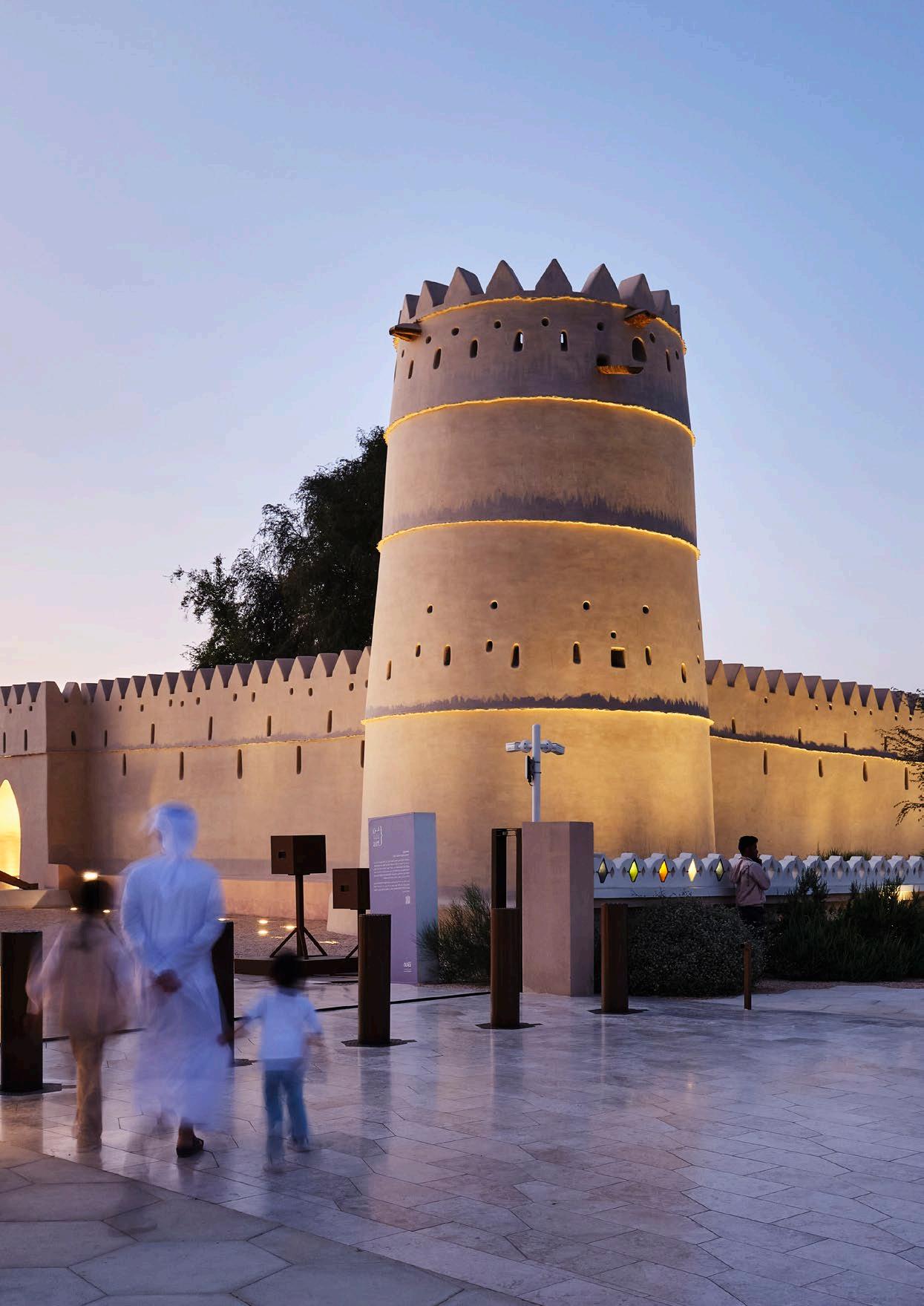
MIDDLE EAST APRIL 2026
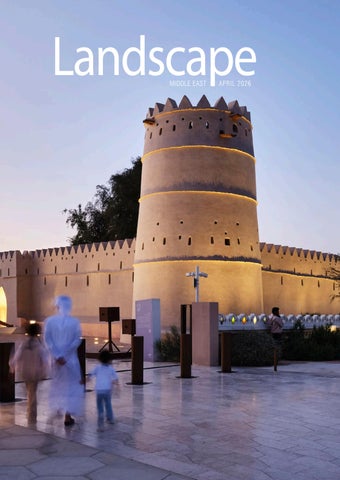
MIDDLE EAST APRIL 2026



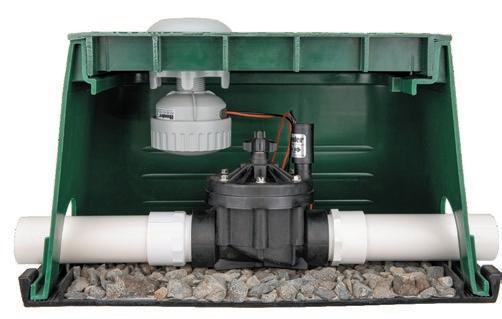
Go wire-free with the Wireless Valve Link! Using advanced radio technology, this innovative system makes it easy to connect valves without running wire or cutting into hardscape. Designed for Hunter ICC2 and HCC Controllers, it saves time and money with simplified installation, quick station expansion, and reduced maintenance. When complex landscapes pose a challenge, go wireless!
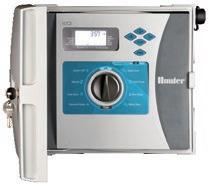
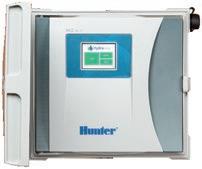
To learn more, visit hunter.info/ WVLem
LANDSCAPE IRRIGATION | Built on Innovation® Learn more. Visit hunterirrigation.com
This month’s issue explores a shift that is becoming increasingly clear across the profession: landscape is no longer something applied at the end of a project. It is being embedded at the core of how environments are conceived, how they perform, and how they endure.
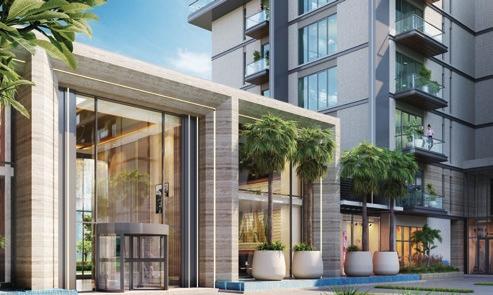
Our lead feature, Wedyan: Where Landscape Becomes Architecture, reflects this change directly. Here, landscape is not treated as an addition, but as a structural and environmental system shaping how the building responds to climate, how it is experienced, and how it performs over time. It sets a clear benchmark for a more integrated approach to residential design in the region.
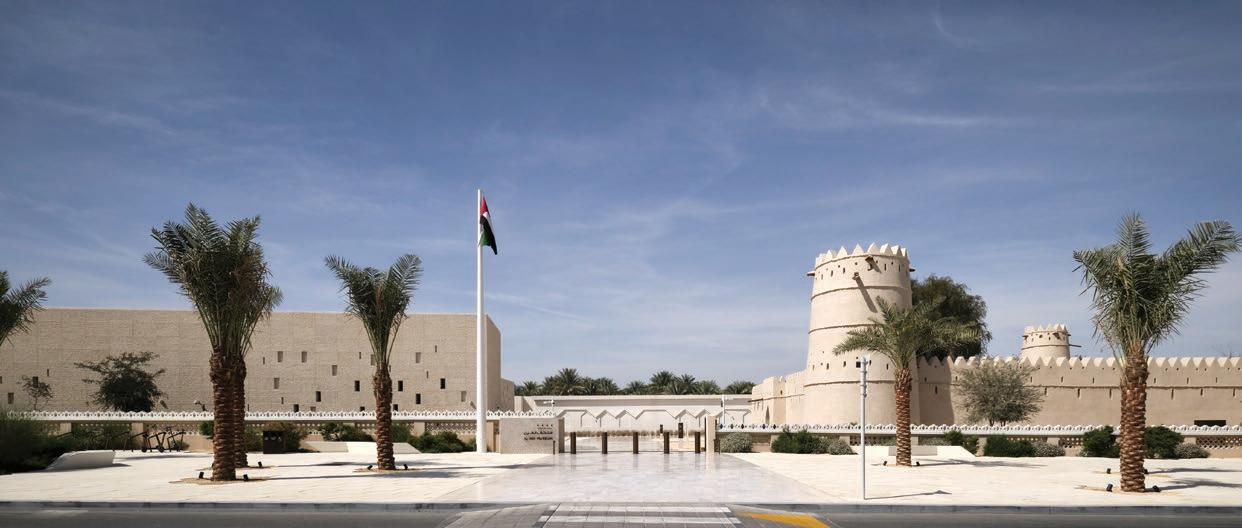
That same thinking continues in very different contexts. At Al Ain Museum, WAHO’s landscape response demonstrates how design can operate with restraint and precision within a heritage setting, where archaeology, architecture, and landscape form a continuous narrative. In Carved by Water, Bödeker Landscape Architects remind us that meaningful intervention begins not with design intent, but with understanding the natural systems already at work.
Elsewhere, the conversation expands into performance and technology. From AI-driven irrigation systems that move from reactive control to predictive intelligence, to the evolving business case for water as both experiential and commercial infrastructure, the role of landscape is increasingly defined by how it performs not simply how it appears.
This issue also reflects on the people behind the delivery. In our interview with Leila Hammami, the focus shifts to the realities of construction, where technical knowledge, preparation, and consistency define credibility and leadership on site.
Across projects, research, and personal insight, one message is clear: landscape is not a layer. It is a system one that shapes behaviour, supports performance, and connects environmental, cultural, and commercial objectives.
This issue brings together a range of perspectives that reflect that evolution. We hope you enjoy the issue.
Managing Partner: Ziad Maarouf Amine
Copy Editor: Phillip Higgins
John Hampton
Administrative Assistance: Sarry Gan
Art Director: Ramon Andaya
Contributors:
Alexandra Williams, Carlos Pissarra, Imran Ashiq, WAHO Landscape Architects, Joel Santosh, Leila Hemmami, Reem Bakir, Tarek Alsheeti
Printed by: Al Nisr Publishing LLC
Webmaster: www.pdinventive.com
Cover:
©JonWallisPhotography
For free subscription and to view the magazine please visit our website: www.landscape-me.com
The First Specialised Landscape magazine in the Middle East
Our magazine is available in app store and google play, search under Landscape Middle East.








The conversation around landscape in the Middle East is evolving and fast. As cities expand and environmental pressures intensify, the need to challenge conventional thinking has never been more urgent. This is exactly the premise behind Landscape Middle East: Conversations That Shape the Region a new webinar series designed to question assumptions, provoke discussion, and address the realities shaping landscape practice today.
Following the launch of the series earlier this year, Episode 2 Just Trees? turned the spotlight onto one of the most visible yet consistently underestimated elements of our built environment: trees.
Hosted by Phillip Higgins, with co-host Annie Baillie, the session brought together consulting arborist Mark Laurence and landscape architect Mona Campbell two professionals with deep, handson experience across the region. What followed was not a typical discussion about planting palettes or aesthetics, but a much more grounded and at times confronting conversation about value, performance, and responsibility.
At its core, Just Trees? asked a simple but important question: are we using trees in the right way?
For decades, trees in many developments have been treated as finishing touches elements added toward the end of a project to soften hardscape or enhance visual appeal. But as the discussion made clear, this approach misses the point entirely. Trees are not decorative. They are critical ecological infrastructure.
From moderating microclimates and reducing urban heat to improving soil health, supporting biodiversity, and enhancing human wellbeing, trees play a fundamental role in how landscapes function. In regions like the Middle East, where temperatures are extreme and water resources are limited, their importance becomes even more critical.
Yet despite this, the gap between knowledge and application remains significant.
The webinar explored the disconnect between design intent and onthe-ground outcomes highlighting recurring issues such as poor species selection, inadequate soil conditions, limited root space,
and improper installation practices. Even more concerning is the lack of long-term thinking, particularly when it comes to maintenance, education, and lifecycle planning.
One of the strongest themes to emerge was the need for a shift in mindset at every stage of a project. From masterplanning through to construction and ongoing care, trees must be considered as part of a broader ecosystem not isolated elements.
This requires more than technical adjustments. It demands leadership—and a commitment to continuous learning.
As highlighted during the discussion, “continuous professional development is so important you must always continue to update.”
In a rapidly evolving field, where understanding of tree physiology, soil systems, and ecological design continues to advance, staying current is not optional it is essential. The session reinforced that landscape professionals must go beyond foundational knowledge and actively engage with new research, practices, and regional insights.
It also highlighted the growing importance of arboriculture as a distinct and essential profession within the industry. As the practice dedicated specifically to the care, management, and long-term health of trees, arboriculture plays a critical role in ensuring trees are not only planted, but properly specified, installed, and maintained throughout their lifecycle.
Designers, developers, contractors, and clients all have a role to play in redefining priorities. Allocating space for trees, investing in soil quality, integrating ecological thinking, and ensuring proper care are not optional extras they are essential decisions that directly impact the success and resilience of a project.
Importantly, Just Trees? didn’t position these challenges as barriers but as opportunities.
Across the region, there are already examples of projects beginning to shift the narrative developments where trees are integrated early, supported properly, and used to shape more livable, sustainable environments. These projects demonstrate what’s possible when trees are treated not as afterthoughts, but as foundational elements of design.
As the Conversations That Shape the Region series continues, the goal remains clear: to create a platform for honest dialogue, practical insight, and collective progress.
Because if there’s one takeaway from Just Trees?, it’s this getting trees right isn’t just about planting more of them. It’s about understanding them, valuing them, and designing with them from the very beginning.
And that starts with knowledge.

NKEY Architects, the international full-cycle architecture and design company, is building on its Dubai-headquartered growth trajectory with more than 250 active projects across the UAE and over 60 completed to date. As regional attention turns to resilience, continuity, and long-term confidence, the firm’s continued expansion highlights Dubai’s role as a stable base for growth, design leadership, and cross-border project delivery.
NKEY’s UAE portfolio spans Dubai, Abu Dhabi, Ras Al Khaimah, and Fujairah, with residential projects accounting for around 80% of current activity, including villas and apartments, while the remaining 20% covers commercial developments across F&B, hospitality, and related asset classes. Alongside interior design solutions, the company also delivers turnkey projects and architectural supervision of construction works, allowing clients to
work with a single partner from concept through to implementation. Luxury real estate projects demand continues to be especially strong in sought-after locations such as Al Barari, Dubai Hills, Emirates hills, La Mer and Palm Jumeirah
The company’s expansion is supported by a growing team of 150+ professionals. From its HQ, NKEY coordinates projects across the UAE, the Middle East, and selected international markets, providing architectural direction, project management, and operational support. The Dubai hub also supports NKEY’s 500 residential and commercial projects across over 45 countries, including highrise projects with real estate developers in Brazil and Canada, a new collaboration in Morocco, and private commissions from Australia. Supporting this growth, the global architecture services market is projected to exceed $605 billion by 2033.
Nataliia Melnyk, Founder of NKEY Architects, said: “Dubai’s steadiness continues to justify our confidence as a long-term
home for NKEY’s global headquarters. It reflects the strength of the local market, the country’s reputation as a safe and reliable destination, and the seriousness with which the city continues to shape its future built environment. We are committed to supporting clients and partners with high-quality design, seamless delivery, and the kind of consistency that helps projects move forward with confidence.”
NKEY continues to expand its operations in Dubai, reflecting the company’s growth strategy and commitment to the region. We will continue to focus on delivering quality projects and services to our clients.
NKEY sees opportunities for further growth in the UAE, both in luxury residential development and in selected commercial segments where design quality, execution discipline, and end-user expectations are rising together. The firm’s priorities across the region to deliver unique architecture and interiors remain consistent, ensuring smooth project execution, maintaining close client relationships, and building long-term partnerships that can scale across markets.
NKEY plans to continue expanding its local team and deepening its contribution to the UAE’s development vision through projects that combine design ambition with practical delivery. With its global HQ now established in Dubai, the firm is well placed to support the next phase of regional growth while serving international clients from one of the world’s most dynamic property hubs.
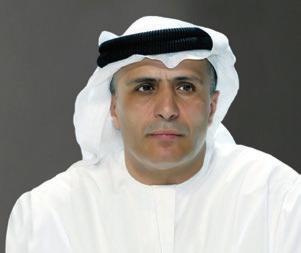
Al Tayer:
• Historic Al Ras Walkway designed to preserve the historic character of the district through a simplified urban design approach for walkways and public plazas
• Development of 12 km of walkways and 5 km of cycling tracks • Rehabilitation of 10 artistic spaces in coordination with Dubai Culture and Arts Authority, with the participation of Emirati and local artists.
• Integration of walkways with 11 metro, public bus and marine transport stations to enhance first- and last-mile connectivity.
• 6,000 km of walkways to be developed across 160 areas under Dubai Walk.
In line with the directives of the wise leadership to position Dubai as a pedestrian-friendly city year-round and deliver a step-change in the quality of walkways and pedestrian facilities across the emirate, Dubai’s Roads and Transport Authority (RTA) has awarded the contract for Phase I of Dubai Walk Master Plan in Al Ras.
The phase covers the development of the Historic Al Ras Walkway, comprising 12 km of walkways and 5 km of cycling tracks, alongside the rehabilitation of 10 artistic spaces in coordination with Dubai Culture and Arts Authority, with the participation of Emirati and local artists.
His Excellency Mattar Al Tayer, Director General, Chairman of the Board of Executive Directors of the Roads and Transport Authority, said: “The Pedestrian Master Plan plays a key role in strengthening Dubai’s global competitiveness in walkway infrastructure and soft
mobility. It also advances a key objective of the Dubai Urban Plan 2040—the 20-minute city—by providing the infrastructure required to enable residents to access more than 80% of essential services within a 20-minute journey.”
“The plan supports Dubai’s Quality of Life Strategy 2033 and contributes to enhancing community wellbeing by transforming Dubai into a pedestrian-friendly city, elevating pedestrian safety standards, and strengthening connectivity between various districts and the existing walkway network. It also integrates creative, aesthetic and cultural dimensions into soft mobility components, reinforces the distinctive identity of urban areas to enhance the emirate’s visual landscape, and contributes to the beautification of public spaces across Dubai.”
“It further strengthens collaboration with strategic partners in advancing creative elements within mobility infrastructure and facilities, while empowering youth and reflecting future mobility trends through their engagement in proposing innovative concepts for the design of walkways and associated amenities,” Al Tayer noted.
The Dubai Walk Pedestrian Master Plan includes the development of a comprehensive structural framework for an integrated, accessible walkway network that meets safety standards and provides a comfortable pedestrian environment. The plan covers the rollout of a walkway network across 160 areas, including the delivery and enhancement of 6,000 km of walkways across the
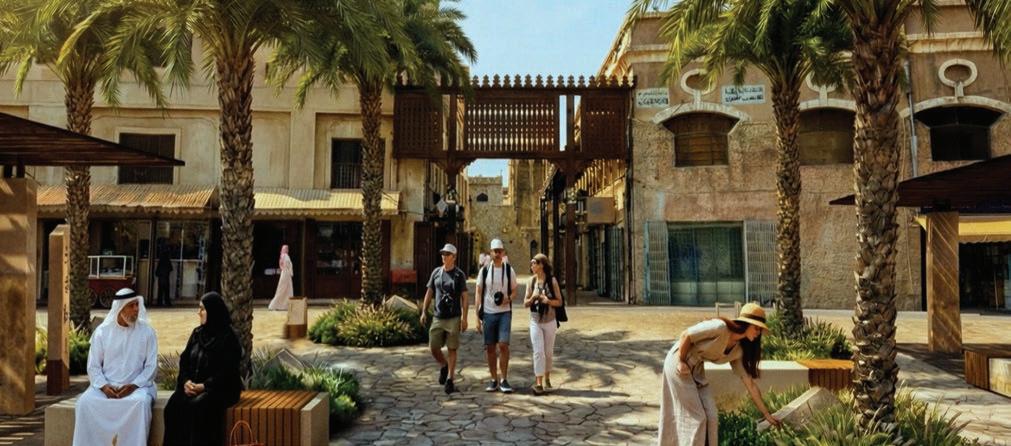
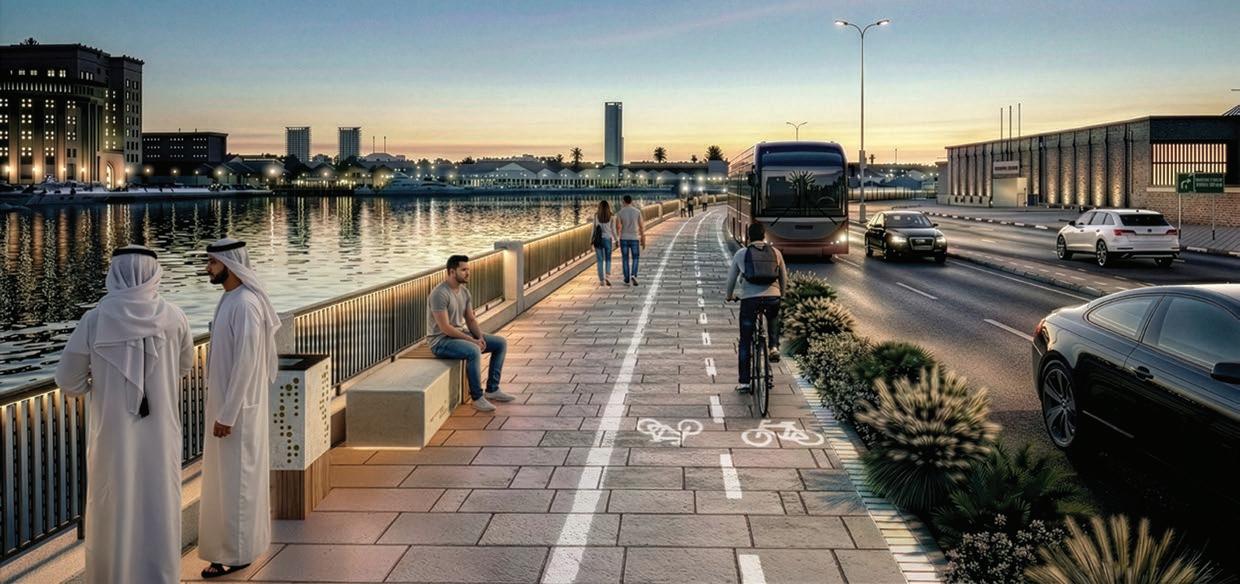
emirate by 2040. It also provides for the construction of 110 pedestrian bridges and underpasses to strengthen connectivity between districts, with the aim of increasing the share of walking and soft mobility trips from 16% in 2025 to 25% by 2040.
The Historic Al Ras Walkway project includes the development of 12 km of walkways and 5 km of cycling tracks. The walkway will connect key heritage landmarks across the area, most notably Al Ahmadiya School, Sheikh Saeed Al Maktoum House, Al Ras Public Library, Al Fahidi Fort, and Al Shindagha Historic District. It will also be integrated with public transport, including 11 metro, public bus and marine transport stations, to enhance first- and last-mile journeys, encourage residents and visitors to use public transport, and provide a distinctive mobility experience across the area.
The project covers the enhancement of internal walkways and the waterfront walkway through simplified urban design solutions that preserve the historic character of the area. The scope includes widening pedestrian pavements, introducing shading structures, providing seating areas, expanding green spaces, and implementing wayfinding systems designed in harmony with the district’s heritage context.
The project also includes the rehabilitation of 10 artistic spaces. RTA will coordinate with Dubai Culture and Arts Authority, with the participation of Emirati artists, to showcase a diverse range of artworks, including murals and sculptural installations. This will be complemented by the application of advanced architectural lighting techniques that highlight the area’s history and cultural identity. Joint initiatives between the two entities will further activate the walkway and revitalise the surrounding spaces through continuous artistic programmes and seasonal events following the completion of the project.
It is worth noting that the Pedestrian Master Plan includes the development and enhancement of more than 6,000 km of walkways, forming a seamless and interconnected network across
the emirate. The first phase of implementation is scheduled between 2025 and 2027, with subsequent phases to be delivered progressively from 2027 through to 2040.
The plan also provides for the construction of 110 pedestrian bridges and underpasses to strengthen urban connectivity. Key components include a pedestrian bridge on Al Ittihad Street linking Al Nahda and Al Mamzar, a bridge on Tripoli Street connecting Al Warqa’a and Mirdif, a bridge on Al Khawaneej Street linking Mushrif and Al Khawaneej, and a bridge on Dubai–Al Ain Road connecting Dubai Silicon Oasis and Dubailand.
The project further supports comprehensive connectivity between key destinations, public facilities and various modes of transport, while reinforcing the distinctive identity and artistic character of walkways through area-specific design concepts. This is reflected in the use of diverse forms, colour schemes, lighting elements and landscaping features, enabling pedestrians to experience a clear transition from one district to another.
Walkway design prioritises enhancing the pedestrian environment through the integration of complementary urban elements that contribute to the overall beautification of the city. These include intensified planting and shading along walkways, the introduction of misting systems to mitigate heat, and provision of interactive walkways incorporating digital screens, signage, ground graphics, and recreational and fitness equipment that encourage both residents and visitors to walk.
The project also provides rest areas and designated commercial investment spaces, ensures barrier-free access to walkways, and enhances pedestrian safety standards. In addition, it introduces a high-quality wayfinding system distinguished by innovative ground markings, directional signage, sustainable lighting solutions, integrated pavements and public art installations. The walkways will also be integrated into navigation systems and smart applications.
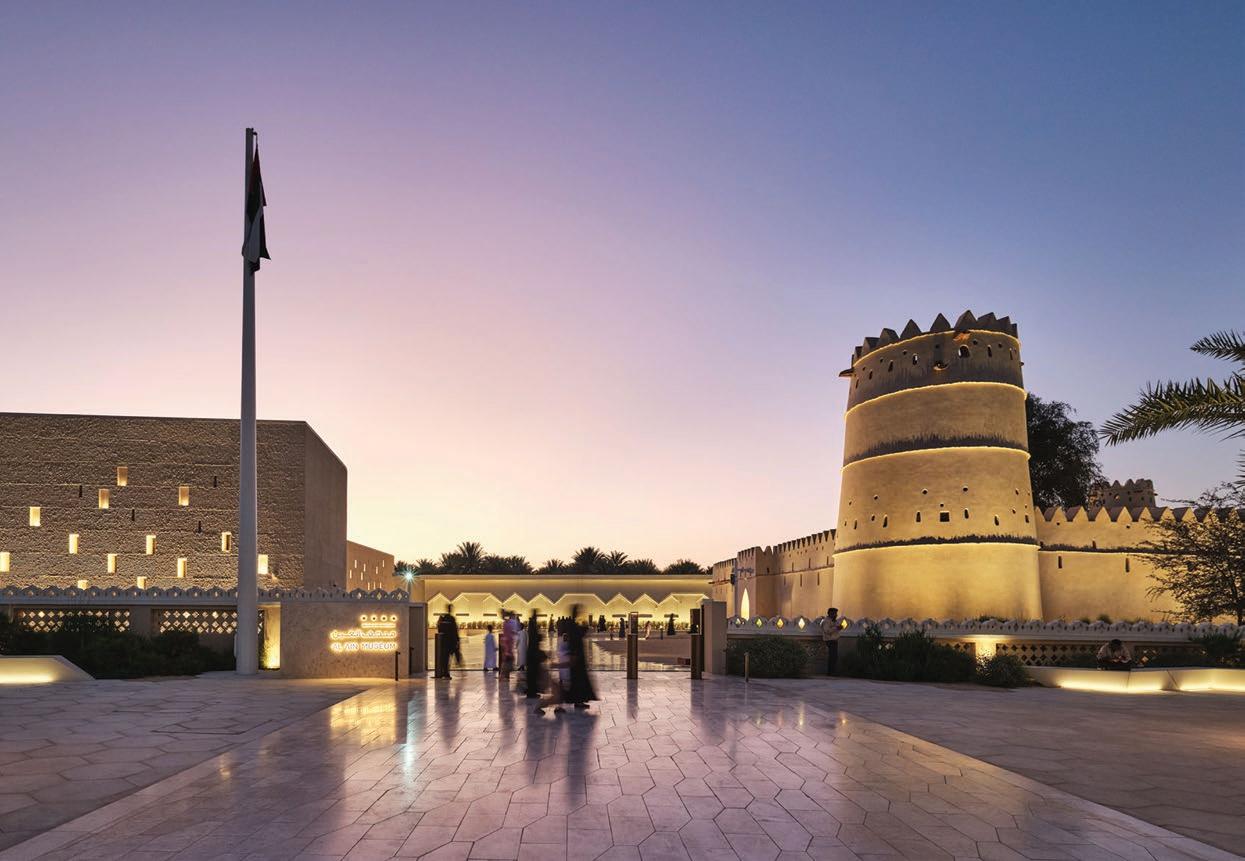
In a region that often looks forward at breakneck speed, Al Ain Museum asks visitors to look down into the ground, into memory, and into the layers of civilisation that shaped the UAE long before glass towers and global headlines. Originally opened in 1969 under the vision of the late Sheikh Zayed bin Sultan Al Nahyan, the museum was the nation’s first formal cultural institution, established to safeguard and interpret the archaeological and ethnographic story of Al Ain and its surrounding region.
Following an extensive restoration and redevelopment programme, the museum reopened in 2025 with renewed architectural and curatorial ambition. Led by Dabbagh Architects under the direction of Sumaya Dabbagh, and landscape design by WAHO Landscape Architechs, the project evolved far beyond a conventional refurbishment. During redevelopment, new archaeological discoveries were made beneath the site an unexpected development that fundamentally altered the design trajectory. Rather than treating these findings as constraints, the architectural response was to build around them, weaving new structures and spatial sequences into the historic fabric.
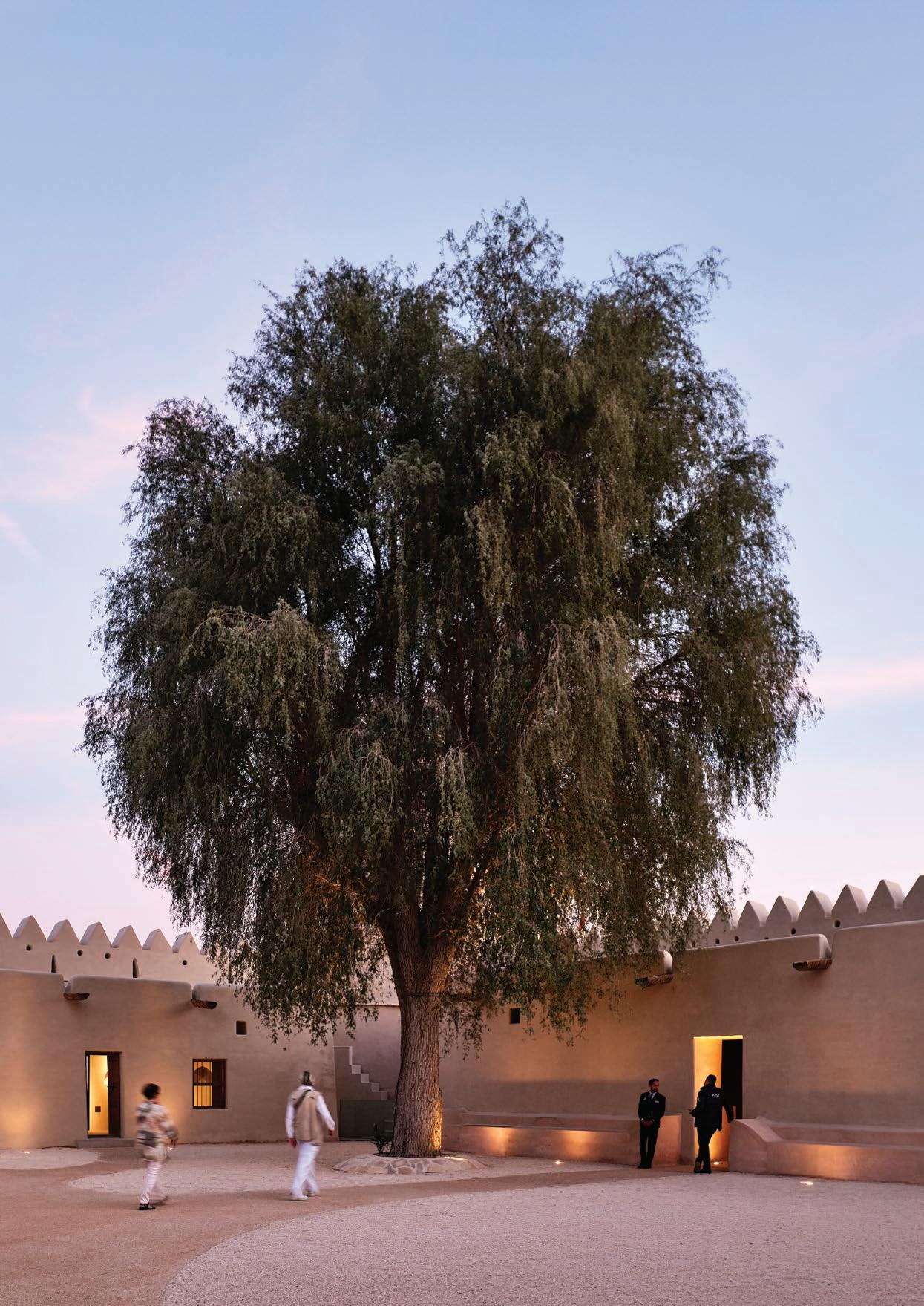
Externally, courtyards and open spaces are carefully carved from the architectural mass, maintaining a visual dialogue with surrounding heritage structures and reinforcing the museum’s role as a gateway to the Cultural Sites of Al Ain, recognised as a UNESCO World Heritage Site.
Internally, galleries dedicated to aflaj irrigation systems, tombs and wells position archaeology at the centre of the visitor journey. Elevated walkways and bridges provide contemplative vantage points, allowing guests to experience the excavations both intimately and panoramically.
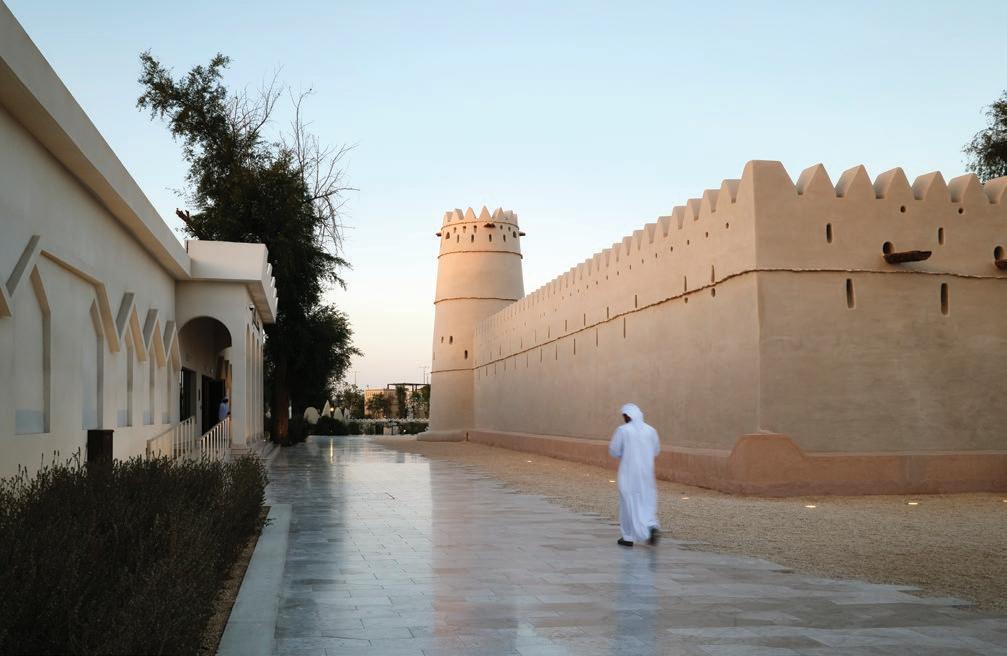
Situated at the edge of the oasis landscape that enabled long-term settlement in this desert environment, the museum functions as more than a repository of artefacts. It serves as an interpretive threshold connecting built form, water systems, settlement patterns, and social history. Yet architecture alone does not define the experience. Located within one of the most culturally layered landscapes in the Emirates, adjacent to oasis systems, historic forts, and archaeological remains dating back thousands of years, the external environment carries
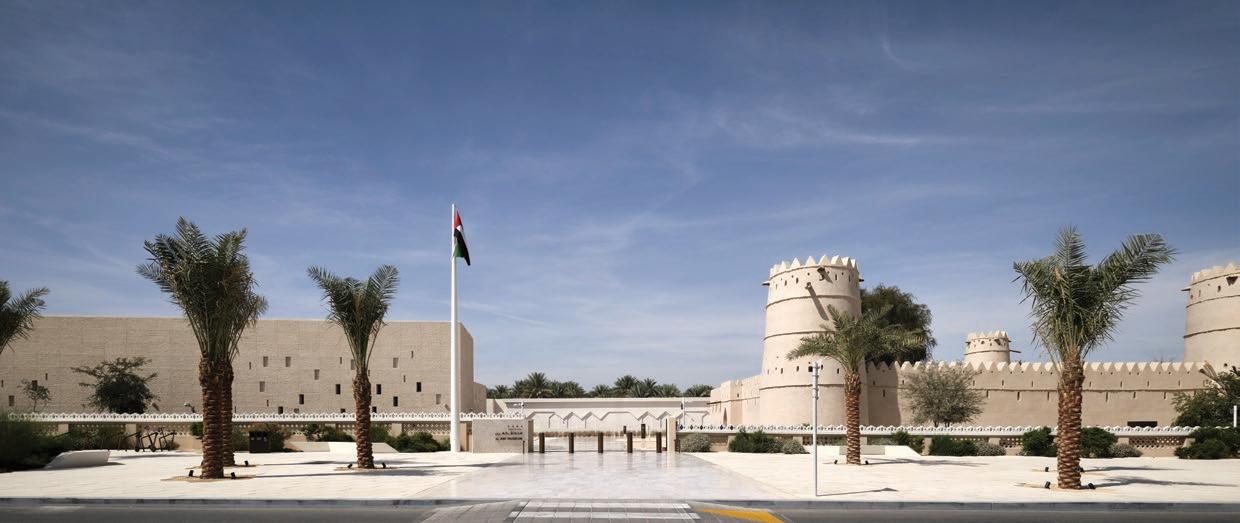
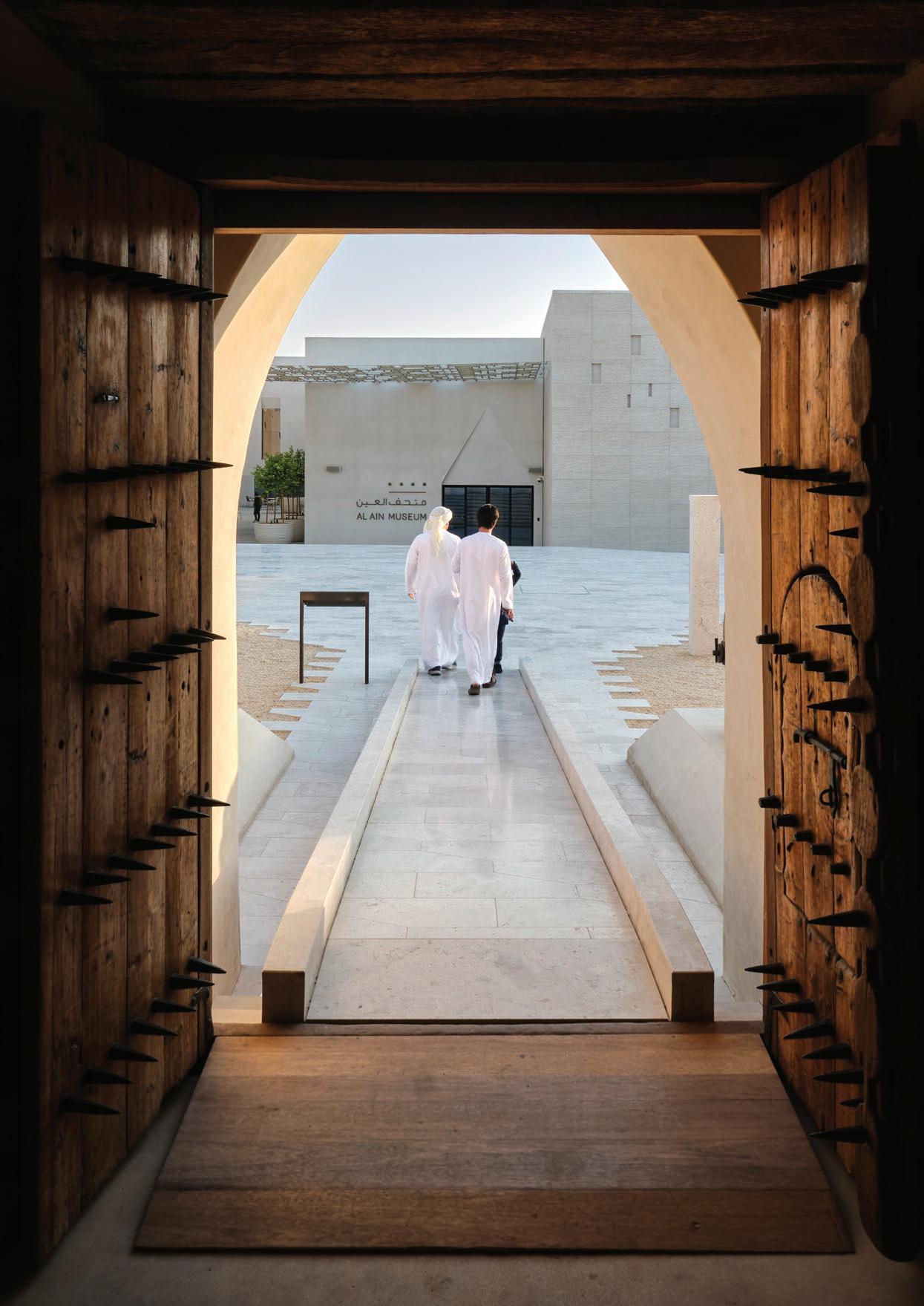
equal narrative weight.In conversation with Sam Spinks, Managing Director of WAHO Landscape Architects, we explore how the landscape was reshaped in response to archaeology, climate, memory, and movement ensuring it acts not as a backdrop but as connective tissue between past and present.
When you were first appointed to the project, what was your response to the archaeological discoveries beneath the site and how did that reshape your strategy?
The discoveries weren’t part of the original brief. We had completed the full design including IFC documentation and construction had already begun when a preliminary archaeological survey revealed significant findings.
At that point, everything changed.
The initial concept had been a contemporary intervention responding to the historic structures already on site. Once the archaeology was uncovered, the brief was fundamentally redefined. The archaeology became the hero of the project. We essentially started again new brief, new spatial logic with the landscape responding directly to what was discovered beneath the ground.
The architecture carefully weaves around historic remnants. How did you ensure the landscape complemented rather than competed with that narrative?
The discoveries altered the geometry and organisation of the project, but they also enriched it.
Our approach was to express the archaeology subtly within the landscape through materiality and detailing. The historic plot boundary wall is referenced through a fine metal inlay within the paving. The former Harat Al Hosn village is suggested through a sandblasted granite texture a quiet shift in surface rather than a bold visual statement. The wells and falaj alignments are inscribed into the ground plane so visitors can read those historic systems as they move through the site.
Inside the foyer, the wells are celebrated as part of the museum experience. Through carefully positioned slits in the façade, visitors can look outward and trace those alignments into the landscape. That visual continuity connects interior interpretation with the broader historic site.
Given the proximity to Al Ain Oasis and its UNESCO-listed context, how did you approach irrigation, planting and shade?
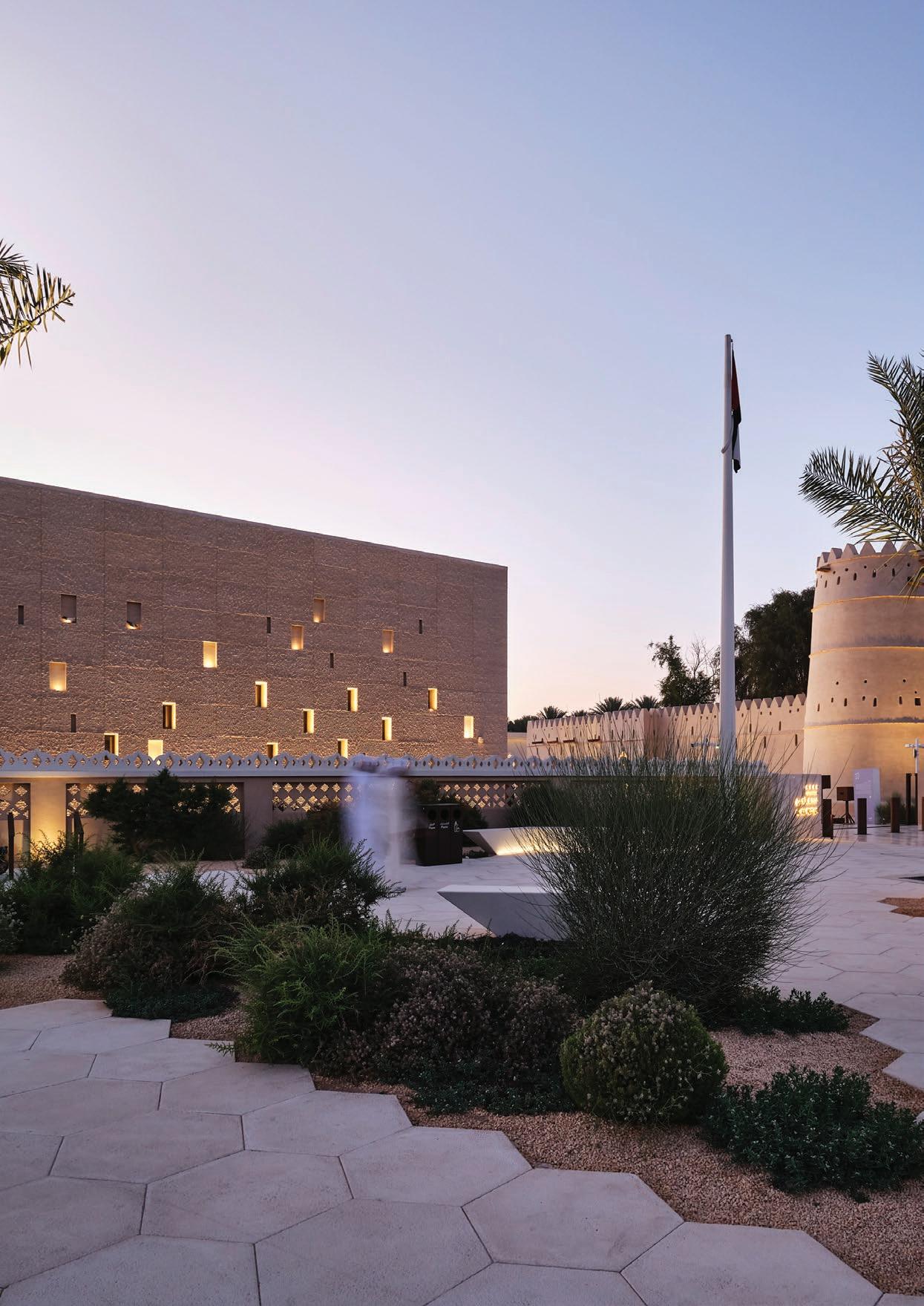
As with all projects the preservation of water and considered use of irrigation is important but overlayed onto this was the requirement to ensure that any introduced irrigation did not negatively affect the archaeological remains beneath the site. That required careful coordination of planting locations, controlled irrigation strategies, and waterproofing considerations. The planting palette is predominantly native and regionally appropriate species resilient, low water-use, and aligned with the character of Al Ain. It’s intentionally
restrained. The goal wasn’t to create something lush or ornamental, but to reinforce the authenticity of place.
Courtyards play a central role in the architecture. What role do they serve in shaping microclimate and visitor experience?
The courtyards reference traditional village typologies protective outer walls enclosing internal spaces that offered safety, food, and respite from the climate.
We translated that into the landscape through fruit-bearing trees such as pomegranate and citrus symbolic of arrival and provision. Historically, once you entered the courtyard, you had reached safety: shade, water, food, rest. We wanted visitors to feel that same psychological shift from exposure to enclosure.
Large planters, integrated seating, and shaded café spill-out spaces activate these areas. Lighter-toned Omani limestone contributes to thermal comfort and softens the hardscape’s character. Together, the courtyards offer moments of pause within the museum’s broader cultural journey.
From a technical perspective, what was the greatest challenge in working on such a heritage-sensitive site?
Once the archaeological remains were excavated, they became untouchable. They took absolute priority. No services could pass through them no MEP, no fire systems which created complexity in coordinating infrastructure around protected zones.
The challenge was balance. The archaeology was the hero, but the site still needed to function as a welcoming public space. Shade, trees, and comfort were essential. Achieving that without compromising the integrity of the historic findings required careful calibration at every stage.
Looking back, what aspect of the landscape are you most proud of?
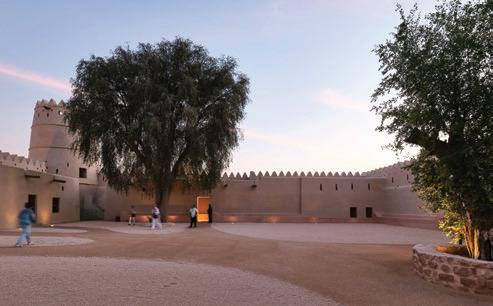
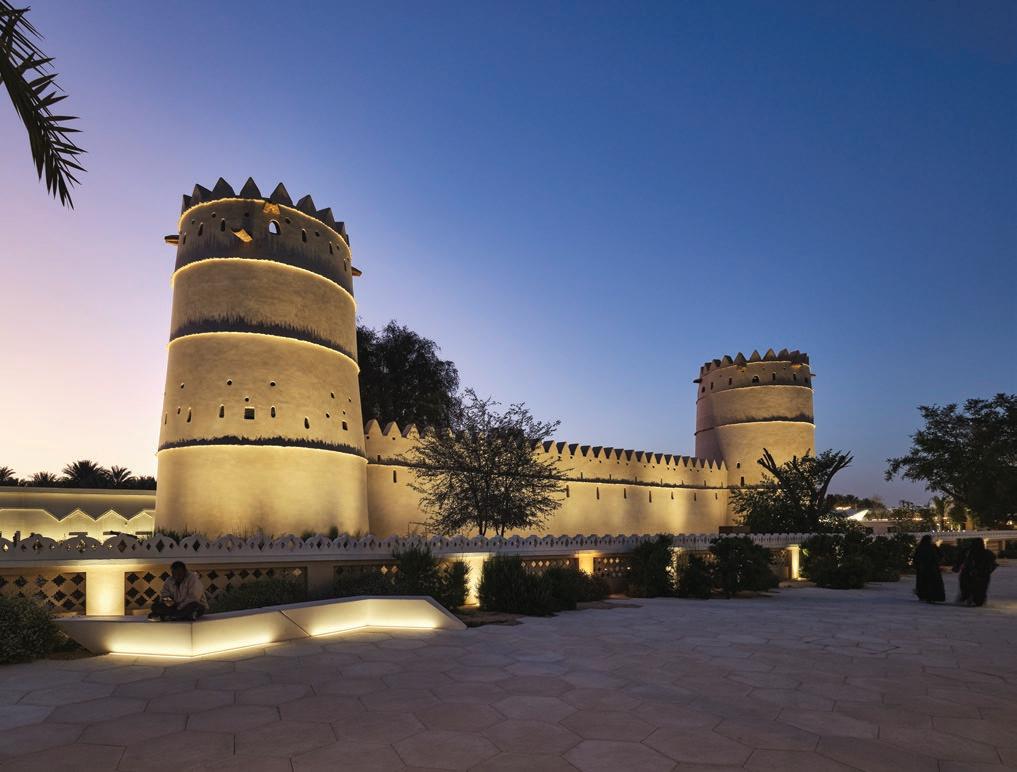
The seamless integration across the site. You have Sultan Fort, the original museum building, and the new museum intervention. We approached the landscape as a connective fabric a layer that gently wraps these elements together.
There’s a permeable gravel zone around the Fort that allows it to breathe visually. That transitions into irregular paving edges and then into the more structured museum spaces. These subtle gradients create cohesion without overpowering any single element.
The landscape’s role is not to dominate, but to unify reinforcing continuity between heritage and contemporary intervention.
Together, the architectural vision of Dabbagh Architects and the landscape response by WAHO demonstrate how contemporary design can operate with humility and intelligence within a heritage context. Rather than competing with history, archaeology, architecture, and landscape operate as a unified narrative, each reinforcing the other. In doing so, Al Ain Museum stands not only as a renewed cultural institution, but as a carefully calibrated dialogue between past and present, where design becomes an act of stewardship as much as expression.



By: Imran Ashiq Land Art Studio
LAND ART STUDIO
At Land Art Studio we provide the best in creative design, for Landscape Architecture. Our design culture and works evolve around the importance of understanding people and the environment. Our growing team is driven by the desire to create places and destinations that inspire dynamic change in people’s lives. With our extensive experience in working on projects in the Middle East, our creatives have always put unique and practical solutions at the forefront of design.
LUXURY RESIDENTIAL DEVELOPMENT AL KHOBAR, SAUDI ARABIA, AL KHOBAR
Al Khobar, its bustling heart. It flips the script on traditional city status, flaunting everything from a glittering skyline to a sandy coastline. Its big waterfront promenade, the Khobar Corniche, is your go-to for strolls – you can see the ornate Water Tower, overlooking the shore from its own man-made island. If you want to take a dip – you’ll definitely be tempted – then Half Moon Beach is the place to be. Its
shallow, calm waters have a high salt content, making for effortless floating. Other top attractions include the Sultan Bin Abdulaziz Science & Technology Center (SciTech), with an aquarium, interactive displays and an IMAX theatre.
The luxury development is strategically positioned along Al-Quds Street in the Al Jawahra district, making it easily accessible from all parts of Al Khobar. It’s adjacent to the Green Belt district, providing a serene and peaceful ambiance.
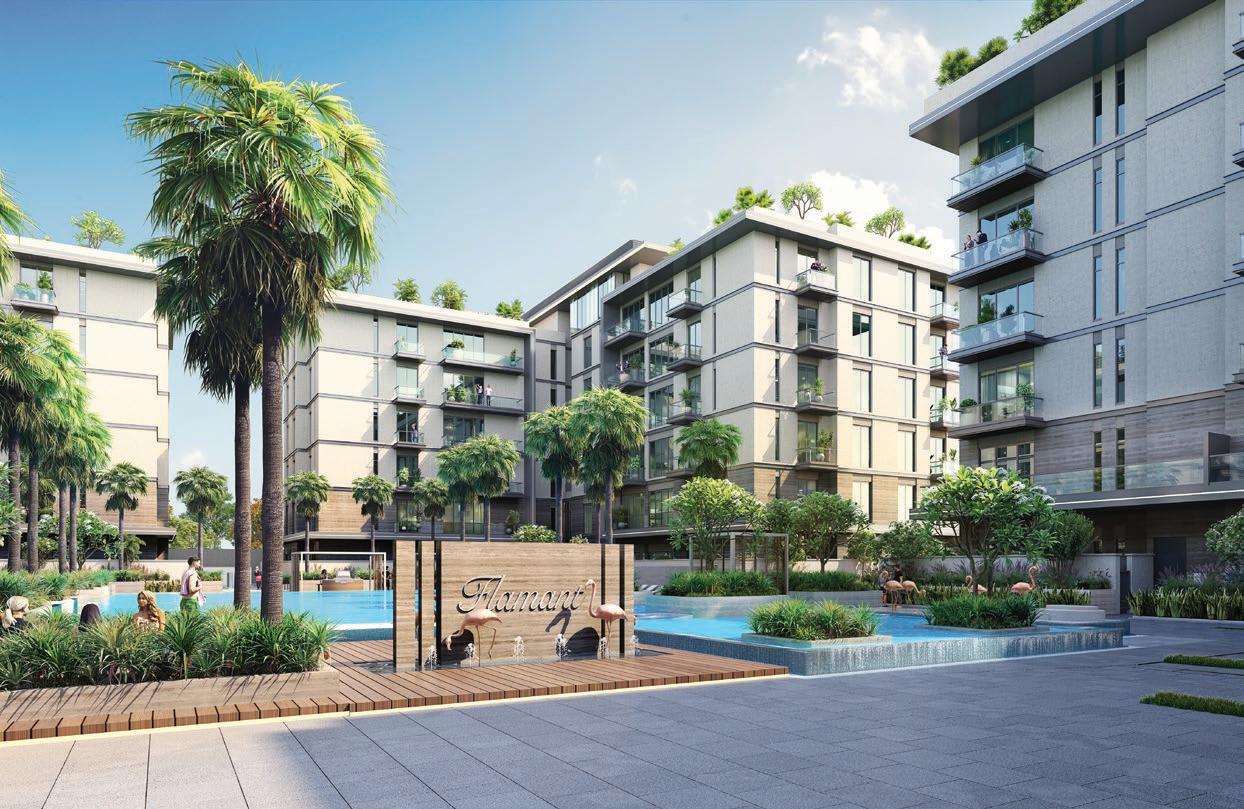
Land Art Studio were appointed for the Landscape Design for a collection of four mid-rise buildings, spanning across six floors, including the ground floor and five standard floors from 1 to 5, and a top floor. Designed to cater to varied tastes and requirements, the project offers a range of one-bedroom apartments
to expansive four-and-a-half bedroom residences. Each apartment is meticulously designed to strike the perfect balance between opulence and comfort tailored to your individual needs.
Landscape Design in Saudi Arabia increasingly integrates, respects, and preserves cultural heritage by blending traditional elements with modern sustainability. Key approaches include using native, drought-resistant plants (xeriscaping), creating private, shaded, and intimate spaces (like majlis-style, courtyards)
Land Art Studio wanted to create spaces aimed at enhancing social interactions, recreation and the overall living experiences whilst understanding the cultural and environmental impacts.
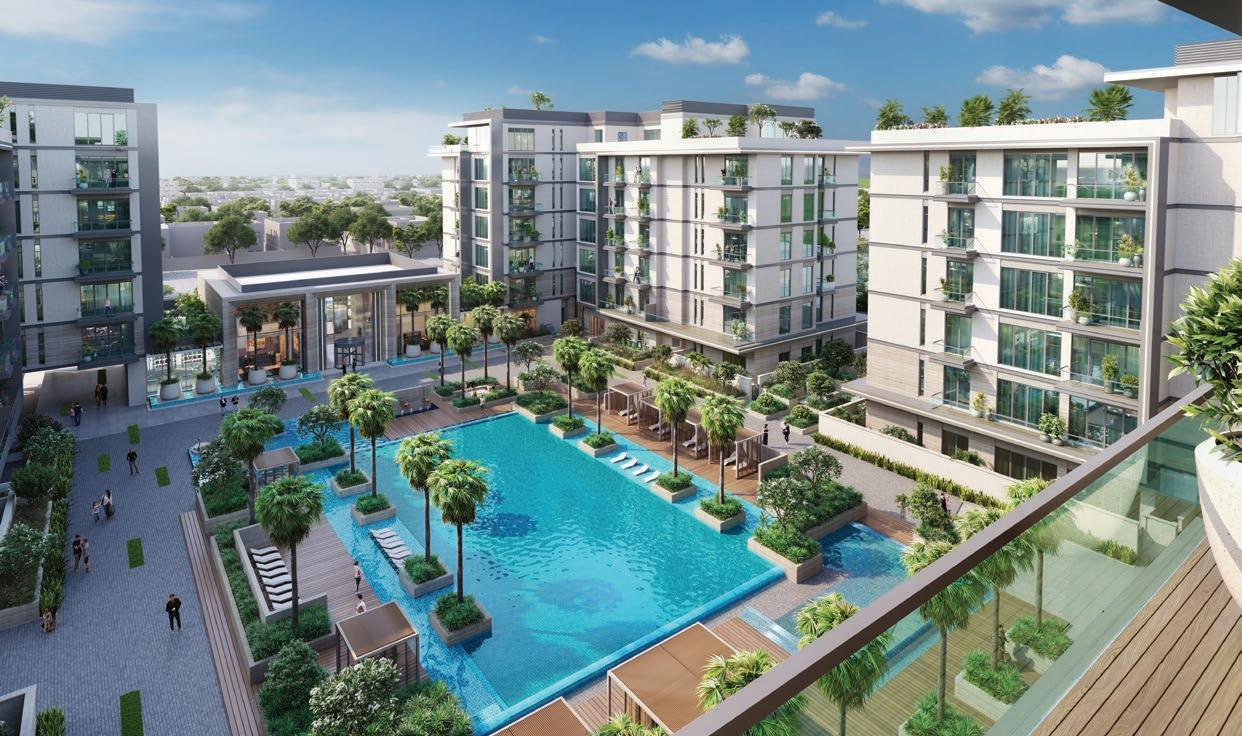
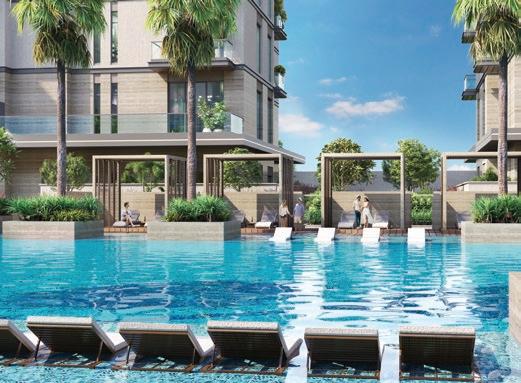
The Landscape Design favors restraint and intention. Courtyards invite reflection, water elements offer subtle movement, and shaded pathways encourage unhurried strolls, all reflecting a cultural appreciation for hospitality, privacy, and connection to nature. Materials are chosen not for excess, but for authenticity—stone, wood, and earth tones forming a palette that feels both timeless and dignified. The landscape does more than frame residences; it tells a story. It is a contemporary interpretation of national identity, where heritage is honored through detail, taste is expressed through simplicity, and culture is felt in every quiet corner.
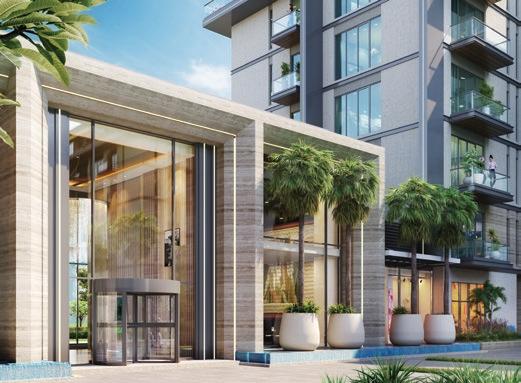
The landscape design boasts a plethora of unique features, including an outdoor swimming pool, water features, a flamingo statue, “Afaj” water feature, main pool, shallow pool, children’s pool, diverse sports areas, family zones, cabanas, and water fountains spread across the four buildings. Other facilities include a mini-mart, an outdoor terrace café, a reception desk, a nursery, a multipurpose hall, indoor and outdoor children’s play areas, a games room, coworking spaces, and a prayer room.
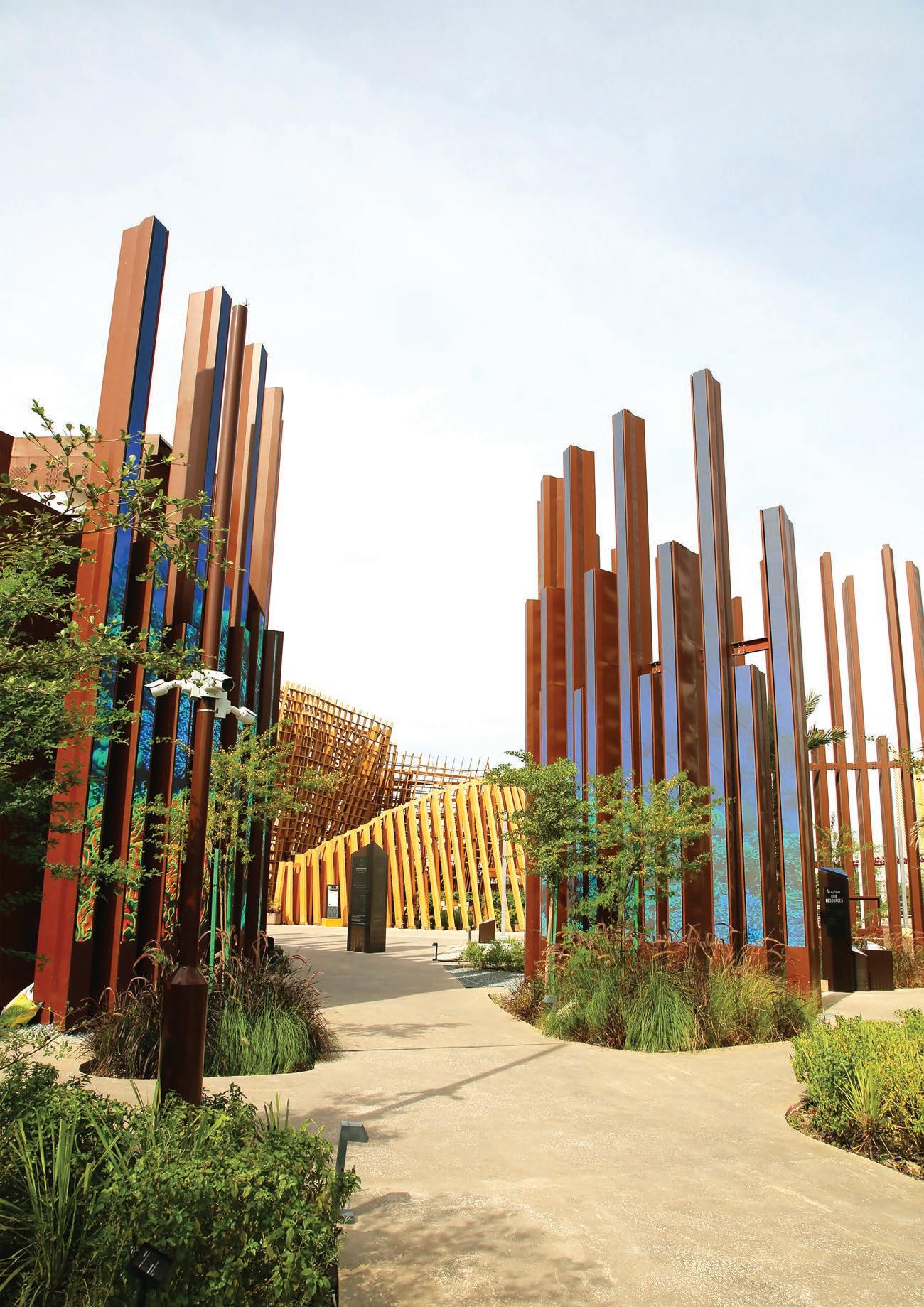
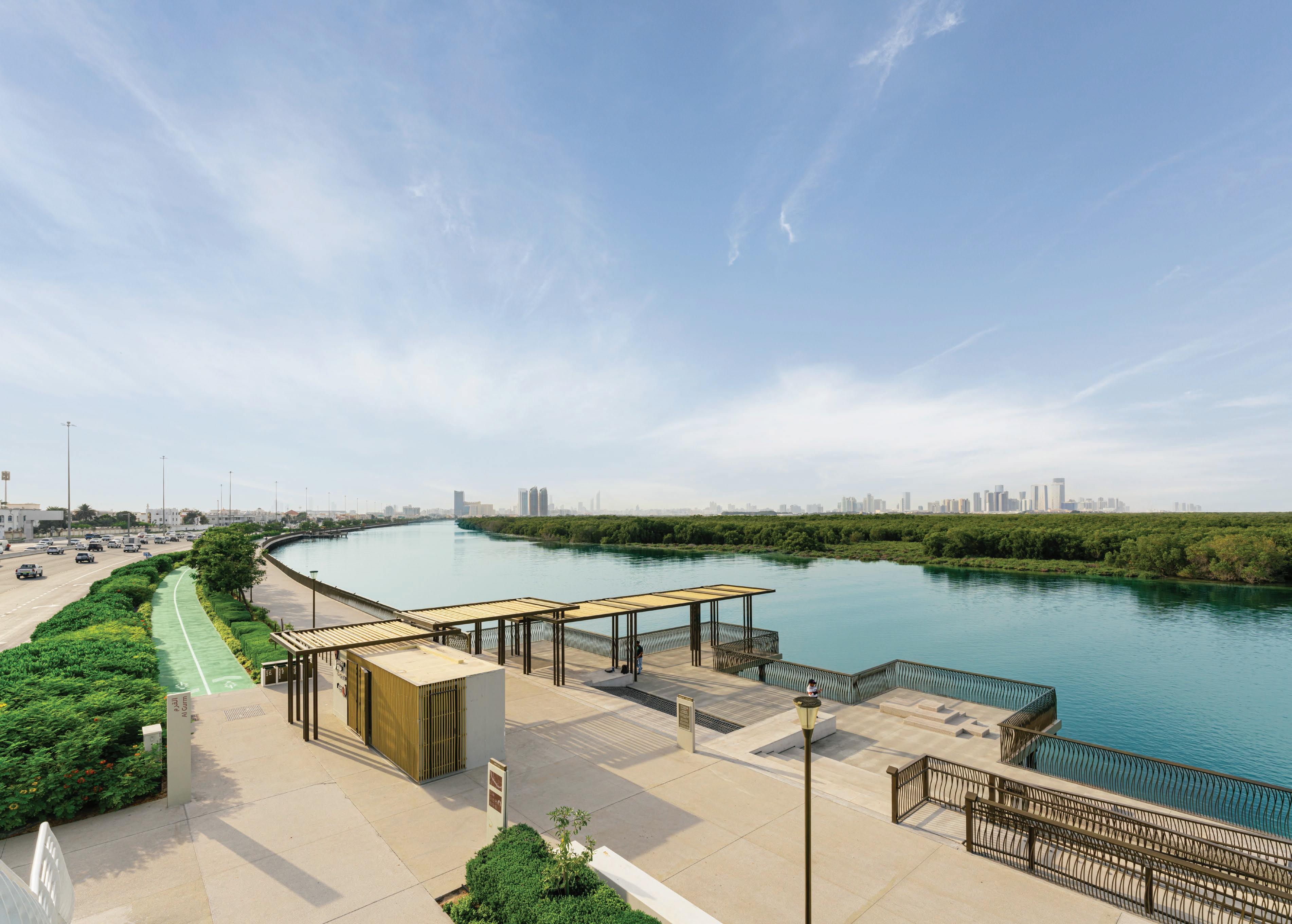
Reem Bakir, Landscape Architect & Content Strategist; Ulrich Riederer, Partner & Landscape Architect
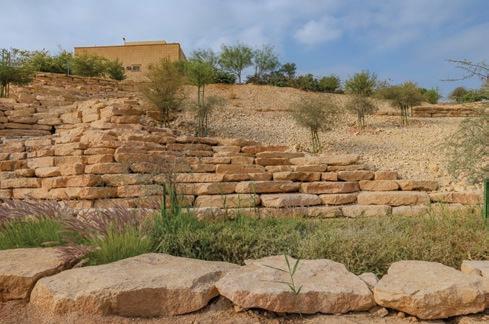
Wadis are among the most overlooked opportunities in the urban environment. At first glance, they appear to be leftover spaces between developments, too irregular to build on and too unpredictable to manage. In reality, they are something far more compelling—active geological systems, continuously shaped and reshaped by water, sediment, and gravity. When properly understood, they offer something far more valuable—the ecological and hydrological backbone of desert cities and valuable spaces for public realm.
Across Saudi Arabia, from Wadi Ghudwana, Wadi Hanifah, and Wadi Sulai in Riyadh to Wadi Al Aqeeq in Madinah, these landscapes are defined by the same underlying forces. They are not static voids but evolving systems, formed through episodic flood events that carve, transport, and deposit material over time. Each wadi has its own scale and character, but the logic behind them is consistent. Understanding that logic is the starting point for any meaningful design intervention.
In wadis, erosion is best understood as a chain of connected processes—such as rainfall, runoff, sediment transport,
channel cutting, and slope retreat - rather than a single isolated event. Each process reinforces the others over long periods of time through repeated flood events. These forces carve escarpments, deepen channels, and create the distinctive landforms seen across the region which form part of the natural heritage.
At bends, faster-moving water concentrates along the outer edge, cutting into the slope and forming what is known as a cut bank — exposed, often unstable ground subject to ongoing erosion. On the inner edge, where flow decelerates, sediment settles to create a slip-off slope: gentler, more stable ground that accumulates over time. This continuous exchange between erosion and deposition, driven by the mechanics of helical flow, shapes the structure of the wadi itself.
In locations such as Wadi Sulai, these processes remain clearly visible, offering a natural record of how the landscape evolves. This is not abstract theory—it is a working system that continues to operate with every rainfall event. The more deeply these dynamics are understood, the more meaningful and responsive design within these environments will become.
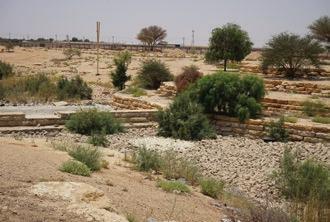
Erosion, Deposition and Soil Formation
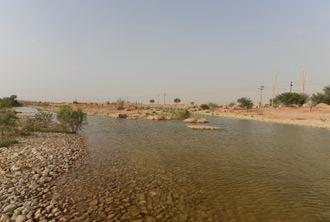
Erosion alone tells only part of the story. Its counterpart, deposition, is what allows these landscapes to support life.
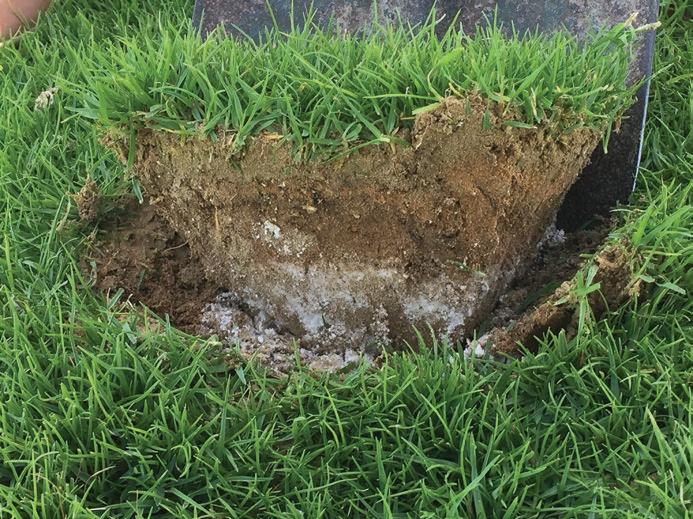
As water slows, it drops the sediment it carries. Over time, this accumulation builds layers of alluvial soil that retain moisture, support vegetation, and create the most fertile zones within arid environments. Historically, Saudi Arabia’s agricultural heartlands developed along wadis, productive land shaped by repeated cycles of flood, sediment movement, and deposition.
Erosion and deposition are two sides of the same process. One sculpts the land, the other builds it—together determining not just how a landscape looks, but what it can sustain.
For designers, this relationship is important. Left unmanaged, erosion strips land faster than it can recover, removing not just soil, but the capacity for life itself. Guided correctly, however, the same forces can be harnessed to stabilise landforms and build fertile ground, laying the foundation for long-term ecological performance.
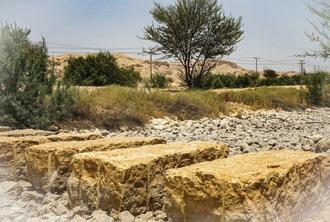
Where natural systems meet urban development, a more layered and complex story begins to unfold. The energy behind these natural processes is what makes wadis such dynamic and compelling environments to design within. In Wadi Ghudwana, for example, prior to restoration, erosion threatened nearby homes following heavy rain events.
However, erosion is not inherently a problem, what matters is the context in which it takes place. Water is not the enemy, resistance is. The moment design stops fighting the natural behaviour of wadis and starts working with it, the same forces that once caused problems become the foundation of something far more resilient. Wadis cannot be engineered out of existence. They can only be understood, carefully guided, and accommodated.
Landscape architecture in wadis is not about eliminating natural processes; it is about working with them. Design becomes a
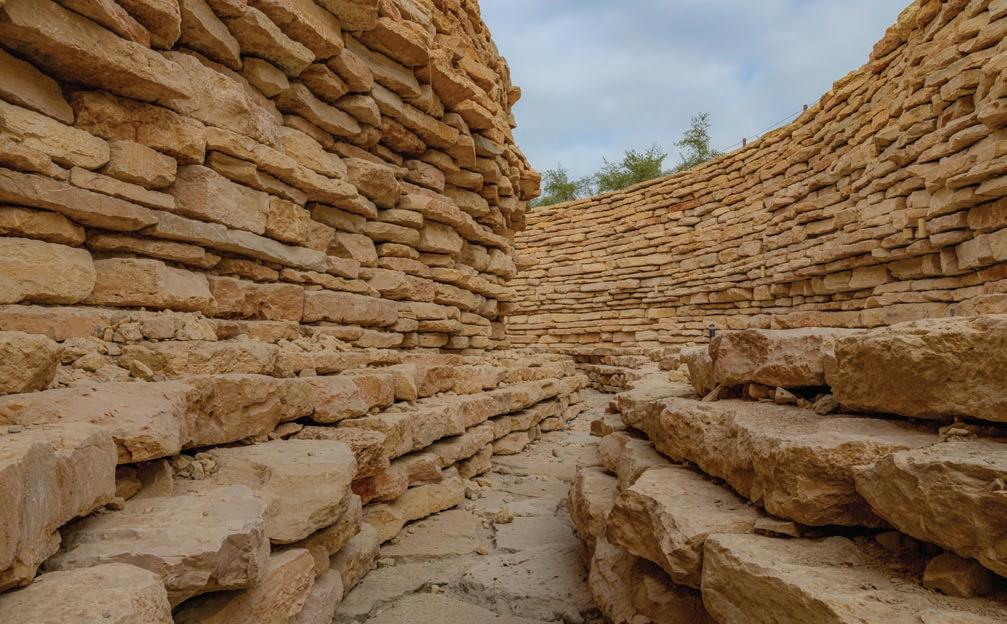
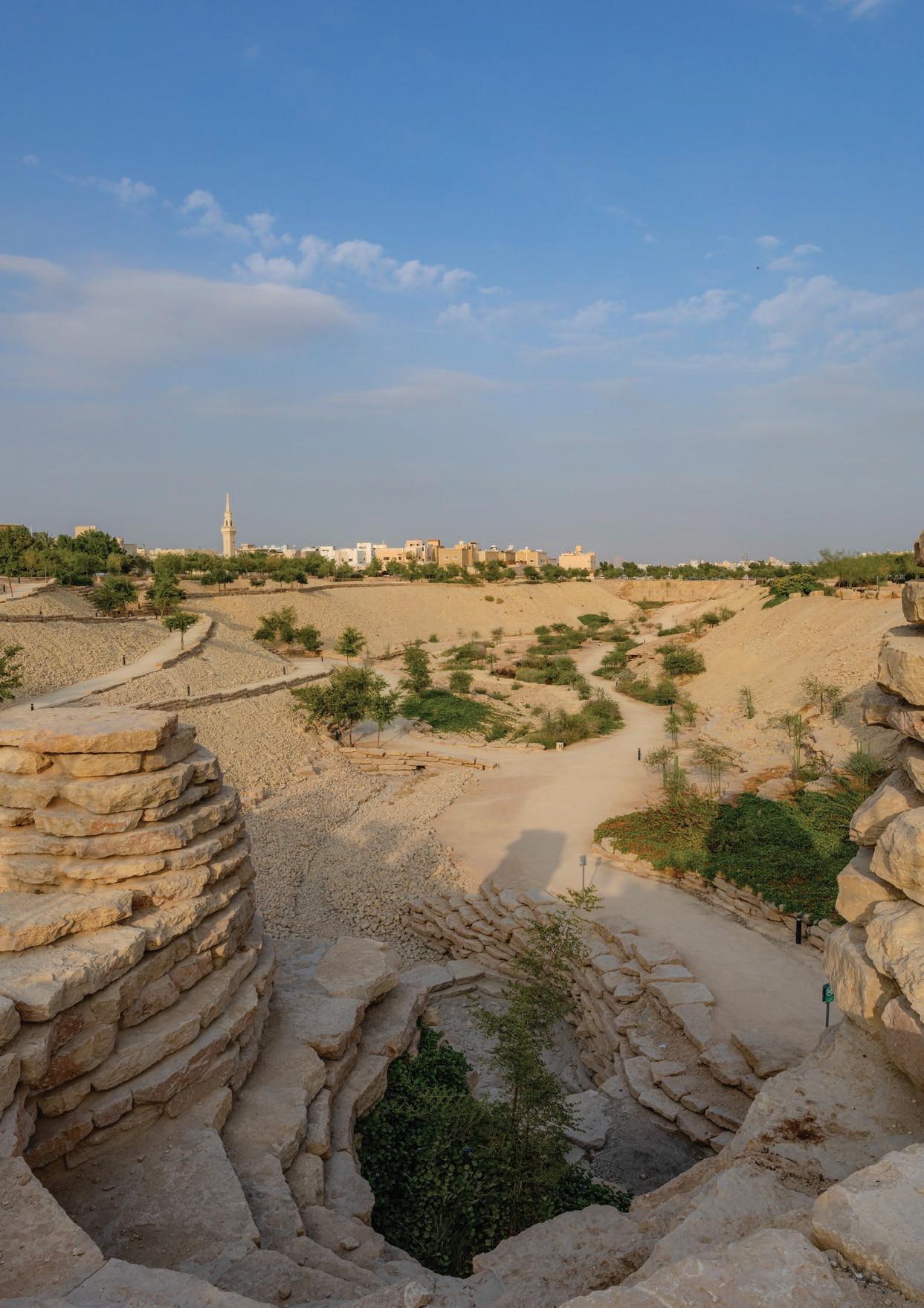
mediator between water and the built environment, shaping how flow moves through the landscape rather than attempting to stop it. In practice, this means aligning with the system’s natural behaviour.
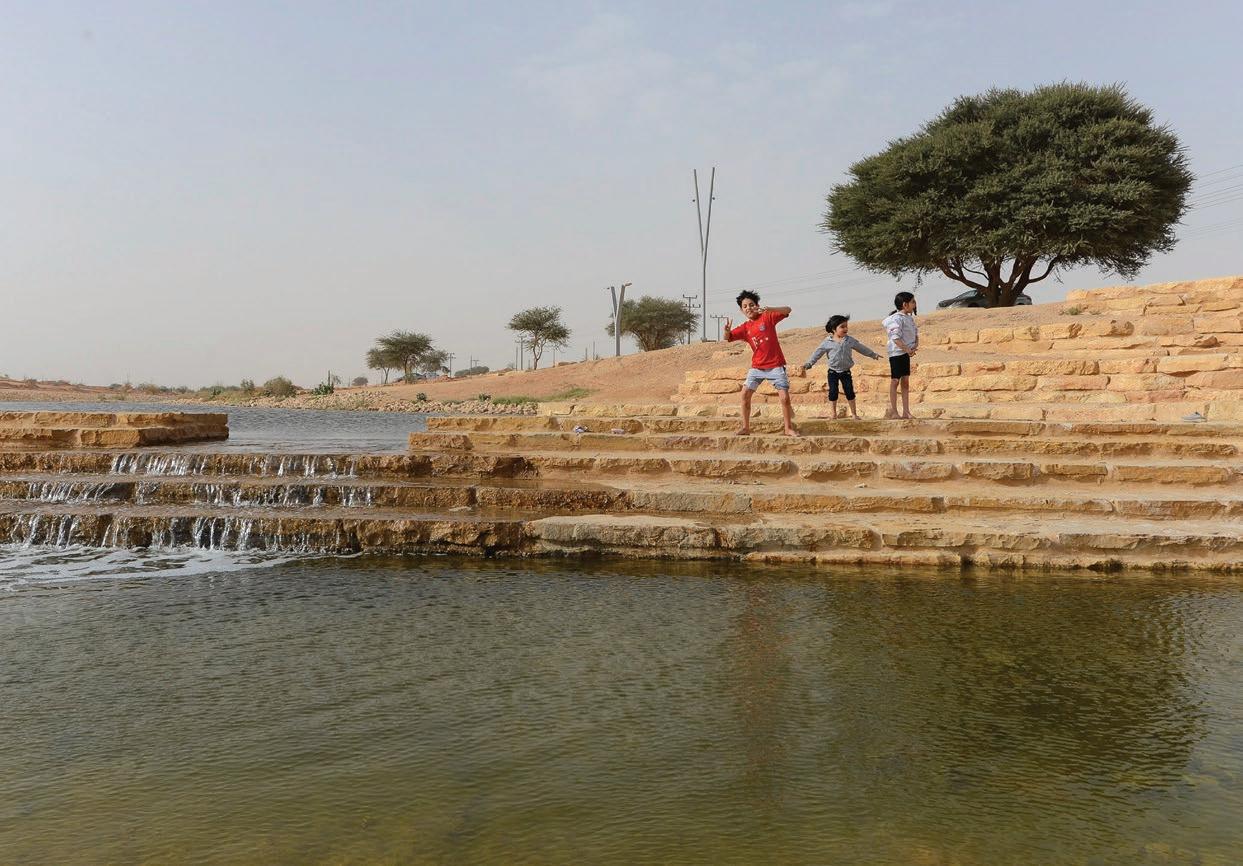
At Wadi Ghudwana, this approach is clearly evident. Instead of diverting water away from the site, the design guides it through the landscape—allowing it to slow, spread, and infiltrate. The result is not an engineered channel, but a functioning system that reads as natural while operating safely within an urban context.
This approach is not site-specific. The same principles apply across Riyadh’s wider wadi network. In Wadi Hanifah, they operate at a much larger scale across an extended floodplain. In Wadi Sulai, the dynamics of cut banks and slip-off slopes offer a clear demonstration of how flow actively shapes landform. In Wadi Al Aqeeq in Madinah, the same interplay of erosion, deposition, and seasonal flow confirms that these principles are not particular to one location, but inherent to the nature of wadis across the region.
Wild Systems in the City
The significance of wadi restoration lies not only in ecological repair, but in what it reveals about the relationship between cities and natural systems.
Wadis are active, dynamic systems that can be integrated into the urban fabric, contributing to water management, biodiversity, and public life. Their value lies not in their appearance, but in their performance—how they manage water, support vegetation, and create usable space within the city.
The transformation of Wadi Ghudwana—from degraded land into an eight-kilometre green corridor—illustrates this clearly. It now supports vegetation, attracts wildlife, and provides accessible space for residents, demonstrating how a functioning landscape system can deliver both ecological and social value simultaneously.
As cities across the region continue to expand, the importance of these systems becomes more apparent. They offer a way to manage water naturally, reduce environmental risk, and introduce ecological performance into dense urban environments. At the same time, they create spaces for recreation, environmental education, and direct experience of natural systems—drawing urban life back into contact with the processes that shape the land. The difficulty lies in striking the balance between allowing natural processes to happen and making wadis accessible and safe at the same time.
Design based on Understanding Wadis are a reminder that the most powerful forces shaping a landscape cannot be designed away—only understood and worked with. Water, sediment, and gravity have been forming these systems for thousands of years, and they will continue to do so regardless of what is built around them.
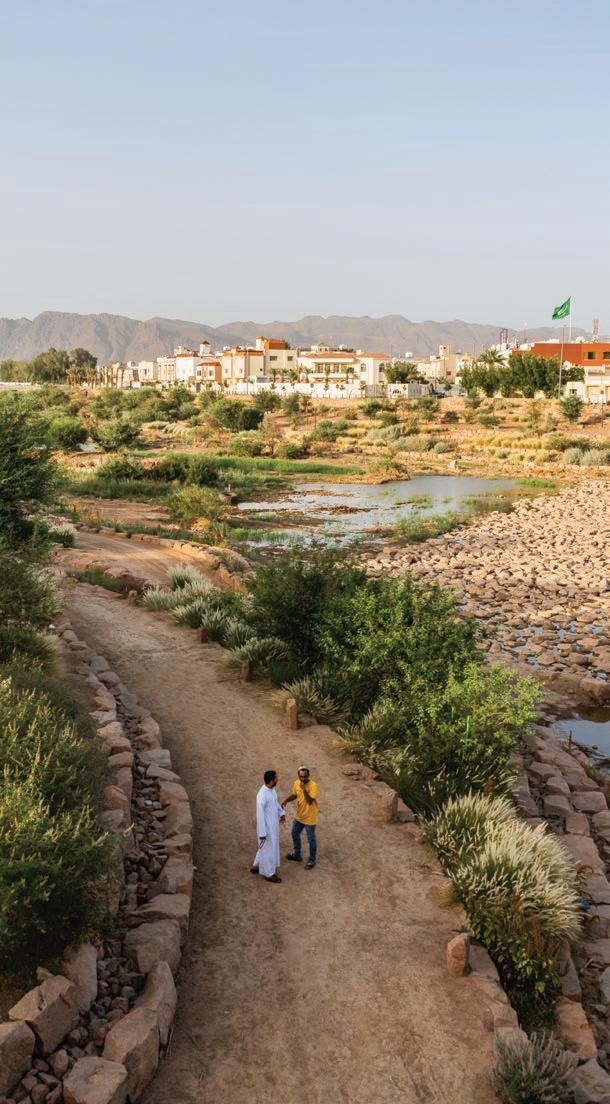
The question for designers is not how to stop these forces, but how to read them clearly enough to make better decisions. Where does erosion threaten, and where does it serve? Where should water be slowed, and where should it move freely? Where is soil being lost, and where can it be built? These are not engineering questions alone—they are design questions, and they begin with understanding the landscape on its own terms.
Saudi Arabia’s wadis are not obstacles to city-making—they are among its most valuable assets. Active systems capable of managing water, reducing flood risks by slowing flow speeds down and creating retention areas, building soil, supporting biodiversity, and anchoring public life. But that value is only unlocked when design is grounded in how these landscapes actually work. Natural forces do not negotiate; they reward those who understand them.
In wadi design, that understanding isn’t just a starting point; it’s the foundation everything else is built on.
By: Tarek AlSheeti Irrigation Specialist & Author
The future of landscaping is no longer just about water and soil; it is about the integration of advanced hardware and intelligent software. Modern irrigation is being reshaped by a new generation of tools— including robots for site maintenance, drones for aerial surveillance, and high-precision sensors—all powered by the “brain” of Artificial Intelligence.
Artificial Intelligence (AI) in irrigation is the simulation of human decision-making by machines to solve complex water-management problems¹. While traditional “Smart” systems follow fixed rules (e.g., “Stop watering if it rains”), AI uses Machine Learning (ML) to recognize patterns and adapt.
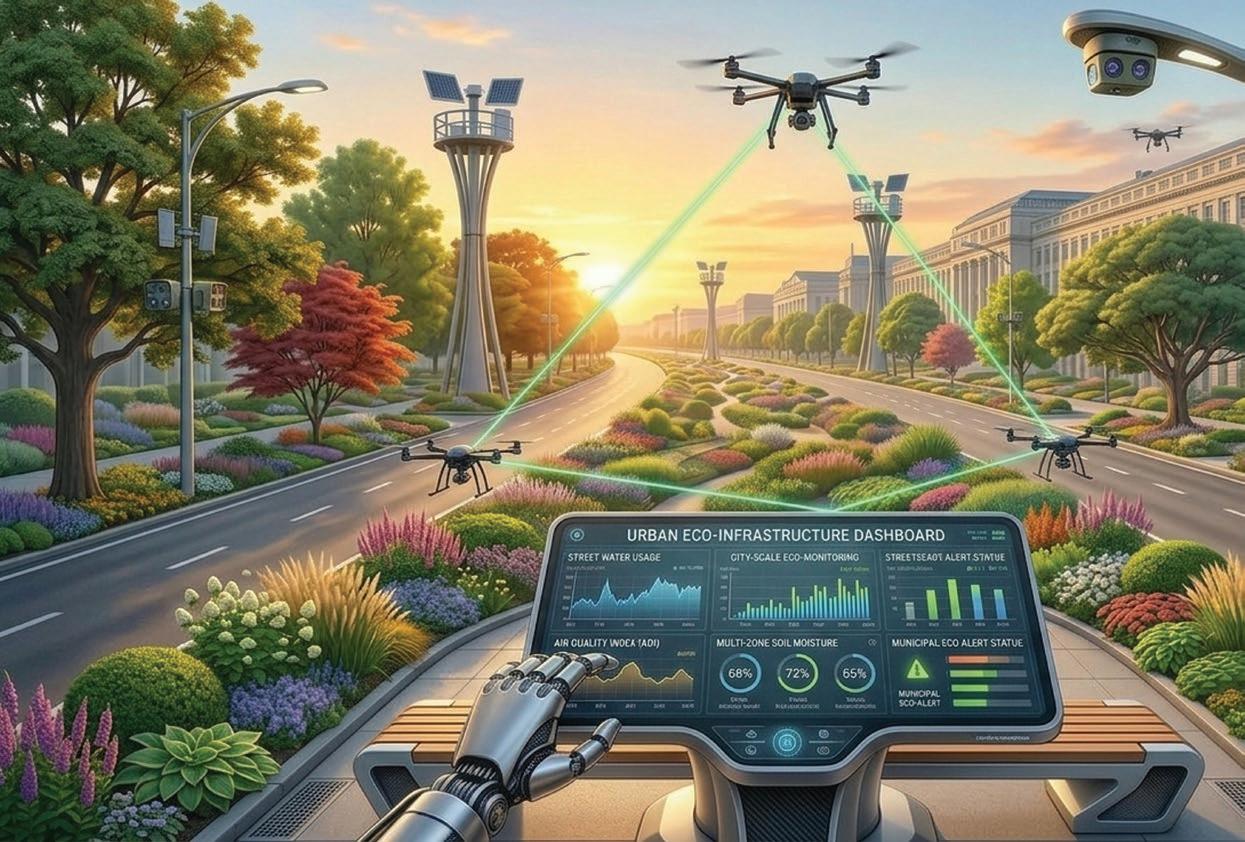
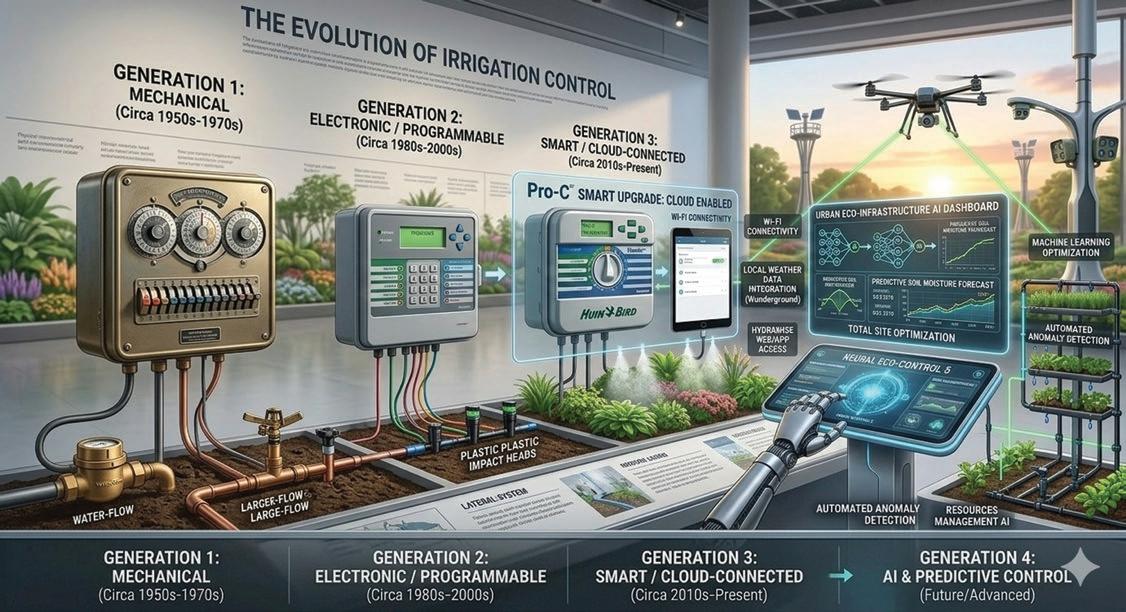
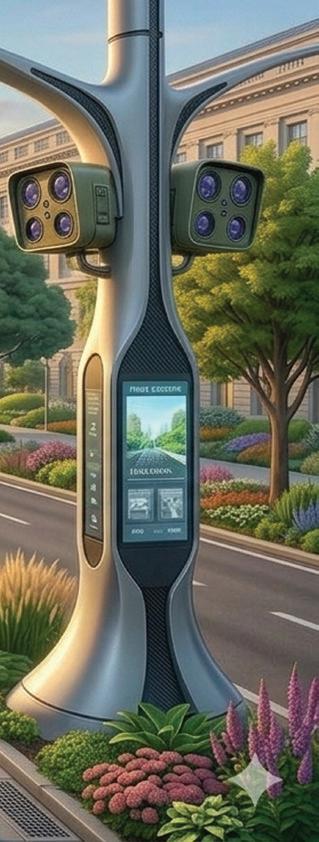
Crucially, AI is a cyber-physical system that requires specific hardware to execute its thoughts on-site:
1: Edge AI Controllers: Specialized on-site boards (such as the NVIDIA Jetson Orin) that act as the local brain.
2: Neural Processing Units (NPUs): These allow the system to run complex algorithms instantly without needing a constant cloud connection.
3: Autonomous Scouts: Drones equipped with multispectral cameras scan for stress signatures invisible to the human eye.
4: Intelligent Sensors: Next-generation probes that “listen” for the unique vibration signatures of leaks or “see” plant stress through thermal imaging.
The most critical concept to grasp in the “AI Drop” is the transition from Automation to Autonomy.
Automation (Current Smart Systems): Professional control system provides ruggedized logic to manage flows, but they remain reactive to programmed thresholds.
Autonomy (The AI Drop): This is a Learning Autonomous System. According to the Irrigation Association, the industry is moving toward systems that observe the environment, learn from micro-climate patterns, and update their own logic to optimize the “trajectory” of every water drop. It is the shift from a machine that follows commands to an Autonomous Partner.
AI Leap: Anticipation Over Reaction
As noted by research from IndiaAI, AI acts as the main pillar behind these systems by synthesizing data from soil sensors, weather stations, satellites, and IoT devices.
Drones add a layer of granularity that satellites cannot match. By scanning landscapes with multispectral images, computer vision models can detect plant stress days before it is visible to the human eye, allowing for “surgical” irrigation.
Using Predictive Controlled Deficit Irrigation models (as detailed in MDPI Sensors Journal), the system analyzes historical results and crop responses to seasonal changes. This helps the system anticipate future needs; it might decide to withhold water because it knows the upcoming humidity will keep the roots hydrated until tomorrow.
The transition from the Digital Drop to the AI Drop is the evolution from a machine that follows commands to an Autonomous Partner that masters its environment. We are no longer just programming a controller; we are training a system to think for itself.
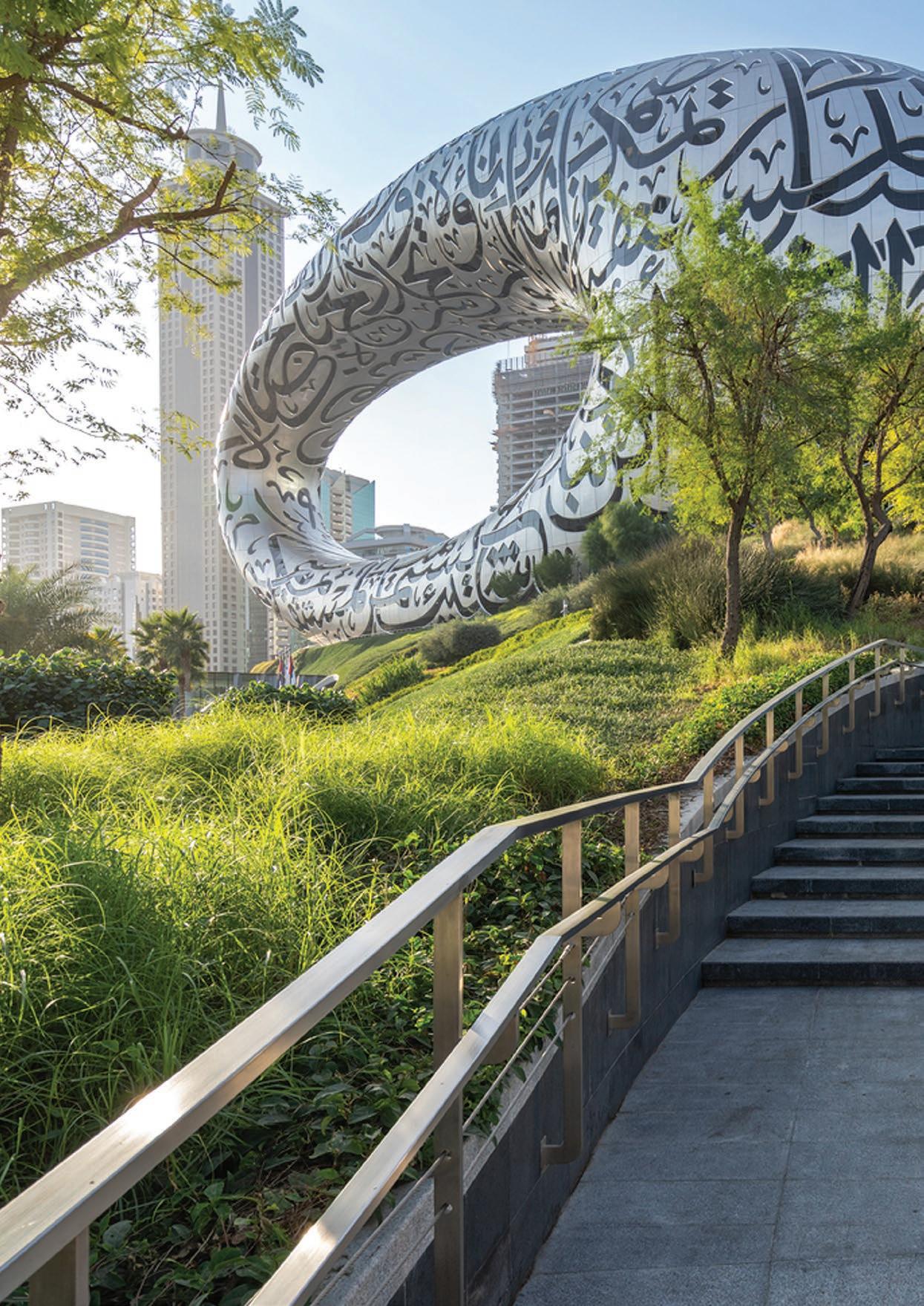
There is a version of the construction industry people like to talk about—progressive, evolving, increasingly inclusive— and then there is the version that exists on site, where performance, pressure, and delivery define everything. With nearly two decades of experience across the Middle East, Leila Hammami has built her career firmly in the latter, working not from behind a desk but in the field, managing teams, solving problems in real time, and making decisions where consequences are immediate. It is a space where women remain the exception rather than the norm, particularly in landscape construction, yet for Hammami this was never something to resist or challenge directly; instead, it became something to work through, to understand, and ultimately to outperform through consistency, capability, and results.
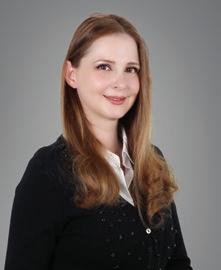
Her entry into the profession set the tone early. As a junior engineer in Syria, she was not eased into the role through design or officebased coordination, but instead placed directly on site, working as a plumber and gardener on a remote mountain project under demanding physical conditions. What might have been intended as a difficult introduction became the most valuable part of her education, giving her a grounded understanding of how systems are installed, how materials behave, and how decisions made on paper translate—or fail—in reality. That experience closed a gap many engineers carry throughout their careers, allowing her to approach design and technical review with a practical awareness that continues to shape her decision-making today. When she looks at drawings, she is not assessing intent alone, but constructability, sequencing, and the real conditions of the site.
“I started on site, doing the work myself. That’s why today I don’t just see drawings—I see whether they can actually be built.” This depth of technical understanding has become central to her leadership. In environments where credibility is constantly tested, particularly for women working in site-based roles, authority is not granted by title but built through knowledge, preparation, and the ability to stand behind decisions with evidence. Hammami is direct about this. In meetings, she prepares in detail, ensuring that every recommendation is supported technically and can be defended under scrutiny. This approach is not simply a personal preference but a necessity developed through experience, where she found that assumptions are quickly challenged and that consistency in technical delivery is what ultimately earns respect. Over time, this level of preparation has allowed her to bridge the common disconnect between design, shop drawings, materials, and execution, reducing errors and improving efficiency across the projects she has led.
“Every time I walk into a meeting, I come with proof. Not opinions — proof. That’s how you build trust on site.”
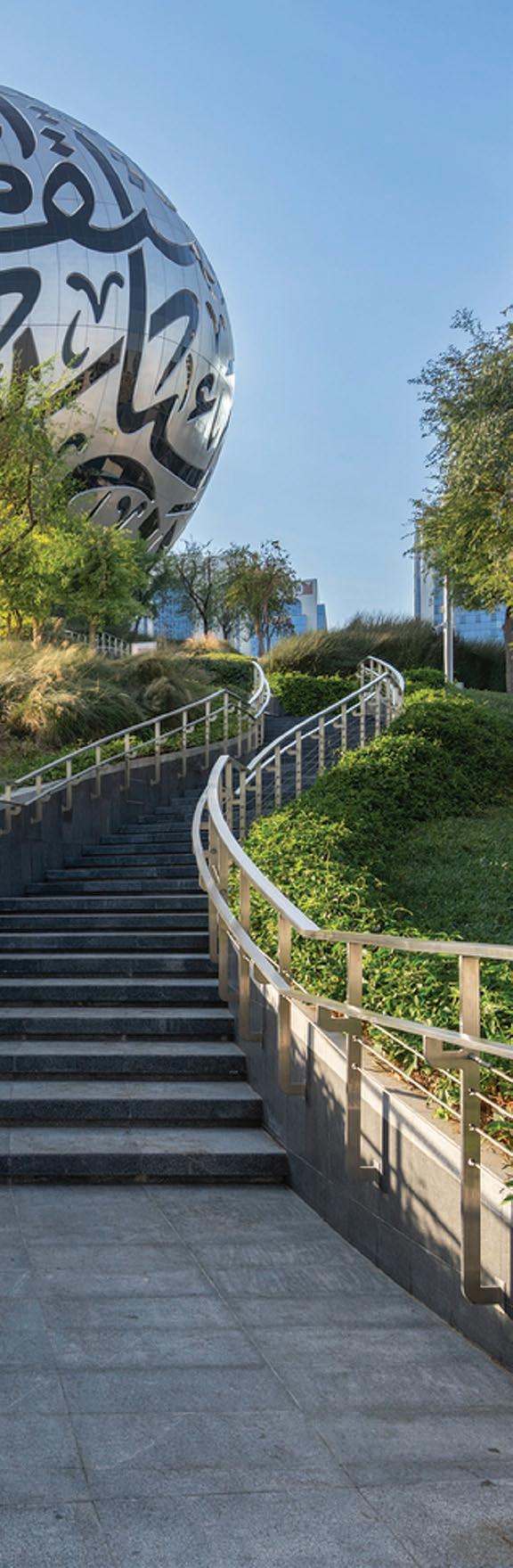
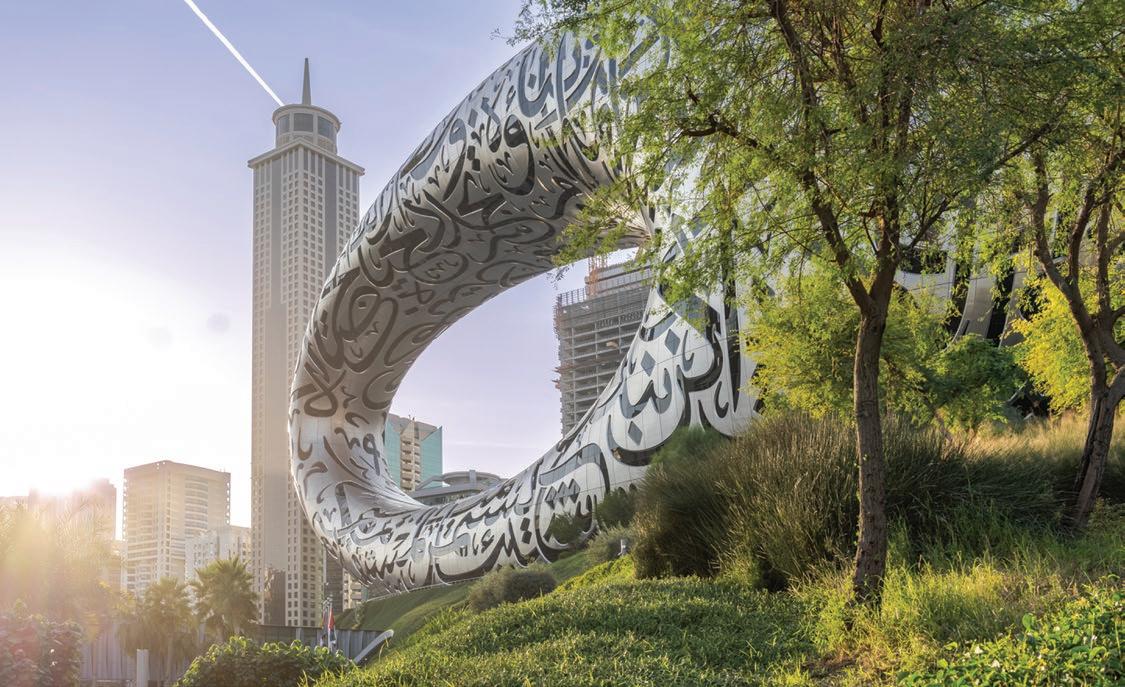
That capability was tested at its highest level during her involvement in the Museum of the Future in Dubai, a landscape project designed and supervised by Cracknell and defined by complexity, and unique and challenging features, particularly during the COVID period when resources were limited, timelines were compressed, and the margin for error was effectively removed. Taking on expanded responsibility during this time, she moved into a leadership position that required not only technical control but also the ability to manage teams, coordinate across disciplines, and make critical decisions under constant time constraints. The conditions were demanding, with extended working hours and continuous site operations, yet it was within this environment that her previous experience aligned. The combination of practical site knowledge, technical depth, and structured project management allowed her to navigate the challenges effectively, reinforcing the idea that leadership is not defined by position but by performance when conditions are at their most difficult.
The reality of working as one of the very few women in such environments is something Hammami addresses without hesitation, but also without framing it as a limitation. She acknowledges that resistance exists, that in some situations there is an expectation
to prove more, and that cultural perspectives can influence how individuals are perceived on site. However, her response has never been to focus on these barriers. Instead, she has approached them as part of the environment, adapting by strengthening her preparation, refining her communication, and ensuring that her technical position is always clear and defensible. Over time, this consistency shifts perception, not through argument but through delivery, where results speak more effectively than discussion. Respect, in this context, is not requested but earned repeatedly through performance.
“You can’t change people or their mindset. But you can prove yourself — again and again — until there’s no doubt.”
A recurring concern she highlights is the tendency for young engineers to move too quickly into senior roles without building the necessary foundation in the field. The desire to progress is understandable, but when it comes at the expense of practical understanding, it creates gaps that become visible under pressure. For Hammami, starting at the most basic level of site work was not a disadvantage but an essential step in building the awareness required to lead effectively. That experience allows her to assess situations with clarity, anticipate issues before they arise, and communicate with teams in a way that reflects an understanding of the work itself rather than just the process around it. It is a perspective she believes applies equally to men and women, reinforcing that technical competence and site experience remain the most reliable measures of capability in construction.
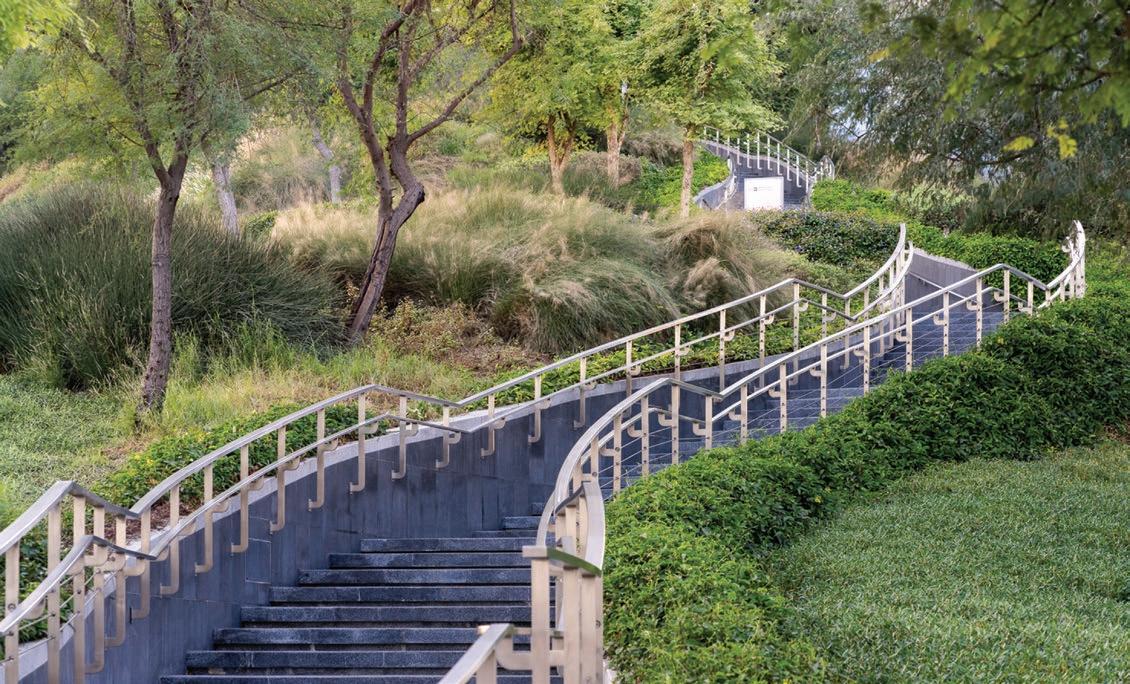
At the same time, the profession itself is evolving, particularly through the integration of smart systems, automation, and datadriven technologies in landscape management. Hammami points to irrigation as a key example, where traditional approaches are being replaced by more intelligent, responsive systems that improve performance and efficiency. However, she is equally clear that technology alone does not resolve challenges. Its value depends entirely on the ability of those managing the project to understand it, apply it correctly, and ensure that it aligns with both the design intent and contractual requirements. In one instance, she re-evaluated a proposed irrigation approach that relied on battery-operated systems, identifying an opportunity to integrate wired and wireless solutions to achieve full automation. This outcome was not the result of following standard practice, but of continuous learning and a willingness to engage deeply with the system’s technical aspects, something she continues to prioritise even after many years in the industry.
Advice for the Next Generation
When asked what advice she would offer to women entering landscape construction or site management, her response is straightforward and grounded in experience. The environment will be demanding, expectations will be high, and there will be moments where additional effort is required to establish credibility. However, none of these factors are barriers to success. What matters is the willingness to build a strong technical foundation,
to gain real site experience, and to approach each project with a level of preparation and determination that leaves little room for doubt. Over time, this approach creates its own momentum, where capability becomes visible, and opportunities follow performance rather than perception.
Beyond the professional sphere, Hammami speaks with equal pride about her role as a mother, particularly in moments where her work becomes visible beyond the construction site. When her daughter recognised and shared her involvement in the Museum of the Future, it represented a different kind of achievement, one that extends beyond project delivery and into the impact of example. It reflects the broader significance of her journey, not just in terms of personal success but in demonstrating what is possible through persistence, discipline, and commitment to continuous improvement.
What emerges from Hammami’s story is not a narrative centred on challenge, but one focused on response. The industry’s conditions are acknowledged for what they are, without exaggeration or dismissal, and success is built through adaptation, effort, and consistency over time. In a profession where outcomes matter more than intent, her career offers a clear message: capability is developed, proven, and reinforced through action, and in the long term, that is what defines leadership on site.
Photography by Alessandro Merati: Copyright Cracknell
By: Joel Santhosh Consultant - Concrete Products Manufacturing
Climate change and urbanisation are placing new demands on the design of our cities. Functional surfaces can actively contribute to sustainable construction, while also serving as innovative design elements that support climate change adaptation, heat reduction, and the development of climate-resilient public spaces and urban environments. There is no doubt that the integration of advanced technologies and innovative methodologies is at the forefront of this transformation. Innovations in practice and materials are driving the rapid evolution of sustainable construction.
It demonstrates how construction transformation can be achieved through interdisciplinary thinking and collaboration, with the shared goal of making a generational contribution to a high-quality environment. We are convinced
that the cities of tomorrow must become more resilient, greener, and more liveable. This can only be achieved by creating spaces where people can move, meet, and feel comfortable. Our approach lies in designs that add architectural character while offering innovative, multifunctional, and sustainable solutions. In this way, functionality and climate protection are combined into a vision that begins today and extends into the future.
The design communicates sustainable commitments in an authentic, clear, and tangible way. It not only demonstrates what responsible action looks like, but also shows how intelligent solutions can contribute meaningfully to the climate-resilient transformation of our cities. Through collaboration, practical application, new materials, and thoughtful
planning, we can develop scenarios that enhance urban resilience. By combining modern architecture, well-considered landscape design, and maximum functionality, cohesive and inspiring environments can be created. A consistent and calming design language helps to unify these elements.
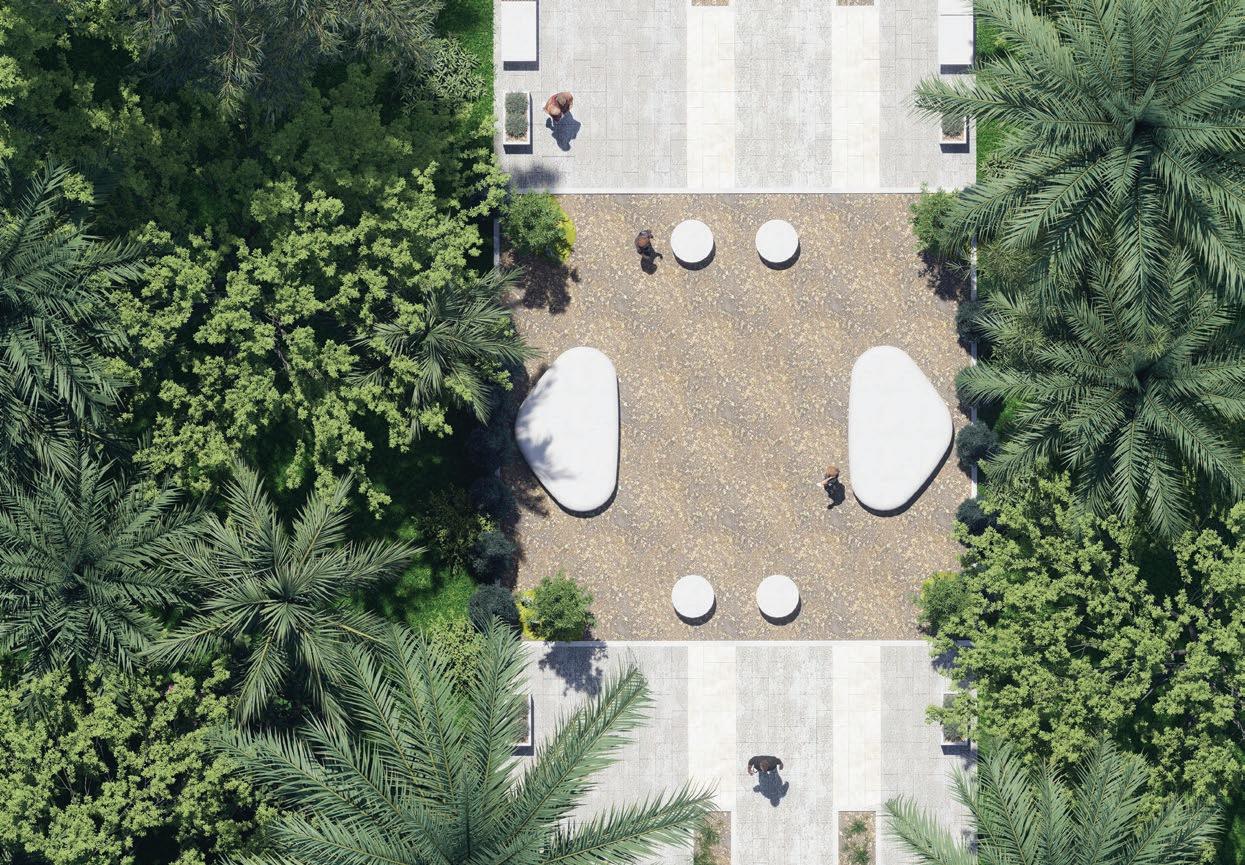
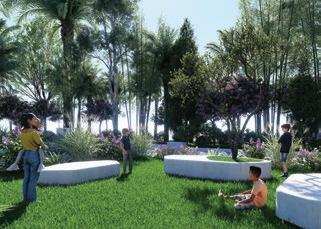
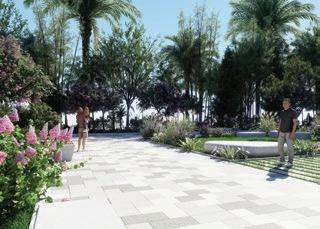
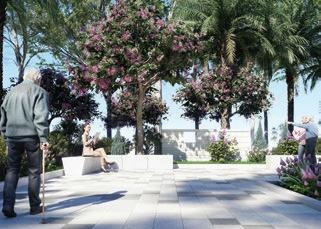
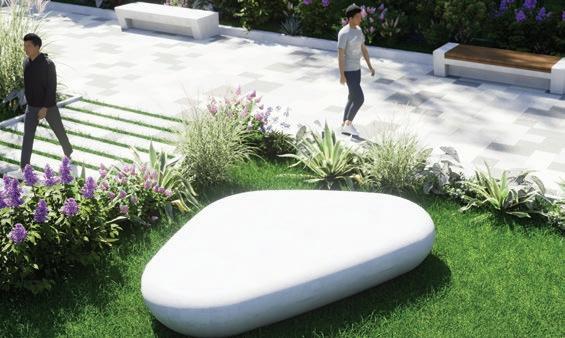
Green meeting points, with tree planters featuring a variety of species and integrated seating, create an inviting atmosphere and enhance the presence of planting within the urban environment. It is important to note that permeable paving offers both a sustainable and aesthetic solution for paving systems. This approach allows the urban environment and nature to coexist more harmoniously. Multifunctional surfaces improve the microclimate while enabling resilient use across a range of applications.
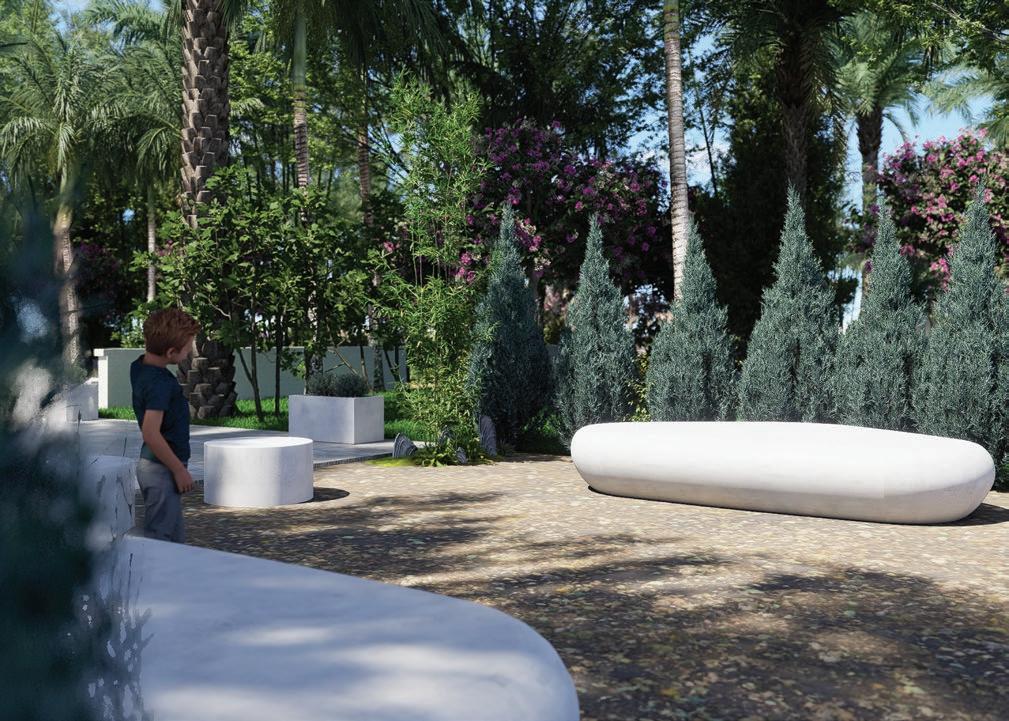

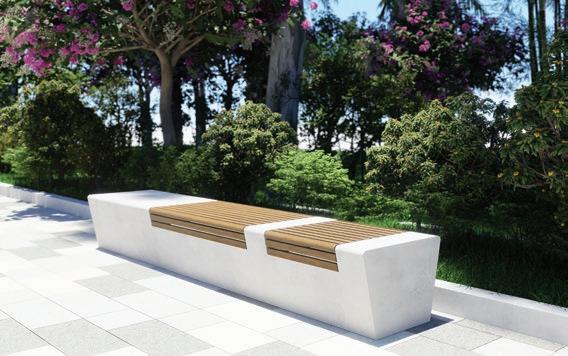
There are extensive design possibilities with landscape architectural concrete products, including variations in style, colour, shape, surface texture, and finish. These incorporate a wide range of elements such as paving stones, walling systems, concept design products, planters, steps, and street furniture, all of which contribute to the quality and identity of the urban landscape. Concrete products can be used in a variety of ways to create durable, functional, and aesthetically refined outdoor spaces that integrate with natural surroundings. Beyond form and function, these solutions bring vibrancy to cities through carefully graduated colours, natural material qualities, and engaging surface textures. It is within the balance of colour and form, light and space, that landscape architecture achieves its greatest impact.
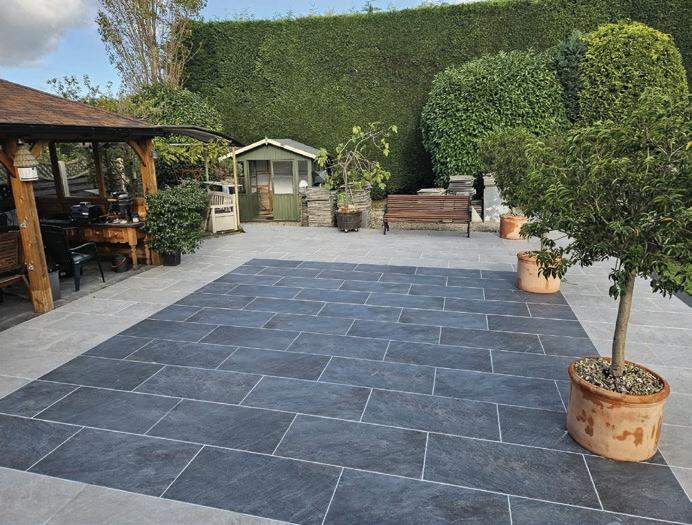
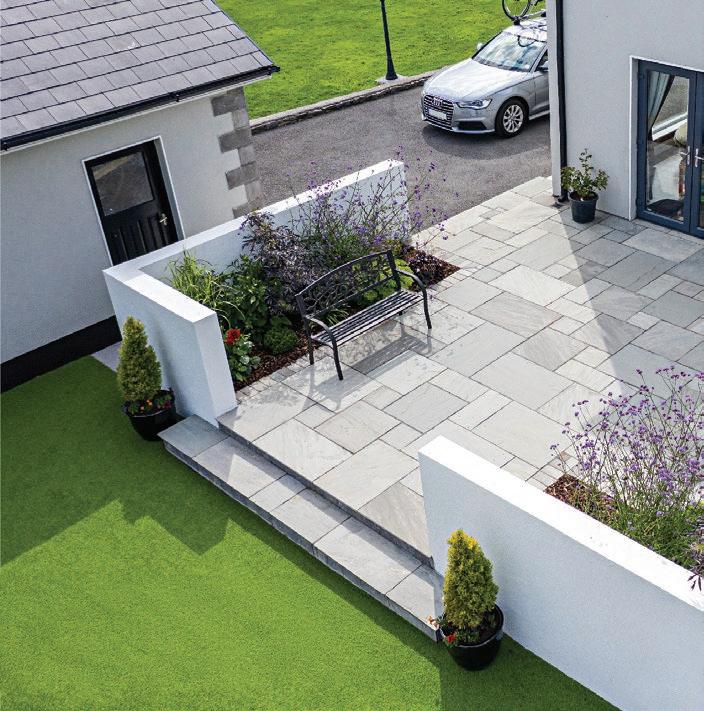
The Natucrest stone pavers are characterised by clear contours and grain-like surface textures, offering a distinctive approach to designing urban spaces and residential environments. Subtly shaded colours and a simple format emphasise a restrained, natural stone aesthetic. A range of timeless colour options reflects the appearance of granite, limestone, and sandstone.
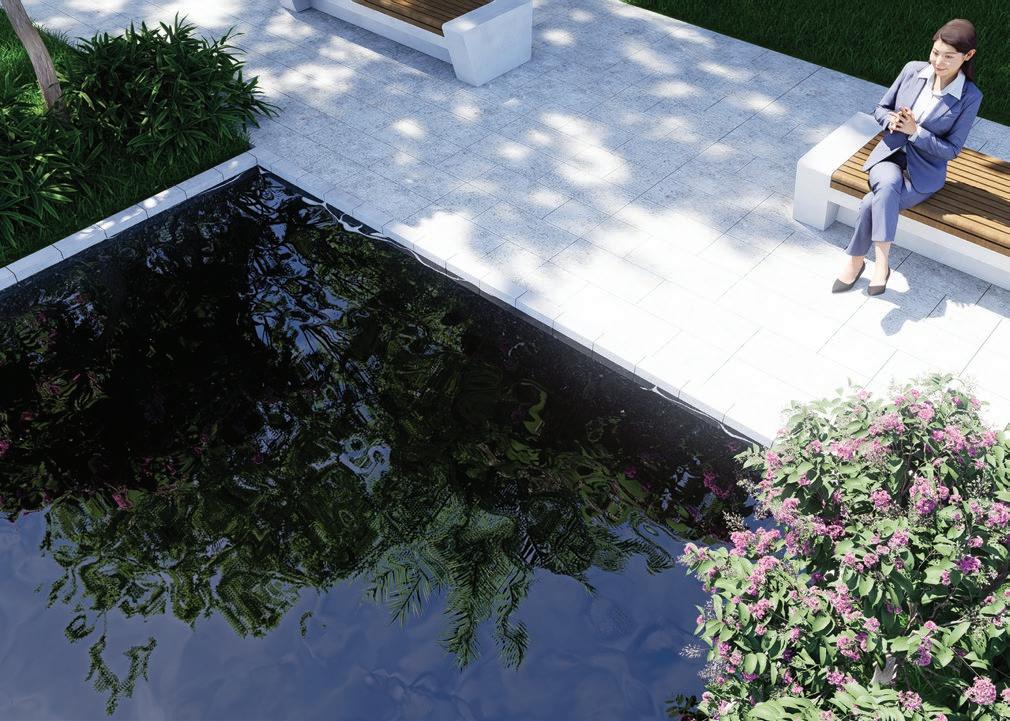
The ProtecTop surface protection system helps protect paving stones from stains and weathering while enabling ease of cleaning and maintenance.
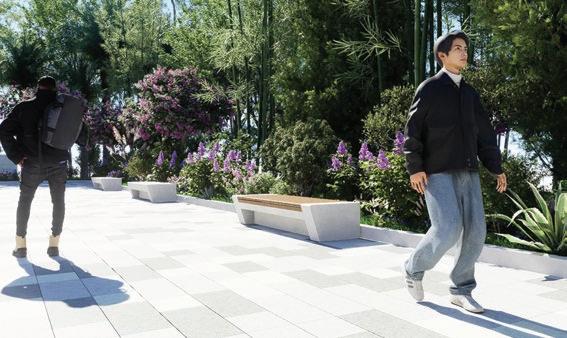
Paving stones with the CoolTop system provide a climate-adaptive solution that reduces the urban heat island effect in public spaces, supporting the development of more sustainable paving systems. Due to its specific properties, this system contributes to the cooling of overheated urban areas and transforms paved surfaces into active components of climateresilient environments. With CoolTop paving stones, a meaningful contribution is made to climate adaptation in cities, redefining concrete surfaces as part of a liveable and sustainable urban future.
Concrete paving stones, walling systems, and associated design elements are used in outdoor environments not only for their functional performance, but also to create a strong architectural expression. This approach demonstrates how thoughtful design, attention to detail, and high-quality materials can produce spaces with character, resulting in a coherent solution with a strong sensitivity to material and spatial relationships.
Residential architecture is undergoing a quiet but decisive shift. Increasingly, landscape is being embedded into the way buildings are conceived—shaping how they perform, how they are experienced, and how they connect to their environment. From Milan’s Bosco Verticale to Bangkok’s Cloud 11, a new generation of projects is redefining the relationship between architecture and ecology, pushing it well beyond aesthetics, and in Dubai that shift is beginning to take a more defined and deliberate form.
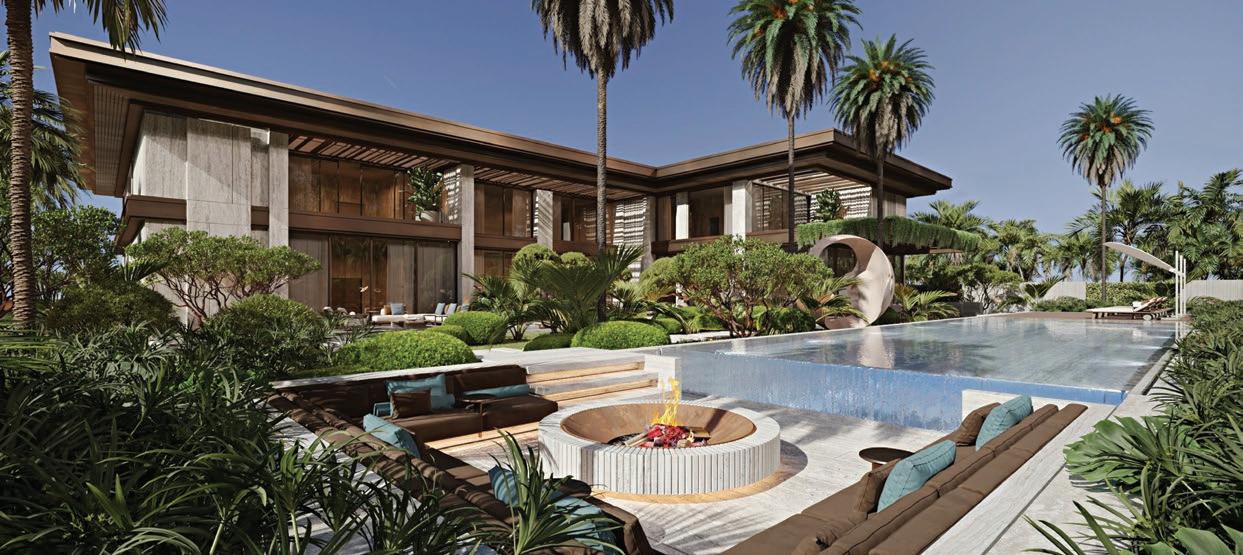
Wedyan is not a tower with landscape added to it, but a project where landscape is integrated into the building’s structure, organisation, and environmental performance from the outset. As described by Al Ghurair Development, through its Al Ghurair Collection—a superprime residential portfolio—the ambition was to create a residence where architecture and landscape are “genuinely inseparable… conceived together as a single, continuous environment.”
Rising 46 storeys along the Dubai Canal, the debut project of Al Ghurair Collection positions itself as a vertical landscape system— layered, responsive, and continuous. Designed by Kengo Kuma, with landscape by Gustafson Porter + Bowman, the building draws from the physical language of the region—erosion, stratification, and the shifting geometry of desert valleys—translating these into a built form where architecture and landscape operate as one.
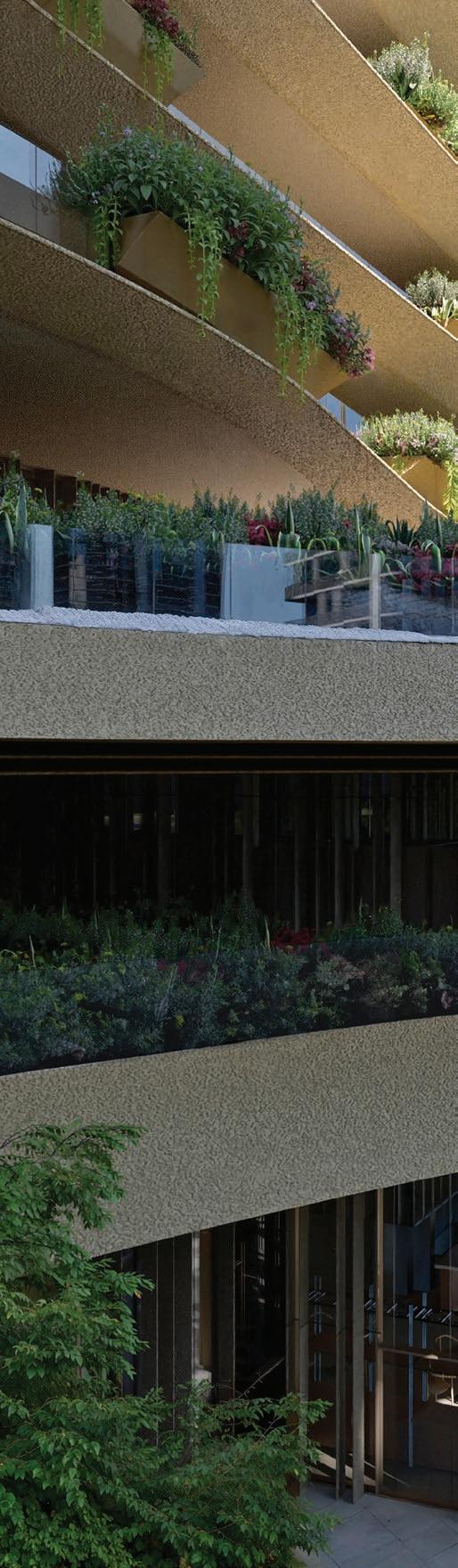
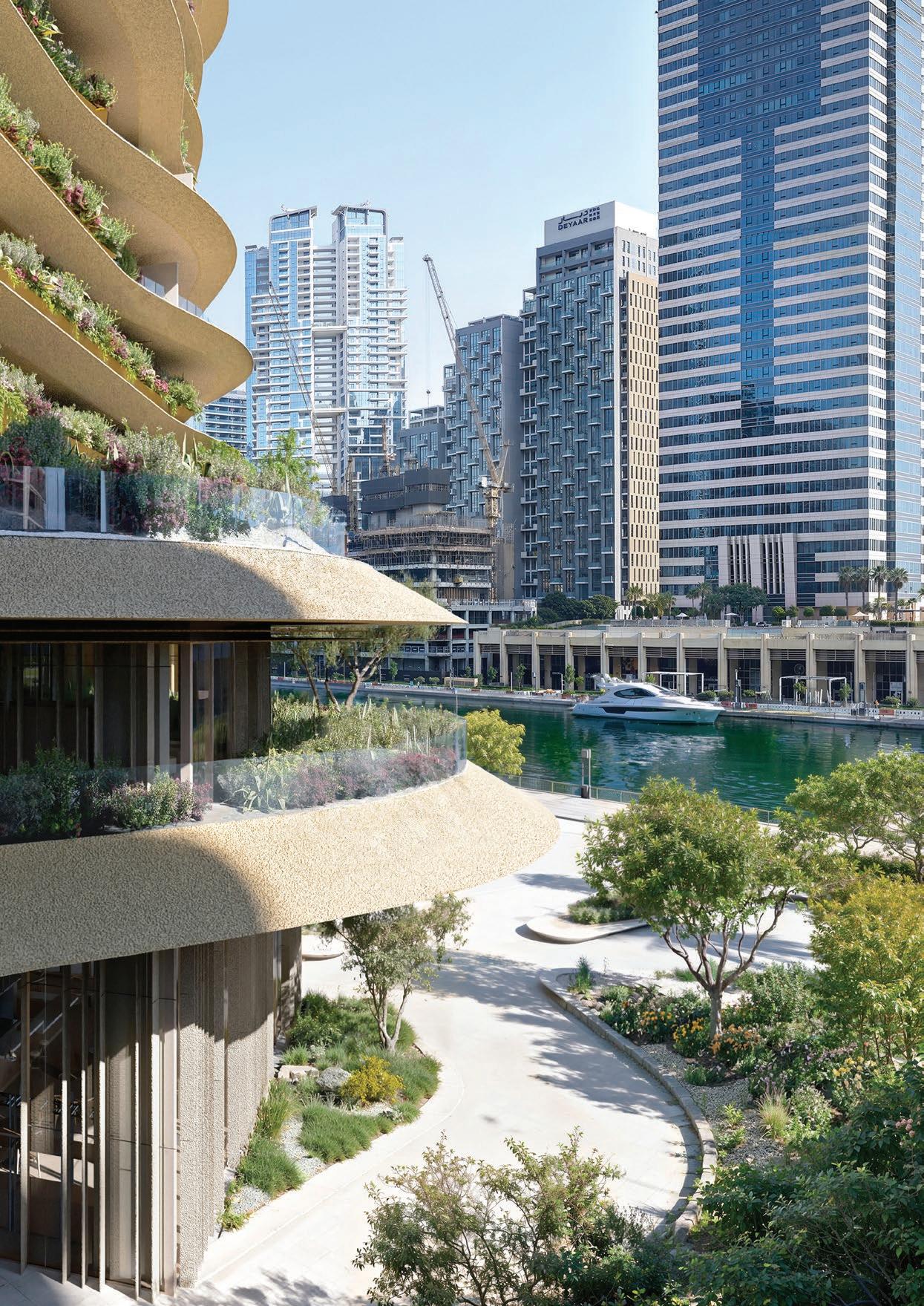
The intelligence of Wedyan lies not only in its formal expression, but in how that integration is executed. The landscape is developed as a responsive system shaped by environmental conditions across each façade, where planting strategies are calibrated to microclimate, solar exposure, and long-term performance. The involvement of Laura Gatti, whose work on Bosco Verticale helped define the contemporary benchmark for vertical planting, signals a level of technical rigour that moves the project well beyond visual intent.
Wedyan ultimately shifts the conversation away from luxury defined by finishes and amenities, and toward a more fundamental question— how buildings live, breathe, and perform over time. What emerges is not simply a residential tower, but a proposition: that landscape, when embedded at the core of design, becomes a driver of value, identity, and long-term resilience.
For Al Ghurair Development, Wedyan is not simply a standalone project, but the opening expression of a broader ambition. As part of the newly launched Al Ghurair Collection—a super-prime residential portfolio—the development signals a deliberate shift away from established residential formulas within the region, toward a more considered and design-led approach to living.
From the outset, the intention was to create a residence where architecture and landscape are conceived together, not sequentially. Rather than treating greenery as an enhancement, the project was envisioned as a continuous environment, where planting, terraces, and living spaces are fully integrated into the daily experience of the building.
This thinking is reflected in how the project is organised. The experience unfolds as a sequence, beginning with a landscaped arrival at ground level and continuing vertically through private terraces, communal gardens, and shared amenity spaces. Each level offers a distinct condition, encouraging residents to engage with landscape as part of everyday life, rather than encountering it as a series of isolated moments.
“What makes Wedyan different is that this level of integration was planned from day one,” says Sultan Al Ghurair, CEO of Al Ghurair Development. “Every terrace, planted area, and amenity was developed in parallel with the architectural vision. We engaged over 30 specialists from the earliest stage to ensure that every element works together seamlessly.”
This early coordination is critical. By involving specialists across disciplines—from façade and lighting consultants to infrastructure and interior planning—the project moves beyond layered design toward a genuinely integrated system, where each component contributes to a cohesive whole.
Kengo Kuma’s architectural vision plays a defining role in articulating this approach. As he describes it, “Wedyan is a dialogue between Japanese aesthetics and the context of Dubai. Our design philosophy is to connect and create a conversation between architecture, nature and people. In this project, our purpose is to bring softness to the design and to create quietness through shadows that cascade and reflect across the façade, terraces and amenity spaces.”
That emphasis on softness, continuity, and environmental response aligns closely with the developer’s ambition to create spaces that feel composed rather than imposed—where architecture and landscape are experienced as a unified condition.
For Al Ghurair, the significance of Wedyan ultimately extends beyond design. It represents a shift in how value is understood, moving away from short-term differentiation toward long-term performance, quality of life, and environmental integration.
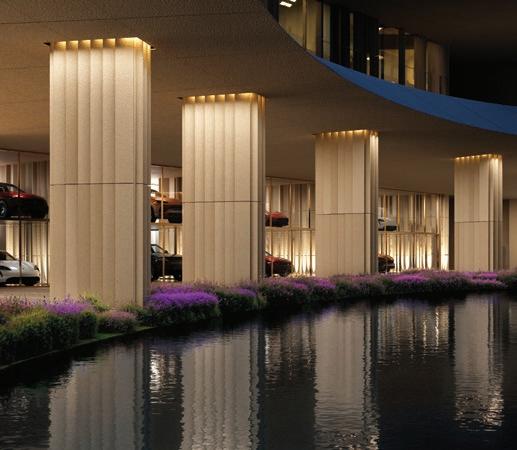
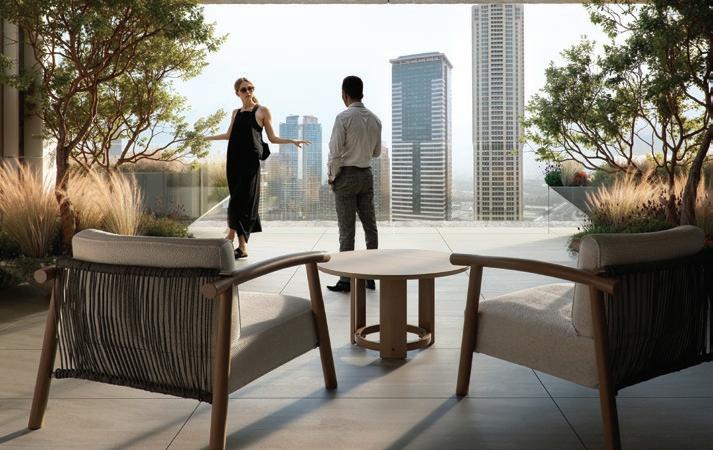
Within that context, Wedyan establishes a clear position. It is not simply about creating a distinctive building, but about setting a benchmark for how architecture and landscape can be conceived together to shape more meaningful, resilient, and enduring residential environments.
If the developer’s ambition sets the direction, the design team is responsible for making that ambition credible. For Gustafson Porter + Bowman, the starting point was not planting, but landscape as a spatial and formal language.
“The architectural concept is rooted in this idea of a sculpted desert landscape—erosion, layering, movement,” explains Donncha O’Shea. “What’s interesting is that when you first look at it, you might ask where the landscape is, but actually, that is the landscape. That becomes the foundation for everything we do.”
Rather than treating landscape as a layer applied to architecture, the project works from a shared conceptual origin, where movement, form, and environment are intrinsically linked. The experience is not of moving around a building, but of moving through a landscape that has been shaped into architectural form.
In many high-rise developments, landscape is introduced late in the process, often constrained by whatever residual space remains once architectural and commercial requirements have been resolved. At Wedyan, that sequence is inverted.
“The landscape didn’t come at the end,” O’Shea explains. “It informed spatial definition from the outset. We needed proper soil, scale, and volume, and that requires a substantial intervention. The architecture allowed for that by lifting and shaping the landscape as part of the building itself.”
This early integration enables meaningful soil depth, supports the establishment of larger planting from the outset, and ensures that the landscape can function as intended over time rather than being reduced to a superficial treatment. The result is a development in which landscape operates as infrastructure—supporting environmental performance, spatial quality, and long-term resilience.
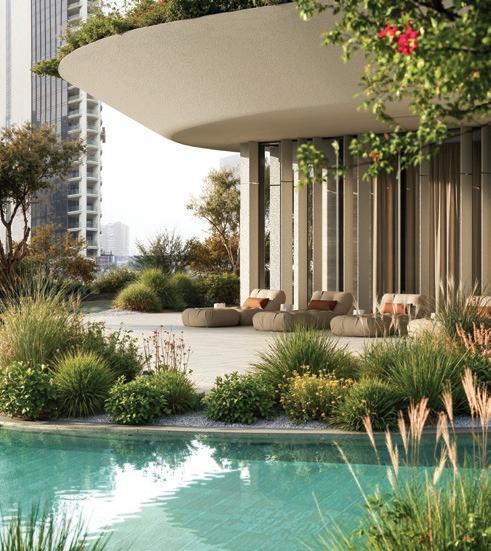
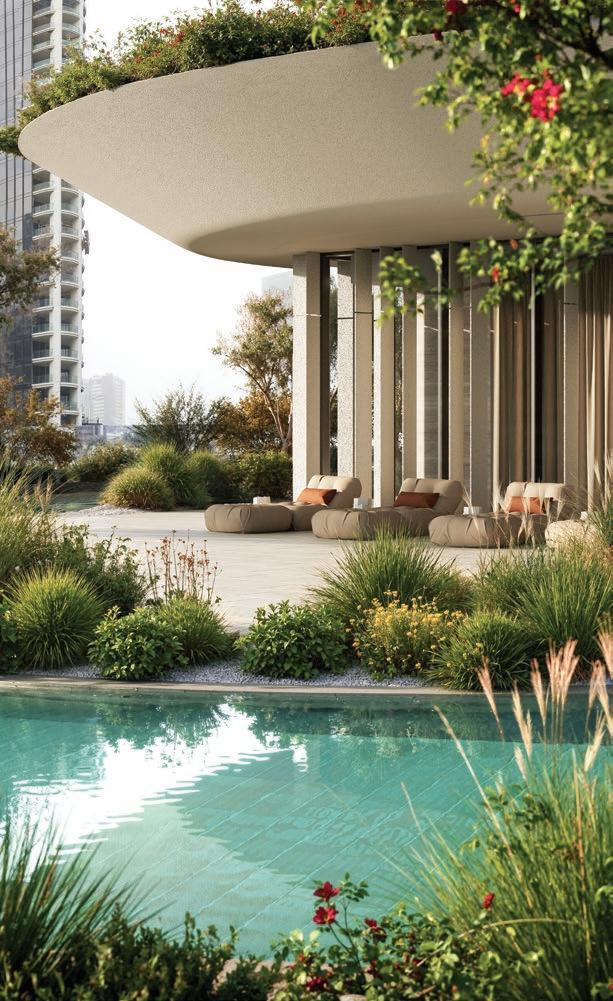
At ground level, the landscape unfolds as a sequence of distinct yet connected environments. Along the canal edge, the character is more open and sculptural, reflecting the language of the desert and engaging with the public realm. Moving inward, the spaces become more shaded, more enclosed, and more immersive, offering residents a quieter and more private experience.
Water is introduced not as spectacle, but as atmosphere. A shallow reflective surface enhances light, introduces movement, and contributes to cooling, subtly reinforcing the relationship between architecture, landscape, and climate.
“It’s not about creating a feature in the traditional sense,” says O’Shea. “It’s about how that surface changes the atmosphere of the space and how people experience it.”
Through these shifts, the ground plane balances openness and intimacy while maintaining a coherent identity.
While the ground plane establishes the project’s identity, the façade is where that identity is most rigorously tested. Integrating landscape into a high-rise structure introduces a set of technical challenges that cannot be resolved through visual intent alone.
“It’s easy to say you want planting on a building,” O’Shea notes. “It’s much harder to make it viable. You need to consider soil volume, irrigation, structure, and how environmental conditions change as you move up the building.”
At Wedyan, these challenges are addressed through the depth and geometry of the façade itself. Terraces extend well beyond conventional balcony dimensions, with overhangs ranging from approximately three metres to, in some areas, approaching five metres in depth, fundamentally altering how the building performs. These deep projections provide significant solar shading, reducing direct heat gain on the façade while simultaneously creating usable, protected outdoor spaces for residents. At the same time, they establish the environmental conditions necessary for planting to survive at height—shielding vegetation from excessive exposure while allowing light, airflow, and layering to occur naturally.
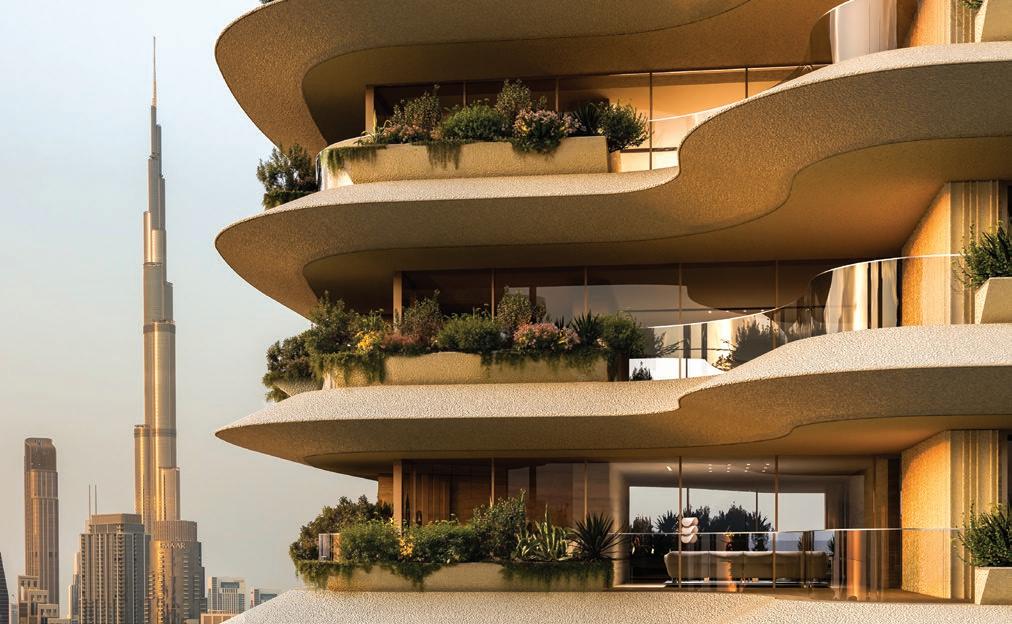
In combination with the building’s sculpted form, these overhangs create a series of microclimates across the elevation, enabling the integration of landscape as a functioning system rather than a visual layer.
A tower is not a uniform environment, and treating it as such is where many façade planting strategies fail. At Wedyan, each façade is approached as a distinct environmental condition, shaped by orientation, solar exposure, and shading.
“We approached each façade as a different environment,” O’Shea explains. “The planting responds to those conditions rather than trying to override them.”
This results in a layered planting strategy that shifts across the building, moving from more resilient, desert-adapted species in exposed areas to denser, softer planting in shaded zones. By allowing planting to create its own internal shading and protection, the design establishes more stable and sustainable microclimates.
The success of an integrated landscape lies in its ability to endure, and at Wedyan, this has informed decisions from the earliest stages of design. Irrigation strategies, soil composition, and planting systems have all been developed with long-term performance in mind.
“Irrigation is fundamental,” says O’Shea. “If you rely on surface watering in this climate, you lose most of it before it reaches the plant, so we’re delivering water deeper into the soil and encouraging root growth below the surface.”
By combining subsurface irrigation with soil systems designed to retain moisture and nutrients, the project supports the longterm establishment of planting while reducing water loss through evaporation.
One of the most common points of failure in projects of this nature lies not in design, but in what happens after completion. Without a clear strategy for maintenance, even the most carefully considered landscape can quickly deteriorate.
“Maintenance has to be considered from the beginning,” O’Shea explains. “It’s about making sure the landscape is accessible, safe to maintain, and supported over the long term.”
At Wedyan, this extends to the management of the façade itself, where planting is treated as a coordinated system rather than being left to individual modification, preserving both the architectural intent and the long-term performance of the design.
For all its technical complexity, the impact of landscape is ultimately measured in how people use it.
“There’s a behavioural shift,” O’Shea reflects. “People stay longer in spaces with planting, even when conditions aren’t perfect, and they’re more likely to use them socially—even in challenging climates” In this sense, landscape does more than moderate climate or enhance visual quality. It transforms how space is occupied, turning transitional areas into places of pause, interaction, and connection.
Wedyan ultimately represents a shift in priorities. Rather than treating landscape as an accessory, it positions it as a fundamental component of architectural thinking—one that shapes performance, defines identity, and supports long-term value. In a market where the language of luxury is often driven by surface-level differentiation, this approach offers something more substantial. It suggests that the future of residential design in the region may not lie in adding more, but in integrating better. And in that shift, landscape moves from the margins of design to its very centre.
OASE FOUNTAIN TECHNOLOGY
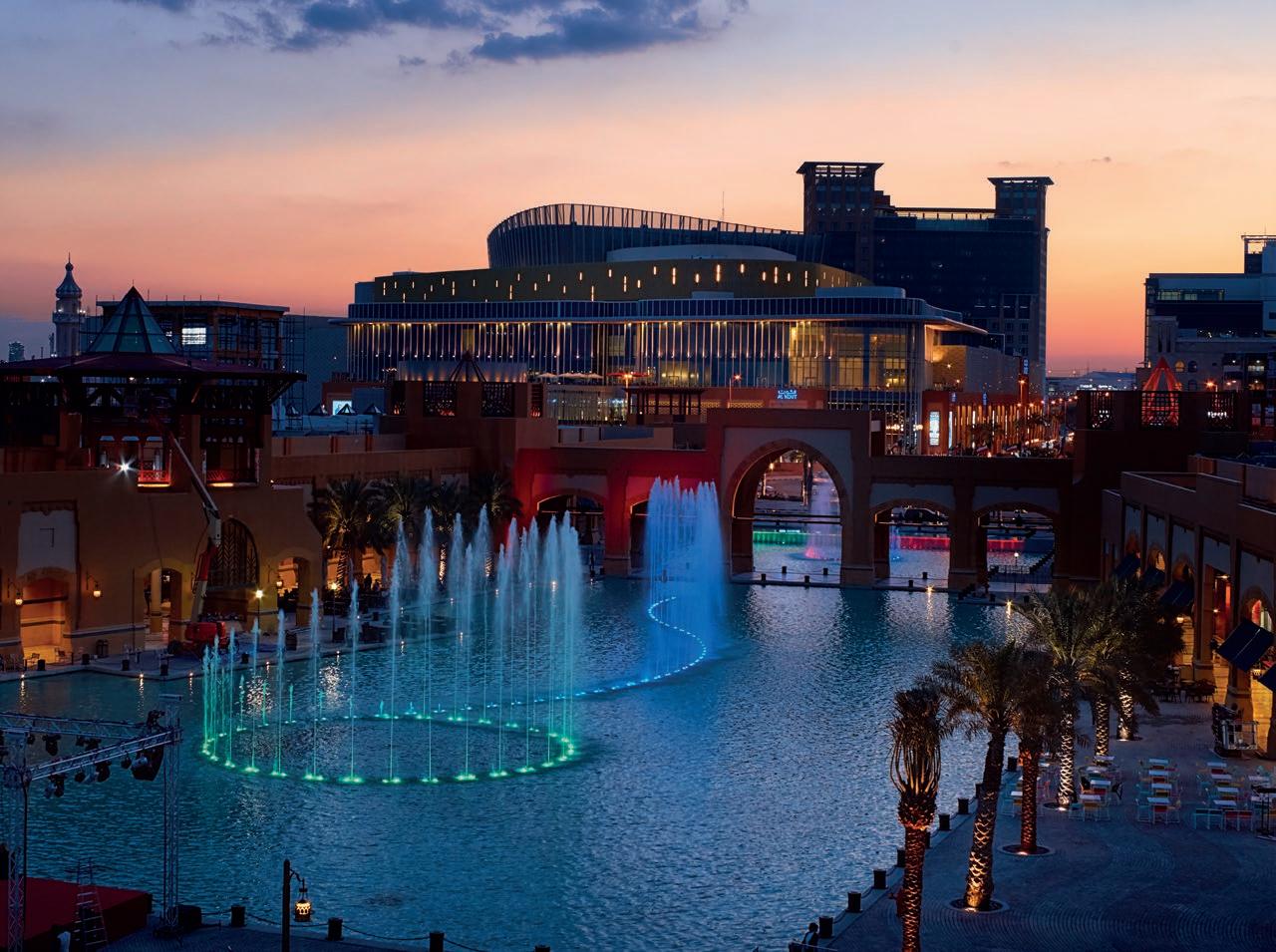
Creating unique urban landmarks, setting world records, designing contemplative quiet zones or attracting millions of enthusiastic visitors - whatever you have in mind, OASE Fountain Technology makes your architectural water vision come true.
Innovative and high-quality German technology paired with a passion for extraordinary creations and the experience gained from over 100,000 unique projects worldwide - this is what makes OASE one of the world’s leading specialists for fountain systems.
With our global network of qualified partners, we are at your sidealso here in the Middle East, at our office in the Dubai Design District.
www.oase-professional.com
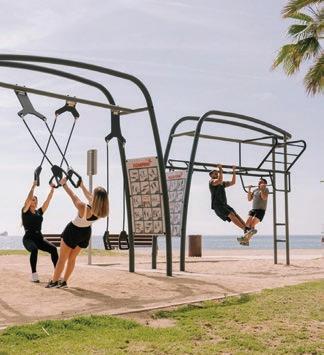
Empowering everyone to stay active with KOMPAN’s inclusive outdoor fitness solutions.
At KOMPAN, we believe that everyone regardless of ability or fitness level should have access to effective and enjoyable outdoor fitness. Our fitness areas are designed with
Accessibility
Equipment designed for users of all abilities.

Usability
universal accessibility in mind, ensuring that all individuals can engage in physical activity and benefit from a healthier, more connected community
Intuitive and easy-to-use for everyone.
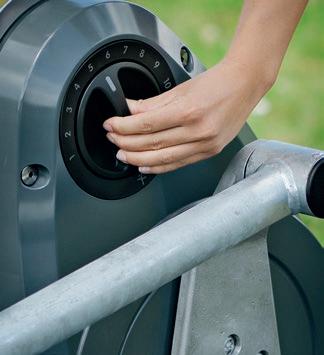
Adjustability
Customizable to individual needs and goals.
Our outdoor fitness equipment fosters social interaction, physical activity, and mental well-being, transforming parks and recreational areas into vibrant community hubs.
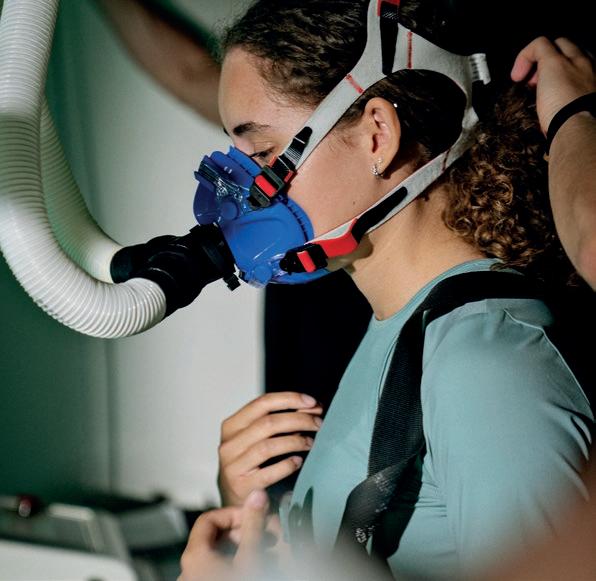
Our inclusive playgrounds and fitness areas are designed based on scientific research, ensuring they provide engaging and supportive environments. Whether you’re looking to improve your health or enhance your performance, KOMPAN equipment supports a wide range of workouts to meet your needs.
Our inclusive playgrounds and fitness areas are designed based on scientific research, ensuring they provide engaging and supportive environments. Whether you’re looking to improve your health or enhance your performance, KOMPAN equipment supports a wide range of workouts to meet your needs.
Multifunctionality
Multifunctionality
Combines general and specific funtionalities to support diverse workouts.
Combines general and specific funtionalities to support diverse workouts.
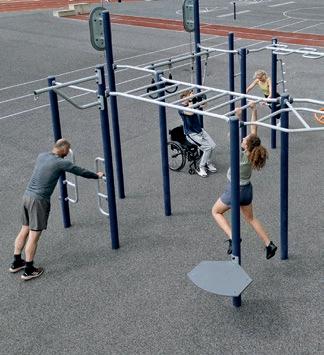
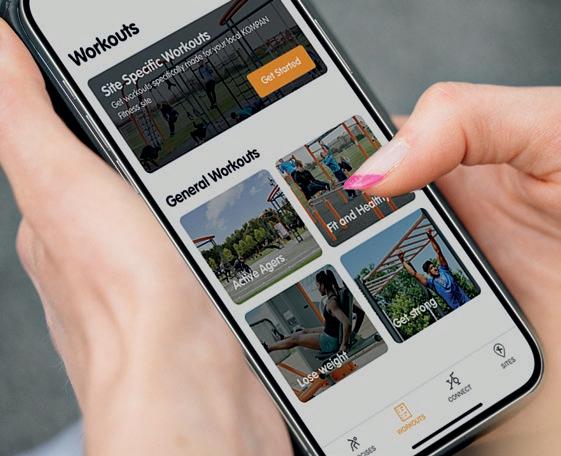
We recognize that everyone has unique abilities and goals. KOMPAN’s fitness sites and the KOMPAN Fit app provide a personal digital trainer, guiding users through workouts and ensuring they exercise correctly and safely. The app offers a range of tools to help users track their progress and stay motivated.
We recognize that everyone has unique abilities and goals. KOMPAN’s fitness sites and the KOMPAN Fit app provide a personal digital trainer, guiding users through workouts and ensuring they exercise correctly and safely. The app offers a range of tools to help users track their progress and stay motivated.
0-60% Intensity: Perfect for beginners or low-impact workouts.
0-60% Intensity: Perfect for beginners or low-impact workouts.
60-85% Intensity: Ideal for moderate training and improving overall fitness.
60-85% Intensity: Ideal for moderate training and improving overall fitness.
85-100% Intensity: Highly effective for those seeking a challenging workout.
85-100% Intensity: Highly effective for those seeking a challenging workout.
Come meet us at the Landscape Conference Awards, St. Regis Saadiyat Island Resort, Abu Dhabi! Let’s discuss how we can transform your outdoor spaces into inclusive fitness hubs for all.
Come meet us at the Landscape Conference Awards, St. Regis Saadiyat Island Resort, Abu Dhabi! Let’s discuss how we can transform your outdoor spaces into inclusive fitness hubs for all.
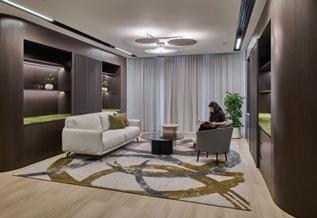
By: Gensler
Gensler Workplace Survey 2026:
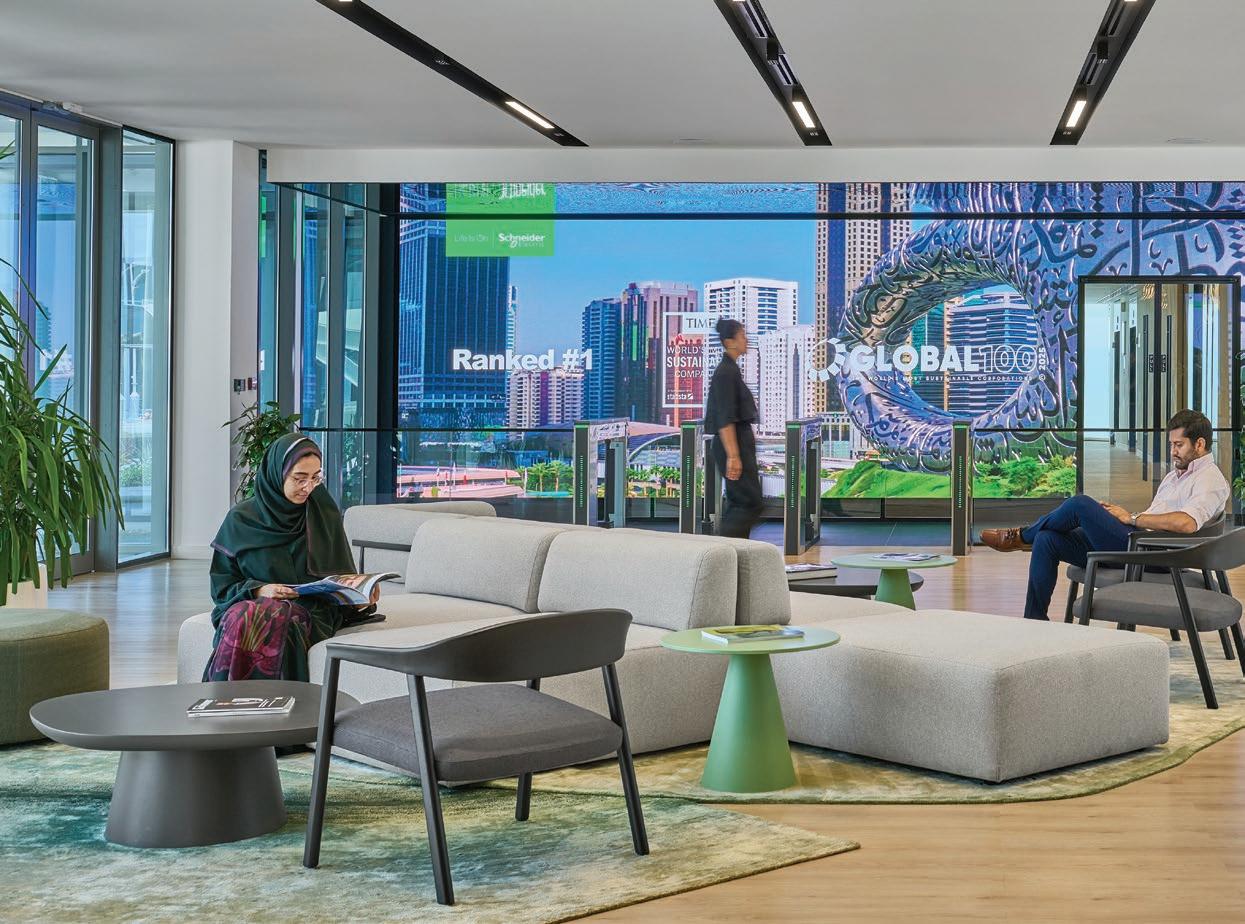
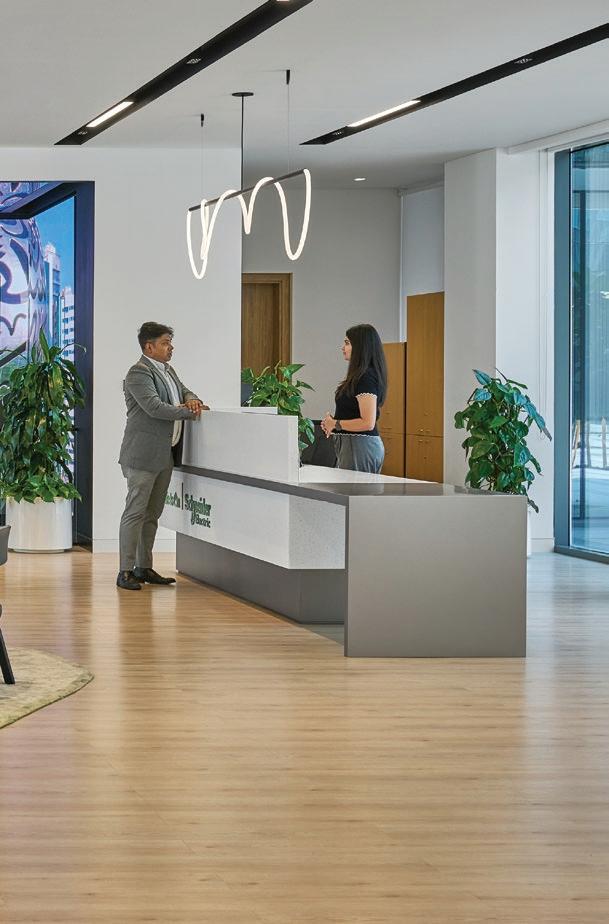
UAE Employees Redefine the Role of the Office Gensler, the world’s largest architecture and design firm, has released its Global Workplace Survey 2026, revealing a clear shift in how employees across the UAE are balancing physical workplaces and digital flexibility.
Rather than moving away from the office, the findings point to something more nuanced: employees are
actively redefining their role placing greater value on environments that support focus, collaboration, and access to technology, while still embracing the flexibility of hybrid work.
Conducted by the Gensler Research Institute, the survey captures insights from more than 16,400 full-time office workers across 16 countries, offering one of the most comprehensive global snapshots of workplace behaviour today.
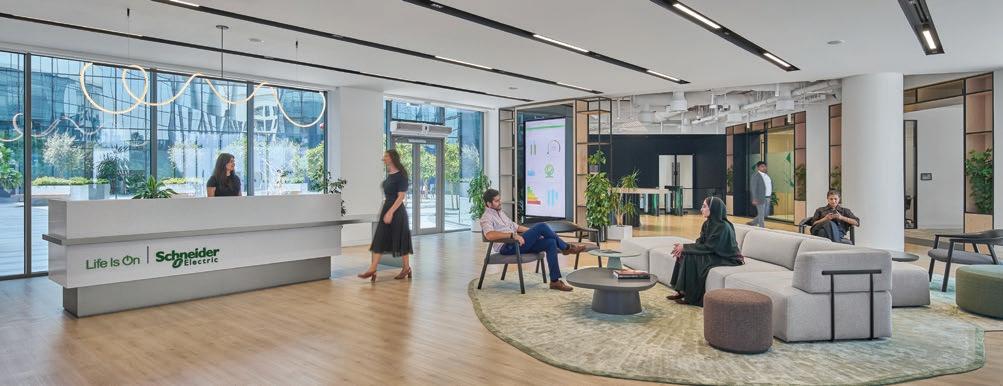
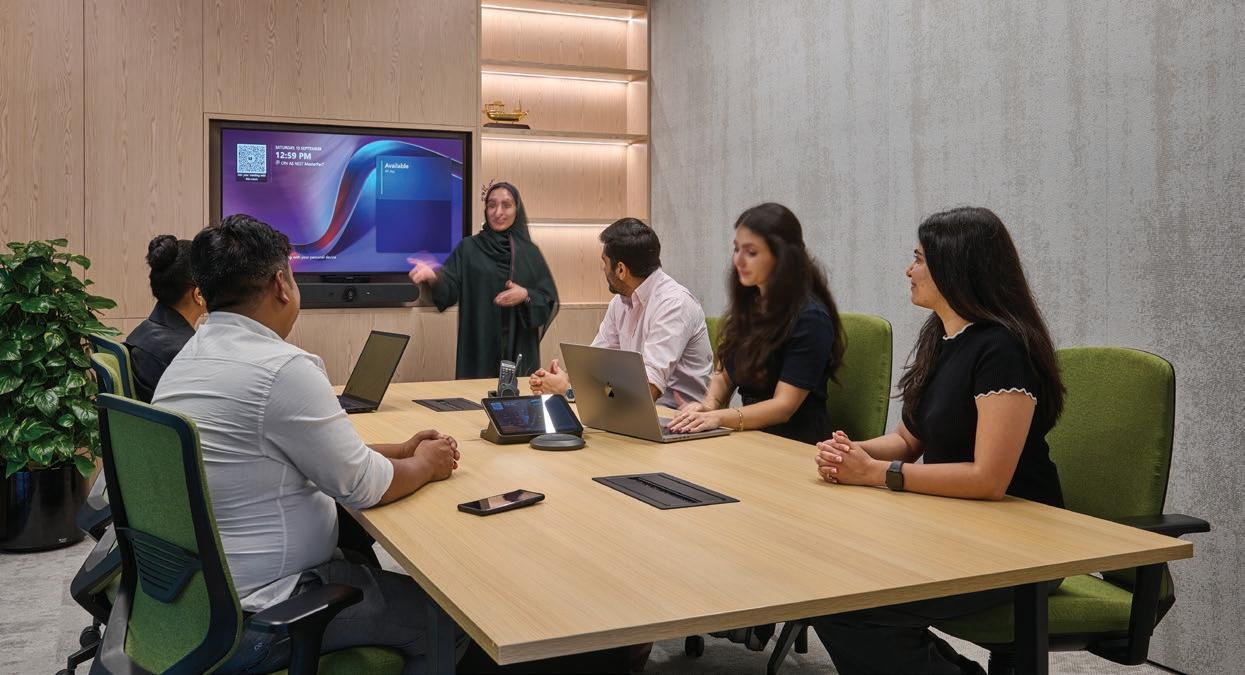
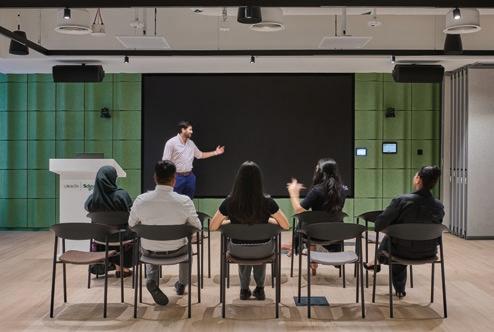
The office is still central just not in the same way
In the UAE, employees currently spend 53% of their working week in the office, with the remainder split across home working, client sites, coworking spaces, and travel.
However, what stands out is not where they work toda but where they want to work. Respondents indicated a preference for spending 65% of their time in the office, highlighting the continued importance of physical workplaces for productivity and collaboration. This is not a return to old models. It is a recalibration where the office becomes a purposeful destination rather than a default setting.
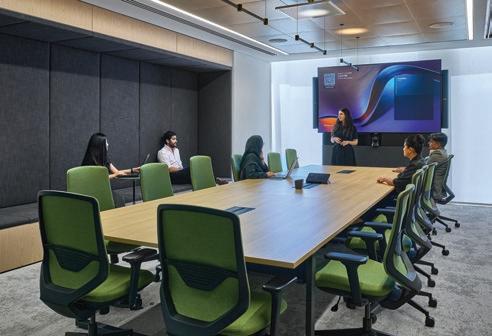
Why employees are choosing the workplace
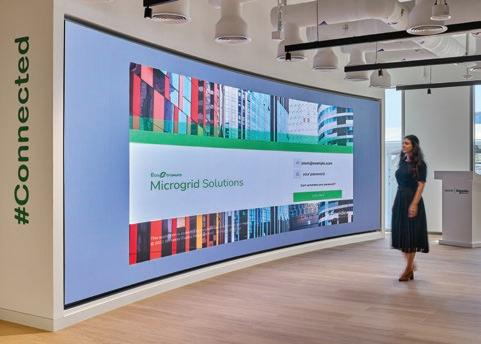
The survey identifies clear, practical reasons behind office attendance in the UAE. Access to technology ranks as the primary driver, followed by the ability to focus on work something that remains inconsistent in remote environments.
Professional development, leadership visibility, and social interaction also play a significant role, reinforcing the office as a place where learning and connection happen more effectively.
Todd Pilgreen, Principal and Co-Managing Director at Gensler Middle East, points to a fundamental shift in how offices are being used:
“Our report findings reflect how the role of the office has evolved. Rather than simply providing desk space, workplaces increasingly function as hubs for collaboration, learning and access to specialised resources. The surrounding neighbourhood also plays an important role in shaping how employees experience the workplace.”
This broader view of the workplace extends beyond the building itself placing equal importance on location, accessibility, and the surrounding urban environment.
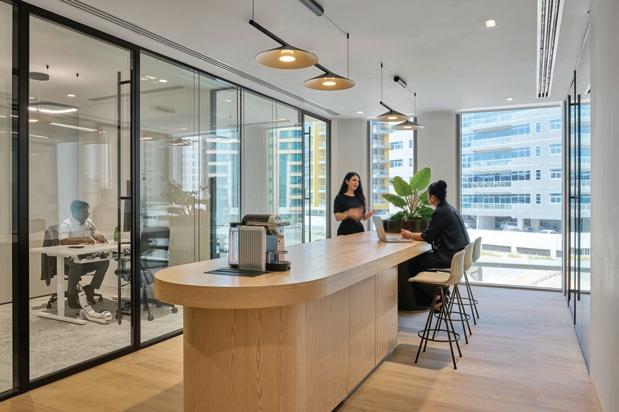
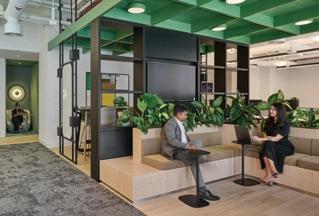
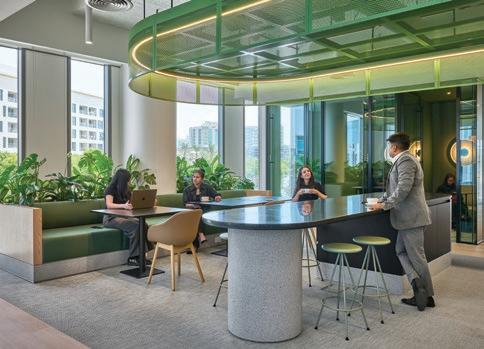
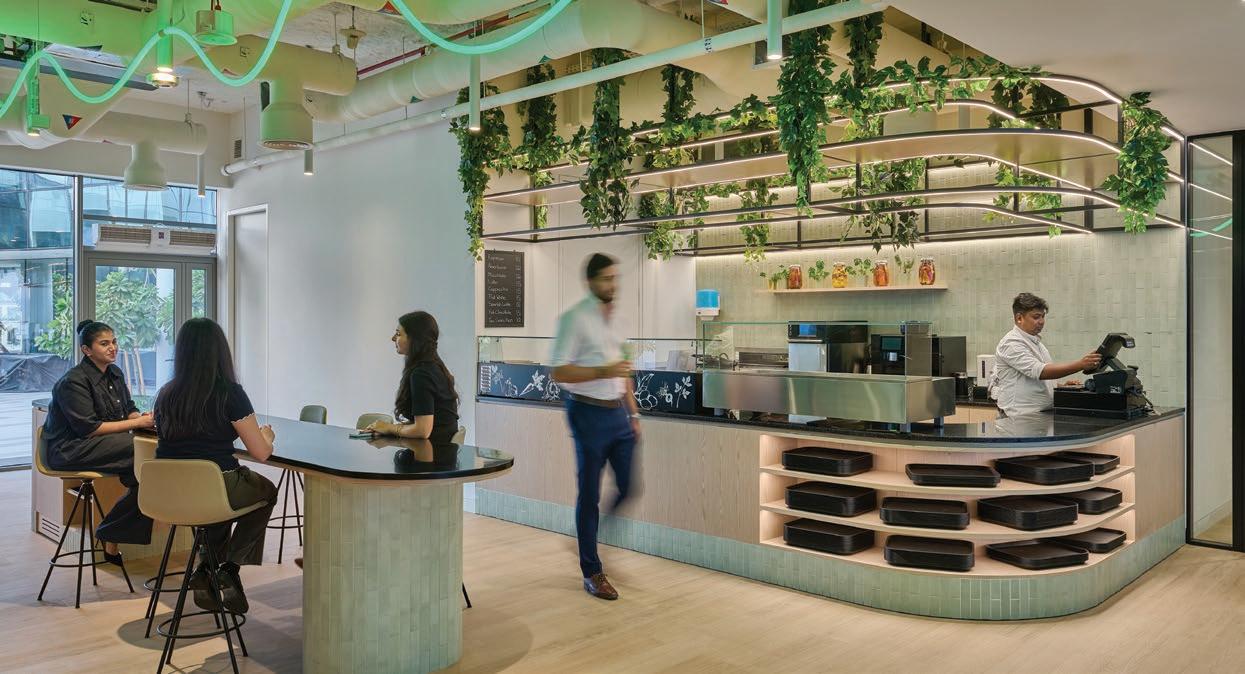
Designing for experience, not just efficiency Employees are also placing greater emphasis on the quality of workplace environments. Within the office, spaces such as cafés, team rooms, social hubs, and wellbeing facilities are now considered essential not optional.
At the same time, nearby amenities including healthcare services, retail, and food and beverage offerings are shaping how employees engage with the workplace on a daily basis.
Joyce Jarjoura, Workplace Studio Director at Gensler Middle East, highlights this shift toward a more integrated approach:
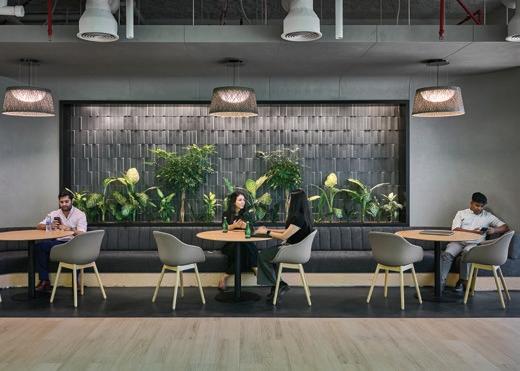
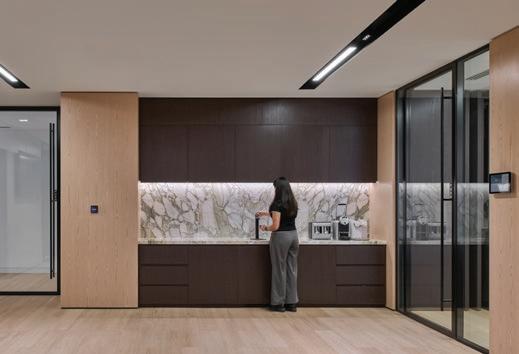
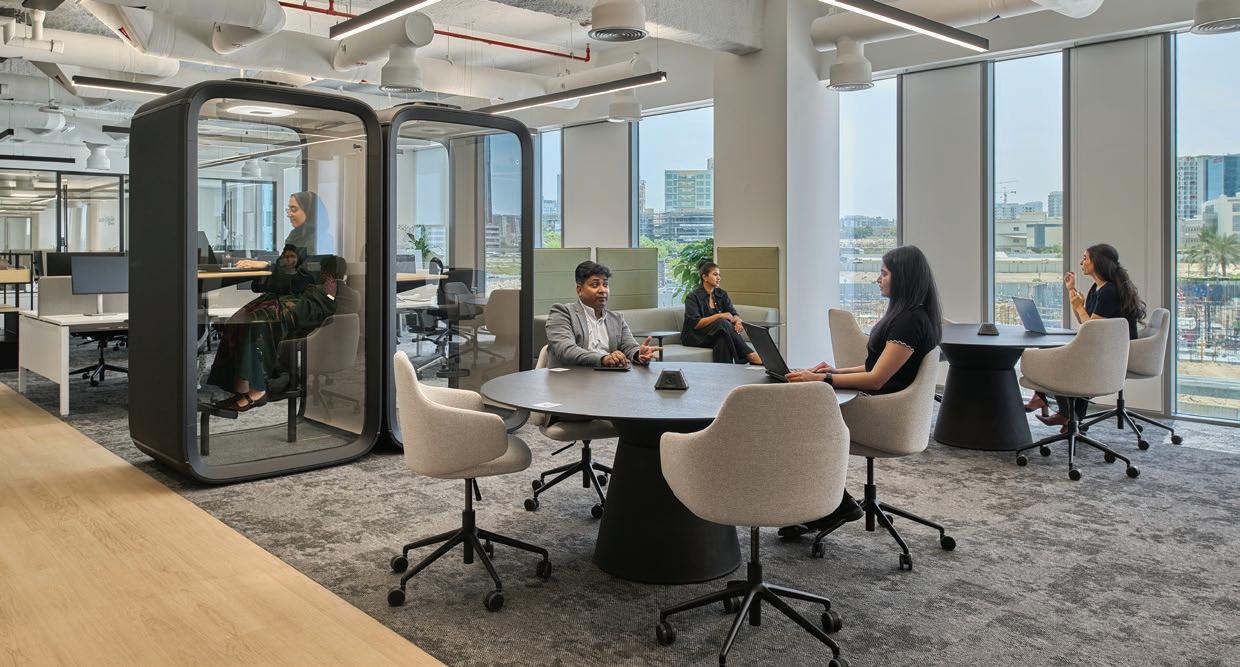
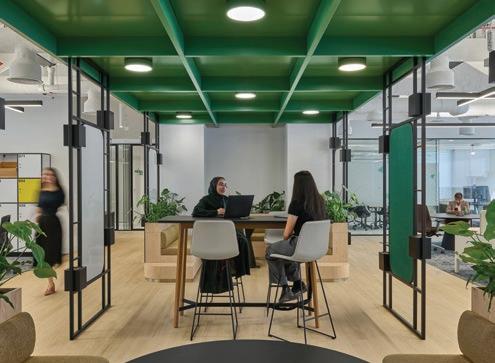
“The workplace is increasingly part of a broader ecosystem that supports both professional performance and everyday life. Designing workplaces that integrate the right mix of spaces, amenities and technology helps organisations support how people work today.”
The findings point to a clear opportunity for organisations across the UAE: rethink the workplace not as a fixed requirement, but as a strategic asset.
As businesses continue to invest in digital tools and advanced technologies, the office remains a critical environment one that enables employees to connect, access specialised resources, and build the skills required for the future of work.
What is changing is not the need for the office but the expectations placed upon it.
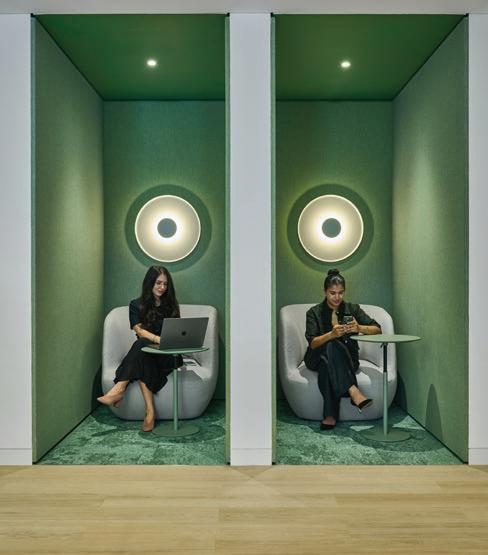
The Global Workplace Survey builds on more than two decades of research by the Gensler Research Institute, drawing from a dataset of nearly 125,000 respondents worldwide. It continues to provide a data-driven understanding of how workplace design directly influences employee experience and business performance.
And if the UAE findings are any indication, the future workplace is not about choosing between physical and digital it is about making both work, together.
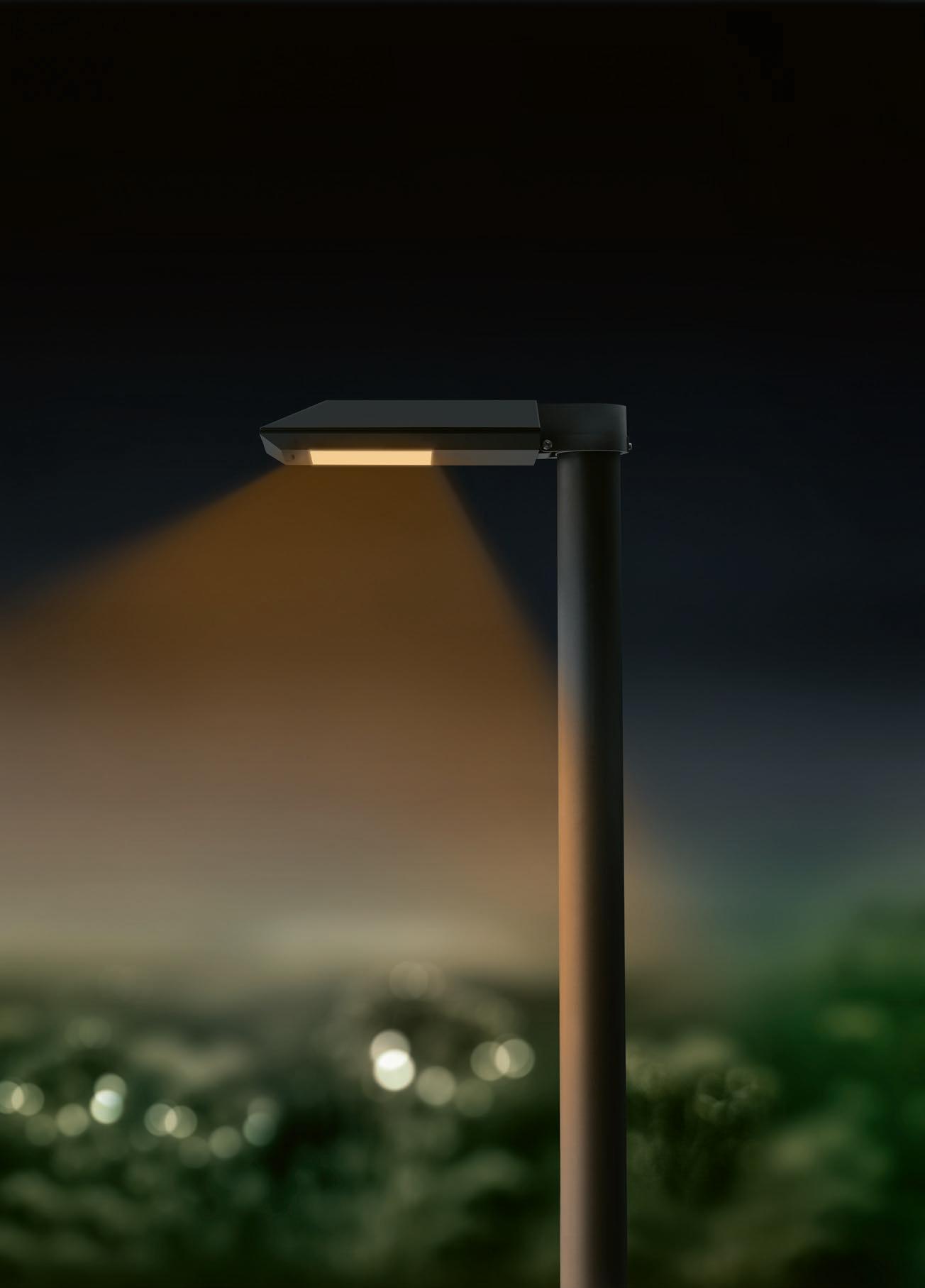
BEGA pole-top luminaires with BugSaver® technology protect nocturnal fauna by reducing the color temperature from 3000 Kelvin to an amber color around 1800 Kelvin, which reduces the light attractive effect. The color temperature and output can be controlled dynamically. bega.com/bugsaver
By Carlos Pissarra
In Part I of this series, we explored how water influences behavioural economics increasing dwell time, strengthening identity, moderating climate, and supporting asset valuation. The conclusion was clear: when strategically integrated, water functions as commercial infrastructure.
However, its performance potential extends well beyond behavioural impact.
When water systems are designed with programmability, multimedia integration, and long-term operational strategy in mind, they evolve from experiential anchors into monetisable platforms assets capable of generating recurring revenue and structured commercial partnerships. This is where the business case becomes even more compelling.
Activation as Revenue Strategy
A static fountain enhances a plaza, while a programmable water environment activates it.
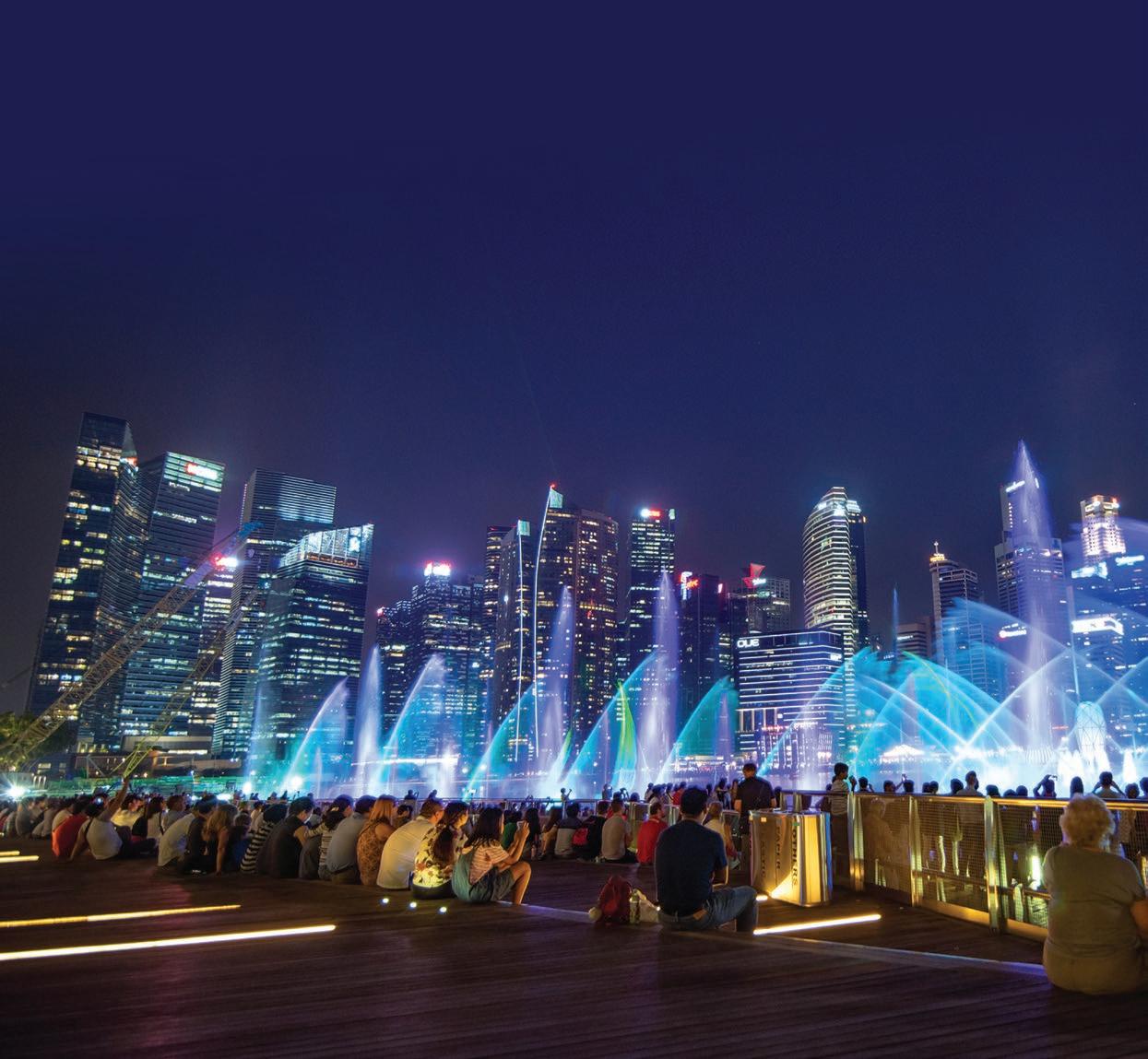
Modern water systems integrate dynamic lighting, projection mapping, laser systems, and synchronised audio. These technologies transform water from background feature into a programmable stage capable of hosting national celebrations, cultural festivals, retail campaigns, corporate launches, and seasonal programming.
Retail and mixed-use analytics consistently demonstrate that programmed event spaces increase footfall during activation periods by 15–35%, with evening uplift often exceeding 40% in destinationled environments. In F&B-dominant districts, programmed activations have been linked to 10–25% same-day revenue increases, particularly where events extend trading hours.
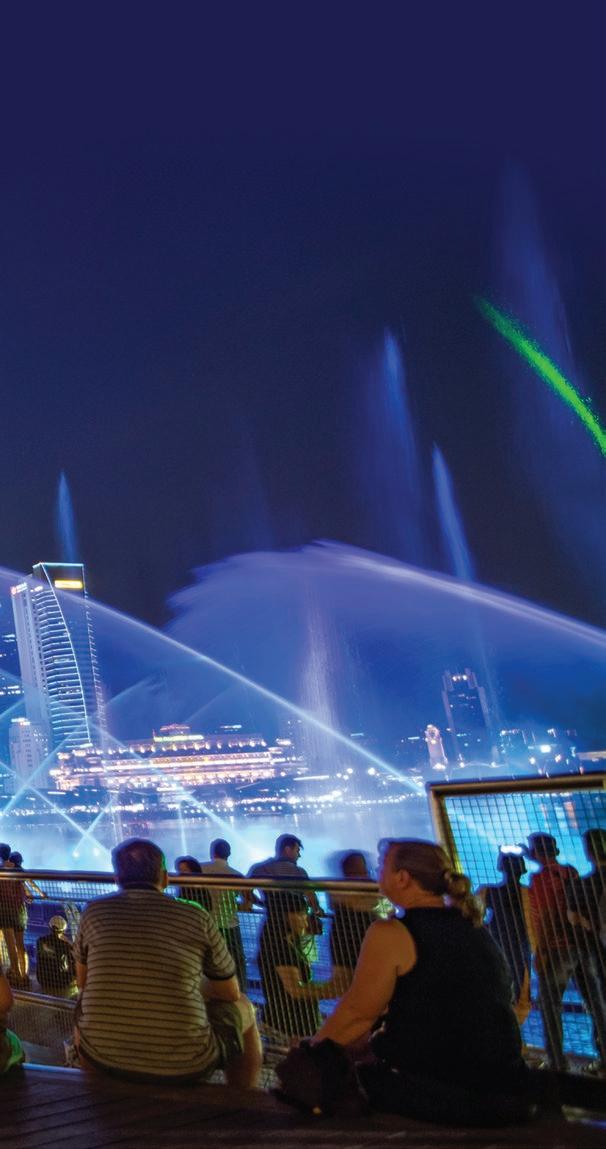
Activation extends commercial relevance beyond standard retail cycles. It keeps developments fresh, creates anticipation, and drives repeat visits and repeat visits drive revenue.
Sponsorship and Structured Monetisation
When a water feature is integrated with programmable infrastructure, it becomes a structured sponsorship platform. Branded show nights, national day themes, campaign tie-ins, corporate partnerships, and seasonal storytelling all become possible without altering the core physical infrastructure. Unlike temporary event staging, the technology is embedded within the environment.
For developers, this opens structured income opportunities. Large-scale destinations can integrate sponsorship packages tied to show sequences, projection segments, and seasonal
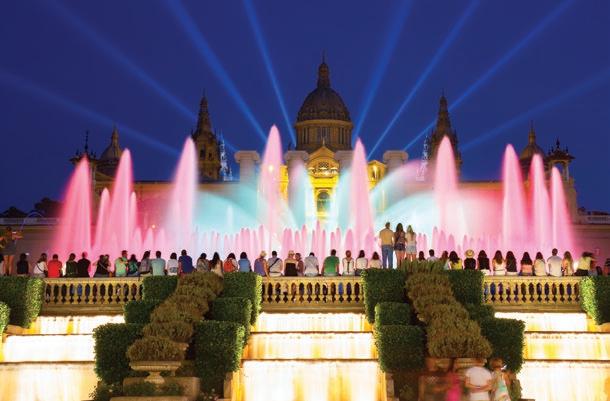
programming calendars. Brands increasingly prioritise highattention environments where audiences pause, interact, and share rather than passive billboard exposure.
Water projection surfaces and multimedia integration allow motion graphics, campaign films, and branded narratives to be delivered in immersive formats. These experiences are filmed and shared organically, amplifying exposure far beyond the inperson audience.
When programming is integrated into daily show schedules, incremental operational costs remain comparatively low when measured against the exposure value delivered. This improves sponsorship margins and transforms a capital investment into recurring revenue infrastructure.
Case Study Logic: Attraction as Commercial Strategy
Globally, the commercial logic of programmed water environments is already visible in large-scale destination developments. Iconic installations such as The Dubai Fountain and the multimedia water feature at ICONSIAM in Bangkok demonstrate how water becomes more than a design statement it becomes a deliberate attraction strategy. These installations draw millions of annual visitors and are supported by structured entertainment programming integrated into broader retail, hospitality, and tourism ecosystems. In these cases, water is not decorative infrastructure; it is central to the project’s identity, visibility, and recurring footfall.
Beyond scale, the commercial principle remains consistent. High-profile fashion and lifestyle brands have demonstrated the expressive potential of water projection technology, using large-format water screens for immersive campaign storytelling and product launches. These environments command attention because they create moments of pause. Audiences stop. They watch. They record. They share.
This behavioural shift is critical, as brands increasingly prioritise environments where audiences actively engage rather than passively consume exposure. A programmable water environment provides a high-attention platform capable of delivering narrative, spectacle, and emotional impact simultaneously. Unlike static signage, it encourages participation and organic amplification. Importantly, the scale of investment need not match global landmarks to deliver commercial value. A mixed-use development may not require a world-record fountain, but it can benefit significantly from integrated programmable capability that supports seasonal events, national celebrations, branded activations, and cultural programming.
While the scale may differ, the underlying commercial strategy remains consistent.
At its core, the lesson from these case studies is straightforward: when water is positioned as an attraction asset rather than an aesthetic feature, it influences visitation patterns, brand alignment, and commercial resilience. It becomes part of the economic engine of the development.
Of course, monetisation must be balanced with operational intelligence.
A water feature that generates activation revenue but suffers from high operating cost or maintenance inefficiency undermines its own business case. This is where intelligent system design becomes critical.
Contemporary closed-loop systems typically lose water only through evaporation generally 0.5–1.5% of total system volume per day, depending on climate. Advanced control platforms integrated with on-site weather monitoring adjust pump output, jet height, and scheduling in response to wind speed, humidity, and occupancy levels.
By dynamically responding to environmental conditions, systems reduce overspray and unnecessary energy consumption while preserving experiential impact.
Energy efficiency also plays a significant role. Variable frequency drives, LED lighting systems, and optimised hydraulic engineering reduce power demand while maintaining visual performance. The objective is not spectacle at any cost. It is performance aligned with operational sustainability.
Water use remains a sensitive issue, particularly in arid climates. However, modern engineering has evolved significantly. UV disinfection systems reduce chemical dependency by neutralising pathogens through ultraviolet exposure. Regenerative media filtration reduces backwash water waste by up to 50–80% compared to traditional sand filtration systems.
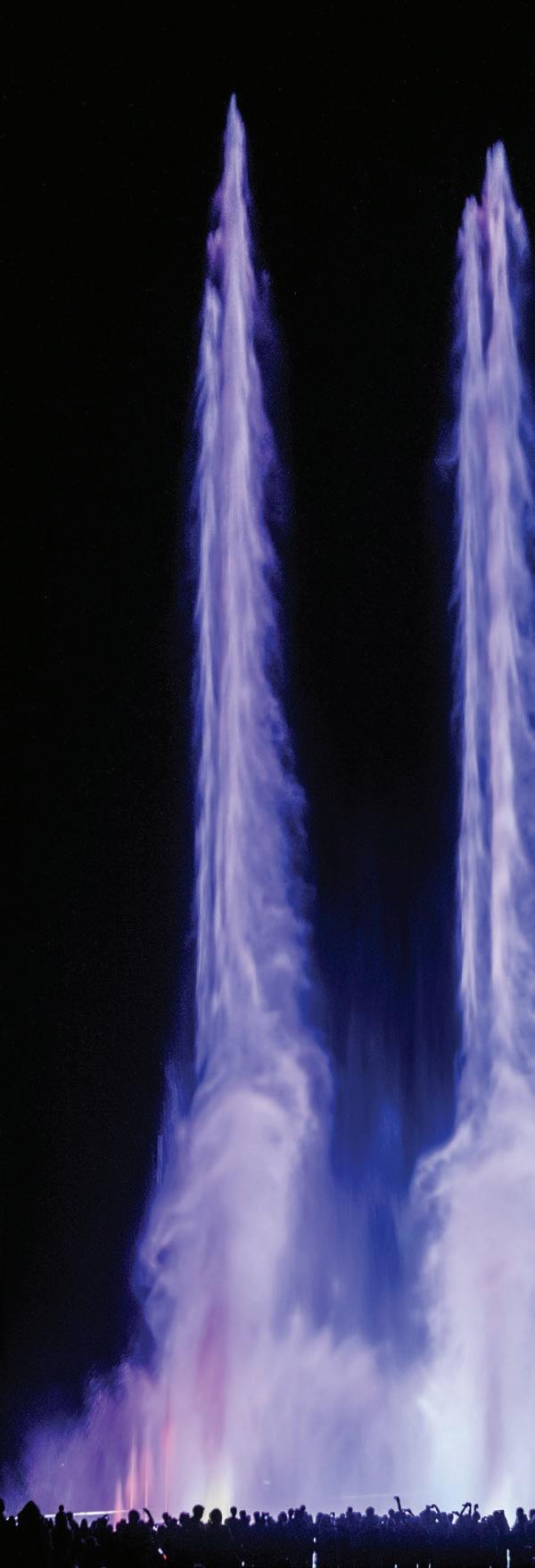
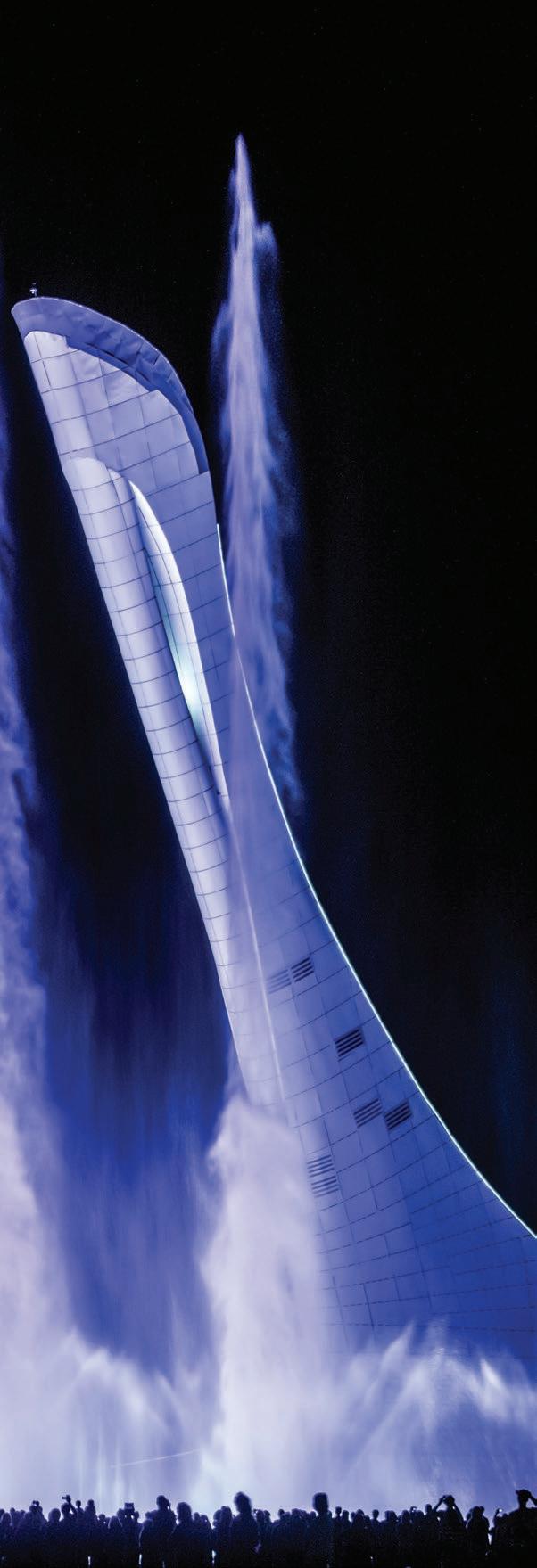
Smart control systems ensure that water features operate responsively rather than continuously at maximum capacity. This aligns performance with environmental conditions and occupancy patterns.
When responsibly designed, water features can support ESG frameworks and sustainability reporting objectives while maintaining commercial and experiential impact. Responsible performance is not contradictory to activation. It is foundational to it.
From Ornament to Infrastructure: Risk, Reward, and Strategic Integration Throughout this series, the central argument has been consistent: water must be evaluated through a commercial lens.
In Part I, we examined its influence on behavioural economics how it shapes movement, extends dwell time, moderates climate, strengthens identity, and supports long-term valuation. In Part II, we explored how programmable capabilities and intelligent operational systems enable water to evolve into a monetisable platform for activation, sponsorship, and recurring revenue.
The conclusion is not theoretical. Water is neither purely aesthetic nor automatically profitable. It exists on a spectrum defined by intention.
A poorly conceived fountain disconnected from circulation strategy, tenant adjacency, lifecycle planning, and operational modelling can become a maintenance burden and a financial liability. It consumes capital, demands servicing, and delivers little measurable return.
A strategically integrated water environment, by contrast, is aligned from the outset with commercial objectives. It is positioned within movement corridors. It anchors identity. It supports event programming. It is engineered for operational efficiency and long-term sustainability. It is treated not as a decorative enhancement, but as infrastructure that influences human behaviour and supports economic performance.
The difference lies not in spectacle, but in integration. As commercial developments grow increasingly competitive and experience becomes a primary differentiator, the industry must move beyond viewing water as an optional embellishment. It should instead be evaluated with the same discipline applied to leasing strategy, asset management, and financial modelling.
When designed intelligently and aligned strategically, water delivers measurable returns behaviourally, commercially, and operationally.
That is the business case and it demands a fundamental rethink of how water is conceived, engineered, and positioned within modern development.
The book Gardens for the Desert tells the story of how bödeker, a German landscape architecture firm, grew from a single seed planted by its founder, Richard Bödeker, into a strong and thriving tree. In the 1970s, Richard Bödeker brought his expertise in arid landscapes to Saudi Arabia, where his innovative designs laid the foundation for transformative projects like the Riyadh Diplomatic Quarter and many others. These projects became deeply intertwined with the city’s development, reflecting a commitment to sustainable urban greenery and a profound understanding of local needs.
Highlighting the many people who supported and shaped this journey, the book also includes perspectives from some of the firm’s partners. They share unique insights into the collaborative efforts that define bödeker’s success. Today, the firm is led by a partnership of six dedicated individuals who continue to develop its core design philosophy, creating new ideas and concepts for the future. This collaborative spirit has fostered significant growth, with the firm now employing 140 team members and continuing to expand.
For anyone interested in the history of landscape architecture in Saudi Arabia and Riyadh’s urban evolution, Gardens for the Desert provides a captivating perspective on the development of iconic projects and the expertise behind them.
The book is not freely available. But if you are interested, you can sign up for our newsletter, where we will be sharing the book as an audiobook in installments.
(bodeker.com/ab-sign-in)
Publisher: German|Ulmer; Englisch|bödeker
Texts: Stefan Leppert
Pages: 289
FREE Audiobook Ger/Eng (bödeker Newsletter)
LANDSCAPE CONSULTANTS
JC Melone Landscape
Design FZ LLE
T: +971 50 6410715 jcmelone@gmail.com
LANDSCAPE CONTRACTOR
Zaid Al Hussain Group
T: +971 4 3296630 info@zaidg.com
Green & More
T: +971 4 8830100
T: +971 4 8830101 info@greendmore.com www.greendmore.com
Proscape LLC
T: +971 4 277 0244 info@proscapeuae.com www.proscapeuae.com
Desert Group
T: +971 4 5904000
T: +971 4 3404441 group@desertgroup.ae www.desertgroup.ae
Basatin Landscaping LLC
T: +971 2 2077729 info@basatinlandscaping.com www.basatinlandscaping.com
FOUNTAINS
Fluidra Middle East
T: +971 4 8835505 F: +971 4 8836761 info@fluidrame.com www.fluidrame.com
Aquashi
T: +971 4 3208777 sales@aquashi.co.uk www.aquashi.co.uk
WATER MANAGEMENT
NDS (By NORMA Group) E: infoEMEA@ndspro.com www.ndspro.com/eu
TURF/LANDSCAPE PROFESSIONAL PRODUCTS
Polyclean LLC (Turf Division)
T: +971 4 338 8226
F: +971 4 338 8785 babiker.khateeb@polyclean.ae www.polyclean.ae
SOIL ADDITIVES
Gulf Perlite
T: +971 56 1235248
T: +971 55 1539640 info@uaeperlite.com www.gulfperlite.com
Zeoplant LLC
T: +971 4 4473588
F: +971 4 4473587 info@zeoplant.com www.zeoplant.com
INDOOR LANDSCAPING, POTS, PLANTS & GREEN WALLS
Plantscapes Indoor
Plants Trading LLC
T: +971 55 724 6193 plantscapes@desertgroup.ae www.plantscapes.ae
LANDSCAPE PRODUCTS
Tanseeq LLC
T: +971 4 3617199
F: +971 4 3607966 info@tanseeqllc.com www.tanseeqllc.com
Sirkap
Tel No.: +971 54 3592070 +971 55 5651426
Email ad: yawar@sirkap.ae Website: www.sirkap.ae
Ventana LLC
T: +971 4 3231603
F: +971 4 3806957 info@ventanallc.com www.ventanallc.com
IRRIGATION
Hunter Industries
T: +001 760 591 7114 F: +001 760 591 7194 Hanna.Zaidan@hunderindustries.com www.hunterindustries.com
Middle East Agrculture Company (MEAC)
T: +971 4 8861151 F: +971 4 8861152 www.meac.com.sa
METTS FZC
T: +971 4 4470927
F: +971 4 4470928 info@mettsfzc.com www.mettsfzc.com
Alwasail Industrial Co.
T: +971 4 8886987 F: +971 2 6733565 hashim@alwasail.com www.alwasail.com
Ventana LLC
T: +971 4 3231603 F: +971 4 3806957
SWIMMING POOLS Aquaverde
T: +971 4 4538469 T: +971 50 8763630 info@aquaverde.com www.aquverde.ae
Fluidra Middle East
T: +971 4 8835505 F: +971 4 8836761 info@fluidrame.com www.fluidrame.com
Pentair
T: +971 4 320 8777 malikhan@mettsfzc.com www.mettsfzc.com
Satma International L.L.C.
T: +971 4 2956088 F: +971 4 2956077 satmaint@emirates.net.ae www.satma.ae
Water in Motion LLC
T: +971 4 277 0244 info@waterinmotionllc.com www.waterinmotionllc.com
PRECAST CONCRETE PRODUCTS / HARD LANDSCAPING PRODUCTS
Consent LLC
T: +97143472011
F: +97143472957 sales@consent.ae www.consentblock.com
LIGHTING
BEGA GantenbrinkLeuchten KG
T: +49 2373 966-0
F: +49 2373 966-216 info@bega.de www.bega.com
TREES & HERBS
Acacia LLC
T: +971 4 265 3397 info@acacia-ae.com www.acacia-ae.com
SPORTS FACILITIES/ PLAYGROUND EQUIPMENTS
Tanseeq Projects LLC
T: +971 4 361 7199 info@tanseeqprojects.com www.tanseeqprojects.com
WT Burden
T: +971 4 8860700
F: +971 4 8860701 streetfurniture@wtburden.ae www.wtburden.ae
METAL FABRICATOR
Metaline LLC
T: +971 224 3369 info@metalinellc.com www.metalinellc.com