
A confident, capable profession is built over time through strong education, high standards, practical experience and sustained professional development. At a moment when landscape skills are central to national agendas in economic growth, housing delivery and sustainability, ensuring that our skills base is robust and future-ready is essential.
As such, this edition of Landscape reflects the Landscape Institute’s commitment to aligning education, skills, policy and practice in a more coherent and strategic way.
Working closely with our Education & Careers Committee (ECC) and the wider membership, we are strengthening the connection between professional practice, education, young people and career influencers, and advancing how members and Registered Practices can play an active role in shaping the future workforce.
Education is not a discrete entity; it is an integral part of the skills pipeline, labour market, long-term resilience of the sector and value we provide to society. Through collaboration with universities, colleges, employers and policymakers, we are seeking to grow the domestic talent pipeline, widen participation, support alternative pathways, and ensure that the skills developed reflect the realities of contemporary practice.
Central to this is collaboration. Registered Practices, educators and members across all career stages bring invaluable insight into emerging skills gaps, evolving modes of practice, and the competencies required for landscape-led delivery. By working together, we can ensure that education and careers programmes remain relevant, accessible and ambitious. We encourage all members to engage with the Institute’s education and careers programmes, to offer placements and mentoring, to contribute expertise, and to help us build a resilient, inclusive and future-ready profession.
We thank ECC Chair, Chris House CMLI, for all that she has contributed as she steps down from her role, and pass over to her and Vice Chair Jonathan Emery CMLI, guest editors for this edition, to introduce the key issues covered in the pages ahead (page 8). Over to them!

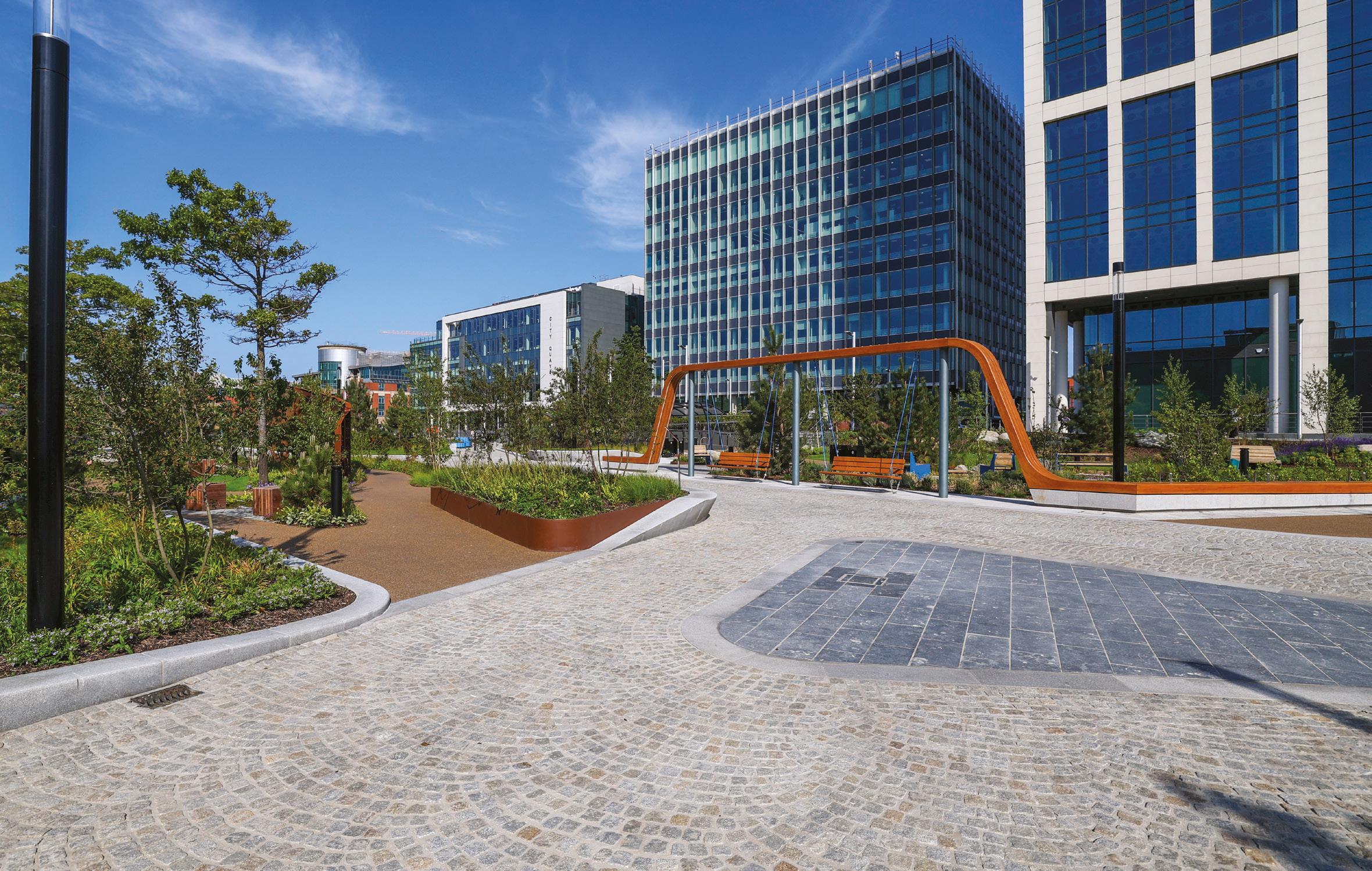
City Quay Gardens, Belfast
Client: Belfast Harbour
Landscape Architects: Gillespies
Artwork Design: Smiling Wolf
Contractor: Northstone (NI)






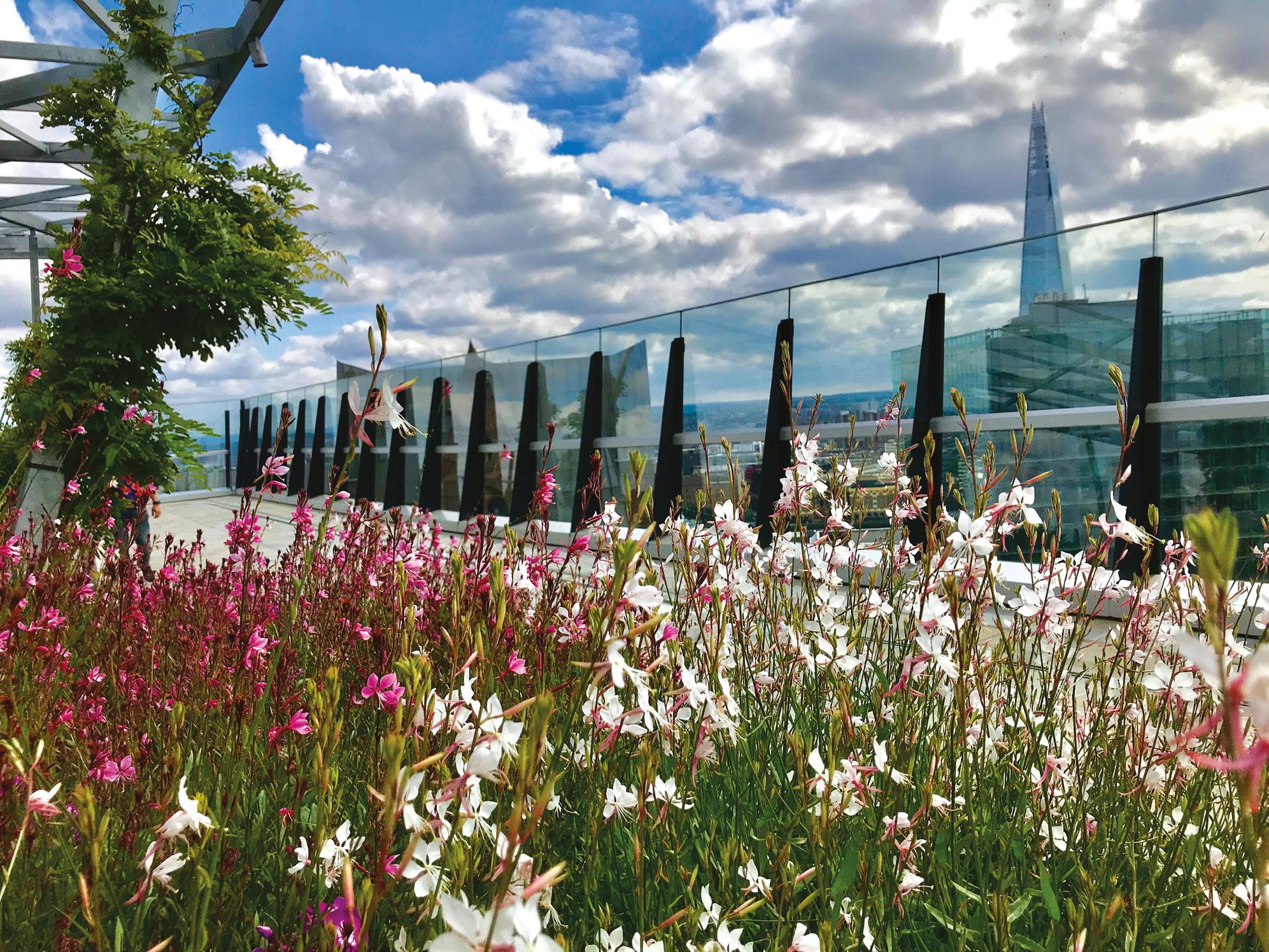
Healthier communities start with healthier landscapes. Sustainable places need a solutions-led approach, supported by Blue Green Infrastructure that benefits people as much as the environment. From rain gardens that reduce flood risk to green roofs, urban trees, and wildflower spaces that improve air quality and encourage active living, Green-tech Specifier’s expert team help turn policy into practical, buildable designs that support everyday wellbeing.
Education is the critical foundation for maintaining and strengthening a well-respected profession.
Chris House CMLI
Jonathan Emery CMLI
Find out more on page 9.
PUBLISHER
Darkhorse Design Ltd
T (0)20 7323 1931 darkhorsedesign.co.uk
studio@darkhorsedesign.co.uk
EDITORIAL ADVISORY PANEL
Saira Ali FLI, Team Leader, Landscape, Design and Conservation, City of Bradford Metropolitan District Council
Stella Bland, Head of Communications, LDA Design
Marc Tomes CMLI, Director, Allen
Scott Landscape Architecture
Sandeep Menon, Lecturer in Landscape Architecture, Manchester School of Architecture
Jaideep Warya CMLI, Landscape Architect, Allies and Morrison
Jane Findlay PPLI & FLI, Director FIRA Landscape Architects
LANDSCAPE INSTITUTE
Managing Editor and PR & Communications Manager: Josh Cunningham
marketing@landscapeinstitute.org
Technical Copy Editor: Romy Rawlings FLI
Proof Reader: Johanna Robinson
President: Carolin Göhler FLI
CEO: Rob Hughes
Head of Marketing, Communications and Events: Neelam Sheemar
Director of Policy & Public Affairs: Belinda Gordon
Landscapeinstitute.org
@talklandscape landscapeinstitute landscapeinstituteUK





For



LI Awards 2025
Recapping the landmark event celebrating landscape excellence 66 FOLAR celebrates Hal Moggridge
Bringing strategic vision and community outcomes to projects of all sizes
Meet the team
Get to know the Education team at the LI
National Housing & Regeneration Conference A look back at the first event in our national tour
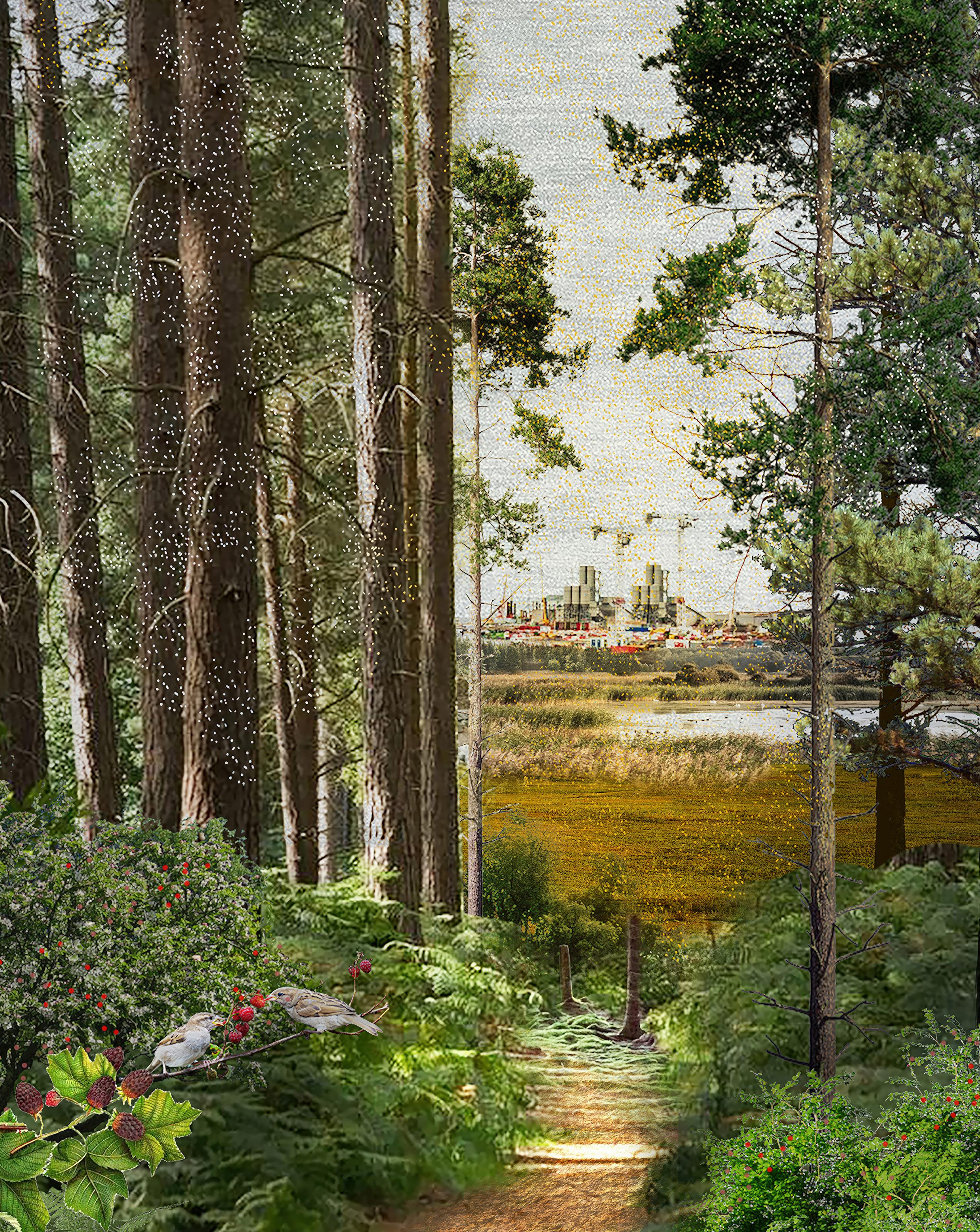
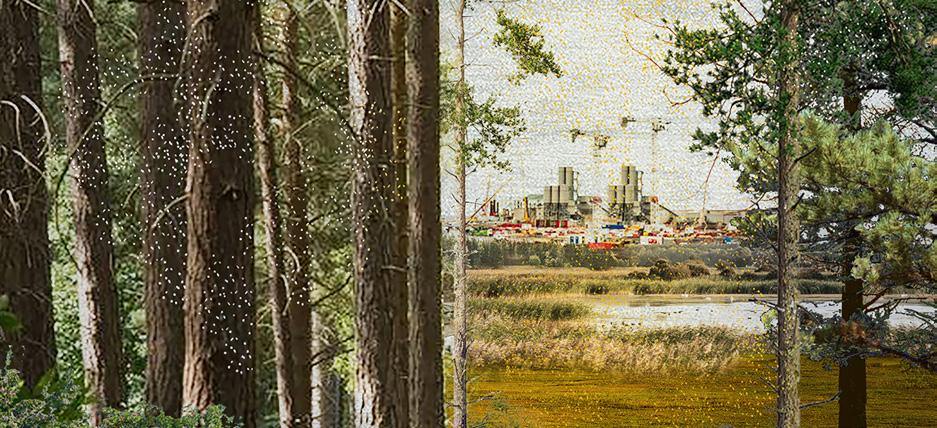
1 A glimpse of Sizewell, from Design in the Territory of Water / At the End of Atomic Age, LI Awards Student Portfolio finalist 2025.
© Zhuoer Yu
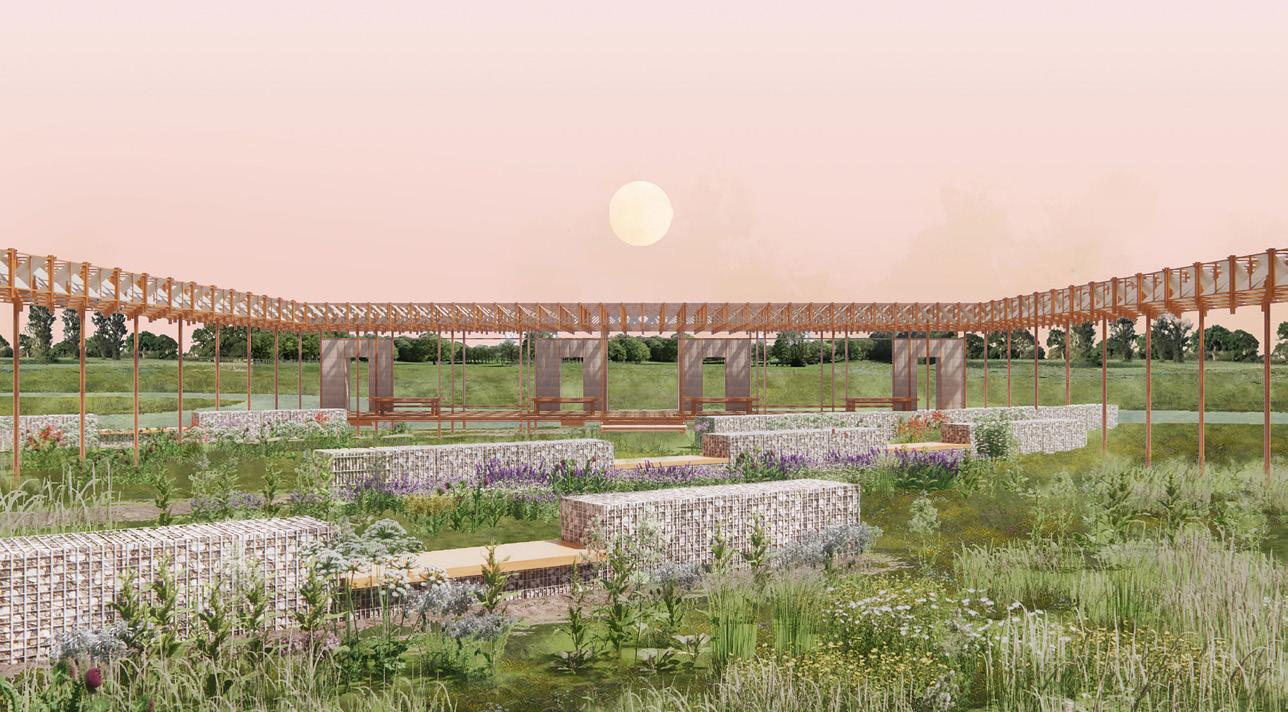
2 Herb Garden, from Design in the Territory of Water / At the End of Atomic Age, LI Awards Student Portfolio finalist 2025.


This edition of the Journal is focusing on education and skills. As Chair and Vice Chair of the Education and Careers Committee, we have the pleasure of writing this introduction. With an expert education team and a new Education and Careers Committee in place, the edition comes at a timely moment for the profession and Institute.
Chris has been involved in education and membership with the Institute for over a decade, while Jonathan has been involved for nearly four years and is not too long out of the Pathway to Chartership process. In this time, we’ve seen that education and its provision are constantly evolving, facing ever-changing challenges from government policy and funding streams. As a relatively small profession, we believe it is essential that we maintain and grow our current routes into the profession, whether that be in higher or further education.
The Landscape Institute Education & Careers Committee outline a path to progress for growing the pipeline of talent and skills entering the profession.
Landscape architects play an essential role in improving and advancing both society and the environment. We have a tremendous ability to bring the knowledge of other related professionals together. In an ever more complex world that encourages you to ‘specialise’, landscape architects are often skilled ‘generalists’, offering a landscape-led approach to design. Our education system must therefore teach us about the broad base from which we draw upon. The article, ‘Alternative pathways’ (page 48), reminds us that “landscape architecture is inherently interdisciplinary. It deals with the interface between people, place and nature, and in doing so draws on a wide spectrum of knowledge.” We are often employed for our understanding of place – ‘site experts’ that help clients navigate the challenges of site planning, interdisciplinary regulations and policy such as Biodiversity Net Gain. Our education must ensure we understand the complexities of the landscape, the different species that inhabit it, and the dynamic relationship between people and their environment.
Education is the critical foundation for maintaining and strengthening a well-respected profession. A growing profession typically equals a growing voice, so the education and careers agenda therefore needs to focus on growth.
© Zhuoer Yu 2
In addition to technical competency, this profession demands that you think holistically. We are often responsible for developing the ‘vision’. Our education must teach us to think creatively, think critically, be reflective and continually learn.
Finally, widening participation within the profession brings significant opportunities. A more diverse range of educational backgrounds, professional expertise, and life experience will further enrich and strengthen the profession, providing a broader and more nuanced base of insight to draw upon. Our work, and our workforce, should reflect the communities we serve.
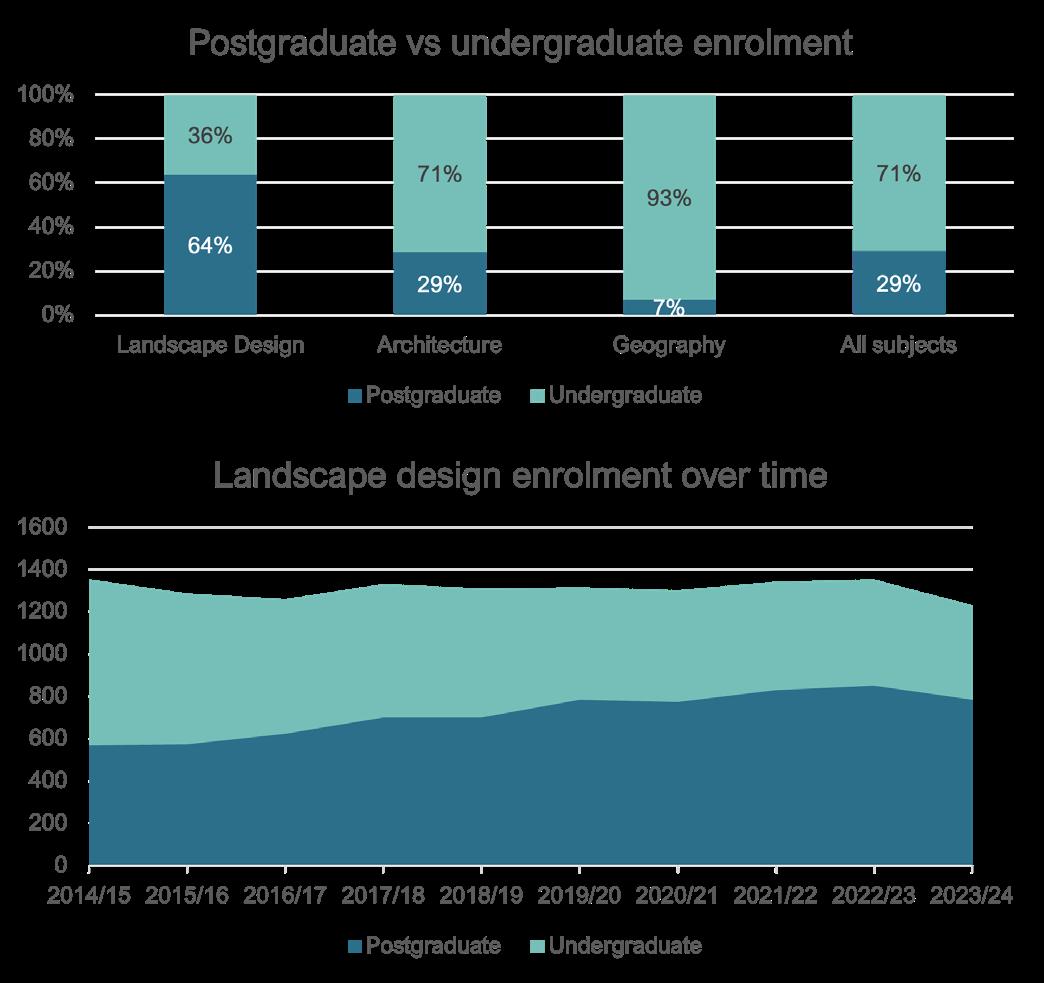
Enrolment in landscape architecture at higher education over the last ten years has not seen significant change overall, but there has been a gradual increase in the number of postgraduate students, and a decrease in undergraduate enrolment. Since the pandemic, there has been a modest overall decline in landscape enrolment
numbers of approximately 5% (see page 12). It could be observed that student numbers are not growing in line with workforce demand.
‘The talent pipeline’ (page 22) identifies the lack of awareness of the profession amongst young people, parents and teachers. It also champions more effective ways of reaching a much wider pool of young people in a more sustained way.
Landscape architects are all too familiar with the issue of awareness. As the article, ‘Alternative pathways’ (page 48), points out, “many school-leavers and undergraduates have never encountered landscape architecture as a potential career, particularly when compared with disciplines such as architecture, geography, art and design, or environmental science, which are more visible within schools and the media. As a result, many future landscape architects first enter another discipline before discovering the landscape profession later in their academic or professional lives.”
There are of course challenges presented by cost of living and tuition fees that are, to a degree, out of our hands. The responsibility remains of this profession to demonstrate value in
our work, in order to increase pay standards and continue to attract talented students. Additionally, education providers need to consider more flexibility within modes of delivery to ensure this profession remains accessible. To truly meet skills needs, we must explore and develop alternative and flexible pathways, including apprenticeships, to strengthen our profession.
We are delighted and very fortunate now to have two dedicated Education Managers at the Institute in Briony Marston and Kelli Cochran-Sharp, who are both highly experienced educators and educational leaders, bringing new ideas and, importantly, a fresh, informed perspective.
In ‘The talent pipeline’ (page 22), Briony says, “there is a

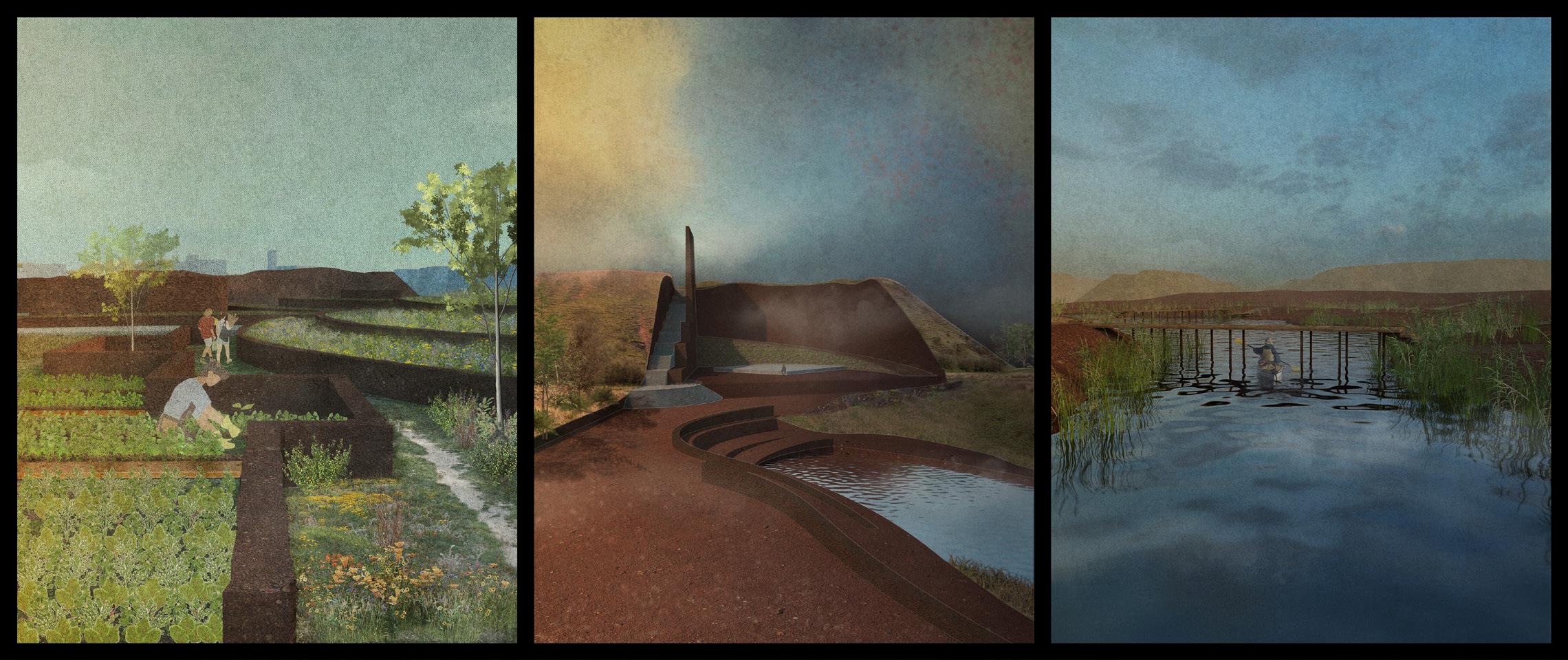
3 Landscapes of memory and resistance, LI Awards Student Portfolio finalist 2025.
© Alice Carrington-Windo
4 Embodied Landscape Explorations, LI Awards Student Portfolio finalist 2025.
© Ana Garrido Chavez
critical need to increase and sustain the domestic talent pipeline for landscape architecture and, more broadly, the landscape profession. Education and careers systems across the UK are complicated and evolving, but the landscape profession needs to work with those systems to ensure real and lasting change.”
Briony and Kelli have already helped identify our key priorities, as well as offering a wealth of new possibilities for the Institute to address, with the 16+ market in the UK as the priority audience in the short to medium term.
Kelli reminds us that “the pathway into the landscape profession has never been singular. While many practitioners follow the traditional route of undergraduate study in landscape architecture followed by a master’s degree, a growing proportion enter the profession from other fields” (page 48). It is therefore unsurprising that students come to conversion programmes from many different fields.
Representation and relatability matter to ensure we are reaching the widest possible audience to enrich and grow our profession. We can’t and shouldn’t do it alone. Educating the educators in relation to careers in the landscape profession is also crucial to domestic growth.
One of our success stories over the last few years has been the introduction of a Level 3 Apprenticeship route for landscape technicians. We now have a remote two-year model for this apprenticeship, details of which can be found on page 54.
Meanwhile, the recent growth and relevance of the Careers Hubs (see page 32) form a core part of increasing our domestic pipeline, and the development of employer-led
projects is an exciting and impactful way of connecting young people with the profession (see page 28). Another key initiative in achieving progress has been increasing the profile of the profession with UCAS for both undergraduate and postgraduate students (see page 36), with early indications that this will be extremely successful.
Recruitment of landscape graduates has always been challenging. The challenges today are different but no less demanding. Our postgraduate courses have been increasingly popular with international students, many of whom aspire to gain employment in the UK market, but recent changes to visa conditions and, in particular, salary levels are now creating a position where international graduates are facing a more challenging landscape to employment in the UK (see page 40).
As the Landscape Institute prepares to publish its new Education and Careers Strategy, aligned with the corporate strategy, there is a significant opportunity to take a more joined-up and ambitious approach to education, skills and professional development. With
recruitment to the Education and Careers Committee underway, including the appointment of a new Chair, member and Registered Practice insight will be central to shaping this work.
As LI members, your experience, perspectives and involvement are vital in helping us build a resilient, inclusive and futurefocused profession. We strongly encourage you to engage with the opportunities highlighted throughout this edition, to get in touch, and to actively support the Education Team as this important work progresses.
Get in touch at education@ landscapeinstitute.org
Chris House CMLI is founder of House Associates and outgoing Chair of the LI Education & Careers Committee
Jonathan Emery CMLI is a Landscape Architect at DSA Environment & Design, Chair of the East Midlands Branch and Vice Chair of the LI Education & Careers Committee

Landscape is a vital and growing economic sector that plays an essential role in delivering government targets and societal value. However, without changes to the way it is viewed within the development system and a more nuanced approach to education and immigration, its potential will remain unfulfilled.
From late 2024 to October 2025, the LI commissioned Metro Dynamics to undertake research on the landscape sector, building on previous research (Skills for Greener Places, 2022).
The new research had two overlapping objectives:
▪ To demonstrate the size, scale and workforce composition of the wider landscape sector and understand its value to the UK economy.
▪ To provide the LI with strategic insights on the employment market, skills demand, and higher education provision, specifically for landscape architecture, to inform our policy and education agenda.
The findings show that landscape is a vital and growing economic sector, developing faster than the national average1, with employment, number of businesses, earnings and gross value added (GVA) all increasing. This is in line with a rising demand for skills that are essential to the delivery of societal needs, helping to deliver government targets across housing, environment and the economy while supporting community pride, wellbeing and livelihoods.
However, the findings also reveal constrained professional enterprise growth and skills shortages in high-value, strategic roles that contribute proportionately higher GVA.
At the same time, landscape education is shown to have an overreliance on international students, an issue which has been exacerbated by UK visa and immigration policy. This highlights the need for a more nuanced approach from government. The immediate implication is that while improving the domestic pipeline of landscape skills is essential, growing the talent pool isn’t enough. For the landscape sector to start fulfilling its potential as a significant driver of long-term, sustainable growth, the value and skills that the sector provides must be engaged and deployed earlier within development delivery systems.
2
The LI is taking action to make sure the landscape profession is equipped with the skills and opportunities to thrive in the future. We are ensuring the sector is recognised and supported for the essential role it plays in delivering societal needs.
Our actions:
▪ Using the findings of the Workforce and Economic Research to inform our Education Strategy, and longterm planning, including:
▪ Strengthening domestic student recruitment on our accredited programmes, through targeted campaigns and
educational outreach.
▪ Ensuring Equity, Diversity and Inclusion is embedded throughout our Education and Careers Strategyincluding initiatives to widen participation from underrepresented groups, purposeful outreach, and transparent pathways into the profession.
▪ Promoting apprenticeships and work-based learning to diversify entry points and broaden the talent pipeline.
▪ Supporting our Higher and Further Education
The support and change we need
If the full potential of landscape is to be realised, it must be supported through enabling policy from government at national, regional and local levels.
Our asks:
1. Recognise landscape as critical infrastructure
Why:
Landscape development underpins built environment activity literally and figuratively. Integrating a landscape-led approach2 early within design and building processes involving land assets ensures the most balanced approach, enhancing the value of the built and natural environments in many positive ways:
▪ Economic stabilityimplementing positive landscape strategies and well-designed townscapes creates healthy and sustainable environments that strengthen
key economic sectors and address social and economic inequalities, while also providing long-term resilience.
▪ Climate performanceLandscape interventions protect against more extreme weather, providing essential shade and cooling by using lower-cost natural systems, as well as carbon capture and rainwater harvesting.
▪ Public Health and Social Value: Landscape-led approaches ensure that design is focused on people, communities and wildlife as much as it is about its infrastructure. We want to foster spaces that support both human well-being and nature, now and into the future.
▪ Safety: Thoughtful landscape design ensures that areas are inclusive, safer and accessible to all, while also raising public awareness and fostering education and knowledge.
Partners to deliver indemand skills.
▪ Continuing to make the case for landscape-led development, through site visits and other engagement with decisionmakers, a significant presence at UKREiiF, carrying out the polling of public views, responding to government consultations and other activities.
▪ Future-proofing professional competencies by:
▪ updating competency frameworks,
▪ ensuring professional standardsremainalignedwith evolving delivery needs.
These critical benefits of a landscape-led approach cannot be fulfilled whilst acute shortages in specialist landscape roles persist. Over 80% of hard-to-fill vacancies are attributed to skills shortages, with recruitment pressures concentrated in conservation, design, planning and management functions. This constrains delivery capacity across housing, infrastructure, climate adaptation and nature recovery programmes.
The ask:
Make the application of landscape expertise key and early stage input to major housing, infrastructure and regeneration programmes. Ensure it is promoted as a skill across apprenticeships and higher education.
2. Ensure built development is landscape-led
Why:
Landscape planning and design are essential to delivering highquality places by integrating green infrastructure and nature-based solutions to support climate adaptation, biodiversity and public health outcomes.
The ask:
Embed landscape-led approaches within national planning policy by strengthening the role of landscape in the National
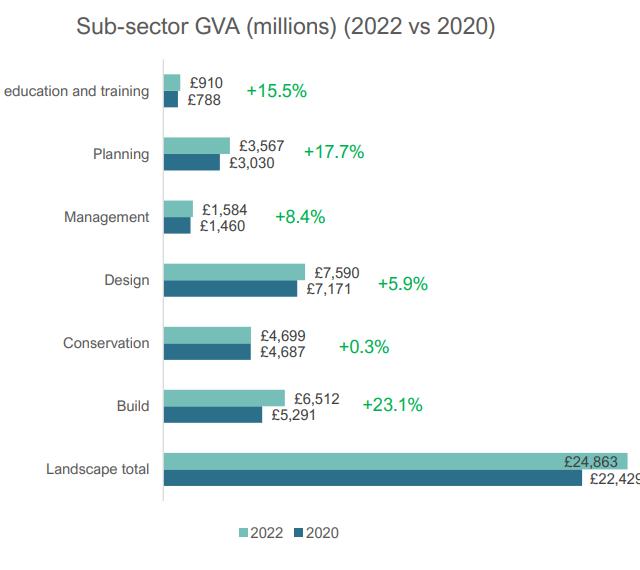
Landscape is a substantial and expanding part of the UK economy, generating approximately £24.9 billion in gross value added, supporting around 372,500 jobs and comprising more than 53,800 businesses3 (Fig 2). It is a sector that combines highly specialised professional services with labourintensive delivery and long-term management functions, operating across planning, design, build and stewardship.
Planning Policy Framework and Design & Placemaking guidance. Ensure Local Plan policies and major development set out the importance of landscape considerations to informsite layout, green infrastructure, climate resilience and long-term stewardship from the outset. Ensure that Local Authorities apply professional landscape skills and competencies to enable landscape-led decisionmaking. Promote and incentivise developers to realise the value of applying, landscape-led approaches.
3. Stabilise the international talent pipeline
Why:
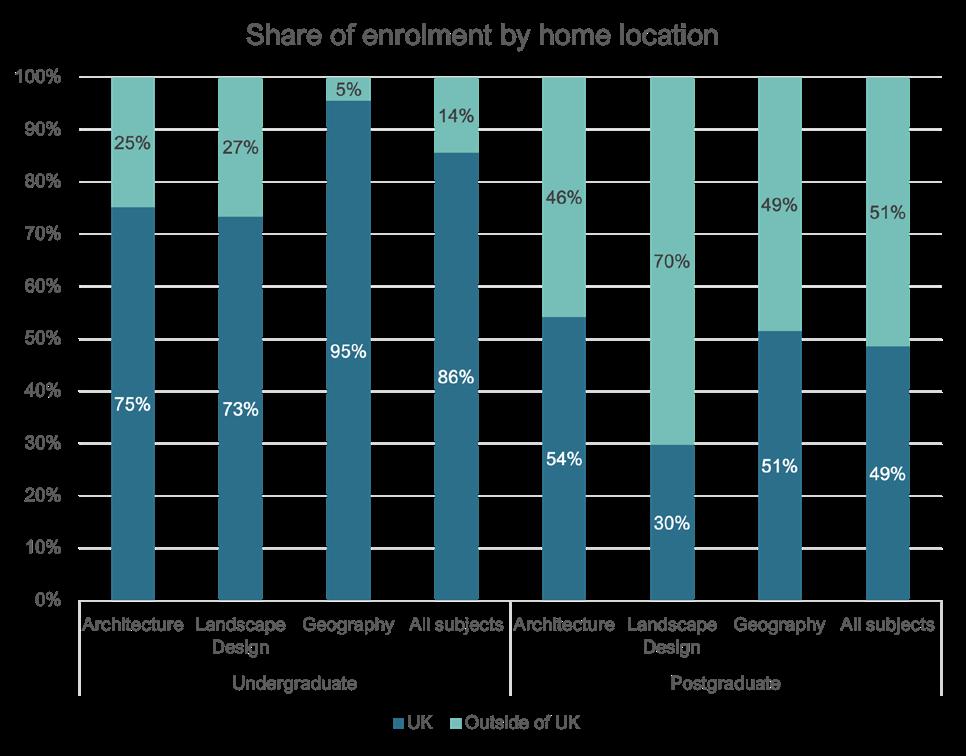
Postgraduate landscape education relies heavily on international students, with 70% classed as 'international' from a fees and funding perspective (Fig 1). Current visa and salary thresholds restrict the employment of the earlycareer professionals who are needed to support project delivery, practice growth and workforce stability.
Note: Landscape Design is the category label in UCAS. It is used as the subject coding umbrella for all programmes related to landscape architecture in the UK.
The ask:
Adjust immigration and salary thresholds for accredited landscape graduates to allow international talent to act as a stabiliser while domestic capacity is scaled up. We will be writing to the Home Secretary on the matter. It is important to keep making the case and highlighting the restricting consequences of Government policy.
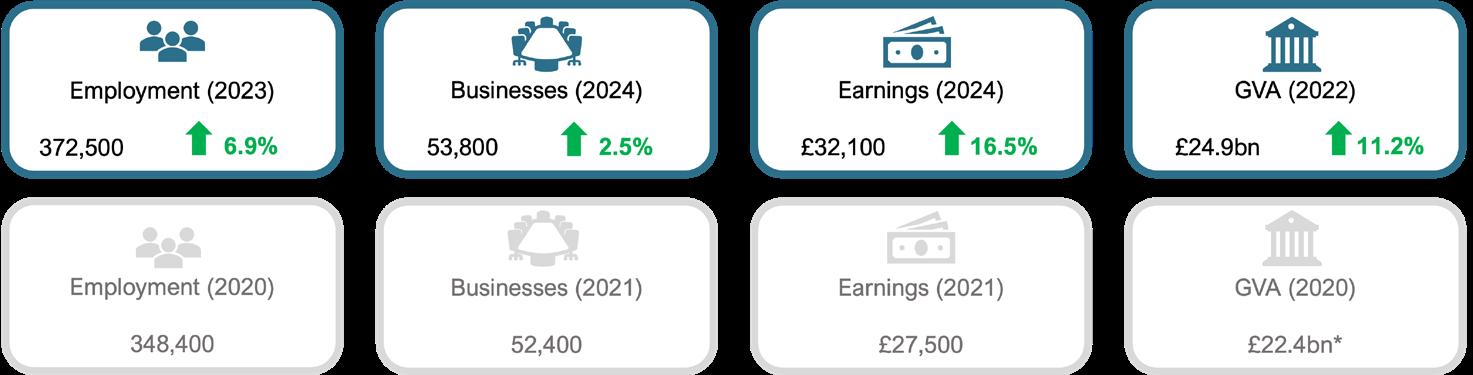
Figure 2
4 https:// landscapeinstitute. org/policy-practice/ topics/a-landscapeled-approach-todevelopment/
However, the economic contribution of landscape tells only part of the story. Its wider value lies in the way it shapes development outcomes, manages environmental risk, supports climate adaptation and secures long-term social, environmental and economic returns through place quality, green infrastructure and ecosystem services.
The LI’s 2025 briefing, Maximising value from development: How a landscape-led approach delivers more for people, place and nature4, sets out clear evidence that landscape expertise underpins housing delivery, infrastructure
resilience and community wellbeing.
In short, landscape is a growing and economically significant sector delivering substantial societal value across multiple policy priorities.
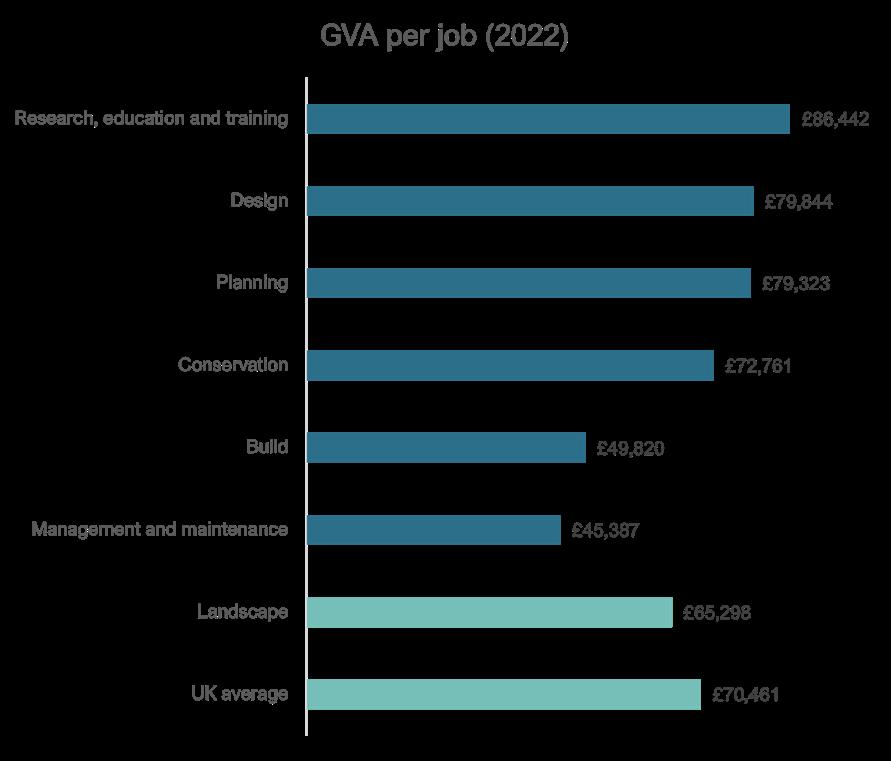
In terms of productivity, skills in research, design and planning exhibit the highest sector GVA. These reflect their knowledgeintensive and specialist nature and their contribution to holistic, long term value creation (Figs 3 & 4).
In contrast, build roles support larger volumes of employment but generate lower productivity per worker (Figs 4 & 5).
In terms of GVA-employment trends, the increase in GVA per
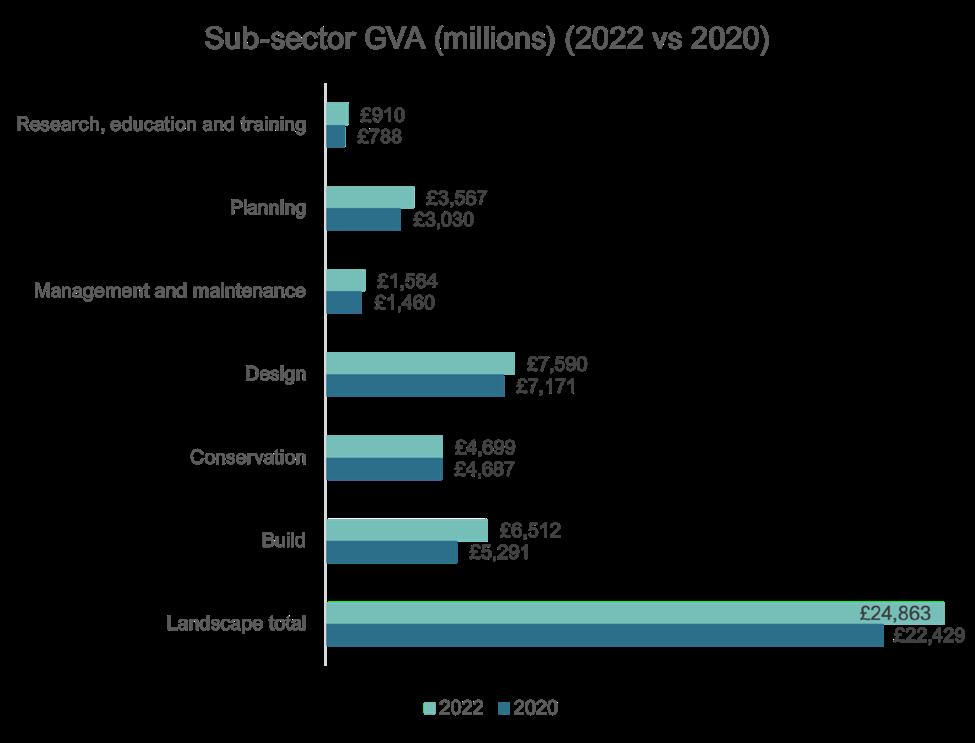
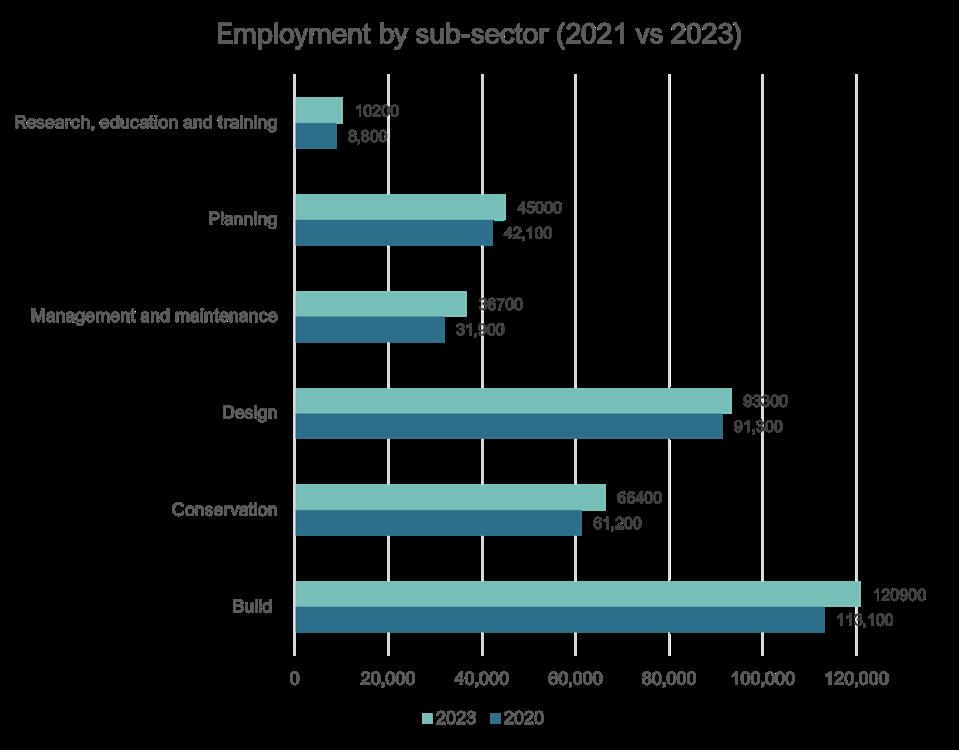
person in Design may reflect its rate of employment rising at a smaller rate than sectors such as management and conservation roles, which now account for a growing share of the overall workforce.
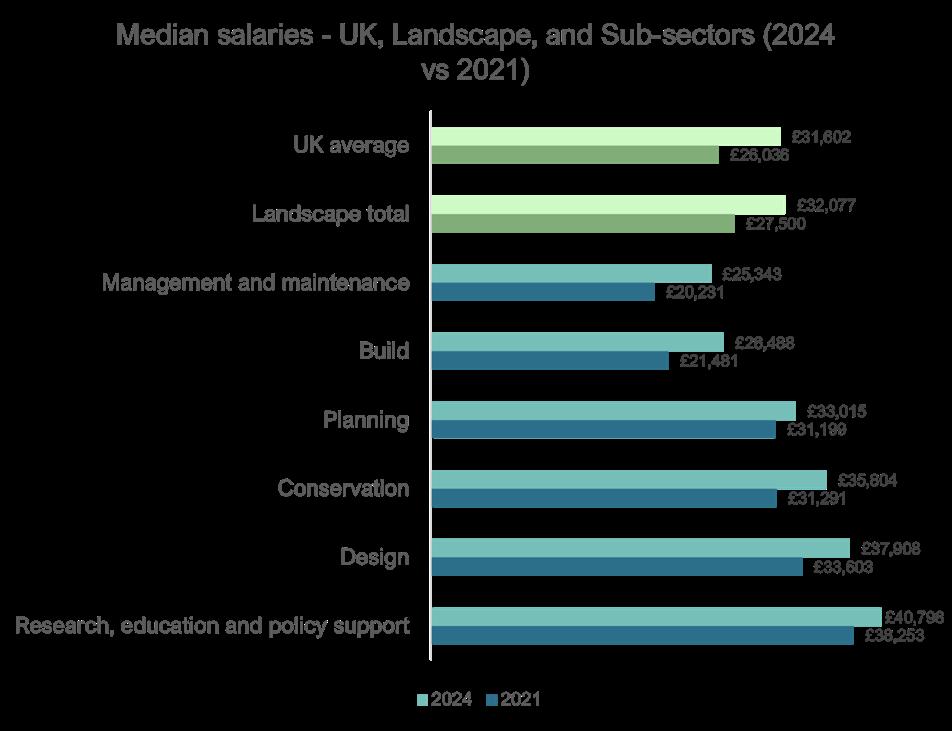
Crucially, higher productivity in key professional roles does not consistently translate into higher earnings growth in professional roles, even as demand has remained strong. Wage rises in planning, design and related professional areas have been below average growth levels, though the average salaries per se in such sectors remain above national averages (Fig 6).
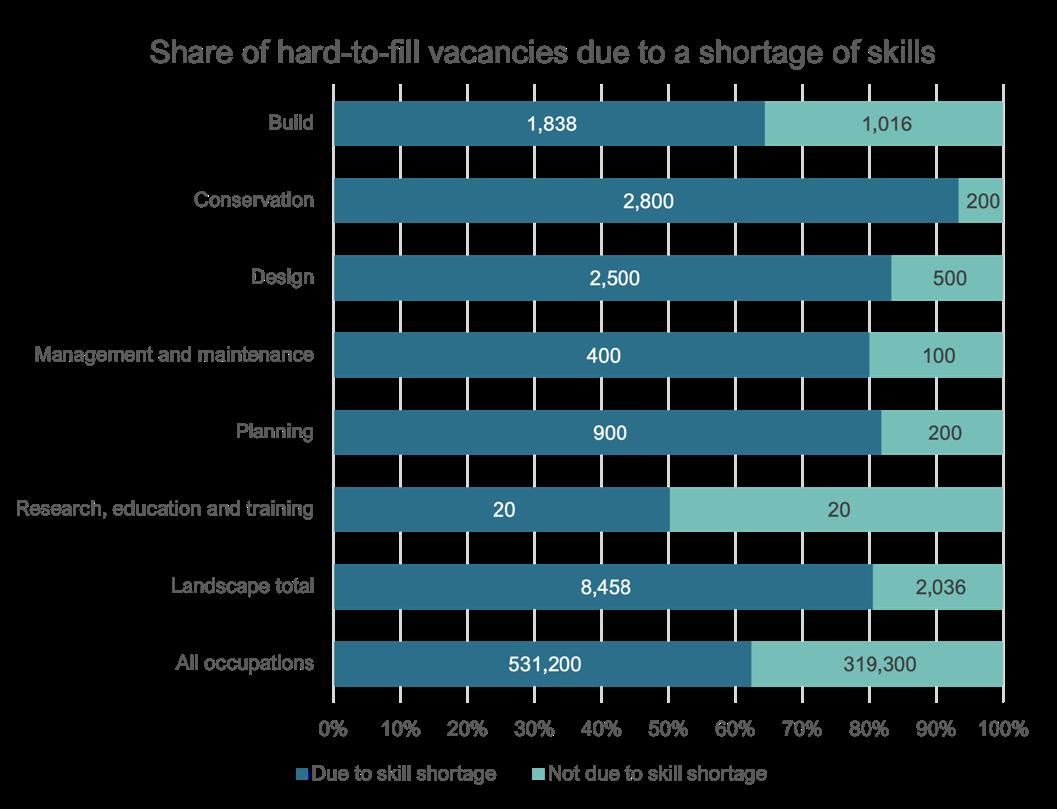
Skills shortages for strategic, high-GVA roles persist, especially in Planning (Fig 7).
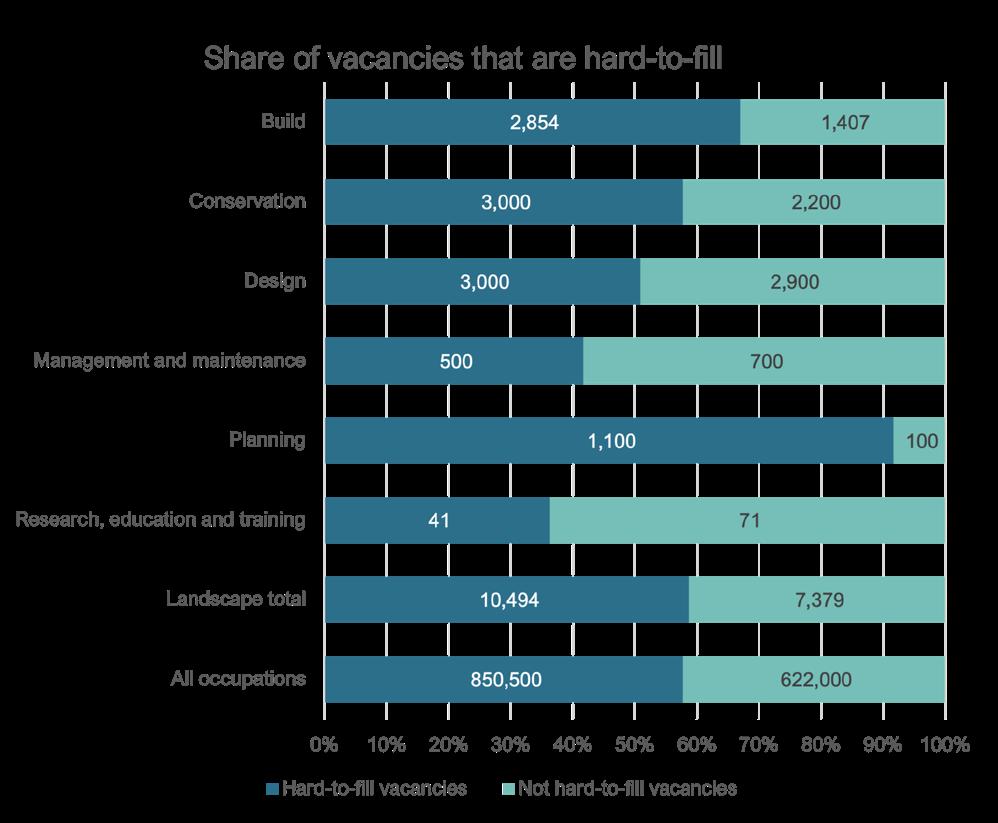
Planning aside, the level of most hard-to-fill landscape vacancies mirror tendencies across the UK economy. However, the landscape sector suffers as most of its vacancies are due to skills shortages, at rates significantly higher than the national average (Fig 8)
The business base of the landscape sector is dominated by
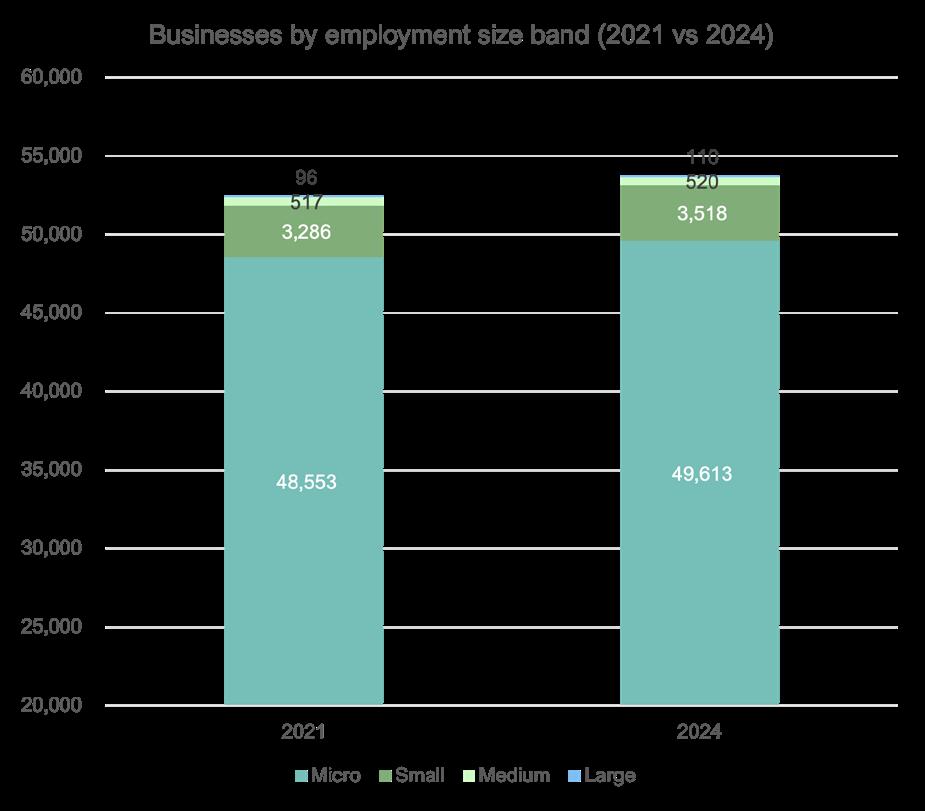
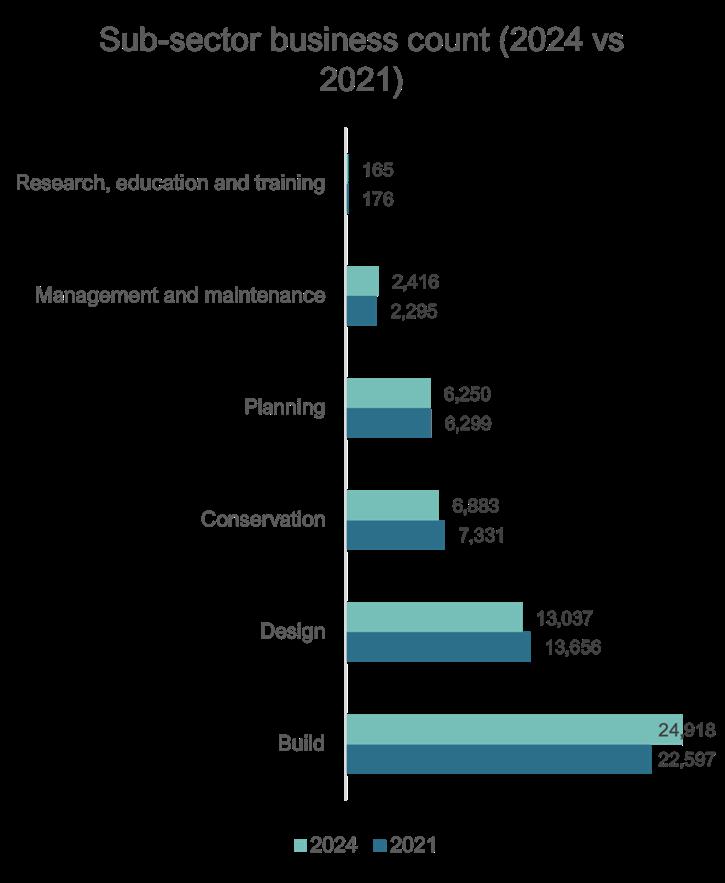
small practices, with around 92% of landscape businesses employing fewer than ten people (Fig 9). Growth in business numbers has been driven primarily by the build sub-sector, while planning has been fairly static, and design, conservation and research have seen concerning declines in enterprise numbers (Fig 10), despite high demands for services.
These trends raise questions about how and when different forms of landscape skill
and expertise are being deployed within development processesand the impact this has on the sector’s ability to contribute more holistic social and environmental value, as well as GVA, to the UK economy. Skills shortages in high value, strategic areas like landscape planning and design suggest demand is strong, but this demand isn’t supporting growth in these areas.
Concurrently, the findings show that landscape education in
the UK relies heavily on postgraduate provision, at more than double the national average (Fig 11).
Whilst UCAS 2024/2025 data suggest a recent uplift in undergraduate applications, the overall pipeline remains narrow and vulnerable to shocks. The tightening of immigration policy has been particularly hard to absorb for smaller businesses that predominate in the landscape sector.
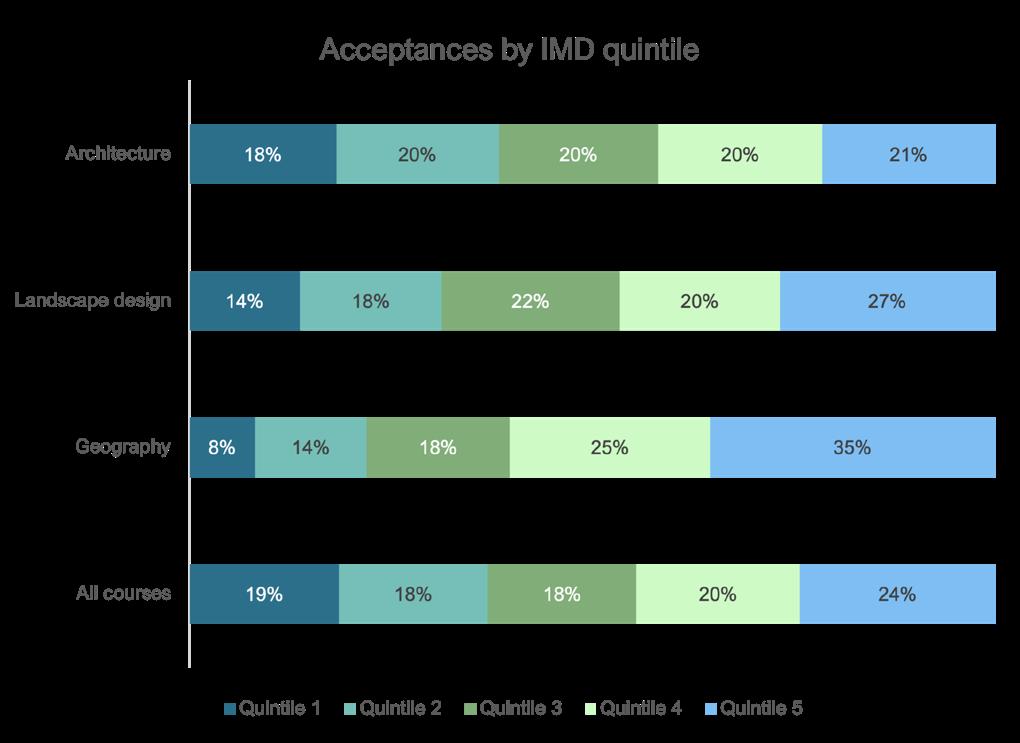
Access challenges are also evident, with applicants from socioeconomically disadvantaged areas experiencing lower acceptance rates (Fig 12), signposting to concerns about long-term diversity, representation and social mobility within the profession.
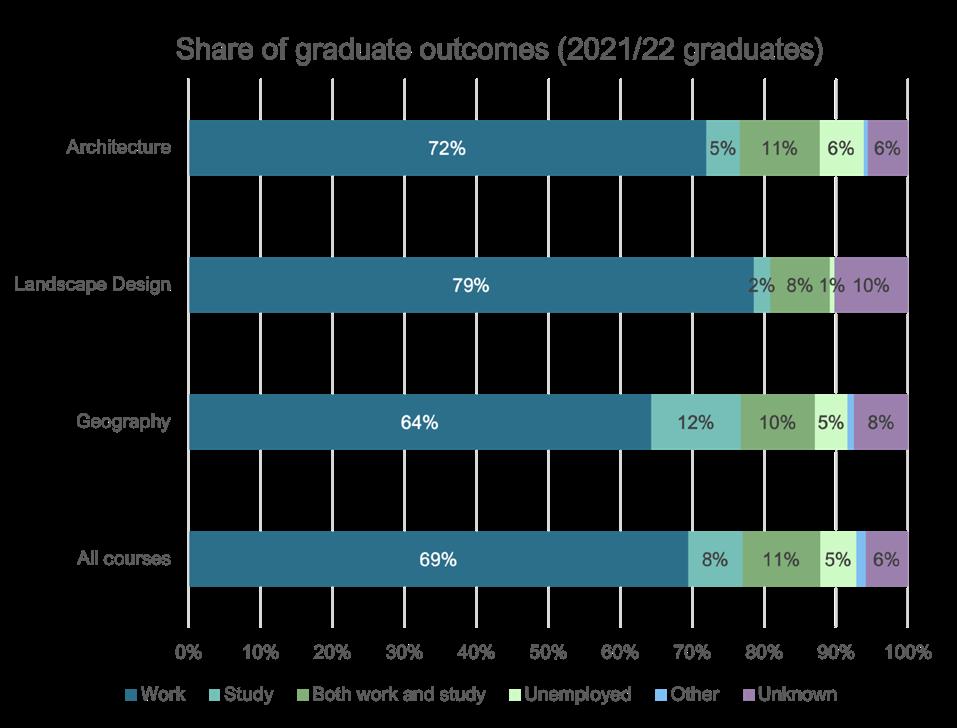
Landscape design graduates do however enjoy low unemployment rates, with only 1% known to be unemployed after graduation (Fig 13).
Landscape is not peripheral to the UK economy; it is a growing £24.9bn sector central to housing and infrastructure delivery, climate resilience and community wellbeing. Yet a number of factors limit its ability to fulfil its growth potential.
The Landscape Institute is working to strengthen the domestic pipeline and advance the case for landscape-led development. More meaningful impact will require government to treat landscape skills as critical, reward long-term, holistic value creation, and align immigration policy with skills demand.
Help shape the future of the profession by getting involved with our Policy & Public Affairs and Education & Careers Committees. Get in touch at Policy@landscapeinstitute.org / Education@landscapeinstitute.org




A Registered Practice perspective on the skills shortage that is being felt across the industry

Robyn Friesner
Working at Pegasus Group since 2013, my role as a landscape architect has developed alongside the growth of the practice, expanding from a small team to now many offices across the UK and 100 colleagues in the Environment Team. As a Registered Practice, several colleagues and I are involved in mentoring candidates through the Pathway to Chartership, sitting on Landscape Institute (LI) committees and branches, and maintaining ties with academia. Over my career I have witnessed the many changes shaped by planning policy or market conditions and have welcomed greater value being attributed to landscape for the benefit of people and biodiversity.
Despite this, due to reduced numbers entering the profession and the ensuing skills shortage, caused by both a lack of university applications and course closures, we face a challenging recruitment scene that has worsened in recent years. There are several issues at play here, but due to declining numbers of landscape students
entering the UK workforce in recent years, mid-grade levels of Senior to Principal Landscape Architect comprise a small pool of individuals that does not satisfy current demand.
The skills gap and shortage of landscape architects is a core challenge for us at Pegasus and for the whole sector. As a practice with a key growth agenda, we (like many) are struggling to fill vacancies across many locations and grades. The reduced support for visa schemes is a crisis that has been developing over the years, and has been exacerbated by the government’s visa requirements (see page 37). In addition, the recent reduction in funding for apprenticeships will only worsen
this situation in years to come. Pegasus provides landscape planning and design services across the country to many sectors including much needed renewable energy and residential schemes. But without more landscape architects we face a shortfall in the service we can provide and, as a result, we have been reviewing degrees with transferrable skills that
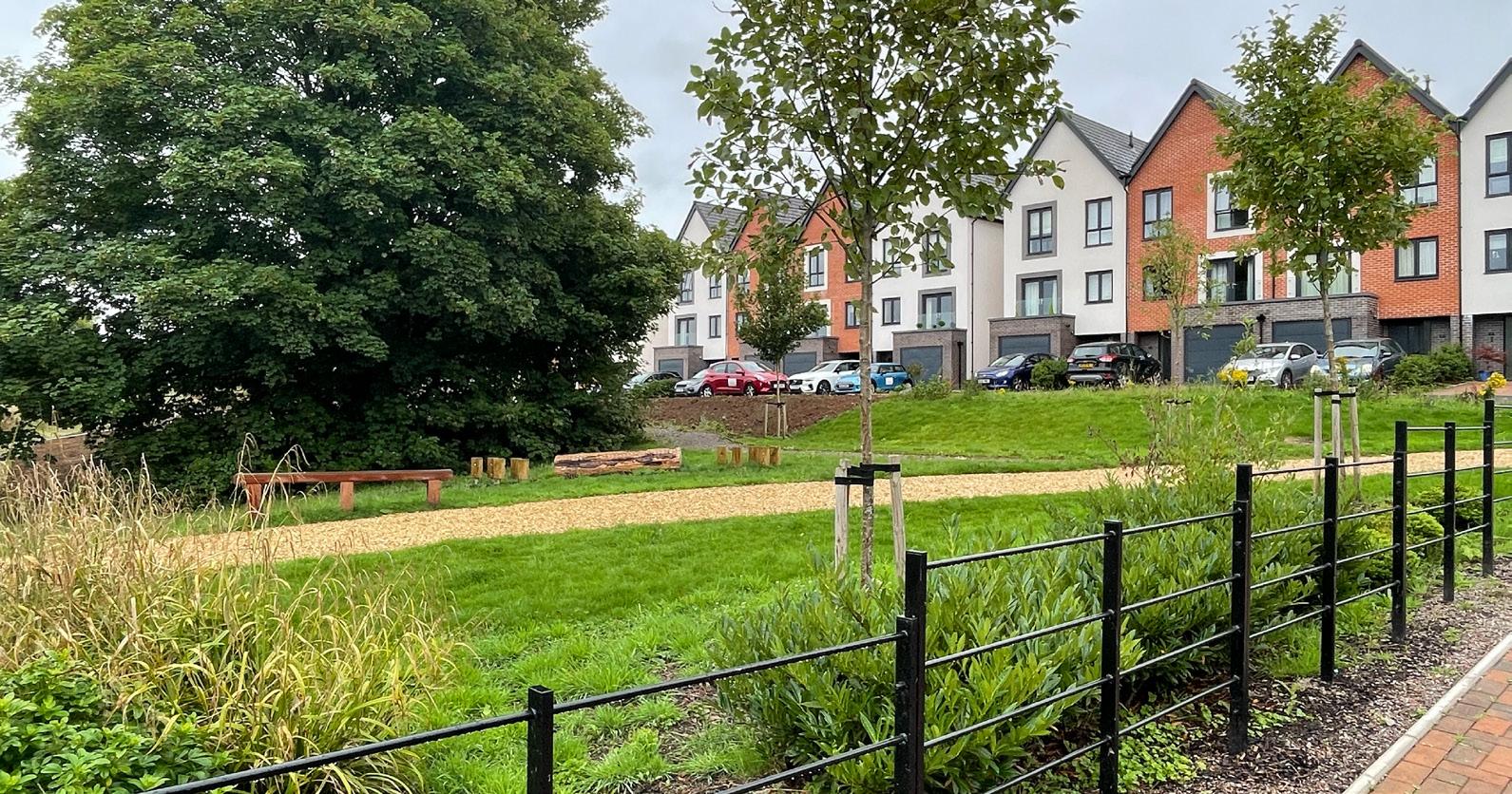
3 Plasdŵr Garden City.
© Pegasus Group
4
©
5
©
6
may provide opportunities for conversion.
Another key issue we face is the lack of societal awareness of landscape architecture and corresponding misconceptions about our role. We’re often assumed to work at a garden design scale or physically build schemes, and this lack of knowledge about the vital role landscape architects play in shaping the world around us is a critical issue to resolve. I do not believe that we can address this issue solely by educating careers advisers or teachers who then pass on their knowledge to school students. There needs to be a tangible shift in understanding: that it’s not only architects and engineers who shape where we live, albeit these are more visible professions in the built environment sector and are better understood by society.
I hope a key focus for the LI’s Education & Careers Standing Committee (ECSC), of which I am a member, is to shout loud and proud about the work landscape architects do. This should include the transformational power of planning and design and the role of topics such as sustainable drainage systems (SuDS), landscape character and climate resilience in transformational placemaking.
As a member of the ECSC, I look forward to working with the LI’s staff, other committee members and colleagues to assist in promoting landscape architecture as a career to the wider public and improving awareness for the benefit of all.
Robyn Friesner CMLI is a Senior Director at Pegasus Group and has been in practice for over 12 years, leading on landscape design within offices across the south.


How pre-19 education, careers education and employers work together in the UK
1 Landscape Institute/ Metro Dynamics Workforce research, 2025
2 See 1
3 See 1
4 https://explore-education-statistics. service.gov.uk/
5 https://www. scotlandscensus. gov.uk
6 https://stats.gov. wales/en-GB
7 https://www.nisra. gov.uk/
8 https://www.skills developmentscotland.co.uk/
9 https://www.workit. info/Employer/New
10 https://careerswales.gov.wales/

Briony Marston
In the UK, the domestic talent pipeline for landscape architecture is too weak. In the academic year 2023/2024, there were 1,240 people studying landscape architecture in UK Higher Education (HE), of which 790 were on postgraduate programmes.1 Within the smaller pool of students on undergraduate programmes, approximately 73% were domestic, which is slightly lower than the average across HE.2 By contrast, at postgraduate level, the enrolment composition shifted significantly, with domestic students accounting for only 30% of master’s-level students.3 This figure is even more concerning when compared to the enrolment composition of postgraduate studies within architecture, geography and HE overall, all of which had a higher percentage of domestic students.
So why are young people from the UK not opting to study landscape architecture? Of course, there are numerous answers to this question, including many broader concerns faced by Generation Z, not least cost of living, rising tuition fees and frozen maintenance loans. That said, from speaking with many current HE students, early career professionals, teachers and career leaders across the UK, the recurring narrative is a lack of awareness and/or understanding of landscape architecture as a career path. Many of our HE students find landscape architecture by accident, and often later than they would have liked. Stories of chance meetings that change someone’s trajectory are, of course, to be celebrated but, on their own, these routes in will not sustain the profession.
To implement meaningful change it is essential to understand the target audience, identify the
systems available to reach them and determine the most appropriate and impactful methods of engagement. While marketing and campaign materials undoubtedly play their part, it is crucial, firstly, to understand the context in which young people are making decisions today, and then target groups strategically.
In the short to medium term, the 16+ market in the UK is the priority audience for the Landscape Institute (LI). This is due to the critically urgent need to increase HE domestic enrolment numbers for landscape architecture. A core element of the educational outreach work required must be with 16–18-year-olds, of which there is a high concentration in England. Statistics from 2023 estimate there are over 2 million 16–18-year-olds in England,4 over 170,000 in Scotland,5 over 100,000 in Wales6 and over 70,000 in Northern Ireland.7 The LI currently has 11 HE partners delivering accredited undergraduate and postgraduate programmes in the UK, of which ten institutes are in England and one in Scotland. A robust understanding of the proportional distribution of 16–18-year-olds and HE provision across the UK, together with the curriculum pathways available in each nation and educational setting, and the careers education systems that support them, underpins informed, effective and sustainable intervention.
Young people today face an extraordinary array of post-16 pathways, including T-Levels, A-Levels or Scottish Highers, vocational qualifications such as BTEC or UAL and apprenticeships. Sadly, for many, the advice and guidance available to those making these choices at 16 will differ and qualification routes are not always well understood by families, or educators and advisers. Yet across all pathways, there is a huge pool of talent that the landscape sector
needs to attract. Successfully attracting this talent requires an appreciation that approaches must be tailored to devolved nations, qualification types and subject specialisms. Understanding the type of qualification enables effective alignment between the interests of the student cohort, approaches that support teachers and curriculum outcomes, and the expectations of external regulatory bodies (such as Ofsted). This insight supports the development of sustainable routes into LI-accredited programmes and onward into the workforce.
The availability and quality of careers services differ across the UK and both are influenced by historical policy decisions and funding. The careers services in Scotland, Wales and Northern Ireland have remained as national models that operate outside of school systems, but funding and resourcing have fluctuated. Unlike other UK nations, England has moved to a national framework that is integrated within schools and colleges, guided by national benchmarks and driven through local partnerships.
Skills Development Scotland (SDS)8 is the national skills agency, providing careers guidance and supporting workforce development. Employers can sign up to the SDS Employer Hub for support with workforce development or engage with SDS Marketplace to offer activities such as careers talks, workplace visits or work experience placements to a local school or college. If offering work experience placements in Scotland, employers should also research their local council, as most local authorities in Scotland run work experience through the Workit9 system and will have additional resources to support local engagement with employers.
Careers Wales10 is a wholly owned subsidiary of the Welsh Government, providing all-age,
independent, impartial and bilingual careers services. Employers can contact Careers Wales to connect to local schools and offer careers talks, workplace visits or other educational outreach activities. As part of the new Curriculum for Wales, schools are expected to include careers and work-related experiences across the curriculum. Additional resources to support employers who wish to offer work-related experiences in Wales can be found through Hwb,11 the digital platform for learning and teaching in Wales.
In Northern Ireland, employers can engage with the work of the Department for the Economy’s Careers Service.12 In June 2025, it published the Careers Action Plan 2025–2028,13 which sets out plans to reform the delivery of careers education services, aiming for a more joined-up careers ecosystem, including the development of a toolkit to support and enhance school–employer engagement.
England has faced more turmoil over the years, with funding completely removed from youth services in 2010, and a few difficult years ensuing. The Good Career Guidance report, commissioned by The Gatsby Foundation, emerged in England in 2014.14 The research, led by Professor Sir John Holman, was an international study of careers guidance best practice. From this report, the Gatsby Benchmarks were created and, subsequently, the Careers and Enterprise Company (CEC)15 was established, primarily funded by the Department for Education. It has taken several years to fully embed this model, progressing from pilot schemes to government adoption of the benchmarks within the national careers strategy, followed by more recent reviews and adaptations.
In September 2025, the updated Gatsby Benchmarks became mandatory for schools, colleges and independent training providers in England.16 The Gatsby Benchmarks are a set of eight criteria for world-class careers guidance,
integrated within the school and college system and supported by 44 regional Careers Hubs. The Careers Hubs act as a strategic regional partner, connecting employers with schools, supporting schools to meet the Gatsby Benchmarks and offering training and support for careers leaders in schools. Schools and colleges in England now have an evidence-based framework and a nationally supported infrastructure for careers education. Employers in England can sign up with their local Careers Hub17 to find out how to engage with them. Key initiatives, with varying degrees of time commitment, include the Employer Standards, Give an Hour Campaign, Teacher Encounters, Enterprise Adviser Networks, Modern Work Experience and Cornerstone Employer Groups.
Although the Gatsby Benchmarks relate to careers and education policy in England only, the learnings we can take from them in terms of good-quality careers provision and employer engagement is beneficial to all. In the context of landscape, the three benchmarks most relevant to educational outreach are:
▪ Gatsby Benchmark 4: Linking curriculum learning to careers
▪ Gatsby Benchmark 5: Encounters with employers and employees
▪ Gatsby Benchmark 6: Experiences of workplaces
Aligned with Gatsby Benchmark 4, teachers in England must embed and evidence careers within their planning and delivery of subject specialisms. Elsewhere, this should be considered good practice but is perhaps not as systematically driven. The subject teacher can spend a vast amount of time with a young person, week after week, and will be a key influencer for decisions about next steps and
careers. Educating the educators in relation to careers in the landscape profession is therefore crucial to domestic growth. That said, we cannot expect to do so through, for example, mailouts alone. Teachers are already stretched and do not need another email to read. There is a need to work with and support teachers to engage with the landscape profession in ways that are beneficial to them.
Teachers are dual professionals, as both deep subject matter experts and trained pedagogical experts. Outside of that, it would be an onerous imposition to expect a teacher to keep up to date with all careers that their subject specialism might lead to. It is also noteworthy that many teachers enter the profession immediately after higher education and consequently may possess limited industry experience to draw upon. The response to this should be to work collectively as the landscape profession to develop case studies and resources that support the delivery of our feeder subjects and/or relevant wider curriculum hot topics. Furthermore, resources can be supplemented with teacher Continuing Professional Development, bringing case studies to life and enriching teaching practice.
Aligned with Gatsby Benchmarks 5 and 6, models of work experience have evolved. Most schools and colleges are moving away from the old-fashioned standalone two-week placement to a more flexible and accessible model. As well as being more accessible to young people, the flexible model also benefits small and mediumsized enterprises who may have previously struggled to resource a standalone two-week placement. The CEC promotes a modern work experience model, underpinned by the equalex18 framework. The core concept is that young people should, over time, access a series of different encounters with employers and the world of work. Flexible opportunities are valued, for example an afternoon
11 https://hwb.gov. wales/
12 https://www.economy-ni.gov.uk/
13 https://www. economy-ni.gov. uk/publications/ careers-ationplan-2025-2028
14 https://www.gatsby. org.uk/education/ activity/good-career-guidance/
15 https://www.careersandenterprise. co.uk/
16 https://www.gov. uk/government/ publications/careers-guidance-provision-for-youngpeople-in-schools/ careers-guidance-and-access-for-education-and-training-providers
17 https://www.careersandenterprise. co.uk/careers-hubs/ contact-your-localcareers-hub/
18 https://resources. careersandenterprise.co.uk/resources/equalex
group visit to a workplace, a project led by an employer or short placements.
Effective teaching and learning are underpinned by well-established pedagogical principles, including coherent sequencing, planned repetition and structured opportunities for critical reflection. If careers education has the objective of helping all students make informed choices about their futures, it should be designed in the same way. Relying on one-off career talks or occasional fairs assumes that brief exposure is sufficient. This is an assumption that markedly disadvantages students who lack social and cultural capital and does not significantly impact long-term outcomes. A more sustained, integrated approach to careers education is therefore not an optional enhancement, but a necessary condition for equity and widening participation.
Employers involved in any kind of career talk or career fair should take a moment to consider whether they have the capacity to offer a follow-up activity with the same group of students. This might be as simple as a career talk followed by a group studio visit or employer-set mini challenge. Finally, who delivers educational outreach matters. Representation and relatability shape credibility, aspiration and engagement.
There is a critical need to increase and sustain the domestic talent pipeline for landscape architecture and, more broadly, the landscape profession. Education and careers systems across the UK are complicated and evolving, but the landscape profession needs to work with those systems to ensure real and lasting change.
Briony Marston is Education Manager - Careers at the Landscape Institute
Gatsby Benchmark 1 A stable careers programme 1 Gatsby Benchmark 2 Learning from career and labour market information
2
Gatsby Benchmark 3
Addressing the needs of each young person
3 Gatsby Benchmark 4 Linking curriculum learning to careers
4
Gatsby Benchmark 5 Encounters with employers and employees
5 Gatsby Benchmark 6 Experiences of workplaces
6
Gatsby Benchmark 7 Encounters with further and higher education 7 Gatsby Benchmark 8 Personal guidance
8
Our dedicated support hub for landscape designers
Protect your design intent and secure your specification.

Tobermore Create Where vision meets expertise.
Shape ideas
Specify with confidence

Design sustainably
Created by the integration of long-standing organizations dating back to 1911, AtkinsRéalis is a world-class multidisciplinary design consultancy rooted in engineering and dedicated to delivering a better future for our planet and its people.
We are a regionally focused, nationally connected team of over 80 design professionals collaborating across the UK and internationally to deliver award winning places for people and nature. We specialise in Landscape Architecture, Masterplanning, Urban Design, Assessment and Arboriculture and are proud of our heritage delivering inspiring places that transform people’s lives.
Our innovative approach to nature based solutions, climate resilient cities and sustainable placemaking is at the heart of our design ethos.
News and information are available at www.atkinsrealis.com or follow us on LinkedIn.









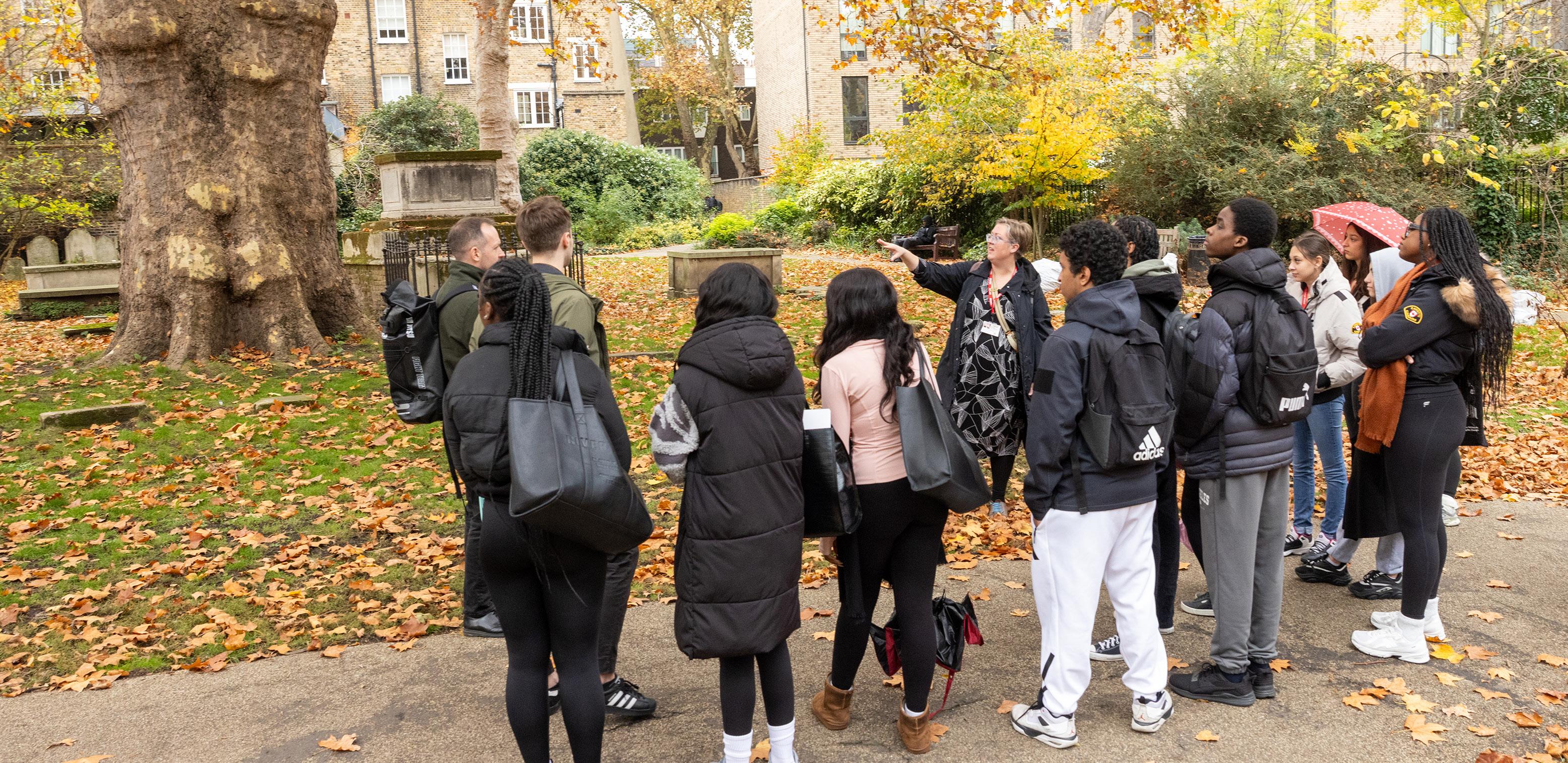
The new Landscape Institute (LI) Education Team has spent the last nine months developing a range of products, partnerships and initiatives to strengthen and expand the LI’s educational outreach work, all of which meet the Gatsby Benchmarks and, where relevant, curriculum outcomes.
Over the following pages, we’re happy to introduce three

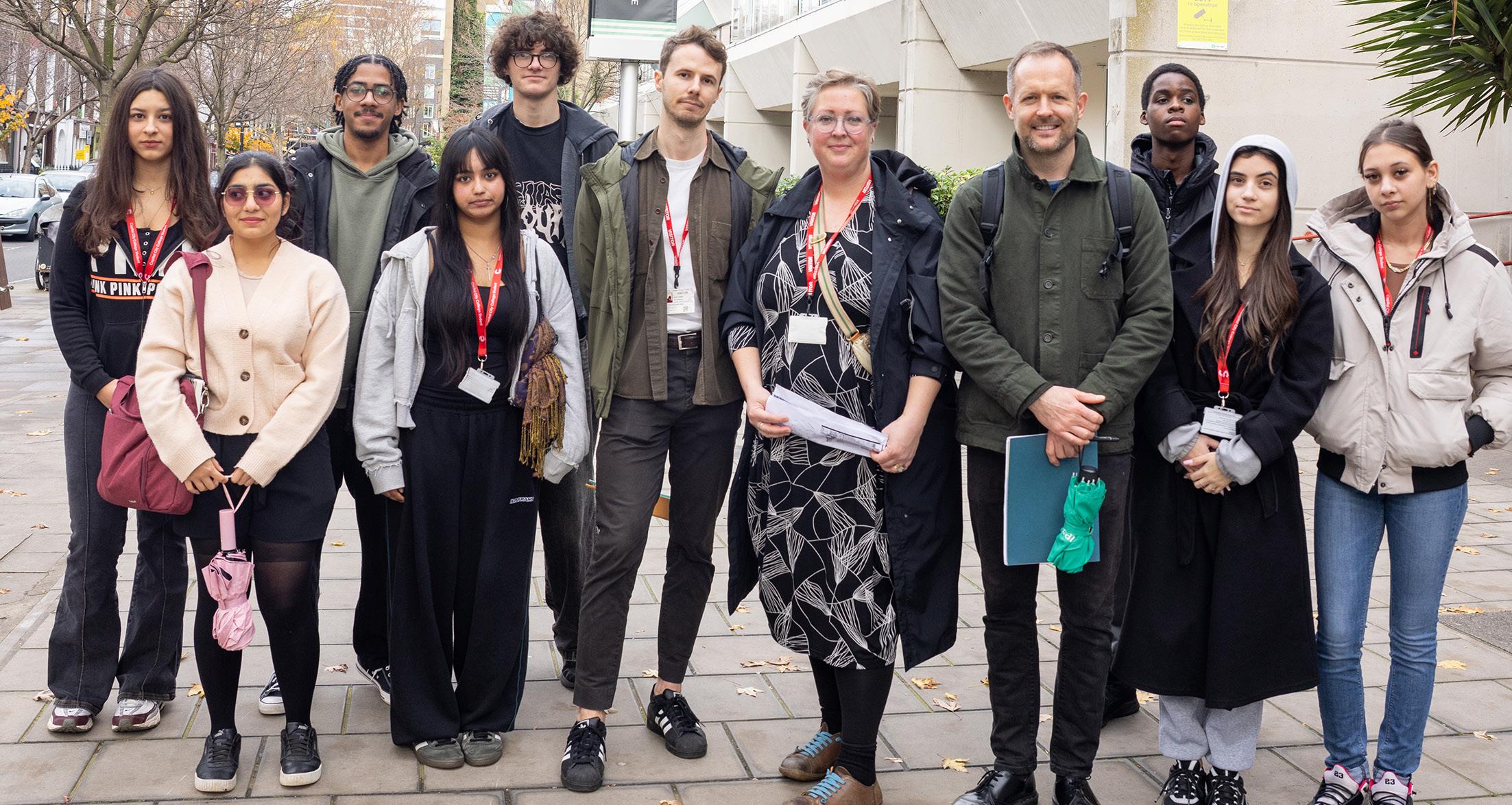
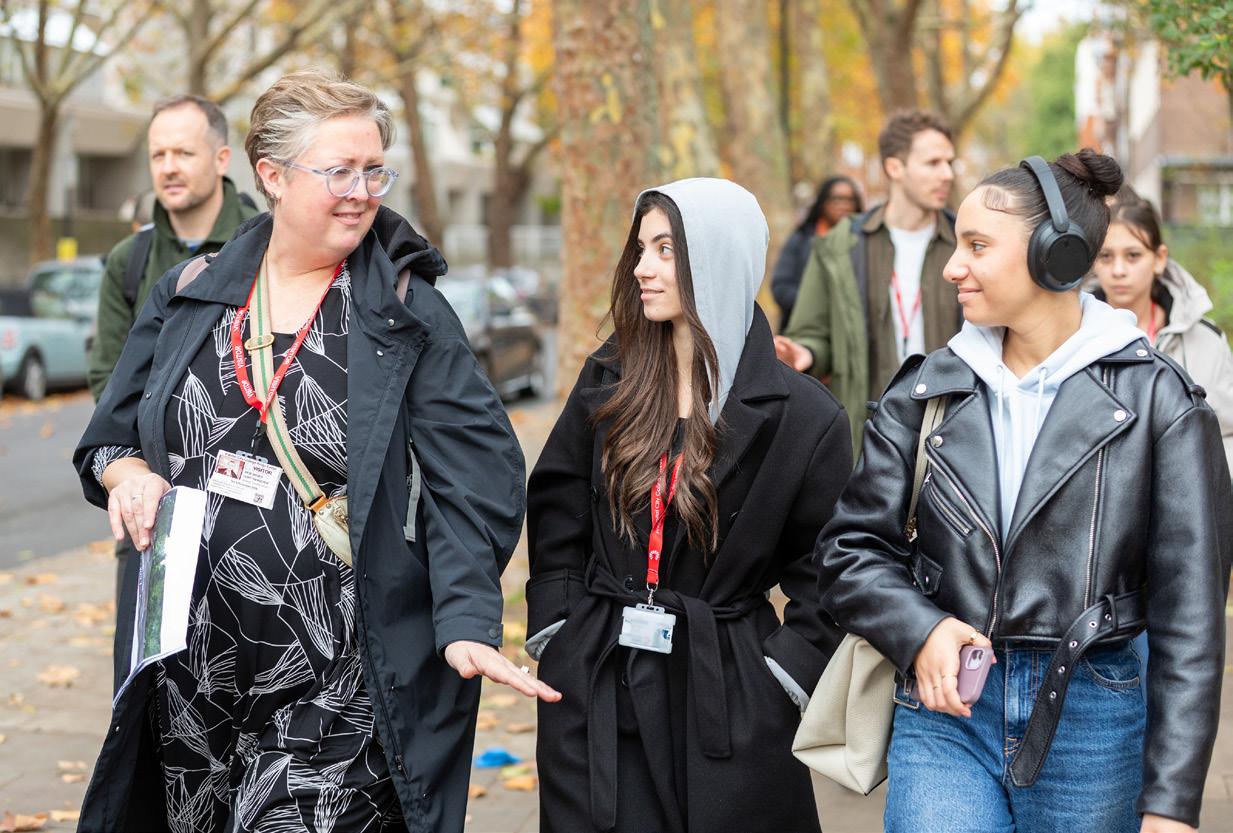
examples outlining a sample of that work. Firstly, the LI Employer-led Project Programme is introduced from the perspective of one our Further Education partners, Capital City College Group. This is one of several projects launched to date, connecting schools and colleges with local practices and enabling targeted groups of 16–19-year-olds to experience landscape architecture in action through a bespoke, in-depth and supported project brief. Projects have already launched in London, Newcastle, Leeds, Huddersfield, Hertfordshire and Northampton. Conversations with additional partners are taking place across the UK for further LI Employer-led Projects through 2026/2027.
Secondly, in November, the team collaborated with the LI’s South East branch, Sussex Talent
Accelerator and other local partners to deliver a whole series of activities for Green Careers Week and Creative Careers Month.
Finally, the team has successfully trialled Teacher Encounter Days, working with Careers Hubs, Registered Practices and teachers of feeder subjects. Teacher Encounter Days will be increased year on year as a key part of the LI’s educational outreach work.
If your practice is keen to support a Landscape Institute Employer-led Project or Teacher Encounter Day, please contact education@ landscapeinstitute.org
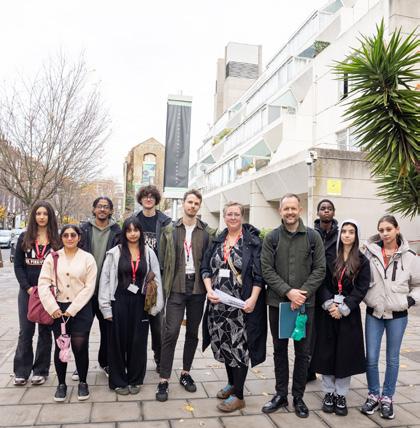
A collaboration between Capital City College, Levitt Bernstein and the Landscape Institute is giving design students a project-focused introduction to the landscape profession

Rebecca Tristram
Capital City College Group is the largest provider of Further Education in London, offering a diverse range of courses across multiple curriculum areas for both young people and adults. Within the School of Arts, we
currently serve approximately 800 students across four centres, offering programmes in visual arts, performing arts and music. Our curriculum spans Levels 1 to 4, providing clear progression routes that support learners in advancing to higher education or entering employment.
In 2024, we introduced architecture as a specialist pathway within the visual arts curriculum at our King’s Cross centre. The pathway was oversubscribed,
and in 2025 we added an additional group. This expansion demonstrates the positive appetite for architectural and spatial design studies and the enthusiasm of learners to explore this discipline. Furthermore, our collaboration with the Landscape Institute (LI) this academic year has drawn our attention to the significant skills shortage in landscape architecture. Student engagement with this specialism has been highly encouraging and, in response,
2
1 https://www. gatsbybenchmarks. org.uk/careers andenterprise.co.uk/ resources/equalex
I’ve genuinely enjoyed working on this project. Teaming up with landscape architects on the employer-led brief was an amazing opportunity and experience. Getting a real peek into what their job actually involves has been enlightening and has really shown me that there is more to architecture than just buildings.
Valentino Karamfilov
3D
Applied Design/ Architecture Level 3 Student, Capital City College Group
we plan to introduce landscape architecture as a dedicated pathway for Level 3 in 2026.
Key to the success of any programme is ensuring that a curriculum delivers skills desired by the industry and real-world experiences for its students. It is a significant challenge securing meaningful experiences of work for students within the creative industries. This could be attributed to the sector’s weighting towards freelancers and micro businesses or due to a lack of understanding of what constitutes experiences of work or the value it brings.

As a Head of School for Arts, I want all my students to have rich experiences of work, and engagement with multiple employers to raise aspirations, develop employability skills and enable informed progression choices. There is also external expectation from Ofsted regarding work experience, skills development and developing a curriculum informed by employers. Additionally, we are guided by the Gatsby Benchmarks1 to build a robust framework that ensures our students receive high-quality careers guidance and support.
We cannot do any of this alone. We need to work with employers to find appropriate opportunities that meet the needs of both our students and the curriculum.
In my experience, developing live briefs with an employer is a robust way to provide experiences of work and industryled skills development to a whole cohort in a fair and equitable way. Many companies, especially those in the creative sector, do not realise how impactful and rewarding it can be to support the next generation of talent by partnering with colleges to co-create live
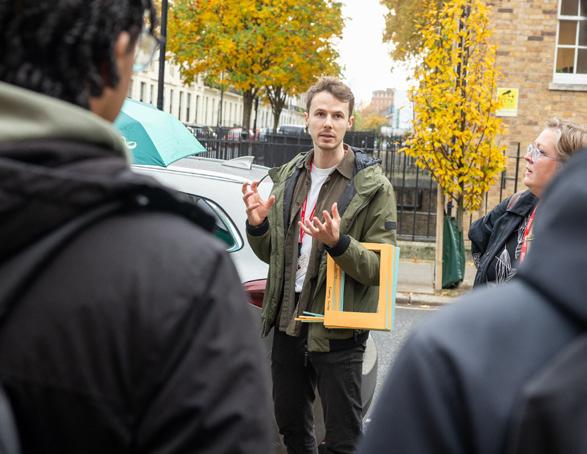
briefs. These briefs can simulate real-world projects, and they offer students invaluable insights into the professional sector they aspire to enter. Our recent live brief collaboration with Levitt Bernstein and the LI has provided an exciting and valuable opportunity for our students. This partnership is increasing our students’ awareness of career pathways within landscape architecture, as well as expanding understanding and knowledge within the curriculum team.
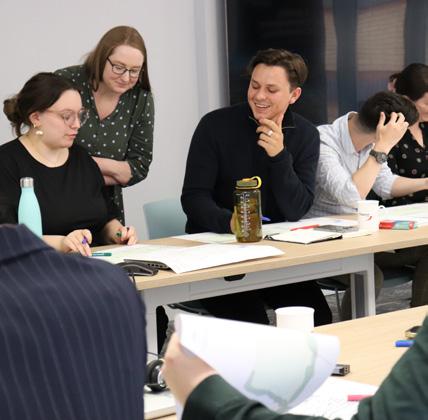
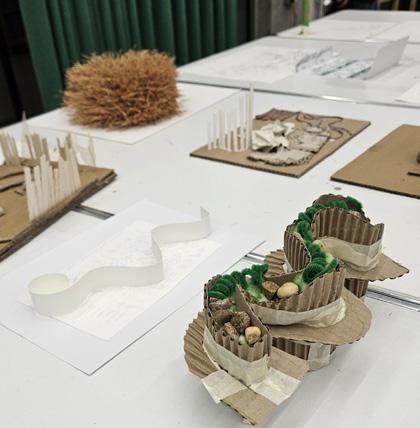
The live brief developed allows for broad creative freedom, with options that include designing for wellbeing spaces, sports facilities, biodiversity enhancement and children’s play areas. This project not only strengthens our students’ practical skills but also deepens their understanding of how landscape architecture can positively impact urban environments and community life. In undertaking this sevenweek landscape architecture project, students have engaged in a comprehensive, processdriven approach that mirrors
professional practice. Through primary and secondary research, they have developed evidencebased insights into site conditions and precedent studies, while independent research has fostered innovation in material selection and sustainable strategies.
Feedback integration has cultivated adaptability and iterative thinking, enabling refinement of concepts in response to critique. Sketchbook documentation has supported the development of critical and reflective practice, capturing ideation, experimentation and problem-solving as integral components of the design process. Technical outputs, including scaled masterplans, detailed features, perspectives and sectional drawings, have enhanced spatial literacy and precision, while the production of a physical 3D model has reinforced understanding of materiality and human-scale relationships. The accompanying written statement has encouraged students to articulate design intent and its contribution to people, place and nature, promoting clarity
Partnering with students and course leaders at the CCC King’s Cross centre has been a fantastic opportunity to promote landscape architecture directly to young people, and the collaboration has far exceeded our expectations. It’s an initiative we would strongly encourage other practices to pursue, and we look forward to future collaborations.”
Kate Digney CMLI Studio Director – Landscape, Levitt Bernstein
and depth in communication. Finally, self-evaluation against the original brief and qualification criteria has instilled a culture of accountability and continuous improvement, equipping students with the analytical skills necessary for professional growth in the landscape architecture discipline.
These collaborations are more than just educational exercises: they are opportunities to inspire, motivate, and illuminate career pathways that young people may not have previously considered. In this way, industry partners play a vital role in shaping the future of the creative workforce.
We were delighted to work with the LI and Levitt Bernstein last term. We look forward to offering similar projects in collaboration with them next academic year and strengthening our partnership moving forward.
Rebecca Tristram is Group Head of Arts, Capital City College Group, London
4

SHAPING PLACES. ACCELERATING A PLANET POSITIVE FUTURE.
We believe that great places begin with people.
Our UK Landscape, Masterplanning & Urbanism (LMU) team brings together over 80 creative and pragmatic professionals: landscape architects, designers, masterplanners joined by over 300 environmental specialists, dedicated to creating inclusive places where people and nature thrive.
Every site we work on is unique.
From urban regeneration to long-term stewardship, from resilient placemaking and digital twinning to biophilic design, our work start with three pillars - Planet, People and Prosperity. We craft places that promote health, well-being, lasting social value and nature positive legacy. We help clients and communities reimagine what’s possible.



At LI Insurance Services, we don’t just insure Landscape Architects, we specialise in providing bespoke insurance solutions for Landscape Institute members.
We work with Landscape Architects every day, giving us a deep understanding of your practice, your risks, your challenges and the claims trends that shape your profession.
Specialist Cover for Landscape Institute Members:
Bespoke Professional Indemnity Insurance Scheme Office Insurance Package
…and more tailored solutions for your practice Real Support for Your Practice: Competitive premiums exclusive to LI members Free Contract Vetting Service Free Legal Helpline A dedicated client advisor who knows your profession Expert in-house claims team for fast, informed support

A new partnership with Landscape Institute members is widening understanding of the landscape profession in the south-east

Workplaces across all sectors are changing fast, and many are facing the same challenge: how do we make sure there’s a strong pipeline of talent ready to step in as experienced professionals retire? In landscape and wider sectors, the answer increasingly lies in collaboration: working together locally, regionally and nationally to support skills development and open up access.
Tackling skills gaps, supporting progression and widening participation can’t be done by any one organisation alone. It relies on practitioners, professional bodies, educators and careers organisations joining forces
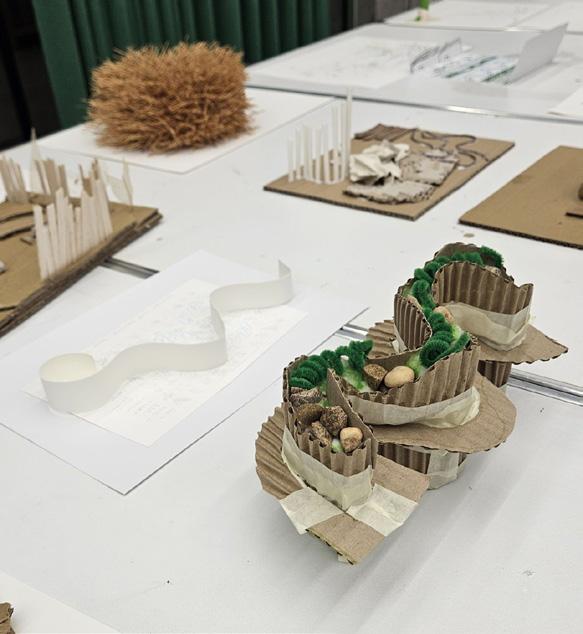
to help young people understand what these careers really look like and how to get into them.
This is the context in which Talent Accelerator, developed by the De La Warr Pavilion, was created. As part of the wider Coastal Catalyst programme, working in partnership with the Brighton Dome in Sussex, Talent Accelerator is a place-based initiative focused on inspiring and supporting young people to explore creative careers. We work to build awareness of opportunities, boost confidence and help young people understand the routes into creative and green professions, all of which is supported by high-quality work experience.
Collaborating with the Landscape Institute (LI), with its commitment to education, outreach and professional advocacy, has been invaluable. Working together has allowed us to connect LI members directly with young people. Hearing firsthand about real projects, career journeys and working life makes a huge difference and helps bring the profession to life in a way no leaflet or website ever could. This collaboration aligns well with the Local Skills Improvement Plan and the wider skills agenda, which place a strong emphasis on employer engagement, regional relevance and closer links between education and industry, often through Careers Hubs.
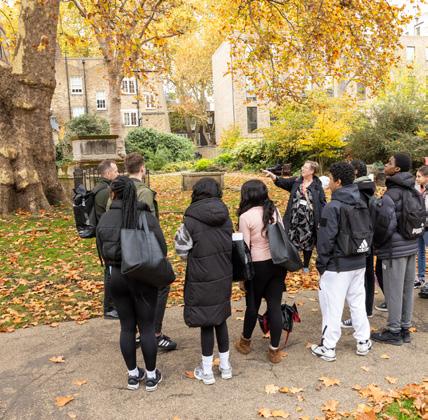
In November 2025 we worked together to deliver a Creative Green Careers Week series of activity across Sussex. Through interactive sessions and creative activities, young people explored how creativity, environmental responsibility and community impact come together in professional practice. These sessions helped demystify the sector and showed how landscape professionals are directly involved in tackling climate change, addressing biodiversity loss and the design of resilient places. A standout activity was the Living Libraries, delivered with several professionals from the LI South-East Branch. This informal, conversation-based format gave young people the chance to ask honest questions about career routes, qualifications and day-today working life. For LI members, it also offered a rewarding way to support outreach, share experiences and help inspire the next generation.
By collaborating, connecting, mentoring and sharing our expertise, we’re planting the seeds for a vibrant, skilled future workforce.
Kim Byford is Head of Skills at the Talent Accelerator, a trustee at Hastings and Rother Arts Education Network and Bexhill Museum and a Governor for East Sussex College Group
1 https://www.gov.
Providing teachers with a chance to visit landscape practices and get to know the profession, developing knowledge which they can pass on to students.

Teacher Encounters, delivered through the Careers and Enterprise Company, give educators the opportunity to step directly into the world of work and experience industries first hand. For the landscape architecture sector, these encounters are a powerful way to bridge the gap between classroom learning and the real skills, knowledge and behaviours needed in modern practice.
These experiences directly support the Gatsby Benchmarks,1 particularly Benchmark 4 (linking curriculum learning to careers) and Benchmark 5 (encounters with employers and employees). When teachers understand the evolving demands of the industry, they are better equipped to embed relevant examples into their teaching, inspire students, and highlight the diverse career pathways available across landscape architecture.
A recent Teacher Encounter, organised through our Careers Hub and working with the
Landscape Institute Education Team, was hosted by BLADE at their Worcestershire practice. BLADE is a multi-disciplinary environmental practice bringing together landscape architects, arboriculturists and ecologists, and, as such, was a perfect placement for a geography teacher. Laura, a participating teacher, described the experience as transformative:
“I’m incredibly grateful to have attended the Teacher Encounter Programme with Blade Landscape Architects. It was a valuable experience that allowed me to engage directly with landscape architects and ecologists, offering insightful perspectives that will greatly support my own professional development. The discussions
around the importance of botany skills were especially useful, highlighting how upskilling in this area can open up access to opportunities in landscape architecture and ecology.”
Encounters like Laura’s help educate the next generation about the exciting opportunities available and ensure that they enter the landscape architecture sector with stronger awareness, better preparation and a clearer sense of the skills that matter, ultimately strengthening the industry’s future workforce. Employers across the sector can play a vital role by opening their doors to teachers.
Sandra Howells is Operational Hub Lead at Worcestershire Early Careers Hub


Rob Hughes
The Universities and Colleges Admissions Service (UCAS) is the most trusted and widely recognised educational resource in the UK. For three decades, it has been the primary gateway to higher education, guiding millions of students and apprentices each year through the process of exploring career options, researching courses and applying to universities and colleges.
Its credibility and national reach are unparalleled – every school, college, teacher, careers lead and careers adviser engages with UCAS materials, and almost every student considering their next steps uses its platform as their first point of reference. With over 1.8 million monthly visitors to UCAS.com and 25 million site visits
For the first time, landscape has a presence on the UK’s most influential careers platform; now we need your support to build the momentum
annually, it is the primary gateway to UK-wide apprenticeship and higher education qualifications, and the careers beyond.
Until now, the landscape profession has not had an identity or defined presence on the UCAS platform, particularly when compared with allied disciplines such as architecture and planning, both of which have long-established and informative profiles and resources.
In the 30 years since UCAS was founded, our profession has remained largely absent from this national go-to platform. As a result, prospective students, teachers, career leaders and parents often remain unaware of the distinct and rewarding career pathways we have available.
This lack of visibility has directly contributed to low levels of awareness and a reduced flow of UK entrants into our accredited programmes. Without a strong and coherent presence within UCAS, our profession risks continued underrepresentation among potential recruits and diminished competitiveness with better promoted disciplines.
Establishing a meaningful and enduring presence for the landscape profession on UCAS is not optional; it is a vital area of work for the sustainability and growth of the profession.
With the support of our members, this is exactly what we are doing.
The LI has launched an initial campaign to begin building the profile of landscape architecture within UCAS.
We’ve set up an Employer Profile for the LI, creating an immediate presence on the UCAS website.
We’ll be running targeted email and digital communications to students (pre-university and undergraduates) with information on careers, placement opportunities and graduate roles. Through this structured approach, the initiative will reach learners at crucial decision points, from early awareness to postgraduate, to promote the credibility of our profession in partnership with UCAS. 2

We’ll be running advertising campaigns at key decisionmaking moments in the academic year on UCAS.com and across social media, aimed at students, parents and teachers.
We’re calling on our Registered Practices to make a strategic investment in future talent by supporting the LI UCAS campaign. By participating, practices will directly contribute to closing the awareness gap and building a sustainable recruitment pipeline.
With your support, we can:
▪ Upgrade the LI’s UCAS profile with guides to the industry and subject
▪ Increase the number of UCAS users that our campaigns will reach
▪ Build our profile, visibility and interest year-on-year
To find out more and support the campaign, email education@ landscapeinstitute.org
Thank you to all organisations that have supported us so far!




Accredited programmes are mapped to the LI’s Competency Framework and are regularly reviewed to ensure they deliver the knowledge, skills, and experience you need for a successful career in landscape practice.
Birmingham City University
MA Landscape Architecture
MLA Landscape Architecture (conversion)
BA (Hons) Landscape Architecture
Kingston University
MLA Master of Landscape Architecture (conversion)
Leeds Beckett University
BA (Hons) Landscape Architecture and Design
MA Landscape Architecture
MLA Landscape Architecture
Manchester School of Architecture
MLA Master of Landscape Architecture (conversion)
Newcastle University
MA Landscape Architecture
MLA Master of Landscape Architecture
University College London
MA Landscape Architecture
MLA Landscape Architecture (conversion)
University of East London
PGDip Landscape Architecture
MA Professional Landscape Architecture
University of Edinburgh
MLA Master of Landscape Architecture (conversion)
MA (Hons) Landscape Architecture
University of Gloucestershire
MA Landscape Architecture
BA (Hons) Landscape Architecture
MA Landscape Architecture (conversion)
University of Greenwich
BA (Hons) Landscape Architecture
MA Landscape Architecture
MLA Master of Landscape Architecture (conversion)
University of Sheffield
MLA Master of Landscape Architecture
MA/PGDip Landscape Architecture (conversion)
BA (Hons) Landscape Architecture
BA (Hons) Architecture and Landscape
We’ve been at the forefront of hard landscaping for over a century and our innovative product ranges have shaped iconic projects and developments across the country.
As one of the UK’s leading commercial paving suppliers, we deliver a wide range of paving and street furniture solutions that enhance urban landscapes.
And it doesn’t end there. With expert guidance, technical know-how and dedicated in-house design and engineering support, we work collaboratively to transform your creative vision into buildable, lasting reality.
Get in touch to discover how we can help.











As the chartered body for landscape professionals in the UK, the Landscape Institute (LI) recognises the government’s objective to reform the legal immigration system, reduce net migration and strengthen domestic skills provision. However, recent and proposed changes to
immigration policy pose significant risks to the landscape profession and wider built environment. Changes include significantly higher salary thresholds for Skilled Worker visas, the removal of landscape architects from the Immigration Salary List (ISL) and restrictions to the graduate visa.
Salary threshold comparison tables
Table 1: Skilled worker salary thresholds (standard route)
Comparative data for landscape professionals (SOC 2451) following the 2024 and 2025 reforms.
These measures threaten to exacerbate existing skills shortages within the landscape and wider built environment sectors and undermine higher education (HE) provision. This significantly constrains the profession’s ability to support national policy ambitions for housing delivery, environmental enhancement and sustainable economic growth.
Table 2: The 2027 graduate route shift
Changes to the duration of post-study work visas for international students. Graduate
Table 3: Market reality vs immigration requirements
Comparison of typical UK landscape architect (LA) market salaries (sourced from Hays 20255 and Bespoke Careers6) against immigration requirements.
The Immigration White Paper (May 2025)1 set out a definitive tightening of restrictions. Its central aim is to ensure that immigration is no longer the default solution to labour market shortages, instead incentivising employers to invest in domestic training and workforce development. Core measures impacting the landscape sector include:
▪ Elevated salary thresholds: the minimum salary for Skilled Worker visas for Landscape Architects (occupation code SOC 2451) has been raised to the occupationspecific ‘going rate’ of £47,600.
▪ Structural list changes: the Shortage Occupation List has been replaced by the narrower Temporary Shortage List (TSL),2 which targets only medium-skilled roles (Regulation Qualifications Framework (RQF) levels 3–5) and requires industries to demonstrate a credible ‘Jobs Plan’ for domestic recruitment.3
▪ Graduate visa restrictions: the Graduate visa will be reduced from two years to 18 months for applications made on or after 1 January 2027.

Talent & workforce

Immigration Salary List (ISL)
▪ Increased employer levies: the Immigration Skills Charge4 was increased by 32% on 16 December 2025, raising costs to £1,320 (first year) for large sponsors.
▪ Education funding pressures: a new levy of £925 per international student per year (effective from August 2028), places additional strain on the LI-accredited
1 https://www.gov. uk/government/ publications/ restoringcontrol-over-theimmigration-systemwhite-paper
2 https://www.gov. uk/government/ publications/ skilled-workervisa-temporaryshortage-list
3 Although landscape architects were added to the Shortage Occupation List in 2019, they were excluded from the more restrictive ISL in 2024 and are currently ineligible for the TSL as a degree-level (RQF 6) profession. Practitioners must typically gain experience through the Pathway to Chartership (P2C) to command the higher salaries required for long-term sponsorship.
4 https://www. gov.uk/uk-visasponsorshipemployers/ immigration-skillscharge
5 https://architectural technology.com/ resource/hayssalary-guide-2025. html
6 https://www. bespoke careers. com/salary-guide/




courses that supply the profession’s talent pipeline.
The most immediate challenge for landscape practices is the significant increase in skilled worker minimum salary thresholds. For a landscape architect (SOC 2451), the standard applicant must now be paid a minimum of £47,600. This figure is dramatically above typical entrylevel and early-career salaries, which for a graduate landscape architect generally range between £26,000 and £33,000.
Consequently, most practices – particularly small and mediumsized enterprises – cannot justify the financial burden of sponsoring overseas graduates, even when facing acute skills gaps. It often makes more business sense not to bid for work, where the extra resourcing costs outweigh the benefits of bidding and delivering contract work. This restricts growth, both for organisations and ultimately at a national level.
The removal of landscape architects from the Immigration


Salary List (ISL) has eliminated the salary flexibility previously afforded to shortage occupations. Furthermore, landscape roles remain inappropriately classified under the broader ‘Architects’ code (SOC 2451), despite distinctly different professional requirements and evidence of ongoing shortages (see page 12).
Many LI-accredited landscape courses rely on international students for financial viability. It will take several years for the domestic pipeline of landscape students to grow sufficiently to replace the current dependency on international students. Restrictions on the graduate route and the prospect of additional levies risk triggering course closures, which will inadvertently also shrink the domestic talent pipeline. This risks reducing both professional and economic growth.
Early-career professionals are disproportionately affected by these reforms. Through Landscape Voices, a group of recent LI-accredited
practitioners, the LI has documented the lived impact of these barriers (see box). The 2025 reforms set an unachievable bar for most new entrants, often forcing international students trained in UK universities to leave the country, despite having developed relevant UK expertise. At best, the reduction of the Graduate visa to 18 months from 2027 further pressurises graduates to rush their professional development and Pathway to Chartership, potentially limiting long-term innovation and diversity within the sector. At worst, it disincentivises international students from studying in the UK and supporting the growth of our landscape sector. Everybody loses.

Through the Landscape Voices group, the LI provided a platform for recent graduates to share lived impacts, career barriers and insights, ensuring policy discussions reflect lived experience alongside employer perspectives.
Recent changes to the UK’s Skilled Worker visa policy have become a pressing concern for a growing landscape architecture sector. The reforms, introduced in July 2025, set a minimum salary threshold of £41,700 or the ‘going rate’ of £47,600 for architects, which includes landscape architects under the same occupation code. These figures tend to be far from the typical graduate salaries in the field, leaving international graduates and early-career professionals unable to qualify for sponsorship.
The impact of this can be seen as twofold: firms which are already struggling to recruit face deeper shortages, while international students trained in UK universities are forced to leave, despite their expertise in local ecological and planning contexts. The reduction of the Graduate visa from two years to 18 months from 2027, combined with limited awareness of alternative pathways, compounds the issue and can pressure graduates to rush into chartership and limit their professional development.
Landscape architecture is rooted in local ecological systems,
cultural contexts and planning policies. Yet current visa rules inadvertently prioritise senior overseas professionals who may lack UK-specific knowledge, while excluding graduates trained within UK universities. This risks weakening innovation, reducing diversity and undermining the sector’s contribution to climate resilience and sustainable design.
Addressing these challenges requires fairer visa pathways, realistic salary thresholds and recognition of landscape architecture as a distinct profession, to ensure the UK can continue to nurture the talent needed for a greener, more resilient future.





The LI has consistently engaged with policymakers to advocate proportionate solutions:
7 https://www. construction leadershipcouncil. co.uk/
8 https://www.cic. org.uk/
▪ Evidence submissions: We have submitted formal written evidence on immigration and salary thresholds to government and the media.
▪ Sector collaboration: We are active members of the Construction Leadership Council’s Skills & Immigration workstream7 and the Construction Industry Council’s Policy & Public Affairs group.8
▪ Direct advocacy: We have written to ministers at the Ministry of Housing, Communities and Local Government to demonstrate the critical role of landscape in national growth.
▪ Domestic pipeline strengthening: We have proactively expanded employerled projects for the 16–19 sector, delivering Teacher Encounter Days and collaborating with UCAS to raise awareness of the profession.


We support an evidence-led approach to immigration reform that recognises the time required to build domestic capacity and manages international recruitment in a nuanced way that allows the sector to keep growing.
To maintain a resilient landscape profession, we recommend the following:
▪ Immediate salary review: Review and lower the salary thresholds for ‘New Entrants’ to align with actual market starting salaries in the landscape sector.
▪ Course viability assessment: Conduct an impact assessment on how immigration and HE reforms affect the financial stability of landscape courses and the long-term supply of graduates.
▪ Graduate route stability: Maintain a viable two-year graduate visa route to allow UKtrained international graduates sufficient time to transition into the workforce and progress towards chartership.
▪ SOC code reclassification: Reconsider the classification of landscape architects within immigration frameworks to recognise the profession as distinct from general architecture, and reflect its shortage issues.
▪ Reinstate shortage status: Evaluate the landscape profession for inclusion on the TSL to provide practices with the flexibility needed to fill critical gaps while domestic pipelines mature.
Andrew Rylah is Policy & Public Affairs Manager at the Landscape Institute
Kelli Cochran-Sharp is Education Manager – Higher Education and Apprenticeships at the Landscape Institute

Andrew Nicholson CMLI
Landscape architecture has always faced challenges in attracting and retaining a skilled workforce. The specialist nature of the profession, combined with limited awareness among young people, has often meant a small pipeline of new entrants.
Practical steps that Camlins is taking to address recruitment challenges in the profession
Recent changes in immigration policy have compounded these pressures (see page 37) significantly reducing the ability of practices to recruit internationally. At a time when demand for our expertise is rising, this narrowing of routes to talent has created real concern across the profession.
For private practices such as ours, talent is the foundation of success. The broader and more diverse the pool we can draw from, the stronger both our practice and the wider profession become. Without access to that pool, there is a risk of lost momentum at precisely the moment landscape architecture is most needed.
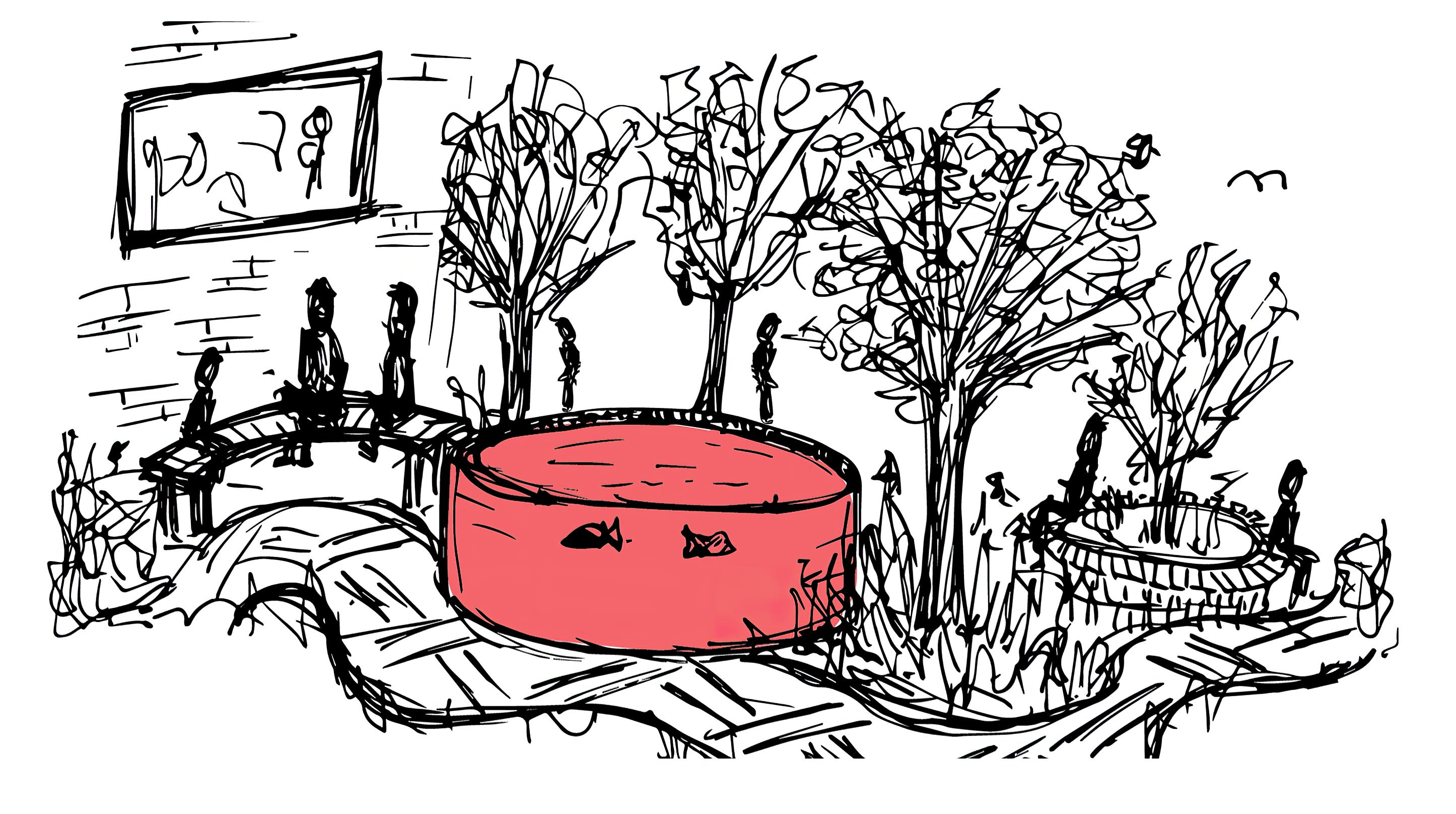
1 A concept sketch for a courtyard at the Hope House Children’s Hospice in Oswestry that was transformed by Camlins. The brief was to create a green heart at the hospice that would provide a vibrant and engaging sensory space for the children and staff.
© Camlins
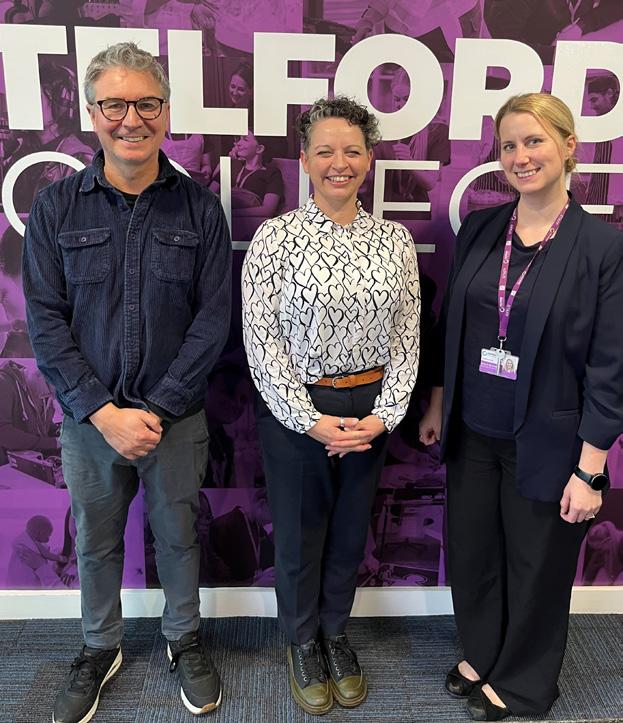
2 Andrew Nicholson CMLI, Landscape Director, Camlins, Briony Marston, Education Manager, LI, Sally Slater, Director of Sixth Form, Telford College.
Photo taken on a visit to Telford College in November 2025 to plan a series of employer engagement activities throughout 2025/2026 as part of Camlins Social Value Strategy, working collaboratively with the LI Education Team.
© Landscape Institute
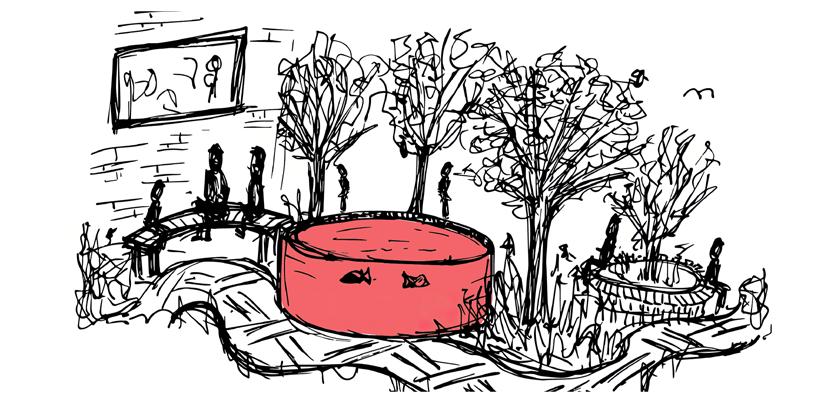
3 This sketch is from the Minthis Village project, a leisure resort and residential estate high in the mountains above Pathos, Cyprus.
© Camlins
The need for experienced, skilled landscape architects has never been greater. Yet the reality is that the available workforce is simply too small to meet current demand.
Nationally, the conversation is dominated by calls to accelerate housing delivery, respond to the climate emergency and create sustainable, liveable places. In this context, imposing stricter restrictions on recruitment feels counterproductive. For practices like ours, the consequences are immediate: difficulties in resourcing projects, turning down opportunities and being constrained in growth because of external regulation.
At Camlins, we have always believed in training the next generation. Bringing early-career professionals into our practice allows them to learn our systems and adapt to our culture, and we help them grow into confident practitioners in long-term roles.
However, the reality of current visa conditions often undermines this ambition. We invest in training individuals who, once their visa term ends, cannot be retained due to the increased salary thresholds. This is not simply a challenge for individual practices but a challenge for the profession as a whole and, ultimately, for the delivery of national priorities.
Over the past year, we have been developing a social value strategy that aligns and focuses on these issues through three guiding principles: it must have a local impact; it must encourage engagement and participation across the office; it must relate directly to our profession.
These principles led us to start working closely with the Landscape Institute’s Education Team. Together, we have focused on promoting and embedding landscape architecture within key local schools and colleges. By supporting teachers and career leaders locally, we help them better understand the profession while raising the profile of the Camlins brand. At the same time, we ensure that our efforts inspire a younger audience to support our goal and help strengthen the profession. The partnership has been the guiding force behind our social value strategy.
As a profession we need a rethink: one that reduces reliance on international talent and instead focuses on inspiring, nurturing and sustaining homegrown talent. As a practice, we are committed to hiring locally wherever possible, recognising the immense value of
regional knowledge and community connection. Yet we also acknowledge the importance of international expertise and continue to advocate for fair policies that support our global colleagues. Building a strong local talent base, supported by international collaboration, is essential for ensuring a resilient and sustainable future for our profession.
As a profession, we must do two things simultaneously. We must advocate for policies that support growth, offer practical solutions to workforce shortages and enable the profession to attract and retain the skills essential to its future. At the same time, we must invest in the future pipeline ourselves. That means mentoring, supporting education and making the case to young people that this is a career where creativity and purpose go hand in hand, and where their work can shape healthier, more sustainable places. Our commitment is clear: to continue building pathways for the next generation while pushing for the policy environment that allows talent to stay and thrive. The future of our profession depends on both.
Andrew Nicholson CMLI is Landscape Director at Camlins
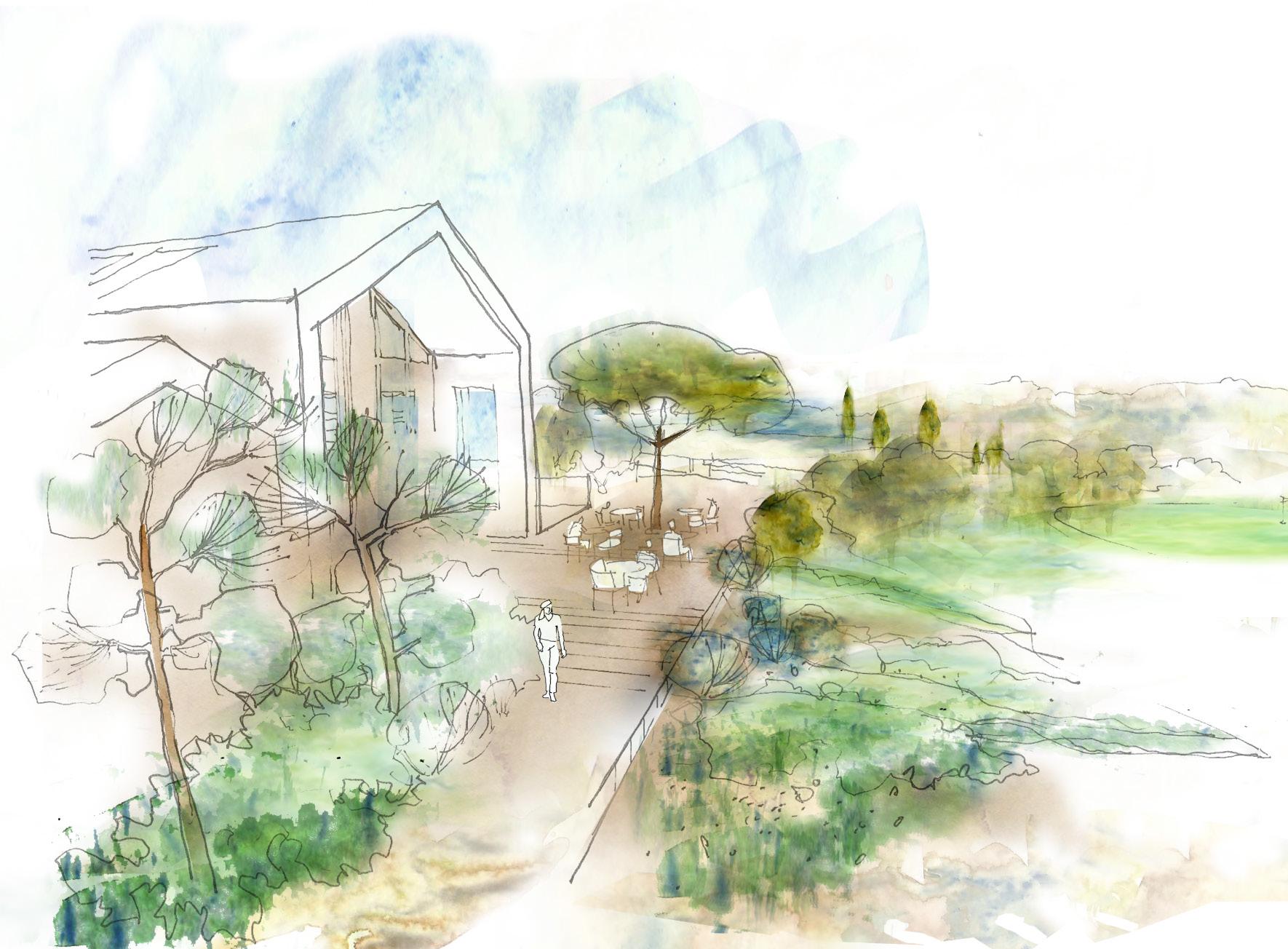




We often talk about education and careers as if they operate on a level playing field where talent rises, diligence pays off and everyone has an equal chance to succeed. It is a reassuring narrative but, for many, it is an ideal that doesn’t reflect reality. Access to opportunity, and the likelihood of success, are still profoundly shaped by a person’s background and experiences. The ideal of meritocracy, appealing though it is, all too often obscures the structural barriers that shape life chances. The myth of meritocracy is far from innocuous. It subtly shifts responsibility for inequality onto individuals and in doing so reinforces the systems, assumptions and unspoken rules that give advantage to some and hold back many others.
The sociologist Pierre Bourdieu asserted that power is not preserved by economic capital alone, but rather, dominant groups pass on a range of less visible assets: forms of social and cultural capital that help reproduce their advantage across generations. Bourdieu’s concept of social capital refers to the networks, relationships and informal knowledge that open doors. These resources act as a currency – if you have them, opportunities appear, if you do not,

you are placed at a disadvantage and essentially blocked from opportunities.
The concept of cultural capital refers to the knowledge, behaviours, skills and credentials that signal belonging in high-status spaces. For example, a degree from a selective university, familiarity with particular cultural references, or even how someone speaks and presents themselves. These forms of capital can be traded, sometimes literally, for economic advantage and they shape how individuals are perceived and evaluated. Bourdieu’s theories are nuanced and complex yet generate a deeply profound insight. The connections, knowledge and assets available to a person throughout their life course do not merely influence outcomes; they help to define them. This underscores why widening participation is critical: effective initiatives expand access to further or higher education and through vocational pathways for groups that have been historically under-served. Beyond being a moral imperative, this work drives vital economic growth, responds to skills shortages, boosts innovation and helps our sectors to better reflect and serve diverse communities. It is one of the tools that can drive social mobility,

The B.E. Inclusive partnership is between the Landscape Institute (LI), Chartered Institute of Building (CIOB), Chartered Institution of Civil Engineering Surveyors (CICES), Institution of Civil Engineers (ICE), Royal Institute of British Architects (RIBA), Royal Institution of Chartered Surveyors (RICS), Chartered Institute of Architectural Technologists (CIAT) and the Royal Town Planning Institute (RTPI). Through a signed Memorandum of Understanding, it is committed to improving how equitable, diverse, and inclusive the sector and profession is. It focuses on key pillars that include the collection and analysis of member social mobility data and student diversity data, exploring opportunities for internships or meaningful work experience and much more.
For updates on the work of B.E. Inclusive and how you can support, please visit landscapeinstitute.org/ about/equity-diversityinclusion

albeit not in isolation.
Social mobility, though complex and widely debated, is the link between a person’s life outcomes in terms of occupation, income, education or housing, and how these correlate with those of their parents. A strong correlation indicates low mobility and signals entrenched inequalities. In the pursuit of genuine meritocracy, we must first acknowledge that we don’t yet have one. Only by recognising and addressing the structural barriers that persist can we create systems where ability and effort truly determine opportunity and success, so that talent can flourish.
Readers of this article are likely to be professionals who have worked hard to build their careers. Yet the experiences of children and young people are far from uniform, from formative childhood through early adulthood; either inspiring and nurturing aspiration, opening doors or reinforcing barriers and ultimately shaping life outcomes. For some people, early opportunities create networks, guidance and advantages that pave the way into and through professional life. For others, disadvantage compounds across multiple dimensions. For example, a young person may be care experienced, live in a socioeconomically deprived area, attend an under-resourced state school or receive poor-quality careers education. Each factor can intersect,
thereby deepening inequality and limiting opportunity.
We hear a lot about talent pipelines and opportunity creation, but far less about the structural and cultural barriers that quietly shape people’s access to careers. Some young people begin with connections, cultural fluency and confidence built from familial networks and affinity. Others begin the race with nothing but potential and perseverance.
When we speak about disadvantage, it is not only referring to socioeconomic starting points. It is also about cultural capital, unspoken rules, networks and implicit expectations. There are young people with talent and brilliance in abundance but without someone to guide them, to translate corporate culture or simply to believe in them, their abilities remain unseen. Meanwhile, privilege acts as an invisible lift. It might be a recognisable surname, a parent who understands corporate pathways or an upbringing where certain environments feel natural, not intimidating. A safety net without financial or other pressures can liberate someone to take risks to follow their passion.
Inequality becomes especially visible in the way careers education is delivered. Many young people receive generic, distant and transactional information, while others get personal guidance,




coaching and strategic positioning. Good careers education is ongoing, relational and human. It should not be a one-off conversation, but a journey of support. Careers education varies in terms of quality and efficacy, yet it functions as a gateway opportunity or a mechanism to reinforce barriers, depending on how individually tailored and frequent it is. We need more than a one-off, standard, sheep-dip approach. The barriers are not only external; they can become internal. If someone has absorbed the belief that people like them do not get chosen, even when opportunity appears, stepping forward feels like overstepping. That is why mentorship, affirming exposure and identity-reflective role models are not extras: they are essential.
Widening participation as a driver of social mobility creates access for those who have not
followed traditional pathways into the profession and helps industry recognise and connect with organisations that nurture emerging talent. It is about unlocking doors in both directions: supporting young people in accessing the sector and supporting employers in discovering capable, overlooked potential.
The way forward requires collective responsibility. Employers must go beyond statements. Careers advisors must recognise their role as potentially transformative rather than gatekeeping. Those with the privilege of networks, knowledge or access must use it generously. True equity is not about pulling people up to where we are; it is about widening the ground so that everyone can walk forward together.
The level of work already being undertaken across the sector to inspire the next generation of professionals is impressive, yet we
must do more to attract and retain diverse talent. The idea of a level playing field, where talent and hard work alone determine success, is far from reality. Recognising and responding to these structural barriers is essential if we are to mobilise effective interventions that genuinely expand access and contribute to social mobility for all.
Emma Carruthers is EDI Manager at the Chartered Institution of Highways and Transportation (CIHT).
Tomi Ayede is Membership DEI Manager at the Royal Institution of Chartered Surveyors (RICS).
The opinions expressed are those of the authors. They do not purport to reflect the opinions or views of the Landscape Institute, respective Institutes, or their members.
Conversion master’s programmes enable graduates from cognate disciplines to enter landscape architecture, widening participation, addressing skills needs and embedding interdisciplinary expertise into practice.
1 https://www. qaa.ac.uk/thequality-code/ subject-benchmarkstatements/ subject-benchmarkstatementlandscapearchitecture
2 See 1
The pathway into the landscape profession has never been singular. While many practitioners follow the traditional route of undergraduate study in landscape architecture followed by a master’s degree, a growing proportion enter the profession from other fields. For these individuals, Landscape Institute (LI)-accredited conversion master’s programmes provide an essential alternative pathway.
These programmes are designed for graduates from cognate disciplines such as architecture, planning, geography, environmental science and art and design, among many others. Cognate disciplines are neighbouring academic fields that overlap or connect, meaning that learning from one helps to inform understanding of another. They act as a bridge, enabling students to transfer their skills into landscape architecture while meeting the professional standards required for chartership. Against the backdrop of ongoing skills needs, efforts to widen participation and the value of diverse expertise in the built environment, cognate disciplines and conversion courses are essential.
Landscape architecture is inherently interdisciplinary. It deals with the interface between people, place and nature, and in doing so draws on a wide spectrum of knowledge. It is therefore unsurprising that students come to conversion programmes from many different fields. The presence of these students enriches the cohort experience, strengthening dialogue across disciplines and reflecting the realities and challenges of contemporary practice. The Quality Assurance Agency for Higher Education (QAA) Subject Benchmark Statement for Landscape Architecture (2024)1 stresses that the discipline is “underpinned extensively by natural and social sciences, culture and history” (section 1.6). The inclusion of students from cognate backgrounds is therefore not incidental but integral to the educational foundations of the profession.
In the UK, there are relatively few undergraduate landscape architecture programmes compared with related disciplines such as architecture, planning or geography. Conversion master’s programmes therefore play a strategic role in expanding the pipeline of talent and supporting a more diverse range of entry points into the profession.
For many students, these courses represent a second opportunity to discover landscape architecture after first encountering it through professional work, a related degree or personal interest. The QAA Subject Benchmark Statement for Landscape Architecture (2024)2 explicitly recognises that not all students enter the profession through a linear undergraduate-to-master’s route. It highlights alternative pathways into accredited programmes, noting that graduates from cognate disciplines may undertake a one-year conversion course to develop the necessary skills before progressing to the master’s stage (section 2.18).
This acknowledgement within the sector’s benchmark standards underlines the legitimacy of conversion pathways and their importance to the profession’s future. Far from being a marginal option, these routes are formally recognised as a means of widening access and ensuring that students with diverse academic backgrounds are able to enter landscape practice and progress towards chartership.
The Statement also emphasises flexibility in delivery, encouraging institutions to consider hybrid, online and part-time models of study (section 2.20). This is particularly significant for conversion students, many of whom are mature learners or career changers who require more adaptable modes of provision. Increased flexibility has the potential to reduce barriers to entry and make landscape education more accessible across different geographies and life circumstances. One of the most persistent challenges facing the landscape
profession is awareness. Many school-leavers and undergraduates have never encountered landscape architecture as a potential career, particularly when compared with disciplines such as architecture, geography, art and design or environmental science, which are more visible within schools and the media. As a result, many future landscape architects first enter another discipline before discovering landscape later in their academic or professional lives.
As landscape architects increasingly engage with complex challenges such as climate adaptation, Biodiversity Net Gain and sustainable placemaking, the profession benefits from the complementary expertise that graduates from cognate disciplines bring. Conversion courses, by attracting students with diverse academic and professional backgrounds, play a critical role in embedding this richness into the profession.
The landscape profession is strengthened, not diluted, by the diversity of its entry routes. Conversion master’s programmes demonstrate that there is no single correct way to become a landscape architect, but rather multiple gateways that enrich the profession with different skills, perspectives and experiences. However, greater targeted outreach is still needed, with the LI, education partners, members, and organisations playing a stronger role in engaging students from related fields and promoting landscape architecture as a rewarding and socially impactful profession.
The future of landscape depends not only on those who enter directly, but also on those who arrive from elsewhere, bringing with them the perspectives and skills that help to make the profession stronger.
Kelli Cochran-Sharp is Education Manager – Higher Education and Apprenticeships at the Landscape Institute

Emily Rusby, BA, MA, PGDip, CMLI
Landscape Architect, Gillespies LLP
First degree: Interactive Arts
I did a BA in Interactive Arts, studying contemporary art practice and specialising in conceptual art. I wanted to study art because I love it and still do. The course helped me build strong skills in critical thinking, visual communication and expressing ideas clearly.
After completing my undergraduate degree and working full time in the legal sector, I realised I wanted a career that allowed me to think creatively while offering clear structure and progression. Landscape architecture provided the balance between creativity and problem-solving.
I then did a Postgraduate Diploma and Master’s (Conversion Course) at Leeds Beckett University. A highlight for me was meeting other people from various backgrounds and experiences who were also doing the conversion course, as well as being part of the wider MA course and working with students that had taken a more traditional route.
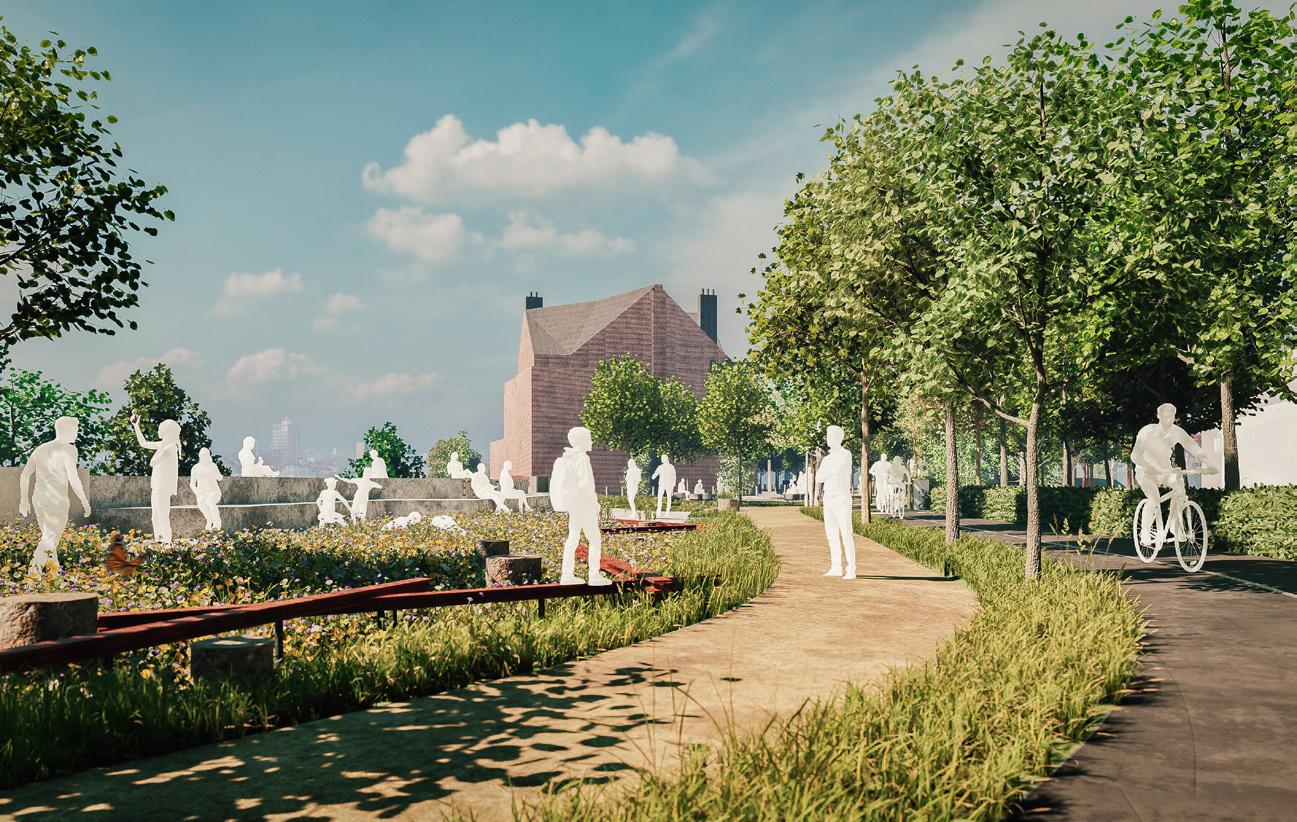
I found the transition into landscape architecture positive and was able to draw on my previous experience while adapting to a new career. One of my biggest highlights has been progressing at Gillespies and achieving chartered status with great support from the team.
My top tip
Landscape architecture needs people from all kinds of backgrounds, so a non-traditional route should not be seen as a disadvantage. Wider experience brings different perspectives and skills, which are genuinely valued in the profession and can really strengthen your approach to design.
Castleford Riverside
Park is a regeneration scheme that Emily has led on with the Gillespies team on behalf of Wakefield Metropolitan District Council. The scheme celebrates and opens the riverside through creation of high-quality park spaces. It is currently on site and due for completion 2026/2027.

Eccles Ng, BA, PGDip, MA, CMLI Course Director
Landscape Architecture BA, Birmingham City University
I studied architecture for my undergraduate qualification. With a background in both science and art, and a keen interest in the construction industry, I was drawn to a discipline which combines technical precision, creative thinking and the practical realities of delivering projects in the built environment.
During my undergraduate studies, friendships with students on the BA Landscape Architecture course introduced me to the discipline. I became particularly interested in its focus on the relationship between the built environment and nature systems. With encouragement from a senior lecturer, I decided to pursue a career in landscape architecture.
I completed a part-time MA in Landscape Architecture at the University of Central England (now Birmingham City University). Studying alongside professional practice allowed me to build technical skills while directly applying

academic theory to live projects, creating a strong and continuous dialogue between university learning and professional experience.
My transition into landscape architecture was gradual and embedded within concurrent study and practice. A key milestone was completing the MA which brought a marked increase in professional responsibility. It also provided me with the confidence and professional identity needed to progress towards the Pathway to Chartership and ultimately CMLI status.
My top tip
My key advice is to understand the profession of landscape architecture before choosing the route. You can explore conversion programmes, speak with practitioners, seek work experience in practice and engage with LI activities. Align these experiences with your own interests and strengths to build a clear and informed view of how you could thrive in the profession.

Amanda Green, BA, MA, PGDip Landscape Architect, Kirklees Council
I studied Fashion Design at Birmingham University in the early 2000s, achieving a FirstClass Honours degree. During the degree, I specialised in children’s clothing and this was a particularly exciting era for the industry. For 15 years I travelled globally, creating collections and overseeing manufacturing for major UK retailers, gaining invaluable experience in design, production and international supply chains.
During the pandemic, I hired a mini digger and landscaped my garden. That hands-on experience, combined with advice from an LI member, sparked my passion for landscape architecture. I approached Leeds Beckett and was accepted immediately onto their master’s in Landscape Architecture Conversion programme, thanks to my transferable skills in graphic design and creative problem-solving.
At Leeds Beckett, I completed my conversion master’s in landscape architecture and then
the Postgraduate Diploma. I chose Leeds Beckett as the ideal step from fashion design to shaping outdoor spaces. The course combined creativity with technical skills, focusing on biodiversity, sustainability and public realm design, perfectly aligning with my passion for art and threedimensional design.
Landscape architecture combines creative design with technical detail, demanding precision and adaptability. Designers are dynamic collaborators, often the lynchpin in multidisciplinary teams. I love seeing my designs come to life and presenting public consultations, guiding communities through the process and showing how their ideas shape the spaces we create.
My top tip
Ask as many questions as possible. Be curious, don’t assume. Be super helpful to those who offer to help you. Don’t be afraid to make mistakes. Landscape architecture is vast, and no one can know everything. There’s always more to learn, so embrace curiosity and growth as part of the process. Take a deep breath and find the people who want to support you.
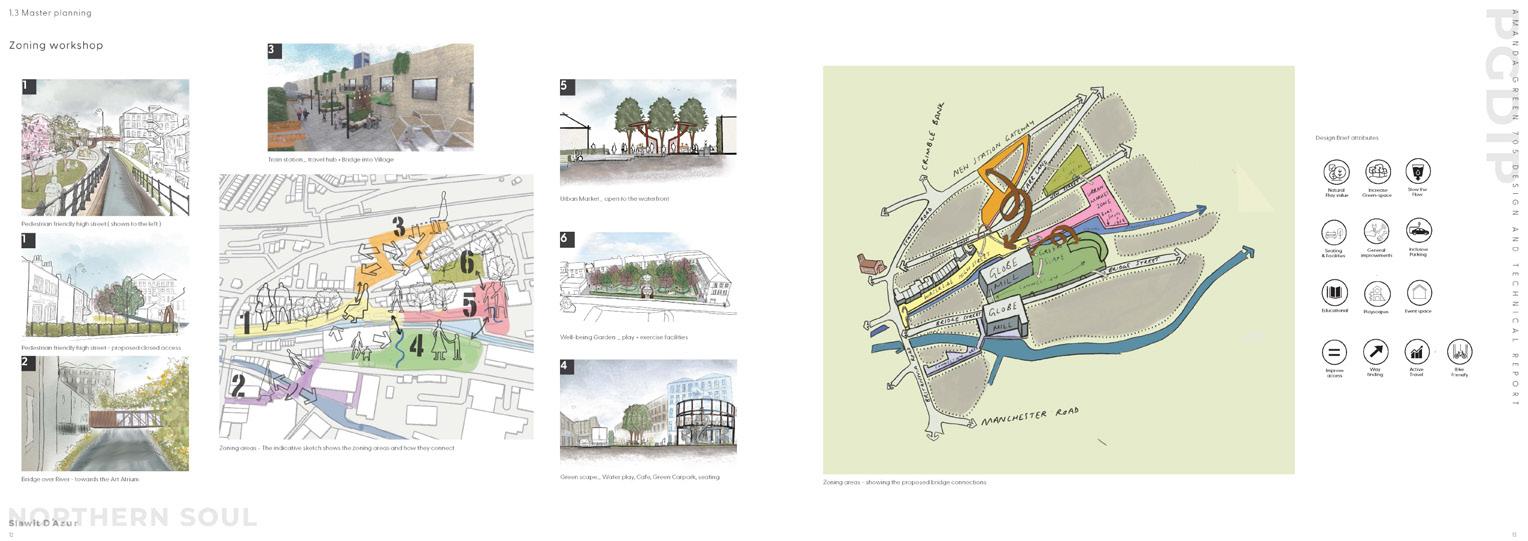

Hannah White BA (Hons), MA, CMLI Senior Landscape Architect, AECOM
I studied BA Geography at the University of Nottingham because I was (still am!) interested in the relationship between human and physical environments. I wanted to better understand the natural world, the processes that shape it, and how human activity interacts with and transforms our surroundings.
My geography degree explored many of the environmental challenges facing our world and I wanted a profession that could actively address these issues. Landscape architecture sits at the forefront of protecting and enhancing the natural environment while empowering stakeholders, developers and communities to achieve positive and sustainable outcomes for people and nature.
I completed an MA Landscape Architecture Conversion degree at Birmingham City University, which was a two-year course with people from diverse academic backgrounds. Highlights included working on
local projects, enabling site visits and contextual understanding, and collaborating across disciplines including architecture and interior architecture, through design studios and interdisciplinary teamwork. I have been lucky enough to work at AECOM with experienced colleagues who generously dedicate time to support my development. My work has focused on landscape planning work, mostly for energy infrastructure, including LVIA and strategic landscape design. Career highlights to date include visiting diverse and exciting sites nationwide and achieving chartership with the Landscape Institute last year.
My top tip I would encourage anyone considering a career in landscape architecture to go for it! Landscape professionals are uniquely placed to deliver effective solutions to the climate and biodiversity emergencies facing the world today. The profession values diverse skills and experiences, enabling us to collaborate to create positive, meaningful change for both people and nature.
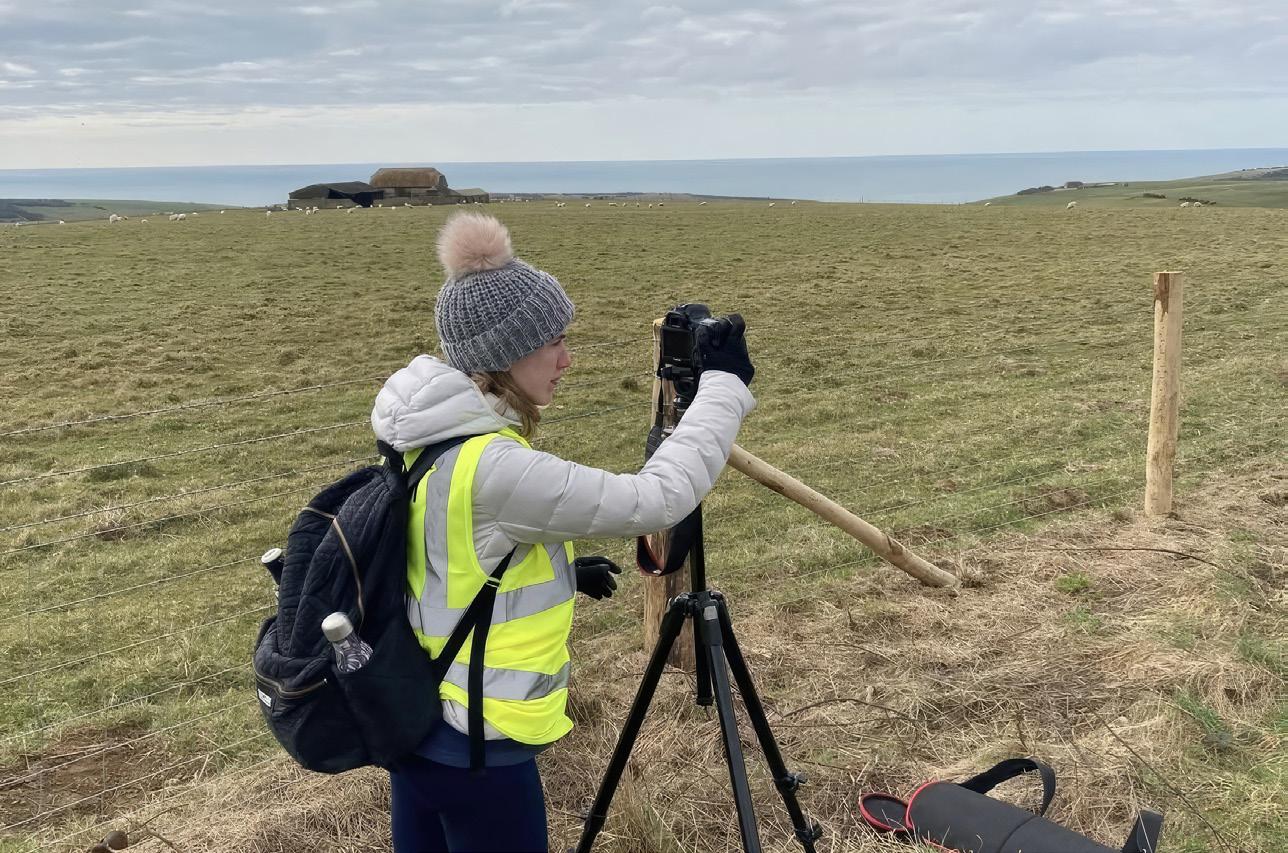
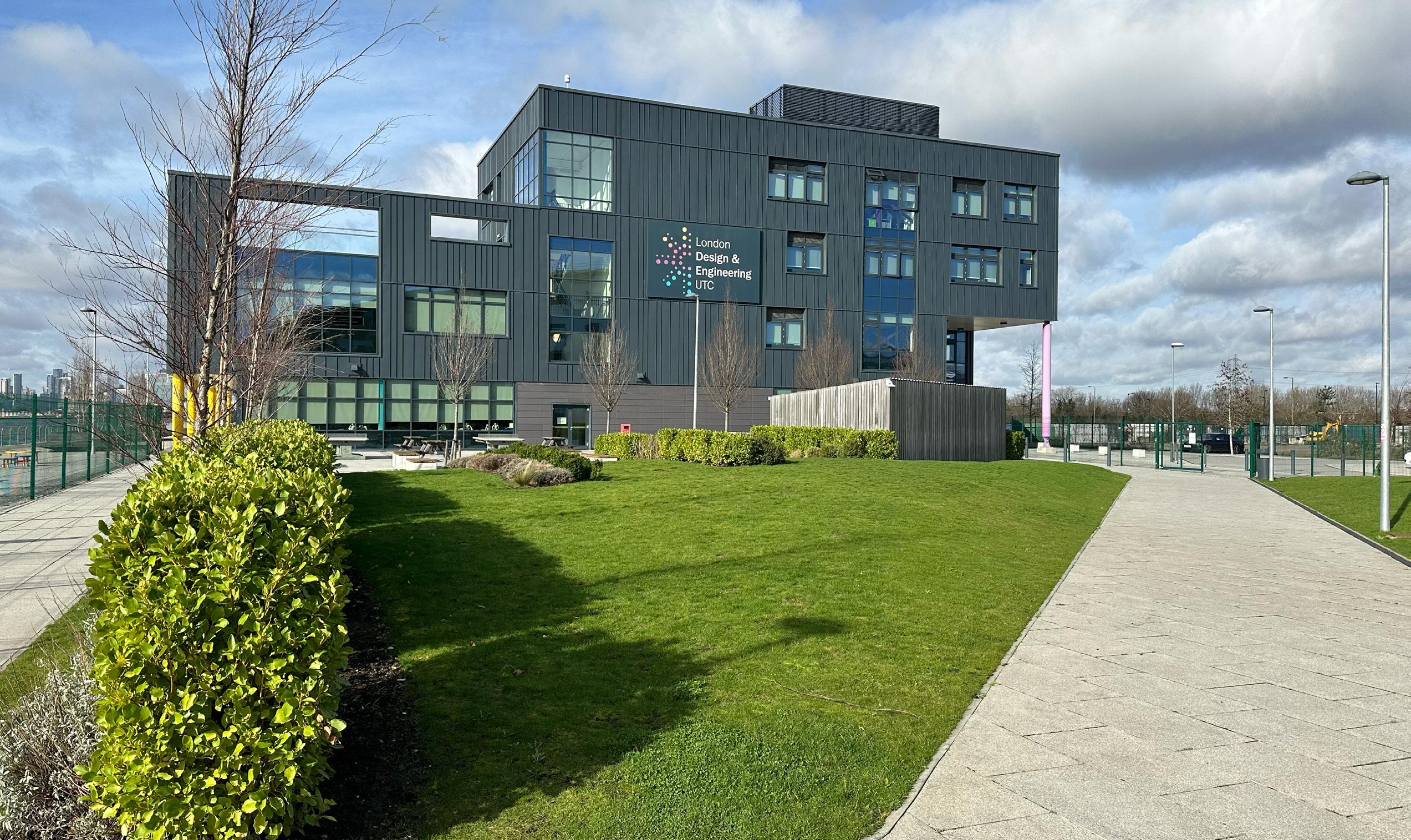
Kelli CochranSharp
The Landscape Institute (LI) and the London Design and Engineering University Technical College (LDE UTC) are set to elevate delivery of the established Level 3 Landscape Technician Apprenticeship. From January 2026, apprentices will benefit from LDE UTC’S teaching excellence and facilities alongside the LI’s professional standards and industry connections, creating a pathway that is more robust, inclusive and impactful than ever before.
The Level 3 Landscape Technician Apprenticeship is designed to blend academic learning with practical experience. It equips learners with skills in technical design, site planning, environmental management and assessment,
A new partnership between the Landscape Institute and the London Design and Engineering University Technical College gives strength to the Level 3 Landscape Technician Apprenticeship
and the use of industry-standard software. What makes 2026 different is the partnership now driving it. LDE UTC’s proven record in apprenticeship delivery and the LI’s professional framework come together to give apprentices not only a recognised qualification but also deeper integration into the heart of the landscape profession.
LDE UTC was awarded five ‘Exceptional’ judgements, the highest possible recognition, reserved for practice of the highest standard nationally, during their recent Ofsted inspection in November 2025, under the revised national framework.
Apprentices thrive in a welcoming, professionally equipped environment where staff use
engaging, continually updated teaching methods. With a track record of high achievement, many learners progress into employment, promotion or further study and the LDE UTC brings both the facilities and expertise to ensure apprentices graduate ready to contribute to realworld projects from day one.
The LI ensures the programme remains aligned with its professional standards and recognises successful graduates with Technician Membership (TMLI). This connection gives apprentices immediate access to the profession: its events, resources and a network of peers and employers. For the LI, the partnership reinforces its leadership in addressing the sector’s skills gap and expanding inclusive
1 London Design and Engineering University Technical College campus.
3
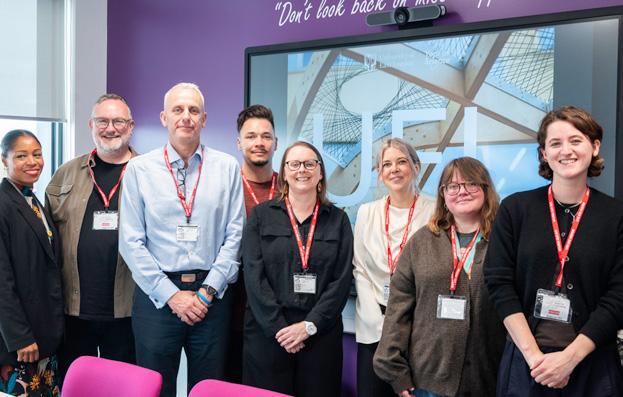
entry routes into professional landscape careers.
Apprentices will gain practical expertise combined with digital fluency in industry-standard tools such as Computer Aided Design and Geographic Information Systems. They will benefit from a strong sense of professional belonging, embedded in the LI community from the start of their training, and they will emerge with enhanced career prospects. All this is supported by a record of strong employment outcomes and progression routes. The first LDE UTC delivered cohort will welcome apprentices in January 2026, building a steady pipeline of skilled landscape technicians equipped to respond to today’s urgent environmental challenges.
Landscape Technician Apprentices can offer immediate, practical support to employers while developing long-term technical capability. They can contribute directly to business operations through producing drawings, mapping and visualisations, undertaking site surveys, interpreting data, and supporting the preparation of plans, specifications, and cost estimates.
Apprentices will be able to offer reliable technical support across the full project lifecycle, from feasibility through to construction. With an understanding of design principles, planting design, sustainability, planning policy, environmental legislation, and contract processes, they can strengthen multidisciplinary collaboration and help maintain continuity within project teams.
This is particularly valuable for consultancies and local authorities delivering complex and long-term programmes of work.
Apprentices can also offer growing capability in sustainability and climate-responsive design. They will be able to apply knowledge of ecological principles, biodiversity, water management, climate-resilient design, and long-term maintenance considerations to support the delivery of landscape projects.
For the profession, this collaboration ensures a supply of competent, job-ready technicians at a time of growing demand. For the LI, it strengthens its role as an enabler of education, widening participation in landscape careers and embedding professional standards from the outset of training. For employers and local authorities, it delivers a
reliable talent stream for projects addressing climate adaptation, green infrastructure and urban regeneration.
By joining forces, the LI and LDE UTC have created a stronger foundation for the apprenticeship, one that combines professional credibility with teaching excellence. The result is a programme that delivers not only skills and knowledge but also confidence, recognition and belonging in a profession that is vital to our shared future.
For further discussion or assistance with any of the above, or to register interest, contact apprenticeships@ landscapeinstitute.org
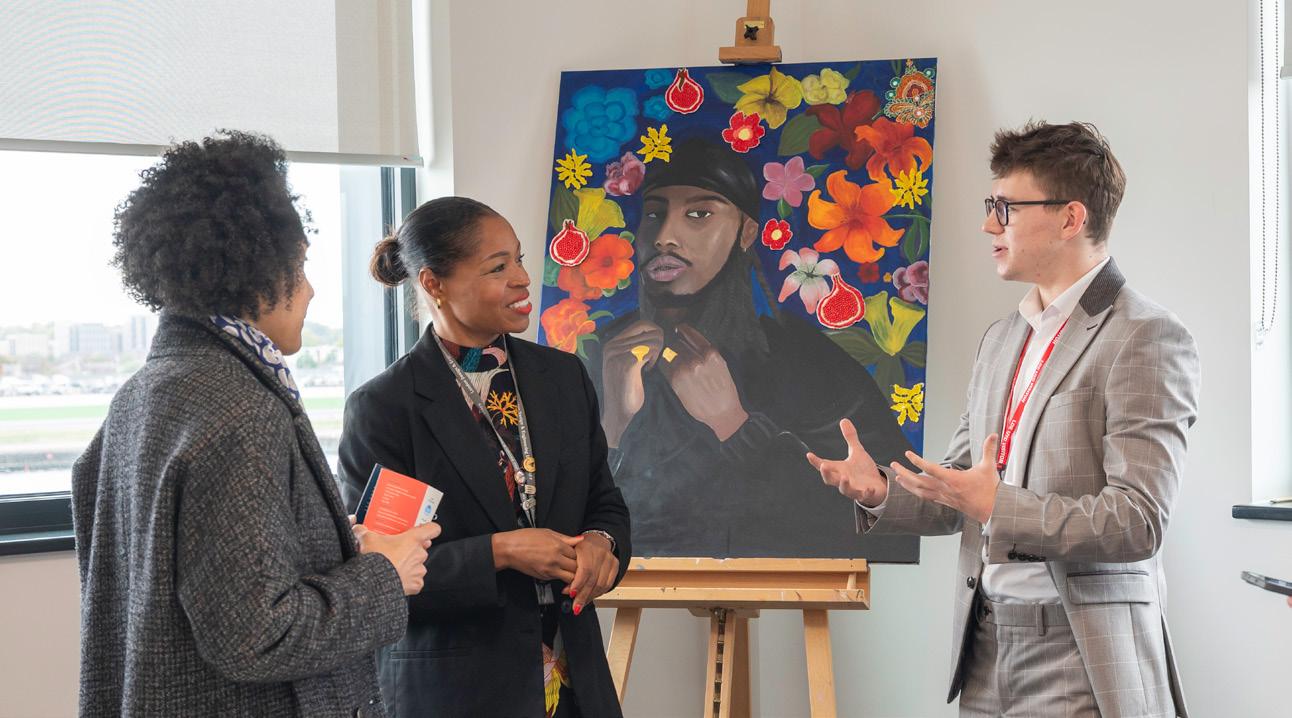
▪ The Landscape Technician Apprenticeship offers a handson professional pathway into the landscape profession and provides a strong mechanism for upskilling existing staff and the recruitment of new staff.
▪ Duration: 24 months
▪ Delivery: Remote (online), one day per week, accessible nationwide
▪ Professional membership: Apprentices begin as Student Members of the Landscape Institute and qualify as Technicians (TMLI) on completion.


The Landscape Institute Awards 2025 was a celebration of excellence, innovation and achievement across the landscape sector. Held at the Brewery in London, the atmosphere was vibrant and full of pride as professionals from across the industry came together to recognise the exceptional work of landscape architects and the impact they have in shaping places and communities.
We were delighted to welcome Frances Tophill as host, whose warmth and enthusiasm brought inspiration to the evening,
A landmark evening recognising the innovation, leadership and transformative impact of landscape professionals on people, place and nature.
as well as our partners (opposite), whose support makes these celebrations possible.
The awards shone a powerful spotlight on the breadth of talent within the sector, highlighting the importance of people, place and nature and the impact that a landscape-led approach to development can have.
Please enjoy looking back at the Awards in the pages that follow, with insights from Paj Valley FLI, Chair of the Awards Panel, Jill Bullen CMLI, winner of the President’s Award, and Rob Hughes, CEO.












Paj, can you tell us what your role is, and that of the Awards Panel?
I have been involved with the Awards panel for a number of years and this year I was nominated as Chair. Collectively, the Awards Panel and the Landscape Institute are instrumental in overseeing the Awards process, reviewing and establishing categories, criteria and judging structures. It serves to recognise and celebrate the highest quality of landscape work, while aligning with the profession’s evolving standards and priorities.
Paj Valley, Chair of the LI Awards Panel, offers insights into the emerging trends in landscape practice today, and the rising bar of professional standards.
Were there any themes or trends across projects this year, and what do these tell us about the future of the profession?
This year’s Awards attracted an impressive breadth of submissions, with over two hundred entries received from across the UK and internationally. The diversity of categories enabled the profession to showcase projects spanning multiple sectors and specialisms, reflecting the richness and adaptability of landscape practice.
A notable trend was the significant increase in international participation. Many entries came from global firms delivering projects within the UK, alongside UK-based practices working abroad. This exchange of ideas and expertise highlights the growing interconnectedness of our profession and its influence on a global stage.
Sustainability emerged as a defining theme across submissions. Projects that demonstrated innovative, resource-efficient solutions and measurable environmental and social benefits stood out as exemplary. These approaches underscore the profession’s commitment to addressing climate challenges and creating resilient, inclusive places.
The Awards evening illustrated how landscape professionals are shaping successful, people-focused environments, whether through assessment, planning, or design. The collaborative spirit evident in multidisciplinary projects was particularly inspiring. Looking ahead, we anticipate an even greater leadership role for landscape professionals in delivering integrated solutions that enhance both ecological and community wellbeing.
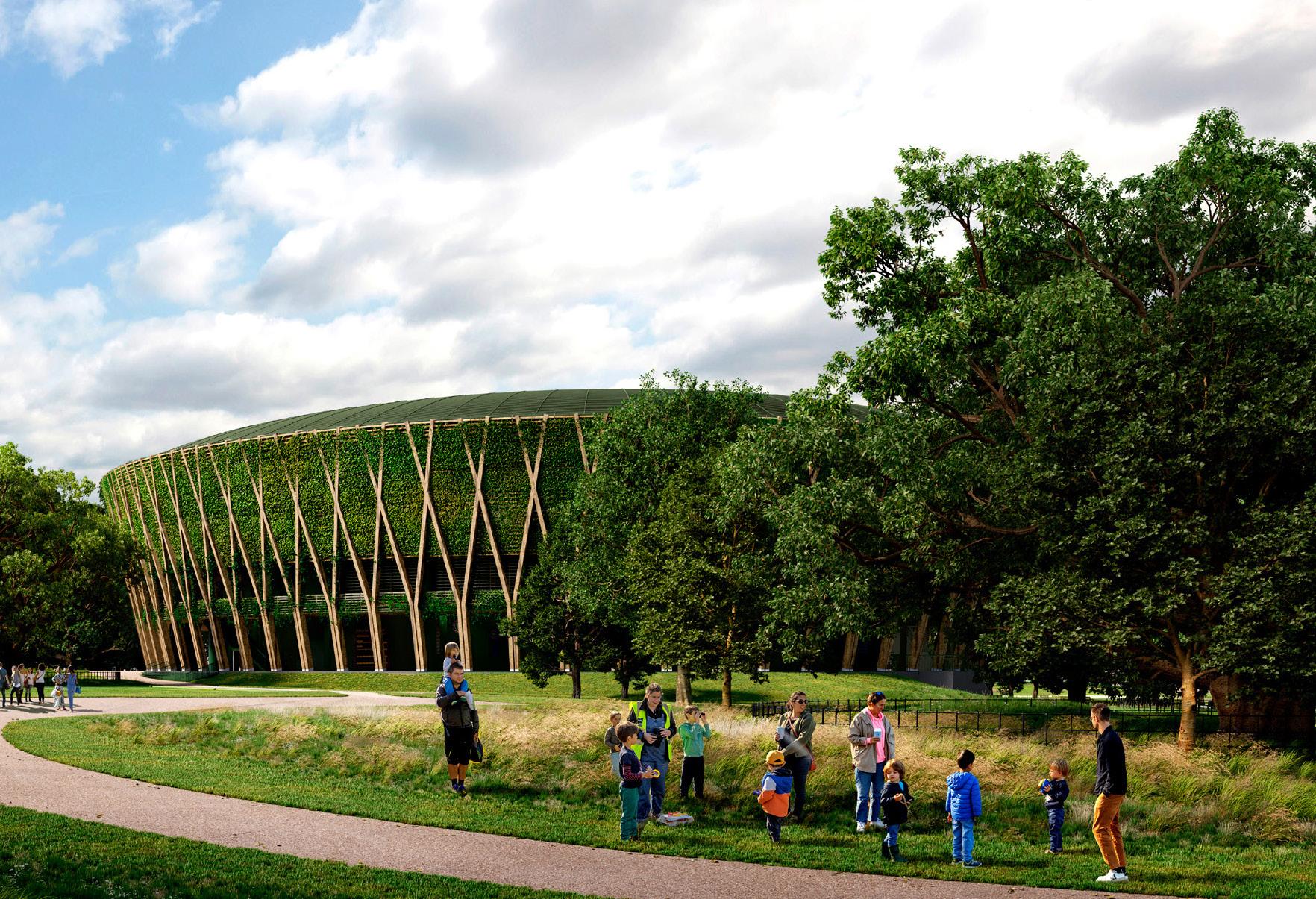
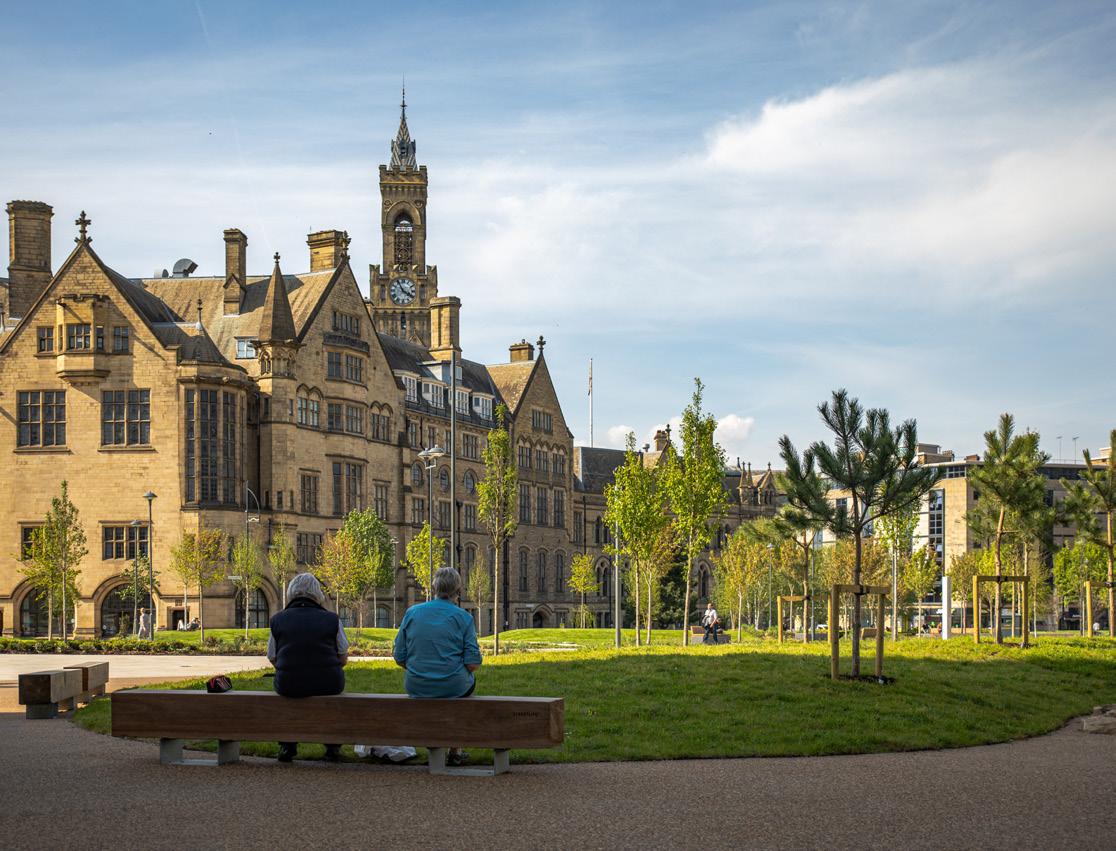
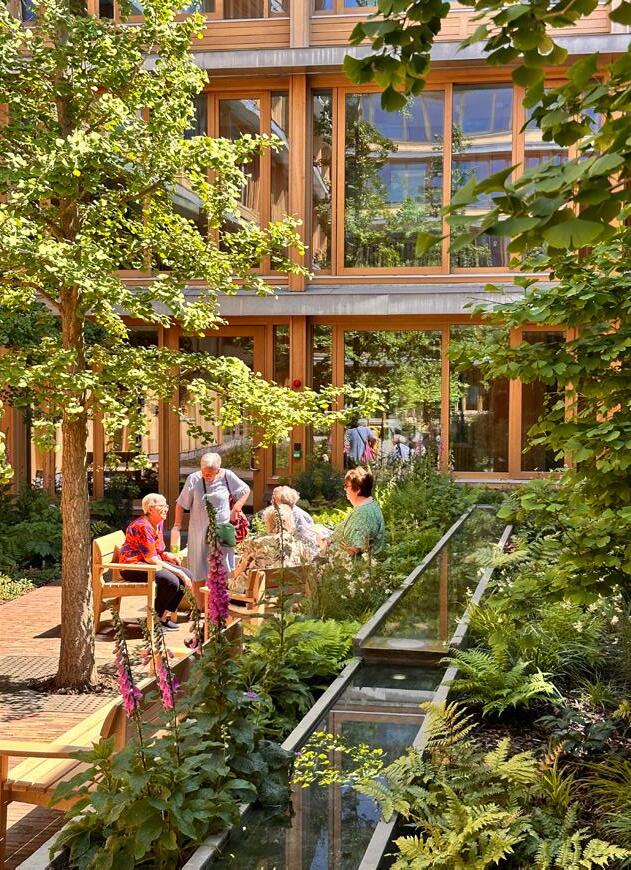
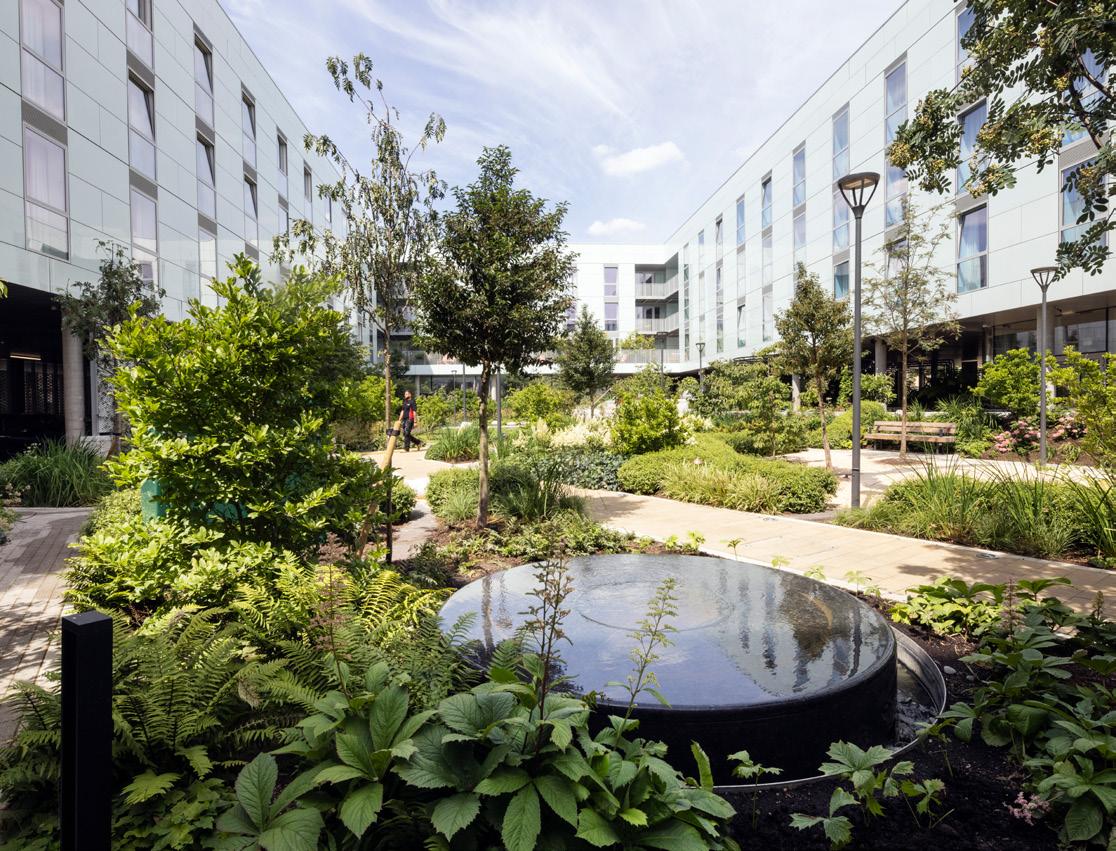

Congratulations, Jill! Could you tell us about your project?
The Good Practice Guidance: Planning for Dark Skies was coproduced and launched in February 2025 in response to the recognised need for national planning guidance. Although awareness is growing with respect to both the opportunities of a night sky and the effects of artificial light at night, light pollution remains a problem. The guidance sets out why reducing light pollution is essential, as well as planning and lighting considerations, and transferable examples of improved designs for multiple settings. The
guidance is designed for use in the planning system, by developers and communities, and can be adopted elsewhere within the UK and internationally.
How did it feel to win the President’s Award?
We were absolutely delighted that the Good Practice Guidance on Planning for Dark Skies won the President’s Award; it truly felt like a euphoric moment. Recognition for the seminal guidance makes an incredible difference; the Dark Skies Working Group in Wales are over the moon!
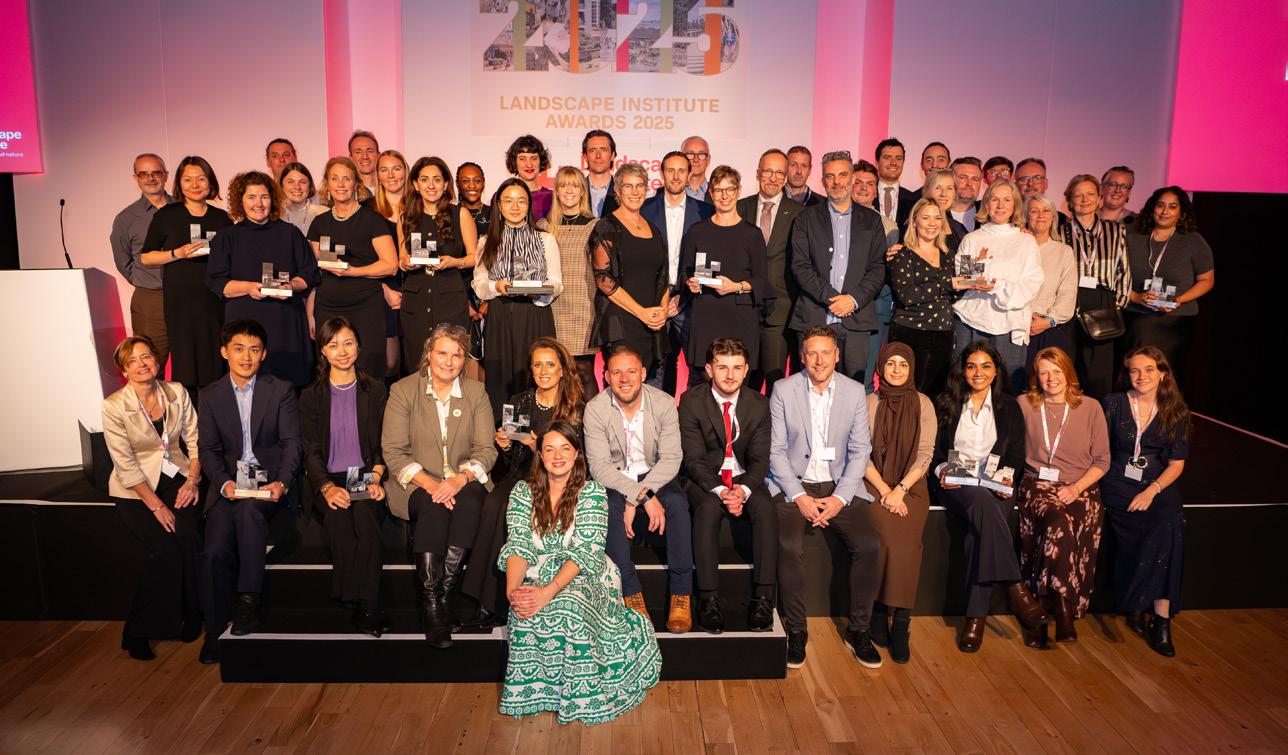
What would you like others to take away from your project?
There are some really clear messages we hope the project sends: preserving dark skies, encouraging dark sky lighting, and reducing light pollution results in positive changes for nature, people and future generations. Also, switching to energy-efficient dark sky lighting, and switching off when it is not needed, has the potential to save energy, money and reduce carbon emissions. We’d also encourage adherence to the Good Practice Lighting Principles to make a difference:
▪ Light only where needs to be lit.
▪ Light should be no brighter than necessary.
▪ Use warm colour temperatures.
▪ Use timers and sensors.
▪ Use a lower mounting height where possible.
▪ Limit internal lighting spilling outside target area.
▪ Keep light away from wildlife.
1 The winners gather on stage.
© Landscape Institute
2 Natural Resources Wales team collect the President's Award.
© Landscape Institute
3 PPLI Adam White with President-Elect, Saira Ali.
© Landscape Institute
4 President Carolin Göhler presents Yvonne Matthews with a special recognition Award.
© Landscape Institute
Hughes, CEO of the
The Landscape Institute Awards 2025 was a truly inspiring evening and a fitting celebration of the talent, dedication and creativity that define our profession. It was great to recognise the outstanding achievements of our members and to celebrate the exceptional quality of work being delivered across the landscape sector.
In addition to celebrating the achievements of individual projects and people, the Awards reflect the collective strength of our profession and the vital role that landscape professionals play in shaping healthier, more resilient and more beautiful places for people and nature. From climateresponsive design and biodiversity enhancement to communityled placemaking and technical excellence, the breadth and ambition of the work showcased this year was remarkable. Every entrant should feel immensely proud of their contribution.
The Awards also provided an opportunity to reflect on the growing influence and relevance of the Landscape Institute. Our members are increasingly at the forefront of tackling some of society’s most urgent challenges, from climate adaptation and nature recovery to health, wellbeing and social equity.

The projects recognised this year demonstrated clearly how landscape professionals are helping to deliver meaningful and lasting positive change.
As demand for high-quality, sustainable and nature-positive development continues to grow, so does the need for skilled, ethical and visionary landscape professionals.
The Landscape Institute will continue to champion the value of our members’ work, advocate for strong policy and professional standards, and invest in education, research and professional development. Our flagship event remains a key part of this vision.
The LI Awards 2025 reminded us of what is possible when expertise, passion and purpose come together. I would like to warmly congratulate all our winners and entrants, and to thank everyone who contributed to making the evening such a success. Together, we are shaping a future where accessible, quality and sustainable landscapes are recognised not as a luxury, but as essential infrastructure for people, place and nature.
Rob Hughes is CEO, Landscape Institute
Landscape and Parks Management Awards
Excellence in Masterplanning and Urban Design
Excellence in Public Health and Wellbeing
Dame Sylvia Crowe International Award for Small to Medium Scale Projects (up to 10ha)
Dame Sylvia Crowe International Award for Large Scale Projects (10ha and above)
Excellence in Climate, Environment, and Social outcomes
Excellence in Place Regeneration
Excellence in Collaboration, Engagement & Influence
Excellence in Biodiversity Conservation and Enhancement
Excellence in Landscape Planning and Assessment
Excellence in Heritage and Culture
Student Dissertation
Landscape Legacy
Landscape Research and Digital Innovation Award
Student Portfolio
Excellence in Small Landscape and Garden Design
Excellence in Landscape Design
President’s Award
A Landscape Vision for Bedgebury The Environment Partnership (TEP) Ltd
AELTC Wimbledon Park Project LUC
Appleby Blue Almshouse Grant Associates
Aranya Stream Park Z'scape
Jiaxing Station Park Z'scape
Beckenham Place Park East BDP
Bradford Transforming Cities Fund City of Bradford Metropolitan District Council
Down Lane Park Levitt Bernstein and Haringey Council
Eden Dock HTA Design
Good Practice Guidance Planning for Dark Skies
Gweithgor Awyr Dywyll Cymru / Dark Skies Working Group Wales
Greenwich Park Revealed The Royal Parks
LIVING WITH THE WILD: Navigating the Human-Leopard Dynamics in Mumbai
Aditi Nair, The Bartlett, University College London
Reviving NAN TOU: A Place Caught in the Pitfall of Gentrification Lab D+H SH
Seeking Resilience and Equity in Transforming Cultural Landscapes
Tides of Heritage: A Journey through the Scilly Landscape
South China Agricultural University
Aditi Nair, The Bartlett, University College London
Turing Locke Hotel, Cambridge Robert Myers Associates
Urban Nature Project, Natural History Museum
Good Practice Guidance Planning for Dark Skies
J&L Gibbons
Gweithgor Awyr Dywyll Cymru / Dark Skies Working Group Wales

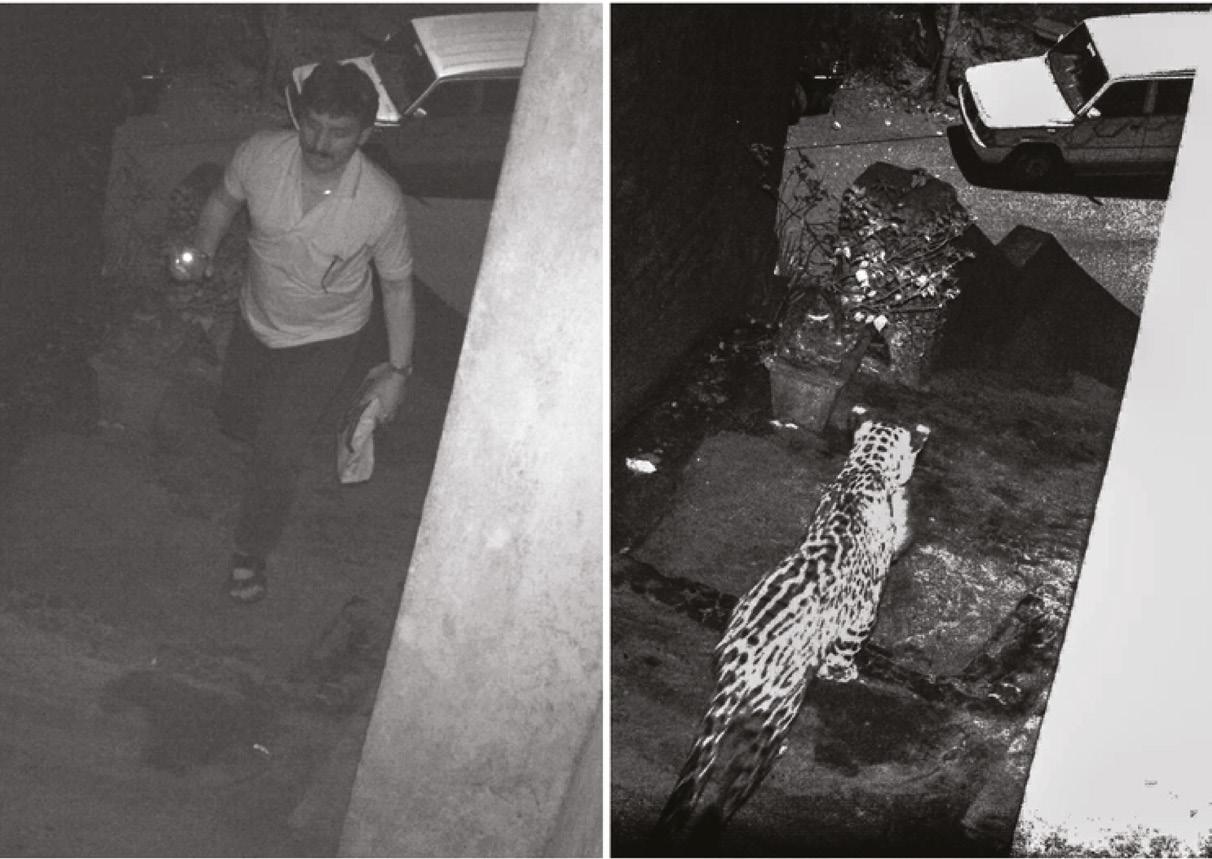
1 Dame Sylvia Crowe International Award for Small to Medium Scale Projects (up to 10ha), Aranya Stream Park.
© Z'scape
2 Dame Sylvia Crowe International Award for Large Scale Projects (10ha and above), Jiaxing Station Park.
© Z'scape
3 Landscape Research and Digital Innovation Award, Seeking Resilience and Equity in Transforming Cultural Landscapes.
© South China Agricultural University
4 Landscape Legacy, Reviving NAN TOU: A Place Caught in the Pitfall of Gentrification.
© Lab D+H SH
5 Student Dissertation, LIVING WITH THE WILD: Navigating the Human-Leopard Dynamics in Mumbai.
© Aditi Nair, The Bartlett, University College London
6 Excellence in Biodiversity Conservation and Enhancement, Eden Dock.
© HTA Design
7 Excellence in Landscape Design, Urban Nature Project, Natural History Museum.
© J&L Gibbons
8 Excellence in Collaboration, Engagement & Influence, Down Lane Park.
© Levitt Bernstein and Haringey Council
9 Student Portfolio, Tides of Heritage: A Journey through the Scilly Landscape.
© Aditi Nair, The Bartlett, University College London
10 Landscape and Parks Management Awards, A Landscape Vision for Bedgebury.
© The Environment Partnership (TEP) Ltd
11 Excellence in Climate, Environment, and Social outcomes, Beckenham Place Park East.
© BDP

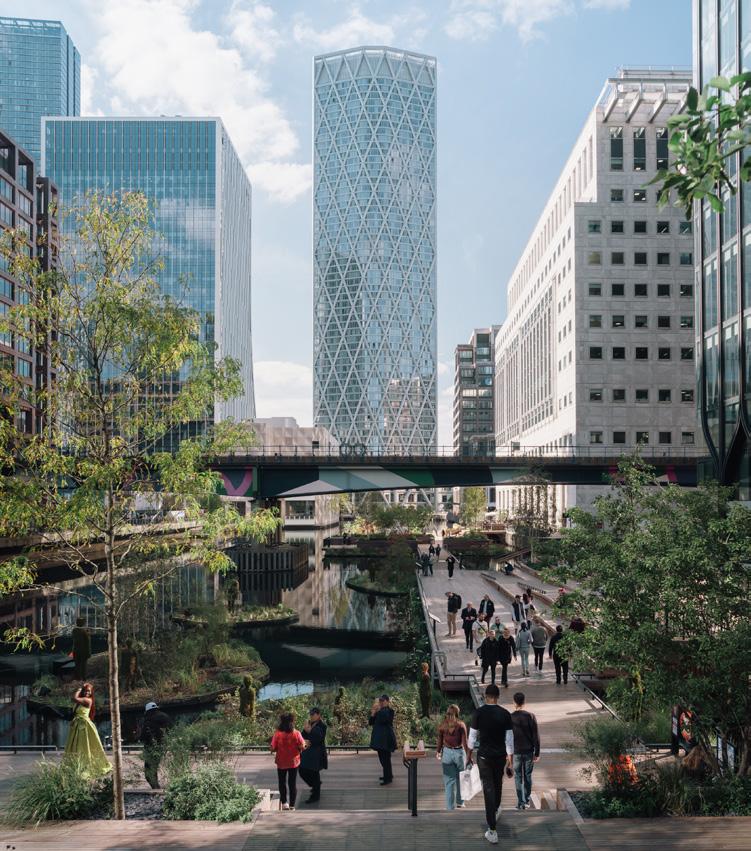
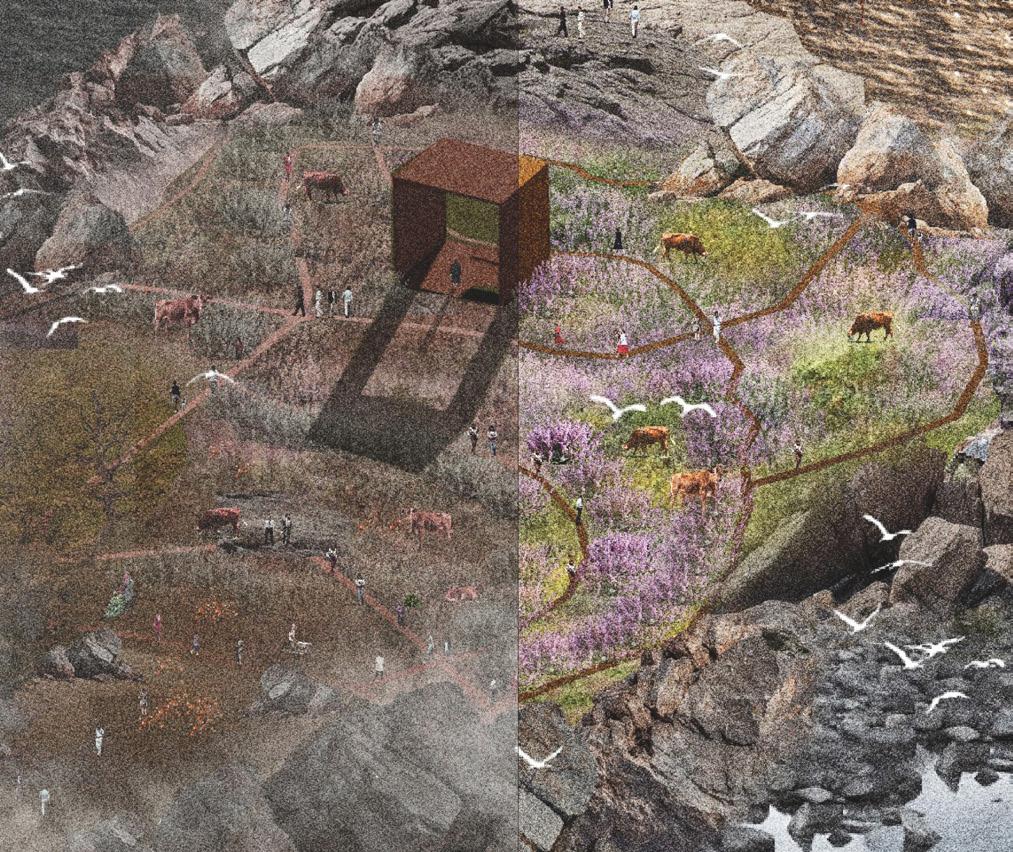

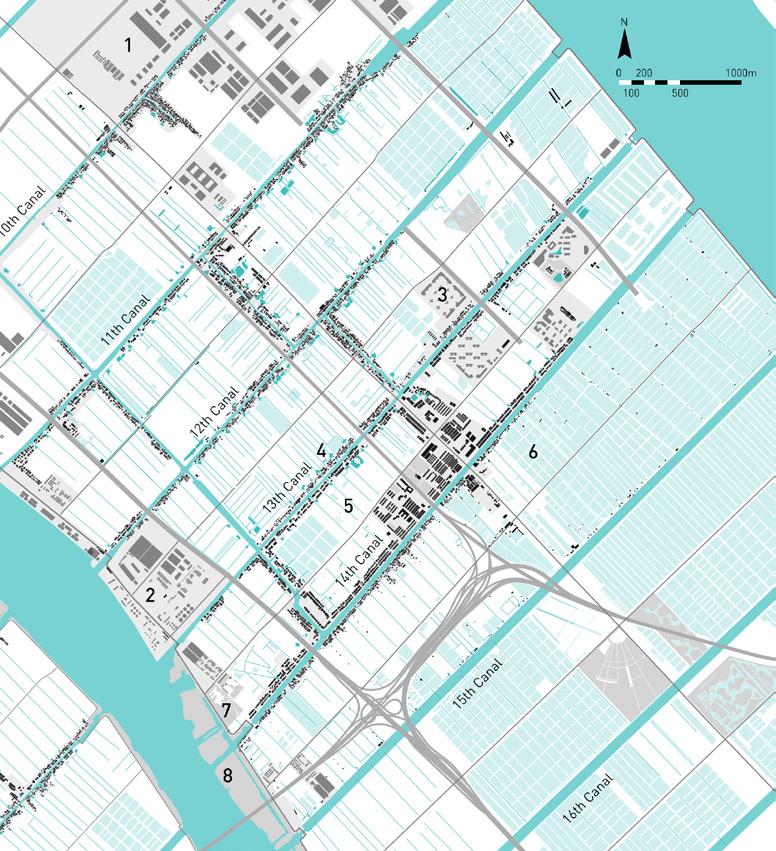

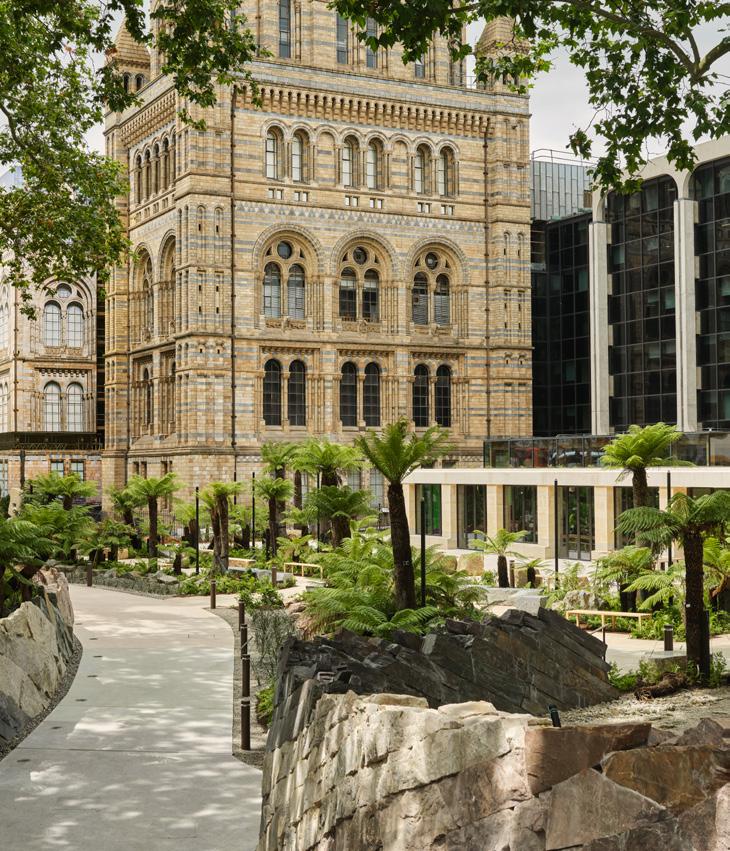
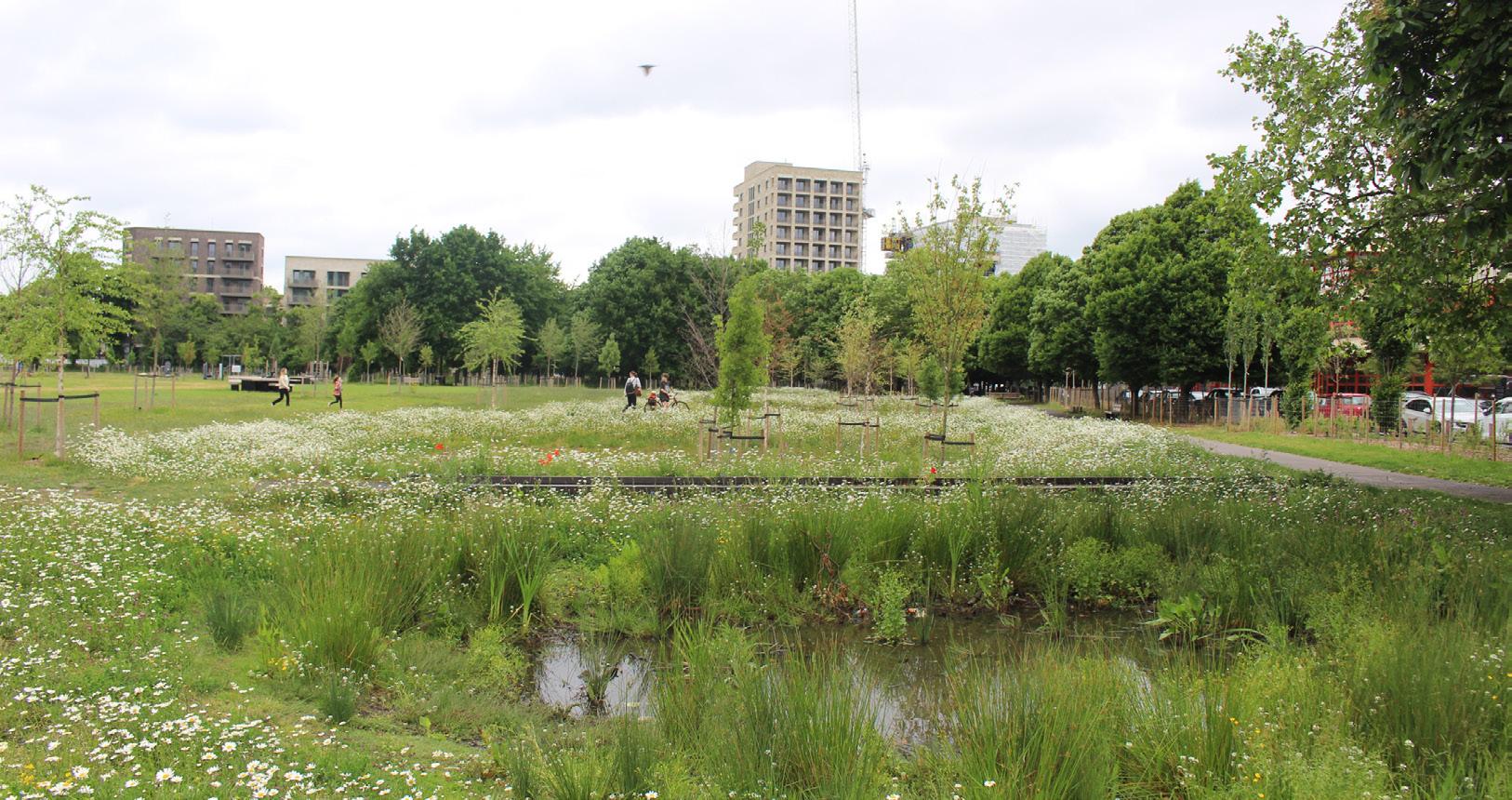
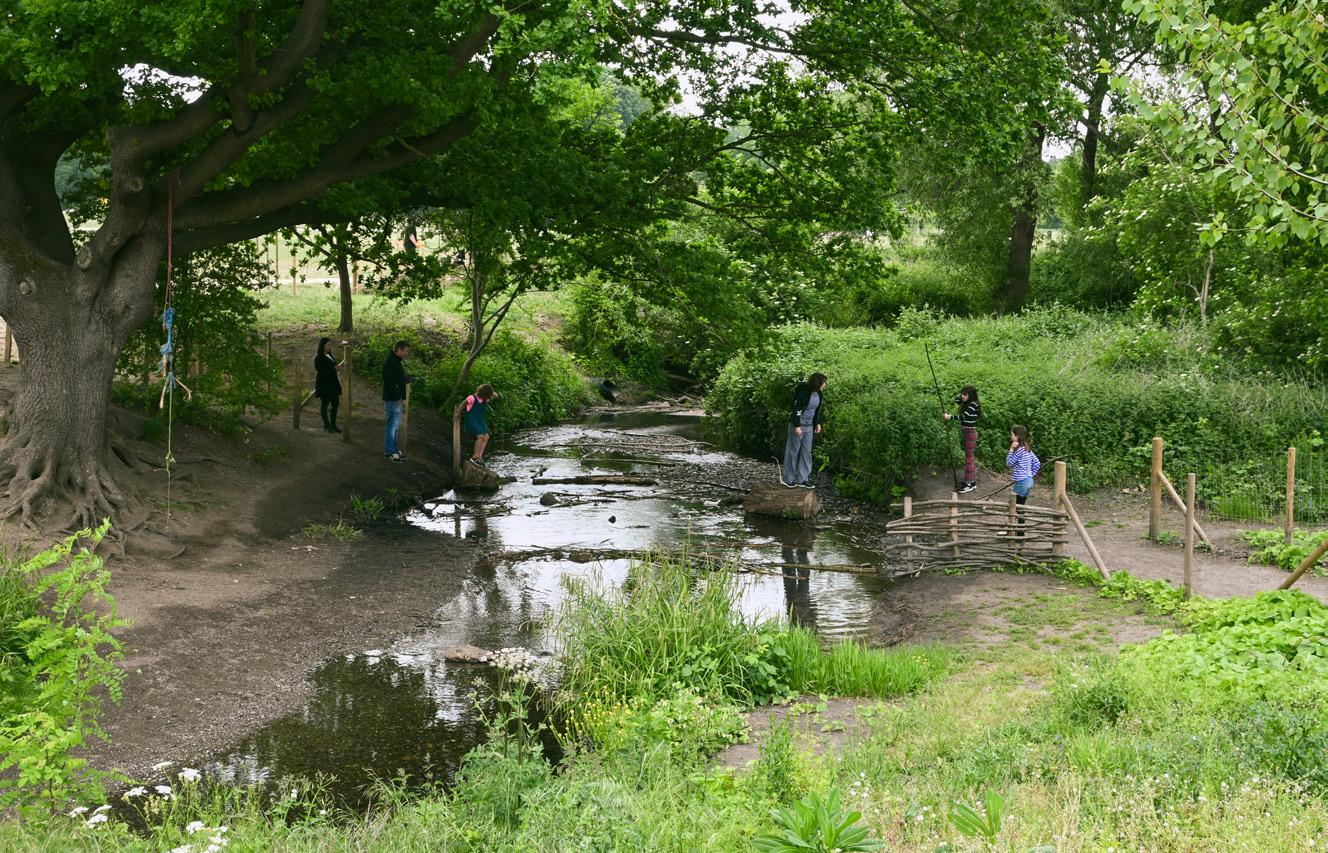

I first met Hal Moggridge in the summer of 2012. I was on maternity leave and, with my new baby, interviewed Hal for an Oral History project, recording “the rich heritage of the Landscape Institute’s elders, movers and shakers.” I remember arriving at his home to find an entire tea service clipped in yew. Now, here was someone fun!
At nearly 90, Hal still has that twinkle, with an optimism and sincerity much needed in these unpredictable times. His generosity with time and insight has supported countless causes and nurtured generations of landscape architects. In September, his long career was honoured at an event chaired by PPLI Tim Gale and organised by the Friends of the Landscape Archives at Reading (FOLAR, www.folar. uk), with support from sponsors including Colvin & Moggridge. The day featured talks, discussions and reflections on Hal’s legacy as a designer, thinker, advisor and global advocate for the profession. A highlight was the presentation
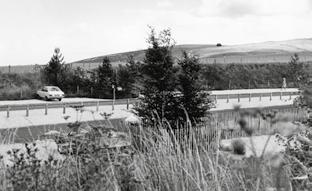
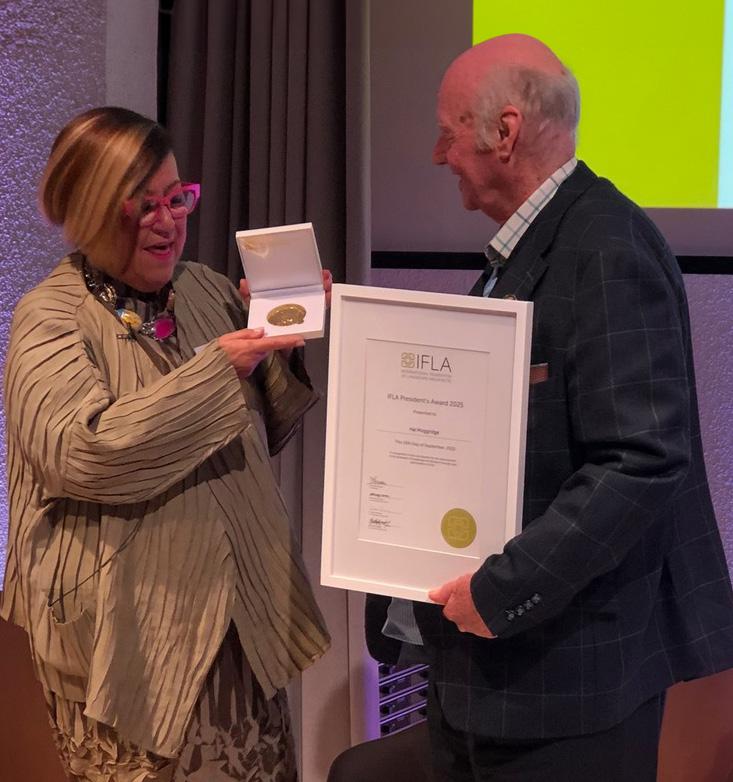
of the IFLA President’s Medal by past president Martha Fajardo, in recognition of Hal’s profound impact. She described him as a compass, guiding the profession with wisdom and kindness.
The event looked back to 1969, when Hal was invited by Brenda Colvin to become her business partner, despite being nearly 40 years her junior. Together, they formed Colvin & Moggridge, now the UK’s longestrunning landscape practice. Their collaboration began at a supper
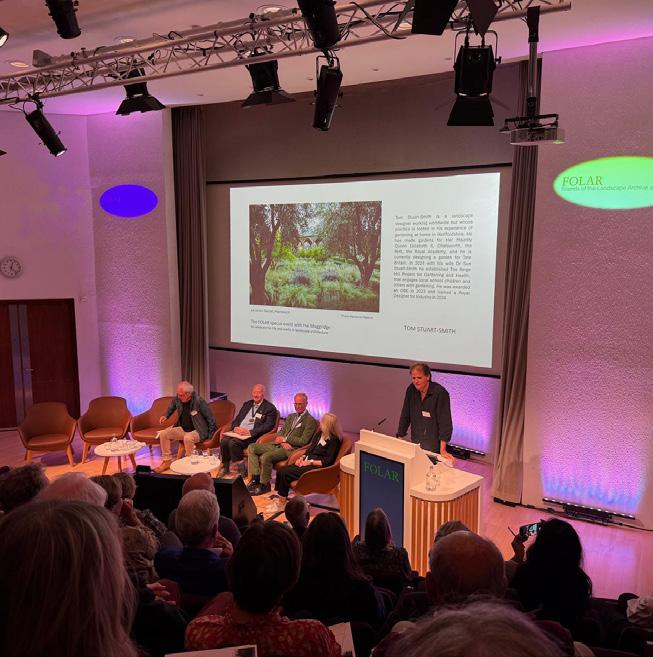
by Sir Geoffrey Jellicoe, for whom Hal had worked as an architectural assistant. This pivotal meeting bridged two generations, carrying forward the founding vision of the Landscape Institute (LI) and planting the roots of a lasting legacy. Central to Hal’s approach is nurturing young professionals and building relationships, often through food. Chris Carter, a partner of 53 years, recalled business conversations over lunch in the office garden. Garden designer Tom Stuart-Smith, who also worked
3
4 For the Royal Parks, Hal introduced gravel and selective tree removal to enhance views and activity at Horse Guard Parade as seen from the lake in St James Park in these before and after photographs.
Colvin & Moggridge (before photo); Gavin Kingcome (after photo)
5 Profile of the unseen City of London skyline out of sight behind Horse Guards (in 2005) viewed from St James’s Park. Colvin & Moggridge
6 Blenheim Palace and Park. Hal’s work on this World Heritage Site, in conjunction with his role at ICOMOS, enabled him to voice concerns that the cultural significance of the landscape is undervalued relative to the buildings, influencing the delineation of World Heritage Site boundaries. Colvin & Moggridge
at the practice, noted that Hal’s “careful delegation to young and enthusiastic designers was incredibly empowering”, and the office climate “supported enormous creativity and calm.” Inspired, Tom’s team now shares daily vegetarian lunches grown in their own garden.
The theme of food as connection echoed throughout the FOLAR event. Professor Luca Csepely-Knorr recalled Hal’s optimism during their collaboration on exhibitions such as Women of the Welfare Landscape. She ended her talk with a painting by her young son, showing a lunch by the stream in Hal’s garden. I, too, remember lunch with Hal during our 2012 interview. He spoke of organising a dinner for the LI’s 50th anniversary: an event fostering relaxed, meaningful conversation with those responsible for major public landscapes. For Hal, meals weren’t just social, they were strategic spaces for trust and the exchange of ideas.
If food aided Hal’s diplomacy, then understanding “the capability of a landscape” defined his design ethos, according to current practice director Mark Darwent. Fellow director Martin Bhatia also noted Hal’s “rigorous approach” to site survey and analysis, and his extensive mapping of significant views. Inspired by Lancelot ‘Capability’ Brown, and Brenda Colvin, Hal’s consistent focus on views shapes much of his work. This is evident in projects
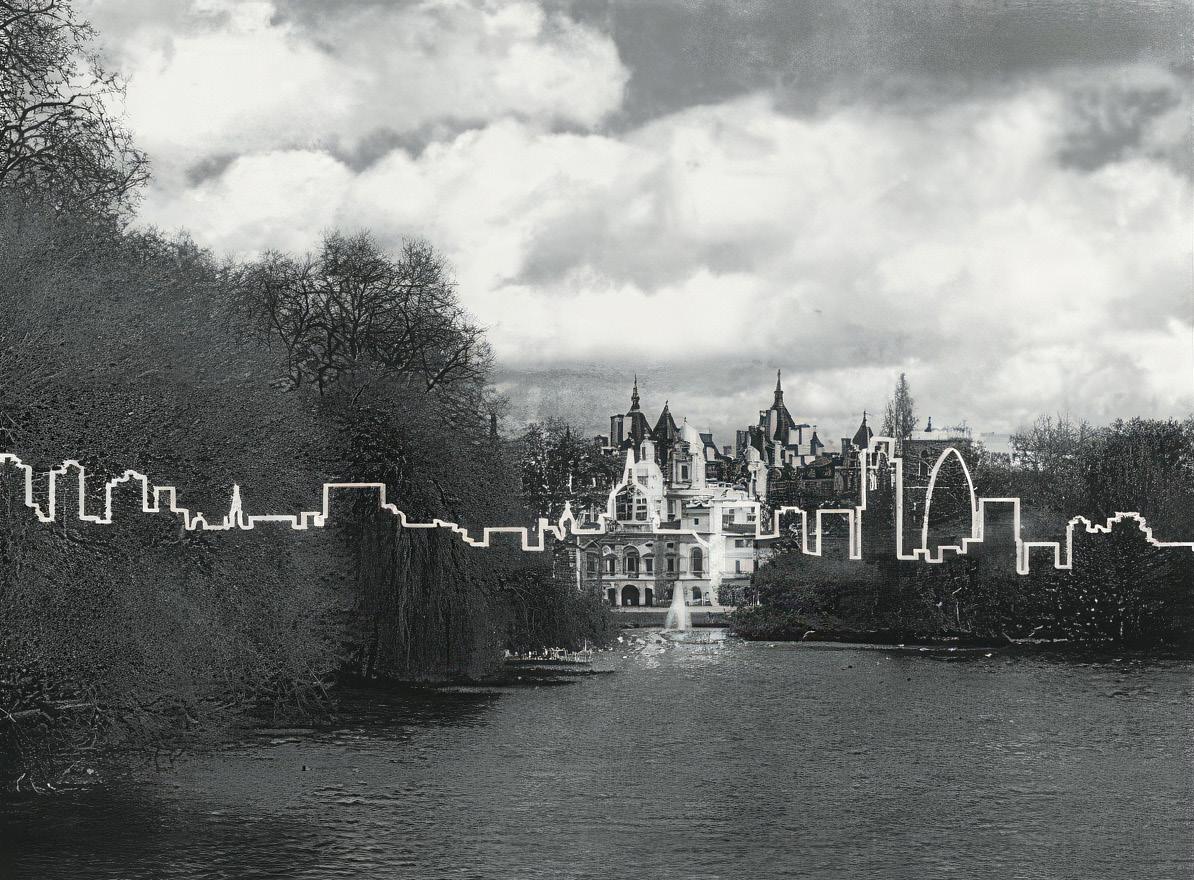

such as a car park discreetly nestled in a chalk pit at White Horse Hill, or the 200-year restoration plan for Blenheim Palace Park (with Ralph Cobham), which became the first publicly funded plan, thanks to the Countryside Commission. In his Royal Parks work, Hal reopened views between Horse Guards Parade and Buckingham Palace, transforming car-dominated areas into publicly accessible spaces. Garden historian Tom Turner compared Hal’s vision to Constructivist artists: interested in “dynamism” and spatial experience over objects. Designer Diana Armstrong Bell praised his transformation of a bitumen car park into a vibrant plaza, where gravel surfacing and selective tree removal enhanced views and activity.
Building on this work, Hal led the Sky Space study, which mapped the sky space needed to preserve the character and “bosky” quality of London’s Inner Royal Parks from the intrusion of tall buildings: a prime example of foresight applied to practice.
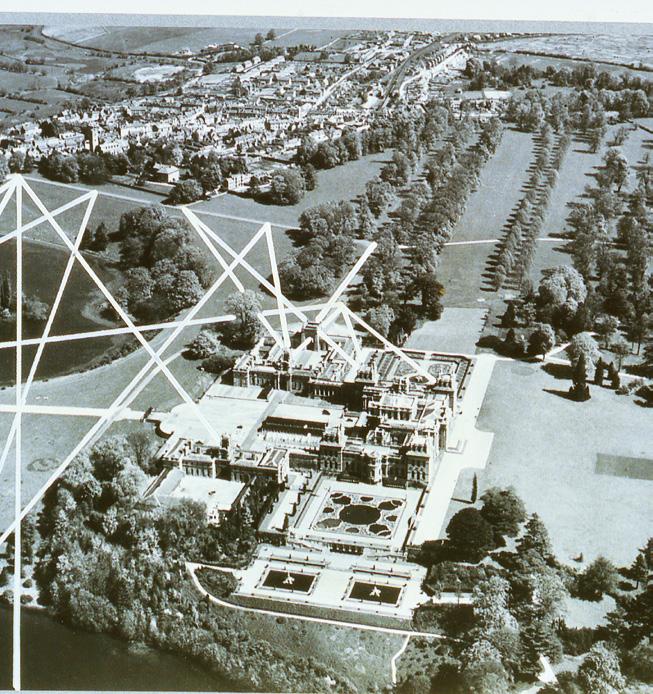

The FOLAR event celebrated not just Hal’s achievements but also his humanity. Speakers highlighted his quiet determination, visionary thinking and deep commitment to meaningful causes. During a closing Q&A session, Hal was asked about the impact of artificial intelligence (AI) on landscape architecture. His response was calm and clear: AI, like any tool, can’t replace the knowledge and feeling gained by physically experiencing a site. “AI can’t go to the site and know what it feels like … it can’t understand the site through the perception of being on site,” he said.
Hal’s deeper concern lay not with technology, but with the profession’s weakening ties to decision-makers, its struggle to articulate landscape’s value to society and its disconnection from clients with the long-term vision vital for future generations. Perhaps this is not just a critique but a call to arms.
As for me, I left the FOLAR event re-energised. Hal’s legacy, rooted in generosity and purpose, compels us to act. I’m responding through deeper involvement with the LI and by pursuing meaningful projects, locally and nationally, that support the next generation. What about you? How will you answer Hal’s call?
Lindsey Abbott is a landscape designer and planner. Currently, she works as a Tree and Landscape Officer for Wokingham Borough Council.
Get to know the people at the LI working with members to make our organisation essential, expert and inclusive.

Education Manager – Higher Education and Apprenticeships
Your role at the LI I provide strategic leadership for the Landscape Institute’s relationships with universities. I manage accredited degree programmes and accreditation processes, shaping high-quality education pathways and apprenticeships that develop the next generation of landscape professionals.
How you work with members
I work in close partnership with members across universities and colleges, engaging academic staff, students, and education-focused committees and groups. Through collaboration and guidance, I help maintain rigorous education standards, support accredited provision, and co-lead a strong student member experience that supports progression.
Your career experience
My career spans both higher and further education. I hold a degree in sport studies and a master’s degree in the psychology of sport. I began my career as a teaching
assistant and lecturer in these disciplines while completing my teaching qualification. I then became a university programme leader, with responsibility for partnerships, academic standards, and academic pathways.
Your favourite landscape/ interests
The Canadian Rockies are my favourite landscape. Their dramatic peaks, turquoise lakes, and expansive forests are inspiring, showcasing the power, scale, and beauty of natural landscapes.

Education Manager – Careers
Your role at the LI I lead careers, educational outreach, and equity, diversity, and inclusion (EDI) initiatives, developing guidance, resources, and partnerships that expand access to the profession. Using research, data, and curriculum expertise, I align our activity with national frameworks, amplify youth and educator voices, and drive inclusive talent pipelines that strengthen the profession’s relevance nationwide.
How you work with members
I collaborate with members and registered practices to design and deliver project-based educational outreach that meets careers education standards and delivers lasting impact. I work closely with committees, co-lead student member experience and work with members to advance EDI across the profession.
Your career experience
I have over 20 years’ experience across further and higher education. Trained in dance and performance, with a degree and master’s in this field, I began as a lecturer and choreographer. As I progressed into leadership roles, I focused on EDI and widening participation, and completed an MSc in Inequality and Society.
My favourite landscape
The Yorkshire Three Peaks in every season, as I am certainly not a fair-weather walker. The view across to Ribblehead Viaduct is always breathtaking. A close second is Kinder Scout, for its vastness and beauty, and for the history of the 1932 mass trespass.
1 Speakers on the Biodiversity Net Gain panel.
© Landscape Institute
2 Keynote speaker Richard Lawrence, Executive Director of Place, Prosperity & Sustainability at Birmingham City Council.
© Landscape Institute

The Landscape Institute’s first National Housing and Regeneration Conference, held at Millennium Point in Birmingham (October 2025) brought together landscape professionals, policymakers, developers and built and natural environment specialists to explore how England’s ambitious housing targets can be delivered through a landscape-led approach. With a shared focus on creating places that are environmentally sustainable, socially inclusive and economically resilient, the conference reinforced the role of landscape as critical infrastructure rather than an aesthetic afterthought.
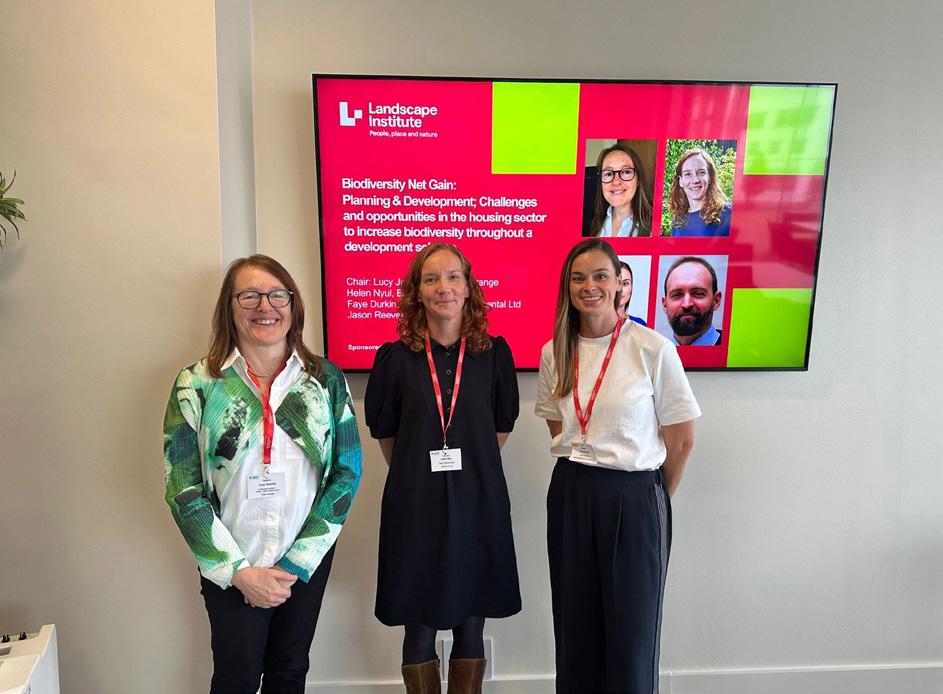
A look back at the first event in our national tour connecting people, place and nature
Discussions highlighted the importance of collaboration across the built and natural environment to move beyond siloed decisionmaking and deliver long-term value for people, place and nature. Through expert panels, case studies and debate, delegates engaged with current challenges and emerging opportunities shaping housing and regeneration. The day concluded with a forward-looking panel discussion on strengthening cross-sector collaboration, followed
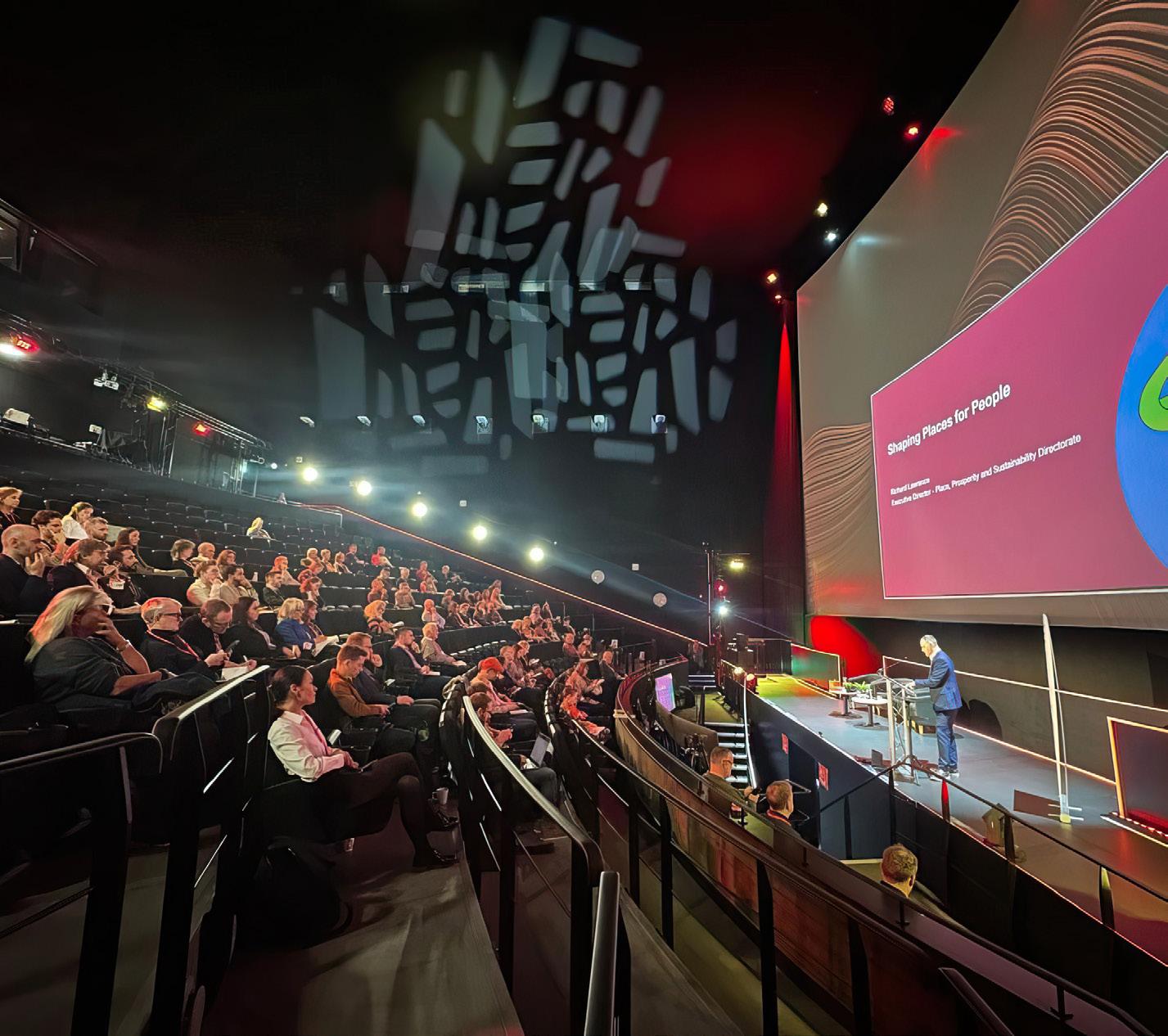
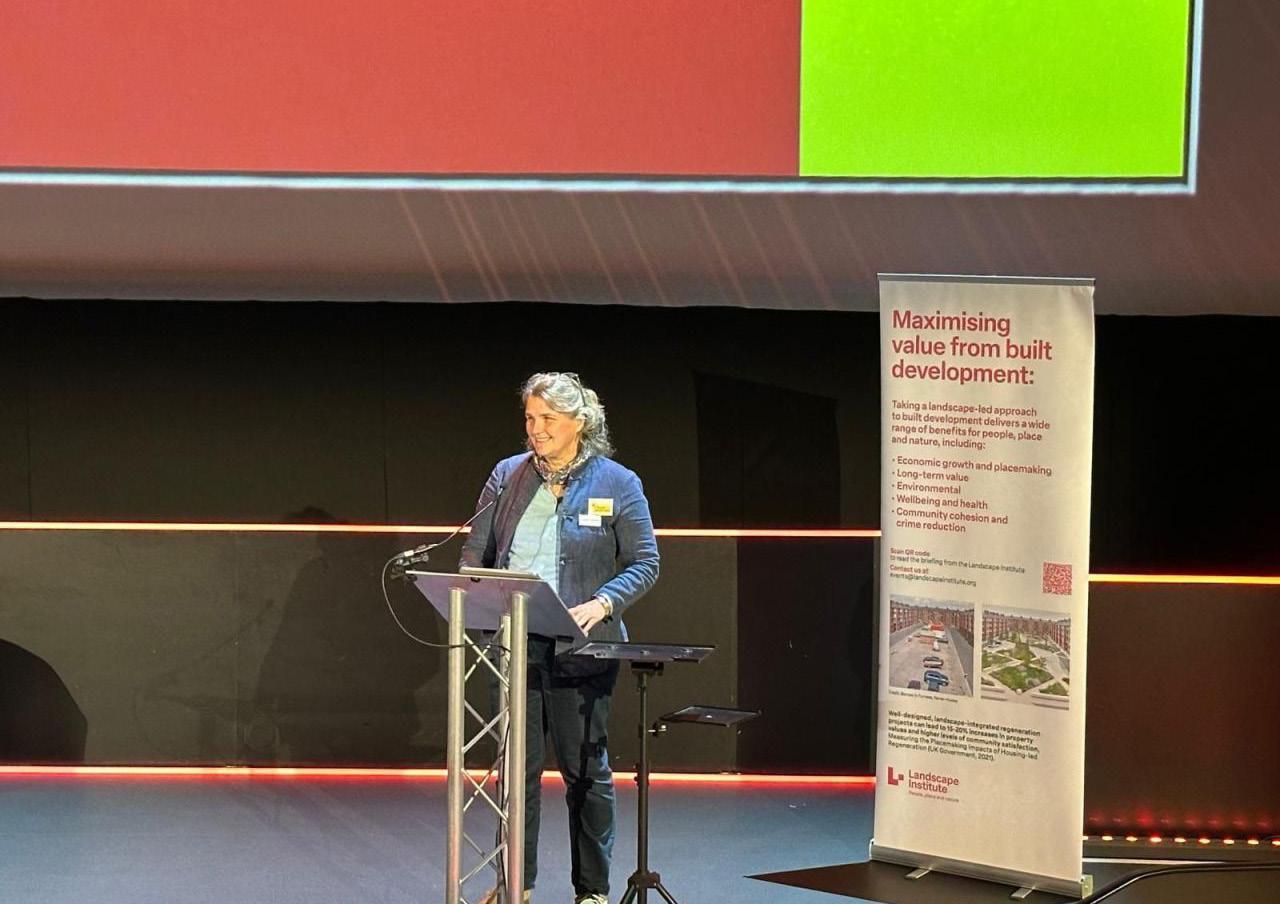
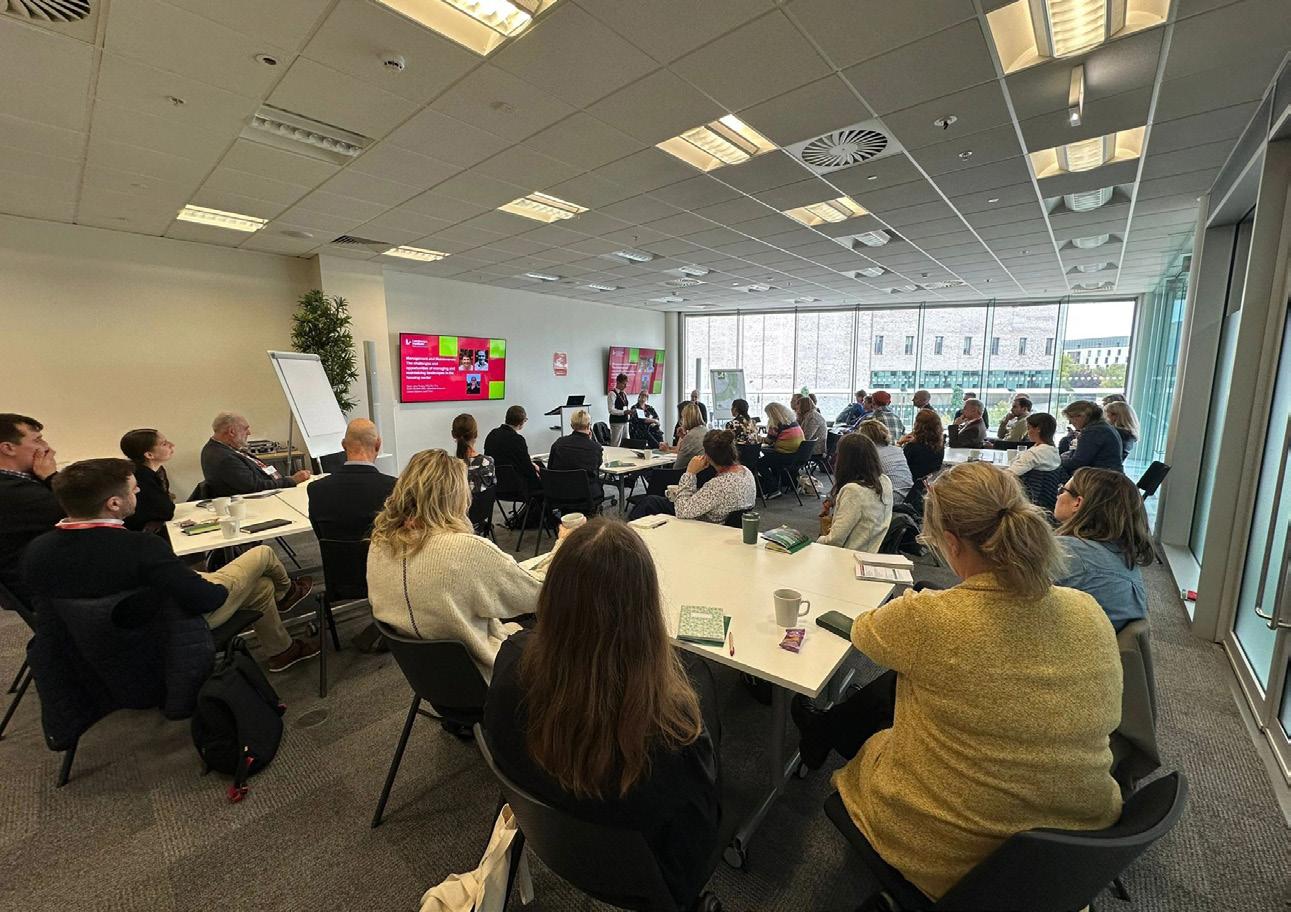
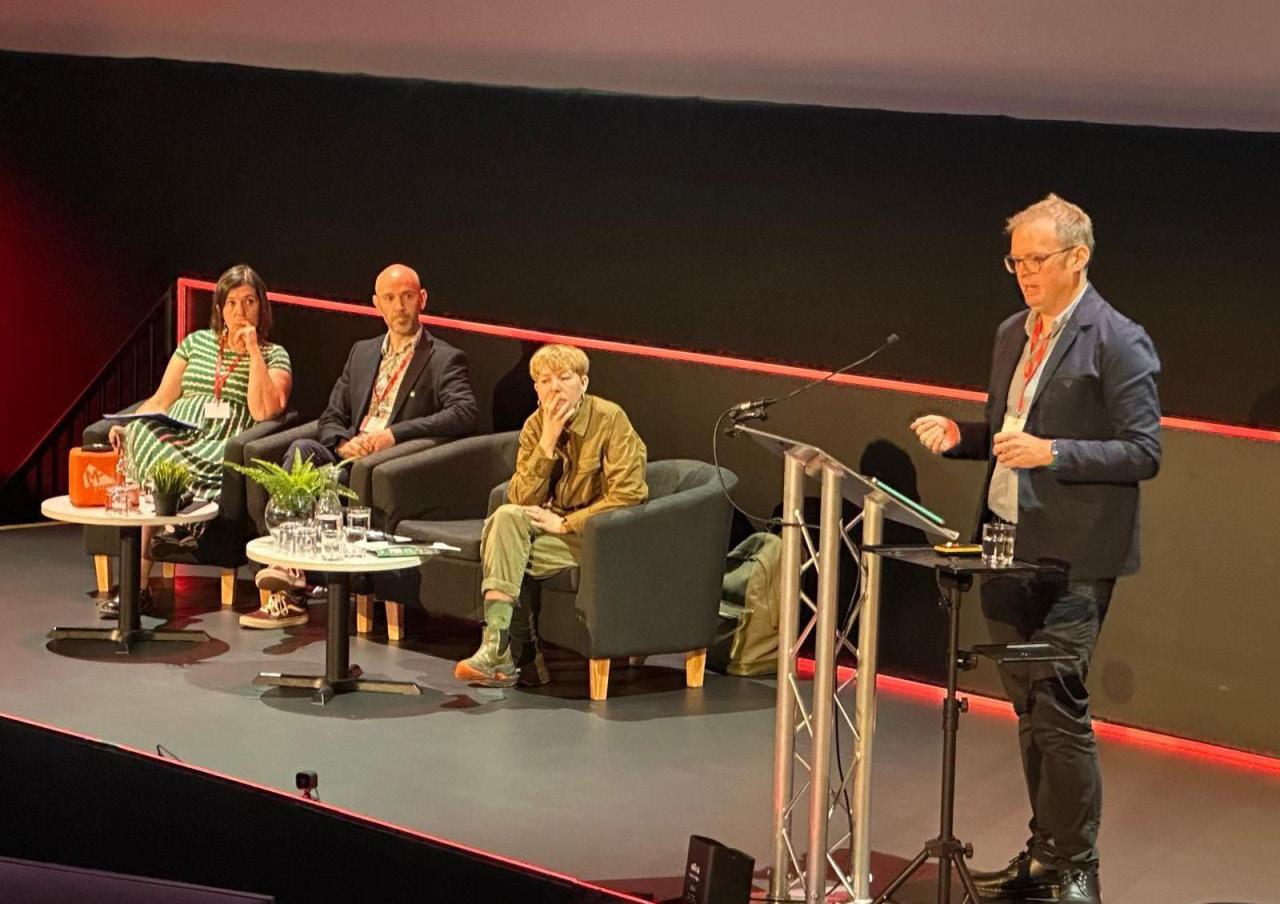
by a well-attended networking reception that underlined the value of professional connection and shared learning.
Across six sessions, delegates gained practical insight into the policy, technical and commercial factors influencing housing delivery in England. Planning policy discussions provided clarity on emerging reforms and their implications for landscape professionals, while sessions on healthy places reinforced the growing evidence linking landscape, nature and wellbeing.
The Biodiversity Net Gain session explored lessons from the first year of mandatory delivery, highlighting the value of early landscape involvement and close collaboration with ecologists. Sessions on SuDS demonstrated how integrated water management supports climate resilience and improved planning outcomes, while discussions on active travel showcased how landscape-led transport planning can deliver economic, social and environmental benefits, and a session on management and maintenance emphasised the importance of longterm stewardship.
Delegates were encouraged to actively contribute to discussions, share their perspectives and reflect on their role in shaping housing and regeneration. They valued the opportunity to connect with professionals across the built and natural environment, strengthening networks and opening the door to future collaboration.
The Landscape Institute would like to thank all speakers, chairs, sponsors and partners for sharing their expertise and insight, and all delegates for their engagement in making the conference such a valuable and successful event.
Neelam Sheemar is Head of Marketing, Communications and Events and Ruhela Begum is Events Lead, Landscape Institute
3 President Carolin Göhler addresses the audience.
© Landscape Institute
4 A split programme of repeated workshops enabled attendees to attend multiple sessions.
© Landscape Institute
5 Planning Policy in England panel session.
© Landscape Institute
Exploring the capabilities of Vectorworks’ AI Visualizer in landscape design
In landscape projects, IFC models serve as a shared language among architects, engineers, and contractors; however, they only function reliably when every object is consistently classified. Robust classification links planting, site, and construction elements to clear specifications, improving coordination, automating quantity take-offs, reducing errors, and making downstream cost and maintenance workflows far more dependable.
Construction specifications are the written documents that define the scope, manufacturers, materials, installation methods, and required quality for a project. They depend on standardised classification IDs to maintain a clear, traceable link between these written specs and the modelled objects in a BIM/IFC workflow. Systems such as CAWS, Uniclass, MasterFormat, UniFormat, and eBKP H provide these structured IDs and descriptions. Keeping those standards synchronised with drawings and IFC models ensures consistent quantities, coordinated scopes, and reliable cost information
across disciplines and project phases.
Many landscape workflows still treat classification as an afterthought, resulting in inconsistent and incomplete data. Some materials and a few symbols may carry classification IDs, but most planting, hardscape, and site objects still require manual classification. This creates duplicated work, a high risk of unclassified elements, weak or partial reporting, and IFC exports that fail to represent the full project scope accurately for downstream coordination.
In Vectorworks, the Classification Standard Setup is a document-level preference, accessible from File > Document Settings, and presented as a web palette allowing you to adjust rules while working in the model. It loads classification content from XML, TXT, or XLS/XLSX files, each structured as a simple two-column list of code and description. Multiple standards can be active simultaneously; objects are processed through criteria-based rule sets and automatically receive primary, secondary, and tertiary classification values. A built-in status and error mechanism flags objects that are unclassified or classified more than once, helping you close gaps before IFC export. Default Data Manager mappings will ensure that once you assign classifications
through Classification Standard Setup, they will automatically map to correct IFC pSets.
Rule sets and filters in Vectorworks are managed through the Edit Criteria and Edit Rules dialogs, where users define worksheet-like filters based on object type, style, or parameters, then map matching objects to specific classification IDs as primary, secondary, or tertiary values. Status popovers and related data views report which rules affect which objects, highlight unclassified elements, and expose conflicts where objects meet multiple rules. This makes it easier to refine criteria and close gaps while working directly in the model.
Landscape projects often begin in a proprietary CAD/BIM environment, where geometry and data reside within a single ecosystem. Once shared, standard and rule sets drive classification, and every landscape object, plant symbol, hardscape, and architectural element can carry a consistent ID that maps cleanly to IFC fields, strengthening quantity take-off, specification alignment, and crossdisciplinary collaboration.
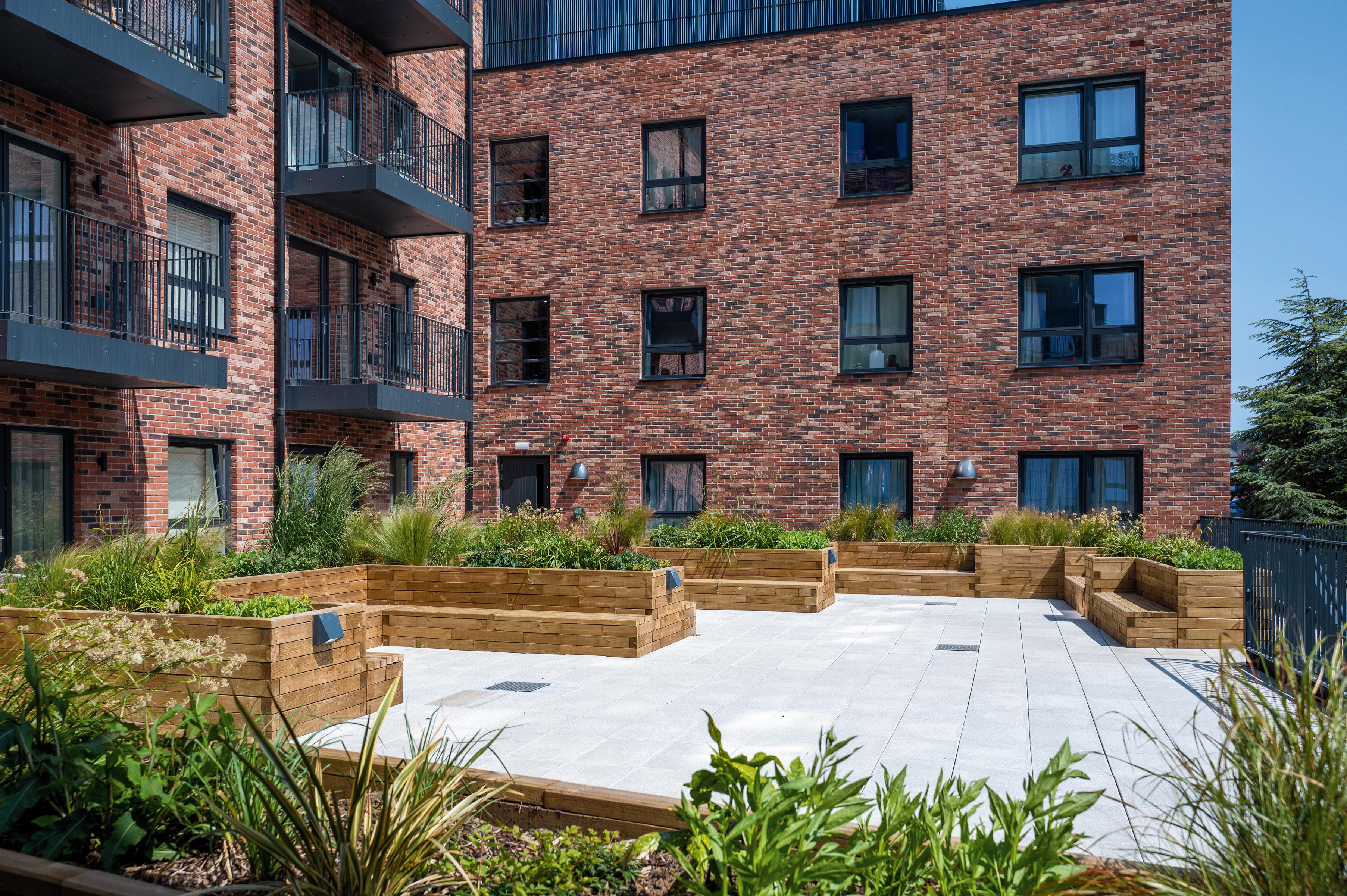
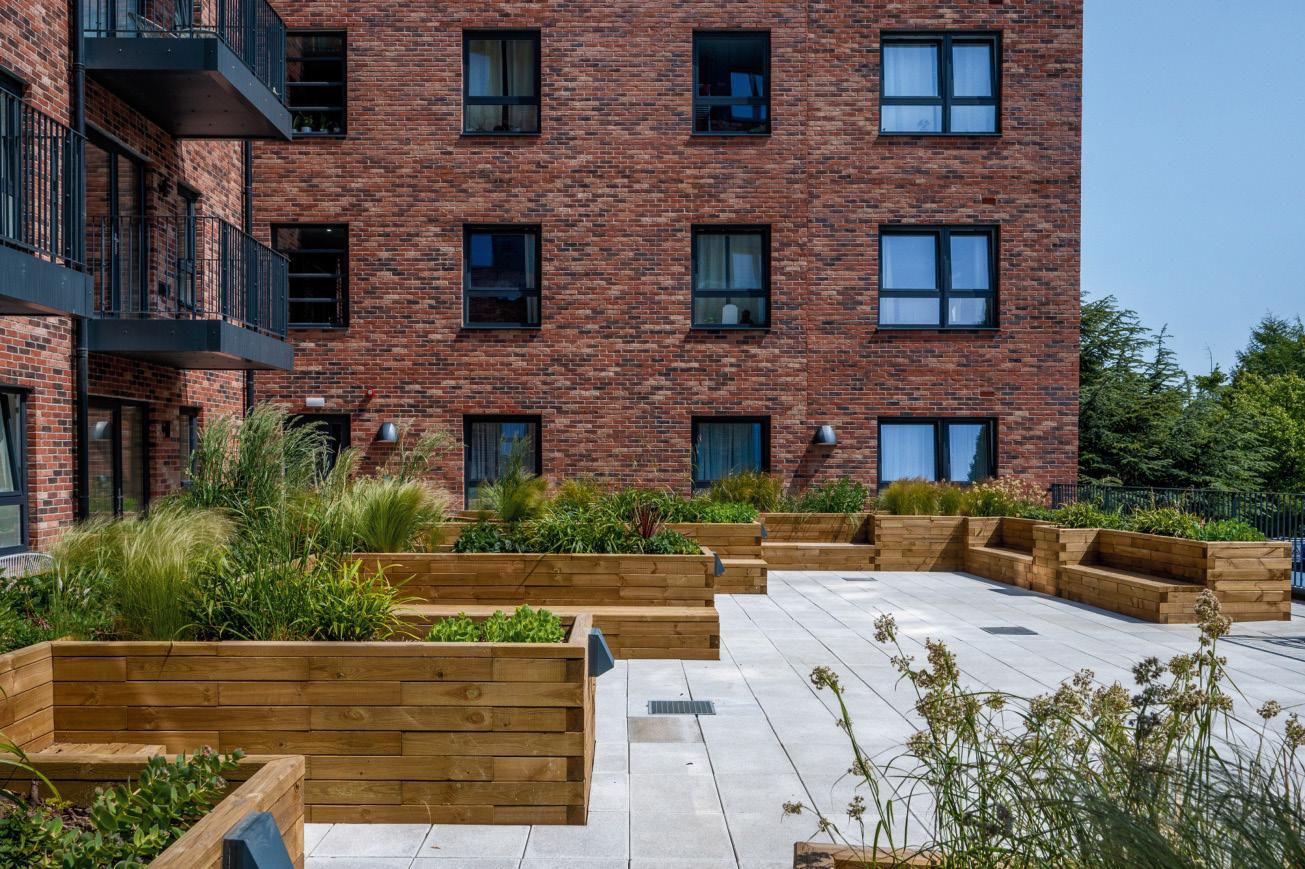

Furniture | Raised Planters | Free Design
Sustainable timber solutions for the built environment with limitless design potential. From new designs to retrofits, the modular WoodBlocX system provides unrivalled versatility.