PR399_P01_Cover.qxp_PR399_p01 17/09/2026 14:15 Page 1
Summer | Issue No.399
www.parkingreview.co.uk
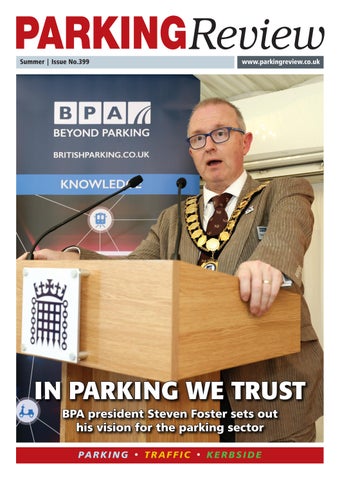
IN PARKING WE TRUST BPA president Steven Foster sets out his vision for the parking sector PA R K I N G • T R A F F I C • K E R B S I D E
PR399_P02-03_Welcome.qxp_PR399_p02-03 17/09/2026 14:16 Page 2
PR399_P02-03_Welcome.qxp_PR399_p02-03 17/09/2026 14:17 Page 3
WELCOME Summer 2026 | Issue No.399
The job of chatbots, AI agents and robotaxis is to serve humanity… for time being
WAYVE
Pay attention folks… the robots are here
The arrival of robotaxis in London is a watershed moment
A
fter years of academic studies, practical trials and discussions about safety protocols, self-driving minicabs have started picking up paying passengers in Britain. The arrival of autonomous Uber minicabs enabled by Wayve’s Artificial Intelligence software in London is a watershed moment. Robotaxis are high profile manifestations of a process of automating public services that is well underway. The work that the traffic and parking sector has done on digitising the road network and kerbside is key to informing geolocation dependent services such as the sat-navs, smartphone maps and courier routing systems. While there is a temptation to entertain dystopian visions, it is worth remembering technological innovation always brings economic and social changes: robots that increasingly run our world will have both positive and negative consequences. For example, while robotaxis will make cab drivers redundant, they will enable taxi fleets to operate more efficiently. But hang on, robots are not only driving cars. They are already among us. Chatbots are working in customer services, while AI agents are being used in the analysis of data… and assisting drivers in drafting appeals against parking penalties. How long, I wonder, before we see the advent of ‘roboreporter’?* Mark Moran Editor *No AI was involved in the writing of this article.
cdergroup.co.uk
Parking Review online: www.parkingreview.co.uk PARKING REVIEW | 3
COVER IMAGE: STEVEN FOSTER, BPA PRESIDENT COURTESY OF THE BRITISH PARKING ASSOCIATION
CDER-2026-Strip-Ads.indd 8
17/12/2025 16:56
PR399_P04-05_Contents.qxp_PR399_p04-05 17/09/2026 14:18 Page 4
Event Partners:
Hosted by:
Supported by: Headline Sponsor:
Wednesday 7 October 2026 | Leicester City Hall Join local authorities, developers, planners, parking leaders, and mobility providers for Mobility Hubs 2026 – the UK’s essential event exploring how to design, deliver, and operate successful mobility hubs across cities, towns, and rural communities.
Delegate rates:
Private Sector
Public Sector
Academics
£275 + VAT
£175 + VAT
£175 + VAT
Speakers include:
Key themes: Designing effective mobility hubs l
What makes a successful hub?
l
From concept to delivery
Scaling Up: Networks, not one-off projects l
Moving from pilots to connected systems
l
Regional and national approaches
Multi-modal integration l
Rail, bus, active travel, micromobility, and car clubs
l
Creating seamless journeys
Inclusive and safe design l
Accessibility for all users
l
Safer design for women and girls
Sir Peter Soulsby
Beth Morley
Robert Davis
Hollie Deverell
Active travel at the core
Mayor
Human Insights Lead
Cenex
Associate & Senior Architect
l
Leicester City Council
Head of Active & Sustainable Travel
Trueform
Fatkin
Walking, cycling and wheeling as the foundation of hubs
Urban logistics and last-mile delivery l
Cargo bikes, microhubs, and freight consolidation
Energy and EV integration l
Charging infrastructure within hubs
Demand responsive transport l
Matthew Stagg Managing Director
Daisy ChapmanChamberlain
Externiture
Rail Services Lead
Rail North Partnership
Plus many more!
Ian Tierney
Claire Maltby
Chief Partnerships Officer
Head of Transport Strategy
Wheels for All
EMCCA
Flexible services connecting into hub networks
View the full programme and book now at:
www.mobilityhubs.uk
PR399_P04-05_Contents.qxp_PR399_p04-05 17/09/2026 14:18 Page 5
CONTENTS
It takes a community to build a car park: Breaking ground at the Queen Elizabeth Hospital in King’s Lynn
17 18 20 26 30 34 39
Supporting safer and accessible parking Blue Badge and School Street awareness projects are being supported by the PATROL Driving Intelligence initiative
The case for transparent justice Caroline Hamilton, chief adjudicator of the Traffic Penalty Tribunal, has published her annual report for 2025-26
Caroline Hamilton
Proud to be president New British Parking Association president Steven Foster sets out his ambitions for his year in office
Tackling Blue Badge abuse National Blue Badge Awareness Week brought councils, parking operators and partners together across the UK
Mike Marrs and Steven Foster
Educate. Engage. Enforce. Enforcement Excellence explored the implementation and operation of parking, moving traffic and road user charges
A many storied structure Created in a multi-storey car park, the Tŷ Pawb arts centre is riding the crest of Wrexham’s wave, reports Rhodri Clark
Tŷ Pawb
Are we solving the wrong problem? The parking sector has to address the need to stop car fires spreading, says the Business Sprinkler Alliance’s Tom Roche
EVolution Magazine The latest developments in electric vehicle infrastructure
Editorial Managing editor: Mark Moran Tel: 020 7091 7871 mark.moran@landor.co.uk Deputy editor: Deniz Huseyin Tel: 020 7091 7872 deniz.huseyin@landor.co.uk Editorial director: Peter Stonham
Production and design production@landor.co.uk
Subscriptions subs@landor.co.uk
Advertising, sponsorship, marketing and exhibition packages Jason Conboy Tel: 020 7091 7895 jason@landor.co.uk
Accounts Irina Cocks Tel: 020 7091 7854 irina.cocks@landor.co.uk
A Wayve-enabled Uber robotaxi
Parking Review was launched in 1989. It is the only independent magazine dedicated to the UK parking sector.
Published by: Landor LINKS Ltd, Unit 20a, The Circle, Queen Elizabeth Street, London SE1 2JE
ISSN: 0962 3599
© Landor LINKS Ltd 2026
The Independent Press Standards Organisation www.ipso.co.uk
www.landor.co.uk
The Professional Publishers Association www.ppa.co.uk
Printed by: Pensord 1 Goat Mill Road, Dowlais, Merthyr Tydfil CF48 3TD
Registered members of:
PARKING REVIEW | 5
PR399_P06-07_News DPS.qxp_PR399_p06-07 17/09/2026 14:19 Page 6
CONSUMER NEWS
Parking companies must treat motorists fairly at all stages – and a clear and consistent appeals process must be at the heart of this Emma Cochrane
The parking inspector calls The Competition and Markets Authority says private parking operators must comply with consumer law or risk action
T
he Competition and Markets Authority (CMA) has announced a number of actions it says will improve the experience of UK motorists when dealing with private parking operators, ensuring they are treated fairly when challenging parking charges. The CMA has advised the UK government to implement its code of practice for parking on private land, called on the parking sector to operate fairer charging and appeals systems, and also launched a specific investigation into operator Euro Car Parks. It has also published advice to help drivers avoid common pitfalls and know their rights The authority says it is aware of complaints from motorists, who often feel they have been unfairly issued with a parking ticket. Complaints highlighted include unclear signage, broken ticket machines, and faulty apps. Based on its own analysis, the CMA has particular concerns about potentially unfair practices of some operators, including the way they handle appeals and attempt to recover additional fees on top of the parking charge. The CMA also cites recent RAC research which suggests private parking operators issued around 14.4 million parking tickets in the year 2024/25 at places such as supermarkets, retail parks, restaurants and gyms. This is more than double the number issued six years ago. The CMA is taking various steps to investigate concerns, including: • Making recommendations to government on its new Code of Practice for parking on private land, that it has consulted on. This includes recommendations that parking firms should be required to make drivers aware of their rights, improve their appeals processes to make them fair and consistent and looking at the rules around consideration periods.
6 | PARKING REVIEW
• Writing to private parking operators outlining concerns about the appeal process for drivers and potentially unfair additional charges applied when seeking to recover unpaid parking charges. • Calling on the wider sector to take action to ensure their practices are consistent with consumer law and writing to trade associations setting out steps that can be taken now to improve appeals handling and communications with motorists. • Opening an investigation into Euro Car Parks to examine whether its practices at petrol stations and its handling of appeals may breach consumer protection law. The investigation will consider whether it’s fair for some drivers to receive parking charges while queuing for, or using, petrol pumps and other forecourt services, such as car washes. It will also examine aspects of the company’s wider appeals processes – relating to both petrol stations and car parks. The CMA is at the beginning of its investigation, and it has reached no conclusions about whether Euro Car Parks has broken the law. Euro Car Parks was previously issued with an administrative penalty for non-compliance with a CMA Information Notice. Euro Car Parks has appealed the CMA’s decision to issue the penalty, and the appeal is ongoing. That penalty relates solely to Euro Car Parks’ initial failure to respond to the CMA’s Information Notice. It does not concern any alleged infringement of consumer protection law. Under the new consumer regime, if a company infringes consumer protection law, the CMA can fine them up to 10% of their global turnover (or £300,000 where this is higher than 10%). Emma Cochrane, executive director of consumer protection at the CMA, said: “Being issued with a parking charge can be a stressful experience. Costs are high and often unexpected which is difficult when people are budgeting carefully. Parking companies must treat motorists fairly at all stages – and a clear and consistent appeals process must be at the heart of this. “We’re setting out a package of actions and recommendations to help drivers and we’ve launched an investigation into the practices of Euro Car Parks. It’s time for all private parking operators to comply with consumer law or risk action from the CMA.”
PR399_P06-07_News DPS.qxp_PR399_p06-07 17/09/2026 14:19 Page 7
CONSUMER NEWS
CMA offers advice to motorists
Airport ‘kiss & fly’ fees take-off RAC reports the average cost of dropping off at UK’s busiest airports has risen by a third
The short goodbye
S The Competition and Markets Authority has created a video and published advice to help motorists navigate the private parking system and avoid being caught out with unnecessary costs: • Not all car parks work the same. Car parks have different rules, and it is important to check the rules that apply (set out on signs in the car park) every time you park so you don’t get caught out. For example, car parks for the same supermarket chain can have different rules in different locations. • Don’t assume free parking is automatic, even if you are a customer. Some places such as supermarkets, gyms and restaurants require drivers to register their vehicle details or scan a receipt to show they are a customer to get free parking. • Keep evidence if something goes wrong. If payment machines are not working, your car breaks down or another issue arises, take photos and keep receipts, payment confirmations and other records in case you need to prove what happened – or need to appeal. • If you get a parking charge, don’t ignore it. If you believe the charge has been issued incorrectly, act quickly and appeal to the parking operator within 14 days, to make sure you remain eligible for the Early Payment Discount (‘EPD’). If you are not appealing the charge, pay within the 14 days to benefit from the EPD. • Know your rights if you get a parking charge notice. You always have the right to appeal. The charge should be cancelled if you have evidence that shows you should be exempt – for example, because of an emergency outside of your control. The charge should be reduced to £20 in some circumstances – for example, where you paid the fee, but mistyped your registration number. These are outlined in the Appeals Charter in the existing industry Code of Practice.
Shining a light on private parking The CMA announcement on measures to tackle issues with private parking was welcomed by RAC head of policy Simon Williams “The CMA’s findings and recommendations are a major step forwards in ensuring drivers are treated fairly by private parking operators. The points made by the watchdog in open letters to the minister and private parking operators highlight many of the issues we’ve been trying to get action on for years and confirm that drivers aren’t consistently getting fair outcomes when they challenge tickets. “The CMA has shone a much-needed light on the appeals process and found major problems that need to be addressed. We strongly hope the code will give us a single independent appeals body, instead of the two we have now – one for each of the two trade associations.
ixteen of the UK’s 20 busiest airports have increased the charges drivers face for dropping off passengers, with the average cost increasing by a third since last summer, RAC analysis has found. The price of dropping off close to airport terminals – in so-called ‘kiss & fly’ zones – rose by an average of £1.70, to £7, compared to this time last year. London Gatwick and London Stansted charge the highest fees (£10 for 10 minutes and 15 minutes respectively), followed by Edinburgh and Bristol (£8.50 for 10 minutes), and Leeds, London City and Bournemouth (each £8 for 10, five and 30 minutes respectively). The RAC calculates that on a per-minute basis, London City is the most expensive, charging the equivalent of £1.60 a minute (£8 for up to five minutes). Like at many other airports, anyone stopping for longer than permitted faces a huge charge which can be as high as £100. But unlike others, London City has good accessible public transport access with a dedicated DLR station and trains running every few minutes during the day, providing a realistic alternative to driving for many passengers. Manchester Airport, which costs £5.50 for five minutes (which equates to £1.10 a minute), is the next priciest place to drop off on a per-minute basis, followed by London Gatwick (£1 a minute), Edinburgh and Bristol (85p a minute) and Leeds Bradford (80p a minute). Four airports have not increased their charges this year, namely Liverpool John Lennon (£6 for 10 minutes), East Midlands (£5 for 15 minutes), Belfast City (£4 for 10 minutes) and Southampton (£7 for 20 minutes). But with London City now charging for drop-offs for the first time, all the UK’s top 20 busiest airports now levy a fee – whereas before COVID in 2019, six airports including London Heathrow and Gatwick still offered free drop-offs. The RAC says the decision by airports to charge drivers for dropping off – a task that can take just moments – is at odds with what’s normal at other major airports around the world. The RAC is warning drivers to be careful when dropping off friends and family members at airports that no longer have entry and exit barriers, nor provide physical facilities for paying the fee, as there’s a risk they could forget to pay and be hit with a penalty. RAC senior policy officer Rod Dennis said: “It’s disappointing to see so many airports charging so much for what many regard as a simple act of kindness in dropping off family and friends. Having a captive audience should be no excuse for these ‘farewell fees’ – especially when they’re completely at odds with how major airports around the world operate. Of course, airports need to manage the limited space they have carefully, but if free, convenient drop-off zones work at so many other international airports then why not here? The growing number of airports that operate barrierless ‘park now, pay later’ drop-off zones is also something drivers need to be extremely careful of. Those that drop off but miss the signage, or forget to go online or phone the airport to pay soon afterwards, can face a parking charge notice as high as £100 – a fee that feels distinctly disproportionate to the contravention. “We certainly recommend drivers explore the free short-term parking options many airports offer but make themselves aware of just how long they’re permitted to park for. Those that plan on accompanying their passengers to the terminal and then coming back to their cars will almost certainly outstay the free period, which can end up being extremely costly.”
PARKING REVIEW | 7
PR399_P08-15_News.qxp_PR399_p08-15 17/09/2026 14:20 Page 8
Presented by
Organised by
Showcasing excellence, celebrating success Friday 18 September, London
GOOD LUCK! Platinum sponsor
Headline sponsor
Category sponsors
www.britishparkingawards.uk
PR399_P08-15_News.qxp_PR399_p08-15 17/09/2026 14:21 Page 9
NEWS
Airport customer data stolen in hack The personal data of nearly nine million people stolen in a cyber attack on three UK airports run by Manchester Airports Group (MAG) has been published online. Customers of Manchester, London Stansted and East Midlands airports are being warned of secondary attacks as the data has been made available to other criminals. The cyber security incident took place at Manchester, Stansted and East Midlands airports at around 1pm on Thursday 27 August. Contact details, vehicle registrations and postcodes were stolen when a hack accessed databases containing Wi-Fi login and car parking details. The data stolen from 8.7 million customers included email addresses, phone numbers, vehicle registrations and postcodes, Manchester Airport Group (MAG) said. MAG says it is working with the authorities and specialist advisors and says passengers’ physical safety has not been at risk in the airports. “Manchester Airports Group has been subject to a cyber security incident by an unauthorised third party,” a MAG spokesperson said. “A quantity of customer data has been obtained that relates to car park, lounge and Fast Track bookings and in-airport Wi-Fi sign-ups at Manchester, Stansted and East Midlands airports. We immedi-
MANCHESTER AIRPORTS GROUP
Cyber hackers target MAG parking, lounge and Wi-Fi sign-ups
Parking at London Stansted ately contained the risk and have been working with specialist advisors and taking appropriate steps to protect our cus-
tomers and systems. We have informed and are working with the relevant authorities. At no point has passenger safety or
‘We immediately contained the risk’ MAG statement on cyber security incident “Manchester Airports group has been subject to a cyber security incident by an unauthorised third party. A quantity of customer data has been obtained that relates to car park, lounge and Fast Track bookings and in-airport Wi-Fi sign-ups at Manchester, Stansted and East Midlands airports. “We immediately contained the risk and have been working with specialist advisors and taking appropriate steps to protect our customers and systems. We have informed and are working with the relevant authorities. At no point has passenger safety or aviation security been compromised.” “The incident has not resulted in any operational disruption. Airport operations remain unaffected and customer parking services continue to operate normally. Neither MAG nor the system accessed hold customers’ bank or payment details. The data that has been accessed includes customers’ email addresses, phone numbers, vehicle registrations and postcodes. “We would like to reassure customers that Manchester Airport Group takes the security of customer information extremely seriously and we apologise for any inconvenience or concern caused.”
aviation security been compromised.” MAG said the system accessed did not hold customers’ bank or payment details. The majority of the data accessed was customer email addresses and related to Wi-Fi sign-ups within the airports’ terminals. More detailed data, including vehicle registrations, came from people booking car-park spaces, arranging access to lounges, and booking fast-track. The Information Commissioner’s Office is assessing the incident. “We can confirm we have received a breach report from Manchester Airports Group, and we are assessing the information provided,” an ICO spokesperson said. The hackers tried to extort Manchester Airports Group for an undisclosed amount, but no ransom was paid. The BBC reports that the hackers – which the broadcaster is not naming – is offering the entire data set for free to other criminals or scammers. “Today we are releasing the Manchester Group database,” the criminals wrote. “Half a terabyte, and every byte of it is pure PII [personally identifiable information].” The cyber criminals’ website where the MAG data is available is hosted on the clear internet and not on the dark net, making the data easier to access. As well as posting the stolen data, hackers boast about how they breached each victim using a method that exploits weaknesses in how companies store their digital keys for internal networks.
Manchester Airport defends parking costs The head of Manchester Airport says its parking charges are priced competitively. Chris Woodroofe, chief executive of Manchester Airport, was responding to a customer who asked the airport to justify a £150 charge for parking for two weeks. Speaking before the hack of customer details. Woodroofe told BBC North West Tonight: “If you go into the town centre and look to park for a day in the town centre and do that comparison with the £150 for two weeks, it’s exactly the same sort of charge. “The car parking world is a competitive one. We are not the only suppliers of car parking in this market place. There are several other competitors, and so it operates a competitive market place.”
Airport customer Ray McGee had told the BBC: “Nobody would realistically be parking their car in a city centre continuously for two weeks, so I don’t think that comparison demonstrates the airport charge is reasonable or competitive.” Woodroofe said: “One of the things we’ll look to invest in the future will be another big multi-storey car park because there is really high demand for that car parking. We’re always going to operate in a world where we are pricing our car parking in a competitive marketplace.” Manchester Airports Group (MAG), which includes London Stansted and East Midlands Airports, makes around £450m from parking, about a third of its annual income.
Chris Woodroofe
PARKING REVIEW | 9
PR399_P08-15_News.qxp_PR399_p08-15 17/09/2026 14:21 Page 10
NEWS
Minister backs National Parking Platform Department for Transport encourages councils to join NPP Roads and buses minister Simon Lightwood MP is encouraging local authorities across England to consider joining the National Parking Platform (NPP) as part of the government’s vision for a better connected transport network. In his letter to councils, Lightwood highlights the role the NPP plays in supporting the government’s Better Connected strategy by making parking simpler for motorists while helping local authorities deliver more integrated, user-friendly transport services. Originally designed and developed by the Department for Transport, the NPP is now operated independently as a not-forprofit, open platform that enables drivers to use their preferred parking app wherever the NPP is available. The platform aims to remove the frustration of downloading multiple apps
Launching the NPP in Watford
Watford joins National Parking Platform Watford Borough Council has joined the National Parking Platform (NPP), a government-backed initiative that aims to give drivers more choice and flexibility when paying for parking across the council’s participating locations. Elected Mayor of Watford Peter Taylor said: “We’re pleased to be joining the National Parking Platform, giving people parking in Watford more choice in how they pay. Being able to use a preferred parking app rather than having to download a different one for different locations will make parking simpler and more convenient for residents and visitors.” David Sinclair, executive director at the NPP, said: “We’re excited to welcome Watford Borough Council to the NPP as our latest participating authority. Watford’s commitment to innovation and improving customer experience makes them a fantastic addition to the growing NPP community.”
Continuity is the word at Department for Transport
Heidi Alexander MP Secretary of State for Transport Heidi Alexander, Rail Minister Lord Hendy and Parliamentary Under-Secretary Simon Lightwood have been reappointed by new Prime Minister Andy Burnham in his opening ministerial team. There were many dramatic changes as cabinet secretaries and ministers appointed by former PM Keir Starmer were replaced in Burnham’s adminstration. For example, John Healey replaced Rachel Reeves at the Treasury, with Wes Streeting picking up Healey’s former role at defence. Meanwhile, Ed Miliband moves from energy to become foreign
10 | PARKING REVIEW
secretary and Angela Rayner returns as housing secretary. There was relative stability at the Department for Transport (DfT), where the ministerial team remains much as it was. This suggests a continuation of existing transport policies is likely, though with a new emphasis on devolved responsibilities and place-based decision making, and strong support for buses as indicated in Burnham’s announcement on the fare cap. Whilst aviation minister Keir Mather was retained in the department, Under-Secretary of State Lilian Greenwood, who was responsible for local
transport, has been moved to the Department for Work and Pensions. Simon Lightwood also remains at transport and takes over Greenwood’s local transport brief. He now holds jobs in two departments because the Prime Minister also gave Lightwood duties in the Ministry of Housing, Communities and Local Government. Lightwood was previously minister for roads and buses, responsibility for these pass to new appointee as Parliamentary Under-Secretary of State at DfT, Justin Madders, who was previously an underat the Department for Business and Trade between from July 2024 to September 2025. Heidi Alexander has led the DfT since the resignation in November 2024 of the Labour Government’s first Transport Secretary Louise Haigh over a previous court conviction. Haigh has returned to government in a high-level capacity as First Secretary of State, giving her a leading role in the new Number 10 North project.
in different towns and cities. The minister’s letter recognises that decisions around parking payment contracts remain a matter for individual authorities. However, it also acknowledges the growing success of the platform and the increasing number of councils preparing to join, while encouraging authorities to explore how the NPP can support their own local transport objectives. Michelle Boshoff-Turner, head of engagement at the National Parking Platform, said: “We’re incredibly encouraged by the Department for Transport’s continued support for the NPP and its recognition of the benefits it can deliver for both local authorities and motorists. Every new authority that joins brings us another step closer to making seamless parking a reality across the UK. The National Parking Platform is built on collaboration, openness and choice, and we’re excited to continue working with councils of every size to help simplify parking for millions of drivers.”
ChargeUK appoints Brennan as CEO
Shane Brennan EV charging trade association ChargeUK has appointed Shane Brennan as chief executive officer. Brennan will join ChargeUK from the Global Cold Chain Alliance, where he held a global policy role for three years, having previously led the Cold Chain Federation in the UK as chief executive. Brennan will succeed ChargeUK’s first CEO Vicky Read who announced her intention to step down earlier this year. Brennan will be tasked with leading ChargeUK through its next phase of growth, implementing a strategy to take the organisation to a new level of influence, stability and impact.
PR399_P08-15_News.qxp_PR399_p08-15 17/09/2026 14:21 Page 11
NEWS greening Hull rolls out roadside parklets Kerbside cools streets Street seating areas will see people socialise at city centre venues
Five parklets are being installed in new locations across Hull city centre to help support the local economy and hospitality sector. Following a successful trial which started in 2023, Hull City Council has worked closely with businesses and the public to identify suitable new locations for the five parklets. They were originally located along Princes Dock Street. Members of the public were given a chance to suggest locations for the parklets, which were then reviewed by Humberside Police and the council. Cllr Mark Ieronimo, cabinet portfolio holder for transport and infrastructure, said: “Parklets provide additional outdoor seating areas during the warmer months, allowing for more customers to enjoy the outdoors and support Hull’s hospitality sector.
A parklet was installed outside The New Clarence Pub “They also transform underutilised spaces into attractive and vibrant areas for people to enjoy. We have seen during the trial just how successful they have been and want to see this elsewhere in the city centre. “The council would like to thank businesses and the public who engaged with us to determine suitable locations for the units.” The parklets are part of the council’s £6m Local Centres investment scheme.
Portfolio holder for economic renewal, housing and organisational development, Cllr Paul Drake-Davis, added: “We know how much people value these spaces and how successful they have been in the past, that’s why we were keen to work with businesses and the public to find these new locations. “By installing these parklets, we hope to encourage people to spend more time in the city centre, benefiting both businesses and the local economy.”
Replacing kerbside parking spaces with trees and other greenery can make streets cooler and better able to cope with heat and flood risk, according to new research. The report by climate action charity Possible and the University of Westminster’s Active Travel Academy says that reallocating kerbside space also has the potential to reduce car usage and encourage active travel, improve air quality and reduce noise pollution. Replacing parking spaces with trees, greenery and other measures such as parklets, planters or rain gardens in the carriageway can open spaces for social interaction and play, and promote health and wellbeing, the report says. Re-designed kerbsides can also enhance biodiversity and make corridors which connect nature, it adds. However, the authors stress that greening projects should consider the accessibility needs of all people including those using wheelchairs, mobility scooters or pushchairs.
Uncover the true condition of your car park! DO YOU WANT TO CREATE CAR PARKS THAT ARE EASY TO USE, EFFICIENT AND FUTURE-READY? Alpha Parking’s Condition Surveys look beyond surfaces and structures to assess the full user experience, from wayfinding and accessibility to safety and overall usability. We analyse current performance, future demand, and opportunities to optimise layouts, technology, and pricing. We give councils the insights they need to make smarter, data-driven decisions. The outcome? Car parks that work seamlessly for drivers today and support thriving communities tomorrow.
020 7242 2567 | parkingenquiries@aparking.co.uk | www.aparking.co.uk
PARKING REVIEW | 11
PR399_P08-15_News.qxp_PR399_p08-15 17/09/2026 14:21 Page 12
Private Parking, Done Differently. National Coverage. Local Delivery.
Public-sector compliance meets private land What authorities value most about NSL-IQ: performance, delivered through a nationwide network of 4,000+ officers.
NSLplusenquiries@marstonholdings.co.uk marstonholdings.co.uk/nsl-iq
PR399_P08-15_News.qxp_PR399_p08-15 17/09/2026 14:21 Page 13
NEWS
BCP Council completes second higher PCN trial Department for Transport will review results of project A month-long trial of higher parking fines on coastal roads between Sandbanks and Southbourne has ended, with the Department for Transport (DfT) set to determine the next steps following analysis of the results. The DfT-approved trial has run from 4 August to 31 August 2026 and significantly increased the cost of a penalty charge notice (PCN) in the designated area: bringing the charges in line with London. Parking fines will now return to their usual level. BCP Council will review the latest enforcement data, operational feedback and responses from residents, visitors and businesses before reporting its findings to the Department for Transport, which will decide the next steps. Cllr Richard Herrett, portfolio
A car issued a PCN by BCP Council holder with responsibility for the seafront, said: “The parking behaviour we continue to see on our seafront roads creates real challenges for residents, businesses, visitors, buses and emergency services. Blocked access is not just inconvenient – it can put people at risk. “Evidence from the first trial was clear – higher fines helped reduce illegal and inconsiderate
parking in the trial area, even at the height of the season. This second trial has allowed us to gather further evidence and better understand the impact higher fines can have on driver behaviour.” The trial followed last year’s pilot, which delivered encouraging results – instead of rising by almost 9% as expected, total PCNs issued in the trial area
Ashford International named UK’s Best Truck Stop Logistics UK campaigns for better HGV facilities Ashford International Truckstop has been named the overall winner of business group Logistics UK’s national search for the Best Truck Stop of the Year 2026. Over 200 nominations were submitted, as HGV drivers around the UK had their say and highlighted the roadside facilities they thought were most deserving of recognition. The Truck Stop of the Year initiative is part of Logistics UK’s efforts to draw attention to the need to raise the standards of truck stops across the UK roadside network and recognise the critical role they play for the nation’s drivers. Drivers were invited to nominate truck stops based on how well they performed against criteria including security, lighting, food availability and value for money. Nominations were scrutinised by a judging panel, consisting of Logistics UK’s interim deputy director of policy Maddi Solloway-Price, My Truck Stop co-founder and
Logistics UK’s Phil Roe and Ashford International’s Darren Smith director Sue Alty and Motorway Buddy founder Chris Holloway. The finalists • Ashford International – Overall Winner • The Hollies, Cannock • Formula – Premier, Ellesmere Port • The Old Fox, Grantham • Route 74, Lesmahagow • AWJ Penrith, Penrith. Logistics UK’s president Phil Roe said: “Ashford International Truckstop is a deserving winner of this search, and it was a pleasure to be given a tour of the site today and see firsthand
its first-class facilities. However, their excellent standards are the exception and not the rule. Too often, professional drivers around the country are contending with a lack of acceptable roadside facilities or forced to take their legally mandated rest breaks in locations that aren’t up to standard.” Darren Smith, operations director at Ashford International said: “Our investment in infrastructure, operational excellence and driver welfare is central to our business, and this recognition reinforces the standards we continually strive to achieve.
fell by nearly 7%, which is a 16% swing in the right direction and clear evidence that tougher fines help to change driver behaviour. Helen Taverner, head of parking operations and enforcement at BCP Council, said: “This second trial has provided valuable further evidence on the impact of higher parking fines along some of our busiest coastal roads. “We are now analysing the latest enforcement data and feedback, alongside the DfT, to understand how the trial has worked and what it tells us. “Feedback remains extremely important and will help inform the decision-making process. We would encourage anyone who has not yet shared their views to do so before the feedback period closes on 30 September. “We will share the results in more detail in the near future and continue to work with the DfT as it considers the next steps.”
Erewash council begs car park users: ‘Don’t pay!’ Erewash Borough Council is begging drivers using its car parks NOT to pay at weekends as it emerged around a quarter still stump up on Saturdays – when there is now no charge. The plea follows analysis of car park income since fees were reduced to zero as on Sundays. Three months on, the council was amazed to discover that Saturday motorists had continued to fork out a total £12,577. The Derbyshire authority has to put up huge yellow banners to stress to car park users that they only need to pay between 8am and 6pm on weekdays, when fees are £1.50 for up to three hours, or £4 for longer. The signs proclaim: “Parking is free of charge in this car park every Saturday & Sunday. There is no requirement to pay and display on these days.”
PARKING REVIEW | 13
PR399_P08-15_News.qxp_PR399_p08-15 17/09/2026 14:21 Page 14
NEWS
Police unit will target illegal number plates National Roads Policing Coordination Centre takes to the roads A nationwide crackdown on illegal number plates will target drivers who evade fines and organised crime gangs. The Department for Transport (DfT) is funding a new roads policing team called the National Roads Policing Coordination Centre (NRPCC). The DfT says being able to better detect these illegal number plates will mean police are able to track down criminals quicker and so will not only make the roads safer and crime. The NRPCC will bring together police forces from around England to share intelligence, improve collaboration and make better use of data. This includes trialling new technology, for example, specialised goggles that can detect number plates where criminals have tried to make them unreadable by cameras. Illegal number plates are often used for criminal activity to evade speeding, parking or clean air zone penalties and are frequently used for organised crime, including moving illegal goods on the road network. Vehicles that hide from number plate recognition technology are harder for police to track down when they are stolen or linked to organised crime and other serious offences.
An NRPCC patrol vehicle Roads minister Justin Madders said: “We’re cracking down on illegal number plates with new policing resource and innovative tech. Illegal number plates are used for crimes from evading parking charges to drug trafficking and we’re stepping in to protect drivers. “This is a signal to anyone using illegal number plates that their time is up. We will catch you and our roads and streets will be safer for it.” Illegal number plates come in a number of forms, including: • cloned plates, where a vehicle carries a copied registration belonging to another legitimate vehicle, making it harder to identify • ‘ghost plates’, where a transparent film is used to make the registration undetectable to cameras
• missing plates, where a car has no number plate at all. Drivers using an incorrectly displayed number plate can be fined up to £1,000. Chief Superintendent Marc Clothier, deputy national coordinator for the NRPCC, said: “Through the National Roads Policing Coordination Centre, our mission is to tackle the biggest risks to road safety, enhancing and developing the police response to criminality both on and off the roads. “The police forces involved in our ghost plates operation have shown how effective a targeted and intelligence-led approach is in tackling offenders as well as educating and supporting drivers in ensuring their number plates are compliant. The testing and sharing of new approaches and
DVLA withdraws London mayor untaxed car conviction The DVLA will withdraw a criminal prosecution against Mayor of London Sir Sadiq Khan, who was convicted of not taxing a 24-year-old Nissan Micra he does not own. The mayor was found guilty of keeping an unlicensed vehicle by a magistrate last month in a criminal prosecution brought by the DVLA. Khan was prosecuted by the DVLA after the annual tax on the blue Nissan Micra, which was first registered in 2002, ran out in September last year. A magistrate, sitting in a private hearing of the Single Justice Procedure in Herefordshire, convicted Khan in his absence and ordered that he pay a £220 fine, £85 in costs, and settle a £35.84 bill for unpaid tax on the vehicle.
14 | PARKING REVIEW
Sir Sadiq Khan A spokesperson for the mayor said: “This is a scam, which is a crime. It’s not the first time the mayor has been victim of a scam involving people falsely stating that Sadiq is the owner of a vehicle.” The BBC reported that the untaxed vehicle has been spotted and that DVLA told the court that Khan’s name and date of birth appeared against
the car on official records. The agency had sent a letter asking for confirmation of the identity of the car owner, which was sent to the wrong address so went unanswered in January. This led to a criminal prosecution on 18 August after no plea was entered to the charge. The court also sent a record of conviction to the Gordon Ramsay restaurant, ordering Khan to pay the £340.84 court bill within 28 days or face the prospect of increased fines, bailiff visits and the risk an arrest warrant to bring him to court. The DVLA said the withdrawal had been accepted but explained the case has to be formally reopened and withdrawn at a hearing at Hereford Magistrates’ Court.
developing innovation has been incredibly valuable and we look forward to building on this as we progress to our next operational focus. “Thanks to the funding from the DfT, we have a valuable opportunity to support road safety and roads policing across the UK with enhanced national coordination, consistency, collaboration and communication across policing, government and the wider road safety community.” Policing and crime minister Sarah Jones added: “Illegal number plates are not a victimless offence. They are used by criminals to avoid detection, move illegal goods and stay one step ahead of law enforcement. “We are determined to give police every advantage in the fight against serious and organised crime, while making our roads safer for everyone.” The NRPCC builds on work from DVSA and DVLA, which are working closely with police to improve how illegal number plates are identified and enforced against. This includes supporting investigations into businesses involved in the illegal supply of number plates and supporting the police in roadside operations. As part of its Road Safety Strategy, the DfT has consulted on stronger penalties for drivers using illegal number plates, reviewing number plate standards and improving enforcement.
Fines for vehicle idling rise in Wales Fines for drivers who refuse to switch off idling engines in Wales will increase from £20 to anywhere between £75 and £150 on 30 September. The Welsh Government believes that £20, introduced in 2003, insufficiently reflects the potential risk of pollution to public health and is too low to provide sufficient deterrence. When it consulted on the Road Traffic (Vehicle Emissions) (Fixed Penalty) (Wales) (Amendment) Regulations 2026, the Welsh Government proposed a penalty range of £50 to £100, but this range was later increased. Drivers who keep their engines idling but drive away or switch off when asked by an officer to do so will not receive a penalty notice.
PR399_P08-15_News.qxp_PR399_p08-15 17/09/2026 14:21 Page 15
Trust Certus to take care of your critical mailings A critical mailing service born out of experience
With security, accuracy and reliability - built in, as standard, Certus is the managed critical mailing service from Parking & Secure Documents. With decades of experience and trusted by over 30 Local Authorities and private operators. We take care of your enforcement and compliance communications infrastructure, with the protection of your data at the heart of everything we do.
Your trusted partner for critical communications Find out how we can support you. Visit: psd-certus.com Proudly part of the
Supported by:
Sponsored by:
Key themes:
Wednesday 18 November Council House Birmingham
l New
pavement parking powers l Enforcement
Helping local authorities prepare for the future of pavement parking management The Government’s response to the pavement parking consultation sets a new direction for local authorities. Join policymakers, local authorities, accessibility groups, parking professionals and highways teams to explore what the changes mean in practice for policy, implementation, accessibility and enforcement.
& compliance
Exhibition opportunities Contact Jason Conboy for exhibition enquiries. Email: jason@landor.co.uk or call: 020 7091 7895
l Accessibility
and inclusive mobility l Kerbside
management l Road safety &
Delegate rates
public realm
Public & Third Sector
Private Sector Delegate
£175 + VAT
£245 + VAT
Scan the QR code to view website and to book your place:
l Technology &
innovation
PR399_P16-17_PATROL.qxp_PR399_p16-17 17/09/2026 14:22 Page 16
Organised by:
Blue Badge & Accessible Parking Conference
In partnership with:
Headline Sponsor:
Tuesday 29 September 2026 Regent’s Park Conference & Events Centre, London Protecting the Blue Badge Scheme. Improving Accessible Parking. Shaping the Future. The UK's dedicated conference for everyone involved in the Blue Badge Scheme and accessible parking. Join local authorities, disability organisations, parking professionals and industry leaders to explore the challenges and opportunities facing the Blue Badge Scheme. Hear practical insight on service delivery, accessible parking, digital innovation, EV charging, private land, fraud, investigations, enforcement and education.
Speakers include:
Jon Allan Head of Learning, Innovation and Research British Parking Association
Anjna Patel MBE
Richard Boultbee
Trustee Disabled Motoring UK
Chief Operating Officer National Blue Badge
Featuring expert presentations, practical case studies and interactive panel discussions, this one-day conference is an opportunity to learn, debate and share best practice with colleagues from across the UK.
SPECIAL DELEGATE RATE for all Parking Review readers Local authorities – £140 + VAT Private sector – £180 + VAT
Charmaine Sweeney
Zoe Hall
Mark Briggs
Learning and Development Manager Parking Associates
Director of Partnerships Nimbus Disability
Graham James
Dr Vera Kubenz
Steven Foster
Technical Director Parking Perspectives
Associate Researcher University of Birmingham
President British Parking Association
Head of Landside Operations Stansted Airport
Quote promocode: Blue20 when booking VIEW THE FULL PROGRAMME & BOOK NOW:
landorlinks.uk/bluebadge2026
Supported by:
Plus many more
PR399_P16-17_PATROL.qxp_PR399_p16-17 17/09/2026 14:22 Page 17
DRIVING IMPROVEMENT
Check your marks, get set, park! Cornwall Council has worked with PATROL to developed a campaign to help Blue Badge holders feel more confident
C
ornwall Council has launched a new campaign to help Blue Badge holders feel confident using their Badge and avoid parking tickets. In a recent survey carried out by the council, almost onein-five Blue Badge holders said they had received a parking ticket after parking with their badge over the last three years. People reported receiving fines for a variety of reasons including forgetting to set their clocks, badges falling off the dash, overstaying time limits and parking in loading bays or restricted zones. Throughout the campaign, the council will be using videos, webinars and other channels to sharing tips on where Blue Badge holders can and can’t park with a Blue Badge, and exploring some of the common reasons people ended up with tickets. Using the strapline ‘Check your marks, get set, park’, the campaign advises Blue Badge holders to always read signage in car parks, as different sites can have different rules, and be aware of where they are stopping on the kerbside so as to avoid causing obstructions. The council has been hosting online events so Blue Badge holders, as well as friends, family members and carers, can find out more about the Blue Badge scheme and ask questions about using their Blue Badge. The council is also reminding people not to
Cornwall Council has produced animations explaining the Blue Badge scheme use Blue Badges belonging to friends or family members, unless the badge holder is in the vehicle at the time. This follows a national rise in Blue Badge misuse, including the use of fake badges, stolen badges and, in some case, people using badges belonging to loved ones that have passed away. Cllr Thalia Marrington, cabinet member for community safety and public protection, Cornwall Council, said: “More than 1,000 people responded to our Blue Badge survey and I’d like to thank everyone who shared their thoughts and experiences. Blue Badges are a real lifeline for thousands of people across Cornwall and we want to make sure all Blue Badge holders feel confident using their badge. We’ve had some really positive feedback from our online events and we hope that this campaign will be useful to Blue Badge holders.”
Promoting safer school parking Lincolnshire County Council wins PATROL award
P
lans for a public awareness campaign promoting safer parking around schools devised Lincolnshire County Council has won Driving Improvement Awards programme for 2026/27. The annual award is presented by PATROL, which stands for Parking and Traffic Regulations Outside London. The Driving Improvement Awards are focussed on inspiring and recognising communications campaigns and activities that drive positive change – both in local areas and replicable nationally – in the delivery of and public engagement around parking and traffic enforcement services. Funding of up to £25,000 is made available to a parking or traffic team (and communications team) to deliver a campaign or activity in
Campaign takes a child’s eye view of parking a local area, with winning bids also assessed on the scope and opportunity they include for the project to be replicated across the whole PATROL membership in England and Wales. This year competition focussed on school parking and safety. PATROL said Lincolnshire County Council’s ‘No Excuses: Safer Streets for Lincolnshire’ campaign stood out as the most creative and complete submission in this year’s bidding process.
The campaign was developed with funding and support from Parking and Traffic Control Outside London (PATROL). Cornwall Council was named winner of the 2025-26 PATROL Driving Improvement Awards, with a bid focussed on the issue of Blue Badge abuse and misuse. The council’s winning bid, ‘Whose badge is it’, set out how the campaign would combine public engagement with internal enforcement training, including the production of an animated film and new materials to aid prosecutions. The Driving Improvement Awards give PATROL’s member authorities the chance to submit a bid for funding to develop a public awareness campaign or activity, with bids encouraged around a specific theme each year, based on current or pressing events, issues and trends in the industry.
The proposal to combine drone footage and ‘child’s-eyelevel’ camera work to make the risk of parking around the school gate – however harmless it may seem to parents – stark and visible was regarded as being particularly compelling. Lincolnshire underpinned its campaign idea with a very strong evidence base, a clear plan for community and stakeholder engagement, as well as a broad range of evaluation tactics to measure behaviour change. PATROL felt the bid offered the most replicable campaign model, particularly with Lincolnshire’s commitment to produce a toolkit for adoption by all local authorities. Matt Jones, parking services manager, Lincolnshire County Council, said: “Unsafe parking around schools is a real and persistent issue across Lincolnshire and the country as a whole, and this award recognises our commitment to tackling it in a new, more impactful way.
“The ‘No Excuses’ campaign is about putting children at the centre of the conversation and making the risks of poor parking behaviour impossible to ignore. By showing the problem from a child’s-eyeview and using real-world evidence, we want to challenge attitudes, encourage behaviour change and ultimately make our schools and streets safer.” Laura Padden, director of PATROL, said: “Lincolnshire County Council submitted a distinctive, considered bid to the Driving Improvement Awards. We are excited to work with the council to bring its creative, drone-led ‘No Excuses’ campaign to life, before sharing the insights, learnings and output materials with all our authorities. “PATROL would like to recognise all authorities that submitted bids to the Driving Improvement Awards this year. 2026/27 entries were of a notably high standard, making for a difficult final decision.” www.patrol.gov.uk
PARKING REVIEW | 17
PR399_P18-19_TPT.qxp_PR399_p18-19 17/09/2026 14:23 Page 18
APPEALS
Open and transparent justice Caroline Hamilton, chief adjudicator of the Traffic Penalty Tribunal, has published her annual report for 2025-26
Traffic Penalty Tribunal
T
raffic Penalty Tribunal’s 2025–26 Annual Report to the PATROL Joint Committee provides appeal outcome statistics, information and an insight into the adjudicators’ work during the reporting year. The adjudicators are independent, impartial office holders appointed under the terms of the Traffic Management Act 2004 and the Transport Act 2000 (for road user charging schemes) to determine appeals against civil fixed traffic penalties issued by authorities in England (outside London) and Wales. Although it is a statutory requirement for adjudicators to present an annual report to the PATROL Joint Committee, the tribunal is pleased to take the opportunity to promote a wider understanding of the appeal process and the work of the adjudicators. This not only supports open and transparent justice, with appeal statistics and annual reports all published on the tribunal’s website at tpt.gov.uk, but also aims to remove misunderstanding by sharing clear information on the appeal process and its legal requirements to all stakeholders. Open access to our work also promotes public confidence in the tribunal by providing motorists with a fuller understanding of the statutory fixed penalty scheme, representation and appeal process, and the remit of the independent adjudicators. Gaining a better understanding of the law and its application is crucial in this jurisdiction, where motorists frequently incur civil penalties because of misinformation or error, rather than simply disregarding the regulations or restrictions. Motorists without a proper understanding of their obligations, or the process underpinning the enforcement of a
Caroline Hamilton civil penalty under a fixed penalty scheme, may be further disappointed by the outcome of an appeal – the limited nature of the appeal jurisdiction not being intuitive. To further assist motorists in this respect, the tribunal (with the support of the PATROL Joint Committee) launched the Traff-iCase key cases website, available at keycases.info. This site provides online access to all traffic tribunal adjudicator and Court determinations that clarify the law and illustrate motorists’ rights and obligations in clear, straightforward terms, potentially reducing the number of unwitting contraventions and appeals without merit. The function of the impartial adjudicator determining an appeal is restricted to the assessment of the evidence submitted by the parties to the appeal, making findings of fact on that evidence and applying the law as it stands to those facts. Their power is similarly limited by the statutory provisions. An adjudicator’s obligation – further to the assessment of the facts – is to apply the law. They are impartial, have no discretion and cannot take mitigating circumstances into account. They are required to apply the law even if they may have sympathy with the facts as presented by a motorist or enforcement authority officer. This limitation can mean that their role is challenging, and that they receive unwarranted criticism for simply carrying out their function as required and defined by law. www.tpt.gov.uk
A library of traffic case law The Traff-iCase website is public legal resource
T
he Traff-iCase website is a publicly accessible library of key cases from civil traffic enforcement appeals across the UK, together with related Court judgments. Launched in March 2024, the site is curated by the Traffic Penalty Tribunal adjudicators. The website’s purpose is to provide a reliable, searchable body of cases to help explain and clarify the law and issues of traffic enforcement that frequently confuse and divide opinion, and which are often misinterpreted. Its target users are motorists – particularly so to illustrate their obligations clearly – and local authorities, as well as the media and other stakeholders. A case is included on the website only if it provides guidance regarding the interpretation and application of the law and regulations. The expectation is that clear, straightforward information presented through the cases will ultimately lead to a reduction in the number of unwitting contraventions or appeals without merit. The site allows motorists not accepting of the authority’s application or assessment of the law (as detailed in a formal Notice of Rejection of Representations document) to research
18 | PARKING REVIEW
The Traffic Penalty Tribunal (TPT) decides motorists’ appeals against penalty charge notices (PCNs), issued by local authorities and charging authorities in England (outside London) and Wales, for traffic contraventions. This includes appeals against PCNs issued by over 300 local authorities in England and Wales for parking, bus lane and moving traffic contraventions, as well as for clean air zones and littering from vehicles (England only). The TPT also decides appeals against penalties from other road user charging schemes in England, including the Dartford-Thurrock River Crossing (Dart Charge), the Mersey Gateway and Silver Jubilee Bridge Crossings (Merseyflow). Appeals to the TPT are decided by 21 part-time adjudicators, together with the chief adjudicator, Caroline Hamilton. All the adjudicators are independent, impartial lawyers, whose appointments are subject to the Lord Chancellor’s consent. They are supported by a team of administrative staff. The independent TPT is funded by a Joint Committee of the 300-plus authorities that enforce the traffic restrictions: Parking and Traffic Regulations Outside London (PATROL). These authorities are fulfilling a statutory requirement to make provision for independent adjudication against the civil penalties they issue.
Key facts • The TPT decides appeals against ~29,000 PCNs a year. • Most appeals are completed fully online, with attendance hearings (via telephone or video) also available. • Appellants unable to get online receive Assisted Digital support by phone, Live Chat or post. • 25% of cases are completed in seven days, with over 40% within 14 days.
issues that might relate to their case and consider the law independently before deciding whether to lodge an appeal.
Scope of cases The case library has grown to 81 key cases from England (inside and outside London), Wales and Scotland, covering 106 distinct issues across the full range of civil traffic restrictions: parking, bus lanes, moving traffic, clean air and congestion charge schemes, bridge crossings and littering from vehicles. The most searched issues include ‘mitigating circumstances’, ‘signs and lines’, ‘Blue Badges’, ‘service of PCNs’ and the ‘50% discount’.
User acquisition and activity Links to Traff-iCase are available to users via the Traffic Penalty Tribunal’s website and the appeals management system, with authorities also encouraged to include the link in their correspondence to motorists. Further efforts have been made to seed the link in popular consumer channels, including the leading consumer advice service, Money Saving Expert, established earlier this year. The site has attracted 8,000 unique users to date. Users average five page views per visit. www.keycases.info
PR399_P18-19_TPT.qxp_PR399_p18-19 17/09/2026 14:23 Page 19
APPEALS Traffic Penalty Tribunal 2025/26
Dart Charge
The individual appeal types (parking, bus lane, moving traffic, Clean Air Zones, road user charging and littering from vehicles) had the following numbers and outcomes (previous year shown in brackets).
Received: 2,390 (3,861). Determined: 2,384 Appeals allowed:
467 (788), inc. 450 (754) not contested
Appeals refused:
93 (134), inc. 46 (61) withdrawn
Parking
Merseyflow
Received: 11,156 (9,724). Determined: 9,787
Received: 385 (471). Determined: 393
Appeals allowed:
3,519 (3,363), inc. 2,064 (1,892) not contested
Appeals allowed:
236 (363), inc. 228 (353) not contested
Appeals refused:
5,309 (4,119), inc. 111 (65) withdrawn
Appeals refused:
46 (27), inc. 11 (9) withdrawn
Bus Lane
Durham RUC* Zone
Received: 3,667 (3,869). Determined: 3,299
Received: 18 (9). Determined: 19
Appeals allowed:
1,160 (1,337), inc. 866 (963) not contested
Appeals allowed:
6 1
(2), inc. (1) not contested
Appeals refused:
1,650 (1,545), inc. 86 (36) withdrawn
Appeals refused:
11 0
(8), inc. (0) withdrawn
Moving Traffic
Oxford Cong** Charge
Received: 1,963 (852). Determined: 1,850
Received: 28. Determined: 11
Appeals allowed:
Appeals allowed:
4, inc. 4 not contested
Appeals refused:
7, inc. 1 withdrawn
Appeals refused:
531 (247), inc. 321 (161) not contested 1,033 (415), inc. (8) withdrawn 49
Clean Air Zone
Littering from Vehicles
Received: 4,701 (6,010). Determined: 3,726
Received: 49 (30). Determined: 45
Appeals allowed:
1,681 (1,211), inc. 1,337 (893) not contested
Appeals allowed:
18 4
Appeals refused:
1,856 (2,305), inc. 32 (65) withdrawn
Appeals refused:
27 (19), inc. 1 (0) withdrawn
(8), inc. (4) not contested
* RUC: Road User Charge
** Cong: Congestion
PARKING REVIEW | 19
PR399_P20-21_BPA President.qxp_PR399_p20-21 17/09/2026 14:25 Page 20
BRITISH PARKING ASSOCIATION
Champion! Steven Foster’s celebrates taking office at the BPA President’s Reception on 8 July in the House of Commons
Proud to be president British Parking Association president Steven Foster sets out his ambitions
I
t was a genuine pleasure to see so many friends, colleagues, partners, and distinguished guests gathered at the annual British Parking Association President’s Reception in the House of Commons. Events like this bring the BPA community together in such an appropriate setting, hosted by Sarah Coombes MP, who has been raising the issue and tackling the scourge of ghost number plates. I know that, politically, there isn’t too much else to focus on at the moment. Becoming president is both a privilege and a responsibility. Like many people the sector I never set out expecting that one day I’d become president of the British Parking Association. I’m a proud North Easterner. Growing up, I don’t remember anyone saying: “One day, son, you’ll make it all the way to Westminster and spend your time talking enthusiastically about parking.” If they had, even I might have questioned their ambition. And yet, here we are. For me, this role is not simply about representing an industry. It is about representing a profession. A profession made up of people who solve problems every day. People who make our roads, car parks, transport hubs, hospitals and communities function more effectively. In short, people who often don’t receive the recognition they deserve. I’d like to pay tribute to my predecessor and fellow Newcastle United supporter, Mike Marrs. Mike has been a tremendous ambassador for the BPA. His passion, professionalism and commitment have been evident throughout his presidency. Like all great presidents, he has travelled extensively, engaged with members across the sector, listened carefully, and represented the interests of our association with distinction. I would also like to congratulate and welcome the new vicepresident – Hannah Fuller. I know we’ll make a great team.
20 | PARKING REVIEW
Trust and technology As I reflected on many of the speeches delivered by those who have worn this chain before me, several themes remain remarkably consistent. Standards, professionalism, public confidence, innovation, people. Those themes matter just as much today as they ever have. But perhaps more than anything else, I keep coming back to one word: Trust. Trust underpins everything we do. The public must trust that parking is managed fairly. Government must trust that our sector is responsible, evidence-led, and capable of delivering outcomes. Employers must trust their teams. Customers must trust the services we provide. And we, as a community, must unite and trust one another. The BPA has spent more than five decades building that trust and we have seen significant progress across our sector in recent years. Technology is transforming how people travel, park, pay, and plan journeys. Data is helping us make better decisions. Digital platforms are making services simpler and more accessible. Parking is not an isolated service and is increasingly recognised for what it really is – an essential part of the wider transport ecosystem. Parking supports economic growth, local communities, accessibility, sustainability and the movement of millions of people every single day. That’s a story we should be proud of telling.
Professionalism, people and collaboration Throughout my presidency, I would like to champion three key areas. Firstly, professionalism. The work carried out by BPA members has never been more complex. The skills required across our sector continue to grow. From technology and data to customer service, compliance, accessibility and infrastructure, ours is a highly skilled profession. It is vital that we continue investing in people, developing talent, and creating opportunities for the next generation of parking professionals. Professional development is not a luxury. It is essential. Secondly, respect for frontline colleagues. Every day, thousands
PR399_P20-21_BPA President.qxp_PR399_p20-21 17/09/2026 14:25 Page 21
BRITISH PARKING ASSOCIATION
BRITISH PARKING ASSOCIATION
One of the things I’ve always valued most about the BPA is its ability to bring together different voices, different perspectives, and different experiences
of people working across our sector interact with the public. They do so professionally. They do so courteously. And often they do so in the most difficult circumstances. No one should face abuse for simply doing their job. No one should feel threatened at work. And no one should go home worrying about their safety because they helped enforce rules designed to keep communities moving. As a sector, we must continue to stand up for our front line teams and ensure they receive the respect, recognition and protection they deserve. Thirdly, collaboration. The biggest challenges we face won’t be solved by any one organisation acting alone. Whether we’re discussing technology, accessibility, regulation, decarbonisation, or customer experience, the best outcomes are achieved when people come together.
BPA vice president Hannah Fuller and president Steven Foster
A community in conversation One of the things I’ve always valued most about the BPA is its ability to bring together different voices, different perspectives, and different experiences. The conversations don’t always end in complete agreement. But they almost always move us forward, and that’s what matters. Of course, as someone born and bred in the North East, I need to mention football. Now, I promised myself I wouldn’t bring Newcastle United into my inauguration speech. Unfortunately, that promise lasted about eight seconds. I also promised that I wouldn’t bring Sunderland football club into the conversation and I have kept my promise! As many of you know, being a Newcastle supporter teaches you several valuable life lessons. Patience. Resilience. Managing expectations. And occasionally, blind optimism in the face of overwhelming evidence. All qualities that, come to think of it, have proved surprisingly useful during a career in parking. During a recent hospital visit, I parked in a Blue Badge holders bay. The patrol officer came over and said: “That bay is for badge holders.” I replied: “That’s ok, I have a bad shoulder!’ But joking aside, what makes our association special is its people. The BPA community is diverse, talented, knowledgeable, and increasingly collaborative. I am delighted to have guests attending from the North East and Cumbria and representatives across multiple sectors alongside parking including the business improvement district, retail sector, car manufacturing, and the NHS.
Steve’s friends in the North East
Steven Foster and his partner Claire
Pride in parking, proud to be president I am proud of the sector we represent, and I am humbled by the opportunity to serve as your President. I absolutely promise, I’m not perfect. But I can promise to listen. I can promise to engage. And I can promise to represent this association and its members to the best of my ability. I would like to thank our chief executive Andrew Pester, the BPA team, our board, BPA Council members, sponsors and supporters. The association achieves what it does because of the commitment and dedication of so many people, not just those visible on stage, but those working tirelessly behind the scenes every day. Anyone who has taken on a role like this knows that while one person may wear the chain of office, plenty of others make sacrifices along the way. To my colleagues, friends and, especially my family, thank you for your patience, your encouragement, and your support over many years. Steve Foster is president of the British Parking Association www.britishparking.co.uk
Steven Foster and Sarah Coombes MP
PARKING REVIEW | 21
PR399_P22-23_Business.qxp_PR399_p22-23 17/09/2026 14:26 Page 22
BUSINESS NEWS
Lysara signs deals with Q-Park and Apex New leases agreed on car parks formerly operated by NCP Thirty car parks formerly operated by National Car Parks have been transferred to new parking operators by Lysara, a panEuropean transport infrastructure operator backed by GreenPoint Partners. Lysara has secured long-term lease agreements with Q-Park across 20 sites, including leases of 20 and 30 years, plus management agreements with existing partner Apex Parking across a further 10 sites. The car parks form part of Lysara’s wider UK and European transport infrastructure platform, which comprises circa 20,000 parking spaces across its portfolio. The transition follows Lysara’s exercising of break options across the former NCP leases. Scott Parsons, chief executive of Lysara, said: “Over the past few months, the team has worked at pace to transition 30 assets into a stronger operating
A Lysara-owned car park structure, securing long-term income with Q-Park across 20 sites and retaining attractive operational upside across a further 10 sites with Apex. “This is an important milestone for Lysara. The new arrangements strengthen the quality and resilience of the portfolio, refocus on the customer experience and preserve our flexibility to integrate new services, including EV charging, over time. It is a strong example of
Apex grows after Lysara deal
Apex directors Iain Selbie, Guy Watson and Ben Sullivan Apex Parking has expanded its portfolio after being awarded leases on a portfolio of sites across England. The operator was selected to run the sites by real estate company GreenPoint, and Lysara, a pan-European investor in fleetcharging infrastructure, which have been seeking new partners to take on sites that had been leased to NCP, which went into administration during March. Lysara and GreenPoint divided the 30-plus car park portfolio between Apex, which already operated three locations on its behalf, and Q-Park. Apex Parking was awarded leases on 10 locations: The deal has seen Apex also rapidly grow its workforce with its
22 | PARKING REVIEW
headcount now standing at 44 after transferring in 21 staff from NCP in one day. Apex director Ben Sullivan said: “We are particularly pleased to have been chosen as the as preferred management partner for these 10 car parks by GreenPoint. “We believe their decision was very much influenced by the work we have done to turn around the existing three sites but also for the significant commercial support and insight we gave them post-NCP’s administration announcement. “This expansion is another significant step in our journey and reflects the confidence our clients continue to place in our team. “Strategically it has worked out very well for us, geographically complementing our existing sites and allowing us to both expand and move forward rapidly through economies of scale. “We will be upgrading the car parks to the most modern standards, making the lighting better, changing bay markings, improving and reducing signage, increasing safety aspects and dealing with anti-social behaviour.”
the way we are building Lysara: combining disciplined asset management with deep operator relationships and a clear focus on long-term infrastructure value.” Lysara sees forming new agreements with established parking operators as way of strengthening income quality and covenant strength. It says it also wants to focus on improving customer experience through enhanced operating and service
standards, investment into the assets and implementation of technology. The arrangements also give Lysara flexibility to integrate high-speed EV charging over time, positioning the portfolio to support future demand from drivers and fleet operators as electrification accelerates across the UK. Lysara develops and operates fleet charging and parking infrastructure across the UK and Western Europe, helping commercial fleets access the infrastructure they need to scale and electrify. Its integrated platform combines real estate ownership, development, operations, technology and energy systems engineering to deliver future-ready sites for fleet customers. The 20 car parks let to Q-Park will operate under the Q-Park and Britannia Parking brands. Q-Park operates more than 5,300 facilities and over one million spaces across the UK and seven European countries, and has invested consistently in the quality of its facilities and technology in recent years.
Q-Park expands UK portfolio Q-Park has expanded its UK portfolio with the addition of 20 parking facilities from the Lysara portfolio, bringing its brand and service offering to a wider range of towns and cities while supporting the continued availability of convenient parking for customers, local communities and businesses. As one of the UK’s largest parking operators, Q-Park has consistently focussed on opportunities that strengthen and grow the business while continually enhancing the quality of its services for customers. Through strategic investment and acquisitions, the company has expanded its presence and broadened the range of parking solutions it is able to offer. An example of this strategy was the acquisition of Britannia Parking in 2024. Five of the Lysara sites will be run under the Britannia Parking brand. Announcing the Lysara deal Adam Bidder, managing director of Q-Park UK, said: “This long-term commitment
Adam Bidder allows Q-Park to undertake comprehensive refurbishment programmes across both vehicle parking areas and pedestrian routes, improving the appearance, functionality and accessibility of each location. “In addition, modern parking management equipment can be installed alongside digital customer services such as online prebooking and the Q-Park app, enabling a more convenient and seamless parking experience. Where appropriate, Q-Park can also invest in EV charging infrastructure, ensuring the facilities are well positioned to meet the growing demand for electric vehicle charging while supporting the transition to more sustainable transport.”
PR399_P22-23_Business.qxp_PR399_p22-23 17/09/2026 14:26 Page 23
BUSINESS NEWS
Dolphin takes on new Arrive role Arrive creates regional director role for Nordics, UK and Ireland Adam Dolphin is joining Arrive in the newly created role of regional director for UK, Ireland and Nordics. The role reflects the creation of the shared Nordics, UK and Ireland region within Arrive, which is designed to facilitate better knowledge and resource sharing between countries to strengthen and grow Arrive’s parking business. Dolphin will manage Arrive’s consumer-facing mobile parking payment brands, which include RingGo in the UK. He will also support the company’s parking hardware teams based across the UK. He brings over 15 years of commercial experience in the mobility sector, most recently as director of EV charging firm Gul-e. Dolphin has also served as managing director of PaybyPhone. Dolphin said: “I’m thrilled to
Adam Dolphin join Arrive at such a transformative moment for the parking industry. What drew me to this role was Arrive’s forward-thinking approach, its strong industry relationships and the opportunity to return to an industry that I feel at home in. “I look forward to driving our growth in this new region and continuing our active support for the UK’s National Parking Platform – an initiative I’ve been proud to have been involved with since its inception.”
Scott Booker, general manager, parking, at Arrive, said: “The reorganization of our team across Europe, and the appointment of Adam, are both proof points that we are constantly looking at ways we can make Arrive stronger in order to provide the best possible services for our customers. {“We remain committed to the open market in the UK and are looking to accelerate our path to success across the region.” Dolphin has also joined the board of the National Parking Platform (NPP), a governmentbacked initiative promoting more open access to payments. Dolphin added: “I look forward to representing multi-vendor interests and working collaboratively with local authorities, service providers and technology partners as the platform continues to expand. “The NPP has an exciting opportunity to deliver greater driver choice, encourage digital innovation and help build an open, future-proof parking ecosystem.”
PSD launches new mailing service Parking & Secure Documents (PSD) has launched a managed critical mailing service called Certus Communications. Certus supports local authorities, private parking operators and software providers with secure, accurate and reliable statutory communications infrastructure. The service provides end-to-end secure printing and mailing services for penalty charge notices (PCNs), enforcement correspondence and other critical statutory documents. Already used by more than 30 local authorities and private operators, the critical mailing service has been designed to help organisations reduce compliance risk, improve operational efficiency and ensure the secure handling of sensitive data. Gavin Reddin, managing director of PSD, said: “Unlike some providers, the mailing of secure documents is not outsourced to third parties. The data remains secure from receipt to print and distribution of the documents to Royal Mail.”
Looking for staff or need employment? We currently supply and have PARKING vacancies around the UK for PERMANENT and TEMPORARY positions
* Drop us a confidential call * 0203 668 5680 parking@unity-recruitment.co.uk
www.unity-recruitment.co.uk
Unity Recruitment_half page.indd 1
29/11/2025 15:30
PARKING REVIEW | 23
PR399_P24-25_Kerb/Grid.qxp_PR399_p24-25 17/09/2026 14:26 Page 24
Concept illustration of a digitally managed kerbside
Beyond the vehicle Why the future of autonomous mobility depends on the kerbside There is no shortage of excitement surrounding connected and automated vehicles. Almost every week brings another announcement about a successful trial, a new partnership, a regulatory milestone or another city preparing for deployment.
G
overnments are rightly focussed on creating the legislative framework. Manufacturers are investing heavily in vehicle capability. Software developers continue to improve perception systems, mapping technologies and artificial intelligence. Across the industry, the debate is understandably centred on one question: can autonomous vehicles operate safely on our roads? It is an important question, but after spending decades developing connected transport technologies and working with local authorities to improve the way we manage our streets, I believe another question deserves equal attention. Can our cities orchestrate autonomous vehicles once they arrive? The answer to that question has farreaching implications, because while autonomous vehicles may be capable of driving themselves, every journey still begins and ends at the kerbside. Ultimately, driving is a vehicle capability. Stopping is a city permission. That distinction may seem subtle, but it changes the conversation entirely.
The next evolution of the kerbside In my previous articles in Parking Review, I have explored how the kerbside is changing. We’ve discussed the success of Bookable Loading Bays in Southwark, demonstrating
“As automated vehicles become part of everyday transport, cities will face an entirely new level of demand for temporary access to limited kerb space” how digital reservations reduce unnecessary circulation, improve compliance and give freight operators certainty over where they can load and unload. We’ve looked at Virtual Loading Bays, showing how digital infrastructure allows authorities to create flexible loading locations without the need for additional street furniture, road markings or expensive civil engineering. Both projects have shown something important, that the kerb is no longer simply a piece of highway defined by static signs and painted lines. It is becoming a digitally managed public asset. That evolution has already begun for freight and servicing, but it is about to become far more significant. As automated vehicles become part of everyday transport, cities will face an entirely new level of demand for temporary access to limited kerbside space. Think passenger pick-ups and drop-offs, vehicle staging, charging access, freight deliveries, servicing activity and accessibility requirements. All of these activities compete for exactly the same finite resource. Without intelligent management, the challenge quickly becomes one of coordination rather than simply compliance. Cities shouldn’t look to manage vehicles – they should ensure they manage outcomes. One of the most interesting aspects of the autonomous vehicle debate is how differently local authorities view the challenge compared with technology companies. Vehicle developers quite rightly concentrate on
proving that their systems can safely navigate complex environments, but local authorities, however, are responsible for something much broader. They are accountable for congestion, are responsible for road safety and support local businesses as well as focussing on everything from enabling efficient and reliable public transport, improving air quality and providing access for disabled residents. Local authorities must balance the competing demands of residents, freight operators, visitors, emergency services and public transport, all within the same constrained streets. Success is not measured by how many autonomous vehicles are deployed. It is measured by whether those vehicles contribute positively to the operation of the city. That is why digital kerbside management becomes so important because every autonomous journey ends somewhere. Imagine a busy town centre during the afternoon peak: hundreds of autonomous vehicles are simultaneously receiving journey requests, some needing to collect passengers and others dropping people outside shops, hospitals or railway stations. Some require short waiting periods before receiving another booking. Others may need access to charging infrastructure. If every vehicle independently decides where to stop, congestion is almost inevitable. The technology inside each vehicle may be operating perfectly, but collectively they create friction within the transport network. This is not simply a vehicle problem. It is an orchestration problem. The city needs to be able to manage demand in real time, allocating kerbside access according to local priorities rather than leaving every vehicle to compete for the same limited space.
PR399_P24-25_Kerb/Grid.qxp_PR399_p24-25 17/09/2026 14:27 Page 25
advertising feature Now the good news: That capability already exists, building on today’s proven technology. The principles behind Bookable Loading Bays provides a useful illustration. Today, freight operators can reserve access to designated loading locations before they begin their journey. They know where they will stop, when they will arrive and how long they are permitted to remain. Local authorities retain control of the asset while businesses gain certainty, so everyone benefits. Now imagine applying the same principle to autonomous passenger services. Rather than simply arriving wherever a passenger happens to request collection, a vehicle could request permission to use nearby kerbside space. The authority’s digital platform could consider current traffic conditions, local priorities, accessibility requirements and competing demand before allocating the most appropriate location. At four o’clock on a weekday afternoon the answer may be different from eight o’clock in the evening. A passenger requiring step-free access may receive different permissions from a routine collection. A commercial delivery may receive priority during designated servicing periods. Rather than static regulation, cities begin managing the kerb dynamically. The objective remains exactly the same as it is today: making best use of limited road space while improving safety, accessibility and network efficiency. What this means is that digital infrastructure is becoming essential infrastructure.
Connections and communication For many years the transport industry has talked about connected vehicles communicating with roadside infrastructure. The conversation has often focussed on safety messages, traffic signal priority and hazard warnings. Those applications remain important, but connected infrastructure has another equally valuable role, which is that it can help cities manage access. Instead of relying entirely on fixed restrictions, future kerbside management could become increasingly responsive to changing circumstances. Let’s think it through: a vehicle requests access, the city evaluates the request, permission is granted, amended or refused. That process happens digitally, automatically and within seconds. This represents a significant shift from today’s largely static management of kerbside space and does not remove authority from local councils. In fact, it strengthens it. Local authorities remain responsible for setting policy, determining priorities and defining how valuable public space should be used. Digital infrastructure simply gives them the tools to apply those policies dynamically. Recent years have shown that successful innovation happens when technology providers and local authorities work together. Southwark has demonstrated how digitally managed loading improves freight operations while supporting wider Streets for People objectives.
Concept illustration of a digitally managed kerbside booking system
“Parking is no longer simply about enforcing restrictions. It is about becoming an integral part of how cities orchestrate movement” Virtual Loading Bays have shown how flexibility can be introduced without expensive infrastructure changes. Research undertaken with Durham University has explored how optimisation techniques can dynamically reschedule access when delays occur, allowing bookable kerbside space to operate even more efficiently. These developments are not isolated projects – they represent building blocks. Each demonstrates how digital management can make better use of limited kerbside capacity while improving outcomes for businesses, residents and road users. Autonomous mobility simply expands the scale of that challenge. Instead of coordinating hundreds of freight movements each day, cities may eventually coordinate thousands of passenger pick-ups, deliveries, charging requests and staging activities every hour. That level of demand cannot realistically be managed using twentieth-century approaches. The arrival of autonomous vehicles should not be viewed simply as the deployment of a new type of vehicle. It represents an opportunity to rethink how cities manage access to their streets. For parking professionals, this creates an exciting opportunity. The expertise developed over many years in managing kerbside regulation, parking policy, enforcement and compliance becomes increasingly valuable as digital transport systems evolve. Parking is no longer simply about enforcing restrictions. It is becoming an integral part of how cities orchestrate movement. The kerbside is evolving from a static asset into a dynamic operating environment, where access is allocated intelligently, infrastructure communicates digitally and local policy can be applied in real time. The technology to begin that journey already exists. The challenge now is ensuring that cities, policymakers and technology
providers develop it together. Autonomous vehicles will undoubtedly transform mobility. But vehicle autonomy alone will not transform our towns and cities. That will depend on something much broader: an intelligent digital operating system capable of coordinating vehicles, infrastructure, regulations and the kerbside as one connected ecosystem. The future will belong not simply to those building autonomous vehicles, but to those who recognise that truly smart mobility begins long before a vehicle starts moving. It begins with how intelligently we manage where it is allowed to stop.
®
gridsmartercities.com
Neil Herron Founder, Grid Smarter Cities
A serial entrepreneur who founded awardwinning Grid Smarter Cities in 2015, developing new propositions in the smart, connected urban ecosystem space, in particular addressing the issues of kerbside management to help deliver optimisation and efficiencies for commercial operators and reduced congestion, improved air quality and Net Zero.
PR399_P26-28_Blue Badge Awareness.qxp_PR399_p26-28 17/09/2026 14:29 Page 26
APCOA
BLUE BADGES
National Blue Badge Awareness Week saw enforcement teams across the country combine targeted action with education and public engagement to help protect accessible parking
Blue Badge misuse: a growing national challenge National Blue Badge Awareness Week brought councils, parking operators and industry partners together across the UK. Nick Bradley and Jason Conboy share results that demonstrate both the scale of the challenge facing the Blue Badge scheme and what can be achieved through coordinated action
F
or five days in May, parking teams across the country turned their attention to one of the most important accessibility issues facing the sector: protecting the integrity of the Blue Badge scheme. National Blue Badge Awareness Week, held from 11–15 May 2026, built on the Blue Badge Day of Action staged the previous year. The ambition this time was bigger: to create a coordinated week of activity that combined enforcement with education, public engagement and, importantly, the collection of meaningful national data. More than 140 organisations registered their support for the initiative, while operational returns received after the week provided a substantial dataset on activity undertaken by participating organisations. Those returns show the scale of the effort. Some 480 personnel were deployed, carrying out 22,670 Blue Badge inspections across on-street and off-street parking locations.
26 | PARKING REVIEW
That activity resulted in 646 penalty charge notices being issued and 142 Blue Badges being seized. But the purpose of Awareness Week was never simply to generate enforcement statistics.
Protecting access At the heart of the campaign is a straightforward principle: accessible parking needs to remain available to the people who genuinely rely on it. For many disabled people, being able to park close to shops, healthcare, employment and other services can make the difference between being able to make a journey independently and not making it at all. Misuse therefore has consequences beyond avoiding a parking charge or taking advantage of a concession. A vehicle occupying an accessible space without entitlement can directly prevent somebody else from accessing the place they need to visit. That is why participating organisations were encouraged to combine enforcement
activity with conversations about the scheme and greater public awareness of why the rules matter. The campaign was supported across the industry, with local authorities, private parking operators and sector organisations helping to amplify the message through local communications, social media and activity on the ground.
What did officers find? The week provided an opportunity to see what officers were encountering across a large number of different parking environments. The most frequently recorded issue was vehicles occupying reserved bays without displaying a Blue Badge. Returns recorded 583 instances during the campaign. Officers also identified expired badges, badges reported stolen, badges belonging to deceased people, cancelled or lost badges and a smaller number of badges suspected of having been altered or falsified. Taken together, the returns recorded 858 instances of potential misuse or inappropriate use during the week.
A growing enforcement challenge The findings from Awareness Week reinforce a wider concern for the sector: Blue Badge misuse is a significant problem and the evidence suggests it is growing. For enforcement teams, misuse can take
PR399_P26-28_Blue Badge Awareness.qxp_PR399_p26-28 17/09/2026 14:29 Page 27
BLUE BADGES
The 2026 National Blue Badge Awareness statistics demonstrate the value of targeted enforcement and the growing involvement of the sector many forms. It may involve vehicles using ered from more than 100 councils recorded enforcement resources are targeted where accessible bays without displaying a badge, 98,766 reported misuse cases in 2024, rising they can have the greatest impact. expired or cancelled badges remaining in to 132,950 in 2025 – an increase of 34.6%. A campaign that is growing circulation, stolen badges being used, or With tens of thousands more cases already badges continuing to be displayed after the recorded during the opening months of As evidence of Blue Badge misuse grows, holder has died. At the more serious end 2026, the direction of travel is difficult to so too does the sector’s response. What are deliberately altered or fraudulent badges ignore. began as a national Day of Action has and cases where a genuine evolved into a full Awareness badge is being used by Week, providing organisasomebody who is not entitions with greater flexibility tled to the concession. to participate and creating Each instance has the opportunities for different Blue Badge misuse has a real impact on people potential to deny an accestypes of activity throughout who genuinely depend on accessible parking. sible parking space to the five days. National Blue Badge Awareness Week shows what somebody who genuinely Participation increased needs it. from 33 organisations in the can be achieved when combining education, The activity undertaken previous campaign to 47 engagement and effective enforcement. We’re during Awareness Week organisations providing operincredibly proud of the response and we’re planning demonstrates the value of ational returns in 2026, while visible, targeted enforcethe number of personnel to build on this momentum year after year. ment. Officers identified deployed rose from 447 to Nick Bradley, chief executive, National Blue Badge potential misuse across a 480. wide range of locations and Inspection activity also circumstances, with the increased substantially. campaign resulting in 646 Around 7,700 badges were PCNs and 142 badge seizures. For the parking sector, that creates both inspected during the previous campaign, Crucially, the challenge extends well a challenge and an opportunity: to improve compared with 22,670 recorded through beyond one week of coordinated activity. detection, share intelligence and make better the comparable inspection measure this Separate Freedom of Information data gath- use of technology and data, while ensuring year. The growing involvement of the sector matters because Blue Badge misuse does not stop at local authority boundaries. Badges can be used across different areas and parking environments, while lost, stolen or cancelled badges can potentially move far from the place in which they were originally issued. A coordinated approach, therefore, offers something individual enforcement operations cannot easily provide: a broader view.
Enforcement… and education
2026 figure covers January-March only and should not be compared as a full-year total
Awareness Week also highlighted the importance of looking beyond the PCN. There will always be cases where deliberate fraud or persistent misuse requires investigation and formal enforcement. But not every situation encountered on street is identical. Expired badges, confusion around the rules and other forms of inappropriate use
PARKING REVIEW | 27
PR399_P26-28_Blue Badge Awareness.qxp_PR399_p26-28 17/09/2026 14:29 Page 28
BLUE BADGES
The social media scene Participants were spreading the word across the digital landscape
can require different responses. Warnings, education and engagement can therefore sit alongside enforcement as part of a proportionate approach. Several participants highlighted the value of speaking directly with badge holders and members of the public during the week. That engagement may be harder to capture in a spreadsheet, but it is an important part of the campaign. Awareness Week is ultimately intended to change behaviour as well as detect it.
A sector-wide effort Perhaps one of the strongest outcomes from 2026 was the visibility of the campaign beyond individual enforcement teams. Authorities and operators shared their activity publicly, industry organisations
supported the initiative and participating teams used the week to explain why Blue Badge enforcement matters. That helped turn what could have been a series of separate local operations into a recognisable national campaign. It also demonstrated that protecting accessible parking is something around which different parts of the parking and enforcement sector can unite.
What comes next? The results provide a useful benchmark, but Awareness Week is still developing. Future campaigns offer the opportunity to increase participation further, improve consistency in the information collected and deepen understanding of how different types of misuse vary across the country. There is also scope to strengthen the
links between enforcement, fraud investigation, technology, education and public communication. Most importantly, the campaign must continue to keep genuine Blue Badge holders at its centre. The success of Awareness Week should ultimately be judged not simply by how many badges are checked, PCNs issued or cases identified, but by whether the work helps protect confidence in the scheme and keeps accessible parking available to those who depend upon it. The first Awareness Week has demonstrated what coordinated action can achieve. The next challenge is to build on that momentum together. Nick Bradley is chief executive of National Blue Badge and Jason Conboy is managing director of Landor LINKS
Continuing the conversation
On the beat: Nick Ruxton-Boyle of Citisense talks with an Ealing Civil Enforcement Officer while looking at the technology used on-street. Citisense joined the CEO team during National Blue Badge Awareness Week to film an ‘out on the beat’ video, helping to raise awareness of frontline Blue Badge enforcement.
28 | PARKING REVIEW
The first Blue Badge & Accessible Parking Conference takes place on 29 September 2026, at Regents Park Conference Centre, London, bringing together local authorities, policymakers, disability organisations, parking professionals and industry leaders to discuss the future of the Blue Badge Scheme and accessible parking. The programme will explore Blue Badge fraud and misuse, enforcement and investigations, administration, digital technology, accessible EV charging, behaviour change and the challenges facing genuine badge holders. Find out more and book your place: www.landorlinks.uk/bluebadge2026
PR399_P29_Blue Badge Gallagher.qxp_PR399_p29 17/09/2026 14:30 Page 29
BLUE BADGES KEVIN NOBLETT
B
etween April 2025 and March 2026, civil enforcement officers in the London Borough of Ealing conducted 14,356 on-street inspections of Blue Badges, verifying each one live against the Department for Transport’s national database. The exercise was not a one-off blitz. It was a sustained, data-driven operation designed to understand the scale and nature of Blue Badge misuse across the borough – and to use what it found to make enforcement smarter. What emerged was a dataset that goes well beyond simple catch rates. It offers a detailed picture of where misuse concentrates, how it behaves over time, and how enforcement resources can be deployed to maximum effect. Tom Gallagher
The scale of misuse Officers inspected 8,521 unique badges over the eight-month period. Of those, 732 – approximately 8.6% – returned a status from the DfT database indicating they were not lawful to use. The three unlawful statuses each tell a different story. Replaced badges, which accounted for 518 encounters, suggest the holder has been issued a new badge but the old one was never surrendered – or was passed to someone else. The 452 encounters where a badge was not found on the database at all raise the possibility of counterfeit or fabricated badges. And the 241 cancelled badges point to cases where the issuing authority has actively withdrawn the badge, often following the holder’s death or a report of loss or theft. In total, officers logged 1,211 unlawful badge encounters. The gap between 732 unique badges and 1,211 encounters is itself significant: it means many of the same invalid badges are being used repeatedly, in plain sight.
Repeat offender patterns Eighty-eight badges were found with an unlawful status three or more times during the period. Five were flagged on 10 or more separate occasions. The most persistent case involved a single badge detected 28 times across 10 different streets and four distinct areas of the borough over 87 days. This is not someone who forgot to update their badge. This is sustained, mobile misuse – and the kind of pattern that only becomes visible when inspection data is aggregated and analysed at scale. Forty-two unlawful badges were detected in more than one area of the borough, suggesting they are not tied to a single address or routine. This mobility makes them harder to catch through static enforcement alone, but easier to identify through data analysis. By mapping the locations and dates of each detection, enforcement teams can build a profile of movement that supports targeted investigation and, where warranted, referral for prosecution.
Geographic hotspots The data revealed significant geographic variation. Southall generated the highest volume of both inspections and unlawful detections, reflecting both the concentration of disabled bays and the level of enforcement activity in the area. However, Acton recorded the highest unlawful rate at nearly 12% –
Data-led enforcement Tom Gallagher explains how 14,000 on-street inspections reshaped Blue Badge management in Ealing roughly one in eight badges checked came back as invalid. This kind of rate disparity between areas is valuable for resource planning: it suggests Acton may benefit from increased patrol frequency, even if its overall volumes are lower than Southall. Multi-storey car parks proved to be a particular concentration point. One car park alone accounted for 1,162 inspections and 71 unlawful encounters. Yet the overall car park unlawful rate of 7.4% was actually lower than the on-street rate of 8.7%. This challenges the assumption that enclosed, less visible locations attract more misuse. What it may indicate instead is that sustained enforcement in car parks is already having a suppressive effect, and that on-street locations – where enforcement is less predictable – now carry the greater risk.
When misuse happens The data showed that afternoon inspections produced a higher unlawful rate than morning ones – 8.8% versus 7.8%. Weekend and weekday rates were nearly identical, at 8.4% and 8.5% respectively. Saturday was by far the busiest single day for inspections, reflecting both enforcement scheduling and the volume of badge use around retail areas. The peak hour for inspections was 11am, but the data suggests that extending patrols later into the afternoon, when unlawful rates are higher, could improve detection yield without increasing overall hours.
The deterrence curve Perhaps the most operationally significant finding was the trend over time. In the early months, when the borough was conducting around 58 checks per day with 36 officers, the unlawful rate sat at 9.1%. By November, daily checks had risen to 110 per day – and the unlawful rate had fallen to 6.4%. June, when only five days of enforcement were recorded with 18 officers, saw the rate spike to 12%. This pattern is consistent with a deterrence effect. As enforcement became more visible and sustained, the likelihood of an unlawful badge
being presented in a disabled bay declined. The implication for other authorities is clear: consistency matters more than intensity. A reliable, visible presence appears to suppress misuse more effectively than occasional highprofile operations.
Badges that change status Sixteen badges returned different statuses on different inspection dates – appearing as valid on one occasion and as cancelled or replaced on another. These are particularly important cases. They may represent badges that were cancelled between inspections, providing a realtime window into how quickly the DfT database reflects changes. They also highlight the value of repeated inspection: a badge that passes one check is not necessarily legitimate the next time it appears.
From data to decisions The practical applications of this kind of dataset are substantial. Repeat-offender lists, generated automatically from inspection data, allow enforcement managers to prioritise investigation resources on the cases most likely to result in successful action. Geographic heat-mapping enables patrol routes to be designed around actual misuse patterns rather than assumptions. Time-of-day analysis can inform shift planning to ensure officers are on street when unlawful rates are highest. And the declining trend line provides evidence to support the case for sustained investment in on-street enforcement – demonstrating measurable impact to elected members and budget holders. For authorities considering a similar programme, Ealing’s experience offers a clear message: the data is there. The Department for Transport database provides real-time – it is the commitment to inspect at scale, to record consistently, and to treat the resulting data not as a compliance exercise but as an intelligence asset. Tom Gallagher is head of parking at the London Borough of Ealing
PARKING REVIEW | 29
PR399_P30-33_EE26.qxp_PR398_p30-33 17/09/2026 14:31 Page 30
PHOTOS: KEVIN NOBLETT
ENFORCEMENT EXCELLENCE
Charging for Movement: John Elliott (LoTAG), Heimo Haub (SkyToll), John Siraut (Fortia Insight), Elizabeth Gilliard (Masterclass Insight) and Chris Harrison (Project Centre)
Educc ate. Engage. Enforce Edu Living in a changing world Enforcement is evolving, says Luke Normington
A Enforcement Excellence 2026 discussed new approaches to managing charging and improving access across roads and public spaces
A
s pressures on local authorities continue to grow, enforcement is no longer simply about issuing penalties. Enforcement plays a critical role in ensuring compliance, enabling access, supporting vulnerable users and maintaining the safe and efficient operation of towns and cities. At the same time, new approaches to charging and pricing are emerging as essential tools to manage congestion, improve air quality and support long-term funding. Enforcement Excellence 2026 brought together local authorities, policymakers, transport professionals and technology providers to explore the evolving role of enforcement in managing roads, public spaces and urban environments. The event combined strategic insight with practical delivery – covering everything from Blue Badge enforcement and anti-social behaviour through to Clean Air Zones, road user charging and future funding models. Enforcement Excellence concluded with an exploration of the political challenges and delivery risks associated with implementing transport and enforcement schemes that introduce charges for movement. Charging for Movement saw a panel of experts drawn from the worlds of consultancy, local government and road tolling discuss how to get buy-in from residents, businesses and other stakeholders for measures such as clean air schemes, road tolls, road user charging, workplace parking levies and – ultimately – reform of national vehicle taxation.
www.enforcementexcellence.uk 30 | PARKING REVIEW
s transport networks become more complex, the role of enforcement is changing – and it needs to. Local authorities are being asked to do more than ever: manage congestion, improve air quality, support accessibility and proactively keep towns and cities moving safely and seamlessly – all while operating within tighter constraints. Traditional enforcement models – often reactive, resource-heavy and focussed on penalty issuance – are no longer enough. If enforcement is to play a meaningful role in modern transport strategies, it must evolve and, in many cases, that shift is already underway. Enforcement is no longer just an operational function. It is a strategic lever within modern transport systems, shaping how networks are used and how policy is delivered in practice. This shift does not move away from compliance. It changes how it is achieved. Increasingly, enforcement must sit alongside traditional engineering, education, safety, communication and community engagement. The keynote address at Enforcement Excellence 2026 was delivered by Luke Normington, managing director, traffic technology, Marston Holdings
Luke Normington
PR399_P30-33_EE26.qxp_PR398_p30-33 17/09/2026 14:31 Page 31
ENFORCEMENT EXCELLENCE
Professionalising enforcement Russell Hamblin-Boone set out how the civil enforcement sector is committed to fairness
T
his year marks a turning point for civil enforcement. Over the past decade, the civil enforcement sector has evolved far beyond the foundations of the Taking Control of Goods Regulations to become a profession driven by a commitment to fairness, professionalism and better outcomes for the public. Recent Enforcement Conduct Board reports and sector-wide initiatives show how aligned we have become in raising standards, strengthening oversight, and improving transparency. We now need to pave the way for statutory regulation with closer scrutiny and a sceptical public. Voluntary oversight was never about avoiding statutory regulation – it was about taking responsibility in its absence, and about learning what works before anything is imposed on us arbitrarily. Through the Enforcement Conduct Board, the sector has been operating under independent scrutiny – not peer review, not self assessment, but challenge that sits outside the industry itself. That scrutiny is supported by transparent reporting – making practice, findings and outcomes visible, rather than hidden behind assurances. It has also meant developing clear standards – not theoretical ones, but standards that can be tested across
John Siraut
Answers to taxing questions John Siraut explained how Vehicle Excise Duty is evolving as electric cars change the tax take
P
ricing in the form of road taxes, parking charges, permit fees and tolls has long played a key role in how the use of roads is managed. John Siraut, director at Fortia Insight, provided insights on the ways in which society
Russell Hamblin Boone different debt types and different operating contexts. And crucially, it has allowed an evidence based approach to emerge: understanding where standards are being met consistently, where variation exists, and where risk genuinely sits. That combination – scrutiny, transparency, clarity and evidence – is what turns oversight into learning, rather than compliance for its own sake. Russell Hamblin-Boone is chief executive of CIVEA, the civil enforcement association
generates income from motoring via taxing fossil fuels and vehicle ownership via fuel tax and Vehicle Excise Duty (VED). He explained how HM Treasury’s concerns over falling fuel duty income will lead to the introduction of an Electric Vehicle Excise Duty (eVED). He shared thoughts on how drivers’ behaviour changes in response to charges. One interesting trend Siraut noted was increase in vehicles being stated to be SORN. “Government advice is that you need to make a SORN (Statutory Off Road Notification) when you take a vehicle ‘off the road’ and you want to stop taxing and insuring it. A vehicle is ‘off the road’ if it is not kept or used on a public road – e.g. it’s in a garage, on a drive or on private land. The percentage of vehicles in England and Northern Ireland that are registered as SORN as a percentage of all vehicles (i.e. licensed plus SORN) has markedly increased. In most cases, more than doubling between 2014 and 2025.” Siraut posed a puzzle: “The question arises, however, are there really in the UK over 6 million vehicles gathering dust on peoples’ and businesses’ premises? Even if each of those vehicles had a notional value of £1,000, that is £6bn worth of unproductive assets slowly deteriorating. So are people just not notifying the DVLA when their vehicles are scrapped (there is no need to renew a SORN) or is the large scale increase in vehicles registered as SORN a major tax avoidance scam?”
The appliance of science cuts friction SkyToll’s Heimo Haub brought theoretical physics to the debate
S
ir Isaac Newton gave us a world of beautiful certainty. F=ma. One formula, one answer. Know the inputs, know the outcome. Then came the steam engine – and suddenly physics faced billions of molecules nobody could track individually. Ludwig Boltzmann’s answer: stop chasing every particle. Describe the system statistically, and you can master it. That shift – from perfect rules to statistical learning – is exactly what AI brings to road user charging. Today, ANPR already runs on sophisticated optical character reading
Heimo Haub (OCR) algorithms. But vehicle identification can go much further: shape, colour, even a vehicle’s unique scratches – fully privacyrespecting – can lift identification performance to a new level. And it gets more interesting on the customer side. A scenario: Many of us use the same tolling or parking app for business and private trips. The result: wrong credit card, messy expense reports, an unhappy finance department.
Now imagine a system that learns the difference by itself. Tuesday, 7am, alone in the car? Business. Saturday morning, your spouse’s phone on the passenger seat, two kids in the back? That is not a business trip. That is the family heading to Croatia. That, to me, is AI in road user charging: not magic, not a buzzword. It is removing friction the customer never asked to have – on the road and in the back office alike. So tell me: where is the biggest friction in charging systems today that a learning system should remove first? PS: Boltzmann was Austrian, by the way. His formula is engraved on his tombstone in Vienna. We may not win at football – but handling chaos, that we taught the world! Heimo Haub is senior vice president, business development and sales at SkyToll
PARKING REVIEW | 31
PR399_P30-33_EE26.qxp_PR398_p30-33 17/09/2026 14:31 Page 32
ENFORCEMENT EXCELLENCE
John Charlton
Alan Wood
Improving the toolkit Real world applications of new thinking
E
nforcement Excellence explored building the business case for enforcement schemes that aim to reduce traffic congestion, improve air quality or take dangerous vehicles and antisocial drivers off the road. Chaired by Mark Moran, editor at Landor LINKS, this session discussed a series of real world operations that employed automated number plate recognition (ANPR) technology.
Local congestion charging in Oxford John Charlton, civil enforcement manager, Oxfordshire County Council, talked about how a temporary congestion charge in Oxford has been used to reduce traffic around Oxford during Network Rail’s extended closure of a major thoroughfare called Botley Road. The temporary congestion charge is enabling investment whose benefits include free park & ride bus travel. “The Congestion Charge is not a zone, it is a set of six charging points implemented in October 2025.” he said. “Permit holders are allowed through without payment – there is a £5 daily charge otherwise. Its impacts are being measured where data is available – data is published monthly on the council’s website. “With a small number of exceptions, the scheme is delivering the intended and expected transport benefits. Bus journey times have been reduced on key bus routes. The data is encouraging – bus use is up and city centre traffic is down. Ongoing monitoring will ensure the developing picture of the scheme’s impact is as well understood as possible. And a representative business survey has been commissioned.” When Botley Road reopens, the county council will introduce a long planned traffic filter trial and the temporary congestion charge will end.
Christopher Beck
Smarter enforcement Showcasing new technology
I
nnovative camera detection and data processing technology is key to ensuring traffic enforcement teams can respond to the emergence of ever more sophisticated attempts by antisocial motorists and organised criminals who are using tactics such as
32 | PARKING REVIEW
Joanne Tonsley
Ending uninsured driving for good In 2025, almost 160,000 uninsured vehicles were seized across the UK, the highest amount in 17 years. Uninsured driving remains a significant issue however, with an estimated 350,000 uninsured vehicles on the road every single day and another person becoming victim to the issue every 20 minutes. “The MIB aims to end uninsured driving for good,” said Joanne Tonsley, strategy delivery lead, Motor Insurers’ Bureau (MIB). “Alongside enforcement action in partnership with UK police, MIB is strengthening public education to support motorists in avoiding common insurance mistakes that leave them uninsured.” MIB will be working with trusted partners to check vehicles and flag non-compliance, then scale with more partners, richer data and greater automation. Tonsley told delegates: “An opportunity exists to leverage our data in new ways to help third parties identify uninsured or incorrectly insured vehicles. We are seeking partners to build mutually beneficial relationships and improved outcomes for society.”
Tackling persistent evaders in Essex The National Persistent Evader Database (NPED) is a UK-wide centralised platform used by local authorities and private parking operators to track vehicles that consistently dodge fines, road tax, and insurance. It integrates automatic ANPR and driving data to identify repeat offenders, tackle cloned number plates, and improve road safety. Alan Wood, chief executive of NPED, and Richard Walker, strategic parking lead, Colchester City Council, shared early results from real world application of the database. IT supplier Unity5 enabled both the North and South Essex Parking Partnerships to access NPED’s A–E behavioural scoring, cross‑authority tracking and real‑time identification of high‑risk vehicles. Both NEPP and SEPP member councils can now stop futile PCN progression and focus their resources where they matter most.
Paul Costello doctored and cloned number plates to evade parking and road user charging payment systems. Enforcement Excellence presented innovative systems and services in a series of showcase presentations. ANPR systems; bay monitoring technology and cloned plate detection. Christopher Beck, associate strategic initiatives director at Project Centre, set out how to define and select the right
Bharinder Moore enforcement solutions. Paul Costello, head of strategic accounts, Marston Holdings, talked about intelligent traffic enforcement using VidAlert systems. Barinder Moore, head of sales, product lead (global parking) and Ken Prior, head of strategic partnerships, MAV Systems, demonstrated how the latest AI-powered CCTV can be used to identify ‘ghost plates’.
PR399_P30-33_EE26.qxp_PR398_p30-33 17/09/2026 14:32 Page 33
ENFORCEMENT EXCELLENCE
Marcus Hall and Graham Footer
Blue Badges: Ensuring inclusion and compliance Enforcement Excellence discussed ways of improving the parking experience of Blue Badge holders
W
ays of protecting the integrity of the Blue Badge scheme was a key topic of debate at Enforcement Excellence in a session that looked at the experience of disabled people, the work of specialist fraud investigation teams and the role of education and awareness courses in deterring ause of the scheme.
Disabled people’s experiences Dr Vera Kubenz, affiliated researcher, University of Birmingham, shared the results of research that examines disabled people’s interactions with strangers in public while using accessible parking spaces. She explored the strategies disabled people employ to navigate (or avoid) negative encounters and the effect these have on disabled people’s emotions and self-identity. “My research showed the impact of austerity politics, with the media and government rhetoric that we have seen for the well over the last decade around benefit fraud and scroungers leading to resentment,” she said. “It also leads to the perception of the Blue Badge as a perk, or something that is nice to have, rather than something that is essential for accessibility. “One factor of why encounters happen is stereotypes around disability. This includes, for example, the expectation that all disabled people are wheelchair users, that we should be old and visibly suffering to need a blue badge, and that disabled people cannot or should not have children, nice cars or fancy clothes. “In Blue Badge Bays, there’s also the expectation that disabled people should be grateful for access and should know their place, for example, by not talking back or standing up for themselves when being asked intrusive questions.
“Then there’s the location and the signage of Blue Badge Bays. Blue Badge bays are often prominently located at the front of the car park. Drawing attention to the people within them, but there are also often not enough bays, which leads to increased competition. The signage, like the international symbol of access, also known as the wheelchair symbol, again sends a message about who is expected in Blue Badge bays. “Finally, lack of enforcement was felt by many of my participants as contributing to encounters, who felt that the lack of checks on Blue Badge Bays encouraged both the misuse of bays and the vigilante enforcement by members of the public.”
consequences. It’s often seen as low-level behaviour – not serious, not planned, and not something that carries real impact. In short, people imagine it’s a narrow group making occasional bad decisions… rather than something much wider. That stereotype is neat, it’s simple… and it’s completely wrong. “The reality is very different. In my experience, there isn’t a single type of person behind Blue Badge misuse. We see people from every background – different ages, different professions, different life situations. It’s not limited to one group, and it’s not occasional behaviour from a small number of people. It’s widespread, and it cuts across society.”
Who abuses the Blue Badge?
Accessible parking matters
Marcus Hall, compliance and fraud officer, Nottingham City Council, provided front line insights into Blue Badge misuse and explained how his specialist team focussed on protecting the integrity of the scheme. “When people think about parking misuse, they often picture a very specific type of person,” said Hall. “Usually, it’s someone young, maybe a bit reckless, taking a quick opportunity – parking where they shouldn’t, cutting corners, and not really thinking about the
Graham Footer, chief executive of Disabled Motoring UK, expressed concern about enforcement of the Blue Badge scheme. “Parking management is not an option; it is a necessity,” he said. “Disabled motorists want more enforcement to protect the Blue Badge scheme and accessible parking bays.” On a more positive note, Footer set out how the refreshed Park Access scheme – now run in partnership with Police Crime Prevention Initiatives – helps ensure that parking provision for people with disabilities can be better designed and managed.
Blue Badge Awareness Week
Richard Boultbee
Richard Boultbee, chief operating officer, National Blue Badge, set how over five days in May, local authorities, private parking operators and organisations across the UK came together to help raise awareness of Blue Badge misuse and its impact on those who genuinely rely on accessible parking.
PARKING REVIEW | 33
PR399_P34-37_Wrexham.qxp_PR399_p34-37 17/09/2026 14:13 Page 34
BEYOND PARKING The main sign at Tŷ Pawb explains the building’s non-parking uses
Ar t house Created in a former multi-storey car park, the Tŷ Pawb arts centre is riding the crest of Wrexham’s wave, reports Rhodri Clark
N
ot many people hear a live choir as soon as they get out of their vehicles in a multi-storey car park, but that’s one of the quirky experiences you might get when you park at Tŷ Pawb in Wrexham. Part of the 1980s structure became an arts centre in 2018, with parking payments funding a wide-ranging programme of exhibitions and events. When Parking Review visited in early May, a rock choir performing on the ground floor was audible even on the upper decks. Since the concept went live in 2018, much water has passed under the bridge. As well as COVID-19 and other global shocks, Wrexham has gained city status and its football club has zoomed up the football league following purchase in 2020 by Hollywood stars Ryan Reynolds and Rob McElhenney. The stardust, aided by the popular American TV documentary series ‘Welcome to Wrexham’, has won the city and club a legion of fans in North America.
34 | PARKING REVIEW
Looking back over the last six years, Gareth Thomas, marketing manager at Tŷ Pawb, recalls: “When COVID happened, we were just starting to get going. The exhibitions were doing well.” Tŷ Pawb has its own staff but remains council-owned, which meant that the car park stayed open during the first lockdown. The arts and shopping activity on the ground floor had to close, but staff ran a programme of “Arts at Home” projects for anyone to take part in. They also organised live streaming of local performance artists on Friday evenings. These activities brought Tŷ Pawb fresh attention and cemented its reputation as a community-oriented facility. “After lockdown we had to start from scratch, but Wrexham is growing as a cultural and tourist destination,” says Gareth. “That was happening before Ryan and Rob bought the football club. We had a good arts and music scene, including the FOCUS Wales music festival. The football isn’t the only reason Tŷ Pawb is doing well.”
PR399_P34-37_Wrexham.qxp_PR399_p34-37 17/09/2026 14:13 Page 35
BEYOND PARKING
A rock choir performing on the ground floor, in front of the gallery entrance One unexpected boost from the rejuvenated football scene came when Ryan gave Rob a digitally generated picture of his coinvestor as a passenger on the Titanic. “They asked us to display it in a gallery so that they could say it’s been in an art exhibition.” When the picture was hung on one of Tŷ Pawb’s gallery walls, Ryan posted about it on his social media channels – where he has some 40 million followers. Tŷ Pawb’s management made the most of the exposure. “For the next few days, our phones were going crazy,” says Thomas.
Welcome to Everyone’s House Word has spread by other means too. In 2022 Tŷ Pawb – which means “Everyone’s House” – made the shortlist of five for Art Fund Museum of the Year award. “That meant we were one of the best five museums and galleries in the UK. We were tiny compared with the other four, in places like London. The judges called Tŷ Pawb ‘modest but mighty’. They couldn’t believe how much was going on here.” Tŷ Pawb operations manager Peter Windsor
This former parking deck can no longer take the weight of vehicles and is now a roof garden for community groups, and even as the filming location of the BBC’s Flaming Feasts cookery show Last year, Vogue magazine devoted two pages to an exhibition at Tŷ Pawb by Welsh-Ghanaian textile artist Anya Paintsil. Even the community roof garden got its moment in the limelight when an edition of the BBC cookery show Flaming Feasts – featuring “fire chef” Chris Roberts in action – was filmed there. The Wrexham Visitor Information Centre has moved into one of the retail units, bringing in more footfall. “If you look at the visitors’ book there, the number of international tourists we get is amazing,” says Gareth Thomas. “We’ve gone from nought to 100 as a tourist destination.” Reflecting on Wrexham FC’s purchase by the filmstars, he says: “It was a one-in-a-million thing to happen to a place, but it’s happened to Wrexham.” Tŷ Pawb is now being marketed to visitors in the same brochure as National Trust stately homes in the region. “People point out that it’s so convenient to have the car park at the gallery.” The city now even has three or four tour guides, whose walking tours all start from the Wrexham Visitor Information Centre.
Beyond parking One trend that helped make Tŷ Pawb viable, however, wasn’t football, arts or city status but the gradual decline in demand for parking at the multi-storey. Originally all of the upper floors were for parking, with the People’s Market on the ground floor. By 2016, retail patterns in Wrexham had changed, not least with the opening in 2008 of the large Eagle’s Meadow shopping centre with a 970-space car park. The car park’s £4.5m conversion involved removing parking spaces. Substantial structural works were carried out to embed the new arts facilities and offices. One section of the original car park jutted out from the main part, extending the footprint of the first two parking decks eastwards. Parking in the lower parts of this section was turned into offices and education or meeting rooms on the first floor and art galleries below. Rectangular holes were cut through both concrete decks for natural light to reach the gallery spaces. This meant that the top deck of this section was no longer strong enough for parking. It is now a roof garden with controlled access, used by schools and community groups.
Power play Another shock to the system since 2018 has been the rise of energy prices. Energy efficiency wasn’t a major consideration in construction projects in the 1980s. The structure that is now Tŷ Pawb had an enclosed and heated ground floor (the People’s
PARKING REVIEW | 35
PR399_P34-37_Wrexham.qxp_PR399_p34-37 17/09/2026 14:13 Page 36
BEYOND PARKING
Visitors now go to Tŷ Pawb for city information Market) but now needs more energy for heating, lighting and ventilation of converted parking areas and for extended opening hours when it hosts evening events. Despite Wrexham’s growth, last year Tŷ Pawb was able to decommission 40 parking spaces on level four to enable a long array of solar panels to be installed. The panels are complemented by another array on a sloping roof on the west side. They went live in October. Tŷ Pawb operations manager Peter Windsor says: “From January to March, even though it was one of the greyest, wettest years since records began, we produced 41% of our energy from solar. As we go through to summer, we’re pretty much guaranteed 100% for the main operational hours, 10am to 4pm. That really helps.” More investment in LED lighting is planned. Rainwater capture is provided for the roof garden but consultants have advised that the nature of the structure precludes cost-effective collection of grey water for toilet flushing.
Traffic counts Although the number of parking spaces reduced from roughly 300 to 260, from October to May there were only five occasions when the car park was full. They were all in midweek, when no home matches or other large events were taking place in Wrexham.
Tŷ Pawb’s new solar panels, including this array on a former parking deck, generate much of the electricity the building needs
36 | PARKING REVIEW
Tuesdays to Thursdays are the busiest days for commuters, when Tŷ Pawb is 80% to 90% occupied. Windsor observes that demand for parking in the city centre is still going down. Investment in active travel routes has increased the numbers of people who walk or cycle instead of driving, he says. “The public transport system is getting better. There’s also a Working From Home effect since COVID. People are more flexible in how they work.” In its first years as a stand-alone venture, Tŷ Pawb charged slightly less than the other council-owned car parks in central Wrexham. Now the charges are harmonised, except for a discount on season tickets. “That allows for the fact that this car park opens and shuts whereas the others are open 24 hours,” says Peter Windsor. “Technically Tŷ Pawb is 24 hours but you don’t have access to it at night.”
Home fixtures Residents who live nearby, such as in flats above shops, like the security of the car park being closed at night. Their season tickets generate steady revenue for Tŷ Pawb and many of them take their cars out in the morning for commuting – leaving spaces free for incoming commuters. Wrexham FC home matches also generate some revenue for Tŷ Pawb. “We’re 20 minutes from the Racecourse Stadium,” says Gareth Thomas. “Parking around there is difficult – people park along the verges of roads and by big factories. At Tŷ Pawb, parking costs £3 for a day there’s somewhere you can eat before the game.” On match days, people in Wrexham shirts can often be seen on the ground floor, tucking in to food and drink from one of the catering outlets there. Another significant change in October was installation of an automatic number plate recognition (ANPR) system, for pay-onexit. This has quickly become the preferred payment method for many car park users. “What was designed to be a back-up has become the main option, especially if there’s a queue of customers for the paying machines,” explains Peter Windsor. “We’re working with the current operators and the back-of-house pay system to resolve the issues.”
Arts space Another remarkable aspect of Tŷ Pawb is that its operating hours will vary, to cater for arts events at the venue. On the night before Parking Review’s visit, Tŷ Pawb hosted a comedy evening and the
PR399_P34-37_Wrexham.qxp_PR399_p34-37 17/09/2026 14:13 Page 37
BEYOND PARKING
Liam Stokes-Massey’s mural on the vehicle ramp at Tŷ Pawb celebrates Wrexham’s industrial heritage car park remained open until about 11pm – fortunately for the staff it wasn’t a Ken Dodd-style jokes marathon. “We usually say the car park closes 20 minutes after the event has ended,” says Windsor. That guarantees eventgoers won’t be locked in, but the staff have to look sharp if they want to drive out before the security guards lock up! Since 2019, Tŷ Pawb has even had its own resident artist, Liam Stokes-Massey, based in a “shepherd’s hut” on the ground floor. He has adorned the outside wall of the curving vehicle ramp with a mural paying homage to Wrexham’s manufacturing and brewing heritage. Further murals may be installed along the inside of the ramp walls, so that car users enter the artistic environment the moment they arrive at Tŷ Pawb. Revenue from Tŷ Pawb’s parking pays not only for events and upkeep but also the venue’s 14 staff. Some of them are operations staff, which includes building management and bookings for the
events programme. The others are arts staff, covering arts exhibitions and community engagement. Tŷ Pawb remains a thoroughfare between the historic city centre to the east and the edge-of-town shopping and leisure facilities to the west. The west side also includes the Memorial Hall, which the Tŷ Pawb team now manages as a venue for conferences, seminars, fairs, concerts and more. But the car park has also become a destination in itself, for food and drink, hairdressing, dog grooming, clothing alterations, wool, window blinds, textiles and many other things. The place has a buzz which it distinctly lacked in the early 2010s, and there’s a stronger sense of the car park belonging to the local people than you’ll find at a typical local authority multi-storey. Surveys have consistently shown that people associate Tŷ Pawb with “community”, says Gareth Thomas. In that sense, Tŷ Pawb – Everyone’s House – is living up to its eight-year-old name.
The view from Tŷ Pawb shows how close the facility is to the historic city centre. Elihu Yale, benefactor of Yale University, is buried near the foot of the church tower
PARKING REVIEW | 37
PR399_P38-41_Build.qxp_PR399_p38-41 17/09/2026 14:33 Page 38
Car parks that are going your way. Ready for the mobility transition? We are.
For more information visit goldbeck.co.uk/mscp
PR399_P38-41_Build.qxp_PR399_p38-41 17/09/2026 14:33 Page 39
HOLIDAY EXTRAS/UNSPLASH
FIRE SAFETY
P
roposed updates to Approved Document B (AD B) would increase the required fire resistance of opensided car park structures to 30 minutes and up to one hour. It is an acknowledgement, at last, that the fire exposure has changed. But while a stronger structure may stand for longer, it does nothing to stop a fire spreading in the first place, and that is the question the industry needs to question and answer. Cars are bigger than they were a generation ago. Heavier with plastics and combustible materials, the modern car burns hotter and faster as a result. This is not about electric vehicles it is just that the old assumption that a car park fire would be limited to one to three vehicles is no longer sound. Modern fire loads mean that once a fire takes hold, it is more likely the fire will spread to neighbouring vehicles and with more adjacent vehicles that fire can keep spreading. Therefore, the window for intervention is narrowing. This is where the increase in fire resistance proposals falls short. A more resilient structure is a worthwhile objective as it protects against collapse and gives emergency services more time to operate. However, if the fire can spread and the scale of that fire mean that the fire service cannot stop it, what will the extra time gain you? It does not address the fundamental challenge: how do we stop the fire spreading in the first place? Recent research commissioned by the Health and Safety Executive, Real Fires: Opensided Car Parks, confirms what fire services have been saying for some time. Car park fires today develop faster, involve more vehicles and place greater demands on structures than the scenarios our regulations were written for. The consequences, as seen at Luton Airport in 2023 and the Kings Dock car park in Liverpool at the end of 2017, are global examples of the impact of these spreading fires. Perhaps an element that is missing in the discussion is that not all open-sided car parks are equal. A slightly odd thing to say, but some car parks form part of critical infrastructure or local community assets. If they are lost or damaged such that their use is restricted, they in turn have an impact on other services. Consider the Luton Airport car park fire. People talk about the scale of the event. The damage in terms of the number of cars lost and the costs involved to rebuild the car park rebuild. However, the discussion in terms of impact on the airport from lost revenue from the car park, trade and disruption to passengers are missing. Some may see this as outside the scope of regulatory guidance, others may read it as an indication that these impacts are limited. Many will therefore be stunned to find the figures in the annual accounts of the airport detail insurance recoveries for business interruption and additional cost of working totalling £49m. This is not for the car park rebuild or the cars damaged – this is impact on the business. That is not the end of it as these figures do not include the entire timeframe to the reopening of the rebuilt car park.
How best to protect modern car parks from fire spread?
Are we solving the wrong problem? The parking sector has to address the need to stop a fire spreading, says the Business Sprinkler Alliance’s Tom Roche
Evidence from sprinkler protected car parks in the UK shows fires are being contained at an early stage Tom Roche
To make the point a bit further. The fire at Addenbrooke’s Hospital car park in Cambridge on 13 December 2025 illustrates this potential infrastructure impact. Caused by a mechanical fault in a diesel vehicle, the blaze spread to 12 vehicles and forced the partial closure of Car Park 1, leaving 77 spaces out of use at one of the UK’s major hospital sites well into 2026. The fire itself was limited but required firefighters from several counties to attend to support the local fire service to suppress the event. It is a telling example of how even a relatively modest vehicle fire, in the absence of early suppression, can have larger impacts and lasting consequences. The case for early intervention is clear. Blocking fire from spreading using barriers may be an effective strategy to limit the fires to a manageable number of cars, though car park users may dislike the solution. A fire suppressed in its early stages, before it spreads beyond the vehicle of origin, avoids all of those consequences. Automatic fire suppression systems such as sprinklers have proven they do precisely that.
Evidence from protected car parks in the UK shows fires being contained at an early stage, in stark contrast to unprotected facilities where fires have escalated rapidly and caused structural damage. Increasing structural fire resistance is not the wrong answer. But it is an answer to a different question. It leaves the question of what to do with the fire spread to be considered by the designers. If we are serious about tackling the growing risk in car parks, we need measures that address fire spread directly and consider the relative importance of these car parks to our infrastructure and local services. Sprinklers should be a fundamental part of that conversation, and of any updated regulatory guidance. Tom Roche is secretary at the Business Sprinkler Alliance The Business Sprinkler Alliance (BSA) was established in 2010 and is an alliance of fire safety professionals working to protect organisations against fire. The BSA aims to highlight the true cost of fire and increase the number of business premises that have automatic fire sprinklers fitted. The BSA is driving a culture change so that sprinklers are understood and accepted as the norm for UK business buildings. The BSA’s founding members are the National Fire Chiefs’ Council, the European and National Fire Sprinkler Networks, the British Automatic Fire Sprinkler Association, commercial insurers FM, and the Fire Protection Association. www.business-sprinkler-alliance.org
PARKING REVIEW | 39
PR399_P38-41_Build.qxp_PR399_p38-41 17/09/2026 14:33 Page 40
CAR PARKS
Work starts on King’s Lynn hospital car park New Queen Elizabeth multi-storey will provide 1,300 spaces Construction work has started on a new multi-storey car park at The Queen Elizabeth Hospital (The QEH) in King’s Lynn. The £39m multi-storey car park is one of the first major enabling projects for the New QEH, which will serve communities across West Norfolk. The project will enable the New QEH to be built on the site of the current main car park. The breaking ground ceremony was attended by local Labour MP Terry Jermy and representatives from across health, local government and the community as well as the project’s contractors. Jo Segasby, deputy chief executive and chief delivery officer for the Norfolk and Waveney University Hospitals Group, gave the official address at the event. As part of her role providing executive leadership at The QEH, Segasby also leads the group’s New Hospital Programme, bring-
Design for the QEH car park ing together the delivery of two new hospitals in Norfolk – the New QEH in King’s Lynn and a new hospital for The James Paget University Hospital in Gorleston. Segasby said: “This is a landmark day for The QEH and our local community. While this project will deliver immediate benefits for patients, visitors and staff, its importance goes far beyond parking. “The multi-storey car park is a vital enabling project that brings us one step closer to delivering the New QEH – a modern,
digitally enabled hospital designed to provide outstanding care for generations to come.” The new car park will be built alongside the main access road into The QEH site off Gayton Road, on land next to the current main car park, and will provide 1,335 spaces across six levels. Designed to improve the experience for patients, visitors and staff, the facility will include pay-on-exit technology, smart signage showing available spaces, larger parking bays, and automatic number plate recognition (ANPR) technology to
MERVYN MITCHELL/ART UK
Nottingham’s Traffic Flow artwork saved
Traffic Flow A public artwork installed on the wall of a Nottingham car park set for demolition will be saved. Traffic Flow by Hilary Cartmel was commissioned in 1986 to help brighten up a concrete wall beneath the NCP car park in Maid Marian Way. Homes England, the government’s housing and regeneration agency, bought the site in March 2025. It plans to demolish the car park as part of a wider project in the Broad Marsh area of the city. It has been confirmed Traffic Flow will be removed and
40 | PARKING REVIEW
relocated by art charity Backlit to its gallery in the former textiles factory Alfred House in the city. A spokesperson for Homes England said: “We can confirm the Traffic Flow piece will be removed from its existing location prior to the demolition of the NCP car park and relocated to a new home in Nottingham. Our contractors are working with local arts charity, Backlit, to find the best long-term home for the artwork.” Cartmel created the artwork using stainless steel. Speaking earlier this year, the sculptor
recalled: “It would require no maintenance. That was really important. If we put it in mild steel or wooden panels it would have rusted, it would have crumbled,” she said. “Although I remember spending £3,000 on the steel and my father had a fit, thinking I was mad, before I told him I wasn’t paying for it, the council was.” The Twentieth Century Society, which seeks to preserve architecture from 1914 onwards, has been campaigning to save Traffic Flow. They said: “Even though Maid Marian Way was once derided as the as ‘the ugliest street in Europe’, Nottingham locals clearly have a real affection for the mural. Surely it would be relatively easy to relocate or recreate and incorporate into the exciting new vision for Broadmarsh?” Nottingham City Council has not retained another artwork by Cartmel, the Chorus Line sculpture, on Maid Marian Way. It was scrapped after a new artwork was commissioned to replace it.
improve traffic flow. The contractors for the new facility are Norfolk-based company RG Carter. Alex Mackay, director and general manager at RG Carter, said: “We are extremely proud to be continuing our long-standing relationship with The Queen Elizabeth Hospital and to be celebrating this important milestone as construction begins on the new multi-storey car park. “As a key enabler for the hospital’s future redevelopment, this project represents a significant step forward and we are excited to be delivering a facility that will benefit patients, visitors and staff for many years to come.” Security features will include AI-enabled CCTV, motion-sensor lighting and 24-hour security monitoring. The new car park is expected to be operational by December 2027. In addition to the multi-storey facility, parking will continue to be available elsewhere on the site while the new hospital is under construction and after it is completed.
Bracknell car park to be demolished A multi-storey car park in Bracknell that has been closed for three years is to be demolished. Bracknell High Street car park was closed in 2023 after surveyors warned the council of corrosion. Bracknell Forest Council has now decided to demolish the car park. The 1970s car park provided 980 parking spaces for shoppers and office workers visiting the town centre. It was also home to a music venue called The Acoustic Couch and a number of council-affiliated services. The car park will be replaced by a project undertaken by the Bracknell Forest Cambium Partnership, a joint venture between the council and Countryside Homes. Possible alternative uses for the site include 142 apartments, outlined in the council’s town centre masterplans supplementary document. There is also the potential for community facilities, such as The Acoustic Couch, to be relocated to replacement buildings.
PR399_P38-41_Build.qxp_PR399_p38-41 17/09/2026 14:33 Page 41
CAR PARKS
Gabe’s Law proposal returns to Parliament Grieving parents support Multi-Storey Car Parks (Safety) Bill Families campaigning to make multi-storey car parks safer have welcomed the return of a Bill after it was reintroduced to Parliament last month by Liverpool Garston MP Maria Eagle. The Multi-Storey Car Parks (Safety) Bill, known as ‘Gabe’s Law’, was originally introduced in the House of Commons in 2023 and again in 2025, but ran out of parliamentary time to be passed. The re-introduced Bill is listed for its Second Reading in the House of Commons on Friday 4 September. The new legislation, if passed, would see all perimeter edging increased from 1.1-metre to 2.7m and 24-hour on-site security. Johnny Santer, whose 15-yearold son Gabe died after falling from a car park in 2020, has been campaigning to raise the legal minimum height of car park rooftop barriers. Three families, whose relatives died or were seriously injured following falls, have joined the campaign: • The Santer family, whose son Gabe, aged 15, died after falling from the roof of the Q-Park Hanover Street in Liverpool in
Maria Eagle MP and Johnny Santer October 2020. • The Perry family, whose son Josh, aged 21, died after falling from the 19th floor of the ParkBee on Heathfield Street in Liverpool in March 2025. • The Minks family, whose son Thomas was left with life-changing injuries after also falling from the ParkBee on Heathfield Street in Liverpool in April 2025. The families are also appealing to the UK government to deliver on a promised call for evidence on building regulations around perimeter guarding design as well as wider fall and accidental prevention measures. The families feel the call for evidence would be a significant step
towards bringing in important new legislation into law. In an open letter to Merseyside Police, local MPs and Liverpool City Council, the families are asking for the findings of an inspection of multi-storey car parks in the city, which was directed after a motion was agreed unanimously at a full council meeting in January 2023. Maria Eagle MP said: “The changes proposed in the Bill will be an important step to making multi-storey car parks safer and ensuring lessons are learned to help prevent future tragedies.” Johnny Santer, from the Gabe’s Law Campaign, said: “We welcome Maria’s re-introduction of
the Bill to Parliament and encourage others to support the Bill when it is brought back to the Chamber in early September. “We are, though, disappointed with the British Parking Association (BPA) and private car park operators, who are refusing to listen to the lived experience of families affected by preventable deaths and lifechanging injuries. Despite repeating the meaningless mantra that they ‘take the issue extremely seriously’, nothing has changed. “Our letter gives Liverpool City Council an opportunity to share with us the details around the inspection that was undertaken by council officers, when this was, what the findings were and how two other people were able to fall from an MSCP that is clearly in breach of building regulations over two years later. “The reality is that since 2020 there have been at least 8 preventable deaths in Liverpool following falls from a MSCP, one which has been proved at a recent inquest to not be compliant with current building regulations. This led to the coroner issuing a Prevention of Future Deaths report (PFD) to which the Secretary of State responded by making reference to the ‘forthcoming call for evidence’. We hope it comes soon before there are further tragedies.”
park follows the recent closure of Exeter to transform Cathedral & Quay car Harlequins surface car park and the
Cathedral & Quay car park Exeter City Council has approved a £2.5 million investment to refurbish and upgrade Cathedral & Quay Multi-Storey Car Park. The refurbishment will enable the car park to be brought back into full use, increase capacity, improve safety and accessibility and enhance the appearance of both the facility and its surrounding area. The investment will fund major
improvements including upgraded mechanical and electrical systems, replacement ventilation infrastructure, improved lighting, landscaping and public realm enhancements. The council is also consulting on introducing operational improvements designed to enhance the experience for users, including a new pay-on-foot system. The improvements at Cathedral & Quay
planned closure of Mary Arches MultiStorey Car Park. Council leader Phil Bialyk said: “This is a significant investment in Exeter’s future. Cathedral & Quay is a strategically important city centre asset, and these improvements will create a safer, more attractive and more welcoming environment for users. By bringing the whole car park back into use and improving the overall customer experience, we are supporting the continued vitality of our city centre, Quayside and evening economy.” The council expects the investment to generate increased usage and revenue over time, with forecasts showing significant growth in income once the refurbished facility reopens and returns to full operation. The project also supports the council’s wider Corporate Plan priorities by strengthening the local economy, improving a key public asset and delivering environmental benefits through the installation of more modern, energyefficient infrastructure.
PARKING REVIEW | 41
PR399_P42-43_AV.qxp_PR399_p42-43 17/09/2026 14:34 Page 42
AUTONOMOUS VEHICLES
A Wayve-enabled Ford Mustang Mach-E
Robotaxis arrive in London Wayve and Uber launch UK’s first autonomous ride-hailing service
W
ayve and Uber Technologies have launched supervised autonomous rides in London, marking the first time autonomous trips are available in the United Kingdom. Londoners requesting an UberX, Uber Electric, or Uber Comfort may be matched with a Wayve ride at no extra cost, with upfront fares shown inapp. The service launches with a small fleet of all-electric Ford Mustangs equipped with the Wayve AI Driver, and every trip will be overseen by a trained private hire driver licensed by Transport for London (TfL). Riders matched with a Wayve ride will travel in an all-electric Ford Mustang Mach-E vehicle equipped with the Wayve AI Driver, as well as surround sensors. The in-vehicle experience, designed by Uber, features an interactive screen available in 64 languages where riders can start their trip and view the vehicle’s planned path. At launch, AV passengers will be able to travel anywhere within London, apart from airports. The initial launch phase features supervised autonomous rides, meaning a trained and TfL licensed private hire driver is onboard to oversee the trip. Once the Wayve vehicle arrives, riders can unlock the doors, and start the trip using their Uber app. On every trip, passengers will have the option to accept or switch to a non-AV ride before the car arrives. “We’re proud to introduce the Wayve AI Driver to the public for the first time right here in London, our home city and one of the most complex driving environments in the world,” said Alex Kendall, chief executive and co-founder of UK-based Wayve. “Autonomous driving technology will complement the city’s rich transport network, and we’re excited for Londoners to experience it first as we begin our global rollout with Uber.” Headquartered in London, Wayve says it has built and trained its AI technology on the UK capital’s roads since 2018. Wayve’s AV2.0 approach utilises an AI driver that is said to learn from experience, allowing it to scale and adapt to complex environments
42 | PARKING REVIEW
without relying on traditional HD maps or hand-coded rules. The London launch is part of Uber and Wayve’s partnership, which included an investment to put Wayve-powered vehicles on the Uber network in 12 markets around the world, beginning with London. Sarfraz Maredia, global head of autonomous mobility at Uber, said: “We’re delighted to bring autonomous rides to Uber riders in London for the very first time, powered by Wayve, a homegrown British success story. London is a world-class hub for transportation innovation and this launch is a major milestone in scaling safe, accessible AV technology in a city with some of the world’s most complex roads.” The launch follows Transport for London granting Private Hire Vehicle licences to Wayve’s autonomous vehicles. Heidi Alexander, transport secretary, said: “This is a major milestone for the future of transport in London, as British innovation brings this technology onto our roads and gives passengers more choice. As this technology develops, we want to support new opportunities for investment and skills, while recognising the important role that those working in the sector today will continue to play. Today’s announcement further cements Wayve’s status as a technology trailblazer here in the UK, and highlights how British innovation is helping drive investment and growth in transport.” While the UK government is supportive of the robotaxi project, criticism has been raised by organisations and unions representing taxi and minicab drivers. Matthew Wright, GMB Regional Organiser, expressed concern about TfL’s decision to grant PHV licences for self-driving vehicles. “This is a worrying development for our private hire driver members,” he said. “We can’t go charging ahead with new technologies without considering the implications of autonomous vehicles on all parties. For drivers; how will they be supported to reskill and redeploy if their jobs go? How will society cope with the lost tax revenue and potential increases in unemployment? For the public, how will their safety be impacted? Who is liable for accidents? What implications are there for disabled passengers? And for passengers, driverless cars cannot replace the knowledge, experience, and human connection that a skilled driver offers.”
PR399_P42-43_AV.qxp_PR399_p42-43 17/09/2026 14:34 Page 43
AUTONOMOUS VEHICLES ‘Driverless shouldn’t be directionless’
Robot parking lands at Gatwick Stanley Robotics service open to the public
An AV trial in London Robotic parking at London Gatwick
Autonomous vehicles should be a part of shared journey ecosystem, says CoMoUK’s Richard Dilks
T
he UK risks missing out on the benefits of driverless vehicles unless the government sets out a clearer vision of their role in the wider transport system, a report has warned. The report has been produced by charity Collaborative Mobility UK (CoMoUK), which has called for ministers to explore taxi trips in automated vehicles (AVs) being pooled with other passengers, and for a shared fleet that could be used by multiple people in the same way as a car club. With the first commercial robotaxi trials due to begin on Britain’s roads soon, the report argues there was a “glaring policy gap” around the introduction of AVs. The report builds on research into shared transport, which includes car clubs, e-bikes and e-scooters. CoMoUK says these modes have repeatedly been proven to cut traffic congestion, reduce emissions, and increase people’s use of active and public transport. CoMoUK warns that without government intervention, AVs could reinforce the UK’s dependence on the car, increasing traffic congestion and reducing active travel. Calling for much greater “clarity and direction” from ministers on their vision for AVs, it makes a series of recommendations, including ensuring that robotaxis give passengers the option of sharing with others for reduced fares. The report cites real-world data from AVs in operation in other countries, showing that almost half of their total mileage is being driven completely empty. It warns that if this pattern were to be repeated in the UK, robotaxis could “reinvent” traffic congestion rather than solving it, wiping out the benefits of their efficient driving. To prevent this, the report says ministers should consider single-occupancy levies for robotaxi journeys made in city centres, or set geographic limits on where they operate. The vehicles should also be connected to active travel options such as shared e-bikes and e-scooters through a UK-wide network of mobility hubs, it says. The report adds that if the roll-out of the technology is left up to private operators, rural communities will be left behind as there will naturally be less demand than in cities. To counteract this, CoMoUK says ministers should consider subsidies for operators that provide AVs in areas that are not well served by existing public transport. Richard Dilks, chief executive of CoMoUK, said: “Our research shows that automated vehicles could bring major benefits to the UK, but only if we have the policies in place to take advantage of their arrival. Without a guiding vision from government, there could be serious unintended consequences for both the transport system and the environment. Self-driving vehicles can absolutely make our roads safer and significantly cut carbon emissions, but ‘driverless’ must not be allowed to mean Richard Dilks ‘directionless’.”
L
ondon Gatwick has launched a robotic parking service to store cars without the need to hand over keys. The system is designed to cut the time it takes to drop off a car and head to check-in. The airport has partnered with Stanley Robotics, which has developed an automated valet parking machine that allows passengers to drive into a dedicated private drop-off area before a flight, before the machines take care of the rest. The robots are located near the South Terminal, which can be reached via a short walk or a shuttle bus after parking. The first passengers were able to use robotic parking this August. Drivers park their cars in a dedicated cabin, scan a booking code and then walk away. The robots then lift the car by its tyres and parks it in a secure space. Upon booking, customers will provide their return flight details so when they get back, the car will be waiting for them in a cabin. Oli Bedford, head of airport access at London Gatwick, said: “This is a real game-changer for our passengers. It’s quick, easy and completely hassle-free – and you even get to keep your keys, giving extra peace of mind while you’re enjoying your holiday.” The new service will be subject to certain time parameters. For example, cars cannot be dropped off or picked up on weekends, the car has to be parked for a minimum of five booked days and the booking window is only open between 9am and 5pm every day. Gatwick says that as the service becomes more popular, these will be adjusted and eased. The airport says the service is compatible with 95% of standardsize vehicle models. For guidance, it can support a maximum wheelbase of 3.3 metres, height of 2.3 metres, wheel diameter of 21 inches and weight of 2.6 tonnes. Stanley Robotics’ system is already in use at Lyon Airport in France, part of the Vinci Airports group of which Gatwick is a member. Clément Boussard, chief executive officer, Stanley Robotics: “We are thrilled to partner with London Gatwick, a global leader in aviation, to deploy our solution and address their critical parking capacity challenges as they prepare for significant growth. This project marks a major milestone for Stanley Robotics in the UK, and we are proud to bring our innovative technology to one of the world’s most forward-thinking airports.”
Stanley Robotics at London Gatwick
PARKING REVIEW | 43
PR399_P44-48_EV.qxp_PR399_p44-48 17/09/2026 14:36 Page 44
EVOLUTION
Electric vehicle mileage tax to go ahead Government publishes its response to eVED consultation The UK government has published its consultation response on the new pay-per-mile charge for electric vehicle (EV) drivers. The government has confirmed it will proceed with eVED, maintaining that EV drivers should make a fair contribution as fuel duty revenues decline. However, it has softened the original proposals, dropping mandatory additional mileage checks for cars under three years old and simplifying arrangements for fleets and leasing companies. The former Chancellor of the Exchequer Rachel Reeves announced that the government will introduce pay-per-mile rules for electric vehicles as a result of falling revenue from fuel duty. Reeves predicted that the tax charge will raise around £1.2bn via new mileage-based charges on electric and plug-in hybrid cars from April 2028, which will be set at around half the fuel duty rate paid by drivers of petrol cars. EV owners will also still
pay Vehicle Excise Duty. However, electric vans will be exempt from the rules. The per mile rate will initially be 3p for electric vehicles and 1.5p for plug-in hybrid electric vehicles. Officials will use mileage data collected during annual MOTs to ensure figures supplied by drivers are accurate. The government consulted on the delivery of the new tax from 26 November 2025 until 18 March 2026. The consultation received over 5,000 responses from a broad range of stakeholders. In its response, HM Treasury says: “There was support for the principle that motorists who drive more should make a greater contribution.
Key concerns raised were around the potential impact on EV uptake and the administrative complexity for motorists, businesses, fleets, leasing companies and MOT garages. “The government has carefully considered the consultation responses and refined the proposed design. In particular, the government will not proceed with the proposed requirement for vehicles under three years old, which are not currently required to have an annual MOT, to have additional mileage checks. The government has also significantly simplified the arrangements for fleets and leasing companies to reflect the way these businesses manage large
Mixed reviews for updated EV taxation scheme Responses to HM Treasury’s revised Electric Vehicle Excise Duty plans The British Vehicle Rental and Leasing Association’s chief executive Toby Poston, said: “When it comes to the Wrong Tax at the Wrong Time, eVED, the fleet sector has spoken loud and clear. It is great that the government has taken some of the roughest edges off its eVED plans. They’ve accepted that a tax designed around private motorists won’t work for the fleets that are driving the UK’s transition to electric vehicles. But there is no avoiding the fact that you can’t create a smooth switch to electric vehicles by making them more expensive to own. The mechanics of the tax may have improved, but the timing is still wrong.” Sue Robinson, chief executive of National Franchised Dealers Association (NFDA), said: “The industry is working harder than ever to encourage greater EV uptake; eVED risks that additional costs for EV ownership could deter consumers from making the switch. We’re concerned at the overcomplexity, the burdening cost to the industry and the reliance on the accuracy of the data.” Tanya Sinclair, chief executive of lobby group Electric Vehicles UK, welcomed the decision. She said: “Government has listened where it matters. Dropping mandatory mileage checks for cars under three years removes a significant speed
44 | PARKING REVIEW
bump that would been a burden on new drivers and big fleets. The other changes it made recognise the practicalities of how fleet operators work. Where government still needs to do better is in how it communicates its policies to drivers. We still have a mix of incentives, taxes, grants and policies which don’t clearly echo its vision of an all-electric future.” Vicky Edmonds, chief executive officer of EVA England, still has reservations: “The government has made one welcome change for newer EVs, but the wider scheme remains too complex, risks leaving people out of pocket and fails to give drivers the confidence they need. At such a crucial point in the switch to electric, ministers should be making the system simpler, fairer and easier to understand, not pressing ahead with a policy whose key faults remain unresolved. This now piles pressure on the public charging review that must pave the way for affordable charging, or this transition simply won’t work for drivers.” Colin Walker, head of transport at the Climate & Intelligence Unit (ECIU), said: “While these mixed signals on EVs from government risk confusing drivers, eVED will not stop EVs remaining significantly cheaper to run than petrol cars, delivering savings of over £1000 a year. But a rumoured government U-turn on EV sales targets would really put British drivers at a disadvantage, incentivising car companies to sell their electric
vehicle fleets. This includes allowing the use of estimated mileage readings, introducing bulk licensing arrangements and providing greater payment flexibility.” Plans for mileage checks on new electric cars and plug-in hybrid vehicles have been dropped. The consultation set out plans for cars under three-years-old – which do not need an MOT – to be taken to an “accredited provider” around their first and second anniversary for mileage checks. But the Treasury has now scrapped the proposal. The eVED system will instead rely on motorists to provide accurate mileage estimates, with the first check carried out when cars have their inaugural MOT on their third anniversary. Balancing payments will be required if the mileage exceeds estimates. The Treasury said the DVLA will have the power to require an official mileage check outside the MOT cycle, including for vehicles under three-years-old, where there is a “reasonable suspicion of fraud or noncompliance”.
cars elsewhere, leaving the UK more heavily reliant on hybrids which don’t do the mileage they claim, costing drivers more while at the same time continuing to emit air pollution.” Ben Nelmes, chief executive of New AutoMotive, said: “The decision to drop mandatory mileage checks for brand-new cars is welcome. But much of the wider package remains untested and risks becoming an albatross around the neck of the next Chancellor and transport secretary. It is absurd that families heading off on holiday will be taxed by the UK government for driving on French roads. It is staggering that the DVLA’s legacy computers are unable even to process a simple automatic refund when someone sells or scraps their car – that in itself should be a massive red flag for the incoming government about the deliverability of this policy. Guy Bartlett, chief executive of chargepoint operator Believ, said: “The introduction of eVED sends the wrong signal at a critical moment for EV adoption especially as government is considering giving in to pressure on providing OEMs further flexibilities to the ZEV Mandate. As government is implementing this tax at the same time as asking drivers to switch to EVs, it must also address the higher costs faced by those who rely on public charging. Measures such as reducing VAT on public charging and tackling chargepoint operator standing charges, which further increase public charging costs, would help keep the EV transition affordable, fair and attractive for consumers.”
PR399_P44-48_EV.qxp_PR399_p44-48 17/09/2026 14:36 Page 45
EVOLUTION
Vauxhall maps state of public EV charging 50% of UK local authorities do not offer on-street chargepoints Over 90% of UK councils now offer at least one public electric vehicle (EV) charger within their constituency, but work is still needed to support those looking for on-street access, says Vauxhall. The carmaker’s latest research shows that the number of councils offering on-street charging for drivers has risen slightly over the past three years, as Vauxhall found 39% of councils now have on-street charging available, compared to 31% in 2023. However, 50% of councils still do not offer any on-street charging for drivers in their local area. While this is an improvement compared to the 66% of councils that had zero on-street chargers in 2023, Vauxhall says the survey highlights the continued need to ensure drivers without driveways are not left behind in the UK’s electrification journey. The new research comes as Vauxhall enters its fourth year
32% of the UK’s public charging network is made up of on-street chargers of its Electric Streets of Britain initiative, launched in 2023 to support the 40% of drivers without access to a driveway in finding practical charging for EVs. Research by Vauxhall indicates on-street EV charging installations peaked in 2025, with 78 councils installing at least one on-street charging point. This growth in installations has been supported in part by efforts made by councils to streamline their operations around EV infrastructure. 32% of councils now have a published strategy for on-street residential charging, while 46% have a dedicated pol-
icy officer for EV charging – a rise of 15 percentage points compared to 2023, when 31% of councils had this role. According to Zapmap, over 50,000 public EV charging points have been added to the UK’s network since the end of 2023, with the total now available to drivers standing at just over 122,000. Some 32% of the UK’s public charging network is made up of on-street chargers, but 2025 saw encouraging signs for those without access to private charging, with over 55% of new installs being on-street. However, Vauxhall says regional disparity
ZEV Mandate review proposes slower transition Government consults carmakers, suppliers, chargepoint operators, dealers and consumers for their views on the pathway to 2030 The UK government looks set to water down targets for how many new cars sold must be electric by 2030. It has launched a review of the Zero Emission Vehicle (ZEV) Mandate, which currently sets motor manufacturers the target of 80% of new car sales being electric by 2030, rising to 100% by 2035. The review proposes a slower rise towards 100% new electric cars by 2035, with the 2030 figure possibly being cut to 70%, 60%, or even 50%. The review comes in response to challenging and complex global economic conditions, including supply chain disruption and tariff and trade uncertainty. Transport secretary Heidi Alexander said: “The UK EV market is strong – sales are up, British manufacturers and chargepoint operators are investing billions, alongside our backing of £7.5bn, including our Electric Car Grant that has helped over 160,000 people make the switch. “It’s right we keep targets under review to ensure they’re practical and back British industry. The end goal hasn’t changed – but we need to take business with us on the journey and that’s exactly what we’re doing today by making sure industry has
The ZEV Mandate is being reviewed the chance to shape how we get there.” The review is being run jointly by the Department for Transport (DfT), Office for Zero Emission Vehicles (OZEV) and the Department for Business and Trade (DBT). The ZEV Mandate has been the subject of much debate since it was launched by the previous Conservative government in January 2024. Initially, the mandate said the sale of new petrol and diesel cars and vans would end by 2030, with all new cars and vans fully zero-emission at the exhaust by 2035. However, that deadline for 100% zero-emission cars was later moved from 2030 to 2035 by the then Prime Minister Rishi Sunak. A review of the ZEV Mandate had been scheduled for 2027, but vehicle manufacturers have been vocal in citing supply chain disruption, tariff uncertainty and economic headwinds. This seems to have led to the review brought forward.
is still a concern, with over 70% of on-street chargers installed across the country up until the end of 2025 being found in London alone. Through Electric Streets of Britain, Vauxhall has been inviting drivers to register the need for on-street charging to be installed near them in order to help understand where the demand for infrastructure lies across the country. Since Electric Streets of Britain launched in 2023, over 13,000 streets across the country have been registered for needing on-street charging. This information has been shared with Vauxhall’s Electric Streets of Britain partners, char.gy, Connected Kerb and Kerbo Charge, to help inform their installation strategies and ensure charging access is provided for those who need it most. Eurig Druce, Vauxhall managing director and Stellantis UK group managing director, said: “The continued roll-out of EV charging infrastructure is essential to giving drivers the confidence to make the switch to electric.”
The consultation will examine whether the annual sales trajectories set for manufacturers between 2027 and 2035 remain appropriate and sets out alternative, lower sales targets. The government has stressed that the 2030 end-date for new petrol and diesel car sales, and the 2035 zero-emission deadline for all new cars and vans, are not up for debate. The consultation does explore what has been described as the ‘PHEV Loophole’. With new plug-in hybrid electric vehicles (PHEVs) seeing rapid market growth, new entrants are using a ‘utility factor’ flexibility to offset ZEV targets through hybrid sales rather than true zero-emission deployment. This risks eroding expected carbon savings, the government says. The consultation is also consulting on four alternatives to the current 70% ZEV van sales target for 2030, aimed at easing compliance for manufacturers. Options one, two and three propose lower 2030 headline targets (60%, 50% and 40%, respectively) and steeper post-2030 growth, while option 4 maintains the 70% target but extends key flexibilities to 2034. The review considers regulatory flexibilities to assess whether existing mechanisms (such as banking, borrowing future allowances, and converting CO2 over-performance into ZEV credits) should be extended or altered. The new consultation will run for 10 weeks until 23 October 2026.
PARKING REVIEW | 45
PR399_P44-48_EV.qxp_PR399_p44-48 17/09/2026 14:36 Page 46
EVOLUTION
IONITY makes London debut in Greenwich High-power charging network is expanding its UK footprint Chargepoint operator IONITY has opened a new charging site at Greenwich Shopping Park, the first in a pipeline of ultrarapid charging hubs the company is bringing to London. This opening marks the next phase of the company’s commitment to expanding highpower charging capacity across the capital and the UK beyond its established motorway network. Open to all electric vehicles, the new Greenwich site features 12 charging bays delivering up to 400 kW, providing convenient, high-power EV charging in minutes. Located on Bugsby’s Way, Greenwich Shopping Park sits at the heart of a busy retail destination, surrounded by supermarkets, high-street stores, cafés and restaurants. Just minutes from The O2 and Greenwich Peninsula and close to the A206,
IONITY chargepoint at the Greenwich Shopping Park the site will serve local residents, visitors and high-mileage commercial drivers travelling across south-east London. Jeroen van Tilburg, chief executive at IONITY, said: “Our expansion goes beyond longdistance travel to enable reliable charging where demand is growing fastest: in urban areas. We must meet drivers where they need us, and in cities like
London the next stage of electrification is now taking place. Growing numbers of drivers are choosing to make the switch to electric and it is vital that the supply of ultra-fast chargers is rapidly scaled up. We’re bringing up to 400kW into urban areas, giving drivers the speed and reliability they expect from IONITY, closer to where they live and work.”
The new hub also supports IONITY’s partnership with Uber, combining ultra-rapid charging with data-driven infrastructure planning to help accelerate urban electrification. Ride-hailing drivers are usually among the earliest and most active adopters of electric vehicles in cities and typically drive significantly more miles per day and operate on tightly scheduled routines, making reliable, ultrafast charging essential. The opening follows the launch of IONITY’s urban sites in Birmingham Aston in February 2026, with many more urban sites under development across London, Birmingham, Manchester, Glasgow and Edinburgh. By 2030, around 30% of IONITY’s network is planned to be located in dense urban environments. Founded in 2017, IONITY is a joint venture of BMW Group, Ford, Hyundai, Kia, MercedesBenz, Volkswagen Group (including Audi and Porsche), and BlackRock’s Climate Infrastructure Platform.
CitiPark boosts charger provision
Artist’s impression of the Loughborough charging hub
Loughborough car parks power up Charnwood Borough Council is investing £200,000 in a solar canopy, battery storage system and electric vehicle charging hub at Loughborough’s Southfield Road Extension Car Park. Cllr Beverley Gray, cabinet lead member for climate action and net zero, said: “This is an exciting investment that will provide more charging facilities for electric vehicle users while supporting our commitment to tackle climate change. “Making it easier for people to charge electric vehicles is an
46 | PARKING REVIEW
important part of creating a more sustainable future and this project will be a positive addition for residents, visitors and businesses in Loughborough.” The solar canopy will generate renewable electricity to support the charging hub which will have 12 charging stations for motorists to use. Funding for the scheme has come through a county-wide initiative, backed by government electric vehicle infrastructure funding, to increase charging points across Leicestershire.
CitiPark has expanded its electric vehicle charging network with the installation of new EV chargers at its AO Arena Manchester car park, making it easier for drivers to top up while visiting the entertainment venue. Located on New Bridge Street, the 970-space car park sits just moments from the AO Arena and within easy walking distance of Manchester Victoria station, the National Football Museum, the Corn Exchange and Manchester Arndale. Open 24 hours a day, seven days a week, the AO Arena car park offers parking for concertgoers but also for commuters, shoppers, tourists and business visitors travelling into Manchester city centre. The new chargers allow electric vehicle drivers to recharge while they park, whether attending an event or spending the day in the city. The chargers are available through CitiCharge, CitiPark’s subscription-free EV charging network, with drivers able to use the CitiCharge app to locate chargers, check live
availability and access charging information. The installation supports the company’s investment in sustainable infrastructure across its portfolio. John Gautrey, chief operating officer at CitiPark said: “We’re committed to making EV charging simple, convenient and accessible for our customers. By installing new chargers at our AO Arena Manchester branch, we’re giving drivers another opportunity to charge while they park, whether they’re attending a concert, commuting into the city or enjoying everything Manchester has to offer. Combined with our 24/7 operation, these new chargers provide even greater flexibility and convenience.”
AO Arena chargers
PR399_P44-48_EV.qxp_PR399_p44-48 17/09/2026 14:36 Page 47
EVOLUTION
Welsh zero-emission car club expands TrydaNi now operates 13 car clubs with more than 500 members The TrydaNi car sharing scheme is giving people across Wales access to electric vehicles in a way that is affordable, convenient and beneficial to local communities. Backed by £1m of Welsh Government funding, the scheme is open to individuals, businesses and non-profit organisations, and has grown to more than 500 members, with numbers rising as new clubs open. This year TrydaNi has launched clubs in Swansea, Penygroes, and Abergavenny, and will soon also launch a club in Bangor. Since launching in December 2024, the Aberystwyth club has grown to 99 members, who share access to two electric vehicles, a Vauxhall Combo Life Electric and a Renault Zoe, based at North Road car park in Aberystwyth.
Transport minister Mark Hooper with the TrydaNi club users in Aberystwyth Simon LePine, a member of the Aberystwyth club said: “My wife and I have not owned a car for at least 15 years, so the car is our only access to a vehicle. It allows us to use a car when we need it without worrying about parking, insurance, and all of that other stuff when we don’t need the car.” The scheme is particularly useful for people in rural areas, where public transport provi-
sion can be limited and access to a car may be more essential than for those living in towns and cities. Welsh deputy minister for transport, Mark Hooper, visited Aberystwyth’s TrydaNi car club to see first-hand how Welsh Government funding is helping communities access affordable, zero-emission transport. He said: “Car clubs are an easy and affordable way for people to
share use of a car without the cost of owning one. I’m so pleased to see the scheme expanding. “It’s just one of the ways we can help cut carbon emissions and move towards a net zero future. People not only have the option of giving up their own car or a second car but also can benefit from the realworld experience of driving electric without a long-term commitment.” Cars can be hired on an hourly or daily basis. Members can book and unlock vehicles through the TrydaNi app, with costs starting from £2 per hour (capped at £30) plus 16p per mile for the first 100 miles. Each club also has an optional WhatsApp group for members, and a dedicated support team is available by phone between 8am and 10pm, seven days a week. Members can become ‘Community Champions’, which allows them to earn credits by helping to clean and maintain the vehicles.
Rates relief for EV charging in Wales Electric vehicle charging bays and forecourts across Wales will benefit from full nondomestic rates relief until 2036. The move, announced by the Welsh Government, intends to remove a potential barrier to investment at a critical stage in the growth of electric vehicles. The 100% non-domestic rates relief will support the continued rollout of the necessary infrastructure to help drivers make the switch, particularly in areas currently underserved by charging points. In the current financial year, local authorities will be asked to award the relief using their discretionary powers. Where relevant, this will allow relief to be backdated to the start of the 2024-2025 financial year. Regulations will be brought forward later this year to place the relief on a statutory footing from 2027-2028 to 2035-2036. Subject to Senedd approval, this will give ratepayers and local authorities certainty in the years ahead. Cabinet minister for finance, Elin Jones, said: “The switch to
Elin Jones electric vehicles is a huge opportunity to cut emissions – but that transition will only work if people can rely on the infrastructure to support it. “We want to see a thriving charging network right across Wales, including in the areas that need it most, so that nobody is left behind. “This relief removes a potential barrier to investment in Wales, giving operators the certainty they need to keep expanding infrastructure, without the risk of unexpected rates bills. “Providing this support for a full decade sends a clear signal that Wales is serious about building a charging network we can all depend on.”
Plug into the Future EVolution is an independent source of news and analysis on planning, creating and operating electric vehicle and zero-emission charging infrastructure.
www.EVolutionMagazine.co.uk PARKING REVIEW | 47
PR399_P44-48_EV.qxp_PR399_p44-48 17/09/2026 14:45 Page 48