Will Carry You Through Your “Why”
1
The truth is, you are enough just as you are. When you feel inspired to make health changes, remember that you have everything you need, so take a moment to appreciate the gifts you possess It's often easier to focus on our flaws rather than our strengths Therefore, as you set your goals, treat yourself with the same kindness you would offer a loved one
We all desire to improve and make better choices, but still, some healthy habits elude us Fad diets and quick fixes fail in the long run because they often arise from a place of desperation for change, leading us to grasp for anything that might work This is a natural tendency, and there is no shame in it However, once you identify your "why" for making lasting changes, those changes become significantly easier to sustain and transform into permanent habits.
Habits are simply the repetition of behaviors, so why not focus on repeating actions that benefit you rather than those that harm you? Often, the challenge lies in not understanding the importance of forming that new habit We might express desires to lose weight, gain strength, or run a marathon, but why? Is it to fit into your jeans, win arm wrestling competitions, or earn a medal? While these are valid motivations, if you dig deeper to understand the significance of that goal in your life, forming a lasting habit will become much simpler!
Start with the future you
Close your eyes and imagine how you want to look and feel As you visualize, ask the following questions:
What do I want my daily life to look like?
How do I want to feel in my body?
What do I want to be able to do easily?
Whom do I want to show up for?
1
Now flip the question: What happens if I don’t change anything? Functional medicine looks upstream, not just at disease, but at the trajectory you’re on. Your habits today are quietly writing your health story for tomorrow. Your “why” might be:
“I want to avoid familial cardiovascular disease.”
“I want to travel without pain ”
“I want to feel strong, not fragile ”
“I want to be here for my kids and grandkids ”
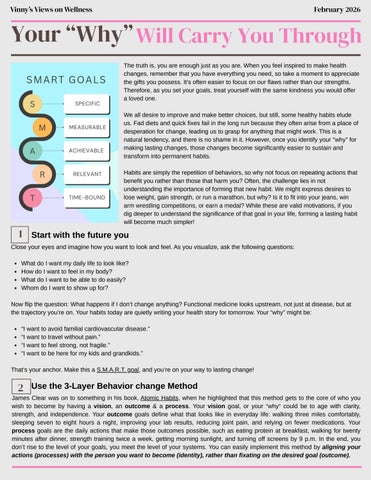
That’s your anchor Make this a S M A R T goal, and you’re on your way to lasting change!
2
Use the 3-Layer Behavior change Method
James Clear was on to something in his book, Atomic Habits, when he highlighted that this method gets to the core of who you wish to become by having a vision, an outcome & a process. Your vision goal, or your “why“ could be to age with clarity, strength, and independence. Your outcome goals define what that looks like in everyday life: walking three miles comfortably, sleeping seven to eight hours a night, improving your lab results, reducing joint pain, and relying on fewer medications. Your process goals are the daily actions that make those outcomes possible, such as eating protein at breakfast, walking for twenty minutes after dinner, strength training twice a week, getting morning sunlight, and turning off screens by 9 p.m. In the end, you don’t rise to the level of your goals, you meet the level of your systems You can easily implement this method by aligning your actions (processes) with the person you want to become (identity), rather than fixating on the desired goal (outcome).
3 Make it Small Enough To Win
Your nervous system loves success! When we follow through with our goals, and even tasks, that signals safety and reward to your brain, activating dopamine (motivation), calming threat circuits, and reinforcing the behavior as “worth repeating,” so your nervous system literally learns, this action keeps me thriving! So, we do it again. Of course, there is the release of dopamine when we do what we set out to do, which is a very powerful reward chemical to keep us moving forward. And, frankly, consistency beats intensity every time. Our new goals don’t need to be huge, they just need to change your trajectory by making small changes. The easiest way to do that is to stack your habits. Find out more here.
Plus, life is easier when we’re consistently doing the things that help us feel better now and in the long run. For example, if you want to get up in the morning and exercise, set your workout clothes out the night before and put them on when you wake up. That signals the brain that you’ve decided to work out. Your workout could simply be to stretch, but guess what, you’re moving and you’re starting a habit that will build over time.
4
Revisit Your Why When You Drift
You will have busy weeks, low-energy days, and even “What’s the point?” moments. Try to listen to that and please don’t punish yourself if you don’t have the capacity for your new goals Reframe what is happening and ask yourself:
Who am I doing this for?
What future am I protecting?
Health is not a punishment you must endure to make positive changes; it’s an investment in what your life can become, because your “why” means that much to you!
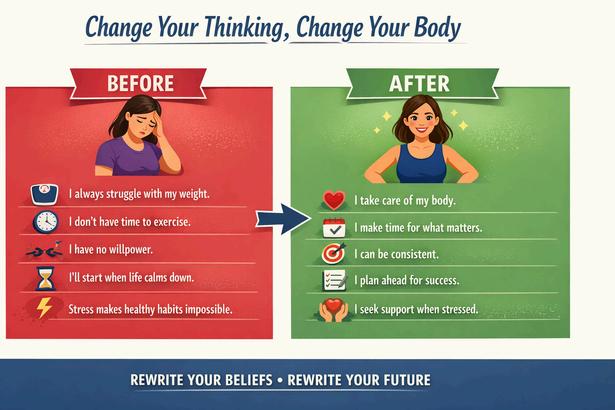
✨ Your why gives your habits meaning ✨ Clear goals give your why structure ✨ Small daily actions give your goals power You don’t need perfection, just clear direction by defining your why.