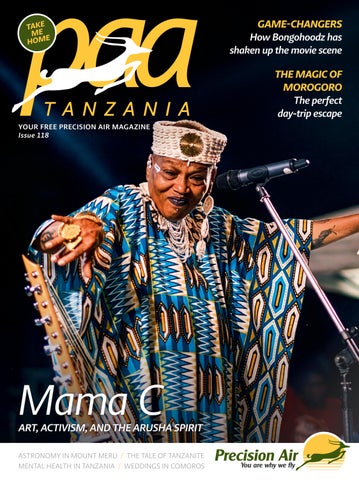
Paa Tanzania – issue 118

Page 1


Dear passengers

Karibu aboard Precision Air, and welcome to the latest edition of Paa Tanzania. Whether you are travelling for business, reconnecting with loved ones, or setting off in search of new discoveries, we are delighted to have you with us.

At Precision Air, everything we do is guided by a simple purpose: to make your journey smoother, more enjoyable, and more rewarding – both in the air and on the ground.

As part of this commitment, we continue to streamline the customer experience through meaningful improvements that reflect how our passengers travel today. One important step is the launch of our cashless payment system, effective from May 1. All ticket payments will now be made via credit card, debit card, or trusted mobile payment networks. This change is designed to make transactions faster, more secure, and more convenient, while aligning Precision Air with global best practice in airline service and operational efficiency.

We are pleased to announce that we have successfully passed an on-site audit conducted by Boston Air Group, commissioned by UK travel agents following the European Union and UK restrictions on Tanzanian operators. As a result, Precision Air has been added to the BlueSky by Boston Air database as an approved air carrier.

At the same time, we remain deeply committed to connecting you to destinations that truly define the richness and diversity of Tanzania and the wider East African region – places that may be less travelled, but deeply rewarding.

This includes our flights to Mtwara, an often-overlooked gem on Tanzania’s southern coast. From its unspoilt beaches to its growing role as an economic gateway, Mtwara offers an appealing blend of opportunity and escape.

As you explore our destinations, we encourage you to share your feedback with us. Your input is valuable and helps us continually improve and serve you better. You can reach us at customer-relations@precisionairtz. com or connect with us through our social media channels.

Thank you for flying with Precision Air. Sit back, relax, and enjoy the journey.

You Are Why We Fly

Precision Air Services Plc

Diamond Plaza

PO Box 70770, Dar es Salaam, Tanzania

Tel: +255 (0)22 219 1000 Fax: +255 (0)22 286 0725 www.precisionairtz.com

Marketing and Corporate Communications Manager: Hillary Mremi Email: hmremi@precisionairtz.com

Paa Tanzania Magazine is published by: Land & Marine Publications (Tanzania) Ltd 5th floor, Josam House Plot Number 16, Mikocheni Area Along Coca-Cola Road, Dar es Salaam Tel: +255 686 118 816 www.landmarine.com

ADVERTISING: Godfrey S. Urassa Tel: +255 (0)686 118 816 (WhatsApp) Email: godfreyurassa@landmarine.com

General enquiries

Email: paa-tz@landmarine.org

EDITOR: Mark Edwards

Email: markedwards@landmarine.com

Head office:

Land & Marine Publications Ltd

6 The Square, Ipswich, Suffolk, IP5 3SL UK Tel: +44 (0)1206 752902

Email: publishing@landmarine.com www.landmarine.org

The contents and opinions expressed in this publication are not necessarily those of the editor, or any other organisation associated with this publication. While every care is taken to ensure accuracy in preparing the magazine, the Publisher and Precision Air assume no responsibility or liability for any inaccuracies or omissions. All submitted material is accepted on the understanding that the material can be edited, amended or abridged for publication. ©2025 Land & Marine Publications (Tanzania) Ltd.

Subscribe

Request your e-version subscription by emailing: subscribe@landmarine.org

Keep in touch

www.precisionairtz.com

Facebook: @Precisionair Tanzania

Instagram: @Precisionairtz

LinkedIn: Precision Air Tanzania

X: @PrecisionAirTZ

TikTok: @_precisionairtz

YouTube: @PrecisionAirOfficial

Precision Air goes cashless

From May 1 all our flight ticket payments will be made cashless for a faster and more secure customer experience. Here’s all you need to know.

Precision Air is now a cashless environment, requiring all booking payments to be made via credit card, debit card, or mobile payment networks.

The move to ‘cashless’ is intended to make transactions faster and more secure.

The shift reflects a broader trend among airlines and businesses to enhance operational efficiency and security.

To pay for a Precision Air ticket using their cashless system, complete your booking on the website to get a mobile reference number. Then, pay instantly via the NMB Mkononi App or dial *150*00# on Vodacom M-pesa, selecting business payments and entering your reference number.

Step-by-Step Payment Guide

Before you start, complete your booking and note the mobile reference number provided.

Vodacom M‑Pesa

y Dial 15000# on your phone

y Select Pay with M‑Pesa (Option 4)

y Select Business Payments  (Option 3)

y Select More Travel Precision Air

y Enter your mobile reference number

y Confirm the payment to complete the transaction.

NMB Mkononi App

y Open the NMB Mkononi App

y Tap Bill Payment

y Select Transportation

y Choose Precision Air

y Enter your mobile reference number

y Confirm to complete the instant payment.

CRDB Bank (SimBanking)

y Open the CRDB SimBanking App

y Select Airline Services

y Choose Precision Air

y Enter your mobile reference number

y Confirm and complete the payment.

BONGOHOODZ no budget, big vision

Tanzania’s biggest actors and musicians want in on their films, and audiences around the world are already watching. Bongohoodz Pichaz are guerrilla filmmaking game‑changers, rewriting the rules of Tanzanian cinema from the ground up.

Dar es Salaam’s ‘Bongo Movie’ guerilla filmmaking industry has dominated the Tanzanian film scene through the 21st century. With its “no budget” feature films that capture in compelling style the day-to-day dramas in Dar’s inner city, independent production house Bongohoodz Pichaz is part of that heritage, yet pushes it into radical new territory.

“What we’re doing is revolutionary,” says BongoHoodz producer and actor Noriega ‘Scooby’ Francis. “There is Bongo Movies and then there is Bongohoodz.”

Key to the distinction is the

production house’s pioneering move to separate itself from the DVD-based distribution that has long defined the Bongo industry and make its films – in Swahili with English subtitles – free to stream worldwide on its YouTube channel. Scooby says the decision was fuelled by a desire to retain full creative control over their work with Government film boards, restrictive regulations, and unreliable or exploitative distributors often standing between the team and its intended audience.

“We wanted to put our films out in our way, and build our own fan base,” says Scooby.

Launched in 2017, Bongohoodz Pichaz now has a catalogue of over 20 feature films available to view online. The collective’s first release, 2018’s wild crime caper Bongo na Flava, has been watched more than 180,000 times – a significant success for an independent film. Follow-up films have been similarly fast-paced slices of Tanzanian street culture, crime and ambition. These include last year’s Kichaa Kichizi (Crazy Crazy), which follows a victim of a brutal assault on a path of revenge; Siku za Alosto (Days of Addiction), a story about a former drug addict trying to rebuild

'Scooby' is a prominent regular actor in Bongohoodz movies
Gordon Fischer

his life; and Mikasa Mikosi na Makosa (Mistakes and Mistakes), in which two friends attempt to piece together the events of a drunken night out. Each is pushing six-figure views.

Popularity

The impressive engagement metrics of these online films highlights another way Bongohoodz distinguishes itself from the guerrilla filmmaking scene: the quality of its output.

While the wider Bongo movie business model often prioritises rapid production for quick returns – frequently at the expense of

cinematography, dialogue, and editing – Bongohoodz takes a different approach. The collective releases just three or four feature-length films a year, each carefully crafted. “A lot of work and dedication is put into our productions,” says Scooby.

Integral to this emphasis on quality is Bongohoodz Pichaz

‘The collective releases just three or four feature-length films a year, each carefully crafted.’

founder Novatus ‘RrahC’ Mugurusi, the collective’s principal director and scriptwriter. Working with a stripped-back crew – often just himself filming with a tiny DJI pocket 3 hand-held camera and a sound operator balancing a pole topped by a taped-on microphone – RrahC captures footage with a high-definition clarity that belies the production’s extreme minimalism and lends the films a polished, big-budget feel online.

Camera skills

RrahC is also known for his immersive and inventive camera work that elevates the energy of these gritty urban dramas. Just how far the director is willing to go to get the perfect shot is evidenced on the Bongohoodz Pichaz Instagram page, which includes some behind-the-scenes footage from Deni La Damu (Blood Debt), a 2026 release about a local thief who tries to clear his name after being framed for murder. RrahC can be seen hanging off a speeding bajaji, camera trained on an argument erupting between driver and passenger. On another occasion, he rides as a passenger on a moving motorbike, facing backwards to stay ahead of – and film – a dramatic chase scene.

Scooby says innovations such as these are a team effort, recalling how for one film a wooden crane was built from scratch and attached to the roof of a car to hold a camera and put viewers directly in the driver’s seat for another intensive chase sequence.

RrahC's film ideas are grounded in Dar street reality, but elevated with high-stakes tension and unexpected dramatic pivots. "My inspirations come from my

The Bongohoodz cast and crew film scenes on the streets of Dar es Salaam RrahC and Gordon Fischer.

community, I read and observe the daily challenges which the people face and try to address it in a dramatic way."

Scooby adds: "When RrahC has finished a script, he’ll put it on the Bongohoodz WhatsApp group chat and we’ll all throw in ideas. Someone might know a location or a house that would work for a certain scene.”

The films are shot in dusty, busy Dar es Salaam central neighbourhoods such as Kinondoni, Manzese, and Buguruni. These areas form the heart of ‘Bongo Hood’, a nickname for the city’s inner districts that inspired the production house’s name. Here daily life is driven by constant hustle and inventive – ‘Bongo’ means brainy or clever in Swahili – means of survival. “This is the real Dar es Salaam,” says Scooby. “Our films represent where we’re from.”

Collaboration at Bongohoodz Pichaz draws on a broad in-house creative skill set. The production house’s community includes musicians who compose original soundtracks, fashion designers responsible for wardrobe, make-up artists, and even chefs who handle on-set catering. For Scooby, this collective ethos is central to the films. “We live as family,” he says. “The bond between us is very strong. Everyone here, whether in front of or behind the camera, is trying to do their best for the film.”

Beyond its core collective, Bongohoodz Pichaz has drawn support from a wider circle of high-profile names in Tanzanian entertainment, keen to associate themselves with an independent company expanding the possibilities of Tanzanian cinema.

“This is the real Dar es Salaam. Our films represent where we’re from.”

Creative talent

Since day one, the country’s hip-hop community has shown strong support, with the raw, authentic portrayal of urban life in these dramas striking a chord with local rappers. Arusha hip-hop legend JCB and Bongo Flava artist Soggy Doggy have even made appearances in front of the camera.

The pull of Bongohoodz has reached some of Tanzania’s most recognised screen talent. Angel Mazanda, star of the TV drama Noma and Female Actress of the Year in 2025, and Isarito Mwakalindile – producer and actor of the multi-award-winning feature My Son – have both appeared in Bongohoodz productions.

Bongohoodz adopts a repertory approach, drawing repeatedly from a large, consistent pool of local actors. The talent spans teenagers to established performers, many of whom have appeared across several of the production house’s

films. The charismatic Scooby is one of the most familiar on-screen faces, with lead roles including Bongohoodz’s latest release, Deni La Damu. His passion for performance began in school plays and later took him to drama school.

Yet he says the characters he plays feel so close to his everyday life in Dar es Salaam that he barely feels like he’s acting at all. “My life is a drama,” he says.

Scooby is also a conduit for the network of connections necessary to complete each film. He’s described on the Bongohoodz Pichaz website as “the guy who knows the guy” and he tells me that his influential circle of friends is as important to him personally as it is professionally. “There is nothing better than having friends, and I have a lot of friends,” he says. “Things always go smoother when you know people.”

Bongohoodz founder and Film director RrahC

The Bongohoodz inner circle includes several of Tanzania’s most prominent entertainment figures, among them celebrated actor and comedian Idris Sultan. “He’s always been there for us,” Scooby says. The wider network also takes in influential industry figures such as radio presenter Adam Mchomvu, Tanzanian musician and politician Hamis Mwinjuma, and Kenyan rapper Kaa La Moto. Far from decorative associations, these relationships play a practical role in Bongohoodz’s survival –helping to forge new connections, unlock opportunities, and, at crucial moments, support productions financially.

No budget

That web of relationships underpins what Scooby describes as Bongohoodz’s “no-budget” model

Five Bongohoodz Pichaz films to watch

Bongo na Flava (2018)

The film where it all started. A fast‑paced crime caper that announced the collective’s raw, street‑level style.

Kichaa Kichizi (Crazy Crazy)

A gritty revenge drama following a man scarred by a brutal assault as he spirals toward retribution on the streets of Dar es Salaam.

Siku za Alosto (Days of Addiction)

A former drug addict struggles to rebuild his life while navigating the pressures and temp tations of inner‑city Dar.

Mikasa Mikosi Na Makosa (Mistakes and Mistakes)

After a drunken night out, two friends attempt to piece together events that quickly spiral beyond their control.

Deni La Damu (Blood Debt)

A local thief fights to clear his name after being framed for murder in this tense crime drama.

of filmmaking. In reality, this does not mean films are made without money, but that there is no banked budget to cover an entire production from start to finish. Instead, films are assembled in stages, dictated by the availability of funds, people, and logistics. “Our movies can take from three to five months,” Scooby explains. “Things happen – cast members get sick, someone is travelling.” When the right conditions align –actors are available, fees can be paid, or a vehicle essential to a scene can be secured –the shoot moves forward.

Sharing their films for free on YouTube generates no direct income for Bongohoodz, but it has built a growing local and international following that continues to raise the production house’s profile. The collective’s channel now has around 40,000 subscribers, and each new release is keenly anticipated online. That enthusiasm carries offline too: in

Dar es Salaam, pop-up premiere screenings draw packed crowds and have become hot tickets.

For Scooby, the films’ popularity reflects the care and commitment invested in them. He sees the online catalogue as proof of what Bongohoodz Pichaz can achieve with “no budget” – and as a calling card for potential investors who could help take the collective to its next stage. “We see the films on the site as trailers for even better things to come,” he says. “When we have the means to do it, then our fans will see the full-blown movies.”

By combining guerrilla methods with professional ambition, Bongohoodz Pichaz has redefined what no-budget cinema can look like in Tanzania. The films stand as both a creative statement and an invitation – evidence of how far the collective has come, and how much further it aims to go with the support to match its vision.

To stream the entire Bongohoodz Pichaz catalogue of films, go to https://www.youtube.com/channel/UCBSXy78j966HTLS3cYpwYBw

For details on the creatives that make up the Bongohoodz Pichaz collective in front of and behind the camera, go to https://nagznova. wixsite.com/bongohoodz/about us

For news of latest releases and behind the scenes reels check out @bongohoodzpichaz1 on Instagram

Tackling a SILENT CRISIS

How

Tahmef

is changing the mental health landscape in Tanzania

Mental health is one of the most significant public health challenges of the 21st century, yet in many parts of the world it remains poorly understood, under-resourced, and heavily stigmatised. Nowhere is this more visible than in low- and middle-income countries, where the World Health Organization estimates that between 70 and 90 per cent of people who need mental health care do not receive it. Tanzania is no exception.

For young Tanzanians in particular, the consequences of this unmet need can be life-altering. Anxiety, depression, emotional distress, and trauma often go unrecognised or untreated, shaping educational outcomes, employment prospects, and long-term wellbeing. But a growing organisation is working to challenge this reality. Through a combination of technology, community outreach, and

system-level integration, the Tanzania Health and Medical Education Foundation (Tahmef) is reshaping how mental health support is accessed and delivered across the country.

A widespread issue hidden in plain sight

“Mental health in Tanzania sits at the intersection of high need and low access,” explains Elna Maro, Tahmef’s corporate and development psychotherapist and sustainability lead. “It is not just invisible, it is misunderstood”.

While mental health conditions are among the leading causes of disability worldwide, access to care in Tanzania is extremely limited. Stigma remains a defining barrier. In rural communities especially, mental distress is still attributed to moral weakness or spiritual causes such as witchcraft or curses. As Maro notes, “young people experiencing anxiety, depression, or emotional distress

Images: Gordon Fischer

are often labelled as ‘weak,’ ‘lazy,’ or associated with spiritual causes,” which leads many to delay or avoid seeking help altogether.

The scale of the challenge is substantial. Tanzania has a population of more than 70 million people, with around 60 per cent under the age of 25. That demographic reality makes youth mental health not only a social issue, but an economic and developmental one. Maro says: “It is a system barrier. When stigma is high, young people do not seek help, even when services exist.”

“We are not only talking about severe or diagnosed conditions,” Maro explains. “We are referring to a broad range of difficulties that affect how a person thinks, feels, and functions in daily life”.

These challenges include anxiety, depression, stress-related emotional distress, difficulty concentrating, problems staying in school, and early warning signs that can develop into more serious conditions if ignored. “What matters most is not the label,” Maro adds. “It is whether someone is able to cope, function, and access support when needed

Why traditional models are not enough

Given the scale of need, relying on one-to-one therapy alone is not realistic. “There are simply not enough mental health professionals to meet the need,” Maro says. “So, the question is not how to reach everyone individually. The question is how to build a system that can reach people early, guide them to the right level of support, and use existing structures more effectively”.

This understanding led to the creation of AHADI, Tahmef’s population-level mental health system. The word ‘Ahadi’ means ‘promise’ in Swahili. It represents, Maro says, “a promise that no young person should face mental health challenges alone, and that support should be available early, not only in crisis”.

How the AHADI system works

AHADI is designed as a connected pathway rather than a single service. It operates across three integrated layers.

The first is digital access for early

detection. Young people can engage anonymously through low-tech and high-tech channels, including Ahadi SMS (15061), the national helpline (199), and the AHADI App, available on Google Play and the App Store. These tools lower the threshold for seeking help by making support discreet and accessible.

The second layer is community-based support that is being piloted in the regions of Dar es Salaam and Pwani before being rolled out across the country. Tahmef is training teachers, community health workers, and peer supporters to provide first-line support, recognise early signs, and guide young people toward appropriate care. This dramatically expands capacity beyond what qualified clinicians alone could deliver

The third layer is government integration for scale. “To reach millions, systems must be embedded into national infrastructure,” Maro says. Tahmef works with government partners to integrate mental health into existing health and community systems, including national helplines and referral pathways. This approach ensures sustainability rather than creating parallel

Community based support is being piloted in Dar es Salaam and Pwani

services that cannot be maintained long term.

Technology as a connector, not a replacement. While the AHADI App and SMS platforms are central to Tahmef’s approach, technology is not viewed as a substitute for human care. Instead, it acts as the connective tissue between different forms of support.

“Our digital tools allow young people to access self-assessment for anxiety, depression, and wellbeing, use journalling and guided support tools, and book counselling sessions, either virtual or in-person,” Maro explains.

Some individuals begin anonymously through their phone, while others are referred from schools or community settings. Technology ensures that these pathways remain connected.

Maro says “Technology helps ensure that human support is used where it is most needed, while making early support widely accessible”.

Reaching rural communities and reducing stigma

Stigma often appears most entrenched in rural areas, but Tahmef approaches this with nuance. “Stigma can be more visible in rural areas, but it is largely shaped by context rather than intention,” Maro says. In these settings, people may rely on spiritual explanations or trusted community structures, and fear of social exclusion can discourage open dialogue.

Rather than dismissing these realities, Tahmef works within them. The organisation focuses on building local capacity by training teachers, community health

December 2025, Tahmef had reached more than 1.1 million young people

workers, and local leaders, using community radio for outreach, and combining smartphone-based tools with low-tech SMS options. The aim is to make support “available, trusted, and usable in everyday life”.

Signs of impact and a growing shift

The results suggest this integrated approach is working. By December 2025, Tahmef had reached more than 1.1 million young people through awareness and access points, supported over 150,000 helpline cases, and engaged more than 21,000 active users on the AHADI platform.

Beyond reach, outcomes matter. Tahmef has recorded measurable improvements in wellbeing, anxiety, and depression scores using internationally recognised tools. “Young people are reaching out earlier,” Maro says. “They

are returning for support, which shows trust. And communities are beginning to see mental health as something that can be addressed, not avoided”.

Tahmef’s long-term goal is not rapid expansion, but sustainable integration. Over the coming years, the focus is on embedding the model more deeply within Tanzania’s national systems, strengthening evidence, and eventually preparing for regional expansion across East Africa.

This partnership-based approach will roll out in other East African countries such as Kenya, Rwanda, and Uganda, with the long-term aim of supporting millions of young people across Africa.

“By 2035, we aim to reach 10 million young people, with the majority accessing support through digital platforms, complemented by communitybased care,” Maro says.

To support the work of Tahmef, go here https://www.every.org/tanzania-health-andmedical-education-foundation-tahmef/f/support-mental-health or use the QR code.

Mama C brings a lifetime of art, activism, and Arusha spirit to the big stage

SAUTI’S NEWEST STAR AT 75

‘I’ve always wanted to be on stage at Sauti za Busara, and now here I am, at 75 years old!” Artist and activist Charlotte Hill

O’Neal – best known in Tanzania as ‘Mama C’ – can’t hide her delight at appearing before a rapturous crowd at Zanzibar’s celebrated annual festival of African music.

It is some surprise that this is Mama C’s Sauti debut. The two seem such a good fit. Since 2003 the pan-African music festival has been showcasing a diverse range of live music from across the continent and the diaspora, and Mama C – an African American by birth – has for

Markus Meissl
'I love A-Town. We’ve lived there for more than four decades. It is not just the physical environment and the peace, but the people. It’s lush and full of love and friendliness.'

half a century fostered a cultural cross-pollination of the arts and spiritual advancement from her adopted home of Arusha. Music has been a primary tool in that cultural connection. Mama C is the lead vocalist and creative anchor of Mama C and the Fusion Band, the Arusha-based musical collective she brought to Sauti za Busara. As its name suggests, the six-piece band’s sound is a hybrid form that blends traditional African music with soul, funk, jazz, and hip-hop. It’s a mix of genres that reflects Mama C’s deep connections to her Tanzanian home as well as her US roots.

Arrival from America

Mama C left Kansas City for Arusha in her early 20s, but the honeyed drawl of America’s heartland is still evident in her speech when we talk after the Sauti show. “Do you get my accent,” she teases. Her performances use that voice as a dynamic instrument. Part spoken word – Mama C is a published poet with works

Dhruv Chauhan

including 2008’s ‘Warrior Woman of Peace’ and ‘Homage’ in 2021 – and part improvisational, jazz-influenced singing, it gives her a powerful, in-the-moment presence on stage.

Mama C’s parting words to the cheering crowds after an impassioned one-hour set are: “A-Town in the house”, a reference to the nickname for Arusha that is popular among the city’s thriving hip-hop community. For all Mama C’s cosmopolitanism, ‘A-Town’ has a special place in her heart.

In 1972, Mama C and her husband Pete O’Neal sought sanctuary overseas when their involvement with US revolutionary civil rights movement the Black Panthers – Pete was the chairman of the Kansas City chapter – led to the prospect of imprisonment. They were welcomed by the Tanganyika African National Union under the leadership of Tanzania's first President Julius Nyerere, who was building the newly independent country on pan-African ideals in alignment with the Panthers’ struggle against racism. When the couple’s first stop Dar es Salaam proved literally too hot to handle – Pete found the humidity of the coastal city detrimental to his health – they relocated to the cooler climes of altitudinous Arusha.

Arusha welcome

The O’Neals were soon smitten with Arusha and the feeling was mutual. “I love A-Town,” Mama C says. “We’ve lived there for more than four decades. It is not just the physical environment and the peace, but the people. It’s lush and full of love and friendliness.”

The couple set about integrating themselves into this welcoming environment. Just outside the city in Imbaseni Village they co-founded the United African

Alliance Community Centre (UAACC) dedicated to community, art, and youth empowerment. It’s a tranquil haven open to everyone – from the disadvantaged children who live on the grounds full-time at the centre’s Leaders of Tomorrow Children’s Home to tourists passing by. “The first thing that people say they notice when they walk through our gates is the peace,” says Mama C.

The centre has an onsite art workshop and music recording studio. Mama C – a visual artist, filmmaker, and musician – is among those sharing her skills, but the centre has welcomed creatives from all over the world as volunteers offer free arts, education, and vocational training for local youths.

They are taught skills that Mama C believes can help lift them out of

poverty – a word she uses not to denote a lack of financial resources, but more a poverty of purpose. Learning can unlock innovative, low-cost solutions to daily survival. She says: “We try to show them the best way to elevate not only themselves, but the community is to try to make them understand they can be farmers, making clothes, being an entrepreneur. If you educate yourself not just with book learning but about life, then that can lift you up. You can make your own jewellery, sell clothes you’ve made, or grow your own food.”

For Mama C there is a lineage to this model of empowerment that can be traced back to her activism in the US. “With the Black Panthers we tried to elevate the people to

Markus Meissl
Mama C playing traditional instrument the zeze at Sauti za Busara and (facing page) Arusha rapper D'wee shares the stage

learn their history, to learn to be entrepreneurs, to learn how to build the community with unity.

“We still do that at the centre. We are still very international we deal with people from all over the world. We don’t care about race.

We talk about people’s hearts. We were taught that when we were members of the Black Panther party. We have never forgotten that lesson. That’s the way to change the world.”

Artistic exchange

The O’Neals acted as a major cultural conduit between the US and Tanzania. Among the artistic exchange they fostered between the two countries it was US hip-hop took hold – and nowhere more so than A-Town.

“Arusha is the capital of hip hop,” Mama C says. “It’s been there from the very beginning

It has spread like wildfire, and I believe its rise was meant to be. What I like is there is a sense of unity in the Arusha hip-hop community. People these days

are competing with each other, but here it is more about lifting everybody up. I hope that never changes.”

Mama C has been around since the very start of the hip-hop scene in Arusha. She can remember brothers GSan and Faza Nelly –founding members of Tanzanian ‘Maasai rap’ group X-Plastaz – as teenagers trying out their first raps.

GSan and Faza Nelly are hip-hop legends in Arusha with the music of X-Plastaz drawing a following across Tanzania and globally.

Tragically, both died far too young. It is indicative of Mama C’s standing in the local hip-hop community that when the body of GSan was flown back to Arusha from the US in 2025, she was a pivotal, charismatic figure whose speeches provided comfort and unity to a city in mourning.

Mama C’s deep, long-standing affinity for the hip hop community continues today. “The hip-hop community keeps it real,” she says.

“They talk about issues and not just talk, they also come up with

methods to elevate the community through their words and their actions. I’m the same way.”

The UAACC holds workshops with the hip-hop artists providing a space for youth to express themselves. Hip-hop is also a key component of the Mama C and the Fusion Band’s music. The current line-up includes D’wee – one half of influential Arusha hip-hop duo Watengwa – who plays ngoma drums but also steps forward to share centre stage with some stirring Swahili rapping.

Mama C doesn’t look or seemingly feel her age – “Let me take of my shoes and dance,” she says at one point on stage, swept up in her band’s rhythms – but she sees older and younger generations as still having much to teach each other. With a playful wish that this is not her “last Sauti” she looks to continue her artistic exchange. “I still want to inspire people. If I can do these things at my age why not a young person?”

To follow the latest developments and events at the United African Alliance Community Centre, go to @uaacc on Instagram

Top see a video stream of the full Mama C and the Fusion Band show at Sauti za Busara 2026, visit https://www.youtube.com/ watch?v=FHgrQ1rwhfQ

Mama C and The Fusion Band were a big hit with the crowd at their first Sauti show
Michaela Soskova
Michaela Soskova

The Zanzibar International Film Festival (ZIFF) was founded in 1997 by Martin Mhando.

The academic and filmmaker –Maangamizi: The Ancient One, which he co-directed, was the first Tanzanian film submitted for an Oscar – established the annual event to keep local cinema culture alive in the wake of the widespread closure of commercial movie theatres across Tanzania and Zanzibar.

Three decades on ZIFF has become a globally respected event showcasing the best in African cinema from filmmakers across the continent and the diaspora. It’s a key event for those exploring African cinema’s evolution attracting thousands of international visitors each year while remaining true to its mission of spreading the magic of cinema among the Zanzibari community. Local schoolchildren are admitted free to the screenings in Stone Town, the festival’s hub, while pop-up screenings are arranged that bring films to more remote areas of the islands.

This year’s event has received more than 400 films from over 100 countries. Some of the films have been selected in mind of this year’s theme, ‘AI and the Art of Storytelling’, with priority given to works that focus on global cultural interaction, sociopolitical commentary, and the integration of digital technology in cinema.

Many of the chosen films will have their African and World Premiere during ZIFF as they begin their first festival circuit worldwide. Films in competition will be in the running for 12 awards with the winners selected by a jury of international film experts, with the coveted Golden Dhow awarded to the Best Feature Film.

Here are 10 films we can't wait to catch at ZIFF when the festival kicks off on June 24.

MUST-SEE MOVIESAT ZIFF 2026

The 29th edition of the Zanzibar International Film Festival (ZIFF) takes place from June 24 to 28. This year’s celebration of African cinema features an exciting slate of world premieres. From intimate documentaries to powerful dramas, here are the standout films we’re most excited to catch.

Kilwa Kisiwani (Tanzania)

This historical drama revisits the Swahili Coast in the 15th century, when Kilwa Kisiwani stood as a major East African trading power. Beneath its prosperity, the film uncovers political intrigue, moral compromise, and resistance. Richly atmospheric, the film provides a rare insight into a formative stage of Tanzanian history while exploring how power is built – and challenged – from within.

My Father and Qaddafi (Libya)

In 1993, Mansur Rashid Kikhia, Libya’s former diplomat and peaceful oppo nent to Qaddafi vanished in Cairo. This documentary follows the efforts of his daughter, Jihan, to get to the truth of what happened. Blending memory, archival material, and reflection, this is a political story told through the lens of family, loss, and identity as Jihan tries to understand the country that both created her father and killed him.

Kikuyu Land (Kenya)

In Kenya’s tea high lands, one man’s claim to his family’s stolen land sets him against a multinational giant. His fight draws a local news producer into a battle that exposes buried histories, family secrets, and the unfinished busi ness of colonial power.

Longing to Belong (Uganda)

In this Ugandan race against time ransom drama, Molly’s five year old son vanishes without a trace during a birthday extrav aganza. As panic sets in, accusations fly; Molly’s mother in law believes she orchestrated the abduc tion to reunite with the child's biological father, her husband questions her loyalty, and her ex lover reappears claiming he is the father of the missing child. A neat twist on the thriller genre to explore family power dynamics.

Out of School (Morocco)

Filmed in rural Morocco, Out of School follows two siblings coming of age as economic realities threaten to cut short their education. The film is a sensitive treatment of childhood adolescents caught between two worlds: the one they imagined they could reach, and the one they must learn to live in.

Cotton Queen (Sudan)

Set in a rural Sudanese cotton‑growing commu nity, Cotton Queen follows a teenage girl awakening to her own agency as tradition, technology, and outside influ ence collide. The film blends coming‑of‑age drama with political subtext, examining who benefits from “progress” and at what cost. Its strength lies in its young protagonist and its ability to frame global economic forces through an intimate, local story.

We are Hadza (Tanzania)

Set in northern Tanzania’s Lake Eyasi region, We Are Hadza offers a rare, quietly immersive portrait of the Hadza, one of the last remaining hunter‑gatherer communities in the world. Filmed over three years, the documentary observes daily life, traditions, and generational change without intrusion. The film weaves together narratives from interviews with Hadza members – from X'ox'a, a strong hunter who would rather die than leave the bush, to Upu une, a young boy who yearns to discover the outside world. An intimate portrayal of Hadza life as the tribe confronts its uncertain future.

Adam to Eve (Kenya)

When a curse transforms a Nairobi playboy into a woman he teams up with his geeky twin for a comically enlighten ing journey into ideas of gender, empathy, and identity. Light on its feet but pointed in its observa tions, Adam to Eve stands out as a rare mainstream African comedy willing to tackle social roles without losing its sense of fun

Molly vs the Machines (UK)

In keeping with the ZIFF 2026 theme of ‘AI and the art of storytelling’ this powerful documentary examines how algorithm driven social media platforms can push teenagers toward harmful content in light of the tragic death of UK teenager Molly Russell, who took her own life in 2017 after viewing content relating to self harm and suicide on social media. From a suburban bedroom to Silicon Valley boardrooms, the film exposes the systems shaping a generation online – and the question of who is accountable.

Aisha Can’t Fly Away (Egypt)

Aisha is a 26 year old African immigrant caregiver residing in Ain shams, a Cairo neighbourhood with a large African migrant community. Through her eyes, the film explores the intricate dynamics of a world where the authorities’ indiffer ence to the violent tensions between Egyptians and various African nationalities has allowed different gangs to seize control. The situation quickly turns sour after one of them offers Aisha security in exchange for a favour. Anchored by a restrained central performance, the film is a tense and atmospheric depiction of contemporary urban Egypt

Top tourism show is back

East Africa's largest international tourism and travel industry show Karibu-Kilifair returns to Arusha bigger and better than ever in 2026.

East Africa’s largest international tourism trade show, Karibu-Kilifair, will return to Arusha from June 4 to 7 2026, with a significantly expanded format, a larger exhibition footprint and several new features.

For the first time since the event was created through the merger of Tanzania’s Karibu Fair – founded and formerly organised by the Tanzania Association of Tour Operators (TATO) – and Kilifair – founded and organised by the Moshi-based Kilifair Promotion –the expo will run for four full days. The opening day on Thursday, June 4 will be reserved exclusively for exhibitors, and the media, while buyers and public visitors will be

admitted from June 5 to 7.

The 2026 edition will take place at the Magereza Grounds, opposite Arusha Airport, with the exhibition area expanded to 47,000 square metres. Organisers expect more than 550 exhibitors from 14 countries, alongside over 1,000 registered travel agents, tour operators and international buyers from more than 45 countries. Attendance across the four days is estimated at approximately 20,000 visitors.

The expansion reflects the continued growth of Karibu-Kilifair as a regional meeting point for tourism professionals working across safari travel, hospitality, aviation and destination marketing

in East and Sub-Saharan Africa. Arusha remains central to the event’s positioning. Often described as East Africa’s safari gateway, the city is within 45 kilometres of Kilimanjaro International Airport and its own airport serves as a hub for domestic flights to major national parks and to Zanzibar and Kenya. Its infrastructure and accessibility continue to support the growing number of international delegates attending the expo.

New Pavilion

Among the notable additions for 2026 is the introduction of the Pan Africa Pavilion, presented under the East African Community (EAC) framework. The pavilion is designed to bring together exhibitors and tourism bodies from across the region under the ‘Visit East Africa’ campaign, offering a structured platform for cross-border tourism collaboration.

Alongside the trade exhibition, the programme will include panel discussions addressing current trends and developments in East African tourism, as well as

(Facing page bottom right) Founders and directors of Kilifair Promotion Tom Kunkler and Dominic Shoo

an expanded food and cultural zone featuring more than 50 restaurants and bars and live performances by over 100 artists across two stages. New visitor-focused features have also been added. These include the Kilimanjaro Running Challenge, organised with CLOUDS Media, which incorporates a summit-themed photo installation and prize competitions. Family audiences will have access to a dedicated children’s playground, reflecting organisers’ efforts to broaden the event’s appeal beyond

Visitor Information

Dates and opening hours

Friday, 5 June: 10am to 6pm Saturday, 6 June: 10am to 6pm Sunday, 7 June: 10am to 5pm

Entry fees

Adult day ticket: TZS 20,000

Children (7–12): TZS 5,000

Family ticket: TZS 45,000 (two adults, up to three children)

Further information is available at www.kilifair‑tanzania.com

industry professionals.

On Saturday, 6 June, the expo will host the Sounds of Kili Music Festival, featuring Tanzanian artists and DJs in the evening. Access to the festival is included with a Saturday expo ticket, with separate entry available on-site for evening-only attendees.

Sustainability Measures

Karibu-Kilifair 2026 will continue to build on sustainability initiatives introduced in previous years. Measures include the use of wooden cutlery, water dispensers, organised waste separation, and bottle collection, implemented in cooperation with regional tourism stakeholders. Tourism remains a strategic sector for Tanzania, with recent government initiatives focused on destination promotion, new attractions and investment incentives. Karibu-Kilifair, alongside its sister event the Z-Summit in Zanzibar, is recognised by national tourism authorities as a key platform for international outreach and industry engagement.

The rise and sudden fall of in Tanzania AFRO ROCK

Tanzanian musician and archivist John Kitime tells how Jimi Hendrix‑obsessed schoolkids in Dar es Salaam sparked a brief but electrifying new music movement in the 1960s and 70s.

Politics has had a profound effect on Tanzanian music. As an example, let me take you back to the 1960s and 70s. During this period a lot of young local musicians – particularly those still in secondary school – formed their own bands playing covers of famous US and European bands such as The Beatles, The Temptations, The Famous Flames, The Jimi Hendrix Experience. Even the names of these Tanzanian bands were imitations of their Western idols with examples such as The Sunburst, The Comets, The Rifters, The

Jets, The Barkeys, The Barlocks, The Hot Fives, The Sparks, The Tonics, The Groovemakers, The LoveBugs, and The Revolutions, and so on.

Even bands that later crossed over and began playing rumba music gave themselves names such as The Safari Trippers, The Afro 70, or Alfa Afrika Group rather than the traditional suffix of ‘Jazz Band’ or ‘Orchestra’.

US influence

Most of these bands were based in Dar es Salaam, Tanga, and Arusha. When discussing this music, you cannot overlook

the contribution of bands started by the Goan youth (children of immigrants from Goa, India, who moved to East Africa.) They, too, had bands in almost every town they were in. The Kilimanjaro, also known as Wananjenje, originally began as The Love Bugs, a band formed by Goan youths in Tanga. Other Goan led bands were The Barlocks and there was also George De Souza Band, The Demellos, and, of course, not forgetting the In Afrika Band, etc.

It is also important to mention the contribution of the American cultural centre, then known as the United States

Information Service (USIS), that also contributed to the direction of the music among the young at that time.

Drop by the centre in Dar es Salaam and you could see US movies, listen to or borrow vinyl records of American musicians or read magazines such as Ebony, which showed the lives of black American artists and athletes. More importantly, the centre brought worldrenowned musicians to perform free shows at the city’s Mnazi Mmoja grounds. Among the musicians I remember who performed in the country are guitarist Buddy Guy and his band as well as the Staple Singers.

The Mnazi Mmoja grounds were an important meeting place for the youth in Dar es Salaam. A stage was built that was used almost every weekend for entertainment. Due to the morals of that time, students, even those in secondary schools, were not supposed to be in dance clubs at night, so popular afternoon dances called Bugi were introduced. They were held on most weekends and public holidays. Many schools allowed Bugi in school halls.

I remember one day paying the 30 cents to attend Bugi at St Joseph Primary school in 1973. The Comets were the headliners, but two songs by other bands on the bill, ‘Mammy Blue’ by the Pop Tops and ‘Alobe’ by Negro Success, stay strongest in the memory.

The birth of Afro Rock

This fertile musical period gave rise to a new type of music, Afro Rock. Among the artists bringing this fusion of rock and African music to Tanzania were the band Osibisa, which was made up of a mix of musicians from Ghana and the Carribean, and Fela Anikulapo Kuti from Nigeria.

Afro Rock was very broad with musicians from every corner of Africa mixing their indigenous music with rock. Patrick Balisidya and Afro 70

combined Gogo music and rock while ‘Mulemuleme’ by The Jets combined elements of Zaramo (a drum-led Dar es Salaam genre believed to be the root of today’s singeli) and rock, The Sparks also drew from Zaramo in their song ‘Nofa na Nzala’, which was covered recently by Vulindlela ‘Vuli’ Yeni – a South African artist who has been based in Tanzania since fleeing his home country’s extreme apartheid politics in South Africa at that time.

Vuli, a saxophone player, ended up playing for a number of bands in Dar es Salaam including Boma Liwanza, the Rifters, the Revolutions and the Safari Trippers. Eventually, he became one of the musicians in Lucky Dube’s band, and he was the teacher of the famous saxophonist Akuliake Salee, known as King Maluu.

The Sunburst also performed Kiswahili songs in the Afro Rock style such as ‘Kosa langu nini’ and ‘Simba anaunguruma’.

They were very well received and led to the Sunburst receiving the ‘Best Band’ award in 1973.

Unfortunately, these bands that played music with a Western orientation rarely recorded their songs so only pictures and stories of them remain. Sadder still is that on November 12, 1969, a meeting was held between teachers and the Regional Commissioner of the Coast Region (that included Dar es Salaam at that time) to raise the fear that students were being corrupted by ‘soul’ music.

After the meeting, the Regional Commissioner issued an order banning that music in his region. The young musicians who had been such a big part of the rising Afro Rock scene in Tanzania found themselves silenced. I still wonder, if that decree had not been issued, what contribution would Tanzanian musicians have made in Afro Rock music?

The Mnazi Mmoja grounds were an important meeting place for the youth in Dar es Salaam.
Emmanuel Jengo of the Groove Makers
The Sparks on stage

A modern gem with an ancient origin

Born beneath Mount Kilimanjaro and found nowhere else on Earth, tanzanite is a gemstone defined by rarity, colour, and an extraordinary sense of place.

Discovered in 1967 in the Merelani Hills at the foothills of Mount Kilimanjaro, tanzanite is one of the youngest gemstones to enter the global jewellery market. Unlike diamonds, rubies, or sapphires, which are mined in multiple countries, tanzanite comes from a single, extremely small geographic area, estimated at only a few square kilometres

According to Maasai oral history, lightning-induced fires once swept across the plains, transforming dull brown stones into vibrant blue-violet crystals. While this account is part of cultural tradition rather than scientific explanation, it reflects the deep local connection to the gem.

A Divine gift

Among the Maasai, blue symbolises the sky, life, and energy. As a result, tanzanite has traditionally been viewed as a gift from God and a symbol of blessing and renewal. It is customary for Maasai women to receive tanzanite after childbirth, marking new beginnings and wishing health and prosperity for the child.

The world takes notice

Tanzanite might have remained a local curiosity if not for US luxury jewellery and specialty design house Tiffany & Co, which recognised its commercial potential shortly after its discovery. The company

Buying guide

named the stone “tanzanite” after its country of origin and famously described it as “the most beautiful blue gemstone discovered in 2,000 years”– a marketing phrase that helped propel the gem onto the global stage

Rare gem is getting rarer

Tanzanite’s rarity is not marketing hyperbole. All known deposits lie within the Merelani mining area, which is divided into four government-regulated blocks (A-D).

Gemologists frequently describe tanzanite as a “one-generation gemstone”, reflecting concerns that economically viable deposits may be exhausted within decades, not centuries. As surface stones were quickly depleted, modern mining now extends hundreds of metres underground, significantly increasing cost and complexity

This finite supply – combined with growing global demand – has become

When buying tanzanite, quality is assessed using the four Cs – colour, clarity, cut, and carat weight – similar to diamonds

COLOUR (MOST IMPORTANT) Deep, saturated blue‑violet stones are the most valuable. Pale or greyish tones are more common and less prized

CLARITY High‑quality tanzanite is typically eye‑clean, meaning cavities are not visible without magnification.

CUT A well‑cut stone maximises brilliance and colour. Poor cuts may show ‘windows’ where light leaks through, reducing beauty and value

CARAT WEIGHT Larger stones with strong colour are significantly rarer. Deep colours are especially uncommon in stones under three carats

Where to buy

Always buy from reputable jewellers who provide independent certification and disclose heat treatment. Certification is critical when purchasing tanzanite because it guarantees the authentic ity, quality, and ethical origin of this incredibly rare gemstone.

central to tanzanite’s long-term appeal and collectability.

Changing colours: the science behind the beauty

One of tanzanite’s most remarkable features is trichroism, meaning the stone can show three different colours – blue, violet, and burgundy – depending on viewing angle and light source. In daylight or fluorescent light, blue tones dominate. Under incandescent or warmer light, violet and reddish flashes become more pronounced

In its natural rough form, tanzanite often appears brownish or yellowish. Gentle heat treatment, an accepted and permanent industry practice, removes these tones and enhances the sought-after blue-violet colour. This treatment is standard and does not reduce value when properly disclosed. Cutting is especially important with tanzanite: expert cutters orient the stone to maximise blue and violet hues while minimising lessdesirable colours.

Why tanzanite is special to Tanzania

Beyond being a gemstone, tanzanite is a symbol of Tanzania’s natural heritage. Its exclusivity to the country makes it a source of cultural pride and economic importance.

Geologically, it was formed 585 million years ago by a rare convergence of tectonic activity, heat, pressure, and trace elements that have not been replicated anywhere else on Earth.

This singular origin, combined with its relatively recent discovery, gives tanzanite a modern identity: agemstone that belongs unmistakably to Tanzania.

Prawn stir fry

Paa cookery columnist Monalisa Rwechungura channels her coastal roots with this speedy and succulent seafood dish.

As a coastal girlie, born and raised in Dar es Salaam, seafood is a staple in my home. And as a busy mother nothing beats a quick recipe that can have dinner ready in 20 minutes.

Today we dive into the world of prawns, queen prawns to be specific. Queen prawns are large, firm, and succulent, often sourced from the Dar es Salaam coast, making them a prized

seafood choice. Known for their pinkish, mild-flavored meat, they are highly versatile for grilling, pan-frying in garlic butter, or adding to curries.

In our recipe today we season our prawns then quickly stir fry them in a wok alongside some vegetables to make the best umami stir fry. This is a simple and quick recipe that is packed with flavour and is guaranteed to have your guests raving. Let’s cook!

Prep time: 5 minutes

Cook time: 15 minutes

Total time: 30 minutes

Servings: 5 people

INGREDIENTS

• One kg queen prawns

• Two large onions, roughly chopped

• Three spring onion stalks

• One leek

• Three stalks of celery

• One tablespoon soy sauce

• One tablespoon oyster sauce

• One teaspoon fish sauce

• One teaspoon ginger garlic paste

• One teaspoon corn starch

• One teaspoon fish spice (Super Samaki)

• One teaspoon fish spice (Aroma Fish)

• One teaspoon lemon juice

METHOD:

• Marinate the prawns with the fish spices and let rest for 30 minutes.

• In a hot wok fry onions until soft.

• Add celery, leeks and spring onions.

• Cook the vegetables until soft.

• Stir in the ginger garlic paste until fragrant.

• Add the marinated prawns and stir fry.

• Pour in the soy, oyster and fish sauce and stir fry for about three minutes or until the prawns release their natural juices.

• Mix the cornstarch with about three tablespoons of water to form a slurry.

• Pour the slurry into the wok and let the sauce thicken (should take about two-to-three minutes).

• Finish with a drizzle of lemon juice.

Best served over a bed of white rice. Enjoy!

Mount Meru Astronomical Observatory launches nightly astro‑tourism tours, opening East Africa’s best dark skies to visitors.

A NEW STAR SAFARI OVER ARUSHA

What you can see during a night at MMAO

The Moon’s craters and phases Planets including Mars, Jupiter and Saturn. Bright star clusters, nebulae and even the oc casional galaxy. Satellites, meteor showers and rare events such as alignments or eclipses.

When most people mention the Big Five in Arusha it relates to the headliner animals– lion, elephant, buffalo, rhino, and leopard – that are the most prized spots in game drives from the ‘safari city’.

However, look up into the dark skies at night in this part of northern Tanzania and there is another Big Five to be seen. Arusha offers exceptional stargazing due to low light pollution, often revealing the ‘Big Five of the

African Sky’. These include the Southern Pleiades, Omega Centauri, the Eta Carinae Nebula, the Coal Sack, and the Milky Way.

The Mount Meru Astronomical Observatory (MMAO) make the most of the dark skies afforded to its location away from the city in the foothills of Tanzania’s second-highest mountain on the edges of Arusha National Park. Since 2019, the observatory has been revealing celestial wonders to school groups and pre-arranged public visits through its 12-inch fixed-mount Cave-Cassegrain telescope.

However, from May this year the non-profit educational organisation and community science centre will be launching an astrotourism programme and running

nightly stargazing tours.

The publicly accessible observatory – the largest of its kind in East Africa – features a variety of stargazing equipment. The permanent-mount telescope, which is housed in a dedicated observatory dome, has been recently refurbished. Secondary telescopes include a Skywatcher 10-inch GoTo Dobsonian reflector and a Celestron-AWB OneSky 5-inch reflector.

Thanks to its position next to the national park, the observatory enjoys naturally dark skies far from Arusha’s city lights – ideal for seeing the Milky Way and other deep-sky objects. Clear weather on most nights and the observatory’s higher elevation create excellent viewing conditions. And unlike higher-latitude destinations, Tanzania’s equatorial location means visitors can see stars from both the northern and southern skies throughout the year.

Since its founding, MMAO has focused on astronomy education, running teacher workshops, school programmes and astro-science clubs that

have inspired thousands of young Tanzanians to pursue science and STEM careers.

The new astro-tourism programme builds on this foundation, creating a visitor experience that supports the observatory’s mission while offering a unique attraction for locals and tourists.

These experiences bring a fresh dimension to a trip to Arusha –an opportunity to complement a daytime wildlife safari with an exploration of the universe above it.

To learn more or book a stargazing tour, contact MMAO: Email: contact@mmao.space

Phone: +255 767 996 444 (Zacharia) / +255 759 669 933 (Elineema).

Thanks to its position next to the national park, the observatory enjoys naturally dark skies far from Arusha’s city lights – ideal for seeing the Milky Way and other deep-sky objects.

Precision air passengers flying into Comoros between July and September will find the islands’ usually quiet villages transformed. Streets fill with dancers and drummers, and everyone is resplendent in garlands of flowers and vibrant traditional dress. It looks like an entire nation is celebrating at once. In a sense, it is.

This is wedding season in the Comoros, a small Indian Ocean archipelago where marriage is not just a private union but one of the most important public institutions in society. At the heart of it is a ceremony found nowhere else in the Muslim world: the Grand Mariage. The name reflects the more than a century (1841 to 1975) of French colonial rule here, but many islanders refer to the ceremony as ‘Anda’ from the native Comorian language.

A marriage that comes twice

Like most Muslim societies, Comoros weddings begin with a nikah – the religious marriage contract performed under Sunni Islamic law. This initial

Inside Comoros’ GRAND MARIAGES

In the Comoros, marriage is often celebrated twice, with Grand Mariages drawing huge crowds and costs – a spectacle Precision Air passengers will encounter across the islands during wedding season.

ceremony, sometimes called a petit mariage, is often modest, held when couples are young, with close family in attendance.

What makes Comoros unique is what happens later – sometimes as long as 20 years later. After the nikah, many couples hold a second, ceremonial wedding: the Grand Mariage. This event is less about forming a union and more about publicly establishing social status

In Comorian society, the Grand Mariage marks the moment a man becomes a full social adult.

centuries of Arab, African, and island life.

In Comorian society, the Grand Mariage marks the moment a man becomes a full social adult. Without it, he may be excluded from community decision-making, barred from certain ceremonial clothing, and even prevented from sitting in the front row at the mosque. Age alone does not confer authority.

For women, the ceremony also brings elevated standing, financial security through gold and gifts, and reinforced ties to the matrilineal family structure that underpins Comorian life. After the Grand Mariage, it is typically the husband who moves into the wife’s home or community, a striking distinction from many other Muslim societies.

Completing a Grand Mariage proves the couple has followed all societal rules and is now ready for leadership roles within the village Comorian couples that choose not to stage a Grand Mariage may live full personal lives, but socially, they remain in a state of perpetual junior status. Men in particular may find their authority limited regardless of age or wealth.

The Comoros is overwhelmingly Sunni Muslim, but its weddings reflect a distinctive blend of Islam. Religious rites such as Quranic recitation and dhikr (Al Zkir) remain central, yet they are embedded within weeks of public celebration, gift exchange, and ritualised social display

The result isn’t a borrowed tradition, but a uniquely Comorian take on marriage – deeply Islamic, yes, but mixed and remixed over

Grand Mariages are not intimate affairs. Entire villages participate. Guests routinely number in the hundreds or more, with visitors arriving from neighbouring islands, coastal East Africa, and especially the large Comorian diaspora in France and Réunion. Summer school holidays in France are a key reason weddings cluster in these months.

These Comorian diaspora members, often having built better lives abroad, are key financial contributors to these lavish celebrations that can last for up to two weeks. Comoros is one of the poorest nations in the world, yet through years of saving and remittances from guests at home and abroad, couples are able to pay for a Grand Mariage that can cost US$ 25,000 and beyond.

The Comorian Grand Mariage is designed to be a public spectacle, often featuring large processions, dancing, communal feasting, and the distribution of money or food to the entire village.

Events unfold across multiple

Pieter

locations – mosques, family houses, public squares –rather than one single venue. Celebrations can last one to two weeks, with preparations stretching months or years beforehand

One way visitors can immediately recognise a Grand Mariage is through dress. Grooms wear elaborately embroidered robes and turbans inspired by the attire of historic sultans, while brides undergo months-long beauty rituals and appear adorned with large quantities of gold jewellery. Guests, too, dress formally, often in specifically designated garments signalling their status and relationship to the couple.

Can visitors join in?

While some rituals are reserved for family and community members, many elements of a Grand Mariage are public by design. Visitors who encounter a wedding may be welcomed to watch processions, observe dances, or even share in communal meals, provided they are respectful and appropriately dressed.

What to look out for

Music and dancing

Music is often your first clue that a celebration is underway. Traditional drumming and dance performances –including ceremonial dance Hambarousi –spill into streets and village squares.

Public feasts

Food is a central part of Grand Mariages, and many meals are intentionally shared with the wider community. Large communal feasts may be set up outdoors, with neighbours, extended family, and curious passers‑by welcomed to eat together. Being offered food is common, and accepting respectfully is usually appreciated.

Processions of wealth and status

One of the most striking sights is the ceremonial display of dowries. Processions move slowly through villages showcasing gold jewellery and neatly arranged money, carried openly as a public statement of achievement, generosity, and social standing

Women‑only and men‑only gatherings At various points, celebrations divide along gender lines. Men’s and women’s ceremonies take place separately, each with their own rhythms, rituals, and energy. While some gatherings are private, their presence is visible in the flow of guests, music, and movement through the village.

Regional traditions

Depending on where you are in the islands, you may encounter distinct local customs layered into the wedding celebrations. In some regions this includes traditional bullfighting.

Where to eat in MWANZA

With a cuisine that is a fusion of Tanzanian and Indian influences working with fresh ingredients from the surrounding fertile farmland and with the fish‑filled Lake Victoria on its doorstep, Mwanza is a foodies’ paradise. Here is a pick of the second city’s dining options to die for.

Hotel Tilapia

Hotel Tilapia is found in the exclusive Capri Point peninsula –known as the ‘Beverly Hills of Tanzania’ for its opulent lakeside homes. Within these glamorous surrounds, diners can choose from three restaurants. Built over the lake on a jetty, Teppenyaki, Mwanza’s only Japanese restaurant, is a romantic choice. Diners can watch the chefs prepare the food as they wait with a set menu that includes grilled chicken, fish, beef, vegetables, prawns, squid, rice, salads and dessert.

OPENING HOURS: Friday to Sunday 9am to 11.30pm, Monday to Thursday 9am to 11pm.

Hasfu Food Empire

Hasfu Food Empire in the bustling Kishamapanda neighbourhood near the ferry terminals is a vibrant, casual restaurant offering Tanzanian dishes, grilled meats, stews and local desserts. Open all day, it’s popular with families and travellers seeking authentic flavours at moderate prices. The warm atmosphere and friendly staff make it a reliable choice for breakfast, lunch or dinner.

OPENING HOURS: Daily 6.30am to 11am.

Rooftop Restaurant & Café

Head to the top floor of the Almasi Tower – a landmark on the Nyerere Road in the heart of Mwanza – for one of the city’s most memorable dining destinations. The food here is just as spectacular as the panoramic views across Mwanza and over the lake afforded to diners. Much of the halal menu reflects the city’s strong and historic Indian heritage with dishes such as chicken mughlai and mutton masala. There are also plenty of Indian-inspired vegetarian dishes, Tanzanian favourites such as mishikaki along with a host of international staples like burgers and buffalo wings. Popular for parties as well as more intimate get-togethers, the lively atmosphere usually experiences an awestruck hush at dusk. Sunsets seen from up here are something special.

OPENING HOURS:

Weekdays: 11am to 10pm. Weekends: 11am to 11pm.

INSTAGRAM: rooftop_restauranttz

Mwanza street-food favourites

Malaika Restaurant

Located on the shore of Lake Victoria near the airport, Malaika Restaurant offers serene views and a menu of African and Indian dishes, with fish being a standout. Diners praise its calm atmosphere, scenic sunsets and outdoor seating. It caters well for vegetarian, vegan, halal and gluten-free diets, making it versatile for many visitors..

No time for a sit down meal? Try these local snacks on the go Chipsi mayai – Tanzania’s beloved fries‑and‑egg omelette, usually served with kachumbari and hot sauce; look for quick‑turnover kiosks around Soko Kuu and

Mo & Pragz Kitchen

Indian couple Mohamed and Pragz are the owners of this Capri Point favourite – found in the exclusive enclave’s yacht club. The lakeside restaurant is renowned for its excellent

The Cask Bar & Grill

service, fresh ingredients and a wide menu spanning Italian, Chinese, Indian and African flavours. Popular dishes include grilled tilapia, steaks, Mongolian beef, and vegetarian options. The restaurant has a warm atmosphere that suits both intimate meals and large gatherings, and the restaurant also offers catering and delivery.

OPENING HOURS:

Sunday to Wednesday 12.30pm to 10.30pm, Thursday 12pm to 10.30pm, Friday and Saturday 12:30pm to 11pm.

Based at Rock City Mall, this lively, modern venue known for grilled meats, pizzas, fresh fish and a wide drinks menu. Its upbeat ambience, live music and open-air seating attract both locals and tourists. A great spot for casual dining, social evenings and enjoying Mwanza nightlife.

OPENING HOURS:

Sunday to Wednesday 9am to 11pm, Thursday to Saturday 24 hours

busy bus stands Mishkaki and nyama choma –skewers and grilled meats cooked over charcoal; evening grills cluster near big markets and around the livelya Kamanga Ferry area.  Vitumbua (coconut‑rice cakes) –lightly sweet, cardamom‑scented Swahili bites best found in the

morning at market‑side carts (pair with chai Lake‑fresh tilapia to go – grab fried or grilled fish at Mwaloni Market, Mwanza’s bustling lakeside fish hub, and eat on the move. Mahindi choma / cassava choma –roasted corn or cassava spears brushed with salt and chili; quick, filling and everywhere around central markets.

Test your brain power with our fun puzzles and games!

Maze challenge

Find your way out of the maze

Shape puzzle

Precision Air Puzzles

For each of the figures 1, 3, 6 and 8, find its top view

Sudoku

Coffee word search

The magic of Morogoro

As much as we adore the chaos of Dar es Salaam, sometimes a little respite from the bustle is in order. Thanks to the SGR, Morogoro is now the perfect day‑trip escape.

Thanks to Tanzania’s Standard Gauge Railway (SGR), this once fivehour road trip to Morogoro has turned into an easy day escape. In less than two hours, you can swap Dar’s hectic traffic for mountain air, waterfalls, and quiet trails.

The ride from Dar es Salaam to Morogoro takes roughly one hour and fifty minutes on the SGR: smooth, comfortable and surprisingly scenic.

Morogoro sits about 196 kilometres west of Dar es Salaam

and is the capital of the Morogoro Region. As the train begins its descent toward the town, the landscape shifts dramatically and the air feels fresher. The Uluguru Mountains rise in the distance like a green wall guarding the city. Banana trees, farms and patches of dense forest stretch across the hills.

And the moment the train doors open, the first thing you notice is the cool mountain air. It’s the kind of place that instantly slows you down.

Now the question is: what do you do with a full day here?

Go hiking in the Uluguru Mountains

If you enjoy being outdoors, Morogoro is a hiker’s paradise.

I like to say it has some of the most beautiful hiking trails in Tanzania. The Uluguru Mountains surrounding the town offer everything from gentle walks to more challenging climbs.

If you arrive early in the morning, you can meet a local guide and head straight into the mountains. Guides can easily be arranged through local tour operators in town, and they know the trails intimately.

I took a guided seven-hour round-trip hike to Morningside, a vantage point that offers breathtaking panoramic views of the surrounding valleys and mountains,

Halfway up the trail, we stopped at a small farm where a woman was sorting freshly harvested strawberries. The sweet scent of the fruit lingered in the air as she explained how well the crop thrives in Morogoro’s cooler mountain climate.

Every now and then the forest opens up to panoramic views of the valley below, and once you reach Morningside, it’s the perfect place to sit back, enjoy the scenery and simply breathe before making your way back down later in the afternoon.

Waterfalls

If you’re short on time or prefer a lighter hike, Morogoro has plenty of waterfalls that are easily accessible.

One of the most popular is

Choma Waterfalls, about a sevenkilometre hike from the starting point. It’s a favourite for locals and visitors alike.

The reward at the end of the trail is worth every step. A beautiful cascade of water flowing into a natural pool surrounded by tropical vegetation. You can spend a couple of hours here swimming, relaxing and listening to the steady rhythm of falling water. It's incredibly therapeutic.

Visit local farms

Morogoro’s fertile soil and cooler climate make it one of Tanzania’s agricultural highlights.

If you prefer something slower paced, you can visit nearby farms that grow tea, spices and vanilla. Walking through these farms gives you a glimpse into the region’s agricultural life and the crops that sustain many local communities.

It’s also a great way to understand why Morogoro feels so green and abundant compared to other parts of the country.

A quick safari

If your idea of a break includes wildlife, Morogoro also happens to be one of the closest gateways to Mikumi National Park.

With its sweeping grasslands, Mikumi is known as the ‘mini Serengeti’ and is far more accessible from Dar than the full-size version. While a full safari deserves some more time, a short visit can still give you the chance to see elephants, giraffes, zebras and buffalo roaming the open plains.

Gravel riding

If you’re into cycling, Morogoro’s terrain is perfect for gravel riding. The rolling hills, quiet rural roads

and mountain backdrops make it ideal for long scenic rides. While formal rental options are still limited, many visiting cyclists bring their own bikes or arrange rides through local cycling groups.

It’s one of the best ways to explore the countryside at your own pace.

Play a round of golf

For those who prefer something more relaxed, Morogoro Gymkhana Club offers a charming 18-hole golf course surrounded by greenery. It’s the kind of place where you can play a casual round, meet locals and enjoy the laid-back atmosphere that defines the town.

Take a walk around town

Morogoro is a university town, home to Sokoine University of

Agriculture, which gives it a youthful energy. Walking through the streets, you’ll find lively markets, small cafés and fruit stalls selling

freshly picked produce.

Many guided tours pass through the Rock Garden, one of the town’s natural viewpoints, before ending at a local farmers’ market where the colours, smells and sounds of everyday life are on full display.

End the day with a Swiss Fondue

No trip to Morogoro is complete without a stop at the Edelwyss-Inn.

This charming family-run inn is famous for its authentic Swiss fondue made with imported Swiss cheese. A surprising culinary experience tucked away in the Tanzanian mountains.

After a full day of hiking, exploring or cycling, sitting down to a warm pot of melted cheese with fresh bread feels like the perfect reward.

Back to Dar

By late afternoon, it’s time to catch the train back to Dar es Salaam. Just like that, your quick trip has turned into a mini adventure: mountains climbed, waterfalls chased, and a quiet town discovered. All in less than 24 hours.

Rebecca Young

Why IShowSpeed’s tour proves it’s time to back African content creators

Harriet James

Paa columnist Harriet James is a Nairobi-based travel journalist who loves to promote African destinations, meet new people and inspire change and positivity wherever she goes. Follow her on Instagram and LinkedIn @HarrietOwalla.

When American YouTuber

IShowSpeed visited East Africa last year many of his millions of followers worldwide expressed surprise, admiration, and even disbelief at the version of Africa they were seeing, highlighting just how under-represented these stories have been.

It showed that the world is watching, but it also reminded us that we should be watching, too. Africa does not lack stories, energy, or talent. What it lacks is consistent support for its own content creators. As a travel journalist, watching the reception, he received across African cities was both exciting and uncomfortable. While it revealed the continent’s vibrancy to the world it raised an important question: why does it take an outsider with a global platform to spotlight what has always been here?

African content creators have been telling these stories for years. The creativity is there. What is often missing is visibility, investment, and belief from within.

IShowSpeed’s tour worked because he already had an audience. When he streamed, millions tuned in not necessarily because of where he was, but because of who he is. That same attention is rarely extended to African creators, many of whom produce equally engaging, authentic, and culturally rich content but struggle to break through the noise of global algorithms and limited local support systems.

For decades, Africa’s stories have been told through external lenses often reduced to clichés of poverty, conflict, or wildlife. While those realities exist, they are not the full story. African creators are best placed to tell nuanced, layered,

and authentic stories about their own communities, histories, and aspirations.

Supporting African content creators requires a shift in mindset. It starts with audiences choosing to engage by watching, sharing, and subscribing to local creators with the same enthusiasm given to international ones. It means recognising that quality is not defined by geography, but by storytelling, effort, and authenticity.

For brands and institutions, the responsibility is even greater. Investment in local creators should not be an afterthought or a token gesture. It should be strategic. What remains is a collective decision for Africans to pay attention, to invest, and to believe in our own storytellers. Because the next global moment showcasing Africa should not have to come from elsewhere, but it should come from within.

Paa Royal Benefits

Benefits that will make you feel like royalty

Precision Air is always looking to give its customers an exclusive and memorable service experience; and the Paa Royal benefits programme is part of that mission. The membership categories* are as follows:

Jade Member benefits

Upon enrolment, members will be given their unique Paa Royal number, which they must always show whenever they buy tickets as well as during check-in at the airport. After flying three times or more, members will be given a Jade membership card. With the card, they will be recognised as members of the Paa Royal Programme.

Other benefits of Jade membership:

• Priority membership baggage tags to ensure tagged bags will be handled with special care and delivered first on the conveyor belt at the passenger’s arrival destination

• An opportunity to get a free ticket within the Precision Air’s network after accumulating enough points in their account.

*Please note that, in each membership category, if a member is unable to maintain the required number of flights in a year, he or she will be downgraded to their tier level achieved in that current year.

Silver Member benefits

After attaining Silver membership level, the member will be issued with a Silver membership card which he (or she) must show at all Precision Air point of sales in order to receive the recognition that he deserves. Should a member book online by logging into Paa Royal Pages, he will automatically receive points earned to his account. Members will be entitled to special treatment and priority treatment whenever they travel.

Other benefits of Silver membership:

• Free 5 kg baggage every time member travels on a PW operated flight

• Priority membership baggage tags to ensure tagged bags will be handled with special care and delivered first on the conveyor belt at member’s arrival destination

• Opportunity to obtain a free ticket within the Precision Air network after accumulating enough points in your account

• Priority telephone reservation in those times when you want to make your reservation and cannot visit our office or travel agent. Booking is a call away through our Paa Royal helpdesk line.

Gold Member benefits

After attaining the Gold membership, members will begin to experience royal and exclusive treatment whenever they fly. Members will be opened up to a new world of opportunities and experiences and, of course, receive more rewards. Should a member book online by logging into Paa Royal Pages, he (or she) would automatically receive points earned to his account.

Other benefits of Gold:

• Free 10 kg baggage every time member travels on a PW operated flight

• Priority membership baggage tags to ensure tagged bags will be handled with special care and delivered first on the conveyor belt at member’s arrival destination

• Opportunity to obtain a free ticket within the Precision Air network after accumulating enough points in your account

• Priority telephone reservation at times when you want to make your reservation and cannot visit our office or travel agent. Booking is a call away through our Paa Royal helpdesk line

• Priority waitlist/airport standby each time you want to travel and your selected flight is full.

Tanzanite Member benefits

When members reach Tanzanite member they attain ultimate royalty. We will always strive to give these royal members an exclusive and memorable flight experience. At this level, members will already be used to royal treatment; royalty will be their way of life.

Other benefits of Tanzanite:

• Free 15 kg excess baggage every time the member travels on a PW-operated flight

• Opportunity to obtain a free ticket within the Precision Air network after accumulating enough points in your account

• Confirmation on any flight if a member is prepared to pay Y class fare, regardless of the flight booking status

• Priority waitlist/airport standby whenever you want to travel and your selected flight is full

• Priority telephone reservation at times when you want to make your reservation and cannot visit our office or travel agent. Booking is a call away through our Paa Royal helpdesk line.

• Priority membership baggage tags to ensure tagged bags will be handled with special care and delivered first on the conveyor belt at member’s destination.

• Silver, Gold and Tanzanite members also get discounts of up to 20 per cent when visiting GSM shopping malls Msasani and Pugu, Southern Sun Hotel, Akemi restaurant, East Point Restaurant and the Colosseum hotel and sports club - all in Dar es Salaam.

Your nearest Precision Air office anywhere in the world

TANZANIA

Dar es Salaam Head Office

Diamond Plaza, 1st Floor, Plot no 162 / 38, Mirambo Street/ Samora Ave, Dar es Salaam

Tel: +255 (0)22 219 1000

Contact Centre:

+255 (0)787 888 409/408/417

Email: pwreservations@precisionairtz.com

Dar es Salaam Sales Office

NIC HDQ BUILDING, Samora Ave/Pamba Road

PO Box 70770, Dar es Salaam

Tel: +255 (0)22 213 0800 / 212 1718

Fax: +255 (0)22 211 3036

Email: salesdar@precisionairtz.com

E-COMMERCE

(For users of VISA and MasterCard)

Diamond Plaza, 1st Floor Plot no 162/38

Mirambo Street/Samora Ave

Dar es Salaam

Tel: +255 (0)686 177 458/ (0)689 669 446

Fax: +255 (0)22 211 3036

Email: pwreservations@precisionairtz.com

ARUSHA

Ngorongoro Tourism Center

First Floor

Goliondoi & Makongoro Road

PO Box 1636, Arusha

Tel: +255 27 254 5489 / 254 5503

Email: pw-arksales@precisionairtz.com

BUKOBA

Bukoba Office-GSA, Bukoba Machinery, Bukoba Centre

Kawawa Road, Bukoba

Tel: +255 (0) 28 222 0545/222 0204

Mob: +255 (0) 713 316 806/ (0) 787 616 806

Email: bukobamachinery55@yahoo.com

DODOMA

Mtendeni street, Dodoma

Tel: +255 787 845 200 / 754 972 173

MOSHI

KNCU Building, Ground Floor

Old Moshi Road, Moshi

Tel: +255 784 686 418

+255 (0)272 753 495/753 498

Mob: +255 (0)787 800 820

Email: sales@acobtravel.com info@acobtravel.com

MTWARA

Tanu Road, Posta Building

PO Box 1066, Mtwara

Tel: +255 (0)23 233 4116

Mob: +255 (0)787 818 442/ 767 818 442

Email: pw-mwzgsa@precisionairtz.com

MWANZA

Along Kenyatta Road, Plot no 002, Mwanza

Tel: +255 (0)28 250 0819/250 0204

Fax/Tel: +255 (0)28 250 1054

Mob: +255 (0)784 402042

Sales Office Mobile: +255 (0)784 968427

ZANZIBAR

Zanzibar Airport

Tel: +255 (0)24 223 4521

Fax: +255 (0)24 223 4520

Email: pwznz@precisionairtz.com

KENYA

NAIROBI

Barclays Plaza, 7th Floor, Loita Street

PO Box 50990-00100, Nairobi

Tel: +254 (0)20 327 4282 / 4290 / 4297

Mob: +254 (0)724 76 0736 / +254 (0)736 046 595

Airport: +254 (0) 733 934 795 / 731 530 000

Email: pw-nbo@kenya-airways.com

SOUTH AFRICA

AVIAREPS

Terminal A Tambo International, Johannesburg

Tel: +27 11 783 1181

Email: jnbres.precision@aviareps.com

UGANDA

Pan Africa House

Plot no.3 Kimathi Avenue

PO Box 5619, Kampala

Tel: +256-790 381 431 (24hr Emergency)

Mob: +256 784(704) 329 793

Email: precisionair.eva@utb.co.ug

AUSTRIA

Argentinierstrasse 2/4

A-1040 Vienna, Austria

Tel: +43 1 585 3630

Fax: +43 1 558 536 3088

AUSTRALIA

Suite 1302, 109 Pitt Street

Sydney, Australia

Email: helpdesk@apg-ga.com.au/ australia@apg-ga.com

BELGIUM

Park Hill, J.E Mommaertslaan 18B

1831 Diegem, Belgium

Tel: +32 (0)2 712 0584

Fax: +32 (0)2 725 8392

Mobile: +32 (0)47 770 9971

FINLAND

Precision Air C/o Aviareps

PL 10 00750 Helsinki, Finland

Tel: +46 8 5556 9162

Email: PWres.scan@aviareps.com

FRANCE

Precision Air, 11 rue Auber 75009 Paris, France

Mob: +33 (0)6 21 824 908

Reservation: +33 (0)1 534 35397

Fax: +33 (0)1 5343 7919

GERMANY

MUNICH OFFICE

Josephspitalstrasse 15 80331 Munich

Germany

Tel: +49 (0)895 525 3373

Fax: +49 (0)895 450 6842

FRANKFURT OFFICE

Kaiserstrasse 77 60329 Frankfurt / Main

Germany

Tel: +49 (0)69 770 673 010

Fax: +49 (0)69 770 673 018

GREECE

7 Stadiou Street, Athens 10562 Greece

Tel: +30 (0)210 9341 500/501

Fax: +30 (0)210 934 1620

Email: PrecisionairSales@tal-aviation.gr

IRELAND

Precision Air GSA APG Ireland

27 Lower Ormond Quay Dublin, Ireland

Reservations: +353 (0)1 804 5100

Email: precisionair@apg-ga.ie

NETHERLANDS

Beechavenue 104 1119 PP Schiphol, Netherlands

Tel: +31 (0)20 520 0280

Fax: +31 (0)2 6 23 0151

SPAIN

Bravo Murillo 101, Planta 6 Oficina 3, 28020 Madrid, Spain

Tel: +34 (0)91 458 5560

Fax: +34 (0)91 344 1726

Email: Precisionair.spain@aviareps.com

SWEDEN

Aviareps, Riddargatan 17 11457 Stockholm

Sweden

Tel: +46 (0)8 5556 9162

Email: PWres.scan@aviareps.com

SWITZERLAND

Badenerstrasse 15, 8004 Zurich

Switzerland

Tel: +41 (0)44 286 99 60

Fax: +41 (0)44 286 99 00

Email: precisionair-switzerland@aviareps.com

TURKEY

Discover The World -Turkey

Nef22 E Blok 13. Kat No:194

Atakoy/ İstanbul 34156 TURKEY

Tel: +90 212 806 11 87

Email: info@discover-tk.com/ sales@discover-tk.com

USA

and CANADA

AirlinePros

420 Lexington Ave Suite 358-360

New York, NY 10170

Tel: +1 877 496 9887

Email: reservations@precisionairlines.us Precisionair_tanzania@airlinerpos.ca

UNITED KINGDOM

APG Global

Highbridge House, 581 Bath Road Longford, West Drayton

Middlesex, UB7 0EW

Reservations: +44 (0)844 482 2313

Email: precisionair@apg-ga.co.uk

MASTER

GSA OF ASIA PACIFIC (excluding Japan and China)

Elite Holiday Travel Service

Taipei, Taiwan

FAX: 8

Tel: 886-2-2541 3366

Fax: 886-2-2536 1824

Email: sales@eliteholiday.com.tw

PRECISION AIR OFFLINE TEAM

Diamond Plaza, 1st Floor Plot no 162/38, Mirambo Street

Samora Ave, Dar es Salaam, Tanzania

Tel: +255 784 772 823 / +255 786 447 411

Email: pw-offline@precisionairtz.com

Welcome Aboard

Safety and well-being on board

PASSENGER SAFETY

Precision Air takes passenger safety very seriously. Aviation safety isn’t just the pilot’s or the cabin crew’s job – it takes all of us.

It is easy for our natural sense of caution to be dulled in our modern environment, where things don’t go wrong very often. Whether in the air or on the ground, your life and the lives of your family members could some day be saved if you make it a point, in every situation, to create a mental plan of action in case of emergency. Here are some important tips to help you enjoy your travel experience with Precision Air – in flight and around the airport.

EXIT ROW SEAT

A passenger who is allocated an emergency exit seat:

A. Must be both willing and physically able to open the exit doors in an emergency

B. Must completely understand the printed emergency evacuation techniques

C. Must be 16 years old and above.

PAY ATTENTION TO PRE-FLIGHT BRIEFING

Although the information seems repetitious, the locations of the closest emergency exits may be different depending on the aircraft that you fly on and the seat you are in.

CARRY ON BAGGAGE

There are strict rules about what you can bring on board an aircraft. Because:

A. Not all aircraft have space to store your carry-on baggage.

B. In an accident, baggage in the aisles makes it harder to get out of the aircraft quickly.

Carry-on bags must be small enough to fit under the seat in front of you or in the overhead bins. Please confirm with Precision Air rules before your travel to avoid delays.

*Remember: All carry-on baggage must be left behind in an evacuation.

SAFETY ONBOARD

Boarding and leaving an aircraft requires your full attention. As you move to and from the aircraft, you may be in a busy area with many other passengers and cargo, moving vehicles, other aircraft, slippery walkways and/or stairs.

RESPECT YOUR CREW AND FELLOW PASSENGERS

Everyone has the right to safe and secure travel. That is why Precision Air employees and the aviation authority will not tolerate any behaviour that interferes with the flight or puts the safety of passengers and crew at risk.

SEATBELTS

Seatbelts must be fastened during take-off, landing, during turbulence and any time the crew deem it necessary. Keeping the belt on when you are seated provides that extra protection you might need in case of emergency. If you are responsible for an infant or a child, you must first ensure that your own seatbelt is properly fastened, then secure the child and, if it is an infant, secure the child’s or the infant’s restraints.

Important note: There are a number of events involving air turbulence that highlight the importance of keeping seatbelts fastened throughout the flight.

Though rare, in-flight turbulence is the leading cause of injuries to both passengers and crew.

Fly with a face mask

For the your own safety and the safety of your fellow passengers and crew, we ask you to wear a face mask during the entirety of your flight today. Thank you!

You Are Why We Fly

It’s a good idea to keep your seatbelt fastened even when the seatbelt signs are not on.

MEDICAL CONDITIONS AND PREGNANCIES

If you have a medical condition and may need assistance during your travel, kindly ask the Precision Air offices or agents about procedures before your flight. If you are pregnant, you will need to fill a Precision Air medical form, to be signed by your doctor, to confirm that you are OK for travel. For further details, kindly ask while booking your ticket from our sales offices and/or customer services.

PORTABLE ELECTRONIC DEVICES

Use of portable electronic devices such as mobile phones, laptops, tablets, MP4 players, iPads, etc are not allowed during take-off, landing, taxiing, descent and climb.

Precision Air prohibits the use of some electronic devices during flight because they emit signals that can interfere with the aircraft's instrumentation. Some of the items prohibited include cellphones, radios, remote-controlled games/toys, laser pointers, iPads or tablets that transmits frequencies, portable printers, walkie-talkies, scanners and laptops. These items need to be stowed away for these phases of the flight to avoid injuries in case of an emergency.

Turn static files into dynamic content formats.

Create a flipbook