tiyende
With compliments of Malawi Airlines
Top crop How Malawi is leading hemp revolution
Gorilla trekking Entebbe flights unlock primate adventures

![]()
Top crop How Malawi is leading hemp revolution
Gorilla trekking Entebbe flights unlock primate adventures

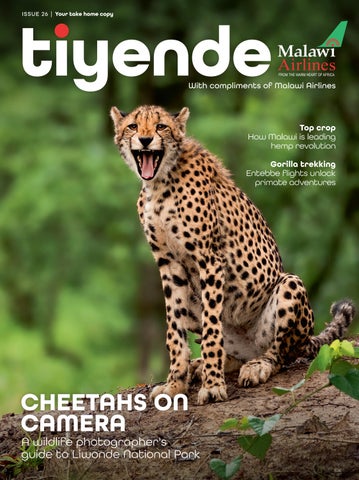
A wildlife photographer's guide to Liwonde National Park


Malawi Airlines’ Public Relations Officer: Joseph Chikalipo josephc@malawian-airlines.com
Editor: Mark Edwards markedwards@landmarine.com
Advertising sales: Lucia Gimson +44 (0)7787 227531 (WhatsApp) lucia.gimson@landmarine.com
by Jamana, Dar es Salaam.
The first quarter of the year is under way, and we hope that our valued customers, stakeholders, and the general public have started 2026 on a positive note.
Last year marked a significant milestone for our national airline. On December 15, we proudly launched a new direct service from our hub in Lilongwe to Entebbe, Uganda, operating four times per week. This route enhances convenience for passengers travelling between the two cities, while also offering seamless onward connections to Johannesburg, Lusaka, and Harare within a short timeframe. This achievement reflects our strong commitment to driving regional economic growth.
As the new fiscal year begins in April, Malawi Airlines reaffirms its commitment to providing high-quality, competitive services to both current and prospective customers, whether travelling for leisure or business across our network.
The year 2026 is about turning plans into reality and vision into action. Our ambition to position the national airline among Africa’s most reputable carriers remains paramount. As the year unfolds, plans to introduce new destinations and increase frequencies on several of our most popular routes are well under way.
Our focus remains firmly on growth, service excellence, and enhanced connectivity. Together with our stakeholders and loyal customers, we are confident that the year ahead will mark another important chapter in strengthening the national airline’s role in regional and global aviation.
Malawi Airlines is flying high thanks to the unwavering support of key stakeholders, including the Malawi Government, through the Civil Aviation Authority; the Ministry of Transport and Public Works; Airport Development Limited (ADL); and others, as well as our strategic partner, Ethiopian Airlines.
Of course, the continued support of our cherished passengers since operations began is deeply appreciated and never taken for granted.

Solomon Bekele CEO, Malawi Airlines
FROM


In December 2025, Malawi Airlines marked a significant milestone in regional aviation with the launch of direct flights between Lilongwe and Entebbe, Uganda. Operating four times per week, the new service underscores the national airline’s commitment to enhancing connectivity, convenience, and economic cooperation within the region.
The introduction of this direct route brings a new level of travel convenience to passengers flying between the two countries. Previously, travellers often endured long layovers across multiple airports, resulting in extended travel times and added fatigue. With the Lilongwe–Entebbe direct service, passengers now enjoy shorter flight times, smoother journeys, and a more comfortable travel experience, making the route ideal for both business and leisure travellers.
Beyond convenience, the route is poised to play a key role in strengthening economic development between Malawi and Uganda. Improved air connectivity is a catalyst for growth, and this service is expected to stimulate tourism, trade, education, and cultural exchange between the two nations. Tourists will find it easier to explore Malawi’s natural beauty and Uganda’s rich wildlife and heritage, while students and professionals will benefit from improved access to educational and commercial opportunities.
The route also holds importance for faith-based travel. Uganda is recognized as a key destination for religious journeys, attracting diverse communities across the region. With a growing number of travellers undertaking pilgrimages and other spiritual trips between the two countries, the Lilongwe–Entebbe direct service

provides a reliable and efficient option for groups and individuals alike.
In addition to serving point-topoint traffic between Lilongwe and Entebbe, the route enhances Malawi Airlines’ broader regional network. Passengers travelling from Entebbe can conveniently connect via Lilongwe to key southern African cities such as Johannesburg, Lusaka, and Harare within a short period of time. This positions Lilongwe as an important transit hub and further strengthens regional integration.
In February 2026, Malawi Airlines welcomed a new cohort of cabin crew. This carefully selected and talented group underwent an intensive threemonth training program in Addis Ababa, Ethiopia, at the Ethiopian Aviation University.
The team successfully completed their training at a time when the airline is expanding its regional network. Recently, the airline launched a direct flight from the Malawian capital, Lilongwe, to Entebbe, Uganda. We have also added three more direct flights from Lilongwe to Johannesburg,

bringing the total number of flights on the route to 10 per week.
With the addition of this new cohort, Malawi Airlines’ service delivery will continue to improve. The team is fully prepared and committed to bringing our
warm Malawian hospitality and worldclass service to every flight.
The new cabin crew bring fresh energy, professionalism, and a shared passion for delivering exceptional customer experiences. Their training focused on safety, service excellence, and international aviation standards to ensure passengers enjoy a comfortable and memorable journey.
As Malawi Airlines continues to grow, investing in skilled people remains central to our mission of connecting Malawi to the region and beyond.


As rock climbing gains momentum in this mountainous country, a home grown movement is ensuring the sport grows with local climbers at its core.
ith more than 1,400 named mountains shaped by the geological forces of the Great Rift Valley, Malawi is gaining a reputation as an emerging rockclimbing destination.
Climb Malawi is working to ensure that the sport’s growth is driven as much by local Malawians as by the international climbing community. Founded in 2018, the non profit club began with a small climbing wall in the back garden of founder Tyler Algeo’s Lilongwe home. Since then, it has grown into a central force in the country’s emerging climbing scene. It operates an indoor climbing centre with bouldering walls in Lilongwe and organises trips to outdoor climbing locations. The trips make use of the more than 100 bolted routes the club has established across Malawi for climbers of all levels
Climb Malawi board member Maha Chairi says: “The idea was to create
a space where people in the country could discover climbing, train together, and build a local climbing community. We are passionate about climbing and we didn’t want it to be seen as something exclusively for foreigners but wanted to share it with Malawians to be able to join in, make it their own and be able to enjoy what their nature and rock has to offer in their own country.”
There are now around 50 Malawians among the club’s membership with the rest made up of expats. “It is growing slowly but surely,” says Maha. “Climb Malawi brings together a mix of different age groups and backgrounds. The community includes Malawians, resident expatriates, and people who return regularly and continue to climb with us when they are in

the country.
We also see a growing range of participants, from children and families to young adults and more experienced climbers. It makes the climbing centre not only a place for sport, but also a place for exchange and community building.”
Maha and fellow board members Tyler and Ann-Kathrin Lichtner are involved in initiatives aimed at making climbing more accessible to young people and women in Malawi. In a country in which many young people have little to no income for discretionary spending, a crucial step has been limiting the financial obstacles to getting involved with climbing. Partnerships with the Global Climbing Initiative (GCI), a non-profit organisation that empowers local climbing communities worldwide, and international donors means all equipment – from harnesses and ropes to climbing shoes in all sizes – is provided free. The club’s sliding scale membership structure has international climbers and wealthier Malawians pay full price (around US$ 20 each month)


"It is a safe and supportive space, particularly for female climbers, where they can try, learn, and challenge themselves with confidence."
to use the centre and for outdoor trips, allowing others to contribute on a pay-what-they-can basis.
Veronica Baker Amores, GCI executive director, says: “Climbing has the potential to provide a new form of recreation and outdoor tourism in Malawi. The Global Climbing Initiative’s role for the past three years has been to bridge Climb Malawi to skills and resources like guide trainings, climbing walls, and safety equipment so that this sport can grow.”
Together, the CGI and Climb Malawi also provide mentorship opportunities to support Malawians on their climbing journey and foster leadership and technical skills within the growing community. Maha says: “Young Malawians who are interested in climbing often begin by volunteering at the centre, helping with activities and gaining regular climbing experience indoors
and outdoors.
“For those who show strong interest, commitment, and ability, we provide additional training opportunities so they can develop their technical climbing skills, safety knowledge, and teaching abilities. Our goal is to gradually build a local generation of climbing instructors and leaders who can guide others and support the growth of the climbing community in Malawi. The first group of climbers currently going through this process is expected to graduate as trainers this year.”
So, what’s the best way to get started if you’re new to rock climbing in Malawi? According to Kelvin Banda, one of the climbing instructors at the centre, the first step is a visit to Climb Malawi’s

flagship training gym in Lilongwe. “The climb centre is in [central Lilongwe neighbourhood] Area 18
A and serves as the main hub of the climbing community. It has a covered boulder wall up to four metres high. You climb without ropes but there are thick crash mattresses on the floor to protect in case of a fall. No special skills or fitness levels are needed, and climbing can be done by everyone.”
All are welcome. Lilongwe offers relatively few public spaces for social interaction, making the community focused environment created by Climb Malawi particularly important. “It is very important to have a place where youth especially can try themselves out and interact with people from different ages, cultures and countries,” says Maha. “It is also a safe and supportive space, particularly for female climbers, where they can try, learn,
and challenge themselves with confidence.”
Once climbers have built confidence and technique indoors, they can join the regular trips the club organises to outdoor crags across the country including the towering cliffs of Nathenje and Nkhoma near Lilongwe; Ndirande Crag near Blantyre; and the steep, demanding face of Chambe Peak in the Mulanje massif. The Climb Malawi team has been creating new climbing routes across the country so people can safely climb outdoor cliffs using ropes and harnesses, with a partner below controlling the rope to stop any fall. Shalom Maholo, one of Climb Malawi's strongest climbers and the first Malawian woman to bolt a new climbing route in the country, says the intention is to create a variety of difficulty levels. “The routes are dictated by the rock and

nature, but when starting to set up routes we try to find features and routes that are easy as well as challenging ones. This helps new climbers progress gradually as they gain experience.”

Whatever their level or pace of progress, Maha says climbers at Climb Malawi are never short of support. “Climbing is often about setting yourself a personal goal or a project,” she says, “but at Climb Malawi you rarely do it alone. There is always a group around you cheering you on and helping you succeed.”
To organise your first visit to Climb Malawi, visit https://www.climbmalawi.com/

Photographer Harman Singh Heer reveals why it is such an inspiration to turn his camera on the spectacular wildlife of Liwonde National Park.
“You can't force a moment, rather you have to wait for it to unfold”

ith a diverse array of wildlife – including the Big Five – to be seen roaming riverbanks, palm-fringed floodplains, and baobab-studded woodlands, Liwonde National Park is a photographer’s dream.
The picturesque park in Southern Malawi is an all-year attraction. The dry season (from May to October) is the most popular with visitors due to the high densities of animals such as elephants, waterbuck, impala, sable antelope, and buffalo, lions, and cheetahs that congregate along the Shire River.
However, freelance photographer and safari planner Harman Singh Heer found the park is arguably even more majestic when the rains come. “The entire park was draped in the most beautiful, rich green,” he says. “The banks of the Shire River were full of life, with birds flitting between the reeds, stunning wildflowers scattered across the landscape, and the park’s iconic palm trees adding to the scenery.
“With such a vibrant colour palette, it was easy to incorporate the unique landscape into my wildlife photography. I often chose to shoot wide, using my 16–35mm lens to capture elephants moving along the riverbanks – arguably one of my favourite moments from my time there.”

The Shire River – the only outlet of Lake Malawi and the largest river in the country – is a vital water source for wildlife. In the wet season (from November to April) its waters swell causing extensive flooding that replenishes the ecosystem. The section of the river in Liwonde is home to one of the largest hippo populations in Africa as well as plenty of Nile crocodile. The start of the wet season provides the optimal conditions of humidity and moistness for crocodile eggs to hatch – a fascinating stage of the reptile’s life cycle that Harman was able to catch on camera. “An unforgettable experience was seeing a Nile crocodile with about thirty hatchlings, something I had never witnessed before,” he says. “It was a special sight and one of those moments in the bush that undoubtably stays with you.”
The wet season is the prime birthing period for many mammals as well. The increased rainfall creates lush, green conditions with abundant food, and camouflage – making it ideal for raising young. Harman was lucky enough to witness this

while in Liwonde and get some heartwarming images. “We got lucky enough to spend time with a cheetah and her young cub who were sitting on an elevated mound during a light drizzle with the most stunning green background,” he says.
The thriving cheetah population in Liwonde like much of the park’s current wildlife density is due to the rehabilitation work of African Parks. The non-profit conservation organisation’s management of Liwonde – in partnership with Malawi’s Department of National Parks and Wildlife – began in 2015 and has been transformational. Over the past decade, Liwonde has gone from a depleted poacher’s haven with severe human-wildlife conflict into a thriving, secure wildlife sanctuary. Predator populations such as cheetah, lion, and wild dog have been restored, and the Big Five park is now a breeding site for the critically endangered black rhino. Harman’s presence behind the lens
adheres to Liwonde’s conservation protocols, prioritising animal welfare and environmental integrity over getting the perfect shot. “The animal comes first, always,” he says. “If there are signs that the animal is uncomfortable with us, we will leave. If there are too many vehicles at the sighting, we will leave. It’s as simple as that.”
Born in Kenya, Harman’s photography began taking pictures with his mum’s camera on regular family trips to the Masai Mara. The passion became a profession in 2023 when he launched Mzuri Safaris and began co-hosting and co-guiding photographic safaris in Africa.
Capturing a memorable wildlife image, he says, is a discipline. Patience, silence, and respect for the natural world win over the staged capturing of moments. “I’m especially drawn to wildlife photography because it is unscripted, raw, and real. You can't force a moment, rather you have to wait for it to unfold, and sometimes that means waiting months, or even years, for the image you've envisioned.”


Clear waters, colourful fish and not a car in sight: welcome to the remote Lake Malawi islands of Likoma and Chizumulu.

ikoma and Chizumulu are two inhabited islands set in the northeastern waters of Lake Malawi. Despite being surrounded by Mozambican waters, both islands belong to Malawi due to their colonial-era missionary history. Their remoteness –far from Malawi’s mainland bustle – gives them an off grid, undiscovered feel.
Likoma is the larger island – around 18 sq km – with several small settlements and a historic cathedral. Chizumulu is smaller, hillier, and even quieter, with fishing villages and simple footpaths shaping its landscape.
Reaching either island is part of the adventure:
BY FERRY
MV Ilala – the historic, slow-travel ferry that runs up and down Lake Malawi. It stops at Likoma and Chizumulu, taking five to eight hours from Nkhata Bay on the lake’s western shore.
Likoma Express – a newer, faster ferry service between Nkhata Bay,


Dwangwa, and Likoma, with a travel time of about 2.5 hours.
Between the two islands, local dhows and small boats shuttle passengers across the short channel.
BY AIR
Light aircraft and charter flights from Lilongwe, Blantyre, or Nkhata Bay land at Likoma’s small airstrip.
Both islands have no real roads and no cars –just footpaths and the rhythm of lake life. Days are shaped by fishing boats, barefoot walks, and sunsets instead of schedules.
Chizumulu can be walked around in about three hours, thanks to its well built circular path.
LIKOMA
Kaya Mawa – Luxury, award winning eco lodge that is one of the most exclusive and expensive accommodation options in Malawi.
Ulisa Bay Lodge – Mid range lodge. A collection of chalets set around Ulisa Bay, all with stunning views over the lake and arguably one of the best sunsets in Africa.
“The absence of modern infrastructure invites visitors to unplug completely –perfect for travellers seeking digital detox, hammock time, and peace.”
Blue Gum Cottage – Friendly family-run stay with excellent hosting
There are no major resorts on Chizumulu but you’ll find small, welcoming, family-run guesthouses.
Dry season (May to October) Best weather, calm waters, top snorkelling visibility.
Wet season (December to March) Beautiful but ferries can be disrupted, and underwater visibility decreases.


“Days are shaped by fishing boats, barefoot walks, and sunsets instead of schedules”

Likoma provides the more varied mix of culture and nature:
Snorkelling and diving – among Lake Malawi’s best, with endemic cichlids and exceptionally clear waters. The PADI-accredited Likoma Island Divers operate here. With calm, clear water this is a wonderful spot for beginner divers to gain confidence underwater.
St. Peter’s Cathedral – the biggest of its kind in Malawi. Built from granite in the early 1900s as a real-size replica of Winchester Cathedral in the UK.
Nkhaji Nature Park – a conservation area aimed at preserving the islands natural, forested, and rocky landscapes. It offers a serene, nature-focused experience, featuring trails. Still in the development stage, there are plans for a bar, restaurant, and accommodation.
Beaches and swimming – clean, quiet, uncrowded beaches with transparent water. Village visits and local markets – meet warm communities, taste local food, and explore everyday island life.
Hiking and baobab walks – the island terrain is dominated by baobab trees and trails weave around them to rocky viewpoints over the lake.
Craft and culture - visit Shrubs Art Craft & Culture Gallery at ferry docking point Jalo Port for local art, textiles, and recycled crafts.
Quieter than Likoma, Chizumulu offers an even more untouched experience:
Village walks – authentic insight into Malawian rural life: fishermen mending nets, children playing by the lakeshore, and elders under mango trees.
Snorkelling straight from shore – Crystal clear shallows filled with colourful cichlids – no boat needed.
Hilltop hikes – two main hills offer sweeping lake panoramas, especially at sunrise and sunset.
Kayaking and local boat trips – gentle waters ideal for paddling and exploring coves.


Tanya Clarke, the founder and director of pioneering Malawian company Invegrow Ltd, reveals how more than a decade of research and regulation is transforming hemp and medical cannabis into new growth sectors for the country.

cross the world, countries are rediscovering the remarkable potential of the cannabis plant. Once viewed through a narrow lens, the plant is now being recognised for two distinct and valuable industries: industrial hemp and medical cannabis. Together, they represent a powerful opportunity for countries like Malawi to develop new agricultural value chains, improve healthcare access, and participate in emerging global markets.
Malawi, with its fertile soils, favourable climate, and strong farming tradition, is well positioned to play a leading role in this growing sector.
The journey towards a regulated cannabis and hemp industry in Malawi began more than a decade ago. In 2013, Malawian company Invegrow began engaging with government authorities to explore the possibility of introducing industrial hemp as a regulated agricultural crop.
At the time, the potential of hemp was not widely understood. Industrial hemp contains extremely low levels of THC – the compound responsible for psychoactive effects – and is grown for food, fibre, construction materials, and industrial applications.
After several years of discussion and advocacy, the Malawian government authorised industrial hemp trials in 2015, approved by the President and conducted at the government Agricultural Research Station in Lilongwe. Working alongside Malawian researchers and agronomists, Invegrow helped
establish trial plots to study the performance of hemp varieties in local conditions.
These trials demonstrated that hemp could thrive in Malawi’s climate, helping lay the foundation for a new agricultural industry.
Building on this research, Malawi passed the Cannabis Regulation Act in 2020, establishing a legal framework for the cultivation of both industrial hemp and medical cannabis with the legal Tetrahydrocannabinol (THC) limit set at 1 per cent for industrial hemp. The legislation created the Cannabis Regulatory Authority (CRA), which oversees licensing, compliance, and industry standards to ensure responsible development of the sector.
The act positioned Malawi as one of the pioneering countries in Africa to develop a regulated cannabis industry focused on agriculture, research, and responsible international trade. Since then, there have been licences issued and renewed, and a focus on how Malawian farmers and co-operatives can get involved in the sector.

Hemp is a versatile and fast-growing plant
Industrial hemp is one of the most versatile plants cultivated today. The seeds are rich in protein, essential fatty acids, and minerals, making them ideal for health foods such as hemp hearts (dehulled hemp whole seeds), protein powders, and plant-based oils.
The stalks produce strong natural fibres that can be used for textiles, insulation, biodegradable plastics, and sustainable building materials.
Hemp can also play a role in soil regeneration, crop rotation, and renewable energy production, making it attractive for sustainable agriculture systems.
For farmers and processors, hemp offers the possibility of building entire industries around a single crop, from farming and food production to construction materials and bio-based manufacturing.
Alongside industrial hemp, medical cannabis is becoming an important area of research and development globally.


Cannabis-derived medicines are increasingly used in many countries to support patients suffering from conditions such as chronic pain, epilepsy, multiple sclerosis, and other neurological disorders.
For Malawi and the wider African region, the development of a regulated medical cannabis sector presents a unique opportunity.
Not only does it allow the country to participate in high-value international pharmaceutical markets, particularly in Europe, but it also opens the door to exploring how low-cost cannabis-based medicines could improve access to pain management and other treatments for patients locally.
As healthcare systems around the world look for safe and affordable alternatives to traditional pharmaceuticals, cannabis-based medicines may play an important role in expanding treatment options.
While international exports are important, the real opportunity may lie in building regional markets across Africa.
Demand for plant-based medicines, natural health products, and sustainable agricultural products is growing rapidly across
the continent. Hemp foods, natural wellness products, fibre-based materials, and medical cannabis products all have the potential to support regional trade within the African Continental Free Trade Area (AfCFTA).
By developing processing, research, and manufacturing capacity within Africa, countries like Malawi can help ensure that the value created by these industries remains within the region.
Companies such as Invegrow have been at the forefront of this development, working alongside government authorities, researchers, and international partners to help establish Malawi’s cannabis and hemp sector.
From early advocacy and research trials to developing cultivation, genetics, and processing expertise, the company continues to support the responsible growth of the industry while promoting Malawi’s reputation as a producer of high-quality agricultural products.
The goal is not only to export raw materials but to build integrated value chains that include cultivation, processing, product development, and manufacturing.

The story of hemp and medical cannabis in Malawi is still being written. But the foundations are now in place for a new generation of agricultural innovation.
With the right investment, research, and collaboration, these crops could contribute to job creation, improved healthcare access, sustainable agriculture, and stronger regional trade across Africa.
For visitors flying over Malawi’s fields today, the landscape below represents more than farmland – it represents the promise of new industries rooted in African soil, driven by innovation, and connected to a global future.


Malawi has some very high-end hospitality options for a luxurious stay in the Warm Heart of Africa. From a five-star fit for a President to an exclusive island retreat, here’s our choice.
Origin story: Designed by Dutch architect G. Hooft Graafland, Pumulani was created as the flagship lakeside lodge of Robin Pope Safaris – a family-run safari company led by renowned guide and walking safari pioneer Robin Pope. Its striking modern curved buildings blend in with the hillside landscape on the Nankumba Peninsula within the Lake Malawi National Park.
Who should stay here? Adventure inclined luxury travellers, families, honeymooners, and guests seeking both tranquillity and high end lake activities.
Luxury features: Ten spacious villas with grass roofs for cooling, private decks, large en suite bathrooms, two swimming pools (one infinity), a private beach, stargazing telescope, dhow cruises, waterskiing, sailing, kayaking, snorkelling, and exceptional views over the “Lake of Stars.”
Why you should stay here: It delivers the perfect blend of relaxation and activity – a modern, secluded luxury lodge with unparalleled lake vistas and exceptional service.

Origin story: Built in the 1920s and 1930s by Maclean Kay, the founder of Satemwa Tea Estate, Huntingdon House was originally the family home and remains one of Malawi’s most historic colonial residences. Satemwa is among the oldest tea estates in Africa, with deep agricultural heritage and generations of Kay family stewardship.
Who should stay here? Heritage lovers, tea enthusiasts, honeymooners, and guests seeking a deeply atmospheric and personalised country house experience.
Luxury features: Five individually themed suites (e.g., The Chapel, Planter’s Suite), manicured gardens, estate tours, tea tastings, colonial era lounges, fireplaces, claw foot bathtubs, and exceptional personalised service from the estate team.
Why you should stay here: It’s one of Malawi’s most characterful and historic luxury stays – intimate, storied, and surrounded by rolling tea fields with exceptional scenery.

Origin story: Malawi’s first five-star hotel owes its name to the key role played by President Bingu wa Mutharika in its creation. Malawi’s third president wanted a venue to host high-profile international events and boost Malawi’s tourism and foreign investment. The resulting Umodzi Park complex was opened to the public in 2014, two years after Bingu wa Mutharika’s death, and during the reign of his young brother Peter Mutharika –who was then the country’s fifth president. But he would return to win the 2025 elections and serve once again as Malawi’s highest-ranking official.
Who should stay here? Business travellers will love it. The hotel is

Degrees (Lilongwe)
Origin story: Latitude 13 Degrees is a design driven boutique hotel
located in the leafy northern edge of Lilongwe. Part of the pan-African Latitude Hotels group each named for its precise geographical coordinate location that includes Kampala (Latitude 0 Degrees) and Lusaka (Latitude 15 Degrees). With 20 long stay apartments, garden suites, and club rooms, it has become a stylish hub of art, culture, and hospitality in the capital.
Who should stay here? Creative professionals, business travellers seeking a non corporate feel, and leisure guests who appreciate modern
located in the heart of Lilongwe’s business centre and the lush Umodzi Park houses the hotel with its 130 rooms and suites as well as the Bingu wa Mutharika International Convention Centre (BICC) making it the primary hub for large-scale summits and corporate events in Malawi.
Luxury features: The 130 air-conditioned rooms include executive rooms and expansive presidential suites with butler service. Key amenities include an outdoor pool, a terrace bar with panoramic city views, and a fitness centre. Excellent dining options include the Wild Orchid restaurant, which serves a variety of cuisines, and a poolside pizza parlour.
Why you should stay here: Top-tier service and a location that is moments from the business district, yet shrouded in tranquil, verdant gardens.
design, art, and a lively social scene. It’s also ideal for long stay visitors due to its apartment options.
Luxury features: A state of the art gym, spa, 18 metre heated pool, lush gardens, an acclaimed restaurant and bar serving global cuisine, multiple event and meeting spaces, and interiors that feature the work of local artisans.
Why you should stay here: A standout boutique experience in Malawi’s capital with exceptional service and ambiance.
Origin story: Amaryllis is Blantyre’s leading modern luxury hotel, conceived as a high rise, contemporary property offering international standard accommodation, dining, and conference facilities. It positions itself as Malawi’s most luxurious urban hotel
Who should stay here? Business travellers, conference attendees, and guests wanting polished modern luxury with strong dining and leisure options.
Luxury features: 91 rooms and suites with balconies or terraces, panoramic Blantyre views, three restaurants, rooftop amenities, spa facilities, fitness centre, pool, high speed internet, conference suites, and private dining rooms.
Why you should stay here: It’s the top luxury choice in Malawi’s commercial capital – modern, efficient, stylish, and equipped for both relaxation and high level business.


Origin story: Opened in 2004 and built using local materials by island craftsmen, Kaya Mawa (‘maybe tomorrow’) is repeatedly ranked among Africa’s most romantic lodges. It was Malawi’s first renewable energy run resort and is renowned for sustainability and community empowerment.
Who should stay here?
Honeymooners, luxury beach seekers, families wanting an intimate island escape, and travellers


who appreciate barefoot luxury and aquatic adventure.
Luxury features: 11 uniquely designed stone and teak rooms and houses, many with private plunge pools or private decks; award winning cuisine; spa treatments overlooking the lake; world class snorkelling and diving; sailing, kayaking, kitesurfing, quad biking, and sunset cruises.
Why you should stay here: Kaya Mawa is an idyllic, award winning lodge offering one of Africa’s most magical lake island luxury experiences.


Origin story: Situated on a spacious 65 acre eco estate on the outskirts of Lilongwe, Eden Estates blends modern luxury with botanical tranquillity. It was created as a nature immersive retreat providing high end stays within easy reach of the city.
Who should stay here? Travellers seeking a peaceful, nature rich environment – families, couples, wedding groups, and corporate teams looking for privacy and relaxation.
Luxury features: High ceilinged deluxe rooms, family cottages, studio loft apartments, landscaped gardens, a sparkling pool, water park features, botanical pathways, and weekly cultural events such as farmers’ markets and outdoor movie nights.
Why you should stay here: Perfect for guests wanting a calm, green, upscale hideaway near the capital.

Origin story: Founded in 1921 by Louisa Ryall, this is Malawi’s oldest hotel and a historic icon. It evolved from early colonial lodging into a major business hotel and is now run by the Marriott group.
Who should stay here? Business travellers, heritage enthusiasts, diplomatic visitors, and guests seeking reliable international brand service with local charm.
Luxury features: 117 elegant rooms and suites, fine dining at the renowned 21 Grill on Hannover, outdoor pool, lush gardens, conference centre, spa, fitness facilities, and central city location.
Why you should stay here: A timeless hospitality landmark –refined, historic, and exceptionally well managed.

‘An hour with the BWINDI GORILLAS is a blessed lifetime’

The recent launch of Malawi Airlines’ flights from Lilongwe to Entebbe connects our passengers the Uganda’s world-renowned gorilla treks. Jonnie Bayfield shares his unforgettable mindful moment with a clan of mountain gorillas in the forests of Bwindi Impenetrable National Park.
n the drive, from Kampala, to the Bwindi Impenetrable rainforest, the home of nearly half of the world’s remaining endangered mountain gorillas, storm clouds gather overhead. It’s November, the short rainy season. Our guide and driver Paul Ochan, of Great Lakes Safaris (one of the country's leading tour operators) throws back a wry smile. He knows what awaits us in the sodden jungle, “Let’s hope you reach the gorillas before the rain does!”
At 7.30am the next morning there’s around 50 of us packed into Bwindi’s tourist hub. The forest hosts 20 habituated gorilla families, spread across four sectors, and ranging in size and temperament. A stern, uniformed tracker tells us: “Bwindi is called the impenetrable rainforest for a reason.”
My companion and I realised that this tourist trek was not to be the walk in the park we’d imagined. We were told we would be trekking for a minimum of two hours through dense vegetation, up steep slopes, and across muddy trails.
The gorillas cannot simply be stumbled upon, we are told. The human-gorilla connection in Bwindi is a process of careful habituation that began in 1991 and is key to the thriving primate population here.
Clearly, for the endangered mountain gorilla then, it pays to stick close to their human cousin

– we share around 98 per cent of our DNA. With climate concerns in full swing, their problems are now our problems too. By the time a family has been successfully habituated, we’re told, via daily visits from the expert tracking teams, us tourist trekkers are, in essence, considered nothing less than members of the extended family.
Split into intimate groups of no bigger than eight, we’re soon assigned a set. We are en route to the Rushegura clan. They are the largest, numbering 16, and supposedly the ‘nicest’, though I'm not entirely sure what a ‘nice’ gorilla looks like. “If the gorillas don’t charge or throw excrement,” I’m
Bwindi Impenetrable National Park is home to more than half of the world's mountain gorillas
told, half-jokingly by one of our two armed guards, “then you mzungu (Swahili for foreigner) are basically family.”
However, before we get into the nitty gritty of excrement etiquette, we’ve still got to find them. Bwindi covers 331 sq km, and crosses borders with Rwanda and the Democratic Republic of the Congo. Luckily, the team of expert trackers have been up since dawn on reconnaissance and located the Rushegura gorillas. We pile into the Land Cruisers and scale up and through sheets of white fog that lingers over verdant tea plantations and on corrugated iron roofs so rusted by the season that they perfectly match the bright, churned up, terracotta dirt roads that slice
“Bwindi is called the impenetrable rainforest for a reason”

across the face of the hills here. At the top, we’re handed over to the trackers and armed guards. Our guide smirks at my companion’s choice of footwear – a pair of beaten up Skechers trainers –incongruous against the rest of the group's elite hiking boots.
For two hours we tackle challenging, yet stunning terrain; thick paths winding up steep ridges, and down into overgrown valleys. It’s humid at this height, and the threat of rain is ever present. After passing a large, bowl-shaped depression in a patch of hedgerow, our armed guard says: “Bush elephant, this is where it sleeps”. There’s no sign of the gigantic animal itself but heaps of elephant dung lead us into the thick foliage of the rainforest basin towards the ever-shifting home of the Rusheguru gorillas. After just over two hours on foot, our tracker placing a finger over his lips, “The family”, he tells us, “are just beyond this clearing.”
All I can make out is a rustling in the trees. Bags are dropped, cameras primed. One by one, we slowly enter the clearing, not entirely sure what we will find
within. A branch snaps in the distance. About 10 metres away, sitting upright within a forest of long, thin tree trunks, is a calm, still silverback. It’s the dominant male known as Kabukojo and he is massive. We stand and stare in awed silence. The silverback – utterly indifferent to our presence – rolls down onto all fours. Another snapping branch, this time behind us. A mother, her belly swollen by the fermenting greens inside, duly walks towards us on all fours. There is a small, jet-black infant dangling from her neck. The next hour feels like a blessed lifetime. We stand in communion with the gorillas as more emerge from the surrounding forest, some even brushing our knees to get by, or gently baring their teeth to encourage us to clear the way. Having gorged on leaves and shoots, the Rushegura clan laze around us in a circle, like discarded soft toys. All are within touching distance. Clearly curious, it’s the eyes of the few infants that are forever fixed on us human onlookers, though when they do try to tempt us to play, our stern guides step in, to ensure distance is maintained. What’s clear is that there is a curious, moving tranquillity to

the whole thing, to the pilgrimage of one species wanting only to observe another. And with that, our peaceful, meditative hour or more in gorilla world is up, and we begin the long walk back to civilization, though noticeably quieter, still somewhat shocked by the grace, and relative ease of the encounter. The privilege is lost on no one –tourists, guards, or guides alike.

Jonnie was a guest of Great Lakes Safaris (www.greatlakessafaris.com) who operate tours across East Africa. Accommodation was provided by Mahogany Springs Lodge (www.mahoganysprings.com) and Clouds Lodge, by Wild Places Africa (www.wildplacesafrica. com/clouds-mountain-gorilla-lodge)


Climbing the 948 steps of Johannesburg’s Ponte Tower is a test of fitness that rewards successful participants with one of the best views in the city. Are you up for the ‘Ponte Challenge’?


he Ponte Tower has been one of Johannesburg’s most recognisable landmarks since it was completed in 1975. Standing at 173 metres tall, the striking cylindrical skyscraper was Africa’s tallest residential building for decades.
As well as being an iconic part of the Joburg skyline, Ponte Tower has become a symbol of the city’s struggles as well as its recent resurgence. Once a luxurious, white-only apartheid-era apartment block, it decayed into a ‘vertical slum’ notorious for crime, gangs, and decay in the 1990s before undergoing a major, ongoing renovation. It now houses roughly 2,500 to 3,000 residents, serving as a rental-only building for working-class people, students, and young professionals.
Dlala Nje (‘Let’s Play’ in isiZulu) is a community-focused tour company based in Ponte Tower that aims to challenge perceptions by offering visitors a real look at life in the city. The social enterprise has come up with ‘The Ponte Challenge’ – an innovative way for visitors to experience Ponte Tower life and the spectacular views from its rooftop.
As Dlala Nje co-founder Nickolaus Bauer points out, visitors will have to earn that amazing view.
“The Ponte Challenge is an urban adventure that tests your fitness and pushes your boundaries,” he says. “From the base, participants enter the stairwell that spirals up the inside of the building, climbing 948 stairs to the 54th floor.
“At the finish line on the 54th floor, climbers receive their medal and then make their way to our skyline venue: 5101. Here they are greeted by a stupendous 270-degree view of the City of Gold and receive a well-earned breakfast made up of local treats like magwinyas (popular Southern African deepfried dough balls) and polony (sliced sausage meat) alongside fresh fruit and juices.”

“Our approach is simple: tell the full story of Johannesburg by challenging perceptions and creating opportunity”
He adds: “Our approach is simple: tell the full story of Johannesburg by challenging perceptions and creating opportunity. The inner city is often spoken about through tired stereotypes of dread, danger and despair. But the reality is far richer. It is one of the most culturally diverse parts of the city – full of families, entrepreneurs, street traders, artists and young people PONTE
How you approach the ascent is up to your inclination and fitness
ability. Fitness enthusiasts can run it – the current record stands at five minutes and 47 seconds – but most walk. However you get to the top, it will be a challenge. “The experience unfolds in stages,” says Nickolaus. “The first third is about finding rhythm and pacing. The middle section is where the legs begin to burn and people realise the scale of the challenge. The final stretch is pure determination – the moment where most participants discover just how far they can push themselves. Along the way there are marshals positioned at key points to guide and encourage participants. While a few competitors chase the course record, for most people the real victory is simply completing the climb.”
The monthly challenge

– it usually takes places on a weekend morning – offers a unique perspective on a striking piece of architecture that tells the story of Johannesburg itself.
Dlala Nje is playing a significant role in highlighting the positive, evolving, and vibrant inner-city that is, in the words of Nickolaus, “becoming a thriving residential community again”.


building new lives.”
While Nickolaus points out that the Ponte Challenge offers just a “sneak peek” into the area’s history and culture in comparison to Dlala Nje’s other immersive walking tours in the surrounding Hillbrow community, participants are directly supporting the work of Dlala Nje. “All our tours and events help sustain two fully fledged youth development centres at the base of Ponte Tower,” Nickolaus says. “These centres provide a safe space for children from the surrounding neighbourhoods to simply be kids – to play, learn, receive support and spend time in an environment designed for their wellbeing. Today, more than 100 children benefit from these programmes. From our weekday homework clinic and rooftop garden to classes in IT, yoga and pantsula (an energetic, syncopated urban dance form that originated in the townships of South Africa).”
The Dlala Nje guides all started as children attending these centres. Grant Ngcobo, who was one of the first young people to benefit from the programmes is now the social enterprise’s CEO. “His journey reflects exactly what the organisation hopes to achieve – creating opportunity where it did not previously exist,” Nickolaus says. “We are the community for the community by the community.
“In that sense, every climb at the Ponte Challenge does more than test someone’s endurance. It helps ensure that the doors at the bottom of the tower remain open for the next generation growing up in Johannesburg’s inner city.”
For information on the next Ponte Challenge and the other inner-city tours organised by Dlala Nje, visit https://dlalanje.org/ or @dlalanje on Instagram.
Malawi Airlines First Officer Christopher Kachinga shares his aviation story with Tiyende

OCan you briefly tell us about yourself and your work history with Malawi Airlines?
My name is Christopher Kachinga, and my journey with Malawi Airlines has truly been a full-circle aviation story. I started out as a cabin crew member, which gave me the incredible opportunity to serve passengers directly and experience the heartbeat of the airline from the cabin.
Those years shaped me in many ways. I learned about teamwork, safety, professionalism, and how much small details matter in creating a great passenger
experience. Today, I serve as a First Officer, a role I once looked at with admiration from the cabin. Being able to contribute now from the cockpit feels both humbling and deeply rewarding.
Q: What inspired you to start as a cabin crew member, and what motivated your transition to becoming a pilot?
Aviation has always fascinated me. Becoming a cabin crew member was my entry point into that world, and I embraced it fully. I loved interacting with passengers, traveling, and being part of a crew that ensures safety and comfort at 35,000 feet. But I’ll be honest – every time I walked past the cockpit door, I felt something. Watching the pilots prepare for departure, listening to their briefings, and seeing the responsibility they carried sparked a bigger dream in me.
At some point, I realized that dream wasn’t going away. It wasn’t just admiration – it was a calling. That’s when I decided to pursue becoming a pilot.
Q: How was the transition between the two roles? What challenges did you face, and how did you overcome them?
The transition was exciting, but definitely not easy. Moving from
the cabin to the cockpit meant stepping into a completely different world. The academic intensity of pilot training – mastering aircraft systems, understanding meteorology, navigation, and decision-making under pressure –was demanding.
There were moments of doubt, moments of exhaustion, and financial sacrifices along the way. But I kept reminding myself why I started. I leaned on mentors, stayed disciplined, and trusted the process. Looking back, every challenge shaped me. It taught me resilience and reinforced that growth often happens outside your comfort zone.
Q: Having worked both in the cabin and the cockpit, how has your understanding of passenger experience and airline operations evolved?
Working in both roles has given me a unique perspective. As cabin crew, you see the human side of aviation – the nervous flyer, the excited family, the business traveller on a tight schedule. You’re the face passengers connect with. Now, in the cockpit, I see the bigger operational picture, such as weather decisions, fuel planning, safety assessments, and the responsibility of getting everyone safely from point A to point B. Because of my cabin experience,
I’m more mindful of communication and teamwork. I understand how critical the relationship between the cabin and cockpit is. Aviation is never a one-person job; it’s a synchronized effort.
Q: What advice would you give to someone in the aviation industry who aspires to transition into a pilot role?
I would say: don’t let your current position limit your future vision. If you’re already in aviation – even outside the cockpit – you’re closer than you think. Stay curious. Ask questions. Learn from those ahead of you.
Most importantly, be prepared to work hard. The journey is demanding, but it’s absolutely possible. If you stay consistent, disciplined, and believe in yourself, you can move from dreaming about the cockpit to sitting in it. I am living proof.
Lastly, I give thanks to God for guiding my journey and for giving me the strength to pursue the dream He placed in my heart. I truly believe this journey was part of God’s plan for my life, and I’m grateful for His grace every step of the way.


Tiyende shares the statistics on this wildlife-filled wetlands on the westernmost edge of Malawi.
300
The reserve’s forest, grassland, and marsh fed by the Nyika Plateau provide a rich habitat for birdlife. Nearly 300 species of birds have been recorded including stork, heron and the white-faced tree duck.
200-250
The estimated number of elephants in the reserve – that’s the largest population of elephants in northern Malawi. Herds of up to 100 collect around Lake Kazuni.
4/5

Four of Africa’s ‘Big Five’ are found here – elephant, buffalo, lion and leopard, but no rhino.
110 km
Length of the solar powered fence co designed with neighbouring communities to reduce human-wildlife conflict along the reserve’s boundary.

300-
The number of hippos using Lake Kazuni, which is a magnet for wildlife in the dry season, and for elephants and waterbirds in the dry season (May to October).

1,661 m
While the reserve is largely characterized by low-lying flat ground, its eastern side is hilly with Mpanda being its highest point.

48
Mammal species documented in Vwaza’s wetlands and woodlands – from numerous antelopes and primates to elusive predators such as lions and leopards.
398
The total plant species identified here. Vwaza is one of Malawi’s most botanically diverse protected areas.

Perched on a plateau, this hidden gem in Northern Malawi rewards visitors with its blend of history, scenery, adventure, and community.
From a vantage point 900 metres above Lake Malawi on the Rift Valley escarpment, Livingstonia offers some of the most dramatic vistas in the country. From the edge of the plateau, the landscape drops away into a wide blue sweep of lake and bordering mountains in Mozambique and Tanzania.
Founded in 1894 by Scottish missionary Dr Robert Laws, Livingstonia was established after earlier missions on the lakeshore succumbed to malaria. Eventually settled in the cooler highlands, the mission built a church with stained glass windows, schools, workshops and what is now the Stone House Museum – once Laws’ own home and today filled with original photographs, artefacts, and early mission furniture. Walking the town is like stepping into a living museum of colonial Malawi’s early educational and social development.
Getting to Livingstonia is part of the thrill. Whether you brave the 21-hairpin bends of the steep Gorode escarpment road by 4x4 or choose the slower, scenic hike from Chitimba, the ascent has become iconic. Travellers often stop at viewpoints or cool off at scenic spots along the route – making the approach not just transport, but one of the highlights of the visit itself.
A short trek from town lies Manchewe Falls, a spectacular 125 metre waterfall, the highest in Malawi. Locals once used caves behind the falls as hiding places during the era of slave raids.
Livingstonia is known for its laid back, sustainable stays. The Mushroom Farm Eco-Lodge located on a cliff-edge in the village of Manchewe offers panoramic decks, locally guided hikes, permaculture gardens, and a strong commitment to community tourism.
Guests at Lukwe Eco-Camp stay in glass-fronted wooden chalets that make the most of the site’s stunning views of Manchewe Falls and Lake Malawi. Features include solar power and organic meals with ingredients sourced from a permaculture food forest.


Malawi’s highest and largest national park is a magical, mountainous expanse that is carpeted in more than 200 species of blooming orchids and wildflowers each rainy season and shelters one of Africa’s highest concentrations of leopards.
yika National Park offers a very different type of African safari experience. Rather than the typical sweeping savannahs, visitors get to explore a high-altitude, rolling montane plateau. There’s still plenty of incredible wildlife – both fauna and flora – to spot. Here’s all you need to know before your trip.
Nyika National Park is located in northern Malawi, spanning the high-altitude Nyika Plateau. The park is Malawi's largest, covering 3,000–3,200 sq km of montane grassland. A small portion of the park does spill over the country’s northern border into Zambia, but the vast majority is in Malawi.

The word ‘nyika’ translates to ‘where the water comes from’ in the local language. It’s a name that references the high-elevation plateau’s role in channelling rainfall and melting snow into the four rivers that originate here to supply water to around a 10th of the country. That water comes down into the valleys in dramatic fashion with a high number of scenic waterfalls especially on the east side of the plateau. The multi-tiered Chisanga Falls is widely considered the park’s most picturesque.

Leopards love Nyika National Park because of its abundance of prey. The plateau’s lush montane vegetation supports high concentrations of roan antelope, eland, bushbuck, reedbuck, and provides plenty of hiding spots for the leopards to lie in wait. While no recent scientific surveys exist to provide a specific,
The best time to visit Nyika for its famed wildflower displays is between January and February, when the plateau bursts into colour after the rains. During this short but spectacular blooming season, the rolling grasslands transform into a patchwork of orchids, aloes, gladioli, and delicate ground flowers that carpet the hills as far as the eye can see. Many of these blooms grow low to the ground and right beside the tracks and walking paths, meaning visitors can get remarkably close— often just a few steps away—to observe their intricate patterns and vivid colours.
exact number, Nyika National Park is consistently identified as having the highest leopard population in the region. While these big cats are shy and primarily nocturnal, sightings are frequent on night drives. While rare, it is possible to spot them during the day, particularly in the early morning or at dusk.

Highlights include rare species of Disa and Satyrium orchids, the fiery-red Scadoxus multiflorus, and clusters of yellow everlastings that shimmer in the light. Nyika’s exceptional floral diversity is a result of its high-altitude, cool climate and ancient, nutrient-poor soils, which have encouraged the evolution of highly specialised and often endemic plant species.

Nyika National Park is one of Africa’s most rewarding birding destinations, with more than 400 species recorded across its sweeping montane grasslands, pockets of evergreen forest, and patches of miombo woodland. The plateau’s high elevation—rising to 2,500 metres—creates a cool, distinct ecosystem that shelters an exceptional array of range restricted and specialised birds, including the Blue Swallow, Wattled Crane, and the impressive Denham’s bustard. The park also supports several endemic and near endemic species, such as the Red winged Francolin and the montane race of the Baglafecht Weaver, adding to its reputation as a sanctuary for rare and remarkable birdlife.


Nyika’s cultural heritage is as intriguing as its landscapes. The plateau is home to the ‘magic’ Lake Kaulime – a serene, mist cloaked crater lake long held in local tradition as a place of spiritual power and healing. Nearby, a
Neolithic rock shelter reveals traces of human presence dating back more than 3,500 years, its artefacts offering a glimpse into the lives of early hunter gatherers who once moved across these high grasslands.
“Nyika is a walker's paradise”
Nyika is a walker’s paradise, offering everything from gentle rambles to waterfalls to multi day treks. Chelinda Camp high on the Nyika Plateau is an excellent base for hikers and bikers staying in the park. It provides easy access to trails to viewpoints like Chosi, and four-day treks to Livingstonia, the Jalawe/Chipme River trails, and summiting the plateau’s highest point, Nganda Peak. Because the park is home to leopards and other potentially dangerous wildlife, all walks – short or long – must be undertaken with a licensed guide and an armed ranger to ensure both safety and responsible travel through this remarkable landscape.

Most Malawians speak some English, but trying out a few words in a local language will always be appreciated. There are around 16 languages spoken in multilingual Malawi, but the most common, Chichewa, is spoken by about half the population. Here’s a few Chichewa phrases to get you started.

Welcome – Takulandirani
Hello, how are you? – Muli bwanji?
I’m fine – Ndili bwino
I’m fine and you? – Ndili bwino, kaya inu?
Thank you – Zikomo
My friend – Achimwene Please – Chonde
Foreigner – Azungu
Good evening – Madzulo abwino
Good night – Usiku wa bwino
How much? – Zingati?
How are you? (informal) – Boh boh?
Response: Boh.
In Malawi, it is customary to greet people with a handshake and a greeting. In rural areas, it is also considered respectful to lightly grasp the right forearm with the left hand while bowing down the head and slightly dipping at the knees.

BOEING 737-800
Seating capacity:
138 (economy) 16 (business)

BOEING 737-700
Seating capacity 118

DE HAVILLAND CANADA DHC-8
Seating capacity: 60 (economy) 7 (business)
For the latest flights, information and to book download our app or visit www.malawian-airlines.com
Reservations: +265 992 991 097 reservations@malawian-airlines.com
All check-in counters are opened two hours before departure. Passengers need to ensure that they come with confirmed bookings, and travel documents in order for their respective destination and transit points, which they will need to present at the counters. Passengers must also ensure that their luggage is within the allowed weight/piece for their particular flight. Any weight/piece above the allowance will incur extra charge.
Separate counters are available for Cloud Nine (business class)passengers with membership cards. Once Cloud Nine passengers have completed their check-in process they will be given an invitation card to use the Cloud Nine Lounge located at the Departure Area.
Check-in at the counter
For personal service, our friendly staffs at our check-in counters at airports we fly to around the world are happy to help you. They make sure that your baggage is checked through to your final destination and give you your boarding pass.
Baggage check-in
Checked Baggage: Passengers are permitted a free checked baggage allowance the limit of which may differ by class and point of origin-destination. Excess baggage may be carried on payment of applicable charges.
Cabin/hand baggage: On all Malawian routes you are allowed to carry only one piece of hand baggage with a maximum weight of 7kgs and measuring not more than 20x40x55cms or 8x16x22inches into the cabin.
Check-in/reporting time
The time shown on flight coupons is the departure time of the aircraft. In order to perform check-in operations in due time, the passenger is requested to report at the airport check-in counter two hours prior to flights departure.
7 KG
One (1) piece with a maximum weight of 7kgs is free of charge

All carry-on baggage should be suitable for placement in the overhead rack or under the passenger’s seat. The total of all dimensions added together (L+W+H) shall not exceed 115 cm and/or 45 inches.
In addition to carry-on baggage passengers may also carry items of personal effects for use in-flight, free of charge, these include:
• A handbag (laptop bag), pocketbook or purse
• A small camera and/or a pair of binoculars
• A reasonable amount of reading material for the flight
• Infant’s food for consumption in flight
• Infant’s carrying basket
• A fully collapsible cabin wheelchair and/ or a pair of crutches, and /or braces or other prosthetic devices provided that passengers are dependent on them
• One laptop without accessories and attachments.
Rivva Grill & Lounge opened in July 2025 and has already earned a reputation as one of the city’s most exciting venues. Known for its Afro-Indo fusion grill menu, stylish design, and vibrant atmosphere, Rivva offers a setting unlike anywhere else in Lilongwe.
A lively open-air lounge, weekend entertainment, and a warm social scene, and you have a night to remember. Whether you’re celebrating a special occasion, enjoying a night out with a partner, or simply keen to try Lilongwe’s newest venue, Rivva delivers the perfect mix of food, atmosphere, and flair.


Deliwe Moyo Congratulations for winning a meal for two at Rivva, Lilongwe


OPERATED BY B737-700 (ET-BCF) ET53
1325-1540
0810-0850
0810-0850 BLZ-JNB 0920-1135
1220-1435
0920-1135
1220-1435
0920-1135
1220-1435 BLZ-LLW 1505-1545 BLZ-LLW 1505-1545 BLZ-LLW 1505-1545 ET50 LLW-NBO 1645-2000 ET50
1645-2000
1645-2000

Book and manage your flights download our app for instant access to the latest flight information.

Johannesburg, South Africa’s vibrant economic hub, seamlessly blends rich cultural heritage with modern attractions. From iconic historical landmarks to dynamic business districts, it’s a must-visit destination for both leisure and corporate travellers.

Zimbabwe’s capital is known for its lush green spaces and rich cultural heritage. With its welcoming atmosphere and nearby natural attractions, Harare provides a distinctive urban experience.
Lilongwe stands out for its dual nature, with the modern city centre complementing the more traditional Old Town. It offers serene landscapes, such as the Lilongwe Wildlife Centre, while serving as a convenient base for exploring Malawi’s rich cultural heritage and natural attractions.

Tanzania’s largest city is a lively coastal destination that combines modernity with Swahili culture. Renowned for its vibrant markets, arts scene, and proximity to pristine beaches and islands, it’s a gateway to Zanzibar and safari adventures.

Nairobi boasts a lively nightlife, excellent dining, and accommodation for all budgets. It is unique among capital cities in having a national park within its city limits offering exciting game viewing.


Lusaka is a vibrant city with a unique African culture and friendly people. Its diverse culinary scene showcases a range of local and international flavours. Whether you’re exploring markets or dining out, Lusaka offers an authentic and dynamic experience.

Malawi’s commercial centre is known for its thriving business scene. The city offers a unique blend of colonial architecture and modern development, along with a rich cultural heritage.

Home to Uganda's international airport, this lush, lakeside city is many travellers' introduction to the country. It is a charming base for visiting nearby attractions such as the Botanical Gardens, the Ngamba Island Chimpanzee Sanctuary, and rare bird habitat the Mabamba swamp.
For the latest flights, information and to book download our app or visit www.malawian-airlines.com
Reservations: +265 992 991 097 reservations@malawian-airlines.com
LILONGWE SALES AND TICKETING OFFICE
Golden Peacock Shopping Centre
T: +265 992 991 097
E: LLWCTO@malawian-airlines.com
Kamuzu International Airport (KIA)
T: +265 992 991 123
E: LLWAPT@malawian-airlines.com
Baggage inquiries
T: +265 996 46 66 10
E: llbaggage@lihaco.net
BLANTYRE SALES AND TICKETING OFFICE
Chibisa House next to Pep Stores
T: +265 992 991 125
E: BLZCTO@malawian-airlines.com
CHILEKA AIRPORT (BLANTYRE)
T: +265 992 991 124
E: BLZAPT@malawian-airlines.com
Baggage inquiries
T:+265 992 178 627
E: blzbaggage@lihaco.net
ENTEBBE
GSA SOUTH AFRICA (JOHANNESBURG)
AVIAREPS/Malawi Airlines Ticketing Counter, Opposite Counter A49-50 International Departures, Terminal A OR International Airport
Johannesburg, South Africa
T: +27 11 783 1181
Fax: +27 11 783 8135
Cell / WhatsApp: +27 (0)79 514 7694

Reservations
E: JNBRES.Malawian@aviareps.com
Sales
E: JNBSALES.Malawian@aviareps.com
AVIAREPS
T: +27 11 783 1181
Cell / WhatsApp: +27 (0)79 514 7694
E: JNBRES.Malawian@aviareps.com
Baggage inquiries
Colossal baggage office (Next to the police station)
T: +27 11 921 6074
T: +27 82 337 1565
E: LostPropertyJNB@colossalaviapartner.co.za
Fast Track Ltd., Peugeot House, Ground floor, Bibi Titi Mohamed Street, PO Box 38331, Dar es Salaam
T: +255 222 136 663
Cell: +255 688 737 500
E: info@fasttracktanzania.com
After Office Hours
T: +255 714 737200
T: +255 755 218 243
Baggage inquiries
T: +255 754 000 051
T: +255 754 000 052
T: +255 763 881 375
E: Dar.tracing@swissport.co.tz
Fast Track Ltd., Upper Ground Floor, Park Royal Mall, Buganda Road, Kampala
Sales
T: +256 716 680 400
T: +256 704 724 279
T: +256 711 888 226
Station in charge / Administration
T: +256 782 485 368
T: +256 718 680 400
Airport sales and service
T: +256779419088
E: reservations@malawiairlines.co.ug
E: sales@malawiairlines.co.ug
Kenneth Kaunda International Airport Office
Contact: Fred Mazyopa
T: +260 955 236 402
E: fredm@malawian-airlines.com
Contact: Rimai Fundisai/Augustine Matingo
No.5 Lezard Avenue, Milton Park, Harare, Zimbabwe
T: +263 4575191
T: +263 716 800 209
E: AugustineM@ethiopianairlines.com
E: RimaiF@ethiopianairlines.com
Muindi Mbingu Street, PO Box 42901-00100, Nairobi, Kenya
Reservations and Ticketing Office
T: +254 723 786 649
T: +254 701 223 493
T: +254 701 223 970
E: nbocto@ethiopianairlines.com
E: nbores@ethiopianairlines.com
Sales
Angela Oduor
T: +254 113 040 927
E: nbosls@ethiopianairlines.com
Claire Gichuki
T: +254 113 040 928
E: nbosr@ethiopianairlines.com
Airport office
T: +254 722 518 532
Global contact Centre
T: 020 3892349

