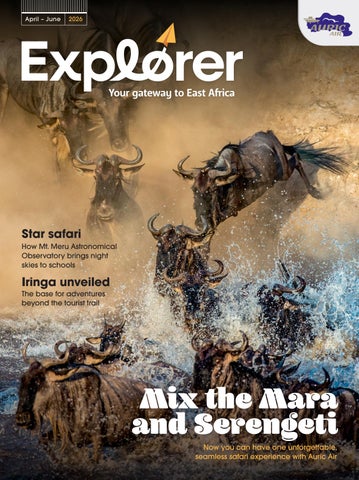
Your gateway to East Africa

Star safari
How Mt. Meru Astronomical Observatory brings night skies to schools
Iringa unveiled
The base for adventures beyond the tourist trail
![]()

How Mt. Meru Astronomical Observatory brings night skies to schools
Iringa unveiled
The base for adventures beyond the tourist trail
Now you can have one unforgettable, seamless safari experience with Auric Air


by:
& Marine Publications (Tanzania) Limited 5th floor, Josam House, Block A, along Coca Cola Road, Mikocheni Area, Dar es Salaam
T: +255 686 118 816
Editorial enquiries: markedwards@landmarine.com
Auric Air Services Limited Plot 154, Block 'B', Malaika Road, Ilemela, PO Box
Mwanza, Tanzania
Advertising sales: T: +44 (0)7714 448059 (WhatsApp) E: advertising@landmarine.com
Head Office: Land & Marine Publications Limited 6 The Square, Ipswich, Suffolk, IP5 3SL, UK
T: +44 (0)1206 752902
E: publishing@landmarine.com
by Jamana Printers, Dar es Salaam.

Welcome to the latest edition of Explorer. It is our pleasure to have you flying with us. At Auric Air, our mission has always been simple: to make some of the wildest and most remote safari destinations effortlessly accessible – while ensuring your journey is as enjoyable as the adventure that awaits.
This season, we are proud to unveil a major milestone in East African aviation: a new wing to wing partnership between Auric Air Tanzania and Kenyan domestic airline Fly ALS. Beginning in June, this collaboration establishes a seamless air corridor between the Serengeti and the Masai Mara, two of the continent’s most celebrated wildlife sanctuaries.
Instead of spending hours on unpredictable overland journeys, travellers can now glide effortlessly between Tanzania and Kenya’s premier parks. Border formalities are conveniently handled at Musoma in Tanzania and Kisumu in Kenya, streamlining your experience and maximising your time in the wild.
We’re also excited to introduce upcoming flights to Iringa – the gateway to one of Tanzania’s least known yet most extraordinary wildernesses: Ruaha National Park. As Tanzania’s largest national park, Ruaha is home to a remarkable concentration of predators, from lions and cheetahs to packs of African wild dogs, along with some of East Africa’s most impressive elephant herds.
Auric Air has also increased its flight frequency between Dar es Salaam and Kahama (via Mwanza) to five weekly flights. This expanded schedule serves both business and leisure travellers heading to the Lake Zone and opens more convenient access to the breathtaking Kigosi Forest Reserve – a vast wetland sanctuary teeming with crocodiles, hippos, and raw, water rich wilderness unlike any other.
Thank you for choosing to fly with Auric Air. Wherever you’re headed next – be it the wide plains of the Serengeti, the river threaded heart of Ruaha, or the shimmering wetlands of Kigosi, we’re honoured to take you there.
Fly the wild.
Deepesh Gupta Director of Corporate Affairs


Passengers weren’t the only ones lining up for a recent flight at Mikumi Airstrip – an entire pride of lions had already claimed the best shady spot: the belly of an Auric Air aircraft.
Rangers say the big cats often lounge near the runway, perfectly unfazed by the daily rhythm of adventure seekers flying in from Zanzibar. And who can blame them? With flights taking just about an hour from the island, visitors can trade turquoise waters for a full day on safari, spotting lions, elephants, giraffes, and more.
After an extensive game drive with expert guides, travellers are back on the beach by sunset – while the lions reclaim their favourite plane shaped parasol.
Auric Air has introduced the De Havilland Canada Q315 to its lineup, a turboprop aircraft designed to carry 50 passengers in a comfortable, efficiently arranged cabin.
The aircraft’s interior follows a consistent, ergonomic layout. Every seat offers a 31 inch (79 cm) pitch, 17 inch (43 cm) width, and 3 inch (7.6 cm) recline, giving the cabin a balanced and modern feel throughout.
Power comes from two Pratt & Whitney Canada PW123E turboprop engines, part of the trusted Q300 family. This configuration supports strong fuel efficiency and allows the Q315 to perform well on medium range and regional routes.
Auric Air’s crew continues to play a central role in the onboard experience, maintaining smooth operations and attentive service.


Auric Air’s ‘wing-to-wing’ partnership with Kenyan operator Fly ALS enables passengers seamless adventures in Serengeti and Masai Mara. Here’s how to maximise your safari combo.


Imagine this: you wake up among the endless golden plains of the Serengeti, spend your morning watching a cheetah sprint after a gazelle, then – after a seamless wing-to-wing Auric Air connection –you’re in the Masai Mara by sunset watching elephants especially lions and leopards – as they start hunting in the cooler evening light.
Thanks to the new air-only link between Tanzania’s Serengeti and Kenya’s Masai Mara, travellers can now blend two of Africa’s greatest wildlife sanctuaries into one smooth adventure. No long road transfers, no border chaos – just pure safari magic from start to finish.
The Masai Mara and the Serengeti are part of the same ecosystem, but they feel wonderfully different: the Serengeti’s grand, open horizons versus the Mara’s concentrated, high drama sightings. Combining them by air gives you more wildlife per day and a richer mix of habitats, species and photographic backdrops.
Same season combos
The migration is a year round cycle, but different spectacles peak in different months. Plan your combo so both parks are “on song” in the same window.
Northern Serengeti (Tanzania) ↔
Masai Mara (Kenya)
This is the classic Mara River crossing window shared by both parks. Base in northern Serengeti and hop to the Mara for complementary angles on the same drama – steep banks, crocs, dust, and predators. Allow multiple days; crossings are spectacular but unpredictable.
ADD ONS THIS SEASON:
Balloon safaris on both sides at sunrise – silent panoramas, then bush breakfasts. (Serengeti Balloon Safaris operate across multiple launch sites by season; the Mara runs daily at dawn.)


Big cats, two styles: the Mara’s compactness concentrates sightings while the Serengeti gives wide open, cinematic hunts (cheetahs on short grass; lions on kopjes). Experiencing both in one week yields a more complete predator portfolio.
Elephants and classic plains game: expect closer, frequent encounters in the Mara and big, horizon line herds in the Serengeti – two different photographic looks, one trip.
Migration theatrics (in season): In July to October, pair Northern Serengeti with the Mara and allow multiple days on each side to raise your odds of a crossing. In May to June, go to the Grumeti and the Mara for early season drama with fewer crowds.
MAY TO JUNE: WESTERN CORRIDOR
Serengeti and early season Mara
Track herds along the Grumeti River in the Serengeti then hop to a quieter Mara for dense resident game and big cats as the vanguard starts to arrive.
ADD ONS THIS SEASON
Lake Victoria on the Tanzanian side. Mwanza is just a 90-minute drive (even quicker with an Auric Air flight) for lake cruises or fishing trips.

Grey crested helmetshrike – a near endemic and local specialty bird reliably targeted in the Mara particularly within acacia and mixed woodlands. These sociable black-and-white birds are characterised by a tall, fluffy grey crest, bright yellow eyes, and usually travel in noisy groups. It’s not a Serengeti staple, so pin it down while you’re in Kenya

Grey breasted spurfowl – Tanzanian endemic particularly common in the Serengeti’s dry thorn savannas and woodlands. They are identified by their red, bare skin around the eyes, red bill, and chestnut-marked underparts. It doesn’t occur in the Mara.
Bonus: while both parks share hundreds of species, the Mara’s riverine forests and marshes (Musiara Marsh, Mara/Talek river lines) are especially strong for herons, storks, and kingfishers, complementing the Serengeti’s open plains bustards, coursers and ground birds.

JANUARY TO MARCH: CALVING AND PREDATOR ACTION (SERENGETI) AND PEAK BIRDING (MARA)
Southern Serengeti / Ndutu for calving and intense predator interactions
The Masai Mara the same week for phenomenal birding (Palearctic migrants and raptors) and resident big cats – even without the crossings, the action is superb. This pairing delivers behavioural drama in the south and avi rich variety in the Mara at the same time of year.


This tranquil natural retreat is the perfect base between safaris in northern Tanzania. Masailand Coffee Lodge is tucked away amid the rolling hills and coffee plantations (including one located onsite) near the town of Karatu, just 15km from the gate to the Ngorongoro Conservation Area and within day-trip driving distance to Lake Manyara and Tarangire national parks. The 18 rooms (14 executive suites and four family rooms) are enormous, beautifully furnished and each features a fireplace to counter the highlands’ evening chill. The rooms frame an outdoor swimming pool and manicured gardens spanned by a striking raised wooden walkway that provides access to the main building. Here you’ll find a spa, gym, and a restaurant serving exquisite food that can be enjoyed on its large terrace to take in your highland hideaway. www.masailandcoffeelodge.com
Sometimes it’s good to get away from it all. From historic boutique hotels tucked away in Stone Town to island escapes that can only be reached by boat, here are some retreats in the Auric Air network that allows guests to disconnect from the world and reconnect with themselves.

The Mara River crossings are one of the dramatic stages of the world-renowned Great Migration, but it does draw the crowds, making it feel like the human presence rivals the massive wildebeest numbers. However, this six-tent camp is located on a bend in the river within the Lamai triangle, a private concession with limited access. This remote setting provides guests with exclusive viewing of one of nature’s greatest spectacles. Singita is all about a serene wildlife experience with the camp a sanctuary of luxury amenities – such as offers a range of amenities including a plunge pool, spa treatments, yoga classes, a bar and restaurant, a library and lounge area – for when you return from the twice-daily game drives. The tent interiors have recently undergone a makeover that maximises the camp’s sense of escape and intimacy. www.singita.com


Finding a place of seclusion and quietude amid the bustling labyrinthine lanes of Stone Town, Zanzibar’s historic centre, may seem a lost cause. However, a stay at Emerson on Hurumzi feels like an escape into a magical world. The mansion once belonged to the richest merchant on the Swahili coast and has been lovingly restored to its former grandeur. The rooms and suites each have their own stories and architectural quirks that make a stay here unforgettable. Guests at the Middle-Ages-inspired Keep Suite have to traverse bridges and stairs to reach their room while the Suite Tour has four distinct sections including a castle keep with carved lattice windows that open to views over the city. The hotel’s Tea House Restaurant also has those rooftop views. Enjoying dishes here that are a modern twist of Swahili cuisine while watching the sunset over Stone Town’s unique skyline of minarets and spires is a very special experience. www.emersonzanzibar.com


Few visitors make it to Ruaha National Park so those that do get a secluded and immersive safari experience. This ten-suite camp is a haven of comfort nestled deep in this vast, untouched wilderness. It is located alongside the seasonal Jongomero River, a tributary of the Great Ruaha River. It’s a popular spot for the park’s abundant wildlife and with the camp unfenced they get very close indeed. Elephants are daily and nightly visitors to the camp while vast herds of buffalo come close and lions and leopards have been known to pass through. The tents are stilted and designed for safety, offering a great vantage point from which to take in the sights and sounds of the African bush. www.labalaba.com/jongomero_hebergement_en
Only accessible by plane or boat, Fundu Lagoon offers a barefoot luxury escape on a pristine 3-kmstrip of beach on Pemba’s forested southwestern coast. All of the five star’s 18 rooms – tented bungalows built under thatched roofs – have views of the ocean. A spectacular recent addition is the hilltop infinity pool that provides views over the forest and the coast. Other features include a spa, two restaurants – meals can be served on the candle-lit jetty or your room’s verandah – and yoga classes. The hotel has its own 5-star Padi dive centre and there are rich coral gardens to explore just offshore, or boat rides will take you to nearby Misali Island, which is ringed by protected reefs. www.fundulagoon.co.uk


Auric Air connects passengers to the wildest adventures in Tanzania’s northwest. We now offer five weekly flights from Mwanza to Kahama, the gateway to the remote wetlands and woodlands of Kigosi Forest Reserve. Here’s what’s in store for intrepid visitors.


If you’re idea of a safari involves an immersive, off-grid experience, Kigosi Forest Reserve may be your next great obsession. Tucked deep into western Tanzania, far from the country’s well trodden safari circuit, Kigosi is a place where wetlands stretch to the horizon, hippos hug the papyrus lined channels, and rare birds stalk the shallows. This is Tanzania at its rawest: immense and untouched.
Kigosi is not your typical African reserve of endless savannahs. Instead, it anchors the MoyowosiMalagarasi Wetlands Complex, the largest of its kind in East Africa. The ecosystem is so vast it provides nearly 30 per cent of Lake Tanganyika’s freshwater and rivals the size of entire countries. The
wetland was the first in Tanzania to be designated a Ramsar site of international significance as it acts as a habitat for diverse bird life, including vulnerable species such as the shoebill stork and the wattled crane. With its vast swamps and papyrus islands, Kigosi is easily one of Africa’s finest water bird habitats.
But what truly sets Kigosi apart is its remoteness. Many areas remain rarely – if ever – visited, thanks to the challenging terrain and minimal infrastructure. Trips here reward travellers who value solitude and immersion over luxury lodges and neatly packaged experiences.
Humans may be thin on the ground in Kigosi, but wildlife is far more plentiful. The park’s water

sources and high number of grazing ungulates such as buffalo, zebra, eland, and sable antelope attract predators lions, leopards, cheetahs, hyenas, and wild dogs. The big cats have adapted to the environment with lions here known to chase buffalo into shallow waters to catch them.
Hippos and Nile crocodiles thrive in the lake channels and backwaters while nowhere else in Africa has more Cape clawless otters than Kigosi. The national park
is also one of the most important protected areas for elusive, swamp dwelling antelope the sitatunga.
The landscape is highly seasonal. During the rainy seasons from January to March and November to December it is defined by vast, flooded wetlands, slow-moving rivers, and extensive papyrus swamps that transition into open miombo woodlands. These wetlands are best explored by boat or canoe. Narrow channels in the Moyowosi River lined with tall papyrus offer serene, intimate encounters with hippos, crocodiles, and birdlife.
During the dry season, the park’s plains and woodlands open up beautifully for wildlife viewing. The thinning vegetation makes it easier to spot lions, leopards, elephants, buffalo, and various antelope species in the savannahs and woodlands.
Guided walks let you experience the park’s subtler wonders – tracks in the mud, bird calls, fresh grazing signs – bringing you closer to the rhythms of the wild.
This is one of the few Tanzanian parks where independent exploration is both common and appealing. Trails vary from gentle to challenging, and seasoned adventurers relish the freedom.
Kigosi showcases Tanzania’s commitment to protecting vast, fragile wetland ecosystems, and the depth of wildlife diversity here beyond the tourist hotspots. In a world where wilderness is shrinking, Kigosi feels like a glimpse into a more ancient Africa – expansive, demanding, and beautiful.


Auric Air can add to your animal adventures in Tanzania by connecting you to mountain gorilla trekking in neighbouring Uganda and Rwanda. Here’s our guide to help you choose.


Tanzania is widely recognised as having one of the most diverse and dense wildlife populations in the world. However, there are some extraordinary animal encounters it can’t provide. There are no mountain gorillas in the country. For that you have to go to the rainforests of neighbouring Rwanda or Uganda.
Auric Air can seamlessly connect its passengers to both countries. We now connect Tanzania’s iconic safari destinations –Serengeti‚ Manyara‚ and Tarangire – with the awe-inspiring mountain gorillas of Uganda and Rwanda. Our flights make embarking on one of the world’s most extraordinary wildlife encounters easier than ever. Our flights connect to international airports in Kigali, Rwanda, and Entebbe in Uganda. These connections continue with partner flights or road transfers to Bwindi Impenetrable National Park or Volcanoes National Park where the gorillas are to be found.
Mountain gorilla trekking is a once-in-a-lifetime experience driven by the combination of the animals’ extreme rarity and their intimate, human-like connection. Rwanda and Uganda offer markedly different gorilla experiences each excellent in their own way. Explorer has some tips to help you make your choice.
Volcanoes National Park
Access: Rwanda offers the quickest and most convenient access to mountain gorillas. Volcanoes National Park lies just three hours from Kigali International Airport, making it the fastest gorilla destination in Africa. This short transfer allows even tight itineraries – a one day trek is possible.
Getting to the gorillas: treks in Volcanoes National Park are generally shorter and less physically demanding than in Uganda. The bamboo forests and gentler volcanic slopes create well maintained, open trails with good visibility. For travellers who want a premium experience without strenuous hiking, Rwanda is ideal.
Price: Rwanda positions itself firmly as a luxury gorilla trekking destination.
Gorilla permit: US$1,500 per person, per trek.
The higher price supports conservation, community development, anti poaching efforts, and scientific research. Many travellers view the premium as worthwhile due to Rwanda’s seamless logistics and high-end accommodation options.
Accommodation options: Rwanda boasts some of Africa’s most luxurious safari lodges, including properties operated by international conservation focused brands.
Other wildlife and activities: Rwanda’s small size allows efficient multi activity itineraries. While gorillas are the main draw, Volcanoes National Park is home to other primates including the endangered golden monkey. Rwanda also offers Big Five safaris in Akagera National Park and more primate adventures in the chimp-filled Nyungwe National Park.

Who would love it?
• LUXURY FOCUSED TRAVELLERS
• VISITORS WITH LIMITED TIME
• FIRST TIME TREKKERS SEEKING GENTLER HIKES
• BUSINESS TRAVELLERS OR WEEKEND ADVENTURERS

Bwindi Impenetrable National Park (and Mgahinga)
Access: Uganda’s gorilla regions require longer travel times. The drive from Entebbe to Bwindi takes eight to 10 hours, though scenic landscapes. Many travellers now fly into Rwanda and cross into Uganda for a quicker four-to-fivehour road transfer.
Domestic flights from Entebbe to airstrips near Bwindi are an option.
Getting to the gorillas: the terrain in Bwindi earns its name – dense rainforest, steep slopes, and rugged trails. Treks can last from 30 minutes to over eight hours, depending on gorilla movement. This makes Uganda’s experience more physically challenging but often more immersive and adventurous.
Mgahinga offers a different volcanic landscape and the chance
to combine gorilla trekking with golden monkey tracking
Price: Uganda is significantly more affordable than Rwanda. In 2026 a gorilla permit is priced at US$800 for foreign visitors
Uganda also offers the unique Gorilla Habituation Experience (US$1,500), allowing four hours with a semi habituated family –something Rwanda does not provide.
Accommodation options: Uganda offers a broad range from budget forest lodges through mid range safari camps to high end ecoluxury lodges
Other wildlife and activities: Uganda delivers one of Africa’s richest wildlife circuits, including chimp trekking in Kibale Forest, tree-climbing lions in Queen Elizabeth National Park, powerful scenery at Murchison Falls, and shoebill stork viewing in Mabamba Swamp on Lake Victoria.

The Unescodesignated Bwindi Impenetrable National Park hosts nearly half of the world’s remaining mountain gorillas
• ADVENTUROUS TRAVELLERS SEEKING CHALLENGING TREKS
• BUDGET CONSCIOUS TRAVELLERS OR FAMILIES
• PHOTOGRAPHERS WHO LOVE ATMOSPHERIC RAINFOREST ENVIRONMENTS
• WILDLIFE ENTHUSIASTS PLANNING MULTI PARK ITINERARIES
• ANYONE WANTING THE LONGER HABITUATION EXPERIENCE
Get a taste of Tanzania on-the-go with these streetfood favourites.
Mandazi
What is it? The ‘African doughnut’, but far less sweet than its US counterpart. A breakfast staple. What does it look like? Golden pillows or triangles of fluffy dough, sometimes slightly crisp on the outside.
What does it taste like? In a word, heavenly. Soft, warm, lightly sweet, and comforting.

Who would love this?
Anyone craving a doughy treat to start the day. When and where to buy?
Small roadside stands that open early to cater for morning commuters. Also look for ‘mama ntilies’ – casual, women-run stalls often near bus stops and workplaces.


What is it? Grilled snacks are not just for the carnivores. Barbecued corn on the cob is also a Tanzanian classic What does it look like? A whole ear of corn charred over open flames. What does it taste like? Smoky, slightly chewy, and extremely fiery (the corn is often rubbed with pili pili spice before grilling). Who would love this? Anyone who enjoys grilled vegetables or simple, rustic snacks. When and where to buy? As with the mishkaki stalls, sellers set up around 5pm every day and grill into the night. A cheap and chewy treat.
What is it? Sometimes referred to as the ‘African Snickers’, Kashata are irresistible little peanut brittle bites. The sugary hit is often used to undercut the bitterness of a cup of super-strong Tanzanian coffee. What does it look like? Small, golden to deep caramel squares or clusters, studded with peanuts and glistening with hardened sugar. What does it taste like? Sweet, nutty, and satisfyingly crunchy. Think peanut brittle’s cheeky, snackable cousin Who would love this? Coffee lovers with a sweet tooth. When and where to buy? Vendors can often be seen on bicycles carrying flasks of not coffee along with bags of kashata. A classic Tanzanian combination.

Zanzibar Pizza
What is it? A culinary curveball: not a pizza at all! Instead, it’s a savoury stuffed pancake filled with egg, mayonnaise, and whatever extras you fancy – from minced meat to chocolate spread – before being fried on a hot plate. What does it look like? A folded, square parcel sizzling on a metal griddle, with crisp golden edges and a soft, gooey interior. What does it taste like? Creamy, rich, indulgent, and slightly crispy – like a cross between a French crêpe and an omelette. Who would love this? Adventurous eaters who enjoy customisable, comforting street food. When and where to buy? Iconic in Zanzibar’s night markets – especially Forodhani Gardens – where stalls whip them up fresh to order.


What is it? Baobab seeds boiled to preserve the fruit, dyed red, then coated in a magical blend of sugar, salt, black pepper, cardamom, and vanilla. Tell-tale signs of anyone who has recently indulged in this sweet snack are bright red lips and tongue. What does it look like? Small, raspberry-like clusters – bright red and dusted with spice. What does it taste like? A wild mix of sweet, sour, aromatic, and spicy all at once. The zingy sour kick is legendary. (Don’t eat the seeds – just suck the coating!) Who would love this? Fans of sour candy and lovers of bold flavours. When and where to buy? Commonly sold in markets and small shops across Tanzania –often in colourful packets.

What is it? East Africa’s answer to kebabs – skewered and grilled beef or goat, often served alongside fish and other street foods. What does it look like? Juicy chunks of marinated meat sizzling on giant barbecues that glow into the evening. What does it taste like? Smoky, savoury, meaty, and irresistibly charred – a street food favourite. Who would love this? Meat lovers and barbecue aficionados. When and where to buy? Mishkaki stalls come alive around 5pm, filling the air with mouth-watering aromas.


What is it? Chewy, delicious little fried dough balls made from rice flour, coconut milk or water, and cardamom. What does it look like? Round, golden-brown bitesized cakes with a slightly crisp shell and soft interior. What does it taste like? Fragrant, slightly sweet, and warmly spiced. Who would love this? Vegans, gluten-free eaters, and anyone who loves coconut-based snacks. When and where to buy? Common across East Africa, usually sold fresh and hot at morning and evening street stalls.
What is it? A unique potato and mango soup known lovingly as “Zanzibar mix.” A bright, tangy, slightly spicy broth served with crispy potato dumplings, potato crisps, and toppings like egg or meat What does it look like? A vibrant yellow orange bowl brimming with crunchy toppings floating over a silky soup. What does it taste like? Slightly sour, slightly spicy, deeply comforting – with a playful contrast of creamy broth and crispy add ins. Who would love this? Soup lovers and spice seekers. When and where to buy? Widely available in Zanzibar’s local eateries and street stalls, especially in Stone Town.
What is it? A pan-fried flatbread that originated in the Indian subcontinent and was brought to East Africa by traders. The Africanised version is thick, flaky, and indulgent. What does it look like? A warm, golden-brown with patches of dark brown or charred spots, indicating it was cooked on a hot pan (tawa). Tanzanian chapatis are typically made by coiling the dough, resulting in multiple, flaky, and distinct layers. What does it taste like? Rich and slightly salty with a comforting, buttery, and nutty flavour. Who would love this? Anyone after a satisfying start-of-the-day snack. Usually, chapatis are cooked in vegetable oils so they are suitable for vegetarians or vegans. To be sure, check with the seller whether ghee or butter is used for the frying. When and where to buy? Chapatis are considered a breakfast snack in Tanzania and usually paired with a cup of chai (tea). Freshly cooked chapatis are best found at local street food stalls in the early morning.


Mount Meru Astronomical Observatory launches nightly astro tourism tours, opening East Africa’s best dark skies to visitors.
When most people mention the Big Five in Arusha it relates to the headliner animals – lion, elephant, buffalo, rhino, and leopard – that are the most prized spots in game drives from the ‘safari city’.
However, look up into the dark skies at night in this part of northern Tanzania and there is another Big Five to be seen. Arusha offers exceptional stargazing due to low light pollution, often revealing the ‘Big Five of the African Sky’. These include the Southern Pleiades, Omega Centauri, the Eta Carinae Nebula, the Coal Sack, and the Milky Way.
The Mount Meru Astronomical Observatory (MMAO) make she most of the dark skies afforded to its location away from the city in the foothills of Tanzania’s second-highest mountain on the edges of Arusha National Park. Since 2019, the observatory has been revealing celestial wonders to school groups and pre-arranged public visits through its 12 inch fixed mount Cave Cassegrain telescope.
However, from May this year the non-profit educational organisation and community science centre will be launching an astro-tourism programme and running nightly stargazing tours.
The publicly accessible observatory – the largest of its kind in East Africa – features a variety of stargazing equipment. The permanent-mount telescope, which is housed in a dedicated observatory dome, has been recently refurbished. Secondary telescopes include a Celestron-AWB 5-inch telescoping reflector, a 3-inch Celestron spotting scope (refractor), and a 2.5-inch Meade refractor.


“Thanks to its position next to the national park, the observatory enjoys naturally dark skies far from Arusha’s city lights – ideal for seeing the Milky Way and other deep sky objects.”


• THE MOON’S CRATERS AND PHASES
• PLANETS INCLUDING MARS, JUPITER AND SATURN.
• BRIGHT STAR CLUSTERS, NEBULAE AND EVEN THE OCCASIONAL GALAXY.


• SATELLITES, METEOR SHOWERS AND RARE EVENTS SUCH AS ALIGNMENTS OR ECLIPSES. To

Thanks to its position next to the national park, the observatory enjoys naturally dark skies far from Arusha’s city lights – ideal for seeing the Milky Way and other deep sky objects. Clear weather on most nights and the observatory’s higher elevation create excellent viewing conditions. And unlike higher latitude destinations, Tanzania’s equatorial location means visitors can see stars from both the northern and southern skies throughout the year.
Since its founding, MMAO has focused on astronomy education, running teacher workshops, school programmes and astro science clubs that have inspired thousands of young Tanzanians to pursue science and STEM careers.
The new astro tourism programme builds on this foundation, creating a visitor experience that supports the observatory’s mission while offering a unique attraction for locals and tourists.
These experiences bring a fresh dimension to a trip to Arusha – an opportunity to complement a daytime wildlife safari with an exploration of the universe above it.

ideal for you
What is it? Pemba is a lush, largely untouched alternative to Zanzibar. The first Arab traders that visited named it Al-huthera or ‘the green island’ because of its dense and fertile vegetation. It is now renowned for untouched beaches, forested hills, and some of the best
diving in the entire region. The island’s reefs and channels support rich marine life and spectacular coral walls. Where is it? Just north of Zanzibar, Pemba is the second largest island in the Zanzibar Archipelago. What to do: Dive and snorkel in the Pemba Channel and at Misali Island, known for pristine coral gardens and rare

What is it? Zanzibar, the jewel of the Indian Ocean, is an island famed for its rich Swahili heritage, white sand beaches, and world class marine ecosystems. The surrounding reefs harbour over 500 marine species and some of the healthiest coral formations in East Africa. Where is it? Located off Tanzania’s coast, Zanzibar
species. Visit Ngezi Forest Reserve for guided nature walks and the chance to see endemic species like the Pemba flying fox and the red colobus monkey. Explore the capital Chake Chake for local markets, and historical sites such as the Old Fort. Relax on remote beaches including Vumawimbi’s long-white shoreline.
Island (Unguja) is the largest island of the Zanzibar Archipelago. What to do: Snorkel Mnemba Atoll, Chumbe Island, and Tumbatu Island, known for crystal clear waters and vibrant coral gardens. Spot marine life including dolphins, turtles, reef sharks, and whale sharks (seasonally). Relax on beaches, wander Stone Town’s cultural sites, or enjoy
Wildlife to see: Expect encounters with vibrant reef fish, sea turtles, reef sharks, dolphins, and whales, especially in the deeper channels. Unique selling point: Pemba remains blissfully under touristed. Its combination of lush landscapes, rich culture, and world class underwater scenery delivers an authentic, serene island escape.
sunset dhow cruises.
Marine life to see: Parrotfish, turtles, moray eels, dolphins, reef sharks, nudibranchs, angelfish, and over 500 coral associated species. Unique selling point: Zanzibar offers some of the most diverse and accessible marine ecosystems on the African coast – ideal for both beginners and seasoned divers, with exceptional water clarity year round.

What is it? Rubondo National Park is a rare island sanctuary – one of Tanzania’s only national parks set entirely on an island. It protects pristine evergreen forests, papyrus wetlands, savannah patches, and the surrounding waters of Lake Victoria. The island is famous for its chimpanzee conservation program, thriving populations of elephants, sitatunga antelope, crocodiles, hippos, and over 300 bird species. Where is it? Rubondo lies in the southwest corner of Lake Victoria, Tanzania’s portion of the world’s second largest freshwater lake. The park spans Rubondo Island and several nearby islets covering about 457 sq km
What to do: Rubondo is tailor made for nature lovers. Go chimpanzee trekking through dense forests; take game drives to spot elephants, giraffes, colobus monkeys, and antelope species; canoe through the island’s network of lakes, channels and wetlands.
Wildlife to see: Expect close encounters with chimpanzees, elephants, giraffes, bushbuck, sitatunga, otters, hippos, crocodiles, and abundant birdlife along the lakeshore and forest trails.
Unique selling point: Rubondo is one of the only places in Africa offering a combination of walking safaris, forest trekking, and water based wildlife viewing – all in a serene, uncrowded island setting.
What is it? Mafia Island is a peaceful, biodiverse marine paradise famous for its resident population of whale sharks and the protected Mafia Island Marine Park – home to over 400 fish species and flourishing coral reefs


Where is it? South of Zanzibar, Mafia Island is part of its own archipelago. Auric Air is one of the few airlines that flies here.
What to do: Swim with whale sharks (October to March) in one of the world’s most reliable viewing locations. Dive and snorkel in Mafia Island Marine Park among coral gardens, turtles, rays, and reef fish. Explore the other Mafia Archipelago islands of Chole and Juani for history, ruins, and turtle nesting. Enjoy quiet beaches and nature walks through mangroves and forests.
Wildlife to see: Whale sharks, sea turtles, dolphins, rays, octopus,
What is it? Saanane is East Africa’s smallest national park – a unique urban island sanctuary located just off the shoreline of Mwanza city. Its compact size packs in rocky landscapes, lakeside viewpoints, and a surprising array of wildlife including impalas, rock hyraxes,


colourful reef fish, and thriving coral ecosystems.
Unique selling point: Mafia Island is one of the world’s top whale shark hotspots, with populations that have more than doubled thanks to strong community led conservation efforts.
vervet monkeys, monitor lizards, and numerous bird species. Where is it? The park is set on Saanane Island and two smaller islets in Lake Victoria, only 2 km from Mwanza city centre, making it one of the most accessible national parks in Tanzania. What to do: Nature walks to rocky viewpoints overlooking Lake Victoria. Wildlife viewing including habituated monkeys, hyraxes, and reptiles. Birdwatching for African fish eagles, parrots, egrets, and cormorants. Canoeing and boat rides from Mwanza’s lakeshore. Wildlife to see: Impalas, rock hyraxes, vervet monkeys, monitor lizards, zebras, De Brazza’s monkeys, and over 70 bird species.
Unique selling point: Its urban wild charm – blending accessibility with authentic nature experiences just minutes from Mwanza’s bustle.
Footstep-free white sand beaches, soaring mountains, and
pristine marine parks: Tanga is the perfect romantic escape.
With its three daily flights from Dar es Salaam, Auric Air connects passengers to one of Tanzania’s most overlooked coastal gems. Tanga offers a slow-paced, intimate environment far from the bustling tourist hubs, with picturesque, quiet streets lined with colonial-era architecture.
If you are looking for the ideal getaway to spend some quality time with your significant other, this off-the-beaten-track destination in northeast Tanzania is ideal. Here are some suggestions for the perfect romantic escape.

Beach breaks don’t come much more romantic than in the Tanga region. The coastline from Tanga City to Pangani further south is full of unspoiled white stretches of sandy beach that shelve gently into turquoise waters for perfect swimming conditions. There are rustic resorts at Peponi, Sange and Ushonge beaches offering beachside banda accommodation shaded among the palm trees. These resorts are among Tanzania’s best-kept secrets so you may find yourself in your own private paradise. As the day ends there are opportunities to ratchet up the romance even further with a sunset trip on a traditional Swahili dhow or ngalawa sailing boat.
The Tanga region’s coastline is dotted with sand islands with some of the country’s most pristine coral reefs built around them. Most hotels around Pangani will be only too happy to organise a boat trip – with picnic lunch included – for you and your partner out to Maziwe Marine Reserve Park, a tiny sand island that only shows itself at low tide. It’s a beautiful spot for sunbathing and snorkelling with a surrounding reef teeming with over 350 fish species and the island itself offering fantastic bird-watching opportunities.


Magoroto Lake
There are plenty of opportunities for romantic forest walks and lakeside lazing at this lush forest estate around 40 km distance from Tanga. Opened at the end of the 19th century, it was one of the first German-owned plantations in East Africa and has over time grown rubber, palm oil, coffee and tea, but now it simply showcases its beautiful 1,500-acres of rain forest and rare plants in the East Usambara Mountains. There is a campsite here and campers can explore a host of hiking trails through the forest and then cool off from their exertions with a swim in the beautiful freshwater lake.
Hot springs
It is definitely at the wild and woolly end of a romantic spa break, but a trip to the Galanos Sulphur Hot Springs is ideal for any adventurous couple. Locals have been bathing in these natural springs – located about eight km outside Tanga city – for many years and believe the water has healing properties that can cure ailments such as arthritis and skin conditions. Bathing in the Galanos Sulphur Hot Springs can be a fun little adventure for couples, but don’t expect sparks to fly straight afterward. With that strong sulphur scent clinging to you both, romance is likely to stay on hold until you’ve scrubbed off with a very generous amount of scented soap.

When putting together a feature on romantic spots in Tanga, we couldn’t ignore a restaurant with a name like Pizzeria d’Amore. This popular restaurant and bar enjoys a breezy coastal location with views across Tanga Bay. The menu is made up of authentic wood-fired pizzas and Italian-style pasta along with chicken, beef and seafood dishes cooked on the grill. Set in lush, palm tree-filled garden and with an attractive upstairs dining terrace, this is a charming place for an intimate meal-for-two.


Beautiful beach house How’s this for a romantic escape? Villa Matalai is set right on the beach in Manza Bay, in the small fishing village of Kwale just north of Tanga and close to the Kenya border. The former family residence has been transformed into an intimate coastal lodge perfect for a romantic escape. The property has nine individually designed, Swahili inspired rooms and suites spread across four buildings overlooking the calm waters of the northern Tanga archipelago. The real draw for couples is the pair of beach side, makuti covered bandas, complete with their own bar, lounge area and garden. Just steps from the sand and shaded by traditional palm leaf thatch, they offer peaceful seclusion and a front row seat to the Indian Ocean. Drift out on a sunset dhow trip, enjoy a candlelit dinner set directly on the beach, or simply fall asleep to the sound of the waves rolling gently ashore.
For more details, visit tangambili.com
Your journey into Tanzania’s wild begins with Auric Air. Here’s how to choose the national park that’s made for you.

Where? Serengeti National Park
What? The Serengeti is Tanzania’s most iconic park, famous for its vast plains and the annual Great Migration. It’s a predator hotspot, with lions, leopards, and cheetahs all thriving here.
Why? If you want to witness nature’s drama –lions hunting, cheetahs sprinting, and leopards lounging in acacia trees - this is the place. The sheer abundance of wildlife means you’re never far from the action.
Must-see: Time your visit for the Great Migration (June to October or December to March) to see thousands of wildebeest and zebras on the move, with big cats in close pursuit. Don’t miss the Seronera Valley for classic predator sightings.


Where? Lake Manyara National Park
What? Nestled at the base of the Rift Valley escarpment, Lake Manyara is a birdwatcher’s paradise, with over 400 species recorded.
Why? The park’s alkaline lake attracts huge flocks of flamingos, pelicans, and storks, while the forests and woodlands are alive with hornbills, kingfishers, and bee-eaters.
Must-see: Visit the lake’s edge for a pink spectacle of flamingos and keep an eye out for the park’s famous tree-climbing lions and large troops of baboons.
Where? Ruaha National Park
What? Tanzania’s largest national park, Ruaha is wild, remote, and blissfully uncrowded.
Why? Ruaha’s rugged landscapes are home to massive elephant herds, rare antelope, and a healthy population of big cats. With far fewer visitors than the northern parks, you’ll often have the wilderness all to yourself.
Must-see: Explore the Mwagusi River area for excellent game viewing, and don’t miss a sundowner overlooking the baobab-studded plains.

Where? Mahale Mountains National Park
What? Set on the shores of Lake Tanganyika, Mahale is a lush, mountainous park best known for its wild chimpanzee population.
Why? Trek through dense rainforest to observe chimpanzees in their natural habitat – a truly unforgettable experience. The park’s remote location means you’ll feel like a true explorer.
Must-see: Join a guided chimp trek, then cool off with a swim in the crystal-clear waters of Lake Tanganyika. The sunsets here are legendary.


Where? Saadani National Park
What? The only park in East Africa where the bush meets the beach, Saadani offers a unique blend of wildlife and Indian Ocean coastline.
Why? Watch elephants and giraffes stroll along the sand, then relax on a deserted beach. It’s the ultimate “two holidays in one” destination.
Must-see: Take a boat safari on the Wami River for hippos and crocs, then enjoy a beach picnic.


Perched high in the cool Southern Highlands, Iringa is the perfect base for travellers who crave authentic, off the beaten path experiences far from Tanzania’s well worn northern safari circuit. With dramatic landscapes, a deep sense of history, and easy access to some of East Africa’s wildest national parks, Iringa invites adventurers to slow down, explore deeper, and uncover a side of Tanzania that few visitors ever see.
A highland haven with a story to tell Iringa’s past is woven with tales of resilience and cultural pride. The Hehe people famously resisted German colonial forces around the turn of the 20th century – a legacy still honoured today. The region is also archaeologically significant, home to one of the world’s richest collections of Middle Stone Age tools, drawing history lovers as much as outdoor explorers.
Start at the Mkwawa Memorial Museum, just outside town, where exhibits recount Chief Mkwawa’s defiant stand – his skull, returned from Germany, remains a powerful symbol of Hehe identity.
Scenic wonders for explorers
Iringa’s elevated setting brings dramatic views, crisp evenings, and endless opportunities for exploration. One of the most iconic sights is Gangilonga Rock, a legendary lookout offering vast, golden hour panoramas over the town.

With four flights a week from our Dar es Salaam hub, the clifftop city of Iringa in Tanzania’s Southern Highlands a picturesque and peaceful base for your adventures beyond the usual tourist trail.

For road trip lovers, the drive through Baobab Valley on the way to Ruaha feels like entering a prehistoric world – towering ancient trees lining the roadside in a scene found almost nowhere else in the country.
A launchpad to Tanzania’s southern safari circuit
Iringa sits at the heart of Tanzania’s Southern Circuit, a lesser visited but immensely rewarding safari region known for vast wilderness, sparse tourism, and exceptional wildlife sightings.
Just a short journey from town, Ruaha National Park – Tanzania’s largest – delivers heart pounding encounters with big cats, elephants, and enormous bird diversity in a setting that feels completely wild and uncrowded
Travellers seeking a multi day, deeper immersion can push further into the Southern Circuit, where Ruaha, Nyerere National Park (formerly Selous Game Reserve) and the Udzungwa Mountains offer some of Africa’s most authentic and remote nature experiences.

Ruaha, in particular, is famed for massive lion prides, abundant elephants, wild dogs, and over 570 bird species – making it a top destination for serious safari enthusiasts looking for something beyond the classic northern parks.
Meanwhile, hikers and nature lovers will love the Udzungwa Mountains National Park. Udzungwa Mountains National Park, the "Galapagos of Africa," is a biodiversity hotspot in Tanzania’s Eastern Arc Mountains, famous for its 1,990 sq km of pristine rainforest, endemic primates, and the 170-meter Sanje Waterfalls. Accessible only by foot, it offers premier trekking, including the scenic four-hour Sanje trail, with no driving safaris allowed.


No visit to Iringa is complete without exploring the Isimila Stone Age Site, just 16–20 km from town. Wander among towering sandstone pillars carved by millennia of erosion and examine early Stone Age tools dating back up to 500,000 years as well as fossilised remains of extinct animals.
Iringa’s cultural scene is warm, welcoming, and deeply tied to community empowerment. Neema Crafts – a Fair Trade centre run by and for people with disabilities – offers beautiful textiles, jewellery, and home décor, making it a rewarding place to support local artisans and take home meaningful mementos of the journey.

Head to the top floor of the Almasi Tower – a landmark on the Nyerere Road in the heart of Mwanza –for one of the city’s most memorable dining destinations. The food here is just as spectacular as the panoramic views across Mwanza and over the lake afforded to diners. Much of the halal menu reflects the city’s strong and historic Indian heritage with dishes such as chicken mughlai and mutton masala. There are also plenty of Indian-inspired vegetarian dishes, Tanzanian favourites such as mishkaki along with a host of international staples like burgers and buffalo wings. Popular for parties as well as more intimate get-togethers, the lively atmosphere usually experiences an awestruck hush at dusk. Sunsets seen from up here are something special.
Opening hours: Weekdays 11am to 10pm.
Weekends: 11am to 11pm.
Instagram: rooftop_restauranttz
With its rich mix of Tanzanian and Indian flavours, fresh produce from nearby fertile farmland, and abundant fish from Lake Victoria, Mwanza is a dream destination for food lovers. Here’s our pick of the city’s standout places to eat.


Hotel Tilapia is found in the exclusive Capri Point peninsula – known as the ‘Beverly Hills of Tanzania’ for its opulent lakeside homes. Within these glamorous surrounds, diners can choose from three restaurants. Built over the lake on a jetty, Teppenyaki, Mwanza’s only Japanese restaurant, is a romantic choice.
Diners can watch the chefs prepare the food as they wait with a set menu that includes grilled chicken, fish, beef, vegetables, prawns, squid, rice, salads and dessert.
Opening hours: Friday to Sunday 9am to 11.30pm, Monday to Thursday 9am to 11pm.

Located on the shore of Lake Victoria near the airport, Malaika Restaurant offers serene views and a menu of African and Indian dishes, with fish being a standout. Diners praise its calm atmosphere, scenic sunsets and outdoor seating. It caters well for vegetarian, vegan, halal and gluten free diets, making it versatile for many visitors.
Based at Rock City Mall, this lively, modern venue known for grilled meats, pizzas, fresh fish and a wide drinks menu. Its upbeat ambience, live music and open air seating attract both locals and tourists. A great spot for casual dining, social evenings and enjoying Mwanza nightlife.
Opening hours: Sunday to Wednesday 9am to 11pm, Thursday to Saturday 24 hours

Indian couple Mohamed and Pragz are the owners of this Capri Point favourite – found in the exclusive enclave’s yacht club. The lakeside restaurant is renowned for its excellent service, fresh ingredients and a wide menu spanning Italian, Chinese, Indian and African flavours. Popular dishes include grilled tilapia, steaks, Mongolian beef, and vegetarian options. The restaurant has a warm atmosphere that suits both intimate meals and large gatherings, and the restaurant also offers catering and delivery.
Opening hours: Sunday to Wednesday 12.30pm to 10.30pm, Thursday 12pm to 10.30pm, Friday and Saturday 12:30pm to 11pm.
Hasfu Food Empire in the bustling Kishamapanda neighbourhood near the ferry terminals is a vibrant, casual restaurant offering Tanzanian dishes, grilled meats, stews and local desserts. Open all day, it’s popular with families and travellers seeking authentic flavours at moderate prices. The warm atmosphere and friendly staff make it a reliable choice for breakfast, lunch or dinner.
Opening hours: Daily 6.30am to 11am.


NO TIME FOR A SIT-DOWN MEAL? TRY THESE LOCAL SNACKS-ON-THE-GO
Chipsi mayai – Tanzania’s beloved fries and egg omelette, usually served with kachumbari and hot sauce; look for quick turnover kiosks around Soko Kuu and busy bus stands
Mishkaki and nyama choma – skewers and grilled meats cooked over charcoal; evening grills cluster near big markets and around the lively Kamanga Ferry area.
Vitumbua (coconut rice cakes) – lightly sweet, cardamom scented Swahili bites best found in the morning at market side carts (pair with chai
Lake fresh tilapia to go –grab fried or grilled fish at Mwaloni Market, Mwanza’s bustling lakeside fish hub, and eat on the move.
Mahindi choma /cassava choma – roasted corn or cassava spears brushed with salt and chili; quick, filling and everywhere around central markets.

Your gateway to East Africa
With their short take-off and landing capabilities‚ the 26-strong Auric Air fleet opens up a world of possibilities for reaching destinations that are inaccessible to larger aircraft. Here’s a closer look at our built-for-adventure fleet.

NUMBER OF AIRCRAFT IN FLEET: 15
MAXIMUM RANGE: 912 NM
MAXIMUM CRUISE SPEED: 185 KTAS
MAX OCCUPANTS: 10 TO 14
NUMBER OF AIRCRAFT IN FLEET: 4
MAXIMUM RANGE: 1,070 NM
MAXIMUM CRUISE SPEED: 186 KTAS
MAX OCCUPANTS: 13 WITH ONE PILOT OR 12 WITH TWO PILOTS
Our entire fleet is meticulously maintained by Hawk Aviation Ltd‚ a reputable organisation head-quartered at Wilson Airport, Nairobi. With approvals from the Kenya Civil Aviation Authority‚ the Tanzania Civil Aviation Authority‚ and the Uganda Civil Aviation Authority‚ Hawk Aviation ensures the highest standards of safety and reliability. All Hawk Aviation engineers in charge of maintaining the aircraft are appropriately licensed having attended approved aircraft type-rating courses with considerable practical experience ensuring all aircraft are looked after by the best of personnel.

NUMBER OF AIRCRAFT IN FLEET: 2
MAXIMUM RANGE: 1,148 NM
MAXIMUM CRUISE SPEED: 270 KNOTS
MAX OCCUPANTS: 39

NUMBER OF AIRCRAFT IN FLEET: 2
MAXIMUM RANGE: 1,490 NM
MAXIMUM CRUISE SPEED: 287 KNOTS
MAX OCCUPANTS: 50

NUMBER OF AIRCRAFT IN FLEET: 2
MAXIMUM RANGE: 1,137 NM
MAXIMUM CRUISE SPEED: 280 KNOTS
MAX PASSENGERS: 9 (ONE PILOT), 8 (TWO PILOTS) SIX EXECUTIVE SEATS

NUMBER OF AIRCRAFT IN FLEET: 1
MAXIMUM RANGE: 1,490 NM
MAXIMUM CRUISE SPEED: 140-180 KNOTS
MAX OCCUPANTS: 11 PASSENGERS AND ONE PILOT
Our 15-strong network of destinations connects with some of the most remote and unforgettable attractions across Tanzania and beyond. Here’s where we fly.
What began as a humble fishing village is now the biggest and busiest city in Tanzania. Dar es Salaam is where you can experience the fusion of the Swahili culture and modern life. The culturally diverse city has a vibrant community with thriving food, music and art scenes. Here you can get a hit of city life and a toes-in-the-sand slice of the beach all in one.
The Ugandan city on the shores of Lake Victoria is the gateway to a host of primate adventures such as mountain gorilla trekking in Bwindi National Park and boat rides to Ngamba Island Chimpanzee Sanctuary, which protects orphaned chimps
Time spent in this tranquil town in the southern highlands of Tanzania reveals a rich historical background – battles were fought here during German colonial times and the world wars – as well as insight into traditional African culture. It can also be the base for safari adventures with Ruaha National Park close by.

Once a modest settlement in north-western Tanzania, Kahama has grown into a bustling town, shaped by the region’s gold mining industry. Today, Kahama offers a blend of energetic urban life and authentic Tanzanian hospitality. The town’s lively markets, local eateries, and welcoming atmosphere provide a window into daily life in the Shinyanga region.
More gorilla adventures can be pursued in Rwanda. The country’s capital, Rwanda, is one of Africa’s most progressive cities as well as being the launch pad for trips to Volcanoes National Park where wild gorillas live among the high forest of the Virunga Mountains – a dramatic backdrop for the trekking experience.
The beautiful, bijou Lake Manyara National Park is dominated by its titular soda lake that takes up almost two thirds of the park during the wet seasons and attracts vast flocks of flamingo, pelican and more than 130 more species of birds. It comprises a diverse range of habitats with herds of elephant, giraffe, baboons


and impala roaming the grass and woodland while its forests contain all manner of monkeys as well as tree-climbing lions.
A trip to Tanzania’s deepest lake opens up the country’s remote west. Here you can dive or snorkel to explore the lake’s unique marine life or take longer canoe and trekking adventures into the Mahali Mountains, renowned for its wild chimpanzees.
The waters surrounding the Mafia archipelago are protected so its pristine reefs teem with marine life and offer some of the best diving experiences in East Africa. Giants of the sea such as whale sharks and humpback whales are also regulars here.
This protected reserve in southern Kenya is one of the best places in the world to observe animals in the wild. Its sprawling plains are home to the Big Five‚ there are hippos and crocodiles in the rivers‚ and more than 500 species of birds. The


reserve is particularly famous for its big cats—lions‚ leopards‚ and cheetahs. While the wildlife viewing at almost any time of the year is superb‚ the Masai Mara is best visited during the months of the Great Migration‚ when millions of zebra‚ wildebeest‚ and gazelle make their way north into the park from the Serengeti‚ crossing the Mara River in search of fresh grazing.
Tanzania’s second city hugs the southern shores of Lake Victoria with its iconic coastline of gigantic granite rocks. The city centre is a bustling place with markets galore. For escapes into nature, you can take boat trips on the lake or take a ferry trip to Ukerewe Island with its lush forests. Mwanza can also be the starting point for safari trips into Tanzania’s world-famous Northern Circuit.
Nyerere National Park is Tanzania’s newest and now largest national park,
WhatsApp: +255 783 233334
+255 746 986123
auric@auricair.com www.auricair.com
yet tucked away in the country’s southern wilderness it is something of a hidden gem. Its rivers and lakes are the lifeblood of the park that hosts some fabulous game‚ including elephants‚ wild dogs‚ buffalo‚ hippo‚ crocodiles‚ and fantastic prides of lions.
Pemba is the second-largest island of the Zanzibar archipelago and provides a lush, lowkey alternative to its larger neighbour, Unguja. Nicknamed ‘The Green Island’, Pemba is renowned for its fertile soil with its clove and vanilla plantations securing it global trading renown. Ringed with pristine beaches and reefs and with a forested interior that is home to endemic birds and mammals, Pemba is a haven for nature lovers.
This massive national park is ideal if you want to escape the crowds. Here you can enjoy outstanding levels of wildlife – some of the country’s largest
Serengeti

prides of lions and herds of elephants call Ruaha home – with almost no other vehicles around.
This island in the southwest corner of Lake Victoria has national park status with colobus monkeys, elephants, giraffes, hippos and crocodiles enjoying its sanctuary. As well as its animal adventures, the island is a true wild getaway with deserted beaches and virgin forest to explore.
With access to the hot-spots of the Great Migration and some of the largest concentrations of African wildlife – including more wild lions than anywhere else in the world, the Serengeti takes safaris to another level. The park welcomes almost a hundred thousand tourists every year.
In colonial times, this port city in northern Tanzania headed East Africa’s trade links with the world. Now it has a more sleepy, laidback appeal, offering charming insights into the Swahili lifestyle. It also provides access to the East Usambara Mountains and the beaches of Pangani.
Zanzibar’s main island, Unguja, has become one of Africa’s most popular tourist attractions. Resorts pepper its spectacular beaches while its historic centre, Stone Town, is a living museum of its trading heyday as well as vibrant proof of the cosmopolitan Swahili culture with its exciting food, music and arts scenes.


Lake Tanganyika Kipili Airstrip
Auric Air chatbot is available to answer your questions 24 hours a day, 365 days a year. Scan the code or WhatsApp "Hello" to +255 783 233334 to get started.

Auric Air chatbot is available to answer your questions 24 hours a day, 365 days a year. Scan the code or Whatsapp “Hello” to +255 783 233334 to get started.
Everything you need to know to get your journey with us off to a smooth start.

Baggage allowance for each passenger is 20kg (inclusive of hand baggage‚ cameras‚ filming equipment and any other personal item including loose clothing). Hard suitcases are allowed, but the dimension of individual items of luggage should not exceed dimension of 90cm in length, 65cm in width and 35cm in depth.
If passengers anticipate they will have excess baggage‚ excess baggage is bookable in advance in slabs of 10kgs. The excess baggage cost is between US$ 30 and US$ 60 depending on destination.
A maximum of four slabs (40kgs) additional luggage can be booked per person. For more than 40kgs‚ a freight seat at child fare is to be booked‚ which will permit a carriage of an extra 75kgs
There is a complimentary secure store at our Dar es Salaam airport office. Please enquire in advance.
You can make payment online by credit card or mobile money at the time of making your booking. Alternatively‚ email reservations@auricair.com for other payment options such as credit card payment links or bank transfer options.
Children aged between two and 11 years (inclusive) are charged 75 per cent of the applicable adult fare. Infants under two years of age are not charged providing they are not occupying a seat. Infants are not entitled to baggage allowance.
No-show passengers will be required to book and pay for new tickets. If prior

notification is received by up to 24 hours before the flight‚ Auric Air can transfer your booking‚ at a cost of 50 per cent of your ticket basic cost‚ to the next available flight but has no responsibility whatsoever for any related extra costs. If seats are not available‚ no refunds will be made. You are advised to ensure that your travel insurance covers such situations. Details of any amendment or a cancellation must be sent by email to reservations@auricair.com
The latest Check-in time for all passengers is strictly 60 minutes before flight time. Auric Air reserves the right to depart up to 15 minutes ahead of the scheduled departure time if passengers are not present at the place of departure by that time. Auric Air has no responsibility for direct or indirect costs resulting from passengers missing a flight due to non-compliance‚ for whatever reason‚ with the above check-in times.
Auric Air operates from Terminal 1 at Julius Nyerere International Airport in Dar es Salaam.
A woman with an uncomplicated pregnancy and clearance from their doctor can board flights up to the end of the 30th week of pregnancy. A doctor’s certificate or clinical card must be provided and Part 1 of our MEDI form must be completed by the passenger. They then have to be seated on the last single seat near to the emergency door.

