Land & Marine Publications (Tanzania) Ltd 5th floor, Josam House Plot Number 16, Mikocheni Area
Along Coca-Cola Road, Dar es Salaam
Tel: +255 686 118 816 www.landmarine.com
Head Office:
Land & Marine Publications Ltd
6 The Square, Ipswich Suffolk, IP5 3SL, UK
Tel: +44 (0)1206 752902
Email: publishing@landmarine.com
14 Mama C Sauti za Busara's newest star at
19 Miss Universe Tanzania Naisae Yona on bringing kindness to the crown
23 Mount Meru stargazing Observatory bringing night skies alive over Arusha
Accra supper clubs
culinary community in Ghana's capital
Ponte Stairs challenge A step-by-step guide to Johannesburg’s revitalised inner city
Matatu magic
Discovering Nairobi the local way
44 A vital act
Donate blood and become a life-saver
Read Twiga online: qrs.ly/qdbooco
Editor: Mark Edwards markedwards@landmarine.com
Advertising sales: Godfrey S. Urassa
Tel: +255 (0) 686 118 816 (WhatsApp)
Email: godfreyurassa@landmarine.com
Printed by Jamana Printers Ltd, Dar es Salaam
On behalf of:
47 Cape Town cuisine
The best places to eat in South Africa’s culinary capital
53 Tazara Tales
The railway that changed a continent
60 Artisans assemble Online marketplace Duhkani
65 Snorkelling skills
Tips from a Tanzanian dive master
68 Khimji
The art of the perfect fit
72 Zanzibar Yoga Festival Island wellness
Air Tanzania contacts
Air Tanzania Company Ltd (ACTL) Second floor, ATC House, Ohio Street Dar es Salaam. Email: info@airtanzania.co.tz Office (JNIA) Telephone: +255 222113248
International customers: +255 748 773 900
@AirTanzania @airtanzania airtanzania_atcl
For the latest flights, information and to book online, visit: www.airtanzania.co.tz
EDITOR’S NOTE
Welcome to the latest edition of Twiga, Air Tanzania’s inflight magazine, where this issue’s delicious theme takes centre stage. We bring you three mouth-watering features, beginning with a guide to the best places to eat in South Africa’s culinary capital, Cape Town. Next, we explore the vibrant supper club scene in new Air Tanzania destination Accra, where emerging chefs test bold new dishes in intimate, communal settings that celebrate creativity, conversation and shared experience. And, as ever, our cookery columnist Belinda Mkony shares her recipe for some quintessential comfort food. Once you’ve worked up an appetite, enjoy this generously stuffed edition, packed with inspiring stories, fresh perspectives from across our network.
Mark Edwards markedwards@landmarine.com
www.airtanzania.co.tz
Follow
airtanzania_atcl
Air Tanzania ATCL
A decade of growth and ambition
This June, we mark ten years since the 2016 relaunch of Air Tanzania — a milestone born of an enduring purpose: to connect our people and partners, catalyse trade and tourism, and carry the Wings of Kilimanjaro with pride wherever we fly.
It is a decade that has transformed our airline from a proud national symbol into a pan-African carrier with unmistakably global ambitions.
What began as a bold act of national reinvestment has become one of Africa’s most dynamic aviation stories. We have rebuilt a modern fleet and forged a network reaching deep across Africa and into Asia. Our Boeing 787-8 Dreamliners and Airbus A220-300s anchor long-haul and regional services, while Boeing 737 MAX 9s and versatile Dash 8-Q400s knit together Tanzania's regions with reliable, frequent service. Each aircraft carries more than passengers – it carries possibility.
These wings now link Tanzania to Nairobi, Entebbe, Lubumbashi, Kinshasa, Harare, Lusaka, Johannesburg, Cape Town, Lagos, Accra, and - most recently - the Seychelles, a natural extension of our Indian Ocean story.
Beyond the continent, we connect to Dubai, Mumbai, and Guangzhou, opening doors for commerce, investment, education, and the family ties that bind our world together. With Lagos and Accra, we have planted the Tanzanian flag firmly in West Africa – a decisive step toward the continent-wide connectivity envisioned under the Single African Air Transport Market.
And what a country we invite the world to discover. Tanzania is a land where the snows of Kilimanjaro rise above the clouds, where the Serengeti thunders with the greatest wildlife migration on Earth, and where the Ngorongoro Crater holds a cradle of life unlike any other.
Continued on page 8
Our coastline opens onto the turquoise waters of Zanzibar – its spice-scented Stone Town and powder-white beaches – and onto Mafia Island, a quiet paradise where whale sharks glide through warm tides. From the chimpanzee forests of Gombe and Mahale to the remote beauty of Ruaha and Selous, Tanzania is, quite simply, unforgettable. To fly Air Tanzania is to begin that journey before you land.
Recognising cargo as a vital growth engine, we inducted our first dedicated freighter – a Boeing 767-300F, the first of its type delivered directly from the manufacturer to an African carrier. It is already helping Tanzanian farmers and entrepreneurs move perishables, pharmaceuticals, and high-value goods to markets across Africa, the Middle East, and Asia – positioning Tanzania as a logistics hub for the region.
Above all, our growth reflects our people. Today the Air Tanzania family numbers more than 1,000 colleagues across the flight deck, cabin, hangar, operations centre, and customer-facing teams – professionals committed to safety, hospitality, and operational excellence, and to upholding the standards that have earned the trust of our regulators, our partners, and you, our valued guests.
As we look toward the next decade, our direction is clear. We are building an airline that is unmistakably Tanzanian in its warmth, unapologetically pan-African in its reach, and fully global in its standards. We will grow our fleet and network, deepen our investment in safety, digital innovation, and talent, and continue to shape the next era of African aviation – not as spectators, but as leaders.
Thank you for choosing Air Tanzania – and for being part of our journey into the next decade. The best is yet to come.
Karibu
sana.
Eng. Peter Rudolf Ulanga Managing Director & CEO Air Tanzania
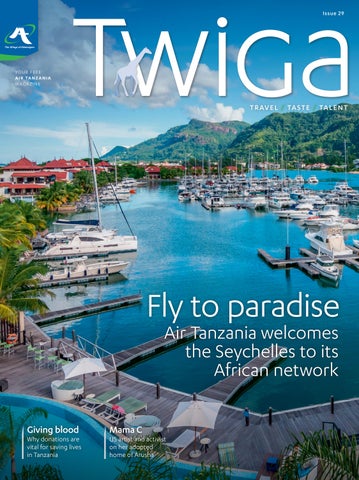
Set for Seychelles
Air Tanzania eyes one of the world’s most beautiful island escapes
Air Tanzania has announced plans to launch scheduled flights from Dar es Salaam to Seychelles.
Seychelles is widely regarded as one of the world’s most beautiful destinations, celebrated for its unspoilt beaches, crystal clear waters and relaxed island lifestyle. The planned service would connect Tanzania directly with Mahé, the largest and most populous island in the Seychelles archipelago, which is home to the capital city, Victoria, and the majority of the country’s population.
For Air Tanzania, the proposed Seychelles route would further strengthen its growing presence in the Indian Ocean region. The airline already serves some of the region’s most desirable island destinations, including Zanzibar, Pemba and Grande Comore in the Comoros.
Adding Seychelles to the network would introduce another iconic island paradise, offering passengers even greater choice when planning leisure travel across East Africa and the Indian Ocean.
The potential new link between Dar es Salaam and Mahé is expected to appeal to a broad range of travellers – from honeymooners and luxury holidaymakers to adventure seekers and nature lovers.
With Seychelles long positioned as a premium destination, direct access via Air Tanzania would make this dream escape more accessible to Tanzanian travellers
Five Reasons to Be Excited About Air Tanzania’s Seychelles Flights
1. World class beaches
Seychelles is famed for its powder white sands and turquoise waters, with beaches on Mahé and neighbouring islands consistently ranked among the most beautiful in the world.
2. Exceptional natural beauty
From lush tropical hills to protected marine parks, Seychelles offers a rare blend of land and sea landscapes that remain largely unspoilt.
3. Rich Creole culture
Visitors can experience a unique cultural mix influenced by Africa,
Europe and Asia, reflected in the islands’ music, architecture and cuisine.
4. Outstanding marine life
You can enjoy a snorkel in the water pretty much anywhere within the archipelago with vast shoals of tropical reef fish to be seen along with sea turtles, reef sharks, and manta rays.
5. Escape the everyday
With its laid back pace, warm hospitality and breathtaking scenery, Seychelles delivers the kind of escape that feels worlds away from everyday life.
To book flights or gain more information, visit airtanzania. co.tz or download the Air Tanzania Mobile App at the App Store or Google Play.
TWIGA MILES BONUS POINTS
Passengers can really rack up reward points through our loyalty scheme in the run-up to the festive season. We will double the Twiga miles earned on any domestic or international flights booked during this period. On top of this there are 500 Twiga Miles bonus points to be had if you book through the Air Tanzania Mobile App. Twiga Miles can also be used to secure seating upgrades.
For the latest flights, information and to book online, visit: www.airtanzania.co.tz
Follow us on:
@AirTanzania @airtanzania airtanzania_atcl
Air Tanzania ATCL
SAUTI’S NEWEST STAR AT 75
Mama C brings a lifetime of art, activism, and Arusha spirit to the big stage
‘’ve always wanted to be on stage at Sauti za Busara, and now here I am, at 75 years old!”
Artist and activist Charlotte Hill O’Neal – best known in Tanzania as ‘Mama C’ – can’t hide her delight at appearing before a rapturous crowd at Zanzibar’s celebrated annual festival of African music. It is some surprise that this is Mama C’s Sauti debut. The two seem such a good fit. Since 2003 the pan-African music festival has been showcasing a diverse range of live music from across the continent and the diaspora, and Mama C – an African American by birth – has for half a century fostered a cultural cross-pollination of the arts and spiritual advancement from her adopted home of Arusha. Music has been a primary tool in that cultural connection. Mama C is the lead vocalist and creative anchor of Mama C and the Fusion Band, the Arusha-based musical collective she brought to Sauti za Busara. As its name suggests, the six-piece band’s sound is a hybrid form that blends traditional African music with soul, funk, jazz, and hip-hop. It’s a mix of genres that reflects Mama C’s deep connections to her Tanzanian home as well as her US roots.
Mama C left Kansas City for Arusha in her early 20s, but the honeyed drawl of America’s heartland is still evident in her speech when we talk after the Sauti show. “Do you get my accent,” she teases. Her performances use that voice as a dynamic instrument. Part spoken word – Mama C is a published poet with works including 2008’s ‘Warrior Woman of Peace’ and ‘Homage’ in 2021 – and part improvisational, jazz-influenced singing, it gives her a powerful, in-the-moment presence on stage.
Mama C’s parting words to the cheering crowds after an impassioned one-hour set are: “A-Town in the house”, a reference to the nickname for Arusha that is popular among the city’s thriving hip-hop community. For all Mama C’s cosmopolitanism, ‘A-Town’ has a special place in her heart.
In 1972, Mama C and her husband Pete O’Neal sought sanctuary overseas when their involvement with US revolutionary civil rights movement the Black Panthers – Pete was the chairman of the Kansas City chapter – led to the prospect of imprisonment. They were welcomed by the Tanganyika African National Union under the leadership of Tanzania’s first President Julius
We talk about people’s hearts. We were taught that when we were members of the Black Panther party
Nyerere, who was building the newly independent country on pan-African ideals in alignment with the Panthers’ struggle against racism. When the couple’s first stop Dar es Salaam proved literally too hot to handle – Pete found the humidity of the coastal city detrimental to his health – they relocated to the cooler climes of altitudinous Arusha.
Arrival in Arusha
The O’Neals were soon smitten with Arusha and the feeling was mutual. “I love A-Town,” Mama C says. “We’ve lived there for more than four decades. It is not just the physical environment and the peace, but the people. It’s lush and full of love and friendliness.”
The couple set about integrating themselves into this welcoming environment. Just outside the city in Imbaseni Village they co-founded the United African Alliance Community Centre (UAACC) dedicated to community, art, and youth empowerment. It’s a tranquil haven open to everyone
– from the disadvantaged children who live on the grounds full-time at the centre’s Leaders of Tomorrow Children’s Home to tourists passing by. “The first thing that people say they notice when they walk through our gates is the peace,” says Mama C.
The centre has an onsite art workshop and music recording studio.
Mama C – a visual artist, filmmaker, and musician – is among those sharing her skills, but the centre has welcomed creatives from all over the world as volunteers offer free arts, education, and vocational training for local youths.
They are taught skills that Mama C believes can help lift them out of poverty – a word she uses not to denote a lack of financial resources, but more a poverty of purpose.
Learning can unlock innovative, lowcost solutions to daily survival.
She says: “We try to show them the best way to elevate not only themselves, but the community is to try to make them understand they can be farmers, making clothes,
being an entrepreneur. If you educate yourself not just with book learning but about life, then that can lift you up. You can make your own jewellery, sell clothes you’ve made, or grow your own food.”
Artistic exchange
For Mama C there is a lineage to this model of empowerment that can be traced back to her activism in the US.
“With the Black Panthers we tried to elevate the people to learn their history, to learn to be entrepreneurs, to learn how to build the community with unity.
“We still do that at the centre. We are still very international we deal with people from all over the world. We don’t care about race.
We talk about people’s hearts. We were taught that when we were members of the Black Panther party. We have never forgotten that lesson. That’s the way to change the world.”
The O’Neals acted as a major cultural conduit between the US and Tanzania. Among the artistic exchange they fostered between the
Mama C was a hit with the Sauti za Busara crowd
two countries it was US hip-hop took hold – and nowhere more so than A-Town.
“Arusha is the capital of hip hop,” Mama C says. “It’s been there from the very beginning
It has spread like wildfire, and I believe its rise was meant to be. What I like is there is a sense of unity in the Arusha hip-hop community. People these days are competing with each other, but here it is more about lifting everybody up. I hope that never changes.”
Keeping it real
Mama C has been around since the very start of the hip-hop scene in Arusha. She can remember brothers GSan and Faza Nelly – founding members of Tanzanian ‘Maasai rap’ group X-Plastaz – as teenagers trying out their first raps.
GSan and Faza Nelly are hip-hop legends in Arusha with the music of X-Plastaz drawing a following across Tanzania and globally. Tragically, both died far too young. It is indicative of Mama C’s standing in
the local hip-hop community that when the body of GSan was flown back to Arusha from the US in 2025, she was a pivotal, charismatic figure whose speeches provided comfort and unity to a city in mourning.
Mama C’s deep, long-standing affinity for the hip hop community continues today. “The hip-hop community keeps it real,” she says. “They talk about issues and not just talk, they also come up with methods to elevate the community through their words and their actions. I’m the same way.”
The UAACC holds workshops with the hip-hop artists providing a space for youth to express themselves. Hip-hop is also a key component of
the Mama C and the Fusion Band’s music. The current line-up includes D’wee – one half of influential Arusha hip-hop duo Watengwa – who plays ngoma drums but also steps forward to share centre stage with some stirring Swahili rapping.
Mama C doesn’t look or seemingly feel her age – “Let me take of my shoes and dance,” she says at one point on stage, swept up in her band’s rhythms – but she sees older and younger generations as still having much to teach each other. With a playful wish that this is not her “last Sauti” she looks to continue her artistic exchange. “I still want to inspire people. If I can do these things at my age why not a young person?”
To follow the latest developments and events at the United African Alliance Community Centre, go to @uaacc on Instagram
Top see a video stream of the full Mama C and the Fusion Band show at Sauti za Busara 2026, visit www.youtube.com/watch?v=FHgrQ1rwhfQ
Mama C and the Fusion Band on stage
NAISAE YONA: MISS UNIVERSE TANZANIA
REDEFINING BEAUTY BEYOND THE CROWN
Naisae Yona is having quite a year. The multiple business owner and mother was crowned Miss Universe Tanzania in 2025 and represented her country at the grand finals in November held in Bangkok. She speaks to Twiga about using her platform to spread the message that true beauty is found in compassion and kindness.
anzanian Naisae Yona is a very modern Miss Universe contestant. It was only in 2024 that the global beauty pageant removed the upper parameter of its 18-to-28 age limit for contestants. Naisae was 28 last year. She is also a mother, another factor that would have seen her application overlooked prior to 2024. The Tanzanian represents the pageant’s significant evolution in recent years, moving away from a strict focus on physical beauty to highlight intelligence, leadership, and personal advocacy.
Willowy with a winning smile, Naisae is undeniably beautiful, but she also embodies deeper, impactful qualities. The economics graduate is an entrepreneur running a series of businesses while heading a foundation, ‘Carry Kindness’, that
empowers women with disabled children. She juggles all these roles while bringing up her own daughter. She is an inspiring reflection of the modern Tanzanian woman: driven, caring, and proud of her roots.
“Tanzanian women are multifaceted,” she says. “We are entrepreneurs, mothers, leaders, creators, and change-makers. Being both a business owner and a mother has taught me resilience, balance, and the importance of creating opportunities not only for myself but for others. When a young woman looks at me, I want them to see that they do not have to choose between ambition, family, and leadership. They can pursue all aspects of their identity and succeed.”
When she was crowned Miss Universe Tanzania at a ceremony in Dar es Salaam in August last year,
Naisae still remembers the surge of emotion that washed over her. “When my name was called, I felt an overwhelming mix of gratitude, disbelief then soon after, the feeling of great responsibility kicked in,” she recalls. “It felt surreal, because I understood that the crown was not just about a title, but about representing Tanzania and the women of our country on a global stage. I remember thanking God and realising then and there, my life was about to change for his glory.”
Miss Universe finals
Representing her country on one of the world’s biggest stages soon followed. In November, she travelled to Bangkok for the Miss Universe finals. “It was one of the proudest moments of my life,” she says. “Standing on that stage with women from across the world reminded me how powerful representation is. I carried not only my own story, but the stories of many incredible, resilient, passionate Tanzanian women.”
It was also her first time in Thailand, a country she found unexpectedly familiar. “Thailand was incredible,” she recalls. “It reminded me a lot of my own country, Tanzania – the warmth of the people, the coastal feel of Pattaya, the food. Very similar to home.” While there, she even tried local martial art Muay Thai for the first time. “It reminded me that strength comes in many forms, both physical and mental. Experiences like that make international competitions special because you learn so much about other cultures while sharing your own.”
For Naisae, the Miss Universe platform has always been about more than a crown. “The message I share most is that kindness, purpose, and confidence have the power to transform communities,” she says. “Whether it is supporting someone in need, mentoring a young woman, or building opportunities through business, each of us has the power to uplift others. I also believe leadership today must be rooted in empathy and service.”
It reminded me that strength comes in many forms, both physical and mental. Experiences like that make international competitions special because you learn so much about other cultures while sharing your own
This philosophy underpins her foundation, Carry Kindness, which supports vulnerable communities, particularly women and children with disabilities. “Carry Kindness is rooted in the belief that small acts of compassion can create powerful social impact,” she explains. “For me, it is deeply personal because kindness has the power to restore dignity and hope. Sometimes the biggest challenges communities face are not only economic, but also emotional and social.”
Inspiring others
The weight of her title is not something she takes lightly. “Holding the title of Miss Universe Tanzania comes
with a responsibility to represent the country with integrity and purpose,” she says. Her goals for the year are clear eyed and rooted in service.
“If at the end of my tenure I can say that I helped inspire young women to believe in themselves, supported communities through meaningful initiatives, and represented Tanzania with pride, then I will consider that a success.”
Naisae continues to balance her entrepreneurial ventures with her duties as Miss Universe Tanzania. Much of her time is spent in Dar es Salaam, with frequent travel for engagements and community work. But no role is as central to her as motherhood – another dimension of
her life that informs her leadership and compassion.
Proud Tanzanian
And when asked what makes her proudest to be Tanzanian, her answer comes easily. “The resilience and unity of our people,” she says with a smile. “Tanzania is a country rich in culture, diversity and tribes. Despite challenges, there is a strong sense of community and optimism that continues to drive progress. I am proud of how Tanzanians support one another, how we celebrate our heritage, and how we continue to build a future that reflects both our traditions and our ambitions.”
A new
Observatory launches nightly astro tourism tours, revealing East Africa’s best dark skies to visitors.
Mount Meru Astronomical
hen most people mention the Big Five in Arusha it relates to the headliner animals– lion, elephant, buffalo, rhino, and leopard – that are the most prized spots in game drives from the ‘safari city’.
However, look up into the dark skies at night in this part of northern Tanzania and there is another Big Five to be seen. Arusha offers exceptional stargazing due to low light pollution, often revealing the ‘Big Five of the African Sky’. These include the Southern Pleiades, Omega Centauri, the Eta Carinae Nebula, the Coal Sack, and the Milky Way.
The Mount Meru Astronomical Observatory (MMAO) makes the most of the dark skies afforded to its location away from the city in the foothills of Tanzania’s second-highest mountain on the edges of Arusha National Park. Since 2019, the observatory has been revealing celestial wonders to school groups and pre-arranged public visits through its 12 inch fixed mount Cave Cassegrain telescope.
Stargazing tours
However, from May this year the non-profit educational organisation and community science centre will be launching an astro-tourism programme and running nightly stargazing tours.
The publicly accessible observatory – the largest of its kind in East Africa – features a variety of stargazing equipment. The permanent-mount telescope, a Srefurbished 1969 12 inch reflector, is housed in a dedicated observatory dome and has been recently refurbished. Secondary telescopes include a Skywatcher 10-inch GoTo Dobsonian reflector and a CelestronAWB OneSky 5-inch reflector.
Thanks to its position next to the national park, the observatory enjoys naturally dark skies far from Arusha’s city lights – ideal for seeing the Milky Way and other deep sky objects. Clear weather on most nights and the observatory’s higher elevation create excellent viewing conditions.
And unlike higher latitude destinations, Tanzania’s equatorial location means visitors can see stars from both the northern and southern skies throughout the year.
Since its founding, MMAO has focused on astronomy education, running teacher workshops, school programmes and astro science clubs that have inspired thousands of young Tanzanians to pursue science and STEM careers.
The new astro tourism programme builds on this foundation, creating a visitor experience that supports the observatory’s mission while offering a unique attraction for locals and tourists.
These experiences bring a fresh dimension to a trip to Arusha – an opportunity to complement a daytime wildlife safari with an exploration of the universe above it.
What you can see during a night at MMAO
The Moon’s craters and phases
Planets including Mars, Jupiter and Saturn.
Bright star clusters, nebulae and even the occasional galaxy. Satellites, meteor showers and rare events such as alignments or eclipses.
To learn more or book a stargazing tour, contact MMAO: Email: contact@mmao.space
Accra’s most exciting meals aren’t always found in restaurants. Across the city, supper clubs – intimate, ticketed dinners hosted in private spaces – are redefining how people eat, connect, and experience Ghanaian cuisine. Kofi Dotse explores the standout supper clubs offering a compelling alternative to the traditional dining scene.
s Accra cements its status as one of Africa’s most dynamic cities, its food scene is evolving. Enter the supper club: intimate, ticketed dining experiences hosted in private spaces that offer a deeper, more personal way to taste the city. These one-off events invite guests to explore local culinary heritage through carefully curated menus and shared tables.
Supper clubs are social by design. Diners gather to eat, talk, and connect – often finding themselves seated beside travellers, creatives, entrepreneurs, or cultural tastemakers. In these communal settings, Accra’s vibrant creative energy is as much a part of the experience as the food itself.
For emerging chefs and culinary entrepreneurs, supper clubs offer something equally vital: freedom. With the high costs of running a restaurant out of reach for many, these private dinners provide a platform to showcase talent without the pressure of long leases or daily overheads. Chefs are free to experiment with local ingredients, reinterpret traditional dishes, fuse old and new influences, and tell stories through flavour and presentation.
From modern Ghanaian cuisine to nomadic dining experiences that traverse the African continent, these are some of Accra’s finest supper clubs.
Midunu
Price: US$ 150 per person
Location: Silica Street, Accra Best for: Farm-to-table dining with exotic wine pairings
Midunu is a nomadic dining supper club curated by celebrated chef and chocolatier Selase Atadika. ‘Midunu’ is a common phrase in the local Ewe language meaning ‘let us eat’ and is used to invite friends to the table. The event pops up in a different location in the city each month to offer diners at communal tables a multi-course menu. The goal is to offer passionate travellers an intimate way to meet people and experience Accra. When I attended the event in August 2025 conversations around the table ranged from ‘Fante Fante’ fish parcels (a local dish from the Fante group) and the taste sensation of the cocoa juice spritzer.
Prekesse
Price: US$ 85 to US$ 150 per person
Location: Otswe Street Accra
Best for: High-value attendees mostly creative entrepreneurs
Prekesse (aidan fruit) brownies, gari (cassava flakes) crusted jollof balls and pan-seared tilapia in kontomire (coco yam leaves) sauce are just some of the creative, locally sourced highlights to be enjoyed at Prekesse. For executive chef Emmanuel Dzansi the Prekesse experience is about more than just food. “I
collaborate with visual artists and experiential marketing brands to design tablescapes that feel like installations and pair menus with some of my favourite wines and beverages,” he says. The Prekesse events are usually held in Otswe Street, in Osu, one of Accra’s buzziest neighbourhoods.
Dine on a Mat
Price: US$ 150
Location: Various Accra-based locations
Best for: A voyage into Fulani food
Dine on a Mat one of the most talked about communal dining experiences in Ghana and West Africa. The immersive, pop-up dining experience curated by chef Fatmata Binta celebrates Fulani culture, heritage, and cuisine. Guests sit on woven mats and eat modern twists on traditional meals such as dishes like fufu, tuwo, or rice-based meals with their hands.
Roots Afrique
Price: US$ 80 to US$ 100
Location: Various Accra-based locations
Best for: Contemporary interpretations of Ghanaian flavours
This pop-up boutique event is one of the latest editions on the Accra supper club scene. The reimagining African culinary heritage in a modern style. Founder and chef Wisdom Adzaka is driven by the principle of ‘sankofa’, a philosophical concept originating from the Akan people of Ghana that emphasises the importance of learning from the past to build a better future. His imaginative, upcycled dishes include smoked corn velouté, suya crusted lamb chops and sobolo (hibiscus) cheesecake. “Roots Afrique reminds us that the past is not behind us, but it’s within us,” Wisdom says. “I wanted to design an environment where food, storytelling, design, and conversation intersect.’’
Wojutei
Price: US$ 80 to US$ 150
Location: Various Accra-based locations
Best for: Crafty cocktails and Ghanaian flavours
In the language of the Guan – a small indigenous ethnic group believed to be the first settlers in modern-day Ghana – ‘wojutei’ means ‘have you eaten?’ Afrofusion chef Fiifi Abiram founded Wojutei’ to showcase his reimagined West African and Ghanaian cuisine in an intimate atmosphere. Dishes blend traditional techniques and ingredients with creative, high-end presentation. Examples include smoked salmon with ofam (spiced caramelized plantain) and pan-seared duck breast with yam pavé. A typical supper seats between 15 and 30 guests.
BRIDGING AFRICAN SKIES
From Lagos to Kilimanjaro, Captain Adebayo finds home in the skies with Air Tanzania
rowing up in a neighbourhood close to the perimeter fence of Runway 18R at Murtala Muhammed International Airport in Lagos, Adebayo Jonathan Ademulegun would pause his playtime every time a plane roared overhead. To many, it was just noise. To him, it was music – a rhythm of dreams taking flight.
“Every takeoff felt like a message,” he recalls. “I’d watch the aircraft rise and disappear into the horizon and wonder – where are they going, and what does it feel like to be in control of that journey?”
That childhood curiosity became a lifelong pursuit. Years later, after countless exams, simulator hours, and licenses – NCAA, TCAA, and FAA ATPL among them – Captain Adebayo found himself in a very different cockpit, under the blue skies of Tanzania. But this wasn’t just another job. It was a rediscovery – of purpose, of people, and of Africa from a higher perspective.
A new sky, a new culture
When Captain Adebayo joined Air Tanzania, the first lesson didn’t come from a flight manual, it came from the country’s people.
“Tanzania teaches you calm,” he says with a smile.
“In Lagos, life moves fast, loud, and determined. In Dar es Salaam, there’s a quiet strength. The culture here doesn’t rush – it flows. That’s something every pilot can learn from: composure.”
This cultural blend shaped him both in and outside the cockpit. From working with Tanzanian crew members who treat every passenger like family, to greeting passengers in Swahili over the PA system, Adebayo found that professionalism can coexist with genuine warmth – and that’s where Air Tanzania truly stands out.
“Every time we take off, I’m reminded we’re carrying more than passengers –we’re carrying a nation’s pride,” he says.
Every time we take off, I’m reminded we’re carrying more than passengers – we’re carrying a nation’s pride
Bridging skies and stories
Flying with Air Tanzania has allowed Captain Adebayo to connect his two worlds – the dynamic energy of West Africa and the serene spirit of East Africa.
“Each route tells a story,” he says. “When I fly from Dar es Salaam to Lagos, I feel like I’m connecting homes. From Kilimanjaro to Johannesburg, I see the heartbeat of Africa – its people, its resilience, its endless beauty.”
And the view never gets old.
From the cockpit, he’s seen Mount Kilimanjaro rising through the clouds at sunrise, the deep greens of the Congo, and the golden shimmer of the Serengeti at dusk.
“These are not just flights,” he reflects, “they’re moments that remind me how vast, diverse, and united Africa really is.”
Why Air Tanzania feels like home
What makes Air Tanzania special, he believes, is not just the fleet – though the modern Boeing Dreamliners and Airbus aircraft are impressive – but the people and philosophy behind the brand.
“The airline’s commitment to excellence, safety, and African hospitality sets it apart,” he says. “There’s a sense of purpose here. Everyone – from ground staff to cabin crew –takes pride in representing Tanzania. That pride shows in the way we serve, fly, and connect.”
He credits the airline’s leadership for nurturing a culture of consistency and respect. “You can feel it from pre-flight briefings to the farewell waves at arrival. It’s not just a job; it’s a shared mission.”
Lessons from the flight deck
To young Africans dreaming of aviation, Captain Adebayo offers grounded wisdom:
“Talent opens the door, but consistency keeps it open. In flying and in life, show up every day with focus. Even when progress feels slow, keep going –eventually, your altitude will match your attitude.”
He adds that aviation teaches patience, teamwork, and humility – qualities that apply beyond the cockpit. “When you’re thousands of feet in the air, you realize how small the world is – and how connected we all are. That’s what Air Tanzania stands for: connection.”
Where dreams take flight
From the rumble of Runway 18R in Lagos to the quiet hum of a Dreamliner’s Rolls-Royce Trent engines above the Serengeti, Captain Adebayo’s journey is a story of growth, gratitude, and the beauty of finding purpose far from where it all began.
As he prepares for another flight – Dar es Salaam to Johannesburg this time – he looks out at the horizon and smiles.
“Every time I lift off, I’m reminded that the sky has no borders – only possibilities.”
Air Tanzania Archives / Captain
Adebayo Collection
ar es Salaam-based social enterprise and NGO Africraft has been creating innovative ecofriendly products since 2004. Its team of local artisans – including women, youth, and people with disabilities – transform recycled materials like plastic, glass, and wood into furniture, jewellery, and home décor. It’s a responsible business model that cleans the streets of waste while promoting a circular economy and sustainable livelihoods. Here is Twiga’s pick of the beautiful and useful creations on offer.
A STEP-BYSTEP GUIDE TO JOBURG’S REVITALISED INNER CITY
he Ponte Tower has been one of Johannesburg’s most recognisable landmarks since it was completed in 1975. Standing at 173 metres tall, the striking cylindrical skyscraper was Africa’s tallest residential building for decades.
As well as being an iconic part of the Joburg skyline, Ponte Tower has become a symbol of the city’s
struggles as well as its recent resurgence. Once a luxurious, white-only apartheid-era apartment block, it decayed into a ‘vertical slum’ notorious for crime, gangs, and decay in the 1990s before undergoing a major, ongoing renovation. It now houses roughly 2,500 to 3,000 residents, serving as a rental-only building for working-class people, students, and young professionals.
Climbing the 948 steps of Johannesburg’s Ponte Tower is a test of fitness that rewards successful participants with one of the best views in the city. Are you up for the ‘Ponte Challenge’?
Dlala Nje (‘Let’s Play’ in isiZulu) is a community-focused tour company based in Ponte Tower that aims to challenge perceptions by offering visitors a real look at life in the city. The social enterprise has come up with ‘The Ponte Challenge’ – an innovative way for visitors to experience Ponte Tower life and the spectacular views from its rooftop. As Dlala Nje co-founder
Nickolaus Bauer points out, visitors will have to earn that amazing view.
“The Ponte Challenge is an urban adventure that tests your fitness and pushes your boundaries,” he says. “From the base, participants enter the stairwell that spirals up the inside of the building, climbing 948 stairs to the 54th floor.
“At the finish line on the 54th floor, climbers receive their medal and then make their way to our skyline venue: 5101. Here they are greeted by a stupendous 270degree view of the City of Gold and receive a well-earned breakfast made up of local treats like magwinyas (popular Southern African deep-fried dough balls) and polony (sliced sausage meat) alongside fresh fruit and juices.”
The inner city is often spoken about through tired stereotypes of dread, danger and despair. But the reality is far richer. It is one of the most culturally diverse parts of the city
How you approach the ascent is up to your inclination and fitness ability. Fitness freaks can run it – the current record stands at five minutes and 47 seconds – but most walk. However you get to the top, it will be a challenge. “The experience unfolds in stages,” says Nickolaus. “The first third is about finding rhythm and pacing. The middle section is where the legs begin to burn and people realise the scale of the challenge. The final stretch is pure determination –the moment where most participants discover just how far they can push themselves. Along the way there are marshals positioned at key points to guide and encourage participants. While a few competitors chase the course record, for most people the real victory is simply completing the climb.”
Take the challenge
The monthly challenge – it usually takes places on a weekend morning – offers a unique perspective on a striking piece of architecture that tells the story of Johannesburg itself. Dlala Nje is playing a significant role in highlighting the positive, evolving, and vibrant inner-city that is, in the words of
Nickolaus, “becoming a thriving residential community again”. He adds: “Our approach is simple: tell the full story of Johannesburg by challenging perceptions and creating opportunity. The inner city is often spoken about through tired stereotypes of dread, danger and despair. But the reality is far richer. It is one of the most culturally diverse parts of the city – full of families, entrepreneurs, street traders, artists and young people building new lives.”
Supporting the community
While Nickolaus points out that the Ponte Challenge offers just a “sneak peek” into the area’s history and culture in comparison to Dlala Nje’s other immersive walking tours in the surrounding Hillbrow community, participants are directly supporting the work of Dlala Nje. “All our tours and events help sustain two fully fledged youth development centres at the base of Ponte Tower,” Nickolaus says. “These centres provide a safe space for children from the surrounding neighbourhoods to simply be kids – to play, learn, receive support and spend time in an environment designed for their wellbeing. Today, more than 100 children benefit from these programmes. From our weekday homework clinic and rooftop garden
to classes in IT, yoga and pantsula (an energetic, syncopated urban dance form that originated in the townships of South Africa).”
The Dlala Nje guides all started as children attending these centres. Grant Ngcobo, who was one of the first young people to benefit from the programmes is now the social enterprise’s CEO. “His journey reflects exactly what the organisation hopes to achieve – creating opportunity where it did not previously exist,” Nickolaus says. “We are the community for the community by the community.
“In that sense, every climb at the Ponte Challenge does more than test someone’s endurance. It helps ensure that the doors at the bottom of the tower remain open for the next generation growing up in Johannesburg’s inner city.”
For information on the next Ponte Challenge and the other inner-city tours organised by Dlala Nje, visit www.dlalanje.org/ or @dlalanje on Instagram.
DISCOVERING NAIROBI THE LOCAL WAY
Harriet James experiences a new twist on the Kenyan capital’s chaotic, colourful transport culture on a guided journey through history, music, and memory.
have boarded matatus almost every day of my life. To school. To work. For errands that could not wait. I wanted to know how different it would feel exploring my city in a matatu as a tourist so I booked a seat on the Matatour Nairobi – the first audio guided private matatu experience in Nairobi.
As I boarded the matatu a voice over the PA said: “Sit back, relax, and discover Nairobi the way locals know it.” ‘Relaxing’ is not a word I’ve heard connected with matatus before, but I have learned to find a strange comfort in the loud, colourful and chaotic world of the Nairobi private bus system.
Stepping inside a matatu there is almost always some music playing, sometimes gospel in the morning, sometimes gengetone (a Kenyan musical genre that is a vibrant stew of rap, dancehall, reggae with lyrics heavy on local slang ‘Sheng’) or oldschool hits blasting from speakers that seem far too powerful for the size of the vehicle. The music hits you like stepping into a club. It’s intense, alive, and impossible to ignore; the beats seem to sync with every jolt and turn the vehicle makes, making your body sway involuntarily even though you’re just trying to hold on to the seat in front. The energy is electric, almost overwhelming at first, and it’s as if the matatu itself is pulsing with life.
There’s a history behind why matatus play loud music by the way. They became popular in the 1960s and 70s as an affordable, flexible
alternative to buses and back then, operators competed fiercely for passengers along busy routes, and one way to attract attention was with bright decorations, flashy lights, and eventually music. Playing loud, catchy music became a way to signal:
“This is my matatu — hop on!” Over time, the music evolved from radio tunes to cassette tapes, and later CDs and digital playlists. The music also served to build identity and some matatus became known for the style of music they played, their flashy interiors, and even branded names or slogans.
I used to enjoy loud music when I was younger but as I grow older, I’ve come to love matatus with soft
The name ‘matatu’ comes from the Swahili word 'tatu' meaning 'three'
music at the background or if the day was hectic, I always opt for the completely quiet ones. I loved the fact that in this matatu tour, the music was comfortable, reflecting the city’s heartbeat, lively without being overwhelming.
The art of the conductor
Matatu conductors have a whole performance dedicated to catching your attention. They lean out the open doors or windows, shouting colorful, rhythmic chants mixing their own improvisations with snippets of popular tunes. Often, they wave their arms theatrically like a street performance, beckoning passengers with exaggerated gestures, hopping in and out to make room, or playfully teasing would-be riders. Once the matatu is full, the conductors move with surprising agility in the aisle, collecting fares with one hand while steadying themselves
with the other as the driver navigates traffic with bold confidence. Our ride is comparatively sedate – our tour guide Paul makes sure that all passengers are kept comfortable with regular snacks and drinks.
Usually, on a matatu space is at a premium and passengers are packed in tight to maximise revenue. I’ve quickly learnt to fit myself into small spaces without complaint. You can’t be too precious about personal space when riding a matatu.
Outside the window, the city rushes past with street vendors weaving between cars, boda bodas squeezing through tight spaces, pedestrians navigating busy roads. Inside, life continues in its compressed, energetic form. It can be exhausting, especially during rush hour when every seat is taken and more passengers are still trying to board. Yet somehow, it also feels communal.
City's musical heritage
Instead of loud music, our matatu tour had narrated audio on the history of the city and the landmarks we passed – something I wish the normal matatus had.
For instance, as we drove through the Westlands area, Congolese Rumba filled the matatu, and the music became part of the lesson. The audio traced how rumba settled into
Nairobi’s cultural heartbeat and how legends like Franco and Mbilia Bel loved the city so much to the point of writing songs of it. We stopped at the Westlands roundabout stage where the audio gave us a brief lesson on the history of matatus.
“The name ‘matatu’ comes from the Swahili word 'Tatu' meaning 'three',” the audio began.
“Historically, in the early days of public transport in Nairobi and other Kenyan cities, a ride in these small vans or minibuses cost three cents or three shillings, and that’s how the name mathree came about. Later on, the name changed to matatu so people would say they were paying ‘matatu’ for a ride – literally, “three.”
The narration took me back to my childhood days when matatus were called mathrees. I recalled my mother telling me this story many time. The guide explained that more than 3.5 million people use matatus every day, accounting for nearly 80 per cent of public transport in Nairobi.
Today’s journey was both a step back in time as well as a new appreciation of my city. Highly recommended.
For more information on Matatours Nairobi and how to book a ride, visit www.matatournairobi.com/
The 'Matatour' provides a thrilling look at life in Nairobi
Tanzania needs regular blood donors. It is a small act of kindness with an extraordinary effect.
DONATE BLOOD LIFESAVER: Become a
lood is a lifesaving medical intervention that cannot be manufactured. It takes people with good heart to donate it for others. Every day in Tanzania, lives are saved due to donated blood in hospital wards across the country. A mother survives bleeding during or after childbirth; a child under five recovers from severe anaemia and other blood conditions like sickle cell; a cancer patient continues treatment; an accident victim makes it through surgery. In all these cases a blood transfusion is a critical, life-saving intervention. Behind each transfusion lies the work of the National Blood Transfusion Service (NBTS), which was established in 2004 under the Ministry of Health to ensure
the availability of safe, sufficient blood and blood products. NBTS is responsible for collecting, processing, testing, storing, and distributing safe blood to all hospitals countrywide both government, private and faith-based.
The estimated blood need in Tanzania as per this year’s population projections is 660,541 blood units (a standard measure of donated blood, typically consisting of approximately 500 ml collected in a plastic bag with an anticoagulant.) The World Health Organization minimum benchmark to meet a nation's basic requirements for blood, is estimated to be 1 per cent of the population. Over
years, this need has not been met in Tanzania due to several reasons; the main being limited community awareness of the need to donate blood regularly and voluntarily.
Gift of life
As people travel, work, and go about their daily lives, emergencies continue to happen without warning. When they do, blood must readily be available. This is why regular blood donation is essential. Blood donation is one of the simplest ways a person can make a direct and immediate impact. One unit of donated blood can save up to three lives. It is a small act of kindness with an extraordinary
A blood donor’s gift lives on in every recovery
effect. A blood donor may never meet the people whose lives they saved, but their gift lives on in every recovery.
NBTS relies entirely on voluntary, non-remunerated blood donors across the country. These donors come from all walks of life, united by a simple act of generosity that takes only a short time but has lasting impact. Every donation is carefully screened and handled by trained medical professionals to ensure safety for both donors and recipients.
By choosing to donate blood, individuals become part of a national effort to save lives quietly, selflessly, and powerfully. You can donate blood in blood collection centres all over the country. You can donate blood at zonal blood banks in Dar es Salaam, Mbeya, Moshi, Mtwara, Tabora, Dodoma, Mwanza and Lugalo Military Hospital Blood Centre. You can also donate blood in hospitals providing blood transfusion services.
For more information on blood donation or how to become a donor, contact the National Blood Transfusion Service on +255 739 613 000 or email info@nbts.go.tz. Online, information is available @changiadamutz on Instagram and on the website www.nbts.go.tz
Cape Town’s food markets offer an explosion of flavour, culture and community. From the Old Biscuit Mill to Maker’s Landing at the V&A Waterfront, the Bay Harbour Market at Hout Bay and the Oranjezicht City Farm Market, these bustling spaces bring together gourmet street food, fresh local produce and artisanal treats.
Food Jams
A culinary experience unique to Cape Town, Food Jams offers an immersive experience that blends cooking, music, and social connection. Founded in 2010 by Jade de Waal, a jazz musician and MasterChef SA finalist, Food Jams transforms traditional cooking classes into lively, collaborative events where participants cook together to the rhythm of curated playlists.
Participants are grouped into teams and guided through the preparation of a themed menu, with options ranging from Mediterranean to Asian cuisines. The experience culminates in a communal feast at a long table, where everyone enjoys the dishes they've created together. With venues in Cape Town's Salt River and Woodstock neighbourhoods, Food Jams emphasises creativity, collaboration, and the joy of cooking. www.foodjams.co.za/
Food Jams transforms traditional cooking classes into lively, collaborative events where participants cook together to the rhythm of curated playlists
Dining in style
Perched above Camps Bay, inside the historic 18th-century Roundhouse, Salsify is a landmark in Cape Town’s fine-dining scene. With sweeping views of the Atlantic and Camps Bay, the restaurant offers a fine dining experience where heritage architecture meets contemporary culinary artistry. Executive Chef and Co-owner Ryan Cole, together with Head Chef Nina du Toit have created a seasonally driven tasting menu that showcases locally sourced and foraged ingredients, transforming them into elegantly plated dishes, with thoughtfully curated wine pairings complete this unforgettable gastronomic journey. salsify.co.za/
Tucked between the Time Out Market and the Silo District at Cape Town’s V&A Waterfront, Salsify’s sister restaurant, COY, is a polished, modern restaurant that highlights African heritage with a fresh, contemporary approach. Led by chef Ryan Cole, the menu leans into seafood and uses local ingredients and traditional techniques in innovative and thoughtful ways. Guests can choose between a seven-course tasting menu or a shorter lunch option, both are paired with excellent South African wines and inventive cocktails. coyrestaurant.com/
Located on the first floor of the historic silo building at the Old Biscuit Mill in Woodstock, SALON is one of Cape Town’s most exciting fine-dining destinations. Created by celebrated chef Luke Dale Roberts and led by Executive Chef Carla Schulze, SALON offers an incredible nine-course global tasting menu that reflects Dale Roberts’ decades of culinary travel, while remaining rooted in seasonal Cape produce. From delicate opening snacks to theatrical tableside moments and indigenous South African ingredients, SALON is as much an experience as it is a meal. salonct.co.za/
Inside the Queen Victoria Hotel at the V&A Waterfront, Terrarium offers a thoughtful fine-dining experience combining sustainability with creativity. Led by renowned South African chef Chris Erasmus and head chef Anlou Erasmus, the restaurant serves two eight-course tasting menus: Fauna, which focuses on local seafood and meats, and Flora, a fully plant-based menu. Both menus showcase seasonal, foraged, and locally sourced ingredients. Wine pairings, curated by sommelier Marlvin Gwese, feature small-batch selections from South African producers that perfectly complement each course. The space also features contemporary local art and occasional live music. newmarkhotels.com/
Set within the peaceful gardens of Palm House Boutique Hotel in Wynberg, De Tafel offers a fine-dining experience that draws deeply from the Cape’s natural surroundings. Led by Executive Chef Greg Henderson, the four- and six-course tasting menus, which include plant-based options, highlight the region’s indigenous ingredients, including wild rosemary (kapokbos), buchu, and foraged mushrooms. Each course is paired with wines from small Cape estates, carefully selected by sommelier Richard Goza to reflect a strong sense of place. www.palmhouse.co.za/de-tafel/
A seaside feast
Flanked by the Atlantic on one side and the Indian Ocean on the other, Cape Town is a paradise for seafood lovers. Fresh kingklip, crayfish and West Coast mussels headline menus across the city. Whether it’s golden fish and chips by the harbour or an elegant seafood platter at a fine-dining table, seafood in Cape Town is a celebration of the ocean.
Snoekies is a Cape Town institution. After World War Two, founder Hans Mickeleit purchased an old bus, which he converted into a takeaway café, positioning it at the end of Harbour Road in Hout Bay. Here, he and his wife served fish and chips to the local fishermen. Hans’s wife ran the cafe whilst he experimented with smoking fish, setting up a factory in Hout Bay Harbour in 1956. In 1959 the business, together with Hans’s secret for smoking fish, was sold to South African Sea Products. More than 60 years since it’s humble beginnings, you’ll still find Snoekies at the far end of Hout Bay Harbour, serving up crispy-golden battered hake and freshly cut chips to locals and tourists alike. There are now several Snoekies outlets around Cape Town.
Street-food favourite ‘the Gatsby’ Few dishes say ‘Cape Town like the Gatsby. Born in the 1970s as an affordable, filling meal, this oversized sandwich is packed with masala steak, fried calamari, chicken or sausage, topped with ‘slap chips’ (French fries) and lashings of sauce. Arguably Cape Town’s most legendary street food creation, the Gatsby has become a cultural icon, with countless eateries putting their own spin on this beloved classic.
Koeksisters: the sweet taste of tradition
Koeksisters is a dessert influenced by South Africa’s cultural diversity. There are two distinct types: The ‘Cape Malay’ koeksister is a fragrant, lightly spiced doughnut rolled in syrup and coconut, and the ‘Afrikaner’ koeksister is a plaited, deep-fried pastry soaked in a rich, sticky syrup. Both variations deliver an irresistible combination of crispy, syrupy goodness that pairs perfectly with a cup of tea or coffee. Whether found at a neighbourhood bakery or homemade with pride, koeksisters are a cherished South African treat.
TAZARA TALES
THE RAILWAY THAT CHANGED A CONTINENT
Stretching 1,860km from Dar es Salaam to Kapiri Mposhi in Zambia, the TAZARA railway was considered one of the greatest feats of African engineering on completion in 1976. Twiga speaks to two of the driving forces behind ‘TAZARA Stories’, a feature-length film documentary that captures the human connection to this lifeline for locals.
n the mid-1960s when work began on the TAZARA Railway it was billed as The Great Uhuru (‘Freedom’) Railway – a bold partnership between two recently independent African countries, Tanzania and Zambia, that would bring economic liberation and self-reliance to each. Stretching from Dar es Salaam to Kapiri Mposhi, the gateway to Zambia’s lucrative copper belt, the 1,860km railway gave landlocked Zambia a trade route that bypassed white-settlerled Rhodesia (now Zimbabwe) and apartheid South Africa while helping turn the port city of Dar into an international gateway. Beyond its geopolitical legacy, TAZARA’s most profound effect was on local communities along the cross-border route. The railway’s primary purpose was to move bulk goods like copper and timber,
but its passenger-carrying trains helped transform previously remote rural areas into vital hubs for trade, culture, and community life. This ‘passenger belt’ includes a stretch in southern Tanzania between the fertile regions of Mbeya in the southern highlands and Mang’ula in the Kilombero Valley. Traders board the train in the river valley with hessian sacks of dried fish or rice to sell in the highlands to the west while on the journey back they carry baskets of onions, tomatoes and cabbages that are not grown in the valley’s wetlands.
Inspiration
In the 1990s, Professor Jamie Monson was often sharing a carriage with traders on this ‘town on the tracks’. A decade earlier the American academic had visited the Kilombero Valley as research for
her PhD dissertation on the colonial history of agricultural and environmental change in the region. The return visit was made in the hope of expanding the thesis into a book, but her frequent rail travel inspired a new direction.
“When I found myself riding the TAZARA line up and down the valley, I realised that the railway itself had brought more profound changes to the lives and livelihoods of people living in the valley than any other interventions I had studied,” Jamie tells me from the US where she is an Adjunct Professor of African History at Michigan State University. “I began to think about writing a history of the railway from a ‘bottom up’ perspective, with a focus on the lives of the people I had been living and learning from over the last years.
“Most histories of technology focus on the technology itself and see the technology as the ‘agent’ of change. In my work I try to show the ways that users of technology don’t just passively use it, but shape and
Film editor Dipesh Shapriya
transform it. The changes in mobility and livelihoods weren’t just due to the train itself but to the ways human lives intersected and interacted with the train.”
Jamie had learned to speak Swahili as a Peace Corps volunteer working with women’s groups in Kenya’s Taita Hills in the early 1980s and continued to study the language during her graduate years. Her fluency enabled her to form close bonds with locals whose lives had entwined with TAZARA as traders, travellers, or as the first engineers, drivers and other railway specialists that formed what was known as the ‘TAZARA generation’.
After more than a decade of research, Jamie’s book, ‘Africa’s Freedom Railway’, was published in 2009. A year later she was back riding the TAZARA and reacquainting with old friends, but this time with cameraman Ru Sheng capturing the interviews on film. Dipesh Shapriya, a Tanzanian filmmaker, editor, and writer who was tasked with editing the more than 100 hours of these field recordings into a 20-minute film, says Jamie’s familiarity to locals coupled with her Swahili skills meant the footage was revelatory.
“She had spent years building trust with workers and their families in Tanzania and Zambia. Many were elderly, but they shared their memories openly in ways they might not have for a traditional film crew,” he says. “This gave the film a depth and intimacy that’s rare in historical documentaries. For these people, TAZARA was transformative. They knew their stories needed to be captured before they were lost.”
Film interviews
In the years to follow this short film was expanded into a feature-length documentary with additional video archive of the railway under construction and new interviews and scenes shot in Zambia’s TAZARA towns. To get the latter footage and deepen their research for the film, Jamie and Ru travelled the entire length of the railway from Dar to
Kapiri Mposhi. “That was a very long trip,” Jamie remembers. The film’s final cut was prepared in the US with Dipesh part of an editing team that also included American Justin Leggs and German Aylin Basaran.
‘TAZARA Stories’ was released in 2021 and made the official selection of that year’s Zanzibar International Film Festival (ZIFF). At the time ZIFF’s director Martin Mhando praised the film’s “masterful storytelling and character-driven approach [that] invites viewers to reflect on the power of community and the shared human experience, making this film a significant contribution to documentary cinema”.
Human stories
The film shares the human-focused approach of the book, beginning with the narrated line: ‘It’s people that make a train’. For Dipesh TAZARA Stories is an important oral history that preserves the voices of those that ensured the success of a hugely ambitious and influential project. “It’s hard to overstate how
significant TAZARA was – it wasn’t just a railway; it was a symbol of independence, solidarity, and shared purpose. We wanted to preserve the human side of that achievement before it was lost to time.”
The film makes innovative use of rare or previously unseen archival footage, including clips shot on 16mm film by Chinese cameramen during the construction of the railway. Chinese involvement in the railway was fundamental with the country supplying vast quantities of equipment and sending more than 50,000 personnel to work with around 60,000 Tanzanians and Zambians on construction.
China is heavily invested in infrastructure and building projects across East Africa today, but TAZARA, as both Jamie and Dipesh point out, distinguished itself not only as the first such project, but also as one motivated more by political goals, including cultural exchange, than financial gain.
“The TAZARA project was an early example of Afro-Asian solidarity,” Jamie says. “There are many stories of friendship and connection, most of them from the workers who were engaged in the engineering workshops and other centres of training at Mang’ula in Tanzania and at Mpika in Zambia.”
Ships from the port of Guangzhou bought the Chinese workforce to Dar es Salaam. Most of them worked for two-year contracts, sometimes renewed, from the survey in 1968 to completion and handover in 1975-6.
“[They] worked alongside Tanzanians and Zambians, learning languages, sharing dorms, forming real bonds,” says Dipesh. “Today, it’s remembered as a rare example of cooperation driven by friendship and ideals rather than profit.”
The cultural exchange was two-way with a select group of Tanzanians and Zambians sent to Beijing for advanced technical and engineering training.
TAZARA Stories uses wonderful archive footage and human testimonies to bring this period to
TAZARA was a landmark project that brought together tens of thousands of Chinese and African workers
Jamie Monson (second from left) and the TAZARA Stories team at the ZIFF premiere
We managed to show the film in the communities, creating cinemas at a soccer pitch, a school, a college classroom and in Mbeya train station
life. The African visitors turned heads in China, a country where Western embargoes and its own Cultural Revolution had left it isolated from much of the world. For many Chinese people it was the first time they had seen an African.
Chinese, Tanzanians, and Zambians worked and suffered together in building the railway. The film captures how ambitious and, on occasions, dangerous the project was. Lives were lost. A route had to be cleared through mountainous terrain, especially between Mlimba and Makambako in southern Tanzania where 18 tunnels and 46 bridges had to be constructed. Many of the bridges crossed rivers with the foundations having to be built underwater with significant human effort. Then there was the risk from wild animals. The TAZARA route cuts through wildernesses such as the Selous Game Reserve (now the Nyerere National Park) where lions, elephants, and buffalo roam.
“There were many sacrifices,” Jamie says. “Some of the work was mechanised but mostly [it involved] a lot of hard human labour especially in building the bridges and blasting the tunnels. They worked day and night to get the job done. There was a lot of scepticism globally about whether the railway could even be built successfully in that difficult
terrain. The workers remember this time with a lot of nostalgia – they were young men, and they feel that they were part of something that was changing the lives of their own communities and contributing to the larger nation.”
Challenges
That sense of achievement is evident in Jamie’s interviews with the original TAZARA staff in the film. However, there is a bittersweet quality to TAZARA Stories that contrasts to the book that inspired it. The reason? The railway is still operating largely with its original tracks and trains. The film, put together two decades after the research for the book, captures a time in TAZARA’s life when the detrimental effects of the ageing infrastructure and limited investment have brought serious challenges to the railway’s reliability.
The decline in the services hit home to Jamie when she was filming at Mlimba, a town in the foothills of the Udzungwa Mountains dependent on TAZARA for trade. “The train was delayed night after night, and we heard stories from many angry passengers who had goods that were perishable. Some were carrying mangoes that needed timely delivery to retain their quality. One woman had a bamboo cage of chickens that needed food and water after days
of waiting. Those who had travelled on foot or by bicycle from far away villages had nowhere to stay so they slept on the platform or on the floor of the station. I just felt so sad and frustrated that the railway had let these people down.”
Slow-running trains, frequent breakdowns, and delays mean the TAZARA timetable holds little credence today. Both the Mukuba ‘Express’ – considered faster as it has fewer stops – and the Kilimanjaro ‘Ordinary’ train are only reliable in as much as they are always late. To travel the length of the line now takes at least 50 hours.
Ironically, the inefficiencies of the railway came into play when a tour of pop-up screenings of TAZARA Stories was organised for communities in Mang’ula, Ifakara, and Mbeya where the majority of the film’s Tanzanian scenes were shot. The tour had initially been scheduled for 2021 after the ZIFF premiere, but the Covid-19 outbreak caused its cancellation. With 2025 marking the 50th anniversary of the launch of TAZARA, the tour was rescheduled with the intention that the screening team – Jamie and Dipesh among them –would travel by TAZARA to each venue.
Pop-up screenings.
“On the day of departure our train was delayed for so long that we had to take the new SGR train to Morogoro and travel onwards by bus,” Jamie says. “We still managed to show the film in the communities, creating cinemas at a soccer pitch, a school, a training college classroom and also in the Mbeya train station.”
In 2026 screenings of TAZARA Stories were arranged in towns and villages served by the railway
Construction of one of the many bridges that formed part of the TAZARA Railway
It is not just the railway’s infrastructure that has suffered neglect. The film talks to original TAZARA staff members who are now approaching their later years without the financial support of a company pension despite decades of dedicated service. There are also interviews with current employees that have not been paid in months but continue to carry out their duties – whether servicing ailing engines or manning rundown rural stations – out of a mix of personal pride and civic duty.
Jamie was touched by the sacrifices of people she had come to know a friends. “Going back to TAZARA to work on the film brought many emotions for me – the warmth of my connections with the people who had built and used TAZARA over the years, and their contributions to the railway and to the region over the course of their working lives. At the same time, there was a lot of frustration and anger about the decline of the train that they had worked so hard to build and operate. The workers were not being paid, and those who had retired were not receiving their pension benefits.”
Brighter future
“The railway still carries more than a million passengers every year,” says Dipesh. “The fact the railway still runs at all is a testament to local mechanics’ ingenuity.” The
formative years of the railway saw the creation of a generation of skilled African technicians that have used and shared their expertise to battle the operational challenges that were to come. The staff may talk glowingly of the railway’s early years, but they have not given up on the present.
“There was a lot of nostalgia for the years when things were running more smoothly, when the now elderly workers were seen as having made a difference in the national development,” Jamie says. “Many of these elders encouraged me to record their stories for the film, to document both their successes in construction and operations in the past, as well as the decline of the operations in the present. They also wanted me to show that there have been hopeful moments as well, and efforts by workers and management to make things better. They didn’t want the film to be only a story of decline, but also a story of hope and the possibility of a brighter future.”
That brighter future could be close at hand. In late 2025 the Tanzanian and Zambian governments were reported to have signed a US$ 1.4 billion deal with China for a major revitalisation of TAZARA that will upgrade infrastructure and transform the line.
Dipesh holds out hope that the “modernisation can renew both TAZARA’s functional role and its symbolic legacy”. Jamie believes
the agreement “bodes well” but says it is important the upgrade will focus on passenger services as well as freight movement. “I do hope that the passenger train services will be greatly improved and become a treasured and supported asset for Tanzanians and Zambians,” she says. “It is the passenger train that makes such a huge difference for everyday lives and livelihoods, and it deserves ongoing support.”
While there is newfound excitement for the future, appreciating TAZARA means honouring its pioneers. This, as Dipesh points out, is what TAZARA Stories will always be there to do. “For the workers, TAZARA wasn’t just a job. It was a mission, a purpose, a contribution to something larger than themselves. It represented independence, pride, and proof that ordinary people can accomplish extraordinary things when they come together.”
Watch TAZARA Stories on YouTube here: www.tazarastories.com/
Africa’s Freedom Railway by Jamie Monson is available as an ebook or physical copy at www.qrs.ly/9vh820s
THE ULTIMATE SLOW SAFARI
As well as being a vital conduit for local traders, the TAZARA passenger service is a unique tourism adventure for intrepid travellers. The route passes through vast swathes of Nyerere National Park, which is home to elephants, buffalo, and lions, plus it’s a stronghold for wild dogs. The railway also skirts the southern edge of Mikumi National Park as well as the fringes of the Udzungwa Mountains and Kazimzumbwi Forest. TAZARA offers First Class (four-berth sleepers), Second Class (six-berth sleepers), and Super Seater (reclining seats) on its Express and Ordinary trains, with dining cars. As long as you are not on a tight schedule, a trip on the TAZARA is the ultimate slow safari. Tickets must be booked in advance. Visit www.TAZARAsite.com/ tickets-and-reservations
Film director Jamie Monson with research assistant George Mwambeta
Twiga cookery columnist Belinda Mkony shares her recipe for a comfort food classic.
The balsamic vinegar adds a slightly richer, deeper flavour compared to cider vinegar, and it pairs beautifully with the beef. For extra depth, you can add a pinch of smoked paprika to the sauce. Leftovers taste even better the next day as the flavours continue to develop overnight.
Ingredients
• 1 tablespoon olive oil
• Half a medium onion, finely chopped (for sauce)
• 2 pieces garlic cloves, minced (for sauce)
• 1 piece tomato sauce
• 1 small tomato diced
• 1 tablespoon balsamic vinegar
• 1.5 tablespoons brown sugar
• 1 pinch salt and pepper to taste
• 1 large head of green cabbage
• 500g ground beef
Cabbage rolls are one of those recipes that takes me straight back to a warm kitchen and the kind of cooking that just feels like home. I have been making these for a while now, and every single time I put them in the oven, the whole house fills up with that rich, tomatoey smell that gets everyone asking what's for dinner.
What I love most about this recipe is that it's simple, honest food, nothing fancy, just good ingredients coming together in the best way. The beef gives the filling so much flavour, and that tangy-sweet tomato sauce ties everything together beautifully. Yes, they take a little time and patience to roll, but trust me, the moment you cut into one at the dinner table, it is absolutely worth every minute. This one is a keeper.
A hearty, comforting classic packed with a seasoned beef filling and wrapped in tender cabbage leaves, all smothered in a rich balsamic tomato sauce.
• 0.5 pieces medium onion, finely chopped (for filling)
• 2 garlic cloves, minced (for filling)
• 1 egg
• 150g jasmine or long-grain white rice
• 1 tablespoon dried parsley
• 0.5 teaspoons paprika
• 5 leaves of fresh basil
• 1 teaspoon of Italian herb seasoning.
• 1 teaspoon of dried oregano.
Image courtesy of Belinda Mkony
Images courtesy of Belinda Mkony
FOLLOW BELINDA
To keep up with her latest recipes and events, visit Fork.Ur.Munchies on Instagram
Method
Prepare the cabbage: Bring a large stock pot of water to a boil. Add the whole head of one large green cabbage and boil for five minutes. Remove to a colander to drain and cool. Once cooled, cut just over a centimetre off the stem end of the cabbage. Carefully remove 12 leaves and cut the tough rib out of the stem end in a ‘v’ shape.
Make the balsamic tomato sauce: In a large skillet, heat one tablespoon olive oil over medium heat. Add half a medium onion, finely chopped (for sauce), and cook for two to three minutes, stirring several times. Reduce the heat to low and add two garlic cloves, minced (for the sauce). Cook for one minute, stirring constantly. Add the can of diced tomato sauce, diced tomatoes, one tablespoon balsamic vinegar, and one-and-a-half tablespoons of brown sugar. Add a teaspoon of Italian herbs, Season with a pinch of salt and pepper to taste. Simmer for 10 minutes.
Prepare the filling: In a large bowl, mix the ground beef, chopped onion (for filling), garlic cloves, minced (for filling), one egg, the rice, the dried parsley and oregano, and half a teaspoon of paprika until well combined.
Assemble the cabbage rolls: Spoon a thin layer of the tomato sauce into a 23 by 33 cm oven baking dish. Place about 75 grams of the meat mixture in the centre of each cabbage leaf. Bring in the sides and roll tightly. Place the rolls seam-side down on the tomato sauce in a single layer. Repeat until all rolls are assembled. Top with the remaining tomato sauce.
Bake: Cover the baking dish tightly with aluminium foil. Bake in a preheated 175°C oven for 80 to 90 minutes, until the cabbage is tender and the filling is cooked through. Serve it on a dish, sprinkle some chopped parsley and basil to finish with a scoop of the tomato sauce on top and a drizzle of extra virgin olive oil.
A smarter way to source for
A new digital marketplace is bringing clarity, visibility, and opportunity to East Africa’s interiors ecosystem.
esign professionals working in East Africa often point to a recurring pattern. Sourcing high quality furniture can require extensive travel between workshops, reliance on informal recommendations, and navigating production timelines that are rarely transparent. For customers, the process is time consuming and unpredictable. For artisans, it can mean inconsistent demand and few opportunities to scale beyond word of mouth commissions.
This disconnect between craftsmanship and market access has long shaped the region’s interiors industry. While the work itself is frequently exceptional, the systems surrounding it are often informal and fragmented. In practice, this limits growth, reinforces dependency on personal networks, and makes it difficult for talented makers to reach clients who might value both quality and provenance.
Many Tanzanian artisans operate small workshops that support families and local communities. Their businesses contribute to local economies and help sustain
traditional techniques, yet they often do so without formalised processes for pricing, timelines, or customer communication. The result is an industry that functions, but rarely at its full potential.
Interior architect Neemaeli
A Mkony, who has spent years managing design and build projects across Tanzania, encountered these challenges repeatedly in her professional work. Moving between workshops, coordinating vendors, and managing client expectations became a regular part of the job. Over time, what initially appeared to be isolated inefficiencies began to reveal a broader structural gap in the market.
Over time, Neemaeli began to see these daily frictions as a larger opportunity for change. “I wanted to build something that could bring clarity, trust, and visibility to an ecosystem that already had everything else it needed to thrive,” she says.
The result is Duhkani, a digital marketplace that connects thousands of homeowners with trusted vendors and design professionals in East Africa. As its CEO and founder, Neemaeli says the platform “is designed to make sourcing furniture and home solutions simpler, more transparent, and more reliable while also expanding access for local artisans
to reach wider markets. At its core is a simple idea: that the talent already exists, but the systems around it need to work better.”
Visitors seeking to update their homes can explore a broad selection of furniture, lighting, mirrors, ceramics, artwork, and garden design, sourced from vendors Neemaeli has previously worked with and trusts for their abilities.
Improving visibility is increasingly seen as a critical step in supporting creative economies across Africa. When artisans present their work to a wider audience, they gain access not only to more customers, but also to more predictable demand. This, in turn, allows for better planning, investment in skills, and the creation of stable employment.
Platforms such as Duhkani –launched this year – are beginning to play a role in this shift. Through structured onboarding, participating vendors are presented with consistent product information and clearer customer expectations. For buyers, this reduces uncertainty around quality and timelines. For artisans, it offers exposure to clients they might otherwise never reach.
To get a feel for what’s available at Duhkani, check out the images here that give a give a snapshot of the wide range of Tanzanian design talent into clear view.
To see the full collection, visit duhkani.com or scan the QR code.
A growing number of consumers are seeking more than functional objects; they are interested in where products come from and who makes them. Duhkani is also the story of the people behind the work. It showcases work by Tanzanian workshops such as Orkaja Seriani, Salvina Handcrafts, and Washa! exemplify this intersection of skill, identity, and community impact.
Duhkani founder Neemaeli A Mkony
There’s no place like home
Blogger and content creator
Faysal Alao – the founder of Arusha-based tour company
All Day In Africa – shares his take on life in Tanzania.
As someone who travels often, I spend a good part of my life moving between countries, cities, and cultures. Travel has opened my eyes in ways I never imagined. It has allowed me to see how different societies function, meet new people, and discover opportunities beyond our borders. But the more I travel, the more one realisation becomes clear to me: there is truly no place like home.
I come from a community where many people grow up believing that the ultimate dream is to leave Tanzania. For some, the hope is that a ‘mzungu’ partner will take them abroad and change their life. Others fight hard for scholarships to study overseas, and once they arrive, the mission becomes staying there at all costs. In many conversations, returning home is quietly viewed as failure.
But travelling has allowed me to see another side of that dream. Life abroad is not always the glamorous picture we imagine. It can be lonely, competitive, and demanding. Many people spend years working just to keep up with the cost of living while trying to maintain the image that everything is perfect. By the time some realise how difficult life abroad can be, coming home feels complicated because expectations back home have grown.
Ironically, the more I travel, the more I appreciate Tanzania. Home is more than a place on a map. It is the language that feels natural, the laughter of people who understand you, and the communities that support you.
And Tanzania itself is full of promise. We are home to some of the most breathtaking landscapes in the world – the endless plains of the Serengeti, the white shores of Zanzibar, and majestic Mount Kilimanjaro rising above it all. Beyond the beauty, we are a peaceful nation with a young and energetic population and industries that still hold enormous potential. From tourism and agriculture to entrepreneurship and innovation, opportunities exist for those willing to build and create.
Travel should expand our perspective, not distance us from where we come from. The knowledge we gain from the world should inspire us to return with new ideas and fresh energy to contribute to our own country.
Because sometimes, the opportunities we search for across the world are waiting quietly right at home.
Sound and vision
Mark Edwards rounds up the latest releases to stream, screen and read
FEKECHE BEATS
‘Life’
Prolific producer, songwriter, and sound engineer Fekeche Beats has had a hand in some of the best hip-hop releases in recent Tanzanian recording history. The prolific artist, who bases himself between Bagamoyo and Arusha, has just released an hour-long mixtape of some of his early work from 2020 to 2022, which showcases his skills in the studio. New single ‘Life’ sees him take centre stage, rapping in Swahili over his own spacey beats. A classy piece of reflective rap.
HOPPERS
Pixar jumps into its Disney era with Hoppers, a film that proves even tiny creatures can make big emotional messes. Expect dazzling animation, earnest life lessons, and at least one character designed to become a wildly overpriced plush toy. It’s classic Pixar: cute, chaotic, and engineered to make grown adults cry in public.
WOMEN RENT MEN AND SECRETS HERE
Damilare Kuku
Nigerian author Damilare Kuku is back dissecting the Lagos dating scene in unfiltered fashion as she did in her winning 2022 short story collection, ‘Nearly All Men in Lagos are Mad’. The new novel centres on Ara Ikoyi, a struggling author who finds inspiration in the scandal surrounding her neighbour, Juicy Mbelu, who has been accused of killing her sugar daddy. This sharp-tongued, non-judgemental satire explores the megacity’s obsession with social media, status, and the scrutiny of Nigeria’s justice system.
STONEBWOY
‘Torcher II’
Air Tanzania’s recent connections between East and West Africa are driving the cross pollination of two of the continent’s most thriving music scenes. Representing the west is celebrated Ghanaian artist Stonebwoy. This year will mark the release of his sixth studio album, Torcher II, with tracks building on his signature reggae/dancehall sound with made-to-move tracks such as ‘Silent Samurai’. More meditative are the stripped down ‘Far Away’ that champion’s the winner’s mindset that keeps the 38-year-old at the top of his game while affecting, socially conscious track ‘Blood Don’t Make Family’ goes deeper still to capture the unpredictability of human relationships.
PROJECT HAIL MARY
Ryan Gosling stars as a school teacher turned accidental astronaut who wakes up alone and amnesiac on a spaceship. It slowly becomes clear that he is on a mission to stop a cosmic threat that’s dimming the Sun. As he pieces together his past, he teams up with an unlikely alien buddy for a sci fi survival story that mixes high stakes science with surprising heart and humour.
BORN AT THE END OF THE WORLD
Donica Merhazion
This debut novel is inspired by the experiences of the author’s parents during Ethiopia’s Red Terror in the late 1970s. The title comes from the notorious Addis Ababa prison that was used to imprison dissenters during the brutal campaign of state-sponsored violence. The prison was known as ‘Alem Bekagn’ or ‘End of the World’ as few of those incarcerated were ever seen again. Merhazion, who was born there, was one of the few to survive. Her novel is a tribute to the love, courage, and resilience of her parents demonstrating that heroes are just ordinary people making extraordinary choices.
Lilian Hipolyte is the executive director of Dar es Salaam creative community Nafasi Arts Space. In her latest column she reveals that the best Tanzanian artists, no matter the level of their personal success, find time to share their skills.
You can go global without ghosting your community
Success in the art world often comes with an unspoken rule: once you’ve ‘made it’, you disappear into international exhibitions, airport lounges, and the occasional artist talk. Studio doors close, calendars fill up, and the next generation is left to figure things out on their own. Fortunately, artists like Amani Abeid didn’t get that memo.
The Tanzanian multidisciplinary artist has a career spanning illustration, painting, and international exhibitions. In 2026, he reached a new milestone as a featured artist in the Tanzania Pavilion at the 2026 Venice Biennale, one of the world’s most prestigious contemporary art platforms. Yet, even with this global recognition, his commitment to local mentorship remains unwavering.
Through his role at Nafasi Art Space, Amani continues to guide emerging artists, sharing not only technical expertise but also insights into navigating the realities of an artistic career. In spaces like Nafasi, mentorship is a daily, hands-on practice, one that nurtures confidence, sharpens creative direction, and builds professional resilience.
For young artists, such access is invaluable. It bridges the gap between aspiration and opportunity, offering both inspiration and practical tools. For the wider sector, it ensures continuity, where knowledge is passed on, and innovation is encouraged within a supportive community.
Remaining grounded is key. In an art world often driven by visibility and rapid success, artists who stay connected to their communities help anchor the ecosystem. They demonstrate that meaningful growth is collective, not individual.
Snorkelling SKILLS
Tips from a Tanzanian dive master on how to snorkel safely and sustainably.
ir Tanzania connects its passengers to some of East Africa’s premier snorkelling locations. Dar es Salaam offers several accessible off-shore islands within its marine reserve – specifically Mbudya, Bongoyo, and Sinda – with white sand beaches, turquoise waters, and vibrant coral reefs. In the Zanzibar archipelago, main islands and Air Tanzania destinations Unguja and Pemba are both ringed with world-renowned reefs that are home to diverse marine life including green turtles, dolphins, and over 350 fish species.
Gerfrida Luvuya is a dive master. She grew up in Kigoma where she was drawn to the rivers that feed Lake Tanganyika.
“It was a calling,” she says. “As soon as I started swimming, I felt a sense of peace. There was never any fear.” When she moved to Dar es Salaam to study wildlife science and conservation at university she had the Indian Ocean as her playground.
She learned to snorkel and scuba to dive master level and went on to launch
her own conservation-minded tourism company Marine Adventures.
Gerfrida loves to share her love of the water and specialises in creating a safe and encouraging environment that allows nervous swimmers to enjoy the underwater world. Women with cultural or modesty-based barriers to swimming – something Gerfrida experienced and fought against in her youth – are also welcome with the company creating a private, safe and female-only environment.
Marine Adventures conserve as well as explore the marine environment. The price of each trip includes a 10 per cent donation to the company’s marine conservation projects such as reef restoration and promoting sustainable fishing practices in the Kunduchi beach area north of Dar es Salaam.
Who better than Gerfrida then to share some snorkelling tips with Twiga readers to ensure they move efficiently and safely in the water without damaging the fragile environment.
Snorkelling skills
1. Kick from the hips
Many first-time snorkellers kick from the knees, but that creates splash (scaring away fish) and hampers your thrust in the water. Instead, keep your legs relatively straight and use your large hip and thigh muscles for power.
2. Wear flippers and let them do the work
Keep your arms relaxed at your sides, tucked behind your back, or pointed straight ahead to stay streamlined. Using your hands to paddle actually creates more resistance and can slow you down.
3. Maintain a ‘floating log’ position: Snorkellers should adopt a horizontal, face-down position on the surface of the water. Keep your body flat with your face tilted downward at a roughly 45-degree angle. This streamlined posture reduces drag and ensures your snorkel stays above the water line.
4. ‘Flutter kick’ your fins
Your fins should stay just below the surface to avoid breaking the water and creating turbulence.
5. Breathe deeply and slowly
Take long, steady breaths through your mouth to lower your heart rate and keep your body calm. Panicked, shallow breathing is a primary cause of fatigue and anxiety in the water.
Marine Adventures
As soon as I started swimming, I felt a sense of peace. There was never any fear
Snorkel sustainably
1. Use reef friendly sunscreen
Chemical sunscreens can damage coral reefs and marine life. Choose reef safe, mineral based options containing non nano zinc oxide or titanium dioxide to protect both your skin and the ocean.
2. Maintain a fully horizontal body position
Staying flat and streamlined on the surface keeps your fins away from coral formations beneath you, reducing the risk of accidental breakage or sediment disturbance.
3. Keep a respectful distance from coral and marine life
Avoid touching or getting too close to fish, turtles, and corals. Even gentle contact can stress animals or destroy fragile reef structures.
4. Never stand on the seabed
Coral breaks easily under pressure. Stay afloat using slow, controlled fin kicks so you do not rest on rocks, coral heads, or seagrass beds.
5. Secure all loose gear
Camera accessories, masks, or snorkel attachments can fall off and become marine debris. Ensure everything is clipped or strapped securely before entering the water.
THE ART OF THE PERFECT FIT
Tanzanian bespoke tailors Khimji’s is closing in on its 50th anniversary. We chart the family-run company’s progress from humble origins in Bukoba to becoming the quintessential tailoring icon in Dar es Salaam.
enerations of Tanzanian men have grown up dressed to impress thanks to the artistry and attention to detail of bespoke tailors Khimji’s. The Dar-based establishment has been there for its clients from their first school uniforms to business suits and wedding outfits.
The company started small in Bukoba in 1978. Founder Kassamali Khimji bought fabrics from local shops and employed two fundis for the tailoring service. The hands-on, community-driven business was driven by expertise, precision, and a commitment to quality over the speed of production.
As demand grew so did Kassamali’s ambition. He moved operations to the commercial capital, Dar es Salaam. A building in Indira Ghandi Street in the city’s bustling Central Business District became the base of operations and remains Khimji’s home to this day.
Sadly, Kassamali passed away in March 2024, but the third-generation family-run business continues to grow steadily. Faiz Khimji, Kassamali’s grandson and Khimji’s assistant director, says the company stays true to its founder’s core values of made-to-measure meticulousness. “Even as the company expanded, my grandfather’s connection to the shop never faded. Until his passing he continued to visit regularly, not out of obligation, but out of love for the craft, the people, and the brand he built. His presence remains deeply felt, and his legacy continues through the work, values, and commitment that define Khimji’s today.”
In two years, Khimji’s will be marking its 50th anniversary. The company’s longevity, Faiz says, is testament, to “the resilience of African entrepreneurship and the power of businesses that grow with their people”.
Reaching 50 years is surreal, and it’s something we don’t take lightly. It represents a trust built stitch by stitch, generation by generation, not just within our company, but with the communities and clients we’ve served across Tanzania
“Reaching 50 years is surreal, and it’s something we don’t take lightly. It represents a trust built stitch by stitch, generation by generation, not just within our company, but with the communities and clients we’ve served across Tanzania.”
The company’s longevity is also rooted in its ability to build lifelong customer relationship. Faiz describes Khimji’s as “a brand that grows with you, from school uniforms and first job interviews to weddings, boardrooms, hotels, hospitals, and restaurants. We stock fabrics and tailoring solutions across a wide range of needs and price points”.
Building on a tailoring culture
Khimji’s has also evolved alongside its customers. “Bespoke tailoring is deeply rooted in Tanzanian culture and across Africa as a whole,” says Faiz. “Today, clients are more style-conscious and informed, valuing fit and craftsmanship more than ever.”
Khimji’s sees its role as both a custodian and a modernizer of the craft. “We respect traditional tailoring principles while translating them into contemporary silhouettes, fabrics, and lifestyles. By raising standards and making bespoke more accessible and relevant, our aim is to contribute to a stronger tailoring culture in Tanzania and be part of
a broader African movement that values craftsmanship, quality, and individuality.”
Bringing the client’s personal style and vision to life is a collaborative process. “It starts with a conversation,” says Faiz. “A client visits our showroom located on Samora or Morogoro Road, selects their fabric, shares inspiration, and tells us where they plan to wear the garment, whether for work, a wedding, travel, or everyday life. From there, we guide them on fit, structure, and details.
One-stop-shop
“The client is involved but never overwhelmed. They bring the vision; we help refine it. Some know exactly what they want, others just know how they want to feel. Both are welcome.”
Fabric selection – Khimji’s sources its textiles through a long-established network of trusted international mills – measurements, tailoring, and finishing are all done under one roof. “We are a onestop-shop,” says Faiz. “We also bring Khimji’s to you. Our team can visit your home or office with fabric options, take measurements on-site, and guide you through the process.”
And the effect on the client of the perfectly fitting shirt, jacket or suit? “A well-fitted garment changes how you stand, move, and show up. When clothes fit properly, you don’t
think about them and that’s when confidence takes over,” Faiz says.
Khimji’s is actively supporting the creative industry in Tanzania by bridging traditional craftsmanship with modern design. It partners with both established and emerging designers to, Faiz says, “support their creative visions with quality fabrics and precise tailoring”. The company also helps maintain the highest quality among craftsmen in the industry. “Our focus remains on preserving quality and consistency in every garment,” Faiz says.
Looking ahead, Faiz forsees a growing demand for made-tomeasure tailoring led by Africans that value fit, longevity, and individuality over fast fashion. Faiz says: “We see tailoring becoming less about occasion-only dressing and more about everyday confidence. Tanzania has the talent, the culture, and the market to lead this shift, and Khimji’s aims to be part of shaping a tailoring industry that is proudly African, globally aware, and built to last.”
For details on how to start your made-to-measure journey, go to www.khimjis.co.tz/made-to-measure/
For the latest looks and updates, follow @khimjis_instyle on Instagram.
Why Zanzibar is becoming the Indian Ocean’s new YOGA DESTINATION
How the Zanzibar Yoga Festival, now in its second year, aims to unite the global yoga community in the island’s mindfulness paradise.
anzibar just might be the mindfulness paradise your yoga needs. The island’s serene natural environment – think lapping ocean waves, the fragrance of spice farm harvests on the gentle breeze, and flawless white-sand beaches – encourages deep disconnection from daily stresses and a profound reconnection with oneself.
Slightly surprising then that it took until 2025 for the island to get its first dedicated yoga festival. Less surprising that it proved a success and is back, bigger than ever, this year.
The Zanzibar Yoga Festival 2026 takes place from April 16 to 19 at the Sunshine Marine Lodge in Matemwe on Unguja, the main island in the Zanzibar archipelago. Over the four days, guests can pick and choose from an all-inclusive programme
All images by Shakki
of 47 classes and workshops that encompass various styles of yoga as well as other wellness practises such as meditation, breath work, and exercise.
Co-founders Sophia Schwer and Tizia Doriye hope the festival will put Zanzibar on the map as an international destination for yoga retreats and showcase the wealth of instructor talent to be found in East Africa as well as the yogic heritage of the region. “People tend to flock to Bali and India for yoga retreats and teacher training, but there is plenty happening here,” says Sophia. “The quality of teachers we have collected is incredible. These are seriously dedicated yogi from varying aspects of life.
A lot of our teachers root themselves in ancient African philosophy. East Africa is represented among the 14 experts we have leading the classes at this year’s festival, including Ugandan rising star Mugisha Ali Allan.”
Inclusive event
Sophia and Tizia first bonded as expats living and working in the northern Tanzanian town of Arusha, and through their shared love of yoga. Sophia, a keen skier and skater, credits her yin yoga practise with helping her recover from debilitating periods of injury and illness while Tizia is a massage therapist and certified yoga teacher recognised by the Yoga Alliance.
In planning the festival, the founders were determined to make it as inclusive and affordable as possible. Ticket prices for the 80 available places were kept deliberately low, while still ensuring the event could cover its costs. Early bird tickets were available for US$200 until the start of the new year, with standard tickets priced at US$250 thereafter. There have also been competitions run on the festival’s Instagram page with one free and one discounted ticket as the prizes.
All tickets grant full access to every class and workshop across the four day festival. Three healthy,
vegetarian meals each day are also included with the hotel’s breakfast, lunch and dinner buffet showcasing local delicacies provided by the festival’s East African partner brands. The 80 festival guests can expect treats such as stingless-bee honey, flavoured salts, and oyster mushrooms. Breakfast and lunch are kept deliberately light to ensure comfort, mental clarity, and high energy levels during classes. Dinner is more celebratory and social with interactive games and shared experiences to build community among guests.
Classes begin early with daybreak mediation sessions, led by Tizia, before sunrise yoga. The retreat goes on to explore diverse wellness practices and immersive experiences. Sophia says: “There’ll be pilates, creative workshops, SUP yoga in the hotel swimming pool, animal movement, a Qigong class, and plenty of dance and music.”
In tune with nature
All classes will take place within the Sunshine Marine Lodge, which will be reserved exclusively for festival guests. Sophia says the hotel’s thatched beachside bandas make the ideal location for yoga classes with beautiful Indian Ocean views to distract the mind from the physical discomfort of long-held poses.
The hotel sits on Zanzibar’s north east coast, a stretch of shoreline famed for its spectacular sunrises.
The four-day Zanzibar Yoga Festival offers an all-inclusive array of classes and treatments
“It’s a powerful moment in the day and an important part of the yoga practice,” says Sophia. She adds that Zanzibar’s position close to the equator also supports the natural rhythms yoga seeks to align with. “The consistent 12 hour days mirror yogic rhythms,” she explains. “There’s something deeply healing about that balance.”
The relative remoteness of Matemwe – Sunshine Marine Lodge organises a shuttle to and from the island’s airport, around 70 minutes’ drive further south – also means that it is largely untouched by the largescale commercialisation that has hit much of Zanzibar.
Matemwe Beach is considered one of Zanzibar’s most beautiful beaches – quite an accolade on an island ringed with white sand and azure waters – but stays relaxed, quiet, and serene. “Matemwe is still a small pocket of tranquillity,” says Sophia. “You look out to Mnemba Island but then it is just the Indian Ocean as far as the eye can see.”
Festival guests will find out how such a place of outward beauty can assist with inward contemplation, reminding them that sometimes the most profound journeys happen in stillness.
For more information on the Zanzibar Yoga Festival, visit www.zanzibaryogafestival.com/ or @zanzibaryogafestival on Instagram.
YOUR ULTIMATE TRAVEL COMPANION
Fly
with ease and book your next adventure with the new Air Tanzania mobile app
FEATURES INCLUDE:
• Book a flight
• Change or cancel your flight and purchase extras such as additional baggage allowance
• Check in, view your boarding pass and add it to Apple Wallet.
• View or change your seat.
• Check the latest flight status and receive flight and gate change notifications.
• Join Air Tanzania’s rewards programme Twiga Miles and earn points every time you travel to enjoy premium services
• Book Twiga Miles award tickets.
• Check your Twiga Miles account balance and current tier status.
• Manage your trips, profile and customise your travel preferences.
Download the Air Tanzania App now on Play Store and App Store
Travel information Before take-off
Taking your first flight is certainly exciting, but can also become a source of stress for those who are unfamiliar with the rules, procedures and customs of flying. To prepare yourself for your first flight, it is therefore important to get information on everything you need to do before and during your journey. Here is a useful pre-departure checklist.
1 Before departing, it is important to check the airline’s website for its hand luggage rules: weight, sizes and types of objects you can take on board. For example, as regards liquids, you are advised to carry these in your hand luggage, only in transparent, reseal able, plastic containers, not exceeding 100 ml. If you have connection flights, we advise that you also check the websites of other airlines.
2 Arrive at the airport in advance (at least two hours for domestic flights and three hours for international flights).
3 Check in online, if possible. If travelling with hand luggage alone, you can check in online and print or download your boarding pass which you must take with you directly to security checks.
4 Set your mobile to flight mode, as well as other devices connected to the internet that you are taking on board. Cabin crew will remind you of this step before take-off. With flight mode set, you can still take photos of your unforgettable journey and you can also enjoy the in-flight entertainment system!
AIR TANZANIA FLEET
BOMBARDIER DASH 8-Q300
Number of aircraft
available: 1
Seat capacity: 56
Number of flight-deck crew: 2
Range: 1,711 km (1,486 Nm)
Typical cruising speed: 271 knots (502 km/hr)
Wingspan: 91 ft 8 in (28 m)
Length: 82 ft 4 in (25 m)
5 To prevent sickness from ruining your first flight on a plane, we advise you to take natural remedies, such as, for example, ginger tablets or gum to chew.
6 Enjoy the view! By choosing a seat near the window, you will see breath-taking landscapes and you can take photos of the exquisite white clouds you will be flying above.
7 Try to take a nap. Sleeping on the plane will make time pass faster and you will arrive at your destination calm and rested.
8 Lastly, especially during take-off and landing, the change in pressure inside the cabin may cause discomfort in your ears. Chew gum or wear earplugs to combat this.
National carrier Air Tanzania is justifiably proud of its revamped six-strong fleet. Here we take a close-up look at our aircraft with technical data and specifications.
DE HAVILLAND CANADA
DASH 8-Q400
Number of aircraft available: 5
Seat capacity: (3 De Havilland Canada) Business Class 6, Economy 70, (1 De Havilland Canada) Business class 10, Economy 68
Number of flight-deck crew: 2
Range: 2,063 km (1,362 Nm)
Typical cruising speed: up to
360 knots
(414 mph or 667 km/hr)
Wingspan: 93 ft 3 in (28.4 m)
Length: 107 ft 9 in (32.8 m)
AIRBUS 220-300 (CS300)
Number of aircraft available: 4
Seat capacity: Business Class 12 and 120 Economy Class
Number of flight-deck crew: 2
Range: 6,112 km (3,300 Nm)
Typical cruising speed: 470 knots (541 mph or 871 km/hr)
Thrust per engine at sea level:
23,300 lbf / 103.6 kN
Wingspan: 115 ft 1 in (35.1 m)
Length: 127 ft (38.7 m)
Interior cabin width: 129 inches (3.28 m)
BOEING 737-MAX 9
Number of aircraft available: 2
Seat capacity: Business Class 16 and 165 Economy Class
Number of flight-deck crew: 2
Range: 6,570 km (3,550 Nm)
Wingspan: 117 ft (35.9 m)
Speed: 853 km/h
Length: 138 ft (42.1 m)
Fuel capacity: 25,800 litres
BOEING 787-8 DREAMLINER
Number of aircraft available: 3
Seat capacity: Business Class 22 and 240 Economy Class
Number of flight-deck crew: 2
Range: 13,621 km (7,355 Nm)
Typical cruising speed: 488 knots (561 mph or 903 km/hr)
Thrust per engine at sea level:
64,000 lbf / 280 kN
Wingspan: 197 ft 3 in (60.12 m)
Length: 186 ft 1 in (56.72 m)
Interior cabin width: 18 ft 0 inch (5.49 m)
FREE BAGGAGE ALLOWANCE
Air Tanzania has a free allowance for passengers’ baggage across economy and business class. For full details and rates please see our website www.airtanzania.co.tz or contact booking enquiries
+255 748 773 900
Passports and visas
A valid passport or travel document that is valid for at least six months is required to enter the United Republic of Tanzania.
Visitors will also require a valid visa upon arrival. There are a range of visas available depending on the nature and frequency of your visits, but a single entry visa can be obtained on arrival in Tanzania subject to the fulfilment of all immigration requirements. There is a US$ 50 charge for the visa.
Those travelling to Zanzibar require an inbound health insurance policy, which is mandatory for all
BOEING 767-300F CARGO
Number of aircraft available: 1
Seat capacity: N/A
Range: 6,025 km (3,253 Nm)
Typical cruising speed:
488 knots (561 mph or 903 km/hr)
Cargo volume:
438 cubic metres
Cargo weight: 52.7 tonnes
Thrust per engine at sea level:
60,600 lbf / 270 kN
Wingspan: 156 ft 3 in (47.57 m)
Length: 180 ft 3 in (54.94 m)
foreign visitors. The insurance can be purchased in advance online or at check-in when departing for Zanzibar. The insurance is charged at $44 per person.
For a full list of visas available and for countries for which special terms exist, visit the Air Tanzania website.
Check-in
Check in online, if possible. If travelling with hand luggage alone, you can check in online and print or download your boarding pass, which you must take with you directly to security checks. You should check in two hours ahead of your flight time for domestic flights and three hours for international flights.
Family travel
Fares for infants and children
As a general rule, children up to two years old are not required to have their own seat and are allowed to travel on parents’ lap. An infant tickets costs 10 per cent of the regular fare. Depending on the destination, taxes and fees may apply. Please note that only 1 baby per adult is accepted. You can choose to buy a seat for your baby at the reduced rates for children if any children’s rate is applicable.
If your child is older than two years or turns two while you are travelling, you will have to book a separate seat for him or her and book the children fare for the entire journey. If a child travels with an accompanying adult in the same class of cabin, the child should be seated in the same seat row as the accompanying adult. Where this is not possible, the child should be seated no more than one
ECONOMY
BUSINESS
seat row or aisle away. Reduced rates apply for children aged two to 11 on most routes, depending on the travel class. Children turning 12 years en route need to be booked as adults for the entire journey.
Expectant mothers
Our priority is always your safety and that of your unborn child.
To avoid unnecessary risks to you and your baby, we recommend that all expectant mothers consult a doctor before booking their ticket and inquire about their fitness to fly the length of the trip they intend to take.
Depending on the stage and circumstances of your pregnancy, you may be required to present certain medical forms before flying. For your own safety and the well-being of your child, Air Tanzania will not accept expectant mothers who are pregnant from their 34th week or beyond.
UMNR (children travelling alone)
If you’re planning for your child to travel alone, we’re here to make sure they enjoy their trip and that they are well taken care of throughout their journey.
When you book our unaccompanied minor service, your child will be received at the originating airport, taken care of during transit and while on board the aircraft. He or she will be handed over to the person designated by the parents/guardians upon arrival at the final destination.
Cost
To avail the unaccompanied minor service, an adult fare needs to be purchased for the child. Please contact us to book the flight and the service.
Infant fare checked baggage allowance
Infants travelling on an infant fare are allowed 10 kg as baggage allowance.
Child fare baggage allowance
Children and infants travelling on a child fare are eligible for the same baggage allowance as adults.
Wheelchairs
If you need wheelchair assistance at the airport, you must advise Air Tanzania of this at the time of booking. You can request wheelchair assistance through our Call Centre or at Air Tanzania Sales offices.
Inflight Wi-Fi
On board Wi-Fi
Enable Wi-Fi on your laptop, tablet or smartphone, and select AirTanzaniaWifi
You will need to launch your web browser, which will display the log-in web portal. From the portal, simply select your preferred price plan.
Portable electronic devices (PEDs)
You can use your e-readers, tablets and smartphones from gate to gate – including taxiing, take-off and landing – without a risk to safety.
Note that on-board Wi-Fi is only available on certain aircraft. Please follow cabin crew instructions at all times.
Zanzibar
Those travelling to Zanzibar require an inbound health insurance policy, which is mandatory for all foreign visitors. The insurance can be purchased in advance online or at check-in when departing for Zanzibar. The insurance is charged at $44 per person.
Air Tanzania contacts
WHERE TO CONTACT US
CONTACT CENTRE
Location: ATC House, Ohio Street.
Email: info@airtanzania.co.tz
+255 748 773 900
Tel: +255 22 2117500
International customers: +255 748 773 900
AIR TANZANIA CONTACTS
DAR ES SALAAM (HQ)
ATC House, Ohio Street PO Box 543 Office (JNIA) Tel: +255 222 117 500