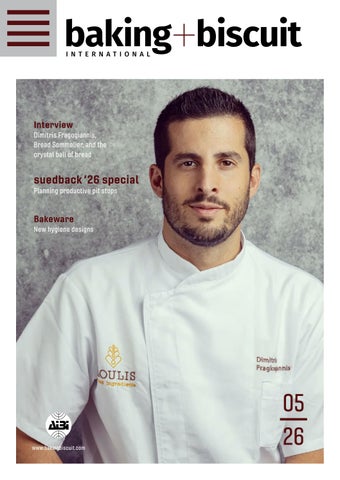
Interview Dimitris Fragogiannis, Bread Sommelier, and the crystal ball of bread
suedback ’26 special Planning productive pit stops
Bakeware New hygiene designs
www.bakingbiscuit.com
05 26
best-in-class
bakery systems
for every
baker
Visit us
Sudbac
at
k
Stuttga Hall 5 | rt Germany Stand n 24-27 Oc o. 5B63 t
Is your pizza & flatbread line prepared for peak demand?
scan to elevate
your bakery
amfbakery.com
sales@amfbakery.com
EDITORIAL
To do or to digitize? For large-scale bread production, the key to profit in operations in bread production is preserving handcrafted product qualities while carefully automating the process. Transferring the artisan spirit and the breadmaking tradition is just as important as respecting the recipe and achieving the dough humidity, the crumb mouthfeel, or crust thickness. They are as challenging to capture as it sounds – what settings put together translate into experience and artisan-level skillfulness? The story may be different for smaller and medium-sized bakeries, where setups rely on the best-suited combinations of automated processes and manual work, either for the artistry of decorating or for any number of production steps. But the question is the same in this case, too: what mix and match can act like a skillful baker consistently, around the clock – across all shifts, with various levels of expertise?
Catalina Mihu, Editor-in-chief Your commments or suggestions are always appreciated: e-mail: mihu@foodmultimedia.de
The answer comes from automation, in bakeries big and small. Craftsmanship is being digitized. This is not the case of machine replacing man (or it should not be), but rather finding the most effective path to having machines work with people (and making up for the lack of more people), comfortably and efficiently. It makes sense that, over the past years, the technologies winning industry awards do just that: map out and execute the most efficient route from ingredient to product, or from product in the bakery through to their destination, on the dinner table, in the lunch box, or anywhere the day takes us, for a snacking moment. How and what to digitize effectively? There is a distinction between ‘entering’ a production line via a VR headset and traveling through for a product’s POV (something that I tried and it looks as fun as it sounds!), or virtually visiting a complex mixing system, for example, and having the entire operation at one’s fingertips, from the big picture to the smallest changes in process parameters and environmental conditions, from controlling the current production run to anticipating next month’s incoming orders and ingredient needs. The answer to this question is a one-fits-one solution. The good news is that there is a wealth of resources being developed to help build the most helpful setup for all bakeries. At suedback this year, digitalization is among the top themes, bringing together the latest developments in this field – from new concepts to new equipment features, and including AI. It’s one of the main topics at this year’s Bakers’ Forum, where practical demonstrations are planned, along with expert talks and ideas for production and sales. To help prepare your trip to Stuttgart for the trade fair, we’ve curated highlights in this issue, from special events to noteworthy exhibits. We hope you will find inspiration to write in your show agenda (itself an item enjoying digitalization tools for efficiency and convenience). See you there! Catalina Mihu
www.bakingbiscuit.com 05/2026
03
CONTENTS
COVER STORIES
HIGHLIGHTS
THE MAGIC CRYSTAL BALL OF BREAD As a professional baker
22
and a baking trainer, Dimitris Fragogiannis – one
© Rondo
of Greece's first certified Bread Sommeliers, is always researching the science that
06
FINDING THE SILVER LINING
has been or could be applied © Dimitris Fragogiannis
Efficiency tops the priority list in baking facilities by
to innovation. One such
necessity: bakeries need to produce more types of
project led him to develop the
goods with fewer people. There is a silver lining to
one-of-a-kind ‘crystal bread’, an
this cloud, and for baking lines, it’s that technology
unconstructed sourdough crust.
upgrades specifically target these challenges with process improvements.
26
© FRITSCH
© Messe Stuttgart
38
SUEDBACK ’26
“WHAT SUSTAINS A COMPANY FOR OVER 100 YEARS ISN’T
Digitalization and AI are two of the focus topics this year in Stuttgart, joining the ranks of core priorities alongside product development, automation and training.
MACHINES, IT’S PEOPLE WHO HAVE IDEAS” Dr. Tobias Richter, Group President (CSO), MULTIVAC Group and Dr. Nico Hassmann, Managing Director Sales, FRITSCH Bakery Technologies GmbH & Co. KG, shared in an interview the company’s success story and its strategy as it steps into its second century.
CLEANLINESS IS NEXT TO SAFENESS Food safety in a bakery relies on the hygiene of the bakeware, one production cycle after another and for all types of doughs, with any number of inclusions, glazes, or toppings. To achieve this, baking supports must be cleaning-friendly by design.
www.bakingbiscuit.com 05// 2026
FOUR KEY TRENDS SHAPING THE FUTURE OF SWEET BAKERY
52
Four key trends are shaping the future of sweet bakery: Sweet Connections, Elevated © Dawn Foods
18
© American Pan
04
Indulgence, Simple Pleasures, and Empowering Choices.
CONTENTS
IN THE SPOTLIGHT 06
Interview: Dimitris Fragogiannis, Bread Sommelier, and the crystal ball of bread
BAKEWARE 18
American Pan: Pan cleanliness is next to safeness
BREAD LINES 22
Rondo: Finding the silver lining for more efficiency and flexibility
SUEDBACK ‘26 26
Trade show preview: The digital future of real-life baking
30
Exhibitor highlights: Planning productive pit stops
INTERVIEW 38
FRITSCH: “What sustains a company for over 100 years isn’t machines, it’s people who have ideas”
MIXING 44
Reading Bakery Systems: Better sustainability with continuous mixing
SCIENCE 48
KPM Analytics: There’s more to flour than meets the water
MARKETS 52
Dawn Foods: Four key trends shaping the future of sweet bakery
INGREDIENTS 58
The Miller: Technological and structural differences between white and wholegrain flour in modern food production
REGULARS 03
Editorial: To do or to digitize?
16
News
17
News
62
News
62
Advertiser directory
Cover ad: Dimitris Fragogiannis
FOLLOW US! ram w w w.in st ag
.c om /f o o d 2m
ultim edia
06
INTERVIEW
In 2026, Dimitris Fragogiannis earned a certification from the prestigious Richemont Kompetenzzentrum in Switzerland, focusing on sourdough
all pictures © Dimitris Fragogiannis
INTERVIEW
The magic crystal ball of bread As a professional baker and a baking trainer, Dimitris Fragogiannis – one of Greece's first certified Bread Sommeliers, is always researching the science that has been or could be applied to innovation. One such project led him to develop the one-of-a-kind ‘crystal bread’, an unconstructed sourdough crust.
+
Catalina Mihu: The global organization Greek Taste Beyond Borders awarded you the Baker Chef of the Year 2026 title. This is the second time you have earned this achievement, now as an International Bread Sommelier. What kind of work is behind such acknowledgements? Dimitris Fragogiannis: I am a professional baker. I've been working at Loulis Food Ingredients for almost 12 years. Before that, I worked in Italy, Turkey, and Greece. After studying baking in Greece and Italy, I went on to attend the Weinheim Academy in Germany to become an international Bread Sommelier. My work spans multiple areas, involving marketing as well as the sales department. I am passionate about my work, the bakery industry, and the future of bread, because bread is the first thing on the table, and it's the most ancient food in the world. I am very curious about the future of our food, especially such ancient food staples as bread. Mihu: What criteria are used to determine the Baker Chef of the Year? Fragogiannis: The most important aspects are – first of all – consistency and passion. Above all, for myself, it's the love for what I do. The core criteria focus on one's career – you have to have a professional background and experience in the baking industry; heritage: keeping authentic Greek culinary traditions alive; innovation – combining traditional recipes with different cooking techniques; and lifestyle – promoting Greek hospitality and culture worldwide. I won the 2026 title thanks to an innovative ‘crystal bread’ I created last year for my thesis in the international Bread Sommelier program. It's a transparent bread, hence the name: imagine a bread crust that looks as if it were made of glass, and the crumb is outside, separate from the crust. It was a completely new innovation.
The wonderful crystal bread Mihu: How do you make such a unique bread? How did you come up with the concept and how did you perfect it? Fragogiannis: The idea of a 'crystal bread' sounded amazing, but the execution was very, very difficult because it required molecular gastronomy, and I didn't have any experience in this field. So, I started reading books and experimenting extensively. After four months of daily trials, I discovered how to make something out of nothing. Many, many tests later, I arrived at the final product. Mihu: What did different tests show along the way, on this development journey?
Fragogiannis: Working on the crystal bread has been a fantastic journey. Initially, the goal of the experiments was to make a natural sourdough in a spherical shape. So, the task was making an 'unconstructed' bread. I worked on sourdough with molecular gastronomy, and made sourdough spheres. The first result was terrible because raw sourdough is very acidic.
“The idea of a ‘crystal bread’ sounded amazing, but the execution was very, very difficult because it required molecular gastronomy, and I didn’t have any experience in this field. So, I started reading books and experimenting extensively. After four months of daily trials, I discovered how to make something out of nothing. Many, many tests later, I arrived at the final product. ” Dimitris Fragogiannis, Bread Sommelier
Then, it dawned on me that, while you can taste raw natural sourdough in the crust, the bread crumb has to be baked to be eaten. So I made the crumb with a sourdough taste and flavor, and in the transparent crust you can feel the sourdough notes; you can taste the bread and feel the aftertaste. In my thesis, I concluded that crystal bread offers an eating experience meeting the kokumi flavor, which occurs in fermented foods. Kokumi is part of Japan's culinary tradition, and it refers to associating a certain taste with a feeling it evokes. When we taste something we loved as little children, one bite can bring back that memory, many years later. My goal was for people eating this crystal bread to feel kokumi. I have already tested this bread with many Master Bakers from Germany, with most of them saying that eating it reminded them of something from their childhood. That's when I knew I had reached my goal. Mihu: Does this happen with people from different cultures and different childhood taste experiences? Do they all get the same feeling? Fragogiannis: Exactly! It’s amazing. That’s how eating the bread feels like, as an experience. I was very happy with
www.bakingbiscuit.com 05/2026
07
08
INTERVIEW
the result, which I achieved through experiments and Master Bakers’ tasting feedback. Mihu: It sounds fantastic! Do you make crystal bread sometimes? Is it something people can try for themselves, or was it only created for the Academy project? Fragogiannis: I have already tested it in restaurants for molecular gastronomy and molecular cuisine for some time. However, this is not happening now, because I am still developing it. My next goal is to bring the crumb into the crust. This is very, very difficult; it’s something that has never been done before. It needs extensive additional research and a lot of experiments. It’s in progress, moving slowly, in parallel with my daily work.
What is the Kokumi taste? In multiple scientific papers, kokumi substances are defined as substances that modify basic tastes or mouthfulness, continuity, or complexity when added to foods, although they have no taste at the concentrations tested. Kokumi is a Japanese word literally meaning ‘rich taste’, joining the well-established five basic tastes: salty, sweet, sour, bitter, and umami, as a flavor modifier.
Mihu: How long have you been working on it? Fragogiannis: I’ve been researching for about a year. It’s very difficult and I have already made many tests. Sometimes, when you imagine that you are just about to reach the finish line, something happens and you get further away from it, having to start again from the beginning. I’m very close to achieving my goal now. It’s good progress, and I am seeing it from the perspective of evolution – how this product evolves, from my point of view.
A full agenda Mihu: Crystal bread has been your side project, in addition to your work. What does your daily agenda look like? Fragogiannis: At Loulis, learning and ingredient training are in our DNA. Thanks to the company, I have access to the world’s top schools. A constant thirst for knowledge serves as a source of inspiration for me. My daily routine involves communicating with my team – all five members are in the market every day to train our customers. We also collaborate closely with the R&D department so we can create new mixes and new flour products together. That makes it easy to spot new developments and stay on the same path as our partners, because I interact with bakers every day.
While umami imparts savory flavor or meatiness, kokumi is a sense of richness, body and complexity that some compare to the way wines age and improve over time. Although kokumi substances have no taste of their own, they seem to make other foods taste and feel better, enhancing not only umami, but also salty and sweet flavors. Source: The Ajinomoto Group
www.bakingbiscuit.com 05/2026
Mihu: What products have you developed recently? Fragogiannis: We have recently created a new category of clean-label flours. Clean-label is a major global trend, so we developed four flours to meet this demand, including durum wheat (a soft flour), as well as whole wheat flour... all clean-label. Currently, we are also preparing flour for panettone, and Manitoba flour, a strong, high-protein
INTERVIEW
variety. Having direct access to these resources and new developments is very useful for me because, with this knowledge, I can find ways of creating products that are just as good as those using 'regular' flours. Finding a way to create something without chemical additives that can be at least as tasty is very difficult, but I see it as a creative challenge. And the results are fantastic! Mihu: Speaking of panettone, market research shows there are interesting opportunities in developing products inspired by seasonal specialties. How do you work with such unique specialties to create new products? Fragogiannis: I study literature and books written by famous pastry and bakery chefs. Reading is part of my everyday routine. My goal is to reach the top level of the world's elite team of baking professionals. Panettone is a very famous product because it embodies extensive experience and knowledge. It is a masterpiece for the baker, a signature product, so it's very difficult for anyone to perfect it. In the Greek market, panettone has become highly popular, also thanks to social media, as top chefs produce excellent versions all over the world. Therefore, young people in the Greek market especially want to try and taste these products. It's highly competitive between bakers as to who will make the best panettone. ADVERTISEMENT
Bread and sourdough, part of the Greek identity Mihu: And what unique products do you see in Greece? Fragogiannis: In Greece, hospitality is in our DNA. And that means, by extension, bread, too. We may not have the schools that France and Germany have, but we know hospitality. It is an ancient tradition: when someone comes into our home, we offer bread and food. This means Greek choriatiko bread (rustic bread) is in our DNA. It is made with sourdough, water, and salt; this is the identity of the table. First, you eat bread, and then you can combine it with all of the food on the table. This is the tradition. Mihu: And now, what bread specialty would you say captures the Greek gastronomy at the moment? Is it still choriatiko having the biggest slice of the market over the varieties available now? Fragogiannis: I would define Greek bread culture through tradition, simplicity, and family. In Greece, bread is not just food; it is our symbol, our culture, made with pure local ingredients, just like feta and olives, to create traditional recipes and meals. Yes, I think the choriatiko sourdough bread is very much our identity in Greece. Mihu: Traditional sourdough strains created over the years in Greece are now carefully documented and preserved.
09
10
INTERVIEW
“My best bread pairing suggestion that represents Greece worldwide is traditional Greek sourdough bread, or choriatiko bread, with extra virgin oil – raw, and feta cheese. This pairing tells the story of the Greek lifestyle in hospitality. It is a story of simplicity and purity.” Dimitris Fragogiannis, Bread Sommelier
How do the Greek baker and the Greek consumer relate to sourdough? Fragogiannis: It’s a very good question because, from my perspective, we have a vast history in bread and sourdough, but we haven’t written it down until now. For instance, we have extensive experience in making sourdough from chickpeas. There is a very traditional sourdough made on the island of Crete, which is crafted from chickpeas without any yeast. Raw chickpeas are stored in bottles with water, and after 48 hours, they ferment. This sourdough is then kneaded into the dough, and bread is made without using any commercial yeast. The dough has a strong smell (and not a very pleasant one, to me), but the final product has an aftertaste with a very unique flavor and aroma that you cannot find anywhere else in the world. It’s fantastic. I hope you can try this bread if you come to Crete. We also have unique traditions in breadmaking on Mount Athos, at the monasteries in Halkidiki. This is a very isolated land, which is why traditions are so well-preserved. Only men are allowed access to visit. Here, monks produce oldtime breads from an ancient sourdough called Agiorgitiko, or bread from Agion Oros (meaning ‘Holy Mountain’). I have been there and helped the monks make a new bread using sourdough from Mount Athos. It was an amazing experience for me. Mihu: Does it also have a unique flavor, like the sourdough from Crete? Fragogiannis: You can say that, indeed, because on Mount Athos, they use very clean flours. They also have water coming straight from the mountain, and there is a lot of love in the craftsmanship, so the bread is unique. It’s very special. I can tell you that bread in Mount Athos keeps for
www.bakingbiscuit.com 05/2026
two weeks outside, and it is still fresh even on the fifth day. It’s a fantastic bread. Mihu: You mentioned that the monks keep their ancient sourdough. So if you wanted to look at the history of bread making in Greece, could Mount Athos be a good place to reflect that? Fragogiannis: It has exceptional value for this research because they have their own old books and records. They also have knowledge passed down from generation to generation to create this kind of sourdough. Every monastery has its own unique sourdough, made from a distinct recipe. Bread has its own taste and flavor in each one of the monasteries there. Mihu: Do they preserve the sourdough strain? Fragogiannis: When I was on Mount Athos, we made the sourdough from scratch every day, following the monks' recipe, and we prepared the bread.
Always learning Mihu: You mentioned that you have access to all kinds of technical training at Loulis. What is interesting for you right now, in terms of technical training opportunities and inspiration for creating new products? Fragogiannis: Recently, my most important plan was to attend an advanced baking seminar at the Richemont Kompetenzzentrum in Switzerland, focusing on the latest developments in the world of sourdough. It is one of the best schools in the world. There, I learned high-level techniques and tried to discover the future of baking. My goal now is to share this new knowledge with my team and our partners, to support the local market.
INTERVIEW
Mihu: You mentioned nutrition – one of the big consumer trends today. What are the prominent nutritional preferences for Greeks nowadays? Fragogiannis: Here in Greece, in our company, we always ask our customers and clients about what the next trend will be. For example, it seems that everyone has an issue with gluten these days. One reason for that, aside from actual gluten sensitivity, is that bread is often made too quickly with far too much yeast, making it difficult to digest. With this kind of feedback from our clients, we are able to develop new products that solve this problem. We are planning to educate the entire market on the slow fermentation process. It’s a major goal for our company: to 'rebuild' bread and to learn about making real bread – because what we call real bread is prebiotic, as it’s made with a slow fermentation process and sourdough. It’s very good for the gut and has a low glycemic index. This project is like a school that rebuilds the future. Mihu: Slow fermentation means time. But longer times mean challenges if conditions change. How do you recommend managing that? Fragogiannis: Temperature is crucial for breadmaking. My team trains our clients on how to control it and how to manage both the dough and the temperature for best results. Some bakers will sometimes say they know how to
11
make bread because they have being doing this job for 25 years. However, they don’t always maintain the daily consistency that comes from calculating the temperature or the water, which are factors subject to change every day. So, we train them on how to calculate everything. It’s very easy, but because it’s so simple, people often overlook it. Something can be so well-known that it becomes the one thing that gets neglected. A steady, stable result comes strictly from following these calculations.
Bread Sommelier certification Mihu: Let’s talk about your experience in Germany. How did you decide to become a bread sommelier, and how was your experience at the Weinheim Academy? Fragogiannis: I decided to pursue this certification because I wanted to learn everything about bread. Bernd Kütscher taught my class. He is not at Weinheim now, but I think he is the Steve Jobs of the baking industry because he knows how to communicate about bread, how to manage the market, how to drive sales, and how to build schools that attract new students. He’s that inspiring. My goal was to study bread at an expert level, similar to how sommeliers study wine, and learn about historic grains and how to pair bread with different foods. My time at Weinheim Academy was very tough, but truly exceptional at the same time. It required a lot of hard work, with important
ADVERTISEMENT
HALL 5 / BOOTH 5B53
YOU NAME THE PRODUCT. WE RUN THE PROCESS. Experience cutting-edge solutions at südback 2026! From bread variety and pastries to snacks and trend products – our smart and connective technologies for dividing, depositing, forming, and automation set new standards. Visit us and explore the future of baking. ↗ HANDTMANN.COM/PROCESSING #WEAREHANDTMANN
12
INTERVIEW
Fragogiannis: In Greece, our research focuses on clean flours in everything, because the market needs new flours to be produced, new clean-label alternatives such as non-gluten flours, or from different cereals. Stone-milled flour is in demand because the market and customers realize they need all the fiber from the bread – whole wheat with a natural and very good taste. There is an opinion in the market that clean labels and organic breads have no taste. This is a perception we want to help change. It’s just a myth because, through a slow fermentation process of 12 hours or more, the bread develops its own flavor profile.
exams and the final project. The teachers are top experts. Michael Kleinert from Switzerland is one of them: he is an expert on pairing, having created the pairing circle, which was a fantastic tool, very useful for my job as a bread sommelier. The trainers at Weinheim helped me to understand bread at a very high level and taught me how to talk about bread professionally. Mihu: What did you find the most challenging, the most difficult in the program? Fragogiannis: The most difficult part is how to combine concepts and communicate bread with more than three to five words, because we usually describe bread as good, bad, acidic, or sweet. It was a very deep perspective, and now I’m in a position to describe bread more profoundly with a very good vocabulary for my work. Mihu: Plato described bread paired with olive oil, red wine, figs and cheese – a simple, hearty meal in the 5th century BC. How is bread paired in Greece today, some thousand years later? Fragogiannis: It’s a very good question. Today, innovation in Greek baking means making traditional recipes healthier and better. We remade tradition by using 100% clean-label flour, with no additives. We combine ancient grains with modern technology for high-quality products. Young bakers are also making a very, very big move with slow fermentation. They combine traditional flavors with precise new technology methods to achieve the perfect bread. We update traditional dough by adding healthy Greek ingredients such as olives, feta cheese, or carob to match today’s food trends. Mihu: Greece has a wide variety of bread products. What new kinds of bread do you see emerging?
www.bakingbiscuit.com 05/2026
Mihu: At iba 2025, the public could see for the first time a competition for bread pairing and tasting. How can subjective, personal taste experiences meet on common ground when communicating them? Fragogiannis: It was an amazing event. You need to master a specialized vocabulary, much like a wine sommelier. Not only do you have to know the right word and match it to the corresponding flavor, but when you bite into a piece of bread, you have to be able to communicate with the examiner using the right language that best describes your sensory experience. It’s very difficult because something that feels sweet to me, for example, could be less sweet in your experience. So, you have to find better phrasing for the experience that is shared with the examiner.
Continuous learning and knowledge sharing Mihu: In addition to pursuing continuous training interests, you also teach. How would you describe your teaching experience at MasterChef? And how do you see your role as a trainer? Fragogiannis: We made and trained in pinsa for the MasterChef show. Grandmothers from ancient Rome, Egypt and Greece were making this special flatbread. In my role as a trainer, I shared not only a preparation guide, but first of all, my passion, and I taught the contestants to respect bread. MasterChef helped me show the art of baking to a wider audience. From teaching, I can also learn a lot because explaining techniques helps me to see my own work clearly, and the students’ questions motivate me to become better. Mihu: What do you find the most challenging product to make, and which one would be your favorite? Fragogiannis: The most difficult specialty to make is a gluten-free croissant. It’s very hard to get the perfect layers and texture without gluten. My favorite is whole wheat bread because I love to use 100% pure flour and natural sourdough. It’s simple and healthy. It represents true and traditional baking. Mihu: How should traditional bread baking be brought to modern times? Fragogiannis: Bread with the traditional flavor and aroma from the early years of the 20th century is the ideal starting
14
INTERVIEW
Dimitris Fragogiannis
+ Chef, Loulis Food Ingredients + Baker Chef of the year 2026 + International Bread Sommelier 2025 + Baker Chef of the Year 2024
Visit on LinkedIn
point, because back then it was free from any additives. Combining this traditional bread with modern-day knowledge about handling it in large-volume production is an ideal scenario, making use of all the available research about different varieties of cereals. All these advances were not available until very recently, so I can say that I’m very lucky to live nowadays, because we combine real bread with all this knowledge. For me, bread is a masterpiece when it is made in this way, combining knowledge and tradition.
A taste of bread Mihu: You recently presented a bread tasting event at Gastronomy Lab 2026. How is such an event organized? Fragogiannis: Organizing bread tasting at HORECA Gastronomy Lab takes careful work. We choose top flour and bake everything fresh for the event. For the first time in public, a bread sommelier like me presented the bread using the official bread language, the bread language from Weinheim. The reaction from the audience was amazing. They loved learning how to taste bread professionally and pair it with food. Every visitor combines the bread with their favorite food in their mind. In Greece, traditional foods are based on olive oil. So for them, a go-to pairing was ‘papara’ – a small bite of bread soaked in the food for tasting. This is a kind of pairing! Some people from the audience said they had beans with olive oil in mind, for pairing with bread; others recalled moussaka with tomato and olive oil. It was a pairing with home food. Mihu: What pairing says ‘Greece’? Fragogiannis: In Weineheim, we learned a lot about bread pairings with cheese and ham, and olive oil. So, my best bread pairing suggestion that represents Greece worldwide is traditional Greek sourdough bread, or choriatiko bread, with extra virgin oil – raw, and feta cheese. This
www.bakingbiscuit.com 05/2026
pairing tells the story of the Greek lifestyle in hospitality. It is a story of simplicity and purity. With just three basic products from our land – bread, olives, and feta cheese – we create a delicious, healthy, and timeless meal that brings people together around the table. Mihu: Looking ahead, what are your personal goals for the future, as a professional Baker Chef? Fragogiannis: My professional goal is to continue studying and experimenting. I want to expand my knowledge and improve my skills every single day. Baking is a science, and there is always something new to discover. Furthermore, I want to inspire the younger generation of bakers in Greece. I want to show them that baking is not just a manual job, but an art and a science that can open doors to the entire world. If you have passion, discipline, and a thirst for knowledge, you can achieve anything, even becoming a Bread Sommelier or winning international titles. Mihu: Thank you very much, Dimitris, for this inspiring conversation. I wish you the best of luck with your future projects and your upcoming crystal bread challenge. Fragogiannis: Thank you, Catalina. It was a pleasure talking with you, and I look forward to welcoming you to Loulis so you can taste our traditional sourdough bread!! +++
Loulis Food Ingredients
+ 7th generation family business since 1782 + Three flour mills in Greece and Bulgaria + Four production units + Milling capacity: 1,500 tons/day + Turnover: EUR 199.6 million + Staff: 425 people Website: www.loulis.com/en
Designed With Your Bakery In Mind...
Because the right rack keeps your bakery on track.
Keep production moving with high-quality stainless steel racks for storage, transport, baking, and more. Choose from standard or custom designs built to improve workflow and maximize efficiency, including space-saving Z-racks that require less room for storage.
QUALITY, SERVICE, AND INNOVATION FROM A PARTNER YOU CAN TRUST.
A Family Business Since 1964
DISCOVER RACK SOLUTIONS
Nuran Gelici - Director of Sales | +31 6241 08202 | ngelici@americanpan.com | americanpan.com | FIND US IN: Brazil | Canada | Colombia | Germany | Mexico | Romania | Spain | Sweden | Türkiye | UK | USA
16
NEWS
Martin Auer arrives in New York Vandemoortele Délifrance debuts
© Martin Auer
Graz-based family business Martin Auer opened its first location outside of its home market of Austria, named ‘Rye by Martin Auer’, in Manhattan. The company’s popular rye recipe was customized for the New York opening in collaboration with a master baker from Graz, who is also training the staff in the US facility. Its USD 60 loaf of bread ignited social media attention. The oven and the baker are the main focus of the store, while a ‘bread wall’ displays 27 rye loaves. “We never wanted to simply open another bakery in New York,” says Martin Auer. There is already a wide variety of baguettes, croissants, wheat breads, and coffee available there. “That’s why we are focusing on what we do exceptionally well: our 100% organic rye sourdough bread.” Martin Auer currently operates 42 branches in Austria, primarily in Graz and the surrounding area. The company employs around 800 people and generates annual revenue of approximately EUR 48 million. +++
Vandemoortele and Délifrance can now operate as a single entity. The Bakery Products business line will enter this new phase as Vandemoortele Délifrance. The UK Competition and Markets Authority (CMA) cleared Vandemoortele’s acquisition of the French bakery, once the transaction conditions were met. These included the divestment of Vandemoortele’s Worcester plant and related UK customer relationships. The European Commission had already cleared the transaction on December 18, 2025, conditional on the divestment of Délifrance’s Béthune and Avignon plants and related French customer relationships. The green light means the companies can start operating as one, marking the start of a new chapter for both companies. The combination of Vandemoortele’s existing Bakery Products business line and Délifrance brings together a team of around 6,000 associates across 41 production sites in Europe, the US and Asia, with a turnover of close to EUR 2.2 billion. This new scale significantly expands Vandemoortele’s bakery portfolio, production footprint and commercial presence. +++
© Vandemoortele Délifrance
Nexture acquires UAE chocolate maker
© Nexture
Nexture announced it has started procedures to acquire La Crema, a Dubai-based manufacturer of chocolate and food ingredients used for a variety of end-applications, including ice cream, bakery, and fine pastry. The transaction is expected to be final by the end of 2026, subject to customary conditions. With around 170 employees, La Crema offers a portfolio including chocolate sauces and cream fillings, chocolate bars, chocolate chips and buttons, assorted chocolates, ice cream solutions, ready-mix powders and fruit fillings, commercialized either under the brand La Crema or through private labels. Once completed, the acquisition will allow Nexture to establish its first manufacturing presence in the Middle East. The new acquisition is the latest in a series: Frulact and Sipral Padana were purchased in March and April 2026, respectively. Since the acquisition of CSM Ingredients in 2021, when the Group generated EUR 517 million in sales, Nexture has evolved into a global group with estimated annual revenues of approximately EUR 1.2 billion. +++
www.bakingbiscuit.com 05/2026
NEWS
Brinker Bakery and Aryzta Food Solutions announce partnership
TECHNOLOGY TECHNOLOGY MEETS MEETS TRADITIONAL TRADITIONAL CRAFTSMANSHIP. CRAFTSMANSHIP.
FOR YOUR PERFECT BAKED GOODS. FOR YOUR PERFECT BAKED GOODS.
© Aryzta
Brinker Bakery, a bakery based in Herne, North RhineWestphalia, partnered with Aryzta Food Solutions so it can now focus entirely on its core competency: the production and sale of fresh baked goods in its approximately 70 company-owned stores. Aryzta Food Solutions is taking over the frozen bakery products business and the associated B2B customer operations. As an exclusive partner, Aryzta Food Solutions will permanently stock selected Brinker products. Furthermore, Aryzta will handle logistics for Brinker’s stores and continue to reliably serve existing business customers. “This partnership enables us to concentrate our efforts specifically on the craft of baking, our stores, and our regional fresh-delivery business. At the same time, our customers benefit from a strong and efficient supply chain,” explains the Brinker management. Going forward, Brinker will further expand its artisanal expertise, as Aryzta contributes its nationwide strength in sales, distribution, and logistics. +++
MODULAR SYSTEM IN EASY CLEAN DESIGN MODULAR SYSTEM IN EASY CLEAN DESIGN
Combiline Plus EC Roll line Combiline Plus EC Roll line
Thanks to its modular design, the Combiline plus Thanks modular the of Combiline plus EC can to beits adapted todesign, the needs your bakery. EC can be adapted to the needs of your bakery. There are no limits to the variety of products you can There are from no limits to the to variety of products you can produce: round-cut long-rolled and coiled produce: from round-cut to long-rolled and coiled products, right through to topped products. products, to topped products. This allowsright you through to produce cut rolls such as Kaiser This allows you to produce cut rolls such rolls, sliced rolls and Houskies, as well as as Kaiser rolls, sliced rolls and Houskies, as well hamburger buns, hot dog buns, etc. as hamburger buns, hot dog buns, etc.
BRIDOR offers cold season recipe ideas BRIDOR presents three seasonal recipe ideas to mark the season for warming, indulgent treats. Three new concepts demonstrate how French viennoiserie can be combined with autumn and winter flavors to create eye-catching desserts and sweet snacks: croissant meets caramelized apple, speculoos meets French viennoiserie; and chocolate and orange. “Especially during the autumn and winter seasons, seasonal ingredients and flavors offer numerous opportunities to showcase classic products in a new light. With just a few additional components, our viennoiserie products can be transformed into unique creations that reflect the season – both visually and in terms of flavor,” says Thilo Ehnis, Zone Director Continental Europe at BRIDOR. +++
FOR OPTIMISED CLEANING FOR OPTIMISED CLEANING
Easy Clean Design »EC« Easy Clean Design »EC«
The entire system is desigThe system is designed entire in the ‘Easy Clean’ style, ned in the ‘Easy Clean’ style, featuring an innovative frame featuring an innovative frame structure for optimised hygiene structure for optimised hygiene and accessibility. and accessibility.
Come and visit us at Südback 2026 Come and visit us at Südback 2026
ADVERTISEMENT
© BRIDOR
EC
EA SYEC CL EA N GN EADE SYSI CL EA N DE SI GN
Hall 8 Hall 8 Stand 8C31 Stand 8C31 24.10.-27.10.2026 24.10.-27.10.2026 König Maschinen GmbH 8045 Graz · Österreich König Maschinen GmbH 8045 Graz · Österreich info@koenig-rex.com · koenig-rex.com info@koenig-rex.com · koenig-rex.com
18
BAKEWARE
Cleanliness is next to safeness Food safety in a bakery relies on the hygiene of the bakeware, one production cycle after another and for all types of doughs, with any number of inclusions, glazes, or toppings. To achieve this, baking supports must be cleaning-friendly by design.
+
Bakeware must combine multiple functions in their role as the support and companion of bakery products throughout processing stages. They contribute to shaping, safeguarding, evenly processing and successfully producing a vast array of baked specialties. The safety of the process and that of the resulting goods are at the top of their to-do list, along with ensuring process efficiency and consistency. Designing bakeware that ensures food safety is not without challenges. Areas that can present challenges include hard-to-clean corners, seams, crevices and exposed edges where dough, oils, glazes or cleaning residues may accumulate. “Pan construction details that limit access for automated cleaning equipment can also make sanitation more challenging,” American Pan specialists underline. Once the design has been established, maintaining consistent quality in the bakeware manufacturing process is equally critical for their intended use in optimum conditions, as it helps ensure predictable baking performance while supporting effective cleaning and sanitation procedures. Everything should be accounted for, to ensure the safe performance of the tray or pan, from material selection and fabrication processes to coating application and quality control. American Pan employs comprehensive quality assurance procedures to verify material integrity, manufacturing consistency and overall product performance, including the ability of bakeware to withstand the repeated thermal and mechanical demands of industrial baking operations.
www.bakingbiscuit.com 05/2026
Cleanliness is key Tray cleaning challenges are well-known to industrial bakeries, particularly when producing glazed buns and rolls. Glaze overspray, oils and baked-on residues can easily accumulate around pan edges, sidewalls and structural components. Traditional pan designs may also include seams or exposed openings that are difficult for automated cleaning systems to access effectively, allowing residue, moisture, or foreign material to collect over time. This is the design challenge that bakeware innovation looks to address, while preserving baking performance and optimizing tray durability.
“With the CleanSweep™ design, the inverted rim enclosure and sidewall-free construction create a flatter, more accessible top surface. The flat top design allows for maximum brush contact during cleaning cycles, helping cleaning equipment remove residue more efficiently.” American Pan specialists
American Pan designs bakeware that check this list, including features such as inverted rim enclosures, sidewall-free construction and smoother, more accessible surfaces, to reduce areas where debris and residue accumulate while
BAKEWARE
improving access for automated cleaning equipment at the same time. “At American Pan, the approach is to design bakeware that not only delivers consistent baking performance but also incorporates hygienic design principles that support efficient cleaning and long-term durability throughout the bakeware's service life,” the American Pan specialists point out. “These design features help bakeries improve sanitation efficiency and support more consistent cleaning results.”
Another recently developed innovation is CleanEdge™, a crimped material design around the pan band that creates a tighter closure. This helps reduce the amount of liquid trapped in the pan rim during washing cycles, minimizing exposure to moisture, which can contribute to extending the lifespan of the pan. “This feature is particularly valuable in industrial bakeries that rely on frequent wet washing as part of their sanitation programs,” the specialist observes.
For bakeries operating wash-intensive production environments, material selection is equally important, in addition to the bakeware design. “Stainless steel and aluminium band options provide improved corrosion resistance under frequent wet-wash conditions, helping extend bakeware life while maintaining hygienic performance,” American Pan illustrates.
CleanEdge™ is available in two versions, with bands made of aluminum or stainless steel, for higher resistance to corrosion in demanding bakery environments and frequent washing cycles. Material selection can be tailored to the bakery's production environment, handling practices and performance requirements.
The coating system also plays a significant role in cleanability. When the appropriate pan coating is matched to the product and baking process, it promotes consistent product release and helps reduce baked-on residue. “Less product sticking means cleaning systems can remove potential contaminants more effectively, reducing buildup over repeated production cycles,” the specialist observes.
New developments American Pan has recently developed new designs that target food safety, sanitation and operational efficiency: CleanSweep™ and CleanEdge™. The CleanSweep™ pan design rethinks traditional bun pan construction, its developer explains: “Conventional bun pans typically feature a bar band wrapped around the perimeter above the baking surface, creating sidewalls and seams where glaze overspray can accumulate and where cleaning brushes may have limited access. With the CleanSweep™ design, the inverted rim enclosure and sidewall-free construction create a flatter, more accessible top surface. The flat top design allows for maximum brush contact during wash cycles, helping cleaning equipment remove residue more efficiently.” The design also helps minimize debris buildup in hard-to-reach areas, supporting more consistent sanitation. CleanSweep™ is also engineered for smooth, stable movement on conveyors throughout production lines, as it helps minimize jams and wear. Built-in stacking gussets are designed to provide secure, stable stacking for storage and transport. “These features extend the benefits of the design beyond sanitation to support overall operational efficiency,” American Pan underlines.
Industrial bakeries already using these innovations see benefits, especially in the high-volume production of challenging specialties such as hamburger buns, hot dog buns and similar products where glaze application and frequent pan washing are routine parts of production. Together, the new designs are particularly suited to these environments, on production lines where pans are subjected to frequent automated washing and repeated handling. CleanSweep™ helps improve brush access during washing and minimize areas where debris and residue can accumulate, while CleanEdge™ helps reduce liquid retention in the pan rim during wash cycles. These designs can support consistent sanitation practices, can reduce the need for manual cleaning and help minimize production downtime associated with pan washing, according to their developer. For bakeries operating frequent wet-wash programs, the availability of stainless steel or aluminium band options, combined with the wrapped and sealed CleanEdge™ rim design, also helps improve corrosion resistance and extend bakeware service life. These features can support bakeries to maintain high sanitation standards while maximizing the long-term value of their bakeware investment.
19
20
BAKEWARE
all pictures © American Pan
Sustainability integrated A longer-lasting pan is a sustainable pan, while also supporting operational efficiency and resource conservation. American Pan product development focuses on reducing energy consumption, extending bakeware life and improving overall production efficiency. An example of this combined approach is the ePAN ® design. Manufactured from proprietary high-tensile strength aluminized steel, these pans are lightweight and use less raw material, in a durable, strong build. For some applications, ePANs can be up to 50% lighter than conventional bakeware, which helps considerably lessen the load on bakery conveyors, stackers and other handling equipment – resulting in lower mechanical wear.
“The CleanEdge™ design features a crimped material design around the pan band that creates a tighter closure. This helps reduce the amount of liquid trapped in the pan rim during wash cycles, minimizing moisture exposure and supporting longer pan life.” American Pan specialists
The reduced mass of ePAN® bakeware also means that it heats and cools faster than traditional designs. “Depending on the bakery application and operating conditions, customers have achieved lower oven temperatures, shorter bake times and faster cooling, resulting in meaningful energy savings and improved production efficiency,” American Pan specialists highlight. In addition, proper coating selection and pan refurbishment schedules further support sustainability efforts, by maintaining release performance over time, while also saving on release agents, cleaning requirements, water and labor. The bakeware provider evaluates coating systems to ensure they deliver the release characteristics, durability and wear resistance required for specific bakery applications. “Selecting the appropriate coating helps minimize product sticking and residue buildup, supporting more effective cleaning and helping bakeries maintain consistent sanitation practices throughout the bakeware's service life,” the specialists explain. They also evaluate coating performance, durability and the ability of bakeware to withstand the repeated thermal and mechanical demands of industrial baking operations. In addition, an easy-to-clean pan and one that has minimal cleaning needs also makes a more sustainable choice. “Cleanability is an important sustainability consideration,” American Pan specialists point out. “Features such as CleanSweep™ and CleanEdge™ help improve access for cleaning while reducing areas where residue and moisture can accumulate.” Digital tools are also an important part of sustainable bakeware management. American Pan's SMART Pan Tracking® System provides detailed data on bakeware cycles, coating life and line efficiency. “By monitoring bakeware throughout its lifecycle and alerting operators when maintenance or recoating is needed, the system supports proactive maintenance strategies, maximizes bakeware utilization and helps reduce unnecessary replacement,” the specialists explain. “Taken together, innovations in lightweight bakeware design, hygienic construction and digital asset management reflect American Pan's holistic approach to sustainability,” the bakeware specialist summarizes. +++
www.bakingbiscuit.com 05/2026
22
BREAD PRODUCTION LINES
Finding the silver lining Efficiency tops the priority list in baking facilities by necessity: bakeries need to produce more types of goods with fewer people. There is a silver lining to this cloud, and for baking lines, it’s that technology upgrades specifically target these challenges with process improvements.
+
Bakeries want greater process stability and faster changeovers. They need better consistency in product quality and systems that are easier to operate to perfect any number of assortments. These challenges appear, over and over, in baking facilities everywhere. These observations led RONDO to develop fresh improvements for its new generation of ASTec industrial lines, which were presented this year at interpack, including developments in process control, modularity, hygiene and dough-friendly product handling.
The improved ASTec line One of the biggest challenges in industrial bread production is preserving the characteristics that consumers associate with handcrafted bread while producing large volumes efficiently. RONDO approaches this challenge by choosing to focus on the dough handling process rather than the machine’s speed. Technologies such as MIDOS and RONDObot have been specifically developed to process doughs as gently as possible, preserving the dough structure
created during mixing and fermentation. “This is particularly important for highly hydrated, sticky and delicate doughs that are traditionally difficult to process automatically,” explains Alexander Weissbach, Head of Dough-how Services at RONDO. MIDOS, for example, was developed for applications including high-hydration and pre-proofed doughs where gentle dough handling is critical. The RONDObot can process doughs with hydration levels of up to 90% and long resting times while maintaining product characteristics. Weissbach notes: “The result can be seen in the finished product. The RONDObot is capable of producing round and oval bread shapes that closely resemble hand-formed products, creating the artisanal appearance that many bakeries are looking for today. Rather than forcing the dough into shape, the process works with the dough, helping customers achieve artisan-style products on an industrial scale.” Rather than focusing on individual machines, RONDO’s objective was to optimize the performance of the entire bread production process. “The ASTec Process Control and the modular line concept play a key role in achieving this,” he adds. A structured and sequential approach guided the development process: individual modules were first tested independently, followed by integrated line trials and finally
“Our objective is always the same: preserving the qualities developed during mixing and fermentation while achieving a stable and repeatable industrial process.” Alexander Weissbach, Head of Dough-how Services, RONDO www.bakingbiscuit.com 05/2026
BREAD PRODUCTION LINES
all pictures © RONDO
full-scale production validation using customer-relevant doughs and types of products. Process stability was the key to advancing through the development steps. In particular, RONDO paid attention to dough handling, transfer points, product consistency and repeatability during long production runs. For industrial bakeries, the new upgrades mean more stable product quality, reduced operator intervention, faster recipe reproducibility and higher process reliability, all of which contribute to better Overall Equipment Effectiveness (OEE), reducing waste and more predictable production outcomes.
To ensure a high level of processing stability, RONDO has developed ASTec Process Control. The ASTec Speed Control, in particular, ensures the correct settings are implemented across different machinery. It helps operators maintain defined process conditions and reproduce validated production settings consistently. “Product quality, process stability, operator efficiency and reduction of unnecessary downtime are central objectives of the system, with the goal of achieving the same result on Monday morning, Friday night and six months later,” the expert emphasizes. For the bakery, the benefits include fewer
deviations, smoother production runs and more consistent product quality.
‘One line fits all’ Flexibility is one of the core concepts of the line’s design. Wider product variety means more types of dough will run through the line, with different characteristics and unique handling strategies – but with one thing still in common: excellent end results. A highly hydrated dough, for example, behaves very differently from a standard bread roll dough. The same applies to pre-proofed doughs or doughs produced with methods such as poolish, biga or autolysis. RONDO offers dedicated process technologies addressing each. “M in MIDOS stands for ‘multiple’. MIDOS was especially developed to handle all these different types of doughs, with a single dough band former. This makes it unique and easy to operate, since no changeovers are needed,” Weissbach explains. There is a lot of thought that goes into changeovers on the line, though, as product variety it needs to cover continues to increase. This is why fast changeovers are a key factor in maintaining the production line’s efficiency. At RONDO, this starts with recipe management: the ASTec Bread Line allows validated production settings to be stored and recalled, helping operators switch between products without manually recreating the process each time. The focus is on achieving repeatable results while reducing th e setup effort and the risk of operator errors. “The ASTec Process Control further supports stable production conditions during these transitions,” notes the specialist. In addition to software controls, changeovers have also been simplified mechanically: tooling and product-specific components are designed for quick replacement, while tool recognition and tool ID systems help ensure that the correct components are installed during changeovers,
www.bakingbiscuit.com 05/2026
23
24
BREAD PRODUCTION LINES
reducing the risk of manual errors. In this way, the system can restart faster after switching to the next scheduled product. Fast and correct changeovers are also included in the design of the RONDObot: even different molding tools can be exchanged automatically, so that different round or oval bread formats can be produced without lengthy manual intervention. RONDObot was developed for multiple shapes, sizes and dough types, including highly hydrated doughs. Weissbach concludes: “Ultimately, the value of a fast changeover is not measured in the minutes required to change a tool. It is measured in how quickly the bakery returns to producing sellable products at the expected quality level.” Once the process concept of the desired ASTec line has been defined, production parameters can be adjusted according to the dough characteristics. “Our objective is always the same,” he underlines: “Preserving the qualities developed during mixing and fermentation while achieving a stable and repeatable industrial process.” Many bakeries working with RONDO lines want to produce traditional breads, premium artisan concepts and regional specialties on the same production platform without losing quality. The most efficient route to a flexible line is designing modular concepts that come with bypass functions. In the scenario where ciabatta and pinsa are made on the same line, for example, the line will be equipped with two calibrators. Ciabatta only requires one, while for pinsa, both are needed. One calibrator can easily be bypassed when ciabatta runs on the line – and just like that, the bread line can expand its use into a new product group – pinsa. The same principle applies to molding: an ASTec line can be fitted with a round molding module and a long molding module. “If any of the modules is not needed, just bypass the dough without any impact to the process,” the specialist explains. Fermentation defines artisan-quality products, and the ASTec Bread Line’s design has carefully taken it into
www.bakingbiscuit.com 05/2026
consideration: it was built to preserve the gluten network and dough structure created during mixing and fermentation. “The line focuses on controlled reduction, gentle shaping and uniform dough band formation because all these factors directly influence the final product quality,” he points out. The line supports the synchronization of the key processes – fermentation, dough preparation and product forming – to allow flexibility in production volumes. Scaling up production will have no impact on the expected artisan qualities of the bread.
Advanced sanitation Hygiene is also a decisive design factor in this line’s concept, to such an extent that it was named after it: ASTec stands for Advanced Sanitary Technology. RONDO’s bread line design prioritizes accessibility and hygiene, with no areas where product residues can accumulate. These concepts translate into using high-quality materials, sealing cavities and avoiding unnecessary horizontal surfaces. The ASTec lines are also available in a washdown version if needed, allowing operators to clean the equipment using highpressure water cleaning. The HMI can guide operators step by step through the cleaning process to ensure effectiveness. “Most customers appreciate very practical considerations. For example, operators can reach the areas that actually need cleaning without wasting time dismantling half the machine,” he illustrates. Cleaning requirements depend on the application itself: a line producing seeded breads has different requirements than a line processing standard bread products, and allergen management may add further considerations. “We recommend a structured cleaning routine focusing on all product-contact areas and locations where flour, dough, or ingredients may accumulate. To support operators, the HMI can guide them step by step through the cleaning procedure, helping ensure that important tasks are performed consistently and reducing the risk of overlooking critical
BREAD PRODUCTION LINES
areas,” Weissbach describes. “Good hygiene is not necessarily about more cleaning,” he elaborates; “It is about cleaning the right areas efficiently. Unnecessary disassembly should be avoided, as that’s how ASTec’s concept was executed.”
Everything bread The ASTec platform can cover virtually the entire bread category. Depending on the selected process concept, this line can produce cut breads, molded breads, rounded breads, stamped products, seeded breads and gluten-free products. Dedicated solutions are also available for artisanstyle products, highly hydrated doughs and specialty breads.
“Product quality, process stability, operator efficiency and reduction of unnecessary downtime are central objectives of the ASTec Process Control system, with the goal of achieving the same result on Monday morning, Friday night and six months later.” Alexander Weissbach, Head of Dough-how Services, RONDO
In reality, however, the design project rarely starts with a list of product shapes, but rather with a product idea, an existing product that needs to be improved, or a production challenge that will determine the suitable configuration, in the RONDO specialist’s experience. Still, a line initially designed for a specific product family can later be used for a much broader product portfolio. Real-life testing can also reveal breakthroughs. The trials conducted at the RONDO Dough-how Centers, in anything from recipes in use, raw materials and production processes, very often lead to new product ideas or reveal opportunities that were not initially considered, the dough specialist
observes: “This ensures that the final solution is not based on assumptions, but on proven results with the customer's own products.”
The design challenge The product portfolio of the bakery, their required output and capacity, and the available production space define the layout of the line. As a result, there is no universal configuration. The ASTec portfolio includes technologies such as MIDOS dough band forming, satellite reduction systems, calibrators, ACS Guillotines, static molders, dynamic molders and RONDObot solutions. These technologies are selected according to the required product. “In most projects, the conversation starts with the final bread. The line configuration comes afterwards,” he emphasizes.
New and/or improved? Whether the new features can be transferred to existing ASTec lines or not depends on the layout originally built. An ASTec Bread Line is typically designed around a defined product portfolio, capacity range and process concept. Once this concept has been established, core technologies such as dough band forming, shaping and downstream handling are often closely linked to the overall line design. In many bakeries, future modifications are also influenced by installed downstream equipment such as tray conveyors, proofers or handling systems. That said, improvements are not exclusively offered to new lines. “There are several areas where customers can expand functionality over time,” Weissbach points out: ASTec Process Control can be added later, which allows enhanced process support and production consistency. Additional process modules such as RONDObot or a long moulding unit can also be integrated, depending on the existing layout and production concept. “For many customers, this is a significant advantage,” he observes. Today’s production concept can very well leave the door open to extending a system’s capabilities in the future, as needed.
+++
www.bakingbiscuit.com 05/2026
25
26
SUEDBACK 2026
The digital future of real-life baking
Digitalization and AI are two of the focus topics this year in Stuttgart, joining the ranks of core priorities alongside product development, automation and training.
+
From October 24 to 27, around 550 exhibiting companies will come to Messe Stuttgart to be a part of suedback. In trade fair halls 5, 7, the Alfred Kärcher Halle (Hall 8), Hall 9 and the Paul Horn Halle (Hall 10), products, technology and trends for the future bakery trade will be presented across approximately 55,000 square meters. It is, rightfully so, a trade event to watch – and a must-attend, for its ability to take the pulse of the industry and bring together the year’s essential and emerging trends.
Centerstage: plant-based snack trends Snacking is a key theme this year: in view of changed dietary habits and increasing demand for quick, high-quality snacks, bakeries are in an ideal position to provide tasty snacks on the go. ‘Freunde des Snacks’, or ‘Snack Friends’, will be located in Hall 6 with its ‘Twenty 4 Snacks’ area, demonstrating how bakeries can appeal to new target groups with convincing snack concepts. A new snacking concept that is expected to capture visitors’ interest is ‘4 Friends’, which has been specially developed for the trade fair. It involves serving four snacks in four flavors to four friends. The current needs and challenges of bakeries will be taken into consideration, including costs, feasibility and workload, while also taking into account the social aspect of engaging with the snacks. The plant-based trend has also entered the snacking world, with new, lucrative opportunities for bakeries to expand their menus to reach entirely new audiences. New alternative ingredients make it increasingly easier to create plant-based offerings.
Learning and meeting peers Together with the exhibition, six themed forums are held, focusing on: bakers, confectioners, pizza, baristas, coffee, and up-and-coming concepts by BAEKO. The main topics
www.bakingbiscuit.com 05/2026
for bakers at suedback 2026, from their dedicated Bakers Trend Forum’s agenda, will be digitalization and artificial intelligence, new product ideas and vocational training. From October 24 to 27, 2026, visitors will be able to attend a diverse agenda on all four days of the trade fair, including practical demonstrations, expert talks and creative content for those involved in production and sales.
The Bakers’ Trend Forum “The Bakers’ Trend Forum demonstrates how focused the bakery trade is on future success. […] It is exactly this variety of topics that makes it so valuable. It is delivering concrete solutions suitable for immediate implementation while, at the same time, highlighting the importance of exchange and further development for the entire industry. Anyone looking to shape the future of the bakery trade will find a wealth of inspiration and expertise right here,” says Stefan Körber, Chief Executive Officer of the Akademie Deutsches Bäckerhandwerk Südwest.
The Bakers’ Trend Forum address Stand 8C71, Hall 8
Digitalization The fast-paced field of digitalization will take center stage at the Bakers’ Forum, in a mix of practical demonstrations and inspiring concepts on production and sales. Simon Schwarz from Delicious Data will be sharing his thoughts on dealing with point-of-sale data and the use of artificial intelligence. His demonstration will show how data can be used for operational decisions and the opportunities provided by digital tools for planning, sales and stock and merchandise management. Sven Seubert will talk about
SUEDBACK 2026
27
all pictures © Messe Stuttgart
future-oriented business and product development, covering both strategic business alignment and product portfolio optimization.
Creative inspiration The Wild Bakers will take to the stage with fresh concepts and innovations in craftsmanship, while other forum contributions will address concepts such as sales psychology, brand development, innovative baking techniques, shopfitting and apprentice retention. The agenda is aimed at visitors looking to expand their product portfolio, improve the customer experience in their shops, sharpen brand profiles, or secure the loyalty of young talent for the bakery trade. Product ideas will also have their time to shine: The Idea Bakery from the Akademie Deutsches Bäckerhandwerk Südwest will share practical insights; new recipes, techniques and concepts will be demonstrated – and how they are combined.
sued back
This dedicated area will also 24 – 27, 2026 Dates: October include a stand, where the uttgart Place: Messe St German Bread Institute (Das desmesse Organizer: Lan Deutsche Brotinstitut) will be bH & Co. KG Stuttgart Gm ready to answer questions : Co-organizers about baking technology and NTRALE eG E Z O the BÄK the latest developments. ociation of
Pizzashow
Ass the Regional ers rttemberg Bak Guilds of Wü
The Association of Italian Pizzerias Opening t imepms (API) and Molino Iaquone joined 00 9:00 am - 6: forces to present innovative cook; (Oct. 24-26) ing demonstrations in the Pizza (Oct. 27) am - 5:00 pm 00 9: Area of suedback. Advanced dough preparation techniques will be explained. Light pizza for a betterfor-you eating experience is in focus. An enticing ‘menu’ of pizza concepts will be presented, including Pizza Romana, Contemporary Neapolitan Pizza, Pizza in
ADVERTISEMENT
BIG OVEN. SMALL FOOTPRINT. 100% THERMAL OIL-HEATED INDUSTRIAL OVENS.
SEE YOU AT SÜDBACK | BOOTH 7C21
28
SUEDBACK 2026
Teglia, stone-baked pizza, Pinsa Romana and partially baked pizza. All pizzas will be made from extremely hydrated dough which has been subjected to a long fermentation and maturation process, to guarantee lightness and freshness.
Pizzashow address Pizza Area – Hall 9, Booth 9B56
The Confectioners’ Forum The Confectioners’ Trend Forum of the Baden-Württemberg State Guild Association of the Confectionery Trade will bring forth new ideas, creative techniques and practical inspiration. A key focus will be on the growing out-of-home business and the development of modern snack ideas. The forum will also address effective product presentation, showing how products can be showcased to best effect. Insights into current trends in coffee specialties and premium chocolate creations will also be presented here.
Confectioners’ Trend Forum address Hall 7, Booth 7D71
The Association of Italian Confectioners (Conpait) will be part of the accompanying program, with live demonstrations, interactive workshops and tastings.
Best in show: competitions suedback Trend Award 2026 The award ceremony for the suedback Trend Award 2026 will take place on Saturday, October 24 at 9:30 am, during the official opening of the trade show. The winners of the 15th edition of the award, in four categories, are: + Marketing, Sales and Organization: Ringoplast, with a reusable stacking and nesting container called AVENDO, bringing together two previously separate standard
www.bakingbiscuit.com 05/2026
transport heights of bakery logistics in a single product. + Raw Materials & Convenience: the BÄKO Head Office of Southern Germany, with a flavourful highlight: the French butter caramel. + Technology: Bongard with the Spiral Evo Smart – a kneading machine that combines traditional kneading processes with modern control technology and enables more precise process control, higher reproducibility of dough properties, as well as improved energy efficiency, thanks to its smart networking + Special award: ‘Digital Solutions’: Artificial intelligence at the service of the trade: Pentacode with its AI-assisted HR intelligence platform Yna, which supports businesses with work scheduling, time recording and human resources management. All award-winning companies will be showcased with their own trade fair stands. “We were impressed in particular by solutions that create specific added value for the bakery and confectionery trades, present well-known raw materials in a new way and connect technological or conceptual innovation with a high level of practical relevance. The winning innovations reflect current challenges such as resource efficiency, digitisation and sustainability and at the same time open up new prospects for the industry. We chose four winners fully worthy of the award – look forward to their presentation within the framework of suedback 2026,” said jury chairman, Prof. Michael Kleinert. The Carlo Wildt Cup Participants in the 2026 CW Cup will be tasked with decorating and finishing a small cake or a small replica cake, 20 cm in diameter, in one-and-a-half hours. This year’s theme is ‘Magic of the Craft’, the organizers revealed. The cake must be covered with a layer of fondant, marzipan or a chocolate coating. Competitors must bring all their own decorative materials to the competition. Trainees in the confectionery trade who are in their second or third year of training during the month of the competition are eligible to participate in the competition. +++
Hall 8 51 C Stand 8
Baguette rolls Juicy crumb and delicate crispiness – Baguette Rolls with Mein Baguette are simply irresistible. Enhanced by the perfectly balanced Sabia 2.0 topping, Mein Baguette becomes a true taste sensation. Suitable for all types of cold processing and outstanding in freshness retention, your specialist advisor has all the details you need about Mein Baguette from backaldrin. www.backaldrin.com
backaldrin.official
backaldrin (official)
30
2026
Planning productive pit stops A suite of around 560 exhibitors are joining suedback 2026, bringing a comprehensive array of new ideas, practical solutions and innovative trends to the show floor in Stuttgart. All areas in the field of baking will be covered at the stands. Some of the exhibitors bringing interesting new developments to suedback are highlighted below. Hall 8
AIPERIA
E13
The German company AIPERIA introduces ADA, a digital assistant for bakery planning. With it, AIPERIA is expanding its AI planning capabilities to include a conversational user interface for the first time. The AI-based planning solution can be used to determine daily production planning, per branch, taking into account variables such as weather, public holidays and regional factors. With the new ADA (‘AIPERIA Digital Assistant’), the planning process becomes even easier. ADA was developed specifically to meet the needs of bakeries. Users can ask questions in their own words without having to navigate through menus. ADA provides the relevant information and answers planningrelated questions. It also assists with implementation. On request, it navigates directly to the relevant section of the app and pre© AIPERIA pares the desired change, so users simply need to review and submit it. This works for tasks such as product range configuration, AI planning targets, or ordering units. “ADA makes daily planning much easier. This means more time goes into making good decisions rather than searching for figures, and the planners' expertise can be put to even better use. Our goal is to make modern AI so accessible that our customers can focus entirely on their business,” says Franz Seubert, CEO of AIPERIA.
Hall 5
AMF Bakery Systems AMF will showcase solutions that support automated, B63 high-capacity production while maintaining product quality and artisanal characteristics. Particular emphasis will be placed on labor-saving technologies, digital connectivity, and equipment designed to improve uptime, energy efficiency, and overall production performance. The company will also demonstrate how AMF's integrated bakery systems help scale production while responding quickly to changing consumer demands. “Our focus this year is on helping bakeries increase efficiency, consistency, and flexibility in an increasingly challenging operating environment,” AMF anticipates.
www.bakingbiscuit.com 05/2026
© AMF Bakery Systems
The major challenges it targets with improvements are sustainability, labor shortages, increasing production flexibility and expanding product portfolios, faster changeovers, and fewer downtimes. The company will prioritize advances for smart, connected bakeries, and sustainable operations – in 2027 and beyond: “We believe the future of bakery manufacturing lies in combining automation, data intelligence, and operational flexibility. Our R&D efforts are focused on developing equipment and system technologies that help bakeries maximize productivity while reducing reliance on manual processes. This includes enhanced digital tools, predictive maintenance capabilities, and datadriven process optimization across the entire production line.”
Hall 10
BAKELS BAKELS will present a wide range of solutions for D22 bakeries, pastry shops, and foodservice businesses, focusing on new baking ingredients, live baking demonstrations, and an exclusive product highlight. The trade fair appearance focuses on three key areas. In addition to highlighting the flavor-enhancing properties of malt in bread and pastries, the stand will showcase ‘Readyto-Use Mallow’, a product available to international markets that now premieres in Germany.
© BAKELS
2026
The company will also present current Asian-inspired trends for fillings and compounds, including their application in the new ‘Cheesecake Deluxe’. The presentation is complemented by live baking demonstrations with fresh samples to taste and practical recipe ideas. BAKELS will also showcase its malt portfolio, ranging from rye malt powder to malt extracts and intense roasted malts. Especially in breads with long fermentation times or a rustic character, malt provides a balanced caramel note, intense color, and a moist crumb. “At südback, we are demonstrating live the sensory impact rye malt can have – ranging from malty sweetness to subtle coffee and roasted aromas. Visitors can taste our Finnish rye malt bread right at the stand and experience just how much character a single ingredient can lend to a loaf,” explains Florian Wunderlich, Bread Sommelier at BAKELS.
Hall 9
BOECKER BOECKER will present solutions for achieving great D40 bread: the focus will be on active sourdoughs, as well as topics such as long-fermentation processes and baking without baker's yeast. BOECKER Rye Sprouts will be introduced at suedback, a ready-to-use paste featuring rye sprouts refined in sourdough, ensuring a soft texture. Its
savory, malty aroma enhances the bread’s characteristic flavor, while the visible sprouts in the crumb visually underscore its artisanal quality. “This product solution enables bakeries to produce aromatic, moist breads with visible sprouts and a soft crumb – giving them a distinctive signa© BOECKER ture style – without the need for time-consuming preparatory work,” the company describes. The BOECKER Rye Sprouts also offers diverse opportunities for product differentiation: various flours, sourdoughs, and fermentation methods can be combined in unique ways to create unique recipes. Visitors to the stand can receive personal advice on topics such as active sourdoughs, long-fermentation processes, and yeast-free baking. Georg Boecker, Managing Director of Ernst BÖCKER GmbH & Co. KG, summarizes the company’s approach: “We view ourselves not merely as a manufacturer of sourdough products, but as a solutions provider for the baking industry. Whether serving large-scale industrial bakeries or artisanal operations, we assess individual requirements and work collaboratively with our customers to develop tailored concepts.”
ADVERTISEMENT
FINALLY KORNFEIL, RIGHT WHERE YOU SELL?
M e et u
s
at
Ha
ll 5
|B
FORNATA MINI
A compact, modular deck oven designed for your store. With the baking quality and reliability you know from Kornfeil. kornfeil.com
ooth D 49
The same standard. Every product. Every location. All day long.
31
32
2026
Hall 8
DÉLIFRANCE Délifrance will highlight a new high-protein product B24 range, taking into account the rising trend for this category. The launch kicks off with a light highprotein roll; a dark version, also high in protein and fiber, is currently in the pipeline. Weighing 80 grams and containing 22.9% protein, the light high-protein roll combines the familiar shape of a classic wheat roll with modern nutritional benefits. The product has a crispy crust and a soft crumb and corn topping for extra texture. More protein can be added in the form of toppings such as cream cheese, egg, or hummus, which can further underscore its nutritional profile. It is recommended for breakfast, as a filled sandwich, or as a snack © DÉLIFRANCE on the go. The rolls are delivered frozen and are ready to bake in just a few minutes. They are available in cases of 75 units. The Délifrance team will also showcase other new products at the stand.
Hall 5
FRITSCH FRITSCH is presenting the MULTIFLEX L, a flexible E33 make-up line for the production of croissants and a wide range of pastries. It combines a gentle punching and turning process with a variety of available shapes. The system uses intelligent punching and cutting technology in a single production line, with various specialized accessories, for custom configurations suitable to almost every product, range and operating process. The MULTIFLEX L uses free-running cutting blades for longitudinal cutting. These can be individually swivelled or removed and can be easily fixed to the corresponding shaft without any assembly tools. Another highlight is the new folding plough system, which allows the folding ploughs to be quickly and easily attached and removed. This makes product changes possible in the blink of an eye. The easy adjustment increases process reliability and reduces changeover times. “The travelling movement of the servo-driven guillotine guarantees that the dough pieces are cut accurately and
maintain their shape. Separate tables prevent dough pieces from sticking together. In croissant production, the triangles are punched and turned in a single process step,” FRITSCH explains. This process is very gentle on the dough and ensures highly accurate shaping and product positioning. of shape and position. Visitors can observe the MULTIFLEX L in four live demonstrations per day at the stand.
Hall 7
GoodMills Innovation GoodMills Innovation showcases its newest soluD31 tions in three themed zones: ‘Healthy Indulgence’, focusing on protein and fiber fortification; ‘Pure Indulgence’ – combining natural recipes, artisanal baking methods, and authentic taste; and ‘High Performance’, dedicated to increasing efficiency and process reliability in production. Visitors can sample a selection of baked goods and learn about them from the experts at the stand. The functional ingredients showcased range from protein and fiber fortification for process-stable artisanal baking to optimized dough elasticity and reduced dust formation. The solutions presented will include GoWell® Tasty Protein, a protein blend made from fava beans, yellow peas, sunflower seeds, and wheat, designed for light-colored baked goods. It will be available to taste in the form of a spelt-skyr protein bread. SCHNEE DINKEL is also among the highlighted solutions, which taps into the current whole-grain trend: the finely ground whole-spelt concentrate is blended with approximately 16% refined spelt flour, resulting in a lighter, mild whole-grain baked good with an open crumb structure that retains all the nutritional benefits of whole grain. In addition, SNOW ® Prebiotic Fibers address the trend for dietary fiber – a flavor-neutral fiber blend derived from seven different sources, which is incorporated into cookies specially for the trade fair.
© GoodMills Innovation
Hall 5
© FRITSCH
www.bakingbiscuit.com 05/2026
Handtmann Handtmann presents flexible production solutions, B53 highlighting the latest technologies for producing both classic baked goods and modern snack and trend products. A wide variety of items can be processed, such as hearth-baked wheat bread and tin loaves, small pastries, snacks, and fine baked goods.
33
2026
machine solutions on display are characterized by excellent product quality and weight accuracy – an economic advantage that is particularly significant when using expensive raw materials,” the company emphasizes. One featured exhibit is the Manual Portioning Unit (MPE), which works in conjunction with a portioning machine to divide doughs with gram-level precision. Other solutions featured at the Handtmann booth are the SE 442-1 dough dividing system in its new advanced version, combined with a VF 840 portioning machine, the integrated WS 910 advanced weighing system, and a conical rounder. The new DS 554 dosing system with a conveyor belt will also be on display, suitable for soft, pasty, chunky, or solid products.
© handtmann
The systems are based on portioning machines that, when combined with various attachments, offer flexible application for dough dividing, portioning, or forming. Designed to process doughs as well as numerous other product masses (e.g., whether liquid, viscous, stiff, solid, or containing particulates), these systems are available in various tailored configurations to artisanal bakeries, medium-sized businesses, and large-scale industrial operations alike. “All the
Hall 7
HEUFT & ICECOOL HEUFT will showcase modern thermal-oil technology, energy-efficient baking and intelligent process solutions for artisan and industrial bakeries. Visitors can experience the technology in action in the stand’s live bakery. A key focus will be on topics such as reliable and C21
ADVERTISEMENT
Unique product folding solutions Visit us at HALL 5 E21 www.rademaker.com/radini INNOVATIVE PRODUCTION SOLUTIONS FOR
LAMINATED DOUGH
PASTRY
CROISSANT
DONUTS
BREAD
www.bakingbiscuit.com 05/2026
34
2026
in-depth knowledge, practical tips, and insights into baking with whole grains. IREKS also combines whole grain with another major trend: high protein. Samples available at the stand will illustrate the opportunities in this area.
Hall 8
KOENIG KOENIG will put the spotlight on two new innovations at its stand: the Premium K with Basic Rex, tailored for artisanal and commercial bakeries, and the Industrie Rex EVO EC, designed for high-capacity industrial demands. “The Premium K seamlessly combines proven technologies from KOENIG and Fortuna into a single, compact solution for automated bun production,” KOENIG explains. The company will illustrate how diverse production requirements can be economically viable, through live demonstrations of the Premium K and the SFE EC sheeting line. “This provides an excellent opportunity to evaluate workflows and product quality firsthand, allowing bakers to directly compare the results with their own operational needs,” KOENIG notes. Additionally, the Industrie Rex EVO EC and the Combiline Plus EC will be showcased at the stand, for an up-close look at their design, accessibility, and technical details. The company’s highest priority is to further simplify operation and reduce operating errors, its management points out: “With our new operating concept, we consistently align user guidance with actual workflows: what is the next step, which settings are relevant for it, and how can these be communicated clearly?” KOENIG aims to ensure that employees can safely utilize the machine's full potential in daily operations – even with changing products and varying levels of experience. C31
© HEUFT
© ICECOOL
reproducible processes, flexibility and consistently high baking quality. HEUFT will also present concepts for energy management, heat recovery and efficient heat supply, demonstrating how thermal oil can provide reliable and economical heat transfer from artisan bakeries to large-scale industrial production. Looking ahead to 2027, energy efficiency and intelligent energy management will remain key topics for HEUFT. “Reducing energy consumption and making efficient use of available energy will continue to play an important role in the development of future-oriented baking solutions,” the company anticipates. ICECOOL, HEUFT’s sister company specializing in proofing, cooling and refrigeration technology, will also highlight its solutions at the stand. A key focus will be the SLOWPROOFER, a refrigeration process designed to support slow, cool proofing over many hours. ICECOOL will also showcase solutions for flexible production processes, improved process reliability and energy-efficient refrigeration and proofing.
Hall 9
IREKS Together with its subsidiaries DREIDOPPEL and LUMEN, IREKS will highlight new products and practical ideas for the baking and confectionery trades. From aromatic whole-grain breads and high-protein baked goods to creative snack pairings, international flavor profiles, and ice cream creations – everything follows a shared philosophy: “Flavor is at its best when it delights people, evokes emotions, and leaves a lasting impression,” IREKS notes. The company highlights its extensive expertise in whole grains with the new ‘Whole Grain Check’ – a guide with C32
© KOENIG
Hall 7
Midera Midera Food Processing (formerly Middleby) debuts its new stand-alone identity, following its spin-off from Middleby earlier this year. It will showcase a broad portfolio of bakery technologies from Sveba Dahlen, Glimek, Colussi Ermes, GBT, Gorreri and Escher Mixers. The participating brands will demonstrate how Midera supports key stages of production, from mixing and dough processing to proofing, baking, washing, automation, and line support. D52
© IREKS
www.bakingbiscuit.com 05/2026
35
2026
systems. The Smart Spin Dryer can process up to 800 crates per hour and is designed for compact layouts, reduced energy consumption and rapid drying, while the centrifugal rack washer supports flexible cleaning of trays, crates and equipment with high-pressure washing and efficient use of space and energy.
Hall 5
© Midera
Sveba Dahlen will hold live baking demonstrations; its display will include bakery solutions ranging from flexible deck ovens to industrial tunnel oven concepts, highlighting technologies for both artisan and high-capacity production. Glimek will present the Bread Line 180, a flexible solution that brings together dividing, rounding, intermediate proofing and molding in one production flow. The line can handle up to 1,800 dough pieces per hour and is designed to support consistent dough weights, efficient handling, and reduced manual labor. GBT will feature the OLYMPIA 3000 dough divider, for gentle dough processing. Designed for precise portioning while protecting dough structure, the machine supports wheat, mixed-wheat and rye doughs and offers recipe management for up to 99 programs, adjustable conveyor speeds and flexible positioning. The MR Line 120 by Escher Mixers is also among highlights, featuring a patented taper bowl locking and motion system designed to improve bowl stability, dough quality and machine performance while reducing mechanical play during mixing. Colussi Ermes will showcase washing and drying technologies, including the Smart Spin Dryer and centrifugal rack washing
Rademaker Rademaker will showcase its latest automation E21 innovations, highlighting precise and flexible production solutions that support increased efficiency. Visitors can explore two semi-automated Radini production solutions: the Radini Bread Line, featuring a Cup Rounder for rounding bread dough pieces, and the Radini Laminator, designed to produce homogeneous dough sheets. Furthermore, a Charlie dough forming and filling solution from Form&Frys will be displayed. Alongside its latest equipment developments, Rademaker will highlight how digitalization and automation can further optimize production processes.
© Rademaker
ADVERTISEMENT
Sharp. Strong. Quality Blades.
Providing high quality blades for 85+ years. Partner with our experience to optimize your slicing.
++1-563-386-1131 • sales@hansaloy.com • www.hansaloy.com
36
2026
The Radini Bread Line can process between 250 and 1,200 kg of dough per hour and can handle a wide range of doughs, from firm to soft fermented varieties, direct or ‘green’ doughs, pre-proofed doughs and high-hydration doughs. “Gentle dough-handling technology ensures consistent, high-quality results while preserving dough integrity throughout the production process,” Rademaker underlines. The modular configuration of the Radini Bread Line allows manufacturers to start with a basic setup and expand the system with additional plug-and-play units as production demands increase. The Radini Cup rounder for shaping rounded products can process a variety of dough types: “From buns with a crisp crust and soft bite to products in different sizes, the Radini Cup rounder offers flexibility in both product variety and production,” Rademaker explains. The Radini Laminator for pastry and croissant production will also be showcased. The modular system has a capacity of 250 to 1,000 kg of laminated dough per hour, ensuring consistent results by creating multiple layers of dough and fat with the desired characteristics. Manufacturers can customize the system to their specific production requirements, including the number of layers, layout and level of automation. Hall 7
Rondo Rondo’s main focus will be the Starline 5. “While visitors will also see established solutions such as the Croissomat 4.0 and Compas 4.0, the Starline 5 best represents the direction in which we see the bakery industry moving,” Rondo emphasizes. The machine was developed around three priorities that repeatedly emerged in customer discussions: flexibility, product quality and ease of operation. Machines will run dry demonstrations explaining the technology, the underlying concepts and their benefits, in a setup that combines sustainability with technical expertise. With a growing demand for artisan-style products made at industrial scale, Rondo plans to continue investing in technologies that process dough gently and preserve product characteristics, even with highly hydrated or challenging doughs. The company closely analyzes challenges associated with different types of bakeries: “An artisan baker may struggle to find skilled staff and maintain consistent quality while growing the business. An industrial B31
© Rondo
www.bakingbiscuit.com 05/2026
producer may face increasing pressure to improve efficiency, minimize waste and manage a growing product portfolio. But in many ways, the underlying challenge is the same: producing high-quality baked goods reliably every day despite increasing complexity.” For Rondo, the future is less about individual machines and more about complete production concepts: “Whether we are talking about a craft bakery or an industrial producer, the goal is the same: helping bakers preserve their knowhow, simplify operations and consistently deliver products that consumers value. That is where we see the greatest opportunities for innovation in 2027 and beyond.”
Hall 10
SchapfenMuehle SchapfenMuehle brings extensive grain expertise, innovative new products, and practical solutions for the baking trade to Stuttgart, focusing on current concepts centered around spelt, oats, and indulgent baked goods. The company addresses key topics currently shaping the baking trade: high-quality raw materials, ideas for product differentiation, nutrition-conscious product concepts, and reliable solutions for everyday baking operations – along with freshly-baked bread. “We love spelt. We love oats. We love indulgence,” is SchapfenMuehle’s core message. In addition to a wide selection of milling premixes and blends, the company demonstrates how spelt can be used in contemporary ways through products from its CeralGran range. Puffed spelt and whole-grain spelt granules create visible structure, interesting textures, and appealing flavor profiles. Oats also play a significant role, becoming increasingly important in the bread and bakery aisle, as it combines flavor variety with nutritional benefits. SchapfenMuehle highlights a product concept designed to assist bakeries in developing modern oat-based baked goods. Solutions for sweet baked goods will also be promoted, with practical ideas and freshly baked samples. Key products featured include Schapfen Rühr-Genuss (for batter-based cakes) and Schapfen Hefeteig soft & frisch 10% (a premix for yeast doughs). +++ B20
© SchapfenMuehle
MIDERA ARTISAN BREAD TOTAL LINE SOLUTIONS Formerly Middleby Bakery
INDUSTRY LEADING TECHNOLOGIES
Crafted By Time. Perfected By Escher. Precision mixing for long-fermented doughs, delivering the flavor, texture, and open crumb structure artisan breads demand.
Escher Mixing Technology Exceptional dough development Precise control of high-hydration doughs
Authentic Artisan Quality. Industrial Performance. From Dough Development To Finished Loaf. From highly hydrated sourdoughs to artisan flatbreads, Midera delivers integrated solutions that help bakeries preserve artisan character while improving efficiency and throughput.
Olympia® Dough Divider Industry-leading weight accuracy Gentle handling of high-hydration doughs Reduced giveaway
GEOH Mistral® Hybrid Oven – The NEW Industry Standard Up to 30% lower burner power consumption Intelligent heat optimization
Divided With Precision. Baked With Intelligent Efficiency.
Flexible SKU production within the same footprint
Accurate dough dividing Energy-efficient baking Flexible production capabilities Optimized footprint
DEDICATED AUTOMATION FOR EVERY STAGE OF PRODUCTION
MIDERA.COM
Washing / Sanitizing / Drying
CONNECT WITH US +1 540 569 4331 SALES@MIDERA.COM KEEP IN TOUCH
Automated Guided Vehicles
MIDERA AT SÜDBACK 2026 HALL 7 - STAND D52
Freeze / Chill / Steam / Proof
38
INTERVIEW
“What sustains a company for over 100 years isn’t machines, it’s people who have ideas” FRITSCH celebrates 100 years in baking this year, and it has ambitious plans for further growth. Dr. Tobias Richter, Group President (CSO), MULTIVAC Group and Dr. Nico Hassmann, Managing Director, FRITSCH Bakery Technologies GmbH & Co. KG, shared in an interview the company’s success story and its strategy as it steps into its second century.
+
Catalina Mihu: This year, FRITSCH is celebrating its 100th anniversary. What does this milestone mean for the company? Dr. Nico Hassmann: 100 years of FRITSCH – that’s truly something special. Alois Fritsch founded this company in 1926 in Wiese, in what is now the Czech Republic. Not with a ready-made plan for 100 years of success, but with something far more important: courage, curiosity and the determination to just get started. He experimented, broke new ground – and then, after the war, dared to make a fresh start by venturing into bakery technology in Germany. What sustains a company for over 100 years isn’t machines or buildings. It’s people. People who have ideas. Who stick with it. And who keep going even when the going gets tough. We look back with pride on FRITSCH’s 100-year history: on what has been and, above all, on what lies ahead. It won’t always be easy, but then again, it hasn’t been for the past 100 years either. Mihu: In 2019, FRITSCH was acquired by MULTIVAC. What did this step mean, for both companies, before and after?
www.bakingbiscuit.com 05/2026
Dr. Tobias Richter: The acquisition brought together two companies that complement each other very well. FRITSCH contributes almost a century of expertise in bakery technology, while MULTIVAC brings global reach, strong customer relationships and extensive experience in industrial food processing. For FRITSCH, joining the MULTIVAC Group created new opportunities to expand internationally and make its technologies accessible to a broader customer base. At the same time, FRITSCH has maintained its strong identity and continues to stand for innovation in dough processing and bakery automation. FRITSCH is a strategically important business unit for MULTIVAC. We see significant potential for the FRITSCH portfolio across all of our subsidiaries worldwide. This is fully aligned with our Agenda 2030 strategy, under which we have set ourselves the goal of achieving substantial growth in the bakery industry. By leveraging our global presence and sales network, we are confident that we can further expand the reach of FRITSCH solutions and unlock new opportunities in this market.
INTERVIEW
all pictures © FRITSCH
Innovations by FRITSCH Mihu: What milestones have marked FRITSCH's history, and what shared milestones have emerged since 2019, following the acquisition by MULTIVAC? Dr. Nico Hassmann: One of the key milestones in FRITSCH’s history was the invention of the ROLLFIX in 1954, which marked our entry into the world of baking technology. The ROLLFIX range introduced entirely new possibilities for dough processing. For the first time, a single machine could handle a wide variety of dough types, while also enabling products to be shaped into round or long loaves and even used for croissant production. In combination with the TEILFIX dough weighing machine, this innovation evolved into a highly successful one-person bread production line in the 1960s. It helped bakeries streamline their processes and significantly improve efficiency. The next major step came in 1968, when FRITSCH launched a complete line for fine pastry production, complemented by newly developed auxiliary equipment. In the early 1980s, we expanded into industrial croissant production. A particularly important milestone was the introduction of the CROISSANTOMAT 2000, which made it possible to produce croissants on an industrial scale while achieving results that were remarkably close to those of traditional hand-rolled products. Another technological breakthrough followed in the mid1990s with the launch of the LAMINATOR 3000. This system enabled dough to be laminated into as many as 144 layers of dough and fat, setting new benchmarks for quality, consistency, and efficiency in industrial dough processing. It remains a strong example of FRITSCH’s commitment to innovation and technological leadership.
At the turn of the millennium, FRITSCH once again set new standards with the introduction of the MULTITWIST, a fully automatic twisting machine for braided and twisted bakery products. Thanks to its wide range of tooling options, the MULTITWIST quickly became a unique selling point for the company and remains one of our standout technologies to this day.
“We continue to invest in future-oriented developments. One of our current focus areas is the croissant segment, where we are working on new solutions. ”
Dr. Nico Hassmann, Managing Director, FRITSCH Bakery Technologies GmbH & Co. KG
Another major milestone came in August 2019, when our family-owned company became FRITSCH Bakery Technologies GmbH & Co. KG and joined the MULTIVAC Group. Becoming part of the group opened up new opportunities, not only from a business perspective but also technologically. For example, we have been able to leverage MULTIVAC’s expertise in precise weighing technology, which played an important role in the development of the compact bread line PROGRESSA bread, launched in 2021. The partnership has also accelerated innovation in areas such as Smart Services and Artificial Intelligence. Most recently, in 2023, we expanded our portfolio with the launch of the new version of IMPRESSA bread. Building on the hygienic design principles of the compact bread line, IMPRESSA bread combines high performance with advanced
www.bakingbiscuit.com 05/2026
39
40
INTERVIEW
“We have been able to leverage MULTIVAC’s expertise in precise weighing technology, which played an important role in the development of the compact bread line PROGRESSA bread, launched in 2021. ”
Dr. Nico Hassmann, Managing Director, FRITSCH Bakery Technologies GmbH & Co. KG
hygiene standards and reflects our ongoing commitment to developing innovative solutions for modern bakeries. Looking back, FRITSCH’s history has always been driven by a clear focus on innovation. Our goal has consistently been to help customers produce high-quality bakery products more efficiently, reliably, and sustainably.
At the same time, customers benefit from the strengths of the MULTIVAC Group, whether through our global service network, international market presence or the exchange of technological expertise. This combination allows us to innovate faster while preserving the entrepreneurial spirit and technological excellence that have always defined FRITSCH.
Mihu: Which investment would you say was the greatest success story in the company’s century-old history? Dr. Nico Hassmann: Looking back over FRITSCH’s 100-year history, there have been many innovations that were truly ahead of their time and helped shape the company into what it is today. However, if I had to highlight one particular development, it would be the MULTITWIST. With this machine, FRITSCH created a solution that remains unrivalled in the market. Its versatility, enabled by a wide range of tooling options, makes it unique and delivers real value to our customers. It is no coincidence that the MULTITWIST continues to be a genuine competitive advantage for FRITSCH and a strong example of the company’s innovative spirit.
The approach to future innovation
FRITSCH and MULTIVAC: a partnership Mihu: And how would you describe the process of the companies joining their forces, since then? How does FRITSCH collaborate with MULTIVAC and how does it develop its established identity as a baking technology innovator for automating artisan-specific processes? Dr. Tobias Richter: What makes the partnership successful is that both companies have remained true to their strengths while learning from each other. FRITSCH continues to focus on what it does best: translating artisan baking processes into highly efficient industrial solutions without compromising product quality.
www.bakingbiscuit.com 05/2026
Mihu: What’s next for FRITSCH in terms of innovation? What processes and product segments are you focusing on, and what do you prioritize for improvements? Dr. Nico Hassmann: In recent years, FRITSCH has introduced two important new bread production systems: PROGRESSA bread and IMPRESSA bread. Both systems are based on a modular design concept, which has not only enhanced hygienic standards but also made operation easier and tool changes faster and more efficient. These improvements help our customers increase flexibility while maintaining consistently high product quality. At the same time, we continue to invest in future-oriented developments. One of our current focus areas is the croissant segment, where we are working on new solutions, not only to increase capacity, but also to maintain a high and consistent product quality. Furthermore, we are constantly developing components to automatise manual processes to produce artisanal-style products on an industrial scale. Mihu: How does FRITSCH adapt to bakeries in every country, according to their products’ processing needs, many times traditional products unique to a certain country? Please share some examples from your projects. Dr. Nico Hassmann: One of the biggest challenges in our industry is the fact that product requirements can vary
Need to know? Stay in the know, with the industry-first, open-access virtual library! Valuable in-depth information about everything baking, always with you.
The f2m resource library is now open!
42
INTERVIEW
“What makes the partnership successful is that both companies have remained true to their strengths while learning from each other. FRITSCH continues to focus on what it does best: translating artisan baking processes into highly efficient industrial solutions without compromising product quality. ” Dr. Tobias Richter, Group President (CSO), MULTIVAC Group
significantly from one country to another: consumer preferences, production methods, ingredients, and product characteristics often differ from market to market. To address these differences, FRITSCH benefits from its global presence through numerous subsidiaries, which allows us to stay close to our customers and gain first-hand insight into local market needs. At the same time, our World of Bakery technology center plays a crucial role. It allows customers to test their products under real production conditions using their own ingredients and recipes. This hands-on approach allows us to work together to develop and optimize solutions that are tailored to specific market requirements. As a result, we can ensure that our technologies not only perform reliably but also meet the expectations of bakers and consumers around the world. This close collaboration with our customers also enables us to develop and produce bakery products that are truly
FRITSCH: a 100-year timeline 1926: Alois Fritsch, a trained metalworker, founded the company in Wiese (the Czech Republic). He traded and repaired agricultural equipment and started producing motorized sprayers. 1948: After WW2, having returned from the war and relocated to Bavaria, Fritsch made a fresh start for the company. 1954: The first dough sheeter was created, which has been constantly improved since 1960s-1980s: Guided by the principle ‘Creating what the market needs’, engineer Adolf Fritsch contributed to developing automated machines set out to increase profitability in bakeries. FRITSCH strengthens its foothold in the German market. 1980s-1990s: FRITSCH enters industrial croissant production. The CROISSANTOMAT 200 was a major milestone on this path. 1995: With the IMPRESSA, FRITSCH introduced the first modular system for industrial production lines.
www.bakingbiscuit.com 05/2026
tailored to regional preferences. While many baked goods may seem similar at first glance, the requirements often differ considerably from one market to another. For example, in North America there is strong demand for closed, curved croissants, whereas in Austria customers look for traditional products such as the Flesserl, a distinctive hand-knotted bread roll that is unique to the region. Understanding these local preferences is essential for us. By working closely with customers through our global network and at the World of Bakery, we can adapt our technologies to these specific requirements. A good example is the MULTITWIST, which can now produce authentic Austrian Flesserl as well as a wide variety of other twisted and knotted products. This flexibility allows us to help customers create products that meet local expectations while benefiting from efficient, automated production processes.
INTERVIEW
Mihu: How would you describe the current situation at FRITSCH? What is the current order situation? Which countries? Dr. Nico Hassmann: The order intake is developing very well. In addition to several large-scale projects, we are also seeing growth in orders in the mid-range segment. In this regard, our global presence – through MULTIVAC subsidiaries that are close to our customers – is, of course, a great asset. Germany, as our home market, remains our strongest sales market. But there are many others that are handled exceptionally well by the MULTIVAC subsidiaries, which ensures that our sales are well distributed across regions and that we are not dependent on any single market. In addition, the current utilization rate of our World of Bakery in Germany for tests and demonstrations is also very good. With our local World of Bakeries – such as those in Japan, Canada, and now, brand new in Denmark – we can also offer customers nearby the opportunity to experience FRITSCH and our solutions. Mihu: The greatest strength of any company is in its people. How do FRITSCH and MULTIVAC teams work together (and with customers) for R&D? And what career opportunities are available for them? What do the R&D and project workflow look like? Dr. Tobias Richter: Our teams work across departments and locations, combining FRITSCH’s deep expertise in dough processing and bakery applications with MULTIVAC’s knowhow in automation, packaging, inspection and line solutions. This allows us to develop integrated systems that address customers’ needs more holistically – from dough processing through to packaging and quality control. One example is MULTIVAC Cooling@Packing, which enables baked goods to be vacuum-cooled directly in the packaging machine. By eliminating the need for large cooling spirals or tunnels, the solution saves valuable floor space and energy while supporting product freshness, hygiene and shelf life.
Another example is our AI-based vision system for pretzels, developed by Marking & Inspection together with FRITSCH. The system detects poorly shaped products and rejects them automatically. Originally created for bakery applications, the technology has since been transferred to other customer segments as well – showing how innovation within the MULTIVAC Group can be developed for one market and successfully adapted to others.
“Only recently, we initiated the construction of our new company headquarters on Iphofen's industrial estate in an official groundbreaking ceremony. The investment amounts to about EUR 75 million. Completion is planned for the second quarter of 2028.” Dr. Tobias Richter, Group President (CSO), MULTIVAC Group
Mihu: What’s next for FRITSCH? What is the company focusing on for the long term? Dr. Tobias Richter: Only recently, we initiated the construction of our new company headquarters on Iphofen's industrial estate in an official groundbreaking ceremony. The investment amounts to about EUR 75 million. Completion is planned for the second quarter of 2028. The new company headquarters will unite our five sites and provide the foundations for us to continue our successful growth as a company, offer attractive employment opportunities and further improve processes. Mihu: Thank you for an interesting conversation! +++
2000s: Twisted baked goods are now produced with the new, fully automatic MULTITWIST twisting machine. The Dough Sheeter was launched in 2002, followed in 2003 by the MULTILINE and MULTICUT systems. 2008: FRITSCH introduced further solutions for efficient and gentle dough processing: the LAMINATOR 300 and a universal filling unit. 2012: A fully automatic croissant bending robot is launched, significantly increasing the level of automation. 2019: The family-run business FRITSCH GmbH became FRITSCH Bakery Technologies GmbH, part of the MULTIVAC Group. 2023: A new industrial bread-making system is unveiled: the IMPRESSA bread. 2026: Construction starts in Iphofen for a new company headquarters, which will bring all divisions of the company together.
www.bakingbiscuit.com 05/2026
43
44
MIXING
Better sustainability with continuous mixing Continuous mixing lowers energy, water and labor needs, all of which contribute to a more sustainable process.
By Joe Pocevicius, Sales Director, EMEA & APAC, Reading Bakery Systems
+
It is no secret that industrial baking is an energyand labor-intensive process with significant water requirements. Traditional batch mixing systems only add to the challenge, as they require frequent hands-on intervention and can produce inconsistent doughs that slow production, waste energy and drive costs. By streamlining dough preparation and ensuring dough consistency, continuous mixing systems offer high capacity lines a more sustainable alternative to batch mixing. Taking into account how continuous mixing slashes labor requirements while cutting energy and water use, the technology allows:
+ Reduced and simplified labor On a typical high speed production line, each batch mixer will generally require three operators, because batch mixing involves many manual steps, and higher dough volumes require more operators. Batch mixing also needs at least one operator per shift trained on all recipe mixing steps, since every action they take (or don’t take) affects product quality and line efficiency. By comparison, just one person can entirely hanfle a continuous mixer, as the process is ‘hands-off’, regardless of dough throughput. With continuous mixing, a recipe control system handles all ingredient selection, metering and
www.bakingbiscuit.com 05/2026
mixing. Dough is automatically cut into smaller chunks or allowed to flow as a rope, with no other manual sizing or handling required. Accordingly, operator tasks are minimal and limited to dough quality checks before forming, and addressing system alarms, should a parameter be out of range. With a continuous mixer, an operator has time to handle other responsibilities on the line, whatever the production volume.
“Continuous mixing systems can cut energy use by 15-40% vs. batch mixers. In one side-by-side comparison trial, a production line that mixed 4 tons of hamburger bun dough over one hour found the continuous mixer used 29% less energy than the batch mixer.” Joe Pocevicius, Sales Director, EMEA & APAC, Reading Bakery Systems
+ Lower energy use and costs Continuous mixing uses significantly less energy than batch mixing, enabling savings of at least EUR 22,000 annually
GLOBAL FOOD CONVEYANCE
KEEP PANS ON TRACK Intralox® ProTrax™ magnetic conveyor belting securely grips metal pans to maintain orientation, reduce jams, and deliver reliable performance on inclines, curves, and transfers. The result? Less maintenance, longer pan life, and smoother handling from start to finish.
Contact Intralox Customer Service to explore what we can do for your operation.
www.intralox.com
© 2026 INTRALOX, L.L.C.
46
MIXING
for every 2.5 tons of dough mixed per hour. The big energy and cost reductions are possible thanks to several factors, starting with their design concept. Unlike batch mixers, continuous mixers run without frequent start-stop cycles. The steady flow of dough saves energy, whereas batch
systems idle between loads. Continuous mixers also generate less frictional heat, so their cooling and air handling equipment uses less power than batch mixers to maintain proper dough temperature. Finally, the precise moisture consistency of continuously mixed dough helps optimize oven energy efficiency. The result: continuous mixing systems can cut energy use by 15-40% vs. batch mixers. In one side-by-side comparison trial, a production line that mixed 4 tons of hamburger bun dough over one hour found the continuous mixer used 29% less energy than the batch mixer.
+ Less water required Continuous mixing systems also help bakeries use less water to produce the same dough. By combining flour and water more precisely and efficiently than batch mixing, continuous mixing technology avoids overhydration and uses less water in the mix.
all pictures © RBS
Sustainability also means profitability. Especially when combining hands-off line efficiency with energy and waterefficient production. In this setup, continuous mixers enable more sustainable and cost-effective production. +++
Misconceptions vs. reality: continuous By Matt Risser, Sales Director, Exact Mixing, Reading Bakery Systems
+ Myth: Continuous mixing is for high-volume lines only It’s true that the first continuous mixing systems were developed for high-volume production. But thanks to specialized designs and ongoing advances in ingredient metering and process controls, today’s continuous mixers can be a cost-effective option for baking systems with a throughput as low as 1,500 kg/hour.
+ Myth: Continuous mixing is unproven vs. batch mixing Continuous mixing systems have a 30+ year history and can be found in thousands of production lines worldwide for some of the world’s biggest brands. Since 2010, Domino’s Pizza Group’s UK production facility has using continuous mixing to produce 144,000 pizza dough balls per day. Since 2018, the vertically integrated Kwik Trip convenience store chain in Wisconsin has been using continuous mixing to produce 96,000 buns per hour.
+ Myth: Continuous mixing is not great with changeovers Changeovers that require a washdown before another dough can be made are no more difficult or time-consuming on a continuous mixer than those on a batch mixer. Continuous mixing systems also feature clamshell barrels and retractable shafts for fast and easy clean-up and inspection. Minor dough changes, where the second dough can push out the first dough, are actually much more efficient on a continuous mixer than a batch mixer, because with modern metering systems, recipes can be changed at a touch of a screen, instead of mixing a new batch of dough by hand.
+ Myth: Continuous mixing is more expensive than batch mixing It is true that the purchase costs of a continuous mixing system can be up to 50% higher than a batch mixer. But that is only true for lower throughput rates of 1,500 to 2,000 kg/hr. At rates of 2,000 - 6,000 kg/hr, purchase costs are about even. On the largest lines, ranging from 6,000 to 20,000 kg/hr, upfront costs are actually less than batch mixing. In most bakeries, the return of investment for a continuous mixer is under two years. Calculating savings Ultimately, the costs and savings for a continuous mixing system are unique to each operation. Reading Bakery Systems developed an online savings calculator, available online.
www.bakingbiscuit.com 05/2026
SCIENCE
There’s more to flour than meets the water Bakers have long equated higher water absorption with better value… until the dough starts behaving unpredictably.
By Arnaud Dubat, Global Business Development Director, KPM Analytics
+
After wheat is milled into flour, its performance is the main priority. With the introduction of roller mills over 100 years ago and the steady disappearance of stone mills, not only did flour stability improve, but millers found themselves in a much better position to control flour consistency and differentiate their products from competitors. The introduction of enzymes, additives, and bread improvers also accelerated this differentiation. Flour water absorption capacity remains one of the most critical parameters for bakers. The math is simple: if bakers can produce more dough – respectively, more bread – from the same weight of flour, they could make more products with less flour. With this mindset, millers who consistently delivered flour with a higher absorption capacity have been valued for this perceived economic benefit for years. However, as the baking process has become more automated in recent years and more baking experts, or master bakers, are retiring or exiting the industry, there is a significant lack of understanding of what influences water absorption capacity. Without this knowledge, many industrial baking operations could risk their bottom lines.
Dough is a complex and unique system Many scientists have worked over the years to understand the dynamics of how water and flour combine to create dough. For standard white wheat flour, there is a consensus that the primary contributor to water absorption capacity is gluten (protein) quantity and quality. Indeed, gluten does represent about 50% of the influence on flour water absorption capacity and is often the quality parameter cited most clearly in the miller’s Certificate of Acceptance (COA) documentation for their outgoing flour. But what about the remaining ~ 50%?
“Realistically, a flour’s water absorption capacity depends on the baker’s preferred dough consistency target.” Arnaud Dubat, Global Business Development Director, KPM Analytics
Damaged starch is next in importance for its influence. While present in small amounts, damaged starch is highly capable of binding with water. Then, fibers and arabinoxylans comprise the third influence category, followed by minerals (ash) and lipids to a lesser extent. For the average baker without a cereal science background or flour testing tools, it is quite common to find that using flour that meets a miller’s COA (based mainly on protein/ gluten content) can still cause issues – like sticky dough, low volume, or over-proofing – even when using the same recipe and process as before. This is why understanding the factors contributing to water absorption is important. As with many things in baking, the best and most consistent products result from a clear balance in flour composition.
Same water absorption, but different dough behavior?
The main contributors to white wheat flour absorption | © KPM Analytics
www.bakingbiscuit.com 05/2026
Figure 1 compares four flour samples with the same water absorption capacity (55%, as determined by first analyzing the flour samples with a Mixolab Universal Dough Characterizer). Not only is water absorption the same, but so are
© Chaechaebyv – stock.adobe.com
48
SCIENCE
all indicators of traditional dough-mixing characteristics (mixing time, dough stability, weakening). By this logic, the four samples should perform the same – except they did not. The results showed a 12% difference in bread volume between samples marked FRA-20 and USA-6, indicating a significant gap. What caused this variation?
Firstly, the higher protein content and lower damaged starch in USA-6 contrasted with those of FRA-20, meaning that protein ultimately drove the higher water absorption capacity. Then, a subsequent Alveograph test on the flour samples indicated different machinability, with lower tenacity, better extensibility (which helps the molding phase), and higher solid elasticity, resulting in better gas
Figure 1: Comparative performances of flours having the same water absorption (and mixing properties). | © KPM Analytics
www.bakingbiscuit.com 05/2026
49
50
SCIENCE
retention with the USA-6. This supported a more stable proofing phase, helping build bread volume.
the USA-6 sample. Lower starch gel and starch resistance also positively impacted the crumb structure.
Then, during the baking phase (again measured with the Mixolab), the lower gluten resistance to heat stress helped increase alveolar growth and improve oven rise in
The purpose of the study was to showcase the importance of understanding the intricacies that affect water absorption, which is typically limited to mixing property function. A
Figure 2: The top graph shows the individual testing steps of a universal dough characterizer analysis (CHOPIN+ Protocol with Mixolab). Bottom graph shows a comparison of three different flour samples indicated by the green, blue, and orange lines. These tests can help users develop a target profile for ideal flours while also helping production teams make data-driven decisions to adjust water additions, increase mixing, introduce additives, and more. | © KPM Analytics
www.bakingbiscuit.com 05/2026
SCIENCE
well-fitted flour not only has the correct water absorption but also has the proper characteristics during the baking phase.
How can bakers measure water absorption? As baking expertise leaves the industry, subjective dough assessment, mainly pulling a sample of dough from the line to observe and feel its structure, is quickly becoming impractical in today’s baking operations. However, several baking operations have adopted objective, data-driven laboratory tools to help apply ‘numbers’ to what bakers are seeing or feeling in their doughs.
“This method, where the baker’s unique process
We build ovens
and product line drive the flour quality COA rather
for masters of their craft
than the miller’s sole input, is a great way to align protocols more closely with the baker’s actual conditions.” Arnaud Dubat, Global Business Development Director, KPM Analytics
A simple test on a dough characterization instrument, such as the Mixolab (Figure 2), can produce an easy-to-follow data curve that simulates the entire baking process in about 40 minutes. It identifies mixing properties (dough stability), gluten resistance to heat (oven spring), starch gelatinization and stability (crumb structure), and shares evidence on product shelf life after cooling.
J4 offers you a wide experience in custom designed ovens, proved by more than 800 installations around the world. WE INVITE YOU TO DISCOVER THE BAKING SATISFACTION
Realistically, a flour’s water absorption capacity depends on the baker’s preferred dough consistency target. A dough characterization tool can help build this dough consistency target, which can be shared with the baker’s miller to help close the quality control gap. This method, where the baker’s unique process and product line drive the flour quality COA rather than the miller’s sole input, is a great way to align protocols more closely with the baker’s actual conditions.
Merging lab tools with baking know-how When the miller can better understand the baker’s baking conditions using objective lab tools instead of a ‘nonrepresentative’ protocol, they are better equipped to get as close as possible to the baker’s target conditions. Then, from the baker’s perspective, frequent sampling can offer recommendations to production teams on increasing or decreasing water input, based on observations of what is good for the baking process.
We cordially invite you to J4 stand A47 in Hall 7
ADVERTISEMENT
With these two factors working together, all decisions for correcting a given flour can be made by observing the dough under baking conditions, helping lead to better-informed bakers, more consistent products, and ultimately happier customers. +++
24 -27 October 2026
Stuttgart
J4 s.r.o. Prumyslova 96, 503 02 Predmerice nad Labem Czech Republic Tel.: +420 495 581 137 - 139, E-mail: j4@j4.cz
www.j4.cz
www.bakingbiscuit.com 05/2026
52
SWEET BAKERY GOODS
all pictures © Dawn Foods
SWEET BAKERY GOODS
TRENDS
“There is a fundamental shift in how consumers discover, experience and connect with bakery products” Four key trends are shaping the future of sweet bakery: Sweet Connections, Elevated Indulgence, Simple Pleasures, and Empowering Choices.
+
By Sarah Browner, Market Research and Insights Manager, Europe & AMEAP, Dawn Foods
Dawn Foods has released its 2026 Trend Report for Europe & AMEAP, drawing on feedback from more than 3,000 consumers across multiple regions, as well as visits to hundreds of bakeries, retail outlets, and foodservice locations. The report highlights four key trends shaping the future of sweet bakery: Sweet Connections, Elevated Indulgence, Simple Pleasures, and Empowering Choices. Together, these trends reflect consumers' growing desire for products that are more personal, meaningful, and tailored to individual lifestyles. Designed as a practical source of inspiration for bakery professionals, the report combines consumer insights, expert analysis, and chef-created recipes to help bakers identify emerging opportunities and translate trends into commercially viable offerings. The featured recipes demonstrate how creativity, craftsmanship, and consumer relevance can come together to drive innovation and growth. “What we’re seeing is a fundamental shift in how consumers discover, experience, and connect with bakery products,” said Sarah Browner, Market Research & Insights Manager Europe & AMEAP, Dawn Foods. “From digital-first discovery to more personalized and value-driven choices, these changes are redefining the category.” The new Dawn Foods report brings all these insights together.
A changing Europe at a glance Eating is becoming increasingly connected to lifestyle, identity, and experience – sweet baked goods included. Consumers are seeking products that reflect their values and create meaningful moments, from shareable, social-first creations to nostalgic favorites and more personalized choices.
Taste, texture and flavor Dawn Foods researched how consumer needs and wants are reflected in sweet bakery. There are several avenues to reaching the ‘sweet’ in ‘sweet goods’. The strongest signals from Dawn’s research suggest that European consumers are seeking indulgence through texture and premium flavor experiences, rather than sweetness alone.
Texture has evolved from a secondary product attribute into one of the most important drivers of consumer satisfaction and purchase intent in sweet baked goods. According to Dawn research, 67% of European consumers enjoy sweet baked goods that offer surprising or contrasting textures, reflecting a growing demand for more dynamic sensory experiences.
“In the 2026 Trends Report, we take readers on a flavor journey spanning the globe, from rose-inspired flavors rooted in Middle Eastern cuisine to matcha from Japan. These internationally inspired flavors are among the fastest-growing influences in new sweet bakery product development.” Sarah Browner, Market Research and Insights Manager, Europe & AMEAP, Dawn Foods
Consumers increasingly want products that deliver multiple sensations in a single bite. One example highlighted in the report is the crème brûlée cookie, which combines a crunchy cookie base, creamy custard filling, and a crackling caramelized sugar topping to create a rich, layered eating experience. Alongside texture innovation, European consumers are also gravitating toward premium, globally inspired flavors that provide a sense of discovery, authenticity, and elevated indulgence. The report shows that consumers are becoming more adventurous in their tastes and are actively seeking products that feel unique, memorable, and influenced by international culinary traditions. Bakers are responding by incorporating ingredients and flavor combinations that were once considered niche, but are now moving into the mainstream, Dawn Foods' research highlights.
www.bakingbiscuit.com 05/2026
53
SWEET BAKERY GOODS
Source: Dawn Global Bakery Trends Study, April 2025, Europe
1
2 Source: Dawn Global Bakery Trends Study, April 2025, Europe
54
The 2026 Trend Report mapped a flavor journey spanning the globe, from rose-inspired flavors rooted in Middle Eastern cuisine to matcha from Japan. These internationally inspired flavors are among the fastest-growing influences in new sweet bakery product development.
emerging in major cities, reflecting growing demand from younger consumers for alternative ways to socialize. Morning parties hosted in bakeries, micro-bakeries, and brunch spots – DJ included – as a trend emerged in the Netherlands and quickly picked up the pace in Paris and across Central Europe.
For pastries, for instance, European consumers appear to favor premium flavors, layered textures, and sensory complexity, rather than through increased sugar intensity alone.
At the same time, the report provides strong evidence that social media remains highly influential in shaping consumer behavior. Overall, 57% of consumers agree that social media can influence their likelihood of purchasing sweet baked goods. This influence is especially strong among younger generations, with 80% of Gen Z and 73% of Millennials agreeing, compared with 51% of Gen X and 23% of Boomers. While consumers may be seeking more offline experiences, they continue to use social platforms intentionally to discover what is worth trying, identify trending products, find shareable bakery experiences, and evaluate which brands feel authentic.
More meaningful engagement for reduced screen times With a trend for reduced screen time in favor of enjoying in-person experiences, consumers make purposeful use of social media. What does that mean for purchasing opinions made from online sources? Firstly, Dawn's report highlights that Gen Z is more likely than any other generation to disconnect from the digital world and seek in-person social experiences. Nearly two-thirds (63%) of Gen Z consumers say they feel overwhelmed by being constantly connected online, compared with just 43% of Boomers. Dawn also identified clear shifts within the bakery industry as brands create new opportunities for connection. Bakery-themed raves and bakery fun runs are
www.bakingbiscuit.com 05/2026
The trends 1 Sweet Connections highlights the growing influence of social media on how consumers discover, evaluate, and share bakery products. Food has become an important part of digital identity and social interaction, with social platforms increasingly driving purchasing decisions and encouraging consumers to try new products.
SWEET BAKERY GOODS
Source: Dawn Global Bakery Trends Study, April 2025, Europe
3
Source: Dawn Global Bakery Trends Study, April 2025, Europe
4
Platforms like Instagram, TikTok, and Facebook allow bakeries to showcase visually compelling content, tap into influencer reach, and ride viral trends. More than a marketing tool, social media now plays a key role in shaping brand perception, building customer relationships, and supporting business growth, making it essential for bakeries to actively and authentically participate in the digital conversation.
2 Elevated Indulgence reflects the rise of ‘little treat culture’, where consumers seek premium, indulgent experiences in their everyday lives rather than reserving them for special occasions. As a result, small luxuries and products that deliver rich sensory experiences are becoming more desirable. “A pistachio-filled donut in the morning or a decorated cookie after work becomes a simple way to mark the day with comfort, joy, and personal reward. This shift is changing expectations, as people seek more than just sweet baked goods; they look for meaningful, sensory experiences that elevate ordinary moments,“ the report highlights. 3 Simple Pleasures: during times of uncertainty, consumers gravitate toward comfort, nostalgia, familiarity, and emotional reassurance. Traditional bakery products are
gaining renewed popularity, particularly when they are reimagined with modern flavors or formats. This shift offers bakeries a chance to reconnect with their heritage by celebrating classic recipes, craftsmanship, and authentic brand stories, while still staying relevant.
4 Empowering Choices captures consumers’ growing expectation for products that align with their lifestyles, dietary preferences, and personal values. Factors such as sustainability, inclusivity, health considerations, and personalization are playing an increasingly important role in purchasing decisions, as consumers choose options that align with who they are: how they eat, what they believe in and how they want to feel about consuming a sweet snack. This growing emphasis on inclusivity means that brands have promising opportunities in offering a more thoughtful variety in ingredients, formats, and storytelling.
This is the European consumer Today’s European sweet bakery consumer is digitally connected, emotionally driven, indulgence-seeking, nostalgic, quality-conscious, and increasingly attentive to health, sustainability, and personal values. At the heart of purchasing decisions is emotion. Consumers often turn to sweet baked goods for comfort, reward, nostalgia,
www.bakingbiscuit.com 05/2026
55
56
SWEET BAKERY GOODS
social connection, and as a way to celebrate everyday moments. These products are not simply treats; they serve as small but meaningful sources of enjoyment and emotional fulfillment.
Overall, the European sweet bakery consumer is seeking products that combine indulgence, emotional connection, quality, and values, delivering both enjoyment and meaning in every bite.
European consumers are also highly experience-oriented. They are looking for products that deliver premium experiences, novel flavors, sensory excitement, and shareable moments. In fact, 72% view sweet baked goods as affordable luxuries, highlighting the category’s role as an accessible indulgence.
A European trend with local differences
At the same time, tradition remains important. Four in five consumers enjoy sweet baked goods that remind them of childhood, while three in four appreciate modern twists on familiar favorites. This balance between nostalgia and innovation creates opportunities for bakers to reinvent classic products while maintaining a sense of familiarity and comfort. Finally, European consumers are increasingly value-driven in their purchasing decisions. Sustainability, dietary preferences, brand values, and inclusivity are becoming more influential factors when choosing products. More than half of consumers say that a brand’s values play an important role in their purchasing decisions, underscoring the growing importance of authenticity and purpose alongside product quality and taste.
www.bakingbiscuit.com 05/2026
While there are some shared consumer trends across Europe, bakeries should be cautious about treating Europe as a single, homogeneous market. A ‘European consumer’ exists to a certain extent in terms of broader lifestyle and purchasing trends, but significant differences remain in taste preferences, eating habits, cultural traditions, and expectations around bakery products.
SWEET BAKERY GOODS
Multi-Zone Climate Control
Direct Drive and Curved Top
Hygienic Design and Automated Cleaning
Across many European markets, consumers increasingly value four key themes: connection, indulgence, comfort, and choice. They seek products that create moments of togetherness, offer affordable treats, provide familiarity and reassurance, and accommodate diverse dietary needs and preferences. These common trends allow bakeries to develop overarching product concepts and marketing strategies that can resonate across multiple countries.
Spiral Systems. Carton Freezer. IQF Freezer.
Visit u Südbac s at k 2026 ! 24–27 Oct. 20 Stuttga 26 rt Hall 5 Booth 5 B33
The report is available online: www.dawnfoods.com/eu/ global-bakery-trends.
ADVERTISEMENT
However, successful local execution requires adapting these concepts to national and regional preferences. As a result, the most effective strategy is not to choose between standardization and localization, but to combine both. Bakeries can build products around pan-European consumer trends while tailoring recipes, branding, and communication to local tastes and cultural expectations. In other words, the winning formula is global inspiration combined with local authenticity. This approach enables bakeries to benefit from shared European trends while remaining relevant and appealing in individual national markets. +++
58
INGREDIENTS
Technological and structural differences between white and wholegrain flour in modern food production The functional properties of flour begin to take shape long before it enters the production process. Regardless of the final product, its technological performance is determined not only by its chemical composition but also by the physical structure created during milling. By Oleg Nasadyk and Dmytro Pavliuk, co-founders, The Miller
+
For food technologists, it is important not only to understand how white flour differs from wholegrain flour in composition, but also how these differences are expressed during processing. For this reason, the comparison between the two should begin not with nutritional value, but with the technology that shapes their functional properties.
How technological differences are formed A wheat kernel consists of three main anatomical components: the endosperm, the bran layers, and the germ. The proportion of these components is the basis for the difference between white and wholegrain flour. In white flour production, the endosperm becomes the main raw material, while the bran and germ are removed at different stages of the milling process. The flour extraction rate is typically around 70%, whereas wholegrain flour is produced at an extraction rate close to 100%, preserving the natural proportion of all anatomical parts of the grain. However, the differences between these two types of flour are not limited to dietary fiber, minerals, or other compositional elements. The presence of bran and germ changes water absorption, affects gluten network development, and influences the course of technological processes.
www.bakingbiscuit.com 05/2026
For a technologist, this means that white and wholegrain flour have different functional properties and may behave differently depending on production conditions and the type of final product. At the same time, having an identical composition does not guarantee that technological behavior will also be identical. Two samples of wholegrain flour produced from the same wheat variety may behave differently during mixing, fermentation, or other processing operations. The reason for these differences lies not in the structure of the grain itself, but in the way it has been processed.
One flour category, different technologies Modern wholegrain flour is produced using two main methods. The first is single-stream milling, traditionally carried out on stone mills. The second is multiple-stream roller milling with subsequent recombination of fractions. In single-stream milling, the grain passes between millstones, where it is simultaneously exposed to compression, shear, and abrasion. The endosperm, bran, and germ remain part of the same product throughout the entire process, and the finished flour is obtained without prior separation of the fractions.
INGREDIENTS
In multiple-stream roller milling, the grain passes sequentially through a system of rollers. After each stage, the milled material is sifted and classified, while the separated fractions can, where required, be recombined in their natural proportions. The result is also wholegrain flour. The term ‘wholegrain flour’ therefore describes the composition of the product, but not the method of its production. Two samples with the same chemical composition may be produced using different milling technologies and, as a result, differ in their physical structure and functional properties during further processing.
Milling shapes flour behavior The technological properties of flour are shaped not only by its chemical composition. The physical structure created during milling is equally important. It is at this stage that particle size distribution, particle morphology, the degree of starch damage, and other characteristics are formed, all of which influence the subsequent behavior of flour in production. Even with a similar chemical composition, two flour samples may demonstrate different functional properties. This is why it is not sufficient to assess flour only by protein content, ash content, or the amount of dietary fiber. It is equally important to understand what structure the flour has acquired during milling and how this structure will manifest itself during subsequent technological operations. The first differences become visible already at the hydration stage. Bran particles actively bind water, which is why wholegrain flour usually requires a different hydration regime than white flour. What matters is not only the amount of bran, but also the size, shape, and degree of fragmentation of the particles, as these determine the rate of water absorption and its subsequent distribution within the system. The structural characteristics of flour are also clearly expressed during gluten network development. The presence of bran and germ affects the mechanical properties of dough, its gas retention capacity, and the course of fermentation in products where these processes are part of the technology. At the same time, it changes the accessibility of individual
all pictures © The Miller
grain components to enzymes and microflora, which also influences the course of biochemical processes. In production, all of these phenomena are interconnected. The structure of flour determines the specifics of its hydration; hydration then affects the further development of dough structure or other food systems; and the resulting material properties determine the course of subsequent technological processes. This is why flour should be considered not only as a raw material, but as an ingredient with predictable technological behavior that begins to form at the milling stage.
Milling is more than equipment type Stone milling and roller milling are often viewed as two alternative flour production technologies. However, this distinction alone does not provide a complete understanding of the properties of the finished product. The milling method defines only the general principle of flour production. In practice, functional properties are
About The Miller The Miller is a Ukrainian brand of stone mills for the production of freshly milled wholegrain and sifted flour. Its equipment is used by bakeries, flour mills, farms, and food manufacturers in different countries around the world. The Miller’s approach is based on the idea that the functional properties of flour are determined not only by the milling method, but also by how this process is implemented in practice. This is why, in equipment development, particular attention is paid to controlling milling parameters, adapting the technology to different cereal grains and production tasks, and ensuring reproducible results from batch to batch. Website: https://the-miller.com
www.bakingbiscuit.com 05/2026
59
60
INGREDIENTS
“For a technologist, this means that assessing flour only through the categories of ‘stone-milled’ or ‘roller-milled’ would be an oversimplification. It is far more important to understand how the milling process is organized and which structural characteristics have been formed in the finished product. ”
shaped by a combination of equipment design and process parameters, including the working gap, rotational speed, feed rate, sifting, and other factors that influence the structure of the finished product.
This is why two samples of the same type of flour may behave differently during production. What matters is not only the category to which the flour belongs, but also how it was produced.
For a technologist, this means that assessing flour only through the categories of ‘stone-milled’ or ‘roller-milled’ would be an oversimplification. It is far more important to understand how the milling process is organized and which structural characteristics have been formed in the finished product. These are the characteristics that determine its technological behavior at all subsequent stages of production.
In practice, this requires a different approach to flour evaluation. Dividing flour only into white and wholegrain categories no longer provides enough information to predict its technological behavior. It is equally important to understand how the milling process is organized, which structural characteristics have been formed in the finished product, and how they will appear at the next stages of production. This approach makes it possible to predict flour behavior more accurately within the technological process, manage production more consistently, and obtain reproducible results from batch to batch. +++
Product properties begin with the grain Comparisons between white and wholegrain flour often begin with chemical composition or nutritional value. For a technologist, this is not enough. What matters more is understanding how the properties of flour are expressed in a specific production process and how they influence the characteristics of the final product.
About the authors Oleg Nasadyk and Dmytro Pavliuk are the co-founders of The Miller, a brand specializing in the development and manufacture of stone mills for freshly milled flour.
The answer is not determined by a single indicator, but by the interaction of several sequential factors. The properties of the grain determine the potential of the future flour. Milling shapes its physical structure. This structure, in turn, influences hydration, the development of dough structure or other food systems, the course of technological processes, and the characteristics of the finished product.
www.bakingbiscuit.com 05/2026
Their practical experience in equipment design and cooperation with flour producers, bakeries, and other food manufacturers has shaped their view of milling as a complex technological process. In their work, they focus not only on mill construction, but also on how milling parameters affect the functional properties of flour and the subsequent stages of production.
®
Baking without Ribbon Burners: Replace DGF Ovens with New Emithermic® XE Technology Eliminates all ribbon burners. Simplifies cleaning and maintenance. Improves product consistency and baking efficiency. Features a humidity-controlled product zone. Easily converts from gas to electric heat in the future. READ MORE
For details, go to readingbakery.com or call (01) 610-693-5816.
62
NEWS
Gulfood Manufacturing 2026: focus on food security and innovation For Gulfood Manufacturing, Dubai will welcome manufacturers, technology providers, investors, and policymakers as the UAE envisions growth in food production, trade, and industrial capabilities. The exhibition returns to Dubai World Trade Centre (DWTC) from November 3–5, 2026, under the theme ‘Powering Food Security Through Manufacturing Innovation’. Leading food manufacturers will join, as well as suppliers, investors, technology providers and policymakers. Aligned with the UAE’s National Food Security Strategy 2051, the exhibition spans the full F&B production value chain – from ingredients, processing and packaging to supply chain solutions, control and automation. The UAE’s food and beverage sector is entering a new phase of industrial growth, the organizers highlight, with the country targeting an increase in the sector’s contribution to GDP from AED 30 billion to AED 40 billion by 2028, alongside plans to grow food trade from AED 25 billion to AED 40 billion, and create around 20,000 new jobs. The country is also targeting AED 2 billion (EUR 484 million) in annual food import substitution through local production, supporting up to 200 food factories and increasing local production capacity by 15–30%. Heading to Dubai are global processing and packaging specialists, including GEA, Heat & Control, Husky, Ishida,
KHS, Krones, Midera/Middleby, Multivac, SIG Combibloc, Sidel, Intralox, Tetra Pak and TNA, alongside ingredients leaders such as ADM International, BUNGE, Cargill, Chocolake, Döhler, dsm-firmenich, Givaudan, IFF, IFFCO, MANE and Symrise, and supply chain specialists, including ACME, Addverb, Delta Systems and Kanoo Machinery. Technologies and expertise for efficient and scalable food production and distribution will be highlighted. Areas covered by technology advances will include advanced processing and packaging, ingredients, robotics and automation, AI and digital manufacturing, traceability, cold chain and predictive planning. Mark Napier, Vice President, Gulfood Manufacturing, inD stated: “Strengthening food manufacturing capacity is fundamental to advancing the UAE’s food security and economic ambitions. A more capable and agile manufacturing base can support greater local production, attract investment, accelerate technology adoption and strengthen the supply chains underpinning the food economy. As a global trade and manufacturing hub, Dubai is uniquely positioned to connect regional manufacturers with international investors, technology providers and supply chain partners. Gulfood Manufacturing and its co-located platforms bring this wider ecosystem together, creating opportunities to forge partnerships, access new technologies and build the capabilities needed for the next phase of regional growth.” +++
ADVERTISER DIRECTORY American Pan.. ......................................... 15
Heinen....................................................... 57
Kwik Lok.................................................... 47
RONDO. ........................................................ 9
AMF Bakery Systems................................ 2
HEUFT........................................................ 27
MECATHERM . ............................................ 21
Royal Kaak................................. back cover
backaldrin................................................ 29
Intralox...................................................... 45
Midera. ...................................................... 37
Verhoeven................................................ 63
FRITSCH..................................................... 13
J4............................................................... 51
Rademaker............................................... 33
Handtmann............................................... 11
Koenig....................................................... 17
Reading Bakery Systems....................... 61
Hansaloy................................................... 35
Kornfeil..................................................... 31
Rheon.......................................................... 5
IMPRINT baking+biscuit international is published six times a year. Single copies may be purchased for EUR 15. Subscription rates are EUR 75 per annum. Students (with valid certification of student status): EUR 40. (All rates include postage and handling, but not VAT). Cancellation of subscription must be presented three months prior to the end of the subscription period in w riting to the publishing company. Address subscriptions to the above stated distribution department. Claims will not be accepted for any copies not received or lost copies due to reasons being outside the responsibility of the publishing company. This magazine, including all articles and illustrations, is copyright protected. Any utilization beyond the tight limit set by the copyright act is subject to the publisher’s approval. Online dispute resolution in accordance with Article 14 Para. 1 of the ODR-VO (European Online Dispute Resolution Regulation): The European Commission provides a platform for Online Dispute Resolution (OS), which you can find at http://ec.europa.eu/consumers/odr Valid advertising price list: 2025
www.bakingbiscuit.com 05/2026
PUBLISHING HOUSE Food2Multimedia GmbH Schoolkoppel 27 21449 Radbruch, Germany +49 4178 244 9797 www.foodmultimedia.de EDITOR EMERITUS Hildegard M. Keil hildegard_keil@t-online.de PUBLISHER James Dirk Dixon dixon@foodmultimedia.de EDITOR-IN-CHIEF Catalina Mihu mihu@foodmultimedia.de
SUBSCRIPTIONS Viktoria Usanova usanova@foodmultimedia.de DISTRIBUTION vertrieb@foodmultimedia.de ADVERTISING Dirk Dixon dixon@foodmultimedia.de SOCIAL MEDIA Annie Dixon annie.dixon@foodmultimedia.de LAYOUT/GRAPHIC DESIGN LANDMAGD Design aus der Heide Linda Langhagen, design@landmagd.de
EDITOR Helga Baumfalk baumfalk@foodmultimedia.de
PRINT Leinebergland Druck GmbH & Co. KG Industriestr. 2a, 31061 Alfeld (Leine), Germany
COPY EDITOR Annie Dixon annie.dixon@foodmultimedia.de
IT IT Consulting BRUNK Felix Brunk, felix@brunk-net.de
NO FUTURE without history 25 Years in Bakery Business In our daily activities, we tend to look ahead to what’s yet to come. Bigger, faster, more efficient, and better – that’s the progress we strive for. “And whoever has the youth has the future,” right? But where would we be without accumulated knowledge and experience? How would we measure our progress? How could we learn from our mistakes to improve, if there were no history offering us the opportunity to confidently pursue our chosen path? A quarter of a century ago, our history in the bakery market began. With the arrival of Dick Bassa, Peter Vos, and Frans Temminck, better known as BVT, our Bakery Equipment Family was born, later expanded with the NewCap, Vacuum Cooling & Baking, and Bakepack labels. And recently, our youngest member, Repeatloaf, saw the first light of day. An impressive portfolio of solutions for production in modern bakeries and those of the future. Before we fully embrace the future, we look back with a satisfied smile on 25 years of experience that have provided us with the foundation for that future. Happy Birthday!
we make to bake VERHOEVEN BAKERY EQUIPMENT FAMILY
WWW.VERHOEVENFAMILY.COM The Netherlands - T +31(0)412 630 545 - info@verhoevenfamily.com
Shaping your bakery, creating your success All controlled within one seamlessly integrated line. Our integrated lines deliver higher output, consistent quality, and full process transparency. A reliable engine for scalable growth and long‑term value creation. One partner for your bakery solutions. Maximum efficiency Synchronised processes reduce downtime and increase throughput. Consistent quality Precise control ensures every product meets the same high standard. Smart insights With our iBakeCare® app, you can access live data anytime, anywhere. Future-proof design Scalable solutions that grow with your bakery.
Visit us! 08/10/2026 - 10/10/2026 Abidjan, CI
kaak.com Contact us: info@kaak.com