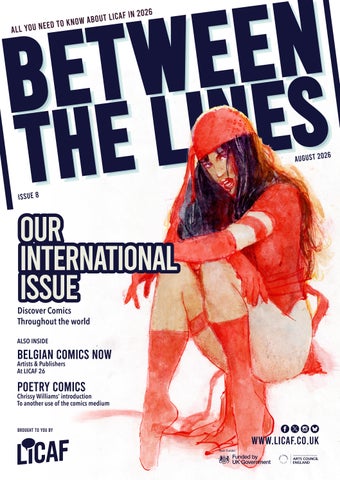
N E E W T BE A L L YO U N
F ABOUT LICA W O N K O T EED
IN 2026
S E N I L E H T AUGUST 202
ISSUE 8
OUR INTERNATIONAL ISSUE
Discover Comics Throughout the world ALSO INSIDE
BELGIAN COMICS NOW Artists & Publishers At LICAF 26
POETRY COMICS
Chrissy Williams’ introduction To another use of the comics medium
BROUGHT TO YOU BY
WWW.LICAF.CO.UK
6
BETWEEN THE LINES - ISSUE 7
Contents POETRY COMICS Pg 3-5
Explored by Chrissy Williams
Belgian Comics Now Pg 6-8
From their start in the 1920s To the present day
From Russia with love Pg 9-11
The origins of Comics In the world’s largest country
James Bacon and The Irish Conflict in Comics Pg 12-14
How Ireland was portrayed Throughout the world
The Funnies Pg 15-17
Some of the greatest works From American newspapers
Korean Waves Pg 18-21
Wonderful stories and art From Korea
Gemma Correll artwork 02
Cover image by Bill Sienkiewicz
Pg 22-23 And the UK’s First Comic Book Town
Editor’s Letter Ireland, Belgium, Russia, and Poetry feature in our latest exciting issue! We are indeed honoured to have as guests at this year’s LICAF, Belgian comics artists and publishers. We even have a fantastic exhibition. Our article in this issue attempts to give a very potted history of the comics scene, past and present, in Belgium. We go beyond the “usual suspects” of Tintin, Zig et Puce, Blake and Mortimer, Lucky Luke (“The man who can shoot faster than his shadow”, now in a new live-action mini-series on Disney+), and not forgetting the Smurfs. We have with us some exciting current creators whom we introduce in this issue’s article. James Bacon is an impressive researcher into the history and controversies of comics in, especially, the Republic of Ireland, but also the various situations in America, the UK, and Europe. He has just followed up The Irish Conflict in Comics with A Sensual Cesspool of Iniquity, Comics and Censorship in 1950s Ireland. Both these books are essential reading for all those interested in comics history. You will discover some works you may never have heard of before. Wonderful! There have been illustrated versions of poems before: The Waste Land by Julian Peters, Martin Rowson’s parody of Pope’s Dunciad, various adaptations of Burns’ Tam O’Shanter, but Over The Line by Chrissy Williams and Tom Humberstone compares the lines and rhythms of poetry with the strips and rhythms of comics. Herriman’s Krazy Kat was often compared to poetry, but there’s a lot more out there as you will discover in this fascinating book. And it is also this year the 80th anniversary of the National Cartoon Society. What a roster of famous cartoonists have been members! A roll call of American greats include: Otto Soglow, Bob Dunn, Milton Caniff, Ernie Bushmiller, Ham Fisher, Fred Harman, Joe Shuster, Harold Gray, Al Capp, Bud Fisher (said to be the favourite cartoonist of James Joyce), Alex Raymond… Oh, wait, we have got to leave room for the articles in this issue, so I’d better stop there. Happy Anniversary, NCS!
John McShane
WWW.LICAF.CO.UK
Poetry Comics
with Chrissy Williams
by John McShane
Before reading your fascinating book, Over the Line, I associated your name with The Wicked + The Divine. When did you first become interested in comics and how did you become a comics editor? Oh, thank you. Yes, I do think Over the Line is quite unique - it’s an introduction to poetry comics, trying to engage with it as its own distinct hybrid medium. I’m always attracted to slightly more niche areas, to the gutters and the margins. I think my debut comic Golden Rage is a little unusual too — the elevator pitch for that is “Battle Royale meets the Golden Girls”. And I have my textonly poetry collections. I also used to edit a poetry magazine published onto cupcakes. It was called Poetry Digest.
My background is that I worked in book publishing as an editor for more than a decade, and would always get hit up by friends on the
side who wanted an eye on their indie work: poetry, prose, comics, anything. I was one of those kids who stopped reading comics as 03
BETWEEN THE LINES - ISSUE 8
a teenager for some mysterious reason, so I didn’t initially know what I was doing on the comics front. I started by offering proofreading comments on fully lettered pages. I quickly saw how the images needed to be “read” (and even proofread) as well, and how mistakes and incongruities between art and text could creep in at pencil and script stage. I realised it would be far more helpful for me to look at the original scripts before they got sent to an artist. That evolved over time, and of course I started reading comics again properly, into a more involved editorial process and project management at script level. I found I kept wanting to do more. If it sounds like I was inventing the comics editing process, that is a little how it felt. Freelance comics editors were a bit more rare back then. I’ve seen comics start to value the editorial process more and more in the last fifteen years.
The Wicked and The Divine was the big job that ultimately supported my switch into being a full-time freelancer, able to edit that project, and do much more of my own writing and teaching. I had never encountered Poetry Comics by Dave Morice (1980). Can you tell us a little bit about this book? The effect of Cubism on modern art in general and on the ideas which lead us into poetry comics is very interesting. Dave Morice is an American educator and I feel his work is helpfully contextualised by the classroom. As well as adapting classic poems into comics (“I wandered lonely as a cloud” where a cloud-man is the protagonist) he also famously cast the classic American poet Walt Whitman as a Superman-esque superhero. SuperWhitman quotes lines from his own major poem Song of Myself, decked out in a cape and wearing his pants on the outside. Morice adds visual dynamism to text-only work which is especially useful in an educational environment. However, I would regard these as adaptations
of poems into comics, rather than the creation of a discrete medium, poetry comics, which is where my interests lie. There is something uneasy and devoid of narrative at the heart of lyric poetry, and I feel that a more nuanced approach is better placed to engage with this. The medium of comics communicates through visual sequence, which gives it an unavoidable and relentless forward drive. I’m more interested in what happens when you use poetry to disrupt and challenge that. You also mention Cubism. Cubism exploded everyone’s conception of what modern visual art was capable of, but it also had a huge effect on the literary world, as did Futurism. World War One had scorched the earth in a uniquely new technological way, and the human imagination responded appropriately. Everything became fractured, told across multiple perspectives and collaged out of conventional narrative into more deconstructed text. Of course some people went back to the old comforting ways afterwards, saying, “No thanks, that’s not for me”. But not everybody. Or at least not all the time. The poet George Herbert (15931633) would shape the lines of some of his poems to resemble the subject of the poem. So combining something which the eye can experience immediately with words which have to be read sequentially is a very interesting concept.
04
I think all art forms and their leveraging of different media and experiences are fundamentally interesting. What does dance do differently performed in a concert
WWW.LICAF.CO.UK
hall or outdoors in a forest? What does a piano sonata do that a poem doesn’t? What does a poem do that a shopping list doesn’t? What happens when you put some of these different art forms and mediums together, and force them to collaborate? I’m currently working on a long poem about the Oslo City Hall carillionist LauraMarie Rueslåtten, whose main artistic practice involves combining different art forms. She has a long-running collaboration with a choreographer in which they fuse together dance and hand bells. One of their pieces from 2024 transformed fifteen dancers into a moving handbell instrument. Her entire practice seems driven by wanting audiences — by which I just mean people — to trust their own sensory experience, and not look to someone else to explain it to them.
fundamental issues with doubt and self-belief. One of our poetry comics Introduction to Charts also won the Selkie Award for Best Narrative, which felt like a real confirmation of people’s interest in unconventional narrative.
Can you tell us a little about your collaborator, Tom Humberstone? What led to your collaboration on Over the Line?
You list a number of other works which you do not include in your anthology, including huge sellers such as Sandman and Swamp Thing. But these are, of course, readily available. Perhaps, in some cases, this will be a certain reader’s first exposure to poetry? Or, at least, poetry they like?
Tom and I bonded over an inability to maintain functional small talk, and have been good friends ever since. He was a cartoonist for the New Statesman at the time and ran his own small press. I worked for the National Poetry Library in London, and had all these ideas about poetry comics that he became interested in too. He had edited this great anthology series called ‘Solipsistic Pop’ which was also interested in unconventional narratives, and it felt like we were both curious about what poetry and comics were able to do both separately and together. We edited Over the Line and have been working on our own collaborations ever since. Alan Moore has been very kind and very encouraging, which has gone a long way to addressing my own
Perhaps! It is difficult to read large graphic novels online, but short poetry comics seem ideal for that medium. Do you agree? I think any short form comics, or short form poems, or smaller format picture or video or text art, are all helpfully accessible online. Whether that equates with a deep engagement or something more shallow is hard to say. I’m not convinced that reading as part of a scrolling experience is the ideal medium for anything, unless it has been explicitly formatted or
designed for it. I’m immediately thinking of a very long, downwardsscrolling poetry comic by Paul Tunis and Matthea Harvey, Game for Anything that was excellent. In one of our poetry comics exhibitions, when the book came out, we had to display it top to bottom on a very tall column, and you could barely make out the words at the top. That would have been far better experienced in the medium it was designed for — i.e. scrolling down on a single page. I really don’t know how I feel about “online” as a reading interface broadly though, which of course is literally on a phone or a tablet or other screen. For specific works it can be very successful, but every work is different. Though of course it makes being seen and shared in the first place easier. What project are you working on next? Tom and I are aiming to have our book-length collection of Poetry Comics ready next year. We’re working on one last pamphletlength piece for it at the moment, which invokes Monet’s Waterlilies. Its subject is how we experience art: how where we experience it changes our perception of it, and how memory can affect our own sense of linear experience. I think it’s probably the logical extension of all our work so far. I’m also working on my next poetry manuscript, and have a new collaborative pamphlet coming out next summer with Ellis Saxey. I’ve also just started writing a horror comic for a licensed property. Lots of writing is being done this year, and hopefully we’ll start to see some of it next year. 05
BETWEEN THE LINES - ISSUE 8
Belgian Comics Now
from Ovo Astralis by Mobidic
by John McShane
The origins of Belgian comics go back to the 1920s. The newspaper supplement Le Petit Vingtième started in 1928 and employed George Remi as editor-in-chief and main contributor You don’t recognise the name? You probably know him better as Hergé. You will almost certainly know his most famous creation. In the supplement from 1929 there appeared The Adventures of Tintin. The style Hergé adopted for the strip was influenced by Alain Saint-Ogan (from 1925 best known for Zig et Puce) and George McManus whose Bringing Up Father (1913) is often reprinted today. The style evolved into what is now known as ligne claire - the clear line. Easy to read, no crosshatching or other ways that can, at worst, take away attention from the story. The Tintin stories were later collected by Casterman into the album format which has become the standard in Europe.
06
The quality of anything is not always reflected in sales figures. But… By 1944, 275,000 Tintin albums had been sold; by 2000 worldwide sales were in excess of 200 million! Belgium is a relatively small country, with about twice the population of Scotland, but in the world of sequential art both these countries punch well above their weight. Now, Tintin expert Stevie White (Stref) has pointed out that Hergé was not really keen on crediting his collaborators (cf Batman’s Bob Kane). One of the most important of these is Edgar P. Jacobs. Some of your favourite Tintin albums may, in fact, be drawn and coloured by Jacobs. He even sometimes appears as a character: In Cigars of the Pharoah Jacobs is in one of the sarcophaguses, and in Destination Moon he is one of the engineers. Edgar P. Jacobs asked for credit from Hergé in 1947, but Hergé refused. Jacobs had been contributing another strip to Tintin magazine since September 1946: The Secret of the Swordfish. This features Captain Francis Blake and Professor Philp Mortimer. Albums featuring the adventures of these two characters - there are 29 so far - can sell 500,000 a year and so far the series has topped over 18 million sales. So, doing his own original albums has not exactly hurt his career.
There are a lot more Belgian comics creators, and we shall meet a few of them shortly, but honorary mention must be given to: The Smurfs. Created by Peyo in 1958 for the magazine Spirou, they are incredibly popular in many media throughout the world. Some fans may not even know they were created for the comics medium. If you have never even heard of them, have a look in shops for little creatures who are blue. So is Belgium an important country in the history of comics? In 2000 nearly 40 million albums were printed, so very important indeed. This year on Disney+ a live action series of Lucky Luke debuted. It was created in 1946 by Morris and is still going strong. Belgian creators are some of the most famous and important in the world.
WWW.LICAF.CO.UK
from Les Pissenlits by Nina Six
from Jusqu’ici tout va bien (OK for now) by Nicolas Pitz
by Léonie Bischoff
And so, to the present day.
In a major festival highlight, WBI and the CBBD are bringing a world-class exhibition of contemporary Belgian comic art to Kendal’s premier art venue, the Abbot Hall Gallery.
Underscoring LICAF’s commitment to fostering international industry connections, WBI is also funding a dedicated delegation of five leading Belgian comic book publishers: Casterman (Nathalie Van Campenhoudt), Dargaud (Valérie Beniest), En 3000 (Romane Armand), Fremok (Thierry Van Hasselt), and L’Employé du moi (Sacha Goerg).
This year LICAF welcomes Belgian comics creators and publishers. Supported by Wallonie-Bruxelles International (WBI), the trade and cultural body promoting the French-speaking Wallonia region of Belgium, and curated in collaboration with the prestigious Comic Art Museum in Brussels, the initiative represents a significant scaling up of international collaboration for the Festival. WBI is funding the attendance of five of Belgium’s most exciting and diverse contemporary comics creators. Festivalgoers will have the chance to see, meet, and learn from: Leonie Bischoff; Nina Six; Nicolas Pitz; Joanna Lorho; and ,
Curated by the Belgian Comic Strip Museum, the exhibition, ‘Landscapes of Contemporary Belgian Comics’ will run across the Festival weekend and showcase an exceptional range of modern Belgian artists, including the five attending creators. Curators are creator Mobidic and publisher Nathalie Van Campenhoudt.
from Le Hibou abasourdi (The Mixed-Up Owl) by Joanna Lorho & Marzena Sowa
07
BETWEEN THE LINES - ISSUE 8
Across the festival weekend, these publishers will participate in a structured International Rights Market, engaging in one-to-one B2B meetings with ten prominent UK publishers to buy and sell translation and publication rights. Let’s have a look at our five creators in more depth: Joanna Lorho Joanna Lorho is renowned for her striking, poetic visual storytelling in À Travers La Nuit, her first graphic novel. In 2024, her first children’s book, “Le hibou abasourdi” (The Mixed-up Owl), was published by La Pastèque, in collaboration with screenwriter Marzena Sowa. An American version, “The Mixed-Up Owl”, was released in July 2025 by Astra Books. Léonie Bischoff Belgian-Swiss Léonie Bischoff, born in Geneva in 1981, studied comics at the Institut Saint-Luc in Brussels. She published in anthologies before creating full-length graphic novels, notably for Casterman. She gained wider recognition with the graphic novels “Anaïs Nin sur la mer des mensonges” (Anaïs Nin, A Sea of Lies) and “La longue marche des dindes” (The Long March of the Turkeys). She is a member of Atelier Mille, a collective of authors based in Brussels. Mobidic Passionate about animation, Mobidic studied film animation at ENSAV La Cambre for three years. But an unexpected passion for comics led her to change course and study for another three years at ESA Saint Luc in Brussels. A complete author, she wrote and illustrated her first graphic novel, “Roi Ours” (King Bear), published in 2015, followed by “Le Culte de Mars” (The Cult of Mars) in 2020, both published by Delcourt. Her work remains heavily influenced by animated film, her first love. Nicolas Pitz Nicolas Pitz, born in 1984 in Brussels, is a Belgian comic book author. His preferred theme in his writing is the critique of the family model and the transmission of values. He is especially acclaimed for Jusqu’ici tout va bien (So far, so good), Le choix de Sam (Sam’s Choice), Traquée: La Cavale d’Angela Davis (Tracked Down: the escape of Angela Davis), and La Dent: La Décolonisation selon Lumumba (The Tooth: Decolonisation according to Lumumba). Nina Six Nina Six’ first graphic novel, “Les Pissenlits” (The Dandelions), won the 2024 Bologna Ragazzi Comics Award for Middle Grade. She is also the author of “La Mousse” (The Moss) and “La Sorcière de Londres” (The Witch of London). As an illustrator, she has published “Monsieur Bigounia” and the “Les Petites Sorcières” (The Little Witches) series. And there’s more… In the UK, The Observer newspaper has often reviewed graphic novels and indeed run a competition - The Rachel Cooke Graphic Short Story Prize - so that aspiring cartoonists can have the chance to see their work in print and pocket some money into the bargain. A recent edition of the paper reviewed The Children of Light by Jean Pleyers, who is, unsurprisingly Belgian and, also unsurprisingly, “a devotee of Hergé”. The Children of Light first appeared in the 1980s in Métal Hurlant, but has now received a single volume edition in an English translation.
08
Belgian comics continue to be among the most important and interesting in the world.
WWW.LICAF.CO.UK
From Russia with Love: The History of Russian Comics
by Finn Miles
Whilst Russia has for some time made rich and significant contributions to art and world culture, its global cultural imprint has often been associated more with ballet and other classical European art forms than more contemporary pop culture. The country is known more for the likes of its rich literary tradition, from Pushkin to Tolstoy to Dostoevsky, than anything resembling the high flying adventures of the American superhero, This has shown some signs of changing. In the world of video games a new Slavic wave has seen former eastern bloc and associated countries begin to find new cultural footing in the realm of digital entertainment, from Polish developer Cd Projekt Red’s hit The Witcher franchise to Ukrainian studio 4A’s Metro series. In more recent years this has begun to include Russia with developer Mundish’s relatively recent release of the surreal first-person shooter Atomic Heart.
Vintage 1902 Rusian anti-alcohol poster
In video games, each of the aforementioned series had several things in common that together made them distinctly Slavic and part of what is in a sense a new broad style of game production, allowing them to leverage their cultural backgrounds in their art. For instance, each and every franchise builds upon and adapts from novels produced around or directly in their own respective cultural sphere. With comics, however, things seemed particularly unlikely to flourish in the same way as they had in other comparable nations. By the 1810s Russia had already been relatively late to adopt the lithographic press compared to its western European counterparts, in part due to restricted industrialisation alongside limited technological development and commercial printing
opportunity, with the press itself debuting around two decades after it had been invented in Germany. But Russia itself was not without visual media of art in any way comparable to comics before their modern inception. As far back as the Medieval period Kievan Rus, a political alliance of eastern Slavic peoples and cultural precursor to Russia, began to produce icons inspired by Byzantine designs following their greater adoption of Christianity in 988AD. These icons often feature depictions of famous saints. Due to the lack of literacy amidst the common populace, these icons served as educational material for the church. Amongst these icons the “zhitiinyi” featured a portrait of the respective saint surrounded by panels depicting major events and alleged miracles, similar to a comic book page. 09
Following the Russian revolution as Russia fell under the Bolsheviks, the revolutionary poster became a significant tool in not just rallying the masses but reinforcing the symbolic power of the communist state. In the fashion of continuing the proto-Russian comic tradition, the communist agitprop posters of the Russian Telegraph Agency (ROSTA) made use of sequential art techniques to spread information quickly and act as a form of public service announcement on everything from hygiene to communist doctrine. In the period after the Revolution, the emigration of Russian artists to neighbouring countries which they could try to enrich, such as was the case with the wave of Russian artists to the Kingdom of Yugoslavia, causing a domestic comic book surge in the 1920s and 1930s, adapting Russian fairytales and literary classics to comic form, such as Pushkin’s fairytales. Prominent creators in this field would come to form the basis of the “Belgrade Circle”. In the 1920s illustrated stories in children’s magazines also made an appearance, with the magazine Ezh (short for Ezhednenny Zhurnal or ‘Hedgehog’ in English) publishing Makar The Ferocious, a globe trotting adventurer joined by his canine companion “Machine Gun” and a horse named Gvozdika. Other magazines like Chizh (Extremely Well Interesting Magazine or ‘Siskin’) also made an appearance in this genre, with cartoons like Clever Masha from poet Danill Kharms and Bronislav Malakhovsky.
10
The Twins from Atomic Heart
In 1937 Sverchoyk, the first Russian magazine consisting mostly of pictured stories, was published with the subheading “Funny pictures for little kids”. Translating simply as “The Cricket” in English, Sverhoyk, in keeping with its subheading, was targeted at Russian children and drew together many famous children’s writers and illustrators but was cancelled after only five issues. This closure came as a result of the reality of the era, with editor-in-chief Nikolay Oleynikov and senior artist Bronislav Malakhovsky both arrested on fabricated charges of espionage and, later, executed. Such a story is indicative of the challenges posed to comics and art in general by Russia’s tumultuous political history In spite of such events comics would persist during the Soviet era. For some the true birth of the Russian comic scene can be traced to September 1956, with the famous cartoonist and illustrator Ivan Semyonov publishing the first issue of Vesyolye Kartinki (The Merry Pictures). As the first art editor of the publication, Vitaliy Statsinskiy recollects that even at this stage of the project the magazine had been planned exactly as a comic.
Major Grom Volume 1
The 1980s saw the first real wave of Russian comics in the more contemporary sense, the industry simultaneously moving in a number of different directions. Various sources opened publishing houses that licensed foreign titles and founded “pictured literature” (a common Russian term for comics) departments, such as Progress, Panorama, Photofilm, Machaon, and Egmont Russia. An important factor in this period, the formation of creative teams comprised of a variety of comic creators coming together on an informal basis helped establish a steady talent pool for the Russian comic industry to continually draw from. Authors were thus in high demand within Russia and comic houses began to publish their own series.
The collapse of the Soviet Union, however, would cut short any of the blossoming comic scene that had persevered through its reign, resulting in financial issues that would plague the comic industry throughout the 1990s, with practically all comic projects essentially put on hold during the 1998 financial crisis. In 1999 the artist Andrey Ayoshin set up Komicsolyot, (The Comicopter), a large online library of Russian comics, demonstrating the effect of the growth of the internet even on Russia’s relatively fledgling comic scene
gains, however, have been made in furthering the popularity of the art form within the country, the reactivation of comic editors having considerable effects in terms of driving this phenomenon. In 2002 the first professional Russian comic festival, KomMissiya (The Commission), took place, with an increasing interest in similar events still growing within the country. In 2008 periodical comics hit an all time high within the country, with 20 magazines
In spite of this, developments in Russian comic art still persisted, with the monthly title “Mukha” (The Fly) showing up and coming talent in this period. In spite of the many issues that faced the Russian comic scene in the tail end of the 20th century however, the 21st century found new vigour injected into the industry, with many publishing houses and festivals dedicated to comics emerging within Russia. How Russian comics can continue to grow is a debatable topic. Perhaps Russian comics, and Slavic comics more generally, could follow suit in establishing their own notable style in this regard. Either way, whether Slavic comics can replicate the same success awaits to be seen. Notable
Velikolepnye priklyucheniya (Magnificent Adventure) Issue #21
being published in a print run of 1.5 million. Whilst many of the works published were foreign publications, native works still made a considerable contribution, most notably among them u Pogodi (Well, Just You Wait!) which ran from 2004 to 2010, with a circulation of 35-40 thousand copies. From 2012 a new development phase of Russian comics has arguably manifested, with the growth of specialised comic retailers throughout the nation. One can only wonder if the country will find a footing in the world of sequential art that is in any way comparable to that which Russia has left in the world of literary fiction. And yet, whether Russian comics rise in popularity or plummet to the depths of irrelevance, there will always be someone with a notion, an idea, they are willing to share. And of those people there will be some to whom the allure of the medium’s strengths proves irresistible, for as long as there are people, there will be tales. As the famed Russian philosopher and novel writer Fyodor Dostoevsky once put it, “but how could you live without a story to tell?”
11
James Bacon and The Irish Conflict in Comics by John McShane
12
What first got you interested in comics?
When did you encounter Comic fandom?
When did you get the notion of writing about the Irish conflict?
I was very fortunate in that I lived in a comic positive household, my father read Commando comics to us when we were very small. At the age of about four, he turned up with a weekly subscription to Battle for me and the Beano for my younger brother. This was fortuitous as it coincided with the beginning of Charlie’s War. He really loved history and I suspect as a young man in his twenties would read Battle before bringing it home, so there were always discussions about history related to the comics in the house. His appreciation for history is clearly something that he could share through the comics. Battle was immensely important, and remains so. It is a testament to all involved that the stories are now back in print which is a recognition of their caliber. I’ve also really enjoyed the last number of years of new Battle comics from Rebellion.
I walked into the Dublin second hand comic shop Phantasia in 1989 at the age of 15 and encountered an amazing group of people who were welcoming, friendly, engaging, and happy to encourage my reading of comics. From there, I started going to the Irish Science Fiction association meetings and then the National Science Fiction Convention Octocon, which was the only comic book fan outlet at the time. I got involved writing reviews and running conventions and meeting professionals. Everyone was so nice, positive, and appreciative of my cynicism and issues with church and state. There was an open mindedness that was absent in my Christian Brother catholic school. I was limited in my outlook as a teenager, and those fans and comics professionals helped me to expand my interest. It is astonishing how much I read in my teenage years.
I wanted to share my appreciation and the awareness of the body of comic book work which relates to Irish conflict. The Garth Ennis and Steve Dillon Emerald Isle Judge Dredd story appeared in 2000AD at the perfect time for me. It was loaded with fabulous satire and dark humour which excited me as a teenager. It was so irreverent and a cracking read and yet drew on ideas and concepts which were pertinent. This fostered an interest in works related to Ireland which built in me over the years. I had hoped that this might manifest in some academic writing on the subject, but this route wasn’t altogether suitable for a number of reasons. Initially I wanted to share my research that related to the Troubles, but did not want to make an argument or argue with other academics. It was about uncovering new information, or finding it for the first time, looking at the broader picture, and that’s not a great fit for some.
I realised a book of my own design would be a much better vehicle and Limit Break Comics and Paul Carroll in Dublin were so supportive of that. I think this has worked out well, as many academics have since been very complimentary of the work and younger students on their own paths have engaged directly, which surprised me somewhat, so it serves a purpose on multiple levels. For some fans it might form a list to collect, for others they can dip into favorite characters or comics to explore the Irish aspect. I must recognise the influence of The Batcave Companion by Michael Eury and Michael Kronenberg, the Encyclopedia of Comic Book Heroes, Batman-Volume One by Michael L Fleisher, and the second edition of Slings and Arrows edited by Frank Plowright among others, released in 2003. They are great books about comics, and I aspired to present something that was likewise detailed, honest, and specific. How important to you were the comic strips in Crisis? As I say in the book, it is astonishing that suddenly in 1989 we have two writers who portray matters in Northern Ireland so well. Garth Ennis and Mal Coney both found themselves within a short time writing for the British anthology comic Crisis. Synchronicity, luck, good fortune, and determined effort gave us two writers who are exceptionally good at what they do. The Irish conflict, which impacted people across Britain and Ireland, was never more acutely felt than in Northern Ireland
itself. These stories give the reader an opportunity to develop an understanding of the environment, as the writers themselves honed their craft over time. Troubled Souls by Garth Ennis and John McCrea and Symphony of Splintered Wood by Mal Coney, Pat Mills, and Sean Phillips presented a very different comic portrayal of Irish conflict in the late 20th century. Comparing them to much of the contemporary US output, one can see that it was a totally different approach. Here there was a clear focus on the “slice of life”, which felt of the moment and helped readers experience a complex matter through characters moving through familiar situations we can understand. If anything, these comics had more in common with European titles; they are paced better, are more thoughtful and offer time and space for the stories to develop. The “Irishness” of these stories is more than just a throwaway remark or a set of short cuts. Pub encounters feature in both stories, and with Symphony of Splintered Wood, we have a whole two episodes to work through what is a short and brief engagement but was needed to share a complex aspect well. These were groundbreaking comics, quite astonishing to read at the time and as we can see from the chapter on the 1980s, while there were quite a few mentions
of The Troubles in comics there was not that much material that one would describe as authentic, accurate, and able to capture the imagination and foster reflection. They remain excellent and challenging stories. Both authors went on to continue to deliver great stories about Northern Ireland, Mal Coney’s Holy Cross stories from Fantagraphics were brilliant, and Garth’s return to Northern Ireland with Kit from Hellblazer drawn by Steve Dillon in Heartland was superb. Did the - thoroughly researched - book take long to write? I think I had a huge advantage. I’ve been reading comics for over four decades, collecting and sharing the interest and having met so many friendly people over 37 years, found not only did I have a solid amount of awareness and some of the actual comics, but the community were quick to help me and fans and pros alike were very generous with their time, so information flowed in my direction. I also realised as I went looking that there was material to be mined, but in certain regards, I knew where to find that rich seam. I started in earnest bringing together all the work and effectively a comic lifetime of information together in November 2024, and I was keen to see it published in a timely fashion, accepting that good would be good enough, and perfect might never see the light of day! The book was released by Limit Break Comics at Dublin Comic Con in August 2025. You deal with early American comics such as Foster’s Prince Valiant. How did you discover this beautifully illustrated, but today largely ignored, strip? The Internet is an incredibly powerful resource, fan sites such as the Grand Comic Database, Comic Book Plus, as well as fan archive work, and web pages about characters, writers, and artists, and even detailed sites like the Appendix to the Handbook of the Marvel Universe, are phenomenal and very helpful. (http://www. marvunapp.com/Appendix/index.htm)
13
As I broadened my search I came across Prince Val’s Adventures and in fairness the title Duel in Ireland was a giveaway, and sure enough, I soon had a copy of the Fantagraphics collected edition and was reading it. There is no shortage of resources on Prince Valiant, but like all the comics, it was vital to read, dare I say enjoy them, and share that. It’s terrific stuff. You also cover European comics - Dutch, Belgian, French, etc - but especially Corto Maltese and Dylan Dog. How did you get interested in them? I have loved Corto for a long time. I found Ballad of the Salty Sea a very different comic, with a more thoughtful pace, and Hugo Pratt’s art additionally stunning. I picked up the Harvill Press edition of The Celts in Barter Books in Alnwick about twenty years ago and adored the sadness and complexity of Concerto in O Minor with Harp and Nitroglycerin. I felt that Hugo Pratt’s attention to certain details, a raw and honest view of the darker side of rebellion, and the relationships and aspects of loyalty all captured something very special. Pratt presents layers, and reflection, and the final moments in that story are so soft, and yet hard. You might be interested to know that four Corto books have now been translated into Irish. https://leabharbreac.com/en/shop/ graphic-novels/port-na-farraige-goirt/
14
Dylan Dog was on my radar, it’s such a huge comic in Europe and the Mike Mignola covers for the Dark Horse series grabbed me when I first saw them. It was not until I was doing research in the Musée de la Bande Dessinée in Bruxelles in their wonderful library, that I realised that work existed concerning Ireland. Thus I found Till Death Do Us Part, Dylan Dog #122 from 1996 by Mauro Marcheselli, Tiziano Sclavi, and Bruno Brindisi. It is such an incredible story, and like so many European works, there is a subtlety, and detail, that adds to the story. The library was such an amazing resource. Over 60,000
comics and to sit in absolute exquisite surroundings, one pays €1.50 for the day with delightful staff ready to help. Your research into Marvel & DC comics introduced me to a lot of things that had passed me by. Have you got a large collection? My comics are a lifetime of collecting and I am very lucky that I just managed to hold onto the majority over time. I did give away my Battles at one stage, as a child, and so rekindled that in later years. Sharing the enthusiasm for comics is important, and I love to pass on comics, and find myself sending comics and ephemera off into the ether, to pals, comrades, comic acquaintances or passing them on, like treasure. I co-edit a fanzine, Journey Planet. and many issues relate to comics, and that is another way for me to share the appreciation and with that, we have had hundreds of voices from around the world contributing: (journeyplanet.org). I have enjoyed archives and libraries, and the National Library of Ireland has become my go to place, where I rediscovered a number of comics. I realised that there was considerable significance to Fanzines and Comics that relate to, or are by Irish people, and the National Library welcomed donations of these. I started doing that a few years ago, and last year the Library named a collection after me, which was very kind. I am also fortunate, fans are just kind, and comics have turned up, been passed on by the sack load, often with unique significance, and I hope I do the same.
You’re working on another book. What can you tell us about it? It is called A Sensual Cesspool of Iniquity, Comics and Censorship in 1950s Ireland and looks at the Irish experience during the 1950s in regards to the “Moral Panic” over comics that occurred in many countries. I have looked at the comics that were banned as well as those seized, borrowed, and investigated by the Garda and how the matter was dealt with by the Civil Service and government, in the face of an aggressive anti-comics stance by church, teachers and local politicians. Ireland had a lot of press coverage, unexpected organisations like the AntiCrime Comic League, formed by the Sisters of Mercy and a history of objectionism to Foreign Press. It was a much larger subject than I anticipated, with levels of complexity that meant the overall work draws in relevant Irish historical aspects such as the government formed Committee on Evil Literature. This has meant the book is even larger than the last one, but I am keen to share the research, rather than make a succinct cited argument, I want to allow scholars and fans to draw their own conclusions, see as much as possible, so they can argue or offer views, but most importantly be fully informed, and it was especially important to give time to the relevant core material, the comics. It is a fascinating and in my view, a singular experience, with some amazing characters, who as comic fans we might characterise as Comic Book Villains, of the Evil Genius type, as well as brilliant comic book heroes, sensible, methodical, thoughtful and Voices of Reason!
The Funnies: A history of American Newspaper strips by Finn Miles The American superhero genre casts a long shadow over the western comic book industry and indeed much of entertainment at large. And yet, long before Superman flew through the sky or Spider-Man swung high through the skyscrapers of New York City, another area of the American comics sphere was producing its own highly popular and iconic pieces, often featuring similarly colourful and larger than life characters, a feat it would continue during and after the herculean rise of the American superhero. This area, of course, comes in the form of the American comic strip, a still renowned but increasingly eclipsed area of American pop culture with deeply American roots. Granted, Hollywood has in just over a decade made small efforts to return such properties to their former relevance, with the likes of 2015’s The Peanuts Movie and the similarly titled The Garfield Movie (2024), the former performing well enough financially but failing to reach blockbuster numbers and the latter only
attaining modest box office results. But in more recent years there can be no doubt that the American comic strip has found itself increasingly pushed towards the margins by other forms of media and entertainment. And yet, the American comic strip and its ensuing popularity, have a long history in the United States, dating all the way back to the 1800s. More specifically much of this history can be traced back to the 1896 release of the first issue of the Humorist, then owned by the Newspaper tycoon William Randolph Hearst. Seminal in many ways, this debut featured what many consider the first modern comic strip in the form of Richard F. Outcault’s Hogan’s Alley, a tale set amidst life amongst the tenements of New York’s lower east side. As provocative as it was pivotal, Hogan’s Alley chronicled the mischief and antics of a group of working class children to become a cultural sensation, inspiring a new wave of comic strips with the corresponding rise in the medium’s popularity. Others quickly followed suit. Winsor McCay’s Little Nemo debuted in the New York Herald in 1905, followed by Bud Fisher’s Mutt and Jeff in 1907, and the likes of George Herriman’s Krazy Kat in 1913. And yet this period of rapid change
showed no signs of stopping here and so, for two decades from 1916 onwards, the comic section of the American newspaper would go through another metamorphosis, expanding from four to eight and then doubling once more to sixteen pages, a testament to the growing popularity of the medium. Such strips would come to encompass a wide variety of genres and sub genres. The daily comic strips from 1917 to 1933, for instance, often moved towards adventure comics focused on tales of suspense. Works like Bobby Thatcher, Minute Movies, and Schooldays focused on more serious and grounded stories. Moon Mullins and Barney Google became regarded as the two great daily adventure strips of the 1920s and 1930s. Roy Crane’s Wash Tubbs (1924) became known as the overall greatest adventure strip. Toonerville Folks by Fontaine Fox Jr. was a comedy inspired by the films of W.C. Fields and Laurel and Hardy and was even adapted into 3 short animations in 1936 by the Van Bueren studios. Adventure, crime and comedy would also grow, becoming evident in the Sunday comic pages from the 1920s, and soon these would be joined by the emergence of a relatively new genre within the pages of American newspapers, Science Fiction, propagated by the likes of Flash Gordon and Alley Oop. From 1928 to 1943 Sunday comics would also begin to find themselves engaging more readily in the space of ongoing narrative structures, with each strip acting as further chapters in a continuous unravelling tale. Even weekly
15
gag comics such as Crockett Johnson’s whimsical Barnaby, a fantasy surrounding a boy and his fairy godmother, adopted an ongoing narrative arc backed by a more modern artstyle. The strip appealed to both children and adults simultaneously. The American newspaper strip would also feature IPs from outside its borders, with the likes of Mickey Mouse racing for riches by featuring the iconic Disney mascot. However, arguably one of the most ground breaking and enduring IPs to come from the hallowed halls of “the funnies” in the mid 20th century came in the form of the acclaimed comic strip known simply as Peanuts. Created by Charles M. Schultz in 1950, the series centres on a social circle of young children and their families, focusing on Charlie Brown, who serves as the series protagonist, whilst exploring sociological topics newspaper strips often ignored. As a result both its protagonist in Charlie Brown and the dog Snoopy became pop cultural mainstays familiar even to those to whom Peanuts itself was an unknown commodity. Entertaining and evocative in equal measure, the Peanuts strip attempted to tackle a wide range of pertinent sociological and philosophical topics, including more universal human themes like love, loneliness, humor and philosophy, with Schulz demonstrating his aptitude for imparting profound messages through the mundane and every day exploits of a group of children and assorted animal companions. The strip itself would thus find itself published in seven newspapers on the 2nd of October of 1950 and was successful, if limited in reach. By the end of the same decade, however, the strip’s popularity had skyrocketed, featuring in hundreds of newspapers each week.
16
By the 60s Peanuts had reached what most consider its golden age, with continued mass success in the comic strip format
garnering 15 million dollars in revenue through merchandise.
joined by a Charlie Brown Christmas, the series’ first television special in 1965, followed by the off-Broadway production You’re a Good Man Charlie Brown in 1967, a play still in rotation to this day. Peanuts would continue its success for decades with mountains of adaptations and merchandise, standing as the world foremost comic strip even as far from its initial publication as the 1990s. The strip would then continue until Schulz’s death in 2000, the Peanuts franchise maintaining its pop cultural presence in some form even to this day.
The art of Garfield, of course, was itself a gradual process, first starting with a more simplified black and white aesthetic before adopting its iconic bulbous cartoon artstyle and designs from 1984 onwards. This new artstyle was, interestingly, partly a result of the aforementioned Charles M. Schultz of Peanuts fame, who through his status as both Davis’s mentor and rival, suggested the aesthetic change to Davis, all in spite of expressing jealousy at how Garfield had, for a time, surpassed Peanuts in popularity, This relationship would continue to prove productive, with Schultz’s history of marketing with Peanuts bolstering Garfield’s. By 2002 just two years after the end of the Peanuts strip following Schultz death, Garfield had become the most syndicated comic strip worldwide and by 2004 had appeared in over 2,400 newspapers and as a franchise had garnered between 750 million and 1 billion dollars in merchandise.
Another product of the second half of the 20th century, the comic strip simply known as Garfield also stands amongst the juggernauts of modern American comic strips. Created by Jim Davis and published in the pages of 41 American newspapers on June 19th 1978, the series follows the titular Garfield, a lasagna loving orange cat, and his patient owner Jon Arbuckle, as they interact with both each other and an increasing range of characters, such as the cohabiting dumb but loveable yellow hound Odie and Dr Liz Wilson, a veterinarian who doubles as Jon’s continued love interest. The series found its primary strength in its nature as a gag comic, the cartoon felines’ both dry and deadpan humour playing off his lazy, mischievous and petty qualities and overall personality. By 1981 Garfield had become a roaring success, having been published in 840 newspapers and
The series thus displays office culture as a kakaesque bureaucracy, with office politics often precluding productivity and each employee’s respective skills and efforts going unrewarded. The series continued its run until Adam’s death in 2026 and
Other more recent strips have made a considerable mark on American pop culture. Scott Adam’s 1989 comic strip Dilbert, for instance, follows the exploits of the titular engineer from within a micromanaged office within Silicon Valley, as well as introducing a range of Dilbert’s similarly white collared co-workers and peers as it progresses. An array of non-human characters also appear, including the aptly named Dogbert, an anthropomorphic dog and certified megalomaniac with dreams of world domination, and Catbert, the very much feline and very much evil director of human resources.
by 2013 had been published daily across 2,000 newspapers in 65 countries and 25 different languages, with the relatable, real world nature of said themes often cited as a primary reason for the strip’s continued success. Another product of the 80s, Calvin and Hobbes has been another continued source of success for the American Newspaper strip. Centring around the 6 year old Calvin and his friend Hobbes, an anthropomorphic Tiger who may be real or a stuffed toy brought to life by the young Calvin’s imagination. The tiger was named after the famed philosopher Thomas Hobbes, and shares his namesake’s pessimism in regards to human nature and is smart and patient in contrast to the trouble making Calvin, who is instead named after the theologian John Calvin, who believed In predestination. Created in 1985 by Bill Watterson, the series follows the duo partaking in high stakes scenarios produced by childlike imagination and introduces a range of supporting characters, including Calvin’s unnamed parents and a litany of other personalities, such as his polite and studious neighbour Susie Derkins. In terms of themes Calvin & Hobbes not only explores the nature of childlike wonder, imagination and mischief but lampoons the pretensions of the art world and what
Watterson describes as the “psychobabble” of academia. The series lasted until 1995 and was featured in 2,400 newspapers worldwide. The series has been in a state of continued rerun, said republications reported as featured in more than 50 countries as of 2010. The growth of internet publishing more generally has been a considerable force in the development of cartoon strips based on the newspaper format, with a litany of sources readers can now draw from. In 1995 Dilbert became the first syndicated comic strip to be published for free online. Since then an array of dedicated websites specifically for the proliferation and consumption of newspaper comics have emerged, with Gocomics becoming the largest centre from which to consume American newspaper strips, with a vast searchable library of both classic and modern content. To some the heydays of the American newspaper strip now feature firmly in the rearview mirror, with the now over 40 years old Calvin and Hobbes commonly referred to as the last great newspaper strip. And yet in spite of such proclamations, a solid scene still remains beyond continued reruns and the proliferation of “zombie strips”- old strips taken over by new artists after the previous artist’s death. 1992’s Non Sequitur for instance is a satirical
comic strip poking fun at the absurdities of everyday life and is still ongoing, having featured in 700 newspapers as well as being widely available online. Alongside ongoing series that started in the transitionary period of the 90s, there are also a considerable wave of new rising talents trying their hand at the medium by producing a litany of new popular series detached from the familiar classics, whilst making use of the same tools that define the American newspaper strip and lead to their ascension. Series like Georgia Dunn’s Breaking Cat News, for instance, use housecats as a medium for commenting on social and political events. Tauhid Bondias Crabgrass channels much of the essence of classics like Calvin and Hobbes into contemporary directions. Some however have instead attempted to breathe new life into the classics, such as the modern revamp of the 1930s series Nancy by both Olivia Jaimed and Caroline Clash, whose respective runs brought the American newspaper strip back to the degree of whimsy that once defined it in new and creative ways. The American newspaper strip, then, is both its own medium and a pivotal part of wider comics history in spite of its decline in cultural significance coinciding with the decline of print news and the growth of other forms of popular entertainment. Still, it is a veritable sub-medium to itself that, with a litany of new creators now steering the ship, seems far from being extinguished from the larger comic market. And even if they were to disappear, few could deny the impact they have had on not just American but world culture. The Newspaper strip in general stands as the proof of art’s ability to convey much with very little but a sample of juxtaposed panels, a testament to the power of quaint whimsy and the art of visual story telling in its simplest and in some ways rawest form. Ultimately such an ability seems one to appreciate. After all, how many other art 17 forms can quite say that?
Korean Waves: a Storm in the Land of Morning Calm by Finn Miles
South Korea, the land of the morning calm. A budding geopolitical construct drawn from the well-developed regional plains that layer the austral half of the Korean peninsula. And yet in spite of its affectionate pseudonym, the young nation, known as Daehan Minguk in its native tongue, finds itself in an unenviable predicament, one born not from tranquility, but a dark and politically tumultuous history.
This is in part because Korea’s history has long been one of subjugation to the whims of foreign powers. From its earlier history as essentially a cultural vassal state of China, to its occupation by the Japanese Imperial forces until the mid 1940s and its subsequent split from its northern counterpart during the tumultuous Korean War, Korea has long found itself at the mercy of Asian geopolitics, often subjugated by its peers. This combined with the period of native-born dictatorship that ended as recently as 1987 and it becomes clear that South Korea’s history has long been defined by long cycles of repression and political strife. Korea’s image as a first world, developed nation masks a recent and brutal history
18
Combine this unfortunate reality with China’s economic rise and Japan’s post war expansion into a pop cultural juggernaut and it is easy to see how Korea by the tail end of the 20th century still found itself in a precarious position, one that has found it dubbed as the “red headed step child” amongst the trinity of major east Asian powers.
general aesthetic trends have helped Korea establish itself as the fashion and cosmetics leader for all of Asia and distinguish it further from Japan and China, whose music endeavours have remained relatively niche globally. The second of these meteoric successes for the Korean cultural infrastructure came within the realm of live action TV shows and cinematic blockbusters.
Japan’s own brand of animation, Anime, has grown into a worldwide multi billion dollar industry complete with its own style and conventions
So whilst Japan had its anime, manga, and a firm foothold in video games and consumer electronics, and even China accrued some degree of cultural soft power through depictions of its history and culture abroad, Korea was often dismissed as little more than a cultural curiosity at best and a side player at worst. One exception to the dearth of China’s own globally successful pop cultural institutions comes from a place seen as both separate from and part of China proper, with the Hong Kong Cinema industry and its Kung Fu fighting kickstarting the West’s own Kung Fu craze of the 1970s Few things however are eternal and following the 1997 Asian financial crisis Korea would begin what scholars and media pundits have dubbed “the Korean wave”, a gradual rise in the popularity of Korean entertainment that began its global ascension and subsequent acceleration in the late 00s, exploding in the 2010s on the back of a soaring western interest in Korean cultural exports via the rise of social media and a new wave of youth culture.
The first, most distinct and perhaps most important instance of this phenomenon can be found within the medium of popular music, with the explosion of the simply titled “K-Pop” almost single handedly putting Korea on the map as part of the greater cultural zeitgeist. In the West this in part started with the satirical hit Gangnam style before giving way to the idol based boy and girl bands that would come to define the genre globally. The Korean music industry alongside its
With these, Korea would manage to distinguish itself from the cinematic and televised output of other East Asian cultural forces. Its focus on live action, for instance, formed a clear distinction from Japan, who had always been more associated with animation on the global stage. Similarly its association with the glorified Soap Operas known as “K-Dramas” would only further this distinction alongside Korea’s reputation as a producer of media centring around high stakes romance. In addition to this asset, Korea would begin to grow its reputation in the filmic world for its riveting political thrillers. The Bong Joon-Ho directed “Parasite” became the first non-english language film to win best picture at the Oscars. Manhwa presents an interesting medium that combines elements of both western comics and manga.
Korean films are on the rise, with Parasite (pictured above) winning an academy award in 2019, a first for a non-english language picture
19
choice but to use their talents for the purpose of Japanese propaganda. From the ashes of occupation, however, rose a surge in animation, itself of course a sister medium to comics, particularly for Korean children, which would help elevate an increased interest in Manhwa to greater heights. In the 1950s and 1960s Korea, the first fully fledged modern generation of Manhwa authors emerged, with a focus on Korean history and culture, further distinguishing themselves from Manga. Americans would thus become the new foreign orchestrator of propaganda after World War Two, with the likes of Koojooboo and The Rabbit and The Turtle combating the advance of communism in the north.
Manga, traditionally black and white and read right to left, often stand as sources for anime adaptions and are slowly taking over the wider comic book industry
Why Manhwa? Manhwa’s history is of little note to a general public, often conflated with or subsumed into the history of other media, especially manga or webtoons more broadly. The truth is that despite the association with modern manhwa and the world wide web, Korea’s own history with comic art predates the modern internet era.
20
The history of Manhwa as we know it begins, as with so much of contemporary Korea, with the Japanese occupation of 1910 to 1945. Downtrodden and repressed in equal measure, Korean artists of the era would use their work as a form of resistance, with the Manhwa of the period largely coming in the form of political cartoons protesting Japanese rule. Eventually this world led to establishment censorship that would
deal a grave blow to the burgeoning Manhwa scene, their presence fluctuating throughout occupation. Perhaps one of the most notable authors of the occupation period was Kim Dong-Sung, who consistently lamented Japan’s persecution of the press through his work. In a similar vein the likes of Ahn Seok-joo who, through his popular series “A Day of a Dummy” and “Adventure of a Boaster”, chastised Japan’s treatment of the Korean population and called for emancipation. Roh Soo-Hyun’s “Imbecile’s Vain Effects” even became popular enough to be made into a movie. As the second world war continued, persecution of the press only increased and eventually Manhwa authors were increasingly threatened and their works burned, with Korean cartoonists eventually often having no
In the 1960s the industry saw the development of Sun Jeong Manhwa (sentimental comics) and Myongrang Manhwa (funny comics). In 1961 The South Korean general Park Chung-Hee staged a coup of The South Korean government fomenting a new era of mass censorship in Korean society, going as far as to ban the simultaneous depiction of men and women in a single comic strip. Manhwa would nevertheless continue to develop into the 1970s and 1980s with serious and mature themes becoming increasingly commonplace. Park ChungHee’s assassination drew back the veil of censorship and led to the modern age of Manhwa. The decline of the print Manhwa industry would eventually force much of the Manhwa industry to transition into the online realm, with much of this content becoming what are sometimes referred to as Korean webtoons, which are to a degree designed and formatted from the ground up for online consumption via scrolling. This phenomenon is now often seen and portrayed as synonymous with Manhwa at large, coming to define the industry.
Manhwa as a third style of comics Most countries have some form of history with comic art. As a result, very few establish a style to the degree that it becomes its own artform or medium separate from “comics” in any but the broadest of senses. Comics are fundamentally a western invention and thus when used in many contexts the concept of the comic book predominantly refers to the western comic. Japanese manga is perhaps the first true example of a distinct comic form that manages to some degree separate itself from this fact, not only referring to comics made in Japan, but its own artform and style regularly contrasted with its more western ancestor. The modern Manhwa is perhaps now the only other contender for such distinction, having developed its own style, separate, although heavily indebted to both western comics and Japanese manga. This style is by and large a hybrid, borrowing much from the styling of Japanese work whilst integrating aspects and traditions from western comics. As a result, Manhwa often borrows much from the anime art style, whilst publishing its work fully in colour, as is the norm in western comics. More fundamentally Korean aspects also make it into Manhwa that whilst not defining the subject, represent several trends and traditions. One of these is a particular focus on drama and romance, particularly historical romance, a phenomenon also seen in K Dramas. Series like Why Raeliana Ended Up at The Dukes Mansion and The Empress Wants to Avoid the Emperor epitomise such a trend, depicting romance in classical European settings. Series that blend techno modernity with traditional fantasy have also found disproportionate success in Manhwa, in particular stories where a protagonist enters a virtual/video game-like world, a sub genre known as Isekai in the Manga
space. This, of course, brings us to the legendary hit series Solo Levelling, by far the most successful Manhwa of all time. Adapted into animation and generating a million dollars weekly at its peak, the series follows Sung Jinwoo as he begins as an E-rank hunter who, after surviving a deadly dungeon, is mysteriously selected to be a “player” by a programme known simply as the “system”. This designation grants Sung Jinwoo the ability to level up infinitely to the point of becoming an unstoppable S-Rank Hunter. The series draws upon South Korea’s love of E-sports and PC gaming and has generated over 30 million dollars in revenue worldwide. Solo Levelling stands as the most successful Manhwa of all time Manhwa, then, is something of an enigma, with a complicated history and long-standing craft that has remained relatively niche, often falsely subsumed under the title of Manga, yet capable of being highly influential. With time and hope in equal measure, perhaps one day it will be even half as known a concept as manga or comic books and become equal to the K-Dramas and pop music that have propelled the land of morning calm to superstardom. Time will tell if the sun will set on the Korean wave.
21
Gemma Correll Artwork produced by Gemma Correll to celebrate Barrow-in-Furness being officially declared the UK’s first Comic Book Town as part of the 2026 National Year of Reading.
22
Between the Lines #8 is published by Lakes International Comic Arts Festival. Editor: John McShane. Consultant: Finn Miles. Publisher: Julie Tait. Design: Steve Kerner. Articles and artwork are copyright respective creators, details on request. With many thanks to our contributors. This issue is dedicated to the memory of Edward “Ed” Murphy (1968-2026), comics creator extraordinary. © 2026 LICAF. The views expressed in this magazine are those of the writers and contributors and, so, do not necessarily represent the views of LICAF.
23
THE LAKES INTERNATIONAL COMIC ARTS FESTIVAL 2026
2-4 OCTOBER 2026 Kendal, Cumbria, UK
GET YOUR FESTIVAL PASSES NOW
www.licaf.co.uk Also supported by
Artwork by Bill Sienkiewicz
Main Funder