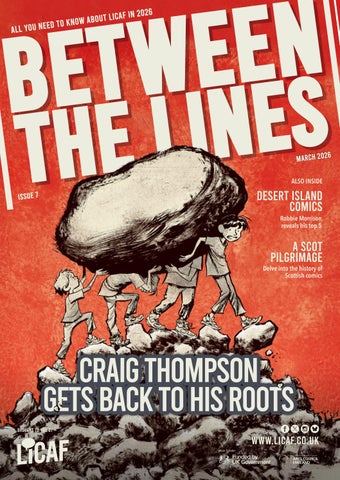
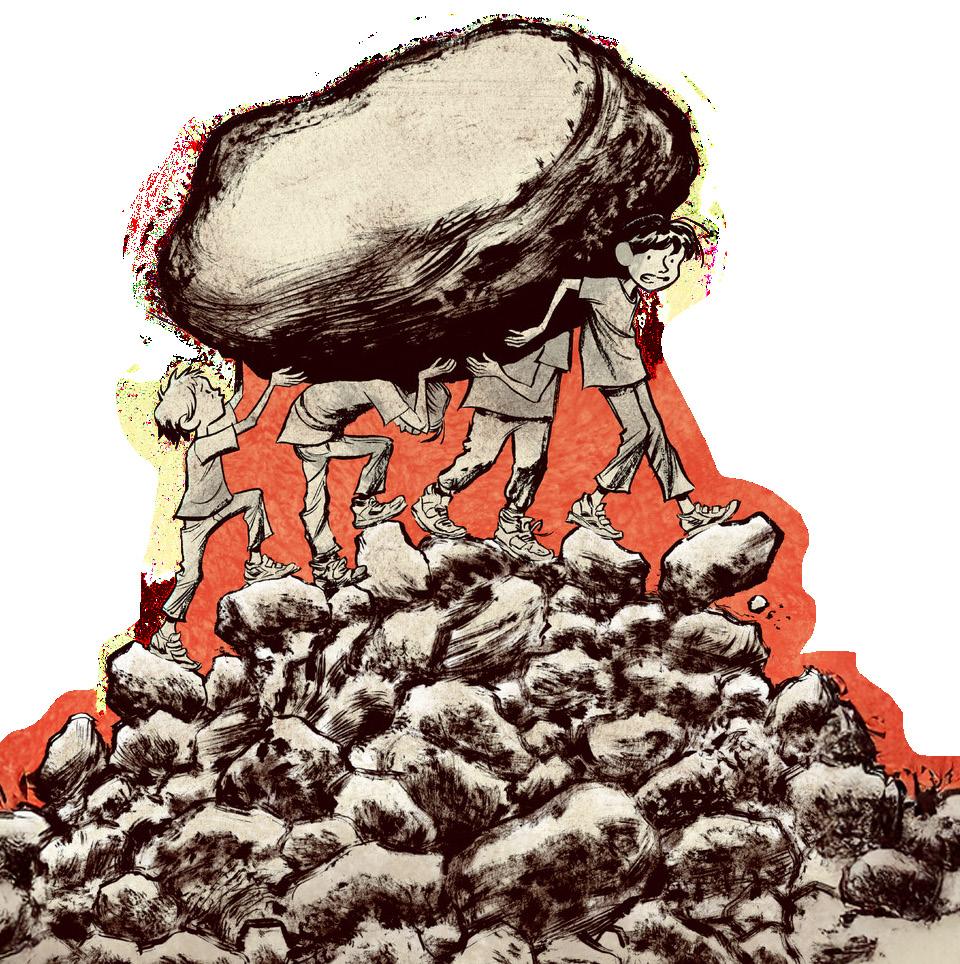
Looking back at the amazing work of Craig Thompson
A revealing journey of Scottish comics
An Elektrifying interview exporing his boundary-pushing creations
Exploring the pitfalls of self-publishing
Robbie talks about his top 5
DESERT ISLAND WITH ROBBIE MORRISON IMAgINE:
EMERgENCE
INDIE THE PERILS OF SELF-PUBLISHINg: WITH JOE SIMON AND JACK KIRBY’S MAINLINE COMICS WITHOUT LIMITS: THE ART OF BILL SIENKIEWICz
The rise of independent comics
EDITOR’S LETTER
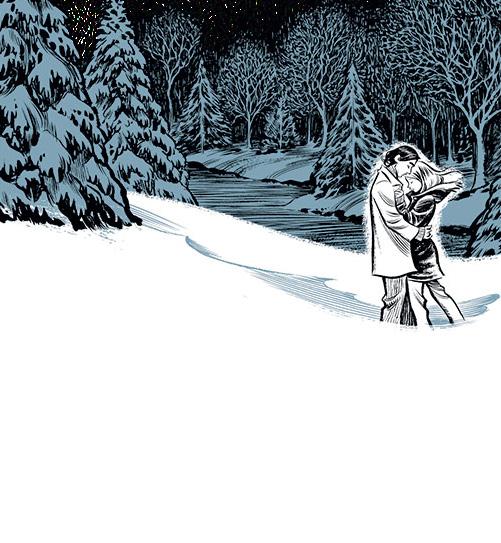
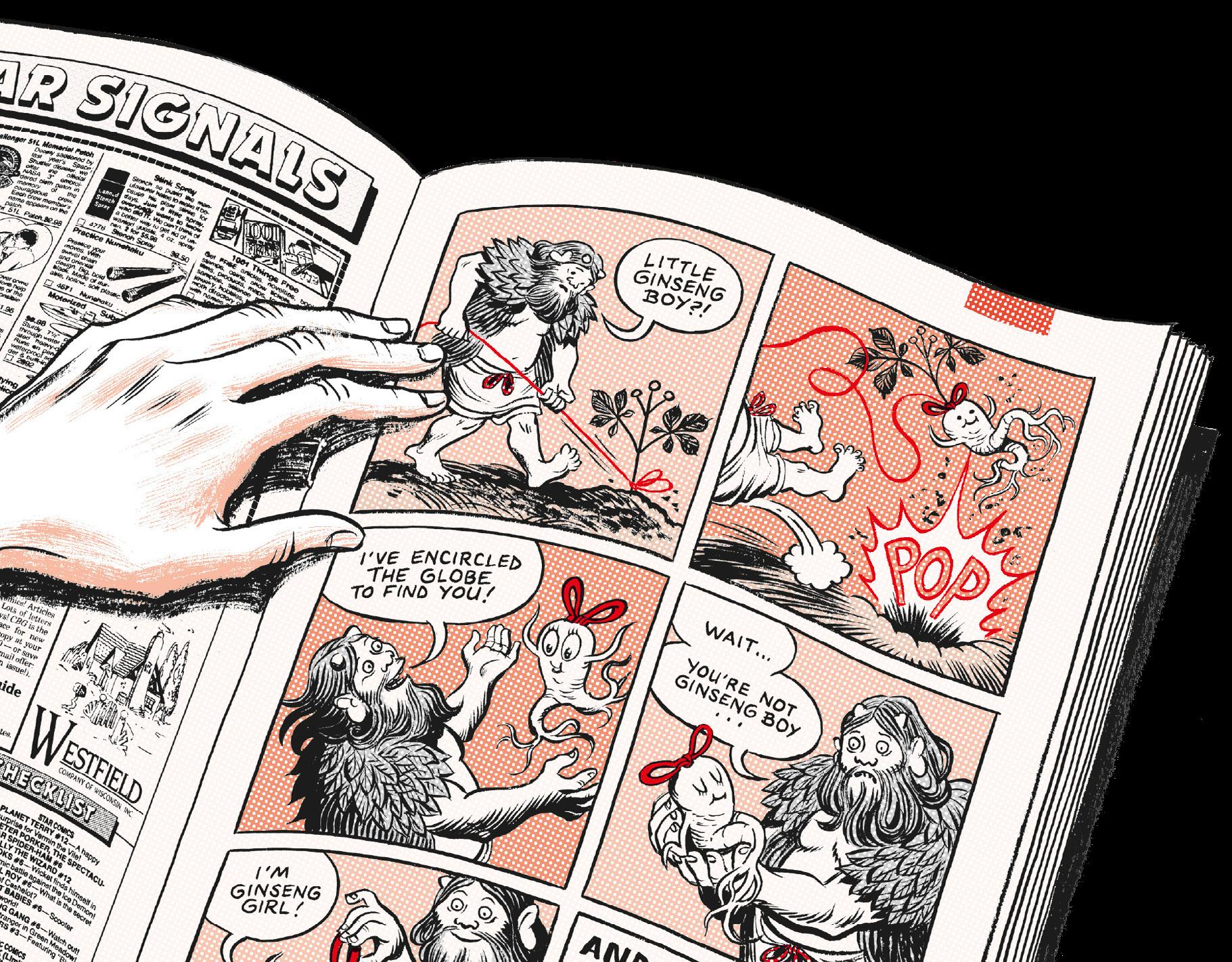
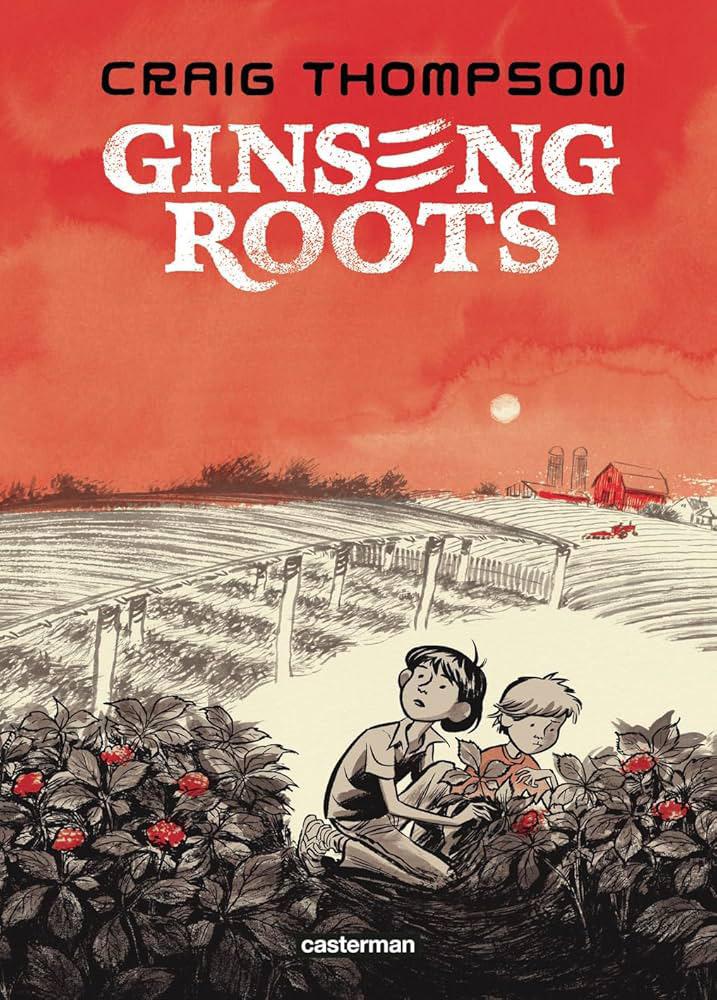
If you have not yet read Craig Thompson’s Ginseng Roots, you are in for a treat. It is difficult to categorise a book which contains autobiography (as does his previous book Blankets), history, botany, and a look into Chinese idiograms. Between the Lines was lucky enough to get an in-depth interview with this fantastic graphic novelist. The moment I finished reading Ginseng Roots, I kept it handy so that when I have time I can read it all again. Every home should have a copy.
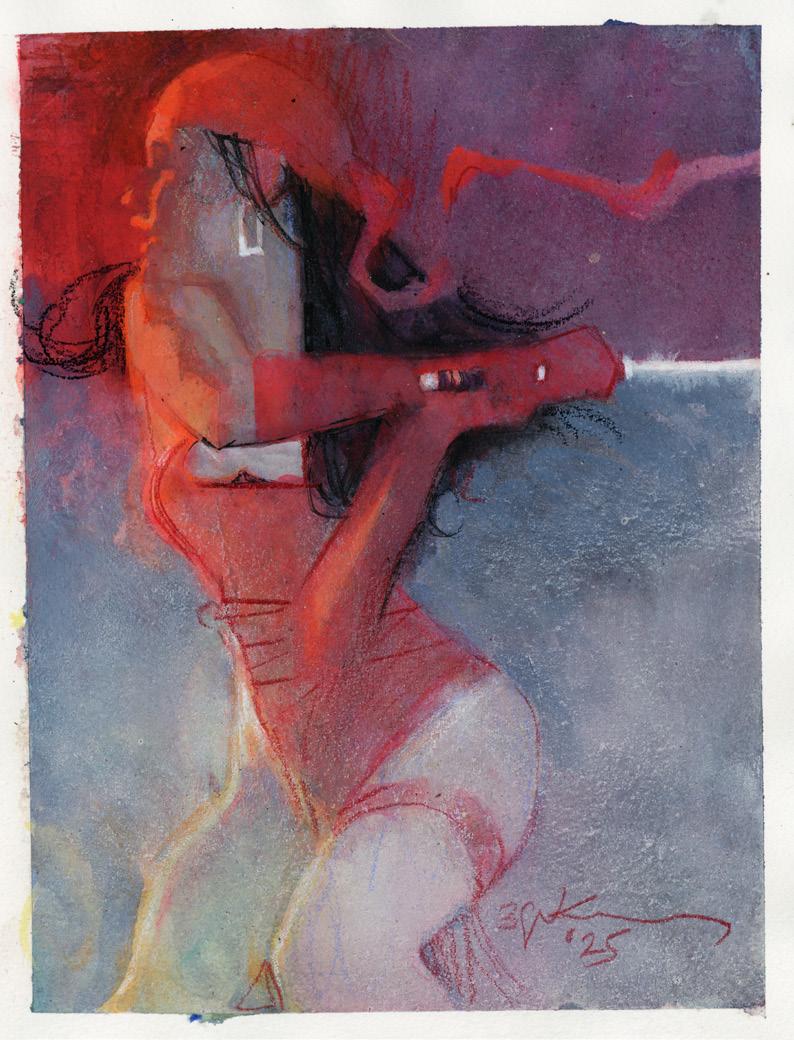
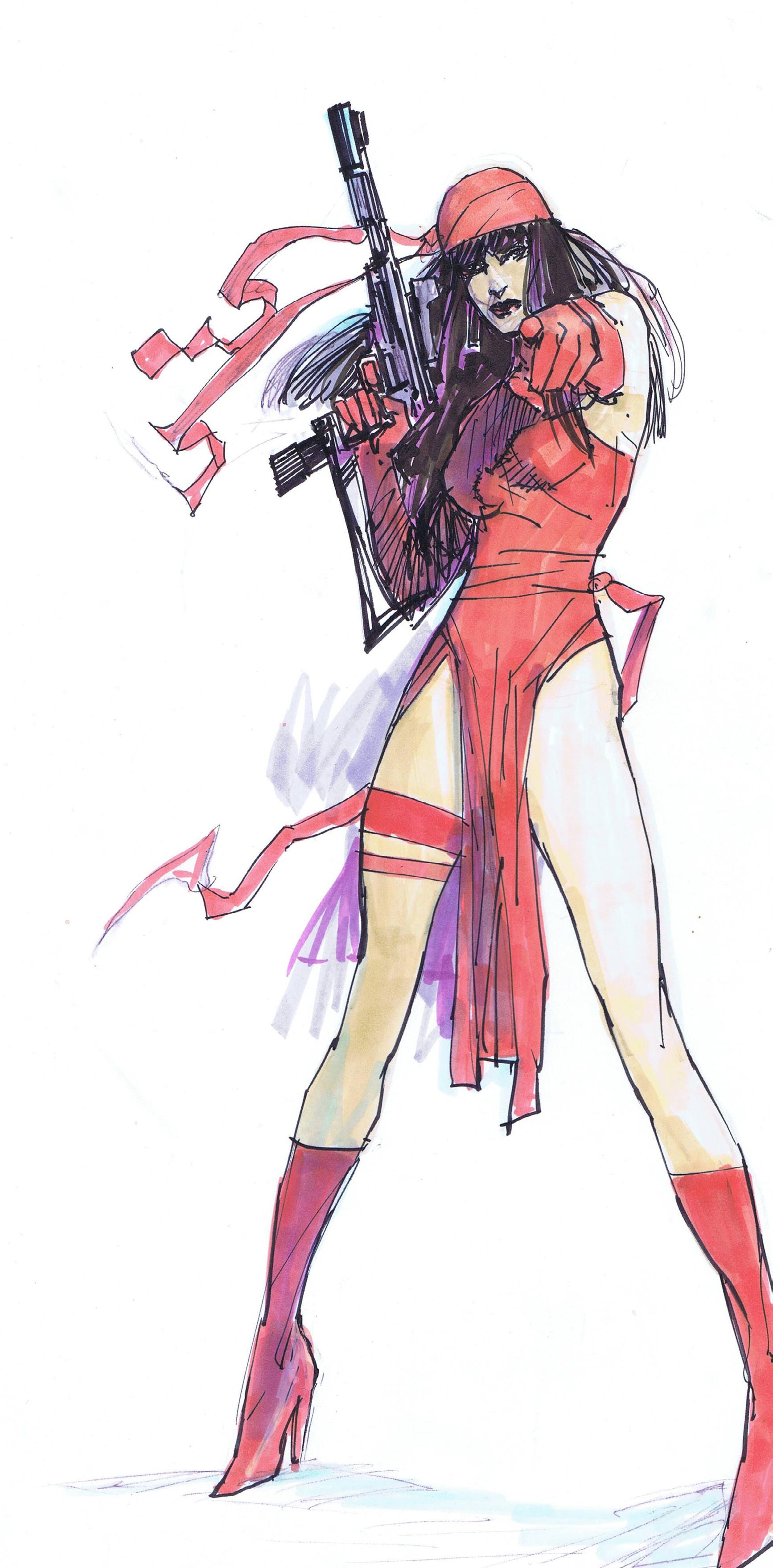
Back in the 1950s, DC Comics wanted each title to have a similar look. They discouraged innovation in visual style. After learning one way of telling stories in comics from Jack Kirby, Jim Steranko threw away the rule book and produced comics that are still studied for their stunning appearance. Then along comes Bill Sienkiewicz! His stunning work on titles like Moon Knight - especially the story Hit It! Written by Doug Moench - keeps me entranced every time I look at it. And then along comes Frank Miller and together they produce Elektra Assassin. Beautiful, amusing, and not like anything else out there.
Given how easy it is these days to self-publish, we thought we would look at Simon & Kirby’s Mainline company and the pitfalls they encountered. Following on from that, Finn Miles explores modern indie comics and the rise of Image which give the world alternatives to the publications of Marvel and DC.
And, as if that wasn’t enough, we explore the history of comics in Scotland. It has been said that, at one point, every family in that wee country (c. 5 million people) read comics, especially due to the influence of the Dundee based DC Thomson. (Don’t be fooled by the Fleet Street address in some of their old comics, they were produced in Dundee.) The latest book which is on everyone’s Christmas gift list is Still Game, based on the successful TV programme. The signing sessions for the first edition had some of the longest queues I have ever seen. What do you mean you don’t have one?
How did we manage to cram all that into one issue? Read on to find out.
John McShane
CRAIg THOMPSON’S ROOTS
So, there I was sitting in a newly refurbished bar in the West End of Glasgow, reading a French Graphic novel (a very dark story from Simenon), when a new waitress comes over to me to say how much she likes Graphic Novels. Then, without a beat, she says her favourite is BLANKETS by Craig Thompson. Imagine my surprise at the coincidence as I was just about to start on this article and imagine her surprise that I had actually met Craig.
How many Graphic Novels are out there? How many bars are there in Glasgow?
Like the waitress, I picked up BLANKETS when it came out. I read it all the way back on the train from London to Glasgow. Unputdownable.
So, it was great to meet Craig at LICAF and then at a signing in Glasgow. I was able to ask him a few questions for this article.
BTL: Your love for a certain period of Marvel comics is obvious. But you have quite a unique style. Who are your main influences on your art and writing - not necessarily from comics? At the weekend Bryan Talbot mentioned William Hogarth as an artist and Michael Moorcock as a writer and you can see both influences in Luther Arkwright
CT: Art and writing influences shift with every project. My latest book, GINSENG ROOTS, was inspired by the nonfiction prose book THE BOTANY OF DESIRE by food/science/botany writer Michael Pollan. In his book, he talks about four plants that shaped human civilization as much as we manipulated them as species, focusing on the apple, the tulip, cannabis, and the potato.
Visually, I drew inspiration from Hokusai’s MANGA volumes, his visual encyclopedia of block-printed “sketches” from the 1800s. Oh, and in comics, no one inspired me more than Joe Sacco with his journalistic approach to comics.
The book I’m best known for, BLANKETS, was visually inspired by French cartoonists Blutch and Edmond Baudoin with their fluid, expressionistic brush lines. And as pretentious as it might sound, it was thematically driven by Proust’s SWANN’S WAY, the one volume of IN SEARCH OF LOST TIME that I’d devoured.
BTL: Do you have favourite graphic novels?
CT: Dylan Horrocks’ HICKSVILLE is my go-to favorite graphic novel about a tiny town in New Zealand that houses a secret library of unpublished comics masterpieces. It’s the type of book that convinces you comics are capable of anything.
BTL: Ezra Pound said that an epic is “a poem including history”. Ginseng Roots is certainly an epic. It was Pound who got me interested in Chinese poetry and calligraphy while I was at University (Pound through The Chinese Written Character as a Medium for Poetry by Ernest Fenollosa). Your book has revived this interest. Your exploration of how to write certain words is fascinating.
CT: Thanks! I’ll need to check out that Fenollosa book. I’d imagine any cartoonist would be fascinated with Chinese text where certain words still retain their pictographic origins. The character for ginseng, for instance, 人参 (rén shēn), loosely translates to “human” “root” reflecting the way the plant is anthropomorphized. The first character means “human.” The second character has three lines at the bottom representing
the roots in the earth, the three triangles or hatches at the top speak to the heavens. Sandwiched in the middle is the same character for “human.” So within that one word is an entire cosmological diagram: the heavens above, the earth below, and humanity between.
BTL: I was interested also in the Chinese eradicating the Hmong written language. In the UK, the 1870s Education Acts certainly improved general literacy but at the expense of other languages (Gaelic, Welsh, Manx, Scots) since it was the law that all education had to be in English! Typical colonisation.
CT: What you describe with the homogenization of UK language correlates to the way Chinese Medicine was standardized by Chairman Mao in the 1950s and 1960s. Diverse folk medicines throughout every province of China were standardized into a single canon, diluting provincial character along the way.
BTL: Some graphic novelists write themselves a full script before doing any drawing. Dave Sim told me he writes/ draws one page at a time. What is your method?
CT: Generally I wrestle with a rough draft of a book for months, even years, before starting on the final artwork. With BLANKETS, I spent one year on the rough draft. With HABIBI, two years. With both books, I couldn’t figure out the last chapter, so I started on drawing the final pages.
GINSENG ROOTS was a bit different because it was first serialized as 12 pamphlet/“floppies” by Uncivilized Books. I created an outline for the 12-issue series, then just focused on writing, thumbnailing, penciling, inking, coloring one issue at a time. When the serialization was complete, I felt each issue stood on its own, self-contained, but didn’t necessarily adhere together. So I spent another year finding the narrative arc to glue it all together, adding 70 pages to the graphic novel including pandemic, two funerals, and my hand health crisis.
Blankets arrived in 2003. Time magazine had no hesitation in ranking it #1 in its Best Comics list and - even more praise - #8 in its Best Comics of the Decade! It is about being brought up in a loving but strict evangelical Christian household, about struggle with faith and adolescence, and about first love. As I said, unputdownable.
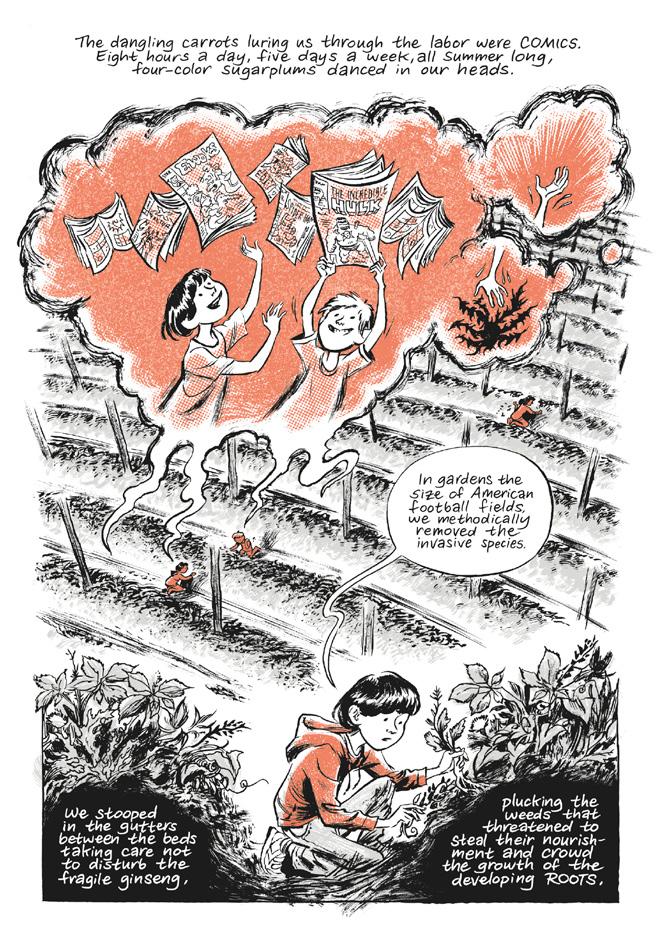
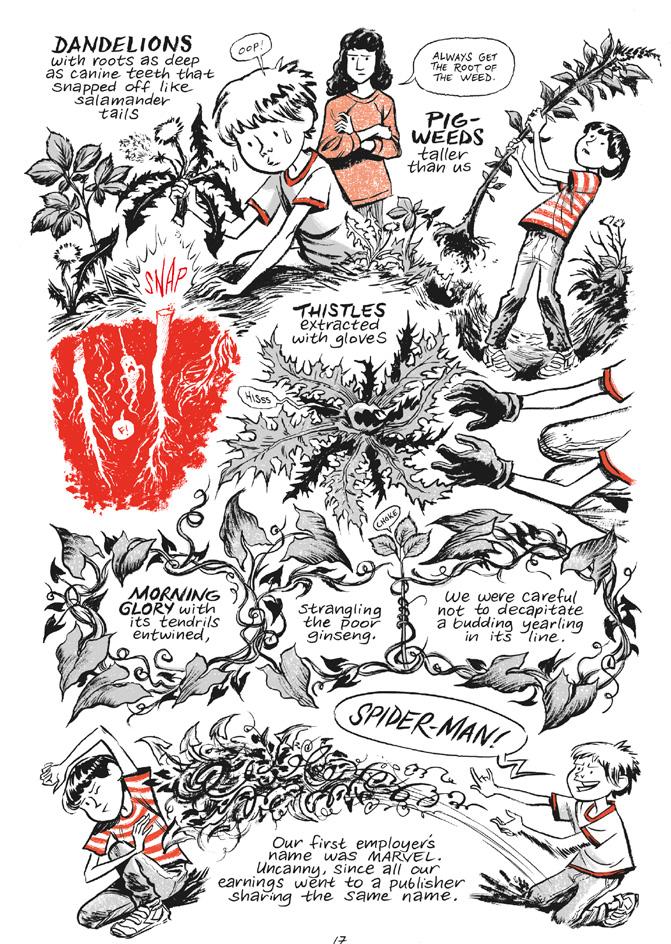
Ginseng Roots, the complete graphic novel, arrived this year (2025) and has been WELL worth the wait. It continues biographical elements from Blankets, but also deals with history, big business vs individual farmers, the ginseng root itself, Chinese calligraphy… The earthy colour palette has been well chosen, the explanatory diagrams fascinating.
Of course, Craig has not just done those two books.
There are, for example:
Good-bye, Chunky Rice (1999) Chunky Rice is, of course, a turtle. No big political or environmental themes here. Just a nice little fable.
Carnet de Voyage (2004): This is a travelogue of Craig’s visits to France, Barcelona, and Morocco during a promotional tour for Blankets.
Habibi (2011). If you like big books, this one comes in at 672 pages! Some of its themes proved a little controversial at the time. But the story is not set on “our world” and as usual has beautiful artwork and imagery.
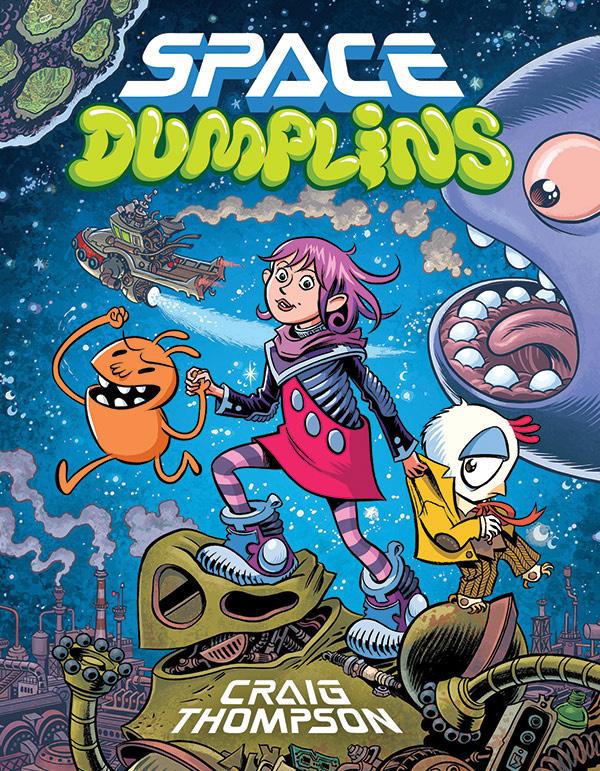
Space Dumplins (2015): a charming 320 page “Adorable Epic” (according to Joss Whedon). A space story for all ages.
Of course, we had to ask:
BTL: What’s next? A children’s book? More writing?
Or a long holiday?
CT: What’s next is the biggest question. Usually I know exactly what I’ll start on after completing a project. Graphic novels take so long… you get bored… you start dreaming of fresh ideas along the way. But on this round, more than anything I needed a sabbatical, a chance to re-evaluate and find out where I belong before I commit to another long project. Also, as I just mentioned, my drawing hand is in crisis, so I’m taking some time to evaluate if I’m able to continue drawing. For better or worse, I’ve been “nomad-ing” since August 2024, when I left Portland, Oregon, for the book tour. My book tour was 4 months in Europe, 2.5 months in the US, 10 days in the UK - otherwise, I’ve continued to travel and couch surf in-between. Hoping I can find opportunities to stay on that side of the pond, in Europe or the UK!
SCOTLAND’S COMICS EMPIRE
Mark Millar: “Why do you think Scotland punches above its weight in terms of comic people?”
John McShane: “DC Thomson is the key. Pat Mills, John Wagner, Alan Grant - all DC Thomson. Also the culture in Scotland was The Broons and Oor Wullie from The Sunday Post which at the time was one of the world’s biggest selling newspapers.”
Mark Millar: “Am I right in saying that there was one in every household in Scotland - a million copies in a country of 5 million people?”
John McShane: “Yes. On average you could say that everybody in Scotland either read comics or knew about them. There’s probably not another country like it.”
[Full interview available on Mark Millar’s YouTube channel, Millar Time #35]
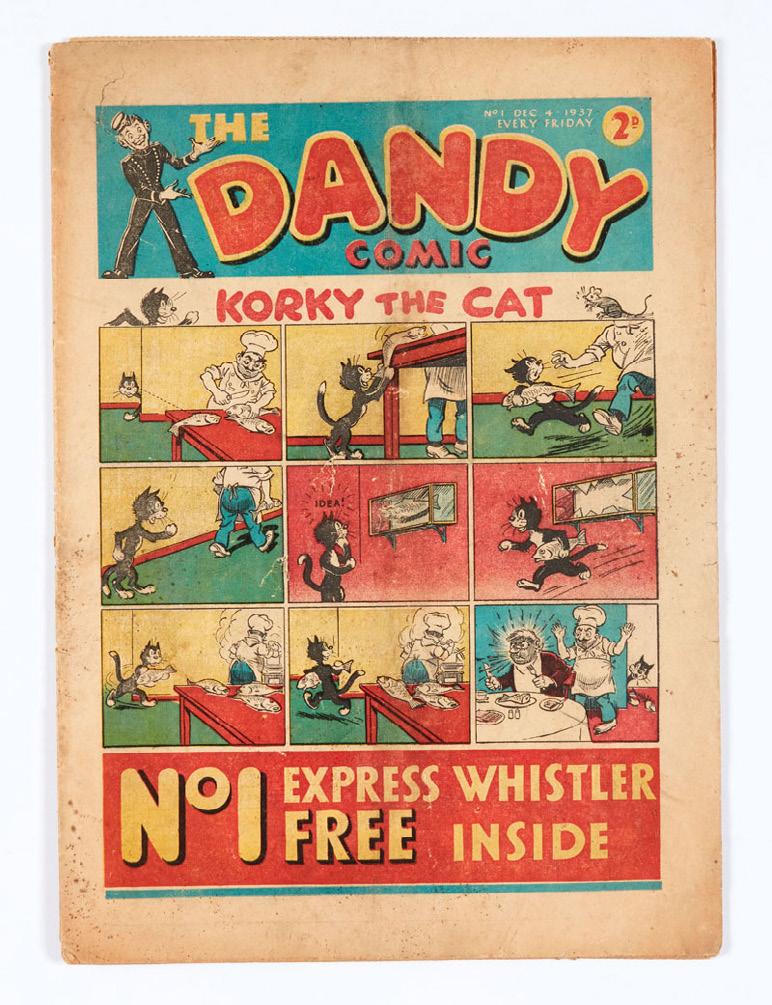
It is highly unlikely that in 1884 when David Couper Thomson took over his family’s publishing business that he could see his name largely associated with some internationally famous comic
Alfred Charles William Harmsworth, 1st Viscount Northcliffe, could always spot a lucrative market in publishing. His most famous comics - Illustrated Chips (18901953!) and Comic Cuts (also 1890-1953)
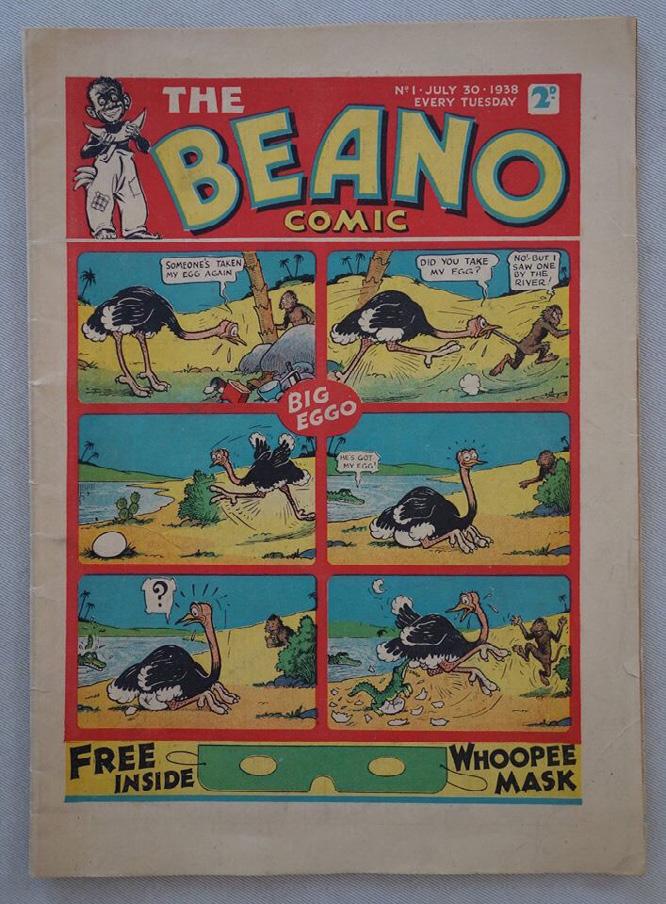
The instant success of the Dandy led on 3th July 1938 to the launch of the Beano in the same format. Dennis the Menace (which appeared exactly the same week as the American comic strip, hence the American one is known here as Just Dennis) has been an international success, especially as an animated cartoon. The Bash Street Kids, Roger the Dodger, Lord Snooty, etc. all live on to the present.
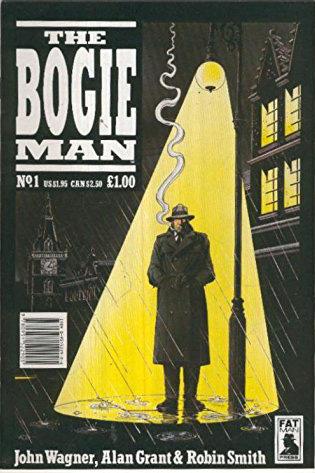
But another reason DCT is so famous is that it was a first class training ground for people who wanted to work in journalism or comics. John Wagner and Pat Mills went on to create Battle Picture Weekly and 2000AD and both have had films made of their work - A History of Violence, Judge Dredd, Accident Man. John Wagner teamed up with fellow DCT writer Alan Grant to produce The Bogie Man (BBC movie starring Robbie Coltrane and even Midge Ure), still in print after 36 years. Alan became famous through his years with the classic American character Batman, published by DC (no relation) Comics.
Another internationally famous name who passed through DCT is Grant Morrison. He wrote and drew a couple of issues of Starblazer. That digestsized comic was a companion to the
Rob King was running Edinburgh’s Science Fiction Bookshop at the time and launched his magazine in 1978. The short-lived magazine (long story) is also famous for the first appearance of Bryan Talbot’s The Adventures of Luther Arkwright, now recognised as a seminal UK graphic novel.
Grant went on to do the groundbreaking Arkham Asylum, and on WE3 and All-Star Superman the collaborations with Frank Quitely are quite stunning.
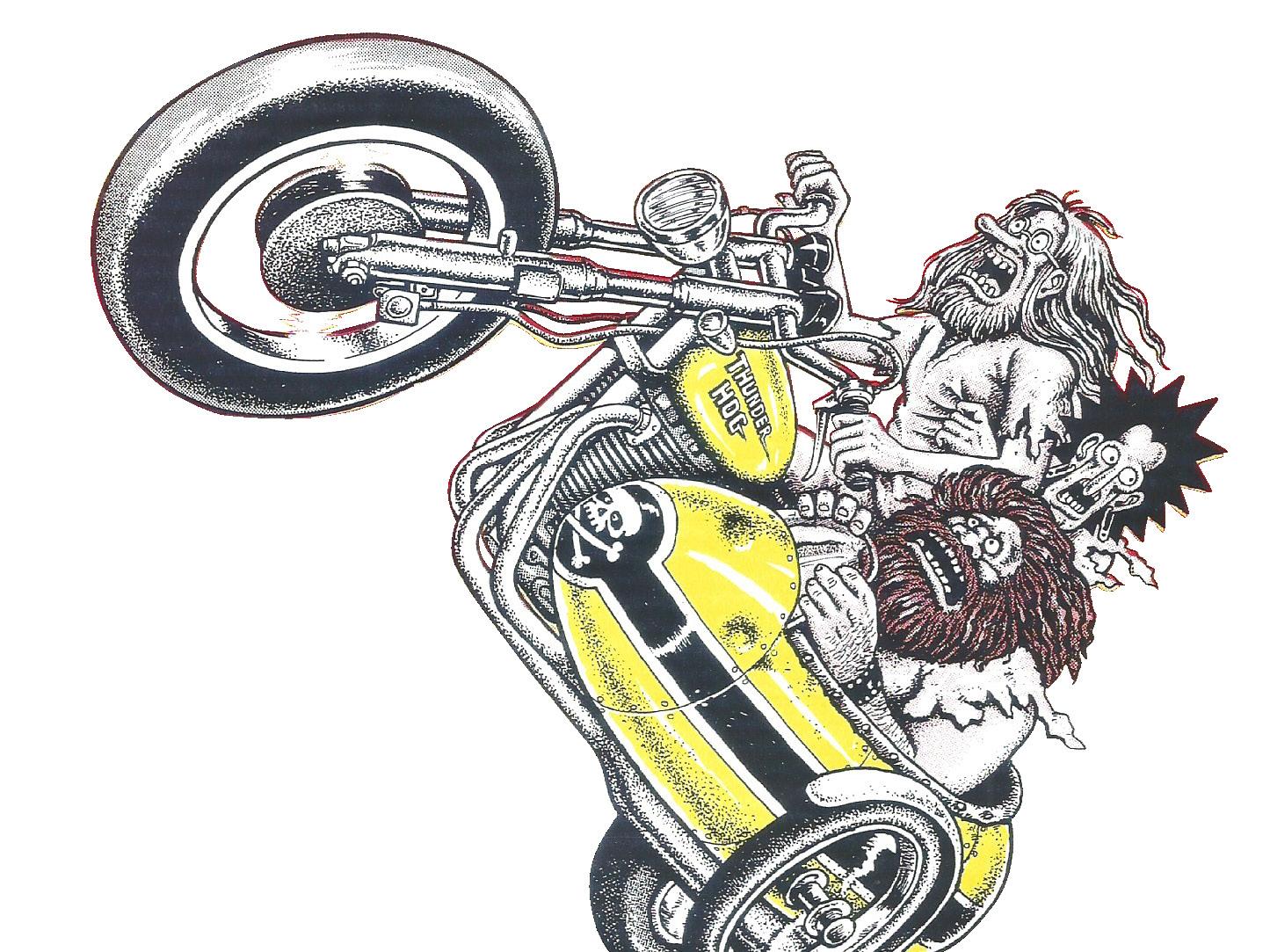
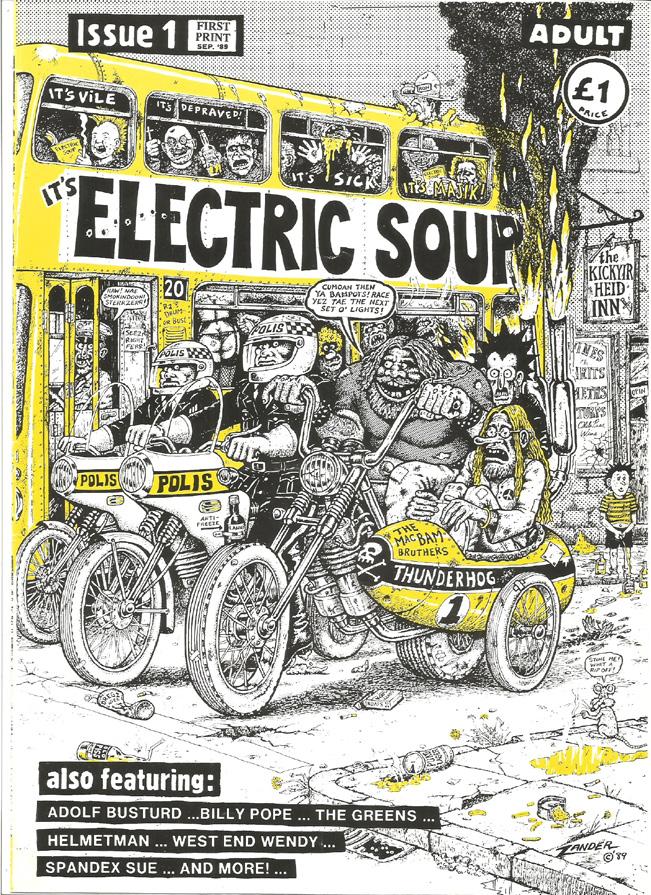
Now Frank Quitely got his start in the Glasgow based Electric Soup (19891992). His parody of DCT’s The Broons, called The Greens, was very much in an Underground style which the artist thought his mum would not like. So, Vincent Deighan adopted the pseudonym Frank Quitely (quite frankly!) which caught on worldwide that he now just answers to “Frank” rather than confuse people any further.
Another major contributor to Electric Soup is Dave Alexander.
staggering 50,000. However, Viz-like sales still eluded them, but Dave did do some work for Viz itself. With a bank loan of £2000, Dave went on to self-publish Escape from Euro Dismal World. And that is far from the end of the story.
Neither from DCT nor either of the above Scottish Independent comics, Jim Stewart is a force to be reckoned with.
digest Commando (5914 issues and counting!). Starblazer was science fiction (unsurprisingly) while Commando featured war stories (also unsurprisingly). But Grant talks very fondly of selling a strip (story and art), Gideon Stargrave, to Rob King’s Near Myths.
One-time winner of the Scottish Independent Comic Book Award for his “outstanding contribution to comics”, Dave Alexander is an important writer/ artist in the Scottish comics scene. His most famous strip, The Mad Mentol MacBam Brothers, started out in 1982 in an unpublished strip for some long forgotten magazine. The first completed strip, “Malky Wherrz Yer Troozirz?” was done as a one-page advertising handout. The MacBams were inspired more by the early ‘80s sitcom, The Young Ones, than by the Freak Brothers, but any comparison with Gilbert Shelton is always welcomed by Dave, of course. In 1985, Dave and Tommy Sommerville started working on what was to become Electric Soup. After 7 self-published issues, John Brown Publishing took over Electric Soup and increased the print run to a
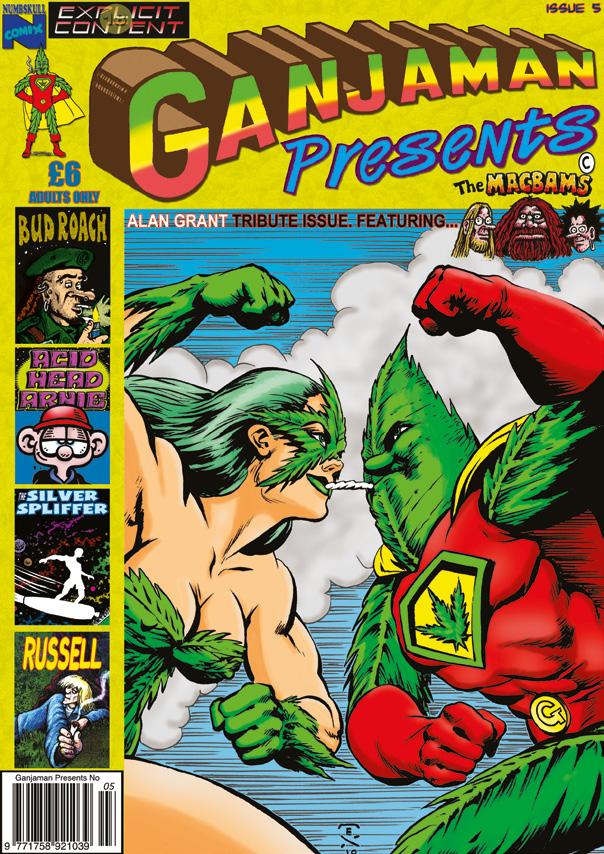
Jim is a self-taught artist and cartoonist who has been drawing commercially for over 30 years. Best known as the creator of underground superhero Ganjaman and as a founding co-creator of Northern Lightz; his comic strips were featured in Soft Secrets, Weed World and have been translated into 8 languages. Jim’s self-published editions of Ganjaman Presents, feature not just his creative talents, but the writing of veterans, including Alan Grant and John Wagner, and the artwork of Glaswegian Cam Kennedy (George Lucas liked his Star Wars comics so much he invited Cam’s entire family to Oregon to work on, well, Star Wars).
ComicScene is worth a paragraph because it behaves like a dozen institutions at once. Magazine, reference website, newsletter, publisher, matchmaker and small press promoter. Based in Scotland (and running a creator directory and industry pages), ComicScene publishes an annual, runs themed specials (including ‘Best of Indie Scottish’ bundles), and has been instrumental in bringing projects like Tara Togs, by Stevie White, into the world. The Comic Scene shop and presence on retail platforms (including listings on the Shift store) mean that they function both as publisher and as grassroots distributor. An example of how small presses now have to think in hybrid ways (magazine production, event activity and online retail). ComicScene also curates directories that are practical tools for schools and local projects seeking comics practitioners.
And, speaking of Stevie White. Stephen White is a comic book writer and artist who lives and works in Edinburgh, under the penname Stref. His past credits include working with D C Thomson, on many strips and characters for the Dandy and Beano, the Digital Dandy, Oor Wullie and the Broons, and a cover for Commando. He currently produces regular work for Viz magazine. Having actually drawn The Broons for DCT, Viz
Christmas edition of 2000AD. He has also published 5 independent graphic novels: Milk (2009), Raising Amy (2010), X (2010), Peter Pan (2015/2025), Tara Togs: The Silence Of Unicorns (2024), and is currently working on the second Tara Togs book: Tara Togs: Year One. A busy lad!
Now, DCT are also famous for The Sunday Post, founded in 1914. In 1969, its total estimated readership of 2,931,000 represented more than 80% of the entire population of Scotland over the age of 16! Inside was a Fun Section. On 8th March 1936, Oor Wullie (our William) first appeared along with The Broons (the Brown family). Not only are they still going strong, but it has become a Scottish (and further afield) tradition to give one of the annual album reprints as a Christmas gift. And, woe betide if you forget to do this…
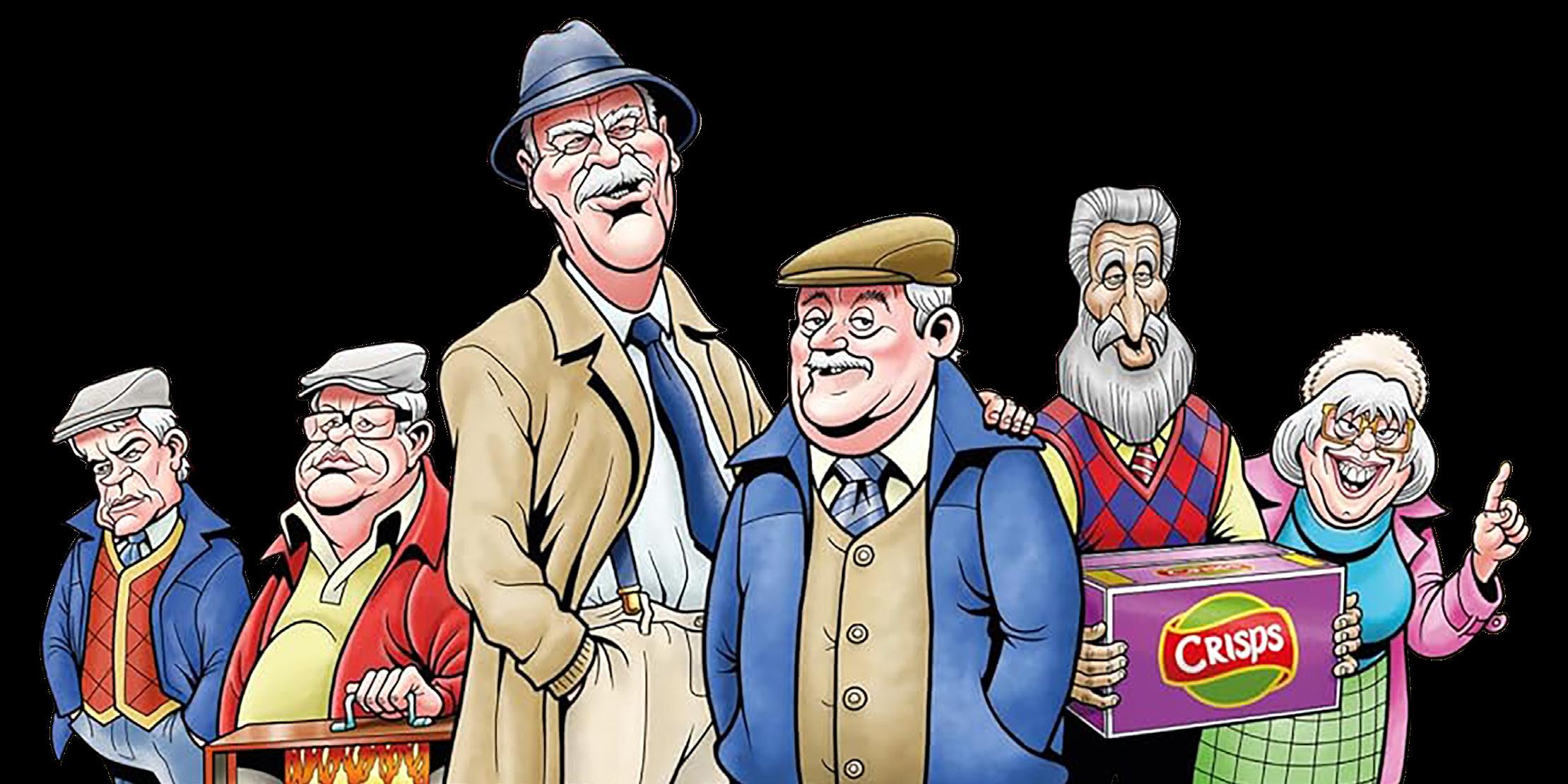
One of the most successful TV comedies in recent years is Still Game (19992005), about two old codgers and their neighbours in Craiglang, a fictional suburb of Glasgow, It has spawned books, whiskey(!), and other merchandise. The creators are the multi-talented Ford Kiernan and Greg Hemphill, who also play the lead characters.
Taking the hint from The Broons and Oor Wullie, there is now a Christmas annual.
Gordon Tait, it should be no surprise by now, worked with DCT for many years. He worked on The Broons and Oor Wullie and 104 issues a year of Commando, so who better to be at the helm of a Still Game annual.
“It was really Ford and Greg’s idea,” says Gordon. “They both have good comic knowledge — at initial meetings they were citing lots of credible reference points.”
And no way is this a one-off. The second collection is out now…
“Aye, hopefully it’ll become a staple at Christmas time. Book 3 is well underway... with something special planned for 2027!”
The problem with this article was not what
THE ART OF BILL SIENKIEWICZ COMICS WITHOUT LIMITS:
“Everybody wants you to be just like them…” Maggie’s Farm, Bob Dylan
“Make it new!” Ezra Pound
“The difference between us is that I tell a complicated story in a simple way and you tell a simple story in a complex way.” Stan Lee to Jim Steranko. [ See Steranko: The Self- Created Man, a comprehensive survey of Steranko’s storytelling innovations.]
Jim Steranko said of his approach to the creation of comics: “ the narrative devices that had been adopted and sanctioned for about half a century were considered untouchable commandments that were permanently etched in stone … Since I had made no agreement to comply with the prehistoric code … I opted to make my own rules, the first of which is there are no rules.”
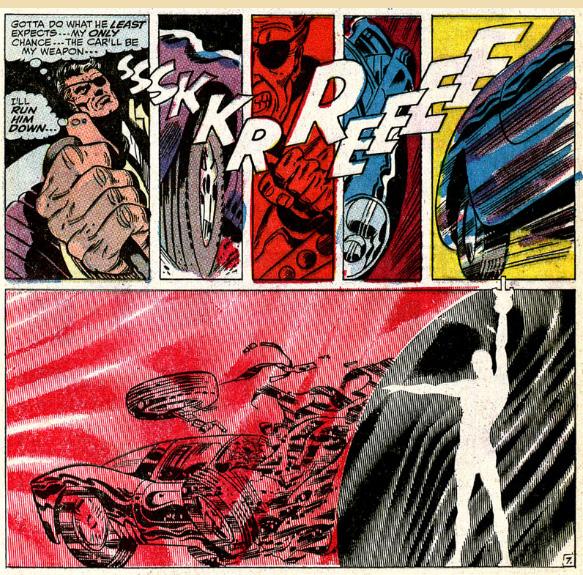
Stan Lee, as he often did with new artists, had Kirby do layouts/ rough pencils for Steranko to finish and ink when he assigned him to Nick Fury, Agent of SHIELD in Strange Tales. But there is a massive difference between issue #153, the last Kirby based issue, and #154 where Stan allowed Steranko to plot, pencil, ink, and colour his own work. This was a remarkable degree of freedom. Kirby’s 6 panel grid - which did lead to very clear storytelling - was ditched. The constraints of the sonnet were replaced with the freedom of free verse.
Mind you, Kirby had not imposed these restrictions on himself. Over at DC in 1957, Kirby was far from encouraged to be innovative: “They kept demanding Jack strip his work of all the sharp edges and stylistic inventions that gave it its power and energy. Everything that was special about his art prompted the comment, ‘That’s not how we do it here’,” according to Gil Kane who had the same response from DC at that time.
Suddenly SHIELD became a dynamic creation with each sequence demanding its own approach. There was nothing in American comics which looked like this. Great innovators like Will Eisner (in a newspaper supplement) and Bernie Krigstein (in Bill Gaines’ beautifully illustrated EC comics) and George Herriman and Cliff Sterrett in the newspaper comic strips produced highly original work, but they were the exceptions. Especially at DC, the more one comic looked like another of their output, the better.
Steranko changed all that.
At a convention in London in the mid 1980s, Frank Miller was shown Mickey Mouse Weekly (1936-1957).
He called over Lynn Varley to look. While American comics of the same period were crudely reproduced and coloured and printed on pulp paper, UK comics like Mickey and later the Eagle used the lithographic printing process on good paper. Frank felt something ought to be done to make American comics catch up 50 years later. This led to The Dark Knight Returns which looked like nothing else on the newsstands in 1986.
And then, at the same period, along came Bill Sienkiewicz.
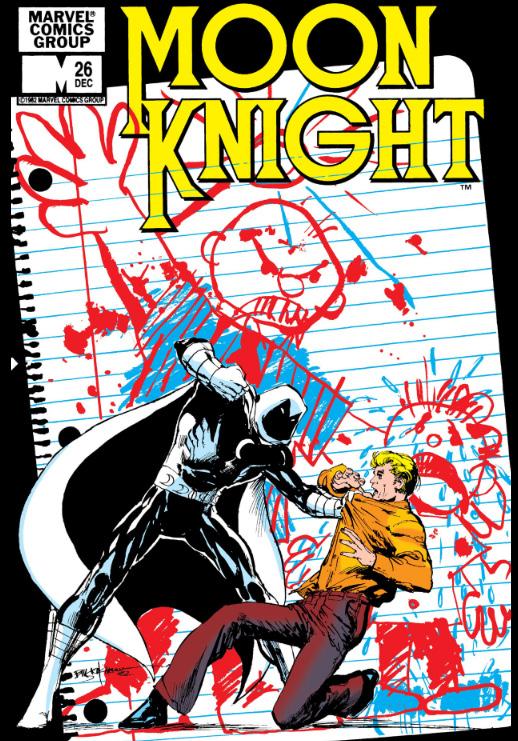
Look at the cover of Moon Knight #26, 1982. While showing some of the influence of Neal Adams in the figure drawing [Adams had sneaked into a Deadman story at DC: “Hey a Jim Steranko effect” - Strange Adventures # 207] but the childish drawing on lined notepaper in the background of the two figures showed that something new was happening.
The story is Hit It! One of Doug Moench’s finest. We gradually learn that the childish drawings tell us about the past life of the antagonist. However crude they appear, the story they reveal is tragic.
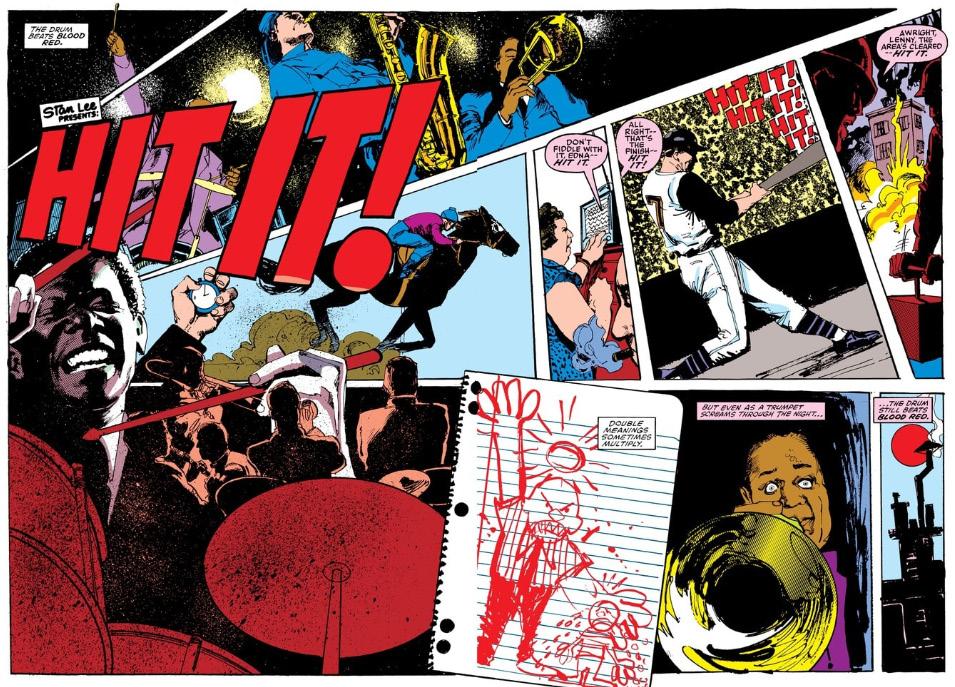
Then there is page 1. No sign of Neal Adams’ influence here. It is a wonderful series of images depicting the feeling of jazz music. The drummer - look at the plethora of speed lines indicating how fast he is hitting the drum - Hit It!
In spite of the freedom Steranko was getting at Marvel, he had one recurring problem. “I explained to production chief Sol Brodsky that interior gutters were unnecessary and that every double page in a comic book could cross the gutter with imagery, not just the centrespread.” But Brodsky seemed unable to accept this.
In SHIELD #3, Steranko found a way around this: the double pages 2 & 3 are set against a white background. And he
managed to sneak in a genuine double page spread on pages 10 & 11. Maybe Brodsky had given up arguing, or was not in the bullpen that day.
By Sienkiewicz’ time Sol Brodsky had been given the position of vice president, special projects (sadly, he died in 1984) and the arguments about gutters had ceased. Sienkiewicz’ amazing double page spread on pages 2 & 3 of that Moon Knight issue is stunning. The jazz band is depicted again with the drummer in the foreground. There is another childish drawing of an angry adult male and a small child. There are images of horseracing and baseball and a woman changing tv channels. And someone is told to Hit It! As he throws a plunger to demolish a building. And the design of all these elements is unique, all depicting different ways to Hit It!
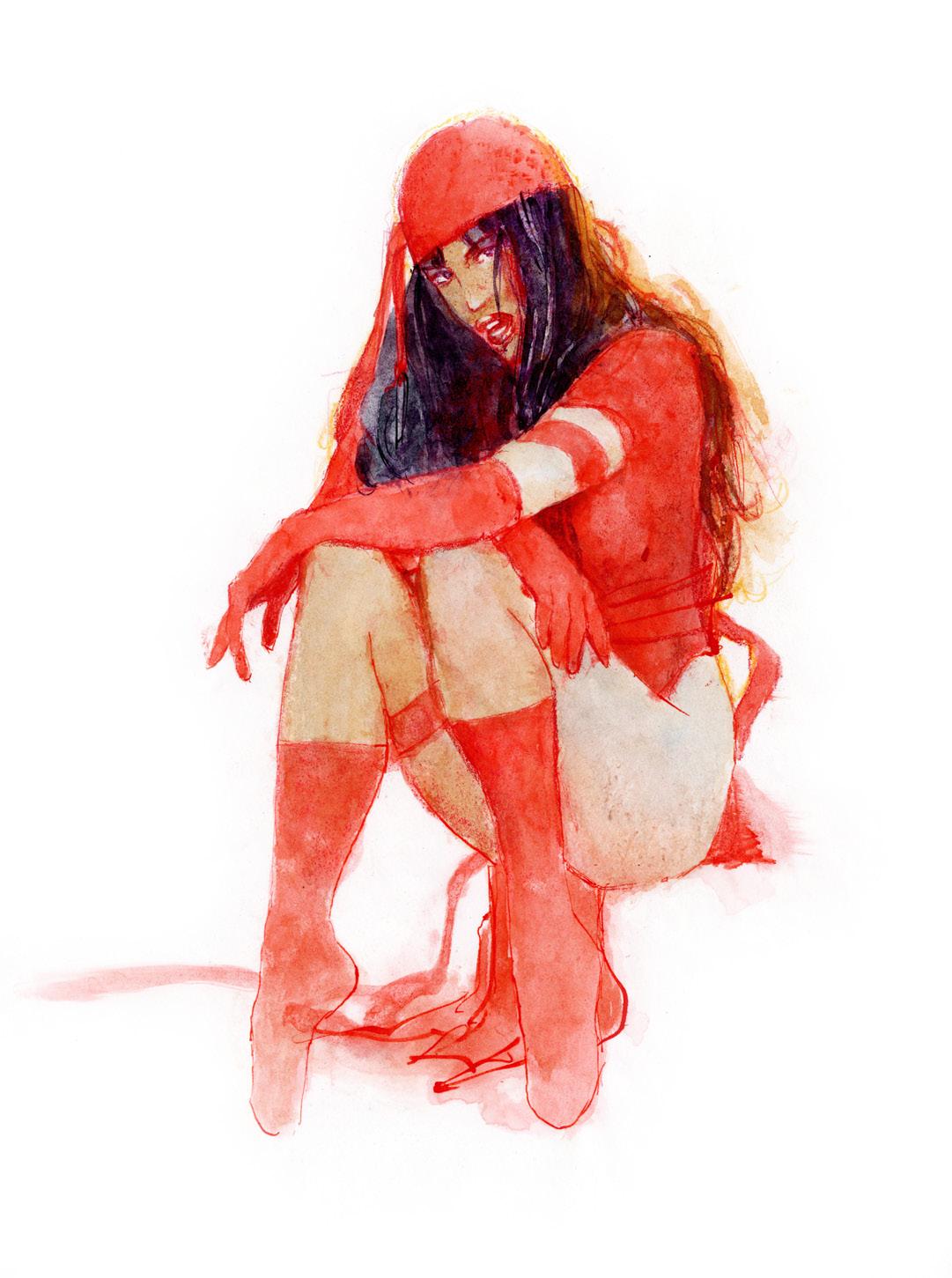
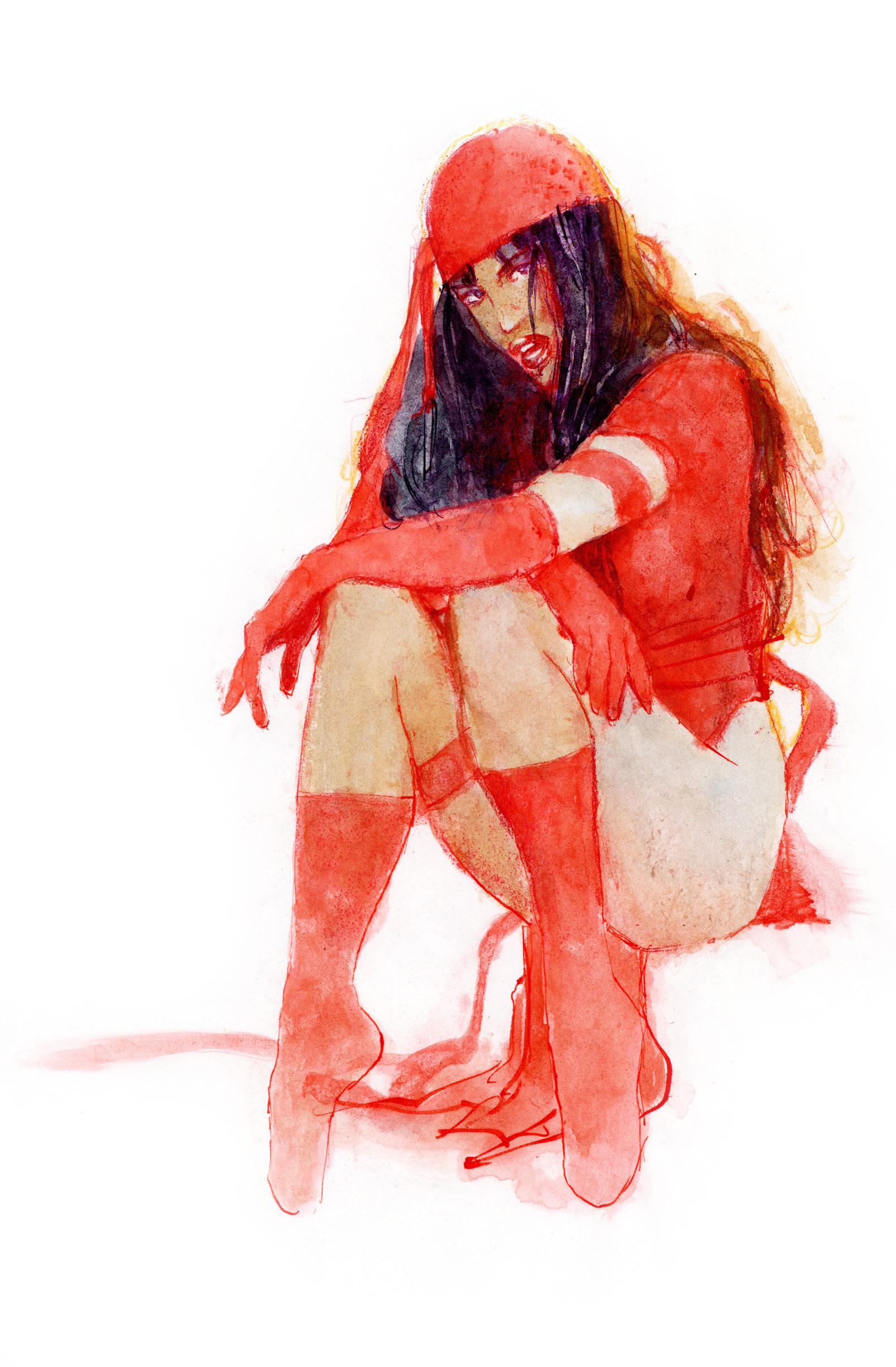
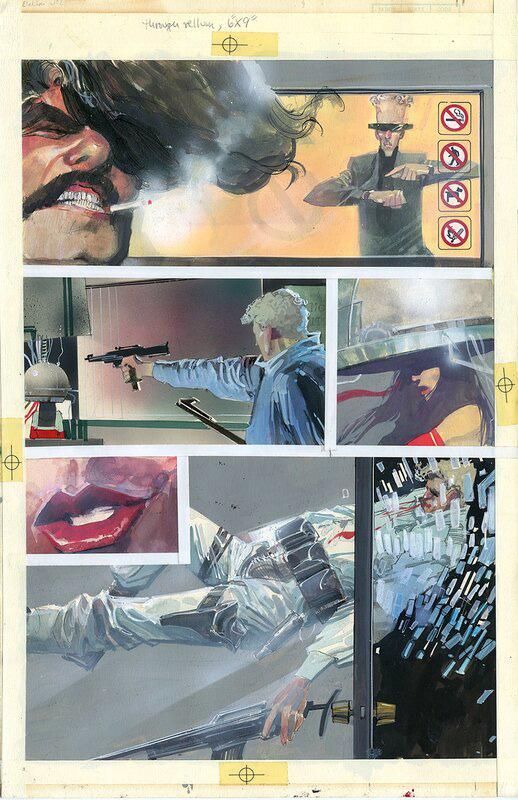
So, by the time Frank Miller joins up with Sienkiewicz for Elektra Assassin, all the stars have aligned to create one of Marvel’s most important graphic novels. Miller’s opinion of Bill Sienkiewicz’ great strengths: “The fine drafting, the loony caricatures, and the high-style infusion of sex-and-drugs-and-rock’n’roll.” Editor Jo Duffy later stated: “I think that both of them [Frank and Bill] pushed the envelope about as far as it’s currently possible to go.” They certainly did!
From the opening sequence you know that you are about to experience something unique. Elektra is depicted as a childish caricature - compare the antagonist’s childish drawings in Moon Knight - looking at us from inside her mother’s womb. Yes, INSIDE is correct! There are what appear to be handwritten notes on top of the painted artwork on some panels: “Oh, Oh - here comes trouble …” as a helicopter noisily approaches. “BULLIT hoL HERE” as her father is shot.
And then we get to Chapter 3 and, guess what? Here’s SHIELD again. You want to do something innovative with the comics form? Well, don’t yield, back SHIELD.
Agent Garrett - a fabulous caricature - is sent to track down the assassin. He eventually sends a message up the chain of command: “I request authority to use lethal force …” But he gets a handwritten note back: “FORGET IT. I WANT HER ALIVE. FURY”, to which Garrett, while scrunching up that note, responds with: “War hero faggot. Doesn’t know what kind of agency he’s running.” Not your typical dialogue from a traditional Marvel comic. This was published by EPIC, Marvel’s more mature branch.
Handwritten notes, annotations on panels, skilful use of captions in different designs by Jim Novak and Gaspar Saladino. This Graphic Novel is a totally immersive experience that demands you pay attention - and, if you do, you will get a totally rewarding experience.
Bill Sienkiewicz has, of course, worked on lots of other books. We have not even mentioned Stray Toasters - a personal and idiosyncratic work - Brought to Light - a brilliant exposé of the CIA’s involvement in the Vietnam War and the infamous Iran-Contra affair whose main narrator is an American Eagle. It had to be written by Alan Moore, of course.
The lesson being: if you want to create great comics, don’t feel you have to make them look like everything else. Make it new!
THE PERILS OF SELF-PUBLISHINg :
SIMON & KIRBY’S
MAINLINE
Joe Simon was wondering how he could use the comics medium to comment on the actions of a failed Austrian artist who decided he was better suited to be a dictator. This thinking led to the basic idea of Captain America.
Martin Goodman had somehow got a hold of Joe Simon’s phone number and invited him over to Timely Publications. Goodman had decided to stop using Funnies Inc. a comics packager who had provided him with best-selling characters like The Human Torch (actually an android, not a human) and Sub-Mariner (half-human). Goodman wanted to bring all production in-house and thought that Simon, who already had a reputation in the comics world, could be the man to do it.
Goodman loved the idea of Captain America and even decided to give the character his own book, rather than having him share an anthology title with other heroes. On top of that, he agreed with Simon a 25% share of the profits15% for Simon and 10% for the artist. But what artist? Joe Simon had met Jacob Kurtzberg when they were both working at Fox Publications. Simon had persuaded Jacob to do some freelance work at home in the evenings to add to his $15(!) a week salary. For the extra work, Jacob used a few pseudonyms, and eventually changed his name to Jack Kirby. Joe Simon had no hesitation in offering Kirby a job at Timely and the art chores on Captain America and other characters.
Now, Goodman’s accountant was Morris Coyne and it was his job to make out the royalty cheques. When alone with Simon one day, he confided that Goodman was “piling salaries and overhead” on Captain America because it was such a huge seller. So, Simon & Kirby never did get the full 25% that they had been promised. “You’re getting the short end,” said Coyne, “but I doubt if there’s anything you can do about it.” However, the creators had already been talking to DC and had started developing characters just as they had done when freelancing during their time at Fox.
Just as well, because Goodman found out about their discussions with DC just before Captain America #10 was due. He insisted they finish that issue and then clear their desk.
At DC, they negotiated a salary of $500 a week on a year’s contract. They created Manhunter, Sandman, and the #3 best seller (behind Superman and Batman) The Boy Commandos.
In 1947, for Crestwood’s Prize Comics, they created what are widely credited as the first Romance comics: Young Romance and Young Love.
And then the comics world was rocked by the works of Frederic Wertham and the creation of the Comics Code.
So many publishers just quit comics altogether and this left printers with silent presses while still having to pay all their overheads. A print salesman approached the now very famous Simon & Kirby to offer them a generous line of credit to start their own comics publishing.
How publishing worked in those days: and Kirby chose Leader News for their distributor. They had had some success with Bill Gaines’ EC Comics, so they seemed like a good fit for this new small comics company.
The distributor would advance the publisher 25% of the total income, based on an assumption of 100% sale.
That money was assigned to the printer and if the books sold at least 30% of the print run, everyone got paid.
Between 1954 and 1956, Simon & Kirby were still working for Crestwood as well! So, money was coming in for those books, although how much sleep the creators managed is not recorded. However, it turned out that Crestwood, like Goodman, was holding back on royalties - according to Joe Simon the sum was $130k. Crestwood confessed they did not have that money, and, rather than force the company out of business, the creators settled for $10k during a meeting and continued working.
Meanwhile, Leader News was suffering because Bill Gaines had cancelled all his EC comics except Mad, so the distributor suddenly found itself cash poor. Eventually, they went out of business entirely leaving Mainline with no money.
“Charlton was the last port of call for a publishing enterprise on the verge of going under, “ Simon knew. So the last of Mainline’s books was published by Charlton. Simon also had a meeting with the packager Waldman and walked away with the right to reprint while keeping the IP with Simon & Kirby. Waldman was only interested in a quick deal and had no interest in keeping those rights.
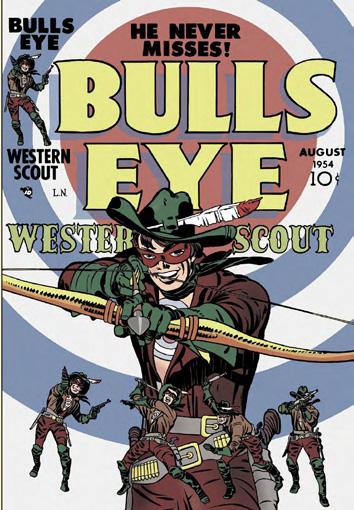
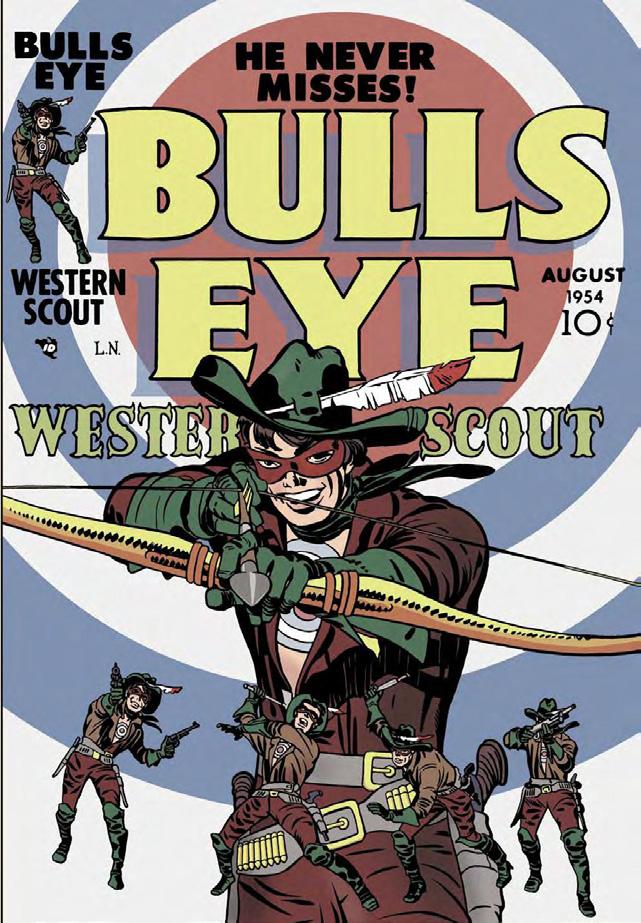
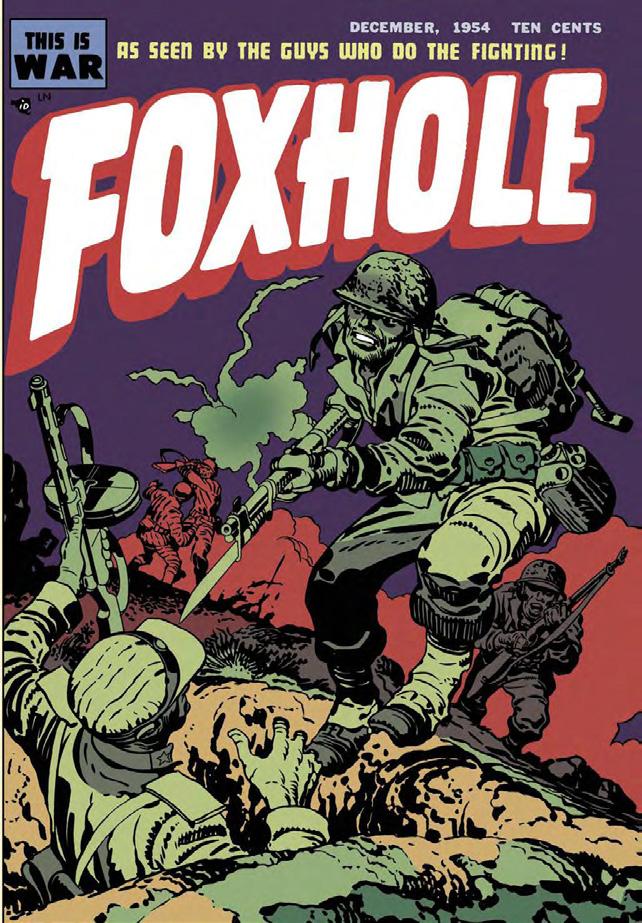
So, what had the creators published in their brief foray into self publishing? Superheroes were no longer very popular; in fact the last issue of Captain America did not even feature, eh, Captain America! Mainline published 4 titles: Bullseye Western Scout. (#s 1-5 published by Mainline, #s 6 and 7 by Charlton)
This was an interesting take on the Western genre and has been reprinted in its entirety by TwoMorrows.
Foxhole (#s 1-4 by Mainline, #s 5-7 by Charlton)
“Authentic! Produced by veterans of the Army, Navy and Marine Corps” it stated on some covers. Of course, Kirby was indeed a war veteran. The stories do indeed feel authentic.
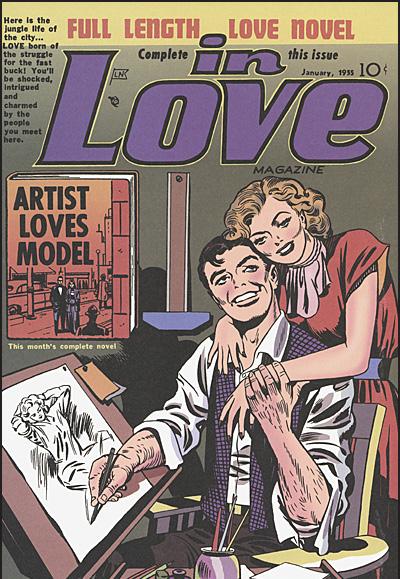
In Love (#s 1-4 by Mainline, #s 5 & 6 by Charlton)
Well, Simon & Kirby created the Romance genre, so they knew what they were doing. In Love # 3 has an interesting story repurposed from a newspaper strip proposal called Inky. “Inky” Wells is the art assistant to Hal Cobb, a newspaper cartoonist. When Cobb dies, Inky has to try to create a popular strip of his own. But can he? Kirby seems to be following the old adage here of writing what you know. It’s a very good story with a bit of a sentimental ending. Did the Code insist that it end on a positive note?
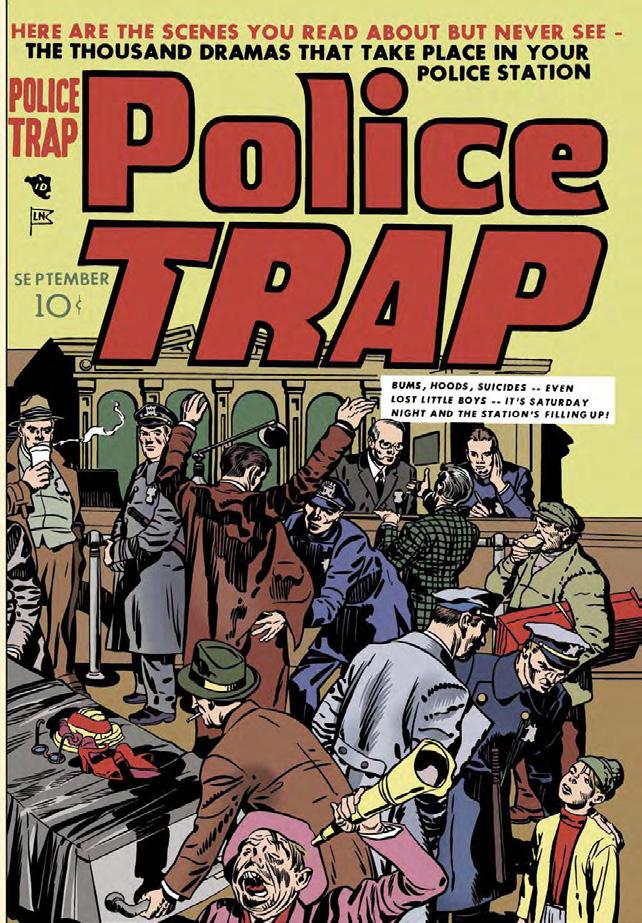
Police Trap (#s 1-4 Mainline, #s 5 & 6 Charlton)
The Code were very nervous about crime comics, so this book concentrated on the police with lots of scenes in a police station. It is actually well written, but Charlton did not continue it.
Even Martin Goodman fell foul of a distributor. He was with the American
News Company due to what turned out to be not good advice from his business manager, Monroe Froehlich. ANC had well known connections with the Mafia, but Goodman chose to ignore that. Suddenly in April 1957, ANC closed down leaving Goodman with no distributor for his comics line. By September he had made a deal with Independent News who were not that independent since they were owned by DC. So Goodman was back in the comics business which a few years later was known as Marvel.
With Mainline gone, Kirby ended up back with Goodman’s company. That went fairly well for him and led to over 100 issues of Fantastic Four. Joe Simon got a job at Harvey where he recruited Jim Steranko who created Spyman. Simon did not think Steranko’s artwork was good enough; his thoughts about SHIELD are not recorded. Jim Steranko went on to self publish with his very successful Supergraphics - the right idea at the right time.
It has never been easier than right now to self publish. But how good are you at distribution?
But please do not let this article put you off.
DESERT ISLAND COMICS
WITH ROBBIE MORRISON
“Perhaps it is only in childhood that books have any deep influence in our lives,” novelist Graham Greene once mused. “What,” he wondered, “do we ever get nowadays from reading to equal the excitement and the revelation in those first fourteen years?”
I’ve been a wee bit cheeky in my interpretation of the Desert Island Comics format, but maybe Greene was right, as I’ve mainly chosen comics from my childhood. And compiling this list brings back the thrill I used to get having the Hotspur read to me by my granny, rushing to the newsagents to pick up my weekly order of Mighty World of Marvel, or visiting Linwood Library with my dad to borrow Asterix for the umpteenth time.
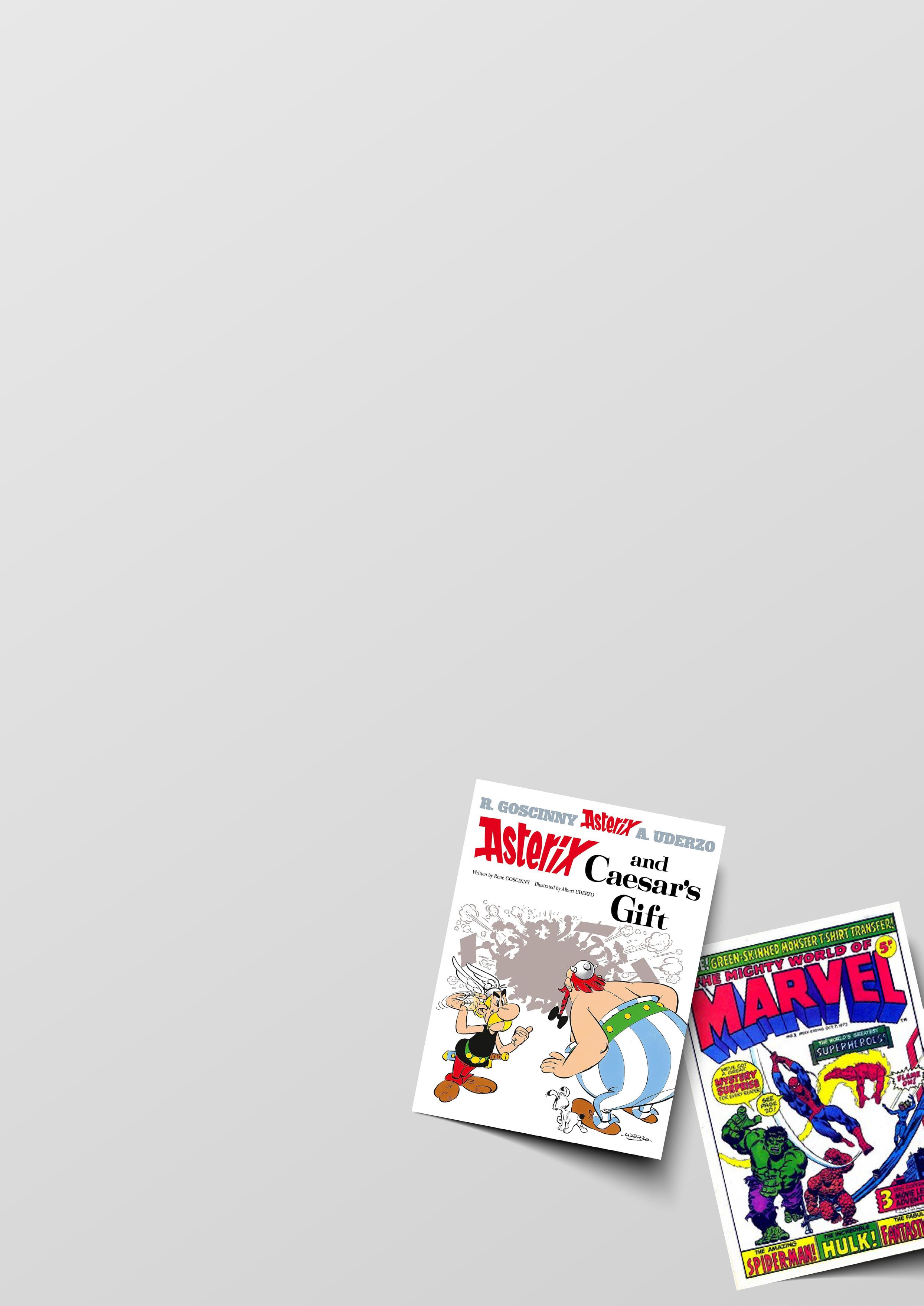
1] Asterix
“The year is 50 BC. Gaul is entirely occupied by the Romans. Well, not entirely... One small village of indomitable Gauls still holds out against the invaders.” So begins perhaps the finest comics series ever created, certainly the most fun – Asterix, by René Goscinny and Albert Uderzo. Beautifully written and drawn (with a nod to UK translators Anthea Bell and Derek Hockridge), this classic series is enjoyable by all ages, and features, in Asterix and his hulking sidekick Obelix, one of the greatest duos in literature. Hard to pick a favourite – all the original team’s stories are terrific – but I’ve always had a soft spot for Asterix and Caesar’s Gift. I sometimes think of Jimmy Dreghorn and “Bonnie” Archie McDaid – the detective heroes of my novels Edge of the Grave and Cast a Cold Eye – as the Asterix and Obelix of crime fiction.
Robbie Morrison
2] Mighty World of Marvel, by various writers/artists
My first introduction to superheroes was via this anthology comic from Marvel UK, reprinting the original US material. I’ve no idea what issue I first had bought for me, but the cover had the Incredible Hulk battling Crusher Creel, the Absorbing Man, on the hull of a crashing spacecraft that was burning up on re-entry. Inside, it also featured Daredevil and the Fantastic Four. How could a kid in early 1970s Scotland resist? In the immortal words of Stan Lee: “‘Nuff said!”
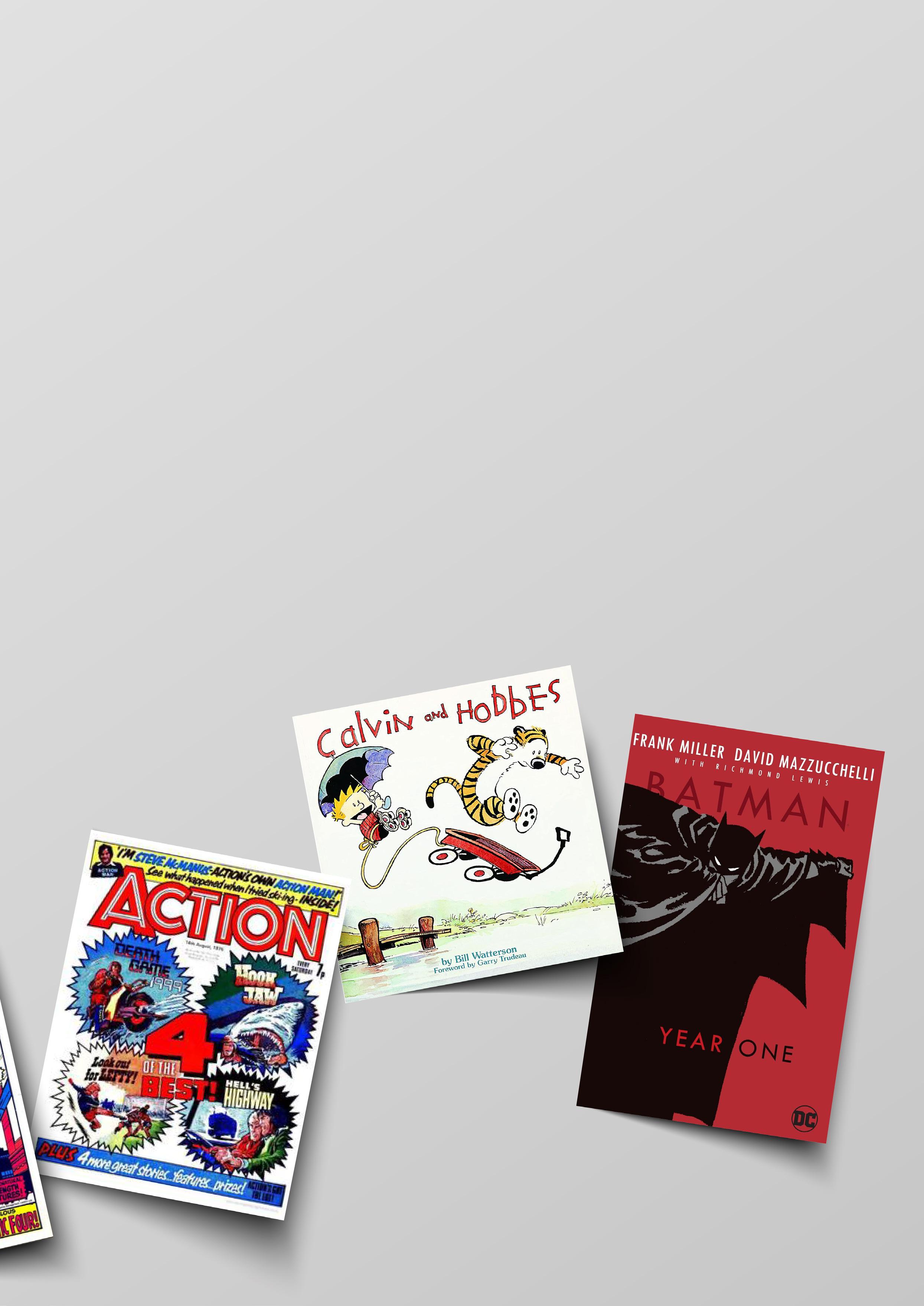
3] Action & 2000AD
I’m cheating by including both Action and 2000 AD, but one did kind of grow out of the other. They’re also a paean to the UK comics I grew up with, anthologies that featured a mix of genres – humour, war, historical, sports, detective, SF. You name it, they had it. It was a format I loved, from DC Thomson’s the Hotspur and the Hornet, to the edgier Battle, Action and 2000 AD – Action was so edgy, it was eventually banned! With brilliant writers like John Wagner and Alan Grant, and artists the calibre of Brian Bolland, Cam Kennedy and Carlos Ezquerra, these are all-time classics. Almost 50 years later, only 2000 AD – for which I wrote Nikolai Dante and Shakara – is still going. Maybe it is “the galaxy’s greatest comic” after all!
4] Calvin and Hobbes
The adventures of a boy and his toy tiger, a simple premise that in the hands of creator Bill Watterson becomes something much more – timeless and heartwarming on a universal scale, and even, on occasion, philosophical, as befitting the characters’ names. With masterful storytelling and beautiful comic timing, it’s a celebration of childhood and imagination that seems to grow in stature, becoming more touching and evocative the older I get. Originally published as a newspaper strip (remember them?), all the collected editions are brilliant.
5] Batman: Year One
The book by Frank Miller and David Mazzuchelli. The story that drew me back into reading (and writing) comics after several years away. A retelling of Batman’s origin that immerses the character in the realm of the darkest crime fiction, focusing as much on conflicted cop James Gordon as it does on playboy Bruce Wayne and his vigilante alter ego. Miller’s hardboiled script and Mazzuchelli’s cinematic art combine perfectly to create a tight, taut thriller without a wasted word or image. A masterclass in sequential storytelling.
IMAgINE: THE EMERgENCE OF MODERN INDIE COMICS
By Finn Miles
From production to distribution there is on one level something innately independent about the nature of the comic book, at least relative to the visual media to which it is so often compared.
Whilst cinema and video games often require larger and larger creative teams and continuously mounting budgets just to get off the ground, with even more independent and self-made projects of any real significance or craft being still largely inaccessible relatively, comics have offered an accessible avenue for nonprofessionals to produce independent or more contemporary technological developments. Whether in the form of self-produced magazines and newspapers or something as simple as a stack of paper stapled together distributed by a child on the local playground, comics have served as an attractive medium for amateurs and freelancers for quite some time.
In spite of this aforementioned independence streak inherent to the wider medium, comics on the larger stage in much of the western world, especially America, have often been in many ways less independent than their contemporaries. On a more mundane level an example of this could be provided through the status of the author. Whilst authorship in terms of the novel is usually boiled down to a single individual and video games to a largely faceless studio or production
company, western comics have largely relegated the status of the author beyond that of a brand or corporation to a position shared between “writer” and “artist”, the latter defined in terms of the penciler/inker. What this means in practice is that the roles of inking, lettering, editing and even colouring are relegated to side work instead of, if you will, collaborators in the creative process as presented to the wider public. Film is perhaps the only major medium quite as unique in how it chooses to operate within the boundaries of authorship, with films on one hand commonly attributed to a larger production company or creative team but also on the other often attributed to the concept of “the director”.
American comics often defy the indie spirit in other notable ways. For instance whilst western film invokes images of a litany of producers, distributors, brands, and genres that are seen as media defining even to the most casual of audiences, American comics (particularly in terms of the “comic book”) have often been reduced
on a macro level to two power players doubling as corporate entities, Marvel and DC. To make matters worse, said brands are inherently anchored to the genre of the superhero, lending the medium a degree of repetitiveness - in spite of said genre’s impressive ability to incorporate and emulate a myriad of genre themes not inherent to its fundamental composition. The rise of the modern indie wave in western comics then has, as a result, been largely a reaction to these constraints, both creatively and financially.
In spite of their consistent lack of mainstream appeal through most of their history, independent comics do in fact have a long and not insignificant history in the United States. The nature of “mini comics” for instance is in many ways analogous to the Japanese Dojouinshi, or even the British small press phenomenon, offering an inherently independent publishing sub genre and format within the wider medium. Often photocopied and stapled by hand, the American mini comic largely found itself emerging as early as the 1920s. Although this largely produced adult content, such as the pornographic and anonymously authored Tijuana Bibles of that decade, the medium would grow and diversify with time. Between the period of 19701983, the underground publisher known as the San Francisco Comic
Book company published numerous soon to be famous creators, such as Bill Griffith, Robert Crumb, Trina Robbins, and Spain Rodriguez, effectively kickstarting their careers in the process. From 1973, Clay Geerdes’ Comix World would also begin to publish several mini comics, with competitors like Artie Romero’s Everyman studios also following suit. The 1980s then saw a new wave of mini comic artists influenced by the “underground comix” scene. By the 1990s mini comics had become a relatively popular means of distribution for creators looking for alternate, independent means of producing their work
Still, something was missing in terms of fundamentally altering the mainstream comic scene to a degree that could even somewhat compete with the larger non independent behemoths that ruled the US comic space. It might in retrospect seem that for those who deeply believed in the indie space’s potential that such a seismic event would be almost prophetic, planned, and expected by a small circle of visionaries. Although when high profile creators like Erik Larsen, Rob Liefeld and Jim Valentino met in1991 over dinner to join Malibu comics (one of the few comic publishers of the time that published
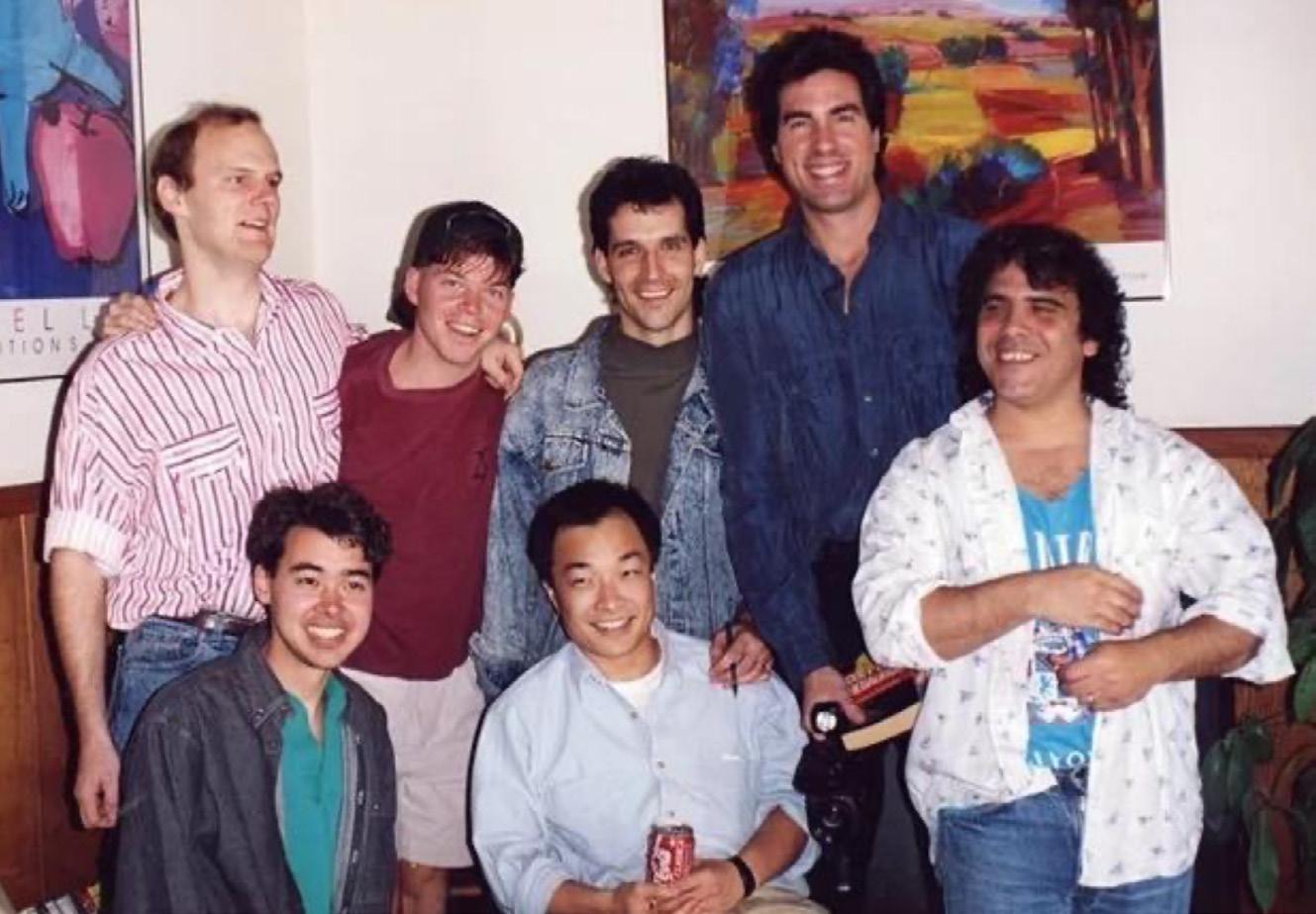
The founding members of Image Comics
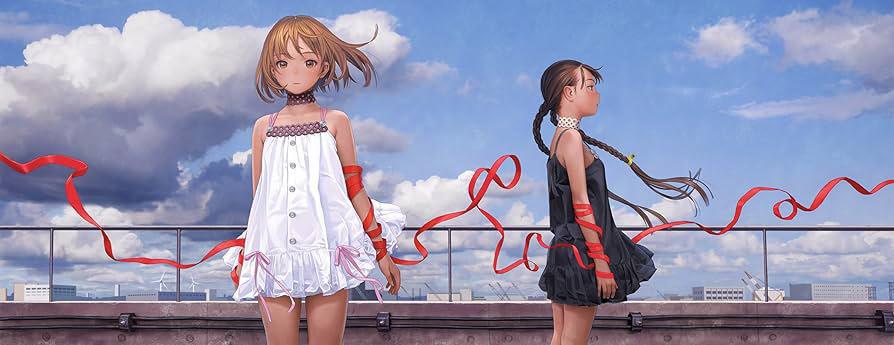
From the cover artwork of Futurelog by Range Murata
independent and creator owned work) as a reaction to their frustrations from working for Marvel and DC, it is unlikely that they quite knew what future laid in store for them. Later that year the trio added Todd McFarlane and Jim Lee before quickly acquiring the collaboration of Marc Silvesti and Whilce Portacio. Together these seven creators would found Image Comics in 1992, which would shepherd the modern boom in high profile, creator owned, independent comics.
In effect, this status of “creator owned comics” gave creatives full ownership of their own independent properties and respective trademarks, whilst removing the sort of creative interference received at larger publishing houses. Image instead acted solely as a vehicle for publishing their work. Such a move combined with the star power behind the Image brand would essentially open up an entire new avenue for mainstream independent comics in the United States and abroad, allowing for the proliferation of a wide variety of titles distinct from the usual superheroics found within the pages of the famed “big two” of the comic book industry.
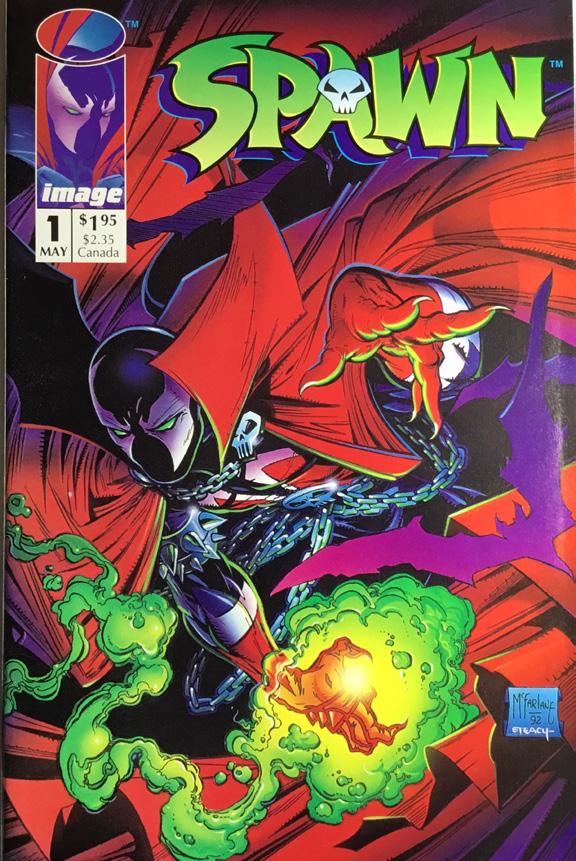
However, in spite of such opportunity, onlookers in Image’s early years might have been forgiven for thinking that Image was merely an attempt to introduce a third player in the superhero genre, a sort of edgy indie alternative if you will to break up the monotony of the super genres regular two player play. And, again, who could really blame them? Titles like Todd McFarlane’s Spawn for instance was essentially another superhero comic, complete with the typical anti hero edge that coloured much of the output of the last two decades of the 20th century. Erik Larsen’s The Savage Dragon was similarly familiar, another superhero doused with super strength and a fine helping of the colour green.
However, with time, Image would develop to become what was, to many, a breath of fresh air on the big stage of the American comic sector, largely establishing this reputation in the 2000s into the 2010s. Titles like The Walking Dead, following survivors trying to make it through a zombie apocalypse where human relations are front and centre, essentially made Image a major player in the modern comic landscape, selling over 45 million copies in total and leading to translations into other media, most notably the hit AMC TV show of the same name.
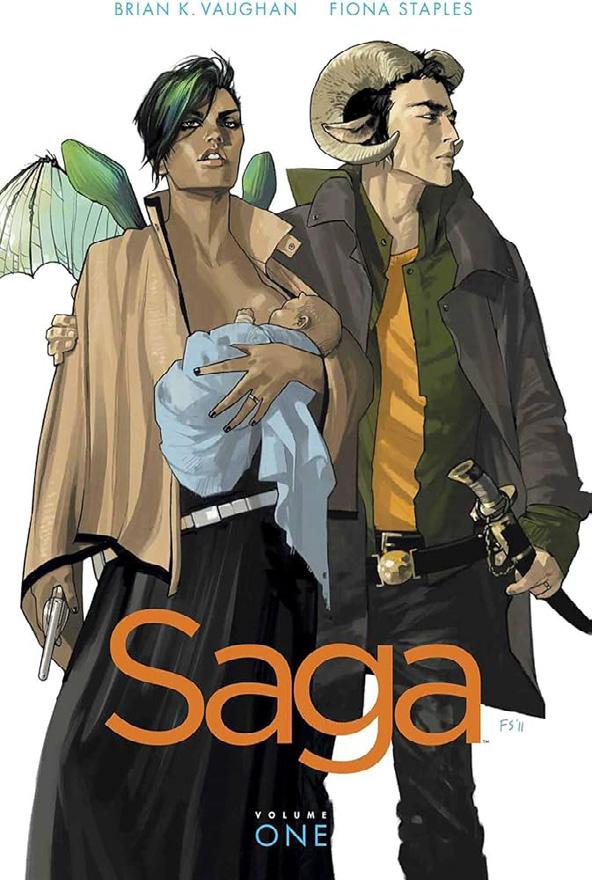
Image thus became disassociated with a particular literary genre. The title Chew for instance consists of a detective who uses his extrasensory sense of taste to reveal the details of unsolved crimes, often going as far as to resort to cannibalism. Saga meanwhile is a science-fantasy hybrid that takes aspects of something like Star Wars and combines it with the romantic sensibilities of Romeo and Juliet. The result for Image is a diverse palette of creator owned titles spanning a broad range of topics and themes, one rooted in a relatively recent tradition that changed the very face of broadly appealing American comics.
Unlike its mainstream counterpart, indie Manga has yet to truly pierce through into being more than a considerable niche internationally beyond the bounds of fan made work, itself still a relative niche. Known as Dojouinshi, indie manga as we know it largely started in the fan creator realm in the 20th century, although the term literally translates as magazine and its first use can technically be drawn back to 1874, with the publication of Meiroku Zasshi establishing modern collaborative literary publications in Japan. This itself led to the creation of arguably the first Doujinshi just over 10 years later with Garakuta Bunko published in 1885.
It wasn’t until the Showa Period (19261989) that Dojouinshi would see a boom in Japan alongside the early 20th century rise of manga, leading to the first manga Dojouinshi Ajima in the early 1980s. In the west Dojouinshi would soon become associated and thus often conflated with Hentai (literally meaning “pervert”), a form of pornography in the form of Manga or anime. As a result, to many outside Japan the term Dojouinshi unfortunately purely evokes fan made pornographic content, often featuring characters from popular non indie titles.
In spite of this roadblock, non pornographic content, both made by fans and in the form of more professional work, are still rife in the Dojouinshi sphere. True, many of these still focus on romance, from Michuyu Hera to the likes of Akane No Koro, but others such as the dramatically titled “Gachinko Battle!!!” firmly fit into the battle manga subgenre of so many non-independent shonen jump titles.
The history of the British small press industry is intimately bound to the history of underground publishing writ large, specifically with publications such as Oz or the International Times. The underground comic scene was led by the likes of Nasty Tales and Knockabout Comics in the 1970s, with Punk zines emerging in popularity towards the end of the decade, because of cheap and accessible photocopying. Fan made zines about comics were also not uncommon in this period, largely focusing on American superhero comics.
From here the bi monthly British small press publication Escape was established by Paul Gravett in 1983, and took the lead in the flowering of the small press comic industry within
Britain. Numerous creatives who would become large names in the comic industry took part to some extent in this movement, including Eddie Campbell, Phil Eliot, Glen Darkin, Paul Grist, and Ed Hillyer.
In the 1990s, a re-emergence of fanzines would take place in the British market. At first some of these various zines focused on American superhero comics, such as in the case of Andy Brewer’s Battleground, but grew increasingly less focused on the mainstream American market. The 2000s saw several other developments emerge from the British small press scene, Metaphrog produced full colour Louis graphic novels from 2000 to 2011, which received mainstream attention. Numerous creators have emerged from the small press junket this century, much as they did in the last, including Gary Northfield, whose Derek The Sheep soon earned itself a recurring slot in the Beano.
More recent years have seen small press comics continue their growth both off and online, with numerous growing platforms and sites.
A once niche and often fanmade sub industry, the last few decades have seen indie comic publications rise from relative obscurity to a producer of multi million pound intellectual properties regularly adapted onto both the big and small screens, as well as to a litany of other media. Whilst the dominance of non-independent work seems unlikely to disappear in the near
future, the rise of the independent comic has created a substantial and sustainable alternative to larger more corporate works, With the cultural and, some would argue, economic struggles currently facing the American superhero comic in the face of the momentous rise of Manga, one can only expect the balance of power between independents and nonindependent work to shift further for many years to come.