Polycrops or monocrops: Which system is better for backgrounding weaned calves?
April 2025
Researcher
Dr. Obioha Durunna, livestock research scientist
Summary
Can a polycrop system facilitate better land stewardship and animal welfare than the conventional monocrop system?
Background
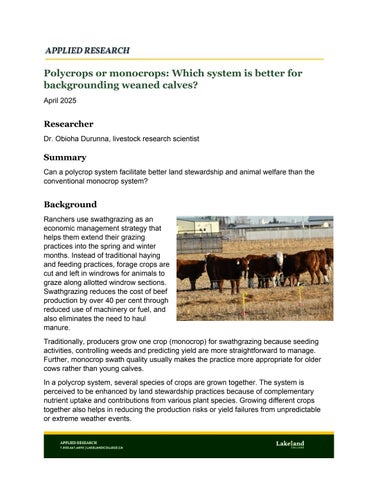
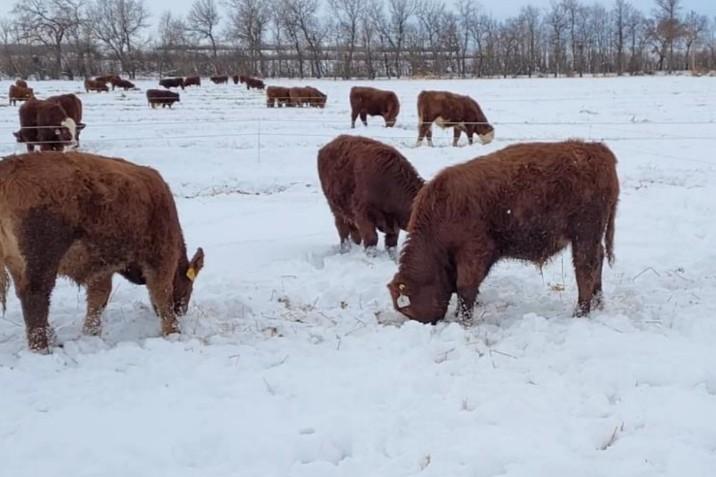
Ranchers use swathgrazing as an economic management strategy that helps them extend their grazing practices into the spring and winter months. Instead of traditional haying and feeding practices, forage crops are cut and left in windrows for animals to graze along allotted windrow sections. Swathgrazing reduces the cost of beef production by over 40 per cent through reduced use of machinery or fuel, and also eliminates the need to haul manure.
Traditionally, producers grow one crop (monocrop) for swathgrazing because seeding activities, controlling weeds and predicting yield are more straightforward to manage. Further, monocrop swath quality usually makes the practice more appropriate for older cows rather than young calves.
In a polycrop system, several species of crops are grown together. The system is perceived to be enhanced by land stewardship practices because of complementary nutrient uptake and contributions from various plant species. Growing different crops together also helps in reducing the production risks or yield failures from unpredictable or extreme weather events.
The study
Researchers at Lakeland College evaluated both monocrop and polycrop forage systems, examining economics, forage characteristics, animal performance, soil quality and virtual management tools.
Timeline: 2021-2024
Methodology
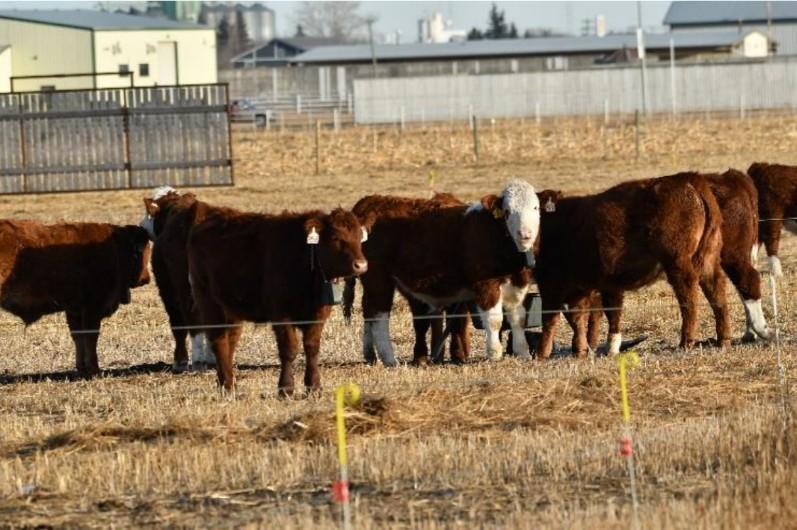
In the first week of June each year, three paddocks were seeded with an oat monocrop while the other three were seeded with a polycrop consisting of oat, forage peas, rapeseed and turnips (as shown in the paddock layout). The crops were swathed in August and September and steers grazed from November to January/February. Seven to 10 steers grazed each paddock yearly.
Data collected
Forage samples were collected for yield assessment and quality analysis at the soft dough and hard dough stages, but swathing was done at the hard dough stage.
Soil samples were taken before the first seeding to establish a baseline, and then again in the fourth year for assessing physicochemical characteristics and microbiota dynamics assessments.
Descriptive online surveys were also conducted into producer motivators or deterrents towards swathgrazing.
Results
Forage quality: While the cost and forage yield were slightly better for the monocrop, the lower crop yield for the polycrop resulted in greater forage utilization efficiency (72 vs. 58 per cent). However, the greater oat yield resulted in greater residues because all animals were allotted new swaths whenever a paddock ran short of feed resources. The extra residues may have supported additional animals in the oat monocrop paddocks.
Most of the forage nutritive values (e.g. crude protein and TDN) from both systems were similar, but the soluble sugar content was greater in the polycrop. Even though the sulphur contents in the brassicas were high (0.63 to 0.68 per cent), they were diluted to safer levels (0.28 per cent) in the forage mix, thereby assuaging any safety concerns in feeding the polycrops.
There was no difference in the average daily gains of the steers assigned to either the oat (0.70 kg/day) or polycrops (0.67 kg/d). At the end of the grazing period, there was no difference in average dry matter intake or back fat thickness measured in animals in both groups.
Soil quality: Even though the results did not show any significant change for the majority of the soil physico-chemical characteristics of the soil, the polycrops had a more favourable water infiltration duration. The soil biology analysis showed that the polycrops system maintained more uniform microbial communities over the three years than the oat monoculture system.
Why it matters
The study showed that oat monoculture produced more biomass but had similar nutritive values as the polycrops. The cost of swath was slightly lower for the Oats monoculture, but both systems had similar effects on the steers’ body performance and soil health, which suggests that a polycrop mixture can be a viable alternative to oat monoculture for winter swath grazing with young beef steers.
Only 20 per cent of western Canadian cow-calf producers have adopted swathgrazing as a preferred extensive grazing method. Top reasons that prohibit them from adopting this system are potential biomass wastes or losses and frigid weather. Adopters of swathgrazing have done so because of the labour-use and fuel-use savings.
This study will help producers make objective, information-based production and investment decisions.