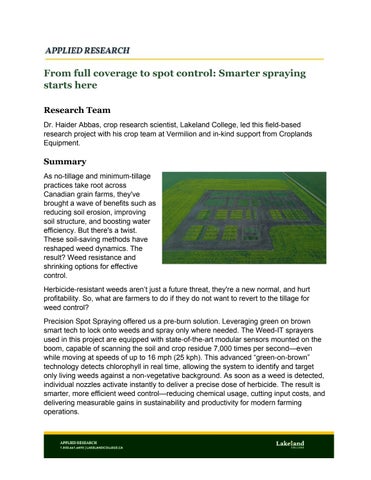
From full coverage to spot control: Smarter spraying starts here Research Team Dr. Haider Abbas, crop research scientist, Lakeland College, led this field-based research project with his crop team at Vermilion and in-kind support from Croplands Equipment.
Summary As no-tillage and minimum-tillage practices take root across Canadian grain farms, they've brought a wave of benefits such as reducing soil erosion, improving soil structure, and boosting water efficiency. But there's a twist. These soil-saving methods have reshaped weed dynamics. The result? Weed resistance and shrinking options for effective control. Herbicide-resistant weeds aren’t just a future threat, they're a new normal, and hurt profitability. So, what are farmers to do if they do not want to revert to the tillage for weed control? Precision Spot Spraying offered us a pre-burn solution. Leveraging green on brown smart tech to lock onto weeds and spray only where needed. The Weed-IT sprayers used in this project are equipped with state-of-the-art modular sensors mounted on the boom, capable of scanning the soil and crop residue 7,000 times per second—even while moving at speeds of up to 16 mph (25 kph). This advanced “green-on-brown” technology detects chlorophyll in real time, allowing the system to identify and target only living weeds against a non-vegetative background. As soon as a weed is detected, individual nozzles activate instantly to deliver a precise dose of herbicide. The result is smarter, more efficient weed control—reducing chemical usage, cutting input costs, and delivering measurable gains in sustainability and productivity for modern farming operations.