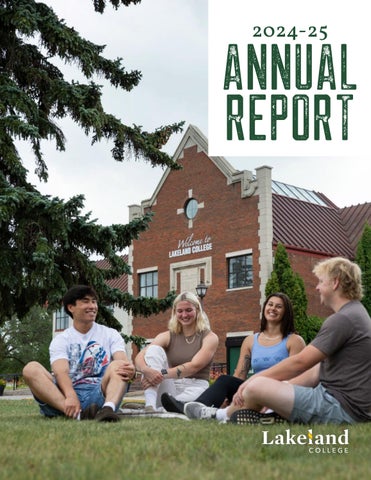
2024-25
ANNUAL REPORT
ANNUAL REPORT
Table of Contents Land Acknowledgment......................................................... 2 2024-25 Board of Governors................................................ 3 Board of Governors Training on For-profit Ventures...... 3 Mission. Vision. Values.......................................................... 3 Accountability Statement..................................................... 4 Management’s Responsibility for Reporting.................... 4 Public Interest Disclosure..................................................... 4 President's Message............................................................... 5 Free Speech Reporting.......................................................... 5 Goals and Performance Measures....................................... 6 Student Supports and Resources........................................15 Strategic Research Priorities...............................................17 Collaborations With Other Learning Providers...............19 Capital Report......................................................................20 Financial Statement Discussion and Analysis................ 23 Mandatory Non-instructional Fees Reporting................ 30 Financial Statements............................................................31 Appendix............................................................................... 66
LAND
PLANTS
ANIMALS
PEOPLE
Askıyiwimamıhcıtotamowin Here at Lakeland College, we acknowledge that the land we gather on is the traditional homeland, hunting, and ceremonial gathering places of the First Nations, Métis and Inuit. The Plains Cree, Woodland Cree, Saulteaux, Blackfoot, Métis, Dene, and Nakota Sioux people have practiced their culture and languages on Treaty 6 and Métis Region 2 territories for generations and were the original caretakers of this land. Many First Nation, Métis and Inuit peoples call this land home today and have done so for millennia. We would like to acknowledge the history we have created together on this land, and to be thankful for the opportunity to walk together side-by-side in Otôtemiwewin (friendship), learning from our past, and promoting positive relationships for the past, present and future. Three members of our Indigenous Student Committee created this land acknowledgement for Lakeland College. Kiera Comeau, Samantha O’Reilly and Ryan Powder wrote the askīyiwimamīhcītotamowin. The English translation of this Cree concept is the act of acknowledging the earth (land). It was unveiled on April 6, 2022.
2 | lakelandcollege.ca
L AKEL AND COLLEGE
Mission. Vision. Values. Mission To inspire lifelong learning and leadership through experience, excellence, and innovation.
2024-25 Board of Governors Chair Adam Waterman Vice Chair Dean Fahselt President and CEO Dr. Alice Wainwright-Stewart Non-Academic Staff Trisha Mechor
Students Alana Olson Michiko Tsuyuki Public Dr. Sean Lessard Kelly Smith-Fraser Brent Fischer Barb Shackel-Hardman A.J. Mokelky
Academic Staff Wanjiku Kaai
Board of Governors Training on For-profit Ventures
Vision Transforming the future through innovative learning.
Values Learner Success Integrity Respect Community Excellence Innovation
There were no training opportunities for board members during the reporting period.
2024-25 Annual Report | 3
ANNUAL REPOR T
Accountability Statement Lakeland College’s Annual Report for the year ended March 31, 2025, was prepared under the Board’s direction in accordance with the Sustainable Fiscal Planning and Reporting Act and ministerial guidelines established pursuant to the Post-Secondary Learning Act. All material economic, environmental or fiscal implications of which we are aware have been considered in the preparation of this report. [Original signed by Adam Waterman] Chair, Lakeland College Board of Governors
Original signed by Dr. Alice Wainwright-Stewart] President & CEO, Lakeland College
Management’s Responsibility for Reporting
Public Interest Disclosure (Whistleblower Protection Act)
Lakeland College’s management is responsible for the preparation, accuracy, objectivity, and integrity of the information contained in the Annual Report. Systems of internal control are designed and maintained by management to produce reliable information to meet reporting requirements. The system is designed to provide management with reasonable assurance that transactions are properly authorized, are executed in accordance with all relevant legislation, regulations and policies, reliable financial records are maintained, and assets are properly accounted for and safeguarded.
Under the Public Interest Disclosure (Whistleblower Protection) Act, Lakeland employees can report in good faith when they believe a wrongdoing has occurred. Lakeland has a detailed procedure that explains the whistleblower process that is followed.
The Annual Report has been developed under the oversight of the institution audit committee, as well as approved by the Board of Governors and is prepared in accordance with the Sustainable Fiscal Planning and Reporting Act and the Post-Secondary Learning Act.
A requirement of the Public Interest Disclosure (Whistleblower Protection) Act is that all disclosures made during the year are reported.
The Auditor General of Alberta, the institution’s external auditor appointed under the Post-Secondary Learning Act, performs an annual independent audit of the consolidated financial statements which are prepared in accordance with Canadian public sector accounting standards.
Lakeland did not receive any disclosures during the 2024-25 year.
[Original signed by Adam Waterman] Chair, Lakeland College Board of Governors
4 | lakelandcollege.ca
[Original signed by Dr. Alice Wainwright-Stewart] President & CEO, Lakeland College
L AKEL AND COLLEGE
President’s Message Movement and growth defined Lakeland College’s 2024–25 academic year. Guided by Vision 2030, we continued to adapt to the changing needs of our students, communities and industry partners with our focus on learner success, relevant programming and research, connectivity and sustainability. With a 17 per cent increase in full load equivalents over the previous year, we served more students and celebrated more achievements. From international design awards to podium finishes at Skills Canada Alberta, they didn’t just participate – they excelled. Our student athletes made history, with Rustler Nation celebrating a third straight Canadian Collegiate Athletic Association gold in women’s volleyball, and Alberta Colleges Athletic Conference gold in women’s volleyball and women’s hockey. On campus, we celebrated cultural milestones like the renaming of the Indigenous Student Lounge to Otôtemiwewin, meaning Friendship in Cree, marking a powerful symbol of the Lakeland Way, where students, faculty and staff create space for belonging and pride. Our students also put their education into action with impactful, hands-on events including Farm 4.0, the Inspiring Women’s Conference, tax clinics, research presentations, case competitions and more. Our 2025 Economic and Investment Impact Report, completed by Lightcast, confirmed our continued strong contribution to our region, our students and Alberta. The report found that Lakeland adds $225.7 million to the Lakeland service area through our operations, student spending, construction and the contributions of our alumni. The report also demonstrated that Lakeland is a strong investment for students, taxpayers and society in Alberta. For every dollar students invest, they receive
$2.50 in higher future earnings. Taxpayers also see a $2.50 return for every public dollar invested while society gains $5.60 in value for every dollar invested, through stronger earnings, business growth and social savings. We also grew in other ways. We expanded our trades programming, continued our work to modernize our campuses with projects in The Commons, Residence, the Bentley Building renewal and Farm Master Plan. We developed a five-year plan for Applied Research to ensure we continue to provide solutions to real-world challenges in agriculture. Our growth and momentum will continue, driven by our vision to transform the future through innovative learning. On behalf of the Board of Governors and my colleagues, I am pleased to present Lakeland’s 2024-25 Annual Report. [Original signed by Dr. Alice Wainwright-Stewart] President & CEO, Lakeland College
Free Speech Reporting Lakeland College’s Free Speech Policy was not amended in the 2024-25 fiscal year. The policy is available online: lakelandcollege.ca/about/administration-and-governance/freedom-of-expression.html During the 2024-25 fiscal year, no events at Lakeland were canceled for reasons related to free speech, nor did the college receive any complaints related to free speech issues.
2024-25 Annual Report | 5
ANNUAL REPOR T
Goals and Performance Measures
Lakeland’s Vision 2030 Lakeland’s Vision 2030 embodies a comprehensive approach that ensures alignment with the Government of Alberta’s priorities and Lakeland’s aspirations. Vision 2030 is built upon four overarching outcomes:
LEARNER SUCCESS
RELEVANT PROGRAMMING AND RESEARCH
CONNECTIVITY
SUSTAINABILITY
Within the framework of Vision 2030, we have established milestones to be reached by 2025. These are outlined in the 2024-25 Strategic Plan which is available on Lakeland’s website. In this section of the annual report, we report on the progress made in 2024-25 in advancing towards the 2025 milestones.
6 | lakelandcollege.ca
L AKEL AND COLLEGE
Board Ends
LEARNER SUCCESS is campus culture and supports, student experience. Key Initiatives (Vision 2030)
Priorities Belongingness
1) Lakeland fosters lifelong learning, leadership.
Expected Outcomes (2025 milestones) 1.1) Every learner has access to a full range of supports and the College is a partner in academic success.
Performance Measures (2024-25) 1) Increase the percentage of students accessing the supports and lifestyle programs.
1.2) Proactive healthy lifestyle programming. 2) Lakeland has a culture of belongingness, engagement, and innovation.
2) Lakeland is a leader in providing a safe and welcoming learning environment for every student.
2.1) Establish systems to create a culture for engagement and student life. 2.2) Implement the Lakeland Framework for Indigenous.
2024- 25 Outcomes 1) An increasing number of students accessed supports and lifestyle programs in 2024-25: • More students – 301 – registered for accessibility services in 2024-25, representing a 34.4 per cent increase from 224 students in the previous year. •
2,158 accommodated exams were provided, compared to 1,564 in 2023-24 – a 38 per cent increase.
• There were 1,130 counselling sessions, which is 3.25 per cent fewer than the previous year’s 1,168 total of sessions. • Lakeland’s peer tutoring program aided 330 new students and had 83 new tutors. There were 1,025 tutoring sessions, with 68 per cent of the sessions involving students who came back for more tutoring. •
The Wellness team met one-on-one with students 123 times and ran 40 groups.
• The Learner Success Strategists met with students one-on-one 383 times, ran 34 groups and gave 113 presentations. • Lakeland’s new Work-Integrated Learning team began work part way through 2024-25. Statistics will be gathered for 2025-26. A number of schools, including Business, University Transfer (UT) and Energy, held Early Bird Orientations for first-year students. An Academic Integrity D2L course module was piloted by Business in 2023-24. For 202425, the pilot expanded to Agricultural Sciences, Human Services and UT programs. Student-learning labs were added to Energy’s academic schedule for first-year students. The School of Agricultural Sciences developed a Student-Managed Farm framework booklet and a framework for student proposals. An early alert system for students at risk or on probation is in place with UT. Student Success workshops were also offered to UT students – 2024-25 marks the second year of these workshops. The School of Environmental Sciences continued its Student Affairs Committee meetings as well as first-year learning workshops during Field Week. Lunch and Learns were also offered covering topics such as professional memberships, job hunting, industry connections and more. Energy also offered Lunch and Learns. The Recreation team built a plan for recreation/fitness activities, creating individual and group activity opportunities for students and staff at each campus.
2024-25 Annual Report | 7
ANNUAL REPOR T
Belongingness
2024- 25 Outcomes (Continued) 2) Lakeland College implemented a tech solution, Involve App, to increase campus engagement and provide stats on engagement through the app. It was used successfully to promote student attendance and engagement for Rustler games. Work is planned to increase Lakeland student and employee users of the app and feature more support services at the college. A Student Activity Coordination Cross-Functional Team was created to strengthen student engagement and event planning. Students had indicated they were overwhelmed due to too many events, lengthy activities, and limited coordination among areas. The team recommended focusing on fewer, higher-impact activities, improving collaboration and aligning smaller events with major ones like Open House and Ag Success Day. Other priorities included reaching online learners through live-streamed events, increasing participation on the Lloydminster campus and addressing student budgeting skills. Lakeland developed an effective international education support model for students and faculty. Rustler student-athletes committed more than 6,000 hours of community involvement through camps, club programming and working with youth. Lakeland completed the Indigenous Support Services Framework. The document is available at lakelandcollege.ca.
8 | lakelandcollege.ca
L AKEL AND COLLEGE
Board Ends
RELEVANT PROGRAMMING & RESEARCH is program quality, labour market alignment, flexible and student-centered, innovative research, healthy enrolment. Priority
Investment Management Agreement
Key Initiatives (Vision 2030) 1) Every student learns experientially through work integrated learning initiatives.
Expected Outcomes (2025 milestones) 1.1) Expand the studentled experience to College operations. 1.2) Curriculum and teaching are aligned to the Academic Framework.
Performance Measures (2024-25) 1.1) Meet the 2024-2025 IMA Work Integrated Learning target of 85%. 1.2) Phase 2 of 3 of the Academic Framework completed.
2) Graduates have employable skills and programs are launching pads into successful careers.
2) Lakeland College programs align with market and industry needs.
2) Meet the 2023-2024 IMA graduate survey target of 92% for the Employed Graduates in Jobs Related to their Programs. Identified for 2024 (survey year).
3) Students learn when, where, and how they prefer and have access to learning pathways.
3) Growing flexible options for students.
3.1) Focus on regional school districts to increase access and participation in CTS and dual credit. 3.2) Improve access to career pathways and opportunities for upskilling and reskilling.
Research
4) Programs meet target enrolment expectations.
4) Program are on target with enrolment growth plan.
4) Meet the 2023-2024 IMA domestic enrolment target of 1,650 FLEs identified in the Investment Management Agreement.
5) Lakeland is nationally recognized as a leader in agricultural research and innovation.
5.1) Create sustainable research funding.
5) Implement the Applied Research Plan.
5.2) Lakeland College identified as an applied research hub. 2024-25 Outcomes
Investment Management Agreement
1) During 2024-25, 96 per cent of Lakeland’s programs included work-integrated learning (WIL) opportunities. The total practicums reported for 2024-25 were 1,522. Phase 2 of 3 of the Academic Framework was completed in 2024-25. Phase 1 of this three-year project was a planning phase, which identified the key features of the Academic Framework: Student Learning Pathways, Course and Program Governance, and Teaching and Learning Excellence. This was completed in 2023-24. Phase 2 involved the development of the foundational elements of the Academic Framework, along with the required tools and resources. In Phase 3 (2025-26), many of the elements developed in Phase 2 will be piloted and the tools and resources will be available internally.
2024-25 Annual Report | 9
ANNUAL REPOR T
2024- 25 Outcomes (Continued) Investment Management Agreement
2) Results from IMA graduate survey changed to focus on full-time employment in related fields of study. Results showed that 92.4 per cent of graduates were employed in either full- or part-time roles, with 84.7 per cent employed full-time in jobs related to their program of study. 3) Lakeland continued to build opportunities for rural students through strategic collaborations with northern institutions. Engagement with community members, and industry supported Lakeland’s regional stewardship model. The latest collaboration, Lakeland as a Collegiate with Buffalo Trail Public Schools (BTPS), supported pathways to Human Services related careers. BTPS also takes University Transfer (UT) dual credit courses. School participation in on-campus visitation days increased slightly, with 12 schools attending 2024 Open House, compared to 11 in 2023. For the first time one school attended Late Hours with Lakeland and another attended Program Info Sessions. During BTPS Grade 9 Day, Lakeland welcomed 311 Grade 9 students and 20 staff members from 13 schools to the Lloydminster campus. Foundational Learning and UT created clear pathways for students through Accuplacer, interviews, advising and course program plans. In 2024-25, 36 students completed Career and Technology Studies in hairstyling, and 202 in trades and technology programs. Foundational Learning students have practicum placements for all daytime programs. Environmental Sciences developed a training program for Indigenous students, which was delivered at Onion Lake First Nation. In 2024-25, 195 students completed dual credit studies in programs ranging from trades to business, human services, and health and wellness. 4) Lakeland had 2,285 domestic FLEs in 2024-25. Marketing supported enrolment through strategic campaigns and the launch of a new website.
Research
5) A five-year plan for Applied Research sustainability and succession planning was created. The plan revolves around five key items: a. b. c. d. e.
Grants (both project and research operating) Overhead Create a technology access centre to access Tri-Agency funding for those centres Submit annual CFI and NSERC ARTI proposal Lab/Service account
Applied Research successfully submitted a proposal to RDAR to extend funding for a research scientist in livestock health. RDAR approved a three-year extension in funding that will end in 2028, along with that of Lakeland’s two other RDAR scientists.
10 | lakelandcollege.ca
L AKEL AND COLLEGE
Board Ends
CONNECTIVITY is industry partners, fundraising, alumni and collaboration. Priority Building Profile
Key Initiatives (Vision 2030)
Expected Outcomes (2025 milestones)
Performance Measures (2024-25)
1) Industry partners are fully engaged as advocates for students and programs.
1) Industry partnerships that support programming.
1) Meet 85% targets for industry engagement.
2) A reliable stream of funds are available to support ongoing capital priorities and to support learners through scholarships and awards.
2) Sustainable resources and supported student success through fundraising and external partnerships.
2) Increase the number of fundraising partnership.
3) Alumni are fully engaged as advocates for students, programs, and supports of the College.
3) Alumni engagement to support student mentorship, student outreach, and school outreach with alumni partners in industry.
3) Implement alumni engagement plan.
4) Lakeland is a leader in maximizing system efficiencies and ensuring student success by coordinating with community and post-secondary partners.
4) Regional connector, partner, and collaborator to support economic development and rural sustainability.
4) Maximize regional stewardship.
2024- 25 Outcomes Building Profile
1) One hundred per cent of Lakeland’s academic schools engaged with industry throughout the academic year. For example, the School of Business and Energy connected with the following industry partners for Student Lunch and Learns and practicum placements: Cenovus, Heartland Generation and Pembina, among others. MNP LLP, Federated Co-operatives Limited, Onion Lake Oilfield Services and Synergy Credit Union were among the many industry partners who presented to business classes. Lakeland’s Chamber Connect event saw 98 business students connect with 16 businesses and 52 business professionals. More than 30 companies connected with Environmental Sciences students, from guest lectures to field work and more. University Transfer students benefitted from guest lecturers, ranging from psychology topics with Little Bear Child and Advocacy, to biology topics with Nutrien. Human Services students engaged with industry partners via field trips, guest speakers, training and more, including Midwest Victim Services, Alberta Health Services and Dreamcatcher Nature Assisted Therapy. Webb’s Machinery, Croptimistic, Landview Drones and Ag Visor Pro were among the list of companies Agricultural Sciences students engaged with last year. Guest speakers from Chatters, Complexions Skin Therapy, Sage & Soul, Primary Care Network and other companies connected with Health and Wellness students.
2024-25 Annual Report | 11
ANNUAL REPOR T
2024- 25 Outcomes (Continued) Building Profile
2) Lakeland received $3 million from 752 donors making 1,011 gifts. This is a 26 per cent increase in donors and a 17 per cent increase in the number of gifts from the previous year. 3) Lakeland implemented an alumni engagement framework that focuses on collaboration, connection and mentorship. 4) Students continued to have a variety of opportunities including academic pathways, support and education activities through ongoing partnerships with regional school systems. Career and Technology Studies and dual credit courses continued to grow through positive engagements. The Emergency Training Centre initiated a Technical Field Advisory Group and conducted stakeholder and client engagement. The School of Business and Energy initiated a number of conversations for practicum placements/steam time/training opportunities with new industry partners including SaskPower, Athabasca Oil Sands Corp. and Dow Chemical. Lakeland continued its partnership with KT&T Company for the Inspiring Women Conference and the local Chamber of Commerce for the Chamber Connect event. Tax clinics were also re-established. University Transfer and Foundational Learning representatives participated in local, provincial and regional stewardship committees. Work is ongoing with UT’s partnership with Northern Lights College for LPN first-year course delivery to expand to a third course. Environmental Sciences developed prescribed fire training for students and industry.
12 | lakelandcollege.ca
L AKEL AND COLLEGE
Board Ends
SUSTAINABILITY is financial sustainability, empowering staff to excel, risk management, sustainable campus and recruitment. Priority
Key Initiatives (Vision 2030)
Expected Outcomes (2025 milestones)
Resourcing the Future
1) Lakeland’s fiscal position is strong and resources are available for strategic investment.
1) Budget framework continues to align with College needs.
2) Lakeland College has a culture of living our values and empowering our staff to achieve our mission and vision.
2) Values are integrated into all decisions.
3) Lakeland is responsive to internal and external threats.
3) Business continuity and risk frameworks are implemented to ensure the stability, safety, and services for staff and students at the College.
3) Adhere to and update the Enterprise Risk Management Report annually.
4) Students are learning in worldclass environments and have to access to modern equipment and technology.
4.1) Completion of a campus revitalization strategy.
4.1) Adhere to and update the Long-term Strategic Capital Plan annually.
4.2) Improve preventable maintenance cycle.
4.2) Adhere to and update the Capital Maintenance and Renewal Plan annually.
4.3) Digital strategies that supports academic and administrative efforts at Lakeland College.
4.3) Leverage operational effectiveness using sustainable technology.
4.4) Completion of Sustainability Framework that integrates the United Nations 17 Sustainability Development Goals into our Framework.
4.4) Complete the official STARS assessment.
5) Optimize sustainable enrolment growth.
5) Implement our strategic enrolment management plan.
5) Lakeland has a strong recruitment strategy.
Performance Measures (2024-25) 1.1) Operate within Board approved plans. 1.2) Identify the administrative expense ratio to ensure it does not exceed the 9% target identified in the Investment Management Agreement. 2.1) Continue to adopt activities that reinforce leadership and accountability. 2.2) Formalize systems to align with our Mission, Vision, and Values.
2024-25 Annual Report | 13
ANNUAL REPOR T
2024- 25 Outcomes Resourcing the Future
1) Lakeland continued to operate within Board approved plans in 2024-25. The administrative expense ratio for 2024-25 was 8.4 per cent. 2) Two Managing with Growth Mindset cohorts completed the program, which was updated during the year. Cross-functional committees were created in 2024-25 and met to focus on streamlining the onboarding and orientation of new employees. Along with launching the Guarding Minds Program, Lakeland introduced four initiatives to reduce burnout and improve retention—succession planning tools, a mentorship framework with digital support, employee feedback on recognition and rewards, and employee development tools — while also creating a video to educate the campus community on the Mission, Vision, and Values. 3) In 2024–25, Lakeland continued to adhere to and update the Enterprise Risk Management Report annually, ensuring that risks are identified, monitored, and mitigated. 4) In 2024-25, Lakeland remained committed to its Long-term Strategic Capital Plan. Significant progress was achieved on several key initiatives, including the construction of the Bentley Building, modernization of the Learning Commons and the modernization of both the interior and exterior of student residences. Lakeland also confirmed its priorities for the Farm Revitalization project, as a result, civil planning was advanced and conceptual design of the Equine Centre was completed. In 2024-25, Lakeland adhered to the Capital Maintenance and Renewal Plan with necessary adjustments made to address emergent issues. Key completed projects included flood remediation in the Learning Commons, repair of the Trades elevator cylinder, elevator modernization, and testing/planning continues in preparation for planned and future projects. In 2024–25, Lakeland advanced its use of sustainable technology to support operational effectiveness. Examples include the rollout of cloud-based print management, expansion of virtual desktops to extend equipment life, migration of systems to the cloud and expanded cybersecurity safeguards. These initiatives reduced resource use, improved efficiency and strengthened long-term sustainability. The STARS Assessment was not completed as planned; however, sustainability initiatives continued. These included lighting retrofits, the initiation of water metering, and exploration of potential synergies in civil work between the farm and campus. The assessment is ongoing and is now expected to be completed by December 2025. 5) The Enrolment and Student Success Roadmap (formerly called the Strategic Enrolment Management Plan) was completed, providing a structured framework for enrolment growth, student retention and resource optimization. The data-informed roadmap has five goals, each with accompanying strategies. Work is underway on an implementation strategy. Lakeland had 2,285 domestic FLEs in 2024-25
14 | lakelandcollege.ca
L AKEL AND COLLEGE
Student Supports and Resources
Lakeland College offers the following support services and resources: • Accessibility Services: accessibility is about connecting students to accommodations, resources, and services they need to achieve their academic goals, including: • exam accommodations such as extra time, quiet environment or readers/scribes • in-class accommodations such as note takers, taping lectures, assistive listening devices, sign language interpreter, flexible assignment deadlines, alternate formats of exams and textbooks • other supports such as tutors and study and learning strategies • accessibility audits for those with mobility supports. •
Health and Wellness Services: a range of supports are available, including: • Counselling services: four counsellors are available to assist with issues ranging from depression to grief, self harm to eating disorders, adapting to life in Canada, loneliness and more. • Campus nurse: available to provide first aid, health education, birth control counselling, sexually transmitted disease testing and more. • Wellness services: examples of support offered include help with culture shock, time management, academic appeals, bullying, finding food and housing resources, developing self-care strategies and more. • Health and dental plan: Lakeland’s Students’ Association offers a mandatory health and dental plan.
• Learning Success Strategists: two learner success strategists are available to help students with different strategies for learning and will cover items such as time management, reading strategies, study skills, note taking and other academic skills. • Work-Integrated Learning advisors: work with specific schools in managing placements for practicums and off-campus learning opportunities. They also provide support in employability skills and the transition to the world of work. There are resources for résumés, interviews and managing conversations. • Academic advisors: available in specific academic schools to guide students through Lakeland (choosing courses, discussing education goals) and help them on their next steps (further education, career goals). If an academic advisor is not available in a school, the department chair fills the role.
2024-25 Annual Report | 15
ANNUAL REPOR T
• Indigenous Support Services: facilitates personal and academic resources, events and activities to help students during their Lakeland journey. Indigenous Support Services offers: • Academic supports: includes tutoring, assistance with projects and presentations, access to the Learning Commons and more. • Cultural supports: includes teachings, workshops (beading, ribbon skirts), ceremonies, and events (powwows, storytelling). • Resource supports: includes financial support, emergency support, career guidance and community connections. • Wellness supports: includes access to campus counsellors, wellness advisors and nurse. •
Library services: each campus has a library, complete with online data bases, interlibrary loans, Hoopla and more.
•
Peer tutoring: using the Nimbus app, students can sign up to be a tutor or get a tutor.
• International support: each campus has an international support coordinator. They support students through admission and orientation, as well as once they’re a student at Lakeland. • Residences: each campus offers residence accommodation, including dorms and family housing. Support is provided from trained residence assistants. • Financial Aid and Awards: the financial aid team provides information on government student aid, entrance awards, external award, Lakeland’s student awards program, sponsorship and other funding options. • Safety: security is available 24/7 throughout the year. This team offers safe walk programs, assistance for those locked out, and help in emergency situations. Lakeland also has the Safe App as a general resource and the REES Reporting Tool to provide online reporting for sexual violence on campus.
16 | lakelandcollege.ca
L AKEL AND COLLEGE
Strategic Research Priorities
Lakeland College’s Applied Research plan was developed with agricultural industry stakeholders to ensure alignment with industry needs and opportunities. Lakeland’s vision is to increase the industry’s productivity, sustainability and competitiveness, share knowledge with the livestock, crop, and ag-tech sectors, and deliver timely, innovative and impactful solutions that will transform the future of agriculture. To achieve this, seven Strategic Directions, that align with provincial strategies (see Appendix), were identified: 1) Ensure research capacity delivers research results through strategic collaborations, investments in infrastructure and talent attraction. Alignment with provincial priorities: • Alberta Technology and Innovation Strategy (ATIS) Goal 1 - Obj 1, 2, 3; Goal 2 - Obj 1, 2, 3; Goal 3 - Obj 1, 4; Goal 5 - Obj 1, 2. • Alberta 2030 Goal 2 - Obj 1, 3; Goal 3 - Obj 1; Goal 4 - Obj 1, 2; Goal 6 - Obj 1. Key achievements: • Secured two NSERC Applied Research Tool and Instrument grants to purchase a new precision seeder and multi-boom precision sprayer for crop research (value $167,305) and a GreenFeed to measure enteric methane emission in livestock (value $200,000). • Secured funding from Results Driven Agriculture Research (RDAR) to extend our three RDAR research scientists until 2028 including RDAR scientist in pulse and special crops, RDAR scientist in livestock health and RDAR scientist in livestock technologies.
• Lakeland’s Applied Research team engaged with 14 strategic collaborators to deliver high quality research to industry. This included collaborations with government (Agriculture and Agri-Food Canada, Lethbridge, Lacombe, Swift Current), Innotech Alberta, applied research associations (Lakeland Applied Research Association, Farming Smarter, SARDA) and other post-secondary institutions (ex. Dalhousie University, Olds College, University - Thompson River, University of Alberta, University of Calgary, University of Manitoba, University of Saskatchewan, University of Stellenbosch). • Lakeland trained 26 students (paid positions and practicums) including 15 college students, eight undergraduate students, one MSc, one PhD and one high school student. Students were provided with the opportunity to engage with industry partners and attend conferences. A major highlight this year was when two Lakeland students took first and second place in a poster competition at the Canadian Beef Industry Conference (CBIC) in Saskatoon in the college/undergraduate/diploma student category.
2024-25 Annual Report | 17
ANNUAL REPOR T
2) Promote industry adoption and on-farm implementation of research findings through knowledge transfer, demonstrations, and extension. Alignment with provincial priorities: • ATIS Goal 1 - Obj 2; Goal 3 - Obj 1, 2, 3; Goal 5 - Obj 1. • Alberta 2030 Goal 3 - Obj 2, 3 Key achievements: • In 2024-25, the Applied Research team hosted the Crop Diagnostic Day and Livestock Field Day – Research for the Ranch that attracted over 150 attendees including students, researchers, ag professional, producers and industry partners. • Hosted the Alberta Beef Producer Research Showcase. • Dissemination, awareness and outreach: o 41 industry/community/general public events o 28 working group/expert panel, advisory committees o 25 publications in a magazine or newsletter o Six broadcast/podcasts 3) Enhance student learning experience, academic excellence, and training of a skilled workforce through engagement with students and faculty. Alignment with provincial priorities: • ATIS Goal 1 - Obj 1, 2, 3 • Alberta 2030 Goal 1 - Obj 1, 2, 5; Goal 2 - Obj 1, 2, 3; Goal 3 - Obj 1; Goal 4 - Obj 1, 2. Key achievements: • In 2024-25, 208 students from our diploma programs (including animal science technology, crop technology, bachelor of agriculture technology and agribusiness) were engaged in research activities. Cumulatively, since the inception of the Applied Research department, 1,646 students have been involved in applied research activities. • In 2024-25, nine faculty and staff were involved in applied research with 2,330 hours of engagement in research activities 4) Investigate promising tools, technology, and innovations to drive strategic advances that enhance the environmental, social, and economic sustainability of the agriculture industry. Alignment with provincial priorities: • ATIS Goal 2 - Obj 1, 2, 3; Goal 3 - Obj 1, 2, 3, 4; Goal 4 Obj 4; Goal 5 - Obj 1, 2. • Alberta 2030 Goal 3 - Obj 2, 3; Goal 5 - Obj 2; Goal 6 - Obj 1 Key achievements: See Strategic Direction #7
5) Develop, optimize, evaluate and validate products, strategies, and management practices that consider our geographical context to enhance livestock and field crop production efficiencies. Alignment with provincial priorities: • ATIS Goal 2 - Obj 1, 2, 3; Goal 3 - Obj 1, 2, 3, 4; Goal 4 Obj 4; Goal 5 - Obj 1, 2. • Alberta 2030 Goal 3 - Obj 2, 3; Goal 5 - Obj 2; Goal 6 - Obj 1 Key achievements: See Strategic Direction #7 6) Offer high quality, science-based and unbiased research services to enhance productivity, profitability and sustainability of our industry partners and provide validation for producers to make informed decisions. Alignment with provincial priorities: • ATIS Goal 2 - Obj 1, 2, 3; Goal 3 - Obj 1, 2, 3, 4; Goal 4 Obj 4; Goal 5 - Obj 1, 2. • Alberta 2030 Goal 3 - Obj 2, 3; Goal 5 - Obj 2; Goal 6 - Obj 1 Key achievements: See Strategic Direction #7 7) Enhance environmental sustainability and social responsibility of the agriculture industry through responsible management of natural resources and care of livestock. Alignment with provincial priorities: • ATIS Goal 2 – Obj 1, 2, 3; Goal 3 - Obj 1, 2, 3, 4; Goal 4 Obj 4; Goal 5 - Obj 1, 2. • Alberta 2030 Goal 3 - Obj 2, 3; Goal 5 - Obj 2; Goal 6 - Obj 1 Key achievements*: • $2,735,411 in sponsored research revenue including $398,380 from industry that was leveraged with provincial and federal funders. • 87 partnerships with not-for-profit, provincial and federal government, SME, large enterprises, and external research institutions. • 65 active projects – all with environmental and economic implications • Research output: o 41 conference, symposium or presentations o Eight peer-reviewed academic publications • 897 product developed/improved • 126 processes developed/improved • Seven services developed/improved
*Key achievements for Strategic Direction 4, 5, 6 and 7 are combined as a total overall research achievement. 18 | lakelandcollege.ca
L AKEL AND COLLEGE
Collaborations with Other Learning Providers
Lakeland collaborates with numerous secondary and post-secondary learning providers to enhance learning opportunities. Examples include: •
•
In March 2025, Lakeland signed a Memorandum of Understanding with Keyano College, Northern Lakes College, Northwestern Polytechnic and Portage College to broaden educational pathways for students in Alberta’s northernmost communities. This marks the first official post-secondary partnership of its kind in northern Alberta and will deliver a strengthened skills and training approach that will stretch 700kms east to west from Lloydminster to Grande Prairie, roughly 560km north to south from Fort McMurray to Vermilion, and everywhere in between. Lakeland collaborates with other post-secondary institutions to provide a variety of degree-completion options. For example, bachelor of education routes are available to Lakeland students thanks to collaborations with the University of Alberta and the University of Calgary. Lakeland is also a location for bachelor of science in nursing from the University of Saskatchewan. A number of different degree completion options are available with Lakeland's agreement with Athabasca University.
•
Northern Lakes College continues to offer labs for its practical nurse program at Lakeland’s Lloydminster campus. Clinical placements are completed in the surrounding region.
•
Lakeland collaborates with regional school divisions to offer Career and Technology Studies (CTS) and dual credit
courses to high school students. In 2024-25, 195 students completed dual credit courses in programs such as trades, business, human services, and health and wellness. Thirtysix students completed CTS courses in hairstyling, and 202 in trades and technology. •
Between August 2024 and June 2025, three trades exposure camps were held at Lakeland involving 53 students from Kehewin Cree Nation, Onion Lake Cree Nation and Frog Lake Cree Nation.
•
Lakeland collaborated with Onion Lake Cree Nation, Thunderchild and Kehewin Cree Nation to offer introduction to carpentry, automotive and welding courses in both the fall of 2024 and spring of 2025. Of the 63 students who completed these courses, 40 applied to Lakeland programs.
•
Lakeland has more than 230 transfer agreements in place. During the 2024-25 academic year, four transfer agreements were developed and two were renewed.
•
During the 2024-25 academic year, Lakeland had institution-level research partnerships with a number of learning providers, including: • Eight post-secondary institutions • Three applied research associations • Two government bodies 2024-25 Annual Report | 19
ANNUAL REPOR T
Capital Report
Future Bentley Building
Lakeland continued to invest in campus renewal and student success. The 2024-25 fiscal year was both active and challenging. Key highlights include: • The Bentley Building modernization, which is part of Phase three of the Vermilion Campus Revitalization Plan, continues to progress despite unavoidable schedule and budget impacts. Substantial completion is now expected for April 2026 with occupancy by July 2026. • Residence revitalization progressed at both campuses. At the Lloydminster campus work included exterior upgrades, fresh paint, building envelope improvements, and completion of the kitchen renovations. In Vermilion, the window and door replacement project faced delays due to the prime contractor filing for bankruptcy, affecting completion and deficiency corrections. Additional improvements may continue through the summer of 2026 pending available budget. • The Farm Revitalization Plan was reprioritized through stakeholder consultation, resulting in a revised, phased approach to the capital funding request. Internal funding was also approved to position Lakeland to be “shovel ready” as funding opportunities arise. • Following an unexpected water break in March 2024, repairs and the modernization of The Commons in Alumni Hall were completed within a short time frame, minimizing disruption. The updated space has been very well received by its users. • Additional projects include; elevator modernizations at both campuses, minor roof replacements, heating plant upgrades at both campuses, HVAC improvements and water infrastructure upgrades on land that houses Lakeland's bision.
20 | lakelandcollege.ca
L AKEL AND COLLEGE
Type of project and funding sources
Type
Project Description
Total Project Cost
Funding Sources
Funding Received To Date And Source
Revised Funding Source
Top 3 Priority Capital Projects Expansion
1. Beef Yard Upgrade and
$6.7 million
80% Government of Alberta (GOA) 10% Partnerships 10% Internal Funding
*See below
Under review
Preservation (Minor 2. Horse Pen Relocation, Preservation Projects) Quarantine Pen Creation and Area Development. Priority 2 of Phase 1 as part of a threephased approach to the Student-Managed Farm revitalization
$2.4 million
80% GOA 10% Partnerships 10% Internal Funding
*See below
Under review
Expansion
$17.2 million
80% GOA 10% Partnerships 10% Internal Funding
*See below
Under review
Expansion. Priority 1 of Phase 1 as part of a three-phased approach to the Student-Managed Farm revitalization.
3. Equine Centre – Modernization and Expansion. Priority 3 of Phase 1 of a threephased approach to the Student-Managed Farm revitalization.
*$2.5 million has been approved from Lakeland funds to address much needed civil work for all three Farm projects.
2024-25 Annual Report | 21
ANNUAL REPOR T
Type of project and funding sources
Type
Project Description
Total Project Cost
Funding Sources
Funding Received To Date And Source
Revised Funding Source
Other Expansion
Vermilion Campus
$28.5 million
80% GOA 10% GOA Capital Maintenance and Renewal (CMR) 10% Lakeland Funds
$13.3 million GOA $15.2 million Internal funding
Revitalization Phase 3: Bentley Building project (in progress)
53% GOA 47% Lakeland funds Inflation and key structural component delivery delay and coordination challenges required an increase to Lakeland funds
Maintenance
Residence Redevelopment Project (in progress)
$16 million
10% Lakeland funds 90% Financing
$15.5 million financing No change
Preservation/repair
Alumni Hall: remediation
$3.85 million
45% Insurance funds 44% CMR 11% Internal funding
$1.75 million Insurance $1.7 million CMR $400K Internal funding
of flood damage to The Learning Commons and subsequent modernization
22 | lakelandcollege.ca
Under review
L AKEL AND COLLEGE
Financial Statement Discussion and Analysis
This financial statement discussion and analysis (FSD&A) provides supplemental information that should be read in conjunction with Lakeland’s financial statements for the year ended March 31, 2025. The FSD&A and audited financial statements are reviewed and approved by the Lakeland’s Board of Governors on the recommendation of the Lakeland’s Audit, Risk and Sustainability Committee. Lakeland’s financial statements have been prepared in accordance with Canadian Public Sector Accounting Standards (“PSAS”).
Overall Financial Performance: Statement of Operations 2024-25 (in thousands of dollars)
Actual 2025
Budget
Actual 2024
Variance from Budget
Percentage Variance
Revenues
$74,410
$82,144
$76,918
$7,734
10.4%
Expenses
3.8%
$73,549
$76,320
$69,640
$2,771
Annual Operating Surplus
$861
$5,824
$7,278
$4,963
Endowment Contributions
-
$363
$662
Endowment capitalized investment income Annual Surplus
-
$582
-
$861
$6,769
$7,940
$4,963
2024-25 Annual Report | 23
ANNUAL REPOR T
Lakeland generated an annual operating surplus of $5.8 million. The recognition of endowment contributions of $363K and endowment capitalized income of $582K increased our total annual surplus to $6.8 million. Enrolment numbers came in higher than budgeted in fall semester and winter semester and in most disciplines. Both domestic and international student tuition were higher than budget. Contributing factors for this surplus: 1. Operating revenues were higher than budget in almost all revenue categories. 2. There was a significant increase in total student tuition and fees (6.9% increase) mainly due to higher enrolment. 3. Expenses were higher in most cost categories, both with budget and year-over-year, but were offset with higher revenues due to student volumes, sales of services and products, and offsetting one-time insurance proceeds.
4. Included in budgets were contingencies which are beginning to be utilized for the purpose they were set up. The premise of these contingencies is that if unused would help to support the Strategic Investment Fund. 5. Investment income was 69% higher than budget ($3.3 million vs $2.0 million).
Revenues and expenses, as well the College state of finances and the future, are discussed in the following.
09 $1,8 0 ,75 $1
(in thousands of dollars)
47.9%
Federal & Other Government Grants
3.0%
Student Tuition & Fees
25.2%
Sales of Services & Products
15.5%
Insurance Proceeds
2.1%
Donations & Other Grants
2.2%
Investment Income
4.1%
$1
2,7
41
$39,316
6
,70
0 $2
$2,486
Government of Alberta Grants
$3,336
2024-25 Revenue by Source
Actual revenues of $82.1 million were $7.7 million higher than budget. The primary reasons for these budget variances were: • Lakeland received unbudgeted conditional grants from the Government of Alberta of $425K and slightly higher general operating grants ($123K) and apprenticeship grants ($418K). This was offset by the lower realization of infrastructure and maintenance grants. • Efforts to realize research funded activities continue to be successful, and as a result federal research grant income was $302K higher than budget. • Tuition and other fees were higher by $1.4 million, which is largely attributable to more international students than previous years, a higher number of returning students, slightly higher tuition fees, and higher overall fees from a greater number of students. •
A $2.3 million positive variance in sales of services and products is primarily due to: 1.
Higher educational contracts of $336K.
2.
Higher residence revenues of $418K due to higher than budgeted occupancy.
24 | lakelandcollege.ca
L AKEL AND COLLEGE
3.
Sale of farm related items (livestock, grain, feed, dairy) - $654K.
4.
Unbudgeted athletics clubs revenues ($285K) and fire aid revenues ($319K).
5.
Admissions, memberships and barn rental of $59K.
6.
Other items - $269K.
•
Insurance proceeds of $1.8 million were unbudgeted. This is one time only and offset by insurance-related expenses.
•
Donations were higher due to gift-in-kind donations ($67K) and sponsorships ($201K).
• Investment income was significantly higher than budget due to higher interest rates on its cash operating account ($316K), and higher interest earnings on bonds and dividend income on equities ($1.3 million) offset by lower realized market gains ($248K).
2024-25 Revenues compared to 2023-24 Revenues Actual revenues were $5.2 million or 6.8% higher than the prior year. The primary reasons for this were: • There was a significant increase in student tuition and fees. Higher enrolment and slightly higher fees yielded an increase of over 11%. • Sales of services of products revenues increased by $803k or 7% – largely due to the addition of athletics clubs being administered by the College and fire aid revenues from the Jasper wildfires. •
Insurance proceeds of $1.8 million were received in 2024-25 only.
•
Donations and other grants were higher by $165K.
• The increase in investment income of almost $300K is primarily from higher interest rates and higher investment income (dividends and interest).
Overview of Revenue Types Government of Alberta Grants: Government of Alberta grants are the primary revenue source for Lakeland (48% in 2025 vs 51% in 2024). Note 20 to the financial statements provides a breakdown of the types of grants received from the various departments and agencies of the Alberta Government.
Federal and Other Government Grants: These consist of grants received primarily for research and usually have federal sponsorship but can have other sponsorship as well. Also included grants received from the Province of Saskatchewan, as Lakeland and the Lloydminster campus also serves Saskatchewan students.
Student Tuition and Fees: The second largest source of revenue for Lakeland is student tuition and fees (25% in 2025, and 24% in 2024). Tuition fee increases were limited to a maximum of 2% per year per the Government of Alberta directive. Increases in the future will be limited to be in line with the Alberta consumer price index (2025-26 tuition increases equal 2%). The primary operational driver for Lakeland is student enrolment, and Lakeland’s focus is to achieve sustainable increases year-overyear. In 2023-24 Lakeland had 2,233 FLEs (full load equivalents), and are 17% higher for 2024-25.
2024-25 Annual Report | 25
ANNUAL REPOR T
Sales of Services and Products: The next largest source of revenue for Lakeland is from sales of services and products at 15.5% (15.5% in 2024). Ancillary revenues from the bookstore, residence, food services, farm, events, athletics and recreation are included here. This revenue source is highly dependent on student enrolments and activity, as well as external and community activities from services the College provides.
Donations and Other Grants: Actual donations can fluctuate quite significantly from year to year, but restricted donations are not recognized as revenue until they are spent on the purposes intended by the donor. Donation activity has been in line with budget and the previous year's activity.
Investment Income: The College Investment Income is derived from interest held in cash accounts, short to medium term Guaranteed Investment Certificates, and two investment portfolios – restricted for endowment purposes and the other nonrestricted. Income derived from these portfolios includes interest, dividend, and market gains (losses) from securities. Funds held by the College are governed by investment policy which has Board oversight.
Expenses Lakeland’s expenses totaled $76.3 million for the 12-month period for 2024-25, $2.8 million higher than budget and $6.7 million more than 2023-24. Most objects of expenditure were higher than budget and prior year with the largest dollar amount variances occurring with salaries and material supplies and services. Expenses are presented by function in the Statement of Operations and by object in note 18 to the financial statements (page 62). The functional breakdown of expenses shows which activities Lakeland is spending its money on. The largest functional expense category is instruction and training.
Expense by Function (in thousands of dollars)
5.5%
Institutional Support
-3.5%
Computing & Communication
-3.7%
Ancillary Services
12.2%
Sponsored Research
34.1%
Special Purpose
0.9%
26 | lakelandcollege.ca
$6,
413
5
,95
4 $1
3
,24
6 $2
29 ,3 $7
Facilities Operation & Maintenance
50
$9,735
11.3%
$860
Student Services
,2
$1,948
Academic Support
6.4%
$4
7
-0.1%
,58
Instruction & Training
$4
Variance to budget
L AKEL AND COLLEGE
(in thousands of dollars)
Variance to budget
Salaries
-0.5%
Materials, Supplies & Services
10.7%
Cost of Goods Sold
24%
Scholarships and Bursaries
7.5%
Maintenance and Repairs
27.8%
Utilities
-1.1%
Amortization of Tangible Capital Assets
3.7%
$2
5 ,30 $8
Expense by Object ,7
$3
77
,80
$1,3 87 $1,040
9
$42,486 16
,5 16
$
Salaries and Benefits At 56% of total, salaries and benefits is the largest expense for Lakeland. These expenses came in slightly lower than budget ($226K) and are higher than the previous year ($2.4 million or 6% higher). The $2.4 million variance consists of salaries at $2.3 million higher and benefits $100K higher. The variances can be attributed to the following: 1. Labour negotiations and settlements were being accounted for in 2024-25. These included realized gains for faculty and administration, and an accrual for faculty and AUPE. These totaled approximately $1.4 million. 2.
Lakeland added and filled vacant positions in faculty, international student support, research and administration.
3.
Benefits were slightly higher due to added and filled positions.
4.
One-time restructuring costs were incurred in 2024-25.
Materials, Supplies and Services This is the second largest expense category for Lakeland College (22% of total). These were $11% ($1.6 million) higher than budget and 16% ($2.2 million) higher than the previous year. This $2.2 million variance was driven by higher supplies and services, travel, consulting and professional fees, professional development, and rentals. A modest portion of some of these variances can be related to timing, however the bulk of these expenses can be attributed to a fully functioning College that is running closer to capacity. Consulting and professional fees were $1.0 million higher (43%) than the previous year due to higher international agency fees, academic framework and restructuring consulting fees, system development, and various facilities initiatives. Investment management fees and enterprise system (PeopleSoft) fees all came in higher than budget.
Amortization Amortization came in $297K or 3.7% higher than budget. The amortization expense from the College Asset Retirement Obligation (ARO) was higher than budget as some activities planned to occur with asbestos in some housing did not take place. Year-over-year amortization was $1.3 million higher. The significant driving factor was the revised estimates for our ARO recorded in 2023-24 which resulted in a corresponding increase in tangible capital assets. Accordingly, this contributed to an increase in amortization during 2024-25 ($895K). Other factors include higher assets being added and fewer disposals.
2024-25 Annual Report | 27
ANNUAL REPOR T
Repairs and Maintenance Repairs and Maintenance expenses were $3.8 million, 28% higher than budget and a $670K (21%) increase year-over-year. The primary driver of this variance was $1.8 million in insurance-related repairs to The Commons, resulting from a flood event. These costs were fully offset by corresponding insurance revenue and are considered one-time in nature. Additionally, there was a notable reduction in building-related expenses—both compared to budget and the prior year—due to the concentration of repair efforts on The Commons. All other categories were generally in line with budget and prior year, with only minor variances.
Utilities Utilities expenses were in line with the budget and showed a slight year-over-year increase of $53K. Notably, electricity and power costs declined by 25% and 8%, respectively. However, water expenses reflected a one-time billing correction exceeding $200K. Excluding this adjustment, overall utility costs would have decreased by more than 10% year-over-year.
Other There were similar expenditures in scholarships year-over-year, as well as cost of goods sold. These were both higher than budgeted due to increased scholarship activity and the number of events and corresponding sales of goods from our bookstore and across the College.
Financial Position Lakeland incurred an annual surplus of $6.8 million increasing to the accumulated surplus from $101 million to $107.8 million. Accumulated re-measurement gains increased by $2.1 million due to positive investment performance. As per Public Sector Accounting Standards, market value gains or losses cannot be recognized in the statement of operations until they are realized via sale of the related investment or when permanent impairment occurs. After consideration of all the changes to accumulated net assets from operations (aka ‘available surplus’), as detailed in note 13 to the financial statements (page 59), with consideration of the impacts of College activity for the fiscal year, the available surplus before board appropriations increased from $14.2 million in 2023-24 to $16.4 million. After the $5 million appropriation to Lakeland’s Strategic Investment Fund (internally restricted net assets) the available surplus stands at $11.4 million. Lakeland's internally restricted net assets increased to $38.4 million. Lakeland has generated modest surpluses over several years, and 2024-25 was no exception. As a result, its financial position appears to be relatively healthy. Of the $112.5 million in net assets (see note 13), $62.6 million is not available for spending - $11.5 million relates to permanently restricted endowments and $51.1 million to investments in capital assets. Over $26 million of Lakeland’s Strategic Investment Fund (internally restricted net assets) is committed to projects in progress or development, and approximately $6 million is currently set aside for operational capital and operating needs, as well as renovations and major maintenance. The net of $20 million is a small percentage of what is needed for future significant investment required to deal with Lakeland’s aging infrastructure, including further campus and farm revitalization. The Alberta Government has not provided any increase to the College’s operating grant for the last several years. It does however continue to recognize the College’s infrastructure needs. A $13.2 million grant for the Bentley Building in Vermilion was given in 2023-24, and construction is well underway, with completion planned for the spring of 2026. The Alberta Government has also contributed maintenance and capital renewal funds. These were $2.1 million for 2024-25 ($2.67 million plus $1.8 million project specific funding for 2023-24). The opportunity to contribute to strategic investment funding continues to be challenging in the future. There continues to be significant challenges for expenses, especially with salaries and impending settlements, with no offsetting funding to accommodate. There will be continued impacts on non-salary expenditures due to inflation and other geopolitical factors. The College will continue to be prudent in its strategic and financial planning and continue with careful management of cost increases, and will strive to generate surpluses, although conservative budgets reflect modest surpluses. The College can continue to be ready for projects that, if supplemented by capital grants from the Government of Alberta and donations from third parties, will move the College forward to address priorities identified in its infrastructure deficit.
28 | lakelandcollege.ca
L AKEL AND COLLEGE
Net Financial Assets Lakeland’s net financial assets include $16.6 million in investments restricted for endowments, of which $11.5 million are permanently restricted endowments. These funds generate investment income that cannot be spent on operations, but only as intended by the donor. A more important indicator of solvency is Lakeland’s net financial assets excluding portfolio investments restricted for endowments. This was $21.9 million as of March 31, 2025. Other significant items on the statement of financial position: • At March 31, 2025, Lakeland held $72.3 million in investments and $20 million in cash. The average interest rate for its cash held averaged close to 4%. Included in unrestricted investments are $15.9 million non-redeemable GICs maturing in 2025 and 2026. • The market value of investments held by CIBC at year end was $39.9 million. The market value increases related to the CIBC investments from the prior year ($36.7 million) can be attributed to the increase of equity assets, higher interest, and higher dividend income. • Lakeland’s scholarship and endowment fund is managed by TD Wealth. The market value of this fund at year end was $16.6 million. The market value increase of $1.8 million can be attributed to the increase of higher interest and dividend income and an increase in value of equities. • The accumulated remeasurement gains were $4.7 million at the end of March 31, an increase of $2.1 million. These gains will impact income when they are realized, ie settled.
• Cash decreased by $8.7 million – primarily due to a $5 million short-term GIC classified as cash being reinvested to a GIC classified as investments. • Accounts payable increased due to a significant accrual related to salary settlement expenses and vacations payable, as well as accrued progress payments for contracted services for our capital projects. • Debt decreased as no new debt was incurred and existing debt is being paid down. • Deferred revenue decreased primarily due to project funds received for capital and major maintenance being spent. • Tangible capital asset cost increased overall by $15.7 million with building and site improvements - primarily the Bentley Building ($12.6 million), computers and software ($870K), furniture and equipment ($1.3 million), and vehicles ($907K). These are offset by an increase in accumulated amortization of $7.08 million, yielding an overall net increase of tangible capital assets of $8.6 million.
Areas of Significant Financial Risk Deferred Maintenance, Campus Revitalization, Modernization of Classrooms and Labs The Government of Alberta has recognized capital renewal for the College and has provided or committed to provide over $30 million in three years for two College buildings on the Vermilion Campus. This helps with revitalization needs however overall deferred maintenance for the College is approximately to $200 million. A significant part of this is with our Student-Managed Farm. Its buildings, both externally and internally, roads, and water and sewer lines need significant investment to extend and/or maintain their useful life. Some of this deficiency can be funded by the Province’s Infrastructure Maintenance Grant ($2.6 million 2023-24 and $2.2 million 2024-25), however, there is uncertainty as to whether these levels will be maintained in future years. In the absence of adequate funding from the provincial government, and operating surplus reductions due to either no increases in grants, or even worse, cuts to grants, Lakeland will have limited options to deal with these critical issues.
Grants from the Province and Tuition Fees The largest source of revenue for Lakeland is grants from the Government of Alberta. The second largest source is tuition. These two sources combined represent 75 % of Lakeland’s total revenue. Lakeland is exposed to significant financial risk if the Alberta Government continues its direction of little or no increases to operating grants and other contributions, and restrictions on tuition fee increases. Operating grants are now tied to performance indicators that are defined in investment management agreements with the Province. If the College does not meet established benchmarks, the College is at risk at receiving reduced grant funding.
2024-25 Annual Report | 29
ANNUAL REPOR T
Mandatory Noninstructional Fees (MNIF) Reporting
MNIF Financial Summary For each MNIF provide the name of the fee, identify all specific goods and/or services supported by the fee, the budget and actual amounts for all specific goods and/or services for the reporting period and provide a brief explanation for any significant variances between budget and actual amounts.
Fee Name
Supported Goods / Services
Student Services Fee
Transcript, Learning Centre, Library, Sc;holarship Stewardship and Career Services
Technology Fee
There is no fee assessed
Athletic/Recreation Fee
Health & Wellness Fee Total
Budgeted Amount
Actual Amount
Variance Explanation
$236,963
$253,683
Slightly higher number of students than budget
ACAC, Campus Recreation (Vermilion and Lloydminster), Pool, Events Arena
$209,908
$224,719
Slightly higher number of students than budget
Health Services and Counseling
$271,521
$290,678
Slightly higher number of students than budget
$718,392
$769,080
Compliance Statement There were no new MNIFs introduced, nor were any existing MNIFs substantively changed during the reporting period.
30 | lakelandcollege.ca
L AKEL AND COLLEGE
LAKELAND COLLEGE Financial Statements MARCH 31, 2025
2024-25 Annual Report | 31
ANNUAL REPOR T
[Original signed by Dr. Alice Wainwright- Stewart] President and CEO
32 | lakelandcollege.ca
[Original signed by James Smith] Chief Financial Officer
L AKEL AND COLLEGE
2024-25 Annual Report | 33
ANNUAL REPOR T
34 | lakelandcollege.ca
L AKEL AND COLLEGE
[Original signed by W. Doug Wylie FCPA, FCMA, ICD.D] Auditor General
2024-25 Annual Report | 35
Docusign Envelope ID: E07CEB5E-5B73-4DAB-829D-5F3A3BB75A9E
ANNUAL REPOR T
Approved by the Board of Governors [Original signed by Chair, Board of Governors] The accompanying notes are an integral part of these financial statements.
36 | lakelandcollege.ca
[Original signed by Vice Chair, Board of Governors]
L AKEL AND COLLEGE
LAKELAND COLLEGE STATEMENT OF OPERATIONS YEAR ENDED MARCH 31, 2025 (thousands of dollars) Budget (Note 24) Revenues Government of Alberta grants (note 20)
$
39,147
2025 $
2024
39,316
$
39,143
Federal and other government grants (note 20)
2,147
2,486
2,558
Student tuition and fees
19,291
20,706
18,600
Sales of services and products
10,403
12,741
11,938
Insurance Proceeds (note 14)
-
1,750
Donations and other grants
1,452
1,809
1,644
Investment income
1,970
3,336
3,035
74,410
82,144
76,918
Expenses (note 18) Instruction and training
26,282
26,243
25,249
Academic support
6,890
7,329
6,441
Student services
8,746
9,735
8,087
Facilities operation and maintenance
14,175
14,955
13,061
Institutional support
6,649
6,413
5,377
Computing and communication
4,414
4,250
3,951
Ancillary services
4,088
4,587
4,233
Sponsored research
1,453
1,948
2,419
852
860
822
73,549
76,320
69,640
861
5,824
7,278 662
Special purpose
Annual operating surplus Endowment contributions (note 13)
-
363
Endowment capitalized investment income (note 13)
-
582
Annual surplus Accumulated surplus, beginning of year Accumulated surplus, end of year (note 15)
$
861 861
-
-
6,769 101,009 $
107,778
7,940 93,069 $
101,009
The accompanying notes are an integral part of these financial statements.
The accompanying notes are an integral part of these financial statements.
5 2024-25 Annual Report | 37
ANNUAL REPOR T
LAKELAND COLLEGE STATEMENT OF CHANGE IN NET FINANCIAL ASSETS YEAR ENDED MARCH 31, 2025 (thousands of dollars) Budget (Note 24) Annual surplus
$
Acquisition of tangible capital assets Proceeds on sale of tangible capital assets Amortization of tangible capital assets Gain on disposal of tangible capital assets (Increase) in inventories of supplies (Increase) decrease in prepaid expenses Increase in spent deferred capital contributions Increase in accumulated remeasurement gains
861
2025 $
6,769
$
7,940
-
(16,953)
(20,317)
-
80
266
8,305
7,023
-
(38)
(45)
-
(858)
(350)
-
(113)
160
-
5,752
1,611
-
2,140
2,064
5,084 33,374
(1,648) 35,022
7,858
Increase (Decrease) in net financial assets Net financial assets, beginning of year Net financial assets, end of year
2024
$
38,458
$
33,374
The accompanying notes are an integral part of these financial statements.
The accompanying notes are an integral part of these financial statements. 38 | lakelandcollege.ca
6
L AKEL AND COLLEGE
LAKELAND COLLEGE STATEMENT OF REMEASUREMENT GAINS AND LOSSES YEAR ENDED MARCH 31, 2025 (thousands of dollars) 2025
Accumulated remeasurement gains, beginning of year
$
2024
2,538
$
474
Unrealized (losses) gains attributable to: Quoted in active market financial instruments: 2,165
1,863
-
-
Portfolio investments - non-endowment
(25)
201
Increase in accumulated remeasurement gains
2,140
2,064
Portfolio investments - non-endowment Amounts reclassified to statement of operations: Quoted in active market financial instruments:
Accumulated remeasurement gains, end of year
$
4,678
$
2,538
The accompanying notes are an integral part of these financial statements.
The accompanying notes are an integral part of these financial statements.
7 2024-25 Annual Report | 39
ANNUAL REPOR T
LAKELAND COLLEGE STATEMENT OF CASH FLOWS YEAR ENDED MARCH 31, 2025 (thousands of dollars) 2025 Operating transactions Annual surplus
$
2024
6,768 $
7,940
Amortization of tangible capital assets
8,305
7,023
Gain on sale of portfolio investments
(1,140)
(426)
(38)
(45)
(4,047)
(3,967)
Asset retirement obligations accretion
97
20
(Increase) decrease in accounts receivable
(73)
1,722
Add (deduct) non-cash items:
Gain on disposal of tangible capital assets Expended capital contributions recognized as revenue
Decrease in inventories held for sale
-
Increase in accounts payable and accrued liabilities
1,818
1,380
(Decrease) increase in deferred revenue
(4,148)
11,870
Asset Retirement Obligations abatement
-
425
(68)
Increase in inventories of supplies
(858)
(350)
(Increase) decrease in prepaid expenses
(113)
160
Cash provided by operating transactions
6,571
25,684
(16,953)
(14,398)
80
266
(16,873)
(14,132)
(13,156)
(18,629)
Proceeds on sale of portfolio investments
6,046
7,110
Cash applied to investing transactions
(7,110)
(11,519)
(1,042)
(1,023)
9,798
5,578
8,756
4,555
(Decrease) increase in cash and cash equivalents
(8,656)
4,588
Cash and cash equivalents, beginning of year
28,678
24,090
20,022 $
28,678
Capital transactions Acquisition of Tangible Capital Assets Proceeds on sale of tangible capital assets Cash applied to capital transactions Investing transactions Purchase of portfolio investments
Financing transaction Debt - repayment Increase in spent deferred capital contributions, less expended capital contributions recognized as revenue Cash provided by financing transactions
Cash and cash equivalents, end of year
$
The accompanying notes are an integral part of these financial statements.
The accompanying notes are an integral part of these financial statements. 40 | lakelandcollege.ca
8
L AKEL AND COLLEGE
LAKELAND COLLEGE NOTES TO THE FINANCIAL STATEMENTS YEAR ENDED MARCH 31, 2025 (thousands of dollars) 1.
Authority and Purpose The Board of Governors of Lakeland College is a corporation which manages and operates Lakeland College (“the College”) under the Post-Secondary Learning Act (Alberta). All members of the Board of Governors are appointed by either the Lieutenant Governor in Council or the Minister of Advanced Education, with the exception of the Chancellor and President, who is an ex officio member. Under the Post-Secondary Learning Act, the College is a comprehensive community institution offering mandated credentials and programs. The College is a registered charity, and under section 149 of the Income Tax Act (Canada), is exempt from the payment of income tax.
2.
Summary of significant accounting policies and reporting practices These financial statements have been prepared in accordance with Canadian public sector accounting standards (PSAS) as recommended by the Chartered Professional Accountants of Canada. Significant aspects of the accounting policies adopted by the College are as follows: a)
Use of Estimates
The measurement of certain assets, liabilities, revenues and expenses is contingent upon future events; therefore, the preparation of these financial statements requires the use of estimates, which may vary from actual results. The College's management uses judgment to determine such estimates. Amortization of tangible capital assets, amortization of purchased intangibles, revenue recognition for expended capital contributions, and the estimate for the asset retirement obligation and contaminated sites are the most significant items based on estimates. In management's opinion, the resulting estimates are within reasonable limits of materiality and are in accordance with the significant accounting policies summarized below. These significant accounting policies are presented to assist the reader in evaluating these financial statements and, together with the following notes, should be considered an integral part of the financial statements. b)
Valuation of Financial Assets and Liabilities
The College's financial assets and liabilities are generally measured as follows: Financial Statement Component
Measurement
Cash
Cost
Portfolio investments
Fair Value
Inventories held for resale
Lower of cost or net realizable value
Accounts receivable
Lower of cost or net recoverable value
Accounts payable and accrued liabilities
Cost
Liability for contaminated sites
Cost
Asset retirement obligation
Present value
Debt
Amortized cost
Unrealized gains and losses from changes in the fair value of financial assets and liabilities are recognized in the statement of remeasurement gains and losses. When the restricted nature of a financial instrument and any related changes in fair value create a liability, unrealized gains and losses are recognized as deferred revenue.
9
2024-25 Annual Report | 41
ANNUAL REPOR T
LAKELAND COLLEGE NOTES TO THE FINANCIAL STATEMENTS YEAR ENDED MARCH 31, 2025 (thousands of dollars) 2.
Summary of significant accounting policies and reporting practices (continued) b)
Valuation of Financial Assets and Liabilities
All financial assets are tested annually for impairment. When financial assets are impaired, impairment losses are recorded in the statement of operations. A write-down of a portfolio investment to reflect a loss in value that is other than temporary is not reversed for a subsequent increase in value. For financial assets and liabilities measured using amortized cost, the effective interest rate method is used to determine interest revenue or expense. Transaction costs are a component of cost for financial instruments measured using cost or amortized cost. Transaction costs are expensed for financial instruments measured at fair value. Investment management fees are expensed as incurred. The purchase and sale of cash and cash equivalents and portfolio investments are accounted for using trade-date accounting. The College does not use foreign currency contracts or any other type of derivative financial instruments for trading or speculative purposes. Management evaluates contractual obligations for the existence of embedded derivatives and has determined that no embedded derivatives are present for the twelve months ending March 31, 2025. When derivatives are identified, management elects to either designate the entire contract for fair value measurement or separately measure the value of the derivative component when characteristics of the derivative are not closely related to the economic characteristics and risks of the contract itself. Contracts to buy or sell non-financial items for the College’s normal purchase, sale or usage requirements are not recognized as financial assets or financial liabilities. c)
Revenue recognition
All revenues are reported on the accrual basis of accounting. Cash received for which goods or services have not been provided by year end is recorded as deferred revenue. Government grants, non-government grants and donations Government transfers are referred to as government grants. Restricted grants and donations are recognized as deferred revenue if the terms for the use, or the terms along with the College’s actions and communications as to the use, create a liability. These grants and donations are recognized as revenue as the terms are met. If the grants and donations are used to acquire or construct tangible capital assets, revenue will be recognized over the useful life of the tangible capital assets. Government grants without terms for the use of the grant are recorded as revenue when the College is eligible to receive the funds. Unrestricted non-government grants and donations are recorded as revenue in the year received or in the year the funds are committed to the College if the amount can be reasonably estimated and collection is reasonably assured. In-kind donations of services, materials and tangible capital assets are recorded at fair value when such value can reasonably be determined. Transfers of tangible capital assets from related parties are recorded at the carrying value. Grants and donations related to land Grants and donations for the purchase of land are recognized as deferred revenue when received, and recognized as revenue when the land is purchased.
42 | lakelandcollege.ca
10
L AKEL AND COLLEGE
LAKELAND COLLEGE NOTES TO THE FINANCIAL STATEMENTS YEAR ENDED MARCH 31, 2025 (thousands of dollars) 2.
Summary of significant accounting policies and reporting practices (continued) c)
Revenue recognition
The College recognizes in-kind contributions of land as revenue at the fair value of the land when a fair value can be reasonably determined. When the College cannot determine the fair value, it records such in-kind contributions at nominal value. Sales of services and products Sales of services and products represent revenues from non-tuition related services and/or products such as parking fees, locker rental fees, media production, conferences, amenities fees, recreation program registration fees, membership fees, food services and related commissions, vending revenue, gift certificates, book sales, rental income, grain and livestock sales, event ticket sales, fines and surcharges, non-refundable application fees, interest revenue, sponsorship revenue, other administrative charges. These revenues, with the exception of fines and surcharges, non-refundable application fees and some administrative fees, are considered revenues arising from exchange transactions. Revenue from these transactions is recognized when or as the College fulfils its performance obligation(s) and transfers control of the promised goods and services to the payor. If the performance obligation is outstanding at year end, the remaining revenue is deferred. Revenue without performance obligations is a non-exchange transaction with a payor and is recognized when the College has the authority to claim or retain an inflow of economic resources and identifies a past transaction or event that gives rise to an asset. Student tuition and fees Student tuition and fees are charged for the programs offered by the College such as program registration and application fees, course delivery fees, student ID fees and laboratory fees. These fees are considered revenue arising from exchange transactions with performance obligations. The College recognizes revenue from program registration and application fees when received as the performance obligations of registering the student are met when paid. Revenue from course delivery and laboratory fees are recognized over the course of each academic period/semester as the College fulfils its performance obligations by delivering the courses. If the performance obligation is outstanding at year end, the remaining revenue is deferred. Revenue from student ID fees is recognized when the performance obligation to provide the student ID cards to the student has been met. Student fees revenue without performance obligations are non-exchange transaction with a payor and is recognized when the College has the authority to claim or retain an inflow of economic resources and identifies a past transaction or event that gives rise to an asset. These include late payment fees and tuition deposit forfeiture. Endowment contributions Endowment contributions are recognized as revenue in the statement of operations in the year in which they are received, and are required by donors to be maintained intact in perpetuity. Investment income (loss) Investment income includes dividends, interest income and realized gains or losses on the sale of portfolio investments. Investment income from restricted grants and donations is recognized as deferred revenue when the terms for use create a liability and is recognized as investment income when the terms of the grant or donation are met. 11
2024-25 Annual Report | 43
ANNUAL REPOR T
LAKELAND COLLEGE NOTES TO THE FINANCIAL STATEMENTS YEAR ENDED MARCH 31, 2025 (thousands of dollars) 2.
Summary of significant accounting policies and reporting practices (continued) c)
Revenue recognition
The endowment spending allocation portion of investment income earned by endowments is recognized as deferred revenue when the terms for the use by the endowment create a liability. Realized investment income allocated to endowment balances for the preservation of endowment capital purchasing power is recognized in the statement of operations. d)
Endowments
Endowments consist of externally restricted donations received by the College and internal allocations by the College’s Board of Governors, the principal of which is required to be maintained intact in perpetuity. Investment income earned on endowments (excluding unrealized income) must be used in accordance with the various purposes established by the donors or the Board of Governors. Benefactors as well as College policy stipulate that the economic value of the endowments must be protected by limiting the amount of income that may be expended and reinvesting unexpended income. Under the Post-secondary Learning Act, the College has the authority to alter the terms and conditions of endowments to enable:
income earned by the endowment to be withheld from distribution to avoid fluctuations in the amounts distributed and generally to regulate the distribution of income earned by the endowment.
encroachment on the capital of the endowment to avoid fluctuations in the amounts distributed and generally to regulate the distribution of income earned by the endowment if, in the opinion of the Board of Governors, the encroachment benefits the College and does not impair the long-term value of the fund.
In any year, if the investment income earned on endowments, including unspent investment income from prior years, is insufficient to fund the spending allocation, the spending allocation is funded from the accumulated capitalized investment income. In the event realized investment income is not sufficient to funs in-year spending allocation, any endowment expenses above realized income (and prior year deferral realized spending allocation) will result in a decrease to Annual Operating Surplus as there is not enough realized income to offset these expenses. Endowment expenditures in excess of spending allocation and realized investment are treated as an operating expense which reduces accumulated operating surplus with no impact to endowment net assets. Endowment contributions, matching contributions, and associated investment income allocated for the preservation of endowment capital purchasing power are recognized in the Statement of Operations in the period in which they are received. e)
Inventories
Inventories held for sale are valued at the lower of cost or expected net realizable value and are determined using the first-in, first-out method. Inventories of supplies are valued at the lower of cost or replacement cost.
44 | lakelandcollege.ca
12
L AKEL AND COLLEGE
LAKELAND COLLEGE NOTES TO THE FINANCIAL STATEMENTS YEAR ENDED MARCH 31, 2025 (thousands of dollars) 2.
Summary of significant accounting policies and reporting practices (continued) f)
Tangible capital assets
Tangible capital assets are recorded at cost, which includes amounts that are directly related to the acquisition, design, construction, development, improvement or betterment of the assets, and costs associated with asset retirement obligations. Cost includes overhead directly attributable to construction and development, and interest costs that are directly attributable to the acquisition or construction of the asset. Work in progress, which includes facilities and improvement projects and development of information systems, is not amortized until after the project is complete and the asset is in service. All leases are recorded in the financial statements as either a capital or operating lease. Any lease which transfers substantially all the benefits and risks of ownership associated with the leased asset are accounted for as leased tangible capital assets. Capital lease assets and liabilities are recognized at the lesser of the present value of the future minimum lease payments and the asset’s fair market value at the inception of the lease, excluding executor costs (e.g. insurance, maintenance costs, etc.). The discount rate used to determine the present value of the lease payments is the lower of the College's rate for incremental borrowing or the interest rate implicit in the lease. The cost, less residual value, of the tangible capital assets, excluding land, is amortized on a straight-line basis over the estimated useful lives as follows:
Building & site improvements
10-40 years
Furniture and equipment
5-40 years
Computer hardware and software
5-10 years
Tangible capital assets are written down when conditions indicate that they no longer contribute to the College’s ability to provide goods and services, or when the value of future economic benefits associated with the tangible capital assets are less than their net book value. The net write-downs are recognized as expenses in the statement of operations. Intangible assets that are not significant, works of art, historical treasures and collections are expensed when acquired and not recognized as tangible capital assets because a reasonable estimate of the future benefits associated with such property cannot be made. g)
Foreign currency translation
Transaction amounts denominated in foreign currencies are translated into their Canadian dollar equivalents at exchange rates prevailing at the transaction dates. Carrying values of monetary assets and liabilities and nonmonetary items included in the fair value category reflect the exchange rates at the statement of financial position date. Unrealized foreign exchange gains and losses are recognized in the statement of remeasurement gains and losses. In the period of settlement, foreign exchange gains and losses are reclassified to the statement of operations, and the cumulative amount of remeasurement gains and losses is reversed in the statement of remeasurement gains and losses.
13
2024-25 Annual Report | 45
ANNUAL REPOR T
LAKELAND COLLEGE NOTES TO THE FINANCIAL STATEMENTS YEAR ENDED MARCH 31, 2025 (thousands of dollars) 2.
Summary of significant accounting policies and reporting practices (continued) h)
Employee future benefits
Pension The College participates with other employers in the Local Authorities Pension Plan (LAPP). This pension plan is a multi-employer defined benefit pension plan that provides pensions for the College's participating employees based on years of service and earnings. The College does not have sufficient plan information on the LAPP to follow the standards for defined benefit accounting, and therefore follows the standards for defined contribution accounting. Accordingly, pension expense recorded for the LAPP is comprised of employer contributions to the plan that are required for its employees during the year; which are calculated based on actuarially pre-determined amounts that are expected to provide the plan’s future benefits. Other employee future benefits The College provides other employment benefits to eligible employees; namely, self-insured short-term disability and other post-employment benefits. These benefits are recorded as a liability and expensed when the event obligating the College occurs, and value is determined by actual costs incurred. The College provides long-term disability insurance through a 3rd party insurance provider and the premiums are recorded as an expense in the period that premiums are paid. i)
Liability for contaminated sites
Contaminated sites are a result of contamination of a chemical, organic, or radioactive material or live organism that exceeds an environmental standard, being introduced into soil, water, or sediment. It does not include airborne contaminants. The College recognizes a liability for remediation of contaminated sites when the following criteria have been met:
an environmental standard exists:
there is evidence that contamination exceeds an environmental standard:
the College is directly responsible or accepts responsibility for the contamination:
it is expected that future economic benefits will be given up: and
a reasonable estimate of the amount can be made.
A liability for a contaminated site may arise from operations that are either considered in productive use or no longer in productive use when environmental standards are exceeded. It will also arise when an unexpected event occurs resulting in contamination that exceeds an environmental standard. In these situations, the College reviews the information to determine if a contaminated site liability exists or if an environmental liability exists and if it does it will record the liability. In cases where the College’s responsibility is not determinable or a reasonable estimate cannot be made, a contingent liability may be disclosed.
46 | lakelandcollege.ca
14
L AKEL AND COLLEGE
LAKELAND COLLEGE NOTES TO THE FINANCIAL STATEMENTS YEAR ENDED MARCH 31, 2025 (thousands of dollars) 2.
Summary of significant accounting policies and reporting practices (continued) i) Liability for contaminated sites Where an environmental standard does not exist or contamination does not exceed an environmental standard, a liability for remediation of a site is recognized by the College when the following criteria have been met:
the College has a duty or responsibility to others, leaving little or no discretion to avoid the obligation,
the duty or responsibility to others entails settlement by future transfer or use of assets, or a provision of services at a specified or determinable date, or on demand; and
the transaction or events obligating the College have already occurred.
In cases where a reasonable estimate cannot be made, a contingent liability may be disclosed. These liabilities reflect the College’s best estimate, as of March 31, 2025, of the amount required to remediate the sites to the current minimum standard of use prior to contamination. Where possible, provisions for remediation are based on environmental assessments completed on a site; for those sites where an assessment has not been completed, estimates of the remediation are completed using information available for the site and by extrapolating from the cost to clean up similar sites. This liability is reported in accounts payable and accrued liabilities in the Statement of Financial Position. j)
Asset retirement obligations (ARO)
Asset retirement obligations are legal obligations associated with the retirement of a tangible capital asset (TCA). The tangible capital assets include but not limited to assets in productive use, assets no longer in productive use, and leased tangible capital assets. Asset retirement activities include all activities relating to an asset retirement obligation. These may include, but are not limited to:
Decommissioning or dismantling a tangible capital asset that was acquired, constructed or developed;
Remediation of contamination of a tangible capital asset created by its normal use;
Post-retirement activities such as monitoring; and
Constructing other tangible capital assets to perform post-retirement activities.
A liability for an asset retirement obligation is recognized when, as at the financial reporting date:
There is a legal obligation to incur retirement costs in relation to a tangible capital asset;
The past transaction or event giving rise to the liability has occurred;
It is expected that future economic benefits will be given up; and
A reasonable estimate of the amount can be made. 15
2024-25 Annual Report | 47
ANNUAL REPOR T
LAKELAND COLLEGE NOTES TO THE FINANCIAL STATEMENTS YEAR ENDED MARCH 31, 2025 (thousands of dollars) 2.
Summary of significant accounting policies and reporting practices (continued) j)
Asset retirement obligations (ARO)
When a liability for an asset retirement obligation is recognized, asset retirement costs related to recognized tangible capital assets in productive use are capitalized by increasing the carrying amount of the related asset and are amortized over estimated useful life of the underlying tangible capital asset. Asset retirement costs related to unrecognized tangible capital assets and those not in productive use are expensed. Where a present value technique is used to measure a liability, the liability is adjusted for the passage of time and is recognized as accretion expense in the Statement of Operations. This expense ensures that the time value of money is considered when recognizing outstanding liabilities at each reporting date. When a present value technique is not used, the asset retirement obligation is measured at the current estimated cost to settle or otherwise extinguish the liability. k)
Expense by function
The College uses the following categories of functions on its statement of operations: Instruction and training Expenses relating directly to the provision of instruction and training programs of the College. This function includes the cost of instructional staff, other direct expenses related to instruction, and the cost of labs, including the College’s student managed farm. Academic support Expenses relating to support of the instruction and training function of the College. This function includes the cost of faculty professional development, program administrators, advisors, Deans, their offices and assistants. Student services Expenses related to providing services to students, including registration, counselling, library and advisory services. Facilities operation and maintenance Expenses relating to maintenance and renewal of facilities that house the teaching, research and administrative activities within the College. These include utilities, facilities administration, building maintenance, custodial services, landscaping and grounds keeping, as well as major repairs and renovations. Institutional support Expenses relating to support for operational functions of the College both directly and indirectly. This function includes expenses incurred by the administrative functions of the College. Computing and communications Expenses relating to information technology, including support, licensing and maintenance of computer software and hardware.
48 | lakelandcollege.ca
16
L AKEL AND COLLEGE
LAKELAND COLLEGE NOTES TO THE FINANCIAL STATEMENTS YEAR ENDED MARCH 31, 2025 (thousands of dollars) 2.
Summary of significant accounting policies and reporting practices (continued) k)
Expense by function
Ancillary services Expenses relating to services and products provided to the College community and to external individuals and organizations. Services include the College bookstore, recreation and student residences. Sponsored research Expenses for all sponsored research activities specifically funded by restricted grants and donations. Special purpose Expenses related to fundraising and community service specifically funded by restricted grants. l)
Funds and Internally Restricted Net Assets
Certain amounts, as approved by the Board of Governors, are set aside in accumulated surplus for future operating and capital purposes. Transfers to / from funds and internally restricted net assets are an adjustment to the respective fund when approved. m)
Future Changes in Accounting Standards
The College will adopt the following new conceptual framework and accounting standard approved by the Public Sector Accounting Board:
Effective April 1, 2026, The Conceptual Framework for Financial Reporting in the Public Sector. The Conceptual Framework is the foundation for public sector financial reporting standards. It replaces the conceptual aspects of Section PS 1000, Financial Statement Concepts, and Section PS 1100, Financial Statement Objectives. The conceptual framework highlights considerations fundamental for the consistent application of accounting issues in the absence of specific standards.
Effective April 1, 2026, PS 1202 Financial Statement Presentation. Section PS 1202 sets out general and specific requirements for the presentation of information in general purpose financial statements. The financial statement presentation principles are based on the concepts within the Conceptual Framework.
The College is currently assessing the impact of the new conceptual framework and standard, and the extent of the impact of their adoption on the financial statements has not yet been determined. 3.
Cash and cash equivalents 2025 Cash
$
Money market funds and guaranteed investment certificates $
2024
20,022 $
23,678
-
5,000
20,022 $
28,678
Cash equivalents include short-term investments with a maturity less than three months from the date of acquisition or redeemable on demand. 17 2024-25 Annual Report | 49
ANNUAL REPOR T
LAKELAND COLLEGE NOTES TO THE FINANCIAL STATEMENTS YEAR ENDED MARCH 31, 2025 (thousands of dollars) 4.
Portfolio investments 2025 $
Portfolio investments - non-endowment Portfolio investments - restricted for endowments
$
2024
55,773 $
46,705
16,601
14,760
72,374 $
61,465
The composition of portfolio investments measured at fair value is as follows: 2025 Level 1
Level 2
Total
Bonds 6,220 $
-
-
19,027
19,027
Canadian Equities
3,917
-
3,917
Foreign Equities
6,464
-
6,464
Canadian Bonds
$
Pooled Investment Funds
$
6,220
Equities
Pooled Investment Funds Money market and term securities $
50 | lakelandcollege.ca
-
19,800
19,800
15,890
1,056
16,946
32,491 $ 45 %
39,883 $ 55 %
72,374 100 %
18
L AKEL AND COLLEGE
LAKELAND COLLEGE NOTES TO THE FINANCIAL STATEMENTS YEAR ENDED MARCH 31, 2025 (thousands of dollars) 4.
Portfolio investments 2024 Level 1
Level 2
Total
Bonds Canadian Bonds
$
5,045 $
-
$
5,045
Foreign Bonds
-
-
-
Pooled Investment Funds
-
17,802
17,802
Canadian Equities
3,655
-
3,655
Foreign Equities
6,060
-
6,060
Pooled Investment Funds
-
17,894
17,894
Money market and term securities
10,000
1,009
11,009
24,760 $ 40 %
36,705 $ 60 %
61,465 100 %
Equities
$
The fair value measurements are those derived from: Level 1 – Quoted prices in active markets for identical assets; Level 2 – Fair value measurements are those derived from inputs other than quoted prices included within level 1 that are observable for the assets, either directly (i.e as prices) or indirectly (i.e derived from prices); Level 3 – While the College does not have any level 3 investments, their fair value measurements are those derived from valuation techniques that include inputs for the assets that are not based on observable market data (unobservable inputs). 5.
Financial risk management The College is exposed to the following risks: Market price risk The College is exposed to market price risk - the risk that the value of a financial instrument will fluctuate as a result of changes in market prices, whether those changes are caused by factors specific to the individual security, its issuer or general market factors affecting all securities. To manage this risk, the College has established an investment policy with a target asset mix that is diversified by asset class with individual issuer limits and is designed to achieve a long-term rate of return that in real terms equals or exceeds total endowment expenditures with an acceptable level of risk. The College assesses its portfolio sensitivity to a percentage increase or decrease in the market prices. The sensitivity rate is determined using the historical annualised standard deviation for portfolio investments over several years, as determined by the College's investment fund manager's reports. At March 31, 2025, the impact of a change in the rate of return on porftolio investments would be as follows:
19
2024-25 Annual Report | 51
ANNUAL REPOR T
LAKELAND COLLEGE NOTES TO THE FINANCIAL STATEMENTS YEAR ENDED MARCH 31, 2025 (thousands of dollars) 5.
Financial risk management Portfolio investments - non endowment
1% change in bonds would result in a $201 increase or decrease (2024 - 1% and $188) 10% change in equities would result in a $1,980 increase or decrease (2024 - 10% and $1,789)
Portfolio investments - restricted for endowments
1% change in bonds would result in a $62 increase or decrease (2024 - 1% and $50) 10% change in equities would result in a $1,038 increase or decrease (2024 - 10% and $971)
Foreign currency risk Foreign currency risk is the risk that the fair value of future cash flows of a financial instrument will fluctuate because of changes in foreign exchange rates. The College is exposed to foreign exchange risk on investments that are denominated in foreign currencies. The College does not use foreign currency forward contracts or any other type of derivative financial instruments for trading or speculative purposes. The College's exposure to foreign exchange risk is very low due to minimal business activities conducted in a foreign currency. Currency
Fair Value
2.5% decrease
1% decrease
1% increase
2.5% increase
Portfolio investments - non-endowed US Dollars
$
8,686 $
(212) $
(86) $
86 $
212
Portfolio investments - restricted for endowment US Dollars
$
6,428 $
(157) $
(64) $
64 $
157
Credit risk Counterparty credit risk is the risk of loss arising from the failure of a counterparty to fully honor its financial obligations with the College. The College is exposed to credit risk on investments and has established an investment policy with required minimum credit quality standards and issuer limits to manage this risk. The credit risk from accounts receivable is low as the majority of balances are due from government agencies and corporate sponsors.
52 | lakelandcollege.ca
20
L AKEL AND COLLEGE
LAKELAND COLLEGE NOTES TO THE FINANCIAL STATEMENTS YEAR ENDED MARCH 31, 2025 (thousands of dollars) 5.
Financial risk management The credit risks on investments held are as follows: 2025 Credit rating AAA
2024
4.8 %
2.4 %
%
1.9 %
AA
45.6 %
76.3 %
AA-
8.6 %
4.7 %
A+
4.6 %
10.3 %
A
36.4 %
4.4 %
-
AA+
-
Not rated
% 100.0 %
-
% 100.0 %
Liquidity risk Liquidity risk is the risk that the College will encounter difficulty in meeting obligations associated with its financial liabilities. This risk is managed by maintaining excess funds in the College’s operating bank account which earns interest at a rate comparable to a short-term redeemable investment product. Interest rate risk Interest rate risk is the risk to the College's earnings that arise from the fluctuations in interest rates and the degree of volatility of these rates. This risk is managed by investment policies that limit the term to maturity of certain fixed income securities that the College holds. Interest risk on the College's debt is managed through fixed-rate agreements with the Department of Treasury Board and Finance (Note 7). A 1% change in interest rates on bond and marketable securities values would result in a $263 increase or decrease (2024 - $239) in fair market value. The maturity and effective market yield of interest bearing investments are as follows:
< 1 year
1 to 5 years
> 5 years
Average effective market yield
Asset class: Cash and cash equivalents
100.00 %
-
%
-
%
3.25 %
Portfolio investments, short term
100.00 %
-
%
-
%
2.95 %
Portfolio investments, fixed income
-
45.95 %
54.05 %
4.53 %
%
21
2024-25 Annual Report | 53
ANNUAL REPOR T
LAKELAND COLLEGE NOTES TO THE FINANCIAL STATEMENTS YEAR ENDED MARCH 31, 2025 (thousands of dollars) 6.
Employee Future Benefit Liabilities Defined benefit plan accounted for on a defined contribution basis Local Authorities Pension Plan (LAPP) The LAPP is a multi-employer contributory defined benefit pension plan for faculty, administrative and support staff members and is accounted for on a defined contribution basis. At December 31, 2024, the LAPP reported an actuarial surplus of $19,557,148 (December 31, 2023 - $15,056,661 surplus). An actuarial valuation of the LAPP was carried out as at December 31, 2023, and was then extrapolated to December 31, 2024. The pension expense recorded in these financial statements is $2,242 (2024 - $2,260). Other than the requirement to make additional contributions, the College does not bear any risk related to any deficit LAPP may have.
7.
Debt Debt is measured at amortized cost and is comprised of the following: Collateral
Maturity
Interest Rate
2025
Debentures payable to the Department
Residences
2026
6.5 % $
of Treasury Board and Finance
Residences
2036
2.1 % $
2024
240 $
360
12,125
13,047
12,365 $
13,407
Principal and interest repayments in each of the next five years and thereafter are as follows: Principal 1,062 $
266
2027
1,082
239
1,321
2028
982
210
1,192
2029
1,003
190
1,193
2030
1,025
168
1,193
Thereafter
7,211
544
7,755
12,365 $
1,617
2026
$
Interest
$
$
$
1,328
13,982
As per the loan agreement, spending is restricted to residence renovations of which $12,223 has been spent (2024 - $9,515). As at March 31, 2025, the unspent balance from the residence renovations loan is $1,727 (2024 - $4,435). Interest expense on debt is $294 (2024 - $315) and is included in the statement of operations. The net book value of assets pledged as collateral is $109,353.
54 | lakelandcollege.ca
22
L AKEL AND COLLEGE
LAKELAND COLLEGE NOTES TO THE FINANCIAL STATEMENTS YEAR ENDED MARCH 31, 2025 (thousands of dollars) 8.
Deferred Revenue Deferred revenues are set aside for specific purposes as required either by legislation, regulation or agreement: 2025
2024
Unspent Research deferred Tuition and and special capital purpose contribution other fees Balance, beginning of year
Total
Total
$ 9,980
$15,746
$ 5,444
$31,170
$18,512
Grants, tuition, donations received
9,115
3,144
22,966
35,225
44,470
Restricted investment income
1,668
551
-
2,219
1,665
Change in unrealized gains
517
-
-
517
788
Transfers to spent deferred capital contributions
(836)
(8,962)
-
(9,798)
(5,578)
(7,178)
(903)
(22,853)
(30,934)
(28,682)
(860)
-
-
(860)
(5)
$ 9,576
$ 5,557
$27,539
$31,170
Recognized as revenue Other Balance, end of year
$12,406
23
2024-25 Annual Report | 55
ANNUAL REPOR T
LAKELAND COLLEGE NOTES TO THE FINANCIAL STATEMENTS YEAR ENDED MARCH 31, 2025 (thousands of dollars) 9. Tangible capital assets
2025
Land Cost(2)
Building & Site Improvements
2024
Furniture & Equipment (1)
Computer Hardware & Software
Total
Total
$ 15,122 $
216,030 $
29,800 $
18,898 $ 279,850 $
264,972
Acquisitions (3)
-
12,653
2,819
1,481
16,953
20,317
Disposals, including write downs
-
-
(650)
(609)
(1,259)
(5,436)
228,683
31,969
19,770
295,544
279,853
106,199 $
16,983 $
12,570 $ 135,752 $
5,726
1,372
1,207
8,305
7,023
(615)
(602)
(1,217)
(5,215)
Balance, beginning of year
15,122 Accumulated Amortization Balance, beginning of year
$
-
$
133,946
Amortization expense
-
Effects on disposals, including write-downs
-
-
-
111,925
17,740
13,175
142,840
135,754
15,122
116,758
14,229
6,595
152,704
144,099
109,830 $
12,819 $
6,328 $
Net book value at March 31, 2025 Net book value at March 31, 2024
$ 15,122 $
-
$
144,099
(1) Furniture & Equipment includes vehicles, office equipment and furniture, other equipment and learning resources. (2) Cost includes work in progress at March 31, 2025, totaling $18,110 (2024 - $6,620) comprised of $17,031 in buildings and site improvements (2024 - $5,415), $215 in software (2024 - $267) and $864 in furniture and equipment (2024 - $937). These assets are not amortized as the assets are not available for use. (3) Included in the acquisitions to buildng and site improvements is $0 (2024 - $5,920) associated with the change in the estimate of the asset retirement obligations. No interest was capitalized by the College during the 2025 or 2024 fiscal years.
56 | lakelandcollege.ca
24
L AKEL AND COLLEGE
LAKELAND COLLEGE NOTES TO THE FINANCIAL STATEMENTS YEAR ENDED MARCH 31, 2025 (thousands of dollars) 10. Spent deferred capital contributions Spent deferred capital contributions is comprised of restricted grants and donations spent on tangible capital acquisitions (not yet recognized as revenue). 2025 Spent Deferred Capital Contributions Balance, beginning of period
78,438 $
76,827
Transfers from unspent deferred capital contributions
8,962
4,547
Transfers from deferred research and special purpose
836
1,031
Expended capital contributions recognized as revenue
(4,047)
(3,967)
84,189 $
78,438
Balance, end of year
$
2024
$
11. Liability for contaminated sites The composition of liabilities is as follows: 2025 Balance, beginning of year
$
2024 189 $
189
Addition to liabilities in the year
-
-
Change in estimate related to existing sites
-
-
Remediation work performed
-
-
Balance, end of year
$
189 $
189
As at March 31, 2025, the liability for contaminated sites includes two sites that were contaminated as a result of ongoing agricultural activity. The Alberta Ministry for Environment and Protected Areas was informed of the contamination and a risk management plan for both sites were approved in August 2023. For the twelve months ending March 31, 2025, no work has been performed to remediate but the risk management plan has been adhered to. Liability estimates are based on third party assessment. These estimates may change upon approval of the risk management plan and based on ongoing assessments in future years.
25
2024-25 Annual Report | 57
ANNUAL REPOR T
LAKELAND COLLEGE NOTES TO THE FINANCIAL STATEMENTS YEAR ENDED MARCH 31, 2025 (thousands of dollars) 12. Asset retirement obligations 2025 Asset retirement obligations, beginning of period
$
6,679 $
Liability incurred
-
Liability settled
-
807 (68)
97
Accretion expense -
Revision in estimates $
20 5,920
97
5,872
6,776 $
6,679
Increase in asset retirement obligations Asset retirement obligations, end of period
2024
Tangible capital assets with associated retirement obligations include buildings located on the main campus in Vermilion. Asset retirement obligations are initially measured as of the date the legal obligation was incurred, based on management's best estimate of the amount required to retire tangible capital assets and subsequently remeasured taking into account any new information and the appropriateness of assumptions used. The estimate of the liability is based on third party quotes. The revision of the estimate for the year ended March 31, 2024 is based on new information and experience gained as the result of demolition and abatement activity associated with the renovation and remediation of asbestos in an existing builidng on campus. As a result, there was re-assessment of the other asset retirement obligations during the year ended March 31, 2024. The extent of the liability is limited to costs directly attributable to asbestos and the removal of hazardous asbestos fibre containing material from various buildings under the College's control in accordance with agreement establishing the liability. The entity estimated the nature and extent of hazardous materials in its buildings based on the potential square meters of 28,705 affected and the average cost per square meter of $230 to remove and dispose of the hazardous materials. Included in ARO estimate is $6,776 (2024 - $6,679) measured using a present value technique. At March 31, 2025, the undiscounted amount of estimated future cash flows required to settle this obligation is $7,807 (2024 - $7,687) and is discounted using a discount rate of 2.51% (2024 - 2.51%). Asset retirement obligations are expected to be settled over the next 1 to 7 years. For the period ended March 31, 2025, a settlement of $0 was recognized (2024 - $68).
58 | lakelandcollege.ca
26
L AKEL AND COLLEGE
LAKELAND COLLEGE NOTES TO THE FINANCIAL STATEMENTS YEAR ENDED MARCH 31, 2025 (thousands of dollars) 13. Net assets (liabilities) Accumulated surplus from operations Net assets, as at March 31, 2023
$
Investment in tangible capital assets
5,647 $
Annual operating surplus (2)
7,278
Internally restricted surplus
48,783 $
Endowments
29,191 $
-
-
-
-
Total
9,922 $
93,543
-
7,278
Endowments Endowment Contributions
-
662
662
Tangible capital assets Amortization of tangible capital assets (1)
3,056
(3,056)
Acquisition of tangible capital assets
(7,558)
8,887
Debt repayment and financing allocation
(1,023)
1,023
Debt Financing Adjustment
(1,147)
Net book value of tangible capital asset disposals Change in Asset Retirement Obligation (Note 12)
Initiatives funded by operations
-
-
-
-
-
-
-
-
1,147
-
-
-
164
(164)
-
-
-
5,872
(5,872)
-
-
-
(1,329)
(122)
-
122
-
-
Board Appropriations
(7,000)
-
7,000
-
-
Change in accumulated remeasurement gains
2,064
-
Net assets, as at March 31, 2024
$
7,231 $
Annual operating surplus (2)
5,824
50,748 $
-
34,984 $
-
2,064 10,584 $
103,547
-
5,824
Endowments Endowment Contributions
-
-
-
363
363
Capitalized investment income
-
-
-
582
582
Tangible capital assets Amortization of tangible capital assets (1)
4,258
(4,258)
Acquisition of tangible capital assets
(5,699)
7,155
Debt repayment
(1,042)
1,042
-
-
-
97
(97)
-
-
-
2,664
(2,664)
-
-
-
792
(792)
-
-
-
(32)
-
-
-
-
-
-
-
Change in Asset Retirement Obligation (Note 12) Debt Financing Adjustment Additional transfers from Operations Net book value of tangible capital asset disposals
32
Initiatives funded by operations
109
(1,456)
-
(109)
-
-
-
-
Transfers from operating Board appropriation
(5,000)
-
Change in accumulated remeasurement gains
2,140
-
Net assets, as at March 31, 2025
11,406
51,102
38,419
11,529
112,456
Net assets is comprised of: Accumulated surplus
6,728
51,102
38,419
11,529
107,778
11,529 $
112,456
Accumulated remeasurement gains and losses
4,678 $
11,406 $
5,000 -
-
-
51,102 $
2,140
38,419 $
4,678
(1) Included in amortization of tangible capital assets is $895 of amortization expense associated with the asset retirement obligation (2024 - $11). (2) Included in annual operating surplus is $97 of accretion expense (2024 - $20). 27
2024-25 Annual Report | 59
ANNUAL REPOR T
LAKELAND COLLEGE NOTES TO THE FINANCIAL STATEMENTS YEAR ENDED MARCH 31, 2025 (thousands of dollars) 13. Net assets (liabilities) Investment in tangible capital assets represents the amount of the College's accumulated surplus that has been invested in the College's tangible capital assets. Internally restricted surplus Internally restricted net assets represent amounts set aside or appropriated by the College’s Board of Governors. Those amounts are not available for other purposes without the approval of the Board and do not have interest allocated to them. Internally restricted net assets reserved for future purposes are summarized as follows: Balance, beginning of year Appropriations for capital activities Major capital projects
$
Appropriations from (returned to) unrestricted net assets
27,821 $ 2,949
Emerging capital needs
5,000 $ -
30,770 Appropriations for operating activities Major maintenance Emerging operating needs Delivery initiatives Total appropriations
$
Net additions or (disbursements) during the year
Balance, end of year
(1,456) $ -
5,000
31,365 2,949
(1,456)
34,314
2,908
-
(11)
2,897
220
-
(50)
170
1,086
(10)
(38)
1,038
4,214
(10)
(99)
4,105
34,984 $
4,990 $
(1,555) $
38,419
14. Contingent assets As at March 31, 2024, the College initiated insurance claims where possible assets were being sought as a result of a flooding event in one of the Campus buildings. 15. Contingent Liabilities As at March 31, 2025, the College has been named as defendant in four (2024 - two) legal actions. The resulting loss from these claims, if any, cannot be determined at this time. A lien has been registered against the residences in association with a contractor bankruptcy. The College continues to review environmental objectives and liabilities for its activities and properties as well as any potential remediation obligations. There may be contaminated sites that the College has identified that have the potential to result in remediation obligations. A liability has not been recorded for these sites because either the likelihood of the College becoming responsible for the site is not determinable, the amount of the liability cannot be estimated, or both. The College’s ongoing efforts to assess environmental liabilities may result in additional environmental remediation liabilities related to newly identified sites, or changes in the assessments or intended use of 60 | lakelandcollege.ca
28
L AKEL AND COLLEGE
LAKELAND COLLEGE NOTES TO THE FINANCIAL STATEMENTS YEAR ENDED MARCH 31, 2025 (thousands of dollars) 15. Contingent Liabilities existing sites. Any changes to the environmental liabilities will be accrued in the year in which they are assessed as likely and measurable. 16. Contractual rights Contractual rights are rights of the College to economic resources arising from contracts or agreements that will result in both assets and revenues in the future when the terms of those contracts or agreements are met. Estimated amounts that will be received or receivable for each of the next five years and thereafter are as follows: Research, other grants and contracts
Operating Leases $
Total
46 $
3,640 $
3,686
2027
42
1,759
1,801
2028
27
438
465
2029
27
76
103
2030
28
30
58
Thereafter
92
90
182
Total at March 31, 2025
262
6,033
6,295
283 $
3,862 $
4,145
2026
$
Total at March 31, 2024
17. Contractual Obligations The College has contractual obligations which are commitments that will become liabilities in the future when the terms of the contracts or agreements are met. The estimated aggregate amounts payable for the unexpired terms of these contractual obligations are as follows: Service Contracts 2026
$
Capital Projects
Information Systems and Technology
Long-term Leases
Total
2,934 $
2,788 $
976 $
148 $
6,846
2027
1,631
-
436
133
2,200
2028
1,000
-
451
97
1,548
2029
903
-
278
97
1,278
2030
623
-
284
30
937
-
-
87
Thereafter
-
87
Total at March 31, 2025
$
7,091 $
2,788 $
2,512 $
505 $
12,896
Total at March 31, 2024
$
3,320 $
3,336 $
971 $
167 $
7,794
29
2024-25 Annual Report | 61
ANNUAL REPOR T
LAKELAND COLLEGE NOTES TO THE FINANCIAL STATEMENTS YEAR ENDED MARCH 31, 2025 (thousands of dollars) 18. Expense by Object The following is a summary of expense by object. 2025 Budget (note 23)
Actual
Actual
42,712 $
42,486 $
40,082
14,913
16,516
14,300
839
1,040
997
Scholarships and bursaries
1,290
1,387
1,374
Maintenance and repairs
2,980
3,809
3,140
Utilities
2,807
2,777
2,724
Amortization of tangible capital assets
8,008
8,305
7,023
73,549 $
76,320 $
69,640
Salaries
$
2024
Materials, supplies and services Cost of goods sold
$ 19. Related parties
The College is a related party with organizations within the Government of Alberta reporting entity. Key management personnel of the College and their close family members are also considered related parties. The College may enter into transactions with these entities and individuals in the normal course of operations and on normal terms. The College has debt with the Department of Treasury Board and Finance as described in Note 7. During the year, the College provided and received the following services at nominal or reduced amounts:
During the year, Government of Alberta related parties occupied space from the College at a nominal cost. These costs and related revenues are recorded at carrying values that differ from values that would have been recorded if the parties were at arm’s length.
The College has accounts receivable with the Ministry of Advanced Education in the amount of $344 (2024 $0).
62 | lakelandcollege.ca
30
L AKEL AND COLLEGE
LAKELAND COLLEGE NOTES TO THE FINANCIAL STATEMENTS YEAR ENDED MARCH 31, 2025 (thousands of dollars) 20. Government transfers The College operates under the authority and statutes of the Province of Alberta. Transactions and balances between the College and the Government of Alberta are measured at the exchange amount and are summarized below. 2025
2024
Grants from Government of Alberta Advanced Education: Operating
$
31,704 $
31,704
Capital
2,456
15,957
Other conditional grants
3,188
1,871
Total Advanced Education
37,348
49,532
Other Government of Alberta departments and agencies: Alberta Agriculture and Irrigation
1,068
823
52
118
Total other Government of Alberta departments and agencies
1,120
941
Total contributions recieved
38,468
50,473
Expended capital contributions recognized as revenue
3,447
3,355
Deferred revenue
(2,599)
(14,685)
39,316
39,143
2,502
2,538
Expended capital recognized as revenue
181
195
Deferred revenue
(197)
(175)
2,486 $
2,558
Jobs, Economy and Trade and other agencies
Federal and other government grants Contributions received
$
31
2024-25 Annual Report | 63
ANNUAL REPOR T
LAKELAND COLLEGE NOTES TO THE FINANCIAL STATEMENTS YEAR ENDED MARCH 31, 2025 (thousands of dollars) 21. Salary and Employee Benefits 2025 Other cash benefits(3)
Base salary(2) Governance(1) Chair of the Board of Governors
$
Members of the Board of Governors
-
Other non-cash benefits(4)
3 $
-
-
22
-
25
Senior Leadership President
$
2024
Total $
Total 3 $
3
-
22
21
-
25
24
249
-
13
262
250
VP Academic & Research
208
-
34
242
236
VP People and Culture(5)
199
-
13
212
132
VP External Relations & Infrastructure(6)
202
219
36
457
229
199
12
36
247
203
Vice-Presidents:
Chief Financial Officer (7) -
Director Human Resources(5) $
-
-
-
84
1,057
231
132
1,420
1,134
1,057 $
256 $
132 $
1,445 $
1,158
(1) The Chair and Members of the Board of Governors receive no remuneration for participation on the Board. (2) Base salary includes pensionable base pay. (3 ) Other cash benefits include honoraria, tuition fee waivers for student members, and severance, when applicable. No bonuses were paid in 2025 or 2024. (4 ) Other non-cash benefits include employer's share of all employee benefits and contributions, or payments made on behalf of employees including pension, health care, dental coverage, vision coverage, out of country medical benefits, group life insurance, accidental disability, and dismemberment insurance, long and short-term disability plan and professional memberships. (5) The VP of People and Culture was established in 2023-24. The incumbent in the Director of Human Resources was the successful candidate. The Director of Human Resources compensation relates only to the VP of People and Culture and is not reported for 2024-25. (6) Included in other cash benefits is $219 (2024 - $0) in severance benefits paid as a result of a termination agreement. (7) The Chief Financial Officer received retroactive pay benefits of $12 (2024 - $0). This is included in Other cash benefits.
64 | lakelandcollege.ca
32
L AKEL AND COLLEGE
LAKELAND COLLEGE NOTES TO THE FINANCIAL STATEMENTS YEAR ENDED MARCH 31, 2025 (thousands of dollars) 22. Budget Figures The College's 2024-25 budget was approved by the Board of Governors and submitted to the Minister of Advanced Education. 23. Approval of financial statements The financial statements were approved by the Board of Governors of Lakeland College.
33
2024-25 Annual Report | 65
ANNUAL REPOR T
Appendix Alberta Technology and Innovation Strategy (ATIS) Goal 1: Increase the depth of Alberta’s technology and innovation talent pool Objectives: 1.
Expand Alberta’s talent pool so our province continues to compete globally.
2.
Strengthen industry and academic partnerships to generate the knowledge and skills for Alberta’s future workforce.
3. Direct government funding to advance talent goals that align with Alberta’s research priorities and drive commercialization in key sectors. Goal 2: Increase access to private capital and public investments in Alberta’s technology and innovation sector Objectives: 1.
Leverage public and private investments to enhance Alberta’s investment and capital environment.
2.
Attract more private capital into Alberta’s technology and innovation ecosystem.
3.
Leverage federal public investments to maximize support for Alberta’s technology and innovation priorities.
Goal 3: Advance a system of supports that facilitate commercialization of Alberta research and innovations Objectives: 1. Convene institutions, industry and potential investors to advance cutting edge research and innovation collaborations and grow federal and industry investment in priority areas. 2. Accelerate Alberta as a leader in the commercialization of technologies, including artificial intelligence, machine learning and quantum science. 3.
Enhance access to public data to support the creation of new products and services.
4.
Invest in fundamental infrastructure that enables Alberta’s technology and innovation sector to thrive.
Goal 4: Optimize Alberta’s technology and innovation ecosystem Objectives 1.
Improve system efficiency and ensure supports are responsive and robust to entrepreneurial needs
Goal 5: Enhance Alberta’s reputation as a leader in technology and innovation Objectives: 1.
Strengthen Alberta’s reputation as a technology hub and the best place to start and grow a technology business.
2.
Attract investment by global anchor firms to Alberta to enhance the technology and innovation sector.
66 | lakelandcollege.ca
L AKEL AND COLLEGE
Alberta 2030: building skills for jobs Goal 1: Improve Access and Student Experience
Goal 4: Strengthen Internationalization
Objectives:
Objectives:
1. Empower learners to make informed decisions on post-secondary pathways.
1. Attract talented international students to Alberta’s post-secondary institutions and communities.
2.
2. Equip learners with international skills and competencies
Ensure that students have a high-quality experience.
3. Improve the transfer system and foster flexible career and education pathways.
Goal 5: Improve Sustainability and Affordability
4. Prioritize the expansion of digital infrastructure and support distance education to reach students where they are.
Objectives:
5. Develop targeted strategies to strengthen the inclusion of Indigenous learners.
2. Enable institutions to compete for and grow nonprovincial sources of funding while preserving access for all Albertans.
6. Improve support for foundational learning and create integrated pathways for learners. 7. Support the expansion of Open Educational Resources, such as course materials and textbooks. Goal 2: Develop Skills for Jobs Objectives: 1. Become the first province in Canada to offer every undergraduate student access to a work-integrated learning opportunity. 2.
Expand apprenticeships in careers of the future.
3. Reduce the skills gap by fostering the strongest employer, industry and postsecondary partnership environment in Canada. 4. Develop strategies and approaches to measure employment-related skills in students. 5. Develop a provincial framework to guide the development of micro-credentials. 6. Streamline the program approval process to allow institutions greater ability to respond to labour market needs and develop innovative new programming.
1. Set a global bar for efficiency, transparency and accountability.
3. Deconsolidate certain institutions to reduce red tape and strengthen innovation and entrepreneurialism. 4. Implement a funding formula to determine allocations to institutions. 5. Prioritize future student aid funding to grants and bursaries. 6. Explore the modernization of student aid to support diverse learners and the needs of the economy. Goal 6: Strengthen System Governance Objectives: 1. Establish a new and world-class governance structure to improve system outcomes, drive collaboration, depoliticize decision-making, and foster continual long-term strategic planning. 2.
Simplify the current six-sector governance model.
3. Develop Centres of Excellence around key areas of programming and research.
7. Strengthen the role of post-secondary institutions in the reskilling and upskilling of our workforce. Goal 3: Support Innovation and Commercialization Objectives: 1.
Attract and nurture world-class faculty and students.
2. Drive Alberta’s competitiveness in critical areas by aligning resources and incentives. 3. Set a national standard for policies and practices that foster commercialization
2024-25 Annual Report | 67
SECTION NAME HERE
Vermilion Campus 5707 College Drive Vermilion, Alberta T9X 1K5 Lloydminster Campus 2602 59 Avenue Lloydminster, Alberta T9V 3N7 1.800.661.6490 | lakelandcollege.ca 68 | lakelandcollege.ca