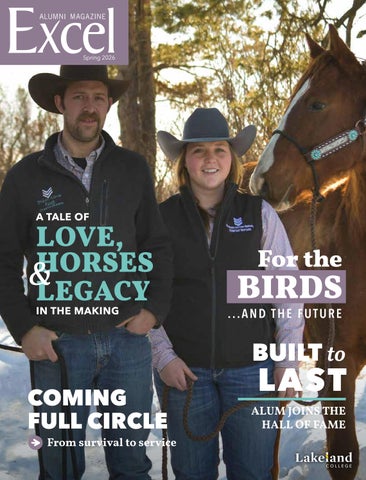
Excel - Spring 2026 Issue

Page 1


Logan Peters intends to become a certified world traveler by the end of 2026, and he’s relying on his carpentry skills to help him.

Peters is a third-year carpentry apprentice and a member of Team Canada who will be competing at WorldSkills in Shanghai, China, this October. To get there, he won silver at Skills Canada and gold at Skills Alberta. He is excited for the opportunity to represent the country, and his past experiences have helped prepare him for it.

Competing helps me see that sometimes I’m a lot more capable than I think I am."

“I’m already used to the pressure and stress of competing,” he says. “It’s really cool to be able to represent your school and your province at a national level, I’d recommend it to anybody.”

This is the first time a Lakeland College apprentice has moved on to represent Canada at WorldSkills. It’s also unexplored territory for Peters, who has never been out of the country.

“This will all be new to me,” says Peters, from St. Paul, Alta. “I’m excited to see other parts of the world and experience some new cultures.”

He’s already put on some miles, heading to Regina, Sask., for Skills Canada 2025. He was also in Ottawa in October for the official announcement of Team Canada. He and his instructor David Jones may travel to the Netherlands in the spring for their national Skills competition, and then on to China in the fall.

Peters is excited for all the travel ahead, for the chance to test his skills against the rest of the world, and to represent his country and Lakeland on such a big stage. He’s nervous but also determined to prove himself.

“Competing helps me see that sometimes I’m a lot more capable than I think I am,” he says. “Going to Worlds is going to be one of the hardest things I’ll ever do. It’ll challenge me and help me grow in my skill set. By the end of the year, I’ll be a certified world traveler.”

WALL

TABLE OF CONTENTS Alumni

Excel is published by Lakeland College’s Department of Donor and Alumni Relations.

Excel is also available on Lakeland College’s website at lakelandcollege.ca/excel

The department distributes mailings, invitations and class lists. Anyone wishing to be excluded from certain mailings should call Kayleigh at 780.871.5526.

Editor: Melissa Barr

Writers: Melissa Barr, Katie Ryan, Colleen Symes

Creative Design: Chelsey Schlosser

Cover Photo: Melissa Barr

Contributions:

Special thanks to all alumni who contributed to this edition of Excel. Letters, photographs and news are welcome. If you’re celebrating a personal or professional milestone, or have other news to share, please let us know! We’d be happy to include your news in the Class Notes section. We reserve the right to edit contributions. Submitted photographs must have a minimum resolution of 300 dpi. Please send all correspondence to Kayleigh Schmid at kayleigh.schmid@lakelandcollege.ca

Publications mail agreement No. 40009099

Return undeliverable addresses to: Lakeland College Donor and Alumni Relations 5707 College Drive Vermilion, Alberta, Canada T9X 1K5 lakelandcollege.ca/alumni-update

Happy Spring, everyone!
I hope you enjoyed connecting with family and friends over the winter months and are excited for a busy summer ahead.

In October, we held our first alumni social in Edmonton during the Canadian Finals Rodeo. It was a huge success, with rodeo club alumni from the Class of 1970 to the Class of 2025 in attendance! We look forward to continuing this event and bringing rodeo alumni together for years to come.

In November, I hit the road to Regina to attend Canadian Western Agribition. On Wednesday evening, we hosted our annual Alumni Social in the cattle barns. It was a fantastic night of connection— reminiscing about college days and catching up on where Lakeland alumni are now. Alumni could be found all across Agribition, from showing cattle to representing their employers at the trade show, and everywhere in between.

Lakeland varsity rowing coach Peter Walsh met up with alumni Kenton Lindenbach (L) and Ian Crosbie (R) at Agribition.
Tracy Quinton, Lakeland's dean of agricultural sciences, Darla dean of agricultural sciences, and varsity rowing coach Peter
Brie Leer, technology, western clothing
Nathaniel
Wade Olynyk, Class of 2018 animal science technology, with Crescent Creek Angus at Agribition.

I’m currently preparing for a busy spring and summer. I’m getting ready to welcome a new group of alumni into the President’s Circle. The President’s Circle is a tradition that began in 2019, recognizing graduating student leaders for their outstanding leadership, commitment and engagement during their time at Lakeland. It’s always a meaningful afternoon spent celebrating their achievements alongside friends and family as they leave Lakeland to begin their careers.

During our convocation ceremonies, I’ll present the Class of 2026 with their generation pins and officially welcome them to the alumni family. The number of generational alumni continues to grow each year—a true testament to the lasting Lakeland legacy.

I’m also preparing for Alumni Weekend, taking place June 12–14 in Vermilion. I look forward to welcoming many familiar faces back to campus, meeting new ones, listening to stories from college days and celebrating together. If you’re interested in volunteering during Alumni Weekend, please don’t hesitate to reach out!

Wishing you a wonderful spring, and I hope to see you at our alumni events in 2026.

2026 ALUMNI SOCIAL CALENDAR

WELCOMING CLASS OF 2026 TO THE ALUMNI FAMILY!

May 29

LLOYDMINSTER CONVOCATION

June 5

VERMILION CONVOCATION

June 12–14

ALUMNI WEEKEND, VERMILION CAMPUS

July 21

AG IN MOTION ALUMNI SOCIAL, LANGHAM, SASK.

Darla Stepanick, associate Peter Walsh at Agribition.
Leer, Class of 2021 interior design technology, attending Agribition with her clothing business, Brazen Boutique.
Nathaniel Hak, Class of 2023 environmental sciences at Agribition

Alumnus Name: Class Year:

Maiden Name:

Address:

City/Town:

Province: Postal Code:

Home Phone: Cell Phone:

Email:

Name of Guest(s):

If Guest(s) is Alumnus, Class Year(s):

ACCOMMODATIONS

(Lakeland College Residence or Lakeland College RV Parking. Note: There is no air conditioning in Residence)

Friday, June 12

 *Single Bed in Residence ($60/person)

 RV Parking (No power available)

Saturday, June 13  *Single Bed in Residence ($60/person)

 RV Parking (No power available)

Total: $________________________

COMPLIMENTARY SATURDAY BONUS

Campus Tour  ________/person

METHOD OF PAYMENT

REGISTRATION TOTAL $

 Cheque Enclosed (payable to Lakeland College)

EVENT TICKET OPTIONS

June 13, Vermilion campus

 OPTION 1- ALL SATURDAY

• Saturday Breakfast & Lunch

• Class Photo

• Afternoon Activities

• Rose Ball, supper, band and midnight lunch

_______ x $110/person: $

 OPTION 2- ROSE BALL

• Rose Ball, supper, band and midnight lunch

_______ x $65/person: $

DIETARY RESTRICTIONS:

Event Ticket Total: $

 Visa  Mastercard Card Number: Expiry Date:

Name on Card:

Signature:

*After payment, your credit card information will be securely destroyed. This form and payment can also be completed online at lakelandcollege.ca/weekend We look forward to hosting you on campus in June!

MAILING INFORMATION

MAIL REGISTRATION FORM AND PAYMENT TO:

Lakeland College 5707 College Drive

Vermilion, AB T9X 1K5

Attention: Alumni Weekend 2026

FOR MORE INFORMATION CONTACT

Kayleigh Schmid

Alumni Engagement & Career Services Specialist

Call: 780.871.5526 or 1.800.661.6490

Email: kayleigh.schmid@lakelandcollege.ca

The personal information provided is collected under Section 4(c) of the Alberta Protection of Privacy Act (POPA) and will be protected under Section 10. The personal information collected will be used by the College for administration and management of alumni program. If you have any questions regarding the collection or use of this information, please contact the Privacy office at privacy@lakelandcollege.ca.

Sweet INVESTMENT

An investment in Lakeland College is something Judy Sweet knows will more than pay off for both current and future ag-based students as well as the agriculture industry.

A longstanding donor,  Sweet's recent gift to Lakeland will support the modernization of the G.N. Sweet Livestock Research Facility at the Vermilion campus. Sweet’s recent gift builds on her tremendous support of the existing G.N. Sweet Livestock Research Facility, which officially opened on Oct. 20, 2016, in memory of Sweet’s late husband Garth, and her donation in 2018 that allowed Lakeland to increase the college’s farm land base.

Located on the campus farm, the facility is a hub for innovation, supporting both studentled learning and applied research projects. With Sweet’s support, the G.N. Sweet Livestock Research Facility will continue to provide research scientists and agricultural sciences students –

including the Student-Managed Farm livestock research team, practicum placements for bachelor of agriculture technology students and summer internships – with state-of-the-art technology for livestock research and development.

“Over the years, I have enjoyed learning how Lakeland students make an impact in commercial ag and animal health. Being able to support their innovation and provide them with access to the latest technologies means they’ll not only graduate job-ready, but these students will also help drive Alberta’s ag sector,” says Sweet, whose granddaughter Tori Kadylo graduated in 2020 from Lakeland’s veterinary technology program, formerly named animal health technology. Her grandson, Tanner

Giving back to Lakeland students is an investment in our future ag leaders and this important industry. It makes me happy to give back."

Kadylo, is currently enrolled at Lakeland.

“Giving back to Lakeland students is an investment in our future ag leaders and this important industry. It makes me happy to give back.”

Capable of housing up to 260 head of cattle, the G.N. Sweet Livestock Research Facility provides Lakeland with the space to participate in applied research projects of importance to the livestock industry in Western Canada. Current projects include testing new feed additives to improve feedlot production efficiency and reduce antimicrobial use, lidocaine impregnated bands to reduce castration associate pain and improve growth performance, development of genetic tools for methane reduction in beef and evaluation of new biodegradable net wrap to reduce software disease in cattle.

“We are deeply grateful for Judy’s generous support,” says Dr. Alice Wainwright-Stewart, president and CEO of Lakeland College. “Her gift reinforces the importance of investing in our campus farm – an essential part of our hands-on learning model – and enables us to move forward with the Student-Managed Farm Lab Revitalization project. Judy’s support not only gives our students the space and tools to put their education into action, but also fuels applied research that delivers real solutions and real results for industry and producers. Her generosity supports Lakeland’s place as one of Canada’s Top 50 research colleges and strengthens the cornerstone of our awardwinning, student-led learning model.”

Judy Sweet (centre, front row) and grandson Tanner Kadylo (second from the left, front row) with Lakeland representatives (left-right, front) Dr. Alice Wainwright-Stewart (president and CEO), James Smith (vice president, finance and infrastructure), Todd Sumner, (vice president, academic and research) and (left-right, back row) Brittnay Thomas (alumna and applied research staff), Francois Paradis (dean, applied research), Tracy Quinton (dean, agricultural sciences) and Stacey Ruller (gift officer).

AGRAIDAIRY MART

donation

SUPPORTS THE DAIRY LEARNING CENTRE

Lakeland College celebrated a welcome investment from Agrai-Dairy Mart to the Dairy Learning Centre by officially naming a classroom after the donor. Thanks to their $70,000 donation, the college will continue to advance agricultural education for future generations of dairy producers.

“Our Dairy Learning Centre gives our students access to the most advanced and emerging technology in the industry,” says Tracy Quinton, Lakeland’s dean of agricultural sciences. “We appreciate Agrai-Dairy Mart’s support as we continue to ensure our Dairy Learning Centre offers students the cuttingedge technology and hands-on experience they need to stay at the forefront of an evolving industry.”

As part of Lakeland’s experiential learning model, students in their second year of the animal science technology program majoring in dairy science are charged with overseeing the college’s dairy herd. With faculty guidance, they make datainformed decisions on breeding, herd management, heifer replacement and more.

advanced tools found in industry—has a profound impact on their readiness and confidence,” says Quinton. “Partnerships like this one with Agrai-Dairy Mart not only strengthen our programs, but also create direct pathways for students to connect with employers and contribute meaningfully to the future of agriculture.”

Agrai-Dairy Mart has been involved with the Dairy Learning Centre since it opened in 2017. This donation is the first of its kind from the company, and in recognition of it, the classroom in the facility was named the DeLaval Classroom, an honour unveiled at an event on Jan. 9, 2026.

"The continued support of Agrai-Dairy Mart and DeLaval for Lakeland College reflects a shared commitment to developing the next generation of dairy professionals. By investing in hands-on education, modern technology, and student-focused learning, they help ensure graduates are well prepared to lead and innovate in the future of the dairy industry," says Brent Leyenhorst, owner of Agrai-Dairy Mart.

"The continued support of AgraiDairy Mart and DeLaval for Lakeland College reflects a shared commitment to developing the next generation of dairy professionals. "
- Brent Leyenhorst, owner of Agrai-Dairy Mart

“This education model—where students learn by doing, using the same

The Dairy Learning Centre is a state-of-the-art 46,600 sq. ft. facility where students can explore a variety of emerging technologies in the industry with a focus on maximizing automation and minimizing environmental impact. It houses the 280-head herd including 120 Holstein milk cows, replacement heifers and young stock, with learning areas dedicated to calf management, feed and nutrition, cow comfort, dairy-specific software and manure management. In addition to the robotic milking system, there is also a traditional milking parlor, an automatic feeding system and three indoor calf rooms, two with automated feeding systems.

(Left-right, front) Todd Sumner (vice president, academic and research, Lakeland College), Brent Layenhorst (owner, Agrai-Dairy Mart - DeLaval dealership), Dr. Alice Wainwright-Stewart (president and CEO, Lakeland College), (Back) Naomi Poortinga (animal science technology student, dairy major), Barry Groves (robotic specialist, DeLaval), Jenna Jongenotter (production specialist, DeLaval), Tracy Quinton (dean, agricultural sciences, Lakeland College), Kris Lehmann (Farm manager, Lakeland College).

From College Roots to a

Lakeland College has been part of Aydon Almberg’s life since he was a child, and today that connection lives on at Broken Arrow Ranch Quarter Horses.

Aydon grew up a member of the fourth generation on the family ranch south of Lakeland near Czar, Alta., heading to the college grounds for horse and bull sales, 4-H events, the Little Royal cattle show and community gatherings. When it was time to head off to college, Lakeland was Aydon’s top choice.

“I chose agribusiness because I wanted to gain more knowledge in banking and business,”

Aydon, Class of 2013, says. He’d been involved in working on the ranch from a young age and wanted to go to school to learn a new side of it, sharing he saw a shift in industry happening.

“It wasn’t enough to just be a good stockman and a good steward of your operation. You had to be able to work the books as well. Being exposed to that through agribusiness was a big advantage for me, especially the hands-on scenarios. They helped me actually see in my mind what was happening on paper. That real-life application was where I found the most value in the course.”

Learning about the business side of agriculture wasn’t the only highlight of his time at Lakeland. Aydon also spent time as a member of the Ranch Horse Club, making friends and borrowing horses in his first year.

“It helped me open myself up to new ideas, to seeing how people do things differently.” Another highlight? Meeting Jessica Wirsta, a fellow student studying western ranch and cow horse and later, animal science technology.

RIGHT FIT

Jessica grew up north of Vermilion near Elk Point, on her family farm. She was involved in 4-H, barrel racing and other equine events, and chose to study horsemanship at another postsecondary. To complete the riding hours she required to apply, Jessica started working with Ken and Barb Nielsen, a ranching family who lived down the road from her, building a close relationship with them.

Jessica transferred to Lakeland after three weeks, where she found the program better suited her goals. Returning home also meant she could keep working for the Nielsens while she studied.

“It felt a little more like home at Lakeland,” Jessica says. She was able to bring a colt she had already started riding at home to work with during her studies.

herd.

“It was a wedding gift,” Jessica explains. “The herd consisted of five brood mares and their stallion, Tejons Blue Hickory. We accepted it and started our operation.”

ARROW

heir operation, Broken Arrow Ranch Quarter Horses, rrepresents a shift in how Jessica and Aydon approach horses on the ranch.

“When I grew up, horses were primarily used to move cattle. My great grandfather started the ranch and would train horses to supplement his income when the cattle (operation) wasn’t great,” Aydon explains. “Our land base is primarily local, so we walk the cows out. Things have advanced, so we can use trucks, quads and sideby-sides, which my dad likes as he gets older, but I like riding horses for

Before they were gifted the herd, Aydon says he was primarily buying horses at low value and using them, rather than looking for quality.

as he gets older, but I like riding horses for the handling."
-Aydon Almberg

“They just had to be good enough,” he says.

He and Jessica also trained “problem horses” for other people, or rode for others to make some extra money.

(Left-right, back) Jessica, Tom, Aydon and (front) Vern Almberg.

“After a couple years of that, we realized we were getting more problem horses instead of quality horses,” Aydon says. “I was riding everybody else’s problem while trying to get my work done.”

The decision to focus on this business venture fulltime became viable thanks to the Nielsens' gift. The Almbergs began breeding and training horses for themselves, as well as marketing them to others. They have specific goals with their breeding program, carefully breeding for specific qualities.

“We’ve been sourcing stallions that are well known in the cow horse side of things to keep our breeding program evolving,” Jessica explains. “Everybody wants horses now but not everybody can ride the ranchstyle horses that are a little tougher and meant to last all day. We’ve been crossing our brood mares with more old-school breeding with modern-type stallions that are a little more gentle, so they make a well-rounded horse that anybody can ride.”

There is only one horse remaining on the ranch from that original herd, but Aydon and Jessica stay busy with their brood mares, stallions and riding horses, as well as the young horses they’re working on training. They also have horses for their sons – an older horse for seven-year-old Vern to ride and a mini horse for nearly-four Tom. They keep a few horses for elderly family who can no longer care for them, a few feeder cows that Jessica keeps accidentally turning into pets, as well as a pack of corgis and two nearly-feral roosters – gifts from the boys’ well-meaning grandmother.

Future TAKING SHAPE

While working on their breeding program, Jessica and Aydon stay connected to Lakeland, especially with the equine side of things. Students in the animal science technology program’s equine major have visited Broken Arrow several times to see their operation and look at prospects for their breeding programs. Students in the program have privately bought colts from the ranch. Last year, the program bred to Broken Arrow’s stud.

Jessica and Aydon receive updates on how the resulting horse is doing.

“We’ve

go through the program, see the horse, and take that knowledge home with them.”

While they work on building Broken Arrow, Aydon and Jessica are also helping shape the fifth generation of Almberg ranchers through their two sons.

"The boys look forward to helping on the ranch. Vern comes and moves cows with us and he’s starting to rope a bit. Tom is probably even more hungry for it – he wants to ride all the time,” say Aydon, who continues to assist his family’s cattle operation as he builds Broken Arrow with Jessica. He is also serving on the board of directors of Alberta Beef Producers.

With time, Aydon says their brood mare operation will continue to grow. Ultimately, the future looks sharp for Broken Arrow.

got a lot of good horses that we don’t have time to ride because we’re

so busy riding the young horses. That’s what I consider success.”

“The instructors and students in the program are part of the industry and it’s a small world,” says Aydon. “Being able to have our stud used in that program is beneficial to us because people

“It takes time to cultivate things so you just keep going and it’s going really well. We’ve got a lot of good horses that we don’t have time to ride because we’re so busy riding the young horses. That’s what I consider success.”

FALLING INTO PLACE:

Alumna provides support and care to anyone who needs it

As part of the team at the Lloydminster Native Friendship Centre (LNFC), Tachina Paddy and her coworkers are dedicated to providing support to those who need it. Whether they need something as simple as food, water, a pair of socks or something more complex like assistance with housing supports, counselling or even a cup of coffee and some company, they’ll find it at the LNFC. And for the past year, Paddy, a Class of 2025 graduate, has been the one to greet them when they walk in the door.

“The Friendship Centre is a place for everyone, Indigenous and non-Indigenous,” Paddy explains. “We are a lifeline for people to come

in and receive care. Anybody can come in and we’ll help them if we can, or refer them to somebody else if we can’t. The most important thing we do is offer our support, our heart and our care to people who don’t necessarily get that from everyday life. It’s hard for people out there. We try to make things more human.”

Paddy knows all about the difference a bit of support can make. As a student in Lakeland College’s pre-professional administration program, it was the supportive classroom culture that helped her overcome the nervousness she felt when returning to the classroom after a decade away.

“The teachers and staff were all really helpful – I loved them all,” she says. “I loved the classes, the challenge, the schedule. If I needed help, the instructors were there. They understood when I needed time off because my child was sick. They helped when I needed it – getting me and my child winter coats, or helping with bills and rent. They were all so supportive.”

In the program, Paddy learned everything from computer skills to professional methods of answering phone calls and emails. The most impactful part, though, was the softer skills. “College was so different than what I was used to,” the single mother from Thunderchild First Nation recalls. “I learned Word and Excel but I also learned how to talk to people and de-escalate situations, it really helped being around different sorts of people. Lakeland was a stepping-stone to coming here, teaching me the foundation so that when I got here, I could learn so much more on my own and from my co-workers.”

Part of the program involved a practicum for on-the-job experience, and at the suggestion of an instructor, Paddy chose to complete hers at the LNFC. She graduated on a Friday in January 2025 and was offered a permanent administrative assistant position at the centre the following Monday.

“It’s literally the best job I’ve ever had in my life and they wanted to keep me,” Paddy recalls, sounding shocked.

Looking back on the route she took to get to where she is now, Paddy still can’t believe that everything fell into place the way it did.

“I got sober, got pregnant, had my child, went to therapy and then went to Lakeland,” she recalls. “Then I did my practicum and now I’m here. I love my job, I love my coworkers and I love helping my community. I can’t believe it all worked out, but I’m grateful that it did. It’s like the universe was saying, ‘Okay, let’s do this,’ and now I’m happier than I’ve ever been.”

Dave King, Lakeland alum and dean of Lakeland College’s School of Trades and Technology, has been inducted into the Alberta Trades Hall of Fame.

King was recognized at a September ceremony in Red Deer for his outstanding contributions to skilled trades and apprenticeship education in Alberta. He was joined at the event by his wife Tori, daughters Devynn Teel and Courtney King, and Dr. Alice Wainwright-Stewart, president and CEO of Lakeland College.

“I’m honoured to be inducted into the Alberta Trades Hall of Fame. We come to work, we do our job and we hope we’ve changed people’s lives. I enjoy coming to work. I’m still a technician. I still love talking to my students,” says King, who lives in Vegreville, Alta.

KING OF ALL TRADES

Career in trades spans 40 years

His career in the trades began in 1985 as a heavy duty mechanic apprentice. An alumnus of Lakeland, he holds Red Seal certifications in heavy equipment technician and automotive service technician. After 20 years in industry where he mentored countless apprentices, King joined Lakeland as faculty in 2006. He taught heavy equipment technician, automotive service technician, and Q endorsement for nine years before becoming dean in 2015.

As dean, King is focused on initiatives that connect students, industry and underrepresented groups to trades training and career pathways. He is widely respected as a leader locally, provincially and nationally, having served on apprenticeship committees, chaired the Alberta Deans of Apprenticeship and Trades, and is an executive member of the National Deans of Apprenticeship, Trades and Technologies group.

Dave King (centre) stands with members of the Alberta Deans of Apprenticeship and Trades (ADAT). They are (left-right) Jim Szautner (SAIT), Dennis Beadoin, (Olds College), John Melo (Portage College), Alan MacLean (SAIT), David Pye (Red Deer Polytechnic), Sheldon Anderson (Lethbridge Polytechnic).

I’m honoured to be inducted into the Alberta Trades Hall of Fame. We come to work, we do our job and we hope we’ve changed people’s lives. I enjoy coming to work. I’m still a technician. I still love talking to my students."

Involved in Skills Canada Alberta

King also is very involved with Skills Canada Alberta and is currently serving as vice-president of the board. Since 2007, Lakeland apprentices have excelled in Skills Canada competitions, earning 30 Alberta Provincial Skills Canada medals and six National Skills Canada medals. After excelling at the Skills Canada national competition in 2025, Lakeland carpenter apprentice Logan Peters (featured on page two and three) will compete for Team Canada at WorldSkills Shanghai 2026.

“Dave’s influence is felt in classrooms, competitions, policy tables and communities across Alberta. His unwavering passion, integrity and mentorship make him not only a champion of the trades, but also a builder of its future. His induction into the Alberta Trades Hall of Fame is a well-deserved honour,” says Wainwright-Stewart.

To learn more about King and watch his induction video, visit the Alberta Trades Hall

Fame website.

of
Dave King sharing remarks at the award presentation.
Rob James, a member of the Alberta Board of Skilled Trades, presents Dave King with his Alberta Trades Hall of Fame award.
(Left-right) Fred Richardson, Shannon Marchand, deputy minister of advanced education, Dave King and Ken Heather. Richardson and Heather are also 2025 Trades Hall of Fame inductees.

MORE THAN MARKET VALUE

A Lakeland alumna’s full-circle journey into leadership

At 16, Chandra Reilly experienced homelessness. Nearly two decades later, she has built a career centred on valuing homes, ensuring fairness for property owners and shaping the future of the appraisal and assessment profession across Canada and beyond.

For this Lakeland College alumna, it’s a path rooted in resilience, intention and a profession she now passionately champions.

"I never thought I would love my career as much as I do"

“It really affected me, obviously, so it’s kind of funny now that I value houses,” says Reilly, who shares her story candidly with others. “It’s a full-circle thing to be where I am now."

In 2006, Reilly graduated from the business administration diploma program, majoring in real estate appraisal and assessment. Today, she is the regional manager for the Saskatchewan Assessment Management Agency in the North Battleford region, serving as a leader within one of the province’s key public service organizations. She is also involved in professional leadership and mentorship, currently serving her third term as president of the Saskatchewan Assessment Appraisers Association (SAAA).

Her influence extends well beyond provincial borders. Reilly volunteers with the International Association of Assessing Officers (IAAO) and has spent the past seven years on its conference

A purposeful path

Despite her impressive resumé, Reilly’s path was never accidental.

“I was homeless when I was 16,” says Reilly. “Because of that experience, it was really important to me to find a career that was stable, paid well and had good benefits.”

That lived experience became one of the six core reasons she chose to study real estate appraisal and assessment — a profession she now encourages students to consider intentionally, rather than stumbling into by chance.

A CAREER YOU CAN TAKE ANYWHERE.

“This education allows you to go anywhere in the world,” she says. “That kind of mobility and security really mattered to me.”

A PROFESSION ROOTED IN PUBLIC SERVICE.

Working on the assessment side of the industry, Reilly sees her role as ensuring fairness and transparency for property owners. “It’s about treating people equitably and making sure they have the information they need.”

committee, helping shape international education programming for assessors around the world. She is also a leader within the Launchpad Network, a professional group focused on recruiting, promoting and mentoring new professionals and emerging leaders in the industry.

Finding her place at Lakeland

Reilly came to Lakeland on a volleyball scholarship, a critical support as she worked toward stability. She lived in residence, served as the real estate appraisal and assessment student representative for both years, and worked in conference services, gaining valuable professional and interpersonal skills.

She credits Lakeland’s welcoming environment and supportive instructors for helping her succeed. “From the professors all the way up, it was incredibly supportive,” she says. “Those relationships really mattered.”

Just as important was the structure of the program itself.

From the professors all

the way up, it was incredibly

supportive."

As someone facing financial and housing challenges, the twoyear diploma offered a practical, affordable pathway into a respected profession.

“It was a good education for a good career in a short period of time, at a reasonable cost.”

Leading and giving back

Today, Reilly describes herself as “deeply involved” in the profession — by choice and by passion. She received the Richard Sweet Memorial Award in 2021 from SAAA for her dedication to advancing education and the profession, and she has been nominated for the IAAO Ian McClung Award, an international honour recognizing leadership and impact.

Reilly regularly returns to Lakeland, attending career fairs, mentoring students and speaking to graduates. She encourages new professionals to embrace lifelong learning, prioritize safety

in the field, accept mistakes as part of growth, and get involved with professional associations early.

For Reilly, the profession is more than a job. It’s purpose, service and proof of what’s possible.

“I never thought I would love my career as much as I do,” she says. “But I really picked the right one.”

3

STABILITY IN A CHANGING WORLD.

In an era of rapid automation, real estate appraisal and assessment remains deeply human. “We can’t be replaced by AI,” she explains. “There will always be a need for subjective decision-making.”

4

VARIETY, TRAVEL AND UNIQUE EXPERIENCES.

Early in her career as a field appraiser, Reilly travelled extensively and saw parts of Saskatchewan most people never do — from rural communities to one-of-a-kind properties, including a former convent heated by a repurposed ship’s boiler. “When else would you ever see that?”

5

STRONG DEMAND AND CAREER GROWTH.

With an estimated 80 per cent of assessors nearing retirement within five years, the profession offers significant opportunity. “There’s no shortage of jobs, and the career trajectory can be steep,” she says. Reilly herself became a manager within 10 years of entering the field.

6

LIFELONG LEARNING AND PROFESSIONAL CHALLENGE.

Licensed and designated like lawyers, assessors are required to pursue continuing education. “Things are constantly changing,” Reilly says. “It keeps the work stimulating and fresh.”

Chandra Reilly (centre), at the IAAO Annual Conference in Denver, Colorado.

Self-proclaimed “bird nerd,” Jana Teefy spends many of her days in the forest around the Beaverhill Bird Observatory (BBO), cradling birds in her hands as she bands them, making notes about them and releasing them again. She’s part of an expanding network of biologists working to track the migratory habits of various species of birds and conserve their habitats to ensure the species thrive in the future. However, it’s her work educating and inspiring future generations of ornithologists that she believes will have the biggest impact on bird conservation.

Before launching her career in bird conservation, Teefy spent 18 years as a veterinary technologist. A volunteer position at the BBO inspired her to head back to school for a career change to work with wild animals instead. She enrolled in Lakeland College’s environmental sciences diploma program, majoring in wildlife and fisheries conservation.

“I absolutely loved every moment at Lakeland,” she says. The Class of 2022 alumna’s first year at Lakeland was impacted by the COVID-19 pandemic, with most classes online.

SAVING BIRDS the

INSPIRATION AND EDUCATION ARE THE KEY TO CONSERVATION

It’s always exciting to see new groups coming through and try to inspire them to become bird nerds."

The lab components continued to be in person, however, which greatly influenced her decision to attend Lakeland. She also appreciated the hands-on learning experiences and countless outdoor certificates, including wilderness first aid, bear awareness and small engine repair.

Now, Teefy is the head biologist at the BBO, located an hour’s drive east of Edmonton. On top of managing volunteers and staff, she heads up the observatory’s research projects.

“I love being in the forest, waking up to the birds calling and then getting to be hands-on with them. It’s quite the privilege to be able to see them that close and study them that closely,” she says.

Yellow Warbler, a common breeder at the Beaverhill Bird Observatory.
Blue Jay at the Beaverhill Bird Observatory.

CONSERVATION

The BBO studies songbirds and owls. The birds are captured in mist nets, numbered bands are put around their legs, and data including location and various measurements is taken and recorded before the birds are released. When the birds are caught again at other stations, similar measurements are taken and added to the database so researchers can see where the birds have gone and how they are doing.

“We’re gathering information on the age and sex dynamics of our songbird population, as well as what’s moving through our area,” Teefy explains. She and the rest of the staff at the BBO track migration patterns in the spring and fall, including which birds are passing through the area, where they end up, how long it takes them to get there and where they stop along the way.

“All habitats that birds interact with in their life cycle are important to conserve,” Teefy says. “A lot of people are interested in where the birds start and where they end, but the journey along the way is just as important.”

EDUCATION

Teefy loves these parts of her job, but she also believes it’s the education part that’s going to have the longest impact on the future of bird conservation. At the BBO, they take on summer interns each year, work with volunteers, host young ornithologist workshops, welcome visiting school groups and conduct educational outreach sessions.

“The research we do is important, but the education, outreach and inspiration is more important, I think,” Teefy says. Part of that involves

In the summer, she tracks the breeding success of the songbirds in the area, including timing of egg laying and fledglings, percentage of old versus young birds and the nesting success rate.

It isn’t the only research the BBO is involved with. They are also part of Motus, an international research community that tracks the movement and behaviour of birds, bats and insects with nanotags that transmit information to stations placed around the world and recorded in a centralized database.

welcoming visiting groups of students from Lakeland’s environmental sciences programs each fall.

“It’s always exciting to see new groups coming through and try to inspire them to become bird nerds. Every year since I graduated, I’ve known some of the people who’ve come to visit the BBO. Some of our younger ornithologists and volunteers have gone to Lakeland and I’m always excited to see how happy they are at the college,” she says.

Inspiring those future generations

of ornithologists is key to bird conservation.

“We can band a bird, but that doesn’t save it. It’s inspiring people to work on conservation, to put stickers in their windows to stop collisions, to do all the little things that can help save our bird population.”

Jana Teefy and Keith, the Red-tailed Hawk education ambassador. 

LAKELAND HEADLINES

Emergency Training Centre integrates virtual reality into training

Lakeland College’s Emergency Training Centre has taken another bold step forward in emergency services education, becoming the first academic institution in Canada to implement the FLAIM Trainer — an immersive virtual reality system that simulates real-life fire and emergency scenarios with extraordinary realism

Lakeland

College celebrates 112th anniversary

In November 2025, Lakeland celebrated 112 years of providing the region with cutting-edge education. Since the early days, buildings have been replaced, rejuvenated and renewed. Campus has expanded – both in Vermilion and into Lloydminster. Generations of students have come and gone, sending their grandchildren and their great grandchildren to Lakeland after them. The first 112 years have passed so quickly – and the future looks bright!

Diversifying genetics

Students on the purebred beef Student-Managed Farm –Powered by New Holland team made Lakeland history this year, entering a heifer into a consignment sale for the first time. The heifer, OAV First Class 2N, was chosen for her power, dimension, temperament and pedigree and made her debut at the Northern Angus Select Sale.

50 years of growing Alberta’s ag talent

A representative of the Government of Alberta joined staff, faculty and students in the fall at Lakeland College to celebrate 50 successful years of the Green Certificate. This is a popular rural employment and training program that supports high school students to enter and build careers in agriculture while earning high school credits at the same time. Lakeland is one of four regional colleges in Alberta that the government partners with, along with agriculture industry partners, to offer this program.

CROP STUDENTS CELEBRATE

SUCCESSFUL HARVEST

LAKELAND CONTRIBUTES

$225.7 MILLION TO REGIONAL ECONOMY EACH YEAR

Lakeland College isn’t just a place to study – it’s a major economic engine.

What makes Lakeland special is that we’re not just learning about farming – we’re managing it."

Last

fall’s harvest season was more than just a busy few weeks in the field – it was a showcase of teamwork, innovation

and leadership in action.

Forty-four crop technology students were involved in harvest. The season was a smooth one thanks to ideal weather, a strong team and plenty of collaboration across Lakeland’s Student-Managed Farm – Powered by New Holland (SMF) operations.

While the peas were taken off before students returned in September, the team stayed busy harvesting canola, wheat, peola and more, while also contributing to other SMF teams –including helping cover silage pits for the dairy and purebred units. “New to Lakeland” crops this year included red lentils, which are not typically grown in the Vermilion area, and peola, a canola field pea intercrop. In total, students harvested 1,300-plus acres of crop varieties.

“What makes Lakeland special is that we’re not just learning about farming – we’re managing it,” says second-

A recent economic impact study confirms that Lakeland is a major contributor to the prosperity of its region, its students and Alberta.

The 2025 Economic and Investment Analysis Report, completed by Lightcast last year, found that Lakeland added $225.7 million to the Lakeland service area in the 2023–24 fiscal year alone. Lakeland’s activities supported nearly 2,400 jobs, equivalent to one in every 28 jobs in the service area.

The $225.7 million impact comes from Lakeland’s operations ($54.2 million), student spending ($4.6 million), construction ($4.3 million), and especially the contributions of our alumni, who generate more than $162.6 million each year in added income for the region.

The report also demonstrated that Lakeland is a strong investment for students, taxpayers and society in Alberta.

year crop technology student Connor Klassen, the SMF crop unit general manager. “The advisors guide us, but the decisions come from us. It’s real experience, not simulation. I would recommend Lakeland to any young farm kid, or even if you’re not a farm kid, because if you show up every day and you’re willing to put the time in, you’ll get a lot out of this program.”

For every dollar students invest, they receive $2.50 in higher future earnings.

Taxpayers also see a $2.50 return for every public dollar invested.

Society gains $5.60 in value for every dollar invested, through earnings, business growth and social savings.

Dr. Alice Wainwright-Stewart, Lakeland president and CEO (right), joined students for a day of harvesting.

NEW IN AGRICULTURAL RESEARCH AT LAKELAND

From crops to livestock, Lakeland College’s applied research team is tackling the questions that matter most to today’s ag industry. Working alongside industry leaders, government officials and other postsecondary institutions, this research turns real-world challenges into practical solutions, ensuring research efforts are at the forefront of discovery. Here’s the latest news in ag research at Lakeland.

EXPANDING CAPACITY

A $1 million investment from the Canada Foundation for Innovation’s College Fund will allow Lakeland to purchase state-of-the-art crop and livestock research infrastructure over the next two years that will greatly enhance the college’s capacity to support Alberta’s agriculture sector.

RESEARCH IN THE FIELD

SHARING RESEARCH RESULTS

Last year, the applied research team hosted two field days –Crop Diagnostic Day in July and Research for the Ranch, focused on livestock research, in October. Recent projects showcased include GPS monitoring of bull activity, lupins as a new pulse crop option and more. Read about these projects in latest edition of Limitless magazine, lakelandcollege.ca/limitless.

This year, the Cultivate and Connect Crop Field Day is on July 16, with a livestock field day date to be confirmed in the fall.

TOP 50 COLLEGE

Lakeland College is one of Research Infosource Inc.’s Top 50 Research Colleges in Canada, ranking 44th nationwide.

With 97 research partnerships, six major projects recently completed and 25 paid student researchers, Lakeland continues to drive innovation in agriculture. The college also ranked fourth nationally among small-tier colleges for artificial intelligence research.

Remember When…

The Vermilion School of Agriculture (VSA) celebrated the first graduating class in six years in 1947.

The Class of 1947 is notable for many reasons. They were the first students through the doors when the VSA reopened after World War II in the fall of 1945. During its closure, the VSA served as a vital training centre for the Canadian Women’s Army Corps.

Together with staff and faculty, the Class of 1947 was instrumental in the realization of the post-war rehabilitation of the VSA. Twenty-four veterans of the war were enrolled at the VSA in 1947.

O.S. Longman, Alberta’s deputy minister of agriculture at the time, wrote a message to the Class of 1947 inspired by the post-war era. It read, “The service which you will render to Alberta and to Canada will be accomplished through your association with your neighbours and humanity at large. In these associations, you will learn that human nature cannot be changed perceptibly, but human behaviour can, and that is what really counts. …The increasing complexities of life have created a growing demand for men and women who can by example or leadership direct human behaviour into constructive channels. I know the students of the Vermilion School of Agriculture will play their part in this great enterprise.”

Today, there are five surviving members of the Class of 1947 and they continue to communicate often, proud of their green and gold roots. They have passed along the following message to be shared with our Lakeland alumni family:

From the last remaining grads of VSA Class of 1947, Selma, Gudrun, Ken, Marvin and Marjorie. Congratulations to all who have graduated at the college since. Ever to Excel!

Selma, 101 years old
Gudrum, 100 years old
Ken, 99 years old
Marvin, 97 years old
Marjorie, 96 years old
n 1947, home nursing class taught first aid, anatomy, obstetrics, child psychology and other bed-side nursing skills.
Students worked on individual and class projects in the expanding farm building course.

Class Notes

Catch up with your fellow Lakeland College alumni! Want to be included in our Class Notes? Submit your memories, celebrations and achievements to Kayleigh at kayleigh.schmid@lakelandcollege.ca

MEGAN BAARS

Class of 2020 Animal Science Technology

Megan was named one of the WestGen 2026 Women of the West for her outstanding success in the dairy industry.

Source: WestGen

KAGEN KNEEN

Class of 2007 & 2008 Business Administration & University Transfer

Kegan is the new CEO of the Lloydminster Region Health Foundation.

Source: Meridian Source

EMMA THOMASON

Class of 2025 Animal Science Technology

Emma received the Brian Good Memorial Scholarship through the Canadian Angus Foundation. The scholarship is presented to a post-secondary student in recognition of overall livestock industry commitment, community involvement and leadership activities.

Source: Canadian Angus Foundation

MARY JANICE DOMINGUEZ

Class of 2021 Business Administration

Mary successfully passed her CFE exam to become a Certified Professional Accountant.

MAXINE LEBO

Class of 2022 Business Administration

Maxine is the new director of operations at LABIS (Lloydminster and Area Brain Injury Society).

Source: Meridian Source

RYAN SCHILL

Class of 2005 General Agriculture

Ryan and wife Romy were named Ontario’s Outstanding Young Farmers for 2025. Ryan and Romy have grown their sheep operation into a large-scale meat, breed stock and wool-producing operation over the past 17 years.

Source: Farmtario.com

LEE SIMANTON

Class of 2008 Livestock Production

Lee (back row, centre) and his family received the Holstein Canada’s Master Breeder award. This award recognizes excellence in Holstein cattle with superior conformation, production, longevity and health.

IN MEMORIAM

ARMITAGE, BILL

CLASS OF 1953, AGRICULTURE

BOHAYCHUK, RONALD "RON" CLASS OF 1966, AGRICULTURE

BURGESS, GEORGE CLASS OF 1954, AGRICULTURE

CAMPEAU, ERNIE CLASS OF 1971, AGRICULTURE

CHERNIAK, RAY CLASS OF 1952, AGRICULTURE

FOX, BILL

CLASS OF 1958, AGRICULTURE 2 IN 1

JACK, DAVID CLASS OF 1956, AGRICULTURE

JACK (NÉE LANG), KATHIE SPOUSE OF DAVID JACK

JONES (NÉE CZWILL), HELEN CLASS OF 1952, HOME ECONOMICS

JONES, LORNE SPOUSE OF HELEN JONES

JUBA, ANN FRIEND OF LAKELAND COLLEGE

KIRTLEY, WILLIAM

CLASS OF 1952, AGRICULTURE 2 IN 1

KLASHINSKY, BERNIE

CLASS OF 1958, AGRICULTURE 2 IN 1

HALL, JO-ANN

BOARD OF GOVERNORS, PUBLIC MEMBER, 2017 - 2023

MASUR, BILL

CLASS OF 1962, AGRICULTURE 2 IN 1 AND CLASS OF 1964, ARTIFICIAL INSEMINATION

MCCOSKEY, TREVOR CLASS OF 2005, FIREFIGHTER

OLSEN, REVEREND RAY CLASS OF 1965, AGRICULTURE

PERRY, EUGENE CLASS OF 1975, SYSTEMS ENG.

PUK, ERNY CLASS OF 1962, AGRICULTURE

RICHARDSON, GEORGE CLASS OF 1956, AGRICULTURE

SMALLEY (NÉE HILL), JANET CLASS OF 1969, BUSINESS ADMINISTRATION

STEWART, CRAIG SPOUSE OF JOYCE STEWART

STEWART, EARL CLASS OF 1958, AGRICULTURE

WACKO, ED CLASS OF 1951, AGRICULTURE

WHITTAKER, DR. LARYSSA CLASS OF 1990, UNIVERSITY TRANSFER AND 2016, DISTINGUISHED ALUMNI

Turn static files into dynamic content formats.

Create a flipbook