gysonehttps://issuu.com/ladykitt/docs/march_newsletter_2021
Rotary Year 2026-27
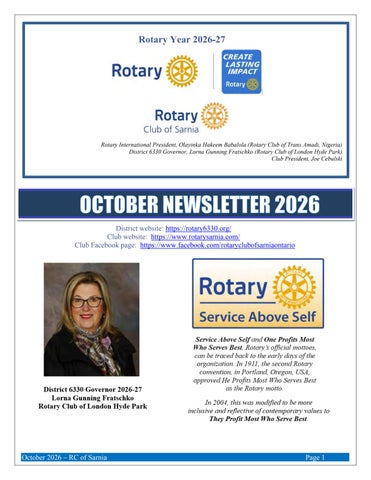
Rotary International President, Olayinka Hakeem Babalola (Rotary Club of Trans Amadi, Nigeria) District 6330 Governor, Lorna Gunning Fratschko (Rotary Club of London Hyde Park) Club President, Joe Cebulski
District website: https://rotary6330.org/ Club website: https://www.rotarysarnia.com/ Club Facebook page: https://www.facebook.com/rotaryclubofsarniaontario
October 2026 – RC of Sarnia
Page 1
TABLE OF CONTENTS 3
Rotary Calendar and Themes Club Mission & Vision statements Building a Community Coming Events OCTOBER MESSAGE – RI President Olayinka Babalola OCTOBER MESSAGE – Rotary Foundation Chair Jennifer Jones OCTOBER THEME D6330 NEWS & INFORMATION - Governance OCTOBER THEME– Community and Economic Development INTERNATIONAL SERVICE – District 6330 A ROTARY LOOK BACK PAUL HARRIS SOCIETY – Jamie Pole POLIO WORLD POLIO DAY – October 24 Unvaccinated challenge plus Rotarian John Nanni DONATIONS TO TRF (The Rotary Foundation) INTERCOUNTRY COMMITTEES WEAR YOUR ROTARY PIN (Rotary Story) WHY WEAR THE ROTARY WHEEL? SHELTERBOX
3 4 5 6 7 8 9 10 11 12 13 15 16 17 18 20 21 22 24 25
CLUB NEWS Visit another club? + our 2026-27 Club President Joe 100th Hat ??? SEPTEMBER 1 - Sarnia Y – Paul Skuza SEPTEMBER 15 - Green Bin – David Jackson SEPTEMBER 22 - Building Communities – Andrew Chunilall Upcoming events HAND UP – Guatemala Project PHOTOS OBJECT OF ROTARY and CODE OF CONDUCT EREY – Every Rotarian, Every Year ROTARY MINUTE FOUR-WAY TEST
29 30 31 35 37 39 40 41 42 43 44 45
BACK PAGES Humour Caring for our community Honouring 99 years of service and counting Community Service …just the beginning
46 47 48 49 50
October 2026 – RC of Sarnia
Page 2
The Calendar below shows Rotary’s 2026-27 monthly themes. ROTARY CALENDAR and THEMES Month July August September October November December January February March April May June
Theme Maternal and Child Health Membership and New Club Development Basic Education and Literacy Community Economic Development The Rotary Foundation Disease Prevention and Treatment Vocational Service Peace and Conflict Prevention/Resolution Water, Sanitation, and Hygiene Environment Youth Service Rotary Fellowships
Right-click and select "Open Link” on each flag below to listen to the respective national anthems.
October 2026 – RC of Sarnia
Page 3
LEARN ABOUT ROTARY CLUB OF SARNIA
ROTARY’S 7 AREAS OF FOCUS •
Peacebuilding and Conflict Prevention: Addressing the underlying causes of conflict—such as poverty, inequality, and lack of resources—while training leaders to mediate and resolve disputes peacefully.
•
Disease Prevention and Treatment: Expanding access to healthcare, fighting infectious diseases like malaria and polio, and improving local health infrastructure.
•
Water, Sanitation, and Hygiene (WASH): Providing communities with sustainable access to clean drinking water, proper sanitation, and hygiene education.
•
Maternal and Child Health: Ensuring access to essential healthcare, nutrition, and sanitary tools so mothers and children can survive and thrive.
•
Basic Education and Literacy: Strengthening the capacity of communities to support schooling, increase adult literacy, and reduce educational gender disparities.
•
Community Economic Development: Reducing poverty in underserved areas by investing in local entrepreneurs, supporting women leaders, and developing sustainable economic opportunities.
•
Supporting the Environment: The newest area of focus; funding projects that protect natural resources, promote sustainability, and address environmental challenges.
October 2026 – RC of Sarnia
Page 4
BUILDING A COMMUNITY – ONE PROJECT AT A TIME For nearly a century, the Rotary Club of Sarnia has quietly helped shape the community we know today. While many people recognize Rotary through events such as the Mackinac Pancake Breakfast or community fundraisers, the true legacy of the club can be seen in the organizations that continue to serve local families every single day. Some of Rotary's greatest achievements have become permanent parts of community life. The club was instrumental in founding Pathways Health Centre for Children, ensuring that generations of children with physical, developmental, and communication challenges could receive care close to home rather than travelling long distances. Today, thousands of children and families continue to benefit from that vision, and Rotary's support continues through major investments such as the Pathways therapeutic pool. Healthcare has remained a priority throughout the years. Rotary has made major contributions toward Bluewater Health's Maternal and Child Health Wing, St. Joseph's Hospice, and Community Concerns for the Medically Fragile (Standing Oaks Home), helping provide compassionate care for people at every stage of life. The club has also invested heavily in young people. From Rotary Youth Leadership Awards (RYLA) and Junior Achievement to YMCA youth scholarships, music festival awards, local schools, Scouts Canada, Big Brothers Big Sisters, and minor hockey, Rotary has consistently supported programs that help young people develop confidence, leadership, skills, and opportunity. Education and community development have always gone hand in hand. Support for Lambton College, Community Living Sarnia-Lambton, Family Counselling Centre, Access Open Minds, Habitat for Humanity, Goodwill Industries, the Inn of the Good Shepherd and many other organizations reflects Rotary's belief that strong communities are built by helping people succeed, especially during difficult times. Beyond Sarnia-Lambton, Rotary's commitment extends internationally. The long-standing partnership with the Rayjon Haiti Project has helped improve health care, education, and sustainable community development by working alongside Haitian communities to build solutions that last. No single list can fully capture the thousands of volunteer hours, partnerships, and acts of generosity that stand behind these projects. Together, however, they tell a remarkable story: for generations, the Rotary Club of Sarnia has invested not only in buildings and programs, but in people. Within this list, there are several themes that emerge naturally: • • • • • •
Children – Pathways, Bluewater Maternal & Child Health, Big Brothers Big Sisters, Scouts, YMCA scholarships, music festival awards, schools, RYLA. Health – St. Joseph's Hospice, Standing Oaks Home, Access Open Minds, Family Counselling Centre. Education & Opportunity – Lambton College, Junior Achievement, Community Living. Basic Needs – Inn of the Good Shepherd, Habitat for Humanity, Canada Food Grains. International Service – Rayjon Haiti Project. Community Recreation – YMCA pool, Point Edward Minor Hockey. That is the true meaning of Service Above Self—creating a stronger community today while leaving an even better one for tomorrow.
October 2026 – RC of Sarnia
Page 5
ECONOMIC & COMMUNITY DEVELOPMENT Month of October
WORLD POLIO DAY Saturday, October 24
CREATE LASTING IMPACT (2026-27)
ROTARY FOUNDATION MONTH Month of November
Rotary Anthem Right-click and select “Open Link” to listen to the Rotary Anthem!
October 2026 – RC of Sarnia
Page 6
THE ROTARY INTERNATIONAL PRESIDENT OCTOBER MESSAGE 2026 99.9 percent is not 100 percent Aminu Ahmed Tudun-Wada knows what polio takes from a child. He contracted the disease as a young boy in Kano, Nigeria, and was left paralyzed. Decades later, when Nigeria was struggling to eradicate polio, Aminu decided that he would use his experience to help protect other children. He brought together polio survivors and began going door to door, talking with parents about vaccination. The survivors told their stories. They showed families the effects of polio. And they urged parents to make sure their children never had to go through the same experience. By 2021, the Polio Survivors Group that Aminu founded had grown to more than 400 members. Their work helped Nigeria reach a milestone that once seemed impossible: In 2020, the World Health Organization certified Nigeria, and the entire African region, free of wild poliovirus. I think about people like Aminu whenever we talk about ending polio. Eradication is about children who will never know what it means to lose the ability to walk. It is about parents who will never have to watch a healthy child become paralyzed by a disease that vaccines can prevent. And it is about making sure the people who remember polio become the last generation that does. Rotary has been part of this fight for more than four decades. Together with our partners, we have helped vaccinate more than 3 billion children, contributed more than $3 billion to the global effort, and reduced cases of wild poliovirus by 99.9 percent. But 99.9 percent is not 100 percent. Wild poliovirus remains endemic in Afghanistan and Pakistan. As long as it circulates anywhere, children everywhere remain at risk. And even after wild poliovirus disappears from a country, we must maintain strong immunization and surveillance systems so the virus cannot find a way back. Aminu could have looked at his own experience and asked, “Why me?” Instead, he asked a different question: “How can I make sure this does not happen to another child?” That is the spirit we need now. The final mile of any journey can be the hardest. But we have walked too far, worked too hard, and protected too many children to stop here. Let us remember why we began. Let us listen to those who have experienced polio. Let us be the generation that creates lasting impact and ensures no one ever experiences polio again
YINKA Olayinka “Yinka” Hakeem Babalola President, Rotary International (2026-27)
October 2026 – RC of Sarnia
Page 7
THE ROTARY FOUNDATION TRUSTEE CHAIR OCTOBER MESSAGE 2026 Like a rock Being a rock is Rotary’s quiet superpower, and with this year’s instability we’ve been reminded how much that matters. Families face displacement, communities navigate climate shocks, and humanitarian needs arise both close to home and across the places we serve. These realities touch us. Yet even as the world shifts, Rotary’s response remains steady, compassionate, and effective. We don’t turn away from uncertainty – we meet it with purpose. The Rotary Foundation was not built for fair weather. Over the last decade, we have strengthened our approach: weaving sustainability into every project, expanding partnerships, and embracing evidence-based solutions. This evolution has made us more resilient and more community-driven. It’s why our comprehensive goal of raising $500 million across the Annual Fund, Endowment Fund, and PolioPlus Fund is not only ambitious but achievable. We’ve proved before that we could reach it, and momentum is building again. While global attention shifts from one crisis to the next, Rotary stays. We convene partners who might never otherwise collaborate. We mobilize resources quickly because our networks are already in place, built through decades of trust. And we strengthen communities not through one-time interventions but by sustained presence and shared commitment. Nowhere is this dedication more evident than in our work to end polio. Last month, I asked you to reflect on your club’s role in this historic effort, and many of you responded with renewed energy and generosity. Polio cases are down more than 99 percent since Rotary began this fight–a testament to the health workers, volunteers, and members who kept vaccinating children through wars, border closures, and every imaginable obstacle. They didn’t know how the story would end. They knew who they were, and they kept going. That is our inspiration in this moment. When the ground feels unsteady, Rotary becomes the stable ground. When plans shift, we are the partner who responds. When the path forward is unclear, our strength of self becomes our compass. By the time you read this, I will be in a place that has tested my own footing. I’ll share the full story online, and it’s one you won’t want to miss. Let us continue being an organization the world can count on. We may not always know how every challenge will be solved. But we know who we are, and that’s always been enough for us to begin.
JENNIFER JONES Foundation Trustee Chair, 2026-27 October 2026 – RC of Sarnia
Page 8
THE POWER OF THE ROTARY FOUNDATION
October reminds us that lasting change often begins with something quite simple: giving people the opportunity to build a better life. Rotary’s focus on Community and Economic Development is about much more than jobs or money. It is about helping communities become stronger and more self-reliant — through education, training, opportunity, access to resources, and support for people who are ready to build a better future for themselves and their families. The most meaningful projects are not simply handouts; they are a hand up, creating possibilities that can continue long after Rotary’s direct involvement has ended. We can learn more about what D6330’s Hand Up Committee is achieving in Guatemala!
World Polio Day – October 24. October also brings World Polio Day, a reminder of what determined people working together can accomplish. Rotary made an extraordinary promise to the world: to help end polio. Decades later, that promise has not been forgotten. The work continues because every child deserves the chance to grow up healthy, learn, work, contribute, and dream. Whether we are strengthening one community or working toward a world free from polio, the principle is much the same: See a need, believe that change is possible, and then do something about it. That is how Rotary Creates Lasting Impact.
October 2026 – RC of Sarnia
Page 9
NEWS & INFORMATION IMPORTANT TO ROTARIANS In District 6330, Rotary leadership – past, present, future
Above (left to right) PDG Mike Chaffee (2022-2023) - PDG Sonja Glass (2023-2024) – PDG Katherine Hahn (2024-2025) – PDG Jeff Ferweda (2025-2026) – DG Lorna Gunning Fratschko (2026-2027)
Above left - DGE Dawn Kennedy (2027-2028) Above right – DGN Peter Maranger (2028-2029)
October 2026 – RC of Sarnia
Page 10
ROTARY’S OCTOBER FOCUS – ECONOMIC & COMMUNITY DEVELOPMENT Economic development isn't about what Rotary can give a community. It's about what Rotary can help a community build for itself.
Guatemala — women creating their own microfinance system. The Rotary Club of Guatemala de la Ermita helped 400 rural women complete financial-literacy training. Because the women generally lacked the collateral required for conventional loans, they pooled their own savings and developed a microlending program. That is a wonderful example of the hand up rather than handout philosophy. Source https://www.rotary.org/en/our-work/growing-local-economies Ecuador — skills + loans + entrepreneurship. In Esmeraldas, Rotary helped provide more than 250 microloans and trained more than 270 people in skills including sewing, baking and plumbing, along with business management, leadership and microcredit. The point wasn't merely to teach someone to sew; it was to help that person turn the skill into a livelihood. https://www.rotary.org/en/our-work/growing-local-economies Cameroon — helping farmers earn more from the land they already have. Rotary helped farmers learn techniques to restore soil fertility, control erosion and market their produce. The result was increased crop yields and increased profits. https://www.rotary.org/en/our-work/growing-local-economies Zimbabwe — teaching women to save, borrow and build. A Rotary grant trained more than 3,000 women in basic economic skills over four years. Women formed small savings groups, accumulated money together and then began making loans from their pooled funds. That's economic development that can continue after the Rotary grant has finished. https://blog.rotary.org/2021/10/26/discovering-the-impact-of-rotary-grants-in-zimbabwe/
Click here to read the full story about a Corporate Social Responsibility grant from Coal India Limited that provided 200 women high-speed commercial sewing machines through a District 3020 project supported by a 20 million Indian Rupee (about US$250,000) “Every stop reminded me that Rotary doesn’t simply provide equipment — we create opportunities.” -- Subbarao Ravuri (Datta), past governor of District 3020 (India) and a member of the Rotary Club of Vijayawada Midtown, Andhra Pradesh, India
October 2026 – RC of Sarnia
Page 11
October 2026 – RC of Sarnia
Page 12
MORE ROTARY FOUNDATION INFORMATION A ROTARY LOOK BACK The beginning actually takes us to the Philippines in 1979. Rotary International undertook a multi-year project to immunize six million children there against polio. RI President James L. Bomar Jr. personally administered some of the first drops of oral vaccine. Rotary records a lovely little incident from that visit: after one child was vaccinated, the child's brother tugged at Bomar's trouser leg and thanked Rotary. That project succeeded. And Rotary began thinking bigger. In 1985, Rotary launched PolioPlus, undertaking the extraordinary goal of protecting the world's children from polio. Its original fundraising target was US$120 million. Then came the really important part. In 1988, the World Health Assembly committed to worldwide polio eradication, and Rotary became a founding partner of the Global Polio Eradication Initiative, along with the World Health Organization, UNICEF and the U.S. Centers for Disease Control and Prevention. At that point, polio was still paralysing an estimated 350,000 children every year in 125 countries. Think about that number another way: Almost 1,000 children every day. And Rotary said, essentially: We can stop this.
And look where that decision led •
Today, wild poliovirus remains endemic in only Afghanistan and Pakistan.
•
Two of the three strains of wild poliovirus have been eradicated altogether.
•
Rotary says its members have contributed more than US$2.9 billion in PolioPlus grants and countless volunteer hours, helping protect more than three billion children in 122 countries.
That is an astonishing return on an idea that began with Rotarians vaccinating children in the Philippines.
October 2026 – RC of Sarnia
Page 13
Rotary didn't eradicate polio alone. But Rotary was there before the world had committed itself to eradication — demonstrating that it could be done, raising the money, advocating with governments, mobilizing volunteers and refusing, decade after decade, to walk away from the promise.
There's the Create Lasting Impact connection, too — and it isn't forced at all.
A must view. The Rotary documentary called “Dare to Dream: How Rotary Became the Heart and Soul of Polio Eradication.” The story is told through some of the original polio-eradication pioneers themselves. The complete documentary is 56 minutes, but a 19-minute excerpt was specifically made available as a Rotary club program. See the links below. Rotary also has a current collection of shorter videos specifically intended to be shown at club meetings for World Polio Day, October 24.
HOW ROTARY BECAME THE HEART AND SOUL OF POLIO ERADICATION Dare to Dream — Rotary's story of the fight against polio
https://daretodreamfilm.com/ - VIEW THE TRAILER HERE
https://daretodreamfilm.com/get-free-movie/ - VIEW THE FULL FILM HERE
The roots of Rotary's polio eradication efforts – LEARN ABOUT HOW THE PROGRAM BEGAN
THIS IS A STORY WORTH TELLING IN OCTOBER!!
October 2026 – RC of Sarnia
Page 14
PAUL HARRIS SOCIETY By now, you must know - What's the Paul Harris Society? The Paul Harris Society is the name given to those Rotarians who pledge a $1,000 gift annually – every year. You may know these committed individuals -- they wear a flag below their Rotary pin that reads PHS. One easy way to give at the $1,000 level is through Rotary Direct -- sign up and an amount of money you designate is automatically deducted from your account each month. Learn more at www.rotary.org. Members of the Paul Harris Society know that the need never ends -- and neither should the giving. D6330’s long-time Paul Harris Society Chair is Rotarian Jamie Pole.
What your giving supports • • • • • • • • • •
Rotarian Jamie Pole RC of Sarnia
Vocational training for teachers establishing an early childhood education center in South Africa Water filters, toilets, and hygiene training to prevent fluorosis, diarrhea, and other diseases in India A scholarship for a medical professional in Italy to research treatments that minimize mortality rates among premature babies Peace-building seminars for 200 teachers and 1,300 students in Uganda Treated mosquito nets and medical services that prevent malaria in Mali Clean water and sanitation which assists in preventing disease Life-saving health care to mothers and children Peace and peace building Education and literacy Economic and community development
In District 6330 we are proud of the generous members in our Paul Harris Society. We have over 32 of our clubs that now have members in the Paul Harris Society.
If you have any questions or need further information, please do not hesitate to reach out to your Paul Harris Society Coordinator, District 6330 – Jamie Pole!
October 2026 – RC of Sarnia
Page 15
Summary of new polioviruses this week: • • • • • •
Afghanistan: two WPV1 cases Pakistan: one WPV1 case and one WPV1-positive environmental sample DR Congo: two cVDPV2 cases Mali : one cVDPV2 case Nigeria: one cVDPV2 case Somalia: two cVDPV2-positive environmental samples
We’re at the brink of eradicating polio. Click here to view the short video.
Uganda: Protecting the Progress Rotary has helped bring the polio eradication message to a national audience in Uganda following the country’s successful closure of its latest variant poliovirus outbreak. In an opinion piece published by the Daily Monitor, Uganda’s leading independent daily newspaper, Rotary End Polio Now Coordinator for Eastern and Southern Africa Kenneth Mugisha, reflects on how wastewater surveillance detected the virus before any child was reported paralyzed, enabling a rapid vaccination response. He argues that Uganda’s success is both a cause for celebration and a reminder that progress must be protected through sustained vaccination, surveillance and community engagement: the goal is to keep polio invisible by continuing the work that made it invisible in the first place. 21,000 Unvaccinated Children Are Not a Minor Problem, But a Warning Sign What happens when vaccines become so successful that we forget the diseases they prevent? Against the backdrop of new immunization data from Germany, Dr Frank Intert of Rotary International reflects on the paradox of vaccination success: as diseases disappear from everyday life, maintaining public awareness, trust and high population immunity becomes even more important. Polio offers a powerful reminder that progress cannot be taken for granted – and that as long as the virus circulates anywhere, the job is not finished.
October 2026 – RC of Sarnia
Page 16
s
Since launching the PolioPlus program in 1985, Rotary and our partners have made incredible progress toward eradicating polio. We’ve celebrated vaccination milestones, cheered as regions of the world were certified polio-free, and contained wild poliovirus to just two countries, Afghanistan and Pakistan. But polio anywhere will always be a threat to children everywhere. We made a promise to the children of the world: One day, they won’t have to fear being paralyzed by polio. This is why it’s so important for Rotary and Rotaract clubs to use World Polio Day on 24 October as an opportunity to raise awareness and funds. Explore the resources below and use them to inform your community about the incredible progress we’ve made toward eradicating this disease. World Polio Day is only a few weeks away, and we want to know what your club is doing. Whether you’re hosting your own activity or participating in a district or zone event, tell us about it! To eradicate polio, we need everyone’s support. Together, we end polio. Click here to view the short video.
October 2026 – RC of Sarnia
Page 17
21,000 UNVACCINATED CHILDREN ARE NOT A MINOR PROBLEM, BUT A WARNING SIGN 15/09/2026 Eradication, Vaccines, Germany Originally published in Pharmazeutische Zeitung, August 2026. Source - https://polioeradication.org/news/21000-unvaccinated-children-are-not-a-minor-problem-but-awarning-sign/ Dr. Frank Intert, Rotary International End Polio Now Coordinator Zone 15 & 16 At first glance, the latest figures from the World Health Organization (WHO) and UNICEF are encouraging. In 2025, more children worldwide were vaccinated than in the previous year. At the same time, however, the data also show how quickly progress can begin to unravel. In Germany, approximately 21,000 children have not received their first vaccination against diphtheria, tetanus, and pertussis. Compared with the country’s overall high vaccination coverage, this may seem like a small number. Nevertheless, it is one that should concern us. Germany does not have a fundamental vaccination problem. But that is precisely where the challenge lies. Vaccination programmes have been so successful that many people have never experienced the diseases they protect against. Illnesses that were once part of everyday life are now known to many only through stories or textbooks. • • •
Most young parents have never seen a child develop polio. They have never witnessed how quickly diphtheria can become life-threatening or the serious complications that measles can cause. The fact that they have been spared these experiences is one of the greatest achievements of modern medicine.
That success, however, has a downside. The rarer these diseases become, the easier it is to forget why vaccination is so important in the first place. As the immediate threat fades from public consciousness, so too can awareness of the need for protection. This is precisely why ongoing public education remains essential. In Germany, all childhood vaccinations recommended by the Standing Committee on Vaccination (STIKO) are available free of charge. The key, therefore, is ensuring that parents have access to reliable information and that any concerns or questions are addressed early. Polio is perhaps the best example. Germany has been free of endemic transmission of the virus for decades. But that does not mean poliovirus has disappeared. It continues to circulate in parts of the world and has been detected repeatedly in wastewater in several European countries in recent years, including Germany.
October 2026 – RC of Sarnia
Page 18
The fact that these detections have not led to outbreaks is no coincidence. It demonstrates how well vaccines work. High levels of immunity in the population, combined with robust surveillance, prevent the virus from regaining a foothold. • • •
That is exactly why we must not allow high vaccination rates to create a false sense of security. They are not guaranteed to continue on their own. Every generation must be reminded why vaccines matter. Every immunity gap increases the risk that diseases we believed had been consigned to history will return.
For nearly 40 years, the Global Polio Eradication Initiative has pursued the ambitious goal of eradicating polio worldwide. Rotary International is one of its founding partners and works alongside the World Health Organization (WHO), UNICEF, and other organizations to ensure that no child ever suffers from polio again. Together, these efforts have already saved more than 1.5 million lives and prevented an estimated 20 million cases of permanent paralysis. Today, the virus remains endemic in only a handful of areas. We are closer to achieving this goal than ever before. That is precisely why now is the wrong time to lose momentum. As long as the virus continues to circulate anywhere in the world, our work is not finished. The 21,000 unvaccinated children in Germany therefore represent far more than a statistic. They remind us that the success of vaccination programmes can never be taken for granted. It must be protected and renewed continuously through public education, trust, and the willingness to vaccinate – even when the diseases themselves have long disappeared from everyday life. Dr. Frank Intert is a pharmacist and Rotary International’s End Polio Now Coordinator for Germany, Switzerland, and Liechtenstein. His professional expertise focuses on hospital pharmacy and infectious diseases.
73 years ago today, I was rushed to the hospital with polio. I was 10 months old, just 6 months before the Salk Vaccine was tested. I was paralyzed from my neck down for 6 months, but I walked a year later, played sports in high school. I now suffer from Post-Polio Syndrome and use a wheelchair for my mobility. However, I have been blessed to have such a wonderful life. Please know that Vaccines Cause Adults, and science doesn't care what one's opinion is. -- Rotarian John Nanni
October 2026 – RC of Sarnia
Page 19
THE ROTARY FOUNDATION (TRF) DONATIONS ARE IMPORTANT! Clubs must qualify every year! The Rotary Foundation requires Clubs that want to participate in the District Grants program to qualify. To qualify, the club must: • • •
Be in good standing May not have any grant reporting that is overdue Have at least 2 members complete the District’s Qualification Training course and quiz The Certification is valid for One Rotary Year only! Clubs must be re-certified for each Rotary Year. Rotary Foundation Grants – There are two kinds of grants. - Global Grants and District Grants:
Global Grants • Must be in (at least) one of Rotary's Areas Of Focus • Must be International projects involving at least 2 clubs in 2 different countries. One of these clubs is the host club - the club where the project will take place. The other is the international partner - the club that provides funding and possibly some expertise to help implement the project. • Must have a minimum budget of USD $30,000 • Club funds are supplemented by the District Designated Funds as, and if, available • Funds donated to the project from District Designated Funds are supplemented by The Rotary Foundation (World Fund) to fund these grants. District Grants • May be local or international in scope. • Are usually smaller in scale. There is no minimum budget requirement. • Will usually involve active participation by Rotarians. • District 6330 clubs may apply for more than one District Grant in a single Rotary year but are limited to a maximum of USD $3,000 per year in District Grant funding. • Projects must be started and completed within one Rotary year - July 1 to June 30 of the next year. Ready to Apply for A Grant? Will it be a District or a Global Grant? 3 simple questions to help you decide: •
Is the project in one of the areas of focus? – No? Consider applying for a District Grant.
•
Is the project between Clubs/Districts in separate countries? – No? Consider a District Grant.
•
Is the total budget for the project more than USD $30,000? – No? Consider applying for a District Grant.
•
If you answer YES to all the above, consider applying for a Global Grant.
October 2026 – RC of Sarnia
Page 20
October 2026 – RC of Sarnia
Page 21
Another benefit of Rotary membership A “good news” story you will enjoy. By Dick Drew, Centennial Governor District 5020 At left: PDG Dick Drew, District 5020 We live in Maple Ridge BC (near Vancouver, Canada), several thousand miles north of Montego Bay, Jamaica. While visiting there on a cruise ship with 12 members of our family on January 22, 2009, a freak accident happened to our 46-year-old son, Mitch. The accident drove home to me the importance of always wearing your Rotary pin and another personal benefit of being a Rotarian. Here is what happened. Our cruise ship Voyager of the Seas has a large ice skating rink. Our son Mitch, his wife Lori-Ann, and their 13- year-old daughter, Jessica, our granddaughter, were skating. Our son, a good skater, hooked an edge, fell backwards, striking his head on the ice, knocking himself unconscious for several minutes. He was taken to the ship’s hospital for x-rays. The ship’s doctor did not like what she saw, and ordered an ambulance to take him to the hospital for a CAT scan. The ship was sailing in 30 minutes for Galveston Texas - two days away. This meant that Mitch would be left ashore in Jamaica. I stayed with him. Then the confusion really began. My son was suffering and sweltering in the ambulance on the dock while I tried to rush through the endless paperwork ashore involved with us remaining in Jamaica. The cruise line’s port agent offered his assistance. I pointed to the Rotary pin on my shirt collar, handed him my Rotary business card, and asked if he would locate a Rotarian so I would have a reliable contact in Jamaica. He disappeared and returned two minutes later with a big smiling Jamaican. “Here,” he said. “He’s a Rotarian.” When I asked how he knew, he replied, “He always wears the same pin you wear.” The Rotarian was Keith Azzan, President of the Rotary Club of Montego Bay East. Keith is also owner/operator of Pirates Market - a large gift shop on the pier. At left: Keith Azzan (President) and Govind Chulani (Secretary) – Govind is also AG for Jamaica West beginning July 1, 2009. Keith spoke with the immigration people and hurried along. He assured me my son was being taken to a very good, small private hospital.
October 2026 – RC of Sarnia
Page 22
He warned me the hospital was expensive and asked “Do you need any money??” Fortunately, I had my trusty well worn VISA card. Keith handed me his card. “This is my cell number,” he said. “Call me any time tonight.” Within minutes, I was in the passenger seat of the ambulance, siren wailing, speeding on the left side of a narrow two-lane highway - No seatbelts - feeling certain this would be my last automobile ride. At the hospital, another round of paperwork began. The admitting clerk required several detailed explanations before she fully understood that Mitch had suffered an ice skating injury. She is likely still laughing as she tells her friends about an “ice skating injury on a ship where the poor mon fell and split open his head.” Even before the paperwork was completed, I was called to the reception area. “There are two men here to see you.” The two men were Rotary club president, Keith Azzan, and club secretary, Govind Chulani. They remained until they were convinced everything was under control. They left, telling me to call either one should I need assistance. Keith returned later to enquire where I would sleep. The small hospital had only three beds and two were taken. I had noticed a Holiday Inn about 2 miles from the hospital and said I would register there. Keith informed me that the annual world-famous Jamaican Jazz Festival was underway, and the Holiday Inn was headquarters for the event. It was doubtful I could get a room there, or anywhere else on the Island. Keith explained that the Rotary Club had held their meetings at the Holiday Inn for years until recently when the hotel renovated and removed the meeting room. Although it was nearing 10:00 p.m., he felt the manager, whom he knew quite well, would still be there, and he was. The manager explained that the hotel was “booked solid” but they did have a room for “emergency purposes.” Keith convinced him this was indeed an emergency, and I was booked in. Then Keith and I went for an authentic Jamaican dinner of Bar BQ pork ribs, and Bar BQ chicken with sweet potatoes in an outdoor restaurant off the road called Schochies - an interesting place that tourists seldom see. Over dinner we shared Rotary stories and experiences. My son was released from the hospital the following day. We flew that afternoon to Texas to await the arrival of the ship and our family two days later. I have kept in touch by email and telephone with both Keith and Govind. I will always remember the immediate response and caring consideration of these two outstanding Rotarians who came to the aid of a Rotarian in need. Rotary is indeed an incredible organization made of up incredible people. On your next trip to Jamaica visit Keith Azzan at his Pirates Market gift store, and Govind Chulani at his El Caribe Diamond Discount Centre. Tell them you heard of their generous deed to a Rotarian in need. And always remember to wear your Rotary pin. Don’t leave home without it!
October 2026 – RC of Sarnia
Page 23
October 2026 – RC of Sarnia
Page 24
Click here to view this powerful video. Every family deserves a place to call home after disaster. We work with disaster-affected communities to provide the emergency shelter, essential items and training needed to support families in the long process of rebuilding their lives. Every disaster is different so we have a flexible approach. We listen and learn from the communities we work with to make sure we provide the right support. We often go further, working with hard-to-reach communities who are overlooked by others. Before a disaster happens, we make sure we are ready to help. We store aid in strategic locations around the world so we can get it to the families who need it as quickly as possible. We work with trusted local partners and we have a network of incredible volunteers who are ready to help at a moment’s notice. Our teams can travel by foot, boat, helicopter or tuk-tuk to get to the families who need your support – whatever it takes to get to the people who need us. Continue reading to learn more about how it all happens. NO FAMILY WITHOUT SHELTER SHELTERBOXCANADA.ORG *
*
ShelterBox and Rotary are official project partners in international disaster relief. ShelterBox is a registered charity independent of rotary International and The Rotary Foundation.
October 2026 – RC of Sarnia
Page 25
Shelter is the foundation for life – for survival, stability and dignity. It offers a place to feel safe, stay together and stay healthy, earn a living and plan for the future. ShelterBox provides emergency shelter and essential household items after disaster. There’s no one size fits all solution. Each disaster and community is different. So, we work flexibly, listening to what’s needed and adapting every time. For some situations, family-sized tents are the best solution. They provide shelter until people can start rebuilding. In other places, heavy duty tarpaulins, ropes and nails can patch-up damaged buildings. Essential items like water filters, mosquito nets, and cooking sets help people survive. Our teams also offer training on shelter building. This supports people to create robust shelters and maintain them over time. Trained people can then pass on their knowledge on to their community too. Our support keeps evolving, and so do we.
October 2026 – RC of Sarnia
Page 26
ShelterBox started supporting people after disaster 25 years ago. At that time, we were all about our iconic green ShelterBoxes. For a long time, we only shipped our aid items inside those boxes. Now, we’ve gone beyond the box – and we no longer use them. Watch the video to find out why.
Click here to view the short film above.
October 2026 – RC of Sarnia
Page 27
Why do we no longer use the box? There are lots of reasons why we’ve gone beyond the box. •
Some of the aid items no longer fit in the boxes. Like our tents. These are now bigger, so people have more space and privacy.
•
Where possible, we will procure items locally. This is better for the environment as it cuts our carbon footprint. It can also be good for the local economy.
•
Using pallets to ship items, instead of packing boxes, means faster delivery times and customs checks. So we can reach people as quickly as possible.
•
Sending items without using boxes also makes it easier to store them in the warehouses we use, close to the areas where many disasters happen. Why do aid items change?
At ShelterBox, we are always learning and developing. We learn from the communities we support and analyse how we can do even more. As part of that, our procurement team reassess each aid item and how it’s procured approximately every three years. By assessing the market and engaging with suppliers about the items they offer, we stay up to date with what’s available and how much each item should cost. This process is known as tendering. Tendering gives us the opportunity to take a fresh look at our suppliers and to set new standards. Through tendering we are also able to reassess the specifications of the aid items we provide. We can include new requirements to meet a new need we’ve observed in our responses, or we can change or remove existing features. We then update our specification before starting the tender process. Requirements that suppliers must meet to be considered are detailed in an Invitation to Tender and scoring criteria are developed so that we can decide as a cross-departmental group who’s most suitable. The right support at the right time Recently we have included… • • • • •
concrete bases in places that repeatedly flood like Pakistan shelters with iron frames and fire-resistant insulation in Yemen wooden frame Sahelian tents to withstand local climates in Burkina Faso storm strapping to make timber shelters more robust in the Philippines cash alongside our shelter support in Cameroon, the Philippes, Moldova and Pakistan
October 2026 – RC of Sarnia
Page 28
Expand your Rotary horizons! Consider joining some of the easy online meetings available – All Rotarians are encouraged to join local (and other) clubs to learn more about Rotary, get to know other Rotarians, gain a new perspective and appreciation for Rotary and Rotarians. Here is a list of online clubs where you can earn a make-up along with learning a whole lot more about Rotary! Why not visit them all? •
• •
Rotary E-Club of Canada One Rotary Club of One World Rotary E-Club of World Peace Click here to attend this week’s posted meeting of E-Club of Canada One. These meetings are posted online and available 24/7! There’s also a Thursday morning Coffee Chat at 10:00 a.m. Eastern Time. Please join our Coffee Chat from your computer, tablet or smartphone. https://us02web.zoom.us/j/709771987
Club President for 2026-27 – Joe Cebulski
October 2026 – RC of Sarnia
Page 29
The hat is ready for our 100th President. The Rotary Club of Sarnia will celebrate 100 years in 2028. The club already has a hat ready for that special President who will lead the club during the celebrations of our 100th year of service to the community of Sarnia. Shown displaying the 100th Presidential Hat are past president, Mark Taylor (#96), past president, Jamie Pole (#97), immediate past president, Kurtis Lush (#98) and current club President Joe Cebulski (#99), who also is the designated caretaker of the prized (#100) hat until that person is chosen later by the members. Special celebrations and projects will take place during 2028.
The gift of service is that it changes two lives — theirs and ours. When we lift another, we rise a little too.
October 2026 – RC of Sarnia
Page 30
Presentation – Tuesday, September 1 More Than a Gym: The YMCA at the Heart of Our Community When we think of the YMCA, many of us probably think first of a swimming pool, a fitness centre, or perhaps a place where children learn to swim. But when Paul Skuza, General Manager of the Jerry McCaw Family Centre, spoke to our Rotary Club recently, it quickly became apparent that our local Y is much more than that. It is a place where children learn, teenagers find their first jobs, families receive support, newcomers find connections, people with special needs gain valuable work experience, older adults find companionship, and those who cannot afford the full cost of membership are still welcomed. In other words, it is very much a community. A Sarnia Institution The Jerry McCaw Family Centre opened in 1997, replacing the YMCA's former Mitton Street location, and will celebrate its 30th anniversary next year. Today, the Sarnia Y has approximately 3,000–4,000 members, depending upon the season, and is one of the larger centres within the YMCA of Southwestern Ontario. And it is busy. There may be a quieter season for fitness memberships during the summer, but there is certainly no quiet season at the Y. Summer camp takes over, and the centre operates almost 365 days a year. Approximately $300,000 was invested in capital improvements in 2025, with that figure expected to exceed $600,000 by the end of 2026. Some improvements are immediately visible — new automatic entrance doors, a refinished gymnasium floor, and new basketball backboards and nets. Others, including HVAC systems, boilers, and heat pumps, may be less noticeable but are equally important. The automatic doors are particularly significant. Something as simple as opening a door can be a barrier for someone using a wheelchair, walker, or cane, or for a parent pushing a stroller. Accessibility sometimes comes down to very practical details. It Begins in the Pool — But Doesn't End There In a waterfront community, learning to swim is not simply recreation. It can be a life skill. The Y's 25-metre pool is used for swimming lessons for hundreds of children and adults, recreational and family swims, lane swimming, Aquafit, high-school swim teams, and the Sarnia Rapids competitive swim club. Aquafit alone attracts approximately 40–50 participants on many mornings.
October 2026 – RC of Sarnia
Page 31
The Y also has an ongoing relationship with Special Olympics. Each spring, it hosts a Special Olympics swim meet attracting more than 100 swimmers from across Ontario. Local Y members and staff also recently returned from the Special Olympics national games in Medicine Hat with gold, silver, and bronze medals in swimming and 10-pin bowling. And this brings us to an important Rotary connection. The Rotary Club of Sarnia's recent $35,000 contribution supports aquatic leadership training — helping young people obtain lifeguard and swim-instructor certification through the 2026–27 school year. The shortage of qualified lifeguards and instructors that developed during COVID has not simply disappeared. Aquatic staff members also tend to be young people who eventually move on to university, careers, and other opportunities, so there is a continuing need to train the next group. Our contribution, therefore, isn't simply paying for courses. It is helping to ensure that swimming lessons, recreational programmes, and safe aquatic facilities can continue in our community. Children, Families — and Opportunity The Y operates one of the larger summer day camps in the region. Registration begins in January, and the programme is generally full by February or March. Children have access to the pool, gymnasium, outdoor play area, and a new 20-by-40-foot pavilion built last fall through a $93,000 donation from the Alix Foundation. But the Y's work with children extends well beyond summer camp. It provides licensed child-care for children from three months to four years of age, before- and after-school care in Sarnia schools, programmes in subsidized-housing communities, child-minding for parents using the Y, and newcomer services. Demand for licensed child-care is so great that waiting lists can extend to approximately a year. Opening a Door to Employment One programme that many of us may know less about is Project SEARCH. The Y is the host site for this programme for high-school students with special needs. Rather than moving directly from school into the workforce, students spend a full school year gaining experience and learning workplace skills. A St. Clair Catholic District School Board special-education teacher operates a classroom right inside the Y, and students rotate through different areas, including housekeeping, the front desk, fitness-class support, and child-minding.
October 2026 – RC of Sarnia
Page 32
The programme has now completed its second year in Sarnia. Almost ten students have graduated — and several have subsequently been hired part-time by the Y. That seems to me to be a particularly good example of what we mean when we talk about creating lasting impact. Give someone an opportunity, provide the support to make that opportunity successful, and the result may extend far beyond the original programme. Project SEARCH is now expanding to Chatham. Reaching Those Who May Be Alone Another new programme deserves particular attention. This year, the Sarnia Y is launching a free, 12-week Social and Wellness programme for adults aged 55 and over who are not presently very active and who may also be experiencing social isolation. Participants will meet once a week for approximately an hour of guided physical activity, followed by another hour devoted to social time, a wellness workshop or guest speaker, and a meal. Importantly, this is not intended for people who are already active Y members. It is specifically designed to reach people who may be inactive, living alone, or simply not connected to a club or social group. The Y is currently looking for participants, and Rotarians are encouraged to think about people we know who might benefit. Sometimes community service begins simply by making a connection. Making Sure Cost Isn't the Barrier Perhaps one of the most revealing facts from Paul's presentation was that approximately one-third of Y members receive some form of financial assistance, with reductions that can reach 40 or 50 per cent of membership fees. The Y is a charity, and its philosophy is that people should not be turned away simply because they cannot afford to participate. That requires money. The Sarnia Y's annual fundraising campaign raised approximately $60,000 two years ago and closer to $70,000 last year. Yet the amount of financial assistance provided to members is close to $250,000. There is no significant recurring government funding supporting the operation. Revenue comes primarily through the Y's own activities, including memberships and child care, supplemented by fundraising, occasional government grants for specific projects, and support through the broader YMCA of Southwestern Ontario. Fundraising, therefore, is not an extra. It is part of what allows the Y to fulfil its charitable mission.
October 2026 – RC of Sarnia
Page 33
Push the Bus — Literally! One of the more unusual ways the Y raises money is its annual Push the Bus fundraiser. And yes, participants actually push a bus. The event began in Sarnia in 2022 and has now raised more than $100,000 to help subsidize camp costs for lower-income families. The idea proved successful enough that it has since spread to London and Chatham. Rotary members have participated before. Perhaps we should start stretching now! Rotary and the Y Our relationship with the YMCA extends well beyond this year's $35,000 contribution. The Rotary Club of Sarnia has been a long-time supporter of the Y. This past summer, we joined Sarnia firefighters, Noel's Gift, and Bluewater Power in sponsoring free Sunday afternoon swims at Tecumseh Pool, which the YMCA operates for the City of Sarnia. That may seem like a relatively simple project — until we remember that removing the admission charge may make the difference between a family being able to enjoy an afternoon together at the pool or staying home. And perhaps that is what stood out most from Paul's presentation. The YMCA provides facilities and programmes, certainly. But underneath all of them is something much more basic: access. • • • • • • • • •
Access to swimming lessons. Access to recreation. Access to child-care. Access to employment experience. Access to healthier living. Access to friendship and social connection. And access even when someone's financial circumstances might otherwise close the door. That sounds very much like community service. And it gives us a better understanding of why Rotary's partnership with our local YMCA matters.
October 2026 – RC of Sarnia
Page 34
The Green Bin - Tuesday, September 15 David Jackson, General Manager of Engineering and Operations for the City of Sarnia, addressed the club to introduce the city's upcoming green bin program, a new curbside collection service for food and organic waste. He covered why the program is needed, how it will work, what it will cost, and when residents can expect it to begin, and he took an extended round of questions from members afterward. Why the City Is Introducing a Green Bin Landfill space across Ontario is running out, with roughly ten years of provincial capacity left and few communities willing to host a landfill or see an existing one expanded. Sarnia sends its waste to the Twin Creeks landfill in Watford, which is expected to reach capacity in about four years; an expansion is underway but facing pushback from neighbouring residents. About a third of the province's garbage is currently shipped to the United States, a practice that would strain local landfills further if it ever stopped. Landfills also carry environmental costs, including methane emissions and leachate that must be treated, and waste management is a significant municipal expense: the City of Sarnia currently spends about $3 million a year on it. Under Ontario's two-tier system, Lambton County is responsible for landfill capacity while the city handles curbside collection. Recycling itself is no longer a municipal responsibility; about four years ago, the province shifted that duty to producers of packaging and products, who now fund and manage recycling through a nonprofit organization. The province has now mandated that municipalities of Sarnia's size divert food and organic waste from the landfill. Sarnia currently diverts about 36 percent of its waste from landfill, compared with a provincial average of roughly 50 percent, and the province's target is to keep 70 percent of food and organic waste out of landfill altogether. Waste audits show that only about a third of what residents put in their black garbage bags actually needs to go to landfill; close to half is food and organic material that a green bin could capture, with the remainder made up of items that should have gone into recycling instead. How the Program Will Work • The city will deliver a green bin to every residential property, roughly 25,000 in total, with weekly curbside collection. • Accepted materials will be broad and organics-focused, including food waste, diapers, pet waste and litter of any type, paper plates, and paper towels; the city deliberately chose an inclusive list, having learned from other municipalities that overly strict rules discourage participation. Some contaminants are screened out at the processing stage. • Collected material goes to a processing facility and is turned into compost, which is applied to local farm fields, completing what Jackson described as a circular loop between farms, residents, and the land. • Bins will carry an RFID tag linked to the property address, which will help the city track and, if necessary, replace lost or stolen bins; the city will own the bins and replace them over their expected 10- to 20-year lifespan. • A kitchen countertop container may also be provided; the city is still deciding whether to supply one to every household automatically or only on request. • An educational sticker will be added to each bin to help residents remember what belongs inside. • The bins are larger than some residents expected because they are sized to allow for automated, arm-lift truck collection over their long service life, even though the city's contractor has not yet decided whether to use that method. October 2026 – RC of Sarnia
Page 35
• The program will launch first for single-family homes and duplexes only. Apartment buildings and commercial or industrial properties are not included at this stage; the city may explore expansion later, likely starting with voluntary pilot projects with interested property managers. Cost and Timeline Program cost
About $1 million per year, roughly a 1 percent tax increase
Contractor
Marcott, a local company, selected through a competitive bid
Public education campaign
Beginning around January–February 2027
Bin delivery
Beginning March 2027
Collection begins
April 2027
Current diversion rate
36% (Sarnia) vs. roughly 50% (provincial average)
Provincial diversion target
70% of food and organic waste kept out of landfill
City staff had proposed switching regular garbage collection to every other week, both to help offset the program's cost and to encourage residents to actually use the green bin. Council decided to keep weekly garbage collection for now, to ease residents into the change, though Jackson expects the question may resurface at budget time. Members asked wide-ranging questions, and several practical points emerged that are likely to matter most to residents: • Recycling now accepts far more than many residents realize, including Styrofoam, plastic cling film, chip bags, and deodorant containers; these belong in the recycling bin, not the green bin, and the city plans a clearer public education campaign on what goes where now that the rules have changed. • Plastic bags will be allowed in the green bin, including for pet waste, based on other municipalities' experience (Ottawa was cited) showing that permitting bags significantly increases participation; biodegradable bags will be encouraged but not required, since the processor can screen out standard plastic. • The city considered adding locks to deter raccoons but decided against it: a lock would have added about $30 per bin, or roughly $1 million across all 25,000 bins. Residents who want extra protection will need to arrange their own, and the city will publish suggestions as part of its communication plan. • Bin theft or loss will be handled through the RFID tags and the city's ownership of the bins; a resident whose bin goes missing can call the city for a replacement. • Several members offered to help spread the word, and Jackson welcomed the idea, mentioning that the city is also considering partnering with local schools, since children who learn about the program may encourage their own households to participate. • Regarding the province's plans for problem plastics: Jackson said the shift to producer-responsibility recycling was meant partly to standardize what is accepted province-wide, but he was not certain whether the province intends to require manufacturers to make currently non-recyclable materials recyclable. The best reaction was when Rotarian Bill spoke, in thanking the speaker: “When I see that bin-I have two banana peels. It seems like a bit of an oversized container!” � That elicited a raucous laugh from everyone! Fabulous, Bill!
October 2026 – RC of Sarnia
Page 36
BEYOND GIVING - Tuesday, September 22 Building Communities Where Everyone Belongs Guest speaker: Andrew Chunilall, CEO, Community Foundations of Canada What is the difference between fitting in and truly belonging? That was the question at the heart of Andrew Chunilall's presentation to the Rotary Club of Sarnia. Andrew began with a personal story about growing up in London, Ontario, after his parents immigrated from Guyana. When he entered pre-kindergarten, his teacher struggled to pronounce his given name. Embarrassed and anxious to fit in with his classmates, he went home and told his parents that he wanted to be called Andrew. He still uses that name today, although it does not appear on his birth certificate, driver's licence, or passport.
Andrew Chunilall
Drawing on the work of researcher Brené Brown, Andrew explained that fitting in and belonging are not the same thing. Fitting in can mean changing ourselves to gain acceptance; belonging means being accepted for who we are. That childhood experience helped shape his understanding of community and the importance of creating places where everyone feels they belong. The Power of Community Foundations Andrew leads Community Foundations of Canada, a national network of approximately 200 locally led and governed community foundations. Unlike foundations established to support a particular hospital, college, or university, community foundations serve the broader needs of their communities. Together, Canada's community foundations manage approximately $9 billion in assets and distribute about $350 million in grants annually. The movement began in Winnipeg in 1921, and Manitoba now has more community foundations than any other province. Much of their funding comes from individuals who establish charitable funds through wills, estates, insurance policies, or other significant financial gifts. A community foundation works with donors to identify causes that reflect t heir interests and address local priorities, including homelessness, mental health, addiction, and youth development. Andrew emphasized that a community foundation offers something beyond financial management: an understanding of its community and the relationships needed to direct generosity where it can make a difference. Charities Under Pressure Since the pandemic, Canadian charities have experienced increasing demand for their programs and services. At the same time, many are struggling to maintain financial reserves, while staff and volunteers face growing pressures. Community foundations play an important role in helping these organizations continue their work. October 2026 – RC of Sarnia
Page 37
During the question-and-answer period, Rotarian Michael, attending online, raised an interesting question about the traditional endowment model used by many charitable foundations. Drawing on his experience serving on several boards, Michael described alternative approaches, including a foundation that invests half its donations while distributing the other half to meet immediate needs. He also cited foundations that have chosen to spend their assets over a defined period rather than preserve their capital indefinitely. His question was straightforward: When is it appropriate to preserve charitable capital for future generations, and when should foundations use more of their resources to address today's urgent needs? Andrew welcomed the question and acknowledged that his own views on permanent endowments are contentious within the philanthropic sector. Traditionally, community foundations invest donated capital and distribute a portion of the fund's value each year, preserving the original capital to support future generations. However, with urgent needs growing in communities across Canada, Andrew questioned whether permanently preserving so much charitable capital is always appropriate. He is not suggesting that foundations spend all their capital, but he believes they should reconsider how much money must remain permanently invested when communities are facing serious challenges. The discussion raised an important question for charitable organizations, including Rotary: How do we balance long-term financial sustainability with the responsibility to respond to immediate needs? Artificial Intelligence and Human Connection Andrew also explored an emerging concern for Community Foundations of Canada: the potential effect of artificial intelligence on human relationships and our sense of belonging. He described his own experience using AI to assist with research, analysis, and preparing presentations. Over time, the technology has become familiar with his preferences and working habits. Unlike human relationships, however, AI offers what he called a "frictionless relationship." It never becomes tired, impatient, or frustrated. But human relationships inevitably involve disagreements, compromises, and occasional frustrations. Those experiences are also part of building meaningful connections. Andrew questioned what might happen if people increasingly turn to artificial intelligence for companionship and understanding rather than developing relationships with other people. Community Foundations of Canada is helping organize AI Safety Week in Toronto in November to encourage discussion about the technology's development, governance, and potential effects on society. Generosity Begins with Belonging One of the most relevant questions for Rotarians concerned how charitable organizations can become better known and more connected to their communities. Andrew's response returned to the central theme of his presentation: generosity begins with belonging. Generosity does not always involve money. A small act of kindness, a helping hand, or an opportunity to make someone feel valued can have a lasting impact.
October 2026 – RC of Sarnia
Page 38
He recalled his own childhood, surrounded by friends, family, and neighbours. Although his parents were not wealthy, he did not recognize their financial limitations until he was an adult. His childhood had been rich in something else: friendship, connection, and a strong sense of community. He suggested that people who feel connected to their communities are more inclined to contribute to them. Building relationships, therefore, is an important part of encouraging generosity. He also reminded members that not everything of value can be measured through financial reports or performance indicators. The relationships people develop, their sense of connection, and their feeling of being valued are equally important. A Message for Rotarians Andrew's presentation offered a broader perspective on the purpose of philanthropy. Charitable organizations certainly need financial resources, but building strong communities requires more than raising and distributing funds. It requires creating opportunities for people to connect, contribute, and feel that they genuinely belong. For Rotary, the message was particularly relevant. Our projects and fundraising activities are important, but so are the relationships we build through service. Andrew left members with a question worth considering: Are we simply helping people fit into our communities, or are we creating communities where everyone truly belongs?
FOR THE CLUB - UPCOMING EVENTS October 1 Membership Committee October 3 Meet the Candidates October 6 Board Meeting Annual Auction Guatemala Global Grant
Youth Exchange
October 2026 – RC of Sarnia
Rotary Office. President Joe will send details. Lambton Mall, 11:00 a.m.–3:00 p.m. Rotary table volunteers, please arrive at 10:30 a.m. Contact Joe to help. Committee chairs: submit agenda items by Oct. 4. Donor letters, forms, and canvassing lists are out. Please contact your donors and suggest new businesses. Our club now leads this Hand Up Guatemala project (formerly Bluewaterland’s). Info meeting Sept. 28; discovery visit in January. See John deGroot. Details on Page 40 below. District youth events at the Lambton Centre near Forest in March and May. Volunteers welcome.
Page 39
October 2026 – RC of Sarnia
Page 40
Johnna, Kevin, Sandra, Bill H. and Tony
Carolyn (Welcome back!), Kurtis, Alison Morrison, Adelle
Speaker David Jackson, Jamie, Barry, Rajni, Mike E.
Randy, Mark, Brian, Myles, President Joe, Ralph, Dave
Alison Mahon
October 2026 – RC of Sarnia
Kitty
Page 41
October 2026 – RC of Sarnia
Page 42
THE ROTARY FOUNDATION EREY – Every Rotarian Every Year With EREY, we encourage you to contribute an amount you can afford every year.
Click here for a short video. Our Every Rotarian, Every Year (EREY) initiative encourages all Rotary club members to contribute something each year to The Rotary Foundation. We hope that you can consider at least $100 USD every year to help us reach our goal to support the Rotary Foundation financially each year. Sustaining member. One who contributes $100 USD every year is a Sustaining Member. With EREY, we encourage you to contribute an amount you can afford every year. Click here to listen to
We are the World.
Turning Generosity into Opportunity A thriving community is one in which people have the opportunity to build better lives for themselves and their families. Around the world, Rotary projects help communities create those opportunities — through vocational training, support for entrepreneurs and small businesses, access to financial services, agricultural development, education, and projects that help people gain the skills and resources they need to become self-sufficient. This is Community and Economic Development at its best: not simply meeting an immediate need, but helping people build a stronger future. And behind many of those projects is The Rotary Foundation. Our contributions become grants. Grants become projects. Projects become clean water systems, training programmes, thriving businesses, jobs, stronger communities, and new possibilities for people we may never meet. A contribution to The Rotary Foundation may begin with us — but its impact can reach around the world and last for generations. That is the power of Rotary. We give. Rotary acts. Communities grow stronger.
October 2026 – RC of Sarnia
Page 43
ROTARY MINUTE – a Rotary story By Priya Ahluwalia, Rotary Club of Southwest Florida, USA Source - https://blog.rotary.org/2026/08/27/if-someone-asked-me-what-is-rotary-id-tell-them-this-story/ QUESTION - When you are asked, “What is Rotary?” how do you respond? Some people describe it as a service organization. Others would say it’s a networking group or a place to make friends. While those answers are true, to me Rotary is the following: A member of our club, Tracey Mitchem, recently faced one of the most difficult moments any grandparent can experience. Her grandson, Elijah, underwent a complicated heart surgery on 21 July at Cincinnati Children’s Hospital Medical Center. The surgery was successful, but Elijah’s recovery would require his family to remain in Cincinnati for nearly two weeks. Like so many families facing a medical crisis, they were suddenly confronted with another challenge: Where will we stay? The Ronald McDonald House had a waiting list. Other local options hadn’t worked out. Time was running out. So we did what Rotary members do. Our club reached out to the Rotary Club of Cincinnati. Within 24 hours, we received a response from one of their members. Without hesitation, Mary and her family opened their home to complete strangers. Tracey and her family had more than just a place to sleep — they had kindness, comfort, and support during one of the hardest times in their lives. While in Cincinnati, Tracey even attended a meeting of the Rotary Club of Cincinnati, where she experienced firsthand that Rotary fellowship knows no boundaries. Think about that for a moment. Two people who had never met. Two Rotary clubs separated by more than a thousand miles. Connected by one shared ideal: Service Above Self. So now when people ask me what Rotary is, I don’t start by talking about our projects, scholarships, networking events, or international initiatives. I tell them this story.
Tracey Mitchem (middle) at the Rotary Club of Cincinnati meeting following her grandson’s surgery. Also pictured is Mary (left), the Rotary member who hosted Tracey during her time in the city, and Ed Mathis (right) club president.
Because Rotary isn’t just something we join. It’s a family. And when one member needs help, the family of Rotary shows up.
October 2026 – RC of Sarnia
Page 44
The Four-Way Test is remarkably simple. Four questions. Twenty-four words. Yet within those few words is a guide for how we speak, how we act, how we make decisions, and how we treat one another. Perhaps its greatest strength is that it does not tell us what to think. Instead, it asks us to stop and think. Is it the truth? That asks for honesty—not only with others, but with ourselves. Is it fair to all concerned? That asks us to look beyond what benefits me and consider how our decisions affect others. Will it build goodwill and better friendships? That reminds us that being right is not always enough. How we speak, listen, disagree, and respond matters, too. Will it be beneficial to all concerned? That challenges us to look beyond the immediate moment and consider the lasting consequences of what we do. RECITED AT ROTARY MEETINGS However, the Four-Way Test was never intended simply to be recited at Rotary meetings. Its real value comes when we carry those questions with us—into our workplaces, our communities, our families, and our everyday conversations. In a world where words can be spoken instantly, opinions shared publicly, and divisions created quickly, four thoughtful questions can provide a valuable moment of reflection. We may not always agree. We may not always make the same choices. But if we genuinely seek truth, fairness, goodwill, and benefit to others, we have a strong foundation from which to begin.
Four questions. A few moments of thought. And, perhaps, a better way to live.
October 2026 – RC of Sarnia
Page 45
A LITTLE HUMOUR
Senior Golf
While walking through a parking lot, I tripped and fell flat on my face. As I was lying there, a woman stopped and called out, “Are you hurt?” “No. I’m fine,” I said, touched by her concern. “Oh, good,” she continued. “So will you be vacating your parking spot?” ******* Frustrated at always being corrected by her husband, my aunt decided the next time it happened she would have a comeback. That moment finally arrived, and she was ready. “You know,” she challenged, “even a broken clock is right once a day.” My uncle looked at her and replied, “Twice.” ******* When I was in the sixth grade, I lost the sight in my right eye during a playground mishap. Fortunately, the accident had little effect on my life. When I reached my 40s, however, I needed to get glasses. At the optometrist’s office, the doctor’s young assistant pointed to an eye chart. “Cover your right eye and read line three,” she said. “I’m blind in my right eye,” I told her. “It’s a glass eye.” “Okay,” she responded. “In that case, cover your left eye.” October 2026 – RC of Sarnia
Page 46
TO VIEW PREVIOUS NEWSLETTERS (2026-27) online in magazine format, click the links below -
July
August
September
CARING FOR OUR COMMUNITY One of the greatest strengths of the Rotary Club of Sarnia is its long-standing commitment to improving the lives of people who need support most. Over many decades, the club has helped build and strengthen organizations that continue to make an extraordinary difference throughout Sarnia-Lambton. •
Pathways Health Centre for Children – specialized health, therapy, and family support services for children and youth
•
Community Concerns for the Medically Fragile (CCMF) – support, advocacy, and a residential home for children and young adults with complex medical needs.
•
March of Dimes Canada – rehabilitation, employment, and independent-living support for Canadians living with disabilities
October 2026 – RC of Sarnia
Page 47
Honouring 99 Years of Service – And Counting! Next Rotary year (2027-28), the Rotary Club of Sarnia will celebrate a remarkable milestone: 100 years of service. As we are currently navigating Year 99, it is worth pausing for a moment to appreciate the countless acts of generosity, leadership, and community spirit that have brought us to this point. A century is built one year at a time, one project at a time, and one member at a time. Behind every scholarship awarded, every youth program supported, every community project completed, and every helping hand extended are Rotarians who chose to turn concern into action. While much has changed since the club was founded, the values that define Rotary remain unchanged. Friendship, service, integrity, and a commitment to improving lives continue to inspire members today just as they did nearly a century ago. The pages that follow highlight only a portion of what has been accomplished over these past 99 years. Together, they tell a story of service that continues to grow – and of a club preparing to begin its second century of making a difference and Creating Lasting Impact!
October 2026 – RC of Sarnia
Page 48
COMMUNITY SERVICE THROUGH THE YEARS Pathways Health Centre for Children (Founder) Bluewater Health – Maternal & Child Health Wing YMCA – Swimming Pool Inn of the Good Shepherd Lambton College St. Joseph’s Hospice Huron House Boys’ Home Community Living, Sarnia Lambton Community Concerns for the Medically Fragile (Standing Oaks Home) Rotary Youth Leadership Awards (RYLA) DOW Centre for Children and Youth Big Brothers – Big Sisters Canada Food Grains Scouts Canada – Camp Attawandaron Goodwill Industries Rayjon Haiti Project YMCA Youth Scholarship Lambton County Music Festival Awards Family Counselling Centre Access Open Minds Habitat for Humanity Point Edward Minor Hockey Association Junior Achievement Numerous Schools – LKDSB and SCCDSB …and much, much more
October 2026 – RC of Sarnia
Page 49
But no -
When tomorrow comes, this day will be gone forever. In its place is something that you have left behind. Let it be something good. †
†
Author unknown
October 2026 – RC of Sarnia
Page 50