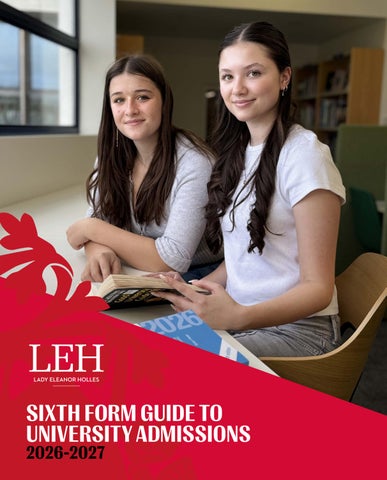
SIXTH FORM GUIDE TO UNIVERSITY ADMISSIONS
2026-2027

THE BEST IS YET TO COME!
Welcome to our university admissions guide as you begin to think about the exciting chapter that awaits you beyond LEH. At LEH, your experiences in the Sixth Form should provide the launch for your bold futures, giving you the opportunity, ambition, and the confidence to pursue what genuinely inspires you.
One of the things that makes LEH students stand out is the brilliantly eclectic range of passions you bring to the Sixth Form. I am always struck by the breadth of university courses, ideas, and aspirations you share, and by your willingness to think independently about the future you want to create.
Choosing what comes next may feel like one of the biggest decisions you have faced so far, but you will not be making it alone. LEH is here to support and challenge you as you explore your options and decide what a bold and fulfilling next step looks like for you.
Our goal is always to help you think deeply about your passions, about what will keep your mind engaged and curious, and what will enable you to lead a purposeful and rewarding life beyond school.
Through our Futures Programme, you will meet inspiring alumnae from a wide range of fields, helping you to see the many different paths open to you and to imagine where your own strengths and interests might lead. Alongside this, our Futures team will be on hand at every stage of your journey, whether you are selecting the courses best suited to you, completing your UCAS application, or preparing for university interviews in the UK, the US or across Europe. Our support doesn’t just end when you leave LEH, we are there through our Alumnae programme to continue to guide and connect you well beyond graduation from school and university.
We hope this guide proves helpful as you begin to shape your plans, and that it gives you a clear sense of the guidance, expertise, and encouragement you can expect from everyone at LEH.
We cannot wait to see where your bold future takes you.
Rowena Cole Head Mistress


LIFE BEYOND LEH
The two years that pupils spend in the Sixth Form at LEH are a time of almost unparalleled excitement and opportunity. They develop their skills, interests and personalities in diverse and life-changing ways, and derive a sense of purpose and direction for their future lives.
The aim of this booklet is to enable you to make the most of all the support and opportunities available to guide you through some of the most significant and challenging decisions you will need to make about life beyond LEH.
Whatever path you choose to follow, we strive to ensure that the foundations have been securely laid for your future happiness and success.
Lauren Viola Head of Sixth Form
KEY MEMBERS OF STAFF
Mark Tompsett
Interim Head of Futures
University Additional Tests Co-ordinator
Catherine Nicholls Deputy Head of Higher Education & Futures
Catherine Packer
Medical University Applications Co-ordinator
Helen Barnett US University Applications Co-ordinator
Charlotte Livingstone Oxbridge Co-ordinator
Lauren Viola Head of Sixth Form
Lindsay Fairholm Exams Officer
LADY ELEANOR HOLLES
Hanworth Road, Hampton, TW12 3HF
T: 020 8979 1601
E: futures@lehs.org.uk www.lehs.org.uk
SIXTH FORM GUIDE TO UNIVERSITY ADMISSIONS
2026-2027
CONTENTS
2. Welcome from Rowena Cole, Head
6. Key dates / Application timeline
9. Choosing the right course at the right university
12. Applying to university - how to make the most of your application
14. Applying to university - summary of Enrichment Activities
16. Writing your personal statement
17. Preparing for interviews
18. Fairs and Gap Years
19. References and predicted grades
20. Applying to Oxbridge
23. Applying for Medicine, Dentistry and Veterinary Medicine
24. American universities and applying abroad
26. Admissions tests
27. Preparation for life after LEH
27. Disability/Special Needs
28. UCAS Flowchart
30. Useful websites
KEY DATES / APPLICATION TIMELINE
LOWER 6
November Update Morrisby questionnaire.
December Introduction to Unifrog software.
OVERVIEW OF KEY EVENTS
We aim to provide a comprehensive support programme throughout the UCAS process. The following summary outlines the process. However, individual support is available at all times from either Sixth Form Tutors or the Futures Team.
January Start researching universities and courses. Start individual meetings with Futures Team.
February Continue individual meetings with Futures Team.
UCAS Evening.
March Higher Education Fair.
April / Easter holidays Start narrowing down university choices by visiting them on open days and / or independently.
Please check with individual universities for Open Day dates.
May Making the Most of your University Open Day sessions.
Internal Examinations.
June Internal Examinations continued.
Predicted A level grades released.
Deadline for requesting any SEND Statements for University Applications.
Summer Holiday Prepare draft Personal Statement. Continue reading and supercurricular exploration.
UPPER 6
September Personal statements shown to subject staff, Sixth Form Tutor, English consultant and Oxbridge Mentor, if appropriate. Complete UCAS form.
October It is strongly recommended that all UCAS applications should be completed by the October Half Term.
January A level Mock Examinations.
May/June A level Examinations.
13 August 2027 A level Results Day.
IMPORTANT DATES
Late June in Lower 6 Predicted A level grades released.
Early July
All students to provide Form Tutors with a first draft of their Personal Statement. Oxbridge applicants should also share this with their Oxbridge Mentor.
First day of term in September in Upper 6 Deadline for completing first personal statement draft.
July – late September UCAT must be taken.
September – October LNAT must be taken.
October Half Term UCAS form completed and handed in.
Late October / Early November Admissions Tests.
Mid-November Mock Interviews.
December Oxbridge applicants interviewed.
In order to study a subject at a university in the UK, you will need to make an application
through UCAS Apply
PREPARATION AND SUPPORT
In the January of Lower 6, you will be encouraged to research the subjects and universities to which you may wish to apply. LEH uses the Unifrog and UCAS Hub platforms which can help you narrow down your options however, you may also want to take a look at the books and resources available in the Futures Room. Our experienced Futures staff are on hand and you can use their knowledge and suggestions to help inform your research.
Sixth Formers are invited to revisit the Morrisby questionnaire. Responses are then analysed and possible degree courses and career areas are suggested based on interest levels and skills.
In January or February, every member of Lower 6 has an individual meeting with a member of the Futures Team to discuss their plans and receive advice on any particular issues. The findings from their Morrisby questionnaire is also discussed and the students can seek clarification on any ideas and queries that may have arisen.
Access to the Futures Room and its resources is available to all students at all times during the school day. A member of the Futures Team is available to answer individual questions every lunchtime or appointments can be made for other times during the school day.
In the Summer Term of Lower 6 and Autumn Term of Upper 6, there are sessions on the different parts of the UCAS process, including writing personal statements, filling out the application form, researching courses, preparing for interview and investigating future careers.
We encourage students to discuss their options with their subject teachers and Sixth Form Tutor. The process culminates in the UCAS Day when the Upper Sixth are taken off timetable to finalise their personal statement, complete their UCAS form and have an individual meeting with their Sixth Form Tutor.
APPLICATION PROCESS 2027
The Head, Head of Sixth Form, Oxbridge Tutors, Futures Department, Form Tutors and subject staff all play a part in the preparation of our students’ applications for post-A level courses.
The main features of the system are as follows:
Using UCAS Apply, students will complete their application, which includes:
a) Choice of course: subject(s), location, 2027 deferred entry/post-A level application.
b) Student’s personal statement.
c) School’s reference.
Preparing for interview (where applicable)
a) Traditional individual interview and other selection procedures.
b) Post-A level application Open Days/informal discussion or interview.
Making decisions on firm and insurance acceptances.
Results – August 2027
Staff are available to help Upper 6 students on results day and afterwards to advise and assist with any action that may need to be taken.
Students should ensure that they are not away on holiday at this time.
CHOOSING THE RIGHT COURSE AT THE RIGHT UNIVERSITY
In order to make the right choices for them, students should expect to undertake a considerable amount of research, as each individual will have a different set of criteria when searching for the right course for them. Questions to ask include:
• Which subjects really interest me?
• What are my talents?
• What grades will I realistically achieve?
• Would I like to combine subjects or concentrate on just one?
• Would I like some experience in the workplace as part of my course?
• Would I like to study abroad as part of my course?
• Would I like a vocational course to prepare me for a particular career?
• How would I like to be assessed – exams, coursework, practicals?
• Do I want to live close to home, a different part of the country, or go abroad?
• Do I want to live on a campus, in a big city or a rural location?
• How much will it cost – tuition fees, accommodation, living expenses, travel?
• Which universities are good for my subject?
• What are the facilities like?
• Is there a good range of clubs, societies, social events?
• What are my career goals?
Only after considering these sorts of questions to establish the criteria on which the choice is being made can a student start to find the right course at the right university for them – one where they will be happy and successful. There is no single university that is ‘best’ for everyone.
We encourage students to talk through their ideas with family, friends, teachers, futures advisers and university admissions tutors (remembering that not all the information they receive will be impartial) before weighing up the evidence and making their decisions.
CHOOSING A SUBJECT TO STUDY
You must feel passionate about the degree subject you choose. It should be a subject that you are willing to get out of bed for on a cold winter’s day in order to go to the library and learn more! Degrees last for a minimum of three years so you need to be sure that you will enjoy studying your discipline in detail and depth for that length of time.
Aside from your own enjoyment, there may be other things you will want to consider:
Whether you are good at it and like it
You may have dreamt of studying one subject at university, and certainly aptitude often goes hand in hand with interest. However, it is possible to be good at a subject that you are not very interested in, and vice versa. It may sound obvious but make sure you know your strengths and play to them.
What course the university actually offers
Many universities offer courses in what superficially appear to be the same subject. However, the content of the courses may be sufficiently different to warrant a closer look before you make a decision. Be clear about the different options available.
Geography applicants may be interested to know that many universities offer a BA and a BSc course. Similarly, students who are finding it difficult to decide between humanities subjects may find the Combined Honours in Arts or Liberal Arts courses offered by some universities appealing. Alternatively, a broader programme is offered by the Scottish university system. Have fun exploring.
For students who are considering studying two subjects, be very clear you understand the difference between a course that offers one subject with another, and a course that offers one subject and another; the former will focus primarily on the first named subject, whereas the latter will strive to achieve a balance between the two.
“Make sure you really want to study your subject. Do not just choose something because you think it’ll be easy to get a place. Bear in mind that once you have that place, you then have to study your chosen subject for the next three or more years.” Former Sixth Form pupil, Oxford Graduate.
You may also want to consider the ‘extras’ that are offered as part of a course, such as study trips, tours and visits. ‘Sandwich’ courses are so named because you can spend a year in an industry or work placement.
Finally, you may want to find out if the university course will allow you to participate in schemes where you can spend between 1 – 3 terms at a university in Europe. There are now many options for study abroad and visiting overseas campuses.
Core and optional modules on offer
The university faculty websites offer detailed information about the modules you will study. Find out about the flexibility of the course and whether you will have an opportunity to pursue independent study. If so, are there options available that excite you?
Employment opportunities after university
Many students choose degrees because they obviously lead into particular careers. However, remember that degrees offer different skills and it is your application of these skills that will help to make you employable.
RESOURCES AVAILABLE
Books
The UCAS Guide to Getting Into University & College
Choosing Your Degree Course & University - Brian Heap
The Times Good University Guide
League Tables (UCAS and newspapers)
Online resources
UCAS website www.ucas.ac.uk
This is the section specifically for parents. www.ucas.com/ how-it-all-works/ parents-and-guardians
Once you have registered an account on the UCAS website you can access specific areas for parents and guardians.
Individual university websites
For information on EU student exchanges visit: www.erasmusprogramme.com/ the_erasmus.php
This programme will become available in the UK once more in 2027.
Student Finance: www.gov.uk/student-finance
Choosing universities for UCAS: www.unifrog.org/
Discover Uni - a website comparing subjects at different higher education institutions: www.discoveruni.gov.uk
We no longer hold university prospectuses but there are computers in the Futures room for students to use and access online resources including:
• Gap Year material.
• Business, Independent Tutorial Colleges, Art and Drama Colleges.
• Study abroad optioins, including American and European universities.
You are welcome to look through these resources in the Futures Room, but they must not be removed (not even into the Common Room), as they will be in constant use.
Please make sure that course information is always cross-checked with the university website.
The current University League Tables are available online. They should be studied and interpreted with care, as some of the information may have been assessed five or six years ago.
Come and use the computers for research, and call in, without appointment, to our ‘Drop In’ clinics (timetable on the Notice Board in the Futures Room and Sixth Form Common Room) or make an appointment for a chat.
The Morrisby programme is offered to all students followed by a one-to-one meeting with a member of the Futures Department. This programme can help with university and course selection.
Futures Centre
APPLYING TO UNIVERSITY –HOW TO MAKE THE MOST OF YOUR APPLICATION
ENRICHMENT AND SUPERCURRICULAR EXTENSION
Whichever universities you decide you’d like to attend, LEH offers a unique opportunity to strengthen your application.
Academic Enrichment
An important and exciting way to enrich your academic life is to pursue your passion for your subjects outside the confines of the examination specification. All academic subjects offer Sixth Form enrichment lessons (known as ‘+’ lessons) where students are introduced to new ideas, thinkers and writers, and all candidates should discuss a programme of wider reading with the relevant Heads of Department.
Intellectual discussion and debate is encouraged to increase your enthusiasm for the subjects you love. University lecturers are sometimes invited to deliver a lecture where you are introduced to new topics and the most up-to-date thinking in your proposed area of specialism. This is an excellent opportunity to have a taste of what university life could be like. There are usually opportunities to ask questions and discuss your own ideas with the lecturers.
If you want to apply for a degree subject that does not easily fit into the School’s academic programme (e.g. Law, Archaeology, Anthropology, Medicine) we aim to organise suitable support in that subject area so that you have the best chance to succeed.
There is also the opportunity to undertake an Extended Project Qualification (EPQ).
“...the sessions on Presentation Skills made the final part of the EPQ [presentation] so much easier to plan…” Former Sixth Form student
“...I chose to do an Extended Project in Political Philosophy because I found the subject fascinating. Actually sitting down and writing the project has been really valuable, forcing me to work out how to argue for my position in an organised and coherent way…” Former Sixth Form student
Critical Thinking
Becoming an independent thinker is important. You need to develop clear strategies for processing, organising and presenting information. Understanding how arguments are formulated and developed is crucial for you to devise your own hypotheses and communicate them in a convincing way. Logical debate and discussion are also essential skills.
Extra-Curricular Enrichment
The Extra-Curricular programme expands as you enter the Sixth Form. We continue to offer a wide range of opportunities in sports, music and drama, whilst focusing increasingly on leadership development.
• Taking on positions of responsibility and leadership such as Peer Mentors, House Captains, Futures Ambassadors, etc.
• Attendance at Be Bold! Lectures to broaden academic and career horizons.
• Attendance at subject-specific clubs, e.g. Medsoc.
• Volunteering positions, such as the Charity Committee.
• Competitions – e.g. essay-writing competitions, Olympiads.
• Engaging in joint enrichment programmes with Hampton School, including the Senior Robotics Club, SATB choir and Adventure Society activities.
• If an extra-curricular activity that you’re interested in doesn’t exist, start a new one!
The entire programme is open to all. Taking a full, active and leading role is an integral aspect of the ‘LEH experience’.
“...if you are passionate about your subject, the subject sessions will fuel your enthusiasm even more…” Former Sixth Former
Open Days and Taster Days
A number of universities run day-long courses for prospective applicants to experience what it is like to study a particular subject at degree level. Many of the London universities, in particular, find this a useful way of encouraging students to apply to their institutions. Applicants who are interested in degree courses which are not available as an A level subject (such as Law or Sociology) have often found taster days especially beneficial in confirming their subject choice at university level.
Students will be allowed up to three days within the year to attend Open Days or Taster Days during school time. It is important that parents/guardians use the form in the ‘Let Us Know’ section of My School Portal to alert the school well in advance of these plans. Where possible, we strongly encourage students to plan their visits at weekends or during the holidays to avoid missing lessons.
Work experience
While work experience can be exceptionally useful in general terms in gaining an understanding of the wider world of work, there are a number of degree courses where the completion of high-calibre work experience can not only strengthen a future application but can also be a pre-requisite for entry onto the course. Many of the more vocational courses, such as Medicine, Dentistry and Veterinary Medicine, will expect applicants to have gained some work experience in order to give them an understanding of the profession prior to application. We are happy to advise pupils about the value of work experience, and we would recommend consulting the university websites to ascertain how much work experience is advisable in order to enhance a future university application.
Internships
Many pupils choose to spend some of their holiday time in the Sixth Form completing internships in London-based companies or indeed completing year-long placements in such firms prior to starting at university. For some pupils, this represents their first steps on their career path, sometimes leading to further opportunities during their university years. Application processes can be rigorous for such ventures but pupils who have completed internships in the past have
found them extremely rewarding. Deloitte and Goldman Sachs are two of several companies where pupils have benefitted from these opportunities in the recent past.
SUMMARY OF ENRICHMENT ACTIVITIES
“I
received excellent support from the Futures Department, and also my Form Tutor. I feel that I would not have been in such an advantageous position had it not been for all the assistance available in preparing my university applications.”
Former Sixth Form student, Cambridge graduate.
LOWER 6 ACADEMIC
JANUARY
Join the academic Subject+ lessons to develop your passion and knowledge of your proposed degree subject.
Join Medsoc.
Begin attending Oxbridge sessions.
FEBRUARY Lower 6 Research Week to help you expand your exploration beyond the curriculum in your A level subjects.
MARCH
APRIL
MAY
Internal examinations.
JUNE Internal examinations.
Attend UCAT Training.
Continue engaging in Subject+ sessions and independently building your supercurricular profile by engaging with reading, podcasts, talks, etc.
JULY
AUGUST
UPPER 6
SEPTEMBER
OCTOBER
NOVEMBER
Subject+ sessions targeted towards meeting the needs of those applying to Oxford, Cambridge and any other universities which have additional entrance tests.
DECEMBER INTERVIEWS
We run Be Bold! Lectures across the school year which provide a wonderful opportunity to explore passions and
CORE SKILLS TEACHER ADVICE
OXBRIDGE-SPECIFIC ADVICE LOWER 6
Session on research skills and EPQ planning. JANUARY
Online networking event with alumnae studying at Cambridge and Oxford Universities.
UCAS Evening. FEBRUARY
Higher Education Fair.
Visits to London universities, meeting with alumnae.
Further EPQ planning sessions.
Provisional A level predicted grades issued to pupils.
Confirm interest in applying to Oxford and/or Cambridge. MARCH APRIL
MAY
Choosing a college meeting.
Applicants assigned an Oxbridge Mentor.
Oxbridge team suggest appropriate colleges for prospective applicants.
JUNE
Choose subject, course and university.
Draft personal statement.
Seek advice on personal statement. Update Sixth Form Tutor.
Start filling out UCAS form.
Applicants meet with Oxbridge Mentor.
Confirm college choice.
Aim to complete UCAS application by UCAS Day.
JULY AUGUST
UPPER 6
SEPTEMBER
Aim to complete UCAS form by October Half Term. OCTOBER
WRITING YOUR PERSONAL STATEMENT
Writing a personal statement can be a challenging exercise. It is worth spending time over this and not leaving it to the very last minute. It is the one thing on a UCAS application that says something about who you are as an individual.
A good personal statement should reflect your engagement in the subject. Keeping a diary or log of your enrichment activities, considering why you love the subject and what specifically fascinates you should make it slightly easier to start.
You should show evidence of your motivation for your subject. How have you furthered your interest outside of your Sixth Form classes? Have you attended lectures or master classes and studied short courses online with Future Learn. Have you visited museums, exhibitions or the theatre?
Make notes on what particularly captivated you. What have you read independently? And again, what specifically caught your attention? Remember, including examples makes you sound much more convincing.
A possible structure could be as follows:
The three questions in the Personal Statement section of your UCAS application will help you to scaffold your answers and ensure you include exactly what universities and colleges want to see, to help you succeed in your applications. Each answer will have a minimum character count of 350 characters, which is clearly labelled on the question boxes, along with an overall character counter, so you can keep track. There is an overall limit of 4,000 characters (including spaces).
Question 1: Why do you want to study this course or subject?
This is your opportunity to showcase your passion and knowledge of your chosen subject area and to demonstrate to universities and colleges why it’s a good fit for you and your future ambitions.
Question 2: How have your qualifications and studies helped you to prepare for this course or subject?
This is your chance to shout about the relevant or
transferable skills you’ve gained from your formal education and highlight your understanding of how they will help you succeed in this subject area.
Question 3: What else have you done to prepare outside of education, and why are these experiences useful?
This is your chance to talk about any other activities you have undertaken outside of your formal education or personal experiences which further demonstrate your suitability for the course. This section is likely to be highly personal to you and anything you do include should reflect on why you’re including it.
The next step is to emphasise the skills you have and show how you have developed your own interest. You will need to mention examples of your reading, competitions you have entered, discussions you have participated in, your EPQ project as well as the skills you have learnt from your Sixth Form courses. Try to discuss these things in some detail. Don’t just reel off a list of books you’ve read; rather, identify key points that you found intriguing and provide examples of how they have particularly motivated you.
Finally you will want to say something about who you are as an individual and this is the moment when you can discuss the extra-curricular activities in which you are involved and how they have helped you develop your personality and your life skills.
Make sure that you use your own words as universities check for plagiarism.
Students planning to apply for an Oxbridge course should provide their Oxbridge staff mentor with a first draft of their personal statement by the end of the Summer Term in Lower 6. For all other courses, we expect Upper 6 students to have the first draft of their personal statement ready in time for the first day of the Autumn Term in Upper 6. The Autumn Term is very busy and it is important you use the ‘mental space’ that the summer holiday provides to start thinking through what you want to include.
You will need to seek advice from your subject teachers and
your tutor. There is also an English specialist who will help you to ensure that you are using accurate and precise English.
Remember, some of you may be facing the prospect of an interview. Therefore, ensure that whatever you write on your personal statement is true and that you are able to discuss it in detail if questioned.
It is important that you are prepared to take responsibility for your personal statement. It is a reflection of who you are. Spend quality time working on it. Avoid clichés yet maintain sincerity.
Above all else, when you have finished it, read it again and be proud of who you are and what you have achieved in your life so far.
“I felt really well supported by the Futures staff...the UCAS evening for parents and students was very informative and we were given plenty of time to complete the process. Everyone’s personal statements were checked through by at least two teachers to ensure a strong entry…”
Former Sixth Form student
PREPARING FOR INTERVIEWS
Some universities do not interview their applicants and make offers based entirely on the UCAS application form. However, there are universities (such as Oxford, Cambridge, UCL and Imperial College, London) that do interview many applicants. Similarly, admissions tutors for courses such as Medicine or Education are also keen to meet their prospective students. In addition, there are some universities that will interview for particular courses.
For some, this will be the first time you are interviewed and it can seem like a daunting experience. Try to look forward to it. View it as an opportunity to discuss a subject you love with someone who shares your passion.
LEH organises a number of different activities to help you prepare for this experience.
Within the Futures Programme there are two sessions focusing on interviews and interview preparation. As well as discussing general approaches and offering tips and advice, we encourage pupils to interview each other in front of each other, receiving constructive criticism from the teachers involved.
In addition, we contact recent Oxbridge alumnae to tap into their experience of interviews and share their expertise with any interested applicants.
Mock interviews are also arranged by the relevant departments for individuals who are likely to face an interview as part of their application process.
“The practice interviews helped to give me a good idea of the sort of questions I might be asked and made me think on my feet. That way I felt better prepared for the real thing.”
Former Sixth Form student, UCL graduate.
FAIRS AND GAP YEARS
Higher Education Fair
The Higher Education Fair is held in March of Lower 6. We invite universities from the Russell Group and other institutions popular with LEH students. Some of the delegates are student ambassadors, and may even be ex-pupils, and all are well placed to offer helpful advice; they bring copies of prospectuses and other useful materials. The Fair gives you the opportunity to find out more about specific places and courses. It is a popular event and other local schools usually join in. Students have enjoyed clarifying questions about courses and locations, and addressing any anxieties about university life in general.
A number of gap year providers also attend the Fair.
What is a gap year?
The phrase ‘gap year’ has traditionally meant spending a year abroad on a structured programme while taking a break from study. However, gap years can be taken by anyone, and for varying lengths of time.
For example, you could choose to fly off to sunnier climates and experience a different culture for a few months during your summer break. Alternatively, you may wish to stay closer to home and sample what the UK has to offer.
Whatever your destination, some examples of gap year activities include conservation work, adventure travel programmes, summer schools and internships.
Why take a gap year?
A gap year offers you the opportunity to gain skills and experiences, while giving you time to reflect and focus on what you want to do next.
• A productive gap year can be valuable on your CV – many employers value the experiences students have gained if they’ve actively managed their time, set themselves goals, and stretched themselves.
• A gap year can also enhance your higher education studies – if you decide to apply for university, you could tailor your gap year to relate it to the subject area you plan to study.
• Admissions tutors know that some students may take a little time to adjust to studying again, but many former gap year students are generally more focused and responsible.
REFERENCES AND PREDICTED GRADES
You will receive your predicted grades during the Summer Term of Lower 6. The predictions are to help you make a realistic application. Make sure you have a range of universities that are likely to make you different offers. This is important for deciding on a firm and insurance place.
Procedures for A level Predicted Grades
Universities use predicted grades for pupils’ A level subjects as part of the selection criteria for making offers to study at their institutions. Staff at LEH are very experienced in predicting and, without being unrealistic, we predict grades which will maximise the pupils’ chances of being made offers for their first choice universities.
Once the internal examinations have been completed in June, pupils will be given two grades:
• A predicted grade which reflects pupils’ highest potential in each of their A level subjects. This is the grade which will be included on the pupils’ UCAS forms and a predicted grade issued at this stage will not be lowered subsequently.
• A second grade which indicates current performance: the level at which the student is currently working.
If there is a discrepancy between current performance and ultimate potential, the pupils will be helped to focus their efforts and attention in the right way during their Upper 6 year.
If a pupil is unhappy at this stage with the predicted grade in any of their subjects, they may ask the Head of Department to reconsider the relevant prediction. Heads of Department may request pupils to complete an additional piece of work over the summer to demonstrate their suitability for an increased prediction. Pupils should provide the Head of Department with any such work as soon as they return to school in September. Please note that a request from a pupil for a predicted A level grade to be reconsidered does not automatically result in an improved prediction. Each case is judged on its own merits.
Departments may also agree to amend a predicted grade on the basis of work completed in the first couple of weeks
of the Autumn Term of Upper 6. Here, not only the quality of work is considered but also the attitude and commitment shown by the individual. Each academic department will have its own policy on how to arrive at any change in prediction.
The deadline for any amendments to predicted grades is designed to coincide with UCAS Day (typically around 20th September), a day off timetable when all Upper 6 pupils and their Form Tutors meet to discuss the completion of individual UCAS forms, including finalising their personal statement and have an individual meeting with their Sixth Form Tutor.
These procedures are followed with the pupils’ best interests at heart, seeking to maximise their chances of success at their first-choice universities while also retaining our professional integrity with UK universities as a school whose predictions can be relied upon.
APPLYING TO OXBRIDGE
What is the Oxbridge experience?
Studying at either Oxford or Cambridge is a dream for some A level students. The world class academic reputation, beautiful environments and rich cultural history combine to attract some of the brightest students.
These prestigious institutions offer a specialised and unique university experience. Whilst upholding the best of respective traditions, both universities strive to remain at the pinnacle of academic excellence and modern achievement.
Studying at Oxbridge
Oxford and Cambridge are two of the few universities in the world that use the tutorial system for teaching. Tutors teach one or two students per session through discussion and question and answer techniques. Students present their weekly work and are challenged to develop and extend their ideas.
In addition, students are expected to attend lectures, seminars and laboratory sessions. The arts students have a much more flexible timetable and are able to choose the lecture courses they follow. They are expected to make up the time with reading and independent study. In contrast, the scientists have a busy regime and follow a more rigid timetable.
“I’ve loved studying at Cambridge. It’s true that there’s a lot of work but I try to balance this work with social stuff and extra-curricular activities. The good thing about studying here is the fact that you get to know your supervisors quite well as you see them on a fairly regular basis, which means that there’s always someone to talk to if you find what is being set hard or you can’t get it done in time for the deadline. I originally found the supervision system daunting but most supervisors just want to talk about your opinions on whatever you’re studying, and in turn it’s great hearing their opinions. The social life in Cambridge is also really good. Obviously people do have quite a bit of work but everyone seems to cope with doing their various interests and going out at the same time. Everyone’s in the same boat and it just means that you really appreciate the social aspect of university life.” Former Sixth Form student, Cambridge graduate.
Am I right for Oxbridge?
Oxbridge can be an exhilarating and exciting experience; many people have a wonderful time. However, Cambridge and Oxford are not the only universities to consider. The style of education they offer is not right for everyone and therefore it is important to make the right decision for you. Think through what your personal priorities are and ensure you fully consider all your options.
The academic education is rigorous. Standards are high and for many people, it will be the first time they are seriously challenged intellectually. Students are taught by world-class experts who are ready to push your ideas in new directions in a way that you will never have experienced before. The workload is heavy and you will need to find the prospect of defending your ideas exhilarating. An Oxbridge student can expect to work on about two essays a week. Some universities set between two and four per term. In addition, the Oxbridge term lasts for eight weeks as opposed to the usual ten/twelve. The pace is fast, demanding and you will need to use the vacation periods for preparation. High levels of motivation and organisation are a must.
You also need to consider whether you would enjoy living within a collegiate system. You will be spending at least three years in Oxford or Cambridge and therefore, you need to ensure that the environment is one you can feel at home in.
Choosing a college
Students live and work in college communities. The college becomes the centre of their academic and social lives. However, there is a strong whole university community and students readily mix with people from other colleges by meeting them through their course or by participating in one of the many university clubs and societies.
In order to make an informed decision, you will need to consider the following:
Academic Life
• Does the college offer my course?
• How many students are admitted for my course?
• How many tutors are there for my subject? What are their research interests?
• What is the library like? Are there other resources available that would benefit me?
“It’s amazing, especially at Murray Edwards (an all female college), as we have quite a sisterly community and there’s always support when you need it. Coming from LEH, most people tend to live a bus or train ride away, whereas here you can just visit your neighbour next door. The community is much more close-knit than in a big university town, which means you’re bound to see a friendly face on your way around lectures!” Former Sixth Form student, Murray Edwards, Cambridge.
Social Life
Think about the sort of environment in which you want to make your home.
Location
Some people like to live in the hub of the city whilst others are keen to see open spaces. Find out what you prefer.
Age and Architecture
Many colleges are beautiful and seem to inspire creativity but do not be completely swept away by romantic dreams of ivory clad towers. Step inside the more modern colleges and explore. Remember that decent central heating and fitted wardrobes can be equally appealing and comfortable.
Facilities
Some colleges offer rooms in college for three years whilst others have opportunities to live out in student houses. Some have college gyms, theatres, music rehearsal rooms, a formal hall in a typical ‘Oxbridge’ dining room. Think about what is important to you.
Size
Physical size of the college and the size of the student population.
Atmosphere
The colleges all have their own particular atmosphere. Talk to the students. Find out what’s important to them.
Try to imagine where you would fit in and feel happiest. Having said that, if eventually you are pooled to a different college after the interview process, then you will very quickly feel a loyalty to your new home.
Male/Female ratio
There is no longer an all female college in Oxford but there are still some colleges where the percentage of men to women is greater or lesser. In Cambridge, there are still two female only colleges. Just because you have attended a girls’ senior school, do not immediately rule out an all female college. You can still be taught with boys, you can still visit boys living in other colleges, and boys can still visit you.
Making an application
The first important step is research: use the resources available in the Futures room, request the prospectuses, visit the universities on Open Days, and arrange a meeting with an admissions tutor at the college you like and/or the subject for which you want to apply.
We host events with alumnae at Oxford, Cambridge and London universities in the Spring Term. Lower 6 pupils are invited to attend in order to meet former pupils who are currently Oxbridge or London university students.
Develop your subject knowledge:
• Attend the ‘+’ enrichment lessons available in your subject area at school.
• Read authors or theories that you already enjoy. Develop breadth and depth. Find out about the leading thinkers in your subject area. What are they famous for? Why are they important? How did they get there? When you read, try to make connections and parallels with other ideas that you have seen or read elsewhere. Find good examples, consider how to illustrate and speak about your ideas.
Keep a reading diary. You should aim to read significantly beyond the syllabus of your subjects. Start with your personal interests. If you are stuck, read material that may be linked to things you are already studying. For example, if you are an English student who enjoyed studying Pride and
“My college is brilliant! The people here are all so different that it’s very easy to find like-minded people and there are so many activities going on within college that you get to know everyone very quickly.” Former Sixth Form student, Cambridge graduate.
Prejudice, the obvious place to start is to read Austen’s other novels. What would be even more interesting would be to read some of the material that Austen herself may have read. If you are a scientist, you could perhaps explore the development of a recent discovery in science. Trace the history of the discovery. See if you can find out which past scientists might have influenced the breakthrough.
In addition, look out for lectures, master classes, exhibitions, concerts, plays – anything that may be relevant for your proposed course.
It is also important to be aware of what is happening in the world so that you can discuss the wider implications of your subject more confidently.
Read The Economist, The Week, watch Newsnight, Panorama, Question Time, or listen to the Today programme on Radio 4. You could also make use of podcasts and plug in to interesting sessions when you are at the gym or walking to school/meeting friends.
LEH’s policy is to encourage students to make an application and we certainly never say that they cannot apply to Oxbridge. However, we are experienced in offering advice and, in view of the increased levels of competition, we believe it is important to provide you with constructive and regular feedback in terms of your suitability as an applicant. The process is challenging and for you to achieve the success you desire, we believe it is necessary to be honest and supportive so that you make the right decisions for you and have the opportunity to strengthen your application.
“So far it has been really good fun. At the moment I have one essay a week, which at first I thought was a lot, but in comparison to other subjects I think it may be a bit less than average. I find writing the essays takes the least amount of time; it’s the reading that takes me ages. This is partly because the essays are mostly on concepts I’ve never studied before, but also because so many books and articles are suggested on the reading lists. The resources are great as there seem to be several libraries that have the books that we need.” Former Sixth Form student, Oxford graduate.
APPLYING FOR MEDICINE, DENTISTRY AND
VETERINARY MEDICINE
Pursuing a career in any of these professions involves lifelong learning. Although competition for entry is fierce and the careers challenging, these professions are also highly rewarding and stimulating.
What are the universities looking for?
A successful applicant will need to demonstrate:
• Scientific knowledge and enthusiasm
• Intellectual curiosity and academic excellence
• Analytical thinking and problem-solving
• Communication skills and teamworking ability
• Empathy and social awareness
• Committment and tenacity
• Integrity and dependability
• Organisational ability and leadership potential
In addition to a strong academic background, a growing portfolio of work experience and community service is essential.
The Lower Sixth year is the time for you to confirm your vocation and broaden your understanding of the Medical, Dental or Veterinary professions by undertaking further work experience or work shadowing.
In particular, community service brings you into contact with the wider public and develops interpersonal skills.
Although it can be hard to secure hospital work experience before you are seventeen, and issues of patient confidentiality may make it difficult to arrange a placement with a GP, persistence will pay. If you are flexible and explore wider options, you will succeed.
Useful website: www.themedicportal.com
How do we help?
We have a loyal and committed alumnae community of veterinary, medical, and dental professionals who regularly engage with Medsoc. They generously share insights into their medical school experiences, provide application updates, support interview preparation, and offer guidance on obtaining relevant work experience.
What can you do?
Join Medsoc
Medsoc meets for a lunchtime discussion at 12.40pm, this year on a Wednesday. Members are guided through the application process and use this time to share ideas and discuss ‘hot topics’.
The Application Process Medics, Dentists and Vets are allowed to apply to four universities, so it is important for you to pitch your application correctly, giving thought to the style of teaching and learning that suits you. A fifth choice of a related science course can be used.
Read prospectuses and websites and visit the universities before applying Discuss your choice of universities and UCAS Personal Statement with Miss Packer by appointment.
University Entrance Tests form an important component of a pupil’s university application. For Medicine and Dentistry, everyone sits the UCAT. UCAT training is provided and you will need to set aside time during the summer holidays of the Lower 6 to prepare and sit the test.
A half day MMI interview course is offered as well as practice panel interviews with our team of alumnae mentors.
The application process can seem long and daunting; however, by availing yourself of the help and advice on offer at school and with the mutual support of your fellow applicants, you can improve your chances of securing a place on one of these sought-after courses.
AMERICAN UNIVERSITIES AND APPLYING ABROAD
Applying for an American University is becoming more popular amongst UK school students.
Previous applicants have been attracted to the broader curriculum, the core of which typically consists of science, civilisation, languages and quantitative skills. The universities aim to teach students how to think, not what to think. There is also a possibility of winning sports and academic scholarships.
If you are considering an American application, you will need to conduct extensive research. LEH can also introduce you to experts who have significant experience guiding UK students through the American University application process.
Choosing a university will require careful thought. Students tend to gravitate towards the well known ‘Ivy League’ universities. However, the Ivy League actually refers to the eight colleges that regularly play in sports matches against each other.
There are in fact over 50 top American universities so you will have many from which to choose.
Admissions Officers look for high calibre students with a strong academic profile who also contribute to extra-curricular activities. They also look carefully at the candidates’ character and personal qualities. It is important their applicants are able to challenge themselves. If you wish to apply to an American university, you will probably need to sit a standardised test. The two options are the SAT or ACT papers.
SAT
• SAT: Evidence-based reading and writing, mathematics and optional essay section.
• SAT Subject Tests: These are not available in every subject and are not required by all US universities.
• Nationally, the average SAT score for the class of 2024 was approximately 1024 out of 1600. A score of 1350 generally places a student in the top 10% of test-takers nationally. At highly selective universities like Harvard, the average SAT scores of enrolled students are significantly higher - recent data indicate averages in the 1520–1550 range.
ACT
• ACT: English, mathematics, reading, science and optional writing sections.
There are books about these tests available to students in the Futures Room. Use them for research and to practise the tests.
Most American universities can be applied to online via the Common Application (though you must check what is relevant for you). Some institutions also require a supplementary form. In addition to providing personal and academic information, you will also need to submit two essays.
The first asks you to discuss your extra-curricular activities and explain why they are important to you. The second is on a topic of the candidate’s choice and is an opportunity for you to give the colleges a more detailed picture of you and what drives you.
On average, a year’s tuition at an American university is $52,000. Financial support and scholarships are also available to international applicants. You will need to do some independent research to see if you are eligible.
If you feel the cost is excessive but are still keen to study abroad, you could explore the possibility of applying to Canada. Canadian universities offer a similar curriculum to their American counterparts but can be a cheaper option.
Applying to universities in Ireland
In recent years, interest in applying to an Irish university has risen, not least because of the lower level of fees under the ‘free fees’ for EU citizens’ scheme. A number of LEH students have gained places at the prestigious Trinity College, Dublin.
The Irish university application system varies substantially from UCAS. It takes place later, in January/February of the Upper 6 year, and is kept strictly anonymous. To ensure this, applicants are allocated random numbers. There are no references, no personal statements and no interviews.
The admissions are overseen by the CAO (Central Applications Office) www.cao.ie., which gives a full account of the steps in the application process.
Applications are online and the system is very straightforward. Admission is based strictly on results. In the case of a UK student, A level results are converted into points which in turn are based on the demand for the course and are subject to change.
Examples of points required at Trinity College
Medicine: 729 points
Mathematics: 545 points
Law and Political Science: 575 points
Economics: up to 570 points (depending on combination)
The scoring system for A levels is as follows:
A* 180
A 150
B 130
C 100
D 75
E 40
Applications are due by 1 February (compulsory for Medicine and other restricted subjects) but can be made as late as 1 May. A candidate can apply to 10 different universities or for 10 subjects at the same university. Less popular subjects will offer a greater chance of acceptance. Some subjects such as Medicine are restricted. Medicine also requires the HPAT (similar to UCAT) which must be taken in Ireland in February.
Students interested in applying to an Irish university are strongly advised to attend the Open Days with their parents (a one day event in December in the case of Trinity College).
Applying to European Universities
Studying at a university in mainland Europe is fast-becoming a popular option for UK students. A number of high-calibre
universities in Europe now offer courses entirely in English and welcome applications from pupils across the continent. Tuition fees at European universities can often be a fraction of the cost of studying in the UK. While it remains unclear how UK applications to universities in mainland Europe will play out in the wake of Brexit, it may well be worth consulting the relevant university websites to see if this option holds any appeal.
ADMISSIONS TESTS TO UK UNIVERSITIES
University Admission Tests for entry to UK Universities
While the requirement to sit university entrance tests varies from one year to the next, the most up-to-date information on all such tests can be accessed here
Candidates for Medicine and Law are routinely pre-tested by their prospective universities, but other faculties, predominantly at Oxford and Cambridge, also pre-assess their candidates.
Students should check on the relevant university websites which courses require admission tests to ensure they have the most up-to-date information available.
Preparation at LEH for all additional admission tests:
• We encourage all students, irrespective of intended university, to be conversant with the requirements of thinking skills tests in general, as these are more and more a feature of job applications.
• We support candidates whose intended courses require an additional admissions test through the provision of workshops in school, where they have the opportunity to look at relevant websites and try their hand at sample questions.
This page provides an overview of the additional entrance examinations that some universities hold to select candidates. Please note that University websites will always hold the most up-to-date information regarding admissions requirements.
The University of Oxford, The University of Cambridge and Imperial College London Oxford, Cambridge and Imperial College London routinely use testing as part of their admissions process. Some tests take place in school in the Autumn Term, and some tests are at interview, depending on the course.
University College London UCL use a thinking skills assessment for their ESPS course.
Mathematics
A select few universities beyond Oxford and Cambridge will look at performance in mathematics tests.
Medicine
Several universities require the UCAT examination as part of the selection process for Medicine courses. Law
Several universities require the LNAT examination as part of the selection process for Law courses.
For the STEP II and STEP III tests:
UCL
PREPARATION FOR LIFE AFTER LEH DISABILITY/SPECIAL NEEDS
Once pupils have completed their UCAS application and (hopefully!) have started to receive conditional offers, we dedicate a fair amount of time in the Upper 6 Futures programme to helping them prepare for the important decisions which lie ahead so that they make the most of the exciting opportunities which university life can offer.
Topics included in this programme encompass the all-important questions of how to apply for university accommodation, knowing how and when to decide which universities to accept as their ‘firm’ and ‘insurance’ options, how to manage student finances and tuition fees, developing the budgeting and culinary skills to survive on a student budget, alongside more general sessions on personal safety and the value of healthy eating.
As a result, pupils complete their Upper 6 year feeling expertly equipped for the challenges of university life both academically and in practical terms.
Results Day: A level subjects
Staff are available to help advise Upper 6 students on Results Day and afterwards when action might need to be taken.
Universities are keen to support students who have specific disabilities/special needs. It is therefore advisable to declare your needs on the UCAS form in the personal details section. Please see Ms Reade, Head of Learning Support, in the allocated timeslot on UCAS day for any advice and guidance regarding this matter.
Please note: Should a SEND statement be required for your University Application, you will need to request this in June 2026 to ensure they are completed before the end of the Summer Term.
University help if you have a diagnosed underlying learning difficulty, mental health problem, long-term illness or any other disability.
If you have a diagnosed underlying learning difficulty, mental health problem, long-term illness or any other disability, you may be eligible to apply for the Disabled Students’ Allowances (DSAs) to cover extra costs that may be incurred as a result of your particular needs. DSAs do not need to be repaid and are not means tested.
You may wish to review your potential entitlement for the DSA by visiting the following website: www.gov.uk/disabled-students-allowances-dsas.
You are advised to apply for this after you have completed your A level examinations and prior to starting your university course. The DSAs previously provided financial support to meet many students’ additional needs, much of this is now being met by individual universities providing reasonable adjustments under the Equality Act 2010. You will need to liaise directly with your receiving university in order to ascertain what help and support they can provide.
UCAS APPLICATION FLOWCHART
1 Apply online*
Check course details to see which deadline your application should arrive at UCAS by.
• 15 October for Oxford, Cambridge or professional courses in medicine, dentistry or veterinary medicine/science.
• January for the majority of courses.
2 Wait to hear back
The universities or colleges will decide whether to make you an offer.
• Either unconditional if you’ve already met the entry requirements.
• Or conditional if the offer is based on your exam results.
3 Reply to your offers
Once all their decisions are in you have to reply to your offers by a specific deadline.
• If your firm acceptance is an unconditional then the place is yours.
• Or if it is conditional it is yours if you meet the entry requirements – you can choose an insurance acceptance as a backup.
• And decline the rest.
Looking for more courses
If you have no offers or you’ve declined them all you can still find other courses.
• Either by adding more choices one at a time in our Extra service.
• Or if you didn’t meet the conditions and Clearing has started, you can see which courses still have vacancies.
4 See if the university or college confirms your place
• They might not if you don’t meet the conditions of an offer.
• But if they do then you’re in – hooray!
• If you’ve met and exceeded your offer conditions you might be able to look for alternative courses. Clearing Plus is now also available, which guides students to relevant universities who have places and match the entry requirements. *
If you miss these deadlines, we recommend you contact your chosen university or college to ask if you’re allowed to apply late as some will accept applications up to 30 June. All applications submitted after 30 June are automatically entered into Clearing.
USEFUL WEBSITES
www.ucas.com
The official universities and colleges admissions website. A massive site to keep coming back to. Students use Apply and Track to make and monitor their online applications.
www.unifrog.org
The easy way for students to choose the best Universities and Apprenticeships for them, and for teachers to track their progress.
www.morrisby.com
A questionnaire to help identify courses linked to a student’s interests and ability.
www.prospects.ac.uk
This graduate website is also a fantastic resource for sixth form students considering university courses. Start with the options with your subject section to research the type of careers that different degrees can lead on to.
www.theuniguide.co.uk
An independent site from Which? to help students make informed choices. You can refine searches by subject, location, interests etc and it includes data on graduate salaries, number of applicants receiving offers and much more.
www.applytouni.com
Includes information on university choices and applications, league tables, student finance and examples of personal statements.
www.thecompleteuniversityguide.co.uk
Independent UK university league tables and advice on university and subject choices.
www.opendays.com
A calendar of university open days.
www.unitasterdays.com
A database of university taster days.
www.futurelearn.com
Free online courses from leading UK and international universities.
www.gov.uk/studentfinance
Information about tuition fees and student finance.
www.moneysavingexpert.com/students
A sixth formers’ guide explaining how student finance works.
www.nhsbsa.nhs.uk/Student-services
The NHS business services authority site includes details of the NHS Student Bursary Scheme which is available to eligible students on some healthcare-related degree courses.
www.thescholarshiphub.org.uk
Search for UK scholarships, grants or bursaries on this comprehensive database.
www.push.co.uk
Independent guide to UK universities, open days, gap years, student life and finance.
www.ucat.ac.uk
Details of the UK Clinical Aptitude Test for admission to some dental and medical schools.
www.lnat.ac.uk
Details of the national admissions test required by some law schools.
www.parentalguidance.org.uk
Advice for parents on the range of post-18 options.
www.russellgroup.ac.uk/for-students
Guidance from the Russell Group of UK universities aimed at Year 11 students making appropriate post-16 subject choices for a wide variety of university courses.