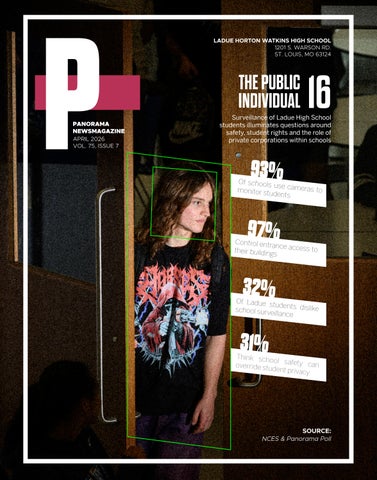
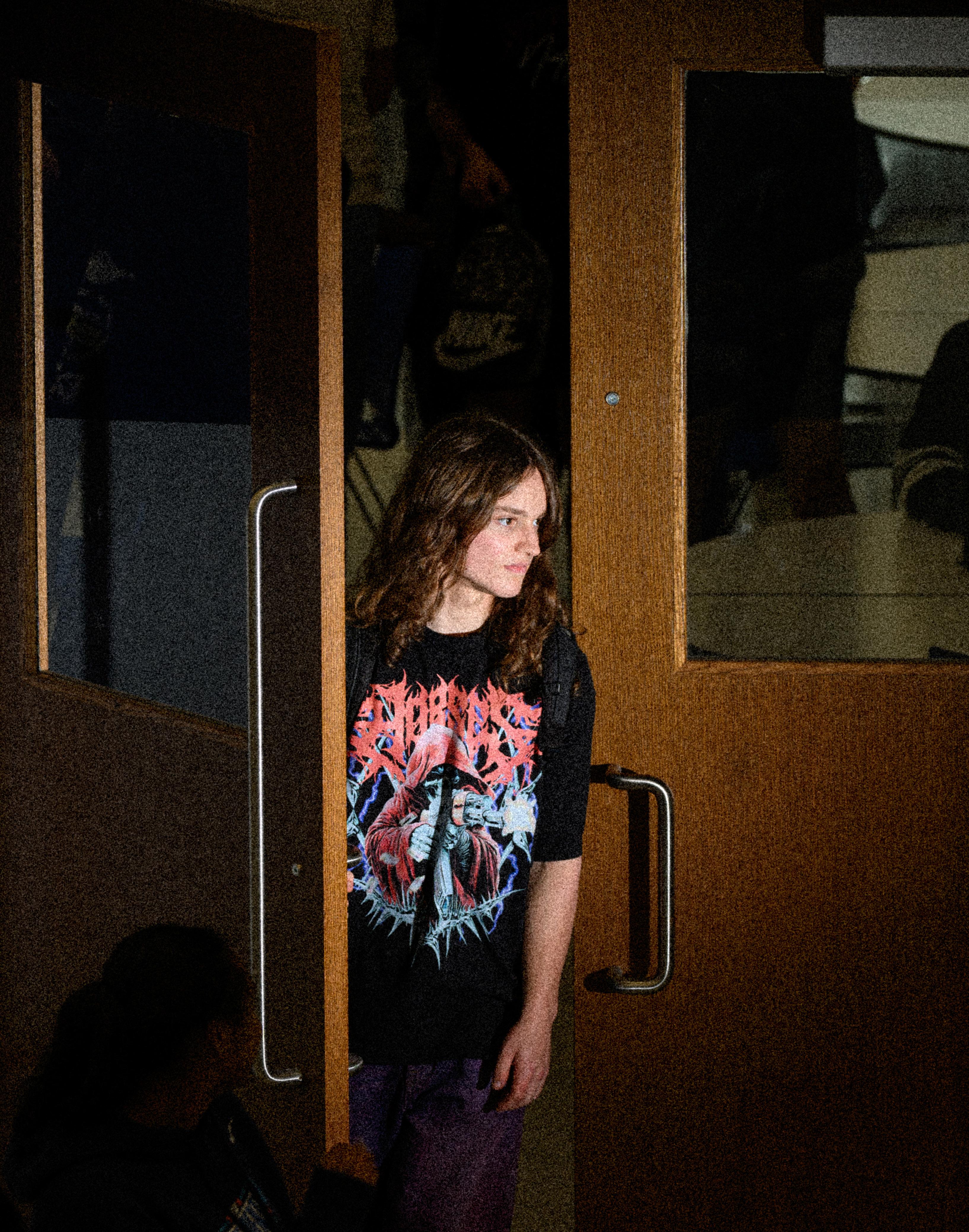
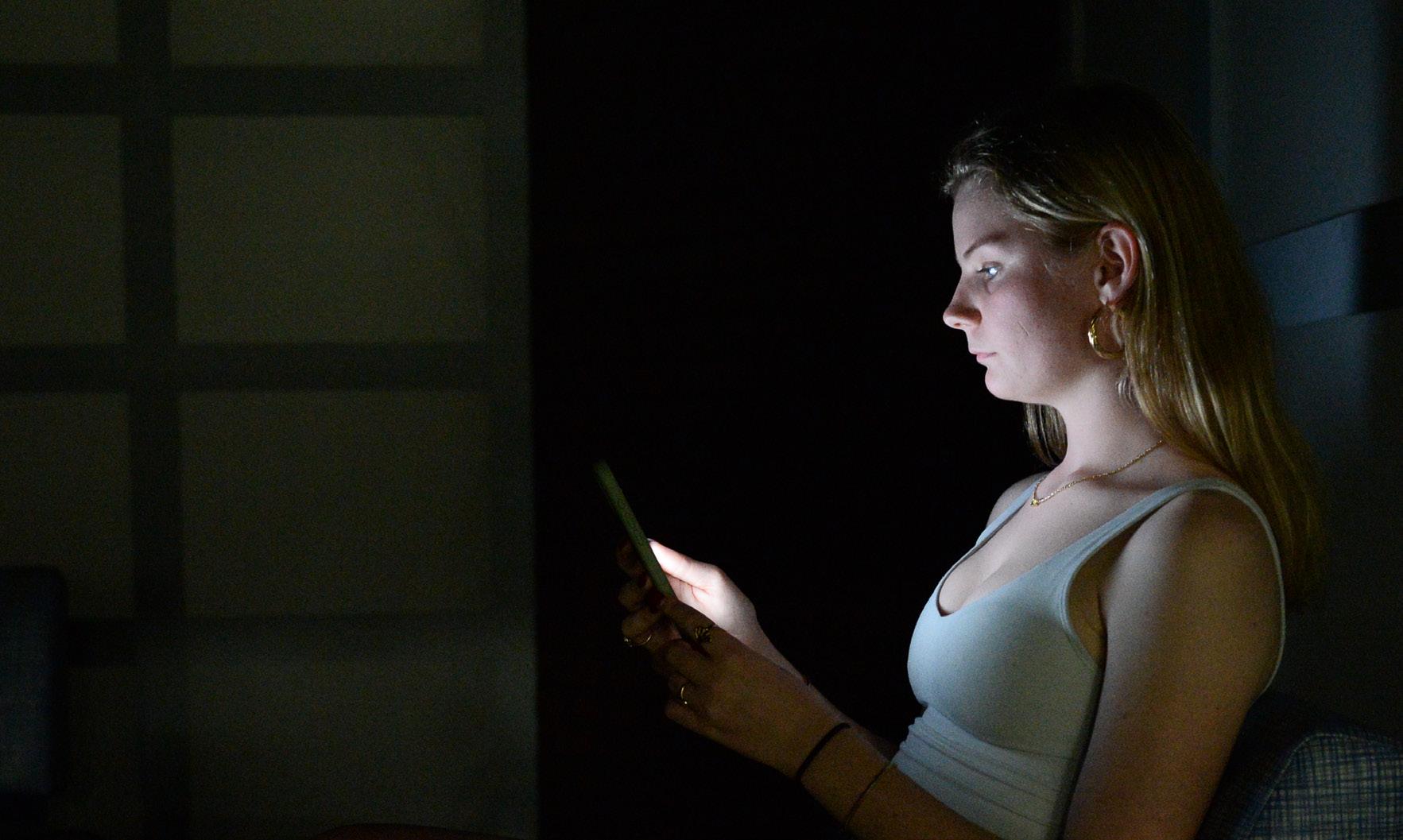
Surveillance of Ladue High School students illuminates questions around safety, student rights and the role of private corporations within schools 16
Of schools use cameras to monitor students 93% 97%
Control entrance access to their buildings 32%
Of Ladue students dislike school surveillance
Think school safety can override student privacy 31%
SOURCE: NCES & Panorama Poll
Editor’s Note
Growing up is supposed to feel like a private place for self-discovery. But as our lives transition to become dependent on Google tools and social media influencing, high school has become a high tech institute where every search is logged and personal time is ever fleeting for many students.
For those in the Ladue community, the feeling of being watched is not just a result of the growth of social media—it has become a mandated reality within learning. Although marketed to students as necessary safety nets that are in place for our own good, the never-ending presence of these watchful devices raise questions: when do these protections begin to hinder the education they are in place to protect?
In this April Issue’s In-Depth, our staff investigated the blurred morality that begins with the surveillance within our halls. Beyond the screen, we saw how the school uses this monitoring to ensure the safety of all who enter the building. We dove into the fine print within technology agreements that allow schools access to our digital footprints. We documented the role of third party companies operating on our school computers. Students shared their testimony on ways they regain some digital autonomy, and teachers spoke out about the threats that surveillance can have on critical thinking.
While safety is a shared goal within the Ladue community, the way to reach said goal is not clear yet. As data becomes more integral in the future, we must decide where to draw the line between school safety and the loss of individual rights.
Josh Devine
Editorial Policy
Ladue Media is an openforum for students at Ladue High School. In order to ensure the news we report is accurate, important and relevant to our students, we do not operate under prior review. All content decisions are made by student editors.
Scan to view our full Editorial Policy
Ladue Media Staff
EXECUTIVE EDITORS-INCHIEF
Josh Devine
Celina Zhou
MANAGING EDITOR-INCHIEF
Madeline Awad
COPY EDITORS-IN-CHIEF
Katie Jansen
Grace Kweon
Ira Rodrigues
ART EDITOR-IN-CHIEF
Fiona Van Allen
PHOTO EDITOR-IN-CHIEF
Vincent Hsiao
NEWS EDITOR-IN-CHIEF
Cindy Liu
SPORTS EDITOR-INCHIEF
Mason Eastman
NEWS EDITORS
Amelie Lock
Jane Scheffel
FEATURES EDITORS
Tiya Kaul
Josie Stout
IN-DEPTH EDITORS
Loukya Gillella
Isaac Zelinske
OPINIONS EDITOR
Frank Chen
HEALTH & SPORTS
EDITORS
Victoria Derdoy
Meg Myckatyn
ARTS & ENTERTAINMENT
EDITORS
Medha Chode
Adela Gingrich
ASSOCIATE EDITOR
Aaron Lin
DIGITAL MEDIA EDITORSIN-CHIEF
Madeline Fong
Nathan King
NEWS STAFF
Elsa Flores-Tamayo
Irene Murphy
FEATURES STAFF
Sydney Gao
IN-DEPTH STAFF
Angella Zhang
Emery Mao
OPINIONS STAFF
Henry Madden
Sophie Cowlen
ARTS & ENTERTAINMENT
STAFF
Gabriella Beltranena
Cami Welsh
Caroline Cobaugh
HEALTH & SPORTS STAFF
Ellie Lercher
Ryan Nolan
Claire Zhang
Elisa Cormier
COVERAGE EDITOR
Emily Pan
ARTISTS
Nora Brunnquell
PHOTOGRAPHERS
Alex Du
Sarmistha Pulagam
Eva VonAllmen
ID EDITORS-IN-CHIEF
Marie Demkovitch
Maya Mathew
Annabelle Reagan
ID STAFF
Adelaide Flintrop
Emily Tinnin
ADVISERS
Abigail Eisenberg
Sarah Kirksey
SPONSORS
SPONSORS
Issue
David Von Allmen
Nicholas Reding
Profusion Private Asset Fund
The Demkovitch Family
Ladue Blue
Allison and Terence Myckatyn
Bruce and JoAnne Vieweq
Donna Freeman and Mike Heyne
Ed Tanyag
Katie Myckatyn
Mr. and Mrs. Charles Cobaugh
The Awad Family
The Chode Family
The Derdoy Family
The Devine Family
The Fong Family
The Kaul Family
The King Family
The Lock Family
The Nolan Family
The Pan Family
The Pisarkiewicz Family
The Stout Family
The Strauss Family
The Warwick Family
The Zwibelman Family
Theresa Tanyag
Wendy Tinnin
Gold
Anonymous
Arti Jain
Desta Gingrich
Jean Hayne
Kurtis and Katie Van Allen
Lillian Jansen
Mark Heyne and Rachel Abroms
Michael & Jamica Johnson
Mike and Elaine Stout
Ms. A Jansen
Ms. Elizabeth Welsh
Pam and Matt Cobaugh
The Cummings Family
The Jansen Family
The Liu Family
The Mathew Family
The Tenenbaum Family
The Witt Family
The Yeoh Family
The Zhao Family
The Zhou Family
“Uncle Blake” Baraks
Silver
Amy & Kevin Fischer
Anonymous
Bill and Cathy Scheffler
Bill and Sharon Hunn
Bremer Family
Gary & Shana Singer
Gillella Family
Hello Garage
John Gingrich
Juli and Bernie Plassmeyer
Kathy Bucholz
Laurie Family
Louise Flick & Bill True
Meera & Barry Bryant
Megan Gingrich
Mr. & Mrs. Brissette
MW Interiors
Myles Leonard
Pedro Beltranena
Sara Serati
Steve and Liz Van Allen
Tass Padavan
Taylor Stone
The Bowen Family
The Cormier Family
The Flores-Tamayo Family
The Gandra Family
The Gebrehiwet Family
The Guyton Family
The Haines Family
The Larrew Family
The Mayer Family
The Provine Family
The Scheffel Family
The Sheldon Family
The Solomon Family
The Turner Family
The Varvares Family
The Zotos Drobak Family
Friendly
Alena Tartouskaya
Amanda & Ryan Reagan
Amy Moglen
Anonymous
Anonymous Ladue Alumni
Berman Chiropractic & Wellness
Candice Bellinger
Clarissa Joyce
Edward Zhang
Ella Bender
HaugenHaus.com
Johnny Zhang
Julie Walther Scheibel
Lindsay Turner
Matthew Kweon
Mohamad Yaacob
Nancy Scheberle
Nithin Kumar Gattu
Olivia Cornelison
Salsbury Family
Shanthi Priya D
Sharon and Louis Hill
Sneha Vadlamudi
The Arora Family
The Choe Family
The Denman Family
The Ganni Family
The Gu Family
The Guthrie Family
The Hanes Family
The Hofer Family
The Lohse Family
The Mao Family
The Murphy Family
The O’Neal Family
The Pandian Family
The Poremba Family
The Reagan Family
The Rhodus Family
The Shi Family
The Silver Family
The Swillinger Family
The Taylor Family
The Wang Family
The Yang & Zhang Family
Tim Armstrong
Venkata Pulagam
Vivek Manohar
Walton Family
Will Kodner
Yan Sun
Zhenyi Liu
Zia Mahmood
PROM PREVIEW
JJUNIORS AND SENIOR s will take a trip into the Roaring 20s April 18, adhering to the prom theme “The Great Gatsby.” The event will be held at the DoubleTree by Hilton in Chesterfield, one of two venues prom alternates between, the other being the Chase Park Plaza Hotel in the Central West End. The theme, like many other elements, was selected by student council members.
“Myself, the president and VP of the junior class STUCO got to go to a tasting for the food,” Public Relations Vice President Mimi Tabscott (11) said. “It was pretty much up to us what food will be served, and it was all good. The menu has plenty of options for dietary restrictions. The juniors [on STUCO] have the biggest role in planning prom, and even though I’ve been on STUCO for a while, junior year has been the most work.”
The venue will be designed to capture the spirit of the popular novel and film, “The Great Gatsby,” featuring gold decor and elaborate centerpieces to truly model a Gatspy party.
“With the new STUCO structure of having officers and representatives, things are getting done more efficiently,” English teacher and prom sponsor Julianne Crockett said. “Also, with a bigger group of students, people seem to care a lot more about prom instead of just doing it for their college application purposes.”
Following the formal event, students will continue the celebration at Topgolf, just down the road from the primary venue. Largely parent planned, Topgolf after prom remains a Ladue tradition of many years.
“I think Topgolf after prom will be super fun,” Lily Crabtree (11) said. “I’m planning on changing before so I’m not in my nice clothes, but after that, it will be great. I hope everyone in the grade comes. ”
While most students stress over dates and attire, the student council remains hard at work planning. Instead of focusing on one subject at a time, their approach is to divide and conquer through committees.
“It has been exciting to break [the representatives] into committees,” librarian and prom sponsor Jennifer Tuttle said. “We have a decoration committee, a social media [committee] and then some students to make the commercial played during the school day. We have more quality work done because we’ve had more people on deck. This experience with the different groups of kids splitting up has incentivized us to keep the representative system for next year.”
Student council members decide on prom theme, BY AMELIE LOCK news editor P logistics and after party CHECK US OUT
Above: Students dance at the 2025 prom, themed “A Night in Paris.” Students nominated themselves or their peers for prom court, and then the top contenders were up for a vote.“Last year’s prom was super fun,” Adaeze Loynd (12) said. “I ended up winning prom queen, which was very unexpected and cool.” (photo by Vincent Hsiao)
MADELINE AWAD SPREAD DESIGN BY
AMELIE LOCK
SENIOR AWARDS
Senior awards night will take place April 23 and will consist of an hour of recognition for students. Students selected by faculty will receive an unspecific invitation to attend the ceremony without knowing what award they will receive. Each department picks a student to be recognized. The Dads Club Scholarship and Faculty Scholarship, Leadership and Service Award are the most sought after awards.
SENIOR FIELD TRIP
April 23 after home lab, seniors will meet in the MPR to write letters to faculty and eat Chris’ Cakes in the plaza. They are also given the opportunity to then go bowling as one of their final celebrations before they graduate. The main part of the field trip will take place at Tropicana Lanes in Richmond Heights.
SENIOR DECISION DAY
On their second to last day of school, the seniors will wear t-shirts and other merchandise of the school they’ve committed to. Early in the school day, they will gather together outside to take pictures with friends and celebrate their high school careers coming to an end.
SPRING PEP RALLY
BY ELSA FLORES-TAMAYO staff STUCO
hosts a spring assembly to raise school spirit
NEWS TO KNOW SENIOR EVENTS
TUESDAY, MARCH 10, THE student council hosted a spring assembly for the first time in many years. The assembly recognized all of the spring sports, including the track & field and state champion girls tennis teams. There was also a variety of games that students from all grades could participate in.
In previous years, the assembly took place in winter and fall. The lack of one in the fall, due to implementing the homecoming parade instead, caused administration to wonder if there was another time an assembly could be hosted.
“We’ve had assemblies before, but they’re not too well attended sometimes,” reading specialist and assembly coordinator Steve Boyd said. “Juniors and seniors skip out, sometimes teachers want more instructional time, but the teachers at a building meeting in the fall said that [they] would like more assemblies.”
STUCO also arranged other school wide events, including the Coaches vs Cancer fundraising game and the 3 v 3 basketball tournament. Boyd worked with 13 student council members that were helping to organize the assembly.
“[Mr. Boyd] and his subcommittee of STUCO [members] generated ideas, put together a plan and a timeline, recruited all the coaches and all the people to play the different games,” librarian and STUCO sponsor MaryKate Mortland said.
During the assembly, students got to cheer on the spring sports teams as they were recognized. They could participate in or watch games like pool noodle swordfighting, Rubik’s cube competitions and the final of the 3 v 3 basketball tournament.
“The sword fighting and the 3 v 3 final was a great unifying moment for the school,” STUCO Executive President Anthony Zhao said. P
DECA STATE
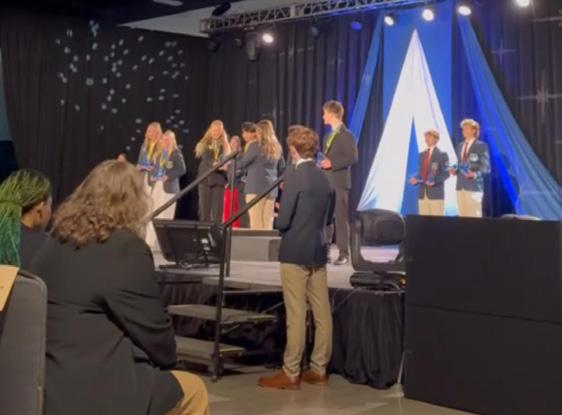
The DECA State award ceremony takes place March 23-24. Thirtyfour Ladue DECA members qualified for the International DECA Championships. “Everyone brought such good energy and they were super outgoing,” competitor Zoe Mei (10) said. “It was really easy to meet new people.” (photo by
Sydney Gao)
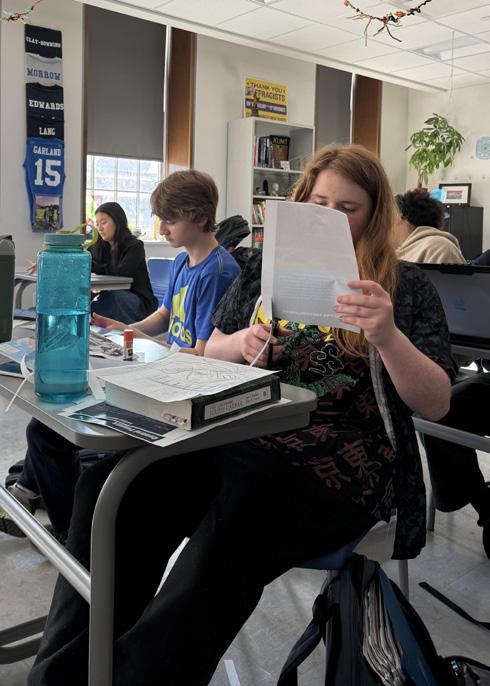
Elizabeth Childrey (9) puts the finishing touches on her exploring World War I assignment for World History and Geography. Every student in class was required to make an informational fold out as their unit final project before their test. “It was a lot of work, but it was a really good review before the test,” Childrey said. (photo by Emily Rosen)
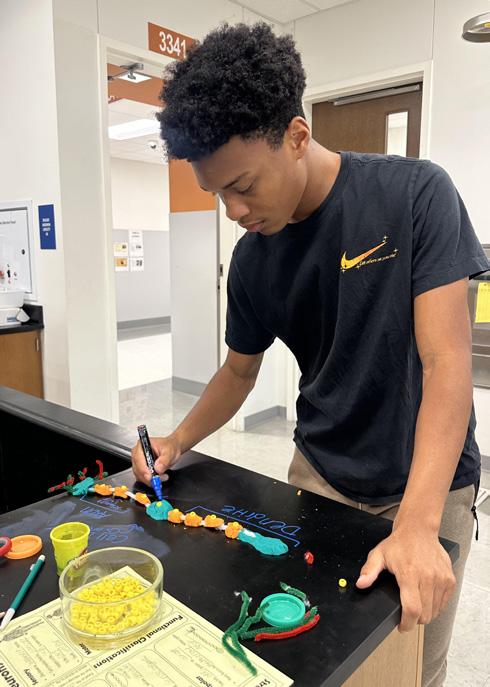
Preston Jewell (12) writes classifications of neurons for an anatomy lab March 27. In this lab, students in class modeled the different kinds of neurons and then labeled them. “This lab was fun because we got to create the three structures of neurons,” Jewell said. (photo by Sophie Leidenfrost)
CLASS COVERAGE
SPECIAL OLYMPICS Q&A
“
SADIE STEINBACH (10)
“My favorite thing was seeing all the kids that came with smiles on their faces right as [they] walked through the door.”
“
DARCY GRAFTENREED (11)
“My favorite part was getting to know my buddy and seeing him enjoy the music. We were dancing the whole time.”
“JACOB KAUFMAN (12)
“I think it’s really fun to hang out with the buddies and have them experience sports in [a way] that they normally can’t.”
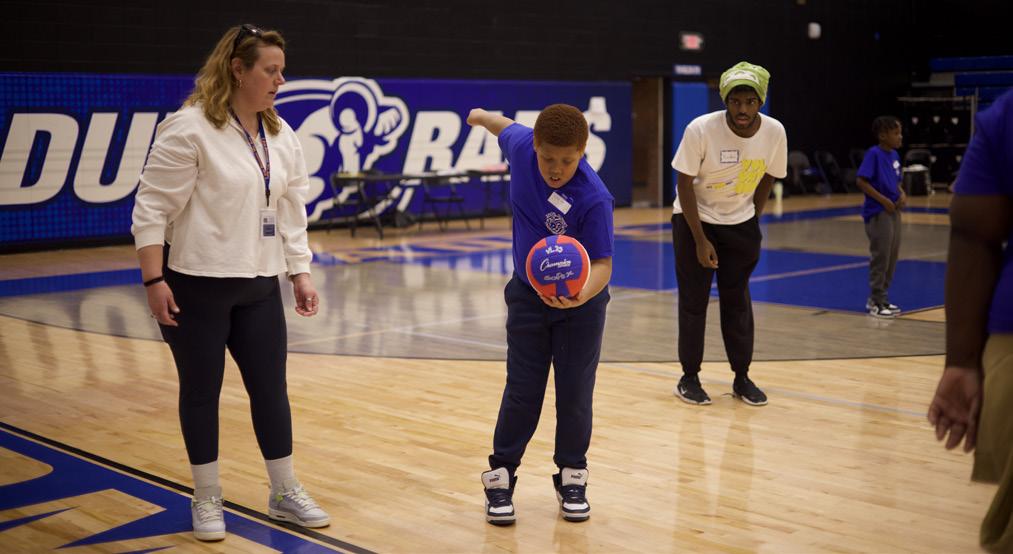
A student swings at a volleyball in a game during the Special Olympics event Nov. 12, 2025. During this event, students moved around different stations with their group, including volleyball games and Victory Village, where people could get face painted. “I really enjoyed this year’s Special Olympics volleyball tournament because as a team captain, I was able to work closely with a small group of kids, helping them play and socialize,” Molly Keys (10) said. “I also really enjoyed the leadership opportunity and making new friends along the way in a supportive environment.” (photo by Manon Hernandez)
IRENE MURPHY
BY CELINA ZHOU executive editor-in-chief
BY IRA RODRIGUES copy editor-in-chief
PHOTOGRAPHY BY VINCENT HSIAO
photo editor-in-chief
VOICE OF THE
COMMUNITY
ABOVE: Geoffrey Macy engages with students and staff at various community events. Macy has made an effort to meet with community members. “In order to best understand how you can serve someone, you need to have understanding,” Macy said. “I’ve been blessed to have built some incredible foundational relationships in Ladue.”
JGeoffrey Macy sits at his desk in the Ladue Schools Administration Center. Despite his office not being physically in the high school, Macy has welcomed high school students in the Performing Arts Center each morning throughout the school year. “I would love for high school students to know who I am and to know that I’m here to support them,” Macy said.
[things] before other schools in St. Louis are going to do it.”
The selection process, which took place over several months, was headed by the Ladue Schools Board of Education and collected feedback to make a decision on who would best reflect communal values.
JULY 1, GEOFFREY MACY WILL assume the position of Ladue superintendent. Macy, currently Assistant Superintendent of Business and Finance, will fill the role left by superintendent Jim Wipke, who will retire after holding the position for seven years. Macy has outlined plans not only to uphold the district’s longtime legacy of excellence but also to build on it.
“Being the superintendent of Ladue is an extreme honor,” Macy said. “Even though I have a lot of responsibility in the district, those responsibilities are going to grow and they’re going to change. I couldn’t do the job I do now or be the superintendent without an incredibly supportive Board of Education. We have an exceptionally forward-thinking board that I give a lot of credit to in terms of being in front of the curve. Ladue is going to try
“Dr. Macy was a top choice among an excellent candidate pool,” board president Marissa Rosen said. “Through the interview process, which was long and intense, he demonstrated his ability to perform under pressure, stay calm and collected and provide thoughtful answers to the questions that were asked of him.”
In their search, the board looked for someone with strong leadership who would listen to community concerns. Macy is already adhering to this goal in his vision.
“Part of my philosophy is always going to be the collective voice,” Macy said. “Our community has provided voice, so understanding how we can build upon that voice, how we can bring that voice back to the table, especially in our next strategic planning cycle [is important].”
This vision is especially important considering the discourse and change surrounding education, particularly at the legislative level. As president of the Missouri Association of School Business Officials and its state legislative chair, Macy is wellplaced to address potential challenges.
Incoming superintendent Geoffrey Macy prepares for new role and builds on a legacy of communal excellence
“Ten years ago, that type of advocacy wasn’t necessary in education, but I think now it is,” Macy said. “We have a lot of lawmakers that are looking at changing, or in their words, improving education, and ensuring that educator voice is part of that conversation is crucial. My mission has been to ensure that educators have a seat at the table and understand how to communicate their voice and get that in the hands of our lawmakers.”
Assistant Superintendent Laila Crabtree has worked closely with Macy and has already seen proof of his continued dedication to the district and its community.
“Dr. Macy has been incredibly communicative and collaborative with me,” Crabtree said. “We have already met several times to discuss future goals for my department and the district. He has listened, been supportive and thoughtful about moving forward.”
During his tenure as superintendent, Macy wants to ensure he leads with regard to student voice as well as staff
“I think that [finding] different ways to collect voice is important,” Macy said. “My goal next year and [during] the start of my transition process is to be present. I want to experience what the students are experiencing, because I do think that [Ladue] is an incredible place.”
For Rosen, Macy’s long history with the community and commitment to the district make him a trustworthy leader.
“Perhaps most importantly for our families to know right now, Dr. Macy is uniquely qualified to protect our district’s future,” Rosen said. “He will be instrumental in educating and preparing our community for state legislation that could have unintended consequences for our schools. We are gaining a champion for our students who understands exactly what it takes to keep Ladue Schools the best in the state.”
For students, staff and members of the community, Dr. Macy seeks to act as a bridge and a point of connection.
“Whatever level you’re at, people don’t care what you know until they know that you care,” Macy said. “The foundation of everything has to be positive intention. Anybody going into education can look at the teachers here and see that they care. Being able to observe all of those master relationship builders is something that I just soaked up, and now it’s really the foundation of the way I like to lead.” P
ON THE BALLOT
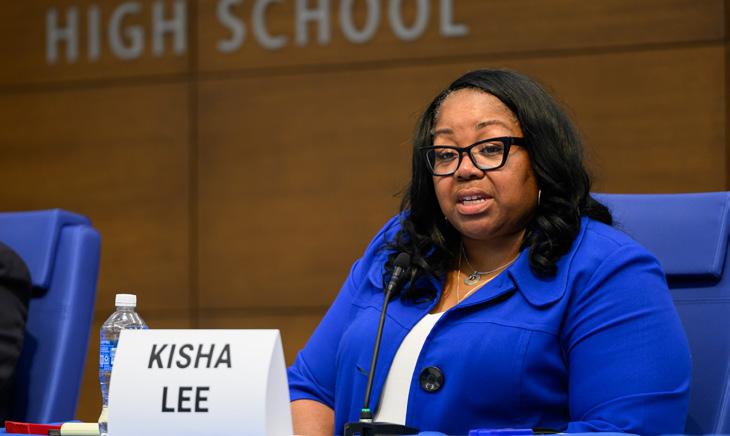
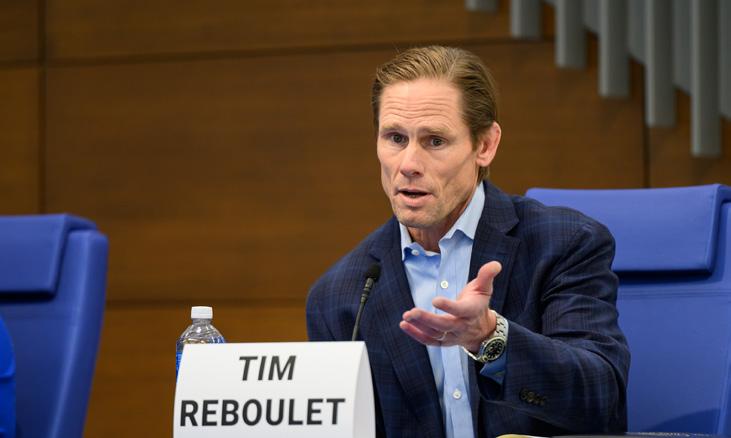
Ladue School Board candidates speak at Meet the Candidates Community Forum March 30
*
PABLO FLINN “
“Serving on the Board of Education is a tremendous privilege. We need to be able to navigate and prepare [students] for the unknown, because that’s what’s coming. It’s our responsibility as the adults. That is what we need to build, what we need to sustain, what we need to dedicate ourselves for. We are the directors of intent. That is where we need to go for our children.
* KISHA LEE
”
CURIOUS?
Scan to hear more from the candidates
Every day, I show up to be of service. I do it outside and inside of this role. I don’t get anything from it, but the knowledge that I’m being of service. That’s why I was put here. I will listen, I will honor your voice. On the current board, we’re willing to lean on each other, listen to each other, have tough conversations with each other. I will continue to be part of that.”
* PETER GARIEPY
“
“It’s my way of life: giving back and being connected to the community and doing what I can to help to leave this place better than it was when I got here. That can only be done through the community. I’m just one person, but together, Ladue strong, we come together. We could do anything. I’m excited for what the future has in store, for what we could do together.
denotes an incumbent candidate. *
”We will continue to exceed and celebrate the equity that exists here. We did not come here by mistake. We have the greatest amount of diversity and the greatest amount of excellence in our students and community. You all wouldn’t be here tonight if we did not continue to come together to support our students, our educators and our communities.”
TIM REBOULET
photos by Vincent Hsiao
CELINA ZHOU
DESIGN BY
BY SYDNEY GAO staff
BY VINCENT HSIAO photo editor-in-chief
William Edwards brings a lifetime of trades experience to the classroom
Edwards, now a woodworking and construction teacher, has been immersed in the skilled trades since the very beginning.
“I grew up in a construction and engineering family,” Edwards said. “My father and his three brothers built houses, boats, foundations, docks and more. All of them did well for themselves, and I worked hard for all of them throughout my youth.”
Much of Edwards’s motivation was rooted in the example set by his family and their fearless approach to the trades.
man in 2007 to participate in construction projects in the aftermath of Hurricane Ivan, a Category 5 storm. Edwards lived for three years in East End, a small town and one of the five districts of the Cayman Islands. He was soon faced with a chance to help the children and teenagers of Grand Cayman continue to rebuild their lives.
W FROM THE GROUND UP
WHILE MOST CHILDREN SPENT their days on playgrounds, William Edwards was raised among steel shrimp trawlers, towering bridges and piling foundations, his days framed by airplanes and helicopters overhead. There, Edwards watched his family turn raw material into marvel: boats that could brave the tides, planes made to weather wild storms.
“These men and their fearless determination were my inspiration,” Edwards said. “They were masters of construction and the ocean. Anything that had to do with the water they were into, whether it was building barges, scuba diving, managing a commercial fishing operation or navigating terrible storms and coming back alive. They did it all.”
Edwards became further involved in the trades when traveling to Grand Cay-
“I felt great training these tough kids and giving them a way to provide for their new families,” Edwards said. “They now had options and could work and make an honest wage. Soon, the East End began to prosper.”
By working alongside people who approached problems in their own unique and distinctive ways, Edwards gained a deep, thorough appreciation for diversity.
“I eventually grew into working in construction groups where I was the only English-speaking person,” Edwards said. “So, I learned how to build high-rise buildings with people [who were] speaking five
PHOTOGRAPHY
or six different languages around me, and the things I learned from them [showed] me better ways to build here. It became a really cool experience because not only are our cultures different, but the way we solve problems are different. That’s what the world needs.”
After obtaining his engineering degree from the Georgia Institute of Technology, Edwards’s journey in education began with his role as a substitute teacher, laying the foundation for what had been blooming from the start — a passion for teaching.
“I fell in love with teaching while subbing, realizing I’d been doing it all along while training employees during my con-
“
Edwards’s personal perspective on hard work is defined by the challenges and opportunities he faced during his own education. In spite of taking on two jobs in the trades to scrape together enough money for an engineering degree, he had the chance to work alongside one of the leading superintendents in Atlanta, who showed him what teamwork and leadership looked like.
“I always tell my students about this experience,” Edwards said. “You don’t come across opportunities like this often in life and I learned so much from [my mentor’s] company and management style.”
These collective experiences translate into Edwards’s environment at Ladue. In
tiated environment. Each student has their own learning preferences, the ways that they learn best. Project-based learning caters to these needs.”
Through both hands-on projects and open discussions, Edwards’ construction and woodworking students are encouraged to connect not only with the physical materials in class, but with one another in meaningful ways.
“As a person, [Edwards] is a thoughtful instructor as well as very kind and conversational,” Brighton Westermayer (10) said. “In class, Mr. Edwards makes an effort to communicate with students and get to know them better. He will have things like
I wanted all kids to understand that they could find their dreams and achieve
them.
I wanted to give them hope.”
struction career,” Edwards said. “Everyone in my family had a hunger for learning, even my dear grandmother up until her final days. She would always talk about new ways to do things and things she had learned during our long talks.”
His past experiences motivated Edwards to guide the next generation of learners along their own pathways to success.
“I wanted to help kids find ways to achieve their dreams and make them realize it was possible if they were willing to work hard,” Edwards said. “I faced tough times in life and paid for my own education. I wanted all kids to understand that they could find their dreams and achieve them. I wanted to give them hope.”
his classroom, Edwards values student collaboration, communication and personal growth, shaped by his familial threads.
“You have to be able to multitask a lot of different things, and that’s what my uncle is good at,” Edwards said. “That’s what kids today need to learn how to do, and that’s the way we work in [my] class. [We learn] how to help each other, grow socially and emotionally and learn how to solve problems together.”
In his classroom, Edwards takes an adaptive approach that helps students explore their own creativity and apply their knowledge in meaningful ways.
“I do a lot of project-based learning,” Edwards said. “This promotes a differen-
puzzles or debates on the board to get the class talking. I enjoy the amount of freedom [he] gives us to build what we want and experiment with new things.”
For Edwards, these combined classroom experiences ultimately encourage students to proceed with confidence towards any future careers or endeavors they may experience throughout their lives.
“I want my students to follow their dreams,” Edwards said. “I am a teacher because I want to provide pathways for students to find success in the future. I want them to realize that it doesn’t matter if you go to college, work in the trades or do a combination of both. If you are willing to work hard, you can do anything.”
William Edwards, woodworking and construction teacher P
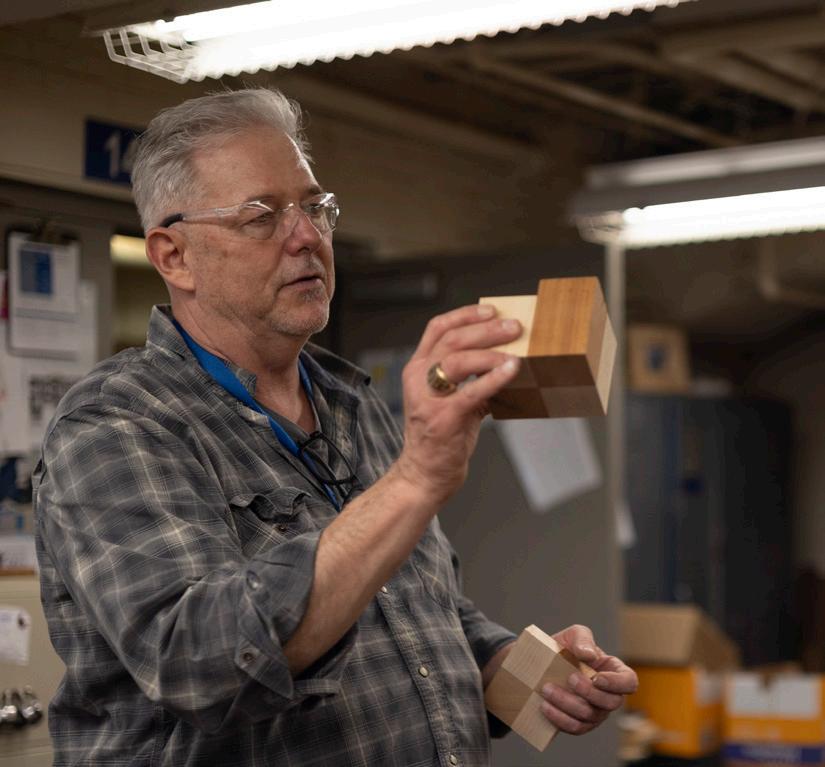
William Edwards works in his Woodworking and Construction Innovation classes. He has been teaching these courses at Ladue High School for three years and brings a unique sense of project-based teaching to the classroom. “I feel very strongly about this type of thinking and learning,” Edwards said. “Working in groups allows us to understand each other and realize the power in teamwork.”
TIYA KAUL SPREAD DESIGN
PLANET PROTECTOR
BY JOSIE STOUT features editor PHOTOGRAPHY BY VINCENT HSIAO photo editor-in-chief
CCLIMATE CHANGE IS A doomed clock ticking over the heads of younger generations. Los Angeles is sinking and the spring and summer months are hotter than ever. Despite this, some people choose to stay hopeful for the future of the world, no matter how grim the circumstances seem. Carmella Alton (10) unites her fellow students to push for environmental changes, no matter how small they seem to be.
Alton is a determined environmentalist who dedicates much of her life to green solutions in her community. She’s organized campaigns
“We saw over a 25% decrease of idling cars [in the carpool lane],” Alton said. “That was a really great accomplishment.”
Environmentalist Carmela Alton (10) leads green initiatives in her community
that take realistic and actionable steps towards making her community greener. In middle school, Alton and a couple friends took action.
“We decided to reach out to our counselor and ask about the possibility of starting an environmental club, or just a program to start cleaning up outside,” Alton said. “That kind of escalated into the whole Planet Protectors Club.”
Now, Alton is the co-president of Student Action for a Greener Earth, which is a club that works towards environmental action and education in the greater Ladue community.
“She’s super smart and dedicated,” Molly Keys (10), fellow SAGE member and Alton’s friend, said. “She’s always the first to jump on projects and get them done.”
Alton knows younger generations are going to have to cope with the consequences of climate change, and it’s always on her mind.
“What we are doing right now is going to be at the forefront of what future generations face,” Alton said.
ECO-LIVING TIPS
Turn off your car when you’re not driving
“So it’s in our hands now to take care of our planet and to prioritize sustainability.”
5
1 2 3 4 Keep AI usage to an absolute minimum
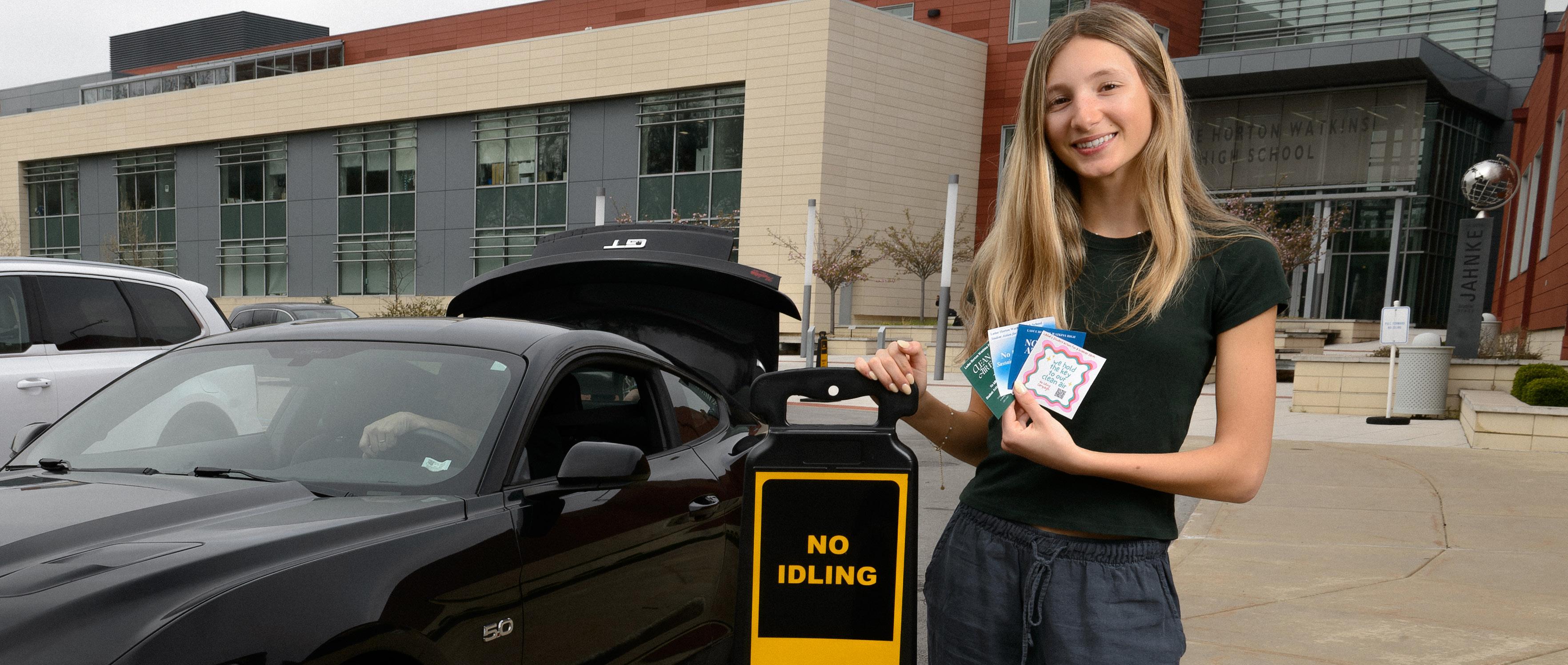
One of Alton’s biggest campaigns in high school has been the “No Idling” campaign, which encouraged parents and students to turn off their cars when not in use.
Use a reusable water bottle
Avoid using single-use plastics
Use reusable grocery bags
“We had volunteers to come with us outside to the carpool lanes and talk to cars and ask them about if they were interested in helping our campaign and contributing and to stop idling,” Alton said.
Alton knows that no matter what her future looks like, a sustainable lifestyle is imperative, and it’s this lifestyle that has inspired those around her to take environmental action in their own lives. It’s these “little” things that give her hope.
6 Avoid shopping at fast fashion stores P
“It’s just those little things in my daily life that motivate me to continue being passionate about the environment and continue pushing for change and working towards a more sustainable school and community,” Alton said.
Carmela Alton (10) stands by the”no idling” sign placed at the carpool line. The sign was created as a part of the larger “No Idling” campaign.
BEHIND THE WHEELS
BY EMILY PAN coverage editor
VINCENT HSIAO
editor-in-chief
QUIET HUMMING AND BEEPI
-ng fills the otherwise silent hallway of St. Luke’s Hospital. The smell of antiseptic and latex lingers in the hospital air. Amidst the chaos of doctors and nurses rushing back and forth in the hallways, Lakell Benford (12) wheels his patient in a wheelchair, finding a sense of calm and grounding.
Benford works in dietary and urgent care units at St. Luke’s. A typical workday for him begins with passing out trays of food and beverages to a patient’s room and then shifts to wheeling patients around.
“I really like meeting patients,” Benford said. “Every now and then, I usually go into a room to talk to the patient for a little bit. Sometimes they go into deep detail in their stories. I saw a guy talking about how he went to a Bob Dylan concert.”
Benford finds comfort in listening to patients’ stories and building meaningful personal connections. However, conversations with coworkers can feel less natural for him because of the large age difference.
“Talking to people that are older than me [is hard],” Benford said. “I’m one of very few people at the job who’s 17 years old. It’s different from high school.”
La’Aysia Macon, Benford’s older sister, also currently works at St. Luke’s. Before he started, she talked with him to prepare him for the unfamiliar environment.
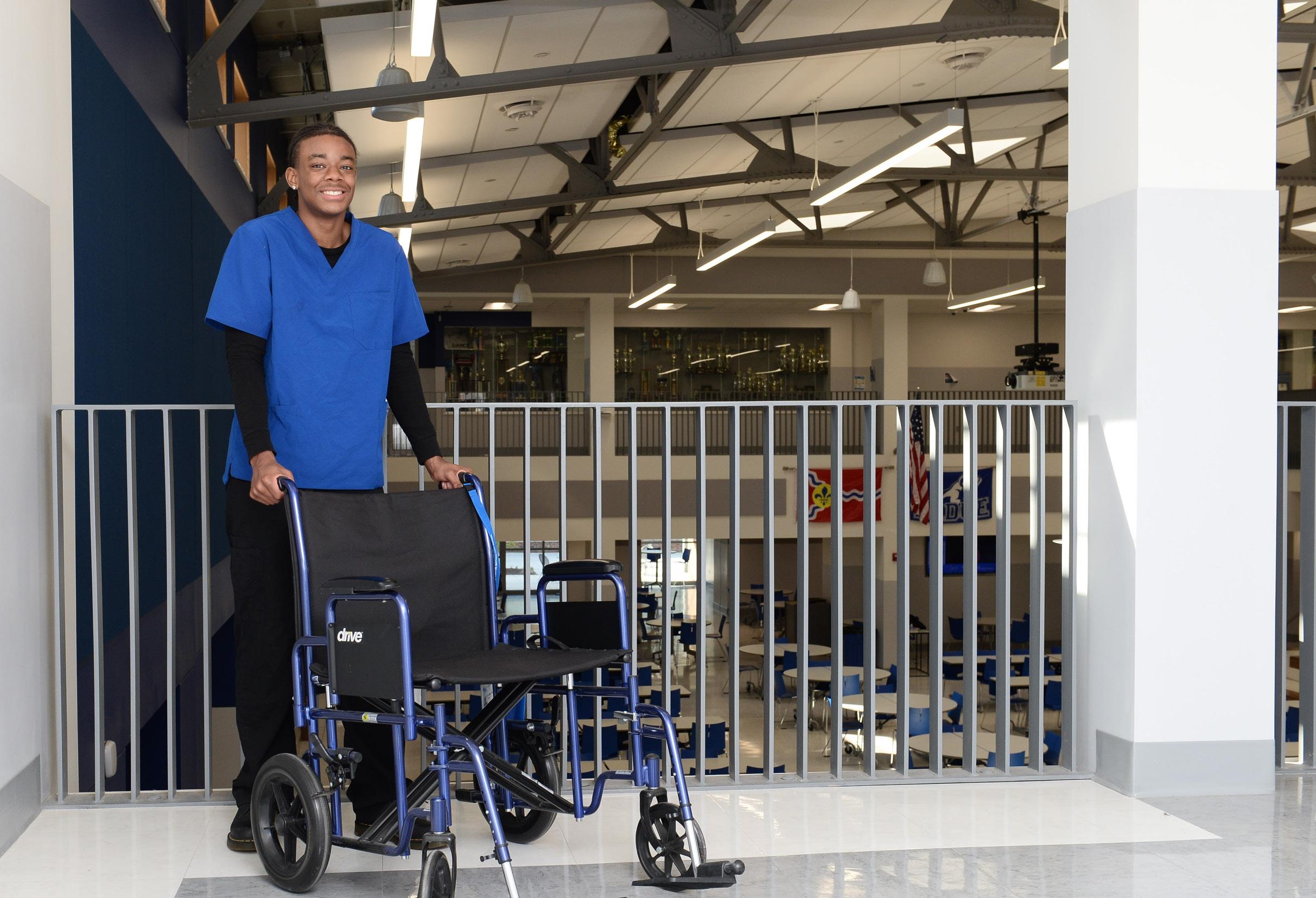
Lakell Benford (12) poses above the Ladue High School cafeteria with a wheelchair March 30. He has worked at St. Luke’s Hospital since September 2025, when his sister shared an open position with him. “I just thought it would be a good place to start helping people,” Benford said. “I just wanted to do something [to help others].”
Lakell Benford (12) works at St. Luke’s Hospital to gain experience in the medical field
“I told him not to stress if he doesn’t learn how to do a task as quickly as others,” Macon said. “I had nothing to worry about regarding him being a quick learner.”
Previously, Benford worked at a restaurant. He wanted to take the job at St. Luke’s due to an interest in the medical field.
“I’ve been working at St. Luke’s for three or four months when my boss asked if I knew anyone who wanted to apply to work there,” Macon said. “After putting in a good word about my brother, I sent him the application, and he was hired a month later.”
Benford’s patients recognized his potential in the medical field. Through their support, he started to gain confidence in his abilities.
LThe lessons he has learned from St. Luke’s has helped him set the foundation for his future plans. Benford plans to be sworn into the Air Force after high school graduation and eventually pursue his dream of working in the film industry.
“[Working at St. Luke’s] made me more ambitious to do more in life because most of the people there will be 30 to 50 years old,” Benford said. “Nowadays, you look at young [people] and they [have] a bunch of health problems. It motivates me to stay more on top of that.”
“Lakell is a quick learner. If one of our workers is falling behind on a task, [Lakell] is one of the first to step forward and help them with it.”
“When I was talking to this older black guy — a lot of young black men usually don’t do what I’m doing — he was like, ‘Keep doing what you’re doing,’” Benford said. “It really made me reflect that if I keep doing what I’m doing, some good things will happen.”
La’Aysia Macon sister
Macon hopes Benford is able to find his own path and pursue his goals in the upcoming years. She knows he has the ability to succeed no matter what direction he chooses in his life.
“I hope my brother accomplishes as much as he wants in life without any regrets,” Macon said. “Even if he makes any mistakes in the future, I know he will get past it and find what works for him. He has time to think cautiously about what he wants to do in the future.”
PHOTOGRAPHY BY
photo
SOURCES:
Alani Nu, American Beverage, Celsius, CStore Dive, MI Blue Daily, Monster Energy, News Medical, Red Bull, UC Davis Health, Yahoo Finance
Sugaror sweeteners,artificial often added inlarge amounts, can enhance the addictive qualities ofenergy drinks
Artificial Caffeine only approximatelymakesup0.06% ofan energy drinkby volume
Although listed as an ingredient, Guarana is labeled as a dietary supplement, so exact amounts are not commonly displayed
Taurine boosts mental focus and can reduce complementingfatigue, the effects of caffeine
Some drinks contain over the valuerecommendeddaily of VitaminB 80x
BRAND COMPARISON
Major differences between the leading energy drinks brands for teenage demographics
Various student statistics about how and why they use energy drinks
Panorama surveyed 201 students March 30
“I love any Red Bull, and I don’t have one specific favorite.”
“My
Connor O’Shaughnessy (10)
“The Cotton Candy Alani. I’m so happy they brought it back.”
Mimi Tabscott (11)
THE PUBLIC INDIVIDUAL
Surveillance of Ladue High School students creates questions around safety, student rights and the role of private corporations within schools
* Indicates a false name to protect the identity of an anonymous student
BY ISAAC ZELINSKE in-depth editor
BY EMERY MAO staff
PHOTOGRAPHY BY
VINCENT HSIAO photo editor-in-chief
EEVERYTHING YOU DO ONLINE can be monitored. Every text you send, question you search, website you visit, picture you like, word you type on a Google doc. Everything you do online can and will be monitored. Well, that’s what most think, but you aren’t just surveyed online — you are surveyed everywhere. Where you drive, what you eat, who you’re friends with, daily spending habits, your routine –– everything you do can and will be monitored.
This sounds impossible, like conspiracy or something out of Orwellian fiction, but it’s our reality. Federal programs like
the Domestic Security Alliance Council leverage national security to collect the information of 35 million Americans via 650 private companies. This deal gives them full freedom to comb through everything someone does, from a purchase at Bass Pro Shop to posts on an extremist forum. Companies like Palantir are being used by the United States government to create large-scale databases of the American people in order to find potential domestic threats. This is done by monitoring everything from an individual’s social media activity to their daily schedule to their movement. No matter who you are, your privacy no longer exists.
This hardly stops at the adult population. For the student, everything you do with your school issued laptop is monitored by the school. Every email you send, question you search, website you visit, file you save, word you type on a Google doc. Everything you do with your school issued laptop can be monitored. Well, that’s another misconception. You aren’t just monitored digitally on your school laptop — you are physically monitored everywhere within the school.
With updates in technology, school surveillance no longer stops at a teacher’s glance and hall monitors. The student is now monitored by CCTV cameras, decibel detectors in bathrooms and metal detectors at all the entrances. School issued devices are now monitored by an online surveillance program, constantly updating a student profile which is built off your searches, app usage, emails and anything else you do on your school-issued devices. For the student, your privacy no longer exists.
PROTECT
What does surveillance look like at Ladue? Technology Coordinator Adam Stirrat explains the two key ways students are monitored online. The first of these ways is through the Google hemisphere. Ladue uses a Google Enterprise account as its main platform for emailing, document creation and learning management systems. These accounts allow the school to better manage student activity on docs, drive, slides, classroom or any other Google product. Ensuring that students are using these products and services properly.
“That’s really just a Gmail account that has a licensed fee that we pay for every year with Google,” Stirrat said. “They kind of latch on [the school district], calling [the school] a Google Enterprise facility. So you are indirectly being monitored through Google because when you sign up to be a Google Enterprise institution, everything that you do is saved by Google. Even when students graduate [and] move on, their work never gets deleted. It just gets kind of suspended. So everything is backed up, everything is saved.”
The second way is usually the one most people picture in their heads when they hear the word surveillance: the network hemisphere. Through multiple companies, the district is able to watch what websites students go on with their school laptop and monitor the student’s searches. Securly is the main service the school uses for search monitoring and Artic Wolf helps with this.
“We use a company called Arctic Wolf, and we use a company called Securly, and they provide us opportunities to backtrack and keep and capture keystrokes,” Stirrat said. “So in a nutshell, we are able to monitor their web traffic, meaning I can see what you did all day long, from minute to minute on every single website, as long as you were logged in onto our computer using our browsers.”
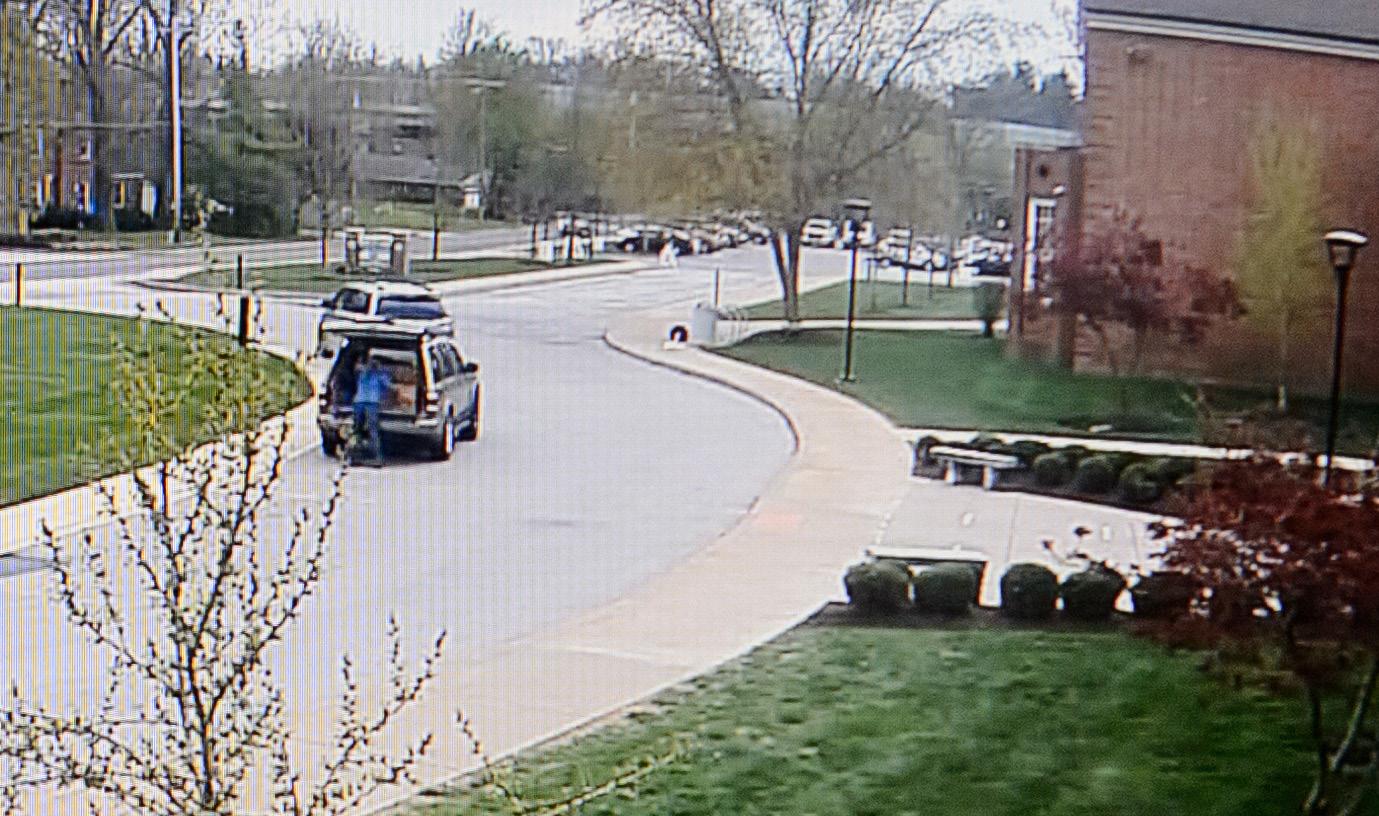
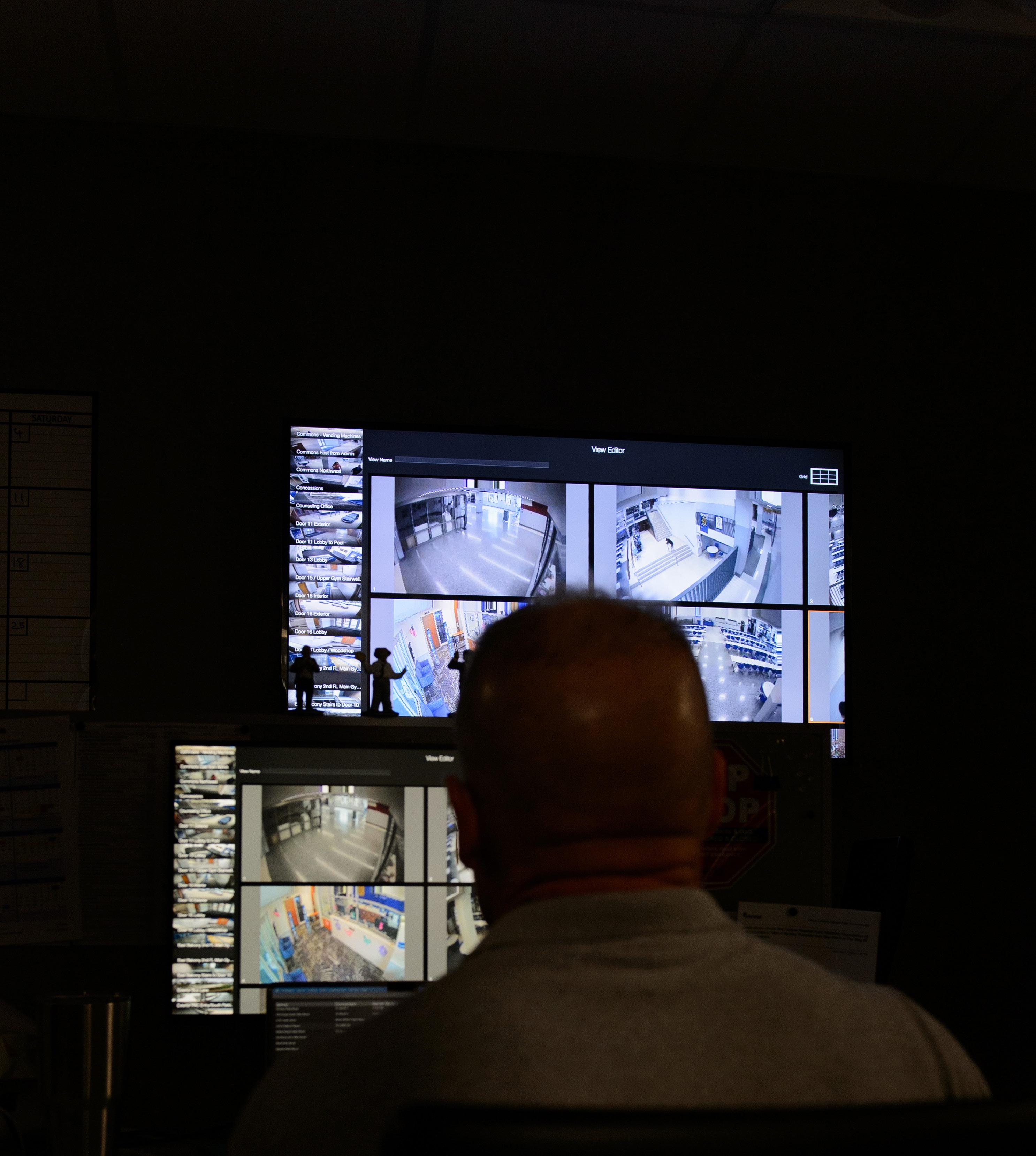
The physical aspects of school surveillance, such as the cameras around the building, which are reactive tools, are managed by the safety and security team. It’s important to note that this capability to monitor the students activities does not mean someone is always watching, and typically, no one is. The camera’s are inplace more as a tool for safety and review as opposed to a tool to monitor the student population.
“Day-to-day monitoring, that’s really not happening,” School Resource Officer Richard Ramirez said. “Obviously, we have a lot of cameras, but those are reactive tools that we use if something happens. We could use that as a reference. But there’s not somebody, per se, watching those constantly. We would only go to the cameras if we had to react to something that’s already happened.”
Junior Assistant Principal Andrew Ross agrees; it’s important to have a real connection with students, the kind you can’t get by watching them through a camera and their search history. Surveillance through the school isn’t an end-all be-all, but rather a safety net in case an emergency takes place.
“I find it more humanistic and important to be physically present students in the hallways, saying hi to people in the cafeterias and being in classrooms [rather] than sitting, watching cameras,” Ross said.
TRACKED BY THE NUMBERS
Panorama surveyed
202 students March 30
Are you aware of your privacy rights as a student?
Ladue students share their views on surveillance in and out of school
Do you have an instance where you felt surveyed by the school?
“I remember looking up something about medication on my phone after school only to have my query blocked because it contained “drug” in it. It made me realize how the school was still watching me even after hours on my personal device.”
LOUKYA GILLELLA
WHO’S THERE?
Other than school, students are monitored in other ways outside of school
WORKPLACE
Having security cameras is legal, but the workplaces need a legitimate business reason to install them. Employers are also required to disclose the presence of security to their employees.
SOCIAL MEDIA
Apps in general gather data for business purposes. However, social media specifically, focuses on keywords, monitors emotional reactions, and alerts the user on big trends.
TRACKING APPS
Apps like Life360 are used for live tracking. These apps need permission from both sides to work.
SOURCE: rhombus & sprinklr
The balance between privacy and safety is difficult to define and is subjective from person to person. By allowing students access to school-provided digital devices that can be taken home and used at all times of the day, the Ladue District must also be held to certain standards of technological safety.
“Sometimes we have to do things for the 10% of the time when something bad could happen,” Stirrat said. “90% of the time, students are safely using and behaving on their computers. 10% of the time they’re not, so it’s really hard to kind of just capture the 10%. We’ve got to kind of offer that universal approach of safety and monitoring so you can ensure safety.”
But the school isn’t always able to oversee students online, no matter how many safeguards are in place. Many students use servers called proxies, allowing them to circumvent the school’s internet rules and access blocked websites. For Mordechai Montgomery* (12), whose name has been changed to protect his identity, VPNs and proxies allow him to browse the web without school supervision.
“I’ve used [proxies] ever since I was a freshman here,” Montgomery said. “I started using them because
I was bored in school and I wanted to free myself.”
Montgomery* is not only an avid user of proxies and VPNs, but also a supplier. Many of his friends have been able to access the unblocked internet with his help. However, this usage hasn’t gone without its consequences. Earlier this year, an upsurge in proxy users caused the technology department to step in, leading many to get caught.
“There was a crazy surge of people installing an app called BlueStacks, which is basically an emulator that allows you to run Android apps,” Montgomery* said. “It also circumvented the school network, but because of that surge, the tech office found out [and] they ran a check on everybody’s laptops.”
Even though the blocks the school district puts into place can be inconvenient, Montgomery* still agrees that they’re for the best ––even if he doesn’t always follow the school’s rules that are in place.
“It might feel bad to students, even myself, that you can’t access certain websites or something that you want to [do] during your free time, but at the same [time], I can understand why the school went on to do it because there might be a risk of some viruses or you might
get distracted from learning if you were playing a normally blocked game on your computer,” Montgomery* said.
Safety has, and will always, be the greatest priority for the school. Not only is it a major priority of the administration, it’s their part of their state assigned duties.
“We are responsible for student safety, and we are responsible for knowing at all times,” Ross said.
“Following [the regulations] is really important because, God forbid, we actually have a safety incident in a building.”
OBSERVE
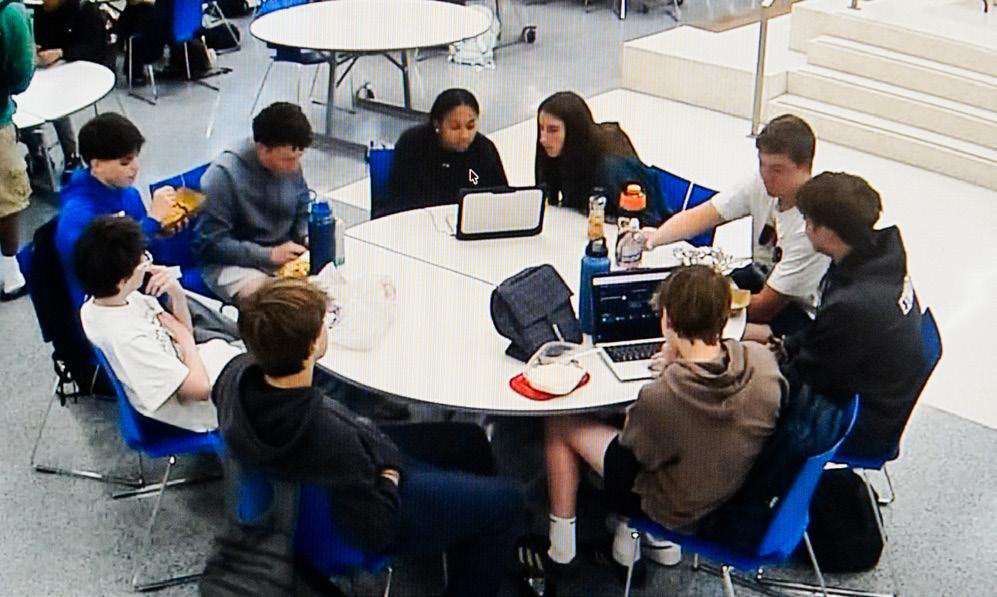
LEFT: On a CCTV camera, Ladue students are seen sitting around a table in the cafeteria. These cameras are used to monitor students for safety and security. “We use the cameras to investigate who is doing certain unsafe things,” School Resource Officer Richard Ramirez said. “Nobody’s sitting behind the cameras watching. It’s only when things are brought to our attention.”
BELOW: Safety and security manager Dan Lottmann demonstrates how Ladue High School’s security cameras operate. Lottmann works as part of the safety and security team, which helps monitor the high school’s campus and keeps students safe. “Safety is at the foundational element of any school,” Junior Assistant Principal Andrew Ross said. “If we don’t feel safe, then it makes it really hard to learn, have a positive experience and interact comfortably with others.”
ble. On the other end, opposers bring up arguments of how far that line really needs to be drawn in order to properly balance the rights of each person as an individual and the complete safety of all its members.
“From an educational perspective, I am very taken by the philosophy that you don’t learn when you are not authentic,” social studies teacher Jeff Miller said. “If all I’m thinking about is ‘I’m being monitored,’ there’s no learning. There’s no critical thought happening there.”
MThere exists an ever present line between the security of an institution and the individual rights and privacy of those within it. Where this line should be drawn is a topic of constant and vigorous debate. For those in favor, there is no duty more dire than that of protection for as many people within the institution as physically possi-
“My job is to keep you guys safe and out of trouble, not to find ways to get you in trouble.”
Rick Ramirez, school resource officer
Student monitoring extends beyond the physical world and into the digital space. The latter has become extremely commonplace as schools become increasingly reliant on technology for day-today education and tasks. Each student and their guardian is required to sign and agree to the terms of the Limitless Learning Parent & Student Technology Agreement in order to access and use their school-issued
devices. This agreement allows administration to monitor safety and ensure proper student use of their school-issued devices.
“When you sign that waiver and that statement, you are signing off that you are using digital devices that are being issued from the school,” Stirrat said. “So, you should assume that everything that you are doing on your school computer is ours to see and watch. That is part of that small fine print.”
The school relies on Securly, one of the many digital software companies for web monitoring. A research study done by the University of California San Diego found that 83% of online surveillance companies used by schools monitor student devices 24 hours a day, seven days a week. Securly is one of these companies, allowing Ladue to observe and manage student activity no matter the location or time.
“I’ve known many people who play a prank on their friend by searching [something] inappropriate on their computer,” Montgomery* said. “Then, that [friend] has been called to the tech office because [of] that thing that was searched on their computer.”
The software itself is in place on the basis of protecting the student body.
A DIGITAL TRAIL
App involvement in data collection and tracking
How do apps collect data?
Cookies: When a website is visited, cookies are stored to track activity.
GPS: Apps requent access to location to provide location-based services.
User Accounts: Creation on user accounts allows activity to be tracked across many devices and platforms.
Permissions: Apps request specific permissions to access features, but they can also be used for tracking.
Accept
Deny
Why do apps collect data?
Apps use tracking mainly for business purposes and in some cases to sell information to third parties. The data collected is used to improve user experience and personalize it to the user’s needs. This may include the amount of time spent on looking at something in the app and advertisements that may be interesting or hated. However, some tracking is necessary for the app to function.
Don’t Allow OK
SOURCE: PAC mag & NYU
However, some critics argue this level of safety could be achieved with a far lesser degree of school surveillance.
“In a liberal democracy, you have to be extremely careful when and how you use those things,” Miller said. “History would tell us that it’s very easy to slip from like, ‘Well, I’m just using it for the right reasons’ to ‘Wait, now I’m using it kind of all the time.’”
The majority of these services rely on AI models to assist in their data collection. The same UCSD study noted 71% of companies used AI for automatic keyword flagging, and only 43% had a list of human-reviewed words. These key words define what is surveyed, making them extremely important to how these services function.
“I’ve seen some sort of things around how Palantir, Oracle and other software companies will use AI for data gathering and surveillance, whether that be through ads or through observation,” Rony Kaul (11) said. “Then [that data] can be used so that they can get a better grasp of their population.”
Kaul has spent a lot of time researching the way AI is being used by these companies. What he’s found is that the ultimate goal for a majority of these companies is to create a profile for the people they monitor, predicting when they may want to buy something, when they may do something or when they may commit a crime. Securly functions in a similar way, developing a profile of a student with an added ‘at risk’ identifier. Based on a student’s activity, Securly assigns if the student is all-clear, concerning, at risk or critical. By developing this profile, the school can get a better sense of their student population. However, when schools rely on any form of private, for-profit, corporation, it can potentially bring with it a plethora of complications.
“In order to drive their profit margin as far as they possibly can, these [companies] are going to be as unregulated as they possibly can for as long as they possibly can,” Miller said. “You’re going to do an analysis of, ‘Am I going to do something that could be abusive for a while that makes us a lot of money?’ And then five years later, somebody sues them because they’ve gone too far. Even if they lose that lawsuit, they still win at the end of the day.”
With an extremely complicated and nuanced issue like school surveillance, this strict reliance on private corporations could threaten the information and privacy
safety of the school’s students. Corporations historically tend to have a less nuanced approch towards this.
“School and at home are two things that have very different moral implications,” Miller said. “‘What am I doing at school versus what am I doing at home? And to what extent should a school be able to reach what you are doing at home?’ Those are the types of questions that private corporations are not as into. They don’t like having those conversations unless it really helps their bottom line.”
School safety will always be a point of concern for the administration. But, as most things are, this question is not as easy as pushing the scale entirely towards safety and away from the students’ rights as individuals. On the other end, it’s irresponsible to allow complete and total individualism and freedom on technology while disregarding the safety of the entire student body. However, no matter what side of the spectrum, disclosure is important.
“It definitely feels immoral to keep [the monitoring] under closed curtains from the students,” Kaul said. “[Students] wouldn’t know any of this. I don’t even know any of this. It just feels very wrong.”
If the goal of the school is to make the students feel safe, monitoring being outsourced to the services of a private company can complicate student trust in the school.
“Corporations are being driven by profit,” Miller said. “It’s just that capitalist mindset of: you have to follow profit. You have to grow and grow and grow. And if you have to do those things, you are going to leave morality at the door.”
The topic of school surveillance, like national surveillance, has no correct answer. The line between individual rights and the safety of the population will continue to be drawn time and time again. Each of these factors need to be taken into account when it comes to the use of a mass monitoring system within any institution. Ladue administration wants to keep students safe, students want complete freedom and the corporations just want to make money.
‘WHAT THE HELL IS A PALANTIR?’
OPINION: Palantir is a dangerous, unchecked company with too much power
BY ISAAC ZELINSKE in-depth editor
The end of World War II cemented the United States as a global superpower. Following the devastation caused by the atomic bomb, a message of fear was sent to all who opposed the U.S. Since that war, the U.S. has been stingy with such blatant acts of intimidation, but in the modern era, the U.S. is feared beyond their destructive power. Now, war is fought through information. By partnering with Palantir, the U.S. government has been given the digital equivalent of an atomic bomb.
Palantir CEO Alex Karp is often bombarded with questions about what his company exactly is. He has responded with “a software” or “an AI company,” but he struggles to say exactly what Palantir is — a surveillance company. Palantir is a company with the express purpose of allowing their clients to collect, manage and observe extremely large sets of data. This seemingly innocent appearance allows the company to dodge the eyes of those that are less observant.
The danger of Palantir is not not in their operations. The U.S. government signed a $10 billion contract with the military to use their services. According to Palantir, all they do is collect and manage data. However, this data is not just numbers, it’s people. Palantir has given the U.S. an all-encompassing view of any population on Earth, including their own. This same technology has been utilized by Immigration and Customs Enforcement, which recently signed a $30 million contract to assist in the mass deportation of immigrants. Not only does this seem oddly Orwellian, but it gives Palantir an unbelievable amount of access. Even if you do hold trust with the U.S. government, Palantir is an external, private corporation whose interests do not include the average U.S. citizen. Palantir is dangerous; there has been report after report of the ways Palantir could abuse their unlimited access. They are not an innocent software company designed to protect us all. It is an unregulated surveillance company designed to make profit — not protect the U.S.
PANORAMA PERSPECTIVE
AARTIFICIAL INTELLIGENCE
isn’t just futuristic — it is the future, where creativity is limitless and your imagination is more important than your understanding of any kind of topic. For so long in our classrooms, we have been sold two opposing narratives: AI as something never to be delved into and AI as one of the most revolutionary new technologies out there (maybe not since sliced bread).
To some extent, both of these views are correct. AI-related technology has the capacity to both help and harm, especially in a classroom environment. Panorama surveyed 201 students March 30, and almost 90% of Ladue students reported using AI at least once for school-related purposes. However, the majority of Ladue students also agreed that AI has been more harmful than beneficial to the education system.
Teachers need to be held more accountable for their use of AI in the clasroom setting
28 LADUE MEDIA EDITORS AGREE
0 LADUE MEDIA EDITORS DISAGREE
TAnd while academic dishonesty fostered by AI use is a genuine concern, there’s something else that our administration needs to consider: the fact that a plethora of teachers use AI for arguably inordinate purposes. Whether it be creating new assignments or making study resources, it’s no secret that many teachers use AI to a significant extent. This in itself isn’t necessarily harmful, but when teachers begin using AI excessively and handing out obvious AI slop with no justification for why AI was used, it’s clear there’s a serious problem.
“Teachers shouldn’t be allowed free reign over AI while it’s primarily associated with cheating for students.”
The opinion of this editorial board isn’t that AI doesn’t have any use cases, but that AI use by teachers should be minimized and regulated. This is because such uses are potentially detrimental towards students and certainly detrimental towards our world. The U.N. finds that chatbots use significant amounts of energy and consume roughly six times as much water as Denmark — destroying our environment in the process. Additionally, Columbia University explains that AI companies hide the environmental destruc-
Editorial note: Each editorial, Panorama selects an issue that the staff thinks is important to address and expresses a view that belongs to the majority of the editorial board. Panorama welcomes the opinions of its readers and encourages letters to the editors. Panorama reserves the right to revise submissions for length so long as original intent remains unaltered.
tion that they’re causing, often viewing the potential benefits of AI as more important. However, the implications of using AI aren’t limited to environmental destruction, with models being built on the backs of the impoverished. For example, a Time magazine investigation found in 2023 that Kenyan workers were paid as little as $1.32 per hour by OpenAI to label graphic and scarring images. Guided by Silicon Valley CEOs who believe that oppressing the Global South is a necessary and rational step in building the future, AI development is only accelerating with increased demand from fields like education. In the present, it is our duty to fight for a future in which students are capable of critically thinking and contributing to society. Teachers are an especially important part of that. Every time a history teacher uses AI to put themselves in a historical photo, an English teacher tells a student to check their work with a chatbot instead of looking at it themselves, a math teacher makes a questionable study guide with AI or any teacher uses AI in various other ways, stu-
SOMETHING TO ADD?
Scan here for more on letters to the editor, guest essays, submitting correction and the full editorial policy.
dents are harmed, not helped. The use of AI in schools shouldn’t be normalized, and teachers can ensure that. The majority of Ladue students agree that consistent use of AI by teachers contributes towards the normalization of student use. It’s not just teachers either; Instagram posts and other materials coming from the district often contain AI content, further habituating students to AI. All staff members should be held accountable to motivate positive use. In a study published by the National Institutes of Health, researchers found the
computing structures of AI models are 900 million times less energy efficient than the human brain. If you’re a living, breathing human reading this, then that means you have the most beautiful and complex supercomputer in the universe right inside of your skull. So, use it. Use it to realize that as a society we shouldn’t be pumping out subpar content, whether it be assignments, photos, videos or feedback, just because a computer has made it easier to do so. Therefore, for all of these reasons, the Ladue administration needs to put great-
FROM THE CLASS
Student statistics and opinions on the use of AI in school and by educators
Do you feel AI use has made a significant positive impact on your teachers’ lessons?
89% of students think teachers should be required to discolse when they use AI
er regulations on AI use — especially for teachers. Teachers should at least be required to disclose when they use AI in creating course content, if not be further restricted on AI use. Teachers shouldn’t be allowed free reign over AI while it’s primarily associated with cheating for students. AI might be a tool of the future, but we shouldn’t accept it without reservations. Our planet is at risk. Our minds are at risk. Our society — being hyperfocused on other issues — seems to have forgotten these risks, and honestly? That’s poetic. P
% 18 % 18 %
Panorama surveyed 201 students March 31 Has teacher AI use contributed to the normalization of student AI usage?
77% of students say teachers should not be allowed to use AI to grade assignments
STUDENT VIEW
Students share their opinion on teachers using AI to create assignments
“I don’t like it beacuse I feel that teachers should do assignments themselves if they don’t want
“I think teachers using AI is acceptable, because it does make their work a bit more easy and specific to individual students.”
KEIRA PALANCA (12)
ARYA PATEL (10) “I do not like it at all.”
AMEYA NERKAR (11)
(9)
HENRY’S HOT TAKES
ILLUSTRATIONS BY FIONA VAN ALLEN art editor-in-chief
BY HENRY MADDEN staff
“Cars 2” is the only good Cars movie
I’m not a huge fan of the Cars franchise, but “Cars 2” holds a special place in my heart. The frst Cars movie is absolutely terrible and doesn’t give a single reason why any of the characters actually need to be cars. “Cars 2,” on the other hand, subverts that. The cars depend on oil which, of course, is bad for the environment. The flm, which takes a stand against oil companies, tells a story of environmentalism that is far more clever than the sloppy wreck of a frst flm.
The justice system should be rehabilitative, not punitive
2Aside from a short period in the 1960s, the vast majority of the U.S. population has supported the death penalty. That’s a pretty worrying insight into how Americans view criminals. Crime is portrayed through a lens of “the love of the game,” per se, while in reality, most crimes don’t come from malice, but from structural inequality and bad decisions. Most criminals can be rehabilitated, because most crimes aren’t necessarily born from bad intentions. Rehabilitative systems are proven to work and are used efectively in countries like Norway constantly. The failure to establish one here is simply a failure of imagination.
St. Louis-style pizza is wretched
I’m aware this one isn’t much of a hot take outside of St. Louis, but here in the area, it’s one that’s caught me a lot of fack. For one, Provel cheese is a tragedy, and its taste alone proves the justifcation behind the Food and Drug Administration not considering it cheese. Secondly, there’s tons of good non-St. Louis-style pizza places in St. Louis that everyone should get instead: La Pizza, Fordo’s Killer Pizza and Katie’s Pizza, to name a few, are spectacular! If you actually want St. Louis food, then it’s best to just buy toasted ravioli from Imo’s Pizza instead.
Henry Madden shares his totally, completely factual opinions
4LA is the worst city in the United States
The state of California refuses to build housing, and so the homeless population is massive and signifcant portions of the city are constantly on the verge of losing their homes. Additionally, its urban planning is vapid and sprawls for miles because the state has entirely prioritized suburbs over any actual city design. This is part of why I desperately don’t want California
Gov. Gavin Newsom to be the presumptive Democratic nominee. California is incredibly faux progressive and “fake” in presentation. In Los Angeles, people claim to care about social justice for marginalized communities — so long as they don’t have to see them.
Serving as the president of the Philippines for nearly four years, President Ferdinand “Bongbong” Marcos hasn’t done much. My primary concern over his presidency, though, has been the war on drugs. Under his predecessor, the notorious war criminal and now Hague resident Rodrigo Duterte, thousands of people were murdered under suspicion of drug possession. Marcos
Politicians should be paid more
Local and even national politicians get paid far less than they deserve. Corruption is such a large issue because so many politicians feel the need to supplement their low income streams. Additionally, raising salaries would encourage more people to seek political ofce. It is also incredibly important because the majority of people in politics are disgustingly wealthy. New York Gov. Kathy Hochul presided over the busiest state legislature in the country last year, largely as a result of the state having the highest-
promised a “bloodless” war on drugs, yet reports from the University of the Philippines have indicated over a thousand deaths since his presidency began. But if that’s not enough, Marcos, much like his father, has presided over a massive corruption scandal siphoning money away from important food relief through corrupt contractors. Marcos has failed the Philippines and the globe as a whole.
paid state senators in the country. That’s in stark contrast to New Mexico and New Hampshire — the two states with the lowest paying jobs for state legislatures — which don’t even crack the top 30 hardest- working state legislatures. It’s important to mention that the quality of legislation in the highest-paid regions is substantially better than whatever terrible things the four hundred people in the New Hampshire legislature are up to.
TORTURED BY ENTITLEMENT
The “Male Loneliness Epidemic” is a self-caused scheme to guilttrip women
W“WOMEN DON’T VALUE MARRIAGE anymore,” thousands of men on the internet say. They claim to suffer from the socalled loneliness epidemic and insist that our society has become too progressive to appreciate masculinity. Some even call it reversed sexism. How difficult it must be, not being able to force a woman to settle for the bare minimum anymore.
Many believe that this problem began with the rise of Andrew Tate. If you’re somehow unfamiliar, he’s an influencer mainly known for mysoginistic comments
BY SABRINA TAGUNKOVA staff
that “teach men to be men.” That’s not completely false — Tate currently has over 11 million followers on X, formerly known as Twitter, alone. He is, unfortunately, famous. However, this issue has existed for much longer. The “incel” community started in the 2000s, though it was more private and personal. Straight men who couldn’t find a relationship talked to one another, both to vent and get advice, but most of the conversations were inherently sexist. Similarly, thousands have been reading “The Game” by Neil Strauss ever since it came out in 2005. The book is marketed as dating advice — all centered around aggression and objectifying women, of course.
The United States Census states that 79.6% of women born between 1940-1944 were married by the age of 25. In contrast, only 30.3% of women born between 19901994 had married by that age. Though
there are many reasons why that happened, gaining more independence was definitely one of them. For example, women were finally allowed to have their own bank accounts in 1974. They weren’t as dependent on men anymore, therefore they could afford staying away from abuse or manipulative relationships. Of course, it’s inconvenient not only for entitled men, but for the government. Without financial leverage, it becomes difficult to control women. This is where the male loneliness epidemic comes in — a made-up, manipulative problem to guilt-trip women into settling for less.
There is evidence that about the same amount of American men and women report feeling lonely. So this isn’t a male-only struggle. Lonely women, however, are more willing to take responsibility for their behaviors and work towards healthy relationships. According to a study by the National Institutes of Health, women often score higher on emotional intelligence tests than men. They tend to be more self-aware. Men, instead, choose to wallow in self-pity and harass women. But what are they really tortured by? Loneliness or entitlement?
ILLUSTRATION BY NORA BRUNQUELL staff
Pete Hegseth U.S. Secretary of War
All day, all night ... Iran will be able to do nothing about it. Death and destruction from the sky, all day long.”
61%
SOURCE:
YouGov, March 25 of Americans oppose the war in Iran
Trump’s war in Iran has shaken the world.
A. President Donald Trump with his cabinet in the opening stages of “Operation Epic Fury.” Trump launched the war on Iran from his personal home in Florida without consulting Congress. (photo courtesy of the White House)
B. The coffins of six American soldiers killed by an Iranian counterstrike in Kuwait. (photo courtesy of the White House)
C. Iranian ballistic missiles in Tehran. Iran has launched hundreds of warheads at targets across the Middle East, including American bases. (Fars Media, CC BY-4.0)
D. An Iranian missile hits a target in Tel Aviv, Israel. (photo courtesy of Kan News, CC BY-4.0)
E. A shrine to dozens of elementary schoolers killed by an American airstrike in Minab, Iran. (Tasnim News, CC BY-4.0)
F. Wounded Iranians after an airstrike near Enghelab Square, Tehran. (Tasnim News, CC BY-4.0)
DIRE STRAITS
How far will it go?
3602
SOURCE: Al Jazeera, April 3 official death count across Middle East
“ Abbas Araghchi Iranian Foreign Minister
We are waiting for [a U.S. invasion of Iran]. We are ready for this war...The Iranian people cannot be threatened.”
A WAR OF WORDS
The Trump administration’s dehumanizing rhetoric is highly dangerous and must be addressed
IN LATE FEBRUARY, AN AIRSTRIKE on an elementary school in Iran killed an estimated 168 people, most of them girls aged 7 to 12. Just days later, the White House posted videos on X (formerly known as Twitter), mixing real war footage with movies, video game clips and sound effects. One of these, titled “JUSTICE THE AMERICAN WAY,” showed airstrikes edited over superhero clips, as if the Shajareh Tayyebeh Girls’ School was a terrorist hideout being bombed by Iron Man. It is reprehensible that the government is using cultural icons to depreciate the lives and downplay the deaths of innocent civilians.
Trivializing war is just one example of how the Trump administration uses dehu-
G. A screenshot of a video posted by the White House March 5. Titled ‘JUSTICE THE AMERICAN WAY,” the video featured clips from the Iran war intermeshed with movie clips and sound effects. (via @WhiteHouse on X)
H. An AI-generated video posted on President Trump’s Truth Social account this February. The “meme” drew bipartisan backlash for depicting the Obamas as apes. Trump has not apologized. (via @realDonaldTrump on Truth Social)
I. An AI-generated photo from an official account of the Republican party. Showing Trump defending a cat and a duck, the image was shared after Trump accused Haitian migrants of “eating the pets” in Springfield, Ohio. (via @JudiciaryGOP on X)
BY SOPHIE COWLEN staff
manization to maintain power. In February, President Trump’s Truth Social account posted an extremely racist video depicting former President Barack Obama and former first lady Michelle Obama as apes, sparking public outrage. The administration attempted to justify the post, calling it an “internet meme,” but it was taken down due to intense public pressure. Even with that backlash, Trump has refused to apologize to the Obamas. Similarly, Trump has used dehumanizing rhetoric against immigrants, calling them “animals” and “illegal aliens.” For example, Trump referred to Somali immigrants as “garbage” and said the U.S. would go “the wrong way” if they continue to take Somalis in. During his presidential campaign, he also falsely claimed that Haitians were eating the cats and dogs of white Americans. The Trump administration repeatedly utilizes such demeaning rhetoric to sow divisiveness and hatred, perpetuating violence worldwide.
This is especially concerning because the administration’s actions mimic the dehumanization that has allowed atrocities
to unfold throughout history. From Jewish people being called “Untermenschen,” or subhuman, during the Holocaust to Tutsis being called cockroaches during the Rwandan genocide, there is a clear pattern of dehumanization before deep injustice. Modern American propaganda comparing Iranians to NPCs in videogames is no different. When people are stripped of the qualities that make them human, it opens the door to oppression — people forget that behind news headlines are real humans with the same dreams and love for their families. We’re far more similar than we are different, yet the difference between our safety and their suffering is simply due to borders or the color of our skin.
In such a deeply divisive time, it is crucial for people to recognize the immense danger of dehumanizing acts and the indifference they generate. People must open their eyes and ears to such actions in order to combat inequality. Moreover, people must celebrate other cultures, religions, diversity and everything that makes them unique in order to uplift those who have been oppressed for so long. In times of deep injustice, humanizing language is essential in ensuring equality for all.
AS OF MARCH 31, THE U.S.
HAS LOST
AT LEAST 14 PLANES AND 15 TROOPS.
THE PENTAGON HAS REQUESTED $200 BILLION TO CONTINUE THE WAR ON IRAN.
THE TANK’S TAKE
Trump’s war in Iran was doomed to fail
BY FRANK CHEN opinions editor
FEB. 28, PRESIDENT
Donald Trump launched a “major combat operation” against Iran. Dubbed Operation Epic Fury, Trump’s war raised major concerns from the start. It began with a sneak assassination of political leaders who’d been negotiating with the United States — an objective war crime and an act of perfidy. What’s more, Trump launched the war from his personal home in Florida — all without consulting Congress. Perhaps most characteristic of his myopic aggression, however, was the 2 a.m. speech Trump posted on Truth Social announcing the war. Arguing without evidence that Iran had posed an “imminent threat,” Trump declared that “bombs will be dropping everywhere” and that Iran’s “wicked, radical dictatorship” would fall.
In that same speech, Trump seemed to acknowledge the risks. “American heroes may be lost, and we may have casualties,” Trump said. “That often happens in war.”
He also identifies as a “genius.”
surrounded Iran with 36 air squadrons and 30 warships, including two aircraft carriers. Since then, the U.S. has launched thousands of missiles and bombs into Iran, and most deaths so far have been Iranian.
Who wins a war, however, is not decided by death tolls. Vietnam and the Taliban lost more than the U.S., yet both met their strategic objectives.
Over the course of this war, Trump has vowed to destroy the Iranian military, cripple its missile and drone production, steal its oil, isolate its allies and topple its regime. Trump has not accomplished any of these goals, and he is not on track to do so. Plan A, “kill the Ayatollah and crush the government in four days,” failed. Plan B, “blow up everything we see and hope Iran surrenders,” is failing. Whether Trump has a Plan C remains unclear.
These failures are more than an inability to win — the war has dramatically weakened the U.S. across the world. Iranian drones and naval mines have choked off oil exports in the Strait of Hormuz, and our closest allies have ignored Trump’s pleas for foreign assistance. What’s more, Iran has bombed U.S. bases with ballistic missiles, with the New York Times reporting that many of them are “all but uninhabitable.”
This war was always against U.S. interests. Trump has never explained how his epic fail would benefit the American people, yet we’re still paying for it. The Pentagon has requested over $1 trillion for its 2026 budget, with $200 billion being earmarked for Iran. Every cent in those billions is a cent that won’t be spent on education, healthcare, infrastructure, medical research, homelessness or poverty; instead, we’ll be bombing cities most Americans have never heard of, for reasons we will never know.
P SOURCE: Iran War Cost Tracker
If you haven’t been reading the news since then, the war has not been going well. Six U.S. troops were killed on the first day, three fighter jets were lost in the first week and the price of oil has shot through the roof (Trump has posted more about the oil than he has about the troops). There is very strong evidence that Trump — and the nation — are headed for a grave embarassment. That may sound strange. The U.S., after all, is a powerful country; it has the largest air force, second-largest navy and the widest reach of any global power. In the lead-up to Trump’s war, the U.S.
No matter who wins, the American people have lost already.
IN THE SPOTLIGHT
THE SENIORS’ STAGE
BY GABRIELLA BELTRANENA staff
Ladue Theatre seniors write and direct one-act performances
THE STAGE IS SET AND THE spotlight is ready. Senior directed One Acts, a long-standing tradition for Ladue’s Thespian Troupe 1109, are returning to the Black Box this spring.
The acts are entirely organized, cast and directed by students Chloe Lang (12), Mina Farrow Prater (12), Trip Hoffman (12) and Grace Pinex (12). This year’s production is scheduled for April 24 and 25.
“Excitingly, this is our first year that we’ve had all four scripts student-written,” director Hoffman said.
Both Hoffman and fellow director Pinex have been involved since their freshman years, moving through production roles as actors and stage managers before stepping into the director’s chair this spring.
“As a director you need to have a plan on what the scenes look like,” Pinex said. “While simultaneously leaving room for actor creativity.”
Behind the scenes, the process is as much about logistics as it is about acting. The directors all draw from the same pool of talented underclassmen for their plays.
“This is always complicated [because] all of the directors want all of the actors,”
Hoffman said. “There’s a lot of negotiating and trading between the four of us before the final cast list is decided.”
The directors rotate through the Black Box theater, rehearsing over a rigorous four-week schedule.
“It’s important to test your actors with others,” Pinex said. “They could be a very strong actor individually, but they don’t have chemistry within the group.”
The heart of the One Acts lies within the students voices. It offers an opportunity for seniors to express their feelings and artistic vision. Audiences get a chance to see the next generation.
“The end goal is to walk out of the black box with a successful show,” Pinex said. “[A] show that represents our feelings and a better understanding of how to work with people.”
ABOVE: Senior directors Trip Hoffman, Chloe Lang, Mina Farrow Prater and Grace Pinex observe the performance of underclassmen. This was the second day of auditions. that the underclassmen performed for. “We see them in auditions and decide who fits best in what role,” Hoffman said. P
SPRINGTIME EVENTS
Animals Aglow
Held at the St. Louis Zoo in Forest Park, Animals Aglow is a massive, after-hours lantern festival. It features dozens of handcrafted Chinese lanterns portraying wildlife, plants and cultural symbols, all being illuminated by thousands of LED lights. The event runs Wednesdays through Sundays from March 13 to May 17. Prices vary depending on the night, ranging from $17.95 to $24.95. The event will be closed Sunday, April 19.
Earth Day Festival
Located at The Muny Grounds in Forest Park, the St. Louis Earth Day Festival is one of the largest Earth Day celebrations in the country. It’s a massive community-held event that is focused on sustainability, it features local food, live music and hundreds of eco-friendly vendors. The two-day event, held April 25-26, is free to the public and runs from 11 a.m. to 5 p.m. both days.
Tulip Festival
Across the river in Belleville, Ill., the tulips at Eckerts are in bloom. Featuring over 300,000 tulips and scenic wagon rides, this is the perfect photo opportunity. The event runs from April 1 through late April, hours are Tuesday through Thursday from noon to 6 p.m. Pricing ranges from $12-$19. Organizers recommend purchasing tickets online as gate prices are higher in-person. Visitors can also pick 10 stems to take home for about $20.
ARTISTIC HOBBIES
SAMUEL ZEVESKI (11)
The spark for Samuel Zeveski’s (11) musical interest in guitar started at home. The journey began not with a formal instructor, but with his father’s help.
“My dad taught me the basic cowboy chords and I built it all from there,” Zeveski said.
These early lessons were reinforced by a childhood soundtrack dominated by songwriters such as Tom Petty and Bob Dylan. Now in his third year of playing, Zeveski’s path has already involved the high and lows of collaboration.
“I was in a band but that broke up a couple months ago,” Zeveski said. “But I do play shows every once in a while.”
Despite no longer being in a band, Zeveski’s connection to music still remains. Currently, he is focused on personal projects, often experimenting with home recordings, visual art and album covers.
“I’m experimental, that’s my excuse,” Zeveski said.
Ladue students transform childhood hobbies into ways of self-expression
SOPHIE TRAN (10)
For Sophie Tran (10), the early immersion into art turned into a lifelong pursuit. However, before her recent success, Tran faced the sting of rejection from a different young artist showcase she had entered in.
“Before this exhibit, there was another young artist [showcase] but I did not get accepted,” Tran said. “I was thinking I wouldn’t be able to get in because I had been declined once.”
Despite the previous hurdles, her art teacher, Patricia Chavez, saw the potential in her work.
“I drew my mom,” Tran said. “I used that specific picture because I think my mom looked really pretty and it’s very heartwarming for me.”
For Tran, art has transitioned from a childhood hobby into a vital source of personal stability.
“For me, [art is] something [that] makes my life,” Tran said. “I feel more peaceful and it brings me a lot of great things when I start doing art.”
Photo I students set up their tripods in room 1412.
During the class, students practiced adjusting manual mode settings and experimented with creative light sources to capture long-exposure effects.
“[Photography] is not something that you get to do in other art classes,”
Tariq Spencer (9) said.
“Photography is special in that way because you can play with it in many different ways.” (photo by Gabriella Beltranena)
PHOTOGRAPHY
GABRIELLA
THE REEL TALK
ILLUSTRATION BY NORA BRUNNQUELL artist
HAMNET
Most movies are praised for roping the audience in and being as immersive as possible, but watching “Hamnet” made us feel like intruders in a room that we weren’t supposed to be in, creating an entirely new relationship between the viewers and the characters. It felt like we were surveilling real-time events through
Caroline Cobaugh and Cami Welsh rate all the Best Picture Nominees
a security camera, and watching the actors glance into the lens had a chilling effect. The movie followed Agnes Hathaway, her three children and her husband, who was even tually revealed to be Shakespeare himself. Actress Jessie Buckley’s raw portrayal of motherhood was unlike anything we’d seen before.
The cast had occasional dance breaks as a way of releasing energy after filming emotional scenes.
ONE BATTLE AFTER ANOTHER
It’s never been clearer that a movie was written, directed and produced by white men. “One Battle After Another” follows a coup of revolutionaries who fight against a white supremacist military group, but the Hollywood stereotypes were diverting. The family-friendly ending ridiculed our country’s harsh reality — however, we won’t complain
when the real “Best Picture” winner reflects our political atmosphere. Conveying outcasts as heroes can be a catalyst for change against the administration, but the theatrics reduced the movie into a mockery of our actual gov ernment — one much closer to “Bugonia.”
TRAIN DREAMS SENTIMENTAL VALUE
“Train Dreams” was a breath of fresh air from the violence in a handful of other nominees. Robert Grainier’s life-altering friendships and agonizing losses were filmed calmly enough to refrain from overwhelming the viewer. It maintained a delicate balance between minimalism and heart-wrenching engagement.
Although “Sentimental Value” was almost entire ly in Norwegian English, each emotional interaction was translated flawless ly through the acting. We were roped in by the distinct European setting, from the charming architecture to the minimalistic outfits. The film allowed for a break from the vibrant, fast-mov ing American culture by inviting the viewer into the complex intricacies of simple lives.
FUN FACT:
SOURCE: IMDB
F1 MARTY SUPREME
As avid F1 fans, our excitement for “F1” was unbridled. The film follows APEX GP, a struggling Formula 1 team that convinces veteran driver, Sonny Hayes, to team up with promising rookie, Joshua Pierce. The team must win a race by the end of the season to secure funding for upcoming years. Sonny purposely crashes in races in order to give Joshua an advantage. However, this plot completely eradicates the premise of F1 by discrediting the talent it takes to win a race without “cheating.”
SINNERS
We live in a world where original ideas are overshadowed by recycled prequels, book adaptations and modern renditions. “Sinners” breaks this repetitive train of Hollywood franchises in a way that embraces many cultures of the Mississippi South in the 1930s. Vampires try to enter, attempting to “cleanse” minorities by using their friendly facade to promise the gift of power. This unpredictable film perfectly executed the constant sacrifices made by marginalized communities to gain even a single evening of safety.
BUGONIA
Some of the nominees brought tears to our eyes, and some had us doubled over with laughter, but “Bugonia” left us with a feeling of nausea in the pits of our stomachs. The story followed a depressive factory worker, Teddy Gatz, who had enough contempt for his female CEO to conclude that she was an alien sent to destroy Earth. It offered a disturbing look into the consequenc-
Despite the excitement that surrounded the release of “Marty Supreme,” the amount of chaotic predicaments that Marty and his counterparts were thrown into became insufferable within the first thirty minutes. Director Josh Safdie gave the viewer no time to breathe, as a plethora of cartoonish violence rolled from the title screen all the way to the credits. We’d describe it as comparable to Instagram reels.
FRANKENSTEIN
Director Guillermo del Toro’s fantasy-like style of production fused very well with the gothic dramatics of Frankenstein. The costume design and gloomy visuals of 19th-century Scotland were some of the most revered factors of the movie, but the plot itself failed to stand out. We can’t help but view movie remakes as bleak unless they offer untraditional, mind-bending outlooks on the classics that they model themselves off of.
es of unchecked mental illness combined with an intransigent “alpha male” mindset. Misogyny may not seem like a threat when it’s confined within the internet-manosphere, but the violent kidnapping in “Bugonia” served as a warning for what could happen when red-pill content consumers execute their plans.
FUN FACT: The movie is an American adaptation of the 2003 Korean film “Save the Green Planet!”
VOWELS, GRIDS & MELTDOWNS
W O R D L E
Wordle was the first puzzle to pave the way for the rising popularity of the New York Times games. As early as my freshman year, I couldn’t go a day in school without seeing students and teachers break a sweat attempting to solve the Wordle. Its renown and influence can be seen in multiple spinoff games, like the Heardle or the Globle. If that doesn’t prove its reputation, the New York Times even added a feature where people can get creative and create their own Wordle puzzle to share with friends. As such, the Wordle is a classic that I doubt will ever get old. This puzzle has quite literally been engraved into my daily schedule to the point that it feels unnatural to miss a day.
Among all the other New York Times games, I find the Wordle to be the simplest of the bunch. Unlike more complicated games, like Connections or Strands, the Wordle can be solved in merely a minute on average. As I’ve observed, playing the Wordle chronically leads people to devise shortcuts to narrow down their options. I’ve used the same starting words for years to clear specific letters, a technique that has caused my winning streak to persevere for weeks on end. Therefore, I’ve never had to clear many hurdles when completing the Wordle (rhyme intended).
TIP: Start your puzzle with the words “light,” “jerky,” “camps” and “wound” to clear as many letters as possible.
If any of these games get my brain juices flowing, it’s Connections. Not only is it challenging, but it also tests one’s observational skills and ability to detect patterns; therefore, the average person can’t quickly master Connections on their first try. It’s a given that the different levels of difficulty are separated by color, but chronic players know that there are some predictable techniques within the puzzle. For example, the purple level tends to have a wackier category, such as a similarity in word structure or being paired with a common word. When attempting Connections, it’s important to remember to analyze not just similarities in meaning, but word structure, possible phrases or even sound and vowels.
TIP: Begin by analyzing a single word, and from there, determine its compatibility with the other given words.
Adela Gingrich reviews different New York Times games
S T R A N D S
To put it bluntly, Strands makes me want to rip my hair out. Half of my Strands puzzles remain incomplete solely because I rage quit—the game is more anger-inducing than one may think. First off, the themes are much too vague. The puzzle seems to take satisfaction in torturing a person’s brain as they ponder the numerous meanings that the theme could be hinting at. Fortunately, it provides some grace by revealing a hint after three guesses, a feature that has saved me from impulsively chucking my laptop across the room. Despite this, the puzzle can trap its players in some sticky situations, even with only one word remaining. I can’t count how many times I was so close to solving it, only to get caught, unable to perceive the last word of the theme. Even the most patient of people will find that Strands can surprisingly bring out the worst in them.
TIP: Don’t settle on a single interpretation of the given theme.
WHAT’S THE BEST NEW YORK TIMES GAME?
“Connections because it’s easier than Wordle.”
GENIE
HONG, MATH TEACHER
“Wordle because I play it with my mom all the time.”
ADDIE DE LA PAZ (11)
THE NEW YORK TIMES PUZZLES WERE PLAYED MORE THAN
1 1 1 0 0 0 0 0
TIMES IN 2025. , ,
SOURCE: The New York Times Advertising
M I I N
CROSSWORD
It’s all in the title: this game is a miniature version of the typical crossword puzzle. Avid crossword players would agree that regular crosswords are very time-consuming, containing several rows and columns to fill out. My last crossword took me an hour to complete, but with the mini, I was able to finish in three minutes flat. Despite this, the mini’s size doesn’t match up to its difficulty. To master the mini, it’s crucial to be knowledgeable in all kinds of fields: not just vocabulary, but sports, geography, cuisine, media and many more. And with the timer ticking continuously in the background, it’s easy to fall under pressure trying to beat a previous record. Only the well-informed, critical thinking and calmunder-stress types can truly succeed with the mini.
TIP: Skim a dictionary before playing the mini crossword.
“Wordle, because its fun to guess to word and the patterns are fun too.”
MIYASI WELIVITA (9)
“Pips, because its both challenging and exhilarating.”
JAMES SMITH (12)
“Probably connections because it really gets me thinking.”
SOPHIA HUESER (12)
“The Wordle. It’s really simple and you can do it in two or three minutes.”
SEPH ZHU (11)
SPRING SPORTS
OVERVIEW
BOYS VOLLEYBALL
Boys volleyball had a home game March 30 against Northwest R-1 High School. Ladue won 3-0, making a comeback after last year’s loss against Northwest R-1 in a close game of three sets. This year, the team believes they can play good matches against their opponents as long as they keep the right mindset.
BASEBALL
Lillian Schappe (9) saves a shot during warmups March 27 at West Campus. Prior to lacrosse, Schappe ran cross country. “I stay motivated through trying to keep a goldfish mentality,” Schappe said. (photo by Vincent
SPORTS IN REVIEW CAGE CLOSED
The baseball team is practicing hard on the new turf field that opened March 24 at the West Campus. Despite a 1-3 start due to key player injuries, the team is focusing on getting healthy and making a run for district and conference championships this season.
BOYS TENNIS
Boys tennis kicked off the season with a 7-2 win against Chaminade. The team is coming off of last year’s 7-5 record, where doubles duo Aiden Qian (12) and Charles Randall (‘25) won second place in state. The varsity lineup will compete in the Tournament of Champions held at MICDS April 24.
BOYS LACROSSE
Boys lacrosse welcomed a new coach at the start of the season and have been implementing new strategies as the season progresses. The team is led by captains Andy Schulte (12), Charlie Goldstein (12) and Alex Choe (12). They finished with a 5-11 record last year and Schulte led the team in points with 38 goals and 35 assists.
BY VICTORIA DERDOY health & sports editor
Lillian Schappe (9) moves to Ladue and makes varsity lacrosse
AS THE CLOCK TICKED down and the final seconds slipped away during the girls lacrosse quarterfinal loss last spring, a newly arrived eighth grader from Louisville, Ky. watched from the stands. While her future teammates huddled together, Lillian Schappe (9) patiently waited before walking down to meet and introduce herself to the coaches.
Schappe began playing lacrosse in fifth grade when she moved to a new school. She started as a field player, but after giving goalie a try, she immediately found a new love for both the position and sport.
“I kind of just stuck with it,” Schappe said. “[Playing goalie] was just fun, different and thrilling.”
Despite it being her first year at Ladue, Schappe began playing club in the fall and came into the season prepared. She quickly made her mark by showcasing her agility, making her the only freshman to snag a full varsity spot on the roster.
“I’ve already seen Lillian making an impact on our team and we haven’t even played in a game yet,” head coach Carrie Lampe said. “Not only has she made our shooters more mindful about where they’re placing the shot, but she’s also helped our defense tremendously. [When] she comes out of the cage, she’s mobile and can be another defender.”
Schappe does not see her young age as a setback, but instead sees it as an opportunity to learn from her older teammates. As the season goes on, she is looking to strengthen the bonds within her team and make the most of her first season as a player on the Ladue varsity team.
“I’m most excited to play my high school season with older girls that I can learn from and get to know my teammates while getting that varsity season feel,” Schappe said. “On the Ladue team, I love how connected we are and how supportive everyone is.” P
Hsiao)
The Ladue community celebrates the new field and tennis courts at West Campus. An official ribbon-cutting ceremony was held March 24. “The new baseball field is a great addition to Ladue,” Maddox Wolf (12) said. (photos by Vincent Hsiao)
Ladue Schools debuts brand new sports facilities at West Campus
VARSITY FRESHMEN
“CHLOE STRICKLAND
I’m excited to start my high school soccer experience alongside the best teammates who welcomed me.”
“READE STOKES
Playing varsity has been a dream for me. I have played year round club and attended many tournaments.”
“KATE BRINTON
Varsity freshmen speak on their experience and hopes for this year
I’m really excited to play good teams around my area and learn from players that are better than me.”
“EMMA LANDSNESS
It’s an amazing opportunity that allows me to improve by being surrounded by such skilled players.”
“ANNABELLE KOPEC
I look up to the older girls a lot, especially because it’s a sport where you improve by actually playing.”
“ BEN WOLLIN
It means all my hard work on the court has finally paid off. I’m excited to play against better competition.”
Water Polo
Girls Lacrosse
Tennis
Soccer
Water Polo
Girls Lacrosse
LEADING THEIR WAY H
TTHE LADUE GIRLS VARSITY
soccer team has seen many captains over the years who’ve shaped the next generation of players with the legacies they leave. Through their experience with past leaders, this season’s four senior captains have learned how important it is to leave a positive impact on the team’s younger athletes.
This season, there’s a record-breaking number of seniors with 12 girls on the team. Among those seniors, Marisa Schreiner (12), Brooke Kolker (12), Madison Stockwell (12) and Darci Levinson (12) were elected to become captains by their teammates. These captains try to honor their leadership positions by being good role models for the rest of their teammates.
“Being captain means practicing what you preach and showcasing leadership,” Schreiner said. “Not only on the field, but off the field as well, and putting in your all at practice and in games.”
Having good leaders on the team is important, since it shows the team what a good leader looks like. But it’s not an easy task and requires lots of dedication. The
Girls varsity soccer captains collaborate to inspire positivity in the next generation of players
BY RYAN NOLAN staff
impression the captains leave now helps the younger players decide what kind of leader they want to be in the future.
“In previous years, we’ve had captains that have just treated the year like a joke, and not really helped us,” Kolker said. “After a loss, for example, there was a captain that was like, ‘Oh, we lost whatever, we’ll get it back next game.’ And there was another girl that was like, ‘We suck, we’re terrible, we’re not gonna win districts.’ But you‘ve gotta have a positive mindset, because having negative mindsets impacts everyone.”
“Hopefully
[the players] can take away my positive energy and to treat everybody with kindness and respect.”
“My favorite thing about Ladue soccer is the community that we have,” Schreiner said. “It’s very special, and different from a lot of soccer teams that I’ve been on previously, because of the amount of team bonding we do. It’s high school season, and we have so many games, so you really get close with people really quickly. I think that’s a very cool aspect, and I’m proud to be a part of it.”
A shared mindset between the team can help the players remain positive throughout the season. Amerie Williams (10) has learned the importance of remaining team-oriented to maximize success.
“You play as well as the people you connect with,” Williams said. “So if you don’t connect with the people, you don’t play as well with them. You can’t play soccer by yourself. There’s 11 players on the field, not one.”
The captains understand that friendships athletes make off the field translates to better chemistry when they play. To help their teammates strengthen these connections, the captains will create multiple team-bonding opportunities throughout the season. They’ll have pasta dinners, team trivia, escape rooms and more activities.
Being a part of a team fosters connections, which will help improve the chemistry between players. But it’s not enough to just share a bond. This season, they’re also going to share attitudes, as they attempt to remain optimistic and team-driven.
“There’s going to be a new mindset of positivity,” Kolker said. “Not beating yourself up if you or your whole team does poorly in a game. There’s gonna be a mindset where we’ve gotta get through everything together as a team.”
While the captains hope to unify their players, they’re also working to inspire the newer players to feel assured in their skills.
“I want to boost confidence in the younger players that will be stepping up into bigger roles next year,” Schreiner said. “So [I’ve been] giving them compliments and really making sure that they know I see when they’re doing well, and helping them when they might make a mistake.”
PHOTOGRAPHY BY VINCENT HSIAO photo editor-in-chief
Marisa Schreiner (12)
The girls soccer team takes photos during their picture day March 9 at the West Campus. After posing for official photos, the group took more photos for Instagram. “[My teammates] motivate me by having good moods,” Amerie Williams (10) said. “When I’m in a bad mood, since you’re not always gonna be in the best mood, being around people who can put a smile on their face no matter what, helps you get through it.”
FROM THE DECK
BY CLAIRE ZHANG staff
WWATER SPLASHES ACROSS
the pool as the thick smell of chlorine fills the air. On the scoreboard, the clock ticks with only a few seconds remaining in the game. Coaches and players shout from the bench as the crowd erupts after another goal is scored. Amid this chaos, water polo manager Emma Hsiao (12) sits behind the scoreboard, recording statistics and running the clock.
Hsiao has served as the water polo team manager since her freshman year. She applied to be a student worker the following year.
“My freshman year, there were a lot of older players on the team who were asking the swim team for girls
Emma Hsiao (12) works the scoreboard as the water polo team manager
to come join,” Hsiao said. “I was a little hesitant, but I was intrigued by the sport, so I asked the coach if I could be a manager.”
Prior to high school, Hsiao had never played water polo before and knew very little about the rules of the game. However, this did not stop her from being a manager.
“I would go to every practice and just observe how [water polo] worked,” Hsiao said. “For games, my coach would show me how to use the scoreboard, which had to coincide with the rules of the game.”
As the water polo manager, Hsiao works the scoreboard at every home game. Behind the scenes, Hsiao also runs the girls water polo social media account and helps with various tasks around the pool.
“Emma plays an essential role in keeping the water polo program running smoothly,” girls water polo coach Maddie Huetel said. “Emma is always willing to step in wherever help is needed.”
Despite Hsiao’s experience, the scoreboard comes with its challenges. During her freshman year, the scoreboard was old and outdated. It
STUDENT WORKER OVERVIEW
Student workers must be at least 16 years old to apply. 1
2 3 4 Student workers earn around $15 an hour but salaries may vary.
Digital scoreboard keepers assists at sporting events. The protech crew assists with lights and sound at the Performing Arts Center.
Currently not hiring*
wasn’t until her sophomore year that a new scoreboard was installed.
“[The old scoreboard] would flip the numbers upside down,” Hsiao said. “People would be so confused and no one knew how to read the scoreboard.”
Hsiao consistently shows up to every water polo practice and game, spending over 20 hours at the pool each week. Her dedication to the team is recognized by her peers.
“It’s really nice to have Emma around at games,” water polo captain Brielle DeRuisseau (12) said. “There is a lot involved behind the scenes in order for a game to run smoothly, and Emma knows exactly what needs to be done and how to make it happen.”
While the role requires a large time commitment, Hsiao is passionate about her job as manager. She is able to spend time with her friends and form new connections.
“[My favorite part is] getting to meet new people,” Hsiao said. “I’ve met many players and coaches from other teams. I’ve built some kind of relationship of trust with [the referees]. It’s just really fun overall.”
Water polo manager Emma Hsiao (12) teaches assistant manager Nethmi Amarakone (12) how to use the controls on the scoreboard. Hsiao has contributed to the water polo program over the past four years. “Even though I really take pride in being able to do practical skills in my job, I’m really gonna miss the team itself because we just have such a tight bond,” Hsiao said. (photo by Eva VonAllmen) P
SET IN MOTION
BY ELLIE LERCHER staff
TO THE SIDE OF THE PLAYERS practicing their hitting approach and working on their passing platform, the new boys volleyball head coach Tom O’Toole observes his players as he decides on a new lineup for the team. When he first stepped into the role as head coach of the boys volleyball program, he wanted to push not only the program, but also its athletes to their full potential. Since becoming head coach, O’Toole has brought new, innovative gameplay strategies for the volleyball program and the varsity team.
“With [O’Toole as head coach], we get to run a more creative offense than we did last year,” varsity captain Luke Reiser (12) said. “We’re running a lot of new plays, and we get a lot more creativity, because last year’s [offense] was pretty basic.”
O’Toole has been coaching competitive volleyball for the past eight years. Previously coaching girls high school volleyball, he has noticed differences in how different players respond to feedback. Though his players are of various skill and age levels, O’Toole manages to maintain a consistent, unique and inspiring coaching style with them throughout the years.
“My style [of coaching] is to figure out who you are, what you are good at, and to try to help enhance that,” O’Toole said. “As opposed to just saying, ‘This is how I
Tom O’Toole coaches boys volleyball varsity team in their game against Parkway South March 26. O’Toole has been coaching volleyball for the past eight years. “I [like to] see young people succeed and seeing people get better and grow,” O’Toole said. (photo by Alex Du) P
Tom O’Toole brings fresh ideas coaching as the new boys volleyball head coach
coach, and you’re going to get on board,’ I like to evaluate a situation and try to make it better.”
Using this same logic, O’Toole remains approachable and open-minded with his team as he begins to bond with them. He achieves this mindset by promoting open and honest communication.
“My main philosophy [of building trust] is to go in and be open to what [the team] has to say,” O’Toole said. “I’m going to deliver what I think is best to them, but I think trust comes from them realizing that [I am] trying to do the same thing they are.”
Isupport and encourage one another. He promotes accountability in his players by prioritizing self-improvement.
“[The most important thing for an athlete] is to be accountable, be selfaware and understand what you’re good at and what you’re not good at,” O’Toole said. “Understand what your teammates are good at and what they’re not good at, then support them to get better at those certain things.”
“I like people winning and losing together, regardless of who is the main contributor or the least contributive. I like watching people succeed in a group and them being okay with it, no matter what their role is.”
Tom O’Toole head coach
Between a new creative offense and new coaching and leadership, the varsity team is hopeful for their upcoming season. They’ve particularly enjoyed O’Toole’s flexibility within his coaching style.
“[O’Toole] seems like he’s a really good leader, and especially with our assistant coach as well, [the team] feels like we have a lot of good leadership,” Reiser said.
O’Toole wishes to not only develop his players’ skills, but also their ability to
O’Toole believes that success in a team is achieved through a positive morale. Though the varsity team’s goal is to make it to districts, O’Toole’s primary goal for the upcoming season is to make sure that the team ends each game proud and that they put in full effort on their side.
“There’s no better feeling than watching your team succeed because of something you did, even if it isn’t the thing that gets the most notoriety,” O’Toole said. “As long as [the whole team] all feels a part of it, and as long as we win together and lose together as a team, then I definitely view that as a success.”
MILES FOR WISHES
Members of the girls swim team participate in inaugural Swim to a Wish event in St. Louis March 13–14
RIGHT: CeCe Etter, organizer of the Swim to a Wish fundraiser, speaks with the LaBrot family alongside the Ladue relay team before they start. The Ladue relay team included Lyn Vanderhoef (10), Annabelle Shepley (12), Noa Brooks (11), Nevinka Amarakone (12) and Kellie Ji (9), not pictured. Each team was tasked with completing 50 miles continuously in the JBS pool from Friday evening into Saturday afternoon. Etter, a former Ladue coach and current volunteer coach for the girls swim team, is the donor relations manager at Make-A-Wish Missouri & Kansas. “The impact these students have made will help grant wishes for local children,” Etter said. “[They create] lifechanging experiences for the children and their families that extend far beyond the wishes themselves.”
Hudson LaBrot, age 6, jumps into the pool at John Burroughs School to swim support laps alongside the relays early into the event. Hudson, a local Make-A-Wish child, rang the starting bell for the three teams — one from Ladue, two from JBS. “Keep granting wishes,” Hudson said.
PHOTOGRAPHY BY VINCENT HSIAO photo editor-in-chief
ABOVE LEFT: As the LaBrot family shares their story with the Ladue team, Hudson embraces his mom, Jeri. Across the pool was the wish family of Ember, age 10, speaking to the JBS relay teams.
ABOVE: At 10:03 p.m. Friday, Lyn Vanderhoef (10) and Ji talk in a squash court near the pool. Each team used a court as a rest area during the relay, with each swimmer getting about 2 1/2 hours between legs.
FAR LEFT: At 8:09 a.m. Saturday, Noa Brooks (11) swims one of her legs. Each swimmer completed 10 miles, one mile per leg.
LEFT: Head coach Robert Peglar counts laps for Kellie Ji (9). He was one of about a dozen volunteers who assisted swimmers.
BOTTOM FAR LEFT: With a cowbell, Annabelle Shepley (12) signals the last lap of Vanderhoef’s leg. By the end, Ladue had swum for 22 continuous hours and raised over $11,000.
BOTTOM LEFT: To complete the relay, Brooks and Amarakone swim the last length clasping hands as the rest of the team follows behind. “We all definitely got a little closer after this,” Amarakone said.”