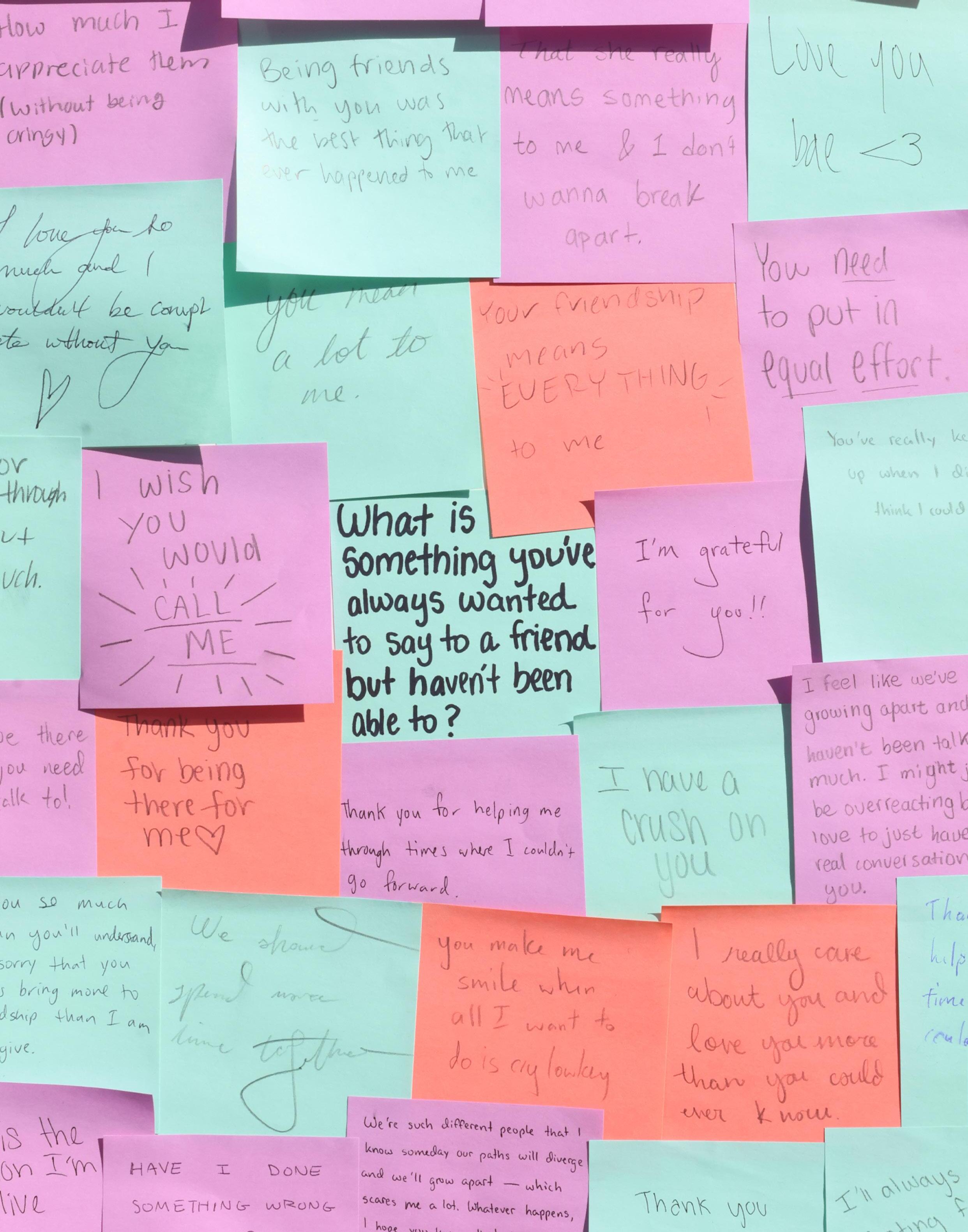
Friendships highlight the importance of sincere high school connection
Editor’s Note
High school can often feel like a battle. With the prominent struggle of balancing one’s GPA, extracurricular activities, sports and whatever else may be going on, it is easy to feel like one may be drifting away from themselves. In a fast moving and stressful environment, everyone is looking for a lifeline, a reason to persevere through hardship.
Thankfully, many of those in the Ladue community have found it. From the Ramming Gym to the third floor, genuine connection floods the hallways, providing a support system of friendship that outweighs school pressure. Data can show that connections lower stress, but the real impact of friendship is found through the stories of those who have grown together, the “day ones” who have made the stress more manageable.
In this issue In-Depth, our team decided to explore the crucial role that true connection in high school plays in shaping our emerging personal identities. We look to the past at friendships fostered in infancy, the bonds that have transitioned from kindergarten buddies to lifelong loyalty, and even to the present at the co-worker friendship dynamic that keeps our educators inspired.
While high school can be seen as an independent race to the top, stories of resilience and connection prove that the finish line is nothing without the community that got you there. Friendship is not just a way to pass the days, but a vessel that brings out the best in two people, stepping into the world with a better outlook on connection.
Josh Devine
Editorial Policy
Ladue Media is an openforum for students at Ladue High School. In order to ensure the news we report is accurate, important and relevant to our students, we do not operate under prior review. All content decisions are made by student editors.
Scan to view our full Editorial Policy
Ladue Media Staff
EXECUTIVE EDITORS-INCHIEF
Josh Devine
Celina Zhou
MANAGING EDITOR-INCHIEF
Madeline Awad
COPY EDITORS-IN-CHIEF
Katie Jansen
Grace Kweon
Ira Rodrigues
ART EDITOR-IN-CHIEF
Fiona Van Allen
PHOTO EDITOR-IN-CHIEF
Vincent Hsiao
NEWS EDITOR-IN-CHIEF
Cindy Liu
SPORTS EDITOR-INCHIEF
Mason Eastman
NEWS EDITORS
Amelie Lock
Jane Scheffel
FEATURES EDITORS
Tiya Kaul
Josie Stout
IN-DEPTH EDITORS
Loukya Gillella
Isaac Zelinske
OPINIONS EDITOR
Frank Chen
HEALTH & SPORTS
EDITORS
Victoria Derdoy
Meg Myckatyn
ARTS & ENTERTAINMENT
EDITORS
Medha Chode
Adela Gingrich
ASSOCIATE EDITOR
Aaron Lin
DIGITAL MEDIA EDITORSIN-CHIEF
Madeline Fong
Nathan King
NEWS STAFF
Caroline Cobaugh
Ellie Lercher
FEATURES STAFF
Elisa Cormier
Emery Mao
Gabriella Beltranena
IN-DEPTH STAFF
Sophie Cowlen
Angella Zhang
OPINIONS STAFF
Henry Madden
Adelaide Flintrop
Emily Tinnin
HEALTH & SPORTS STAFF
Cami Welsh
Elsa Flores-Tamayo Irene Murphy
COVERAGE EDITOR
Emily Pan
ARTISTS
Nora Brunnquell
PHOTOGRAPHERS
Alex Du
Sarmistha Pulagam
Eva VonAllmen
ID EDITORS-IN-CHIEF
Marie Demkovitch
Maya Mathew
Annabelle Reagan
ID STAFF
Ryan Nolan
Sydney Gao
Claire Zhang
ADVISERS
Abigail Eisenberg
Sarah Kirksey
SPONSORS
SPONSORS
Issue
David Von Allmen
Nicholas Reding
Profusion Private Asset Fund
The Demkovitch Family
Ladue Blue
Allison and Terence Myckatyn
Bruce and JoAnne Vieweq
Donna Freeman and Mike Heyne
Ed Tanyag
Katie Myckatyn
Mr. and Mrs. Charles Cobaugh
The Awad Family
The Chode Family
The Derdoy Family
The Devine Family
The Fong Family
The Kaul Family
The King Family
The Lock Family
The Nolan Family
The Pan Family
The Pisarkiewicz Family
The Stout Family
The Strauss Family
The Warwick Family
The Zwibelman Family
Theresa Tanyag
Wendy Tinnin
Gold
Anonymous
Arti Jain
Desta Gingrich
Jean Hayne
Kurtis and Katie Van Allen
Lillian Jansen
Mark Heyne and Rachel Abroms
Michael & Jamica Johnson
Mike and Elaine Stout
Ms. A Jansen
Ms. Elizabeth Welsh
Pam and Matt Cobaugh
The Cummings Family
The Jansen Family
The Liu Family
The Mathew Family
The Tenenbaum Family
The Witt Family
The Yeoh Family
The Zhao Family
The Zhou Family
“Uncle Blake” Baraks
Silver
Amy & Kevin Fischer
Anonymous
Bill and Cathy Scheffler
Bill and Sharon Hunn
Bremer Family
Gary & Shana Singer
Gillella Family
Hello Garage
John Gingrich
Juli and Bernie Plassmeyer
Kathy Bucholz
Laurie Family
Louise Flick & Bill True
Meera & Barry Bryant
Megan Gingrich
Mr. & Mrs. Brissette
MW Interiors
Myles Leonard
Pedro Beltranena
Sara Serati
Steve and Liz Van Allen
Tass Padavan
Taylor Stone
The Bowen Family
The Cormier Family
The Flores-Tamayo Family
The Gandra Family
The Gebrehiwet Family
The Guyton Family
The Haines Family
The Larrew Family
The Mayer Family
The Provine Family
The Scheffel Family
The Sheldon Family
The Solomon Family
The Turner Family
The Varvares Family
The Zotos Drobak Family
Friendly
Alena Tartouskaya
Amanda & Ryan Reagan
Amy Moglen
Anonymous
Anonymous Ladue Alumni
Berman Chiropractic & Wellness
Candice Bellinger
Clarissa Joyce
Edward Zhang
Ella Bender
HaugenHaus.com
Johnny Zhang
Julie Walther Scheibel
Lindsay Turner
Matthew Kweon
Mohamad Yaacob
Nancy Scheberle
Nithin Kumar Gattu
Olivia Cornelison
Salsbury Family
Shanthi Priya D
Sharon and Louis Hill
Sneha Vadlamudi
The Arora Family
The Choe Family
The Denman Family
The Ganni Family
The Gu Family
The Guthrie Family
The Hanes Family
The Hofer Family
The Lohse Family
The Mao Family
The Murphy Family
The O’Neal Family
The Pandian Family
The Poremba Family
The Reagan Family
The Rhodus Family
The Shi Family
The Silver Family
The Swillinger Family
The Taylor Family
The Wang Family
The Yang & Zhang Family
Tim Armstrong
Venkata Pulagam
Vivek Manohar
Walton Family
Will Kodner
Yan Sun
Zhenyi Liu
Zia Mahmood
A Spanish language story of tyranny.
CAN’T CONNECT
TTHROUGHOUT THE
2025-26 school year, the technology department has worked to resolve Wi-Fi issues at Ladue High School. The issues largely came from the access ports, which extend network coverage by connecting to a router. They have since been replaced.
“We had to take the updated ports that Ladue’s software provider suggested and undo it by removing them,” Technology Director Adam Stirrat said. “Good internet is not like a light switch. It’s an old radio dial. When we got good reports from teachers, we decided to spread the update through the rest of the building.”
While non-digital learning still makes up for at least a portion of most classes, most teachers rely largely on technology. Ladue uses both student MacBooks, teacher MacBooks and iPads for instruction.
“There were some hardware updates, and the updates did not work well with our existing system,” social studies teacher Zachary Garrison said. “When things got really bad [with the Wi-Fi], there has been more
communication after I brought the issues to the attention of the school. It interrupts lesson plans and can make learning more difficult.”
For students, losing access to Wi-Fi creates issues both in and out of the classroom.
“One time, I was trying to do some of my math work before a test and nothing was loading,” Mila Alper (11) said. “I had to go to the tech office and I missed the test. Some people said it’s because [students are] watching YouTube when they aren’t supposed to.”
This issue has not gone unnoticed by most students, and the tech team is hopeful that the update will continue to work. If students are more cognizant of their MacBook, they will be able to combat the issues.
“[Students] don’t need their laptop out all day while in class,” Stirrat said. “When you need the laptop, that’s what it’s there for. But every time a computer is on, it’s talking to our access point. So the network felt slow because it was bogged down.”
Earlier in the year, the school explored the idea of switching MacBooks for devices that use less service. The community gave an overwhelmingly negative response.
“I don’t want to go to Chromebooks or [iPads],” Stirrat said. “Although at some point, students have to own a level of digital discipline. No matter how fast the network [is], how many access points, there will be gridlocks.”
PABLO TRUJILLO ALVAREZ
@ptrujilloalv
NEWS TO KNOW
CITY EVENTS
2026 American Cup
Date: March 2-13
Location: Saint Louis Chess Club Cost: $28-$63
314 Day: STL Trivia
Date: March 9-14
Location: Lewis & Clark Branch Cost: FREE
St. Patrick’s Parade
Date: March 17
Location: Dogtown Cost: FREE
Jewish Film Festival
Date: March 15-26
Location: The J Cost: $17.30 per film
18th Annual Gateway Blues Festival
Date: March 20
Location: Chaifetz Arena
Cost: $75+
March Madness
Date: March 20-22
Location: Enterprise Center
Cost: $114+
St. Louis Cardinals Home Opener
Date: March 26
Location: Busch Stadium
Cost: $49+
St. Louis Regional FIRST Robotics Competition
Date: March 25-28
Location: Chaifetz Arena
Cost: FREE
CULTURE IN COLOR
BY ELLIE LERCHER staff Ladue celebrates
students’ cultures during International Week
THE WORLD LANGUAGES
departments hosted the Language and Cultures Color the World International Week Feb. 23-27 to celebrate the different cultures in Ladue.
“[International Week] involves all the students from the different languages,” Spanish teacher Haydee Taylor-Arnold said. “Our school is very diverse, and we invite everybody who would like to share their heritage.”
Four events happened during International Week. The Parade of Nations started the week and is followed by a culinary sampler, an international films viewing and finally a talent show allowing students to display all forms of cultural skills.
“[The thing from International Week] that I [want] to stay with students is that they’re visible,” Taylor-Arnold said. “That we have the opportunity to see each other and the value that we bring with our culture the way we are. So I think it’s aligned perfectly with all the work
that we’re doing and how we’re celebrating each other.”
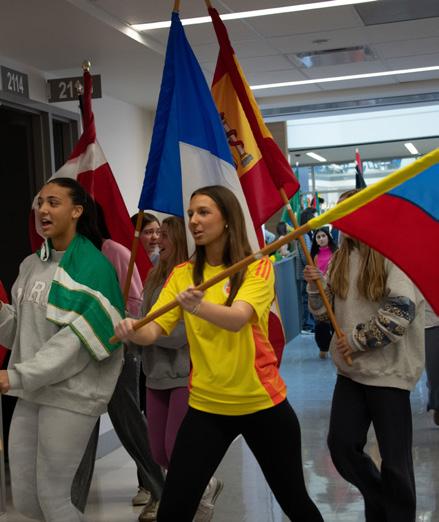
The Parade of Nations was held Feb. 23 near the student staircase during seminar. Student volunteers walked through the hallways holding flags, wearing traditional garments and carrying an array of cultural objects. Other students were able to view the parade from class.
“[I love that] I can dress in one of the dresses from my home country, Panama,” Taylor-Arnold said. “[I love] collaborating and [celebrating] with the students through the Parade of Nations.”
International Week serves as an opportunity for every student to celebrate their culture. Each event gives students a chance to display a specific part of their culture.
“Knowing about different languages is beautiful,” Taylor-Arnold said. “Languages and cultures make bridges and make connections. Then we learn from each other, and we all celebrate our beautiful diversity.” P
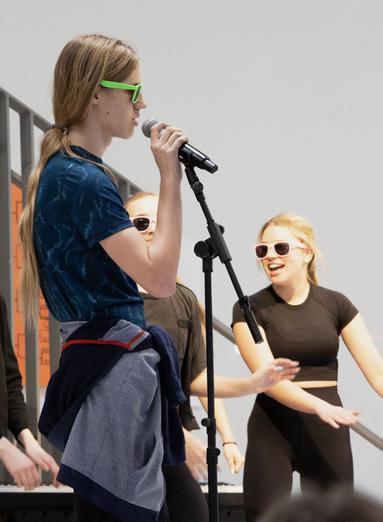
FAR LEFT: Zoe Warticovschi (11) walks through the hallway swinging a Colombian flag. She participated in the Parade of Nations Feb. 23. “I went to the Parade of Nations so I could represent my Colombian culture,” Warticovschi said. (photo by Teo Lee) LEFT: Finn Sehy sings along to a Spanish song. Students volunteered to perform different forms of art, displaying their culture and heritage. (photo by Devin Freeman)
ROAD TO STATE
DECA and
HOSA
members head to state championships
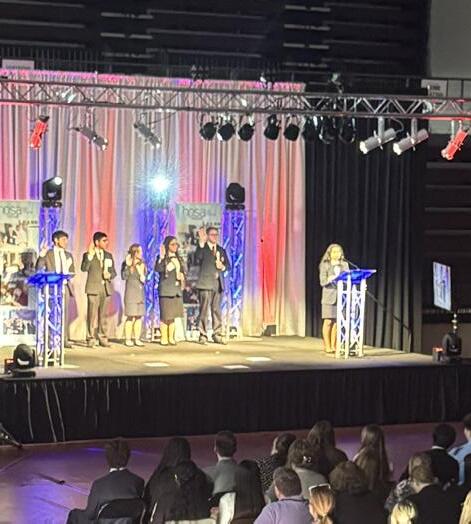
DECA AND HOSA WILL both compete in state championships. The two clubs competed in districts, where multiple members of each qualified for state championships. In between the two clubs, 106 students are heading to state.
DECA is a club where students take on the roles of business professionals. On the other hand, HOSA students explore the world of healthcare professions.
DECA will attend state championships March 22-24 in Kansas City, Missouri. DECA competed in districts Feb. 5. The 62 students who placed in the top three in their events qualified for state. Members have been preparing by working with businesses and planning fundraisers. During state competitions, students compete in different events where they have to do things such as participate in workshops and mock interviews.
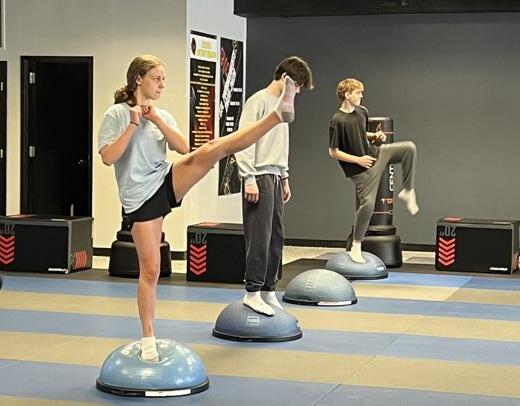
“LANDON PAGE (11)
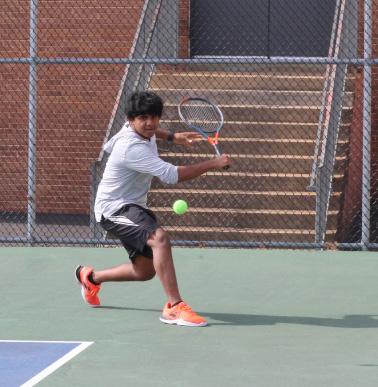
“I didn’t think I was going to like [martial arts], but I ended up really liking it. It was a unique experience.”
BY ELLIE LERCHER staff
“[The most memorable part of state championships] are [the students] getting to see that they are successful and that they can challenge themselves and go against the best in the state,” DECA sponsor Megan Bruce said.
Similarly, HOSA will attend the State Leadership Conference (SLC) March 24-25 in Rolla, Missouri. HOSA members competed in qualifiers Jan. 20. The students that placed in the top 20 of their respective events qualified to compete in the SLC. 44 members qualified and will participate in specialized skill shops and testing events during the competition.
“[The most important part of SLC] is that [the students] get to grow as individuals, as leaders and as competent critical thinkers,” HOSA sponsor Allen Weltig said. “The work they have to put in to get [to the SLC] builds those skills of teamwork, collaboration and service.”
“It was really fun. We got a backstage tour of the veterinary hospital at the Zoo, where they treat all the animals.” Lifetime Sports: Martial Arts
“TORI FOX (11)
““All the work that [the students] put into [HOSA] is them growing in knowledge and skill,” sponsor Allen Weltig said. “It’s really cool and it’s exciting to see that.” (photo courtesy of Qina Hong) ABOVE: DECA holds a mock role-playing event in order to prepare for state championships. Judges volunteered to accurately critique the member’s performances. (photo courtesy of Norah Martin)
KIMMI LIN (12)
“It was very interesting. There was a SLU medical student, and she talked to us about the different organs of the body.”
(photo courtesy of Roberta McCaffrey)
(photo courtesy of Fernanda Lopez)
(photo courtesy of Suri Johnson)
TOP: Missouri HOSA SLC will be March 24-25. Ladue has competed at SLC the past few years.
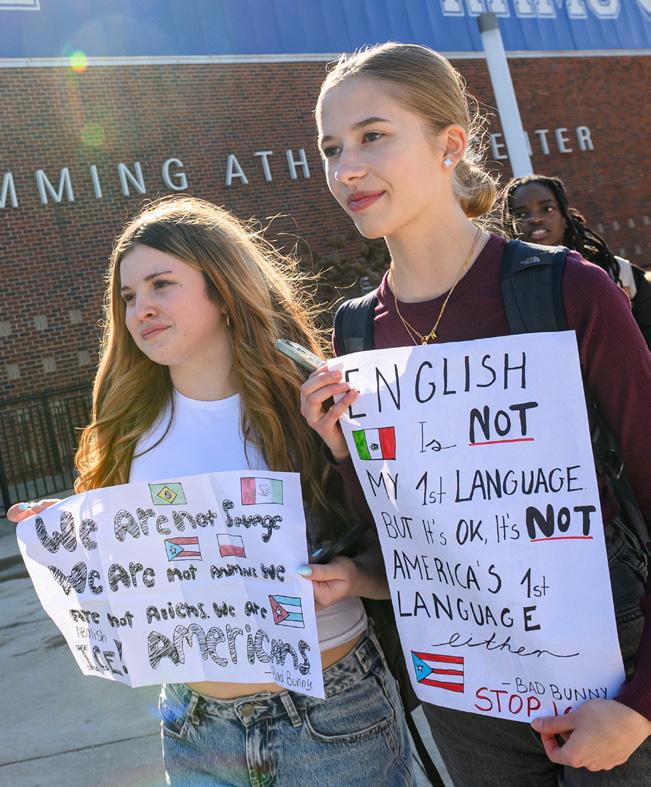
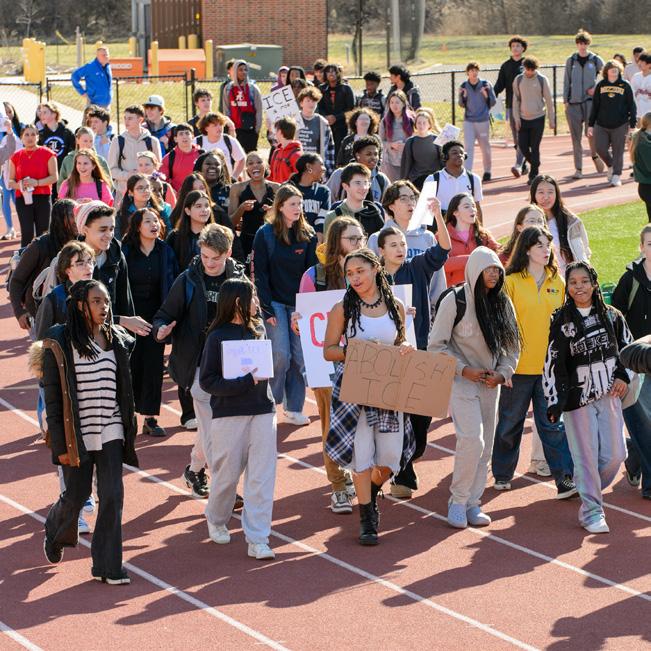
ABOVE: Ladue High School students gather a week after Ladue Middle School students walked out. The walkout was entirely organized through social media. “It makes me really proud that people our age are standing out and protesting,” Nadia Pyziak (9) said.
MELTING THE
SILENCE
Students walk out to protest recent acts of violence committed by U.S. Immigration and Customs Enforcement
BY JANE SCHEFFEL news editor
LPHOTOGRAPHY BY VINCENT HSIAO photo editor-in-chief
around the track, holding homemade signs and chanting to end the cruelty of ICE.
“[My favorite moment of the walkout was] definitely the chants up in the front,” Maximus Denos (10) said. “[The chants] were very passionate and enthusiastic, and they were inventing a bunch of chants.”
LADUE STUDENTS WALKED out of classrooms to protest recent immigration policies made by the Trump adminstration and the aggressive actions by the United States Immigration and Customs Enforcement (ICE) Thursday, Feb. 12.
Since the start of the new year, community and student protests against ICE have increased across the country. The deaths of Renée Good and Alex Pretti in Minnesota by ICE agents continue to stir discontent with the operations of ICE. Political unrest over ICE immigration policies and tactics have influenced students to come together and use their collective voices to protest.
“Our goal is to spread as much awareness as possible of the abuses committed by ICE and the fact that we at Ladue High School are opposed to [it],” participant Jackson Lloyd (10) said.
A few days before the walkout, a student posted the time, date and location of the protest on Instagram. Multiple Ladue students then reposted the notice across social media to spread awareness of the protest. While the walkout attracted a large crowd, many students chose not to walkout.
“I really think it’s the harmful mentality of, ‘Oh, I’m just one guy. What can I do?’ I think that held a lot of people back,” Denos said. “That’s a big thing with group mentality. It takes one person to start something, but the second person is really what starts the tumble.”
In the St. Louis area, multiple high schools, such as Clayton and Kirkwood, have held walkouts against ICE. At first, Ladue held a walkout Jan. 6, but many students were unaware and missed walking out, so multiple students felt the need to host another walkout. Students have come together to bring awareness to the current issues with ICE and to express overall concerns about immigration policies.
“It’s amazing and makes our generation very impactful and resilient.” P
Around 300 students walked out of their last period class and gathered on the football field. The crowd walked laps
“[Students] should make [their] voices heard in the sense that this is one of the only ways that we as high schoolers can make it known what we believe, what we feel about [ICE],” Lloyd said.
ABOVE: Ben Reiser (12), Henry Brenneman (12) and Henry Madden (10) chant and hold a sign as they walk the track. All grades participation in the walkout. “As a commentator, I know how to use my voice to make a difference,” Reiser said. “Starting and leading the chants was exactly where I knew I needed to be to do my part in making a difference.”
MIDDLE SCHOOL HOLDS WALKOUT
STUDENT ACCOUNTS
Why did you decide to participate in the walkout against ICE?
“It’s really important that students speak up and use their voices for good.”
Talia Poremba (10)
“I really wanted to support my fellow students and wanted to [protest] against ICE.”
Daniel Wang (11)
Ladue Middle School students organized a walkout Feb. 2 to protest violent acts committed by ICE. The walkout was organized through social media and groupchats. Around 300 students walked out of classrooms at 10:30 a.m. and stood in the front of the middle school building, chanting and holding up homemade signs. (photos courtesy of Eve Lock)
“The walkout is important because it shows a sense of solidarity within our community. Especially with the oppression that minority communities are facing.”
Anna Huewe (11)
“My friends were going and they don’t like ICE. I just wanted to support my friends.”
Jordan Barnes (10)
JANE SCHEFFEL
SPREAD DESIGN BY
IS HOLDING IN DETENTION
68,289
PEOPLE AS OF FEB. 7, OF WHICH ONLY
ICE UNDER TRUMP IS THIS TOMORROW?
ILLUSTRATION BY CELINA ZHOU executive editor-in-chief
BEFORE BEING SENT OUT, ARMED, INTO THE STREETS.
26.4% HAVE CRIMINAL CONVICTIONS OR CONNECTIONS TO CRIME. HAS A BUDGET OF OVER $85 BILLION WHICH FUNDS AGENTS THAT ARE GIVEN 8 WEEKS OF TRAINING
entered Columbia University dorms and illegally arrested undergraduate student Elmina Aghayeva, just under a year after the arrest of Mahmoud Khalil March 5, 2025, another Columbia student, as part of a wider campaign by ICE and the Trump administration against the university.
SOURCE: AP News
ALWAYS WATCHING?
How ICE uses technology to recruit, propagandize and surveil
DEFEND THE HOMELAND
SOURCES: Washington Post, New Yorker, SPLC are among platforms
ICE is using in what they refer to as “WARTIME RECRUITMENT.”
White supremacist dogwhistles often appear in their advertisements.
“We will have our home again.”
“Which way, American man?”
“Defend the homeland.”
“Secure the Golden Age.”
AMERICA NEEDS YOU
“America needs you.”
SOURCE: Politico
ICE seeks to spend over $300 million on tech under Trump.
SOCIAL MEDIA MONITORING, FACIAL RECOGNITION SOFTWARE
AMERICA NEEDS YOU
AND DATA FROM THE SSA AND IRS
JOIN ICE TODAY
are among tools the agency is using to build a massive, automated surveillance network.
IS ICE IN ST. LOUIS?
Short answer, yes. ICE has active agents in all 50 states. In addition, local police departments can enter into 287(g) agreements with ICE, a kind of voluntary partnership.
TASK FORCE MODEL
“NEVER FORGET”
The history of modern immigration enforcement
SOURCES: The Guardian, ICE, USA Today, The New York Times
MARCH 1, 2003
The Homeland Security Act of 2002 establishes the Department of Homeland Security (DHS), of which Immigrations and Customs Enforcement (ICE) is a major branch, replacing the preexisting Immigration and Naturalization Services.
2009
Under President Barack Obama, ICE deports a record 2.4 million undocumented immigrants from 2009 to 2016.
JANUARY
2017
Shortly after his inauguration, President Donald Trump signs an executive order boosting ICE’s staff by 10,000 and vastly increasing the scope of its power. ICE shifts from targeting people charged with crimes to anyone entering the United States illegally.
2024
President Trump’s second term marks the rollback of protected areas like churches and schools, usage of the Alien Enemies Act to deport with little or no due process and the expansion of detention facilities.
* WASHINGTON
SOURCES: ICE.gov
SAINTE GENEVIEVE
*Washington County has entered into both a Task Force Model partnership and a Warrant Service Officers program.
partnerships allow local police officers to hold limited immigration power with ICE oversight during routine police duties.
WARRANT SERVICE
partnerships allow ICE to train and certify local police officers to serve and execute warrants against aliens in their county’s jail.
JANUARY 2026
As ICE presence and local protests increase in scope and scale in Minneapolis, conflict arises. ICE officers shoot and kill civilian Renee Nicole Good Jan. 7, and restrain, pepper-spray, shoot and kill ICU nurse Alex Pretti Jan. 24, sparking nationwide protests.
CELINA ZHOU
VIBRANT BY DESIGN
BY JOSIE STOUT features editor
PHOTOGRAPHY BY VINCENT HSIAO photo editor-in-chief
TTHERE’S SOMETHING ABOUT going to a concert, watching live music and letting the energy from the artist flow through you, that brings a peculiar sense of calm. The stress from school or life seems to melt away, becoming irrelevant when the rhythm of the song takes the place of your own heartbeat. For Kyra Siegel (11), music is more than just a subscription to a music streaming app. It’s an outlet for expression, a connection to family and a way for her to escape from the inevitable stressors of life.
“School, especially for me, can be so draining and stressful, but when I’m at a concert and seeing live music, it’s like my soul is revived,” Kyra said. “I get so caught up in thinking about the future, but when I’m at a concert and I’m seeing music, nothing matters anymore.”
Kyra grew up in a rock ‘n’ roll household and her dad introduced her to music when she was young. As her love for music progressed, Kyra took a liking to one band in particular: Phish. While she loves their music, the band has also served as a key connector between her and her father.
“Every year, I get a Phish shirt for Christmas, and that’s just been a running gift from my dad,” Kyra said. “Those always mean a lot to me because I love the
band, and it’s brought me really close with my dad, and I just love their designs and all their shirts,”
Kyra’s personality is one that is also shared with her father. She’s a fervent optimist, and her uninhibited approach to life is passed down from her parents.
“[Music] got me closer with my dad because at a concert, I really like to dance, and he dances too, and it’s just something we’ve always had in common,” Kyra said. “Being weird, being weirdos in public, is one of our favorite things to do.”
Because Kyra is so open about her love for music, she’s able to make connections with strangers. In her mind, music is a universal language that everyone can speak.
“I love talking to people about music,” Kyra said. “Sometimes I’ll just see people wearing concert shirts, or when I’m shopping for CD’s, I’ll just talk with random people. It’s so easy to talk about music because it’s something everyone likes.”
IKyra extends her talents to her peers as well. As president of Ladue’s Beading Club, she’s able to share this creative outlet and help others make pieces they love.
“When they smile and they’re so proud of their piece, it makes me feel proud too,” Kyra said. “I was able to teach someone how to do [beading] and teach someone something they love.”
After Kyra’s mother passed away a few years ago, Kyra chose to carry on her legacy of making and designing jewelry.
“She’s amazingly empathetic of others and caring of others,” Peter Siegel, Kyra’s father, said. “When she’s creating, whether it’s art or jewelry, she loves to share. It’s always just super fun to see.”
“I get so caught up in thinking about the future, but when I’m at a concert and I’m seeing music, nothing matters anymore.”
Kyra’s love for music is only part of vibrant self expression. She derives a ton of happiness from creative fashion.
“Almost everything I wear is secondhand or handmade by myself,” Kyra said. “It’s better for the environment, and it makes me feel better when I wear something I’ve made.”
Aside from the beaded work and embellishments Kyra adds to her clothes when they need something extra, she creates a lot of the jewelry that she wears daily.
“I usually do more beading but I’m slowly learning metal work,” Kyra said. “It’s kind of hard, but I love it.”
Kyra’s style, love for music and personality set her apart from many as a truly bright and positive force in the world. She fills her life with things that bring her joy, and ditches the things that don’t.
“[I love] her bubbly personality, her beautiful personality,” Cam Chen (11), one of Kyra’s friends, said. “She’s purely and authentically herself. I feel like these days that’s really rare.”
Just as music connects Kyra with her father, and her personality brings her closer with her friends, her love for creating connects her with her mother. Kyra bears her mother’s creative torch with pride.
“Jewelry has always been very close to me,” Kyra said. “Especially now, because my mom taught me how to make jewelry. When she passed away, I knew I couldn’t give it up, because it was one of my closest ties I had to her.”
Kyra Siegel (11)
Kyra Siegel (11) expresses herself through fashion and music
Kyra made these two buttons on her tote bag. One is a collage of her favorite musicians, and the other is a collage of Lisa Frank’s art. Frank serves as a huge fashion inspiration for her.
The charm bracelet features charms all the way back from Kyra’s childhood, with some being as old as she is. Each charm holds special significance.
Kyra made the silver heart earrings as an homage to her mother. Her ashes are kept inside them.
CURIOUS? Scan for the extended story
Kyra hand makes all of her necklaces. The long silver chain is one her mother used to wear every day. The blue one took a lot of time and effort to make, and she’s especially of it.
ELISA CORMIER
Beginning debate, it can be nerve-racking to speak publicly, especially when facing opponents years older than yourself. Fan, too, dealt with this stress. Despite this, he’s conquered this fear and has been able to see his age as an advantage.
“In my first couple tournaments, I was pretty scared, especially if my opponents were good [competitors],” Fan said. “But, honestly, once you start competing at a high level, your opponents see you as an equal, not someone younger. I feel I’ve lost that sense of anxiety before rounds. Having so many years ahead of me and having a different perspective is very helpful.”
Now, after competing in the eastern Missouri circuit for a full season, Fan has racked up wins throughout tournaments like the Clayton Invitational, Pattonville Invitational and more. With Pan, they’ve been able to write and create cases, which are the prewritten arguments given in the first speech, that are creative and unique.
“My favorite case of this season was the [November and December] negative case,” Pan said. “The case was about cybersecurity and lawful access to encrypted communications, and one of the key reasons for why it’s my favorite is because we largely wrote it on our own without external help from sites like Open Case List.”
Although Fan’s first year in debate has been filled with competitive success, he’s faced numerous challenges along the way.
Many judges in the eastern Missouri circuit aren’t experienced debaters, but rather just parents who volunteer since their children compete. Thus, it can be hard to understand how the judge will score a round.
“At that type of level, everyone’s very good,” Fan said. “There’s not a bad person. And, honestly, I sometimes struggle taking stuff in, like how the judges will react. At certain tournaments, I felt I was in control of the round and still lost. But it’s to be expected at that level.”
Although this can be considered a constant issue for all debaters, Fan realizes that the outcome of one round doesn’t define you or your abilities as a whole.
“It’s not always about the results,” Fan said. “That tournament can still be a lot of fun. I might have lost a round, but I felt like I did well. And honestly, that’s something that I can hold with myself and be happy [about].”
Next year, and the years after that, Fan will be back in the same classrooms, competing just as always. But each time, he’ll do it with a little more confidence, a little less fear and with even more wins.
“I still have more than three years ahead of me,” Fan said. “I think that as time goes on, you just get better and better. And I think a lot of that is the more you debate, the more experience you have. So in the future, I think everything will continue to get better.” P
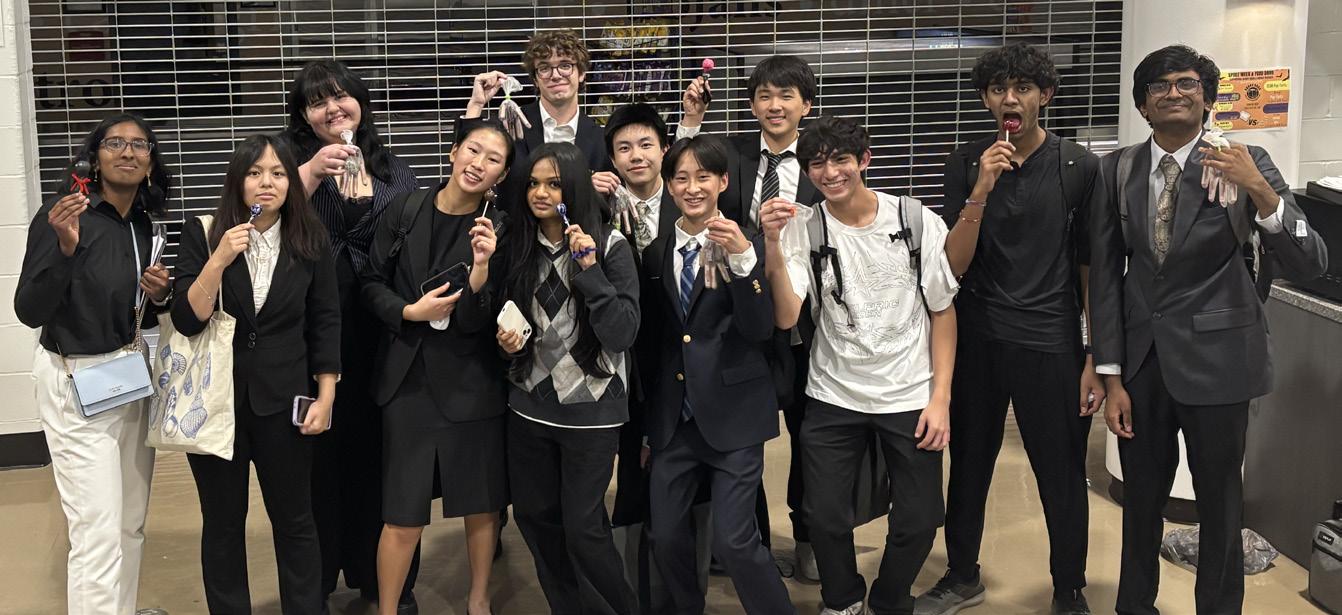
ABOVE: Ladue Talking Rams display their candy awards Oct. 11 at the Troy Round Robin. Charlie Fan (9) competed in junior varsity Public Forum, championing the event by going 5-0. “I was nervous about placing because some rounds were pretty close,” Fan said. “I was very excited for my first debate tournament to go well.” (photo courtesy of Talking Rams)
LEFT: Charlie Fan (9) gives a practice speech after school. Talking Rams holds speech and debate practice four days of the week. “I would say I spend seven to eight hours a week on debate,” Fan said. “It depends on the week though. Like the week before tournament, everyone locks in, and that’s why Ladue is really good.” (photo by Alex Du)
TALK SMART
Debaters give advice for firsttime competitors
“If [a competitor’s argument] sounds too good to be true, it probably is.
“[Debate] requires a lot of work and effort, but it’s rewarding in the end.”
“Don’t be upset if you don’t do well, because there’s always next time.”
“Don’t be nervous, [because] it’s not as hard as it seems.”
SOPHIE YUAN (10)
JESSIE WANG (10)
URMIL PATEL (12)
ADAM GLASSMAN (9)
SINGING WITH PURPOSE
PHOTO ILLUSTRATION BY VINCENT HSIAO
photo editor-in-chief
BY GABRIELLA BELTRANENA staff
MOLO CHRIST (11) WEARS THE “choir kid” label with pride. Many high schoolers view choir as just an elective — a simple fine art credit to check off the list for graduation. But Christ’s singing and passion for music is an integral part of who she is as an individual. Ever since arriving at Ladue earlier this year, Christ has made her mark in the musical programs the school has to offer. However, the dedicated alto 1 isn’t looking for applause: She is planning to take this passion and turn it into a career in music education and conducting.
Growing up in a musical household, with her father’s influence, Christ has been singing since she could talk. Once her father discovered her natural talent for singing, she entered in singing competitions.
“I don’t have any memories of the singing competitions, because I was just so young,” Christ said. “But there’s videos of me singing on the microphones.”
Christ first decided to join choir when she was in grade school at Bayless High School in Wisconsin. Shortly after that, she decided to join the Bayless show choir, a musical ensemble that combines both choreographed dancing with vocals.
“We usually get [our] music before, so we can listen to it and learn it ourselves,”
Christ said. “But then we really drive it home with the music director.”
When Christ was in show choir she would stay after school till 6 p.m., practicing dancing and songs with her peers. Most show choirs only have a music director, but the Wisconsin School Music Association did not only have a music director, but a dance choreographer. This new role highly peaking Christ’s interest in performance.
“We would go up on stage and we would practice formations, dancing and [would] sing,” Christ said. “We would usually learn a song within a week, drilling it until opening night.”
The WSMA show choir was big on making sure the younger students were happy and wanted to return.
“[Bayless] had a bunch more programs for singing because we were a Christian based high school,”
Iher hat into the ring for the Missouri All State Choir, she ended up declining.
“I knew I wanted to do the musical,” Christ said. “[But] I didn’t know if I would be able to balance both all state and the musical.”
Christ’s introduction to theater wasn’t on stage under the spotlight, but in the shadows behind the curtain. As part of the Ladue fall play set crew, her afternoons were spent with the scent of fresh paint and the grind of 7 p.m. finishes. But as she watched the production take shape from the sidelines, something clicked.
“I tried out for the musical because I always wanted to be in one,” Christ said. “It also stems from me missing show choir, the musical being the closest thing to it.”
“I feel like I’ve gotten to experience [the] best of both worlds. I’ve never been so passionate about anything else.”
Molo Christ, (11)
Christ said. “The choir usually went out to the grade schools, and we would sing at churches.”
When Christ entered high school here at Ladue, she no longer did show choir. To fill her time, she auditioned for the All Suburban Choir, a regional ensemble featuring the best singing in the all suburban area. If accepted, one is then given the opportunity to try out for the All State Choir.
“Think of your high school choir, but probably three times bigger,” Christ said. “And no offense, probably way better voices, and it’s overall really eye opening.”
This year, Christ was accepted into All Suburban back in November. However, when she was given the opportunity to toss
Despite having years of vocal experience, she didn’t possess any prior theater experience, so Christ chose to aim for a “realistic role.”
“I wanted to be Brooke Windham due to her having a reasonable amount of lines and her own solo song,” Christ said. “I also auditioned with Paulette’s song and wouldn’t mind if I got her.”
Ultimately, the casting board saw Christ as the perfect fit for Serena, the high-energy Delta Nu cheer captain. It was a match that Christ embraced wholeheartedly. To bring the “sass” of Serena to life, Christ had to transform her stage presence.
“I had to channel my inner sass and made sure I was always reactive,” Christ said. “Instead of shock, I would be disgusted. Instead of happy, I would be ecstatic.”
This transformation didn’t happen overnight; it was fueled by bonds formed be-
Molo Christ (11) progresses her singing skills while exploring musical theater
hind the scenes. Lauren Damman, one of Christ’s closest theater friends, first met her during a technical project last semester.
“She had a lot of energy and wasn’t afraid to speak her mind,” Damman said. “I also loved her fashion sense and how she wore what she wanted and what made her comfortable so freely, which is very inspiring to me as someone who struggles with body image.”
As Christ navigated her musical debut, Damman became a constant support system, but the inspiration went both ways. Christ’s natural vibrance helped Damman find her own footing in the production.
“She really helped me gain more confidence and energy onstage and in rehearsals,” Damman said. “She is a naturally talented singer and performer … truly a perfect fit for her role and my perfect hype woman.”
The experience has done more than just add a line to her resume. It has changed her perspective on the community behind the curtain. While her schedule was sometimes stressful, the end result made it worth it.
“I loved the time in theater and honestly being called a theater kid isn’t bad,” Christ said. “The people [in the theater] are so fun and chill.”
The theater community reciprocates this sentiment. Christ has met many people during her time on set that she’s forged a deep connection with, including Micah Meyer (9), who she met earlier this year.
“She is very charismatic and has great energy,” Meyer said. “She’s super cool to watch on stage.”
As Christ looks towards graduation, her sights are set on a career in music education. Currently, her ultimate goal is to be a conductor on the stage. In a world where many students are pressured to pursue high-paying jobs, Christ is intentionally choosing a different path.
“At this point, I don’t really care [about the money],” Christ said. “Just doing something I really love would be something I would really [like to do].”
For Christ, music is more than a stage performance, it is the place where the technicality of notes meets depth.
“Whenever I feel a very strong emotion, I sing. It’s just something that moves me to tears … I think about the words, I think about the melody and singing it. And seeing it lets me cry because it’s just this beautiful arrangement,” Christ said.
Christ
performs as Serena during the Ladue Theater production of Legally
Christ played the role of the sassy Delta Nu sister who supports the journey of Elle Woods. “I believe I did really well for my first musical,” Christ said. “I made sure I was always locked in when it came to learning my music and the dances.”
Molo
(11)
Blonde.
W a l k N N e e x
Friendships highlight the importance of sincere high school connection
BY ISAAC ZELINSKE in-depth editor
BY SOPHIE COWLEN
BY NORA BRUNNQUELL artist
S
SCHOOL CAN SUCK. BETWEEN GRADES, tests, quizzes, what to wear, who likes who, college, it can feel pointless to try and stay secure through the chaos. Teenagers are given the impossible tasks of navigating a minefield of social challenges, all while trying to pass AP Biology. At times, it can feel like you’re drowning alone. In the vast sea of adolescence, all anyone wants is a life vest.
Thankfully, many have found their life vests. From cafeteria to classrooms, the sound and sights of friendship fill each corner of the school, assisting one another through the many trials and tribulations of growing up. Being close with someone brings with it a laundry list of benefits: someone to complain with, someone to hang out with, someone to relate to, someone to be seen by.
It’s easy to understand this laundry list of benefits through statistics about communities lowering rates of depression or lower-
ing stress, but the real impact can only be seen by telling their stories. The stories of how friends have grown together. Stories of people who have been there for each other since day one. When it feels like everything is trying to break you and make you feel worthless, it’s important to remember those that both complete and make you feel loved.
CLAIRE
& NETRAA
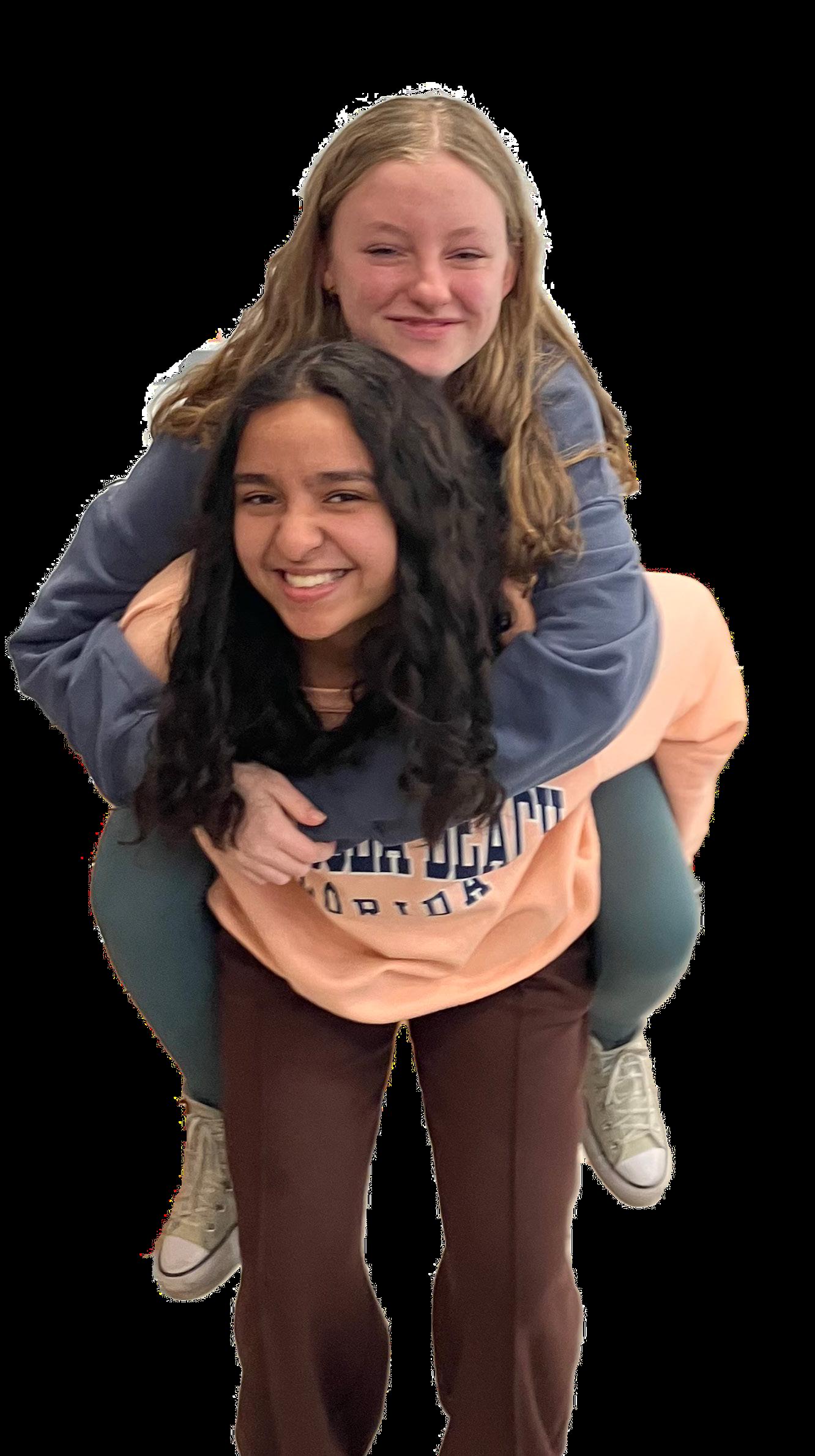
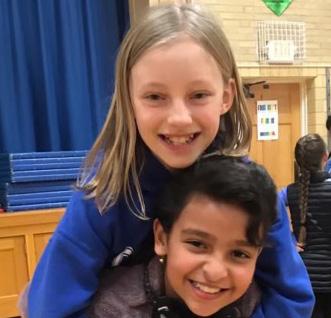
Looking back over one’s life oftentimes far-off memories fade from the mind. The moments not preserved in photos slowly fade from memory. However, even when the past seems like a blur, feelings are not forgotten. For the longtime friends, Claire Yates (10) and Netraa Dixit (10), this is true for the feelings of their 11-year friendship.
“[Netraa’s] there for anything,” Yates said. “She’s always been a support system for me. Since we were friends through switching schools, elementary to middle to high school, through COVID-19, through different friend groups, we’ve always been close in a different way, and I think the fact [that] we always talk [about] our issues has helped us stay so close.”
Yates and Dixit first met in kindergarten at Conway Elementary School, and they grew even closer together as time passed.
“In elementary school, there was a phase where I didn’t really like Claire because her mom made her cut her hair into a bob, and I thought she looked really mean,” Dixit said.
ILLUSTRATION
Despite the hair debacle, the two quickly clicked and became very close friends. As they grew up and met new people, their friendship stayed strong because they always tried to stick by one another, prioritizing loyalty and trust in their friendship.
“We’ve been through multiple friend groups together, and somehow we always end up together after the friend group dissolves,” Yates said.
Since they’ve known each other most of their lives, they have something much deeper than a surface-level connection with one another.
“I feel like our friendship has gotten to the point where we don’t even know generic stuff [about each other],” Dixit said. “We just know specifics and details.”
What has helped them have such a strong bond is their ability to listen intently to one another and talk through the serious aspects of life.
“Having known each other for so long helps us vent when we need to, and it gets us through our problems,” Yates said.
In addition to being a solid support system, the close pair also keep finding ways to make each other laugh.
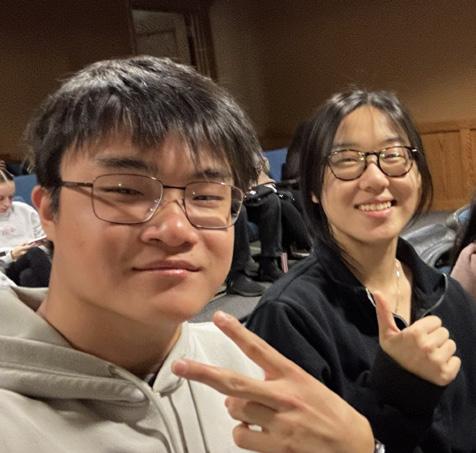
RIGHT: Claire Yates (10) and Netraa Dixit (10) have been close friends for years. Whether they’re making each other laugh or encouraging each other in difficult times, they prioritize support in their friendship. “We [always] talked through any issues, [and] if something happens, we never let it go untalked about.” (photos courtesy of Claire Yates)
This balance is what makes their friendship so important to them.
“Something I look for in a friend is somebody that you can be goofy and crazy with, but also [be] serious with, and it won’t be an issue going forward,” Yates said.
This meaningful, long-lasting connection has created many memories for the two of them over the years.
“We had a feast at my house,” Dixit said. “I spent over $100 buying groceries, and we cooked all of it in one night. But we ate so much while we were cooking it that we couldn’t actually eat the final product. And I had two months worth of soup, rolls and pasta in my fridge.”
Aside from the big plans they make, they also find joy in the simplicity of each other’s company.
“We go to each other’s houses and spend 12 hours together,” Yates said. “On a random day, I’ll be like, ‘Hey, you want to come over?’ and then we’ll just do nothing for 12 hours.”
From instantly clicking when they were young to sticking by each other over the years, their friendship has remained. Now, their bond has evolved beyond a normal friendship.
“I know more about her than I know about myself,” Yates said. “I would say that Netraa’s more family than friend by this point.”
E E x p p e e r t
A d d v i c e e
Safe Connections’ Jacob Stern provides advice on high school friendships
Q: Why are high school friendships important?
A: High school can be a first foray into adult life, so it’s a chance to bring a new level of consciousness and intentionality to your friendships. My high school friendships helped me form an identity that still resonates with me to this day. High school is also a time of daunting transitions, and it’s always helpful to navigate those alongside people you love and trust and who really know you.
Q: If me and my friends are fighting, how should we go about figuring it out?
A: For conflict resolution, I’m a huge fan of structured dialogues. It can feel unnatural at first, but that’s part of the point, since so many conflicts “naturally” devolve into unproductive back-and-forths when emotions run high. Take turns sharing what your experience was, and the other person’s job at that time is to listen, not with the intent to reply, but to understand what you went through that led to the conflict. Then you switch roles and it’s your turn to listen to them. After you both have heard each other and validated the other’s experience, you can move to a resolution, new agreements or apologies if necessary.
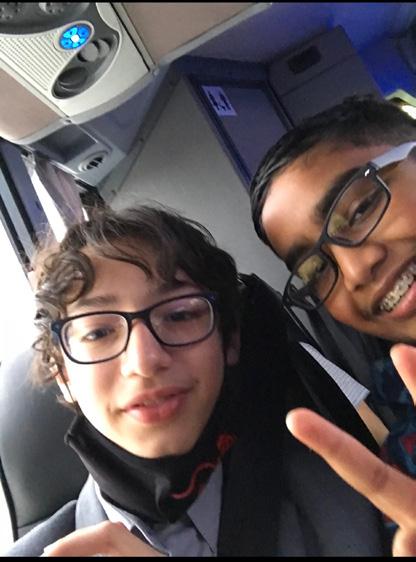
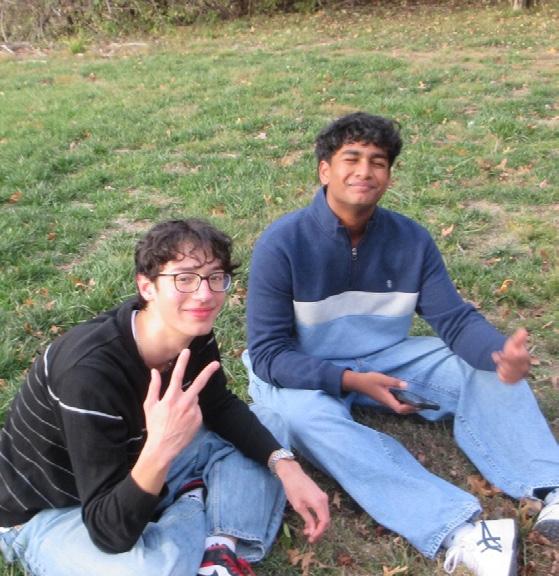
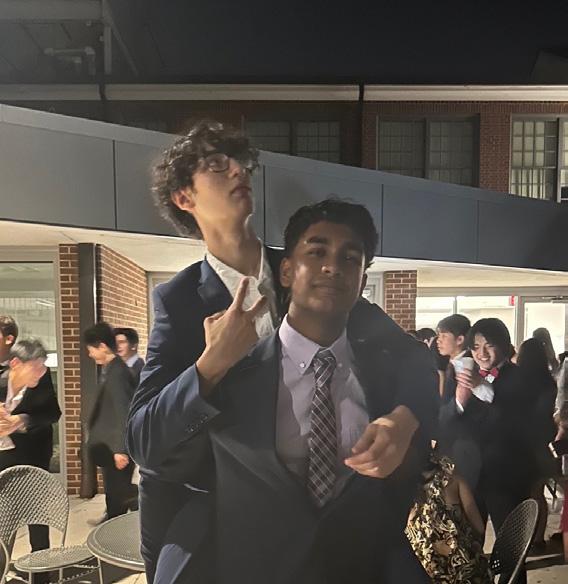
ABOVE: It’s hard to find a moment where Aidan Antony (11) and Jonah Alper (11) are not together. The two originally met in fifth grade. “We both have our really smart moments and our not so smart moments,” Antony said.
Photos courtesy of Aidan Antony & Jonah Alper
JONAH & AIDAN
There is a stereotype within the manosphere that all it takes for two men to become best friends is one shared interest and proximity. Although there are many cases to disprove this, for Aidan Antony (11) and Jonah Alper (11), this trope couldn’t be more true.
“We both have an ‘A’ last name, so we’d stand in line together,” Alper said. “ [One day] I go, ‘Do you like Venom?’ Basically, that’s how we [became friends]. He was like, ‘Yes, I love him.’”
In fifth grade, after Antony’s move from Wisconsin to Missouri, the two became very close. Now, their friendship has changed in many ways, but the two are still inseparable.
as helping me make other friends. Because we have a dynamic where I feel like I don’t have to hide anything or do anything different than I normally do.”
This pattern is not exclusive to them. A National Institute of Health meta-analysis found a positive strong link between teenagers with strong relationships and higher self esteem. Friends can often function as support systems for each other.
“Last year, over spring break, no one else was in town,” Antony said. “So we met up at like, 8 a.m., and we’re like ‘you want to get Starbucks?’ Then, we [didn’t] stop hanging out with each other that day until 9 p.m. It was a full day we [had] spent together.”
Despite how long they’ve been friends, the pair’s dynamic has stood the test of time.
“I think as we’ve been able to see [how] each other have matured, I think our friendship has matured as well,” Alper said.
Sans their fifth grade selves’ love for Venom, the two don’t have much in common. Still, their bond extends past the differences.
“Past one or two shared interests, we’re very different people,” Alper said. “[We have] very different interests educationally. I like writing, he likes science, he likes sports a lot and I don’t really. But our friendship dynamic runs past that and instead of letting the differences divide us, we’ve been able to share each other’s interests with each other.”
Despite sharing a friend group, the pair has grown uniquely close to one another.
“I feel like we’re a little different,” Antony said. “I haven’t really met [anyone] that acts like we do. Sometimes, even [our other friends] will get really mad at us because of how stupidly in-sync we are.”
Over the last six years, the connection Antony and Alper have built has done more than just strengthening their friendship.
“Our dynamic has really been able to show me how to build confidence within myself,” Alper said. “[Both] as a person as well
“Someone who has your back, your day one,” Antony said. “Someone who will pick up the phone and go get food with you. That’s a friend. Someone you know you can trust.”
In a more basic sense, friends often aren’t making some grandiose show of support. Instead, their mere presence is steady and stabilizing.
“I’ve been in this position a lot of times throughout my life where I’ve been absent of friendship,” Alper said. “It’s really taught me how important friendship is. Because, really, it’s the kind of thing that gets you through the day. Friendship is just such an important thing, because it’s what’s important to people in life.”
KELLY & JOSH
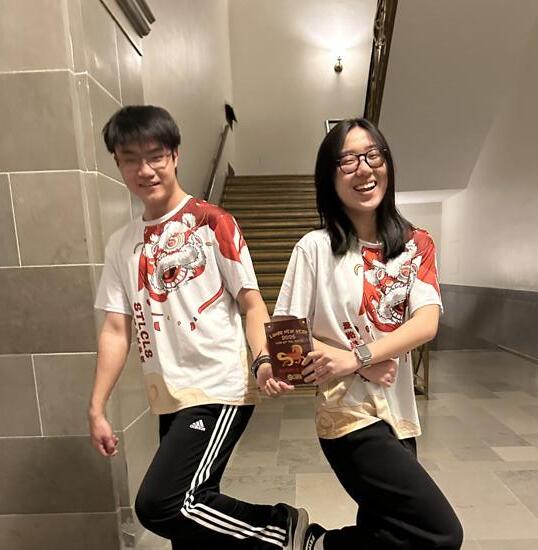
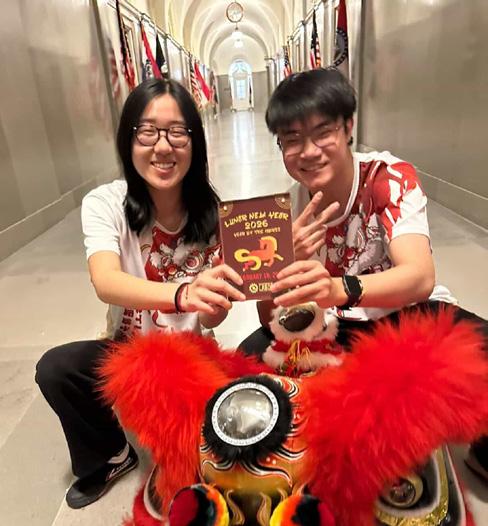
As people perform the traditional Chinese lion dance in bright, colorful costumes, symbols of good luck are spread. For the co-captains of the lion dance team, Kelly Bian (12) and Josh Gu (12), the dance also brings prosperity to their friendship. As Chinese Americans, their communities were always meshed together growing up. But, through a shared sense of humor and passions, the two became close friends while lion dancing the past few years.
S“Lion dancing is like a team sport. There’s a lot of trust that goes in with being in the lion,” Bian said. “But there’s something sacred itself on performing lion dancing because there’s a lot of tradition and history that goes with it. So something that makes it even more special is performing with people that you care about.”
In addition to dancing, Bian and Gu also deepened their friendship through Catalyst, a program they go to every school day.
“We’re working on electric conversion of a go kart,” Gu said. “So we spend a lot of time trying to make it work and thinking of different ways to solve it. That’s definitely strengthened our connection together.”
When Bian and Gu began working together, whether it was for lion dancing, Catalyst or simply for a school assignment, what made them an excellent team was their similar humor. They became close not just because they spent lots of time together, but because they felt connected on a personal level.
“I would say [I have] the same sense of humor, but not to the extent of Josh,” Bian said. “Josh is a little more of a silly guy and that’s what you need after a long day. Some times you don’t want to have those long conversations. You can turn your brain off and just talk about In stagram reels. But Josh is also a guy who you can have those conversations with about the worries for your future. He’s a very multidimensional guy.”
“Something that makes [lion dancing] even more special is performing with your friends and people that you care about”
Kelly Bian, (12)
In addition to making each other laugh, the two also support each other through the serious aspects of life. They both want to study engineering, so through their shared experiences, they can help each other talk through their plans for the future.
“We’re planning on the next step of our lives,” Gu said. “So, a lot of the time during college [application] season we were discussing what we want to do,” Gu said. “A lot of the time we would go on a call and just talk. If we had any concerns, we would talk to each other about it and then see what colleges we wanted to apply to and why. It was just a nice experience having that time to talk about your worries about the future.”
Putting together their sense of humor with the strong support system they’ve built, the two have become more present and at ease in their everyday lives.
“Overall, I’ve just been
shared interests. From lion dancing to Catalyst, they formed a supportive team. “It’s important to think less individualistically,” Bian said.
more relaxed as a person,” Gu said. “I don’t really dwell on things that much. Sure, there’s obviously tests and life events that pen, but our friendship, it’s made me calmer.”
By being able to talk through their future plans together, they’ve found that they can fully enjoy the current moments more.
“Josh encourages me to be a little more silly and just take life as it comes and not be afraid to live more in the present,” Bian said.
From laughing over funny reels, to having deep conversations, to supporting each other in their endeavors, Bian and Gu have always been able to brighten one another’s day. For Bian, that encouragement is what makes a true friendship.
“Friends are supposed to be a support system within your life,” Bian said. “It’s really naive to think that you can achieve everything you want to achieve in life without that support system around you and building up your village. Holding each other accountable, but also being able to work towards a common goal, and still being silly with each other. That’s what friendship is to me.”
LEFT: Kelly Bian (12) and Josh Gu (12) bonded through
Photos courtesy of Josh Gu & Kelly Bian
CROCKETT & TUCKER
The halls of high school are filled by the sounds of a plethora of relationships. From close friends to vague acquaintances, every aspect of teen relationships can be found within the academic walkways. But beyond these teenage friendships, another form of high school relationship exists, a specific type of teacher friendship that English teachers Marisa Tucker and Julianne Crockett have perfectly demonstrated.
J“Sharing stuff that says co-worker feels weird,” Tucker said. “Like that meme that I shared that was: ‘when things are going poorly at work, but you get to see your favorite co-workers.’ And, that doesn’t feel right, because [we’re] more than that. It’s not even just friends, [we’re] really good friends.”
What initially began as a phone number exchange at a pizza party quickly morphed into a bond built on both professional and personal support. When it comes to friendships between teachers, it’s hard to find a pair as close as Tucker and Crockett.
“If you have an idea that’s half baked, you don’t have to worry about it if it’s polished or ready to go,” Crockett said. “You can collaborate and think about it together.”
Along with having access to a second mind to bounce things off of, having a close friend who teaches a similar curriculum can bring with it many other benefits.
“Julie set the stage for me feeling comfortable with other people and feeling more confident in sharing my ideas, my personal life and just everything.”
“If there’s a situation where I need help and I’m not sure what to do, or I’m not sure how to handle whatever happened,” Crockett said. “And if I go to someone and I ask, ‘what would you do? How should I handle this?’ And if that person is helpful and supportive and doesn’t make me feel judged or criticized, then that’s a plus in the friend category.”
Marisa Tucker, English teacher
There are plenty of relationships similar to this at Ladue High School. The difference between these two is their relationship goes far deeper than just collaboration and a sharing of ideas.
“We’ll go to workout classes together,” Crockett said. “When we’re both up in the middle of the night, we’ll be texting each other, sending each other Instagram reels. We talk to each other every day at work and every day outside of work.”
Since Tucker was hired in 2024, Crockett has quickly become a beacon of support for her both inside and outside of school.
“[It can be difficult] coming from a new place and not knowing the culture or the expectations,” Tucker said. “I know what ELA skills they are looking for, but when you come to a new team, there’s a new curriculum and the pacing is different. I didn’t want to ever feel like I was over-relying on people, but [with Crockett] it doesn’t feel that way now.”
Tucker and Crockett perfectly demonstrate a recent development within the modern workforce. A Harvard Business School study found that having a workplace best friend can lead to trust, emotional support, innovation and increased job performance.
“We do fun things at lunch,” Tucker said. “[We have] lots of camaraderie and spirit, which are built into collaboration and a celebration of [each other’s] talents.”
Similar to those of teenage friendships, it’s impossible to ignore the benefits of having a close relationship even as an adult.
“Some days it’s not exciting to get out of bed and come to school at seven in the morning,” Crockett said. “But I always know that I’m excited to see Marissa or talk to her, or tell her this crazy thing my toddler did last night. On the days when it’s hard to come to work, she’s there.”
In a formal professional setting, it can sometimes be hard to identify who is a co-worker versus who is a friend.
S
LEFT: English teachers Marisa Tucker and Julianne Crockett often spend time together both in and out of school. The two grew even closer after having kids at similar times.
“Being on maternity leave at the same time deepened our bond,” Crockett said. “It was very stressful, so we spent a lot of time together.” (photos courtesy of Julianne Crockett)
“[A friend] is someone who is supportive and helpful,” Crockett said. “Someone who, after something bad happens, will check up the next day and say, ‘Hey, are you okay?’ And [the friendship] just builds from there. I’ve had situations where somebody I thought was more in the friend column, then something happened, and how they respond to that further shifts them towards friend or
The largest difference between a co-worker and a friend can be mea-
sured by their ability to support outside of the workplace. For Crockett and Tucker, it’s the fact that they are there for one another no matter what.
“There have been a lot of situations where one of our spouses has been out of town, and we have been solo parenting,” Crockett said. “When you have two children, solo parenting can be exhausting. In those situations we’ve gone to each other, ‘Hey, let’s go take the kids to dinner together so that we can just survive together. Let’s go do this together.’”
O c i a l
N N m m
u
b e e
r
Panorama surveyed 210 students Feb. 23
PANORAMA PERSPECTIVE
Society should not normalize the culture of nonchalance because it risks prioritizing conformity over actual passion
28 LADUE MEDIA EDITORS AGREE
0 LADUE MEDIA EDITORS DISAGREE
WWHEN DID CARING BECOME
something we’re supposed to hide?
Somewhere between doomscrolling online and coming back from a pandemic, we learned it was better to pretend we didn’t care. Easier, somehow, to hide away passions and creative outlets, make fun of anyone too invested and never, ever put ourselves out there. We learned to play it safe. Stick to the rules. Be nonchalant, always.
That mindset of not caring might have come to life through jokes and trends, but today, it’s everywhere, an inextricable part of high school culture, and it has negative implications. Students are taught to bury their interests, but it comes with a cost: damaged confidence, a loss of authenticity and the message that conforming is the goal, no matter what. By normalizing this, we are setting an unsettling precedent.
TThe idea of nonchalance isn’t new, but it’s experienced a strong resurgence in recent years on social media. Apps like TikTok and Instagram have turned detachment into a viral trend; on the former, the hashtag #nonchalant has been used over 573,000 times as of Feb. 19. Videos with thousands of views teach kids not to care about friends, family or even their own feelings. At school, too, nonchalance has become the norm: out of 200 Ladue students surveyed Feb. 25, almost 30% said they had felt pressured by their peers to hide their interests, and 44% said they sometimes downplay things they care about in order to fit in. This culture of nonchalance isn’t just online. It has seeped into our hallways and classrooms, and it’s already had a strong impact on how students perceive themselves and experience emotional growth.
“The culture of nonchalance that grips us isn’t freeing — it’s suffocating. But if ever there was a time to stop playing it safe, it’s now.”
for — yet another form of peer pressure to add to the pile — and adolescents are especially vulnerable to this kind of social conformity. According to a study from Nature, teens typically adjust what their peers have deemed normal out of a desire to fit in and be admired. In today’s world, this has increasingly meant performative disinterest, and the consequences of this behavior can’t be ignored. Data from Pew Research Center shows that around 40% of teens say they’ve chosen not to post on social media because of fear of judgment. Collectively, we’ve already begun to silence ourselves, to pull back from what differentiates us. This constant self-monitoring does not bode well for teenage identity.
That impact shouldn’t be surprising, considering how much it has in common with issues that have plagued teens for ages. Over the years, society has turned having hobbies into something to be judged
Editorial note: Each editorial, Panorama selects an issue that the staff thinks is important to address and expresses a view that belongs to the majority of the editorial board. Panorama welcomes the opinions of its readers and encourages letters to the editors. Panorama reserves the right to revise submissions for length so long as original intent remains unaltered.
Nonchalance is not just a harmless trend. Although social media and pop culture have presented it as a behavior that helps you gain confidence, the reality is much more insidious. A study by Springer Nature found that inauthentic behavior, like performing disinterest in what we care about, is associated with anxiety, self-silencing and lower self-esteem in teens. Out
SOMETHING TO ADD?
Scan here for more on letters to the editor, guest essays, submitting correction and the full editorial policy.
of 200 Ladue students surveyed, 24% felt that nonchalance had affected their relationships negatively, showing just how intensely this pressure has affected our sense of self. As a generation, we’ve been taught that nonchalance will make us appear cooler and less vulnerable, but masking our interests doesn’t protect us like we’ve been led to believe. It only isolates us.
Our culture of not caring, fundamentally, is rooted in fear. Teens are constantly
afraid of being judged, mocked or isolated by our peers, and nonchalance is simply the newest way we’ve been taught to deal with it. If we just stop caring, society suggests, we’ll never risk rejection. And yes, it’s easier to conform in a world where no one tries. But it also means we sacrifice our drive and our ability to take risks — the very things that make us human.
We shouldn’t have to bury our passions for the sake of peer pressure. We shouldn’t
need permission to explore our interests. The culture of nonchalance that grips us isn’t freeing — it’s suffocating. But if ever there was a time to stop playing it safe, it’s now. If we continue pretending not to care, we’ll have lost what matters most.
So break the rules. Take a risk. Do something and don’t be afraid to try. Despite the messaging from society, our peers and the internet, it’s not wrong to have interests. It’s never wrong to care. P
KEEP IT CASUAL
Students and staff share feelings about the culture of nonchalance in high school
Samarth Donakanti (9)
“Nonchalance is a good thing in school so we can get good grades. But when you’re outside of school, you should be chalant. We should spread the culture.”
Jennifer Hartigan (staff)
“It is developmentally a part of being a teen. You have to show you don’t care before you care. Eventually, all of us have to find things to care about.”
Nina Ye (11)
“As the epitome of nonchalance, I feel like I embody the concept very well. It’s a great way for me to rebel against my existence and aura farm.”
NEWSFLASH
The collapse of the Washington Post represents the fall of American journalism
BY HENRY MADDEN staff
PHOTOGRAPHY BY VINCENT HSIAO photo editor-in-chief
THE WASHINGTON POST LAID off over 30% of its newsroom this January. To many, it came as the final blow to a once esteemed publication. I’d learned to stop trusting the Post a year and a half ago when its owner, Jeff Bezos, notorious Lex Luthor impersonator, cancelled its endorsement of Kamala Harris. It had struck rock bottom, but I was hopeful it could return to the bastion of investigative journalism it once stood for. That was until the layoffs came. Not only were hundreds of writing staff laid off, the entire photography division was laid off and the program was left abandoned. Now the Post has to entirely rely on external sources for all their photography.
The Post’s warning sign is just a brief segment of the collapsing industry. Last year, conservative billionaire David Ellison acquired Paramount in a corrupt bargain with the Federal Communications Commission. Following that engagement, the Paramount owned CBS news — which is notably the only “liberal” news source my grandma consumes — fired its leadership in favor of the inexperienced conservative “activist” Bari Weiss.
Weiss has turned CBS News — the once respected home of journalist legends like Walter Cronkite, Anderson Cooper and Dan Rather — into a cesspool of conservative rage. When a shooter walked into Brown University, killed two students and then seemingly escaped, CBS’s head story was an interview with Erika Kirk, which was nothing remotely newsworthy.
In another move to destroy journalism, Ellison struck again. It’s almost certain that Paramount’s attempted acquisition of Warner Brothers will go through. That spells disaster for CNN, which is owned by Warner Brothers. So long to journalism, as the hideous,
faux-centrism of CBS takes over every acre of our media landscape.
Not only is national news declining, journalism as a whole is in free fall. Thirty years ago, there were thousands of newspapers printed across the nation. Now, for this article, I could barely find more than four newspaper publications at my local Barnes & Noble branch.
A common fixture of my childhood in St. Louis were the big red RFT boxes lining the streets of the Delmar Loop. Admittedly, I didn’t read the free papers they dispensed, I wasn’t particularly old, after all, but they were a consistent backbone to my childhood in the St. Louis area.
St. Louis was once a bastion for the free press, but over the last 50 years we’ve lost the East St. Louis Monitor, the Globe Democrat, the Riverfront Times and more publications I didn’t read in their heyday.
The Riverfront Times shut down its publication in May 2024, after being bought out by an anonymous buyer. Now, what was once a core tenet of progressive local journalism only exists as an empty website promoting OnlyFans “content creators.”
The reach is broader than St. Louis though. Over the last two decades, a third of total newspapers have shut down. The Local News Initiative has placed over 250 counties across the country on a watchlist as they slowly become news deserts themselves.
Local journalism is one of the most important things in a democracy. Investigative or not, journalism, education and literature prevent the encroaching threat of fascism. In 2024, 91% of news desert counties — counties without a single local paper — voted for Trump in 2024.
While the Post might be done for, there’s still a chance to revive journalism. But if we don’t, the risk is abundantly clear. Democracy is already under attack. But, unlike every other time it’s been under threat, there’s no journalistic establishment to back it up. Which is why it’s paramount (unrelated to David Ellison) to invest in journalism. Ultimately, democracy dies in darkness. P
HENRY MADDEN
caption caption caption capton blah blah blasnkS; LEFT: United States Immigration Customs Enforcement (ICE) shoots at Minneapolis protesters.
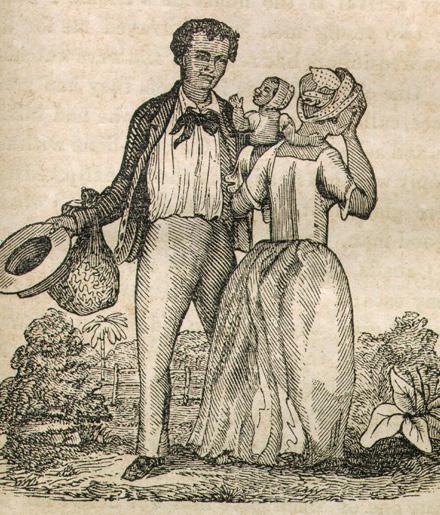
Source: Uncloseted Media RIGHT: 1849 historical cartoon from former slave Henry Bibb depicting the violence of slave catchers.
Source: Narrative Life and Adventures of Henry Bibb
BORN IN THE USA
Why we want to push history away, and why doing so is detrimental to understanding our world
TTHE HUMAN BRAIN IS DESIGNED to recognize patterns and similarities; we find comfort in making sense of and rationalizing the things happening around us, especially when they seem scary. Because we have such a penchant to seek these commonalities, we like to look for the historical patterns that we know exist. We make comparisons because they help us gain understanding of what’s going on around us — something we desperately want. But in seeking similarities and rationalities to alleviate the discomfort of not knowing, we often distance ourselves from the urgency of the very problem we want to be rid of.
BY ADELAIDE FLINTROP staff
One comparison made over and over again by activists, posters on social media and historians is the United States Immigration and Customs Enforcement and Gestapo (secret police) of Nazi Germany. Political officials, including Minnesota Governor Tim Walz, have drawn the parallel, comparing children hiding from ICE to Anne Frank who hid from Nazis in the attic of her father’s business in Amsterdam.
It’s not hard to see why this connection is being made; ICE’s current behavior paints a clear picture of power abuse and oppression. Political commentator Andrew Lapin helps us understand the tendency to notice the resemblance: “Federal immigration enforcement has long prompted alarm about the abuse of civil liberties, including concerns about racial profiling, excessive force, family separation and opaque chains of accountability.” Seeing masked agents of the state detaining individuals with no use of due process, it’s simple to conclude that what we see happening now is a parallel of what is perhaps the most discussed
example of authoritarianism in history. But the things that are simple are almost never the things that are actually right.
Though the tendency to find similarities is natural, a problem arises when seeking correlations leads us to oversimplification. In immediately looking for the similarities between instances, as opposed to grasping the nuances that make them different, we miss important details that should shape the way we think and act within our current social context. When we are uninformed in our comprehension of a situation, our actions become just as misguided as we are.
When we seek to more closely understand important distinctions across history, in spite of the patterns, it becomes clear that ICE resembles Nazism much less than it mimics something a lot closer to home — slave catchers. Slave catchers were active across the U.S., but particularly in southern states, from 1704 to 1865 as government controlled and sponsored groups of white men sought to enforce “slave codes” and would rally up escaped slaves. Especially prevalent during the antebellum period, slave catchers utilized racial profil-
ing to identify their targets, requiring anyone they suspected of violations to present papers proving that they weren’t escapees.
ICE mirrors the tactics of slave catchers in numerous ways, drawing a clear historical parallel: the reliance on racial profiling, requiring physical proof of innocence and the lack of due process. There are countless other similarities between the two — both asserted the right to enter people’s homes without warrants, the use of fear and intimidation to control the persecuted people and encourage self-reporting and the lack of accountability to which the agents of both groups were — or are — held.
Both ICE and organized slave catching have a legacy of exercising unchecked power to detain, harm and remove countless innocent people. Just as ICE is trying to evade courts and facilitate deportation as quickly as possible, the Fugitive Slave Act of 1850 empowered slave catchers to circumvent state judicial systems that would have aided in curbing their illegal activity.
But perhaps the most important point to understand in regards to this particular historical observation is that Nazism and slave catchers are not at all separate. Scholar James Q. Whitman, published in the Princeton University Press, discusses the fact that Hitler actually took direct inspiration from American examples of racial discrimination when developing his policies. In fact, Jim Crow served as the example for the Nuremberg Laws of Nazi Germany. American factions like the Ku Klux Klan and slave catchers served as the template for Nazi organizations like the Gestapo.
History does, in a sense, repeat itself. But what’s more important than recognizing the repetition is understanding the connectivity. The distinction between Gestapo and slave catcher becomes less important when one is able to understand that they are both one in the same, that the basis of both was curated by the U.S system.
The foundation upon which ICE is built was not created in a far-off land or across an ocean; the legacy of hatred that it continues to perpetuate was constructed right here. Acknowledging that our current turmoil is so deeply rooted in American life is terrifying. To understand that something that feels so unbelievably evil is simultaneously so engrained in everything we know is not an easy truth to sit with. But to understand where corruption comes from is the only way to properly confront it.
PROOF IN PICTURES
Vizualising the similarities between ICE and slave catchers
LEFT: An illustrative depiction of three men being detained by slave catchers. Source: BlackPast
RIGHT: ICE officers in San Francisco enter home as part of initiative to detain immigrants across the Bay area.
Source: ICE
RIGHT: Two ICE agents detain a man during a raid in 2021. Source: Wikimedia Commons
LEFT: A cartoon depicting the detention of a freed black man in a Northern city in 1850. Source: University of Maryland Source: Wikimedia Commons
LEFT: An illustration depcting a family being separated by slave catchers, drawn in 1815. Source: Narrative Life and Adventures of Henry Bibb
RIGHT: ICE agents deport California resident as part of operation.
Source: Center for Immigration
Studies
LEFT: ICE agents in Minneapolis Jan. 24 following the death of Alex Pretti, who was killed by an ICE agent. Source: Wikimedia Commons
RIGHT: An 1860 cartoon, depicting slave catchers aiming a rifle at a formerly enslaved person. Source: Granger
THE GLITTER & THE GORE
BY EMILY TINNIN staff
ILLUSTRATION BY
NORA BRUNNQUELL staff
EENTERING THE EXPLORE page on Instagram, or any other social media app, you may have come across displays of lavish money spreads, high-performance supercars and overpriced Dubai chocolate. But underneath the glamour rests the rot. In the Gulf nations, especially Saudi Arabia or the UAE, there’s a calculated use of luxury propaganda that conceals buses packed full of exploited workers being transported to labor camps. This doesn’t concern most people amidst a perpetual state of passive doom-scrolling. In this digital age, the opportunity to make money through lifestyle content, bogus
Consumer awareness must increase when engaging with unethical luxury economies
masterclasses and pyramid schemes has never been more alive and thriving. While these grifters prance around high-rise penthouses duping the vulnerable, the migrant workers who installed the futuristic glass shower are forced back to the slums.
Efforts to hide these deplorable conditions are working. In 2024, according to Global Media Insights, Dubai received nearly 19 million tourists, and Saudi Arabia has reported audits that they are on the path to spend at least $1.5 trillion on the construction of a futuristic city as reported by Middle East Eye. The most attracted demographic is teenagers and young adults, appealing to concepts of success, entrepreneurship and a sort of “new money” flexing. Coupled with an underdeveloped frontal lobe and a dull grasp of critical thinking, all most perceive is aspiring contemporary opulence.
Disenfranchised migrant workers bear the brunt of the economic shortcuts, on top of being trapped in deceptive labor contracts linked to legal status under certain employers. Wage theft and passport confiscation have both been frequently reported to further remove any semblance of
MORE TO KNOW
95% of the workforce in Qatar and the UAE are made up of of migrant workers
1 in 5 laborers arrive with illegal recruitment debt to pay off
rudimentary independence. According to the Human Rights Watch in 2025, workers reported going up to eight months without pay. In addition to thousands missing, some end up paying the ultimate price. In the same year, Walk Free indicated an estimated 21,000 migrant workers have died since construction began on Saudi Arabia’s mega-projects. To put that fully into perspective, that is eight deaths a day for eight years.
The Middle East tourism economy depends on the masses remaining ignorant to these abhorrent human rights abuses. For the most part, it has worked. By attracting celebrities, influencers and athletes into the mix, they become puppets for these regions to generate positive public opinion through association.
8,000+
Estimation of unexplained deaths over last decade P
Alas, there’s simply not enough space to encapsulate these regional abuses in full detail. But what ultimately fuels the cycle are the ignorant consumers funding these economies without knowledge or care for labor practices. By ignoring the standing reality, we inadvertently subsidize a class system in which digital vanity overrides the suffering of an invisible servant class.
FLIPPING THE PYRAMID
The USDA switches the portion recommendations with the stated goal of emphasizing protein and healthy fats
ILLUSTRATION BY MEG MYCKATYN health & sports editor
Differences between the old and updated serving suggestions and related information
Three daily servings of vegetables are recommended, significantly less than the previously suggested five servings. Only of students are aware of the changed food consumption suggestions. 38% of the US food supply is made up of processed foods.
Fats were a last priority; now they are suggested to be paired with every meal.
42%
MyPlate’s 2016 portion recommendations
*updated portions are not published
Overconsumption of protein can lead to digestive issues and kidney strain.
The recommended grams protein per kilogram of bodyweight doubled. of a person’s daily calorie intake is accounted for by refined grains and added sugars.
UP WITH THE TRENDS
Panorama surveyed 206 students Feb. 23 1 students are more likely to purchase an item if it is highprotein. in2
SOURCES: Business Insider, FSBH, Harvard School of Public Health, Johns Hopkins School of Public Health, MyPlate, NIH. gov, Paragon Institute of Health, ScienceNews
Popular food items now have high-protein alternatives that conform with new guidelines
By 2030, the market size for high-protein bakery goods in the US is predicted to be $32 billion.
Many cereal brands’ target amount of protein in grams per serving quadrupled.
Since
of students have noticed more foods being labeled as high-protein.
SPORTS IN REVIEW A NEW ERA
CHALK TALK
Coaches speak on upcoming season
“Finishing in fifth place in state [last year] and going into this season with All-State players and an All-American, everybody sort of knows who we are, and this gives us a chance to really show what we can do. We graduated out a ton of starters from last year, but I think that we can really build a legacy. Not just based off of certain players, but really show that we can sustain our legacy.”
TRACK
AND FIELD
“Every year is kind of like a puzzle, so [I’m] most looking forward to trying to figure out new pieces, how the current pieces that we have are gonna fit in [and] just trying to see progress in everybody, even the returners. My biggest hopes are the same thing every year, that we can keep improving and see growth in athletes. Not just on the track, but their personalities and their confidence grow, and just achieve whatever our ultimate potential could be.”
BY CAMI WELSH staff
Thomas Bragg takes position as head coach of boys lacrosse team
LADUE BOYS LACROSSE
appointed a new head coach, Thomas Bragg, in late September after he was offered the position from the Ladue Boys Lacrosse Parent Board. Alongside returning coaches Cody Cornier and Tate Rusnacko, he has hosted several pre-season practices to help the team prepare, mainly taking place at Conway Elementary. He has also hosted a number of social and team bonding events to bring the team closer together and encourage more students to join in.
“If you want to make the commitment and come out, then you will be a part of the team,” Bragg said. “I don’t want to cut anybody. I want everybody to enjoy the spring and have something to look forward to. I think myself and our coaching staff have the poise to make it a fun experience for everybody.”
VOLLEYBALL
BOYS
The Ladue boys volleyball team will return to the court March 26 versus St. Mary’s High School. Last year, the boys went 16-8, their best record in program history. They hope to return to the district final and have a good outlook on the season.
RIGHT: The team celebrates together after scoring a point. Luke Reiser (12) served as a captain last season.“Everyone is extremely coachable,” Reiser said. (photo by Millie Birchfield)
Bragg first began his coaching career at Bowdoin University in 2012. He moved on to a job opportunity at 3D Lacrosse, where he spent eight years coaching in various cities around the United States such as Boston, Portland and San Diego. When the COVID-19 pandemic hit, he settled in Boston to continue working in several camps, clinics and small groups. He moved to St. Louis in September with the intention of strengthening the lacrosse community, coaching both high school lacrosse at Ladue and club lacrosse at Lou Fusz Athletic.
“We’re going to invite those eighth grade boys out as well to practice with us,” Bragg said. “That’s really to build some more camaraderie within the community. Our goal is to make Ladue the hotbed of lacrosse in St Louis.” P
GIRLS LACROSSE
CARRIE LAMPE
NICK BUCKVAR
After last years’ 19-4 record and losing 1-0 to John Burroughs School in the District Final, the girls soccer team is coming into this season with an intense hunger to prove themselves. Although captains have not yet been chosen, there is a very large number of returning players and the most seniors in girls soccer history, leaving lots of potential candidates.
RIGHT: Charlotte Wilson (11) kicks the ball to a teammate during their game against St. Joseph’s Academy. The team lost 2-1. “I’m most excited for the opportunity to become a leader this year and lead by example,” Wilson said. (photo by Risa Fingerman)
SPRING ATHLETE Q+A
“Aiden Qian (12)
I’m excited to play on the new courts at the FGC. I hope it encourages more people to come support us and create a strong home court advantage. I want to enjoy every match and hang out with the team.”
GIRLS SOCCER
Athletes share their hopes for the upcoming season and new facilities at the Ladue Fifth Grade Center
“Devan Patel (11)
We are super excited for the new turf field. Hopefully with the new turf we will be able to play more games as we won’t have as many rainouts. [I’m excited for] baseball season as I love getting to play with my friends.”
Devin Freeman (12) prepares to bat against Parkway Central High School. Freeman signed to play baseball at Missouri Southern State University. “I’m excited we won’t have to tarp the field anymore,” Freeman said. (photo by Ivana Todorova)
“Sloan Gingrich (10)
I hope that we come out with many wins. Being back at the FGC, I am hoping for a smoother schedule and less changes to practice times. [This year], I hope to improve my defense.”
Sanjay Adireddi (12) winds up for a backhand. The Ladue Fifth Grade Center underwent construction in the fall to add new tennis courts. “My goals are to play consistently [and] have fun,” Adireddi said. (photo by Kayla Chan)
Boys Tennis
Baseball
Girls Lacrosse
Linnea Nystrom (10) guides her crew back to the boathouse at the end of practice Feb. 24 at Creve Coeur Lake. This was Nystrom’s first season as a part of the St. Louis Rowing Club after moving from New York City, and prior to that, living in California. “Theres a lot of interpreting what [coaches] want you to do or say,” Nystrom said. “You have to know them really well to know what they would want you to do in a specific situation. Especially on race days when they’re not going to be there the whole time. You need to take charge and emulate what they would want.”
RISING TIDE
Linnea Nystrom (10) navigates being a rowing coxswain in a new city
TTHE BOAT SLIDES UP TO THE starting line, flanked by seven others in adjacent lanes, oars slicing through the waters in perfect synchronization as athlete’s adrenaline and nerves hang palpable in the air. Inside the rocking boat, eight rowers lock into position, backs facing the finish line as they wait for the strong timbre of
BY ELSA FLORES-TAMAYO staff
PHOTOGRAPHY BY VINCENT HSIAO photo editor-in-chief
the coxswain. She sits at the stern of the boat, facing forward, eyes taking in her surroundings as she prepares to steer and sternly yell out the commands that will ensure their successful push across the finish line without ever having to touch an oar.
Linnea Nystrom (10) is in her third year rowing and her second year as a coxswain. As a coxswain, it is her job to sit at the front of the boat, steer and call out instructions to the rowers who have their backs turned to the front of the boat. After a childhood with little interest in sports, this is a position that clicked quickly for Nystrom.
“I like to be in charge, I like being bossy, I like telling people what to do and I like being able to lead everyone, especially when we win,” Nystrom said.
Nystrom takes her responsibilities as a coxswain very seriously. In addition to being the eyes and ears for the rowers, coxswains must find dynamics within the team to ensure the movement on the boat is organized. The use of a microphoned headset which connects to speakers all around the boat aids the coordination between them.
“If we [are] actively in the boat, then I’m the only one talking,” Nystrom said.
“I will yell at anyone if they talk because it’s my job to keep everyone safe, it’s my job to make sure we’re all working together. They need to follow my exact directions and we’ll be great.”
On top of having to be comfortable in her role as the head of the boat, Nystrom’s teammates recognize her talents that com-
plement her leadership and contribute to her successful performance as a coxswain.
“She’s really hardworking [and] she’s always locked in,” teammate Austin Singer (10) said. “She’s not goofing off [during practice] and doing stuff that can hurt the focus of the team.”
Prior to living in St. Louis, Nystrom was born and raised in California, then lived in New York City for a year before moving to St. Louis this past summer. Nystrom has done her best to ensure her success in rowing, even while moving around the country.
“
form. She doesn’t just do the normal stuff you do to get by, she’ll do extra to make sure that you’re better as a rower.”
A telling moment for athletes is the way they perform under pressure. When beginning a regatta — which is a rowing, speedboat or sailing race — Nystrom does not spiral with anticipation over the moments ahead of her, but instead she stays present to lead her team calmly and correctly.
“I try to pay really close attention to the officials around me and what they’re saying so I can make sure I’m in the right place at
As Nystrom becomes more involved with the sport, her family provides encouragement towards her rowing pursuits.
“It’s been fun watching [Nystrom] step into her natural gifts and develop them as a coxswain,” Nystrom’s mom Cari Nystrom said. “She’s learned how to lead and motivate different personalities, all while calculating how and where to move the boat. Her ability to relate to others and lead on the water naturally spill over into other areas of life, and I can’t wait to see where it takes her.”
Her ability to relate to others and lead on the water naturally spill over into other areas of life and I can’t wait to see where it takes her.”
Cari Nystrom, mother
“Here in St. Louis, it’s a lot harder to be competitive because its an even more niche sport in the midwest,” Nystrom said. “But everyone really cares about the team because theres no where else for us to go.”
Nystrom’s success as a coxswain comes from more than just natural ability. She has a willingness to put in the work, and that sets her apart from other coxswains.
“A lot of coxswains will just say the calls and not go into depth about what you should be doing form wise,” Singer said. “I’ve noticed she really helps with people’s
the right time and that we start on time, and don’t delay the other boats,” Nystrom said.
Nystrom’s collected demeanor when she needs to perform under pressure aids her teammates in moments where nerves tend to run high in their competitions.
“She has the right mindset,” Singer said. “[She] helps the rowers, because if [going into a regatta] a coxswain is talking like ‘I have a feeling we’re not going to do good,’ then the rowers [will] take that same mindset. She helps set an example, and she’s really supportive when you need it.”
Nystrom came into her new sport on a whim when she was asked to accompany a friend to an introductory practice. She did not expect the effect that being a dedicated rower would later have on her identity, and she is grateful for her experiences.
“Rowing has taught me that I’m a lot more determined and a lot more stubborn than I think,” Nystrom said. “I will race no matter what. I will get into that boat, and I want to do as well as I can. No matter if it’s pouring rain or freezing cold, I want to be out there and cross the finish line.”
SCORING A
COMEBACK
BY
Liam Reeves (12) overcomes injury, returns to lacrosse
PHOTOGRAPHY BY VINCENT HSIAO
photo editor-in-chief
EMILY PAN coverage editor
TTHE CACOPHONY OF VOICES
fills a locker room. Eye black and sports bags litter the ground. Anticipation buzzes through the atmosphere. Outside, rain hammers the field. As the players walk out, the soaking jerseys cling to the lacrosse players’ shoulders as they press together in a silent huddle. The players’ voices suddenly cut through — “One, two, three, Rams! Four, five, six, family!” This chant signals the beginning of a match, end of practice and the close bond between the players. Wearing the number 17 on his back, Liam Reeves (12) steps out of the huddle.
After the COVID-19 pandemic, Liam explored his newfound interest in lacrosse, seeking a challenge and new environment.
“I got to know some of the people who played lacrosse at Ladue, and we really formed bonds [with each other],” Liam said. “I feel like each team I played with has gotten more connected and feels like more of a community.”
Lacrosse has taught Liam how to work hard and keep going through struggles.
“Sometimes it’s just not about the game,” Liam said. “It’s about yourself and challenging yourself, to be like, ‘can I be better than who I was yesterday?’”
During Liam’s junior year season, his ongoing success was put on pause.
“We were playing SLUH in April last year, and I had the ball on o!ense,” Liam said. “I’m mid-dodge and a long stick defender goes down and swings his defensive pole on my left leg. [He] broke my leg, and I didn’t know it at the moment. The goal went in, which was a cool moment, but I just got injured and that kind of spiraled.”
Following his injury, Liam came to realize how much his happiness depended on lacrosse. In spite of that, he was able to keep a positive mindset during recovery.
“You don’t know how much you appreciate the sport until you are stripped away from it,” Liam said. “It was hard to watch your team on the sideline knowing that you couldn’t help them, but it also wasn’t a bad thing. When you watch your team from the sidelines it teaches you things about the game.”
Physical therapy added another layer of frustration for Liam amidst his mental struggle.
W“The challenging part [of physical therapy] was coming back, and feeling like, ‘why am I here?’” Liam said. “It’s hard mentally to keep pushing when you’re already down and you’re injured.”
Liam decided to return to lacrosse during the winter preseason. As he worked his way back, Liam focused on self-discipline to properly prepare for his return.
“[The injury] decreased my confidence,” Liam said. “I remember that feeling when I first started playing again in the fall, and it was really disheartening because I thought I was ready to play. But [the injury] also was a kind of stimulus for
motivation to keep pushing myself because I needed to get better and improve my fitness to alleviate the injury and fix it.”
Liam’s determination to return from the injury was evident to his teammates throughout the club lacrosse season.
“Liam is easily one of the most hardworking kids on the team,” teammate Andy Schulte (12) said. “He is always willing to shoot outside of practice and put extra work in.”
One of Liam’s supporters is his mom, Valerie Reeves, who has been there throughout his entire lacrosse journey.
“Sometimes you just have to vent and you allow yourself to be sad, but you’re gonna keep moving on and be looking forward and pushing through,” Valerie said. “It’s going to get better, it just takes time.”
“What community means to me is a group of people that support each other and help [with] hardships.”
Liam Reeves, (12)
Liam realized that his recovery progress depended on finding strength within himself.
“I kept [remembering] the feeling of not being able to play, and [that made me want] to push myself,” Liam said. “I think it’s good when that happens to people because there’s not always going to be someone there for you. The most viable part of recovering as an athlete is supporting yourself and being confident.”
Throughout his recovery, Liam has learned the importance of holding things he is passionate about close to his heart.
“Don’t take things for granted,” Liam said. “When you’re taken away from it, you don’t want to have regrets. If you really love something, don’t give up on it.”
LEFT: The boys lacrosse team huddles at Ladue High School’s athletic stadium Feb. 23. Liam Reeves has been playing lacrosse since fifth grade.
“Iron sharpens iron,” Reeves said. “It’s good to not practice against the same competition.”
IN THE SPOTLIGHT
Band students perform the jazz concert in the PAC Feb. 26. They performed songs they had been practicing for months prior to the concert. “I am most excited to perform two soli’s along side the fellow clarinet in our group,” band student Oluwatomisin Falako (11) said. (photo by Alex Du)
ALL THAT JAZZ
BY AARON LIN associate editor
Jazz Band students perform in concert Feb. 26
Chromatic runs scaling up and down, the flow of the melody tumbles over itself. Underneath, a consistent, rhythmic bassline sets the tone. Consisting of improvisation, complex rhythm and syncopation, jazz has been a keystone of American music and culture. Ladue’s band celebrated this rich history through a performance Feb. 26 in the PAC.
“Most of our periods are spent within each section practicing the pieces for our concerts,” tenor saxophone Oluwatomisin Falako (11) said. “This process includes runthroughs, solo and soli development. It all culminates in two nights where sections get to show off.”
The Jazz Band consists of 10 members, with instruments ranging from saxophones to trumpets. In addition, the band has added a new instrument this year: The clarinet.
“[I’ve been practicing] by reading the score and listening to recordings,” clarinet Felix Zhang (11) said.
“[The band] uses a metronome and rehearses parts together.”
A notably difficult aspect of jazz is its complex rhythm. Breaking measures into individual beats and working with lower tempos are common ways musicians help acquaint themselves with the music.
“It is a wonderful experience to expand one’s understanding of the arts,” Falako said. ”Students put in countless hours to produce [a concert] for the audience. The audience gets to see a combination of masterful instruction and a strong understanding of music.”
The goal of the concert is to support the arts while also celebrating and enjoying jazz music as a whole.
“I’m in the Jazz Band because I’ve been interested in this type of music since I was a child,” Falako said. “My first jazz experience was listening to one of Africa’s legends, Fela Kuti. His sound inspired me to [follow] my love of music.”
P
SOURCE: IMDB
Leading the count with 16 nominations, “Sinners” was nominated for every category it competed in, garnering nods for Best Picture, Achievement in Film Editing and more.
The recent A24 film was nominated in nine categories, including Best Picture, Director and Actor. It’s known for Timothée Chalamet’s portrayal of a 1950s New York ping-pong hustler.
Led by Leonardo DiCaprio as an exrevolutionary, this film is inspired by Thomas Pynchon’s novel “Vineland.” The movie garnered 13 nominations, second only to “Sinners.”
The Norwegian drama received nine nominations, the most out of any non-English film, continuing a recent trend of non-English films receiving nods for Best Picture.
ON OUR WAY
Sam Rochester (10)
“I’m most looking forward to the horseback ride.”
Panorama surveyed 211 students Feb. 23 about their Spring Break destinations
“I’m going to be in New York City with my friends.”
Ben Reiser (12)
“I’m heading off to Orlando for Disney World.”
Viva Voce performs the second song of their set, “Doomsday” by Lizzy McAlpine, with Norah Murphy (12) singing the solo. They placed fourth overall at the International Championship of High School A Cappella (ICHSA) Feb. 7 at the 560 Music Center, with Murphy winning Outstanding Arrangement for the set.
“Getting to compete is always one of my favorite events that we do,” Viva Voce member Juliet Golden (11) said. “It’s always so much fun to spend the day with the other girls, but also just getting to watch the other groups perform and grow closer with them.” (photo by Izzy Bly)
VIVA VOCE
Eric Mao (12)
Ruby Jurgiel (11)
“I’m excited to go see Yosemite and Big Sur.”
#2016REWIND
Cindy Liu and Madeline Fong review popular 2016 toys and crafts a decade later
SLIME
Made with Elmer’s glue and Magical Liquid, slime was by far the easiest and most rewarding craft. Although messy, the satisfying sounds of poking and popping bubbles reminded us of easier times of seeking glueless slime recipes. Hated by parents and hair alike, slime is truly the essence of childhood and the embodiment of 2016 — for a good reason.
SQUISHIES
The name for this toy is just as creative as it is fun. Watching the toy slowly return to its shape after being squished made us wonder how this was considered entertainment as kids. For being popular enough to become keychains and earrings at Claire’s, this toy is the closest thing we’ve done to watching paint dry.
LEGO FRIENDS
The build quality of LEGO Friends is solid and the instructions are clear. The pieces are more specialized than classic sets, including pre-molded accessories that limit creative rebuilding, but look polished in the final product. Compared to the classic LEGO, it trades versatility for aesthetic components. Four stars for being competent LEGO in a pastel package.
PERLER BEADS
Simply put, this is one of the worst crafts to exist on the market. The package came with no tweezers, so the small beads were nearly impossible to place without moving another bead. Making matters worse, several of the bead colors were indistinct from one another. This craft was best when our hands were small enough to complete it.
FIDGET SPINNERS
WHAT IS THE BEST 2016 TREND?
The fidget spinner does exactly what it promises: it spins. A good flick gets about two minutes of rotation — impressive for approximately three days before it becomes a decorative paperweight. Does it justify 2016 cultural hysteria? Absolutely not. Three stars for being precisely as advertised and nothing more.
RAINBOW LOOM
Bracelets have evolved over thousands of years, but perhaps the most remarkable style was created with Rainbow Loom. The concept seems simple enough, but the actual process will have you squinting at a YouTube tutorial like it’s a foreign language exam. Rainbow Loom earns its three stars for being more rewarding and humbling than it has any right to be.
BATH BOMBS
If you want to reminisce on those satisfying bath bomb videos you watched in 2016, open YouTube, not your wallet. Halfway through the process, it became clear this isn’t the kind of craft you give a kid to do. Although the cleanup process isn’t included in the rating, it should be, since the clean up took longer than the creation. From now on, we’ll just have to hope there’s no microscopic bath bomb residue remaining on Cindy’s kitchen island.
“I played with my fidget spinner all the time.”
Roger Tang (10)
“My favorite trend was the mannequin challenge.”
Dylan Press (9)
“I like the Rio de Janeiro filter on Instagram.”
Betina Hirsch (11)
“In 2016, I did the bottle flip challenge a lot.”
Barbara Greyson (staff)
“I loved watching slime ASMR videos on YouTube.”
Nevinka Amarakone (12)
HIGH SOCIETY MEETS
ILLUSTRATIONS
BY
FIONA VAN ALLEN
Certified nerd reviews Bridgerton book one, “The Duke and I”
BY AARON LIN associate editor
COUNTLESS SCANDALS, A FAKE engagement and romance — these elements are about as far from my everyday life as I could possibly imagine. So after some intense convincing from my fellow peers, I decided that “The Duke and I,” the first installment in the famed romance series, Bridgerton, by Julia Quinn, would be my next literary adventure of choice.
The story narrates a tale of courtship between two rather contrasting individuals. Daphne Bridgerton, the eldest daughter of a respected, noble family is known to be witty, funny and deeply kind. On the other hand, Simon Basset, the Duke of Hastings, is exceptionally handsome, yet has a mountain of trauma, leading to him to be quite emotionally distant. In an unusual encounter at a ball, the pair pretend
SOURCE: Avon
to be head over heels for each other, which allows for Simon to avoid stalking from debutantes and also improve Daphne’s social status. Unsurprisingly, Simon and Daphne end up together. However, it turns out that Daphne’s brother (and Simon’s friend), Anthony, is extremely disapproving of the relationship, leading to a conflict between searching for love and family, a theme that is perpetuated throughout the book.
While the fake dating trope is done quite a lot, this book does it in a very delicate way that really accentuates the personalities of Simon and Daphne. Simon is quite the complex character, and Quinn takes this opportunity to explore some intriguing commentary on the paradoxical nature of love. In addition, the Bridgerton family as a whole also has a great family dynamic that is chaotic but still loving. Underneath, however, this love represents the protective, and often stifling world that Daphne must navigate.
I won’t talk more about the plot to avoid big spoilers, but I should warn that there are a few explicit scenes in the book. On that topic, I did think that some elements of Simon and Daphne’s relationship were a little weird and often slightly nonconsensual, but I guess this is a work of fiction, so there really isn’t much I can say. The latter half of the book also does have quite a lot of drama and conflict that could’ve been avoided by a simple conversation, which was a little frustrating. There were some other qualms that I had against the ending, but (once again) to avoid spoilers I’ll just leave it to future readers.
CURIOUS?
Scan for a review of Bridgerton season 4
After spending around six hours on a random weekend night reading this contemporary work about love, I concluded that this book was not the most worthwhile expedition of choice. While the story had a decent plot accompanied by complex characters, at least half of my time was spent reading fluff and unnecessary buildup. The book definitely isn’t something I’d usually read, and I think I’ll stick to avoiding this genre in the future. However, I don’t think the book is bad and I’m sure that enjoyers of historical romance would have a better time than me.
TRAGIC LOVE STORY
The new movie adaptation has all of the glamour and none of the
heart of the novel
BY IRA RODRIGUES copy editor-in-chief
WHEN YOU READ WUTHERING
Heights, you have to be prepared for heartbreak. The ache of watching two characters who are so similar, so flawed, so deserving of love and knowing they’ll never get it. The pain of knowing what could have been. After watching the movie, I’m still so heartbroken, but for all the wrong reasons.
Let’s get one thing straight: Wuthering Heights is not a love story. In my opinion, it’s more about the cycle of abuse than it ever was about romance. After dealing with hatred from Catherine’s older brother, isolation in their home, near-constant neglect and more, she and Heathcliff are so broken that even when love falls into their lap, they can’t have it. Their relationship and its tragic end is a direct result of their trauma, carried from generation to generation, poisoning everything it touches.
I loved how the author, Emily Brontë, showed that in the novel: unflinchingly, powerfully. The movie takes all of that away for me.
I knew from the marketing — “the greatest love story of all time” — that I was getting romance. Still, I was hopeful that the story’s darker themes could be realized. But inexplicably, the pain in Wuthering Heights is erased. There’s no abusive older brother; instead, Catherine’s father becomes a weak imitation. We get a glimpse of Heathcliff and Catherine’s childhood, just barely showing how neglected they were, how they only had each other. It’s not enough to do justice to the story’s deeper message.
Most egregiously, we lose the story of the next generation, which makes up the entire second half of the novel. This, at least, isn’t just the movie alone — many adaptations have done this — but I hate it. Without Catherine II, Linton and Hareton, we lose the resolution to the cycle, the depth that makes Wuthering Heights so great. The movie tries to fix this with kinky romance, R-rated intimacy, even opening with an execution for shock value. This effort only feels cheap when compared to the emotion of the novel.
SOURCE: IMDB
CURIOUS?
Scan for a review of the Wuthering Heights movie
Everything feels hollow in this movie. Every character is a shadow of themself. Catherine, who is headstrong, passionate and, yes, unlikable, but for good reason, has the maturity of a 6-year-old. Heathcliff is actually villainous in the novel; here, he’s just an edgier Jacob Elordi, a whitewashed facsimile without any venom. Don’t get me started on Isabella’s character destruction. I’m still traumatized by that “pet” scene. What breaks my heart is this movie had such potential. There are moments when I can almost see the novel I love: in the crumbling stone of the set. In the scene where Heathcliff cries over Catherine. In the flashbacks to childhood, however brief. But mostly, the tragedy of Wuthering Heights just disappears. This movie seems to say that everything the characters experience, all of their flaws, isn’t enough to keep us entertained. Like if Wuthering Heights isn’t modernized, if it’s not a trashy romance, then nobody will care. Not only is that disappointing for the audience, it’s also just plain wrong.