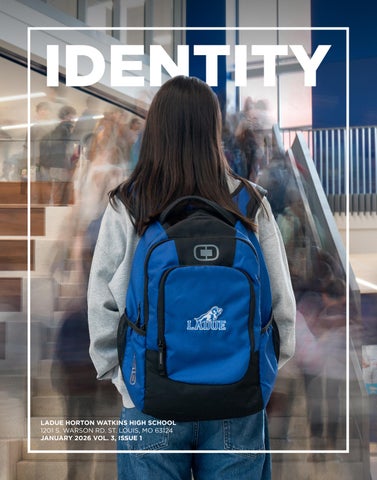
IDENTITY
LADUE HORTON WATKINS HIGH SCHOOL 1201 S. WARSON RD. ST. LOUIS, MO 63124 JANUARY 2026 VOL. 3, ISSUE 1
TABLE OF CONTENTS More Than Music
04-07
Keys to Excellence
08-11
The Greatest Investment
12-15
Flying the Flag
16-19
Throwing a Fit
20-23
Spilling Ink
24-27
When Justice Comes Knocking
28-31
Unwavering Faith
32-33
Passion Meets Purpose
34-39
Home Away From Helsinki
40-43
Twin It to Win It
44-49
Two Worlds One Sound
50-53
Finding Her Pace
54-55
Mending Hearts
56-59
Roll With It
60-63
CREDITS Front and back cover photo illustrations by Vincent Hsiao. Front and back cover designs by Maya Mathew. Mission statement by Annabelle Reagan and Ira Rodrigues. 02
TABLE OF CONTENTS
Scan for Ladue Publications’ full policy
44-49
32-33
54-55
64-67 28-31
POLICY
The Ladue High School administration agrees to allow the Ladue Publications staff to make content decisions and to operate as an opem forum, provided they do not infringe on the rights of other students or create a substantial disruption at school as per the Tinker standard. The advsier will give advice to the students on staff and play devil’s advocate concerning controversial or sensitive material, but ultimately, the students have final say in what is published. ID | FALL 2025
EDITOR’S NOTE
STAFF
As the hallways bustle with students, conversations buzz, offering a small glimpse into students’ lives. But something is missing. While in years past, passing periods were filled with noses in phones, a state law introduced at the beginning of this school year banning phones has drastically changed our lives as we knew them. Now, being forced to recognize the people around us, we realize that no two people here are alike, and each individual has untold stories. In ID’s third volume, we aim to produce stories that represent the population here at Ladue that makes us so unique. This issue includes stories that follow one student’s involvement in activism, another’s passion for fashion and a profile on our superintendent’s journey through education. Through this collection of profiles that range all across different aspects of identity, we hope to share the stories of just a handful of the many diverse members of our Ladue community. We have the intention of celebrating what makes each subject who they are today. By exploring the ways religion, service, culture, gender, self-expression and more interact, we hope to represent the beauty and diversity of identity. It is the way these distinct identities connect that makes ID, and Ladue, so special. ID’s mission is to bring the community closer together with one story at a time. Take the time to learn about those around you, our acquaintances, staff and even best friends, because we all could benefit from learning a little bit more about each other. Everyone has a story, here are just a few.
MANAGING EDITOR-IN-CHIEF Marie Demkovitch
Annabelle Reagan
MISSION STATEMENT ID Magazine seeks to provide the most accurate, relevant and important information regarding the identities of Ladue High School students, teachers and administration. The stories aim to showcase the myriad of talents exhibited by the school community. ID strives to amplify student voices and perspectives, creating a lasting record of the experiences that shape Ladue. The magazine remains committed to representing the diversity of Ladue High School, and the staff works to ensure ID is racially, religiously and economically inclusive. ID also makes an effort to maintain professional standards and employ current design trends within the journalism field.
DESIGN EDITOR-IN-CHIEF Maya Mathew CONTENT EDITOR-IN-CHIEF Annabelle Reagan COPY EDITORS-IN-CHIEF Katie Jansen Grace Kweon Ira Rodrigues PHOTO EDITOR-IN-CHIEF Vincent Hsaio STAFF Caroline Cobaugh Elisa Cormier Victoria Derdoy Madeline Fong Tiya Kaul Nathan King Ellie Lercher Aaron Lin Emery Mao Emily Pan Josie Stout Sabrina Tagunkova Cami Welsh Claire Zhang PHOTOGRAPHERS Marcus Goebel Laken Hadley Teo Lee Sarmistha Pulagam EXECUTIVE EDITORS-IN-CHIEF Josh Devine Celina Zhou ADVISERS Sarah Kirksey Abigail Eisenberg SPREAD DESIGN BY MAYA MATHEW
03
04
ANTHONY ZHAO
ID | FALL 2025
MORE THAN
MU IC Anthony Zhao discovers a community in music through volunteering and choir written by
Emily Pan
photographed by
Vincent Hsiao
Scan here to listen to Anthony Zhao’s (12) story
SPREAD DESIGN BY EMILY PAN
05
A
small group of friends huddle around a television screen while the lyrics of “Begin Again” by Taylor Swift flash across the screen. As the G-major chords drift throughout the attic, seven of the group members start waving their phone flashlights like shooting stars in the dark sky. To his friends, singing is just a fun activity, a way to unwind. But to Anthony Zhao (12), it’s more than that – music is a creative outlet, a way to connect with peers and an expression of his passions. Anthony’s love for music started at a young age. Music was a constant presence in his household, from Chinese singing shows to violin and flute practice, and it helped him realize his passion for singing. “My mom is pretty good at singing,” Anthony said. “Whenever I feel sick, my mom always [sings] lullabies. I was exposed to a lot of singing when I was a little kid, and I feel like I’ve adapted that into my own [singing].” Anthony is a part of two school-related choirs: baritone choir class and an after-school choir, Rams Chamber Singers. Last year, Anthony made it to choir all-state and plans to re-audition this year. Although Anthony has gained statewide recognition for his musical ability, he prefers to focus on the hidden meaning behind music. “I love music because it transcends languages,” Anthony said. “You hear the melodies, the beauty of instrumentals and the cultural aspects of songs.” Even with his experience, Anthony still feels nervous during performances. Showing off his individual musical ability continued to be difficult throughout his musical career; he’s often struggled with the challenges that come with performing alone. Learning to be comfortable with his music has allowed him to gain confidence over time. “I had the most severe performance anxiety,” Anthony said. “Eighth grade [concert] was the first solo I ever did. I was so nervous leading up to the point that I was shaking. Over time, my performance anxiety has gotten better. If I get a solo in choir now, I’ll sing it, no problem.” Before every solo performance, the first person Anthony performs his songs to is his older sister, Annie Zhao. Whether it is through FaceTime or in person, after his sister gives her critique, Anthony takes it to heart. “Simple compliments can easily help someone, so I try to affirm their musical abilities,” Annie said. “Anthony often lacks confidence in his abilities, and he allows others’ opinions to dictate his. Even a simple ‘great job’ or ‘you sounded amazing’ is not taken lightly by Anthony.” Anthony’s passion for music is not only in his performances, but through his dedication. His goal is to ensure the audience can feel music the way he does. “My goal is to just convey the meaning through a song and make the audience feel something,” Anthony said. Outside of music, Anthony is passionate in pursuing a career in STEM. He is the president of HOSA—Future 06
ANTHONY ZHAO
Health Professionals, was nationally ranked for Science Olympiad and was a national finalist for USA Biology Olympiad. Music has helped Anthony meet new people and find a safe haven in the choir community. “The biggest thing I hope Anthony can achieve with his music is a way for him to find solace and build confidence in his abilities,” Annie said. “I wish he could gain energy and happiness from practicing music and performing it, as if music could heal him. Music should be an outlet for him, away from all the noise of others’ opinions and away from all the academic pressures.” Anthony has been able to connect his passion for music to his efforts in aiding communities around the St. Louis area. Inspired by the success of Viva Voce, the female a cappella group at Ladue High School, Anthony helped reinstate a previously disbanded male a capella group, the LaDudes, to extend a similar opportunity to male singers. It wasn’t just his passion for music that motivated him — it was about giving others the same joy and camaraderie that music had always given him. “We go and perform for nursing homes,” Anthony said. “[Singing] makes me feel good. It makes them feel happy too. I think this brings the community together.” Besides bringing joy to the elderly, Anthony is a team player in terms of making everyone feel important and heard. Choir director Ruth Grollman has known Anthony throughout high school and observed his work ethic. “Anthony has natural leadership,” Grollman said. “I feel most proud of him in the classroom. He is always willing to help other students. He understands that in choir, we work towards a collective goal, and he’s always the first one to help students that are struggling.” Anthony’s connection to music extends beyond pursuing it as a profession; it gives him an opportunity for expression. He wants to join an a capella group in college and continue to share his passion with others. “I hope Anthony knows that music is there for him,” Grollman said. “He will always be a musician in whatever capacity he wants to be. I hope that music can be a refuge for him, something that he always enjoys.” In his career, Anthony has found that music is not only a mode of creative expression, but a form of healing. “When I’m stressed, music brings [me] back alive,” Anthony said. “Singing together is emotional therapy, and it’s a bridge for human connection.” Captions: Anthony Zhao (12) sings at a photo shoot in the Performing Arts Center. His singing was fueled by practice and exposure. “Anyone can learn to sing with the right technique,” Anthony said. (on pages 4-5) Anthony performs at Clarendale Clayton Senior Living Sept. 14th with the LaDudes. He has performed at nursing homes around St. Louis for the past three years. “I love [singing] because the residents love [it],” Anthony said. Photos by Vincent Hsiao. (on page 7) ID | FALL 2025
SPREAD DESIGN BY EMILY PAN
07
KEYS TO EXCELLENCE Molly Keys balances the worlds of STEM and service written by
Victoria Derdoy
08
MOLLY KEYS
photographed by
Sarmistha Pulagam
photos courtesy of
Molly Keys ID | FALL 2025
B
etween the clang of metal in the robotics lab and the peaceful energy of a Girl Scouts meeting, Molly Keys (10) has learned that leadership can take many forms. Whether she’s programming a robot or organizing a project to give back to her community, Keys blends the STEM and service worlds together to demonstrate what it means to be a leader and a difference-maker.
“Being one of the only girls on the robotics team, I’m very grateful that I have the opportunity to go out and recruit more girls at Ladue,” Keys said. “I really want to have more girls feel comfortable enough to join the team, to participate in STEM activities like robotics, because it’s a really fun thing, and I think more girls should find this community that I have loved and that makes me feel confident.”
Robotics
Girl Scouts
Keys’ love for robotics began at a very young age, starting with the simple building blocks of LEGO sets and eventually becoming a more serious passion. When her older brother influenced her to join the FIRST Robotics club during her freshman year, she felt compelled to join. “I was introduced to the whole idea of engineering and building things with my hands from my father, who’s an engineer, and then my brother has also always loved that,” Keys said. “I [started to] go to competitions like LEGO League in elementary and middle school.” The high school robotics program is primarily student-led, requiring not only technical skill but also teamwork and negotiation. Over winter break, Keys and her brother built a field out of plywood, replicating the competition arena to allow them to practice with their robot at their house. Although Keys hasn’t been involved in robotics for very long, her mother, Jenny Kissel, noticed that this environment quickly taught her complex skills. “They have to build this whole robot from scratch, and the robot has to be able to meet these challenges in order to score points in the competition,” Kissel said. “Like any organization, especially an organization that is led by students who are young and still trying to figure out leadership, there’s definitely bumps in the road. Everyone doesn’t always agree on how things should be done, and it requires a lot of trial and error [and] negotiating.” Despite being in a male-dominated field, Keys remains confident. She refuses to let any lingering stereotypes affect her, choosing instead to focus on her own growth. Keys seeks to bridge the gap between the gender divide. “There’s a lot of boys in robotics,” Keys said. “But in the past years, there’s definitely been more women, and it’s very inspirational. Last year was my first year, and that was hard for me, coming into competitions where you feel underestimated. I think there’s stereotypes like, ‘Oh, you don’t actually know what you’re doing,’ or ‘Oh, you’re not as smart, you don’t belong here.’” Keys views her position in the club as an opportunity to be a role model for others. Having found confidence through robotics, she wants to extend her positive experiences with the club to other members. She is determined to help other girls overcome any initial hesitation and help them feel comfortable enough to join.
Keys began Girl Scouts in kindergarten, after her mom started the troop at Old Bonhomme Elementary School. Kissel, who was a Girl Scout herself, wanted to give her daughter a similarly meaningful experience. “I have a lot of happy memories associated with Girl Scouts, and it’s a really great way for girls to meet other girls when they’re young,” Kissel said. “By starting a Girl Scout troop that was open to all of the kindergartners, it was a nice way for the girls to get to know each other.” Having already earned the Silver and Bronze Awards, Keys is now working towards earning her Gold Award, the most prestigious award for Girl Scouts. For her Bronze Award, she worked with her troop to organize a park cleanup and beautification project. For her Silver Award, Keys and another girl from her troop created a video on mental health for middle schoolers. Now, for her Gold Award, she is focusing on sustainability and artistic expression by giving back to The Green Center, the summer camp she attended every summer as a child. “I really wanted to give back, because [The Green Center] watched me grow up and it’s a big part of my community,” Keys said. “I’m working on creating pamphlets with Missouri natives, [including] flowers and animals, for the kids to take with them when they go on nature walks. I’m a really artistic person, so [I want to] incorporate some sort of design or art into a project while giving back to the community.” While Keys is able to express herself and her artistic interests through this project, her motivation is rooted in the desire to use her own personal experiences to benefit others, especially those less fortunate. She wants to give back to the community that has been so meaningful to her and ensure the same experience for other children. “It goes back to putting what I have grown up with and my experience, to bring that back into the community, to better it,” Keys said. “I’ve had a very privileged life and have all these things available to me, but a lot of people really don’t. [I wanted to] create something to put in the Green Center, because it’s a free space so anyone can use it.” Keys met Elle Saleeby (10) in middle school, and they quickly became friends after having multiple school-related activities and classes in common. Despite being a
Scan here to listen to the story and more
SPREAD DESIGN BY VICTORIA DERDOY
09
part of different troops, Keys and Saleeby have volunteered at the same Girl Scout camp for the past several years and have both grown through the organization. “[Keys] is a hard worker. [She’s] very smart, goal oriented [and] she’s a great person,” Saleeby said. “[Girl Scouts] really is a way to make a change and educate yourself, because [it provides] a lot of different online and in-person experiences [you can attend] which may be focused around science or STEM categories, or anything that’s your passion, because that’s something that Girl Scouts really tries to promote to young girls.”
it rolled around for registration for this fall, I asked my family and everyone wanted to participate.” As Keys looks to the future, she hopes to channel these values and blend her two worlds together. From her leadership to problem-solving skills, she’s ready to pursue a path that enables her to do both things she loves. “Robotics has really led me into a path of engineering or architecture,” Keys said. “I’m a very artistic person, so I want to somehow combine those. Growing up around those things has really influenced me to try and become an engineer or designer of some type.” Despite Keys’ long laundry list of achievements, the most valuable lesson she has learned is that true success Identity is defined by the impact she leaves on those around her. Keys’ identity is rooted in the values instilled by her “Although we encourage our children to work hard, family. Her father’s constant encouragement to try new and that’s important, we also encourage them to be kind,” things has helped shape her confidence and drive. Kissel said. “When my kids are kind to other people, “My dad is a very hands-on person,” Keys said. “He’s that’s what most impresses me. Not the achievements on very interactive, and he’s taught me that you just try paper.” things and [that] messing up is okay. He would come alCaptions: Molly Keys (10) smiles while adjusting her most every day after school to help the robotics team, robot. She has been in Robotics since her freshman year. [and] he always helps me “Everyday after school, if I’m stuck on my homewe met and worked on work or schoolwork.” our robot,” Keys said. Pho[Robotics] is really fun, While her father has to by Sarmistha Pulagam. and more girls should find taught her to take initia(on page 8) tive and embrace her misKeys and Jenny Kissel this community that I have takes in order to grow, serve as delegates at a Girl loved and that makes me Keys also looks to her Scout council meeting. feel confident.” mother as an example of Keys has been a Girl Scout resilience and leadership. for 11 years. “I’ve done a Molly Keys (10) This was especially evilot of community service,” dent when she watched Keys said. (on page 11) her mother fight a life-changing illness. Keys and her brother build their robotics practice field. “I love my mom so much,” Keys said. “A couple years She credits her volleyball talent to skills she’s picked up ago, in eighth grade, she was diagnosed with ovarian through robotics. “In robotics, you have to be very meticcancer. Seeing her persevere and survive that and [beulous [and] pay attention to the details,” Keys said. “That come] a leader and a role model in the ovarian cancer translates to volleyball with understanding [where] to community for other people who are going through that put a ball to get a kill, or reading what the setter is going has really taught me how I could be a leader in my comto do.” (on page 11) munity, within Girl Scouts or robotics.” Posing next to her father and brother, Keys smiles at a Outside of these two passions, Keys stays busy playrobotics competition. Keys and her brother often practice ing varsity and club volleyball and is involved with her coding their robot at home. “Over winter break, me and community in other ways. She participates in Pedal the my brother built the fields [which] allowed us to practice Cause, a fundraising event that is especially close to our robot [at home],” Keys said. (on page 11) her heart due to her family’s connection to cancer. The Lucy Goellner (10) and Keys hug at a Girl Scout’s money raised from Pedal the Cause benefits the Siteman meeting in Kindergarten. Each meeting involves a new Cancer Center. Keys’ grandfather was also affected by focus or project. “I do April Showers, which is collecting cancer, and he had his treatment at Siteman. toiletries for people in my community,” Keys said. “I also “I’m a two-year survivor,” Kissel said. “Initially, two packed period products at the diaper bank.” (on page 11) years ago, before my cancer diagnosis, I decided to parKeys stands next to a Girl Scouts mural in Chicago. ticipate in Pedal the Cause because of my dad’s connecShe has traveled to many places for Girl Scouts. “I’m willtion to Siteman, and my son participated with me. Three ing to show up and bring positivity,” Keys said. Photos weeks after that race, I was diagnosed with cancer. When courtesy of Molly Keys. (on page 11) 10
MOLLY KEYS
ID | FALL 2025
SPREAD DESIGN BY VICTORIA DERDOY
11
THE GREATEST
INVESTMENT Jace Mortimer thrives in the Ladue community after experiencing a disjointed past written by
Nathan King
photographed by
Laken Hadley
photographed by
Vincent Hsiao
12
JACE MORTIMER
ID | FALL 2025
A
room waits relatively spartan, with fluofor the financial services and insurance company Massrescent lighting eliminating even a hint Mutual, Mortimer had more difficulties than expected. of a shadow. Four fresh copies of “The “I hated making 200 phone calls [a day],” Mortimer Athlete’s Bible” sit on a moderately bare said. “‘Hey, this is Jace Mortimer over here at MassMutushelf, their bright red spines contrasting al, I’d like to talk to you about your finances.’ I learned the grey walls. On the opposite side of the shelf are phopretty quick that people don’t want to talk to a 24-yeartos of family, a family now living hundreds of miles closold fresh out of college [about their finances.]” er to its relatives. Flags for sports teams adorn the walls, After another brief stint—this time in management— the Cubs, the Redhawks and most unsurprisingly the Mortimer began to feel the allure of working in a school Rams. A flyer admonishes that “wrestling changes lives.” environment. With his family’s support, Mortimer left A myriad of financial posters line seemingly every blank his job as a restaurant general manager to move towards surface. Brown tables contrast the sea of grey, white and a career in managing a classroom setting. blue. More important than these undeveloped surround“I knew I wanted to get into coaching, and I did a little ings however, are the students that inhabit them—along bit as a college volunteer assistant coach,” Mortimer said. with the teacher, coach and man they look up to. “I came from a family of teachers and had conversations Business teacher and assistant coach Jace Mortimer with them. They said, ‘Yeah, you should really go for it.’ has only recently become a part of Ladue’s staff, but his So [in] 2017, I ended up going back to school. Got my connections to education and athletics are far deeper. degree, and took off from there.” They began in high school, where Mortimer participated While Mortimer was working on his Bachelor’s of Edin a variety of sports along with other activities. ucation at Illinois State University, he also met his wife. “I ended up doing four sports in high school: football, The two met in a library that Mortimer frequented, and cross country, wrestling their relationship deepand track,” Mortimer ened from there—propelsaid. “Unfortunately, ling Mortimer to eventu“It [was] an opportunity at I had to end my footally move to Texas. the best school district in ball career early, I had “2019 was my first the state.” too many concussions. year [teaching],” MortimI was getting contacted er said. “I moved down to Jace Mortimer, business teacher by a couple of coaches Texas with my wife. She for track, and they said, did her student teaching ‘Hey, now that you’re not playing football anymore, you down in San Antonio, and she’s like, ‘Hey, if you want should really think about running cross country, because to stay together, you’re coming down here to Texas with that’s probably what you’ll end [up doing] in college.’” me.’ So after I graduated from Illinois State, I moved.” While Mortimer might have had an early attraction to After settling down, Mortimer began teaching busisports, a life teaching in a classroom wasn’t his first callness and marketing classes at Pflugerville High School, ing. Towards the end of high school, Mortimer focused near Austin, Texas. Additionally, while Mortimer had on pursuing a career in aerospace engineering. some experience with coaching in college, it was moving “I took [physics] in my junior year and fell in love, to Texas—where wrestling was less popular—that gave and I knew from there I wanted to go into engineering,” him his first chance at being a head coach. Mortimer said. “So my college search was all about engi“Pflugerville had a very, very small wrestling team,” neering schools. I ended up taking an Air Force [Reserve Mortimer said. “When I took over that program, there Officers’ Training Corps] scholarship to Ohio State Uniwere four wrestlers, and the kids were essentially coachversity and joining their aerospace engineering program. ing themselves. It worked out in my favor that I knew [My] ultimate goal was to go work at NASA.” enough to take over that program.” However, reality soon set in. Mortimer found that After spending several years teaching and coaching in pursuing a career in the engineering field didn’t align Texas, it was time for a change. Mortimer learned about with his passions, so he turned to another path. an opening in the business department at Ladue from his “[My] second option was going into some form of fisister, and he decided to go for the position. nance field,” Mortimer said. “So once I left Ohio State, I “It [was] an opportunity at the best school district in went to [Southeast Missouri State University]. They had the state. You don’t get those opportunities very often,” a decent business program down there. I ended up studyMortimer said. “As much as we loved Texas and loved ing finance, that’s really what I wanted to do.” our life in Texas, we prioritized that over living there.” Regardless, Mortimer’s second attempt at a career endMortimer’s previous experience working in manageed up also not working out. After taking a job working ment and finance gave him the requisite experience for Scan here to listen to the story and more
SPREAD DESIGN BY NATHAN KING
13
the job. Having degrees in both business education and business administration allowed for Mortimer to carve out a unique role in his new department. “He is kind of our finance guru,” business teacher Allen Stringer said. “He teaches investment strategies and personal finance, which is really why he was brought in when we had that opening a couple years ago. That was a big reason why he was selected for the job, because he has a background in finance and has an understanding about how different markets work and things like that.” This year, Mortimer has been working as an assistant coach for Ladue’s football and wrestling teams. His previous experiences have shaped the way that he interacts with student athletes, and have changed his philosophy when it comes to teaching, coaching and living. “I made a lot of decisions personally when I was younger, [which] definitely were not the smartest decisions, personally or financially,” Mortimer said. “And this [was] part of the reason why I wanted to get into coaching, to be able to take what I love and mentor young people. Being a teacher, I get to do that now.” While wrestling might have been less competitive in Texas, the opposite was certainly true for football. Mortimer’s unique perspectives have helped the team in its success during its season earlier this year. “Coming from a place like Texas, where high school football is operated on such a different level than at Missouri, he just kind of brings that perspective of what high school football should be like,” social studies teacher Matt Horn said. “Coming from a different school, you do different things, you have different philosophies. He’s never been afraid to bring those ideas to the staff and try to implement them.” Mortimer has also stepped up this year in a different way. After having a complicated relationship with his faith for several years, Mortimer has become the advisor for the Fellowship of Christian Athletes (FCA). The club actively hosts a variety of meetings to help students integrate faith into their individual athletic journeys. “My faith has been off and on,” Mortimer said. “I guess for a very, very long time, I was away from God, and really recently within the last year—my wife and I—we’ve started really reconnecting with our faith. When I got contacted by Mr. Kendall about needing an FCA sponsor, I was still fairly early on into renewing my faith. I’ve been trying to use FCA as a way to go down that renewed faith journey.” Looking to the future, Mortimer has higher aspirations. At 32, with a long tenure at Ladue ahead of him, he’s seeking to deepen his engagement with athletics through his work with athletic director Nick Gianino. “I’m fortunate enough that coach Gianino has offered to be my mentor in this program, so I want to learn as much from him as possible,” Mortimer said. “After being 14
JACE MORTIMER
at Ladue, falling in love with the school and the community, my ultimate dream job would be Ladue’s athletic director at some point in the future.” Even after just one school year at Ladue, Mortimer has made an impact. Students and teachers alike have recognized him for being a genuine teacher. “He’s legitimately a good person,” Stringer said. “I could say without a doubt that he enjoys being here, he enjoys his job and he enjoys working with students. I think that makes a big difference in those connections he builds, because students are better at recognizing authenticity than people sometimes realize.” Mortimer has tried and failed to find a suitable career path time and time again. Whether it was solving problems, serving drinks or making phone calls—everything has led up to his present. While some might claim that the journey is more important than the destination, Mortimer’s journey through life is only just beginning. “Everything happens for a reason,” Mortimer said. “It’s interesting to look back and think, ‘What i(?’ But if I didn’t make the choices I did, I don’t know [i(] I would be working here. I don’t know if I would have been married to my wife. I don’t know if I would have a son. I feel like I’m in a really good place right now, and I have a pretty awesome life as it is. Everything happens for a reason.” Captions: Mortimer stands on the sidelines during a game against Troy Aug. 8. Mortimer hasn’t been in the most visible position during games, but he played a pivotal role in ensuring that the team ran more smoothly. “We coach different positions, but I coach the special teams, and he was really, really instrumental in helping me during my portion of practice,” Horn said. “[He] helped get what we call our scout teams together, and made sure that the players were doing as good a job as possible at recreating what the other team was going to do.” Photo by Laken Hadley. (on page 12) Mortimer supports students during wrestling practice. Despite having participated in cross country and track in college, Mortimer had more motivation to coach wrestling. “Football and wrestling have always been my passions as far as coaching,” Mortimer said. “[They were] the sports that I enjoyed playing the most. I liked track and cross country, but I didn’t have any interest in coaching them.” Photos by Vincent Hsiao. (on page 15) Mortimer works on assignments at his desk. His role as a coach has allowed him to build unique relationships with his students that also take his classes. “You just have a different relationship with students when you are a coach as well as a teacher, because you get a lot more time with some students, especially the ones that are your athletes,” Stringer. “They get to see you in a slightly different light. Coaching is teaching. There’s no way around that, you are teaching, but it’s not the same.” Photo by Vincent Hsiao. (on page 15) ID | FALL 2025
"I want to make that difference, even if it can’t be [made] for everyone." Jace Mortimer, Business Teacher
SPREAD DESIGN BY NATHAN KING
15
S
urging waves swish over the beach as hot sun glazes over residents of Miraflores, a Peruvian district in Lima renowned for its stunning sites and natural beauty. Skyscrapers shadow the green hills, and the roars of car engines pervade the warm and salty air. Bike bells ring as cyclists glide down scenic trails, surrounded by grainy sand and indigenous flowers. These Peruvian lilies and bougainvilleas provide the perfect pop of color to the region. The chatter of energized teenagers radiates near the ocean as a gust of cool wind hits the tall palm trees. Among this exuberant chaos is Talia Poremba (10), who truly immerses in her Peruvian culture through vibrant experiences like these.
Traditions Being half-Peruvian, Poremba feels a distinct bond to the culture and various traditions of Peru. Specifically, she, like most Peruvians, places significance on nature and appreciating the natural world and Earth. “Peruvians celebrate Mother Nature,” Poremba said. “They have many festivals, and Mother Nature is called Pachamama, in Andean culture, which is something they celebrate.” Poremba also connects with her culture through food; her dinner table often features a variety of Peruvian delicacies. She finds food to be a way to maintain and express her unique cultural identity at home. “[Peruvian food] is super flavorful and diverse, and known for being some of the best,” Poremba said. “We have Inca Kola, which is a soda. We also have Chicha Morada, which is another juice that’s really good and food like Lomo Saltado, Ceviche, and Arroz Chaufa. Even though I’m living [in the U.S.], my family and I will still make [Peruvian] food.” One of Poremba’s strongest sources of her culture is language. Since she is fluent in Spanish, Poremba is able to connect and communicate with her family back in Peru. Through this, she is also able to gain a better understanding about her cultural history. “My grandma’s nanny would always tell me stories because she grew up in a small town in [Cusco, Peru], and she knew Quechua,” Poremba said. “My grandma also knew Quechua, which was the traditional language of the Incan people.” Poremba has been introduced to her culture from a young age via language. This helped her maintain a strong cultural identity even while living in the U.S. “[Poremba] went to a Spanish immersion preschool, so she learned Spanish really well from a very young age,” Poremba’s mother, Cynthia Wachtel, said. “She is still very connected to Peru and her culture.” 16
TALIA POREMBA
ID | FALL 2025
Talia Poremba channels her Peruvian heritage through traditions and DECA work written by
Tiya Kaul
photographed by
Vincent Hsiao
photos courtesy of
Talia Poremba
Scan here to listen to the story and more
SPREAD DESIGN BY TIYA KAUL
17
Even though Poremba’s upbringing was mostly situated in the U.S., Wachtel has made sure that Poremba is frequently surrounded by various aspects of her culture. This ensures Poremba’s appreciation of her heritage. “We made sure that food, language, culture and visits to Peru were a part of her upbringing,” Wachtel said. Holidays are also heavily celebrated in Poremba’s household, such as the Peruvian Independence Day July 28. Not only that, but sports tournaments have much importance placed upon them in Hispanic culture as well, creating moments for familial and cultural bonding. “A memory of me celebrating my culture was [during] the World Cup,” Poremba said. “I was with my whole family and even though Peru didn’t win the World Cup, we were still celebrating and rooting for our soccer team.”
DECA Not only does Poremba represent her culture at home, but she also strives to support it at school and in her extracurriculars. Through DECA, which she has been a part of since her freshman year, Poremba is able to give back to her community and honor her heritage. “I can’t overstate how much she cares about the Hispanic community,” Poremba’s DECA partner, Regina Copeland (10), said. “She expresses this through the passion projects we’ve competed with both last year and this year.” Poremba’s project with Copeland is centered around a donation drive, similar to what she did the year before. With events like these, Poremba is able to promote the well-being of members of her community. “This year, our project is collecting diapers and baby wipes to support the Hispanic community in St. Louis,” Copeland said. “Last year, we collected over 4,000 toothbrushes, toothpastes and packs of floss.” Poremba wants to show her pride and devotion to her culture and uses DECA as a medium to do so. In school-based settings, DECA is a foolproof way to put her Peruvian identity and hard work on display. “[DECA] has become a channel for me to advocate about my culture and to give back to my community,” Poremba said. Poremba’s achievements in DECA have spanned all the way from winning district level competitions to participating in international career conferences. On account of this, Poremba, alongside Copeland, can honor her ancestry and portray her heritage in front of a widespread and diverse international audience. “[Poremba and I have] been very active in DECA,” Copeland said. “We’ve attended the State and International competitions, participated in mock competitions and held events for our community drive.” 18
TALIA POREMBA
Since her freshman year, Poremba’s participation in DECA has not only been rewarding in terms of competitions, but also for her cultural selfhood. “DECA has helped strengthen [Poremba] identity a lot,” Copeland said. “She’s been very in touch with helping her people in need through these focused projects.”
Identity Despite Poremba’s distinct cultural identity, she feels intertwined with multiple cultures. Due to her father and mother being different nationalities and growing up in the U.S., Poremba struggles with a cultural balance. This difficulty makes Poremba embrace her culture and actively try to strengthen her bond with her heritage. “I think that living in the United States is super different because the Peruvian culture is not all around [me], so [I] need to make more of an effort,” Poremba said. “Also, my mom is Peruvian and my dad is Israeli so [I’m] juggling two languages and two different sides.” Wachtel acknowledges this fact, and makes sure that Poremba has a variety of options for observing, participating in and learning about her culture. “Growing up and being far away from family, it was important that we would visit them,” Wachtel said. “Being Peruvian is a big part of who I am and I want to pass that on to Talia.” Poremba appreciates the special aspects of her culture and prioritizes them in her everyday life. She believes that her culture helped her develop a strong sense of individuality which she has had since she was young. “Peru’s culture raised me with music, delicious food, family, and pride,” Poremba said. “It’s still a huge part of who I am today.” Captions: Talia Poremba (10) dons a Peruvian soccer jersey and stands with a plethora of Peruvian traditional artwork and textiles. They belonged to the Chancay Culture, whose members resided in the Peruvian valleys of Chancay, Lurin and Lima between 1200 and 1470 AD. “These textiles were woven with wool, gauze [and] feathers and showed geometric designs [and] animal figures that are typical of [the Chancay] civilization,” Poremba said. “They belonged to [my] great grandfather.” Photo by Vincent Hsiao. (on pages 16-17) Poremba spends time at various sites in Peru with her family, locations including Miraflores, Peru and Las Dunas, Peru. Poremba participated in the local culture through activities such as eating the traditional food and visiting popular destinations; she especially loved Miraflores, a picturesque Peruvian urban district. “[Miraflores] is super beautiful,” Poremba said. “It has parks and you can see the view [of] the beach.” Photos courtesy of Talia Poremba. (on page 19)
ID | FALL 2025
"She’s very proud of [her] Peruvian
heritage."
Cynthia Wachtel, mother
SPREAD DESIGN BY TIYA KAUL
19
THROWING A
FIT Tariq Spencer embraces personal growth through fashion
20
TARIQ SPENCER
written by
Aaron Lin
photographed by
Vincent Hsiao
photos courtesy of
Tariq Spencer
ID | FALL 2025
A
ringing bell pierces through the air, students rushing through the hallways. Amidst all this chaos, one thing stays monotonous — hoodies, sweatpants, baggy jeans, crop tops — all in dull, grayscale tones. Suddenly, a flash of color emerges. A lively, contagious energy fills the hall. Talking with friends and brimming with style, the presence of Tariq Spencer (9) can be felt from more than a mile away. Growing up in Ferguson, Mo., Spencer moved to Ladue in fourth grade. However, this change of environment posed many challenges and led to social problems. “It started around fifth grade,” Spence said. “I was very sad all the time. I didn’t have any friends. I got bullied a lot too, so it wasn’t the best time for me. But the one thing I felt like I could do was pick out my own clothes.” Because of these struggles, Spencer knew something had to change. As he searched, he realized that fashion and creating outfits gave him a sense of self. “One day, I had this epiphany,” Spencer said. “I [wanted] to start being a new me, and I started picking out my own clothes. It grew from there. When I was going into sixth grade, I had an even bigger epiphany. I was like, ‘I want to change everything about myself.’” Beginning in sixth and seventh grade, Spencer adopted a very flamboyant style. Often consisting of clashing colors, it allowed him to learn about different styles and grow his passion for fashion. In eighth grade, Spencer transitioned to home schooling, which gave him time to be alone for an entire year. He took this time to reflect on himself, which culminated in a maturing of his style. “You don’t have to be all colorful and bright all the time,” Spencer said. “It’s okay to just wear something normal. And I feel like that’s how I’ve changed over time. I went from being very flamboyant and just rambunctious in my style to being more open to new ideas.” In his outfits, Spencer uses a variety of brands, ranging from Nike to Adidas to American Eagle to H&M, each item having a story behind their use and inspiration. “I love Adidas,” Spencer said. “It was probably the first brand that I really connected to when it came [to] style. [Originally], I was like, ‘Nike is the worst.’ My dad, he really likes Nike. I started looking in Nike stores and outlets, and I was like, ‘I really like these clothes.’ Now I have an appreciation for Nike and Adidas, and Nike was one of the main brands that I started my style journey [with] and I just want to express that. Nike has helped my style grow and develop, especially because there’s so many different options.” Through this exploration, Spencer has developed a very fluid and flexible style. In particular, he enjoys outfits employing Y2K and grunge aesthetics. “I see my outfits like my children,” Spencer said. “I created them, and I have such a deep connection with them.
Scan here to listen to the story and more
SPREAD DESIGN BY AARON LIN
21
I would say one of my favorite outfits would probably be In the future, Spencer plans to become a lawyer. While what I wore on the first day of school. It was some Amerlawyers are often stereotypically known to wear suits, he ican Eagle jeans, a white collared shirt and light blue and wants to work towards changing those stereotypes. white Air Forces. I feel like it was an outfit that I’ve been “I want to be able to change so many things when it wanting to wear for a while, and I just never got to. So comes to fashion,” Spencer said. “I want to change the when I wore it, I was like, ‘I finally achieved something.’” way people see fashion, the way people see formal wear. Throughout the years, fashion has evolved to truly beI want to wear something fun. I want to wear something come a fundamental aspect of Spencer’s identity. Even that expresses me. That’s a part of myself that I will although it sometimes stresses him out to choose an outfit ways carry. I will always want to express myself even in the morning, it is a fulfilling, good type of stress that when I’m an adult.” motivates him to represent himself through his style. Fashion has given Spencer an opportunity to truly “Usually what I’m wearing depicts how I’m feeling,” embrace his identity and grow through that experience. Spencer said. “If I show up to school one day in my favor“If I hadn’t changed my style, I wouldn’t be the same ite pair of pants or my favorite color, then you’re gonna person I am today,” Spencer said. “While most people know I’m really happy. But if I show up to school one day think that fashion and style [are] silly, it really does have looking like I’m a homeless person, you’re probably goa bigger impact on who you are and your personality.” ing to guess that I’m really sad because I’m not worried Captions: Tariq Spencer (9) poses with a New York about what I’m wearing.” themed outfit. His outfits often employed a mix of colIn addition, Spencer draws inspiration from the peoors, orange being his favorite. “I focus on items that pull ple around him. He takes in standout colors and clothes me,” Spencer said. “It’s mostly the color; I’m not gonna and incorporates them into his own style. To Spencer, buy a color that I don’t have because it’s really hard to fashion is his outlet of crematch it.” Photo by Vinative freedom. Even with cent Hsiao. (on page 20) his expertise, however, he Spencer dons a pair of Style is something you’re still faces challenges when sunglasses while posing born with. It means you’re coming up with outfits. with a finger gun. His exopen to new ideas, you’re “Sometimes I’ll find ploration of fashion bemyself with a creative gan after moving to the creative, you’re outgoing. block, like when artists Ladue School District. You can’t be closed don’t know what to draw “Before fourth grade, I or when writers don’t never thought about my minded and stylish.” know what to write,” clothes,” Spencer said. Tariq Spencer (9) Spencer said. “I have a “My mom would iron our flow of really good outfits clothes at night and pick that’ll coordinate really well, and they’ll have all differout [my] clothes and everything.” (on page 23) ent styles. And then I’ll have this block one day and it’ll Spencer fashions denim during his time at Ladue Midbe like, ‘What do I do?’” dle School. His outfits often represented his outgoing and This openness with fashion and expression also transexpressive personality. “We were signing each other’s lates into his personality. He’s loud, energetic and loves yearbooks and [a peer] was like, ‘I really like how you to talk about fashion with his friends and peers. stand by your own ideas,’” Spencer said. (on page 23) “[Fashion] is very important to him,” Spencer’s friend, Spencer poses with an all-black outfit with his middle Gus Klaverkamp (9), said. “It means a lot to him what school peers. While Spencer’s peers have criticized his he’s wearing, because I hear him talking about it a lot and sense of fashion, he has used the criticism as an opporwhat other people wear.” tunity to grow. “I get inspiration from the people around Spencer also helps others with their outfits, commentme,” Spencer said. “That’s why I always ask people what ing on suitable colors and possible ways to style certain I should wear, because I get really good insight from peopieces of clothing. To him, having style is something ple, even if it is a bit harsh sometimes.” (on page 23) much more important than most people realize. Spencer sports a neon inspired outfit. When Spencer “[Style] is so overlooked and it’s so misunderstood had just started experimenting with outfits, he often used that I have almost this anger inside of me,” Spencer said. bright, clashing colors that represented his personality. “It’s such a big part of your life. No ma&er what, in my “I like to express how social and outgoing I am,” Spencer opinion, style is something that will always impact [peosaid. “If I went on a road trip with you, it would take me ple]. One of the main [reasons] people get bullied in the an hour to start telling you my entire life story.” Photos first place is because of what they wear.” courtesy of Tariq Spencer. (on page 23) 22
TARIQ SPENCER
ID | FALL 2025
SPREAD DESIGN BY AARON LIN
23
24
MIA LALOV
ID | FALL 2025
SPILLING SPILLING
INK Mia Lalov lives between religion and creative writing written by
Sabrina Tagunkova
Scan here to listen to the story and more
photographed by
Vincent Hsiao
SPREAD DESIGN BY SABRINA TAGUNKOVA
25
A
n immersive, alternative tune fills the few paragraphs from an Islamic scholar, they’d find room. The window is wide open, mixthat what they think is Islam isn’t really Islam at all.” ing the smell of dying leaves with the Regardless of others’ views on her religion, Lalov bevanilla-scented candle that flickers in lieves it plays a huge role in her identity as a writer. She the corner of the desk. Her fingertips tries to keep her work aligned with her spiritual beliefs. have the keyboard memorized, creating art with just a “To me, being religious isn’t just about sayfew clicks, and all at once, she transports herself to a ing ‘I believe’ or following rules,” Lalov dark castle full of philosophical mysteries. Dark, layered said. “It shapes your entire world view.” hair falls upon her shoulders like stretched out wings. Wyatt Horton (11), a close friend of Lalov, is deepMillions of story ideas run through her mind as she ly impressed with her creativity. After four years gazes off into the distance, shielded from the world by of friendship, he’s one of the only people acquainta big oxblood sweater. Mia Lalov (11) is truly at home. ed with her writing. He witnessed some of the chalLiterature has been an important part of Lalov’s identity lenges Lalov deals with because of her creative mind. since she was a kid. Around fourth grade, she attempted to “I know that she waits for the right time, or the right write her very first two novels. Her imagination took her feeling to come before she writes things down,” Horton mind to a completely different world, providing shelter. said. “Having a way to put ideas into words can be trou“It’s an escape from reality, a daydreamer’s haven,” bling, but she always keeps writing until it feels right.” Lalov said. “You can look inside yourself or out to the Though writing can be a great source of confirest of the world without ever leaving your bedroom.” dence, Lalov is often self-conscious about her art. Lalov writes all kinds of things: poetry, horror, social “I never submit because I’m afraid of the inevitable,” commentary, to name a few. At only 17, she’s already Lalov said. “Once it’s out there, anyone can do anything putting together a book of her own poems. Her most they want with it, and interpret it however they please.” beloved styles of writEnglish teacher Cheryl ing are early RomantiOgolin, who’s been teach“I have a very active cism and Elizabethan. ing the subject for 23 years, Through years of pracmet Lalov last year. She’s imagination, so most of tice, she found her auread various pieces of writthe time I’m living in my thentic writing voice. ing the student has proown world.” “I love words: linduced. In her opinion, Lalov guistics, etymology, is more than just a skilled Mia Lalov (11) language history, vowriter; she’s a deep thinkcabulary,” Lalov said. er with a wide perspective. “I love storytelling. To me, writing as an art can take so “She has an ability, unlike most of her peers, to really many forms — it’s a study and a form of entertainment.”’ think broadly and philosophically about things,” Ogolin Born in St. Louis and brought up with no parsaid. “She [is] grounded in so much reading, especialticular religion, Lalov had the freedom to find herly the sufferable human condition we face quite often.” self. She discovered that her values aligned with Writing isn’t simply about technique to Lalov. Sunni Islam. Beyond the main beliefs, she’s fascinatIn being able to create her own world, she has ed by the way her religion is connected to academia. found herself. It’s a truly special connection. “The Quran constantly tells people to use their logic, “You’re an artist, and as such your craft has a soul, and study the world around them,” Lalov said. “The more just like you,” Lalov said. “It feels, it breathes, it lives.” you know, the more reasons you’ll find to marvel at God’s Captions: Lalov poses for portrait photos. It was hard perfect creations. Not to mention, early Islamic nations to balance authenticity and aesthetics. “I hated being were the ones to develop modern algebra, make advanceput on the spot,” she said. Photos by Vincent Hsiao. (on ments in astrology and chemistry, author the first surpage 24, 27). gical encyclopedia, open universities. The list goes on.” The cover of one of Lalov’s books. She chose to use As comfortable as Lalov is in her religion, she her pen name. “My middle name is Nicole, based on the faced a great deal of misunderstanding. Lack of edname of my grandfather, Nikola,” Lalov said. It’s a way ucation about Sunni Islam, as well as its followfor Lalov to honor her grandfather. (on page 27). ers, still causes substantial hatred to this day. The cover of Lalov’s poetry collection. She designed “Even people you consider friends will look at it herself. “I wanted to use a painting for [the cover],” you like you’re the enemy for believing in someLalov said. “Something feminine, decadent. The poetry thing they don’t understand,” Lalov said. “I feel like is focused on the morbid, love and religion.” Photos if anybody decided to open up the Quran, or read a courtesy of Mia Lalov (on page 27).
26
MIA LALOV
ID | FALL 2025
SPREAD DESIGN BY SABRINA TAGUNKOVA
27
WHEN JUSTICE COMES
KNOCKING Calvino Hammerman finds his voice in activism written by
Madeline Fong
28
CALVINO HAMMERMAN
photographed by
Teo Lee
ID | FALL 2025
T
he chants tear through the foggy April air as more than 1,000 students pour out onto the muddy grass at Ladue Middle School. Signs thrust skyward. Voices crackle through megaphones. It’s noon, April 5, 2023, and Calvino Hammerman (11) stands at the center of the commotion he created—students surrounding him, news cameras rolling, administrators and teachers watching as their classrooms empty out in protest. A week after a gunman killed three students and three adults at a middle school in Nashville, Tenn., schools across the country planned to walk out in protest of gun violence in schools. Hammerman made sure Ladue would be one of them. But Hammerman’s instinct for activism didn’t come out of nowhere. His mother, Amy Hammerman, serves as the State Policy Advocate for the National Council of Jewish Women and has spent years in activist spaces. At just 5 years old, Hammerman attended his first pride parade. By middle school, activism wasn’t a distant, adult endeavor—it was simply what people in his life did. “I just got a strong sense of wanting to fight for what’s right,” Hammerman said. “Because I’ve been exposed to what real advocacy looks like, it never looked daunting to me. It never looked too hard, because I don’t believe it is. It’s just making the decision to do it. And because I’ve seen family members do it, I knew I could too, so it just seemed very obvious.” Representing Senate District 24—including areas like Ladue, Creve Coeur, Des Peres, Kirkwood and Maryland Heights—Missouri State Sen. Tracy McCreery has been longtime family friends with the Hammerman family and watched Hammerman grow up. “I think Calvino has truly been engaged in the community and caring about the community even when he was a young child,” McCreery said. “I noticed that when he was with his family at events, he truly was taking it all in. He wasn’t sitting in a corner playing on an iPad, killing time. He’s just a very compassionate person. He’s kind, and he truly wants to make the world a better place for other people.”
Attending Hearings From January to May, Hammerman makes the drive to Jefferson City. %ere, he testifies at hearings on bills regarding K-12 education. Hearings are where he focuses most of his activism, missing about 25% of school to focus on advocacy. Besides hearings, Hammerman works on the other, more tedious side of advocacy: emails. %e process is simple; he hears something on the news, does a little research and decides where he stands. From there, he drafts emails and sends it to multiple representatives. “I focus my advocacy on school-related issues, mainly public school-related issues,” Hammerman said. “In the Scan here to listen to the story and more
state of Missouri, unfortunately, I’m not advocating for a lot of good things. In my opinion, I’m advocating to stop bad things, trying to keep education free and what’s taught in schools free, and then in some places, advocating to add a certain curriculum.” Hearings can draw anywhere from 10 people to 150, and sessions often start early and can drag on for hours. Speaking time varies by each bill from two minutes to as long as the speaker chooses. Regardless, Hammerman has learned to keep his speeches around 90 seconds, short enough to hold attention. At K-12 hearings, he is almost always the only student there. “I’m the only person that has any close relation to schools there,” Hammerman said. “%ere’s not teachers because teachers are working during that time. %ere’s not principals because they’re working as well. %ere’s not students because most students don’t skip as much school as me.” Hammerman describes himself as a moderate Democrat supporting freedom of speech and religion for all, and the bills he weighs in on reflects that. Whether his testimony influences how legislation plays out, Hammerman can’t say for certain. But he shows up regardless, believing that speaking up for what’s right matters. “It’s hard to say whether I’ve made a direct impact, but I know the bills I’ve testified [for or against] have gone the way I wanted,” Hammerman said. “For instance, last year I testified against a bill that would require the Ten Commandments to be posted in schools. I didn’t like that, since [I believe in] the separation of church and state. And this year, we still don’t have the Ten Commandments in school.” Hammerman has taken on numerous bills that relate to his Jewish faith as well. He has previously advocated for increased security funding for nonprofits, which is particularly important to him as a member of the Jewish community facing rising antisemitism. “Calvino is very guided by his faith, and some of those values are making sure that people have access to food, clothing, shelter, health care and also making sure that people are not discriminated against,” McCreery said. “I think that is part of his guiding light.” Connecting his faith with education, Hammerman has testified in Jefferson City, MO., for the requirement of Holocaust education in the Missouri curriculum. In addition, he has testified against the Parents Bill of Rights, which would allow guardians to have the right to review public school curriculum. It would also allow guardians to withdraw their child from specific classes or activities—including topics like the Holocaust or Black history. “One [bill] I’m proud of that did pass was a bill to require Holocaust education, which as a Jewish person, I thought, ‘%at’s important, we should probably learn about that,’” Hammerman said. “%e state has all kinds SPREAD DESIGN BY MADELINE FONG
29
of required curriculum. You can’t make it out of school without learning algebra. But until a few years ago, they weren’t required to teach what the Holocaust was.”
Canvassing When McCreery was running for office in the 2022 Missouri Senate election, Hammerman canvassed for her campaign, knocking on doors across the St. Louis area. McCreery’s priorities align with Hammerman’s, such as increasing funding for education, expanding healthcare access and fighting discrimination. “I think he was able to connect the dots and understand that, if you truly care about equality for all—about non-discrimination, about access to health care, clean air and water—it doesn’t matter how much you care if you elect people into office that don’t,” McCreery said. “I think Calvino has that unique ability to see how if you care about something, then you need to support candidates that actually have those same values and beliefs.” Hammerman first started canvassing at the age of 8, going door-to-door on his own by the time he reached 10. He focuses on areas with more moderate political leanings, where he’s more likely to encounter people who haven’t settled on a particular political affiliation. Over time, he’s developed the ability to debate and persuade. “I think it’s a really interesting skill,” Hammerman said. “%e debate skills learned in your competitive Speech and Debate tournament doesn’t necessarily translate to talking to regular people. You’re trying to convince someone, but you’re trying to do it gently and talk to them like you’re their neighbor. %ey’re just another person. I’m just a regular person. It’s very different from the skills we learn in school, which are like, ‘You must cite your sources. You must use this language.’ It doesn’t work when you’re trying to just talk to a regular person. %e average American doesn’t care whether you’re citing your sources in MLA format.” %at casual, door-to-door approach resonates, especially with older voters who make up most of the people canvassers meet. McCreery has seen firsthand how Hammerman’s age becomes an asset to her campaign. “A lot of the voters that we talk to are in their 60s, 70s, 80s,” McCreery said. “I think that voters would find it inspiring that a high school student is coming out to talk to them about the importance of voting and the importance of participating. And although people under the age of 18 can’t vote [for] elected officials, we make decisions all the time that impact students of all ages.” Hammerman’s strategy isn’t to overwhelm people with information. He opens with common ground, establishing where he’s coming from first. “He’s very empathetic,” McCreery said. “He has excellent social skills. It’s pretty unusual for a young student 30
CALVINO HAMMERMAN
to just be able to talk so easily to strangers. %ose are life skills that will definitely serve him well as he matures and goes off to the rest of his life. %ere are families where parents sort of force their kids to volunteer, and you can always just tell that the students are really not that into it. But that’s not the case with Calvino; he seems to truly just have a fire in the belly for getting involved.” Hammerman has visited Washington D.C. twice. In January, he went alongside the Religious Action Center of Reform Judaism to advocate for legislation addressing how antisemitism is defined and ensuring legal protections for political speech. In June, he was a part of the Cultural Leadership Fellowship, where he met Rep. Wesley Bell and Sen. Elissa Slotkin. But, overall, Hammerman’s real passion lies closer to home. “I really care a lot more about state politics,” Hammerman said. “I’ve gone to D.C. and talked with representatives and senators and their staff. %e thing for me with D.C. is that it’s at such a high level, and it just fills the news. I think people don’t realize how much it’s the state level politics that dictate exactly what their lives are like. %at’s kind of scary, because it allows a loud minority to basically control our lives.” Despite his trips to D.C., Hammerman has made the deliberate choice to invest his energy into state politics, believing that’s where he can make the biggest impact. “Calvino’s focus on working to impact the state legislature makes sense to me, because that’s something that even a high school student can have an impact on,” McCreery said. “It’s much harder to get involved in a U.S. Senate race, or some of these other high-level, multi-million dollar giant races. So Calvino is focused on something that he actually can have an impact on, where he volunteered on my campaign. %ese smaller campaigns are a way for volunteers to be much closer to the candidate too.”
What’s Next Hammerman also has an interest in pursuing music. In the future, Hammerman wants to attend the University of Illinois Urbana-Champaign for their music education and jazz program. After graduating, he hopes to later become a middle or high school band director. “Music has kind of been the best thing for me throughout school,” Hammerman said. “It’s been my passion. I help teach little kids music, and it’s almost more satisfying for me to help them than for me to get something right. I really love it, and the profession sounds great. I get to be paid to talk about music all day. It sounds amazing.” Hammerman’s true passion lies in jazz. Hammerman plays in Jazz St. Louis’ JazzU program, a tuition-free program that draws students from across Missouri to reID | FALL 2025
hearse weekly and learn from professional jazz artists. In addition to being in the school band, he is currently in the Missouri All-Suburban and All-State Band. “He’s a dedicated musician,” band director Aaron Lehde said. “He does a great job of taking advantage of every possible facet of things we offer here. If there’s something going on in the band world, he’s involved with it in some way shape or form, which is the absolute right attitude in terms of wanting to be a music educator and being an advocate.” Funding for arts education is always vulnerable when school budgets shrink, but Hammerman sees the current threat as different. %ese controversial disputes over curriculum reach further than most realize. For Hammerman, they extend into places like the band room. “Another reason I advocate for school stuff isn’t just because I want to be working in one,” Hammerman said. “You wouldn’t think the legislature would affect music education, but it does. For instance, learning jazz. What is jazz? It’s a music [genre] created by black people. If they ban black studies, how can we teach jazz? How can we teach the actual rich history of it? We won’t learn about jazz as a protest music, so it really touches all forms of education.” %e fight over arts funding goes beyond just budget lines. Lehde, who has taught Hammerman since sixth grade, has watched his student develop a deep love for music while simultaneously watching arts programs face increasing pressure. For Lehde, these funding cuts strike at what it means to be properly educated. “Music is one of the essential elements of being a human being,” Lehde said. “You can’t consider yourself educated without music in your life. %e arts often cost money, but it’s a way to make life bearable and woe is us who don’t take that part seriously. It helps to answer the questions, ‘Why are we here, and what are we doing? Why is life worth living?’ %e arts provide that answer. When you talk about funding for the arts, you can’t start anywhere but the purpose of life.” As Hammerman looks to the future, one thing is clear: he won’t stop showing up and speaking out. %ose around him wouldn’t expect anything different. “%e sky’s the limit for Calvino,” McCreery said. “He seems to have it all, including a knack for being a good communicator. He will be able to do whatever he sets his mind to. And of course, he’s got support from people all over the place. He’s got a big village of people that are rooting for him and want him to be successful.” Caption: Calvino Hammerman (11) stands and speaks at a podium. Hammerman testified independently at hearings, unaffiliated with any organization. “This is all independent for me,” Hammerman said. “I think it’s really important for average people [to be] going out there and sharing their voice, because that’s all I’m doing.”
“I wouldn’t be able to do what I do and I wouldn’t be successful if it wasn’t for volunteers like Calvino.” Tracy McCreery, Missouri state senator
SPREAD DESIGN BY MADELINE FONG
31
W
earing his best suit and a pair of Vans, as he dreaded wearing dress shoes, Jonah Alper (11) stood nervously, reciting his prayers and his speech over and over again. Ever since kindergarten, he had been preparing for this day: going to Sunday school, learning Hebrew and even using his vacation time to get more studying in for his bar mitzvah. After shaking off his jitters, he walked into the synagogue and stood in front of his family and friends. With the years of preparation and dedication, Jonah entered not as just a boy, but as a man, ready to embrace, accept and cherish his place in his community. To Jonah, b’nai mitzvahs are one of the most important events in the Jewish lifespan, which is why he saw his rite of passage as such a proud accomplishment. As he was growing up, religion was always playing a major and vital role in Jonah’s life, as both of his parents are rabbis at Congregation Temple Israel. After spending every Friday evening for Shabbat and every Sunday morning there for his work at the Sunday school, Temple Israel serve as a second home for Jonah. “I’ve pretty much grown up [at the temple],” Jonah said. “I know everybody there. I know the building like the back of my hand, so it’s something that feels comforting.” As Temple Israel played such an important role in his life, Jonah decided that he wanted to give back to his community. Jonah works at Temple Israel as a madrich, an assistant teacher for Sunday school; while working with kids, he learns new skills along with a unique and fresh approach on how to perceive religion. “It’s taught me that you need to have more patience [while] working with kids,” Jonah said. “It’s taught me to be patient with people and understand that some people might get it faster or slower than you think. I also think it’s taught me to hold religion very closely, but less the idea of religion, and more of the things it’s teaching.” Jonah also makes an effort to serve as a living example of the principles he teaches as a madrich by showing the Jewish morals of humility and empathy. “He just cares about other people a lot,” Jonah’s mother, Rabbi Amy Feder Alper, said. “He’s always thinking about the people around him; his friends, and even the people he’s just a little bit friends with. That trait of just being empathetic and thinking of others is something that really defines who he is.” Not only does Jonah display the vital Jewish values of caring for others, he also exhibits ‘the right of question,’ which is the value of asking big-picture questions. “There’s no subjects that are off the table; you can always be thinking about the big questions,” Feder Alper said. “Because of that, I can’t think of anything that [Jonah] wouldn’t be comfortable talking about.” 32
JONAH ALPER
Outside of the temple and his job, Jonah finds pleasure in writing. As president of the National English Honor Society, Jonah prioritizes writing as much as he prioritizes his religion. However, writing isn’t just a part of his life outside of his faith; Jonah has displayed this syncretism by writing the play for his synagogue during the Jewish holiday, Purim, for the past three years. “It’s been a really fun experience, writing and being able to be in a director’s chair and learn[ing] how to do that,” Jonah said. During the Jewish holidays, Jonah values the time he spends with his family and close friends in celebration. “The religious part is really important, especially the themes of Purim and Hanukkah too, which are both about standing up to antisemitism and [hope],” Jonah said. “Those themes and those stories are really important to me. The most important thing for [Purim and Hannukah] is spending time with family and friends. That makes me enjoy [the holidays].” As Jonah was born and raised in St. Louis, a city with a large Jewish population, he thinks of himself as lucky to be in a city where he and his community can be represented. With this, and the fact that his parents lead a congregation of over 800 people, Jonah was always deeply connected to the Jewish community in St. Louis. “Everybody’s really friendly with each other, and you can find whatever friends you want; everybody knows everybody,” Jonah said. “So it can be interesting, because you’ll run into anybody you know on the street, and you’ll know them from synagogue. It’s a really close and tight-knit community.” Though St. Louis may seem like a safe haven for the Jewish community, it is not immune to antisemitism. After witnessing an antisemitic attack in Clayton, Mo., Jonah faced personal concerns about his faith. “There’s been times where, after these antisemitic attacks, or after seeing this stuff around the world, I just think, ‘God, I wish I wasn’t Jewish,’ because then I [wouldn’t] have to face the hatred,” Jonah said. Despite the challenges that antisemitism presents for Jonah, nevertheless, he still persists and continues to display immense pride in his Jewish faith and beliefs. “I’ve done a lot of research and talked to a lot of my Jewish friends,” Jonah said. “I think the overwhelming consensus is that you just have to block it out of your mind and say, ‘I’m Jewish and I’m proud.’” Caption: Jonah Alper holds the Torah with a Torah mantle covering it at his temple, Congregation Temple Israel. Ever since his freshman year, Jonah has worked at Temple Israel as a madrich, where he teaches 6th grade. “Teaching made me understand how to be patient, and understanding that just because [a student] isn’t open to learning at the moment, it doesn’t mean you should give up on them,” Jonah said. Photo by Vincent Hsiao. ID | FALL 2025
NWAVERING
FAITH Jonah Alper practices his Jewish faith through teaching youth written by
Ellie Lercher
Scan here to listen to the story and more
photographed by
Vincent Hsiao
SPREAD DESIGN BY ELLIE LERCHER
33
PASSION MEETS
PURPOSE
Superintendent Jim Wipke reflects on his educational journey written by
Annabelle Reagan 34
JIM WIPKE
photographed by
Vincent Hsiao
photos courtesy of
Jim Wipke ID | FALL 2025
T
he little boy’s ears burned as his fifth-grade he is able to pull from something that might have otherteacher, Mrs. Cheeks, called his name. Anxwise seemed negative and then build it into something iously getting out of his chair, he headed to even bigger and better. He’s very determined to just make the front of the classroom, terrified to see the most of everything.” her holding the expository paragraph he While education wasn’t always Wipke’s career plan, had written. His shoes squeaked underneath him and he it became clear to him through his participation in Rockbraced himself for the reprimand he must be getting over wood School District’s after school program, where he disthe quality of his writing, for he had never felt confident covered his passion and also met his wife, Jennifer. in his writing before. But his thoughts were interrupted “I can remember playing kickball with the kids, and I’m when Mrs. Cheeks announced to his classmates that Jimlike, I’m getting paid to do this,” Wipke said. “This is as my Wipke’s paragraph was perfect and had no mistakes, close as ever to being a professional athlete, because I’m something the little boy had never dreamed of. A smile playing [kickball] with kids and I’m getting paid. I felt like covered his face as he headed back to his desk, beaming not only did I have fun with the kids, but I felt like they with pride and holding a newfound confidence and love enjoyed having me around. I felt I was able to give them for writing and school. It was this moment that would set some good advice even at a young age. I was just in college him on a path to teach students, coach athletes, raise four at the time, and I had had some teachers that had meant children, write a book and lead multiple school districts. a lot to me throughout the years, and I thought maybe I Ladue superintendent Jim Wipke was born in St. Louis would like to do that.” to a nurse mother and an electrical engineer father. As a Wipke graduated with a Bachelor of Science in Edukid, he was incredibly active, filling his days with activities cation from Harris-Stowe State University. He has served ranging from piano lessons to multiple sports practices. roles in education all across the spectrum, from fifth-grade “I thought I was going to be a NBA basketball player,” teacher to principal and eventually superintendent. His Wipke said. “I wanted to decision to pursue adminisplay some kind of protration was largely due to the [My parents] instilled fessional sport. I went family values he upholds. through a phase where I “To be honest, I loved family values within me, thought I could be a proteaching,” Wipke said. “I loved and they always put family fessional golfer.” coaching, and I thought I Family was a large was going to teach and coach first, which influences me part of Wipke’s childforever. My wife was teachtoday.” hood and remains so toing first grade, but when we day. He grew up closely had our kids, I needed to get Jim Wipke, superintendent with his older sister, a master’s degree, because Chrissy Wagner, and when you get your master’s was heavily influenced by her and their parents. degree, you can climb up in salary. So I thought maybe I “[My parents] gave me a very loving, caring home,” need to get a master’s degree in administration, and then Wipke said. “They wanted to make sure that we had the I could broaden my lenses a little bit. If we didn’t make a best that we could possibly a%ord. They valued education. decision to have Jennifer at home with the kids, I may have They knew that education was extremely important. They just said, you teach, I’ll teach, and not gone into adminiswanted to provide as many opportunities as they possibly tration. So that was life-changing.” could for us as a family. I feel very fortunate to have had While his job has taken many di%erent forms, one asthe mom and the dad that I have had. They instilled family pect of his schedule has remained constant: coaching. As a values within me, and they always put family first, which former collegiate soccer player himself, Wipke prioritized influences me today.” coaching his children in an e%ort to maintain a close relaEven though Wipke was a sports-oriented child, he still tionship with them, regardless of his work commitments. faced setbacks in his athletic career. These eventually led “As we decided to have Jennifer come home, I was like, him to focus on soccer and find success in it. ‘I need to bring in a little more revenue,’” Wipke said. “So “He had tried out for baseball in high school, and his then I started [coaching] girls and boys soccer, and then I [friend’s] dad was the coach, and the coach had to tell him, did basketball. But then my kids started to get older, so as I ‘We think you should focus on soccer, the baseball thing moved into administration, I kept coaching them in soccer. isn’t going to be for you,’” Wagner said. “It really hit him All of our kids went to college and played soccer, so I had a hard, because he always wanted to succeed. [But] he just blast. Over the course of coaching Jamison, Jordan, Jill and put 110% into soccer, which is what the coach suggested, Jacob, we’ve won 15 state championships through soccer. and that has been a huge part of his life. It just shows that I really got to stay connected to kids by coaching them.” Scan here to listen to the story and more
SPREAD DESIGN BY ANNABELLE REAGAN
35
Wipke’s devotion to family doesn’t go unnoticed by those around him. Now, he makes an e%ort to priorize his wife Jennifer, their four kids and three grandkids. “My dad in particular made a huge impression on him,” Wagner said. “He was a really big family man. Family was the most important, making sure that support was given to family at all times, [and] being focused on making sure that we always felt secure and safe. I think my brother has taken that and carried that on to his family and his kids.” Wipke’s father, Dennis, was a role model and mentor throughout his life. As a kid, Wipke had many formative memories with him, but one stands out. At 11-years-old, Wipke decided to take the keys to his mom’s car. “I could barely see over the steering wheel,” Wipke said. “I started to press on the brake to slow down as I’m backing out of this driveway, but the car didn’t slow. So I pushed harder, and the car went faster. I did a 360 in the car, hit a mailbox, and then my car stopped on top of a fire hydrant. I can remember [my dad] pacing back and forth. I did get grounded, but he showed so much empathy, and he knew that I was really beating myself up already. So that was a life lesson that when someone’s down, you don’t kick them down further. There’s a time and a place for everything, and you try and build them up.” Wipke was inspired by Dennis’s resilience as well. At 47, his father was diagnosed with Parkinson’s disease, which he battled with until passing away in 2019. That year was also Wipke’s first at Ladue, Dennis’s alma mater. “My dad went through Parkinson’s and was a fighter,” Wagner said. “[He was] very strong and didn’t let it take him down as quickly as it could have. I think my brother gets a lot of his strength and his focus on being able to weather the storm from my dad.” As superintendent, Wipke’s days are packed full of school visits, cabinet meetings, calling parents and tending to any other needs the district may have. His executive assistant, Fern Wagsta%, helps to keep his day in line and, in turn, has become close friends with Wipke. “In working with Dr. Wipke, [it’s] not just being his assistant, but being his friend,” Wagsta% said. “I remember taking the role and talking to other people, they were like, ‘you’re on an island. It’s only the two of you.’ So you build a relationship with someone, not just professionally, but personally. Knowing that he’s leaving, I’m happy for him, [but] it’s a little bittersweet. I know the next superintendent will move us forward, but I will miss my friend.” Over the summer, Wipke made the decision to retire at the end of the school year, marking seven full years. While the decision to leave was not taken lightly, he looks forward to putting time into what he values most: family. “I’m a little nervous [to retire], but I’m most excited to be able to hang with the grandkids a little bit more,” Wipke said. “There’s nothing better when you get home, and the grandkids are over there, and they come running up and 36
JIM WIPKE
ID | FALL 2025
give you a big hug. That means a lot to me, so I’m going to enjoy more family time.” To maintain relationships, Wipke makes the most out of small amounts of free time. From runs with his running partner to quick phone calls with Jennifer during car rides to visit schools, he stays connected with loved ones. “The hardest part of this job is you don’t ever have work-life balance,” Wipke said. “You just don’t. So you try and find work-life harmony.” While the career of superintendent poses many challenges, ultimately the positives outweigh the negatives to Wipke. His favorite part of the year is graduation. “When kids walk across the stage and they grab their diploma, I have such a sense of pride that I’m a little part of that, and that now they have multiple doors of opportunity to walk through,” Wipke said. “Not only that they’re going to be successful, which that’s really exciting, but they’re also going to be quality citizens and help society as a whole.” During his time at Ladue, Wipke adopted a motto of “See, Serve, Connect” that he feels embodies his purpose. As the title of his podcast and part of his mission statement, he hopes it has allowed him to do good in the community. “His motto really resonates with me, because it’s not just for students,” Wagsta% said. “I think it’s for all people. When you see someone, when you do what you can to help them, you’re serving them and connecting with them. It’s making those relationships meaningful and relatable and sharing a part of yourself.” Wipke can often be found popping into schools to see students and sta%. He aims to start each morning at the high school, where he catches up with students. No matter the time of day, Wipke is often taking selfies. “Sometimes I think people misread why I take selfies,” Wipke said. “You probably think, ‘Gosh, does that guy really have to be in every picture?’ But honestly, I like to capture moments. I want to remember how [I was] a part of that. I also think it’s fun, because it’s built up a little bit of a following where people are like, ‘Are you gonna put that on Instagram? I want to see it.’ It’s really not about me being in the picture. I can save it, and I can remember it.” As Wipke prepares to close his chapter at Ladue, he reflects on his career. In a culminating event, he has written a book that is set to be published in the winter. “It’s called Your Life Incorporated, and it deals with a couple of questions that I’ve had over time in education,” Wipke said. “That’s something I worked really, really, really hard on for two years, working on weekends and getting coached by an author. So I’m really looking forward to that. I don’t know how good people will think the book is, but I’m like, I always wanted to do it, so I got it done.” Wipke believes if his younger self knew where he ended up, he would’ve never believed it. Now, he has advice that he wishes he had known before his father’s passing.
"[Students] have such a purposeful life. They’ve taught me the power of hope." Jim Wipke, superintendent
SPREAD DESIGN BY ANNABELLE REAGAN
37
“Take a breath,” Wipke said. “It is all going to be okay. You can do so many things at the age of 25 that you can’t do at 54, so really take time. Absorb everything that your dad can tell you, because he’s not gonna be around forever. That would be the main thing. Because when you’re 54, he’s not going to be there. If I would have known that, I would have done something di%erent.” One of Wipke’s goals is to lead a purposeful life. This mission influences his decisions in his relationships and career, and is recognized by those around him. “Everything he does, he is all in,” Wagner said. “He really does live to help others, specifically students, reach their fullest potential. He thrives on that. That’s his legacy. He gives 110% and puts that into the people that he loves, and it’s a genuine commitment to just helping people be their absolute best.” Wipke’s all-in attitude is reflected on the mark he’s left on the Ladue district from his time as superintendent. Through his decisions, personal connections and mission statement, he hopes he will be remembered fondly. “I hope I’ll be remembered as someone that always put students first and foremost and changed the world just a little bit for the better,” Wipke said. “I want to be remembered for a person that loved his family with all of his heart and lived his life with passion and purpose.” The school district prepares to turn the page on Wipke’s tenure and hire his replacement. While he may not know who will fill his role, he knows the district is in good hands and looks forward to his retirement spent with loved ones. “I would give them advice, enjoy every moment, even the ones that are frustrating,” Wipke said. “You have now inherited the best school district in the nation. Take time to listen, take time to learn. Enjoy every moment because it’s a very special place to be.” Captions: Superintendent Jim Wipke answers emails on his computer. Wipke’s family was deeply rooted in the Ladue community. “My dad grew up in this area,” Wipke said. “He went to Ladue. When this position came open, I thought, ‘How neat would that be to be able to be the superintendent where my dad went to school?’ And so that’s what I did.” (on page 34) Wipke holds the door open for students on their way into school. Wipke believed he will miss seeing students in his day to day schedule the most after his retirement. “Many mornings I’m here at the high school in front of the PAC,” Wipke said. “I’ve had so much fun talking to the kids when they’re coming in.” (on page 36) Leadership books, awards and family photos fill the bookcases of Wipke’s office. Wipke wrote a book of his own, something he never thought would be possible. “I didn’t have a lot of confidence in terms of writing,” Wipke said. “If you would have asked my fifth grade self, are you a good writer? The instant answer would have been nope.” (on page 36) 38
JIM WIPKE
ID | FALL 2025
Wipke discusses important decisions while in a meeting with Director of Communications Kimberly McKenzie. In working with members of his cabinet, he became very close with them. “Even if he is out in the community, he still has emails and a leadership team that he leads,” executive assistant Fern Wagsta% said. “It’s those behind the scene things that help keep the district running that I don’t think a lot of people understand.” Photos by Vincent Hsaio. (on page 36) Wipke takes a selfie with his family while they celebrate Christmas together. All of his children’s primary residences were in St. Louis. “Jordan’s a traveling nurse,” Wipke said. “So she’s based out of our house. Jamison’s in Eureka. Then Jill, right now is living at home, but she’s building a home in Pacific.” (on page 38) Wipke and one of his grandchildren play together after dinner. His third grandkid was born Nov. 24. “We [didn’t] know what the sex of the baby was,” Wipke said. “That was going to be a surprise, but the name’ll be a J.” (on page 38) Wipke’s family attends Jacob’s soccer game for Elmhurst University. All four of his children played soccer in college and were very succesful in their high school soccer careers. “Jamison’s team won six [state championships],” Wipke said. “Jordan’s team won three, Jill’s won two, and then Jacob’s won four. Jill’s still mad that she has the fewest.” (on page 38) Wipke and a class full of elementary school students gather around the front of the classroom for a picture. One of Wipke’s favorite parts of the day was visiting schools. “It’s kind of like you have two parts to your day as a superintendent,” Wipke said. “You have your day when the kids roll in on the busses and the period of time where they roll out, and then the second part of your day starts when everybody’s gone.” (on page 39) Wipke snaps a picture with the Board of Education (BOE) March 26. The BOE met several times a month. “Our teachers are great here,” Wipke said. “I think we have an amazing district. We have a very supportive community. We have a very supportive Board of Education that makes so many great decisions.” (on page 39) Wipke and members of the middle school Student Advisory Council get together for a selfie after their meeting. Wipke met with student advisory groups at the high school and the middle school every other month. “I’ve really had fun with our student advisory councils,” Wipke said. “[They’ve] taught me a lot.” (on page 39) Two elementary school students smile with Wipke in front of their artwork in the administration office Feb. 27. Although he is no longer a teacher, he still stayed connected to students. “His calendar is pretty full, [but] he will take time to go see buildings, make parent calls [and] visit with sta%,” Wagsta% said. “I appreciate the fact that even though he doesn’t always stay on task, he is reaching out to others.” Photos courtesy of Jim Wipke. (on page 39) SPREAD DESIGN BY ANNABELLE REAGAN
39
HOME AWAY FROM Iris Vuohelainen experiences the U.S. for the first time as an exchange student from Finland written by
Elisa Cormier
40
IRIS VUOHELAINEN
photographed by
Sarmistha Pulagam
photos courtesy of
Iris Vuohelainen
ID | FALL 2025
Scan here to listen to the story and more
SPREAD DESIGN BY ELISA CORMIER
41
F
or Iris Vuohelainen (11), a 16-year old Back home, independence was a key component to exchange student from Helsinki, Finland, the Vuohelainen’s identity and how she went about life. blare of a 6 a.m. alarm doesn’t just mark the Since public transportation is the standard in Finland, start to her day. It also signifies the yearlong Vuohelainen was always able to travel using the metro, journey she is currently taking to shape her buses, trains and trams spread throughout the city. identity as a junior at Ladue High School. Through new “I think a lot of [kids], especially European kids who experiences, pushing herself outside her comfort zone have good public transport from [a] young age, they’re and embracing change, Vuohelainen is reflecting on the super independent, because they can go everywhere, moments in her life that make her who she is. anytime they want,” Vuohelainen said. “So back at home, “I was excited that [Ladue has] such a spirit in school,” I used to [be] like, ‘Oh, I need something from there, Vuohelainen said. “And [Ladue has] a lot of activities okay, I’m gonna go.’ I didn’t have to ask someone else’s [like] the football games. Everything is so much bigger permission and arrange my schedule with someone.” [in the U.S.].” Friendship is another thing Vuohelainen holds close Vuohelainen’s decision to study in the U.S. stemmed to her identity. 17-year-old Effi Kohtala, Vuohelainen’s from her family along with her own personal goals. friend from Finland, has built a close connection to “I wanted to do the exchange here because my mom Vuohelainen over the last four years that they’ve and my aunt have both done it, and they said it was high known each other. Through frequent sleepovers, sports energy,” Vuohelainen said. “I came to America because and shared classes, Kohtala has gotten to know the I wanted somewhere [where people] can speak English, characteristics that make Vuohelainen who she is. because I can speak English.” “I think Iris will be the greatest exchange student,” Vuohelainen’s identity has always been shaped by her Kohtala said. “[She’s] positive and doesn’t give up. willingness to try new things. Back home, Vuohelainen Those are good [traits] to have when you’re doing [an] spent her time practicing exchange year. And I think cheerleading, which she really will enjoy it.” “I think Iris will be the allowed her to exercise Kohtala’s support for her athleticism while Vuohelainen began with greatest exchange being connected to her difficult endings. student. [She’s] positive peers. In the U.S., she has “I was shocked when and doesn’t give up.” picked up new activities Iris told me that she that have let her explore [would] leave me, because Effi Kohtala, friend her creative side. we pretty much hang out “I like my ceramics every single day, and we’re class,” Vuohelainen said. “It’s super different. We don’t best friends,” Kohtala said. “I was crying. I was so sad have [that] in our high school [in Finland].” when she told me she would leave and do an exchange Academics are one of the biggest shifts shaping [year]. Of course, I was happy for her that she gets to Vuohelainen’s identity this year. In Finland, instead of experience [an exchange year]. But I was devastated. It four years, high school is only three years. Along with was [a] really hard time for me.” other changes, Vuohelainen’s experience in the U.S. has Despite relationships left behind, Vuohelainen has made her realize how drastically her academic lifestyle begun to build new ones at Ladue High School. Emma has changed within the past few months. Hsiao (12) who shares a Film Analysis class with “I think our classes are super subject-based [in Vuohelainen has found Vuohelainen to have contributed Finland]; we don’t have marketing class,” Vuohelainen to the Ladue community through her willingness to try said. “They’re super, ‘this is biology,’ and we go through new things and share her perspective on various topics. that, and ‘this is physics,’ and we go through that, and “[Vuohelainen is] pretty capable, she always has ideas [we don’t have] real-world [skill classes].” and is friendly,” Hsiao said. “I’ve heard her talk about Aside from school, as Vuohelainen adjusts to a new the school systems from where she is [from] and how environment, she is noticing how her identity is actively fast-paced they are, which I found interesting. [I] hope to adapting to a different way of living. In the states, learn from her [about] Finland, like what a normal day Vuohelainen has noticed how her long-held sense of would look like there.” independence has been fundamentally challenged. Additionally, Vuohelainen’s host family has been a “The biggest [challenge] is I cannot go anywhere constant support as she adjusts to a new life. The Bauers’ without someone else,” Vuohelainen said. “So if I’m like, have ensured Vuohelainen feels like a part of the family ‘Oh, I want to go to the store,’ then I have to ask someone by taking her out to explore St. Louis and by making sure to drop me off to the store and everything like that.” she’s included in family dinners and movie nights. 42
IRIS VUOHELAINEN
ID | FALL 2025
“My host mom [is] super, super nice,” Vuohelainen said. “She’s welcoming [and] if I have concerns about anything, she’s ready to [help].” Tradition is another piece to Vuohelainen’s identity. Growing up in Finland, celebrating holidays allowed her to connect with her community. Vuohelainen enjoys Vappu, or May Day, a Finnish holiday during the beginning of the spring season where students celebrate the end of the year and graduation. Students partake in wearing graduation caps while enjoying big parties and picnics which can last for a week or longer. “We go to picnic in the same [area],” Vuohelainen said. “Everyone usually goes there, so it’s super cool. It is like [a] high school, university party thing. So people try to remember those [moments].” While Vuohelainen is excited to experience holidays exclusive to the U.S., she has already begun embracing a few new traditions with the Bauer family. “We went to Colorado [during Labor Day weekend],” Vuohelainen said. “We went to Top Golf and we went hiking. We did so much [in Colorado]. It was super fun.” Beyond the holidays, Vuohelainen has bridged the gap between cultures with her host family through exchanging traditional flavors and foods. “We did food testing because I brought so much Finnish candy here,” Vuohelainen said. “So with my host family, we tried it. I went [also] to taste all the fast food [in the U.S.]. I think everything is a lot sweeter [here].” At home, Vuohelainen enjoys traditional foods that represent her cultural identity growing up in Finland. “We live [next to] the ocean,” Vuohelainen said. “So we have a lot of fish [in Finland]. [Also] we have the [Finnish brand] Fazer, they have good chocolate, so I miss that. And regular foods. Karjalanpiirakka is a [cultural food] we usually eat as breakfast. It’s super good.” As Vuohelainen continues her year, she hopes to weave all her new experiences into her growing identity. Though she has only been living in the U.S. since August, her time here has highlighted her core identity as someone juggling two different cultures and lifestyles. “I want to have a good time,” Vuohelainen said. “And when I come back, be like, ‘Oh, it was a fun year.’” Captions: Iris Vuohelainen (11) wraps the Finnish flag around her shoulders outside of Ladue High School. She came to the U.S. Aug. 12 and had to quickly adjust to a new life before school started. “[Ladue] is a good school,” Vuohelainen said. “I’m happy I came here.” Photo by Sarmistha Pulagam. (on page 41) A young Vuohelainen skies on Levi, a resort in Lapland, Finland, and climbs at Sepänpuisto, a park near her house. Her time in the U.S. made her miss the familiarity of home. “[I] miss my friends and family [in Finland],” Vuohelainen said. “Everyone just clicked.” Photos courtesy of Iris Vuohelainen. (on page 43) SPREAD DESIGN BY ELISA CORMIER
43
44
NETHMI AND NEVINKA AMARAKONE
ID | FALL 2025
TWIN IT TO WIN IT Twins Nevinka and Nethmi Amarakone discover their individuality through their respective sports written by
Ira Rodrigues
photographed by
Vincent Hsiao
B
y the pool, the air hangs thick with chlorine and adrenaline. The girls’ swim and dive conference has begun, and as Nevinka Amarakone (12) adjusts her goggles, she feels the pressure. Cheers, splashing, the referee’s whistle — it all blurs together. Standing in her suit, surrounded by water, the chaos feels overwhelming. But one glance at the window cuts through it. There’s her twin in the next-door gym, fresh from the mat. Wrestling meets are punctuated by teammates’ cheers and the thud of bodies, but despite this intensity, Nethmi Amarakone (12) still finds time to cheer her sister on. Different sports. Different gyms. A wall in between. But even on opposite sides of the window, the twins haven’t forgotten where it all began: together.
New Lanes, New Mats Nethmi and Nevinka were introduced to sports early on. They started with swimming at the age of 5 and continued until they joined the high school’s swim and water polo team. For Nevinka, both sports clicked instantly. But while she’d found her place, Nethmi struggled. It was the Scan here to listen to the story and more
photographed by
Marcus Goebel
photos courtesy of
Nevinka Amarakone
summer before sophomore year, at a just-for-fun wrestling tournament for the girls’ water polo team, when Nethmi realized her wrestling talent for the first time. “I wrestled all the girls in our team, and I beat all of them,” Nethmi said. “I already didn’t like swimming to an extent. I was the second slowest person in swim when I was a freshman. So I was like, ‘Okay, maybe I’ll just try wrestling, and if I don’t like it, I’ll just swim again.’” The decision to switch wasn’t one that Nethmi made easily. Not only was she quitting a sport she’d spent years training in for a completely different one, but she would also have to leave her twin sister behind. “It was a little weird at first,” Nethmi said. “Nevinka has always been faster than me, so we would be in different lanes [during swim]. Now, she wasn’t even in my view. She just wasn’t there. I was on my own. But I kind of liked that in a way, because we’ve always been competing since we were born. Either I would be a little bit better at her than something, or she would be better than me at something. I feel like this was the first time I had something that was my own.” Although Nevinka supported her decision, adapting to the swim team alone the next year was challenging. SPREAD DESIGN BY IRA RODRIGUES
45
“I had no problem with Nethmi prioritizing her own sports journey,” Nevinka said. “I wanted her to do something good for herself, and I wanted her to be in love with the sport that she wanted to do. That’s why I was actually proud of her for leaving. I wanted her to do well in wrestling, but I felt more alone. It tested my mentality.” However, as the weeks passed, both sisters came to terms with the separation. When Nethmi competed in her first tournament, she realized how much the new sport meant to her, both athletically and emotionally. “I don’t think I’ve loved a hobby as much as I’ve loved wrestling,” Nethmi said. “Throughout my life, I’ve always gone with the flow and done whatever. Wrestling, I think, was one of the first things I really chose for myself.” In the moment, the decision to split was difficult, especially since the twins had always been together. Reflecting on it now, however, they see it as a move that helped them develop their individuality. “I really think that us separating into our own sports helped,” Nevinka said. “People know that’s the swimmer, that’s the wrestler. That’s Nevinka, and that’s Nethmi.”
A Twin Thread The twins have had a strong connection ever since they were little. Even their names seem to suggest it: Nevinka and Nethmi, always intertwined. Although they’ve become very different people as they’ve gotten older, they feel they complement each other well. “There are videos of us as babies jumping out of the bed, and Nevinka would shield me from falling,” Nethmi said. “Nevinka’s always been the protector. I think that’s why she’s so much more vocal than me.” As they grew and developed their individual identities, the twins started to rely on each other less. Still, they didn’t let it put distance between them. “Me and Nethmi aren’t very clingy twins,” Nevinka said. “We like doing what we individually like doing. [But] we’re both very similar. We’re very teamwork-oriented. We care a lot. I see that in both of us.” This passion hasn’t gone unnoticed by their classmates. Ruby Jurgiel (11), who is on the water polo team with both twins and has known them for years, has been consistently impressed by the dedication they show. “They are both passionate players and fantastic teachers,” Jurgiel said. “One of my favorite memories with them is ‘rowing’ during the boys’ water polo games. This is how we cheer after each goal: one person, normally Nethmi, stands on the bleachers, while everyone else sits and pretends to row the number of goals our team has. Nevinka also has a big Ladue flag that she’ll wave. They work together to rally support and cheer on our teams.” Even with the separation, the twins have found ways to support each other in achieving their goals. 46
NETHMI AND NEVINKA AMARAKONE
“I think we both encourage each other to be the best at our sports,” Nevinka said. “We just really want to be proud of something for ourselves, and we want to make the people looking up to us proud.”
Breaking the Mold Neither swim, wrestling nor water polo are forgiving sports. With practice for hours every day, constant drills to complete and homework to balance, the twins know how challenging it is to be a high school athlete. “You need to be so disciplined to do well in swim,” Nevinka said. “You want perfection out of everything, from your dive to your entry into the water, from your catch to your flip turns. You don’t want to waste time.” Like swimming, wrestling also has its obstacles to face. P.E. teacher Kevin Clawson, who is the head coach for varsity wrestling, has helped multiple students navigate it and is no stranger to its difficulties. “Just the practices say it all,” Clawson said. “A wrestling match is six minutes. People believe that since it’s six minutes, it’s easy. But those six minutes are grueling.” It’s not just the physical aspects of their sports that are demanding. Growing up Sri Lankan, the twins often had to deal with feeling unseen in the sports they played. “From a young age, our parents have put us into sports or hobbies that have been predominantly white,” Nevinka said. “Being the only person of color in the room or in the pool, it’s made me lonely. I do feel connected to my culture, but sometimes the hobbies or sports that I do make me want to push that part of me down.” Being the minority, as the twins so often are, can be isolating to handle. Although Nethmi has found many things to love about wrestling, the lack of representation that she’s seen in her sport frustrates her, too. “Once in a while, I’ll realize, ‘Oh, I’m the only darkskinned person in this room right now,’” Nethmi said. “I feel like there’s this pressure for me to do well, because I’m the only South Asian person who does wrestling. So, when I wrestle, I want to be noticed.” Not only does wrestling lack cultural diversity, but it’s also male-dominated. When Nethmi joined the team in her sophomore year, there were just five girls on the team, and this number dwindled. She decided to take action, posting flyers to recruit from the Ladue community. “I made that poster and put my name on it so people could see there’s another girl who was doing [wrestling] at the moment, and they could,” Nethmi said. “Last year, I did that. This year, we have almost a full team. There’s a girl in every single weight class, and I’m just amazed by that. It just shows that girls are taking so much more of an interest in wrestling.” While many sports have made strides in diversity, there are still underlying issues. After four years on a ID | FALL 2025
"We encourage each other to be the best. We want to make people proud." Nevinka Amarakone (12)
SPREAD DESIGN BY IRA RODRIGUES
47
cool photo w the two of them (try to differentiate from the first page)
48
NETHMI AND NEVINKA AMARAKONE
ID | FALL 2025
team sport and more in club sports and extracurriculars, Nevinka knows how difficult it is to stay committed. “I’m so proud of the girls who continue to persevere in their sports, despite being constantly let down or seen as other than,” Nevinka said. “I’m proud of them persevering through that other part of sports that is undeniably there. People like to pretend it’s not, but through all the locker room stuff and looks and microaggressions, it really is there. It’s impossible to isolate. Your identity [is] a part of you as a player. It’s undeniably who you are.” Although the twins have dealt with a lack of diversity in their sports, they try not to let it discourage them. Nevinka has even found a way to turn it into motivation. “I see myself as a voice of representation, or a person of representation for people of color in general,” Nevinka said. “People see me as Indian or South Asian, or try to generalize me, and I’m okay with being generalized, if I can be the person that is an inspiration for darker skin tones, for other people in the audience to look up to me and be like, ‘Hey, she’s swimming, I can swim too.’” The twins have also had to deal with cultural expectations. Their parents, although supportive, were doubtful at first that choosing untraditional sports was the right choice for their daughters. This pressure has only left Nethmi with more motivation to pursue the unorthodox. “As a South Asian kid, think about how many kids never figure out they could be amazing at something that’s not the norm,” Nethmi said. “Even if you are hesitating about something new, always try it.” By forging their own path and continuing to put in work, the twins hope to be inspirations for others. “Ultimately, this sport will continue to be predominantly white or predominantly this and that if people don’t choose to become their own representation,” Nevinka said. “My legacy will end here if no one else of color decides to follow through. Don’t just quit because you think that you’re not good enough, not like other people. Let that boil, let that turn into motivation and let that pressure you to become the best.”
Why They Stay Despite the grueling practice, conditioning and the isolation that both twins have faced, they have put in consistent effort, resulting in both sisters becoming team captains in junior year. This, more than anything, is why they stay: their fundamental passion for their sports. “We’re extremely motivated,” Nevinka said. “We love our teams, and we want to do anything to see the team succeed. We carry our successes through other people.” Jurgiel has been on the swim team with Nevinka for three years and has found her to be a source of strength. “During a particularly difficult swim set, Nevinka made our whole lane laugh,” Jurgiel said. “She brings out
the best in everyone. Whenever I was discouraged, she was cheering me on the loudest. She brought the team together and never failed to be my biggest supporter.” Nethmi has also found her place in her sport. To Clawson, her improvement is what makes her a great player. “She has grown so much,” Clawson said. “I could see that spark in her eyes. Wrestling is a sport where if you put in effort, you see results. She worked really hard.” Nethmi’s teammate, Aiyana Ungacta (10), has watched her hone her wrestling talent over countless meets. “Nethmi is one of the most hard-working people I’ve ever met,” Ungacta said. “Two years ago, she was an entirely different wrestler than she is now, and that’s because she puts in so much time and effort in. She’s helped me grow so much over these past seasons. I would not be the wrestler I am today if it wasn’t for Nethmi.” Sports in general demands much from athletes. Nevinka has found the way to keep going is to love it. “The biggest thing that motivates me to swim faster is intense emotion,” Nevinka said. “When I swim, when I’m done with an event, I’m crawling out of a pool, basically. I’m leaving everything in the water, everything in that match. Let sports drain you, and let them build you up.” Similarly, Nethmi’s passion for wrestling has helped her through the tougher sides of the sport. “Despite being the only person of color, basically, in an all-white room of kids, and being one of only four girls in my club, my love for the sport erases all the hardships,” Nethmi said. “Whenever I have a bad practice, or I get extremely injured or I feel like I just can’t get up anymore, my love for wrestling just overcomes everything.” The twins’ love for sports is a defining characteristic of their lives. To them, it’s always been about furthering their passion, being role models and proving themselves. “I want to make my younger self proud of me,” Nevinka said. “I want to be what I’ve dreamt of being, someone that I could have looked up to when I was a kid.” Captions: Nevinka and Nethmi Amarakone (12) stand back-to-back against the Ramming gym window during competitions Dec. 9. They cheered for each other on different sides of the glass. “We can hear each other, but barely,” Nethmi said. “We just say hello. Sometimes we dance. It’s that quick, and it makes us feel supported.” Photos by Vincent Hsiao. (on pages 48-53) Nethmi and Nevinka swim and wrestle at various competitions throughout their lives. The team-building aspect of their sports were important for both twins. “For swim, I always lose my voice during meets because I’m just yelling for people,” Nevinka said. “They can see you and hear you. They smile, and you scream, ‘Let’s go, team.’ That’s my favorite thing. I want them to come out of the water and say, ‘Nevinka, I heard you.’” Photo by Marcus Goebel and photos courtesy of Nevinka Amarakone. (on page 51) SPREAD DESIGN BY IRA RODRIGUES
49
TWO WORLDS
ONE
Xinyi Lu bridges his life through music and education written by
Emery Mao
photo by
Sarmistha Pulagam
photos courtesy of
Xinyi Lu
50
XINYI LU
ID | FALL 2025
U
nder the harsh glow of rehearsal lights, States, while also being a former professor at the ChiAssisstant Orchestra Director Xinyi Lu na Conservatory of Music and the National University raises the grip of his baton. Each note of the Arts in Taiwan. Since Boegner has studied music that flows from the orchestra blends in around the world, including the Cincinnati Conservatory tandem, guided by the careful flicks of his of Music, he’s able to bring a unique strategy to teaching. hand. This symphony tells his story, one that began in “His approach is more technique-based,” Lu said. “He Beijing and continues in the classrooms of Ladue today. will break the [music] into [the] details of details with Lu’s journey through music started at the age of 6, you. There are many teachers who are too abstract. They living in the heart of the Hebei province in North Chiwant something, but they don’t tell you how to do it. He na. His father had connections to a violin teacher, which will tell you he wants something, and then he will tell allowed him to first start learning the instrument. From you how to do it, [in] very micro steps.” there, Lu became involved in music, not only through Today, students see that same technique based apprivate violin lessons, but also in the broader community. proach reflected in Lu’s own teaching style. Agwu David “I played in [the] school orchestra and also played Nnanna (10) finds that when Lu gives instructions, it’s [with the] musical theatre in a school club,” Lu said. “I always been very informative and in-depth. played music because my friends are doing it, so I’m do“He always makes sure that we completely undering it, and I happened to [be] not bad.” stand the topic before we move on to the next one,” Growing up in Beijing, one of China’s biggest cities, Nnanna said. “You can tell that he has a lot of knowledge made it easy for Lu to socialize with others. It was these on what he teaches.” early bonds that kept him involved in music. Now, Lu’s What specifically led the way for Lu to become a pubstudents are witnesses to his outgoing nature. lic school teacher was one person: his mom. Lu’s mother “He has a super positive energy,” Liam Shoghi (11) is also a public school teacher, educating high schoolers said. “I’ve never seen him mad at us. He walks in every on macro and micro economics in China. day with a big smile. He’s “My mom was pretty just, he’s fun.” supportive,” Lu said. “She “I’ve never seen [Lu] mad While Lu’s hometown [said], ‘If you want to be was where he first starta public school teacher, at us. He walks in every ed to play, it was only I think you’re following day with a big smile.” when his family moved my career path, [and] I from China to Michigan feel proud of you because Liam Shoghi (11) at 16 years old that violin you’re following my caevolved from a hobby to reer path. There’s nothhis passion. Lu’s orchestra teacher, Mathias Boegner, uning wrong with it.’” locked his potential to make music a career. After Lu finished his undergraduate degree, he spent “My high school teacher [said], ‘I think you’re good some time teaching middle and high school students in enough to major in music. How about you major in muMichigan before returning to school to further his own sic? And they will give you [a] scholarship,’” Lu said. “So education at Florida State University (FSU). for my undergrad, I went to Western Michigan Univer“I appreciate [FSU] because they gave me an assissity in Colorado, Michigan. I still thank them, because tant position, which means I worked for them [and] they they [gave] me a full ride, plus other scholarships. I really covered my tuition,” Lu said. “[I’m a] teaching assistant, appreciate them.” which means as a graduate student, [I] teach or assist It wasn’t until starting college at West Michigan that with some undergraduate class. In my case I teach [an] Lu discovered the possibility of going into music educaundergraduate-level guitar class and also assist with an tion. Lu realized that a degree in music education could instrument method class.” help open new opportunities for work, including being a At the end of graduate school, Lu was deciding on conductor, music instructor or private teacher. what to do with his career after he received his master’s “At the beginning, I was majoring in music perfordegree. Just as he was about to sign a contract to work mance, and I’m like, ‘maybe that’s harder to get a job,’” at a middle school in Atlanta, Ladue Orchestra Director Lu said. “So I finished college with a degree in violin perSarah Heuermann reached out to him. formance and also a degree in music education.” “Ms. Heuermann sent my professor [an] email saying Boegner has done more than just help Lu acquire she’s looking for an assistant orchestra teacher, and my scholarships; he’s heavily influenced the way Lu inprofessor forwarded the email to me,” Lu said. “I did my structs his students. Boegner is a violinist who received interview, and they called me later in the day and hired his music education in both Germany and the United me.” Scan here to listen to the story and more
SPREAD DESIGN BY EMERY MAO
51
Heuermann and Lu both attended graduate school at FSU with a major in music education. When she was promoted, having the same education helped reassure Heuermann of Lu’s ability to replace her role. “He was very confident and sure of himself and the questions that he answered during the interview,” Heuermann said. “He’s very detail oriented and helps to pick up the slack when I need help.” Now at Ladue, Lu helps coordinate high school and middle school orchestra rehearsals and activities. Although he’s only been here for two years, Lu’s adapted to the Ladue community smoothly, with many students finding that he creates a welcoming space for all. “In the morning, sometimes I would go to the orchestra room to chill on the couch, and Mr. Lu would be there,” Alex Wang (12) said. “It’s really nice just talking to him about things that aren’t [music] related.” Adapting to new environments can be challenging, but for Lu, it’s a familiar obstacle. Lu has been able to create a space for himself in this district seamlessly, adjusting to whatever gets thrown in his way. “[The] first year of teaching can be a shell shock for some people,” Heuermann said. “[Lu] did really well, and I think he’s fitting in nicely with the students here at Ladue and the culture of what we teach.” Captions: Xinyi Lu waves his baton as he conducts concert orchestra class. For two years, he’s worked with Sarah Heuermann to direct Ladue’s orchestras. “[My favorite piece Ladue’s played] is Dies Irae, from last year,” Lu said. “The emotion of that piece is very strong, and I could clearly feel what Mozart [wanted] to express.” Photo by Sarmistha Pulagam. (on page 54) Lu holds his violin after finishing his master’s degree at Florida State University. Lu’s thesis was on Standard Grade Examination for violin. “I [didn’t] get enough sleep in those six months,” Lu said. (on page 56) Lu poses with his high school teacher, Mathias Boegner. Boegner helped create a strong orchestra community at Lu’s school. “There were times after [the orchestra] was with musical theatre, he [would] bring everyone to barbecue together,” Lu said. (on page 56) Lu preforms a solo piece in middle school. He played a Bach violin concerto. “I was so nervous [when preforming] I was shaking,” Lu said. (on page 57) Lu finishes a concert at Western Michigan University. He and his classmates had been rehearsing for one quarter, or six weeks. “It was exciting but also very tiring, since we are taking multiple classes and practicing our solo repertoire while rehearsing,” Lu said. (on page 57) Lu plays in a trio for violin, piano and oboe. He and his friends performed and practiced two pieces together, one by Darius Milhaud. “It was different from playing in an orchestra, since I didn’t have a [section] to follow,” Lu said. Photos courtesy of Xinyi Lu. (on page 57) 52
XINYI LU
ID | FALL 2025
“Mediocre teachers tell. Good teachers explain. Superior teachers demonstrate. Great teachers, like Mr. Lu, inspire.” Jason Shi (12)
SPREAD DESIGN BY EMERY MAO
53
FINDING HER PACE Evelyn Vogt trains for marathons with the support of her family written by
Caroline Cobaugh
photographed by
Vincent Hsiao
written by
Eloise Reagan
54
EVELYN VOGT
ID | FALL 2025
W
hen the sun starts to rise, most people are asleep. But with wind spiraling around her face, whether she’s crushing leaves beneath her Saucony’s on a winding trail or gliding across the slick asphalt, Evelyn Vogt (10) is marking the first miles of her day. Beside her are her brothers, cheering her on. She dedicates her time to an activity most people consider punishment: marathon training. Evelyn plans out her own workouts, so in order to prepare for marathons, she starts ramping up her training and preparation six weeks before her race. “I start off with just getting my mileage up, and then I’ll add in workouts and speed workouts,” Evelyn said. “Then the day before, I try to not move and just eat a lot of carbs.” But when she doesn’t have an upcoming marathon, Evelyn’s weekly routine includes a long run, five easy ones and an intense workout. Her mother, Sandy Vogt, helps plan out her schedule to maximize effectiveness during every hour between school and sleep. “She prioritizes sleep and her meals, which is great,” Sandy said. “So we plan our weeks and our days around when she’s going to do runs, when she’s going to lift [and] when she’s going to cross train.” Evelyn grew up with two older brothers, Hunter and Max Vogt. Their encouragement and experience ultimately led her to choose running. Both of her brothers are participating in the Army training program, Reserve Officers’ Training Corps. Evelyn has plans to join the military herself, but through their expertise, she has gained meaningful insight on what it takes to be in the military. “They have a lot of discipline,” friend and teammate Addie Salvatori (11) said. “They have a lot of hard training. I feel like that kind of motivated her to be like them.” In the spring, Evelyn had mentioned to her family she wanted to do a mountain range run. So, in July, Evelyn completed a marathon in Switzerland with her brothers. “We started looking to see where we could [find] one,” Sandy said. “Then we built our vacation around that realm, and her two brothers decided to run it with her. It was great to watch them do that together.” Her past United States marathons stood in stark contrast to her run in Switzerland, where people were much more serious about their performance. It was also proved to be significantly more difficult; as the altitude change in the mountains made breathing challenging. “We were running up this huge, steep mountain,” Evelyn said. “I looked around, and people were just passed out in the forest. I was scared at the moment, but the whole marathon was really fun now thinking back on it.” Along with her marathon training, Evelyn joined the Ladue cross-country team to improve her skills and build a new level of endurance, through the coaching the Scan here to listen to the story and more
team recieves. But the demands of long-distance running proved tough to balance, and cross country sometimes had to come second. “After she ran a marathon during the cross-country season, she was super sore, so she had to take multiple days off,” Salvatori said. “But it strengthens her as a runner, because she knows how to pace herself.” Many of her peers are inspired by her disciplined mentality. Evelyn’s efficiency and focus has helped maximize her potential as a runner. Yet, like any great athlete, she has to deal with her vulnerabilities. “She pushes herself a lot, but then gets overwhelmed when things go out of her expectations,” Sandy said. “If she has to alter schedules during the week, that kind of becomes overwhelming for her.” As her mother and training planner, Sandy has learned her role extends beyond mapping out workouts. She’s become a voice of reason, helping Evelyn balance her drive for perfectionism with self-compassion. “I encourage her to be okay with herself if she doesn’t reach a certain goal,” Sandy said. “She might have put [it] in her head at the beginning of the week, [but] sometimes, something may come up, or she may not feel good. Evelyn always sets goals, but I try to teach her that it’s okay if she doesn’t accomplish it.” For Evelyn, running isn’t just a temporary interest but a build-up of endurance and skills for bigger goals. Evelyn plans on continuing to run after high school and dreams of completing a 100-mile race someday. “I think that she will always be a competitive runner,” Sandy said. “She’ll continue to sign up for different races, and I hope that she gets to explore different regions of the country [and] different countries, through running.” Along with how impactful running is for her future, it has also taught Evelyn many life lessons that she will carry with her for the rest of her athletic journey. “[Running] teaches you how to control your mind, to stay dedicated and strong through something that you can easily just stop doing,” Sandy said. “It’s important that you make yourself stick through and complete it.” Sandy hopes for her daughter to be fueled by her own personal determination. As Evelyn continues to grow with each marathon she completes, her drive gives her a certainty in her capabilities that’s hard to shake. “It’s always gonna be scary, but I’m definitely more confident in knowing that I can complete a long distance [run],” Evelyn said. “The mileage isn’t the problem anymore. It’s how fast I want to do it.” Caption: Evelyn Vogt (10) runs along the trail at Creve Coeur lake. She has used the lake for her long runs while preparing for marathons and other distance competitions. “I’m in control,” Vogt said. “It’s the only thing I can control out of my day. So [running is] really freeing and open.” Photo by Vincent Hsiao. SPREAD DESIGN BY CAROLINE COBAUGH
55
56
GRANT BULLINGER
ID | FALL 2025
MENDING
HE RTS Grant Bullinger connects with campers through shared heart conditions and finds a passion in veterinary medicine written by
Claire Zhang
A
photographed by
Vincent Hsiao
rich, smoky aroma drifts through the air from the crackling campfire. Its bright orange flames light up the evening sky, casting shadows on the smiling faces of the gathered campers as they enjoy some classic s’mores. Other evening traditions include dance parties, movie nights and carnival games. This is how Grant Bullinger (12) spends a night at Camp Rhythm, a camp designed for children with heart defects. Bullinger’s connection to Camp Rhythm traces back to his childhood as he was diagnosed with three congenital heart conditions — levotransposition of the greater arteries, pulmonary atresia and ventricular septal defect. “I was about 20 weeks pregnant,” Bullinger’s mom, Lisa Pappalardo, said. “I went in for what I thought would be my typical ultrasound, and [the doctor] said they wanted us to come back. It was very emotional because I knew nothing about congenital heart defects in children. It was very scary and sad because I didn’t know if my little boy would live. I didn’t know if he would be born. If he was here, I didn’t know what kind of life he would have.” Bullinger has attended Camp Rhythm since he was 4 years old. Sponsored by the St. Louis Children’s Hospital, the camp allows children with heart conditions to connect with peers who share similar experiences to them. “Its whole goal is not only to bring the community closer together, but show those kids that [they’re] not alone,” Bullinger said. “It’s a normal camp [and] it gives those kids a chance to just be normal.” Scan here to listen to the story and more
photos courtesy of
Grant Bullinger
In addition to being a lifelong camper, Bullinger returns to the camp each summer and has volunteered as a junior counselor for the past two years. He plans to serve as a head counselor in the upcoming years. “What inspired me to be a counselor is [because] it’s become like a family for me,” Bullinger said. “I want to keep giving back [and] give the next generation of heart kids a chance to experience that same joy that I felt while I was there. It’s like a home away from home.” As a junior counselor, Bullinger led campers in a variety of activities, ranging from rock climbing and fishing to archery and swimming. There, he was able to form meaningful connections with the campers. “One thing that I love seeing every year, especially with the little boys, is when they all take off their shirts for the first time to go swimming,” Bullinger said. “They all see the giant scars on each other’s chests, and they get so excited, like ‘I have one of those too.’ And then they all start showing off their surgery scars.” Bullinger first learned about his heart conditions at a very young age. His parents created a personalized picture book to help him better understand his heart conditions and provide support along his journey. “When we started reading to him, one of the things we did was we wrote his story,” Pappalardo said. “We had pictures from the hospital, and we told him in the book how wonderful and unique he was, how strong he could be, how he was so loved and how he had nothing but amazing, special people in his life to help him be strong.” SPREAD DESIGN BY CLAIRE ZHANG
57
On a daily basis, Bullinger encounters certain challenges in regards to physical activity. He relies on a pacemaker, a small metal device, to regulate his heartbeat by generating electrical impulses. Unfortunately, this has limited the activities he can safely participate in. “He’d always wanted to play hockey,” Pappalardo said. “His older brother and his younger brother played, and it’s really frustrating for him because he has the energy to play hockey, but he couldn’t be checked because he has an implanted pacemaker and that’s unsafe for him.” Bullinger’s journey has not been easy, but he has learned to adapt and overcome those challenges. This has allowed him to volunteer with different organizations, including the Ollie Hinkle Heart Foundation, Mighty Oaks Foundation and American Heart Association. “The biggest challenge is just understanding that I will be limited in life compared to my peers,” Bullinger said. “I can’t always do what everyone else is doing, so I’ve had to accept that. At the same time, that’s just a minor thing, but compared to the positivity that I’ve experienced from the heart community, it outweighs [the challenges].” In total, Bullinger has undergone six heart surgeries, all of which have required him to travel to California. While this may pose a situational concern for some, Bullinger has a stable support system from his family. “My family is always there for me,” Bullinger said. “Say I go to have surgery somewhere that’s not home, I have family who lives in that state. If I go to [get] surgery in California, I stay with my uncle. So, it’s not just my immediate family. It’s all my family who’s been there to support me, even outside of heart stuff. They support me with my passion for veterinary medicine [and] with my goals and accomplishments in life.” Specifically, Bullinger is able to expand his interests in veterinary medicine through his involvement in HOSA — Future Health Professionals, an international organization that prepares students for potential careers in healthcare. Bullinger competed in veterinary science the past two years and qualified for state both years. Moreover, he placed fourth at state this past year. “I’ve always had a passion for veterinary medicine,” Bullinger said. “[HOSA has] given me new opportunities to meet more people and it’s widened my perspective on what chances or what opportunities I have for the field.” In school, Bullinger receives support from his classmates and teachers, such as science teacher and veterinarian Allen Weltig who he was introduced to as a freshman. Bullinger was a student of Weltig’s Human Body Systems and Comparative Anatomy and Preventative Animal Wellness Service (PAWS) class. “[I’m] basically an encyclopedia for him,” Weltig said. “Any question he has, he often comes to me first. [I give] him advice on steps that he can do and things to focus on to position himself to achieve what his goal is currently.” 58
GRANT BULLINGER
Bullinger currently serves as a Member-at-Large of HOSA. Weltig, one of the club sponsors, points out how Bullinger’s commitment and dedication to the organization sets him apart from regular HOSA members. “Anytime there’s anything that needs to be done, he was there, willing to help,” Weltig said. “He was there for every meeting. He never missed anything. He was always willing to offer his help to do things in a way that an average member doesn’t always do.” Furthermore, this summer, Bullinger attended the HOSA International Leadership Conference to teach a dog phlebotomy class with Weltig. In the class, students compared models of human veins with models of dog veins and performed phlebotomy on dog models. “Grant was a natural fit to be my assistant,” Weltig said. “I needed somebody who’s comfortable showing how to do the restraint and Grant [could] probably do it with his eyes closed at this point. He was helping the students get through those models as I was overseeing and instructing. [He was] really the teacher of phlebotomy.” As Bullinger prepares for college, he plans to obtain a bachelor’s degree in biological sciences and pursue veterinary school, inspired by his personal experiences. “He’s probably the most passionate student for veterinary science that I’ve seen come through,” Weltig said. “What makes him stand out is how consistent he is about it. There’s nothing else that he cares more about. I think his personal medical experience gives him a really strong understanding of what health care is about.” Despite the setbacks he has encountered, Bullinger has learned to view them as a positive aspect of his life, finding a sense of belonging in the heart community. “Overall, besides the rough medical patches, [I’ve] had more of a positive experience,” Bullinger said. “I’ve been able to be a part of a community that I wouldn’t have been able to be a part of if I didn’t have this condition.” Captions: Bullinger smiles for a portrait photo and wears his Camp Rhythm shirt. He has attended the camp for 14 years as both a camper and camp counselor. “[My favorite part is] seeing the younger generations experiencing that same joy I had as a camper there,” Bullinger said. Photo by Vincent Hsiao. (on page 56-57) Bullinger stands for a photo with another volunteer at Camp Rhythm. The success of the camp was made possible with the help of community and hospital volunteers. “All the directors there [are] nurses and volunteers from Children’s,” Bullinger said. (on page 59) Bullinger participates in camp activities and interacts with other campers. He was introduced to the camp by a nurse at the St. Louis Children’s Hospital. “It’s pretty big within the St. Louis area for kids with heart disease,” Bullinger said. “It’s posted all over the cardiology department at Children’s, so it’s well advertised.” Photos courtesy of Grant Bullinger. (on page 59) ID | FALL 2025
“[Grant is] one of the strongest people I’ve ever met in my life.” Lisa Pappalardo, mother
SPREAD DESIGN BY CLAIRE ZHANG
59
ROLL WITH IT Director Stacy Carlock works to bring joy to the Ladue Early Childhood Center written by
Cami Welsh
60
STACY CARLOCK
photographed by
Vincent Hsiao
ID | FALL 2025
alking through the glass doors of the Ladue Early Childhood Center (LECC), a burst of glitter and laughter erupts. A line of smiling preschoolers marches through the hallway, singing songs and carrying art projects proudly. Then, with her signature roller skates and beaming smile,
W
While living in Milwaukee, Carlock worked as a speech language pathologist, then moved into administration by becoming a special education supervisor. She moved to St. Louis in 2010 and spent about four years acclimating to the new city by returning to speech pathology, a familiar trade. In 2014, she circled back to administrative work by accepting a role at the LECC as an area
Director Stacy Carlock glides through the hallway to spread her share of joy. Directors and principals are typically seen as intimidating, but Carlock runs the LECC with a positive presence. She makes it a top priority to cultivate a thriving community and provide for her staff members, making the LECC a welcoming place. “One of my teacher’s assistants asked me a few years ago if I knew how to roller skate, and I thought, ‘Well, I haven’t skated in years, but I’d love to go skating,’” Carlock said. “So, I went skating with her about three years ago, and I have been skating ever since. She brought back joy to me and gave me a new hobby, and then I brought that hobby to school. It was Halloween one day, and I put my roller skates on with my costume, and that’s where it all started.” Carlock is a Milwaukee native who received her master’s degree in speech pathology and audiology from Tennessee State University before earning her doctorate from Saint Louis University. During her time as a university student, she was involved in Alpha Kappa Alpha Sorority Incorporated (AKA), where she had countless formative experiences and made lifelong friends that she still keeps in contact with today. She also makes a point to teach these values to her loved ones, amplifying the spread of kindness that she strives to create. “I was on so many committees, and we did a lot of community service events where I was always talking to people and building relationships with people, which helped me to grow my confidence in public speaking,” Carlock said. “It also helped me to network. As far as jobs and things like that, there are people in my sorority all over the world, and we always connect with each other.” AKA is characterized by many qualities that Carlock incorporates into her life today. Sisterhood, leadership and service are all valuable elements that she makes sure to demonstrate as a way of giving back to her community. Carlock’s participation in AKA has made a long-lasting effect on her commitment to giving back. “Those are all things that we used to do when I was in college,” Carlock said. “Community service projects, feeding the homeless, providing school supplies and backpacks for kids who are in need. I brought that back home.”
coordinator. Then, in 2020, Carlock was awarded her title of director, a role that consists of supervising and managing students and staff at the learning center. She entered the new stage of leadership with her signature sense of optimism, ready to maintain a strong community. “I wanted to get to know everybody again, build some relationships, see what was going on with the building, assess what was going on before I came in directly to make changes,” Carlock said. “My first year was really all about getting to know my staff, building relationships and then figuring out what it is that they wanted to change, things that they thought needed to improve.” Carlock makes it her mission to brighten days and strengthen relationships within the LECC community, especially among staff. Cases of burnout and stress are sweeping educators across the country, but her social values serve as a breath of fresh air. To boost the workplace morale, Carlock facilitates unique traditions that allow staff members to share delicious food and uplifting moments together. For Carlock, stress is a rare when she’s surrounded by coworkers who double as friends. “There’s a lot of burnout with teachers, there’s a lot of turnover,” Carlock said. “It’s important to bring back fun in the workplace so that you feel good coming to work every day. People don’t really talk much about this, but there is so much research around the necessity of having fun at work.” Carlock has been an inspiration for many people during her time as director at the LECC. There are lots of opportunities to learn from her positive attitude, her way of communicating with children and her determination to make sure everyone’s needs are met. It’s routine for Carlock to learn everyone’s names and make personal connections with students and parents. Although Carlock views her staff members at the LECC as role models, they still learn from her unique tactics as an educator. “We both work with students that sometimes come in having some challenging behaviors, and I have learned so much from [Carlock] in her interactions with the kids that are struggling,” LECC Early Childhood Coordinator Debbie Cohen said. “She’s so good with them and with their families, and I really admire her for her ability to be so child-centered and family-centered.”
Scan here to listen to the story and more
SPREAD DESIGN BY CAMI WELSH
61
Carlock enjoys using different forms of social mefancy movie stars and singers and that on, but when you dia to document her unique way of directing the LECC. have a teacher up there who’s getting the same treatShe uploads videos of her workplace’s morning routine, ment, I think that’s the best compliment you could get.” birthday celebrations, rollerskating with students, days Near the end of the show, Carlock was surprised with in the life and other memorable moments that warm the a free five-night Hawaiian getaway. This trip included a hearts of her followers. These online profiles had started luxury hotel room overlooking the Hawaiian coast, a full relatively small, but her audience skyrocketed in August. service spa, a lava rock hot tub and access to award-winHer Instagram account currently has over 26,000 followning dining. The live broadcast ended with a round of ers, her TikTok account has over 10,000 and her Faceapplause and a hug between Clarkson and Carlock. She book profile has accumulated to over 17,000. then made her exit through the NBC gift shop, a land“I never realized how many people I would inspire, mark attraction for audience members and guests of the but that’s one thing I love to do,” Carlock said. “I love show to explore an array of unique merchandise. doing my job, what I’m doing here, but what I really love “We got in the gift shop, and all the people from the is inspiring others. I’m just so happy and so thrilled that studio audience were like, ‘Can we take a picture with it has touched so many.” you? Excuse me, hi, Stacy. We loved you. You were The plethora of fame didn’t stop at social media. Soon great,’” Carlock said. “The next thing I know, there was after the overnight success, Carlock was contacted by a line forming of people standing there who wanted to The Kelly Clarkson Show, which she described as a surmeet me and take a picture with me, like I was a celebreal experience. She opened the invitation through text rity.” from her office, surrounded by her supportive coworkers. Carlock’s experience with the production team of the “We looked up the name to make sure it wasn’t spam Kelly Clarkson show is a reflection and result of one of or somebody trying to scam me, because we just couldn’t her lifelong principles: spreading kindness. Throughout believe it, and it was her administrative career, real,” Carlock said. “I’m Carlock has been dedicatjust like, ‘Oh my good ing her efforts into cre“I never realized how ness, they are going to fly ating a space that uplifts many people I would me to New York City to employees. This is espeinspire, but that’s one come on The Kelly Clarkcially important during a son Show.’” time when educators face thing I love to do.” Once Carlock landed burnout and pressure in Stacy Carlock, LECC Director in the city, it was like she the workplace. became a celebrity. Her “There’s more to just hair and makeup were sitting in your office and touched up by professionals, and a live audience, buzzing just sitting behind a desk,” Carlock said. “You got to get with excitement, was waiting for her in the studio. Alout there. You got to get in those classrooms. You got to though she was both nervous and excited, the producers get to know your staff, and you got to make work fun. had gone over the show’s logistics with her, preparing You got to show them that you love them and you want her for the critical moment that was coming up. the best for them and you’ll do anything to make it a “They booked the flights, and they booked my hotel, great place for them to work.” and then as far as what I was going to wear on the show, Captions: Carlock poses in the lobby of the LECC. Stuthey picked it out,” Carlock said. “The hotel was amazing dents at the LECC made a variety of art projects that are [and] was right in Times Square. I just really did get the hung on the walls of the lobby. “I’ve always loved being royal treatment, and it was amazing.” around kids, holding babies, so I knew my career was The featured guests are faces that the public has typgoing to be doing something with kids,” Carlock said. (on ically seen on movie screens or red carpet events. Carpage 64) lock is one of the only educators to be uplifted with a TV Carlock skates with student Yaszir Olayiwola, age 3, screen appearance. After being introduced with a smile guiding him around the LECC building. She readied him from the host and cheers from the audience, Carlock by tying his roller skate laces, clipping on his helmet and spoke about her love of education. The news of Carlock’s equipping him with a skate trainer. “Our curriculum is invitation spread throughout the LECC. To her staff very play based, so we learn through play,” Carlock said. members, the achievement was well-deserved. “This place, to me, is all about fun. I’ve learned from the “Seeing a teacher on a show like that be honored the kids that they love to have fun. I love to have fun too, so way she was makes everybody feel good,” LECC Care I’m going to make this building a fun place.” Photos by Facilitator Connie Brawley said. “It’s one thing to have Vincent Hsiao. (on pages 64-67). ID 62
STACY CARLOCK
ID | FALL 2025
SPREAD DESIGN BY CAMI WELSH
63