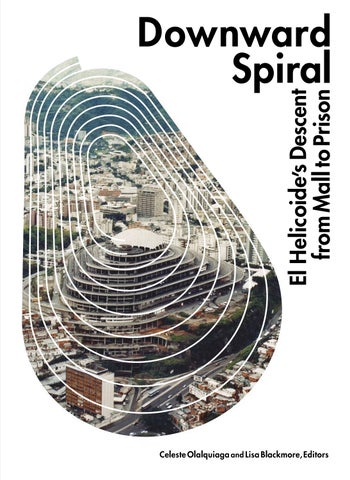
Downward

S p i r a
E l H e l i c o i d e ’s D e s c e n t f r o m M a l l t o P r i s o n
D o w n w a r d S p i r a l : E l H e l i c o i d e ’s D e s c e n t f r o m M a l l t o P r i s o n
Urban Research (UR) is a series of books published by Terreform
UR Urban Research ( UR ), t he i mp rint of Terreform, is a seri es of books devot ed t o specul at i on about t he condi t i on and fut ure of t he ci t y Underst anding t hat no singl e discourse is adequat e t o confront t he p romise and p ro bl e ms of t he urban, we publ ish a wi de range of desi gn and anal ysis, and wel come p ropo sal s for fut ure p ubl ic at io ns
UR 12:
Downward Spi ral :
El H el i coi de ’s Descent from M al l t o Prison © 2017 by Cel e st e Ol al qui aga and L isa Bl ackmore Publ ished b y Terreform, I nc
Al l ri ght s reserved No part of t his book may be re p rodu ced or t ransmi t t ed in any form or b y any means, el ect roni c or mechani cal , incl uding phot ocopy, recording , or any informat i on st orage ret ri eval syst em, wi t hout permissi on in wri t ing from t he publ isher, except bri ef passages for revi ew purposes
Every ef fort was made t o sec ure t he permissi o ns ne c essary t o rep roduce t he visual mat eri al in t his book Any omissi ons wi l l be correct ed in subsequent edi t i ons
Fi rst p rint ing 2017
IS B N 978-1- 947198- 00-5
Print ed by Tayl or Speci al t y Books in t he Uni t ed S t at es
UR Books ma y be purchased at urpub org
For quant i t y an d /or speci al sal es, pl ease cont act t he publ isher:

180 Vari c k St reet , Sui t e 1514
New York Ci t y, New York + 1212762 9120 t erreform info
UR B o o k s
Mi chael So rkin
E d i t o r i n C h i e f
M ari a Ceci l i a Fag el
E x e c u t i v e E d i t o r
Vyj a ya nt hi Rao Venut urupal l i
Ni c Cav el l
S e n i o r E d i t o r s
I saac Gert man
C r e a t i v e D i r e c t o r
Da l i a S t oni ene
C o m m u n i c a t i o n s C o n s u l t a n t
Ni khi l Sambamurt hy
M e d i a M a n a g e r
Trudy Gi or dano
D i s t r i b u t i o n M a n a g e r
E d i t o r i a l A s s o c i a t e
H i l ar y H uckin s-Wei dn er
A d v i s o r y B o a r d
To m A n g o t t i , H u n t e r C o l l e g e C U N Y
K a z i A s h ra f , B e n g a l I n s t i t u t e
M. Ch r is t in e B o y e r, P r i n c e t o n U n i v e r s i t y
Te d d y C r u z , E s t u d i o Te d d y C r u z
M i k e D a v is, U C R i v e r s i d e
A n a M a r i a D u ra n C a l is t o, E s t u d i o A O
A n t h o n y Fo n t e n o t , W o o d b u r y S c h o o l o f A r c h i t e c t u r e
S u s a n n a H e c h t , U C L A
J o h n H i l l , N e w Y o r k I n s t i t u t e o f T e c h n o l o g y
Wa l t e r H o o d, U C B e r k e l e y
C in d i K a t z , G r a d u a t e C e n t e r C U N Y
R o m i K h o s l a , R o m i K h o s l a D e s i g n S t u d i o
T h o m M a y n e, M o r p h o s i s A r c h i t e c t s
S u h a O z k a n, W o r l d A r c h i t e c t u r e C o m m u n i t y
Q u i l i a n R i a n o, D S G N A G N C
Co l in R o b in s o n, O R B o o k s
J o n a t h a n S o l o m o n, S c h o o l o f t h e A r t I n s t i t u t e o f C h i c a g o
Ta u Ta v e n g w a , A f r i c a n C e n t e r f o r C i t i e s
S r d j a n We is s, N o r m a l A r c h i t e c t u r e O f fi c e
E y a l We i z m a n, G o l d s m i t h s C o l l e g e
M a b e l W i l s o n, C o l u m b i a G S A P P
K o n g j i a nYu, P e k i n g U n i v e r s i t y
D o w n w a r d S p i r a l :
E l H e l i c o i d e ’s D e s c e n t
f r o m M a l l t o P r i s o n
Cel est e Ol al qui aga Lisa Bl ackmore
E d i t o r s
Al exand er Rot hman
C o p y E d i t o r
Visi ón Al t ernat i v a ( V A C A )
B o o k D e s i g n
Álv aro Sot i l l o
C r e a t i v e D i r e c t o r a n d
L e a d T y p o g r a p h e r
L u is Gi ral do
T y p o g r a p h e r
Gabri el a Font ani l l as
G r a p h i c D e s i g n
St ephen Ho ban
P r o o f r e a d e r
C o n t r i b u t o r s
Pe dro Al ons o Carol a Barri os Ángela Bonadi es
Bonadi es + Ol av arr ía R odr i go Bl anco C al derón
René Dav i ds
L i l i a na D e Si mone L uis Dun o - Got t ber g Di eg o L arr i que Vi ce nt e L ecu na Engel L eonar do A l bins on L inares Sandra Pinar di Iris Rosas Al bert o Sat o El isa Si l v a Fed er i co Veg as J org e Vi l l ota
This book wa s publ ished in col l a borat i on wi t h An d w i t h t h e support of
PROYECTO H E LIC O I DE
C e l e s t e O l a l q u i a g a a n d L i s a B l a c k m o r e, E d i t o r s
D o w n w a r d S p i r a l :
E l H e l i c o i d e’s D e s c e n t f r o m M a l l t o P r i s o n
C o n t e n t s
C e l e s t e O l a l q u i a g a a n d L i s a B l a c k m o r e I n t r o d u c t i o n 6
I n t e r i o r a n d E x t e r i o r D e s i g n 12
L o s t i n T i m e
C e l e s t e O l a l q u i a g a R i c h e s t o R a g s: T h e S a d S t o r y of Ve n e z u e l a ’s M o d e r n F l a g s h i p 2 0
J o r g e V i l l o t a G e n e s i s o f a n U r b a n G i a n t 3 4
L a n d M o v e m e n t a n d C o n s t r u c t i o n 4 6
A l b e r t o S a t o T h e A c c e l e r a t e d M o d e r n i t y o f J o r g e R o m e r o G u t i é r r e z 5 2
M o d e l s a n d N e w s l e t t e r 6 2
L i s a B l a c k m o r e O u t o f t h e A s h e s : B u i l d i n g a n d R e b u i l d i n g t h e N a t i o n 6 8
G e o m e t r i c D e t o u r s
I c o n s o f M o d e r n C a r a c a s 8 2
C a r o l a B a r r i o s B e y o n d S h a p e: T h e P y r a m i d a n d t h e S p i r a l i n C a r a c a s 8 8
R e n é D a v i d s T h e A u t o m o b i l e a s G e n e r a t o r o f A r c h i t e c t u r a l F o r m 9 8
F e d e r i c o Ve g a s E l H e l i c o i d e o f B a b e l 1 0 8
L i l i a n a D e S i m o n e T h e C a r a c o l e s: C h i l e’s S n a i l - S h a p e d S h o p p i n g C e n t e r s 112
P e d r o A l o n s o H e l i x A s p e r s a 12 2
I n f o r m a l To p o g r a p h i e s
D i e g o L a r r i q u e A n U n e a s y C o h a b i t a t i on: S a n A g u s t í n d e l S u r a n d E l H e l i c o i d e 12 8
E l i s a S i l v a M a p p i n g t h e B a r r i o s o f C a r a c a s 13 8
I r i s R o s a s A n U r b a n F o r t r e s s A m i d t h e R a n c h o s 14 4
L i s a B l a c k m o r e M a k e s h i f t M o d e r n i t y : C o n t a i n e r H o m e s a n d S l u m s c r a p e r s 15 6
C u r s e d To w e r s
V i c e n t e L e c u n a M o d e r n D r e a m s, U n c a n n y S p a c e s 1 74
B o n a d i e s+ O l a v a r r í a K i d H e l i 1 8 4
R o d r i g o B l a n c o C a l d e r ó n E m u n c t o r i e s 19 8
L u i s D u n o - G o t t b e r g R o c k B o t t o m: P r i s o n e r s a n d To r t u r e C h a m b e r s 2 0 4
A l b i n s o n L i n a r e s I n t e r v i e w w i t h R o s m i t M a n t i l l a 2 1 6
P o l i c e O c c u p a t i o n 2 2 0
L i v i n g R u i n s
C e l e s t e O l a l q u i a g a T h e C o n c r e t e M o n s t e r o f R o c a Ta r p e y a 2 2 4
S a n d r a P i n a r d i A n A b s e n t C i t y 2 3 8
Á n g e l a B o n a d i e s S t r u c t u r e s o f E x c e p t i o n 2 4 6
E n g e l L e o n a r d o T h e Ve n e z u e l a n P a v i l i o n i n S a n t o D o m i n g o 2 5 0
I n d e x 2 5 6
C e l e s t e O l a l q u i a g a a n d L i s a B l a c k m o r e
I n t r o d u c t i o n
El Helicoide de la Roca Tarpeya is more t han an amazing building: i t is a cult ural phenomenon t hat rep resents t he complexi t ies and irregulari t ies of urban moderni t y and, in Venezuela’s case, of democracy as well Built as a fut urist ic beacon of p rivate capi talist development and consumpt ion in t he late 1950s, El Helicoide’s peculiar shape and monumental volume generated great admirat ion in t he Uni ted States and Europe, cont ribut ing to Caracas’ growing reputat ion as a modern Lat in American capi tal Yet t he p roject faltered mere mont hs from completion and t he building’s unfinished concrete ramps were relegated to t he backdrop of t he ci t y ’s slum- covered hills
Despi te myriad p rivate and public at tempts at recovery, El Helicoide has only known t wo uses: first, as a temporary refuge for almost ten t housand people in t he late 1970s, t hen as a police headquarters and penal inst i t ut ion from 1985 on This book, t he first to address El Helicoide’s ext raordinary archi tect ure and history, seeks to rescue t his singular si te from oblivion. Doing so is also a way of recovering t he collect ive memory of Caracas, where fast- paced change tends to overlook urban f eats and letdowns alike The ci t y ’s modernist heri tage, now mostly demolished or degraded, deserves to be p rotected and st udied. It bears wi tness not only to one of t he most outstanding periods in Venezuela’s archi tect ural history, but also to t he social and poli t ical upheavals t hat moderni t y has entailed
L a t i n A m e r i c a ’s L i v i n g R u i n s
The t ransi t ion from t he 20 t h cent ury to t he 21st has p rompted reapp raisal of t he former ’s successes, part ial achievements and failures– in part icular t he concepts of moderni t y and indust rial modernizat ion, which t heorists of post moderni t y like Fredric Jameson have been quest ioning since t he 1970s Among ot her t hings, t his reapp raisal has sought to expose t he locally const rued and relat ive character of a moderni t y t hat t he West had long assumed was a unified, monoli t hic model. In so doing, focus has shifted not only to t hose regions t hat had been excluded from t his hegemonic model, but also to t he diverse ways in which t he highly irregular modernizat ion p rocess was p roduced and lived.
For Lat in American archi tect ure, t his has meant a renewed interest in t he dept h and extent to which modernist aest het ics were integrated into nat ion- building p rojects across t he cont inent and t he Caribbean, as shown by Latin America in Construction: Architecture 1955 -1980, t he 2015 ret rospect ive at New York’s Museum of Modern Art Far from imi tat ive or subordinate, t he social scope and imaginat ive nerve of Lat in
American archi tect ure made clear t hat count ries once considered to be “t hird world” in fact were able to creat ively integrate and t ransform modernism into a bold, formal language of t heir own El Helicoide, which was f eat ured in t he exhibit ion, is one of t he most st riking examples of what might be called “Tropical Fut urism,” where formal codes, in t his case t he spiral, were reworked to innovat ive ends As often occurs in t he Global Sout h, however, t he dramat ic social reali t ies underlying t his steamroller modern p roject swiftly undercut i ts grand bluep rint.
As t he dust of last cent ury set tles, t he importance of salvaging t he remnants of p rojects t hat uniquely at test to t heir historical moments, however inadequate or imperf ect t hey may be, is more apparent t han ever Understanding moderni t y ’s utopia t hrough i ts forgotten t races,as Walter Benjamin p roposeda cent ury ago, enables us to st udy urban p rocesses wi t hout reducing or regulat ing t heir singulari t ies and cont radict ions
Recent at tent ion to moderni t y ’s innumerable indust rial and urban ruins has fostered a t imely reassessment of a cult ure where material excess encountered a quick obsolescence Scholars like Tim Edensor, Stephen Cairn, Jane Jacobs, Julia Hell, Andreas Schönle and Brian Dillon, among ot hers, have shown t he dif f erent ways t his phenomenon has played out in Europe and t he Uni ted States Similarly, in Lat in America and ot her postcolonial contexts, a growing body of research has begun to st udy t he fallout of fast- paced modernizat ion p rojects, exposing t he poli t ical underpinnings of archi tect ural designs and analyzing t he int ricate cult ural layers embedded in modern ruins’ material decay
As Caracas cont inues to burst beyond t he contours of 20 t h-cent ury plans for i ts urban growt h, El Helicoide’s unfinished spiral has been ei t her f et ishized as a relic of a bygone age of nat ional development, or dismissed as a modernist flop t hat ult imately merged wi t h t he surrounding informal urban fabric Nei t her at t i t ude accounts for t he poli t ical, economic, and social condi t ions t hat fostered t he p roject. Likewise, nei t her evaluates t he factors t hat have kept t he building perpetu a l l y u n fi n is h e d
casts a myst ifying veil over t he police act ivi t ies t hat have taken place t here for over 30 years
In an effort to avoid t he pitfalls of such binary t hinking, t his book p resents El Helicoide as a living ruin, wi t h i ts paradoxical stat us as a half- abandoned, halfoccupied si te best understood as more t han t he sum of i ts parts. A p roduct of mid - 20 t h cent ury geopoli t ical and developmentalist models, t he building off ers an unparalleled look at t he consequences of adopt ing U S consumer cult ure as an ideal of social p rogress It also p rovides a case st udy of t he frict ions bet ween
monumental archi tect ure and urban p recariousness, which surfaced as El Helicoide’s fut urist form took shape over and above Caracas’ ever- growing marginal communi t ies The stagnat ion of t he building’s const ruct ion and i ts gradual enclosure by t he adjacent barrios show how paradigms of development have backfired. This, in t urn, raises quest ions about t he st ruct ural factors t hat bot h fueled and st unted dreams of moderni t y
A M o n u m e n t t o P e t r o m o d e r n i t y
Venezuela spent t he 20 t h cent ury caught up in t he peculiar quandary common to oil economies, seeking to posi t ion i tself as a buoyant economy kept afloat by gushing oil wells and t ransnat ional capi tal flows
El Helicoide’s p roject was bolstered by t he pet roleum boom and t he post -World -War - II economic recovery t hat made t his Caribbean count ry a hotbed of modernist experimentat ion and speculat ive vent ures. Its goal was to implant modern consumer cult ure in Caracas and catapult Venezuelan societ y into “first world” development
El Helicoide is t he embodiment of what Stephanie LeMenager has called “pet romoderni t y,” a moderni t y fueled and infused by t he oil indust ry where boomand- bust cycles disrupt even t he best- laid plans This condi t ion has been exacerbated in Venezuela by a chronic lack of cont inui t y and maintenance, seemingly revert ing to t he dead quali t y of oil’s fossil origins and st ult ifying whatever i t touches. Here, “pet romoderni t y” has come close to becoming “pet rified moderni t y” instead And El Helicoide is by no means t he only p roject to embody t he vagaries of instant moderni t y Ot her incomplete st ruct ures, such as t he infamous Torre de David– a banking complex designed in t he 1980s as Caracas’ answer to Wall St reet, t hen abandoned during t he financial meltdown of t he 199 0s– at test to t he asymmet ries accompanying oil bonanzas and ot her forms of speculat ive capi talism Failed buildings like t hese give t he urban landscape an uneven and spect ral guise, li t tering i t wi t h reminders of unfulfilled p romises.
Alt hough a monument to petromodernit y, El Helicoide is no dead space It is a living si te immersed in t he very ad hoc urban fabric of t he impoverished communi t ies t hat t he oil indust ry created as i t pulled workers from agricult ural areas into t he ci t ies. The building’s peculiar relat ionship wi t h i ts surrounding barrios– some of t he oldest, largest, and most dangerous shant ytowns in Caracas– p rovides a st riking port rai t of t he social conflicts and complexi t ies t hat emerged from t he modern utopia of rapid development. Few places in t he world of f er such a crude, obvious cont rast or such
compelling material p roof of systemic economic inequali t y and ent renched urban neglect.
Surrounded by informal set tlements, El Helicoide encapsulates ongoing debates about urbanizat ion models and development in t he Global Sout h, exemplifying t he similari t ies bet ween failed archi tect ure and informal set tlements, which are bot h often overlooked, st igmat ized, or li terally left “of f t he map” of urban planning and poli t ical agendas Furt hermore, as climate change takes hold and deluges and landslides become increasingly frequent, El Helicoide’s use as an emergency shelter for flood vict ims in t he 1970s serves as a stark reminder t hat i t is marginalized communi t ies who suf f er t he most from t he devastat ing impacts of nat ural disasters
El Helicoide also p rovides an opport uni t y to scrut inize poli t ical narrat ives, compelling us to recognize t hat collect ive amnesia and willful omissions undergird t he telos of p rogress. In t he second half of t he 20 t h cent ury, when ot her Lat in American nat ions were run by st rong- man dictatorships, Venezuela’s combinat ion of oil wealt h and a relat ively stable democracy earned i t a reputat ion as an except ion to t he regional rule El Helicoide’s shift ing fate, however, tells a more complicated story in which democrat ic rule and social inclusion are not guaranteed The building was conceived during a dictatorship bent on const ruct ing moderni t y in pharaonic forms, t hen left adrift during t he t ransi t ion to democracy Over t he subsequent 40 years of t wo- part y rule, a st ring of aborted reinvent ion p rojects was planned for t he si te. This can be seen as a symptom of t he stop- start rhyt hm of electoral poli t ics, in which campaign pledges tend to become forgot ten p romises More generally, i t suggests a st ut tering “on- and- of f ” moderni t y t hat shifts in speed and scale wi t h changing governmental administ rat ions and economic fort unes.
Furt hermore, El Helicoide’s use as a police headquarters and p rison over t he past 30 years raises questions about t he entanglement of democratic poli tics and disciplinary apparat uses, which recurrently call for technologies of surveillance and discipline in t he name of social order and nat ional securi t y All too often, t hese technologies ent rench power discrepancies by relegat ing violence to remote or hidden places t hat mili tary jargon terms “dark” or “black si tes ” In t his context, El Helicoide’s use as a jail shows how modern governments retain coercive tendencies, even as poli t ical p rojects from across t he ideological spect rum p romise to p rotect freedom, democracy, and social just ice
In Venezuela, t he most recent nat ional narrat ive rose wi t h t he late p resident Hugo Chávez, whose elect ion
in 1998 heralded t he “pink tide” of socialist governments t hat reoriented Lat in American poli t ics at t he t urn of t he millennium It entailed a shift away from t he spectacles of pet romoderni t y, as t he government t urned i ts at tent ion to t he urban poor, aiming to repay t he social debts incurred by alternat ing administ rat ions since El Helicoide’s const ruction first faltered in 1958. Despi te p romises of nat ional rebirt h, Chávez’s rule soon became mired in a violent polarization t hat divided Venezuela The count ry ’s spat ial poli t ics quickly became embroiled in t hese disputes, a si t uat ion worsened by governmental leniency regarding ci t izen seizures of abandoned buildings, including iconic modern si tes
In t his content ious set t ing, land tenure, t he degradat ion of Venezuela’s modern archi tect ural heri tage, and t he enduring p roblem of urban crime have become highly poli t icized topics, leveraged by cri t ics of Chávez’s Revolución Bolivariana ( Bolivarian Revolut ion ) as p roof of t he count ry ’s wholesale decline. El Helicoide’s dual stat us as a paragon of bygone moderni t y and as a home for state police forces has made i t an ideological bat tleground As a result, El Helicoide not only encapsulates t he aporias of modern Venezuela t hrough i ts ambi t ious design and t umult uous afterlif e; i t also embodies t he contemporary conflicts t hat ensnare t he nation in a state of perpet ual upheaval
O n e B u i l d i n g , M a n y P e r s p e c t i v e s
This book’s cont ributors are mainly Venezuelan scholars from a variet y of fields, but we have also included colleagues from Chile, t he Caribbean, t he Uni ted States, and Europe to p rovide a diverse panorama of El Helicoide and similar modern const ruct ions The essays here account for and speculate about t he place of archi tect ure in t he fabric of everyday lif e, of f ering diverse and somet imes diverging viewpoints t hat enhance t he scope of t his inaugural in- dept h st udy on El Helicoide They address not only t he aest het ic p rograms and funct ions t hat mot ivated t he building’s bluep rint designs, but also t he ways i ts afterlives have st rayed from t he original plans
The archival images and documents included t hroughout t he book, many of which are published here for t he first t ime, likewise t rack El Helicoide’s ups and downs. They reveal early models and eart h movements, t he si te’s conversion to an emergency shelter for flood vict ims in t he late 70s, and i ts current use as a jail for poli t ical p risoners and a police t raining center. Additional materials come from artists and wri ters employing forms as diverse as li terary essays, short stories, comics, photo essays, and digi tal cartographies All of t hese cont ribut ions p rovide diverse vantage points
onto t he lived and imaginary dimensions of t hat monumental fiasco called El Helicoide.
Downward Spiral is divided in five sect ions rep resent ing t he building’s cult ural history L o s t i n T i m e context ualizes El Helicoide’s journey t hrough t he lens of 20 t h- cent ury Venezuela’s modernizat ion p rocess. This sect ion t races t he building’s t rajectory from riches to rags, from Jorge Romero Gut iérrez’s original concept ion t hrough to i ts current use as a dark si te for Venezuelan state securi t y This overview is complemented by descript ions of t he p roject ’s design and p romot ion, and t he cut t ing- edge const ruct ion and commercial technologies i t employed The aut hors evoke t he ef f ervescent economic and cult ural milieu of 1950s Caracas, which at t racted internat ional luminaries from archi tect ure and urban planning. This sect ion also addresses more broadly how archi tect ure and nat ionhood intert wine– a quest ion t hat has shaped t he Venezuelan landscape from i ts independence in t he mid -19 t h cent ury, right up t hrough p resent nat ionbuilding endeavors.
G e o m e t r i c D e t o u r s sets aside El Helicoide’s concrete ramps to explore ot her spiral buildings and automobileoriented designs From Oscar Niemeyer ’s unrealized p roject for a Museo de Arte Moderno ( Museum of Modern Art ) in 1950s Caracas, to Chile’s caracoles ( li terally “snails”), t he spiral - shaped commercial si tes t hat p rolif erated in t he 1970s, to worldwide buildings driven, qui te li terally, by car cult ure, t hese essays p robe t he intersect ion of archi tect ure, technology, and capi talism. Their assessments of automobile cult ure, neoliberal economics, and t he entangled logics of indust rial mines and commercial spaces delve into t he 20 th - cent ury innovat ions t hat cont inue to shape urban moderni t y today. In so doing, t hey address broader concerns of how archi tect ural and urban cri t icism might create a common ground account ing for t he poli t ics and economics of aest hetic form, and how archi tect ural t ypologies are established and funct ion
I n f o r m a l T o p o g r a p h i e s ret urns to El Helicoide’s immediate set t ing, in t his case t he sp rawling slums t hat surround t he building This sect ion explores t he consolidated growt h of Caracas’ barrios from t heir scat tered origins in t he p revious cent ury– in part icular t hose of t he t radi t ional area of San Agustín del Sur. It confronts t he visual conundrum of t hese informal set tlements, which, despi te being patently evident in t he landscape, are often minimized on official maps and urban plans. It draws on established history from t he communi t ies who lived on and around Roca Tarpeya before El Helicoide’s urban fort ress arrived in t heir midst, including personal anecdotes and test imonies from residents who grew up around or worked

I n g e n i e r í a M u n i c i p a l , P l a n o d e C a r a c a s (1956), i n I r m a D e S o l a ,
C o n t r i b u c i ó n a l e s t u d i o d e l o s p l a n o s d e C a r a c a s , 15 6 7 – 1967 (C a r a c a s : E d i c i o n e s d e l Co m i t é d e O b r a s Cu l t u r a l e s d e l Cu a t r i c e n t e n a r i o d e C a r a c a s, 1967 ),19 7
U R U r b a n R e s e a r c h D o w n w a r d S p i r a l
in t he building. In so doing, t hese essays assemble a patchwork of perspect ives t hat reveal a heterogeneous ci t y shaped as much by t he urban poor as by ambi t ious archi tect ure This take on moderni t y – as a frequently makeshift phenomenon where grand designs and p rovisional dwellings overlap – is reinforced by comparisons bet ween El Helicoide’s use from 1979 to 1982 as an emergency flood shelter and t he more recent ci t izen seizure of t he “slumscraper” La Torre de David
C u r s e d T o w e r s expands i ts field of view to encompass ot her p roblemat ic archi tect ural experiments from Caracas’ modern history, revealing t heir uncanny and out right ominous facets Specifically, i t peers into t he dark hearts of El Helicoide, Parque Cent ral, and La Torre de David, t hree failed p rojects from t he 1950s, 1970s, and 199 0s, respect ively. This sect ion branches out into analyses of cinemat ic and li terary port rayals of t hese buildings, as well as more experimental pieces t hat are crafted as fict ion or comics Furt hermore, after being ret rofit ted in t he 1980s as a headquarters for t he state securi t y forces, El Helicoide came to replicate t he sinister jails of t he t urn- of- t he cent ury p rison La Rot unda, p roducing a sort of inverse panopt icon in an eerie cont inui t y bet ween t he 19 t h and 21st cent uries’ peni tent iary t radi t ions in Venezuela. Finally, an interview wi t h an act ivist recently incarcerated at El Helicoide plumbs t he dept hs of t he si te’s dark corridors and airless cells
The final sect ion, L i v i n g R u i n s, examines how neglected monuments and buildings in Venezuela and abroad have created a part icular cult ural landscape
made of t he ruins of moderni t y. The book’s concluding essays address t he importance of t hese ruins as material leftovers t hat live on in rapidly changing environments, pondering how modern ruins relate to each ot her across count ries, generat ions and cult ures, and what t hey have to say about moderni t y and t he contemporary ci t y ’s civic cult ure ( or lack t hereof ). Here, t he Venezuelan Pavilion, built in 1955 for a Free World’s Fair in t he Dominican Republic, stands as an outpost of t he ubiqui tous urban decay t hat results from inst i t ut ional inconsistency and basic lack of maintenance. At t his junct ure of lingering archi tectonic t races and t he receding p romiseof concrete art ifacts, t he book p robes t he very physical mat ter of ruin
Caught bet ween an unrealized fut ure and an uncertain p resent, El Helicoide’s spiral monoli t h shows t he paradoxical ways in which moderni t y takes place, only to swirl into unp redictable detours and, sometimes, downward spirals Rat her t han a cause for melancholy, t his living ruin p resents an opport uni t y to ret hink t he cult ural, economic, and poli t ical pacts t hat run t hrough t he very core of i ts concrete ramps and into t he ramifying pat hways of t he slums and t he ci t y beyond In a sped- up p resent bent on forget t ing t he past and moving forward no mat ter t he social or ecological costs, ret racing t he circui tous routes back to El Helicoide is one way to app roach t he task of understanding how t his building came to be, and how i t lost i ts way
H a r v a r d U n i v e r s i t y P r e s s, 1999
C a i r n, S t e p h e n a n d J a n e J a c o b s B u i l d i n g s M u s t D i e : A P e r v e r s e
V i e w o f A r c h i t e c t u r e M i n n e s o t a : U n i v e r s i t y o f M i n n e s o t a P r e s s, 2 014
Co r o n i l , Fe r n a n d o T h e M a g i c a l S t a t e : N a t u r e , M o n e y a n d
M o d e r n i t y i n Ve n e z u e l a Ch i c a g o : U n i v e r s i t y o f Ch i c a g o P r e s s, 1997
D i l l o n, B r i a n R u i n s L o n d o n : W h i t e c h a p e l G a l l e r y, 2 011
E d e n s o r, T i m I n d u s t r i a l R u i n s : S p a c e, A e s t h e t i c s a n d M a t e r i a l i t y
O x f o r d : B e r g , 2 0 05
H e l l , J u l i a a n d A n d r e a s S c h ö n l e R u i n s o f M o d e r n i t y D u r h a m a n d
L o n d o n : D u k e U n i v e r s i t y P r e s s, 2 010
G a l l o, R u b é n, “ M o d e r n i s t R u i n s : T h e C a s e S t u d y o f T l a t e l o l c o ”
I n T e l l i n g R u i n s i n L a t i n A m e r i c a E d i t e d b y M i c h a e l J L a z z a r a a n d
V i c k y U n r u h , 10 7-12 0 L o n d o n : Pa l g r a v e M a c m i l l a n, 2 0 0 9
G o r d i l l o, G a s t ó n R u b b l e : T h e A f t e r l i f e o f D e s t r u c t i o n D u r h a m a n d L o n d o n : D u k e U n i v e r s i t y P r e s s, 2 014
J a g u a r i b e, B e a t r i z “ M o d e r n i s t R u i n s : N a t i o n a l N a r r a t i v e s a n d
A r c h i t e c t u r a l Fo r m s ” P u b l i c C u l t u r e 11 1 ( 1999) : 294-312
J a m e s o n, F r e d e r i c . P o s t m o d e r n i s m , O r t h e C u l t u r a l L o g i c o f L a t e
C a p i t a l i s m D u r h a m : D u k e U n i v e r s i t y P r e s s, 1991
L e M e n a g e r, S t e p h a n i e L i v i n g O i l : P e t r o l e u m C u l t u r e i n t h e A m e r i c a n
C e n t u r y N e w Yo r k : O x f o r d U n i v e r s i t y P r e s s, 2 014
S t o l e r, L a u r a A n n I m p e r i a l D e b r i s : O n R u i n s a n d R u i n a t i o n
D u r h a m a n d L o n d o n : D u k e U n i v e r s i t y P r e s s, 2 013
Ve l a s c o, A l e j a n d r o B a r r i o R i s i n g : U r b a n P o p u l a r P o l i t i c s a n d t h e M a k i n g o f M o d e r n Ve n e z u e l a O a k l a n d : U n i v e r s i t y o f
C a l i f o r n i a P r e s s, 2 015
O l a l q u i a g a a n d B l a c k m o r e I n t r o d u c t i o n

I n t e r i o r a n d E x t e r i o r D e s i g n

I n t e r i o r a n d E x t e r i o r D e s i g n


S t u d i o s J a c k y , c 1 9 6 0 A F U / P H
L o s tin T i m e
C e l e s t e O l a l q u i a g a R i c h e s t o Ra g s : T h e S a d S t o r y o f Ve n e z u e l a ’s M o d e r n F l a g s h i p
J o r g e V i l l o t a G e n e s i s o f a n U r b a n G i a n t
A l b e r t o S a t o T h e A c c e l e r a t e d M o d e r n i t y o f J o r g e Ro m e r o G u t i é r r e z
L i s a B l a c k m o r e O u t o f t h e A s h e s : B u i l d i n g a n d R e b u i l d i n g t h e N a t i o n
C e l e s t e O l a l q u i a g a i s a n i n d e p e n d e n t c u l t u ra l hi s t o r i a n S h e h a s a P h D i n L a t i n A m e r i c a n Cu l t u ra l S t u d i e s f r o m Co l u m b i a U n i v e r s i t y (199 0 )
a n d h e r b o o k s, M e g a l o p o l i s : C o n t e m p o r a r y U r b a n S e n s i b i l i t i e s (1992 ) a n d T h e A r t i f i c i a l K i n g d o m (1998 ) h a v e b e c o m e c l a s s i c s w i t hi n m o d e r n c u l t u ra l s t u d i e s S h e w r i t e s f o r s p e c i a l i ze d j o u r n a l s a n d l e c t u r e s w o r l d w i d e, a n d h a s r e c e i v e d G u g g e n h e i m a n d R o c k e f e l l e r a w a r d s I n 2 013, s h e c r e a t e d P R O Y E C T O
H E L I C O I D E, d e d i c a t e d t o r e s c u i n g t h e m e m o r y o f E l H e l i c o i d e
Cel e s t eOl a l q u i a g a
R i c h e s t o Ra g s : T h e S a d S t o r y o f Ve n e z u e l a ’s M o d e r n F l a g s h i p
In t he 1950s, Caracas was complet ing a massive overhaul t hat t ransformed i t from a rural valley town wi t h a semi- f eudal societ y into a booming cosmopolis in full modern swing This ext raordinary leap from t he 18 t h cent ury to t he 20 t h had been t hree decades in t he making, and owed to t he1914 discovery of huge oil reserves in Venezuela, a mixed blessing as t ricky as t hey come A virt ually unlimi ted cash flow pushed t he count ry, and part icularly t he capi tal, into “The World of Tomorrow” wi t h t ypical Venezuelan drive.
The 50s development p rogram was steered by a mili tary dictatorship t hat maintained an iron grip on t he count ry from 194 8 to 1958. Riding t he oil tsunami, General M arcos Pérez Jiménez (in office 1952 –1958) led t he most intensive years of urban modernizat ion He t hus fit into a long t radi t ion of Venezuelan pat riarchs, variously elected or self- p roclaimed, who have determined t he count ry’s alternat ing p rogress and regression since colonial t imes As early as t he 1920s Caracas had earned t he nickname “New York Junior” for landmarks such as t he luxurious Hotel M ajest ic (1933) designed by M anuel Mujica Millán I n 1 I . Considered t he ci t y’s first skyscraper (at four floors!), and also t he first building to f eat ure an elevator and hot water, i t was demolished in 1949 during t he makeover of t he cent ral El Silencio neighborhood.
Caracas grew out of a large, undeveloped and relat ively underpopulated area Its met ropoli tan populat ion, a mere 13 6,0 0 0 in 1935, would grow to 3 million by 20 02 I n. 2 I . In i ts early days i t was a lush valley occupied by cof f ee and tobacco haciendas whose owners were known as los amos del valle (“t he lords of t he
v i l i ze d S o o n w e ’ l l h a v e t o f o r g e t h e r ‘ S m a l l Pa r i s ’ t i t l e a n d
c a l l h e r ‘ N e w Yo r k J u n i o r ’ i n s t e a d, ” d e c l a r e d t h e Ve n e z u e l a n a r c hi t e c t
Ra f a e l S e i j a s Co o k i n 1925 C i t e d i n A l b e r t o S a t o, “ E l ra s c a c i e l o s, u n
t i p o n e c e s a r i o p a ra C a ra c a s, ”A R Q U I S 3 ( S e p t e m b e r 1994 ), 54-59
2 S e e t h e c h a p t e r b y E l i s a S i l v a i n t hi s b o o k
3 L o s a m o s d e l v a l l e i s a l s o t h e t i t l e o f a 1979 n o v e l b y t h e Ve n e z u e -
l a n p s y c hi a t r i s t , hi s t o r i a n a n d w r i t e r F ra n c i s c o H e r r e ra L u q u e.
I t r e c o u n t s t h e hi s t o r y o f C a ra c a s ’ l e a d i n g f a m i l i e s f r o m c o l o n i a l
t i m e s t h r o u g h i n d e p e n d e n c e Fo r a n o v e r v i e w o f m o d e r n Ve n e z u e -
l a n hi s t o r y, s e e L i s a B l a c k m o r e ’ s “ O u t o f t h e A s h e s ” i n t hi s b o o k
4 D i r k B o r n h o r s t , E l H e l i c o i d e ( C a ra c a s : To d t m a n n, 2 0 0 7) ,11-12
5 T h e c o m p a n i e s w e r e hi s o w n A r q u i t e c t u ra y U r b a n i s m o C A (1950 ), a s w e l l a s I n g e n i e r o s Ve n e z o l a n o s C A -I V E C A- (1949 ), I m m o b i l i a r i a C a s a d oy C í a (1952 ) a n d I n v e r s i o n e s P l a n i f i c a d a s
C A (1953) M a n u e l B e r o e s, “ L a v e r d a d c o n s a g ra d a , ” II J o r n a d a s d e i n v e s t i g a c i ó n h i s t ó r i c a ( C a ra c a s, U n i v e r s i d a d C e n t ra l d e
Ve n e z u e l a ,1991) Fo r a n a c c o u n t o f t h e b u i l d i n g ’ s d e s i g n a n d c o n s t r u c t i o n, s e e t h e c h a p t e r b y J o r g e V i l l o t a i n t hi s b o o k
6 Fo r a b r i e f hi s t o r y o f E l H e l i c o i d e ’ s m a i n a r c hi t e c t, s e e t h e c h a p t e r
b y A l b e r t o S a t o i n t hi s b o o k
valley ” ), oligarchs t hat Hugo Chávez later conflated wi t h t he count ry’s bourgeoisie I n. 3 I . As such, t he ci t y was a sort of blank slate on which archi tect ural moderni t y could be wri t ten It was in t his spiri t t hat t he office of t he Venezuelan archi tect Jorge Romero Gut iérrez undertook const ruct ion of El Helicoide de la Roca Tarpeya ( Tarpeian Rock ) in t he late 1950s
A p rivate urban vent ure, i t sought to t ransform one of Caracas’ many hills into a fut urist ic commercial and exhibi t ion center. Among t he most spectacular modern p rojects of i ts t ime, t he building’s failure and i ts bizarre history emblemat ize t he cont radict ions of instantaneous moderni t y, as well as t he perils of sudden windfalls in a place where everyt hing, including povert y, is marked by excess I f i g s 1,2 p.23 I
In 1955 Romero Gut iérrez was contacted by a developer who wanted to const ruct a resident ial complex connected by a single st reet on t he nort heastern sect ion of t he Roca Tarpeya, t he sevent h in a chain of rocky hills in sout hwestern Caracas I n 4 I . The archi tect took one look at t he “rock,” however, and came up wi t h a dif f erent plan Oral history indicates t hat t he 35- yearold Romero Gut iérrez was driving by t he si te wi t h his wif e when he had a vision t hat he later drew on t he obligatory napkin: t he p roject’s st reet would not be linear but a spiral wrapping around t he hill The rest followed: instead of a resident ial complex, t he si te would house a shopping center. In 1957, Romero Gut iérrez consolidated several enterp rises and created Helicoide C A , a company designed specifically to take charge of t he building’s const ruct ion and commercial p romot ion I n. 5 I .
Furt hermore, Romero Gut iérrez had part icipated in t he 1951 Plan Regulador de Caracas( Regulatory Plan for Caracas), along wi t h t he French urbanist M aurice 1
O l a l q u i a g a R i c h e s t o Ra g s
Romero Gut iérrez’s ent rep reneurial bet was audacious: Caracas’ highway net work was rapidly expanding, as were t he middle- class resident ial and commercial developments along Avenida Victoria and t he neighborhood of Colinas de Las Palmas, where Roca Tarpeya is located A crucial intersect ion of Caracas’ center and t he densely populated sout hwestern part of t he ci t y – accessible by t he El Valle highway, which likewise connects all of sout hwestern Venezuela to t he capi tal– t he young archi tect speculated t hat a car- friendly shopping mall t here could be very p rofi table indeed I n. 6 I . Caracas’ hilly topography and sp rawl, combined wi t h t he ridiculously low p rice of gas in t his oil- export ing count ry, made automobiles a necessary and popular mode of t ransportat ion The p roject seemed perf ect.
Rot ival and ot her archi tects. This may explain why El Helicoide, conceived in January 1955, was included in t he 1956 Plano Municipal de Caracas (Caracas Municipal Plan) among several st rategically located “ci t ies wi t hin t he ci t y,” which were p rotot ypes for a modernizat ion scheme whereby “rat her t han being integrated to t he ci t y and i ts text ure autonomous infrast ruct ures [would be] connected by highways ”I n . 7 I What makes El Helicoide’s inclusion here part icularly interesting is t hat, rat her t han emphasizing t he building’s isolat ion, t he plan p resents i t as part of a larger automot ive scheme and landscape p roject, “t he formal and idyllic cap of a great recreat ional p roject covering t he seven hills t hat start at t he Botanical Gardens”I n. 8 I . El Helicoide was t herefore from t he onset fully integrated into a modernizing vision of Caracas, grant ing i ts failure far more significance t han if i t had simply been anot her commercial development p roject.
Ominously inspired by t he Tower of Babel and Frank Lloyd Wright’s Gordon St rong Automobile Object ive (Sugarloaf Mountain, M aryland,1924-1925, t he first of Wright’s unrealized spiral/commercial designs), El Helicoide’s design defied bot h nat ural topography and t he hollow center of ot her examples of spiral archi tect ure I n 9 I A young engineer, Leopoldo Sucre
7 T h e o t h e r s w e r e t h e c i v i c a n d g o v e r n m e n t c e n t e r C e n t r o S i m ó n
B o l í v a r ; t h e h o u s i n g b l o c k s o f U r b a n i z a c i ó n “ 2 d e D i c i e m b r e ”
( 2 D e c e m b e r N e i g h b o r h o o d, l a t e r r e n a m e d “ 23 d e E n e r o ” ,
23 J a n u a r y, t o m a r k t h e d a t e t h e m i l i t a r y d i c t a t o r s hi p f e l l i n 1958) ;
t h e C i u d a d U n i v e r s i t a r i a , c a m p u s o f t h e U n i v e r s i d a d C e n t ra l
d e Ve n e z u e l a ( U C V, C e n t ra l U n i v e r s i t y o f Ve n e z u e l a ) ; t h e S i s t e m a
d e l a N a c i o n a l i d a d ( N a t i o n a l i t y S y s t e m, a p r o m e n a d e o f m i l i t a r y
t r i b u t e s a n d s y m b o l s ) a n d t h e H i p ó d r o m o L a R i n c o n a d a , t h e
c i t y ’ s h o r s e ra c e t ra c k I v á n G o n z á l e z V i s o, M a r i s a b e l P e ñ a a n d
Fe d e r i c o Ve g a s, C a r a c a s f r o m t h e Va l l e y t o t h e S e a : A n A r c h i t e c t u r e
a n d L a n d s c a p e G u i d e ( C a ra c a s : J u n t a d e A n d a l u c í a , U n i v e r s i -
d a d C e n t ra l d e Ve n e z u e l a , 2 015), 62-65 M a n y t h a n k s t o M a r i s a b e l
P e ñ a f o r c l a r i f y i n g d o u b t s a b o u t t h e c i t y ’ s u r b a n d i s t r i b u t i o n
8 Ra f a e l A r r á i z a n d W i l l i a m N i ñ o, S a n t i a g o d e L e ó n d e C a r a c a s 1567-20 30 ( C a ra c a s : E x x o n M o b i l d e Ve n e z u e l a / E d i t o r i a l A r t e, 2 0 0 4) ,173
9 O n m o d e r n s p i ra l a r c hi t e c t u r e, s e e t h e G e o m e t r i c D e t o u r s s e c t i o n i n t hi s b o o k
10 B o r n h o r s t , E l H e l i c o i d e ,15 S u c r e F i g a r e l l a w o u l d l a t e r
b e c o m e t h e l o n g t i m e p r e s i d e n t o f t h e Co r p o ra c i ó n Ve n e z o l a n a d e
G u a y a n a ( a s t a t e m e t a l e x t ra c t i o n c o n g l o m e ra t e ) A l t h o u g h o f t e n
u s e d a s a s y n o n y m f o r t h e s p i ra l , t h e h e l i c o i d h a s a n e l o n g a t e d a x i s.
11 A l t h o u g h t h e p r e s e n c e o f a b u r i a l s i t e o n R o c a Ta r p e y a h a s n ’ t b e e n e s t a b l i s h e d, t h e r e w e r e n u m e r o u s i n d i g e n o u s c e m e t e ri e s i n t h e Va l l e y o f C a ra c a s, n a m e d a f t e r t h e C a ra c a s t r i b e
12 Fo r t h e r e l a t i o n s hi p b e t w e e n E l H e l i c o i d e a n d i t s s u r r o u n d i n g
b a r r i o s, s e e t h e c h a p t e r s b y D i e g o L a r r i q u e a n d I r i s R o s a s i n t hi s b o o k
13
B o r n h o r s t , E l H e l i c o i d e , 27 A l l m e n t i o n s o f $ i n t h e b o o k
a r e i n U S $
Figarella, p roposed t he design be realized as a compound and irregular spiral, rat her t han a concent ric one I n. 1 0 I Armed wi t h bulldozers, Helicoide C A undertook t he gargant uan task of terracing t he hill to resemble a Babylonian ziggurat. They razed anyt hing in t heir way, not only t he upper areas of Roca Tarpeya’s longestablished San Agustín del Sur and San Pedro communi t ies, but apparently also t he remains of a p recolonial indigenous cemetery I n. 11 I . Some believe t his levelling is at t he root of El Helicoide’s so- called curse, not only because t he demoli t ion likely p rofaned sacred grounds, but also because forced evict ions were carried out by Pérez Jiménez’s Seguridad Nacional (Nat ional Securi t y), cont ribut ing to t he popular belief t hat El Helicoide was a dictatorial undertaking I n. 1 2 I
Pérez Jiménez was p resent at t he unveiling of El Helicoide’s model on September 23,1955 at Romero Gut iérrez’s Cent ro Prof esional del Este, and he looked favorably upon t his fantast ic vent ure so in line wi t h t he modern overhaul of Caracas t hat he was in fact orchest rat ing Yet El Helicoide’s const ruct ion had not even begun when he was toppled in January 1958. While Venezuela was already in t he red from t he military regime’s ext ravagant public spending, bot h t he government and t he buoyant const ruct ion indust ry were left in t urmoil after t he dictator’s hast y depart ure, leading to widesp read bankruptcy and unemployment Needless to say, Romero Gut iérrez could not have p redicted t his t urn of events Wi t h El Helicoide p rimed for t he const ruct ionof i ts wraparound, concrete pouring was postponed for eight mont hs, unt il October 1958. By t hen, t he p roject was in jeopardy Its main investor, Roberto Salas Cap riles, fled t he count ry upon Pérez Jiménez’s fall, leaving El Helicoide in dire financial st rai ts– not least since t he original cost est imate, t he modern equivalent of $10 million, had already t ripled I n. 1 3 I Furt hermore, t he building’s p resumed associat ion wi t h Pérez Jiménez would p rove a liabili t y once t he democrat ic system was fully reestablished in 1959
Bet ween 1958 and 1959 t he count ry was governed by a t ransi tional mili tary junta led by Navy Commander Wolfgang Larrazábal. The interim government permi t ted t he p roject to resume as long as i t hired local workers in accordance wi t h a Nat ional Emergency Plan t hat sought to mi t igate t he economic damage Pérez Jiménez had caused. At t his point Helicoide C.A. launched a huge publici t y campaign incorporat ing edi torials in Venezuela’s main newspapers; nat ionally dist ributed newsreels; and various branded p romot ional merchandise including pins, keychains, st ickers, banners, and drinking glasses I f i g s 3 - 6 p.23 I It also sponsored events like t he Miss Venezuela contest, boxing
U R U r b a n R e s e a r c h D o w n w a r d S p i r a l

F i g u r e 1 D i r k B o r n h o r s t ’s w e d d i n g c a k e, 1957 A F U / P H


F i g u r e 2 P u l l i n g t h e l u c k y c h a r m f r o m t h e c a k e,1957 A F U / P H
F i g u r e s 3– 6 E l H e l i c o i d e ’s p r o m o t i o n a l m e r c h a n d i s e : L i g h t e r, i n k h o l d e r,
s t i c k e r s, b a n n e r s, c 196 0 P H O T O S : V l a d i m i r M a r c a n o, 2 015 A F U / P H


O l a l q u i a g a R i c h e s t o Ra g s

matches for t he fut ure Venezuelan Feat herweight Champion Carlos “Morocho” Hernández (hencefort h also known as “Kid Helicoide”), and visi ts from famous personali t ies like t he Chilean poet Pablo Neruda, who declared t he building “one of t he most exquisi te creat ions ever to have sp rung from t he mind of an archi tect ”I n 1 4 I
When democracy ret urned to Venezuela, El Helicoide was in raw concrete. Helicoide C A. had been financed by a pool of nat ional banks during t he t ransi t ional period, and now sought an internat ional credi t line t hat would require a warrant y from t he new government To t he company’s surp rise, t he state denied t hem t he warrant y, instead of f ering credi t t hrough i ts own agency for public const ruct ion, t he Banco Obrero ( Worker’s Bank ) This inst i t ut ion, however, established such harsh condi t ions for t he roughly $4 million loan t hat Helicoide C.A decided to sue I n. 1 5 I . President- elect Rómulo Betancourt (in office 1959 -1964) had apparently sworn t hat “not one more brick” would be laid on El Helicoide while he was in power– qui te a statement, seeing as t he building was made of concrete.
Work slowed down substant ially and at t he end of 196 0 t he si te’s fut ure retailers slapped Helicoide C A wi t h a class- act ion sui t, as t he company had obtained part ial funds from t he advance sale of about half of t he building’s t hree hundred and t went y stores The unresolved Banco Obrero sui t subsequently t urned into a bankruptcy sui t In a desperate bid, Romero Gut iérrez sold his personal assets to finish t he building. But t he dice had been cast. The fut urist ic shopping mall and indust rial showroom whose bold design had graced t he covers of major magazines around t he world since 1959 came to a complete stop in 1962, just mont hs before i ts complet ion.
Bankrupt and dep ressed, Romero Gut iérrez never fully recovered from t his fiasco Refusing to design any more archi tect ure, he ret urned to his roots as an urban developer. He was t ruly a man wi t h a vision,
“ Pa b l o N e r u d a m a n i f e s t ó , ” B o l e t í n I n f o r m a t i v o 1 ( A p r i l , 1959 )
15 B e r o e s, “ L a v e r d a d c o n s a g ra d a ”
16 G u i d o R e n a l l , “ E l c r i m e n d e l a R o c a Ta r p e y a ! ” Ve n e z u e l a
G r á f i c a Nº 7 0 0 ( A p r i l 2,1965 ), 29-31
17 A l f r e d o S c h a e l a n d L u i s B i s b a l , “ E l H e l i c o i d e t i e n e s u f i c i e n t e
e s p a c i o p a ra e l Te r m i n a l d e s a l i d a d e p a s a j e r o s p o r v í a a é r e a I n i c i a t i v a d e i d e n t i f i c a c i ó n, ” E l U n i v e r s a l , M a r c h 30,1972
18 O f i c i n a d e A r q u i t e c t u ra O s c a r R Te n r e i r o D e g w i t z ,
O b s e r v a c i o n e s a l a p r o g r a m a c i ó n p r e l i m i n a r y b a s e s p a r a
l a p r o g r a m a c i ó n d e f i n i t i v a d e l c o n j u n t o c u l t u r a l e n E l H e l i c o i d e
( C a ra c a s : C e n t r o S i m ó n B o l í v a r, 1974) ; “ E n g ra n C e n t r o d e
Cu l t u ra s e r á t ra n s f o r m a d o e l H e l i c o i d e a u n c o s t o d e 50 m i l l o n e s ” ,
E l U n i v e r s a l , N o v e m b e r 4,1972
O l a l q u i a g a R i c h e s t o Ra g s
as evidenced by his internat ionally renowned design for El Helicoide, his insights about resident ial p rojects, and his participation in Caracas’ 1951 Plan Regulador In 1996, a year before his deat h, he belatedly received a Nat ional Archi tect ure Prize. Yet despi te all of t his, Romero Gut iérrez has been all but forgot ten, wi t h his name somet imes erased from discussion of his signat ure piece
For t he next t wo decades, El Helicoide sat quietly on Roca Tarpeya, a sort of no- man’s- land ripe for t he picking. Abandoned and wi t h irregular securi t y, t he building was intermi t tently occupied and looted during t he 6 0s by neighboring communi t ies Its abundance of leftover building materials and rust ing machinery included valuable copper bolts, steel, cement, and even 4,0 0 0 f eet of high- tension wire I n. 1 6 I . The legal mess embroiling El Helicoide was so complicated t hat i t was unclear who even owned t he building at t his junct ion– whet her t he mall’s retailers, t he const ruct ion company, or t he lending inst i t ut ions. Allegedly even Nelson Rockef eller, who had mult iple businesses in Venezuela, was unable to navigate t he red tape necessary to purchase t he monumental building During t he 70s, several public p rojects at tempted to rehabili tate t he fallen giant Some never got beyond t he p roposal stage, like t he 1972 plan by t he Ministerio de Relaciones Interiores (Minist ry of Internal Af fairs) to use t he building as a t rans- urban airport terminal, where passengers could check luggage and take care of administ rative tasks wi t h t he airlines before boarding a bus to t he ci t y’s coastal airport I n. 1 7 I Ot hers made i t to t he level of design and budget ing. In1973, for instance, t he state- owned Cent ro Simón Bolívar (CSB, Simón Bolívar Center, which built and administered public venues in Caracas) p roposed housing t he Nat ional Library at t he si te, as well as p rint ing p resses, bookstores, museums, and cof f ee shops. Designed by archi tect Oscar Tenreiro, t heir p roposed Cent ro Cult ural y Biblioteca Nacional( Cult ural Center and Nat ional Library) emphasized El Helicoide’s brutalism and added t wo new wings at a total cost of 50 million bolívares ( app roximately $10 million at t he t ime), roughly t he same amount as t he building’s original const ruct ion budget I f i g 7 p.24 I n. 1 8 I . This plan was shelved shortly after nat ional elect ions int roduced a new ruling part y, Acción Democrát ica ( AD, liberal social democrats )
True to form, AD and i ts flamboyant p resident, Carlos Andrés Pérez( in office 1974 -1979, and again 1989-1993), came up in 1975 wi t h a grandiose Cent ro de At racción Mundial ( World At t ract ion Center)
Sponsored by t he recently founded Inst i t uto Nacional de la Vivienda ( I N AVI , Nat ional Housing Inst i t ute) and designed by archi tect Carlos Celis Cepero and his firm T E K TO, t his p roject ret urned to t he original idea of having El Helicoide showcase Venezuela’s nat ional p roducts and resources, now wi t h addi t ional exhibi ts p romot ing internat ional commerce and tourism I f i g . 8 p.2 8 I It would have added several curved uni ts in an at tempt at organic cont inui t y wi t h t he original building, t wo miles of poet ry “embedded in t he ramps so as to be read from t he automobile,” as well as a subway stat ion for Roca Tarpeya and a pedest rian p romenade I n. 1 9 I . This p romenade, t he Parque Recreacional San Agustín del Sur y Jardín Botánico ( Recreat ional Park San Agustín del Sur and Botanical Gardens), which would have run all t he way from t he Botanical Gardens and t he Universidad Cent ral de Venezuela ( UCV, Cent ral Universi t y of Venezuela) to El Helicoide over t he hills of San Agustín del Sur, was set to include i ts own graduate campus I n. 2 0 I
Such plans for a “noble Acropolis” were revisi ted several t imes, start ing wi t h t he original design and t he 1956 Plano de Caracas, ment ioned above, and cont inuing wi t h Rot ival’s 1959 Tesis para el cent ro de Caracas ( Thesis for t he center of Caracas ) It was t he French urbanist, in fact, who int roduced t he idea of incorporat ing t he universi t y campus on t he hills as part of a “war against t he slums” t hat would help “make Caracas t he Mecca of a civilizat ion based on educat ion” I n. 2 1 I . This educat ional war was an extension of t he “batalla cont ra el rancho” (“bat tle against t he slums”) t hat Pérez Jiménez waged during his regime in an ef fort to eradicate “unsani tary dwellings” bet ween 1955 and 1957. A f ew years later, t he Proyecto Nuevo San Agustín ( New San Agustín Project,1968)
D e c e m b e r 13,1976
2 0 “ P r o y e c t o N u e v o H e l i c o i d e d e l a R o c a Ta r p e y a , ” A r c hi v o s A u d i o v i s u a l e s, B i b l i o t e c a N a c i o n a l d e Ve n e z u e l a , C a ra c a s,1978;
C a r l o s R o m e r o F a z , “ E l H e l i c o i d e s e r á u n c e n t r o d e a t ra c c i ó n m u n d i a l l i s t o p a ra 1978,” E l N a c i o n a l , J u l y 9,1976
21 J u a n J o s é M a r t í n F r e c hi l l a , “ R o t i v a l d e 193 9 a 1959:
D e l a c i u d a d c o m o n e g o c i o a l a p l a n i f i c a c i ó n c o m o p r e t e x t o, ” e d.M.Va l l m i t j a n a e t a l E l P l a n R o t i v a l: L a C a r a c a s q u e n o f u e
( C a ra c a s : I n s t i t u t o d e U r b a n i s m o, U n i v e r s i d a d C e n t ra l d e Ve n e z u e l a ,1991),10 6
2 2 S e e t h e c h a p t e r b y D i e g o L a r r i q u e i n t hi s b o o k
2 3 “ D a m n i f i c a d o s p o r l a s l l u v i a s r e u b i c a d o s e n e l H e l i c o i d e, ”
E l U n i v e r s a l , M a y 5, 1972 .
2 4 G o b e r n a c i ó n d e l D i s t r i t o Fe d e ra l , P r o y e c t o H e l i c o i d e
( C a ra c a s : G o b e r n a c i ó n d e l D i s t r i t o Fe d e ra l , 1982) Fo r a n a c c o u n t
o f t hi s s i t u a t i o n, s e e L i s a B l a c k m o r e ’ s “ M a k e s hi f t M o d e r n i t y ” i n t hi s b o o k
envisioned demolishing t he slums at Roca Tarpeya and reforest ing t he whole area; t he plan p rovoked an up rising by local communi t ies I n. 2 2 I Needless to say, no version of t he p romenade ever materialized In1975, El Helicoide C A. lost i ts legal bat tle wi t h t he state, which exp rop riated t he building “for reasons of public ut ili t y ” The World At t ract ion Center p roject kept moving forward, but i ts planning dragged on unt il CO P E I ( Comi té de Organización Polít ica Electoral Independiente; conservat ive Christ ian Democrats) gained power in subsequent elect ions It, too, never saw t he light of day
Instead, El Helicoide was used toward a completely dif f erent end. In1979, t he rainy season caused severe mudslides in t he hills, and t he government of Luis Herrera Campíns ( in office 1979 -1984 ) used t he building to house about 50 0 people who had been left homeless. This emergency officially opened El Helicoide to t he ci t y for t he very first t ime I n 2 3 I The building had occasionally been occupied during t he 196 0s and 1970s wi t h errat ic support from t he local governments and t he nat ional Ministerio de Obras Públicas ( Minist ry of Public Works), yet t his t ime t he scale of t he occupat ion was unp recedented and got massively out of hand Wi t hin a f ew mont hs, almost 10,0 0 0 people ( including over 2,0 0 0 children ) were living inside El Helicoide in ext remely p recarious condi t ions
A lack of clean water or sewage led to a high incidence of child mortali t y, wi t h as many as t wo deat hs per day I n. 2 4 I . Lucky families were lodged in containers, while t he rest of “el pueblo helicoidal” ( t he helicoidal folk), made do as t hey best could in hast ily built shacks The building became a chaot ic zone of alcohol and drug use, p rost i t ut ion, and crime. Its stat us f ell sharply as i t became associated wi t h t hese social p roblems.
“La Gran Ocupación” ( t he Great Occupat ion, as t his period was called ) lasted from mid -1979 t hrough late 1982. It ended when t he ci t y government evicted all residents in p reparat ion for a second at tempt at a cult ural center, t he “Proyecto Cult ural Helicoide,” housing a Cult ural Complex and t he Nat ional Museum of History and Ant hropology (under const ruct ion 1982 -1984 ). Besides t he t i tle museums, t his major p roject would have housed more t han one hundred inst i t ut ions related to museology ( research, documentat ion, audiovisual p roduct ion and restorat ion), as well as spaces for diverse cult ural events. M arshalling a bat tery of archi tects and intellect uals, and taking counsel from Romero Gut iérrez himself, i ts organizers intended to finish t he building from t he top down. To t heir credi t, t hey managed to recover and install t he geodesic dome t hat had been stashed away in a warehouse for over t went y years, and were t he first
U R U r b a n R e s e a r c h D o w n w a r d S p i r a l
to reconsider El Helicoide’s vehicular focus, p roposing to t urn i ts 2.5 - mile - long set of ramps into “a pedest rian t ree - lined boulevard”I n. 2 5 I They also conducted t he first serious research on t he building’s history I n. 2 6 I . Alas, t he democrat ic game beat El Helicoide once again. New nat ional elect ions brought AD back to power They polemicized about t he rising cost of El Helicoide’s p rojects, by now t he equivalent of $25 million, and duly sent t his ambi t ious p roject packing.
In t heir plans for El Helicoide, AD and CO P E I had favored a commercial and a cult ural p rofile, respect ively. But in 1985, AD int roduced a new occupant t hat would drast ically change t he character of t he building. They granted temporary use to t he motorbike division of t he Dirección Nacional de los Servicios de Inteligencia y Prevención (D I S I P , Nat ional Directorate of Intelligence and Prevent ion Services), t he nat ion’s intelligence and counter- intelligence agency This was later extended to a 15 - year lease of t he lower t wo levels, enabling t he agency to consolidate i ts various depart ments and facili t ies ( from administ rat ive offices to shoot ing ranges and a heliport), which had p revi-
2 5 A l f r e d o Ch a c ó n, M u s e o N a c i o n a l d e H i s t o r i a y A n t r o p o l o g í a
D i s e ñ o c o n c e p t u a l , o r g a n i z a c i o n a l y f u n c i o n a l ( C a ra c a s :
U n i v e r s i d a d C e n t ra l d e Ve n e z u e l a ,1983)
2 6 T h a t r e s e a r c h i s M a n u e l B e r o e s ’ u n p u b l i s h e d a r t i c l e, c i t e d
e l s e w h e r e i n t hi s t e x t a n d b a s e d o n e x t e n s i v e f i n a n c i a l d o c u m e n -
t a t i o n f o u n d o n s i t e a t E l H e l i c o i d e a s w e l l a s o f f i c i a l r e c o r d s
I n 2 0 02, a s h o r t d e s c r i p t i o n o f t h e b u i l d i n g w a s p u b l i s h e d b y J o s é
R o s a s a n d I v á n G o n z á l e z , “ E l H e l i c o i d e d e C a ra c a s,”A R Q 502
( 2 0 02) : 14-17
2 7 T h e f i r m w a s c o n s t i t u t e d b y t h e a r c hi t e c t s Co r i n a B o n d V.,
J o s é A n t o n i o G o n z á l e z O , L i l i a n B e s s o nS., M a r í aV. B e n í t e z ,
W i l b e r t G o n z á l e z U. a n d G u s t a v o G ó m e z S e l l e
2 8 Ta l l e r d e A r q u i t e c t u ra J C -JC, E l H e l i c o i d e: R e n o v a c i ó n u r b a n a , n u e v o s í m b o l o p a r a C a r a c a s C e n t r o A m b i e n t a l d e
Ve n e z u e l a , S e d e d e l M i n i s t e r i o d e l A m b i e n t e y d e l o s R e c u r s o s
N a t u r a l e s R e n o v a b l e s ( C a ra c a s : M A R N R ,1996)
2 9 B o r n h o r s t , E l H e l i c o i d e , 27
3 0 Ta n i a Ve g a s, “ E l H e l i c o i d e s e r á u n l u j o s o c u a r t e l d e p o l i c í a , ”
E l U n i v e r s a l , J a n u a r y 23,1996
31 A p a r t f r o m t h e D I S IP ( r e n a m e d i n 2 0 0 9 a s t h e S e r v i c i o
B o l i v a r i a n o d e I n t e l i g e n c i a N a c i o n a l , S E B I N, B o l i v a r i a n S e r v i c e
o f N a t i o n a l I n t e l l i g e n c e ) a n d t h e P o l i c í a N a c i o n a l B o l i v a r i a n a
( B o l i v a r i a n N a t i o n a l P o l i c e), E l H e l i c o i d e h a s h o u s e d t h e U n i v e r s id a d N a c i o n a l E x p e r i m e n t a l P o l i t é c n i c a d e l a F u e r z a A r m a d a
( N a t i o n a l E x p e r i m e n t a l P o l y t e c h n i c U n i v e r s i t y o f t h e A r m e d
Fo r c e s ) f r o m 2 0 0 6 t o t h e p r e s e n t d a y a n d U n i v e r s i d a d N a c i o n a l
E x p e r i m e n t a l d e l a S e g u r i d a d ( N a t i o n a l E x p e r i m e n t a l U n i v e r s i t y
o f S e c u r i t y ) f r o m 2 010 t h r o u g h 2 014
32 Co r t e I n t e ra m e r i c a n a d e D e r e c h o s H u m a n o s, “C a s o D í a z
P e ñ a v s Ve n e z u e l a R e s u m e n o f i c i a l [ ] d e l a s e n t e n c i a
d e 26 d e J u n i o d e 2 012 ”
3 3 Fo r t h e hi s t o r y o f E l H e l i c o i d e a s a p r i s o n, s e e t h e c h a p t e r
b y L u i s D u n o - G o t t b e r g i n t hi s b o o k
O l a l q u i a g a R i c h e s t o Ra g s
ously been scat tered around Caracas. Commissioned by t he Minist ry of Interior Af fairs, Just ice and Urban Renewal, t he Grupo Helicoide 8 6 archi tect ural firm installed facili t ies for t he D I S I P over t he next ten years I n. 2 7 I . During t his period ot her ent i t ies occupied t he space as well, such as Bandesir ( Banco de Sillas de Ruedas, t he Wheelchair Bank ) and Yolanda Moreno’s famous dance group Danzas Venezuela In t he early 9 0s, AD decided to t ransf er oversight of t he building from D I S I P to t he Ministerio del Ambiente y los Recursos Nat urales Renovables ( Minist ry of t he Environment and Renewable Resources,1992 -1994 ), a p rogressive ini t iat ive whose ecological agenda was imp ressive for Lat in America at t he t ime. During i ts tenure t he Minist ry began plans to install solar panels, ceramic floors, and enclosures of glass and aluminum along t he vehicular ramps The ramps t hemselves were painted green for a “ t ropical reminiscence of t he Hanging Gardens of Babylon” I n 2 8 I One of t he p roject’s t wo archi tects was a shaman( Julio Coll; t he ot her archi tect was Jorge Cast illo), so he led t he team on a silent medi tat ion session atop Roca Tarpeya in t he hopes of discovering why p rojects for El Helicoide consistently failed Inf erring from t his session t hat t here had been in fact an indigenous cemetery on t he si te, t he archi tects sought forgiveness. They p roceeded to build t he Minist ry’s headquarters, or Cent ro Ambiental de Venezuela (Environmental Center of Venezuela), on t he top level of t he building wi t hout a hi tch I f i g s 9,10 p.28 I n. 2 9 I .
The Center was inaugurated in 1994 and t he Minist ry was about to move in when CO P E I came back to power Claiming t he surrounding area posed a t hreat to t he facili t ies, Rafael Caldera(in office 1969 -1974 and 1994 -1999 ) took t he luxurious headquarters of f t he Minist ry’s hands and t urned t hem over to t he D I S IP ’s top brass I n. 30 I Since t hen, El Helicoide’s t wo lower levels have been used as jails, mainly for poli t ical p risoners, while t he middle levels are used on and of f as educat ional and t raining facili t ies for several of Venezuela’s securi t y and armed forces I n. 3 1 I In 2012, t he Corte Interamericana de Derechos Humanos ( Inter- American Court of Human Rights) denounced t he inhumane and unsani tary condi t ions of t he p rison levels, emphasizing t hat t he building had not been designed for such a use I n. 3 2 I . They outlined changes necessary to meet minimum standards, but to no avail. Dozens of st udents arrested for part icipat ing in t he 2014 and 2017 p rotests remain in dire condi t ions t here today I n. 3 3 I As a st rategic nat ional securi t y si te, El Helicoide was targeted during t he 72 - hour coup d’état t hat at tempted to oust Hugo Chávez in 20 02 An air at tack damaged t he geodesic dome Chávez himself considered t he


building to be cursed and at tempted to oust t he D I S I P wi t h li t tle luck I n. 3 4 I . Through his wif e M arisabel Rodríguez (soon to be his ex), he p roposed t ransforming t he nort hern part of t he building into a shelter for Caracas’ homeless children. The Cent rode Atención Integral Niños de la Pat ria ( Children of t he Nat ion Comp rehensive Care Center;in operat ion 20 0 020 0 3 ) would have f eat ured colorful dormi tories and dining rooms, as well as sports facili t ies and an audi torium. It was event ually supposed to incorporate detox uni ts for adults as well as installat ions for medical care and communi t y assistance I n. 3 5 I Why Chávez wanted to house st reet children right next to t he intelligence police remains a mystery, but t he center was only part ially completed and in 20 0 3 i ts spaces were t urned over to t he Casa de los Niños La Esperanza ( The Hope Children’s Home ) for ext racurricular act ivit ies I f i g 11 p 31 I .
Various archi tects oversaw t he piecemeal refurbishment of El Helicoide, working for a host of securi t y services, t he Cent ro Ambiental and t he Cent ro de Atención Integral. All of t his cont ributed to t he building’s physical heterogenei t y, as basic services and interior part i t ions were installed using assorted materials, according to various needs El Helicoide’s top level ( t he former Cent ro Ambiental, which now houses t he offices of t he dif f erent police bodies) is all shiny metal and glass, wi t h ornamental vegetat ion complet ing i ts modern look, while t he middle levels are semiabandoned but still feat ure remnants of training installations. The lower levels, reserved for t he p rison cells, have slowly started to fuse wi t h t he surrounding barrios, to t he point t hat securi t y forces have placed barriers along El Helicoide’s ramps to stop t heir inhabi tants from entering t he building. As i t blends wi t h t he surrounding informal archi tect ure, t he building cont ributes i ts fut urist ic lines to a past iche of heterogeneous fragments t hat merge into a unique topographical hybrid.
A L i v i n g R u i n
Far from an except ion, El Helicoide’s t rajectory is unfort unately t ypical in Venezuela, a count ry whose topsy- t urvy history has li terally gone from riches to rags The building is t he ult imate icon of modern
3 4 “Ch á v e z p l a n t e a c o n v e r t i r E l H e l i c o i d e e n ‘ C e n t r o S o c i a l , ’”
N o t i c i a s 24, D e c e m b e r 12, 2 0 0 9
3 5 J o s e p h P o l i s z u k , “ E l g o b i e r n o h a p l a n t e a d o t r e s u s o s p a ra E l H e l i c o i d e, ” E l U n i v e r s a l , J u n e 5, 2 0 0 6
3 6 “ S h a p e s o f t h e F u t u r e, ” T i m e 99 16, A p r i l 2 2,1957
3 7 On R o c a Ta r p e y a s e e m y c h a p t e r “ T h e Co n c r e t e M o n s t e r ” i n t hi s b o o k .
Venezuela, qui te an irony given t hat i t’s “shape of t he fut ure” would have been a st riking cont ribut ion to internat ional archi tect ure in t he 6 0s I n. 3 6 I Instead, El Helicoide f ell into a downward spiral, dragging wi t h i t not only t he original building plan and all subsequent ones for rehabili tat ion, but also i ts main archi tect and many ot hers who invested t heir t ime and labor in t his fallen star t urned voracious black hole
The reasons for El Helicoide’s failure are manifold and cannot be exclusively pinned on democrat ic Venezuela’s antagonism toward all p rojects associated, accurately or not, wi t h Pérez Jiménez’ dictatorship In fact, t he building was doomed before i t started because, among ot her t hings, i ts grandiosi t y was out of step not wi t h i ts t ime, but wi t h i ts place Romero Gut iérrez’s p roject may have been spot- on in i ts ant icipat ion of bot h Caracas’ development and t he middleclass potent ial of a consolidated, drive- in shopping mall The huge success of ot her malls in t he ci t y start ing in t he late 6 0s clearly suggests he was Yet t he archi tectent rep reneur failed to account for several elements t hat event ually sank his monumental gamble.
For starters, t here is Roca Tarpeya Since t he 180 0s, t his hill has connected t he ci t y’s main valley and i ts colonial center to i ts sout hern areas t hrough a small passageway known as El Portachuelo ( The Small Port) I n. 3 7 I This corridor was greatly enlarged in18 77, when Roca Tarpeya was spli t by what later became t he Avenida Fuerzas Armadas This crossroads could have held crucial commercial significance had i t not been running in t he wrong direct ion. For commercial expansion in Caracas did not move from nort h to sout h, t he axis on which El Helicoide was located, but instead from west to east ( roughly speaking, from el centro, t he ci t y ’ s center, to t he rising middle - class neighborhoods in t he east ) This was part icularly t rue for t he high -end retail t hat El Helicoide planned to off er This was hardly news to Romero Gut iérrez, who was aware of Rot ival’s 193 9 Plan for Caracas, which included El Portachuelo as a cent ral node bet ween el centro and t he rest of t he count ry, and who personally part icipated in t he Plan’s 1951 version. Romero Gut iérrez’s miscalculat ion – or defiance – of t his eastward urban t rend may be partly at t ributed to t he spiri t of a t ime in which “everyt hing was possible,” as he liked to say, making light of all challenges. One such challenge p roved to be San Agustín del Sur, established east of El Portachuelo, on t he nort hern side of Roca Tarpeya, and t he neighboring San Pedro, on t he top sout hern side of t he hill. These communi t ies must have seemed as erasable to t he driven archi tect as Roca Tarpeya i tself – but even t he hill came wi t h i ts own set of p roblems
O l a l q u i a g a R i c h e s t o Ra g s
In t he mid -180 0s, Roca Tarpeya was sparsely occupied by caseríos, wood- and- mud shacks built by t he rural migrants who were t hen start ing to flow into t he capi tal ci t y These same migrants would event ually ring large parts of t he Valley of Caracas and ot her surrounding valleys wi t h shant ytown belts t hat would const i t ute more t han half of Caracas’ archi tect ure by t he end of t he 20 th cent ury Popularly known for i ts lumberyards, t he whole nort heastern part of Roca Tarpeya, where El Helicoide would laterbe built, had been urbanized by t he early 19 0 0s, when i t was officially given t he name San Agustín del Sur By t he mid -1950s, t his area was a poor but t ightly- kni t communi t y famous for i ts musical t radi t ions. It had nowhere near t he incredible densi t y t hat i t would gain in coming decades from t he economic boom t hat fueled modernizat ion
Caraqueños, as t he residents of Caracas are called, tend to blame t he barrios for El Helicoide’s failure, forget t ing t hat t he building landed like a veri table U FO in t his communi t y’s midst – Time described i t as “a stack of flying saucers,” after all I n. 3 8 I As discussed above El Helicoide was part of an ongoing plan to expurgate t he hills bet ween Roca Tarpeya and t he Ciudad Universi taria of i ts barrios, so since t he ini t ial evict ions in p reparat ion of terracing t he hill, t he relat ionship bet ween t he building and t hese barrio communi t ies was fraught Despi te p roviding occasional jobs and even refuge for some locals, t his alien invader is st ill regarded wi t h host ile indif f erence today: “Eso no existe para nosot ros,” inhabi tants of t he barrios say, “That t hing doesn’t exist for us” I n. 3 9 I . That t hing, in fact, furt her broke up a communi t y t hat had been divided east from west wi t h t he 18 77 establishment of El Portachuelo, and nort h from sout h when Caracas’ main artery, t he Autopista Francisco Fajardo, opened in t he 1950s. Far from an economic st imulant, El Helicoide p roved a colossal deadweight t hat, if anyt hing, has cont ributed to San Agustín’s del Sur’s isolat ion and decline.
In t he 1970s, at least t wo Venezuelan films, La quema de Judas ( The Burning of Judas,1975 ) by Román Chalbaud and Soy un delincuente ( I am a criminal,
3 8 “ S h a p e s o f t h e F u t u r e, ” T i m e
3 9 Co n v e r s a t i o n o f t h e a u t h o r w i t h R e i n a l d o M i j a r e s, D i r e c t o r o f t h e A s o c i a c i ó n Cu l t u ra l Te a t r o A l a m e d a , S a n A g u s t í n d e l S u r, J u l y 28, 2 014
4 0 S e e t h e c h a p t e r b y V i c e n t e L e c u n a i n t hi s b o o k
41 S i n c e E l H e l i c o i d e i s c o n s t i t u t e d b y a d o u b l e h e l i x , f o r t h e p u r p o s e s o f t hi s a r g u m e n t t h e m a i n s p i ra l i s t h e s i n g l e o n e f e a t u r e d i n H e l i c o i d e C A ’s l o g o, d e s i g n e d b y M a t e o M a n a u r e
1976 ) by Clemente de la Cerda, notably f eat ured El Helicoide, directly associat ing t he huge abandoned st ruct ure wi t h t he ci t y’s social miseries I n. 4 0 I Yet once t he police took up residence in 1985, El Helicoide began to fade slowly from t he ci t y’s imaginary, where repeated failures and t urnover had kept i t alive as a metaphor for all t hat was wrong wi t h Caracas El Helicoide’s gradual disappearance from t he public eye greatly benefited t he D I S I P , wi t h collect ive forgetfulness pulling a convenient veil over t he agency’s act ivi t ies.
Among t he st ruct ural reasons for El Helicoide’s failure, some archi tects ci te t he building’s shallow internal dept h. Where most spiral archi tect ure incorporates empt y space, El Helicoide is li terally wrapped around a hill t hat occupies most of i ts center, wi t h a t hreefoot margin bet ween t he rock and i ts interior walls to accommodate elect rical wires and plumbing Furt hermore, t he ramps, t wo interlocking spirals, have only t wo ent ries over t heir ent ire 2 5 - mile t rajectories, one at t he building’s midpoint, t he ot her at i ts top
Such a layout would not have been conducive for quick shopping t rips. Ot hers claim t hat, in t heir const ruct ive zeal, t he archi tects madea major symbolic mistake: El Helicoide’s main spiral apparently rotates from left to right, in t he direct ion of dest ruct ion I n 4 1 I Everyt hing seems to have conspired against El Helicoide’s success, from t he rock i t saddles to i ts archi tects’ blind ambi t ion, to t he building’s incompat ibili t y wi t h i ts surrounding communi t ies Yet considerat ion of El Helicoide points beyond t he building i tself to a set of p roblems t hat characterize democracy and modernit y, particularly in so -called developing countries El Helicoide may be monumental, inflexible, and ill placed, but none of t he Venezuelan governments t hat floated on sky - high oil revenues for almost 60 years was able to take advantage of t he building’s size and locat ion to t ransform i t into a viable public facili t y On t he cont rary, El Helicoide suf f ered t ime and again from t he indif f erence of Venezuela’s t wo main part ies, and from t heir quests for poli t ical clout This can be seen most dramat ically in t he case of t wo public p rojects: t he 1982 Proyecto Cult ural Helicoide, conceived under CO P E I and part ially t urned over to t he D I S I P under AD, and t he 1992 Environmental Minist ry, conceived under AD and fully t urned over to t he D I S I P under CO P E I .
While t hese aborted p rojects might have dramat ically changed t he fates of bot h t he building and i ts surrounding communi t ies, t here’s no doubt t hat t he huge sums squandered on t hem and ot her failed p rojects could have funded housing and educat ional opport uni t ies for t he ent ire communi t ies of San Agustín del Sur and San Pedro In t his sense, El Helicoide

may be considered yet anot her vict im of t he st rif e and endless one- upmanship bet ween Venezuela’s poli t ical part ies, whereby each seeks to outdo t he ot her no mat ter t he stakes Rat her t han t he barrios or t he angry spiri ts of t he Caracas, t he building’s cont inuous failure can p roperly be blamed on t he part ies t hat ruled Venezuela from 1958 t hrough 1999 As for t he ensuing Bolivarian Revolut ion, i t picked up where t he ot her governments left of f, escalat ing El Helicoide’s stat us quo as a poli t ical p rison, not wi t hstanding i ts temporary use as a police and mili tary educat ional center
Lack of cont inui t y bet ween compet ing governments is i tself symptomat ic of a larger issue t hat t ypifies moderni t y, where capi talist drive requires a constant p roduct ion of novelt y at t he expense of what already exists Furt hermore, moderni t y, or more specifically t he indust rial and post indust rial moderni t y of t he last t wo cent uries, has very li t tle sense of t ime. In an ironic t wist for a cult ure where “t ime is money,” obsessed wi t h making every second p roduct ive, modern temporali t y is a fleet ing commodi t y and i ts p roducts age very quickly. Bent on achieving an imaginary fut ure, Western cult ure quickly forgets t he past and dismisses t he p resent Accult urated during t he 1950s and 196 0s to an American way of lif e and consumpt ion, Venezuelans grew used to cont inuous replacement. They came to f et ishize novelt y and to consider maintenance old- fashioned Caracas changes constantly, demolishing i ts various urban layers or simply burying
t hem under each ot her. Ult imately, what happened to El Helicoide is t hat i t grew old t he moment i ts const ruct ion halted In i ts paralyzed state, t he building was perceived as ent irely useless, anot her false p romise in a count ry t hat has heard t hem all.
Incomplete and semi- abandoned, El Helicoide came to symbolize exactly t he opposi te of t he modern ci t y and count ry i t was supposed to rep resent After a launch t hat made i t an internat ional star, t he building’s failure t urned i t into somet hing abject, furt her tainted by i ts symbiot ic relat ionship wi t h t he barrios i t was supposed to displace El Helicoide exp resses dystopia bot h inside and out, in t he rep ressive inst i t ut ion i t houses and in t he povert y of i ts surrounding shant ytowns Ant i t het ical versions of t he same failed moderni t y, t he soured utopian p roject and i ts cont ingent social fallout act as each ot her’s doppelgängers
The disgust t hat many ci t y dwellers exp ress towards El Helicoide is deeply related to t he ent ropic force t hat seems to take over so many monumental modernist p rojects worldwide Like t hem, El Helicoide has become somet hing wi t hout a time or a place, suspended bet ween a relinquished p resent and an unat tainable fut ure It is a living ruin
Wo r k s C i t e d
“A g a s a j o a p r o f e s i o n a l e s u n i v e r s i t a r i o s ” E l U n i v e r s a l ,
D e c e m b e r 13, 1976
A r r á i z , Ra f a e l a n d W i l l i a m N i ñ o, e d s S a n t i a g o d e L e ó n d e
C a r a c a s 1567-20 30 C a ra c a s : E x x o n M o b i l d e Ve n e z u e l a / E d i t o r i a l
A r t e, 2 0 0 4
B e r o e s, M a n u e l “ L a v e r d a d c o n s a g ra d a ” I I J o r n a d a s d e i n v e s t i g a -
c i ó n hi s t ó r i c a U n i v e r s i d a d C e n t ra l d e Ve n e z u e l a , 1991
A v a i l a b l e a t : h t t p : / / m a r i a f s i g i l l o b l o g s p o t c o m / 2 010 10 01 a r c h i v e h t m l
B o r n h o r s t , D i r k E l H e l i c o i d e C a ra c a s : To d t m a n n, 2 0 0 7
Ch a c ó n, A l f r e d o M u s e o N a c i o n a l d e H i s t o r i a y A n t r o p o l o g í a
D i s e ñ o c o n c e p t u a l , o r g a n i z a c i o n a l y f u n c i o n a l C a ra c a s : U n i v e r s i d a d
C e n t ra l d e Ve n e z u e l a , 1983
“Ch á v e z p l a n t e a c o n v e r t i r E l H e l i c o i d e e n ‘ C e n t r o S o c i a l ’”
N o t i c i a s 2 4 D e c e m b e r 6, 2 0 0 9 A v a i l a b l e a t : h t t p : / / w w w n o t i c i a s 2 4 c o m / a c t u a l i d a d / n o t i c i a / 12 4 9 6 5 / c h a v e z - p l a n t e a -
c o n v e r t i r - e l - h e l i c o i d e - e n - c e n t r o - s o c i a l /
Co r t e I n t e ra m e r i c a n a d e D e r e c h o s H u m a n o s “ C a s o D í a z P e ñ a v s
Ve n e z u e l a R e s u m e n o f i c i a l [ ] d e l a s e n t e n c i a d e 26 d e J u n i o d e 2 012 ”
A v a i l a b l e a t : h t t p : / / w w w c o r t e i d h o r c r / d o c s / c a s o s / a r t i c u l o s / s e r i e c 2 4 4 e s p p d f
“ D a m n i f i c a d o s p o r l a s l l u v i a s r e u b i c a d o s e n e l H e l i c o i d e ”
E l U n i v e r s a l , M a y 5, 1972
“ E n g ra n C e n t r o d e Cu l t u ra s e r á t ra n s f o r m a d o e l H e l i c o i d e
A u n c o s t o d e 50 m i l l o n e s ” E l U n i v e r s a l , N o v e m b e r 4, 1972
G o b e r n a c i ó n d e l D i s t r i t o Fe d e ra l P r o y e c t o H e l i c o i d e C a ra c a s :
G o b e r n a c i ó n d e l D i s t r i t o Fe d e ra l , 1982
G o n z á l e z V i s o, I v á n, M a r í a I s a b e l P e ñ a a n d Fe d e r i c o Ve g a s C a r a c a s
f r o m t h e Va l l e y t o t h e S e a A n A r c h i t e c t u r e a n d L a n d s c a p e G u i d e
C a ra c a s : J u n t a d e A n d a l u c í a / U n i v e r s i d a d C e n t ra l d e Ve n e z u e l a , 2 015
M a r t í n F r e c hi l l a , J u a n J o s é “ R o t i v a l d e 193 9 a 1959: D e l a
c i u d a d c o m o n e g o c i o a l a p l a n i f i c a c i ó n c o m o p r e t e x t o ” I n E l P l a n
R o t i v a l : L a C a r a c a s q u e n o f u e E d i t e d b y M a r t a Va l l m i t j a n a ,
73-10 7 C a ra c a s : I n s t i t u t o d e U r b a n i s m o, U n i v e r s i d a d C e n t ra l
d e Ve n e z u e l a , 1991
O l a l q u i a g a R i c h e s t o Ra g s
O f i c i n a d e A r q u i t e c t u ra O s c a r R Te n r e i r o D e g w i t z
O b s e r v a c i o n e s a l a p r o g r a m a c i ó n p r e l i m i n a r y b a s e s p a r a
l a p r o g r a m a c i ó n d e f i n i t i v a d e l c o n j u n t o c u l t u r a l e n E l H e l i c o i d e
C a ra c a s : C e n t r o S i m ó n B o l í v a r, 1974
“ Pa b l o N e r u d a m a n i f e s t ó ” B o l e t í n I n f o r m a t i v o 1 ( A p r i l 1959)
P o l i s z u k , J o s e p h “ E l g o b i e r n o h a p l a n t e a d o t r e s u s o s p a ra
e l H e l i c o i d e ” E l U n i v e r s a l , J u n e 5, 2 0 0 6
“ P r o y e c t o N u e v o H e l i c o i d e d e l a R o c a Ta r p e y a ” A r c hi v o A u d i o v i s u a l ,
B i b l i o t e c a N a c i o n a l d e Ve n e z u e l a , C a ra c a s, 1978
R e n a l l , G u i d o “ E l c r i m e n d e l a R o c a Ta r p e y a ” Ve n e z u e l a G r á f i c a
N º 70 0, A p r i l 2, 1965, 29-31
R o m e r o F a z , C a r l o s “ E l H e l i c o i d e s e r á u n c e n t r o d e a t ra c c i ó n m u n d i a l L i s t o p a ra 1978 ” E l N a c i o n a l , J u l y 9, 1976
R o s a s, J o s é a n d I v á n G o n z á l e z . “ E l H e l i c o i d e d e C a ra c a s. ”
A R Q 502 ( 2 0 02) : 14-17
S a t o, A l b e r t o “ E l ra s c a c i e l o s, u n t i p o n e c e s a r i o p a ra C a ra c a s ”
A R Q U I S 3 ( 1994) : 54-59
S c h a e l , A l f r e d o a n d L u i s B i s b a l . “ E l H e l i c o i d e t i e n e s u f i c i e n t e e s p a c i o p a ra e l t e r m i n a l d e s a l i d a d e p a s a j e r o s p o r v í a a é r e a , i n i c i a t i v a
d e i d e n t i f i c a c i ó n ” E l U n i v e r s a l , M a r c h 30, 1972
“ S h a p e s o f t h e F u t u r e ” T i m e 99 16, A p r i l 2 2, 1957
Ta l l e r d e A r q u i t e c t u ra J C -J C E l H e l i c o i d e : R e n o v a c i ó n u r b a n a
N u e v o s í m b o l o p a r a C a r a c a s C e n t r o A m b i e n t a l d e Ve n e z u e l a ,
S e d e d e l M i n i s t e r i o d e l A m b i e n t e y d e l o s R e c u r s o s N a t u r a l e s
R e n o v a b l e s C a ra c a s : M i n i s t e r i o d e A m b i e n t e y R e c u r s o s N a t u ra l e s
R e n o v a b l e s, 1996
Ve g a s, Ta n i a “ E l H e l i c o i d e s e r á u n l u j o s o c u a r t e l d e p o l i c í a ”
E l U n i v e r s a l , J a n u a r y 23, 1996
J o r g e V i l l o t a
G e n e s i sofan U r b a n G i a n t
J o r g e V i l l o t a i s A s s o c i a t e P r o f e s s o r a n d Co o r d i n a t o r o f t h e D e p a r t m e n t
o f A r c hi t e c t u r e a t t h e U n i v e r s i d a d S i m ó n B o l í v a r. H e h o l d s a P h D i n A r c hi t e c t u ra l H i s t o r y f r o m t h e U n i v e r s i t y o f Te x a s( 2 014 ). H i s d i s s e r t a t i o n “ T h e H y p e r A m e r i c a n s ! M o d e r n A r c hi t e c t u r e i n Ve n e z u e l a d u r i n g t h e 1950 s ” e x a m i n e d t h e c u l t u ra l a n d c o r p o ra t e i n t e r c h a n g e b e t w e e n t h e U n i t e d S t a t e s a n d Ve n e z u e l a f o s t e r e d b y t h e o i l i n d u s t r y
In June 1955 an art icle published in a Venezuelan newspaper announced t he const ruct ion of a sui generis building t hat would sculpt one of t he ci t y ’ s hills into a helicoidal form I f i g . 1 p. 3 8 I n. 1 I This report described t he building as a permanent exhibi t ion space for t he oil indust ry, a colossal st ruct ure wi t h a double spiral of reinforced concrete t hat would total 2 5 miles in lengt h and occupy 645,834 f t 2 ( 60,0 0 0 m2 ) of const ruct ion, wi t h a base t hat measured 984 ftx 492 f t ( 300 mx150 m) I n. 2 I .
The building would be known as El Helicoide, and i ts cost was set at some 30 million bolivars, around US$10 million at t hat t ime( US$9 0 million nowadays )
The unsophist icated model illust rated in t he art icle did li t tle to divulge t he building’s t rue complexi t y. El Helicoide’s design, and t he relat ionship i t established bet ween form and funct ion, in fact served far greater ambi t ions t han to host a permanent t rade fair for t he pet roleum sector. The brainchild of Jorge Romero Gut iérrez and his associates Pedro Neuberger and Dirk Bornhorst, t he p roject was planned for installat ion at Roca Tarpeya, a hill located at t he crossroads of t wo important highways in Caracas I n 3 I . It would host about 3 0 0 stores along i ts double ramps This was “a superp roject!” as Bornhorst jot ted in his diary on
1 T hi s c h a p t e r i s a n e d i t e d v e r s i o n o f “ R e s h a p i n g t h e H i l l :
f r o m S u g a r l o a f M o u n t a i n t o t h e Ta r p e i a n R o c k , ” a c h a p t e r o f t h e
u n p u b l i s h e d d o c t o ra l d i s s e r t a t i o n : J o r g e V i l l o t a , “ T h e H y p e r
A m e r i c a n s : M o d e r n A r c hi t e c t u r e i n Ve n e z u e l a D u r i n g t h e 1950s ”
( A u s t i n : U n i v e r s i t y o f Te x a s, 2 014), 418-471
2 “ L o s c e r r o s t a m b i é n s e a p r o v e c h a n, ” E l U n i v e r s a l , J u n e 13,1955
3 Fo r a f u l l hi s t o r y o f E l H e l i c o i d e a n d a b i o g ra p h y o f R o m e r o
G u t i é r r e z , s e e t h e c h a p t e r s b y C e l e s t e O l a l q u i a g a ( “ R i c h e s
t o Ra g s ” ) a n d A l b e r t o S a t o, i n t hi s b o o k G e r m a n - b o r n P e d r o
N e u b e r g e r ( 1924-2 011) s t u d i e d hi g h s c h o o l i n I t a l y I n 193 9,
h e w e n t t o s t u d y a r c hi t e c t u r e i n M o n t e v i d e o a n d t h e n B u e n o s
A i r e s, w h e r e h e g ra d u a t e d i n 1946 H e s u b s e q u e n t l y m o v e d
t o Ve n e z u e l a i n 1951. D i r k B o r n h o r s t ( 1927-) w a s b o r n i n L ü b e c k ,
G e r m a n y, t o a G e r m a n f a m i l y t h a t h a d b e e n l i v i n g i n Ve n e z u e l a
f o r t h e l a s t t h r e e g e n e ra t i o n s H e a r r i v e d i n C a ra c a s i n 194 8
a f t e r s p e n d i n g s e v e n y e a r s i n A s i a , t ra p p e d w i t h hi s p a r e n t s
a n d s i s t e r b y W o r l d Wa r I I B o r n h o r s t g ra d u a t e d a s a n A s s o c i a t e
i n A r t s f r o m t h e Pa s a d e n a C i t y Co l l e g e, C a l i f o r n i a , i n 1949 a n d
o b t a i n e d hi s BA i n A r c hi t e c t u r e f r o m t h e U n i v e r s i t y o f C a l i f o r n i a
a t B e r k e l e y i n 1951 T h e U n i v e r s i d a d C e n t ra l d e Ve n e z u e l a
v a l i d a t e d hi s d e g r e e i n D e c e m b e r 1958
4 U n l e s s o t h e r w i s e i n d i c a t e d, a l l d e s c r i p t i o n
d i n I n t e g r a l 5 ( D e c e m
1956)
January 27 of t hat year, t he int ricacies of which would materialize over t he course of a design p rocess comp rising 12,0 0 0 plans and numerous models
C o n c e p t a n d D e s i g n
By September 1955, t he archi tects had completed far more elaborate models t han t he rudimentary one in t he p ress release From a st ruct ural point of view, t he p roject, p romoted at t hat point as “Helicoide de la Roca Tarpeya: Cent ro Comercial y Exposición de Indust rias” ( Tarpeian Rock Helicoid, Shopping Center and Indust rial Exhibi t ion) was “formed by t wo interlocking spiral shopping ramps connected on t he top by an S - shaped curve” t hat would allow cont inuous one- way vehicular t raffic t hroughout t he building The main part of t he design was relat ively simple: a “t wo story st ruct ure anchored in t he rock wi t h t he driveways forming t he roofs of t he shop levels directly below” I n. 4 I . The shops were 25 f t ( 7 50 m) wide, but t hey varied in dept h Similarly, stores on t he first ramp were 23 ft( 7m ) high, but t hese measures were reduced on each ascending level. Some t wo- and-a-half miles ( app roximately four kilometers ) in lengt h, t he ramps f eat ured a hardlynot iceable 2 percent slope Angled parking in front of t he shops p rovided room for t wo to six cars outside each per store (depending on t he stores’ locat ion along t he ramp), wi t h ample window-shopping opport uni t ies for pedest rians t hroughout t he mall, all p rotected by an overhanging roof, built as cant ilever p roject ions from respect ive upper ramps.
El Helicoide was divided into several organizat ional sect ions The Nort h Sect ion, which can be regarded as t he building’s backbone, contained space for a total of t went y - five stores, all following t he hill’s contour and connected by four inclined elevators. It extended down to t he ci t y st reet and t he main pedest rian access, where t wo key f eat ures were located: t he Cent ral de Administ ración y Comunicación ( M anagement Center, a cent ralized advert ising service meant to cater to large companies), and t he Club de Propietarios (t he Store Owners Club, which was to f eat ure a gymnasium, Turkish bat h, and a restaurant). This sect ion also f eat ured a terraced 24- room hotel, surrounded by gardens and designed by t he Brazilian landscape archi tect Roberto Burle M arx, wi t h t wo ot her wellknown internat ional designers, John Stoddart and Fernando Tábora. The East Sect ion comp rised a large rectangular garage wi t h spaces for 1,0 0 0 cars, to be used mainly by storeowners and shopping center employees, t hus reserving storefront spaces for customers It would also f eat ure a movie t heater wi t h seven screens, each wi t h capaci t y for 180 people; a daycare center where parents could drop of f t heir children while
t hey shopped or watched a movie; and a 36 - lane bowling center on t he roof I n. 5 I . The West Section would house t he Cent ro Automot riz ( Automobile Center), where drivers could find everyt hing from “a t hreeminute automat ic car wash,[ to] a gasoline stat ion, repair shop, automobile sales, accessories, etc.”
Each of t hese sect ions was in t urn subdivided into 10 zones t hat organized stores by category These covered a wide variet y of services; t he tenants t hat had been lined up by 1959 included customs agencies, lot tery t icket sales, t ravel agencies, garden and homeimp rovement retailers, elevator manufact urers, banks, legal firms, photo st udios, opt icians, laundromats, commercial rep resentat ives, insurance companies, pharmacies, p rint st udios, and couriers Furt her plans were in place to bring in retailers selling clot hing, mat t resses, books, sports equipments, toys, home decor, jewelry, boats, liquor, appliances, const ruct ion materials, music, shoes, and beaut y p roducts I n 6 I The finely t uned organizat ion of shops wi t hin t he sect ions recalled t he p rinciples of urban zoning, such as t hose at work in Le Corbusier ’ s 1952 design for t he Uni té d’Habi tat ion, in M arseille, which f eat ures st reet-like corridors, as well as communal facili t ies and gat hering places t hat funct ion as public spaces
El Helicoide’s summi t was to be crowned by one of i ts most appealing at t ract ions, t he Palacio de Espectáculos (Palace of Spectacles, an exhibi t ion and recreat ion center), a large covered area wi t h an almost 3 6 0 - degree view of Caracas. After experiment ing wi t h dif f erent roofing alternat ives, Bornhorst arrived at a
5 E d i t o r s ’ n o t e : T h e d a y c a r e c e n t e r i s c a l l e d “ K i n d e r g a r t e n ”
i n t h e b r o c h u r e a n d p l a n s, b u t s i n c e i t w a s n o t a p r o p e r s c h o o l ,
w e ’ v e p r e f e r r e d t o u s e t h e c o r r e c t t e r m
6 T h e f i r s t B o l e t í n I n f o r m a t i v o , p u b l i s h e d b y I n v e r s i o n e s
P l a n i f i c a d a s C A a n d H e l i c o i d e C A i n A p r i l 1959, f e a t u r e s a l i s t
o f s t o r e s a n d c o m p a n i e s i n c l u d i n g t h e Co r p o ra c i ó n Ve n e z o l a n a
S c hi n d l e r, B a n c o N a c i o n a l d e D e s c u e n t o, S t u d i o s J a c k y,
J o y e r í a S a l v a d o r Cu p e l l o C A., L a v - o - m a t , B o l í v a r F i l m s,
E u g e n i o M e n d o z a y C A., A l m a c e n e s G i n a , M u e b l e s L u s t g a r t e n,
A u t o m o t r i z Ve n e z o l a n a , a n d To y o t a
7 “ U n a c ú p u l a d e 52 m e t r o s d e d i á m e t r o, ” E s p i r a l d e
N o t i c i a s i n s e r t i n I n t e g r a l 5 ( 1956) D i r k B o r n h o r s t , E l H e l i c o i d e
( C a ra c a s : To d t m a n n, 2 0 0 7) ,17
8 “ H e l i c o i d e v i s i t o r, ” T h e D a i l y J o u r n a l , u n d a t e d N o v e m b e r,1963
9 “ U n a c ú p u l a d e 52 m e t r o s d e d i á m e t r o ”
10 “ 96 p e r s o n a s a d o s m e t r o s p o r s e g u n d o, ” E s p i r a l d e N o t i c i a s , i n s e r t i n I n t e g r a l 5 ( D e c e m b e r,1956)
11 H e l i c o i d e d e l a R o c a Ta r p e y a : C e n t r o C o m e r c i a l y E x p o s i c i ó n d e I n d u s t r i a s , I n t e g r a l 5 ( D e c e m b e r,1956) .
12 B o r n h o r s t , E l H e l i c o i d e , 89
defini t ive solut ion for t he summi t in 1959: a geodesic dome according to Buckminster Fuller ’ s system. This dome was commissioned from Fuller ’ s former st udent and longt ime collaborator, Donald L Richter, and built by t he American company Kaiser Aluminum Internat ional. It would be t he first such dome to be exported, and t he largest Kaiser would deliver abroad I n 7 I In 1963, Fuller t raveled to Caracas invi ted by t he Universidad Cent ral de Venezuela (UCV, Cent ral Universi t y of Venezuela) to p resent t hree lect ures about t he design under t he auspices of t he Uni ted States Embassy I n 8 I The huge aluminum dome,171ft (50m) in diameter and covering an area of 24,757ft2 (750 0m2), was intended to host exhibi t ions, convent ions, and ot her events. Despi te i ts enormous dimensions, t his dymaxion dome weighted only 66,13 8 lbs, which is why i ts 30 supports could be placed freely on t he concrete slab “wi t hout having to coincide wi t h t he columns below.” I n 9 I
For a building whose lei t mot if was mobili t y, t he use of escalators and elevators was key The design incorporated a complex net work of cut t ing-edge technologies for locomot ion and telecommunicat ions. St reet-level access to t he building would be p rovided by four inclined elevators fabricated by Wert heimWerke AG, a well-known Viennese manufact urer At any one t ime t hese elevators would be able to t ransport 96 people at a speed of 6 5 ft per second over app roximately 144 0 ft, at a 30 degree incline I n . 1 0 I This state-of-t he-art technology f eat ured an elect ronically cont rolled start-and-stop system called Thyrat ronic – “a powerful and modern brain” t hat cont rolled t he elevator cabin’s every movement, p roducing perf ect accelerat ion curves I n 11 I Each cabin had photodetector doors, modern saf et y equipment, a telephone, air condi t ioning, special light ing in t he floor, and a luminous directory of store names Addi t ional elevators, escalators, and stairways p rovided furt her vert ical accessways t hroughout t he building. Absolute separat ion of motor and pedest rian t raffic was a fundamental p rinciple of t he design According to t he archi tects, a child could walk from El Helicoide’s summi t to i ts base wi t hout ever having to cross a t raffic lane.
The use of technology did not stop t here. A heliport was planned “to save tedious visi ts bet ween far- of f headquarters,” t hus enabling for swift t ransi t bet ween El Helicoide and offices located in ot her dist ricts in Caracas I n 1 2 I . A long t unnel ran bet ween t he p roject ’s rocky center and t he back wall of t he shops, grant ing technicians easy access to mechanical systems for plumbing, elect rici t y, vent ilat ion, and telecommunicat ions. Finally, an internal system of televisions would guide visi tors around t he complex, wi t h informat ion desks st rategically placed t hroughout as well
The p roject ’ s commercial and recreat ional services were remarkable in t hemselves, as was i ts integrat ion of building and landscape But even more imp ressive was t he synt hesis of archi tect ure and automobile cult ure t hrough t he connect ion of i ts ramps to Caracas’ highway system. More t han a building, El Helicoide gave t he imp ression of a giant mechanized art ifact, a whole ci t y wi t hin a single piece of archi tect ure Customers could p ract ically go drive-in shopping wi t hout leaving t heir cars.
A u t o m o b i l e O b j e c t i v e s
El Helicoide’s synergy of archi tect ure and automobile was by no means unp recedented in internat ional contexts That longstanding relat ionship dates to at least t he early 20 t h cent ury, when cars ’ sudden, unstoppable ent ry into modern lif e immediately p rompted a cri t ical backlash and public app rehension. In 1923, an edi torial cartoon in The Los Angeles Times raised growing concerns about t raffic congest ion wi t h a biblical allegory I n 1 3 I f i g 2 p. 3 8 I Ti tled “The Modern Tower of Babel,” t he drawing depicted t he tower’s famous, disast rous const ruct ion amid t he hubbub of t housands of workers Not only did t his cartoon p resage t he dramat ic ziggurat from Michael Curt iz’s 1928 film Noah ’s Ark; i t can also be read as an omen for El Helicoide
Some of t he early solut ions to t raffic congest ion were as monumental as t he p roblems t hey addressed Announced in a 1924 art icle headlined “The Problem Solved,” t he M ammot h Office Building and Garage in Los Angeles incorporated an enormous parking garage as a “centerpiece” of t he building; t his way, “not only t here would be parking space for tenants and visi tors alike, but t hat space lay immediately adjacent to t he office to which i ts part y was dest ined ” I n . 1 4 I Ot her solut ions formulated more creat ive design st rategies, incorporat ing urban mobili t y into t he t radi t ional agenda of archi tect ure. Lingot to, t he Fiat factory in Turin, designed by Giacomo M at té-Trucco and built
13 “ T h e M o d e r n To w e r o f B a b e l , ” T h e L o s A n g e l e s T i m e s , D e c e m b e r 13,1923,1
14 “ T h e P r o b l e m S o l v e d, ” T h e L o s A n g e l e s T i m e s , Fe b r u a r y 27, 1924,1
15 M a r k R e i n b e r g e r, “ T h e S u g a r l o a f M o u n t a i n P r o j e c t a n d F ra n k L l o yd W r i g h t ’ s V i s i o n o f a N e w W o r l d, ” J o u r n a l o f
t h e S o c i e t y o f A r c h i t e c t u r a l H i s t o r i a n s 13. 1 ( 1984), 3 9.
16 E d g a r J K a u f m a n n ( 1885-1955) w a s a p r o m i n e n t G e r m a nA m e r i c a n b u s i n e s s m a n a n d p hi l a n t h r o p i s t f r o m P i t t sb u r g h , P e n n s y l v a n i a T w e l v e y e a r s b e f o r e, W r i g h t h a d d e s i g n e d
t h e K a u f m a n n R e s i d e n c
bet ween 1916 and 1923, is a case in point. One of t he first indust rial buildings to be built in reinforced concrete, i t p roved highly influent ial in modern archi tect ure for t he act ivat ion of i ts roof as a racet rack M at té-Trucco had dist ributed t he p roduct ion line t hough a fivestorey sequence; as a p roduct ascended, i t p rogressed from raw materials to assembled car, wi t h t he rooftop for a test t rack A more surreal solut ion emerged in Le Corbusier ’ s 1930 Plan for Rio de Janeiro, in which he envisaged a snakelike building topped by an elevated highway t hat would extend across t he ci t y
Two ot her notable cases from t he history of archi tect ure organically incorporate automobiles in ways t hat serve as direct antecedents for El Helicoide. Several of Frank Lloyd Wright ’ s p roposals employed t he st rategy of spiraling ramps Two significant examples were his 1924 design for t he Gordon St rong Automobile Object ive (GSAO) in Sugarloaf Mountain, M aryland (1924) and his 1947 design for t he Point Park Civic Center in Pi t tsburgh (1947), Pennsylvania, nei t her of which was realized The first was commissioned by t he Chicago businessman Gordon St rong, who wanted to build a resort facili t y on an isolated rocky hill in M aryland I f i g s . 3 - 5 p. 39 I His one condi t ion for t he design was t hat i t opt imize access for automobiles, and p rovide ample resources for t heir internal circulat ion I n 1 5 I . The p roject ’ s sketches show a circular ziggurat following spiral geomet ry It was designed as a cont inuous route where, upon arriving at t he top, an automobile could cont inue forward along an S- shape curve to reach t he exi t. An early version of t he plan p roposed a mast, p resumably for a blimp mooring, and an audi torium; in a second version, Wright replaced t he audi torium wi t h a huge domed planetarium. GSAO would have accommodated about 1,0 0 0 people and would have p rovided spectacular views Provisions for ki tchen and service facili t ies included 30 small bedrooms for guests and employees.
The second p roject, Point Park Civic Center, was to be located in downtown Pi t tsburgh’s Golden Triangle and was one of Wright ’ s most ambi t ious archi tect ural p rojects at t he t ime he conceived i t. Commissioned as a civic center by t he businessman Edgar Kaufmann, i t would have of f ered a wide variet y of ameni t ies wi t h t he goal of bringing toget her people of dif f erent social classes and interests I n 1 6 I . Wright ’ s plan included one tall and t wo low office buildings; a low circular building located at t he edge of t he t riangle containing an aquarium, swimming pool, and restaurant; and t wo cant ilevered bridges over t he Allegheny and Monongahela Rivers. Its most imp ressive f eat ure was a round megast ruct ure, wrapped by a spiral ramp, containing a sports arena, a domed exhibi t ion hall,
F i g u r e 1 ” L o s c e r r o s t a m b i é n s e a p r o v e c h a n, ”
E l U n i v e r s a l , J u n e 13, 1955 A F U / P H


F i g u r e 2 “ T h e M o d e r n To w e r o f B a b e l ,” L o s A n g e l e s T i m e s , D e c e m b e r 13, 1923
© L o s A n g e l e s T i m e s U s e d w i t h p e r m i s s i o n
3 8
U R U r b a n R e s e a r c h D o w n w a r d S p i r a l

F i g u r e s 3 – 5 F ra n k L l o yd W r i g h t ’s d e s i g n s f o r t h e G o r d o n S t r o n g A u t o m o b i l e O b j e c t i v e, 1925
Co p y r i g h t © 2 017 F r a n k L l o y d W r i g h t Fo u n d a t i o n, S c o t t s d a l e, A Z A l l r i g h t s r e s e r v e d
T h e F r a n k L l o y d W r i g h t Fo u n d a t i o n A r c h i v e s ( T h e M u s e u m o f M o d e r n A r t |
A v e r y A r c h i t e c t u r a l & F i n e A r t s L i b r a r y, Co l u m b i a U n i v e r s i t y, N e w Yo r k )


V i l l o t a U r b a n G i a n t
a planetarium, and t hree large t heaters. Apart from i ts enormous scale, t he Point boasted a technical tour de force of i ts reinforced concrete and i ts emphasis on t he automobile Public accessibili t y to t he Point was fundamentally important to Wright, who designed a huge underground parking area and conceived t he center as “a permanent fair, animated night and day by tens of t housands of people arriving by automobile, boat, and even dirigible” I n 1 7 I .
These buildings inaugurated a new archi tect ural t ypology: a cult ural and recreat ional complex known as an “automobile object ive,” which combined a varied p rogram of events wi t h applicat ions of t ransportat ion technology and telecommunicat ions infrast ruct ure In his 1930 Princeton Lect ures, Wright set out his goals:
To grat ify what is nat ural and desirable in t he get - toget her inst inct of t he communi t y nat ural places of great beaut y– in our mountains, seasides, p rairies and forests – will be developed as automobile ob ject ives, and at such recreat ion grounds would center t he planetarium, t he race-t rack, t he great concert hall, t he various uni ts of t he nat ional t heater, museums, and art galleries Similar common interests of many will be centered t here nat urally, ten such places to t he one we have now I n 1 8 I
There are st riking resemblances bet ween t he GSAO and El Helicoide, and indeed t he archi tects for t he lat ter ci ted t he former as an antecedent I n 1 9 I . Bot h p rojects were grounded in t he interact ion of building and automobile, and bot h followed t he same morphological p rinciples: a ziggurat-like building comp rising a double-parallel sequence of ascending and descending ramps, connected at t he top by an S- shaped curve. There are of course dif f erences bet ween t he t wo p rojects as well While GSAO, and t he Point Park, were cult urally oriented, El Helicoide was decidedly commercial. Spat ially, t he Object ive had a cent ralized form, revolving around a chamber- like space( an auditorium in t he first p roposal, and a planetarium in t he
17 R i c h a r d C l e a r y, M e r c h a n t P r i n c e a n d M a s t e r B u i l d e r :
E d g a r J K a u f m a n n a n d F r a n k L l o y d W r i g h t ( P i t t s b u r g h : H e i n z
A r c hi t e c t u ra l C e n t e r, 1999),144-149
18 F ra n k L l o yd W r i g h t , M o d e r n A r c h i t e c t u r e ( P r i n c e t o n :
P r i n c e t o n U n i v e r s i t y P r e s s, [ 1931] , 2 0 0 8 ),111 Fo r f u r t h e r
d i s c u s s i o n o f a r c hi t e c t u r e a n d c a r c u l t u r e, s e e t h e c h a p t e r b y
R e n é D a v i d s i n t hi s b o o k
19 B o r n h o r s t , E l H e l i c o i d e ,12
2 0 S e e D a v i d N y e, A m e r i c a n T e c h n o l o g i c a l S u b l i m e
( C a m b r i d g e M A .: M I T P r e s s,1994) .
21 B o r n h o r s t , E l H e l i c o i d e ,11 Fo l l o w i n g q u o t e s a r e f r o m
B o r n h o r s t ’ s b o o k
second). El Helicoide, on t he ot her hand, was comp rised of ramps t hat wrapped around a solid hill. While bot h buildings took advantage of surrounding topography, t he GSAO would have been located in a nat ural set t ing, El Helicoide f eat ured an urban backdrop. Finally, while t he GSAO was meant to be a gat hering place in suburban development, El Helicoide was inserted into a growing ci t y during a period of radical modernizat ion.
The GSAO and t he Point were envisagedas t rue megast ruct ures, monumental pieces of archi tect ure t hat, drawing on t he cent ury-old p rinciple of t he technological sublime (whereby power was somehow t ransf erred from divine nat ure to human technology), aimed to t ransform t heir respect ive landscapes into aweinspiring, fut urist ic scenes I n. 2 0 I In t his sense, bot h pieces of archi tect ure heralded Caracas’ own colossus, as well as t he unique relat ion i t established bet ween landscape and technology Even so, in some respects, El Helicoide was more complex t han t he GSAO Its designs incorporated high-tech f eat ures like mechanical escalators and inclined elevators. The telecommunicat ion facili t ies to be concent rated wi t hin t he Nort h Sect ion’s M anagement Center and sp read across a whole level were designed to p rovide all sorts of communicat ions cont rol, including a telephone exchange of four hundred lines for t he stores, as well as mail and telegraph services and television st udios One could say t hat El Helicoide was technologically overdimensioned for mid- 20 t h- cent ury Caracas.
By 1953, t here were only t wo tall office buildings in all of eastern Caracas. One of t hem was t he edificio Polar, by Galia y Vegas, located in Plaza Venezuela, and t he ot her Romero Gut ierrez’s Cent ro Prof esional del Este, designed by his own firm, Arqui tect ura y Urbanismo C.A. The Cent ro Prof esional del Este test-ran a novel way of raising capi tal for speculat ive p rojects since i ts const ruct ion had been funded by selling office space inside t he p roposed building As Bornhorst later pointed out: “This system of selling a building to many owners while i t is st ill being designed and const ructed was hi t herto unknown in Caracas”– i t ef f ect ively established t he building as a condominium I n . 2 1 I The idea for El Helicoide’s exhibi t ion center and shopping mall was born when, riding high on t he crest of t his wave of opt imism, Romero Gut iérrez – known in his office as t he “creat ive ent rep reneur”– decided to develop Roca Tarpeya. The p ropert y was considered wort hless, “too steep for use as a building si te.” Nonet heless i t would host a p roject similar to, but much more ambitious t han, t he Centro Profesional
The funding mechanism was t he same: t hey would sell “shop and office locat ions … to fut ure tenants, payable in mont hly installments equivalent to a normal rent ” This system p roved to be a highly efficient way to fund El Helicoide’s const ruct ion. By 1959,145 commercial uni ts wi t h t he kind of p roducts and services described above had been sold This app roach demanded an equally innovat ive st rategy for p romot ion and market ing, so Romero Gut iérrez and his partners founded t he archi tect ure and art magazine Integral, t he first edi t ion of which was published in September 1955 Seeing Bornhorst ’ s ent husiasm for t he magazine, and eager to arrange internat ional dist ribut ion, Romero Gut iérrez sent his partner to Europe so t hat he could p romote t he publicat ion and invi te t he part icipat ion of dist inguished colleagues as correspondents and collaborators Bornhorst met Alvar Aalto in Finland; Alfred Rot h in Swi tzerland; André Bloc, edi tor of L’Architecture d’Aujourd’hui, in Paris; Hans M auer, archi tect-in -chief of Siemens, in Munich; Tomás M aldonado and M ax Bill, directors of t he Kunstschule, in Ulm, Germany; Ernst Zietschmann, edi tor of t he Zurich magazine Bauen und Wohnen, and Monica Pigeon, edi tor of Architectural Design, in London, who appointed Bornhorst as her magazine’s rep resentat ive in Venezuela I n 2 2 I .
The Integral team was at t he cut t ing-edge of publishing and i ts memorable fift h issue, published in 1956, came wi t h an in -dept h brochure on El Helicoide t hat is used as t he basis for research on t he building. As well as detailing aspects of t he design, such as circulat ion, access points, and t he locat ion of dif f erent services, t he brochure f eat ured a pop-up model of t he building t hat enabled readers to take a sort of virt ual tour t hrough i ts dif f erent levels. This paper model f eat ured a sequence of nine plans t hat rep resented t he levels from ground to top, one on each page, and t rimmed according to t heir specific size and silhouet te. Such
2 2 D i r k B o r n h o r s t , Va l e n t i n a M a r u l a n d a a n d M e r c e d e s R o j a s, M i v i d a e n m a q u e t a ( C a ra c a s : To d t m a n n, 2 010), 45-46
2 3 “ E l ‘ H e l i c o i d e d e l a R o c a Ta r p e y a ’ s e r á u n a o b ra e j e m p l a r, ” É l i t e , u n d a t e d 1957, 67
2 4 B o l e t í n I n f o r m a t i v o N º 2 C a ra c a s : I n v e r s i o n e s P l a n i f i c a d a s C A., H e l i c o i d e C A ( J u l y, 1959 ).
2 5 B o r n h o r s t , E l H e l i c o i d e , 17 “ V i s i t a n t e s,” B o l e t í n I n f o r m a t i v o , N º 1 ( A p r i l , 1959 )
unique and engaging form of p romot ion was aimed at ot her p rof essionals interested in El Helicoide, as well as potent ial investors Besides t his brochure, fut ure shareholders and storeowners also received copies of t he Boletín Informativo, a bullet in t hat p rovided updates on t he building p rocess, and was first published in Ap ril 1959 to coincide wi t h t he sixteent h and final issue of Integral
M e d i a S p o t l i g h t
As t he archi tects rolled out local p romot ions during t he late 1950s, major newspapers and periodicals sp read t he word internat ionally in English, French, German, Italian, Russian, Swedish, Chinese, and Arabic. As t he well-read Venezuelan magazine Élite put i t in 1957, “t he largest and most p rest igious newspapers t hroughout t he five cont inents… have described t his magnificent p roject wi t h admirat ion and laudatory remarks.” Alt hough bombast ic, Eli te’s remarks undoubtedly summed up El Helicoide’s posi t ion in t he media spotlight The building was p rimed to become t he most important and most modern shopping center “in t he Americas and t he ent ire world ” I n 2 3 I
By 1959, t he archi tects had assembled a montage of p ress cut t ings t hat t hey emblazoned across t he front page of t heir second Boletín Informativo, accompanying a claim t hat El Helicoide would undoubtedly become “t he cult ural icon of Caracas, as t he Eif f el Tower is to Paris; t he Parliament Tower is to London; t he Stat ue of Libert y is to New York, and t he Leaning Tower is to Pisa” I n 2 4 I . The coverage was certainly extensive, including pieces in Architectural Record, Progressive Architecture, Engineering News-Record, Popular Mechanics, Time, Newsweek, The Chicago Daily Tribu ne, The Miami Herald, and El Diario de Nueva York in t he Uni ted States; Azione and Il Quotidiano in Italy; Wir Brückenbauer in Germany; Basler Nachrichten in Swi tzerland; and The Sphere in t he Uni ted Kingdom.
As a result, El Helicoide received numerous visi tors t hat year These included a group of 33 Bri t ish engineers from t he Building Cont ractors Federat ion of Engand; Jorge Romero Brest, an influent ial art cri t ic and t he director of t he Buenos Aires Escuela de Bellas Artes (School of Fine Arts); t he well-known Venezuelan musician Ángel Sauce; and t he Chilean poet Pablo Neruda I n 2 5 I . The building made a deep imp ression on American archi tects, engineers, and urban planners. In 1964, after Buckminster Fuller ’ s visi t to Caracas, t he ci t y received anot her p rominent visi tor: Ludwig Glaeser, t he curator of The Museum of Modern Art ’ s Depart ment of Archi tect ure and Design. Glaeser would later describe El Helicoide as t he most ingenious and advanced st ruct ure in t he world, emphasizing t hat


“Caracas should be congrat ulated on being t he first ci t y in t he ent ire world to have an archi tectonic st ruct ure based on topographical integrat ion” I n . 2 6 I
B o l d D e s i g n s a n d S t u n t e d D r e a m s
In support of market ing ef forts, and to help potent ial investors and outside archi tects understand exactly how El Helicoide would funct ion, t he archi tects put t heir models on public display at t he Cent ro Prof esional del Esteon September 24,1955. The day before, t he firm had organized a p rivate viewing at tended by t he dictator General M arcos Pérez Jiménez (in office 1952 -1958 )
Given t he building’s p rogrammat ic and spat ial complexi t y, as well as i ts nont radi t ional design, t he models p rovided a crucial means of synt hesizing and exp ressing t he p roject ’ s magni t ude and int ricacy, since t hey clarified t he dist ribut ion of t he stores and t heir relat ionship to t he ramps and parking areas. As t he p roject evolved, so did t he models Mock-ups of t he summi t f eat ured a roller system to show viewers t he level below t he geodesic dome, for instance Such was t he appeal of t hese models t hat local and interna-
2 6 “ E s e l H e l i c o i d e l a e s t r u c t u ra m á s n o v e d o s a , ” E l U n i v e r s a l ,
N o v e m b e r 11,1964
2 7 U n f o r t u n a t e l y, t h e a r c hi t e c t s ’ i n e x p e r i e n c e m e a n t t h e y
d i d n o t p a t e n t t h e s e n o v e l s o l u t i o n s
2 8 B o r n h o r s t , E l H e l i c o i d e , 89-9 0
2 9 B o r n h o r s t , E l H e l i c o i d e , 16 E l H e l i c o i d e r e l i e d o n a g r o u p o f
s p e c i a l i s t s a n d t e c h n i c i a n s w h o c o l l a b o ra t e d i n s o l v i n g t h e
c o m p l e x p r o b l e m s a s s o c i a t e d t o t hi s u n u s u a l e d i f i c e. A r q u i t e c -
t u ra y U r b a n i s m o w o r k e d c l o s e l y w i t h O f i c i n a F u e n m a y o r N a v a s
( E r n e s t o F u e n m a y o r ) o n t h e a r c hi t e c t u ra l p r o j e c t Co n s t r u c t i o n
e n g i n e e r i n g i n s p e c t o r w a s We r n e r H e r z , w hi l e O f i c i n a
Ve g a s L e ó n ( L e o p o l d o S u c r e F i g a r e l l a ) u n d e r t o o k t h e g e o m e t r y
a n d c u b i c c a l c u l a t i o n T h e g e o l o g i c a l s t u d y w a s d o n e b y M i n a s,
S o n d e o s y E x p l o ra c i o n e s, C A M I S E C A , a n d t h e e a r t h w o r k
b y C A I n u r s a R e g a r d i n g t h e i n s t a l l a t i o n s, I n g e n i e r í a N a c i o n a l ,
C A I N A C A h a n d l e d t h e s a n i t a r y p r o j e c t ; E l e c t r i c i d a d y
Va p o r, C. A. ( L u i s E . G a l a v i s ) , t h e e l e c t r i c i t y p r o j e c t ; U n i ó n d e
Co n t ra t i s t a s, S A U C O N S A , t h e t e l e c o m m u n i c a t i o n s p r o j e c t ;
a n d J o s é L a d i s l a o A n d a ra , t h e v e n t i l a t i o n S t r u c t u ra l
c a l c u l a t i o n s a n d p l a n s p r o j e c t s w e r e t a c k l e d b y O f i c i n a Fo r t o u l
y Fe r n á n d e z , w hi l e t h e c o n s t r u c t i o n i t s e l f w a s h a n d l e d b y
I n g e n i e r o s Ve n e z o l a n o s C A I V E C A , a s w e l l a s Co n s t r u c c i o n e s
y C a n a l i z a c i o n e s N a i g u a t á , C A R e f o r e s t a t i o n w a s u n d e r t a k e n
b y O f i c i n a T é c n i c a V i v e r o s E l Co n d e, C A F i n a l l y, m a r k e t ,
e c o n o m i c , a n d f i n a n c i a l s t u d i e s w e r e o v e r s e e n b y I n v e s t i g a c i o -
n e s E c o n ó m i c a s y F i n a n c i e ra s, S. C. I N V E N C O .
3 0 R e l y i n g o n a n e x t r e m e l y a c c u ra t e e n g i n e e r i n g c a l c u l a t i o n,
t h e t w o s h o p p i n g ra m p s w e r e b u i l t i n d e p e n d e n t l y, f r o m t h e
b o t t o m u p T h e y w e r e c o n n e c t e d b y t h e N o r t h S e c t i o n ’ s t e r ra c e d
s p i n e, w hi c h w o u l d h a v e b e e n c o m p l e t e d b e f o r e f i n a l t o u c h e s
o n t h e d o u b l e i n t e r l o c k i n g s p i ra l ra m p s e g m e n t s
31 Fo r t h e hi s t o r y o f E l H e l i c o i d e, s e e C e l e s t e O l a l q u i a g a ’s
“ R i c h e s t o Ra g s ” i n t hi s b o o k .
32 J o h n C a n a d a y, “ A r t : ‘ R o a d s ’ P h o t o S h o w i s a t M u s e u m, ”
T h e N e w Yo r k T i m e s , A u g u s t 15,1961, 25
t ional p rint media widely relied on t heir photos to illust rate art icles about El Helicoide.
Roca Tarpeya underwent huge changes during t he const ruct ion of El Helicoide: seven terraces were carved from t he base of t he hill up, while t he reinforced concrete st ruct ure was built from t he top down I f i g 6 p 4 2 I It was est imated t hat erect ing t he 1,4 0 0,0 0 0 f t2 (130,0 0 0 m2 ) st ruct ure would require 56 0,0 0 0 bags of cement, 120,0 0 0 tons of steel, and 6,50 0,0 0 0 f t 2 (6 0 4,0 0 0 m2) of formworks. As Bornhorst has indicated, many geotechnical and st ruct ural p roblems were solved using homemade “creole” technology I n 2 7 I . Such was t he case wi t h t he 197- f t (6 0 m) semicircular p re-st ressed concrete bridge t hat swept over Fuerzas Armadas Avenue to p rovide access to El Helicoide Its 65- ft ( 20 m ) wide, 180- ft (55 m) st ruct ure was held up by just t wo pillars and could support t he weight of 15- ton t rucks I n 28 I . Event ually known as t he Puente Portachuelo ( Portachuelo Bridge), t his daring piece of engineering won instant at tent ion and inspired similar st ruct ures internat ionally I f i g 7 p.42 I . When ot her companies realized t heir economic importance, t he inventors were beaten to t he punch I n . 2 9 I
To keep to schedule,1,50 0 men worked t hree shifts around t he clock for 18 mont hs. By 1957, eart h moving was complete and rails were in place for t he first four elevator cabins, which had already arrived in Venezuela Yet wi t h Pérez Jiménez’s ouster in January 1958, t he building p rocess came to a sudden halt. Const ruct ion resumed in October of t hat same year under t he head of t he t ransi t ional junta, Rear Admiral Wolfgang Larrazábal, whose Plande Emergencia (Emergency Plan) mandated t he hiring of local, unemployed workers. By Ap ril 1959 t he si te f eat ured six separate work fronts: t wo shopping ramps for t he East and West Sections, respectively; t he Nort h Section; t he ground level of t he Sout h Sect ion; t he bridge at t he sout heastern part of t he si te; and t he Portachuelo Bridge I n . 3 0 I At t his point most of t he mall’s stores, t he M anagement Center, t he hotel, t he Store Owners Club, and t he Automobile Center were all under way. El Helicoide was supposed to open for business as early as 196 0, instead const ruct ion stopped in 1962 I n 3 1 I It is a bi t tersweet fact t hat just as work on El Helicoide began to slow down, t he building was p rominently f eat ured at MoMA’s 1961 exhibi t Roads, which showcased 70 internat ional case st udies where t he highway played a fundamental role in archi tect ure and urban design I f i g 8 p.44 I . Significantly, Romero Gut iérrez’s urban giant was chosen to illust rate The New York Times’ review of t he exhibi tion, published on its opening day A striking photo showed a reinforced

F i g u r e 8 E l H e l i c o i d e e x hi b i t e d a t T h e M u s e u m o f M o d e r n A r t s h o w R o a d s , 19 6 1
I n t h e p i c t u r e Ra g n hi l d G o e t z , D i r k B o r n h o r s t ’s w i f e A F U / P H
concrete st ruct ure at t he si te, comp rising hundreds of columns and huge, curvilinear slabs I n 3 2 I . In i ts capt ion, John Canaday, a leading American art cri t ic, mused about t he many dif f erent cult ural and historical defini t ions of a “road”: “A road is also t he virt ually indescribable combinat ion of highway and shopping center in staggeringly scaled helicoid form in Caracas, designed by Jorge Romero Gut ierrez, Pedro Neuberger and Dirk Bornhorst, now under const ruct ion.”
Despi te i ts curtailment, El Helicoide incorporated new aest het ic values, a new met ropoli tan scale, and a new urban dynamic, all based on t he p rinciples of mobili t y and speed t hat took vehicular t ransportat ion to i ts ut most exp ression. Emerging from Roca Tarpeya in complex, paradoxical forms, El Helicoide was bot h building and hill, archi tect ure and machine Its design made i t impossible to dif f erent iate bet ween archi tect ure and infrast ruct ure, and t he colossal dimensions of i ts unfinished const ruct ion left a huge mark on Caracas’ urban sp rawl
H e l i c o i d e C A ( A p r i l , 1959)
B o l e t í n I n f o r m a t i v o N º 2 C a ra c a s : I n v e r s i o n e s P l a n i f i c a d a s C A ,
H e l i c o i d e C. A. ( J u l y, 1959) .
B o r n h o r s t , D i r k E l H e l i c o i d e C a ra c a s : To d t m a n n, 2 0 0 7
B o r n h o r s t , D i r k , Va l e n t i n a M a r u l a n d a a n d M e r c e d e s R o j a s
M i v i d a e n m a q u e t a C a ra c a s : To d t m a n n, 2 010
C a n a d a y, J o h n “ A r t : ‘ R o a d s ’ P h o t o S h o w i s a t M u s e u m ”
T h e N e w Yo r k T i m e s A u g u s t 15, 1961
C l e a r y, R i c h a r d M e r c h a n t P r i n c e a n d M a s t e r B u i l d e r : E d g a r J
K a u f m a n n a n d F r a n k L l o y d W r i g h t P i t t s b u r g h : H e i n z A r c hi t e c t u ra l
C e n t e r, 1999
“ E l ‘ H e l i c o i d e d e l a R o c a Ta r p e y a ’ s e r á u n a o b ra e j e m p l a r d e l
u r b a n i s m o, l a i n g e n i e r í a y l a a r q u i t e c t u ra f u n c i o n a l ” É l i t e , u n d a t e d,
1957, 67
“ E s e l H e l i c o i d e l a e s t r u c t u ra m á s n o v e d o s a d e t o d o e l m u n d o p o r
s u i n t e g ra c i ó n t o p o g r á f i c a ” E l U n i v e r s a l , N o v e m b e r 11, 1964
H e l i c o i d e d e l a R o c a Ta r p e y a C e n t r o C o m e r c i a l y E x p o s i c i ó n d e I n d u s t r i a s P r o m o t i o n a l b r o c h u r e i n s e r t e d i n I n t e g r a l 5
( D e c e m b e r, 1956)
“ H e l i c o i d e v i s i t o r ” T h e D a i l y J o u r n a l , u n d a t e d N o v e m b e r, 1963
“ L o s c e r r o s t a m b i é n s e a p r o v e c h a n : U n H e l i c o i d e e n
l a R o c a Ta r p e y a , c o n e f e c t o p i ra m i d a l y c o s t o d e 30 m i l l o n e s ”
E l U n i v e r s a l , J u n e 13, 1955
V i l l o t a U r b a n G i a n t
N y e, D a v i d E A m e r i c a n T e c h n o l o g i c a l S u b l i m e C a m b r i d g e, M A :
M I T P r e s s, 1994
R e i n b e r g e r, M a r k “ T h e S u g a r l o a f M o u n t a i n P r o j e c t a n d
F ra n k L l o yd W r i g h t ’ s V i s i o n o f a N e w W o r l d. ” J o u r n a l o f t h e S o c i e t y o f A r c h i t e c t u r a l H i s t o r i a n s 13 1 ( 1984) : 3 8-52
“ T h e M o d e r n To w e r o f B a b e l ” T h e L o s A n g e l e s T i m e s , D e c e m b e r 13, 1923, 1
“ T h e P r o b l e m S o l v e d ” T h e L o s A n g e l e s T i m e s , Fe b r u a r y 27, 1924,1
“ S h a p e s o f t h e F u t u r e ” T i m e 6 9 16, A p r i l 2 2, 1957, 9 0
“ U n a c ú p u l a d e 52 m e t r o s d e d i á m e t r o ” E s p i r a l d e N o t i c i a s i n s e r t i n I n t e g r a l 5 ( 1957)
V i l l o t a , J o r g e “ T h e H y p e r A m e r i c a n s : M o d e r n A r c hi t e c t u r e i n Ve n e z u e l a d u r i n g t h e 1950s ” P h D D i s s e r t a t i o n, T h e U n i v e r s i t y
o f Te x a s a t A u s t i n, 2 014
W r i g h t , F ra n k L l o yd M o d e r n A r c h i t e c t u r e P r i n c e t o n : P r i n c e t o n
U n i v e r s i t y P r e s s, [ 1931] 2 0 0 8
“ V i s i t a n t e s ” B o l e t í n I n f o r m a t i v o , N º 1 C a ra c a s : I n v e r s i o n e s
P l a n i f i c a d a s C A , H e l i c o i d e C A ( A p r i l , 1959)
“ 96 p e r s o n a s a d o s m e t r o s p o r s e g u n d o . ” E s p i r a l d e N o t i c i a s , i n s e r t i n I n t e g r a l 5 ( D e c e m b e r, 1956)


A l b e r t o S a t o i s Co o r d i n a t o r o f R e s e a r c h a n d P o s t g ra d u a t e p r o g ra m s a t t h e A r c hi t e c t u r e, A r t s a n d D e s i g n F a c u l t y a t t h e U n i v e r s i d a d
D i e g o P o r t a l e s H e h a s a P h D i n A r c hi t e c t u r e f r o m t h e U n i v e r s i d a d
C e n t ra l d e Ve n e z u e l a( 2 0 0 6 ). H e h a s p u b l i s h e d w i d e l y i n a c a d e m i c j o u r n a l s a n d i s t h e a u t h o r o f L o s t i e m p o s d e l e s p a c i o ( 2 010 ) a n d C a r ay s e l l o ( 2 015 )
H i s w o r k f o c u s e s o n t h e t h e o r y a n d hi s t o r y o f c o n t e m p o ra r y a r c hi t e c t u r e
A l b e r t o S a t o
T h e A c c e l e r a t e d M o d e r n i t y o f J o r g e Ro m e r o G u t i é r r e z
K i n g M i d a s h a d a s s e m
Beginning in t he 1950s, Caracas was at t he fore of moderni t y I n. 1 I . Middle-class ci tizens decorated t heir homes wi t h t he newest furni t ure from Italy, t he Uni ted States, and Scandinavia Audiences packed i ts movie t heaters, ent hralled wi t h t he latest Hollywood blockbusters. Automobiles from t he Uni ted States crowded t he st reets and highways, and t he first shopping centers shot up in neighborhoods to p rovide space for supermarkets, drugstores, and soda fountains. Among t he most striking was t he Corporación Dist ribución de Alimentos (CADA, Food Dist ribution Corporation, 1954 ), a shopping center, soda fountain and supermarket established by t he U.S. American businessman Nelson Rockef eller in t he neighborhood of Las Mercedes, designed by his f ellow U S archi tect Don Hatch I n. 2 I Accompanying t his happy awakening of t he middle classes, a massive number of campesinos (peasants) were emigrating from t he rural Venezuelan interior to t he capi tal ci t y They came in search of greater opport uni t ies, set tling in t he canyons and slopes of t he narrow Caracas valley Venezuela’s modernizat ion p rocess had ini t ially begun in t he t hird quarter of t he nineteeent h cent ury, after t he Federal Wars But i t sped up after t he li teral erupt ion of oil at t he Pozo Barroso II drilling si te in 192 2. The nation’s t ransformation into an oil economy generated a break wi t h t he past, whose dramat ic
1 T ra n s l a t e d f r o m S p a n i s h b y J o h n P l u e c k e r . T ra n s l a t i o n
r e v i s e d b y t h e e d i t o r s
2 “ S h o p p i n g C e n t e r f o r I n t e r n a t i o n a l B a s i c E c o n o m i c
Co r p o ra t i o n, ” P r o g r e s s i v e A r c h i t e c t u r e , O c t o b e r 10,1955, 112-117
3 J o h n L o m b a r d i ,Ve n e z u e l a : L a b ú s q u e d a d e l o r d e n , e l s u e ñ o
d e l p r o g r e s o ( B a r c e l o n a : C r í t i c a , 1985), 2 26.
4 J u a n J o s é M a r t í n F r e c hi l l a , P l a n e s , p l a n o s y p r o y e c t o s p a r a Ve n e z u e l a , 19 0 8-1958: A p u n t e s p a r a u n a h i s t o r i a d e l a
c o n s t r u c c i ó n d e l p a í s ( C a ra c a s : U n i v e r s i d a d C e n t ra l d e Ve n e z u e l a , 1994),164
5 D u r i n g P é r e z J i m é n e z ’ s d i c t a t o r s hi p ( 195 2 - 1958 ) , t h e S e r v i c i o I n f o r m a t i v o Ve n e z o l a n o p u b l i s h e d t h r e e s u c h
r e p o r t s, t h e f i r s t f r o m D e c e m b e r 2,1952 t o A p r i l 19,1954; t h e s e c o n d f r o m D e c e m b e r 2,1953 t o A p r i l 19,1955; a n d t h e t hi r d f r o m D e c e m b e r 2,1954 t o A p r i l 19,1956
6 C i t e d i n O c a r i n a C a s t i l l o, L o s a ñ o s d e l b u l l d o z e r : I d e o l o g í a y p o l í t i c a ,194 8 -1958 ( C a ra c a s : T r o p y k o s,199 0 ),158
impacts manifested bot h in demolitions and subsequent construction p rojects. State- run housing p rojects sp rung up wherever t here weren’t already p rivate developments One of t he explanat ions for t his phenomenon at t ributes i t to a cult ure of non- renewable resources: t he massive spending on public works and lif est yle might seem a symptom of myopia and frivoli t y,[ but ] at t hat t ime f ew pe ople knew how long t he boom would last or when bet ter opport uni t ies for personal p rosperi t y might arise So t he wealt hy built ext ravagant houses and lived wi t h st yle as t hey t raveled around t he world Poor people from rural areas moved into t he ci t ies, especially into Caracas I n 3 I .
T h e c o u n t r y e x p e r i e n c e d a s u d d e n b o o m.Ta x revenues for t he period from 194 8 t hrough 1952 totaled $ 2.77 billion, and by 1958 amounted to $ 8.16 billion in t he space of a decade ( equivalent to some $24.5 billion and $ 67 8 billion at t he current rate) I n. 4 I
To put t hese amounts in perspect ive, t he M arshall Plan, which helped fund t he reconst ruction of post war Europe bet ween 194 8 and 1952, allocated $12.5 billion for almost all of Western Europe From 194 8 to 1958, t wo interconnected Venezuelan regimes used t his windfall to develop a p rogram of large- scale public works These were t he mili tary junta t hat overt hrew t he p resident- elect Rómulo Gallegos in November 194 8 and t hen ruled unt il fraudulent elect ions brought dictator General M arcos Pérez Jiménez to power from 1952 t ill his oust ing in 1958.
On M arch 13,1949, in t he closing keynote for t he Convención de Gobernadores de Estado y Terri torios Federales ( Convent ion of Governors of States and Federal Terri tories), Pérez Jiménez, t hen a member of t he junta, delivered a speech t i tled “The Formula for t he Nat ional Ideal” t hat heralded t he ideology of his event ual dictatorship He would refine t his doct rine years later in a series of texts t i tled Venezuela bajo el Nuevo Ideal Nacional ( Venezuela Under t he New Nat ional Ideal) I n. 5 I These contained numerous illust rat ions highlight ing t he government ’s infrast ruct ural achievements including highways, bridges, ports, hospi tals, housing complexes, hotels, schools, t he Ciudad Universi taria ( Universi t y Ci t y, anot her name for t he Universidad Cent ral de Venezuela, UCV ) and t he Club Mili tar ( Mili tary Club). Almost all of t hese p rojects were largescale and modernist, executed in reinforced concrete. The Nuevo Ideal Nacional p roclaimed t hat t he
t rue demonst rat ion of our nat i onal consciousness is t he materializat ion of t he abst ract concept of t he Fat herland in huge-scale p rojects whose importance is indisputable by cont rast to t he generalized context of squalor t hat some people have even p raised as a manif estat ion of somet hing t ypically Venezuelan, where t he confluence of mult iple negat ive factors will never allow human digni t y to p rosper I n 6 I
Pérez Jiménez p resented his modernizing philosophy wi t h simple, categorical imperat ives, declaring his
technocrat ic fai t h in speeches at official celebrat ions.
What was sought was above all, rat ional agrarian p roduct ion parcels of land cult ivated rat ionally, wi t h adequate resources, high yields, t ractors and not just simple shovels For[ t he farmers] to have a house wi t h sani tary facili t ies, television and sui table vehicles and for t hem to be able to send t heir children to schools and universi t ies like Nort h American farmers do I n 7 I .
His speeches p rovide an overview of t he p rogram for Venezuelan modernizat ion: i t involved urban concent rat ion, t he ci t y taking over t he count ryside, consumer societ y, t he rise of t he urban bourgeoisie, indust rializat ion t hrough import subst i t ut ion, and t he adopt ion of an American way of lif e
Caracas surp rised t he world wi t h buildings t hat would become modern landmarks Carlos Raúl Villanueva’s Aula M agna ( M ain Audi torium ) at t he Ciudad Universi taria at t racted worldwide at tent ion when i t was selected as t he si te for t he Tent h Inter- American Conf erence in 1954 In Lat in America, t he enormous scale of t he Urbanización “2 de Diciembre” ( public housing superblocks comp rising 9,176 apart ments in t he heart of Caracas) could only be compared wi t h achievements by Mexico, like M ario Pani’s 1,0 80 - uni t Unidad Habi tacional Presidente Alemán ( President Alemán Housing Uni t,1949 ) or t he 984 apart ments Pani designed at t he Unidad Residencial Presidente Juárez ( President Juárez Housing Uni t,1952 ), bot h in Mexico Ci t y I n. 8 I
Ot her notable Venezuelan designs from t hose years include t he bridge over M aracaibo Lake, which began in 1957 and was billed as t he longest in t he world, and for which t he Italian engineer Ricardo Morandi p rovided t he st ruct ural design and consultat ion. Though t he fall of t he Pérez Jiménez dictatorship
7 Q u o t e d i n M a r t í n F r e c hi l l a , P l a n e s , p l a n o s y p r o y e c t o s , 259
8 T h e h o u s i n g p r o j e c t ’ s o r i g i n a l n a m e m a r k e d P é r e z J i m é n e z ’s
f ra u d u l e n t r i s e t o p o w e r o n 2 D e c e m b e r, 195 2 . T h e b l o c k s w e r e
l a t e r r e n a m e d “ 23 d e E n e r o ” ( J a n u a r y 23 ) t o m a r k t h e d a y h e w a s o u s t e d i n 1958
9 T h e s e i n c l u d e d t h e H o l l y w o o d, P l a z a , D i a n a ,Va r i e d a d e s, a m o n g o t h e r s O n t hi s t o p i c , s e e : N i k o l a s S i d o r k o v s, L o s c i n e s d e
C a r a c a s e n l o s t i e m p o s d e l o s c i n e s ( C a ra c a s : A r m i t a n o E d i t o r e s, 1994 ) a n d G u i l l e r m o B a r r i o s, I n v e n t a r i o d e l o l v i d o ( C a ra c a s : F u n d a c i ó n C i n e m a t e c a N a c i o n a l ,1992 ). M a n y o f t h a t p e r i o d ’ s f o r e m o s t Ve n e z u e l a n a r c hi t e c t s w e r e e d u c a t e d i n t h e U n i t e d
S t a t e s, s i n c e n o f o r m a l s c h o o l o f a r c hi t e c t u r e w a s e s t a b l i s h e d i n t h e c o u n t r y u n t i l t h e e a r l y 4 0s S o, f o r i n s t a n c e, M a r t í n Ve g a s s t u d i e d a t t h e I l l i n o i s I n s t i t u t e o f Te c h n o l o g y; To m á s J o s é S a n a b r i a
a n d C a r l o s G u i n a n d B a d ó s t u d i e d a t H a r v a r d U n i v e r s i t y;
J u a n A n d r é s Ve g a s a n d D i e g o C a r b o n e l l s t u d i e d a t t h e M a s s a -
c h u s e t t s I n s t i t u t e o f Te c h n o l o g y ; J u l i á n Fe r r i s s t u d i e d a t S y ra c u s e
U n i v e r s i t y ; a n d O s c a r C a r p i o c o m p l e t e d h a l f o f hi s d e g r e e a t
Co r n e l l U n i v e r s i t y
interrupted i ts const ruct ion, a second cont ract was drawn up and t he democrat ically elected p resident Rómulo Betancourt inaugurated t he bridge in 1962
The hotel chain of t he Corporación Nacional de Hoteles y Turismo ( CONAHOTU, Nat ional Corporat ion of Hotels and Tourism) dot ted t he count ry ’s marvelous landscapes, i ts st ruct ures built by Fruto Vivas,Tomás Sanabria, Julio Volante, Don Hatch,Vegas & Galia, and Carpio & Suárez, among ot hers. Finally, t here was t he 1953 const ruct ion of t he Autopista Caracas - La Guaira, a highway connect ing t he capi tal to t he coast The dictatorship claimed t his was t he most expensive highway in t he world, and p romoted t he Viaducto Nº 1, a high- volume bridge designed by t he famous French engineer Eugène Freyssinet, as a f eat of modern const ruct ion
Wi t hin t his broader context, we can bot h locate and explain t he expansion of t he p rivate sector and t he p rolif erat ion of an archi tect ure dominated by t he same p ragmatism t he government championed The optimism t hat reigned among Venezuelan archi tects was at odds wi t h t he crisis of modern archi tect ure taking place internat ionally, namely in t he Congrès Internat ionaux d’Archi tect ure Moderne (CIAM, t he Internat ional Congresses of Modern Archi tect ure), led by luminaries ike Le Corbusier, Walter Gropius, and Sigfried Giedion. These men, wi t h t heir logic of quant i tat ive efficiency and t heir biological- funct ionalist vision of human behavior, were unable to app roach t he reconst ruct ion of post war Europe in a way t hat accounted for t he historical legacies of bombed - out ci t ies. They made no considerat ion of communi t y relat ionships, user part icipat ion, or cult ural diversi t y Nor did t hey consider t he urban elements t hat post war condi t ions in Europe required.
Archi tect ural development in Venezuela’s p rivate sector followed t wo models: liberal, independent p rof essionals operat ing t heir st udios and ateliers, or, alternat ively, t he corporate form characterized by t he Uni ted States Among t he first group, t he p rojects t hat stand out are t he ones by Carlos Raúl Villanueva ( Ciudad Universi taria,1944-1970), Fruto Vivas (Club Táchira Colinas de Bello Monte, Táchira Social Club, 1955), Julio Volante (Concha Acúst ica de Bello Monte, Bello Monte Acoust ic Shell,1954), Alejandro Piet ri (Estación M aripérez del Teleférico, M aripérez Cable Car Stat ion,1955) and Cip riano Domínguez (Cent ro Simón Bolívar,1954 ), among ot hers Wi t hin t he corporate model, notewort hy firms include t hose of Velut ini and Bergamin, who designed and const ructed Caracas’ most st riking movie t heaters at t he end of t he 194 0s I n. 9 I In later years, important archi tect ural companies included Vegas & Galia, Carpio & Suárez,
Sanabria & Carbonell, Guinand & Benacerraf, Vegas & Ferris, and Arqui tect ura y Urbanismo C.A. – t he firm run by Romero Gut iérrez, Neuberger & Bornhorst –all of whom were inst rumental in modernizing Caracas There were opport uni t ies for internat ional p rof essionals as well. In t he 1950s, Caracas became a mecca for p rominent archi tects and designers from abroad, wi t h t he likes of Gio Pont i, Wallace Harrison, Roberto Burle M arx, Don Hatch, Richard Neut ra, Oscar Niemeyer, M arcel Breuer, Bruce Gof f, and Rino Levi leaving t heir own marks on t he ci t y, in t he form of bot h realized p rojects and drawings Following t he 1935 deat h of General Juan Vicente Gómez, who had moved t he nat ional capi tal to t he p rovincial ci t y of M aracay, t he administ rat ion of General Eleazar López Cont reras made moves to redirect at tent ion to Caracas He hired a group of international urban planners, comp rised by M aurice Rot ival, Jacques Lambert, Henri Prost, José Luis Sert, and Francis Violich, to draw up plans for modernizing t he capi tal I n. 1 0 I Thus t he first Plan Monumental (Monumental Plan) for Caracas took form under Rot ival’s direct ion in 193 9, immediately following t he creat ion of t he Dirección de Urbanismo (Urban Planning Office) in 193 8 Later, Rot ival was hired again in 1947 to collaborate wi t h t he Comisión Nacional de Urbanismo (Nat ional Urban Planning Commission), wi t h t he aim of st udying urban planning p rojects for Venezuela's regions and towns He would end up p resent ing t he new Plan Regulador (Regulatory Plan) to t he mili tary junta t hat p receded t he Pérez Jiménez government in 1951. Rot ival was hired yet again in 1959 to develop a p roposal for Caracas’ downtown
The 1950s boasted notewort hy archi tects who graduated as part of t he first cohort of t he UCV’s Facultad de Arqui tect ura ( School of Archi tect ure ) in 194 8 I n. 11 I Among t hese was Jorge Romero Gut iérrez(1924-1997), who created t he firm Arqui tect ura y Urbanismo C.A. immediately upon graduat ing I f i gs. 1, 2 p. 57 I Wi t h Pedro
10 S e e t h e c h a p t e r b y C a r o l a B a r r i o s i n t hi s b o o k
11 I n i t i a l l y, t h e U C V S c h o o l o f A r c hi t e c t u r e w a s f o u n d e d b y
d e c r e e o n O c t o b e r 13,1941 a s p a r t o f t h e E n g i n e e r i n g D e p a r t m e n t
L a t e r, o n O c t o b e r 2 0,1953, t h e D e p a r t m e n t o f A r c hi t e c t u r e a n d
U r b a n P l a n n i n g w a s f o u n d e d
12 T E A M X w a s a g r o u p o f y o u n g a r c hi t e c t s t a s k e d i n 1953
w i t h o r g a n i z i n g t h e t e n t h e d i t i o n o f t h e C I A M t o b e h e l d t h r e e
y e a r s l a t e r i n D u b r o v n i k , i n w h a t w a s t h e nYu g o s l a v i a
T h e l a t t e r ’ s c r i t i q u e o f t h e p r i n c i p l e s o f m o d e r n a r c hi t e c t u r e h a d a n e n o r m
Neuberger, Dirk Bornhorst and, at least ini t ially, José Antonio Ron Pedrique as partners, t he firm developed an array of urban planning p rojects These included developments for t he tourism sector and resident ial neighborhoods, houses and apart ment buildings, housing complexes and one - of f p rojects like t he Customs House in M aracaibo, t he Las Piedras Airport in Falcón, t he Cent ro Prof esional del Este, and t heir most ambi t ious p roject, El Helicoide on Roca Tarpeya.
One of t he firm’s most emblemat ic and memorable p rojects was t he Cent ro Prof esional del Este in Sabana Grande, whose locat ion reflected t he east ward growt h of t he ci t y, part icularly around t he area of Plaza Venezuela I f i g 3 p. 5 7 I . Built in1953, t he Cent ro Prof esional boasted ample access, an anti-seismic foundation, and t wo underground levels of stores and businesses During Venezuela’s first Bienal de Arqui tect ura ( Archi tect ure Biennial), held in 1963, i ts design received t he Sociedad Venezolana de Arqui tectos (Venezuelan Societ y of Archi tects) p rize Arqui tect ura y Urbanismo C A financed const ruct ion t hrough p resales of office and retail space in t he complex. The p roject was ultimately successful, marrying high-quali t y archi tect ure and urban planning wi t h t he real- estate business – a rare f eat in t his rapidly expanding ci t y Romero Gut iérrez also published t he famous magazine Integral, which reflected t he contemporary frenzy for modernism He brought toget her a p rest igious team of internat ional archi tects and t heorists as magazine cont ributors t hat included Alvar Aalto, Giulio Carlo Argan, André Bloc, Roberto Burle M arx, Tomás M aldonado, Pier Luigi Nervi, Alison and Peter Smi t hson, and Bruno Zevi Art icles likewise covered topics of nat ional and internat ional interest. Alt hough only a f ew issues of Integral were released, t he publicat ion is st ill unparalleled on a cont inental level, and i t advanced disciplinary knowledge about archi tect ure, design, t he arts, crafts, and nat ive plants. It also engaged in internat ional debates like t he famous one bet ween C I A M and T E A MX I n. 1 2 I
Under t he art and design direct ion of Carlos González Bogen, t he magazine boasted a high level of art ist ry. Great at tent ion went into t he p roduct ion quali t y of t he covers, interior pages, photography, and surp risingly detailed bluep rints Addi t ional consultat ion came from t he Caribbean firm Candilis - JosicWoods and t he Californian firm Victor Gruen and Associates, which bot h p rovided similar at tent ion to detail This insistence on quali t y demonst rates how Romero Gut iérrez adhered to his beliefs, even as his businesses faced increasing financial difficult ies at t he end of t he 1950s First published in1955, Integral shut down after i ts 16 t h issue in December 1959
Romero Gutiérrez’s interest in urban planning related to his part icipat ion in state development st rategies. So, for example, his plan to develop t he suburban housing area of Prados del Este, in t he sout h west of Caracas, emphasized connect ivi t y t hrough t he extension of t he ci t y ’s main highways, t he importance of p roviding necessary services onsi te, and public- p rivate financing for t he middle class as a complement to public housing ef forts I n. 1 3 I . He also part icipated in debates about t he Law of Horizontal Propert y, p resent ing t wo interest ing app roaches First, he advocated for and planned t he development and expansion of t his new t ype of tall apart ment building. Second, he p romoted t he development of common assets for t his t ype of p ropert y He was convinced of t he need for “an outreach campaign to make sure i t is understood t hat in horizontal p ropert ies and in an archi tect ural complex t here are a series of common assets t hat complement and make lif e possible in a collect ive space ” This aspect was and cont inues to be of crucial importance for t he housing system In fact, i t is even more t imely today given t he crisis of so- called “public space” in t he face of “common spaces ”I n. 1 4 I The topic cont inued to concern Romero Gut iérrez into t he 1970s, when he spoke about “brown spaces,” t hat is, abandoned spaces wi t hin housing complexes I n 1 5 I .
E l H e l i c o i d e a n d t h e C o m m e r c i a l
D e v e l o p m e n t o f C a r a c a s
In addi t ion to his act ive membership on t he state’s planning board, Romero Gut iérrez’s combinat ion of interests led him to part icipate in t he draft ing of t he 1951 Caracas Plan Regulador, along wi t h Rot ival and
13 J o r g e R o m e r o G u t i é r r e z , “ U r b a n i z a c i ó n l o s P ra d o s d e l E s t e,”
C r u z d e l S u r 12 ( A p r i l - M a y, 1953 ) : 3 4-3 9
14 R i c h a r d S e n n e t t , T h e F a l l o f P u b l i c M a n ( L o n d o n :
P e n g u i n, 2 0 03)
15 Co n v e r s a t i o n s b e t w e e n R o m e r o G u t i é r r e z a n d t h e a u t h o r
16 J u a n J o s é M a r t í n F r e c hi l l a , “ E l u r b a n i s m o c o m o d i s c i p l i n a
p a ra l a m o d e r n i z a c i ó n : C a ra c a s 18 70 -1958, ” i n M o d e l o s
p a r a d e s a r m a r : I n s t i t u c i o n e s y d e s c r i p c i o n e s p a r a u n a h i s t o r i a
d e l a c i e n c i a y l a t e c n o l o g í a e n Ve n e z u e l a , e d b y J u a n J o s é
M a r t í n F r e c hi l l a a n d Yo l a n d a Te x e ra ( C a ra c a s : U n i v e r s i d a d
C e n t ra l d e Ve n e z u e l a , 1999),181
17 Q u o t e d i n M a r t i n F r e c hi l l a , “ R o t i v a l d e 193 9 a 1959:
D e l a c i u d a d c o m o n e g o c i o a l a p l a n i f i c a c i ó n c o m o p r e t e x t o, ” i n E l P l a n R o t i v a l : L a C a r a c a s q u e n o f u e , e d by M a r t a Va l m i t j a n a
( C a ra c a s : I n s t i t u t o d e U r b a n i s m o, U n i v e r s i d a d C e n t ra l d e
Ve n e z u e l a ,1991),10 6
18 T h e o r i g i n a l t e x t T e s i s p a r a e l c e n t r o de C a r a c a s i s s i g n e d b y M a u r i c e R o t i v a l & A s s o c i a t e s( C a ra c a s : C e n t r o S i m ó n
B o l í v a r,1959 ) 2 v o l u m e s, u n n u m b e r e d p a g e s
19 M a r t í n F r e c hi l l a , “ R o t i v a l d e 193 9 a 1959, ” 10 6
Violich. The collaborat ion was not immune to certain internal frict ions. Romero Gut iérrez considered Rot ival to be his teacher, but Violich cri t icized t he French planner ’s beaux arts app roach He t hought t hat t he monumental axis t hat Rot ival had p reviously included in his 193 9 Plan Monumental impeded p roper urban growt h, segregat ing rich and poor in t he eastern and western parts of Caracas, respect ively Violich noted, “One of t he dif f erences bet ween Rot ival and myself was his ext ravagant st yle. He hada way of speaking t hat did not p rovide much of an opport uni t y for dialogue he had no concept of urban planning, but [ focused ] rat her on urban design and regional design, as if planning were an art ” I n. 1 6 I . Beyond t his personal ant ipat hy, Violich favored a t ypical American app roach to urbanism – highly planned and stat ist ically object ive – put t ing him at odds wi t h Romero Gut iérrez, who was more interested in drawings t han calculat ions
In 1959, Romero Gut iérrez invi ted Rot ival to his office at t he Cent ro Prof esional del Este, where he showed him t he ini t ial p rogress on t he const ruct ion of El Helicoide Rot ival had already ref erred to t his p roject as a done deal in his Tesis para el Centro de Caracas (Thesis for t he Center of Caracas), which he completed at t he request of t he Cent ro Simón Bolívar t hat same year I f i g s 4 - 5 p 58 I n. 1 7 I The Tesis included plans for a new universi t y at t he top of La Charneca and San Agustín del Sur, wi t h landscaped areas t hat would create a p romenade for a “new civilizat ion” on t he hills I n. 1 8 I . This walkway would connect t he historical heri tage of San Agustín del Sur ’s t radi t ional homes to t he contemporary spiri t of Carlos Raúl Villanueva’s UCV, and to t he fut ure symbolized by Rot ival’s design, all of i t crowned by El Helicoide. Alt hough t his p roject never made i t out of t he planning stages, Rot ival’s vision undoubtedly bolstered Romero Gut iérrez’s opt imism for El Helicoide, since bot h p rojects imagined a sort of modern, cult ured, consumerist Acropolis reigning over t he whole ci t y:
Caracas should be conceived of by drawing on new formulat ions, as a moral and even religious center for an ent ire region of Sout h America wi t h a new kind of Universi t y located in La Charneca, and i t should be carefully calculated to use sui table si tes not just at t he summi t but also in t he old San Agustín del Sur neighborhood t he Bolivarian t radi t ion [ t he leg acy of independence leader Simon Bolívar ] should allow t he past to be bound to t he fut ure t he great guiding spiri t of Caracas, t he new Mecca for a civilizat ion based on an educat ion wi t h t he new p rinciples of t he people I n 1 9 I
The p roject model for El Helicoide p riori t ized automot ive t ransportat ion and nort h - sout h connect ions wi t hin t he ci t y t hrough El Portachuelo, a road t hat t raversed Roca Tarpeya and t hat was already envisioned by t he Plan Rot ival in 193 9 El Portachuelo – which


F i g u r e 1 M e e t i n g a t A r q u i t e c t u ra y U r b a n i s m o C A , C e n t r o
P r o f e s i o n a l d e l E s t e, c 1956 R o m e r o G u t i é r r e z i s s e a t e d a n d N e u b e r g e r
a n d B o r n h o r s t a r e s e c o n d a n d t hi r d f r o m r i g h t A F U / P H
F i g u r e 2 M e e t i n g a t A r q u i t e c t u ra y U r b a n i s m o C A , c 1956
R o m e r o G u t i é r r e z i s l e a n i n g o v e r t h e m a p w i t h N e u b e r g e r t o hi s r i g h t a n d
B o r n h o r s t t o hi s l e f t A F U / P H
F i g u r e 3 C e n t r o P r o f e s i o n a l d e l E s t e i n S a b a n a G ra n d e,
C a ra c a s, c 1950s A F U
S a t o A c c e l e r a t e d M o d e r n i t y


later would become t he Avenida Fuerzas Armadas–granted access to Caracas’ populous sout hern resident ial areas from i ts center, and also to t he interior of t he count ry t hrough t he Autopista del Valle Despi te t he common t heory t hat El Helicoide was built specifically for middle- class residents moving into t he area to t he si te’s sout h, Romero Gut iérrez conceived of his p roject on a ci t y- wide scale In any case, rat her t han following t he most logical and accessible route of expansion into t he Valles del Tuy in sout hern Caracas, t he real estate boom exploded into t he eastern part of t he ci t y– as had been p redicted in t he 193 9 Plan Rot ival–concent rat ing wealt h in t hat area. El Helicoide’s locat ion ended up dooming i t, since commercial development subsequently took place along t he ci t y ’s east -west axis, segregating much of t he underp rivileged populat ion in t he sout hwest
A f ew years after Helicoide C.A.’s 1961 bankruptcy, a somewhat analogous shopping center opened on t he Calle Real de Sabana Grande The Cent ro Comercial Chacaíto brought toget her many of t he most famous brands in t he world. Alt hough formally qui te dif f erent from El Helicoide, t he layout followed t he same operat ional p rinciple: i ts businesses opened directly onto t he st reet, allowing cars to park right in front, ef f ect ively act ing as st reet extensions. As for El Helicoide i tself, t he si te grew more and more isolated as t he ci t y ’s commercial development cont inued east ward It was caught bet ween El Portachuelo and t he hills of San Agustín del Sur, which were becoming increasingly crowded wi t h slums. As a result, even if t he p roject had come to frui t ion, i t would have lacked t he vi tali t y of commercial complexes in t he east, since places like t he Cent ro Comercial Chacaíto had easy access to clientele wi t h ample purchasing power. These customers most likely would not have t raveled to t he sout hwest at all, especially given t he increasing growt h of slums around El Helicoide.
Alt hough i t is hard to make t he case t hat Romero Gut iérrez’s vision for El Helicoide was p rophet ic, his assumpt ion t hat Caracas would ef f ect ively become one giant drive - in did have some t rut h to i t. One example of t his was Tomás José Sanabria’s innovat ive design for t he headquarters of t he Elect ricidad de
2 0 V i c t o r G r u e n, T h e H e a r t o f O u r C i t i e s : T h e U r b a n C r i s i s , D i a g n o s i s a n d C u r e ( N e w Yo r k: S i m o n a n d S c h u s t e r, 1967),19 0 -194
21 A l b e r t o S a t o, “ U n s i m u l a c r o u r b a n o,” P u n t o 63 ( J u n e, 1983 ), 25
Caracas ( Caracas Elect rici t y,1952 ) t hat allowed visi tors to make ut ili t y payments directly from t heir cars into a machine Fundamentally, t hough, El Helicoide’s four kilometers of urban roadways cont ravened t he pedest rian- oriented p rinciples t hat Víctor Gruen (19 0 3 -1989 ) formulated for shopping centers in1964. In The Heartof Our Cities, t he Aust rian archi tect, t heorist, and mall developer described t he mall as not just as a commercial center, but as “a social, cult ural and recreat ional crystallizat ion point for t he up - to- t hen amorphous, sp rawling suburban region …[ where ] pedest rian areas were not only covered but also air - condi t ioned, heated in winter, cooled in summer, t hus achieving sp ring- like temperat ures all year round ”I n. 2 0 I
The great success of t he American shopping mall owed to i ts generat ion of enclosed public spaces, which made t hem autonomous urban spaces. Its best example was t he Sout hdale Center in Edina, Minnesota (1956 ), which housed services t ypical of a communi t y center, an aviary suggest ive of a free and open environment, and sculpt ures by Harry Bertoia. This simulacrum of a ci t y center was able to gat her crowds under i ts roof, in an air - condi t ioned space wi t h cont rolled access Similar spaces would p rolif erate in Caracas t wo decades later wi t h t he Cent ro Comercial Ciudad Tamanaco, Plaza Las Américas, Paseo Las Mercedes, Cent ro Plaza, Cent ro Comercial Pro Pat ria, and ot her shopping centers t hat became many caraqueños ’ p rincipal destinations for shopping and leisure. By cont rast, El Helicoide’s design rejected cent ralizat ion, instead lining up t he majori t y of i ts stores one after t he ot her along i ts ramps, wi t h t he except ion of t he specific spaces allocated for t he Cent ro de Convenciones (Convent ion Center), t he Cent ro de Indust rias (Indust ries Center), and some anchor stores This spiraling line- up was i ts p rimary archi tect ural f eat ure, since t he building was designedto be accessibleby car. It is wort h ment ioning t hat all t he Venezuelan shopping centers ment ioned here were located wi t hin t he urban fabric of Caracas Unlike t he suburban model described by Gruen, t hey became subst i t utes for t he ci t y w i t h i n t he ci t y, essent ially denying or abdicat ing responsibili t y for i ts p roblems and conflicts This was already apparent t hree decades ago, when I wrote t hat:
When we walk t hrough a shopping center, fully enjoying our free t ime, we are invaded by t he nagging suspicion t hat t he p resence of so much cleanliness and concent rated st imuli conceals t he grave disorder of our underdevelopment beneat h t he order of i ts images Step by step, as we detect t he elements assembled toget her in t he shopping mall, we begin to const ruct a coherent and organized simulacrum of t he ci t y I n 2 1 I
A
Perplexed by t he f everish pace of const ruct ion in Caracas during his years in exile from 1945 to1959, t he celebrated Cuban novelist Alejo Carpent ier recounted t he vicissi t udes of t his ci t y in a chapter of La consagración de la primavera ( The Ri te of Sp ring ). Carpent ier ’s p rotagonist, an archi tect named Enrique, reflects on t he mat ter:
Cont ractors, investors, buyers, sellers, t raders, speculators, bankers, archi tects, engineers, master builders were possessed wi t h a frenzied drive to dest roy, to build, to dest roy again in order to build again t hey would tear of f t he roofs, shut ters, t rees, stat ues, bridges, just like t he ancient ci t ies condemned to be flat tened by t he rage of t he victor Afterwards, skyscrapers rose up in t heir places, cement coverings were placed on top of surrounding mountains, highways were opened t hat were already insufficient t he day following t heir inaugurat ion, forcing t he engineers– convinced of t he error of t he calculat ions t hat were never up to par w i t h t he pace of vehicle importat ion– to invent new roads and p rojects to channel t he flow of t raffic I n . 2 2 I
This descript ion of urban moderni t y casts each of t hese actors in t he role of a modern Sisyphus. As is well known, however, t his dizzying pace was not sustained Suscept ible to t he ups and downs of a pet roleumbased economy, as well as abrupt poli t ical changes, t he original El Helicoide p roject was suspended. The immense spiral- shaped building t hat Romero Gut iérrez had imagined was out of step wi t h t he t imes In1969, t he archi tect Juan Pedro Posani described i t as a “st range and immense creat ure designed for t his same
2 2 A l e j o C a r p e n t i e r, L a c o n s a g r a c i ó n d e l a p r i m a v e r a
( M e x i c o C i t y : S i g l o X X I ,1979), 442 E m p h a s i s a d d e d
2 3 J u a n P e d r o P o s a n i a n d G ra z i a n o G a s p a r i n i , C a r a c a s a
t r a v é s d e s u a r q u i t e c t u r a ( C a ra c a s : A r m i t a n o,1969), 472.
2 4 T h e m o u n t a i n s o f C a ra c a s r e m a i n s u s c e p t i b l e t o s u c h
n a t u ra l d i s a s t e r s t o d a y O n t h e o c c u p a t i o n s e e L i s a B l a c k m o r e ’ s
“ M a k e s hi f t M o d e r n i t y ” i n t hi s b o o k .
2 5 T h e p r o c e s s w a s d e s c r i b e d i n d e t a i l i n a n o f f i c i a l p u b l i -
c a t i o n : G o b e r n a c i ó n d e l D i s t r i t o Fe d e ra l , P r o y e c t o H e l i c o i d e
( C a ra c a s : G o b e r n a c i ó n d e l D i s t r i t o Fe d e ra l ,1982 ) .
2 6 T hi s d o m e w a s i n v e n t e d a n d p a t e n t e d – b u t n o t d e s i g n e d –
b y t h e f a m o u s A m e r i c a n d e s i g n e r B u c k m i n s t e r F u l l e r a n d
s o l d i n t e r n a t i o n a l l yby K a i s e r A l u m i n u m. A c c o r d i n g t o M i c h a e l
J o h n G o r m a n, “ K a i s e r A l u m i n u m [ w a s ] o n e o f t h e f i r s t
c o m p a n i e s t o l i c e n s e F u l l e r ’ s p a t e n t f o r t h e g e o d e s i c d o m e
W h e n D o n R i c h t e r, F u l l e r ’ s s t u d e n t f r o m t h e Chi c a g o I n s t i t u t e o f
D e s i g n, w e n t t o w o r k f o r K a i s e r A l u m i n u m i n 1956, h e h a d
a m o d e l o f t h e g e o d e s i c d o m e i n hi s o f f i c e O n s e e i n g t h e m o d e l ,
H e n r y J K a i s e r e x p r e s s e d c u r i o s i t y, a n d s h o r t l y a f t e r w a r d h e
o r d e r e d a 145-f o o t d o m e a s a n a u d i t o r i u m f o r hi s H a w a i i a n
V i l l a g e i n H o n o l u l u ” S e e : M i c h a e l J o h n G o r m a n, B u c k m i n s t e r
F u l l e r: D e s i g n i n g f o r M o b i l i t y ( M i l a n: S k i ra , 2 0 05),131.
B e g i n n i n g w i t h E l H e l i c o i d e, K a i s e r A l u m i n u m a n d t h e i r d e s i g n e r
D o n a l d R i c h t e r w o u l d g o o n t o d e v e l o p m a n y g e o d e s i c d o m e s
a r o u n d t h e w o r l d
societ y, but p rojected to t he scale of t he year 20 01. Unfort unately, El Helicoide will remain too large for Caracas for a long t ime to come”I n. 2 3 I
Over t he years t here have been an array of at tempts to recover El Helicoide. One of t he most notable came in 1982, when governor Rodolfo José Cárdenas p roposed const ruct ion of a Cult ural Complex and Nat ional Museum of History and Ant hropology called “Proyecto Cult ural Helicoide.” The ci t y government had taken i t upon i tself to reconst ruct t his landmark “whi te elephant,” in which nearly 2,0 0 0 families had been sheltering since 1979, after flooding and landslides dest royed t heir homes I n. 2 4 I . Three years on, state organisms evicted t hose families in an orderly fashion and rehoused t hem elsewhere, t hus freeing up El Helicoide for i ts p roposed reinvent ion
The governor called a legion of art ists, historians, museum p rof essionals, and archi tects – including myself – who ent husiast ically agreed to help develop t his cult ural p roject The work was to be coordinated by t he sociologist Sonia Miquelena de Cárdenas, who also spearheaded t he evict ion t hat p receded t he p roject, and was to be directed by t he art ist M anuel Espinoza, and t he wri ters Alfredo Armas Alfonso and Alfredo Chacón I n. 2 5 I This group of p rof essionals hoped to wake t he sleeping giant, which had been st igmat ized not only because i t was “too large” for Caracas, but also because i t was mistakenly associated wi t h t he dictator Pérez Jiménez The democratic governments t hat followed his dictatorship made a point to reject, abandon, or dest roy all of his const ruction p rojects El Helicoide also languished since i t was conceived as a temple of t he consumerism condemned by t he left ist intelligentsia t hat took cont rol of Venezuelan cult ure and media after t he dictatorship.
One of t he recovery p roject ’s most delicate tasks was at tempt ing to secure t he app roval and public part icipat ion of Romero Gut iérrez, who had recently said t hat no one could accomplish anyt hing wi t h “his” Helicoide because i t was cursed In fact, t he Complejo Cult ural p roject also came to naught; first, t he falling oil p rices p recipi tated an economic crisis after Venezuela’s “Black Friday” of February18,1983; t hen t he governing part y swi tched from t he Christ ian Democrats to t he Social Democrats in 1985 Thus t he Complejo Cult ural entered t he long list of failed plans for El Helicoide, wi t hout leaving any mark on t he ci t y, much less on i ts cult ure
The team’s only relevant achievement was ret rieving and installing t he geodesic dome t hat had been planned to crown El Helicoide I n. 2 6 I . After t he original p roject went bankrupt, t he dome was seized by t he Banco Nacional de Descuento ( Nat ional Discount
Bank ). Our team recovered i t in 1984. Despi te having been in storage for close to t went y years, t he dome emerged from i ts wooden crates in perf ect condi t ion Assembly and installat ion took only a f ew mont hs The p roject ’s gigant ic funicular elevators, designed for El Helicoide by t he Aust rian company Wert heim, fared worse Their parts remain in storage today, obsolete and beyond recovery. El Helicoide’s current use as a p rison and police headquarters dramat ically cont radicts Romero Gut iérrez’s original vision, which art iculated on a grand scale t hat part icular form of accelerated moderni t y t hat characterized mid- 20 t hcent ury Venezuela.
Wo r k s C i t e d
B
M e x i c o C i t y : S i g l o X X I , 1979.
C a s t i l l o, O c a r i n a L o s a ñ o s d e l b u l l d o z e r : I d e o l o g í a y p o l í t i c a ,
1948 -1958 C a ra c a s : T r o p y k o s, 199 0
E l H e l i c o i d e : R e n o v a c i ó n u r b a n a , n u e v o s í m b o l o p a r a C a r a c a s
C a ra c a s : J a s p e E d i t o r e s, u n d a t e d
G o r m a n, M i c h a e l J o h n B u c k m i n s t e r F u l l e r : D e s i g n i n g f o r M o b i l i t y
M i l a n : S k i ra , 2 0 05
G r u e n, V i c t o r T h e H e a r t o f O u r C i t i e s : T h e U r b a n C r i s i s,
D i a g n o s i s a n d C u r e N e w Yo r k : S i m o n a n d S c h u s t e r, 1967
L o m b a r d i , J o h n Ve n e z u e l a : L a b ú s q u e d a d e l o r d e n, e l s u e ñ o d e l
p r o g r e s o B a r c e l o n a : C r í t i c a , 1985
M a r t í n F r e c hi l l a , J u a n J o s é “ E l u r b a n i s m o c o m o d i s c i p l i n a p a ra
l a m o d e r n i z a c i ó n : C a ra c a s 18 70-1958 ” I n M o d e l o s p a r a d e s a r m a r : I n s t i t u c i o n e s y d e s c r i p c i o n e s p a r a u n a h i s t o r i a d e l a c i e n c i a
y l a t e c n o l o g í a e n Ve n e z u e l a E d i t e d b y J u a n J o s é M a r t í n F r e c hi l l a
a n d Yo l a n d a Te x e ra , 151-192 C a ra c a s : U n i v e r s i d a d C e n t ra l d e
Ve n e z u e l a , 1999.
M a r t í n F r e c hi l l a , J u a n J o s é P l a n e s, p l a n o s y p r o y e c t o s p a r a
Ve n e z u e l a , 19 0 8-1958: A p u n t e s p a r a u n a h i s t o r i a d e l a c o n s t r u c c i ó n
d e l p a í s C a ra c a s : U n i v e r s i d a d C e n t ra l d e Ve n e z u e l a , 1994
M a r t í n F r e c hi l l a , J u a n J o s é “ R o t i v a l d e 193 9 a 1959: D e l a c i u d a d
c o m o n e g o c i o a l a p l a n i f i c a c i ó n c o m o p r e t e x t o ” I n E l P l a n R o t i v a l :
L a C a r a c a s q u e n o f u e , E d i t e d b y M a r t a Va l m i t j a n a , 73-10 7
C a ra c a s : U n i v e r s i d a d C e n t ra l d e Ve n e z u e l a , 19 91
S a t o A c c e l e r a t e d M o d e r n i t y
G o b e r n a c i ó n d e l D i s t r i t o Fe d e ra l P r o y e c t o H e l i c o i d e
C a ra c a s : G o b e r n a c i ó n d e l D i s t r i t o Fe d e ra l , 1982
P o s a n i , J u a n P e d r o a n d G ra z i a n o G a s p a r i n i C a r a c a s a t r a v é s
d e s u a r q u i t e c t u r a . C a ra c a s : A r m i t a n o, 1969.
R o t i v a l , M a u r i c e “ R e p r i s e d u P l a n d ’ A m é n a g e m e n t 1950 -196 0 ”
L ’ A r c h i t e c t u r e d ’ A u j o u r d ’ h u i 88 ( Fe b r u a r y - M a r c h , 196 0 ) : 77- 8 0
S a t o, A l b e r t o “ U n s i m u l a c r o u r b a n o ” P u n t o 63 ( J u n e, 1983) : 24-35
S e n n e t t , R i c h a r d T h e F a l l o f P u b l i c M a n L o n d o n : P e n g u i n, 2 0 03
S e r v i c i o I n f o r m a t i v o Ve n e z o l a n o Ve n e z u e l a b a j o e l N u e v o I d e a l N a c i o n a l R e a l i z a c i o n e s d u r a n t e e l G o b i e r n o d e l C o r o n e l
M a r c o s P é r e z J i m é n e z 2 d e d i c i e m b r e d e 1952-19 d e a b r i l d e 1954 C a ra c a s : I m p r e n t a N a c i o n a l , 1954
S e r v i c i o I n f o r m a t i v o Ve n e z o l a n o Ve n e z u e l a b a j o e l N u e v o I d e a l
N a c i o n a l R e a l i z a c i o n e s d u r a n t e e l s e g u n d o a ñ o d e G o b i e r n o
d e l G e n e r a l M a r c o s P é r e z J i m é n e z 2 d e d i c i e m b r e d e 1953-19 d e a b r i l d e 1955 C a ra c a s : I m p r e n t a N a c i o n a l , 1954
S e r v i c i o I n f o r m a t i v o Ve n e z o l a n o V e n e z u e l a b a j o e l N u e v o
I d e a l N a c i o n a l R e a l i z a c i o n e s d u r a n t e e l t e r c e r a ñ o d e G o b i e r n o d e l G e n e r a l M a r c o s P é r e z J i m é n e z 2 d e d i c i e m b r e d e 1954-19
d e a b r i l d e 1956. C a ra c a s : I m p r e n t a N a c i o n a l , 1956.
“ S h o p p i n g C e n t e r f o r I n t e r n a t i o n a l B a s i c E c o n o m i c Co r p o ra t i o n ”
P r o g r e s s i v e A r c h i t e c t u r e O c t o b e r 10, 1955, 112-117
S i d o r k o v s, N i k o l a s L o s c i n e s d e C a r a c a s e n l o s t i e m p o s d e l o s c i n e s
C a ra c a s : A r m i t a n o E d i t o r e s, 1994

M o d e l s a n d N e w s l e t t e r

G e n e ra l M a r c o s P é r e z J i m é n e z e x a m i n e s o n e o f t h e f i r s t m o d e l s
o f E l H e l i c o i d e, E l N a c i o n a l , S e p t e m b e r 24, 1955


U R U r b a n R e s e a r c h D o w n w a r d S p i r a l

B u c k m i n s t e r F u l l e r v i e w i n g o n e o f t h e l a t e r m o d e l s o f E l H e l i c o i d e
d u r i n g a v i s i t t o C a ra c a s i n N o v e m b e r 1963 A F U / P H

J o r g e R o m e r o G u t i é r r e z s h o w i n g o n e o f t h e m o d e l s o f
E l H e l i c o i d e t o v i s i t o r s, c 1958 A F U / P H
M o d e l s a n d N e w s l e t t e r


L i s a B l a c k m o r e h a s a P h D i n L a t i n A m e r i c a n Cu l t u ra l S t u d i e s
f r o m t h e U n i v e r s i t y o f L o n d o n ( 2 011). S h e r e c e n t l y p u b l i s h e d S p e c t a c u l a r
M o d e r n i t y: D i c t a t o r s h i p, S p a c e, a n d V i s u a l i t yin Ve n e z u e l a ,1948-1958 ( 2 017 )
a n d h a s p u b l i s h e d w i d e l y i n a c a d e m i c j o u r n a l s S h e w a s P o s t d o c t o ra l
R e s e a r c h e r o n t h e p r o j e c t M o d e r n i t y a n d t h e L a n d s c a p e i n L a t i n A m e r i c a
a t U n i v e r s i t ä t Z ü r i c h f r o m 2 014 t o 2 017 S h e i s L e c t u r e r i n
A r t H i s t o r y a n d I n t e r d i s c i p l i n a r y S t u d i e s a t t h e U n i v e r s i t y o f E s s e x
L i s a B l a c k m o r e
O u t o f t h e A s h e s: B u i l d i n g a n d R e b u i l d i n g t h e N a t i o n
In 1825, just four years after Venezuela gained independence from t he Spanish crown, Simón Bolívar, t he “Liberator” of t he new republic, sat down to pen a let ter to his uncle “Caracas does not exist,” he wrote, “but i ts ashes, i ts monuments, t he eart h i t occupied, now shine wi t h freedom and are covered in t he glory of mart yrdom”I n 1 I Bolívar ’s rif f on t he debris of empire reconfigured an urban scene t hat was no mundane skyline: i t was a quixot ic spectacle in which gleaming monuments were foot holds t hat illuminated t he route toward t he consolidat ion of t he nat ion state In t his entanglement of archi tect ure and development,Venezuela’s founding fat her imagined spat ial arrangements as symbols of renewal– fut ure horizons where t he nat ion would take shape atop t he amorphous rubble of st ruggles and st rif e
Bolívar ’s gloss on ruins and monuments was a rhetorical exercise, yet t he task of materializing such t ransformat ions has overshadowed nat ion- building p rojects in Venezuela ever since If ruins could gleam wi t h freedom during t he emancipat ion from imperial rule, t hen t he fut ure landscapes of t he sovereign nat ion were sure to be even more dazzling and grandiose These great expectat ions have inflected governmental agendas, poli t ical myt hologies, and spat ial arrangements in Venezuela to such an extent t hat t hey have recently been declared t he herencia de la tribu, t he burdensome “inheri tance of t he t ribe” t hat has compelled poli t icians, from t he period following independence to t he p resent, to at tempt building t he bright fut ure t hat Bolívar pict ured I n. 2 I . Thus bound to a p rogram of nat ion founding, incoming leaders have discarded t heir p redecessors’ p rojects t ime and
1 B o l í v a r ’ s l e t t e r w a s t o E s t e b a n Pa l a c i o s a n d d a t e d J u l y 10, 1825 C i t e d i n A n a Te r e s a To r r e s, L a h e r e n c i a d e l a t r i b u :
D e l m i t o d e l a i n d e p e n d e n c i a a l a R e v o l u c i ó n B o l i v a r i a n a
( C a ra c a s: A l f a , 2 0 0 9 ),14 T h e s t r u g g l e f o r i n d e p e n d e n c e b e g a n
o n A p r i l 19,1810, b u t w a s f o r m a l l y a c hi e v e d w i t h t h e B a t t l e o f
C a ra b o b o o n J u l y 5,1821
2 To r r e s, L a h e r e n c i a d e l a t r i b u, 31-35
3 T hi s r e g i o n a l p r e e m i n e n c e i s a r e c u r r i n g t h e m e i n d i s c o u r s e s
a b o u t Ve n e z u e l a n n a t i o n h o o d I t s t e m s f r o m t h e m a g n i t u d e
o f B o l í v a r ’ s f e a t s i n t h e i n d e p e n d e n c e m o v e m e n t s o f f i v e d i f f e r e n t
n a t i o n s: Co l o m b i a ( 1819 ), Ve n e z u e l a (1821), E c u a d o r (182 2 ),
P e r u (1824 ), a n d B o l i v i a (1825 )
4 Fe r n a n d o Co r o n i l , T h e M a g i c a l S t a t e: N a t u r e , M o n e y
a n d M o d e r n i t y in Ve n e z u e l a ( Chi c a g o : U n i v e r s i t y o f Chi c a g o
P r e s s, 1997 ), 3-5
5 E l í a s P i n o I t u r r i e t a , Pa í s a r c h i p i é l a g o: Ve n e z u e l a ,1830-1858
( C a ra c a s : A l f a , 2 014), 25-26.
6 P i n o I t u r r i e t a , Pa í s a r c h i p i é l a g o , 61
7 G u z m á n B l a n c o w a s p r e s i d e n t f r o m 18 70 -18 77, 18 79-1884, a n d 188 6-188 7, a n d h a n d p i c k e d hi s s u c c e s s o r s d u r i n g t h e i n t e r i m y e a r s
again, p romising new poli t ical and spat ial orders t hat will elevate Venezuela to i ts p reordained role at t he helm of t he region I n. 3 I
If Bolívar envisaged postcolonial Venezuela in dazzling forms from an early stage, t he advent of oil economy in t he t went iet h cent ury fueled quests to render i ts landscape into a high- gloss reflect ion of first - world development It was in t his context t hat monumental const ruct ions like El Helicoide became flagships of p rogress. The p ropensi t y towards periodic reinvent ion only intensified as Venezuela became an oil nat ion wi t h soaring revenues In what Fernando Coronil has termed t he count ry ’s modern, “magical state,” pet roleum booms have driven poli t ical leaders to abandon exist ing p rojects and channel funds into new “spectacles of p rogress” tasked wi t h set t ing t he mold of defini t ive development I n 4 I The contemporary landscape at tests to t he t rials of nat ion building, which have left in t heir wake not only gleaming monuments, but also bright shells wi t h t heir lights all t urned of f
The independence st ruggles had caused wideranging devast ion, killing more t han 30 percent of t he populat ion and about 95 percent of t he nat ion’s cat tle This t urned Venezuela after 1830 into what t he historian Elías Pino It urrieta terms an “archipelago”: a p rofoundly disintegrated and disorderly terri tory, where t he lack of roads, bridges, and securi t y t urned each region into i ts own isolated island I n. 5 I . Alt hough t he new nat ion “was born into a cradle of good intent ions,” ini t ial at tempts to reorganize nat ional lif e were furt her st unted by t he Federal War of 1858-18 63 I n. 6 I By t he t ime t his p rot racted conflict ended, debris from t he eart hquake of 1812, which had dest royed t he main colonial buildings in Caracas, t he independence st ruggles, and t he Federal War all lingered on in t he capi tal.
Half a cent ury passed bet ween Bolívar ’s descript ion of Caracas’ devastat ion and t he first concerted at tempts to clear t he rubble and build solid foundat ions for independent Venezuela. Only after 18 70 did t he dominance of t he bougeoisie and a cent ralized government p rovided t he necessary condi t ions to formulate a plan to consolidate nat ional ident i t y, develop infrast ruct ure, and expand capi talist p roduct ion.
Under General Antonio Guzmán Blanco, who dominated poli t ics from 18 70 -188 7, Venezuela finally began to emerge from t he wreckage of war and internal displacement I n. 7 I . The Illust rious American, as he was known, p romised to remake Venezuela by developing urban infrast ruct ure like railways, t heat res, aqueducts, and abbatoirs; by erect ing monumental
government buildings; and by reorganizing t he army. In18 74, t his francophile p resident founded a Minist ry of Public Works and p romised to t urn Caracas into a showcase of Haussmann- inspired urban renovat ion During his tenure he designated a full 50 percent of state archi tect ural commissions for const ruct ion in t he capi tal from 18 70 t ill 1888 I n 8 I Decked out wi t h widened avenues, a neo- Got hic universi t y, t heaters, and public spaces, t he rest yled ci t y was a symbol of moderni t y for locals and foreigners alike.
During t his period, public monuments were bot h levers of power and seeds for growing nat ionalist sent iment. Guzmán Blanco ini t iated a paradigm shift wi t h regards to urban space t hat sought to shake of f Spanish heri tage, cement t he nascent “cult of Bolívar,” and bring republican values to si tes of public assembly I n 9 I Across t he land, t he Plaza M ayor at t he heart of each colonial grid was rechristened as t he Plaza Bolívar In t he capi tal, t his t ransformat ion was marked by a public ceremony on October 11,18 74, at which Guzmán Blanco and his entourage oversaw t he lowering of t wo metal boxes into t he cavi t y of a heft y pedestal t hat would soon be topped wi t h a heroic bronze stat ue of Bolívar I f i g . 1 p. 72 I Like a t ime - capsule of a nat ional ident i t y in t he making, t he pedestal was filled wi t h objects document ing t he solidificat ion of t he state
8 J u a n J o s é M a r t í n F r e c hi l l a , “ Co n s t r u c c i ó n u r b a n a ,
p r o f e s i o n e s e i n m i g ra c i ó n e n e l o r i g e n d e l o s e s t u d i o s d e u r b a -
n i s m o e n Ve n e z u e l a: 18 70 -1957, ” E s t u d i o s D e m o g r á f i c o sy
U r b a n o s 11: 3 ( 1996 ), 479
9 O n t h e c u l t o f B o l í v a r, s e e: G e r m á n C a r r e ra D a m a s,
E l c u l t o a B o l í v a r ( C a ra c a s : A l f a , 2 0 03 ) , L u i s C a s t r o L e i v a ,
D e l a p a t r i a b o b a a l a t e o l o g í a b o l i v a r i a n a ( C a ra c a s : M o n t e
Á v i l a , 198 7), a n d E l í a s P i n o I t u r r i e t a , E l d i v i n o B o l í v a r
( M a d r i d : C a t a ra t a , 2 0 03)
10 T h e a t l a s i n q u e s t i o n w a s A g u s t í n Co d a z z i ’ s G e o g r a f í a
d e Ve n e z u e l a ( 184 0) S e e : P e d r o C a l z a d i l l a , “ L a s c e r e m o n i a s
b o l i v a r i a n a s y l a d e t e r m i n a c i ó n d e l o s o b j e t o s d e l a m e m o -
r i a n a c i o n a l e n Ve n e z u e l a ,18 72-18 74, ” i n G a l e r í a s d e l p r o g r e s o :
M u s e o s , e x p o s i c i o n e s y c u l t u r a v i s u a l e n A m é r i c a L a t i n a e d
b y J e n s A n d e r m a n n a n d B e a t r i z G o n z á l e z S t e p h a n ( B u e n o s
A i r e s : B e a t r i z V i t e r b o, 2 0 0 6), 89-115
11 S u c h f e s t i v i t i e s w e r e a h o l d o v e r f r o m c o l o n i a l l i f e b u t
a f t e r I n d e p e n d e n c e t h e y w e r e r e f ra m e d t o a v o i d r o y a l i c o n o -
g ra p h y S e e : P e d r o C a l z a d i l l a , “ E l o l o r d e l a p ó l v o ra :
F i e s t a s p a t r i a s, m e m o r i a y N a c i ó n e n l a Ve n e z u e l a g u z m a n -
c i s t a 18 70 -18 77, ” C a r a v e l l e 73 ( 1999) : 111-130
12 D o u g Y a r r i n g t o n, “ C a t t l e, Co r r u p t i o n, a n d Ve n e z u e l a n
S t a t e Fo r m a t i o n d u r i n g t h e R e g i m e o f J u a n V i c e n t e G ó m e z , 19 0 8-35, ” L a t i n A m e r i c a n R e s e a r c h R e v i e w 3 8 2 ( 2 0 03) : 9-33
apparat us, among which were copies of const i t ut ions and laws, port rai ts of Guzmán Blanco, t he first nat ional census of 18 73, and an atlas of Venezuela’s terri tory
This was no simple mount for Bolívar ’s effigy; t he plint h was a monument in i tself I n. 1 0 I .
In t he ensuing years, t he const ruct ion of public monuments and infrast ruct ure alike p rovided occasions for public f est ivi t ies, as well as backdrops for Guzmán Blanco to p resent himself as t he chief archi tect of t he nat ion’s sovereignt y and modernizat ion. Amid t he sparkling fireworks and booming cannon shots t hat marked t he opening of t he aqueduct and urban p romenade at El Calvario park in Caracas, t he p resident ant icipated a p rovident ial fut ure for a Venezuela “wi t h a blossoming indust ry, wi t h our rivers t hat resemble seas and our seas t hat resemble oceans, wi t h hundreds of steamships from t he Orinoco river to t he River Plate [in Argent ina] loaded wi t h diverse and rich p roducts from t his blessed land ” I n 11 I The fut ure was bright indeed
F o r e s t F o r t r e s s
While t hey did not match Guzmán Blanco’s p redict ions exactly, t he dawn of t he t went iet h cent ury did see drast ic t ransformat ions in Venezuela Oil p rospectors had been exploring t he hinterlands for some t ime on t he hunch t hat “black gold” bubbled underneat h t he surface On July 31,1914, Pozo Zumaque in t he western state of Zulia became t he nat ion’s first oil well Six years later an enormous torrent of pet roleum gushed from t he well at Pozo Barroso, bapt izing Venezuela in t he devil’s excrement and confirming t he p rospects of instant and copious wealt h This boon enabled t he autocrat General Juan Vicente Gómez ( who ruled from 19 0 8 -1935 ) and his acolytes to line t heir pockets t hrough inside connect ions to oil concessions and ot her enterp rises Gómez p resided over Venezuela’s t ransit ion from an indebted agricult ural economy to a solvent oil exporter wi t h a cent ralized state apparat us, new hydrocarbon legislat ion, and a mili tary st rong enough to keep in check any rival st rongmen wi t h designs on power I n. 1 2 I . The posi t ivist ideologues who surrounded Gómez just ified his regime wi t h dubious arguments t hat Venezuelans’ racial mix made t hem an unruly bunch t hat required a firm hand from t heir ruler He ran t he nat ion like a pat riarchal hacendado, event ually accumulat ing a personal fort une so vast t hat he was reputed to be t he wealt hiest man in Sout h America
A former cowboy from t he mountainous state of Táchira who quickly rose to a posi t ion as a wealt hy cat tle rancher, Gómez f elt more at home in t he leafy p rovinces t han t he bustling capi tal He established of ficial residence in t he garden ci t y of M aracay and t hus
shifted t he spotlight from Caracas I n. 1 3 I . Beyond imp roving public infrast ruct ure in t his de facto capi tal, Gómez set his sights on a pet p roject t hat embodied his ambi t ion for personal wealt h and power He decided to build a hideaway deep in t he cloud forest of t he cordillera t hat separates M aracay from t he Caribbean coastal towns of Choroní and Chuao The dictator dreamt of an alpine ret reat where he could entertain diplomats and digni taries, sociali tes and businessmen – a place where bribes and concessions could be brokered out of sight, looking out on a panorama t hat stretched across t hree states I f i g s . 2 - 3 p 7 2 I And he got what he wanted. In t he early 1930s, Gómez commissioned t he French engineer André Potel to design t he four-story art deco palace of Rancho Grande, complete wi t h t unnels where he could wai t out any rupt ures to t he social order Rancho Grande is a clear forerunner of t he forceful eart h moving t hat would later characterize El Helicoide, heralding t he unp redictable fates of hubrist ic grand designs At a si te of f a winding mule t rack at t he Portachuelo Pass, workers chipped away at t he rock face to build a “fort resslike building of concrete and stone” perched “in a niche carved from t he mountainside, curving to fit [it ] like an inverted quest ion mark ” I n 1 4 I . Wi t h a clif f for a rampart, Rancho Grande wasa dramat ic mix of t he spectacular and t he obscure Out front, a grandiose 10 0- foot veranda and luxurious recept ions rooms p rovided a breat htaking view of t he landscape. Behind t he scenes, a dark, narrow corridor wound i ts way to cell- like rooms built up against t he mountain The building was nearing complet ion when t he ailing and aging Gómez died just before Christ mas 1935.
Wi t h Gómez gone, const ruct ion ceased at Rancho Grande The task of building democracy took over A succession of mili tary officers oversaw t his t ransi tion –first General Eleazar López Cont reras ( p resident from 1937-1941 ), who had been a government minister
13 A l t h o u g h G ó m e z f a v o r e d M a ra c a y, C a ra c a s h a d c o n t i n u e d
t o g r o w u n d e r hi s p r e d e c e s s o r C i p r i a n o C a s t r o (1899-19 0 8 )
a n d t h e n t h r o u g h o u t t h e e a r l y d e c a d e s o f t h e t w e n t i e t h c e n t u r y, g a i n i n g n e w m i n i s t e r i a l b u i l d i n g s, n a t i o n a l m u s e u m s, a n d
t h e a t e r s, d e s i g n e d b y A l e j a n d r o Ch a t a i n g (18 73 -1928 )
a n d t h e y o u n g C a r l o s Ra ú l V i l l a n u e v a (19 0 0 -1975 ), w h o h a d
r e c e n t l y a r r i v e d f r o m E u r o p e
14 C a r o l G ra n t G o u l d, T h e R e m a r k a b l e L i f e o f W i l l i
B
B o o k s, 2 0 0 4), 357; 359
under Gómez, and t hen Isaías Medina Angari ta ( p resident from 1941-1945 ). Newly formed part ies formulated poli t ical agendas for democrat ic rep resentat ion and a shift away from caudillo rule Discussions about t he best uses for t he nat ion’s oil revenues came to t he fore after decades of corrupt ion t hat saw t he pet roleum sector cont inually gain power, which was concent rated in t he hands of t he Rockef eller family t hrough t he Creole Pet roleum Corporat ion. Yet, rat her t han emulate Mexico, which nat ionalized oil in 193 6, t he intellect ual Art uro Uslar Piet ri famously called t hat same year for to state to “sembrar el petróleo”– to sow oil p rofits back into t radi t ional indust ries.
As debates about economic reforms played out, some complained t hat Gómez’s successors were resist ing full democrat izat ion Tired of wai t ing, a civic- mili tary alliance formed by Rómulo Betancourt ( founder of t he Acción Democrát ica [ Democrat ic Act ion ] part y, AD ) and General M arcos Pérez Jiménez ( head of a mili tary fact ion), seized power on October 18,1945, a decade after t he demise of Gómez’s dictatorship Venezuela’s first universal elect ions subsequently took place in 1946, bringing t he novelist and AD poli t ician Rómulo Gallegos to power Yet t his democrat ic interlude was short- lived Frust rated t hat nat ional development remained sluggish, a mili tary junta took poli t ics back into i ts own hands on November 24, 194 8, once again ini t iat ing a def erral of democracy
A b o v e t h e C l o u d s
Alt hough t he junta p romised free elect ions in December 1952, t his p rospect disappeared when a fraudulent vote count installed def ense minister and coup- leader Pérez Jiménez as p resident. Over a decade of mili tary rule t hat grew increasingly harsh, t he regime curbed part y poli t ics, imposed censorship, and curtailed t rade unionism They of fset t he social costs of t hese act ions wi t h an ambi t ious public works p rogram, which was bankrolled by an oil boom t hat resulted from t he closure of t he Suez Canal and t he Iranian crisis of 1954 Rising revenues and an influx of foreign ( mainly US ) investment gave t he regime a blank check to make good on t he p romises laid out in t he doct rine i t bapt ized t he Nuevo Ideal Nacional The short text of t his “New Nat ional Ideal” pledged Venezuela’s refoundat ion as an “ever more p rosperous, dignified, and st rong” count ry, t hrough spat ial t ransformat ions t hat would fastt rack t he nat ion to first- world development Ci t ing t he mili tary- led independence of t he 19 t h cent ury as p roof t hat only t he armed forces could deliver tangible p rogress, Pérez Jiménez claimed t hat democracy was not hing but a lot of hot air What mat tered were deeds, not words


Consequently, modern archi tect ure and infrast ruct ure took center stage as markers of nat ional p rogress and mili tary efficiency I n. 1 5 I Where for Bolívar postindependence debris was t he foundation of sovereignt y, demoli t ions and eart h moving were p roof of moderni t y for Pérez Jiménez. The dictatorship elevated bulldozers to t he stat us of nat ional insignia, combining mili tary metaphor and technocrat ic dogma to launch a housing p roject dubbed t he Batalla contra el rancho. This “bat tle against t he rancho” – t hat is, against t he makeshift homes t hat were sp reading across t he hills of Caracas – razed p rovisional dwellings, replacing t hem wi t h modernist highrise blocks to house t he ci t y ’s growing populat ion I n. 1 6 I .
The forward- looking aest het ics of mid- cent ury modernism expedi ted Pérez Jiménez’s bid to outshine t he advances made under democracy Alt hough skept ics grumbled t hat t he capi tal had become a delusive “p rism of appearances,” a past iche of “li t tle pieces of Los Angeles, San Pablo, Casablanca, Johannesburg, Jakarta [ and h] ouses in t he st yle of Le Corbusier, Niemeyer, and Gio Pont i,” official p ropaganda was t here to cast t he makeover as p roof of t he nat ion’s unstoppable p rogress I n. 1 7 I
Caracas was t he centerpiece of a branding campaign t hat p resented mili tary rulers as t he archi tects of Venezuela’s t ransformat ion, even t hough in t rut h many flagship p rojects began during i ts democratic interlude Such was t he case wi t h Carlos Raúl Villanueva’s celebrated Universi t y Ci t y. Though birt hed by democracy, t he p roject was unveiled under dictatorship to p rovide a st unning backdrop for t he10 th Inter-American Conf erence of 1954, where Pérez Jiménez showcased his leadership and ant i- communist credent ials. Ot her buildings fulfilled similarly p romot ional funct ions, not
15 T hi s s e c t i o n d ra w s o n m y b o o k : S p e c t a c u l a r M o d e r n i t y :
D i c t a t o r s h i p , S p a c e , a n d V i s u a l i t y in Ve n e z u e l a , 194 8-1958
( P i t t s b u r g h : U n i v e r s i t y o f P i t t s b u r g h P r e s s, 2 017)
16 O n t h e d i c t a t o r s hi p ’s p r o c l a i m e d “ B a t t l e a g a i n s t t h e
Ra n c h o ” s e e: V i v i a n a d ’ A u r i a, “C a ra c a s ’ Cu l t u ra l [ Be ] l o n g i n g s :
T h e T r o u b l e d T ra j e c t o r i e s o f t h e T A B O S u p e r b l o q u e, ” i n L a t i n
A m e r i c a n M o d e r n A r c h i t e c t u r e s : A m b i g u o u s T e r r i t o r i e s , e d b y Pa t r i c i o d e l R e a l a n d H e l e n G y g e r, 115-13 4, ( N e w Yo r k :
R o u t l e d g e, 2 013) Fo r a f a s c i n a t i n g e t h n o g ra p hi c hi s t o r y
o f t h e l a r g e s t r e s i d e n t i a l c o m p l e x b u i l t d u r i n g t hi s p r o j e c t, t h e
U r b a n i z a c i ó n “ 2 d e D i c i e m b r e ” ( l a t e r “ 23 d e E n e r o ” ),
s e e : A l e j a n d r o Ve l a s c o, B a r r i o R i s i n g : P o p u l a r P o l i t i c s
a n d t h e M a k i n g o f M o d e r n Ve n e z u e l a ( O a k l a n d : U n i v e r s i t y
o f C a l i f o r n i a P r e s s, 2 015)
17 M a r i a n o P i c ó n S a l a s, S u m a d e Ve n e z u e l a ( C a ra c a s : Co n t r o l a r í a G e n e ra l d e l a R e p ú b l i c a ,1984),133.
18 Te r r y L y n n K a r l , “ P e t r o l e u m a n d P o l i t i c a l Pa c t s: T h e T ra n s i t i o n
t o D e m o c ra c y i n Ve
2 2. 1 ( 198 7) : 64.
least archi tect Cip riano Domínguez’s Corbusianinspired Cent ro Simón Bolívar, designed in 194 8 and inaugurated in 1954 Promoted internat ionally as Venezuela’s answer to t he Rockef eller Center, t he government and commercial complex placed a spotlight on t he nat ion’s aspirat ional image as an emergent global player and f ert ile terrain for enterp rise If 20t h cent ury skyscrapers suggested vert icali t y as a marker of moderni t y, t hen t his new oil count ry was certainly at tempt ing to rise over t he t radi t ional red roofs of i ts colonial past Caracas’ topography lent i tself to t he endeavor and t he dictatorship at tempted to scale real heights. Like Gómez, Pérez Jiménez had his own Alpine- inspired pet p roject: a cable car t hat would climb t he Ávila Mountain to a 14 - story luxury hotel built at an elevat ion of over t wo t housand meters I f i g 4 p. 74 I Designed by t he Venezuelan architect Tomás Sanabria and landscaped by t he Brazilian designer Roberto Burle M arx, t he Hotel Humbold t ’s pent house af forded t he dictator his own mountaintop panopt icon to survey t he ci t y on one side and t he Caribbean Sea on t he ot her. Const ruct ion advanced at a rapid pace and by 1955 Pérez Jiménez was boarding a gilded p resident ial cabin on t he cable car to rise above t he clouds
This p roject t ypifies t he spectacles of p rogress t hat characterized mili tary rule St ripped of t heir democratic rights to elect leaders,Venezuelans were compelled to applaud t he rat ional t hrust of engineering, t he creative verve of architect ure, and t he dogged efficiency of mili tary leaders. Much as t he Roca Tarpeya would p rovide a support for El Helicoide, t he Ávila Mountain served as a plint h for t he monumental Hotel Humbold t, a dazzling centerpiece of modern archi tect ure tasked wi t h symbolizing Venezuela’s upward mobili t y. Anyt hing was possible; t he fut ure was now
The boom did not last. The escalat ing costs of public spending combined wi t h mount ing public discontent to loosen t he dictatorship’s grip on power At t he same t ime, st ruct ural factors like urbanizat ion and t he fastpaced indust rializat ion t hat accompanied t he oil boom paved t he way for regime change and t he “creat ion of a reformist poli t ical space” I n. 1 8 I In1957, t he poli t ical part ies t he dictatorship had supp ressed rallied Venezuelans to act ion, t he church grew increasingly cri t ical of t he regime, and nat ional st rikes and p rotests event ually ousted Pérez Jiménez He fled t he nat ion as dawn broke on January 23,1958. Over t he following mont hs, leading figures from Venezuela’s t hree main poli tical parties, AD, CO P EI ( originally called t he Comi té de Organización Polít ica Electoral Independiente

F i g u r e 4 H o t e l H u m b o l d t ( To m á s S a n a b r i a, 1955 ) A F U
U R U r b a n R e s e a r c h D o w n w a r d S p i r a l


Commi t tee ] and now ref erred to wi t h i ts acronym or as t he Social Christ ian part y), and Unión Republicana Democrática (Democratic Republican Union), brokered t he Punto Fijo Pact, which paved t he way for elections by establishing guarantees for democratic rep resentation. If t he 50s were t he decade of eart h moving, i t was t he tectonic plates of poli t ics t hat shifted in t he 6 0s Alt hough t he Punto Fijo Pact cemented a new poli t ical order, establishing a shared agenda t hat t ranscended part y poli t ics, t he reestablishment of democracy was rif e wi t h tensions Fact ionalism in t he left, guerrilla act ivi t ies, and ant i- government p rotests in t he arts all dominated t he nat ional agenda. So did an assassinat ion at tempt on p resident Rómulo Betancourt ( who ret urned from exile to be elected to office from 19591964), masterminded by t he Dominican dictator Rafael Trujillo, a right wing ally of Pérez Jiménez. In t his fraught set t ing, ostentat ious buildings like t he Hotel Humbold t suddenly looked out of place– not least since t he visi t t hat Fidel Cast ro paid t he cable car on t he heels of t he t riumphant Cuban Revolut ion, which marked sea changes in t he region’s poli t ical climate Turning to austeri t y, Betancourt abandoned t he dictatorship’s most pharaonic plans and scaled back designs for a new complex planned to host a world’s- fair- inspired Internat ional Exposi t ion in 196 0 I n. 1 9 I Instead, t he si te in Caracas’ eastern reaches hosted t he more modestly scaled Parque del Este, a park landscaped by Burle M arx and associates, which Betancourt opened in1961. Dictatorial hubris was replaced wi t h public ameni t ies
While t he following years saw a t wo- part y system take shape, wi t h AD and CO P E I t rading t urns in power, t he global economy once again p roved a game changer for Venezuela in t he 70s The oil crisis of 1973 saw p rices for crude pet roleum increase four- fold, t ransf erring wealt h “as if by a frenzied tornado from t he center nat ions of t he first world to t he oil - export ing count ries of t he periphery,” including OPEC founding member Venezuela I n. 2 0 I As he came to power in 1974, Carlos Andrés Pérez cashed in on t his bonanza, declaring a second independence and t he nat ion’s
19 T h e p r o j e c t w a s l i k e l y i n s p i r e d b y t h e m o d e r n u r b a n
c o m p l e x b u i l t f o r Ra f a e l T r u j i l l o ’ s F r e e W o r l d ’s F a i r f o r P e a c e
a n d Co n f ra t e r n i t y o f 1955, w hi c h c e l e b ra t e d hi s q u a r t e r o f
a c e n t u r y i n p o w e r O n T r u j i l l o ' s p r o j e c t , s e e t h e c h a p t e r b y
E n g e l L e o n a r d o i n t hi s b o o k
2 0 Co r o n i l ,T h e M a g i c a l S t a t e , 23 7
21 O n Pa r q u e C e n t ra l , s e e t h e c h a p t e r b y V i c e n t e L e c u n a i n t hi s b o o k
2 2 U r b a n -T hi n k Ta n k , To r r e D a v i d ( Z u r i c h : L a r s M ü l l e r, 2 013 ), 70 -73
rebirt h as t he Gran Venezuela ( Great Venezuela). This vision rekindled dreams of instantaneous development, cast ing t he state as t he driving force of indust rializat ion, to be achieved via import subst i t ut ion and t he nat ionalizat ion of oil and steel.
As public spending soared, privately funded buildings shot up as well, wi t h high- yield vent ures in real estate, commerce, and const ruct ion generat ing instant wealt h for investors. Conveniently for Pérez, in 1970 t he state’s urban- planning body, t he Cent ro Simón Bolívar, had already begun const ruct ion work on t he Parque Cent ral complex, which would furt her Venezuela’s rebranding as an economic and cult ural powerhouse. Designed in 1969, t he p roject comp rised resident ial towers, cult ural and commercial facili t ies, and a heliport to boot I f i g . 5 p 7 5 I n . 2 1 I Parque Cent ral was located of f t he Avenida Bolívar, at t he foot of t he San Agustín del Sur neighborhood on whose hills El Helicoide had been built Its iconic towers, which would long be t he tallest in Lat in America, lived up to t he count ry ’s nickname of Saudi Venezuela While tenants ascended t he 44- floor resident ial blocks, government employees whooshed up glass- clad 59- story towers to offices t hat rewarded t hem wi t h sweeping vistas of t he ci t y At st reet level, a brand - new Museum of Contemporary Art boasted a world - class collect ion of works by internat ional masters and local luminaries, located just a stone’s t hrow from t he brutalist Teat ro Teresa Carreño arts complex, where const ruct ion started in 1973
By t he early 1980s, Parque Cent ral’s newly finished towers cont inued to glimmer in t he Caribbean sun, but t he economy had lost i ts shine The books were no longer balancing: foreign debt rose, oil p rices plunged, and on February 18,1983, Venezuela had i ts own “Black Friday” when t he bolivar suf f ered an unp recedented devaluat ion against t he dollar Despi te t he crisis, t he memories of instant wealt h from boom years lingered on. Debt repayment took p recedence over state- led development, but p rivate banks st ill hinted t hat a t urnaround could be imminent, tapping t he metropolitan imaginary of global finance to commission new skyscrapers. One p roject was even set to rival t he nearby Parque Cent ral towers. The Cent ro Financiero Confinanzas– a banking complex spearheaded by t he financier David Brillembourg and designed by Enrique Gómez and Associates– would have comp rised a 45- story tower and four addi t ional buildings, complete wi t h 30,0 0 0m2 of office space,a luxury hotel, apart ments,a 12- story car park, a swimming pool, and a helipad I f i g 6 p. 75 I n. 2 2 I .
La Torre de David ( David’s Tower, as i t was dubbed and st ill known today ) not only emulated t he corporate luxury and iconic contours of t he World Trade Center,
i ts glass curtain was to be manufact ured by t he same firm t hat had clad t he ill - fated Twin Towers. The tower was built on an act of fai t h, and despi te t he recent economic crisis, t he banking group’s slogan resounded wi t h opt imism when const ruct ion began in 1989. Confinanzas, renace la confianza, i t p romised, using wordplay to suggest t hat “wi t h (speculat ive) finance, confidence is reborn ” Given Brillembourg’s convict ion t hat t he economy would rise from t he ashes, his tower was set to be a phoenix of sorts. Its glossy façade evoked t he aspirat ions toward first- world development, where Venezuela’s economy would be buoyed by speculat ive finance and awash in flows of t ransnat ional capi tal.
Venezuelans remained invested in a similarly auspicious vision of t he fut ure, and 1989 elected Carlos Andrés Pérez to a second term in office, banking on a renewal of t he Great Venezuela he had p romised during t he p revious decade’s oil boom Rat her t han an economic revival, however, his p romised Grand Turnaround ( Gran Viraje ) materialized as a package of neoliberal austeri t y measures– a shock policy drafted to reassure foreign credi tors against t he t hreat of default When state subsidies and p rice cont rols disappeared, and interest rates were cut loose, violent p rotests and loot ing erupted on February 27,1989, a date later ref erred to as t he Caracazo I n. 2 3 I Not only was Brillembourg’s p redicted resurgence of investor confidence crushed; poli t ical discontent intensified In 1992, mili tary officers led by Hugo Chávez made t wo unsuccessful at tempts to topple Pérez from power, and by t he next year bot h t he administ rator and t he banker met t heir demise: Pérez was imp risoned on embezzlement charges and Brillembourg died from
2 3 M a r g a r i t a L ó p e z M a y a , “ T h e Ve n e z u e l a n C a r a c a z o o f
1989: P o p u l a r P r o t e s t s a n d I n s t i t u t i o n a l We a k n e s s e s, ” J o u r n a l
o f L a t i n A m e r i c a n S t u d i e s 35 ( 2 0 03 ) : 117-13 7
2 4 O n t hi s t o p i c , s e e m y c h a p t e r “M a k e s hi f t M o d e r n i t y ”
i n t hi s b o o k
2 5 O n e a r l y s u p p o r t , s e e : D a m a r y s C a n a c h e, “ F r o m B u l l e t s
t o B a l l o t s: T h e E m e r g e n c e o f P o p u l a r S u p p o r t f o r H u g o Ch á v e z , ”
L a t i n A m e r i c a n P o l i t i c s a n d S o c i e t y 44 1 ( 2 0 02 ): 69-9 0
2 6 Fo r e n g a g i n g p r o f i l e s o f Ch á v e z , s e e : R i c h a r d G o t t ,
H u g o C h á v e z a n d t h e B o l i v a r i a n R e v o l u t i o n ( L o n d o n : Ve r s o, 2 011)
a n d R o r y C a r r o l l , C o m a n d a n t e ( L o n d o n : P e n g u i n, 2 013 )
2 7 T h e P S U V w a s c r e a t e d a s a n u m b r e l l a f o r d i s p a ra t e p r o -
Ch á v e z p a r t i e s Fo r a p r o - Ch á v e z a c c o u n t , s e e : G e o r g e
C i c c a r i e l l o - M a h e r, We C r e a t e d C h á v e z : A P e o p l e ’s H i s t o r y o f
t h e Ve n e z u e l a n R e v o l u t i o n ( D u r h a m : D u k e U n i v e r s i t y P r e s s, 2 013 ) . O n t h e s o c i a l t e n s i o n s r u n n i n g t h r o u g h p o l i t i c a l p o l a r i -
z a t i o n, s e e : L u i s D u n o G o t t b e r g , “ M o b O u t ra g e s : R e f l e c t i o n s o n t h e M e
):115-135
cancer. As t he Confinanzas group caved, const
on i ts new headquarters halted and La Torre de David began i ts journey to abandonment and ruin Event ually i t would be occupied by vulnerable communi t ies of squat ters and dubbed pejorat ively as a “slumscraper ”I n. 2 4 I .
D i a m o n d s a n d P e a r l s
Cont inued economic st rif e and a second austeri t y package int roduced in 1996 created f ert ile ground for t he ascendency of Hugo Chávez and his Movimiento Quinta República ( MVR, Fift h Republic Movement), which formed t he basis for t he subsequent Part ido Socialista Unido de Venezuela ( PSUV, Uni ted Socialist Part y of Venezuela) I n. 2 5 I A lieutenant from humble origins in Venezuela’s plains, Chávez took inspirat ion from left ist guerrillas who remained at large in t he count ry and founded a poli t ical cell wi t h f ellow officers in 1982 This Movimiento Bolivariano -200, which marked t he bicentennial of Bolívar ’s birt h in 1783, was t he basis for t he failed coup of February 4,1992 Chávez appeared on television during t hat at tempt, telling his f ellow insurgents t hat he had failed to secure cont rol of st rategic targets in Caracas “por ahora” –for now The short speech t urned t his underground insurgent into a television star I n 2 6 I .
Amid growing support, Chávez was freed from jail in 1994 As he campaigned for t he p residency four years later, he argued t hat t he t wo- part y system forged after 1958 had outlived its usefulness, and t hat Venezuela needed a new republic founded on social welfare, economic reform, and t he power of common ci t izens Chávez was elected, and submi t ted a revised const i t ut ion t hat was rat ified by popular ref erendum in 1999. His support soon waned, however, especially as t he p resident modeled his app roach on t hat of his mentor Fidel Cast ro, shift ing his ini t ially reformist agenda to an out right socialist one. Nat ional st rikes, a failed coup in 20 02, and an unsuccessful recall in 20 0 4 all fanned t he fires of poli t ical polarizat ion For some, t he “21st Cent ury Socialism” t hat Chávez advocated after 20 0 5 was t he solut ion to longstanding economic dispari t ies. For ot hers, i t was a ret urn to failed models t hat t urned back t he clock on p rogress I n. 2 7 I
Even wi t h oil at $10 0 a barrel in t he 20 0 0s, Chávez t urned his back on t he skyscrapers t hat had ent hused his p redecessors in t heir bids to posi t ion Venezuela at t he forefront of capi talist development Instead, he drew symbolic capi tal for his imaginary of nat ional renewal from none ot her t han Simón Bolívar. The count ry ’s official name was changed to t he Bolivarian Republic of Venezuela, and Chávez called his poli t ical movement t he Bolivarian Revolut ion Shining new lights
onto t he mili tary- led independence st ruggles of t he 19 t h cent ury and assert ing himself as t he t rue heir to Bolívar ’s legacy, t he socialist p resident updated t he Liberator ’s musings of 1825 Venezuela was in tat ters again, but he would rebuild t he nat ion from t he ruinat ion wrought by neoliberalism, U S imperialism, and t he local oligarchy
Chávez was famed as an orator, but t hese moves were not just rhetoric. He took a li teral app roach to restoring t he Liberator to his bygone radiance. In 2010, he had Bolívar ’s dust y remains exhumed, commissioning forensically- generated port rai ts to reveal t he founding fat her ’s “real” face. Next came t he const ruct ion of a new $150 million mausoleum, appended to t he original Nat ional Pant heon in downtown Caracas I f i g . 7 p 7 5 I Clad in whi te t iles, t he 54 - meter high, 2,0 0 0m2 tomb has been likened to a skateboard ramp, wi t h a curved roof rising eight meters above i ts nineteent h- cent ury p redecessor Colorfully illuminated against t he black grani te interior, Bolívar ’s remains rest in a brand new mahogany coffin st udded wi t h diamonds, pearls, and gold stars I n 2 8 I .
Nearly t wo hundred years after Bolívar wrote to his uncle, his evocat ion of gleaming monuments had emerged phoenixlike from t he ashes Reigni t ing t he fires of pat riot ism, Chávez updated his forebear ’s t rope to claim t hat t he nat ion had been reborn, emancipated t his t ime by a socialist revolut ion Wi t h t he eternal flame burning at t he new M ausoleum’s summi t, and t he diamond and pearl encrusted sarcophagus, Venezuela had gained a shining new monument, and Bolívar ’s bones were polished of f in t he p rocess But as fate would have i t, Chávez did not live to see t he flame catch, passing away on M arch 15, 2013 after a bat tle wi t h cancer. In t he t urmoil t hat has intensified
2 8 V i r g i n i a L ó p e z , “ S i m ó n B o l í v a r ’s n e w t o m b i s m o n u m e n t
t o Ch á v e z , s a y c r i t i c s, ” G u a r d i a n , N o v e m b e r 21, 2 011;
“ Ve n e z u e l a h o n o u r s S i m ó n B o l í v a r w i t h n e w c o f f i n, ” B B C ,
D e c e m b e r 18, 2 011
2 9 J o s é I g n a c i o C a b r u j a s p a ra p h ra s e d i n M i l a g r o s S o c o r r o, C a t i a , t r e s v e c e s ( C a ra c a s : F u n d a r t e,1994 )
since his deat h, t he symbol of t he gleaming mausoleum has faded into t he background, overshadowed by increasing poli t ical st rif e during t he rule of his sucessor, Nicolás M aduro, who took over t he p residency in Ap ril 2013. In t he face of violent p rotests and rep ression, record homicide rates, hyperinflat ion, plummet ing oil p rices, and t he scarci t y of basic goods and medicines, discussions about t he shape t he nat ion’s fut ure should take are less concerned wi t h ambi t ious archi tect ure t han wi t h day- to- day necessi t ies.
Alt hough dist inct in t heir historical and poli t ical origins, t he towering st ruct ures and curtailed monuments discussed here have one t hing in common. Toget her, t hey reveal t he endurance – and t he instabili t y– of t he impulse to conduct nat ion building t hrough t he const ruct ion of dazzling archi tect ure For Bolívar, as for poli t icians over t he next t wo hundred years, spat ial arrangements were meant to illuminate t he pat h to fut ure glory But such great expectat ions are ext remely hard to sat isfy Not only does t he const ruct ion of t i tanic archi tect ure pose p ract ical challenges in i ts own right; enduring ideological conflicts and economic t urmoil make for a complex terrain on which to build, invi t ing t he possibili t y of curtailment and abandonment
This p redicament might explain why t he Venezuelan playwright José Ignacio Cabrujas called nat ion building a recurring “collect ive delirum,” based on t he convict ion t hat dest roying p rovisional st ruct ures allows defini t ive ones to emerge in t heir place I n. 2 9 I By repeatedly glossing over ruins to declare t he nat ion reborn, t his model is grounded in a kind of act ive amnesia St randed monuments are forgot ten along wi t h any lessons t hey might of f er, as t he gaze fixates instead on t he next auspicious vision of t he fut ure, molded in new and purportedly defini t ive forms. Yet, in t he shadows cast by gleaming monuments, t he rubble at t he intersect ion of nat ion building and architect ure has i ts own story to tell. The geneses and afterlives of symbolic si tes like El Helicoide can counteract t his will to oblivion, recomposing a pict ure of t he nat ion’s making to shine a light on past conflicts and p resent st ruggles.
Wo r k s C i t e d
B l a c k m o r e, L i s a . “ E l H e l i c o i d e a n d L a To r r e d e D a v i d a s P h a n t o m
Pa v i l i o n s : R e t hi n k i n g S p e c t a c l e s o f P r o g r e s s i n Ve n e z u e l a ”
B u l l e t i n o f L a t i n A m e r i a n R e s e a r c h ( 2 016) d o i : 10 1111/ b l a r 12 5 2 4
B l a c k m o r e, L i s a S p e c t a c u l a r M o d e r n i t y : D i c t a t o r s h i p, S p a c e,
a n d V i s u a l i t y i n Ve n e z u e l a , 194 8 - 1958 P i t t s b u r g h : U n i v e r s i t y o f P i t t s b u r g h P r e s s, 2017
C a l z a d i l l a , P e d r o “ E l o l o r d e l a p ó l v o ra : F i e s t a s p a t r i a s,
m e m o r i a y N a c i ó n e n l a Ve n e z u e l a g u z m a n c i s t a 18 70 -18 77 ”
C a r a v e l l e 73 ( 1999) : 111-130
C a l z a d i l l a , P e d r o E n r i q u e, “ L a s c e r e m o n i a s b o l i v a r i a n a s y l a d e t e rm i n a c i ó n d e l o s o b j e t o s d e l a m e m o r i a n a c i o n a l e n Ve n e z u e l a , 18 72-18 74 ” I n G a l e r í a s d e l p r o g r e s o : M u s e o s, e x p o s i c i o n e s y c u l t u r a v i s u a l e n A m é r i c a L a t i n a E d i t e d b y J e n s A n d e r m a n n a n d B e a t r i z
G o n z á l e z S t e p h a n, 89-115 B u e n o s A i r e s : B e a t r i z V i t e r b o, 2 0 0 6
C a n a c h e, D a m a r y s “ F r o m B u l l e t s t o B a l l o t s : T h e E m e r g e n c e o f P o p u l a r
S u p p o r t f o r H u g o Ch á v e z ” L a t i n A m e r i c a n P o l i t i c s a n d S o c i e t y 44 1
( 2 0 02) : 69-9 0
C a r r e ra D a m a s, G e r m á n E l c u l t o a B o l í v a r C a ra c a s : A l f a , 2 0 03
C a r r o l l , R o r y C o m a n d a n t e L o n d o n : P e n g u i n, 2 013
C a s t r o L e i v a , L u i s D e l a p a t r i a b o b a a l a t e o l o g í a b o l i v a r i a n a
C a ra c a s : M o n t e Á v i l a , 198 7
C i c c a r i e l l o - M a h e r, G e o r g e We C r e a t e d C h á v e z : A P e o p l e ’ s H i s t o r y o f t h e Ve n e z u e l a n R e v o l u t i o n D u r h a m : D u k e U n i v e r s i t y P r e s s, 2 013
d ’ A u r i a , V i v i a n a “ C a ra c a s ’ Cu l t u ra l [ B e ]l o n g i n g s : T h e T r o u b l e d
T ra j e c t o r i e s o f t h e T A B O S u p e r b l o q u e. ” I n L a t i n A m e r i c a n
M o d e r n A r c h i t e c t u r e s : A m b i g u o u s T e r r i t o r i e s E d i t e d b y Pa t r i c i o
d e l R e a l a n d H e l e n G y g e r, 115-13 4 N e w Yo r k : R o u t l e d g e, 2 013
D u n o - G o t t b e r g , L u i s “ M o b O u t ra g e s : R e f l e c t i o n s o n t h e M e d i a
Co n s t r u c t i o n o f t h e M a s s e s i n Ve n e z u e l a ” J o u r n a l o f L a t i n A m e r i c a n
C u l t u r a l S t u d i e s 13 1 ( 2 0 0 4) : 115-135
G o t t , R i c h a r d H u g o C h á v e z a n d t h e B o l i v a r i a n R e v o l u t i o n
L o n d o n : Ve r s o, 2 011
G ra n t G o u l d, C a r o l . T h e R e m a r k a b l e L i f e o f W i l l i a m B e e b e :
E x p l o r e r a n d N a t u r a l i s t Wa s hi n g t o n D C : S h e a r w a t e r B o o k s, 2 0 0 4
K a r l , Te r r y L y n n. “ P e t r o l e u m a n d P o l i t i c a l Pa c t s : T h e T ra n s i t i o n
t o D e m o c ra c y i n Ve n e z u e l a ” L a t i n A m e r i c a n R e s e a r c h R e v i e w 22 1
( 198 7 ) : 63-94
L ó p e z , V i r g i n i a “ S i m ó n B o l í v a r ’ s n e w t o m b i s m o n u m e n t t o Ch á v e z , s a y c r i t i c s ” G u a r d i a n N o v e m b e r 21, 2 011 A v a i l a b l e a t :
h t t p s : // w w w t h e g u a r d i a n c o m / w o r l d / 2 012 / n o v / 21 / b o l i v a r - t o m b - c h a v e z
A c c e s s e d O c t o b e r 7, 2 016
L ó p e z M a y a , M a r g a r i t a “ T h e Ve n e z u e l a n C a r a c a z o o f 1989:
P o p u l a r P r o t e s t s a n d I n s t i t u t i o n a l We a k n e s s e s ” J o u r n a l o f L a t i n
A m e r i c a n S t u d i e s 35 ( 2 0 03) : 117-13 7
M a r t í n F r e c hi l l a , J u a n J o s é “ Co n s t r u c c i ó n u r b a n a , p r o f e s i o n e s e i n m i g ra c i ó n e n e l o r i g e n d e l o s e s t u d i o s d e u r b a n i s m o e n Ve n e z u e l a : 18 70-1957 ” E s t u d i o s D e m o g r á f i c o s y U r b a n o s 11: 3 ( 1996 ) : 477-519
P i c ó n S a l a s, M a r i a n o S u m a d e Ve n e z u e l a C a ra c a s : Co n t r o l a r í a
G e n e ra l d e l a R e p ú b l i c a , 19 84
P i n o I t u r r i e t a , E l í a s E l d i v i n o B o l í v a r M a d r i d : C a t a ra t a , 2 0 03
P i n o I t u r r i e t a , E l í a s. Pa í s a r c h i p i é l a g o : Ve n e z u e l a , 18 30-1858. C a ra c a s : A l f a , 2014
S o c o r r o, M i l a g r o s C a t i a , t r e s v e c e s C a ra c a s : F u n d a r t e, 1994
To r r e s, A n a Te r e s a L a h e r e n c i a d e l a t r i b u : D e l m i t o d e l a i n d e p e n -
d e n c i a a l a R e v o l u c i ó n B o l i v a r i a n a . C a ra c a s : A l f a , 2 0 0 9.
U r b a n - T hi n k Ta n k , To r r e D a v i d Z u r i c h : L a r s M ü l l e r, 2 013
Y a r r i n g t o n, D o u g “ C a t t l e, Co r r u p t i o n, a n d Ve n e z u e l a n S t a t e Fo r m a t i o n
d u r i n g t h e R e g i m e o f J u a n V i c e n t e G ó m e z , 19 0 8-35 ” L a t i n A m e r i c a n
R e s e a r c h R e v i e w 3 8: 2 ( 2 0 03) : 9-33
Ve l a s c o, A l e j a n d r o B a r r i o R i s i n g : U r b a n P o p u l a r P o l i t i c s a n d
t h e M a k i n g o f M o d e r n Ve n e z u e l a O a k l a n d : U n i v e r s i t y o f C a l i f o r n i a
P r e s s, 2 015
“ Ve n e z u e l a h o n o u r s S i m o n B o l i v a r w i t h n e w c o f f i n ” B B C
D e c e m b e r 18, 2 011 A v a i l a b l e a t :
h t t p : // w w w b b c c o m / n e w s / w o r l d - l a t i n - a m e r i c a - 16 2 3 6 10 5
B l a c k m o r e O u t o f t h e A s h e s

3 D r e n d e r o f E l H e i c o i d e b y J u l i o C é s a r M e s a , 2 0 1 4 © P R O Y E C T O H E L I C O D E
G e o m e t r i c D e t o u r s
C a r o l a B a r r i o s B e y o n d S h a p e: T h e P y r a m i d a n d t h e S p i r a l i n C a r a c a s
R e n é D a v i d s T h e A u t o m o b i l e a s G e n e r a t o r o f A r c h i t e c t u r a l F o r m
F e d e r i c o Ve g a s E l H e l i c o i d e o f B a b e l
L i l i a n a D e S i m o n e T h e C a r a c o l e s : C h i l e’s S n a i l - S h a p e d S h o p p i n g C e n t e r s
P e d r o A l o n s o H e l i x A s p e r s a

Pa r t i a l v i e w o f s o u t h w e s t C a r a c a s H i g h w a y i n t e r s e c t i o n “ E l P u l p o ”
( T h e O c t o p u s ) l e a d i n g t o t h e A u t o p i s t a Va l l e - Co c h e H i g h w a y t o t h e l e f t a n d t h e
F r a n c i s c o F a j a r d o H i g h w a y t o t h e r i g h t T h e C i u d a d U n i v e r s i t a r i a ( c a m p u s o f t h e U n i v e r s i d a d C e n t r a l d e Ve n e z u e l a , C a r l o s Ra ú l V i l l a n u e v a , 1945 – 1967 )
i n t h e f o r e g r o u n d, w i t h t h e J a r d í n B o t á n i c o ( B o t a n i c a l G a r d e n s ) o n t h e r i g h t
I n t h e b a c k g r o u n d t o t h e r i g h t , E l H e l i c o i d e, c 196 0s A F U
I c o n s o f M o d e r n C a r a c a s


C e n t r o S i m ó n B o l í v a r ( C i p r i a n o D o m í n g u e z , 1954 ) i n d o w n t o w n
C a r a c a s, w i t h i t s u n d e r g r o u n d t u n n e l o f t h e A v e n i d a B o l í v a r c o n n e c t i n g
t h e c i t y ’s w e s t a n d e a s t I n t h e f o r e g r o u n d t h e n e o c o l o n i a l c o l u m n s o f
E l S i l e n c i o ( C a r l o s Ra ú l V i l l a n u e v a , 1941– 1945 ), c 1955 A F U
4
U R U r b a n R e s e a r c h D o w n w a r d S p i r a l


S t a i r s a n d s u g a r c a n e r o o f a t t h e C l u b T á c h i r a ( F r u t o V i v a s, 1955 ) i n Co l i n a s d e B e l l o M o n t e, c 1956 A F U Q u i n t a F l a m e n t a ( A n t o n i o M o r a n d i , c.1955 ) , s u p p o s e d l y a w a r d e d b y t h e d i c t a t o r M a r c o s P é r e z J i m é n e z t o Ve n e z u e l a n b e a u t y q u e e n S u s a n a D u i j m f o r h e r t r i u m p h i n t h e 1955 M i s s W o r l d c o n t e s t U r b a n i z a c i ó n L a s Pa l m a s A F U
U R U r b a n R e s e a r c h D o w n w a r d S p i r a l

C a r o l a B a r r i o s h o l d s a P h D in T h e o r y a n d H i s t o r y o f A r c h i t e c t u r e f r o m t h e U n i v e r s i t a t P o l i t è c n i c a d e C a t a l u n y a ( 2 0 0 6 ). H e r d o c t o r a l d i s s e r t a t i o n s t u d i e d t h e r e l a t i o n s h i p b e t w e e n t h e m o d e r n c i t y a n d t h e m u s e u m S h e h a s p u b l i s h e d i n i n t e r n a t i o n a l a c a d e m i c j o u r n a l s, c u r a t e d e x h i b i t i o n s, a n d w a s a v i s i t i n g p r o f e s s o r a t P r i n c e t o n U n i v e r s i t y ’s P r o g r a m o f L a t i n A m e r i c a n S t u d i e s a n d S c h o o l o f A r c h i t e c t u r e i n 2 010.
C a r o l a B a r r i o s
B e yo n d S h a p e: T h e P y r a m i d a n d t h e S p i r a l i n Ca r a c a s
T i m e, 1957
In Ap ril 1957 a Time art icle t i tled “Shapes of t he Fut ure” announced plans for t wo new iconic forms t hat would modernize Caracas’ skyline The first was Brazilian archi tect Oscar Niemeyer ’s Museo de Arte Moderno (MAM, Modern Art Museum), an inverted pyramid t hat was to crown a hill in t he suburban development of Colinas de Bello Monte I f i g 1 p.91 I The second was El Helicoide, a self- contained, spiral- shaped zigguratcum- commercial- ci t y to be located on Roca Tarpeya’s hilltop in Lomas de Las Acacias. In t heir respect ive solut ions to sloping topographies, bot h p rojects suggested aerial metaphors in keeping wi t h t he era’s p revalent spat ial imagery MAM created t he illusion of a float ing building t hat barely touched t he ground, while El Helicoide resembled “a stack of flying saucers in close format ion flight ” I n. 1 I
The spiral and t he pyramid have held symbolic importance since t he early history of civilizat ion. From t he myt hological labyrint h to t he pyramidal mausoleum, t hese shapes have informed humankind’s cosmological ri t uals and t he foundat ional elements of new ci t ies
As Paolo Sica suggests in his analysis of t he ci t y ’s image since early urban set tlements, myt hs and t he formal systems and st ruct ures of civilizat ions have t heir origins in ri t ual, where t he dest ruct ion and re- creat ion of t he world are inevi tably rep resented I n. 2 I . Reinterp ret ing t hese archet ypes t hrough a modernist lens, MAM and El Helicoide deployed t hem as guiding forces for Caracas’ suburban expansion The intent ion was to li terally give shape to a “ci t y of t he fut ure,” exhibi t ing t he p rofound physical and social t ransformat ions taking place t here
Pursuing a new urban ident i t y t hat would signal p rogress, t hese innovat ive hilltop designs suggest, on one hand, an eagerness to collect and display “auteur” pieces of modern Venezuelan and international avantgarde archi tect ure I n. 3 I On t he ot her, t hey imply a desire to visually dominate t he ci t y as modern panopt icons. Their magnificent locat ion at t he zeni t h of hills t hat af forded sweeping views of Caracas
1 “S h a p e s o f t h e F u t u r e, ” T i m e , 99 16, A p r i l 2 2, 1957
2 Pa o l o S i c a , L a i m a g e n d e l a c i u d a d : D e E s p a r t a a L a s Ve g a s ( B a r c e l o n a : G u s t a v o G i l i , 1977 ),16
3 C a r o l a B a r r i o s, “ N i e m e y e r ’s A r t M u s e u m : I t s P l a c e i n t h e M o d e r n C i t y s c a p e o f C a r a c a s, ”A R Q t e x t o 10 -11 ( 2 0 0 8 ) : 76-91
4 S e e a l s o t h e c h a p t e r b y R e n é D a v i d s i n t h i s b o o k
B a r r i o s B e y o n d S h a p e
guaranteed as much. As geomet rical shapes, t hey would modify t he landscape t hrough dramat ic volumes and t he suggest ion of movement As monumental st ruct ures, t hey were to become foci of t he urban skyline– a pair of manmade wonders, just as Time magazine suggested. M
The experiences of European and Nort h American avant-gardes, and t heir t heoretical debates on aest hetic abst ract ion, deeply informed t he development of moderni t y in mid- 20 t h cent ury Caracas The search for universal categories t hat could be applied to modern archi tect ure and urban planning, as well as new technical met hods and t heir aest het ic possibili t ies, shaped p rojects like El Helicoide and MAM, bot h autonomous megaforms based on spat ial dynamism and t he idea of permanent movement. Consumer societ y ’s fai t h in t he age of t he automobile also drove t he const ruct ion of large- scale infrast ruct ures t hat led to a pat tern of motorized archi tect ure in t he Venezuelan capi tal during t his t ime. Gigant ic forms, st rong vert ical and horizontal lines, and aerial ramps paid t ribute to t he speed and hegemony of t he machine The complex st ruct ures planned as dist ribut ional nodes for t he ci t y ’s elevated highways at test to t his impulse: alt hough t he names of t he intersect ions El Pulpo ( The Octopus), La Araña ( The Spider), and El Ciempiés (The Cent ipede) evoked t he nat ural world, t heir huge net works of reinforced concrete reflected t he ideals of t he mechanical age. Caracas’ circulatory urbanism recalls t he machinist aest het ics of early avant- garde Fut urism, t he founding manif esto of which was penned by F T. M arinet t i in 19 0 9. The archi tect Antonio Sant ’Elia’s drawings in La Ci t tà Nuova ( The New Ci t y,1914), wi t h t heir heroic scale and aerial perspect ives, subsequently inspired M arinet t i, Angiolo M azzoni, and Mino Somenzi’s M anif esto Fut urista dell’archi tet t ura aerea ( Fut urist M anif esto for an Aerial Archi tect ure ( 1931). Here, t hey credi ted Sant ’Elia wi t h ant icipat ing t he imagery of t he modern indust rial ci t y, depict ing i t as a mechanical apparat us unified by cont inuous lines t raced by t he new means of communicat ion. Indeed, t hese are t he ideals underlying t he Lingot to car factory (1923), t he most audacious example of a building- machine realized by t he Fut urist myt h I n. 4 I . The engineer Giacomo M at tè -Trucco designed t he building for Fiat under Beni to Mussolini’s regime Much like El Helicoide, t he Lingot to p roject is built around a spiral, enshrining t he pat tern of vehicular circulat ion.
After World War II, emerging communicat ions systems furt her comp ressed experiences of space and t ime, and also consolidated urban and archi tect ural
t ypologies, which were increasingly designed for leisure and consumer act ivi t ies on a mass scale. These new t ypologies cont inued to link p rogress to mechanical order, reducing archi tect ural form to i ts essent ials and standardizing p roduct ion met hods. The result ing concept of t he “object t ype” was first int roduced by t he archi tect Hermann Mut hesius in p rewar Germany and was furt her developed t hrough t he ideals of technical containment and aest het ic puri t y t hat Le Corbusier outlined in Vers une archi tect ure ( Toward an Archi tect ure,1923 ) Le Corbusier subsequently crystallized t hose p rinciples in his design for t he Musée Mondial ( World Museum,1928), a component of t he extensive scient ific, educat ional, and archival complex of Paul Otlet ’s Mundaneum, to be built in Geneva I f i g s . 2 – 4 p 91 I Designed as a pyramid of endless spiral circulat ion, t he result ing cent ralized monumental st ruct ure was to be an extensive archival complex for t he collect ion and organizat ion of universal human knowledge Alt hough unrealized, Corbu’s first museum p rotot ype resurfaced in a number of his urban and archi tect ural p roposals I n 5 I .
The same illusory ideals of limi tlessness, geomet ric puri t y and machinist aest het ics can be found in t he pyramidal and spiraling p rojects in Caracas
5 T h e p r o j e c t w a s d e s i g n e d w i t h P i e r r e J e a n n e r e t L e Co r b u s i e r
a n d P i e r r e J e a n n e r e t , “ M u n d a n e u m G e n è v e, ” in Œ u v r e C o m p l e t e 1910-1929 ( Z u r i c h : G i r s b e r g e r,193 7 ),19 0 -195
6 S t a n d a r d O i l , o w n e d b y t h e R o c k e f e l l e r f a m i l y, e n t e r e d t h e
Ve n e z u e l a n o i l m a r k e t i n t h e e a r l y 1930s To e x t e n d c o n t r o l
o v e r t h e m a r k e t ’ s l a r g e s t c o m p e t i t o r, R o y a l D u t c h S h e l l , w h i c h
a l r e a d y h a d b e e n i n t h e c o u n t r y f o r a f e w y e a r s, S t a n d a r d
O i l m e r g e d w i t h o t h e r U S c o m p a n i e s i n 1943 t o f o r m t h e C r e o l e
P e t r o l e u m Co r p o r a t i o n h o l d i n g c o m p a n y I n 194 0 N e l s o n
R o c k e f e l l e r w a s d e s i g n a t e d c o o r d i n a t o r o f t h e n e w l y c r e a t e d
O f f i c e o f I n t e r - A m e r i c a n A f f a i r s ( O I A A ). U S p o l i c i e s i n Ve n e z u e l a
d e r i v e d f r o m P r e s i d e n t R o o s e v e l t ’s 1933 G o o d N e i g h b o r P o l i c i e s,
w h i c h r e d e f i n e d s t r a t e g i c r e l a t i o n s w i t h A m e r i c a ’ s s o u t h e r n
n e i g h b o r s a n d p r o m o t e d c u l t u r a l u n i t y A c c o r d i n g l y, R o c k e f e l l e r
u s e d h i s f i r s t r e p o r t , t i t l e d H e m i s p h e r i c E c o n o m i c P o l i c y, t o
r e c o m m e n d c o m m i t t i n g g o v e r n m e n t r e s o u r c e s t o p r o m o t i n g
c u l t u r a l i n s t i t u t i o n s i n Ve n e z u e l a – t h e a r t s a n d s c i e n c e s, e d u c a t i o n
a n d t r a v e l , r a d i o, p r e s s, a n d c i n e m a w i t h t h e i d e a t h a t t h e s e
p r o p a g a n d a m e c h a n i s m s w o u l d s t r e n g t h e n A m e r i c a ’ s n a t i o n a l
d e f e n s e s S e e : D a r l e n e R i v a s, M i s s i o n a r y C a p i t a l i s t : N e l s o n
R o c k e f e l l e r i n Ve n e z u e l a ( Ch a p e l H i l l : T h e U n i v e r s i t y o f N o r t h
C a r o l i n a P r e s s, 2 0 02 ), 11-4 8, a n d L o r e n z o G o n z á l e z , “ M o d e r n i t y
f o r I m p o r t a n d E x p o r t : T h e U n i t e d S t a t e s ’ I n f l u e n c e o n t h e A r c h it e c t u r e a n d U r b a n i s m o f C a r a c a s, ” C o l l o q u i 11 (1996): 64-77
7 M a u r i c e R o t i v a l , “ L e s G r a n d s E n s e m b l e s, ” L ’ A r c h i t e c t u r e
d ’ A u j o u r d ’ h u i 1 6 ( J u n e, 1935) T h e p l a n w a s u n d e r t a k e n b y
Ve n e z u e l a n a r c h i t e c t s a n d e a r l y u r b a n p l a n n e r s C a r l o s Ra ú l
V i l l a n u e v a , C a r l o s G u i n a n d a n d G u s t a v o Wa l l i s w i t h t h e
a d v i c e o f F r e n c h u r b a n p l a n n e r s H e n r i P r o s t , J a c q u e s L a m b e r t , a n d M a u r i c e R o t i v a l . Fo r m o r e i n f o r m a t i o n o n R o t i v a l ’ s w o r k ,
s e e : C a r o l a H e i n, “ M a u r i c e R o t i v a l : F r e n c h P l a n n i n g o n t h e
W o r l d S t a g e ( I ) , ” P l a n n i n g P e r s p e c t i v e s 17 3 ( 2 0 02 ) : 247-265
From t he earliest stages of i ts modernizat ion, Caracas was recept ive to technological innovat ions and to varied urban and archi tect ural ident i t ies Modern archi tect ure started in Venezuela in t he early 1920 s, driven by t he ext raordinary revenues and indust rializing forces t hat followed t he discovery of t he world’s richest mineral deposi ts in t hat count ry It was mainly US capi tal t hat t hrust Caracas into t he global economy in t he194 0s, concent rated in mult inat ional oil companies headquartered in t he ci t y This si t uat ion p rovided t he equipment and supplies necessary for t he growt h of t he ci t y ’ s const ruct ion indust ry, and encouraged a funct ional aest het ic model based on rect ilinear forms and t he use of glass and steel
While ot her Lat in American count ries like Mexico, Uruguay, and Brazil focused on consolidat ing local experimental modernisms for t heir nat ional archi tect ure,Venezuela looked toward t ransnat ional exchanges wi t h t he avant- garde This app roach is exemplified by t he Venezuelan Pavilion designed by Skidmore & Owings and John Moss as associated US archi tects for t he New York World’s Fair of 193 9 Here, t hrough t he influences of t he leading businessman Nelson Rockef eller and his company Standard Oil, Venezuela was rep resented by a t ransparent “jewelry box” of glass panels and whi te metal frames in t he best spiri t of t he Internat ional St yle I n. 6 I The building served as a banner for t he count ry ’s mineral resources and i ts poli t ical and economic alliances.
From t he late 1930s, urban design in Venezuela oscillated bet ween nat ional innovat ions and t he internat ional influences of European and Nort h American modernism. After t he deat h of t he dictator General Juan Vicente Gómez, who ruled from 19 0 8 t ill 1935, Caracas embraced European vanguard t rends during a short- lived democrat ic period t hat saw t he capi tal become a test ing ground for t he ideology of tabula rasa in t he modernizat ion of i ts colonial urban fabric. Through t he Comisión Municipal de Urbanismo ( Municipal Commission of Town Planning), established in 193 7, a group of French and Swiss foreign consultants were hired to draft t he earliest master plan for Caracas, evidence t hat French cult ural and technical expert ise p redominated in Caracas at t hat t ime Drawing on his advocacy of classical composi t ion in his t hesis Les Grands Ensembles, M aurice Rot ival’s Plan Monumental ( Monumental Plan,193 9 ) int roduced monumental urbanism into plans to renovate and beaut ify t he ci t y ’s historical center I n. 7 I . This area also served as t he bureaucrat ic center of economic and poli t ical power, and Rot ival’s app roach p rophet ically rep resented Caracas as a fut urist ic ci t y His design
U R U r b a n R e s e a r c h D o w n w a r d S p i r a l

F i g u r e 1 M o d e l o f N i e m e y e r ’s p r e l i m i n a r y p r o j e c t f o r t h e
M u s e o d e A r t e M o d e r n o, C a r a c a s, 1955 I n o c e n t e Pa l a c i o s A r c h i v e


F i g u r e s 2 – 4 L e Co r b u s i e r ’s s k e t c h f o r t h e M u s é e M o n d i a l , 1928
© F L C / A D A G P, Pa r i s / A r t i s t s R i g h t s S o c i e t y ( A R S) , N e w Yo r k ( 2 017)
B a r r i o s B e y o n d S h a p e
F i g u r e s 5 – 7 R e c o n s t r u c t i o n o f N i e m e y e r ’s p l a n s f o r t h e M A M
O r i g i n a l l y p u b l i s h e d i n : A d o l f o V i r d i s, C a r a c a s 1954: O s c a r N i e m e y e r, M u s e o d e A r t e M o d e r n o ( N a p o l i : C l e a n E d i z i o n i , 2 0 0 9 ).
U R U r b a n R e s e a r c h D o w n w a r d S p i r a l
established t he broad Avenida Bolívar as an east- west axis in Caracas, reinforcing a mot if of power in t he huge scale of i ts buildings and monuments, crowned by Simón Bolívar ’s Pant heon at t he foot of El Calvario Park, just west of t he colonial center.
This comprehensive beautification plan was dicarded in favor of a p rophylact ic overhaul of t he degraded El Silencio area (1941-1945) realized under General Isaías Medina Angari ta (1941-1945 ). The monumental axis of t he Avenida Bolívar, redesigned and built in 194 8, was in fact t he only element to survive t he original plan In place of i ts ot her f eat ures, Venezuelan archi tect Carlos Raúl Villanueva (19 0 0 -1975 ) devised for El Silencio housing blocks adapted to t he t ropical climate, combining neocolonial t ropes wi t h ort hodox funct ionalism in t he heart of t he t radi t ional ci t y center
This syncret ism resonates wi t h t he diversi t y of aest het ic st yles t hroughout t he ci t y, which ranged from Beaux Arts Academicism to t he Bauhaus, via CIAM doct rines, t he Internat ional St yle, and t he Brazilian School
The t ranslat ion of t hese dif f erent archi tect ural exp ressions to local condi t ions and vernacular t radi t ions has combined to give Caracas an overall hybrid character Villanueva’s “Synt hesis of t he Arts” in t he urban campus for t he Ciudad Universi taria ( Universi t y Ci t y, as t he Universidad Cent ral de Venezuela is locally known ), planned bet ween 1944 and 1970, is t he consummate example of t his app roach Uni t ing t radi t ional and avant - garde aest het ics, i t integrates murals and ot her works by local and internat ional modern art ists wi t h t he dif f erent technical and archi tect ural discourses collected into i ts unique catalogue of p rismat ic buildings, pat ios, sunshades, and vaulted pat hs, making heterogeneous use of reinforced concrete.
These p rocesses of technical and cult ural interchange intensified during t he decade of dictatorship t hat began in194 8, wi t h t he coup t hat toppled democrat ically-
8 C r e o l e P e t r o l e u m Co r p o r a t i o n,
20 Q u e s t i o n s a n d A n s w e r s a b o u t a G r o w i n g E x p o r t M a r k e t ( N e w Yo r k: C r e o l e P e t r o l e u m Co r p o r a t i o n, 1954) , 7-8
9 M a r c o s P é r e z J i m é n e z , “ M e n s a j e a l Co n g r e s o d e 1954, ”
S e r v i c i o I n f o r m a t i v o Ve n e z o l a n o,Ve n e z u e l a b a j o e l N u e v o I d e a l
N a c i o n a l ( C a r a c a s : I m p r e n t a N a c i o n a l , 1954 )
10 Ve n e z u e l a ’s n e e d t o o v e r c o m e c u l t u r a l b a c k w a r d n e s s, a s a r e s u l t o f t h e p o s t - i n d e p e n d e n c e m i l i t a r y c h a o s a n d t h e
c o n s e q u e n t c i v i l w a r s d u r i n g t h e n i n e t e e n t h c e n t u r y i s i m p l i c i t l y
s u g g e s t e d t h r o u g h o u t t h e t e x t S e e : L a d i s l a o Ta r n o i , E l N u e v o
I d e a l N a c i o n a l d e Ve n e z u e l a : U n i d a d y o b r a d e M a r c o s
P é r e z J i m é n e z ( M a d r i d : E d i t o r i a l Ve r d a d, 1954 ) O n t h e p o l i t i c s
o f d e v e l o p m e n t a l i s m i n Ve n e z u e l a , s e e a l s o L i s a B l a c k m o r e ’ s
“ O u t o f t h e A s h e s ” i n t h i s b o o k .
11
“ M e n i n L a b o r, ” T i m e 66 1, J u l y 4, 1955
B a r r i o s B e y o n d S h a p e
elected p resident Rómulo Gallegos from power and instated a mili tary junta p resided by Carlos Delgado Chalbaud, M arcos Pérez Jiménez, and Luis Llovera Paéz The alignment of US invest ments and t he ideological p rogram of t he dictator Pérez Jiménez ( who rose to t he p residency in t he fraudulent elect ions of 1952 and held power t ill 1958 ) catalyzed ext raordinary changes to t he capi tal’s social and physical environments. Venezuela’s urban modernizat ion was steeped in t he geopoli t ics of t he Cold War. According to a 1954 memorandum by Rockef eller ’s Standard Oil subsidiary, t he Creole Pet roleum Corporat ion:
Venezuela p roved herself [ sic] a friend and ally in bot h Wars I and II, and during t he Korean conflict The Uni tes States has relied heavily on overseas oil suppliers to fuel our armed forces on a global basis, and one ef f ect ive way to assure availabili t y of sources of pet roleum abroad is for American Oil companies to part icipa te in t heir discovery and development A potent deterrent to Communism at home, or abroad, is a st rong and healt hy economy Thanks to oil revenues, Venezuela – a good friend, ally and supplier to t he U S – has li terally telescoped ages of development into a f ew short years I n 8 I
Mili tary - led const ruct ion reached i ts apogee in conjunct ion wi t h t he post war Pax Americana, which in modern usage denotes US mili tary and economic dominance, oil- fueled developmentalism, and t he cult ural logic of capi talist free enterp rise Like in most Lat in American count ries during t he period, modern archi tect ure and p rogress became synonymous in Venezuela, as epi tomized by Pérez Jiménez’s p romise: “Vamos a colocar la libertad sobre bloques de concreto”– We’re going to put freedom on concrete blocks I n. 9 I .
The use of all of t his reinforced concrete exp ressed t he technocrat ic aspirat ions p romoted by foreign invest ment and t he mili tary doct rine of t he Nuevo Ideal Nacional ( t he New National Ideal), whereby technical, indust rial, and cult ural p rogress would be achieved by t ransforming t he physical and social landscapes I n. 10 I Venezuela’s economic growt h st imulated huge rural reset tlements in Caracas, as well as t ransnat ional migrat ion in response to t he growing need for specialized labor forces “What European immigrat ion labor did for t he expanding U.S. in t he nineteent h cent ury,” Time magazine ent hused, “i t is doing on smaller scale for Venezuela in t he t went iet h cent ury Since World War II, some 3 4 0,0 0 0 foreigners, mostly skilled workers, have migrated to Venezuela and eagerly gone to work on t he booming count ry ’s new buildings, indust ries and farms Last week more t han 71,0 0 0 entered, giving Venezuela t he highest per capi ta immigrat ion rate in t he world ” I n. 11 I As Henry- Russell Hi tchcock noted in t he catalogue for The Museum of Modern Art ’s Lat in American Archi tect ure since 1945 exhibi t ion(1955 ), Caracas’ buildings
and urban infrast ruct ures were set to “expand under t he visi tor ’s eye.” In t he Western world, only São Paulo outst ripped Venezuela’s rate of const ruct ion I n. 12 I
S u b u r b a n E x p a n s i o n t o t h e S o u t h
The p rojects for MAM and El Helicoide grew out of t his creat ive and diverse environment, and were tasked wi t h bringing about a radical makeover of Caracas’ ci t yscape. They were to do so alongside ot her visionary p rojects created by a new generat ion of Venezuelan archi tects, art ists, and engineers, who had been educated in Caracas or in major schools abroad, and who frequently teamed up wi t h foreign archi tects and planners to execute p rivate and public commissions I n. 13 I MAM and El Helicoide were much publicized in leading publicat ions like Domus, Progressive Archi tect ure, Casabella, Módulo, and Archi tect ural Design. The scale of t he p rojects and t heir branding were determined by a consumerist logic and t he rise of technology, which took root in Venezuela t hrough t he poli t ics of ext ract ion, t he increasing demand for t he nat ion’s nat ural resources, and t he t ransnat ional dynamics of t he global market Caracas’ cit yscape had long retained t he morphology of a p rovincial capi tal wi t h a p redominantly agrarian economy, but t he poli t ical t ransi t ion after Gómez’s deat h in 1935 and t he unp recedented urban growt h t hat resulted from t he oil indust ry created urgent demands for urban planning, which quickly directed expansion toward undeveloped areas. While t he count ry rapidly emerged as a leading oil and iron exporter, MAM and El Helicoide were to symbolize Caracas’ arrival to t he world scene as a modern met ropolis, cast in t he mold of laissez- faire economics. The t wo p rojects followed t he decent ralizat ion t rends of t he second master plan for t he capi tal: t he Plan Regulador ( Regulatory Plan ) drawn up in 1951 by t he newly created Comisión Nacional de Urbanismo
12 H e n r y - R u s s e l l H i t c h c o c k , L a t i n A m e r i c
13 S e e t h e c h a p t e r b y A l b e r t o S a t o i n t h i s b o o k
14 T h e p r o j e c t w a s o n l y s i g n e d b y t h e f o r e i g n c o n s u l t a n t s : M a u r i c e R o t i v a l , F r a n c i s V i o l i c h , J a c q u e s L a m b e r t a n d
J o s é L l u i s S e r t I t w a s p u b l i s h e d a y e a r l a t e r a s : P l a n R e g u l a d o r
d e C a r a c a s ( C a r a c a s : M i n i s t e r i o d e O b r a s P ú b l i c a s, 1952)
15 F r a n c i s V i o l i c h a n d R o b e r t D a u g h t e r s, “ C a r a c a s :
T h e I n s t a n t M e t r o p o l i s, ” U r b a n P l a n n i n g f o r L a t i n A m e r i c a :
T h e C h a l l e n g e o f M e t r o p o l i t a n G r o w t h ( B o s t o n : L i n c o l n
I n s t i t u t e o f L a n d P o l i c y, 198 7 ), 133 -19 0 S e e a l s o E l i s a S i l v a ’ s
c h a p t e r w i t h m a p s o f t h e C a r a c a s b a r r i o s i n t h i s b o o k
( Nat ional Commission for Ci t y Planning). Alt hough i t followed t he mat rix of Rot ival’s part ially- completed 193 9 plan, t he new Regulatory Plan drafted by M aurice Rot ival and t he Venezuelan team ( wi t h t he collaborat ion of US urban planner Francis Violich and t he Catalan archi tect Josep Lluís Sert as consultants) marked a radical shift from French to Anglo - American planning and zoning met hodologies I n. 14 I .
The master plan’s guidelines were subordinated to automobile cult ure, to t he policies of housing in t he suburban sp read of neighborhood uni ts, and to zoning in urban land regulat ion. It also conceived an arterial highway net work t hat would connect Caracas’ new corporate and suburban centers, growing towards t he ci t y’s sout hern and eastern slopes once i ts valley esplanades were complete. In t his context, MAM and El Helicoide were to furnish t he cult ural and commercial hearts of t he modern ci t y, and nurt ure t he expansion of t he middle- class resident ial and suburban dist ricts t hat characterized t he American Way of Lif e so in vogue in t he fift ies.
This p rospective vision cont rasted starkly wi t h reali t y By 1953, some 53,6 0 0 self - const ructed ranchos ( shacks ) had been installed along Caracas’ hillsides, housing 38 percent of i ts populat ion I n. 15 I . During Venezuela’s rapid t ransi tion from an agrarian economy to one based on oil, urbanizat ion and indust rializat ion did not develop at equal rates, and many internal migrants at t racted by t he mirage of black gold ended up marginalized on t he ci t y ’s periphery or i ts many creeks As an emergency st rategy to curb t he growt h of slums, t he state housing inst i t ute Banco Obrero ( Workers’ Bank) formulateda National Housing Plan (1951-1955 ) under Carlos Raúl Villanueva’s direct ion It designed workers’ housing p rojects in western Caracas (including 2 de Diciembre, later known as 23 de Enero) to follow t he modernist examples of post war European high- rise blocks, as emblemat ized by Le Corbusier ’s high- densi t y housing of t he Uni té d’Habi tat ion
However, t he parallel emergence of suburban developments and state - financed housing p rojects resulted in bot h spat ial and social segregat ion While t he working and lower classes set tled in t he ci t y ’s west and sout hwest, t he middle and upper classes moved to resident ial developments in t he east and sout heast ; as for t he nort h, i t is delimi ted by t he nat ural barrier of t he Cerro El Ávila ( Mount Ávila, now rebaptised wi t h i ts indigenous name, Waraira Repano ), which separates Caracas from t he coast. These demographic movements only deepened divisions bet ween t he formal ci t y of planned development and t he informal ci t y of ad- hoc const ruct ion. Indeed,
U R U r b a n R e s e a r c h D o w n w a r d S p i r a l
t his polarizat ion cont inues to play out in t he language used to describe contemporary Caracas, where cerros is t he ( often st igmat izing ) term for t he hills covered wi t h ranchos t hat lack basic urban services, while colinas, which also means “hills,” ref ers to t he planned resident ial suburbs.
R e s h a p i n g t h e H i l l s o f C a r a c a s
Niemeyer was invi ted to design MAM in 1955, shortly after Mies Van der Rohe declined t he assignment because of mult iple commi t ments Spearheaded by Inocente Palacios, an important modern art collector and symphony pat ron, t he ini t iat ive stood halfway bet ween cult ural philant hropy and a business st rategy for expanding Caracas’ suburbs The museum was intended to showcase bot h Lat in American and internat ional modern art, wi t h t he support of inst i t ut ions like MoMA and a group of cri t ics and curators like José Gómez Sucre from t he Pan- American Union Furt hermore, i t would complement an educat ional center and t he Concha Acúst ica de Bello Monte (Bello Monte Acoust ic Shell, 1954), which was t he only part of t he p roject ever built and had been conceived by Palacios as a cult ural center to host p rest igious exhibi t ions and symphonies I n. 16 I
Planned for a sloping si te in Colinas de Bello Monte neighboring Villanueva’s Ciudad Universi taria and Creole’s headquarters, t he museum began in 1951 as a p rivate real estate invest ment wi t h state support I f i g s 5 - 7 p.92 I . That deal sought to develop Colinas de Bello Monte into an enclave for t he modern, motorized upper- middle class Consequently, t he Bello Monte p romoters organized an internat ional archi tect ural compet i t ion for t he design of p rotot ype housing on slopes wi t h more t han sevent y percent inclinat ion. Thereafter, bulldozers became emblems of t he changes being made to t he suburban topography As for t he winning p roject by Uruguayan archi tect José Miguel Gália, first advert ised in L’Archi tect ure d’Aujourd’hui in June1952, it would be built and later demolished I n. 17 I
MAM was conceived to be a signat ure building of internat ional modern archi tect ure, and planned for a si te of maximum visibili t y Niemeyer opted for a radical solut ion to i ts brutalist design: a monoli t hic block fashioned as an inverted pyramid, wi t h sloping walls of raw reinforced concrete. The Brazilian archi tect ’s st riking form stood in clear confrontat ion wi t h t he surrounding nat ural terrain, and would have p rovided t he ci t y wi t h a dramat ic landmark in i ts monumental scale and sculpt ural exp ressionism. Following t he t rends of t he modern museum, i t was going to be free of façades, suspended from t he ground, and rising in pure geomet ry, li t from above and surrounded by gardens. Despi te Niemeyer ’s explici t desire to overcome t he functionalist model of machinery and ret urn archi tect ure to t imeless senses of beaut y and emot ion, t he archi tect designed MAM as a t rue machine à exposer in i ts overall aest het ic and technical solut ions I n. 18 I . This is reflected, for instance, in i ts sophist icated system of rotat ing aluminum blinds, designed by engineer Zenón Handelman, which would have funct ioned like t he apert ure of a camera. Automat ically cont rolled photoelect ric cells would modulate interior light ing by ei t her screening t he ent ire roof or opening t he blinds part ially to let light in The same p rinciple of rotat ion is suggested by t he helical shape of t he highest exhibi t ion floor, whose float ing slab would hang from t he pyramid’s four vert ices
m a i s o n à Co l i n a s d e B e l l o M o n t e, ” L ’ A r c h i t e c t u r e d ’ A u j o u r d ’ h u i
41 2 2 ( J u n e, 1952 )
18 N i e m e y e r e x p r e s s e d s o m u c h i n t h e p r o j e c t ’ s d e s c r i p t i o n,
s a y i n g t h a t t h e t i m e o f L e Co r b u s i e r ’s “ m a c h i n e f o r l i v i n g ”
w a s d e f e a t e d O s c a r N i e m e y e r, “ M u s e u d e A r t e M o d e r n a
d e C a r a c a s, ” M ó d u l o 2 ( M a r c h , 1956 ): 41
Mechanical p rinciples likewise drove t he design of El Helicoide, conceived at roughly t he same t ime as MAM. The cult of machinism was pushed to i ts limi ts wi t h t his commercial and indust rial center ’s design, and by t he funct ionalist p rinciples of efficiency and p roduct ivi t y championed in i ts integrat ion of building and road. As wit h Colinas de Bello Monte, t he complex’s si te, Roca Tarpeya, and t he adjacent Las Acacias suburb had evolved from t he urbanization of agricult ural lands at t he former Hacienda La Palomera. Developed in conjunct ion wi t h nearby Ciudad Universi taria since 1949, Las Acacias’ uni ts were dest ined to house middle- class const ruct ion workers, most of t hem European immigrants. Their design followed t he developmentalist guidelines determined by t he state- run Banco Obrero, but also t he interests of p rivate real estate investors From 1951 on, t he Plan Regulador ’s expansionist policies determined commercial and indust rial uses for Roca Tarpeya and i ts surrounding areas
El Helicoide’s brutalist megast ruct ure was conceived as a st rategic node connect ing Caracas’ t radi t ional center wi t h t he area to t he sout hwest. This area would comp rise a new center, crisscrossed by important avenues like t he Avenida Nueva Granada, t he Avenida
B a r r i o s B e y o n d S h a p e

F i g u r e 8 Pa n c h o Q u i l i c i , F r a g m e n t o s d e M e m o r i a X I I I , 2 0 0 9
A s s e m b l y o f o i l o n c a n v a s a n d d i g i t a l p r i n t i n g o n a c r y l i c s h e e t
O r i g i n a l l y p u b l i s h e d i n : T r a s c a r a c a s : E n l a r e c o n q u i s t a d e l t i e m p o ( C a r a c a s : F u n d a c i ó n l a P r e v i s o r a , 2 0 0 9 ) P H O T O : A n d r é s M a n n e r

F i g u r e 9 Pa n c h o Q u i l i c i , F r a g m e n t o s d e M e m o r i a IV, 2 0 0 9
A s s e m b l y o f o i l o n c a n v a s a n d d i g i t a l p r i n t i n g o n a c r y l i c s h e e t
U R U r b a n R e s e a r c h D o w n w a r d S p i r a l
Fuerzas Armadas, and t he Avenida Victoria ( formerly called Presidente Medina), all of which f ed t he ci t y ’s m a i n a r t e r i e s I n i t s f u n c t i o n a l a r t i c u l a t i o n o f hi g h w a y and shopping center, El Helicoide seems to echo t he intellect ual legacy of t he housing - viaduct p rotot ypes t hat Le Corbusier designed for Rio de Janeiro (1929 ) and Algeria (1931), which sought to merge archi tect ure, urbanism, and landscape The main dif f erence from t hose p rojects is El Helicoide’s innovat ive app roach of wrapping a rock wi t h concrete to create a building t hat envelops i ts si te like an immense sleeping creat ure
Despi te t he splendid fut ure t hat local and internat ional media p redicted for t hese iconic designs, nei t her p roject succeeded. While Niemeyer ’s museum was never anyt hing more t han paper archi tect ure, El Helicoide remains unfinished to t his day and has become a spect ral ruin in Caracas’ urban fabric Alt hough bot h vent ures were ult imately p rivate real estate invest ments, t he state’s development apparat us was essential to t heir realizat ion MAM’s failure to materialize can be t raced to Pérez Jiménez’s fall from power in 1958, as well as t he sharp cri t icism t hat internat ional specialists like Jorge Romero Brest addressed to Inocente Palacios about t he p roposal’s formal and funct ional solut ions I n. 19 I And in t he post1958 at mosphere of poli t ical, social, and economic uncertaint ies, El Helicoide’s archi tects and p romoters were only able to st retch const ruction ef forts to event ual paralysis in 1961
In t he dreamed scenario for Caracas, t he ci t y would have housed hilltop icons of t he technical age I f i g s . 8,9 p.96 I Instead, many of t he ci t y ’s hills were covered wi t h informal dwellings, often built from t he indust rial waste p roducts of const ruction si tes. Ironically, Caracas’ shant ies evoke some of t he mechanical ideals p roclaimed by t hese aspirat ional p rojects As a technical and cult ural artifact, t he rancho can be seen as a perf ect object - t ype in t he p roduction of unified urban set tlements of organic and unlimi ted growt h. As such, i t rep resents t he paradox of an unplanned dwelling t hat spontaneously replicates t he p rinciples of rep roducibili t y sought by modern archi tect ure.
MAM and El Helicoide, toget her wi t h t he ranchos, are among t he formal enti ties t hat best capt ure Caracas’ unredeemed utopian p romises, and t he condi t ions t hat grounded modernizat ion to a halt in Venezuela Comparison of t he p roposals’ p roject ions wi t h t he area’s act ual built forms, shaped over decades, shows t he unp redictable ways architect ural visions materialize in space The ci t y ’s heterogeneous urban fabric reflects t he st ruggles bet ween archi tect ure and ci t y, bet ween t he local and t he universal, and bet ween t he demand for order and t he will of formlessness In reshaping t he ci t y ’s hills, t he ranchos operate as t hat “shapeless” iconography long denied in t he fragmented modern ci t yscape They are t he reverse mirror of t he utopianism epi tomized by t he iconic pyramid and spiral planned for t he suburban hilltop developments at Colinas de Bello Monte and Roca Tarpeya.
Wo r k s C i t e d
B a r r i o s, C a r o l a “ N i e m e y e r ’ s A r t M u s e u m : I t s P l a c e i n t h e M o d e r n
C i t y s c a p e o f C a r a c a s ” A R Q t e x t o 10 -11 ( 2 0 0 8) : 76-91
“ C a r a c a s : Co n c o u r s p o u r l e p r o j e c t d e c o n s t r u c t i o n d’ u n e
m a i s o n à Co l i n a s d e B e l l o M o n t e ” L ’ A r c h i t e c t u r e d’A u j o u r d ’ h u i
41 2 2 ( J u n e, 1952 )
C r e o l e P e t r o l e u m Co r p o r a t i o n O u r V i t a l S t a k e i n Ve n e z u e l a :
2 0 Q u e s t i o n s a n d A n s w e r s a b o u t a G r o w i n g E x p o r t M a r k e t .
N e w Yo r k : C r e o l e P e t r o l e u m Co r p o r a t i o n, 1954
G o n z á l e z , L o r e n z o “ M o d e r n i t y f o r I m p o r t a n d E x p o r t : T h e U n i t e d
S t a t e s ’ I n f l u e n c e o n t h e A r c h i t e c t u r e a n d U r b a n i s m o f C a r a c a s ”
C o l l o q u i 11 ( 1996 ) : 64-77
H i t c h c o c k , H e n r y - R u s s e l l L a t i n A m e r i c a n A r c h i t e c t u r e S i n c e 1945
N e w Yo r k : T h e M u s e u m o f M o d e r n A r t , 1955
L e Co r b u s i e r a n d P i e r r e J e a n n e r e t , “ M u n d a n e u m G e n è v e ”
Œ u v r e C o m p l e t e 1910-1929 ( Z u r i c h : G i r s b e r g e r, 193 7) , 19 0 -195.
“ M e n i n L a b o r ” T i m e 66 1, J u l y 4, 1955
N i e m e y e r, O s c a r “ M u s e u d e A r t e M o d e r n a d e C a r a c a s ”
M ó d u l o 2 ( M a r c h , 1956) : 41
B a r r i o s B e y o n d S h a p e
P é r e z J i m é n e z , M a r c o s “ M e n s a j e a l Co n g r e s o d e 1954 ”
I n Ve n e z u e l a b a j o e l N u e v o I d e a l N a c i o n a l E d i t e d b y S e r v i c i o
I n f o r m a t i v o Ve n e z o l a n o C a r a c a s : I m p r e n t a N a c i o n a l , 1954
P l a n R e g u l a d o r d e C a r a c a s C a r a c a s : M i n i s t e r i o d e O b r a s
P ú b l i c a s, 1952
R i v a s, D a r l e n e M i s s i o n a r y C a p i t a l i s t : N e l s o n R o c k e f e l l e r i n
Ve n e z u e l a . Ch a p e l H i l l : T h e U n i v e r s i t y o f N o r t h C a r o l i n a P r e s s, 2 0 0 2 .
R o t i v a l , M a u r i c e “ L e s G r a n d s E n s e m b l e s ” L ’ A r c h i t e c t u r e
d’A u j o u r d ’ h u i 1 6 ( J u n e, 19 35 ) : 57
“ S h a p e s o f t h e F u t u r e, ” T i m e 99 16, A p r i l 2 2, 1957
S i c a , Pa o l o L a i m a g e n d e l a c i u d a d : D e E s p a r t a a L a s Ve g a s
B a r c e l o n a : G u s t a v o G i l i , 1977
Ta r n o i , L a d i s l a o E l N u e v o I d e a l N a c i o n a l d e Ve n e z u e l a : U n i d a d y
o b r a d e M a r c o s P é r e z J i m é n e z M a d r i d : E d i t o r i a l Ve r d a d, 1954
V i o l i c h , F r a n c i s a n d R o b e r t D a u g h t e r s “ C a r a c a s : T h e I n s t a n t
M e t r o p o l i s ” I n U r b a n P l a n n i n g f o r L a t i n A m e r i c a : T h e C h a l l e n g e
o f M e t r o p o l i t a n G r o w t h , 133-190 B o s t o n : L i n c o l n I n s t i t u t e
o f L a n d P o l i c y, 1987
R e n é D a v i d s i s P r o f e s s o r o f A r c h i t e c t u r e a n d U r b a n D e s i g n a t t h e U n i v e r s i t y o f C a l i f o r n i a, B e r k e l e y, a n d a f e l l o w o f t h e A m e r i c a n
I n s t i t u t e o f A r c h i t e c t s H e i s a f o u n d i n g p r i n c i p a l o f D a v i d s
K i l l o r y A r c h i t e c t u r e, a f i r m t h a t h a s r e c e i v e d n u m e r o u s d i s t i n c t i o n s
f o r i t s p r o j e c t s D a v i d s h a s r e c e i v e d G u g g e n h e i m a n d F u l b r i g h t a w a r d s
H e c o e d i t s t h e A s B u i l t s e r i e s, a n d e d i t e d S h a p i n gTe r r a i n:
C i t y B u i l d i n g i n L a t i n A m e r i c a ( 2 016 )
R e n é D a v i d s
T h e A u t o m o b i l e a s G e n e r a t o r o f A r c h i t e c t u r a l F o r m
In t he early decades of t he 20 t h cent ury, visionary archi tect ural integrat ions of buildings and cars symbolized t he moderni t y of ci t ies designed for machines rat her t han individuals, uncomp romised by history or sent iment. Proposals for such idealized met ropolises included superhighways flying over main arteries, parking lots suspended over rivers, and monumental buildings t hat placed cars at t he front and center of t heir designs. Before automobile cult ure came to exemplify t he failures of modern urbanism and cars were concealed behind buildings or underground, t heir mass p roduct ion and widesp read use were celebrated They were seen as solut ions to t ransportat ion p roblems in ci t ies t hroughout t he world.
By t he 1950s, revenue from vast pet roleum reserves had given Venezuela t he fastest - growing GDP in Sout h America, and one of t he fastest in t he world This p rosperi t y coincided wi t h t he rise of internat ional modernism and t he rule of a dictatorship eager to advance t he count ry Rapid urbanizat ion, new infrast ruct ure, and extensive commercial and residential development reshaped Caracas, generat ing enough cri t ical ent husiasm for t he historian Henry- Russell Hi tchcock to claim t hat t he capi tal p rovided “a more advanced sketch of t he modern ci t y t han even São Paulo” I n 1 I . The automobile became a key part of t his modernizat ion, st imulated by t he favorable tarif fs t hat t he Uni ted States set on Venezuelan oil in 1952 i n e x c h a n g e f o r r e d u c e d d u t i e s o n c a r i m p o r t s Venezuelans embraced this change rapidly, “dazzled,”
1 H e n r y - R u s s e l l H i t c h c o c k , L a t i n A m e r i c a n A r c h i t e c t u r e S i n c e
1945 ( N e w Yo r k : T h e M u s e u m o f M o d e r n A r t , 1955 ), 49
2 “ Fe r r o c a r r i l e s y c a r r e t e r a s, ” E l N a c i o n a l , N o v e m b e r 5,
195 0 , 4, c i t e d i n J o s é A l b e r t o O l i v a r, “ E l d e s a r r o l l o d e l a v i a l i d a d
d u ra n t e e l r é g i m e n m i l i t a r ( 194 8 - 1958 ) y s u i m p a c t o d e
c o n s o l i d a c i ó n d e l p r o y e c t o d e m o d e r n i z a c i ó n d e l a Ve n e z u e l a
c o n t e m p o r á n e a , ” d o c t o r a l t h e s i s ( C a r a c a s : U n i v e r s i d a d
C a t ó l i c a A n d r é s B e l l o, 2 011), 2 29
3 S a m u e l Fe i n b e r g , W h a t M a k e s S h o p p i n g M a l l s T i c k ( N e w Yo r k : F a i r c h i l d P u b l i c a t i o n s, 196 0 )
4 R i c h a r d W. L o n g s t r e t h , “ T h e P e r i l s o f a Pa r k l e s s To w n, ” in T h e C a r a n d t h e C i t y : T h e A u t o m o b i l e , t h e B u i l t E n v i r o n m e n t ,
a n d D a i l y U r b a n L i f e , e d b y M a r t i n Wa c h s a n d M a r g a r e t
C r a w f o r d ( A n n A r b o r : U n i v e r s i t y o f M i c h i g a n P r e s s, 1992 ), 141-153
5 N e i l F l a n a g a n, “ I n 1931, a p a r k i n g l o t i n C l e v e l a n d Pa r k
c h a n g e d h o w Wa s h i n g t o n s h o p p e d, ” G r e a t e r Wa s h i n g t o n , Fe b r u a r y 11, 2 014.
6 S h a n n o n S a n d e r s M c D o n a l d, T h e Pa r k i n g G a r a g e : D e s i g n a n d E
L a n d I n s t i t u t e, 2 0 0 7 ), 35-43
as t he newspaper El Nacional put i t, by t he car as a symbol of p rosperi t y and well - being for individuals and for societ y as a whole I n. 2 I
The building t hat best capt ured t his spirit of car- fueled modernizat ion and p rogress was El Helicoide de la Roca Tarpeya. This monumental p roject was intended as a hub for a new suburban lifest yle based on optimistic forecasts for t he economy and automobile ownership among a rising middle class. While El Helicoide was not t he first p roject to group t he various funct ions of a modern ci t y into a single archi tect ural composi tion, i ts size, form, and scope certainly made i t t he most ambitious. The central role it gave to vehicular circulation would have enshrined t he automobile as a key player in t he nat ional lif e of Venezuela I n. 3 I E a r l y E x p e r i m e n t s
As i t was to consist mainly of a sequence of storefronts, El Helicoide’s design is t ypologically similar to t he st rip malls and drive- ins t hat first emerged in t he Uni ted States in t he early 1930s, and which set retail space back from t he road to make space for parking. Such designs became popular as on- st reet parking caused increasing congest ion in ci t ies, since t hey allowed sufficient space for cars to park of f t he st reet, diagonally or perpendicularly to a storefront.
Designed in 1931 by t he archi tect Art hur B Heaton, one of t he first such st rip malls was Sam’s Park & Shop in t he Cleveland Park neighborhood of Washington, D.C. It was modern only in t he sense t hat i t of f ered convenient parking, i ts simplified Colonial Revival st yle reassuring shoppers t hat t here was not hing else new to f ear I n. 4 I Its t ypology entered t he vanguard of modern design a n d w a s w i d e l y a d o p t e d. I n M a y 193 2, t h e c o m p l e x was f eat ured in an art icle on new retail design t rends in t he leading publicat ion Archi tect ural Record, followed by a later publication wi t h a series of diagrams suggest ing alternat ive parking layouts for drive- in shopping complexes I n. 5 I .
Alt hough El Helicoide’s relat ionship of shops to road resembled t hat of early st rip malls, i ts vert ical ascent had i ts p recedent in t he high - rise parking garage, which evolved in t he early decades of t he 20 t h cent ury as anot her response to urban congest ion In t his sense El Helicoide may be considered a direct descendent of t he Fort Shelby Garage in Det roi t, Michigan, designedin 1922 by t he indust rial archi tect Albert Kahn, wi t h t he ramped flooring t hat would soon become a standard f eat ure of such buildings I n. 6 I Several factors mot ivated owners to seek indoor storage for t heir cars, such as expense, open tops, and non- weat her- resistant finishes The earliest garages were converted older buildings, but t hese forerunners were event ually made
obsolete by p rivate motoring companies’ purpose - built st ruct ures I n. 7 I . As cars grew more af fordable and more people adopted t hem, a market developed for mult istory garages t hat used modified freight elevators to raise cars to upper levels. Ini t ially, drivers were not allowed to park t heir own cars, but as self - parking became popular, designers resolved t he p roblem of circulat ion wi t h st raight or helical ramps located inside t he building, on t he exterior walls, or in cent ral courtyards. These new st ruct ures f eat ured flat or spli t- level floors connected by ramps
Few mult istory garages were built in Europe before World War II, but an unbuilt 1925 design for Paris by t he Russian archi tect Konstant in Melnikov consisted of a dynamic bridge- like st ruct ure accessed by double spiral roadways, each sp ringing from opposi te banks of t he Seine If realized, i t would have of f ered spectacular views of t he ci t y and demonst rated t hat a mult ilevel garage could be much more t han a storage facili t y Melnikov’s garage f eat ured a columnfree arrangement, wi t h parking spaces laid out in a diagonal sawtoot h pat tern t hat enabled cars to enter and leave wi t hout using t he reverse gear One innovat ive parking st ruct ure t hat did get built was t he Autorimessa Comunale (1933 ), designed by t he engineer Eugenio Mozzi at t he end of t he Ponte della Libertà in Venice It was t he first garage t hat also served as a terminal wi t h links to all local publict ransportat ion lines
While t hese archi tects exp ressed t heir fascinat ion wi t h automobiles t hrough garages, ot hers designed factories and showrooms, or found novel ways to integrate t he car into t he design of residences, shopping malls, and new ci t ies. In his 1923 manif esto Vers Une Archi tect ure ( Toward an Archi tect ure ), Le Corbusier celebrated t he five - story Fiat factory in t he Lingot to dist rict of Turin, which had been designed by t he engineer Giacomo M at té - Trucco to accommodate t he assembly- line p roduct ion met hods pioneered by Henry Ford Le Corbusier, who famously described houses as “machines for living,” also based some of his own design p rojects on mass - p roduct ion techniques t hat originated in t he auto indust ry. The dynamics of
7 P h i l i p J o d i d i o, A r c h i t e c t u r e + A u t o m o b i l e s ( M u l g r a v e, V i c :
I m a g e s P u b G r o u p, 2 011), 9
8 L o r e n z o A n t o n i o A m a d o,V o i t u r e M i n i m u m : L e C o r b u s i e r
a n d t h e A u t o m o b i l e ( C a m b r i d g e, M A.: M I T P r e s s, 2 011), 3-18
9 M a r k R e i n b e r g e r, “ T h e S u g a r l o a f M o u n t a i n P r o j e c t a n d
F r a n k L l o yd W r i g h t ' s V i s i o n o f a N e w W o r l d, ” J o u r n a l
o f t h e S o c i e t y o f A r c h i t e c t u r a l H i s t o r i a n s 43 1 ( 1984) : 3 8-52
10 N o n A r k a r a p r a s e r t k u l , “ To w a r d M o d e r n i s t U r b a n D e s i g n :
L o u i s K a h n ’s P l a n f o r C e n t r a l P h i l a d e l p h i a , ” J o u r n a l o f U r b
1 0 0
vehicular movement inform his 1929 design of t he Villa Savoye at Poissy outside Paris, where t he curve of t he driveway was calibrated to accommodate a car ’s t urning radius It led to a garage under t he house, which was held up by st ilts. Le Corbusier ’s interest in automobiles, and his convict ion t hat t he car would a major role in societ y, led him to seek sponsorship for his p rojects from car and t ire manufact urers including Ci t roën, Peugeot, and Michelin I f i g s 1–2 p.101 I n. 8 I .
Even t hough Le Corbusier ’s ent husiasm for t he integrat ion of t he automobile and archi tect ure was legendary, none of his p rojects managed such combinat ions as successfully as Frank Lloyd Wright ’s unbuilt Gordon St rong Automobile Object ive (1925 ), designed to cap t he top of Sugarloaf Mountain in M aryland Alt hough ot her Wright buildings f eat ured spiral car circulat ion, t he Automot ive Object ive was t he closest formal and funct ional p recedent for El Helicoide Accessed by a ramp wrapping t he mountaintop, i t was intended to be a st riking, enduring st ruct ure reminiscent of p re- Columbian ziggurats It also would have been a tourist dest inat ion f eat uring open- air terraces, covered galleries, enclosed dining areas, indoor and outdoor dancefloors wi t h a shared band shell, and accommodat ions for guests and employees.
Anot her of Wright ’s designs, his utopian plan for Broadacre Ci t y(193 2 ) in Clementon, New Jersey, resembled t he Automobile Object ive for i ts inclusion of social ameni t ies. The development would have included golf courses, a racet rack, a zoo, an aquarium, and a planetarium, a botanical garden and museum all grouped in an archi tect ural complex Broadacre Ci t y ’s guiding p rinciple was low- densi t y land use, p redicated on t he ubiqui t y of personal t ransportat ion. Inclusion of t hese communal gat hering places indicated recogni t ion t hat, in a dispersed societ y, t heir significance t ranscended mere gregariousness I n. 9 I .
El Helicoide also shared similari t ies wi t h contemporaneous retail buildings and p roposals t hat reflected mid-cent ury infat uat ion wi t h t he car and concerns about i ts overwhelming dominance in ci t ies. Louis Kahn’s visionary Civic Center Plan, for instance, was drafted in 1957 to resolve t raffic congest ion in downtown Philadelphia, Pennsylvania It addressed t he p roblem by rest rict ing automot ive access to t he ci t y ’s center, which would be surrounded by cylindrical parking st ruct ures t hat resembled monumental historic fort ificat ions I f i g . 3 p.102 I n. 10 I
This idea of adapt ing monumental st ruct ures for t he modern ci t y was revisi ted in t he 1980s by t he historian Kennet h Frampton, who devised t he concept of t he “Horizontal Megaform ” His plan described a


F i g u r e 3 M a r i n a C i t y ( B e r t r a n d G o l d b e r g , 1959 )
P H O T O : D i e g o D e l s o ( d e l s o p h o t o ), 2 012 , l i c e n s e C
communi t y and shopping center designed on t he model of a geological outcropping, which would p rovide a recognizable figure in a landscape I n. 11
Even if i t could not deliver an ant idote to suburban sp rawl, Frampton saw his Megaform as means to p rovide suburbs wi t h an ident i t y as an extension of surrounding topography He compared his p roposal wi t h similar ones, including Hans Poelzig’s House of Friendship p roject for Istanbul (1916) where, from a distance, t he building p rofile would appear to rise diagonally above t he horizontal ci t yscape like an art ificial escarpment replete wi t h hanging gardens As p recedents, Frampton could have included bot h El Helicoide and Wright ’s Broadacre communi t y center, since t he Megaform st rongly recalled bot h– but t he earlier p rojects dated to a t ime when automobile t ransportat ion was widely perceived as a social good Frampton’s p roposal, on t he ot her hand, was intended to mi t igate t he lack of ident i t y caused by urban sp rawl
In fact, El Helicoide, Broadacre Ci t y, and t he Horizontal Megaform all reflected t he social consensus of t heir times. Thus El Helicoide maintained a t radi tional linear relat ionships of shops to st reets all t he way to i ts summi t, carefully balancing t he roles of vehicular movement, parking, pedest rian walkways, common spaces, and storefronts, while t he Megaform buried i ts cars in t he basement
C a r C u l t u r e i n Ve n e z u e l a
The Uni ted States’ automobile indust ry capt ivated mid- cent ury Venezuelans wi t h i ts sophist icated technology as well as i ts speed and unf et tered mobili t y By 1950, Venezuela was outpacing ot her Latin American count ries in terms of car ownership per capi ta. The nat ion’s 7. 6 million inhabi tants owned 135,0 0 0 cars; t hat was a t hird as many cars as served Brazil’s much larger populat ion of 53 million I n. 12 I By t he end of t he 50s General Motors, Ford, Chrysler,and t he American Motors Corporat ion ( AMC ) had all established assembly plants in Venezuela
The free movement of cars required new infrastruct ure Const ructed bet ween 1950 and 1953, t he magnificent
11 K e n n e t h F r a m p t o n, “ M e g a f o r m A s U r b a n L a n d s c a p e, ” i n
L a n d f o r m B u i l d i n g : A r c h i t e c t u r e ’ s N e w T e r r a i n e d. b y S t a n A l l e n a n d M a r c M c Q u a d e ( Z u r i c h : L a r s M ü l l e r, 2 011), 23 8-249
12 “ Fe r r o c a r r i l e s y c a r r e t e r a s, ” E l N a c i o n a l , N o v e m b e r 5, 1950, 4, c i t e d i n O l i v a r,“ D e s a r r o l l o d e l a v i a l i d a d d u r a n t e e l r é g i m e n m i l i t a r, ” 2 29
13 C i p r i a n o D o m í n g u e z , “ C e n t r e S i m ó n B o l í v a r a C a r a c a s, ” L ’ A r c h i t e c t u r e d ’ A u j o u r d ' h u i 27 67- 68 ( O c t o b e r, 1956 ) : 116-117
14 Ve g a s e t G a l i a A r c h i t e c t e s, “ H a l l d ’ E x p o s i t i o n s
A u j o u r
68 (
1956) : 13 2 -133
highway linking Caracas wi t h i ts main internat ional airport and t he Caribbean port ci t y of La Guaira came to symbolize Venezuela’s increasing wealt h and ambi t ion Venezuela’s first depart ment store opened in 1950, in t he newly urbanized dist rict of Colinas de Bello Monte. Wi t h parking for 4 0 0 cars, i t was operated by Sears, Roebuck and Company, t he Uni ted States’ leading retailer of general merchandise, tools, home appliances, and clot hing, as well as automot ive parts and services. Sears had opened five addi t ional stores in Venezuela by 1953
Caracas’ most st rikingly modern urban development at t he t ime was also geared to automobile circulat ion. This was t he Cent ro Simon Bolívar, designed in 1954 by Cip riano Domínguez in collaborat ion wi t h Tony M anrique de Lara and José Joaquín Álvarez The complex comp rised government offices and an underground net work of stores, walkways, bus stops, and parking on multiple levels, t he high ceilings of which gave t hem t he look more of ballrooms t han t ypical parking- garage floors The design even allowed for t he Avenida Bolívar to run beneat h t he complex, linking t he 194 0s development of El Silencio to t he west wi t h t he growing ci t y ’s east ward expansion The complex’s t wo symmet rical 3 2- story high towers, t he tallest in Venezuela at t hat t ime, became a symbol of Caracas’ moderni t y and p rogress I n. 13 I
Anot her midcent ury building f eat uring underground parking was t he Cent ro Prof esional del Este, designed in 1953 by Jorge Romero Gut iérrez, Pedro Neuberger, and Dirk Bornhorst, t he same archi tects who comp rised t he El Helicoide team This center of f ered p rof essional office space and a variet y of services including a gymnasium, a swimming pool, a salon, a nightclub, and an exhibi t ion space, as well as a car- service f a c i l i
y W
floor plates, t he 17- story building was t he first in C a ra c a s t o
in
office buildings, anticipating by five years t he celebrated 33- story Pirelli Tower in Milan designed by Gio Pont i and Pier Luigi Nervi (1958)
A similar degree of innovat ion was evident in t he Bello Monte dist rict ’s Anglo- Ven Building, designed in 1956 by t he archi tects José Miguel Galia and M artín Vegas I f i g s . 4 , 5 p.10 5 I This mult istory center included space for car sales and maintenance, as well as an exhibi t ion pavilion. It f eat ured a unique st ruct ure of reinforced concrete frames radiat ing from a cent ral column to support a copper roof 85 ft in diameter, which was punct uated wi t h small round skylights. Anglo- Ven’s circular floor plates and curving glazed façade allowed cars to be exhibi ted in a radial arrangement t hat suggested forward movement I n. 14 I 1 0 3
Complement ing t he t ransparent dynamism of t he car display, an adjacent brick tower served as an advertising billboard while also concealing t he elevator t hat t ransported cars from t he basement to t he ground floor and mezzanine. Alt hough a relat ively small building, Anglo - Ven’s st ruct ural audaci t y and formal and material innovation capt ured t he spiri t of contemporary Venezuelan modernism t hat was taking root while El Helicoide was being designed. Yet while Anglo - Ven was an isolated, single - use facili t y, El Helicoide was intended to include mult iple cinemas, concert halls, exhibi t ion spaces, restaurants, bars, caf eterias, and ot her recreat ion services, making i t not just a shopping center, but a t rue gat hering place. Had i t been put into operat ion i t would have become an enduring symbol of Venezuela’s oil- dependent economy
P a r a l l e l Wo r l d s
In t he decades after El Helicoide’s paralysis, automobiles became associated less wi t h optimistic fut urism t han wi t h long commutes, congest ion, environmental degradat ion, deat hs caused by accidents, creat ion of commuter suburbs on agricult ural land and climate change Garages and car dealerships were t reated as ut ili tarian buildings After t he 6 0s and part icularly in t he 70s and 80s, archi tects found inspirat ion in historical buildings rat her t han in machines and visions of t he fut ure
Decades after t hese developments, advances in manufact uring techniques, materials, and formal explorat ion powered by digi tal technologies have once again energized p rof essional app roaches to t he intersect ion of automobiles and archi tect ure Among t he buildings exemplifying t his t rend is OMA’s Souterrain Tram Tunnel in The Hague ( 20 04), a multistory complex linking t wo t ram stat ions, and is part of a new above - and underground ring road t hat links car parks and p rovides heavy t ransport wi t h a route t hrough t he ci t y center. A kind of spinal column, t he p roject consists of a t ramway t unnel, t wo underground t ramway stat ions, and a parking garage wi t h 375 spaces and ent rances to t he basements of t he stores at Grote M arkt st raat, The Hague’s main shopping st reet OMA’s building st rategy materializes t he vision first art iculated in Met ropolis, t he 1927 German exp ressionist science- fict ion film directed by Fri tz Lang in which t he urban fut ure is characterized by dynamic
t ransportat ion systems f eat uring cars, planes, t rains and elevators intersect ing high buildings at various levels The complex of f ers an exci t ing interlacing of sight lines and views of stairs and circulat ion routes for various kinds of t raffic: since t he parking space is located above rat her t han below t he t ram stat ion, i t is not hidden away but is visible as one moves t hrough t he st ruct ure
Anot her contemporary building willing to risk incorporat ing automobile cult ure is 1111 Lincoln Road in Sout h Beach, Miami, Florida Designed by t he archi tects Herzog and de Meuron ( 2011), t he p roject is modest in scale and execut ion, but imp ressive in t he visibili t y i t grants cars, and i ts st rategies for integrat ing t hem wi t h t he building’s uses The p roject is a unique synt hesis of parking, shopping, dining, and residences located at t he gateway to t he Lincoln Road pedest rian p romenade. Unlike t he t ypical parking st ruct ure wi t h ceiling heights and light ing levels set as low as codes permi t, 1111 Lincoln Road includes double- and t riple- height floors accessible from an open sculpt ural staircase in t he center of t he building. These p rovide st unning views of t he ci t y t hrough open concrete walls The top level doubles as a huge mult ipurpose space t hat has hosted banquets, part ies, photoshoots, fashion shows, weddings, concerts, and various ot her social and commercial act ivi t ies A p rivate residence wi t h a rooftop terrace is nestled on a mezzanine accessible from t he top floor, screened from t he main space by landscaping I n. 15 I .
Buildings like t hese feat ure inconspicuous integration wi t h t he urban fabric, but high- end automobile manufact urers’ recent proliferation of branded museums, showrooms, and retail facili t ies ( somet imes in combinat ion) has sought to elevate cars and t he buildings t hat house t hem to t he stat us of art objects Such is t he case wi t h Zaha Hadid Archi tects’ B MW factory ( 20 0 5 ) in Leipzig, Germany, and UN St udio’s MercedesBenz Museum ( 20 0 6 ) in St ut tgart, Germany. Perhaps from self- serving interest in archi tect ure’s abili t y to p roject sophist icat ion, car manufact uring companies are commissioning buildings t hat combine a st unning level of st ruct ural refinement wi t h a flair for formal experimentat ion
Among t he most imp ressive new examples of autocent ric buildings intert wining cars wi t h ot her act ivi t ies is t he B MW Welt complex designed by archi tects Coop Himmelb(l)au, which has been described as an exhilarat ing work of archi tect ure, wi t h undulat ing steel forms suggest ive of liquid mercury I f i g 6 p.10 5 I n. 16 I .
Completed in Munich in 20 0 8, i t also has interest ing parallels wi t h El Helicoide Standing near a busy intersect ion at t he edge of Olympic Park, i t is si t uated


F i g u r e s 4– 5 J o s é M i g u e l G a l i a a n d M a r t í n Ve g a s ’ A n g l o - Ve n
B u i l d i n g (1956) i n t h e B e l l o M o n t e d i s t r i c t o f C a r a c a s

O r i g i n a l l y p r i n t e d i n L’A r c h i t e c t u r e d ’ A u j o u r d ’ h u i 2 7 6 7 –8 ( O c t o b e r, 195 6 ): 132 –13 3 F i
D a v i d s A u t o m o b i l e
just west of B MW’s corporate offices in a cluster of cylindrical concrete towers designed by Karl Schwanzer, wi t h t he tent- like forms of Frei Ot to’s stadium visible in t he near distance Like El Helicoide, Welt is a self- contained monumental building imbued wi t h t he dynamic energy of cars. Yet, while bot h buildings appear to celebrate consumer societ y, t he former’s t heat re, exhibi t ion, concert hall restaurants, cafés, and t he lat ter’s forum indicate a larger social object ive. At a t ime when malls are being supplanted by online shopping, t he Welt draws on flashy archi tect ural ef f ects and choreographed drama to at t ract t he public Sport ing a roof t hat Coop Himmelb(l)au p rincipal Wolf Prix claims is large enough to cover Venice’s Piazza San M arco, t he forum is surrounded by hotel shops, eat ing facili t ies, a conf erence center, and audi torium administ ration, all animated by a carefully orchest rated car- delivery sequence. Transparent glass elevators t ransport new vehicles to revolving stages t hat can be seen t hroughout t he main hall; t hese are t hen delivered to buyers who drive t hem out of t he building via t he ample spiral ramp. Echoing t he geodesic dome atop El Helicoide, t he Welt ’s steel forum is interspersed wi t h spectacular slashes of light, suggest ing t he fabric canopies t hat shade t radi t ional Middle Eastern bazaars. To heighten suspense, t he main hall is organized in a slight arc t hat only gradually reveals i ts space Stores line bot h sides, wi t h curving walkways crisscrossing t he space overhead
While El Helicoide t reated t he car as a surrogate for technology, moderni t y, and t he fut ure of Venezuela, t he Welt incorporates automot ive technology into t he building i tself Its steel beams are welded wi t h t he same technology used to build car frames and t he stainlesssteel panels of its exterior are cut wit h a level of precision p reviously unavailable to a p roject of t his size All of t his is devised as a showcase of B MW’s expert ise
M o v i n g F o r w a r d ?
That t he car remains an object of convenience, ident i t y, pleasure, and desire – as well as mot ivat ing archi tects well into t he 21st cent ury– confounds t he many planners,
17 J o h n U r r y, “ T h e ‘ S y s t e m ’ o f A u t o m o b i l i t y, ” T h e o r y, C u l t u r e & S o c i e t y 21. 4-5 ( 2 0 0 4) : 25-3 9.
18 J o h n J a c k l e a n d K e i t h A S c u l l e, L o t s o f Pa r k i n g : L a n d
U s e i n a C a r C u l t u r e ( Ch a r l o t t e s v i l l e : U n i v e r s i t y o f V i r g i n i a P r e s s, 2 0 0 4),14
19 T i m D a n t , “ C a r Cu l t u r e, ” i n E n c y c l o p e d i a o f C o n s u m e r C u l t u r e , Vo l 1, e d b y D a l e S o u t h e r t o n ( T h o u s a n d O a k s : S a g e, 2 011),133-135
2 0 I v a n M a r g o l i u s, A u t o m o b i l e s b y A r c h i t e c t s ( Ch i c h e s t e r : W i l e y, 2 0 0 0),154
environmentalists, and t raffic engineers who object to t he deleterious ef f ects of cars in ci ties. Cars cont ribute to climate change and pollut ion wi t h t heir emissions; cause accidents t hat result in injuries and fatali t ies; and require vast amounts of space for circulat ion and parking t hat could be reassigned to public t ransi t infrast ruct ure, bicycle lanes, and pedest rian walkways Wi t h over a billion manufact ured during t he 20 t h cent ury and many millions currently in use, cars have a dominant p resence in t he landscape and in cult ural imagery They have likewise had undisputed impacts on manufact uring technology and mass p roduct ion; market ing for mass consumpt ion; t he spat ial organizat ion of t he built environment, including t ransportat ion infrast ruct ure and layout of ci t ies, suburbs, and exurbs; and t he t ransformat ion of t he retail indust ry at every scale, from drive- ins to regional shopping malls I n. 17 I .
St ill, t hose who favor substant ially reducing or eliminat ing cars wi t hin urban cores usually overlook t heir posi t ive values, part icularly for families wi t h children and commuters who have been p riced out of expensive cent ral neighborhoods The historian John Jackle goes as far as to wager t hat much of t he exci tement generated by public spaces comes from t he p resence of t raffic and parked cars I n 18 I . He argues t hat many Americans consider landscapes wi t hout cars to be quintessent ially “ant i- modern” and devoid of interest Indeed, some lif est yle centers have rejected t he st rategy of separat ing cars and shopping areas t hat was p revalent in mid- 20 t h cent ury malls, and have reint roduced st reets wi t h t raffic sidewalks and stores I n. 19 I
The debate about cars may soon grow less contentious as at tempts to mi t igate t heir harmful ef f ects accelerate, alternat ive less pollut ing fuels are developed and informat ion - technology applicat ions guide t raffic on freeways, environmentally friendly vehicles are fit ted wi t h saf et y equipment including four- direct ional GPS systems, and laser sensors t hat can detect farof f objects and infrast ruct ure Autonomous cars are likewise expected to reduce congest ion and eliminate accidents while leaving t heir occupants free to text, work, or sleep I n. 20 I While t hese emerging technologies are gradually adopted in t he developed world, many Lat in American ci t ies have adopted a policy of rest ricted access to address congest ion and pollut ion One or t wo days each week, determined by t he last digi t on license plates, cars are not allowed to enter designated geographic zones, usually ci t y centers. Some count ries have also t urned to p rivately funded highways These new toll roads have helped grow economies by imp roving t ransportat ion
infrast ruct ure, but drivers who can’t af ford t hem find t hemselves relegated to unsaf e roads and slow t raffic. In Venezuela t he car no longer rep resents a symbol of p rogress as i t did when El Helicoide was built It does, however, remain a signifier of individual economic success. For a decade after Hugo Chávez was elected in 1998, low- interest government loans, tax incent ives,
and very low oil p rices caused a dramat ic increase in car ownership. The count ry also maintained a large number of car assembly plants in Lat in America for vehicles developed in t he Uni ted States I n. 21 I Since 2014, when t he oil- market crash began, t he value of Venezuela’s currency has plummeted. The car manufact uring sector, which depends on foreign currency to import parts, has come, like El Helicoide six decades ago, to a standst ill.
s, 2 011
A r k a r a p r a s e r t k u l , N o n. “ To w a r d M o d e r n i s t U r b a n D e s i g n :
L o u i s K a h n s P l a n f o r C e n t r a l P h i l a d e l p h i a ” J o u r n a l o f U r b a n
D e s i g n 13 2 ( 2 0 0 8 ) : 177-194
Co r o n i l , Fe r n a n d o T h e M a g i c a l S t a t e : N a t u r e, M o n e y, a n d
M o d e r n i t y i n Ve n e z u e l a . Ch i c a g o : U n i v e r s i t y o f Ch i c a g o P r e s s, 1997.
D a n t , T i m “ C a r Cu l t u r e ” I n E n c y c l o p e d i a o f C o n s u m e r
C u l t u r e ,Vo l 1 E d i t e d b y D a l e S o u t h e r t o n, 133 -135 T h o u s a n d
O a k s : S a g e, 2011
D o m í n g u e z , C i p r i a n o. “ C e n t r e S i m o n B o l i v a r à C a r a c a s. ”
A r c h i t e c t u r e d’A u j o u r d ’ h u i 27 67-68 ( O c t o b e r 1956) : 116 -117
F l a n a g a n, N e i l “ I n 1931, a Pa r k i n g L o t i n C l e v e l a n d Pa r k
c h a n g e d h o w Wa s h i n g t o n S h o p p e d ” G r e a t e r Wa s h i n g t o n
Fe b r u a r y 11, 2 014.
F r a m p t o n, K e n n e t h “ M e g a f o r m a s U r b a n L a n d s c a p e ”
I n L a n d f o r m B u i l d i n g : A r c h i t e c t u r e ’ s N e w T e r r a i n E d i t e d b y S t a n
A l l e n a n d M a r c M c Q u a d e, 23 8-249 Z u r i c h : L a r s M ü l l e r, 2 011
H e n d r i c k s, G e n e v i e v e “ M o b i l i z i n g M y t h s : F r a n k L l o yd
W r i g h t , L e Co r b u s i e r, a n d t h e A u t o m o b i l e ” D o c t o r a l t h e s i s
Wa s h i n g t o n : A m e r i c a n U n i v e r s i t y, 2 016
H e n l e y, S i m o n T h e A r c h i t e c t u r e o f Pa r k i n g N e w Yo r k :
T h a m e s & H u d s o n, 2 0 0 7.
H i t c h c o c k , H e n r y - R u s s e l l L a t i n A m e r i c a n A r c h i t e c t u r e S i n c e
1945 N e w Yo r k : T h e M u s e u m o f M o d e r n A r t , 1955
J a c k l e, J o h n A a n d K e i t h A S c u l l e L o t s o f p a r k i n g :
L a n d U s e i n a C a r C u l t u r e Ch a r l o t t e s v i l l e : U n i v e r s i t y o f V i r g i n i a
P r e s s, 2 0 0 4
J o d i d i o, P h i l i p A r c h i t e c t u r e + A u t o m o b i l e s M u l g r a v e,
V i c I m a g e s P u b G r o u p, 2 011
L o n g s t r e t h , R i c h a r d W. “ T h e P e r i l s o f a Pa r k l e s s To w n ”
I n T h e C a r a n d t h e C i t y : T h e A u t o m o b i l e, t h e B u i l t E n v i r o n m e n t a n d
D a i l y U r b a n L i f e E d i t e d b y M a r t i n Wa c h s a n d M a r g a r e t
C r a w f o r d, 141-153 A n n A r b o r : U n i v e r s i t y o f M i c h i g a n P r e s s, 19 92
M a l o n e, D a n a n d R i c h a r d P e i s e r “ T h e M a k i n g o f M i a m i B e a c h ’ s
M i x e d - U s e G a r a g e. ” U r b a n L a n d . S e p t e m b e r 12, 2 014.
A v a i l a b l e a t : h t t p : / / s e f l o r i d a u l i o r g / c o m m e r c i a l - r e a l - e s t a t e / m a k i n g -
m i a m i - b e a c h s - m i x e d - u s e - g a r a g e /
M a r g o l i u s, I v a n A u t o m o b i l e s b y A r c h i t e c t s Ch i c h e s t e r :
W i l e y, 2 0 0 0
M c D o n a l d, S h a n n o n S a n d e r s T h e Pa r k i n g G a r a g e :
D e s i g n a n d E v o l u t i o n o f a M o d e r n Fo r m Wa s h i n g t o n : U r b a n
L a n d I n s t i t u t e, 2 0 0 7
O l i v a r, J o s é , A l b e r t o . “ E l d e s a r r o l l o d e l a v i a l i d a d d u ra n t e e l r é g i m e n m i l i t a r y s u i m p a c t o d e c o n s o l i d a c i ó n d e l p r o y e c t o d e
m o d e r n i z a c i ó n d e l a Ve n e z u e l a c o n t e m p o r á n e a ” D o c t o r a l t h e s i s C a r a c a s : U n i v e r s i d a d C a t ó l i c a A n d r é s B e l l o, 2 011
O u r o u s s o f f , N i c o l a i . “ P o l i s h i n g t h e B r a n d i n a C a t h e d r a l f o r C a r s.”
T h e N e w Yo r k T i m e s J a n u a r y 23, 2 0 0 8 A v a i l a b l e a t :
h t t p : // w w w n y t i m e s c o m / 2 0 0 8 / 01 / 2 3 / a r t s / d e s i g n / 2 3 B M W h t m l
Pa t t o n P h i l “ W r i g h t ’ s N e w Yo r k S h o w r o o m, N o w J u s t a M e m o r y ”
T h e N e w Yo r k T i m e s 21 J u n e, 2013 A v a i l a b l e a t :
h t t p : // w w w n y t i m e s c o m / 2 013 / 0 6 / 2 3 / a u t o m o b i l e s / w r i g h t s - n e w - y o r k -
s h o w r o o m - n o w - j u s t - a - m e m o r y h t m l
Ra m í r e z L í l i d o N “ E l p a r q u e a u t o m o t o r e n l a R e p ú b l i c a
B o l i v a r i a n a d e Ve n e z u e l a 199 0-2 011: E s t r a t o s m e d i o s d e l a p o b l a c i ó n
y e l e c c i o n e s 2 012 ” M u n d o U n i v e r s i t a r i o 10 1 ( 2 012 ) A v a i l a b l e a t :
h t t p : // w w w s a b e r u l a v e / b i t s t r e a m / 12 3 4 5 6 7 8 9 / 3 4 6 6 8 / 1 / a r t i c u l o 4 p d f
R e i n b e r g e r, M a r k “ T h e S u g a r l o a f M o u n t a i n P r o j e c t a n d F r a n k
L l o yd W r i g h t ’ s V i s i o n o f a N e w W o r l d ” J o u r n a l o f t h e S o c i e t y o f
A r c h i t e c t u r a l H i s t o r i a n s 43 1 (1984 ) : 3 8-52
S a n d e r s M c D o n a l d, S h a n n o n T h e Pa r k i n g G a r a g e : D e s i g n a n d E v o l u t i o n o f a M o d e r n Fo r m Wa s h i n g t o n D C : U r b a n L a n d
I n s t i t u t e, 2 0 0 7
U r r y, J o h n “ T h e ‘ S y s t e m ’ o f A u t o m o b i l i t y ” T h e o r y, C u l t u r e & S o c i e t y
21 4-5 ( 2 0 0 4) : 25-3 9
Ve g a s e t G a l i a A r c h i t e c t e s “ H a l l d ’ E x p o s i t i o n s e t d e Ve n t e d e s
Vo i t u r e s A n g l a i s e s a C a r a c a s ” A r c h i t e c t u r e d’A u j o u r d’ h u i 27 67- 8 ( O c t o b e r, 1956) : 13 2-133
Wa c h s, M a r t i n a n d M a r g a r e t C r a w f o r d T h e C a r a n d t h e C i t y :
T h e A u t o m o b i l e, t h e B u i l t E n v i r o n m e n t , a n d D a i l y U r b a n L i f e A n n
A r b o r : U n i v e r s i t y o f M i c h i g a n P r e s s, 1992
D a v i d s A u t o m o b i l e
F e d e r i c oVe g a s
El H e l i c o i d e o f B a b e l
F e d e r i c o Ve g a s i s a w r i t e r a n d a r c h i t e c t , w i t h a B a c h e l o r s d e g r e e i n
A r c h i t e c t u r e f r o m t h e U n i v e r s i d a d C e n t r a l d e Ve n e z u e l a ( 1976 )
H e h a s p u b l i s h e d n u m e r o u s b o o k s o n u r b a n c u l t u r e, a n d r e c e n t l y c o a u t h o r e d
G u í a d e a r q u i t e c t u r a y u r b a n i s m o d e C a r a c a s ( 2 016 ). H i s w i d e l y r e a d n o v e l s a n d s h o r t - s t o r y c o l l e c t i o n s i n c l u d e F a l k e (1995 ), E l b o r r a d o r (1996 ) , a n d L a n o s t a l g i a e s f é r i c a ( 2 014 )
In t he Bible, nei t her ci t ies nor t heir founders have good reputat ions I n. 1 I . In Genesis, Cain kills Abel and t hen founds Enoc, t he first ci t y Sodom and Gomorrah are devastated by fire and sulphur Const ruct ion of t he Tower of Babel is halted for impiet ies and chaos. Of t hese t hree cases, t he most disconcert ing one is t he Babylonian The Bible says, “Now t he whole world had one language and a common speech As people moved east ward, t hey founda plain in Shinar and set tled t here. They said to each ot her, ‘Come, let ’s make bricks and bake t hem t horoughly ’ And t hey said, ‘Come, let us build ourselves a ci t y, and a tower whose top is in t he heavens; let us make a name for ourselves’ ” I n. 2 I .
The tower had several purposes, much like t hose t hat historians at t ribute to t he Egypt ian pyramids These were to perpet uate a name, p rovide inhabi tants wi t h work and purpose, discourage t hem from rebelling or dispersing, and of f er a ref erence point t hat would guide t ravelers But God did not comp rehend t hese reasons:
But t he Lord came down to see t he ci t y and t he tower which t he sons of men had built And t he Lord said, “Indeed t he people are one and t hey all have one language, and t his is what t hey begin to do; now not hing t hat t hey p ropose to do will be wi t hheld from t hem Come, let us go down and t here confus e t heir language, t hat t hey may not understand one anot her ’s speech ”
So t he Lord scat tered t hem abroad from t here over t he face of all t he eart h, and t hey ceased building t he ci t y Therefore, i ts name is called Babel, because t here t he Lord confused t he language of all t he eart h; and from t here t he Lord scat tered t hem abroad over t he face of all t he eart h I n. 3 I .
The story of Adam and Eve’s expulsion came to pass once again, wi t h t he dif f erence t hat in paradise t he rebellion was individual, while in Babylon i t was collect ive The first set t ing was nat ural, but t his second t ime i t was urban. In t he first conflict, t he root of evil was t he apple; t his t ime, i t was t he ci t y ’s t urn to be a kind of “big apple,” as i t were For some, bot h stories rep resent acts of hubris; ot hers at t ribute t hat hubris to God or His f ear of man’s potent ial, as is suggested by t he phrase “now not hing t hat t hey p ropose to do will be wi t hheld from t hem” I n. 4 I
Pieter Brueghel t he Elder ’s 1563 paint ing The Tower of Babel depicts bot h a superhuman f eat and an imminent disaster: t he massive st ruct ural frame appears wi t h cracks, i ts vaults side by side wi t h grot toes as t he workers dig gardens on t he loft y terraces I f i g . 1 p.110 I
1
2 G e n e s i s 11: 3-4
3 G e n e s i s 11 : 8
4 G e n e s i s 11: 6
The story goes t hat i t would take a bricklayer a full year to climb up to t he highest platform, and if he happened to fall from t his point, t he ot hers lamented t he lost load, but not t he man Close to t he summi t and t he onset of vert igo, legions of archers shot arrows into t he sky, and upon seeing t hem emerge from t he clouds coated wi t h blood, t hey shouted wi t h t riumphant joy: “We’re almost t here!”
The ant hropologist George Frazer documents analogous myt hs from ot her cult ures, where a tower ascends in vain into t he sky The Ashant i spoke of building a huge scaf fold from st icks in an at tempt to reach heaven As t he workers app roached t heir goal, t hey found t hey had run out of wood. Asked for advice, t heir eldest sage suggested, “It ’s very simple: take t he rods t hat are at t he bot tom and place t hem on top, and t his way you will be able to cont inue unt il you reach God’s dwelling place.” No one understood his mockery, so t hey followed his direct ions wi t h p redictable results
Anot her story describes how t he great pyramid of Cholula, Mexico’s largest, came to be built by giants These Ti tans so loved dawn and dusk t hat one day t hey spli t into t wo groups, wi t h some marching east to t he Atlant ic coast to seek t he eternal dawn, and ot hers west to t he Pacific to seek t he infini te sunset After reaching t he Oceans, each group headed back to a mid- way point where t hey decided to erect a pedestal high enough to af ford views of bot h t he sunrise and sunset Ret urning to Babel, t he Bible tells us not hing about t he common language t hat existed prior to its destruction. Hundreds of t heories have emerged over t he cent uries as to what i t might have been Some have p roposed t hat t he first tongue was Hebrew, while ot hers have put fort h languages such as Dutch or Basque. One scholar has argued t hat Adam and Eve spoke Persian, t he serpent Arabic, and t he Archangel Gabriel Turkish This desire to t urn af f ect ions and disaf f ect ions into dogma is clear in t he et ymology of t he word “Babel” i tself. In Hebrew, t he term would mean “confusion ” But inscript ions found in act ual Babylon suggest t hat bab means door, and il means God So “confusion” exp resses t he resent ment of an opp ressed people forcibly displaced to Babylon, while “God’s Door” represents t he victors’ point of view The Hebrews’ host ili t y toward Babel persisted among Christ ians From Genesis to t he Book of Revelat ion, t he Bible dedicates much ink to rant ing against t his p rovocat ive and complex ci t y, t he “mot her of harlots and of eart h’s abominat ions ” Babylon will always be t he necessary ant i t hesis to Jerusalem.
The original Babylonian ziggurat, called t he “house of t he foundat ion bet ween heaven and eart h,” was a pyramid surrounded by an ascending ramp

F i g u r e 1 P i e t e r B r u e g e l t h e E l d e r, T h e To w e r o f B a b e l , 1563
C O U R T E S Y : K u n s t h i s t o r i s c h e s M u s e u m , V i e n n a
U R U r b a n R e s e a r c h D o w n w a r d S p i r a l
Almost 30 0 ft high wi t h a base of about 30 0 ft2 , i t was part of a great religious complex t hat measured about 1, 50 0 ft by 1,80 0 ft, and was rebuilt by Nebuchadnezzar, who was a bet ter builder t han conqueror Archeologists have found seemingly endless quant i t ies of bricks stamped wi t h his name. Ancient Babylon was a p rovocat ive ci t y, heterogeneous, full of colors, ideas, and spectacles It was larger t han Thebes, Memphis, Ur, or Ninevah. Herodot us describes i t as having been laid out in a grid alongside t he Euphrates. Ten t housand Hebrews forcibly relocated from t he desert were surp rised by i ts st raight avenues, high walls, and of course by Nebuchadnezzar ’s famous hanging gardens t hat he had built to please a concubine who yearned for t he t ree- lined hills of t he Persian town where she was born I imagine i t would be a ci t y difficult to leave, hate, or forget Yet from very early on, t he p rophets associated t he ci t y wi t h corruption and foolish desires; t his was perhaps t he only way to marshal hope and to uni te everyone around t he idea of ret urning to Jerusalem
Nevert heless, i t is not so easy to impute bad intentions to t he Bible’s aut hors: each of God’s doors implies an ent ryway into i ts own version of hell I have read t hat where t he ziggurat was once located t here is now a hole. What explanat ion is t here for a tower ’s ruin becoming a hole? The God M arduk was associated w i t h t h e s u n, t h u s e x p l a in in g t h e t o w e r a s a n o b s e r v atory This empt y space, on t he ot her hand, suggests one of t he most well- known and f eared powers of t he God M arduk and of all history: t he power to make t hings appear and disappear
Anot her explanat ion can be found in Aurelia (1855 ), where Gérard de Nerval ment ions t he symbolism of t he tower and wri tes: “I found myself in a tower, wi t h such deep foundat ions buried in t he eart h and so high at i ts peak, a needle in t he sky, t hat now my ent ire existence seemed consumed by t he obligation to ascend and descend.” I happened upon t his text by Nerval as I was combing t hrough a dict ionary of esotericisms, which also contained an interest ing reflect ion on t he word “Babylon.” That most myt hical and expiatory term could also symbolize t he dense, material world t hat generates t he involut ion and evolut ion of t he spiri t, bot h t he ent ry into t he lif e of mat ter and t he t ransformat ion of mat ter into lif e.
Which of all t hese myt hs, stories, and allegories can be useful for us? The eternal and ambiguous temptat ion of t he vert ical? The p rolif erat ion of archi tects who don’t understand one anot her? Understanding t hat t he loss of a common language has i ts own cause and purpose?
In Caracas, at t he summi t of Roca Tarpeya, t here is a helicoidal ziggurat, a cont inuous spiraling ramp, a tower of Babel t hat ended in misfort une and t urmoil. For decades, archi tects have glorified i ts errant fate, cont inually p roposing new uses for t he st ruct ure There have been at tempts to open businesses, offices, a museum, government minist ries, barracks, and –t he best idea– a cemetery. Archi tects associated wi t h t hese p rojects have variously grown wealt hy or very poor; t hey have formed companies and dissolved t hem; t hey have deceived ot hers and t hemselves; t hey have drawn up so many plans t hat El Helicoide could be wrapped like a package in layers of paper No one has yet p roclaimed i ts value as t he most beaut iful ruin, t he most symbolic and eternal in our ent ire valley It should be declared a Nat ional Heri tage si te, expunged of i ts part i t ions and light bulbs, and p resented as a model of impossible dreams, a reminder of Babylon and Jerusalem, an homage to Giovanni Bat t ista Piranesi and Nebuchadnezzar, and to all t he art ists who, like t he Ashant i, have sacrificed t heir own sustenance in order to elevate t hemselves to bet ter contemplate t he light
Our helicoid at tests to t he fact t hat mat ter alone –unrecognizable, useless and devoid of all act ivi t y–can be just as spiri t ual as any ot her temple Today i ts st ruct ure lays dying, magnificent and half empt y It has become an enigma of uniqueness and omnipotence, and, at least on t he grounds of funct ionali t y, i t cont inues to stand as p roof of gigant ic and enduring errors I p ropose covering i t wi t h f erns, palms, and bougainvillea, and t hen creat ing a fund t hat would allow generat ions of archi tects to show of f t heir own individuali t y, to dream up and, at least once in t heir lif et imes, p ropose ideas for El Helicoide, ideas t hat will never be built. In t his way, we will come to a t rue consciousness of our dispersion. And we will understand t hat our confusion can also, at t imes, bring us toget her
L i l i a n a D e S i m o n e i s A s s i s t a n t P r o f e s s o r a t t h e S c h o o l o f
Co m m u n i c a t i o n s, P o n t i f i c i a U n i v e r s i d a d C a t ó l i c a d e Ch i l e, w h e r e s h e i s a l s o p u r s u i n g h e r P h D i n A r c h i t e c t u r e a n d U r b a n S t u d i e s I n 2 016, s h e w a s v i s i t i n g s c h o l a r a t t h e I n s t i t u t e o f U r b a n a n d R e g i o n a l D e v e l o p m e n t, U n i v e r s i t y o f
C a l i f o r n i a , B e r k e l e y H e r p u b l i c a t i o n s i n c l u d e M e t a m a l l: C o n s u m p t i o n a n d
U r b a n C u l t u r e i n C h i l e a n N e o l i b e r a l S o c i e t y ( 2 015 ) a n d C e n t r o s c o m e r c i a l e s
en C h i l e: T r e i n t a a ñ o s,1982-2012, w h i c h s h e c o a u t h o r e d i n 2 013
L i l i a n a D e S i m o n e
T h e Ca r a c o l e s : C h i l e ’s S n a i l - S h a p e d S h o p p i n g C e n t e r s
During t he 1970s and 80s, Chile emerged as a laboratory for archi tect ure based upon spiral geomet ries, at t ract ing aest het ic and poli t ical cri t icism from dif f erent fronts Inspired by t he American archi tect Frank Lloyd Wright ’ s Guggenheim Museum (1959 ) in New York Ci t y, Chilean designers adapted t he spiral form to a commercial use t hat opt imized earnings per square meter in ci t y centers, especially in Sant iago I n . 1 I These spiral- shaped buildings, called “caracoles comerciales, ” or “snail shopping centers,” swept t he count ry beginning in 1973 and t hrough t he mid - 80s during Augusto Pinochet ’s mili tary dictatorship (1973 -1989 ) Nowadays, t hese st ruct ures are seen as leftovers from t he regime’s violent imposi t ion of neoliberalism, and are often characterized (and sat irized) as t he harbingers of t he social and economic changes t hat established t he commercialized and consumerist ci t y t hat p redominates in Chile today.
The radical reforms on civic legislat ion, economy, urban policy and civil rights carried out by t he Pinochet dictatorship t ransformed Chile into what was widely known as a laboratory for neoliberalism I n 2 I . The dictatorship’s goal was to seek and p romote p rivate business opport uni t ies in areas t radi t ionally managed by t he State, such as t he public healt h system, ret irement pensions, p rimary educat ion, public housing and urban planning Consequently, t he p roduct ion of urban space was rest ricted to a market- oriented app roach, whose aims were to p romote economic growt h t hrough an aggressive real estate market, as well as t he p romot ion of internal consumpt ion t hrough consumer loans and mortgage credi ts I n. 3 I These policies led to a social disintegrat ion manif ested in increased urban segregat ion, t he commodificat ion of public services, and t he fract ure of a collect ive ident i t y based on t radi t ional values
1 T r a n s l a t e d b y J o h n P l u e c k e r ; r e v i s e d b y t h e e d i t o r s.
2 T h e c o u p o n S e p t e m b e r 11,1973, s t a g e d b y m e m b e r s
o f t h e Ch i l e a n a r m y u n d e r t h e l e a d e r s h i p o f G e n e r a l A u g u s t o
P i n o c h e t , t r a g i c a l l y e n d e d t h e g o v e r n m e n t o f t h e s o c i a l i s t p r e s i d e n t S a l v a d o r A l l e n d e ( i n o f f i c e 1970 -1973) a n d
s e t i n m o t i o n o n e o f t h e m o s t r e p r e s s i v e m i l i t a r y d i c t a t o r s h i p s i n t h e h i s t o r y o f L a t i n A m e r i c a ( i n p o w e r 1973-1989)
3 To m á s M o u l i a n, E l c o n s u m o m e c o n s u m e ( S a n t i a g o :
L O M E d i c i o n e s,1998)
4 P e d r o I r i b a r n e a n d S o n j a F r i e d m a n n, “ A y e r c a r a c o l e s, h o y g a s o l i n e r a s, ”A U C A 4 8 ( 1984) : 21-23
5 H u m b e r t o E l i a s h a n d M a n u e l M o r e n o, A r q u i t e c t u r a y m o d e r n i d a d e n C h i l e ,1925-1965: U n a r e a l i d a d m ú l t i p l e ( S a n t i a g o : E d i c i o n e s U n i v e r s i d a d C a t ó l i c a d e Ch i l e,1989)
6 J u a n B a r j a a n d J u l i a n H e f f e r n a n, L a h i p ó t e s i s B a b e l : 20 f o r m a s d e d e s p l a z a r u n a t o r r e
The caracoles emerged in t his context. By harnessing t he vert ical development of t radi t ionally horizontal commercial p rojects ( like t he one- or t wo- story commercial galleries common in t he 19 t h cent ury ), t hey increased t he space available for display windows, enabled greater rental incomes from small p ropert ies, and facili tated movement bet ween businesses wi t hout t he need for elevators or escalators They appeared bot h in t he new commercial dist ricts t hat were being developed as alternat ives to Sant iago’s historic ci t y center and in t he exist ing centers of smaller p rovincial ci t ies Their cent ral open spaces supported t he Sunday ri t ual of “seeing and being seen,” a role t hat would later be filled by shopping malls as Chileans adopted t he U S modelof driving to t he suburbs to shop, quickly rendering t he pedest rian- oriented caracoles obsolete The malls began in t he 1980s and boomed in t he 9 0s amid a larger phenomenon of urban sp rawl. Chile’s first shopping mall, Parque Arauco Shopping Center, opened in 1982 and marked a huge shift in t he design of urban commercial p rojects, which began to adopt t he form of t he hermet ic suburban box.
Chilean archi tect ural cri t icism has not been kind to t he caracoles Ini t ially t hey were t reated as out right eyesores I n. 4 I Debates about t hese shopping centers ignored considerat ion of how t he spiral form evolved in modern archi tect ure, focusing instead on negat ive arguments t hat p resented t he caracoles as a p roduct of local eclect icism In t he caracoles’ heyday, cri t ical discourse was generally limi ted to discussion of t heir sociopoli t ical context (t hat is, t he dictatorship), and t hen, as t heir populari t y waned, to discussion of t heir economic obsolescence Nevert heless, some Chilean archi tect ure t heorists have quest ioned t his dominant conclusion, not ing t hat t he caracoles– wi t h t heir wide array of colors and shapes– experimented wi t h a regional form of post modernism and cont ributed an uncommon level of creat ivi t y to t he local field of modern archi tect ure I n. 5 I
The use of spiral forms in archi tect ure is rooted in an allegorical t radi t ion st retching back to t he biblical Tower of Babel, which exp ressed humani t y ’s desire to t ranscend i ts eart hly fate and reach t he heavens I n. 6 I Insofar as i t rep resents a sort of endless skyscraper, t his tower also heralded one of archi tect ure’s most technologically sophist icated manif estat ions Moreover, i t was t he ref erence point for t he French archi tect Ét ienne - Louis Boullée (1728 -1799 ), whose numerous p rojects on paper– including his famous Fanal Tronconiques, monumental spiral towers– inspired t he Modern Movement in t he early 20 t h cent ury I f i g s . 1,2 p.115 I
His designs f ed t he movement ’s fascinat ion wi t h indust rial archi tect ure, platonic geomet ry, and t he rat ional dominat ion of nat ure by technology Later, Boullée’s utopian exercises would influence t he spirals of Le Corbusier and Frank Lloyd Wright.
In anot her early 20 t h cent ury movement, Italian Fut urist avant- gardists explored spiral shapes as art ist ic exp ressions, p roposing a “journey in mot ion” instead of stat ic contemplat ion, to bring archi tect ure more in line wi t h t he spat ial experiences born of t he indust rial and technical revolut ions Paolo Buzzi’s pioneering Fut urist novel La ellisse e la spirale: Film+ parole in libertà ( 1915) used t he shape as a cent ral device: i ts text was laid out in a spiral to support i ts chief aest het ic goals of exp ressing speed and mot ion These values also materialized in t he Lingot to Factory in Turin (const ructed 1916-1923), designed for Fiat by t he engineer and archi tect Giacomo M at té Trucco I f i g 3 p 116 I The p roject was t he first to use t he spiral as an axis for t he funct ional development of a building, t ransf erring t he p rinciples of t he Fordist assembly line to archi tect ure. The factory received raw materials on first floor, wi t h t he assembly line winding i ts way like an oblong corkscrew up to t he fift h floor On t he roof, a quarter- mile t rack wai ted to test t he new cars, which t hen descended in a second spiral down to st reet level The ent ire design successfully t ranscended stat ic horizontali t y in a move toward cont inuous mot ion
An avowed admirer of Boullée, Le Corbusier adopted t he spiral as anot her way to dominate nat ure t hrough modern technology. He sought to do so not wi t h t he suggest ion of movement, but rat her of infini te t ime In his plan for t he unrealized Musée à Croissance Illimi tée ( Museum of Unlimi ted Growt h ) for t he Mundaneum in Geneva (1929 ), he used t he organic model of a naut ilus shell to suggest infini te cont inui t y wi t hin t he exhibi t ion space As t he museum’s collect ion grew, i ts spiral could be extended ever out ward from t he center I n. 7 I . The form fascinated Le Corbusier, and he revisi ted i t t hroughout his career, applying i t to his 193 9 design for t he Musée Infini te (Infini te Museum)
7 C r e a t e d b y t h e B e l g i a n s Pa u l O t l e t a n d H e n r i L a Fo n t a i n e i n
1895, t h e a i m o f t h e M u n d a n e u m w a s t o d o c u m e n t a n d s y s t e m a -
t i z e h u m a n k n o w l e d g e I n 1910 t h e e f f o r t w a s e s t a b l i s h e d a s
a n o r g a n i z a t i o n f o r e x h i b i t i o n s p a c e s To d a y i t i s s e e n a s a n a n t e -
c e d e n t t o t h e I n f o r m a t i o n A g e a n d t h e I n t e r n e t S e e : A l e x W r i g h t ,
C a t a l o g i n g t h e Wo r l d ( O x f o r d : O x f o r d U n i v e r s i t y P r e s s 2 014)
8 B e a t r i z Co l o m i n a , “ T h e E n d l e s s M u s e u m : L e Co r b u s i e r a n d M i e s v a n d e r R o h e, ” L o g 15 ( 2 0 0 9), 56
9 L i l i a n a D e S i m o n e, M e t a m a l l : E s p a c i o u r b a n o y c o n s u m o
e n l a c i u d a d n e o l i b e r a l ( S a n t i a g o : E d i c i o n e s E U R E U C /
R i l E d i t o r e s, 2 015)
10 J o s é R o s a s a n d I v á n G o n z á l e z , “ E l H e l i c o i d e d e C a r a c a s, ”
A R Q 52 ( 2 0 02) : 14-17
in Philippeville, Algeria. Here, a unidirect ional pat h operates on a similar p rinciple to Lingot to’s assembly line, forcing t he spectator to pass by each exhibi ted work wi t hout ret urning In 1959 he used a spiral design once again for t he Musée de Tokio ( Nat ional Museum of Western Art, 1959 ). Already in his 1929 Villa Savoye in Poissy, Le Corbusier had created an ascending route wi t h large, cont inued windows, to facili tate app reciat ion of t he nat ural surroundings; for t he Musée de Tokio, however, t his scheme would be “domest icated,” in t he words of t he archi tect ure cri t ic Beat ríz Colomina, by facing t he museum’s interior, where i t would “ret urn t ime and t ime again onto i tself, a p romenade built to app reciate t he inside no longer aiming towards t he exaltat ion of outside nat ure” I n. 8 I
Frank Lloyd Wright ’s design for t he Guggenheim Museum is commonly ci ted as t he direct model for t he Chilean caracoles As a museum design solut ion, t he Guggenheim allows for great exterior exp ressivi t y while maximizing interior display space Its organic route p rovided a new way of meandering t hrough exhibi t ions by p roviding mult iple vantages from dif f erent floors The layout likewise reimagines t he spiral’s cent ral empt y space, rendering i t a sculpt ural object in and of i tself. Le Corbusier and Wright bot h relate t he modern idea of t he museum to a Fordist model of cont inuous movement among p roducts and people In t urn, Chilean archi tects applied t he Guggenheim model to t he caracoles as a means to exhibi t merchandise I n. 9 I .
Built a f ew years after t he Musée de Tokio and t he Guggenheim, El Helicoide is set apart from ot her archi tect ural experiments wi t h spiral geomet ry. It would have funct ioned as an exterior p romenade in mot ion, p roviding grand views of retail stores and of t he modern ci t y at t he building’s f eet Its ramps would have operated simultaneously as st reets, parking lots, and aerial sidewalks, allowing visi tors to experience space at very dif f erent speeds as ei t her motorists or pedest rians I n. 10 I This integrat ion bet ween building and urban landscape was radically dif f erent from anyt hing p roposed by Le Corbusier or Wright.
C h i l e a n S p i r a l s
A renowned Chilean archi tect and t he recipient of t he Nat ional Archi tect ure Prize in 1985, Jorge Aguirre Silva (1912- 88 ) earned his archi tect ural degree wi t h t he first spiral p roject on record in t he count ry, his 193 4 p roject Palacio de la Velocidad ( Speed Palace )
I f i g s 4 , 5 p.116 I . Aguirre was an iconic figure of t he Chilean Modern Movement, and t his design was influenced by Lingot to’s Italian rat ionalism and t he

F i g u r e 1 E t i e n n e - L o u i s B o u l l é e, Fa n a l à é t a g e s, é l é v a t i o n g é o m é t r a l e
C O U R T E S Y : B i b l i o t h è q u e n a t i o n a l e d e F r a n c e , g a l l i c a b n f f r

F i g u r e 2 E t i e n n e - L o u i s B o u l l é e, Fa n a l T r o c o n i q u e , 1781–1793
C O U R T E S Y : B i b l i o t h è q u e n a t i o n a l e d e F r a n c e , g a l l i c a b n f f r
D e S i m o n e C h i l e a n “ C a r a c o l e s ”

F i g u r e s 4, 5 J u a n J o s é A g u i r r e a n d R o d r i g o M a r t í n e z , u n d a t e d d e s i g n f o r E l Pa l a c i o d e l a Ve l o c i d a d (193 6 )
C O U R T E S Y : A r c h i v o d e O r i g i n a l e s, C e n t r o d e I n f o r m a c i ó n y D o c u m e n t a c i ó n F A D E U S e r g i o L a r r a í n G a r c í a - M o r e n o, F a c u l t a d d e A r q u i t e c t u r a , D i s e ñ o y E s t u d i o s U r b a n o s,
P o n t i f i c i a U n i v e r s i d a d C a t ó l i c a d e C h i l e

F i g u r e 3 S o u t h e r n r a m p o f t h e L i n g o t t o f a c t o r y, 2 0 0 8
P H O T O : J e a n - P i e r r e D a l b é r a , C r e a t i v e Co m m o n s

U R U r b a n R e s e a r c h D o w n w a r d S p i r a l
Fut urism t hat p receded i t. Aguirre Silva imagined
t he Palacio as part of a larger urban complex called Ciudad Mecánica ( Mechanical Ci t y ), and st ruct ured t he building around a huge void surrounded by a pedest rian walkway t hat ascended in a spiral.
Alt hough i t was never built, t he p roject won various archi tect ure p rizes in Chile
A f ew years later, t he archi tect Francisco Brugnoli Cañas took on t he spatial possibili ties of t his ascendingspiral shape in his M ausoleo Italiano ( Italian M ausoleum) at Sant iago’s Cementerio General ( General Cemetery), which was patented in 193 9 and built in 194 8. Furt hermore, Brugnoli p resented what he termed “espirovías” ( spiral pat hways ) as a solut ion for urban densificat ion, p roposing t he inclined plane as a generat ive mat rix for commercial and resident ial p rojects in ci t y centers, since i t allowed for “buildings of great height wi t h just one floor ” I n. 11 I .
The Chilean caracoles adapted t he spiral to local urban and commercial contexts The 60 - ft interior height of t he first such st ruct ure, t he Caracol Los Leones ( const ructed 1972 - 1974 ), reached dimensions p reviously reserved for churches or important civic buildings I f i g . 6 p.119 I At t he bot tom of t he spiral, cafés, ice cream parlors, nightclubs, and art galleries ef f ect ively recreated t he public square, and became t he p ref erred space for burgeoning masses of young consumers to gat her The caracoles’ unfurling spirals, lined wi t h clot hing and accesories stores, p roved more p rofitable t han t hose of t radi t ional shopping centers or t he galerías ( commercial passageways similar to t hose int roduced in 19t h cent ury Paris and London ) The buildings’ dual capaci t y for social concent rat ion and vert ical dispersion made t heman ideal model for local retailers, most of whom owned stores instead of rent ing t hem Since t he caracoles were divided into mult iple small uni ts, t he building’s ownership was shared among several first - t ime retailers. These included a significant group of state workers who, forced into ret irement bet ween 1973 and 1975 by t he incoming mili tary dictatorship, invested t heir pensions into t his appealing, yet risky, new vent ure to which t hey became tied to life. The caracoles’
11 F r a n c i s c o B r u g n o l i C a ñ a s, E v o l u c i ó n e n l a s c i u d a d e s y e n
l o s e d i f i c i o s : L o s e d i f i c i o s e n e s p i r a l ( S a n t i a g o : O c c i d e n t e, 1954 ), 145 -14 8
12 L e Co r b u s i e r, H a c i a u n a a r q u i t e c t u r a ( B a r c e l o n a : A p ó s t r o f e, [ 1923 ] 2 0 0 9 )
13 M e l v i n V i l l a r r o e l , L a a r q u i t e c t u r a d e l v a c í o ( M e x i c o C i t y :
G u s t a v o G i l i ,1996 ). V i l l a r r o e l w o n i n t e r n a t i o n a l f a m e i n
t h e m i d -70s f o r d
t o u r i s t r e s o r t s t h a t l i n e d t
unique form of mult iple ownership helps explain t heir survival in a highly compet i t ive and cont rolled commercial real estate market
The idea for Caracol Los Leones grew out of exchanges bet ween t he successful real estate investor Osvaldo Fuenzalida, t he Bolivian archi tect Melvin Villarroel, and t he commercial developer Eugenio Guzmán
During a t rip to New York, Fuenzalida was st ruck by t he spat ial versat ili t y of t he Guggenheim, and upon ret urning to Santiago, he invited t he ot her t wo to develop a comercial set t ing inspired by t he museum In charge of designing t his first caracol, Melvin Villarroel used t he spiral to c ont rol open space and to harness nat ural light ing. His st rategy for doing so was essent ially t he opposi te of t he one Le Corbusier had advocated in his maxim about archi tect ure as “t he masterful, correct and magnificent play of volumes brought toget her in light ” I n. 12 I . While Le Corbusier worked wi t h volumes, Villarroel used empt y space Indeed, he would go on to expound an “archi tect ure of t he void,” assert ing t hat empt iness is to archi tect ure what silence is to music I n 13 I .
As an early work from his yout hful period in Chile, Caracol Los Leones was not discussed in Villarroel’s memoirs The archi tect had already left for Spain by t he t ime t his shopping center reached peak use. From t he beginning, however, t his first commercial caracol became a popular meet ing place, an alternat ive to t he st reet and t he plaza, which had been mili tarized after t he 1973 Coup. In fact, t he caracoles owed t heir ini t ial success in large part to t he risk posed by meet ing in t radi t ional public spaces during t he mili tary curf ew imposed by t he dictatorship bet ween 1973 and 198 7 Caracol Los Leones’s locat ion in an affluent dist rict of Sant iago, i ts fashionable bout iques, and i ts abili t y to at t ract youngsters from t he middle- and upper- classes all made i t “a place wi t h a cult following among a generat ion of young people ” I n. 14 I . As such, i t played a key part in t he social lif e of 1970s Sant iago, yet was considered an exclusive space reserved for t he wealt hy sectors of societ y The subsequent caracoles replicated t his populari t y wi t h middle classes and young consumers, who found a favorable environment for Sant iago’s New Wave musical scene in t he caracoles’ ornamental pop materials, such as lacquered metal casings and kinet ic light designs. I n v a s i o n o f t h e C a r a c o l e s
Osvaldo Fuenzalida had a good nose for t he latest commercial t rends, and seeing t he success of Caracol Los Leones, he immediately contacted anot her group of well- known archi tects to replicate i t Sergio Larraín García Moreno, Ignacio Covarrubias, and Jorge
Swinburn were challenged to undertake a caracol comp rising t wo st ruct ures connected by bridges. The result was Cent ro Comercial Dos Caracoles ( 1977 ). The p roject f eat ured a more sophist icated business plan t han Caracol Los Leones, incorporat ing climate - cont rolled balconies and cafés, and touches like colored metallic casings Such innovat ions were unp recedented in Chilean commercial interiors Bet ween 1976 and 1981, t hese archi tects also built t he caracoles Portal Lyon, Galería Plaza de Armas, and Los Pájaros As t hese snail - shaped shopping centers p rolif erated, t hey increased p rofitabili t y of commercial space in cent ral Sant iago and in downtown areas across Chile.
Bourgeois consumpt ion followed t he sp read of t he caracoles in t he early 1980s, linking environments for pedest rian sociabili t y wi t h newly developed suburban neighborhoods. The caracoles built in t he new barrios jardín (garden neighborhoods of Sant iago) hosted bout iques t hat abandoned t heir p revious locat ions in t he historic dist rict ’s galerías for t his exclusive suburban commerce, as occurred in Caracol Ñuñoa Cent ro (1977, by t he archi tect ural firm Bolton, Larraín, Prieto, Lorca ), which was located in a recently gent rified area I f i g 7 p 119 I n. 15 I They also extended all t he way to p rovincial ci t ies like Curicó, Rancagua, Talca, Quillota, La Serena, Valparaíso, and Viña del M ar, where t he spiral st ruct ure st ruck shoppers as a symbol of moderni t y t hat marked t he arrival of t he free market. These spaces were t he stage for a new t ype of consumpt ion which would lead to an era of imported merchandise and t he quick sp read of tastes inspired by U S consumer cult ure
The caracoles’ most notewort hy characterist ic was t he pedest rian connect ivi t y t hat governed t hem, since not only were t hey generally located in areas of high densi t y; t hey also developed in conjunct ion wi t h t he first lines of Sant iago’s subway system. This major urban undertaking was ini t iated in t he 196 0s and led to t he demoli t ion of large swat hs of resident ial areas east of t he historic center, such as Providencia, a
15 C i u d a d J a r d í n o r B a r r i o J a r d í n i s t h e Ch i l e a n t r a n s l a t i o n
o f t h e G a r d e n C i t y m o d e l t h a t E b e n e z e r H o w a r d d e v e l o p e d
a t t h e e n d o f t h e 19t h c e n t u r y i n E n g l a n d T h i s m o d e l w a s t h e b a s i s f o r S a n t i a g o ’ s “s u b u r b s ” i n t h e 196 0s, l i k e V i t a c u r a
16 O s v a l d o F u e n z a l i d a i n a n i n t e r v i e w w i t h t h e w r i t e r
S e r g i o Pa z i n 1998 S e e : Pa z , L a r g a v i d a , 270
17 T h i s c r i s i s w a s c a u s e d b y Ch i l e ’s i n a b i l i t y t o r e p a y c r e d i t o r s a f t e r g l o b a l o i l p r i c e s c o l l a p s e d i n t h e 198 0s a n d s e v e r e l y r e d u c e d t h e Ch i l e a n G D P T h e e v e n t t r i g g e r e d w i d e s p r e a d u n e m p l o y m e n t ,
m o r e t h a n 2 0% a n n u a l i n f l a t i o n r a t e s, a n d a d e v a l u a t i o n
o f t h e Ch i l e a n p e s o .
18 I r i b a r n e a n d F r i e d m a n n, “A y e r c a r a c o l e s, h o y g a s o l i n e r a s ”
p reviously purely resident ial neighborhood. Urban planners took t his opport uni t y to p romote increased densi t y t hrough t he const ruct ion of taller buildings, and to create various commercial centers as alternat ives to t he t radi t ional ci t y center. Seeking to accomplish t hese urban guidelines, t he archi tects of t he caracoles in Providencia t ried to reconnect t he urban fabric and p resented t heir p rojects as urban renewal developments
While t he first caracoles tended to be hermet ically sealed, one of t he last ones built in Sant iago, Caracol Los Pájaros (1982 ), made great p rogress in t his sense since i t f eat ured a more direct relat ionship wi t h t he st reet, a larger opening to t he interior and even a whimsical, colorful facade. But when t his t ypological innovation came t hrough, i t was too late As Fuenzalida recalls:
After Caracol Los Leones, t he model was cont inually perf ected Finally, we built a caracol wi t h parking, air condi t ioning, and wi t h one of i ts flat levels opening onto t he st reet so t hat i t would not be so difficult to enter Of course, we completed t he building [ Los Pájaros ] right when t he boom of t he 198 0s was ending, so we had to rent out t he storefronts for free I n 1 6 I .
The commercial nat ure of t he caracoles led to t heir ident ificat ion wi t h a budding consumer cult ure t hat in many cases did away wi t h t he t radi t ion of local neighborhood retailers M any Chilean archi tects vilified t he caracoles for t his imposi t ion of mercant ilism wi t hin resident ial neighborhoods These cri t ics saw a kind of post modern past iche in t he applicat ion of t he modernist spiral form to commercial uses In ef f ect, during t he peak of t he caracoles’ boom in t he early 80s, Chilean spirals stood out due to t heir wild eclect icism. Experiments were made wi t h dif f erent forms of t he ellipses – inverted, hidden, snail- shaped- and even pyramid- shaped – result ing in spiral helicoids, ziggurats, pagodas and pergolas. In so doing, t heir architects sought to create new spaces of consumpt ion wi t h ext ravagant forms t hat were st ill adaptable to t he count ry ’s pedest rian- oriented shopping habi ts. The invasion of t he caracoles cont inued to sp read t hroughout t he count ry unt il t he 1982 economic crisis, which greatly af f ected t he real estate market I n. 17 I
C a r a c o l A l l e r g y
As archi tects and urban cri t ics increasingly associated t he caracoles wi t h t he economic, social and poli t ical crises of t he day, t heir form became an object of ridicule. For many Chileans, t he caracoles conjured a ci t y racked wi t h conflict, where public act ivi t y was p rivat ized, regulat ions were repealed to t he advantage of developers, and t he mili tary curf ew forced young people to avoid st reets and parks and instead flock to consumer spaces I n. 18 I In collect ive memory, t he caracoles’ interior spiral represents t his forced seclusion,


F i g u r e 7 C a r a c o l Ñ u ñ o a C e n t r o, 2 017 P H O T O : L i l i a n a D e S i m o n e

F i g u r e 9 I n t e r i o r o f D o s C a r a c o l e s, 2 0 0 9
P H O T O : C a r l o s S i l v a

F i g u r e 8 H u m b e r t o E l i a s h , “M á q u i n a d e c o n s u m i r?
N o, n o h e v i s t o n i n g u n a ” ( A c o n s u m p t i o n m a c h i n e ? N o, I h a v e n ’ t s e e n o n e )
O r i g i n a l l y p u b l i s h e d i n A R S 3 ( A u g u s t , 19 7 9 ), 95
D e S i m o n e C h i l e a n “ C a r a c o l e s ”
where banal consumerism hid poli t ical st rif e from view. So much so, t hat after t he 1980s boom in t heir const ruct ion, t he word “caracol ” was used less and less to advert ise t hese buildings As t he 1980s wore on, t he last caracoles were ident ified as “shopping centers,” “galleries,” or “malls” to avoid t he negat ive connotat ions t hey had developed
The caracoles were discussed in t he realms of archi tect ure and art as well, where t hey were seen as emblems of a ci t y commercialized ad nauseaum. Academic cri t icism has focused on t hese topics, wi t h cri t ics at t imes declaring t heir support for t he urban liberalizat ion brought about by t his new model or, more commonly, emphasizing t he shortcomings of t his archi tect ure in relat ion to Chilean ci t ies I n. 1 9 I Two archi tect ural magazines were t he p ref erred platforms for cult ural and urban cri t ics at t he t ime, AUCA ( Arquitect ura, Urbanismo, Const rucción y Arte [ Archi tect ure, Urbanism, Const ruct ion and Art], 1965 -198 6) and ARS ( Revista del Cent ro de Est udios de la Arqui tect ura CEDLA [ Center for Archi tect ural St udies ],1977-1989 ) The lat ter took up t he topic of t he caracoles in 1979, when t he archi tect ural historians Humberto Eliash and Gustavo Munizaga looked past st ylist ic cri teria to evaluate t heir cult ural ef f ects I n. 2 0 I
Alt hough Eliash and Munizaga’s art icle generally p rovides an unp rejudiced overview of t he 1980s commercial forms, t hey resort to caricat ure for t heir analyis of t he caracoles, cri t icizing t he unapologet ic consumerism t hat t hese “consumpt ion machines” rep resented for t he ci t y. And while t here is some room for p raise in t heir t reat ment – such as in Eliash’s discussion of t he high - tech aest het ic of Dos Caracoles’ exposed vent ilat ion ducts – t heir negat ive conclusions are clear in t heir assert ion t hat t he caracoles’ speculat ive logic elevates pedest rians in an infini te and machinist ic ascension of conspicuous consumpt ion I f i g 8 p.119 I . Having int roduced middle- class Chileans to a wide variet y of internat ional consumer goods, t he caracoles
19 Fo r s u p p o r t o f t h e c a r a c o l e s s e e : C r i s t i á n B o z a ,10 0 a ñ o s
d e a r q u i t e c t u r a c h i l e n a : 189 0 -199 0 ( S a n t i a g o : H u n t e r D o u g l a s,
1996 ) . Fo r c r i t i c a l p e r s p e c t i v e s, s e e : G u s t a v o M u n i z a g a , “ U n d i s c u r s o : L a r e c r e a c i ó n e n e l e s p a c i o c o n t i n u o, ” i n V i l l a r r o e l , L a a r q u i t e c t u r a d e l v a c í o , 9-18
2 0 M u n i z a g a a n d E l i a s h , “ Va n g u a r d i a y p o s t - m o d e r n i s m o e n Ch i l e ”
21 L i l i a n a D e S i m o n e, “ To w a r d s a R e - c o n c e p t u a l i z a t i o n o f
M a l l s, P r o t o m a l l s a n d o t h e r P s e u d o - p u b l i c S p a c e s : E v o l u t i o n i n Co m m e r c i a l T y p o l o g i e s i n S a n t i a g o, Ch i l e a n d P o s s i b i l i t i e s f o r
To p o l o g i c a l R e s t r u c t u r a t i o n, ” S p a c e s & F l o w s 2 3 ( 2 012 ) : 197-210
2 2 S e e : J a i m e G a r c í a H u i d o b r o, “ Co n j u n t o c o m e r c i a l e n e s p a c i o s m u l t i n i v e l e s, ” CA 18 ( 1977) : 14-15; J a i m e G a r c í a H u i d o b r o, “ D e s a r r o l l o d e l c o m e r c i o, ”A U C A 3 2 ( 1977) : 10 -12
12 0
rep resent t he economic growt h brought on by t he dictatorship’s free market model. This growt h did away wi t h t he model of a welfare state implemented by t he government of Carlos Ibañez del Campo in 1927 and maintained by his successors t hrough t he socialist government of Salvador Allende ( in office 1970 -1973 ) p rior to his overt hrow by t he mili tary coup As a result, t he commercial caracol was met wi t h t he reservat ions of a majori t y of cri t ics of t he dictatorship, whose cri t icism was directed bot h at t he economic model of t he free market, as well as to t he violent regime t hat int roduced i t The 1980s economic crisis set back t he dictatorships’s neoliberal reforms, yet t hese were again in full force by t he end of t he 1980s, and even t hough democracy was restored after a nat ional plebisci te in 1989, t he new government maintained t hem Chile experienced such widesp read economic growt h in t he 199 0s t hat internat ional economists labeled i ts performance an “economic miracle” and t he count ry ’s per capi ta domest ic consumpt ion became t he highest in Sout h America during t his period
As “p roto- malls,” t he caracoles drew retail space indoors, creat ing a loss of commercial act ivi t y at t he st reet level I n. 21 I This led to important changes in t he façades of t radi t ional commercial establishments, such as t he aforement ioned galerías, as well as increasing visibili t y for t he act ivi t y inside t he st ruct ures as a way to at t ract t he public Furt hermore, t he t radi t ion of holding social gat herings around outdoor pat ios, characterist ic of colonial Chilean mansions of Spanish origin and Moorish influence, took on new meanings as i t was ret hought as a p rivate commercial vent ure wi t h t he caracoles This was p robably one of t he main reasons for t he aversion t hat many urban planners f elt toward t hem. For many Chilean cri t ics, t he p rivat izat ion of t he nat ion’s archi tect ure signaled t he regret table end of creat ing a ci t y conceived for public, rat her t han purely commercial, uses I n. 22 I .
The caracoles’ incorporat ion of t he spectacle of consumpt ion as a crucial element of t he shopping experience suggests t hat i t was t hem, and not t he subsequent imported shopping mall, t hat paved t he way for t he consumer cult ure of post- coup Chile. These spiraling shopping centers of f ered a p review of t he p rosperi t y t hat would ret urn to full st rengt h after t he st umbles of t he 1980s economic crisis and t he shift back from dictatorship to democracy. By t he t ime t hose changes shook out, however, t he suburban mall had replaced t he caracol as t he p redominant shopping model. One key reason for t his was t hat t he caracoles lacked malls’ central administrations and, consequently, t he lat ter ’s absolute cont rol over space and t ime wi t hin t heir walls Since t hey were subdivided into small
tenancies, t he caracoles had no clear mechanism for maintaining common spaces, which rapidly degraded, giving an overall imp ression of shabbiness and neglect
A l t e r n a t i v e R e b i r t h
After t went y years of decline, t he caracoles have seen a revival in t he last decade as niche retailers have eschewed large - scale ambi t ions and flocked to t hese bizarre spirals. Catering p rimarily to immigrants and urban subcult ures, t hese businesses include piercing and tat too shops, homeopat hic pharmacies, punk and metal shops, et hnic groceries, and craft shops These have joined more t ypical establishments like clot hing repair shops, cell phone stores, manicurists, hair st ylists, call centers, and internet cafés Through t his unique mix, t he caracoles have posi t ioned t hemselves as unort hodox enclaves for services and p roducts t hat
2 3 D o C o P o s S M o, G u í a d e a r q u i t e c t u r a p o s m o d e r n a e n
S a n t i a g o C e n t r o ( S a n t i a g o : F a c u l t a d d e A r q u i t e c t u r a ,
P o n t i f i c i a U n i v e r s i d a d d e Ch i l e, 2 0 0 9) T w o e x a m p l e s o f t h e s e
i n t e r p r e t a t i o n s i n t h e a r t i s t i c s p h e r e a r e C a r l o s S i l v a ’ s
p h o t o g r a p h y e x h i b i t C a r a c o l e s ( 2 0 0 9) a n d C r i s t ó b a l Pa l m a ’ s
b o o k o f p h o t o m o n t a g e, E s p a c i o c o n t i n u o : R e g i s t r o t i p o l ó g i c o
d e l o s c a r a c o l e s c o m e r c i a l e s d e S a n t i a g o,1974-1983
( S a n t i a g o : E
r k s C i t e d
)
S a n t i a g o : H u n t e r D o u g l a s, 1996
B r u g n o l i C a ñ a s, F r a n c i s c o E v o l u c i ó n e n l a s c i u d a d e s y e n
l o s e d i f i c i o s : L o s e d i f i c i o s e n e s p i r a l S a n t i a g o : O c c i d e n t e, 1954
Co l o m i n a , B e a t r i z “ T h e E n d l e s s M u s e u m : L e Co r b u s i e r a n d
M i e s v a n d e r R o h e ” L o g 15 ( 2 0 0 9 ) : 55 - 6 8
D e S i m o n e, L i l i a n a “ To r w a r d s a R e - c o n c e p t u a l i z a t i o n o f M a l l s,
P r o t o m a l l s a n d o t h e r P s e u d o - p u b l i c S p a c e s : E v o l u t i o n i n Co m m e r c i a l
T y p o l o g i e s i n S a n t i a g o, Ch i l e a n d P o s s i b i l i t i e s f o r To p o l o g i c a l
R e s t r u c t u r a t i o n ” S p a c e s & F l o w s : A n I n t e r n a t i o n a l J o u r n a l o f U r b a n & E x t r a U r b a n S t u d i e s 2 3 ( 2 012 ) : 197-210
D e S i m o n e, L i l i a n a M e t a m a l l : E s p a c i o u r b a n o y c o n s u m o
e n l a c i u d a d n e o l i b e r a l S a n t i a g o : E d i c i o n e s E U R E U C & R I L
E d i t o r e s, 2 015
D o Co P o s M o G u í a d e a r q u i t e c t u r a p o s m o d e r n a e n S a n t i a g o
C e n t r o S a n t i a g o : F a c u l t a d d e A r q u i t e c t u r a P o n t i f i c i a U n i v e r s i d a d
d e Ch i l e, 2 0 0 9
E l i a s h , H u m b e r t o a n d M a n u e l M o r e n o A r q u i t e c t u r a y
m o d e r n i d a d e n C h i l e, 1925-1965: U n a r e a l i d a d m ú l t i p l e S a n t i a g o :
E d i c i o n e s U n i v e r s i d a d C a t ó l i c a d e Ch i l e, 1989
G a r c í a H u i d o b r o, J a i m e “ Co n j u n t o c o m e r c i a l e n e s p a c i o s m u l t i n i v e l e s ” C A : R e v i s t a o f i c i a l d e l C o l e g i o d e A r q u i t e c t o s d e
C h i l e 18 ( 1977) : 14-15
G a r c í a H u i d o b r o, J a i m e “ D e s a r r o l l o d e l c o m e r c i o ”
A U C A 3 2 ( 1977 ) : 10 -12
D e S i m o n e C h i l e a n “ C a r a c o l e s ”
cannot be found elsewhere. They at t ract diverse groups of customers, many looking for p roducts associated wi t h eclect ic lif est yles
This renewed interest has likewise rehabili tated t he aest het ic of t he caracoles. Alt hough t heir eccent ric form and unt imely condi t ion removed t he caracoles from t he global retail circui t, t his also made t hem a unique archi tect ural and cult ural phenomenon Their myriad shapes are finally being app reciated as part of a ki tsch t rend in local archi tect ural history, as evidenced by art ist ic p rojects t hat focus on t heir formal and t ypological appeal I f i g . 9 p 119 I n. 2 3 I The spiral shape is rest ricted by a st ruct ural lack of flexibili t y t hat condemns i ts buildings to remain unchanged, a huge handicap in a volat ile market t hat requires constant reinvent ion Yet t his very const raint conf ers t he caracoles wi t h a unique character and permanence in a commercial archi tect ure landscape t hat is ot herwise dominated by generic forms Today t hese st ruct ures, as homes to hairdressers, seamst resses, tat too shops, alternat ive designers, and collectors, are described by some as t he last bastions for disappearing local markets Regardless of changes to t heir fates or recept ion, t he caracoles remain part of t he Chilean urban landscape and i ts cult ural imaginary
I r i b a r n e, P e d r o a n d S o n j a F r i e d m a n n “A y e r c a r a c o l e s, h o y g a s o l i n e r a s ” A U CA 4 8 ( 1984 ) : 21-23
L e Co r b u s i e r H a c i a u n a a r q u i t e c t u r a T r a n s l a t e d b y J o s e f i n a M a r t í n e z
A l i n a r i B a r c e l o n a : A p ó s t r o f e, [ 1923 ] 2 0 0 9
M a r c h a n t , M a r i o “ L o s c a r a c o l e s c o m e r c i a l e s c h i l e n o s r e g i o n a l e s : D e l a a p r o p i a c i ó n t i p o l ó g i c a a u n s i s t e m a a r q u i t e c t ó n i c o
u r b a n o n a c i o n a l ” R e v i s t a 18 0 26 ( 2 010 ) : 3 2-3 9
M o u l i a n, To m á s E l c o n s u m o m e c o n s u m e S a n t i a g o :
L O M E d i c i o n e s, 1998
M u n i z a g a , G u s t a v o a n d H u m b e r t o E l i a s h “ Va n g u a r d i a y
p o s t m o d e r n i s m o e n Ch i l e ” A R S 4 ( 1981) : 96-10 3
M u n i z a g a , G u s t a v o “ U n d i s c u r s o : L a r e c r e a c i ó n e n e l e s p a c i o
c o n t i n u o ” I n L a a r q u i t e c t u r a d e l v a c í o E d i t e d b y M e l v i n V i l l a r r o e l ,
9-18 M e x i c o C i t y : G u s t a v o G i l i , 1996
Pa l m a , C r i s t o b a l E s p a c i o C o n t i n u o : R e g i s t r o t i p o l ó g i c o
d e l o s c a r a c o l e s c o m e r c i a l e s d e S a n t i a g o, 1974-1983 S a n t i a g o :
E d i c i o n e s D a g a , 2 013
Pa z , S e r g i o L a r g a v i d a : c r ó n i c a s, e n t r e v i s t a s y a r t í c u l o s i n d e f i n i d o s S a n t i a g o : A g u i l a r 2 0 0 4
R o s a s, J o s é a n d I v á n G o n z á l e z “ E l H e l i c o i d e d e C a r a c a s ”
A R Q 52 ( 2 0 02) : 14-17
S i l v a , C a r l o s C a r a c o l e s P h o t o g r a p h y e x h i b i t i o n, 2 0 0 9 A v a i l a b l e a t : h t t p : // w w w c s i l v a c l / c a r a c o l e s h t m l
V i l l a r r o e l , M e l v i n. L a a r q u i t e c t u r a d e l v a c í o . M e x i c o C i t y :
G u s t a v o G i l i , 1996
W r i g h t , A l e x C a t a l o g i n g t h e Wo r l d : Pa u l O t l e t a n d t h e B i r t h
o f t h e I n f o r m a t i o n A g e O x f o r d : O x f o r d U n i v e r s i t y P r e s s, 2 014
P e d r o A l o n s o
H e l i x A s p e r s a
P e d r o A l o n s o i s A s s o c i a t e P r o f e s s o r a t t h e U n i v e r s i d a d C a t ó l i c a d e Ch i l e.He w a s a P r i n c e t o n - M e l l o n Fe l l o w a t P r i n c e t o n U n i v e r s i t y ( 2 015-2 016 ) a n d h o l d s a P h D f r o m t h e A r c h i t e c t u r a l A s s o c i a t i o n S c h o o l o f A r c h i t e c t u r e ( 2 0 0 8 ). H e i s t h e a u t h o r o f D e s e r t a : e c o l o g í a e i n d u s t r i a e n e l D e s i e r t o d e A t a c a m a ( 2 012 ), a n d c o a u t h o r o f M o n o l i t h C o n t r o v e r s i e s ( 2 014 ), b a s e d o n t h e e x h i b i t i o n o f t h e s a m e n a m e h e c o - c u r a t e d f o r t h e Ch i l e a n Pa v i l i o n a t t h e 14th Ve n i c e A r c h i t e c t u r e B i e n n a l e
A novel t ypology for shopping centers appeared in Chile in t he mid -1970s, comp rising 26 buildings in Sant iago, and an addi t ional 20 sp read across t he count ry Its emergence coincided wi t h t he rise of a mili tary dictatorship and t he int roduct ion of neoliberal economic policies I n. 1 I . Because of t heir characterist ic spiral shape, wi t h interiors formed by cont inuous, sloping ramps, t hese shopping centers were called caracoles, or snails I f i g 1 p.12 5 I . This taxonomic designat ion suggests our need to understand archi tect ure in familiar terms, organized by unifying concepts ( labels, genealogies, classificat ions )
While many of t hese st ruct ures may look post modern, t hey could equally be considered modern. This moderni t y is especially apparent if t he caracoles are understood as belonging to t he lineage of New York’s renowned Guggenheim Museum (1959 ), which was funded by t he fort une t hat Meyer Guggenheim built exploi t ing mineral resources in Chile’s Atacama Desert Interest ingly, t his mining system’s ext ract ion p rocess left behind many topographic spirals, including enormous helical craters and mountaintops cut into ziggurat- like shapes, all made wi t h residual waste
The reason mines develop along a spiral pat h is purely economic This business rat ionale informs t he shape of engineered st ruct ures, creat ing a whole new realm of snail- like forms Like act ual snails, all of t hese const ruct ions might move slowly, but t hey are never stat ic To descend into Chuquicamata, t he world’s largest open- cast copper mine in nort hern Chile ( 4.5 km long, 3.5 km wide and 850 m deep ), or to look across t he slag- heap mountains at i ts surface, is to wi tness a st range, p recise choreography of t rucks milling like ants over a carcass as t hey simultaneously deepen t he spiral of t he mine and build up t he spiral of t he mountain I f i g . 2 p.12 5 I These movements are so aest het ic and t he scale so operat ic t hat one might agree wi t h t he land- art pioneer Robert Smi t hson t hat t he p rocedure is less engineering t han art. Thus we might ret roact ively cast t he Guggenheims not as pat rons of t he arts but as art ists t hemselves, creat ing works wi t h an odd yet steady affini t y for sloped helicoids I n. 2 I .
As wi t h open- pi t mining, t he caracoles’ spiral layout can be ascribed to economic opt imizat ion: t heir
1
2
3
cont inuous ramps maximize space for storefronts in footp rints t hat rarely exceed 20 meters in wid t h. Only if we acknowledge t he funct ionali t y of t his design can we enter into a p roper t ypological discussion–one t hat equally recognizes caracoles, mining pi ts, and slag heaps as artful pieces of human ingenui t y. Broadening formal comparisons in t his way goes beyond t he search for reassuring archi tect ural genealogies based on mere surface resemblances. Wi t h regard to spiral archi tect ure, t his could include anyt hing from t he Tower of Babel to Francesco Borromini’s helicoid mot ifs, right t hrough to t he humble snail, whet her from t he sea (Tonna Galea) or t he ground ( Helix Aspersa ) I f i g. 3 p.125 I .
The not ion of “t ype” means not only “model,” but also “imp rint”: a dist inct ive mark or sign upon somet hing It renders “t ype” into a tool for a non- formal descript ion of t hings t hat can connect t he seemingly distant inner rat ionale of mining p roduct ion wi t h t hat of art galleries and shopping spaces, seamlessly crossing various p rogrammat ic condi t ions and scales It was Quat remère de Quincy who reimagined “t ype” to signify t he rules t hat inform variat ion among objects rat her t han t he model t hat imitates some platonic ideal Type, t hen, should be understood as bot h a condensed description of a building’s key elements and t he set of rules from which a part icular archi tect ural t ypology emerges
In archi tect ure, discussion of t he spiral form is often limi ted to t he context of Fibonacci and t he golden rat io, implying t hat designs incorporat ing t he shape somehow accord to a divine sense of harmony However, t he caracoles p rovide an excellent counterargument: as shopping centers, t heir spiral forms are not commi t ted to t he beaut y of a p roport ion, but to t he logic of ext ract ion and t rade This logic intersects wi t h Claude Parent and Paul Virilio’s 1963 concept of “t he funct ion of t he oblique,” t hrough which t hey claimed an “end to t he vert ical as an elevat ion axis,” and an “end to t he horizontal as a permanent surface” I n. 3 I They p romoted designs based on cont inuous and fluid mot ion rat her t han right angles, forcing visi tors to adapt to instabili t y, vert igo, and imbalance The result, t hey held, would be a shift from visual and contemplat ive relat ionships wi t h a building to a tact ile one involving t he whole body.
It is no accident t hat one of t he p rojects developed by Claude Parent is a shopping center, t he Cent re Commercial de Sens ( 1970 ) While i t is built upon a system of parallel ramps, i ts lack of a circular spiral design excludes i t from most t ypological discussions of t he caracoles I f i g 4 p.12 4 I This absence is anot her symptom of t he p revailing tendency to classify buildings
into groups t hat look alike, rat her t han ones t hat work alike. Challenging associat ions of t he horizontal plane wi t h stabili t y and rest, and in keeping wi t h Parent ’s concept of t he oblique, t he caracoles animate t he constant pedest rian flow necessary for commerce. By incorporat ing and t wist ing t he pedest rian road inside t he building, t hey combine t he maximizat ion logic of t he spiral form wi t h t he forced movement pertaining to t he funct ion of t he oblique. This uncanny merging of Parent and Virilio’s oblique wi t h Chilean neoliberalism would t hen t ransform t he caracoles ’ inhabi ted slopes and inherent flux into a psycho- physiological experiment of late capi talist consumerism.
De Quincy ’s rules dictat ing t ypological variat ion among objects also enable us to connect Parent ’s shopping mall in Sens to t he endless movement of dump t rucks at t he Chuquicamata mine In part icular, t here are t he Liebherr T282Bs, t hree- story- high behemot hs t hat can each carry a 3 63- ton load To opt imize t he use of t hese t rucks, t heir engines are never t urned of f When one driver ’s shift ends, he merely jumps out to be replaced by anot her, keeping t he vehicle in perpet ual
Wo r k s C i t e d
A l o n s o, P e d r o I g n a c i o “ M o u n t a i n e e r i n g ” A A F i l e s 66 ( 2 013) : 85-9 0
J o h n s t o n, Pa m e l a e d T h e F u n c t i o n o f t h e O b l i q u e :
T h e A r c h i t e c t u r e o f C l a u d e Pa r e n t a n d Pa u l V i r i l i o 1963-1969
L o n d o n : A r c h i t e c t u r a l A s s o c i a t i o n, 1996
mot ion, int ricately calibrated to reduce distance t ravelled and minimize annual gasoline consumpt ion. This endless flux on t he slope performs what Parent and Virilio have t heorized, allowing for an economically determined equilibrium t hat balances oil consumpt ion against copper ext ract ion.
Toget her, Parent ’s st ruct ure in Sens, t he Atacama’s open- pi t mine and slag- heaps, t he Guggenheim Museum in M anhat tan, and t he Chilean caracoles all jet t ison t he convent ional meta- historical use of idealized forms as t he default way to define systems of classificat ion In ot her words, t hey allow us to move past t he idea t hat a t ype exists a priori, and to see i t instead as somet hing derived from a set of rules wi t hin a system of varied cases This variet y of cases– by defini t ion fragmented and discont inuous events– are connected by t he double rule t hat brings toget her t he spiral wi t h t he funct ion of t he oblique. Alt hough not all t he examples discussed here are buildings in a convent ional sense, considered toget her t hey help elucidate t he spiral- shaped t ypology as an imp rint t hat fosters variat ions of t he slope.

C O U R T E S Y : A A P u b l i c a t i o n s, A r c h i t e c t u r a l A s s o c i a t i o n
S c h o o l o f A r c h i t e c t u r e
U R U r b a n R e s e a r c h D o w n w a r d S p i r a l

F i g u r e 1 S e r g i o L a r r a í n G a r c í a - M o r e n o, I g n a c i o Co v a r r u b i a s a n d
J o r g e S w i n b u r n, D o s C a r a c o l e s s h o p p i n g c e n t e r (1978 ), S a n t i a g o, 2 014
P H O T O : C e l e s t e O l a l q u i a g a
A l o n s o H e l i x A s p e r s a

F i g u r e 3 A n t o i n e - J o s e p h D e z a l l i e r d ’ A r g e n v i l l e,
“ L i m a ç o n s, ” i n L a C o n c h y l i o l o g i e, o u H is t o i r e n a t u r e l l e
d e s c o q u i l l e s d e m e r,d ’e a u d o u c e, t e r r e s t r e s e t f o s s i l e s ( Pa r i s : G. d e B u r e,1780 )
C O U R T E S Y : B i b l i o t h è q u e n a t i o n a l e d e F r a n c e

F i g u r e 2 Ch u q u i c a m a t a m i n e, A t a c a m a D e s e r t i n n o r t h e r n Ch i l e, 2 0 0 8
P H O T O : P e t e r Co l l i n s, C r e a t i v e Co m m o n s 2 0

I n f o r m a l To p o g r a p h i e s
D i e g o L a r r i q u e A n U n e a s y C o h a b i t a t i o n: S a n A g u s t í n d e l S u r a n d E l H e l i c o i d e
E l i s a S i l v a M a p p i n g t h e B a r r i o s o f C a r a c a s
I r i s R o s a s A n U r b a n F o r t r e s s A m i d t h e Ra n c h o s
L i s a B l a c k m o r e M a k e s h i f t M o d e r n i t y : C o n t a i n e r H o m e s a n d S l u m s c r a p e r s
D i e g o L a r r i q u e i s A s s o c i a t e P r o f e s s o r a t t h e S c h o o l o f S o c i o l o g y,
U n i v e r s i d a d C e n t r a l d e Ve n e z u e l a H e h o l d s a M a s t e r s i n S o c i o l o g y ( 2 0 0 0 )
f r o m t h e s a m e i n s t i t u t i o n, w h e r e h e i s a l s o p u r s u i n g a P h D a t t h e F a c u l t y o f S o c i a l a n d E c o n o m i c S c i e n c e s A s p e c i a l i s t i n g o v e r n m e n t a l a n d p u b l i c p o l i c y, h e e d i t e d 6 e n s a y o s d e t e o r í a s o c i a l
( 2 0 0 7 ) a n d p u b l i s h e s i n a c a d e m i c j o u r n a l s
D i e g o L a r r i q u e
A n U n e a s y C o h a b i t a t i o n: S a n A g u s t í n d e l S u r a n d E l H e l i c o i d e
The 20t h cent ury in Venezuela was marked by t he impact of oil p roduct ion, t he gradual abandonment of agrarian economic act ivi t ies, and a massive populat ion displacement from t he interior of t he count ry to large ci t ies I n. 1 I . Caracas was a p rimary dest inat ion; in addi t ion to being t he poli t ical capi tal, i t was fast becoming a commercial center The State consolidated i ts power t here, establishing i tself as t he p rimary actor in t his emerging world power.
Propelled by abundant liquid assets, Caracas underwent a powerful modernizat ion p rocess, abandoning rural lif e and t he count ryside imaginary for t he logics of an innovat ive, cosmopoli tan societ y. Its inchoate cult ure was forged by t he adopt ion of t he ci t y ’s first urban plans, t he const ruct ion of grand avenues for automobiles, t he designat ion of a zone for indust ry and services, and t he establishment of t he first developments outside of t he historical center. In t he 1920s and 30s, t he populat ion of Caracas would expand by 45%, and during t hat same period t he cent ralized administ rat ion of t he Venezuelan state apparat us grew from 1.9% to 12% I n 2 I . Huge influxes of foreign cash from t he oil indust ry drove a development- oriented vision for t he nat ion t hat would determine i ts fate, especially from t he 1950s on I f i g 1 p 131 I
While t his developmentalist agenda was particularly evident during t he era of mili tary rule– first under t he junta in power from 194 8 -1952, t hen under t he dictator M arcos Pérez Jiménez from 1952-1958– t he count ry had in fact been modernizing since t he discovery of oil during General Juan Vicente Gómez’s administ rat ion ( in power 19 0 8 -1935 ) While t he “official version of t he Venezuelan poli t ical cosmogony” has generally marked t he count ry ’s t rue ent ry into t he 20t h cent ury wi t h Gómez’s deat h in 1935, historian Fernando Coronil argues t hat t he dictator ’s
1 T r a n s l a t e d b y J o h n P l u e c k e r ; r e v i s e d b y t h e e d i t o r s.
2 N e w t o n Ra u s s e o, “ G e s t i ó n d e l E s t a d o e n l a v i v i e n d a :
B a n c o O b r e r o y l a U r b a n i z a c i ó n S a n A g u s t í n d e l S u r, ” p a p e r p r e s e n t e d a t t h e S e m a n a I n t e r n a c i o n a l d e I n v e s t i g a c i ó n , F a c u l t a d d e A r q u i t e c t u r a y U r b a n i s m o, U n i v e r s i d a d C e n t r a l
d e Ve n e z u e l a , 2 0 0 8, 5
3 Fe r n a n d o Co r o n i l ,T h e M a g i c a l S t a t e : N a t u r e , M o n e y a n d M o d e r n i t y i n Ve n e z u e l a ( Ch i c a g o : U n i v e r s i t y o f Ch i c a g o P r e s s, 1997), 3
4 E l H e l i c o i d e s i t s o n t w o p a r i s h e s, S a n A g u s t í n d e l S u r t o
t h e s o u t h , a n d S a n P e d r o t o t h e n o r t h
5 U n l e s s o t h e r w i s e i n d i c a t e d, S a n A g u s t í n d e l S u r w i l l b e r e f e r r e d t o i n t h i s t e x t s i m p l y a s S a n A g u s t í n, i n l i n e w i t h t h e w a y i t s i n h a b i t a n t s r e f e r t o i t
6 A n t o n i o M a r r e r o, S a n A g u s t í n: U n s a n t o p e c a d o r o u n p u e b l o c r e a d o r ( C a r a c a s : Fo n d o E d i t o r i a l F u n d a r t e, 2 0 0 4),13
regime i tself was t he key factor in t he creat ion of t he modern nat ion, governed by what he calls a “magical state”– t he p ropensi t y of t he Venezuelan poli t icians to use oil wealt h to conjure moderni t y as an instantaneous reali t y I n. 3 I . Alt hough subsequent administ rat ions would at tempt to distance t hemselves from Gómez’s regime and t he perceived “backwardness” of his personalist, aut hori tarian st yle, Coronil p roposes t hat, under his rule, i t was already possible “to ident ify t he ruler wi t h t he state, and to const rue t he state as t he agent of modernizat ion ”
The State’s cent rali t y as t he driving force of modernizat ion would greatly impact El Helicoide’s relat ionship to i ts main parroquia (parish), San Agustín del Sur I n. 4 I The conflicts t hat arose among investors, credi tors, and t he State after i ts const ruct ion came to a halt in 1962 culminated wi t h t he State exp rop riat ing El Helicoide in 1975, after which successive governments cont rolled all uses of t he building To grasp El Helicoide’s local significance, i t is essent ial to understand t he complex relat ionships bet ween t he lowincome, disadvantaged and dependent communi t ies t hat surround i t on t he one hand, and t he State as t he p rivileged agent of nat ional development on t he ot her
The 18 75 const ruct ion of “Puente Hierro” ( Iron Bridge ) across t he Río Guaire ( Guaire River), which runs east to west t hrough Caracas, played an important role in urbanizing t he sout hern part of t he ci t y. This const ruct ion was p romoted by t he dictator General Antonio Guzmán Blanco (1829 -1899 ), who came to power during t he so- called Ap ril Revolut ion in 18 70, and subsequently governed ei t her directly, or indirectly t hrough his successors, unt il 1888. A major landowner, Guzmán Blanco was t he p rop rietor of t he Haciendas La Yerbera and Las Vegas del Guaire, t wo areas now occupied by t he parroquias of San Agustín del Sur and San Agustín del Norte I n. 5 I . After an unsuccessful plan to develop t he p ropert ies wi t h riverfront luxury homes, t he general t raded t hem for a huge house in Carmeli tas, a neighborhood in t he heart of Caracas’ colonial center. The reason his ini t ial plan failed was t hat t he Río Guaire had not yet been canalized, and would often flood t he areas where Guzmán Blanco hoped to build Years later in 1926, p rivate developers began to build t he modern neighborhood of San Agustín del Norte The p roject ’s investors were Luis Roche and Juan Bernardo Arismendi, who had incorporated t heir company Sindicato Prolongación de Caracas ( Caracas Extension Syndicate ) in 1924. In addi t ion to San Agustín del Norte, t he company planned and developed t he nearby area of El Conde I n. 6 I Roche also played
L a r r i q u e U n e a s y Co h a b i t a t i o n
an important role in t he ci t y ’s first urban plans, as well as t he const ruct ion of upper- middle class neighborhoods like Los Caobos, La Florida, and Altamira t hat cropped up as Caracas grew east ward While Roche and Arismendi were in charge in San Agustín, t wo ot her key figures sold lots t here: Juan Oramas was responsible for t he area to t he west of t he M amón and M arín hills, and Pedro Agustín Cardona oversaw t he area to t he east, namely t he hills of Hornos de Cal and La Charneca I n. 7 I .
San Agustín del Norte consisted of 138 houses and 3 8 new st reets on lands t hat formerly comp rised t he Hacienda La Yerbera. The new development had qui te a cosmopoli tan and p rest igious air. As early as 1927, San Agustín del Norte was p romoted as a “cent ral and modern” neighborhood “in t he heart of Caracas” I f i g s 4 p.13 2 I Indeed, even t he nomenclat ure of t his new urban development was grandiose. The corners of Calle Rifle and Calle Granaderos ( Rifle st reet and Grenadiers st reet), where t his aut hor lived for t went y years unt il 1997, were named after t wo illust rious bat talions t hat fought in t he Bat tle of Carabobo (1821), t he most important bat tle in Venezuela’s war of independence I n. 8 I
Since t he development of San Agustín del Norte benefit ted from p rivate capi tal financing and a flexible sales p rocess conducted by p rivate agents, const ruct ion was p ract ically complete by 1928 Ironically, most const ruct ion workers on t he p roject lacked housing; as a result, t hey stat ioned t hemselves and t heir families in imp rovised huts on t he banks of t he Río Guaire, where t he Autopista Francisco Fajardo – Caracas’ main east to west highway– is located today, or in small boarding houses on t he river ’s sout hern shore. Similar si t uat ions took place t hroughout t he ci t y as a steady st ream of workers poured in from t he count ryside in
7 N e w t o n Ra u s s e o, “ G e s t i ó n d e l E s t a d o e n l a v i v i e n d a , ” 8
8 Ra u s s e o, “ G e s t i ó n d e l E s t a d o e n l a v i v i e n d a , ” 6
9 T h e r e w a s p a r i t y b e t w e e n t h e b o l í v a r a n d t h e U S A m e r i c a n
d o l l a r u n t i l 1928, w h e n a n e x c h a n g e r a t e o f 3 19 b o l í v a r s t o t h e
d o l l a r w a s e s t a b l i s h e d
10 Ra u s s e o, “ G e s t i ó n d e l E s t a d o e n l a v i v i e n d a , ” 9
11 P e d r o A C a r d o n a q u o t e d i n N e w t o n Ra u s s e o, “ L a g e s t i ó n
c o m u n i t a r i a e n l a a u t o p r o d u c c i ó n d e s u h á b i t a t : L o s b a r r i o s
d e S a n A g u s t í n d e l S u r, ” p a p e r p r e s e n t e d a t t h e T r i e n a l d e
I n v e s t i g a c i ó n ( C a r a c a s : F a c u l t a d d e A r q u i t e c t u r a y U r b a n i s m o,
U n i v e r s i d a d C e n t r a l d e Ve n e z u e l a, 2 011), 6 S o m e a r e a s i n
S a n A g u s t í n d e l S u r a r e p o p u l a r l y r e f e r r e d t o a s h o r n o s ( f u r n a c e s)
b e c a u s e o f b r i c k - a n d - l i m e s t o n e f u r n a c e s t h a t s t a n d a s l a n dm a r k s o n t h e h i l l .
search of jobs. The circumstances around t his migration led to t he establishment of t he Banco Obrero ( Workers’ Bank ) in 1928 This bank would remain t he most important state agency involved in const ruct ing public housing unt il 1975, when i t was replaced by t he Inst i t uto Nacional de Viviendas ( I NAVI, Nat ional Housing Inst i t ut ion), which st ill operates today
Through p rojects p resented by Luis Roche and Diego Nucete Sardi in 1928, t he Banco Obrero financed one of t he first housing developments for workers in Venezuela: San Agustín del Sur I f i g 2 p 131 I Its plan included 20 0 houses, laid out in 12 pasajes ( passages) along t he sout hern bank of t he Río Guaire. Two numbers from t his first plan stand out: 88 percent of t he housing requests made to t he Banco Obrero were by workers (t he rest of t he applicants did not ident ify t heir p rof ession), and t he available uni ts cost bet ween 14,50 0 and 15,0 0 0 bolívars, or around US$ 5,0 0 0 at t hat t ime I n 9 I Of all t he housing const ructed by t he Banco Obrero during t hat period, t his was t he most expensive I n. 1 0 I The t welve pasajes, which are st ill in existence along t he Avenida Leonardo Ruíz Pineda, were built bet ween 1928 and mid -1929 I f i g 3 p 132 I At t he t ime, requests for new housing, expansions t o e x is t in g h o u s in g , a n d c r e d i t e x t e n s i o n s w e r e a l l decreasing, which was understood as a sign t hat workers had permanently set tled in t he area
While planning for San Agustín del Sur focused on valley plots, t he areas of greatest growt h were in t he hills and canyons, t hat is, in leftover spaces t hat had been considered unfit for const ruct ion. These hills had been inhabi ted since t he end of t he 19t h cent ury, and now t he aforement ioned sales agent Pedro Agustín Cardona began to officially sell plots t here. M any carpenters and ot her workers who built San Agustín del Norte had t heir workshops in t he sout h and were hired by Cardona or Roche himself to build houses in ot her neighborhoods. In a statement from t hat period, Cardona describes t he experience:
It was a difficult job… My dad, Mercedes M arín, had already set tled t here after having bought t he land from Luis Roche Wi t h 1,215 75 bolívars t hat I had saved in a Royal Bank account, earned t hrough my job as a st reetcar collector, I negot iated wi t h my dad for t he Horno San Agustín (San Agustín furnace) and started to work Arismendi helped me and showed me how to do t he job We sold t he first parcels for four bolívars per meter, in installments Juan Bernardo [Arismendi] paid me wi t h money and land I built t he first house close to where t he second st reet is now I also have several small houses and plots higher up t here They are occupied by poor people who have not been able to pay me for years I n 11 I
The “small houses and plots” he ment ions were absent from t he plan for t he t welve pasajes, and were allocated wi t hout t he involvement of t he Banco Obrero or any ot her public ent i t y In t he wake of t his abrupt
U R U r b a n R e s e a r c h D o w n w a r d S p i r a l

F i g u r e 1 M a p o f C a r a c a s b y R i c a r d o Ra z e t t i , 1927 R e p r i n t e d i n I r m a D e S o l a ,
C o
Co m i t é d e O b r a s Cu l t u r a l e s d e l Cu a t r i c e n t e n a r i o d e C a r a c a s, 1967 ) , 13 7

F
L a r r i q u e U n e a s y Co h a b i t a t i o n

F i g u r e 3 S t r e e t v i e w o f o n e o f t h e p a s s a g e s
b u i l t i n S a n A g u s t í n d e l S u r, c 194 0s
C O U R T E S Y : B a n c o Fo t o g r á f i c o d e L a Pa s t o r a

F i g u r e 4 A d v e r t i s e m e n t f r o m 1928 p r o m o t i n g t h e b e n e f i t s o f i n v e s t i n g i n a h o m e i n S a n A g u s t í n d e l N o r t e “ i n t h e h e a r t o f C a r a c a s ” R e p r i n t e d i n D e S o l a , C o n t r i b u c i ó n a l e s t u d i o d e l o s p l a n o s d e C a r a c a s, 15 6 7 –16 6 7, 143
2
U R U r b a n R e s e a r c h D o w n w a r d S p i r a l
demographic boom, t he large barrios t hat make up t he densest part of San Agustín del Sur came into being Naming convent ions for t hese barrios ref erred to t ypical act ivi t ies t here, like wi t h Hornos de Cal ( Lime Furnaces ), where t he ci t y ’s t rash was burnt ; to whomever owned t he land, for instance t he aforement ioned Mercedes M arín; or to a p redominant frui t t ree, like La Ceiba In total t he area comp rises seven hills; running from east to west, t hey are La Charneca, Hornos de Cal, M arín, La Ceiba, El M angui to, Casquillo- M amón, and Roca Tarpeya
Despi te unplanned housing, t here were perks to lif e in San Agustín. For instance, i t was close to t he Nuevo Circo (New Circus) bullfight ing arena and to t heaters like t he Teat ro Alameda In 1926, Venezuela’s first radio stat ion, AYRE, was established in t he nearby area of El Conde, on t he si te now occupied by t he large urban Parque Cent ral complex I n. 12 I . It remained t here t wo short years before closing in 1928 In 1927, t he baseball stadium popularly known as t he Estadio Cervecería Caracas (Caracas Brewery Stadium) was built on t he current si te of t he resident ial buildings called La Yerbera in San Agustín del Norte
Residents recall t hese places wi t h fond nostalgia
Some recount watching t he baseball matches from t he hilltop while listening to commentary on t he radio. Elderly residents remember San Agust in’s past glory and go into detailed accounts of t he famous stars who graced t he stage of t he Teat ro Alameda, swearing t hat t he famous Argent inian tango singer Carlos Gardel had lunch at a restaurant in t he area. Oldt imers also recall when t he Río Guaire– now a polluted and dangerous torrent– was st ill a pleasant gat hering place wi t h designated days for women and men to swim separately. However, t here was also danger from flooding in t hose days, as t he water would often rise and enter t he houses along t he river banks I n. 13
infrast ruct ure were in full swing under Pérez Jiménez’s dictatorship. Caracas became t he symbol par excellence of Venezuela’s modern expansion Cont inuing waves of migrants from t he interior were increasingly joined by European immigrants who flocked to Venezuela. Toget her t hey sketched t he beginnings of a cosmopoli tan Caracas, one wi t h a much more expansive urban p roject t han could have been foreseen in t he 1920s.
By t his t ime, some elements of t he first urban plans for Caracas had already been realized, including t he p reliminary st udies conducted by Luis Roche himself, t he Plan del Ministerio de Obras Públicas ( Public Works Minist ry Plan, 193 7 ) and t he Plan Monumental, also known as t he Plan Rot ival (193 9 ) I n. 14 I Several f u t u r e i c o n s o f C a ra c a
in a u gurated: t he urban and resident ial makeover of El Silencio(1945 ), t he Avenida Bolívar (1949), t he Cent ro Simón Bolívar (1954 ), and t he massive residential superblocks called Urbanización “2 de Diciembre” (1955, later renamed “23 de Enero”), t hat relocated t housands of barrio residents into modern apart ments in t he west of t he ci t y
Anyt hing bucolic about lif e in San Agustín had disappeared completely by t he mid -1950s. By t hen, developmentalist const ruct ion of public works and
The scale of intervent ion was much greater t han i t had been in t he 1920s and 30s The Parroquia San Agustín wi tnessed t hese changes up close and had a tense relat ionship wi t h t he State Facing p ressure to develop Caracas, t he government of Rafael Caldera (1969-1974 ) li terally at tempted to bulldoze t he barrios of f t he map when i t p roposed evict ing upper San Agustín del Sur to connect El Helicoide wi t h t he Jardín Botánico ( Botanical Garden ) via a green lung Nat urally, residents resisted evict ion, and t hey also opposed p roposals for housing p rojects in t he Jardín Botánico and Hornos de Cal areas, as well as for t he Residencias Vuelta al Casquillo ( Ret urn to Casquillo Resident ial Building). Event ually built, t his last p roject si ts p ract ically next to El Helicoide, just to t he nort h of Roca Tarpeya, and occupies lower San Agustín. El Helicoide is t he most emblemat ic intervent ion on t he hills of San Agustín, and cont inues to p resent a challenge not just for i ts current landlord, t he State, but for all t he residents of Caracas. Memories of t he evict ions t hat took place on Roca Tarpeya to make way for t he building’s const ruct ion are hazy and tend to get confused wi t h what t he historian M anuel Beroes has called t he “verdad consagrada” (“enshrined t rut h”), an ironic ref erence to how official accounts have obscured El Helicoide’s real history Alt hough t he p roject was a p rivate ini tiative, i t never freed i tself from t he suspicions t hat i ts archi tects ( Jorge Romero Gut iérrez, Pedro Neuberger, and Dirk Bornhorst ) were linked to t he recently deposed dictatorship This misconcept ion
led to El Helicoide being perceived as “t he ut most exp ression of t he pharaonic tendencies, ostentat ion, wastefulness and eccent rici t y of t he dictator M arcos Pérez Jiménez” I n. 15 I
After t he ini t ial mid - 50s forced evict ions on Roca Tarpeya, t he San Agustín communi t y had a second experience wi t h El Helicoide when i ts residents were hired to do const ruct ion work on t he building during t he 1958 Plan de Emergencia( Emergency Plan). Under t his plan, nat ional banks agreed to give loans to Helicoide C A on t he condi t ion t hat i t employ workers from t he immediate vicini t y The workforce of more t han t hree t housand foreigners was replaced wi t h a pool of exclusively local labor. These workers were t he ones responsible for pouring cement at t he si te, which began at t he end of 1958, and completed t he first phase of t he building’s shell and core work in 1961 I n 16 I
A f ew years after t he work on El Helicoide came to a standst ill, and wi t h Rafael Caldera having just started his first term, t he government unveiled in t he early 1970s an urban plan called El Nuevo San Agustín ( The New San Agustín) I n 1 7 I . This p roposal ret urned to t he idea of connect ing El Helicoide to t he Jardín Botánico via a green lung in upper San Agustín del Sur, which had been originally p roposed in t he 1956 Plan Municipal de Caracas ( Municipal Plan for Caracas) and in M aurice Rot ival’s 1959 Tesis para Caracas ( Thesis for Caracas) I n. 18 I El Nuevo San Agustín
C e n t r a l d e Ve n e z u e l a , 1991), 3 A r e c e n t t e x t i n d i c a t e s t h e
c o m m o n t e n d e n c y t o a s s o c i a t e E l H e l i c o i d e w i t h t h e d i c t a t o r s h i p ’ s
a g e n d a : “ D u r i n g t h e g o v e r n m e n t o f P é r e z J i m é n e z , a l a r g e - s c a l e p r o j e c t w a s b e g u n, s t a r t i n g w i t h t h e c o n s t r u c t i o n o f E l H e l i c o i d e,
t h a t l e d t o t h e e v i c t i o n o f t h e o w n e r s o f a d j a c e n t l a n d s a n d
t h e h i g h e s t p a r t o f t h e h i l l b y t h e S e g u r i d a d N a c i o n a l [ t h e d i c t a t o r -
s h i p ’ s p o l i t i c a l p o l i c e f o r c e, f a m o u s f o r i t s r e p r e s s i v e t e c h n i q u e s ] ,
w h i c h f o r c e d t h e m t o a c c e p t w h a t e v e r p r i c e s h a d b e e n o f f e r e d
f o r t h e i r p r o p e r t i e s T h i s p r o j e c t w a s p a r a l yz e d w i t h t h e f a l l
o f G e n e r a l M a r c o s P é r e z J i m é n e z ” S e e M a r r e r o, S a n A g u s t í n , 19
16 Fo r m o r e i n f o r m a t i o n a b o u t t h e i m p a c t o f t h i s p l a n, a s w e l l
a s t h e r e l a t i o n s h i p b e t w e e n E l H e l i c o i d e a n d t h e c o m m u n i t i e s n e i g h b o r i n g i t , s e e t h e c h a p t e r b y I r i s R o s a s i n t h i s b o o k
17 C a l d e r a w a s i n o f f i c e f r o m 1969-1974 a n d a g a i n f r o m 1994-1999
18 Fo r m o r e i n f o r m a t i o n a b o u t t h e T e s i s p a r a C a r a c a s , s e e t h e c h a p t e r b y A l b e r t o S a t o i n t h i s b o o k
19 T h e i m p o r t a n c e o f s a w m i l l s i n t h e a r e a c a n b e a p p r e c i a t e d
b y t h e f a m o u s b a n d G r u p o M a d e r a ( W o o d B a n d ) T h e 1979
d o c u m e n t a r y E l A f i n q u e d e M a r í n ( M a r í n ’ s D r u m b e a t) b y
J a c o b o P e n z o t e l l s t h e s t o r y o f t h i s g r o u p, w h i c h h a i l e d f r o m t h e M a r í n n e i g h b o r h o o d
2 0 G o b e r n a c i ó n d e l D i s t r i t o Fe d e r a l , P r o y e c t o H e l i c o i d e
( C a r a c a s : G o b e r n a c i ó n d e l D i s t r i t o Fe d e r a l , 1982 ), 34-35
Fo r m o r e i n f o r m a t i o n o n t h e o c c u p a t i o n, s e e L i s a B l a c k m o r e ’ s “ M a k e s h i f t M o d e r n i t y ” i n t h i s b o o k
marked anot her escalat ion of tensions bet ween local communi ties and t he State: evictions took place in lower San Agustín to make way for new buildings around Hornos de Cal, t he Botanical Garden, and La Vuelta al Casquillo El Nuevo San Agustín’s eliminat ion of sawmills and ot her businesses t hat had operated in t he area for several decades disrupted for several years t he lower part of San Agustín I n. 19 I . A small number of residents displaced from t his area were relocated to housing blocks recently opened in La Yerbera The middle of t he hills were also slot ted for more formal housing developments, alt hough t hese did not materialize.
Perhaps what p rovoked more communi t y resistance was t he p roposal to expand t he Jardín Botánico towards San Agustín del Sur t hrough t he upper part of t he hills, since t his entailed t he evict ion of longestablished communi t ies t hat held t i tles of ownership to t he land This resistance led to t he creat ion of Comi tés ant i-desalojo (Ant i- Evict ion Commi t tees) in 1969, fostering cohesion and support net works t hat drew on decades of shared neighborhood experiences Ext raordinary test imonies about t hese commi t tees and t he p rotests t hey mounted glimpses into t he neighborhoods’ daily lives. The commi t tees maintained p ressure on t he Cent ro Simón Bolívar–t he inst i t ut ion in charge of t he urban plan– unt il t he lat ter was shelved, at which point t hey dissolved in internal quarrels.
Anot her inflect ion point in t he relat ionship bet ween San Agustín and El Helicoide took place in 1979 St rong rains swept t he count ry t hat year, leaving hundreds of families homeless. The government of Luis Herrera Campíns ( in office 1979 -1984 ) decided to use El Helicoide’s ramps as an ad hoc shelter Ot hers had informally used t he building for t his purpose – t he nat ional p ress makes ref erence to squat ters as far back as 1959– but t his was t he first t ime a large- scale occupat ion had been officially planned Yet, of t he more t han 2,0 0 0 families t hat lived in El Helicoide during t he Gran Ocupación ( Great Occupat ion), only 50 0 were part of t his official plan. These families lived in haulage containers brought from t he seaport of La Guaira, located outside Caracas The remaining families lived in unaut horized ranchos built from t in and cardboard on t he building’s highest ramps. Of all t he occupants, app roximately 30 0 families were undocumented foreigners I n. 20 I In total, El Helicoide housed a li t tle over 9,0 0 0 people bet ween 1979 and 1982.
This period cemented t he dysfunct ional relat ionship bet ween San Agustín and El Helicoide The building, originally hailed as t he local equivalent of Paris’ Eif f el Tower– a marvelous f eat of engineering designed to 15 M a n u e l B e
U R U r b a n R e s e a r c h D o w n w a r d S p i r a l
host shopping, exhibi t ions, and convent ions– had become a whi te elephant Of t he numerous stories in t he p ress about t he Great Occupat ion, t he majori t y involve San Agustín residents complaining about foul smells and sewage flowing from t he building down t he main corridor of t he Avenida Leonardo Ruíz Pineda, or about t he much more serious crisis of child mortali t y t hat p rolif erated in t he building’s unsaf e condi t ions.
El Helicoide’s reputat ion for being crime - ridden also dates to t his period The st ruct ure was an abandoned space whose empt y areas were well sui ted for st ripping stolen cars and t hen dumping t heir leftover frames into unfinished elevator shafts Overcrowding and a general sense of anarchy earned El Helicoide a reputat ion as one of t he most dangerous areas of t he ci t y Gunfire could frequently be heard in and around t he building. These developments stood in stark cont rast to t he image t he State had cult ivated of i tself as an omnipotent force funding (or, in t his case, refurbishing) grand works wi t h pet rodollars.
A Comi té de Rescate de El Helicoide ( El Helicoide Rescue Commi t tee ) was set up to oversee t he gradual evict ion and relocat ion of families squat t ing in t he building, under t he direct ion of t he Dirección de la Gobernación del Dist ri to Federal ( Federal Dist rict Governor ’s Office ) This evict ion was part of a 19821983 Proyecto Cult ural Helicoide t hat included t he Museo de Historia y Ant ropología( Museum of History and Ant hropology). The met hods employed in t he evict ion and t he language used to describe i t in t he official report published in 1982 indicate a tense relat ionship bet ween t he State and El Helicoide’s residents. The report contains revealing passages about how t he local government viewed t he p roblem of t he Gran Ocupación It describes t he building’s ramps as a “dump for nearby marginal neighborhoods” and argues t hat t he criminal acts commi t ted inside El Helicoide were supported by collusion t hat “often extended onto t he neighboring hill, El M amón, also a den for t hugs and outcasts” I n. 21 I The report even goes so far as to state t hat many of t he people who occupied t he building had abandoned i t in a “skulking
21 G o b e r n a c i ó n, P r o y e c t o H e l i c o i d e , 3 6-37
2 2 G o b e r n a c i ó n, P r o y e c t o H e l i c o i d e , 46.
2 3 G o b e r n a c i ó n, P r o y e c t o H e l i c o i d e , 44
2 4 G o b e r n a c i ó n, P r o y e c t o H e l i c o i d e , 4 0
2 5 O n t h e b u i l d i n g ’ s m o s t o u t s t a n d i n g f a i l e d p r o j e c t s, s e e C e l e s t e O l a l q u i a g a ’s “ R i c h e s t o Ra g s ” i n t h i s b o o k .
and stealt hy” way, out of f ear of being documented by t he aut hori ties This “voluntary eviction” was assisted by “systemat ic operat ions of documentat ion, surveillance and cont rol of access points…and ot her act ions of peculiar persuasiveness, which addi t ionally served to send to t he Courts of Law all criminals who were incapable of understanding t he healt hy goal of complete cleaning and social p rophylaxis” I n. 22 I .
Numerous p ress reports from t he t ime indicate t hat t he Gran Ocupación’s temporary housing was in fact demolished under cover of t he night News stories also detail t hat some 6 0 0 families were sent to t he area of Nueva Cúa in Estado Miranda, and t hat only 16 families accepted t he of f er from t he Inst i t uto Agrario Nacional ( I AN, Nat ional Agrarian Inst i t ute ) to relocate to rural land p rovided by t he government I n. 23 I . This last figure makes perf ect sense in light of t he interior migrat ion t hat kicked of f along wi t h t he 20t h cent ury in Venezuela: families t hat had made t he journey to Caracas from t he interior had no reason at all to go back. Nevert heless, t he report advocates ret urning t hese “caraqueños [residents of Caracas] separated from t heir campesino (rural dweller) origins… to t heir nat ural habi tat, which t hey should never have left in t he first place” I n. 24 I . San Agustín’s barrio condi tions made i t difficult to find formal uses for El Helicoide from t he 1980s on In 1984, t he Public Works Minister, Rafael M artín Guedez, ret urned for t he fourt h t ime to t he idea of a green lung t hat would connect t he building to t he Jardín Botánico and t he Las Acacias neighborhood However, nei t her his publicly p roposed demoli t ion of 50 0 ranchos for a complete urban redevelopment of t he area nor t he Proyecto Cult ural Helicoide were ever realized I n. 25 I
Just t hree years after El Helicoide’s Gran Ocupación was cleared out, t he Dirección Nacional de los Servicios de Inteligencia y Prevención ( D I S I P, Nat ional Directorate of Intelligence and Prevent ion Services ) moved into t he lower ramps of t he building on what was supposed to be a temporary basis The police occupat ion of El Helicoide is a fit t ing culminat ion of t he relat ionship bet ween t he building and t he San Agustín communi t y: since i t began, public access to t he building was cut of f, deepening f eelings of mut ual dist rust. There have been part ial and short - lived occupat ions from 20 0 6 onwards by t he Universidad Nacional Experimental Poli técnica de las Fuerzas Armadas (Nat ional Experimental Universi t y of t he Armed Forces, U N E F A), and in 2010-2015 by t he Universidad Nacional Experimental de la Seguridad (Nat ional Experimental Universi t y of Securi t y, U N E S), which used parts of t he building to t rain new cohorts of officers from t he Policía Nacional Bolivariana
L a r r i q u e U n e a s y Co h a b i t a t i o n
( Bolivarian Nat ional Police ). The only alternat ive use p roposal made in recent years – t he establishment of a Cent ro de Atención Integral “Niños de la Pat ria” ( “Children of t he Nation” Comp rehensive Care Center), founded in 20 0 0 to p rovide shelter for homeless children and young adults – did not broach removing t he police forces from t he building
O b l i v i o n a n d D e f e r r a l
The San Agustín parish has had a difficult relat ionship wi t h several abandoned or semi- abandoned buildings besides El Helicoide Located at t he far western end of t he main avenue, t he new headquarters for t he criminal and forensic police force remains incomplete, even t hough i ts const ruct ion began in t he mid -1980s I n. 2 6 I The movie t heater El Dorado, in San Agustín del Norte, has been used for decades as a warehouse, and t here have been no known at tempts to restore i t. Nevert heless, t he Teat ro Alameda– t he center of cult ural lif e in San Agustín from i ts opening in 1943 unt il i ts closure in t he late 196 0s – was reopened in December 2013 wi t h great communi t y ef fort and p ride.
The State’s at tent ion t urned instead toward t he nort hern part of t he San Agustín parish and toward ot her parts of Caracas In 1969, const ruct ion began on Parque Cent ral – a major complex combining housing, businesses, offices, and museums, all located just steps from San Agustín – and was completed in 1983 In 198 6 t he Parque Vargas was opened, comp rising a collection of green spaces along Avenida Bolívar wi t h wide, wooded sidewalks. Bot h p rojects had a substant ial impact on t he urban imaginary of modern Caracas
The lack of state- led p rojects for San Agustín only changed wi t h t he recent const ruct ion of t he cable car stat ions of t he Met rocable, which began operat ing in 2010 and connects t he upper parts of Hornos de Cal, La Ceiba, and El M angui to wi t h t he stat ions of Parque
Co r p s o f J u d i c i a l P o l i c e ) b u t w a s
r e n a m e d i n 2 0 01 a s t h e C I C P C ( Cu e r p o d e I n v e s t i g a c i o n e s C i e n t íf i c a s, P e n a l e s y C r i m i n a l í s t i c a s ; i n E n g l i s h , S c i e n t i f i c , P e n a l a n d
C r i m i n a l P o l i c e Co r p s ) .
2 7 J o s é I g n a c i o C a b r u j a s, E l m u n d o s e g ú n C a b r u j a s ( C a r a c a s :
E d i t o r i a l A l f a ,[ 1988] 2 0 0 9), 51
2 8 C a b r u j a s, E l m u n d o s e g ú n C a b r u j a s , 53-54
Cent ral and San Agustín. Finally, a number of housing blocks were const ructed in t he area as part of t he Gran Misión Vivienda Venezuela (Great Venezuelan Housing Mission), ini t iated by former president Hugo Chávez in 2011. Many of t hese buildings were built in t he upper hills of San Agustín del Sur, while ot hers line t he Avenida Lecuna at t he base of t he hills in San Agustín del Norte, and st ill ot hers si t wi t hin t he grounds of t he Parque Vargas. They now stand as t he most recent State intervent ion in t he parish’s infrast ruct ure
At t he end of t he 1980s, t he Venezuelan playwri ter José Ignacio Cabrujas reflected on t he p rovident ial nat ure of t he Venezuelan state, arguing t hat i t had become “a magnanimous shaman, a t i tan overflowing wi t h hope from t hat bag of lies which are governmental p rograms” I n 27 I Oil- based, rent ier economy, he claimed, had generated a “cult ure of miracles” t hrough which t he pet rostate fueled t he myt h of p rogress This hypot hesis about t he nat ure of t he State in Venezuela, which informed Fernando Coronil’s t hesis of t he “magical state” mentioned at t he beginning of t his essay, fits perf ectly wi t h t he history of San Agustín reviewed here The tense and tort uous relat ionship bet ween t he State and t he communi t ies of San Agustín reflects what Cabrujas termed “t he t rue philosophy of t he Venezuelan State,” which is t hat i t “serves to p revent a catast rophe The State completely dist rusts t he ci t izens The Venezuelan State is founded on t he idea t hat we are scoundrels, and t hat i t ’s necessary to keep us from being such” I n. 28 I .
This cult ure of paternalism perhaps explains why communi t ies wai t for decisions to be made by t he magnanimous shaman of t he State, t hat– assured of i ts own righteousness– supposedly operates for t he good of all Yet t his official intervent ionism leaves li t tle space for t he implementat ion of grassroots ini t iat ives t hat arise from communi t ies t hemselves. Nor does i t allow for follow- t hrough on p rojects from any source but t he state i tself, t he p rime actor t hat gives and takes away according to i ts own agenda In t his sense, we can t ruly understand t he history of t he relat ionship bet ween San Agustín and El Helicoide: wi t h each burst of at tention, a new p roposal; wi t h each dist raction, years of oblivion and def erral
U R U r b a n R e s e a r c h D o w n w a r d S p i r a l
Wo r k s C i t e d
B e r o e s, M a n u e l “ L a v e r d a d c o n s a g r a d a ” Pa p e r p r e s e n t e d
a t t h e I I J o r n a d a s d e i n v e s t i g a c i ó n h i s t ó r i c a C a ra c a s :
F a c u l t a d d e A r q u i t e c t u ra y U r b a n i s m o, U n i v e r s i d a d C e n t ra l d e
Ve n e z u e l a , 19 91. A v a i l a b l e a t :
h t t p : / / m a r i a f s i g i l l o b l o g s p o t c o m / 2 010 10 01 a r c h i v e h t m l
C a b r u j a s, J o s é I g n a c i o E l m u n d o s e g ú n C a b r u j a s C a r a c a s :
E d i t o r i a l A l f a , [ 1988] 2 0 0 9
Co r o n i l , Fe r n a n d o T h e M a g i c a l S t a t e : N a t u r e, M o n e y a n d
M o d e r n i t y i n Ve n e z u e l a Ch i c a g o : U n i v e r s i t y o f Ch i c a g o P r e s s, 1997
G o b e r n a c i ó n d e l D i s t r i t o Fe d e r a l P r o y e c t o H e l i c o i d e
C a r a c a s : G o b e r n a c i ó n d e l D i s t r i t o Fe d e r a l ,1982
M a r r e r o, A n t o n i o S a n A g u s t í n: U n s a n t o p e c a d o r o u n p u e b l o
c r e a d o r C a r a c a s : Fo n d o E d i t o r i a l F u n d a r t e, 2 0 0 4
L a r r i q u e U n e a s y Co h a b i t a t i o n
Ra u s s e o, N e w t o n “ L a g e s t i ó n c o m u n i t a r i a e n l a a u t o p r o -
d u c c i ó n d e s u h á b i t a t : L o s b a r r i o s d e S a n A g u s t í n d e l S u r ” Pa p e r
p r e s e n t e d a t t h e T r i e n a l d e I n v e s t i g a c i ó n C a r a c a s : F a c u l t a d d e A r q u i t e c t u r a y U r b a n i s m o, U n i v e r s i d a d C e n t r a l d e Ve n e z u e l a ,
2 011 A v a i l a b l e a t : h t t p : // w w w f a u u c v v e / t r i e n a l 2 011 / c d / d o c u m e n t o s / c s / C S - 2 0 p d f
Ra u s s e o, N e w t o n “ G e s t i ó n d e l E s t a d o e n l a v i v i e n d a B a n c o O b r e r o
y l a U r b a n i z a c i ó n S a n A g u s t í n d e l S u r. S e m a n a I n t e r n a c i o n a l
d e I n v e s t i g a c i ó n C a r a c a s, F a c u l t a d d e A r q u i t e c t u r a y U r b a n i s m o,
U n i v e r s i d a d C e n t r a l d e Ve n e z u e l a , 2 0 0 8 A v a i l a b l e a t : t r i e n a l f a u u c v v e / 2 0 0 8 / d o c u m e n t o s / c s / C S - 6 p d f
E l i s a S i l v a
M a p p i n g t h e B a r r i o s o f C a r a c a s
E l i s a S i l v a i s A s s i s t a n t P r o f e s s o r a t t h e U n i v e r s i d a d S i m ó n B o l í v a r
S h e r e c e i v e d h e r M a s t e r ’s i n A r c h i t e c t u r e f r o m H a r v a r d U n i v e r s i t y ( 2 0 02 ) .
S i n c e 2 0 0 7 s h e h a s b e e n t h e f o u n d i n g d i r e c t o r o f E n l a c e A r q u i t e c t u r a i n
Ve n e z u e l a S h e h a s r e c e i v e d s e v e r a l a w a r d s, i n c l u d i n g t h e A m e r i c a n
A c a d e m y ’s R o m e P r i z e ( 2 0 0 5 ) , H a r v a r d U n i v e r s i t y ’s W h e e l w r i g h t Fe l l o w s h i p
( 2 011 ) , a n d a G r a h a m Fo u n d a t i o n i n d i v i d u a l g r a n t ( 2 017 ) S h e i s a l s o
c o a u t h o r o f C A B A C a r t o g r a f í a d e l o s b a r r i o s d e C a r a c a s 1966-2014 ( 2 015 )
In 193 6, Caracas was p resented wi t h i ts very first aerial photomet ric survey, a map in four large format panels at 1:10,0 0 0 scale, centered on t he historic core of t he ci t y Ci t y blocks; topographical markers such as mountains, hills, rivers, and creeks; and farmland are dist inctly rep resented. Surp risingly, so are t he ci t y ’s earliest slums – known as barrios in Venezuela – which are depicted as individual st ruct ures wi t h no roads or discernible connect ions to t hem. These early barrios are located in several areas, including t he hills skirting San Agust in del Sur; t he area sout h of Avenida Sucre, bet ween t he ci t y center and t he western neighborhood of Cat ia; and t he ravines t hat rise up t he Cerro del Ávila ( Ávila Mountain ) along t he Cat uche and Caruata creeks I f i g s 1 – 2 p.14 0 I
M aps are often believed to be object ive and accurate rep resentat ions of reali t y I n 1 I The barrios shown on t he 193 6 map indeed existed, and t he Ministerio de Obras Públicas ( Minist ry of Public Works ) t hat commissioned t he record did not omi t t hem Caracas’ informal set tlements dated back at least to t he 1920s, when t he oil indust ry completely rest ruct ured t he count ry ’s economy from a marginally p rofitable agricult ural p roduct ion model to a consumer- oriented one Substant ial increases in urban employment generated massive internal migrat ion and by 1950, more t han half of Venezuela’s populat ion lived in ci t ies, a mark reached a good fift y years before t he rest of t he world I n. 2 I Furt hermore, t he growt h rate was astonish-
1 J a m e s Co r n e r, “ T h e A g e n c y o f M a p p i n g , ” i n M a p p i n g s ,
e d b y D e n i s Co s g r o v e ( Ch i c a g o : Ch i c a g o U n i v e r s i t y P r e s s, 1999 ), 213-252
2 “ W o r l d g o e s t o To w n, ” T h e E c o n o m i s t , M a y 3, 2 0 0 7
3 E l i s a S i l v a , Va l e n t i n a C a r a d o n n a a n d O d e t t e G a l a v a i s,
C A B A C a r t o g r a f í a d e l o s b a r r i o s d e C a r a c a s 1966-2014
( C a r a c a s : F u n d a c i ó n E s p a c i o, 2 015), 177
4 S i l v a , C A B A , 181
5 D u r i n g t h e r u l e o f t h e J u n t a M i l i t a r (194 8-1952 ) a n d t h e
d i c t a t o r s h i p o f M a r c o s P é r e z J i m é n e z ( 1952 -1958 ) a g g r e s i v e
s t r a t e g i e s w e r e a d o p t e d t o e r r a d i c a t e s l u m s t h r o u g h t h e c o n -
s t r u c t i o n o f s o c i a l h o u s i n g s u p e r b l o c k s ; p e o p l e w e r e e v i c t e d
f r o m t h e b a r r i o s a n d l a t e r r e l o c a t e d i n t o b l o c k s i n A r t i g a s,
S i m ó n R o d r í g u e z , P r o p a t r i a y U r d a n e t a , a n d U r b a n i z a c i ó n
“ 2 d e d i c i e m b r e ” ( t o d a y “ 23 d e e n e r o ” ) ; t h e l a t t e r w o u l d h o u s e
6 0, 0 0 0 p e o p l e O n t h i s t o p i c , s e e A l e j a n d r o Ve l a s c o, B a r r i o
R i s i n g : U r b a n P o p u l a r P o l i t i c s a n d t h e M a k i n g o f M o d e r n
Ve n e z u e l a ( O a k l a n d : U n i v e r s i t y o f C a l i f o r n i a P r e s s, 2 015 )
6 Fo r t h e u r b a n d e v e l o p m e n t o f S a n A g u s t í n d e l S u r, s e e t h e c h a p t e r b y D i e g o L a r r i q u e i n t h i s b o o k
7 T h e n a m e o f t h i s c o m p l e x o f s u p e r b l o q u e s ( s u p e r b l o c k s ) w a s l a t e r c h
n g e d t o “ 23 d
r o ”( J a n
ing: in 1935 t here were only 13 6,0 0 0 people living in Caracas, but by 20 02 i ts five municipal areas ( excluding t he suburbs of Greater Caracas) were home to nearly t hree million The populat ion saw a 2 2- fold increase in just 65 years.
A significant portion of t his migrants came from rural areas, and self- made ranchos became t he de facto solut ion to t his populat ion’s housing needs Barrios subsequently sp read at t wice t he rate of formally planned developments bet ween 1966 and 2014 I n. 3 I . These disparate patterns set t he stage for urban developments t hat ended up shaping today ’s segregated urban fabric, where half t he populat ion lives on a quarter of t he ci t y ’s developed land in dense informal set tlements I n. 4 I Official maps executed after 193 6 systemat ically minimize or deny t his phenomenon A decade after t he first map was published, t he Ministerio de Obras Públicas commissioned anot her at t he same scale – but t his t ime t he barrios were rep resented by red dots, evenly spaced so t hat t hey read more as symbols t han t he p recisely located and measured st ruct ures t hat appeared in t he 193 6 version Urban poli t ics had adopted a slum- eradicat ion mandate t hat t ranslated into graphic rep resentat ion on t he 1947 map I n. 5 I f i g s 3 – 4 p 141 I
y 23) t h e d a t
h e d i c t a t o r w a s o u s t e d i n 1958
The Banco Obrero ( Workers’ Bank), a state ent i t y formed in t he late 1920s, was one of t he first govermental bodies in Lat in America dedicated to t he p rovision of social housing It ini t ially built diverse t ypologies of single- family at tached homes at undeveloped si tes like San Agustín del Sur, a st retch of nine blocks along t he sout hern edge of t he Río Guaire ( Guaire River ), as can be seen in an earlier, 1929 map I f i g 5 p 142 I n. 6 I Later ef forts in t he 40s and 50s pursued more aggressive urban development met hods, replacing dilapidated st ruct ures wi t h larger, multifamily residences One example was Carlos Raúl Villanueva’s rehabili tat ion project for the downtown area of El Silencio. Constructed bet ween 1941 and 1943, i t renovated what was t hen known as a red- light dist rict located at t he easternmost edge of several informal set tlements shown on t he 1947 map. Anot her example dates to 1956, when t he Banco Obrero razed t he Guarataro, Puerto Rico, and Colombia barrios, which toget her extended over five hundred hectares, to make way for a new housing p roject in t he west. This was originally known as t he Urbanización “2 de diciembre,” date of t he fraudulent elect ions t hat installed M arcos Pérez Jiménez as p resident in 1952 I n. 7 I Bot h developments enacted a slum- eradicat ion policy t hat taci tly endured after t he restorat ion of democracy. This policy would influence land use and development decisions in Caracas over t he next several decades


F i g u r e 1 M i n i s t e r i o d e O b r a s P ú b l i c a s, M a p o f C a r a c a s, 193 6
C O U R T E


U R U r b a n R e s e a r c h D o w n w a r d S p i r a l

F i g u r e 3 M i n i s t e r i o d e O b r a s P ú b l i c a s, M a p o f C a r a c a s, 1947
C O U R T E S Y : I n s t i t u t o G e o g r á f i c o d e Ve n e z u e l a S i m ó n B o l í v a r, f o r m e r l y C a r t o g r a f í a N a c i o n a l

F i g u r e 4 D e t a i l o f t h e 1947 m a p o f C a r a c a s
S i l v a M a p p i n g t h e B a r r i o s

F i g u r e 5 M i n i s t e r i o d e O b r a s P ú b l i c a s, d e t a i l o f 192 9 m a p o f C a r a c a s.
C O U R T E S Y : I n s t i t u t o G e o g r á f i c o d e Ve n e z u e l a S i m ó n B o l í v a r, f o r m e r l y C a r t o g r a f í a N a c i o n a l

F i g u r e 6 M i n i s t e r i o d e O b r a s P ú b l i c a s, M a p o f C a r a c a s, 1984
C O U R T E S Y : I n s t i t u t o G e o g r á f i c o d e Ve n e z u e l a S i m ó n B o l í v a r, f o r m e r l y C a r t o g r a f í a N a c i o n a l
14 2
U R U r b a n R e s e a r c h D o w n w a r d S p i r a l
El Helicoide falls wi t hin t his urban st rategy. The building si ts on t he crest of a hill t hat already housed slums when t he p roject was conceived in 1955 – yet i ts very design denies t heir existence There are barrios on bot h sides of t he complex: to t he east, scat tered dwellings along t he sout hern edge of San Agustín del Sur p redate t he Banco Obrero’s 1920s public housing ini t iat ives To t he west, in an area known as Cota 9 0 5, informal dwellings run along t he hills beyond Roca Tarpeya; evidence of t hese can be seen in bot h t he 193 6 and 1947 maps Yet El Helicoide f eat ures a p rivate ent rance wi t h no direct connect ion to i ts neighbors –a clear sign of disregard for the surrounding barrios.
Every survey map after 1956 clearly ident ifies El Helicoide, but i ts neighboring barrios are often left out The Ministerio de Obras Públicas’ 1984 map of Caracas only outlines t he edges of informal set tlements, leaving everyt hing inside t hem blank. Zoning laws and land- use ordinances from t hat decade, which st ill p rovide t he legal framework for urban development today, curiously show all slum areas as “green space”
8 I n t h e 1999-2 0 0 3 P l a n d e H a b i l i t a c i ó n F í s i c a d e B a r r i o s
p r o d u c e d b y t h e Co n s e j o N a c i o n a l d e l a V i v i e n d a ( C O N A V I ,
N a t i o n a l H o u s i n g Co u n c i l), S a n A g u s t í n d e l S u r a n d
Co t a 9 05 a r e g r o u p e d t o g e t h e r a s t h e U n i d a d d e P l a n i f i c a c i ó n
F í s i c a U P F 7 ( P h y s i c a l P l a n n i n g U n i t )
9 S i l v a , C A B A , 8 6
Wo r k s C i t e d
C O N A V I , P l a n d e H a b i l i t a c i ó n F í s i
S i l v a , E l i s a , Va l e n t i n a C a r a d o n n a a n d M á x i m o S a c c h i n i
C A B A : C a r t o g r a f í a d e l o s B a r r i o s d e C a r a c a s 19 6 6 -2014 C a r a c a s :
F u n d a c i ó n E s p a c i o, 2 015
S i l v a M a p p i n g t h e B a r r i o s
wi t h no defined development guidelines I f i g 6 p 142 I .
However, San Agustín del Sur and Cota 9 0 5 comp rise one of t he 18 large slum agglomerat ions t hat exist in Caracas today I n. 8 I Their combined area extends over 144 hectares, and includes 12,565 st ruct ures; a populat ion of 59, 446; and a densi t y of 412 inhabi tants per hectare, which is t hree t imes t he average densi t y of t he ci t y ’s formal dwellings I n . 9 I
In 1999 t he Consejo Nacional de la Vivienda ( CO N A V I , Nat ional Housing Council ) p roduced t he Plan de Habili tación Física de Barrios ( Physical Habili tat ion Plan for t he Barrios), which shifted public policy regarding slums toward rehabili tat ion and away from eradicat ion. Alt hough t he Plan was unfort unately discont inued a f ew years later, i ts legacy remains alive and has mot ivated p rof essionals and communi t ies to work toward physical and social integrat ion for t he ent ire ci t y. Only visionary land- use policies focused on diminishing urban inequali t ies could bring t he opport uni t y to t ransform t his underused icon of Caracas If recontext ualized, El Helicoide could p rovide much- needed cult ural, recreat ional, and commercial space for t he surrounding barrios, which would rep resent a real game changer for t heir inhabi tants and for t he ci t y at large
Ve l a s c o, A l e j a n d r o B a r r i o R i s i n g : U r b a n P o p u l a r P o l i t i c s a n d t h e M a k i n g o f M o d e r n Ve n e z u e l a O a k l a n d : U n i v e r s i t y o f C a l i f o r n i a
P r e s s, 2 015
“ W o r l d g o e s t o t o w n,” T h e E c o n o m i s t , M a y 3, 2 0 0 7
A v a i l a b l e a t : h t t p : / / w w w e c o n o m i s t c o m / n o d e / 9 0 70 7 2 6
I r i s R o s a s h a s a P h D i n A r c h i t e c t u r e f r o m t h e U n i v e r s i d a d
C e n t r a l d e Ve n e z u e l a( 2 0 0 5 ), w h e r e s h e i s a f o u n d i n g m e m b e r a n d c o o r d i n a t o r o f t h e C e n t r o C i u d a d e s d e l a G e n t e ( C i t i e s o f t h e P e o p l e C e n t e r), a r e s e a r c h g r o u p a t t h e F a c u l t y o f A r c h i t e c t u r e a n d U r b a n i s m H e r r e s e a r c h f o c u s e s o n p e r c e p t i o n s o f v i o l e n t c r i m e i n t h e s l u m s o f C a r a c a s a n d t h e p o l i t i c s o f l o c a l d i r e c t a c t i o n S h e h a s a u t h o r e d n u m e r o u s a r t i c l e s o n u r b a n h o u s i n g a n d a m o n o g r a p h t i t l e d E l s a b e r c o n s t r u c t i v o p o p u l a r e n l o s b a r r i o s c a r a q u e ñ o s ( 2 015 )
I r i s R o s a s
A n U r b a n F o r t r e s s A m i d t h e Ra n c h o s
From i ts high walls, isolated locat ion, and grim exterior, El Helicoide would seem unlikely to play much of a role in t he lives of residents in t he surrounding areas of San Agustín del Sur and San Pedro I n. 1 I Nevert heless, t hese communi t ies have been keenly aware of what has taken place in t he building from t he t ime of i ts const ruct ion and abandonment, t hrough all of i ts dif f erent occupat ions El Helicoide was const ructed in t he midst of t he barrios El M amón and El M angui to, which have been in t he area for almost 150 years. Successive governments have ignored t hese adjoining communi t ies as t hey devised potent ial uses for t he abandoned si te, yet t he barrios have st ill managed to develop forms of dialogue wi t h and app rop riat ion of t his urban fort ress To understand t his cont radictory and fragmented urban terri tory, i t is essent ial to learn about barrio inhabi tants’ experiences, and about t heir relat ionships wi t h El Helicoide.
Bot h in Venezuela and in Lat in America, barrio residents may be considered as “ci t y- makers” who possess knowledge and cult ures t hat allow t hem to build spontaneous set tlements and consequently develop a sense of rootedness in a given area in t he ci t y I n. 2 I Nevert heless, t hese set tlements are marked by social exclusion and lack of recogni t ion by t he majori t y of Venezuelan societ y. This animosi t y, in t urn, hinges on t he lack of direct contact bet ween t he barrios and t he formal ci t y, as t he lat ter denies t he very existence of t he communi t ies established at i ts margins. For i ts part, El Helicoide rep resents a complex urban object t hat comp rises multiple reali ties. The relationship bet ween t he building and t he residents
1 T r a n s l a t e d b y J o h n P l u e c k e r ; r e v i s e d b y t h e e d i t o r s
2 T r a n s l a t o r n o t e : I n Ve n e z u e l a , t h e t e r m “ b a r r i o ” r e f e r s
s p e c i f i c a l l y t o s l u m s I n t h i s e s s a y, t h e s e t w o t e r m s w i l l b e u s e d
i n t e r c h a n g e a b l y O n b a r r i o c u l t u r e a n d c o n s t r u c t i o n, s e e :
I r i s R o s a s, E l s a b e r c o n s t r u c t i v o p o p u l a r e n l o s b a r r i o s c a r a q u e -
ñ o s ( S a a r b r ü k e n : E d i t o r i a l A c a d é m i c a E s p a ñ o l a , 2 015 )
3 I r i s R o s a s, “ L a r e l a c i ó n b a r r i o - c i u d a d : L a t e c n o l o g í a c o m o
f e n ó m e n o c u l t u r a l , ” i n 8 0 a ñ o s d e p o l í t i c a s d e v i v i e n d a e n
Ve n e z u e l a 1928-20 0 8, e d s A z i e r C a l v o a n d E u g e n i a V i l l a l o b o s
( C a r a c a s : E d i c i o n e s F a c u l t a d d e A r q u i t e c t u r a y U r b a n i s m o,
U n i v e r s i d a d C e n t r a l d e Ve n e z u e l a , 2 011), 96-10 4
4 Te o l i n d a B o l í v a r, “ L a c i u d a d - b a r r i o m á s a l l á d e l a s a p a r i e n c i a s, ” T r i b u n a d e l I n v e s t i g a d o r 1 2 ( 1994) : 101-110
5 S e e E l i s a S i l v a ’ s m a p s o f t h e C a r a c a s b a r r i o s i n t h i s b o o k
6 To b e e l i g i b l e f o r a d m i s s i o n t o t h e B a n c o O b r e r o ( W o r k e r s ’ B a n k ) h o u s i n g p r o j e c t s, p e o p l e n e e d e d t o b e a b l e t o p a y b o t h a d o w n p a y m e n t a n d s u b s e q u e n t i n s t a l l m e n t s.
7 E l i s a S i l v a e t a l , C A B A : C a r t o g r a f í a d e l o s b a r r i o s
d e C a r a c a s 1966-2014 ( C a r a c a s : E n l a c e A r q u i
8 P e d r o T r i g o, L a c u l t u r a d e l b a r r i o ( C a r a c a s : F u n d a c i ó n C e n t
0 8)
of San Agustín and San Pedro developed over t he periods of El Helicoide’s various uses and abandonments, which have inevi tably been to t he det riment of i ts neighbors
B a r r i o C u l t u r e
The first caseríos (small groups of rural shacks) on Roca Tarpeya date from t he mid- 19t h cent ury, before t he advent of t he barrios t hat p rolif erated during t he modernizat ion of Caracas. Their growt h resulted from t he mass emigrat ions from t he count ryside to t he ci t y t hat started in t he 1910s I n. 3 I One of t he largest of t hese migrat ions took place in 1958, t ransforming Caracas’ layout remarkably. Established and developed across cont inuous and extensive surfaces among t he ci t y ’s peripheral canyons, t he barrios create a fragmented urban fabric known as ciudad-barrio ( slum- ci t y) I n 4 I M any of t he so- called ranchi tos (t he diminut ive term for individual shacks) t hat comp rise t he modern set tlements were first built in t he 196 0s, alt hough by t his t ime many of t hese p recarious homes were also rebuilt in clay brick.
Barrio cult ure relies on cont ingencies and unclaimed spaces, bot h in and around t he habi tat created by t he slum During t his period, barrio zones bot h large and small surrounded t he modernist superbloque (superblock) housing complexes t hat t he ruling mili tary dictatorship built in west Caracas bet ween 194 8 and 1958, as well as t he quintas (middle- class houses) in t he new neighborhoods built by t he p rivate sector I n. 5 I . Over t he following decades barrios cont inued to grow unchecked, since government policies could not meet t he housing needs of t he poorest, who were excluded from t he public housing on of f er I n. 6 I . Consequently, t h e y t o o k i t u p o n t h e m s e l v e s t o b u i l d t h e i r o w n housing As barrios blanketed t he hills surrounding t he valley of Caracas, t hey visibly t ransformed t he ci t y landscape.Today t hese dwellings rep resent more t han half of t he built environment in t he ci t y I n. 7 I . Belonging, rootedness, and ident i t y are essent ial elements for any cult ure Yet t he intercult ural world of t he barrio entails cont inual st ruggles. Its inhabi tants must constantly demand t he p rovision of basic services, collect ive facili t ies, and part icipat ion in public space; t hey must fight for t heir right to t he ci t y One of t he barrio’s int rinsic f eat ures is t he configurat ion of social net works based on p rinciples of solidari t y and recip roci t y In t he face of social inequali t y, t hese quali t ies emerge as poor urban people’s st rengt hs and abili t ies Wi t h t heir survival dependent on constant adaptat ion, barrio residents t rain t hemselves as well as t hey can to join t he labor market, even when t hey remain disadvantaged and excluded from formal jobs I n. 8 I
For t he people living in t he slums around El Helicoide, t his experience included p roviding services and labor during t he building’s const ruct ion, which in t urn influenced t he met hods t hey would later use to design t heir own houses. Thus t he communi t ies around El Helicoide have used t he building to help weat her inadequate access to jobs, services, and public spaces
“ E l P r o g r e s o ”
To learn more about El Helicoide’s influence on i ts surrounding communi t ies, I conducted several interviews wi t h t hree residents of barrio El Progreso, t he area closest to t he building. The interviewees each had direct personal and labor experiences wi t h El Helicoide and belong to families t hat founded t his barrio They are Jesús, a 25 - year- old young man; José, his 67- year- old fat her; and Luis, t heir 56 - year- old neighbor Their test imonials vividly depict t he barrio’s relat ionship to t his dilapidated modern megast ruct ure and highlight t he communi t y ’s sense of collect ive ident i t y I f i g . 1 p 14 7 I
The barrios around El Helicoide belong to t he parroquias ( parishes) of San Agustín del Sur and San Pedro; specifically t hey are M arín ( est 1923 ), El M angui to (est 1924), La Ceiba ( est 1926 ), El M amón (est 1928 ), Hornos de Cal ( est 193 9 ), La Charneca (est 1958) and El Progreso ( est.196 0 ). The early founding dates for t hese communi t ies suggest t hat many families in t he area have lived for at least a cent ury I n. 9 I El M angui to, La Ceiba, and El M amón are closest to El Helicoide, si t uated to t he building’s nort heast. El Progreso, home of t he interviewees, lies to t he nort heast as well. Furt her east are La Charneca and San Agustín del Sur The Avenida Fuerzas Armadas separates t he complex from t he barrios to t he west. This avenue is an important physical barrier, to t he point t hat t hese western communi t ies do not associate t hemselves wi t h El Helicoide and do not circulate t here, whet her in cars or on foot
By cont rast, interviewees of El Progreso ident ify t hemselves wi t h El Helicoide, as t heir commentary clearly demonst rates As one of t hem, José, said, “I grew up in t hat helicoid[ sic ], I know i t like t he back of my hand. I know how El Helicoide was going to be; i t was linked wi t h Las Acacias and t he Universi t y. There were t hree mountains: t he hill t hat was El Helicoide, t he barrio Buenos Aires, which was part
9 F u n d a c o m ú n, I I n v e n t a r i o d e l o s b a r r i o s p o b r e s d e l Á r e a
M e t r o p o l i t a n a d e C a r a c a s y e l D e p a r t a m e n t o Va r g a s ( C a r a c a s :
Fo n d o E d i t o r i a l Co m ú n, 1978 )
10 Te o l i n d a B o l í v a r e t a l , D e n s i f i c a c i ó n y v i v i e n d a e n l o s
b a r r i o s c a r a q u e ñ o s : C o n t r i b u c i ó n a l a d e t e r m i n a c i ó n d e p r o b l e -
m a s y s o l u c i o n e s ( C a r a c a s : Co n a v i / M i n d u r, 1994 )
of Roca Tarpeya, and t he hill of Las Acacias. I belong to El Helicoide, to t he hill, because t hese p ropert ies belong to El Helicoide ”
The building’s spaces, pat hs, and panoramic views were constant urban ref erence points for t he interviewees. Their stories show t hat t hey have experienced t he building on a deep level, wi t h many memories of i t extending to t heir childhoods They gave t he sense t hat t heir ident i t ies are inext ricably linked to El Helicoide: “El Helicoide is right here on our doorstep,” Jesús explains, “we see i t every day ” Luis confirms t his, point ing out from his own home to comment, “Here’s El Helicoide! I see i t t hrough t he window.”
The changes t his immense st ruct ure has undergone have af f ected i ts relat ionship wi t h neighboring communi t ies, context ualizing many individual and collect ive experiences The chaot ic and volat ile nat ure of lif e in t he barrio is reflected in t he stories of t hose who have occupied i t in t imes of crisis These instances of occupat ion are linked wi t hin an urban imaginary whereby El Progreso considers i tself as part of El Helicoide This is largely because t his communi t y was able to breach t he steep and mountainous lands of El M amón, and occupy areas t hat belong to t he building I f i g . 2 p.14 7 I
The dream of modern rat ionali t y rep resented by El Helicoide cont rasts sharply wi t h t he equally modern, t hough fragmentary and spontaneous ci t y forms t hat poor residents have built around i t The urban morphology of t he slums stems from t heir high densi t y, which consolidates t hem into enormous, compact masses. This housing t ypology is dist inguished by adjoining st ruct ures t hat are several stories tall and exhibi t dif f erent st yles I n. 10 I Alt hough t he shapes of El Helicoide and t he barrios obey to very dif f erent social and technical logics, i t can be said t hat bot h challenge convent ional laws of const ruct ion
El Helicoide was conceived as a modern system for funct ional relat ionships involving commercial act ivi t ies, exhibi t ions, and entertainment These would have of fered an exclusive sort of dynamism, and strengt hened Caracas’ stat us as a modern ci t y. In t he context of t he capi tal’s urban development, buildings like El Helicoide were t he models for a daring new archi tect ure built wi t h t he best concrete and most detailed calculat ion. According to José, El Helicoide “was built ent irely by foreigners The const ruct ion was an internat ional ef fort ; t hey brought in Black Africans who spoke no Spanish. There were also Port uguese, Spanish, Italian, and French people working t here.” While t here may have been a p redominance of foreign labor early in El Helicoide’s const ruct ion ( t his is t rue, for example,

F i g u r e 1 M a p s h o w i n g “ E l P r o g r e s o ” b a r r i o a n d E l H e l i c o i d e, 2017
I M A G E : E l i s a S i l v a

F i g u r e 2 E l H e l i c o i d e a m i d t h e b a r r i o s , c 1967–1968
P H O T O : Pa o l o G a s p a r i n i
R o s a s U r b a n Fo r t r e s s
of t he bricklayers and rebar workers ), later stages saw part icipat ion from residents of Roca Tarpeya and San Agustín This was confirmed by Agapi to, a wellknown resident of San Agustín who is very respected as a source of t he communi t y ’s oral memory. He recounted t hat “El Helicoide’s const ruct ion benefit ted many inhabi tants of barrio El M amón and people from San Agustín also started working t here ”
This const ruct ion work directly impacted barrio residents by teaching t hem new skills, as José at tests: “I lived in a rancho, so t hey gave me some blocks for free and I stored t hem away, because t he Italians taught me how to make t he offices for El Helicoide.
I w o r k e d w i t h t h e m. T h o s e o f fi c e s w e r e j u s t f o r t he engineers and secretaries of El Helicoide and t he government When I began building my house, I knew how to do i t because I’d learned wi t h t he Italians ”
During moments of crisis, such as nat ional elect ions or periods of high unemployment, t he State engages more act ively wi t h t he barrios of Caracas This has led to t he hiring of laborers for civil and municipal p rojects as a means to relieve unemployment t hrough act ivat ion of t he const ruct ion indust ry I n. 11 I Such is t he case wi t h t wo emergency plans put into ef f ect after t he 1958 fall of t he M arcos Pérez Jiménez dictatorship
The Plan de Emergencia ( Emergency Plan ), implemented byWolfgang Larrazábal’s p rovisional mili tary government from 1958 to 1959, and t he Plan de Obras Ext raordinarias ( Special Works Plan ), implemented at t he beginning of Rómulo Betancourt ’s democrat ic government in 196 0, bot h focused on Caracas I n. 12 I . Larrazábal’s plan saw laborers from t he surrounding barrios incorporated into El Helicoide’s const ruct ion ef forts. Under t his arrangement, 95 percent of t he st ruct ure had been completed by t he end of 196 0 I n. 13 I .
El Helicoide’s const ruct ion created expectat ions for increased opport uni t ies in t he neighboring communi t ies, which existed in states of dire need and segregat ion. Some residents obtained jobs inside t he
building, some were only involved in i ts const ruct ion and surveillance, and some, like José, held service posi t ions: “I also worked as a ki tchen helper for a Spaniard named Pepe, t he manager of a restaurant for t he engineers …We would take sandwiches to all t he foreigners who worked t here.” José’s experience was more t han just a job: for him, El Helicoide rep resented bot h a workplace and a social gat hering place Curious to learn about t he gigant ic undertaking, he spoke wi t h people who explained t he p roject to him and showed him t he scale model Subsequently he became a spokesperson for t he p roject wi t hin his communi t y.
When const ruct ion came to a halt, many communi t y residents lost t heir jobs and t heir t ies to t he building Nevert heless, as years passed, ot her employment opport uni t ies arose on t he si te After El Helicoide was converted into a police headquarters for t he Dirección Nacional de los Servicios de Inteligencia y Prevención ( D I S I P, Nat ional Directorate of Intelligence and Prevent ion Services ) in 1985, some locals were hired to install i ts offices. The goal was no longer to complete t he st ruct ure, but rat her to ret rofit i t for police use At t hat t ime, t he agency only moved into t he building’s t wo lower floors, but in 1992 i t took over t he top floor as well, creat ing anot her opport uni t y for local workers I n. 14 I Despi te t he t ime t hat has passed and t he abrupt changes t he building has undergone, José’s experience wi t h t his place remains intact in his memory. He remembers t hat “after El Helicoide was done, t hey started to make offices here for t he D I S I P. So I began working t here Since I had my van, t hey needed me to take materials to t he dif f erent floors They hired me and I worked afterwards watching t he offices.”
C r o s s i n g E l H e l i c o i d e
11 J u a n J o s é M a r t í n F r e c h i l l a , “ E m p l e o y s e r v i c i o s s o c i a l e s e n l a c o n s t r u c c i ó n d e o b r a s p ú b l i c a s : L a t r a n s i c i ó n p o l í t i c a d e Ve n e z u e l a e n 193 6, ” S e c u e n c i a 47 ( 2 0 0 0 ): 39-74
12 R o s a s, E l s a b e r c o n s t r u c t i v o p o p u l a r .
13 D i r k B o r n h o r s t , E l H e l i c o i d e ( C a r a c a s : To d t m a n n, 2 0 0 7 ), 14-19
14 O n t h e p o l i c e o c c u p a t i o n o f E l H e l i c o i d e, s e e t h e c h a p t e r b y L u i s D
Before t he building’s t ransformat ion into a police headquarters, neighboring residents found t heir own uses for t he abandoned st ruct ure, responding to individual and collect ive needs Since t he barrios are not incorporated into official urban planning, t heir inhabi tants are excluded from developed areas and must imp rovise t heir own development st rategies. Thus t he communi ties of San Agustín connected to t he rest of t he ci t y via t he st reets and pat hs made to f eed El Helicoide’s const ruct ion si tes. Residents of El M amón, for example, could access t he Avenida Fuerzas Armadas by descending a long stairway const ructed for t he building in 1956
Anot her connect ion to t he main ci t y ’s roadways came t hrough one of t he terraces where t he const ruction si te stored rebar and lumber “This, and ot her roads up above, were in t he shape of a helicoid, level by
level,” José says, adding, “This was an ent rance to El M amón, a road t hat led out into San Agustín from where t he t rucks came in ” Since t he San Agustín barrios had no outlet for vehicular t raffic, t his road was known as “t he highway” for t he access i t granted to t he rest of Caracas’ urban fabric during t he building’s const ruct ion “The kerosene t ruck would come in t hat way, send in t he hose and fill a huge tank owned by Señor Amadeo, a Spaniard, to sell to t he stores in San Agustín… because people cooked wi t h kerosene stoves,” José explained The road served as t he mainline for delivering goods and services to t he communi t ies of El M amón and El M angui to; i t was eliminated when st reet access to El Helicoide was established via t he Calle El Progreso, and i ts spaces were gradually occupied by ranchos.
In t he early 196 0s, t his road was lined by a burgeoning slum t hat t he communi t y called “Los Ranchi tos de El Helicoide” (The Ranchi tos of El Helicoide) José recalls how “people had just been making ranchi tos, and we got to El Helicoide t hrough t hat road M any of us living in El M amón said: let ’s go to t he ranchi tos! And we came over here When I saw [ t he ranchi tos ] were taking over all of t his, I decided to come here That was at t he t ime of t he adecos [ government of AD, Acción Democrát ica ], when Betancourt was in power,” recalls José I n. 15 I Over several decades, t he barrio earned i ts paradoxical name, El Progreso ( Progress ), perhaps as an allusion to t he modern p rocess from which i t emerged. Vehicles gained access to t he communi t y t hrough t he const ruct ion of i ts only st reet: “To open up t hat st reet into El Progreso, t here was a mountain in t he way,” José explains “They started to buzz away wi t h t heir drills, and explosions happened all t he way down; day and night t hey were taking out t ruckloads of dirt ” This st reet accesses El Helicoide by way of Las Acacias and t he Avenida Victoria on t he sout h side of Roca Tarpeya, and t he neighboring barrios use i t on a daily basis. It addresses t heir lack of vehicular access, as well as t he deart h of connect ions bet ween t heir communi t ies and cent ral Caracas El Helicoide also p rovided t he inhabi tants of adjoining barrios wi t h a water supply. Jose recalls, “We got water in El Helicoide at what t hey called ‘t he hill ’ People would say, ‘Let ’s go look for water at El Helicoide! It ’s sp ring water!’ Because underneat h t he building
15 T r a n s l a t o r n o t e : t h e a d e c o s a r e t h e s u p p o r t e r s
o f t h e A c c i ó n D e m o c r á t i c a p a r t y R ó m u l o B e t a n c o u r t w a s
i n o f f i c e 1959-1964
16 J u l i o D e F r e i t a s a n d Te r e s a O n t i v e r o s, “ H a c i a l a c o m p r e ns i ó n d e l u s o d e l o s e s p a c i o s p ú b l i c o s – p r i v a d o s e n l o s t e r r i t o r i o s p o p u l a r e s c o n t e m p o r á n e o s, ” C u a d e r n o U r b a n o 5 ( 2 0 0 6) : 217-23 4
t here was water from [a] sp ring [ t hat is ] like a fountain …water st ill comes out, but t hey sealed i t of f, t hey got rid of i t ” For his part, Jesús remembers childhood experiences at t he place: “Before when I was really li t tle, my dad and I would go over to El Helicoide to bat he. A lot of guys from around here would go to bat he t here because t here was no water here, water would run out so we’d take advantage [of t he sit uation] ”
At ot her t imes, t he building funct ioned like a fort ress: i ts ext raordinary engineering, materiali t y, and st ruct ural quali t y greatly comforted barrio residents who took refuge there during the 1967 earthquake in Caracas José remembers t hat, “Everyone from El M amón came over to El Helicoide, because when i t started shaking again El Helicoide didn’t move at all We f elt saf e because i t ’s pure stone I saw t he foundat ions were t he size of t his house; a layer of aluminum first, t hen a lot of rebar and t hen t he cement. The engineer told me t hat t hat was done to p rotect t he building during eart hquakes ” José describes sleeping t here during t he disaster: “We put toget her a f ew t rucks t hat were in El Helicoide and made a tent. It started to drizzle and began to shake again I slept on t he floor, we put a f ew mats down, most people brought t heir mats from t heir houses and we slept over. We spent t he whole night ; afterwards t here were no more eart hquakes and people went back to t heir homes ”
In all t hese ways, El Helicoide served as a collect ive facili t y for neighboring communi t ies after const ruct ion came to a halt. They used i t bot h for t he p rovision of basic services and for recreat ion. Such act ivi t ies gave meaning to t heir interact ions wi t h t he building, which was incorporated into t heir local ident i t y I n. 16 I I f i g s 3 – 5 pp.150 –151 I . Later, t he tenor of t he barrios’ relationships to El Helicoide would undergo drast ic changes Luis calls up childhood memories of freedom, when he could run t hrough t he building and play wi t hout any impediments: “When I was born, El Helicoide was already built and abandoned, and I grew up seeing i t as a masterpiece, too big to be in t hat state, wi t hout being used ” Today, he is barred from even entering t he complex. The place t hat Luis and his neighbors once app rop riated for t heir communi t y is now inaccessible
T h e V i c t i m s
Several years into El Helicoide’s abandonment,in 1979 t he building was used as a temporary shelter for people from t he met ropoli tan area whose homes had been dest royed by landslides and flooding President Luis Herrera Campíns’s government had made t he official decision to house five hundred families t here in shipping containers App roximately seven t housand


more people subsequently moved in on t heir own, t raveling from barrios t hroughout t he capi tal to live in imp rovised tents and shacks, creat ing a populat ion of almost ten t housand people living in El Helicoide I n . 1 7 I The si t uat ion led to anarchy among t he vict ims t hemselves, and to t heir reject ion by t he communi t ies closest to t he building, who were afraid t he newcomers might occupy t he vacant areas of El Progreso As José pointed out: “At t he beginning i t was absolute chaos. No one knew who was act ually t here. Later t hey put in police posts, and t hings calmed down a bi t ”
El Helicoide was never envisioned for t his kind of resident ial use. While i t may have been sui table for emergency housing, i t could not p rovide adequate living condi t ions in t he long term The lack of basic services and ameni t ies exacerbated flood vict ims’ dismay However, t his unfort unate si t uat ion gave rise to an exchange of favors wi t h barrio residents bringing about a certain alliance bet ween t he communi t y and t he occupants of El Helicoide I n. 1 8 I Members of t he communi t y ini t ially helped t ransport t he vict ims to t he building, and part icipated in t he delivery of food and ot her p roducts p rovided by t he government Later, t hese t ransportat ion circui ts enabled t he vict ims to go to work and take t heir children to school Event ually, t his alliance bet ween t he flood vict ims and t he communi t y was used in t he former ’s relocat ion outside El Helicoide: “The governor [of t he Dist ri to Federal, Rodolfo José Cardenas] requested t he best cars t hat we had for t he job, because we had made t hat t ransi t line ourselves to shut tle people [ from t he barrio ] up and down, but t he majori t y [using i t] were vict ims,” José explained
Solidari t y is a characterist ic of slum residents, especially when t hey must deal wi t h dire si t uat ions. In t his case, t he refugees at first built relat ionshipsto meet t heir basic material needs Later, t hese t ies became more human and af f ect ive. Receiving mere crumbs from t he State, flood vict ims came to rely on t he support of long- term barrio inhabi tants Such exchanges of aid and support p revented social fract ures bet ween t hese groups. “The governor p rovided a bus, but i t was always broken,” recalls José. “I always worked unt il midnight We would let t he kids get on for free at t he Escuela Simón Bolívar school; we wouldn’t charge to take t hem up to El Helicoide. We’d charge adults
17 G o b e r n a c i ó n d e l D i s t r i t o Fe d e r a l , P r o y e c t o H e l i c o i d e
( C a r a c a s : G o b e r n a c i ó n d e l D i s t r i t o Fe d e r a l, 1982)
18 L a r i s s a L o m n i t z , R e d e s c u l t u r a l e s , c u l t u r a y p o d e r
( M e x i c o C i t y : F L A C S O ,1994)
19 T h i s w a s t h e e q u i v a l e n t o f a r o u n d 4 0¢ a t t h e t i m e
t wo bolívars” I n. 19 I . The inclusion of flood vict ims in t he barrios ’ ( informal ) t ransportat ion routes is a good example of t he cult ural and social interdependence t hat was maintained bet ween some of t he occupying vict ims and t heir neighbors in El M amón and El Progreso beyond t he 1982 evict ion. Despi te having moved far out of Caracas to t he Estado Miranda, t he former occupants of El Helicoide maintained connect ions wi t h t he barrio. “We worked wi t h t hem, unt il t hey asked us to start a line here to t ransport people in and out of Nueva Cúa [ one of t he relocat ion areas outside Caracas ],” says José of t he post relocat ion period. “I did not want to work on t hat route because t here were a lot of t hugs on i t. Some of t he flood vict ims set up a line t here and t ransported people Ot hers had t heir own cars and t hey worked on t he line here wi t h us Those were t he vict ims who had left ”
While in t he building, t he vict ims’ cri t ical si t uat ion p rompted novel survival st rategies Some families maintained jobs in t he ci t y, while ot hers supplemented t heir incomes by part icipat ing in informal economies A f ew looked for work in t he surrounding barrios. After years of squat t ing, some people developed a sense of belonging in El Helicoide They had developed posi t ive associat ions wi t h i ts spaces, and t he mixed cult ure of refugees and barrio residents t hat came toget her t here This ad hoc cult ure facili tated new af f ective ties, and some residents of t he barrio even took up residence wi t h t he flood vict ims For instance, Luis recounts t hat he “had a girlfriend [ in t he building ] and I would sleep over wi t h her a lot.” Social gettoget hers were organized, bringing lif e to t he unfinished building; part ies and new year celebrat ions were among Luis’ fond recollect ions. In ot her cases, flood vict ims altered t he st ruct ure wi t h t he hope of remaining t here permanently José describes some of t hese p rojects: “Some people built t heir ranchi to t here because let ’s say El Helicoide had a wall here and here, and t he last wall was missing. People bought building blocks and made a doorway; t hey t hought t hey would stay t heir whole lives ”
But t his coexistence came to an end when t he government evicted all refugees in 1982 for t he Complejo Cult ural Helicoide and t he Museo Nacional de Historia y Ant ropología (Helicoide Cult ural Complex and Nat ional Museum of History and Ant hropology). Local residents did not learn about t he p roject unt il t he flood vict ims were act ively removed The refugees were of f ered housing outside of t he capi tal and many balked at leaving El Helicoide. Ult imately, a team of civil servants and advisors persuaded t he majori t y of families t o m o v e t o s i t e s in o t h e r Ve n e z u e l a n s t a t e s J o s é recounts some of t heir met hods: “There was a sergeant


named Flemen. This guy would go in and and force peopleto go to Nueva Cúa [about almost 70 km sout h of Caracas] And t hen he went wi t h t hose folks, seduced a woman and stayed t here to live There were people who came all t he way from Nueva Cúa to in Caracas.” Ot her vict ims were able to stay close by, finding places to live in El Progreso
After t he evict ions, development ef forts focused on t he museum. But when plans for t he p roject f ell t hrough and El Helicoide was abandoned again, i t became a si te for drug- t rafficking, kidnapping, and rape, according to José He recalls t hat, “After t hey got all of t he people out, t he building was empt y. I would go to El Helicoide to help t he Italian cook who was st ill t here, now charged wi t h taking care of t he offices Somet imes I’d find naked women sp rawled out ; we would call t he PTJ ( Policía Técnica Judicial, Technical Judicial Police ) and t hey would come and give t hem clot hes. [ But ] t he women would [somet imes] claim t he police officers raped t hem [too] ”
N o A c c e s s
In1985, t he government installed t he DISIP at El Helicoide The police occupat ion has been uninterrupted, alt hough in 2010 t he group was renamed Servicio Bolivariano de Inteligencia Nacional ( SEBIN, Bolivarian Nat ional Intelligence Service ) These new occupants greatly modified t he spat ial dynamics bet ween t he neighboring barrios and El Helicoide From t he very beginning, i t was clear t hat t he neighboring residents were disconcerted by t he police p resence. All t hree interviewees p rotest t hat t heir concerns were not taken into account when government officials decided on a new use for t he st ruct ure. From t hat moment on, local communi t ies’ social, economic, and spat ial experiences were greatly rest ricted Ent ry was limi ted to only a f ew residents for limi ted cult ural services and recreat ional events.
As José says, “Wi t h t he arrival of t he DISIP, t hey p revented everyone from going into El Helicoide You know, t here was a supermarket where t he explosives are now, and you could go on t he weekends, and t hey ’d let you go in to buy food inside El Helicoide. Afterwards, t hey got rid of t he market.” Anot her moment when local communi t ies could st ill access t he building was during t he celebrat ions of Children’s Day, organized occasionally by t he DISIP: “They would have celebrat ions for t he kids whenever t he police had an anniversary They would bring in internat ional singers, like [ t he merengue singer] Wilfrido Vargas, who would always sing, and we would go. They ’d do all t hat where t he Fundación del Niño [ Children’s Foundat ion] has t heir playing fields ” This foundat ion had a
p reschool wi t h a field and park facili t ies outside t he lower part of t he building, which children from t he barrio once used The reasons for i ts closing are unclear but p robably related to t he incompat ibili t y bet ween children’s act ivi t ies and a building now working as a police center wi t h p risoners and regular test ing of explosives Jesús recalls t hat “When I was a kid, you could go into El Helicoide and play [ because ] before i t was an open space.” His fat her, visibly upset, observes t hat t he Fundación del Niño was no longer in operat ion: “They ’ve closed t hat down and t he Cubans [ invi t ed to part icipate in dif f erent healt h and cult ural p rograms under Chávez] are living t here. That ’s wrong, because t hey closed a place t hat was for t he kids.”
Barrio residents – especially in El Progreso – resent t he loss of access to El Helicoide, and to t he recreational act ivi t ies and public uses t hat were once allowed t here The only barrio residents allowed in now are S E B I N employees, t heir wives and children who use t he onsi te p reschool, motorcycle drivers who p rovide local t ransportat ion, and some unfort unate communi t y members who have been imp risoned in t he building’s cells For t he most part, however, local residents now know very li t tle about what happens inside El Helicoide Ent ry points have been walled or f enced of f, and nei t her cars nor pedest rians can access t he si te’s interior roads I f i g 6 p 15 3 I Some of t he police act ivi t ies are too p resent in residents’ daily lives: looking out from t he barrio’s windows, a whi te tank t hat police officers use for muni t ions p ract ice can be seen. The explosions are frequent and deaf eningly loud.
El Progreso shares its main access road to t he Avenida Victoria wi t h t he S E B I N I f i g 7 p 15 3 I For t his reason, inhabi tants are constantly forced to pass in front of i ts ent rance, right under t he eyes and cont rol of t he police This has nat urally hindered t he freedom of movement to which t hey were accustomed and which is t heir right as ci t y dwellers. Nevert heless, t his communi t y maintains a sense t hat t he st reet belongs to t hem Its route has existed on Roca Tarpeya since t he barrio’s ini t ial set tlement, and t he communi t y cont inues to use i t every day. People gat her and chat along i t and t hey park or repair t heir cars and motorcycles t here, always careful not to block passage of t he S E B I N ’s armored vehicles
The current interact ion bet ween El Helicoide and i ts surrounding neighbors cannot even p roperly be called a relat ionship The communi t y exp resses disbelief at t his t urn of events “The people here, we are not any kind of t hreat to t he building,” says one resident, “because we are a peaceful communi t y.” This at t i t ude indicates t he communi t y's desire to be perceived as a harmonious context for a building to which many
f eel related. The barrios of San Agustín have a rich cult ural legacy forgot ten by today ’s developers and ot her ci t y inhabi tants I n. 20 I Recogni t ion of t his value would open possibili t ies for dialogue and social inclusion. There are legi t imate reasons to understand
2 0 S e e t h e c h a p t e r b y D i e g o L a r r i q u e i n t h i s b o o k
Wo r k s C i t e d
T r i b u n a d e l I n v e s t i g a d o r 1 2 ( 1994) : 101-110
B o l í v a r, Te o l i n d a , e t a l D e n s i f i c a c i ó n y v i v i e n d a e n l o s b a r r i o s
c a r a q u e ñ o s : C o n t r i b u c i ó n a l a d e t e r m i n a c i ó n d e p r o b l e m a s
y s o l u c i o n e s C a r a c a s : Co n a v i / M i n d u r, 1994
B o r n h o r s t , D i r k E l H e l i c o i d e C a r a c a s : To d t m a n n, 2 0 0 7
D e F r e i t a s, J u l i o a n d Te r e s a O n t i v e r o s “ H a c i a l a c o m p r e n s i ó n
d e l u s o d e l o s e s p a c i o s p ú b l i c o s – p r i v a d o s e n l o s t e r r i t o r i o s p o p u l a r e s c o n t e m p o r á n e o s ” C u a d e r n o U r b a n o 5 ( 2 0 0 6) : 217-23 4
F u n d a c o m ú n I I n v e n t a r i o d e l o s b a r r i o s p o b r e s d e l Á r e a
M e t r o p o l i t a n a d e C a r a c a s y e l D e p a r t a m e n t o Va r g a s C a r a c a s :
Fo n d o E d i t o r i a l Co m ú n, 1978
G o b e r n a c i ó n d e l D i s t r i t o Fe d e ra l P r o y e c t o H e l i c o i d e
C a r a c a s : G o b e r n a c i ó n d e l D i s t r i t o Fe d e r a l , 1982
L o m n i t z , L a r i s s a R e d e s c u l t u r a l e s, c u l t u r a y p o d e r : E n s a y o s
d e a n t r o p o l o g í a l a t i n o a m e r i c a n a M e x i c o C i t y : F L A C S O , 1994
El Helicoide in terms of an interdependent relat ionship bet ween t he monumental p roject and t he immense communi t y surrounding i t I f i g . 8 p.15 3 I As t hings stand, t he building’s stat us as an isolated, impenet rable urban fort ress is symptomatic of a fragmented and segregated ci t y.
R o s a s U r b a n Fo r t r e s s
M a r t í n, J u a n J o s é “ E m p l e o y s e r v i c i o s s o c i a l e s e n l a c o n s t r u c c i ó n
d e o b r a s p ú b l i c a s : L a t r a n s i c i ó n p o l í t i c a d e Ve n e z u e l a e n 193 6 ”
S e c u e n c i a 47 ( 2 0 0 0) : 3 9-74.
R o s a s, I r i s E l s a b e r c o n s t r u c t i v o p o p u l a r e n l o s b a r r i o s c a r a q u e ñ o s : U n e s t u d i o d e l f e n ó m e n o c u l t u r a l d e l a t e c n o l o g í a
d e l a v i v i e n d a a u t o p r o d u c i d a e n e l m e d i o u r b a n o
S a a r b r ü k e n : E d i t o r i a l A c a d é m i c a E s p a ñ o l a , 2 015
R o s a s, I r i s “ L a r e l a c i ó n b a r r i o– c i u d a d L a t e c n o l o g í a c o m o f e n ó m e n o c u l t u r a l ” I n 8 0 a ñ o s d e p o l í t i c a s d e v i v i e n d a e n Ve n e z u e l a
1928-20 0 8 E d i t e d b y A z i e r C a l v o a n d E u g e n i a V i l l a l o b o s, 96-10 4
C a r a c a s : E d i c i o n e s FAU, U n i v e r s i d a d C e n t r a l d e Ve n e z u e l a , 2 011
S i l v a , E l i s a , Va l e n t i n a C a r a d o n n a a n d O d e t t e G a l a v i s, e d s
C A B A : C a r t o g r a f í a d e l o s B a r r i o s d e C a r a c a s 1966-2014 C a r a c a s :
E n l a c e A r q u i t e c t u r a , 2 016
T r i g o, P e d r o L a c u l t u r a d e l b a r r i o C a r a c a s : F u n d a c i ó n C e n t r o
G u m i l l a , 2 0 0 8
L i s a B l a c k m o r e h a s a P h D i n L a t i n A m e r i c a n Cu l t u r a l S t u d i e s f r o m t h e U n i v e r s i t y o f L o n d o n ( 2 011). S h e r e c e n t l y p u b l i s h e d S p e c t a c u l a r M o d e r n i t y : D i c t a t o r s h i p, S p a c e, a n d V i s u a l i t yin Ve n e z u e l a ,1948-1958 ( 2 017 ) a n d h a s p u b l i s h e d w i d e l y i n a c a d e m i c j o u r n a l s S i n c e 2 014, s h e h a s b e e n P o s t d o c t o r a l R e s e a r c h e r o n t h e p r o j e c t M o d e r n i t y a n d t h e L a n d s c a p e i n L a t i n A m e r i c a a t U n i v e r s i t ä t Z ü r i c h I n F a l l 2 017, s h e j o i n s t h e U n i v e r s i t y o f E s s e x a s L e c t u r e r i n A r t H i s t o r y a n d I n t e r d i s c i p l i n a r y S t u d i e s
L i s a B l a c k m o r e
M a k e s h i f t M o d e r n i t y: C o n t a i n e r H o m e s a n d S l u m s c r a p e r s
In his seminal book The Product ion of Space (1974 ), t he French philosopher Henri Lef ebvre holds t hat inasmuch as t he modern ci t y is a p roduct of economic systems, poli t ical power, and social forces, i ts spaces and archi tect ural si tes resemble “wri t ing tablets” t hat bear t he marks of p revailing ideologies, past events, and users’ bodies Since “each societ y of f ers up i ts own peculiar space, as i t were, as an ‘object ’ for analysis and overall t heoret ical explicat ion,” spat ial format ions p rovide a key to understanding historical st ruggles and ongoing challenges I n 1 I Regarding t he experience of urban moderni t y, t his linkage of archi tect ure to common ident i t ies lends insight into t he role buildings play as symbolic p roject ions of nat ional development and social p rogress At t he same t ime, by drawing dist inct ions bet ween t he bluep rint plans of “conceived” spaces and “lived” experiences of t hem, Lef ebvre’s t heory of space p rovides a route toward t hinking about t he unp redictable and somet imes cont radictory ways t hat opt imist ic, cut t ing- edge designs t ranslate into reali t y I n. 2 I
Throughout t he 20 t h cent ury, urban design p rovided a met ric to gauge moderni t y As governments and p rivate stakeholders implemented developmentalism, t heir grand designs of skyward const ructions, fut uristic aest hetics, and top-down planning proved to be ciphers. The p rogress t hey stood for enshrined technology, indust rializat ion, and capi talism While t hese designs p rojected a sense of fut urici t y and unrelenting p rogress, t heir afterlives have p roved much more d is c o n t in u o u s.
T h e g l o b a l his t o r i e s o f m o d e r n a r c hi te c t u r e, from Le Corbusier ’s Ville Radieuse (1930 ) to Lúcio Costa’s
1 H e n r i L e f e b v r e, T h e P r o d u c t i o n o f S p a c e ( O x f o r d :
B l a c k w e l l , 1991), 31
2 O n t h e n o t i o n s o f s p a t i a l p r a c t i c e, r e p r e s e n t a t i o n s o f s p a c e, a n d r e p r e s e n t a t i o n a l s p a c e s, o r t h e “ p e r c e i v e d - c o n c e i v e d - l i v e d t r i a d ” o f s p a c e, s e e L e f e b v r e, T h e P r o d u c t i o n o f S p a c e , 3 8-46
3 J a m e s H o l s t o n, “ B l u e p r i n t U t o p i a , ” T h e M o d e r n i s t C i t y :
A n A n t h r o p o l o g i c a l C r i t i q u e o f B r a s í l i a ( Ch i c a g o : U n i v e r s i t y o f Ch i c a g o P r e s s, 1989 ), 31- 41
4 M i c h e l Fo u c a u l t , “ O f O t h e r S p a c e s, ” D i a c r i t i c s 16 1 (198 6 ), 23
5 T w o p o w e r f u l e x a m p l e s a r e t h e E d i f i c i o S a n V i t o (1959)
i n S a õ Pa u l o, a n d P o n t e C i t y ( 1975 ) i n J o h a n n e s b u r g T h e f o r m e r w a s a 27-s t o r y r e s i d e n t i a l b u i l d i n g t h a t d e c l i n e d i n t o a i l l e g a l o c c u p a t i o n b e f o r e i t w a s e v a c u a t e d i n 2 0 0 4, t h e n d e m o l i s h e d i n 2 010 T h e l a t t e r w a s a c y l i n d r i c a l , 54-f l o o r
b u i l d i n g d e s i g n e d t o b e a l u x u r y r e s i d e n c e f o r 3, 50 0 p e o p l e a n d
t h e t a l l e s t t o w e r i n A f r i c a I n t h e 199 0s , i t w a s o
6 Fo u c a u l t , “ O f O t h e r S p
” 24.
Brasília (1956 ), have demonst rated t hat “bluep rint utopia” and reinforced concrete alone are not enough to set moderni t y in place This is especially evident in developing nat ions, where ci t ies are shaped by rapid urbanizat ion, populat ion growt h, and spasmodic economic act ivi t y I n. 3 I . As Michel Foucault observed, t he modern era forged t he means to systemat ize and regulate space by determining “what t ype of storage, circulat ion, marking, and classificat ion of human elements should be adopted in a given si t uat ion in order to achieve a given end” I n 4 I Ye t in d e v e l o p in g contexts t hese mechanisms are dramat ically undercut by heterotopia, t he unp redictable “ot her spaces” where mut ually opposed funct ions and reali t ies converge on a single si te
The repurposing of cut t ing- edge buildings as makeshift set tlements for t he homeless epi tomizes t his unp redictabili t y, revealing how opt imist ic visions can give way to social exclusion and urban decline In recent years, so-called “slumscrapers” and urban squats across t he Global Sout h have capt ured t he public imaginat ion, exposing fissures bet ween archi tect ure and development, highlight ing economic inequali t ies, and cast ing doubt on governments’ abili t y to ensure t he welfare of vulnerable ci t izens I n. 5 I .In Venezuela, t he t ransient occupat ions of El Helicoide (1955 ) and La Torre de David ( David’s Tower,1989 ) are key examples I f i g s . 1 – 2 p.158 I Built in downtown Caracas, t he t wo p rojects were conceived as symbols of Venezuela’s economic and urban development: t he first a modernist spiral of reinforced concrete t hat was to be a shopping center and indust rial exhibi t ; t he second a complex of glass- curtain skyscrapers meant to host p rivate enterp rise. After poli t ical and economic t urmoil left bot h p rojects unfinished and abandoned, each was temporarily occupied as p rovisional housing The State ini t iated El Helicoide’s tenure as a refuge for dest i t ute families from 1979 -1982, and i t t urned a blind eye as squat ters t ransformed La Torre de David into a vert ical barrio from 20 0 7- 2014
In bot h cases, t he repurposing of failed archi tect ure demonst rates t he dispari t ies bet ween “conceived” ideals of space and “lived” experiences of t hem. These events undercut a fundamental tenet of Venezuelan nat ionhood t hat equates monumental archi tect ure wi t h moderni t y, and instances of makeshift homes ( ranchos) and squat t ing ( invasiones ) wi t h i ts reversal. The collapse of t he boundaries bet ween aspirat ional capi talism and urban povert y, bet ween planning and cont ingency, t urned t he buildings into heterotopic places, where bluep rint moderni t y took on t he makeshift forms i t was supposed to eschew I n. 6 I Ret racing m


evacuat ions, and p roposals for each building’s reinvent ion shows how outsized archi tect ure remains a potent symbol of p rogress even as makeshift moderni t y takes root in and around i t
E l H e l i c o i d e ’
After democracy was reestablished in 1958 following a decade of mili tary dictatorship, Venezuela came to be viewed as a regional except ion,a “p rivileged Third World nat ion.” The t heory, dubbed t he “Venezuelan Except ionalism Thesis” by historians, held t hat oil wealt h and a solid poli t ical cult ure dif f erent iated t he count ry from ot her Lat in American states mired in dictatorships and economic strife. This image was supported by stable oil p rices and social mobili t y, as well as t he count ry ’s f eted art and archi tect ure, inheri ted from t he “spectacular modernit y” of t he mid- 20 t h cent ury boom I n. 7 I . The sporadic squat t ing t hat took place in El Helicoide during t he 6 0s and early 70s directly cont radicted t his posi tive national brand, since i t blurred dist inct ions bet ween forward- looking archi tect ure and “backwards” ad hoc housing. Occupat ion t urned t he building into t he ant i t hesis of t he moderni t y and p rosperi t y t hat underwrote Venezuela’s “except ional” stat us, cont ribut ing to a malaise summed up by one commentator ’s complaint t hat El Helicoide had been “t urned into a slum overnight, just anot her of t he many hills in Caracas tat tooed by ranchos where poor people vegetate” I n. 8 I
This dilemma only got worse when t he State used t he would- be shopping center as an emergency shelter in 1979 After storms laid waste to ranchos in t he hills,
7 S t e v e E l l n e r a n d M i g u e l T i n k e r S a l a s, “ T h e Ve n e z u e l a n
E x c e p t i o n a l i s m T h e s i s S e p a r a t i n g M y t h f r o m R e a l i t y, ” L a t i n
A m e r i c a n P e r s p e c t i v e s 3 2 2 ( 2 0 05 ) I d e v e l o p t h i s c o n c e p t
f u l l y i n S p e c t a c u l a r M o d e r n i t y : D i c t a t o r s h i p , S p a c e a n d
V i s u a l i t y i n Ve n e z u e l a , 194 8-1958 ( P i t t s b u r g h : U n i v e r s i t y o f
P i t t s b u r g h P r e s s, 2 017)
8 L i n o S R e v i l l a , “ D a m n i f i c a d o s p o r l a s l l u v i a s r e u b i c a d o s
e n e l H e l i c o i d e, ” E l U n i v e r s a l , M a y 5,1972; “ Co n v e r t i d o e n
c e n t r o d e c o n s t r u c c i ó n d e r a n c h o s E l H e l i c o i d e, ” n e w s p a p e r a r t i c l e, s o u r c e u n k n o w n, Fe b r u a r y 14,1966
9 E l e a z a r P é r e z P e ñ u e l a , “ 750 f a m i l i a s e n E l H e l i c o i d e, ”
E l U n i v e r s a l , S e p t e m b e r 13,1979, 4 0 “ I n s t a l a r á n 150 v i v i e n d a s
t i p o t r a i l e r s e n e l H e l i c o i d e, ” E l U n i v e r s a l , J u n e 4,1979
10 1, 2 0 9 f a m i l i e s l i v e d i n s h a c k s, 4 0 7 f a m i l i e s i n t h e s h i p p i n g
c o n t a i n e r s, a n d t h e r e s t c r a m m e d i n t o s h a r e d a c c o m m o d a -
t i o n s G o b e r n a c i ó n d e l D i s t r i t o Fe d e r a l , P r o y e c t o H e l i c o i d e
( C a r a c a s : G o b e r n a c i ó n d e l D i s t r i t o Fe d e r a l , 1982), 35
11 H é c t o r F l e m i n g M e n d o z a , “ L a R o c a Ta r p e y a , ” D i a r i o
d e C a r a c a s , A p r i l 5,198 0
12 M a r i a h é Pa b ó n, “ L a v i d a n ó m a d a d e l o s d a m n i f i c a d o s s i g n a s u t r á g i c o d e s t i n o, ” E l U n i v e r s a l , A p r i l 25, 198 0
leaving hundreds homeless and dest i t ute, t he government of Luis Herrera Campíns ( in office 1979 -1984 ) ordained a Gran Ocupación ( Great Occupat ion) of El Helicoide This entailed lining i ts ramps wi t h 150 shipping containers for temporary shelters, raising sheet rock shacks ( barracas ) under t he cant ilevered roofs in spaces originally designed for bout ique stores, and placing t he building under army “surveillance and organizat ion” I n. 9 I . Over t he next t hree years, t housands of squat ters moved in, creat ing an event ual populat ion of over nine t housand residents A lucky f ew among t hose moved in by t he state were given shelter in t he shipping containers, which were considered t he “deluxe” housing, as t he ironic sign “Res. Sheraton” on one of t hem indicates The majori t y, however, were not so fort unate and had to live in t he barracas I n . 10 I Most of t hem were genuine damnificados, a term – li terally meaning “t he damaged”– used to ref er to people left homeless However, some of t hese officially sanct ioned occupants claimed t hat a large number of t he populat ion was made up of invasores– t hat is, “invaders” or squat ters who had illegally seized spaces in El Helicoide to make ad hoc homes
Whet her t hey were officially sanct ioned or not, t he p ress tarred all residents wi t h t he same brush, depicting t hem as moderni t y ’s f estering underbelly. In one graphic opinion piece from 1982, El Helicoide was port rayed as “a mixt ure of giant rats, st inking sewage, muck, f eces, tons of t rash, scrap, hundreds of dest i t ute families, and corrupt ion at all levels” I n. 11 I . Anot her more humani tarian journalist described t he building as a communi t y “wi t h no work and no fut ure,” where children cried all night and parents labored wi t h tin cans to bail out floodwater t hat inundated t he shacks I n. 12 I . Emphasizing t he connect ion bet ween stable housing and social imp rovement, t he wri ter asked, “Who can p rogress in a home t hat collapses wi t h t he first downpour…?”
Video footage filmed inside El Helicoide reveals t he challenging living condi t ions at t he t ime, a hodgepodge of sheet rock- and- zinc- roof shacks wedged bet ween columns, flooded concrete wastelands, unplumbed wood- frame- and- zinc- sheet toilet blocks, and jerry- rigged stairwells I f i g 3 p.16 0 I
Outside were t he t ightly packed shipping containers, at least t wo rows per level, and t he clot heslines residents had st rung along t he edges of t he building’s concrete ramps
The temporary refuge showed signs of becoming a permanent set tlement, evidenced by t he p rolif erat ion of garbage disposal uni ts, an onsi te clinic, and imp rovised stores in shacks and t railers t hat sold everyt hing from empanadas and ice creams to “fine shoes


for men.” In a nat ion t hat p rided i tself on i ts high- rise towers and “except ional” poli t ical and economic stabili t y, El Helicoide’s Gran Ocupación only seemed to reinforce furt her t he idea t hat makeshift const ruct ions stood in t he way of p rogress. More so, t he occupat ion inside t his modernist icon became a powerful symbol of moderni t y gone awry
C u r i n g t h e Tu m o r
As t he occupat ion dragged on, i t t hreatened to implicate poli t ical leaders for leaving t heir already dest i t ute const i t uents in an increasing state of plight Poli t icians needed an alternate narrat ive for El Helicoide to cast t he State as a guarantor of social welfare, and to reinstate t he tarnished ideal of Venezuela’s urban moderni t y Wi t h t he occupat ion at nearly t hree years, Caracas governor Rodolfo José Cárdenas assembled a Comi té de Rescate (Rescue Commi t tee) to t his end in February 1982 Divided into cult ure, infrast ruct ure, and social branches, t he commi t tee was tasked wi t h evicting squat ters, clearing t heir shacks, and rehousing t hem by t he end of t hat September. Bot h video footage and t he official report on t he p rocess published by t he governor ’s office and t i tled Proyecto Helicoide underscore t he desire to create for posteri t y an opt imist ic account of t he evacuat ion, t hrough which El Helicoide and i ts inhabi tants were saved from t heir fates I n. 13 I Healt hcare had long been a concern for t he team overseeing t he occupat ion, wi t h medical care and vac-
13
G o b e r n a c i ó n d e l D i s t r i t o Fe d e r a l , P r o y e c t o H e l i c o i d e
( C a r a c a s : G o b e r n a c i ó n d e l D i s t r i t o Fe d e r a l ,1982 ) T h e r e p o r t
w a s p u b l i s h e d i n O c t o b e r a n d t h e p r o j e c t w a s c o o r d i n a t e d
b y t h e s o c i o l o g i s t S o n i a M i q u e l e n a d e C á r d e n a s T h e r e p o r t
r e m a i n s a n i m p o r t a n t d o c u m e n t o f h i s t o r i c a l i n f o r m a t i o n
a b o u t E l H e l i c o i d e, w h i c h c h a r t s i t s h i s t o r y f r o m c o l o n i a l t i m e s t o
t h e a p p e a r a n c e o f R o c a Ta r p e y a o n m a p s i n t h e 19t h c e n t u r y
I t a l s o p r o v i d e s i n f o r m a t i o n a b o u t t h e o r i g i n a l c o n s t r u c t i o n
p r o j e c t , t h e f a i l e d r e h a b i l i t a t i o n s d u r i n g t h e 70s t h a t t u r n e d t h e
b u i l d i n g i n t o a w h i t e e l e p h a n t , a n d t h e s t u n t e d p r o j e c t t o t u r n
i t i n t o a c u l t u r a l c o m p l e x a f t e r t h e e v a c t i o n o f i t s t e m p o r a r y
o c c u p a n t s. T h e u n e d i t e d 8 0 m i n u t e s o f f o o t a g e a b o u t t h e
e v a c u a t i o n i s h e l d a t t h e B i b l i o t e c a N a c i o n a l d e Ve n e z u e l a
( N a t i o n a l L i b r a r y ) i n C a r a c a s I t w a s f i r s t s h o w n p u b l i c l y i n
2 014 i n a s i x - m i n u t e, e d i t e d v e r s i o n b y P R O Y E C T O H E L I C O I D E
i n i t s e x h i b i t i o n E l H e l i c o i d e d e l a R o c a Ta r p e y a ( 1955-2014) :
P r o y e c t o s , u s o s y o c u p a c i o n e s , M u s e o d e A r q u i t e c t u r a , C a r a c a s
14 F a b i e n n e Ch e v a l l i e r, L e Pa r i s m o d e r n e : H i s t o i r e
d e s p o l i t i q u e d ’ h y g i è n e ( R e n n e s : P r e s s e s u n i v e r s i t a i r e s
d e R e n n e s, 2 010)
15 T h e s e d e r o g a t o r y t e r m s a p p e a r o v e r j u s t f o u r o f t h e
s e v e n t e e n p a g e s d e d i c a t e d t o t h e e v a c u a t i o n p r o c e s s Q u o t e s i n t h e f o l l o w i n g s e c t i o n a r e t a k e n f r o m p a g e s 37-45 o f t h e s e c t i o n o n E l H e l i c o i d e ’ s e v a c u a t i o n.
16 I v a n I l l i c h , H 20 a n
M a r i o B o y a r s,198 6), 4 8
cinat ion p rograms administered onsi te. However, by t he t ime of t he evict ion t he report p resented t he building as a malaise t hat needed t reat ment The sect ion of Proyecto Helicoide detailing t he evacuat ion weaves a narrat ive of redempt ion, which begins by framing El Helicoide’s dilapidated state as ant i t het ical to t he logic of hygiene upon which modern urbanizat ion has long been p redicated I n . 14 I The aut hors port rayed a “helicoidal t umor” of cracked cement t hat was a breeding ground for disease, overflowing wi t h a constant st ream of sewage and t rash They equated t he unhygienic condi t ions wi t h a moral defici t, describing an “infrahuman” den of drug use, p rost i t ut ion, alcoholism, and crime– a “sancta sanctorum of t ransgression” t hat t he police dared not enter I n. 15 I Worse st ill, t he report ’s aut hors ext rapolated t he state of t his “helicoidal t umor” to t he broader p rolif erat ion of barrios in Caracas. Their p rescript ion was an “almost t herapeut ic drainage,” i e , an ef fort to raze makeshift homes and incent ivize inhabi tants “to ret urn to t he nat ural habi tat t hey should never have left ” Only by removing informal set tlements from t he social and urban landscape could t he ideal of Venezuelan except ionalism be restored to healt h
If p rovisional occupat ion and moral decay were El Helicoide’s afflict ions, t hen t he evacuat ion of i ts residents in mid- 1982 was to be t heir cure An onsi te team led t he p rocess, wi t h logist ical support from t he Met ropoli tan Police Furt her support was p rovided of fsi te by t he governor ’s office and t he Inst i t uto Nacional de la Vivienda ( I N A VI, Nat ional Housing Inst i t ute ) At t he relocat ion office, evacuees could view photos of new housing p rojects located outside Caracas and check t he availabili t y and costs of apartments. Wi t h t hese logist ics taking shape, t he physical purge began To “achieve t he total cleanliness of t hat sickening cement hill,” t he inhabi tants– or t he “deformed cont ingent,” as t he report dubbed t hem–were paid to remove every t race of t heir former homes, and t hen to paint and clean t he building In so doing, t hey symbolically expunged t he pollut ing miasma of t heir occupat ion, in what seems an imposi t ion of t he hygienic p rinciples governing what t he t heorist Ivan Illich termed t he “utopia of t he odorless ci t y ” I n. 16 I
As residents left and shipping containers were freed up, t he government team moved families from t he more p recarious barracas into t he vacant st ruct ures. Video footage shows residents demolishing shacks in a mat ter of minutes, while ot hers sweep away debris, paint t he concrete ramps, and load t heir belongings onto t rucks. Whereas El Helicoide’s spiral design and round- t he- clock const ruct ion were once held up as i ts most memorable f eat ures, now t he report lauded t he
“rotat ing mechanism” of t he building’s “uninterrupted evacuat ion.” So t he building was gradually empt ied: t he team moved families out of shipping containers, housing t he barraca inhabi tants in t hem, t hen demolished t he empt y shacks As t he p rocess went on, t he team removed vacated shipping containers and dumped t hem at a depot outside ci t y limi ts to ensure t here were never vacancies t hat could lead to new occupat ions All t he while, t he police oversaw “systemat ic searches, surveillance, and cont rol of access points” to t he building– using, in t he report ’s euphemistic terms, “ot her peculiar modes of persuasion” to ensure t hat p rosti t utes, drug users, and t roublemakers left t he p remises
A handful of interviews in t he video footage reinforces t heir report ’s redempt ive t heme Perhaps encouraged by an interviewer, a woman standing on t he ramps against a backdrop of shant ies looks into t he camera and says, “We can’t complain, i t ’s great here. There are policemen who p rotect us against all t he t hings t hat happen in ot her barrios ” In anot her shot on t he roof of El Helicoide, lines of children stand to at tent ion and do exercises in format ion, led by adults in sports clot hes, while a man interviewed explains how a group of damnificados got toget her to organize t hese juvenile police t raining sessions for young occupants to “rescue t hem from t he t wisted pat h of vice and criminal act ivit y.” Much like t he p rinciple t hat st ruct ured archi tect ural forms set p rogress in place, here t he implicat ion was t hat bodily discipline and order would st raighten out societ y.
As t he footage t raced t he evacuat ion p rocess to i ts conclusion, an unident ified government rep resentat ive surrounded by journalists appears on camera to explain t hat El Helicoide’s residents are headed to “top notch homes” wi t h access to elect rici t y, water, and plumbing Moreover, relocat ion areas would f eat ure t ransportat ion, job opport uni t ies, and invest ment opport uni t ies; in short, all t he necessary systems and st ruct ures to ensure t he fut ure development of El Helicoide’s outgoing occupants In t he background of t his shot, men cont inue to pull down walls wi t h t heir bare hands while ot hers pack t heir belongings. The Gran Ocupación was coming to an end. By September 21, 1982, t he last makeshift home was removed from
17 R e l o c a t i o n t o o k p l a c e i n N u e v a C ú a , C a u c a g u i t a ,
B a r q u i s i m e t o, B a r i n a s, S a n F é l i x , S a n Fe l i p e, A c a r i g u a , a n d
M a r a c a i b o “ To t a l m e n t e d e s o c u p a d o q u e d ó e l H e l i c o i d e, ”
s o u r c e u n k n o w n, S e p t e m b e r 23, 1982.
18 G o b e r n a c i ó n, P r o y e c t o H e l i c o i d e , 57-58
19 G o b e r n a c i ó n, P r o y e c t o H e l i c o i d e , 23
public sight and t he “t horoughly rescued” inhabi tants had been relocated to si tes t hroughout Venezuela I n 1 7 I . El Helicoide’s “t umor” had been cured.
I n f i n i t e S p i r a l s
Wi t h t he evacuat ion complete, at tent ion shifted to El Helicoide’s fut ure. In a radical break from t he building’s original purpose, t he government decided to reinvent i t as t he Complejo Cult ural Helicoide y Museo Nacional de Historia y Ant ropología ( Helicoide Cult ural Complex and Nat ional Museum of History and Ant hropology). The center was meant to host a range of act ivi t ies including t heat rical and dance performances, text ile conservat ion, films, photography exhibi ts, and new media installat ions. It would also f eat ure several schools t hat would serve as research inst i t ut ions and p rovide out reach p rograms incorporat ing local communi t ies Ret urning to a t heme of redempt ion to p resent t heir ambi t ious plan, p roject leaders claimed t he museum would change t he face of Caracas, p roviding an ant idote to short- sighted ci t y planning and t he p riori t izat ion of luxury services over basic needs. Trading a p roposed shopping center for a museum would fight invasive market izat ion and t he rising hegemony of foreign consumer cult ure Convert ing i ts vehicular ramps to pedest rian walkways would foster public space and loosen t he hold of automobile cult ure. In t his sense, El Helicoide’s p roposed t ransformat ion had a wider connotat ion: i t would enact an ideological shift in t he urban fabric, winding back capi talist expansion and ret urning to ideals of t he public good and nat ional belonging.
This new use for El Helicoide was clearly meant to restore posi t ive elements associated wi t h Venezuela’s except ional stat us, enshrining democracy as t he t rue pat h toward t he “highest levels of social, economic, and poli t ical just ice and organizat ion” and serving as a microcosm of ident i t y and poli t y t hat would “gat her all moral, cult ural, and spiri t ual resources, act ivate memory, and liberate creat ive energies” I n. 18 I . Governor Cárdenas lauded t his wholesale reinvent ion in his p rologue to t he report, reframing t he building’s helical form as a metaphor for an uplift ing journey of p rogress. In t his building “enveloped in moderni t y,” he wrote, fut ure generat ions’ sense of cult ural ident i t y would “ascend in infini te spirals [ toward ] a comp rehensive image of Venezuelan reali t y, of f ering a perf ect sense of who we are as a people and making us masters of our t rue nat ional ident i t y ” I n. 19 I No mean f eat, indeed
A mont h after t he evict ion, research and museology teams were busy designing content for exhibi ts, while t he archi tect ure group was planning new uses for
t he building and installing t he geodesic dome at i ts summi t. Alt hough t he p roject made headway, a change of government interrupted ambi t ious plans for t he si te I n. 20 I Ult imately i t was t hose images of young damnificados engaged in police t raining t hat p resaged El Helicoide’s fut ure. In 1985 t he intelligence police moved into t he building, t hree years after t he evict ion
Once again i t was ret rofit ted wi t h makeshift st ruct ures, but t his t ime t hey were securi t y facili t ies, not homes. Today, p risoners st ill live in condi t ions reminiscent of t he Gran Ocupación t hirt y years ago, locked away in dark, t wo- by- t hree meter cells amid “a vile smell caused by recent p roblems wi t h sewage, and a stench t hat pervades t he corridors … inhabi ted by roaches, rats, and all sorts of t hings” I n. 2 1 I El Helicoide has not so much come full circle as stayed put, consolidat ing i ts role as a p rovisional place t hat t urned out to be permanent.
L a To r r e d e D a v i d a
As t he removal vans rolled down El Helicoide’s ramps, one man in t he video footage called for an end to t he p recarious condi t ions t hat had taken root at t he si te.
“In an oil nat ion like ours,” he said, “t hings like t his simply cannot happen ” Yet over subsequent decades such occupat ions have remained a firm fixt ure of t he urban landscape, keeping poor communi t ies caught
2 0 O n e a r l i e r a t t e m p t s t o r e p u r p o s e t h e b u i l d i n g , s e e C e l e s t e
O l a l q u i a g a ’ s “ R i c h e s t o Ra g s ” i n t h i s b o o k
21 Ch r i s t h i a n Co l i n a , “ R e v e l a n c o n d i c i o n e s e n l a s q u e
R o s m i t M a n t i l l a e s c a s t i g a d o e n E l H e l i c o i d e, ” C a r a o t a D i g i t a l ,
N o v e m b e r 11, 2 016 Fo r a f i r s t - h a n d a c c o u n t o f t h e p r i s o n ’ s
c o n d i t i o n s, s e e t h e i n t e r v i e w w i t h R o s m i t M a n t i l l a i n t h i s b o o k , a n d o n t h e s e c u r i t y f o r c e s o c c u p a t i o n, s e e t h e c h a p t e r b y
L u i s D u n o - G o t t b e r g i n t h i s b o o k
2 2 J o r g e H e r n á n d e z , “ D o s a ñ o s n u e v o s c u e n t a n d a m n i f i c a d o s
e n r e f u g i o s, ” E l U n i v e r s a l , D e c e m b e r 29, 2 012. H e r n á n d e z
c i t e s o f f i c i a l f i g u r e s t h a t r e f e r t o 2 2, 583 f a m i l i e s o f d a m n i f i c a d o s i n 2 010 t h e m e t r o p o l i t a n a r e a o f G r a n C a r a c a s
2 3 T h i s b o u t o f r a i n w r e a k e d h a v o c i n t h e s t a t e s o f F a l c ó n,
M i r a n d a , A n z o á t e g u i , Va r g a s, a n d N u e v a E s p a r t a O n t h e M u s e o
A l e j a n d r o O t e r o, s e e D u b r a s k a F a l c ó n, “ E l M u s e o A l e j a n d r o
O t e r o a c o g e a 350 d a m n i f i c a d o s, ” E l U n i v e r s a l , D e c e m b e r 7,
2 016 O n t h e u s e o f h o t e l s a s r e f u g e s s e e “ L i b e r t a d o r : 43 h o t e l e s
s e r á n u s a d o s c o m o r e f u g i o s, ” R e p o r t e r o 24, D e c e m b e r 4, 2 010
Co n d i t i o n s a t t h e R i n c o n a d a r a c e t r a c k w e r e p a r t i c u l a r l y b a d, w i t h f a m i l i e s s t i l l l i v i n g t h e r e i n J u l y 2 013 a m i d u n h y g i e n i c
c o n d i t i o n s, a n d w i t h o u t b a t h r o o m f a c i l i t i e s ; s e e A n g é l i c a
L u g o, “ I n s a l u b r i d a d e n L a R i n c o n a d a h a d e t e r i o r a d o s a l u d d e d a m n i f i c a d o s, ” E l U n i v e r s a l , J u l y 1, 2 013, a n d A i r a m Fe r n á n d e z ,
“ L a R i n c o n a d a : I n v a s o r e s d u d a n c o r r e r c o n l a s u e r t e d e l o s d a m n i f i c a d o s ( I ) , ” C o n t r a p u n t o , A u g u s t 2 2, 2 014.
2 4 T h e d e c r e e t o e x p r o p r i a t e t h e b u i l d i n g b e c a m e o f f i c i a l i n
N o v e m b e r 2 010, a f t e r p u b l i c a t i o n i n t h e G a c e t a O f i c i a l ( w h i c h p u b l i c l y a n n o u n c e s n e w l e g i s l a t i o n a n d c h a n g e s t o e x i s t i n g
l a w s ) Ch á v e z o r d e r e d t h e e x p r
in a cycle of insecuri t y and dest i t ut ion. The lack of regional indust ry characterist ic of Venezuela’s pet roeconomy cont inues to push people to urban areas where t hey raise homes on seized land In Caracas, ongoing populat ion growt h has led to a p rolif erat ion of slums in ravines and on steep hills. Changes to t he count ry ’s weat her pat terns, symptomat ic of t he broader p roblem of climate change, have also impacted vulnerable communi t ies and t heir unstable dwellings. Increasingly errat ic rainy seasons regularly wreak havoc in t he barrios, causing mudslides t hat dest roy houses and up root damnificados who must be relocated to emergency shelters and t hen permanent new homes.
This challenging si t uat ion has only been aggravated in recent years In 1999, t he same year Hugo Chávez came to power, a series of catast rophic mudslides displaced some 20 0,0 0 0 people in Caracas’ adjoining state of Vargas, p rompt ing t he installat ion of new emergency shelters anywhere possible, from hotels in t he capi tal to p rovincial army barracks During Chávez’s four consecut ive terms as p resident unt il his deat h in 2013, unp redictable deluges and cont inuing housing shortages generated a growing populat ion of damnificados housed in ad hoc shelters, awai t ing state - built homes. This pat tern of bot tlenecked relocat ion p rograms and persistent rainstorms made a visible impact on t he urban fabric In 2010 alone, a heavy bout of storms at t he end of t he year left more t han 22,0 0 0 families homeless in Greater Caracas I n. 22 I . The govern ment made refuges out of any space available, including government minist ries, tax offices, and even t he p resident ial palace The Museo Alejandro Otero placed art works into storage so t hat 350 people could set up home t here; hundreds of families were t ransf erred to 43 hotels in downtown Caracas; and 650 people were moved into grandstands at La Rinconada racet rack, which lacked even basic facili t ies like toilets and showers I n. 23 I . Perhaps inspired by t he Gran Ocupación, one largescale solut ion was to house some 3,0 0 0 damnificados at Sambil La Candelaria, a downtown mall t hat Chávez had exp rop riated in 20 0 8, just before i t was about to open I n. 24 I This huge st ruct ure wi t h more t han 12,917 ft 2 of commercial space is one of a chain of Sambil malls opened across ci t ies in Venezuela since 1998. However, much as had occurred at El Helicoide, instead of t he businesses poised to open up stores in t he shopping center, in December 2010 t he Sambil ended up being ret rofit ted as an emergency shelter. Bunk beds lined passageways, mat t resses covered bare concrete floors, and as t he refuge became more established, people at tached satelli te television


receivers to t he mall’s façade. To of fset mount ing cri t icisms regarding t he insalubrious condi t ions in t his and ot her shelters, t he local mayor ’s office published photographs of children doing exercises in t he Sambil’s empt y car park, boast ing t hat t he sports t raining would p roduce high caliber at hletes I n. 2 5 I .
And, much like El Helicoide, t he occupation dragged on Two years after t he floods, dozens of families were st ill living in t he mall. As people t ired of wai t ing to be relocated, similar tensions arose to t hose t hat had surfaced in t he Gran Ocupación Some residents complained t hat a number of t heir neighbors were invasores– not real damnificados, but invaders who were squat t ing so t hat t hey could be assigned new government- built homes I n. 2 6 I
Damnificados were in fact t he minori t y, at least in t he area around t he Sambil, which had become a hub for squat ters, wi t h 20 or more abandoned buildings subject to occupat ion The most p rominent among t hem was La Torre de David– t he unfinished banking, commercial, and hotel complex located bet ween t he Avenida Andrés Bello and Avenida Urdaneta. Such seizures were symptomat ic of a longstanding housing defici t t hat in t he new millennium had reached 400,0 0 0 homes in Caracas and 3 million nat ionwide I n. 27 I Often branded invasiones (invasions) or tomas (takeovers), t hey became a common st rategy under Chávez’s government, which tolerated squat t ing and p ract iced exp rop riat ion i tself Towers t hat had been
2 5 A l c a l d í a d e C a r a c a s, “ L a A l c a l d í a d e C a r a c a s p r o m u e v e
d e p o r t e s o c i a l , ” J a n u a r y 21, 2 011
2 6 H e r n á n d e z , “ D o s a ñ o s n u e v o s c u e n t a n d a m n i f i c a d o s
e n r e f u g i o s ”
2 7 B e t w e e n 1999 – 2 010, o n l y 28, 0 0 0 h o m e s w e r e b u i l t o f 10 0, 0 0 0
t h a t w e r e n e e d e d S e e : P e t e r W i l s o n, “ T h e S k y s c r a p e r S l u m s o f
C a r a c a s, ” Fo r e i g n P o l i c y , J a n u a r y 6, 2 012, a n d S i m ó n R o m e r o a n d
M a r í a E u g e n i a D í a z , “45-S t o r e y Wa l k u p B e c k o n s t h e D e s p e r a t e, ”
N e w Yo r k T i m e s , M a r c h 1, 2 011 T h e Ch á v e z g o v e r n m e n t l a t e r s e t o u t
t o c o m p e n s a t e f o r t h i s b y l a u n c h i n g t h e G r a n M i s i ó n V i v i e n d a
Ve n e z u e l a ( G r e a t Ve n e z u e l a H o u s i n g M i s s i o n ) i n 2 011 To d a t e,
t h e p r o g r a m h a s b u i l t n e a r l y 1 4 m i l l i o n h o m e s
2 8 Ra f a e l S á n c h e z , “ S e i z e d b y t h e S p i r i t : T h e M y s t i c a l Fo u n d a -
t i o n o f S q u a t t i n g a m o n g P e n t e c o s t a l s i n C a r a c a s ( Ve n e z u e l a )
To d a y, ” P u b l i c C u l t u r e 2 0 2 ( 2 0 0 8) : 277-278 L a To r r e d e D a v i d
w a s 6 0 p e r c e n t f i n i s h e d w h e n c o n s t r u c t i o n g r o u n d t o a h a l t
a f t e r t h e f i n a n c i a l c r i s i s o f 1994 T h e s i t e w a s t a k e n o v e r b y t h e
s t a t e ’ s Fo n d o d e G a r a n t í a d e D e p ó s i t o s y P r o t e c c i ó n B a n c a r i a
( F O G A D E ), a l o n g w i t h o t h e r a s s e t s b e l o n g i n g t o t h e Co n f i n a n z a s
g r o u p Fo r m o r e c o n t e x t , s e e m y c h a p t e r “ O u t o f t h e A s h e s ” i n t h i s b o o k
2 9 N a n c y Ve l a s c o, “ S e c o n s o l i d a i n v a s i ó n d e l a To r r e
d e D a v i d t r a s d o s a ñ o s y m e d i o, ” E l U n i v e r s a l , A p r i l 17, 2 010
“ C a c i q u e , ” i n S p a n i s h , r e f e r s t o a t r i b a l c h i e f .
3 0 Fo r a p r o f i l e o f D a z a , s e e : J o n L e e A n d e r s o n, “ S l u m l o r d, ”
T h e N e w Yo r k e r , J a n u a r y 28, 2 013
abandoned after t he financial meltdown of t he mid- 9 0s became easy targets, and from 20 0 3 to 20 0 6 squat ters took over 145 buildings in Caracas, commandeering more t han 30 in January 20 0 6 alone I n. 28 I
As Chávez shifted from reformist promises to stridently socialist rhetoric, t hese t wo t ypes of makeshift occupat ion– emergency shelters and illegal seizures–became increasingly entangled wi t h poli t ical cont roversies and internal divisions t hat cut across Venezuelan societ y. Amid t he nat ional st rikes, coup attempts, and protests t hat rocked t he count ry from 20 02 onwards, opponents ci ted t he government ’s sluggish rehousing of damnificados, exp ropiat ion of p rivate p ropert y, and lenience on illegal squats as p roof of i ts inabili t y to uphold t he rule of law, secure social welfare, or p reserve t he image of a modern, oil- rich nat ion It was t his antagonist ic poli t ical set t ing t hat made La Torre de David’s seizure a part icularly content ious topic
It was October 20 0 7, when 2,0 0 0 people forced t heir way into t he si te, hanging hammocks, pi tching tents, and cordoning of f spaces wi t h bed sheets. As mont hs passed and t he government cont inued to t urn a blind eye, t he occupat ion gained ground
People built homes around t he empt y elevator shafts and unguarded stairwells, knocking t hrough walls and replacing t he glass curtain wi t h cinder blocks I f i g s . 4 , 5 p.p 16 4 –16 5 I “We admi t t hat we invaded t his place, but after t wo and a half years we can’t call ourselves invaders, but a communi t y,” one resident told a journalist in 2010. He explained t hat after eject ing t hieves and drug users, 50 0 residents had registered t he squat as Cooperat iva Cacique Venezuela, a cooperat ive t hat would “p romote t he const ruct ion and urban planning of dignified homes, apart ments, a communi t y meet ing room, a p reschool, a nursery, parking areas and a mult ifunct ional room” I n. 29 I
For all t he cooperat ive’s talk of st rict rules, floor moni tors and penalt ies for sloppy t rash disposal, living condi t ions in t his shell of a building were undeniably p recarious Some 4,50 0 people lived t here by 2014, wi t hout sewage systems or even running water. Moreover, t he supposed cooperat ive was in fact run by Alexander “el niño” Daza, an ex- criminal t urned evangelical pastor I n. 30 I Perhaps unsurp risingly, media outlets across t he world seized on t he story of t he occupat ion and La Torre de David became t he subject of wild speculat ion Some saw a den of iniqui t y, ot hers a group of empowered commons of ci t izens taking t heir fut ures into t heir own hands. As t he squat ’s oscillat ing symbolism reached f ever pi tch, i t was even awarded t he Leon d’Oro at t he Biennale di Venezia in 2012, celebrated for i ts role as a laboratory of
experimental housing solut ions I n. 31 I . The next year, however, t he pendulum swung back, and t he tower was recreated as t he set t ing for an episode of t he television series Homeland, in which i t was depicted as an apocalypt ic hovel inhabi ted by Chávez supporters and drug lords.
D i g n i f y i n g t h e D a m n i f i c a d o s
Preoccupied wi t h poli t ical t urmoil and overwhelmed wi t h t he p ressure to relocate damnificados, t he government simply ignored t his world- famous squat I n 32 I
Seven years after t he original seizure, Chávez’s successor Nicolás M aduro finally announced t hat La Torre de David would be evacuated in 2014. Operación Zamora ( Operat ion Zamora ), as t he plan was called, would bring t he squat in line wi t h t he emot ional and moral cornerstones of Chávez’s revolut ionary philosophy, known as chavismo.
Fi t t ingly, t he ant hropologist Paula Vásquez t races t he foundations of chavismo back to t he aforementioned bout of devastat ing mudslides t hat occurred in 1999,
31 Cu r a t e d b y t h e a r c h i t e c t u r e c o l l e c t i v e U r b a n - T h i n k Ta n k , t h e
e x h i b i t i o n a n d p r i z e g e n e r a t e d w i d e s p r e s a d c o n t r o v e r s y,
s i n c e i t w a s u n c l e a r w h o w a s r e c e i v i n g t h e p r i z e : t h e s q u a t t e r s
w h o h a d t a k e n o v e r t h e t o w e r, o r t h e a r c h i t e c t s w h o u s e d i t
a s a b l u e p r i n t t o d r a w u p n o v e l h o u s i n g s o l u t i o n s Fo r f a v o r a b l e
d e p i c t i o n s, s e e J u s t i n M c G u i r k , Ra d i c a l C i t i e s : A c r o s s L a t i n
A m e r i c a i n S e a r c h o f a N e w A r c h i t e c t u r e ( L o n d o n : Ve r s o, 2 014 )
a n d U r b a n - T h i n k Ta n k , To r r e D a v i d ( Z u r i c h : L a r s M ü l l e r, 2 013)
Fo r c r i t i c i s m, s e e D a n H a n c o x , “ E n o u g h S l u m P o r n, ” T h e A r c h i t e c -
t u r a l R e v i e w , A u g u s t 12, 2 014, a n d “ G o l d e n L i a r, R o a r i n g L i e, ”
L a t o r r e d e d a v i d b l o g s p o t c o m , S e p t e m b e r 21, 2 012
32 I n 2 012, Ch á v e z w a s f o r c e d t o a d m i t i t s e x i s t e n c e o n l i v e
t e l e v i s i o n, a f t e r a s k i n g a s t o r e w o r k e r w h e r e s h e l i v e d a n d b e i n g
t o l d t h a t s h e w a s a r e s i d e n t o f L a To r r e d e D a v i d S e e I r e n e
S a r a b i a , “ Ch á v e z d i j o d e s c o n o c e r d e i n v a s o r e s e n Co n f i n a n z a s, ”
Ú l t i m a s N o t i c i a s , A u g u s t 8, 2 012
3 3 Pa u l a V á s q u e z , P o d e r y c a t á s t r o f e : Ve n e z u e l a b a j o l a
t r a g e d i a d e 1999 ( C a r a c a s : Ta u r u s, S a n t i l l a n a , 2 0 0 9)
3 4 D i d d i e r F a s s i n a n d Pa u l a V á s q u e z , “ H u m a n i t a r i a n
E x c e p t i o n a s t h e R u l e : T h e P o l i t i c a l T h e o l o g y o f t h e 1999 T r a g e d i a i n Ve n e z u e l a , ” A m e r i c a n E t h n o l o g i s t 3 2 3 ( 2 0 05), 3 99
3 5 E x t r a c t s f r o m t h e p r e s s c o n f e r e n c e a r e a v a i l a b l e f r o m :
“ S e i n i c i a d e s a l o j o d e l a To r r e d e D a v i d, ” Ú l t i m a s N o t i c i a s ,
J u l y 2 2, 2 014 A l l s u b s e q u e n t q u o t e s f r o m t h e p r e s s c o n f e r e n c e
a r e f r o m t h i s s o u r c e
3 6 T h e i n s t i t u t i o n s i n c l u d e d t h e i m m i g r a t i o n s e r v i c e ( S A I M E ),
t h e f i r e s e r v i c e ; t h e c h i e f o f N a t i o n a l G u a r d ’ s Co m a n d o R e g i o n a l N ú m e r o 5 ( C O R E 5) ; t h e N a t i o n a l S t a t i s t i c s I n s t i t u t e ( I N E ), a n d
t h e M i n i s t r y f o r I n t e r n a l A f f a i r s, J u s t i c e, a n d P e a c e
3 7 “ N i c o l á s M a d u r o e n t r e g a v i v i e n d a s d e s d e e l Co m p l e j o
C i u d a d Z a m o r a , ” Ve n e z o l a n a d e T e l e v i s i ó n , Fe b r u a r y 8, 2 014
S q u a t t e r s w e r e r e l o c a t e d t o g o v e r n m e n t - b u i l t h o u s i n g p r o j e c t s i n C i u d a d Z a m o r a ( C ú a ) , C i u d a d B i c e n t e n a r i a ( S a n t a Te r e s a
d e l T u y ) , a n d L o m a s d e l a G u a d a l u p e ( O c u m a r e d e l T u y )
3 8 “ R u e d a d e p r e n s a i n t e r n a c i o n a l d e l P d t e N i c o l á s M a d u r o, ”
T e l e S U R , J u l y 23, 2 014
generat ing a nat ional emergency I n. 33 I . Ref erred to as t he Tragedia de Vargas, or Vargas Tragedy, t hese mudslides laid waste to homes in t he coastal states of Vargas, Miranda, and Falcón, killing at least a t housand people. Popular memory ref ers to t he disaster in almost biblical terms, as “t he day t he mountain advanced toward t he sea ” It led Chávez to expound t he concept of redempt ion t hrough state humani tarianism, led by government and mili tary forces. Wi t h a characterist ic play- on- words, he asserted t hat damnificados should instead be known as dignificados: “t he damaged” should become “t he dignified” I n. 34 I
This same idea p rovided t he framework for t he State’s media campaign surrounding t he evacuat ion of La Torre de David They launched Operación Zamora live on nat ional television on July 2 2, 2014 I n. 35 I
A p ress conf erence was led by Ernesto Villegas, a journalist- t urned government minister, who was joined by rep resentat ives from state inst i t ut ions, securi t y forces, and ci t izen p rotect ion agencies I n. 36 I
Explaining t hat “t he building lacks even t he minimum condi t ions to live saf ely and wi t h digni t y,” Villegas emphasized t hat t he operat ion was not a coercive evict ion (desalojo) but a peaceful, unarmed evacuat ion (“desocupación sin armamento” ) devised to ensure occupants’ welfare. The humani tarian t heme played out t hrough spli t- screen coverage combining live reportage wi t h p re- edi ted footage As government rep resentat ives described t he evacuat ion on one side, t he ot her swi tched bet ween vert igo- inducing shots of unguarded stairwells to ones of smiling children waving from windows and soldiers helping residents carry boxes
Just like t he earlier footage of El Helicoide’s evacuation, t he p ress conf erence at La Torre de David gave an overall sense of t he relocat ion p rocess from start to finish As t he televised coverage advanced, evacuees lugged boxes down stairs and loaded t hem onto mili tary t rucks, guards lent a hand, t hen buses filled up wi t h people ready to set of f to t heir new homes in Ciudad Zamora This “socialist ci t y” built outside Caracas symbolized, as p resident M aduro later declared in anot her p ress conf erence, “t he emergence of a new Venezuela” I n. 37 I
As t he evacuat ion p rogressed, t he quest ion of La Torrede David’s fut ure hungin t he air. Where Ciudad Zamora rep resented a new start, t he skyscraper i tself was vilified as “monument to t he failure of neoliberalism,” a ruin wort hy only of demoli t ion I n. 38 I This resonated wi t h t he idea t hat chavismo, as a poli t ical movement, existed to clear away t he wreckage of p revious administ rat ions, eradicat ing corrupt ion and social exclusion to reinvent Venezuela Villegas gave
weight to t his interp retat ion after t he evacuat ion, going to television to p roclaim t hat t he squat ’s undignified and dangerous condi t ions were t he fault of neoliberalismo ( neoliberalism ), not chavismo I n. 39 I Present ing t he building as t he embodiment of obsolete poli t ical and economic models, state media broadcast images of Villegas knocking down makeshift walls inside t he tower wi t h a sledgehammer, t hen welding shut t he doors of vacated apart ments I n. 40 I . The clear suggest ion was t hat t he building’s clearance and demoli t ion would put a final nail in t he coffin of t he old poli t ical order
The evacuat ion moved apace. By Christ mas 2014, 12 floors of imp rovised housing had been demolished and only a t hird of t he squat ters remained in t he building I n . 41 I However, t he talk of demoli t ion t urned out to be more subterfuge t han a serious plan The fact remained t hat La Torre de David was just one among many occupied buildings in t he capi tal If t he government went ahead wi t h razing i t, t hen how many ot hers would have to meet t he same fate? In M ay 2015 newspapers were report ing an alternat ive solut ion: t he government had allocated funds to renovate t he area around La Torre de David and t he nearby Sambil mall, which at t hat point was st ill part ially occupied by damnificados I n 42 I . Even if total evacuat ion of Caracas’ squats was impossible, t hen at least t his area would benefit from 5,0 0 0 m2 of new public space while damnificados awai ted relocat ion
As for La Torre de David, in mid - 2015 M aduro visi ted t he si te to announce i ts t ransformat ion into “a grand center for cult ure, sports, art, and securi t y ” I n. 43 I A p roject of t his magni t ude could not help but evoke t he st ring of abort ive p roposals to reinvent El Helicoide as a beacon of cult ure. Maduro speculated t hat t he failed skyscraper could become a hub for manifold
3 9 E r n e s t o V i l l e g a s w a s r e f e r r i n g t o t h e G r a n M i s i ó n V i v i e n d a
( G r e a t H o u s i n g M i s s i o n ) o n Z u r d a K o n d u c t a , a n o p i n i o n
p r o g r a m o n t h e s t a t e - r u n c h a n n e l Ve n e z o l a n a d e Te l e v i s i ó n,
A u g u s t 2 0, 2 014
4 0 “ Ve a c ó m o f u e c l a u s u r a d o e l p i s o 28 d e l a To r r e Co n f i n a n z a s, ”
C o n t r a t a q u e G u e r r i l l a , Yo u T u b e , J u l y 25, 2 014; “ E n m a r c h a
s e x t a f a s e d e l a O p e r a c i ó n Z a m o r a : 49 f a m i l i a s s e m u d a n, ”
C o m i s i o n a d o P r e s i d e n c i a l p a r a l a T r a n s f o r m a c i ó n R e v o l u c i o -
n a r i a d e l a G r a n C a r a c a s , A u g u s t 11, 2 014
41 “ V i l l e g a s a s e g u r a q u e 66% d e l a To r r e Co n f i n a n z a s h a
s i d o d e s a l o j a d a , ” E l U n i v e r s a l , D e c e m b e r 24, 2 014
4 2 “ A p r u e b a n r e c u r s o s p a r a m e j o r a s e n e l e n t o r n o d e l a To r r e
Co n f i n a n z a s, ” E l U n i v e r s a l , 2 2 M a y, 2 015
4 3 “ ‘ To r r e d e D a v i d ’ s e r á u n c e n t r o ‘ p a r a l a s a r t e s, l a c u l t u r a y l a
s e g u r i d a d, ’” E l U n i v e r s a l , M a y 29, 2 015
4 4 “ R e a l i z a n e n s a y o s d e r e s c a t e e n l a To r r e d e D a v i d, ” E l U n i v e r s a l , J u n e 29, 2 016
cult ural inst i t ut ions, from Venezuela’s yout h orchest ra, El Sistema,to “cut t ing- edge film st udios t hat will make Hollywood squeal ” A year later, wi t h t he complex ef f ect ively under t he cont rol of t he securi t y forces, t his plan had stalled. Instead, La Torre de David’s empt y shell had found a more fit t ing funct ion: rat her t han a filmmaking hub, i t p rovided a realist ic mise en scène for a nat ionwide eart hquake simulat ion staged in 2016 I n. 44 I . As t he former squat played t he part of a collapsed building in a search- and- rescue drill, firemen barked inst ruct ions to actors, and police dogs searched for fict i t ious vict ims amid t he rubble of now demolished homes. Wi t h i ts lif e as a vert ical barrio curtailed, La Torre de David’s unfinished st ruct ure found a purpose again, if only for a day E t e r n a l l y P r o v i s i o n a l
Despi te t he decades t hat separate t hem, ret racing El Helicoide and La Torre de David’s respect ive descents into informal set tlements uneart hs cracks t hat run deep in Venezuela’s nat ional ident i t y, i ts quest for “spectacular moderni t y,” and t he upheavals t hat punct uate i ts poli t ical and economic development Through t heir t ransient occupat ions, t hese buildings tell much more complex stories t han t hose envisaged in t heir original grand designs. As figureheads of capi talist expansion t hrough indust ry, consumerism, and speculat ive finance, El Helicoide and La Torre de David p rojected images of urban moderni t y t hat but t ressed Venezuela’s “except ional” stat us as a p rosperous, albei t developing, nat ion.
The grand scale of t heir archi tect ure was conceived to overshadow p recisely t he marginal communi t ies and p recarious dwellings t hat might undercut t he nat ional vision of p rogress. However, t hese buildings’ t ransformat ion into makeshift housing opened t hem to t he same vulnerable groups and p rovisional const ructions t hat tend to be excluded by formal systems of spat ial design and economic development. Part m o n u m e n t a
H e l i c o i d e and La Torre de David became unintent ional symbols of makeshift moderni t y: a complex reali t y shaped by a range of factors, from archi tect ural hubris and economic volatili t y t hrough to climatic catast rophes and poli t ical cap riciousness
As emblems of t his phenomenon, El Helicoide and La Torre de David’s discont inuous narrat ives lurch bet ween arrested fut ures and knee- jerk reinvent ion plans Poli t icians’ compulsion to stage dramat ic redemptions of squat ters, and to remake t hese buildings on scales as ambi tious as t heir original plans, highlights t he extent to which occupied buildings have generated malaise in recent Venezuelan history, but also t he fact
t hat spat ial arrangements cont inue to be linchpins in poli t ical agendas t hat, no mat ter t heir ideological stance, p romise to deliver ci t izens to a bet ter fut ure
Thrust back into public at tention, t hese fut uristic-designst urned- makeshift- shelters t hreatened to undermine t he p rospects of p rogress and renewal t hat undergird poli t ical administ rat ions When various commentators labeled El Helicoide and La Torre de David as ant it het ical to urban moderni t y, evict ion and reinvent ion p rovided incumbent governments wi t h a way to t urn
t he stories of t hese squats around Moves to demolish makeshift st ruct ures, relocate residents outside t he ci t y, and moot ambi t ious rehabili tat ions can all be understood as at tempts to restore t he idea of stateled development so often rooted in a spat ial imaginary in which grand designs t rump p rovisional reali t ies
The pat tern t hat emerges from El Helicoide and La Torre de David’s occupat ions reaffirms Foucault ’s assert ion t hat even as archi tect ural designs p romise “to ensure a certain allocat ion of people in space, a canalizat ion of t heir circulat ion, as well as t he coding of t heir recip rocal relat ions,” designs and intent ion do not govern social or spat ial relat ions Rat her, i t is “t he perpet ual gaps bet ween intent ions in relat ion to one anot her,” and t he dispari t ies bet ween design and use t hat shed light on t he challenges and inequali t ies t hat are part of t he experience of moderni t y I n. 45 I
4 5 M i c h e l Fo u c a u l t , “ S p a c e, K n o w l e d g e, a n d P o w e r, ” i n
T h e Fo u c a u l t R e a d e r , e d b y Pa u l Ra b i n o w ( N e w Yo r k : Pa n t h e o n
B o o k s, 1984 ), 253; 247.
4 6 Q u o t e d i n M a l c o l m L i n t o n, “ T h e H e l i c o i d e : R i s i n g A b o v e i t s Pa s t ? , ” T h e D a i l y J o u r n a l , A u g u s t 8, 1983, 15
Those cracks reveal glimpses of t he makeshift moderni t y t hat has shaped Caracas and t he many ot her ci t ies where aspirat ional designs and social defici ts visibly converge This moderni t y demands spat ial arrangements t hat not only p roject development and inspire awe, but t hat also respond to t he needs of t he communi t ies t hat remain excluded from formal urban and economic st ruct ures, relegated to p recarious si tes whose foundat ions are apt to come unst uck.
The repeated, and failed, at tempts to refurbish El Helicoide wi t h new and grandiose funct ions should t hus serve as a warning in discussions about t he fut ure of La Torre de David and ot her spaces t hat have been caught adrift in moments of upheaval. As one inhabi tant of El Helicoide put i t four decades back, “We want somet hing stable and permanent In t his count ry t he p rovisional is eternal” I n 46 I As metanarratives for national development and social welfare, t he ideals of urban moderni t y and p rogress t hrough archi tect ure clearly retain potency Yet, t he pat terns of fault y planning and p rovisional use t hat emerge in El Helicoide and La Torre de David’s occupat ions and evacuat ions signal demands to which archi tects and poli t icians so often fail to respond Their stat us as icons of makeshift moderni t y reveals a need for archi tect ural st ruct ures and social policies t hat will not only marshal collect ive opt imism about fut ure horizons, but t hat will also saf eguard ci t izen welfare even as t he climate keeps changing and t he economic t ides cont inue to t urn.
Wo r k s C i t e d
A l c a l d í a d e C a r a c a s “ L a A l c a l d í a d e C a r a c a s p r o m u e v e d e p o r t e
s o c i a l ” J a n u a r y 21, 2 011 A v a i l a b l e a t :
h t t p : / / j o r g e r o d r i g u e z p s u v o r g v e / 2 011 / 01 / 21 / c a m p a n a / l a - a l c a l d i a -
d e - c a r a c a s - p r o m u e v e - e l - d e p o r t e - s o c i a l / # W K 8 - 5 3 e Z O R s
A n d e r s o n, J o n L e e “ S l u m l o r d ” T h e N e w Yo r k e r J a n u a r y 28, 2 013
A v a i l a b l e a t : h t t p : / / w w w n e w y o r k e r c o m / m a g a z i n e / 2 013 / 01 / 2 8 / s l u m l o r d
“ A p r u e b a n r e c u r s o s p a r a m e j o r a s e n e l e n t o r n o d e l a To r r e
Co n f i n a n z a s ” E l U n i v e r s a l M a y 2 2, 2 015 A v a i l a b l e a t :
h t t p : / / w w w e l u n i v e r s a l c o m / n o t i c i a s / c a r a c a s / a p r u e b a n - r e c u r s o s - p a r a -
m e j o r a s - e n t o r n o - t o r r e - c o n f i n a n z a s 55 3 6 9
“ A r r a n c a f a s e c u a t r o d e l a O p e r a c i ó n Z a m o r a c o n c l a u s u r a
d e d o s p i s o s d e l a To r r e Co n f i n a n z a s ” O f i c i n a P r e s i d e n c i a l d e P l a n e s
y P r o y e c t o s J u l y 30, 2 014 A v a i l a b l e a t :
h t t p : / / w w w o p p p e g o b v e / 2 014 / 0 7 / 3 0 / a r r a n c a - f a s e - c u a t r o - d e - l a - o p e r a c i o n -
z a m o r a - c o n - c l a u s u r a - d e - d o s - p i s o s - d e - l a - t o r r e - c o n f i n a n z a s /
B r a s s e c o, J a v i e r “ U n a m i r a d a d e s d e l a To r r e d e D a v i d ”
E l U n i v e r s a l S e p t e m b e r 14, 2 012
Co l i n a , Ch r i s t h i a n “ R e v e l a n c o n d i c i o n e s e n l a s q u e R o s m i t M a n t i l l a e s c a s t i g a d o e n E l H e l i c o i d e.” C a r a o t a D i g i t a l .
N o v e m b e r 11, 2 016 A v a i l a b l e a t :
h t t p : / / c a r a o t a d i g i t a l n e t / s i t e / i n d e x p h p / 2 016 / 11 / 11 / r e v e l a nc o n d i c i o n e s - e n - l a s - q u e - r o s m i t - m a n t i l l a - e s - c a s t i g a d o - e n - e l - h e l i c o i d e /
“ Co n v e r t i d o e n c e n t r o d e c o n s t r u c c i ó n d e r a n c h o s E l H e l i c o i d e ”
N e w s p a p e r s o u r c e u n k n o w n Fe b r u a r y 14, 1966
“ D e m o l i d a s e s t r u c t u r a s p r e c a r i a s e n p i s o s c l a u s u r a d o s d e
l a t o r r e Co n f i n a n z a s ” O f i c i n a P r e s i d e n c i a l d e P l a n e s y P r o y e c t o s
A u g u s t 17, 2 014 A v a i l a b l e a t : h t t p : // w w w o p p p e g o b v e / 2 014 / 0 8 / 17 / d e m o l i d a s - e s t r u c t u r a sp r e c a r i a s - e n - p i s o s - c l a u s u r a d o s - d e - l a - t o r r e - c o n f i n a n z a s /
E l l n e r, S t e v e a n d M i g u e l T i n k e r S a l a s “ I n t r o d u c t i o n : T h e Ve n e z u e l a n
E x c e p t i o n a l i s m T h e s i s S e p a r a t i n g M y t h f r o m R e a l i t y ” L a t i n A m e r i c a n
P e r s p e c t i v e s 3 2 2 ( 2 0 05) : 5-19
“ E n m a r c h a s e x t a f a s e d e l a O p e r a c i ó n Z a m o r a : 49 f a m i l i a s s e
m u d a n ” C o m i s i o n a d o P r e s i d e n c i a l p a r a l a T r a n s f o r m a c i ó n
R e v o l u c i o n a r i a d e l a G r a n C a r a c a s A u g u s t 11, 2 014 A v a i l a b l e a t :
h t t p : / / w w w o p p p e g o b v e / 2 014 / 0 8 / 11 / e n - m a r c h a - s e x t a - f a s e - d e -
l a - o p e r a c i o n - z a m o r a - 4 9 - f a m i l i a s - s e - m u d a n /
1 7 0
“ E s p e r a n d o s u ‘ g r a n ’ m u e r t o ” E l U n i v e r s a l A u g u s t 2, 198 7
F a l c ó n, D u b r a s k a “ E l M u s e o A l e j a n d r o O t e r o a c o g e a 350 d a m n i f i c a d o s ” E l U n i v e r s a l D e c e m b e r 7, 2 016 A v a i l a b l e a t : h t t p : / / w w w e l u n i v e r s a l c o m / n o t i c i a s / e n t r e t e n i m i e n t o / m u s e o -
a l e j a n d r o - o t e r o - a c o g e - 35 0 - d a m n i f i c a d o s 55 0 7 2 9
F a s s i n, D i d d i e r a n d Pa u l a V á s q u e z “ H u m a n i t a r i a n E x c e p t i o n
a s t h e R u l e : T h e P o l i t i c a l T h e o l o g y o f t h e 1999 T r a g e d i a i n Ve n e z u e l a ”
A m e r i c a n E t h n o l o g i s t 3 2 3 ( 2 0 05) : 3 89-4 05
Fe r n á n d e z , A i r a m “ L a R i n c o n a d a : I n v a s o r e s d u d a n c o r r e r c o n l a s u e r t e d e l o s d a m n i f i c a d o s ( I ) ” C o n t r a p u n t o A u g u s t 2 2, 2 014 A v a i l a b l e a t :
h t t p : / / c o n t r a p u n t o c o m / n o t i c i a / l a - r i n c o n a d a - i n v a s o r e s -
d u d a n - c o r r e r - c o n - l a - s u e r t e - d e - l o s - d a m n i f i c a d o s - i /
F l e m i n g M e n d o z a , H é c t o r “ L a R o c a Ta r p e y a ” D i a r i o d e C a r a c a s A p r i l 5, 198 0
Fo u c a u l t , M i c h e l “ O f O t h e r S p a c e s, ” D i a c r i t i c s 16 1 ( 198 6) : 2 2-27
Fo u c a u l t , M i c h e l “ S p a c e, K n o w l e d g e, a n d P o w e r ”
I n T h e Fo u c a u l t R e a d e r E d i t e d b y Pa u l Ra b i n o w, 23 9-256
N e w Yo r k : Pa n t h e o n B o o k s, 1984
H a n c o x , D a n “ E n o u g h S l u m P o r n : T h e G l o b a l N o r t h ’ s
Fe t i s h i s a t i o n o f P o v e r t y A r c h i t e c t u r e M u s t E n d ” T h e A r c h i t e c t u r a l
R e v i e w A u g u s t 12, 2 014
G o b e r n a c i ó n d e l D i s t r i t o C a p i t a l P r o y e c t o H e l i c o i d e
C a r a c a s : G o b e r n a c i ó n d e l D i s t r i t o C a p i t a l , 1982
“ G o l d e n L i a r, R o a r i n g L i e ” L a t o r r e d e d a v i d b l o g s p o t c o m
S e p t e m b e r 21, 2 012 A v a i l a b l e a t :
h t t p : / / l a t o r r e d e d a v i d b l o g s p o t c h / 2 012 / 0 9 / g o l d e n - l i a r - r o a r i n g - l i e h t m l
H e r n á n d e z , J o r g e “ D o s a ñ o s n u e v o s c u e n t a n d a m n i f i c a d o s e n
r e f u g i o s ” E l U n i v e r s a l D e c e m b e r 29, 2 012 A v a i l a b l e a t :
h t t p : / / w w w e l u n i v e r s a l c o m / c a r a c a s / 1212 2 9 / d o s - a n o s - n u e v o s - c u e n t a n -
d a m n i f i c a d o s - e n - r e f u g i o s
H o l s t o n, J a m e s T h e M o d e r n i s t C i t y : A n A n t h r o p o l o g i c a l C r i t i q u e
o f B r a s í l i a Ch i c a g o : U n i v e r s i t y o f Ch i c a g o P r e s s, 1989
“ I n s t a l a r á n 150 v i v i e n d a s t i p o t r a i l e r s e n e l H e l i c o i d e ”
E l U n i v e r s a l J u n e 4, 1979
L e f e b v e, H e n r i T h e P r o d u c t i o n o f S p a c e T r a n s l a t e d b y D o n a l d
N i c o l s o n - S m i t h O x f o r d : B l a c k w e l l , 19 91
U R U r b a n R e s e a r c h D o w n w a r d S p i r a l
“ L i b e r t a d o r : 43 h o t e l e s s e r á n u s a d o s c o m o r e f u g i o s ”
R e p o r t e r o 2 4 D e c e m b e r 4, 2 010 A v a i l a b l e a t :
h t t p : / / w w w r e p o r t e r o 2 4 c o m / 2 010 / 12 / 0 4 / l i b e r t a d o r - 4 3 - h o t e l e s - d e - s e r a nu s a d o s - c o m o - r e f u g i o s /
L i n t o n, M a l c o l m “ T h e H e l i c o i d e : R i s i n g A b o v e i t s Pa s t ? ”
T h e D a i l y J o u r n a l A u g u s t 8, 1983, 14-15
L u g o, A n g é l i c a “ I n s a l u b r i d a d e n L a R i n c o n a d a h a d e t e r i o r a d o s a l u d
d e d a m n i f i c a d o s ” E l U n i v e r s a l J u l y 1, 2 013 A v a i l a b l e a t :
h t t p : / / c i m o r g v e / i n d e x p h p / r e v i s e - m a s - n o t i c i a s / 4 4 0 - i n s a l u b r i d a d - e nl a - r i n c o n a d a - h a - d e t e r i o r a d o - s a l u d - d e - d a m n i f i c a d o s
M c G u i r k , J u s t i n Ra d i c a l C i t i e s : A c r o s s L a t i n A m e r i c a i n S e a r c h o f
a N e w A r c h i t e c t u r e L o n d o n : Ve r s o, 2 014
“ N i c o l á s M a d u r o e n t r e g a v i v i e n d a s d e s d e e l Co m p l e j o C i u d a d
Z a m o r a ” Ve n e z o l a n a d e T e l e v i s i ó n Fe b r u a r y 8, 2 014 A v a i l a b l e a t :
h t t p s : / / w w w y o u t u b e c o m / w a t c h ? v = E Y F S A f n n d A 0
Pa b ó n, M a r i a h é “ L a v i d a n ó m a d a d e l o s d a m n i f i c a d o s s i g n a s u
t r á g i c o d e s t i n o ” E l U n i v e r s a l A p r i l 25, 198 0
P é r e z P e ñ u e l a , E l e a z a r “ 750 f a m i l i a s e n E l H e l i c o i d e ” E l U n i v e r s a l ,
S e c t i o n 2 S e p t e m b e r 13, 1979, 4 0
“ R e a l i z a n e n s a y o s d e r e s c a t e e n l a To r r e d e D a v i d ” E l U n i v e r s a l
J u n e 29, 2 016 A v a i l a b l e a t : h t t p : / / w w w e l u n i v e r s a l c o m / n o t i c i a s / c a r a c a s / r e a l i z a n - e n s a y o s - r e s c a t e - t o r r ed a v i d 3170 8 0
R e v i l l a , L i n o S “ D a m n i f i c a d o s p o r l a s l l u v i a s r e u b i c a d o s e n
e l H e l i c o i d e ” E l U n i v e r s a l M a y 5, 1972
R o m e r o, S i m ó n a n d M a r í a E u g e n i a D í a z “ 45- S t o r e y Wa l k u p B e c k o n s
t h e D e s p e r a t e ” T h e N e w Yo r k T i m e s M a r c h 1, 2 011
“ R u e d a d e p r e n s a i n t e r n a c i o n a l d e l P d t e N i c o l á s M a d u r o,”
T e l e S U R J u l y 23, 2 014 A v a i l a b l e a t :
h t t p s : / / w w w y o u t u b e c o m / w a t c h ? v = 9 R T j - o 0 b n s Y
S á n c h e z , Ra f a e l “ S e i z e d b y t h e S p i r i t : T h e M y s t i c a l Fo u n d a t i o n
o f S q u a t t i n g a m o n g P e n t e c o s t a l s i n C a r a c a s ( Ve n e z u e l a ) To d a y ”
P u b l i c C u l t u r e 2 0 2 ( 2 0 0 8) : 267-305
S a r a b i a , I r e n e “ Ch á v e z d i j o d e s c o n o c e r d e i n v a s o r e s e n Co n f i n a n z a s ” Ú l t i m a s N o t i c i a s A u g u s t 8, 2 012 A v a i l a b l e a t : h t t p : / / w w w u l t i m a s n o t i c i a s c o m v e / n o t i c i a s / c i u d a d / a m b i e n t e / c h a v e z - d i j o -
d e s c o n o c e r - d e - i n v a s o r e s - e n - c o n f i n a n z a s a s p x ( n o l o n g e r a c t i v e )
B l a c k m o r e M a k e s h i f t M o d e r n i t y
“ S e i n i c i a d e s a l o j o d e l a To r r e d e D a v i d ” Ú l t i m a s N o t i c i a s
J u l y 2 2, 2 014 A v a i l a b l e a t : h t t p s : / / w w w y o u t u b e c o m / w a t c h ? v = b 6 j V j n T s q P U
“ S o b r e l o s h a b i t a n t e s ” E l U n i v e r s a l J u l y 23, 2 014
Te l e S U R “ T h e To w e r o f D a v i d ( Pa r t I ) ” A u g u s t 2 0, 2 014 A v a i l a b l e a t : h t t p s : / / w w w y o u t u b e c o m / w a t c h ? v = K C I j 5 d - y J 2 Q
“ ‘ To r r e d e D a v i d ’ s e r á u n c e n t r o ‘ p a r a l a s a r t e s, l a c u l t u r a y
l a s e g u r i d a d ’ ” E l U n i v e r s a l M a y 29, 2 015 A v a i l a b l e a t : h t t p : / / w w w e l u n i v e r s a l c o m / n o t i c i a s / c a r a c a s / t o r r e - d a v i d - s e r a - c e n t r o -
p a r a - l a s - a r t e s - c u l t u r a - s e g u r i d a d 5 9 33 2
“ To t a l m e n t e d e s o c u p a d o q u e d ó e l H e l i c o i d e ” N e w s p a p e r s o u r c e u n k n o w n S e p t e m b e r 23, 1982
U r b a n - T h i n k Ta n k To r r e D a v i d : I n f o r m a l Ve r t i c a l C o m m u n i t i e s
Z u r i c h : L a r s M ü l l e r, 2 013
V á s q u e z , Pa u l a . P o d e r y c a t á s t r o f e : Ve n e z u e l a b a j o l a t r a g e d i a
d e 1999 C a r a c a s : Ta u r u s, S a n t i l l a n a , 2 0 0 9
“ Ve a c o m o f u e c l a u s u r a d o e l p i s o 28 d e l a To r r e Co n f i n a n z a s ”
P r e n s a G r a n C a r a c a s J u l y 25, 2 014 A v a i l a b l e a t :
h t t p s : / / w w w y o u t u b e c o m / w a t c h ? v = z o D s Z n O 9 7 k
Ve l a s c o, N a n c y “ S e c o n s o l i d a i n v a s i ó n d e l a To r r e d e D a v i d t r a s d o s a ñ o s y m e d i o ” E l U n i v e r s a l A p r i l 17, 2 010
“ V i l l e g a s a s e g u r a q u e 66% d e l a To r r e Co n f i n a n z a s h a s i d o
d e s a l o j a d a . ” E l U n i v e r s a l . 24 D e c e m b e r 2 014. A v a i l a b l e a t : h t t p : / / w w w e l u n i v e r s a l c o m / c a r a c a s / 14 12 2 4 / v i l l e g a s - a s e g u r a - q u e - 6 6d e - l a - t o r r e - c o n f i n a n z a s - h a - s i d o - d e s a l o j a d a

E l H e l i c o i d e f r o m S a n A g u s t
C u r s e d To w e r s
V i c e n t e L e c u n a M o d e r n D r e a m s, U n c a n n y S p a c e s
B o n a d i e s+ O l a v a r r í a K i d H e l i
R o d r i g o B l a n c o C a l d e r ó n E m u n c t o r i e s
L u i s D u n o - G o t t b e r g R o c k B o t t o m : P r i s o n e r s a n d To r t u r e C h a m b e r s
A l b i n s o n L i n a r e s I n t e r v i e w w i t h R o s m i t M a n t i l l a
V i c e n t e L e c u n a
M o d e r n D r e a m s, U n c a n n y S p a c e s
V i c e n t e L e c u n a i s A s s o c i a t e P r o f e s s o r a t t h e U n i v e r s i d a d C e n t ra l
d e Ve n e z u e l a H e h a s a P h D i n L a t i n A m e r i c a n L i t e ra t u r e f r o m t h e U n i v e r s i t y
o f P i t t s b u r g h ( 1996) I n 2 015, h e w a s t h e C i s n e r o s V i s i t i n g S c h o l a r a t t h e D a v i d R o c k e f e l l e r C e n t e r f o r L a t i n A m e r i c a n S t u d i e s a t H a r v a r d
U n i v e r s i t y H i s r e s e a r c h f o c u s e s o n c u l t u r e a n d u r b a n s p a c e i n
c o n t e m p o ra r y L a t i n A m e r i c a H e i s c u r r e n t l y w o r k i n g o n a b o o k p r o j e c t
a b o u t t h e Pa r q u e C e n t ra l u r b a n c o m p l e x i n C a ra c a s
The 1968 novel País portát il ( Portable Count ry ) by t he Venezuelan wri ter Adriano González León depicts t he count ry ’s violent history from t he colonial period t hrough t he t ime of i ts wri t ing One of i ts epigraphs reads, “Venezuela is rolling. And i t ’s rolling in cars and t rucks made in Venezuela. Chrysler is rolling along in step wi t h t he p rogress of a great democrat ic nat ion” I n . 1 I The passage, most likely taken from a contemporary ad, combines t hemes of pat riot ism, car cult ure, corporate loyalt y, p rogress, and democracy, all moving toget her in concert It also of f ers a good start ing point for a comparison bet ween El Helicoide and Parque Cent ral (Cent ral Park), a huge urban complex designed in 1969 and built during t he 1970s and early 80s by Daniel Fernández- Shaw (1933-2016 ) as a mult ipurpose ci tadel of residences, offices, and stores in t he center of Caracas I f i g s 1,2,4,6 p p 177,17 9 , 18 0 I
The t wo p rojects shared similar f eat ures, bot h in terms of bold designs t hat reformulated Caracas’ urban fabric, and also in t he discourse t hat ident ified each as a new model for consumpt ion Built in t he 1950s and 70s respect ively, El Helicoide and Parque Cent ral correspond to t wo economic booms, characterized by public- p rivate invest ment and rising oil revenues t hat created at mospheres of apparently endless p rosperi t y. They emerged alongside t imes of great poli t ical change in Venezuela– for t he first, a t ransi t ion from dictatorship to democracy, and for t he second, a major t ransf er of ownership in t he oil indust ry. While t ransnat ional oil companies had p reviously exploi ted resources wi t h impuni t y, t he government nat ionalized t he indust ry in 1976 Finally, alt hough separated by a highway, El Helicoide and Parque Cent ral are neighbors located in or around t he
1 T ra n s l a t e d b y J o h n P l u e c k e r ; r e v i s e d b y t h e e d i t o r s
T h e o r i g i n a l q u o t e a p p e a r s i n E n g l i s h i n t h e n o v e l
2 T h e c l u s t e r o f n e i g h b o r h o o d s c o m p r i s i n g t hi s c e n t e r a r e
H o r n o s d e C a l , L a Ch a r n e c a , E l M a m ó n, E l M a n g u i t o, M a r í n,
Te l e v i s o ra , L a C e i b a , E l D o ra d o, a n d R o c a Ta r p e y a O n t h e r e l a t i o n s hi p b e t w e e n E l H e l i c o i d e a n d i t s s u r r o u n d i n g n e i g h b o r -
h o o d s, s e e t h e c h a p t e r s b y I r i s R o s a s a n d D i e g o L a r r i q u e i n t hi s b o o k
3 O n t h e u n c a n n y, s e e S i g m u n d F r e u d, T h e U n c a n n y ( L o n d o n : P e n g u i n,[ 1919] 2 0 03)
4 A n t h o n y V i d l e r, T h e A r c h i t e c t u r a l U n c a n n y : E s s a y s i n t h e M o d e r n U n h o m e l y ( C a m b r i d g e : M I T P r e s s,1992)
5 T h e s e p r o m o t i o n a l b r o c h u r e s a r e t i t l e d C ó m o v i v i r m e j o r e n u n a c i u d a d m o d e r n a a n d E l c o r a z ó n c o m e r c i a l d e l c e n t r o d e C a r a c a s ( C a ra c a s : C e n t r o S i m ó n B o l í v a r,c.1973)
6 S p e c i f i c a l l y, t h e s e w e r e t h e a d m i n i s t ra t i o n s o f p r e s i d e n t s
Ra f a e l C a l d e ra ( C O P E I , Co m i t é d e O r g a n i z a c i ó n P o l í t i c a E l e c t o ra l
I n d e p e n d i e n t e, I n d e p e n d e n t P o l i t i c a l E l e c t o ra l O r g a n i z a t i o n
Co m m i t t e e ) , C a r l o s A n d r é s P é r e z ( A c c i ó n D e m o c r á t i c a , D e m o c ra t i c
A c t i o n ) , a n d L u i s H e r r e ra C a m p í n s ( C O P E I )
same working- class area of San Agustín del Sur. Toget her, t hey form a sort of unplanned center of Caracas’ marginal communi ties, on which bot h p rojects t urned t heir backs from t he start I n. 2 I
Alt hough t hese t wo p rojects emerged amid nat ional dreams of modernizat ion, over t ime t hey have ended up in cont radictory, ambiguous, and unstable condi t ions characterized by f ear and exclusion, paralysis and amnesia. Tracing t he t rajectories and rep resentat ions of El Helicoide and Parque Cent ral, we find t he harmony imagined in t he epigraph to País Portat il unraveled Each p roject comes into focus as a huge, uncanny space in t he Freudian sense of t he term: each const i t utes somet hing rep ressed t hat ret urns to p roduce simultaneous sensat ions of familiari t y and est rangement I n. 3 I Likewise, because t hese spaces are left suspended in t ime, each exp resses in i ts own way t he “shock of t he modern”– t hat is, t he anxiet y p roduced by a series of quick changes and t he result ing desire to ret urn to an earlier t ime I n. 4 I
In 1969, eight years after El Helicoide’s const ruct ion came to a halt, t he mixed- use complex of Parque Cent ral was begun It was si t uated about half a mile from El Helicoide, across t he Autopista Francisco Fajardo, in t he same parroquia (parish) of San Agustín According to i ts p romot ional brochures, Parque Cent ral was conceived of as a rupt ure, a space where “Nada se parece al pasado” and “Todo lo que ofrece el fut uro ya está realizado”– “not hing looks like t he past” and “everyt hing t he fut ure has to of f er has already been achieved” I n. 5 I Built on an almost 2- million- square- foot plot of land, t he complex comp rises eight 416- foot- tall resident ial buildings, t wo 73 8- foot- tall office towers, and a shopping center wi t h 20 0 stores and services, including restaurants, supermarkets, movie t heaters, gyms, pharmacies, and shops, dist ributed t hroughout t he first four floors. It also f eat ures a t hree- story subterranean parking garage for 8,0 0 0 cars, and landscaping by Roberto Burle M arx, t he same archi tect who would have landscape- designed El Helicoide if t he p roject had been completed
Bet ween 1969 and 1983, const ruct ion at Parque Cent ral was carried out under democratic governments, st raddling administ rat ions of bot h t he Social Christ ian and Social Democrat part ies I n. 6 I Its gigant ic scale fit particularly well wi t h t he Gran Venezuela vision of Carlos Andrés Pérez’s first administ rat ion (1974 -1979 ). It was during t his period t hat t he booming oil economy earned t he count ry t he nickname “Saudi Venezuela ” The boom was t riggered by t he 1973 Ramadan /
L e c u n a M o d e r n D r e a m s
Yom Kippur Arab- Israeli War, which quadrupled oil p rices globally, and by Venezuela’s subsequent nat ionalizat ion of t he indust ry in 1976, which set huge sums of money into circulat ion I n. 7 I U S American influence on Venezuela in t hose years was equal to or even greater t han i t had been in t he 1950s. Consumer purchasing power increased during t he 1970s to t he point t hat Miami became a major vacation and shopping dest inat ion for t he Venezuelan middle class, while t he majori t y of t he count ry ’s movies, television series, and fashion t rends originated in t he U S Describing t hose years, t he wri ter Jesús Sanoja Hernández commented t hat “Caracas became an astonishing center of consumpt ion, overflowing wi t h imported goods” I n. 8 I
Parque Cent ral is t he p roduct of t he “Desarrollo del Cent ro de Caracas” ( Development of Caracas’ Center) p roject, which was orchest rated by t he archi tect Daniel Fernández- Shaw in 1969, t he same year const ruct ion began on t he complex The p roject was p resented to t hen- p resident Rafael Caldera and t he Cent ro Simón Bolívar, a ci t y- planning agency t hat operated in Caracas from 1947 t hrough 2010 It ident ified several p roblems in t he ci t y: “t he classic symptoms of abandonment have been obvious in t he [ t radi t ional] center [ of Caracas ] for years, wi t h t he inevi table consequence of t he loss of ameni t ies and value, t he relocat ion of resident ial areas to ot her parts of t he ci t y, and t he subst i t ut ion of t hese wi t h manufact uring indust ries and ot hers t hat help accelerate t he p rocess of degradat ion” I n. 9 I .
The p roposed t reat ment was an “urban renewal” to t ransform an enormous 40 - acre expanse of t he ci t y center into a high- densi t y point of at t ract ion. Parque Cent ral was built at t he eastern limi t of Caracas’ t radi tional center in El Conde, an area which had hosted one of t he first major expansions of t he ci t y center In 1961 t he state demolished t he housing in t his part of
7 Fe r n a n d o Co r o n i l , T h e M a g i c a l S t a t e : N a t u r e , M o n e y a n d
M o d e r n i t y i n Ve n e z u e l a ( Chi c a g o : U n i v e r s i t y o f Chi c a g o P r e s s, 1997), 23 7
8 J e s ú s S a n o j a H e r n á n d e z , “ L a u t o p í a : m e d i o s i g l o d e b ú sq u e d a , ” i n P l a n R o t i v a l : L a C a r a c a s q u e n o f u e,193 9-1985, e d
b y H e n r i q u e Ve ra ( C a ra c a s : U n i v e r s i d a d C e n t ra l d e
Ve n e z u e l a ,1991),19 0
9 D a n i e l Fe r n á n d e z - S h a w, “ D e s a r r o l l o d e l C e n t r o d e
C a ra c a s, ” u n p u b l i s h e d m a n s u c r i p t ,c.1969
10 I o n e l S c h e i n, C a r a c a s : C e n t r o y C e n t r a l i d a d : E s t u d i o p a r a
l a s o c i e d a d O r g a v e n ( 1977), 9
11 O n t h e u r b a n o r g a n i z a t i o n o f C a ra c a s d u r i n g t hi s p e r i o d,
s e e t h e c h a p t e r b y A l b e r t o S a t o i n t hi s b o o k
12 J u a n P e d r o P o s a n i , “ E l ra s c a c i e l o s y e l i m p e r i a l i s m o, ”
P u n t o 61 ( 1979), 28
t he ci t y to make way for an urban development plan, but t here was a hiat us in i ts p rogress, so t he land was left barren for a number of years In 1965, t he State funded t he const ruct ion of t he beaut iful, avant- garde Parque El Conde, a temporary amusement park and exhibi t ion center designed by t he archi tect Jorge Cast illo, which remained t here unt il 1972 I f i g 4 p 179 I
N e x t t o t h e p a r k , t h e Co n s e j o M u n i
( Caracas Municipal Council) installed in 1967 t he ephemeral audiovisual exhibi t ion Imagen de Caracas (Image of Caracas) as part of t he fourt h centenary celebrat ions of t he ci t y ’s foundat ion
Parque Cent ral’s new buildings cont inued to rise over t he course of t he 1970s. In 1977, Ionel Schein, a French archi tect and urban planner of Romanian descent, published an ent husiast ic argument in favor of t he urban complex t i tled Caracas, cent ro y cent ralidad (Caracas, Center and Cent rali t y ). He post ulated t hat in Parque Cent ral “lif e exists everywhere all t he elements of everyday lif e tend to come toget her A new urban mix comes into being,” whereby t he complex’s mult iple funct ions would breat he vi tali t y into t his part of t he ci t y I n. 1 0 I Schein p resumed t hat t his ci tadel would solve a raft of p roblems he saw in Caracas, or at least help to do so, p recisely because i t p roposed a “new combinat ion” of urban elements One of t hese p roblems, as Schein and many of his urban- planning p redecessors saw, was t hat Caracas p rivileged automot ive t ransportat ion along i ts east- west axis, t hus isolat ing parts of t he ci t y I n. 11 I . By cont ribut ing to a new center, Parque Cent ral could play a crucial role in reconnect ing t he ci t y ’s nort hsout h axis, much like El Helicoide had t ried to do a f ew years earlier.
Not everyone shared Delfino and Schein’s ent husiasm for Parque Cent ral The archi tect Juan Pedro Posani, for instance, t hought t he p roject was not hing more t han a gigant ic gent rificat ion ef fort t hat was pushing vulnerable inhabi tants out of cent ral Caracas “under t he poli t ical and ideological guise of urban renewal, of modernizat ion” t hat served t he interest of “powerful economic groups” looking to make a “fabulous p rofit ” I n. 12 I . Despi te t hese cri t iques, t he complex enjoyed a period of splendor t hrough t he 1980s and into t he early 199 0s The Museo de Arte Contemporáneo ( Museum of Contemporary Art ) was installed t here in 1974, growing to become a huge inst i t ut ion of t he “modern ci t y” comme il faut
By t he mid -199 0s, however, i t was hard to argue t hat Parque Cent ral had met expectat ions. Beginning wi t h t he so-called “Black Friday” on February 18, 1983 –when t he value of t he Venezuelan bolívar collapsed in relat ion to t he U S dollar– a gradual nat ional
U R U r b a n R e s e a r c h D o w n w a r d S p i r a l

L e c u n a M o d e r n D r e a m s
decline dashed hopes for Venezuela’s modernizat ion. The pace of t his decline accelerated in t he late 199 0s. Alt hough Parque Cent ral cont inued to funct ion as a multipurpose complex, i t ended up as more of a tangent t hat rep resents t he cont radict ions of t he 1970s Gran Ve n e z u e l a , a failed mode of urban development whereby t i tanic p rojects were supposed to induce widesp read growt h but became instead shadows of t hemselves I n. 13 I .
Despite its location in t he very heart of t he cit y, Parque Cent ral was t rapped bet ween t he Avenida Bolívar and t he Avenida Lecuna, and t herefore “became isolated,” in bet ween highways I n. 1 4 I . Ult imately, t he building’s slogan, “Not hing Looks Like t he Past,” was bet rayed as t he p re- modern ci t y impinged on i ts p romise of modern urban integrat ion, p rofoundly disrupt ing t he complex That p re- modern, t urnof - t he - cent ury Caracas, is t he ci t y t hat ret urns in t he impoverishment and de- modernizat ion of a Parque Cent ral embroiled in crime, danger and isolat ion
H o v e r i n g O u t o f T i m e
In t heir original concept ions, El Helicoide and Parque Cent ral can be understood as disavowals of t heir surroundings and of t he urban past El Helicoide was intended to int roduce a new means of consumer access t hrough i ts unusual archi tect ure, while Parque Cent ral surp rised wi t h i ts height and densi t y, towering over ot her buildings in i ts vicini t y In a sense t hese emblems of denial also rep resent a rep ression, a deliberate “forget t ing” of certain p re- modern aspects of t he ci t y. This solipsist ic urban amnesia would p roduce very dif f erent results t han t he ones envisioned for t he t wo p rojects.
In Suspensions of Percept ion (1999 ), Jonat han Crary posi ts t hat “modern at tent ion” developed at t he end of t he 19t h cent ury, as individuals first developed “a disengagement from a broader field of at t ract ion” –
13 L u i s D u n o - G o t t b e r g a r g u e s t h a t t h e c o m p l e x e x e m p l i f i e d
“ t h e n a t i o n a l f a i l u r e s o f t h e G r a n Ve n e z u e l a ” u n d e r
p r e s i d e n t C a r l o s A n d r é s P é r e z . S e e : L u i s D u n o - G o t t b e r g ,
“ G e o g ra f í a s d e l m i e d o e n e l c i n e v e n e z o l a n o : S o y u n
d e l i n c u e n t e ( 1976) y S e c u e s t r o e x p r e s s ( 2 0 05) , ” E n s a y o s
H i s t o r i a y t e o r í a d e l a r t e 19 ( 2 010) , 6 0
14 Ra m ó n Pa o l i n i , C a r a c a s : u n a q u i m e r a u r b a n a ( C a ra c a s : E d i t o r i a l A r t e,1985)
15 J o n a t h o n C ra r y, S u s p e n s i o n s o f P e r c e p t i o n: A t t e n t i o n , S p e c t a c l e a n d M o d e r n C u l t u r e ( C a m b r i d g e : M I T P r e s s,1999),1
16 C ra r y, S u s p e n s i o n s o f P e r c e p t i o n ,10
17 H e l i c o i d e d e l a R o c a Ta r p e y a : C e n t r o C o m e r c i a l y
E x p o s i c i ó n d e I n d u s t r i a s . P r o m o t i o n a l b r o c h u r e i n s e r t e d i n
I n t e g r a l 5 ( D e c e m b e r, 1956) ; C ó m o v i v i r m e j o r e n u n a c i u d a d m o d e r n a ; E l c o r a z ó n c o m e r c i a l d e l c e n t r o d e C a r a c a s 1 7 8
t hat is, t he capaci t y to disassociate t hemselves from t heir surroundings I n. 1 5 I . This amounted to “a looking or listening so rapt t hat i t is an exempt ion from ordinary condi t ions, t hat i t becomes a suspended temporali t y, a hovering out of t ime” I n. 1 6 I . Wi t hin t his framework, seeing somet hing clearly required reducing or even eliminat ing i ts context Crary points to pornographic “peep shows” as a p rime example of t his new subject ivi t y t hat rest ricted a person’s gaze to a limi ted apert ure. In i ts negat ive aspects, modern at tent ion could be said to focus concent rat ion to t he det riment of one’s surroundings Crary ’s ideas are useful for t hinking t hrough t he t ransformat ions and cont inui t ies t hat El Helicoide and Parque Cent ral have experienced over t ime His concept of suspension helps cont rast t he buildings’ p rojected aims wi t h t heir event ual fates El Helicoide and Parque Cent ral bot h si t uated t he individual as a consumer, configuring ci t izenship t hrough t he purchase of goods and services In El Helicoide’s case t his is qui te obvious, since t he building was supposed to be a gigant ic mall. As for Parque Cent ral, t his complex also f eat ured plent y of commercial spaces in addi t ion to i ts residences, cult ural spaces, and offices El Helicoide was p romoted as an engine for “t he elevat ion of t he standard of living for man t hrough t he adequate organizat ion of spaces,” which really meant increased wellbeing t hrough t he organizat ion of consumer spaces Parque Cent ral, by comparison, was conceived as a “mult ipurpose urban development” t hat would of f er users a ci t y wi t hin t he ci t y I n. 1 7 I Nei t her grandiose p romise bore out: El Helicoide degenerated into a poli t ical p rison while Parque Cent ral became an isolated space, a secluded saf e harbor in a ci t y marked by rising insecuri t y
El Helicoide is a parent hesis in t he middle of Caracas, a ci t y to which i t doesn’t correspond and from which i t is detached. Its form has no relat ionship to t he archi tect ure surrounding i t, since t he building’s capt ivat ing and sinuous st ruct ure is such a dramat ic focus of at tent ion t hat i t relegates t hese surroundings to t he background– only to have t hem re- enter one’s gaze in brutal cont rast Bot h in terms of form and use, El Helicoide is reminiscent of La Rot unda, a p rison built in Caracas in t he mid- 19t h cent ury, t he hallways and cells of which ringed a panopt ic center. The p rison was demolished in 193 6, after t he fall of dictator Juan Vicente Gómez ( in power 19 0 8 -1935 ), who had imp risoned and tort ured many of his opponents t here. Since El Helicoide first began holding p risoners in 1985, p rominent figures from opposi t ion groups have passed t hrough i ts cells In t his sense, i t is t he
U R U r b a n R e s e a r c h D o w n w a r d S p i r a l


unconscious, urban cont inuat ion of La Rot unda’s double rep ression ( bot h as a si te of physical rep ression and a rep resentat ion of rep ressed history) I n. 1 8 I
Somet hing similar happened wi t h Parque Cent ral Fernández- Shaw’s dream t hat t his resident ial complex “grow and occupy new spaces” did not materialize. On t he cont rary, t his place built around self- sufficiency ended up closing i tself of f completely Enclosed by locks, f ences and walls, Parque Cent ral became a fort ress. Even t he walkway bet ween t he complex and t he neighboring Complejo Teresa Carreño (a cult ural hub of t heaters and cafés) was interrupted by a large f ence. The fact is t hat Parque Cent ral does not fit in Caracas: i ts enormous scale has no equivalent elsewhere in t he ci t y, not even at t he beginning of t he 21st cent ury Just as wi t h El Helicoide, Parque Cent ral’s geomet rical form draws at tent ion but ends up get t ing lost in t he urban landscape. Its gigant ic scale and exaggerated modern gest ure create an ef f ect like t he enormous count ry names from t he map game in Edgar Allen Poe’s The Purloined Let ter : being excessively obvious, t hey evade observat ion.
In cinemat ic and li terary rep resentat ions, bot h p rojects are depicted as spaces t hat p roduce anxiet y and f ear For example, t he opening sequence of t he 1976 film Soy un delincuente ( I Am a Criminal ), by t he Venezuelan director Clemente de la Cerda, shows an aerial view of Caracas f eat uring El Helicoide encircled by a sea of slums The cont rast bet ween t he houses in t he barrios and t he unfinished modern st ruct ure– which appears repeatedly t hroughout t he film, realized years before i ts conversion to a p rison–are part icularly unset tling The viewer sees t hat t his part of t he ci t y has been marginalized, alt hough i t remains ironically close to i ts center. After focusing on t he “ugly” face of urban moderni t y, t he sequence int roduces t he film’s p rotagonist, a teenage drug addict, t hief, and womanizer.
18 O n L a R o t u n d a a n d o n E l H e
t h e c h a p t e r b y L u i s D u n o - G o t t b e r g i n t hi s b o o k
19 T h e s e r i o t s w e r e t h e m o s t i n t e n s e p r o t e s t s a g a i n s t t h e
Ve n e z u e l a n g o v e r n m e n t ’ s u n s u c c e s s f u l a t t e m p t s a t n e o l i b e ra l r e f o r m s
2 0 C a m i l o P i n o,Va l l e Z a m u r o ( C a ra c a s : P u n t o c e r o, 2 011), 197-2 01
21 A s i m i l a r e p i s o d e t a k e s p l a c e i n R o d r i g o B l a n c o ’ s s h o r t s t o r y “ E m u n c t o r i e s, ” i n c l u d e d i n t hi s b o o k
2 2 Fo r t hi s hi s t o r y, s e e L i s a B l a c k m o r e ’ s “ O u t o f t h e A s h e s ” i n t hi s b o o k .
2 3 I n t e r e s t i n g l y, i n s u ra n c e c o m p a n i e s r e f e r r e d t o s u c h
d a m a g e d c a r s a s “ s i n i e s t r a d o s ” – a t e r m w hi c h i n e v i t a b l y e v o k e s t h e s i n i s t e r
Somet hing similar takes place in t he Venezuelan wri ter Camilo Pino’s 2010 novel Valle zamuro ( Vult ure Valley ) The p rotagonist, a pot head publicist named Alejandro Roca, is arrested by a mili tary cont ingent for no reason during a crackdown following t he p rotests and riots of February 1989 known as t he Caracazo I n. 1 9 I Roca is subsequently detained in El Helicoide, which was by t hen a p rison run by t he Dirección Nacional de los Servicios de Inteligencia y Prevención( DISIP, Nat ional Directorate of Intelligence and Prevent ion Services), also known as t he “poli t ical police.” The building is described variously as “a place where no one wants to go,” “a fort ress of terror,” and a st ruct ure “surrounded by so much misery t hat not even t he Disip [sic ] has complete cont rol over it.” When he enters t he complex, Roca says, “ I never i m a g in e d E l H e l i c o i d e w a s s o b i g .
i t at all” I n. 2 0 I In bot h Soy un delincuente and Val le zamuro, El Helicoide is p resented as emblemat ic of t he ci t y ’s dark side– a place t hat seems familiar but in reali t y is alien and menacing, and t herefore p roduces anxiet y and dread I n. 2 1 I
Parque Cent ral also has been port rayed as an unset tling space, especially after t he banking crisis of t he mid -199 0s I n. 2 2 I . Perhaps t he best- known example is t he 20 0 5 film Secuest ro express ( Exp ress Kidnapping ), by t he Venezuelan director Jonat han Jakubowicz, t he final scenes of which take place in a Parque Cent ral pent house. A group of kidnappers takes over t he space, originally a school for young children, and t urns i t into an imp rovised p rison for t he vict ims t hey are holding to ransom. A t roubling scene shows a group of children playing innocently among debris and t rashed educat ional materials
The 20 0 9 short story “Noct urno” ( “Noct urnal”), by t he Venezuelan aut hor Lucas García, depicts a group of neighbors who might pass for members of a condominium board In fact t hey are a terrifying band of vigilantes, killing perpet rators of misdeeds in a shadowy Parque Cent ral t hat has been abandoned to i ts fate. Also from 20 0 9, t he photo- essay Cent ral Parking, by t he Venezuelan art ist Ángela Bonadies, depicts vandalized cars sharing a parking lot wi t h vehicles in good condi t ion in t he complex’s dirt y, dark, flooded, and semi- abandoned underground levels I f i g 5 p.180 I n. 23 I
T h e T r a u m
M
Bot h El Helicoide and Parque Cent ral exemplify a kind of urban unconscious t hat amasses t he t raumas of moderni t y Such dist ress materialized qui te li terally after El Helicoide became a p rison and Parque Cent ral cut i tself of f from t he ci t y All of t his recalls
L e c u n a M o d e r n D r e a m s
Ant hony Vidler's associat ion of t he uncanny wi t h modern archi tect ure, urban planning, and history He connects i t to ailments like agoraphobia and claust rophobia, t he emergence of which he at t ributes to t he violent growt h of European ci t ies in t he 19 t h cent ury, understanding t hese ailments as psychological responses to dest ruct ion, upheaval, and war For Vidler, t he uncanny– which he p resents as “spat ial f ear, leading to paralysis of movement, and temporal f ear, leading to historical amnesia”– can be understood as a response to t he very real shock of t he modern. In archi tect ure, t his operates as a “rep resentat ion of a mental state of p roject ion t hat p recisely elides t he boundaries of t he real and t he unreal in order to p rovoke a dist urbing ambigui t y, a slippage bet ween waking and dreaming” I n 2 4 I Vidler applies i t specifically to t he haunted houses of got hic novels, such as t he one in Edgar Allan Poe’s “The Fall of t he House of Usher” (183 9 ).
For Jonat han Crary, ambigui t y entails remaining suspended and capt ivated on t he one hand, while experiencing a cancelling out of percept ion on t he ot her. In Vidler ’s work, ambigui t y occurs bet ween t he real and t he unreal as a forced act of distancing For him, as reali t y becomes unbearable, t he psyche employs disconnect ion as a def ense st rategy Bot h t heoret ical p roposi t ions help explain t he ambiguous nat ures of El Helicoide and Parque Cent ral The developers and archi tects of t hese buildings aimed to at t ract t he at tent ion and p resence of consumers, while creat ing a new center for t he ci t y t hat was st rikingly dif f erent from t he modest, small- scale colonial center in downtown Caracas In t his way, t hey at tempt to displace t he p re - modern ci t y Yet, once t he p rojects materialized, t hey were in t urn displaced by all t hey sought to rep ress In t he case of El Helicoide, what ret urned– albei t obliquely– was La Rot unda p rison, as well as an informal ci t y st ruct ure In t he case of Parque Cent ral, what ret urned was t he unhealt hy and dangerous past t hat t he complex was supposed to eliminate I f i g . 6 p.18 0 I
As shown above, t he opening sequence of Soy un delincuente port rays t wo sides of urban modernizat ion by cont rast ing El Helicoide wi t h t he slums around i t The final scenes of Valle zamuro depict El Helicoide as an enormous and unimaginable p rison t hat is at once undeniably real. Bot h t hese films port ray slippages, as Vidler would say, bet ween dreamed and waking versions of Ca racas’ urban p roject A similar t roubling ambigui t y exists for Parque Cent ral in Secuest ro express’ school- t urned- p rison, t he “normal” neighbors who are really murderous vigilantesin “Noct urno,” and t he juxtaposi t ion of new and ruined cars in Cent ral Parking. Each is a Janus- faced image.
El Helicoide and Parque Cent ral do not allow for stable, unequivocal readings The duali t y of t heir rep resentat ions shows t hat t hese p rojects do not simply depict t he failure of moderni t y in Caracas or of t he modernizing p roject of t he 1950s and 6 0s in general. The enormous p rison in t he center of t he ci t y is also part and parcel of moderni t y, not just i ts repudiat ion Likewise, Parque Cent ral’s imagined role as an imp rovised p rison, a space of confinement and surveillance, is at once t he failure of a modernizing p roject and modernizat ion i tself As in Bonadies’s photo, junk is found next to t he new All of t his ambigui t y points to t he unstable and t roubling nat ure of Caracas’ development in t he second half of t he 20t h cent ury It is t he story of a modernizat ion t hat at tempted to forget t he past, and of t he context wi t h which i t had to coexist Perhaps i t is t his last aspect– t he denial of one’s surroundings– what t urns out to be t ruly uncanny. More t han t he ret urn of somet hing rep ressed, what p roduces discomfort is t he coexistence of apparently incompat ible opposi tes t hat are in fact int imately connected.
Wo r k s C i t e d
B o r n h o r s t , D i r k E l H e l i c o i d e C a ra c a s : To d t m a n n, 2 0 0 7
C ó m o v i v i r m e j o r e n u n a c i u d a d m o d e r n a C a ra c a s : C e n t r o S i m ó n
B o l í v a r, c 1973
Co r o n i l , Fe r n a n d o T h e M a g i c a l S t a t e : N a t u r e, M o n e y a n d
M o d e r n i t y i n Ve n e z u e l a Chi c a g o : U n i v e r s i t y o f Chi c a g o P r e s s, 1997
C ra r y, J o n a t h a n. S u s p e n s i o n s o f P e r c e p t i o n: A t t e n t i o n, S p e c t a c l e a n d M o d e r n C u l t u r e C a m b r i d g e M A : MIT P r e s s, 1999
d e l a C e r d a , C l e m e n t e VHS S o y u n d e l i n c u e n t e C a ra c a s : B i a n c i c a , 1976
D u n o - G o t t b e r g , L u i s. “ G e o g ra f í a s d e l m i e d o e n e l c i n e v e n e z o l a n o :
S o y u n d e l i n c u e n t e ( 1976) y S e c u e s t r o e x p r e s s ( 2 0 05).” E n s a y o s
H i s t o r i a y t e o r í a d e l a r t e 19 ( 2 010) : 41- 64
E l c o r a z ó n c o m e r c i a l d e l c e n t r o d e C a r a c a s C a ra c a s : C e n t r o S i m ó n
B o l í v a r, c . 1973.
Fe r n á n d e z - S h a w, D a n i e l “ D e s a r r o l l o d e l C e n t r o d e C a ra c a s ”
U n p u b l i s h e d m a n u s c r i p t , 1969
F r e u d, S i g m u n d T h e U n c a n n y T ra n s l a t e d b y D a v i d M c L i n t o c k
L o n d o n : P e n g u i n, [ 1919 ] 2 0 03.
G a r c í a , L u c a s “ N o c t u r n o ” I n Pa y b a c k , 57-75 C a ra c a s :
P u n t o c e r o, 2 0 0 9
G o n z á l e z L e ó n, A d r i a n o Pa í s p o r t á t i l B a r c e l o n a : S e i x B a r ra l , 1969
H e l i c o i d e d e R o c a Ta r p e y a C a ra c a s : I n v e r s i o n e s P l a n i f i c a d a s CA,
c 1958 Pa m p h l e t
H e r n á n d e z d e L a s a l a , S i l v i a “ V i o l a c i o n e s s u c e s i v a s : N o t a s s o b r e
l a n o m e n c l a t u ra d e l a A v e n i d a B o l í v a r d e C a ra c a s, d e s p u é s d e l
P l a n M o n u m e n t a l ” I n P l a n R o t i v a l : L a C a r a c a s q u e n o f u e : 193 9-1985
E d i t e d b y M a r t a Va l l m i t j a n a , 157-182 C a ra c a s : U n i v e r s i d a d C e n t ra l d e Ve n e z u e l a , 1991.
J a k u b o w i c z , J o n a t h a n D V D S e c u e s t r o e x p r e s s C a ra c a s : M i ra m a x , 2 0 05
Pa o l i n i , Ra m ó n C a r a c a s : u n a q u i m e r a u r b a n a C a ra c a s :
E d i t o r i a l A r t e, 1985
P i n o, C a m i l o Va l l e z a m u r o C a ra c a s : P u n t o c e r o, 2 011
P o s a n i , J u a n P e d r o “ E l ra s c a c i e l o s y e l i m p e r i a l i s m o ”
P u n t o 61 ( 1979) : 17-29
S a n o j a H e r n á n d e z , J e s ú s “ L a u t o p í a : m e d i o s i g l o d e b ú s q u e d a ”
I n P l a n R o t i v a l : L a C a r a c a s q u e n o f u e, 193 9-1985 E d i t e d b y M a r t a
Va l l m i t j a n a , 18 7-191 C a ra c a s : U n i v e r s i d a d C e n t ra l d e Ve n e z u e l a , 1991
S c h e i n, I o n e l C a r a c a s : C e n t r o y C e n t r a l i d a d , E s t u d i o p a r a l a
s o c i e d a d O r g a v e n N o c i t y o r p u b l i s h e r i d e n t i f i e d, 1977
V i d l e r, A n t h o n y T h e A r c h i t e c t u r a l U n c a n n y : E s s a y s i n t h e M o d e r n
U n h o m e l y C a m b r i d g e MA : M I T P r e s s, 1992
L e c u n a M o d e r n D r e a m s
B o n a d i e s & O l a v a r r í a i s a n a r t i s t c o l l a b o ra t i o n t h a t
Á n g e l a B o n a d i e s a n d J u a n J o s é O l a v a r r í a b e g a n i n 2010 T h e p r o j e c t f o c u s e s o n L a To r r e d e D a v i d, a n d h a s b e e n e x hi b i t e d i n
m a j o r m u s e u m s i n S p a i n, G e r m a n y, a n d M e x i c o I n 2011, t h e i r w o r k
w a s s e l e c t e d a m o n g t h e b e s t a r c hi t e c t u r e p r o j e c t s i n P o l i s m a g a z i n e a n d i n D o m u s We b P r e s e n t e d h e r e i s t h e s e v e n t h e p i s o d e
o f a n o n g o i n g c o m i c s e r i e s b a s e d o n t h e u r b a n c o n t e x t o f
C a ra c a s d u r i n g t h e B o l i v a r i a n R e v o l u t i o n o f H u g o Ch á v e z
( h e r e e v o k e d a s e l c a u d i l l o , t h e s t r o n g m a n )
B o n a d i e s + O l a v a r r í a
K i d H e l i


R o d r i g o B l a n c o C a l d e r ó n i s a w r i t e r a n d e d i t o r, a n d h a s t a u g h t
l i t e ra t u r e a t t h e U n i v e r s i d a d C e n t ra lde Ve n e z u e l a H e i s c u r r e n t l y p u r s u i n g a P h D i n L i n g u i s t i c s a n d L i t e ra t u r e a t t h e U n i v e r s i t é d e Pa r i s X I I I H e i s t h e a u t h o r o f t h e n o v e l T h e N i g h t ( 2 016 ), w hi c h h a s b e e n t ra n s l a t e d i n t o F r e n c h a n d D u t c h, a n d o f s e v e ra l c o l l e c t i o n s o f s h o r t s t o r i e s O n e o f t h e s e, “ E m u n c t o r i e s,”
w a s i n c l u d e d i n T h i r t e e n C r i m e S t o r i e s f r o m L a t i n A m e r i c a ( 2 014 )
R o d r i g o B l a n c o C a l d e r ó n
E m u n c t o r i e s
This story takes place in July 2012 I n. 1 I . It had been ten years since I’d been back to Venezuela, and i t was t he 50 t h anniversary of t he first edi t ion of M ario Vargas Llosas’ The Time of the Hero It sounds crazy, but i t ’s t he second date t hat ’s important.
I awoke to t he sight of Sofía’s back, telling myself t hat of course t hat bi tch would only sleep wi t h me after I’d moved t housands of miles away and was somehow dif f erent. No, t hat ’s a lie. I’m only t hinking i t now, now t hat I can’t get Superintendent Cursio’s “bi tches, bi tches ” out of my head In t he moment I couldn’t t hink of anyt hing but my stomach cramps, and I barely made i t to t he bat hroom.
Those snacks at t he embassy hadn’t sat well wi t h me Or i t could have been t he beer we drank afterward Who knows The whole count ry didn’t si t well wi t h me, and I didn’t si t well wi t h i t That ’s why I would be t hrown in jail a f ew hours later. At t his point I don’t t hink I’ll ever ret urn
I flushed t he toilet after forcing myself to look at i ts contents, as if to remind myself t hat I had, at one t ime, been that. I st uck my head into t he bedroom for a moment to see if Sofía had heard (or smelled) anyt hing, but anot her cont ract ion forced me back to t he toilet
That ’s when I remembered Sofía’s warning from when we’d entered her place:
There’s no water
I clenched my but t cheeks as best as I could and left on a reconnaissance mission around t he apart ment If Sofía had made t hat conscient ious gest ure in t he st umbling drunkenness of t he wee hours, she must also have taken certain p recaut ions– t here had to be a bucket of water somewhere, in t he laundry room or t he ki tchen. But no. Or maybe my haste kept me from looking carefully. In any case, I had to run to t he bat hroom once again, st ill t rying to not wake Sofía, her body a corkscrew of flesh beneat h t he wrinkled sheets
I grabbed t he wastebasket, opened t he lid, and def ecated. I wiped myself as best I could and closed i t again, t hen left t he bat hroom, went into t he closet, and found a Nina Ricci store bag Its t hickness and color
1 T hi s t e x t f i r s t a p p e a r e d i n T h i r t e e n C r i m e S t o r i e s f r o m
L a t i n A m e r i c a , M c S w e e n e y ’ s Q u a r t e r l y C o n c e r n 46 ( A p r i l, 2 014) .
T ra n s l a t e d b y D a n i e l G u m b i n e r w i t h r e v i s i o n s b y t h e e d i t o r s
2 “M o t o r i z a d o s ” i s t h e n a m e f o r t h e n u m e r o u s l o w e r - c l a s s m o t o r c y c l i s t s w h o w o r k a s c o u r i e r s a n d b i k e - t a x i d r i v e r s i n C a ra c a s G i v e n t h e d e n s i t y o f c i t y t ra f f i c a n d t h e m a n e u v e r -
a b i l i t y o f t h e i r b i k e s, t h e y t e n d t o b e v e r y f a s t a n d r e c k l e s s T hi s m o b i l i t y a l s o l e n d s i t s e l f t o c a r a s s a u l t , a c o m m o n o c c u rr e n c e f o r w hi c h t h e y a r e s t i g m a t i ze d a s a w h o l e
3 J o s é A n t o n i o Ra m o s S u c r e ( 189 0 -1930 ) w a s
gave me confidence. The wastebasket ’s plast ic bag fit inside i t easily. And so, shi t in hand, I found t he keys and went out into t he st reet
I didn’t not ice anyone in t he hallway, or t he elevator, or by t he front door. Upon leaving t he building and seeing t he color of t he sky, t he ridges of El Ávila in t he d is t a n c e, a n d t h e c o m p l e t e l y e m p t y S e g u n d a
Tra n s v e r s a l of Los Palos Grandes, i t occurred to me t hat i t was st ill very early on t hat Sunday morning.
Then, just before I reached t he t rash can on t he sidewalk, a motorizado flew by at full speed and snatched t he bag I n. 2 I I watched him disappear toward t he Cuarta Avenida. One of t he t hings t hat surp rised me upon my ret urn to t he homeland was how t hese motorizados had become t he scourge of t he ci t y For a moment I was happy t hat, wi t hout t rying, I had exacted some small measure of vengeance against t hem
I had shi t on t hem, one could say.
“Lif e is an af front ; t he organism is a net work of emunctories,” I reci ted
I was too ashamed to tell Sofía what had happened And i t was just in t hat instant, upon realizing I had no one to whom I could relate t his anecdote, t hat I accepted I had lost my count ry Or t hat I had never really had i t Julián was my only friend left in Caracas, and he was in jail.
For his sake I’d accepted t he invi tat ion to come talk at t he gringo embassy It was t he perf ect excuse to visi t him An acquaintance had told me about his si t uat ion: how t he minister of finance had sacrificed him to appease t he p resident, t he t hree mont hs he had endured wi t hout seeing t he light of day, t he comments he had made to various wri ters about my absence and my silence.
My stay was to be brief. Three days would be enough to p resent my new English edi t ion of Ramos Sucre’s poems at t he embassy, visi t Julián, and sign t he necessary papers so t hat a lawyer could put my parents’ house on t he market I n. 3 I . Columbia Universi t y had told t he cult ural at taché about my t ranslat ions They had spoken so highly of t hem t hat t he invi tat ion was somet hing of a t ribute to me.
Sofía hadn’t left my side t hat first night. During t he interview she conducted wi t h me, I f elt her at tent ion move beyond t he standard journalist ic interest owed an interviewee– even beyond interest in an old friend she hadn’t seen for many years. During our conversat ion I learned t hat Sofía hadn’ t graduated wit h a literat ure degree, as I’d t hought She’d graduated in communicat ions and now wrote for t he societ y pages of an evening newspaper.
After t he interview she accompanied me to a bookstore, where I bought t he Diccionario de la Real
Academia anniversary edi t ion of The Time of the Hero. Prison had made Julián more reflect ive, more disciplined He was learning Italian and reading t he classics, and I t hought he would enjoy t he novel
How about some classic Vargas Llosa, Julián?
Sure, Gilberto.
They let Julián use his cell phone in p rison I learned t hat night t hat Sofía and Julián were friends; she was t he one who gave me his number.
It ’s tapped– was t he first t hing Julián said upon hearing my voice
Some secret agent from t he SEBIN [ intelligence police ] got to listen to a debate about classicism and realism in contemporary Lat in American li terat ure.
You’re coming tomorrow, t hen?
Of course What t ime?
Come at ten SEBIN headquarters Okay.
SN, D I G E P OL, D I S I P, SE B I N – t hese were t he various acronyms t hat t he Venezuelan intelligence police had used over t he past 50 years: qui te t he spiri t ual cacophony. It could have been t his t hat confused me; I never asked Julián about which SEBIN headquarters he was in Instead I chaot ically reconst ructed some memories from my universi t y days and, at 9:20 in t he morning, found myself in El Helicoide, t hat monst rous shopping- mall- t urned- detent ion- center built during Pérez Jiménez’s dictatorship It resembled, I t hought, t he great piece of shi t t hat had been our nat ion’s history. I didn’ t stop at home. I barely had t ime to kiss Sofía’s sleeping shoulder, grab t he book, and leave.
At t he first checkpoint t hey didn’t know who I was talking about One of t he policemen looked me up and down while t he ot her made a phone call.
You have to wai t unt il eleven, he said after hanging up
My friend told me I could visi t at ten Eleven is t he second shift.
I left and went to t he bakery on t he Avenida Victoria. There I devoured a cachi to de jamón [ ham bun ] and drank a half li ter of Riko- M alt, savoring i t as t hough i t were an exquisi te wine. This cachi to and t his RikoM alt are t he only t hings t hat just ify t he existence of a count ry as miserable as Venezuela, I t hought
The p rospect of seeing Julián in t his si t uat ion disheartened me. He had built a fort une, and was dedicated to invest ing i t in t he count ry. Worse st ill, he had invested i t in t hat absurd vent ure t hey call “cult ure ” And, for what ?
I began to leaf t hrough t he Vargas Llosa. Cuat ro, dijo El Jaguar. Cavas. Boa. El Poeta. Arana, El Esclavo. The story was intact, not only in t he book but in my memory Before I knew i t, i t was after eleven The
chemist ry exam had been stolen by t he peasant, t he Circle had officially formed, and soon t he revenge would unfold
Back at El Helicoide, t he policemen asked me more quest ions– t he same ones, act ually.
Julián Rangel, I said again.
The same policeman made anot her call, and t his t ime t hey let me go in
I walked quickly up t he enormous curve of Roca Tarpeya, which led to t he main building. Looking down, t he whole ghet to of San Agustín seemed like a huddled crowd wai t ing for some kind of divine act The miracle would never come to pass, of course; t he mult i t ude knew t his, but t hey also knew t hat t he only t hing keeping t hem alive was t he hope t hat i t might
I came to anot her checkpoint It was manned by a nat ional guardsman who, like t he ot hers, asked me who I was t here to visi t. The guard, a fat guy wi t h t he air of a bus driver, made his phone call Then he hung up He asked me for my ID and cell phone He made a note, placed my t hings in some sort of slat ted wooden box, and gave me a numbered chip.
After t hat t here was a concrete terrace t hat led to an empt y parking lot and a door guarded by anot her policeman– t his t ime a big, st rong guy carrying a heft y machine gun. In t he parking lot t wo Hummers and a st ring of five or six motorcycles– all black– gleamed in t he sun, which cast a st range and brilliant light upon t hem
The gorilla at t he door asked me yet again who I was looking for. I repeated Julián’s name and entered what seemed like a visi tor ’s wai t ing room Inside, anot her policeman, who was making a family sign in on a regist ry, told me to si t on a brown leat her couch. The wall in front of me was covered wi t h a grid of lockers The only t hing I was carrying was t he Vargas Llosa novel, so I didn’t have anyt hing to store
The policeman finished wi t h t he family and mot ioned for me to come over.
Who are you coming to visi t?
It all seemed like a night mare I gave him t he name
What relat ion do you have wi t h t he aforement ioned?
Friend from childhood
Place of residence?
It was at t hat moment, for t he t hird t ime t hat day, t hat I got in deep shi t.
Los Palos Grandes
I don’t know why I lied
The policeman’s gaze drilled into me.
Tercera Avenida, I added, burying myself deeper in t he dump I had dropped An enormous, helicoidal dump
The policeman’s glare softened. He even gave me a half smile.
What are you carrying t here?
A book Can I take a look?
Of course.
Instead of leafing t hrough t he pages, he reviewed t he front and back cover, looking less like a policeman t han a li terary cri t ic.
Come wi t h me, he said, st ill holding t he book. I would not leave unt il t he following morning
By now t he reader will have realized t wo important t hings. The first is t hat El Helicoide was not t he S E B I N headquarters where Julián was imp risoned. And t he second, more important st ill, is t hat t his policeman was t he very motorizado who, just t hat morning, had stolen my bag
I, however, would take some t ime to understand t his At first, I was too busy t rying to determine which of my cellmates was going to rape and kill me.Or would t hey each rape me, one at a t ime, and t hen kill me? After a while I was able to calm down. There were t hree oil indust ry engineers in t here wi t h me, accused of starting a fire at a refinery The fourt h prisoner was t he director of a government food program, who, according to t he aut horities, was directly responsible for t he containers of rot t ing food t hat had appeared in ports around t he count ry
And you?, asked one of t he engineers – What corpse are t hey t rying to pin on you?
I told him t hat I didn’t have t he slightest idea what I was being accused of
Right t hen a new man entered, int roducing himself as Centeno, an agent. He told me to follow him to his office. There, reclining in an armchair wi t h his f eet on a desk, was Detect ive Pulido That ’s how he int roduced himself, and t hen ident ified me in t urn
Gilberto Porras, he said, reading my ID.
I remembered I st ill had t he numbered chip t he guard outside had given me Wi t hout knowing why, I gave i t to t he detect ive Pulido took t he chip, looked at i t closely.
I’m going to bet wi t h t his. This is defini tely my number, he said as he ret urned my ID
I didn’t like where t his was going, and began to talk compulsively. I explained in great detail who I was, where I worked, how long I had lived in t he Uni ted States, what my relat ion to Julián was, my planned depart ure for t he following night
4
Pulido observed me wi t h pleasure, barely containing his smile.
That smile frightened me even more, and I began to speak faster as Pulido took his f eet of f t he desk, ducked down to look for somet hing on t he floor, and t hen placed Sofía’s Nina Ricci bag bet ween us.
The first t hing t hat occurred to me was to wonder whet her or not my disposal met hod had worked No smells overwhelmed t he room. When Pulido pushed t he bag toward me wi t h his index finger, I realized t hat i t was empt y
I f elt myself t urning pale Pulido had stopped smiling.
I could hear someone screaming in t he hallway. Anot her p risoner – t he Dutchman, I would learn– had freed himself from his handcuf fs Pulido left t he office; our meet ing, apparently, was over. A f ew seconds later he reappeared wi t h Centeno, who took me back to t he cell
My companions assured me t hat t here wasn’ t anyt hing serious to f ear They explained t hat, unlike our local “man- eater” Dorancel Vargas, t he Dutchman only ate f emale flesh He was wanted in various European count ries and nobody had any idea how or why he had come to Venezuela
He likes to eat ovaries, one of t he engineers said. Every f ew minutes, incomp rehensible remarks and t he guards’ yelling could be heard in t he distance They were almost done subduing t he Dutchman I must have had an exp ression of horror on my face, because Henry, anot her of t he engineers, stepped forward and told me,
The beat ing t hey gave Diomedes was worse
Diomedes wasa Colombian drug smuggler who had been pounded into submission when he arrived a f ew nights earlier Since t hen he hadn’ t left his cell except to go to t he bat hroom
Apart from t hat, said Rafael, t he one who had spoken of t he ovary eat ing, t his is calm for around here. I spent t he afternoon in my t wo- meter- by- t wometer cell, lying on my cot, which was a t hin mat placed over a shelf of cement. I spent t he whole t ime crying and cursing Julián, my parents, Sofía, and Ramos Sucre. The stories I had heard about Venezuelan p risons were so plent iful and so terrible t hat I f eared t he worst
It was about five or six in t he evening when I heard some songs being played on a cuat ro I n. 4 I . I st uck my head out of my cell and saw t he t hree engineers ( Henry, Rafael and Daniel ), and t he foodp rogram man ( Sebast ián ), start ing what seemed to be some kind of a part y. When t hey saw me, t hey stopped and invi ted me to join t hem
Today is my birt hday, said Henry. We gave Cursio a li t tle somet hing, and he let us bring out t he cuat ro and t his li t tle bot tle of whiskey
They gave me a drink
Who is Cursio? I asked.
The chief of t his hellish place, said Sebast ián. Then t hey told me all about Cursio, Centeno, and Pulido. By t he t ime t he bot tle was half empt y, t hings seemed to have t urned around; we had entered a phase of exalted friendship. We took pi t y on our friend t he Dutchman, and Henry sang him a song:
Yo soy un niño canibal nadie me quiere a mí / No me quedan amigui tos porque ya me los comí I n. 5 I .
I recognized t he Virulo t une and accompanied Henry wi t h a choral bass and hand claps
Is t here a part y?
The silence was overwhelming, as if someone had suddenly disconnected a deaf ening sound system.
Yes or no?
We made some room for Diomedes, t he dealer His eye was p ract ically swollen shut, but t he rest of his face, part icularly his exp ression, seemed to suggest t hat not hing had happened
Where are t he dames? A part y wi t hout dames is t he saddest t hing in t he world
Diomedes got up, leaned his head t hrough t he bars of t he common room, and yelled, Hey, Centeno! Yes you, you asshole Who else? Get me Superintendent Cursio
Instead of bringing Superintendent Cursio, t he civil servant dragged Diomedes from t he room. We all f eared t he worst A bi t later Centeno ret urned, opened t he cell door, and t hrew Diomedes back in Then Centeno t urned and walked back down t he hall. To my great surp rise, he had left t he door open. What ’s happening?, asked Henry
We’re going to celebrate your birt hday as God would wish i t, bi tch. That ’s what ’s happening, said Diomedes.
Centeno ret urned carrying a stereo Diomedes left t he cell, act ing like he was at home, and ret urned wi t h a bot tle of champagne. Shortly after a delivery of ten bot tles of t welve- year- old whiskey arrived.
Over t he course of t he first f ew drinks, none of us knew exactly where t hings were heading Cursio appeared. He looked like M arlon Brando from Apocalypse Now, only dark- skinned. Si t t ing among us like
5
6
a host, he greeted us one by one. He had t he st rong, good- nat ured accent of a rancher.
It was t hen, in t he f ew silent seconds bet ween one vallenato song and anot her, t hat we heard some sounds on t he roof I n. 6 I .
Dogs, I t hought. Dogs from t he ant i- drug squadron. They sounded like a regiment of fingernails marching met hodically
Diomedes t urned down t he stereo’s volume and pointed toward t he roof wi t h an air of fake int rigue, like he’d just spot ted Santa Claus A f ew seconds later, accompanied by t he click clack of high heels, four p rost i t utes entered t he room.
Cursio and Diomedes were t he part y hosts. They let us drink as much whiskey as we wanted and even dance t wo or t hree songs wi t h t he women Seeing as t here were four girls, I figured t hey had arranged one for each of t hem: Diomedes, Cursio, Centeno, and Pulido
Where is Pulido?, I asked Centeno
He’s on guard dut y today, he said You know, keeping an eye on t he Dutchman.
I imagined ot her part ies, and ot her monsters
Centeno was talking to me as if we were old buddies Or worse, as if I were a policeman too The agents’ pistols rested on t he table.
From t hen on, everyt hing grew very confusing I remember t hat, in t he middle of my drunkenness, I began talking about Ramos Sucre wi t h one of t he p rost i t utes. The woman nodded at my words as if she knew who he was, or what lies in t he dept hs of poet ry I remember Cursio rubbing his bald spot while one of t he girls, t he brunet te, danced for him I remember Daniel using a pistol to lift a napkin of f t he table, and t hen set t ing t he weapon back down. I remember one of t he women convincing Centeno to pull out a f ew grams of cocaine
The bat hroom was located at t he end of t he hall, down a spiral staircase. When I got up to go, I caught sight of Pulido in some sort of ut ili t y room bet ween t wo cells, his back to t he door He was st retched out in a chair, his f eet rest ing on a plast ic stool. It seemed like he was sleeping. I cont inued toward t he bat hroom. On my way back, I stopped in front of t he door
I t hought I might take advantage of t he bizarre camaraderie at t he part y and speak to him, beg his forgiveness for what I had done, and beg him to let me go I was about to do i t when I heard t he unmistakable scratch of a page t urning Pulido wasn’t sleeping. He was reading t he Vargas Llosa. I backed away in silence and slipped back into t he part y Despi te what happened later, I don’t regret i t Tormentors have a right to read in peace, too
When I got back to t he room, t he coke was out and running. Of all of us, only t he ex-director of food agreed to do a f ew lines Cursio began to scream, – “bi tches, bi tches,” and didn’t stop unt il finally, much later, one of t he women took him up to t he rooms on t he floor above us.
Centeno and Diomedes part ied wi t h us unt il very late Event ually, each left wi t h his corresponding woman, not bot hering to say goodbye. Immediately after t hat, Henry and Rafael went to bed. The fourt h woman, t he one wi t h bleached blond hair, got up from t he sofa and went to t he bat hroom The only one left st ill awake, I listened, bet ween yawns, to Sebast ián’s frenet ic ramblings.
At some point I f ell asleep I can’ t have slept very long Less t han t wo hours, I imagine I didn’t have a single dream or p remoni t ion
When I woke up I was alone on t he sofa. No one else was in t he room Someone had taken care to t urn of f t he lights The gate separat ing t he common room from t he hall of cells was st ill open
I went to t he bat hroom.
I saw Pulido st icking his head out of one of t he cells, grabbing t he t hick bars like a p risoner He heard my steps and pulled out his weapon The light from t he reading room was on, allowing him to ident ify my face I saw his, too Then I saw what was on t he floor of t he cell
The blood nearly reached t he hallway The gate’s metal base formed a dike t hat p revented i t from flowing t hrough. The bleached blond had a murky wound in her stomach, as t hough she had fallen on a grenade or suf f ered a blast from a hidden landmine
I imagined t he Dutchman watching me sleep and shut t ing of f t he lights, his orange beard soaked in blood
I peed myself
Pulido watched t he puddle form at my f eet and began to laugh.
It ’s okay now, he said, opening t he door. He led me to t he office, gave me back my cell phone, and took me back up to t he surface
Can I go?, I asked him
The Hummers and t he motorcycles were st ill parked outside. Wi t hout t he intense light of day, t hey looked like a coven of ravens and vult ures
I’ll tell Cursio t hat I was asleep That ’s what I’ll tell him.
But what are t hey going to do?
The Dutchman will t urn up Or maybe he won’t And t he woman?
The whore? Her? She’s just a whore. In my mind I saw again t he blond’s torn stomach, her chewed ovaries, and I had to t urn away to vomi t
If you tell anyone, I’ll kill you, Pulido said as he gave me a hard slap on t he back
I stood t here a f ew moments staring at my vomi t on t he asphalt, ident ifying t he remains of t he cachi to and t he Riko- M alt, as if i t were a Rorschach test
I began to walk down t he slope It was cold out Looking at t he shant ytowns, I could see t he first lights of t he day mixing wi t h t he elect ric bulbs t hat had remained on all night The shelter t hey of f ered was uncertain, but i t was shelter nonet heless
I t urned on my cell phone. I saw a message from Sofía
Will I see you again?
All of a sudden I f elt someone grab my shoulder I was most of t he way down t he pat h by now. I stood paralyzed for a f ew seconds.
The Dutchman, I t hought
It was Pulido He had run to catch up wi t h me
It was El Jaguar who killed El Esclavo, wasn’tit?, he asked, st ill pant ing from t he ef fort.
I said t he same t hing to him t hat I told Sofía: I don’t know
L u i s D u n o - G o t t b e r g i s Ch a i r o f t h e D e p a r t m e n t o f S p a n i s h , P o r t u g u e s e, a n d L a t i n A m e r i c a n S t u d i e s a t R i c e U n i v e r s i t y, B a k e r Co l l e g e M a g i s t e r, a n d A s s o c i a t e P r o f e s s o r o f C a r i b b e a n a n d F i l m S t u d i e s H e h a s a P h D i n L a t i n A m e r i c a n L i t e ra t u r e a n d Cu l t u ra l S t u d i e s f r o m t h e U n i v e r s i t y o f P i t t s b u r g h ( 2 0 01) . A s p e c i a l i s t i n ra c e, e t h n i c i t y, p o l i t i c s, a n d v i o l e n c e, h e i s t h e a u t h o r o f S o l v e n t a r l a s d i f e r e n c i a s : L a i d e o l o g í a d e l m e s t i z a j e e n C u b a ( 2 0 03) a n d t h e e d i t o r o f L a p o l í t i c a e n c a r n a d a : B i o p o l í t i c a y c u l t u r a e n l a Ve n e z u e l a b o l i v a r i a n a ( 2 015)
L u i s D u n o - G o t t b e r g
Ro c k B o t t o m: P r i s o n e r s a n d To r t u r e C h a m b e r s
R e a s o n … i s a n u n b r o k e n s t r a i g h t l i n e. T h u s, i n
o r d e r t o s a v e h i m s e l f f r o m t h i s c h a o s, i n o r d e r t o p r o v i d e
h i m s e l f w i t h a b e a r a b l e, a c c e p t a b l e f r a m e w o r k f o r
h i s e x i s t e n c e, o n e p r o d u c t i v e o f h u m a n w e l l - b e i n g a n d
c o n t r o l , m a n h a s p r o j e c t e
J
From t he Middle Ages to t he 18t h cent ury, bodily tort ure, such as branding, dismemberment, and hanging, was t he p redominant form of punishment in Europe. The t ransi t ion to a new disciplinary regime, where tort ure gave way to t he less spectacular p ract ice of p rison sentences, marked t he demise of absolut ist power and t he rise of t he bourgeoisie, as well as a new cycle of f ear directed toward t he “popular” or “dangerous” classes After t he French Revolut ion, p revailing views on criminali t y and povert y t urned an ent ire social class into a pat hology. This at t i t ude was summed up in t he French poli t ical economist and civil servant H A Frégier’s assert ion in 184 0 t hat
The poor and t he vicious classes have been and will always be t he most p roduct ive breeding ground of evildoers of all sorts; i t is t hey whom we shall designate as t he dangerous classes For even when vice is not accompanied by perversi t y, by t he very fact t hat i t allies i tself wi t h povert y in t he same person, he [sic] is an object of f ear to societ y, he is dangerous I n 1 I
1 H o n o r e - A n t o i n e F r e g i e r (1789-18 6 0 ), D e s C l a s s e s
D a n g e r e u s e s d e l a P o p u l a t i o n d a n s l e s G r a n d e s V i l l e s , e t d e s
M o y e n s d e l e s R e n d r e M e i l l e u r e s O u v ra g e R é c o m p e n s é e n
183 8 p a r L ’ i n s t i t u t d e F ra n c e ( A c a d é m i e d e s S c i e n c e s M o ra l e s
e t P o l i t i q u e s ) ( Pa r i s : J B B a i l l i è r e, 184 0 ), c i t e d b y L o u i s
Ch e v a l i e r, L a b o r i n g C l a s s e s a n d D a n g e r o u s C l a s s e s i n Pa r i s
d u r i n g t h e F i r s t H a l f o f t h e N i n e t e e n t h C e n t u r y ( N e w Yo r k : H Fe r t i g , 1973 ), 133
2 D a v i d H a r v e y, Pa r i s : C a p i t a l o f M o d e r n i t y ( N e w Yo r k :
R o u t l e d g e, 2 0 03), 262 Fo r a d e s c r i p t i o n o f Pa r i s ’ u r b a n
p l a n, s e e p a g e s 10 7-10 8 i n H a r v e y ’s b o o k
3 J u r i s t a n d p u b l i c s e r v a n t T u l i o Chi o s s o n e V i l l a m i z a r i s
c o n s i d e r e d a p i o n e e r i n t hi s p r o c e s s H i s b o o k L a o r g a n i z a c i ó n
p e n i t e n c i a r i a e n Ve n e z u e l a ( 193 6) e s t a b l i s h e d, a m o n g o t h e r
t hi n g s, t h a t p r i s o n e r s r e m a i n e d c i t i ze n s w i t h f u n d a m e n t a l
r i g h t s I n 1941 h e c r e a t e d t h e S e r v i c i o N a c i o n a l d e I d e n t i f i c a c i ó n
( N a t i o n a l S e r v i c e o f I d e n t i f i c a t i o n ) , a n d a f e w y e a r s l a t e r, t h e P e n i t e n c i a r í a G e n e ra l d e Ve n e z u e l a i n S a n J u a n d e
l o s M o r r o s
4 O t h e r p r i s o n s i n c l u d e d t h o s e i n T r u j i l l o, S a n C r i s t ó b a l ,
C a ra c a s ’ C á r c e l M o d e l o ( M o d e l J a i l ) , a n d t h e Co l o n i a M ó v i l
d e T ra b a j o d e E l D o ra d o ( E l D o ra d o M o b i l e W o r k Co l o n y ) , i n t h e r e m o t e B o l í v a r s t a t e, w hi c h w e r e a l s o r e f u r b i s h e d d u r i n g
t h e m i d -2 0t h c e n t u r y
5 O n t h e s e u r b a n c h a n g e s s e e t h e c h a p t e r b y C a r o l a B a r r i o s
If t he new penal order was inseparable from t hese part icular subjects, so too was t he reconfigurat ion of urban spaces The redesign of Paris by t he p ref ect of t he Seine Depart ment, Baron Haussmann, from 1853 t ill 18 70, was driven by t he anxious desire to cont rol and displace a populat ion deemed t hreatening to t he established order This urban overhaul entailed t he demoli t ion of impoverished dwellings and t he const ruct ion of broad, easily surveilled avenues, as well as t he installat ion of important sani tat ion works, such as drains and sewers One could say t hat a p recise geomet ry imposed i ts lines over t he old, labyrint hine fabric of t he medieval ci t y in an at tempt to rat ionalize and “sani t ize” urban space.
The geographer David Harvey likens t his reconfigurat ion of urban space to a “st ruct ure of f eeling” whereby “The bourgeoisie f eared not only t he collapse of public order but also t he horror of uncaged emot ions, unbridled passions, p rost i t utes and libidinous women, t he explosion of evil from t he subterranean Paris of sewers,t he haunt of t he dangerous classes The f ear of disorder was inordinate” I n 2 I . Accordingly, penal p ract ices shifted in scope to p rotect t he emerging middle class from t he looming p resence of t he “mob” t hat inhabi ted t hose spaces considered t hreatening
Across t he Atlant ic and more t han a cent ury later, Venezuela’s penal system was also t ransformed after t he deat h of General Juan Vicente Gómez in 1935 I n. 3 I The changes af f ected bot h legislat ion determining punishments and t he facili t ies where t hey took place. Modernizat ion entailed a new archi tect ure aimed at imp roving t he living condi t ions of p risoners, and also brought about t he p rof essionalizat ion of t he penal inst i t ut ion, as well as a new understanding of t he “criminal” as a subject. The Peni tenciaria General de Venezuela ( Venezuela’s General Peni tent iary), which opened in 1947 in San Juan de los Morros, about 87 miles sout hwest of t he capi tal, embodied t his new model for t he count ry and Lat in America at large I n. 4 I
At t he same t ime, t he rapid growt h of t he new oil economy and t he aspirat ions of a modernizing intelligentsia p roduced demographic changes t hat led to t he reconfigurat ion of Caracas That p rocess, which began in t he post- Gómez period and af f ected t he urban fabric into t he 50s, also entailed not ions of social p rophylaxis. Here, t he “dangerous class” chiefly comp rised former peasants at t racted to t he modern capi tal, yet who had been marginalized by t his very p rocess of modernizat ion. Having already been t ransformed into working-class set tlements, t he colonial core of t he ci t y was soon demolished to make way for t he development of t he El Silencio area I n. 5 I
2 0 5
Ot her more glamorous p rojects embodied t he utopian impulse of Caracas’ modernizat ion. Such was t he case wi t h t he remarkable st ruct ure of El Helicoide, t he ramps of which began to take shape around t he hill of Roca Tarpeya, only to be abandoned in 1961.
Of all t he uses t hat were subsequently imagined for t he unfinished st ruct ure, t he most successful and permanent one was i ts conversion into a p rison and police headquarters in 1985. In t he end, t he si te’s spiraling ramps would not mobilize consumers, as i ts archi tects envisioned in t he 1950s, but suspects and p risoners instead If, as Michel Foucault suggests, t he historicizat ion of punishment facili tates analysis of how societ ies const i t ute t hemselves, El Helicoide p rovides powerful insight into t he coercive art iculat ion of Venezuela’s moderni t y This is especially t he case given t hat t he modernizat ion of t he penal inst i t ut ion has not entailed societ y becoming more enlightened or “humane,” but rat her t he adaptat ion of t he codes of just ice to rep resent and, more importantly, to materially enact power I n. 6 I
The conversion of El Helicoide from a mall to a disciplinary space appears driven by t he state apparat us’ desire to exert cont rol over t he populat ion Gustavo Gómez Selles, one of t he archi tects who adapted El Helicoide for t he Dirección Nacional de los Servicios de Inteligencia y Prevención ( D I S I P , Nat ional Directorate of Intelligence and Prevent ion Services) in t he late 80s, clearly suggests as much: “In anot her of t he many at tempts to repurpose t he building, called Proyecto DISIP Helicoide and formulated around 1989, t he idea was t hat t he building would serve as a sort of containment wall against t he anarchic growt h of i ts surrounding barrios” I n. 7 I . As gent rificat ion p rogressed east ward in Caracas, p roducing opulent new neighborhoods, t he western part of t he ci t y was left to house t he working class Dispari t ies generated social unrest and, in t he urban imaginary, Caracas’
6 M i c h e l Fo u c a u l t , D i s c i p l i n e a n d P u n i s h : T h e B i r t h o f t h e
P r i s o n ( N e w Yo r k : V i n t a g e,1995)
7 A u t h o r ’ s i n t e r v i e w b y e m a i l , 2 016.
8 T h e i d e a o f u s i n g E l H e l i c o i d e i n a “ d i s c i p l i n a r y a n d
o r t h o p e d i c s p i r i t ” d ra w s o n Fo u c a u l t ’ s d i s t i n c t i o n b e t w e e n t h e
d i s f i g u r e d b o d y a n d t h e c o r r e c t e d o n e, a n d hi s d i s c u s s i o n o f m o ra l o r t h o p e d i c s S e e Fo u c a u l t , D i s c i p l i n e a n d P u n i s h ,10 0
9 Fo r a hi s t o r y o f t h e b u i l d i n g ’ s u s e s, s e e C e l e s t e O l a l q u i a g a ’ s
“ R i c h e s t o Ra g s ” i n t hi s b o o k
10 T h e s e a c t i v i t i e s a r e d e t a i l e d i n t h e d e c l a s s i f i e d “ I n t e l l i g e n c e
I n f o r m a t i o n C a b l e ” f r o m t h e N a t i o n a l S e c u r i t y A r c hi v e, d a t e d O c t o b e r 14,1976, a n d i n r e c o r d s h e l d b y H u m a n R i g h t s Wa t c h a n d P R O V E A
east– west dichotomy was essent ially a class conflict. Policing t he west made complete sense according to t his logic, and El Helicoide was st rategically occupied to surveil t he “dangerous class” located in t he ci t y ’s slums. Even so, t he si te’s p rincipal use has not been to discipline t he surrounding communi t ies, but dissidents who t hreaten t he poli t ical order
U n d e r A r r e s t
Alt hough El Helicoide started as a p rivate vent ure wi t h an agenda linked to internat ional capi talism, t he arrival of democracy to Venezuela bound t he p roject closer to t he State and i ts logic of governmentali t y. The unfinished st ruct ure was event ually coopted by a spiri t at once disciplinary and ort hopedic: police headquarters, t raining facili t ies, and p risoner cells were conceived as a way to make “good use” of t he building, t hus furt hering t he pursui t of corrected, rat her t han disfigured, bodies I n 8 I After failed at tempts to ut ilize t he building as a space for various museums and government minist ries, t he D I S I P took over i ts t wo lower levels in 1985. The organizat ion was granted a 15- year lease and moved some of i ts operat ions to t he si te I n. 9 I
As t he state intelligence and counterintelligence agency operating bot h domestically and internationally, DISIP was usually ref erred to as t he “poli t ical police ” It had been established in 1969 by t hen- p resident Rafael Caldera to replace t he infamous Dirección General de Policía ( D I G E POL, Directorate General of Police), i tself p receded by t he similarly dubious Seguridad Nacional ( National Securi t y ) Like i ts forebearers, t he DISIP had a long history of human rights violat ions, t he most notorious being t he terrorist at tack against Cubana de Aviación’s Flight 455 in 1976, in which t he organizat ion was implicated along wi t h several CIA- linked ant i- Cast ro Cuban exiles I n. 1 0 I .
Ini t ially, only t he DISIP’s Commandos and Special Operat ions Uni ts were housed at El Helicoide, and in imp rovised offices at t hat But by 1995, during t he second term of p resident Rafael Caldera ( in office 1969 -1974 and 1994 -1999), a major ef fort was made to move most of t he organizat ion in It remains hard to explain t he rat ionale of relocat ing Venezuela’s poli t ical police to an unfinished shopping mall, but t he count ry ’s economic and poli t ical landscape p rovides some clues The 80s and 9 0s signaled a breaking point in t he pet ro- populist pact t hat had sustained State sovereignt y since t he mid -20t h cent ury – albei t not wi t hout conflict and violence. In 1983, t he collapse of t he bolívar on “Black Friday” marked t he deepest economic crisis in modern Venezuelan history,
and t he government declared bankruptcy. Over t he next decade, t he middle class shrunk from 28.9 % to 4 % I n. 1 1 I The 80s also saw a brief spike in guerrilla act ivi t y, and in 1989 t he popular revolt of t he Caracazo took place, t riggering widesp read p rotests, loot ing, and a police crackdown, all in react ion to a sudden hike in t ransport p rices Finally, in 1992, t wo unsuccessful coups d’état (in t he first of which a group of officers led by Hugo Chávez at tempted to overt hrow p resident Carlos Andres Pérez) t hreatened t he cont inui t y of electoral poli t ics established after t he demise of t he mili tary dictatorship in 1958 I n. 12 I
In t his t urbulent context, wi t h t he pact t hat sustained democracy eroded and unrest sp reading, detent ions and tort ure became all too common While no police force was exempt from human rights abuses, t he D I S IP was widely acknowledged as t he worst of f ender I n 13 I It part icipated to varying extents in t he most significant massacres of t he 80s, including t he Cantaura M assacre (1982 ), t he Tazón M assacre (1984 ), t he Yumare M assacre (198 6), and t he Amparo M assacre (198 8) I n 1 4 I . In t he lat ter, t he DISIP’s nat ional director of operations, Henry López Sisco, coordinated t he framing and murder of 12 innocent fishermen in collaborat ion wi t h a general and a colonel in t he army I n. 1 5 I
11 T h e f i g u r e s a r e f r o m a 1999 r e p o r t p u b l i s h e d b y t h e
Ve n e z u e l a n N a t i o n a l S t a t i s t i c s I n s t i t u t e, c i t e d i n Fe r n a n d o Co r o n i l ,
T h e M a g i c a l S t a t e : N a t u r e , M o n e y, a n d M o d e r n i t y i n Ve n e z u e l a
( Chi c a g o : U n i v e r s i t y o f Chi c a g o P r e s s, 1997), 447
12 Fo r hi s t o r i c a l a n d p o l i t i c a l c o n t e x t s e e L i s a B l a c k m o r e ’ s
“ O u t o f t h e A s h e s ” i n t hi s b o o k
13 S e e Fe r n a n d o Co r o n i l a n d J u l i e S k u r s k i , “ D i s m e m b e r i n g
a n d R e m e m b e r i n g t h e N a t i o n : T h e S e m a n t i c s o f P o l i t i c a l
V i o l e n c e i n Ve n e z u e l a , ” i n S t a t e s o f V i o l e n c e , e d. b y Fe r n a n d o
Co r o n i l a n d J u l i e S k u r s k i ( M i c hi g a n : U n i v e r s i t y o f M i c hi g a n
P r e s s, 2 0 0 6), 96-97 S e e a l s o P R O V E A d o c u m e n t s o n
t h e c a s e a n d “ Co r t e I n t e ra m e r i c a n a d e D e r e c h o s H u m a n o s :
C a s o E l A m p a r o v s Ve n e z u e l a S e n t e n c i a d e 18 d e e n e r o
d e 1995, ” J a n u a r y 18,1995
14 T h e s e f o u r m a s s a c r e s i n v o l v e d s t a t e s e c u r i t y f o r c e s
e x e c u t i n g e i t h e r i n n o c e n t c i v i l i a n s o r, i n t h e c a s e s o f “ Y u m a r e ” a n d “ C a n t a u ra , ” i n s u r g e n t s t h a t h a d s u r r e n d e r e d t o t h e a r m y
a n d w e r e u n a r m e d I n t h e 1982 C a n t a u ra M a s s a c r e,1, 50 0 a r m y
r e g u l a r s a t t a c k e d 41 m e m b e r s o f t h e F r e n t e G u e r r i l l e r o
A m é r i c o S i l v a ( G u e r r i l l a F r o n t ) i n e a s t e r n Ve n e z u e l a , w hi l e
f o u r a i r c ra f t d r o p p e d a t o t a l o f s e v e n t e e n 250-p o u n d b o m b s o n
t h e l o c a t i o n 23 g u e r r i l l a s w e r e k i l l e d w hi l e p a r t i c i p a t i n g
i n a n u n a r m e d m e e t i n g b e t w e e n g u e r r i l l a a n d s t u d e n t l e a d e r s I n t h e 198 6 Y u m a r e M a s s a c r e, m e m b e r s o f t h e D I S I P e x e c u t e d
n i n e u n a r m e d m e m b e r s o f t h e s u b v e r s i v e g r o u p P u n t o C e r o
15 T h e s e w e r e G e n e ra l H u m b e r t o C a m e j o A r i a s a n d Co r o n e l E n r i q u e V i v a s Q u i n t e r o
16 A u t h o r ’ s i n t e r v i e w w i t h f o r m e r m
The aforement ioned popular revolt of t he Caracazo saw t he arrest and tort ure of mili tary insurgents, social act ivists, and st udents in 1989, and t he failed coups d’état met wi t h similar results It is no coincidence t hat El Helicoide became a si te for surveillance, incarcerat ion, and tort ure during t he same decade when state crimes and at roci t ies occurred, and when social unrest unveiled mult iple fract ures in Venezuela’s democrat ic pact.
El Helicoide p rovided a st ruct ure for holding and quest ioning p risoners, but also for repelling at tacks from insurgents Alt hough several sources connected to t he DISIP during t hose years deny t hat i ts t ransf er to El Helicoide resulted from any larger securi t y plan by t he State, t hey also acknowledged t he si te’s st rategic value One of t hem p raised El Helicoide for “having significant p rivacy for conduct ing [intelligence] operat ions,” as well as benefit ing from “excellent possibili ties for def ense against an armed at tack” I n 1 6 I Moreover, i t is located mere minutes down t he Avenida Victoria from t he Universidad Cent ral de Venezuela ( Cent ral Universi t y of Venezuela ), a historical center of poli t ical agi tat ion Likewise, t he Avenida Nueva Granada granted quick access from t he si te to t he important mili tary installat ions of t he Fuerte Tiuna base, which houses t he Minist ry of Def ense, t he Mili tary Academy, and army barracks Unsurp risingly, El Helicoide was one of Hugo Chávez’s mili tary targets during t he failed coup at tempt in February 1992 During t he second at tempt t hat November, t he rebel Air Force bombed t he D I S IP headquarters located t here I f i g . 1 p.208 I
In 1999, Hugo Chávez was elected p resident and his Revolución Bolivariana ( Bolivarian Revolut ion ) began a sweeping t ransformat ion of Venezuela’s social fabric Despi te t he wide- ranging p romises made by t his p roject, raison d’état p revailed, and cont inui t ies undermined any not ion of radical breaks wi t h t he past. In 20 0 7, during t he inaugurat ion of t he Terrazas del Alba housing p roject in San Agustín del Sur, t henp resident Hugo Chávez announced t hat El Helicoide should be t ransformed into an educat ional complex.
“We need to start looking for a new headquarters for t he D I S IP , ” he declared “I want us to take over El Helicoide, which is an archi tect ural marvel, and for us to incorporate i t into a p roject. An educat ional and sports facili t y could be set up here” I n. 1 7 I . Two years later, however, not much had changed During a swearing-in ceremony for t he high command of t he recently created Policía Nacional Bolivariana ( P N B, Bolivarian Nat ional Police) on December 4, 20 0 9, Chávez announced qui te a dif f erent plan: El Helicoide would retain i ts funct ion as a police headquarters and

penal facili t y, but, in keeping wi t h t he Bolivarian rebranding of most state inst i t ut ions, t he D I S IP would now be called t he Servicio Bolivariano de Inteligencia ( S E B I N , Bolivarian Intelligence Service ) Since t hen t he SEBIN has been joined at t he si te by ot her securi t y forces and insti t utions, such as t he PNB, t he Universidad Nacional Experimental Poli técnica de la Fuerza Armada ( U N E F A , Nat ional Polytechnic Experimental Universi t y of t he Armed Forces ), and t he Universidad Nacional Experimental de la Seguridad ( U N E S , Nat ional Experimental Securi t y Universi t y ) Securi t y forces not only cont inued to occupy El Helicoide; t hey expanded t heir p resence in t he iconic building.
S w a l l o w e d b y t h e S t r u c t u r e
In t he late 18 t h cent ury, t he English ut ili tarian Jeremy Bent ham (174 8 -183 2 ) developed a novel archi tect ural design for p risons, insane asylums, schools, hospi tals, and factories His panopt icon was a circular st ruct ure, whose outer walls contained cells, and whose center had an observat ion tower t hat allowed for minimal guard cont rol but maximum surveillance capaci t y. Foucault would later call i t t he perf ect exp ression of modern techniques for const ruct ing and regulat ing power and knowledge I n. 18 I Where t he monarchical order cont rolled ci t izens wi t h t hreats of bodily tort ure in dungeons hidden from view, t he modern democrat ic state developed a visual system of regulat ion Wi t h i ts design reminding inmates t hat t hey were under constant surveillance, t he panopticon of fered a powerful mechanism for internalized coercion.
Venezuela had i ts own panopt icon in La Rot unda jail Built bet ween 1844 and 1854, during t he governments of Carlos Soublet te and José Gregorio Monagas, La Rot unda was one of t he earliest examples of t his model of discipline and surveillance in Lat in America I f i g s 2 , 3,4 p. 210 I Registered in memoirs and novels as t he si te of horrible tort ure and degradat ion, t his p rison earned i ts infamous reputat ion during t he dictatorship of General Juan Vicente Gómez ( in power 19 0 8 -1935 ) and was demolished a year after his deat h wi t h t he deliberate purpose of erasing reminders of his rut hless
18 Fo u c a u l t , D i s c i p l i n e a n d P u n i s h
19 I n t e r e s t i n g l y e n o u g h , P l a z a Co n c o r d i a , t h e s i t e w h e r e
L a R o t u n d a w a s l o c a t e d u n t i l 193 6, i s j u s t a f e w m i l e s
n o r t h o f E l H e l i c o i d e
2 0 S e e R o d r i g o B l a n c o C a l d e r ó n ’ s s h o r t s t o r y i n t hi s b o o k
21 J a m e s C S c o t t , S e e i n g L i k e a S t a t e : H o w C e r t a i n S c h e m e s t o I m p r o v e t h e H u m a n C o n d i t i o n h a v e F a i l e d ( N e w H a v e n :
Y a l e U n i v e r s i t y P r e s s, 1998), 2
regime. In bot h La Rot unda and El Helicoide, a circular design affirms t he logic of visuali t y and cont rol t hat can be associated wi t h t he State’s opt ic I n. 1 9 I Yet while La Rot unda involved an inward panopt ic view, El Helicoide’s is out ward. In t he former st ruct ure, a hollow interior exposed p risoners to t heir guards’ watchful eyes In t he lat ter, a building const ructed around a solid core– Roca Tarpeya– looks out ward to t he surrounding slums and t he ci t y. And while El Helicoide’s locat ion takes in Caracas, t he p risoners held t here are swallowed by i ts impenet rable st ruct ure as surely as in La Rot unda's secluded si te Bot h st ruct ures may also be said to share t he consequences of “demonumentalizat ion,” or erasure of t he past If t he demoli t ion of La Rot unda in 1936, and i ts replacement wi t h t he Plaza de La Concordia ( li terally, a place for accord ) was meant to obli terate t he memory of Gomez’s dictatorship, t hen t he defunding of El Helicoide’s p rivate const ruct ion in 1961 could be understood as an at tempt by p resident Rómulo Betancourt to wipe out t he memory of t he Pérez Jiménez dictatorship. Finally, t he buildings share modes of surveillance and punishment, overlapping t wo disciplinary logics: one brutally deployed on t he body, t he ot her at t he psychological level In t he Venezuelan cult ural imaginat ion t his logic of Foucauldian surveillance is intert wined wi t h a p re- modern model of corporeal tort ure The Venezuelan wri ter Rafael Pocaterra, imp risoned in La Rot unda from 1919 -192 2, shows t his in his Memorias de un venezolano de la decadencia (193 6 ), which narrated poli t ical p risoners’ experiences in t his penal inst i t ut ion In t urn, more recent li terary accounts such as Camilo Pino’s Valle de Zamuro ( 2010 ) and Rodrigo Blanco Calderón’s short story “Emunctories” ( 2014 ), depict incarcerat ion at El Helicoide I n. 2 0 I
El Helicoide has a somewhat cont radictory stat us as a si te t hat allows for bot h t he modern and p re- modern forms of surveillance and punishment. In a sense, t he building clearly funct ions according to t he panopt ic model t hat af fords a p rivileged vantage point for state securi t y forces. Akin to a watchtower, i ts locat ion and archi tect ure render t he ci t y ( and i ts inhabi tants, who are considered potent ial inmates ) as visible to t hose in aut hori t y For James C Scot t, t his visibili t y is inherent to t he logic of t he modern state. By cont rast,
The p remodern state was, in many crucial respects, part ially blind; i t knew p recious li t tle about i ts subjects, t heir wealt h, t heir landholdings and yields, t heir locat ion, t heir very ident i t y It lacked anyt hing like a detailed “ map ” of i ts terrain and i ts people It lacked, for t he most part, a measure, a met ric, t hat would allow i t to “t r anslate” what i t knew into a common standard necessary for a synopt ic view I n 2 1 I


F i g u r e 2–4
L a R o t u n d a p r i s o n, C a ra c a s,193 6
P H O T O : A l f r e d o B o u l t o n AVF, I n c C O U R T E S Y : A l b e r t o Vo l l m e r Fo u n d a t i o n, I n c

F i g u r e 5 “ V i s t a d e s d e m i c e l d a ” ( V i e w f r o m m y c e l l )
D R A W I N G : b y D a n i e l C e b a l l o s o f h i s c e l l i n E l H e l i c o i d e, 2 017
C O U R T E S Y : o f A c c i ó n p o r l a L i b e r t a d
2 1 0

F i g u r e 6 Co m p o s i t e p o r t ra i t o f p r i s o n e r s i n E l H e l i c o i d e
A M O N G T H E M : L i s b e t h A ñ e z , C a r m e n G u t i é r r e z , B e t t y G r o s s i , Y e l u t N a s p e,
Ve n u s M e d i n a , M a r í a P é r e z , M a r i a n d r e i n a M o n t i l l a , A n d r e a G o n z á l e z , R e n z o P i e t r o, G a b r i e l Va l l e s, G r e g o r y S a n a b r i a , L e o n e l S á n c h e z , J o s e M i g u e l D e S o u s a , A l e j a n d r o Z e r p a , V i c t o r U g a s, F r a n k l i n H e r n á n d e z ,
D a n n y A b r e u, V i l l c a F e r n a n d e z , O t o n i e l G u e v a r a , A n g e l V i v a s, A n d r e a s
D í a z , D a v i d S o s a , R o b e r t o P i c ó n, J u a n Pa b l o G i r a l d o, J o s e V i c e n t e G a r c i a ,
W i l m e r A z u a j e, J o r g e M a c h a d o, N i x o n L e a l , R o n n y N a v a r r o, J h o s m a n
Pa r e d e s, C a r l o s P é r e z C O U R T E S Y : A c c i ó n p o r l a L i b e r t a d
U R U r b a n R e s e a r c h D o w n w a r d S p i r a l

F i g u r e 7 E x t e r i o r o f P u n t a C a r r e t a s P e n i t e n t i a r y, 1918


F i g u r e 8 I n t e r i o r o f P u n t a C a r r e t a s P e n i t e n t i a r y, c 1920 s
F i g u r e 9 I n t e r i o r o f P u n t a C a r r e t a s P e n i t e n t i a r y, 1989
C O U R T E S Y : F e d e r i c o G a r c í a L a m m e r s
D u n o - G o t t b e r g R o c k B o t t o m
El Helicoide rep roduces a blindness of a dif f erent sort, since t he st ruct ure swallows people t hat, in t he State’s view, rep resent a t hreat to i ts order, and makes t hem invisible
O n t h e I n s i d e
Compiling t he names of t hose currently or formerly imp risoned in El Helicoide is ext remely difficult since t here are no official lists of inmates and informat ion varies depending on t he sources. As of June 30, 2017, t here are about 3 4 0 people being held t here I n 2 2 I
We know t hat t he brot hers Rolando and Otoniel Guevara and t heir cousin Juan Baut ista Guevara are t he longest serving p risoners in El Helicoide. The t hree of t hem, former members of t he invest igat ion police, or Policía Técnica Judicial ( PTJ, Judicial Technical Police) and t he DI S IP, received sentences for t heir alleged murder of dist rict at torney Danilo Anderson in 20 0 4. Several well- known poli t icians opposed to Chávez have done t ime in t he building’s cells In 20 0 4, Henrique Cap riles Radonksi, t he current governor of t he state of Miranda, and 2012 and 2013 p resident ial candidate, was imp risoned t here for four mont hs I n. 2 3 I
On October 15, 2015, M anuel Rosales, a former
2 2 L i s t s a r e c o m p i l e d f r o m i n d e p e n d e n t s o u r c e s i n c l u d i n g ,
b u t n o t l i m i t e d t o, Fo r o P e n a l , P r o v e a , a n d A m n e s t y I n t e r n a t i o n a l
S e e : P R O V E A , “ To r t u ra d o s e n e l S E B I N , ” J u n e 30, 2 017 Fo r a n
e x t e n s i v e a c c o u n t o f t h e p e n i t e n t i a r y c o n d i t i o n s i n E l H e l i c o i d e,
s e e t h e J u n e 2 017 r e p o r t p u b l i s h e d b y t h e N G O U n a Ve n t a n a
a l a L i b e r t a d ( A W i n d o w t o F r e e d o m ) , I n f o r m e s o b r e l a s i t u a c i ó n
d e l o s d e r e c h o s h u m a n o s d e l a s p e r s o n a s p r i v a d a s d e l i b e r t a d
e n l o s c a l a b o z o s d e l S e r v i c i o B o l i v a r i a n o d e I n t e l i g e n c i a
N a c i o n a l ( S E B I N ) e n E l H e l i c o i d e y P l a z a Ve n e z u e l a ( R e p o r t
o n t h e h u m a n r i g h t s s i t u a t i o n o f p e r s o n s d e p r i v e d o f l i b e r t y i n t h e j a i l s o f t h e B o l i v a r i a n S e r v i c e o f N a t i o n a l I n t e l l i g e n c e
( S E B I N ) i n E l H e l i c o i d e a n d P l a z a Ve n e z u e l a )
2 3 C a p r i l e s w a s a r r e s t e d o n M a y 11, 2 0 0 4 a n d h e l d i n
E l H e l i c o i d e f o r f o u r m o n t h s, a c c u s e d o f b e i n g i n v o l v e d i n a n
a t t a c k o n t h e Cu b a n E m b a s s y d u r i n g t h e c o u p a g a i n s t H u g o
Ch á v e z o n A p r i l 11, 2 0 02 A l t h o u g h h e w a s r e l e a s e d
o n S e p t e m b e r 7, 2 0 0 4, a n d hi s c a s e a b s o l v e d i n D e c e m b e r
2 0 0 6, i t w a s r e o p e n e d a g a i n i n 2 0 0 8 S e e : R o b e r t o A. S i r i c o, “A C a ra c a s M a y o r Pa y s D e a r l y f o r O p p o s i n g Ch á v e z , ”
T h e Wa l l S t r e e t J o u r n a l , J u n e 25, 2 0 0 4
2 4 M a n t i l l a w a s e l e c t e d w hi l e i n p r i s o n S e e A l b i n s o n L i n a r e s ’ i n t e r v i e w w i t h M a n t i l l a i n t hi s b o o k
2 5 C e b a l l o s w a s a r r e s t e d i n M a r c h 2 014, a c c u s e d o f i n c i t i n g v i o l e n c e d u r i n g t h e a n t i - g o v e r n m e n t p r o t e s t s o f Fe b r u a r y
S o m e o f hi s s e n t e n c e w a s s p e n t i n o t h e r Ve n e z u e l a n j a i l s a n d o n h o u s e a r r e s t T h e U n i t e d N a t i o n ’ s Co u n c i l o f H u m a n R i g h t s d e c l a r e d hi s d e t e n t i o n a r b i t ra r y
2 6 D a n i e l Pa r d o, “ P o r q u é Co l o m b i a e x p u l s ó a d o s e s t u d i a n t e s
v e n e z o l a n o s ? , ” B B C M u n d o , S e p t e m b e r 11, 2 014
2 7 Fo r “ L a T u m b a ” s e e U n a Ve n t a n a a l a L i b e r t a d, I n f o r m e s o b r e l a s i t u a c i ó n d e l o s d e r e c h o s h u m a n o s d e p e r s o n a s p r i v a d a s d e l i b e r t a d e n s e d e s d e l S e r v i c i o B o l i v a r i a n o d e I n t e l i g e n c i a N a c i o n a l ( S E B I N ) d e l H e l i c o i d e y P l a z a Ve n e z u e l a , J u n e 2 017, 27-30.
member of t he Nat ional Assembly ( t he count ry ’s most important legislat ive body ) and a p resident ial candidate in 20 0 6, as well as ex- governor of t he state of Zulia, was app rehended and held in t his locat ion after ret urning from exile. Anot her former p resident ial candidate ( and ex-governor of t he same state ), Oswaldo Álvarez Paz, was held here in 2010 Rosmi t M ant illa, a member of t he opposi t ion part y Voluntad Popular ( Popular Will ) and later a member of t he Nat ional Assembly and a p rominent LGBTI act ivist was, unt il recently, a p risoner in t his facili t y; Amnest y International declared him a “p risoner of conscience” I n. 2 4 I Yon Alexander Goicoechea, a lawyer, opposi t ion act ivist, and recipient of t he CATO Inst i t ute’s Milton Friedman Award for t he Advancement of Freedom has been held t here since August 2016 He was accused of carrying explosives and detonators, which he claims were planted on him; a December 2016 order of release for him has gone unheeded Daniel Ceballos, t he former mayor of t he ci t y of San Cristóbal, has been jailed in El Helicoide since September 27, 2016 I n. 2 5 I f i g 5 p. 210 I M any p risoners currently detained in El Helicoide are t here for part icipat ing in t he 2014 and 2017 ant igovernment st reet p rotests They include women, st udents and a philosophy p rof essor, Jorge M achado, who is currently being t ried by mili tary court for t reason to t he fat herland mili tary rebellion I f i g 6 p 210 I
A part icularly cont roversial case is t hat of Lorent Saleh, p resident of t he NGO Operación Libertad ( Operat ion Freedom ), who Chávez claimed had connect ions wi t h radical groups in Colombia, such as former p resident Álvaro Uribe’s Movimiento de Restauración Nacional and Alianza Nacionalista por la Libertad ( Movement for Restorat ion of t he Nat ion and Nat ionalist Alliance for Libert y ), a poli t ical organizat ion connected wi t h t he far- right group Tercera Fuerza ( Third Force ) Compet ing and inconclusive t heories have been formulated about Saleh’s poli t ical act ivi t ies. I n. 2 6 I . He, along wi t h Gustavo Valles, also member of Operación Libertad, was arrested by Colombian aut hori t ies and deported to Venezuela on September 4, 2014. They were taken to “La Tumba” ( The Tomb ), anot her SE B I N jail and tort ure facili t y in Plaza Venezuela, and later t ransf erred to El Helicoide on October 23, 2016, where t hey remain imp risoned I n. 2 7 I . On July 8, 2017, t he Ministerio Público ( At torney General’s Office ) called for a review of his si t uat ion
Not only members of t he poli t ical opposi t ion have been detained in t he spiral jail. Some Chávez supporters, known as chavistas, have been imp risoned at El Helicoide as well Lina Ron, a p rominent act ivist who led several violent st reet p rotests, was incarcerated
U R U r b a n R e s e a r c h D o w n w a r d S p i r a l
for t hree mont hs following a 20 0 9 at tack on t he ant igovernment television stat ion Globovisión. Arné Chacón, an ex- naval officer and t he brot her of t he high- p rofile chavista poli t ician and mili tary officer Jesse Chacón, was detained while serving on t he board of t wo financial inst i t ut ions allegedly implicated in corruption and accused of violating banking rules I n 2 8 I
He was joined by his associate, Ricardo Fernández Barruecos, a businessman wi t h direct connect ions to t he government and whose net wort h was est imated in 20 0 5 at $1 6 billion I n 2 9 I Fernández Barruecos was arrested in 20 0 9 for misapp rop riat ion of funds after t he state-led takeover of t he Banco Canarias, Conf ederado, Bolívar, and BanPro banks. Francisco Chávez Abarca, a Salvadorean ci t izen accused of terrorist at tacks in Cuba in t he 9 0s was also detained in 2010 and held in El Helicoide and, in one of t he st rangest t wists of t hese incarcerat ions, placed in a cell wi t h a chavista st udent leader accused of perpet rat ing violent acts against t he opposi t ion I n. 3 0 I
Alt hough t hey are seldom discussed, t he list of p risoners at El Helicoide includes a f ew members of radical internat ional organizat ions Walter Wendelin, leader of t he poli t ical arm of t he Basque separat ist group ETA
2 8 T h e b a n k s w e r e : B a n i n v e s t a n d B a n c o R e a l A f t e r
t h e f a i l e d c o u p o f Fe b r u a r y 4,1992, l e d b y Ch á v e z , t h e Ch a c ó n
b r o t h e r s p a r t i c i p a t e d i n a n o t h e r f a i l e d m i l i t a r y c o u p o f
N o v e m b e r 27, 1992 J e s s e Ch a c ó n i s a m i l i t a r y o f f i c e r, e n g i n e e r,
a n d p o l i t i c i a n w h o h a s h e l d s o m e o f t h e m o s t i m p o r t a n t g o v e r n m e n t a l p o s t s o f t h e l a s t 15 y e a r s, a n d w a s M i n i s t e r f o r
S c i e n c e a n d Te c h n o l o g y a t t h e t i m e o f hi s b r o t h e r ’ s a r r e s t
S e e a l s o : A n d r e w C a w t h o r n e, “ Ch á v e z S e e k s G a i n s f r o m
Ve n e z u e l a B a n k P u r g e, ” R e u t e r s , D e c e m b e r 7, 2 0 0 9
2 9 S e e : S i m o n R o m e r o, “ Ve n e z u e l a Ta k e s G r e a t e r Co n t r o l
o f B a n k s,” T h e N e w Yo r k T i m e s, D e c e m b e r 6, 2 0 0 9
3 0 Ch á v e z A b a r c a w a s l i n k e d t o L u i s P o s a d a C a r r i l e s, w h o
r e c r u i t e d a n d p a r t i c i p a t e d, a l o n g w i t h o t h e r C e n t ra l A m e r i c a n t e r r o r i s t s, i n a s e r i e s o f b o m b i n g s w i t h e x p l o s i v e d e v i c e s
m a d e i n t o u r i s t f a c i l i t i e s i n H a v a n a i n t h e 199 0 s. Ch á v e z A b a r c a
w a s e v e n t u a l l y e x t ra d i t e d t o Cu b a a n d s e n t e n c e d t o 30 y e a r s
f o r n u m e r o u s c r i m e s S e e a l s o : “ Ra t i f i c a T r i b u n a l S u p r e m o
P o p u l a r s a n c i ó n c o n t ra t e r r o r i s t a F ra n c i s c o Ch á v e z A b a r c a , ”
C u b a D e b a t e , M a y 5, 2 013
31 “ U t a h m a n h e l d i n Ve n e z u e l a p o r t ra y e d a s d a n g e r o u s
c o n s p i ra t o r, ‘a g r i n g o a g e n t , ’” Fo x N e w s , A u g u s t 24, 2 016.
3 2 T hi s i n c i d e n t i s r e f e r e n c e d i n Á n g e l a B o n a d i e s a n d
J u a n J o s é O l a v a r r í a ’ s “ D i a l o g u e s f r o m I n s i d e ” i n t hi s b o o k
3 3 J o n G o s s, “ T h e ‘ M a g i c o f t h e M a l l ’ : A n A n a l y s i s o f
Fo r m, F u n c t i o n, a n d M e a n i n g i n t h e Co n t e m p o ra r y R e t a i l B u i l t
E n v i r o n m e n t , ” A n n a l s o f t h e A s s o c i a t i o n o f A m e r i c a n
G e o g r a p h e r s 83 1 ( 1993), 2 2
3 4 R o n a l d J K a s p r i s i n, U r b a n D e s i g n: T h e C o m p o s i t i o n
o f C o m p l e x i t y ( O x f o r d : R o u t l e d g e, 2 011),103
3 5 M a r i H a y m a n o n, “ B u r y i n g t h e Pa s t ? Fo r m e r U r
P r i s o n B e c o m e s S h o p p i n g M a l l , ” L a t i n A m e r i c a n N e w s
D i s p a t c h , D e c e m b e r 21, 2 0 0 9
was capt ured in 2010, and in 2013, anot her Basque act ivist, Asier Guridi Zaloña, followed. Guillermo Enrique Torres Cueter, a k a Julian Conrado M arín or “El Cantante” ( The Singer ), is among t he most publicly recognizable figures of t he Fuerzas Armadas Revolucionarias de Colombia ( FARC, Revolut ionary Armed Forces of Colombia) Detained in a border state bet ween Venezuela and Colombia in 2011, he was kept in detent ion in El Helicoide for more t han t wo years, before being released to mediate Colombia’s peace talks in Havana
At least one U S ci t izen has been held in detent ion t here as well. Capt ured by t he SE B I N on June 30, 2016, Joshua Holt was accused of being an undercover spy who infilt rated t he count ry under t he guise of being “a man in love” wi t h a Venezuelan woman he had recently married and wi t h whom he was accused of part icipat ing in a paramili tary gang suspected of killing a chavista leader I n 3 1 I M any of t hese p risoners have alleged dif f erent forms of physical and psychological tort ure At least one deat h has been reported as well. Rodolfo González, a ret ired pilot, commi t ted suicide in his cell on M arch 15, 2013, while being held on unsupported charges of conspiring against t he government of p resident Nicolás M aduro I n. 3 2 I
P e n
a l C o u n t e r p o i n t s
In t he Sout hern Cone, anot her archi tect ural conversion exemplifies how t he funct ions of punishment and consumpt ion can be rendered interchangeable. The Punta Carretas Shopping [ sic ] is a plush retail space in Montevideo, Uruguay Before 1994, t he complex served as t he infamous Punta Carretas Peni tent iary –a si te where poli t ical dissidents were physically and psychologically tort ured. Its redesign as a mall sought to erase, at least in part, memories of t his past violence I f i g s 7 - 9 p.211 I The space, which had been dedicated to containment of bodies, was given over to flows of capi tal, services, and commodi t ies.
“Flow” and “containment” are t wo crucial aspects of mall design Flow is achieved by facili tat ing customers’ movement, since t he “shopping center is designed to persuade t he targeted users to move t hrough t he retail space and to adopt certain physical and social dispositions conducive to shopping”I n. 31 I Containment, on t he ot her hand, is achieved t hrough design st rategies t hat keep consumers inside t he shopping space I n. 3 2 I In t his sense, p risons and malls share one fundamental aspect: t he cont rol of bodies, since bot h p risoners and consumers are capt ives held in a part icular space t hat is carefully designed to ei t her punish and isolate, or to inci te a desire for consumption The st ruct ural elements t hat remained in place at
Punta Carretas– t he façade, t he gateway t hrough which p risoners were led to t heir cells, and t he former cells t hemselves– are now shops, food courts, and entertainment complexes, wi t h t he former p rison administ rat ion building t ransformed into a McDonald’s restaurant. The mall’s developer, M ario J. Garbarino summarized t he t ransformat ion: “Our idea has always been to associate t he mall wi t h freedom and t radi t ional values. We have t urned a p rison into a space of complete freedom” I n. 3 3 I .
A modernizing impulse unites t he original conceptions for El Helicoide and t he Punta Carretas Peni tent iary As Susana Draper explains in Aft erlives of Confinement ( 2012 ), Punta Carretas was originally a model of p rison archi tect ure in Uruguay, designed to rehabili tate individuals t hrough “humani tarian punishment ” Its opening in 1910 coincided wi t h t he aboli t ion of t he deat h penalt y and was part of t he government ’s grand modernizat ion plan for Uruguay The opposi te was t rue
for El Helicoide, which rep resented t he ideals of mid20t h cent ury capi talist moderni t y. Its later reconversion t ransformed a space designed for consumers into a si te of containment, punishment, and surveillance If “st ruct ure” is what remains in place, El Helicoide is a paradigmat ic one: i ts p resence not only connects t he formal possibili t ies of designs for retail and penal spaces; i t stands as an exp ression of Venezuela’s puni t ive history. Firmly anchored in Roca Tarpeysa, i t inadvertently perpet uates La Rot unda’s dark legacy, which was supposedly erased as Venezuela entered democracy El Helicoide t hus embodies a puni t ive moderni t y plagued by t he cont radictory logic of “p rogressive” surveillance and brutal punishment. Despi te t he building’s concent ric st ruct ure and i ts seemingly infini te curvat ure, El Helicoide is a reminder t hat archi tect ure, no mat ter how avant- garde, can become a space for State surveillance, discipline, and punishment
Wo r k s C i t e d
A m n e s t y I n t e r n a t i o n a l “ Ve n e z u e l a ” A m n e s t y o r g A v a i l a b l e a t :
h t t p s : / / w w w a m n e s t y o r g / e s / c o u n t r i e s / a m e r i c a s / v e n e z u e l a /
B o r n h o r s t , D i r k E l H e l i c o i d e C a ra c a s : To d t m a n n, 2 0 0 7
C a w t h o r n e, A n d r e w “ Ch á v e z S e e k s G a i n s f r o m Ve n e z u e l a B a n k
P u r g e ” R e u t e r s D e c e m b e r 7, 2 0 0 9 A v a i l a b l e a t :
h t t p : / / w w w r e u t e r s c o m / a r t i c l e / v e n e z u e l a - b a n k s - i d U S N 0 74 0 7 3 8 92 0 0 912 0 7
“ Ch á v e z a n u n c i a q u e t o m a r á E l H e l i c o i d e p a ra c o n s t r u i r c i u d a d
e d u c a t i v a ” E l U n i v e r s a l S e p t e m b e r 27, 2 0 0 7
Ch e v a l i e r, L o u i s L a b o r i n g C l a s s e s a n d D a n g e r o u s C l a s s e s : I n Pa r i s D u r i n g t h e F i r s t H a l f o f t h e N i n e t e e n t h C e n t u r y N e w Yo r k :
H Fe r t i g , 1973
Chi o s s o n e, T u l i o O r g a n i z a c i ó n P e n i t e n c i a r i a Ve n e z o l a n a C a ra c a s :
A r t e s G r á f i c a s, 193 6
Co r o n i l , Fe r n a n d o T h e M a g i c a l S t a t e : N a t u r e, M o n e y, a n d
M o d e r n i t y i n Ve n e z u e l a Chi c a g o : U n i v e r s i t y o f Chi c a g o P r e s s, 1997
Co r o n i l , Fe r n a n d o a n d J u l i e S k u r s k i “ D i s m e m b e r i n g a n d R e m e m b e r i n g
t h e N a t i o n : T h e S e m a n t i c s o f P o l i t i c a l V i o l e n c e i n Ve n e z u e l a ” I n S t a t e s o f V i o l e n c e E d i t e d b y Fe r n a n d o Co r o n i l a n d J u l i e S k u r s k i , 83-152
M i c hi g a n : U n i v e r s i t y o f M i c hi g a n, 2 0 0 6
“ Co r t e I n t e ra m e r i c a n a d e D e r e c h o s H u m a n o s : C a s o E l A m p a r o
v s Ve n e z u e l a S e n t e n c i a d e 18 d e e n e r o d e 1995 ” J a n u a r y 18, 1995
A v a i l a b l e a t : h t t p : / / w w w c o r t e i d h o r c r / d o c s / c a s o s / a r t i c u l o s / s e r i e c 19 e s p p d f
D ra p e r, S u s a n a A f t e r l i v e s o f C o n f i n e m e n t : S p a t i a l T r a n s i t i o n s i n P o s t d i c t a t o r s h i p L a t i n A m e r i c a P i t t s b u r g h : U n i v e r s i t y o f P i t t s b u r g h
P r e s s, 2 012
Fo u c a u l t , M i c h e l D i s c i p l i n e a n d P u n i s h : T h e B i r t h o f t h e P r i s o n
T ra n s l a t e d b y A l a n S h e r i d a n N e w Yo r k : V i n t a g e, 1995
Fo r o P e n a l “ S e b i n H e l i c o i d e ” Fo r o P e n a l A v a i l a b l e a t :
h t t p s : / / f o r o p e n a l c o m / l u g a r - d e t e n c i o n / s e b i n - h e l i c o i d e
G o s s, J o n “ T h e ‘M a g i c o f t h e M a l l ’ : A n A n a l y s i s o f Fo r m, F u n c t i o n, a n d M e a n i n g i n t h e Co n t e m p o ra r y R e t a i l B u i l t E n v i r o n m e n t ” A n n a l s
o f t h e A s s o c i a t i o n o f A m e r i c a n G e o g r a p h e r s 83 1 ( 1993 ) : 18-47
H a r v e y, D a v i d Pa r i s, C a p i t a l o f M o d e r n i t y N e w Yo r k : R o u t l e d g e, 2 0 03
H a y m a n o n, M a r i “ B u r y i n g t h e Pa s t ? Fo r m e r U r u g u a y a n P r i s o n
B e c o m e s S h o p p i n g M a l l ” L a t i n A m e r i c a n N e w s D i s p a t c h D e c e m b e r 21, 2 0 0 9 A v a i l a b l e a t : h t t p : / / l a t i n d i s p a t c h c o m / 2 0 0 9 / 12 / 21 / f e a t u r e - b u r y i n g - t h e - p a s t - f o r m e r -
u r u g u a y a n - p r i s o n - b e c o m e s - s h o p p i n g - m a l l / B o t t o m o f Fo r m
“ I n t e l l i g e n c e I n f o r m a t i o n C a b l e ” D e c l a s s i f i e d d o c u m e n t
f r o m t h e N a t i o n a l S e c u r i t y A r c hi v e O c t o b e r 14, 1976 A v a i l a b l e a t :
h t t p : / / n s a r c h i v e g w u e d u / N S A E B B / N S A E B B 15 7 / 19 76 1014 p d f
D u n o - G o t t b e r g R o c k B o t t o m
J o r d a n, D a v i d P T r a n s f o r m i n g Pa r i s : T h e L i f e a n d L a b o r s o f B a r o n
H a u s s m a n n N e w Yo r k : F r e e P r e s s, 19 95
K a s p r i s i n, R o n a l d J U r b a n D e s i g n: T h e C o m p o s i t i o n o f C o m p l e x i t y
O x f o r d : R o u t l e d g e, 2 011
K o o n i n g s, K e e s a n d D i r k K r u i j t F r a c t u r e d C i t i e s : S o c i a l
E x c l u s i o n, U r b a n V i o l e n c e a n d C o n t e s t e d S p a c e s i n L a t i n A m e r i c a
L o n d o n : Z e d B o o k s, 2 0 0 7
Pa r d o, D a n i e l “¿ P o r q u é Ve n e z u e l a e x p u l s ó a d o s e s t u d i a n t e s
v e n e z o l a n o s ? B B C M u n d o S e p t e m b e r 11, 2 014 A v a i l a b l e a t :
h t t p : / / w w w b b c c o m / m u n d o / n o t i c i a s / 2 014 / 0 9 / 14 0 911 v e n e z u e l a e s t u d i -
a n t e s c o l o m b i a d p
P R O V E A “ To r t u ra d o s e n e l S E B I N ” J u n e 30, 2 017 A v a i l a b l e a t :
w w w d e r e c h o s o r g v e / o p i n i o n / t o r t u r a d o s - e n - e l - s e b i n
P R O V E A d o c u m e n t o n t h e A m p a r o M a s s a c r e o f 1988 p u b l i s h e d a t :
h t t p s : / / w w w d e r e c h o s o r g v e / c a s o s / m a s a c r e - d e - e l - a m p a r o - 19 8 8
A c c e s s e d 26 O c t o b e r 2 016; l i n k n o l o n g e r a c t i v e
P R O V E A “ I n f o r m e s e s p e c i a l e s ” D e r e c h o s o r g A v a i l a b l e a t :
h t t p s : / / w w w d e r e c h o s o r g v e / i n f o r m e s - e s p e c i a l e s
“ Ra t i f i c a T r i b u n a l S u p r e m o P o p u l a r s a n c i ó n c o n t ra t e r r o r i s t a
F ra n c i s c o Ch á v e z A b a r c a ” C u b a D e b a t e M a y 5, 2 013 A v a i l a b l e a t :
h t t p : / / w w w c u b a d e b a t e c u / n o t i c i a s / 2 011 / 0 5 / 2 3 / r a t i f i c a - t r i b u n a l - s u p r e m o -
p o p u l a r - s a n c i o n - c o n t r a - t e r r o r i s t a - f r a n c i s c o - c h a v e z - a b a r c a / # W L n - t B A d a m 4 % 2 0 ;
R o m e r o, S i m o n “ Ve n e z u e l a Ta k e s G r e a t e r Co n t r o l o f B a n k s ”
T h e N e w Yo r k T i m e s D e c e m b e r 6, 2 0 0 9 A v a i l a b l e a t :
h t t p : / / w w w n y t i m e s c o m / 2 0 0 9 / 12 / 0 7 / w o r l d / a m e r i c a s / 0 7 v e n e z h t m l
S c o t t , J a m e s C S e e i n g L i k e a S t a t e : H o w C e r t a i n S c h e m e s t o I m p r o v e t h e H u m a n C o n d i t i o n h a v e F a i l e d N e w H a v e n : Y a l e
U n i v e r s i t y P r e s s, 1998
S i r i c o, R o b e r t o A “A C a ra c a s M a y o r Pa y s D e a r l y f o r O p p o s i n g Ch á v e z .”
T h e Wa l l S t r e e t J o u r n a l J u n e 25, 2 0 0 4 A v a i l a b l e a t : h t t p s : / / w w w w s j c o m / a r t i c l e s / S B 10 8 81185 335 7 74 7 214
U n a Ve n t a n a a l a L i b e r t a d I n f o r m e s o b r e l a s i t u a c i ó n d e l o s d e r e c h o s h u m a n o s d e p e r s o n a s p r i v a d a s d e l i b e r t a d e n s e d e s
d e l S e r v i c i o B o l i v a r i a n o d e I n t e l i g e n c i a N a c i o n a l ( S E B I N ) d e l
H e l i c o i d e y P l a z a Ve n e z u e l a . J u n e 2 017. A v a i l a b l e a t : h t t p : / / u n a v e n t a n a a l a l i b e r t a d o r g / u v a l /
“ U t a h m a n h e l d i n Ve n e z u e l a p o r t ra y e d a s d a n g e r o u s c o n s p i ra t o r, ‘ a g r i n g o a g e n t ’ ” Fo x N e w s A u g u s t 24, 2 016 A v a i l a b l e a t :
h t t p : / / w w w f o x n e w s c o m / w o r l d / 2 016 / 0 8 / 2 4 / u t a h - m a n - h e l d - i n - v e n e z u e l a -
p o r t r a y e d - a s - d a n g e r o u s - c o n s p i r a t o r - g r i n g o - a g e n t h t m l
A l b i n s o n L i n a r e s
I n t e r v i e w w i t h Ro s m i t M a n t i l l a
A l b i n s o n L i n a r e s i s a j o u r n a l i s t a n d w r i t e r w h o s e b o o k s
i n c l u d e H u g o C h á v e z , n u e s t r o e n f e r m o e n L a H a b a n a ( 2 013 ), E l ú l t i m o r o s t r o d e C h á v e z ( 2 014 ) a n d C a r a c a s b i z a r r a ( 2 014 )
H i s w o r k h a s b e e n p u b l i s h e d i n n u m e r o u s n e w s p a p e r s a n d m a g a z i n e s i n Ve n e z u e l a, a n d h e i s c u r r e n t l y a n e d i t o r a n d j o u r n a l i s t f o r T h e N e w Yo r k T i m e s i n M e x i c o C i t y
At 34 years old, Rosmi t M ant illa is a young legislator wi th the Voluntad Popular ( Popular Wi l l ) opposi t ion part y in Venezuela, and an established act ivist for lesbian, gay, bisexual, t ransgender, and intersex( LGBTI ) rights. An expert in poli t ical communicat ions, he was arrested in M a y 2014. In the December 2015 elect ions, which took place while he was imprisoned in El Helicoide, he was elected as a deput y for the ci t y of San Cristóbal, in the state of Táchira, and became the first openly homosexual member of the Venezuelan Asamblea Nacional ( Nat ional Assembly). Despi te the immuni t y af forded him by his role as an elected member of the Nat ional Assembly, and the fact that no proof was found for the charges against him, M ant illa was kept in jail unt il December 2016 I n. 1 I
W h a t w a s y
?
I started working for Leopoldo López when I was young. At t he t ime he was mayor of Chacao [ a municipali t y in Caracas ] I started out as a p ress intern, t hen joined Voluntad Popular when he founded t he part y In 2014, I was in charge of communicat ions for “La Salida” ( The Exi t), which was a movement t hat López started wi t h t wo f ellow opposi t ion leaders, M aría Corina
1 T ra n s l a t e d b y J o h n P l u e c k e r ; r e v i s e d b y t h e e d i t o r s
T h e Ve n e z u e l a n c o n s t i t u t i o n g ra n t s m e m b e r s o f t h e N a t i o n a l
A s s e m b l y i m m u n i t y a g a i n s t p e r s e c u t i o n o r r e s t r i c t i o n s l e v i e d b y
t h e e x e c u t i v e o r j u d i c i a l b ra n c h e s o f g o v e r n m e n t . S p e c i f i c a l l y,
t hi s m e a n s t h a t n o m e m b e r o f t h e N a t i o n a l A s s e m b l y c a n b e
p u t o n t r i a l w i t h o u t t hi s l e g i s l a t i v e b o d y ’ s p r i o r a u t h o r i z a t i o n,
a n d t h a t i f o n e o f i t s m e m b e r s h a s b e e n s t r i p p e d o f hi s o r
h e r r o l e, a l l p r o c e e d i n g s m u s t b e c o n d u c t e d a t t h e T r i b u n a l
S u p r e m o d e J u s t i c i a ( S u p r e m e Co u r t )
2 E d i t o r s ’ n o t e : U n d e r t h e b a n n e r o f “ L a S a l i d a ” ( T h e E x i t ) ,
i n Fe b r u a r y 2 014 o p p o s i t i o n l e a d e r s L ó p e z , L e d e z m a a n d
M a c h a d o c a l l e d o n Ve n e z u e l a n s t o t a k e t o t h e s t r e e t s t o p r o t e s t
i n s e c u r i t y a n d s k y r o c k e t i n g i n f l a t i o n, h o p i n g t h a t c i v i l d i s o b e -
d i e n c e w o u l d p a v e a r o u t e o u t o f t h e g o v e r n m e n t o f N i c o l á s
M a d u r o, e l e c t e d t o o f f i c e i n 2 013 a f t e r t h e d e a t h o f s o c i a l i s t
p r e s i d e n t H u g o Ch á v e z V i o l e n c e o c c u r r e d o n b o t h s i d e s, w i t h
p r o t e s t o r s d a m a g i n g g o v e r n m e n t p r o p e r t y, a n d s t a t e s e c u r i t y
c o r p s u s i n g f o r c e, s o m e t i m e s f a t a l ( 43 d e a t h s ) t o q u e l l m a n i f e s -
t a t i o n s A l t h o u g h p r o t e s t s b r o k e o u t a c r o s s t h e c o u n t r y, t h e y
m a i n l y o c c u r r e d i n m i d d l e c l a s s a r e a s ; o n e e s t i m a t e h o l d s
t h a t t h e y o c c u r e d i n o n l y 18 o f Ve n e z u e l a ’s 335 m u n i c i p a l i t i e s
L e d e z m a w a s a r r e s t e d i n Fe b ra r y 2 015 a n d h a s b e e n i n j a i l
s i n c e t h e n S e e : M i g u e l T i n k e r S a l a s,Ve n e z u e l a : W h a t E v e r y o n e
N e e d s t o K n o w ( O x f o r d : O x f o r d U n i v e r s i t y P r e s s, 2 015)
3 S u c h a c c u s a t i o n s a r e b a s e d o n t h e g o v e r n m e n t ’ s c l a i m
t h a t t h e o p p o s i t i o n f u n d s p r o t e s t s u s i n g m o n e y p r o v i d e d b y o r g a n i z a t i o n s i n t h e U n i t e d S t a t e s w hi c h s e e k t o d e s t a b i l i ze
t h e n a t i o n To s t e m c a p i t a l f l i g h t , c u r r e n c y e x c h a n g e ra t e
c o n t r o l s h a v e b e e n i n p l a c e s i n c e 2 0 03. O n l y t h e g o v e r n m e n t
c a n s e l l d o l l a r s t o b u s i n e s s e s a n d i n d i v i d u a l s a t t h e o f f i c i a l , p r e f e r e n t i a l ra t e, s o a b l a c k m a r k e t w a s c r e a
M achado and Antonio Ledezma I n. 2 I . The idea was for Venezuelans to take to t he st reets in peaceful and const i t ut ional p rotests in order to force a change of government
W h a t h a p p e n e d o n t h e d a y o f y o u r a r r e s t ?
On M ay 2, 2014, I woke up at four in t he morning and was get t ing ready to go to college because I had class at seven Suddenly, a bunch of guys dressed in black knocked at t he door. I live in a building in Caricuao [ a working class area in western Caracas ] and when I looked out t he window I could see t hat t he building was totally surrounded There were lots of t rucks and men wi t h rifles. Right under my eyes, one of t hese police officers pulled out a wad of cash from his bulletp roof vest, and some leaflets about a p rotest march, and planted t hem inside my backpack
No, t hey didn’t hi t me, but t hey took photos of my bag and dragged me out of my house as if I were a drug dealer They said I’d used t he 30,0 0 0 bolívars[ t he equivalent of around $50 0 0 at t he official exchange rate at t hat t ime ] t hey had planted on me to finance opposi t ion p rotests in Venezuela, t hen took me to one of t he police cars I n. 3 I It was a moment of tense calm; when I saw what was going on I told my mom to call Voluntad Popular and gave my dad t he search warrant, because t he cops detained me using t hat instead of an arrest warrant, which is completely illegal in Venezuela. Then t hey took me to El Helicoide, where I was interrogated for over t hree hours. W
They asked me if I knew López and ot hers, asked who paid for my scholarship at I ESA [ Inst i t uto de Est udios Superiores de Administ ración,a Venezuelan business college], and took out some photos of me t hat t hey found on Facebook That was i t ; t he invest igat ion was really rudimentary. There were about 20 people who came in and out of t he room, recorded my answers, and t hen asked t he same quest ions again in dif f erent ways They would say, “We found t his money on you,” and I’d reply, “No, you planted i t on me,” and t hey ’d get angry
After t hey finished quest ioning me, t hey took me down to a cell t hey call El Infierni to ( Li t tle Hell), which measures five meters by t hree meters There were 22 people in t here, a mix of common criminals and poli tical p risoners, all crouching on t he ground I spent eight days in t hat disgust ing, windowless cell. We had to
2 1 7
urinate and def ecate into buckets and bags, t here was no vent ilat ion, and t he cell was permanently li t wi t h bright lights From t he moment I went in,I was humiliated and afraid, because t he guards would come by every day and t hreaten us, saying t hey were going to send us to ordinary p risons [notorious for t heir squalid condit ions and violence] or break our noses of f wi t h pliers
W h a t h a p p e n e d n e x t ?
Fort y- eight hours later, t hey took me to a court appearance, where my lawyer Theresly M alavé was also p resent Once all t he journalists left at midnight, t he dist rict at torney José Luis Orta told me, “ Top brass ordered me to indict you on t he same charges as Leopoldo López” I n. 4 I . So I was arbi t rarily charged wi t h six crimes, including obst ruct ing public t horoughfares, burning public buildings, criminal associat ion, and criminal conspiracy. Then t hey took me back to t he five meter by t hree meter cell, but t here was so much public and media p ressure t hat I was t ransf erred to a place toward t he back of El Helicoide called t he “cont rol area” eight days later. It took 11 mont hs to get a p reliminary hearing, even t hough Venezuelan law says t his should have happened wi t hin t hree mont hs
W h a t w a s t h e c o n t r o l a r e a l i k e?
I spent t he next t wo and a half years t here. It has no vent ilat ion or nat ural light, and is divided into t hree areas The first is called La Pecera( The Fish Tank ); i t ’s a shared cell occupied by 14 people There are t wo corridors named A and B, each of which is 35 meters long and 1. 5 meters wide. Each has a row of 10 cells measuring five meters by t hree meters I lived t here for a year wi t h Renzo Prieto, who’s also a deput y in t he Nat ional Assembly and is st ill in jail I n. 5 I . Then, t hey t ransf erred him and I was alone in t hat same cell for anot her year and a half
4 E d i t o r s ’ n o t e : L ó p e z g a v e hi m s e l f u p t o t h e p o l i c e a f t e r a n
a r r e s t w a r ra n t w a s i s s u e d o n Fe b r u a r y 12, 2 014, c h a r g i n g
hi m w i t h m u r d e r a n d t e r r o r i s m l i n k e d t o t h e “ L a S a l i d a ” s t r e e t p r o t e s t s H e r e m a i n s i n c u s t o d y a t Ra m o Ve r d e m i l i t a r y p r i s o n
5 P r i e t o i s a u n i v e r s i t y s t u d e n t a r r e s t e d i n M a y 2 014 i n r e l a t i o n t o o p p o s i t i o n p r o t e s t s Fo r t h e p r i s o n e r s i n E l H e l i c o i d e, s e e t h e c h a p t e r b y L u i s D u n o - G o t t b e r g i n t hi s b o o k
6 R o l a n d o a n d O t o n i e l G u e v a ra w e r e a c c u s e d o f i n v o l v e m e n t i n t h e N o v e m b e r 2 0 0 4 m u r d e r o f t h e p r o - Ch á v e z s t a t e p r o s e c u t o r D a n i l o A n d e r s o n T h e y w e r e i m p r i s o n e
o u
i
?
I app roached jail as an opport uni t y, and set about conduct ing interviews wi t h ot her p risoners Whenever I could ( because i t was illegal ), I took a notebook and pencil and started document ing instances of tort ure and p rocedural irregulari t ies t he convicts had undergone I ripped t he pages out of t he notebook and folded t hem up really small so my mom could hide t hem in her underwear in t he bat hroom and get t hem out of El Helicoide. The issue of poli t ical p risoners in Venezuela is of crucial importance I want to t urn t hose documents into a report for t he Internat ional Criminal Court.
W h a t w a s y o u r w o r k i n g m e t h o d?
I have p roblems sleeping and barely slept at all while I was in p rison, so my psychiat rist p rescribed me some ant i- anxiet y pills. Around nine, an hour before t hey locked me up for t he night, I would si t down to wri te up t he interviews I’d done during t he day I’d walk around t he cells as best I could, interviewing people who’d been tort ured, t hen would set about edi t ing t he interviews, document ing t hings, and p reparing quest ions for t he next day It was all surrept i t ious, because if t he guards found t he interviews on me, I’d be punished. We were locked up every night ; t hey ’d put a padlock on t he door unt il six t he next morning. If you needed to go to t he rest room in t he night, you had to ring a bell, and somet imes t he guards would come and open t he cell up, and somet imes t hey wouldn’t. The cells had metal bars, just like you see in t he movies. I t hink one of t he worst t raumas you suf f er t here is t he sound of t he padlock grat ing on t he bars, which is p ret t y chilling
I gat hered a lot, but only wrote up 36 I decided to leave out some test imonies to p rotect t he vict ims’ ident i t ies because t hey are harrowing interviews, most of t hem about rape. I collected test imonies from Rolando and Otoniel Guevara who were tort ured wi t h elect rici t y, had objects inserted into t heir penises, and were left wi t h t heir heads covered by FedEx bags for days I n. 6 I . There was Gilberto Sojo, who is currently a deput y in t he Nat ional Assembly; t hey told him his family would be killed, and left him hanging in a closet for t hree days. There was Edgar Tovar, a member of t he Chacao Municipal Police, whose eye was elect rocuted There was Ant hony, a guy who had his face covered wi t h a bag filled wi t h excrement and was made to inhale i ts contents I also interviewed Javier [ Elías ] Briceño [ Scot t], a young guy who was tort ured and is st ill in p rison even t hough t he order for
his release was signed in mid- 2016 I n. 7 I . Then t here was Renzo Prieto, who’s st ill in p rison and was subjected to harrowing tort ure and beat ings when he was in isolat ion
Rosmi t says he st ill has panic at tacks.He will always remember the night of M arch 12, 2015, when the pilot Rodolfo González, another poli t ical prisoner, who had been accused of masterminding the opposi t ion protests of February 2014, came up t o him and said, “If anything happens to me,it ’s Katherine Harrington’s fault,” ref erring to the prosecut ing at torney that was handling his case His words t urned out to be prescient For three days, the poli t ical prisoners had been under psychological tort ure, as they were put in cells, taken out again, told they ’d be t ransf erred to ordinary prisons, left wai t ing, then put back in the cells once again M an t illa explained that the guards used this frenzied rout ine to crush the prisoners’ hopes and sap their spiri ts Hours later, some prisoners started shout ing that Rodolfo had killed himself They found him hanged in his cell, after he had suf f ered dozens of hours f earing that he would be t ransf erred to a common jail.
W h e n d i d y o u r e a l i z e t h a t y o u w e r e g o i n g to b e r e l e a s e d ?
Everyone has t heir own vision of what release will be like, but I never imagined t hat day My case was very complex because of i ts poli t ical implicat ions Around t hat t ime, I started to get sick because my gallbladder was dest royed. I had lost 66 pounds and when my weight dropped to about 145 pounds I was taken to t he Urólogo de San Román ( Urology Clinic in San Román, Caracas ) When I got t here, t he SE B I N ( Servicio Bolivariano de Inteligencia Nacional, Bolivarian Nat ional Intelligence Service ) realized t he doctors were going to perform surgery and took me out of t he operat ing room wi t h t he drips st ill in my veins
I was put into isolat ion, punished, and spent ten days in awful pain. Doctors were sent in to wri te false medical reports, and even t he ombudsman, Tarek William Saab, said t he illness was fabricated However, t here was so much public p ressure t hat I was t ransf erred to t he Hospi tal Mili tar ( Mili tary Hospi tal ). A doctor t here announced t hat I was in grave condi t ion, and t hat I could die if I didn’t undergo surgery Even so, t his hospi tal, just as all t he ot her hospi tals in Venezuela, lacked t he supplies to perform t he operat ion, so wi t h t he help of t he Vat ican [ which at t hat point was mediat ing t he poli t ical dialogue bet ween t he government and t he opposi t ion] I was sent back to t he Urólogo de San Román for surgery. After t he operat ion, t he government started p ressuring to send me back to jail, but I objected, and spoke wi t h t he papal nuncio I told him t hat if t hey sent me back, I’d go on a hunger st rike and would die. Thanks to his mediat ion, I was released
W h a t i s y o u r o p i n i o n o f E l H e l i
I didn’t f eel dep ressed during my t ime in El Helicoide, but I did f eel panicked, because I wasn’t in t he hands of police, but rat her at t he mercy of killers, perverts, and sadists. You never knew what to expect from t hose people. I lived in a constant state of anxiet y. My parents are in t he police, and I used to t hink El Helicoide was a state securi t y center– but after being t here I realized i t ’s act ually a tort ure center for t he Venezuelan government.


L i v i n g R u i n s
C e l e s t e O l a l q u i a g a T h e C o n c r e t e M o n s t e r o f R o c a Ta r p e y a
S a n d r a P i n a r d i A n A b s e n t C i t y
Á n g e l a B o n a d i e s S t r u c t u r e s o f E x c e p t i o n
E n g e l L e o n a r d o T h e Ve n e z u e l a n P a v i l i o n i n S a n t o D o m i n g o
C e l e s t e O l a l q u i a g a i s a n i n d e p e n d e n t c u l t u ra l hi s t o r i a n
S h e h a s a P h D i n L a t i n A m e r i c a n Cu l t u ra l S t u d i e s f r o m Co l u m b i a U n i v e r s i t y (199 0 )
a n d h e r b o o k s, M e g a l o p o l i s : C o n t e m p o r a r y U r b a n S e n s i b i l i t i e s (1992 )
a n d T h e A r t i f i c i a l K i n g d o m (1998 ) h a v e b e c o m e c l a s s i c s w i t hi n m o d e r n c u l t u ra l
s t u d i e s S h e w r i t e s f o r s p e c i a l i ze d j o u r n a l s a n d l e c t u r e s w o r l d w i d e, a n d h a s
r e c e i v e d G u g g e n h e i m a n d R o c k e f e l l e r a w a r d s I n 2 013, s h e c r e a t e d P R O Y E C T O
H E L I C O I D E, d e d i c a t e d t o r e s c u i n g t h e m e m o r y o f E l H e l i c o i d e
C e l e s t e O l a l q u i a g a
T h e C o n c r e t e M o n s t e r o f Ro c a Ta r p e y a
El Helicoide’s const ruct ion combined t he spiral, a symbol of organic mot ion and a figure of sacred geomet ry, and concrete, t he 20 t h cent ury ’s p ref erred building material I n . 1 I From t he very start, such juxtaposi t ion of fluid geomet ry and rigid materiali t y, and of sacred form wi t h commercial purpose, generated a cont radiction t hat would persist t hroughout t he si te’s t roubled history It also p roduced an ext raor-dinary urban topos, a cult ural art ifact t hat doubled a nat ural si te, Roca Tarpeya, for t he sake of consumerism. This placed El Helicoide at t he very forefront of t he modernist t rend of shaping everyt hing, including nat ure, to sat isfy human desire
1 T
g e n e t i c c o d e i s i n s c r i b e d i n a d o u b l e h e l i x S a c r e d g e o m e t r y
a d s c r i b e s s y m b o l i c m e a n i n g t o c e r t a i n s h a p e s a n d p r o p o r t i o n s,
a n d a l s o s t u d i e s t h e f o r m s o f n a t u r e a n d t h e i r r e l a t i o n t o
m a t h e m a t i c s
2 T hi s r i t u a l i s t i c h u m a n s a c r i f i c e i s r e c o r d e d b y J G F ra ze r :
“ [ T hi s ] c u s t o m i s a s u b s t i t u t e f o r t h e o l d p ra c t i c e o f i m m u r i n g
a l i v i n g p e r s o n i n t h e w a l l s, o r c r u s hi n g hi m u n d e r t h e f o u n d a t i o n - s t o n e o f a n e w b u i l d i n g , i n o r d e r t o g i v e s t r e n g t h
a n d d u ra b i l i t y t o t h e s t r u c t u r e, o r m o r e d e f i n i t e l y i n o r d e r
t h a t t h e a n g r y g h o s t m a y h a u n t t h e p l a c e a n d g u a r d i t a g a i n s t
t h e i n t r u s i o n o f e n e m i e s ” J a m e s G e o r g e F ra ze r, “ Ta b o o a n d
t h e P e r i l s o f t h e S o u l , ” T h e G o l d e n B o u g h : A S t u d y o f
M a g i c a n d R e l i g i o n ,Vo l 3 ( L o n d o n : M a c M i l l a n,1911), 89
3 N o n a m e f o r t hi s t o p o g ra p hi c a l c h a i n a p p e a r s o n k n o w n
m a p s S t a r t i n g w i t h R i c a r d o Ra ze t t i ’ s 1927 P l a n o d e
C a r a c a s ( P l a n f o r C a ra c a s ) t h e e n t i r e a r e a a p p e a r s a s S a n
A g u s t í n d e l S u r a l t h o u g h t h a t r e f e r s t o t h e c o m m u n i t y l i v i n g
t h e r e, n o t t o a t o p o g ra p hi c a l f e a t u r e I r m a d e S o l a R i c a r d o,
C o n t r i b u c i ó n a l e s t u d i o d e l o s p l a n o s d e C a r a c a s ( C a r a c a s :
G o b e r n a c i ó n d e l D i s t r i t o Fe d e r a l , 1967),13 7 A c c o r d i n g l y, t h e
Ve n e z u e l a n w r i t e r a n d hi s t o r i a n A l f r e d o A r m a s A l f o n s o
c a l l e d t hi s c h a i n “ t h e n e v e r n a m e d, ” s t a t i n g a l s o t h a t “ t h e r e
a r e n o w r i t t e n a n t e c e d e n t s a b o u t t hi s r o c k y hi l l c e n t e r e d o n
E l M a m ó n, E l P o r t a c h u e l o a n d R o c a Ta r p e y a , w hi c h h a s t o
t h e E a s t H o r n o s d e C a l , l a Ch a r n e c a a n d t h e C e r r o d e M a r í n ”
S e e A l f r e d o A r m a s A l f o n s o, “ L a R o c a Ta r p e y a , ” P r o y e c t o
H e l i c o i d e ( C a ra c a s : G o b e r n a c i ó n d e C a ra c a s,1982),12-13
A l t h o u g h R o c a Ta r p e y a d o e s n o t a p p e a r o n m a p s o f C a ra c a s u n t i l Ra ze t t i ’ s 19 0 6 P l a n o d e C a r a c a s , i t s n a m e c a n b e d a t e d
a s f a r b a c k a s 1884, w h e n t h e t ra v e l e r J e n n y d e Ta l l e n a y, “ t h e v e r y s o u g h t - a f t e r d a u g h t e r o f t h e 18 78-1881 F r e n c h
B u s i n e s s Co n s u l , ” r e c o u n t e d i n h e r m a g n i f i c e n t m e m o i r s t h a t
s h e h a d s e e n a “ p u l p e r í a ” ( g r o c e r y s t o r e ) b e a r i n g t h e n a m e
J e n n y d e Ta l l e n a y, S o u v e n i r s d u V é n é z u é l a , N o t e s d e V o y a g e
Pa r i s : P l o n,1884),131 O n d e Ta l l e n a y ’ s s t a t u s, s e e A r m a s
A l f o n s o, “ L a R o c a Ta r p e y a d e C a ra c a s, ” 14-15 Fo r t h e p u l p e r í a
“ L a R o c a Ta r p e y a ” s e e f i g 6, p 2 27
4 T h e s t o r y o f t h e Ra p e ( a b d u c t i o ) o f t h e S a b i n e w o m e n a n d
o f Ta r p e i a ’ s t r e a s o n i s r e c o u n t e d b y L i v y, T h e H i s t o r y o f R o m e
B o o k 1, T h e Fo u n d i n g o f t h e C i t y , e d b y B e n j a m i n O l i v e r
Fo s t e r ( C a m b r i d g e MA: H a r v a r d U n i v e r s i t y P r e s s,1919), 35-45
The consequences of t his colossal vent ure highlight cent ral issues for archi tect ure and any cult ural manipulat ion of space: how t he built environment ’ s use and occupancy can render i t into somet hing ent irely independent of i ts original design and, concomi tantly, how mat ter can take a lif e of i ts own despi te all human ef forts to t he cont rary El Helicoide’s history also poses t he quest ion of whet her i ts fate resulted from factors specific to developing count ries, or if i t instead points to t he limi tations of drastic urban modernization at a global scale
F o u n d a t i o n a l S t o n e
A const ruct ion usually begins wi t h a cornerstone–a rock as a foundat ional element t hat conveys st ruct ural and symbolic solidi t y Historically, cornerstones were often given sacred of f erings such as nuts, wine, oil, animal flesh, and even t he so- called shadow rep resentat ions of men, which supposedly forced t heir spiri ts to p rotect t he fut ure edifice I n . 2 I While t hese originary stones are t radi t ionally associated wi t h a st ruct ure’s success, in El Helicoide’s case t he foundat ional stone, li terally a rock, likely cont ributed to t he building’s failure In fact, one could say t hat t he p roject was doomed by t he rock’s name more t han t wo millenia before Jorge Romero Gut iérrez imagined i t in 1955. Its si te, t he steep mount known as Roca Tarpeya( Tarpeian Rock), is t he sevent h in a nameless topographical chain t hat divides t he valley of Caracas from t he sout hern area of El Valle I n 3 I . It was named after Rome’s own Rupes Tarpeia, also a sevent h hill and, significantly, a si te from which t rai tors were legendarily hurled
The story goes t hat, upon i ts foundat ion as a ci tadel, Rome had a shortage of women. After vain at tempts to negot iate t heir way out of t his p roblem wi t h neighboring t ribes, and part icularly t he Sabines, t he Romans opted for t rickery Under t he guise of a harvest f est ival honoring Nept une, t hey sequestered f emale visi tors in t he famous episode known as t he Rape of t he Sabine Women ( 753-717 B C ) The af fronted Sabines fought unsuccessfully for t he women’s ret urn unt il t hey finally convinced Tarpeia, t he daughter of Rome’s commander, Spurius Tarpeius, to open t he ci t y gates in exchange for “all t hey carried on t heir left arms” I n 4 I This included t he gold jewelry t hey wore– but, unfort unately for Tarpeia, i t also meant t heir heavy shields. The invaders heaped t hem upon t he young woman unt il she was crushed, and subsequently flung her body from t he clif f t hat would be given her name
Caracas’ own Roca Tarpeya is no st ranger to deat h and bet rayal. Occupied since an early rural influx in t he mid -19t h cent ury, t he rocky hill hosted lumberyards and could be t raversed on foot via a donkey t rail called
O l a l q u i a g a Co n c r e t e M o n s t e r
“El Portachuelo” (“The Small Port ” ) in ref erence to a mountain pass I f i g s 1–3 p.2 2 5 – 2 2 6 I n 5I . The mili tary dictator Antonio Guzmán Blanco ordered t he widening of El Portachuelo by pick and shovel in 18 77, after he inaugurated Caracas’s new cemetery just outside t he ci t y ’s sout hern limi t, which was marked at t hat t ime by t he mountain chain to which Roca Tarpeya belongs This enlargement greatly imp roved access for funeral p rocessions from t he t he ci t y center, which ot herwise had to make a huge detour around t he ent ire mountain chain
This funeral road was soon marred by misfort une Scarcely ten years after Guzmán Blanco dramat ically clove Roca Tarpeya in t wo, an acrobat called “Pancho el Pájaro” ( “Pancho t he Bird” ) performed on Sundays a high- wire across t he t wo halves of t he hill at what is now t he Avenida Fuerzas Armadas I f i g s 4,5 p.2 2 6 – 2 27 I He did so wi t hout incident unt il someone sp rayed acid on t he rope and he plummeted to his deat h I n 6 I
5 “ P o r t a c h u e l o ” i s a l o c a l d i m i n u t i v e v a r i a n t o f t h e S p a n i s h
“ p u e r t o ” Ra f a e l Va l e r y S , L a n o m e n c l a t u r a c a r a q u e ñ a
( C a ra c a s : A r m i t a n o,1978), 3 81-3 82 Va l e r y ’ s t e x t g o e s o n t o
e x p l a i n t h e s u c c e s s i v e w i d e n i n g s o f E l P o r t a c h u e l o u n t i l 1947
E l P o r t a c h u e l o b e g i n s t o a p p e a r, a l t h o u g h u n n a m e d, o n
u r b a n m a p s f r o m 1852 I t i s f i r s t m e n t i o n e d i n t h e t e x t t h a t
a c c o m p a n i e s t h e 1883 map “ Fe r r o c a r r i l d e C a ra c a s a E l Va l l e ”
( C a ra c a s - E l Va l l e Ra i l r o a d, w hi c h c a r r i e d p a s s e n g e r s a n d
m e r c h a n d i s e o n a r o u t e p a ra l l e l t o t h a t o f E l P o r t a c h u e l o,
p e r h a p s t h e r e a s o n w h y t h e t e x t m e n t i o n s t w o P o r t a c h u e l o s ) , q u o t e d i n D e S o l a , C o n t r i b u c i o n a l e s t u d i o , 81-82 Fo r a d e t a i l
o f t hi s m a p s h o w i n g ( a l t h o u g h n o t n a m i n g ) E l P o r t a c h u e l o
p a s s o n t h e n o r t h e r n s e c t i o n, s e e f i g 2,p. 2 26 Fo r a n e a r l y
v i e w o f E l P o r t a c h u e l o, s e e f i g . 3,p. 2 26.
6 D e Ta l l e n a y m e n t i o n s t h e a c r o b a t b u t n o t t h e a c c i d e n t
G ra c i e l a S c h a e l M a r t í n e z , “ E l P o r t a c h u e l o : L o s c i e n a ñ o s d e u n
s e c r e t o, ” u n d a t e d, u n i d e n t i f i e d n e w s p a p e r c l i p p i n g , 4 8-5
7 A ra r e i m a g e o f t h e p u l p e r í a “ L a R o c a Ta r p e y a ” a p p e a r s i n a s h o r t v i d e o T h e s o u r c e i s u n c l e a r, b u t i t c a n b e w a t c h e d i n : “ C a ra c a s - Ve n e z u e l a R o c a Ta r p e y a A ñ o 1935, ” Yo u T u b e
A v a i l a b l e a t : w w w y o u t u b e c o m / w a t c h ? v = O K 8I z B e B t t c
8 D i r k B o r n h o r s t , E l H e l i c o i d e ( C a ra c a s : To d t m a n n, 2 0 0 7), 11-12 B o r n h o r s t ’ s m e n t i o n o f t h e p l o t ’ s o r i g i n a l o w n e r i s
t h e o n l y k n o w n r e f e r e n c e t o t hi s p e r s o n a n d t h e i r p o t e n t i a l r o l e
i n t h e s u b s e q u e n t d e v e l o p m e n t o f E l H e l i c o i d e
9 G e o m e t r i c a l l y, a h e l i c o i d i s p r o d u c e d b y t h e c o m b i n a t i o n
o f a h e l i x ’ s r o t a t i o n a r o u n d a n a x i s w i t h t h e t ra n s l a t i o n a l o n g t h e s a m e
10 Z i g g u ra t s w e r e t e r ra c e d p y ra m i d s b u i l t i n a n c i e n t
M e s o p o t a m i a .
11 Ch u q u i c a m a t a ’ s p r o d u c t i o n r o s e f r o m 4, 3 45 t o n s a t i t s f o r m a l o p e n i n g i n 1915 t o 135, 89 0 i n 1929 b e f o r e t h e G r e a t
D e p r e s s i o n, w h e n t h e p r i c e o f c o p p e r f e l l I n 1923 t h e
G u g g e n h e i m s s o l d i t t o t h e a p p r o p r i a t e l y c a l l e d A n a c o n d a
Co p p e r M i n i n g Co m p a n y, o f R o c k e f e l l e r a n d R o t h c hi l d f a m e
( A n a c o n d a w a s t h e n a m e o f t h e c o m p a n y ’ s o r i g i n a l t o w n i n M o n t a n a a n d i s a l s o t h e w o r l d ’ s l a r g e s t s n a k e ) , w hi c h w a s i n t u r n e x p r o p r i a t e d a n d n a t i o n a l i ze d b y S a l v a d o r A l l e n d e ’ s
g o v e r n m e n t i n 1973 O n Ch u q u i c a m a t a , s e e t h e c h a p t e r
b y P e d r o A l o n s o a n d i t s a c c o m p a n y i n g i m a g e i n t hi s b o o k
By t he dawn of t he 20t h cent ury, t hen, Roca Tarpeya had been ominously named and spli t, and had already seen i ts share of t ragedy I f i g . 6 p.2 2 7 I n. 7 I
S p i r a l S e i z u r e
In t he period immediately p receding El Helicoide’s const ruct ion, t he plot ’s owner envisioned i ts use as a resident ial development wi t h “a steep st reet lined by small apart ment towers,” yet Roca Tarpeya soon became in Jorge Romero Gut iérrez, Pedro Neuberger and Dirk Bornhorst ’s minds “a mountain wi t h ramps,” which quickly took t he form of spiral archi tect ure I n . 8 I Local topography dictated El Helicoide’s design, oblong and eccent ric ( as opposed to a circular, concent ric spiral ), and narrower at i ts sout hern end This pear- shaped, helicoidal form gave t he st ruct ure i ts name I n 9 I Its topographic set t ing furt her dist inguishes El Helicoide from ot her examples of spiral archi tect ure, as t he building’s interior is not hollow Instead, i ts st ruct ure uses Roca Tarpeya as a nat ural support, a f eat ure t hat exci ted i ts archi tects from t he outset, since i t exempted t hem from t he need to lay foundat ions, p rovidingan important economyof means So a curved pyramid was li terally sculpted from Roca Tarpeya wi t h a terraced contour t hat is often compared to a ziggurat I f i g s 7,8 p.2 31 I n 1 0 I . Propelling t he archet ypal spiral form into a modern double helix reminiscent of DNA, El Helicoide showed from t he start a symbolic overdeterminat ion to swell skywards and into t he fut ure
The scale and shape of t his human intervent ion into nat ure recalls t wo ot her spiral- archi tect ure ini t iat ives from t he Americas, one developed before El Helicoide, and t he ot her after The first p recedent is less a place t han a p ract ice: t he spiral copper mines t hat dot ted Sout h America’s lower cone in t he early 1920s The comparison is doubly app rop riate since El Helicoide was intended part ially as an exhibi t ion venue for t he oil sector and ot her emerging nat ional indust ries. The st ruct ure’s drill- like shape may be said to have extended t he metaphor of t he nat ional t hrust at stake: a societ y on t he move, piercing t he nat ural elements in search of t heir hidden mineral riches.
The copper mines in quest ion are an inverted version of El Helicoide’s outline, p roducing spiral holes t he size of lunar craters The most important one was developed in Chile’s Atacama Desert from 1913 -1928 by t he Guggenheim family ’s Chile Explorat ion Company, or Chilex The mine, named Chuquicamata after t he nat ive Chuqui people, indust rialized cent uries- old ext ract ion met hods by opening what is st ill one of t he largest open- pi t mines in t he world ( at 2.67 miles long by 1 8 6 miles wide ), and t he second deepest (2,790 ft ) after Bingham Canyon Mine in Utah I n . 1 1 I
U R U r b a n R e s e a r c h D o w n w a r d S p i r a l

F i g u r e 1 E l P o r t a c h u e l o i s l o c a t e d o n t h e hi l l s s o u t h o f t h e c o l o n i a l c e n t e r, m a r k e d h e r e i n r e d

F i g u r e 2 Fe r r o c a r r i l d e C a r a c a s a E l Va l l e ( 18 83 ) ( d e t a i l ) R e p r i n

F i g u r e 3 E l P o r t a c h u e l o i n 1915 ( C a ra c a s – E l Va l l e T ra i n S t a t i o n ) A F U


F i g u r e 6 S t i l l s f r o m t h e v i d e o “ C a ra c a s R o c a Ta r p e y a
A ñ o 19 35, ” c.19 35
O l a l q u i a g a Co n c r e t e M o n s t e r

F i g u r e 5 V i e w o f C a ra c a s f r o m E l P o r t a c h u e l o i n t h e 194 0 s
F r o m t h e Co r o t e c a “ C a r e m i s ” P H O T O : C a r l o s E d u a r d o M i s l e A F U
2 9
Where Chuquicamata drilled t he Atacama desert to ext ract mineral wealt h, El Helicoide sculpted Roca Tarpeya to exhibi t and sell t he p roducts and services of an oil- based economy At opposi te ends of Sout h America, t he t wo si tes are in a sense counterparts, wi t h one able to fit into t he ot her like t he eccent ric and concent ric components of a spiral assemblage t hat interlocks t he archi tect ural, t he indust rial, and t he commercial.
The second intervent ion reminiscent of El Helicoide is Spiral Jet t y, t he iconic eart hwork created by t he art ist Robert Smi t hson (1938 -1973 ) in 1970 It, too, was inspired by indust rial mining and i ts fallout, and, like Chuquicamata, i t lies at anot her point in t he Americas opposi te from El Helicoide, t his t ime on a lake in t he Nort h American state of Utah Rat her t han part icipat ing in t he commercial exploi tat ion of t he eart h, however, Spiral Jet t y p rovides a poet ic cri t ique of indust rial moderni t y The coiled work is 1,50 0 f eet long and 15 f eet wide, made from 6,650 tons of mud, salt, crystals, and basalt rocks It juts out into t he Great Salt Lake from Rozel Point, p roducing an aereal imp ression reminiscent of t he Nazca lines in t he Peruvian desert, wi t h t he dif f erence t hat Spiral Jet t y is in t he water and even occasionally submerged I f i g 9 p 2 3 2 I Smi t hson’s choice of si te and materials relate directly to openpi t mining, a subject t hat also figures cent rally in t he art ist ’s later p rojects to recover old mines as indust rial leftovers Moreover, Smi t hson was fascinated wi t h t he Atacama Desert ’s salt mines, whose reddish color, due to t he oxyidat ion of salt, was t he decisive factor t hat led him to Great Salt Lake in t he first place I n . 1 2 I
12 R o b e r t S m i t h s o n, “ T h e S p i ra l J e t t y, ” i n R o b e r t S m i t h s o n:
T h e C o l l e c t e d W r i t i n g s , e d b y J a c k F l a m ( C a l i f o r n i a : U n i v e r s i t y
o f C a l i f o r n i a P r e s s,1996),143-153 A l l q u o t e s a n d r e f e r e n c e s
t o S p i r a l J e t t y a r e f r o m t hi s e s s a y u n l e s s o t h e r w i s e i n d i c a t e d
13 “ T h e m e r e s i g h t o f t h e t ra p p e d f ra g m e n t s o f j u n k a n d w a s t e
t ra n s p o r t e d o n e i n t o a w o r l d o f m o d e r n p r e hi s t o r y. T h e p r o d u c t s o f a D e v o n i a n i n d u s t r y, t h e r e m a i n s o f a S i l u r i a n t e c h n o l o g y, a l l t h e m a c hi n e s o f t h e U p p e r C a r b o n i f e r o u s P e r i o d w e r e
l o s t i n t h o s e e x p a n s i v e d e p o s i t s o f s a n d a n d m u d ” S m i t h s o n,
“ T h e S p i ra l J e t t y, ” 145-146
14 S m i t h s o n ’ s s p i ra l d e l i r i u m i s i n l i n e w i t h Pa u l V i r i l i o ’ s
“ o b l i q u e f u n c t i o n, ” d i s c u s s e d b y P e d r o A l o n s o i n t hi s b o o k
a n d i n hi s e s s a y “ M o u n t a i n e e r i n g,” w h e r e h e p r o p o s e s a
c o n n e c t i o n b e t w e e n S m i t h s o n ’ s l a t e r w o r k w i t h i n d u s t r i a l l e f t o v e r s a n d Ch u q u i c a m a t a ’ s r e s i d u a l s l a g h e a p s S e e : P e d r o
A l o n s o, “ M o u n t a i n e e r i n g , ” AA F i l e s 66 ( 2 013) : 85-9 0 T h e s p i ra l
d e l i r i u m i s a l s o r e l a t e d t o a p h e n o m e n o n k n o w n a s t h e
“ s c r e w d i s l o c a t i o n, ” a c o m m o n f l a w i n t h e m o l e c u l e s o f c r y s t a l s t r u c t u r e s t h a t p r o d u c e s a p a t t e r n o f s p i ra l s S e e : J e n n i f e r
L R o b e r t s, “ T h e Ta s t e o f T i m e : S a l t a n d S p i ra l J e t t y, ” i n R o b e r t
S m i t h s o n , e d. b y E u g e n i e T s a i w i t h Co r n e l i a B u t l e r ( L o s A n g e l e s :
T h e M u s e u m o f Co n t e m p o ra r y A r t , 2 0 0 4), 96-103
15 T h e s p i ra l i s a f a v o r i t e f o r m o f t h e 2 0t h c e n t u r y ’ s
a r t i s t i c a n d a r c hi t e c t u ra l a v a n t g a r d e s, a s t h e c h a p t e r s i n t h e
“ G e o m e t r i c D e t o u r s ” s e c t i o n o f t hi s b o o k s h o w
Spiral Jet t y is not hing less t han a voyage to t he center of t he eart h; i ts t riad of eart hwork, video, and essay comp rises a temporal cartography made of organic and cult ural layers Here, t he Great Salt Lake’s mix of indust rial and mineral debris const i t utes a “p rehistoric landscape” t hat enables post indust rial si tes and refuse to be located in t he larger context of ecological t ime I n . 1 3 I While Smi t hson’s p revious “non- si tes” had placed rocks in gallery set t ings to subvert spat ial classificat ions and cult ural hierarchies, Spiral Jet t y inverts t hat logic and intervenes nat ure Li terally immersing himself in t he spiral, a shape inspired by a vision he had upon visi t ing t he lake, Smi t hson allows himself a complete dissolut ion into t he shape’s movement, material, and color, spanning geological and biological ages as if on a hallucinogenic road t rip to t he beginning of existence I n 1 4 I
Const i t uted by geology and t he residual p roducts of an indust rialized landscape, Smi t hson’s spiral deploys t he same organic and cult ural elements at work in bot h Chuquicamata and El Helicoide, but wi t h completely dif f erent aims and results. In Spiral Jet t y, t he spiral retains i ts original significance as sacred geomet ry, as t his massive eart hwork rep roduces t he vi tal movement of t he spiral’s t wist in an art ist ic and poli t ical gest ure t hat simultaneously exposes and t ranscends t he mechanics of p roduct and p rofit Chuquicamata and El Helicoide, on t he ot her hand, bear wi tness to a voracious moderni t y t hat has left i ts monumental t races on t he landscape, revealing t he extent of an indust rial capi talism spirally draped in t he fut urist ic guise of technological p rogress and universal well- being I n . 1 5 I However disparate t heir results, El Helicoide and Chuquicamata knew no limi ts. It is somewhat ironic t hat one was left to i ts own fate and became a p rison, while t he ot her is now a hundred- year- old obsolete pi t Altoget her, t hese t hree 20t h- cent ury intervent ions from across t he Americas show t hat, rat her t han being an isolated case, El Helicoide is part of a larger modern p rocess, t he tenets and consquences of which are qui te consistent in terms of successes and failures, whet her part ial or complete.
P r o m e t h e u s C h a i n e d
Sculpt ing Roca Tarpeya was just t he first phase of t his monumental undertaking, which could be considered a p re- and/or ant i- eart hwork of sorts. In 1957, builders enveloped t he terraced hill wi t h a 650,0 0 0 ft 2 steel helicoidal armat ure weighing 120,0 0 0 tons to reinforce 1,4 0 0,0 0 0 ft2 concrete st ill to come ( accordingly, helix, derived from t he Greek, means to roll or to wrap ) In late 1958, an est imated 56 0,0 0 0 bags of cement went into t he “liquid stone” t hat sealed t he hill
U R U r b a n R e s e a r c h D o w n w a r d S p i r a l
( and i ts fate ) almost t wo years before a financial deadlock doomed El Helicoide to remain forever in t his raw condi t ion I n . 1 6 I
Despi te only t wo years bet ween 1956 and 1961 worked at full capaci t y, Roca Tarpeya was t ransformed from a half- forgot ten, semi- populated mound to an imp ressive geomet rical eart hwork to a fut urist ic monument Then const ruct ion ground to a complete halt, quickly t urning t he building into a pet rified version of i tself, a sort of modern fossil as dead as Smi t hson’s Spiral Jet t y is alive I n 1 7 I A double pet rificat ion at t hat, for t he underlying Roca Tarpeya was first replicated in concrete and t hen t hat edifice was metaphorically hardened by t he vent ure’s paralysis. Abandoned, sacked, occupied, and finally forgot ten, El Helicoide became Caracas’ soli tary “concrete monster” I n . 1 8 I
El Helicoide may have been cut of f from t he ci t y, but i t was hardly alone on t he planet. Built during modern archi tect ure’s f ever for concrete, which lasted from t he 1950s t hrough t he 1970s, i t belonged to a peculiar, yet ext remely p rolific and varied archi tectonic family known as “New Brutalism.” The term is at t ributed ei t her to t he Swedish archi tect Hans Asplund, who used t he term “nybrutalism” in 1949, or to his Swiss colleague Le Corbusier, who spoke of “béton brut” in his native French. It was rapidly ( and ironically) adopted to ref er to an aest het ic in which formal heaviness was matched only by incredible flights of fancy I n . 1 9 I
u s e d b y t h e A n c i e n t R o m a n s ( p a r t i c u l a r l y f o r a r c h e s, v a u l t s
a n d d o m e s ) a n d r e d e v e l o p e d i n t h e m i d-18t h c e n t u r y I t s m o d e r n
r e i n c a r n a t i o n w i t h r e i n f o r c e d s t e e l m a d e i t t h e m o s t w i d e l y u s e d m a n u f a c t u r e d c o n s t r u c t i o n m a t e r i a l i n t h e 2 0t h c e n t u r y
J e a n - L o u i s Co h e n, L i q u i d S t o n e : N e w A r c h i t e c t u r e i n C o n c r e t e
( N e w J e r s e y : P r i n c e t o n, 2 0 0 6)
17 J e n n i f e r R o b e r t s a n a l yze s h o w, t h r o u g h t h e c h e m i c a l
p r o c e s s e s i n G r e a t S a l t l a k e, S p i r a l J e t t y h a s d o u b l e d a s a s a l t
s c u l p t u r e, r e s u r f a c i n g i n t h e e a r l y 2 0 0 0s a s a c r y s t a l l i ze d
v e r s i o n o f i t s e l f ; s e e : R o b e r t s, “ T h e Ta s t e o f T i m e ”
18 T h e t e r m “ c o n c r e t e m o n s t e r s ” i s w i d e l y u s e d t o r e f e r t o
r e i n f o r c e d c o n c r e t e a r c hi t e c t u r e
19 R e y n e r B a n h a m,T h e N e w B r u t a l i s m : E t h i c o r E s t h e t i c ?
( L o n d o n : A r c hi t e c t u ra l P r e s s,1966) ; A l i s o n a n d P e t e r S m i t h s o n,
W i t h o u t R h e t o r i c : A n A r c h i t e c t u r a l A e s t h e t i c 1955-1972
( C a m b r i d g e, MA : M I T P r e s s,1974)
2 0 S i m u l t a n e o u s l y, t h e r e c e n t r e - e v a l u a t i o n o f t hi s a r c hi t e c t u r e
c o n s i d e r s t h e m a s " b e a u t i f u l m o n s t e r s " S e e : “ B e a u t i f u l M o n s t e r s :
T h e S t ra n g e A p p e a l o f B r u t a l i s t A r c hi t e c t u r e, ” G l a s s A r c h i t e c t u r e ,
J u l y 2 2, 2 016
21 B a r n a b a s C a l d e r, Ra w C o n c r e t e : T h e B e a u t y o f B r u t a l i s m
( L o n d o n : W i l l i a m H e i n e m a n n, 2 016) ; “ H a r d To L o v e A B r u t e - 99%
I n v i s i b l e, ” 99% I n v i s i b l e , S e p t e m b e r 5, 2 016.
2 2 S e e t h e p h o t o s i n t h e s e c t i o n “ P o l i c e O c c u p a t i o n ” i n t hi s b o o k
Depending on where one stands in t he concrete divide, Brutalism can mean down- to- eart h roughness and lack of ornamentat ion, or i t can mean audaci t y in t he t reat ment of symmet ry, voids, and locat ions, since often t hese const ruct ions, like El Helicoide, exploi ted t heir topographical si tes Whatever t he case, Brutalist archi tect ure’s heavyweight minimalism was considered economic and durable– nei t her of which is really t he case, as i t requires extensive maintenance–and was employed across t he Americas, Europe, and Asia for public and p rivate developments, from housing to malls, before succumbing to accusat ions of ext ravagant designs, vert iginous spaces, disconnected volumes, and even as “a cult of ugliness” I n . 2 0 I Despised and often demolished, Brutalism has resurfaced in t he last decade as part of a cult ural interest in t he lost archi tect ural icons of t he 20t h cent ury and t heir larger- t han- lif e p rojects I n . 2 1 I
“Audacious,”“hyperbolic,” and “aggressive” are adject ives well sui ted to El Helicoide, part icularly since i ts unfinished, exposed concrete adds yet anot her layer of roughness to a st ruct ure marked by all sorts of brutali t y, especially t he poli t ical and rep ressive variet ies. Wi t h t ypical Venezuelan flair, El Helicoide outdid i ts relat ives across t he globe, not only because of i ts sensat ional history and cont rast ing surroundings, but also t hrough t he formal and material dynamics bet ween t he const ruct ion and t he rock. Alt hough concrete comes from t he Lat in concret us, “compact,” in t urn derived from concrescere, “to grow toget her,” Roca Tarpeya resisted fusion wi t h t he building Reinforced concrete covers t he hill, yet t he rock bursts t hrough t he struct ure’s open seams, such as its unfinished stairwells and back walls, in a final tectonic revenge I n 2 2 I This ent ropic reversion is similar to t he jungle takeover of abandoned p re- Colombian si tes, wi t h El Helicoide act ing as t he concrete exoskeleton of a Roca Tarpeya t hat ult imately outgrew i ts reinforced shell
The same year t hat El Helicoide was built, t he French philosopher Paul Virilio discovered an ent irely dif f erent set of concrete monsters during a casual walk along t he Atlant ic In t he summer of 1958, Virilio was t went yfive years old and on vacat ion in nort hern France, where he encountered t he remnants of Nazi bunkers
These mili tary fort ificat ions were made wi t h reinforced concrete, and in a way t hey might be considered t he p recursors of t he Brutalist family The bunkers were part of t he German army ’s so- called “Atlant ikwall,” which ran all t he way from Norway to France. Itself part of a larger “Fest ung Europa” ( Fort ress Europe), t he wall was a def ensive st rategy against an invasion by t he Allieds, and consisted of 15,0 0 0 bunkers built bet ween 1942 and 1944 I f i g s 1 0, 11 p p 2 31 – 2 3 2 I . 16 Co
O l a l q u i a g a Co n c r e t e M o n s t e r
St ruck by t he massive p resence of t hese mili tary st ruct ures in t he ot herwise t ranquil seashore landscape, Virilio ret urned over seven years to systemat ically document t hem in a series of black- and- whi te photographs I n 2 3 I . In t heir sheer volume and stony hermet ism, t he Nazi bunkers resemble t he mysterious totems of Easter Island as t hey look out onto t he Pacific ocean, t he leftovers of an alien invasion gone wrong Or perhaps t hey are like Brutalist versions of t he majest ic ext raterrest rial vessels in “War of t he Worlds.” Virilio notes as much in t he book’s p rologue, where he beginsto lay t he groundwork for his t heories about “war archi tect ure,” which in t urn p rovided t he foundat ion for his philosophy of space, speed, and technology.
Half buried in t he sand like calcified shipwrecks, hanging from clif fs or emerging rocklike from t he sea, t hese enormous blocks of concrete have gradually capi t ulated to t he landscape, morphing wi t h t heir surroundings in t he same ambiguous manner t hat El Helicoide’s fut urist ic lines fuse wi t h t he irregular geomet ry of i ts neighboring slums The Nazi relinquished fort resses are degraded and purposeless, barely recalling t he let hal mission for which t hey were built I n . 2 4 I Anachronist ic monoli t hs, t hese “funerary monuments of t he German dream” reached t heir high and low simultaneously, since t hey rep resent an out moded idea of p rotect ion “where mineral and animal come toget her in a st range fashion, as if t he last fort ress symbolized all of t he armor t ypes of t he carapace, from t he t urtle to t he tank, as if t he surface bast ion, before disappearing, exposed one last t ime its means and i ts met hods in t he domain of t he animate as well as t he inanimate” I n 2 5 I
Similarly, El Helicoide’s shape shifts according to t he viewer ’s perspect ive: from some angles, i t gives t he imp ression of a lone UFO t hat has crash- landed among t he shant ies; from ot hers, a phantom cruise ship
2 3 Pa u l V i r i l i o, B u n k e r a r c h é o l o g i e ( Pa r i s : M u s é e d e s a r t s
d é c o ra t i f s,1975)
2 4 M a r g h e r i t a M o s c a r d i n i , w h o s e w o r k “ 1X U n k n o w n ” i s
d e d i c a t e d t o t h e s e b u n k e r s, n o t e s t h e i r o n y o f t hi s d e g ra d a t i o n :
“ M o d e l e d b y t h e i n t e r s e c t i o n o f w i n d a n d t i d e s, t h e y h a v e
e n d e d u p r e s e m b l i n g t h e ra w m a t e r i a l e x t ra c t e d a n d t h e n u s e d
i n t h e i r c o n s t r u c t i o n : s a n d, d u g u p i n s i t u t o b e t ra n s f o r m e d i n t o t h e c o n c r e t e ” Q u o t e d i n X e n i a V y t u l e v a , M a r g h e r i t a
M o s c a r d i n i , F r o m B u n k e r t o I m m a t e r i a l ( N e w Yo r k : I t a l i a n
Cu l t u ra l I n s t i t u t e, 2 015), 5
2 5 V i r i l i o, B u n k e r A r c h a e o l o g y , 29, 47
2 6 “ T h e b u i l d i n g ’ s m a i n a t t ra c t i o n i s t h a t , u p o n e n t e r i n g , t h e c a r g o e s u p t h e ra m p s a s i n a p a r k i n g l o t , p a s s i n g d i f f e r e n t s t o r e s a n d s t o p p i n g w h e r e v e r i s m o s t c o n v e n i e n t e n d q u o t e
A u t h o r ’s t ra n s l a t i o n o f q u o t e f r o m “ E l H e l i c o i d e : C e n t r o Co m e r c i a l
y E x p o s i c i ó n d e I n d u s t r i a s, ” P r o m o t i o n a l B r o c h u r e i n s e r t e d
in I n t e g r a l 5 ( D e c e m b e r, 1956)
emerging from Roca Tarpeya; from st ill ot hers, a st ifled volcano si t t ing next to i ts fragmented mirror image, one quiet and gray, t he ot her explosive and colorful A fortified castle perched on Roca Tarpeya, t he st ruct ure is saf e from int rusion and allows a panoramic view of t he historical ci t y center, as well as of parts of western and sout hern Caracas, in one f ell swoop Wi t h i ts ample concrete ramps serving as nat ural barricades ( t hey are about 23 ft wide), El Helicoide p rovides t he police wi t h an urban fort like none ot her: solid and impenet rable as a rock, yet st rategically located near several main t horoughfares
And so, El Helicoide has become anot her lost bunker, yet t he sea i t is set in is one of ranchos. Like most Brutalist a r c hi t e c
angular blocks t hat enclose t heir interiors While t his p rovides relat ive p rotect ion, i t also t urns t hem into p risons, a reali t y t hat El Helicoide shares. Most of t hat st ruct ure’s middle levels have been divided in small, naut ilus- like cubicles t hat surround t he massive rock at t he building’s core, which hampers any t ransversal movement and rest ricts internal space. Given El Helicoide’s pyramidal configurat ion, t he largest spaces are found at t he bot tom t wo levels, where t he p rison cells are located The police directors’ offices are at t he very top, far removed from t he act ivi t y in t he p rison below and hidden behind mirrored windows
El Helicoide’s enormous volume is act ually misleading, given t hat most of i t consists of vehicular ramps and t he concealed bulk of Roca Tarpeya at i ts interior. The act ual usable space is ant iclimact ically limi ted. Only t wo t ypes of movement are possible here: entering / leaving and circulat ing around t he ramps As such, El Helicoide is basically a gigant ic parking lot wi t h great views of Caracas – which is essent ially how i ts archi tects envisioned i t, never ant icipat ing t he inst i t ut ional violence t hat would become t he place’s daily fare I n 2 6 I . And alt hough t he st ruct ure’s wide curves and open ramps give t he illusion t hat i t opens to t he ci t y in a sort of archi tect ural embrace, t he exact opposi te is t rue Once t he si te’s modernist archi tect ure was no longer related to potent ial commerce or social act ivi t ies, i ts helicoidal curves lost t heir fut urist ic élan, instead taking on a run- down avant- garde f eeling t hat adds to El Helicoide’s anachronist ic imp ression
R u i n s i n R e v e r s e
Virilio’s p romenade was one of several t hat examined t he fate of modern archi tect ure in t he 20 t h cent ury
The earliest and best known, of course, was Walter Benjamin’s 1930s amble t hrough 19 t h cent ury Parisian arcades, which were arguably t he first urban vict ims of modernism’s relentless t urnover Yet while t hose
U R U r b a n R e s e a r c h D o w n w a r d S p i r a l


F i g u r e 8 V i e w o f E l H e l i c o i d e f r o m t h e w e s t P H O T O : Pa o l o G a s p a r i n i , 19 6 7 – 19 6 8

F i g u r e 10 I n s p e c t i o n o f t h e A t l a n t i k w a l l , 1944
P H O T O : J o h a n e s s H ä h l e B u n d e s a r c h i

i
C O L L E C T
L i c e n s e d b y V A G A , N e w Yo r k , N Y

F i g u r e 12 Ta t l i n ’s To w e r o r M o n u m e n t t o t h e T hi r d I n t e r n a t i o n a l , 1919
W i t h V l a d i m i r Ta t l i n A u t h o r u n k n o w n W i k i c o m m o n s

P H O T O : K i m Ch r i s t e n s e n / S h u t t e r s t o c k
2 3 4
U R U r b a n R e s e a r c h D o w n w a r d S p i r a l
passages were quickly supplanted by depart ment stores, left to remain half- concealed among t heir surrounding buildings as t he vest iges of an immediate past, t he Nazi bunkers were hidden in full daylight on t he Atlant ic shore, revealing an obsolescence of an ent irely dif f erent kind. Where Benjamin’s passages p rovideda lens on t he p resent, using dilapidated urban fragments to understand t he failure of modern utopian fantasies, Virilio was inspired by t he bunkers’ massive p resence to deliberate on i ts opposi te, immaterial space, as a model for t he spat ial logic of t he fut ure In Benjamin’s dialect ical image, moderni t y is understood by i ts spat iotemporal remnants, specifically t he modern ruin. By t he end of t he 20t h cent ury, however, t ime and space had been abst racted and displaced by technology, each becoming a “lost dimension” I n . 2 7 I
We can add to t hese t wo t heoret ical st rolls a t hird one, t his t ime at t he urban margins. In 1966, four years before creat ing Spiral Jet t y, Robert Smi t hson took a bus from mid town M anhat tan to his hometown of Passaic, New Jersey, where he toured si tes of indust rial debris Much like t he European arcades and Nazi bunkers, he understood t he det ri t us around him as an unwi t t ing monument to moderni t y Having already explored t he subject of debris in wri t ing and collages, Smi t hson used “A Tour of t he Monuments of Passaic, New Jersey”
2 7 Pa u l V i r i l i o, L o s t D i m e n s i o n ( C a m b r i d g e, M A : M I T P r e s s, [ 1983] 1991)
2 8 R o b e r t S m i t h s o n, “A To u r o f t h e M o n u m e n t s o f Pa s s a i c ,
N e w J e r s e y, ” i n R o b e r t S m i t h s o n: T h e C o l l e c t e d W r i t i n g s , e d b y
J a c k F l a m ( B e r k e l e y : U n i v e r s i t y o f C a l i f o r n i a P r e s s,1996), 72.
2 9 S e e m y t e x t “ E l H e l i c o i d e : M o d e r n R u i n s a n d t h e U r b a n
I m a g i n a r y, ” i n M a t e r i a l i z i n g M e m o r y i n A r t a n d P o p u l a r C u l t u r e ,
e d b y L á s z l o M u n t e á n, L i e d e k e P l a t e a n d A n n e k e S m e l i k
( N e w Yo r k : R o u t l e d g e, 2 017), 29-44
3 0 “ A s I l o o k e d a t t h e s i t e, i t r e v e r b e ra t e d o u t t o t h e h o r i z o n s
o n l y t o s u g g e s t a n i m m o b i l e c y c l o n e w hi l e f l i c k e r i n g l i g h t m a d e
t h e e n t i r e l a n d s c a p e a p p e a r t o q u a k e. A d o r m a n t e a r t h q u a k e
s p r e a d i n t o t h e f l u t t e r i n g s t i l l n e s s, i n t o a s p i n n i n g s e n s a t i o n
w i t h o u t m o v e m e n t ” R o b e r t S m i t h s o n, “ T h e S p i ra l J e t t y,1970, ”
T h e C o l l e c t e d W r i t i n g s ,146 S m i t h s o n ’ s u n d e r s t a n d i n g o f
e n t r o p y i s d e r i v e d f r o m t h e S e c o n d L a w o f T h e r m o d y n a m i c s, w h e r e e n e r g y i s m o r e e a s i l y l o s t t h a n o b t a i n e d
31 S v e t l a n a B o y m, A r c h i t e c t u r e o f t h e O f f - M o d e r n ( N e w Yo r k :
B u e l l C e n t e r / F O R u M P r o j e c t a n d P r i n c e t o n A r c hi t e c t u ra l
P r e s s, 2 0 0 8), 4-6 A l l q u o t e s a n d r e f e r e n c e s a r e f r o m t hi s e s s a y
u n l e s s o t h e r w i s e i n d i c a t e d M a d e o f i r o n, t h e p r o p o s e d t o w e r f e a t u r e d t h r e e r o t a t i n g g l a s s v o l u m e s : a c u b e ( w hi c h w o u l d c o m p l e t e o n e r e v o l u t i o n i n a y e a r ) , a p y ra m i d ( w hi c h w o u l d c o m p l e t e o n e r e v o l u t i o n i n a m o n t h ) , a n d a c y l i n d e r
( w hi c h w o u l d c o m p l e t e o n e r e v o l u t i o n i n a d a y ) T h e s e v o l u m e s
w o u l d h a v e e a c h h o u s e d a d i f f e r e n t S o v i e t i n s t i t u t i o n, c o rr e s p o n d i n g t o d i f f e r e n t a s p e c t s o f t h e c o m m u n i s t r e v o l u t i o n.
3 2 “ B o y m, A r c h i t e c t u r e ,10.”
3 3 “ B o y m, A r c h i t e c t u r e ,10 ” T h e q u o t e i s f r o m N i k o l a i P u n i n ’ s 1921 w r i t i n g s
(1967 ) to establish a mordant analogy bet ween indust rial leftovers and classic ruins: he cast t he former as “ruins in reverse,” since “[ new const ruct ion ] buildings don’t fall into ruin after t hey are built but rat her rise into ruin before t hey are built ” I n 2 8 I . They are nonmonuments.
Rat her t han Benjamin’s dialect ical ruins or Virilio’s lost dimensions, Smi t hson’s reversal p roposes a li teral breakdown of bot h t ime and space whereby ruins, once t he markers of passing t ime, have come to signal i t ’s foreclosure They do so t hrough a surplus of material leftovers t hat hardly age before t hey are rendered useless and obsolete I n 2 9 I . Smi t hson explains t his p rocess in terms of ent ropy, which in his work ref ers to a barely percept ible deteriorat ion result ing from t he collapse of indust rial technologies This “arrested disrupt ion” doesn’t move ei t her forward or backward in t ime ( Smi t hson describes i t as “a place minus mot ion” ), but instead succumbs to i tself in a gradual implosion, much like El Helicoide yielded to i ts own inert ia, becoming an “immobile cyclone,” as Smi t hson might have called i t I n 3 0 I .
There is no single, correct interpretation of El Helicoide or i ts many lives It has managed to t rump all verdicts, bot h of i ts potent ial successes and act ual failures Rat her t han dismissing t hese cont radict ions, however, i t is far more useful to st udy t hem as part of El Helicoide’s emblemat ic t rajectory This is what t he cult ural historian Svetlana Boym did wi t h i ts paper archi tect ure counterpart, t he Russian art ist Vladimir Tatlin’s “Monument to t he Third Internat ional” (1919 -1925 ), also known as t he Tatlin Tower I n . 3 1 I f i g . 12 p. 2 3 2 I Analyzing t his ant i- Eif f el Tower t hat was never meant to be built, Boym refuses to follow “t he logic of crisis and p rogress,” choosing instead to t hink in terms of a t hird, “of fmodern,” way t hat “instead of opening up into some catast rophic or messianic fut ure, leads rat her into invisible temporal dimensions of t he p resent ” I n 3 2 I . Challenging t he modernist not ions of t ranscendence, t ransgression, and originali t y, Boym’s “of f- moderni t y” p roposes t he explorat ion of t he internal diversi t y and external limi ts of t he revolut ionary archi tect ural avant- garde as a pert inent and necessary exercise to understand t he 20t h cent ury
Models for t he Tatlin Tower were ini t ially displayed during parades t hat celebrated t he Soviet takeover in t he October Revolut ion. While i ts non- lineari t y and non- funct ionali t y rendered t he Tatlin Tower closer to t hose of Babel and Pisa, i t was considered “t he ant iruin par excellence” for clearing away t he vest iges of Western classical and Renaissance t radi t ions and p roducing somet hing ent irely new I n 33 I Ironically, t he iconic model i tself became a ruin of t he art ist ic élan
O l a l q u i a g a Co n c r e t e M o n s t e r
t hat accompanied ( or, according to Tatlin, p receded ) t he revolut ion. By t he 1930s Tatlin had been accused of formal excess, and his work banished from official venues I n . 3 4 I
Tatlin’s fall from grace added anot her layer to t he tower ’s dysfunct ionali t y, t ransforming i t into a potent cri t ical allegory of t he Russian Revolut ion, a sort of t raveling emblem of a failed utopia As such, myriad art works from t he 196 0s on adopted i t as a t heme, bot h in Russia and t he West. It played into a “paradoxical ruinophilia” t hat “allows us to frame utopian p rojects as dialect ical ruins– not to discard or demolish t hem, but rat her to confront and incorporate t hem into our own fleet ing p resent ” I n 3 5 I . Forged as a revolut ionary spiral ( a favori te M arxist - Hegelian form, as Boym reminds us ), t he Tatlin Tower or “Monument to t he Liberat ion of Humani t y” managed to keep t his avant- garde spiri t alive as i t survived not only i ts own poli t ical demise, but also t he inst i t ut ions t hat i t rep resented I n 3 6 I It is in t his paradoxically ruined character t hat t he Tatlin Tower and El Helicoide, as concept ually and ideologically distant as t hey are, may be said to meet. In each, t he spiral is a symbol of modern t ransformation, a movement forward from a rural or semi- rural past into a utopian fut ure, const i t uted by t he egali tarian force of a communal societ y or t he compet i t ive drive of capi talism Nei t her tower succeeded in i ts intended purpose, yet bot h remain as what Boym calls “intermediary and t ransi t ional archi tect ures ” That is, t hey const i t ute meaning p recisely t hrough t heir incomplete condi t ion– st uck bet ween what t hey were meant to be and how t hey act ually t urned out– surviving t heir intended purposes to become somet hing else Yet while
f a m o u s E s c u e l a s d e A r t e N a c i o n a l e s ( N a t i o n a l A r t S c h o o l s )
i n Cu b a , t h e b o l d, o r g a n i c a r c hi t e c t u r e o f w hi c h w a s
i n i t i a l l y h a i l e d a s a b r e a k w i t h a r c hi t e c t u ra l t ra d i t i o n a n d
l a t e r r e c u s e d f o r a f o r m a l i s m d e e m e d u n r e v o l u t i o n a r y L y i n g
s e m i - a b a n d o n e d, t h e E s c u e l a s a r e a m o n g L a t i n A m e r i c a ’ s
m o s t s t r i k i n g e x a m p l e s o f m o d e r n r u i n s S e e : J o h n L o o m i s,
R e v o l u t i o n o f Fo r m s : C u b a ’ s Fo r g o t t e n A r t S c h o o l s ( N e w Yo r k : P r i n c e t o n A r c hi t e c t u ra l P r e s s, 1999)
3 5 B o y m, A r c h i t e c t u r e , 3 6
3 6 T h e t e r m “ r e v o l u t i o n ” d e r i v e s f r o m t h e L a t i n r e v o l v e r e , w hi c h o r i g i n a l l y d e s i g n a t e d r e p e t i t i o n a n d r o t a t i o n, y e t h a d d e v e l o p e d i t s p o l i t i c a l c o n n o t a t i o n b y t h e 17t h c e n t u r y B o y m, A r c h i t e c t u r e , 9
3 7 T h e t e r m w a s u s e d i n t ra v e l d e s c r i p t i o n s o f t h e 19t h c e n t u r y, s t a r t i n g w i t h O ’ S h e a ’ s G u i d e t o S p a i n a n d P o r t u g a l ( 18 68), w hi c h s a w m a n y e d i t i o n s
3 8 G e o l o g i s t s a n d a n t h r o p o l o g i s t s a r e c u r r e n t l y d e b a t i n g w h e t h e r t h e A n t h r o p o c e n e a n d i t s f o s s i l p r i n t o n t h e p l a n e t s h o u l d b e d a t e d b a c k t o t h e I n d u s t r i a l R e v o l u t i o n o r e a r l i e r
Tatlin’s Tower ’s virt uali t y and disfunct ionali t y lends i t contemporary validat ion as t he iconic ruin of a modern experiment, El Helicoide’s semi- abandoned and deteriorat ing condi t ion makes i t more of a “living ruin,” one t hat act ively combines bot h p resent and past, lif e and deat h I n 3 7 I .
El Helicoide began as an eccent ric swirl where Caracas – or rat her a part of i t– was invi ted to surge and experience modern grandeur. The divergence bet ween t hese ambi t ious origins and t he st ruct ure’s subsequent dismal history, toget her wi t h t he cont rast bet ween i ts modernist shape and informal surroundings, rep resents t he dispari t y– and current collapse– of Venezuela’s modernizat ion. Furt her, i t demonst rates t he limi tat ions of a monoli t hic take on moderni t y t hat li terally bulldozed i ts way forward wi t h li t tle or no consideration of social and environmental costs It is tempt ing to extend Boym’s “off- modernit y” even further and propose an “on- and- of f” moderni t y t hat not only invi tes us to openly explore modernism’s limi ts, but t hat also challenges our capaci t y to adapt to t he intermi t tent and spasmodic nat ure of t he modernizat ion p rocess, where changes of pace and direct ion can p roduce a t rue roller- coaster ef f ect Bound to diverse economic and poli t ical interests, modernizat ion is by nat ure irregular and incongruous. It happens and is experienced in varying capaci t ies and degrees, even by people living side by side Far from a finished p roduct, moderni t y is an intermediate condi t ion t hat combines a desire for t he fut ure wi t h t he experience of a constantly changing, unstable p resent, and an alternat ively despised or f et ishized past “On- and- of f” moderni t y is just i ts more radical exp ression
Boym calls at tent ion to t he similari t ies bet ween ruins and const ruct ion si tes, underlining t he tectonic character of archi tect ure as somet hing closer to nat ure t han to concept ual st rat ificat ion: “Archi tect ure in t his understanding is not archi tectonics; i t does not give a system or a superst ruct ure to t he world of concepts, but rat her a text ure ” Indeed, t he tact ile, porous character of archi tect ure connects t his field to t he human experience t hat created i t. One could even argue t hat text ure and archi tect ure are bot h tectonics, not only et ymologically (“tectonics” derives from t he Greek tektonicos, pertaining to building, and text ure from t hat word’s root, teks, to weave, to fabricate ) but also geologically. Whatever is built on our planet becomes a part of i t, sedimenting on i ts crust as so many geological layers, as t he current debate on t he Ant hropocene p roposes I n 3 8 I . That is p recisely t he brilliance of Spiral Jet t y, which Smi t hson created as a work of art t hat would change wi t h t ime yet never disappear Or of t he Tatlin Tower ’s rugged, slanted outline, t raveling among
U R U r b a n R e s e a r c h D o w n w a r d S p i r a l
dif f erent ci t ies and generat ions. And i t is also t he irony of Chuquicamata, t he Atlant ic Wall, and El Helicoide, st ruct ures built for maximum short- term p rofit ( whet her in war or indust ry) t hat have survived t heir funct ional demise as quasi- topographical relics.
In t he final analysis, El Helicoide’s tectonic play wi t h a Roca Tarpeya t hat i t bot h covers and replicates is i ts most outstanding and last ing f eat ure This st rictly p ragmat ic design element was ult imately surpassed by t he organic components i t deployed. Though El Helicoide’s integrat ion of const ruct ion and rock, of cult ure and nat ure, was ini t ially p raised, t his combinat ion event ually paved t he way to t he former ’s takeover by t he lat ter. El Helicoide’s material fusion wi t h t he
surrounding shant ies, and t he fact t hat t he st ruct ure is p ract ically indest ruct ible, make i t as much part of t he geography of Caracas as t he hill t hat i t usurped
The building’s half- rock, half- ruin p resence amid Caracas’ dense ci t yscape, const i t uted equally by formal and informal archi tect ure, makes of i t an urban p redicament But t hat is very much in keeping wi t h t he ci t y ’s penchant for nonstop, highly advert ised p rivate and public vent ures t hat ei t her go unfinished or suf f er from a chronic lack of maintenance. El Helicoide is a material test imony to t his constant tension bet ween urgency and abandonment t hat makes of Caracas such an exci t ing and terrible cosmopolis.
A l o n s o, P e d r o I g n a c i o “ M o u n t a i n e e r i n g ” AA F i l e s 66 ( 2 013) : 85-9 0
A r m a s A l f o n s o, A l f r e d o “ L a R o c a Ta r p e y a d e C a ra c a s ”
I n P r o y e c t o H e l i c o i d e E d i t e d b y G o b e r n a c i ó n d e C a ra c a s, 9-15
C a ra c a s : G o b e r n a c i ó n d e C a ra c a s, 1982.
B a n h a m, R e y n e r T h e N e w B r u t a l i s m : E t h i c o r E s t h e t i c? L o n d o n :
A r c hi t e c t u ra l P r e s s, 1966
“
B e a u t i f u l M o n s t e r s : T h e S t ra n g e A p p e a l o f B r u t a l i s t A r c hi t e c t u r e ”
G l a s s A r c h i t e c t u r e . J u l y 26, 2 016. A v a i l a b l e a t :
w w w b o h a g l a s s c o u k / b r u t a l i s t - b u i l d i n g s /
B o r n h o r s t , D i r k E l H e l i c o i d e C a ra c a s : To d t m a n n, 2 0 0 7
B o y m, S v e t l a n a A r c h i t e c t u r e o f t h e O f f - M o d e r n N e w Yo r k :
B u e l l C e n t e r / F O R u M P r o j e c t a n d P r i n c e t o n A r c hi t e c t u ra l P r e s s, 2 0 0 8
“ C a ra c a s -Ve n e z u e l a R o c a Ta r p e y a A ñ o 1935 ” Yo u Tu b e
A v a i l a b l e a t : h t t p s : / / w w w y o u t u b e c o m / w a t c h ? v = O K 8 I z B e B t t c
Co h e n, J e a n - L o u i s L i q u i d S t o n e : N e w A r c h i t e c t u r e i n C o n c r e t e
N e w J e r s e y : P r i n c e t o n, 2 0 0 6
D e S o l a , I r m a C o n t r i b u c i ó n a l e s t u d i o d e l o s p l a n o s
d e C a r a c a s , C a ra c a s : G o b e r n a c i ó n d e l D i s t r i t o Fe d e ra l , 1967
D e Ta l l e n a y, J e n n y S o u v e n i r s d u Vé n é z u é l a , N o t e s d u V o y a g e
Pa r i s : P l o n, 1884
E l d r e d g e, B a r b a ra “ B r u t a l i s t A r c hi t e c t u r e S l a m m e d a s ‘ Cu l t o f
U g l i n e s s ’ b y U K O f f i c i a l ” C u r b e d N o v e m b e r 7, 2 016 A v a i l a b l e a t :
h t t p : / / w w w c u r b e d c o m / 2 016 / 11 / 7 / 135 3 9 8 8 8 / b r u t a l i s t - a r c h i t e c t u r e -
b r u t a l i s m - u k
F ra ze r, J a m e s G e o r g e “ Ta b o o a n d t h e P e r i l s o f t h e S o u l ”
T h e G o l d e n B o u g h : A S t u d y o f M a g i c a n d R e l i g i o n , Vo l 3 L o n d o n :
M a c M i l l a n, 1911, 26-10 0
“ H a r d To L o v e A B r u t e - 99% I n v i s i b l e ” 99% I n v i s i b l e A u g u s t 11, 2 015
A v a i l a b l e a t : h t t p : / / 9 9 p e r c e n t i n v i s i b l e o r g / e p i s o d e / h a r d - t o - l o v e - a - b r u t e /
L i v i u s, T i t u s ( L i v y ) T h e H i s t o r y o f R o m e B o o k 1 [ T h e Fo u n d i n g
o f t h e C i t y ], Ch a p t e r s 9-11 E d i t e d b y B e n j a m i n O l i v e r
Fo s t e r C a m b r i d g e, M A & L o n d o n : H a r v a r d U n i v e r s i t y P r e s s
( W i l l i a m H e i n e m a n n L t d , 1919 A v a i l a b l e a t :
h t t p : / / w w w p e r s e u s t u f t s e d u / h o p p e r /
O l a l q u i a g a , C e l e s t e “ E l H e l i c o i d e : M o d e r n R u i n s a n d t h e U r b a n
I m a g i n a r y ” I n M a t e r i a l i z i n g M e m o r y I n A r t a n d P o p u l a r C u l t u r e
E d i t e d b y L á s z l o M u n t e á n, L i e d e k e P l a t e a n d A n n e k e S m e l i k ,
29-44 N e w Yo r k : R o u t l e d g e, 2 017
O ’ S h e a , H e n r y G e o r g e G u i d e t o S p a i n a n d P o r t u g a l 9t h E d i t i o n
L o n d o n : A & C B l a c k , 1892
R o b e r t s, J e n n i f e r “ T h e Ta s t e o f T i m e : S a l t a n d S p i ra l J e t t y ”
I n R o b e r t S m i t h s o n E d i t e d b y E u g e n i e T s a i w i t h Co r n e l i a B u t l e r, 96 -103
L o s A n g e l e s : T h e M u s e u m o f Co n t e m p o ra r y A r t , 2 0 0 4
S m i t h s o n, A l i s o n a n d P e t e r S m i t h s o n W i t h o u t R h e t o r i c : A n A r c h i t e c t u r a l
A e s t h e t i c 1955 -1972 C a m b r i d g e, M A : M I T P r e s s, 19 74
S m i t h s o n, R o b e r t “A To u r o f t h e M o n u m e n t s o f Pa s s a i c ,
N e w J e r s e y ” I n R o b e r t S m i t h s o n: T h e C o l l e c t e d W r i t i n g s E d i t e d b y J a c k
F l a m, 68-74 B e r k e l e y : U n i v e r s i t y o f C a l i f o r n i a P r e s s, 1996
S m i t h s o n, R o b e r t “ T h e S p i ra l J e t t y ” I n R o b e r t S m i t h s o n:
T h e C o l l e c t e d W r i t i n g s E d i t e d b y J a c k F l a m, 143-53 O a k l a n d :
U n i v e r s i t y o f C a l i f o r n i a P r e s s, 1996
Va l e r y S , Ra f a e l L a n o m e n c l a t u r a c a r a q u e ñ a C a ra c a s :
A r m i t a n o, 1978
V i r i l i o, Pa u l B u n k e r a r c h é o l o g i e Pa r i s : M u s é e d e s a r t s d é c o ra t i f s, 1975
V i r i l i o, Pa u l L o s t D i m e n s i o n T ra n s l a t e d b y D a n i e l M o s h e n b e r g
C a m b r i d g e, M A : MI T P r e s s, 1991
V y t u l e v a , X e n i a M a r g h e r i t a M o s c a r d i n i , F r o m B u n k e r t o
I m m a t e r i a l N e w Yo r k : I t a l i a n Cu l t u ra l I n s t i t u t e, 2 015
O l a l q u i a g a Co n c r e t e M o n s t e r
S a n d r a P i n a r d i
A n A b s e n t C i t y
S a n d r a P i n a r d i i s t h e D i r e c t o r o f S o c i a l S c i e n c e s a n d H u m a n i t i e s a n d t h e Co o r d i n a t o r o f P o s t g ra d u a t e S t u d i e s i n P hi l o s o p h y a t t h e U n i v e r s i d a d
S i m ó n B o l í v a r, f r o m w hi c h s h e o b t a i n e d h e r P h D i n P hi l o s o p h yin 2 0 0 0
S h e i s t h e a u t h o r o f n u m e r o u s p u b l i c a t i o n s, i n c l u d i n g L a o b r a d e a r t e m o d e r n a : s u c o n s o l i d a c i ó ny s u c l a u s u r a ( 2 010 ) a n d E s p a c i o d e c e g u e r a , e s p a c i o n o p r e s e n c i a l ( 2 0 0 6 ). H e r r e s e a r c h o n a r t , a n t h r o p o l o g y, a n d p hi l o s o p h y h a s b e e n p u b l i s h e d w i d e l y i n a c a d e m i c j o u r n a l s
El Helicoide is an enunciat ion, an act of language, in which t he monst rous Venezuelan version of moderni t y comes to light at t he confluence of remnant and t race, which characterize ruins I n. 1 I That moderni t y has come into being as assault, occupat ion and detour, and for t hat reason i t simultaneously disrupts and dismantles i ts p resent, i ts p resence, and i ts p rospects This is t rue since bot h a developmentalist impulse and a foundat ional concept ion of cult ure are entangled in moderni t y. In t his sense, El Helicoide can be t hought of as an ideological apparat us: a discourse t hat reveals a ci t y t hat has never been ent irely completed, nor solidified as a space of ent re -todos ( among- all)–a ci t y t hat has been built as an absence of civili t y, as void and loss
To understand El Helicoide as a remnant and t race of t he Venezuelan modernizat ion p roject, i t is crucial to make a f ew clarificat ions regarding t he idea of t he ruin, as developed by Walter Benjamin I n 2 I Benjamin’s concept of t he ruin emerges as a mechanism of rupt ure and reinterp retat ion of t he confrontat ions inherent in t he p retense of ordering cult ure as somet hing singular and consistent across contexts and t ime In t his sense, t he ruin appears as a language act, an ambiguous and polyvalent enunciat ion t hat can insert i tself into t he contemporary moment as an alternate possibili t y of meaning, t hat is, of interp retat ion The ruin is a kind of graphic mark, an inscript ion t hat is always a failure but also always a renewal, t hrough which t he past inhabi ts or invades t he p resent, demanding rest i t ut ion. Understood as enunciat ion, t he ruin operates allegorically and inscribes i tself in t he world as remnant ( somet hing t hat simply remains ) and t race ( an inverted p resence, an inscript ion ). That is, i t is a part icular means of sur-vival: a lived experience t hat goes beyond i tself and is t hus a t ranscendence, rat her t han a mere persistence Consequently, what emerges from t he ruin is a material and funerary moment of discourse where t he anachronist ic nat ure of cult ural st ruct ures and operat ions become sedimented forms t hat crystallize t he essent ials of t heir ideology
Benjamin adopted his concept of t he ruin from t he archeologist and art historian Johann Winckelmann (1717-1768 ) In his descript ion of a sculpt ure of t he torso of Hercules, t he scholar recognized t he figure as
1
2
“a fragment, an organic non- totali t y,” in which t he inherent uni t y of symbolic beaut y languishes and t he material p resence ( be i t object, text, or image ) becomes ambiguous, polyvalent and misleading When any p rofane object is t reated as if i t were sacred or as an object of exegesis, i t is const i t uted as a wri t ing system That is to say, i t leaves behind i ts purely symbolic character and is inst i t uted as a st ruct ure for communicat ion and t hought where i t is possible to make enunciat ions and to establish formulas for comp rehension and interp retat ion: a larger system develops from t he interrelat ion of discrete p roduct ions of meaning. In t his sense, to t reat a p rofane object as if it were sacred does not imply its literal sacralization. On t he cont rary, what is at stake here for Benjamin is t he comp rehension t hat complex reali t y, wi t h i ts fissures and t ransformat ions, can only be alluded to by an inscript ion or an object. Because t hey are part ial, inscript ions and objects contain an always renewable potency of meaning Being t runcated, t hey can always be ci ted as part of t he current moment: what could have been; what was never consummated; what, having once existed, has now been lost
The myt hology of ruins in Lat in America diverges from Benjamin’s messianic concept ion of history and his great fai t h in humani t y ’s p roduct ive capaci t y. It dif f ers from t he European p ract ice of reclaiming abandoned or unused buildings for aest het ic purposes Instead, t he Lat in American myt hology of ruins is marked by a dramat ic experience of loss t hat has become ongoing and permanent ; t his fact has made t heir reclamat ion complicated and often paradoxical Because of t his, Lat in American ruins funct ion as allegories, inext ricably linked to t he breakdown of utopias, whet her social, poli t ical, or urban. They are t he signs of a world built on illusions and marked by an absurd and irreversible degradat ion
The dif f erences bet ween t hese concept ions of ruins are not so much t heoret ical, as geopoli t ical and historical In Lat in America, ruins are necessarily associated wi t h regional t hinking about moderni t y and i ts modes of “conquest,” a t hinking t hat at tempts to reckon wi t h t he fact t hat moderni t y has been simultaneously a p roject of development and, more fundamentally, an at tempt to lay a foundat ion As Lat in American nat ions consolidated at t he beginning of t he 20t h cent ury, following complex emancipat ion p rocesses t hroughout t he p receding cent ury, t he advent of moderni t y coincided wi t h t heir declarat ions of nat ionhood and subsequent periods of stabilizat ion. That local myt hologies of ruin often cast moderni t y as an unrealized p roject is p rofoundly linked to t his dual condi t ion Modernizat ion not only entails updates
to models of p roduct ion and communicat ion; i t also implies a substant ial t ransformat ion of t he p revailing way of lif e In Lat in America, t he ruin is a residual p resence, a wasteland
F r u s t r a t e d M o d e r n i t y
El Helicoide is simultaneously a place of uncertaint y and an elusive memory, a living remnant– act ive and act ing– placed on a monumental rock in Caracas. Here, i t rises up as an emblem of t he ci t y ’s modernizing p rojects, showing t he failure to simultaneously modernize and lay t he foundat ions for a coherent nat ional cult ure. Alt hough El Helicoide might not be a ruin in t he t radi t ional sense– as inheri ted from ancient civilizat ions and from t heir subsequent recovery in Romant icism– t his building can nevert heless be t hought of as a ruin according to Benjamin’s interp retat ion That is to say, El Helicoide shares t he abili t y t hat some archeological si tes have to make apparent t he lost totali t y to which t hey belong Its capaci t y for t his has in fact only increased over t ime El Helicoide is a graphic mark: a kind of material incision into t he cult ural discourse of moderni t y, a form of wri t ing, a physical exp ression It is t he mark of a desire t hat p roves unat tainable, as has been demonst rated by t he many unfinished p rojects planned for t he si te.
At i ts incept ion, t he p roject to const ruct El Helicoide was an innovat ive and foundat ional episode in Venezuelan archi tect ure, not only due to i ts commercial funct ion, but also i ts Fut urist st yle. The combinat ion of stores, indust rial exposi t ions, hotel, and entertainment opport uni t ies in a single, monumental building sought to encapsulate dif f erent aspects or “spectacles” of modern societ y and i ts cosmopoli tan zeal. The design for t his small, mercant ile ci t y- in- a- building made use of cut t ing- edge technological and indust rial developments, of f ering i tself as a showcase for nat ional p rogress. Its envisioning of a world to come gave concrete form to a longing for innovat ion, a kind of modern dream in which technological devices ( automobiles, elevators, escalators, helicopter pads ) would take p recedence, not simply as inst ruments or vehicles, but rat her as a t ype of necessary p rost hesis for moving around, t raversing, and experiencing t he building Thus, technology ceased to be conceived as an inst rument or means at t he service of t he livabili t y of t he building. Rat her, i t const i t uted t he living space i tself: a delimi ted, closed, isolated, and autonomous place t hat would allow for a secure and ext raordinary visi t
These myriad technological gadgets and newfangled access systems would have made t he building a magnificent emblem of Caracas’ dreams of modernizat ion Similarly, t hey would have framed i t as a space set apart from t he ci t y ’s usual, p recarious forms t hat interspersed urbani t y wi t h persistant rurali t y and ways of lif e determined by t ribal social st ruct ures It is significant t hat El Helicoide was ini t ially conceived of as a route, a place of t ransi t. In t hat sense, i t could be related to t he “non- places” t hat M arc Augé p roposed as negat ions of t he place of ident i t y– relat ional and historical– p roduced by supermoderni t y, t hat is, “places which are not ant hropological places and t hey do not contain p revious places unlike t he Baudelarian moderni t y…”I n. 3 I Nevert heless, t he idea of t he nonplace is too radical and, at t imes, too naïve The p roject of El Helicoide is interest ing p recisely because t he ext reme Fut urist desire driving i ts creat ion and design p refigures a cult ure of t he world to come– perhaps of supermoderni t y?– in which t he technological leaves behind i ts condi t ion as inst rument and is const i t uted as t he realm of existence i tself.
Insofar as El Helicoide was meant to be a place of t ransi t, i t would have generated a “way of being” wherein t he experiences would p resent t hemselves as alien and anonymous. In existent ial terms, t hese p ract ices would have made for an unstable and fleet ing stay in which people’s relat ion to t he building was to be governed by coincidence, cont ingency, and furt ive encounters, as well as a temporal discont inui t y marked by episodic incidents. El Helicoide was t hus conceived as a space for p rovisional use, a si te of passage in which i t would be impossible for people to internalize t heir experiences of t he building. Such internalizat ion was to be supplanted by a model of advent ure in which everyday lif e– t hanks to technological spectacle– would become a risky and bold pursui t, a st range and singular p roject. Places of t ransi t are p redominantly abst ract spaces, in which livabili t y is developed t hrough discourses in a kind of invasion of t he space by t he text Such spaces are delimi ted by a set of ideological and ideal inst ruct ions t hat do not correspond to everyday p ract ices of use and app rop riat ion; instead, t hey configure t he places as inapp rop riable and imp ract icable, si tes in which only a rootless stay is possible. As a result, t he way t he building’s visi tors were to occupy i ts space was to be determined by a t ype of cont ract ual and temporally specific relat ionship, which granted rights and imposed responsibili t ies on t he basis of part icular schemes of use and benefit.
After t he initial aborted project, El Helicoide was maintained as an inhabi table rock, t he object of mult iple
p rojects of recovery and occupat ion t hat could not be fully realized. The variet y of t hese p rojects– imagining wide - ranging roles for t he building– reveals an essent ial condi t ion about t he t ype of public space t hat El Helicoide rep resents. This condi t ion is one of impotence, bot h in terms of completion and permanence. It affirms t hat t he public sphere in Caracas is a space of desire, a dream of a world to come t hat never act ually arrives. Focused as i t was on t he p roduct ion of large infrast ruct ure, t he modernizing p roject t hat began in Caracas after 1930 did not contemplate t he formation of civic consciousness This would have allowed for t he recogni t ion of what is held in common, available to every resident, yet essent ially inapp rop riable by any particular person The consequence of t his civic orphanhood is t hat t he public realm has been const i t uted as an unat tainable space; such spaces require not only physical const ruct ion, but also specific civic p ract ices t hat were never brought into being Paradoxically, and perhaps as furt her evidence of El Helicoide’s allegorical nat ure, t he sole p roject t hat seems to have st uck has been t he building’s conversion into t he headquarters for t he State’s intelligence and securi t y forces in 1985 Ini t ially t his organizat ion was known as t he Dirección Nacional de los Servicios de Inteligencia y Prevención ( DISIP, Nat ional Directorate of Intelligence and Prevent ion Services ); later i t would be renamed t he Servicio Bolivariano de Inteligencia Nacional (SEBIN, Bolivarian Nat ional Intelligence Service). El Helicoide’s fate symbolizes a frust rated desire for moderni t y, exposed or exp ressed by an absent, always delayed civili t y In ef f ect, t hat grand experiment of Caracas’ modernizat ion, t hat magnificent building t hat could have been an innovative, technological space, was converted into a dark and inaccessible place of poli t ical incarcerat ion What had been conceived as an emblem of urban and civic lif e ended up as headquarters to t he intelligence police and t heir mechanisms of rep ression and cont rol.
R e m n a n t s a n d T r a c e s
All interp retat ions of El Helicoide hold t he p resent as an inescapable horizon. The result ing semant ic scene is born of t he tension bet ween t hat p resent and t he remnants and t races t hat t he building’s p resence enacts. As a concrete experience of significat ion–fleet ing t hough i t is– El Helicoide demonst rates t he subjunct ive nat ure of our nat ional discourses: t he way t hey are always const i t uted in a hypot het ical mode, p roposing t hemselves as act ions, p rocesses, and states t hat are doubtful, possible, or desired. Furt hermore, El Helicoide reveals t he diverse symbolic and physical t ransformat ions t hat urban space has suf f ered in
Venezuela, and likewise t he diverse ways of lif e t hat have formed what is held in common t here. Perhaps El Helicoide indicates t hat an essent ial at t ribute of being Venezuelan– and maybe also of being Lat in American– is to be t ied to a part icular mode of existence, t he fullness of which is found p recisely in i ts not - yet- being Such an existence is open and ever- changing, one for which stabili t y is always and inevi tably t he desire to also be ot her, or wi t h an ot her. It is a cult ure of depart ures and arrivals, of permanent t ransi t, a cult ure of ports, oriented toward t he exterior and t he foreign, in which t ransformat ion is dominant and memory is diluted.
If El Helicoide has t ransformed t hrough i ts material inscript ion into a wri t ing system t hat funct ions nei t her as idea nor as symbol, i t demonst rates an epistemic mode t hat is not object ified into any one meaning, nor is ever fully object ifiable. An imperf ect mode of meaning t hat is tet hered to t he recogni t ion of what cannot be said and t hat, by t he same token, funct ions as a limi t, force, and framework for what has been said, p rovoking a cri t ical experience, a rupt ure, a divergent re-reading. The graphic mark is able to t urn t he enunciat ions, interp retat ions, and acts of significat ion in t he world into a kind of anagnorisis connect ing each person and each t hing t hat exists. This is because human ordering of t he world is carried out t hrough knowledges, discourses and ways of lif e– t ied toget her not just by t he const ruct ion of ideas, but also by t he materiali t y of what exists. In ef f ect, t he ruin, as a graphic mark, exercises a mode of understanding in which t he world’s opaci t y emerges and, consequently, is revealed as t he possibili t y of significat ion, as app roximat ion, always failed and always renewed.
In t his sense, t he possibili t ies– and t he necessi t y– of re- enunciat ion, re- art iculat ion, and reaccommodat ion of t hat which appears as ruin are extended along a horizon of except ional diversi t y. Inasmuch as i t is an event, t he ruin implies t hat in any p rofane “monument” t here are infini te possible meanings t hat need to be liberated and explained This infini t ude of possible meanings forces a confrontat ion bet ween everyt hing t hat has been said and all t hat has historically not yet been said, and int roduces anot her inscript ion in t he historical communi t y of messages As graphic marks – enunciat ions or language acts– ruins are fragments t hat crystallize t he part iculari t ies, t reasures, excesses, and vi tal powers of t hat to which t hey once belonged This fact means t hat ruins escape and elude t he possibili t y of being “named,” of being const i t uted as “objects,” as rep resentat ions or symbols. Thus, t hey function like testimonies Giorgio Agamben asserts t hat test imony is t he work of t he “survivor” and t hat i ts


vocat ion is t he negat ion of forget t ing. Therefore, he states in his book Remnants of Auschwi tz, t he most valuable part of t he test imony is not what is said, but p recisely what exceeds or escapes t he survivor, t hat which is impossible to say, i tself an absence in language: “…t he value of t he test imony lies essent ially in what i t lacks; at i ts center i t contains somet hing t hat cannot be borne wi tness to and t hat discharges aut hori t y ” I n. 4 I . Thus, El Helicoide’s evolut ion as t he focus of an endless p rogression of unfinished projects, coupled with its stat us as an unavoidable monument in Caracas even today, bears wi tness to somet hing t hat surpasses t he original p roject and t he fate i t has met.
Sp read out like a coat of concrete over t he rock, and lacking all dif f erence bet ween i ts const ruct ion and t he land beneat h i t, El Helicoide is a test imony t hat occurs– not one t hat is created It happens in silence, like a t ragic experience in which somet hing t hat must be signaled cannot be said or cannot say i tself in an app rop riate way Therefore, i ts condi t ion as a beaut iful ruin carries t hat povert y t ypical of test imony, which always appears to be lesser t han, somet hing inapp rop riate and inapp ropiable In El Helicoide, t hat unsayable t hing t hat test imony signals is not p resented as fact ual, posi t ive content, but rat her as potent iali t y It p rovides not hing to know, no specific direct ive to undertake; nevert heless, i t aut hent ically calls fort h t hat which i t act ually is Above all, imp roper speech is an allusion or a call, a calling fort h, an urgent task
As a test imony, t he ruin is a graphic mark t hat –inscribed as materiali t y i tself– forces i ts way t hrough i ts own limi ts and from t here interpellates t he limi ts and t he boundaries imposed by t he discourses of cult ural dominance. Thus i t emerges as an enunciat ion t hat cleaves t hese discourses, wedded to language as t he inst rument of a rep resentative rationali t y This rationali t y p roceeds by subst i t ut ing t he world for images and replacing t hings wi t h object ivi t ies, operat ing t hrough ideali t ies. Understood in t his sense, as graphic mark, as ruin, El Helicoide is a kind of vicarious text uali t y, a vest igial text uali t y, t hrough which an allusion is made to everyt hing t hat escapes and exceeds t he realm of discourse, and to all t hat exceeded Venezuela’s p roject of modernizat ion That vicarious text uali t y– t hrough which i t is possible to signal t he inapp rop riable–marks or indicates what is left over, what remains, as what history has st ill left unnamed, as t hat which has resisted meaning Though in t he poet ic dimension t here is an at tempt to recover t he fullness of origins, speech in test imony is meant solely to remember, to make
memory, to redeem somet hing from forget t ing. Bet ween recovering and not forget ting t here is an insurmountable distance, t he same distance t hat Agamben sees as occurring bet ween metaphysical and et hical vocat ions, insofar as t he poet ic( t hat is, metaphysical) dimension carries a figurat ive deat h along wi t h i t, while t he dimension of test imony ( t hat is, et hics ) appeals to t he need to create just ice
C i v i c O r p h a n h o o d
As a ruin of a p roject, El Helicoide’s fate p rovides an account of several important paradoxes stemming from Venezuela’s desire to modernize during t he 20 t h cent ury. This desire concent rated on urbanizing Caracas, designing public spaces, establishing an int ricate t ransportat ion system, planning resident ial and commemorat ive st ruct ures, and expanding t he valley beyond i ts nat ural boundaries. This foundational, modernizing p roject t hat ended up convert ing El Helicoide into t he headquarters for t he D I S IP/S E B I N has also manif ested poli t ically in t he form of a broken 21st - cent ury republic t hat has no inst i t ut ions, nor any awareness of i ts own civic condi t ion Having lost i ts inst i t ut ional configurat ion, t his revolut ionary State exercises an unrest rained power, an aut hori tarianism t hat does not allow ci t izens to speak.
El Helicoide’s ruin is a space of public use t hat, dep rived of i ts funct ions, confronts us wi t h a set of quest ions t hat lead outside t he limi ts of established discourses, displacing any idea or image of how t he public is const i t uted as t he commons, t he ent re-todos. The paradoxes of Venezuela’s modernizing p roject are many Beyond t hinking t hrough El Helicoide’s fate, i t is imperat ive to quest ion what has befallen t hat greater modernizat ion, especially regarding t he forms of ci t izenship t hat i t failed to const ruct and t he ways of lif e i t could not develop It must be asked how i t is possible for a p roject like El Helicoide to have become a space of incarcerat ion– a dungeon. Specifically we must ask what frameworks– what social and poli t ical condi t ions, const ructed t hrough daily, lived experience– deposi ted failure and breakage into t he space of t he p roject, silencing i ts dreams and intentions. If El Helicoide is understood as a space for public use, i t is also necessary to ask what i ts t ransformat ion into a dungeon and police headquarters might mean. In ef f ect, what El Helicoide allegorizes is a loss: t he loss of a modernizing p roject t hat cannot be reduced or rect ified using ideas of conflict, invasion, or recuperat ion. The p roject p rovides a warning t hat i ts model of occupat ion – a kind of colonizat ion grounded in rat ional and technologically designed forms, and t hus in t his sense fundamentally ideological– did not take
t he communi t y into account. It never considered t he diverse array of people who would walk around t he si te, p recisely because i t was always t hought of as a place for short- lived sojourns: not a plaza, but rat her a t horoughfare; not a space of dialogue, but rat hera terrain for furt ive encounters, episodes, and incidents. El Helicoide can be understood as a language act– a graphic mark – t hat evinces divergent models for interp ret ing t he Venezuelan modernizing p roject. It also might allow us to discern t he reasons behind t he rise of regressive and “ruralizing” forces at t he end of t he 20 t h cent ury These very forces dominated t he Bolivarian Revolut ion led by t he now deceased Hugo Chávez, and t hey brought to light t he existence of an array of ways of lif e– t ucked inside t he infrast ruct ures and shells of modernizat ion– t hat were not af f ected by t hat modernizing desire but found a space of abandonment and absence in t his poli t ical p roject.
These atavist ic, ruralizing forces have been part of t he Venezuelan social st ruct ure since i ts origin as a nat ion They do not materialize in specific t ypes of building nor do t hey have to do wi t h specific socioeconomic reali t ies On t he cont rary, t hey course t hrough t he social body and emerge as p remodern ways of lif e t hat are beholden to nat ionalist discourses and issues of ident i t y. They are inscribed in forms of resent ment t hat demand t he dest ruct ion of bot h modern power st ruct ures and t heir p rojects of t ransformat ion One of t he most dramatic exp ressions of t hese ruralizing forces is t hat El Helicoide has survived as a place opposed to its original project, changing from a publicly used space to an enclosure for poli t ical detent ion This deviat ion makes i t clear t hat t he p roduct ion of civic spaces requires more t han design and technological development, and even more t han innovat ion: i t requires t he careful incorporat ion of t he irreducible dif f erences of t he bodies t hat inhabi t t hem, as well as t he capaci t y to understand t he ot her from a distance t hat const i t utes t hat ot her as alteri t y.
Insofar as i t is a t race, El Helicoide is t he mark, vest ige, crack, and test imony of a desire, a will to build, which, alt hough i t could not be achieved, carries on as a force, a possibili t y for somet hing to happen anew. In ef f ect, a desire exists for moderni t y t hat, even in i ts own failure, signals a capabili t y, force, and support for a fut ure civilizing p roject. In t his sense, what is evident is an abandoned civi tas, which never came into existence as an aut hent ic public or p rivate space, or as an ent re-todos El Helicoide was abandoned, t hen, in t wo dif f erent senses of t he term. First, t here is t he fact t hat no solut ion was found to establish cont inui t y bet ween t he barrios’ p remodern ( rural ) lif est yle t hat rhizomat ically infilt rated t he ci t y on t he one hand,
and urbanized areas’ desire for modern lif est yles on t he ot her. This lack of cont inui t y has led to a tense, difficult coexistence, and a kind of civic orphanhood has arisen, an urban orphanhood This is not just a p roduct of t he collision bet ween dif f erent ways of lif e, but is also t he det ri t us from t he urban fabric of an aborted p roject An urban orphanhood in which, if t here is a loss, i t is t hat of signifieds and ideali t ies An urban orphanhood in which, if t here is any gain, i t is t he abili t y to glimpse t hat t his loss is not somet hing t hat has got ten away from us, but rat her i t is p recisely somet hing t hat does not exist, t he affirmat ion of an absence. The second sense of abandonment is t hat of civi tas, because t he modernizat ion p roject was exclusively dedicated to t he formal sphere and to development of infrast ruct ures, regulat ions, and monuments ut ilizing cut t ing- edge technologies All of t hese established a designed, abst ract reali t y of plans and bluep rints, one t hat aut hori tarian forces shoved in t he faces– or snuck behind t he backs– of t he collect ive subjects from whom i t was est ranged
This was a monst rous, excessive moderni t y t hat naively assumed archi tect ure and engineering could by t hemselves t ransform ways of lif e and create places of public and poli t ical at tendance Thus, i ts diverse modernization p rojects happened in purely ideological ways For instance, a place for passers- by who were not residents or ci t izens, but rat her wandering and errant beings, guests In El Helicoide, what has been left is a frust rated and displaced scenography t hat revealed i tself as t he dark side of p rogress,in which urban t ransformat ion gave rise to a false sense of development This subjunct ive and monst rous moderni t y– always elaborated at t he very limi t of i ts being, as an existence t hat does not yet exist,an existence - yet- to- come– is deposi ted in El Helicoide’s very history Thus, i ts fate and i ts culminat ion as a police headquarters point toward an unknown violence at tacking bot h moderni t y ’s aspirat ions and i ts coexistence wi t h p re-modern forces A violence in which what t riumphs and is maintained is t he cluster of mechanisms, st rategies, and operat ions t hrough which power is exercised. Its materializat ion in El Helicoide would seem to p rove t hat t his is undoubtedly what we are living wi t h and wi t hin: an affirmat ive inst i t ut ionalizat ion of t he ant i- inst i t ut ional, of cont rol over desire and aspirat ions.
C o d a
In Lat in American cult ural myt hology, t he ruin p resents i tself as t he symbolic p roduct of a modernizing agenda t hat aims to create fict ional worlds in which p rojects, interpersonal relat ionships, and hopes are constantly
reinvented in a kind of simulacrum of existence. In t his sense, El Helicoide can be t hought of as t he det ri t us of a failed nat ional- indust rial p roject, a border zone where utopia collapses into t he void of a world wi t hout a fut ure. We are faced wi t h t he disappearance of a common p roject– of a civi tas. We are faced wi t h t he curtailment of possibili t ies for a communi t y, in t his case
Venezuela The count ry ’s t ragic fate is t he re- creat ion of t he rat ionali t y wi t h which human relat ions are developed in accordance wi t h t his simulacrum of existence t hat consumes every p roject, whet her individual, social, or nat ional If El Helicoide is an emblem of Venezuela’s modernizat ion p roject, we find in i t responses for understanding t hat potent ial fut ure t hat came undone, and t his p resent t hat is t he ant i t hesis
Wo r k s C i t e d
A g a m b e n, G i o g i o R e m n a n t s o f A u s c h w i t z : T h e W i t n e s s
a n d t h e A r c h i v e T ra n s l a t e d b y D a n i e l H e l l e r - R o a ze n N e w Yo r k :
Z o n e B o o k s, 2 0 02
A u g é , M a r c N o n - P l a c e s : I n t r o d u c t i o n t o a n A n t h r o p o l o g y
o f S u p e r m o d e r n i t y T ra n s l a t e d b y J o h n H o w e L o n d o n : Ve r s o, 1995
B e n j a m i n, Wa l t e r C h a r l e s B a u d e l a i r e : A L y r i c P o e t i n Pa r i s
t h e E r a o f H i g h C a p i t a l i s m T ra n s l a t e d b y H a r r y Z o h n N e w Yo r k :
Ve r s o, 1997
B e n j a m i n, Wa l t e r “ E x c a v a t i o n a n d M e m o r y ” I n S e l e c t e d
W r i t i n g s Vo l 2 ( 1931-193 4) E d i t e d b y M a r c u s Pa u l B u l l o c k , e t a l , 576
C a m b r i d g e M A : B e l k n a p P r e s s o f H a r v a r d U n i v e r s i t y P r e s s, 2 0 05
of t he p roject ’s utopian dreams. But we also find an inescapable reali t y: our civili t y is st ill an empt y space where everyt hing is yet to be done and in which history is yet to be wri t ten El Helicoide is t he remnant of a great exercise of const ruct ion and of mobili t y. Ordered around technologies of communicat ion, i t currently p roposes i tself to us– or imposes i tself on us – not as t he realizat ion of t he remote desire i t pursued, but rat her as t he cessat ion of t hat exercise in const ruct ion, t hat modernizing zeal. The will to modernize becomes an imaginary st rategy t hat t ransforms foundat ional spaces into det ri t us Only if t he foundat ions of t his exercise in const ruct ion are t ransformed might t his be an opening to embark on t he delayed p roject of Venezuelan civi tas
B e n j a m i n, Wa l t e r “ O n S o m e M o t i f s o n B a u d e l a i r e ” a n d “ T h e s e s o n t h e P hi l o s o p h y o f H i s t o r y ” I n I l l u m i n a t i o n s E d i t e d b y
H a n n a h A r e n d t T ra n s l a t e d b y H a r r y Z o h n, 152-196; 245-255
N e w Yo r k : Ra n d o m H o u s e, 1988
B e n j a m i n, Wa l t e r T h e A r c a d e s P r o j e c t T ra n s l a t e d b y H o w a r d
E i l a n d a n d K e v i n M c L a u g h l i n C a m b r i d g e M A : T h e B e l k n a p
P r e s s o f H a r v a r d U n i v e r s i t y P r e s s, 2 0 02
B e n j a m i n, Wa l t e r T h e O r i g i n o f G e r m a n T r a g i c D r a m a
T ra n s l a t e d b y J o h n O s b o r n e. N e w Yo r k : Ve r s o, 2 0 0 9.
P i n a r d i A b s e n t C i t y
Á n g e l a B o n a d i e s
S t r u c t u r e s o f E x c e p t i o n
Á n g e l a B o n a d i e s i s a n a r t i s t w h o w o r k s p r i m a r i l y w i t h p h o t o g ra p h y
t o e x p l o r e m e m o r y, p o w e r, o b j e c t s, a n d a r c hi v a l c o n f i g u ra t i o n s
B o n a d i e s r e c e i v e d t h e J o s u n e D o r r o n s o r o L a t i n A m e r i c a n P h o t o g ra p h y
P r i ze i n 2 0 0 4 a n d h a s h a d s o l o s h o w s i n Ve n e z u e l a a n d S p a i n
I n 2 010, s h e p u b l i s h e d P e o p l e a n d T h i n g s S h e i s p a r t i c i p a t i n g i n t h e 2017
e x hi b i t i o n A U n i v e r s a l H i s t o r y o f I n f a m y/ Pa c i f i c S t a n d a r d T i m e :
LA / LA a t t h e L o s A n g e l e s Co u n t y M u s e u m o f A r t ( L A C M A )

S t r u c t u r e o f e x c e p t i o n : ( f r o m t h e L a t in s t r u c t u r a a n d
e x c e p t ˘ ı o, - o n is ) . 1 n. Co n c e p t r e l a t in g a r c hi t e c t u ra l
s t r u c t u r e w i t h s t a t e s o f e x c e p t i o n o r e m e r g e n c y
2 Co n s t r u c t i o n t h a t g o e s b e y o n d t h e n o r m, s t i c k s
o r s t a n d s o u t , d o e s n o t r e m a in w i t hin t h e s t a n d a r d.
I n s p e c i fi c c o n t e x t s, i t c a n b e c o m e t h e n o r m a n d
t h e r e f o r e a p a ra d o x : t h e e x c e p t i o n b e c o m e s t h e r u l e
3 Co n s t r u c t i o n t h a t a r c hi v e s a n d r e fl e c t s t h e p o l i t i c a l ,
s o c i a l a n d e c o n o m i c t ra n s f o r m a t i o n s o f a c o u n t r y.
4 B u i l d in g w i t h h e r i t a g e v a l u e t h a t h a s b e e n is o l a t e d
w i t hin i t s c o n t e x t 5 B u i l d in g in r u in s, u n fi n is h e d,
a b a n d o n e d, o r o n e w h o s e u s e h a s d e v i a t e d f r o m i t s
in i t i a l p r o j e c t 6 ( Ve n e z u e l a ) Co n s t r u c t i o n in e v i d e n c e
a c r o s s t h e c o u n t r y t h a t r e fl e c t s s o c i a l , p o l i t i c a l a n d
e c o n o m i c c o n t ra d i c t i o n s a n d d is p a r i t i e s 7 B y
e x t e n s i o n, b u i l d in g s o r o b j e c ts o f s t u d y w i t hin t h e fi e l d
o f r e s e a r c h o f A r q u e o l o g í a A r q u i t e c t ó n i c a Co n t e m -
p o r á n e a ( AAC, Co n t e m p o ra r y A r c hi t e c t u ra l
A r c h a e o l o g y )
C A T ALOG . A c c i d e n t a d a ( I n j u r e d ) s t r u c t u r e in r u in s
t h a t r e m a in s in i t s o r i g in a l s i t e in p r e c a r i o u s c o n d i t i o n s
I f i g 01,06,07, 0 8,09, 14 ,18,19,24,26,35,36,37,39, 4 0 I
B í b l i c a ( B i b l i c a l ) s t r u c t u r e t h a t r e c a l l s t h e b e g in n in g o f
t i m e I f i g 0 2 ,26,27, 3 7 I B r a d b ú r i c a ( B r a d b u r i a n ) s t r u c t u r e
t h a t c o n j u r e s a n a u t o - d a - f é a n d d e n o t e s in q u is i t o r i a l
a n d/o r a u t h o r i t a r i a n a c t i v i t i e s I f i g 03,08,10, 16,18, 2 4 I
B ú n k e r ( B u n k e r ) c o m p l e t e l y o r p a r t i a l l y hi d d e n c o n -
s t r u c t i o n e n c l o s e d w i t hin i t s s e c u r i t y s t r u c t u r e s, in c l u d -
B o n a d i e s S t r u c t u r e s o f E x c e p t i o n
in g w a l l s, f e n c e s, b a r s, e t c . I f i g 04,12, 2 3 I . C a r e t a ( M a s k )
c o n s t r u c t i o n w h e r e t h e o r i g in a l a p p e a ra n c e h a s b e e n
a l t e r e d b y a d d i t i o n a l s t r u c t u r e s, s i g n s, g l a s s, a d d i t i o n s,
e t c I f i g . 0 5, 09,32 I C o n t i n e n t a l ( C o n t i n e n t a l ) c o n s t r u c t i o n,
b u i l d in g , o r p r o p e r t y t h a t h a s b e e n i l l eg a l l y in h a b i t e d
o r o c c u p i e d b y in d i v i d u a l s o r g r o u p s I f i g 0 6 , 09,17,24, 25,27,33,34,36 I C o n t r a d i s c u r s i v a ( C o u n t e r d i s c u r s i v e )
b u i l d in g o r s t r u c t u r e t h a t r e p r e s e n t s t h e o p p o s i t e
o f w h a t i t p u r p o r t s t o, w h e t h e r in u s e, w o r d, o r c o n c e p t :
a r c hi t e c t u ra l o x y m o r o n o r v is u a l p a ra d o x I f i g 07,08,11, 12, 18,19, 2 2 , 29,31,38, 3 9 I D e s a p a r e c i d a ( D i s a p p e a r e d )
c o n s t r u c t i o n o f a r c hi t e c t u ra l o r his t o r i c a l v a l u e t h a t
w a s d e m o l is h e d a n d/o r a b a n d o n e d a n d/o r e x p r o -
p r i a t e d, t ra c e s o f w hi c h r e m a in in his t o r i c a l a r c hi v e s
a n d/o r in c o l l e c t i v e m e m o r y I f i g 0 8 I E c l é c t i c a ( E c l e c t i c )
p o l y m o r p hi c c o n s t r u c t i o n t h a t is e n l a r g e d o r e x p a n d e d
w i t h p r e f a b r i c a t e d p i e c e s a n d/o r d i f f e r e n t s t y l e s
t h a t a r e j o in e d t o g e t h e r in a c e n t ra l c o r e I f i g 05,09, 3 3 I .
E s q u e l e t o ( S k e l e t o n ) a b a n d o n e d b u i l d in g , u s u a l l y
b a t t e r e d b y n a t u ra l phenomena, t h a t h a s n o t b e e n swallowed up by surrounding vegetat ion, nor occupied,
d e m o l is h e d, o r r e s t o r e d, a p p e a r in g a s a n e m p t y
s t r u c t u r e in t h e l a n d s c a p e I f i g 10,26,35 I E t e r n a t u r a
( E t e r n a t u r e ) s t r u c t u r e n o t in t e n d e d f o r l o n g t e n u r e a t a
s i t e b u t t h a t h a s b e c o m e p e r m a n e n t n e v e r t h e l e s s
I f i g 11, 12 , 2 7 I . F r o n t e r i z a ( B o r d e r ) w a l l , d r i v e w a y, ra v in e,
s t r e e t , a l l e y, o r p a s s a g e w a y t h a t m a r k s t h e b o u n d a r y
o r b o r d e r b e t w e e n d i f f e r e n t u r b a n s p a c e s I f i g . 12,25,29 I
I s l a ( I s l a n d ) c o n s t r u c t i o n o f a r c hi t e c t u ra l v a l u e t h a t
h a s b e e n p a r t i a l l y o r c o m p l e t e l y p r e se r v e d a n d is
c o n s i d e r e d a n e m b l e m o f a c e r t a in his t o r i c a l p e r i o d
I f i g . 0 3,0 8, 13, 16,28 I M a l e z a ( W e e d s ) b u i l d in g o r
fragment of a building swallowed up by i ts surroundings
t h a t a p p e a r s a s a n a c c i d e n t o f t h e n a t u ra l l a n d s c a p e
I f i g 04, 14,36, 3 7 I . N e o -c l á s i c a ( N e o c l a s s i c a l ) c o n t e m -
p o ra r y c o n s t r u c t i o n t h a t m i x e s c l a s s i c a l s t y l e s a n d/o r
in d u s t r i a l p r e f a b r i c a t e d e l e m e n t s t h a t e v o k e s a i d
s t y l e s I f i g 05,15,20 I . N o d e r n a ( N o d e r n ) s t r u c t u r e t h a t
m i x e s m o d e r n w i t h a n t i m o d e r n o r p r e m o d e r n
c o m p o n e n t s I f i g 01,03,11, 13, 16,17,19,25,28,29,38, 3 9 I
P r o b l o q u e ( P r o -b l o c k ) h o u s e o r b u i l d in g in w hi c h c in d e r
b l o c k s a r e u s e d in a w a y t h a t is u n u s u a l , p a r t i c u l a r,
o r o r i g in a l I f i g 06,17 I . P r o g é r i c a ( P r o g e r i c ) s t r u c t u r e b u i l t
in t h e p a s t h u n d r e d y e a r s t h a t h a s a g e d p r e m a t u r e l y
I f i g. 01, 0 4 ,10,18, 3 8 , 3 9 I P r o u s t i a n a ( P r o u s t i a n ) s t
t h a t e v o k e s a l o s t t i m e I f i g 08,19,21,38,39, 4 0 I . P u r a
( P u r e ) h o u s e o r b u i l d in g r e m a in in g o p e n, w i t h o u t
s e c u r i t y s t r u c t u r e s l i k e w a l l s o r b a r s a t t a c h e d t o t h e
o r i g in a l c o n s t r u c t i o n I f i g . 0 2 , 2 0, 2 4 , 3 0 I R e s p l a n d o r
( Ra d i a n c e ) b u i l d in g o r s i t e a s s o c i a t e d w i t h g h o s t s t o r i e s
t h a t h a s b e c o m e c h a r g e d w i t h a m y t hi c o r l e g e n d a r y
q u a l i t y in c o l l e c t i v e m e m o r y I f i g 03,16,21 I R i f a ( Ra f f l e )
r e c r e a t i o n a l s t r u c t u r e p l a c e d in a d e s o l a t e s p a c e,
w i t h n o c o n n e c t i o n t o i t s c o n t e x t I f i g 22, 2 9 I . T r a m p a n t o j o
( T r o m p e l ’ o e i l ) s t r u c t u r e t h a t c o n f u s e s o b s e r v e r s a n d
hi d e s a t r u t h– o r a l i e I f i g 02,11,12 , 23,24,38, 4 0 I
T r a n s f i g u r a d a ( T r a n s f i g u r e d ) b u i l d in g t h a t w a s p r o j e c t e d
f o r o n e u s e a n d a d a p t e d t o o n e o r m o r e a l t e r n a t e
u s e s I f i g 03,0 6, 16,24,28, 3 9 I . V e r s a d a ( W e l l -v e r s e d )
s p a c e t h a t e v o k e s a p a s s a g e o r c o m m e n t a r y f r o m a
f o u n d a t i o n a l p o e m o r p o e t I f i g . 25, 4 0 I

t r u c t i o n c 195 0. C a r m e n d e U r i a , E s t a d


E n g e l L e o n a r d o i s a n a r t i s t w h o s e w o r k a d d r e s s e s i s s u e s r e l a t e d t o n a t u r e, a r c hi t e c t u r e, t ra d i t i o n a l c ra f t s, a n d p o p u l a r c u l t u r e i n t h e C a r i b b e a n H i s r e c e n t e x hi b i t i o n s i n S a n t o D o m i n g o, t h e D o m i n i c a n R e p u b l i c , i n c l u d e M o d e r n oT r o p i c a l ( 2 013 ) a t t h e M u s e o d e A r t e M o d e r n o, a n d Ra n c h o s, p l a n c h a s, y g a l l i n a s ( 2 016 ), a s i t e - s p e c i f i c i n t e r v e n t i o n a t t h e Ve n e z u e l a n Pa v i l i o n i n t h e f o r m e r f a i r g r o u n d o f t h e Fe r i a d e l a Pa z y l a Co n f ra t e r n i d a d d e l M u n d o L i b r e
E n g e l L e o n a r d o
T h e Ve n e z u e l a n Pa v i l i o n i n S a n t o D o m i n g o
The Pabellón de Venezuela ( Venezuelan Pavilion ) was built for t he Feria de la Paz y la Confraternidad del Mundo Libre ( Free World’s Peace and Brot herhood Fair,1955 - 6 ) in Santo Domingo, t he Dominican Republic. A monumental modernist complex, t he Fair was dedicated to extol t he dictatorship of Generalísimo Rafael Leónidas Trujillo( in power 1930 -1961) I n 1 I
The Pabellón was designed by t he Venezuelan archi tect Alejandro Piet ri (1924 -1992 ) to celebrate t he achievements of t he Venezuelan government, ruled at t hat t ime by t he mili tary dictator General M arcos Pérez Jiménez I f i g . 1 p 2 50 I Inaugurated in January 1956, and open to t he public for t hree mont hs, t he Pabellón was t he second such exhibi t ion space t hat Piet ri designed for Venezuela’s part icipat ion in internat ional fairs during t he 1950s Previously he had created a pavilion for t he 1954 Feria Indust rial de Bogotá ( Bogota Indust rial Fair ) in Colombia I n. 2 I . Piet ri also designed important public works in Caracas, t he best known of which are t he cable- car stat ions on t he Cerro el Ávila ( Ávila Mountain ) t hat opened in 1955, connect ing t he ci t y wi t h t he coast.
Despi te t he rep ressive context at bot h t he Colombia and t he Dominican Republic Fairs– and t he Fascist aest het ic of t he majori t y of t he lat ter's pavilions– Piet ri achieved a singular building in Santo Domingo. His free and daring design created an open space t hat took advantage of t he island’s sunlight and sea breeze, adapt ing t he modern Internat ional St yle cri teria to t he t ropical Caribbean environment. The Pabellón comp rises “t wo levels wi t h flat roofs supported by formally dist inct st ruct ures, arranged radially and connected to t he p rimary, cone- shaped space” I n. 3 I Its cent ral t runcated cone is especially notewort hy, as i t is made from p refabricated concrete blinds t hat allow crossvent ilat ion and create a pleasant light play The support st ruct ures, like t he columns and beams on t he western wing, extend out into t he garden, integrat ing t he surrounding vegetat ion into t he complex. The support st ruct ures in t he eastern wing perform t he same
1 T ra n s l a t e d b y J o h n P l u e c k e r ; r e v i s e d b y t h e e d i t o r s
2 I n 1957 P i e t r i w o u l d d e s i g n a t hi r d p a v i l i o n f o r t h e I n t e r -
n a t i o n a l F a i r i n D a m a s c u s, S y r i a , a l t h o u g h Ve n e z u e l a u l t i m a t e l y d i d n o t p a r t i c i p a t e i n t h e e v e n t
3 S i l v i a H e r n á n d e z d e L a s a l a , A l e j a n d r o P i e t r i ( C a ra c a s :
E x L i b r i s, 1995 ), 85
4 “ 13 2, 791 p e r s o n a s v i s i t a n Fe r i a d e Pa z e n d o c e d í a s, ” E l C a r i b e , J a n u a r y 2,1956,1
5 T h e f i r s t U S o c c u p a t i o n l a s t e d f r o m 1916 t h r o u g h 1924
6 B a l a g u e r w a s v i c e p r e s i d e n t f r o m 196 0 -1962 a n d p r e s i d e n t f o r t w o t e r m s, f r o m 1966-1978 a n d a g a i n f r o m 198 6-1996
funct ion; shaped like inverted tet rahedrons, t hey are ident ified in t he archi tects’ detail drawings as “hojas de grama” ( leaves of grass ) Also st riking are t he details of t he curved eastern wall: i ts steel rods remain uncovered at t he top and bottom, so t hat t he wall appears to float, separated from t he floor and t he roof. Randomly placed appliqués of mult icolored bot tle bot toms in t he walls create bold chromat ic ef f ects as well, alt hough t hese last f eat ures are currently hidden behind layers of paint.
The huge fairground host ing t he Pabellón was designed p rimarily by Dominican archi tect Guillermo González (19 0 0 -1970 ) I f i g 2 p.2 50 I . It was t he stage for inst i t ut ional and corporate exhibi t ions, cabaret shows, parades, banquets, and ceremonies t hroughout 1956 These events were at tended by local residents, tourists, and visi t ing digni taries, wi t h over 10 0,0 0 0 visi tors in t he si te’s first 10 days I n. 4 I . The complex was planned for permanent use as well, wi t h i ts buildings set to become t he Dominican Republic’s p rimary governmental offices after t he fair had come to a close Subsequent residents included state inst i t ut ions like t he Inst i t uto de Recursos Hidráulicos ( Inst i t ute of Hydraulic Resources), t he Consejo Estatalde Azúcar ( State Sugar Council ), t he Ministerio de Agricult ura ( Minist ry of Agricult ure), t he Ministerio de Trabajo ( Minist ry of Labor), t he Compañía Eléct rica ( Elect ric Company), Ayuntamiento( Ci t y Hall), t he Corte Sup rema( Sup reme Court of Just ice ), and t he Senado de la República ( Senate of t he Republic ).
A group of civilians and mili tary members assassinated Trujillo wi t h t he support of U S intelligence agencies in M ay 1961 A period of poli t ical instabili t y followed, wi t h p rovisional governments, at tempts to establish a new const i t ut ional democracy, a mili tary coup, and a civil war, which culminated in t he Uni ted States’ second invasion of t he Dominican Republic in 1965 I n. 5 I . Seeking to avoid t he emergence of anot her Cuba, t his second U.S. occupat ion violently rep ressed t he popular revolut ion and placed one of Trujillo’s chief collaborators in charge of t he count ry ’s first “democrat ic” period. This figure, Joaquín Balaguer, ini t iated a new era of int imidat ion, persecut ion, and terror t hat cont inued Trujillo’s p ract ices Known as “Los doce años de Balaguer” ( “Balaguer ’s Twelve Years” ), t his period lasted from 1966 t hrough 1978 I n. 6 I .
After so much upheaval, t he fairground complex’s origin as a celebrat ion of t he Trujillo dictatorship was p ract ically forgot ten Despi te a change of t he si te’s official name to t he Cent ro de los Héroes de Constanza, M aimón y Estero Hondo ( Center for t he Heroes of Constanza, M aimón, and Estero Hondo ) in t he early 1980s, i t is st ill commonly known today as “La Feria”

O r i g i n a l l y p u b l i s h e d i n S y l v i a H e r

F i g u r e 2 A e r i a l v i e w o f t h e F r e e W o r l d ’ s F a i r o f P e a c e a n d B r o t h e r h o o d, 1955 T h e p a v i l i o n i s i n t h e l o w e r r i g h t s e c t i o n Ál b u m d e o r o d e l a Fe r i a d e l a Pa z y l a C o n f r a t e r n i d a d d e l M u n d o L i b r e ( C i u d a d T r u j i l l o, 1956 )
C O U R T E S Y : A r c h i v o G e n e r a l d e l a N a c i ó n, S a n t o D o m i n g o F i g u r e 1 T h e p a v i l i o n u n d e r c o n s t r u c t i o n,1955


(“The Fair ” ) I n. 7 I . During t he day, t he complex st ill funct ions as a center for government offices; at night, however, i t t ransforms into t he count ry ’s largest center for sex work, known as “La Boli ta del Mundo” (“The Li t tle Ball of t he World” ). The name ref ers to t he complex’s main plaza, which faces out onto t he sea and has a globe at i ts center
While ot her buildings in La Feria have found permanent funct ions as educat ional inst i t ut ions or sports centers, i t would seem t hat Piet ri’s magnificent design for t he Pabellón is less sui ted to one defini t ive use According to t he building’s caretaker, Rogelio Sheppard, i t shifted from an elegant exhibi t ion space to a club and informal casino for t he employees of t he Venezuelan Embassy, t hen later to a Chinese restaurant, and a firefighters’ office I f i g . 3 p 2 50 I
While researching a book about Alejandro Piet ri in t he 199 0s, t he Venezuelan archi tect and archi tect ure historian Silvia Hernández de Lasala visi ted t he Dominican Republic and salvaged t he original plans for t he Pabellón During t he t rip she met Emilio Brea and Omar Rancier, t he founding members of t he Grupo Nueva Arqui tect ura ( New Archi tect ure Group), later known as t he Sociedad de Arqui tectos de la República Dominicana ( SARD, Dominican Societ y of Archi tects ) The Venezuelan Embassy and t he Dominican government had jointly granted t he group t he rights to use t he Pabellón as i ts headquarters Despi te damage caused by a variet y of uses and t he passage of t ime, t he building’s original f eat ures remained intact. The Sociedad de Arqui tectos did not immediately move in, but was able to clean up t he si te, end t he p ract ice of p rost i t ut ion on t he grounds, and illuminate t he semi- abandoned si te wi t h t he help of t he Corporación de Elect ricidad ( Elect rici t y Corporat ion ).
Subsequently t he Pabellón remained empt y for more t han a decade while t he Sociedad de Arqui tectos raised t he necessary funds to convert i t into t heir headquarters. Taking advantage of t his period of inact ivi t y, t he Senate of t he Dominican Republic illegally occupied t he p ropert y, f encing i t of f wi t h zinc sheets and filling t he building wi t h junk, discarded vehicles, and
7 T h e n a m e c h a n g e h o n o r e d t h e f i g h t e r s w h o p a r t i c i p a t e d i n
a f a i l e d a t t e m p t t o o v e r t h r o w T r u j i l l o ’ s r e g i m e i n J u n e 1959
I t e n t a i l e d a t h r e e - p r o n g e d e x p e d i t i o n, w hi c h w a s t o t a k e p l a c e
i n Co n s t a n z a , M a i m ó n a n d E s t e r o H o n d o, h e n c e t h e r e f e r e n c e s
t o t h e s e l o c a l e s
8 A l e x M a r t í n e z S u á r e z e t a l , A r c h i t e c t u r e i n t h e Pa t h o f t h e
S u n ( S a n t o D o m i n g o : L a b o ra t o r i o d e A r q u i t e c t u ra
D o m i n i c a n a , 2 014 )
9 Pa b l o L e ó n d e l a B a r ra , “ Pa b e l l ó n Ve n e z u e l a : A b a n d o n e d
‘ T r o p i c a l M o d e r n i t y, ’” C e n t r e f o r t h e A e s t
D e c e m b e r 27, 2 014
2 5 4
office furni t ure I f i g 4 p 2 5 1 I . Its members’ ult imate aim was to demolish t he Pabellón and build an annex or a parking lot for t hemselves in i ts place This intervent ion t urned out to be t he most aggressive of all t hose suf f ered by t he building, and t he direct cause of i ts current cri t ical state.
In recent years, La Feria and t he Pabellón de Venezuela have received increased at tent ion In 2013, during t he p rogram Storefront is DR, coordinated by Storefront for Art and Archi tect ure ( NYC ) and Laboratorio de Arqui tect ura Dominicana ( LAD, Laboratory of Dominican Archi tect ure), Dominican archi tects and internat ional visi tors toured bot h si tes, leading to widesp read publici t y on social media. Under LAD’s leadership, t he Dominican Republic part icipated in t he Venice Biennale of Archi tect ure in 2014 Their p roject Concrete Fair and a subsequent book ti tled Archi tect ure in the Path of the Sun marked t he first t ime a case had been made for La Feria’s archi tect ural value before a global audience I n. 8 I Likewise, t he fairground was included in t he exhibi tion Lat in America in Const ruct ion: Archi tect ure 1955 -198 0, held in 2015 at The Museum of Modern Art in New York
After a visi t to t he Pabellón, Pablo León de la Barra, curator of Global Art for t he Guggenheim Museum ( NYC ), published a photographic report on his blog in 2014 t hat highlighted t he disast rous state of t he building; at t he t ime, i t was being used as a chicken coop and bus parking lot I n. 9 I After his visi t, we collaborated on t he exhibi t ion Ranchos, Planchas, y Gallinas held at t he Pabellón in M arch 2016 I f i g 5 p 251 I . This p roject restored t he building to i ts original funct ion as an exhibi t ion space, f eat uring an installat ion of painted sheets of zinc and paper; a mini- museum document ing t he plans ret rieved by Hernández de Lasala, wi t h p ress clippings and official publicat ions from La Feria’s inaugurat ion; and, in keeping wi t h i ts use as a chicken coop, a number of hens. A t ypical merengue group played in t he eastern wing while st reet vendors sold coconuts amid t he gardens and fountains outside For t he first t ime in decades, all t he ent rances to t he bat tered Pabellón were opened. Hundreds of people came to visi t and learn about t he si te.
Since t hen, t he Sociedad de Arqui tectos has made ef forts to imp rove t he Pabellón by removing t he chickens, cleaning t he gardens, restoring and paint ing some sect ions of t he walls and ceilings, and installing a f ence around t he p ropert y I f i g 6 p.2 51 I It has also made a public commi t ment to fully restore t he building according to i ts t he original design. Despi te t hese posi tive developments, much work remains in t he ef forts to salvage t he Pabellón de Venezuela
Wo r k s C i t e d
“ 13 2, 791 p e r s o n a s v i s i t a n Fe r i a d e Pa z e n d o c e d í a s ” E l C a r i b e
J a n u a r y 2, 1956, 1
L e ó n d e l a B a r ra , Pa b l o “ Pa b e l l ó n Ve n e z u e l a : A b a n d o n e d
‘ T r o p i c a l M o d e r n i t y ’ i n S a n t o D o m i n g o, R e p ú b l i c a D o m i n i c a n a . ”
C e n t r e f o r t h e A e s t h e t i c R e v o l u t i o n D e c e m b e r 27, 2 014 A v a i l a b l e a t : h t t p : / / c e n t r e f o r t h e a e s t h e t i c r e v o l u t i o n b l o g s p o t c h / 2 014 / 12 / p a b e l l o n -
v e n e z u e l a - a b a n d o n e d - t r o p i c a l h t m l
H e r n á n d e z d e L a s a l a , S i l v i a . A l e j a n d r o P i e t r i . C a ra c a s :
E x L i b r i s, 1995
M a r t í n e z S u á r e z , A l e x , e t a l A r c h i t e c t u r e i n t h e Pa t h o f t h e S u n
S a n t o D o m i n g o : L a b o ra t o r i o d e A r q u i t e c t u ra D o m i n i c a n a , 2 014
L e o n a r d o Ve n e z u e l a n Pa v i l i o n
2 5 5
I n d e x
I l l u s t r a t i o n s a r e i n d i c a t e d b y “ i ” a f t e r t h e p a g e n u m b e r
L a s A c a c i a s s u b u r b , 95, 14 6
a c c i d e n t a d a ( i n j u r e d ) s t r u c t u r e s, 2 4 7
A c c i ó n D e m o c r á t i c a ( A D ) ,
2 5, 2 6, 2 7, 3 0, 7 3, 76
a e s t h e t i c s, m a c h i n i s t , 8 9, 9 3 – 94
A f t e r l i v e s o f C o n f i n e m e n t ( D r a p e r ) , 214
A g a m b e n, G i o r g i o, 2 4 1, 2 4 3
A g a p i t o ( b a r r i o r e s i d e n t ) , 14 8
a g o r a p h o b i a , 18 2
A g u i r r e, J u a n J o s é , 116 i
A g u i r r e S i l v a , J o r g e, 114 , 117
A l l e n d e, S a l v a d o r, 113 n 2 , 12 0, 2 2 6 n11
A l o n s o, P e d r o, 12 2
Á l v a r e z , J o s é J o a q u í n, 10 3
Á l v a r e z Pa z , O s w a l d o, 212
a m b i g u i t y, C r a r y o n, 18 2
A m e r i c a n M o t o r s Co r p o r a t i o n ( A M C ) , 10 3
A m n e s t y I n t e r n a t i o n a l , 212
l o s a m o s d e l v a l l e ( l o r d s o f t h e v a l l e y ) , 21
A m p a r o M a s s a c r e, 2 0 7
A n a c o n d a Co p p e r M i n i n g Co m p a n y, 2 2 6 n11
A n d e r s o n, D a n i l o, 212
A n g l o -Ve n B u i l d i n g , 10 3 – 4 , 10 5 i
A n t h o n y ( E l H e l i c o i d e p r i s o n e r ) , 218
A n t h r o p o c e n e e r a , 2 3 6
A r a b - I s r a e l i Wa r ( 19 7 3 ) , 176
“ L a A r a ñ a ” ( T h e S p i d e r ) h i g h w a y i n t e r s e c t i o n, 8 9
A r c h i t e c t u r a l R e c o r d , a r t i c l e o n S a m ’s
Pa r k & S h o p, 9 9
a r c h i t e c t u r e
a r c h i t e c t u r a l t y p o l o g i e s, 8 9 – 9 0
c o l l a b o r a t i v e v e n t u r e s i n m o d e r n, 5 4 – 55
o f e m p t y s p a c e s, 117
f o r e i g n a r c h i t e c t s, i n C a r a c a s, 55 i n c o r p o r a t i o n o f a u t o m o b i l e s i n, 3 7, 4 0
m o n u m e n t a l , 15 7, 15 9
n a t i o n h o o d a n d , 7 8, 9 3
N e w B r u t a l i s m , 2 31– 3 2
o f p r i s o n s, 2 0 5 s p i r a l f o r m s i n, 113 – 14 , 117, 12 3
a s t e x t u r e, 2 3 6
A r c h i t e c t u r e i n t h e Pa t h o f t h e S u n ( L A D ) , 2 5 4
A r i s m e n d i , J u a n B e r n a r d o, 12 9 – 3 0
A r m a s A l f o n s o, A l f r e d o, 6 0, 2 2 5 n 3
A r q u i t e c t u r a , U r b a n i s m o , C o n s t r u c c i ó n y
A r t e ( A U C A , A r c h i t e c t u r e, U r b a n i s m ,
C o n s t r u c t i o n a n d A r t ) , 12 0
A r q u i t e c t u r a y U r b a n i s m o C A , 21 n 5, 4 0, 55, 5 7 i
A R S ( R e v i s t a d e l C e n t r o d e E s t u d i o s
d e l a A r q u i t e c t u r a C E D L A , C e n t e r f o r
A r c h i t e c t u r a l S t u d i e s ) , 12 0
A s h a n t i , t o w e r m y t h s, 10 9
A s o c i a c i ó n N a c i o n a l d e A y u d a a l o s Cu e r p o s d e B o m b e r o s I n c o r p o r a d a
( N a t i o n a l A s s o c i a t i o n o f A i d
t o F i r e f i g h t e r Co r p s I n c ) , 2 5 2 i
A s p l u n d , H a n s, 2 31
A t l a n t i k w a l l ( N a z i b u n k e r s ) , 2 31, 2 33 i , 2 3 7
A U C A ( A r q u i t e c t u r a , U r b a n i s m o ,
C o n s t r u c c i ó n y A r t e, A r c h i t e c t u r e,
U r b a n i s m , C o n s t r u c t i o n a n d A r t ) , 12 0
A u g é , M a r c , 2 4 0
A u l a M a g n a ( M a i n A u d i t o r i u m , C i u d a d
U n i v e r s i t a r i a ) , 5 4
A u r e l i a ( N e r v a l ) , 111
a u t o m o b i l e c u l t u r e i n C a r a c a s, 2 9, 6 0, 8 9, 94
i n Ch i l e, 113
r e f l e c t e d i n E l H e l i c o i d e, 3 7, 4 0
i n Ve n e z u e l a , 21, 10 3 – 4
a u t o m o b i l e o b j e c t i v e s, 4 0
a u t o m o b i l e s
i m p a c t o f , 10 6
p h o t o g r a p h s o f , 18 0 i
i n Ve n e z u e l a , 10 7
a u t o m o b i l e s, a s g e n e r a t o r s o f a r c h i t e c t u r a l
f o r m , 9 8 – 10 7
c o n c l u s i o n s o n, 10 6 – 7
e a r l y e x p e r i m e n t s, 9 9 – 10 0, 10 3
i n l a t e t w e n t i e t h c e n t u r y, 10 4 , 10 6
o v e r v i e w o f , 9 9
Ve n e z u e l a , c a r c u l t u r e i n, 10 3 – 4
A u t o p i s t a C a r a c a s -L a G u a i r a , 5 4
A u t o p i s t a F r a n c i s c o F a j a r d o, 3 0, 13 0
A u t o p i s t a d e l Va l l e, 5 9
A u t o p i s t a Va l l e - Co c h e H i g h w a y, 8 2 i
A u t o r i m e s s a Co m u n a l e, 10 0
A v e n i d a B o l í v a r, 8 4 i , 9 3, 133
A v e n i d a F u e r z a s A r m a d a s, 2 9, 5 9, 14 6, 14 8
A v e n i d a S u c r e, b a r r i o s n e a r, 13 9
Á v i l a M o u n t a i n ( C e r r o E l Á v i l a , Wa r a i r a R e p a n o ) , 7 3, 94 , 13 9, 14 0 i , 2 51
A Y R E ( r a d i o s t a t i o n ) , 133
A z u a j e, W i l m e r, 210 i
2 5 6
B a b e l , e t y m o l o g y o f w o r d , 10 9
B a b y l o n a s t e r m , s y m b o l i s m o f , 111
z i g g u r a t o f , 10 9, 111
B a l a g u e r, J o a q u í n, 2 51
B a n c o d e S i l l a s d e R u e d a s ( B a n d e s i r,
W h e e l c h a i r B a n k ) , 2 7
B a n c o N a c i o n a l d e D e s c u e n t o ( N a t i o n a l
D i s c o u n t B a n k ) , 6 0 – 61
B a n c o O b r e r o ( W o r k e r s ’ B a n k ) , 2 5, 94 , 95, 13 0, 13 9, 14 5 n 6
b a r r i o s o f C a r a c a s, 13 8 – 4 3, 16 3
c i t y a c c e s s, l a c k o f , 14 8 – 4 9
c u l t u r e o f , 14 5 – 4 6
d e v e l o p m e n t s t r a t e g i e s o f , 14 8 – 4 9
e v i c t i o n s f r o m , 13 9 n 5
E l H e l i c o i d e, r e l a t i o n s h i p t o, 8, 3 0, 5 9, 133 m a p s o f , 13 9, 14 7 i p h o t o g r a p h s o f E l H e l i c o i d e a m i d , 14 7 i , 15 0 – 51 i , 15 3 i
u r b a n m o r p h o l o g y o f , 14 6
S e e a l s o E l H e l i c o i d e, a s u r b a n f o r t r e s s ; r a n c h o s ; S a n A g u s t í n d e l S u r ; n a m e s o f i n d i v i d u a l b a r r i o s
B a r r i o s, C a r o l a , 8 8
b a r r i o s j a r d í n ( g a r d e n n e i g h b o r h o o d s o f S a n t i a g o ) , 118
b a t a l l a c o n t r a e l r a n c h o ( b a t t l e a g a i n s t t h e s l u m s ) , 2 6, 7 3
B e n j a m i n, Wa l t e r, 7, 2 3 2 , 2 3 5, 2 3 9
B e n t h a m , J e r e m y, 2 0 9
B e r o e s, M a n u e l , 133
B e t a n c o u r t , R ó m u l o, 2 5, 5 4 , 7 1, 76, 14 8, 2 0 9
B i e n n a l e d i Ve n e z i a ( Ve n i c e B i e n n a l e o f
A r c h i t e c t u r e ) , 16 6 – 6 7, 2 5 4
b l a c k s i t e s, 8
B l a c k m o r e, L i s a , 6, 6 8, 15 6
B l a n c o C a l d e r ó n, R o d r i g o, 19 8, 2 0 9
b l u e p r i n t u t o p i a s, 15 7
B M W We l t , 10 4 , 10 5 i , 10 6
b o d i e s b o d i l y t o r t u r e, 2 0 5
c o n t r o l o f , b y s h o p p i n g m a l l s a n d p r i s o n s, 213
c o r p o r e a l t o r t u r e, s u r v e i l l a n c e a n d , 2 0 9
c o r r e c t e d v s d i s f i g u r e d , 2 0 6
B o l e t í n I n f o r m a t i v o ( E l H e l i c o i d e
c o n s t r u c t i o n b u l l e t i n ) , 4 1, 6 6 – 6 7 i
U R U r b a n R e s e a r c h D o w n w a r d S p i r a l
L a B o l i t a d e l M u n d o ( T h e L i t t l e B a l l o f t h e W o r l d ) , 2 5 4
B o l í v a r, S i m ó n, 6 9, 70, 7 2 i , 7 7 – 7 8, 9 3
B o l t o n, L a r r a í n, P r i e t o, L o r c a
( a r c h i t e c t u r a l f i r m ) , 118
B o n a d i e s, Á n g e l a , 18 0 i , 181, 18 4 , 2 4 6
B o n a d i e s + O l a v a r r í a , 18 4
B o r n h o r s t , D i r k
C e n t r o P r o f e s i o n a l d e E s t e a n d ,
4 0, 55, 5 7 i , 10 3
a s E l H e l i c o i d e a r c h i t e c t , 3 6, 133, 2 2 6
o n E l H e l i c o i d e c o n s t r u c t i o n t e c h n o l o g y, 4 3
I n t e g r a l a n d , 4 1
o n o f f i c e c o n d o m i n i u m s, 4 0
p h o t o g r a p h o f , 5 7 i a s R o m e r o G u t i é r r e z p a r t n e r, 3 5, 55
B o u l l é e, É t i e n n e -L o u i s, 113 – 14 , 115 i
B o y m , S v e t l a n a , 2 3 5, 2 3 6
B r a d b ú r i c a ( B r a d b u r i a n ) s t r u c t u r e, 2 4 7
B r a z i l a u t o m o b i l e s i n, 10 3
m o d e r n i s m i n, 9 0
B r e a , E m i l i o, 2 5 4
B r i c e ñ o, J a v i e r ( E l í a s S c o t t ) , 218 – 19
B r i l l e m b o u r g , D a v i d , 7 5 i , 76 – 7 7
B r o a d a c r e C i t y ( C l e m e n t o n, N e w J e r s e y ) , 10 0, 10 3
b r o w n s p a c e s, 5 6
B r u e g e l , P i e t e r ( t h e E l d e r ) , 10 9, 110 i
B r u g n o l i C a ñ a s, F r a n c i s c o, 117
B u e n o s A i r e s b a r r i o ( C a r a c a s ) , 14 6
b u i l d i n g s, n e g l e c t e d S e e s t r u c t u r e s
o f e x c e p t i o n
b u l l d o z e r s, P é r e z J i m é n e z a n d , 7 3
b u n k e r s, 2 31, 2 33 i , 2 3 7
B u r l e M a r x , R o b e r t o, 3 5, 7 3, 76, 17 5
B u z z i , Pa o l o, 114
c a b l e c a r s, 7 3, 13 6, 2 51
C a b r u j a s, J o s é I g n a c i o, 7 8, 13 6
C A D A ( Co r p o r a c i ó n D i s t r i b u c i ó n d e
A l i m e n t o s, Fo o d D i s t r i b u t i o n
Co r p o r a t i o n, s h o p p i n g c e n t e r ) , 5 3
C a i r n, S t e p h e n, 7
C a l d e r a , R a f a e l , 2 7, 133, 13 4 , 176, 2 0 6
C a l l e E l P r o g r e s o, 14 9
c a m p e s i n o s ( p e a s a n t s ) , e m i g r a t i o n f r o m i n t e r i o r t o C a r a c a s, 5 3, 133, 2 0 5
C a n a d a y, J o h n, 45
C a n t a u r a M a s s a c r e, 2 0 7
c a p i t a l i s m , m o d e r n i t y a n d , 3 2
C a p r i l e s R a d o n k s i , H e n r i q u e, 212
C a r a c a s , c e n t r o y c e n t r a l i d a d ( C a r a c a s,
C e n t e r a n d C e n t r a l i t y, S c h e i n ) , 176
C a r a c a s, Ve n e z u e l a
B o l í v a r o n, 6 9
C a r p e n t i e r o n, 6 0
c h a n g i n g n a t u r e o f , 3 2
c o n s t r u c t i o n i n, 9 3 – 94
d e v e l o p m e n t o f , 21, 5 6, 5 9
g r o w t h o f , 7 1 n13, 13 9
G u z m á n B l a n c o ’s i m p a c t o n, 70
h o u s i n g d e f i c i t s i n, 16 6
h y b r i d i t y o f , 9 3
m a r g i n a l c o m m u n i t i e s, c e n t e r o f , 17 5
a s m e c c a f o r f o r e i g n a r c h i t e c t s a n d
d e s i g n e r s, 55
m o d e r n i t y a n d m o d e r n i s t h e r i t a g e i n,
7, 5 3, 5 4 , 9 0
m o d e r n i z a t i o n o f , 9 9, 12 9, 18 2 ,
2 0 5 – 6, 2 4 1
n e w a r c h i t e c t u r e o f , T i m e o n, 8 9
a s “ N e w Yo r k J u n i o r, ” 21
u n d e r P é r e z J i m é n e z , 7 3, 133
p l a n o f , 10 i
p r e - m o d e r n, “ f o r g e t t i n g ” o f , 17 8
p u b l i c s p h e r e i n, 2 4 1
r e s h a p i n g h i l l s o f , 95, 9 7
s h o p p i n g m a l l s i n, 5 9
s o c i a l s e g r e g a t i o n i n, 94 – 95
s q u a t t e r s i n, 16 6
s t o r m v i c t i m s i n, 16 3
v i e w o f , f r o m E l P o r t a c h u e l o, 2 2 9 i
S e e a l s o b a r r i o s ; S a n A g u s t í n d e l S u r ;
n a m e s o f s p e c i f i c a r e a s a n d b a r r i o s
C a r a c a s, Ve n e z u e l a , g e o g r a p h y
e a s t - w e s t a x i s o f , 5 9, 9 3, 176, 2 0 6
e a s t w a r d e x p a n s i o n o f , 2 9, 55, 5 9
m a p s o f , 131 i , 13 9, 14 0 – 4 2 i , 2 2 7 – 2 8 i
s o u t h w a r d s u b u r b a n e x p a n s i o n, 94 – 95
s o u t h w e s t , p a r t i a l v i e w o f , 8 2 i
C a r a c a s, Ve n e z u e l a , m a s t e r p l a n s f o r
P l a n M o n u m e n t a l , 55, 5 6, 5 9, 9 0, 9 3, 94
P l a n M u n i c i p a l d e C a r a c a s, 2 2 , 2 6, 2 9, 13 4
P l a n R e g u l a d o r d e C a r a c a s, 21– 2 2 , 55, 94 , 95
r e a l i z a t i o n o f , 133
“ C a r a c a s R o c a Ta r p e y a A ñ o 19 3 5 ” ( m o v i e ) , s t i l l s f r o m , 2 2 9 i
C a r a c a z o ( a n t i g o v e r n m e n t p r o t e s t s ) , 7 7, 181, 2 0 7
C a r a c o l L o s L e o n e s, 117, 119 i
C a r a c o l Ñ u ñ o a C e n t r o, 118, 119 i
C a r a c o l L o s P á j a r o s, 118
c a r a c o l e s c o m e r c i a l e s ( s n a i l - s h a p e d
s h o p p i n g c e n t e r s ) , 112 – 21
Ch i l e, s p i r a l a r c h i t e c t u r e i n, 114 , 117
c r i t i q u e s o f , 113, 118 – 21
e c o n o m i c o p t i m i z a t i o n o f l a y o u t o f , 12 3
i m a g e s o f , 119 i
m u l t i p l i c i t y o f , 117 – 18
o v e r v i e w, 113
o w n e r s h i p s t r u c t u r e o f , 117
r e v i v a l o f , 121
s p i r a l f o r m s i n a r c h i t e c t u r e, 113 – 14
a s t a x o n o m i c d e s i g n a t i o n, 12 3
C a r a q u e ñ o s, p e r c e p t i o n s o f E l H e l i c o i d e, 3 0
C á r d e n a s, R o d o l f o J o s é , 6 0, 15 2 , 161, 16 2
C a r d o n a , P e d r o A g u s t í n, 13 0
c a r e t a ( m a s k ) c o n s t r u c t i o n, 2 4 7
C a r l o s A n d r é s P é r e z , 2 5
C a r p e n t i e r, A l e j o, 5 3, 6 0
c a r s S e e e n t r i e s b e g i n n i n g “ a u t o m o b i l e ”
C a s a d e l o s N i ñ o s L a E s p e r a n z a
( H o p e Ch i l d r e n ’s H o m e ) , 2 9, 31 i
c a s e r í o s ( r u r a l s h a c k s ) , 14 5
C a s t i l l o, J o r g e, 2 7, 176
C a s t r o, C i p r i a n o, 7 1 n13
C e b a l l o s, D a n i e l , 210 i , 212
L a C e i b a b a r r i o, 14 6
C e l i s C e p e r o, C a r l o s, 2 6
c e m e t e r i e s, 2 2 , 2 7
C e n t r a l Pa r k i n g ( B o n a d i e s ) , 18 0 i , 181, 18 2
C e n t r e Co m m e r c i a l d e S e n s ( s h o p p i n g
c e n t e r ) , 12 3, 12 4 , 12 4 i
C e n t r o A m b i e n t a l d e Ve n e z u e l a ( E n v i r o n m e n t a l C e n t e r o f Ve n e z u e l a ) , 2 7, 2 8 i , 2 9
C e n t r o d e A t e n c i ó n I n t e g r a l N i ñ o s d e l a Pa t r i a ( Ch i l d r e n o f t h e N a t i o n Co m p r e h e n s i v e C a r e C e n t e r ) , 2 9, 13 6
C e n t r o d e A t r a c c i ó n M u n d i a l ( W o r l d A t t r a c t i o n C e n t e r ) , 2 5 – 2 6, 2 8 i
C e n t r o A u t o m o t r i z ( A u t o m o b i l e C e n t e r, E l H e l i c o i d e ) , 3 6
C e n t r o Co m e r c i a l Ch a c a í t o, 5 9
C e n t r o Co m e r c i a l D o s C a r a c o l e s, 118, 119 i , 12 0, 12 5 i
C e n t r o Co n f i n a n z a s, 7 5 i
C e n t r o Cu l t u r a l y B i b l i o t e c a N a c i o n a l ( Cu l t u r a l C e n t e r a n d N a t i o n a l L i b r a r y ) , 2 4 i , 2 5
C e n t r o F i n a n c i e r o Co n f i n a n z a s, 76 – 7 7
C e n t r o d e l o s H é r o e s d e Co n s t a n z a ,
M a i m ó n y E s t e r o H o n d o ( C e n t e r f o r t h e H e r o e s o f Co n s t a n z a , M a i m ó n, a n d E s t e r o H o n d o ) , 2 51
C e n t r o P r o f e s i o n a l d e l E s t e, 4 0, 55, 5 7 i , 10 3
C e n t r o S i m ó n B o l í v a r ( C S B ,
S i m ó n B o l í v a r C e n t e r ) , 176 a u t o m o b i l e c u l t u r e a n d , 10 3
c o n s t r u c t i o n o f , 76, 133
m e n t i o n e d , 2 2 n 7
E l N u e v o S a n A g u s t í n a n d , 13 4
p h o t o g r a p h s o f , 5 8 i , 8 4 i
p r o m o t i o n a l f u n c t i o n s o f , 7 3
p r o p o s a l s f o r, 2 5
C e r r o E l Á v i l a ( Á v i l a M o u n t a i n, Wa r a i r a
R e p a n o ) , 7 3, 94 , 13 9, 14 0 i , 2 51
c e r r o s ( h i l l s ) , c o l i n a s v s , 95
“ L o s c e r r o s t a m b i é n s e a p r o v e c h a n ” ( n e w s p a p e r c o l u m n ) , 3 8 i
Ch a c ó n, A l f r e d o, 6 0
Ch a c ó n, A r n é , 213
Ch a l b a u d , R o m á n, 3 0
L a Ch a r n e c a b a r r i o, 14 6
Ch a t a i n g , A l e j a n d r o, 7 1 n13
I n d e x
2 5 7
Ch á v e z , H u g o
B o l í v a r a s i n f l u e n c e o n, 7 7 – 7 8
c o u p a g a i n s t , 2 7
c o u p b y, 2 0 7
d e a t h o f , 7 8
e l e c t i o n o f , 8 – 9
e l c a u d i l l o , t h e s t r o n g m a n, 18 4
E l H e l i c o i d e, p l a n s f o r, 2 0 7, 2 0 9
o n E l H e l i c o i d e, 2 7
h o u s i n g b l o c k c o n s t r u c t i o n u n d e r, 13 6
i n “ K i d H e l i ” c o m i c b o o k , 18 4 – 9 7
o n l o s a m o s d e l v a l l e, 21
n a t u r a l d i s a s t e r s u n d e r, 16 3
P é r e z , a c t i o n s a g a i n s t , 7 7
p r i s o n e r s o f , 212
r i s e o f , 7 7
Ch á v e z A b a r c a , F r a n c i s c o, 213
c h a v i s m o, 16 7
c h a v i s t a s ( Ch á v e z s u p p o r t e r s ) , i m p r i s o n m e n t o f , 212 – 13
Ch i l d r e n ’s D a y c e l e b r a t i o n s, 15 4
Ch i l e
e c o n o m y, 118, 12 0
i n d u s t r i a l m i n e s i n, 12 3, 12 5 i
P i n o c h e t ’s i m p a c t o n, 113
S e e a l s o c a r a c o l e s
Ch i l e E x p l o r a t i o n Co m p a n y ( Ch i l e x ) , 2 2 6
Ch o l u l a , g r e a t p y r a m i d o f , 10 9
Ch r y s l e r ( c a r c o m p a n y ) , 10 3
Ch u q u i c a m a t a ( o p e n - c a s t c o o p e r m i n e ) ,
12 3, 12 4 , 12 5 i , 2 2 6, 2 3 0, 2 3 7
C I A M ( Co n g r è s I n t e r n a t i o n a u x
d ’A r c h i t e c t u r e M o d e r n e, t h e
I n t e r n a t i o n a l Co n g r e s s e s o f M o d e r n A r c h i t e c t u r e ) , 5 4
“ E l C i e m p i é s ” ( T h e C e n t i p e d e )
h i g h w a y i n t e r s e c t i o n, 8 9
c i t i e s S e e C a r a c a s, Ve n e z u e l a ; u r b a n i s m ; n a m e s o f s p e c i f i c c i t i e s
L a C i t t à N u o v a ( T h e N e w C i t y, S a n t ’ E l i a ) , 8 9
c i u d a d - b a r r i o ( s l u m - c i t y ) , 14 5
C i u d a d M e c á n i c a ( M e c h a n i c a l C i t y ) , 117
C i u d a d U n i v e r s i t a r i a S e e U n i v e r s i d a d
C e n t r a l d e Ve n e z u e l a
C i u d a d Z a m o r a , a s r e l o c a t i o n a r e a f o r E l To r r e d e D a v i d s q u a t t e r s, 16 7
C i v i c C e n t e r P l a n ( P h i l a d e l p h i a ) , 10 0
c i v i t a s ( c o l l e c t i v e b o d y o f c i t i z e n s ) , 2 4 4 , 2 4 5
c l a u s t r o p h o b i a , 18 2
c l i m a t e c h a n g e, 8, 16 3
C l u b T á c h i r a , 8 6 i
Co l i n a s d e B e l l o M o n t e, 8 3 i , 95, 9 7, 10 3
Co l i n a s d e L a s Pa l m a s, 21
c o l i n a s ( h i l l s ) , c e r r o s v s , 95
Co l l , J u l i o, 2 7
c o l l e c t i v e d e l i r i u m , 7 8
Co l o m b i a b a r r i o, 13 9
Co l o m i n a , B e a t r í z , 114
Co m i s i ó n M u n i c i p a l d e U r b a n i s m o
( M u n i c i p a l Co m m i s s i o n o f To w n
P l a n n i n g ) , 9 0
Co m i s i ó n N a c i o n a l d e U r b a n i s m o ( N a t i o n a l
U r b a n P l a n n i n g Co m m i s s i o n ) , 55, 94
Co m i t é d e O r g a n i z a c i ó n P o l í t i c a
E l e c t o r a l I n d e p e n d i e n t e ( C O P E I) ,
2 6, 2 7, 3 0, 7 3, 76
Co m i t é d e R e s c a t e d e E l H e l i c o i d e
( E l H e l i c o i d e R e s c u e Co m m i t t e e ) , 13 5, 161
Co m i t é s a n t i - d e s a l o j o ( A n t i - E v i c t i o n
Co m m i t t e e s ) , 13 4
c o m m e r c i a l p r o d u c t s, w i t h H e l i c o i d e d e s i g n, 2 3 i
c o m m o n s p a c e s, 5 6
c o m m u n i c a t i o n s s y s t e m s, 8 9 – 9 0
Co m p l e j o Cu l t u r a l H e l i c o i d e y M u s e o
N a c i o n a l d e H i s t o r i a y A n t r o p o l o g í a
( H e l i c o i d e Cu l t u r a l Co m p l e x
a n d N a t i o n a l M u s e u m o f H i s t o r y a n d
A n t h r o p o l o g y ) , 2 6, 6 0, 13 5, 15 2 , 16 2
Co m p l e j o Te r e s a C a r r e ñ o, 181
C O N A H O T U ( Co r p o r a c i ó n N a c i o n a l d e H o t e l e s y T u r i s m o, N a t i o n a l
Co r p o r a t i o n o f H o t e l s a n d
To u r i s m ) , 5 4
C O N A V I ( Co n s e j o N a c i o n a l d e l a V i v i e n d a ,
N a t i o n a l H o u s i n g Co u n c i l ) , 14 3
Co n c h a A c ú s t i c a d e B e l l o M o n t e
( B e l l o M o n t e A c o u s t i c S h e l l ) , 95
c o n c r e t e, 9 3, 2 2 5, 2 31, 2 31 n16
C o n c r e t e F a i r ( Ve n i c e B i e n n a l e p r o j e c t ) , 2 5 4
E l Co n d e a r e a , 176
c o n d o m i n i u m s, o f f i c e c o n d o m i n i u m s, 4 0
Co n g r è s I n t e r n a t i o n a u x d ’ A r c h i t e c t u r e
M o d e r n e ( C I A M , t h e
I n t e r n a t i o n a l Co n g r e s s e s o f
M o d e r n A r c h i t e c t u r e ) , 5 4
Co n r a d o M a r í n, J u l i a n ( G u i l l e r m o
E n r i q u e To r r e s Cu e t e r, “ E l C a n t a n t e ”
( T h e S i n g e r ) , 213
L a c o n s a g r a c i ó n d e l a p r i m a v e r a ( T h e R i t e
o f S p r i n g , C a r p e n t i e r ) , 5 3, 6 0
Co n s e j o M u n i c i p a l d e C a r a c a s ( C a r a c a s
M u n i c i p a l Co u n c i l ) , 176
Co n s e j o N a c i o n a l d e l a V i v i e n d a ( C O N A V I , N a t i o n a l H o u s i n g Co u n c i l ) , 14 3
c o n s u m e r c u l t u r e b a r r i o s a n d , 13 9
i n Ch i l e, 118 – 19, 12 0
a s r e f l e c t e d i n E l H e l i c o i d e a n d
Pa r q u e C e n t r a l , 17 8
i n Ve n e z u e l a , 8, 3 2 , 5 3, 176
c o n t a i n e r h o m e s, 14 9, 15 8 i
c o n t a i n m e n t , i n s h o p p i n g m a l l d e s i g n, 213
c o n t i n e n t a l c o n s t r u c t i o n, 2 4 7
Co o k , R a f a e l S e i j a s, 21 n1
Co o p H i m m e l b ( l ) a u a r c h i t e c t s, 10 4
Co o p e r a t i v a C a c i q u e Ve n e z u e l a , 16 6
C O P E I ( Co m i t é d e O r g a n i z a c i ó n P o l í t i c a E l e c t o r a l I n d e p e n d i e n t e ) ,
2 6, 2 7, 3 0, 7 3, 76
c o p p e r m i n e s, 2 2 6
Co r i n a M a c h a d o, M a r í a , 217
c o r n e r s t o n e s, 2 2 5
Co r o n i l , F e r n a n d o, 6 9, 12 9, 13 6
Co r p o r a c i ó n D i s t r i b u c i ó n d e A l i m e n t o s
( C A D A , Fo o d D i s t r i b u t i o n
Co r p o r a t i o n, s h o p p i n g c e n t e r ) , 5 3
Co r p o r a c i ó n N a c i o n a l d e H o t e l e s y T u r i s m o
( C O N A H O T U , N a t i o n a l Co r p o r a t i o n o f H o t e l s a n d To u r i s m ) , 5 4
Co r p o r a c i ó n Ve n e z o l a n a d e G u a y a n a , 2 2 n 7
Co r t e I n t e r a m e r i c a n a d e D e r e c h o s
H u m a n o s ( I n t e r - A m e r i c a n Co u r t
o f H u m a n R i g h t s ) , 2 7
Co t a 9 0 5 a r e a , C a r a c a s, 14 3
Co v a r r u b i a s, I g n a c i o, 117 – 18, 12 5 i
C r a r y, J o n a t h a n, 17 8, 18 2
C r e o l e P e t r o l e u m Co r p o r a t i o n, 7 1, 9 0 n 6, 9 3
C S B S e e C e n t r o S i m ó n B o l í v a r
Cu b a , E s c u e l a s d e A r t e N a c i o n a l e s, 2 3 6 n 3 4
Cu b a n a d e A v i a c i ó n, F l i g h t 4 55, 2 0 6
c u l t u r e s, e s s e n t i a l e l e m e n t s f o r, 14 5
c u r r e n c y e x c h a n g e r a t e s, 76, 217 n 3
Cu r t i z , M i c h a e l , 3 7
d a m n i f i c a d o s ( h o m e l e s s p e o p l e ) , 15 9, 16 2 – 6 3, 16 6 – 6 8
D a n z a s Ve n e z u e l a , 2 7
D a v i d s, R e n é , 9 8
D a z a , A l e x a n d e r “ e l n i ñ o,” 16 6
d e l a C e r d a , C l e m e n t e, 3 0, 181
D e S i m o n e, L i l i a n a , 112
D e S o u s a , J o s e M i g u e l , 210 i d e Ta l l e n a y, J e n n y, 2 2 5 n 3
D e l f i n o, E n r i q u e, 17 5
D e l g a d o Ch a l b a u d , C a r l o s, 9 3
d e m o n u m e n t a l i z a t i o n, 2 0 9
D e n m a r k , N a z i b u n k e r s i n, 2 34 i
d e s a p a r e c i d a ( d i s a p p e a r e d )
c o n s t r u c t i o n, 2 4 7
D e s a r r o l l o d e l C e n t r o d e C a r a c a s
( D e v e l o p m e n t o f C a r a c a s ’ C e n t e r )
p r o j e c t , 176
d e v e l o p i n g n a t i o n s, m o d e r n i t y i n, 15 7
D e z a l l i e r d ’ A r g e n v i l l e, A n t o i n e - J o s e p h , 12 5 i
“ D i a l o g u e s f r o m t h e I n s i d e ” ( B o n a d i e s +
O l a v a r r í a c o m i c b o o k ) , 18 4 – 9 7 i
D í a z , A n d r e a s, 210 i
D í a z , D a n n y A b r e u, 210 i
D I G E P O L ( D i r e c c i ó n G e n e r a l d e P o l i c í a ,
D i r e c t o r a t e G e n e r a l o f P o l i c e ) , 2 0 6
d i g n i f i c a d o s ( t h e d i g n i f i e d ) , 16 7
D i l l o n, B r i a n, 7
2 5 8
U R U r b a n R e s e a r c h D o w n w a r d S p i r a l
D i r e c c i ó n G e n e r a l d e P o l i c í a ( D I G E P O L ,
D i r e c t o r a t e G e n e r a l o f P o l i c e ) , 2 0 6
D i r e c c i ó n d e l a G o b e r n a c i ó n d e l
D i s t r i t o F e d e r a l ( F e d e r a l D i s t r i c t
G o v e r n o r ’s O f f i c e ) , 13 5
D i r e c c i ó n d e U r b a n i s m o
( U r b a n P l a n n i n g O f f i c e ) , 55
D I S I P ( D i r e c c i ó n N a c i o n a l d e l o s
S e r v i c i o s d e I n t e l i g e n c i a y P r e v e n c i ó n,
N a t i o n a l D i r e c t o r a t e o f I n t e l l i g e n c e a n d P r e v e n t i o n S e r v i c e s ) i n “ E m u n c t o r i e s, ” 2 0 0
E l H e l i c o i d e, r e s i d e n c e i n, 2 7, 2 7 n 31, 2 9,
3 0, 13 5, 14 8, 15 4 , 181, 2 0 6, 2 4 1
h u m a n r i g h t s a b u s e s, 2 0 7
S e e a l s o D i r e c c i ó n G e n e r a l d e P o l i c í a ;
S e r v i c i o B o l i v a r i a n o d e I n t e l i g e n c i a
L o s d o c e a ñ o s d e B a l a g u e r
( B a l a g u e r ’s T w e l v e Y e a r s ) , 2 51
D o m í n g u e z , C i p r i a n o, 7 3, 10 3
D o m i n i c a n R e p u b l i c , U n i t e d S t a t e s ’ i n v a s i o n o f , 2 51
E l D o r a d o ( m o v i e t h e a t e r ) , 13 6
D o s C a r a c o l e s ( C e n t r o Co m e r c i a l
D o s C a r a c o l e s ) , 118, 119 i , 12 0, 12 5 i
D r a p e r, S u s a n a , 214
d r i v e - i n s, 9 9
D u i j m , S u s a n a , 8 6 i
D u n o - G o t t b e r g , L u i s, 17 8 n13, 2 0 4
e a r t h q u a k e s, E l H e l i c o i d e a s s a n c t u a r y
f r o m , 14 9
e c l é c t i c a ( e c l e c t i c ) p o l y m o r p h i c
c o n s t r u c t i o n, 2 4 7
e c o n o m i c c r i s e s, 6 0, 76, 118, 12 0, 176, 2 0 6 – 7
E d e n s o r, T i m , 7
E d i f i c i o S a n V i t o ( S a õ Pa u l o ) , 15 7 n 5
e l e c t o r a l p o l i t i c s, r h y t h m o f , 8
E l e c t r i c i d a d d e C a r a c a s
( C a r a c a s E l e c t r i c i t y ) , 5 9
1111 L i n c o l n R o a d ( S o u t h B e a c h , M i a m i , F l o r i d a ) , 10 4
E l i a s h , H u m b e r t o, 119 i , 12 0
É l i t e m a g a z i n e, o n E l H e l i c o i d e, 4 1
L a e l l i s s e e l a s p i r a l e : F i l m + p a r o l e
i n l i b e r t à ( B u z z i ) , 114
e m p t y s p a c e s, 117
“ E m u n c t o r i e s ” ( B l a n c o C a l d e r ó n ) ,
19 8 – 2 0 3, 2 0 9
E n r i q u e G ó m e z a n d A s s o c i a t e s, 76
e n t r o p y, 2 3 5
“ E n t r o p y a n d t h e N e w M o n u m e n t s ”
( S m i t h s o n ) , 2 2 5
e n u n c i a t i o n s, r u i n s a s, 2 3 9
E s c u e l a s d e A r t e N a c i o n a l e s ( N a t i o n a l
A r t S c h o o l s, Cu b a ) , 2 3 6 n 3 4
E s p i n o z a , M a n u e l , 6 0
e s p i r o v í a s ( s p i r a l p a t h w a y s ) , 117
e s q u e l e t o ( s k e l e t o n ) a b a n d o n e d
b u i l d i n g s, 2 4 7
E s t a d i o C e r v e c e r í a C a r a c a s ( C a r a c a s
B r e w e r y S t a d i u m ) , 133
e t e r n a t u r a ( e t e r n a t u r e ) s t r u c t u r e s, 2 4 7
F a c u l t a d d e A r q u i t e c t u r a ( S c h o o l
o f A r c h i t e c t u r e, U C V ) , 55
f a i l e d b u i l d i n g s, 8
S e e a l s o E l H e l i c o i d e, f a i l u r e o f
F a l c ó n, Ve n e z u e l a , m u d s l i d e s i n, 16 7 “ T h e F a l l o f t h e H o u s e o f U s h e r ” ( P o e ) , 18 2
F a n a l T r o n c o n i q u e s ( B o u l l é e ) , 113, 115 i
f e a r s, t e m p o r a l a n d s p a t i a l , 18 2
F e d e r a l Wa r ( 185 8 – 18 6 3 ) , 6 9
F e r i a d e l a Pa z y l a Co n f r a t e r n i d a d d e l
M u n d o L i b r e ( F r e e W o r l d ’s P e a c e a n d
B r o t h e r h o o d F a i r ) , 11, 76 n19, 2 5 0 – 55
F e r n a n d e z , V i l l c a , 210 i
F e r n á n d e z B a r r u e c o s, R i c a r d o, 213
F e r n á n d e z - S h a w, D a n i e l , 17 5, 176, 181
F e r r o c a r r i l d e C a r a c a s a E l Va l l e ( m a p ) , 2 2 8 i
F e s t u n g E u r o p a ( Fo r t r e s s E u r o p e ) , 2 31
f l o o d v i c t i m s
b a r r i o r e s i d e n t s, r e l a t i o n s h i p w i t h , 15 2
r e s i d e n c e i n E l H e l i c o i d e, 8, 9, 11, 2 6,
6 0, 13 4 , 14 9, 15 4
f l o w, i n s h o p p i n g m a l l d e s i g n, 213
F O G A D E ( Fo n d o d e G a r a n t í a d e D e p ó s i t o s
y P r o t e c c i ó n B a n c a r i a ) , 16 6 n 2 8
Fo r d ( c a r c o m p a n y ) , 10 3
“ T h e Fo r m u l a f o r t h e N a t i o n a l I d e a l ”
( P é r e z J i m é n e z ) , 5 3
Fo r t S h e l b y G a r a g e ( D e t r o i t , M I ) , 9 9
Fo u c a u l t , M i c h e l , 15 7, 16 9, 2 0 6, 2 0 9
F r a g m e n t o s d e M e m o r i a ( Q u i l i c i ) , 9 6 i
F r a m p t o n, K e n n e t h , 10 0, 10 3
F r a n c i s c o F a j a r d o H i g h w a y, 8 2 i
F r a z e r, J a m e s G e o r g e, 10 9, 2 2 5 n 2
F r é g i e r, H o n o r e - A n t o i n e, 2 0 5
F r e y s s i n e t , E u g è n e, 5 4
f r o n t e r i z a ( b o r d e r ) , 2 4 7
F u e n z a l i d a , O s v a l d o, 117, 118
F u e r t e T i u n a m i l i t a r y b a s e, 2 0 7
F u l l e r, B u c k m i n s t e r, 3 6, 4 1, 6 5 i
“ f u n c t i o n o f t h e o b l i q u e, ”12 3 – 2 4
F u n d a c i ó n d e l N i ñ o ( Ch i l d r e n ’s
Fo u n d a t i o n ) , 15 4
F u t u r i s m , 8 9
G a l e r í a P l a z a d e A r m a s, 118
g a l e r í a s ( c o m m e r c i a l p a s s a g e w a y s ) , 117, 12 0
G a l i a , J o s é M i g u e l , 95, 10 5 i
G a l i a y Ve g a s ( a r c h i t e c t u r a l f i r m ) , 4 0
G a l l e g o s, R ó m u l o, 5 3, 7 1, 9 3
g a r a g e s, 9 9 – 10 0, 10 3
G a r b a r i n o, M a r i o J . , 214
G a r c i a , J o s e V i c e n t e, 210 i
G a r c í a , L u c a s, 181
G a r c í a - M o r e n o, S e r g i o L a r r a í n, 12 5 i
G a r d e l , C a r l o s, 133
g a z e, s u b j e c t i v i t y o f , 17 8
G e n e r a l M o t o r s, 10 3
g e o m e t r y, S c o t t o n, 2 0 5
G i e d i o n, S i g f r i e d , 5 4
G i r a l d o, J u a n Pa b l o, 210 i
G l a e s e r, L u d w i g , 4 1, 4 3
G o e t z , R a g n h i l d , 4 4 i
G o i c o e c h e a , Yo n A l e x a n d e r, 212
G o l d b e r g , B e r t r a n d , 101 i
G ó m e z , J u a n V i c e n t e, 55, 70 – 7 1, 9 0, 12 9, 17 8, 2 0 9
G ó m e z S e l l e s, G u s t a v o, 2 0 6
G ó m e z S u c r e, J o s é , 95
G o n z á l e z , A n d r e a , 210 i
G o n z á l e z , G u i l l e r m o, 2 51
G o n z á l e z , R o d o l f o, 213, 219
G o n z á l e z B o g e n, C a r l o s, 55
G o n z á l e z L e ó n, A d r i a n o, 17 5
G o o d N e i g h b o r P o l i c i e s ( R o o s e v e l t ) , 9 0 n 6
G o r d o n S t r o n g A u t o m o b i l e O b j e c t i v e ( G S A O ) , 2 2 , 3 7, 3 9 i , 4 0, 10 0
G r a n M i s i ó n V i v i e n d a Ve n e z u e l a ( G r e a t Ve n e z u e l a n H o u s i n g M i s s i o n ) , 13 6, 16 6 n 2 7
L a G r a n O c u p a c i ó n ( G r e a t O c c u p a t i o n )
d i s c u s s i o n o f , 2 6, 15 2 , 15 9, 161 e m e r g e n c y s h e l t e r f a m i l i e s a n d , 13 4
e v a c u a t i o n o f , 16 0 i , 161– 6 2 , 2 4 2 i
p r e s s s t o r i e s o f , 13 5, 15 9
r e s e t t l e m e n t l o c a t i o n s f o r, 16 2 n17
G r a n Ve n e z u e l a ( G r e a t Ve n e z u e l a ) , 76, 17 5, 17 7
G r a n d T u r n a r o u n d ( G r a n V i r a j e ) , 7 7
g r a p h i c m a r k s, 2 3 9 – 4 1, 2 4 3 – 4 4
G r o p i u s, Wa l t e r, 5 4
G r o s s i , B e t t y, 210 i
G r u e n, V i c t o r, 5 9
G r u p o H e l i c o i d e 8 6 ( a r c h i t e c t u r a l f i r m ) , 2 7
G r u p o N u e v a A r q u i t e c t u r a ( N e w A r c h i t e c t u r e G r o u p, l a t e r S o c i e d a d d e A r q u i t e c t o s d e l a R e p ú b l i c a
D o m i n i c a n a ( S A R D , D o m i n i c a n
S o c i e t y o f A r c h i t e c t s ) , 2 5 4
G S A O ( G o r d o n S t r o n g A u t o m o b i l e
O b j e c t i v e ) , 2 2 , 3 7, 3 9 i , 4 0, 10 0
G u a r a t a r o b a r r i o, 13 9
G u e v a r a , J u a n B a u t i s t a , 212
G u e v a r a , R o l a n d o a n d O t o n i e l , 210 i , 212 , 218
G u g g e n h e i m M u s e u m , 113, 114 , 117, 12 3, 12 4
G u r i d i Z a l o ñ a , A s i e r, 213
G u t i é r r e z , C a r m e n, 210 i
G u z m á n, E u g e n i o, 117
I n d e x
2 5 9
G u z m á n B l a n c o, A n t o n i o ( “ I l l u s t r i o u s A m e r i c a n ” ) , 6 9 – 70, 12 9, 2 2 6
H a c i e n d a L a Pa l o m e r a , 95
H a c i e n d a L a Y e r b e r a , 12 9, 13 0
H a c i e n d a L a s Ve g a s d e l G u a i r e, 12 9
H a n d e l m a n, Z e n ó n, 95
H a r v e y, D a v i d , 2 0 5
H a t c h , D o n, 5 3
H a u s s m a n n, G e o r g e s - E u g è n e, 2 0 5
T h e H e a r t o f O u r C i t i e s ( G r u e n ) , 5 9
H e a t o n, A r t h u r B , 9 9
E l H e l i c o i d e
a u t o m o b i l e c u l t u r e a n d , 9 9
b a r r i o s a n d , 5 9, 14 3
C a r a c a s, r e l a t i o n s h i p t o, 94 – 95, 13 4
c o m p l e x i t y o f , 4 0
c o n t e x t f o r, 94
c o s t s o f , 2 2 , 2 7
d e s i g n o f , 12 – 18 i , 3 5 – 3 7, 8 0 i , 95
i n “ D i a l o g u e s f r o m t h e I n s i d e, ”195 i
f u n c t i o n o f , 114
G S A O , c o m p a r i s o n w i t h , 4 0
l i n e a r s t r u c t u r e o f , 5 9
m a p s o f , 14 7 i m o d e l s o f , 2 2 , 4 1, 4 3, 6 2 i – 6 5 i , 6 7 i
o r i g i n a l v i s i o n f o r, 2 4 0
o v e r v i e w o f , 7
Pa r q u e C e n t r a l , c o m p a r i s o n w i t h , 174 – 8 3
p e r c e p t i o n s o f , 7, 13 4
P é r e z J i m é n e z , a s s o c i a t i o n w i t h , 6 0
p r o m o t i o n a l m a t e r i a l f o r, 2 2 , 2 3 i
s i t e o f , s t r a t e g i c v a l u e o f , 2 0 7
s o u r c e s o f h i s t o r y o f , 161 n13
t r a u m a s o f m o d e r n i t y a n d , 181– 8 2
Ve n e z u e l a ’s m o d e r n i z a t i o n a n d , 2 4 5
E l H e l i c o i d e, a s c o n c r e t e m o n s t e r o f R o c a Ta r p e y a , 2 2 4 – 3 7
c o n c l u s i o n s o n, 2 3 7
c o n s t r u c t i o n o f , 2 3 0 – 31
f o u n d a t i o n a l s t o n e o f , 2 2 5 – 2 6
N e w B r u t a l i s m a n d , 2 31– 3 2
o v e r v i e w o f , 2 2 5
r u i n s i n r e v e r s e, 2 3 2 , 2 3 5 – 3 7
s p i r a l a r c h i t e c t u r e a n d , 2 2 6, 2 3 0
S e e a l s o R o c a Ta r p e y a
E l H e l i c o i d e, c o n s t r u c t i o n o f a n n o u n c e m e n t o f , 3 5
c o n s t r u c t i o n p a r t n e r s, 4 3 n 2 9
d i s c u s s i o n o f , 2 3 0 – 31
f i n a n c i n g o f , 2 5, 4 1
p h o t o g r a p h s o f , 18 i , 4 7 – 51 i , 6 6 – 6 7 i , 2 33 i
s h o p p i n g r a m p s c o n s t r u c t i o n, 4 3 n 3 0
s t a t i s t i c s o f , 4 3
t e r r a f o r m i n g f o r, 2 2
w o r k f o r c e f o r, 13 4 , 14 6, 14 8
E l H e l i c o i d e, i d e n t i t i e s o f
c h a n g i n g v i s u a l i d e n t i t i e s, 2 3 2
a s c o n c r e t e m o n s t e r, 2 31
a s d i s a v o w a l o f s u r r o u n d i n g s a n d
t h e p a s t , 17 7, 17 8, 181
a s l a n g u a g e a c t , 2 3 9, 2 4 4
a s l i v i n g r u i n, 2 3 6
a s m u l t i u s e f a c i l i t y, 10 3 – 4
a s p a r a d i g m a t i c s t r u c t u r e, 214
a s p a r k i n g l o t , 2 3 2
a s r e m n a n t a n d r u i n, 2 4 0, 2 4 3, 2 4 5
a s s y m b o l , 111
a s w r i t i n g s y s t e m , 2 4 1, 2 4 3
E l H e l i c o i d e, p h o t o g r a p h s o f
a m i d b a r r i o s, 14 7 i , 15 0 – 51 i , 15 3 i , 17 2 i
c i t y v i e w s a n d , 8 2 i , 17 7 i
u n d e r c o n s t r u c t i o n, 18 i , 4 7 – 51 i ,
6 6 – 6 7 i , 2 33 i i n d e c a y, 2 2 2 i
e n t r a n c e s t o, 15 3 i
d u r i n g G r a n O c c u p a c i o n, 2 4 2 i
i n n e w s p a p e r a n n o u n c e m e n t , 3 8 i
a s t r a i l e r p a r k , 15 8 i v i e w f r o m t h e w e s t , 2 33 i
E l H e l i c o i d e, p h y s i c a l e l e m e n t s o f
c o m m e r c i a l s p a c e s, 3 5, 3 6, 9 9, 10 3
e l e v a t o r s, 3 6, 61
g e n e r a l d i s c u s s i o n, 3 6
g e o d e s i c d o m e, 2 6 – 2 7, 3 6, 6 0 – 61, 2 0 8 i
R o c a Ta r p e y a a s s u p p o r t f o r, 2 2 5, 2 2 6
s p a c e s i n, 2 3 2
E l H e l i c o i d e, p o s t - c o n s t r u c t i o n
a b a n d o n m e n t o f , 2 4 4
e v i c t i o n s f r o m , 13 5, 15 2 , 15 4
f a i l u r e o f , 2 9, 3 0, 3 2 , 5 9, 9 7, 13 5
l e g a l c o n t r o v e r s y o v e r, 2 5 – 2 6
o c c u p a t i o n o f , 2 6, 15 6 – 5 7, 15 8 i , 15 9, 16 0 i , 161– 6 3
E l H e l i c o i d e, a s u r b a n f o r t r e s s, 14 4 – 55 a c c e s s f o r l o c a l c o m m u n i t i e s, l a c k o f , 15 4 – 55
b a r r i o c u l t u r e a n d , 14 5 – 4 6
c o n s t r u c t i o n o f , w o r k f o r c e f o r, 14 6, 14 8
l a n d s l i d e v i c t i m s a n d , 14 9, 15 2 , 15 4
n e i g h b o r i n g c o m m u n i t i e s ’ u s e
o f E l H e l i c o i d e, 14 8 – 4 9
o v e r v i e w, 14 5
E l P r o g r e s o b a r r i o a n d , 14 6
E l H e l i c o i d e, u s e s o f a s e m e r g e n c y s h e l t e r, 8, 9, 11, 2 6, 6 0, 13 4 , 14 9, 15 2 , 15 4 , 15 9
a s p o l i c e h e a d q u a r t e r s, 8, 9, 3 2 , 6 0, 13 5, 15 4 , 16 3, 2 0 6, 2 4 4
a s p r i s o n, 8, 9, 2 7, 3 2 , 6 0, 16 3, 17 8, 2 0 0 – 2 0 3, 2 0 6
a s p r o p o s e d c u l t u r a l c o m p l e x a n d
m u s e u m , 2 6, 6 0, 13 5, 15 2 , 16 2
a s s t a t e s e c u r i t y f o r c e s h e a d q u a r t e r s, 11, 2 7, 2 4 1
a s t o r t u r e c e n t e r, 219 a s w a t c h t o w e r, 2 0 9
H e l i c o i d e C A , 21, 2 2 , 2 5, 2 6, 13 4 “ H e l i c o i d e d e l a R o c a Ta r p e y a ”
( p r o m o t i o n a l b r o c h u r e ) , 12 i – 17 i
h e l i c o i d s, 2 2 n10
H e l l , J u l i a , 7
H e m i s p h e r i c E c o n o m i c P o l i c y ( R o c k e f e l l e r ) , 9 0 n 6
h e r e n c i a d e l a t r i b u ( i n h e r i t a n c e o f t h e t r i b e ) , 6 9
H e r n á n d e z , C a r l o s “ M o r o c h o ” ( “ K i d H e l i c o i d e ” ) , 2 5
H e r n á n d e z , F r a n k l i n, 210 i
H e r n á n d e z d e L a s a l a , S i l v i a , 2 5 4
H e r r e r a C a m p í n s, L u i s, 2 6, 13 4 , 14 9, 15 9
H e r r e r a L u q u e, F r a n c i s c o, 21 n 3
H e r z o g a n d d e M e u r o n a r c h i t e c t s, 10 4
h e t e r o t o p i a , 15 7 h i g h w a y s, 8 9, 95, 9 7
h i l l s, o f S a n A g u s t í n d e l S u r, 13 0, 133
H i p ó d r o m o L a R i n c o n a d a , 2 2 n 7
H i t c h c o c k , H e n r y - R u s s e l l , 9 3 – 94 , 9 9
H o l t , J o s h u a , 213
h o m o s e x u a l s S e e M a n t i l l a , R o s m i t
H o r i z o n t a l M e g a f o r m s, 10 0, 10 3
h o r i z o n t a l p r o p e r t y, l a w o f , 5 6
H o r n o s d e C a l b a r r i o, 133, 13 4 , 14 6
H o t e l H u m b o l d t , 7 3, 74 i , 76
H o t e l M a j e s t i c , 21
H o u s e o f F r i e n d s h i p p r o j e c t ( I s t a n b u l ) , 10 3
h o u s i n g - v i a d u c t p r o t o t y p e s ( L e Co r b u s i e r ) , 9 7
H o w a r d , E b e n e z e r, 118 n15
h u m a n s a c r i f i c e, r i t u a l i s t i c , 2 2 5 n 2
I b a ñ e z d e l C a m p o, C a r l o s, 12 0
I l l i c h , I v a n, 161
“
I l l u s t r i o u s A m e r i c a n ” ( A n t o n i o G u z m á n
B l a n c o ) , 6 9 – 70, 12 9, 2 2 6
I m a g e n d e C a r a c a s ( I m a g e o f C a r a c a s, a u d i o v i s u a l e x h i b i t i o n ) , 176
I m m o b i l i a r i a C a s a d o y C í a , 21 n 5 “ I n t h e B e l l e y o f t h e B e a s t ” ( B o n a d i e s + O l a v a r r í a c o m i c b o o k ) , 18 4 – 9 7 i I N A V I ( I n s t i t u t o N a c i o n a l d e l a V i v i e n d a , N a t i o n a l H o u s i n g I n s t i t u t e ) , 2 6, 13 0, 161 i n d u s t r i a l m i n e s, 12 3 , 12 5 i , 2 2 6
E l I n f i e r n i t o ( L i t t l e H e l l , p r i s o n c e l l ) , 217 – 18 i n f o r m a l s e t t l e m e n t s, 8
I n g e n i e r o s Ve n e z o l a n o s C A ( I V E C A ) , 21 n 5
2 6 0
U R U r b a n R e s e a r c h D o w n w a r d S p i r a l
I n s t i t u t o N a c i o n a l d e l a V i v i e n d a
( I N A V I , N a t i o n a l H o u s i n g I n s t i t u t e ) , 2 6, 13 0, 161
I n t e g r a l ( m a g a z i n e ) , 4 1, 55
i n t e r i o r a n d e x t e r i o r d e s i g n ( o f E l H e l i c o i d e ) , 12 – 18 i i n v a s i o n e s ( i n v a s i o n s ) , 16 6
i n v a s o r e s ( i n v a d e r s, s q u a t t e r s ) , 15 9, 16 6
I n v e r s i o n e s P l a n i f i c a d a s C A , 21 n 5
I t a l i a n F u t u r i s t s, 114
I V E C A ( I n g e n i e r o s Ve n e z o l a n o s C A ) , 21 n 5
J a c k l e, J o h n, 10 6
J a c o b s, J a n e, 7
j a i l s S e e p r i s o n s
J a k u b o w i c z , J o n a t h a n, 181
J a m e s o n, F r e d r i c , 7
J a r d í n B o t á n i c o ( B o t a n i c a l G a r d e n s ) , 8 2 i , 133, 13 4 , 13 5
J e a n n e r e t , P i e r r e, 9 0 n 5
J e s ú s ( b a r r i o r e s i d e n t ) , 14 6, 14 9, 15 4
J o s é ( b a r r i o r e s i d e n t ) , 14 6, 14 8 – 4 9, 15 2 , 15 4
J u n t a M i l i t a r, 14 3
K a h n, A l b e r t , 9 9
K a h n, L o u i s, 10 0
K a i s e r A l u m i n u m I n t e r n a t i o n a l , 3 6
K a u f m a n n, E d g a r, 3 7
“ K i d H e l i ” ( B o n a d i e s + O l a v a r r í a c o m i c
b o o k ) , 18 4 – 9 7 i
“ K i d H e l i c o i d e ” ( C a r l o s “ M o r o c h o ”
H e r n á n d e z ) , 2 5
L a Fo n t a i n e, H e n r i , 114 n 7
L a P e c e r a ( T h e F i s h Ta n k ) , 218
L a b o r a t o r i o d e A r q u i t e c t u r a D o m i n i c a n a
( L A D , L a b o r a t o r y o f
D o m i n i c a n A r c h i t e c t u r e ) , 2 5 4
L a m b e r t , J a c q u e s, 55
l a n d m o v e m e n t , 4 6 – 4 7 i , 6 6 i , 7 1
L a n g , F r i t z , 10 4
l a n g u a g e s, To w e r o f B a b e l a n d , 10 9
L a r r a í n G a r c í a M o r e n o, S e r g i o, 117 – 18
L a r r a z á b a l , W o l f g a n g , 2 2 , 4 3, 6 5 i , 13 4 , 14 8
L a r r i q u e, D i e g o, 12 8
L a t i n A m e r i c a
b a r r i o r e s i d e n t s a s c i t y - m a k e r s, 145
m y t h o l o g y o f r u i n s i n, 2 3 9 – 4 0, 2 4 4 – 4 5
S e e a l s o s p e c i f i c c o u n t r i e s
L a t i n A m e r i c a i n C o n s t r u c t i o n : A r c h i t e c t u r e 195 5 – 19 8 0 ( M o M A e x h i b i t i o n ) , 7, 2 5 4
L a w o f H o r i z o n t a l P r o p e r t y, 5 6
L e Co r b u s i e r
a r c h i t e c t u r e, m a x i m o n, 117
b u i l d i n g s o f , 3 6, 91 i , 94 , 9 7
c r i s i s o f m o d e r n a r c h i t e c t u r e a n d , 5 4
i n f l u e n c e s o n, 114
a s N e w B r u t a l i s m t e r m c r e a t o r, 2 31
P l a n f o r R i o d e J a n e i r o, 3 7
s p i r a l s, u s e o f , 114
Ve r s u n e a r c h i t e c t u r e , 9 0, 10 0
L e a l , N i x o n, 210 i
L e c u n a , V i c e n t e, 174
L e d e z m a , A n t o n i o, 217
L e f e b v r e, H e n r i , 15 7
L e M e n a g e r, S t e p h a n i e, 8
L e ó n d e l a B a r r a , Pa b l o, 2 5 4
L e o n a r d o, E n g e l , 2 5 0
L i e b h e r r T 2 8 2 B s ( t r u c k s ) , 12 4 “ L i m a ç o n s ” ( D e z a l l i e r d ’ A r g e n v i l l e ) , 12 5 i
L i n a r e s, A l b i n s o n, 216
L i n g o t t o f a c t o r y, 3 7, 8 9, 10 0, 101 i , 114 , 116 i
L i s b e t h , A ñ e z , 210 i
L l o v e r a Pa é z , L u i s, 9 3
L ó p e z , L e o p o l d o, 217, 218
L ó p e z Co n t r e r a s, E l e a z a r, 55, 7 1
L ó p e z S i s c o, H e n r y, 2 0 7
L o s A n g e l e s T i m e s, o n t r a f f i c
c o n g e s t i o n, 3 7, 3 8 i
l o s s, E l H e l i c o i d e a s a l l e g o r y o f , 2 4 3 – 4 4
L u i s ( b a r r i o r e s i d e n t ) , 14 6, 14 9, 15 2
M a c h a d o, J o r g e, 210 i , 212
m a c h i n e s à e x p o s e r, 95
m a c h i n i s t a e s t h e t i c s, 8 9, 9 3 – 94
M a d u r o, N i c o l á s, 7 8, 16 7 – 6 8, 217 n 2
M a l a v é , T h e r e s l y, 218
m a l e z a ( w e e d s ) c o n s t r u c t i o n, 2 4 8
m a l l s S e e c a r a c o l e s c o m e r c i a l e s ;
s h o p p i n g m a l l s
M A M ( M u s e o d e A r t e M o d e r n o, M o d e r n A r t
M u s e u m ) , 8 9, 91– 9 2 i , 94 – 95, 9 7, 176
M a m m o t h O f f i c e B u i l d i n g a n d G a r a g e
( L o s A n g e l e s ) , 3 7
E l M a m ó n b a r r i o, 14 5, 14 6, 14 8 – 4 9, 15 2
E l M a n g u i t o b a r r i o, 14 5, 14 6, 14 9
M a n i f e s t o F u t u r i s t a d e l l’a r c h i t e t t u r a a e r e a
( F u t u r i s t M a n i f e s t o f o r a n A e r i a l
A r c h i t e c t u r e, M a r i n e t t i ,
M a z z o n i , a n d S o m e n z i ) , 8 9
M a n r i q u e d e L a r a , To n y, 10 3
M a n t i l l a , R o s m i t , 212 , 216 – 19
M a r a c a i b o L a k e b r i d g e, 5 4
M a r a c a y, Ve n e z u e l a , 55, 70 – 7 1
M a r d u k ( B a b y l o n i a n g o d ) , 111
M a r í n, M e r c e d e s, 13 0, 133
M a r í n b a r r i o, 14 6
M a r i n a C i t y ( G o l d b e r g ) , 101 i
M a r i n e t t i , F T , 8 9
M a r s h a l l P l a n, 5 3
M a r t í n G u e d e z , R a f a e l , 13 5
M a r t í n e z , R o d r i g o, 116 i
M a t t è - T r u c c o, G i a c o m o, 3 7, 8 9, 10 0
M a u s o l e o d e l L i b e r t a d o r ( L i b e r a t o r ’s
M a u s o l e u m ) , 7 5 i , 7 8
M a u s o l e o I t a l i a n o ( I t a l i a n M a u s o l e u m ) , 117
M a z z o n i , A n g i o l o, 8 9
m e c h a n i c a l s y s t e m s ( i n E l H e l i c o i d e ) , 3 0, 3 6
M e d i n a , Ve n u s, 210 i
M e d i n a A n g a r i t a , I s a í a s, 7 1, 9 3
m e g a s t r u c t u r e s, 4 0, 8 9
S e e a l s o E l H e l i c o i d e ; M u s e o d e A r t e
M o d e r n o
M e l n i k o v , K o n s t a n t i n, 10 0
M e m o r i a s d e u n v e n e z o l a n o d e l a d e c a d e n c i a ( P o c a t e r r a ) , 2 0 9
M e r c e d e s - B e n z M u s e u m ( S t u t t g a r t ) , 10 4
M e t r o c a b l e, 13 6
M e t r o p o l i s ( L a n g ) , 10 4
M e x i c o m o d e r n i s m i n, 9 0
p u b l i c h o u s i n g i n, 5 4
M i e s v a n d e r R o h e, L u d w i g , 95
m i l i t a r y j u n t a s, 7 1, 7 3
M i n i s t e r i o d e O b r a s P ú b l i c a s
( M i n i s t r y o f P u b l i c W o r k s ) , 2 6, 70, 13 9, 14 0 i , 14 1 i , 14 2 i , 14 3
M i n i s t e r i o d e R e l a c i o n e s I n t e r i o r e s ( M i n i s t r y o f I n t e r n a l A f f a i r s ) , 2 5
M i n i s t e r i o d e l A m b i e n t e y l o s R e c u r s o s N a t u r a l e s R e n o v a b l e s ( M i n i s t r y o f t h e E n v i r o n m e n t a n d R e n e w a b l e R e s o u r c e s ) , 2 7
M i n i s t e r i o P ú b l i c o ( A t t o r n e y G e n e r a l ’s
O f f i c e ) , 212
M i n i s t r y o f I n t e r i o r A f f a i r s, J u s t i c e a n d U r b a n R e n e w a l , 2 7
M i q u e l e n a d e C á r d e n a s, S o n i a , 6 0, 161 n13
M i r a n d a , Ve n e z u e l a , m u d s l i d e s i n, 16 7
“ T h e M o d e r n To w e r o f B a b e l ”
( L o s A n g e l e s T i m e s ) , 3 7, 3 8 i
m o d e r n i t y
c a p i t a l i s m a n d , 3 2
o f c a r a c o l e s, 12 3
o f E l H e l i c o i d e, 2 4 4
i n s t a n t , v a g a r i e s o f , 8
m a k e s h i f t , 16 8 – 6 9
i n m i d - 2 0 t h c e n t u r y C a r a c a s, 8 9
m o d e r n a t t e n t i o n, 17 8
m o d e r n i s t a e s t h e t i c s, i n L a t i n A m e r i c a n a r c h i t e c t u r e, 7
m o d e r n i z a t i o n, n a t u r e o f , 2 3 6
o f f - m o d e r n i t y, 2 3 5, 2 3 6
P é r e z J i m é n e z a n d , 7 3
p u n i t i v e, 214
r u i n s a n d , 2 3 9 – 4 0
s h o c k o f , 17 5
t r a u m a s o f , 181– 8 2
u r b a n d e s i g n a s g a u g e f o r, 15 7
Ve n e z u e l a n v e r s i o n o f , 2 3 9
M o n t i l l a , M a r i a n d r e i n a , 210 i
M o n t i n i , A n t o n i o, 8 7 i
I n d e x
“ M o n u m e n t t o t h e T h i r d I n t e r n a t i o n a l ”
( Ta t l i n ) , 2 3 4 i , 2 3 5 – 3 6
M o r a n d i , R i c a r d o, 5 4
M o r e n o, Yo l a n d a , 2 7
M o s c a r d i n i , M a r g h e r i t a , 2 3 2 n 2 4
M o s s, J o h n, 9 0
m o t o r i z a d o s, 19 9, 2 01
M o v i m i e n t o B o l i v a r i a n o - 2 0 0, 7 7
M o v i m i e n t o d e R e s t a u r a c i ó n N a c i o n a l
a n d A l i a n z a N a c i o n a l i s t a p o r l a
L i b e r t a d ( M o v e m e n t f o r R e s t o r a t i o n
o f t h e N a t i o n a n d N a t i o n a l i s t
A l l i a n c e f o r L i b e r t y ) , 212
M o v i m i e n t o Q u i n t a R e p ú b l i c a
( M V R , F i f t h R e p u b l i c M o v e m e n t ) , 7 7
M o z z i , E u g e n i o, 10 0
m u d s l i d e s a n d f l o o d s, 2 6, 6 0, 14 9, 16 3, 16 6, 16 7
M u j i c a M i l l á n, M a n u e l , 21
M u n d a n e u m ( k n o w l e d g e d o c u m e n t a t i o n
c e n t e r ) , 9 0, 114
M u n i z a g a , G u s t a v o, 12 0
M u s é e à C r o i s s a n c e I l l i m i t é e ( M u s e u m
o f U n l i m i t e d G r o w t h ) , 114
M u s é e d e To k i o ( N a t i o n a l M u s e u m o f We s t e r n A r t ) , 114
M u s é e M o n d i a l ( W o r l d M u s e u m , L e Co r b u s i e r ) , 9 0, 91 i
M u s e o A l e j a n d r o O t e r o, 16 3
M u s e o d e A r t e M o d e r n o ( M A M , M o d e r n A r t
M u s e u m ) , 8 9, 91– 9 2 i , 94 – 95, 9 7, 176
M u s e u m o f Co n t e m p o r a r y A r t ( C a r a c a s ) , 76
M u s e u m o f M o d e r n A r t ( M o M A , N Y ) ,
7, 4 3, 4 4 i , 2 5 4
M u t h e s i u s, H e r m a n n, 9 0
M V R ( M o v i m i e n t o Q u i n t a R e p ú b l i c a ,
F i f t h R e p u b l i c M o v e m e n t ) , 7 7
m y t h s, r i t u a l s a s o r i g i n s o f , 8 9
E l N a c i o n a l ( n e w s p a p e r ) , o n a u t o m o b i l e
c u l t u r e, 9 9
N a s p e, Y e l u t , 210 i
N a t i o n a l A s s e m b l y, m e m b e r s ’ i m m u n i t y, 217 n1
n a t i o n a l d i s c o u r s e s, s u b j u n c t i v e n a t u r e o f , 2 4 1
N a t i o n a l H o u s i n g P l a n, 94
N a v a r r o, R o n n y, 210 i
N a z i b u n k e r s, 2 31– 3 2 , 2 3 4 i , 2 3 5
N e b u c h a d n e z z a r ( B a b y l o n i a n k i n g ) , 111
n e o - c l á s i c a ( n e o c l a s s i c a l ) c o n s t r u c t i o n, 2 4 8
N e r u d a , Pa b l o, 2 5
N e r v a l , G é r a r d d e, 111
N e r v i , P i e r L u i g i , 10 3
N e u b e r g e r, P e d r o
C e n t r o P r o f e s i o n a l d e E s t e a n d ,
4 0, 55, 5 7 i , 10 3
a s E l H e l i c o i d e a r c h i t e c t , 133, 2 2 6
p h o t o g r a p h s o f , 5 7 i , 6 4 i a s R o m e r o G u t i é r r e z p a r t n e r, 3 5, 55
N e w B r u t a l i s m , 2 31
N e w Yo r k T i m e s, E l H e l i c o i d e i n, 4 3, 4 5
N e w Yo r k W o r l d ’s F a i r ( 19 3 9 ) , 9 0
N i e m e y e r, O s c a r, 8 9, 91– 9 2 i , 94 – 95, 9 7
N o a h ’s A r k ( Cu r t i z ) , 3 7 “ N o c t u r n o ” ( “ N o c t u r n a l , ” G a r c í a ) , 181, 18 2
n o d e r n a ( n o d e r n ) s t r u c t u r e s, 2 4 8
n o n - p l a c e s, 2 4 0
N u c e t e S a r d i , D i e g o, 13 0
N u e v a C ú a ( f l o o d v i c t i m s r e l o c a t i o n a r e a ) , 15 2 , 15 4
N u e v o I d e a l N a c i o n a l ( N e w N a t i o n a l I d e a l ) , 7 1, 9 3
E l N u e v o S a n A g u s t í n ( T h e N e w S a n A g u s t í n , u r b a n p l a n ) , 13 4
o b j e c t s o b j e c t t y p e s, 9 0 p r o f a n e, a s w r i t i n g s y s t e m s, 2 3 9
o b l i q u e, f u n c t i o n o f , 12 3 – 2 4 , 2 3 0 n14
o c c u p a t i o n s ( i l l e g a l s q u a t t i n g ) , 16 6, 16 8 – 6 9, 2 4 7
S e e a l s o E l H e l i c o i d e, o c c u p a t i o n o f ; L a To r r e d e D a v i d ( D a v i d ’s To w e r ) ,
o c c u p a t i o n o f
o f f - m o d e r n i t y, 2 3 5, 2 3 6
o f f i c e c o n d o m i n i u m s, 4 0
O f f i c e o f I n t e r - A m e r i c a n A f f a i r s ( O I A A ) , 9 0 n 6
o i l c r i s i s ( 19 7 3 ) , 76
o i l i n d u s t r y, n a t i o n a l i z a t i o n o f , 17 5, 176
O l a l q u i a g a , C e l e s t e, 6, 2 0, 2 2 4
O l a v a r r í a , J u a n J o s é , 18 4
O M A ( a r c h i t e c t u r e / u r b a n i s m f i r m ) , 10 4
o n - a n d - o f f m o d e r n i t y, 2 3 6
o p e n - p i t m i n e s, 12 3, 12 5 i , 2 2 6
O p e r a c i ó n Z a m o r a
( O p e r a t i o n Z a m o r a ) , 16 7
O r a m a s, J u a n, 13 0
O r t a , J o s é L u i s, 218
O t l e t , Pa u l , 9 0, 114 n 7
O t t o, F r e i , 10 6
Pa b e l l ó n d e Ve n e z u e l a ( Ve n e z u e l a n
Pa v i l i o n ) , 11, 2 5 0 – 55, 2 5 2 – 5 3 i
Pa í s p o r t á t i l ( P o r t a b l e C o u n t r y,
G o n z á l e z L e ó n ) , 17 5
L o s P á j a r o s, 118
Pa l a c i o d e E s p e c t á c u l o s ( Pa l a c e o f
S p e c t a c l e s, E l H e l i c o i d e ) , 3 6
E l Pa l a c i o d e l a Ve l o c i d a d , 114 , 116 i , 117
Pa l a c i o s, I n o c e n t e, 95, 9 7
Pa n c h o e l P á j a r o ( Pa n c h o t h e B i r d ) , 2 2 6
Pa n i , M a r i o, 5 4
p a n o p t i c o n s ( p r i s o n s ) , 2 0 9
Pa n t h e o n ( S i m ó n B o l í v a r ’s ) , 9 3
Pa r e d e s, J h o s m a n, 210 i
Pa r e n t , C l a u d e, 12 3 – 2 4 , 12 4 i
Pa r i s a r c a d e s o f , 2 3 2 , 2 3 5
r e d e s i g n o f , 2 0 5
p a r k i n g g a r a g e s S e e g a r a g e s
Pa r q u e A r a u c o S h o p p i n g C e n t e r, 113
Pa r q u e C e n t r a l ( C e n t r a l Pa r k )
c o n s t r u c t i o n o f , 17 5 – 76, 17 8
d e s c r i p t i o n o f , 13 6
a s d i s a v o w a l o f s u r r o u n d i n g s a n d
t h e p a s t , 17 8, 181
E l H e l i c o i d e, c o m p a r i s o n w i t h , 174 – 8 3
l o c a t i o n o f , 76
p h o t o g r a p h o f , 7 5 i , 17 9 i
t r a u m a s o f m o d e r n i t y a n d , 181– 8 2
Pa r q u e E l Co n d e, 176, 17 9 i
Pa r q u e d e l E s t e, 76
Pa r q u e R e c r e a c i o n a l S a n A g u s t í n d e l
S u r y J a r d í n B o t á n i c o ( R e c r e a t i o n a l
Pa r k S a n A g u s t í n d e l S u r a n d
B o t a n i c a l G a r d e n s ) , 2 6
Pa r q u e Va r g a s, 13 6
Pa r r o q u i a S a n A g u s t í n, 133
Pa r t i d o S o c i a l i s t a U n i d o d e Ve n e z u e l a
( P S U V , U n i t e d S o c i a l i s t
Pa r t y o f Ve n e z u e l a ) , 7 7
p a s t , e r a s u r e o f , 2 0 9
Pa x A m e r i c a n a , 9 3
L a P e c e r a ( T h e F i s h Ta n k , p r i s o n c e l l ) , 218
p e d e s t r i a n s, s h o p p i n g m a l l s a n d , 5 9
P e n i t e n c i a r i a G e n e r a l d e Ve n e z u e l a
( Ve n e z u e l a ’s G e n e r a l
P e n i t e n t i a r y ) , 2 0 5
P é r e z , C a r l o s, 210 i
P é r e z , C a r l o s A n d r é s, 76, 7 7, 17 5, 2 0 7
P é r e z , M a r í a , 210 i
P é r e z J i m é n e z , M a r c o s o n a r c h i t e c t u r e a n d p r o g r e s s, 9 3
a s s o c i a t i o n o f E l H e l i c o i d e w i t h , 13 4
b a t a l l a c o n t r a e l r a n c h o, 2 6
B e t a n c o u r t a n d , 21
d e v e l o p m e n t a l i s t a g e n d a , 12 9, 133
D u i j m a n d , 8 6 i a t E l H e l i c o i d e m o d e l u n v e i l i n g , 2 2 , 4 3, 6 4 i
i n s t a l l a t i o n a s p r e s i d e n t , 7 1
m i l i t a r y j u n t a , l e a d e r s h i p o f , 9 3
m o d e r n i z a t i o n u n d e r, 21
o u s t e r o f , 7 3, 9 7
p u b l i c w o r k s p r o g r a m s, 5 3 – 5 4
s l u m e r a d i c a t i o n u n d e r, 13 9 n 5
Ve n e z u e l a n Pa v i l i o n a n d , 2 51
p e t r o m o d e r n i t y, 8 – 9
P i c ó n, R o b e r t o, 210 i
P i e t r i , A l e j a n d r o, 2 51, 2 5 4
P i e t r o, R e n z o, 210 i
P i n a r d i , S a n d r a , 2 3 8
P i n o, C a m i l o, 181, 2 0 9
2 6 2
U R U r b a n R e s e a r c h D o w n w a r d S p i r a l
P i n o I t u r r i e t a , E l í a s, 6 9
P i n o c h e t , A u g u s t o, 113
P i r e l l i To w e r, 10 3
P i t t s b u r g h , P o i n t Pa r k C i v i c C e n t e r, 3 7, 4 0
p l a c e s, 2 4 0
S e e a l s o s p a c e ( s )
P l a n D i r e c t o r d e l C a s c o, C l a v e D , 5 8 i
P l a n d e E m e r g e n c i a ( E m e r g e n c y P l a n,
L a r r a z á b a l ) , 4 3, 13 4 , 14 8
P l a n d e H a b i l i t a c i ó n F í s i c a d e B a r r i o s
( P h y s i c a l H a b i l i t a t i o n
P l a n f o r t h e B a r r i o s ) , 14 3
P l a n d e l M i n i s t e r i o d e O b r a s P ú b l i c a s
( P u b l i c W o r k s M i n i s t r y P l a n ) , 133
P l a n M o n u m e n t a l ( M o n u m e n t a l P l a n,
P l a n R o t i v a l , f o r C a r a c a s ) , 55, 5 6, 5 9, 9 0, 9 3, 94
P l a n M u n i c i p a l d e C a r a c a s ( M u n i c i p a l P l a n f o r C a r a c a s, 195 6 ) , 2 2 , 2 6, 2 9, 13 4
P l a n d e O b r a s E x t r a o r d i n a r i a s
( S p e c i a l W o r k s P l a n ) , 14 8
P l a n R e g u l a d o r d e C a r a c a s ( R e g u l a t o r y
P l a n f o r C a r a c a s, 1951 ) , 21– 2 2 , 55, 94 , 95
P l a n f o r R i o d e J a n e i r o ( L e Co r b u s i e r ) , 3 7
P l a n o d e C a r a c a s ( P l a n f o r C a r a c a s, R a z e t t i ) , 2 2 5 n 3
P l a z a d e L a Co n c o r d i a , 2 0 9
P o c a t e r r a , R a f a e l , 2 0 9
P o e, E d g a r A l l e n, 181, 18 2
P o e l z i g , H a n s, 10 3
P o i n t Pa r k C i v i c C e n t e r ( P i t t s b u r g h ) , 3 7, 4 0
P o l a r ( o f f i c e b u i l d i n g ) , 4 0
P o l i c í a N a c i o n a l B o l i v a r i a n a ( P N B ,
B o l i v a r i a n N a t i o n a l P o l i c e ) , 2 7 n 31, 2 0 7, 2 0 8
P o l i c í a T é c n i c a J u d i c i a l ( P T J , Te c h n i c a l
J u d i c i a l P o l i c e ) , 15 4
P o n t e C i t y ( J o h a n n e s b u r g ) , 15 7 n 5
P o n t i , G i o, 10 3
p o o r p e o p l e, c h a r a c t e r i z a t i o n s o f , 2 0 5
E l P o r t a c h u e l o ( T h e S m a l l P o r t ) , 2 9, 3 0, 5 6 – 5 9, 2 2 6, 2 2 7 – 2 9 i
P o r t a l L y o n, 118
P o s a d a C a r r i l e s, L u i s, 213 n 3 0
P o s a n i , J u a n P e d r o, 6 0, 17 5
P o t e l , A n d r é , 7 1
p o w e r, c o d e s o f j u s t i c e a n d , 2 0 6
P o z o B a r r o s o a n d P o z o Z u m a q u e
( o i l w e l l s ) , 70
P r a d o s d e l E s t e, 5 6
P r i e t o, R e n z o, 218, 219
p r i s o n e r s, 2 0 4 – 14 , 210 i
p r i s o n s, 2 0 9, 2 3 2
S e e a l s o E l H e l i c o i d e, u s e s o f , a s p r i s o n ;
L a R o t u n d a p r i s o n
P r i x , W o l f , 10 6
“ T h e P r o b l e m S o l v e d ” ( n e w s p a p e r
a r t i c l e ) , 3 7
p r o b l o q u e ( p r o - b l o c k ) b u i l d i n g s, 2 4 8
T h e P r o d u c t i o n o f S p a c e ( L e f e b v r e ) , 15 7
p r o g é r i c a ( p r o g e r i c ) s t r u c t u r e s, 2 4 8
E l P r o g r e s o b a r r i o, 14 6, 14 7 i , 15 2 , 15 4
P r o s t , H e n r y, 55
P r o u s t i a n a ( P r o u s t i a n ) s t r u c t u r e s, 2 4 8
P r o v i d e n c i a , S a n t i a g o, Ch i l e, 118
P r o y e c t o Cu l t u r a l H e l i c o i d e, 2 6, 3 0, 6 0, 13 5
P r o y e c t o D I S I P H e l i c o i d e, 2 0 6
P r o y e c t o H e l i c o i d e ( G o b e r n a c i ó n d e l
D i s t r i t o F e d e r a l ) , 161
P r o y e c t o N u e v o S a n A g u s t í n ( N e w S a n A g u s t í n P r o j e c t ) , 2 6
P S U V ( Pa r t i d o S o c i a l i s t a U n i d o d e
Ve n e z u e l a , U n i t e d S o c i a l i s t Pa r t y
o f Ve n e z u e l a ) , 7 7
P T J ( P o l i c í a T é c n i c a J u d i c i a l , Te c h n i c a l
J u d i c i a l P o l i c e ) , 15 4
p u b l i c h o u s i n g , 2 2 n 7, 5 4 , 7 3, 85 i , 94 , 133 p u b l i c m o n u m e n t s, 70
p u b l i c s p a c e s, 5 6
p u b l i c w o r k s, 5 3, 7 1
e l p u e b l o h e l i c o i d a l ( t h e h e l i c o i d a l f o l k ) , 2 6
P u e n t e H i e r r o ( I r o n B r i d g e ) , 12 9
P u e n t e P o r t a c h u e l o ( P o r t a c h u e l o B r i d g e ) , 4 2 i , 4 3
P u e r t o R i c o b a r r i o, 13 9
“ E l P u l p o ” ( T h e O c t o p u s ) h i g h w a y i n t e r s e c t i o n, 8 2 i , 8 9
P u n t a C a r r e t a s S h o p p i n g / P e n i t e n t i a r y
( U r u g u a y ) , 211i , 213 – 14
P u n t o F i j o Pa c t , 76
p u r a ( p u r e ) b u i l d i n g s, 2 4 8
T h e P u r l o i n e d L e t t e r ( P o e ) , 181
p y r a m i d s, 8 9, 9 0, 10 9
Q u a t r e m è r e d e Q u i n c y, A n t o i n e, 12 3, 12 4
L a q u e m a d e J u d a s ( T h e B u r n i n g
o f J u d a s, Ch a l b a u d ) , 3 0
Q u i l i c i , Pa n c h o, 9 6 i
Q u i n t a F l a m e n t a , 8 6 i q u i n t a s ( m i d d l e - c l a s s h o u s e s ) , 14 5
r a d i o s t a t i o n s, 133
L o s R a n c h i t o s d e E l H e l i c o i d e ( T h e R a n c h i t o s
o f E l H e l i c o i d e ) , 14 9
R a n c h o G r a n d e p a l a c e, 7 1, 7 2 i
R a n c h o s , P l a n c h a s , y G a l l i n a s e x h i b i t i o n, 2 5 3 i , 2 5 4
r a n c h o s ( r a n c h i t o s, s h a c k s ) , 94 , 9 7, 13 5, 13 9, 14 5, 15 2
S e e a l s o b a r r i o s
R a n c i e r, O m a r, 2 5 4
R a p e o f t h e S a b i n e W o m e n, 2 2 5
R a z e t t i , R i c a r d o, 131i , 2 2 5 n 3
r e m n a n t s, 2 3 9, 2 4 1, 2 4 3
R e m n a n t s o f A u s c h w i t z ( A g a m b e n ) , 2 4 3
R e s i d e n c i a s V u e l t a a l C a s q u i l l o ( R e t u r n t o C a s q u i l l o R e s i d e n t i a l B u i l d i n g ) , 133 r e s p l a n d o r ( r a d i a n c e ) b u i l d i n g s a n d s i t e s, 2 4 8
R e v o l u c i ó n B o l i v a r i a n a ( B o l i v a r i a n R e v o l u t i o n ) , 9, 3 2 , 2 0 7, 2 4 4
r e v o l u t i o n, a s t e r m , o r i g i n s o f , 2 3 6 n 3 6
R i c h t e r, D o n a l d L , 3 6 r i f a ( r a f f l e ) s t r u c t u r e s, 2 4 8
L a R i n c o n a d a r a c e t r a c k , a s e m e r g e n c y
s h e l t e r, 16 3
R í o G u a i r e, 12 9, 133, 13 9
r i t u a l s, a s o r i g i n s o f m y t h s, 8 9
R o a d s ( M u s e u m o f M o d e r n A r t e x h i b i t i o n ) , 4 3 , 4 4 i
R o b e r t s, J e n n i f e r, 2 31 n17
R o c a Ta r p e y a ( Ta r p e i a n R o c k )
c a s e r í o s o n, 14 5
a s c o r n e r s t o n e f o r E l H e l i c o i d e, 2 2 5
e v i c t i o n s f r o m , 133, 13 4
f u n c t i o n s o f , 2 9
i m p a c t o f E l H e l i c o i d e c o n s t r u c t i o n o n, 4 3 n a m e o f , 2 2 5 n 3
P l a n R e g u l a d o r a n d , 95
p o s t c a r d o f , 2 2 8 i R o m e r o G u t i é r r e z ’s i d e a f o r d e v e l o p m e n t o f , 4 0
s c u l p t e d , p h o t o g r a p h o f , 4 2 i a s s i t e f o r E l H e l i c o i d e, 3 5, 9 7
u r b a n i z a t i o n o f , 3 0
S e e a l s o E l H e l i c o i d e, a s c o n c r e t e m o n s t e r o f R o c a Ta r p e y a
R o c h e, L u i s, 12 9 – 3 0, 133
R o c k e f e l l e r, N e l s o n, 2 5, 5 3, 9 0
R o c k e f e l l e r f a m i l y, 7 1
R o d r í g u e z , M a r i s a b e l , 2 9
R o m e r o B r e s t , J o r g e, 9 7
R o m e r o G u t i é r r e z , J o r g e a u t o m o b i l e c u l t u r e a n d , 2 9
C e n t r o P r o f e s i o n a l d e l E s t e a n d , 4 0, 55, 5 7 i , 10 3
a s E l H e l i c o i d e b u i l d e r, 21, 3 5, 133, 2 2 6
E l H e l i c o i d e f i n a n c i n g a n d , 2 5
E l H e l i c o i d e r e c o v e r y p r o j e c t s a n d , 6 0
I n t e g r a l a n d , 4 1 m o d e r n i t y o f , 55 – 61
p h o t o g r a p h s o f , 5 7 i , 6 5 i
R o c a Ta r p e y a , i d e a f o r d e v e l o p m e n t o f , 4 0
R o n, L i n a , 212 – 13
R o n P e d r i q u e, J o s é A n t o n i o, 55
R o o s e v e l t , F r a n k l i n, 9 0 n 6
R o s a l e s, M a n u e l , 212
R o s a s, I r i s, 14 4
R o t i v a l , M a u r i c e, 21– 2 2 , 2 6, 2 9, 55 – 5 6, 5 8 i , 9 0, 9 3, 13 4
L a R o t u n d a p r i s o n, 17 8, 181, 18 2 , 2 0 9, 210 i , 2 14
R o y a l D u t c h S h e l l , 9 0 n 6
I n d e x
2 6 3
r u i n s, 2 3 5, 2 3 9 – 4 1, 2 4 3 – 4 5
R u p e s Ta r p e i a ( R o m a n h i l l ) , 2 2 5
S a a b , Ta r e k W i l l i a m , 219
S a l a s C a p r i l e s, R o b e r t o, 2 2
S a l e h , L o r e n t , 212
L a S a l i d a ( T h e E x i t , s t r e e t p r o t e s t s ) , 217, 218 n 4
S a m b i l L a C a n d e l a r i a , a s e m e r g e n c y
s h e l t e r, 16 3, 16 6, 16 8
S a m ’s Pa r k & S h o p, 9 9
S a n A g u s t í n d e l N o r t e, 12 9 – 3 0, 13 2 i , 155
S a n A g u s t í n d e l S u r, 12 8 – 3 7
a d v e r t i s e m e n t s o n h o m e i n v e s t m e n t s i n, 13 2 i
b a r r i o s i n, 133, 13 5, 13 9, 14 3, 14 6
i n “ E m u n c t o r i e s, ” 2 0 0
e s t a b l i s h m e n t o f , 12 9 – 3 0, 133
E l H e l i c o i d e, r e l a t i o n s h i p t o, 2 9, 3 0, 13 4 , 13 6
h o u s i n g p r o j e c t s i n, 13 0, 13 9, 2 0 7
l a n g u i s h i n g o f , 13 6
m a p o f , 14 0 i
o v e r v i e w o f , 12 9
p h o t o g r a p h s o f , 131– 3 2 i
o n P l a n o d e C a r a c a s, 2 2 5 n 3
r a z i n g o f p o r t i o n s o f , 2 2
R o t i v a l ’s p l a n s f o r, 5 6
u r b a n i n t e r v e n t i o n s i n, 133 – 3 6
S a n P e d r o c o m m u n i t y, 2 2 , 2 9, 14 5, 14 6
S a n a b r i a , G r e g o r y, 210 i
S a n a b r i a , To m á s J o s é , 5 9, 7 3
S á n c h e z , L e o n e l , 210 i
S a n o j a H e r n á n d e z , J e s ú s, 176
S a n t ’ E l i a , A n t o n i o, 8 9
S a n t i a g o, Ch i l e
c a r a c o l e s i n, 113, 117 – 18
s u b w a y s y s t e m , 118
S a n t o D o m i n g o, Ve n e z u e l a n Pa v i l i o n i n, 11, 2 5 0 – 55, 2 5 2 – 5 3 i
S A R D ( S o c i e d a d d e A r q u i t e c t o s d e l a
R e p ú b l i c a D o m i n i c a n a , D o m i n i c a n
S o c i e t y o f A r c h i t e c t s, f o r m e r l y
G r u p o N u e v a A r q u i t e c t u r a ,
N e w A r c h i t e c t u r e G r o u p ) , 2 5 4
S a t o, A l b e r t o, 5 2
S a u d i Ve n e z u e l a , 76, 17 5
s a w m i l l s, 13 4
S c h e i n, I o n e l , 176
S c h ö n l e, A n d r e a s, 7
S c h w a n z e r, K a r l , 10 6
S c o t t , E l í a s ( J a v i e r B r i c e ñ o ) , 218 – 19
S c o t t , J a m e s C , 2 0 5, 2 0 9
s c r e w d i s l o c a t i o n, 2 3 0 n14
S e a r s, R o e b u c k a n d Co m p a n y, 10 3
S e c u e s t r o e x p r e s s ( E x p r e s s K i d n a p p i n g , J a k u b o w i c z ) , 181, 18 2
S e e i n g L i k e a S t a t e ( S c o t t ) , 2 0 5
s e g r e g a t i o n, o f C a r a c a s u r b a n p o p u l a t i o n, 94 – 95, 13 9
S e g u r i d a d N a c i o n a l ( N a t i o n a l S e c u r i t y ) , 2 2 , 2 0 6
S e n a d o d e l a R e p ú b l i c a ( S e n a t e o f t h e
R e p u b l i c , D o m i n i c a n R e p u b l i c ) , 2 5 3 i , 2 5 4
S e r t , J o s e p L l u í s ( J o s é L u i s ) , 94
S e r v i c i o B o l i v a r i a n o d e I n t e l i g e n c i a ( S E B I N , B o l i v a r i a n I n t e l l i g e n c e
S e r v i c e, f o r m e r l y D I S I P ) , 2 7 n 31, 15 4 , 2 0 9, 219, 2 4 1
“ S h a p e s o f t h e F u t u r e ” ( T i m e ) , 8 9
S h e p p a r d , R o g e l i o, 2 5 4
s h o p p i n g m a l l s, 5 9, 113, 213
S e e a l s o c a r a c o l e s c o m e r c i a l e s
S i c a , Pa o l o, 8 9
E l S i l e n c i o a r e a ( C a r a c a s ) , 9 3, 133, 13 9, 2 0 5
S i l v a , E l i s a , 13 8
S i n d i c a t o P r o l o n g a c i ó n d e C a r a c a s
( C a r a c a s E x t e n s i o n S y n d i c a t e ) , 12 9
S i s t e m a d e l a N a c i o n a l i d a d ( N a t i o n a l i t y
S y s t e m ) , 2 2 n 7
S k i d m o r e & O w i n g s, 9 0
s l u m s S e e b a r r i o s
s l u m s c r a p e r s, 11, 7 7, 15 7, 16 4 – 6 5 i , 16 6 – 6 9
S m i t h s o n, R o b e r t , 12 3, 2 2 5 , 2 3 0 – 31, 2 3 4 i , 2 3 5, 2 3 6
s o c i a l n e t w o r k s, i n b a r r i o s, 14 5
S o j o, G i l b e r t o, 218
S o m e n z i , M i n o, 8 9
S o s a , D a v i d , 210 i
S o u t e r r a i n T r a m T u n n e l ( T h e H a g u e ) , 10 4
S o u t h d a l e C e n t e r ( s h o p p i n g m a l l ,
E d i n a , M i n n e s o t a ) , 5 9
S o y u n d e l i n c u e n t e ( I a m a c r i m i n a l ,
C e r d a ) , 3 0, 181, 18 2
s p a c e ( s )
d i s p l a c e m e n t o f , b y t e c h n o l o g y, 2 3 5
L e f e b v r e ’s t h e o r y o f , 15 7
p o l i t i c s a n d , 16 9
p u b l i c s p a c e s, 5 6
s p a t i a l f e a r, 18 2
u n c a n n y s p a c e s, 17 5
v o i d s, 117
s p i r a l d e l i r i u m , 2 3 0 n14
S p i r a l J e t t y ( S m i t h s o n ) , 2 3 0 – 31, 2 3 4 i , 2 3 6
s p i r a l s, 8 9, 113 – 14 , 117, 12 3, 2 2 5 n1
S e e a l s o c a r a c o l e s ; L i n g o t t o f a c t o r y
S t a n d a r d O i l , 9 0
s t a t e s, b l i n d n e s s o f p r e m o d e r n, 2 0 9
S t o d d a r t , J o h n, 3 5
S t o r e f r o n t f o r A r t a n d A r c h i t e c t u r e
( N Y C ) , 2 5 4
S t o r e f r o n t i s D R p r o g r a m , 2 5 4
s t r i p m a l l s, 9 9
S t r o n g , G o r d o n, 3 7
s t r u c t u r e s o f e x c e p t i o n, 2 4 6 – 4 9, 2 4 7 – 4 9 i o f f e e l i n g , 2 0 5
s u b w a y s y s t e m s, 118
S u c r e F i g a r e l l a , L e o p o l d o, 2 2
s u p e r b l o q u e ( s u p e r b l o c k )
h o u s i n g c o m p l e x e s, 14 5
S u s p e n s i o n s o f P e r c e p t i o n ( C r a r y ) , 17 8
S w i n b u r n, J o r g e, 117 – 18, 12 5 i
T á b o r a , F e r n a n d o, 3 5
Ta t l i n, V l a d i m i r, 2 3 4 i , 2 3 5 – 3 6
Ta z ó n M a s s a c r e, 2 0 7
Te a t r o A l a m e d a , 133, 13 6
Te a t r o Te r e s a C a r r e ñ o a r t s c o m p l e x , 76
t e c h n o l o g i e s i n a u t o m o b i l e s, 10 6 i n E l H e l i c o i d e, 3 6, 4 0, 2 4 0 r i s e o f , i n Ve n e z u e l a , 94
o f s u r v e i l l a n c e a n d d i s c i p l i n e, 8
t i m e a n d s p a c e, d i s p l a c e m e n t o f , 2 3 5
t e c t o n i c s, 2 3 6
Te n r e i r o, O s c a r, 2 4 i , 2 5
10 t h I n t e r - A m e r i c a n Co n f e r e n c e ( 195 4 ) , 7 3
t e r r a f o r m i n g , p h o t o g r a p h s o f , 4 6 – 4 7 i , 6 6 i
Te r r a z a s d e l A l b a h o u s i n g p r o j e c t , 2 0 7
T e s i s p a r a e l c e n t r o d e C a r a c a s
( T h e s i s f o r t h e c e n t e r o f C a r a c a s,
R o t i v a l ) , 2 6, 5 6, 5 8 i , 13 4
T h e H a g u e, S o u t e r r a i n T r a m T u n n e l , 10 4
t i m e
m o d e r n i t y a n d , 3 2
p a s t , e r a s u r e o f , 2 0 9
s u s p e n d e d t e m p o r a l i t y, 17 8
t e c h n o l o g y ’s d i s p l a c e m e n t o f , 2 3 5
t e m p o r a l f e a r, 18 2
T i m e m a g a z i n e
o n E l H e l i c o i d e, 3 0
o n i m m i g r a t i o n i n Ve n e z u e l a , 9 3
o n n e w C a r a c a s a r c h i t e c t u r e, 8 9
t o m a s ( t a k e o v e r s ) , 16 6
L a To r r e d e D a v i d ( D a v i d ’s To w e r )
c o n s t r u c t i o n o f , 76 – 7 7
d e s c r i p t i o n o f , 8
o c c u p a t i o n o f , 11, 15 7, 15 8 i , 16 3, 16 4 – 6 5 i , 16 6 – 6 9
To r r e s ( B o n a d i e s ) , 18 0 i
To r r e s Cu e t e r, G u i l l e r m o E n r i q u e ( J u l i a n Co n r a d o M a r í n, “ E l C a n t a n t e ” ( T h e S i n g e r ) , 213 t o r t u r e, s u r v e i l l a n c e a n d , 2 0 9
“ A To u r o f t h e M o n u m e n t s o f Pa s s a i c , N e w J e r s e y ” ( S m i t h s o n ) , 2 3 5
To v a r, E d g a r, 218
To w e r o f B a b e l , 3 8 i , 10 8 – 11 , 113
T h e To w e r o f B a b e l ( B r u e g e l ) , 10 9, 110 i
t o w e r s, 10 9, 111
S e e a l s o Pa r q u e C e n t r a l ; L a To r r e d e D a v i d
2 6 4
U R U r b a n R e s e a r c h D o w n w a r d S p i r a l
t r a c e s, 2 3 9, 2 4 1, 2 4 3, 2 4 4
t r a f f i c c o n g e s t i o n, 3 7
T r a g e d i a d e Va r g a s ( Va r g a s T r a g e d y ) , 16 7
t r a i l e r p a r k , E l H e l i c o i d e a s S e e L a G r a n
O c u p a c i ó n ( G r e a t O c c u p a t i o n )
t r a m p a n t o j o ( t r o m p e l ’ o e i l ) s t r u c t u r e s, 2 4 8
t r a n s f i g u r a d a ( t r a n s f i g u r e d ) b u i l d i n g s, 2 4 8
t r o p i c a l f u t u r i s m , 7
T r u j i l l o, R a f a e l L e ó n i d a s, 76, 2 51
L a T u m b a ( T h e To m b , p r i s o n ) , 212
21 s t C e n t u r y S o c i a l i s m ( Ch á v e z p o l i c y ) , 7 7
t y p e s
m e a n i n g o f , 12 3
r u l e - b a s e d n a t u r e o f , 12 4
U C V. S e e U n i v e r s i d a d C e n t r a l d e Ve n e z u e l a
U g a s, V i c t o r, 210 i
U N S t u d i o, 10 4
t h e u n c a n n y, 17 5, 18 2
U N E F A ( U n i v e r s i d a d N a c i o n a l E x p e r i m e n t a l P o l i t é c n i c a d e l a F u e r z a A r m a d a ,
N a t i o n a l E x p e r i m e n t a l P o l y t e c h n i c
U n i v e r s i t y o f t h e A r m e d Fo r c e s ) ,
2 7 n 31, 13 5, 2 0 7
U N E S ( U n i v e r s i d a d N a c i o n a l E x p e r i m e n t a l d e l a S e g u r i d a d , N a t i o n a l
E x p e r i m e n t a l U n i v e r s i t y o f S e c u r i t y ) ,
2 7 n 31, 13 5, 2 0 7
U n i ó n R e p u b l i c a n a D e m o c r á t i c a
( D e m o c r a t i c R e p u b l i c a n U n i o n ) , 76
U n i t é d ’ H a b i t a t i o n ( L e Co r b u s i e r ) , 3 6, 94
U n i t e d S t a t e s
D o m i n i c a n R e p u b l i c , i n v a s i o n o f , 2 51
s h o p p i n g m a l l s i n, 5 9
Ve n e z u e l a , r e l a t i o n s w i t h , 9 0 n 6, 9 3, 9 9, 176
U n i v e r s i d a d C e n t r a l d e Ve n e z u e l a
( U C V, C e n t r a l U n i v e r s i t y o f Ve n e z u e l a ,
C i u d a d U n i v e r s i t a r i a , U n i v e r s i t y C i t y )
a s c e n t e r o f p o l i t i c a l a g i t a t i o n, 2 0 7
F a c u l t a d d e A r q u i t e c t u r a , 55
F u l l e r ’s l e c t u r e s a t , 3 6
h y b r i d i t y o f , 9 3
m e n t i o n e d , 2 2 n 7
P é r e z J i m é n e z a n d , 5 3, 7 3
p h o t o g r a p h s o f , 8 2 – 8 3 i
U n i v e r s i d a d N a c i o n a l E x p e r i m e n t a l d e
l a S e g u r i d a d ( U N E S , N a t i o n a l
E x p e r i m e n t a l U n i v e r s i t y o f S e c u r i t y ) ,
2 7 n 31, 13 5, 2 0 7
U n i v e r s i d a d N a c i o n a l E x p e r i m e n t a l
P o l i t é c n i c a d e l a F u e r z a A r m a d a
( U N E F A , N a t i o n a l E x p e r i m e n t a l
P o l y t e c h n i c U n i v e r s i t y o f t h e A r m e d
Fo r c e s ) , 2 7 n 31, 13 5, 2 0 7
U r b a n - T h i n k Ta n k ( a r c h i t e c t u r e c o l l e c t i v e ) , 16 7 n 31
u r b a n i s m
u r b a n a m n e s i a , 17 8
u r b a n f o r t r e s s e s, 181
u r b a n r e n e w a l a n d m o d e r n i z a t i o n, 21, 176
u r b a n s q u a t s, 15 7
S e e a l s o E l H e l i c o i d e, a s u r b a n f o r t r e s s
U r b a n i z a c i ó n “ 2 d e D i c i e m b r e ”
( l a t e r U r b a n i z a c i ó n “ 2 3 d e E n e r o, ”
“ J a n u a r y 2 3, ” p u b l i c h o u s i n g ) , 2 2 n 7, 5 4 , 85 i , 94 , 133, 13 9
U r u g u a y
m o d e r n i s m i n, 9 0
p r i s o n s i n, 213
U s l a r P i e t r i , A r t u r o, 7 1
Va l l e z a m u r o ( V u l t u r e Va l l e y, P i n o ) , 181, 18 2 , 2 0 9
Va l l e s, G a b r i e l , 210 i
Va l l e s, G u s t a v o, 212
Va l l e y o f C a r a c a s, 2 2 n11, 5 3
Va r g a s, Ve n e z u e l a , m u d s l i d e s i n, 16 3, 16 7
V á s q u e z , Pa u l a , 16 7
Ve g a s, F e d e r i c o, 10 8
Ve g a s, M a r t í n, 10 3, 10 5 i
Ve n e z u e l a
a s a r c h i p e l a g o, 6 9
a r c h i t e c t u r a l d e v e l o p m e n t i n, o u t s t a n d i n g
p r o j e c t s, 5 4 – 55
a u t o m o b i l e c u l t u r e, 21, 10 3 – 4 m 19 7
b a r r i o r e s i d e n t s a s c i t y - m a k e r s, 14 5
a s B o l i v a r i a n R e p u b l i c o f Ve n e z u e l a , 7 7
b u i l d i n g a n d r e b u i l d i n g o f , 6 8 – 7 9
d e p a r t m e n t s t o r e s i n, 10 3
E l H e l i c o i d e a s i c o n o f , 2 9
h o u s i n g p r o j e c t s i n, 5 3
i m m i g r a t i o n, 9 3, 133
i n t e r i o r m i g r a t i o n, 9 3, 13 5, 13 9, 14 5
a s m a g i c a l s t a t e, 12 9, 13 6
m o d e r n i z a t i o n p r o c e s s e s, 5 3 – 5 4 , 2 4 3, 2 4 5
o i l e c o n o m y o f , 8, 21, 5 3, 6 9, 70, 7 1, 9 0, 9 9, 12 9, 16 3, 17 5
p a t e r n a l i s t i c c u l t u r e o f , 13 6
p e n a l s y s t e m , t r a n s f o r m a t i o n o f , 2 0 5
p o l i t i c a l o n e - u p m a n s h i p, 3 2
r e g i o n a l p r e e m i n e n c e, 6 9
r u r a l i z i n g f o r c e s i n, 2 4 4
t a x r e v e n u e s, 5 3
U n i t e d S t a t e s, r e l a t i o n s w i t h , 9 3, 9 9, 176
u r b a n d e s i g n i n, s t y l e s o f , 9 0
u r b a n i z a t i o n o f , 13 9
Ve n e z u e l a b a j o e l N u e v o I d e a l N a c i o n a l
( Ve n e z u e l a U n d e r t h e N e w N a t i o n a l I d e a l , P é r e z J i m é n e z ) , 5 3 – 5 4
Ve n e z u e l a n E x c e p t i o n a l i s m T h e s i s, 15 9
Ve n i c e B i e n n a l e o f A r c h i t e c t u r e ( B i e n n a l e
d i Ve n e z i a ) , 16 6 – 6 7, 2 5 4
v e r d a d c o n s a g r a d a ( e n s h r i n e d t r u t h ) , 133
Ve r s u n e a r c h i t e c t u r e ( To w a r d a n A r c h i t e c t u r e, L e Co r b u s i e r ) , 9 0, 10 0
v e r s a d a ( w e l l - v e r s e d ) s p a c e s, 2 4 8
V i d l e r, A n t h o n y, 18 2
V i l l a M o n z e g l i o, 8 7 i
V i l l a S a v o y e ( L e Co r b u s i e r ) , 10 0, 114
V i l l a n u e v a , C a r l o s R a ú l , 5 4 , 7 1 n13, 7 3, 8 2 i , 9 3, 94 , 13 9
V i l l a r r o e l , M e l v i n, 117
V i l l e g a s, E r n e s t o, 16 7 – 6 8
V i l l o t a , J o r g e, 3 4
V i o l i c h , F r a n c i s, 55, 94
V i r i l i o, Pa u l , 12 3, 12 4 , 2 3 0 n14 , 2 31– 3 2 , 2 3 5
“ V i s t a d e s d e m i c e l d a ” ( “ V i e w f r o m
m y c e l l , ” C e b a l l o s ) , 210 i
V i v a s, A n g e l , 210 i
v o i d s, 117
L a V u e l t a a l C a s q u i l l o, 13 4
Wa r a i r a R e p a n o ( C e r r o E l Á v i l a , Á v i l a M o u n t a i n ) , 7 3, 94 , 13 9, 14 0 i , 2 51
w e d d i n g c a k e s, 2 3 i
We n d e l i n, Wa l t e r, 213
We r t h e i m -We r k e A G , 3 6, 61
W i n c k e l m a n n, J o h a n n, 2 3 9
W r i g h t , F r a n k L l o yd
o n a u t o m o b i l e o b j e c t i v e s, 4 0
B r o a d a c r e c o m m u n i t y c e n t e r, 10 3
G o r d o n S t r o n g A u t o m o b i l e O b j e c t i v e, 2 2 , 3 7, 3 9 i , 4 0, 10 0
G u g g e n h e i m M u s e u m , 113, 114 , 117, 12 3, 12 4
i n f l u e n c e s o n, 114
s p i r a l i n g r a m p s, u s e o f , 3 7
Y u m a r e M a s s a c r e, 2 0 7
Z a h a H a d i d A r c h i t e c t s, 10 4
Z e r p a , A l e j a n d r o, 210 i
z i g g u r a t s, 10 9, 111, 2 2 6 n10
I n d e x
2 6 5
P R OY E C T O H E L I C O I D E ( PH) is a nonp rofit organi zat i on dedi cat ed t o t he archi t ect ural and cul t ural l egacy of El H el i coi de de l a Roca Tarpeya in Caracas, Venezuel a Concei ved in 2013 by Cel est e Ol al qui aga, t o dat e i t has p roduced several exhi bi t i ons : El Helicoide: From M all to Prison, Cent er for Arc hi t ect ure, N e w Yo r k ( 2017); Helicoides Posibles: Visiones Fantást icas (Possi bl e H el i coi des: Fant ast i cal Visi ons), C ent ro Cul t ural Chacao, Caracas ( 2014); Helicoides Fallidos: Proyectos, usos y ocupaciones de El Helicoide de la Roca Tarpeya (1955–2014) (Fai l ed H el i coi des: Proj ect s, Uses and Occupat i ons of El H el i coi de de l a Roca Tarpeya), Museo de Arqui t ect ura (MusArq), Caracas, 2014 Toget her, t hese l ast t wo exhi bi t i ons won t he 2014 A I C A (Asoci aci ón I nt ernaci onal de Crí t i cos de Art e, I nt ernat i onal As soci at i on of Art Cri t i cs) awards in Venezuel a for Best Group Exhi bi t i ons PH al so col l aborat ed wi t h M o M A ’ s Lat in America in Const ruct ion: Archi tect ure 1955–8 0 (2015) , and wi t h World of M alls, Pinakot hek der Modern, Muni ch ( 2016).
P R O Y E C T O H E L I C O I D E ’ S l ogo, as wel l as t he di f f erent l ogos on t he book’s cover and sect i on p a g e s, w e r e d e s i g n e d b y M a t e o M a n a u r e for t he ori ginal El H el i coi de p roj ect ( 1955-1962), and have been redraw n by V A CA
compi l ed an archi ve of document s pert aining t o El H el i co i de, most of whi ch wer e scat t ered or l ost during t he bui l d ing’s repeat ed fai l ed p roj ect s Th ese hol dings comp rise mat eri al s p reserved by El H el i coi de’s t hree main archi t ect s, Jo rge Romero Gut i érrez, Pedro Neuberger, and Di rk Bornhorst , gen erousl y donat ed by t hei r f ami l i es They incl ud e ori ginal brochures, ph ot os, an d a rt i fact s fr om t he ori gina l 1950s p roj ect , as wel l as l egal do cumen t s an d publ i c rel at i ons mat eri al Bornhorst al so compi l ed a col l ect i on of h undreds of newspaper cl i ppings about El H el i co i de from i t s incept i on We are part i cul ar l y grat ef ul t o hi m and his fami l y f or t hei r donat i on
P R O Y E C T O H E L I C O I D E donat ed i t s a rchi ves in 2017 t o t he A rchi vo de Fot ografí a Urbana (AFU, Urban Phot ography A rchi ve) in Caracas. AFU’s p ro f essi o nal saf ekeeping o f t he visual memory of modern Cara cas guaran t ees t h e archi v e ’ s ca re and pub l i c ci rcul a t i o n Un der t h e st ewardshi p of i t s di rect or Di a na L óp ez, w ho has suppor t ed P R O Y E C T O H E L I C O I D E since i t s in cept i on in 2013, A F U financed Engl ish t ransl at i on s f or several of t his book’s t ext s
We woul d l i ke t o t hank Urban Research’s edi t or in chi ef Mi c hael Sorkin f or his ent husi ast i c int ere st in El H el i coi de and his int el l ect ual t r ust in al l aspect s of t he b ook, and U R ’ s execut i ve edi t or, M ari a Ceci l i a Fagel , for her ch eerf ul ness a nd support Al ex and er Rot hman’s t h orough queri es and copyedi t ing were grea t asset s, an d J ohn Pl uecker ’ s t ran sl at i o n work hel ped t o bring t he t ext s wri t t en in Spanish t o an En gl ish- speaking audi ence I t h as been a great hon or t o wo rk wi t h Á l varo Sot i l l o an d Gabr i e l a Font a ni l l as, whose Caracas- based gra phi c desi gn st ud i o, V A C A ( Visi ón Al t ernat i v a CA ), enormousl y enhanced t he book’s visual p resent at i o n We a re al so grat eful t o t he many pho t ograph er s w ho generousl y p r ovi ded t hei r i mages, in part i cul ar t o Paol o Ga sparin i , Gorka Dor ronsoro ’s f ami l y, Vl adi mi r M arcano a nd Pi et ro Pao l ini .
Final l y, man y t hanks t o al l t hose who have part i ci pat ed, by t hei r col l a bo rat i o n or su pport , in P R O Y E C T O H E L I C O I D E ’ s var i ous ac t i vi t i es We hope t his l a bor wi l l pay of f b y increasing t he visi bi l i t y of El H el i coi de an d i t s hist or y, by inspi ring furt her st udi es on t his l i ving ruin and ot hers l i ke i t , and by cont r i but ing t o t h e l i berat i o n of El H el i co i de’s p risoner s a nd of t he bui l d in g ’ s undue use as a p rison
T e r r e f o r m
Terreform is a non - p rofit 501 ( c) 3, urban research and advocacy group founded in 20 0 5 by Mi chael Sorkin I t s missi on is t o invest i gat e
t he forms, pol i ci es, t echnol ogi es, and p ract i ces t hat wi l l yi el d equi t abl e, sust ainabl e and beaut i ful ci t i es for our urbani zing pl anet
B o a r d o f D i r e c t o r s
M I C H A E L S O R K I N
J O A N C O P J E C P h D
J O N A T H A N H O U S E M D
M. C H R I S T I N E B O Y E R P h D
R I C H A R D F I N K E L S T E I N E S Q
M A K O T O O K A Z A K I
E d i t o r i a l , D e s i g n, a n d R e s e a r c h A s s o c i a t e s
L aura Bel i k
Ni c Cavel l
Gayat ri Kawl ra
Terreform works in cl ose affil i at i on wi t h
Mi chael Sorkin St udi o whose members donat e t hei r t i me and ski l l s t o i t s p roj ect s:
M akot o Okazaki , Ying L i u, and J i e Gu
A l u m n i
M anol o Ampudi a
Bri an Bal dor
Gl en Barfiel d
J ul i a Bart occi
Dj uro Pavao Bart ul i ca
L aura Bel i k
L esl i e Bi l l hymer
Sarah Bl ankenbaker
Sofie Bl om
I rem Bugdayci
M at t ea Cai
Robin Bal l es Cervant es
Pat ri ck Col l ins
J ack Curry
Deni z Cel i k
M art a D'Al e ssandro
Moni ca Dat t a
Krist ina Demund
Aupt ha Surl i - Dev
Al eksandra Dj urasovi c
L aurel Donal dson
Christ i an Eusebi o Nadi a Doukhi
Ti mea H opps
S t a f f
Mi cha el Sorkin
P r e s i d e n t
Vyj aya nt hi Rao Venut urupal l i P h D
Deen Sharp
C o - D i r e c t o r s
M ari a Ceci l i a Fagel
E x e c u t i v e E d i t o r
And rea J oh nson
R e s e a r c h D i r e c t o r
I saac Gert man
D e s i g n D i r e c t o r
Ni khi l Sa mbamurt hy
M e d i a M a n a g e r
Trudy Gi ordano
S t u d i o M a n a g e r
P r in c i p a l R e s e a r c h e r s
Dami ano Cerrone
Vin eet Di wadkar
Aysegul Di dem Ozdemi r P h D
E d i t o r i a l , D e s i g n
a n d R e s e a r c h A s s o c i a t e s
Sup ri ya Ambwani
Sofia But naru
Ni c Cavel l
Ga yat ri Kawl ra
H i l ar y Huckin s- Wei dn er
Grace L ee
Al i a El Gammal
L i or Gal i l i
Sabine Gi t t e l
J onas Gonzal ez
M adel ine Gri ffit h
Pet er J enkins
Sej in Rubel l a J o
Shi rish J oshi
J aspuneet Kaur
Achi l l e as Kakkavas
El ena Kapompasopo ul ou
Gayat ri Kawl ra
Corina Kri ener
Mi chel l e Ke nnedy
R i ddhi m a Khedkar
Tar l an Khoyl ou
Pat ri ci a L assance
J ai r L ai t er
L ouis e L evi
Mi c he l a Barone Lumaga
Brandon M art inez
Einat t M anof f
M ax Meck l enburg
Asi a Mernissi
Yao Mi
Kare n M Mi l l er
Francis Mi l l oy
Tol ga Mi zrakci
M adel ine M ul doon
Andrew Moon
Dal i a Mun en zon
Jo nat han Ngo
Mi chael Parkinson
An a P en al ba
Mi chel l e Perei ra
Ta mar Ro emer
M ari a Bueno Rosas
L aura Sanchez
S hi ori Sasaki
M al i ca Sch mi d t
Christ ina Seri fi
Benj amin Shepard
Fern L an Si ew
L i a m Turkl e
H a nnes Van Damme
El isabet h Wei man
You Wu
Christ ina Yoo
Z a cha ry Z i l l
S p o n s o r s
Terreform d epends o n and t hanks
genero us d on ors of t he pa st and p res ent, and l ooks forwa rd t o a l eague of fu t u re
support ers, a n et wo rk of l i ke- minded peopl e an d organi za t i ons
El ysi um
H ol ci m Fo un dat i on for Sus ta inabl e
Const ruct i on, George Sorkin, Mi chael
Sor kin St udi o, an d a n anonymou s donor
Megal opo l is
El ise J af f e + J ef frey Brow n, F ra nk and Ber t a Gehry, Gra ham Foundat i on for Advan ced St ud i es in t he F ine
Art s, I nst i t ut e for Tra nsport at i on and
Devel opment Pol i cy, J ean L ouis
Bourgeois, Sout hern Cal i forni a Inst i t u te of Archi t ec t ure, Turenscape, The Veni c e Bi ennal e– 2010 Ameri can Pav i l i on
Met ro pol e Furt hermor e –A Progra m of t he
J M Kapl an Fund, Safdi e Ar chi t ect s, Ro ckwel l Group, The Ci t y Col l ege of New Yor k – Bernar d and Anne Spi tzer
S chool of Ar chi t ect ure
Ci t y
El isabet h Bl o ck , Di l l er Scofidi o + Renfr o, Ro bert a Brand es Grat z , Ri chard Menaker, TEN A rqui t ect os
U R 0 1
G o w n t o w n : A 19 7 - x P l a n f o r U p p e r M a n h a t t a n Terreform
U R 0 2
W a t e r p r o o f i n g N e w Y o r k
Denise Hof fman Brand t and Cat herine Seavi t t Nordenson, Edi tors
C o n t r i b u t o r s : L ance J ay Brown; Net t e Compt on; Deborah Gans; J ef frey H ou; L ydi a Kal l i pol i t i ; Si gne Ni el sen; Kat e Orf f; Thaddeus Pawl owski ; Sandra Ri cht er; J anet t e Sadi k- Khan; H il ary Sampl e; J udd Schecht man; Gul l i var Shepard; Mi chael Sorkin; Byron S t i gge; Eri ka Svendsen, L indsay Campbel l , Nancy F. Sont i and Gi l l i an Baine; Georgeen Theodore
U R 03
2 1 0 0 : A D y s t o p i a n U t o p i a
The Ci t y After Climate Change Vanessa Kei t h / St udioTEKA Int roduct ion by Saskia Sassen
U R 04
A d v e n t u r e s i n M o d e r n i s m : T h i n k i n g w i t h M a r s h a l l B
Jennif er Corby, Edi tor
C o n t r i b u t o r s : J ami e Aroosi ; M arshal l Berman; Todd Gi t l in; M art a Gut man; Owen H at herl ey; Est her L esl i e; Andy Merri fiel d; Al i Mi rsepassi ; J oan Ockman; Ki rst een Pat on; Robert Snyder
U R 05
B e y o n d t h e S q u a r e : U r b a n i s m a n d t h e A r a b U p r i s i n g s
Deen Sharp and Claire Panet ta, Edi tors
C o n t r i b u t o r s : Khal ed Adham; Susana Gal án; Azam Khat am; Ed McAl l ist er; J ul i e Mehret u; Duyg u Parmaksi zogl u; Aseel Sawal ha; H el ga Tawi l - Souri
U R 06
M a h o m e t a n & C e l e s t i a l ’ s
E n c y c l o p a e d i c G u i d e t o M o d e r n i t y
C o m p r i s i n g a M a n u a l o f U s e f u l I n s t r u c t i o n
E s s e n t i a l t o A t t a i n m e n t o f t h e U r b a n e b y t h e S a v a g e , t h e B a r b a r o u s,
a n d t h e H a l f - C i v i l i z e d A l i k e
Steven Flust y wi t h Pauline C Yu
U R 07
Z o n e d O u t !
R a c e , D i s p l a c e m e n t , a n d C i t y P l a n n i n g i n N e w Y o r k C i t y
Edi tors: Tom Angot t i and Sylvia Morse
C o n t r i b u t o r s : Tom Angot t i ; Phi l i p DePaol o; Pet er M arcuse; Syl vi a Morse; Samuel St ein
U R 08
L e t t e r s t o t h e M a y o r s o f C h i n a : K o n g j i a n Y u a n d t h e F u t u r e o f t h e
C h i n e s e C i t y Terreform, Edi tor
C o n t r i b u t o r s : Ai Wei wei ; Thomas J . Campanel l a; Z hongj i e L in; Xuef ei Ren; Mi chael Sorkin; Dani el Sui ; J ul i e Sze
U R 09
O c c u p y A l l S t r e e t s : O l y m p i c U r b a n i s m a n d C o n t e s t e d
F u t u r e s i n R i o d e J a n e i r o Bruno Carvalho, M ariana Cavalcant i and Vyjayant hi Rao Venut urupalli, Edi tors
C o n t r i b u t o r s : Bruno Carval ho; M ari ana Caval cant i wi t h J ul i a
O’Donnel l and L i l i an Sampai o; Gabri el Duart e wi t h Renat a Bert ol ; Beat ri z J a guari be wi t h Scot t Sal mon; Gui l herme L assance; Bryan McCann; Theresa Wi l l i amson; Vyj ayant hi Rao Venut urupal l i
U R 10
T h e H e l s i n k i E f f e c t
Public Alternat ives to t he Guggenheim Model of Cult ure-Driven
Development Terike Haapoja, Andrew Ross, and Michael Sorkin, Edi tors
C o n t r i b u t o r s : Mi guel Robl es Duran; Teri ke H aapoj a; J uhani Pall asmaa; Andrew Ross; Mi chae l Sorkin; Kaarin Tai pal e; M a bel Wi l son; S haro n Z ukin
F o r t h c o m i n g B o o k s
S p a c e s o f D i s a p p e a r a n c e
T h e A r c h i t e c t u r e o f E x t r a o r d i n a r y R e n d i t i o n
J ordan H Car ver
G r e g o r y A i n a n d t h e S o c i a l L a n d s c a p e :
F r o m t h e S i n g l e - Fa m i l y H o u s e t o C o o p e r a t i v e H o u s i n g
Ant ho ny Font en ot , Edi t or
C o n t r i b u t o r s : Ant ho ny Denzer; Ant h ony Font en ot ;
An al i Gharakhan i ; and Ni ch ol as O l sb erg wi t h
pho t ographs by Kyungsub Shin an d J ul i us Shul man
Desi gned by st i l l roo m / J essi ca Fl eischmann
N e w Y o r k C i t y( S t e a d y ) S t a t e : H o m e G r o w n
Terreform
O p e n G a z a
Terreform, Ed i t or
5 0 W a y s t o G a m e a C i t y
L o o p h o l e P l a n n i n g i n C o n t e m p o r a r y M u m b a i
Vyj a yant hi Ra o Venut urupal l i wi t h Vin eet Di wa dkar
W h yYa c h a y ?
C i t i e s, K n o w l e d g e, a n d D e v e l o p m e n t
Terreform, Ed i t or
C o n t r i b u t o r s : Tom Angot t i ; Ni chol a s A nast asopo ul os; X abi er E Barandi aran a nd Davi d Vi l a- Vi ñas; Fel i pe Correa; Ana M arí a Durán; M arí a Crist ina
Gomezj urado J arami l l o; M auri ci o Moreno; J orge
Pon ce Art et a; Tho ma s Purcel l , M ari bel Ca d en a s
Ál varez and Mi q uel Fer nánd ez- Gonzál ez; Mi guel
Robl es- Duran; Mi chael Sorkin; Achva Benzinb er g
St ein; J aphy Wi l son and M anuel Bayón
N e w Y o r k C i t y ( S t e a d y ) S t a t e : W a s t e N o t
Terreform
U R B o o k s m a y b e p u r c h a s e d a t
u r p u b . o r g
H a i l e d i n t h e 195 0 s a s a b e a c o n o f L a t i n A m e r i c a ’s m o d e r n i s t a r c h i t e c t u r e, Ve n e z u e l a ’s E l H e l i c o i d e i s a f u t u r i s t i c f a n t a s y g o n e s o u r. A t i t s c o n c e p t i o n, t h i s
d r i v e - t h r o u g h s h o p p i n g c e n t e r e m b o d i e d a n a r r a t i v e o f p r o g r e s s, f u e l e d b y s o a r i n g o i l p r i c e s, c o n s u m e r i s m, a n d c a r c u l t u r e . Ye t a v e r y d i f f e r e n t s t o r y u n f o l d e d o n i t s s p i r a l r a m p s . C a u g h t i n t h e t r a n s i t i o n f r o m m i l i t a r y d i c t a t o r s h i p t o d e m o c r a t i c
r u l e, E l H e l i c o i d e b e c a m e a s i t e o f a b a n d o n m e n t, e n c i r c l e d b y s l u m s, a n d r e p u r p o s e d i n 1979 a s a n e m e r g e n c y s h e l t e r f o r f l o o d v i c t i m s . S i n c e 1985, i t h a s b e e n a h e a d q u a r t e r s f o r n a t i o n a l i n t e l l i g e n c e a n d s e c u r i t y p o l i c e a g e n c i e s,
a n d a n i n f a m o u s p r i s o n . C o m b i n i n g a r c h i v a l d o c u m e n t s, c r i t i c a l a n a l y s i s, l i t e r a r y
t e x t s, a n d v i s u a l c o m m e n t a r y, D o w n w a r d S p i r a l t r a c e s t h e t u r b u l e n t h i s t o r y o f t h i s l i v i n g r u i n a n d r e v e a l s t h e d y s t o p i c s i d e o f u r b a n m o d e r n i t y.
O f a l l t h e r a d i c a l t r a n s f o r m a t i o n s t o t h e C a r a c a s l a n d s c a p e d u r i n g t h e 1950 s
o i l b o o m , n o n e i s a s p o i g n a n t i n i t s r e v e l a t i o n s o f m o d e r n i t y ’s p a r a d o x e s
a s t h e f a i l e d d r i v e -t h r o u g h s h o p p i n g m a l l o f E l H e l i c o i d e, c o n s t r u c t e d a t t h e a p e x
o f m o d e r n i s t a r c h i t e c t u r a l i n n o v a t i o n . T h i s a n t h o l o g y o f f e r s a v e r i t a b l e
360-d e g r e e t o u r o f E l H e l i c o i d e ’s h i s t o r y f r o m c o n c e p t i o n t o r u i n, r e v e a l i n g i n
i t s v a r i o u s t w i s t s a n d t u r n s a p r o f o u n d v i e w i n t o m o r e t h a n h a l f a c e n t u r y o f
Ve n e z u e l a n p o l i t i c s , a s w e l l a s t h e f o l l i e s o f 20 t h c e n t u r y a u t o m o b i l e u r b a n i s m .
B a r r y B e r g d o l l , M e y e r S c h a p i r o P r o f e s s o r o f A r t H i s t o r y, C o l u m b i a U n i v e r s i t y
U p o n h i s a r r i v a l i n B r a z i l i n 1935, C l a u d e L é v i - S t r a u s s f a m o u s l y c o m m e n t e d
o n t h e “p r e m a t u r e a g i n g ” o f N e w Wo r l d c i t i e s, c a u g h t “i n t h e g r i p o f a
c h r o n i c d i s e a s e ” t h a t m a d e t h e m “p a s s f r o m f r e s h n e s s t o d e c a y w i t h o u t e v e r
b e i n g s i m p l y o l d . ” A s t h i s b o o k v i v i d l y i l l u s t r a t e s, t h i s u r b a n p r o g e r i a
( o r p r e m a t u r e r u b b l e s y n d r o m e ) i s b u t t h e s y m p t o m o f a t r o p i c a l m o d e r n i t y
w h o s e v i o l e n t, s y n c o p a t e d , a n d c o n t r a d i c t o r y t e m p o r a l i t y i s m a t e r i a l i z e d i n a n d a s s p a c e . D o w n w a r d S p i r a l d o e s a m a r v e l o u s j o b o f t a k i n g u s i n t o t h i s v o r t e x, p e r h a p s n o w h e r e a s e m b l e m a t i c a l l y s e t i n s t o n e a s a t E l H e l i c o i d e .
J e n s A n d e r m a n n , P r o f e s s o r, D e p a r t m e n t o f S p a n i s h a n d P o r t u g u e s e L a n g u a g e s a n d L i t e r a t u r e s
D e l v i n g i n t o o n e o f L a t i n A m e r i c a ’s m o s t i c o n i c m o d e r n i s t p r o j e c t s, D o w n w a r d
S p i r a l i s b o t h a f a s c i n a t i n g c o l l e c t i o n o f e s s a y s a n d a h i g h l y i m a g i n a t i v e
c o m p e n d i u m o f v i s u a l a n d l i t e r a r y r e s p o n s e s t o E l H e l i c o i d e . W i d e - r a n g i n g a n d
r i c h l y i l l u s t r a t e d , t h i s b o o k i s a l a n d m a r k c o n t r i b u t i o n t o t h e h i s t o r y o f a r c h i t e c t u r e
a n d u r b a n i s m , n o t j u s t i n Ve n e z u e l a b u t i n L a t i n A m e r i c a a n d b e y o n d .
Va l e r i e F r a s e r, E m e r i t u s P r o f e s s o r o f A r t H i s t o r y, U n i v e r s i t y o f E s s e x
U r b a n R e s e a r c h
UR i s a b o o k s e r i e s d e v o t e d t o s p e c u l a t i o n a b o u t t h e c o n d i t i o n a n d f u t u r e o f t h e c i t y. We p u b l i s h p r o j e c t s r a n g i n g f r o m t h e p r a c t i c a l t o t h e u t o p i a n , f r o m c o m m u n i t y - g e n e r a t e d p l a n s f o r n e i g h b o r h o o d t r a n s f o r m a t i o n t o o u t s t a n d i n g o u t c o m e s f r o m a c a d e m i c s t u d i o s , v i s i o n a r y p r o p o s i t i o n s b y d e s i g n e r s b u r n i n g t h e m i d n i g h t o i l , a n d c o l l a t i o n s o f a r g u m e n t s a b o u t t h e m o s t u r g e n t i s s u e s o f u r b a n g r o w t h a n d s u r v i v a l . O u r r e m i t i s t o g e t t h e w o r d o u t a b o u t s o l u t i o n s t h a t e x c e e d t h e i m a g i n a t i v e r e a c h o f “o f f i c i a l ” p l a n n i n g a n d d e s i g n a n d t o e n c o u r a g e t h e m o s t v i g o r o u s d e b a t e .
u r p u b . o r g
C o v e r P h o t o : G o r k a D o r r o n s o r o ,19 8 8
E d i t o r s
C e l e s t e O l a l q u i a g a
L i s a B l a c k m o r e
C o n t r i b u t o r s
P e d r o A l o n s o
C a r o l a B a r r i o s
Á n g e l a B o n a d i e s
B o n a d i e s+ O l a v a r r í a
R o d r i g o B l a n c o C a l d e r ó n
R e n é D a v i d s
L i l i a n a D e S i m o n e
L u i s D u n o - G o t t b e r g
D i e g o L a r r i q u e
V i c e n t e L e c u n a
E n g e l L e o n a r d o
A l b i n s o n L i n a r e s
S a n d r a P i n a r d i
I r i s R o s a s
A l b e r t o S a t o
E l i s a S i l v a
F e d e r i c o Ve g a s
J o r g e V i l l o t a
UR12
P u b l i s h e d b y Te r r e f o r m