Note: Break requirements vary by state. For example, California has different rules. Please review the state-specific addendum at the end of this handbook.
Pay
Employees are paid according to the schedule below:
Employee Type Pay Frequency
Weekly-Paid Employees
Semi-Monthly-Paid Employees
Paid once a week (52 pay periods/year)
Paid twice a month, on the 15th and last business day of each month (24 pay periods/year)
• Paychecks reflect the pay period shown on the pay stub.
• Employees are responsible for reviewing their pay to ensure it accurately reflects hours worked and applicable rates.
Direct Deposit
The Company’s preferred method of payment is direct deposit for convenience, security, and efficiency.
• Participation is strongly encouraged, but employees may request an alternative payment method as permitted by applicable state laws.
• For setup instructions or assistance, contact Corporate HR or Payroll.
Tax Withholding
Employees are responsible for managing their federal and state tax withholding elections.
• To update exemptions or make changes, complete a new IRS Form W-4 and submit it to your district office manager, Corporate HR, or Payroll.
• Changes will take effect in the next applicable payroll cycle.
Accessing Paychecks and W-2
Employees can access pay statements and year-end W-2s online through UKG Pay Statement, available 24/7.
• Registration is required via UKG AnsonHR. Instructions are posted on the intranet under Tools & Resources.
• For login support, contact Payroll or Corporate HR.
• Report any paycheck errors to Corporate Payroll immediately.
Pay Stub Review
Employees should regularly review their pay stubs for accuracy.
• If you believe an error has occurred, including any improper deduction from an exempt employee’s salary, contact your supervisor, HR or Payroll as soon as possible.
Pay Transparency Policy
The Company is committed to pay transparency and fairness. Employees and applicants will not be disciplined, terminated, or discriminated against for discussing their own pay or the pay of others. However, employees who have access to the compensation information of other employees or applicants as part of their essential job functions must not disclose the pay of other employees or applicants to individuals who do not otherwise have access to compensation information, unless the disclosure is (a) in response to a formal complaint or charge, (b) in furtherance of an investigation, proceeding, hearing, or action, including an investigation conducted by the Company, or (c) consistent with the Company’s legal duty to furnish information.
Travel and Expense Reimbursement
Employees will be reimbursed for actual, reasonable, and necessary expenses incurred while conducting approved Company business, in accordance with applicable laws and Company policy. All expenses must align with the Company’s ethical and legal standards, as outlined in this handbook. Employees are expected to exercise sound judgment, particularly when incurring expenses for client entertainment. Such expenses must be reasonable, business-related, and pre-approved by a direct manager, District Manager, or Corporate Officer.
Employees issued a Company credit card should use it whenever possible. Personal credit cards or cash should only be used when necessary. Expense reports and supporting documentation must be submitted at least once per month, and no later than 30 days from the date the expense was incurred, to be eligible for reimbursement.
External Communication and Media Inquiries
The Company recognizes that, due to the public nature of our work, employees may occasionally be approached by reporters or media representatives seeking information about the Company.
• Do not respond directly to media inquiries. All media contacts must be referred to:
• Jim Kasella, CEO
• John Sytsma, COO
• Either the CEO or COO will act as the official spokesperson for the Company in all matters involving the media, particularly for sensitive or high-profile issues.
• Employees are not authorized to speak on behalf of the Company unless specifically designated to do so.
Conflicts of Interest and Outside Employment
The Company expects all employees to uphold the highest standards of integrity and professionalism. Employees must avoid any situation in which personal interests interfere or appear to interfere with their responsibilities to the Company.
Definition of Conflicts of Interest
A conflict of interest exists when an employee’s personal, financial, or outside business activities:
• Result in personal gain through Company business or relationships
• Negatively impact the Company’s interests or objectivity in decision-making
• Benefit a third party at the Company’s expense
• Involve the unauthorized use of Company assets, equipment, or materials
Examples include but are not limited to participating in external business activities that compete with the Company or using Company time, tools, or information for personal benefit.
Outside Employment and Business Activities
Employees may hold outside jobs or engage in external business activities only with prior written approval from a District Manager or Corporate Officer. Approval may be withheld if:
• The outside activity interferes with the employee’s job performance or availability.
• The outside activity competes with or conflicts with the Company’s business interests.
• Company time, resources, equipment, or confidential information would be used for the outside activity.
• The outside activity creates a real or perceived conflict of interest.
Employees are expected to avoid any situation that could compromise their professional responsibilities or the integrity of the Company. All questions about potential conflicts should be directed to a District Manager or Corporate Human Resources.
IV. TECHNOLOGY, INTELLECTUAL PROPERTY, &
Technology Use and Device Responsibilities
Employees are expected to use Company technology and systems responsibly and in line with Company policies.
Computers and Technology
• Company hardware and software are for business use; limited personal use is permitted.
• Prohibited: unauthorized access, offensive content, personal business use, system tampering.
• Report all device theft, damage, or loss to IT and a District Manager immediately.
• Security policies must be followed, including MFA and password rules.
• All Company systems are subject to monitoring; employees waive any expectation of privacy.
Cellular Phone Policy
• Some employees may be issued a Company phone or reimbursed for business use of a personal phone.
• Minimal personal use is permitted but must not interfere with responsibilities.
Phone Use While Driving
• Follow all state/local laws regarding phone use.
• No handheld use, texting, or browsing while driving even when stopped.
• Use voice-activated dialing or pull over if a call requires extended focus.
• Violations may lead to disciplinary action and legal liability.
Internet and Social Media Use
Employees using online resources or social media must demonstrate professionalism and uphold Company values.
Responsible Use Guidelines
• Employees may identify the Company as their employer but must include a disclaimer: “The views expressed are my own and not necessarily the views of the Company.”
• Never speak on behalf of the Company without authorization.
Prohibited Activities
• Using the internet through Company-provided information systems to access content in violation of applicable law;
• Posting information that is knowingly false about the Company, fellow employees, clients, or competitors;
• Posting information in violation of copyright or other laws;
• Posting trade secret, confidential, or proprietary information of the Company;
• Posting statements, photographs, video, or audio that could be viewed as obscene, discriminatory, defamatory, threatening, intimidating, harassing, or bullying; and
• Using Company logos or trademarks without written consent.
Monitoring
and Legal Protections
• The Company reserves the right to monitor and restrict access.
• The Company reserves the right to access all stored data on its computers or network, including records of postings and social networking activity.
• This policy does not limit rights protected under the National Labor Relations Act (NLRA), which states that employees have the right “to engage in . . . concerted activities for the purpose of collective bargaining or other mutual aid or protection.”
Inventions and Creative Works
The Company encourages employees to think creatively and support innovation across all areas of the business. In the course of your work, you may develop or contribute to inventions or trade secrets that relate to the Company’s services, operations, or strategic goals
Covered Work Includes (but is not limited to):
• Original works of authorship, research, plans, developments, characters, know-how, data, discoveries, improvements, modifications, technology, algorithms, or designs
• Computer software, applications, source code, and internal tools
• Marketing strategies, sales concepts, business models, and other confidential innovations
• Trade secrets any proprietary knowledge, formulas, processes, or data that are not publicly known and give the Company a competitive advantage
All such work is considered “work made for hire” and is the sole property of the Company. Employees agree that the Company has the exclusive right to use, modify, and protect these works.
Employee Responsibilities
• Assign all intellectual property rights to the Company
• Cooperate with the Company in protecting inventions and trade secrets (e.g., executing patent, copyright, or trademark applications)
• Maintain strict confidentiality (see Section V.3: Confidential Information)
Exceptions
The Company does not claim ownership of inventions developed:
• Entirely on the employee’s own time
• Without the use of any Company resources or confidential information
• That are unrelated to the Company’s business, services, or anticipated research
If any invention arises from your work at the Company or is related to Company activities, it is considered Company property even if developed outside work hours.
Confidential Information
Protecting Company confidential information is of critical importance for all employees. Except as allowed by this policy or in the course of regular job duties, employees must not use or disclose any confidential information obtained during their employment with the Company. All employees are expected to observe good security practices and keep confidential information secure from all persons who do not have a legitimate and authorized reason to see or use such information. This obligation continues even after an employee’s relationship with the Company ends
Confidential information is defined as information that derives value from the fact that it is not known to the general public, and includes such things as business plans, client lists, marketing information, and financial information of the Company.
Confidential information does not include: (a) information about an employee’s own wages, hours, and other terms and conditions of employment; and (b) information regarding the wages, hours, and other terms and conditions of employment for other employees of the Company, except where an employee has access to such information only because of the nature of the employee’s job functions or where the employee’s job functions include safeguarding employee personnel information. It is unacceptable to conduct any improper transfer of material or disclosure of confidential information, even if it is not apparent that there is personal gain from such activity.
Notwithstanding the above restrictions or any other provision of this handbook, employees are: (i) not in any way prohibited from reporting information to, or participating in any investigation or proceeding conducted by, the U.S. Securities and Exchange Commission (“SEC”), the Occupational Safety and Health Administration (“OSHA”), or any federal, state, or local governmental agency or entity; (ii) not in any way precluded from providing information in response to a valid subpoena, court order, or regulatory request; (iii) not prohibited from making any other disclosures that are protected under the whistleblower provisions of applicable law; (iv) not in any way prohibited from making truthful statements or disclosures regarding alleged unlawful employment practices; and (v) not in any way prohibited from engaging in activities protected by §7 of the National Labor Relations Act, which states that employees have the right “to engage in . . . concerted activities for the purpose of collective bargaining or other mutual aid or protection.” Furthermore, nothing in this handbook interferes with the right of employees to: report any allegation of unlawful employment practices to any appropriate federal, state, or local governmental agency enforcing discrimination laws; report any allegation of criminal conduct to any appropriate federal, state, or local government agency enforcing discrimination laws; make any truthful statements or disclosures required by law, regulation, or legal process; or request or receive confidential legal advice.
Pursuant to 18 USC § 1833(b), an individual may not be held criminally or civilly liable under any federal or state trade secret law for disclosure of a trade secret: (i) made in confidence to a government official, either directly or indirectly, or to an attorney, solely for the purpose of reporting or investigating a suspected violation of law; and/or (ii) in a complaint or other document filed in a lawsuit or other proceeding, if such filing is made under seal. Additionally, an individual suing an employer for retaliation based on the reporting of a suspected violation of law may disclose a trade secret to his or her attorney and use the trade secret information in the court proceeding, so long as any document containing the trade secret is filed under seal and the individual does not disclose the trade secret except pursuant to court order.
V. SAFETY
Workplace Violence Prevention
To ensure a safe and secure workplace, the Company strictly prohibits any violent acts or threats of violence directed at employees, applicants, clients, customers, or vendors, and or job site visitors. Any person who makes threats, exhibits threatening behavior, engages in violent acts, or engages in other unacceptable behavior on Company property or worksites shall be removed from the premises as quickly as safety permits and shall remain off the premises pending the outcome of an investigation. If an employee encounters an individual who is threatening immediate harm, they are to dial 911 immediately. All employees are responsible for notifying their District Manager or Corporate Officer of any threats of violence that they have witnessed or received.
Our complete Workplace Violence and Prevention Plan is available on the company’s intranet under Company Policies.
Personal Safety and Jobsite Requirements
The safety and security of each employee is very important. The Company will make all reasonable efforts to address any employee safety concern. Employees should exercise caution and good judgment in all activities and notify their District Manager or the Risk Management Department if a safety issue needs to be addressed.
As a general practice:
• Emergency phone numbers (including local police and fire department) should be visible at all locations;
• Fire exits, first aid kits, fire extinguishers, and other safety areas should be readily marked and accessible to all employees;
• “No-Smoking” signs must be observed at all times. Signs may also be posted in areas where a fire hazard may exist or where required by applicable law;
• Employees must observe all Personal Protective Equipment (PPE) requirements before and during all visits to jobsites. Standard PPE requirements include a hard hat, safety glasses, hearing protection, and gloves;
• All office warehouse employees should read the safe practices manual for job-specific requirements; and
• All Company offices are a firearm-free workplace. Guns or any type of firearms are strictly prohibited.
Reporting Injuries
Employees who suffer an illness or injury on the job must promptly report such illness or injury to their direct report, District Manager, or Corporate Officer. No employee will be subject to any form of discrimination or retaliation for reporting a workplace illness or injury.
Substance Use and Workplace Safety
Employees are expected to be responsible and to exhibit behavior in line with the Company’s core values regarding the use of alcohol or legally prescribed drugs. The Company does not tolerate the manufacture, use, distribution, or possession of illegal drugs in violation of this policy. Employees who violate this policy are subject to discipline, up to and including termination. Nothing in this policy, however, shall require the Company to undertake drug or alcohol testing as a prerequisite to disciplinary action. The provisions of this policy will be applied in accordance with applicable federal, state, and local laws. To the extent that any provision of this policy conflicts with applicable law, the Company will comply with applicable law.
Alcohol
No employee shall abuse/misuse alcohol while on Company premises or while operating machinery of any kind on Company business. Driving while under the influence is strictly prohibited. The possession, consumption, purchase, sale, transfer, or distribution of alcohol on worksites is prohibited. No employee shall abuse/misuse alcohol while performing Company business off Company premises or worksites.
Legal Drugs
“Legal drugs” are drugs obtained by an employee with a physician’s prescription or over-the-counter drugs that are legally obtained by the employee, and that are used for the purposes for which they were prescribed or sold (except where otherwise required by law, marijuana is not a “legal drug” under this policy; employees in states where off-duty marijuana use is legal should refer to the applicable state-specific addendum for further information). Employees using legal drugs must be aware
of any potential effect such drugs may have on their judgment or ability to perform their duties. If an employee feels that such effects could be a direct threat to safety, he/she must report such use and potential effect to a District Manager or Corporate Officer prior to reporting to work. In the event that an employee fails to report such use and creates a direct threat to safety, neither a physician’s prescription nor other medical reason will be an acceptable excuse for being in violation of this policy.
Illegal Drugs
“Illegal drugs” are any controlled substance that an individual may not manufacture, distribute, dispense, possess, or use under either U.S. law or the law of the state in which the individual is employed. Illegal drugs also include any drug that is legal for purchase, possession, and use under both federal and state law but that is illicitly used, including prescription drugs obtained without proper medical authorization, and prescribed drugs, over-the-counter drugs, and other substances not used consistent with applicable product labeling or a doctor’s orders.
The use, purchase, sale, transfer, possession, manufacture, being under the influence of, or the presence in one’s system of a detectable amount, of an illegal drug by any employee is not allowed (a) on Company premises or worksites, (b) where the employee is performing Company business off Company premises or worksites, or (c) away from Company premises or worksites where such activity affects the employee’s suitability for continued employment or may harm the reputation of the Company or its employees. With respect to marijuana, employees are prohibited from working under the influence of marijuana.
Drug and Alcohol Testing
The Company may test an employee for alcohol and illegal drugs where there is a reasonable basis to believe that he or she may be using illegal drugs or may be under the influence of drugs or alcohol. “Reasonable basis to believe” includes, but is not limited to:
• Abnormal conduct, speech, or odor;
• Detection of alcohol or illegal drugs in the area where an employee has been working;
• A report of workplace drug or alcohol use by an apparently credible source; or
• An injury or accident at work involving the employee where there is a reasonable possibility that drug or alcohol use by the employee was a contributing factor in the injury or accident.
The Company may also administer drug and alcohol tests where required by law, regulation, or contract with a governmental agency or other client. Employees will be required to sign a consent form prior to drug or alcohol testing, and an employee’s refusal to submit to a test will be considered equivalent to a test failure. The Company will conduct all testing in accordance with any requirements of applicable law relating to specimen collection and analysis and confirmatory testing. The employee will be given the opportunity to provide information to the testing laboratory that may be considered relevant to the test, including identification of prescription or non- prescription medications currently or recently used, or other relevant information. Test results will be kept confidential to the extent possible and consistent with applicable law.
Employees will be notified if they test positive for alcohol or drugs. Any employee who tests positive for alcohol or drugs may be immediately suspended pending further investigation. Within five working days of being notified of a positive test result, an employee may contest the positive result by delivering a written explanation to the employee’s District Manager or Corporate Officer. The Company may, in its sole discretion, re-test the employee based on the explanation given. If the employee fails to dispute a positive test result, or if the Company rejects the employee’s explanation, the employee will be subject to discipline for the positive test result, up to and including termination.
Searches
The Company may at any time search lockers, desks, rooms, and other Company property or worksites or Company-provided receptacles for alcohol, illegal drugs, and related paraphernalia. No employee may obstruct drug and alcohol searches. Any employee who obstructs searches for drugs or alcohol is subject to discipline, up to and including termination.
Drug-Free Workplace Act Notice
In accordance with the requirements of the federal Drug-Free Workplace Act, any employee of the Company who is convicted of the manufacture, distribution, dispensation, use, or possession of any controlled substance for a violation occurring in the workplace must notify Company management within five days after such conviction. Any employee so convicted is subject to discipline, up to and including termination.
Smoke-Free Workplace
To contribute to the health and well-being of all employees, the Company maintains a smoke-free workplace in all locations. The use of all smoking products, including electronic cigarettes (E-cigarettes), is prohibited in all enclosed areas on Company premises and job sites, without exception. This includes common work areas, warehouse facilities, conference and meeting rooms, private offices, hallways, break rooms, stairs, restrooms, and all other enclosed facilities.
Each location may have designated smoking areas as allowed by state or local law. In addition, employees may smoke in their personal vehicles, but the smoke must be completely contained within the vehicle. Smoking in company-owned vehicles is prohibited. No additional breaks are provided to employees who smoke
All smoke and tobacco products must be disposed of in proper containers. This helps to keep a neat and clean environment for all employees, as well as visiting vendors, customers, or other outside parties.
Weapons in the Workplace
All individuals are prohibited from bringing firearms, ammunition, weapons, or explosives onto Company premises or worksites. This prohibition includes concealed firearms, irrespective of whether the employee has a license or permit to carry a concealed firearm. However, employees who are properly licensed under applicable state law may, if otherwise permitted by state law, store firearms or ammunition in a privately owned vehicle in any Company parking area, provided that such firearms or ammunition are concealed within a case in a locked vehicle or locked container out of plain view (e.g., in a trunk or glove box). In addition to complying with the restrictions stated above, employees must comply with any lawful restrictions on firearms or other weapons imposed by customers or general contractors when accessing worksites.
Safe Transportation – No Questions Asked
Employees may occasionally find themselves in situations such as client meetings, company events, or other businessrelated activities where it would not be safe or appropriate to drive. In these circumstances, employees are strongly encouraged to use reasonable alternative transportation, such as ride-sharing services, taxis, or public transit.
The cost of safe transportation may be expensed to the Company. Employees are expected to use sound judgment in these situations. Our priority is the safety of our employees and the public, and the Company supports decisions that prevent impaired driving or unsafe conditions.
VII. COMPENSATION, BENEFITS & TIME AWAY FROM WORK
Compensation Strategy
At Anson, we are committed to providing an industry competitive compensation program focused on performance and contribution enabling us to attract, retain, motivate and reward our team for all to thrive and excel.
Pay for Performance
Base Pay
Base pay is structured to be fair, competitive, and reflective of each employee’s role, responsibilities, performance, and the cost of labor in relevant markets. Compensation is reviewed annually and may be adjusted based on individual performance and business needs.
Bonuses and Incentive Awards
Bonus incentives promote shared accountability and recognize both individual and Company performance from the prior calendar year. Eligibility and participation vary by role. Bonus payments are typically issued in March.
Bonuses are not guaranteed and are awarded at the discretion of District Managers and/or Corporate Officers based on individual, district, and Company performance.
Together, base pay and bonus incentives make up an employee’s total cash compensation. Additional components such as benefits, retirement contributions, and stock ownership opportunities are outlined below.
Profit Sharing Plan
The Company supports employees’ long-term financial well-being, including retirement planning. Eligible salaried employees may participate in the Company’s qualified profit-sharing plan after meeting the following requirements:
• Completion of one year of service
• At least 1,000 hours worked and active employment as of December 31 of the plan year
• At least 21 years of age
The Company may make discretionary annual contributions based on eligible compensation and years of service. Employees may also contribute up to 10% of post-tax wages through payroll deduction. Total annual contributions are subject to applicable IRS limits. Participants may choose from a range of investment options offered by the plan provider.
The plan is administered by Empower. Account details and investment options are available at www.participant.empowerretirement.com
Company Stock Ownership
The Company is 100% employee owned. We believe shared ownership strengthens accountability, performance, and alignment with the Company’s long-term success.
Office payroll employees with at least 12 months of service are eligible to purchase Company stock based on the audited year-end book value nearest the offering date. Stock purchase opportunities are typically offered once every two years (the Anson Stock Offering). Shares may be purchased through a lump-sum payment or payroll deductions. The Company does not grant stock or stock options.
Employees are required to sell their shares back to the Company upon separation. Payment terms vary based on the situation. Additional details are provided in the Stock Offering Circular issued at the time of the offering. Questions may be directed to the Corporate Accounting Department.
Health and Welfare Benefits
We offer a comprehensive benefits program that provides choice, quality, and value. Employees have the flexibility to design their own personalized benefit program that will meet their needs. Some of the key benefits offered include the following.
• Medical
• Prescription Drugs
• Health Savings Account
• Dental
• Vision
• Life and AD&D insurance
• Short-Term Disability insurance
• Long-Term Disability insurance
Benefit details are available on the ARC benefits page or through the Benefits Administrator.
Eligibility
Eligibility for benefits is determined based on employment status and other criteria as defined by the applicable benefit plans. Employees will receive detailed eligibility and enrollment information upon hire.
• If hired on or before the 15th of the month, benefits begin on the 1st of the following month.
• If hired after the 15th: benefits begin on the 1st of the second following month.
Employee Assistance and Advocacy
To help employees and their families navigate benefits, employees and eligible family members may contact the Company’s Benefits Administrator for assistance with health care and insurance-related questions.
In addition, the Company offers an Employee Assistance Program (EAP) at no cost. The EAP provides confidential counseling, legal, financial, and family support resources. Employees may contact ComPsych EAP at 800-272-7255 or learn more on the ARC EAP benefits page.
Employee Referral
Employees are encouraged to help build our team by referring qualified candidates who are a strong fit for our culture and values. Eligible referrals that result in a hire may qualify for a bonus. Employees can learn more about the program and submit referrals directly through the ARC Employee Referral Program page.
Paid Time Off (PTO)
We provide Paid Time Off (PTO) to support employees in taking time away for vacation, illness, and personal needs. PTO is available to regular full-time and part-time employees and accrues based on role, schedule, and years of service.
Because PTO plans may vary, employees should refer to their specific PTO policy for details on accrual rates, usage, rollover, forfeiture, and payout.
To review your applicable PTO policy, visit the Company Policies section on the intranet or contact your manager or HR.
Holidays
The Company provides nine (9) employer-paid holidays each year, including six (6) nationally recognized holidays and three (3) company-designated holidays determined annually based on business needs.
Recognized Holidays:
• New Year’s Day
• Memorial Day
• Independence Day
• Labor Day
• Thanksgiving Day
• Christmas Day
Company-Designated Holidays:
• Three additional paid holidays announced annually
Holidays falling on a Saturday are typically observed the preceding Friday. Those falling on a Sunday are typically observed the following Monday. Refer to the current Holiday Schedule on the intranet under Company Policies or contact your district/office manager for more information.
Bereavement
All regular full-time and regular part-time employees are eligible for three paid days off for the death of an immediate family member, which includes an employee’s spouse, domestic partner, child, parent, grandparent, brother, or sister of the employee or of the employee’s spouse. Additional unpaid time may be available under applicable state or local law. See Human Resources for further details.
Jury Duty
In recognition of the obligation of certain employees to fulfill community responsibilities by serving as jurors, it is the Company's policy to grant time off without financial loss to employees while performing such duty.
Employees summoned for jury service should advise their manager well in advance to arrange for time off. Regular full-time and regular part-time employees are eligible to receive their regular salary during the jury duty period. Contact Human Resources or HR@ansonindustries.com for additional information on the process.
Leaves of Absences
The Company offers a variety of leaves to support employees through personal, family, and military-related life events. Some leaves are required by federal, state, or local law, while others are offered at the Company’s discretion. Eligibility, duration, and whether the leave is paid or unpaid may vary.
Family Medical Leave (FML)
All employees who have worked for the Company at least 12 months and have worked at least 1,250 hours in the preceding 12 months are eligible for Family Medical Leave (FML). Under FML, eligible employees may take job-protected unpaid leave up to 12 weeks for any of the following reasons:
• for the birth and care of a newborn child of the employee.
• for placement with the employee of a child for adoption or foster care;
• to care for an immediate family member (spouse, child, or parent) with a serious health condition;
• to take medical leave when the employee is unable to work because of their own serious health condition.
For the complete Family Medical Leave Act (FMLA) policy, please refer to the addenda included with this handbook, view it on the intranet, or contact Human Resources
Military Family Leave
Military Family Leave provides special rights to employees with family members in the military to take family leave. In particular, if an employee's family member is called to active military duty or is injured during military service, federal law allows the employee to take time off to handle issues related to the family member's service or to care for the injured service member. Up to 26 weeks of leave may be taken to care for a family member injured during military duty; otherwise, 12
weeks of leave is available for military family leave. Eligibility is the same as for regular FML leave. Please see the complete FML policy for further details.
Military Reserve Leave
The Company recognizes and supports the obligation of certain employees who are Reservists or members of the National Guard to participate in periods of active duty and/ or inactive duty training. An employee is eligible for Military Reserve Leave if he/she is a full-time or part-time employee of the Company who is also military personnel in the Reserve or National Guard. It is the Company's policy to comply fully with all applicable state and federal laws regarding Military Reserve leave of absence.
Personal Leave of Absence
Regular full-time employees may request a Personal Leave of Absence, subject to manager approval and business needs. If approved, available PTO must be applied prior to any unpaid leave. Personal leave is generally unpaid and is not jobprotected unless otherwise required by law.
For additional details or to request a leave, employees should contact Human Resources.
State and Local Leave Laws
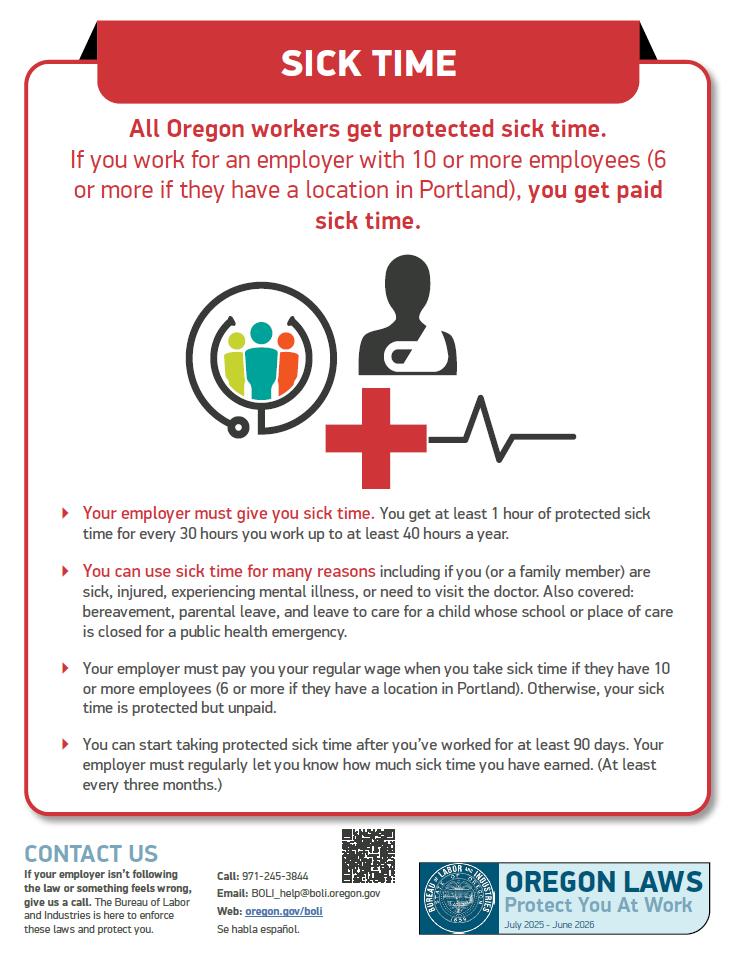
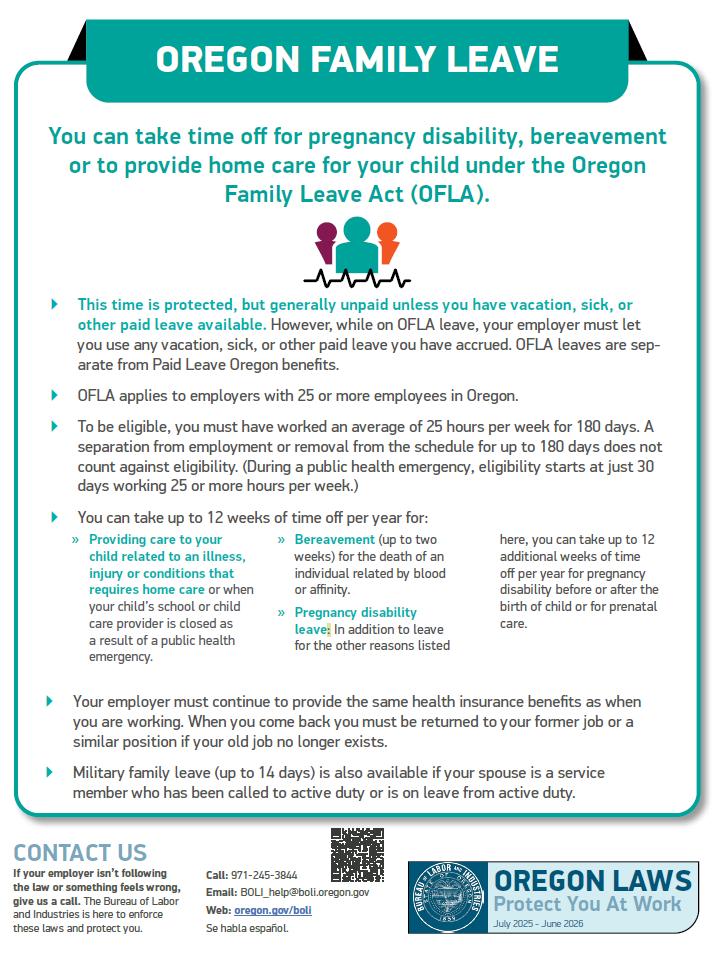
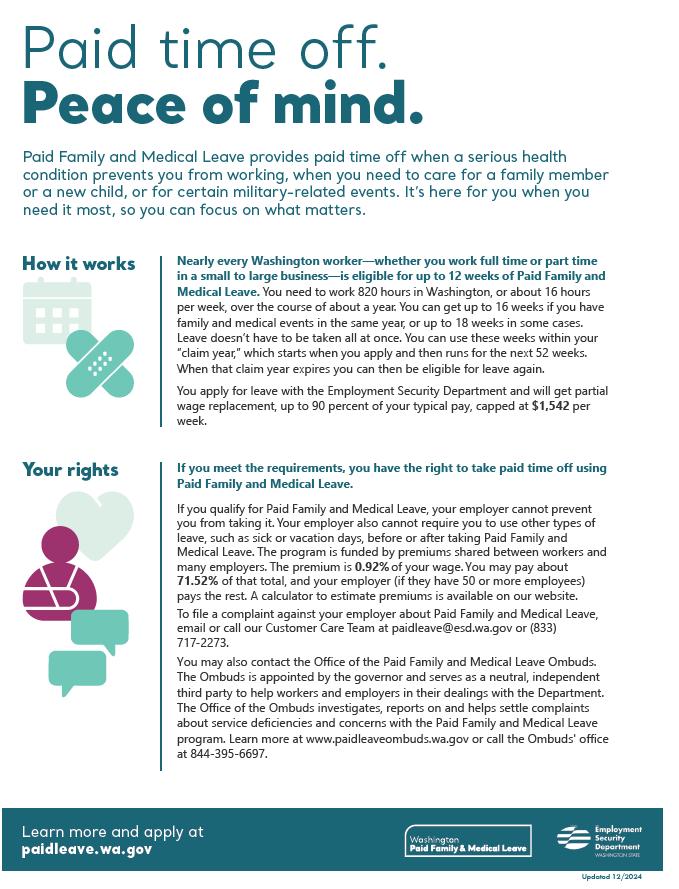
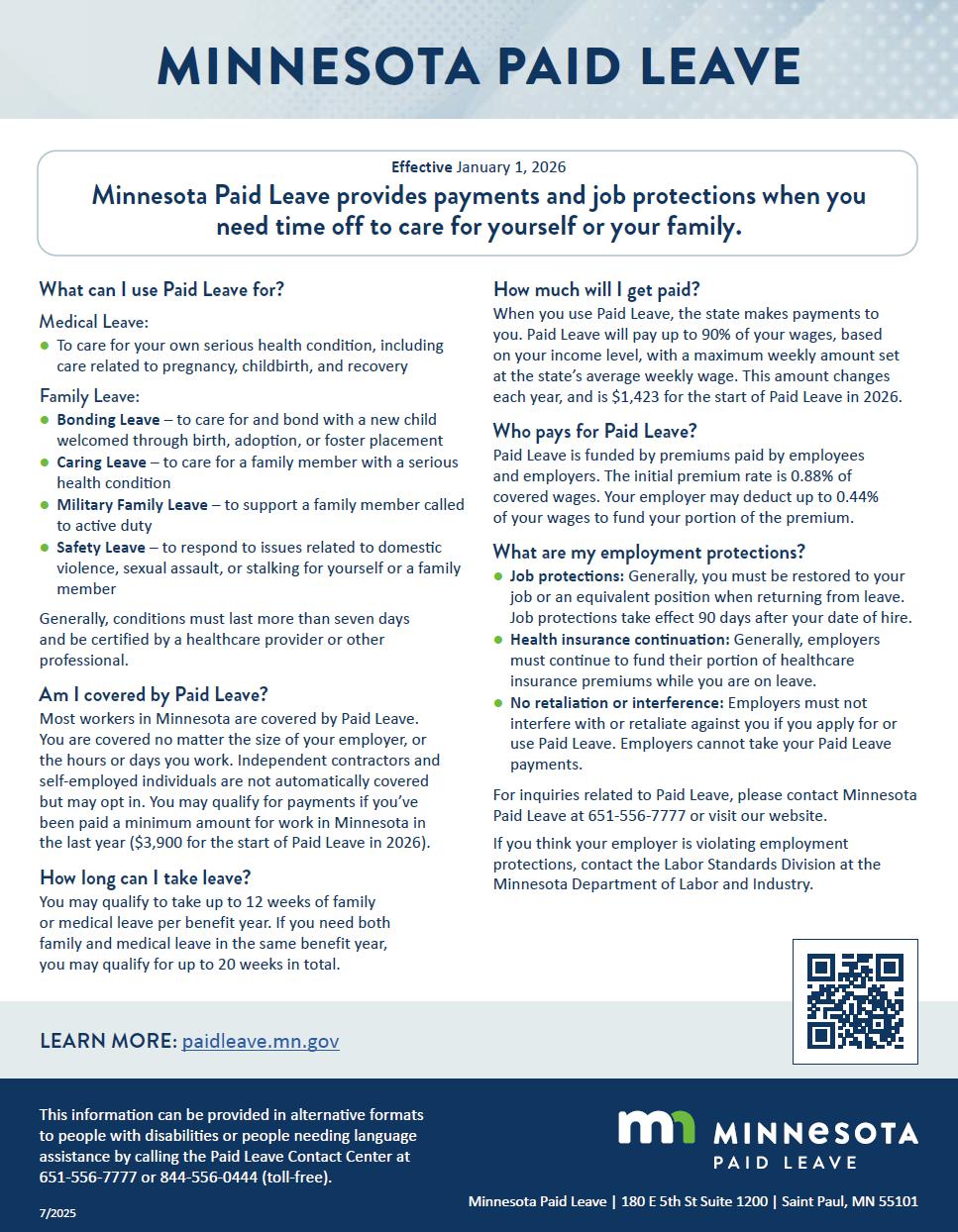
The Company complies with all applicable state and local leave laws, which may provide additional or different protections depending on your location.
For information about leave laws specific to your state or city, please refer to the state-specific addenda included with this handbook or contact Human Resources.
VIII. OFFBOARDING
It is the Company’s policy that separation of employees, whether voluntary or involuntary, should be managed consistently throughout the Company.
Employees who separate from the Company will be prepared for transition by Human Resources or by the local designated representative. An off-boarding process will be conducted with the exiting employee. This off-boarding process will detail all benefit continuation information, ensure the collection of company property, and may include an exit interview.
Types of Separation
Voluntary Termination
An employee will have voluntarily terminated if he or she elects to resign; fails to return from an approved leave of absence at the end of the approved period; or fails to report for work without notice for three consecutive days (i.e., job abandonment).
Involuntary Termination
An employee may be terminated involuntarily for reasons that may include poor performance, misconduct, or other violations of the Company's standards of conduct, discipline, and work rules. Notwithstanding these rules, the Company reserves the right to discharge or demote any employee with or without cause and with or without prior notice.
Return of Company Property
Upon termination of employment, employees must return promptly all Company property including, without limitation, all computers/ laptops, docking station and power cables, mobile phones, iPad/ tablet, monitors, keyboards and any other computer related equipment, electronic data and all copies, and all other materials of a confidential and proprietary nature, or trade secret nature relating to the Company's business and which are in the employee's possession or under the employee's control, company credit card, office key, any access badge, company vehicle, vehicle keys, or any other Company issued tools or equipment. The employee shall not take any affirmative steps to delete, remove, or otherwise destroy any such documents and records that are in the employee's possession or under the employee's control. Rather, the Company expects the employee to take affirmative steps to maintain, store, or otherwise archive such documents and records prior to leaving the Company’s employ.
The employee agrees to maintain the confidentiality of all confidential information of the Company and its Clients provided to the employee during his/her employment, whether or not incorporated in the above-described materials
The Company assumes no responsibility for loss of or damage to employees' personal belongings.
Pay after Separation
Upon separation from the Company, employees will be paid all wages earned through their last day worked on the next scheduled pay date, or sooner, as required by applicable local law Any payout of accrued and unused PTO, where applicable, will be made in accordance with Company policy and applicable law.
Retirement
We recognize and appreciate the service and contributions that retirees have made to the Company. You are eligible for retiree benefits if you are at least age 55 and have 20 years of service and will no longer be working on a full-time basis. Benefits include medical insurance, medical and prescription drug coverage, and dental insurance If you are considering retirement, you should contact our Benefits team for more details on retiree benefits
IX. APPENDIX A: COMPANY-WIDE POLICIES
Family Medical Leave Act (FMLA) Policy HR-CW-POL-302
The Company provides job-protected leave under FMLA to eligible employees for specific family and medical reasons. Employees may take FMLA leave for their own serious health condition, the birth or placement of a child, to care for a family member with a serious health condition, or for military-related exigencies. This policy establishes guidelines for requesting and coordinating FMLA leave, ensuring compliance with federal regulations and Company policies.
Purpose
This policy outlines the procedures for requesting, approving, and managing FMLA leave, as well as the responsibilities of employees, managers, and HR. It ensures compliance with federal law while supporting employees in managing personal and family medical needs.
Scope
The Company provides up to 12 weeks of unpaid, job-protected leave within a rolling 12-month period to eligible employees. Employees may receive up to 26 weeks of military caregiver leave to care for a covered service member with a serious injury or illness.
1. Eligibility
To qualify for FMLA leave, an employee must:
• Have worked for the Company for at least 12 months (not necessarily consecutive).
• Have worked at least 1,250 hours in the previous 12 months.
• Work at a location with 50 or more employees within a 75-mile radius.
2. Qualifying Reasons for Leave
Eligible employees may take FMLA leave for the following reasons:
• Their own serious health condition that prevents them from performing essential job duties.
• Birth, adoption, or foster care placement of a child, and bonding time within 12 months of placement.
• Care for an immediate family member (spouse, child, or parent) with a serious health condition.
• Military caregiver leave to care for a covered service member or veteran with a serious injury or illness.
• Qualifying exigency leave due to a family member’s military deployment.
3. Duration of Leave
• Up to 12 workweeks in a rolling 12-month period, measured backward from the date of leave usage.
• Up to 26 workweeks in a single 12-month period for military caregiver leave.
• Leave for birth, adoption, or foster placement must be used within 12 months of the event.
4. Intermittent Leave
• Employees may take intermittent leave (in separate blocks of time or on a reduced schedule) when medically necessary.
• Bonding leave for birth/adoption must be taken continuously.
• Employees should schedule intermittent leave to minimize disruption to business operations.
5. Spouses Employed by the Company
• If both spouses work for the Company, they may take a combined 12 weeks of FMLA leave for birth/adoption or a parent’s serious health condition.
• They may take a combined 26 weeks for military caregiver leave.
Responsibilities
1. Human Resources
• Implement and enforce FMLA compliance.
• Provide employees with FMLA eligibility notices and required documentation.
• Track FMLA usage and maintain employee records.
• Coordinate benefits during FMLA leave.
2. Employees
• Request FMLA leave at least 30 days in advance when foreseeable.
• Provide required medical certification and respond to HR requests for additional information.
• Maintain regular communication with HR during leave.
• Provide a fitness-for-duty certification before returning to work, if required.
3. Supervisors & Managers
• Direct employees to HR for FMLA-related inquiries.
• Support compliance with FMLA guidelines.
• Maintain confidentiality regarding employee medical leave.
Procedure for Requesting FMLA Leave
1. Requesting Leave
• Employees must provide at least 30 days’ advance notice for foreseeable leave.
• If unforeseeable, employees must notify HR as soon as possible (same or next business day).
• Requests should be submitted via the Leave of Absence Request Form.
2. Medical Certification & Documentation
• Employees must submit a Certification of Health Care Provider Form within 15 days of the leave request.
• If the certification is incomplete, the employee has 7 days to provide corrections.
• Recertification may be required for extended or intermittent leave.
3. Approval & Denial
• HR will provide written approval or denial within 5 business days after receiving complete documentation.
While on Leave
1. Pay Status During Leave
• FMLA leave is unpaid, but employees must use available paid time off before taking unpaid leave.
• If on Short-Term Disability (STD), employees may use PTO or Legacy Medical-Sick time to supplement earnings up to 100% of pre-disability income.
• No PTO accruals occur during unpaid leave.
2. Continuation of Benefits
• The Company will continue health insurance coverage under the same conditions as active employment.
• Employees must continue paying their portion of insurance premiums while on unpaid leave.
• If an employee fails to make payments, benefits may be suspended or terminated after a 30-day grace period.
3. Returning from Leave
• Employees must provide a fitness-for-duty certification before returning from leave for their own medical condition.
• If an employee cannot return at the end of FMLA leave and no accommodation is available, employment may be terminated as “unable to return from leave.”
• Employees who do not return from FMLA leave without an approved extension may be subject to termination.
Coordination with Other Policies
• FMLA and Workers’ Compensation run concurrently if the work-related injury qualifies as a serious health condition.
• FMLA runs concurrently with Short-Term Disability (STD).
• State and local leave laws may provide additional protections beyond FMLA
Harassment, Discrimination, and Retaliation
The Company strictly prohibits harassment, discrimination, and retaliation in the workplace. This policy applies to all employees, including supervisors, co-workers, vendors, clients, and customers. Harassment based on race, color, religion, national origin, sex, age, gender identity, gender expression, disability, genetic information, pregnancy, protected veteran status, sexual orientation, or any other protected characteristic will not be tolerated.
Employees have the right to work in an environment free of unlawful discrimination and harassment. Any violations of this policy will result in corrective action, including possible termination.
Purpose of This Policy
The purpose of this policy is to define expectations for workplace conduct and establish procedures for reporting, investigating, and addressing harassment, discrimination, and retaliation complaints. This policy reinforces the Company's commitment to a safe, inclusive, and legally compliant workplace.
What This Policy Covers
1. Who it Applies To
This policy applies to all employees of the Company, regardless of position, location, or length of employment. It also covers behavior outside the workplace when it affects the work environment, including:
• Work-related social events
• Customer visits or job sites
• Online or social media activity
• Any off-site Company-sponsored gathering
2. What Counts as Harassment or Discrimination
Harassment is unwelcome conduct related to a person’s protected status, including:
• Race
• Sex or gender
• Age
• Religion
• Disability
• Sexual orientation
• National origin
• Genetic information
• Any other characteristic protected by law
Examples include:
• Offensive jokes, slurs, or name-calling
• Unwanted touching or physical contact
• Showing offensive images or messages
• Intimidating or hostile behavior targeting someone’s identity
3. Sexual Harassment
Sexual harassment includes unwanted advances, comments, or behavior of a sexual nature. It’s illegal when:
• You feel pressured to accept this behavior as part of your job
• Your decision to reject or accept affects your employment
• The behavior creates an uncomfortable or threatening environment
This applies at work and beyond, including job sites, social events, and online communication.
How to Report a Complaint & What Happens Next
1. Reporting Options
If employees experience or witness harassment, speak up immediately by reporting it to:
• Your supervisor, office manager, or district manager
• Any upper-level manager if you’re uncomfortable speaking to your direct supervisor
• The Board of Directors at: ansonboard@ansonindustries.com (for senior-level concerns)
• The Internal Speak-Up Line: (708) 547-4898 (24/7 confidential hotline)
• The External Compliance Hotline (anonymous, 24/7):
o Website: https://report.syntrio.com/ansonindustries
o Phone: English: 833-380-0099 Spanish: 800-216-1288
o Email: reports@syntrio.com (include Company name in your message)
2. What to Expect During an Investigation
Once a complaint is made:
• HR will promptly and thoroughly investigate the issue.
• Your complaint will remain as confidential as possible.
• If misconduct is confirmed, corrective action will be taken, up to and including termination.
• Knowingly making false or malicious claims may result in disciplinary action.
3. Protection Against Retaliation
The Company strictly prohibits retaliation against anyone who:
• Files a complaint
• Participates in an investigation
• Reports a violation to HR or a government agency
Retaliation can look like:
• Being demoted, fired, or reassigned unfairly
• Being excluded from meetings or projects
• Receiving the “cold shoulder” or hostile treatment
If you believe you’re being retaliated against, report it right away using the same complaint process.
Your Role in Preventing Harassment
• Everyone: All employees are expected to speak up, support respectful behavior, and help create a safe, inclusive workplace.
• Supervisors and Managers: must step in immediately if they witness inappropriate behavior even if no one complains.
Training & Policy Acknowledgement
1. Annual Policy Review
Human Resources will review and update this policy annually to ensure compliance with applicable federal, state, and local laws.
2. Required Training (by employee type)
To meet regulatory requirements, all employees must complete training on harassment, discrimination, retaliation, and bullying. Training will be delivered through Anson University or another approved format, depending on availability. Completion records will be tracked in the Company’s learning management system (LMS), Anson University.
• New Employees must complete the training within 30 days of hire as part of their onboarding process.
• Newly Promoted or Hired Supervisors must complete supervisor-specific harassment prevention training within 30 days of assuming a supervisory role, regardless of when their last employee-level training was completed.
• Office and Corporate Employees must complete refresher training at least every two years, or more frequently as required by law.
• Supervisors must complete annual harassment prevention training tailored to their responsibilities, in compliance with applicable regulations. This training includes how to prevent, identify, respond to, and report workplace misconduct.
• Field Employees will receive training through Monthly Safety Training (MST) Topics, delivered quarterly. Human Resources will provide updated content to the Safety Team for incorporation into the MST annual training calendar. All employee training completions must be entered into Anson
3. Training & Policy Acknowledgment
At the time of training, all employees are required to confirm in writing or electronically that they have:
• Received and reviewed a copy of this policy and the CEO Anti-Harassment Statement;
• Completed the required training;
• Acknowledged their understanding of the expectations and responsibilities outlined in this policy.
Roles & Responsibilities
1. All Employees
• Maintain a professional, respectful, and inclusive work environment.
• Refrain from engaging in any form of harassment, discrimination, or retaliation.
• Promptly report any incidents of misconduct to a supervisor, office manager, district manager, or Corporate Human Resources.
2. Supervisors, Office Managers, and District Managers
• Take immediate action when witnessing or being informed of potential harassment, discrimination, or retaliation.
• Report all complaints to Corporate Human Resources, regardless of perceived severity.
• Ensure all employees under their supervision complete required training and acknowledgments.
• Provide oversight to ensure field-level training is delivered accurately and consistently, incorporating updated content from HR and Corporate Safety into MST schedules.
• Ensure field-level training records are submitted accurately and on time into Anson University or the designated tracking system.
3. Human Resources
• Administer and enforce the Anti-Harassment, Discrimination, and Retaliation Policy.
• Investigate complaints promptly, thoroughly, and impartially.
• Provide and track annual training in accordance with legal requirements.
• Distribute the policy and confirm employee acknowledgment via written or electronic confirmation.
• Coordinate with Corporate Safety to deliver updated content for field-level MST training.
4. Senior Leadership
• Approve and support enforcement of this policy.
• Ensure that all complaints and investigations are handled fairly, consistently, and without bias.
• Champion a culture of accountability, safety, and inclusion across the organization.
X. Appendix B: State Specific Policies
California
Prohibition Against Harassment, Discrimination and Retaliation Policy
Supplement HR- CA-POL-202
The Company strictly prohibits harassment, discrimination, retaliation, and abusive conduct in the workplace. California employees are entitled to a work environment free from unlawful or inappropriate conduct based on any protected characteristic.
This policy supplements the Company’s Harassment, Discrimination and Retaliation Prevention Policy and applies specifically to employees working in California.
Purpose of This Policy
This policy outlines California-specific protections, reporting options, definitions, investigation standards, and training requirements that apply to all employees working in California.
What This Policy Covers
1. Who it Applies To
This policy applies to all employees, applicants, supervisors, managers, interns, volunteers, contract workers, and third parties interacting with Company personnel.
2. Additional Protected Characteristics
In addition to those listed in the Companywide policy, California law also protects:
• Ancestry
• Color
• National Origin
• Marital or domestic partner status
• Medical condition (including cancer-related physical or mental impairment from a diagnosis, record, or history of cancer, or genetic characteristics or information)
• Physical or mental disability
• Genetic information
• HIV/AIDS status
• Height or weight
• Citizenship status
• Political affiliation
• Protected family and medical care leave status
• Religious belief (including observance, practice, religious dress, and grooming practices)
• Creed
• Physical or cultural traits associated with race (such as hair texture and protective hairstyles)
• Drivers’ license or language-use restrictions not related to job requirements
• Gender (including sexual orientation, gender identity, gender expression, and transitioning or transgender status)
• Sex (including pregnancy, childbirth, breastfeeding, and related medical conditions)
• Reproductive health decision-making
• Military or veteran status
The Company does not discriminate on the basis of off-duty cannabis or marijuana use, except to the extent required by state or federal law. California also prohibits discrimination or harassment based on perceived characteristics or association with someone belonging to a protected group.
3. Non-Employees Protected Under California Law
California extends protection against harassment and retaliation to:
• Unpaid interns
• Volunteers
4. Harassment Standard Under California Law
Harassing conduct is prohibited even if the conduct is not “severe or pervasive” under federal standards. Any behavior a reasonable person would find offensive, intimidating, hostile, or abusive is prohibited. Such harassment is unlawful, regardless of whether it is committed by managers, employees, coworkers, or third parties with whom the employee comes into contact (such as vendors or clients).
Prohibited harassment includes, but is not limited to, the following behavior:
• Verbal conduct such as epithets, derogatory jokes or comments, slurs or unwanted sexual advances, invitation, or comments;
• Visual displays, which is not an art asset or business-related items for the Company’s games and products, such as derogatory and/or sexually oriented posters, photography, cartoons, drawings, or gestures;
• Physical conduct including assault, unwanted touching, intentionally blocking normal movement or interfering with work because of an employee’s protected category;
• Threats and demands to submit to sexual requests as a condition of continued employment, or to avoid some other loss, and offers of employment benefits in return for sexual favors;
• Retaliation for reporting or threatening to report harassment;
• Rude or aggressive managerial conduct directed at one sex more frequently than the other;
• Extensive sexual favoritism or favoring employees who engage in sexual conduct with a supervisor.
In particular, sexual harassment is defined as any unwelcome sexual advances, requests for sexual favors and other verbal or physical conduct of a sexual nature which (1) has been made either explicitly or implicitly a term or condition of an individual’s employment (or other contract relationship), (2) is used as a basis for employment (or other contract) decisions such as promotions and benefits affecting such individual, or (3) substantially interferes with an individual’s work (or contract) performance or creates an intimidating, hostile, or offensive work environment.
5. Abusive Conduct (Bullying)
California requires employers to address abusive conduct, including repeated derogatory remarks, intimidation, humiliation, or deliberate interference with another person’s work performance.
Reporting Procedure
1. Internal Reporting Options
If employees experience or witness harassment, speak up immediately by reporting it to:
• Supervisor or Manager
• Your supervisor, office manager, or district manager
• Any upper-level manager if you’re uncomfortable reporting to your direct supervisor
• Board of Directors (for senior-level concerns)
• ansonboard@ansonindustries.com
• Internal Speak-Up Line
• (708) 547-4898
• External Compliance Hotline (anonymous, 24/7)
o Direct website: https://report.syntrio.com/ansonindustries
o Phone:
English: (833) 380-0099
Spanish: (800) 216-1288
o Email: reports@syntrio.com
2. External Reporting Options
Employees may also file a complaint with the government agencies responsible for enforcing anti-discrimination and anti-harassment laws:
• California Civil Rights Department (CRD)
• www.calcivilrights.ca.gov | (800) 884-1684
• U.S. Equal Employment Opportunity Commission (EEOC)
Investigation Standards
Investigations will be:
• Timely
• Fair, thorough, and impartial
• Conducted by qualified personnel
• Documented and tracked
• Confidentiality will be maintained to the extent possible. At the conclusion of the investigation, the employee will be informed whether corrective action was taken.
Protection Against Retaliation
Retaliation is strictly prohibited. Retaliation includes intimidation, threats, adverse work actions, exclusion, or any conduct that would discourage someone from reporting or participating in an investigation. Any employee who believes retaliation has resulted from either the reporting of a complaint of harassment or discrimination or from participation in an investigation of such allegations should immediately report as discussed above in Section V.
Roles & Responsibilities
1. All Employees
All employees are expected to speak up, support respectful behavior, and help create a safe, inclusive workplace.
2. Supervisors and Managers
In California, supervisors must:
• Report any potential misconduct immediately
• Refrain from attempting to resolve issues independently
• Avoid assurances of confidentiality that limit investigations
• Prevent retaliation
• Understand they may be held personally liable for certain violations under FEHA
3. Human Resources
• Administer and enforce the Anti-Harassment, Discrimination, and Retaliation Prevention Policy.
• Investigate complaints promptly, thoroughly, and impartially.
• Provide and track annual training in accordance with legal requirements.
• Distribute the policy and confirm employee acknowledgment via written or electronic confirmation.
• Coordinate with Corporate Safety to deliver updated content for field-level MST training.
Training & Acknowledgement
California requires:
• Harassment prevention training once every two years for all employees
• Supervisor-specific training that includes:
• Legal responsibilities
• Abusive conduct prevention
• Duty to report
No Contract / At-Will Employment
This policy is not a contract. It is intended to explain employees’ legal rights in regard to harassment, discrimination, abusive conduct, and retaliation. It is not meant to provide for greater or lesser rights than employees have under applicable law.
Alcohol & Drug Free Workplace Policy
The Company prohibits the use of illegal drugs, or the abuse of other controlled substances, prescription drugs or medicines or alcohol, during any time an employee is working for the Company or while on Company business. Specific examples of prohibited conduct related to drugs and alcohol include, but are not limited to, the following:
• Use, possession, manufacture, distribution, or sale of controlled substances, illegal drugs or alcohol and/or the distribution or sale of prescription drugs or medicines on the Company’s premises or while on Company business.
• Misuse or abuse of prescription drugs or alcohol while on Company premises or on Company business.
• Working under the influence of alcohol or controlled substances.
• Use of alcohol or use, possession, manufacture, distribution, or sale of controlled substances and/or illegal drugs off Company premises that might affect the employee’s work performance, his or her safety, the safety of others, or the Company’s reputation in the community or with its investors or affiliated companies.
• Refusal to submit to and/or cooperate with an investigation or search in accordance with the Company’s Searches policy (described below).
• Conviction of any criminal drug and/or alcohol statute for a violation occurring while on the Company premises or while on Company business.
Rest Periods
The Company complies with all California rest period requirements. Non-exempt employees are expected to take 10-minute paid rest periods based on the total hours worked in a day, as follows:
• If an employee works three and a half (3.5) hours but not more than six (6) hours within a work day, that employee shall be permitted to take one (1) paid rest period of not less than ten (10) minutes. If an employee works over six (6) hours but no more than ten (10) hours within a work day, that employee shall be permitted to take a total of two (2) paid rest periods, where each rest period shall last not less than ten (10) minutes. If an employee works over ten (10) hours but no more than fourteen (14) hours within a work day, that employee shall be permitted to take a total of three (3) paid rest periods, where each rest period shall last not less than ten (10) minutes. If an employee works over fourteen (14) hours but no more than eighteen (18) hours within a work day, that employee shall be permitted to take a total of four (4) paid rest periods, where each rest period shall last not less than ten (10) minutes. For shifts in excess of eighteen (18) hours, you will continue to be entitled to additional paid ten (10)-minute rest breaks for every four (4) hours you work, or major fraction thereof. The rest period should be taken in the middle of each period of work.
If an employee encounters any obstacles to taking rest periods, he or she is to communicate with his/her manager, or, if that will not resolve the problem, with his/her District Manager. If an employee misses a rest period, he or she must notify his/her manager.
Meal Periods
It is the policy of the Company to provide employees with all meal periods required by California law. California employees are entitled to take meal periods per Company policy as follows:
• Each non-exempt employee are entitled to an unpaid, uninterrupted meal period of 30 minutes each workday when 5 or more hours are worked. An employee’s first meal period must start no later than the point at which the employee has worked 4.5 hours, unless the Company and the employee agree to waive it. Working through the meal period is prohibited. In the event a non-exempt employee works more than 10 hours, he or she will be provided a second unpaid, uninterrupted meal period of 30 minutes. The second meal period must start no later than the point at which the employee has worked 9.5 hours, unless the Company and the employee agree to waive it. Employees shall not perform any work during a meal period. Employees are allowed to leave the work-site during meal periods.
If an employee encounters any obstacles to taking meal periods, he or she is to communicate with his/her manager, or, if that will not resolve the problem, with his/her District Manager. If an employee misses a meal period, he or she must notify the manager.
Recovery Periods
For employees working in outdoor places of employment, the Company provides and encourages them to take recovery periods to prevent “heat illness”. In addition, to prevent heat illness, the Company provides such employees with the following:
• Potable drinking water. Such water will be fresh, pure, suitably cool, and free of charge. Such drinking water is provided as close as practicable to where the employees work. The Company provides at least one quart of drinking water per employee per hour, and employees are encouraged to drink water frequently; and
• Access to shade, which means blockage from direct sunlight such that it allows the body to cool and is open to the air or provided with ventilation or cooling
“Heat Illness” means a serious medical condition resulting from the body’s inability to cope with a particular heat load, and includes heat cramps, heat exhaustion, heat syncope, and heat stroke.
When the outside temperature exceeds 80 degrees Fahrenheit, the Company provides and maintains one or more areas of shade at all times while the employees are present that are either open to the air or are provided with ventilation or cooling. The amount of shade provided will be at least enough to accommodate the number of employees on rest, recovery, and meal periods such that employees can sit in normal posture without being in physical contact with each other. Such shade will be located as close as practicable to where employees are working.
When the outdoor temperature does not exceed 80 degrees Fahrenheit, the Company will provide shade as previously described in this paragraph or in a timely manner upon an employee’s request.
The Company allows and encourages employees to take preventative cool-down rest in the shade when they feel the need to do so to protect themselves from overheating. The Company provides access to shade at all times. If an employee takes a preventative cool-down rest, he or she (a) shall be monitored and asked if he or she is experiencing heat illness, (b) shall be encouraged to remain in the shade, and (c) shall not be ordered back to work until any signs or symptoms of heat illness have abated, but in no event less than 5 minutes in addition to the time needed to access the shade.
If an employee exhibits signs or reports symptoms of heat illness while taking a preventative cool-down rest or during a preventative cool-down rest period, the Company will provide appropriate first aid or emergency response under the “emergency response procedures” below.
• High-heat procedures: If the temperature equals or exceeds 95 degrees Fahrenheit, the Company has implemented the following high-heat procedures:
o Reliable and effective communication between the employees and the supervisor to ensure that the employees can reliably contact him or her when necessary;
o Effective employee observation/monitoring of employees by the Company for employee alertness and signs and symptoms of heat illness;
o Proper designation of one or more employees on each worksite as authorized to call for emergency services and procedures for other employees to call for emergency services when no designated employee is available;
o The Company will remind employees throughout the shift to drink plenty of water; and
o The Company will hold pre-shift meetings before the commencement of work to review the high heat procedures, encourage employees to drink plenty of water, and remind employees of their right to take a cool-down rest when necessary.
• Emergency response procedures: The Company has implemented the following effective emergency response procedures:
o Reliable and effective communication between the employees and the supervisor or emergency medical services to ensure that the employees can reliably contact either of them when necessary;
o Protocols in response to signs and symptoms of possible heat illness, including but not limited to first aid measures and how emergency medical services will be provided. For instance, if a supervisor observes, or any employee reports, any signs or symptoms of heat illness in any employee, the supervisor shall take immediate action commensurate with the severity of the illness; if the signs or symptoms are indicators of severe heat illness (such as, but not limited to, decreased level of consciousness, staggering, vomiting, disorientation, irrational behavior, or convulsions), the Company shall implement emergency response procedures; an employee exhibiting signs or symptoms of heat illness shall be monitored and shall not be left alone or sent home without being offered onsite first aid and/or being provided with emergency medical services in accordance with the employer’s procedures;
o Protocols for contacting emergency medical services and, if necessary, transporting employees to a place where they can be reached by an emergency medical provider; and
o Protocols for ensuring that, in the event of an emergency, clear and precise directions to the work site can and will be provided as needed to emergency responders.
• Acclimatization: This is the temporary adaptation of the body to work in the heat that occurs gradually when a person is exposed to it. All employees shall be closely observed by a supervisor or designee during a “heat wave.” An employee who has been newly -assigned to a high heat area shall be closely observed by a supervisor or designee for the first 14 days of the employee’s employment.
o “Heat wave” means any day in which the predicted high temperature for the day will be at least 80 degrees Fahrenheit and at least ten degrees Fahrenheit higher than the average high daily temperature in the preceding five days.
o Training: The Company provides training to each supervisory and non-supervisory employee before the employee begins work that should reasonably be anticipated to result in exposure to the risk of heat illness on the following topics:
o The environmental and personal risk factors for heat illness, as well as the added burden of heat load on the body caused by exertion, clothing, and personal protective equipment;
o The Company’s procedures for complying with the requirements of this standard, including, but not limited to, the Company’s responsibility to provide water, shade, cool-down rests, and access to first aid as well as the employees’ right to exercise their rights under this standard without retaliation;
o The importance of frequent consumption of small quantities of water, up to 4 cups per hour, when the work environment is hot and employees are likely to be sweating more than usual in the performance of their duties;
o The concept, importance, and methods of acclimatization pursuant to the Company’s procedures above;
o The different types of heat illness, the common signs and symptoms of heat illness, and appropriate first aid and/or emergency responses to the different types of heat illness, and in addition, that heat illness may progress quickly from mild symptoms and signs to serious and life threatening illness;
o The importance to employees of immediately reporting to the Company, directly or through the employee’s supervisor, symptoms or signs of heat illness in themselves or in co-workers;
o The Company’s procedures for responding to signs or symptoms of possible heat illness, including how emergency medical services will be provided should they become necessary;
o The Company’s procedures for contacting emergency medical services and, if necessary, for transporting employees to a point where they can be reached by an emergency medical service provider;
o The Company’s procedures for ensuring that, in the event of an emergency, clear and precise directions to the work site can and will be provided as needed to emergency responders, including designating a person to be available to ensure that emergency procedures are invoked when appropriate; and
o In addition to the topics described above, supervisory employees are provided with training on: the procedures the supervisor is to follow to implement the applicable provisions in this section, including procedures for provision of water and access to shade; the procedures the supervisor is to follow when an employee exhibits signs or reports symptoms consistent with possible heat illness, including emergency response procedures; and how to monitor weather reports and how to respond to hot weather advisories.
• Heat illness prevention plan: The Company has established, implemented, and maintained an effective heat illness prevention plan which includes the following:
o The procedures for the provision of water and access to shade described above;
o The high heat procedures described above;
o The emergency response procedures described above; and
o The acclimatization methods and procedures described above.
Family Rights Act Leave (CFRA)
Under the California Family Rights Act of 1993 (CFRA), if an employee has 12 months of service with the Company and has worked at least 1,250 hours in the 12-month period before the date the employee wants to begin the leave, an employee may have a right to a family care or medical leave (CFRA leave). Please note that if CFRA leave is taken following Pregnancy Disability Leave (“PDL”), eligibility is measured by looking at the number of hours worked in the 12-month period immediately preceding the PDL leave. This leave may be up to 12 work weeks in a 12-month period for the birth, adoption, or foster care placement of a child; or for an employee’s own serious health condition or that of a child, parent or parent-in-law, spouse, registered domestic partner, grandparent, grandchild, sibling or designated person; or to be with a spouse, domestic partner, child, or parent in the Armed Forces of the United States due to a qualifying exigency related to covered active duty or call to covered active duty. While the law provides only unpaid leave, employees may choose to use any accrued paid leave or any Paid Family Leave (“PFL”) benefits through the California’s State Disability Insurance (“SDI”) program while taking CFRA leave under certain circumstances. The Company may also require employees to exhaust vacation and/or medical leave depending on the circumstances of the leave.
A “designated person” is an individual related by blood or whose association with the employee is the equivalent of family relationship. The designated person may be identified by the employee at the time the employee requests leave. An employee is limited to one designated person per 12-month period for family care and medical leave.
Eligible employees may take leave of up to 12 work weeks in a 12-month period. The leave does not need to be taken in one continuous period of time. Certification procedures for FMLA leave also apply to CFRA leave. Reinstatement rights are also the same under both the FMLA and the CFRA.
An employer may require a 30-day advance notice for the need for a CFRA -qualifying leave when the need for leave is foreseeable due to an expected birth, placement for adoption or foster care, or planned medical treatment for a serious health condition of the employee or family member. For events that are unforeseeable, the employee should notify the Company as soon as the employee learns of the need for the leave. Notice can be written or verbal and should include the timing and the anticipated duration of the leave. Failure to comply with these notice rules is grounds for, and may result in, deferral of the requested leave until the employee complies with this notice policy.
If both parents are eligible for CFRA leave and are employed by the same employer, both parents may take leave for the birth, adoption, or foster-care placement of their child up to 12 work weeks in a 12-month period for a combined total of up to 24 weeks between the two parents.
Leave taken for the birth, adoption, or foster care placement of a child must be completed within one year of the qualifying event. Where CFRA leave is taken for the serious health condition of the employee or the employee’s parent, parent-in-law, child, spouse, registered domestic partner, grandparent, grandchild, or sibling, leave may be taken intermittently or on a reduced-work schedule when medically necessary, as determined by the health care provider of the person with the serious health condition. Under the CFRA, an employee may be eligible for intermittent leave to bond with a new child. However, such intermittent leave generally must be taken in periods of at least two weeks’ duration, except on two occasions an employee can request such leave for a period of less than two weeks’ duration.
During an approved CFRA leave, the Company will maintain the employee’s group benefits under the same conditions as if the employee had continued to be actively employed.
CFRA leave runs concurrently with FMLA leave unless the leave is for an employee’s own pregnancy related disability or is due to a qualifying exigency for military personnel or to care for a military service member.
The Company may require certification from the employee’s health care provider before allowing leave for an employee’s own serious health condition. The Company may require certification from the health care provider of an employee’s child, parent, parent-in-law, or spouse who has a serious health condition before allowing leave to take care of that family member. When medically necessary, leave may be taken on an intermittent or reduced work schedule.
If the employee does not return to work on the scheduled return date nor request in advance an extension of the agreed upon leave with appropriate documentation, the employee may be deemed to have voluntarily terminated employment with the Company.
Please obtain further information on CFRA leave from Human Resources or go to www.dfeh.ca.gov.
Employees on leave for their own serious health condition or returning from "PDL" will be required to obtain a release to return to work from their healthcare provider that the employee is able to resume work. This is a requirement of all employees returning from other types of medical leave. Otherwise, the employee will not be permitted to resume work until it is provided.
Pregnancy Disability Leave (PDL)
Even if you are not eligible for FMLA leave, if you are disabled by pregnancy, childbirth, or a related medical condition, you are entitled to take pregnancy disability leave (PDL) of up to four months (the working days you normally would work in onethird of a year or 17-1/3 weeks) depending on your period(s) of actual disability. If you are CFRA-eligible, you have certain rights to take BOTH a pregnancy disability leave and a CFRA leave for reason of the birth of your child.
If you are affected by pregnancy or a related medical condition, you are also eligible to transfer to a less strenuous or hazardous position or to less strenuous or hazardous duties, if such a transfer is medically advisable and can be reasonably accommodated. PDL may include, but is not limited to, additional or more frequent breaks, time for prenatal or postnatal medical appointments, doctor-ordered bed rest, “severe morning sickness,” gestational diabetes, pregnancy-induced hypertension, preeclampsia, recovery from childbirth or loss or end of pregnancy, and/or postpartum depression. In addition, if it is medically advisable for you to take intermittent leave or work a reduced schedule, the Company may require you to transfer temporarily to an alternative position with equivalent pay and benefits that can better accommodate recurring periods of leave.
• The PDL is for any period(s) of actual disability caused by pregnancy, childbirth or related medical condition up to four months per pregnancy. The PDL can be used intermittently or on an as-needed basis; and
• PDL runs concurrently with FMLA leave, but not concurrently with leave under the California Family Rights Act
(“CFRA”). Eligible employees may combine PDL (up to four months) and CFRA leave after childbirth to care for the newborn child (up to 12 weeks), for a maximum approximate total of seven months combined leave.
While the law provides only unpaid leave, employees may choose to use any accrued paid leave or to seek benefits through California’s State Disability Insurance (“SDI”) program. The Company may also require employees to exhaust their own medical leave depending on the circumstances.
Generally, upon return from an approved PDL that does not exceed the maximum available leave, the employee will be reinstated to the same position, subject to any applicable exceptions. However, employees have no greater rights to reinstatement or to other benefits and conditions of employment than if the employee had not taken PDL. If an employee does not return to work on the scheduled return date nor request in advance an extension of the agreed upon leave with appropriate medical documentation, the employee may be deemed to have voluntarily terminated employment with the Company.
If possible, employees should provide at least 30 days’ advance notice for PDL leave taken for foreseeable events. For events that are unforeseeable, employees should provide notice as soon as they learn of the need for the leave.
As a condition of return from pregnancy disability leave, the Company requires submission of a release to return to work from a health care provider stating that job duties may resume with or without reasonable accommodation.
During an approved PDL, group benefits will be maintained under the same conditions as if the employee had continued to be actively employed.
For more information regarding eligibility for leave and/or the impact of the leave benefits, please contact Human Resources.
Bereavement Leave
Eligible California employees who have been employed at least 30 days may take up to five (5) days of bereavement leave following the death of a qualifying family member.
• Leave must be completed within three (3) months of the date of death.
• The first three (3) days are paid under Company policy.
• The remaining two (2) days are unpaid, unless the employee chooses to use accrued and available paid time off or any other paid leave available.
When California law provides greater rights than the Company’s standard benefits, California law will apply.
California Paid Family Leave Act
California employees who suffer a wage loss in order to care for an ill family member or for the birth or adoption of a new child may qualify for “Paid Family Leave” benefits from the State of California. The state’s Paid Family Leave (PFL) program provides partial wage replacement benefits during an absence for these purposes. PFL is funded entirely by employee contributions. All California employees contribute to a pool of funds which has been set aside to pay for PFL benefits. The program is administered by the state, not by the Company. Employees are responsible for applying directly to the state for PFL benefits, and application forms are available from the Human Resources Department.
PFL benefits may be available from the EDD for a leave of absence:
• For the birth or placement of a child, as defined by the PFL law, for adoption or foster care within one year of the birth or placement of the child; or
• To care for an immediate family member (spouse, registered domestic partner, child or parent, as defined by the PFL law) who is seriously ill and requires care.
The PFL program does not provide additional leave, job protection or reinstatement rights beyond those provided by the Company’s policies by applicable state and federal law. Employees must apply separately for a leave of absence under the Company’s leave policies. Leave taken under this policy will run concurrently with any other time off or leave the employee is eligible to take for the applicable condition under Company policies or federal, state, or local law (e.g. FMLA leave and CFRA leave). Paid benefits available from the Company will be offset by paid benefits under this policy.
Other California Leaves
Employees may qualify for additional leave in California for the following reasons:
• Parental Leave for Schol Suspension
• Parental Leave for School Visitation
• Witness and Jury Leave
• Voting Time Off
• Crime, Domestic Violence and/or Sexual Assault or Stalking Victim Leave;
For information about taking any of these leaves, please contact a Human Resources representative.
Illinois Unlawful Discrimination and Harassment Supplement HR-IL-POL- 202
The Company strictly prohibits unlawful discrimination and harassment of any kind, including sexual harassment, in accordance with the IHRA and applicable federal laws. Harassment by supervisors, coworkers, customers, vendors, or other third parties based on race, color, religion, national origin, sex, gender, sexual orientation, age, disability, genetic information, pregnancy, or any other protected characteristic will not be tolerated. The Company also prohibits retaliation against any individual who reports discrimination or harassment, participates in an investigation, or otherwise exercises their rights under the IHRA.
This policy supplements the Company’s Harassment, Discrimination and Retaliation Prevention Policy and applies specifically to employees working in Illinois.
Purpose of This Policy
This policy is intended to:
• Provide the Illinois-specific definition of sexual harassment under state law.
• Notify employees of their rights to report discrimination and harassment internally or externally.
• Provide required contact information for the Illinois Department of Human Rights (IDHR) and the U.S. Equal Employment Opportunity Commission (EEOC).
• Explain anti-retaliation protections under the IHRA.
• Address state-required training obligations.
Scope
This policy applies to all Illinois employees, including full-time, part-time, temporary, seasonal, interns, applicants, supervisors, managers, and anyone else conducting business on behalf of the Company within the state.
Definitions of Sexual Harassment Under Illinois Law
The Illinois Human Rights Act defines sexual harassment as any harassment based on someone’s actual or perceived sex or gender. It includes harassment that is not sexual in nature (for example, offensive remarks about an individual’s sex or gender), as well as any unwelcome sexual advances or requests for sexual favors or any conduct of a sexual nature when:
• Submission to such conduct is made, explicitly or implicitly, a term or condition of an individual’s employment;
• Submission to or rejection of such conduct is used as the basis for employment decisions affecting the individual; or
• The conduct has the purpose or effect of substantially interfering with an individual’s work performance or creating an intimidating, hostile, or offensive working environment.
Harassment may include verbal, physical, visual, electronic, or other conduct based on sex or gender.
Prohibited Conduct
Examples include, but are not limited to:
• Unwanted touching, sexual jokes, or comments about appearance.
• Displaying or sending sexually suggestive images or materials.
• Repeated unwelcome invitations or requests for dates.
• Conditioning employment benefits, schedules, or opportunities on sexual cooperation.
• Any conduct that creates a hostile or offensive work environment.
Reporting Procedure
1. Internal Reporting Options
If employees experience or witness discrimination or harassment, speak up immediately by reporting it to:
• Supervisor or Manager
o Your supervisor, office manager, or district manager
o Any upper-level manager if you’re uncomfortable reporting to your direct supervisor
• Board of Directors (for senior-level concerns)
o ansonboard@ansonindustries.com
• Internal Speak-Up Line
o (708) 547-4898
• External Compliance Hotline (anonymous, 24/7)
o Direct website: https://report.syntrio.com/ansonindustries
o Phone:
English: (833) 380-0099
Spanish: (800) 216-1288
o Email: reports@syntrio.com
2. External Reporting Options
Employees may also file a charge of discrimination or sexual harassment directly with the appropriate government agency.
Illinois Department of Human Rights (IDHR)
• Chicago: (312) 814-6200
• Chicago TDD: (312) 263-1579
• Springfield: (217) 785-5100
• Springfield TDD: (217) 785-5125
U.S. Equal Employment Opportunity Commission (EEOC)
• Chicago District Office: (312) 872-9744
• National Hotline: 1-800-669-4000
• TDD: (800) 800-3302
A charge with the EEOC must be filed within 300 days of the alleged incident of harassment or retaliation. A charge with the IDHR must be filed within two years of the alleged incident of harassment or retaliation.
Anti-Retaliation Protections
The Illinois Human Rights Act prohibits retaliation against any individual who:
• Opposes conduct they reasonably and in good faith believe to be unlawful discrimination or harassment;
• Files a complaint or charge with IDHR or EEOC;
• Testifies, assists, or participates in an investigation, proceeding, or hearing; or
• Cooperates in any way with a workplace inquiry related to discrimination or harassment.
Any employee who believes they have been subjected to retaliation may file a charge with IDHR or EEOC within the applicable 300-day or two-year timeframe.
Training & Acknowledgement
Illinois law requires all employees to complete annual sexual harassment prevention training. The Company will provide the required training materials and will track completion. Supervisors are required to participate in additional training as mandated by local or state regulations.
The Company prohibits discrimination, harassment, sexual harassment, and sexual assault against any employee. Behavior that a reasonable person in the individual’s circumstances would consider intimidating, hostile, abusive, threatening, violent, or offensive is strictly prohibited.
This policy supplements the Company’s Harassment, Discrimination and Retaliation Prevention Policy and applies specifically to employees working in Oregon.
Purpose of This Policy
This policy is intended to:
• Comply with the Oregon Workplace Fairness Act
• Provide Oregon-specific definitions (harassment, discrimination, sexual harassment, sexual assault)
• Clarify reporting options and anti-retaliation protections
• Explain requirements regarding nondisclosure, nondisparagement, and no-rehire provisions
• Inform employees of Oregon’s statute of limitations
• Reinforce supervisor responsibilities under Oregon law
Scope
This policy applies to all employees working in Oregon, including applicants, interns, supervisors, managers, and anyone conducting business on behalf of the Company.
It applies to conduct occurring:
• On Company premises
• At Company events or offsite meetings
• During work-related travel
• At any location where employees engage in Company business
Definitions of Sexual Harassment Under Oregon Law
• Harassment / Discrimination: Harassment or discrimination includes unwelcome conduct or decisions based on protected characteristics including: race, color, religion, sex, sexual orientation, gender identity, gender expression, national origin, marital status, age, disability, uniformed service, expunged juvenile record, or any other category protected by Oregon law.
• Workplace Harassment: Conduct that a reasonable person in the employee’s circumstances would find unwelcome, intimidating, hostile, threatening, violent, humiliating, or offensive.
• Sexual Harassment: Includes:
o Unwelcome sexual advances
o Requests for sexual favors
o Verbal, physical, or visual behavior of a sexual nature
o Conduct that impacts employment decisions or creates a hostile environment
• Sexual Assault: Unwanted sexual contact or conduct obtained through force, manipulation, intimidation, or coercion.
• Employment decisions based on protected class status
Reporting Procedure
Employees should report any violation of this policy using the following reporting procedure options. Employees may bypass their chain of command and report to any designated contact. Employees are encouraged to document incidents promptly.
1. Internal Reporting Options
If employees experience or witness harassment, speak up immediately by reporting it to:
• Supervisor or Manager
o Your supervisor, office manager, or district manager
o Any upper-level manager if you’re uncomfortable reporting to your direct supervisor
• Board of Directors (for senior-level concerns)
o ansonboard@ansonindustries.com
• Internal Speak-Up Line
o (708) 547-4898
• External Compliance Hotline (anonymous, 24/7)
o Direct website: https://report.syntrio.com/ansonindustries
o Phone:
English: (833) 380-0099
Spanish: (800) 216-1288
o Email: reports@syntrio.com
2. External Reporting Options
Employees may also file a complaint with:
Oregon Bureau of Labor and Industries (BOLI), Civil Rights Division
U.S. Equal Employment Opportunity Commission (EEOC)
• National Hotline: (800) 669-3362
• TDD: (800) 800-3302
Restrictions on Nondisclosure, Nondisparagement, and No-Rehire Provisions
Under the Oregon Workplace Fairness Act:
• The Company cannot require an employee to enter into a nondisclosure (preventing release of information), nondisparagement (preventing negative, damaging, or critical statements), or no-rehire agreement if it would limit disclosure of alleged discrimination, harassment, or sexual assault.
• An employee may voluntarily request such provisions in a settlement, separation, or severance agreement.
• Any such agreement must include a seven-day revocation period, during which the employee may revoke the agreement for any reason.
Statute of Limitations
Employees must be informed that:
• Civil actions for discrimination, harassment, or sexual assault under Oregon statutes (including ORS 659A.030, 659A.082, and 659A.112) must be filed within five (5) years of the alleged violation.
• Federal law or other claims may have shorter deadlines.
No Retaliation
The Company prohibits retaliation against any employee who:
• Reports discrimination, harassment, or sexual assault
• Participates in an investigation
• Requests protections under Oregon law
• Files a complaint with BOLI or the EEOC
Retaliation will result in corrective action, up to and including termination.
Rest Periods
It is the policy of the Company to provide employees with all rest periods required by Oregon law. The Company will provide rest periods for non-exempt employees in Oregon as follows:
• For each segment of four hours (or major part thereof) worked in a work period, an employee is provided a paid 10-minute rest period. This means that if an employee works more than two hours but six or less hours, the employee is entitled to one paid 10-minute rest period. If an employee works more than six hours but 10 or less hours, the employee is entitled to two paid 10-minute rest periods. If an employee works more than ten hours but 14 or less hours, the employee is entitled to three paid 10-minute rest periods. For work periods in excess of 14 hours, you will continue to be entitled to additional paid 10-minute rest breaks for every four hours you work, or major part thereof. Employees will be completely relieved of all duty during rest periods. The rest periods should be taken in the middle of each period of work. Rest periods may not be combined with meal periods or taken at the beginning or end of a shift.
If an employee encounters any obstacles to taking rest periods, he or she is to communicate with his/her manager, or, if that will not resolve the problem, with his/her District Manager. If an employee misses a rest period, he or she must notify his/her manager.
Meal Periods
It is the policy of the Company to provide employees with all meal periods required by Oregon law. The Company will provide meal periods for non-exempt employees in Oregon as follows:
• Employees who work six or more hours in a work period are provided a 30-minute unpaid meal period. Employees will be completely relieved of all duty during this meal period. If the work period is seven hours or less in duration, the meal period is to be taken after the conclusion of the second hour worked and completed prior to the commencement of the fifth hour worked. If the work period is more than seven hours in duration, the meal period is to be taken after the conclusion of the third hour worked and completed prior to the commencement of the sixth hour worked. Working through the meal period is prohibited.
• In the event an employee’s work period is 14 hours or greater, the employee will be entitled to a second unpaid 30-minute meal period. In the event an employee’s work period is 22 hours or greater, the employee will be entitled to a third unpaid 30-minute meal period.
If an employee encounters any obstacles to taking meal periods, he or she is to communicate with his/her manager, or, if that will not resolve the problem, with his/her District Manager. If an employee misses a meal period, he or she must notify his/her manager.
Paid Family Leave Act
Information about the Oregon Paid Family Leave Act is provided below in the state-mandated poster included in this section.
Sick Time
Information about Oregon’s sick time laws is provided below in the state-mandated poster included in this section.
Oregon Equal Pay Act
The Company will not pay you less than someone else because of your gender, race, veteran status, disability, age, color, religion, national origin (including language), marital status, sexual orientation, or pay history.
Captive Audiences
You have a right to not attend or participate in employer-sponsored meetings or communication that is primarily about your employer’s opinion on labor unions or religious or political matters. This includes meetings or communication regarding joining or not joining a union. Employers are prohibited from taking adverse action against an employee who has declined to attend a captive audience meeting or made a good faith report of a violation of this protection.
Family Leave
Washington Law Against Discrimination Supplement
HR-WA-POL-202
The Company prohibits discrimination, harassment, sexual harassment, sexual assault, and retaliation against any employee or applicant. Conduct that a reasonable person in the individual’s circumstances would consider intimidating, hostile, abusive, threatening, violent, or offensive is strictly prohibited.
The Company acknowledges that discrimination takes many forms, including discrimination based on traits historically or commonly associated with race, such as hair texture or protective hairstyles (including braids, locs, twists, and similar styles).
This policy supplements the Company’s Harassment, Discrimination, and Retaliation Prevention Policy and applies specifically to employees working in Washington.
Purpose of This Policy
This policy is intended to:
• Reinforce supervisor responsibilities under Washington law
• Comply with the Washington Law Against Discrimination (WLAD)
• Identify Washington-specific protected classes
• Provide definitions of discrimination, harassment, sexual harassment, and sexual assault
• Clarify reporting options available to Washington employees
• Reinforce anti-retaliation protections
• Reinforce supervisor responsibilities under Washington law
Scope
This policy applies to all employees working in Washington, including applicants, interns, supervisors, managers, contractors, and anyone conducting business on behalf of the Company.
It applies to conduct occurring:
• On Company premises
• At Company events or offsite meetings
• During work-related travel
• At any location where employees engage in Company business
Definitions Under Washington Law
1. Protected Classifications (WLAD)
The Company does not permit discrimination, harassment, or retaliation against any person based on:
• Race or color
• Traits historically associated with race (including hair texture and protective hairstyles)
• Creed or religion
• National origin
• Sex, including pregnancy
• Sexual orientation
• Gender identity
• Marital status
• Age (40+)
• Honorably discharged veteran or military status
• Sensory, mental, or physical disability
• Use of a trained guide dog or service animal
• HIV/AIDS or Hepatitis C status
• Any other classification protected by federal, state, or local law
2. Harassment / Discrimination
Unwelcome conduct, comments, actions, or decisions based on a protected classification that impact employment or create a hostile work environment.
3. Sexual Harassment
Includes, but is not limited to:
• Unwelcome sexual advances
• Requests for sexual favors
• Verbal, physical, or visual conduct of a sexual nature
• Conduct that affects employment decisions or creates a hostile environment
4. Sexual Assault
Unwanted sexual contact or conduct involving force, intimidation, coercion, or manipulation.
• Employment decisions based on protected characteristics
• Discrimination based on protected characteristics
• Failure to accommodate disabilities, including sensory disabilities
Reporting Procedure
Employees should report any violation of this policy using the following reporting procedure options.
1. Internal Reporting Options
• Supervisor or Manager
o Your supervisor, office manager, or district manager
o Any upper-level manager if you’re uncomfortable reporting to your direct supervisor
• Board of Directors (for senior-level concerns)
o ansonboard@ansonindustries.com
• Internal Speak-Up Line
o (708) 547-4898
• External Compliance Hotline (anonymous, 24/7)
o Direct website: https://report.syntrio.com/ansonindustries
o Phone:
• English: (833) 380-0099
• Spanish: (800) 216-1288
o Email: reports@syntrio.com
2. External Reporting Options
Employees may also file a complaint with:
Washington State Human Rights Commission (WSHRC)
• (800) 233-3247, Option 2
• U.S. Equal Employment Opportunity Commission (EEOC)
• National Hotline: (800) 669-3362
• TDD: (800) 800-3302
No Retaliation
The Company prohibits retaliation against any employee who:
• Files a complaint
• Participates in an investigation
• Reports a violation to HR or a government agency
• Retaliation will result in corrective action, up to and including termination.
Rest Periods
It is the policy of the Company to provide employees with all rest periods required by Washington law. The Company will provide rest periods for non-exempt employees in Washington as follows:
• Employees are entitled to take a paid 10-minute rest period for each four hours of working time. Rest periods should be taken as near to the middle of each four-hour work period as practicable and must be taken no later than the end of the third working hour in each four-hour work period. Employees will be completely relieved of all duty during rest periods. Rest periods may not be combined with meal periods or taken at the beginning or end of a shift.
If an employee encounters any obstacles to taking rest periods, he or she is to communicate with his/her manager, or, if that will not resolve the problem, with his/her District Manager. If an employee misses a rest period, he or she must notify his/her manager.
Meal Periods
It is the policy of the Company to provide employees with all meal periods required by Washington law. The Company will provide meal periods for non-exempt employees in Washington as follows:
• Employees who work a shift of more than five consecutive hours are entitled to take a 30-minute, uninterrupted, unpaid meal period between the second and fifth working hour. Furthermore, employees are entitled to take a 30-minute, uninterrupted, unpaid meal period for each five consecutive hours worked in a regular shift (e.g., if an employee regularly works a 12-hour shift, that employee is entitled to take two 30minute meal periods, the first no later than the end of the fifth hour worked and the second no later than five hours after the first meal period ended). Additionally, employees working three or more hours longer than their normal work day will be allowed at least one 30-minute meal period prior to or during the extra work period.
• Employees will be completely relieved of all duty during meal periods. Working through meal periods is prohibited.
If an employee encounters any obstacles to taking meal periods, he or she is to communicate with his/her manager, or, if that will not resolve the problem, with his/her District Manager. If an employee misses a meal period, he or she must notify his/her manager.
Paid Family and Medical Leave Act
Information about the Washington Paid Family Leave Act is provided below in the state-mandated poster included in this section.
Paid Leave
Information about Minnesota Paid Leave is provided below in the state-mandated poster included in this section.
Nevada
Rest Periods
It is the policy of the Company to provide employees with all rest periods required by Nevada law. The Company will provide rest periods for employees in Nevada as follows:
• If an employee works three and a half (3.5) hours but less than seven hours within a work day, that employee shall be permitted to take one paid rest period of not less than 10 minutes. If an employee works seven or more hours but less than 11 hours within a work day, that employee shall be permitted to take a total of two paid rest periods, where each rest period shall last not less than ten minutes. If an employee works 11 or more hours but less than 15 hours within a work day, that employee shall be permitted to take a total of three paid rest periods, where each rest period shall last not less than 10 minutes. If an employee works 15 or more hours but less than 19 hours within a work day, that employee shall be permitted to take a total of four paid rest periods, where each rest period shall last not less than 10 minutes. Each rest period should be taken in the middle of each period of work.
If an employee encounters any obstacles to taking rest periods, he or she is to communicate with his/her manager, or, if that will not resolve the problem, with his/her District Manager. If an employee misses a rest period, he or she must notify his/her manager.
Meal Periods
It is the policy of the Company to provide employees with all meal periods required by Nevada law. The Company will provide meal periods for employees in Nevada as follows:
• Employees who work eight or more hours in a work period are provided a 30-minute meal period that is unpaid for non-exempt employees. Employees will be completely relieved of all duty during this meal period. Working through the meal period is prohibited.
• In the event an employee’s work period is 16 hours or greater, the employee will be entitled to a second 30minute meal period that is unpaid for non-exempt employees.
If an employee encounters any obstacles to taking meal periods, he or she is to communicate with his/her manager, or, if that will not resolve the problem, with his/her district manager. If an employee misses a meal period, he or she must notify his/her manager.
Virginia Leaves
To learn more or for information about taking any of the following leaves, please contact a Human Resources representative.
• Jury duty and court attendance
• Victim/witness leave
• Election officer service
• Sick leave for home health workers
• Organ or bone marrow donation leave
XI. ACKNOWLEDGEMENT
I hereby certify that I have read and fully understand the contents of this Employee Handbook as revised April 01, 2026. I also acknowledge that I have been given the opportunity to discuss any policies contained in this handbook with my District Manager or the Human Resources team. I agree to abide by the policies set forth in this handbook and understand that compliance with the Company’s rules and regulations is necessary for continued employment. My signature below certifies my knowledge, acceptance, and adherence to the Company policies and any applicable rules and regulations contained in this employee handbook. I will read and review this handbook, any applicable state-specific addendum, and the policies contained on the Company’s intranet.
I acknowledge that the Company reserves the right to modify or amend policies contained in this handbook at any time, without prior notice. I understand these policies do not create any promises or contractual obligations between the Company and its employees and that all employment is “At-Will.”
Name
Signature
Date
Please sign, date and return to Human Resources. A copy of the employee’s signed acknowledgement of the Employee Handbook will be placed in the employee's personnel file.