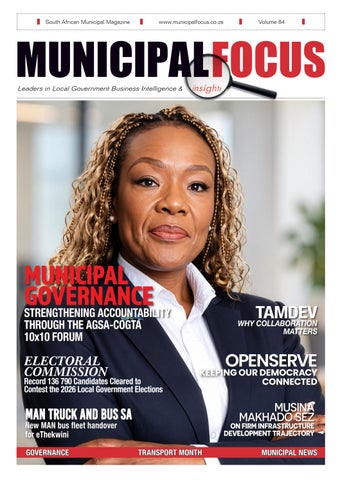
South South African African Municipal Municipal Magazine Magazine
www.municipalfocus.co.za www.municipalfocus.co.za
Volume Volume 84 58
Leaders in Local Government Business Intelligence &
MUNICIPAL GOVERNANCE STRENGTHENING ACCOUNTABILITY THROUGH THE AGSA-COGTA 10x10 FORUM BARLOWORLD
Building Communities ELECTORAL COMMISSION
SA CITIES NETWORK
Record 136 790 Candidates Cleared to Contest the 2026 Local Government Elections
Highlights SACN’S 2021 State of Cities MAN TRUCK AND Report BUS SA New MAN bus fleet handover for eThekwini
GOVERNANCE YOUTH MONTH
SIMO TAMDEV MKHIZE
WHY COLLABORATION MATTERS
CHIEF COMMERCIAL OPENSERVE OFFICER CELL C KEEPING OUR DEMOCRACY
CONNECTED ‘Partnerships: Key to Serving SA MUSINA and Her MAKHADO Role’ SEZ
ON FIRM INFRASTRUCTURE DEVELOPMENT TRAJECTORY
TRANSPORT MONTH TECHNOLOGY
MUNICIPAL NEWS MUNICIPAL NEWS
Smart Uptime. Drive for better. Designed to spend more time on the road and less time in the workshop, helping your business deliver when it matters most. Better for logistics. Better for business.
FROM
R1 627 500
*
FREE AdBlue | 2 000L / 2 Years* whichever comes first
Includes 5 years of complimentary UD Connected Services and Stolen Vehicle Recovery *While stocks last. Terms and conditions apply.
Contact your nearest UD Trucks dealership to take advantage of this limited time offer. @UDTrucks
@ud-trucks-southern-africa
@UDTrucksSouthernAfrica
Municipal Focus
2
Innovation that puts people first
Going the Extra Mile Municipal Focus
3
LETTER FROM PUBLISHER TALETSO TVETTHE COLLEGE
Minister of Cooperative Governance and Traditional Affairs, Velinkosi Hlabisa and Auditor-General of South Africa, Tsakani Maluleke at the launch of the 2026 AGSA-COGTA 10x10 Forum
Nardine Nelson: Publisher & CEO Kweda Media & Communications
PUBLISHER'S NOTE There are moments when the state of local government demands more than diagnosis. It demands coordinated action, stronger institutions, and a clear commitment to turning public resources into visible improvements in people’s lives. As South Africa moves closer to the 2026 Local Government Elections, this edition of Municipal Focus examines what it takes to strengthen municipalities not only before the polls,but well beyond them. Our Front Cover Feature showcases the launch of the AGSA-CoGTA 10×10 Forum, a timely and significant partnership aimed at strengthening governance, accountability and financial management across local government. Bringing together AGSA, CoGTA and the nine provincial departments responsible for local government, the Forum is set to bring about a more coordinated response to persistent municipal challenges and ensure that audit findings lead to practical corrective action and better service delivery.
Across the edition, examples of progress show what implementation looks like. North West CoGTA marks its first clean audit; the Musina Makhado Special Economic Zone advances critical bulk infrastructure; and eThekwini’s new MAN bus fleet has strengthened accessible public transport. Our TAMDEV feature examines how practical technical assistance, skills transfer and collaboration can help municipalities build lasting institutional capability. And our feature on KONE Projects showcases the company’s integrated, tailored, multi-disciplinary solutions in water, energy and technology. Drawing on discussions at SIDSSA 2026, we emphasise the interdependence of mining and municipal infrastructure, particularly the need to plan for diversified local economies beyond the life of a mine. With leadership in mind, we showcase the Tshwane School for Business and Society which has set its course
towards developing the entrepreneurial and leadership capabilities needed to navigate complexity and drive transformation. When it comes to elections - and considering the scale of our democratic process - much depends on the systems, institutions and partnerships that make participation possible. What cannot be overlooked is Openserve’s longstanding relationship with the IEC and its critical role in supporting South Africa’s electoral process since the country’s first democratic elections in 1994. We took the opportunity to speak to Chief Service Delivery Officer Nomthi Nelwamondo about this enduring responsibility. Our Municipal News section offers a snapshot of progress taking shape across the country – from water security, upgraded roads and housing development, to stronger municipal services, community infrastructure and new oportunities for learning. Together, these contributions reinforce a central message: capable leadership must be matched by practical delivery, resilient infrastructure and partnerships grounded in accountability. Enjoy the read and keep safe!
89th IMESA Conference & Exhibition at Durban ICC on 28-30 October 2026
4
Municipal Focus
VOTED THE NO. 1
MEDICAL AID IN SOUTH AFRICA*
AFFORDABLE PLANS From R1 275pm
To suit the needs of all South Africans
DEPENDANTS UP TO
AGE 24 YEARS
PAY CHILD RATES
ONLY PAY FOR A MAXIMUM OF 3 CHILDREN**
FINANCIALLY STABLE
R9 BILLION IN RESERVES SO WE CAN AFFORD TO PAY YOUR CLAIMS
JOIN NOW
www.bonitas.co.za *According to the Ask Afrika Orange Index® Awards for 2025/2026 **Plan dependent
FOCUS
Leaders in Local Government Business Intelligence &
WWA AT TE ERR
MM UN U NI CI CI PI PAAL LI ITTI IEESS
E LE LE ECCTTI IOONN SS
IN I NFFRRAASSTT RR UU C TT UU RREE
LL O O C A LL G OO VVEERRNNMME ENNT T
COVER FEATURE COVER FEATURE CELL C: PARTNERSHIPS 1008 MUNICIPAL GOVERNANCE STRENGTHENING ACCOUNTABILITY THE KEY TO SERVING THROUGH THE AGSA-COGTA 10x10 FORUM SOUTH AFRICA AND HER PEOPLE
FEATURES FEATURES 16
ELECTORAL COMMISSION
14 Record Electoral Commission: SA'S Youth 136 790 candidates cleared to contest Vote the 2026Matters Local Government Elections
2018 OPENSERVE SA Cities Network
Keeping our democracy connected
Ozone Information 2422 TAMDEV
Why collaboration matters Technology Distribution
30
MUSINA MAKHADO SEZ
28 OnBarloworld Mbewu firm infrastructure development trajectory
3434 TSHWANE SCHOOL FOR BUSINESS Kwikspace AND SOCIETY Developing leaders for impact
36 Plastics SA: Honours Water Warriors
36 40 42
MAN TRUCK AND BUS SOUTH AFRICA
New MAN bus fleet handover for eThekwini
SOUTH AFRICAN RESERVE BANK
Launches two commemorative coins
KONE PROJECTS
Integrated Infrastructure, Energy & Technology Solutions
1820
0810
34 22
6
4
Municipal Focus Municipal Focus
42 34
WAT E R 46 48 50 52 56 58 60
M U N I C I PA L I T I E S
ELECTIONS
INFRASTRUCTURE
LOCAL GOVERNMENT
NORTH WEST COGTA
Achieves first ever Clean Audit outcome
GIJIMA
Building a modern state that works for citizens
IMESA
2026 Annual Conference and Exhibition ESKOM Partnering with municipalities to enhance electricity service delivery
PLASTICS SA
30th Clean-Up & Recycle SA Week
WEARCHECK
Fuel adulteration an invisible threat to infrastructure
TVET COLLEGES
Minister Buti Manamela urges youth to apply early for TVET Colleges
MUNICIPAL NEWS 72 BITOU LOCAL MUNICIPALITY 74 CITY OF CAPE TOWN 76 DR JS MOROKA LOCAL MUNICIPALITY 79 BUFFALO CITY METRO 80 MNQUMA LOCAL MUNICIPALITY 82 UMVOTI LOCAL MUNICIPALITY
60
56
72
74
80
Municipal Focus
7
South SouthAfrican AfricanMunicipal MunicipalMagazine Magazine
www.municipalfocus.co.za www.municipalfocus.co.za
Volume Volume57 58
Leaders LeadersininLocal LocalGovernment GovernmentBusiness BusinessIntelligence Intelligence&&
South SouthAfrican AfricanMunicipal MunicipalMagazine Magazine
www.municipalfocus.co.za www.municipalfocus.co.za
Volume Volume57 58
Leaders LeadersininLocal LocalGovernment GovernmentBusiness BusinessIntelligence Intelligence&&
STATE OF THE BARLOWORLD PROVINCE Building Communities ADDRESS Limpopo SA CITIES NETWORK
ON ON THE THE SITHOLE ON SIMO MBANGA COVER MKHIZE COVER THE COVER
SITHOLE SIMO MBANGA SA CITIESMKHIZE NETWORK Preparing TheCHIEF Cities For COMMERCIAL a Better Future
OFFICER CELL C OR TAMBO SCHOOL ‘Partnerships: OF KeyLEADERSHIP to Serving SA SA CITIESBuilding NETWORK and Her Role’ Agents STATE OF THE Preparing TheofCHIEF Cities Change BARLOWORLD PROVINCE For COMMERCIAL a Better Future Building Communities MUNICIPAL NEWS TECHNOLOGY ADDRESS WATER MONTH TECHNOLOGY YOUTH MONTH OFFICERMUNICIPAL CELL NEWS C Limpopo OR TAMBO SCHOOL ‘Partnerships: SA CITIES NETWORK North WestSACN’S 2021 OF KeyLEADERSHIP to Serving SA Highlights North WestSACN’S 2021 Highlights Western Cape Report State of Cities
Western Cape Report State of Cities WATER YOUTHMONTH MONTH
DESIGN PRINT PUBLISH “Communications, and Advertising DESIGNMarketing PRINT PUBLISH are indispensable tools towards success and “Communications, Marketing and Advertising growth in any business venture…” are indispensable tools towards success and growth in any business venture…” Kweda Media & Communications offers a diverse range of business and sales solutions, strategies and ideas Kweda Media & Communications a diverse that are customised to meet our clients’offers standards and range of business and sales solutions, strategies and ideas exceed their expectations. that are customised to meet our clients’ standards and exceed their is expectations. Our Vision driven by the passion to inspire, assist and elevate business enterprises by forming strategic Our Vision that is driven themultiple passionbenefits to inspire, collaborations will by yield of assist and elevate businessforenterprises by forming strategic success and growth all. collaborations that will yield multiple benefits of success Media and growth all. Kweda andforCommunications is a Proudly South African, 100% black female owned company Kweda andCape Communications located in Media Plumstead, Town, registered isasaaProudly private South African, 100% black female owned company company since May 2014 - we hold a level 1 B-BBEE located in Plumstead, Cape of Town, as amembers private certificate. We are a team multiregistered skilled staff company since May 2014 we hold a level 1 B-BBEE who have a fresh, innovative and diverse approach to certificate. We arewilling a teamtoofput multi skilled staff members working and always in the extra time and who have a fresh, innovative and diverse approach to attention to ensure great service delivery on time. working and always willing to put in the extra time and attention to ensure great service delivery on time.
Your vision… our drive
Your vision… our drive
SIMO MKHIZE SITHOLE MBANGA Auditor-General South Africa, CCO: SA CELL C of CEO: CITIES NETWORK Tsakani Maluleke
and Her Role’ Building Agents of Change
TECHNOLOGY TECHNOLOGY
SITHOLE MBANGA SIMO MKHIZE
CCO: SA CELL C NETWORK CEO: CITIES
MUNICIPAL MUNICIPALNEWS NEWS
PUBLISHING EDITOR
DISTRIBUTION
Nardine Nelson nardine@kwedamedia.co.za nardine@kwedamedia.co.za nardine@kwedamedia.co.za PUBLISHING EDITOR +27 82 739 739 3932 3932 +27 82 +27 82 739 3932 Nardine Nelson nardine@kwedamedia.co.za nardine@kwedamedia.co.za EDITORIAL EDITORIAL CONTRIBUTORS CONTRIBUTORS +27 82 +27 82 739 739 3932 3932 Contributors Contributors Isaac Mahlangu Happy Nkhoma EDITORIAL CONTRIBUTORS Andile Moyo Isaac Mahlangu Contributors Thebe Mabanga Madala Thepa Nwabisa Pondoyi Kenny Mahlangu Nkhoma Happy Madala Thepa Isaac Mahlangu
GCIS, National Assembly,
MAGAZINE DESIGN MAGAZINE DESIGN & & LAYOUT LAYOUT Madala Thepa Nwabisa Pondoyi Digital Pixels Studio& LAYOUT MAGAZINE DESIGN KCDA Design Agency Madala Thepa
NCOP, National & Provincial DISTRIBUTION Departments, Municipalities: GCIS, National Assembly, Mayors, Managers, Heads NCOP, National & Provincial of Procurement, Tenders and Departments, Municipalities: Purchasing Officers, Conferences Mayors, Managers, Heads and the Private Sector of Procurement, Tenders and Purchasing Officers, Conferences DIGITAL E-BOOKSector CREATION and the Private DIGITAL E-BOOK CREATION
Paul Sampson Digital Pixels Studio Jaco Kotze MAGAZINE DESIGN & LAYOUT paul@digital-pixels.co.za Paul Sampson jk@kcda.co.za Digital Pixels Studio& LAYOUT MAGAZINE DESIGN paul@digital-pixels.co.za Paul Sampson Digital Pixels Studio Advertising paul@digital-pixels.co.za Paul Sampson Nazly Leite Mphumzi Njovana Advertising paul@digital-pixels.co.za nazly@kwedamedia.co.za mphumzi@kwedamedia.co.za Mphumzi Njovana Advertising Nomonde Siko Nazly Leite mphumzi@kwedamedia.co.za Mphumzi Njovana Advertising nomonde@kwedamedia.co.za nazly@kwedamedia.co.za Nazly Leite mphumzi@kwedamedia.co.za Mphumzi Njovana Lunga Zimemo nazly@kwedamedia.co.za Nazly Leite mphumzi@kwedamedia.co.za lunga@kwedamedia.co.za nazly@kwedamedia.co.za Nazly Leite Production Brilliant Mabena nazly@kwedamedia.co.za production@kwedamedia.co.za Production brilliant@kwedamedia.co.za Production Rayhaan Suleiman Production production@kwedamedia.co.za Production Administration production@kwedamedia.co.za
kinetic creative DES IGN AGEN C Y
www.digital-pixels.co.za www.KCDA.co.za
PUBLISHED BY
www.digital-pixels.co.za PUBLISHED BY
Kweda Media Kweda Media & Communications PUBLISHED BY & Communications (Pty)Ltd 1 TheMedia Village Square, Main Road, Kweda 1 The Village Square Cape Town & Plumstead, Communications Main Road, Plumstead (21) 768 +27 (21) 7680115 0115 1 Tel: The +27 Village Square, Main Road, Cape Town www.kwedamedia.co.za www.kwedamedia.co.za Plumstead, Cape Town 7800 Tel: +27 +27 (21) (21)768 7680115 0115 Tel: +27 (21) 768 0115 www.kwedamedia.co.za www.kwedamedia.co.za www.kwedamedia.co.za
production@kwedamedia.co.za Rayhaan TamerynSuleiman Moses Administration production@kwedamedia.co.za Administration tameryn@kwedamedia.co.za Administration/Finance Tameryn Moses admin@kwedamedia.co.za Tameryn Moses Administration tameryn@kwedamedia.co.za tameryn@kwedamedia.co.za admin@kwedamedia.co.za Subscriptions / Distribution Marketing / Distribution subscriptions@kwedamedia.co.za / Distribution Subscriptions Nozi Mbanjwa marketing@kwedamedia.co.za subscriptions@kwedamedia.co.za
correspondenceshould shouldbe beaddressed addressedtotoMunicipal All editorial, business and production correspondence Municipal PO Box 12454 Plumstead 7800. Manuscripts, illustrations and Focus, POFocus, Box business 12454 Plumstead 7800. Manuscripts, illustrations and be other material All editorial, and production correspondence should addressed to editorial, business correspondence should beaddressed addressed All and production correspondence should be totoillustrations Municipal Municipal Focus, PO 12454 Manuscripts, other material must be accompanied byPlumstead a stamped,7800. self-addressed envelope. Nocan must be accompanied by aBox stamped, self-addressed envelope. No responsibility and other material must be accompanied by The athe stamped, self-addressed Municipal Focus, PO 12454 Plumstead 7800. Manuscripts, illustrations and Focus, PO Boxfor 12454 Plumstead 7800. Manuscripts, illustrations andreserves material responsibility can beBox accepted for unsolicited material. editor the be accepted unsolicited material. The editor reserves right toother amend andright to
envelope. No responsibility can accepted for unsolicited material. The other material beby accompanied by material abe stamped, self-addressed envelope. Nocanby must be accompanied a stamped, self-addressed envelope. No by responsibility to amend and to alter copy and as deemed necessary. Copyright alter copy andmust visual material asvisual deemed necessary. Copyright Kweda Media & editor reserves the right tounsolicited amend and to alter copyreserves and visual material responsibility can be accepted for material. The editor the right be accepted for unsolicited material. The editor reserves the right to amend and to Kweda Media & Communications. All rights reserved. No part ofmay this be publication may Communications. All rights reserved. No part of this publication reproduced, as deemed necessary. Copyright by Kweda Media & Communications. All
to amend altermaterial copy and material as deemed necessary. Copyright alter copy and and to visual asvisual deemed necessary. Copyright by Kweda Media by & berights reproduced, stored in part a retrieval system transmitted by any form or anyprior means in stored in reserved. a retrieval system or transmitted byorany form or any means without No of this publication may be reproduced, stored Kweda Media & Communications. All rights reserved. No part of this publication may prior Communications. All rights reserved. No part of this publication may be reproduced, a retrieval system oroftransmitted form or any means without without prior the Theany opinions expressed in Municipal permission ofpermission the publisher. Thepublisher. opinions by expressed in Municipal Focus are not Focus bepermission reproduced, stored in a retrieval system transmitted by any or anyprior means stored in a retrieval system or transmitted byorany form or any means without of the publisher. The opinions expressed inform Municipal Focus are are not necessarily of the publishers. necessarily those ofthose the publishers. not necessarily those ofpublisher. the publishers. without priorofpermission of the The opinions expressedFocus in Municipal permission the publisher. The opinions expressed in Municipal are not Focus are not necessarily of the publishers. necessarily those ofthose the publishers.
MUNICIPAL GOVERNANCE
TURNING MUNICIPAL AUDIT FINDINGS INTO ACTION As South Africa approaches the 2026 local government elections, a new partnership between the Auditor-General and CoGTA aims to help municipalities act on persistent governance and financial-management failures.
A
municipal audit can reveal that financial statements are unreliable, a budget cannot be funded or money allocated to an infrastructure project has not been properly managed. The finding matters most when the municipality acts on it: correcting its records, strengthening its controls and making sure the service or project reaches the community. Too often, the same problems return in the following year’s audit. That gap between identifying a weakness and fixing it is the focus of the AGSA-CoGTA 10×10 Forum. Launched on 2 July 2026 by Auditor-General Tsakani Maluleke and Minister of Cooperative Governance and Traditional Affairs Velenkosini Hlabisa, the forum brings together the Auditor-General of South Africa (AGSA), the national Department of Cooperative Governance (CoGTA) and the nine provincial departments responsible for local government. It is intended to coordinate support and oversight so that audit findings lead to practical improvements in municipal performance.
10
Municipal Focus
Its launch came 8 days after Auditor-General Maluleke tabled AGSA’s report on the 2024/25 local government audit outcomes.
Progress That Has Yet to Reach Enough Communities The 2024/25 results present a mixed picture. Financial statements were submitted on time at a rate of 98%, which AGSA described as the highest level in its records. Unqualified audit opinions rose to 61%, indicating that more municipalities ultimately published credible financial statements. The number of municipalities with disclaimed opinions fell from 29 in 2020/21 to eight in 2024/25. Those are significant changes. A disclaimed opinion means auditors could not obtain enough evidence for most of the information in a municipality’s financial statements. Without reliable records, it becomes much harder for a council, an oversight body or the public to establish how money was used. AGSA attributed improvements in
submissions and disclaimers in part to stronger national and provincial support, oversight and its material irregularity process. Yet only 39 municipalities, or 15%, achieved clean audits in 2024/25. Together, they administered approximately 8% of the total local government expenditure budget. A further 38 municipalities had regressed since 2020/21, including municipalities that had previously earned clean audits and three metropolitan municipalities. Most municipalities either remained at the same audit outcome as at the end of the previous administration or improved without reaching a clean audit. The distinction between an unqualified opinion and a clean audit is especially relevant to the forum’s work. An unqualified opinion indicates that the financial statements are credible, but a municipality may still have material findings concerning compliance or performance reporting. In 2024/25, the most common outcome was an unqualified opinion with findings, received by 117 municipalities.
Aud itorGener al o f S o
alul kani M a s T , a c i r f uth A
eke
AGSA said many in this group had corrected material misstatements during the audit, while significant weaknesses in compliance, reporting and accountability persisted. An audit outcome can thus improve while the systems needed for reliable management remain weak. AGSA warned against treating an unqualified opinion with findings as the end of the improvement process. For a municipality, the next step is to maintain sound records throughout the year, comply with legislation and report accurately on what it has delivered. The metros illustrate the scale of the challenge. None of the eight metropolitan municipalities achieved a clean audit in 2024/25. Five received qualified opinions on their financial statements, compared with two earlier in the administration’s term. AGSA reported material findings on compliance at every metro. These municipalities and their entities managed approximately R335.97 billion, or 54% of the total local government expenditure budget, and were responsible for services to 8.9 million households. Their governance affects a substantial share of the country’s residents.
From Annual Audits to Ongoing Correction Mi nis ter o
isa
f Co
op e rativ e Gove
rnance and Traditiona
lab Minister Hlabisa described the 10×10 Forum as a way to move si H o k in l e from identifying problems to implementing solutions. Rather than irs, V l Affa
treating audit outcomes solely as annual compliance
>
Municipal Focus
11
MUNICIPAL GOVERNANCE
The AGSA-COGTA 10x10 Forum will serve as an early-warning mechanism to identify systemic and emerging risks, monitor municipal performance, track the implementation of corrective measures and escalate areas of persistent concern requiring intervention.
results, he said municipalities and the departments supporting them should use those outcomes to guide corrective action during the year. AGSA says the forum is intended to identify emerging and systemic risks early, monitor municipal performance, track corrective measures and escalate persistent concerns that require intervention. AuditorGeneral Maluleke welcomed the partnership as a coordinated response to interconnected local government challenges. Both institutions retain their respective roles: AGSA provides independent audit findings, while the CoGTA portfolio has responsibilities for supporting and overseeing municipalities. The forum is designed to help those roles work together more effectively.
The 5 Priorities that Guide the Forums Work 1.
12
Elimination of unfunded municipal budgets within the next two years through credible and sustainable financial planning.
Municipal Focus
2.
Achievement of 100% submission of Annual Financial Statements (AFS) by municipalities.
with the 61% that ultimately did. Five municipalities did not submit their statements by the legislated date.
3.
Eradication of audit disclaimers and adverse audit outcomes, while accelerating progress towards clean governance.
4.
Reduction of municipal dependence on consultants through the strengthening of internal capacity, skills and accountability.
5.
Improvement of overall audit outcomes by increasing the number of unqualified and clean audits through strengthened governance systems, professionalisation and quality assurance.
A target of full submission addresses one part of the problem. The quality of statements when they are first prepared matters just as much. Reliable in-year records give municipal leaders information they can use to make decisions before an auditor identifies an error. They also allow councils to detect financial pressure sooner and respond while there is still time to change course.
The need for stronger financial reporting is clear in the latest audit results. Although timely submission improved, AGSA found that 195 municipalities, or 76%, initially submitted financial statements containing material misstatements. Auditors allowed corrections during the audit process. Without those corrections, AGSA said, only 24% of municipalities would have received unmodified opinions, compared
The same applies to performance reports. AGSA found that every municipality prepared and submitted one for the 2024/25 audit, an important milestone. But auditors identified material findings on the usefulness or reliability of information reported by 123 municipalities. A performance report should allow a council and the public to judge whether a municipality is meeting its planned service-delivery objectives. When information is incomplete or unreliable, oversight becomes less effective, even if the report itself has been submitted.
The Cost of Budgets that Cannot be Funded Among the forum’s most demanding commitments is the aim to eliminate unfunded budgets within two years. AGSA reported that 116 municipalities, or 45%, adopted unfunded budgets in 2024/25, up from 113 the previous year. These budgets committed municipalities to expenditure of approximately R288.17 billion for which they had no means of funding. Seventy-seven of the 116 municipalities had adopted unfunded budgets for four consecutive years. The consequences extend beyond the budget document. A municipality that cannot collect enough revenue or manage its expenditure faces increasing difficulty paying creditors, maintaining infrastructure and delivering services consistently. AGSA found that 98 municipalities spent more than they generated in revenue in 2024/25, producing a combined deficit of R17.41 billion. It also reported that 136 municipalities failed to pay suppliers on time, incurring interest and penalties. Weak collection and infrastructure management compounded the pressure. According to AGSA, municipalities took an average of 129 days to collect amounts owed and wrote off R62.12 billion in debt that could not be recovered. It reported water distribution losses valued at R14.73 billion and electricity losses of R21.63 billion. Financial recovery therefore requires more than adjusting figures at budget time. It depends on credible revenue estimates, effective billing and collection, controlled spending and attention to the infrastructure that enables services to reach customers. National Treasury’s 2026 Budget Review identified unfunded municipal budgets as a concern and outlined
renewed support for long-term financial plans to improve cash-flow planning and financial decisions. In July, Treasury announced the temporary withholding of equitable share transfers to selected municipalities to encourage fiscal discipline and better management of public money. Affected municipalities were given procedures to secure the release of the funds.
Building Skills that Stay in the Municipality
systems that are either ineffective or not used effectively for functions such as billing, asset management and payments. Building capacity consequently involves both competent staff and dependable processes. Neither can be supplied by a year-end exercise to prepare statements for audit. Professionalisation is particularly relevant as municipalities approach an electoral transition. Auditor-General Maluleke warned that changes in political leadership after elections can contribute to regression in audit outcomes. AGSA urged political parties >
The forum’s commitment to reduce reliance on consultants speaks to a different, but closely connected, weakness: whether municipalities have the people and systems to perform essential work themselves. In 2024/25, 225 municipalities spent R1.61 billion on financial reporting consultants, AGSA reported. A decade earlier, 179 municipalities had spent R590 million. Consultants were most often used for financial statement preparation, asset management and tax-related work. Municipalities cited skills shortages, vacancies or a combination of the two as reasons for their appointments. Despite the expenditure, 61% of municipalities that used consultants submitted financial statements with material misstatements in the areas for which the consultants had been engaged. External expertise can help municipalities with specialist work. But where consultant appointments recur without strengthening municipal staff and systems, financial reporting weaknesses may persist despite the money spent on outside support. AGSA’s recommendations call for compliant appointments, targeted skills development and the retention of scarce skills. They also point to
Municipal Focus
13
MUNICIPAL GOVERNANCE
The AGSA-COGTA 10x10 Forum underscores government’s shared commitment to building capable, ethical and accountable municipalities that are better positioned to deliver quality services and improve the lives of all South Africans.
to put forward capable candidates, called for high-quality induction of new councillors and recommended maintaining administrative stability where officials have performed well. Those recommendations underline a practical test for the forum: whether improvements can survive changes in council leadership and remain part of a municipality’s day-to-day operations.
When Governance Failures Become Service Failures Municipal accountability extends beyond financial statements. AGSA examined 129 infrastructure projects, with an estimated combined cost of R14.16 billion, at 59 municipalities and three municipal entities. It reported findings on 101 projects and an average project delay of 25 months. Housing projects had an average delay of 39 months. The consequences also reach the environment. Of 35 wastewater treatment works inspected,
14
Municipal Focus
22 discharged wastewater that did not meet required effluent standards. Thirty of 31 landfill sites inspected were not managed in accordance with their licensing conditions. AGSA linked inadequate maintenance and delayed upgrades to risks for communities and the environment. AGSA reported material findings on compliance with key legislation at 215 municipalities in 2024/25. It also highlighted slow investigations into financial and procurement misconduct and inadequate action on unauthorised, irregular, and fruitless and wasteful expenditure. When expenditure is written off without proper investigation, the underlying failure can remain unresolved. These findings show what is at stake when governance problems are allowed to persist. The forum’s proposed monitoring of corrective measures is intended to help turn audit findings into action before further public resources and services are affected.
A Wider Push for Ethical Leadership Since the forum’s launch, another governance development has added to the debate about how municipalities should be led. In September, Minister Hlabisa welcomed the adoption of the Code for Ethical Leadership in Local Government by 100 municipalities across the nine provinces. The code emerged from a partnership involving The Ethics Institute (TEI), CoGTA, the South African Local Government Association (SALGA) and the Moral Regeneration Movement (MRM). It applies to people in municipal leadership positions, including political and administrative leaders. Adoption is a first step. The councils of those 100 municipalities are expected to develop implementation plans to make the code part of their leadership practices. Minister Hlabisa also encouraged the remaining municipalities to adopt it. AGSA’s audits show why ethical leadership matters: controls and
reports can only protect public resources when leaders use them, respond to failures and accept accountability for their decisions. A council resolution expresses a commitment; sustained conduct and effective consequences show whether that commitment has taken hold. The review of the White Paper on Local Government provides further context. A revised draft was published for public comment in May 2026, and SALGA called for practical reforms that would strengthen effective, responsive and accountable municipalities. The draft remains a reform proposal, rather than a completed change to the local government system. Together with the audit findings and ethical leadership code, it shows that the discussion extends beyond a single year’s audit outcomes to the structure and capability of municipalities entering the next term.
contribution to be judged more directly. In the absence of such an account, the forum’s ambitions should remain clearly described as ambitions.
become more credible; the work is incomplete while budgets remain unfunded, projects stall and residents cannot rely on essential services.
Minister Hlabisa said at the launch that the forum’s success would be measured by stronger municipalities, responsible use of public resources and better services for communities. The latest audit report explains why that measure matters. Submission rates can rise, disclaimers can fall and financial statements can
As a new municipal term approaches, the opportunity is to carry the gains already made into daily practice: records kept accurately, risks addressed early, skilled officials supported, findings corrected and leaders held to account. That is where the distance between an audit finding and a functioning municipality begins to close.
From Commitments to Results For the 10×10 Forum, the central question is now one of implementation. Its July announcement set out the partners, priorities and intended method of working. A published account of which municipalities have been prioritised, what corrective measures have begun, and how progress will be assessed would allow its
Municipal Focus
15
ELECTOR ELECTORAL AL COMMISSION COMMISSION
136 790 CANDIDATES. THE BALLOT TAKES SHAPE. NOW, GET ELECTION READY. Electoral Commission Chief Electoral Officer: Sy Mamabolo
16
Municipal Focus
T
he road to the 2026 Local Government Elections reaches another milestone as candidate certification is completed and preparations intensify for 4 November. The Electoral Commission has certified 136 790 candidates who have satisfied the statutory requirements to contest South Africa’s 2026 Local Government Elections on 4 November 2026. The candidates will contest 10 526 seats across the country’s eight metropolitan municipalities, 44 district municipalities and 205 local municipalities. The certification of candidates marks an important milestone in the electoral timetable. It provides certainty about the candidates who will contest the elections and enables the Commission to proceed with the next stages of election preparation, including ballot paper production.
From Nomination to Certification
On 9 September, notices were issued concerning 550 candidates who had either been nominated as independent candidates and by a political party, or by more than one political party. The affected parties were given an opportunity to retain or replace the candidates in accordance with the applicable process. Following the conclusion of the statutory reviews, 5 096 candidates were disqualified. The reviews included confirmation that contestants had met applicable requirements, including the payment of deposits and proper nomination.
The certification of candidates is therefore the outcome of a defined statutory and administrative process designed to establish which candidates meet the requirements to contest the elections. The process has resulted in a field of 136 790 certified candidates. Of these, 98 219 candidates have been nominated by political parties to contest ward elections, while 38 571 candidates have been nominated by political parties to contest the Proportional Representation (PR) election. The 136 790 include 621 independent candidates nominated to contest ward elections. >
The candidates will contest seats across:
Contestation Political Party Independent TOTAL Levels Candidates Candidates Metro
42 976
122
43 098
District
6 443
N/A
6 443
Local
86 750
499
87 249
Total
136 169
621
136 790
The candidate nomination process closed at 17:00 on 28 August, with independent candidates and political parties able to submit nominations at Either Electoral Commission offices countrywide or through the Online Candidate Nomination Portal. Digital access played a significant role, with 84% of submissions made online and 16% submitted in person. The closure of nominations was followed by statutory reviews and verification processes to establish whether the candidates had met the requirements to contest. On 4 September, the Commission issued notices to 221 parties and independent candidates requesting additional information relating to 1280 nominated candidates. The requested information included identification documents and completed acceptance of nomination forms. Municipal Focus
17
ELECTOR AL COMMISSION
Building Readiness for 4 November With the final candidate lists established, the electoral process moves into its next phase. The Commission will proceed with preparations for ballot paper production following the ballot paper draw associated with the signing of the Electoral Code of Conduct on 23 September 2026. Candidates will receive certificates confirming their candidature on 25 September 2026, in accordance with the Election Timetable. Election preparations are also advancing across voting infrastructure, personnel and technology. The Commission is recruiting 23 696 Presiding Officers and 29 964 Deputy Presiding Officers. More than half have been recruited to date, and training has commenced. The Commission has secured 23 696 voting stations countrywide, comprising of 22 668 permanent, 995 temporary and 33 mobile voting stations. These figures may change slightly as outstanding lease agreements are finalised. Election readiness also includes testing and assurance of the systems supporting the electoral process. The Commission has engaged external independent auditors to validate key controls, processes and system functionality as part of the overall assurance process. In addition, an Independent Quality Assurance Testing engagement is scheduled to commence on 17 September 2026 and run for three weeks.
The commission will also provide contesting political parties with an opportunity to test the results system using their preferred experts. Parties will have access to the system from 05 to 12 October 2026.
are unable to travel to a voting station because of their physical condition. Other qualifying voters who cannot vote on 4 November may vote at their registered voting station on 02 or 03 November.
These activities form part of the broader preparations to test, validate and strengthen the systems and processes supporting the elections.
Voters are encouraged to establish whether they qualify for a home visit and apply through the Commission’s official channels.
Informed, Prepared and Ready to Participate As the Commission continues its final operational preparations, voters also have an important role to play in getting ready for 4 November 2026. Voters are encouraged to: •
Check – Confirm your voting station details.
•
Understand – Familiarise yourself with the electoral process and the ballots you will receive.
•
Get informed – Use credible and official sources to access information about the electoral process and the candidates contesting in your area.
•
Prepare – Know where you will vote and make the necessary arrangements to participate.
For voters who may not be able to vote at their voting station on Election Day, special vote applications open on 21 September and Close at 17:00 on 12 October 2026. Qualifying voters may apply for a home visit special vote if they
As campaigning intensifies, voters have an important role to play: verify information and rely on credible sources before sharing election related information.
KEY DATES TO REMEMBER: 21 Sept12 Oct
Special Vote Applications
23 Sept
Electoral Code of Conduct signing and ballot paper draw
25 Sept
Candidate certificates issued
2-3 Nov
Special voting at registered voting stations
4 Nov
Election Day
The Testing will cover: •
Functional testing
•
Performance testing
•
Code reviews
18
Municipal Focus
Know your wards For more information: Go directly to the info portal: Scan the QR Code #KNOWYOURWARDS
OPENSERVE
OPENSERVE
Keeping our Democracy Connected
As South Africa heads towards the 2026 Local Government Elections, Openserve brings decades of experience, national reach and resilience to its support of the IEC. 20
Municipal Focus
M
unicipal Focus took the opportunity to speak with Chief Service Delivery Officer at Openserve, Nomthi Nelwamondo, about the organisation’s enduring contribution to the country’s electoral process over the past 32 years, the people and infrastructure working behind the scenes, and the responsibility of keeping a nation connected when every vote counts.
From South Africa’s first democratic elections in 1994 to the 2026 Local Government Elections, Telkom and Openserve has been part of an extraordinary democratic journey. What does this proud legacy mean to Openserve? Every election in this country has been carried by something most people never see. Behind the ballot box in a school hall in the Eastern Cape or a community hall outside Upington sits a network that has to work on that day, in that place, at that hour. It has never let the country down, and that is the part of our history we are proudest of. Since 1994, Telkom and Openserve have stood with the IEC through six national elections and five municipal polls. In that time the country has changed, the technology has changed several times over, and the demands placed on the network have grown beyond anything imagined in the early years. What has not changed is the answer we give the IEC when they ask whether we will be ready. This legacy also belongs to our people. The technicians, network controllers and planners who look after this infrastructure are South Africans who stand in the same queues as everyone else. When one of them restores a link at two in the morning before a results centre goes live, they are not closing a work order. They are making sure their own community gets counted.
As we approach the 2026 Local Government Elections, that is what we carry forward. Not the kilometres of fibre we have laid, but the trust the country has placed in them.
As South Africa prepares for the 2026 Local Government Elections, how is Openserve once again supporting the IEC? Our job is to make sure that on election day the IEC never has to think about connectivity at all. Openserve’s contribution forms part of a broader Telkom Group effort, bringing together the Group’s connectivity, digital infrastructure and technology capabilities to support the IEC’s operational requirements. In practice, that means providing the network that links the IEC’s operations across the country, from results-capturing sites through to the provincial and national results centres and the systems behind them. Telkom also hosts the IEC website, which carries the online voter registration and voter status services that millions of South Africans use long before they get to a voting station. For 2026 we are supporting resultscapturing sites nationwide, including approximately ten results centres, using WiFi 6, Layer 3 networking, high-speed fibre and high-throughput satellite where terrestrial reach limited. Satellite matters more than it sounds. It is how we hold a link in places where there is no fibre and no easy road in, which is exactly where the temptation to accept a lower standard is strongest. We do not accept it. Behind the technology sits a readiness plan. Links are tested under load, not simply switched on. Critical sites run on diverse routes. Backup power is checked rather than assumed.
Teams and spares are pre-positioned near the sites that carry the most risk, and we run a dedicated command centre for the election period with direct escalation into the IEC. Standby rosters are set and escalation routes are agreed before the day, not on the day. As the IEC adds results-capturing sites and results centres, we scale with them. That is the undertaking we have given, and we will meet it.
How has Openserve’s role in supporting the IEC evolved alongside advances in technology and the changing demands of modern elections? In 1994 the requirement was largely to get a working line into a building. Today it is to move verified results, imagery, live broadcast feeds and audit data across the country in near real time, with no break in the chain and no unexplained gaps. The shift is from connectivity to assurance. Providing a link is no longer the job. The job is being able to prove the link will hold, show exactly what it is doing at any moment, and recover it quickly when something goes wrong. That has changed how we design. Diverse routing, end-to-end monitoring and automatic failover are now the starting point rather than an upgrade. Three decades of doing this has also given us something that cannot be bought. We know which routes are exposed in heavy rain, which areas lose power and for how long, and where a physical presence is needed because a remote fix will not do it. That knowledge is built into every election plan we write. The same shift is now playing out in local government. Municipalities are moving billing, indigent registers, meter data, public safety and disaster management onto digital platforms. The lesson from elections transfers directly. Build for the day it must not fail, and the ordinary days take care of themselves. > Municipal Focus
21
OPENSERVE
How does Openserve’s national network support the connectivity demands of an election of this scale and reach? South Africa cannot be served from a head office. The electoral process has to work in Sandton and in a village ward in Limpopo on the same day, to the same standard, within the same minutes. Openserve’s national fibre network runs to more than 190 000 kilometres. Kilometres alone do not win an election day. What counts is that reach combined with people on the ground: technicians based across every province who can reach a site quickly, regional operations centres that see the network live, and spares held locally rather than centrally, where they are of no use at midnight. Where fibre does not reach, we use satellite and wireless. Where power is unreliable, we plan for the outage rather than hope against it. Where a route is exposed, we build a second one. The principle behind all of it is simple. Geography must never decide the quality of a citizen’s participation. A voter in a deep rural ward must count as quickly and as reliably as a voter in a metro. That is the standard we hold during an election, and it is the same standard we owe communities on every other day of the year.
What responsibility comes with providing connectivity that plays such a critical role in South Africa’s electoral process? Connectivity is invisible until it fails. In an election, a failure is not an inconvenience. It is a silence that people will fill with suspicion. That is the weight this responsibility carries. Our infrastructure sits underneath the credibility of a national
22
Municipal Focus
process. If a results centre goes quiet for twenty minutes, the country notices, and the questions that follow are not technical ones. The IEC safeguards the integrity of the election. Our part is to make sure the network never becomes a reason for anyone to doubt it.
a contract, and it is the thing we value most.
So we do not treat this as supplying a service. We treat it as holding a line. It shapes how we prepare: redundancy by default, failure scenarios rehearsed in advance, named accountability for every site, and teams who know that nothing waits for office hours.
The first lesson is that preparation
It also shapes something less visible, which is culture. The people who look after this network understand what it is being used for. That understanding is what gets them out of bed at three in the morning in bad weather on the Friday before an election. You cannot write that into
Having supported the IEC through successive elections, what lessons and insights is Openserve bringing to the 2026 Local Government Elections? beats reaction. Nothing done on election day matters as much as what was done in the eight weeks before it. Sites surveyed. Links tested under real load. Backup power started, not assumed. Contact lists current rather than inherited. The second is that single points of failure will find you. Every election has taught us the same thing in a different form: a cable cut, a generator that did not start, a route carrying more than it should have. We now design on the assumption that some-
“
Our infrastructure sits underneath the credibility of a national process. Our part is to make sure the network never becomes a reason for anyone to doubt it.
“
As Election Day approaches, what is Openserve’s commitment to the IEC and to South Africans participating in the 2026 Local Government Elections? Our commitment is straightforward, to ensure our connectivity is ready, resilient and fully supported throughout the 2026 elections. There is a bigger point behind that. A vote in a local government election is the most direct instrument a South African holds. It decides who
fixes the streetlight, who signs off the water budget and who answers the phone when a clinic runs short. This is the tier of government closest to daily life, and our role is to make sure that instrument is never blunted by a technical failure. To the IEC, our undertaking is that we will be ready, resourced and reachable, from readiness testing through to the last result declared. To South Africans, the message is simpler. Turn up. Stand in the queue. Make the choice. Our people will be at the sites, on the routes and in the operations centres through the night, doing their part so that yours counts. Openserve has carried this responsibility for more than thirty years. We have never treated a single election as routine, and we will not start with this one.
thing will fail, and the only question that matters is whether the country ever sees it. The third is that coordination is the multiplier. The IEC, ourselves, other operators, municipalities, power utilities and local law enforcement each hold a piece of the same picture. Elections run well when those parties have spoken to one another before the day, not during it. The fourth is that local presence is not optional. Remote monitoring tells you something is wrong. Only a person on the ground makes it right. That is why we invest in regional teams rather than centralising everything into one building. We bring all of this to 2026, together with the humility to know that every election writes a lesson we did not have before.
Municipal Focus
23
NBI TAMDEV
STRENGTHENING MUNICIPALITIES
Why Collaboration Matters
As South Africa approaches the 2026 local government elections, the national conversation is again focused on whether municipalities can provide reliable services, maintain infrastructure and create conditions in which communities and local economies can thrive. The experience of the NBI’s Technical Assistance, Mentorship and Development (TAMDEV) programme suggests that durable improvement depends not only on policy, but on capable institutions, practical implementation support and collaboration built around municipal priorities.
A
cross South Africa, municipalities are expected to provide essential services, maintain ageing infrastructure, respond to climate risks and create conditions for local economic growth, often while operating under significant financial, technical and institutional constraints. A leaking municipal water network is never only a technical problem. Every litre lost places further pressure on municipal finances, compromises service reliability and weakens public confidence. The same is true when infrastructure projects stall, 24
Municipal Focus
critical positions remain vacant, or development plans cannot move beyond paper. These challenges are not experienced only in council chambers. They affect households waiting for reliable services, entrepreneurs facing interruptions to their operations and investors assessing whether a town or city can support long-term growth. As South Africa approaches the 2026 local government elections, attention will understandably focus on political leadership and accountability.
But another question is equally important: will municipal institutions have the practical capability to deliver after the votes have been counted? The experience of the National Business Initiative’s (NBI) Technical Assistance, Mentorship and Development (TAMDEV) programme, suggests that municipalities do not always need another strategy or diagnosis. In many cases, they need experienced professionals working alongside their teams to solve defined problems, strengthen systems and turn plans into implementable projects.
Local Government is where Policy Becomes Real National policies and reform programmes matter, but their success is ultimately tested locally. It is at municipal level that infrastructure is maintained, land-use decisions are made, basic services are delivered, and communities interact most directly with the state. Municipal performance also affects South Africa’s economic prospects. Reliable water, electricity, roads, waste management and administrative services influence the cost of doing business and the willingness of companies to invest in particular locations. Strengthening local government is therefore not solely a public-sector concern. It is a shared national priority involving government, business, organised labour, civil society and communities. However, South Africa’s municipalities do not all face the same circumstances. Some have maintained capable administrations and relatively sound financial systems. Others confront overlapping challenges that include leadership instability, weak revenue collection, ageing infrastructure, skills shortages and limited capacity to prepare or implement projects. Effective support must recognise these differences and respond to the needs of each municipality.
Bringing Experience Closer to the Problem The NBI’s TAMDEV programme has developed a crucial platform through which experienced professionals, mentors and technical specialists can support public institutions. The programme draws on a network of senior professionals,
including retired specialists whose institutional knowledge and technical experience can help address complex public-sector challenges. TAMDEV currently has more than 60 specialists deployed across 14 active projects, supported by expertise in procurement, financial management, and monitoring and evaluation. The model also creates a structured bridge between government and business. The NBI represents more than 90 member companies operating across the South African economy, while formal agreements with publicsector partners provide a governed route through which expertise and resources can be mobilised. The purpose is not to establish a parallel administration or assume responsibilities that belong to elected councils and municipal officials. Specialists work alongside public-sector teams to address identified gaps, transfer skills and establish systems that can remain in place after an intervention ends. Technical assistance cannot compensate for political instability, inadequate accountability or poor governance. It can, however, help a committed municipality strengthen its ability to plan, procure, implement and monitor its work. TAMDEV’s municipal interventions show how this approach can be applied to different local challenges.
customer information or weaknesses in the management of the network. The consequences extend beyond the loss of water. Municipal revenue is reduced, service reliability deteriorates and already constrained budgets come under greater pressure. As financial capacity declines, it becomes increasingly difficult to repair or replace infrastructure, creating a cycle of growing losses and declining services.
Municipal improvement takes shape when experienced specialists work alongside local teams to solve defined problems and leave stronger systems behind. In such a situation, TAMDEV’s initiative combines technical expertise and skills with community participation and a public water-awareness campaign. This recognises that water losses cannot be addressed through engineering alone. Technical improvements must be supported by reliable municipal systems, accurate information and the participation of communities.
Protecting Water and Municipal Revenue
The initiative offers a practical illustration to municipalities on how addressing a service-delivery problem often requires infrastructure management, financial sustainability and public participation to be considered together.
Addressing a problem familiar to municipalities across South Africa, non-revenue water.
Turning the Just Transition into Local Opportunity
This is water that has been produced but is lost before it can be billed. The losses may result from leaking infrastructure, inaccurate meters, illegal connections, incomplete
Where the challenge is connected to South Africa’s transition towards a lower-carbon economy, for example, Coal-dependent communities have legitimate concerns about what > Municipal Focus
25
NBI TAMDEV
the transition could mean for employment, local businesses and municipal revenue. National commitments to a just transition will have limited meaning if they do not produce credible projects and new economic opportunities in the areas most affected. Through the JUST SA programme, TAMDEV is helping to strengthen institutional capacity, establish a Just Transition project management office and develop a pipeline of three investment-ready green projects.
A just transition must deliver practical projects, attract investment and create lasting economic opportunities for local communities. The focus on project preparation is important. Municipalities may identify promising development opportunities but lack the specialist capacity required to complete feasibility work, structure projects, navigate procurement requirements or approach potential funders. Closing this gap can help move a project from an integrated development plan towards implementation. The work seeks to connect climate and energy priorities with industrial development, inclusive growth and community resilience. The real measure of success will not be the number of strategies or plans produced. It will be whether projects become implementable, attract appropriate investment and create meaningful local opportunities.
Creating Clearer Partnerships and Collaboration Structures South African municipalities require substantial investment to rehabilitate and expand infrastructure. 26
Municipal Focus
Public funding alone is unlikely to meet every requirement, making responsible collaboration with the private sector increasingly important. However, public-private collaboration requires clear governance, strengthened municipal teams and transparent decision-making. Without these foundations, partnerships may fail to deliver value or adequately protect the public interest. Technical specialists can support the design and adoption of a partnering framework and establishing an independent public-private partnership office. If municipalities are to mobilise privatesector expertise and investment successfully, they require mechanisms that clearly determine how opportunities are identified, assessed, approved and monitored. Private-sector participation should strengthen municipal capability and accountability, not bypass or weaken it.
Connecting National Reform with Municipal Reality The focus on municipal capability is becoming increasingly important within South Africa’s broader reform agenda. The NBI serves as the Technical Support Facility for Operation Vulindlela Phase II. Its role includes supporting fundraising, technical resourcing, financial management and progress monitoring. The second phase of Operation Vulindlela provides an opportunity to connect national reform with the operational realities confronting municipalities, particularly in areas such as water, energy, infrastructure and local economic development. TAMDEV has also supported in engagements on the review of the White Paper on Local Government. Consultations held in the Western Cape, Gauteng, KwaZulu-Natal and the Eastern Cape enabled business representatives to contribute
practical perspectives on municipal finance, infrastructure, service delivery, spatial transformation and economic development. Business can bring operational knowledge, specialist capacity and investment experience to the reform process. But it is one part of a broader partnership. Municipal officials, communities, organised labour and civil society must also help shape reforms if they are to be legitimate, responsive and implementable.
What Sustainable Technical Support Requires TAMDEV’s experience points to several conditions that can make municipal support more effective. An initiative should begin with a clearly defined problem and an agreed outcome. Municipal leaders and officials own the process, with external specialists working alongside
internal teams rather than around them. Skills transfer must also be built into every initiative so that knowledge, skills and systems remain within the municipality. Most importantly, progress is measured through institutional and service-delivery outcomes, not simply by counting experts deployed, workshops held or reports produced. Funding remains a constraint.
Lasting progress will depend on municipal teams having the skills and systems to deliver reliable services long after external support ends. TAMDEV has access to experienced professionals who could contribute to municipal capability, but they cannot be deployed without adequately funded and properly scoped projects. This creates a practical role for business and development partners who can fund
targeted interventions, contribute appropriate expertise and support approaches that can be independently monitored, adapted and replicated.
From Electoral Promises to Institutional Capability The councils and administrations taking responsibility after the 2026 Local Government Elections will inherit urgent work. Meeting this challenge will require more than new policies or short-term interventions. It will require municipal leadership, specialist expertise, sound governance and sustained attention to implementation. The objective is not to make municipalities dependent on outside support. It is to build institutions that can plan, procure, implement and solve problems with confidence. South Africa already understands the cost of municipal failure. The priority now is to move from repeated diagnosis to practical, measurable improvement through collective action.
Contact details: Phone: 011 544 6000 Website: www.nbi.org.za Address: 5th Floor, 61 Katherine Street, Dennehof, Sandton, Gauteng 2196
Municipal Focus
27
BORDER MANAGEMENT
GOVERNMENT STEPS UP EFFORTS TO SECURE SOUTH AFRICA’S BORDERS Government is stepping up efforts to secure South Africa’s borders through improved infrastructure, technology, surveillance and coordinated law enforcement operations as part of the implementation of the Five-Point Plan on Migration Management.
A
t the beginning of September Minister of Justice and Constitutional Development Mmamoloko Kubayi stated that progress had been made in strengthening border management and coordination among agencies operating at ports of entry.
shared with six neighbouring countries and traversing varied and challenging terrain. Over time, border security infrastructure has deteriorated significantly, with large sections of fencing damaged, vandalised or absent and critical access roads in poor condition,” Minister Kubayi said.
Minister Kubayi announced that Cabinet had approved the Borderline Infrastructure Improvement Plan (2026–2030), which will be implemented across all seven border provinces. The plan aims to improve border security, patrol mobility and response times while deterring illegal cross-border incursions.
She said this had limited patrol mobility, delayed response times, strained personnel and equipment, and created vulnerabilities exploited through illegal crossings, smuggling and transnational crime. National Treasury is finalising the funding model for the project.
More than 4 200 Intercepted Government continues to face challenges along the country’s extensive borders. More than 4 200 undocumented foreign nationals were intercepted attempting to enter South Africa outside formal ports of entry between April and July 2026. Most were intercepted along the northern corridor bordering Zimbabwe, followed by areas bordering Lesotho and Mozambique. “South Africa has an extensive land borderline of approximately 4 471km, 28
Municipal Focus
Technology to Strengthen Border Control The Department of Home Affairs has intensified efforts to modernise border management through the Electronic Traveller Authorisation and upgraded Enhanced Movement Control System, launched at OR Tambo International Airport by President Cyril Ramaphosa on 12 August 2026. The Customs Online Traveller Declaration system began operating on 1 July 2026, while scanners are operational at all major land ports, airports and seaports.
The Border Management Authority is operating five drones at critical border points in Lebombo, Maseru, Oshoek, Beitbridge and KwaZulu-Natal, with nine additional drones being procured. About 40 body-worn cameras are also being deployed at critical ports of entry to improve operational visibility and combat internal corruption.
“Government remains committed to improving surveillance, inspections and operational coordination at ports of entry to ensure that South Africa’s borders are secure while facilitating legitimate travel and trade.” - Minister Mmamoloko Kubayi Repatriation Operations Return to Normal Between 14 June and 20 August 2026, 86 596 foreign nationals were processed for deportation and repatriation through coordinated law enforcement operations. Malawians constituted the largest group, followed by Zimbabweans and Mozambicans. The IMC’s data indicates that 90% of those repatriated had entered the country illegally, with 95% classified as border jumpers. The Temporary Repatriation Processing Centre in Musina was decommissioned following a significant decline in demand. The centre, which had capacity for 20 000 people, processed more than 4 000 repatriations at its peak, declining to 58 in August. Operations ceased on 21 August 2026, marking a return to normal immigration law enforcement operations.
South Africa’s water crisis is not only about scarcity. It is also about responsible asset stewardship. As South Africa looks ahead to the municipal elections, water reliability will remain one of the clearest measures of public service delivery.
What the sector evidence is telling us
These are not isolated technical defects. They point to recurring gaps in infrastructure management, institutional capability, accountability, planning, maintenance, monitoring and implementation.
47% National municipal non-revenue water reported in 2023
Asset visibility Lifecycle planning Institutional capability
277
Data credibility
municipal systems assessed as being in a critical performance state.
Outcome-based delivery models Transparency and trust
Water resilience starts with asset stewardship
Pragma enables organisations to improve infrastructure performance through practical asset management, maintenance planning, operational data and capability building.
pragmaworld.net
MUSINA MAKHADO SEZ
MUSINA MAKHADO SEZ ON FIRM INFRASTRUCTURE DEVELOPMENT TRAJECTORY Following the commencement of the infrastructure development programme on the North Site of its industrial zone in Musina in January 2026, the Musina Makhado Special Economic Zone (MMSEZ) would like to reflect on progress as follows. The period under review is July 2026.
30
Municipal Focus
CONSTRUCTION OF MMSEZ NORTH SITE, BULK WATER SUPPLY AND WATER TREATMENT WORKS - PHASE 1A, WORK PACKAGE 2 (WATER TREATMENT WORKS, BUILDINGS, ELECTRICAL AND MECHANICAL WORKS): CONTRACT NO. MMSEZ/INF/06/2025/05
The contractor assumed responsibility for the site in January 2026 to commence with site establishment, with actual construction works commencing in March 2026 due to delays in establishment activities.
The contract duration is 24 months, with completion scheduled for January 2028. Overall project progress is at 19%, with financial progress at 6%. The following activities have been undertaken to date: •
Completion of the works under Site Instruction 01 (pioneer layer/ damp rock fill on wet areas) and Site Instruction 02 (setting-out and box cutting for the gravel
•
Commencement of trench excavation for the clearwater rising main on the belowground alignment.
•
Continued platform preparation and layer work at the warehouse and water treatment works platforms.
•
Continued dust suppression (at least twice daily), with waterusage and dust-suppression records now maintained.
•
Continued environmental and OHS monitoring, including corrective action on the residual EMPr and NCR MMSEZ001 items.
Milestones •
GP layout alignment and submission to the Surveyor General.
•
Site establishment complete.
•
Bulk site clearance and grubbing.
•
Bulk earthworks excavation.
Social Impact •
The contractor has approximately 27 full-time local labourers on site.
•
Approximately 5% of the 30% expenditure allocated to local SMME upliftment and development has been recorded in terms of expenditure.
CONSTRUCTION OF MMSEZ NORTH SITE BULK WATER SUPPLY AND WATER TREATMENT WORKS - PHASE 1A, WORK PACKAGE 1 (ABSTRACTION WORKS, BULK WATER PIPELINES, RESERVOIR AND PUMP STATION): CONTRACT NO. MMSEZ/INF/06/2025/04
The contractor took over the site in January 2026 to commence with site establishment, with actual construction works commencing in February 2026 following delays in site establishment activities.
The contract duration is 24 months, with project completion scheduled for January 2028. Overall project progress is at 20%, with financial progress at 9%. The contractor continues to submit two-week catch-up plans with hold points to improve progress and align with the approved baseline programme. >
access road). Box cutting, selectedlayer construction and cement stabilisation on the access road. •
Site clearing along the access-road alignment and continued layer works to the parking area.
•
Setting out, excavation and commencement of foundations for the administration building.
•
Sewer trench excavation for the wet services. MMSEZ CEO, Mr. Gundo Maswime Municipal Focus
31
MUSINA MAKHADO SEZ
Milestones •
Average weighted physical progress advanced to 19% (up from 15% in the previous period).
•
Setting out was completed during the period. The Surveyor General attended the site, the pegs were placed and verified, and excavation is now proceeding on the correct alignment. The pipeline works falling within the MMSEZ development have accordingly been released.
•
Site clearance was completed in full (5 ha of 5 ha), earning the full 3% weighting for the item.
•
•
•
The 110 mm uPVC pipeline advanced on the released sections: excavation ≈ 1 900 m bedding ≈ 1 800 m pipe laying ≈ 1 300 m backfilling ≈ 700 m (of a total 5 084 m). This represents approximately 700 m of additional pipe laid during the period.
MMSEZ CEO, Mr. Gundo Maswime and Speaker of Musina Local Municipality, Siyaphi Shirilele
•
Riverside abstraction works and the borehole drilling and equipping programme remain suspended pending the resolution of security arrangements.
•
Plant complement remains unchanged from the previous period: nine items on the register, with the roller and grader remaining off-hired.
The 400 mm HDPE pipeline commenced: excavation ≈ 300 m bedding ≈ 60 m (of a total 2 634 m) The 110 mm uPVC and 400 mm HDPE lines are being laid in a single combined trench along the Malala drift, adopted in response to the hard-rock conditions.
•
Labour on site increased to 19 persons (from 12 in the previous period).
The refurbishment assessment of the 12 km, 400 mm steel collector manifold remains complete (100%); the refurbishment itself has not commenced, pending resolution of the riverside security arrangements.
•
Social Impact •
Labour on site increased from 12 to 19 persons during the period, of whom 11 are youth and one is a person with a disability. Local expenditure advanced from 3.9% to 4.2% of the contract value during the period.
32
Site establishment and preliminary and general items continue; time-related preliminaries stand at 6 of 24 months.
Municipal Focus
Location Positioned adjacent to Zimbabwe’s border and near the Beitbridge border, MMSEZ commands a pivotal role along the northsouth transport corridor.
Operational Efficiency MMSEZ aims to offer state-of-the-art logistics facilities, promoting operational excellence and enabling businesses to streamline supply chains and embrace Just-in-Time principles for enhanced efficiency.
Transport Connectivity Seamlessly linked by the arterial N1 road network, Musina serves as a nexus for trade, facilitating the efficientflow of goods from Cape Town to Johannesburg and Polokwane.
Trade Opportunities With respect to the CONSTRUCTION OF BULK AND WASTEWATER TREATMENT WORKS – (DOMESTIC
•
The MMSEZ Strategic Advantage
AND INDUSTRIAL) – PHASE 1D,
the contractor was handed over the site on 11 June 2026 and commenced works on 20 July 2026.
South Africa’s duty-free access to 15 SADC nations and the potential of the African Continental Free Trade Area positions MMSEZ as a gateway to vast markets, fostering preferential trading opportunities with an additional 38 countries.
INVESTMENT INCENTIVES AND SUPPORT These incentives include:
Black Industrialist Scheme (BIS)
Export Marketing and Investment Assistance Scheme (EMIA)
Support Programme for Industrial Innovation (SPII)
Critical Infrastructure Programme (CIP)
The BIS financial incentive
Businesses operating within an
The SPII is designed to pro-
This incentive supports the
provides for the accelerated
SEZ may be eligible for a 50%
mote, through the provision
construction of new, or expan-
quantitative and qualitative
building allowance, subject to
of financial assistance to
sion of infrastructure made
increase and participation
certain requirements contained
businesses, the development
by private companies. The
of black industrialists in the
in the Income Tax Act of 2013.
of innovative products and/or
grant covers infrastructure
national economy. It provides
processes. SPII is focused specif-
development costs, limited
for a cost-sharing grant ranging
ically on the development phase,
to a maximum R50 million.
from 30%–50%, to a maximum
which begins at the conclusion
Agro-processing applicants
of R50 million.
of basic research and ends at the
obtain 10%–50% of the total
point where a pre-production
infrastructure development
prototype has been produced. It
costs with a maximum grant
is calculated as a percentage of
of R50 million. Projects that
qualifying costs incurred in the
alleviate water and/or electricity
development activities of a
dependency on the national
specific project. The grant is
grid obtain a grant average of
limited to R5 million.
10%, limited to a maximum of R50 million.
QUALIFICATION CRITERIA FOR PARTICIPATION IN THE MMSEZ to apply for location within the MMSEZ:
A service or business, other than a service or business contemplated in Regulation 9(1), may apply to locate in an SEZ provided that:
•
a business conducting manufacturing activities;
•
•
a business performing internationally tradable services; or
•
a business providing warehousing and
The following types of service or business are eligible
distribution and logistics services.
•
such a service or business provides services or sells goods that support the businesses located in the SEZ; or the number of services or businesses and the area they occupy in the SEZ does not exceed the number and area provided for in the guideline.
Municipal Focus
33
TSHWANE SCHOOL FOR BUSINESS AND SOCIET Y
One School. Two Pathways. Developing Leaders for Impact.
A
t the Tshwane School for Business and Society (TSB), we develop responsible, future-ready leaders through entrepreneurial education, innovation, research and engagement. Our Executive Education offering provides two pathways for development, one for organisations and one for professionals. Different needs, one purpose: developing leaders who can transform organisations, build enterprises and create meaningful impact.
Tailored Executive Development for Organisations Organisations need more than capable managers. They need entrepreneurial leaders who canidentify opportunities, embrace innovation, harness technology and turn challenges into sustainable solutions. 34
Municipal Focus
TSB’s Executive Development Programmes (EDPs) are designed and tailored around the specific needs, strategic priorities and operating environments of organisations, with a special focus on Leadership, Management and Entrepreneurship. Through entrepreneurial education and executive development, we help organisations build the capabilities needed to adapt, innovate and grow. Our programmes can be customised to address specific organisational priorities, with development areas spanning leadership and management, entrepreneurship, innovation, technology, strategy, organisational transformation and change management. Whether you are strengthening your leadership pipeline, developing effective managers, building entrepreneurial capability or preparing your organisation for a changing business environment, TSB works with you to develop learning solutions that create organisational impact. Your challenges are unique. Your development should be too.
Executive Education for Professional Growth For professionals, the future belongs to professionals who can think entrepreneurially, lead confidently and create opportunities in a changing world. TSB offers executive education and post graduate qualifications for professionals, managers, entrepreneurs and emerging leaders. Our approach to education goes beyond knowledge, we develop the strategic, entrepreneurial and leadership capabilities needed to navigate complexity and drive transformation.
About Us: Founded in 1997, the Tshwane School for Business and Society (TSB) has grown into an established South African business school committed to developing responsible, entrepreneurial and future-ready leaders.
transition into leadership or take your career to the next level, TSB provides the platform to learn, innovate and lead with purpose.Across both pathways, our purpose is clear: to develop leaders who transform organisations, build enterprises, harness technology and create sustainable solutions for Africa and the world. TSB CONTACT DETAILS: Tel: +27 (0) 12 382 3008/4036 Email: businessschool@tut.ac.za Website: www.tsb.ac.za Address: Ditsela Place, 1208 Park Str, (Cnr of Jan Shoba St. & Park St.) Hatfield, Pretoria, 0028 Tshwane School for Business & Society Tshwane School for Business @TSB_Society
Located in the country’s capital city and as the official custodian of management development at Tshwane University of Technology (TUT), TSB is strategically positioned at the intersection of business, government and society. Through strategic partnerships, the School delivers leadership, management and entrepreneurship development across the public and private sectors, higher education, municipalities and industry. The School is also a preferred partner of the National School of Government for the delivery of education, training and development programmes. A member of the South African Business Schools Association (SABSA) and the international Business Graduates Association (BGA), TSB remains committed to developing leaders who can transform organisations, build enterprises and create meaningful impact in society.
Whether you want to strengthen your leadership capabilities, develop an entrepreneurial mindset, harness innovation and technology, Municipal Focus
35
MAN TRUCK AND BUS SOUTH AFRICA
ETHEKWINI MUNICIPALITY STRENGTHENS PUBLIC TRANSPORT WITH NEW MAN BUS FLEET HANDOVER
T
he eThekwini Municipality has taken a significant step towards improving public transport with the official handover of 57 new MAN buses, including four fully accessible buses designed to accommodate persons with disabilities. The investment reflects the municipality’s commitment to enhancing mobility, improving service delivery, and creating a more inclusive and environmentally sustainable transport network for residents across the region. The handover represents more than just the introduction of new vehicles into service. It highlights a collaborative effort between eThekwini Municipality
36
Municipal Focus
and MAN Truck & Bus South Africa to provide reliable, high-quality transport solutions that will positively impact thousands of commuters who depend on public transport every day.
Moving Closer to the People Speaking at the handover ceremony, Executive Director of Fleet Management, Ms Lindokuhle Mkhize, emphasised that the importance of the new fleet extends far beyond the buses themselves. “These are not just vehicles but government increasing visibility
to communities.” She continued. “Service delivery begins with moving closer to the people.” Ms Mkhize noted that the true measure of the investment lies in its impact on residents’ daily lives. She also highlighted the municipality’s ongoing commitment to environmental sustainability, stating that the new fleet is expected to reduce carbon emissions by approximately 400 tonnes annually. The event brought together transport stakeholders, community representatives, and industry partners who welcomed the municipality’s continued investment in infrastructure that directly benefits commuters.
Delivering the keynote address, Mayor Cllr Cyril Xaba linked this acquisition to the municipality’s broader commitment to economic growth, job creation, and responsive governance. He highlighted that approximately 90,000 jobs were created between April and June 2026, contributing to a 5% reduction in unemployment. According to the mayor, investments in public infrastructure such as transport play a critical role in supporting economic activity and improving access to opportunities. The new fleet forms part of a R154 million investment, with a portion specifically allocated towards addressing the transport needs of people living with disabilities. Mayor Xaba noted that concerns around inaccessible public transport had been raised consistently during public participation engagements over the past two years. “It shows we are a council that is responsive, a council that cares and a council that responds with service delivery,” he said
Representing the Transport Forum, Mr Sakhephi Buthelezi expressed appreciation to Mayor Cyril Xaba and the eThekwini Municipality for the investment, noting that the additional buses would improve efficiency and strengthen transport services across communities.
by inaccessible public transport will now be able to travel more freely and participate more fully in daily life,” he said.
He said the new fleet would not only make the work of transport operators easier but would also improve the quality and speed of service delivery. Importantly, he acknowledged the positive impact that the MAN disability-accessible buses would have on vulnerable members of society.
The sentiment was echoed by Ms Hlengiwe Mgadi of the Vulnerable Groups Forum, who described the introduction of accessible public transport as a major step towards equality and inclusion.
“On behalf of commuters and vulnerable members of the community, these buses mean mobility and independence People who have often been limited
Advancing Accessible and Inclusive Mobility
“This shows that we do not need pity, but equal rights and equal access,” she said, adding that the new buses represent dignity, independence, and greater opportunities for vulnerable groups within the community.
A Major Delivery for MAN While the handover marked an important milestone for eThekwini Municipality, it also represented a significant achievement for MAN Truck & Bus South Africa. Behind the scenes, the project demanded extensive planning, coordination, and dedication from teams across the business to ensure that all 57 buses were delivered and prepared to the highest standards. According to Mr Giacomo Virgili, Head of Bus Sales, the project came with considerable pressure as teams worked tirelessly to ensure every vehicle was in pristine condition for the handover while continuing to support other dealerships and customers across the country. The scale of the project required seamless collaboration >
Municipal Focus
37
MAN TRUCK AND BUS SOUTH AFRICA between MAN Truck & Bus South Africa and the MAN eThekwini Dealership team, led by Mr Skungo Gxididi, whose commitment and professionalism were instrumentalin the successful delivery. “The project came with a lot of pressure, considering the volume of buses that needed to be prepared and delivered while we continued supporting other dealers. However, through the commitment of our team and the excellent support from the eThekwini team led by Skungo, we were able to make the handover a huge success,” said Mr Virgili. Reflecting on the significance of the project, he added: “It is an honour to be involved with the council on such a project which will help so many people with their day-to-day lives.”
Partnership Delivering for Communities The successful completion of the project demonstrates MAN Truck & Bus South Africa’s commitment to delivering more than just vehicles. Through technical expertise, teamwork, and a customer focused approach, MAN continues to partner with municipalities and transport operators to provide reliable mobility solutions that improve the lives of communities across South Africa. As the buses enter service, they are expected to enhance mobility throughout eThekwini, improve access to essential services and opportunities, and strengthen confidence in municipal transport. More importantly, they stand as a testament to what can be achieved when public institutions and trusted industry partners work together to deliver meaningful, long-term benefits for the people they serve.
38
Municipal Focus
KNOWLEDGE IS (RENEWABLE) POWER The future is bright for renewable energy enterprises. However, specific challenges may plunge your project into darkness. Has your renewable energy project struggled due to any of the following? Managing Economic Development Obligations (EDO) Project labour agreement disputes Local content challenges Resource methodology misalignment Strike and contingency management Inadequate technology control and systems implementation
Manage your operations with full compliance and with the least risk by using our expertise in: Alignment with site-specific agreements Employee centric solutions Local community involvement and procurement Local leadership and stakeholder engagements Preferential procurement and early supplier payment process Providing training and skills transfer
Your operation’s success lies with an experienced, compliant, and passionate project partner
Staff wellness and support programs TES, procurement and direct employment services
Contact us today to jumpstart your renewable energy project. Tel: 087 135 8888 | Email: info@workforcestaffing.co.za | www.workforcestafing.co.za
SOUTH AFRICAN RESERVE BANK
RESERVE BANK LAUNCHES COMMEMORATIVE COINS
HONOURING WOMEN’S CONTRIBUTION TO FREEDOM
A
major milestone in the country’s history was marked on August 26, 2026 when the South African Reserve Bank launched two commemorative circulation coins,honouring women whose courage, leadership and sacrifice helped shape South Africa’s path to freedom, equality and justice.
Through the coins, South Africa affirms that it values the courage, leadership and contributions of women, and that their legacy must continue to inspire future generations. Two Coins, Two Historic Milestones The first R2 coin marks 125 years since Charlotte Maxeke became the first Black South African woman to graduate with a university degree. The second commemorates 70 years since the historic 1956 Women’s March, when more than 20 000 women marched to the Union Buildings to protest against apartheid pass laws. The coins form part of the Milestones of Freedom Campaign, launched by President Cyril Ramaphosa in June 2026, to commemorate key moments in South Africa’s democratic journey, while strengthening service delivery and promoting social cohesion.
40
Municipal Focus
Together, the coins place women’s stories in the hands of South Africans, ensuring that their courage and contribution continue to travel through communities and across generations.
Women at the Heart of South Africa’s Story Minister of Women, Youth and Persons with Disabilities Sindisiwe Chikunga described the launch as a significant moment in the country’s history: “For generations, women stood at the forefront of resistance, organised communities, sustained families during periods of oppression and made immeasurable contributions to the liberation struggle. Yet their contributions have too often been overlooked.” “Today, South Africa affirms that our national story cannot be told without recognising the central role played by women,” said Minister Chikunga. “In 1901, Charlotte Maxeke, at a time when both racial discrimination and gender barriers sought to limit opportunity, she shattered expectations and expanded possibilities for generations of women to follow. Her achievement was far more than academic. It was a declaration that Black women were entitled to knowledge, dignity, leadership and equal participation in society,” the Minister said.
Chikunga added that Charlotte Maxeke understood the transformative power of education, saying it equips citizens to challenge injustice, participate meaningfully in the economy, and unlock opportunities for personal growth and national development. The Minister said the Women’s March remains a defining example of democratic participation and active citizenship. “As these coins circulate throughout our country, may they inspire reflection on our shared history and our collective future. May they remind us that freedom was won through struggle, that democracy is sustained through participation, and that equality requires action,” Chikunga said.
Carrying Their Legacy Forward Minister Chikunga emphasised the need to continue building a South Africa where women enjoy not only equal rights, but equal opportunities; where vulnerable groups are not merely protected, but empowered; and where economic participation and prosperity are accessible to all. “As we honour their legacy, we must recommit ourselves to building an inclusive society where women, youth, persons with disabilities and other vulnerable groups are fully involved in governance, decision-making and development. The South Africa we seek cannot be built by a few; it must be shaped collectively by all its people,” said Minister Chikunga.
BRAVE/1010421/E/PG
R2.69 TRILLION STRONG BECAUSE YOUR SERVICE DESERVES STRENGTH The GEPF’s investment portfolio has grown to R2.69 trillion; proof that every year of service contributes to a fund built on trust and responsibility. Your dedication has built this strength, and this strength now protects your future. From years of service to years of dignity... For Life
For more information contact us at: 0800 117 669
@GEPF_SA
enquiries@gepf.co.za
gepf.co.za
KONE PROJECTS
INTEGRATED INFRASTRUCTURE, ENERGY & TECHNOLOGY SOLUTIONS We provide reliable home and business backup solutions − water, power, and essential infrastructure you can depend on.
Company Overview Kone Projects (Pty) Ltd is a subsidiary of Kone Solutions, a company with over 20 years of proven experience in delivering human capital services across both the public and private sectors. Leveraging this strong foundation, Kone Projects was established to deliver integrated infrastructure, energy, and technology solutions that address modern-day challenges faced by homes, businesses,and institutions. We specialize in water security, power continuity, renewable energy, plumbing services, and ICT solutions, ensuring our clients operate efficiently, sustainably, and without disruption.
Our Vision To be a leading provider of integrated infrastructure, sustainable energy, and smart technology solutions in South Africa and beyond, building resilient communities and enterprises.
Our Mission
Paul Mokone: CEO, Kone Projects 42
Municipal Focus
To deliver innovative, reliable, and costeffective backup and infrastructure solutions that enhance resilience, improve operating efficiency, and create long-term value for our clients.
Our Core Service Offerings
1. Water Backup & Security Solutions
2. Electricity Backup Solutions
We design and implement reliable water backup systems to ensure uninterrupted water supply for residential, commercial, and institutional clients.
We provide dependable power backup systems to ensure uninterrupted operations during load shedding and power failures.
Our offerings include:
Our offerings include:
•
Supply and installation of JoJo tanks (various capacities)
•
Inverter and battery system installation
•
Booster pump systems and pressure management
•
•
Advanced water filtration and purification systems
Hybrid power systems (grid + backup integration)
•
Integration into existing plumbing infrastructure
•
Essential and full-load coverage solutions
•
Automated water switching systems
•
•
Preventative maintenance and system optimization
Load analysis and system sizing Maintenance and technical support
•
Borehole systems
Value to client: 9 Continuous water supply during outages 9 Improved water pressure and quality
Value to client: 9 Business continuity 9 Protection of equipment 9 Reduced downtime and losses
9 Long-term cost savings
Municipal Focus
43
KONE PROJECTS
3. Energy Sustainability & Solar PV Solutions We deliver clean, renewable, and cost-efficient energy solutions tailored to client needs. Our offerings include: •
Solar PV system design and installation
•
Hybrid and off-grid energy systems
•
Lithium battery storage solutions Energy audits and consumption analysis
•
Green energy consulting and optimization
Value to client: 9 Reduced electricity costs 9 Energy independence 9 Environmental sustainability 9 Protection against rising energy tariffs
•
Integration with water backup systems (JoJo tanks, pumps, etc.)
•
Preventative maintenance and inspections
Expanded capability (key focus area): We specialize in the unblocking, cleaning, and rehabilitation of sewer mainline pipes located on streets and public infrastructure, a critical service in many townships and rural communities where sewer blockages frequently lead to overflows, environmental hazards, and health risks.
4. Plumbing & Water Infrastructure Services We provide professional plumbing solutions that ensure efficient water usage, system reliability, and prevention of costly damages. Our offerings include:
44
•
Installation and maintenance of plumbing systems
•
Detection and repair of water leakages (including hidden and running leaks)
•
Pipe installation, repairs, and replacements
•
Bathroom and kitchen plumbing installations
•
Geyser installation, repairs, and maintenance
•
Drainage systems and blockage removal
•
Sewerage system maintenance and unblocking of mainline street pipelines
•
High-pressure cleaning and restoration of municipal sewer lines in residential, township, and rural areas Municipal Focus
Our approach includes: •
Rapid response to sewer spillages and blockages
•
Use of advanced equipment such as high-pressure jetting and mechanical rodding
•
Identification of root causes (grease buildup, foreign objects, infrastructure damage)
•
Restoration of full sewer flow capacity
•
Preventative maintenance programs to reduce recurring blockages
Value to client and community: 9 Improved sanitation and public health 9 Reduced environmental contamination 9 Faster resolution of community service delivery challenges 9 Protection of infrastructure and property 9 Reliable service delivery in underserved areas
Integrated Solutions Approach What sets Kone Projects apart is our ability to provide end-to-end, integrated solutions across infrastructure, energy, and technology. We don’t operate in silos − we deliver holistic systems that work together to: •
Ensure continuity
•
Improve efficiency
•
Drive sustainability
•
Enhance business performance
Why Choose Kone Projects 9 Integrated multi-disciplinary solutions 9 Strong focus on quality and reliability 9 Tailored solutions for each client 9 Commitment to innovation and sustainability
Target Market National and Provincial Government and Municipalities Townships, RDP & Informal Settlements Rural & Underdeveloped Landscapes Residential Estates & Corporate Buildings
Our Commitment We are committed to excellence, integrity, and long-term partnerships. Every solution we provide is designed to deliver lasting value, resilience, and performance.
Contact Information: Email: info@koneprojects.co.za admin@koneprojects.co.za Tel: 010 880 2636 Website: www.koneprojects.co.za
Municipal Focus
45
NORTH WEST COGTA
NORTH WEST CoGTA ACHIEVES FIRST EVER CLEAN AUDIT OUTCOME
report, follows a succession of unqualified opinions between the 2019/20 and 2024/25 financial years. Prompting a new compliance formula of effective controls, that has now positioned the department as an institution that leads by example to the 22 municipalities that it oversees. Effectively, the department has dealt with prior irregular expenditure amounting to R501 million, dating back to the year 2008.
Leading by Example MEC for North West CoGTA, Gaoage Oageng Molapisi
The North West Department of Cooperative Governance and Traditional Affairs (CoGTA) has obtained a clean audit outcome in the 2025/26 financial year, marking a significant milestone in solidifying public confidence in the department and the public service as a whole. 46
Municipal Focus
he North West CoGTAS’s clean audit outcome demonstrates the department’s commitment to sustainable governance, ethical leadership and financial accountability.
T
The MEC for Cooperative Governance, Human Settlements and Traditional Affairs Gaoage Oageng Molapisi, describes the clean audit outcome as a defining moment in the department’s efforts towards building a capable, ethical and developmental state.
The clean audit outcome of the Auditor General of South Africa (AGSA)
“This clean audit is a victory for the people of the North West Province.
P EO P L E | P R O G R E S S | P O S SIBIL I T Y
r e t t B e r na n ce e t er v o G r ig h s B tur e Fu It confirms that integrity, accountability and disciplined financial management are not merely aspirations but principles that guide the work of this department every day. As the institution responsible for supporting local government, we believe that leadership begins with leading by example. We are proud that our department has demonstrated that clean governance is achievable through commitment, teamwork and responsible stewardship of public resources” remarked MEC Molapisi.
“This achievement sends a clear message that clean governance is attainable when there is decisive leadership, strong governance systems, sound financial controls and a culture of accountability.”
achievement, the department remains steadfast in its efforts to cultivate and sustain a culture of transparency and organisational excellence. “The clean audit strengthens our resolve to intensify support to municipalities as they strive to improve governance, strengthen financial management, enhance service delivery and ultimately improve audit outcomes. This achievement sends a clear message that clean governance is attainable when there is decisive leadership, strong governance systems, sound financial controls and a culture of accountability” said MEC Molapisi.
Accountability that Supports Service Delivery At the centre of this milestone, is the reaffirmation of the commitment
to transform the lives of the many people who rely on basic services. Beyond public value, is the force of dedicated employees who continue to put in the work to improve the reach and impact of service delivery. Two core programmes that were scoped for audit, Local Governance as well as Development and Planning had no findings. In addition, no audit findings were received for ICT, BAS and Persal from the IT audit. The department ensured full compliance with legislation, with no material findings relating to Annual Financial Statements, Annual Performance Report, Procurement, Contract Management, Assets, Expenditure, Governance and Oversight, Transfer of Funds, and Utilisation of Grants.
WHAT DOES “CLEAN” AUDIT ACTUALLY MEAN? A clean audit is the highest audit outcome an institution can achieve. It means the Auditor-General found the financial statements to be free from material misstatements, with no material findings on reported performance information or compliance with key legislation.
>>> One Department >>> 22 Municipalities >>> A New Standard To Uphold
- MEC Gaoage Oageng Molapisi Strengthening Governance Across Municipalities Furthermore, MEC Molapisi stressed that while the department celebrates this Municipal Focus
47
Connected government. Building a modern state that works for citizens. Secure systems. Connected processes. Trusted data. Better public services. Municipal performance improves when security, operations and data stop functioning as separate technology agendas and become one institutional operating system. This shift gives leaders greater visibility, stronger accountability and a clearer path from information to better public services.
S
outh Africa’s public sector is operating in an environment unlike any before.
Municipalities and government institutions are expected to deliver more services, improve governance, strengthen financial controls and restore public confidence, all while managing constrained budgets, rising regulatory requirements and growing citizen expectations. The 2024–25 Auditor-General outcomes show how wide the gap has become. Only 39 of South Africa’s 257 municipalities achieved a clean audit. Not one of the eight metros did, despite those metros accounting for 54% of all local government expenditure. Three in four municipalities submitted financial statements containing material misstatements and 225 municipalities spent R1,61 billion on financial reporting consultants to help close the gap. These are not simply accounting results. They are indicators of institutional capability of whether an organisation can plan, control, execute and account for the work it does on behalf of the public.
That is why public finance leadership is no longer confined to balancing budgets and producing compliant financial statements. Today’s finance leaders are expected to help shape organisational strategy, improve operational performance and enable better service delivery through informed decision-making. It is a fundamental shift in the role of finance, from financial stewardship to organisational transformation.
THE PRESSURE IS REAL The 2024–25 Auditor-General outcomes show the cost of fragmented systems, manual processes and untrusted information.
39 of 257
municipalities achieved clean audits.
R1,61bn
was spent by 225 municipalities on financial reporting consultants to help close the gap.
13 000+
prior-year audit findings were loaded onto audit action plan systems.
Public finance leadership is no longer about managing budgets. It is about enabling trusted, transparent and efficient public service delivery.
<10%
were recorded as resolved.
85%
of municipalities reviewed showed procurement and contract management non-compliance.
LET’S BUILD WHAT WORKS.
By Martin Nangoro, Industry Principal Public Sector
Book an Executive Strategy Session with Gijima to explore how connected government can strengthen your organisation and improve service delivery for your community.
The New Reality
Six expectations now define the role: Deliver more with less. Constrained budgets require every investment to demonstrate measurable public value. Efficiency is no longer a cost-cutting exercise — it is a service delivery strategy. Strengthen governance. Increasing audit scrutiny demands stronger financial controls, transparency and accountability, embedded in daily operations rather than assembled at year-end. Improve service delivery. Citizens increasingly judge government on the quality, speed and accessibility of public services, not on the accounting policies behind them. Make better decisions. Leadership depends on trusted, timely information rather than fragmented reports, spreadsheets and manual reconciliation. Manage growing risk. Cybersecurity, fraud, compliance and operational resilience have become board-level priorities and standing items on audit committee agendas. Enable transformation. Finance now plays a central role in driving digital transformation across government, because it holds the mandate for value, control and accountability.
From financial stewardship to organisational leadership
Historically, finance reported what had already happened. Today’s finance leaders are expected to influence what happens next. They are being asked to help build organisations that are more transparent, more accountable, more efficient, better connected, better informed and more responsive to citizens. Achieving those outcomes requires more than policy or process improvements. It requires a modern operating model in which people, processes, information and technology work together to lift organisational performance. The evidence suggests the current model has reached its limit. Financial statement submission rates have climbed to 98% and repeat disclaimed opinions are at their lowest level in years. Yet only 24% of municipalities would have
qualified for an unqualified opinion without corrections made during the audit itself. Effort is not the constraint. The constraint is an operating model that makes accuracy expensive, assurance late and insight scarce. The next generation of public finance leadership will not be defined solely by financial governance. It will be defined by the ability to simplify processes, improve accountability and enable better decisions across the entire organisation. That is where connected government begins.
From manual government to intelligent government
Across government, many of the greatest barriers to service delivery are not policy related. They are process-related. Manual approvals, paper-based records, disconnected systems and fragmented information create delay, increase operational cost and make it difficult to deliver the transparency and accountability that citizens, auditors and oversight bodies now expect. Consider one telling example. During 2024–25, municipalities loaded more than 13 000 prior-year audit findings onto their audit action plan systems. Fewer than one in ten were recorded as resolved. The findings were known. The remedial actions were documented. What was missing was a dependable mechanism to assign ownership, track progress, escalate delay and evidence completion.
That is not an audit problem. It is a case management problem.
Public finance leaders have a rare opportunity to drive meaningful organisational change by modernising the processes that support financial management, procurement, compliance and service delivery. Digital, data-driven and compliance-integrated public finance is the way of the future. At a time when demands for accountability, transparency and service delivery are growing, maintaining manual procedures is no longer viable. We must prioritize our capacity to simplify complexity.
Scan the QR code or visit our website to start the conversation.
IMESA
URGENT LOCAL GOVERNMENT CHALLENGES ON THE AGENDA WHEN MUNICIPAL ENGINEERS FROM AROUND SA CONVENE IN DURBAN FOR ANNUAL IMESA CONFERENCE AND EXHIBITION
The Institute of Municipal Engineering of Southern Africa (IMESA) has announced the programme for its 2026 conference, which takes place in Durban next month. The topics on the agenda include some of the most urgent challenges facing local government in South Africa, including water security, flooding, informal settlements, infrastructure resilience, procurement and technical capacity. IMESA urges all industry stakeholders – including engineers, municipal leaders, academics and private sector partners – to attend the event.
T
he timing of this year’s 89th Annual IMESA Conference and Exhibition could not be more critical. South Africa’s water infrastructure is under severe strain. Of 144 Water Services Authorities (WSAs) assessed nationally, 107 were rated poor or critical in terms of their drinking water systems, while 81% of municipal wastewater infrastructure was assessed as being in a poor or critical condition. Non-revenue water averages 47%, representing a massive loss of treated water before it generates revenue.
50
Municipal Focus
Tackling Water Insecurity and Climate Risk Against this backdrop, the IMESA Conference will examine practical approaches to strengthening municipal water and sanitation services and improving water security in stressed communities. Climate resilience is another important theme running through the programme, with presentations exploring affordable forecasting systems, improved design
practices and the ability of cities to respond effectively when extreme weather strikes. A dedicated panel discussion will examine how cities can rethink disaster response when they come under increasing pressure. With catastrophic flooding in Limpopo and Mpumalanga earlier this year having claimed lives and destroyed homes and critical infrastructure, it is essential that the focus be on South Africa’s vulnerability to extreme weather.
Strengthening Infrastructure Planning and Delivery The conference will also explore how municipalities can respond to rapid
to help municipalities prioritise maintenance and investment. The focus on procurement at the conference is particularly timely as municipalities face scrutiny over irregular expenditure and tenders, project delays, cost escalation, contractor appointments and the inability to translate capital budgets into functioning infrastructure.
South Africa’s premier gathering for municipal and civil engineering professionals, bringing together expertise, innovation and informed dialogue to shape the future of infrastructure. Sustainability is also in the spotlight, with discussions around recycled and alternative construction materials, particularly for low-cost housing; sustainable riverbank protection; and the long-term management of municipal landfill capacity.
Rethinking Municipal Engineering for Today’s Challenges
urban densification and informal settlement growth, harness digital technologies and drones to improve infrastructure management, and strengthen the technical and organisational capacity needed to deliver public infrastructure effectively. Drone technology has the potential to advance water and sanitation management. IMESA stresses that municipalities must move beyond fragmented digital initiatives, noting that digital tools can deliver better visibility and data on infrastructure condition, failures and service networks,
With municipalities under pressure to deliver more with limited resources, the 2026 IMESA Conference and Exhibition provides a vital platform for the engineering profession and local government stakeholders and role players to learn, share knowledge and network.
The IMESA Conference & Exhibition takes place at the ICC in Durban from 28 to 30 October 2026. To find out more, to view the full programme or to register to attend the event, visit: https://conference.imesa.org.za/ or email conference@imesa.org.za
For more information: Tel: +31 266 3263 Email: info@imesa.org.za Website: www.imesa.org.za
Why attend the 2026 IMESA Conference and Exhibition? CPD Accredited Knowledge Sharing Flexible Programme Global Participation
ABOUT IMESA Since 1961, The Institute of Municipal Engineering of Southern Africa (IMESA) has been committed to the pursuit of excellence in all facets of infrastructure, pushing boundaries and driving innovation. Our unwavering dedication extends to the professionals who form the backbone of this industry. IMESA creates a platform for the exchange of ideas and viewpoints on all aspects of municipal engineering with the aim of expanding the knowledge and best practices in all local government municipalities. This is made up of a community of pioneers, professionals and enthusiasts united by a singular purpose: to reshape the landscape of infrastructure engineering.
This year’s theme, “Blueprints Reimagined Judiciously”, reflects the imperative in today’s widely troubled municipalities to take existing plans, standards and longestablished methods of designing public infrastructure and rethink them, IMESA says. “We must refine and adapt traditional methods and integrate new technologies, smarter planning and collaborative approaches to meet today’s local government and service delivery realities.”
Municipal Focus
51
Partnering with municipalities to enhance electricity service delivery
For 103 years, Eskom has partnered with South Africa in its growth, adapting to change and overcoming challenges. The Distribution Agency Agreement (DAA) collaborates with municipalities by providing proven expertise, systems, and support to improve safe, reliable, and sustainable electricity services, all while being sensitive to the municipality's needs and the DAA's objectives.
Use the agreement to create a sustainable and resilient electricity business.
Distribution Agency Agreement (DAA) facilitates the closing of skill gaps.
Revenue collection processes are strengthened.
The model supports better long-term planning.
Reporting requirements support accountability.
Lead the transition towards a stronger and more sustainable electricity services. Take the next step today
Visit www.eskom.co.za/distribution/about-daa/ or scan the QR code to request a consultation and see how the DAA can benefit your municipality. For more information email the DAA team today DAA@eskom.co.za Eskom Holdings SOC Ltd Reg No 2002/015527/30
DAA
Distribution Agency Agreement
Eskom’s Distribution Agency Agreement - Delivering. Together.
A partnership that can help municipalties:
Municipal Managers Lead the transition towards stronger and more sustainable electricity services.
Municipal Chief Financial Officers (CFOs) Leverage the DAA to establish a sustainable and resilient electricity enterprise.
Discover how the DAA can assist your municipality in achieving its electricity service objectives. For more information email the DAA team today DAA@eskom.co.za
DAA
Distribution Agency Agreement Eskom Holdings SOC Ltd Reg No 2002/015527/30
Let’s partner Discover how the Eskom DAA can help your municipality achieve more together.
Scan here
PLASTICS SA
54
Municipal Focus
Accre
di ted
Municipal Focus
55
PLASTICS SA
It starts with me Join the 30th Clean-Up & Recycle SA Week
Plastics SA celebrates 30 years of inspiring South Africans to take action against litter
E
very piece of litter picked up, every recyclable separated and every person who chooses not to litter is proof that meaningful environmental change starts with individual action. That is the message behind Clean-Up & Recycle SA Week 2026, taking place from 14-20 September 2026, during which South Africans are once again encouraged to roll up their sleeves and take pride in the places where they live, work, learn and play. This year’s campaign carries the inspiring theme, “It Starts With Me,” reminding every citizen that creating a cleaner South Africa begins with individual action. This year marks the 30th anniversary of Plastics SA coordinating this national environmental awareness campaign, which has mobilised hundreds of thousands of volunteers to remove litter from neighbourhoods, rivers, beaches and public spaces while promoting recycling and responsible waste management.
Working Together for Cleaner Communities Today, the initiative has grown into one of South Africa’s largest collaborative environmental campaigns, supported by the country’s Producer Responsibility Organisations (PROs), including Petco, Polyco, The Southern African Vinyls Association (SAVA), EWASA, MetPac-SA, Fibre Circle and The Glass Recycling 56
Municipal Focus
Company, together with national and provincial government departments, municipalities, environmental NGOs, schools, community organisations and thousands of volunteers across the country. This broad partnership demonstrates that keeping South Africa clean is a shared responsibility that transcends industries, organisations and communities.
Throughout the month of September, clean-up activities will be taking place nationwide, with the main focus falling during Clean-Up & Recycle SA Week. To support these efforts, Plastics SA will once again distribute 500 000 of its iconic bright yellow clean-up bags to coordinators across South Africa, supporting thousands of volunteers taking part in organised clean-up activities across the country.
About Clean-Up & Recycle SA
Week:
Clean-Up & Recycle SA Week is South Africa’s annual national environmental awareness campaign coordinated by Plastics SA in partnership with the country’s Producer Responsibility Organisations, government departments, municipalities, NGOs and industry partners. The campaign promotes responsible waste management, recycling and active citizen participation in keeping South Africa’s communities, rivers and coastline clean for future generations. Explains Douw Steyn, Sustainability Director at Plastics SA: “The first Clean-Up & Recycle SA Week took place in 1996 and was built on the simple belief that ordinary South Africans could make an extraordinary difference simply by taking responsibility for the environment around them. Three decades later, that vision is stronger than ever. Every clean-up, every volunteer and every yellow bag filled represents someone who chose to be part of the solution. That is exactly what this year’s theme, ‘It Starts With Me’, is all about”.
Why Every Clean-Up Matters For more than three decades, the local plastics industry has encouraged South Africans to become active environmental custodians by participating in clean-up initiatives that remove litter before it reaches rivers, streams, beaches and ultimately the ocean. Beyond improving the appearance of neighbourhoods, these clean-ups help protect wildlife, prevent blocked stormwater systems, reduce pollution and promote the responsible use and recycling of valuable materials. Litter that is left unmanaged can be carried by wind and rain into stormwater systems, rivers and eventually the ocean, making community clean-ups one
of the simplest yet most effective ways of preventing environmental pollution at source.
Clean-up and Recycle SA Week 2026 Key dates during Clean-Up & Recycle SA Week 2026: •
National River Clean-Up Day Wednesday, 16 September 2026
•
National Recycling Day South Africa Friday, 18 September 2026
•
International Coastal Clean-Up Day Saturday, 19 September 2026
•
World Clean-Up Day Sunday, 20 September 2026
Plastics SA, in partnership with the Sustainable Seas Trust (SST) is South Africa’s national coordinator for the International Coastal Clean-Up – the world’s largest volunteer effort for ocean health. The organisation is also an active member of the Let’s Do It Foundation (the movement behind World Clean-Up Day) which works alongside the United Nations Environment Programme (UNEP) to mobilise millions of volunteers worldwide to remove litter, raise awareness about waste pollution and inspire long-term behavioural change.
“Cleaning up the environment is only the beginning. Every clean-up starts conversations about recycling, responsible consumption and preventing litter in the first place. When communities come together, they don’t just remove waste. They build community pride, strengthen neighbourhoods and inspire others to do the same. Real environmental change starts with individual choices, and those choices spread from one person to another,” says Steyn, highlighting that their active involvement in these campaigns is about far more than simply collecting litter. The organisers are encouraging schools, businesses, community organisations, municipalities, environmental groups and individuals to either participate in an existing clean-up or organise one of their own. Information about registered clean-up coordinators across South Africa is available at www.cleanupandrecycle.co.za and www.plasticsinfo.co.za. Members of the public are encouraged to contact the coordinator nearest to them to join an existing clean-up, or to register and organise one of their own. Whether you can spare an hour or an entire day, your contribution matters. Because a cleaner South Africa doesn’t begin with someone else. It starts with me. It starts with you. It starts with all of us.
Municipal Focus
57
WEARCHECK
FUEL ADULTERATION An Invisible Threat to Critical Infrastructure Reliability
D
iesel is the lifeblood of South Africa’s infrastructure. It powers municipal fleets, refuse trucks, water and sanitation equipment, standby generators, road-maintenance machinery, and emergency-response vehicles. When diesel is compromised, the consequences extend far beyond damaged engines – affecting service delivery, maintenance budgets, and public confidence. According to condition monitoring specialist WearCheck, fuel adulteration, particularly the illegal blending of illuminating paraffin into diesel, is a growing technical and economic concern, with far-reaching implications for municipalities and industry alike. WearCheck diagnostician Rivendren Wayne Moodley explains that paraffin is chemically similar enough to diesel to be difficult to detect, yet sufficiently different to damage modern diesel engines and fuel systems.
‘Fuel adulteration is far more than a fuel-quality issue,’ says Moodley. ‘It is a technical crime that compromises equipment reliability, increases maintenance costs and ultimately impacts organisations that depend on diesel-powered assets.’ WearCheck has witnessed the effects first-hand. In one case, a rail operator suffered extensive locomotive damage after receiving approximately 600 000 litres of diesel adulterated with paraffin. In another, a foodprocessing plant incurred generator repair costs of around R2.5 million after using compromised fuel.
Hidden Costs The damage caused by adulterated diesel often develops gradually. Operators may initially notice higher fuel consumption, excessive smoke, reduced performance, or injector problems.
WearCheck’s direct paraffin detection testing helps identify diesel adulteration that may not be visible during routine handling. Here, WearCheck laboratory technician Ntiyiso Masia conducts the IP-440 test to determine the quantity of solid particles in the submitted fuel sample.
58
Municipal Focus
Over time, accelerated wear of fuel pumps and injectors, increased maintenance requirements and unplanned downtime significantly reduce equipment reliability. For municipalities, the consequences can be severe - non-functioning refusecollection vehicles create public health risks, and standby generators failing during power outages disrupt essential services and increase operating costs. In more critical situations, water tankers unable to deliver water during shortages, or fire and rescue vehicles that cannot be deployed could have life-threatening consequences. There are broader economic consequences, too. Higher maintenance costs are reflected in the price of delivering public services and maintaining infrastructure. Fuel adulteration also contributes to increased emissions and reduced engine efficiency, undermining efforts to improve environmental performance.
Pictured are two diesel samples - one of which has been adulterated with paraffin, and one that has not – yet they appear to be visually identical, demonstrating how difficult it is to spot the difference.
Why Adulterated Diesel Damages Engines Although diesel and illuminating paraffin are both petroleum products, they are designed for very different applications. Modern diesel engines depend on fuel not only for combustion but also for lubrication. High-pressure fuel pumps and injectors rely on diesel’s lubricating properties to protect precision components. Paraffin, however, has significantly lower lubricity and viscosity. When blended into diesel, paraffin reduces this protective lubrication, leading to increased wear, poor injector performance, reduced combustion efficiency, higher emissions, and shorter component life. The result? Increased maintenance costs and reduced asset reliability.
Detecting Sophisticated Fraud Artboard 2.pdf 1 2026/06/18 14:32:07 Detecting fuel adulteration is increasingly difficult. As diesel
WEARCHECK ...where analytical precision is an art form
and paraffin share similar physical properties, contaminated fuel may appear perfectly normal. Sophisticated adulterators may also use additives to help blended fuel pass routine specification tests. Recognising this challenge, the latest SANS 342:2025 fuel standard formally identifies paraffin adulteration as a non-desirable, strengthening the role of accredited laboratories in protecting fuel quality and supporting enforcement. WearCheck has responded by implementing an advanced laboratory test capable of detecting paraffin directly, rather than relying solely on chemical markers that can be removed, masked, or bypassed. This provides customers with greater confidence when investigating suspected fuel contamination and helps protect valuable equipment from unnecessary damage.
equipment to deliver essential services, fuel integrity is increasingly important for asset management. Routine fuel testing enables organisations to verify fuel quality before problems develop into costly failures, helping protect engines, improve reliability reduce maintenance expenditure, and minimise unplanned downtime. By proactively identifying fuel contamination, municipalities can improve fleet availability, extend equipment life, strengthen budget control and support consistent and reliable service delivery to the public. Celebrating 50 years of condition monitoring expertise, WearCheck continues to support municipalities and organisations across South Africa with advanced laboratory testing and technical expertise, helping ensure that the fuel powering the country’s essential infrastructure is fit for purpose. FOR MORE INFORMATION, PLEASE VISIT:
Protecting Critical Assets As municipalities and industry continue to rely on diesel-powered
Web: www.wearcheck.co.za Tel: 031 700-5460 Email: marketing@wearcheck.co.za
Condition Monitoring is at the heart of machine reliability WearCheck specialises in a range of sophisticated condition monitoring techniques which help to boost the availability and reliability of machinery, thereby helping our customers to operate more efficiently and save money on maintenance costs. Machines speak, we listen, you save!
*Presence in multiple countries South Africa (Head Office) + 27 31 700 5460
marketing@wearcheck.co.za
www.wearcheck.co.za
Municipal Focus
59
Testing and Analysis | Lubricant-Enabled Reliability | Asset Reliability Care
T VET COLLEGES
PLAN NOW FOR A TVET FUTURE
MINISTER MANAMELA URGES YOUTH TO APPLY EARLY FOR TVET COLLEGES one of the pathways provided for in the PSET (Post-School Education and Training) sector and central to the Skills Revolution,” he said. The Minister said government is building a PSET system that connects learning to the skills required by the economy and creates pathways from education to opportunity.
H
igher Education and Training Minister Buti Manamela has urged young South Africans to start planning their futures now and use the September 2026 application window to apply to Technical and Vocational Education and Training (TVET) colleges for the 2027 academic year. The Minister warned prospective TVET students against waiting until January to start the application process, when many opportunities may already be limited. “Young people can apply using their previous year’s results and should use this period to explore their interests, understand different occupational offerings, identify the skills they would like to acquire and apply,” Manamela said.
about education and training is an important step towards accessing opportunities for employment, entrepreneurship and further learning, adding that TVET colleges provide important pathways to these opportunities and called for a shift in the way society views the institutions.
“TVET Colleges are not just alternatives to universities – they are the engines of industrialisation, entrepreneurship and community development.” – DHET Minister, Buti Manamela
TVET as a Pathway to Opportunity Minister Manamela emphasised that making informed and timely choices 60
Municipal Focus
“They are not a second choice for young people who do not get admitted into a university. They are
“We are building a Post-School Education and Training system that connects learning to the skills our economy needs and creates pathways from education to opportunity and are inviting young people to take up the available opportunities,” Manamela said.
Helping Young People Make Their Choice Minister Manamela also called on parents, guardians, teachers and Life Orientation educators to support young people during the application period. This includes starting conversations about career choices, helping learners understand the different education and training pathways available, and encouraging them to consider TVET colleges as institutions of choice. Through the Skills Revolution, government is working to ensure that education and training translate into skills, skills translate into opportunities, and opportunities translate into meaningful participation in the economy. “The message is simple: EXPLORE. CHOOSE. APPLY,” Manamela said.
ORBIT TVET TVET COLLEGE COLLEGE ORBIT ORBIT TVET COLLEGE CELEBRATE THE THE TVET TVET CELEBRATE CELEBRATES TVET MONTH MONTH MONTH
As part part of of August August TVET TVET Month, Month, ORBIT ORBIT TVET TVET As College’s Brits Brits and and Rustenburg Rustenburg Campuses Campuses College’s As part of August TVET Month, ORBIT TVET simultaneously hosted hosted successful successful Open Open Days Days on simultaneously College’s Brits and Rustenburg Campuses on Thursday, 27 27 August August 2026, 2026, welcoming welcoming learners learners Thursday, simultaneously hosted successful Open Days on andThursday, Life Orientation Orientation (LO) (LO) teachers from and Life teachers from 27 August 2026, welcoming learners surrounding schools. surrounding and Life schools. Orientation (LO) teachers from surrounding schools.
The events events provided provided learners learners with with an an opportunity opportunity The to The explore career pathways, programmes and to explore programmes eventscareer providedpathways, learners with an opportunityand practical learning opportunities offered by by the the practical learning offered to explore careeropportunities pathways, programmes and College. Staff members conducted career College. members conducted practicalStaff learning opportunities offered by career the exhibition presentations and engaged engaged LO College. presentations Staff members conducted career LO exhibition and teachers on presentations career guidance guidance and informed informed exhibition and engaged LO teachers on career and decision-making. teachers on career guidance and informed decision-making. decision-making.
Learners and and teachers teachers toured toured various various facilities, facilities, Learners including the AI Lab, Lab,toured Civil various Engineering and Learnersthe and AI teachers facilities,and including Civil Engineering Electrical Engineering workshops, Robotics includingEngineering the AI Lab, Civil Engineering and Electrical workshops, Robotics Electrical Engineering workshops, exhibition areas and the the JewelleryRobotics workshop, exhibition areas and Jewellery workshop, exhibition areas and with the where they interacted interacted withJewellery studentsworkshop, and learned learned where they students and where they interacted students and learned about practical trainingwith opportunities. about practical training opportunities. about practical training opportunities.
Another highlight highlight was was aa visit visit to to the the Centre Centre for for Another Another highlightRapid was a Incubator, visit to the Centre Entrepreneurship whereforthey they Entrepreneurship Rapid Incubator, where Entrepreneurship Incubator, they explained how the theRapid Centre assistswhere community explained how Centre assists community explained how the Centre assists community members with starting and sustaining sustaining businesses, members with starting and businesses, members with starting and sustaining businesses, including accessing funding opportunities. including accessing funding opportunities. including accessing funding opportunities.
key highlight highlight was was the the College’s College’s transition transition AA key A key highlight was the College’s transition towards occupational occupational qualifications, qualifications, which which aims aims to to towards towards occupational qualifications, which aims to provide learners learners with with practical, practical, hands-on hands-on skills skills provide provide learners with practical, hands-on skills and better better prepare prepare them them for for the the world world of of work. work. and and better prepare them for the world of work. The events events reaffirmed ORBIT ORBIT TVET TVET College’s College’s The The eventsreaffirmed reaffirmed ORBIT TVET College’s commitment to to building building skills, skills, creating creating commitment commitment to building skills, creating opporopportunities and and shaping young young people’s people’s opportunities tunities and shapingshaping young people’s futures. futures. futures.
globalinstitution institutionof ofexcellence, excellence,surpassing surpassingcommunity communityneeds needs AAglobal
DEPARTMENT OF BASIC EDUCATION
BOOKS REACH RURAL LEARNERS DURING NATIONAL BOOK WEEK
R
eading took centre stage in rural KwaZulu-Natal during National Book Week as the Department of Basic Education (DBE) and its partners delivered new libraries to two schools in the Umkhanyakude Education District. On 7 September 2026, Minister of Basic Education Siviwe Gwarube joined AVBOB Chief Executive Officer Eugene Strauss and Oxford University Press Managing Director Karen Simpson to hand over two trolley libraries to Mengu Primary School and a container library to Thongwana High School. The initiative is intended to bring books closer to learners and support stronger reading proficiency, particularly in the Foundation Phase.
Building a Culture of Reading Representatives of AVBOB and Oxford University Press emphasised the importance of introducing children to age-appropriate books while they are young. They also highlighted the role of parents in making reading a regular activity at home, alongside access to suitable material at school.
62
Municipal Focus
The South African National Literacy Strategy and Plan: 2024-2030 calls for parents and communities to take part in efforts to improve literacy. Connecting what children read at school with reading at home is central to this approach. A wider range of books in African languages can help more parents support reading homework and encourage children to read for enjoyment, while community book clubs offer another way to involve local residents. Gwarube praised AVBOB’s contribution and said partnerships could help government extend educational resources to rural districts. “Quality educational resources must reach every part of South Africa, including our rural districts,” she said. She described the trolley libraries as a practical way to make books more accessible and reading part of everyday school life.
Opening Doors Beyond the Classroom At Thongwana High School, the Minister also addressed 1,018 Grade 12 learners ahead of the
2026 National Senior Certificate examinations. She commended the school principal’s leadership and encouraged the school to work towards strong results. Speaking about the new container library, Gwarube urged learners to make use of it, reminding them that “every book you open can expand what you know”. She said books can broaden their sense of what is possible for their future. She linked strong literacy skills to learners’ ability to understand Mathematics and Science, use technology, communicate effectively and succeed across the curriculum. For the two schools, the handover makes reading material available where learners can use it every day. Its wider aim is to strengthen the connection between schools, families and communities so that more children develop a lasting habit of reading.
DPSA
BATHO PELE AI CHATBOT LAUNCHED
NEW TOOL GIVES PUBLIC SERVANTS QUICKER ACCESS TO GOVERNMENT INFORMATION
T
he Department of Public Service and Administration (DPSA) has launched the Batho Pele AI Chatbot to help public servants find policy updates, circulars, legislation and other information more quickly. Launched at Batho Pele House in late August, the chatbot can process information and respond in nine South African official languages. It is intended to support public servants, particularly those in Corporate Services and management roles, by reducing the time they spend searching for information. Public Service and Administration Minister Inkosi Mzamo Buthelezi described the launch as a new way of honouring the Batho Pele commitment to put people first. “Today we launch more than technology. Today we launch a new way of keeping our oldest promise which is ‘BathoPele - People First’,” he said.
More Time to Serve Citizens Buthelezi said easier access to reliable government information could help officials respond more quickly and give consistent advice. By spending less time looking for the latest policy documents and circulars, they could spend more time addressing citizens’ needs. The Minister stressed, however, that the chatbot is a support tool. 64
Municipal Focus
“This Chatbot does not make decisions. It does not replace human judgment. It supports public servants to make better, faster, and more informed decisions - with empathy and accountability that only a human can provide.” He said its use must remain responsible and grounded in constitutional values, in keeping with the Framework Towards the Professionalisation of the Public Service.
Implementation is the Next Step According to Buthelezi, the platform will be extended over time to frontline services, including Health, Home Affairs, SASSA, Education and Local Government. That expansion remains a future goal. For now, the focus is on widening access across the Public Service, training officials to use the chatbot
and regularly updating its knowledge base so that its responses remain current, correct and aligned with policy.
“Today marks the convergence of technology, AI and a government committed to putting people first.” − DPSA Minister, Inkosi Mzamo Buthelezi Buthelezi said the measure of its value would be whether it makes it easier for citizens to obtain the information they need. “AI is not the destination. It is the vehicle,” he said, describing the goal as a professional, ethical and capable Public Service that answers citizens quickly, correctly and with respect.
One Partner. End-to-End Capability. Secure Foundations Protect systems, safeguard information and build resilience.
Intelligent Operations Automate workflows, integrate systems and improve efficiency.
For over three decades, Gijima has worked alongside the South African government to design, build and operate the systems that keep the nation moving. Our end-to-end capability spans strategy, security, operations, data, infrastructure
and outcomes, held in balance by one trusted partner. We help government create secure, connected and intelligent public-service environments that empower people and strengthen the state.
Ready to strengthen government and deliver better outcomes? Book an Executive Strategy Session.
gijima.com
Trusted Data & AI Transform data into trusted insights and intelligent decisions.
Scan the QR code or visit our website to start the conversation.
SIDSSA
MUNICIPAL INFRASTRUCTURE AND MINING
CRITICAL AND INTERDEPENDENT 66
Municipal Focus
use mining investment to build infrastructure for future economies.” Panellists noted that mining enabled infrastructure development, saying that mining investment allowed municipalities to take a long-term view and borrow against the government for infrastructure projects.
“Our infrastructure master planning must be centralised on improving energy provision, water, and road infrastructure to ensure we maintain the current mining activities.” - Executive Mayor of Rand West, Cllr William Matsheke Building on Mining Investment Cllr. William Matsheke, Executive Mayor of Rand West, said the mining sector made a significant contribution to municipal economies.
M
unicipal infrastructure is both crucial for supporting the mining sector, and can depend on mining to support municipal growth. It requires good leadership, skilled human resources and forward thinking to ensure a win-win environment for both mining and municipal infrastructure development. This emerged during a panel discussion on Infrastructure for Mining, Industrialisation and Resource Beneficiation at the Sustainable Infrastructure
Development Symposium South Africa (SIDSSA), hosted by Infrastructure South Africa (ISA) at the Century City Convention Centre in Cape Town over two days, 23 to 25 August 2026 Luphumlo Ngcayisa, Communications Strategist and moderator of the panel, noted: “What remains of the economy when the mine eventually closes? A mine has a lifecycle but a city does not have that luxury - it remains, and must take care of past, present and future generations. The infrastructure we build around mining must also
“In Rand West, with around 83,000 households, every third person is employed in the mining sector. Goldfields has the most employees locally - at almost 10,000 employees followed by Sibanye. Goldfields has confirmed there will be mining in our city for the next 90 years, so we must plan to maintain the infrastructure the mines depend on, because municipalities depend on the employment of their residents.” “Our infrastructure master planning must be centralised on improving energy provision, water, and road infrastructure to ensure we maintain the current mining activities,” he said. >
Municipal Focus
67
SIDSSA
“In Rand West we are one of the few municipalities with five mega human settlement projects running concurrently. This will effectively create another city - adding 96,000 more households. So we are investing in terms of our bulk infrastructure linked both to mining activity and to this growth and to mining activity. In line with this, we are embarking on a R1.2bn alternative energy project to supply additional power to our city, as well as increasing the number of substations and transformers.” He added that Rand West did welcome industrial investment too, with opportunities such as a R4 billion biodigester investment. “We are planning for the future,” Cllr. William Matsheke said.
“Our vision is that the mining industry will grow on the back of skilled and educated people, creating a multiplier effect that will cascade through the economy.” - CEO of the Minerals Council South Africa, Mzila Mthenjane Beyond Extraction Cllr. Sheila Mabale-Huma, Executive Mayor of the City of Rustenburg, said the city was moving beyond mining dependency to build a solid foundation for a diversified, industrialised economy. She said: “As Africa’s ‘platinum capital’, mining traditionally accounted for the bulks of our local economy. But this has made the city vulnerable to global market volatility.”
68
Municipal Focus
She outlined how the city, with its fastgrowing population of over 950 000 residents, was experiencing disruptions to the bulk water supply. “We are transitioning from a miningdependant town to a diversified industrial and trade capital using a dual strategy that leverages the mining economy while also expanding other sectors such as agriculture, agro-processing, logistics, manufacturing and education,” she said. “Because water security is foundational to industrial infrastructure, we have expanded our bulk water capacity and are also working to expand our grid capacity.”
After Mining Ends Panellists noted that beneficiation and industrialisation were crucial to sustain municipalities after the ore ran out, or when markets changed. Mzila Mthenjane, CEO of the Minerals Council South Africa, said: “We have seen in Welkom and Carletonville how the unplanned closure of mines can be devastating. We can avoid that in future. Mining companies need to work with the government and civil society to plan to support future livelihoods well in advance of mines closing.
“It should be introduced in the planning of a new mine too.” Musa Jack, Municipal Capacity Development Principal at Anglo American, highlighted Anglo American’s support of Northern Cape municipalities Gamagara and Tsantsabane through the Municipal Capability and Partnership Programme (MCPP), in partnership with the CSIR South Africa and the Northern Cape Office of the Premier. The initiative builds mine-municipal compacts, strengthens local governance, upgrades infrastructure, and drives economic diversification for a sustainable post-mining future. Jack said: “The issue of beneficiation becomes very pertinent in municipalities where mines are about to close. In Gamagara and Tsantsabane, 8 of the 15 mines face closure in the next few years. In 2023, the MCPP helped them do a thorough analysis of the impact of the closures. We found that the closure of just four of the mines could result in the loss of 38,000 direct jobs and up to 90,000 jobs in the national value chain. This isn’t a municipal problem or a Northern Cape problem - it’s a national problem that needs all stakeholders to come together to address it.” She said an economic transition compact was mobilising all stakeholders to develop an economic transition strategy for the region.
projects. A lot of effort and funding needs to go into this, and the government needs to come aboardto support them.”
Building Beneficiation Capacity On the question of what it would take for mining companies to establish processing facilities closer to the source rather than exporting raw materials, Prof. Oliver Saasa, Board Director of TDB Infrastructure Investment Management Company, said: “We sometimes look at money as the solution. I believe it’s not just about money. With the right mindset and focus, money will follow. This is where the human resource base becomes fundamental. It begins with training. Often, we are not training for the market and the knowledge that is needed in the workplace.” Prof. Saasa said: “Across the African continent, we see interventions at national and regional level to create a hospitable environment that provides for the sort of investment that is needed for beneficiation. Africa is often seen as a poor ‘Cinderella‘continent. But Africa is a rich continent with poor people in it. Africa is a net exporter of minerals yet the people of the continent are defined as poor. How have we invited investors with deep pockets to tap
those resources, and how have we empowered human resources on the continent to exploit the resources and make a difference to the GDP? How and to what extent have we as a continent invested prudently, given potential investors the ability to access the resources and development financing they need to make a difference?” Mzila Mthenjane added: “The conversation on beneficiation is not new. The response is often that we need infrastructure. But we don’t talk enough about the leadership infrastructure required. Our vision is that the mining industry will grow on the back of skilled and educated people, creating a multiplier effect that will cascade through the economy.”
Planning Beyond the Mine Taken together, the panellists’ contributions showed how closely the future of mining is tied to the strength of the municipalities around it. The discussion underscored how closely the future of mining is tied to the strength of the municipalities around it. Reliable infrastructure supports mining today, while investment in services, skills and economic diversification can help communities prepare for what comes after extraction. Planning for both must begin well before a mine closes, with municipalities, mining companies and government working together to build economies that can endure.
“We helped them identify enablers for this transition, and their most critical one is infrastructure development,” Jack said. “The region’s bulk infrastructure development backlogs are a deterrent to investors, so they are now moving towards the activation of bulk infrastructure
Municipal Focus
69
Fund of choice! As a trusted custodian managing over R40 billion
in assets for 60,000+ municipal employees Fund of choice! and councillors across South Africa, the NFMW is the Fund of Choice in Local Government!
NFMW EMPOWER EMPOWER • • EVOLVE EVOLVE • • EXCEL EXCEL NFMW NFMW
EMPOWER EVOLVE• EXCEL EXCEL EMPOWER • EVOLVE Growing Investments Growing Investments Maximising returns to build member financial wellbeing. Maximising returns to build member financial wellbeing.
Driving Impact Driving Impact Creating positive change for members and communities. Growing Investments Growing Creating Investments positive change for members and communities. Maximisingreturns returns to to build wellbeing. Maximising build member memberfinancial financial wellbeing. Securing Futures Securing Futures Driving retirement Impact today for sustainable futures tomorrow. Securing Driving Impact Securing todayfor formembers, sustainable Creatingretirement positive change theirfutures familiestomorrow. and communities. Creating positive change for members and communities. Delivering Securing Lasting FuturesValue Delivering Lasting Value Providing competitive costs, benefits, Securing Futures retirement today for superior sustainable futuresand tomorrow. Securing Providing competitive costs, superior benefits, and exceptional service. Securing retirement exceptional service. Delivering Lastingtoday Valuefor sustainable futures tomorrow.
Providing competitive costs, superior benefits, and Governance that Delivers Delivering Lasting Value Governance that Delivers exceptional service. Strong leadership, accountable decisions, measurable results. Providing competitive costs, superior benefits, and Strong leadership, accountable decisions, measurable results. exceptional service. Governance that Delivers
•Consecutive EXCELLENCE INTEGRITY • PROFESSIONALISM clean • strong leadership, accountable decisions, • EXCELLENCE •audits, INTEGRITY • PROFESSIONALISM Governance that Delivers •BENEVOLENCE • RESPONSIBILITY measurable results. •BENEVOLENCE • RESPONSIBILITY Strong leadership, accountable decisions, measurable results.
EXCELLENCE INTEGRITY PROFESSIONALISM • EXCELLENCE • INTEGRITY • PROFESSIONALISM 080 112 2884 | info@nationalfund.co.za 0•BENEVOLENCE 8 0 BENEVOLENCE 1 1 2 2 8 8 4 | i n f• o@ n aRESPONSIBILITY tionalfund.co.za RESPONSIBILITY w w w. n a t i o n a l f u n d . c o . z a w w w. n a t i o n a l f u n d . c o . z a 080 112 2884 | info@nationalfund.co.za 080 11w 2 2w 8 8w4 .|ni n lfu a ftoi@onnaat ilofnua n d n. dc .oc o. .zz a
w w w. n a t i o n a l f u n d . c o . z a
MUNICIPAL
NEWS K E E P I N G YO U U P -T O - D AT E W I T H T H E L AT E S T A N D M O S T R E L E VA N T N E W S I N S O U T H A F R I C A
CITY OF CAPE TOWN
BELA-BELA LOCAL MUNICIPALITY BITOU LOCAL MUNICIPALITY Water infrastructure to unlock A tourist paradise Kurland’s potential
WEST RAND DISTRICT CITY OF CAPE TOWN Welmoed Housing Development Underway MUNICIPALITY Welmoed housing development underway Invest and tour in West Rand
DR JS MOROKA LOCAL MUNICIPALITY 2026 State of the Address CITY OFMunicipality MATLOSANA Turning commitments into delivery MUNICIPALITY
City of people onCITY the move BUFFALO METRO
Quenera Lagoon road upgrade MOPANI DISTRICT gains momentum
MUNICIPALITY
MNQUMA LOCAL In MUNICIPALITY good hands
New Municipal Office Precinct A ‘One Stop Shop’ for service delivery
UMVOTI LOCAL MUNICIPALITY
eShane Library - A new hub for learning
Municipal Focus Municipal Focus
71 65
MUNICIPAL
NEWS BITOU LOCAL MUNICIPALITY
Water Infrastructure to Unlock Kurland’s Potential
Bitou Municipality is one step closer to realising its vision of delivering thousands of housing opportunities to residents of the Kurland community. This follows the official launch of the state-of-the-art Kurland Water Treatment Works, a R41.7 million infrastructure investment aimed at supporting future development in the area. Bitou Executive Mayor and Ward 1 Councillor, Cllr Jessica Kamkam was joined at the event by the executive leadership, Deputy Mayor Cllr Nokuzola Kolwapi, Council Speaker, Cllr Mavis Busakwe and community services and engineering portfolio Chair, Cllr Annelise Olivier, as well as Cllr Dave Swart.
72
Municipal Focus
Building Capacity for a Growing Community The newly upgraded facility is expected to benefit more than 12 000 residents and will play a critical role in enabling housing and other essential services for the growing community. The facility now provides for additional capacity which ensures that borehole water and water from Wit River can also be treated. The Works comprised of two key components, including a R12.1 million civil engineering component and a R29.6 million mechanical and electrical component, reflecting the advanced technology required to provide reliable and high-quality potable water to the community.
and Bitou Municipality. An amount of R7.9 million was received through the Water and Sanitation Infrastructure Grant, while the municipality contributed the balance of approximately R33.8 million from its own resources.
Infrastructure that Unlocks Development Speaking at the programme Mayor Kamkam said: “The commissioning of the Kurland Water Treatment Works is about far more than opening a new facility. It is about strengthening our capacity as a municipality to provide reliable, quality water services to our residents while creating opportunities for future development in Kurland.” While the planning for the project began in 2020, the commissioning
of the facility happened in June this year to ensure that all was functioning before it being officially handed over. Cllr Kamkam said: “Infrastructure development begins long before construction starts. It requires careful planning, sound design, strong coordination and financial discipline. This project is proof that when we plan effectively and remain committed to a shared vision, we can deliver infrastructure that transforms communities.” The Kurland Water Treatment Works stands as a clear demonstration of Bitou Municipality’s commitment to infrastructure-led development, improved service delivery and the creation of sustainable opportunities for all residents.
Funding for the project was secured through a partnership between the Department of Water and Sanitation
“This investment is not only about meeting today’s needs. It is an investment in the future of Kurland and future generations. We thank the community for its patience, support and trust throughout this journey.” – Executive Mayor, Cllr Jessica Kamkam
Municipal Focus
73
MUNICIPAL
NEWS CITY OF CAPE TOWN
Welmoed Housing Development Underway
Construction of one of the Western Cape Government’s largest affordable housing developments officially commenced on 5 August 2026 as MEC for Infrastructure Tertuis Simmers turned the first sod at the Welmoed Estate development in Eerste River, Cape Town. The Welmoed development, also known as the Penhill or Welmoed Estate project, falls within the City of Cape Town’s Subcouncil 14, with beneficiaries primarily drawn from the subcouncil and surrounding informal settlements. At a total estimated cost of R1.2 billion, the full Welmoed housing development is set to yield 8 000 housing
74
Municipal Focus
opportunities by 2040 – creating not simply homes, but a new integrated community with schools, healthcare, sporting facilities and economic opportunities.
From Community Engagement to Construction The launch of the project follows a series of public meetings with residents of the host Subcouncil 14, starting in August last year, where MEC Simmers and officials from his department listened to residents’ concerns, responded to questions, and provided updates on the progress of the development.
Thereafter, the Western Cape Department of Infrastructure hosted two Beneficiary Verification Drives, where thousands of beneficiaries on the housing demand database could update their details and ensure that all necessary information was up to date. A total of 6 253 beneficiaries visited the various verification centres across Mfuleni, Stratford, Blackheath, Kalkfontein and Hillcrest. The scale of the development extends well beyond housing. Plans include two large retail sites forming a commercial node, four community sites, including a clinic, a sports precinct and five school sites – bringing essential social and
economic infrastructure into the heart of the new community.
Infrastructure Investment Paves the Way for Delivery Significant investment has also gone into preparing the area for development, with R680 million in bulk infrastructure upgrades completed ahead of housing construction. Phase one, projected to conclude in 2030, will deliver thousands of housing opportunities across a range of housing options, including First Home Finance, rental, Breaking New Ground and Deferred Ownership, as well as opportunities for micro and private developers. The first set of homes is expected to be handed over to beneficiaries late next year.
Creating Opportunity Beyond Housing The benefits are also expected to extend into the local economy. The development is projected to create up to 6 000 work opportunities, with contractors required to make use of local labour and subcontractors from the Subcouncil 14 area. “It brings me so much joy to get to this point in our housing delivery process. Turning the sod of a project that will not only provide housing opportunities for our people, but also establish a new community filled with opportunity, is a great pleasure,” said MEC Simmers. The Welmoed housing development forms part of the Western Cape Government’s broader strategy to accelerate affordable housing delivery
through integrated, mixed-use developments located closer to economic opportunities.
WELMOED AT A GLANCE R1.2 billion Estimated total development cost 8 000 Housing opportunities R680 million Invested in bulk infrastructure upgrades 6 000 Work opportunities projected 5 - School sites 2 - Retail sites 1 - Clinic 1 - Sports precinct 4 - Community facilities *First homes: Expected late 2027 *Full development: Targeted for by 2040
“The Western Cape Government and the people of this community walked the journey together to make this possible. This is what we can achieve when we work together.” – Western Cape MEC for Infrastructure, Tertuis Simmers City of Cape Town Mayor, Geordin Hill
MEC for Infrastructure, Tertuis Simmers
Municipal Focus
75
MUNICIPAL
NEWS DR JS MOROKA LOCAL MUNICIPALITY 2026 State of the Municipality Address Turning Commitments into Delivery
As the current municipal term draws towards its conclusion, Dr JS Moroka Local Municipality’s 2026 State of the Municipality Address (SOMA) was as much an account of the road travelled as it was a statement of what still is to come. Delivered by Executive Mayor Cllr Nomsa Sanny Mtsweni at Ga-Morwe Community Hall on 26 August, the address placed service delivery, financial governance, economic opportunity and community development firmly at the centre of the municipality’s agenda. With a R1.072 billion budget, major infrastructure investment and a renewed focus on governance, Mayor Mtsweni’s SOMA set out the municipality’s priorities for the year ahead.
Executive Mayor: Cllr Nomsa Sanny Mtsweni
76
Municipal Focus
Mayor Mtsweni acknowledged that the municipality continues to operate in a challenging environment, with constrained resources and growing community needs, but committed to focused and practical implementation. Mobilising resources, building strategic partnerships and advancing critical infrastructure projects intended to improve residents’ lives were among the measures highlighted as the municipality works to translate its plans into tangible service delivery.
“The true measure of our leadership will not be the positions we held, but the legacy we leave behind.” – Executive Mayor, Cllr Nomsa Mtsweni
Investing Where Communities Need it Most At the heart of the 2026/27 programme is a R1.072 billion municipal budget, largely funded through national government grants and subsidies. Key allocations include: •
R535.672 million in Equitable Share
•
R158.449 million through the Municipal Infrastructure Grant (MIG)
•
R20 million from the Water Services Infrastructure Grant
•
R10.355 million through the Integrated National Electrification Programme
Water receives particular attention, with R81.4 million allocated to water infrastructure. Work includes the replacement of ageing asbestos pipelines and improvements to bulk water infrastructure and treatment capacity. A further R44.8 million has been allocated to sanitation infrastructure, while R32 million through MIG will support key roads and stormwater projects.
Electrification projects will target 213 households in Phake Phase 2 and 170 households in Madubaduba, alongside pre-engineering studies for further connections in Skimming and Masobye/Diphalane.
Land, Security and the Dignity of Ownership One of the strongest threads running through the SOMA was the municipality’s focus on land and secure tenure. Working with the Mpumalanga Department of Cooperative Governance, Human Settlements and Traditional Affairs, 1 149 title deeds have been distributed to beneficiaries in Siyabuswa A, B and C. For the municipality, the significance extends beyond the administrative transfer of property: title deeds provide security of tenure and an asset that families can pass from one generation to the next. Formalisation is also opening the way for future development. Completed initiatives include approximately 850 residential stands at Ramokgeletsane Extension and approximately 350 at Makopanong, while several additional settlements are being advanced. These include Moripe Gardens, Tooitskraal Village, Maganagobuswa Village,
Thabana Village, Mogononong Village, Ga-Morwe Village and Borolo Extension.
Building Communities Beyond Basic Services The municipality’s development agenda extends beyond pipes, roads and electricity. The recently opened Troya Clinic in Ward 21 is expected to serve approximately 4 960 residents, while the construction of Lefiswane and Molapomogale clinics is intended to bring primary healthcare closer to communities where some residents previously travelled more than 15km for services. The upgrading of Siyabuswa Clinic into a Health Centre is also under way. Community infrastructure is receiving further investment, with R12.5 million allocated to upgrading Nokaneng Stadium in 2026/27 and a further R14.5 million projected for the following financial year.
“Our ultimate goal is not only to achieve a clean audit, but to build a municipality that manages public funds with integrity.” – Executive Mayor, Cllr Nomsa Mtsweni
Municipal Focus
77
MUNICIPAL
NEWS audit opinion, an outcome the Mayor described as a collective governance responsibility rather than solely a finance issue. Corrective measures implemened include strengthened financial controls, improved record keeping and a Data Cleansing Project aimed at improving consumer and billing information. With the Local Government Elections approaching, the address ultimately turned towards accountability and continuity. As the current Council approaches the conclusion of its term, attention is firmly on the legacy it will leave behind: stronger systems, infrastructure that delivers, communities with a greater voice and a municipality better equipped to meet future demands.
Creating Opportunity Closer to Home Local economic development remains critical in a municipality where unemployment and limited economic activity constrain the revenue base. The newly approved Local Economic Development Strategy 2026-2031 provides a framework for investment and economic initiatives. More than 95 local businesses have already benefited from a Community Business Capacitation Programme undertaken with Provincial TreasuryEmployment initiatives have also reached significant numbers, with 1 778 participants benefiting through EPWP,
78
Municipal Focus
and 1 147 through the Community Work Programme. Looking ahead, R2 million has been set aside for an Economic Development and Cultural Show in March 2027. The event is intended to create market and networking opportunities for SMMEs, cooperatives, informal traders and tourism operators, while generating approximately 100 temporary jobs.
Strengthening Governance for the Next Chapter The SOMA did not shy away from areas requiring improvement. Dr JS Moroka received a qualified
As Mayor Mtsweni confidently stated, the ambition is for Dr JS Moroka’s next chapterwill be defined by “great unity, stronger governance, accelerated service delivery and improved quality of life for all our people .”
“These investments in water, sanitation, roads, electrification and community facilities demonstrate our unwavering commitment to building a municipality that is responsive to the needs of its people.” – Executive Mayor, Cllr Nomsa Mtsweni
BUFFALO CITY METRO MUNICIPALITY Quenera Lagoon Road Upgrade Gains Momentum
while planning and design for Phase Two were already under way. The second phase is expected to cover a further 3.2 kilometres, taking the project closer to the municipality’s longer-term objective of upgrading the full route.
For communities in Mzamomhle and the Quenera Lagoon area, the transformation of a long-standing gravel access route is bringing safer and more reliable travel closer to reality.
stormwater infrastructure comprising pipes, open channels and culverts. Together, these improvements are intended to create a safer, more functional and reliable transport corridor. Sidewalks will provide safer movement for pedestrians, street lighting will improve visibility, and the stormwater infrastructure will help manage water along the route.
The upgrade of the Quenera Lagoon Access Road is gaining momentum, with the first phase approaching completion and planning already under way for the next stage. The project forms part of Buffalo City Metropolitan Municipality’s wider infrastructure master plan to improve connectivity, strengthen service delivery and support economic development across the metro.
The project is being delivered through cooperation between BCMM and the Eastern Cape Department of Transport, which provided co-funding in 2025 and remains the custodian of the road.
From Gravel Road to Modern Transport Route
Extending the Route and Its Benefits
Phase One covers approximately four kilometres, upgrading the existing gravel road to an asphalt-surfaced route. The project also includes pedestrian sidewalks, street lighting and
Construction on Phase One is nearing completion, with the installation of street lighting approximately 90% complete. The municipality expected the first phase to be completed by the end of August,
The project is also creating local employment opportunities during construction. Its longer-term benefits are expected to include improved access to employment, services and economic opportunities in surrounding areas. BCMM’s vision extends beyond the current upgrade. As development and traffic increase, the municipality is considering the route’s eventual transformation into a dual carriageway. With Phase One nearing completion and Phase Two advancing through planning and design, the project is turning a longawaited infrastructure goal into tangible progress for Mzamomhle, Quenera Lagoon and the wider Buffalo City metro.
“This road is much more than a transport route. It is a catalyst for development and a gateway to new opportunities for the people of Mzamomhle and Quenera Lagoon.” – Executive Mayor, Cllr Princess Faku
Municipal Focus
79
MUNICIPAL
NEWS MNQUMA LOCAL MUNICIPALITY
New Municipal Office Precinct A ‘One Stop Shop’ for service delivery
a 215-seat capacity Council Chambers with a public gallery, offices for the Troika and Municipal Manager and around 120 offices housing staff from the Budget & Treasury, Infrastructure Development, Strategic Management and Corporate Services directorates.
Executive Mayor, Cllr Tunyiswa Manxila-Nkamisa
Mnquma Local Municipality, a Category B rural municipality nestled along the Wild Coast in the Eastern Cape, recently opened doors to a brand-new state-ofthe-art office precinct in Butterworth that has brought key service delivery directorates under one roof. Dubbed as a ‘One Stop Shop’ for service delivery, the facility boasts
80
Municipal Focus
Mnquma at a Glance Mnquma Local Municipality includes the towns of Butterworth, Centane and Ngqamakhwe. The Municipalities population count hovers around 245 000 based on the latest Census records. It also has a number of heritage and tourism sites including Tiyo Soga Memorial grave in Centane, Govan
Mbeki’s birthplace in Ngqamakwe, Bawa Falls (100m long drop) in Butterworth, AmaXhosa King Hintsa (1790-1835) Memorial Site and five beaches along the Wild Coast.
Mnquma’s new office precinct brings key directorates under one roof, making it easier for residents to access municipal services in one place.
A New Home for Municipal Services The new Municipal Office Precinct is aptly named in honour of 19 th century intellectual giant, visionary, journalist, translator, composer and author the Reverend Tiyo Soga (1829-1871),
whose mortal remains lie buried a stone’s throw away in Tutura Village, Centane.
where residents can access the services they deserve.”
The Rev. Tiyo Soga Municipal Offices was built at a cost of R200m which was derived from the municipality’s own revenue collection and it took two years to complete.
Clean Audits and Continued Delivery
Among the delegates who attended the official opening ceremony in June 2026 were Eastern Cape Premier Oscar Mabuyane, who delivered the keynote address, AmaXhosa King Ahlangene “Aah Vulikhaya” Sigcau, Mnquma Executive Mayor Councillor Thunyiswa Manxila-Nkamisa, Municipal Manager Mr Silumko Mahlasela, members of the Soga family and the community at large. Municipal Manager, Mr Mahlasela said: “Our offices and personnel were previously scattered all over town and this caused a lot of inconvenience for members of the public. To have all these key offices under one roof will escalate the turnaround time for the delivery of basic services to the people of Mnquma in line with our mandate and the Batho Pele principles.”
The new municipal office precinct adds a further cap to the municipality’s record achievements, which include four consecutive Clean Audit Awards opinions (2021-2025) by the office of the Auditor General of South Africa Tsakani Maluleke. Mnquma Local Municipality is the first municipality to achieve this feat under Amathole District since democracy. During her address, Mayor Cllr Tunyiswa Manxila-Nkamisa said the 4 Clean Audits were a sign of an institution that enjoys political and administrative stability and invited investors to explore developmental opportunities within the municipality.
A Record of Delivery, an Invitation to Invest “During the current term we have completed a large number of infrastructure projects. We’ve fixing potholes and made sure that most of our busy routes are tarred, built shopping malls and fuel stations, ensured farmers are empowered with the necessary implements and financial support, held youth upliftment programmes and ensures that the vulnerable members of society are attended to. Indeed, we can now say we are a well-oiled machine and we need investors to drive us forward,” said Mayor Manxila-Nkamisa.
Named in honour of Rev. Tiyo Soga, the Mnquma Municipal Office Precinct stands as a symbol of progress and excellence, and reaffirms the municipality’s commitment to serving its people.
Eastern Cape Premier Oscar Mabuyane stated: “This investment is more than just a building. It is a commitment to bringing government services closer to our communities, improving efficiency and creating a professional environment
Municipal Focus
81
MUNICIPAL
NEWS UMVOTI LOCAL MUNICIPALITY
eShane Library - A New Hub for Learning The department further supported youth development by donating sports equipment during the programme. This complements the educational investment by providing additional opportunities for young people to participate in sport.
A Shared Community Resource
A significant investment in education and community development has been realised in the eShane community, where a newly constructed and fully equipped library has officially been handed over to residents. The R47 million facility will provide learners and the wider eShane community with improved access to books, information and educational resources. KwaZulu-Natal Premier Thamsanqa Ntuli and MEC for Sport, Arts and Culture Mntomuhle Khawula presided over the handover of the facility, delivered by the KwaZulu-Natal Department of Sport, Arts and Culture and completed at the end of July. The event brought together residents, learners, educators, dignitaries and other stakeholders, including uMzinyathi District Municipality Mayor Cllr T.H. Mchunu. Community members
82
Municipal Focus
turned out in large numbers to celebrate the completion of a facility expected to strengthen access to books, information and educational resources.
Supporting Learning and Youth Development More than ten schools in the surrounding area are set to benefit from the library. It offers learners access to reading and information resources beyond the classroom, together with a dedicated environment in which to study and broaden their knowledge. When addressing residents during the handover, Premier Ntuli emphasised the role of knowledge in empowering young people and opening opportunities for their future. The Premier also thanked MEC Khawula and the department for delivering a facility that responds directly to the community’s needs.
Residents were encouraged to take ownership of the library and ensure that it is protected, maintained and used responsibly. The eShane Library represents more than the completion of a construction project. It provides a permanent community space dedicated to reading, learning and access to information, while the accompanying sports equipment broadens the support available to local youth. With more than ten schools expected to benefit, the facility’s reach will extend across the surrounding community. Its long-term value will now rest in the hands of those it was built to serve.
The eShane Library provides a permanent community space dedicated to reading, learning and access to information for learners, educators and residents.
‘Helping people make smart and informed choices about their financial goals. Providing peace of mind through creating understanding for the client.’
FRUGALSURE is an authorised financial services provider and accredited medical aid brokerage It was formed out of passion to minimise financial planning gaps by educating and assisting clients to make informed decisions about their financial goals. FrugalSure comprises of professionals’ team with numerous years of experience in the Medical aid and Insurance industry. The team focus is on professional holistic advice with personal service whilst maintaining the highest levels of honesty, integrity and confidentiality. We are actively finding new ways and constantly increasing our knowledge to provide our clients with the best possible service. FrugalSure is licensed to offer financial solutions and products from leading suppliers in the financial services sector thus ensuring that each client receives best of class benefits together with personalised advice. At FrugalSure we pride ourselves by helping identify ways to maximise the benefits from our clients existing financial resources, by providing holistical view to current financial position of an individual/family and advise/partner with our clients on a journey to an ideal financial position.
OUR MAIN OBJECTIVES • • • • •
Provide holistical financial literacy and planning paired with expert advice to enable our clients to make appropriate decisions regarding their money matters. Bridging the gaps of financial planning between wealthy and financially indigent individuals. To maximise our client’s financial resources into meaningful financial goals and legacy. Grow with our clients from as early as their first financial income (job/business) to set clear retirement goals. Build realistic financial goals by reviewing our client’s financial plans regularly to accommodate their life stages and possible changes.
VALUE ADDED SERVICES • • • •
Financial wellness workshops Pre and Post Retirement planning workshops and individual sessions Estate Planning Free wills
OUR PRODUCTS OFFERINGS • LONG TERM INSURANCE INVESTMENTS • MEDICAL AID • GAP COVER • LIFE INSURANCE • ANNUITIES • EMPLOYEE BENEFITS (PENSION/PROVIDENT FUND WITH GROUP LIFE COVER UP TO 10X ANNUAL SALARY) • SHORT-AND LONG-TERM DEPOSITS We are a level 1 BEE and 100% Female owned company.
IT IS THAT TIME AGAIN! GET A FREE MEDICAL AID REVIEW BECAUSE YOUR HEALTH MATTERS OUR SERVICE PROVIDERS MEDICAL SCHEMES
INSURERS
Contact No: 012 940 3067 / 078 102 0879 | Fax: 086 274 4190 | E-mail: sithembile@frugalsure.co.za | Website: www.frugalsure.co.za
We build machines
to answer the needs of society
Our GD555-5 144kW grader ensures ease and safety in use by providing the operator with outstanding visibility to the blade and work surface areas. Komatsu’s unique dual mode transmission system allows the operator to select the full power shift option or the grader’s lockup automatic torque converter. All graders come standard with our KOMTRAX® remote monitoring and location system and are backed by our Southern Africa-wide service and support network. The Komatsu GD555-5 concentrates on working, with unobstructed view and lock-up torque converter ensures ease of operation, resulting in more productivity in any application. High performance engine Power on demand Versatile mouldboard geometry
www.komatsu.com