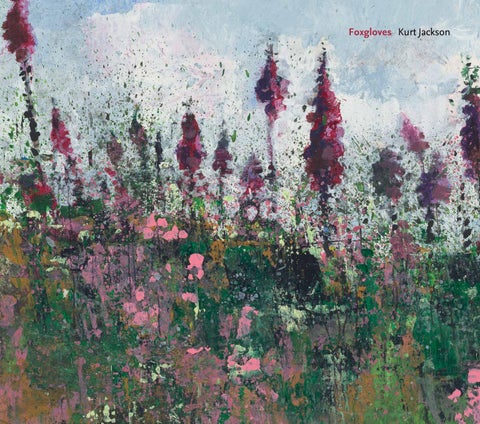
Foxgloves Kurt Jackson


Foxgloves
2025 was the year of the foxgloves, not as in a Chinese year but simply in the mass and profusion of these flowers blooming. I have obviously worked with these plants many times before, but this year I studied them intensely across Cornwall; everywhere I found myself, the foxgloves were there as well, waiting to be painted. It often seems to me incredible that the hedges and field margins are bedecked by such a magnificent flower. As showy and eye-catching as any lupin or delphinium, in fact it is one of the few wildflowers often grown in the garden in the same form as is found in the wild in Britain; it just doesn’t need to be improved or changed.
I painted them repeatedly and found that their colour and tone depended on the light; they are creatures of sunlight, absorbing and reflecting, their form defined by strong directional light. High-lit or silhouetted, the bells can be deep purple almost black to shining white, pink, fuchsia with all the range between; maroon, mauve, magenta, carmine. Up close they are a column, a spike of pods and bells; a stack arranged vertically, tottering in declining size as they rise up the stem. And when studied within touching
distance they come alive with the endless visits of bumblebees, rattling and buzzing with the hum and drone of these speedy pollinators. They are beautiful plants to paint, complete in colour, form, movement and sound.
They are also powerful plants. When admiring their beauty and charisma there is also a wisdom somehow attached to those nodding heads. Can there be such a thing as a wise plant? Or is it a sort of well-bred, noble presence? think it’s tied up with their herbal, chemical properties. A plant that can control your heart.
As I read in the Woodland Trust magazine: “…towering flower spikes bring a splash of colour to the woodland understory, but common foxgloves Digitalis purpurea) – also known as dead men’s bells – have a deadly defence mechanism. Toxic cardiac glycosides throughout the plant can cause severe poisoning to anyone who consumes them. However, these same chemicals are used in conventional medicine to treat heart failure and high blood pressure. It’s therefore been said that foxgloves have the power to ‘raise the dead but kill the living’.”
I painted them against the sky and the land, laying them over the background or bringing the surroundings in and over to establish their exact form, their ‘foxgloveness’; dark shadows pushing in, to contrast them against their backlit varnished glow or layers of
vivid grass-green placed up to and around the silhouetted bells and thin stem. In the early mornings and late afternoons, the plants carry their halos when the low light delineates each bell, bud, pod and the stem. Edged, rimmed as if by ice they shine sharply to define their distinct form.


Hedge Ogle
I look at you
And you look at me
Every hedge has an eye (and ditch an ear)
An eye to eye contact
Crossing the animal-plant divide
Multi-eyed feminine fatale
In your feminizing purple
You shimmy, shudder, sway
Seductively
Freckled, heavy browed, brooding
All noddle and backbone
Confident
You, hold your head high
Fix me with that stare
A stare across an empty room
We know our place, our stations
Never to really meet
We cannot connect across this divide.
May, 2025


Inconvenient Beauty
Ascending the steps
Those chunky granite blocks
As lumpen as handmade chips I come face to face
With a bold brazen foxglove Centre stage
Floodlit in glorious saturated colour
By the low solstice sun
She blocks my stride
Stares me down
All buzzy and rattley
With her fat bumbles
In vibrant violet bells
What can I do?
But step aside
Detour around
Acknowledging her superiority
A bow to hierarchy I pass on by Summer, 2025


Mid-August, Frenchman’s Creek
At the side of the path, on the ground amongst the ferns I see a scattering of pink foxglove tubes. Up above me, standing looking down on me is a final flowering foxglove. Over two meters tall, the stalk is as knobbly as a line of vertebrae and lanky with just four bright flowers perched on the very top. It must have bloomed dozens of times over its three or four months of continual flowering, and now was on its last. It tottered, swayed in the breeze. A bee landed on the pink petals causing the plant to bow down. The bumblebee, a carder bee, orange-brown and furry, disappeared inside the flower but the rattling buzz was audible as it tumbled around inside. When it took off and flew away, the plant once again sprang back, delicately balanced like a set of weighing scales.
I stood and drew the tall thin foxglove in its woodland setting beneath the ash trees. Was this my last flowering foxglove of the year? Around her feet next year’s plants were growing, bunched crowns of green leathery leaves.
A vivid orange apparition alighted on the foxglove flower, tangerine bright, as if a piece of orange peel had floated down. The comma butterfly fluttered to sip from the petals, perched for a few minutes and then was off, disappearing into the trees.
Yet another tube fell from the foxglove, tumbled down to join the others littering the woodland floor. Now only three remained; time was visible here, tangible.


I sit in the deep dark shade of a patch of Cornish woodland. In front of me stands a solitary foxglove, vertical and still; seven purple bells on top of a thin stem. The plant is noticeable because dappled sunlight spotlights the topmost buds against the dark green background. Almost theatrical, the colourful star on her stage, and I am the audience. I paint her portrait on a board propped before me, this purple in the green.
The air is dominated by the stink of a fox; ironically the flower’s namesake has scented this place, marked my spot, made it foxy. Reynard’s aftershave is cloying and probably clinging; I wonder whether I will carry it away with me afterwards along with my painting. Midges nibble, distracting me. A blackcap sings above, a beautiful summer melody while the occasional visiting bumblebee buzzes into my arena and out again, entering stage left, leaving stage right.
As the afternoon progresses, the sunlight’s focus shifts to other parts of the foxglove. A single bell is illuminated fuchsia bright, then a large pale leaf at the base lights up, then a section of the stem. Searchlight bright. It makes me examine the plant part by part, almost anatomically, botanically. The same shift with the sun’s arc happens all around, the mass of brambles, grass and tree leaf are dappled bright and dark with a host of shades of green, vivid grass-green through to almost black; moving slowly all-around. All is dynamic but in slow motion.
June, 2025


Periglis
Foxgloves
Gladioli
Some campion
A smudge of seasonal glow
For the winds to blow
Of Scilly pink, magenta, maroon
Party bright
Confectionary dainties
Toe varnish vivid
Lipstick hues
This warmth of the hedge
Skirts the sea’s edge
Gathers the sunlight
The sun’s own paint
At the end of the day
In this summer’s May
To the delight of the evening
This red array
May, 2025


Close Up
Looked at closer, full in the face, eye to eye so to speak, you see that the mauve gloves are paler inside with a rash of tiny spots, a dark purple, measly, speckled in the interior. The ceiling of the flower is lined with delicate linear anthers, each loaded with yellow pollen, ready to stroke the hairy back of a bee. The anthers surround the stamen, and once the flowering is over and the petals have fallen, this single filament is what remains, protruding from the slowly swelling base – the new seedpod. The pods, each with their multilobed surrounds, desiccate and turn brown once all the flowers have finished, and then the dried foxglove soon resembles a rusty wrought-iron floral piece, a vertical length of gothic metalwork, decorative, almost like ecclesiastical Victoriana. When accompanied by a haze of pretty pink from the campion flowering alongside, the array of purplepink-cerise is nearly garish. Gorgeous. And then the sorrel’s rusty red sprays of Venetian terracotta add to the red spectrum and the occasional wild gladiolus (the whistling jacks) trespass into the wildflower show, just to confuse the eye and exaggerate this floral display.
The foxgloves provide a welcome vertical element to my compositions in this horizontal world. They disrupt the flatness, provide drama as well as the dabs of colour punctuating the hedges, backs of beaches and field edges.
On St Agnes on Scilly I wrote, “… are these the most westerly foxgloves? ... The skyline is broken by the purple spikes everywhere you look. Except for at the actual water’s edge, they grow across the island pushing up through the gorse, brambles or grass; swaying gently in the breeze.”
I wandered all over the island, across and around, finding foxgloves posing for me against blue seas and the glowing Atlantic, between the small fields and on the verge of the paths. Every carn was topped by its own massive granite boulders but alongside foxgloves competed, piercing the skies to overlook the island. They kept watch, stately, aristocratic, graceful. I was there at the peak of their flowering season; they are at their best in May but will continue for a good few more months as the buds open further up the spikes
June, 2019


The Season’s End
Summer is moving on now, and yet I still find one last foxglove in flower. A few bright petals at the top of the tall stem. It’s funny this seasonal business we all live through, take for granted. The last flash of purple by the hedge before the long autumn and winter, before we (us and the foxglove) will meet again. It’s like saying goodbye to someone; knowing that you won’t meet again till the next whatever – holiday, visit? That enforced gap of separation. These timely associations that result, when a presence is combined with a season and the weather at the time, it all leads to memories, nostalgia, emotive connections. This year will always exist as the ‘foxglove year’ for me, these plants will now always provoke memories of the family and these times, walking in our fields with the grandchildren, the cattle, the long hot summer; joy and happiness.
August, 2025


About Kurt Jackson
A environmentalist and true polymath, Jackson’s holistic approach to his subject seamlessly blends art and politics providing a springboard to create a hugely varied body of work unconstrained by format or scale.
Jackson’s artistic practice ranges from his trademark visceral plein-air sessions to studio work and embraces an extensive range of materials and techniques including mixed media, large canvases, print-making and sculpture.
The son of artists, Jackson was born in Blandford, Dorset in 1961. While studying Zoology at Oxford University he spent most of his time painting and attending courses at Ruskin College of Art. On gaining his degree he travelled extensively and independently, painting wherever he went before putting down roots in Cornwall with his wife Caroline in 1984.
Jackson’s focus on the complexity, diversity and fragility of the natural world has led to artist-in-
residencies on the Greenpeace ship Esperanza the Eden Project and for nearly 30 years Glastonbury Festival which has become a staple of his annual working calendar.
Over the past forty years Jackson has had numerous art publications released to accompany his exhibitions.
Six monographs on Jackson have been published by Lund Humphries depicting his career so far; A New Genre of Landscape Painting (2010), Sketchbooks (2012), A Kurt Jackson Bestiary (2015), Kurt Jackson’s Botanical Landscape (2019), Kurt Jackson’s Sea (2021) and Kurt Jackson’s Rivers (2024). A Sansom & Company published book based on his touring exhibition Place was released in 2014.
Jackson regularly contributes to radio and television and presents environmentally informed art documentaries for the BBC and was the subject for an awardwinning BBC documentary, A Picture of Britain.
He has an Honorary Doctorate (DLitt) from Exeter University and is an Honorary Fellow of St Peter’s College, Oxford University and an Honorary Fellow of Arts University Plymouth and a Bard of the Gorsedh Kernow (Cornish Gorsedd). He is an ambassador for Survival International and frequently works with Greenpeace, Surfers Against Sewage, Friends of the Earth and The Wildlife Trusts. He is a patron of human rights charity Prisoners of Conscience. He is an academician at the Royal West of England Academy.
Kurt Jackson and his wife Caroline live and work in the mostwesterly town in Britain, St JustinPenwith where in 2015 they set up the Jackson Foundation. Kurt and Caroline have three grown children and eight young grandchildren.
Jackson Foundation
North Row | St Just | tr19 7lb
info@kurtjackson.com jacksonfoundationgallery.com
+44 (0) 1736 787638
First published in 2026 for the Foxgloves exhibition, by Kurt Jackson Editions www.kurtjackson.com
isbn 978-1-0686620-6-5
Publication © Kurt and Caroline Jackson Ltd 2026
All images, words and poetry © Kurt Jackson 2026
Portrait photography © Maceo Tucker 2026
Art Photography by Fynn Tucker and The Logical Choice
@jacksonfgallery f
jacksonfoundation
Design by Lyn Davies www.lyndaviesdesignfolio.com