XXXX
KÜNKER EXKLUSIV
NEWS FROM THE AUCTION AND GOLD MARKET
Fall Auction Sales 445-446 22-25 September 2026 in Osnabrück
The Imperial Collection, Part II eLive Premium Auction 450
Page 20
#39 2026
1
2
KÜNKER EXKLUSIV
NEWS FROM THE AUCTION AND GOLD MARKET
In this Issue
Dates 2026/27
Preface
3
Sberatel Coinshow in Prag
4-5 September 2026
Fall Auction Sales 445-446
4
Fall Auction Sales 445-446
22-25 September 2026
A preview of our eLive Auction 94
18
COINEX in London
25-26 September 2026
On Views
19
eLive Auction 94
eLive Premium Auction 450 The Imperial Collection, Part II
20
Munich Show in München
23-25 Oktober 2026
Coins from Poland’s “Golden Age”
26
Winter Auction Sale 447
2-4 November 2026
There Is No Mention of This in the Jaeger Catalog – Ernest Louis of Hesse-Darmstadt
38
eLive Premium Auction 448-449
9-11 November 2026
NUMISMATA Berlin
14-15 November 2026
The Imperial Collection, Part I an auction evening for the history books Reception on the eve of Auction 442 Lecture by Fritz Rudolf Künker: The Hohenzollerns in the 19th century – A German history
63 64 68 70
eLive Premium Auction 450-451
24-25 November 2026
Künker at the premiere of the NUMISMATIK@Munich Show
84
The Saxon Vicariate coinage
86
New exhibition at the Hamburger Kunsthalle
106
Coins as miniature sculptures: The collection concept of the Hamburger Kunsthalle
108
5-9 Oktober 2026
eLive Auction 95
1-4 Dezember 2026
Legal Notice Publisher
Photography Floor Auction Sales
Fritz Rudolf Künker GmbH & Co. KG
Lübke + Wiedemann KG, Leonberg
Nobbenburger Straße 4a
B.Seifert
49076 Osnabrück
Four decades at Künker
116
www.kuenker.de
Book launch: Minted Glory
118
Proofreading
Photography eLive Auction 94 Fritz Rudolf Künker GmbH & Co. KG
Georg Müller
Responsilble according to press law Dr. Andreas Kaiser
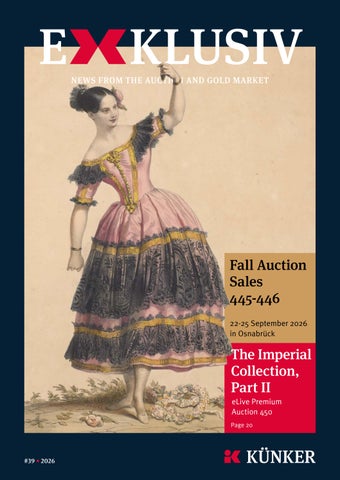
Editors Cover picture Fanny Elßler dancing the “Cachucha”. Coloured copperplate engraving from 1842.
Prof. Dr. Paul Arnold
Prof. Dr. Torsten Fried
Druck- und Verlagshaus
Dr. Ursula Kampmann
Fromm+Rasch GmbH & Co.KG
Julia Kröner
www.frommrasch.de
Inja MacClure Dr. Margret Nollé Dr. Hertha Schwarz Dr. Martin Ziegert Typesetting and layout Helge Lewandowsky
ISSN 3052-0630
PREFACE
KÜNKER EXKLUSIV
Dear Customers and Coin Enthusiasts,
welcome to the Fall 2026 edition of our magazine Künker Exklusiv. For many collectors, fall is one of the highlights of the numismatic year. With our Fall Auction Sales 445 and 446, we are once again presenting a diverse selection of outstanding coins and medals that bring history to life in all its facets. You will find an initial overview of the highlights of these auction sales at the beginning of this issue. In addition, the coins from Poland’s “Golden Age” featured in Auction Sale 445 bear witness to an era of cultural flourishing and political strength, offering fascinating insights into European history. We would also like to draw your special attention to our eLive Auction 94 in October as well as the two eLive Premium Auctions 450 and 451 taking place in November of this year. With Catalogue 450, we are proud to present the second part of the Imperial Collection, featuring numismatic treasures from the possessions of the Prussian kings and German emperors of the House of Hohenzollern. However, this issue offers many exciting discoveries beyond our auctions as well. We introduce you to coins of Landgrave Ernst Ludwig of Hesse-Darmstadt and take a closer look at numismatic peculiarities that have remained unmentioned even in the standard reference works. Another article explores the history of the Electoral Saxon vicariate coinage, whose powerful imagery and political significance continue to captivate collectors and historians alike.
Our reports on the new exhibition at the Hamburger Kunsthalle and its extraordinary collecting concept demonstrate just how closely art and numismatics are connected. Here, coins are viewed as miniature sculptures and presented from an art-historical perspective, opening up new ways of appreciating familiar objects. In addition, we look back on special events at Künker: Auction Sale 442, which brought history vividly to life, as well as the reception on the evening before the sale, featuring a lecture by Fritz Rudolf Künker on the Hohenzollern dynasty in the 19th century. Last but not least, we report on the premiere of the NUMISMATIK@Munich Show, which will once again underscore in October just how vibrant and international our shared passion is. We hope you enjoy reading this issue, making exciting discoveries, and, of course, wish you every success in our upcoming auction sales. Perhaps we will have the pleasure of welcoming you personally to Osnabrück or meeting you at one of the many numismatic events in the near future. We always look forward to such opportunities!
Ulrich Künker
Dr. Andreas Kaiser
3
4
KÜNKER EXKLUSIV
FALL AUCTION SALES 445-446
The Finest Specimen of the Rarest Gold Coin of the German Empire ... ... is just one of the many highlights of our upcoming Fall Auction Sales. Taking place from 22 to 25 September 2026, the auctions present coins and medals from medieval and modern times, including many special collections such as “Argentum Poloniae” and the collection of a physicist with coins of the German Empire in fabulous condition. Once again, collectors can look forward to an interesting and diverse auction week in Osnabrück. From 22 to 25 September 2026, we will auction a colorful selection of coins and medals from medieval to modern times in auctions 445 to 446, featuring many special collections. Catalogs 445 and 446 comprise a total of nearly 2,600 lots with a total estimate of around 5 million euros. Of particular note are: “Argentum Poloniae” – The collection of Polish talers, another part of the impressive collection of Kommerzialrat Dr. Herbert Wenzel with Habsburg coins and medals, the Erich Götz Collection with a focus on his homeland of the Upper Palatinate, the collection of a Rhineland collector and art enthusiast featuring gold coins from around the world, For auction catalogs 445-446 and a
and, last but not least, the collection of a physicist with coins of the German Empire in fabulous condition and partly with spectacular patinas.
detailed auction overview simply scan the adjacent QR code.
FALL AUCTION SALES 445-446
KÜNKER EXKLUSIV
5
Argentum Poloniae
Lot 2 Sigismund III., 1587-1632. Reichstaler 1623, II-VE, Bromberg. Extremely rare. Very fine. Estimate: 3,500 euros
Under the title “Argentum Poloniae”, 113 talers reflecting the fate of Poland are being offered: depicting the kings who once ruled the First Polish Republic, these coins – some in outstanding condition – range from Stephen Báthory to the Duchy of Warsaw. As the Sejm reserved the right to elect the Polish king, the coins feature the portraits of rulers from various dynasties. The period during which the House of Wettin held the Polish throne is particularly well represented. The collector assembled this collection with meticulous care and scholarly rigor, and it impresses with its remarkable completeness. Learn more about the eventful history of this country in the heart of Europe through these Polish talers!
Lot 12 Wladislaw IV., 1632-1648. Reichstaler 1641, G-G, Bromberg. Rare. Attractive specimen with fine patina, very fine+. Estimate: 1,250 euros
Lot 54 City of Thorn. Reichstaler 1637. Rare. Lot 32
Nice Patina, extremely fine.
Stanislaus August, 1764-1795. Talar 1793.
Estimate: 1,250 euros
Very rare. Nice Patina, almost extremely fine. Estimate: 1,500 euros
Lot 79 Lot 42
Electorate of Saxony. Friedrich August I., 1694-1733
City of Danzig. Reichstaler 1645.
(August the Strong). Reichstaler 1721, Dresden.
Extremely rare. Very fine +.
Attractive specimen with nice patina, extremely fine.
Estimate: 2,000 euros
Estimate: 1,500 euros
6
KÜNKER EXKLUSIV
FALL AUCTION SALES 445-446
Lot 92
Lot 113
Electorate of saxony. Friedrich August II., 1733-1763.
Electorate of saxony. Friedrich August I., 1806-1827.
Reichstaler 1740, Dresden, to the Imperial Vicariate.
Talar 1811, IB, for the Duchy of Warsaw. Rare.
Rare, especially in this condition. Very attractive specimen with
Very fine-extremely fine.
nice patina, extremely fine.
Estimate: 400 euros
Estimate: 2,000 euros
Habsburg Rarities from the Dr Herbert Wenzel Collection
By now, Kommerzialrat Dr Herbert Wenzel is a well-known figure among collectors. In the world of numismatics, his name is synonymous with Habsburg rarities in the finest condition. Coins from his collection are featured once again in catalogs 445 and 446. This time, it is not only the great rarities that command special attention, but also Habsburg small coins. Selected with great care and expert knowledge, they are offered in thoughtfully curated multiple lots, with estimates predominantly in the two- and three-digit ranges. Collectors of Habsburg coinage cannot afford to miss out on a thorough reading of this catalog!
1,5:1
Lot 2292 Holy Roman Empire. Ferdinand II., 1592-1618-1637. 20 Ducats 1622, Klagenfurt. Extremely rare and of great numismatic significance. Along with the specimen in the Horsky Collection, this is likely the second known specimen. Fine golden hue, very fine to extremely fine. Estimate: 100,000 euros
The undisputed highlight of this section is a 20-ducat piece by Ferdinand II from the Klagenfurt mint. Dr. Herbert Wenzel acquired it in 1949 from the heirs of the High Court Judge Dollinger (lot No. 2292). This coin has not been on the market since. It is remarkable because multiple gold coins from Klagenfurt are extremely rare. After all, the mint of Carinthia was actually located in St. Veit. However, the right to mint coins was disputed – the Carinthian estates claimed to have the right to mint coins themselves as they were keen to preserve their independence. Therefore, Archduke Ferdinand established a princely mint in Klagenfurt in 1522. This mint ceased operations as early as 1622.
FALL AUCTION SALES 445-446
KÜNKER EXKLUSIV
1,5:1
Lot 2309 Holy Roman Empire. Leopold I, 1657–1705. 2 ducats, 1682, Vienna. Very rare, especially in this condition.
1,5:1
Magnificent specimen. Extremely fine-uncirculated. Estimate: 7,500 Euro
Lot 2357 Holy Roman Empire. Joseph II, 1765–1790. 4 ducats, 1786 A, Vienna. Extremely rare. Fine golden patina, extremely fine. Estimate: 10,000 Euro
Lot 293 Holy Roman Empire. Maximilian I, 1490–1519. Double Schauguldiner 1509, Hall, commemorating his accession to the imperial title. Very rare, especially in this condition. Unusually cleanly struck specimen. Attractive patina, minute collector’s mark on the rim, extremely fine. Estimate: 10,000 Euro
Lot 314 Holy Roman Empire. Ferdinand I, 1522–1558–1564. Silver medal, 1547, unsigned, Wolf Milicz workshop, commemorating the death of his wife, Anna Jagiello, on January 27. Extremely rare. Attractive specimen with a fine patina, very fine+. Estimate: 4,000 Euro
7
8
KÜNKER EXKLUSIV
FALL AUCTION SALES 445-446
Lot 322 Holy Roman Empire. Maximilian II, 1564–1576. Silver medal, 1566, unsigned, Nickel Milicz workshop. Magnificent Renaissance portrait. A superb specimen in excellent condition. Fine patina, almost uncirculated. Estimate: 7,500 euros
Lot 328
Lot 352
Holy Roman Empire. Archduke Ferdinand, 1564–1595.
Holy Roman Empire. Matthias, 1608–1612–1619.
Guldentaler (60 Kreuzer), 1567, Mühlau. Extremely rare.
Thick double Reichstaler, undated, Prague. Very rare,
Superb specimen. Beautiful patina, extremely fine-uncirculated.
especially in this condition. A very attractive specimen
Estimate: 4,000 euros
with a lovely patina, almost extremely fine. Estimate: 12,500 euros
Lot 354 Holy Roman Empire. Matthias, 1608–1612–1619. Quadruple Reichstaler, 1614, Vienna. Extremely rare. Attractive specimen with a fine patina, very fine to extremey fine. Estimate: 25,000 euros
Lot 406
Lot 426
Holy Roman Empire. Frederick of the Palatinate
Holy Roman Empire. Ferdinand III, 1625–1637–1657.
(the Winter King), 1619–1621. Reichstaler, 1621, Heidelberg.
Thick quadruple Reichstaler, 1642, Vienna. Of the utmost
Extremely rare. Attractive specimen with a fine patina,
rarity. Attractive, sharply defined specimen
extremely fine.
with a magnificent patina, almost extremely fine.
Estimate: 10,000 euros
Estimate: 20,000 euros
FALL AUCTION SALES 445-446
KÜNKER EXKLUSIV
Lot 546
Lot 565
Austrian Empire. Franz Joseph I, 1848–1916.
Diocese of Gurk. Johann VI von Schönburg, 1552–1554.
Taler, 1877, Vienna. Commemorating the opening of the Carl-
Taler, 1553, bearing the title of Ferdinand I.
Ludwig-Haus on the Raxalpe. Only 100 copies minted. Magnificent
Extremely rare. A very attractive specimen
specimenwith a splendid patina. Tiny scratches, proof.
with a fine patina, extremely fine.
Estimate: 10,000 euros
Estimate: 10,000 euros
The Erich Götz Collection
Lot 633 Electorate of Bavaria. Maximilian I, 1598–1651. Reichstaler, undated (1623), Amberg, bearing the title of Ferdinand II, for the Upper Palatinate. Extremely rare.
Coins offer a fascinating insight into past eras and distant cultures, providing a wonderful opportunity to take a break from the daily grind. This was the view of Erich Götz, a collector who traded minerals from over 60 countries in his busy daily life. Born in the Upper Palatinate, Erich Götz knew the whole world. Nevertheless, he was most passionate about the history and numismatics of his homeland. Coins minted in Regensburg, Amberg, Neumarkt, Cham or Nabburg are at the center of his collection – although he was certainly enthusiastic about other fields as well. His 1992 book, “Die Münzprägung der Oberpfalz - Geschichte und Katalog” (Coinage of the Upper Palatinate: History and Catalog), bears witness to his love of the region’s numismatics. The book also demonstrates the depth of knowledge and patience with which Erich Götz assembled his Upper Palatinate coin collection.
Beautiful patina, almost extremely fine. Estimate: 1,000 euros
Lot 640 Electorate of Bavaria. Ferdinand Maria, 1651–1679. Reichstaler, 1657, Munich, issued by the Vicariate. Very rare. Attractive patina, almost extremely fine. Estimate: 2,500 euros
9
10
KÜNKER EXKLUSIV
FALL AUCTION SALES 445-446
Lot 807
Lot 887
Teutonic Order in Mergentheim.
Landgraviate of Leuchtenberg. George III, 1531–1555.
Johann Eustach von Westernach, 1625–1627.
½ taler, 1547, Pfreimd, bearing the title of Charles V.
Reichstaler, 1625, Nuremberg. Attractive patina,
Extremely rare.
almost extremely fine.
Attractive, very fine specimen.
Estimate: 1,000 euros
Estimate: 1,500 euros
1,5:1
Lot 931 Mint of the Dukes of Bavaria. Nabburg. Margrave Heinrich (known as Hezilo) of Schweinfurt, 1003.
Lot 963
Denarius. Extremely rare. Attractive patina, extremely fine.
Duchy of Palatinate-Neuburg.
Estimate: 1,000 euros
Otto Heinrich and Philipp, 1504–1544. Silver cast medal, 1531, unsigned, by M. Gebel, Nuremberg, depicting Otto Heinrich. Contemporary cast. Attractive patina, extremely fine. Estimate: 750 euros
1,5:1
1,5:1
Lot 968
Lot 977
Upper Palatinate. Frederick II, 1508–1556.
Mint of the Dukes of Bavaria. Regensburg.
Zehner (12 Kreuzer), 1527, Amberg.
Eberhard, 937–938. Denarius, Regensburg.
Extremely rare. Attractive patina, extremely fine.
Extremely rare. Very fine.
Estimate: 1,250 euros
Estimate: 1,500 euros
Lot 1189 County of Wolfstein. Christian Albrecht, 1693–1740. Silver coin weighing 1/2 Reichstaler, 1719, commemorating the laying of the foundation stone for the castle church in Obersulzbürg. Very rare. Very attractive specimen with a lovely patina, extremely fine. Estimate: 2,500 euros
FALL AUCTION SALES 445-446
1,5:1
KÜNKER EXKLUSIV
11
1,5:1
Lot 2444
Lot 2653
Electorate of Bavaria. Maximilian I, 1598–1651.
Electorate of the Palatinate. Ruprecht II, 1390–1398.
2 ducats, 1618, Munich. Attractive specimen
Gold guilder, undated (1395–1397), Amberg.
with a fine golden hue, extremely fine.
Extremely rare. Second known example.
Estimate: 2,500 euros
Very fine–extremely fine. Estimate: 5,000 euros
Gold Coins of a Rhineland Collector and Art Enthusiast
The Rhineland collector and art enthusiast whose exquisite collection of gold coins is being offered at auction 446 did not seek to amass a complete collection. The only factors that mattered to him were the quality and the aesthetic appeal of a piece, regardless of its era of origin. This approach resulted in a remarkably diverse collection characterized by excellent condition and refined taste. The collection combines classic numismatic treasures with rare, exotic 20th-century gold coins, offering something for a wide range of collecting interests.
Lot 2116 Grand Duchy of Luxembourg. Charlotte, 1919–1964. 20 francs, 1946, Brussels, by A. Bonnetain, commemorating the 600th anniversary of the Battle
Lot 2267
of Crécy and the heroic death of John the Blind.
United States of America.
Gold proof. Extremely rare. Only 25 copies minted.
10 dollars, 1801, Philadelphia. Very rare.
NGC PF 63 Ultra Cameo (Top Pop). Proof.
Attractive specimen, minute edge defect,
Estimate: 5,000 euros
minute handling mark in the field of the obverse, nearly extremely fine. Estimate: 10,000 euros Lot 2478 Electorate of Brandenburg. Frederick William, the Great Elector, 1640–1688. 2 ducats, 1677, IH, Berlin, commemorating the conquest of Stettin. Very rare. Magnificent specimen. NGC MS 62 (Top Pop). Very attractive, extremely fine-uncirculated. Estimate: 7,500 euros
12
KÜNKER EXKLUSIV
FALL AUCTION SALES 445-446
Lot 2565 City of Hamburg. Private Portuguese coin worth 10 ducats, undated (1679), unsigned, by J. Rethe or his son Johann Reteke, based on the Pinneberg Interim Recess. Extremely rare. Magnificent specimen with polished dies. NGC MS 61 PL. Extremely fine-uncirculated. Estimate: 20,000 euros
1,5:1
Lot 2589 Duchy of Jülich-Berg. Johann Wilhelm II, 1679–1716. 2 ducats, 1711, Düsseldorf, for the vicariate. Very rare. A very attractive specimen, almost extremely fine. Estimate: 5,000 euros
1,5:1
1,5:1
Lot 2657
Lot 2666
Electorate of the Palatinate. Karl Philipp, 1716–1742.
Duchy of Pomerania, under Swedish rule.
Rheingold ducat, undated (circa 1740), Mannheim.
Charles X Gustav, 1654–1660. 2 ducats, 1658, Stettin.
Very rare.Extremely fine.
Extremely rare. A very attractive specimen
Estimate: 4,000 euros
with a fine gold patina, almost extremely fine. Estimate: 10,000 euros
1,5:1
1,5:1
Lot 2667
Lot 2733
City of Regensburg. Ducat, undated (1742).
Wallenstein, Albrecht, 1623–1634, Duke of Friedland.
Extremely rare. NGC MS 62.
Ducat, 1630, Jičín. Extremely rare. ALmost extremely fine.
Extremely fine-uncirculated.
Estimate: 20,000 euros
Estimate: 6,000 euros
FALL AUCTION SALES 445-446
Coins of the German Empire from the Collection of a Physicist
KÜNKER EXKLUSIV
The final collection we are pleased to present comprises an exceptional series of coins of the German Empire, assembled by a passionate physicist. This offering will thrill collectors who appreciate perfect condition and fascinating patinas. Whatever your budget, you are sure to find some pieces missing from your collection with estimates that fit your budget. However, be prepared for the fact that coins of this quality are currently attracting great interest worldwide. Accordingly, it is likely that the hammer prices will be significantly higher than the estimates. Many experts also believe that the market potential of coins of the German Empire is far from exhausted. Two additional collections complement this offering of a kind that can only be found on rare occasions. The exceptional nature of this offering is illustrated by the fact that 62 of the 503 lots are “Top Pop”.
2:1
Lot 2789 1 Pfennig, 1905 E. Extremely rare. NGC MS 64 BN (Top Pop). A magnificent specimen. Attractive copper patina, extremely fine-uncirculated. Estimate: 10,000 euros
Lot 2813
Lot 2859
Baden. Frederick I, 1852–1907.
Hesse. Ludwig III, 1848–1877. 2 Mark, 1876.
5 Mark, 1875, without a horizontal line in the “A.”
Extremely rare in this condition. NGC PF 63.
Extremely rare in this condition.
Beautiful patina, tiny scratches, proof finish.
PCGS PR 62 CAM (Top Pop). A showpiece.
Estimate: 12,500 euros
Fine patina, proof finish. Estimate: 12,500 euros
Lot 2842 Bavaria. Ludwig III, 1913–1918. 3 Mark, 1918. Commemorating the golden wedding anniversary of the Bavarian royal couple. Very rare. Superb specimen. Unciculated. Estimate: 30,000 euros
13
1,5:1
14
KÜNKER EXKLUSIV
FALL AUCTION SALES 445-446
1,5:1
Lot 3175 Reuss Elder Line. Heinrich XXII, 1859–1902. 20 marks, 1875. Extremely rare. Magnificent specimen. Almost uncirculated. Estimate: 35,000 euros
2,5:1
1,5:1
Lot 3212 Saxony-Meiningen. George II, 1866–1914. 20 Mark, 1872. Extremely rare, especially in this condition. NGC MS 65 (Top Pop). A cabinet piece of the finest quality. Almost uncirculated. Estimate: 25,000 euros
Lot 3203 Saxe-Coburg and Gotha. Ernst II, 1844–1893. 20 Mark, 1872.
1,5:1
Extremely rare, especially in
Lot 3273
this outstanding condition.
German New Guinea. 10 New Guinea Marks, 1895 A. Only 2,000
NGC MS 67 (Top Pop). Arguably
coins minted. NGC MS 67 (Top Pop).
the best-preserved specimen.
A magnificent specimen of the finest quality. Uncirculated.
First strike, proof-like finish.
Estimate: 40,000 euros
Estimate: 100,000 euros
World Rarities
Lot 129 Kingdom of France. Louis XIV, 1643–1715. 1/2 Ecu, bust draped in the classical style, 1687
As always, Künker offers a wide range of world coins and medals including numerous rarities as well as more affordable options. We would like to showcase special pieces to you – but be sure to browse through all the lots to find your favorite.
(Year in the die changed from 1686) A, Paris. Extremely rare, especially in this condition. Attractive specimen with a lovely patina, almost uncirculated. Estimate: 10,000 euros
FALL AUCTION SALES 445-446
KÜNKER EXKLUSIV
15
Lot 238 Kingdom of Sweden. Gustav II Adolf, 1611–1632. Silver medallion (worth 5 talers) 1634, by S. Dadler, commemorating his death at Lützen on November 6, 1632, and his burial at Riddarholmskyrkan in Stockholm on June 22, 1634. Superb specimen. Magnificent patina, almost uncirculated. Estimate: 20,000 euros
Lot 569 Archdiocese of Salzburg. Johann Jakob Khuen von Belasi, 1560–1586. Triple Schautaler from 1572, unsigned, commemorating the defeat of the plague. Extremely rare. Attractive specimen with a fine patina, very fine to extremely fine. Estimate: 25,000 euros
Lot 2018 Kingdom of Belgium. Leopold I, 1830–1865. 100 francs, 1853, Brussels, commemorating the marriage of the heir to the throne, Leopold (later Leopold II), to Princess Marie Henriette of Austria. Only 482 coins minted. PCGS MS 63. Attractive specimen with polished dies,almost unciculated. Estimate: 40,000 euros
1,5:1
Lot 2046 Kingdom of France. Louis XVIII, 1814, 1815–1824. 40 Francs 1815 A. Trial Strike (Essai)
Lot 2074
in gold, by P. J. or N. P. Tiolier.
United Kingdom. George V, 1910–1936. 5 Pounds, 1911, London.
Extremely rare. NGC PF 62 Cameo.
Only 2,812 coins were struck. Rare in this condition.
Magnificent specimen. Uncirculated.
PCGS PR 66. Magnificent specimen. Proof.
Estimate: 60,000 euros
Estimate: 25,000 euros
16
KÜNKER EXKLUSIV
FALL AUCTION SALES 445-446
Lot 2091 Naples and Sicily. Ferdinand IV (I) of Bourbon, 2nd reign, 1799–1805 (–1825). Portable gold medal from 1799, by D. Perger, commemorating the British Navy’s support for the restoration of Ferdinand as King of Naples. Extremely rare. Very fine/extremely fine. Estimate: 20,000 euros
Lot 2135 Kingdom of Portugal Maria II, 1834–1853. Peça (7,500 reis), 1833, Lisbon. NGC MS62+. Very rare year. Only 265 coins were struck. Superb specimen. Nearly proof-like. Estimate: 5,000 euros
As you know, the German States are our specialty. Once again, we are offering an extensive selection of pieces from the many imperial cities, abbeys and principalities that had the right to mint coins. You can look forward to many coins and medals – some of which are rare, in excellent condition or of great historical significance. Every now and then, you’ll come across a piece that combines all three of these characteristics.
Rarities from the German States
Lot 879 Duchy of Berg. Joachim Murat, 1806–1808. Taler, 1807. Cassataler. Extremely rare in this condition. Attractive patina, extremely fine-uncirculated. Estimate: 10,000 euros
Lot 1071 Electorate of Saxony. Johann Georg II, 1656–1680. Wide triple Reichstaler, 1663, Dresden. Beichttaler. Extremely rare. A very attractive specimen with a magnificent patina, slight lack of relief, extremely fine+. Estimate: 15,000 euros
FALL AUCTION SALES 445-446
KÜNKER EXKLUSIV
Lot 1134
Lot 1179
County of Schaumburg-Lippe. Philip I, 1647–1681.
Wallenstein. Albrecht, 1623–1634, Duke of Friedland.
Reichstaler, 1660, Bückeburg. Only 200 coins minted.
Reichstaler, 1627, Jitschin. Very rare. NGC XF 45.
A very attractive specimen with a magnificent patina,
Beautiful patina, very fine - extremely fine.
extremely fine.
Estimate: 17,500 euros
Estimate: 10,000 euros
1,5:1
Lot 2464
Lot 2479
Kingdom of Bavaria. Maximilian II, 1848–1864.
Electorate of Brandenburg. Frederick III, 1688–1701.
Union Crown, 1857. Only 771 coins minted.
20-ducat gold medal, 1692, by R. Faltz, commemorating
NGC MS 64 (Top Pop). Almost proof-like.
the construction of the “Lange Brücke” in Berlin.
Estimate: 10,000 euros
Extremely rare. Very fine - extremely fine. Estimate: 35,000 euros
Lot 2545
Lot 2621
City of Bremen. Gold medal, undated (1631–1660)
City of Nuremberg. 4 ducats, 1629,
by J. Blum, commemorating a wedding. Extremely rare,
bearing the title of Ferdinand II.
probably the only copy available on the market.
Extremely rare. Extremely fine-uncirculated.
PCGS MS 62. Attractive specimen with a fine golden hue,
Estimate: 25,000 euros
extremely fine-uncirculated. Estimate: 30,000 euros Lot 2691 Electorate of Saxony. Frederick Augustus I, 1694–1733 (August the Strong). 5 ducats, 1733, Dresden. Gold strike from the dies of the 1/2 Reichstaler. Attractive specimen, extremely fine-uncirculated. Estimate: 50,000 euros
17
18
KÜNKER EXKLUSIV
eLIVE AUCTION 94
A preview of our eLive Auction 94, 5-9 October 2026 on www.kuenker.auex.de
Cilicia Soloi. Stater, ca. 420 B.C.
Germania Anonym. Stater (Regenbogenschüsselchen), 50/25 B.C.
Grand Duchy of Hesse Louis II, 1830–1848. Gulden, 1843.
Römische Kaiserzeit
Concert Gulden, minted on the occasion of a
Augustus, 30 v.-14 n. Chr.
concert in honor of the Russian heir to the throne,
Denar, 15/13 v. Chr., Lugdunum.
the future Tsar Alexander II.
Kingdom of Prussia Electorate of Saxony
William II, 1888–1918. Gold medal worth
John George II, 1656–1680.
6 ducats undated (1893), by E. Weigand.
Reichstaler, 1660, Dresden.
Commemorative medal for
Erbländischer Taler.
services to military pigeon racing.
Archdiocese of Salzburg Paris von Lodron, 1619–1653. Kipper-24 Kreuzer, 1621. Imprinted with the denomination “74” on the reverse.
Principality of Waldeck Georg Heinrich, 1813–1845. Crown thaler, 1824.
Kingdom of Bavaria Principality of Reuss-Schleiz Heinrich LXII, 1818–1854. Association Double Taler, 1846.
Louis I, 1825–1848. Association Double Taler, 1844. Feldherrnhalle.
ON VIEWS
KÜNKER EXKLUSIV
There are 8 auctions open for viewing during our fall auction week.
Fall Auction Sales Viewings from Monday, 17 August 2026
eLive Auction 94 Viewings from Monday, 14 September 2026
Auction 445 T he Argentum Poloniae Collection | Coins and Medals from the Medieval and Modern Times, including the collections of Commercial Councilor Dr Herbert Wenzel (Habsburg) and Erich Götz (Bavaria, Upper Palatinate, and others)
Coins and medals from the Ancient World, the Middle Ages, and Modern Times
Auction 446 Gold coins from around the world, including the collection of Commercial Councilor Dr Herbert Wenzel (Habsburg) and the collection from a connoisseur of arts | German Coins after 1871 in the finest conditions, including the collection of a physicist
Auction 447 Coins from the Ancient World
Winter Auction Sale Viewings from Monday, 19 September 2026
eLive Premium Auction 448 Coins from the Ancient World – The Rolf W. Schumm Collection, Kornwestheim eLive Premium Auction 449 Coins from the Ancient World – The Collections from Dr Hartmut Kreutzer and Dr W. R. Collection, part 11
Fritz Rudolf Künker GmbH & Co. KG Nobbenburger Straße 4a 49076 Osnabrück We would kindly ask you for early registration for a viewing appointment.
eLive Premium Auction 450 The Imperial Collection, Part 2 eLive Premium Auction 451 Brandenburg-Prussia Collection (Middle Ages and 19th Century)
19
20
KÜNKER EXKLUSIV
THE IMPERIAL COLLECTION, PART II
The Imperial Collection, Part II We are delighted to be able to offer you a first glimpse of the second part of the Imperial Collection, which will be auctioned online as eLive Premium Auction 450 on 24 November 2026 at kuenker.auex.de. The approximately 400 items in this part also come from the personal collection of the Hohenzollern family, and bear witness to the enthusiasm of King Friedrich Wilhelm/Frederick William IV and his brother, Kaiser/ Emperor Wilhelm/William I, for Prussian history and numismatics.
Alongside coins and medals from Old Germany and the German Empire, connoisseurs will, of course, once again find a rich selection of European medals, including a substantial collection of the magnificent architectural depictions by the Wiener family of diecutters.
Coins and medals of Friedrich/Frederick II, whom both of the brothers held in high esteem, will go under the hammer, as will medals produced during the reigns of Friedrich Wilhelm III, Friedrich Wilhelm IV, Kaiser/ Emperor Wilhelm I and Kaiser Wilhelm II. Some of these are just as well-preserved, just as rare, and just as significant historically and numismatically as the items auctioned in the first part of the collection. The only difference is that these items are not made of gold, but of silver and bronze. For the silver medal commemorating the premiere of Antigone, the highest bid from an enthusiastic art lover during Auction 442 was 17,000 euros. Now the bronze version, in exactly the same condition, is being offered at a considerably lower price. It is reasonable to assume that the price will rise beyond this level.
It goes without saying that numerous bronze medals also found their way from Russian relatives into the Prussian royal house. Look forward to a wealth of truly exceptional items with a very special provenance!
Many of the commemorative medals relate to the ruling family, but this collection also includes numerous medals honouring individuals, such as a bronze medal commemorating the death of the Prussian mint master Gottlieb Ernst Kleinstüber, or a silver medal commemorating the death of the Prussian LieutenantGeneral Job Wilhelm von Witzleben, a close confidant of King Friedrich Wilhelm III. 1,5:1
Also worthy of mention is an extensive series of cast bronze medals commemorating figures and events of the First World War, created by Arthur Immanuel Loewenthal, one of the many German patriots of the Jewish faith who entered the service of the German Empire at the outbreak of the First World War. Lot 5058 A testament to the territorial gains Prussia achieved through the Treaty of Paris: an extremely rare silver medal from 1815 by A. F. König. It depicts the busts of the Great Elector Friedrich Wilhelm, the Prussian King Friedrich Wilhelm I, and Friedrich Wilhelm III, the victor over Napoleon. In this way, the medal interprets the Treaty of Paris as a further historical step for Prussia on its path to becoming a major European power. A magnificent specimen. Splendid patina, extremely fine to mint lustre.
THE IMPERIAL COLLECTION, PART II
KÜNKER EXKLUSIV
21
Lot 5077 Silver medal, undated (1838), by H. F. Brandt commemorating the death of the Prussian Lieutenant-General Job Wilhelm von Witzleben. Very rare in silver. Extremely fine to mint lustre.
0,4:1
From the Imperial Collection, Part 1, Auction 442 (23 June 2026), Lot 152: Silver medal, undated (1846) by Chr. Pfeuffer commemorating the premiere of the incidental music for Antigone. Magnificent patina, Almost mint lustre. Estimate: 4,000 euros; Hammer price: 17,000 euros.
Lot 5104 Bronze medal of the same type. This medal was created to commemorate the world premiere of the incidental music for the Greek tragedy Antigone. Friedrich Wilhelm IV had the idea of setting this ancient story to music. The poet Ludwig Tieck suggested Mendelssohn as the composer, who had already dedicated his incidental music for A Midsummer Night’s Dream -- featuring the famous Wedding March --to Friedrich Wilhelm IV in 1835. Mendelssohn was so pleased with Antigone that he stipulated that a selection from it should be played at his funeral in 1847.
0,4:1
From the Imperial Collection, Part 1, Auction 442 (23 June 2026), Lot 154: 80-ducat gold medal, 1847, by K. Fischer to mark the publication of the second volume of his work Kosmos. NGC MS65 PL. Extremely rare in gold. Proof-like, almost mint lustre. Estimate: 40,000 euros; Hammer price: 70,000 euros.
Lot 5070 Bronze medal, 1828, by F. Brandt, commemorating the “Kosmos lectures”, which formed the basis for Humboldt’s work Kosmos. Minor edge flaw, almost mint lustre.
22
KÜNKER EXKLUSIV
THE IMPERIAL COLLECTION, PART II
Lot 5158 Very few people realise that one of Germany’s most iconic landmarks, the Köln/Cologne Cathedral, owes its completion to the initiative of a number of Köln citizens and the patronage of the Prussian King Friedrich Wilhelm IV. With this gesture, Friedrich Wilhelm sought to win over the Catholic Rhinelanders, who were hostile towards him and had belonged to Prussia since 1815. Leopold Wiener created this medal in 1867 to mark the 25th anniversary of the Cologne Cathedral Building Association. It demonstrates the consummate mastery that the Wiener family had developed in the depiction of architecture. Almost mint lustre.
Lot 5184 Representing the era of the last Kaiser/Emperor is a rectangular cast bronze plaque from 1898, which O. Rohloff produced to mark the consecration of the Church of the Redeemer in Jerusalem during the Imperial Couple’s tour of Palestine. Wilhelm II and Auguste Viktoria travelled through the Middle East from 11 October to 26 November 1898; the consecration of the church was the most important event of the journey. Only a few of these plaques were produced and were awarded exclusively to high-ranking Turkish and German dignitaries – making this piece correspondingly rare. Extremely fine.
THE IMPERIAL COLLECTION, PART II
KÜNKER EXKLUSIV
23
Lot 5192 Undated (1914) cast bronze medal by A. Loewenthal commemorating the sinking of the “Nürnberg” under Vice-Admiral Count von Spee. Extremely fine.
Lot 5107 A tribute to Giacomo Meyerbeer. Finally, a silver medal from 1847 by J. B. Resek commemorating the pianist, composer and conductor Giacomo Meyerbeer rounds off the selection of portrait medals. Meyerbeer, who was born in 1791 in Tasdorf, Brandenburg, and who died in Paris in 1864, was one of the most successful opera composers of his time and a master of the French grand opéra. The medal depicts his bust and is very rare in silver. Magnificent patina, almost mint lustre.
Lot 5313 A suite medal by Jacques Wiener featuring two views of the Hagia Sophia in Constantinople/ Istanbul, created between 1850 and 1862. Rare. Tiny scratches, almost mint lustre.
24
KÜNKER EXKLUSIV
THE IMPERIAL COLLECTION, PART II
From the Imperial Collection, Part 1, Auction 442 (23 June 2026), Lot 288. 25-ducat gold medal, 1818, by H. F. Brandt, commemorating the laying of the foundation stone of the Victory Monument on Berlin’s Kreuzberg. NGC MS64 DPL. Magnificent specimen with polished dies. Almost mint lustre. Estimate: 20,000 euros; Hammer price: 55,000 euros. 1,5:1
Lot 5330 Bronze medal of the same type. Minor edge defects and pressure marks, inventory number on the rim in ink. Extremely fine.
“Fanni Elßler dances the ‘Cachucha’ with her feet, with her eyes, with her mouth, with a thousand smiles, with millions of graceful comments, with millions of sweet asides; that is the Cachucha, and one might say the Cachucha dances through Elßler” Moritz Gottlieb Saphir Austrian writer, journalist and satirist
1,5:1
Lot 5355 From the Habsburg circle comes a silver medal from 1842, dating from the reign of Ferdinand I, created by F. Gaul in honour of the Austrian dancer Fanny Elßler. Elßler (1810–1884) was one of the most famous ballerinas of the Romantic era, along with Marie Taglioni and Carlotta Grisi; she became famous above all for her passionate dancing style and for dances such as the “Cachucha”. The medal depicts a bust of the dancer and is an extremely rare piece in silver. It was produced in 1842 to mark the conclusion of the artist’s tour of North America and Cuba – which was highly daring for the time – during which she gave 200 performances and 21 charity galas, earning a fortune of 742,000 francs. Magnificent patina, slight traces of varnish, almost mint lustre.
THE IMPERIAL COLLECTION, PART II
Fanny Elßler dancing the “Cachucha”. Coloured copperplate engraving from 1842.
KÜNKER EXKLUSIV
25
26
KÜNKER EXKLUSIV
COINS FROM POLAND’S “GOLDEN AGE”
Coins from Poland’s “Golden Age” In our upcoming auction 445, we are offering the “Argentum Poloniae” collection, featuring a wide selection of coins from the most glorious era of the Kingdom of Poland. By Margret Nollé
Unfortunately, any study of Polish history reveals just how little historical knowledge there is in Germany about our neighboring country. Yet the shared history of the two nations stretches back more than a thousand years, a period during which they sometimes laid claim to the same territories and centers of power: Gniezno (Gnesen) and Poznań (Posen) were the birthplaces of the Polish state, Wrocław (Breslau) was a seat of Piast rule, and Gdańsk (Danzig) – which had the fourth-largest German urban population in the 16th and 17th centuries – was under the Polish crown. The late 18th century saw German-Polish relations overshadowed when Prussia and Austria, together with Russia, partitioned Poland among themselves. During the Second World War, German troops committed unspeakable atrocities. After 1945, the German eastern territories were given to Poland. Despite these dramatic events, Poland and Germany began to cautiously improve their relationship several decades later, resulting in an increasingly relaxed dynamic between the two countries. As both countries are now members of the European Union, the European perspective finally put an end to the territorial disputes. Mieszko I Shapes Christian Poland (c. 945–992) A lack of sources makes it difficult for historians to piece together Poland’s early history. It is certain, however, that various West Slavic tribes, including the Polans, united to form a realm in the area of the present-day cities of Poznań and Gniezno, between the Oder and Vistula rivers, during the 9th and 10th centuries. Poland finally emerged as a political entity in the annals of history through the writings of the Saxon historian Widukind of Corvey Abbey, who mentioned a King Mieszko (“rex Misaca”) around the year 960. Through his wise and far-sighted policies, this Polish ruler from the Piast dynasty succeeded in laying the foundations for the future Kingdom of Poland. First, beginning in 966 – the year of his own baptism – he successfully established Christianity in his country,
thereby joining the ranks of Christian European rulers. In 968, a missionary diocese was established in Poznań, with missionaries from Lorraine carrying out the Christianization of the area. Ties with Europe’s leading noble houses grew closer still when Mieszko I married Dobrawa, daughter of the Bohemian duke Boleslaus I of the Přemyslid dynasty. Following her death, Mieszko I married the daughter of Margrave Dietrich of Haldensleben in 978. Between 967 and 979, Mieszko managed to place all of Pomerania and Pomerelia under his rule, and his daughter’s marriage to the Danish king guaranteed him access to the Baltic Sea. Having attended the imperial court assemblies since 974, the Polish prince was regarded as a vassal of Emperor Otto III, who was still a minor at the time, from 986 onwards, becoming a tributary ally of the empire as “Margrave of the Empire”. According to a touching legend, Mieszko I sent a lock of hair from his son, who was being held as a hostage at the imperial court, to Pope John XV in the hope that the Pope would become his protector. Around 990, Mieszko I further strengthened his ties with the papacy by donating his land to “Saint Peter”, effectively granting it to the pope as a fief, as detailed in a document (known as the “Dagome iudex Regest”). It is important to note that Mieszko I regarded his entire realm as a “patrimony” – that is, as the hereditary possession of his family, whose members became his heirs upon his death in 992. The Piast Patrimony Becomes a Kingdom Mieszko’s eldest son, Bolesław I, seized control of the entire Piast patrimony and continued his father’s policies, fighting alongside Emperor Otto III against the pagans between the Oder and Elbe rivers. Bolesław also supported Bishop Adalbert of Prague in his efforts to convert the pagan Prussians. Following Adalbert’s death at the hands of the Prussians in 999, Bolesław purchased his body and had him buried in Gniezno. News of miracles occurring at Adalbert’s grave spread rapidly, eventually prompting Emperor Otto III to make
COINS FROM POLAND’S “GOLDEN AGE”
KÜNKER EXKLUSIV
27
1660 map of Poland.
a pilgrimage to Gniezno himself. The emperor presented the Polish duke with a replica of the Holy Lance, which is still kept at Wawel in Kraków today. In return, Otto received a small portion of Adalbert’s relics. In 1000, Gniezno was elevated to an archdiocese comprising the suffragan dioceses of Poznań, Wrocław, Kraków and Kołobrzeg. However, the good relations between Bolesław I and the empire did not continue under Henry II. Although the emperor had granted Lusatia to the duke as a fief at the Imperial Diet in Merseburg in 1002, accepting him as a vassal (“miles”), the duke accused the emperor of plotting to murder him. From that point on, he waged war against the empire and Bohemia. Following Henry’s death, Bolesław finally placed the royal crown on his
head in 1025, presumably with papal approval, and was thus on equal footing with the rulers of the West. However, shortly after his coronation, Bolesław died. Under his sons, the Kingdom of Poland, along with the Archdiocese of Gniezno, fell into disarray. They were even stripped of their royal title. Nevertheless, Mieszko I’s legacy proved enduring. Casimir I and his successor, Bolesław II, succeeded in restoring the Piast patrimony and regaining the royal title. The kings of Poland now chose Kraków Castle as their residence, shifting the country’s political center to the Upper Vistula region for over 500 years. Kraków was also the only episcopal see at that time. The Investiture Controversy, which escalated within the empire under Henry IV, also spread to Poland. Bolesław II ordered the hacking to pieces of Bishop Stanislaus of Kraków, which led to an uprising
28
KÜNKER EXKLUSIV
COINS FROM POLAND’S “GOLDEN AGE”
The Wawel at Kraków with cathedral. Photo: JN.
and resulted in the king losing his crown and being forced to flee the country. However, Stanislaus became Poland’s new national saint. The successors of Bolesław II continued the work of Christianization, but no longer sought the royal crown. During the 11th and 12th centuries, the relationship between the Piasts and the empire was characterized by the emperor regarding himself as their suzerain and demanding homage, attendance at court assemblies, military service and, occasionally, tribute payments. The “seniorate system”, established by Bolesław II to regulate the previously disorderly line of succession, led to repeated disputes within the Polish ruling family, in which the emperor was also forced to intervene. To ensure order, a treaty was concluded stipulating that the eldest member of the family, the “senior”, should hold all sovereign rights, including administration, jurisdiction, the right to mint coins, and command of the army. The senior’s domain was to consist of Kraków, southern Greater Poland and Pomerania, while the remaining parts of the country were to be divided among the other Piasts to secure their income. However, they were not to rule over these domains as sovereigns. The system did not work.
In the mid-13th century, Poland was divided into several independent duchies, including Lesser Poland, Greater Poland, Kuyavia, Masovia, Głogów, Wrocław, Legnica and Raciborz. Struggling to repel the Prussians’ frequent incursions into his territory, Duke Konrad of Masovia called upon Hermann von Salza, the Grand Master of the Teutonic Order, for help in 1224. After withdrawing from Palestine, the Order had initially taken on the task of defending Hungary’s eastern border, settling in Transylvania. However, as it became clear that the Order was trying to establish a new territory there for itself, it was expelled from Hungary by the king and nobles. Hermann von Salza, who welcomed this new mission, then sought to establish clear legal boundaries in Poland. He persuaded Emperor Frederick II to transfer the conquered Prussian lands to the Order through the “Golden Bull of Rimini” in 1226. In 1230, Konrad of Masovia ceded the Culm region and Prussian lands to the Teutonic Order through the Treaty of Kruschwitz. The Teutonic Order quickly established castles there to secure its new territory, and founded towns and villages. In 1309, the Grand Master’s seat was moved from Venice to the newly built Malbork castle.
COINS FROM POLAND’S “GOLDEN AGE”
KÜNKER EXKLUSIV
29
Malbork Castle seen from the Nogat river. Zespół Zamku Krzyżackiego MALBORK 01. Marienburg (Malbork) Wikipedia: CC BY-SA 3.0 PL.
Poland was severely damaged during the “Mongol invasion” that devastated Europe in the first half of the 13th century. In spring 1241, Tatars attacked Hungary from the east and swept through Poland. Although the Polish knights, including Henry II of Wrocław (a son of Saint Hedwig), bravely resisted the invaders, they were defeated. Sandomierz, Kraków and Wrocław were set on fire. The Polish Monarchy in the Late Middle Ages The economic and political significance of Bohemia meant that Lesser Poland and Silesia came increasingly under its influence in the second half of the 13th century. However, after King Ottokar II of Bohemia was defeated by Holy Roman Emperor Rudolf I of Habsburg at the Battle of Marchfeld, Polish Duke Henry IV of Wrocław immediately paid homage to the emperor. He received the Bohemian county of Kladsko and took possession of Kraków and the Wawel. As the most powerful Piast prince, he could even contemplate claiming the royal title. However, his early death in 1290 dashed these hopes. King Wenceslaus II of Bohemia also claimed Henry’s inheritance. After some turmoil, he was crowned king in Gniezno in 1300. That same year,
King Albert I of Habsburg granted him Greater Poland as a fief. Consequently, most of Poland came under the Bohemian crown. However, Bohemia’s rule over Poland was shortlived. Following the death of Wenceslaus II and the assassination of his son and successor in 1306, the Přemyslid dynasty came to an end. Meanwhile, Władysław Łokietek of the Piast dynasty rose to power in Poland. After a long and bitter struggle against the Bohemians, the German citizens of Kraków and part of the nobility of Greater and Lesser Poland, he brought these territories under his control. In 1320, he was crowned king with papal permission. The monarchy founded by Władysław endured until 1795. However, it no longer ruled over the former Piast territories, only the core regions of Greater and Lesser Poland. The four Upper Silesian duchies and Masovia remained Bohemian-Luxembourg fiefs. Following Władysław’s death in 1333, his son Casimir III succeeded him to the throne. He managed to reach a compromise with Bohemia and the Teutonic Order. Casimir relinquished large parts of Silesia, while King John of Bohemia agreed to no longer lay claim to the
30
KÜNKER EXKLUSIV
COINS FROM POLAND’S “GOLDEN AGE”
The state of the Teutonic Order, 1260 to 1410. Wikipedia: S. Bollmann; CC BY-SA 3.0.
Polish crown in exchange for a payment of 20,000 schock of Bohemian groschen (with one schock equaling 60 coins). Casimir also reached an agreement with Poland’s other dangerous neighbor, the Teutonic Order. The Treaty of Kalisz was concluded in 1343, relinquishing the Culmer region while forcing the Order to return Kuyavia and Dobrin. Domestically, Poland was also developing into an “estates-based state”, a typical feature of the late European Middle Ages. The leading estate was the nobility, especially the lesser nobility, consisting of peasant landowners and being far more numerous in Poland than in Germany. This group gained an ever-greater say in government. Encouraged by Casimir, the cities grew in economic importance, with Kraków and Lviv flourishing in particular. Their citizens, who came from families eligible to serve on the city council, were predominantly German immigrants from Silesia. A class of scholars also gradually emerged
in the cities. With the Pope’s approval, Casimir III founded the University of Kraków in 1364. Casimir III is the only king to whom the Poles gave the epithet “the Great” – not because he waged wars, but because he made peace. Unions with Hungary and Lithuania – The Beginning of the Jagiellonian Dynasty King Casimir III had no children and designated the son of his sister Elizabeth, King Louis of Hungary of the House of Anjou-Naples, as his successor. As the nobility demanded a say in matters of the crown, Louis had to secure their consent before his coronation in Kraków, granting them a privilege that exempted them from most taxes and obligations to the ruler. However, Louis also died without male heirs and designated his daughter Mary as Queen of Poland.
COINS FROM POLAND’S “GOLDEN AGE”
KÜNKER EXKLUSIV
31
The Battle of Tannenberg; historical painting by Jan Matejko, oil on canvas, 1872–1878, National Museum in Warsaw.
This was rejected by the Polish nobility, who no longer wished for a personal union with Hungary. An interregnum ensued, during which the nobility assumed the rights of the crown. Instead, the nobility demanded that Hedwig of Anjou, Louis’s second daughter, be elevated to the throne as Queen of Poland. Hedwig, who was barely thirteen years old, was crowned in 1386 and married the pagan Grand Duke Jagiello of Lithuania, who had to be baptized first. Through this union with Lithuania, Poland expanded its territory to include Masovia and Ruthenia, whose dukes swore fealty to Jagiello. The Jagiellonian dynasty brought a new ruling house to Poland that would last for over 200 years. However, its position was much weaker than that of the Piasts, as it could not invoke ancient property rights like the Piasts could. Instead, it possessed only the rights granted to it by the nobility. War Against the Teutonic Order Following the Treaty of Kalisz, peace prevailed between the Teutonic Order and the Polish Crown. However, King Jagiello’s cousin, the magnate Witold, came into conflict with the Order when he supported an uprising by the Samogitians in western Lithuania, despite having ceded their land to the Order in 1398. Tensions escalated and, in 1410, war broke out. Jagiello and Witold formed an alliance. With an army of around 20,000 men, they confronted the Teutonic Order’s forces, led by Grand Master Ulrich von Jungingen and comprising 15,000 knights, on 15 June 1410, near the village of Tannenberg. In one of the greatest battles of the late Middle Ages,
the Polish army inflicted a devastating defeat on the Teutonic Order. The Grand Master was among the 200 Teutonic Knights and 5,000 mercenaries killed. The victors took control of all of Prussia and laid siege to Malbork, though to no avail. Although the First Peace of Toruń in 1411 restored nearly all of the Order’s territory, it was still required to pay reparations amounting to 100,000 Bohemian groschen. A turning point in relations between Poland and Lithuania was reached when Emperor Sigismund intervened. In 1429, he traveled to meet King Władysław Jagiello in Łuck, Volhynia – a region in western Ukraine (known as “Lodomeria” by the Habsburgs). Never before had a German emperor ventured so far into eastern Europe. Despite fierce opposition from the Polish nobility, led by Zbigniew Olésnicki, the Bishop of Kraków, the emperor offered the crown to the Grand Duke of Lithuania. The crown was crafted in Germany, but the Bishop of Magdeburg, who was to deliver it, could not enter Lithuania as the Poles had blocked all the roads. Thus, Władysław Jagiello died uncrowned in October 1430. “Royal Prussia” The Teutonic Order tried to recoup the substantial payments it was required to make to Poland under the Peace of Toruń by imposing heavy taxes in Prussia. In 1440, a rebellion broke out in which nineteen cities joined their forces to form the Prussian Confederation to rise up against the Teutonic Order. When Emperor
32
KÜNKER EXKLUSIV
COINS FROM POLAND’S “GOLDEN AGE”
The Wawel at Kraków – the royal castle. Photo: JN.
Frederick III ordered the Confederation to dissolve, the Prussians sought help from King Casimir IV of Poland. He agreed, but demanded a corporate privilege in return: Prussia was to be “incorporated” into the Polish Crown, along with its cities, while retaining its autonomy and the privileges of the nobility. In 1454, a Polish army confronted the Teutonic Order at Chojnice and was decisively defeated by the Order’s forces, which consisted mainly of mercenaries. Subsequently, Königsberg and other cities once again sided with the Order. Consequently, even after the war ended, eastern Prussia remained under the Order’s rule, resulting in a different historical trajectory for East Prussia compared to West Prussia until 1945. Yet Poland continued the war for another thirteen years, until the Order capitulated in 1466 and was forced to sign the Second Peace of Toruń, losing Gdańsk and Warmia. King Casimir IV Jagiellon then entered Malbork in triumph. From then on, each Grand Master was required to swear an oath of allegiance to the King of Poland, which they only did with great reluctance. However, the Order had become completely powerless. West Prussia, now known as “Royal Prussia”, was definitively incorporated into the Crown of Poland. Faced with a shortage of new recruits, the Grand Master of the Teutonic Order, Albert of Brandenburg-Ansbach, disbanded the Prussian branch of the Order and transformed its territory into a secular
Protestant duchy. In April 1525, he received this territory as a fief from the Polish king, since he could not rely on the support of the German emperor. East Prussia thus became part of the Polish monarchy. The Livonian Order also dissolved in 1561 under the leadership of Grand Master Walter von Plettenberg, after which it came under the control of the Polish king, who guaranteed the preservation of Lutheran doctrine. In 1515, a compromise was reached between the Jagiellonian King Sigismund I of Poland and the Habsburgs through the diplomatic skill of Emperor Maximilian I, who regarded the crowns of Hungary and Bohemia as a hereditary share due to the House of Habsburg. In order to put pressure on Sigismund, Maximilian allied himself with the Grand Prince of Moscow, thereby forming the first German-Russian alliance in history. He also encouraged the Grand Master of the Teutonic Order to renounce the Second Treaty of Toruń. A compromise was finally reached at a meeting in Vienna: Sigismund renounced the Bohemian and Hungarian crowns, Maximilian promised to support Poland against Russia, and the Teutonic Order once again submitted to the Peace of Toruń. This defined the spheres of influence: Bohemia and Hungary fell within the Habsburg sphere, while East Prussia fell within the Polish sphere.
COINS FROM POLAND’S “GOLDEN AGE”
KÜNKER EXKLUSIV
33
The Republic of Nobles and the Elective Monarchy In 1493, Casimir IV Jagiello convened all royal councilors and senators, as well as the entire nobility, for the first time at Piotrków Trybunalski, on the border between Lesser Poland and Greater Poland. This led to the establishment of the Polish Diet, or Sejm, consisting of the king, the senate and the chamber of deputies, representing the lesser nobility’s interests. The clergy and cities were not represented in the Sejm. The Sejm’s resolutions were legally codified by the king and subsequently promulgated. It soon became the norm for the Sejm to convene approximately every two years. In 1505, the Sejm resolved to clearly define its powers, deciding that all matters concerning the nobility – and that was the majority of them – were to be handled by the Sejm. Poland thus became a republic of nobles (Rzeczpospolita Polska), in which the king was merely the head of state, elected for life. All nobles had equal voting rights in the election of the king. In the event of an interregnum, the Archbishop of Gniezno was to assume the regency and oversee the election of a new king. However, due to a lack of clear electoral rules, disputed elections occurred repeatedly until the 18th century. The outcome largely depended on the financial, diplomatic or military support that the respective candidate received from Austria, France, Sweden and, later, Russia. With its elective monarchy, Poland differed definitively from Western states. In Poland, the view was held that the authorities were merely responsible for guaranteeing peace and justice. The Western idea that the state should expand its power both internally and externally never took hold in Poland. Consequently, Polish politics lacked dynamism and efficiency – a fact that would prove catastrophic as history unfolded – in contrast to those of its neighboring countries. Poland’s “Golden Age” During the reigns of the last two Jagiellonian kings, Casimir IV and Sigismund III, Renaissance and humanist ideas began to take root in Poland. By the 16th century, this movement had flourished to such an extent that contemporaries raved enthusiastically about a “Golden Age” in light of the achievements in literature and the arts. No other period in Polish history saw such a surge in the country’s cultural forces, in both art and culture as well as intellectual life, with the capital, Kraków, emerging as its center. In addition to Polish scholars, teachers at the University of Kraków included professors from Germany, Italy and France. Nicolaus Copernicus, who was born in Toruń, studied in Kraków. In 1518, King Sigismund I married Princess Bona Sforza of Milan, the daughter of Gian Galeazzo Sforza and granddaughter of the King of Aragon. This marriage marked the peak of Italian influence in Poland, which
Kraków, market square with tower. Photo: JN.
had been evident for some time, with Italian courtiers, artists and architects in the princess’s entourage bringing the Renaissance style to the court in Kraków. For many years to come, the Italian model would be one of the main components of Polish culture. Architecture, art, literature, court etiquette and even cuisine were all modelled on practices from southern Europe. Even today, visitors to Kraków are overwhelmed and delighted by the city’s unexpected “Italian flair”. During this period, the German citizens of Kraków engaged in extensive and lively trade, and from 1473 they also operated printing presses. Polish-language books began to be printed around 1530, after the Polish language had developed its written form in the 15th century. The 16th century was truly a “golden age” for the Polish nobility, as they began producing large quantities of grain for export via Gdańsk, significantly increasing their prosperity. To ensure a sufficient labor force, landowners increasingly tied peasants to the land. However, the growing disenfranchisement of citizens and peasants during the 16th century led to a gradual decline in the country’s economy from the 17th century onwards.
34
KÜNKER EXKLUSIV
COINS FROM POLAND’S “GOLDEN AGE”
Three Great Kings – Stephen Báthory, Sigismund III Vasa and John Sobieski Following the death of Sigismund II in 1572, the Jagiellonian dynasty came to an end and the Polish nobility had to decide who to elect as the next king. In April 1573, 40,000 nobles gathered at the electoral field in Kamion, near Warsaw, for the royal election. There were five candidates to choose from: two Vasas from Sweden, Ivan IV the Terrible of Russia, Henry of Valois of France and a Habsburg. Henry of Valois was chosen, but he fled Poland after his older brother died in 1560 to be crowned Henry III of France in Paris. Following this, Poland experienced another interregnum, during which additional claimants to the throne came forward, even including the Habsburg Emperor Maximilian II. Although the senators declared the emperor to be the winner, the nobility wanted to make Prince Stephen Báthory Somlyó of Transylvania king instead. He hurried immediately to Poland, where he married Anna Jagiellon, the nearly fifty-year-old sister of Sigismund II. The problem of the double election resolved itself when Emperor Maximilian II died in December 1576.
Künker auction 445, Lot 1. Stephen Báthory, 1576–1586. Reichstaler, 1586 NB, Nagybánya. Estimate: 2,000 euros.
Stephen Báthory would prove to be one of Poland’s most capable rulers. In terms of foreign policy, he managed to repel the Russians in the 1579 Livonian War with Tsar Ivan IV and even invaded Russia. The beleaguered Tsar, who had also been defeated by the Swedes, asked Pope Gregory XIII to mediate. The Pope gladly accepted, hoping for a union between the Russian and Roman churches. The legate he dispatched brokered a ceasefire in 1582, under which Russia renounced its claims to Livonia. In domestic politics, the king – who, unlike his predecessor, was critical of Protestantism – established the Jesuits in Poland. They carried out zealous missionary work from their academy in Vilnius. The Counter-Reformation rapidly gained ground as one noble family after another returned to the old Church. Only Livonia, Courland and Prussia, as well as the cities of Riga, Gdańsk and Toruń remained purely Protestant. Gdańsk, the largest and wealthiest of the Prussian cities, stubbornly refused to recognize the “oath of Toruń” taken by the other cities. During the Gdańsk rebellion of 1576–77, Stephen Báthory laid siege to the heavily fortified city from June to September 1577. The city was supported by Denmark via sea. However, he was unable to conquer Gdańsk and, on 16 December 1577, signed a peace treaty which turned out favorably for the old trading city: The Gdańsk City Council was required to apologies to the king and pay 200,000 złoty, but in return all its privileges were confirmed. In our auction, we are pleased to offer one of the extremely rare siege coins from Gdańsk. Rather than bearing the royal bust, it features the bust of Christ, the city’s coat of arms and the motto “Defende nos, Christe Salvator” (Defend us, Christ, our Savior). Following the peace treaty with the Polish king, the humiliated senate of Gdańsk was forced to recall these coins. Stephen Báthory died from a stroke in 1586 at the age of only 53. He was given a magnificent tomb in Wawel Cathedral in Kraków. The reichstaler of the king offered in our auction is one of the rare coins minted at the Hungarian mint in Nagybánya, and therefore bears the letters NB as its mint mark. Felix von Herberstein, who headed the mint at that time, otherwise only minted imperial Hungarian currency. Between 1585 and 1586, he was commissioned to mint a specific quantity of gold and silver coins for the King of Poland. These issues were apparently minted for use in Transylvania, the homeland of Stephen Báthory. The obverse of the coin depicted here features a crowned half-length portrait of
Künker auction 445, Lot 34. City of Gdańsk. 1577 reichstaler, minted during the siege of the city at the time of the citizens’ revolt of 1577. Estimate: 1,000 euros.
COINS FROM POLAND’S “GOLDEN AGE”
KÜNKER EXKLUSIV
35
throne as King Charles IX. However, Sigismund Vasa never relinquished his claim to the Swedish throne, thereby involving Poland in several wars with Sweden. He died in 1632 at the age of 66 and was buried in the Vasa Chapel beneath Wawel Cathedral in Kraków.
Künker auction 445, Lot 2. Sigismund III, 1587–1632. Reichstaler, 1623 II-VE, Bydgoszcz (Bromberg). Estimate: 3,500 euros.
the king holding a scepter over his shoulder, with his left hand resting on the hilt of his sword. The reverse shows the coat of arms of the Kingdom of Poland and Lithuania, with two eagles and two Lithuanian horsemen in the field, and the central shield displaying the Báthory family coat of arms. King Sigismund III Vasa is also one of the most notable figures of Poland’s golden age. His descent from both the Polish and Swedish royal families made him an exceptional case: he was the son of King John III of Sweden and Catherine Jagiellon, sister of King Sigismund II of Poland. Thus, he belonged to both the Vasa and Jagiellonian dynasties. Following Stephen Báthory’s death, the young prince was elected King Sigismund III by the Polish nobility on 19 August 1587, with the support of the influential Polish chancellor Jan Zamoyski and substantial funding from his aunt Anna. Two weeks later, he signed the Treaty of Kalmar, which established the terms of the future Polish–Swedish dual monarchy: the two kingdoms were to remain united indefinitely while retaining their autonomy. In Sigismund’s absence, Sweden was to be governed by his uncle, Duke Charles, and a council of the crown. Sigismund’s political goals were well thought out and forward-looking. He sought to forge a close alliance between Poland and the Habsburg Empire in order to ward off the looming Turkish threat together. To this end, he married Anna of Austria in 1592. Following her death in 1605, he married her sister Constance. However, he was unable to gain acceptance for his ideas among the Polish nobility or Chancellor Zamoyski. The Polish magnates did not understand him – an art-loving, free-spirited man – and even considered him “possessed by the devil”. His reign in Sweden following the death of John III was similarly unsuccessful. Although he was crowned in Uppsala in 1594, he lost the Swedish crown in a war against his uncle Charles, who considered himself the rightful heir. The Swedish Riksdag deposed Sigismund in 1599 and his uncle ascended the
Overall, Poland’s history in the 17th century can only be described as chaotic and tragic. Therefore, the election of Crown Grand Hetman Johann Sobieski, a Cossack colonel, as King of Poland in 1674 was fortunate. Having already fought numerous battles against the Turks, Sobieski formed an alliance with Emperor Leopold in March 1683. If the Turks threatened either Kraków or Vienna, the other city was to come to its aid with all its might. The alliance was soon put to the test when the Turkish Grand Vizier Kara Mustafa marched on Vienna in July 1683 and laid siege to the city. King John Sobieski advanced with a Polish relief army, while Duke Charles of Lorraine led a German relief force. On 12 September 1683, under the supreme command of the Polish king, the allies defeated the Turks and liberated Vienna. The Polish “winged cavalry” fought with particular bravery. The fame of Hero Sobieski echoed throughout the entire empire. The following year, Sobieski formed the Holy League with Emperor Leopold, the Pope and the Republic of Venice to fight the Turks, whose imperial army had recaptured Hungary.
Winged Hussar at Czartoryski Museum in Kraków. Photo: JN.
36
KÜNKER EXKLUSIV
COINS FROM POLAND’S “GOLDEN AGE”
War (1757–1763) took a heavy toll on the country. This was accompanied by the progressive paralysis of the state apparatus, through which neighboring powers secured increasing influence and, soon, an overt protectorate over Poland. During the Wettin reign, the tradition-conscious and extremely conservative Polish magnates consoled themselves with the notion that Poland would survive primarily because of its ungovernability and its lack of a military, which would certainly not provoke any neighbor to attack. Künker auction 445, Lot 79. Frederick Augustus I (Augustus the Strong)
Finis regni Poloniae
as King Augustus II of Poland, 1697–1733. 1721 reichstaler, Dresden. Estimate: 1,500 euros.
Künker auction 445, Lot 32. 1793 taler. Confederation taler, commemorating the Targowica Confederation of the Polish nobility. Estimate: 1,500 euros.
The “Saxon Era” Following Johann Sobieski’s death in 1696, his sons were disqualified from the election on the basis of an old decree stipulating that a monarch’s sons and grandsons could not immediately succeed to the throne, but only after two additional reigns. Ten candidates, including four German imperial princes, declared their interest in succession. At the diet convened for the election, 100,000 voters were present. France’s candidate, Prince Louis Conti, secured four-fifths of the votes. However, the very next day, the Wettin Elector Augustus II the Strong – who had recently converted to Catholicism – secured his election by lavishing generous monetary gifts on the nobility. His immediate arrival in Kraków and coronation on 15 November quickly established a fait accompli, prompting Conti to withdraw. The “Saxon era”, which lasted until 1763, is considered one of the darkest chapters in Polish history, as the Polish republic of nobles was drawn into political conflicts that lay outside its national interests. The Great Northern War (1700–1721) and the Seven Years’
When the last Saxon-Polish king, Augustus III, died in 1763, Russia and Prussia agreed not to allow any Austrian- or French-backed pretender to the throne. Under military pressure from the Russians, the electoral assembly elected Stanisław II August Poniatowski as the new king of Poland in 1764. He came from an old Polish noble family and had arrived at the court of Tsarina Catherine II as an envoy, soon becoming her lover. Poniatowski was a pleasant-looking man devoted to the good life in the true Rococo spirit, but he was also open-minded towards the Enlightenment and its new ideas. Together with Poland’s leading intellectuals, he concluded that the country required reform – albeit entirely in Russia’s interest. In 1768, the Sejm adopted the Treaty of Toleration, an agreement between Russia and Poland that allowed for significant political interference by the powerful neighbor. This sparked opposition from the Bar Confederation, whose members defended the primacy of the Catholic Church and resisted any Russian interference. Meanwhile, peasant and Cossack uprisings broke out, prompting Russia to intervene militarily to protect the king. In August 1772, negotiations took place between Russia, Prussia and Austria. All three great powers had their own interests, though the primary goal was to defuse tensions between them. The argument that the situation in Poland, which was considered untenable, needed to be resolved served as a pretext. Under the treaty, Prussia received Warmia and West Prussia (excluding Gdańsk and Toruń), Austria received southern Lesser Poland and Ruthenia, and Russia received territories along the Daugava and Dnieper rivers. The partition came as a shock to Poland and intensified the desire for reforms. In 1791, with the king’s consent, Poland adopted a constitution, becoming Europe’s first constitutional monarchy. However, Tsarina Catherine II was unwilling to tolerate the “French plague” (the ideas of the French Revolution) at the Vistula River and, in 1793, encouraged the Targowica Confederation – composed of reactionary magnates – to take action against the constitution. A bloody civil war ensued, during which the Tsarina supported the rebels with 100,000 Russian soldiers. Although King Stanisław tried to stop the fighting by
COINS FROM POLAND’S “GOLDEN AGE”
KÜNKER EXKLUSIV
37
Map with depiction of the three partitions of Poland, 1772, 1793 and 1795. Wikipedia: CC BY-SA 3.0.
joining the Confederation, he was unable to change the course of events. The Second Partition of Poland took place in January 1793. The remaining state was barely viable and further uprisings by Polish nationalists raged within the country. These were crushed and ultimately led to the Third Partition of Poland in 1795. The republic of nobles – the Polish-Lithuanian Commonwealth – disappeared from the political map of Europe. Stanisław II August Poniatowski was forced to abdicate in 1796 and was summoned back to Saint Petersburg by the Tsarina. He died there on 12 February 1798. In 1938, his remains were transferred and reburied with great ceremony in the chapel of the Royal Castle in Warsaw in 1998.
Catherine II (at the very left) divides Poland among herself, Joseph II and Frederick II (at the very right, with sword in hand) as if it were a cake, while the Polish King Stanisław II August tries to hold on to his crown (caricature “Le gâteau des rois” by Jean-Michel Moreau, 1773).
38
KÜNKER EXKLUSIV
ERNEST LOUIS OF HESSE-DARMSTADT
There Is No Mention of This in the Jaeger Catalog Ernest Louis of Hesse-Darmstadt Coins from the German Empire feature the imperial eagle on one side, and a portrait of the ruler of one of its constituent states on the other. But who were these men? And how much power did they actually wield under Bismarck and the emperor? We will examine this by taking Grand Duke Ernest Louis of Hesse-Darmstadt as an example. By Ursula Kampmann
has been published. What we do know is that Ernest Louis wrote his memoirs in the winter before his death in 1937. He did so at his son’s request. The memoirs were never intended for publication! Therefore, the prince did not mince his words, describing his life with vivid candor and bringing this seemingly distant era very close to us. Rich Hesse-Darmstadt
2,5:1
Hesse-Darmstadt. Ernest Louis. 5 marks, 1895. J. 73.
As a member of the House of Hesse, Ernest Louis was a descendant of one of Germany’s oldest noble families, which had produced a saint and a Holy Roman (Anti-)King. Consequently, the members of this noble house were on an equal footing with Europe’s leading dynasties. And as the House of Hesse had numerous sons and daughters, Ernest Louis was related to many great dynasties. He was the grandson of Queen Victoria and the brother-in-law of both the Russian tsar and Prince Henry, the brother of Emperor William II. He left behind an unofficial memoir offering an intimate glimpse of the great figures of his time. But how much truth is there in his recollections? We do not know. To this day, no scholarly and critical biography of him
But let’s start our article with some basic facts about the Grand Duchy of Hesse-Darmstadt, which became part of the newly formed German Empire on 1 January 1871. With an area of 7,688 km², it was the largest of the medium-sized and small constituent states. However, unlike Bavaria, Württemberg and Saxony, Grand Duke Louis III had not succeeded in negotiating reserve rights for Hesse-Darmstadt. Perhaps he had not even tried. After all, his brother was married to a Prussian princess, and the fact that Hesse-Darmstadt still existed – and had not been annexed by Prussia, as had the other Hessian territories – was thanks to the intervention of the Russian tsar, his brother-in-law. The tsar threatened Bismarck that he would invade East Prussia should Hesse-Darmstadt be annexed. Moreover, Prussia had a stranglehold on the region: the territories of Hesse-Darmstadt were held together by a corridor barely 500 meters wide, over which Prussia had complete control. This bottleneck hindered the development of the predominantly agricultural north. The south, on the other hand, was booming. This is where the state’s industrial centers were located. Offenbach, for instance, saw its population triple during the imperial era. It boasted profitable machinery and leather industries. As the home of Opel, Rüsselsheim became a hub for the German automotive industry.
ERNEST LOUIS OF HESSE-DARMSTADT
KÜNKER EXKLUSIV
39
The Heir to the Grand Duchy of Hesse-Darmstadt On 25 November 1868, Ernest Louis – officially, Ernst Ludwig Karl Albrecht Wilhelm – of Hesse and by Rhine was born as the eldest son and heir of Louis IV, who would become the Grand Duke of Hesse-Darmstadt. Although his great-uncle Louis III was still officially reigning and appeared on coins at that time, Louis IV was already pulling the strings behind the scenes. Due to his (morganatic) marriage to a ballet dancer, Uncle Louis – as he was known within the family – had retired to Seeheim Castle, where he would gather the family for Sunday lunch.
The Grand Ducal family in May 1875 – clockwise from the left: Elisabeth, Grand Duke Louis IV with Marie, Alice, Victoria, Irene, at the center Ernest Louis and above him Alix. Photograph of 1875. Royal Collection RCIN 2902858.
And let’s not forget the Merck company, which is based in Darmstadt. It evolved into the world’s first globally operating pharmaceutical and chemical company. By around 1900, Merck was distributing some 10,000 different products through its branches in London, New York, Moscow, Paris, Budapest and Stockholm. The substantial revenues generated by such successful companies benefited the Hessian state treasury, as the majority of direct taxes – such as income, property and inheritance taxes – went to the individual states. Despite having to pay a per capita tax to the German Empire on a regular basis, the Grand Duke of HesseDarmstadt enjoyed considerable financial freedom.
40
KÜNKER EXKLUSIV
ERNEST LOUIS OF HESSE-DARMSTADT
1,5:1
Hesse-Darmstadt. Louis III. 2 marks, 1876. J. 66. From the collection of a physicist. NGC PF63. Extremely rare in this quality. Splendid patina, minuscule scratches, Proof.
On the other hand, Ernest Louis claims to have always enjoyed visiting his maternal grandmother, Queen Victoria of Great Britain. He recounts that, among other things, she helped him break the habit of biting his nails: “When I was a boy, I used to bite my nails, so she promised me a small gold medal if I stopped. She looked at my hands almost every day while I was with her. Finally, I got the medal.” Unfortunately, this is the only indication that Ernst Ludwig had an interest in numismatics. We know that he collected stamps as a teenager, but his memoirs make no mention of a coin collection. The British Legacy: Hemophilia
Estimate: 12,500 euros. From Künker auction 446 (23 September 2026), Lot 2859.
Ernest Louis was related to Queen Victoria through his mother, Alice. He would never know just how fortunate he had been even at birth. Although people whispered about the “curse of Victoria’s grandsons”, no one knew at the time that the Queen was a carrier of the hemophilia B mutation. Sons of a mother with this gene have a one in two chance of developing hemophilia. Daughters have a 50% chance of being carriers of the gene. 1,5:1
Hesse-Darmstadt. Louis IV. 2 marks, 1888. J. 68. From the collection of a physicist. NGC MS65. Very rare in this quality. Showpiece.
Alice was a carrier of the gene, so it was pure luck that Ernest Louis did not become a hemophiliac like his brother Fritz. His sisters, Irene, who married Prince Henry of Prussia, and Alix, the wife of Tsar Nicholas II, were carriers of the gene and passed it on to their sons.
Beautiful patina, about FDC. Estimate: 5,000 euros. From Künker auction 446 (23 September 2026), Lot 2861.
Men with hemophilia have problems with blood clotting. Even minor injuries can be fatal because they cannot be stopped and the injured person bleeds to death. Before the invention of blood transfusions at the beginning of World War I, the only way to prevent children from bleeding to death was to protect them from any injury. We probably don’t need to elaborate on what that meant for a boy’s life. Childhood in the 19th Century
Ernest Louis recalled these visits as follows: “Louis III, Uncle Louis, was my grandfather’s eldest brother. He was a giant, standing at 2 meters 7, broad and stout with round cheeks. When we children came to the family lunch on Sundays, we were always dressed up, and always anxious, since he actually found children a nuisance as he didn’t know what to do with them. I remember very well how he would puff out his cheeks, and pull a face, looking down at us and saying, ‘Little lambs, little lambs!’ He wasn’t entirely at ease around us, and not without reason. Once, he heard a clatter coming from his study next door. When someone ran in, I am said to have quickly knocked his entire desk onto the floor. I was about four years old.”
Louis IV and Alice had seven children, two of whom died at an early age. Two out of seven? That was considered quite a good survival rate in the 19th century. Around 1870, approximately one quarter of all newborns did not survive their first year, and half of all children died before reaching adulthood. Those of a higher social status were more likely to survive. Nevertheless, tragedies could not be prevented, and five-year-old Ernest Louis witnessed his little brother’s fatal accident: “My mother was still in bed that morning. My brother and I were playing beside her. ... I ran into the living room to look out of the window at my brother.
ERNEST LOUIS OF HESSE-DARMSTADT
KÜNKER EXKLUSIV
41
Father Louis IV
1,5:1
Hesse-Darmstadt. Louis IV. 10 marks, 1880. J. 219. Rare in this quality. Extremely fine +. Estimate: 1,000 euros. From Künker auction 446 (23 September 2026), Lot 3108.
My mother jumped out of bed and pulled me away from the window. At that moment, my little brother climbed onto a chair to look at us. Before my mother could get back to him, the chair tipped forward and he fell onto the stone landing below. He survived until that evening.” Ernest Louis lost his favorite little sister when he was ten years old. She died of diphtheria. This bacterial infection affects the upper respiratory tract. Before the invention of antibiotics, the body’s own defenses produced a white-yellowish coating in the throat that could thicken so much that it would literally suffocate the patient. The disease therefore earned its nickname “strangling angel”. The only way to prevent suffocation was to repeatedly remove the coating, around the clock. As Ernest Louis reports, the risk of infection for caregivers was extremely high: “Then diphtheria struck. Except for Ella, we were all ill. Victoria fell ill first, then Irene. No sooner did they seem to be getting better than it was my turn. I was on the verge of death for a long time. Then it was my father‘s turn. He was also seriously ill. In between, my favorite younger sister, May, died. Mother wasn‘t allowed to tell me. Whenever I was lucid, I asked about her, and time and again she would tell me, “She’s perfectly well and happy now.” As soon as we were all able to move again, we went to the castle so the New Palace could be disinfected. While we were moving, my mother fell ill. She had fulfilled her duty and had no strength left to fight.” And so, on 14 December 1878, Ernest Louis’ mother – ever-serious Alice, who had ridden so boldly and played the piano with such sensitivity – passed away.
From then on, the children were brought up entirely by their governesses, teachers and father, Grand Duke Louis IV. Ernest Louis felt the deepest reverence for him: “My father was kindness personified. I have never seen a person from whom kindness radiated as it did from him. His soldiers idolized him and his people loved him. All men who had dealings with him were devoted to him body and soul.” However, the seemingly perfect Grand Duke Louis IV appears to have had at least one problematic trait: “Sometimes, in order not to hurt anyone, he couldn’t bring himself to make a decision, which unfortunately is a flaw in our Hessian family. We tend to avoid unpleasant discussions, mainly for the sake of keeping the peace”. Ernest Louis claimed that it was his father’s behavior that spared him from the dreaded “princely arrogance”: “He was a very humble man, and thanks to him, none of us ever developed what is known as ‘princely arrogance’, because he believed that everyone was our equal. Consequently, we were humble towards others and often did not assert ourselves as firmly as was necessary. This is also why I was later often called the ‘Red Grand Duke’, as I tried to treat everyone fairly, regardless of who they were or what their political views were.” This statement should be put into perspective. The fact that Ernest Louis and his father presented themselves as approachable to ordinary people was indicative of the times. The Revolution of 1848 was still fresh in everyone’s memory. It had shown the ruling houses how important it was to forge a bond with the middle classes. This resulted in carefully orchestrated acts of charity in which the entire ruling family participated. (If you also watch Little Lord Fauntleroy every Christmas, you will be familiar with the practical aspects: rulers would bring food and flowers to the sick and elderly, care for them, carry the infirm and frail home on their own horses and invite them to a festive dinner.) Even the youngest children were sent to hospitals to instill this behavior: “Every Saturday morning, we had to go to the hospital on Mauerstraße with lots of flowers. The flowers would be arranged in vases and we had to take them to the various patients. That’s how we overcame the shyness that children so easily feel around the sick ... Age didn‘t matter, even the youngest among us had to go.” Ernest Louis engaged in this highly ritualized form of civic duty throughout his life, even on the front lines during the First World War: “I also visited all the military hospitals to provide moral support whenever possible. The joy people felt when they recognized me was often so touching that you could really feel you had been of some use.”
42
KÜNKER EXKLUSIV
ERNEST LOUIS OF HESSE-DARMSTADT
The fact that the ruling house was so close to the people also meant that they received a great deal of public attention. For example, Ernest Louis recounts that his widowed father was practically stalked by women: “The women just kept running after him. In Darmstadt, they often besieged the house. How often did we, as children, have to look out of the window to see if the way was clear so that my father could go into town unmolested!” An Affair with a Numismatic Sidekick
Grand Duke Louis IV of Hesse and Ernest Louis at Balmoral, Scotland, where Queen Victoria liked to spend her summer. Photograph of 1879.
It is very likely that a prince with a talent for public relations deliberately crafted the anecdotes that were sure to make him popular in the 19th century. It was important that there was always a witness present – in this case, Louis IV’s personal huntsman, who recounted this story to Ernest Louis (and certainly not just him): “Another time, also returning from a hunt, he was driving through a heavy snowstorm. There he met an old mailman who was struggling against the storm. The prince quickly stopped and the mailman got in. He turned around and drove the mailman back to the town he was heading for, dropped him off, and continued home.”
In his memoirs, Ernest Louis omits the fact that one of these women persuaded the Grand Duke to marry her. We could leave this out too, were it not for the numismatic sidekick of the affair: The beautiful wife of the Russian ambassador, Aleksandra Adamovna Kolemina, came to Darmstadt with her husband in 1882. She was born Countess Hutten-Czapska and thus the niece of Emmerich Hutten-Czapski, after whom the numismatic museum in Kraków is named today. Hutten-Czapski is considered one of the most important coin collectors of the 19th century. He initially assembled an outstanding collection of Russian coins before turning his attention to Polish numismatics. Today, his collection is considered the most significant collection of Polish coins of all time. It seems that his niece was more interested in men and pleasure. Rumors soon spread throughout Darmstadt that the Grand Duke, who had been a widower for four years, was far too fond of the ambassador’s attractive wife. When the diplomat heard this, he beat his wife, which prompted Louis IV to ask his Russian relatives to recall the ambassador. They did so; the beautiful Aleksandra remained in Darmstadt, filed for divorce and, after it was granted in March 1884, married Louis IV in a morganatic marriage. According to canon law, a morganatic marriage was a valid marriage, although the offspring of such a union were excluded from the line of succession. In April of that same year, Queen Victoria traveled to Darmstadt for the wedding of her granddaughter, Victoria, to Prince
ERNEST LOUIS OF HESSE-DARMSTADT
Louis of Battenberg. She was outraged when she heard about the bride’s father’s marriage to a scandal-ridden Polish countess. To cut a long story short, the smitten grand duke had the marriage annulled in July 1884, providing the European press with a wonderful scandal that could not be hushed up. After all, the former diplomat’s wife produced an extremely successful roman à clef titled Le Roi de Thessalie in a thoroughly undiplomatic move. The whole of Europe laughed at the plump Empress of Hindustan (Queen Victoria), who, with the help of her son-in-law (the future Emperor Frederick), forced the King of Thessaly (Louis IV) to relinquish the beautiful Princess of Mineleko (Countess Hutten-Czapska). The Little Prince Did all this make a deep impression on little Ernest Louis? Following his mother’s death, his education became the responsibility of the rather insensitive Moritz Muther, a high school teacher in Darmstadt. Moritz Muther was naturally permitted to discipline the young prince, as Ernest Louis recounts in his memoirs:
KÜNKER EXKLUSIV
43
“... then he took a walking stick that I loved dearly, one that my grandmother Victoria had given me, and, in his rage, he broke it while beating my shins.” It was well known throughout the family that this teacher was very quick to use the cane. For example, in 1885, Ernest Louis’ eldest sister decorated the envelope of a letter she wrote to her brother with a watercolor depicting one of these punishments: In the picture, the tutor has thrown the boy face-down over a low stool to hit his bottom. Although the little boy is struggling with all his might, the teacher holds him down mercilessly. 16-year-old Ernest Louis‘ had learned that the helplessness he experienced as a child was something to laugh off. The Military Recruit
On 9 June 1884, Ernest Louis received his first military rank as a second lieutenant à la suite, meaning he did not have a specific function. This came with the right to wear his first uniform, that of the 1st Grand Ducal Hessian Infantry Regiment No. 115. He required rank and uniform because his sister Elisabeth was to marry Grand Prince Sergei Alexandrovich Romanov, a brother of Tsar Alexander III. As it was known in Darmstadt that all Russian princes would be in uniform, one was also made for 15-year-old Ernest Louis. Years later, he still raved about the festivities: “At the time of her wedding, on 15 June 1884, the Russian court was in all its splendor. The wedding was celebrated with great pomp. We all stayed at Peterhof. The day before, everyone traveled to Saint Petersburg on a special train, the ladies in full evening dress and the gentlemen in full dress uniform. The rest of the family had gathered at the station. Then the ladies boarded golden carriages and the gentlemen mounted their horses. They all rode in front of the bride’s carriage, in which Empress Maria – Dagmar of Denmark, the Empress Mother – was traveling. Then, a grand church service was held at the Winter Palace. I don’t remember what we did that evening. The wedding day began early. First came the Protestant ceremony, followed by the Orthodox one, which seemed to go on forever, and then a Te Deum. After that, everyone proceeded to the grand lunch ceremony in the largest hall. Although it took Elisabeth of Hesse-Darmstadt moves to Saint Petersburg on the occasion of her wedding. a long time, it was a beautiful sight. Photography of 1884 by S. L. Levitsky. Hermitage.
44
KÜNKER EXKLUSIV
ERNEST LOUIS OF HESSE-DARMSTADT
Afterwards, the newlyweds returned to their palace in their wedding attire. No one had changed clothes because in the evening everyone drove to the palace in their finery. There, the young couple hosted a grand dinner. It was strange to see everyone in full regalia when he was in a simple uniform and she was wearing a pink lace nightgown and a lace bonnet. Finally, everyone said their goodbyes and went home, happy, as everyone was incredibly exhausted.” On 21 April 1885, Ernest Louis was promoted to the rank of Prussian second lieutenant à la suite, and an aide-decamp was assigned to him to introduce him to military thinking. On his 18th birthday, he became an activeduty officer, officially one among many, but unofficially, of course, he was someone quite special. Thus, Father Louis invited the entire officer corps to Darmstadt Palace to welcome his son as a comrade: “My father had summoned the entire officer corps to the New Palace that day. They were standing in a circle in the downstairs hall. After a short speech, I shook hands with each of the officers. Fortunately, I already knew many of them from the balls, which made everything much easier. On 11 December, I began my service.” Ernest Louis in his uniform. Photograph of 1885.
As commander of the Hessian troops, Grand Duke Louis IV had fought in two wars himself: in the Austro-Prussian War of 1866, he was on the losing side, and in the FrancoPrussian War, he was on the winning side. Yet it was on the battlefields of Gravelotte, Metz, and Orléans that he became an opponent of war. In his memoirs, Ernest Louis records that his father said the following: “Anyone who has fought in a war as a capable soldier and later advocates for war should be hanged.” Nevertheless, as head of state, he never questioned the need for his son to receive military training. Ernest Louis was fine with that. He probably enjoyed moving from the castle to the much more open barracks. An athletic young man, who could keep up with the tennis champions of his time, he took pleasure in horseback riding and drill exercises: “I was unstoppable! I had to take part in everything. There was instruction at 7 a.m., then the recruits were on the drill field or in the barracks courtyard. After a quick bite to eat in the mess hall, we went ice skating. Then it was back to the recruits, followed by a second round of ice skating under the lights. After that, it was a quick trip home to change, then off to dinner at the officers’ club, and finally to a ball or the theater. That’s how I spent the whole winter.” Das Jahr 1888 In the Year of the Three Emperors, on 16 August 1888, to be exact, Ernest Louis took his officer test. He did quite
well, as he recounts: “It went well, though, and to my surprise, I received a ‘very good’ in fortification.” Yet the young man hadn’t been able to prepare properly because he was frequently absent due to numerous official engagements: “I passed the test in Berlin in April 1888 quite well, despite many obstacles. During those days, the poor Emperor Frederick suffered another severe breakdown, so I often had to be at Charlottenburg Palace. Then Queen Victoria arrived, and I was invited back to Charlottenburg.” The British Queen had traveled to Berlin for the wedding of her two grandchildren: Prince Henry of Prussia, the younger brother of William II, and Princess Irene of Hesse-Darmstadt, the older sister of Prince Ernest Louis. The celebrations were scheduled for 24 May 1888. Although William I died on 9 March 1888, the celebration went ahead at the express request of Emperor Frederick III. Ernest Louis described the
ERNEST LOUIS OF HESSE-DARMSTADT
KÜNKER EXKLUSIV
45
The wedding of Prince Henry of Prussia and Irene of Hesse-Darmstadt. The last photograph of Emperor Frederick III, who was seriously ill. The arrows point from left to right to Irene of HesseDarmstadt, Prince Henry of Prussia, Princess Victoria, Emperor Frederick III, Elisabeth of Hesse, Emperor William II.
1,5:1
Prussia. William I. 10 marks, 1888. J. 245A. Extremely fine to FDC. Estimate: 400 euros. From Künker auction 446 (23 September 2026), Lot 3160.
1,5:1
Prussia. Frederick III. 5 marks, 1888. J. 99. From the collection of a physicist. Beautiful patina, struck from polished dies, extremely fine, Proof. Estimate: 400 euros. From Künker auction 446 (23 September 2026), Lot 2912.
strange atmosphere that prevailed at the wedding: “Their wedding in Charlottenburg was small and very sad. ... On 9 March, the old Emperor William I had died. The old Empress Augusta sat in her wheelchair like a black ghost. Emperor Frederick was, in fact, dying. He passed away on 19 July, so the newlyweds were right there with him. The wedding had been scheduled so soon after Emperor William’s death because he [Emperor Frederick] absolutely wanted to be present at his son’s wedding and did not know how much longer he would live.” If you look closely at photographs of the celebrations, you may notice how close Elisabeth (“Ella”) and William II stand to each other. Ernest Louis has his own explanation for this: “My cousin William of Prussia was in love with my sister Ella. He was still quite young, but he truly loved her. However, both his mother and my mother wanted nothing to do with it because of their close family relationship. Now Serge had married Ella. From that day on, William hated him and persecuted him in every possible way. Since he couldn’t harm his career, he spoke ill of him.”
46
KÜNKER EXKLUSIV
ERNEST LOUIS OF HESSE-DARMSTADT
We should exercise caution regarding this remark. Ernest Louis and William II couldn’t stand each other. And the Prussians were generally unpopular among the European nobility, at least according to Ernest Louis: “Incidentally, we were so popular with our English and Russian relatives because we were our father’s children, and because we weren’t Prussian – the latter of which they often reminded me of”.
1,5:1
Prussia. William II. 2 marks, 1888. J. 100.
A “Completely Normal” Student Life
From the collection of a physicist. NGC PF66. Beautiful patina. Proof. Estimate: 600 euros. From Künker auction 446 (23 September 2026), Lot 2913.
1,5:1
Hesse-Darmstadt. Louis IV. 5 marks, 1888. J. 69. From the collection of a physicist.
In March 1889, Ernest Louis began his studies. At his father’s request, he enrolled as a law student. However, when it came to choosing where to study, Ernest Louis got his way. Contrary to his father’s wishes, he chose to study in Leipzig, Saxony, instead of Göttingen in Prussia. He hoped that he would have a little more privacy in this important commercial city. In fact, he made many acquaintances in Leipzig during his time as a student – across a wide variety of social classes: “There was the circle of professors, the circle of patricians, merchants, the Imperial Court, the army and theater artists. I enjoyed socializing with all of them because I was full of joie de vivre and nothing could tire me out. ... As these circles were so different, I was imperceptibly educated in versatility; in each circle, the interests were completely different and each circle looked down on the others”.
Rare, especially in this quality. Beautiful patina, minuscule edge error, about FDC. Estimate: 4,000 euros. From Künker auction 446 (23 September 2026), Lot 2862.
Saxony. Albert. 20 marks, 1877. J. 262. NGC MS63 (Top Pop). Very rare year. Minuscule scratches, extremely fine to FDC. Estimate: 25,000 euros. From Künker auction 446 (23 September 2026), Lot 3186.
1,5:1
Saxony. Albert. 5 marks, 1889. J. 122. NGC MS64 (Top Pop.) Rare year. Extremely fine to FDC. Estimate: 2,000 euros. From Künker auction 446 (23 September 2026), Lot 2948.
1,5:1
ERNEST LOUIS OF HESSE-DARMSTADT
Of course, Ernest Louis was somewhat different from his fellow students, and was frequently invited by the Saxon royal family. This enabled Ernest Louis to get to know King Albert of Saxony and his sons while he was still a student, “when he invited me to Pillnitz and Dresden. Of all the reigning German princes, he showed us young princes a truly fatherly love. It was only later that I realized how much he influenced us as a mentor, and I am certain that was his intention.”
KÜNKER EXKLUSIV
47
1,5:1
Saxony. 1889 silver commemorative coin of 5-marks. 800-year
During the winter semester of 1890–91, Ernest Louis received an order from his father to transfer to the University of Giessen. Giessen was under the rule of the Grand Duke of Hesse-Darmstadt. For Ernest Louis, this meant that he had advanced to the status of a crown prince pursuing his studies. The days of informal interaction with students and professors were gone. Ernest Louis was now at the head of his own household, where he served as host: “... I learned how to represent something, which was, of course, very necessary in later years,” he says of this period. Unwelcome Military Service in Prussia After two years, his time as a student came to an end and Ernest Louis was required to return to military service. This time, he was sent to Prussia – and he didn’t like that at all. He wrote: “On 1 April 1891, I joined the First Guard Regiment as a first lieutenant. It was the same regiment in which my father had served. ... I didn’t enjoy my time in Potsdam as much as I had my previous posting. Most of my comrades were rather one-dimensional. Of course, there were some very nice people among them, but you never felt a genuine emotional connection with them. ... There was absolutely nothing for the inner self, and the relationships among the superiors were downright impossible. My captain, von Buttlar, was a thoroughly embittered man, while Major von der Laken was stubborn, quick-tempered and prone to hurling unbelievable insults. Colonel von Natzmer, meanwhile, was narrow-minded and thoroughly second-rate. ... I usually had to hide from Colonel von Natzmer, who was biased, unjust and capricious, during the ‘love feasts’ in the officers’ club because, when drunk, he always wanted to kiss me. Otherwise, he usually treated me with condescending aggression.” Just so there are no misunderstandings: to a 19th-century officer in Prussia, a ‘love feast’ was a social gathering involving good food and plenty of wine, paid for out of one’s own pocket.
anniversary of the House of Wettin. J. 123. Rare. NGC PF61. Fine patina, small scratches, Proof. Estimate: 2,500 euros. From Künker auction 446 (23 September 2026), Lot 2949.
As well as being harassed by his superiors, Ernest Louis also had to fight against their constant attempts to diminish his ceremonial status. “Before I went to Potsdam, my father told me: ‘Don’t forget that you are the Hereditary Grand Duke of Hesse.’ Since my father was the very picture of modesty, I didn’t understand what he meant by that remark at the time. But now it became clear. First, I should explain that the ranks of the heirs were as follows: The crown prince came after the kings. The heirs to the larger states followed the other reigning princes, after them came the Prussian princes, and finally the other princes. A chamberlain approached me with the plan and showed me my place in the procession. I told him it was incorrect. Immediately afterwards, the Grand Marshal of the Court, Count von Eulenburg, came over to me and informed me that my place was correct — I was supposed to walk behind the Prussian princes. I was furious and told him that I would wait until the emperor arrived, as he would certainly assign me to the correct place. Eulenburg walked away, offended. Soon after, another chamberlain came up to me and said it had been a misunderstanding and I was given the correct position. This was when I understood what my father had meant.” Another act of malice by a comrade nearly ended in disaster. The cruelty of the incident described below lay in the fact that dueling still played an important role among the officers. Anyone who refused to face it lost the respect of his peers. At the same time, however,
48
KÜNKER EXKLUSIV
ERNEST LOUIS OF HESSE-DARMSTADT
The grieving family after the death of Louis IV (from the top left to the bottom right): Ernest Louis, Victoria Battenberg, Irene of Prussia, Alix, the future tsarina, and Elisabeth. Photograph of 1892.
ERNEST LOUIS OF HESSE-DARMSTADT
KÜNKER EXKLUSIV
49
1,5:1 1,5:1
Hesse-Darmstadt. Ernest Louis. 2 marks, 1899. J. 72. From the collection of a physicist. NGC PF65. Beautiful patina. Proof. Estimate: 2,000 euros. From Künker auction 446 (23 September 2026), Lot 2867.
Hesse-Darmstadt. Ernest Louis. 5 marks, 1895. J. 73.
1,5:1
From the collection of a physicist. NGC PF64 (Top Pop).
Hesse-Darmstadt. Ernest Louis. 10 marks, 1893. J. 222.
Very rare in this quality. Showpiece.
About extremely fine. Estimate: 1,000 euros.
Magnificent patina, minuscule contact mark, Proof.
From Künker auction 446 (23 September 2026), Lot 3113.
Estimate: 2,000 euros. From Künker auction 446 (23 September 2026), Lot 2869.
1,5:1
a future prince could not afford to take part in a duel, as it was prohibited by law. Ernest Louis thus found himself in a dilemma. “Once, in the officers’ club, my comrades and I were discussing German affairs. Then Lieutenant von Griesheim said, ‘As a foreigner, you can’t understand that.’ I replied, ‘Then, as a nonGerman, you can’t understand it either.’ He wanted to challenge me, but when his seconds arrived [to deliver the challenge to me], I simply said, ‘If I, a German prince, am mistaken for a foreigner, then he must logically be a non-German.’ With that, the matter was dropped and I had the audience on my side. That’s how one had to defend oneself in Potsdam.” By today’s standards, Ernest Louis was bullied in Potsdam. He was aware of this: “Comrades told me later that they had admired how I endured this harassment.” Apparently, some high-ranking military officers had set out to test just how far they could go.
Hesse-Darmstadt. Ernest Louis. 20 marks, 1893. J. 223. Very fine +. Estimate: 1,000 euros. From Künker auction (23 September 2026), Lot 3114.
Upon the prince’s arrival, Oswald Freiherr Treusch von Buttlar-Brandenfels – a man of little historical or military significance, and Ernest Louis’ immediate superior – is said to have remarked: “He’ll yet curse his Maker for having been born a prince.” Si non è vero, è ben trovato. In any case, in his memoirs, Ernest Louis recounted with relish what a poor figure William II cut on horseback, despite his love of uniforms and martial speeches. During a surprise visit by Emperor William in 1894, he wanted to ride one of the “wild” Hessian horses, and the following occurred:
50
KÜNKER EXKLUSIV
ERNEST LOUIS OF HESSE-DARMSTADT
The entire European nobility attended the wedding of Ernest Louis and Victoria Melita. The arrows point out some well-known characters (left to right): Emperor William II, Tsar Nicholas II, Edward VII, Alix of Hesse-Darmstadt, the future tsarina, Queen Victoria, Ferdinand I of Romania, Victoria, the emperor’s widow.
Assuming Office But we‘ve gotten a little ahead of our timeline. Let’s get back to the winter of 1891–92. Ernest Louis was suffering from severe bronchitis. He took this as an opportunity to take a holiday, traveling to the warm city of Nice to recover from his illness. This is where he was when he learned of his father’s stroke. He immediately went to Darmstadt, where Louis IV died two days later. Thus, at the age of 24, Ernest Louis became the reigning Grand Duke of Hesse-Darmstadt. Not a Matter of Love, But of State
“All night long, Riedesel rode the horse in the riding arena, for my horses were not broken in to a degree they behaved like sheep. At 5 a.m., William went to the main guardhouse in the palace where he was staying and sounded the alarm. Everything went off without a hitch. I told Adjutant Scholl to stay by the emperor’s left side while I did the same on the right. Nevertheless, we were terribly afraid, for William had a heavy hand and absolutely no control over his thighs. The horse only made a small sidestep once, when a flag was lowered that nearly struck its head. If we hadn’t both pushed him up with our legs, he would have fallen right off. You can imagine what we were going through. When it was all over, a weight was lifted from our hearts.”
The fate of Hesse-Darmstadt now lay in the hands of a young, unmarried man with no heirs. Marriage was not an option, but a necessity. The family suggested „Ducky“. “Ducky” was Victoria Melita of Saxe-Coburg and Gotha. Like Ernest Louis, she was a granddaughter of Queen Victoria and held 10th place in the British line of succession. Through her mother, she was also a granddaughter of Tsar Alexander II. Nevertheless, neither Ernest Louis nor Victoria Melita were particularly enthusiastic about the union. However, they gave in to the family’s persistent pressure. The wedding took place in Coburg on 19 April 1894. Ernest Louis remains completely silent about this marriage. The name of the woman he was married to for over six years and had two children with does not appear once in his memoirs. He also fails to mention the tragic event that officially brought the marriage to a definitive end. After giving birth to a daughter, Melita had a stillborn son in May 1900. However, it was not until Queen Victoria’s death in 1901 that the way was cleared for the divorce.
ERNEST LOUIS OF HESSE-DARMSTADT
1,5:1
1894 silver medal by Deitenbeck, Oertel workshop, commemorating the wedding with Victoria Melita. From eLive Premium Auction 426 (2025), Lot 3661. Estimate: 75 euros. Hammer price: 310 euros.
While Melita’s lack of interest in state affairs and her love of parties were once blamed for the rift between the spouses, it is now believed that Ernest Louis was homosexual and could only live out his personal preferences in secret. In his day, the law imposed severe penalties for homosexuality. For someone like Ernest Louis, marriage was the only option. However, his wife Melita was not willing to share him with the kitchen boy, whom she claimed to have caught him in bed with. She even left their daughter, whom Ernest Louis adored, with him. Tragically, the girl died of typhoid fever at the age of eight. Ernest Louis only mentions his divorce once, in his account of the wedding of his niece, Alice Battenberg, to Andrew of Greece: “Another of the last occasions when many relatives were together was Alice Battenberg‘s wedding to Andrew of Greece on 5 October 1903. They came from all over, and I believe it was also to show me that they stood by me after my divorce.” A Modern Country with a Booming Economy Regardless of what was said behind the Grand Duke’s back, he was a sovereign who promoted the country’s prosperity. His enthusiasm for modern technology was useful in this regard. If we are to believe Ernest Louis’
KÜNKER EXKLUSIV
51
account, Sophie Opel, the widow of the entrepreneur Adam Opel who died in 1895, was inspired by him to start manufacturing cars. He also said that later, that he became her representative when traveling: “I came into contact with the Opel family very early on through my first visit to their factory, where sewing machines and bicycles were made. During our conversation, I pointed out to them that automobiles had a great future and asked whether it wouldn’t be wise to start manufacturing them as soon as possible. They were a little hesitant at first, but then they jumped at the chance with enthusiasm. The mother of the Opel family, a truly remarkable woman who personally owned the factory, needed some persuading, but once convinced, she fully supported the idea. As someone who had been such a strong advocate for the idea, I felt a real sense of responsibility. We often worked on new plans together. To get a clear picture, I spent some time familiarizing myself thoroughly with every department, where the respective foremen explained the construction of the car to me in great detail. For years, I traveled on behalf of the company, acting as a sort of ambassador and promoting it vigorously. The factory has grown large and strong.” Just how energetically Ernest Louis committed himself to supporting Hessian entrepreneurs became clear during the nationalization of the previously private railway Ludwigsbahn. It suffered greatly from competition with the railway companies in neighboring Prussia, which had recently been consolidated into the Royal Prussian State Railways. Ernest Louis found a solution: “I floated the idea of nationalization very carefully, so that most people believed they had come up with it first.” He then convinced the Prussian Minister of Railways to merge the two lines by a state contract that favored him: “When negotiations with Prussia became increasingly difficult in spring 1896, I informed the Emperor in Coburg on 21 April 1896 that I had instructed my representatives in Berlin to return immediately if they were not treated more courteously within a few days. As a federal prince who came up with such a German idea for the first time ..., I asked him to help me. The emperor fully agreed with me and informed me the following day that he had ‘given those gentlemen a stern talking-to’. It must have been so, for everything proceeded amicably from then on.” In fact, Ernest Louis arranged for the shareholders of the struggling railway to receive Prussian and Hessian government bonds worth 700 marks for each share with a par value of 600 marks, plus 41 marks in cash. In March 1897, a railway administration was established, with Prussian and Hessian officials jointly taking over management of the railway.
52
KÜNKER EXKLUSIV
ERNEST LOUIS OF HESSE-DARMSTADT
Mathildenhöhe as a UNESCO World Heritage Site Finally, let’s turn to what is probably Ernest Louis’ bestknown economic project. He planned to transform his state into a center for modern arts and crafts, exporting tiles, tableware, books and furniture throughout Europe. In doing so, he implemented an idea without realizing that his mother had already dreamed of an artists’ colony: “Mum had a deep appreciation of art. She was an excellent painter. And she knew how often young artists struggled with financial worries. To support them, she bought the property on Prinz Emilsgarten, which ran alongside Hermannstraße, with the intention of having studios built there for artists. I carried out her idea at the artists’ colony, unaware of her intentions.” However, Ernest Louis was not a patron in the traditional sense. His focus was on helping people help themselves. He supported artists in setting up a factory in Darmstadt and establishing their products on the international market. One of these artist-entrepreneurs was Jakob Julius Scharvogel, who specialized in ceramics: “Then there was Scharvogel, with whom I founded the ceramics factory. His hard glazes were particularly beautiful. Almost all of the decorative work in Bad Nauheim was produced by the ceramics factory. However, he was not good at business, so he left after a few years and I leased out the factory.”
Art nouveau tile by Jakob Julius Scharvogel.
One of the posters for the first exhibition of 1901.
Photo: KW.
Photo: KW.
ERNEST LOUIS OF HESSE-DARMSTADT
KÜNKER EXKLUSIV
53
The famous Darmstadt exhibitions of 1901, 1904, 1908 and 1914, which are celebrated by art historians today, were, in their time, merely commercially oriented sales exhibitions. The artists’ houses served as a kind of model homes, whose furnishings could be purchased as either a complete set or individually. Ernest Louis had no use for artists who created beautiful art that was unsellable: “I‘ll also mention Schneckendorf ... He made art glass by fusing metals, and every item was a piece of art. But the work was so expensive that I later terminated the contract.” Why Is There an Orthodox Church on Mathildenhöhe Hill?
Prize for extraordinary achievements; the plaque was awarded at the 1901 exhibition. Photo: KW.
1901 bronze medal by Rudolf Bosselt commemorating the exhibition in Mannheim. Estimate: 100 euros. Hammer price: 270 euros. From eLive Auction 92 (2026), Lot 6933.
Nicholas II met and fell in love with his cousin Alix at the wedding of Elisabeth of Hesse-Darmstadt to Grand Duke Sergei. He pushed through the marriage against his mother’s opposition and Queen Victoria’s reservations. On 1 November 1894, he married Alix, who had converted to the Russian Orthodox faith for him. Despite all their love, life for the empress could not always have been easy. Ernest Louis recalls an incident on her wedding day: “Since she was marrying an emperor, she did not receive the purple ermine coat, but rather a huge gold one. During the informal congratulations with relatives and close friends after the wedding ceremony, I noticed that she was left standing alone in the middle of the room. I went over to her to help, and she told me that her silver dress and gold cloak were so heavy that she couldn’t move. I quickly ran over to Nicky, who was talking on the other side of the room, and told him. Two chamberlains were summoned at once, and she was then able to move again.” There was also a wicked mother-in-law: “Empress Maria was the quintessential mother-in-law and empress. I must say that Alix, with her serious and resolute nature, was certainly no easy daughter-in-law for such an ambitious mother-in-law. According to Emperor Paul’s family law, the empress who was crowned first takes precedence over the younger one. ... Now, Empress Maria always arrived at the same time ... so Nicholas II had to walk with both empresses – his mother on his right and Alix on his left – and at the doors, Alix always had to step back due to lack of space. Nicky, with his keen sense of tact, kept trying to find a compromise, but he always failed because of his mother’s iron will.”
54
KÜNKER EXKLUSIV
ERNEST LOUIS OF HESSE-DARMSTADT
Orthodox church at Mathildenhöhe hill. Photo: KW.
It’s no wonder that Nicholas and Alix enjoyed traveling to the relaxed city of Darmstadt. This is evident in Ernest Louis’ account of a family outing by tram, for example: “One afternoon, I ordered three trams down at the garden, and we all filled them up. Then, much to the delight of the local residents, we rode through the entire city. Aunt Alix was so delighted that she kept waving to the crowd with a smile.” The church on Mathildenhöhe hill symbolizes the close ties between the last Russian imperial couple and Hesse-Darmstadt and its ruler. It was built at the personal request of Tsar Nicholas so that he and his wife could attend Orthodox services while visiting Ernest Louis. Even today, this small building remains at the heart of a vibrant Orthodox congregation in Darmstadt.
On 1 November 1894, Alexander III died unexpectedly and Nicholas II succeeded him to the throne. The coronation itself was not celebrated until 18 months later, on 26 May 1896. Of course, relatives and princes from all over Europe came to Moscow for the occasion. Ernest Louis was also among them. He describes the coronation as follows: “The coronation in Moscow was an exuberant spectacle, verging on the Oriental. ... In the cathedral, paintings of saints adorned the gold background, and the priests were dressed in gold robes adorned with embroidery and precious stones. A profound sense of mystery pervaded all the ceremonies, and the tradition of Byzantium was palpable. Through the anointing, the emperor and empress were consecrated. The emperor receives Holy Communion as a priest in the Holy of Holies.
ERNEST LOUIS OF HESSE-DARMSTADT
KÜNKER EXKLUSIV
55
Anointing as part of the coronation of Nicholas II. Painting by Valentin Alexandrowitsch Serow. The State Russian Museum. Saint Petersburg.
1,5:1
Now, before the throne, the emperor removes his crown, kneels and prays aloud the wonderful prayer for his people. Then, during the prayer for the emperor, he was the only person standing in the entire Russian Empire. The procession comprised uniforms, gold and silver, the Emperor and Empress beneath a gigantic golden canopy wearing gold ermine robes, as well as all the princesses adorned with jewels. With the sun shining down on everything, it must have looked like a fantastic dream. ... The Emperor and Empress of Russia both looked like gods or icons covered in jewels. …“ In his memoirs, Ernest Louis reports that amid all this splendor, there were also all-too-human problems: “... I knew Ludwig III of Bavaria very well, especially because I rescued him from a delicate situation twice. During the coronation in Moscow, he had diarrhea. ... It started while we were still in the church and I managed to get him into a room where he could wait until I found something suitable.”
1896 gold medal by A. Vasyutinsky commemorating the coronation. Estimate: 10,000 euros. Hammer price: 28,000 euros. From Künker auction 146 (2008), Lot 8895.
56
KÜNKER EXKLUSIV
ERNEST LOUIS OF HESSE-DARMSTADT
1,5:1
Bavaria. Ludwig III. 5 marks, 1914. J. 53. From the collection of a physicist. NGC PF66 CAMEO (Top Pop). Rare in this quality. Proof. Estimate: 400 euros. From Künker auction 446 (23 September 2026), Lot 2841.
will – all of this, unfortunately, in rather clear and unambiguous terms. Perhaps it was tactless to be so blunt at that moment, since the poor speaker who had spoken before him had meant no harm at all. Immediately afterwards, Ludwig told me that, after all, he had to clarify the historical perspective for the Germans in Moscow. Henry – of Prussia –, the German ambassador, and the Prussian delegations were furious. At such a time, it was not appropriate to present Germany’s internal divisions to the world. This was a very private celebration with no outsiders present, and the speeches could have been edited before publication. However, everything was reported to Berlin. Prince Ludwig was banned from staying in Berlin and Prussia. In effect, he was banished. There was lengthy correspondence between Munich and Berlin. Finally, after a year, he was ordered to Kiel to apologize. ... The future King Ludwig III never got over this incident, as he himself told me.” 400 Years of Philip the Magnanimous
1,5:1
Bavaria. Ludwig III. 3 marks, 1918 commemorating the golden wedding anniversary of Bavaria’s royal couple. J. 54. From the collection of a physicist. Very rare. Showpiece. FDC. Estimate: 30,000 euros. From Künker auction 446 (23 September 2026), Lot 2842.
Overall, Ernest Louis did not consider his Bavarian colleague, Ludwig III, to be particularly worldly: “He couldn’t speak any languages,” and he wasn’t always diplomatic. This became apparent at a reception for the German princes hosted by German merchants living in Moscow: “During the welcoming speech, delivered by a very ordinary gentleman, the word ‘vassals’ came up. Ludwig, as the eldest of us and as representative of Bavaria, had to respond. In doing so, he stated that we were not vassals and that we had placed ourselves under the emperor of our own free
Hesse-Darmstadt also made use of its privilege to mint commemorative coins during the era of the German Empire. The first was issued in 1904 to commemorate Landgrave Philip the Magnanimous of Hesse (1504–1567). During his lifetime, he was certainly a colorful figure – a ruthless power-seeker who made deals with all denominations whenever it served his interests. In the 19th century, precisely for this reason, he was portrayed as a tolerant ruler who sought to bridge the divide between Lutherans and Reformed Protestants. This was, in fact, entirely in line with the interests of the Hohenzollerns. In 1866, they had annexed vast territories of the former Landgraviate of Hesse, using Philip the Magnanimous as a figurehead for their church policy. Since 1817, this policy had sought to unite Lutherans and Reformed Protestants. Ernest Louis responded to the Prussian appropriation of a Hessian ruler with his commemorative coin. Depicted alongside his ancestor on the coin, he made it clear that, as a member of the House of Hesse, he was the true heir of Philip the Magnanimous. While competing anniversary events took place in the Prussian ruled cities of Hesse, Marburg and Kassel, Darmstadt emphasized its role through commemorative church services, publications and the minting of large quantities of commemorative coins – 100,000 2-mark coins and 40,000 5-mark coins – to demonstrate that the House of Hesse had the authority to interpret history and the right to claim Philip the Magnanimous as its ancestor.
ERNEST LOUIS OF HESSE-DARMSTADT
1,5:1
Hesse-Darmstadt. Ernest Louis. 2 marks, 1904. “Philip the Magnanimous”. J. 74. From the collection of a physicist. NGC PF65. Matte obverse. Proof. Estimate: 150 euros. From Künker auction 446 (23 September 2026), Lot 2870.
1,5:1
KÜNKER EXKLUSIV
57
to both England and Russia. I was well-liked in both countries, and so I truly had very close family ties there. Edward VII, George V and Nicholas II spoke to me quite openly about everything concerning Germany and poured their hearts out to me on difficulties and the like regarding Germany. They often said something like: ‘Can’t you convey these thoughts and views of mine to Berlin somehow?’ All I could say was that I would do my very best, but deep down I knew it wouldn‘t amount to anything. ... How often could I have warned against steps that were taken and which then made a bad impression? But one had to agree with everything that happened; otherwise, one would be viewed with suspicion by the government. I once even offered my services to the Foreign Office (in fact, against my inner convictions as a prince) to work for our Germany, but I never received a response to this offer.” That was politics. The Prussian administration, led by Bismarck, went to great lengths to exclude the influential ruler of Hesse-Darmstadt from all important decisions: “Apart from exchanging pleasantries, there was no conversation. The same applied to all the ministers. Someone like me was too insignificant for them. Generally, we were just part of the scenery because, even in smaller circles – even with the emperor – I never met the ministers.”
Hesse-Darmstadt. Ernest Louis. 5 marks, 1904. “Philip the Magnanimous”. J. 75. From the collection of a physicist. NGC PF66 CAMEO (Top Pop). Matte obverse. Proof, minimally touched. Estimate: 500 euros. From Künker auction 446 (23 September 2026), Lot 2871.
Unwelcome! This commemorative coin is just one example of how keenly aware Ernest Louis was that the Prussiandominated central government was sidelining him, just as it was doing to his peers, and even more so when it came to foreign policy. He sadly observed: “I never played a major role in foreign policy because I realized very early on that this was not what Berlin wanted. (Was it jealousy?) Yet I could have helped so much, given that I had long been closely connected
Even when it came to constitutional rights, the Prussian administration resorted to underhanded tricks to secure the desired voting results: “The imperial government in Berlin often made things difficult for us states through the way it behaved towards us. Whenever it had to discuss certain issues with a committee of the Bundesrat [the body that represents the individual states], it had to notify us a day in advance so that we could send the appropriate representatives. But when they wanted to push through something that they weren’t sure the state most directly affected by the issue would agree to, they had gotten into the habit of sending the meeting notice – which was always scheduled very early – very late the previous evening, so that our envoy arrived too late and the matter had already been discussed and decided against our position. We protested and complained, but this underhand trick was used time and again. Finally, I asked my ministers to keep a small suitcase packed with the necessary items. As soon as the notice arrived, the minister whose portfolio the discussion concerned would head straight to the train station. Thus, much to the astonishment of the Berliners, we were always there at the right time. We didn’t
58
KÜNKER EXKLUSIV
ERNEST LOUIS OF HESSE-DARMSTADT
Mosaic at the Wedding Tower. Photo: KW.
tolerate much, and so it came to be said in Berlin that the Hessians were indeed blunt, but also clever. Such a behavior was necessary because the imperial government tried to sideline the states wherever possible. In fact, they would have preferred the entire Bundesrat to be abolished.” Ernest Louis soberly summarizes the marginal role of the princes in the context of imperial politics: “We weren‘t allowed to say a word. If we raised an issue that, in his view, did not fit into the general scheme of things, we were treated poorly. In some cases, I know that the emperor acted in his capacity as Supreme Commander of War and treated others like insubordinate officers. As a result, most of the princes’ voices went unheard or were disregarded, and over time they learned to remain silent if they wanted to take care of their own states.” Ernest Louis focused entirely on the economic and social well-being of his own state, too: “I devoted all my attention to the state of Hesse, trying to raise it to the highest possible level so that it would occupy a prestigious position among the other German states. I was quite successful in this endeavor.”
The Wedding to Eleonore of Solms-Hohensolms-Lich After his divorce from Victoria Melita of Saxe-Coburg and Gotha and the death of his only daughter, Elisabeth Marie, in November 1903, Ernest Louis was left without a legitimate heir. Had he died suddenly, the prosperous state of Hesse-Darmstadt would have become a bone of contention among his many nephews, which could have led to Prussian intervention – an option that was not acceptable to Ernest Louis. Regardless of his sexual orientation, he married Eleonore of Solms-Hohensolms-Lich on 2 February 1905. She was 36 years old at the time – a serious, experienced woman with an interest in medicine and social work. She gave birth to the long-awaited crown prince on 8 November 1906. He was christened George Donatus, meaning “George, the gift [from God]”. Two years later, Louis Hermann was born. “The heir and the spare”, as one might say today. Incidentally, his marriage to Eleonore left its mark on the cityscape of Darmstadt. The citizens presented the newlyweds with the Wedding Tower, which has since become the city’s landmark, and couples in Darmstadt can still get married there today.
ERNEST LOUIS OF HESSE-DARMSTADT
On the Eve of the Russian Revolution The wedding celebrations may have been Ernest Louis’ last carefree hours, as he would soon have to fear for his sisters in Russia. It began with the assassination of his brother-in-law, Sergei, on 17 February 1905: “Then came the terrible day when Sergei was murdered. He had gone to a meeting. Recently, he had always been driving alone. He didn’t even take an aide with him because he knew the revolutionaries were after him and he didn’t want them to target one of his aides because of him. The explosion occurred not far from the palace. Most people in the house hardly paid any attention to it because it wasn’t loud enough to be heard. Ella, however, knew right away. True to form, she ran out of the house into the cold and through the streets until she was one of the first to arrive at the scene. People told me that the sight was horrific. Even a few days later, people were still sending in bone fragments and other debris that had been hurled onto their roofs. Keeping her composure, she helped to bring back the mutilated body. When we, our mother and I, came to Moscow for the funeral shortly after our wedding, she was quiet and thin, with large, unblinking eyes that radiated an eerie calm. She did everything necessary and, in between, prayed through the nights.”
59
Her deep faith helped Elisabeth find new meaning in life. She founded a convent in Moscow modeled on the German deaconesses. As well as prayer, the focus was on serving others, which is why it included a hospital, a pharmacy and an orphanage. This was how Elisabeth sought to alleviate the suffering of the poorest people. But that did not stop the Bolsheviks from murdering her. She refused to leave Russia until the very end. The day after the tsar’s family were murdered, the revolutionaries threw her into a deep shaft. Ernest Louis notes: “To our relief, we heard that the shaft was so deep that she must surely have been dead by the time she reached the bottom.” Ernest Louis was also constantly worried about Alix. The tsarina was distraught at first because she had “only” four daughters. When her son was born in August 1904, it turned out that he was a hemophiliac. Time and again, Alix had to fear for his life. Through the mediation of Princesses Militza and Anastasia of Montenegro, she therefore turned to the notorious Rasputin: “In her despair, she began to turn to mysticism ... Finally, the heir to the throne arrived. Over time, it became clear that the poor, beautiful boy was unwell. His mother was in utter despair. So, the Montenegrin women brought Rasputin in to help. What could be more natural than for Alix to turn to
The closed coffin of Sergei Alexandrovich Romanov. His body was completely destroyed by the explosion. Contemporary depiction by Stepan Mukharsky.
KÜNKER EXKLUSIV
60
KÜNKER EXKLUSIV
ERNEST LOUIS OF HESSE-DARMSTADT
him in her time of need? ... It‘s only natural that this ordinary man gradually became somewhat arrogant given the adoration of hysterical women and the flattery of opportunistic men. He boasted a great deal about his influence with Their Majesties, but I doubt it was significant in political matters.” 1,5:1
The Great War
Prussia. William II in uniform. 3 marks, 1914. J. 113. From the collection of a physicist. NGC PF65 (Top Pop). Beautiful patina. Proof. Estimate: 500 euros. From Künker auction 446 (23 September 2026), Lot 2934.
1,5:1
Prussia. William II in uniform. 20 marks, 1915. J. 253. Rare year and the last gold coin minted in the German Empire. Due to the war, it was not issued. Extremely fine to FDC. Estimate: 3,000 euros. From Künker auction 446 (23 September 2026), Lot 3173.
On 1 August 1914, the German Empire announced a general mobilization and declared war on Russia. For Ernest Louis, this was a personal catastrophe: “It was particularly hard for me to be cut off from my siblings and closest relatives for an indefinite period of time from then on.” Of course, that did not prevent him from fulfilling his constitutional duties. Soldiers from Hesse were also called up for the war: “In addition to all the acquaintances in the regiments, one saw many new soldiers that were close acquaintances, including the sons of friends and former servants etc. Everyone wanted to speak with me if at all possible. First, our two dragoon regiments marched out. It was then that we first heard the old song ‘Muss i denn’, which tightened our throats and squeezed our hearts as the regiments sang it while marching out of the castle down Rheinstraße towards the train station after retrieving their standards from the castle. I didn’t join the front lines until later, after all the troops had left.” However, Ernest Louis did not play a significant role in the war. “Life at the front lines was often difficult since I was assigned to the corps headquarters and was really only tolerated as a spectator.” His attempt to negotiate a peace treaty between Russia and the German Empire through correspondence also failed.
1,5:1
Hesse-Darmstadt. Ernest Louis. 3 marks, 1917. Anniversary of the reign. J. 77. Rare. From the collection of a physicist. NGC PF66 (Top Pop). Showpiece. Proof. Estimate: 3,500 euros. From Künker auction 446 (23. September 2026), Lot 2873.
ERNEST LOUIS OF HESSE-DARMSTADT
Anniversary of the Reign On 13 March 1917, Ernest Louis celebrated the silver anniversary of his reign. An extremely rare commemorative coin marks the occasion. Originally, 100,000 specimens of this coin had been requested and approved, but due to a shortage of silver, only 1,333 could be minted. Ernest Louis was likely in no mood for celebrations. In the West, soldiers were dying in the trenches, and alarming reports were coming in from Russia, followed by silence. The Russian Revolution began on 4 March 1917 with a demonstration by workers at the Putilov works, and the situation quickly became so chaotic that Ernest Louis learned nothing of the fate of his sister, brother-in-law, nieces and nephews. Then he received a phone call from the emperor that he would never forgive him for: “The hardest thing to bear was when he called me from headquarters at 9:00 a.m. on 12 March 1917, the anniversary of my accession to the throne. He said: ‘I have news from Russia, revolution has broken out and the Emperor, the Empress and their family have been taken prisoner. It is not known whether they are alive. By the way, I offer my congratulations.’ I could barely walk and had to attend the first breakfast with relatives who had come to visit. I also had to hide my feelings during the celebrations because, otherwise, sadness would have prevailed when everyone wanted to be joyful for my sake. ... In May, I received a telegram from headquarters that read: ‚His Majesty sends word that Emperor Nicholas and his family have been murdered.‘ At that time, everything was still uncertain, since the murders did not take place until July.” The Beginning and the End The November Revolution began on 3 November 1918 with the Kiel mutiny, which had spread to HesseDarmstadt by 8 November. Ernest Louis was certain of the loyalty of most of his subjects up until the end. He describes an example of this loyalty in his memoirs: “To demonstrate Habich’s (Ludwig Habich, sculptor) loyalty, I’ll simply say that right at the start of the revolution, he made the difficult journey to Darmstadt to offer me and my family his house in Stuttgart. No one knew me there, and I could do as I pleased.” But on that very same November 8, some 7,000 Darmstadt residents began besieging the New Palace to force Ernest Louis to resign. When he refused, a workers’ and soldiers’ council deposed him on 9 November 1918. On 10 November, the Grand Duchy became a republic.
KÜNKER EXKLUSIV
61
On 11 November, the German Empire surrendered, and two days later, a messenger from the British King stood at the palace door: “… two days after the armistice, a servant came up to me … and … said that a British officer was waiting downstairs who wanted to speak with me. Rather than invite him into the house, I went downstairs. He was standing on Hügelstraße. When I asked him what he wanted, he told me he had come on behalf of the King and Queen of the United Kingdom, who had sent word to say how glad they were that we were in contact again, that blood was thicker than water, and that their old love had not suffered because of the war.” Fortunately, Ernest Louis did not have to accept this implicit offer of exile. Unlike other princes, he reconciled himself to the new government and retained his primary residence at the New Palace in the heart of Darmstadt. There is much more to be said about Ernest Louis, such as the legal proceedings and negotiations through which his private estate was separated from the Hessian state treasury. We could also discuss his role in exposing the impostor who claimed to be the Tsar’s daughter Anastasia. We might also analyze whether Ernest Louis truly embraced National Socialism, had the Grand Duke not died of chronic pneumonia on 9 October 1937. The Outside Perspective So far, we have let Ernest Louis speak for himself. Now, let’s hear about his personality from the writer Carl Zuckmayer. In his memoirs, he wrote the following: “Our Grand Duke could be certain of the sympathy of his compatriots, even among the circles of radical intellectuals and revolutionary workers. He was a refined, educated gentleman who ... never allowed himself to be exploited for militant or hyper patriotic rallies during the war. ... I often saw him in his theater box during my high school years – a slender figure in a dark suit, with a narrow, delicate face – when he attended a special concert in Mainz and, visibly a bit embarrassed, responded to the audience’s standing, reverent ovation with a gracious and modest gesture.” The Grave on Rosenhöhe Hill Today, Ernest Louis’ grave can be found in an idyllic park. Visitors reach Rosenhöhe hill by walking between tall stelae, from which Art Nouveau-style lions gaze down. These lions once guarded the entrance to an exhibition in Darmstadt, and now stand at the start of the path leading to the grave of Ernest Louis. Buried beside him are his wife Eleonore, his son George Donatus, George’s wife Cäcilie, and their
62
KÜNKER EXKLUSIV
ERNEST LOUIS OF HESSE-DARMSTADT
Grave of Ernest Louis and his family. Photo: KW.
sons Louis and Alexander. They all died on 16 November 1937 when the plane that was supposed to take them to the wedding of Ernest Louis’ younger son crashed. Louis Hermann was waiting with his fiancée at Croydon Airport to collect his family for the celebrations when he received news of the accident. He held a private wedding ceremony before traveling to Belgium to arrange the repatriation of the deceased to Darmstadt. Louis Hermann’s marriage remained childless. In 1960, he adopted Moritz of Hesse-Kassel. The latter’s eldest son, Heinrich Donatus, has been the head of the House of Hesse, which still exists today, since 2013. Quellen: Sources: · Barbara Hauck, Capriolen – Die Männerfreundschaften des letzten hessischen Großherzogs Ernst Ludwig. Bad Nauheim 2017. · Frank-Lothar Kroll, Geschichte Hessens. Munich (2006) · Kurt Jaeger, Die deutschen Münzen seit 1871. 29th edition, Regenstauf (2025) · Ernst Ludwig, Geschehnisse und Menschen – Erinnerungen. 2nd edition, Darmstadt and Marburg (2024) · Marina Soroka, Diplomats‘ Wives and the Foreign Ministry in Late Imperial Russia, in Four Portraits.
The Imperial Collection Part I
Numismatic Treasures from the Collection of Prussian Kings and German Emperors of the House of Hohenzollern
64
KÜNKER EXKLUSIV
THE IMPERIAL COLLECTION
“ The Imperial Collection” – an auction evening for the history books
The auction hall in Osnabrück was filled to capacity.
It is collections like these that will be long remembered. We opened our 2026 summer auctions with “The Imperial Collection” – a numismatic highlight reflecting Prussian-German history from the House of Hohenzollern. This unique collection drew numerous bidders to the auction hall in Osnabrück, while hundreds more around the world followed the action with bated breath via live bidding online or by telephone. The auction of the 337 lots lasted from 2:00 pm to 9:00 pm – an average of around 75 seconds per lot, an unusually slow pace for auctions, which impressively reflects the tenacity of the bidding battles. Such was the desire of many collectors to secure an item from the Imperial Collection. It felt just like the old days: The auction hall in Osnabrück was packed to the rafters, and extra chairs had to be brought in. Enthusiasm,
ambition and euphoria – an atmosphere one rarely experiences. A result that far exceeded expectations Interest from all over the world has significantly exceeded our expectations: The total estimate for the collection was around 1 million euros – but in the end, the total hammer price was around 4 million euros (excluding the auctioneer’s commission). It was a result that impressively confirms the outstanding significance of this collection. The silver medals, in particular, saw a substantial increase in value. This was a clear sign of how many private collectors were bidding to add a coin formerly owned by the Hohenzollerns to their own collections.
THE IMPERIAL COLLECTION
KÜNKER EXKLUSIV
65
Lot 297 - Russian Empire. Nicholas I, 1825–1855. 1½ roubles (10 zlotych) 1835, St. Petersburg. “Family rouble”. Extremely rare. Only 36 examples struck. A cabinet piece with polished dies. Almost mint lustre. From the estate of King Friedrich Wilhelm IV. Estimate: 250,000 euros; Hammer Price: 700,000 euros
2:1
Record hammer prices and hidden gems As expected, the Russian “family rouble” – which Tsar Nicholas I personally sent to his Prussian brother-in-law Friedrich Wilhelm IV in Berlin – achieved the highest price: Estimated at 250,000 euros, it was sold for a staggering 700,000 euros (Lot 297). Lot 191 - Kingdom of Prussia.
The catalogue’s title lot, number 442, also caused a stir: The 120-ducat gold medal from 1871 commemorating the victory over France, formerly in the collection of Wilhelm I – one of only 25 examples struck in gold – rose from an estimate of 75,000 euros to a remarkable hammer price of160,000 euros (Lot 191).
Wilhelm I, 1861–1888. General’s Medal worth 120 ducats, 1871, commemorating the victory over France. Only 25 examples struck in gold. Extremely rare. Almost mint lustre. From the estate of Kaiser Wilhelm I. Estimate: 75,000 euros; Hammer Price: 160,000 euros
66
KÜNKER EXKLUSIV
THE IMPERIAL COLLECTION
The gold medal in honour of Alexander von Humboldt (Lot 154) and the medal commemorating the unveiling of the monument to Friedrich II (Lot 166) each fetched 70,000 euros. The unsung star of the evening was the perfectly-preserved silver medal of the “Soldier King” commemorating the military parade in Berlin in 1733: From an estimate of 7,500 euros, it rose to an impressive hammer price of 50,000 euros (Lot 32). However, it is precisely the supposedly “unremarkable” items that demonstrate the enthusiasm with which bids were made: A silver medal from 1851 (Lot 172) commemorating the homage paid to Friedrich Wilhelm IV, from his own collection – estimated at 100 euros – fetched 3,200 euros thanks to its perfect condition and exquisite rainbow patina. Such price increases were not the exception, but rather the rule.
Lot 154 - Kingdom of Prussia. Friedrich Wilhelm IV, 1840–1861. Gold medal of 80 ducats, 1847, commemorating the naturalist Alexander von Humboldt and the publication of the second volume of his work Kosmos. NGC MS 65 PL. Almost mint lustre. From the estate of Kaiser Wilhelm I. Estimate: 40,000 euros Hammer Price: 70,000 euros
Lot 166 - Kingdom of Prussia. Friedrich Wilhelm IV, 1840–1861. 50-ducat gold medal, 1851, commemorating the unveiling of the equestrian statue of Friedrich der Große/ Frederick the Great on the boulevard “Unter den Linden” in Berlin. NGC MS 63 PL. Extremely rare in gold. Almost mint lustre. From the estate of Kaiser Wilhelm I. Estimate: 25,000 euros; Hammer Price: 70,000 euros
THE IMPERIAL COLLECTION
Acknowledgements – and a look ahead We wish to thank the House of Hohenzollern for the trust they have placed in us; also our partner, Philipp Württemberg Art Advisory GmbH, for their excellent collaboration; and the many bidders and collectors from all over the world who made this auction something special. This was an event that impressively demonstrates just how vibrant and strong the numismatic market is. And those who were unsuccessful this time have reason to look forward to the future: A second part of the Imperial Collection will be auctioned as part of an eLive Premium Auction in November 2026.
Lot 32 - Kingdom of Prussia. Friedrich Wilhelm I, the Soldier King, 1713-1740. Silver medal, 1733, by P. P. Werner, commemorating the military review in Berlin. Extremely rare. Attractive specimen with fine patina, magnificent medallion, extremely fine. Estimate: 7,500 euros; Hammer Price: 50,000 euros
1,5:1
Lot 172 – Kingdom of Prussia. Friedrich Wilhelm IV, 1840–1861. Silver medal, 1851, by Chr. Pfeuffer, commemorating his investiture in Hohenzollern. A magnificent specimen. Splendid patina, almost mint lustre. Estimate: 100 euros; Hammer Price: 3,500 euros
KÜNKER EXKLUSIV
67
68
KÜNKER EXKLUSIV
THE IMPERIAL COLLECTION
An evening dedicated to the Imperial Collection – Reception on the eve of Auction 442 There are evenings when history comes to life. The eve of our Auction 442, “The Imperial Collection, Part I”, was just such an occasion. Around 50 invited guests gathered in Osnabrück to pay tribute to a collection that had remained hidden from the public for decades, and whose extraordinary history took centre stage during the evening.
Ulrich Künker welcomed the guests, including Dr Philipp Herzog von Württemberg and Osnabrück’s Mayor, Katharina Pötter. Following an introduction to the evening’s programme and a preview of the auction taking place the following day, he yielded th toe microphone to the Herzog/Duke. Through his company, Philipp Württemberg Art Advisory GmbH, the Herzog played a key role as a partner and intermediary between the House of Hohenzollern and our auction house, ensuring that the Imperial Collection found its way to Osnabrück.
Particular praise was given to the lavishly-produced auction catalogue with its richly illustrated background articles. Its scope extends far beyond mere documentation: It recounts Prussian-German history through the lens of the collectors Friedrich Wilhelm III, Friedrich Wilhelm IV and Wilhelm I, and brings the historical context to life just as vividly as the collection’s provenance. The result is a work that will endure beyond the auction – as a reference and compendium for scholars and academics, collectors, and those with an interest in numismatics.
In his welcoming address, Dr Philipp Herzog von Württemberg paid tribute to the trusting and collaborative partnership that had made this extraordinary project possible in the first place.
Mayor Katharina Pötter drew an impressive parallel with the history of Osnabrück. She recalled that the city became part of Prussia following the dissolution of the Kingdom of Hanover in 1866, and that the ensuing
THE IMPERIAL COLLECTION
Ulrich Künker
Katharina Pötter
Fritz Rudolf Künker
Philipp Herzog von Württemberg, Ulrich Künker, Hans-Jürgen Fip,
KÜNKER EXKLUSIV
69
Philipp Herzog von Württemberg
Katharina Pötter, Fritz Rudolf Künker (left to right)
era brought with it a profound wave of modernisation – from the expansion of the railway network and industrialisation to the opening up of the former fortress town. Some 160 years later, the coins and medals of those rulers who once guided Prussia’s destiny from Berlin were now coming to Osnabrück. “Over the coming days, the numismatic world will not be looking to Potsdam or Berlin, but to Osnabrück,” emphasised Pötter. At the same time, she paid tribute to the House of Künker as an ambassador that brings “the world to us here in the City of Peace”. The highlight of the evening was the lecture by Fritz Rudolf Künker entitled “The Hohenzollerns in the 19th Century – A German History”. He traced a path from the reforms under Friedrich Wilhelm III, through
the founding of the German Empire, to the end of the monarchy in 1918 – thereby charting the very era in which the Imperial Collection was formed. At the reception that followed, with champagne and canapés, guests had the opportunity to view selected highlights from the collection, reflect further on the lecture, and discuss the eventful history of this extraordinary collection. Those who were unable to attend the event need not miss out on the lecture: You can find the full text of that lecture in this issue.
70
KÜNKER EXKLUSIV
THE IMPERIAL COLLECTION
The Hohenzollerns in the 19th century – A German history By Fritz Rudolf Künker
The Margraves of Brandenburg and later Kings of Prussia were Calvinists; they belonged to the Evangelical Reformed Church. Religious affiliation played a major role, particularly in the 19th century, leading to conflicts especially with Catholics, which came to a head during the Kulturkampf (“cultural struggle”) beginning in 1874. Friedrich Wilhelm III had founded the Prussian United Church in 1817, with the aim of resolving the doctrinal differences between members of the Evangelical Reformed and Evangelical Lutheran Churches. Christianity, as the common bond between the Hohenzollern dynasty and all strata of the population, was deeply rooted in the consciousness of the people of Prussia.
Friedrich Wilhelm III., 1797-1840.
On 23 June 2026, the author gave a lecture on this topic as part of the 442nd auction, which was titled “The Imperial Collection Part I”. The auction featured 337 items from the private collection of the House of Hohenzollern, which the Prussian kings had amassed primarily during the 19th century. A state treaty in 2025 regulated the restitution of the collection, which had been handed over by the Soviet Union to the GDR in 1958 and subsequently housed at the Bode Museum in Berlin. This collection was largely assembled under the Prussian King Friedrich Wilhelm III (1797-1840) and his sons, King Friedrich Wilhelm IV (1840-1861) and the latter’s younger brother, King Wilhelm I (1861-1888), who was also German Kaiser/Emperor from 1871 on.
This also included the monarchs’ belief that they had been appointed by God as rulers over their subjects – a concept still referred to today as the “divine right of kings”. Prussia was not a nation state; although the German population constituted the majority, there was a significant Polish minority in the east of the kingdom, particularly in the provinces of West Prussia and Posen, but also in Upper Silesia, which formed part of the province of Silesia. Finally, there was a Lithuanian minority in the northeast of the province of East Prussia. At the beginning of the 19th century, Prussia was an agrarian state; the vast majority of the population was employed in agriculture. The Industrial Revolution fundamentally changed this situation. The capital, Berlin, grew at an enormous rate, from 172,000 inhabitants in 1800 to 914,000 in 1871 (the year the German Empire was founded), and further to 2,712,000 in 1900. The development of the railway system in the second half of the 19th century was of great significance.
THE IMPERIAL COLLECTION
Friedrich Wilhelm IV, 1840–1861.
KÜNKER EXKLUSIV
71
Wilhelm I, 1861–1888.
The population of Prussia was 6.2 million 23.9 million 34.5 million
in 1800 in 1867 around 1900
By way of comparison: The German Empire had a population of 56 million around 1900.
The area, in square kilometres, of Prussia in 1914 the German Empire in 1914
349,000 km² 540.000 km2
By way of comparison: Since reunification in 1990, the Federal Republic of Germany has covered an area of 357,600 km².
Friedrich III, 1888.
The political upheavals were particularly catastrophic at the beginning of the 19th century. Following the devastating defeat at the hands of Emperor Napoleon I in the Battles of Jena and Auerstedt on 14 October 1806, Prussia was forced to submit to French dictates and suffered considerable territorial losses.
72
KÜNKER EXKLUSIV
THE IMPERIAL COLLECTION
The Kingdom of Prussia.
The German Confederation.
Napoleon’s defeat a few years later (at the Battle of the Nations at Leipzig in 1813 and the Battle of Waterloo in 1815) led to the territorial reorganisation of Prussia and the whole of Central Europe at the Congress of Vienna. There were five great powers:
alongside Great Britain, France, Austria-Hungary and Russia, there was also the Kingdom of Prussia. This order endured for a century, but after the end of the First World War, a completely new political landscape emerged in Europe.
THE IMPERIAL COLLECTION
KÜNKER EXKLUSIV
Frederick Wilhelm III with Queen Luise, 1797-1810.
The adversary: Emperor Napoleon I, portrait from 1809.
With the restoration brought about by the Congress of Vienna, the ideals of the French Revolution of 1789 also faded from view in Europe for a long time: Liberté, Égalité, Fraternité (Liberty, Equality, Fraternity). The concept of the divine right of kings and subjection formed the basis of state action in most European countries.
The University of Berlin
King Friedrich Wilhelm III, 1797–1840 King Friedrich Wilhelm III inherited a heavy burden following the death of his extravagant father, Friedrich Wilhelm II (1786 to 1797). The defeat in 1806 at the hands of Napoleon I must have been nothing short of traumatic for him and his family. Not even the charm of Friedrich Wilhelm III’s wife, Queen Luise, could persuade Napoleon to ease the harsh terms of the peace treaty imposed on Prussia. The Queen’s early death in 1810 was another blow for the reserved and modest Prussian King, who was regarded as indecisive and relied heavily on his advisers. Nevertheless, it was during this very trying period for Prussia that the University of Berlin was founded in 1810, primarily through the work of Wilhelm von Humboldt (1767-1835).
73
The University of Berlin developed rapidly and very successfully, becoming a model for other universities. By 1914, it was already the largest university in Germany. The University of Berlin’s international reputation was crowned by numerous Nobel laureates, including Max Planck (1918), Albert Einstein (1921), Robert Koch (1905), and Otto Hahn (1944). Theodor Mommsen was the only German historian to be awarded the Nobel Prize in Literature, which he received in 1902 (for his work Roman History). As early as 1885, the historian of the ancient world Theodor Mommsen had correctly identified the site of the Battle of Varus as Kalkriese, north of Osnabrück. (Mommsen, Theodor: The Site of the Battle of Varus). In 1828, the University of Berlin was renamed the Royal Friedrich-Wilhelm University of Berlin. Since 1949, it has been known as the Humboldt University of Berlin. Among the first professors were Schleiermacher, Savigny, Fichte and Niebuhr. Wilhelm von Humboldt wrote to his wife Carolin about the scholars: “The most unruly and hardest class of people to satisfy, with their perpetually conflicting interests, their jealousy, their envy, their lust for power, their one-sided views, where everyone
74
KÜNKER EXKLUSIV
THE IMPERIAL COLLECTION
The University of Berlin, founded in 1810.
Wilhelm von Humboldt, 1767-1835.
THE IMPERIAL COLLECTION
KÜNKER EXKLUSIV
believes that only their own subject deserves support and promotion.” Nevertheless, Wilhelm von Humboldt’s goal of ensuring the independence of research and teaching was achieved. As early as 1810, the teaching qualification examination for grammar school teachers was introduced, and the standardisation of the Abitur University degree followed in 1812. In 1811, with the founding of the University of Breslau, the successful Berlin model was also introduced in Silesia. The dynastic thinking of the Hohenzollerns As in other monarchies, the Prussian kings also sought to strengthen good relations with other states through dynastic alliances. Two examples are worth mentioning here. On 13 July 1817, the Prussian Princess Charlotte, a daughter of King Friedrich Wilhelm III and sister of the future kings Friedrich Wilhelm IV and Wilhelm I (German Kaiser/Emperor from 1871), married the future Russian Tsar Nicholas I (1825-1855). As Russian Tsarina, she took the name Alexandra Feodorovna. Numerous Russian coins and medals in the Hohenzollern Collection bear witness to the good relations between the ruling houses. Luise, the daughter of the future King and Emperor Wilhelm I and his wife Augusta of Saxe-Weimar, married the Prince Regent of Baden and future Grand Duke Friedrich I (1856-1907) on 20 September 1856 . On 18 January 1871, Friedrich raised a toast to his father-in-law, Wilhelm I, who had been proclaimed German Kaiser.
Kaiser Nicholas I, 1825-1855, husband of Charlotte of Prussia.
Grand Duchess Luise of Baden, 1838-1923,
Grand Duke Friedrich I of Baden, 1826-1907,
daughter of Kaiser Wilhelm I.
son-in-law of Kaiser Wilhelm I.
75
76
KÜNKER EXKLUSIV
THE IMPERIAL COLLECTION
Princess Charlotte of Prussia (1798–1860), known as Empress Alexandra Feodorovna of Russia (1825-1855).
THE IMPERIAL COLLECTION
Friedrich Wilhelm IV, 1840-1861.
KÜNKER EXKLUSIV
Queen Elisabeth of Prussia, née Princess of Bavaria, sister of King Ludwig I of Bavaria, 1801–1873.
King and Kaiser Wilhelm I, 1861–1888.
Kaiserin Augusta of Saxe-Weimar, 1811–1890.
77
78
KÜNKER EXKLUSIV
THE IMPERIAL COLLECTION
The proclamation of the Kaiser on 18 January 1871 in the Hall of Mirrors at the Palace of Versailles.
King Friedrich Wilhelm IV, 1840–1861
King and Emperor Wilhelm I, 1861–1888
Friedrich Wilhelm IV had been married since 1823 to Princess Elisabeth Ludovica of Bavaria, a daughter of King Maximilian I Joseph of Bavaria and a half-sister of King Ludwig I of Bavaria. The marriage remained childless. The amnesty granted to numerous political prisoners at the start of his reign raised false hopes amongst the liberal movement.
Wilhelm I held the same conservative views as his father and brother. He, too, was an advocate of the divine right of kings. As Prince Wilhelm, he married Princess Augusta of Saxe-Weimar-Eisenach on 11 June 1829. The marriage between the conservative Wilhelm and the liberal Augusta was not considered a particularly happy one. The couple had two children: Friedrich Wilhelm (1831–1888), the perpetual Crown Prince and later Kaiser Friedrich III, who reigned for only 99 days, and Luise (1838–1923), who later became Grand Duchess of Baden. During the reign of Wilhelm I, the Prussian state underwent a period of significant expansion. As a result of the intra-German War of 1866, Prussia annexed the Duchy of Schleswig-Holstein, the Kingdom of Hanover, the Electorate of Hesse, the Duchy of Nassau, and the Free City of Frankfurt. Almost the entire region of northern Germany thus became part of Prussia’s territory.
Like his father Friedrich Wilhelm III and his brother and successor Wilhelm I, Friedrich Wilhelm IV upheld the belief in the divine right of kings. It was only under pressure from the March Revolution of 1848 that he agreed to grant Prussia a constitution, parts of which he later revoked. And when the Frankfurt National Assembly elected him German Kaiser in March 1849, he refused to accept the title shortly afterwards. As a monarch appointed by God, he did not wish to be an emperor elected by the people. This sealed the failure of the March Revolution. Friedrich Wilhelm IV was a great patron of the arts and culture. The Neues Museum in Berlin was built during his reign. Numerous coins and medals from the Hohenzollern collection come from his estate.
THE IMPERIAL COLLECTION
Kaiser Wilhelm I and Bismarck.
KÜNKER EXKLUSIV
79
80
KÜNKER EXKLUSIV
THE IMPERIAL COLLECTION
Auction 442, Lot 203 from the Imperial Collection: Gold medal worth 15 ducats, 1885, commemorating Bismarck’s 70th birthday 1,5:1
and his 50th anniversary in service.
Wilhelm I and Bismarck
Kaiser Friedrich III, 1888
Wilhelm I was a very modest and reserved monarch. His reign is inconceivable without the future Imperial Chancellor Otto von Bismarck (1815–1898). In 1862, Wilhelm I appointed the diplomat Bismarck as Prussian Minister-President. Bismarck consistently pursued the so-called “Small German” solution, which excluded Austria-Hungary as a leading power in Germany. The military conflicts against Denmark (1864), Austria (1866) and France (1870–71) – known as the Wars of Unification – led to the dissolution of the German Confederation in 1866 and the founding of the German Empire in 1871. Wilhelm I was dissatisfied with this development and is said to have remarked on the very day of the imperial proclamation that it was the saddest day of his life. Furthermore, he wanted, if anything, to become Kaiser of Germany rather than German Kaiser. The German Empire was organised as a federal state. Bismarck served as the first Reich Chancellor from 1871 to 1890.
Kaiser Friedrich III had been married since 1858 to Victoria, Princess Royal, a daughter of Queen Victoria of England. The marriage was considered very happy, and the Liberals in Germany hoped for a favourable turn of events in Prussia and the German Empire, primarily through Victoria’s positive influence on her husband Friedrich. However, when he ascended the throne in March 1888 he was already terminally ill, and died on 15 June of laryngeal cancer after a reign of just 99 days.
The British historian Christopher Clark assesses Bismarck as follows: “State manipulation of the press was an instrument which he was to develop into a fine art.” (Clark, p. 596) Bismarck sought to strike a balance between the major European powers. Austria-Hungary remained an ally until 1918. In 1881, the Three Emperors’ Alliance was formed with Russia, though this was effectively brought to an end by the rapprochement between France and Russia under Tsar Alexander III. Emperor Wilhelm I almost always followed Bismarck’s lead, albeit sometimes reluctantly. Shortly before his death on 9 March 1888, he is said to have remarked to Bismarck: “It was not always easy to be Kaiser under you.”
Kaiser Friedrich III, 1888.
THE IMPERIAL COLLECTION
KÜNKER EXKLUSIV
81
Emperor Wilhelm II, 1888–1918 The British historian Christopher Clark is one of the foremost experts on Prussian history and describes the beginning of Wilhelm II’s reign in his magnificent work Iron Kingdom: The Rise and Downfall of Prussia, 1600–1947 (p. 672): “When Wilhelm II ascended the throne in 1888, the office of Kaiser/Emperor resembled a house in which most of the rooms had never been occupied. His accession heralded a revolution in the leadership style of the German imperial monarchy. From the very beginning, Wilhelm II regarded himself as a public figure.”
Kaiserin Friedrich, née Princess Royal, daughter of Queen Victoria, 1840–1901.
Kaiserin Friedrich, as Victoria was known, died – like her mother Queen Victoria – in 1901 at her widow’s residence, Schloss Friedrichshof in Kronberg im Taunus. The relationship between Victoria and her son Wilhelm, the future Emperor, was regarded as strained and characterised by mistrust.
Auction 442, Lot 182 from the Imperial Collection: Gold medal commemorating the 1858 marriage of Prince Friedrich Wilhelm (later Kaiser Friedrich III) to Victoria, Royal Princess of Great Britain.
The very modest lifestyle exemplified by Kaiser Wilhelm I came to an end with his death. The young Kaiser Wilhelm II – who was 29 years old when he ascended the throne – loved pomp and splendour. He was extremely keen on travelling and used his steam yacht, the Hohenzollern, to represent the German Empire as a world power. In Berlin, he considered the City Palace to be too old-fashioned and outdated. Wilhelm therefore sponsored the construction of the luxury Adlon Hotel on Unter den Linden, which he personally inaugurated on 23 October 1907 and recommended to his state guests for their stay in Berlin. Wilhelm II had been married since 1881 to Auguste Viktoria, a princess of the House of SchleswigHolstein-Augustenburg (1858–1921). The couple had six sons, including Crown Prince Wilhelm (1882–1951), and one daughter, Viktoria Luise, who later became Duchess of Brunswick (1892–1980). Her marriage to Duke Ernst August in 1913 was intended to help bring about a reconciliation with the House of Welf. Relations between the Hohenzollerns and the Guelphs had been strained since the annexation of the Kingdom of Hanover in 1866. Wilhelm II was a controversial figure whose brash demeanour contributed to the German Empire being perceived by the other major European powers as an unpredictable force. The expansion of the Kriegsmarine was also a reason why Britain became an adversary of Germany, and the “Entente cordiale”, concluded between France and Britain in 1904, ultimately led to a situation in which, during the First World War, the German Empire faced the great powers of France, Britain and Russia as adversaries
82
KÜNKER EXKLUSIV
THE IMPERIAL COLLECTION
Kaiser Wilhelm II, 1888–1918.
Kaiserin Auguste Viktoria, 1888–1918.
and found itself embroiled in a two-front war. At the end of the First World War, the neutral Netherlands granted exile to the deposed and abdicated Emperor. He purchased Haus Doorn near Utrecht, where he worked as a woodcutter. He was permitted to take a large portion of his personal belongings with him. Haus Doorn, where he died in 1941, is now a Dutch museum commemorating the extraordinary history of Wilhelm II. Christopher Clark comes to the following conclusion: “The truth is that Prussia was a European state long before it became a German one. Germany was not Prussia’s fulfilment, but its downfall.”
Crown Prince Wilhelm, 1882–1951.
THE IMPERIAL COLLECTION
KÜNKER EXKLUSIV
83
1,5:1
Auction 442, Lot 200 from the Imperial Collection: Gold medal from 1881 commemorating the marriage of Prince Wilhelm (later Emperor Wilhelm II) to Auguste Viktoria of Schleswig-Holstein-Augustenburg.
Source reference (in order of images) · F ranz Krüger: King Friedrich Wilhelm III – bpk / Prussian Palaces and Gardens Foundation Berlin-Brandenburg / Wolfgang Pfauder · F ranz Krüger: King Friedrich Wilhelm IV – bpk / Prussian Palaces and Gardens Foundation Berlin-Brandenburg / Roland Handrick · P aul Bülow: Kaiser Wilhelm I – Wikimedia Commons, public domain. · A nton von Werner: Crown Prince Friedrich (III) Wilhelm in Baveno, 1887 © SPSG / Roland Handrick · M aps “The Kingdom of Prussia” and “The German Confederation” from “Bayerischer Schulbuchverlag” · F riedrich Georg Weitsch: King Friedrich Wilhelm III and Queen Luise of Prussia – bpk / · R obert Lefèvre: Portrait of Napoleon I (1769-1821), in the uniform of a Colonel of the Guard Chasseurs – Portrait of Napoleon I in the
· Unknown artist after Franz Xaver Winterhalter: King Wilhelm I – Potsdam, property of the House of Hohenzollern, Georg Friedrich, Prince of Prussia · Augusta of Saxe-Weimar-Eisenach, Wikimedia · 1871 Proclamation of the German Empire, Wikipedia · Konrad Siemenroth – Potsdam, Hohenzollern Art Collection Foundation (SPSG) · Kaiser Friedrich III as Crown Prince Friedrich Wilhelm, photograph by the Royal Court Photographers Reichard & Lindner, 1878 – Friedrich’s signature still reads “Friedrich Wilhelm, Crown Prince”. Wikipedia, public domain · V itória, Empress Dowager of Germany, Wikimedia Commons · Arthur von Ferraris: Kaiser Wilhelm II – Hohenzollern Castle. Georg Friedrich, Prince of Prussia · Philip Alexius de Laszlo – The Kaiserin Auguste Victoria of
uniform of a mounted chasseur of the Guard – Musée Carnavalet –
Germany, Queen of Prussia, née Princess Auguste Victoria of
Wikimedia Commons
Schleswig-Holstein, Wikipedia
· S ource: Unknown – Wilhelm von Humboldt 1767-1835 – Painting
· W ilhelm of Prussia, Potsdam-Wiki
by Fr. Krüger 1934 – (MeisterDrucke-739018), Wikipedia · F ranz Krüger: Tsar Nicholas I – bpk / Jürgen Liepe · P rincess Luise of Prussia, later Grand Duchess of Baden. Painting by Joseph Spelter, 1857, Wikipedia · R . Grether – Friedrich I of Baden (1857, copy after Winterhalter), Wikipedia · F ranz Krüger: Empress Alexandra Feodorovna – bpk /Alfredo Dagli Orti · F ranz Biow: King Friedrich Wilhelm IV – Prussian Palaces and
Bibliography Christopher Clark: Iron Kingdom: The Rise and Downfall of Prussia 1600–1947. 2007/2023 München ISBN 978-3-421-07021-0 Mommsen, Theodor:
Gardens Foundation, Berlin-Brandenburg – Wikimedia Commons,
The Location of the Battle of Varus, Berlin 1885
public domain.
Mommsen, Theodor:
· K arl Wilhelm Wach: Queen Elisabeth of Prussia, after 1840, Charlottenburg Palace, Wikipedia
Roman History, 1854–1885, Leipzig and Berlin
84
KÜNKER EXKLUSIV
KÜNKER AT THE NUMISMATIK@MUNICH SHOW
When history meets nature: Künker at the premiere of the “NUMISMATIK@Munich” Show From 23 to 25 October 2026, the Munich Show will open its doors to numismatics for the first time. With the “NUMISMATIK@Munich” Show, a dedicated themed area covering around 6,000 square metres will be created in Hall A1 of the Munich Exhibition Centre, dedicated to coins, medals and banknotes.
One fair, two worlds – and a shared essence Since its founding in 1964, the Munich Show has developed into the world’s largest fair for minerals, fossils, gemstones and jewellery. Over 60 years later, a new chapter is beginning: For the first time, numismatics is becoming a permanent feature of this long-established autumn fair. Künker has been involved from the very start. Special exhibitions, talks and hands-on activities for the whole family The Munich Show is renowned for its elaborately-staged special exhibitions, its extensive programme of talks and numerous hands-on activities for children – formats that impart knowledge and inspire even the youngest visitors to take up collecting. For the new numismatics section, a cultural-historical special exhibition is planned for 2026, dedicated to the life of the Bavarian “Fairy-Tale King”, Ludwig II. Visit us in Hall A1 Take the opportunity to meet Künker in person at the Munich Show: At our stand in Hall A1, our team will be happy to make time for you – for a personal chat, to answer your questions about our auctions and consignments, and for the expert consultation that no catalogue can replace. Our colleagues from the Precious Metals Trading Department look forward to presenting you with an attractive range of bullion coins and bars in various weights. The touchscreens at our stand ensure a comprehensive numismatic experience: There, you can browse through our online shop at your leisure. Look forward to a wide range of items, from antiquity, through the modern era, to contemporary
issues – and best of all: You’ll receive a five per cent discount on every purchase you make via the touchscreen (excluding literature). If you’re considering parting with individual items or your collection, the Munich Show offers you the perfect opportunity: Present your items to our experts directly at the stand – we accept consignments for our upcoming auctions on the spot. If you wish to sell investment coins or bullion immediately, we will make you an offer straightaway at attractive rates. So please do bring your items along.
KÜNKER AT THE NUMISMATIK@MUNICH SHOW
A particular highlight: Onsite, in one of the Auction Rooms, you can view over 5,000 lot numbers – and thus almost the entire range of our winter auctions! Excluded are so-called “large lots”, “lots” or “collections”. This means that a single lot number comprises a larger number of individual items. Take this opportunity to view your favourite items in person. The Winter Auctions 447–451 are available for you to view: • Auction 447 – Coins from the Ancient World • eLive Premium Auction 448 – Coins from the Ancient World: The Schumm Collection • eLive Premium Auction 449 – Coins from the Ancient World, featuring the collections of Dr Hartmut Kreutzer and Dr W. R., Part 11 • eLive Premium Auction 450 – Imperial Collection, Part II • eLive Premium Auction 451 – Brandenburg-Prussia Collection (Middle Ages and 19th century)
KÜNKER EXKLUSIV
85
Please note: Friday 23 October is a trade visitors’ day reserved exclusively for registered trade visitors. If you would like to collect your items on Friday, we can arrange this for you. On the public days, Saturday 24 and Sunday 25 October, the fair is open to all interested parties. Join us in celebrating this premiere – a new, highquality meeting place for the numismatic community. We look forward to welcoming you in person in Munich.
NUMISMATIK@MUNICH SHOW 23 October 2026 • for registered trade visitors only
Collect your auctioned items at the Munich Show
24–25 October 2026 • Trade visitors & general public 9:00 am – 18:00/6:00 pm
If you win lots in our Autumn Auctions 445 and 446 or in eLive Auction 94, you can conveniently collect them from the Auction Room (viewing area) at the Munich Show. Please inform our Customer Service team in good time if you intend to collect your items in person at the Munich Show either by e-mail at service@kuenker.de or by telephone at +49 541 96 202 0.
Munich Exhibition Centre NUMISMATIK@MUNICH SHOW WEST Entrance Am Messesee 2 81829 München munichshow.com/numismatik
86
KÜNKER EXKLUSIV
THE SAXON VICARIATE COINAGE
The Saxon Vicariate coinage against the backdrop of German Imperial history Dedicated to Prof. Dr Wilhelm Hollstein in a spirit of collegial fellowship. By Paul Arnold
Fig. 1: The Church of the Nine Choirs of Angels (Kirche am Hof) in Vienna. From the balcony of this church, Emperor Franz II (1768-1835) is said to have announced his relinquishment of the Imperial Crown mon 6 August 1806. By Thomas Ledl – Own work, CC BY-SA 3.0 at, https:// commons. wikimedia.org/w/ index.php?curid=38409975.
The End of the Old Empire The “Old Empire” came to an end on 6 August 1806, when Kaiser/Emperor Franz/Francis II laid down the German imperial crown – the crown of the Holy Roman Empire of the German Nation – in what was then the Viennese “Jesuit Church of the Nine Choirs of Angels” (Fig. 1) (Fig. 2). He regarded the bond that had hitherto linked him to the German Empire as severed thereby, and released all the imperial estates from their duties towards him as head of the Empire. This marked the end
of a thousand years of imperial history, for according to the conception of the state at that time, the Empire dated back to the imperial coronation of Charlemagne in Rome in the year 800. Kaiser Franz/Francis II had no other choice. He was merely drawing a line under a decade of political and military defeats against France. The Empire had fallen victim to the reorganisation of Europe by Napoleon I. Its final dissolution had already begun in 1803 with the occupation by France of imperial territories on the
THE SAXON VICARIATE COINAGE
KÜNKER EXKLUSIV
87
Fig. 2: The imperial crown of the Holy Roman Empire of the German Nation. Following Emperor Franz II’s (1768-1835) abdication, the imperial crown remained in the Imperial Treasury at the Vienna Hofburg. Wikimedia Commons, public domain
Fig. 3: The small Royal Saxon coat of arms, surrounded by the Order of the Rhomb Crown, founded in 1807. By Glasshouse using elements by Sodacan and Trondivers – Own work, CC BY-SA 4.0, https://commons.wikimedia.org/w/ index.php?curid=65213861
left bank of the Rhine. The compensation of those who were expropriated with territories on the right bank – namely the lands of the ecclesiastical princes , the Free Imperial Cities and the Imperial Knighthood – had already begun in 1803. To this end, the principles of the Imperial Constitution were abandoned in the Imperial Deputation’s Main Resolution of 1803. Following the defeat suffered by Kaiser Franz II, together with the Russian Emperor/Tsar Alexander I, at Austerlitz (now Slavkov in Moravia) in 1805, Napoleon had deprived the Empire of its southern and western German states in 1806 through the foundation of the Confederation of the Rhine. Finally, on 1 August 1806, at the Imperial Diet in Regensburg, he announced that he would no longer recognise the Empire as a whole, but would recognise the individual German states as sovereign partners. The Elector of Bavaria, who had already been elevated to the rank of King in the Peace of Pressburg on 26 December 1805, no longer had to agonise, as the Saxon Elector Friedrich August III had done, over whether the office of Imperial Vicar must now come into effect following Kaiser Franz II’s abdication. These were lines of thought that certainly had occupied the Saxon Elector, who had always pursued a policy loyal to the Empire. Yet Napoleon would, in all likelihood, not have tolerated such political reactions.
Half a year later, this problem was also resolved for the Saxon Elector, who was also elevated in rank. Thanks to the French Emperor’s policy, guided by the ancient Roman principle of “divide et impera” (divide and rule!), Saxony – following the devastating defeat it had suffered in alliance with Prussia against Napoleon at Jena and Auerstedt in October 1806 – was elevated to the status of a kingdom before the end of the year and joined the Confederation of the Rhine, which was under Napoleon’s patronage. The King adopted the old ducal Saxon coat of arms as that of his new kingdom – and it remains the coat of arms of the Free State of Saxony to this day – but had it adorned with the royal crown. As for the red swords crossed on a black-and-white background, which for centuries had been the symbol of the high imperial office, a title he himself had held for 38 years as Sacri Romani Imperii Archimarescallus et Elector (Archmarshal and Elector of the Holy Roman Empire), they were removed from the coat of arms (Fig. 3). Yet, according to the Imperial Constitution – the “Golden Bull” issued by Kaiser/Emperor Karl/Charles IV in 1356 – the Saxon electoral office, like that of the Palatinate and Bavaria, entailed far more than merely the electoral vote entitling the holder to elect the Emperor. It also included the office of Imperial Vicar, the role of regent during periods without an Emperor.
88
KÜNKER EXKLUSIV
THE SAXON VICARIATE COINAGE
Fig. 4: The Saxon vicariate districts: No. 8 -- Lower Rhine-Westphalian District, No. 9 -- Upper Saxon District, No. 10 -- Lower Saxon District (from: F. W. Putzger, Historischer Atlas, 45th ed. 1924).
The Imperial Vicariate The Holy Roman Empire recognised two forms of the Imperial Vicariate: 1. The Imperial Vicariate “vacante imperio”, which came into effect when there was no “Roman King” and an interregnum had arisen (i.e. a transitional period in which, in the German Empire as an elective monarchy, the holder of supreme authority as defined by the constitution was absent). In this case, the two imperial vicars provided for in the Golden Bull took over the administration of the Empire until the election of a new Emperor or until the Roman King assumed the throne.
2. T he imperial vicariate “absente rege” or “vivente imperatore”, which arose in the Middle Ages when the German kings had to travel to Rome for their imperial coronation. This vicariate, exercised during the head of the empire’s lifetime, lost its significance as early as the 16th century, when the emperors renounced the act of coronation by the Pope in Rome and called themselves “Electus Romanorum Imperator” (Emperor-Elect of the Romans). The Golden Bull provided for two vicariate districts, though these were not precisely defined. The Saxon vicariate district unquestionably included the estates of the Upper Saxon and Lower Saxon Imperial Circles, as well as a number of Westphalian estates from the
THE SAXON VICARIATE COINAGE
KÜNKER EXKLUSIV
89
were “princely fiefs” and “banner fiefs”, which were reserved exclusively for the Emperor and the Roman King. Imperial vicars were prohibited from selling or pledging Imperial property in any form. The Saxon Vicariate of 1519 1,3:1
Fig. 5: Elector Friedrich “the Wise” of Saxony, schauthaler 1519. Dresden Coin Cabinet, Inv. No. BGB2489.
During the vicariate of 1519 – following the death of Emperor Maximilian I and lasting until the election of his grandson Karl/Charles V – Elector Friedrich/Frederick “the Wise” had Hans Kraft in Nürnberg/Nuremberg inscribe the year 1519 on some of his fine governor-general’s medals, so that he might present them as gifts during the election proceedings (Fig. 5). He did not have any vicariate coins struck. The Saxon Vicariate of 1612
1,3:1
Fig. 6: Count Palatine Johann II of Zweibrücken as guardian of Elector Friedrich V of the Palatinate, vicariate thaler 1612. Dresden Coin Cabinet, Inv. No. AOB1847.
Lower Rhine/Westphalian Imperial Circle (Fig. 4). Furthermore, the Saxon Electors exercised the Imperial Vicariate in the lands of the Crown of Wenceslas, which, while not part of the ten Imperial Circles, were nonetheless part of the Empire –namely in the Kingdom of Bohemia, the Duchy of Silesia and the Margravates of Moravia, Upper Lusatia and Lower Lusatia. The powers of the Imperial Vicars included the right to establish vicarial courts and administer justice, to collect revenues and dues, to confer titles of nobility as well as those of Imperial Barons and Imperial Counts, to confer fiefs and to receive oaths of allegiance on behalf of the Empire in place of the Emperor. Excluded from this
The extensive issue of vicariate coins and medals did not begin until the Interregnum following the death in 1612 of Emperor Rudolf II, who had already been stripped of his power during his lifetime by his brother Matthias. It coincided with the politically turbulent period preceding the Thirty Years’ War. The political factions had already established themselves: Under the leadership of the Calvinistleaning Elector of the Pfalz/Palatinate, the Protestant Union had been formed in 1608. In opposition to this, the Bavarian Duke Maximilian had founded the Catholic League in 1609. From the outset, both alliances were supported by foreign powers: the Union by Catholic France and the League by Spain. After the Elector of Brandenburg – a close ally of Electoral Saxony – had also converted to Calvinism and joined the Union, Electoral Saxony stood alone. It did not join the Protestant Union, but continued to hope for advantages from an alliance with the Emperor, who for his part had not joined the Catholic League. This is also reflected in the vicariate coins. While Count Palatine Johann II of Zweibrücken, who ruled the Electoral Palatinate as regent from 1610 to 1614, had his vicariate coins inscribed with the Protestant motto VERBUM DOMINI MANET IN ÆTERNVM (The Word of the Lord endures for ever) (Fig. 6), the vicariate coins of the Saxon Elector Johann Georg I merely feature the addition of the word Vicarius to his title. In the accounts of the Dresden mint, the vicariate coins were designated as coins struck for the Empire. The coins minted included ducats, whole-, half-, quarter- and eighth-reichsthalers, as well as groschen worth 1/24 of a reichsthaler. With the exception of the groschen, the same design was
90
KÜNKER EXKLUSIV
THE SAXON VICARIATE COINAGE
1,3:1
Fig. 7: Elector Johann Georg I of Saxony, vicariate thaler, 1612. Dresden Coin Cabinet, Inv. No. AGB6461.
1,3:1
Fig. 8: Elector Johann Georg I of Saxony, ½ vicariate thaler, 1612. Dresden Coin Cabinet, Inv. No. AGB6618.
1,3:1
Fig. 9: Elector Johann Georg I of Saxony, ¼ vicariate thaler, 1612. Dresden Coin Cabinet, Inv. No. AGB6619.
1,3:1
Fig. 10: Elector Johann Georg I of Saxony, 1/8 vicariate thaler, 1612. Dresden Coin Cabinet, Inv. No. AGB6742
used for the obverse of all denominations (Figs. 7–10): a bust of Johann Georg I in his electoral regalia, comprising the electoral mantle, electoral hat and electoral sword. The legends on both sides confer titles upon him (each using different abbreviations): Imperial Orb IOHAN(nes) : GEORG (ius) : D(ei) : G(ratia) : SA(xoniae) : IVLIÆ : CLIVIÆ : ET MO(ntium) : DV(x) || Swan SA(cri) : RO(mani) : IMP(erii) : ARCHIMARSCALL (us) : EL(ector) : ET VICARIVS / By the Grace of God, Duke of Saxony, Jülich, Cleves and Berg, Elector and Vicar of the Holy Roman Empire (as shown in Fig. 7). The small swan at the beginning of the reverse legend is the mint master’s mark of Heinrich von Rehnen, who served as mint master in Dresden from 1605 to 1624. The Imperial Orb in the obverse legend before the name IOHAN(n) : GEORG indicates that the thaler was struck in accordance with the Imperial standard of weight. The individual denominations also bear different coat of arms designs on the reverse: the Imperial thalers (Fig. 7) feature the large eighteen-field coat of arms shield with the following coats of arms: (top row) the Landgraviate of Thuringia, the Duchy of Saxony and the Margraviate of Meissen; (second row) the Duchies of Jülich, Cleves and Berg; (third row) the Palatinate of Saxony, a central shield bearing the electoral swords of the Office of the Arch-Marshal and the Palatinate of Thuringia; (fourth row) the County of Orlamünde, the Margraviate of Landsberg and the Lordship of Pleißen; (fifth row) the Burgraviate of Altenburg, the Burgraviate of Magdeburg and the County of Brehna; (sixth row) the Lordship of Eisenberg, the Princely County of Henneberg and the County of Mark. There are two variants: one with the divided year above the coat of arms, the other with the divided year to the side of the coat of arms. The half-, quarter- and eighth-reichsthaler coins bear only the smaller five-field coat of arms (Figs. 8–10): at the top, the duchies of Saxony and Cleves; at the bottom, the duchies of Jülich and Berg; and in the centre, the Electoral Swords. The groschen, or 1/24-reichsthalers, bear on the obverse a shield featuring the electoral and ducal Saxon coats of arms, and on the reverse a four-field shield bearing the coats of arms of Jülich, Cleves, Berg and Thuringia. Medals were also struck to mark the Imperial Vicariate of 1612. The finely-crafted oval gem in a green enamelled setting (Fig. 11) is the work of the medallist and electoral goldsmith Daniel Kellerthaler. It depicts the Elector in a bust portrait wearing a high ruff, while the reverse shows the five-field coat of arms: Saxony, Cleves, Jülich, Berg and, in the central shield, the electoral swords. These gems, also known as gnadenpfennige,
THE SAXON VICARIATE COINAGE
KÜNKER EXKLUSIV
91
were worn on the chest on gold chains and were gifts from the Electors in recognition of particularly loyal service. The medallist Herbart von Lünen produced one such gnadenpfennig bearing the bust of Johann Georg I on the obverse and the five-field coat of arms on the reverse. The title corresponds to that used on coins (Fig. 12). The Saxon Vicariate of 1619 Emperor Matthias died at the start of the Thirty Years’ War after a seven-year reign. Johann Georg I was therefore able to assume his second Imperial Vicariate in 1619, having declined the Bohemian crown offered to him in 1618 and having promised Emperor Ferdinand II full support against the Bohemian rebels and their King, Elector Friedrich/Frederick V of the Pfalz/Palatinate. Johann Georg I continued to strongly condemn the interference of foreign powers in imperial affairs. As the dispute over the Cleves inheritance had shown, his plans to expand and consolidate Saxon territory could only be pursued with the support of the Emperor, who, in recognition of his assistance in suppressing the Bohemian uprising of 1623, had granted him both Lusatias as a pledged possession and, in the Peace of Prague in 1635, transferred them to him as a hereditary fief of the Bohemian Crown. Johann Georg I exercised the office of Imperial Vicar from the death of Emperor Matthias in March until Ferdinand’s election in August 1619. To mark this vicariate, numerous medals were issued in addition to coins.
Fig. 11: Daniel Kellerthaler, jewel box with a medal commemorating Elector Johann Georg I of Saxony, undated (1612). Dresden Coin Cabinet, Inv. No. BGA4153.
1,3:1
Fig. 12: Herbart von Lünen, vicariate medal commemorating Elector Johann Georg I of Saxony, 1612. Dresden Coin Cabinet, Inv. No. BGA3816.
As early as 1614, the Nürnberg medallist Christian Maler created a medal in honour of Johann Georg, of which he sent one gold and two silver copies to the Saxon Elector (Fig. 13). It depicts a bust of Johann Georg within an oval frame adorned with angel heads and the coats of arms of the Electorate and the Duchy of Saxony. The Elector is depicted wearing armour and a thick, wide ruff. Within the oval frame, above his head, the Latin inscription in abbreviations is arranged in a semicircle: D(ei) : G(ratia) : IOAN(nes) : GEOR(gius) : SAX(oniae) : IVL(iaci) : CLIV(iae) / By the Grace of God, Johann Georg of Saxony, Jülich and Cleves. The frame is surrounded by the 18 shields of the Saxon coat of arms listed above. On the reverse, Johann Georg is depicted riding an ornamented horse. He is clad in armour, a ruff and a fluttering field sash.
1,3:1
Fig. 13: Christian Maler, medal commemorating Elector Johann Georg I of Saxony, undated (1614). Dresden Coin Cabinet, Inv. No. BGA3713.
92
KÜNKER EXKLUSIV
THE SAXON VICARIATE COINAGE
With his right hand, he shoulders the electoral sword. The abbreviated Latin inscription surrounding the medal’s image repeats the name and titles: D(ei) : G(ratia) : IOAN(nes) : GEORG(ius) : SAX(oniae) : IVL(iaci) : CLIV(iae) : ET MON(tium) : DVX : S(acri) : R(omani) : I(mperii) / By the Grace of God, Johann Georg, Duke of the Holy Roman Empire of Saxony, Jülich, Cleves and Berg. The inscription bears the artist’s signature in abbreviated form: C(um) PRIVI (legio). CÆ(saris). C(hristian) M(aler), in English: By imperial privilege, Christian Maler.
1,3:1
Fig. 14: Christian Maler, vicariate medal commemorating Elector Johann Georg I of Saxony, undated (1619). Dresden Coin Cabinet, Inv. No. BGB2714.
On the occasion of the second Imperial Vicariate in 1619, Maler struck this medal once more and added the word vicarivs and the abbreviated titles to the reverse legend (Fig. 14): ARCHIMARS(callus) : ELECTOR : ET VICARIVS / Grand Marshal, Elector and Vicar. He also designed a second vicariate medal using this reverse, the obverse of which shows the Elector in a waist-length portrait, almost en face (Fig. 15). He is clad in richly-decorated armour, a precious lace ruff and the field sash. The Electoral Saxon coin engravers Herbart von Lünen and Ruprecht Niclas Kitzkatz, who worked at the Dresden Mint, also produced showpieces (Fig. 16-18). Lünen cut the dies for two large, slightly different medals depicting Johann Georg in his electoral regalia on a festively adorned horse, surrounded by his motto PRO LEGE ET GREGE • 1619 / For law and people • 1619 • (Figs. 16-17). Lünen’s medals feature the same obverse, but in one instance (Fig. 17) with the Electoral and Ducal Saxon coat of arms in a scroll cartouche in front of the hanging saddlecloth, and in the other without this coat of arms (Fig. 16). In place of the coat of arms, the reverse bears the following twelve-part inscription: D(ei). G(ratia) . | IOHANN(es). GEORG(ius). | DVX SAX(oniae). IVL(iaci). CLIV(iae). ET | MONT(ium). S(acri). R(omani). I(mperii). ARCHIMAR(escallus). | ELECT(or). ATQ(ue). POST. EXCESS(um). | D(ivi). IMP(eratoris). MATTHIÆ. AVG(usti) SE|CVNDVM. VICAR(ius). LANTGR(avius). | THVR(ingiae). MARCH(io). MISNIÆ. | BVRGGR(avius). MAGD(eburgensis). COM(es). DE / MARCA. ET RAVENSP (ergensis). | D(omi)NVS. IN RAVEN.|STEIN. / By the grace of God, Johann Georg, Duke of Saxony, Jülich, Cleves and Berg, Arch-Marshal of the Holy Roman Empire, Elector and, following the death of the immortalised, exalted Emperor Matthias, Vicar for the second time,
1,3:1
Fig. 15: Christian Maler, vicariate medal commemorating Elector Johann Georg I of Saxony, undated (1619). Dresden Coin Cabinet, Inv. No. BGB2737.
1,3:1
Fig. 16: Herbart von Lünen, vicariate medal commemorating Elector Johann Georg I of Saxony, 1619. Dresden Coin Cabinet, Inv. No. BGB525.
THE SAXON VICARIATE COINAGE
KÜNKER EXKLUSIV
93
Fig. 17: Herbart von Lünen, vicariate medal commemorating Elector Johann Georg I of Saxony, 1619. Dresden Coin Cabinet, Inv. No. BGB7763. 1,3:1
Fig. 18: Ruprecht Niclas Kitzkatz, vicariate medal commemorating Elector Johann Georg I of Saxony, 1619. Dresden Coin Cabinet, Inv. No. BG7764.
1,3:1
Fig. 19: Elector Johann Georg I of Saxony, 10-ducat gold strike from the 1619 vicariate thaler. Dresden Coin Cabinet, Inv. No. AGA1278.
1,3:1
Landgrave of Thuringia, Margrave of Meissen, Burgrave of Magdeburg, Count of the Mark and Ravensberg, Lord of Ravenstein. The small coin marked with K (itzkatz) F(ecit) depicts the Elector, also on horseback, with the oval Saxon electoral and ducal coat of arms in a scroll cartouche in front of the saddlecloth (Fig. 18) . Like the vicariate coins, the reverse of the medal bears the same twelveline inscription as on Lünen’s medals, suggesting that the artistic design for the vicariate coins can be traced back to both medallists. Based on this design, Kitzkatz cut the dies with which the Dresden master of the mint, Heinrich von Rehnen, had ducats (Fig. 19) minted, as well as whole-, half-, quarter- and eighth-reichsthalers.
94
KÜNKER EXKLUSIV
THE SAXON VICARIATE COINAGE
The Saxon Vicariate of 1657
In April 1657, Emperor Ferdinand III died. His eldest son, Ferdinand IV – who had already been elected Roman King and thus successor by the Electors during his father’s lifetime – had died three years earlier. In the territories governed by Saxon law, Elector Johann Georg II consequently assumed the Imperial Vicariate and, in 1657, had his master of the mint, Constantin Rothe, mint double and single ducats, wide schauthalers, whole-, half-, quarter- and eighth-reichsthalers at the Dresden Mint, as well as whole- and half-reichsthalers in 1658, based on the magnificent design by the Electoral Saxon coin engraver Johann Caspar Höckner. Höckner’s single-sided design for the obverse depicts Johann Georg II in armour and a cloak, riding to the right on an ornamented horse (Fig. 20). With his right arm bent, he shoulders the electoral sword. Beneath the horse, the Electoral Saxon coat of arms is set in a cartouche. Above the Elector’s head, the legend surrounding the coin’s design begins: • D(ei) • G(ratia) • IOH(hannes) • GEORG(ius) • II • D(ux) • S(axoniae) • I(uliaci) • C(liviae) • & • M(ontium) • S(acri) • R(omani) • IMP(erii) • ARCHIM(arescallus) • EL(ector) • & • VICARIVS 1 / 1657 By the Grace of God, Johann Georg II, Duke of Saxony, Jülich, Cleves and Berg, Archmarshal of the Holy Roman Empire, Elector and Vicar, 1657. In the section below the date line is the artist’s monogram, composed of the letters ICH.
2:1
Fig. 20: Elector Johann Georg II of Saxony, single-sided design by Caspar Höckner for a vicariate thaler, 1657. Dresden Coin Cabinet, Inv. No. AGB2969a.
1,3:1
Fig. 21: Elector Johann Georg II of Saxony, thick strike worth 2/1 of the “Breiten” vicariate thaler 1657. Dresden Coin Cabinet, Inv. No. AGB8554.
The suffix ‘VS’ appears in the legend as a subscript ‘9’.
1
This was the abbreviation commonly used in Kurrentschrift for the syllable ‘us’. As in note 1.
2
THE SAXON VICARIATE COINAGE
KÜNKER EXKLUSIV
95
Fig. 22: Elector Johann Georg II of Saxony, gold strike at 10 ducats of the vicariate thaler, 1658. Dresden Coin Cabinet, Inv. No. AGA1515.
1,3:1
On the broad ceremonial thaler, Johann Georg II is depicted on horseback in his electoral regalia (Fig. 21). The horse is adorned with a richly-embroidered saddlecloth. Beneath the horse is the two-part shield bearing the coat of arms for the Electorate and the Duchy of Saxony. Above the Elector are the words DEO ET PATRIÆ | 1657 / For God and Fatherland | 1657. The reverse side contains, in twelve lines in Latin, the reason for the coinage: D(ei) • G(ratia) • | IOHAN(nes) • GEORG(ius) • II • | DUX • SAX(oniae) • I(uliaci) • C(liviae) & MONT(ium) • | S(acri) • R(omani) • IMP(erii) • ARCHIM(arescallus) • ELECT(or) • | ATQ(ue) • POST • EXCESS(um) • DIV(i) • IMP(eratoris) • | FERDIN(andi) • III •AUG(usti) • VICARIVS 2 | LANDG (ravius) • THUR(ingiae) • MAR(chio) • MIS=|NIÆ • SUP(erioris) • & • INF(erioris) • LUSATIÆ • | BURGG(ravius) • MAGD(eburgensis) • COM(es) • DE • | MARC(a) • & • RAVENSB (ergensis) | DOM(inus) • IN RAVEN=|STEIN • EICHEL / By the Grace of God, Johann Georg II, Duke of Saxony, Jülich, Cleves and Berg, Arch-Marshal of the Holy Roman Empire, Elector and, following the death of the immortalised, exalted Emperor Ferdinand III, Imperial Regent, Landgrave of Thuringia, Margrave of Meissen, Upper and Lower Lusatia, Burgrave of Magdeburg, Count of the Mark and Ravensberg, Lord of Ravenstein. The eighth-thaler coins bear only a ten-line reverse legend. For the ducats (Fig. 22), reverse dies with both twelve- and ten lines were used. The denominations bear the mint master’s mark of Constantin Rothe, who worked at the Dresden mint from 1640 to 1678: C R and an acorn. In addition to coins, two rare vicariate medals were also produced, based on designs by Magister Johann Frenzel in Leipzig and struck by the Breslau medallist Johann Buchheim. The large medal bears, surrounded by names and titles, a full-face bust of Johann Georg II in armour with a cloak and a large ruff (Fig. 23). Before him lies the electoral hat, and beneath the right-hand section is the monogram “MIF” for Magister Iohann Frenzel, alongside “I.B.” for Iohann Buchheim. The portrait is surrounded by two palm and rue branches
1,3:1
Fig. 23: Johann Buchheim, vicariate medal depicting Elector Johann Georg II of Saxony, 1658, silver, gilded. Dresden Coin Cabinet, Inv. No. 2012/3123.
tied together at the bottom, as well as the abbreviated legend: IOH(annes) • GEORG(ius) • II • D(ei) • G(ratia) • DUX • SAX(oniae) • I(uliaci) • C(liviae) & MONT(ium) • S(acri) • R(omani) • I (mperii) • ARCHIMAR(escallus) • ELECT(or) • & VICARIUS LANDG(ravius) • THUR(ingiae) • MARCH(io) • MISN(iae) • SUP(erioris) • & INFER(ioris) • LUS(atiae) • BURGG(ravius) • MAGD(eburgensis) • COM(es) • DE MARC(a) • & RAV(ensbergensis) D(omi)N(us) • I(n) R(avenstein) / •
96
KÜNKER EXKLUSIV
THE SAXON VICARIATE COINAGE
1,3:1
Fig. 24: Johann Buchheim, vicariate medal commemorating Elector Johann Georg II of Saxony, 1658, silver, gilded. Dresden Coin Cabinet, Inv. No. BGB162.
Fig. 25: Elector August I of Saxony, gold strike worth 10 ducats of the vicariate thaler, 1711. Dresden Coin Cabinet, Inv. No. AGA1809.
1,3:1
Fig. 26: Albrecht Krieger, vicariate medal commemorating Elector Friedrich August I of Saxony, 1711. 1,3:1
Dresden Coin Cabinet, Inv. No. BGA1834.
Johann Georg II, by the Grace of God Duke of Saxony, Jülich, Cleves and Berg, Arch-Marshal of the Holy Roman Empire, Elector and Imperial Regent, Landgrave of Thuringia, Margrave of Meissen, Upper and Lower Lusatia, Burgrave of Magdeburg, Count of der Mark and Ravensberg, Lord of Ravenstein. Beneath this is the date 1658. Magister Frenzel was a professor of poetry at the University of Leipzig. On the reverse is a view of Dresden, the capital of the Electorate of Saxony, with the mountains of the Sächsische Schweiz (“Saxon Switzerland”) depicted in the background: the Lilienstein on the left and the Königstein with its fortress on the right. Above this is the abbreviated motto of Johann Georg II: SURSUM DEORSUM, and between two eyes float a crossed sceptre and the Saxon sword. The upper eye gazes towards the Hebrew name of God (Yahweh), while the lower one looks down upon the land. The inscription surrounding the medal’s image
contains Johann Georg II’s full motto: SURSUM OCULUS COELUM SPECTAT TERRAMQ(ue) DEORSUM NEMPE DEO & PATRIAE CURA SUPREMA MANET. In Wilhelm Ernst Tentzel’s Baroque German translation, this reads: “One eye looks up to heaven, one down to earth; thus for God and country I remain ever vigilant.” The smaller medal, surrounded by the same two-line inscription, depicts Johann Georg II on horseback on the banks of the Elbe on the obverse (Fig. 24) . Above him, two winged putti standing on clouds hold the Saxon coat of arms, surrounded by palm branches. The legend, like the reverse design, corresponds to that of the large medal (Fig. 23). To the left, beneath the horse on the opposite bank of the Elbe, is the monogram “MIF”, standing for Magister Iohann Frenzel. “I.B.”, standing for Iohann Buchheim, appears in the section between the split year 16 58.
THE SAXON VICARIATE COINAGE
KÜNKER EXKLUSIV
97
provided an opportunity for the minting of a wealth of coins and medals in the contemporary spirit of Baroque grandeur and theatrics. However, his attempt to be addressed as “King” before the Palatinate Elector Johann Wilhelm on account of his royal rank failed because Emperor Charles IV had placed the Electoral Palatinate before Electoral Saxony in the Golden Bull, the imperial constitution.
1,3:1
Fig. 27: Albrecht Krieger, vicariate medal commemorating Elector Friedrich August I of Saxony, 1711. Dresden Coin Cabinet, Inv. No. BGB8848.
The Saxon Vicariate of 1711 Following the death of Emperor Joseph I on 17 April 1711, Elector Friedrich August I/Frederick Augustus I, also known as “Augustus the Strong”, assumed the Imperial Vicariate, which lasted until 19 December 1711, when Emperor Karl/Charles VI invoked the election capitulation. Augustus the Strong, who had also been King of Poland as Augustus II since 1697, was a monarch with a great love of splendour, for whom this elevation in rank
Under the direction of the master of the mint, Johann Lorenz Holland, who held office from 1698 to 1716, the Dresden mint struck ducats for the Vicariate, as well as whole-, half-, quarter- and eighth-reichsthalers. The dies were cut by the medallist Heinrich Paul Groskurt. The King is riding to the right (Fig. 25). He is clad in armour and a cloak and wears the Polish royal crown. In his right hand he holds the commander’s staff. His left hand grasps the horse’s reins. On a broad shoulder sash he wears the jewel of the Danish Order of the Elephant. Beneath the galloping horse is the four-field PolishLithuanian coat of arms with the Electoral Saxon heart shield. Augustus the Strong is the first Saxon Elector to be depicted, on the occasion of his Imperial Vicariate, not in the traditional electoral regalia but as a king. The reverse side shows three tables, the top two of which are covered with the traditional dress and insignia of the Polish kingship and the Saxon Electorate. Above this is the Latin inscription FRID(ericus) : AUG(ustus) : | REX ELECTOR / Friedrich August, King Elector. On the lower table lies a cloth with an embroidered wreath of diamonds. Within this wreath is the following five-line inscription: ET | VICARIUS | POST MORT(em) : | JOSEPHI | IMPERAT(oris) / and Vicar after the death of Emperor Joseph. To the right and left of the lower table are the divided year date and the mint master’s mark: MDC CXI. I • L • H – a zainhaken symbol representing the Dresden mint master Johann Lorenz Holland. In addition to this series, the King had medals struck by Albrecht Krieger, the medallist and coin engraver at the Leipzig Mint: First, the King on horseback, surmounted by the inscription FRID(ericus) AVGVST(us), and on the reverse, a sceptre and electoral sword crossed, with the symbols of his dignities in the corners: the royal crown at the top, and the imperial orb and electoral mitre to the right and left (Fig. 26). Krieger struck this medal in diameters of 22.0 and 22.5 mm, such that the legend on the reverse is abbreviated differently. The legend reflects his titles: D(ei) • G(ratia) • REX POL(oniarum) • ET EL (ector) • SAX(oniae) • VICARIVS IMP(erii) / By the Grace of God, King of Poland and Elector of Saxony, Imperial Vicar. Another medal (Fig. 27) shows on the obverse a crowned bust of the King in armour and cloak, surrounded by the names and titles FRID(ericus) : AVG(ustus) : D(ei) • G(ratia) • REX POL(oniarum) • & EL(ector) • SAX(oniae) • |
98
KÜNKER EXKLUSIV
THE SAXON VICARIATE COINAGE
1,3:1
Fig. 28: Albrecht Krieger, vicariate medal commemorating Elector Friedrich August I of Saxony, 1711. Dresden Coin Cabinet, Inv. No. BGB3922.
1,3:1
Fig. 29: Albrecht Krieger, vicariate medal commemorating Elector Friedrich August I of Saxony, 1711. Dresden Coin Cabinet, Inv. No. BGA1830.
1,3:1
Fig. 30: Albrecht Krieger, vicariate medal commemorating Elector Friedrich August I of Saxony, 1711. Dresden Coin Cabinet, Inv. No. BGA1827.
VICARIVS IMP(erii) 1711 / Frederick Augustus, by the Grace of God King of Poland and Elector of Saxony, Imperial Vicar 1711. The portrait is surrounded by the eight Electors of the Albertine line of the House of Wettin, with their dates of birth and death. At the top of the medal, above the busts, is the genealogical inscription: LINEA ALBERTINA. The reverse depicts the Electorate of Saxony’s coat of arms against a draped electoral cloak, crowned with the electoral hat and surrounded by the busts of the first six Ernestine Electors, together with their dates of birth and death, beginning with Friedrich/Frederick “the Belligerent”. Above the busts is the genealogical inscription LINEA ERNEST INA. 3 A third medal serves to represent Augustus’s office as Imperial Vicar and his royal dignity, featuring a bust of the King crowned with a laurel wreath, clad in armour and a cloak, surrounded by the customary titles (Fig. 28). The reverse depicts a Baroque temple of honour, on whose four columns and cornice stand Fortuna, Mercury, Justitia and Hercules, as well as the personifications of Prudence and Religion. Beneath the arches are three altars. On the large central altar lies the Polish royal crown, while on the smaller side altars, the electoral mitre lies on the left and, on the right, the double-headed, nimbated imperial eagle symbolises the imperial vicariate. Fama hovers above the temple. Flanking her are the words OMNIBUS PAR EST: / He is equal in all [dignities]. Beneath the curved steps of the temple are the dates 1694 (rosette), in Roman numerals MDCICVII 4 (rosette) and 1711. These three dates mark his accession as Elector of Saxony in 1694, his election and coronation as King of Poland in 1697, and his assumption of the Imperial Vicariate in 1711. They thus allude to the words OMNIBUS PAR EST. A fourth small medal, with a weight twice that of a ducat, depicts the Elector on horseback on the obverse, while on the reverse, beneath the usual legend, a large altar table is
Genealogically, the Ernestine line is the older one. It begins
3
with Elector Ernst, who divided Saxony with his younger brother Albrecht in 1485. The Duchy of Saxony, which held the electoral title, could not be divided because this was linked to primogeniture, and thus belonged to the firstborn son. It was only after the Schmalkaldic War of 1547, which the Ernestine line lost,
1,3:1
that Emperor Karl V enfeoffed the younger Albertine line with the Fig. 31: Albrecht Krieger, vicariate medal commemorating Elector Friedrich August I of Saxony, 1711. Dresden Coin Cabinet, Inv. No. BGA1828.
Duchy of Saxony and the Electorate. Krieger, however, has incorrectly inscribed the date 1697
4
on the medal
THE SAXON VICARIATE COINAGE
KÜNKER EXKLUSIV
99
Fig. 32: Elector Friedrich August II of Saxony, gold strike worth 12 ducats of the vicariate thaler, 1740. Dresden Coin Cabinet, Inv. No. AGA1917.
1,3:1
depicted with a crossed sceptre and electoral sword, as well as the Imperial Orb, the electoral hat and the royal crown (Fig. 29). Krieger used the same reverse die for two further medals. One shows Augustus the Strong, clad in armour, a crown and an ermine cloak, standing before an altar on which lie the insignia of the vicariate: the electoral hat, the electoral sword and the imperial orb (Fig. 30). On the other medal, the King is depicted in ancient armour, with a fluttering cloak and a helmet adorned with feathers, mounted on a prancing horse (Fig. 31). The reverse of both medals reads under the Latin inscription – AVG(ustus) • II. D(ei) • G(ratia) • REX POL(oniarum) • ET • EL(ector) • SAX(oniae) | VICARIVS | IMP(erii) / August II, by the Grace of God King of Poland and Elector of Saxony, Vicar of the Empire – two curved shields bearing the Polish-Lithuanian coat of arms beneath the royal crown, and the Electoral and Ducal Saxon coat of arms beneath the electoral hat, linked by palm fronds and branches of the rhathet. The divided year 1711 is placed at the base of the shields. The Saxon Vicariate of 1740 On 20 October 1740, Emperor Karl/Charles VI died. His efforts to secure recognition of the succession of his eldest daughter, Maria Theresa, and the election of her husband, Franz Stefan/Francis Stephen of LorraineTuscany, as Emperor – known in diplomatic circles as the Pragmatic Sanction – had failed. On 24 January 1742, the Bavarian Elector Karl Albrecht was elected Emperor as Karl VII. He was married to the younger daughter of Emperor Joseph I. Elector Friedrich August II/Frederick Augustus II, known as Augustus III, King of Poland, was able to exercise the office of Imperial Vicar for almost 15 months. For the vicariate coinage of 1740, the Dresden Master of the Mint, Friedrich Wilhelm ô Feral, used the following design (Fig. 32) : On the obverse of a gold die-strike of the speciesthaler type, weighing twelve times that of a ducat, is the armoured bust of the King with the Order of the Golden Fleece hanging from a ribbon and an ermine cloak draped
1,3:1
Fig. 33: Elector Friedrich August II of Saxony, gold strike worth 5 ducats from the 2/3 thaler, 1741. Dresden Coin Cabinet, Inv. No. AGA1921.
over his left shoulder. On the cloak is the pectoral cross of the Polish Order of the White Eagle. On the reverse is the double-headed German Imperial Eagle with outstretched wings; on its breast is the crowned, four-fielded Royal Polish-Lithuanian coat of arms with the Electorate of Saxony’s heart shield beneath the electoral cap. Beneath the coat of arms hangs the insignia of the Polish Order of the White Eagle. The title, which spans both sides, reads: (front) D(ei) • G(ratia) • FRID(ericus) : AUG(ustus) : REX POL(oniarum) : DUX SAX (oniae) : ARCHMARSHAL : AND ELECTOR • | (reverse) IN PROVINCIIS IUR(e) SAXON(ico) : PROVISOR ET VICARIUS 1740 with the mint master’s zainhaken mark / By the Grace of God, Friedrich August, King of Poland, Duke of Saxony, Arch-Marshal and Elector, Imperial Administrator and Vicar in the provinces governed by Saxon law. In 1740, ducats, ‘Species’ reichstalers worth 32 groschen and 1/24 kurantthalers (groschen) were struck. For the years 1741 and 1742, new dies were cut based on a different design (Fig. 33): On the obverse, the King rides facing right. He is fully armoured and wears an ermine cloak draped over his shoulders. Suspended from a chain across his chest is the jewel of the Order of the Golden Fleece, and at his side, attached to a ribbon, is the jewel of the Order of the White Eagle. In his right hand he holds the electoral sword. The reverse depicts the empty imperial throne.
100
KÜNKER EXKLUSIV
THE SAXON VICARIATE COINAGE
1,3:1
Fig. 34: Elector Friedrich August II of Saxony, vicariate thaler, 1745. Dresden Coin Cabinet, Inv. No. AGB11395.
It stands on a three-step pedestal beneath a canopy, the back of which is adorned with the large double-headed imperial eagle bearing the coats of arms of the PolishLithuanian Commonwealth and Electoral Saxony. The imperial regalia lie upon the throne: the imperial crown, the coronation mantle, the imperial sceptre and the imperial orb. The standard legend described above is distributed across both sides of the coins. Based on this design, ducats, double 2/3 and single 2/3 thalers (gulden), 1/12 thalers (double groschen) and 1/24 thalers (groschen) were minted in 1741, and in 1742 ducats, 2/3 thalers and 1/12 thalers (double groschen) were minted. The Saxon Vicariate of 1745
1,3:1
Fig. 35: Elector Friedrich August II of Saxony, vicariate thaler, 1745. Künker Auction 368, 10 June 2022, Lot 340.
1,3:1
Fig. 36: Elector Friedrich August II of Saxony, 1/12 vicariate thaler, 1745. Dresden Coin Cabinet, Inv. No. AGB10720.
Following severe military defeats, Emperor Karl/Charles VII died on 20 January 1745. His reign, which was dominated by war, lasted barely three years. Now Archduchess Maria Theresa, the daughter of Emperor Karl/Charles VI and Queen of Bohemia and Hungary, together with her husband Franz Stefan of LorraineTuscany, once again laid claim to the imperial crown. On 25 December 1745, the warring parties concluded the Peace of Dresden through English mediation. Two months earlier, on 4 October 1745, Franz I Stefan had been elected Holy Roman Emperor. Friedrich August II’s second imperial vicariate thus lasted just under 10 months. On this occasion, various types of vicariate coins were minted in Dresden: ‘species’ reichsthalers worth 32 groschen, struck using the dies from 1740, featuring the King’s bust on the obverse and the double-headed imperial eagle on the reverse (Fig. 34); secondly, species reichsthalers worth 32 groschen, featuring the Elector’s armoured bust in a cloak facing right, along with two curved coats of arms on the reverse – on the left that of Poland-Lithuania and on the right the 26-field coat of arms of Electoral Saxony (Fig. 35). The legend, spread across both sides, lists Friedrich August’s extended titles: D(ei) : G(ratia) : FRID(ericus) : AUGUST(us) : REX POL(oniarum) : DUX SAX(oniae) : I(uliaci) C(liviae) : M(ontium) : A(ngariae) : & W(estphaliae) : || SAC(ri) : ROM(ani) : IMP(erii) : ARCHIM(arescallus) : ELECTOR ET VICARIUS • 1745 / By the Grace of God, Friedrich August, King of Poland, Duke of Saxony, Jülich, Cleves, Berg, Engern
THE SAXON VICARIATE COINAGE
KÜNKER EXKLUSIV
101
Fig. 38: Heinrich Friedrich Wermuth, vicariate medal commemorating Elector Friedrich August II of Saxony, 1745. Dresden Coin Cabinet, Inv. No. 2012/4547.
1,3:1
1,3:1
1,3:1
Fig. 37a: Elector Friedrich August II of Saxony,
Fig. 37b: Elector Friedrich August II of Saxony,
vicariate thaler 1745.
vicariate ducat 1745.
Dresden Coin Cabinet, Inv. No. AGB3960.
Dresden Coin Cabinet, Inv. No. AGA1931.
and Westphalia, || Arch-Marshal of the Holy Roman Empire, Elector and Vicar 1745. Between the coats of arms at the bottom: the Imperial Orb | Mint master’s mark: F.W. ô F. | zainhaken.
In 1745, the medallist and coin engraver Heinrich Friedrich Wermuth produced a medal which also served as a model for the minting of ducats and kurantthalers (Figs. 37a–b) . Frederick Augustus is depicted as King of Poland, wearing a crown, an ermine cloak and armour, riding to the right, surrounded by the customary legend (Fig. 38). Beneath the base is the artist’s signature: WERMUTH F(ecit) / Wermuth made it. The reverse shows a single-headed crowned eagle flying to the left, bearing the Polish-Lithuanian and Electoral Saxon coats of arms in the crowned central shield; this is probably the Polish eagle rather than the two-headed eagle of the Holy Roman Empire, which is depicted with halos. It is presumably intended to symbolise the dignity of the Imperial Vicar as King of Poland. It flies to the left, its head turned to the right, and holds a sword in its right talon. The inscription DECUS ET PRÆSIDIUM / Dignity and Protection characterises the position of the Polish King and Saxon Elector as Imperial Vicar and is supplemented by the inscription in the section: PROVISOR IMPERII | ITERUM | MDCCXLV / Once again Administrator of the Empire in 1745.
Based on this design, master of the mint Friedrich Wilhelm ô Feral also struck ducats, 2/3 thalers (gulden), 1/3 thalers (½ guilder) and 1/6 thalers, which, however – as we can see on the ducat – feature only a five-field coat of arms for Electoral Saxony instead of the 26-field coat of arms. For the 1/12 thaler (double groschen, Fig. 36) and the 1/24 thaler (groschen), ô Feral used different dies: On the obverse, beneath the Polish royal crown, the four-field coat of arms for Poland-Lithuania with the Electorate of Saxony’s heart shield, and on the reverse, the denomination. The abbreviated inscription on both sides reads (in English translation) Frederick Augustus, by the Grace of God, King of Poland, Duke of Saxony, Archmarshal of the Holy Roman Empire and Vicar D(ei) G(ratia) FRID(ericus) AUGUST(us) REX POL(oniarum) D(ux) SAX(oniae) S(acri) R(omani) I(mperii) ARCHIM(arescallus) ET VICARIUS.
102
KÜNKER EXKLUSIV
THE SAXON VICARIATE COINAGE
The last two Saxon vicariates1790 and 1792
1,3:1
Fig. 39: Elector Friedrich August III of Saxony, vicariate thaler, 1790. Dresden Coin Cabinet, Inv. No. AGB11707.
Under Elector Friedrich August III/Frederick Augustus III, who reigned as Elector from 1763 to 1806 and as King of Saxony from 1806 to 1827, the Imperial Vicariate fell to Saxony on two further occasions: in 1790 following the death of Emperor Joseph II and in 1792 following the death of Emperor Leopold II. The Dresden master of the mint, Johann Ernst Croll, minted the following vicariate coins in 1790: The obverse depicts the head of the Elector, surrounded by the legend bearing his name and titles: FRID(ericus) • AVG(ustus) • D(ei) • G (ratia) • DVX SAX(oniae) • ELECTOR & VICARIVS IMPERII / Friedrich August, by the Grace of God Duke of Saxony, Elector and Imperial Vicar (Fig. 39). The reverse depicts the double-headed, nimbated Imperial Eagle with the Saxon electoral
1,3:1
Abb. 40: Elector Friedrich August III of Saxony, 2/3 vicariate thaler, 1790. Dresden Coin Cabinet, Inv. No. AGB11711.
1,3:1
Fig. 41: Elector Friedrich August III of Saxony, 1/3 vicariate thaler, 1790. Dresden Coin Cabinet, Inv. No. AGB11714.
1,3:1
Fig. 43: Karl Wilhelm Höckner,
Fig. 42: Elector Friedrich August III of Saxony,
vicariate medal commemorating Elector
gold coin of ducat weight equivalent to 1/12 of a vicariate thaler, 1790.
Friedrich August III of Saxony, 1790.
Dresden Coin Cabinet, Inv. No. AGA2043.
Dresden Coin Cabinet, Inv. No. BGB5293.
THE SAXON VICARIATE COINAGE
KÜNKER EXKLUSIV
103
The Convention coins minted in the Convention coin standard and their conversion into Saxon Convention currency coins. convention thaler
gulden
groschen
currency thaler
1 ½ ¼ 1/16
2 1 ½ ⅛
32 16 8 2
1⅓ ⅔ ⅓ 1/12
not minted
All transactions were conducted in the Saxon Convention currency.
1,3:1 1,3:1
Fig. 44: Elector Friedrich August III of Saxony,
Fig. 45: Elector Friedrich August III of Saxony,
vicariate ducat, 1792.
vicariate thaler, 1792.
Dresden Coin Cabinet, Inv. No. AGA2047.
Dresden Coin Cabinet Inv. No. AGB11727.
and ducal coat of arms beneath the electoral hat. On either side of the eagle’s tail is the mint master’s mark I• E• C•, for Johann Ernst Croll. Around the eagle is the denomination, stating how many coins make up one mark of fine silver weighing 233.855 g, and in the section below the edge line is the year 1790. The 2/3 thaler (Fig. 40) or guilder, the 1/3 thaler (Fig. 41) or half-guilder, and the 1/12 thaler or double groschen are also designed with this model. Ducats were not minted, but Croll had gold coins struck to the weight of a ducat using the double groschen die; these are extremely rare (Fig. 42). The coins also bear the denomination in the Saxon Convention kurant, according to which one kurant thaler was equivalent to 24 groschen. The kurant thaler is purely an accounting coin, used to calculate all transactions. The convention thaler worth 32 groschen was thus always calculated as a 4/3 kurant thaler. (Table 1)
a robe draped over it. The legend lists the customary titles. The reverse shows a circular altar on a panelled floor. The electoral sword and the imperial sceptre rest upon the circular altar. The front of the altar is adorned with the double-headed imperial eagle and the Saxon electoral coat of arms. The inscription, CONSERVATIONI LEGVM IMPERII / For the preservation of the laws of the Empire, praises the Imperial Vicar’s protection of imperial laws. In 1792, master of the mint Croll used a similar, but differently designed, obverse for the reverse sides of the vicariate coins design (Fig. 44).
The renowned Dresden medallist Karl Wilhelm Höckner also produced a medal commemorating the Elector’s first Imperial Vicariate (Fig. 43). Friedrich August III is depicted in a bust portrait wearing antique armour with
As we see on the convention thaler (Fig. 45), the Elector is depicted in a bust portrait facing right, clad in armour with a robe draped over it, surrounded by his name and titles: FRID(ericus) • AVGVST(us) • D(ei) • G(ratia) • DVX SAX(oniae) • ELECTOR. / Friedrich August, by the Grace of God, Duke of Saxony and Elector. In addition to the denomination ‘X EINE MARK F(ein)’, the reverses of the individual denominations also bear the continuation of the obverse title: SAC(ri) • ROM(ani) • IMP (erii) • PROVISOR ITERVM / of the Holy Roman Empire – Imperial Regent for the second time.
104
KÜNKER EXKLUSIV
THE SAXON VICARIATE COINAGE
Croll also minted ducats, 2/3 thalers or guilders, 1/3 thalers or half guilders, and 1/12 thalers or double groschen based on this design (Figs. 46–48). In 1792, the Imperial Vicariate was established for the last time – for, as mentioned at the outset, the Old Empire fell victim to Napoleonic foreign policy just 14 years later. 1,3:1
ACKNOWLEDGEMENTS I am deeply grateful to the Dresden Coin Cabinet for providing the illustrations and to Roger Paul (Dresden Coin Cabinet) for his invaluable assistance. I also wish to thank Dr Hertha Schwarz and Kai-Uwe Arnold for their support.
Fig. 46: Elector Friedrich August III of Saxony, 2/3 vicariate thaler, 1792. Dresden Coin Cabinet, Inv. No. AGB11732.
1,3:1
Fig. 47: Elector Friedrich August III of Saxony, 1/3 vicariate thaler, 1792. Dresden Coin Cabinet, Inv. No. AGB11736.
1,3:1
Fig. 48: Elector Friedrich August III of Saxony, 1/12 vicariate thaler, 1792. Dresden Coin Cabinet, Inv. No. AGB11739.
Bibliography · P . Arnold, Die Münzen und Medaillen auf das sächsische Reichsvikariat, MÖNG 26, 1986, pp. 39-44. · P . Arnold/U. Arnold, “ELECTOR-REX-VICARIUS: die sächsischen Reichsvikariatprägungen von 1711. Ein numismatischer Beitrag zur Verfassungsgeschichte des Alten Reiches”, in: “Fundamenta HISTORIAE. Festschrift for Niklot Klüßendorf” (Hanover 2004), 267-282. · R . Grund, Die Entwicklung der Medaillenkunst an der Münzstätte Dresden im 17. Jahrhundert (Gütersloh 1996). · M . Schöder, “Der Medalleur und Stempelschneider Albrecht Krieger. Medaillenkunst des Barock in Leipzig”, edited by the Society for Thuringian Numismatics and Medallic Studies e.V. (Neustadt/Orla 2019). · W. Hermkes, Das Reichsvikariat in Deutschland: Reichsvikare nach dem Tode des Kaisers von der Goldenen Bulle bis zum Ende des Reiches (Karlsruhe 1968).
DIE KURSÄCHSISCHEN VIKARIATSPRÄGUNGEN
KÜNKER EXKLUSIV
105
LIEFERN SIE JETZT IN UNSERE AUKTIONEN EIN.
Wir sind Ihr Partner für den Verkauf Ihrer Sammlung Wir garantieren eine professionelle Abwicklung Ihrer Einlieferung Nehmen Sie mit uns Kontakt auf
+49 541 96202 0
Profitieren Sie von unserem Service und liefern auch Sie bei uns ein! Fritz Rudolf Künker GmbH & Co. KG Telefon: +49 541 96202 0 · Gebührenfrei: 0800 5836537 Fax: +49 541 96202 22 · service@kuenker.de Nobbenburger Straße 4a · 49076 Osnabrück · www.kuenker.de
eLive Auctions, Online-Shop und online bieten – direkt auf www.kuenker.de
106
KÜNKER EXKLUSIV
NUMISMATIC SIGHTS AROUND THE WORLD
New exhibition at the Hamburger Kunsthalle: “Skulptural – The New Galleries” showcases coins and medals On the evening of 23 April 2026, the opening of the new exhibition “Skulptural – The New Galleries” took place at the Hamburger Kunsthalle, situated in the immediate vicinity of the Hanseatic city’s main railway station. The event began with four speeches delivered by the Director of the Kunsthalle, the Senator for Culture of the City of Hamburg, the project’s patron, and the Curator of the sculpture collection. Three of them expressed their gratitude to the auction house Fritz Rudolf Künker of Osnabrück. What was it all about? By Martin Ziegert The original building of the Hamburger Kunsthalle, 1869.
To answer this, we must go back five years to 2021. At the Kunsthalle, the Curator, Dr Annabelle GörgenLammers, had noticed that her area of responsibility also included a substantial collection of coins and medals. These had been collected since the Kunsthalle’s foundation in 1890, with many coins having been donated to the institution from the collection of the Hamburg Bank. In the 1890s – just 20 years after the Franco-Prussian War – the Kunsthalle’s founding Director, Alfred Lichtwark, travelled to Paris to visit contemporary medallists in their workshops and purchase their medals. He regarded these as “miniature sculptures” and therefore perfectly suited
to an institution dedicated to sculpture. His successor, Gustav Pauli, continued along this path, but was also particularly interested in acquiring ancient coins. At that time, the Kunsthalle employed a numismatist, Hans Börger, who published catalogues of some outstanding ancient coins as well as medals dating from the Renaissance onwards. In the 1960s and early 1970s, Rainer Postel worked at the Kunsthalle and finally published their catalogue of ancient coins in 1974. In 1980, Sunhild Salaschek published the Kunsthalle’s collection of 19th- and 20th-century medals and plaques. Thereafter, the coin
NUMISMATIC SIGHTS AROUND THE WORLD
KÜNKER EXKLUSIV
107
January 2022, with work taking place for two weeks per month during an initial period of two years. As the Kunsthalle’s database was not designed for coins, the institution joined the IKMK association in Berlin, and Karsten Dahmen came for a visit to give an introduction. The firm Künker provided photographic equipment for modern photography. Two external metal conservators, Anne Batzilla-Kempf and Corinna Kröner, were also hired, so that the groundwork was carried out by three external staff members at the start of the project. The ancient coins were first professionally cleaned, then identified, weighed, measured, photographed and entered into the IKMK database by Martin Ziegert. In June numismatist Dr Sylvia Karges was 24.2022, Aprthe2026 appointed at the Kunsthalle. She took charge of the bis 11. Apr 2027 medals from the Renaissance through the 19th century. Over the following two years, many coins and medals were identified and themes for the exhibition were selected. Student assistants --Dana Zacharias, Tessa Scheunert and, during the summer of 2023, Niklas Groschinsky --joined the team to support the work. By the end of the two years, Martin Ziegert had identified all of the ancient coins; however, his contract was extended for a further year at the end of 2023, allowing him to turn his attention to the medals. In October 2023, Sylvia Karges left to take up a post at the Dresden Numismatic Cabinet. Her successor was Patick Pohl, who took over the work from Martin Ziegert in the autumn of 2024. Also in 2024, Marlene Knut, a provenance researcher, worked on the database for a year. At the end of 2024, Martin Ziegert withdrew from the project as major projects at the Künker auction house awaited him. It was therefore a great pleasure for everyone involved to meet again at the exhibition opening.
SKULPTURAL SKULPTURAL SKULPTURAL 24. Apr 2026 bis 24. 11. Apr Apr2027 2026 bis 11. Apr 2027
DieGalerien neuen Galerien DieDie neuen neuen Galerien Ermöglicht durch Ermöglicht durch
Gefördert von Ermöglicht durch
Mit außergewöhnlicher Unterstützung Gefördert von
Mit außergewöhnlicher Unterstützung
Gefördert von Medienpartner Medienpartner
Mit außergewöhnlicher Unterstützung Kulturpartner Kulturpartner
Makedonien: Alexandros III, Makedonien: Alexandros III, 323 – 317 v. Chr.,III, Foto: Christoph Irrgang Design: hlz.de 323 – 317 v. Chr., Foto: Christoph Irrgang Design: hlz.deMakedonien: Alexandros 323 – 317 v. Chr., Foto: Christoph Irrgang Design: hlz.de
The exhibition poster.
cabinets were placed in the care of the Kunsthalle’s Director, and the post of numismatist was replaced by a position in public relations. The collection fell into a twenty-year slumber until Görgen-Lammers once more took notice of the coins and medals. The display cabinets were scattered throughout the Kunsthalle, which was an untenable situation. First of all, premises were needed and, more importantly, funding to launch the project on a grand scale. The objects were to be cleaned, undergo a basic cataloguing process, be digitised, and finally take centre stage in an exhibition project. For the premises, GörgenLammers approached the new museum Director, Prof. Dr Alexander Klar, who also took charge of financing the project. What the Kunsthalle initially lacked, however, was numismatic expertise. To address this, the Kunsthalle turned to the well-known coin auction house in Osnabrück. Andreas Kaiser asked Martin Ziegert whether he could envisage taking on the work in Hamburg and received a positive response. In November 2021, the two travelled to the Hanseatic city to meet. There they also met Alexander Klar, Annabelle Görgen-Lammers and her project assistant, Ann-Kathrin Hubrich. It was agreed that the project would start in
Medienpartner
Kulturpartner
Spanning 1,500 m² across the Columned Hall, the Hamburg Corridor and the Rotunda, the exhibition showcases 650 masterpieces of coins and medals on specially-designed display tables, juxtaposed with large-scale sculptures and other media and placed in context. It thus quickly becomes clear that the frontal portrait of Medusa was not reserved for coins alone. Major thematic areas within the coin section include a series of emperors based on ancient coin designs, as well as the coinage of the city of Syracuse in Sicily, with its masterpieces from the Greek Classical period. For the medals, many works have been on loan from the Musée d’Orsay in Paris, which, with its focus on 19th-century medal art, shares a very similar collection focus to that of the Kunsthalle. The result is a successful exhibition that makes for a perfect rounding-off to a visit to Hamburg.
108
KÜNKER EXKLUSIV
NUMISMATIC SIGHTS AROUND THE WORLD
Coins as miniature sculptures: The collection concept of the Hamburger Kunsthalle Since 24 April 2026, the Hamburger Kunsthalle has been presenting its major exhibition “SKULPTURAL. The New Galleries”. To this end, it is looking back to the very beginning of its history, as coins and medals played a central role in the collection concept of the museum’s first Director, Alfred Lichtwark. By Ursula Kampmann
On 23 April 2026, the Hamburger Kunsthalle opened a new presentation of its collection. Entitled “SKULPTURAL. The New Galleries”, it showcases not only what is commonly understood as sculpture, but also the most significant finds from a treasure trove of coins, medals and plaques that has only just been unearthed. These, in fact, played a central role right from the start, when Alfred Lichtwark laid the foundations for the Hamburger Kunsthalle as we know it today with his collection concept. This prompted the museum’s press office to focus its press release regarding the new exhibition specifically on the coins and medals, and to open the text with a statement by Lichtwark: “The starting point for the sculpture collection was an art form intended to inject fresh, stimulating ideas into the only area of sculpture that
had been cultivated in Hamburg since the Renaissance: the modern medal and plaque.” A civic museum But let us return to the beginning. The Hamburger Kunsthalle is not the only museum to owe its origins to the 19th century. That century saw a wave of museum foundations. After all, the ideas of the Enlightenment demanded that those in power educate the citizens through the contemplation of beauty, which was simultaneously regarded as goodness. And so, in Hamburg too, a group of committed citizens came together in 1846 to form an art association and called for an art museum for their city. Their initiative met with a broad response. The council contributed a plot
NUMISMATIC SIGHTS AROUND THE WORLD
KÜNKER EXKLUSIV
109
Alfred Lichtwark set out to shape this motley collection into a museum where connoisseurs could train their eye on significant works of art from the past and present.
Alfred Lichtwark. Painting by Leopold von Kalckreuth , 1912. Hamburger Kunsthalle Inv. No. 1813.
This was a highly ambitious undertaking for the son of a failed miller and a talentless innkeeper, although he had benefited from the innovative school system of the Hanseatic city of Hamburg. Without having to pay high school fees, young Alfred received an excellent education, and not only in the basic subjects such as reading, writing and arithmetic. In the higher classes, subjects such as geometry and algebra, art and foreign languages were added to the curriculum. His talent first enabled this exceptional pupil to attend a teacher-training college and then, at the age of 21, to take his “A-level” exams. He was now able to study art and education on a scholarship – a daring choice at the time for a man of modest means. He could easily have ended up as a poorly-paid drawing teacher to bored young ladies. Yet the art world recognised Lichtwark’s discerning eye. As early as 1881, he was appointed to the fledgling Museum of Decorative Arts in Berlin. He continued his studies, obtaining his doctorate in 1885, after which the City of Hamburg entrusted him with the post of Director of the Kunsthalle on 3 December 1886. What a mark of trust for the 34-year-old! He was to prove himself worthy of this trust by turning the Hamburger Kunsthalle into a museum hotspot for contemporary art, thanks to his bold acquisition policy.
of land and covered half the construction costs, while wealthy citizens financed the other half and, at the same time, ensured that there was something to see in the Kunsthalle when it opened in 1869. Alfred Lichtwark We have no inventory of the existing collection that Alfred Lichtwark took over when he was appointed the first Director of the Kunsthalle in 1886. We can imagine a rather colourful assortment. Of course, there were coins too. These were found in every museum newlyfounded in the 19th century. After all, coins were the favourite collectable of the bourgeois upper class: easily obtainable and, at the same time, the simplest and cheapest gateway to antiquity, which was celebrated by the bourgeois educational elite as the great beginning of Western culture.
Lichtwark as a patron of medal art We could now discuss Lichtwark’s acquisition policy at length, to which the Hamburger Kunsthalle ultimately owes some of its most significant works. However, we are interested specifically in the role that medals played in Lichtwerk’s work. After all, it was precisely because of his acquisition policy that he had his finger on the pulse of the international art market. He travelled to Copenhagen, London and Paris, always on the lookout for promising young talent. He visited them in their studios and bought whatever was good and whatever he could still afford. For ambitious museum directors, even the largest acquisition budget is never enough. This may well have drawn Lichtwark’s attention to the medals produced in the studios of the French Impressionists. They were reproducible, and therefore not as expensive as paintings and sculptures,
110
KÜNKER EXKLUSIV
NUMISMATIC SIGHTS AROUND THE WORLD
Photograph of the French sculptor Jean-François Soitoux, between 1860 and 1870. Bibliothèque nationale de France 4_NA-112.
Design for the medal by Maximilien Bourgeois depicting Jean-François Soitoux. Reddish modelling clay. Photo: Hamburger Kunsthalle M-477.
yet they still conveyed the fresh rebelliousness with which the artists were revolutionising the art scene. When making his purchases, Lichtwark consulted one of the foremost experts on French Impressionism, Léonce Bénédite, Director of the Musée du Luxembourg in Paris – now the Musée d’Orsay. Much of the correspondence between these two leading figures has been preserved. Inspired by the marvellous medals Lichtwark saw in Paris, he turned his attention to the contemporary medal-making of the many private mints in Germany. It filled him with horror. How antiquated all those richly-detailed allegories, those lifelike architectural views and those historicising scenes seemed to him – the very things that fill us with delight today! He expressed his feelings on contemporary medal-making in his seminal treatise “The Revival of the Medal” in 1895: “A yawn usually overtakes the German art lover when he is reminded of the modern medal. Museum numismatic collections no longer acquire them, except for reasons of local history. A private individual who
maintains a collection of modern medals gains no greater prestige from this pursuit than if he had turned his attention to stamp collecting. Anyone who is awarded a medal at an exhibition or on some other occasion puts it in a drawer and forgets about it, unless he might use it for business advertising. Out of old habit, at military and shooting festivals, people buy a pewter commemorative token, wear it for a day and then give it to their children as a toy. In the production of the medal, there is scarcely any intention left of creating a work of art.” With these words, Lichtwark spoke from the heart of a new, young generation of artists. If academic numismatists today still distinguish the “art medal” from the economically-motivated utilitarian medal, the distinction stems from that period. Of course, one is perfectly entitled to view this notion critically (and the author of this article does). For it goes without saying that the Impressionists also earned money from their medals, just as artists do today – or at least intend to. But more on that later.
NUMISMATIC SIGHTS AROUND THE WORLD
KÜNKER EXKLUSIV
111
The portrait of Jean-François Soitoux
The medal by Maximilien Bourgeois depicting Jean-François Soitoux. Diameter 192 mm. Photo: Hamburger Kunsthalle M-476.
The Hamburg Kunsthalle’s collection as a reflection of a new era But let us return to the time when Lichtwark took up his post. Inspired by his exhibitions and writings, many museums began collecting contemporary “art medals” at that time. What makes the Hamburger Kunsthalle’s collection so unique, however, is the fact that Lichtwark did not merely purchase the finished products, but sought to acquire objects that documented their creative process. He amassed over 1,000 medals and, thanks to his excellent contacts, systematically acquired preliminary studies and models. Furthermore, Lichtwark was an avid letter-writer, and his correspondence has largely survived, so that we find numerous accounts of studio visits and acquisitions in his letters. And so this unique collection offers us an intimate insight into an era in which medallists and art enthusiasts set about reinventing the art of the medal.
Let us look at a few examples. Frau Annabelle GörgenLammers, who heads the Sculpture & Plastic Arts Department (objects until 1960) – which therefore also oversees the coin collection – and who curated this exhibition, has provided us with photographs of some impressive objects. We begin with a particularly successful portrait of the sculptor Jean-François Soitoux (1816-1891), created by Maximilien Bourgeois (1839-1901) in 1883, which transposes Impressionist portraiture onto the coin’s obverse. The view of the subject from behind, wearing only a hint of outer clothing; the long, wild hair that seems to reflect the artist’s personality; the texture of the obverse field with its comb-like pattern, reminiscent of fingerprints, and so far removed from the high-gloss “polished plate” minting that we so admire today: All of this makes Bourgeois’s medal something quite special. As Alfred Lichtwark managed to secure an early sketch made from reddish-brown plasticine, we can gain an insight into the piece’s genesis. We can observe which details the artist chose to emphasise more clearly for the final artwork, and which he preferred to leave as fleeting as his initial sketch. Such insights into the genesis of a medal are precious and rare. Incidentally, the subject appears to have been very pleased with his portrait. This is certainly suggested by the fact that this very portrait medal was incorporated into the gravestone commemorating Jean-François Soitoux in the Montparnasse cemetery.
112
KÜNKER EXKLUSIV
NUMISMATIC SIGHTS AROUND THE WORLD
The medal by Jules-Clément Chaplain depicting Jeanne Mathilde Claude. 1887, silver-plated copper. Diameter 124 mm. Photo: Hamburger Kunsthalle M-537.
Drawing of a woman in left-facing profile by Jules-Clément Chaplain. Pencil drawing, 298 x 237 mm. Photo: Hamburger Kunsthalle 30095.
Portrait of an Unknown Woman named Jeanne Mathilde Claude In many numismatic collections today, one can find a marvellous medal created by Jules-Clément Chaplain (1839-1909) in 1887. It depicts a lady whose name, Jeanne Mathilde Claude, is inscribed in large letters around the edge. Unfortunately, that is pretty much all we know about this impressive lady. She did not interest contemporary art historians; while her portrait was celebrated, the questions of who she was and why she was depicted took a back seat. This medal was frequently depicted as a particularly significant work in Chaplain’s artistic oeuvre, and was consequently acquired by numerous museum directors and collectors. For example, Prof. Dr Paul Herrmann wrote in “Die Kunst: Monatsheft für freie und angewandte Kunst” (Monthly Journal for Fine and Applied Art), Volume 17 (München 1908), p. 196, the following about the portrait: “He [Chaplain] develops
his powerful, at times almost austere art particularly in the brilliant series of portrait medals, which occupy a significant place in his oeuvre. With powerful strokes, he models his heads in broad planes, thereby achieving a truly monumental effect on the small surface of the medal, which combines great, solemn calm with heightened vitality.” No other medal better illustrates the paradigm shift that began around 1880: The medal, originally created to commemorate events and individuals, is completely taken over by the artist, whose craftsmanship comes so strongly to the fore that what is depicted no longer matters. One can only understand this development by bearing in mind that portrait photography was increasingly displacing the visual artist from his traditional fields of work. Madame Claude no longer needed to go to an artist to have her likeness immortalised. An hour in a good photographic studio was quite sufficient. Her
NUMISMATIC SIGHTS AROUND THE WORLD
KÜNKER EXKLUSIV
113
It is not only Chaplain’s preparatory drawing that has survived: Visitors to the exhibition can admire several examples of both design and execution. Photo: Fred Dott / Hamburger Kunsthalle.
portrait on a medal thus ceased to be a documentary record and became a pure work of art. The artist was no longer selling a portrait, but an artwork. Roty’s depiction of a policeman’s office from 1892 Our third and final example comes from Oscar Roty (1846–1911), one of the most renowned medallists in France during his time. Together with Jules-Clément Chaplain, he is considered one of the founders of Art Nouveau. We see a plasticine model for a plaque, which essentially depicts a French police station that was highly modern for its time. It shows a lady in antique-style robes sitting at a desk, of the sort found in many offices of the Paris Sûreté. A distinctive feature is the modern gas lamp; to the right of it stands the inkwell with its long quill. Although typewriters already existed, they did not experience their major breakthrough until after 1900. On the table lies a ceremonial sabre with two prominent tassels. Beneath the desk stands a huge wastepaper basket. Above the desk we see a coat of arms which was later to be developed into the coat of arms of Paris. Frédéric de Haenen, An Interrogation in the office of Marie-François Goron, deputy to Henri Lozé. Book illustration from 1892.
This is the design for the reverse side of a portrait medallion that Roty created for Henry Lozé, the Prefect of the Paris Sûreté. The reason why the medallion was created in this particular year is unclear. There was no
114
KÜNKER EXKLUSIV
NUMISMATIC SIGHTS AROUND THE WORLD
Oscar Roty, model for the reverse of a plaque dedicated to Henri Lozé, Prefect of Police of Paris. Plasticine on slate. 330 x 250 mm. Photo: Hamburger Kunsthalle M-1205b.
discovered in the building of a Parisian mining company. The police were called; the bomb was removed and taken to the nearest police station, where it exploded, killing five men. Lozé was forced to preside over the funeral service while the Parisian newspapers were simultaneously calling for his head. Lozé resigned and went on to pursue a career in politics. He made it into the French Senate, where he helped shape the destiny of France until his death in 1915. Far more significant than this historical background, in our context, is the inscription we see on the model, formed in plasticine on a slate panel. In the upper panel we find the inscription “A M[onsieur] Lichtwark, Souvenir bien affectueux de son ami Roty aout 1892” (To Monsieur Lichtwark, a fond memento from his friend Roty, August 1892). Roty thus presented Alfred Lichtwark with the design for the plaque and even added a dedication to it. Art-historical artefacts such as this are what make the Hamburg Kunsthalle’s collection so interesting and significant. A collection such as this requires an innovative exhibition concept birthday, no service anniversary, nor any anniversary of the French police that seems to have been the likely occasion. However, on 21 September 1892, the whole of France celebrated the centenary of the French Republic. Did Lozé wish to have a souvenir ready for his highranking visitors, who had come to Paris for this occasion and wished to tour the premises of what was then the most modern police force in Europe? It was unfortunate then that – of all years – 1892 saw a wave of terror sweep through Paris. Its tragic climax came on 8 November 1892, when a bomb was
It was not for nothing that Alfred Lichtwark had studied art and education. He is regarded today as a pioneer of art education, one whom his close friend Max Liebermann liked to refer to as “Germany’s teacher”. He would have delighted in the current presentation, which reveals commonalities through its surprising juxtapositions alone. The new exhibition takes up an idea of Lichtwark’s that will delight any coin enthusiast who normally starts rubbing her back after an hour of eagerly peering into display cases. Lichtwark had designed a special type
NUMISMATIC SIGHTS AROUND THE WORLD
KÜNKER EXKLUSIV
Historical view of the Hamburger Kunsthalle featuring the coin display cases designed by Alfred Lichtwark.
of display case for his numismatic objects, in front of which interested visitors could sit comfortably. Frau Görgen-Lammers drew inspiration from this, resulting in display cases where visitors can sit while admiring the objects. Some of these are situated in the historic colonnade, which houses the café “Das Liebermann” – meaning that it is theoretically possible to sip your coffee while sitting next to a coin display case.
You can even have a coffee at this coin display case, if you like. Photo: Fred Dott / Hamburger Kunsthalle.
For further information,
“SKULPTURAL. Die neue Galerien” is open to the public until 11 April 2027. Don’t miss this innovative exhibition, in which coins and medals play such a central role.
the QR code opposite will take you directly to the website of the Hamburger Kunsthalle.
115
116
KÜNKER EXKLUSIV
FOUR DECADES AT KÜNKER
Four decades at Künker: Jutta Osing and Manuela Weiß celebrate their 40th work anniversary On 1 August 1986, two young women began their apprenticeships at a coin shop in Osnabrück, Germany – although actually, Fritz Rudolf Künker had originally intended to take on just one apprentice at the time. Fortunately, things turned out differently. Today, 40 years later, it is impossible to imagine Künker without Jutta Osing and Manuela Weiß. Jutta Osing’s experience was much the same. She, too, had been given the address by the job centre, and she, too, was initially unimpressed by the old villa: “When I walked into that old villa, all I could think was: ‘How stuffy is this!’ The doors were all shut.” And yet she, too, started her apprenticeship that summer – and ended up staying. Two apprentices, when only one had been planned Fritz Rudolf Künker had really been looking for only a single apprentice in 1986. Now, suddenly, there were two young, intelligent and committed women working in the business, who quickly grew bored with the simple tasks. Jutta Osing recalls: “At the start, I mainly dealt with the mail – at least, that’s how it felt. I unpacked catalogues and coins. I’d pack the coins and catalogues away again. It was a nuisance. I wanted more responsibility.” Jutta Osing
If you ask the two women celebrating their anniversaries about their very first impression of Künker, you’ll get rather unexpected answers, because it wasn’t exactly a case of immediate enthusiasm. Manuela Weiß, then 17 years old and fresh out of business school, recalls her visit to the villa on Gutenbergstraße: “My first thought when I entered the villa? ‘No, I don’t think so.’ That passageway you had to go through to get into the library – old, dusty books everywhere.” When Fritz Rudolf Künker asked her at the end of the interview whether she’d like to start the job, she actually said “no” – and added that she’d been dreaming of an apprenticeship at a posh travel agency. But this refusal led to an open conversation, and a few days later she called Herr Künker on the phone: She could start. “I never in my wildest dreams would have imagined that I’d end up enjoying the coins so much.”
Meanwhile, Manuela Weiß was being trained in numismatics – in the pragmatic Künker style that was customary at the time: The other staff members placed imperial coins and the Jaeger coin catalogue on the table in front of her. “For me, it was a bit like a memory game: which picture goes with what.” Bit by bit, she worked her way back through the centuries, writing descriptions with particularly sharp ballpoint pens on coin bags and slips of paper so that all the details would fit. Memories of a different era Anyone who talks to the two of them today about those early years is transported into a world of professional activity that is almost unimaginable now. Jutta Osing wrote her first invoices on an invoicing machine – a combination of a typewriter and a calculator, connected to a dot matrix printer, “which made a very distinctive sound”. Every single invoice was written by hand.
FOUR DECADES AT KÜNKER
KÜNKER EXKLUSIV
117
40 years – and still going strong Four decades, three different company locations, countless auctions: Jutta Osing and Manuela Weiß have not only witnessed Künker’s development from a small family business into a leading international auction house, but have also played a decisive role in shaping it – one in finance, the other in numismatics. The fact that both began by casting a sceptical eye on a “stuffy” old villa makes their story all the more wonderful.
Manuela Weiß
And then there were the auction catalogues, the photos for which were cut out at home and stuck onto the printer originals using the legendary Fixogum glue. Manuela Weiß, on the other hand, would sit on the sofa at home for hours cutting out pictures of coins – she was paid extra for the overtime. The two of them took turns attaching them, as Jutta Osing recounts: “I’ll never forget the stench of that glue, but the catalogues had to be finished. Sometimes we sat there until the wee hours.”
The Managing Directors, Dr Andreas Kaiser, Ulrich Künker and Timo Niermann, together with Fritz Rudolf Künker and Horst-Rüdiger Künker, offer their heartfelt congratulations to Jutta Osing and Manuela Weiß on their 40th service anniversary – coupled with a huge Thank You for four decades of dedication, loyalty and good humour. Here’s to the next chapters!
Book recommendation: The Künker Chronicle
Two paths, one company As parallel as their starts were, their paths gradually diverged significantly. After completing her apprenticeship, Jutta Osing initially reckoned she had little chance of being taken on permanently – “because Manuela was interested in numismatics” – but she was allowed to “stay on for a few months to start with”. Those few months turned into decades. Gradually, she was entrusted with more and more tasks in the Finance Department; later, she took over as head of Financial Accounting. “I wouldn’t have dreamt of that at the start.” Manuela Weiß became one of the firm’s leading numismatists. The young woman who once played “Jaeger” Memory with coins from the German Empire has become one of the world’s most experienced coin experts – numerous auction catalogues from the past decades bear her mark. Today, she focuses on special projects and numismatically-sophisticated collections.
Would you like to find out more about the early days of Jutta Osing and Manuela Weiß – and about 50 years of our company’s history, from the small coin shop on Heger Straße to a leading international auction house? All quotes and anecdotes in this article are taken from The Künker Chronicle by Ursula Kampmann, published to mark the company’s 50th anniversary. If you want a copy of The Künker Chronicle, please feel free to get in touch with us: Tel. +49 541 96202 0 or service@kuenker.de
118
KÜNKER EXKLUSIV
BOOK LAUNCH: MINTED GLORY
A new standard work on the medals of Louis XIV By Torsten Fried
After 300 years, these approximately 300 medals of Louis XIV have been brought together in a catalogue that sets entirely new standards in the study of medals.
Prof. Hengerer at the lectern during the book launch.
On 9 July 2026, a book was launched in the Max Joseph Hall of the Munich/München Residenz that casts the French “Sun King” in a whole new light. For Louis XIV commissioned the most extensive series of medals ever produced in honour of a single individual: It was designed to glorify himself. This unique commemorative collection shone in gold and silver, was characterised by its durability in bronze and copper, and was made affordable for a wider audience in tin or lead. With his “Histoire métallique”, Louis XIV had the most important events of his 72-year reign permanently recorded in metal – including state ceremonies, dynastic events, wars, peace treaties and much more: a minted biography. Sir Mark Jones, a long-standing expert at the British Museum, describes the series as a “fundamental source for understanding the history of European culture and ideas”, which is at once “underestimated and inexhaustible”. And now the circle is complete:
This two-volume catalogue brings together all the medals of the séries uniformes (diameter 41 mm) that were reproduced in the official, lavishlydesigned publications of 1702 and 1723 respectively (“Médailles sur les principaux événements du règne de Louis le Grand, avec des explications historiques”). The first edition (1702) comprises 286 medals, while the second edition (1723) comprises 318. In addition to the struck pieces, which feature numerous variants and reissues, the catalogue also documents the minting tools (dies and punches) as well as the copperplate engravings from the book editions. Transcriptions and translations of the inscriptions, descriptions of the pictorial representations, and explanations of the events commemorated offer a variety of approaches to exploring this extraordinary gesamtkunstwerk. Its status as a work of art is further enhanced by the fact that the photographs of the medals, dies and punches themselves possess an artistic quality. They were taken by Nicolai Kästner of München, one of the leading photographers of numismatic objects in Germany and far beyond. In order to capture the medals in all their diversity, collections across Europe were visited, whether in Germany, France, Great Britain, Italy, or Austria. Today, such projects are not so easily situated within the research landscape. In this case, an ideal symbiosis emerged between the university and the museum: the team of Prof. Dr Mark Hengerer, a professor at Ludwig Maximilian University of München and a specialist in Louis XIV, and Prof. Dr Torsten Fried, longstanding Director of the Schwerin Coin Cabinet, whose research focuses on “The medal as a means of
BOOK LAUNCH: MINTED GLORY
Filled to capacity: the Max Joseph Hall in the München Residenz.
princely representation”. Furthermore, the project was embedded within a cooperation agreement between LMU München, the State Palaces, Gardens and Art Collections, the Coin Cabinet of the Schwerin State Museum and the Münzsammlung München. Coinciding with the book launch, the exhibition “Der Sonnenkönig in Medaillen” (The Sun King in Medals) opened; it will be on display at the Münzsammlung München until 2027, after which it will be presented in Schwerin. It should be clear to everyone that such a project requires many partners. The collaboration with the Paris Mint (Monnaie de Paris) and the Paris Numismatic Collection (Département des Monnaies, médailles et antiques) proved particularly successful. It was therefore a great pleasure for everyone involved that the French Consul-General in München, Monsieur Alexandre Vulic, attended the book launch. Financial support is also of enormous importance. The Fritz Rudolf Künker coin dealership played a prominent role in this regard. Dr Andreas Kaiser, Managing Director, and Dr Hubert Ruß, Head of the München branch, attended the event in the Max-Joseph-Saal, accompanied by their staff. Once again, the Osnabrückbased coin auction house demonstrated its great commitment as a steadfast supporter of numismatics in Germany.
KÜNKER EXKLUSIV
Dr Ruß engaged in lively conversation.
The two new volumes, Geprägter Ruhm (Minted Glory)
Torsten Fried and Mark Hengerer, Geprägter Ruhm: The Medals of Louis XIV from the séries uniformes. Hirmer Verlag, München. 2 volumes, 944 pages, with approx. 2,400 colour illustrations, ISBN 978-3-7774-4539-7, 158 euros
119
ISSN 3052-0630
www.kuenker.de