Nobbenburger Straße 4a · 49076 Osnabrück www.kuenker.de
Proofreading
Georg Müller
Editors
Michael Autengruber
Detlev Hölscher
Dr. Ursula Kampmann
Julia Kröner
Inja MacClure
Professor Dr. Johannes Nollé
Typesetting and layout
Helge Lewandowsky
Dates 2026
Lübke + Wiedemann KG, Leonberg
B.Seifert
Photography
Fritz Rudolf Künker GmbH & Co. KG
Responsilble according to press law
Dr. Andreas Kaiser
Print
Druck- und Verlagshaus
Fromm+Rasch GmbH & Co.KG www.frommrasch.de
ISSN 3052-0630
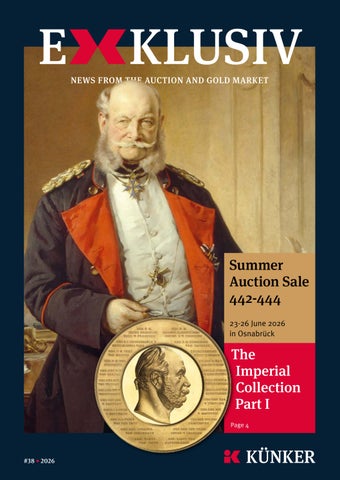
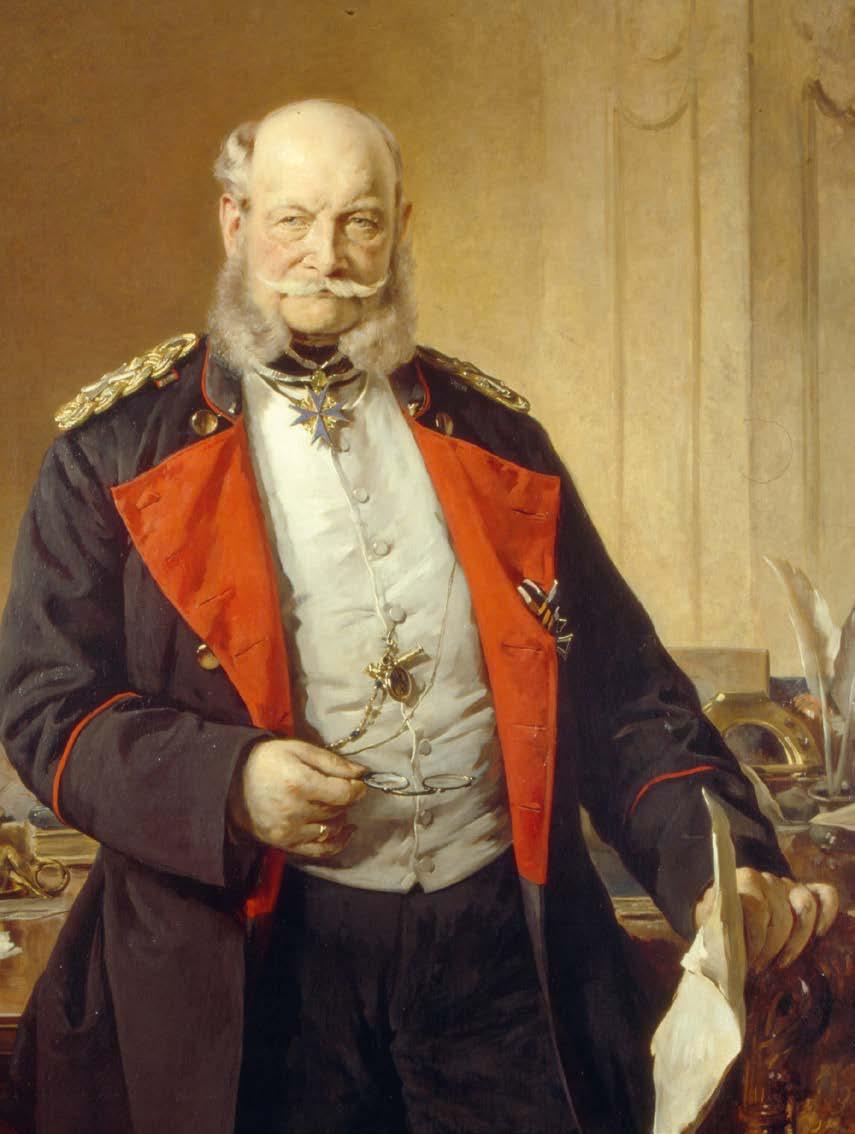
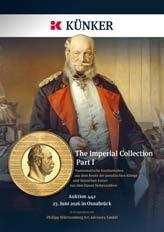
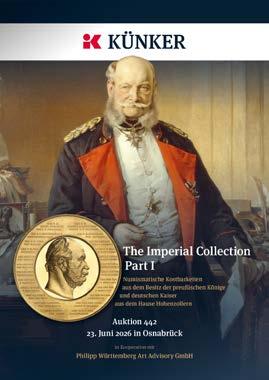
Cover picture Paul Bülow: Emperor Wilhelm I in his office, painting from 1883.
Dear Customers and Coin Enthusiasts,
Summer is a time for travel, discovery and new perspectives – and that is exactly what our latest issue of Künker Exklusiv invites you to experience. We take you on a fascinating journey through the world of numismatics, leading us from the German royal houses all the way to Tokyo, and impressively demonstrating just how closely coins, history, and culture are interwoven.
At the heart of this issue is a collection of exceptional historical significance: the Imperial Collection, the private coin and medal collection of the Prussian kings and German Emperors of the House of Hohenzollern. Assembled over generations, primarily by Friedrich Wilhelm IV and his brother Kaiser Wilhelm I, it documents German and European history in a unique way. Many pieces entered the collection immediately after being minted and have been preserved for decades right up to the present day – despite wars, political upheavals, and the coins’ removal as war booty to the Soviet Union.
With our Summer Auctions 442 to 444, a selected part of this significant collection is now being returned to the numismatic market for the first time. Under the title “Imperial Collection”, 337 selected coins and medals are coming up for auction – a rare opportunity for collectors and, at the same time, a numismatic event of international significance.
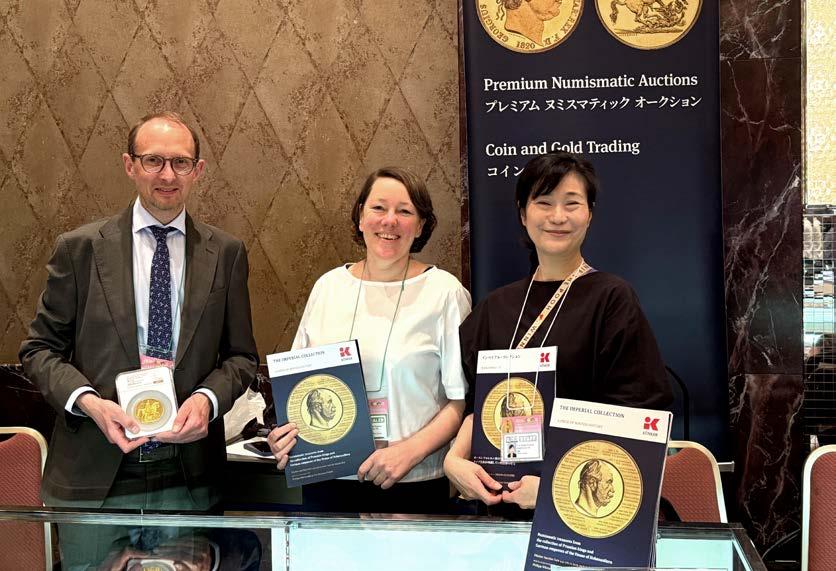
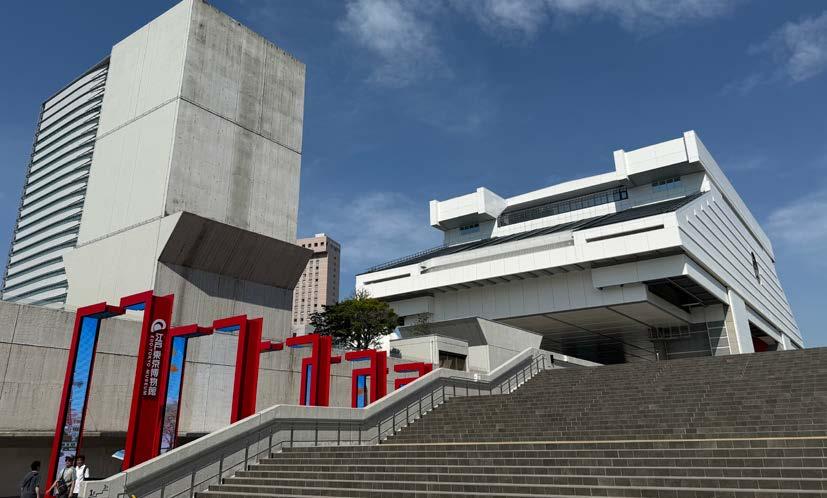
The history of this collection also forms a link to several articles in this issue. We therefore focus on the sovereigns of the House of Hohenzollern in Brandenburg-Prussia and shed light on the dynasty whose passion for collecting and historical selfimage formed the basis of the Imperial Collection. Furthermore, our series on numismatic landmarks takes us to Tokyo this time. The fact that parts of this
extraordinary Imperial Collection travelled to Japan lends our look at the Edo-Tokyo Museum a particular relevance, and once again underlines the international nature of numismatics.
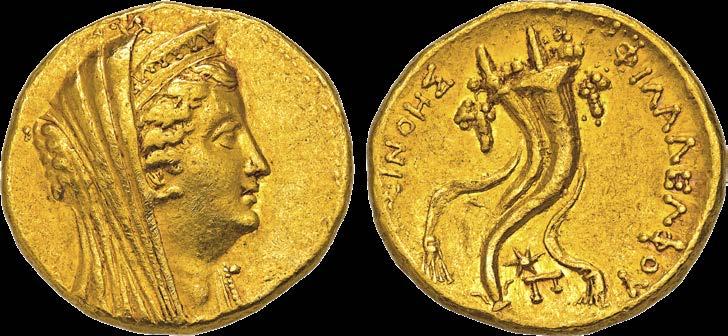
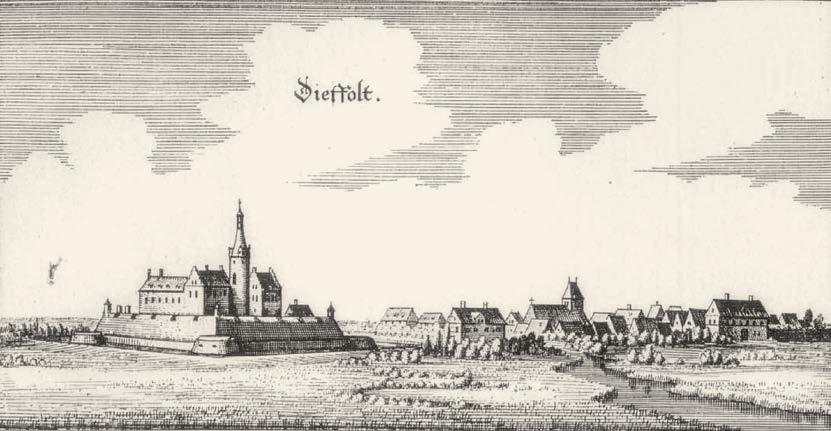
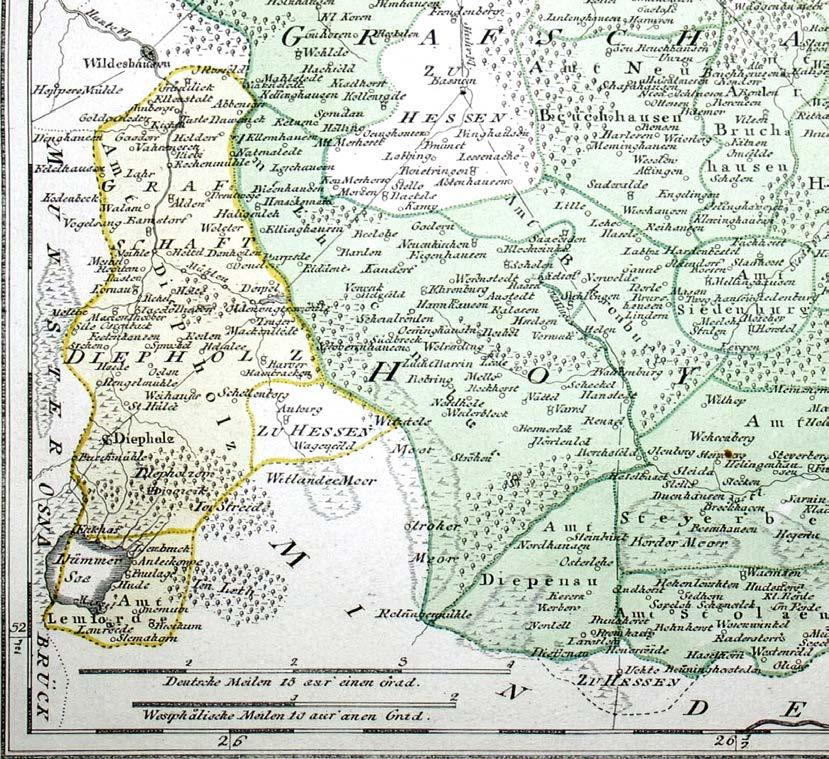
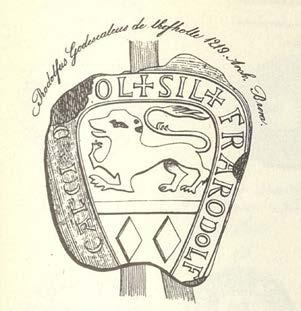
But there are also numerous other fascinating topics in store for you. We recount the history of the noble lords and counts of Diepholz and their coinage, introduce the first modern commemorative coins in the form of the geschichtsthaler, and turn our attention to Arsinoë II –one of the most intriguing and, at the same time, most power-conscious female rulers of the ancient world.
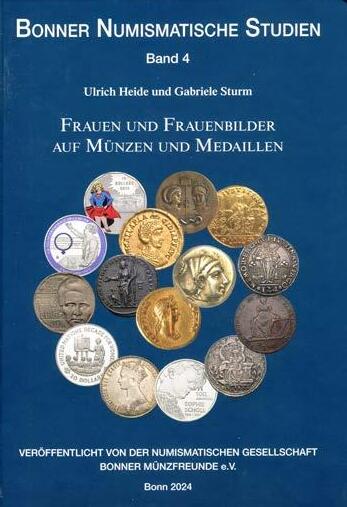
In keeping with this, we recommend a recently published book on “Women and Images of Women on Coins and Medals”, which opens up new perspectives on female representations in numismatics.
There is also news from within our company: We’re delighted to introduce our third Managing Director, Herr Timo Niermann. With his experience and dedication, he will play an active role in shaping the future of our company.
Of course, as usual we take a detailed look at our Summer Auctions from 23 to 26 June 2026 in Osnabrück. You can look forward to significant collections, exceptional provenances, and numerous numismatic highlights.
We wish you an inspiring read, exciting discoveries –and a wonderful summer.
Ulrich Künker Dr Andreas Kaiser
Preview of our Summer Auctions 442-444 from 23-26 June 2026
With our Summer Auctions 442 to 444, running from 23 to 26 June 2026, we are once again presenting an exceptional numismatic selection of high international standing. A total of more than 2,250 lots with a combined estimate of over four million euros will come under the hammer, bringing together significant provenance, rare gold coins, and outstanding coins and medals from the Middle Ages and modern times.
For auction catalogs 442-444 and a detailed auction overview simply scan the adjacent QR code.
Auction 442: The Imperial Collection, Part I
The proceedings will commence on Tuesday, 23 June 2026, at 14:00 with Auction 442, “The Imperial Collection, Part 1”. Up for auction are 337 numismatic treasures from the collection of the Prussian kings and German emperors of the House of Hohenzollern. With an estimated value of around one million euros, the auction offers fascinating insights into the collecting and ceremonial culture of one of Europe’s most significant ruling houses.
Particularly noteworthy are the exceptional provenance, the outstanding condition of the items and the large number of rare pieces. The collection was built up over generations by members of the House of Hohenzollern, including King Friedrich Wilhelm IV of Prussia and Kaiser Wilhelm I.
Originally, the collection was housed in the Hohenzollern Museum at Berlin’s Monbijou Palace. Towards the end of the Second World War, it was moved to the Berlin City Palace, subsequently taken to the
Soviet Union as looted art, and returned to East Berlin in 1958. It then remained largely hidden from public view for decades and was kept at the Bode Museum.
Following many years of negotiations with the public authorities, an agreement on the future of the collection was reached in 2025. Numerous objects remain on permanent loan in German museums, whilst others have passed into the ownership of the House of Hohenzollern. Selected items from this collection will now be offered for sale in our Auction 442 of June 2026.
The collection comprises coins and medals, many of which were acquired immediately after minting and were never put into circulation. The focus is on Prussian medals from the 18th and 19th centuries in gold, silver, and bronze. The collection is complemented by Brandenburg coinage and selected international coins, offering an impressive overview of the Hohenzollerns’ numismatic culture of representation.
Highlights of Auction 442
Lot 108
Prussia
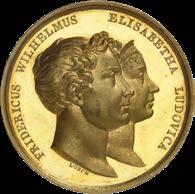
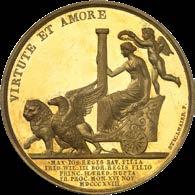
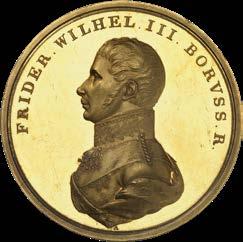
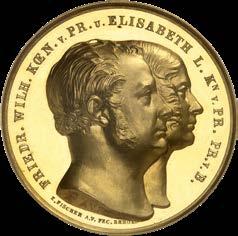
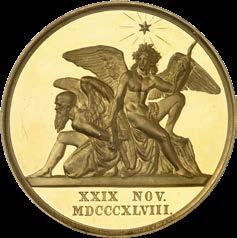
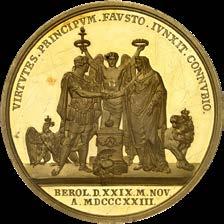
Friedrich Wilhelm III., 1797-1840. 12-ducat Gold Medal from 1823, commemorating the marriage of his son Friedrich Wilhelm (later King Friedrich Wilhelm IV) to Elisabeth Ludovika, the fourth daughter of King Maximilian I (IV) of Bavaria.
NGC MS 63 DPL. Extremely rare. Extremely fine.
From the estate of Emperor Wilhelm I.
Estimate: 6.000 Euro
Lot 20
Brandenburg
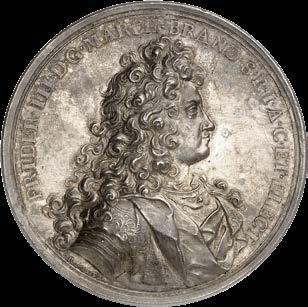
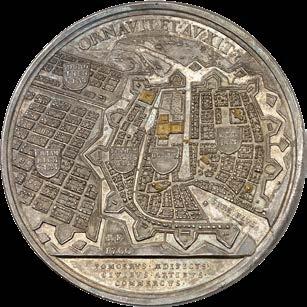
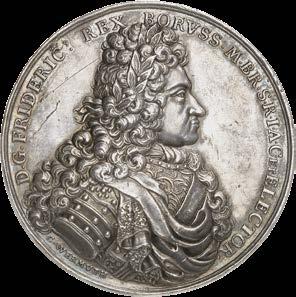
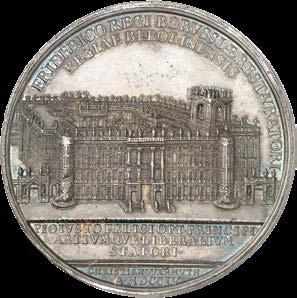
Friedrich III., 1688-1701. Silver Medal 1700, on the expansion and beautification of the city of Berlin. Extremely rare. Parts of the city map are gilded; in excellent condition.
From the estate of Emperor Wilhelm I.
Estimate: 4.000 Euro
Lot 131
Prussia
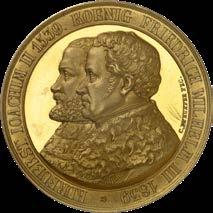
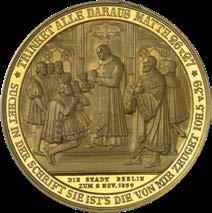
Friedrich Wilhelm III., 1797-1840. 25-ducat Gold Medal, 1839, commemorating the 300th anniversary of the Reformation in Berlin. A very rare gold coin.
Nearly proof-like. From the estate of Emperor Wilhelm I.
Estimate: 12.500 Euro
Lot 146
Prussia
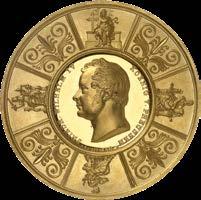
Friedrich Wilhelm IV., 1840-1861. 20-ducat Prize Medal, undated (1841), for science (1st version).
NGC PF 65 Ultra Cameo. Very rare, especially in this condition. Proof. From the estate of Emperor Wilhelm I.
Estimate: 10.000 Euro
Lot 154
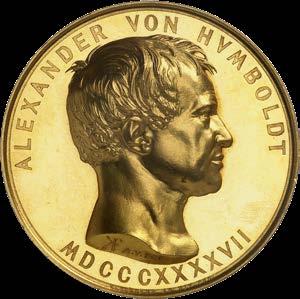
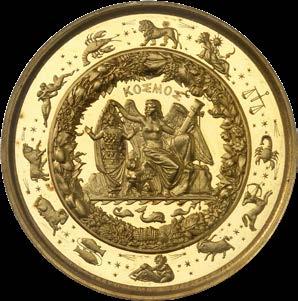
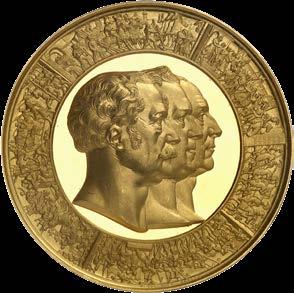
Friedrich Wilhelm IV., 1840-1861. 80-ducat Gold Medal from 1847, commemorating the naturalist Alexander von Humboldt and the publication of the second volume of his work Kosmos. NGC MS 65 PL.
Almost proof. From the estate of Emperor Wilhelm I.
Estimate: 40.000 Euro
Lot 166
Prussia
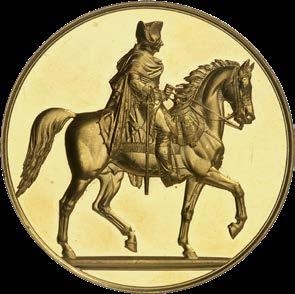
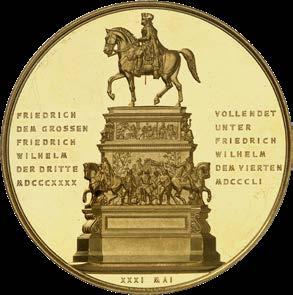
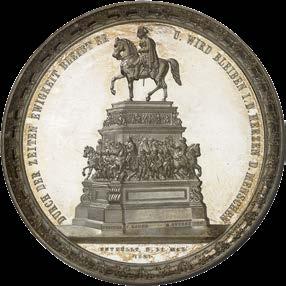
Friedrich Wilhelm IV., 1840-1861. 50-ducat gold medal, 1851, commemorating the unveiling of the equestrian statue of Frederick the Great on the “Unter den Linden” boulevard in Berlin. NGC MS 63 PL.
An extremely rare gold coin. Nearly proof-like. From the estate of Emperor Wilhelm I.
Estimate: 25.000 Euro
Lot 179
Prussia
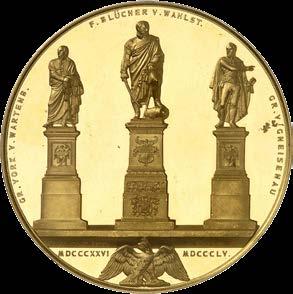
Friedrich Wilhelm IV., 1840-1861. 50-ducat Gold Medal, 1855, struck in honor of the field marshals. NGC MS 62 DPL. Extremely rare in Gold. Nearly proof quality. From the estate of Emperor Wilhelm I.
Estimate: 25.000 Euro
Prussia
Lot 191
Prussia
Wilhelm I., 1861-1888.
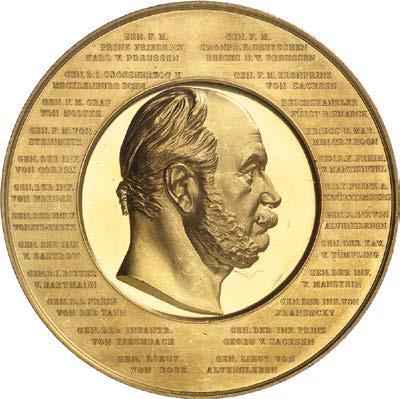
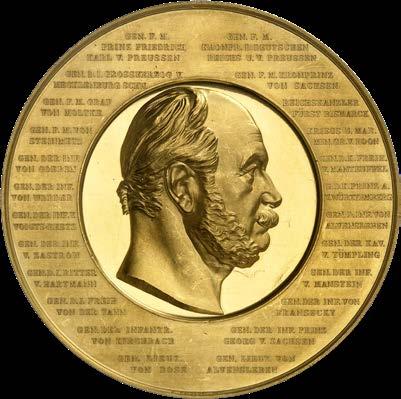
General‘s Medal, 120 ducats, 1871, commemorating the victory over France. Only 25 examples minted in gold.
Extremely rare. Nearly mint condition.
From the estate of Emperor Wilhelm I.
Estimate: 75.000 Euro
Lot 297
Russian Empire
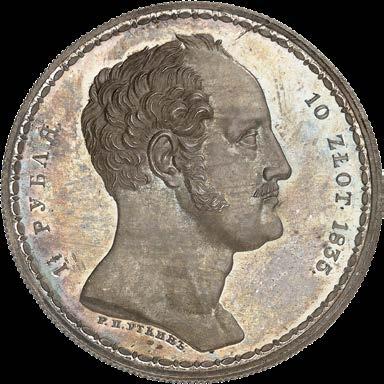
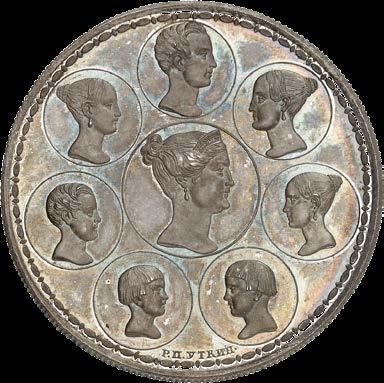
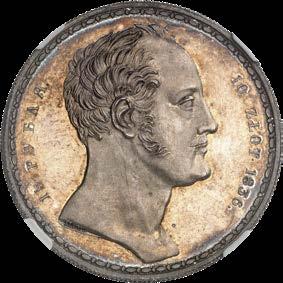
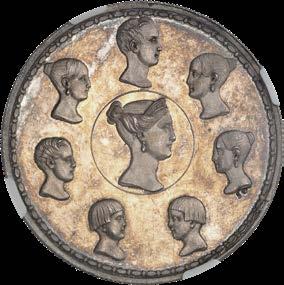
Nicholas I, 1825–1855. 1 1/2 rubles (10 zlotys), 1835, St. Petersburg. Family ruble.
Extremely rare. Only 36 copies were minted. A cabinet piece struck with polished dies. Nearly mint condition.
From the estate of King Frederick William IV.
Estimate: 250.000 Euro
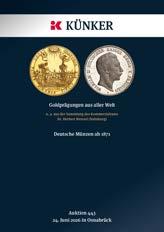
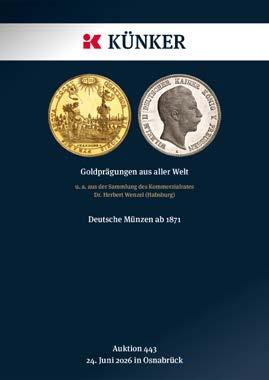
Auction 443: Gold coins from around the world, including items from the collection of Kommerzialrat Dr Herbert Wenzel
On Wednesday, 24 June 2026, beginning at 10:00, Auction 443 will follow, featuring gold coins from around the world as well as German coins from 1871 onwards. Particular attention should be paid to numerous rarities from the collection of Kommerzialrat Dr Herbert Wenzel, with a focus on the Habsburgs. The 677 lots represent a total value of around 1.6 million euros.
Gold coins from around the world
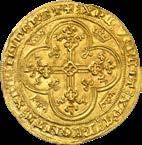
Lot 1022
Kingdom of France
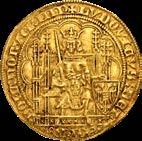
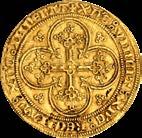
Philippe VI, 1328-1350. Lion d‘or o. J. (1338).
NGC MS 65 (Top Pop). Very rare, especially in this condition. Extremely fine.
Estimate: 10.000 Euro
Lot 1098
Netherlands
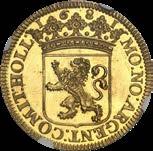
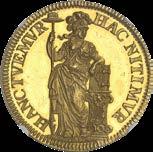
Province of Holland. 5 ducats, 1681. Minted with the dies of the guilder.
NGC PF 64 CAMEO (Top Pop). Extremely rare, especially in this condition. Proof.
Schätzung: 40.000 Euro
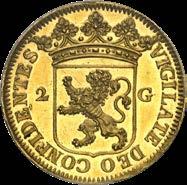
Lot 1096
Netherlands
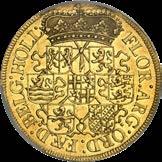
Province of Holland. Gold strike worth 8 ducats from the dies of the 2-guilder coin, undated. PCGS SP 62 (Top Pop). Extremely rare. Magnificent specimen. Extremely fine.
Schätzung: 50.000 Euro
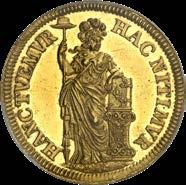
Lot 1099
Netherlands
1,5:1
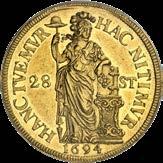
Province of Holland. 5 ducats, 1694, Dordrecht.
Minted with the dies of the 28-stuber coin (28 stuivers).
PCGS SP 58. Extremely rare. Extremely fine.
Estimate: 20.000 Euro
Habsburg Hereditary Lands of Austria from the collection of Kommerzialrat
Dr Herbert Wenzel
Lot 1199
Holy Roman Empire
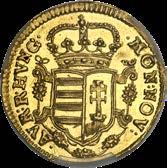
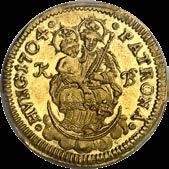
The Malcontents. Uprising led by Franz Rakoczy, 1703–1711. 1704 ducat, KB, Kremnitz. PCGS MS 64. Extremely rare, especially in this condition. A magnificent specimen. Nearly proof-like.
Estimate: 20.000 Euro
Lot 1120
Russian Empire
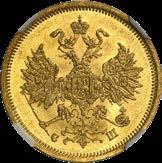
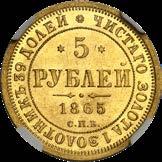
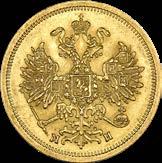
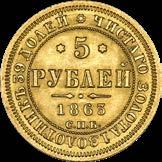
Alexander II, 1855–1881. 5 rubles, 1865, St. Petersburg. NGC MS 63. Very rare, especially in this condition.
Extremely fine.
Estimate: 15.000 Euro
Lot 1192
Holy Roman Empire
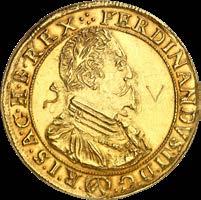
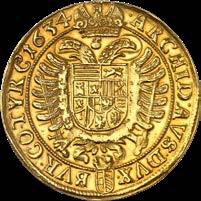
Ferdinand II, 1592–1618–1637. 5 ducats, 1634, Vienna. Extremely rare. With the denomination “V” engraved on the obverse. Extremely fine.
Estimate: 10.000 Euro
Lot 1194
Holy Roman Empire
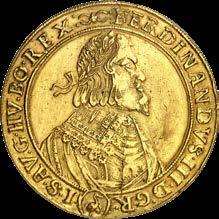
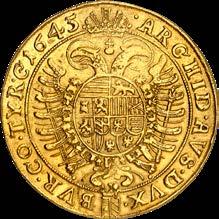
Ferdinand III, 1625–1637–1657. 10 ducats, 1645 (year date in the die changed from 1643), Vienna.
Extremely rare. Very fine+.
Estimate: 7.500 Euro
Lot 1229
Austrian Empire
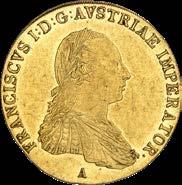
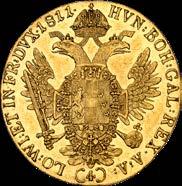
Franc I, 1804–1835. 4 ducats, 1811 A, Vienna. Slightly worn, almost extremely fine.
Estimate: 2.000 Euro
German coins and medals
Lot 1201
Holy Roman Empire
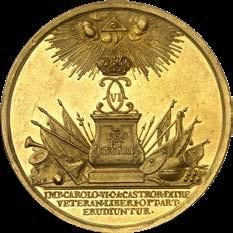
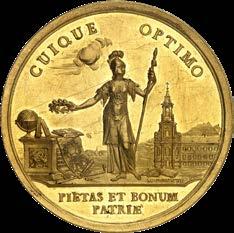
Charles VI, 1711–1740. Undated 20-ducat Gold Medal by M. Donner, commemorating the Academy of Engineering in Vienna. Extremely rare. Extremely fine.
Estimate: 12.500 Euro
Lot 1297
City of Hamburg
Bankportugalöser from Portugal for 10 ducats, 1677, by J. Rethe or his son J. Reteke, issued for the major European banking centers of Amsterdam, Hamburg, Nuremberg, and Venice. Extremely rare, especially in this condition. Extremely fine.
Estimate: 25.0000 Euro
Lot 1315
Archdiocese of Cologne
Clemens August of Bavaria, 1723–1761. Karolin 1735, Bonn.
Extremely rare. Extremely fine
Estimate: 15.000 Euro
Lot 1334
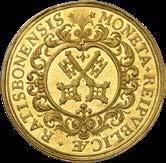
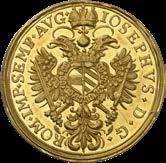
City of Regensburg
5 ducats, undated (1708–1710), bearing the title of Joseph I. NGC MS 64. Extremely rare. Extremely fine. According to mint records, only 7 copies were struck.
A magnificent specimen. Extremely fine.
Estimate 25.000 Euro
German coins from 1871
Lot 1380
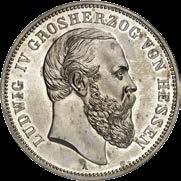
Hesse
Lot 1424
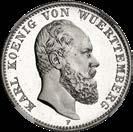
Württemberg
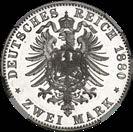
Karl, 1864–1891. 2 Mark, 1880. NGC PF 66 CAMEO. Extremely rare in this condition. A collector’s item. Proof.
Estimate: 7.500 Euro
Lot 1602
German New Guinea
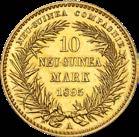
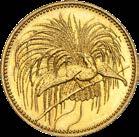
10 New Guinea Marks, 1895 A. NGC MS 65. Extremely rare. Only 2,000 copies minted. A magnificent specimen. Nearly proof-like.
Estimate: 50.000 Euro
Lot 1674
Federal Republic of Germany
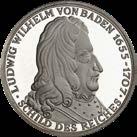
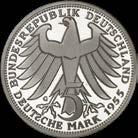
5 DM 1955 G. Ludwig Wilhelm, Margrave of Baden, smooth edge. Extremely rare. Proof.
Estimate: 7.500 Euro
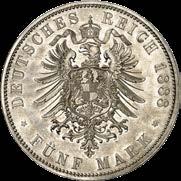
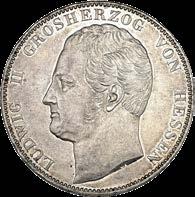
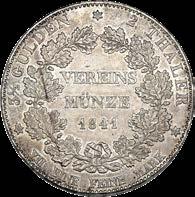
Louis IV, 1877–1892. 5 marks, 1888. Rare, especially in this condition. Proof.
Estimate: 6.000 Euro
Lot 1526
Mecklenburg-Strelitz
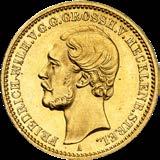
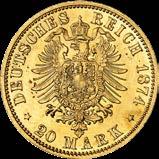
Friedrich Wilhelm, 1860–1904. 20 Mark, 1874. NGC MS 64 (Top Pop). Rare, especially in this condition. Extremely fine.
Estimate: 20.000 Euro
Lot 1610
Weimar Republic
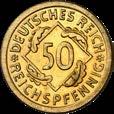
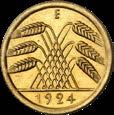
50 Reichspfennig, 1924 E. Extremely rare, especially in this condition. A magnificent specimen. Proof.
Estimate: 6.000 Euro
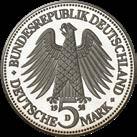
Lot 1675
Federal Republic of Germany
5 DM 1958 D. “The Return of the Saar”.
Extremely rare. Proof.
Estimate: 7.500 Euro
Highlights of Auction 444
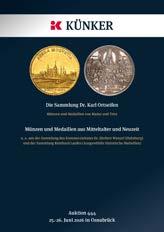
The series concludes with Auctions 444 on Thursday, 25 June, and Friday, 26 June 2026, both starting at 10:00. The focus is on the significant collection of Dr Karl Ortseifen, featuring coins and medals from Mainz and Trier. The offering is complemented by coins and medals from the Middle Ages and modern times, including further items from the collection of Dr Herbert Wenzel as well as selected historical medals from the Reinhard Laufen collection. The 1,250 lots spread over two auction days are also estimated to have a value of around 1.6 million euros.
This year’s summer auctions thus combine outstanding quality, excellent provenance, and a broad numismatic spectrum that is likely to appeal to collectors, scholars and institutions alike.
The collection of Dr Karl Ortseifen (Mainz coins and medals)
Lot 2146
Archdiocese of Mainz
Lot 2288
Archdiocese of Mainz
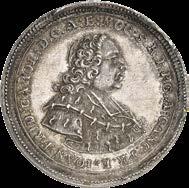
Johann Friedrich Karl von Ostein, 1743–1763. Schautaler, 1747. Extremely rare. Extremely fine.
Estimate: 7.500 Euro
Wolfgang von Dalberg, 1582–1601.
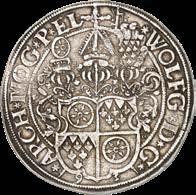
Reichstaler, 1593, Mainz. Bettlertaler.
Rare, especially in this condition. Very fine to extremely fine.
Estimate: 4.000 Euro
Lot 2179
Archdiocese of Mainz
Anselm Casimir Wamboldt von Umstadt, 1629–1647.
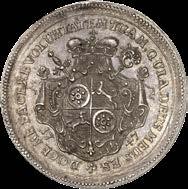
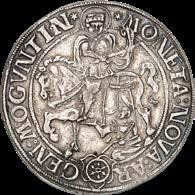
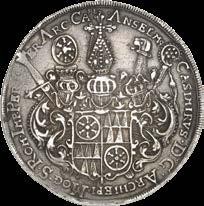
Reichstaler, 1642, Mainz. Extremely rare.
Attractive patina, very fine+.
Estimate: 5.000 Euro
Lot 2290
Archdiocese of Mainz
Johann Friedrich Karl von Ostein, 1743–1763. 2 ducats, 1748, mint unknown. Extremely rare. Extremely fine.
Estimate: 4.000 Euro
Lot 2385
City of Mainz
Silver medal, 1689, by P. H. Muller, commemorating the recapture of the city and the expulsion of the French occupiers. Extremely rare. Extremely fine.
Estimate: 5.000 Euro
The Reinhard Laufen collection (selected historical medals)
Lot 2507
Margraviate of Baden-Baden
Ludwig Wilhelm, 1677–1707. Silver medal, undated (1691/1692), unsigned, presumably by P.H. Müller, struck on behalf of F. Kleinert, commemorating the victories over the Turks. Extremely rare. A collector’s item.
Magnificent patina, nearly mint condition.
Estimate: 2.000 Euro
Lot 2613
Braunschweig and Lüneburg.
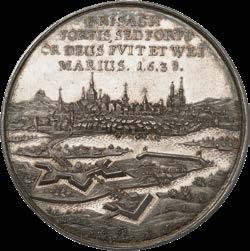
City of Breisach. Silver medal, 1638, by J. Blum, commemorating the capture of the besieged city by Duke Bernhard of Saxe-Weimar on December 3. Extremely rare. Magnificent patina. Extremely fine.
Estimate: 2.500 Euro
Lot 2753
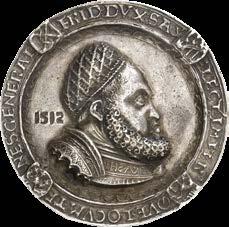
Electorate of Saxony Frederick III the Wise, 1486–1525. Double Guldengroschen, 1512, Nuremberg, bearing the title of Maximilian I, who became Viceroy. Extremely rare. Original minting. Extremely fine.
Estimate: 10.000 Euro
Lot 2949
Holy Roman Empire Silver medal, 1638, by H.J. Wolrab, commemorating the siege and relief of Vienna. Extremely rare. An excellent specimen with a beautiful dark patina.
Estimate: 2.000 Euro
Lot 3274
Kingdom of Sweden
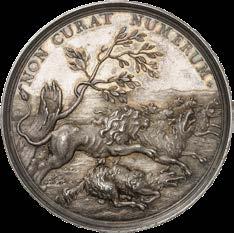
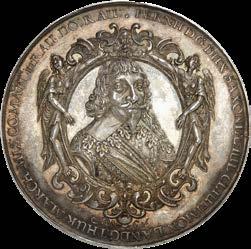
Silver medallion, 1634, by S. Dadler, commemorating his death at Lützen on November 6, 1632, and his burial at Riddarholm Church in Stockholm on June 22, 1634. A magnificent specimen. Beautiful patina, almost extemely fine.
Estimate: 7.500 Euro
Lot 3234
Poland City of Gdańsk. Silver medal, 1653, by J. Hohn, commemorating the visit of King John II Casimir of Poland (1648–1668) to the city of Gdańsk. Rare. Superb specimen. Extremely fine.
Estimate: 7.500 Euro
Coins and medals from the Middle Ages and the modern era
Braunschweig-Calenberg-Hanover
Johann Friedrich, 1665–1679.
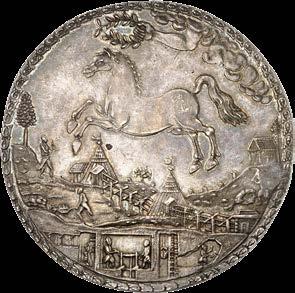
2-Reichstaler redemption coin, 1672, Clausthal.
Proceeds from the Harz mines.
NGC AU 58. Extremely rare.
Magnificent specimen. Excellent+.
Estimate: 5.000 Euro
Lot 2757
Electorate of Saxony
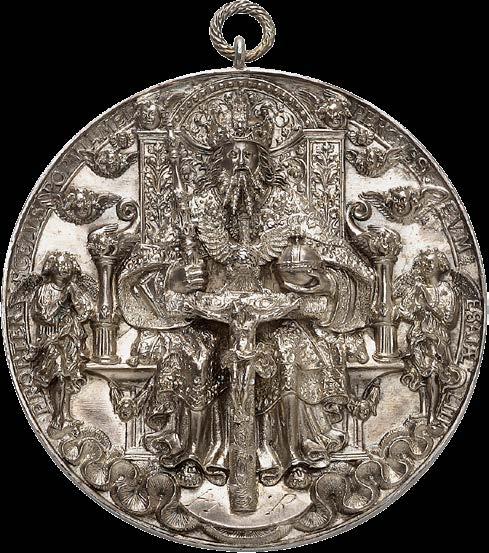
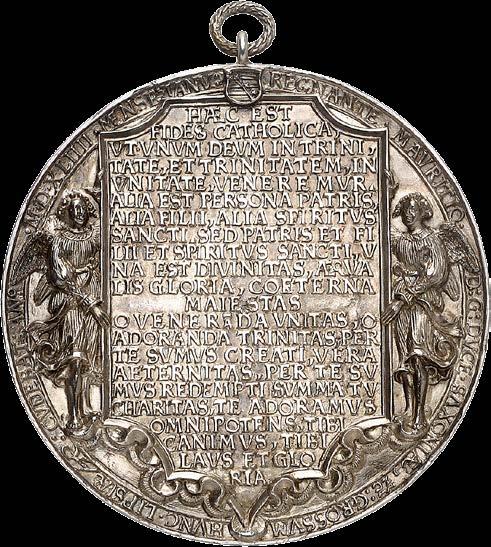
John Frederick the Magnanimous and Maurice, 1541–1547. Silver cast medal from 1544, by Hans Reinhart the Elder.
Known as the “Trinity Medal” or “Maurice Penny.”
A masterpiece of German medal art on an antique ring.
Magnificent, exquisite workmanship.
Estimate: 75.000 Euro
Lot 2587
Lot 2706
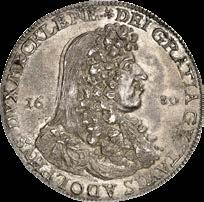
Duchy of Mecklenburg-Gustrow
Gustav Adolf, 1636–1695. Reichstaler, 1680, Gustrow. Very rare. Excellent-Uncirculated.
Estimate: 10.000 Euro
Lot 2807
Wallenstein
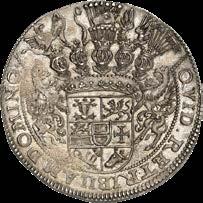
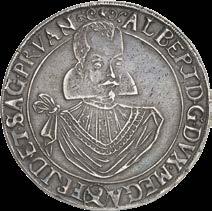
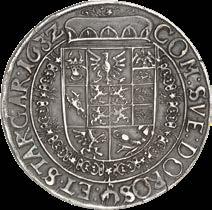
Albrecht, 1623–1634, Duke of Friedland. Imperial thaler, 1632, Jičín. Rare. Very fine.
Estimate: 20.000 Euro
Lot 2733
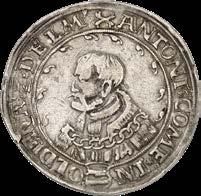
County of Oldenburg
Anton I, 1526–1573. Taler, undated (1538). Extremely rare and of particular numismatic interest. The first Oldenburg taler. Very fine.
Estimate: 35.000 Euro
Lot 2932
Holy Roman Empire
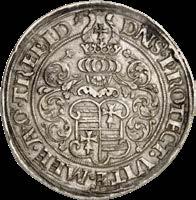
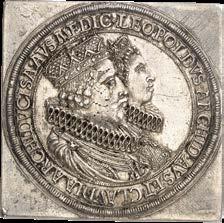
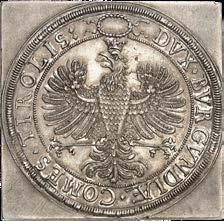
Archduke Leopold V, 1619–1632. Undated double imperial thaler (posthumously minted in 1635), Hall, commemorating his marriage to Claudia de’ Medici in 1626. Extremely rare. Extremely fine.
Nicholas I, 1825–1855. 1 1/2 rubles (10 zlotys) 1836 (minted after 1837), St. Petersburg. Family ruble. Novodel. NGC MS 63 PL. Extremely rare in this condition. A cabinet piece with polished dies.
Estimate: 150.000 Euro
Lot 3245
Russian Empire
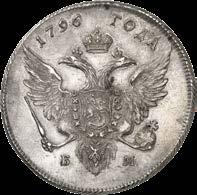
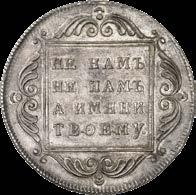
Paul I, 1796–1801. 1796 ruble, St. Petersburg. NGC AU 58. Extremely rare. Extremely fine.
Estimate: 20.000 Euro
A new member of our management team: Timo Niermann
We are delighted to welcome Timo Niermann as a new member of our management team. Together with Ulrich Künker and Dr Andreas Kaiser, he will strengthen our team as the third Managing Director.
Born in Osnabrück, he completed an apprenticeship as a tax consultant after leaving school and subsequently studied Business Administration, specialising in controlling, taxation and accounting – graduating with a degree in Business Administration. His professional career has taken him mainly to family-run businesses, where he gained valuable experience in senior controlling roles.
Herr Niermann has been an integral part of the Künker team since 2021 and is now responsible for the entire Commercial Division, a role he approaches with dedication and a keen eye for figures and processes.
After spending time in Hamburg, he now lives with his wife and two daughters in the southern district of Osnabrück. In his spare time, he is a keen soccer fan and follows the matches of VfL Osnabrück with particular passion.
The Sovereigns of the House of Hohenzollern in Brandenburg-Prussia from 1535 to 1918
To mark the auction of the “Imperial Collection’” which will take place on 23 June 2026, it seems particularly fitting to present below the sovereigns of Brandenburg and Prussia from 1535 to 1918 in the form of short biographies and portraits.
By Michael Autengruber
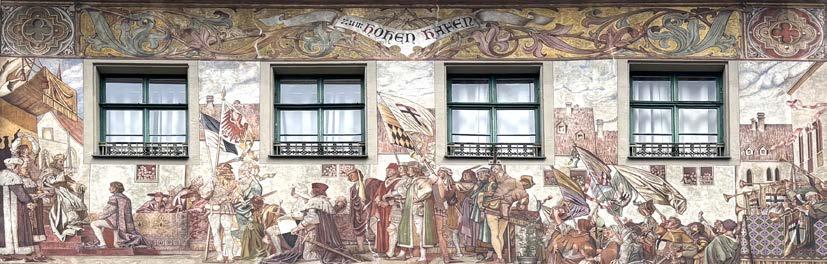
On 18 April 1417, during the Council of Konstanz/ Constance (1414–1418), Frederick VI of Zollern, Burgrave of Nürnberg/Nuremberg, was formally enfeoffed with the Margraviate of Brandenburg and elevated to the rank of Elector and Archchamberlain by the Roman-German King Sigismund of Luxembourg. Since then, Brandenburg has been ruled by the Zollern or (from the end of the 15th century) the Hohenzollern (Fig. 1).
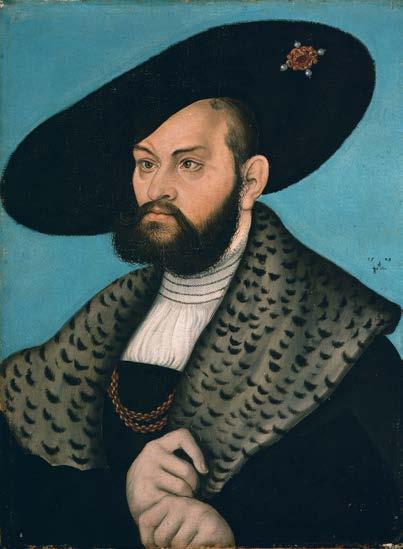
Albrecht of Brandenburg of the House of Hohenzollern, the last Grand Master of the Teutonic Order to reside in Prussia, converted to Lutheranism in 1525 and founded the Lutheran Duchy of Prussia, which was under Polish suzerainty (Fig. 2).
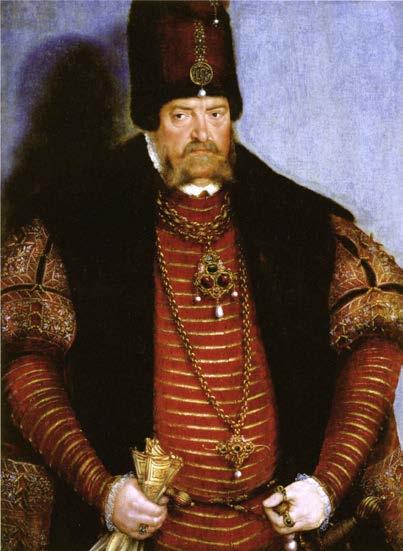
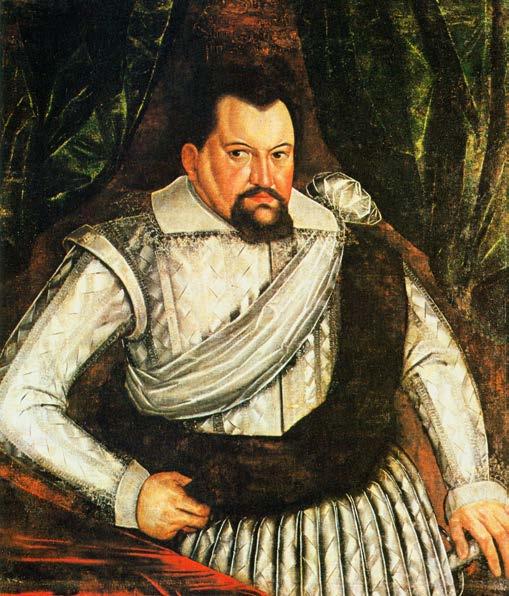
In 1539, Margrave and Elector Joachim II (1505-1571, reigned from 1535) introduced the Reformation according to the Lutheran confession in Brandenburg (Fig. 3). On 25 December 1613, Margrave and Elector Johann Sigismund (1572-1619, reigned from 1608) converted, on his own behalf and that of the House of Brandenburg-Hohenzollern, from the Lutheran to the Reformed confession, although Brandenburg remained Lutheran. In 1614, he succeeded in asserting his claim to the Duchy of Kleve and the counties of Mark and Ravensberg in the northwest of the Empire. From 1618, he also ruled the Duchy of Prussia, which he had since inherited, in personal union (Fig. 4).
Fig. 1: King Sigismund enfeoffing Friedrich von Zollern, Burgrave of Nürnberg, with the Margraviate of Brandenburg in front of the Haus zum Hohen Hafen in Konstanz/Constance. Photograph of the façade painting on the Haus zum Hohen Hafen in Konstanz. Photo: Michael Autengruber.
Fig. 2: Lucas Cranach the Elder (1472–1553): Albrecht of Brandenburg, Duke of Prussia, painting from 1528.
Fig. 3: Lucas Cranach the Younger (1515–1586): Joachim II Hector, Margrave and Elector of Brandenburg, painting c. 1570.
Fig. 4: Unknown artist: Johann Sigismund, Margrave and Elector of Brandenburg, painting c. 1610.
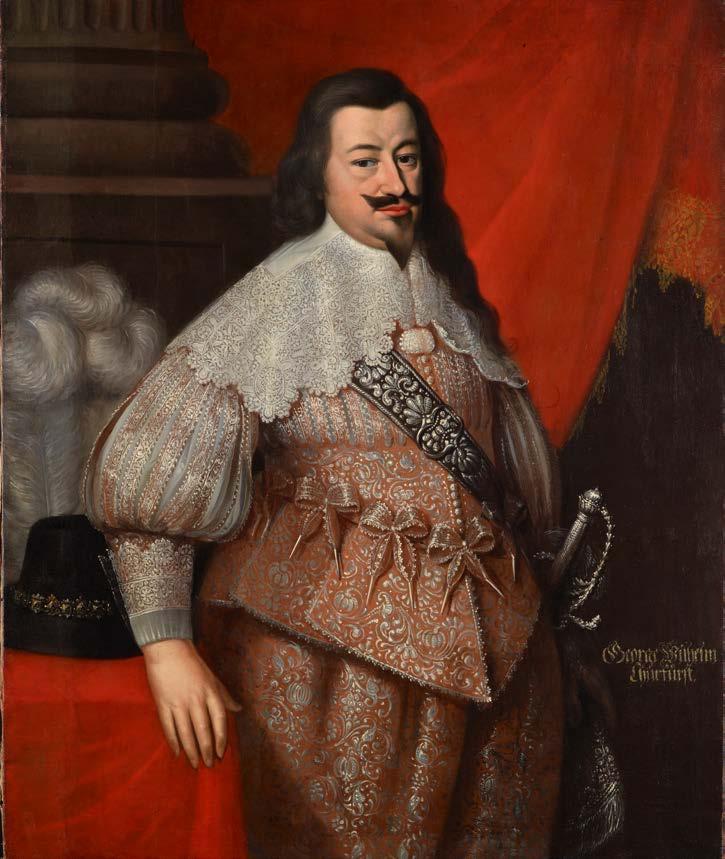
Under his son and successor, Georg Wilhelm (b. 1595), who succeeded him in 1619, the Reformed confession was further consolidated at court in organisational and liturgical terms (Fig. 5). From 1616, he was married to Elisabeth Charlotte of the Pfalz/Palatinate (1597-1660), the younger sister of Friedrich V , Elector Palatine (15961632), the so-called “Winter King”. Physically impaired from 1620 onwards due to a serious injury, he was
regarded as lacking political assertiveness. During the Thirty Years’ War, he pursued a policy of neutrality and loyalty to the Emperor, yet left key decisions to his First Minister and refrained from strengthening his military. Due to structural and military weakness, Brandenburg nevertheless became a theatre of war and was severely devastated, particularly by the Swedes; in 1638, Georg Wilhelm fled to Königsberg, where he died in 1640.
Fig. 5: Unknown artist: Georg Wilhelm, Elector of Brandenburg, painting c. 1640. Hohenzollern Art Collection Foundation (SPSG).
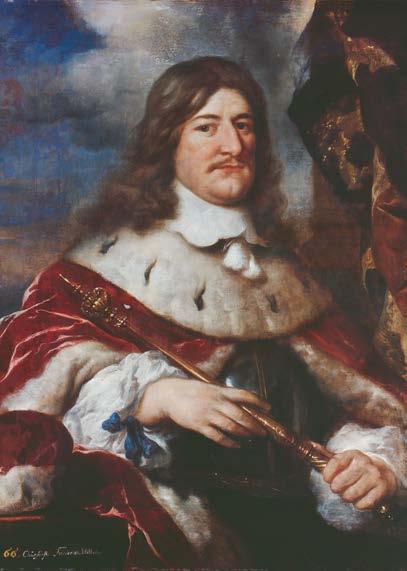
With his son Friedrich Wilhelm (b. 1620), a figure ascended the throne who would leave a lasting mark on Brandenburg-Prussia (Fig. 6). He grew up under difficult conditions during the Thirty Years’ War, was raised as a Calvinist and was influenced personally and politically by a formative stay in the Netherlands. In 1640, he took over a devastated, fragmented territory, swiftly began its consolidation, and gained room for manoeuvre in foreign policy. In 1646, he married Luise Henriette of Oranien/Orange (1627–1667), daughter of the Stadtholder of the Netherlands.
In the Peace of Westphalia of 1648 he secured territorial gains; crucial was the full sovereignty over Prussia achieved in the Peace of Oliva in 1660. Domestically, he established a standing army, strengthened central authority, and prevailed against resistance from the estates. Economic promotion, infrastructure measures and targeted immigration (including that of the Huguenots) supported the reconstruction.
In foreign policy, he shifted alliances flexibly and achieved military successes, such as at Fehrbellin in 1675 – which earned him the epithet “the Great Elector” – though he was forced to relinquish some of these gains. Overall, he laid the foundations for the rise of Brandenburg-Prussia; he even harboured – albeit limited – colonial ambitions in Africa.
Fig. 6: Govert Flinck: Friedrich Wilhelm, Elector of Brandenburg, painting 1652.
Künker Auction 442, Lot 11.
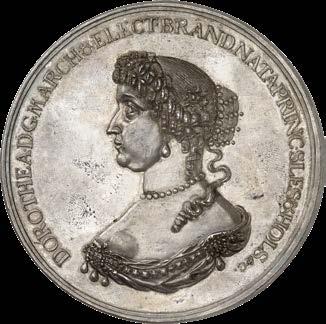
On the marriage of Elector Friedrich Wilhelm to Dorothea of Holstein-Glücksburg.
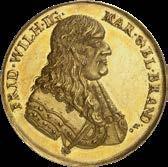
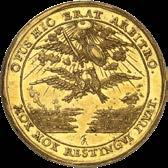
Künker Auction 442, Lot 6. On the support for Sweden against Poland in the Battle of Warsaw.
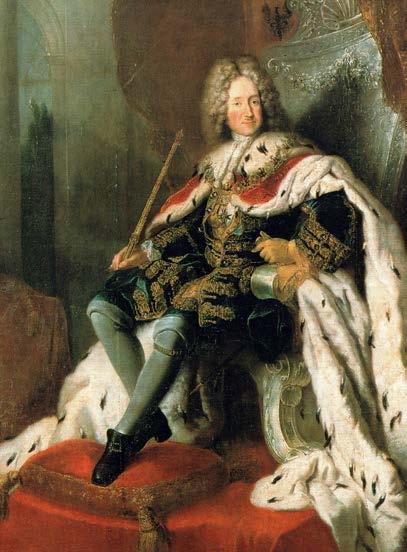
His son, Margrave and Elector Friedrich III (b. 1657), succeeded the Great Elector in 1688 (Fig. 7). Upon assuming the throne, he resisted plans to partition the realm and preserved the unity of BrandenburgPrussia, whilst initially relying heavily on his advisers for governance. He had been married since 1679 to Elisabeth Henriette of Hesse-Kassel (1661-1683) and, following her death, to Sophie Charlotte of BrunswickLüneburg, Princess of Hannover (1668-1705).
In foreign policy, he took part in the War of the Palatinate Succession from 1688 to 1697 and, from the 1690s onwards, consistently pursued the acquisition of the royal title. With the consent of Emperor Leopold I (1640–1705, Emperor from 1658), he crowned himself King of Prussia in Königsberg in 1701 under the name Friedrich I, thereby demonstratively elevating his state’s rank and claim to sovereignty.
His reign was characterised by courtly splendour, administrative consolidation and repeated changes of ministers; in domestic policy, he responded to crises with reforms aimed at stabilising the administration and finances. While his contemporaries criticised him for being wasteful, more recent research offers a more nuanced assessment, particularly regarding his significance regarding state continuity and the culture of representation.
Fig. 7: Antoine Pesne: King Friedrich I of Prussia on the silver throne, painting 1712.
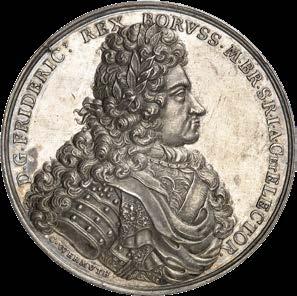
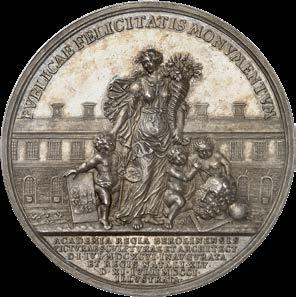
Künker Auction 442, Lot 24. On the Academy of Fine Arts.
Künker Auction 442, Lot 25. On Berlin Palace.
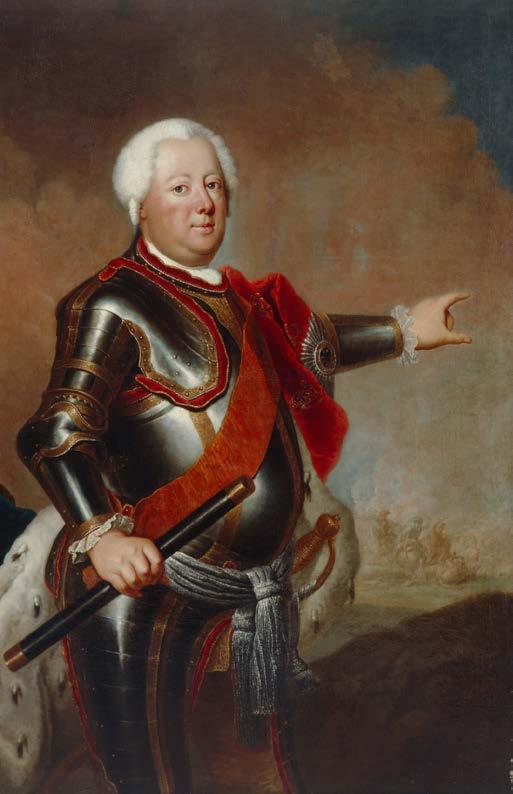
Following the death of Friedrich I, his son Friedrich Wilhelm I (b. 1688) ascended the throne in 1713 (Fig. 8). Under Huguenot influence (from 1692), his upbringing was characterised by the French language, a practical orientation and a distancing from courtly pomp; Pietistrationalist elements reinforced frugality and a focus on utility. He gained administrative experience at an early age and was involved in government from 1702; military and political influences followed, including during the War of the Spanish Succession from 1701 to 1714 and through Pietist influences. From 1706, he was married to Sophia Dorothea, Duchess of Brunswick and Lüneburg, Princess of Hannover (1687-1757) and daughter of the future British King George I (1660-1727, King from 1714).
From 1713, he implemented a strict programme of reforms: reduction of the court and expenditure, centralisation of the administration, mercantilist economic policy, and limited educational reforms. At the heart of his reign was the expansion of the military state (over 80,000 men, canton system 1733). In foreign policy, he remained defensive. The conflict with the Crown Prince (1730) placed a lasting strain on the ruling house. He died in 1740, leaving behind a centralised, financially-stabilised state with a dominant military orientation.
Fig. 8: Antoine Pesne (workshop): King Friederich Wilhelm I of Prussia, painting after 1733.
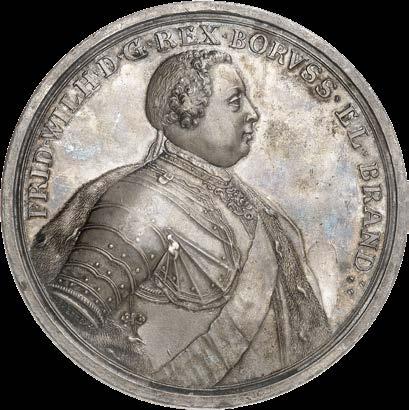
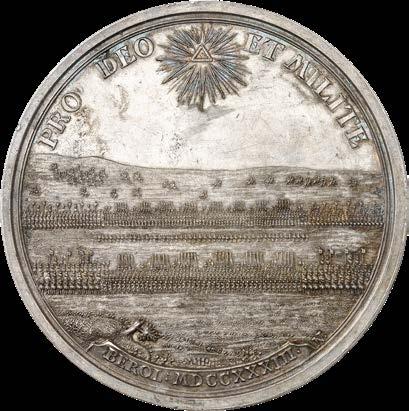
Künker Auction 442, Lot 32. On the military review in Berlin.
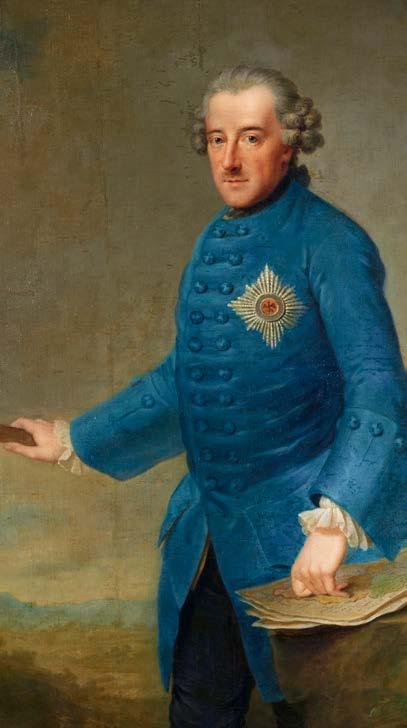
Fig. 9: Johann Georg Ziesenis: King Friedrich II, painting 1763.
Hohenzollern Art Collection Foundation (SPSG).
His son Friedrich II (b. 1712) ascended the throne. Under Huguenot influence, he had received an authoritarian Reformed upbringing, though he also cultivated a humanistic education, and music (against his father’s will) (Fig. 9). The conflict escalated in 1730 with the Prince’s failed escape attempt involving Hans Hermann von Katte (1704-1730), whose execution he was forced to witness; after imprisonment and temporary demotion, he was rehabilitated in 1732.
In 1733, the Prince married Elisabeth Christine of Brunswick-Wolfenbüttel-Bevern (1715-1797), though the marriage remained childless; he lived as an officer in Rheinsberg until 1740. Upon assuming the throne in 1740, he initiated a cautiously enlightened reform policy (including the restriction/abolition of torture, limited religious tolerance, mercantilist promotion, and partial freedom of the press).
In foreign policy, he pursued a distinctly power-political and expansionist strategy: In the Silesian Wars from 1740 to 1745, he acquired Silesia; in the Seven Years’ War from 1756 to 1763, he maintained Prussia’s status as a great power despite crises. From 1763 onwards, his epithet “the Great” began to appear, which became an established title after his death. After 1763, reforms followed in the fields of law, the economy and infrastructure; in foreign policy, the alliance with Russia dominated, allowing for further territorial expansion: the First Partition of Poland took place in 1772. From this point onwards, he styled himself King of Prussia (instead of, as previously, King in Prussia).
Friedrich II combined Enlightenment ideals with the practices of a power-oriented state. He died in 1786, and is regarded as a key figure of Enlightened Absolutism and as the founder of Prussia’s status as a great power.
Künker Auction 442, Lot 166. On the equestrian monument to Friedrich/Frederick the Great in Berlin.
Künker Auction 442, Lot 41. On the Battle of Kesselsdorf.
His nephew Friedrich Wilhelm II (b. 1744) succeeded him to the throne (Fig. 10). Raised in a strict and utilitarian manner, his upbringing was dominated by discipline, formalised education and early involvement in court life; his military training took place under harsh, at times physical, discipline. He had little practical experience of government. His youth was shaped by his wartime experiences during the Seven Years’ War; at the same time, his relationship with his predecessor remained distant. His biography is characterised by dynastically-motivated marriages – in 1765 to Elisabeth Christine Ulrike of BrunswickWolfenbüttel (1746-1840) and, following the divorce, to Friederike Luise of Hesse-Darmstadt (1751–1805) – and an unrestrained private life involving further morganatic marriages and a system of mistresses.
Upon assuming the throne in 1786, he implemented a change of course: a stronger court culture, selective tax relief, but few structural reforms amidst continuing administrative shortcomings. In foreign policy, he initially operated actively, but failed in 1795 in the First Coalition War against France. This was offset by significant territorial gains through the Second and Third Partitions of Poland in 1793 and 1795, the most extensive expansion in the entire history of Brandenburg-Prussia; however, these gains came at a heavy financial cost.
He died in 1797, and his reign is considered ambivalent: limited reform activity alongside territorial expansion, yet overall overshadowed by his predecessor.
Fig. 10: Anton Graff: King Friedrich Wilhelm II, painting from 1787.
Künker Auction 442, Lot 66. On his 42nd birthday.
Friedrich Wilhelm III (b. 1770), his son, ascended the throne at the age of 27. His education, strongly influenced by the Reformed and Enlightenment traditions but lacking practical experience, combined with his early wartime experiences to shape a duty-bound, reserved personality that defined his style of government (Fig. 11).
In 1793, he married the Lutheran-influenced Luise of Mecklenburg-Strelitz (1776-1810), with whom he had seven surviving children, including his successors Friedrich Wilhelm IV and Wilhelm I. Luise’s influence contributed to the union of the Lutheran and Reformed churches into the Evangelical Church in Prussia, introduced in 1817 and institutionally implemented beginning in 1821.
In domestic policy, the King pursued a frugal court style alongside administrative continuity and limited reforms. In foreign policy, his initial neutrality towards France led to isolation; the defeat in the twin battles of Jena and Auerstedt against the French in 1806 brought about the collapse of Prussia. The Treaty of Tilsit in 1807 significantly weakened the state, triggering far-reaching reforms under Stein and Hardenberg that modernised the administration, society and the military. Following a forced alliance with France in 1812, Prussia changed sides in 1813 and contributed to the Wars of Liberation and the European reorganisation of the Congress of Vienna (1814/15), from which it emerged strengthened.
Consequently, a policy of restoration prevailed: close ties with Russia and Austria within the framework of the “Holy Alliance”, increased internal repression, and the failure to fulfil constitutional promises. Nevertheless, his reign remained characterised by a tension between limited modernisation and the monarch’s claim to authority. Despite political restrictions, the long period of peace fostered economic and cultural development.
Künker Auction 442, Lot 77. Chamberlain’s thaler in perfect condition.
Künker Auction 442, Lot 101. On the union of Pomerania and Rügen with Prussia.
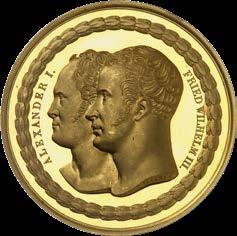
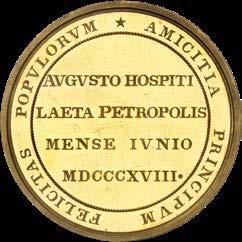
Künker Auction 442, Lot 105. On the King’s visit to St Petersburg.
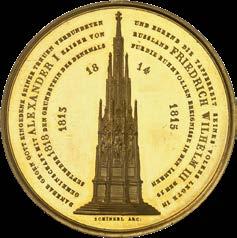
Künker Auction 442, Lot 288. On the laying of the foundation stone of the Victory Monument on the Kreuzberg in Berlin.
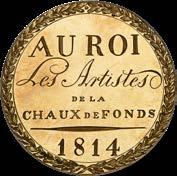
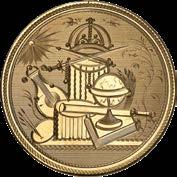
Künker Auction 442, Lot 100. Engraved gold medal crafted by the watchmakers of the town of La Chaux-de-Fonds as a gift to the King.
Fig. 11: Fig. 11: Franz Krüger: King Friedrich Wilhelm III, painting c. 1830. bpk / Prussian Palaces and Gardens Foundation Berlin-Brandenburg / Wolfgang Pfauder.
Fig. 12: Franz Krüger: King Friedrich Wilhelm IV, painting 1844. bpk / Prussian Palaces and Gardens Foundation Berlin-Brandenburg / Roland Handrick.
Künker Auction 442, Lot 156. On the silver wedding anniversary.
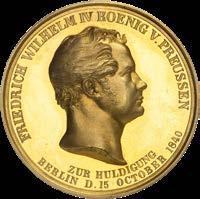
Künker Auction 442, Lot 146. Medal of Honour for Science.
After the death of Friedrich Wilhelm III in 1840, his eldest son Friedrich Wilhelm IV (b. 1795) succeeded him (Fig. 12). His upbringing was shaped by the Enlightenment, Reformed piety and military discipline; the Napoleonic era, the early death of his mother (1810) and the Prussian reforms led to a religiously grounded, monarchically conservative outlook characterised by a clear rejection of liberalism and revolution, as well as a romanticised view of history and art, particularly of the Middle Ages. Military interests receded significantly, and intellectual/religious and aesthetic inclinations dominated, which were later also clearly reflected in the medals he issued.
In 1823, Friedrich Wilhelm married Elisabeth Ludovika of Bayern/Bavaria (1801–1873), but remained childless; as Crown Prince and King, he led an increasingly ceremonial and culturally-oriented life in the company of scholars, artists and scientists; a trip to Italy in 1828 reinforced his romantic/religious conception of the state.
His accession to the throne initially raised liberal expectations with amnesties and limited reforms, but led to a restorative conception of the state based on the principle of a monarchy legitimised by the estates and by divine right. During the Revolution of 1848, his policy wavered between tactical accommodation and the repressive withdrawal of his promises, evident in his rejection of the German imperial crown, the suppression of revolutionary movements, the imposed constitution of 1848-50, and the three-class suffrage designed to secure monarchical authority.
In 1850, the Hohenzollern territories were integrated. In the same year, the King accepted the constitutional oath only with reservations; in foreign policy, his reign was marked by neutrality during the Crimean War and the defeat in the Neuchâtel Question of 1857. Following strokes, he handed over the regency to Wilhelm in 1858, thus marking the beginning of the New Era. He died in Sanssouci in 1861. His reign combined restorative politics with a strong cultural and architectural influence in Potsdam and Berlin.
Künker Auction 442, Lot 165. On the Equestrian Monument to Friedrich/ Frederick the Great in Berlin.
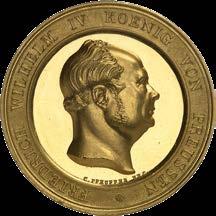
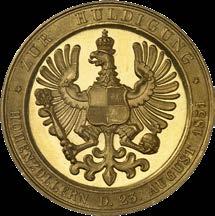
Künker Auction 442, Lot 171. On the tribute in Hohenzollern.
Künker Auction 442, Lot 143. Grand Commemorative Medal for Berlin.
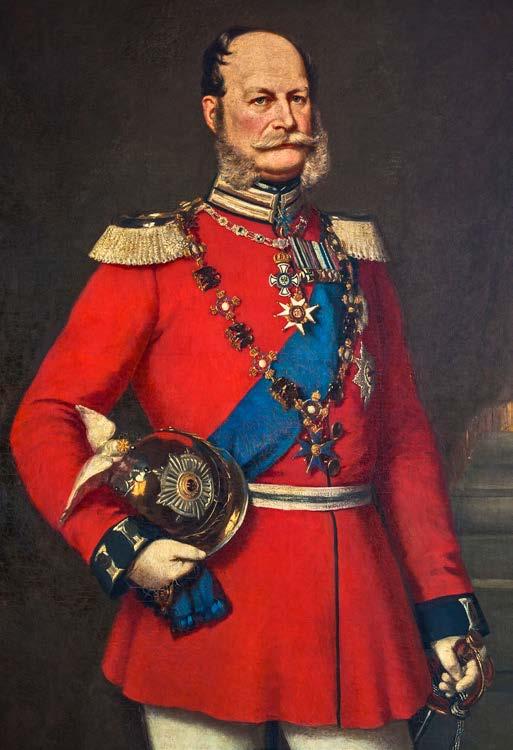
Fig. 13: Unknown artist after Franz Xaver Winterhalter: King Wilhelm I, painting c. 1861. Potsdam, property of the House of Hohenzollern, Georg Friedrich, Prince of Prussia.
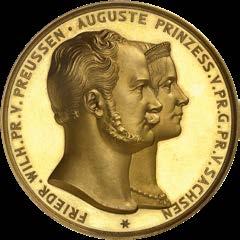
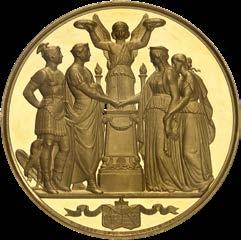
Künker Auction 442, Lot 175. Commemorating the Silver Wedding Anniversary of Prince Friedrich Wilhelm Ludwig (later Wilhelm I) and Princess Auguste of Saxe-Weimar.
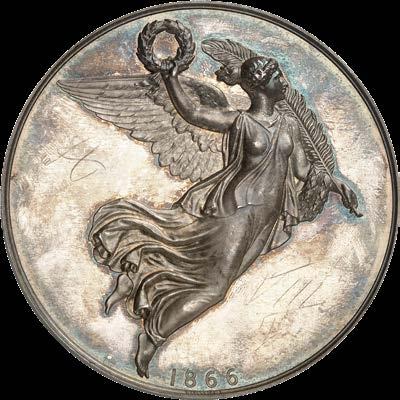
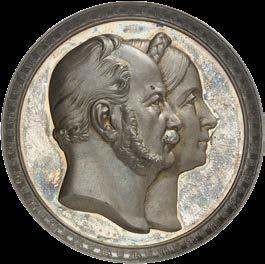
Künker Auction 442, Lot 188. On the victorious war against Austria.
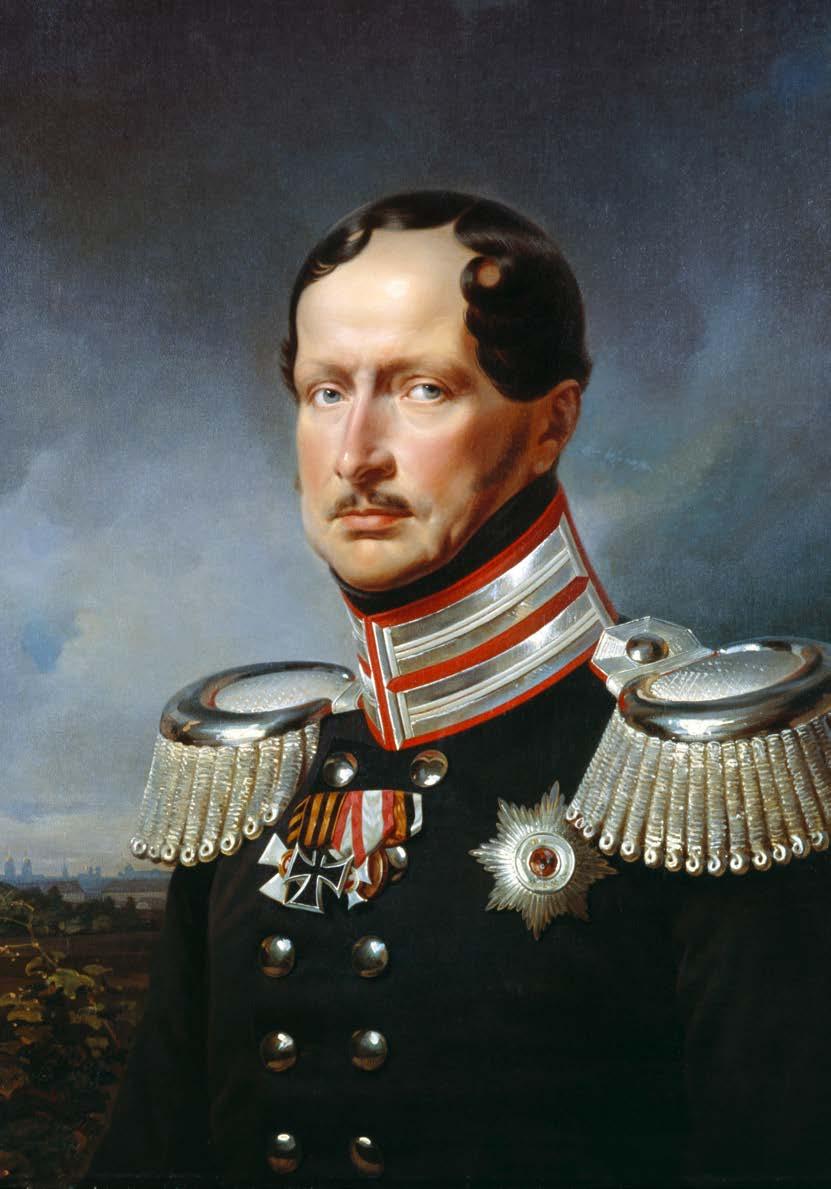
He was succeeded on the throne by his younger brother Wilhelm I (b. 1797) (Fig. 13). Together with his elder brother, Wilhelm had received an identical education from the same teachers, shaped by the Enlightenment, Reformed piety and military discipline; yet this led to Wilhelm developing a personality with a much stronger military character than his elder brother, a trait that defined his entire life and was later clearly reflected in the medals he commissioned.
Involved in foreign policy matters since the 1820s, he travelled to Russia in 1826 and, following the Decembrist uprising, supported the harsh repression, which cemented his strongly anti-revolutionary stance and inclination towards preventive force. In 1829, he married Augusta of Saxe-Weimar-Eisenach (1811–1890), with whom he had two children, including the future Kaiser/Emperor Friedrich III; at the same time, he rose through the ranks of the army to the highest positions and combined his military status with a political role that was increasingly perceived as repressive.
From 1840 onwards, he opposed his brother’s reforms; in 1848-49 he was regarded as a symbolic figure of the counterrevolution. He had the uprisings in the Pfalz/ Palatinate and Baden crushed. From 1850, as military governor, he pursued a conservative policy.
Upon becoming King, he appointed Otto von Bismarck (1815-1898) as Prime Minister in 1862 and implemented a policy of strong-arm rule that led to German unification: Following the wars of 1864 and 1866, the North German Confederation was established under Prussian leadership.
In 1870, the conflict over the Spanish succession led to war with France; Wilhelm remained nominally Commander-in-Chief, but left the military command to Helmuth von Moltke (1800–1891). He agreed to the founding of the German Empire and his own proclamation as German Kaiser/Emperor, which took place at Versailles in January 1871, and supported the annexation of Alsace-Lorraine as imperial territories. His reign was strongly characterised by military symbolism, with a foreign policy based on dynastic ties – particularly with Russia – and fundamentally Bismarck-friendly, yet at the same time peace- and status-oriented, as well as sceptical of colonialism. In domestic policy, he endorsed the conservative turn and the Anti-Socialist Law, remained ambivalent during the Kulturkampf, and took no action against anti-Semitism; in the 1880s, he increasingly took a back seat and became, above all, a representative symbolic figure of the Empire.
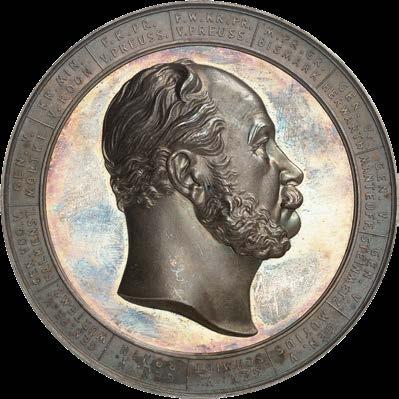
Künker Auction 442, Lot 185.
Schiller State Prize Medal.
Künker Auction 442, Lot 186. On the coronation in Königsberg.
Künker Auction 442, Lot 204. On the 25th anniversary of his reign.
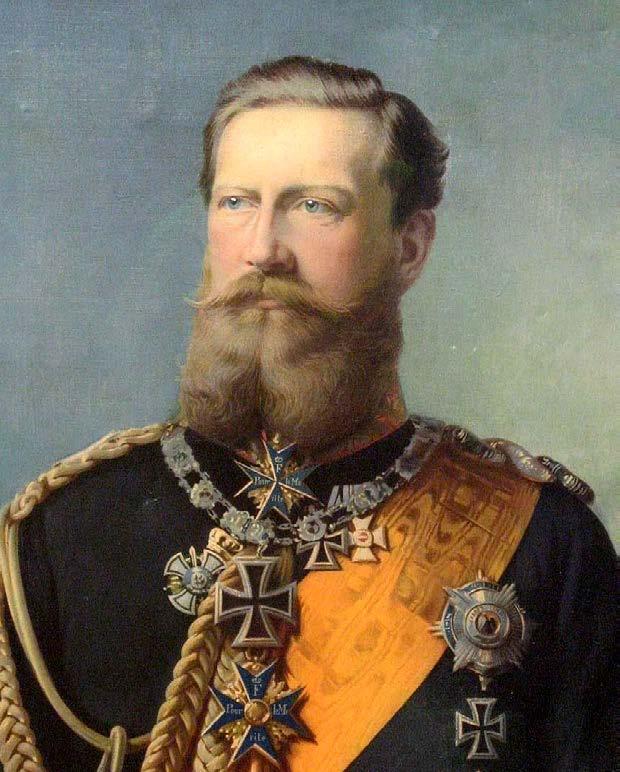
Following the death of Wilhelm I in 1888, his son Friedrich III (born 1831), who was seriously ill with cancer, succeeded him (Fig. 14). He had received a comprehensive humanistic and military education from private tutors, who shaped him in a religious/ constitutional and liberal manner. Alongside his studies in languages, the sciences and the practical arts, he embarked on a military career at an early age and became an officer in the First Guard Regiment in 1843. He rose rapidly through the ranks under his military mentors and was further influenced by the young Helmuth von Moltke. After studying law in Bonn (1849/50), he continued his career as an officer.
His marriage to the British Princess Royal Victoria, daughter of Queen Victoria (1858), was of considerable political significance and produced several children, including Wilhelm II. As Crown Prince of Prussia (from 1861), he played only a limited political role, for instance with remarks distancing himself from Bismarck in 1863.
Fig. 14: Friedrich III, German Kaiser, King of Prussia.
Painting from 1888.
DHM, Berlin Inv. No. Kg 63/58.
Militarily, he played a central role as an army commander in the German War of 1866 and the FrancoPrussian War of 1870–71, and was promoted to Field Marshal. Politically, however, he remained marginalised under Bismarck’s dominance; he presented himself as a liberal and publicly criticised anti-Semitism, though without any lasting effect. From 1887, he fell seriously ill with throat cancer, lost his voice and was effectively unable to govern.
His reign as King and Kaiser in 1888, which lasted only 99 days, had no major consequences and was limited to a few personnel and amnesty decisions. After his death, he was cast as a hope for liberal reform. In reality, his political influence was severely limited.
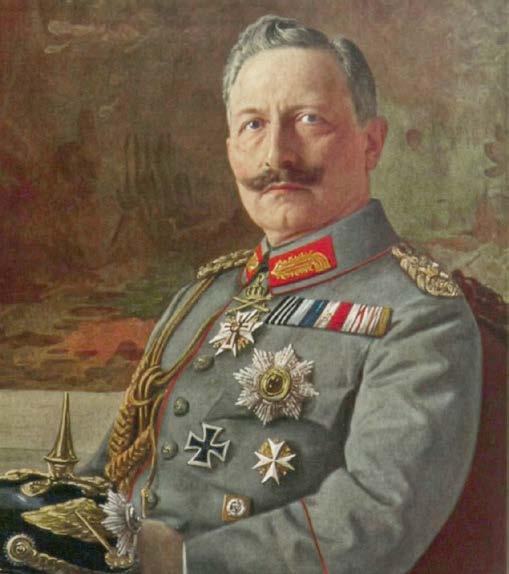
At the age of 29, Friedrich’s son Wilhelm II (born 1859) succeeded him (Fig. 15). He had been born in a difficult breech delivery requiring the use of forceps, which led to permanent paralysis of his left arm and torticollis. His early upbringing was strictly religious and broadly humanistic, though it later came under the highly authoritarian influence of his private tutor. In addition, he received a broad linguistic, academic and military education and passed his graduation examination in 1877. In the same year, he joined the First Guard Regiment as an officer.
In 1881, he married Auguste Viktoria of SchleswigHolstein-Sonderburg-Augustenburg (1858-1921), with whom he had seven children. His military career progressed rapidly, but remained limited by changing postings and Bismarck’s political dominance.
His reign was characterised by foreign policy ambitions, naval rearmament and colonial expansion, which contributed to international isolation. Domestically, authoritarian structures, social reforms without democratisation and close ties to the military shaped the system. During the July Crisis of 1914, he wavered between attempts at mediation and support for Austria-Hungary, thereby contributing to the escalation. During the war, he increasingly lost political control to the military leadership, in particular to Field Marshal
Fig. 15: Wilhelm II, German Kaiser, King of Prussia. Colour lithograph between 1914 and 1918. Jever Castle Museum (CC BY-NC-SA).
Paul von Hindenburg (1847–1934) and Quartermaster General Erich Ludendorff (1865–1937). By 1916 at the latest, he had been largely stripped of power, whilst the Empire effectively transformed into a military regime.
In a hopeless military situation, revolutionary pressure in 1918 led to the abdication of the last Prussian King and German Kaiser Wilhem II, which took place de facto on 9 and formally on 28 November; Wilhelm had previously fled to the Netherlands. There he lived an isolated life in exile, politically insignificant and ideologically increasingly radicalised, until his death in 1941 at Huis Doorn. Scholars describe his personality as characterised by impulsiveness, a need for recognition and political inconsistency, which significantly influenced his often unpredictable reign.
Thus, in November 1918, after half a millennium, the rule of the Hohenzollerns in Brandenburg-Prussia came to an end.
Künker Auction 442, Lot 200. On the marriage to Auguste Viktoria.
The Historical Thalers: The first commemorative coins in the modern sense
Few ideas have had such a lasting impact on numismatics as the decision to combine the concept of the medal with that of legal tender. The commemorative coin evolved into a numismatic collectable that still captivates millions of people today.
By Ursula Kampmann
Actually the idea was already around: to use coins not merely as a means of payment, but as a medium for royal propaganda. After all, the Roman emperors had already done so. They too, following the bloody end of the Republic, were under pressure to justify their rule, just as the monarchs of the 19th century were. After all, the people had learnt from the French Revolution that there was an alternative to absolute monarchy. For the first time, rulers had to engage in a form of public relations aimed not only at their peers but at the entire population.
Coins were the ideal medium for this at the ideal time. For in the 19th century, circulation coins became more than just an urban phenomenon. They also spread to the countryside, where subsistence farming and barter had previously dominated.
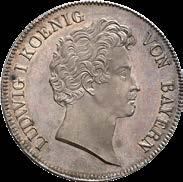
It was, therefore, a good time for new ideas. The first to develop the concept of the commemorative coin in 1790, in a celebratory address on the occasion of the birthday of Friedrich Wilhelm II of Prussia, was the educator Friedrich Gedike. There were no consequences. The situation was quite different in München, where the curator of the Royal Coin Cabinet, Franz von Streber, made the concept appealing to Crown Prince Ludwig, who was very interested in ancient history. Ludwig thought it was brilliant, but he still lacked the power to realise the idea. When von Streber made a fresh approach two years after Ludwig’s accession to the throne, the latter responded enthusiastically.
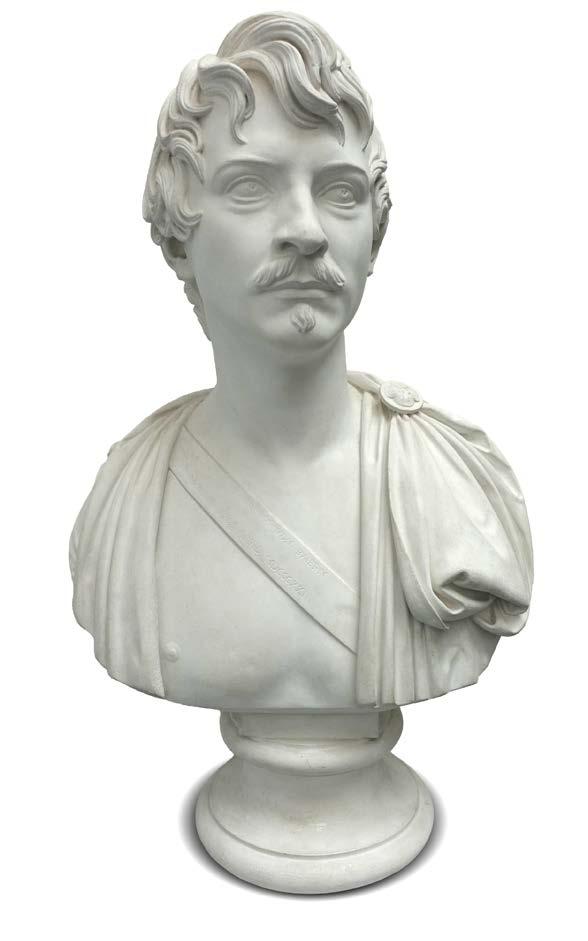
Ludwig of Bayern/Bavaria as Crown Prince in the garb of an ancient general. Portrait by the classical sculptor Bertel Thorvaldsen. München Collection of Antiquities. Photo: KW.
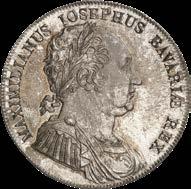
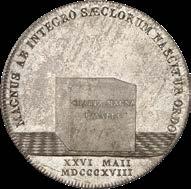
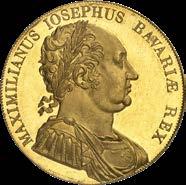
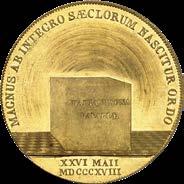
Fig. 2: Bavaria. Max I Joseph. Convention thaler commemorating the Constitution of 1818. Uncirculated. From the collection of the Hohenzollern Museum, from the estate of King Friedrich Wilhelm IV.
Estimate: 300 euros.
From Auction 442 (23 June 2026), Lot 218.
Fig. 3: Bavaria. Max I Joseph. 8 ducats, struck with the dies of the convention thaler. NGC MS64 (Top Pop). Extremely Fine to Mint Luster. From the collection of the Hohenzollern Museum, From the estate of Emperor Wilhelm I.
Estimate: 15,000 euros.
From Auction 442 (23 June 2026), Lot 217.
A first-rate primary source
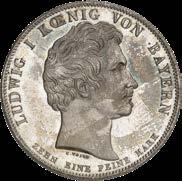
In the autumn of 1828, Ludwig commissioned the first designs from Johann Baptist Stiglmaier, engraver at the Royal Mint. However, as Stiglmaier’s work as inspector of the Royal Metal Foundry left him with insufficient time, the young Carl Friedrich Voigt took on the task. It was labour-intensive, for Ludwig had every design presented to him at every stage, paying attention to even the smallest details and sometimes demanding alterations. As a result, the historical thalers reflect the royal perspective on events. Sketches and proofs illustrate how Ludwig’s attitude changed.
But beware: The date we see on the historical coins often has nothing to do with the year of issue. We must take this into account when reconstructing the message of a historical coin based on the historical context. The best example of this is Ludwig’s attitude towards the Bavarian Constitution.
Ludwig and the Bavarian Constitution
On 26 May 1818, Maximilian I Joseph issued a second constitution for the Kingdom of Bayern/Bavaria. It replaced the first constitution, which he had issued as a precautionary measure to prevent a constitution being imposed by Napoleon. The 1818 Constitution, which remained in force with modifications until 1918, was extraordinarily progressive for its time and guaranteed fundamental rights such as freedom of the press, security of person and property, and the participation of the wealthy population in government through the Assembly of the Estates, known as the Landtag from 1848 onwards.
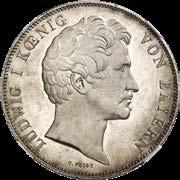
Crown Prince Ludwig was present when his father took the oath on the Bavarian Constitution before his ministers. A coin commemorates this (Figs. 2 and 3). We may describe it as a precursor to the later geschichtsthaler (historical thalers). It does not yet fully correspond to Streber’s concept, as it exists in two forms: There are extremely rare gold strikes. The AKS tentatively estimates their number at 91 specimens. We may assume that they were presented as diplomatic gifts during the ceremonial swearing-in. By contrast, 40,000 specimens of the konventionsthaler, which bore the same motif, were minted – considerably more than would have been necessary for gifts. These coins circulated as official tender.
The Gaibach Constitutional Column
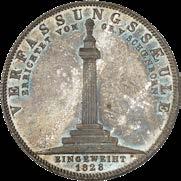
At Streber’s suggestion, Ludwig planned to issue such commemorative pieces on a regular basis. He therefore had several designs drawn up in the autumn of 1828 as, so to speak, a stock. These included, among others, a design depicting the inauguration of the Gaibach Constitutional Column, also known simply as the Constitution Column.
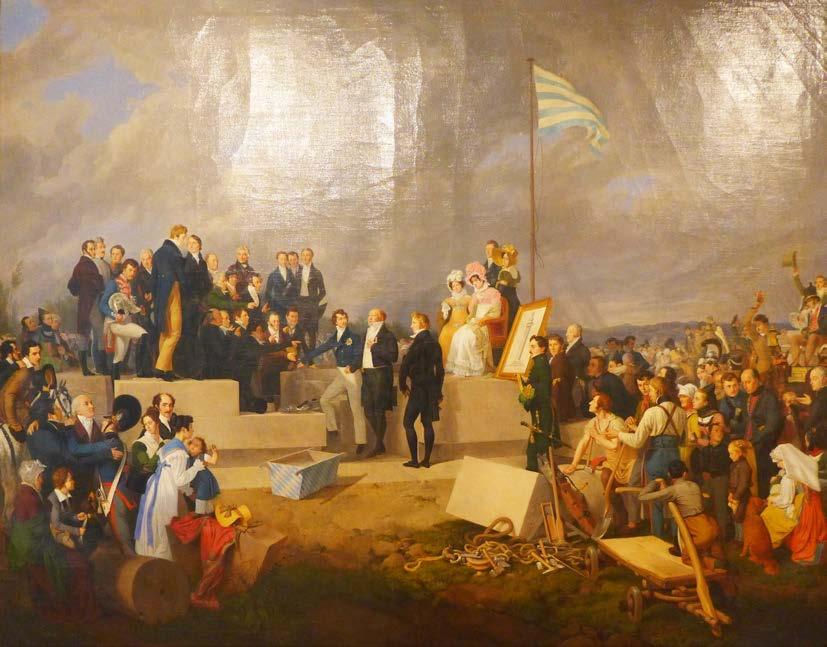
For Ludwig, as Crown Prince, was an enthusiastic supporter of the Constitution. As King, he took the oath on the Constitution on 19 October 1825 and even planned a regular celebration of the Constitution at the Gaibach Constitutional Column. Even though, strictly speaking, it stood on the land of his friend Count Erwein von Schönborn, it was Ludwig’s project. His favourite architect, Klenze, provided the plans; Ludwig laid the
foundation stone on 26 May 1821 and inaugurated the column on 22 August 1828 (Fig. 4).
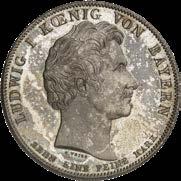
The minting of the “geschichtsthaler” (Fig. 5) began in 1830. In 1831, Ludwig sent a specimen to Erwein von Schönborn with the words: “I hasten to send the first minted thaler depicting the Constitutional Column to its noble founder. One ardent friend of the Constitution sends it to another. The Column is a magnificent monument which, centuries hence, will still bear glorious witness to the convictions of the man to whom it owes its creation. Even if the Constitution were to be misused to prevent many desirable and excellent things, this certainly does not alter my conviction that it is essentially beneficial, for I already felt a keen attachment to the Constitution both during the days of Napoleonic tyranny and after our liberation had been achieved.”
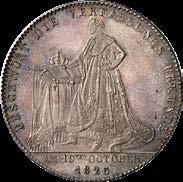
In 1828, Stiglmaier also worked on a commemorative coin intended to document the King’s accession to the throne (Fig. 6). Significantly, it is dated 19 October 1825 – that is, the day on which Ludwig took the oath to the
Historical convention thaler commemorating the erection of the Gaibach Constitutional Column in 1828. NGC MS64. Almost Mint Luster.
From the collection of the Hohenzollern Museum, from the estate of King Friedrich Wilhelm IV.
Estimate: 1,000 euros.
From Auction 442 (23 June 2026), Lot 226.
Fig. 4: Ludwig lays the foundation stone for the Gaibach Constitutional Column. Painting by Peter von Hess, 1822/3. Fürstenbaumuseum / Würzburg. Photo: Oktobersonne. cc-by-sa 4.0.
Fig. 5: Bavaria. Ludwig I.
Constitution. The image of the King is large and central, placing his right hand on the Constitution to swear upon it. Yet this version was never minted, for Ludwig’s attitude towards the Constitution changed dramatically.
The shock of 1830
Reality caught up with the monarch on 31 July 1830. On that day, he learnt that insurgents had deposed Charles X of France. This brought back memories for Ludwig: In 1789, he had fled Strasbourg before the Revolution, where his father had served as a French officer. Ludwig’s godfather, Louis XVI, had been beheaded. And now, in the autumn of 1830, students were taking to the streets of München. Would the horrors of the Revolution also befall Bavaria?
Ludwig blamed the unrest on the abuse of press freedom. On 28 January 1831, he imposed censorship, a move met with great displeasure by the liberal members of the Bavarian Estates Assembly. This was a serious matter, for Ludwig wanted to push through a royal civil list. This would have separated state finances from the royal treasury. Ludwig would have received a share of the taxes, which he could have used without consultation for his controversial building- and cultural policies.
But the negotiations dragged on. It was only when Ludwig withdrew his censorship decree that the Estates Assembly granted him its approval for a provisional civil list. This was actually a success, yet the King felt hurt by the criticism levelled by some politicians at his most cherished building projects. This was not how he had imagined freedom of speech! How could they dare to criticise his Odeon, the State Library and even the Alte Pinakothek!
Even though the State Parliament ultimately financed the costs of these building projects from the state treasury, these politicians were not “his people” as Ludwig thought of them. His Bavarians were loyal, trusted their King, and if they spoke out otherwise, it was only because they had been incited by intellectual free-thinkers who abused the freedom of the press.
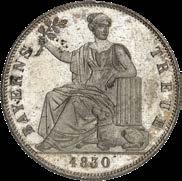
A historical thaler is dedicated to this Bavarian Volk (Fig. 7), and it was indeed planned, designed and minted in 1830. Amidst the turmoil of 1830, Ludwig represents his people. To this end, he has Bavaria appear, that anthropomorphic embodiment of Bavaria which still today presides over the then-new Bavarian national festival – the Oktoberfest. The Bavaria personification holds an oak branch in her hand.
Fig. 6: Bavaria. Ludwig I.
Trial piece for the historical convention thaler commemorating the oath on the Constitution on 19 October 1825. Uncirculated.
Estimate: 4,000 euros, Hammer price: 7,000 euros.
From Auction 108 (14 March 2006), Lot 598.
7: Bavaria. Ludwig I.
Historical convention thaler commemorating the loyalty of the Bavarians in 1830. NGC MS64. Almost mint luster.
From the collection of the Hohenzollern Museum, from the estate of King Friedrich Wilhelm IV.
Estimate: 1,000 euros. From Auction 442 (23 June 2026), Lot 229.
In the 19th century, the oak was regarded not only as the quintessential German national tree, but also served as a reminder of the ancient Corona Civica, which Augustus had received as a token of the people’s gratitude for bringing the civil war to an end.
The tree symbolised closeness to the people.
The seated Bavaria leans on a column, thus evoking a perfect fusion of two distinct ancient types of Securitas: in terms of posture, the seated Securitas; in terms of her attribute, the column, to the Securitas standing by a column. In this way, Bavaria takes up an ancient symbol of stability, representing a kind of counterpoint to revolutionary upheavals. At her feet rests a dog, a sign of loyalty.
This sentiment is also conveyed in a poem written by the King in 1831, which he proudly addressed “To the Bavarians!”:
Fig.
“Honest people! In ancestral loyalty // You hold fast to your ancient princely house, // You are not tempted by the false new, // Nor does the flame of love extinguish it in you.
Yes! To old loyalty, old faith // You hold fast, unshakeable, // You do not let time rob you of them, // Loyalty has never wavered in the Bavarians.
Unshaken, when storms rage from above, // Unshaken, when the earth trembles, // Even when adversity piles up against you: // Nothing can topple you, nothing can undermine you.
You stand like a thousand-year-old mighty oak // That shall never be felled; // No blows can penetrate it, // And the axe ricochets from the trunk.
Having already passed every test with victory, // You remain ever true to your duty, // Just as the earliest times knew you; // Bavaria, you are not to be corrupted!”
The victory of the conservative forces
Just how out of touch Ludwig’s view of his people was became clear on 27 May 1832, when 25,000 liberals made their demands at the Hambach Festival. Hambach lay in the Pfalz/Palatinate and was thus on territory ruled by Ludwig. And that was not the only rally to take place there. Even Ludwig’s much-loved Constitutional Column became the centre of liberal protests. The Mayor of Würzburg, who had celebrated with the King at the inauguration of the Constitutional Column, now voiced open criticism. Ludwig showed no understanding for this. He felt betrayed and personally saw to it that the 60-year-old Mayor was sentenced to 16 years in prison. The latter was not the only victim of state coercive measures: Soon, hundreds of opposition figures were imprisoned in fortresses, and still more fled. Even death sentences were handed down, though not carried out.
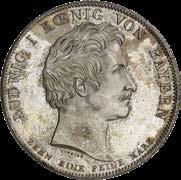
convention thaler 1834. Mint luster.
Estimate: 2,500 euros, Hammer price: 2,800 euros. From Künker Auction 302 (1 February 2018), Lot 1041.
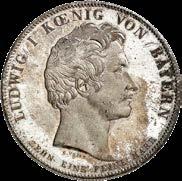
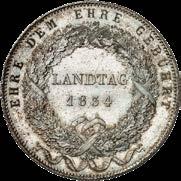
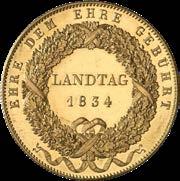
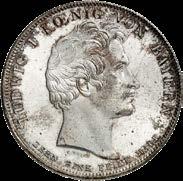
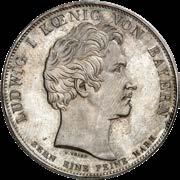
This silenced the liberal movement in Bavaria. In 1834, the ten most radical members of parliament were absent from the sessions of the Estates Assembly. Many were too intimidated to voice their opinions publicly. Thus, the conservative speakers dominated. They voted in favour of Ludwig finally receiving the long-awaited, lifelong civil allowance. These members were rewarded with a geschichtsthaler (Fig. 8), with which the King expressed his gratitude for their decision.
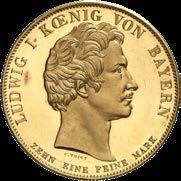
We can also show a gold version of the geschichtsthaler (Fig. 9), which illustrates the coin’s popularity among collectors even as early as the 19th century. Louis Philippe de Ferrari (1850–1917) commissioned a series of the geschichtskonventionsthaler in gold using the original dies from the Bavarian Main Mint. It was produced in 1903. There are no contemporary gold proofs of the geschichtstaler.
Ludwig’s view of his style of governing
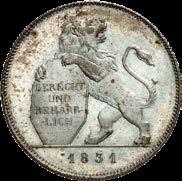
Another historical thaler illustrates just how important it is, when interpreting these coins, to focus not on their date of issue but on the time at which they were put into circulation. Although dated 1831, it was not designed and put into circulation until 1834/5, following the victory of the conservative forces. It depicts the royal lion as it still stands today in front of the München Residenz. The lion holds a shield bearing Ludwig’s motto GERECHT UND BEHARRLICH (Just and Persistent) (Fig. 10). This renders the coin a kind of historical distortion. In 1834/5, it pretends that Ludwig had already tightened the reins of government in 1831, that is, long before the Hambach Festival.
Gold strike of the historical convention thaler 1834, manufactured in 1903. Uncirculated.
From the collection of King Farouk of Egypt and Ferrari.
Fig. 10: Bavaria. Ludwig I. Historical convention thaler 1831. Uncirculated. Estimate: 2,500 euros, Hammer price: 2,600 euros. From Künker Auction 302 (1 February 2018), Lot 1038.
Fig. 11: Bavaria. Ludwig I. Historical convention thaler commemorating his accession to the throne on 13 October 1825. Almost Mint Luster. Estimate: 500 euros, Hammer price: 1,800 euros.
From Auction 354 (30 September 2021), Lot 5333.
From a liberal to a conservative ruler
The extent to which Ludwig’s attitude towards the constitution changed after the Hambach Festival can be clearly seen in the altered design of the historical thaler commemorating his accession (Fig. 11). It still bears the year of his accession to the throne, 1825, even though it was not minted until 1836.
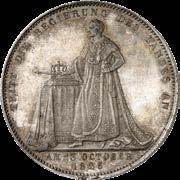
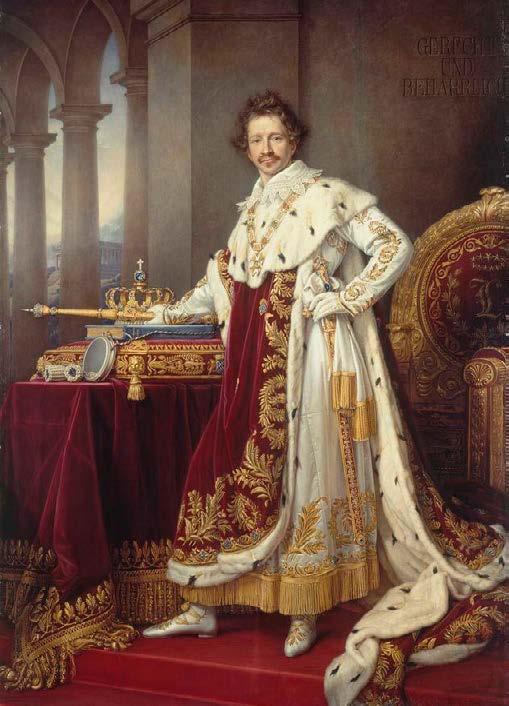
Fig. 12: Ludwig I assumes the throne. Painting by Joseph Karl Stieler. Neue Pinakothek, München, Inv. No. 1062.
The date of his accession to the throne has been demonstratively shifted on this coin. Ludwig no longer counts from the oath to the constitution on 25 October 1825, but from his father’s death on 13 October 1825. The depiction on the coin has changed in exactly the same way. Instead of the oath-taking scene initially planned in the designs, in which Ludwig I swears on the constitution with his hand raised, he now resorts to the official portrait – considerably more restrained in content – which the court painter Stieler produced of him immediately after his accession to the throne. The Constitution is also visible in this portrait, but merely as one of many royal attributes. The enthusiastic emphasis with which Ludwig had sought to demonstrate his stance on the Constitution to the entire Volk on circulation coins has given way to a statesmanlike, sober portrait that relegates the Constitution to its proper place. (Fig. 12).
Nothing could better illustrate how far Ludwig had left behind the liberal ideals of his youth. The hard-of-hearing and severely stuttering monarch withdrew more and more from “his” people, disappearing into his artistic make-believe worlds, which could scarcely be reconciled with reality. It is certainly telling that Ludwig, of all people – once so liberal – became the only ruler in the German Empire whose lost his throne in the revolution of 1848.
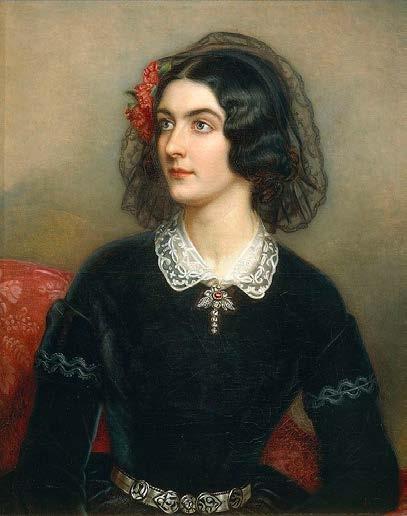
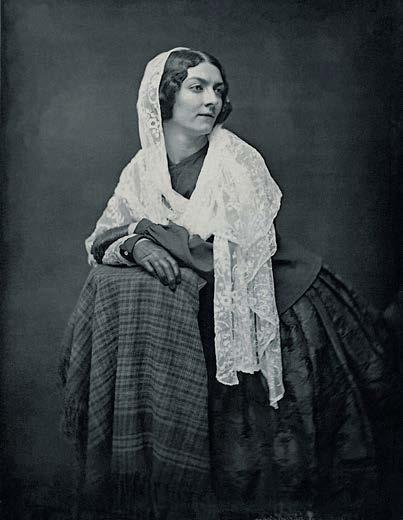
Yet it was not political missteps that caused outrage in München, but a beautiful Irish dancer who, under the name Lola Montez, gained influence over the ageing King. Because he insisted on her naturalisation in 1847 – against the express will of the State Council –virtually all the ministers resigned. The members of the university and the majority of the civil service showed solidarity with the politicians. The citizens grumbled too, even though the newly appointed “Ministry of the Dawn” had introduced a number of liberal and anticlerical measures. Censorship was relaxed, and reforms in the judicial and educational systems were initiated. Yet the ministers still refused to alter their positions with regard to the dancer. This time it was Ludwig who replaced the ministers, a move that earned the new cabinet the nickname of the “Lola Ministry” in student circles.
Naturally, protests ensued. The King responded by closing München University on 9 February 1848 until the start of the coming winter term. This was an untenable act of defiance. But on 10 February, joint action by ministers, the Estates Assembly
and representatives of the citizenry forced its rapid reopening. Ludwig, now 62 years old, was frustrated. He did not at all like having limits imposed on him. When subsequently – following news of the Paris unrest on 22 February – the call for the abolition of the monarchy became unmistakable and violence broke out, the King lost heart. On 18 March 1848, he told his advisers the following: “I have reigned for 23 years as a true king and am now supposed to be nothing more than a rubber-stamp king, bound and fettered at both hands; no, I cannot do that. Someone starting afresh might perhaps come to terms with it, but after 23 years, that is not possible.”
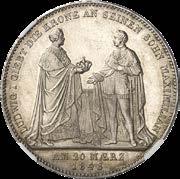
And with that, Ludwig handed over the reins to his son Maximilian II Joseph. Let him deal with the rebels! On the 1848 historical double thaler the geschichtsdoppelthaler, however, there is no sign of any unrest. Here it is a matter amongst kings: Ludwig voluntarily removes the crown to pass it on to his son. That this reflects Ludwig’s view of things is revealed in a letter dated 28 March 1848, in which he informs his son, King Otto, of the events: “I acted in accordance with what I have always said. No one urged me to renounce the crown, not even a single acting minister. It was on 19
The beautiful Lola
Fig. 13: Lola Montez, née Elizabeth Rosanna Gilbert, portrayed by court painter Joseph Karl Stieler for Ludwig’s Gallery of Beauties at Nymphenburg Palace.
Fig. 14: Lola Montez, née Elizabeth Rosanna Gilbert, in a daguerreotype from 1851 by Southworth & Hawes. Collection of the Metropolitan Museum of Art, New York.
Fig. 15: Bavaria. Ludwig I historical double-thaler commemorating the transfer of sovereignty to his son in 1848. Almost Mint Luster. Estimate: 4,000 euros, Hammer price: 9,000 euros. From Auction 170 (22 June 2010), Lot 3623.
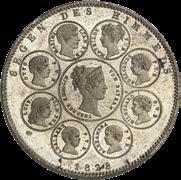
Fig. 16: Bavaria. Ludwig I historical convention thaler “Blessing from Heaven”, dated 1828. Almost Mint Luster. From the collection of the Hohenzollern Museum, from the estate of King Friedrich Wilhelm IV. Estimate: 500 euros. From Auction 442 (23 June 2026), Lot 227.
The Wittelsbach Dynasty
But we have gotten far ahead of ourselves. Let us go back to the year 1828 and consider another central theme of the Bavarian historical thalers: the Wittelsbach dynasty. It was a central theme for Ludwig. Twelve of the forty-three historical thalers – more than a quarter –are dedicated to it.
Blessing from Heaven
When Ludwig wrote to the Director of the Royal Mint on 22 September 1828 to commission designs for the first historical thalers, the royal family was one of the two themes specified. “Blessing from Heaven” was to become the most famous Bavarian historical thaler in Russia due to its numismatic significance.
On this coin (Fig. 16), the royal couple are depicted with all of their children. What appears to us as a charming family gathering had a very different significance in a monarchy: No one who has grown up in a democracy can imagine the legal uncertainty that the extinction of a ruling dynasty entailed. We know of enough cases where the lack of an heir triggered a civil war.
Even the Roman monarchs boasted of their extensive offspring. They combined their children’s names with coin inscriptions such as TEMPORVM FELICITAS (the happiness of the [present] times), AETERNITATI IMPERII (the eternity of the reign) or FELICITAS
March ... when, at 1 o’clock in the afternoon, I gathered all the adult princes of my house around me and revealed my decision to them. After a long inner struggle, I had made it (the day before, I had not been without concern that I might suffer a nervous breakdown). It was deeply moving, profoundly touching; I heard loud weeping all around me. Max knelt down and asked for my blessing. ... I did not consider myself as beloved by the people as I found myself to be. I hear that people wept in the streets when my abdication became known; it caused general consternation.”
Ludwig even believed that there would have been an uprising had his people learnt of the plan. In fact, Ludwig could probably have held on to the throne if he had waited patiently until the citizens had had enough of the unrest. He did not. He preferred, from then on – with a lavishly-endowed civil list that deprived his son of the necessary funds for the royal household – to live for the arts.
SAECVLI (the happiness of the century). Ludwig revived this tradition, for the Bavarians, too, had changed their ruling house all too often. In 1777, the Palatinate Wittelsbachs took over the rule of Bavaria with the unpopular Karl Theodor; when he died childless, the previously insignificant Wittelsbach-ZweibrückenBirkenfeld branch took the helm.
This made Ludwig I only the second ruler from this new dynasty. By conspicuously bringing his four sons and four daughters to the fore, he showed the Bavarians that they need not fear the new ruling house dying out again.
The first draft, produced by Stiglmaier, closely followed Roman models with the Latin inscription PATRIAE SALVS ET FELICITAS (Salvation and Happiness of the Fatherland). However, on the King’s personal orders, the Latin inscription was replaced with a German one. The fact that Ludwig chose “SEGEN DES HIMMELS” (Blessing of Heaven) may be interpreted as a testament to his personal faith.
Digression: The Beginnings of Russian Commemorative Coinage
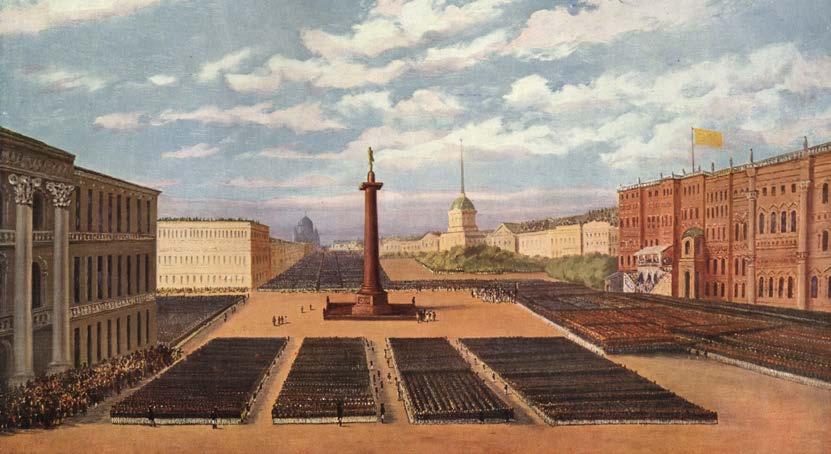
Let us now turn our attention to Russia. In 1831/2, “Segen des Himmels” was put into circulation in München. On 30 August 1834, the Russian court gathered in front of the Winter Palace in St. Petersburg to celebrate the inauguration of the Alexander Column. The Alexander Column was conceived as a direct response to the Parisian Victory Column on the Place Vendôme, which commemorated the Allies’ most bitter defeat. The following is inscribed on the plinth in Paris: “The sublime Emperor Napoleon dedicated this monument to the war in Germany in 1805, brought to a close under his leadership within a period of three months, made from bronze captured from the enemy, to the glory of the Grande Armée.” The statue of Napoleon that once stood at the top has now disappeared: The victors had it melted down in 1814.
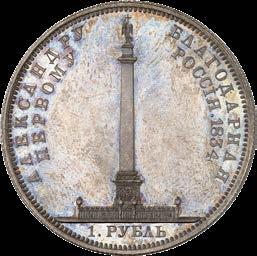
The Alexander Column in Russia surpassed the column on the Place Vendôme in height – at 47.5 metres – and in modesty. For it was not Alexander who was depicted at its summit, but an angel, whose face was at best reminiscent of Tsar Alexander I. The inscription on the plinth, in its simplicity, subtly rebukes the attention-seeking upstart Napoleon. It reads: “Alexander I, grateful Russia”.
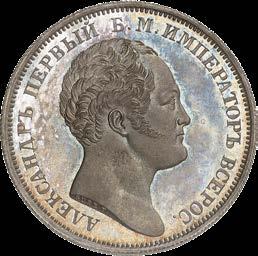
Just a few days after the inauguration of the Alexander Column, a small parcel lay on the desk of the Minister of Finance, Count Egor Francevic Kankrin, in which Prince Grigory Ivanovich Gagarin, the Russian ambassador in München, had sent a few coins to supplement the coin collection at the Hermitage in St. Petersburg. These were the first 15 Bavarian historical thalers. This gave Finance Minister Kankrin the idea of having a coin struck to mark the inauguration of the Alexander Column. He proposed this to Nicholas I, who was delighted with the idea.
The imperial decree to the mint was issued on 9 December 1835. Just one day later, the director of the St. Petersburg mint reported that he had received the order and had commissioned Heinrich Gube to produce the die. By 16 December, Gube had already submitted his first draft designs. In doing so, he recommended that the denomination be placed beneath the column on the coin for aesthetic reasons. At the same time, he sent various existing portraits of Alexander I to aid the selection process. On 26 December 1835, Tsar Nicholas I decided which design should be used and approved the coin portrait. On 25 February 1836, the order to mint the coins followed: Finance Minister Kankrin ordered that 5,000 coins should be minted initially. On 8 and 20 June 1836, approval was granted for further coins. This was replaced on 4 December 1836 by a standing authorisation: The mint was to continue minting this
Fig. 17: Inauguration celebrations marking the erection of the Alexander Column in St. Petersburg. Painting by an unknown artist from 1912.
Fig. 18: Russia. Nicholas I ruble, St. Petersburg, commemorating the inauguration of the Alexander Column in 1834. NGC PF65 Cameo. Mint Luster. From the collection of the Hohenzollern Museum, from the estate of King Friedrich Wilhelm IV. Estimate: 7,500 euros. From Auction 442 (23 June 2026), Lot 298.
type of coin so that at least 5,000 pieces were always in stock. It was probably planned, much as Ludwig had done with his historical thalers, to use these for very special payments.
Today, there is debate as to how large the actual mintage was. In 1859, Finance Minister Knyazhevich mentioned the production of up to 74,000 blanks. It is likely that most of these were not used, but were melted down at a later date, although we have no further details on this.
The Family Ruble
Among the first 15 historical thalers was the “Blessing from Heaven” type, which had been minted since 1831. Following the great success of the first Russian commemorative coin, Finance Minister Kankrin commissioned the young die-cutter Pavel Petrovich Utkin, who had been working as a medallist for the St. Petersburg Mint only since January 1835, to mint a similar coin featuring the portraits of the family of Tsar Nicholas I. Kankrin suggested that the portraits should be copied from the snuffbox of the prince’s tutor, Prince Alexander Nikolayevich Golitsyn. Utkin presented a first pair of dies in December 1835. The Minister of Finance received 36 pieces from the first batch of coins struck. He presented them to the Tsar on 6 December 1835, who in turn gave them as gifts to family members, including his German brother-in-law Friedrich Wilhelm IV. The coin shown here is likely to have been a personal gift from Tsar Nicholas I to the then German Crown Prince Friedrich Wilhelm.
Incidentally, the Tsar did not like the portrait of his wife at all. He is said to have been horrified by her double chin, which made her look far too old. Utkin subsequently developed a new portrait design. However, this too was rejected for mass production. Despite two further dies being made for trial strikes, a comprehensive series was never produced. The “family ruble” remained a numismatic rarity, minted solely for a small circle of collectors – during Nicholas I’s lifetime and subsequently as “novodels”.
19: Russia. Nicholas I 1 1/2 ruble, St Petersburg, so-called “family ruble”. NGC MS 64 (Top Pop).
Only 36 examples struck. A masterpiece struck from polished dies. Almost Mint Luster. From the collection of the Hohenzollern Museum, from the estate of King Friedrich Wilhelm IV.
Estimate: 250,000 euros. From Auction 442 (23 June 2026), Lot 297. 2:1
Fig.
The dynastic links to Prussia
But back to Bavaria … Ludwig also used his historical thalers to popularise themes that had been depicted on the commemorative coins and medals of the noble houses for centuries. Marriages and births – as long as they concerned the ruling dynasty – were also of crucial importance to the population. They confirmed alliances and, as mentioned above, guaranteed the dynasty’s survival.
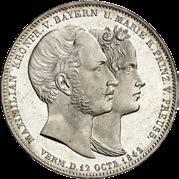
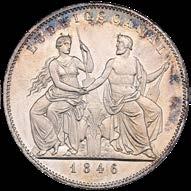
Thus, Ludwig had a historical double thaler struck to celebrate the marriage of the Bavarian Crown Prince Maximilian to Marie of Prussia in 1842 (Fig. 20). Marie of Prussia was the cousin of Friedrich Wilhelm IV and Wilhelm I. She was descended from the fourth and youngest son of Friedrich Wilhelm II. In other words: From a dynastic perspective, the Crown Prince of Bavaria could have made a far better match.
But Ludwig insisted that his son should make his own choice – as long as he didn’t bring home a Frenchwoman, for Ludwig had expressly forbidden that. A marriage beneath his station was, of course, equally out of the question. Yet Maximilian found it difficult to make up his mind. He was already 31 years old when, with his “feet sore from courting”, he proposed to his future wife. Marie of Prussia was 16 at the time, her appearance was charming, and she was fond of her prospective husband. It is said that – in defiance of all court etiquette – she jumped out of the carriage upon her arrival in München to embrace her husband. This Queen was certainly unconventional. She outlived her husband by more than a quarter of a century and became a pioneer of women’s mountaineering.
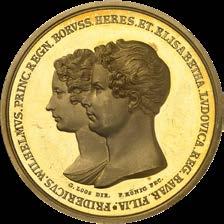
21: Prussia. 12-ducat gold medal by J. Lösch and B. Stiglmaier commemorating the marriage of Friedrich Wilhelm to Elisabeth Ludovika in 1823. NGC MS63 DPL. Extremely Fine to Mint Luster. From the collection of the Hohenzollern Museum, from the estate of Emperor Wilhelm I. Estimate: 6,000 euros. From Auction 442 (23 June 2026), Lot 108.
the
NGC MS 62 DPL. Minor scratch. Extremely Fine to Mint Luster. From the collection of the Hohenzollern Museum, from the estate of Emperor Wilhelm I. Estimate: 7,500 euros. From Auction 442 (23 June 2026), Lot 110.
20:
From
the
Yet the union between Maximilian and Marie was not as unproblematic as we might imagine today. For he was Catholic, whilst she belonged to the Protestant faith. In which faith should their children be raised?
There was already a protocol blueprint in place to build upon. For this wedding was already the second dynastic union between the Wittelsbachs and the Hohenzollerns. On 29 November 1823, Friedrich Wilhelm IV had married the Catholic Elisabeth Ludovika of Bavaria,
Fig.
Bavaria. Ludwig I historical double-thaler commemorating
wedding of Maximilian and Marie of Prussia in 1842. Almost Mint Luster. Estimate: 750 euros, Hammer price: 2,025 euros.
Auction 322 (24 June 2019), Lot 206.
Fig.
Fig. 22: Prussia. 18-ducat gold medal by F. König commemorating
marriage of Friedrich Wilhelm to Elisabeth Ludovika in 1823.
Estimate: 750 euros, Hammer price: 3,800 euros. From Auction 232 (17 June 2013), Lot 465.
a half-sister of Ludwig I, as evidenced by magnificent medals (Figs. 21 and 22) . This marriage had been preceded by four years of diplomatic negotiations to clarify how to deal with matters of religion and mutual claims to the throne.
Unlike Wilhelm’s sister Charlotte, who converted to the Orthodox faith for her marriage to the future Tsar Nicholas I, the Wittelsbachs and Hohenzollerns demonstrated their equality by allowing Elisabeth Ludovika and Marie respectively to retain their denominations upon marriage.
The Heir and the Spare
Naturally, the birth of Maximilian and Marie’s eldest son was also commemorated on a historical thaler (Fig. 23). He was named Ludwig after his grandfather. This was the future King Ludwig II of Bavaria, known as the eccentric builder of Neuschwanstein, Linderhof and Herrenchiemsee.
It is interesting to note that the historical thaler is dedicated not only to Ludwig’s birth, but also commemorates that of another Ludwig who, at the time of minting, was fourth in line to the throne. This was the eldest son of Ludwig’s third son, Luitpold (the future Prince Regent). In fact, this child – Ludwig III – was to reign as the last King of Bavaria.
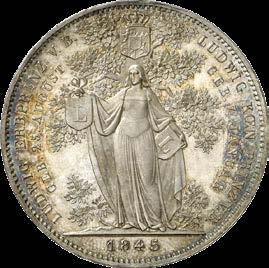
The reverse depicts a figure of Bavaria in medieval garb. She holds a shield in each hand bearing the initials of the princes’ names. An oak tree grows behind her. It is marked by the Wittelsbach coat of arms as the family tree of the dynasty, from which two new, fresh shoots spring at the very bottom.
Secondary line in Greece
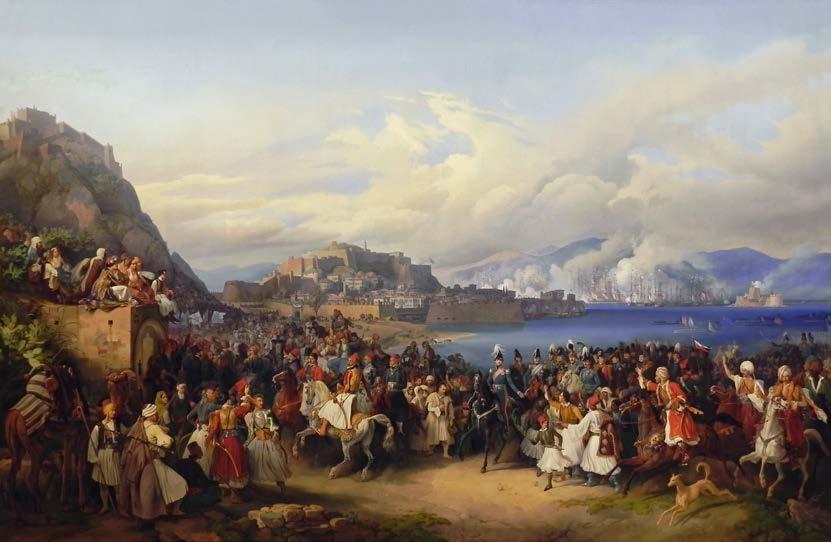
Ludwig’s greatest dynastic achievement was the establishment of a secondary line in Greece. Even as Crown Prince, Ludwig had enthusiastically supported the Greek struggle for liberation. The otherwise frugal prince repeatedly supported the Greek army and arranged for Bavarian officers to serve as instructors. After representatives of Russia, England and France recognised Greece’s independence in 1830, thereby forcing the Ottoman government to relinquish that part of their empire, a king had to be found for the new state. The three protecting powers had now undertaken not to propose any member of their own ruling dynasties. This meant a compromise candidate with as little power as possible was needed, one with whom all three governments could live.
Leopold of Coburg was a promising candidate, but he had received a better offer: The Belgians had hinted that they would be happy to make him their ruler. This brought the relatives of the ardent philhellene Ludwig into the picture. First, his brother Karl was asked. But on Ludwig’s instructions, Karl declined. Throughout his life, Ludwig had been jealous of his brother, the ladies’ favourite with a talent for military affairs.
Ludwig also initially had reservations regarding his son Otto. Otto was only fifteen years old, and a reign in an underdeveloped country would be costly and risky. Yet ultimately, Ludwig was delighted by the enormous prestige this would bring to the House of Wittelsbach. He therefore signalled to the three powers that representatives of the Greek people should officially offer the candidacy to his son, who would accept. This took place in October 1829.
Fig. 23: Bavaria. Ludwig I historical double-thaler 1845. First strike. Mint Luster.
On 15 October 1832, the deputies of the Greek National Assembly swore their oath of allegiance to King Otto. This moment is depicted in a mythically-exaggerated manner on a historical thaler (Fig. 24). Hellas herself, dressed in the classical style, presents the crown to the youthful prince. His age is further emphasised by the proportions. The Bavarian element is highlighted in several ways: Otto’s title as Prince of Bavaria appears BEFORE his royal title, and the Bavarian lion stands behind the young man.
Just how proud Ludwig was of this second son is evident from the mintage figures of the commemorative thaler alone. 8,095 pieces were minted of this issue.
Farewell to his son
Just two years later, Ludwig followed up. He had another historical thaler struck in honour of his royal son. It depicts the monument in Aibling that Ludwig had erected on the spot where Queen Therese bid farewell to Otto (Fig. 25).
24: Bavaria. Ludwig I historical convention thaler commemorating the accession of Otto of Bavaria as the first King of Greece in 1832. NGC MS64. Almost Mint Luster.
From the collection of the Hohenzollern Museum, from the estate of King Friedrich Wilhelm IV.
Estimate: 1,000 euros. From Auction 442 (23 June 2026), Lot 230.
Ludwig I. Historical convention thaler commemorating Therese’s farewell to her son in Aibling in 1835. Uncirculated. Estimate: 2,500 euros, Hammer price: 2,000 euros. From Auction 302 (1 February 2018), Lot 1042.
Fig. 24: King Otto of Greece’s entry into Nafplio. Painting by Peter von Hess from 1835. Neue Pinakothek, München.
Fig.
Fig. 25: Bavaria.
Bavaria. Ludwig I historical convention thaler commemorating the consecration of the Otto Chapel in Kiefersfelden in 1836. Extremely Fine to Mint Luster. Estimate: 300 euros, Hammer price: 950 euros. From Auction 337 (22 June 2020), Lot 609.
Bavaria. Ludwig I historical convention thaler commemorating the Bavarian inventors Reichenbach and Fraunhofer. NGC MS64. Almost Mint Luster. Estimate: 1,000 euros. From the collection of the Hohenzollern Museum, from the estate of King Friedrich Wilhelm IV. From Auction 442 (23 June 2026), Lot 222.
The neo-Gothic statue features a statue of the Virgin Mary, the embodiment of all mothers who sacrifice their children for a higher purpose. Here we see the tension between Ludwig’s dynastic ambition and the maternal love of a mother who must give up her son. We do not know whether the grief was genuine or whether Therese was merely fulfilling the expectations of those of her female subjects who wept because their sons were required to go to Greece with Otto.
Ludwig then revisited this theme just one year later with yet another historical thaler (Fig. 26) . This was dedicated to Otto’s departure from his homeland of Bavaria in late autumn 1832. For those wondering about the date, it refers not to the departure itself, but to the consecration of a small chapel at the spot where Otto crossed the border on 19 June 1836.
Incidentally, Ludwig was eventually forced to witness the failure of his Greek plans even before his death. A revolt drove Otto and his wife Amalie out of Athens in 1862.
Ludwig and the Economy
Let us turn to another topic to which a large portion of the historical coins is also dedicated: the economy, which had become even more important than in the age of absolutism. For the central argument with which a monarch could score points in the Vormärz (pre-March) period was precisely the economy. When the economy
was thriving, nobody thought of unrest or revolution. Economic concerns were therefore the core business of every monarch – at least that was how Ludwig I saw it.
The first commoners to appear on a commemorative coin were inventors
Thus, it was not poets or thinkers who were the first non-nobles to be depicted on a state commemorative coin, but inventors (Fig. 27). Georg von Reichenbach was not only a brilliant optician and precision engineer; he is regarded as the pioneer of the steam engine in Bavaria and, as Director of the Building Office, was responsible for many new roads, bridges and canals, along which Bavarian goods are still transported today. Joseph von Fraunhofer, for whom the Fraunhofer Institute was named, was a pioneering optician of his time who produced technical lenses that revolutionised telescope construction in the 19th century.
Franz von Streber had wanted to see their images on a Bavarian historical thaler earlier. His memorandum of 16 June 1827 to Ludwig concludes with the words: “An ordinary Bavarian convention thaler bearing Fraunhofer’s or Reichenbach’s portrait on the reverse would carry their names throughout Europe. It would be preserved for centuries and serve as a monument even for the King.”
Ludwig took up this idea – though not until 1833/4, when this historical thaler was minted.
Fig. 26:
Fig. 27:
The path to the German Customs Union
As an ardent supporter of the German Customs Union, Ludwig meticulously recorded every stage of the journey towards it on the historical thalers. The first historical thaler appeared in 1830/1 and celebrated the Customs Union with Württemberg (Fig. 28). Negotiations for this had been set in motion by a personal exchange of letters between Wilhelm I of Württemberg and Ludwig I of Bavaria in December 1826. As early as 12 April 1827, the treaty on the Customs Union between Bavaria and Württemberg was signed.
In 1831/2, the geschichtsthaler was issued to mark the Customs Union, which had been expanded on 27 May 1829 to include Prussia and Hesse (Fig. 29). Ludwig I was involved here too: He himself suggested negotiating directly with Prussia in order to undermine the basis for an independent Central German Customs Union which would not include the southern German states.
Saxony and Thuringia joined on 30 March and 11 May 1833 respectively, as commemorated by another geschichtsthaler (Fig. 30), with still another marking Baden’s accession on 11 July 1835.
Ludwig’s Railway vs. Ludwig’s Canal
We know from Ludwig’s poem “Die Dampfbahnen” (the steam tracks) just how much he detested the railway: ‘... And mortals are now driven by the force of steam, / Restless bearers of universal equality. Destroyed / Is the people’s love for the land of their birth. / At home everywhere and nowhere, roaming the earth / Restless, like the steam, the human race is restless. ... ”
Nevertheless, on 19 February 1834, the King was forced to reluctantly approve the initiative of several prominent figures in Nürnberg’s business community who were planning to build a steam railway from Nürnberg to nearby Fürth. By the middle of the following year, the land required for the railway line was already in the hands of the railway company. In the same year, the Nürnberg-Fürth-Ludwig Railway Company purchased a locomotive from Stephenson. On 7 December 1834, at 9 o’clock in the morning, the grand opening of the Ludwig Railway took place – without Ludwig.
Just how alien his railway ultimately remained to the King is illustrated by the historical coin dedicated to this technical innovation (Fig. 32). After all, it was the first railway line on German soil! While other medals depict modern steam locomotives in great detail, Ludwig opted for a coin type that had been minted under Emperor Trajan. With a similar depiction, that coin had commemorated the opening of the Via Traiana from
Fig. 28: Bavaria. Ludwig I historical convention thaler commemorating the Bavarian-Württemberg Customs Union of 1827. NGC MS65. Almost Mint Luster.
From the collection of the Hohenzollern Museum, from the estate of King Friedrich Wilhelm IV.
Estimate: 1,250 euros. From Auction 442 (23 June 2026), Lot 223.
Fig. 29: Bavaria. Ludwig I historical convention thaler commemorating the trade agreement between Bavaria, Prussia, Württemberg and Hesse in 1829. NGC MS65 (Top Pop).
Almost Mint Luster.
From the collection of the Hohenzollern Museum, from the estate of King Friedrich Wilhelm IV.
Estimate: 1,250 euros. From Auction 442 (23 June 2026), Lot 228.
Benevent to Brundisium. The only “modernisation” of the coin type by Ludwig: The wheel is winged, presumably to express the higher speed.
At the feet of the reclining lady lies an object that has been the subject of much speculation. Some believed they could make out a Bavarian onion-domed tower. It is far more likely to be a Prussian milestone, of the kind familiar to the die-cutter Voigt, who hailed from Berlin.
Ludwig favoured canals, the traditional transport routes of absolutism, for the transport of goods. Even as Crown Prince, he advocated a link between the Rhine or Main and the Danube. Because the private sector failed to realise the project despite his substantial financial support, Ludwig took over the planning in 1840. He did not leave the task to the experts, but concerned himself personally with even the smallest (minor) details. Thus he ordered:
Fig. 31: The Fürth junction around 1845.
On the left, a train of the Ludwig South-North Railway, on the right, the Ludwigsbahn. To the right of the station stands a horsedrawn tram which takes passengers to the train. Copperplate engraving from 1845.
Fig. 30: Bavaria. Ludwig I historical convention thaler marking the expansion of the Customs Union to include Saxony and Thuringia in 1833. NGC MS64.
Almost Mint Luster. Estimate: 1,000 euros. From the collection of the Hohenzollern Museum, from the estate of King Friedrich Wilhelm IV.
Estimate: 1,000 euros. From Auction 442 (23 June 2026), Lot 231.
Fig. 32: Bavaria. Ludwig I historical convention thaler commemorating the opening of the Ludwig Railway between Nürnberg / Nuremberg and Fürth in 1835.
Estimate: 2,500 euros, Hammer price: 3,800 euros. First strike. Mint Luster. From Auction 422 (19 March 2025), Lot 3490.
“Where there are no local obstacles, bridges with semicircular arches, as the Romans built them, are to be constructed; they are more durable, grander, more beautiful; they may be called classical. Nor should any iron railings, of which antiquity knows nothing, be fitted.”
The historical double-thaler commemorating this canal project (Fig. 33) was minted and issued long before the construction was completed. The date 1846 therefore does not refer to the inauguration of the new waterway, but to that of a canal monument near Erlangen, financed from Ludwig’s civil list and executed by Schwanthaler, on 15 July 1846.
Fig. 33: Bavaria. Ludwig I historical double-thaler commemorating the opening of the Ludwig Canal in 1846. Almost Mint Luster.
Estimate: 500 euros, Hammer price: 2,300 euros.
From eLive Auction 87 (20 May 2025), Lot 7395.
The fact that the first trial mintings of the historical double-thaler were carried out as early as 1842 can be interpreted as an indication of the King’s impatience. The opening of the waterway did not take place until 1852, four years after Ludwig’s abdication.
The end of the historical thalers
We might have discussed many more interesting topics here for which the historical thalers provide insight. We could have used them to demonstrate how important the German nation was to Ludwig and what stance he took in the Church Struggle. But that would have gone beyond the scope of this article.
So let us just briefly consider the end of the Bavarian commemorative coins under Maximilian II, who decided to discontinue this series due to its high costs. The production of the geschichtsthaler was, in fact, too expensive in relation to its purchasing power. The Bavarian state lost seven kreuzer per coin – compared to the most important commercial coin, the kronthaler. Consequently, the geschichtsthalers never played the role originally intended for them in circulation. They were collected from the very beginning.
The King used them mainly for ceremonial payments, for example when paying the allowances of the Assembly of the Estates or awarding cash prizes and bonuses. From November 1836, interested citizens even had to pay a premium for them – much like the way commemorative coins are marketed today.
The series of Bavarian historical thalers ranks among the most attractive 19th-century collecting fields worldwide. Their varied motifs offer an insight into the self-image of a monarch who made München/Munich the city it is today. They also play a key role in the development of contemporary coinage – a good reason to collect them. Historical thalers are still relatively inexpensive given their rarity and appeal.
H. R. Baldus, Randbemerkungen zum bayerischen Geschichtstaler auf die erste deutsche Eisenbahn, 1835, JNG 40 (1992) 97-100.
H. Gollwitzer, Ludwig I. von Bayern. Eine politische Biographie, München 1997.
W. Grasser, Bayerische Geschichtstaler. Von Ludwig I. und Maximilian II., Rosenheim 1982.
Ursula Kampmann, Die Geschichtstaler Ludwigs I. von Bayern. MünzenRevue 1998/4, 5 und 6.
M. Mackensen, Entwicklung der bayerischen Kronen- und Geschichtstaler, JNG 22 (1972) 77-97.
B. Overbeck, Geschichtstaler König Ludwigs I. von Bayern –Zitate nach Römischen Münzen, JNG 39 (1989) 27-35.
Ludwig I’s throne toom in the Munich / München Residenz.
Photo: KW
“ Women and Images of Women on Coins and Medals”
A recommendation for a recently published book
By Johannes Nollé
Solidus for Galla Placidia from Ravenna. Künker Auction 347 (22 March 2021), Lot 1275. Estimate: 4,000 euros, Hammer price: 8,500 euros.
It is astonishing what Germany’s numismatic societies still manage to produce in the way of academic (or at least quasi-academic) publications, despite an increasingly apparent crisis in the general area of voluntary clubs and societies. The publication of a journal or monographs requires not only the comprehensive scholarly knowledge and intellectual efforts of numerous members – particularly those of the editors – to produce an anthology of highquality contributions, but also an energetic executive committee that ensures the provision or procurement of substantial financial resources to produce an attractive book.
In 2024, the “Numismatische Gesellschaft Bonner Münzfreunde e.V.” in Bonn published a beautifullydesigned book¹ entitled Frauen und Frauenbilder auf Münzen und Medaillen (Women and Images of Women on Coins and Medals) as Volume 4 of the “Bonner Numismatische Studien” series, edited by Ulrich Heide and Gabriele Sturm, at the affordable price of €29.90. We would like to thank the society and its chairman, Dr Ulrich Heide, for the Bonn Coin Collectors having
given our readers the opportunity to purchase the volume with a 33% discount for €19.90 plus postage and packaging. You can take advantage of this generous offer by sending your order to inja.macclure@ kuenker.de or julia.kroener@ kuenker.de.
It is worth highlighting the support for this publication from numerous firms in the coin trade, predominantly German but also including one Italian and one Austrian firm. They have correctly assessed the importance of numismatic societies for culture and for their clientele – coin collectors.
The publication of a book with this title, dedicated to a sub-discipline of “gender studies” – studies on gender relations – namely “women’s studies”, is no easy undertaking. This field of research is repeatedly characterised by feminist approaches that often disregard the basic rules of scholarly work and become entangled in ideological misconceptions and prejudices, which do not lead to the desired goal of understanding the position and role of women in various historical societies within their social contexts, and only then arriving at judgements. Only a careful and unbiased examination of the source material makes it possible to
1 This also applies to the colour illustrations of the coins, which, with the exception of the Markianopolitan coins in Jens Barthel’s essay, are reproduced to an extremely high standard.
arrive at comprehensible assessments, which should be guided by Leopold von Ranke’s much-quoted statement on history: “Every epoch is in direct relation to God, and its value does not rest at all on what emerges from it, but in its very existence, in its own self”. Only such a standpoint protects the historian from the oftenpractised but unscientific tendency to moralise.
There is hardly any preliminary work on women’s studies based on coin images from antiquity to the modern era. Coins depicting women have, on the one hand, been insufficiently examined and compiled, and, on the other, have not yet been adequately studied and interpreted within their intellectual context. Since the
primary function of coins is to highlight the identity of the issuer2 in a limited space and with little or no text, a comprehensive understanding of the minting context, the intellectual background of the coin design, and the issuer’s propaganda objectives is of fundamental importance for a correct interpretation.
Approaches to such studies include the workshop of numismatists in Tübingen (Gender Numismatics. Fluid Identities and Ancient Coinage. International Workshop, University of Tübingen, 29-30 November 2018) and an exhibition at the Berlin Coin Cabinet, which Johannes Eberhardt reports on in his article (“From Eva to Greta –Women on Coins and Medals”. Review of an exhibition by the Coin Cabinet of the State Museums in Berlin, 2020-2022) in this volume. He also presents some of his reflections and findings. In this context in particular, it would have been desirable for the significance – or lack thereof – of the theme of “depictions of women”, in relation to the identity-forming function of coins, to have been discussed in greater depth.
In this respect, the volume by the Bonn Coin Collectors’ Society is very much to be welcomed and should be considered indispensable for any numismatist’s library, as it addresses an extremely under-researched field of numismatics. Above all, the book offers a compilation of extensive source material and, in some cases, engages in a more in-depth interpretation of individual coins. Even the less successful sections of the book are useful in that they challenge the reader to engage with the material presented and can thus serve as a starting point for further reflection and insight.
On ancient coins, women appear solely in the roles of goddesses and heroines (such as the Amazons), personifications of countries and bodies of water, and finally as female rulers or the consorts of a ruler. In various ways, they contributed to the identity of ancient coin issuers or states. In addressing this question, numismatists and historians should examine more closely which aspects of femininity are emphasised on coins: Were female protective deities intended to invoke or highlight the maternal or martial protection of cities or monarchical coin issuers? Should the beauty of a city or a female ruler be evoked through attractive depictions of women? Should the portraits of the consorts of ancient rulers allude to the role of preserving a dynasty and/or to co-regency and the political influence of the woman at his side?
The Bonn Coin Collectors’ Society was able to secure Jens Barthel to speak on the topic of depictions of goddesses on coins. He discussed female deities on the Pentassarion/Fünfas coinage of Markianopolis from the time of Emperor Macrinus, and highlighted the fact that
goddesses appear on the city’s coins just as frequently as their male counterparts, and that these heavenly women were consequently conceived as emancipated. The following essay by Claudia Klages discusses three issues surrounding the depiction of female rulers on coins, drawing on various aspects of the appearance of the younger Agrippina on imperial coins. Peter Quay examines Roman empresses on late antique coinage. However, he does not sufficiently acknowledge the importance of imperial women for the preservation of the dynasty when he (p. 65) asserts that “women did not belong among the official representatives in this system”. The imperial women appearing on coins primarily represent the hope for the continued existence of the imperial house, showcase desirable feminine virtues, and occasionally also point to their political influence. One need only think of coins on which Julia Domna is designated both as “mater Augustorum” and as “mater castrorum”.
In the Middle Ages, following in the footsteps of the ancient goddesses, it is female saints who appear as patronesses of cities or regions. Reiner Theil discusses Saint Helena on pilgrimage medals from Trier, and Ulrich Heide presents the Venetian Santa Giustina and the personified Justitia on Venetian coins in two very interesting and well-researched essays. Saint Justina is said to have died a martyr’s death under Diocletian on 7 October 304 (?) in Padua/Patavium and was particularly venerated in Padua and Venice. She became the patron saint of the Venetians as, on the anniversary of her death and patronal feast day in 1571, the Venetians won the world-famous naval battle of Lepanto.
It is to the credit of the co-editor of this volume, Gabriele Sturm, that she has collected numerous depictions of women on modern coins and organised them into several articles according to the various functions of these depictions. Provided one is not put off by the somewhat excessive use of the “gender star”, Gabriele Sturm’s numerous articles make for highly rewarding reading. Her contributions on modern coinage are supplemented with essays by Eberhard Auer on Marie Curie and her daughter Irène on coins and medals, and by Henning Föls on the Gothic Crown of Queen Victoria of England. This piece focuses on highlighting the beauty of this coin, but fails to examine in greater detail the 19th-century interest in the Middle Ages that shaped artistic styles – an interest reflected, for example, in Neo-Gothic architecture, the completion of Cologne Cathedral according to its medieval plans, in Historicism and editions of medieval literature. In this context, it is worth raising the question of how this movement, drawing on the Middle Ages, influenced the image of women in the Victorian era.
These critical remarks are not intended to, nor can they, call into question the achievement of the Bonn Coin Collectors’ Society in making a welcome contribution to an aspect of numismatics that has hitherto received far too little attention. The book should inspire further compilations and studies on this subject and perhaps also lead to a follow-up volume, in which many further aspects of this interesting topic are presented and discussed.
2 This generic masculine term naturally also includes those women who were coin issuers, such as Elizabeth I of England and German abbesses.
3 The author could not decide whether to assume that the Pentassarion coinage originated from the city of Markianopolis or from Macrinus. There can be no doubt that, as the coin inscriptions show, the citizens of Markianopolis – and not the Emperor – were the coin issuers.
The Ruthless Drive of a Queen: Arsinoë II
By Johannes Nollé
Fig. 1: Octodrachm, minted by Ptolemy II in honour of his late sister and wife Arsinoë II, Paphos mint in Cyprus: image of Arsinoë with a veil covering the back of her head, crowned with a royal diadem / / [ΑΡΣ]ΙΝΟΗΣ
([Minted] for Arsinoë, the brother-loving) double cornucopia, filled with fruit and cakes and adorned with two diadem bands, Π(άφος), above it the star of Aphrodite (Künker Auction, late 2026).
We are delighted to be able to offer our collectors one of the rarest Ptolemaic eight-drachma coins 1 bearing the image of Arsinoë II in one of our forthcoming auctions towards the end of the year (Fig. 1). This large gold coin, weighing 27.72 g and also known as a mnaion, was minted in the city of Paphos on Cyprus during the final years of the reign of the Egyptian King Ptolemy II (283/82-246 BC).
The place of its minting highlights the fact that the Egyptians had brought the island of Cyprus and parts of the opposite southern coast of Asia Minor under their rule, primarily to gain access to the cedar forests and other important raw materials found there. 2 They used the wood of the cedars, which was particularly wellsuited to shipbuilding, for an extensive naval policy that stretched across the entire eastern Mediterranean and the Aegean Sea as far as the Black Sea. The aim was to facilitate trade and secure links with the Greek motherland. To administer their empire, the Ptolemies
required Greek intellectuals, whom they were able to recruit primarily from the highly-developed cities of Greece as well as those of Greek Asia Minor. Rich gold deposits in Egypt and neighbouring Nubia on the one hand, and a glaring shortage of silver on the other, led the Ptolemies to mint heavy gold coins on a large scale to finance these ventures, which stood in stark contrast to Greek coinage, which was based on silver.
Beyond this information on the Ptolemaic Empire’s expansionist power politics, the obverse of this beautiful coin draws our attention to one of the most fascinating women of antiquity, whose eventful life sheds significant light on the Hellenistic era (323-31 BC). The vicissitudes of her life make it clear why the people of this age of rapid, sometimes precipitous change felt particularly subject to and beset by the goddess of fate, Tyche (Latin: Fatum). A rudder in the goddess’s right hand (Fig. 2) symbolises the influence of chance on people’s lives in the Hellenistic period.
Cleopatra (VII) – ‘The’ Face of the Egyptian Ptolemaic Dynasty
Of the Macedonian queens who shared in the rule of the land along the Nile following Alexander the Great’s conquest of Egypt in 332 BC, Cleopatra VII is the best known. She was the last ruler of the Macedonian-Greek Ptolemaic dynasty, which had gained power over Egypt in 323 BC under Ptolemy I (323–283/2 BC) and which came to an end with Cleopatra’s suicide in 30 BC: Following Cleopatra’s suicide, the Romans were also able to incorporate Egypt into their empire spanning the Mediterranean. With a reign lasting almost 300 years, the Ptolemies were the longest-lasting royal dynasty of the Hellenistic era and also the most successful. Cleopatra, who was Queen of Egypt from 51–30 BC, remains an extraordinary monarch of this ruling family, despite the tragic decline and fall of the Ptolemaic dynasty associated with her. Her relationships with Julius Caesar and Mark Antony, as well as her failure in her confrontation with the young Caesar who would later call himself Augustus, already interested and fascinated ancient historians. At the very beginning of the 17th century, the Queen’s fate also attracted the English playwright Shakespeare and found its expression in the tragedy “Antony and Cleopatra”. 3
Fig. 2: Reverse of a Hellenistic tetradrachm from Tripolis in Phoenicia: the goddess Tyche wearing a mural crown on her head, holding a rudder in her right hand and a cornucopia in her arm (Künker Auction 341, 1 October 2020, Lot 5145, Hammer price: 3,200 euros).
Behind the historical figure of Cleopatra lies, above all, the question of the power and influence of female eroticism on politics. Caesar, Antony and the young Octavius Caesar (later Emperor Augustus) reflect three very different approaches by prominent statesmen towards a seductive woman who sought to use her sexual allure effectively to further political ends: Julius Caesar’s masterful handling of the beautiful Queen, who could not dissuade him from the strict pursuit of his political goals; then Antony’s sexual subservience, which made him a plaything of the beautiful Egyptian and a defeated opponent of the young Octavius Caesar; and finally the young Octavius Caesar’s (Augustus) brusque rejection, motivated by political calculation, of the advances of this attractive but ageing woman.
The famous 1963 film “Cleopatra”, starring Liz Taylor as Cleopatra and Richard Burton as Antony, still forms the basis for our modern-day perception of Cleopatra. Through the acting performances of the two leading actors, along with lavish costumes and impressive sets, it imparts a certain knowledge of Cleopatra to us, shapes our perceptions of this Egyptian queen and preserves her memory even after more than 2,000 years. Since the premiere of this feature film, Cleopatra has taken on the appearance and demeanour of Liz Taylor in our imaginations.
1 Catharine C. Lorber in her catalogue of Ptolemaic coinage (Coins of the Ptolemaic Empire I 1, New York 2018, 352 No. 495) lists only a single example on the market, which is not identical to the one offered in our auction, however.
2 See R.S. Bagnall, The Administration of the Ptolemaic Possessions outside Egypt, Leiden 1976, 38–79.
3 For the Queen’s lasting influence, see the exhibition at the Bundeskunsthalle (ed.), “Cleopatra. The Eternal Diva“, München/Munich 2013.
Arsinoë II
Another Ptolemaic queen, who lived more than two hundred years earlier from around 316 to 270 BC, would undoubtedly have deserved the theatre stage or a cinematic spectacle similar to “Cleopatra”: Arsinoë II. (Fig. 3) Her name means something like “the selfassured” or “the magnanimous”. Arsinoë is thus a truly regal name and, as will become apparent, suited its bearer perfectly. However, she was evidently given this name because her father Ptolemy’s mother—that is, her paternal grandmother – had already borne it. Although there are several recent scholarly studies of her life in book form, 4 Arsinoë’s legacy has not come close to that of Cleopatra. She is completely unknown to most of our contemporaries.
A lady-in-waiting becomes queen
Arsinoë was the daughter of Ptolemy I (Fig. 4), a comrade-in-arms of Alexander the Great. Ptolemy – whose name means “the battle-hardened” – had inherited Egypt as his domain following the death of the great Macedonian in 323 BC: From 306 BC, he bore the title of King of Egypt. Arsinoë’s mother was Berenice (Fig. 5), a woman as beautiful as she was witty. She had come to the royal court of Alexandria around 320 BC as a relative and lady-in-waiting to Eurydice, Ptolemy’s first wife. Just three years later, Ptolemy took a greater fancy to Berenice than to his wife Eurydice, who had borne him several children – including a son who, like his father Ptolemy, had been given the epithet Keraunós (Greek for “the Thunderer”). Three children were born of Ptolemy’s liaison with Berenice: Arsinoe (II), who was born around 316 BC, Ptolemy (II), and a daughter named Philotera.
Fig. 4: Head of Ptolemy I, Louvre (Marie-Lan Nguyen, Wikipedia, s.v. Ptolemy I).
Fig. 3: Head of Arsinoë II, modelled on the moon goddess Selene, Louvre (Jastrow, Wikipedia, s.v. Arsinoë II).
Fig. 5: Eight-drachma coin of Ptolemy III, minted in Alexandria:
ΑΔΕΛΦΩΝ ([Portraits] of the siblings); staggered busts of Ptolemy II and Arsinoë II //
ΘΕΩΝ ([portraits] of the gods); staggered busts of Ptolemy I and Berenice. (Künker Auction 438, 16 March 2026, Lot 436, Hammer price: 9,000 euros).
At the court of Alexandria
The polygamy practised by many Hellenistic kings, modelled on the marriage policy of Philip II of Macedon, served not only to satisfy the monarchs’ sexual desires and grand affections, but was also a political means of binding subjugated peoples to the royal house or securing alliances through family ties. However, “polygyny” more often led to tensions and disputes among the royal wives over power and influence, into which the entire court was frequently drawn. A fatal consequence was intrigues and conspiracies, murders, exiles or even executions. Very often, these shook not only the Hellenistic dynasties, but the entire Hellenistic world.
Berenice, the new favourite of King Ptolemy I, succeeded in ousting Eurydice from the Alexandrian royal court, assumed the position of Queen, and ultimately secured the position of future successor to Ptolemy I for her son Ptolemy (II), with the result that Eurydice’s son Ptolemy (Keraunós) lost his role as heir to the throne. When Eurydice realised she could not compete with Ptolemy I’s love for Berenice and his favouring of her children, she left Alexandria in 287 BC together with her son Ptolemy (Keraunos). Mother and son first stayed in Miletus in Asia Minor, then in Cassandreia on the Chalkidiki.
Ptolemy and Berenice’s daughter, Arsinoe II, had witnessed first-hand at the court of Alexandria her mother’s struggle with Eurydice for power and influence at the Egyptian court. In this power struggle, Berenice
and Eurydice were each particularly concerned with establishing their respective eldest sons – Ptolemy Keraunos and Ptolemy II – as heirs to the throne. Berenice’s bitter struggle for female supremacy at the royal court is likely to have had a profound influence on her daughter Arsinoe. Added to this was the fact that great energy and, not infrequently, extreme daring were specific traits of Arsinoë’s character. She used these to gain glory (Greek: kléos). It was not without reason that the name Cleopatra (“a daughter who built on her father’s fame”) was extremely popular among the daughters of Macedonian nobility: The pursuit of fame that set one apart from the masses was a life goal of the Macedonian nobility, regardless of whether the members of this class were male or female. Alexander the Great had ventured to the ends of the earth in pursuit of such glory and was regarded as the great role model in this respect too.
4 G. Longega, Arsinoe II, Rome 1968; E. D. S. Müller, The Hellenistic Royal Couple in Media Representation: Ptolemy II and Arsinoe II, Berlin/New York 2009; E. D. Carney, Arsinoe of Egypt and Macedon: A Royal Life, New York 2013.
Queen of Thrace
Arsinoë was given in marriage to a man approximately 45 years her senior. She became the wife of the Thracian and later Macedonian ruler Lysimachus (Fig. 6a and b), who had already been married two or three times prior to this union. Arsinoë bore him three sons.
Lysimachus was demonstratively grateful to Arsinoë for securing his dynasty with three sons. He could now assume that his family’s rule over his Thracian empire –to which, following the death of Antigonus Monophthalmus in 301, Western Asia Minor had also been added – was secure (Fig. 7). Lysimachus provided Arsinoë with a substantial income and named several cities after her. Even the venerable Ephesus had to change its traditional name to Arsinóeia. Coins from this period of the Ionian metropolis are still in circulation today (Fig. 8). In 284 BC, Lysimachus succeeded in bringing the greater part of Macedonia under his rule as well.
As the ruler of this vast empire was around 75 years old at the time, the question of a definitive succession plan became increasingly urgent. In 283-282 BC, Lysimachus had his son and heir apparent, Agathocles, executed as a result of a plot by Arsinoe. Agathocles was the son of Lysimachus from a previous marriage, had until then
been the clear favourite to succeed to the throne, and was married to a sister of Lysimachus’s wife Arsinoë named Lysandra.5
This crime brought disaster upon Lysimachus and his house; it was also to set Arsinoë’s fortunes on a new course. Lysimachus’s neighbour in Asia Minor, Seleucus I, to whose court Lysandra (Agathocles’s wife and Arsinoë’s sister) had fled, took the execution of Agathocles as an opportunity to march against Lysimachus. Lysimachus met his death in the spring of 281 at the Battle of Curupedium in Lydia. His widow Arsinoë, fearing Seleucus’s vengeance for her part in Agathocles’s murder, fled to her unscrupulous and brutal half-brother Ptolemy Keraunos, who saw Lysimachus’s death as an opportunity bestowed upon him by fate to be exploited for his own ends.
Wife of a royal monster
Ptolemy Keraunos treacherously murdered the victor of the Battle of Curupedium, King Seleucus I, even though he had once fought alongside him against Lysimachus. Through this murder, he sought to portray himself as Lysimachus’s avenger, thereby gaining control of Lysimachus’s former empire. A marriage to the queenwidow Arsinoë fitted into his scheme, as it would allow him to underpin such claims.
Fig. 6a and b: Head of a cult statue of Lysimachus from Ephesus, Selçuk Museum, front and side views (JN May 2022).
Fig. 8: Bronze coin from the period when Ephesus was called Arsinoeia: bust of Arsinoë with head veil // Name of the minting supervisor ΘΕΟΦΙΛΟΣ (Theóphilos) Bow and quiver of Artemis, a bee as the symbol of Ephesus, APΣΙ(νοέων) ([minting] of the Arsi(noeis)/citizens of Arsinoeia); (Künker Auction 136, 10 March 2008, Lot 642, Hammer price: 340 euros).
Although Arsinoë’s half-brother Keraunós had been a rival to her full brother Ptolemy II at the court of Alexandria, and Arsinoë’s mother Berenice had opposed his claims to the throne, Arsinoë married him, probably to retain her status as a queen. However, Ptolemy Keraunos turned out to be a royal monster: He killed two of Arsinoe and Lysimachus’ sons, although a third managed to escape. The children of Lysimachus and Arsinoë could have threatened his claims to power, and who could trust a wife like Arsinoë? Thus, the more Ptolemy Keraunos was able to consolidate his rule over Macedonia and Thrace, the more Arsinoë had to fear for her own life. She initially fled (again) to the highly sacred sanctuary the Cabiri on the island of Samothrace. It now paid off that, during her time as Lysimachus’ wife, she had made lavish gifts to this place of worship and pilgrimage.
5 H. Bengtson, Herrschergestalten des Hellenismus, München 1975, 224: “The events at the court of Lysimachus, but in particular the violent death of Agathocles, brought about at the instigation of Arsinoe II, reveal a degree of brutality and ruthlessness that cannot be surpassed. Neither her stepson nor her own sister were sacred to the ruler, and Lysimachus’s blindness was a welcome aid to her in her quest for power, for which she fought to the bitter end.”
Fig. 7: The Diadochi kingdoms at the time of Lysimachus (JN based on a map by Captain Blood, Wikipedia).
Fig. 9: Arsinoë II and Ptolemy II, with Isis between them, Philae (Olaf Tausch, Wikipedia, s.v. Arsinoë II.)
Return to Egypt –
The marriage between the royal siblings
When Arsinoë no longer felt safe even on Samothrace, she left the island in the northern Aegean and, around the mid-270s, returned from Keraunos’s sphere of influence to her Egyptian homeland. She found refuge at the court of her brother Ptolemy II.
He was married to Arsinoë I, a daughter of Lysimachus. This Arsinoë had once been Arsinoë II’s stepdaughter and foster daughter. Arsinoë II, a woman of the world and, despite her forty years, evidently still attractive, quickly succeeded in ousting her namesake and stepdaughter from her role as Queen of Egypt. Arsinoë II, now back home, became the mistress of her brother Ptolemy II and soon his Queen, after Arsinoë I had been accused of plotting against the King. From then on, Arsinoe I was forced to live in exile under apparently acceptable conditions in Koptos, a caravan town in Middle Egypt on the edge of the Arabian Desert.
Arsinoë II and Ptolemy II soon became known as the philadelphoi, i.e. “the Loving Siblings”. Sibling marriage (endogamy) was considered scandalous in the Greek world, and the associated breach of the incest taboo drew criticism in the Greek world towards the unusual ruling couple. Although Greek mythology recounted the marital union of the siblings Zeus and Hera, such a union was unacceptable in the real world. It was also alleged that Arsinoë dominated her husband Ptolemy II, and that Egypt had thus come under the rule of a woman. The spectre of gynaecocracy (“rule by women”) haunted many Greeks.
Ptolemy II had proclaimed his parents – Ptolemy I and his wife Berenice – to be “saviour gods” (theoí sotäres): Upon their deaths, Zeus and Aphrodite were said to have taken them both up into heaven. Pharaonic traditions, the exaggerated sense of power among Hellenistic rulers, and the Greek conception of divinity – according to which anyone possessing power far exceeding human measure is a god – led to the “Loving
Siblings” being worshipped as gods even during their lifetimes, as theoi philadelphoi.
Places of worship for the ruling couple were established throughout the empire (Fig. 9). The divine Arsinoë – identified with both Aphrodite and Isis – became known as the protector of all those who travelled by sea, whether soldiers of the navy or sailors on Egyptian merchant ships. Furthermore, she was also seen as the patroness of newlyweds and families.
In Paphos, the Ptolemaic admiral Callicrates of Samos had established a place of worship for Arsinoë. This is commemorated in an epigram composed by the Ptolemaic court poet Poseidippus. 6
Honour this sacred site of Kypris, 7 both at sea and on land, that of Arsinoë Philadelphos, let her heart be at peace, she who was once mistress of Zephyrion’s cliff, 8 first set by the ship’s master, he, Kallikrates of old. But she will grant safe passage at sea and, whilst storms rage, calm the seas for those who approach her in supplication.
Arsinoë was not able to enjoy her divine status on Earth for long. She died in 270 BC, but Ptolemy II had her image struck on coins in her memory, as in the case of the octodrachm mentioned at the beginning. Even after his death in 246 BC, his successor Ptolemy III continued to put such coins into circulation.
The obverse of our octodrachm, which bears no inscription, depicts the head of Arsinoë. She wears a head veil that leaves the front of her head uncovered; above the forehead, her hair is styled in parallel strands; a diadem rises above this. At the back of her head, a plait peeks out from beneath the veil. The veil signifies the modesty (Greek: σωφροσύνη/sophrosyne) of the queen depicted. Her royal-divine status is expressed above her head by the “crowning” with a sceptre.
The reverse side depicts a double cornucopia (díkeras), filled to the brim with cone-shaped cakes and fruit; a bunch of grapes hangs down from each side. Two diadem bands emerge from behind the double cornucopia. Evidently, the two inseparablylinked cornucopias are intended to evoke the harmony and close bond of the royal couple and their bountiful harvest for Egypt. The Greek legend, however, emphasises the divine efficacy of ΑΡΣΙΝΟΗΣ
(Arsinóäs Philadélphu). Between the right horn and the right diadem, the Greek letter π (Pi) designates P(aphos) as the place of minting. Above this is a star, which can be interpreted as the morning or evening star of Aphrodite, who was highly venerated in Paphos.
Showing faith in her divinity, people at Arsinoë’s Paphian sanctuary turned to the queen who had become a goddess and implored her for help in times of distress. Several small votive altars have been found there, and these offerings of thanks bear witness to the fact that they believed Arsinoë had actively helped them. 9
Taking a final look at the life of Arsinoë II, one is tempted to think of the saying, “Good girls go to heaven, bad girls go everywhere”. The energetic and unscrupulous Arsinoë ultimately ascended to the Macedonian-Egyptian heavens, despite her many intrigues and acts of violence. Such is the way of the world. In Hellenism, which bears many similarities to our own age, this was hardly surprising.
6 Recorded in the “Professors’ Banquet” by Athenaeus of Naucratis (VII 318d).
7 Aphrodite, who, according to myth, was born from the foam of the sea and came ashore in Cyprus.
8 A reference to Cape Zephyrion, not far from Alexandria, where a temple had been erected to Arsinoë.
9 T.B. Mitford, The Hellenistic Inscriptions of Old Paphos, ABSA 56, 1961, 1–41, esp. Z No. 12 and 8 No. 13
The Noble Lords and Counts of Diepholz Their History and Coinage
By Detlev Hölscher
Fig. 1: Diepholz Castle and town. Copperplate engraving from: Matthäus Merian the Elder, Topographia Westphaliae.
In our Auction 444, Lot 2630 offers the opportunity to acquire a specialised numismatic collection of the Noble Lords and Counts of Diepholz (hereinafter referred to as “the collection”). The items contained therein cover almost the entire period of noble and countly coinage, which, based on the surviving examples, is thought to have lasted from the 14th century into the first third of the 16th century. The minting of their own coins took place largely at the Diepholz mint; only Lord Johann III operated an additional mint in Westerdrebber (now Mariendrebber) during the second half of the 14th century. The coin stock that has come down to us suggests that the minting of their own currency was characterised by intermittent periods of inactivity.
“That is, a description of the most notable and well-known sites and places in the highly praiseworthy Westphalian district.”
Frankfurt am Main 1647, illustration accompanying the text on p. 78: “Dieffolt / Diepholt / by Lake Dummer / and the Hunte / across from Hunteborg / in Westphalia / is the principal town / or market town / and castle / of the county of that name / which now belongs to Lüneburg …”
Note: The coins marked with an asterisk [*] in the text, most of which are extremely rare specimens, are not included in the collection.
Furthermore, the collection now on offer also contains foreign coins that were struck by the noble family’s younger sons – who had no right to rule – in their capacity as bishops of foreign dioceses.
Historical Overview
In the written sources that have come down to us, the noble family of the Lords of Diepholz first steps out of historical obscurity in 1160, represented by the
noble lords Cono (Konrad) and Wilhelm. We thus find ourselves in an era in which it became customary among the nobility not only to use their personal baptismal names, but to combine these with a surname or family name, which was usually derived from the ancestral seat of the respective family. In this case this was Diepholz Castle, which has been only sporadically investigated archaeologically to this day; it existed prior to 1160 and was later converted into a palace.
Despite sophisticated historical research methods, the identities of earlier members of this clan can only be deduced with some uncertainty. It is highly probable that there was a relationship, which cannot be defined in detail, between the Diepholz dynasts and Gottschalk, who was Bishop of Osnabrück from 1110 to 1118, as well as his father of the same name, documented in 1080/1088, and his paternal aunt, a certain noblewoman Gysla, heiress of Drebber.
Given that the lords of Diepholz still possessed hereditary estates in the Elbe-Weser triangle in the early 13th century, which they transferred to the Church of Bremen in 1219, the theory arose that their ancestors had originally resided in the coastal region of the Elbe-Weser triangle before relocating their sphere of influence to the area of the later Diepholz domain, situated more than 100 kilometres to the southwest. Although such a geographical shift in the centre of gravity of a noble family during the High Middle Ages is amply documented – as in the case of the Counts of Ravensberg, for example – such a process can be postulated regarding the question of the Diepholz noble family’s origins, yet cannot be fully proven due to the limited available sources.
There is however no doubt that, by the end of the 12th century at the latest, their main focus lay on the region interspersed with moors east of Lake Dümmer and the course of the River Hunte, part of the so-called Dümmer Geest lowlands of the North German Plain. Thanks to their ownership of extensive allodial estates and the consolidation of their rights in this area, not least due to the natural protection afforded by the landscape, the noble lords succeeded in establishing a small, largely self-contained domain here. This process of territorialisation was facilitated by the fall of Henry “the Lion” and the revocation of his imperial fiefs in 1180/1181, as well as the death of his son, Emperor Otto IV, in 1218. However, the spatial expansion of the Diepholz lords’ sphere of influence was strictly limited by their immediate neighbours: the bishops of Minden and Osnabrück, and the counts of Hoya.
The centrepiece of the Diepholz domain was the lowland castle of Diepholz, surrounded by a moat, together with
the nearby settlement that developed early on and was granted the Osnabrück town charter in 1380. Other settlements within their domain included Drebber and the Mariendrebber Abbey, situated approximately 14 kilometres northeast of Diepholz – whose abbey church, together with the church of the Midlum/Neuenwalde monastery, served as the burial place for the noble family. With the construction of the castles of Auburg, Lembruch and Lemförde, the nobles helped to secure their border regions. Cornau Castle, situated within their domain a few kilometres east of Mariendrebber, lost its importance by the 15th century at the latest and was systematically demolished.
Intra-family policy followed the custom generally observed among the nobility of placing unmarried daughters, and those sons not destined to succeed to the throne, in ecclesiastical institutions. This was done in order to secure their future and, at the same time, to enhance the standing and influence of the entire family should the chosen ones enjoy a successful clerical career. Thus in the 13th and 15th centuries some representatives of this group did indeed attain high ecclesiastical offices, including the episcopacy, in Minden, Osnabrück and Utrecht. The marriage policy of the House of Diepholz generally focused on marital alliances with noble and countly families in the neighbouring regions of Lower Saxony and Westphalia. A prominent exception in this context is the marriage of Rudolf II of Diepholz to a daughter of the Swedish King Waldemar I in 1285.
The Diepholz domain had long since established itself within the Holy Roman Empire of the German Nation when it became an imperial fief in 1512. At some unspecified later date, the noble lords were likely also elevated to the rank of counts. With the establishment of various offices and bailiwicks, a structural element of the internal administration of the small state had already been created. By 1515 at the latest, there was a mint within the grounds of the castle’s outer works. After the last male holder of the title of Count died in 1585 without male heirs, the Guelphs successfully claimed a feudal right of succession to the County of Diepholz that had once been granted to them by the emperor. Excluded from this was the district of Auburg in the southeastern corner of the county, which, together with the castle there, passed to the Landgrave of Hesse. The marriage in 1610 of Anna Margareta, the daughter of the last ruling Count and Countess who died in 1629, to Landgrave Philipp of Hesse-Butzbach produced no offspring. Thus ended the history of her family, which spanned 15 generations.
Following the extinction of the counts’ line and the transfer of the main part of their small state’s territories
Fig. 3: Topography of the County of Diepholz 1799, coloured copperplate engraving. Detail from Map No. 289, “The County of Hoya with the Counties of Diepholz and Spiegelberg”, in: Franz Johann Joseph Reilly. The Theatre of the Five Parts of the World: Compiled in Three Parts by a Society of Geographers with Constant Reference to the Best Original Works; Based on and Supplementing Büsching’s Great Description of the Earth; Contains: 1. Germany and Switzerland, 2. Italy and its Islands, 3. France and the Netherlands, 4. Spain and Portugal. Vienna 1799.
to the Dukes of Brunswick-Lüneburg -Celle, and the transfer of the Auburg estate to the Landgrave of Hesse, there were no significant territorial changes over a period of more than 230 years. With the annexation of the Auburg region to the Kingdom of Hannover in 1816, the reunification of the territories of the old County of Diepholz was completed.
Succession of the Diepholz rulers (according to B. U. Hucker)
A list of the ruling noble lords and counts of Diepholz, based on the current state of research, is provided below, as it differs in several respects from earlier studies; this sometimes has consequences for the
numbering of names in the chronological sequence of rulers, and thus also affects the designation of the coin-minting authorities established by numismatists. It should be emphasised that the historical sources do not provide precise biographical data for most of the rulers listed here. The ranges of their documentary mentions, marked by square brackets, therefore generally do not define the year of birth and death or the term of office of the respective ruler. Exceptions are noted. Only for the last two counts do reliable dates regarding their births and deaths exist. The paragraphs list the rulers or the succession of rulers for the respective generations since the first recorded mention of the family name of the House of Diepholz.
1st generation Cono (Conrad) I [1160]; Wilhelm I [1160]
2nd generation Gottschalk I [1177-1205]
3rd generation Rudolf I [1219-1242], as regent, acting jointly with Gottschalk II [1219-1240] and Cono III [1219, † before 1233]
4th generation Johann II [1233-1265]; Cono V [1233–1248]
5th generation Rudolf II [1262-1303]; Konrad VI [1267-1302]
6th Generation Rudolf IV [1300-1350]; Burchard [1300-1309]
7 th Generation Konrad VIII [1328-1379]
8th Generation Johann III [1356, †1422], reigned 1379-1422
9th generation Conrad X [1403-1426], reigned 1422-1426
10th generation Otto IV [1420-1481] (probably initially under guardianship)
11th generation Conrad XII [1461-1483]; Rudolf VIII [1471-1510], reigned 1481-1483
12th generation Frederick I [1493-1529], regent 1510-1529; Conrad XIII [1493-1514], Co-regent 1510-1514, thereafter canon in Cologne; Johann VI [1493, †1545], 1514–1529 canon in Cologne, regent 1529-1545
13th generation Rudolf IX, * 1524, †1560, reigned 1545-1560
14th generation Friedrich II, * 1556, †1585, under guardianship 1560-1575, thereafter reigning alone
Bernd Ulrich Hucker. The Noble Lords and Counts of Diepholz. In: Museum Association for the Counties of Hoya, Diepholz and Wölpe (eds.), The Counties of Bruchhausen, Diepholz, Hoya and Wölpe, A Journey Through History. (Publications of the Nienburg Museum No. 18, Nienburg 2000, pp. 7–23 [including the genealogical table on pp. 20ff.]).
Ibid. Selected Bibliography on the History of the Counties of Hoya, Diepholz and Wölpe. Supplemented by the bibliographical references of the other authors. In: op. cit., pp. 104–123.
Ibid. Article “Diepholz”, in: Courts and Residences in the Late Medieval Empire: Counts and Lords, Volume 1. Edited by Werner Paravicini, compiled by Jan Hirschbiegel, Anna Paulina Orlowska and Jörg Wettlaufer, Ostfildern 2012, pp. 319-321.
Heraldry
The coat of arms of the lords of Diepholz underwent several changes up until the 15th century. The oldest heraldic evidence, a seal of Gottschalk II on a document from the year 1219, originates from a die with which another document that has come down to us was also sealed in 1233. The design features a per pale shield with a lion in the upper field and a lower field strewn with three lozenges (Fig. 3). Gottschalk’s son Johann II modified the coat of arms by replacing the lion motif in the upper field with a per pale bar (Fig. 4).
4
Fig. 3
Fig.
Coinage
Money in Diepholz and the surrounding area in the High Middle Ages before the production of their own coins began
In the written records from the 13th century to the first quarter of the 15th century, the two-sided pfennigs of the Bishops of Osnabrück played a dominant role in the currency circulation of the Diepholz domain and its neighbouring territories. Hoards from this region and the surrounding areas confirm their status, as well as the no less significant importance of the episcopal-Münster denarii. From around the mid-13th century until the 15th century, a special manufacturing technique was employed for the production of these Westphalian pfennigs, which was likely aimed primarily at speeding up production in the hammerstriking process. An intermediate product in the coinmaking process was a blank, which had a smaller diameter than the cross-measurement of the striking circle of the dies. Consequently, on coins produced in this manner, parts of the inscriptions or parts of the pictorial representations were always left out.
It was probably in the 1260s that the heraldic emblem emerged which – albeit with interruptions – was used right up to the era of the counts: the shield divided horizontally, with a lion facing left in the upper field and an eagle in the lower field, its head also facing left (Fig. 5). From 1556 onwards, the lion is always depicted crowned, prior to which it is encountered only sporadically with this embellishment. From the first half of the 14th century, the lion/eagle coat of arms competed with a new coat of arms and was temporarily supplanted by it entirely in 1367: a single-field shield bearing the image of a stag’s antlers (Fig. 6). On various seals, the antlers are depicted in conjunction with a section of the skull; on others, they stand upright in pairs without the supporting piece. The seals generally feature the antlers of an eight-point stag, though an example of a ten-point stag is also attested. The coins, by contrast, bear six- or eight-point antlers. This heraldic interlude likely came to an end towards the end of the 14th century or shortly thereafter, giving way to the two-part shield bearing the lion and eagle, which alone henceforth once again defined the heraldry of this Diepholz noble family.
However, from the 13th to around the mid-14th century, bracteates and hollow pfennigs – which were lighter than the thick pfennigs and originated in the regions east of the riverbank – were by no means unknown in the Diepholz area and its neighbouring regions west of the Weser. For the settlement of larger financial transactions, particularly in the 13th century, bar silver was also used, often in the form of a cast ingot with a flat upper side and a convex lower side, sometimes bearing an embossed municipal hallmark.
Diepholz hollow pfennigs
The earliest products of the Diepholz mint, which was likely established on the grounds of the stately castle, were light hollow pfennigs based on the Bremen currency (Fig. 7). They are thought to have been produced from around 1300, that is, during the transitional period of the reigns of Rudolf II [1273–1303] and Rudolf IV [1300–1350]. Their obverse depicts the
Fig. 5
Fig. 6
Fig. 7
8
Diocese of Münster, Ludwig of Hesse, 1310-1357. Pfennigs. Künker eLive Auction 51, Lot 936. Künker Auction 274, 2016, Lot 2089
coat of arms with the stag’s antlers. These coins appear in various versions, which were likely produced until around 1350. The slightly older type, characterised by a slightly larger diameter and a slightly greater weight, features a beaded border encircling the coin’s design. The second, somewhat younger type instead bears a radiating border as the boundary of the field. Both versions are represented in this collection.
“Sware Penninge” (swaren) from Diepholz and Mariendrebber
The double-sided silver pfennigs of the Diocese of Münster were highly valued in the regions between the Ems and Weser rivers, as far as East Frisia, due to their high silver content. In northwestern German written sources of the 13th-14th centuries, the thick pennies of Westphalian mints – in contrast to the lighter hollow pennies prevalent mainly east of the Weser – are summarily referred to by the Latin term “denarii graves” or the Low German term “sware penninge”. Local authorities then had their own coins minted, which adopted the design of the Münster pfennigs but contained a lower silver content than their Westphalian models.
Probably in the last decade before the mid-14th century, the re-minting of the later type of pfennig issued by Bishop Ludwig of Hesse (in office 1310-1357) began in some places in the Weser-Ems region.
The original (Fig. 8) bears on the obverse a frontal image of the seated bishop in liturgical vestments, fastened at the chest by a quatrefoil-shaped clasp. His right hand is raised in blessing, while his left holds a missal. The reverse shows a full-face image of Saint Paul, patron
saint of the Diocese of Münster, together with his sword attribute. The inscription on the obverse side names the mint master, while that on the reverse bears the saint’s name.
Among the early imitations are anonymous examples which, without any indication of their origin, closely follow the images and inscriptions of the originals. Only a few, however, bear the name and title of the person responsible for the imitation. Such examples exist of Otto von Oldenburg, Archbishop of Bremen, who served from 1344 to 1388 (Künker Auction 444, Lot 2614) and of the Emden chieftain Liudward (Luert) II Wiardisna Abdena († 1358); a similar imitation coin may also have been produced in Diepholz. A hitherto unique specimen[*] from the Warmsen hoard, discovered after 1350 in the district of Nienburg/Weser, may have been struck in the name of the noble lord Konrad VIII of Diepholz [1328–1379], assuming that the rudimentary surviving inscription has been correctly interpreted.
It is only during the reign of the noble lord Johann III of Diepholz (in office from 1379, † 1422) that we find ourselves on firm ground regarding the Diepholz seigniorial coinage (Figs. 9-12). Coinage in Diepholz, as well as at the newly-established mint in Westerdrebber (now Mariendrebber), was limited solely to this type. From the late 1370s through the turn of the 15th century this type of coin is likely to have been produced there, and in no small quantity as evidenced by the types and variants.
Fig. 9: Diepholz
Fig. 10: Mariendrebber
Fig. 11: Diepholz
Fig. 12: Diepholz
Fig.
Compared to the design programme of the earliest northwestern German coinage from around 1350, the series of coins issued by the noble lord Johann III of Diepholz features several innovations and additional types. Some versions, which still reference the image of the bishop on Louis’s pfennigs – a design long since abolished in Münster (Figs. 9–10) – now show the Diepholz antler shield on their reverse, to the right of Saint Paul. A second Diepholz type, however, presents the antler shield on the obverse, on the chest of the bishop’s figure, which also lacks an “agraffe” fastener, whilst the reverse is designed without a heraldic image (Figs. 11–12). A breast shield also appears in the bishop’s effigy on the pfennigs of the Münster Bishop Florenz von Wevelinghofen, but these mintings show a crosier instead of a book. Furthermore, their reverse displays a further shield below the image of the saint (Fig. 13).
Fig. 13:
Diocese of Münster, Florenz von Wevelinghofen (1364-1379).
Künker Auction 339, Lot 116.
The inscriptions on the coins of Johann III appear in various combinations on the obverses and reverses. They usually bear the name and title of the mint master (generally IOhanneS DOmInVS; a few examples also feature IOhanneS DOmICeLLVS), the designation of the mint (mOneTA DePhOLT or something similar, such as for Wester-/Mariendrebber mOneTA WeSTeR), as well as the name of a saint. In the latter case, SAnCTVS PAVLvS is usually mentioned, less frequently SAnCTVS NICOLAUS.
A distinctive feature from a later phase of Johann’s coinage is represented by those coins whose obverse inscription mentions the name of Saint Nikolaus[*]. Saint Nikolaus, Bishop of Myra, was the patron saint to whom the castle chapel in Diepholz was dedicated in 1358. Specific to this type and some related coinage is the obverse image of a seated bishop in a chasuble, which is fastened with a round agraffe. With his left hand, the figure holds a book, while his right arm –
located beneath an isosceles cross floating freely in the field – forms an S-shaped line together with his hand, which is depicted in an abstracted pincer-like spread. The reverse of the St Nikolaus coins shows the familiar basic image of St Paul and the inscription referring to this apostle. A rare version in the collection, featuring corresponding pictorial representations, bears an inscription on the bishop’s side indicating the mint at Diepholz.
The first appearance of the Diepholz lion/eagle shield on the coins of the nobility is documented by an extremely rare type, which combines the image from the St Nikolaus coin on one side with the coat of arms prominently displayed on the reverse in striking size [*]. The inscription, which is only partially visible on the blank, reveals only the title DOmICeLLvS, but not the name of the coin issuer. Consequently, the involvement of a Junker, i.e. a mature, unmarried nobleman of the Diepholz House, may be considered certain in the minting of the swaren coins; the same applies to a Diepholz swaren issue of the type “depiction of a bishop with a breast shield” / “bust of Saint Paul” with the reverse inscription IOhanneS DOmICeLLVS [*].
Swaren minting at other mints west of the Weser and in the city of Bremen
The noble Diepholz swaren were not found only in the area west of the Weser. The two lines of the Counts of Hoya also had swaren minted at Nienburg and Bassum in their lower and upper counties, as did the archiepiscopal-Bremish bailiwick of Wildeshausen under its bailiff Friedrich von Schagen (active 1360-1387), and the burgraves of Vechta and Counts of Oldenburg.
This development was likely largely modelled on the wilhadus swaren of the trading centre of Bremen, which the young Hanseatic city produced on a considerable scale from 1369 – following the granting of the right to mint coins by Archbishop Albrecht II – until the end of the pledge in 1395. The image of the seated Bishop, as prescribed by Bishop Ludwig’s Münster pfennig, was re-dedicated in Bremen by changing the inscription to the name of Saint Wilhad (first Archbishop of the Archdiocese of Bremen). The bust of Münster’s patron saint on the reverse was declared to be Saint Peter (patron saint of Bremen Cathedral) by incorporating the key, the saint’s attribute, into the coin’s design and changing the inscription to MOneTA BReMEnSIS The key, which is also the heraldic symbol of the city of Bremen, was initially positioned below the image of the saint, in accordance with the shield bearing the wreath as Münster’s coat of arms which appears below
the image of St Paul on the pfennigs of Bishop Florenz von Wevelinghofen (who served in Münster from 1364 to 1379). On later versions of the wilhadus coin, the key appears to the left of the saint’s image, positioned upright. The accompanying inscription on all coins of this type includes the indication of origin. The Münster episcopate protested against the city of Bremen’s imitation of its coins, but an agreement was reached in this dispute, as evidenced by a letter from Florenz von Wevelinghofen dated 11 January 1372. In any case, the city continued to mint the wilhadus swaren coin until it was eventually replaced entirely by a new type of swaren, featuring a bust of Saint Peter on one side and the Bremen city coat of arms on the other.
Minting of foreign coin types in Diepholz for export
Following the end of the minting of swarens, the nobility’s Diepholz mint lay dormant until the late 15th century, when Rudolf VIII [1471–1510], who had reigned since 1481, reactivated the Diepholz mint. From then on, he and his sons who succeeded him, Friedrich I [15101529] and Konrad XIII (as co-regent 1510-1514) – with the assistance of the mint master, Lambert Vlemynck, –issued here exclusively reissues of foreign coins, which were not primarily intended to supply the local currency but were exported as inferior imitations of their originals. Here are a few examples from the collection (Figs. 14-21):
The following Diepholz coins may also be attributed for the most part to the mint master Lambert Vlemynck, who was born in the Netherlands around 1443. He had probably completed his training at the Dutch mint in Roermond before taking up his first post as master of the mint in Zaltbommel. In 1489, he entered the service of the Bishop of Osnabrück Konrad von Rietberg. After Konrad had been appointed Bishop of Münster and was simultaneously managing the affairs of the Diocese of Osnabrück as administrator, Vlemynck was also entrusted with the management of the episcopal mint in Münster. With Konrad’s death in 1508, Vlemynck’s employment in Osnabrück came to an end, and for the time being also that in Münster. In the period that followed, Lambert Vlemynck worked at the mint in Deventer. In 1512, however, he once again entered the service of the Bishop of Münster. Following disputes, he left in 1515 and subsequently settled in Diepholz, where he acquired a house and plot of land in the area of the castle’s outlying estate. Even while working for the bishops of Osnabrück and Münster, he had struck inferior coins based on foreign models for the lords of Diepholz and for Count Johann I (1472 -1516) in their principal towns. None of these imitations were intended for circulation in their places of origin, but were
intended rather for export, particularly to the circulation areas of their models. Vlemynck now continued, in his own home in Diepholz, the production of a wide range of imitations of common coins from mints as far afield as possible, temporarily employing his son Jaspar there as a die-cutter and continuing to organise their distribution through middlemen. Lambert Vlemynck also produced “overmints” of late Lüneburg witten coins in the name of Conrad XIII of Diepholz following the Recess of 1502[*], as well as schillings[*] and halfgroschen[*] on the Margrave of Brandenburg’s die, coins which are now considered great rarities. In 1523, Vlemynck sold his house in Diepholz; in 1525, he also ended his work for the County of Rietberg and took up residence in his retirement home in Osnabrück. There, in 1531, he was sentenced to death by boiling and executed for the coinage offences of which he was accused.
Counterfeits of coins issued by the Bishop of Osnabrück, Konrad von Rietberg (in office 1482–1508)
Fig. 14. Rudolf VIII of Diepholz. Pfennig. This coin exactly replicates the imagery of the Osnabrück original, yet with the divided lion/eagle shield and the image of a rising lion – which on the reverse replaces the Osnabrück wheel of the model – it identifies itself as a Diepholz minting. Further imitations were produced in the County of Rietberg under Count Johann I (1461–1516), in Helmarshausen under the abbot of the local Benedictine monastery (in office 1504-1515), in Minden under Bishop Franz I of Brunswick-Lüneburg (1508-1529) and in Lemgo under the nobleman Bernhard VII zur Lippe (1431-1511).
Figs. 15 and 16. Rudolf VIII of Diepholz. Vierlinge (quarter pfennigs). Here too, their provenance can only be determined by their coats of arms.
Fig. 14 Fig. 15 Fig. 16
Rudolf VIII also had Lambert Vlemynck mint the eighth-schilling[*] and the schilling[*], both of which were likewise modelled on corresponding denominations of Bishop Konrad von Rietberg. No direct model could be identified for a groschenshaped Diepholz coin of undetermined denomination[*] struck in the name of a nobleman named Rudolf. The only verifiable example to date depicts the noble lord on the obverse, standing frontally in armour and holding a sword. The reverse shows the Diepholz lion and eagle shield, surmounted here by a helmet with two buffalo horns. The inscriptions, written in Gothic capital letters, date the coin to the years c. 1480-1510, thus to the reign of Rudolf VIII – but by no means, as has been suggested by other authors, to the reign of his grandson Rudolf IX (1545–1560).
Reissues of lion pfennigs from the Electorate and the Duchy of Saxony
Fig. 17: Rudolf VIII of Diepholz. Imitation of the Lion pfennigs of the Electorate and Duchy of Saxony, struck in accordance with the coinage ordinance of 13 January 1382 until 1497. Above the coat of arms is the initial “D” for Diepholz.
21
Figs. 20 and 21: Friedrich I of Diepholz (sole ruler 1514-1529)? Imitations in the style of the hellers struck by Silesian towns under the Bohemian King Wladislaus II (1471-1516).
Reissues of Bohemian pfennigs from the reign of Vladislaus II (1471–1516)
Due to their low metal content, these Diepholz pfennigs were valued at just under a fifth of the value of the Bohemian originals.
Fig. 18
Fig. 19
Fig. 18: Rudolf VIII of Diepholz. Reissue of the single-sided white pfennigs of the Bohemian King Vladislaus II (1471-1516), from the Kuttenberg mint.
Fig. 19: Konrad XIII as co-regent of his brother Friedrich I (1510-1514). Reissue of the single-sided white pfennigs of the Bohemian King Vladislaus II (1471-1516), retaining the obverse design and adapting the inscription.
Following Lambert Vlemynck’s departure, a batzen was produced in 1526[*] under the noble lord Friedrich I of Diepholz, modelled on a type struck at the imperial mint in Augsburg. This is likely one of the latest surviving Diepholz coins. Also near the end of the Diepholz mintings, the goldgulden [*] may have been produced. A specimen of this coin, along with a multitude of other coins in circulation at the time, was already illustrated and valued in a book published in Antwerp in 1580 by the printer and publisher Willem van Parijs: “Het Thresoor oft schat van alle de specien / figuren en sorten van Gouden ende Silveren munten / allen Muntmeesters” / (“money changers / treasurers / money lenders / and all lovers of antiquities, very useful and necessary”, Sheet M, penultimate page, No. 673). This publication was intended primarily to provide private individuals and officials with information regarding the intrinsic value of the various gold and silver coins in circulation. All authors of relevant publications on the coinage history of Diepholz had to rely solely on the woodcut illustration from 1580 until 2013, when an original specimen from a private collection in northern Germany was brought to light; we are now presenting it here once again due to its great significance, accompanied by a higher-quality illustration.
Reissues of Silesian hellers
Fig. 20
Fig.
doubt that the Diepholz goldgulden was produced under his supervision on the orders of Lord Friedrich I.
Fig. 22: Friedrich I of Diepholz (reigned1510-1529).
Goldgulden from a North German private collection[*].
Obverse: [reclining cross with clover-leaf shaped ends, i.e. a ‘Gelder kruis’ placed at an angle]
MONETA NOVA AUReA De DIPH
Eagle with outstretched wings and head turned to the left.
Reverse: SANCTVS STe – PHAN ✶ MA ✶. Saint Stephen standing facing half-right, holding a palm branch in his left hand and the three stones of his martyrdom on a book in his right.
Weight: 3.28 grams. 2:1
Until well into the 21st century, the goldgulden was dated to the time of Rudolf VIII. Its inscriptions are based on the Latin alphabet, with the exception of the uncial “e” which still retains Gothic script. It follows that this coin was not minted until the 1520s.
When this specimen was first presented in 2013, it was assigned to the group of Diepholz imitations of South German models, citing an iconographic similarity to the Nürnberg/Nuremberg goldguldens, which feature the single-headed royal eagle marked with the city’s initial on the obverse and the standing Saint Lawrence on the reverse. The town issued these from 1429 until the 17th century. The inscriptions on this group attest that the transition from Gothic to purely Latin letters took place there in 1516. The replacement on the Diepholz gulden of the Nürnberg patron saint Laurentius by Saint Stephen was interpreted in 2013 as a “reminiscence” by the nobleman Friedrich I “of his wife Eva von Blankenstein”, who presumably introduced her husband to [St. Stephen’s] goldguldens from the Diocese of Halberstadt. Furthermore, when comparing the inscriptions on the Diepholz goldgulden with those on the goldgulden of the city of Deventer minted in 1523, the author at the time noted the use of identical dies, without documenting this photographically through detailed images. He links this observation to the work of the mint master Lambert Vlemynck in Deventer and the minting of the Diepholz gulden under the latter’s supervision. This conclusion is open to doubt, as the written sources attest to Vlemynck’s activity in Deventer only for the period 1509–1515. However, there is little
It is likely that two different Dutch models influenced the design of the Diepholz goldgulden: on the one hand, the obverse of the goldgulden minted by the city of Deventer in 1523, whose depiction of an eagle is repeated almost identically on the Diepholz specimen; on the other hand, the reverse of the goldgulden minted by the city of Nijmegen between 1523 and 1526, featuring a depiction of Saint Stephen corresponding to that on the Diepholz specimen and the “Gelder kruis” at the start of the obverse inscription, though here correctly positioned upright. Another notable feature is that the design of the inscriptions is consistent: While the Gothic “e” appears on all three types, the remaining letters are rendered in the Latin script.
Foreign episcopal coins, minted under the sovereignty of sons of the Diepholz noble house
Rudolf of Diepholz, Bishop of Utrecht, 1423/1432-1455
Rudolf was elected Bishop of Utrecht in 1423, but was not recognised by Pope Martin V. Although he asserted himself as sovereign in the Upper Diocese of Utrecht, he was initially able to maintain his position in the Lower Diocese only as regent with a municipal mandate, before finally being installed as Bishop of Utrecht by Pope Eugene IV in 1432. His position remained controversial and unstable, but with the support of the Pope and the secular estates he was ultimately able to establish himself.
Fig. 23: Goldgulden, Rhenen. 26 specimens in the collection.
2:1
Konrad of Diepholz. Bishop of Osnabrück (1455-1482)
26: So-called “short pfennig”, Osnabrück
Bibliography (in chronological order): Hermann Grote. The Coins of the Lords of Diepholz.
In: Münzstudien, Vol. 4, Leipzig 1865, pp. 252-268 including Plate 9. Bernhard Engelke. Marien-Drebber, a mint of the noble lord Johann von Diepholz (1377-422).
In: Blätter für Münzfreunde, Vol. XLVI, 1911, pp. 4704-4706. Bernhard Engelke. The Counts of Diepholz, Their Coats of Arms and Coins. Re-paginated special edition, Berlin 1914, from: Berliner Münzblätter, New Series Volume IV, 32nd year 1911, pp. 131-135, 155-160, including Plate 34. Karl Kennepohl, Nikolaus swaren of Diepholz.
In: Hamburger Beiträge zur Numismatik, Volume IV, Issue 12/13, 1958/1959, pp. 231-233 including Plate 11.
Klaus Giesen. The Coins of Diepholz. Monetary and Numismatic History, Coin Catalogue. Numismatischer Verlag Fritz Rudolf Künker, Osnabrück 2001. 136 pp., with numerous illustrations in the text. Original full linen binding.
This current reference work is available in our online shop.
Klaus Giesen. The Coins of Diepholz – a Supplement. In: Numismatisches Nachrichtenblatt, Vol. 62, No. 6, June 2013, pp. 217 ff.
Note
[1] The terms “sware” (singular) and “swaren” (plural, German) have become exclusively established in numismatics to refer to the imitative pfennigs minted in the North German Lowlands between the Ems and Elbe rivers and their subsequent developments. Their Westphalian models were never referred to by this name in their region of origin, and should therefore not be designated by this term.
Klaus Giesen. The Coins of Diepholz, 2001.
€29 (incl. 7% VAT)
You can find further fascinating numismatic literature in the Künker online shop: www.kuenker.de
Fig. 24: Groot, Deventer
Fig. 25: Double myte, Rhenen
Fig.
When coins go on a journey: The Imperial Collection –parts of a very special collection travel to Tokyo.
A report by Alexandra Elflein-Schwier
Background
It’s actually nothing unusual for coins to go on a journey or be circulated, but the journey of selected pieces from the Imperial Collection to Tokyo was special in many ways. It all began in Osnabrück with the selection of the right objects: Which pieces should make the journey? Which ones would delight the Japanese and international clients we would meet there? How much would the insurance cost? Would the medals be secure at all storage locations? What details would customs require for transport? Nineteen pieces from
Ulrich Künker and Martin Huth open the reception in front of the display case containing the medals of the Imperial Collection.
Photo: Alexandra Elflein-Schwier.
the upcoming summer auction made the selection, including 16 medals in the finest condition from the Imperial Collection. A first, as these showpieces had never before been seen in Asia!
Their travel history to date is likely as follows: from the Berlin Mint directly into the Hohenzollern family’s private collection; in the summer and autumn of 1945 as war booty to the Soviet Union and back to East Berlin in 1958 as part of the restitutions to the GDR; from Berlin in 2025 into our hands in Osnabrück, and now with Ulrich Künker and myself to Tokyo in May 2026 – surprisingly, initially straight to the German Embassy.
A convivial reception in Tokyo
We owed this opportunity to the Deputy German Ambassador to Japan, Martin Huth. As an enthusiastic numismatist, he had the wonderful idea of hosting a reception for invited guests on 30 April 2026, the eve of the T.I.C.C. (Tokyo International Coin Convention). What better could have happened to us and the medals of the Imperial Collection? We at Künker Auction House were delighted to accept, together with Dr Ursula Kampmann from Münzenwoche. Following a warm welcome from Martin Huth; a personal plea by Dr Ursula Kampmann for the unifying power of numismatics; an insight into the significance of the Imperial Collection for Japan
from Ulrich Künker; and the obligatory Japanese ‘Kanpai 乾杯’ by the President of the Japanese Mint, Mr Yasura Hirai – the convivial evening was formally opened. In Japan, it’s considered a great honour to announce the “Kanpai”, which literally translates as “empty glass”, meaning an invitation to empty one’s glass (though this would actually be considered rude; in practice, one takes only a sip), and during which, unlike in our culture, one avoids making eye contact with one’s counterpart. It was a wonderfully successful evening with 60 international guests from all fields of numismatics, who spent several hours chatting in every language imaginable in a very relaxed and almost private atmosphere. The centrepiece was the display case housing the much-admired, outstanding medals of the Imperial Collection. Throughout the evening, guests gathered around this treasure to catch a glimpse of the medals, which had never before been presented to the public. Some guests had even changed their flights and travel plans to be present and spend the evening at the German Embassy. The guests’ delight in the event was overwhelming for us.
Our thanks go above all to Herr and Frau Huth, the initiators and excellent hosts of this unique, warm and cheerful evening, which was greatly appreciated by all the international guests!
Arigatou
gozaimas (ありがとうございます)!
Thank you very much!
The T.I.C.C. Coin Fair from 1-3 May 2026 in Tokyo
Over the subsequent three days, Japan’s most important international coin fair took place at the Royal Park Hotel in the traditional commercial district of Nihonbashi. It is held annually at the start of “Golden Week”, when the Japanese have the rare opportunity to enjoy a few days off and travel. Consequently, this fair is very well-attended over the three days, attracting everyone from top-tier collectors to those who are simply curious. In general, Japanese coin collectors are known for their keen eye and their love of outstanding, rare, and superbly-preserved coins and medals. They particularly love, for example, historical cityscapes in the finest condition. One coin collector who visited us at our table had even brought his historical coins with him on his trip to Europe to photograph them against the current cityscapes at their original locations (Zurich, Regensburg, Nürnberg, etc.). A very interesting idea –and we very much enjoyed the photos!
Ulrich Künker, Alexandra Elflein-Schwier and Hiroko Yamada at the T.I.C.C. The picture shows Ulrich Künker with Lot 166. In my hands and those of Ms Yamada is the brochure produced especially for the T.I.C.C. in English and Japanese. Photo: Ursula Kampmann.
In short, this fair attracts serious buyers of the finest numismatic rarities. Securing a table at the T.I.C.C. as a dealer or auction house is highly sought-after and not easy, as space is limited and the waiting lists are long.
For us Europeans, the many typically Japanese rules for exhibitors are somewhat surprising, but very clear. These rules include the fair’s opening hours (08:0018:00) – the tables must be manned from the time the public is admitted at 10:00 until 18:00. No one leaves early or closes their table over lunchtime. Visitors to the T.I.C.C. are expected to have access to the entire exhibition from the first admission until closing time. A table left unmanned during opening hours can result in the loss of the exhibitor’s licence. The opening of the fair is also special in Japan: On the first morning, the fair is opened in a solemn ceremony by Yuji Takeuchi, President of the Japanese Numismatic Dealers Association (JNDA), and three other dignitaries, with uplifting words and ceremonial gestures. There is no jostling at the entrance; all visitors listen patiently for 30 minutes and queue up to be able to set foot on the hallowed ground of the T.I.C.C.
At our table, the medals from the Imperial Collection were the main attraction. Time and again, individual pieces were examined, handled with care, marvelled at, filmed, photographed, discussed at the table, or fellow collectors were called over to have a look. An
enthusiastic “Sugoi!” was often heard! ( すごい / 凄い –Impressive! Fantastic!) could be heard at the table. We were energetically, tactfully and perfectly supported in Tokyo by Akio Seki and Ms Hiroko Yamada, who speak fluent, perfect German. As a translator, Ms Yamada was indispensable at the stand. In her charming Japanese manner, she also made a point of carefully cleaning every medal that had been handled with a cloth to remove any fingerprints before we gently placed it back in the display case. As we looked on in amazement, she replied: “If something is so beautiful, you must be able to see it clearly!”
That is Japan – a surprise and a special experience in every respect. Surely that was the case not just for us: It was also a first for the much-travelled medals of the Imperial Collection.
Scan the QR code and discover the extraordinary history of Japanese-Prussian relations.
There was a buzz of activity again this year at the Tokyo International Coin Convention (T.I.C.C.). Right in the thick of it: the Künker auction house group – see the back left of the picture. Photo: Ursula Kampmann.
EIN STÜCK GEPRÄGTER GESCHICHTE
THE IMPERIAL COLLECTION
Tokyo: Economy and Money at the new Edo-Tokyo Museum
How do we convince the general public that coins are fascinating?
A look at Tokyo’s new city museum offers some inspiration. It defies all our preconceptions of a “city museum”. How does it approach the topics of economics and numismatics?
By Ursula Kampmann
The Edo-Tokyo Museum, designed by Kikutake Kiyonori, opened in 1993. The newly-opened permanent exhibition on the 5th and 6th floors covers 9,000 m2. This is just a fraction of the 46,590 m2 of exhibition- and event space that this building offers.
What comes to mind when you hear the term “city museum”? Well, until recently, I couldn’t have imagined, for example, that I’d have to queue for over an hour on a Saturday to buy a ticket for the Edo-Tokyo Museum – Tokyo’s city museum. I’ve been told that this was no exception. After all, more than 20,000 people visit this museum every weekend! Before it closed during the pandemic, the museum had over a million visitors a year. In Germany, only the Deutsches Museum in München and Miniatur Wunderland in Hamburg manage that. By contrast, München/Munich’s City Museum expects ‘only’ around 170,000 visitors annually. The tourist metropolis of Vienna can be very proud of its Vienna Museum on Karlsplatz, as it
attracted around 600,000 visitors in 2025 – just to put the visitor numbers of the Edo-Tokyo Museum into perspective for you.
What makes the Edo-Tokyo Museum different from other city museums?
There is a good reason why so many people visit this museum. It does not merely exhibit interesting objects, it truly brings the past to life. Just like in a historical theme park, you can walk through 1:1 scale models. These are complemented by smaller models. These are not dry 3D reproductions of buildings jazzed up with a few little trees. The models provide the backdrop for
little people who tell their stories entirely without words. This makes the hidden-object scenes ideal for letting the imagination run wild. Take a moment to immerse yourself in the small section of Fig. 4, which shows Edo-Tokyo at the end of the 19th century. You can make up a story for every single figure! That is what makes the models so popular with visitors. Parents and their children in particular love taking a close look. And so these models serve their purpose. They spark curiosity for more information.
That’s why large crowds gather in front of the panels, reading the long texts intently. I have never seen such a large number of long and complex texts for visitors in any European museum. The museum curators still manage to capture their visitors’ attention, however, because the texts do not merely summarise historical facts, but touch on everyday life.
How did the citizens of Edo live back then? What did they eat, what clothes did they wear, how did they wash
The life-size model of a food stall. In the 19th century, fish fried in tempura batter was sold here. Photo: UK.
The model on which the stall was reconstructed: a 19 th-century colour woodblock print. Photo: UK.
Detail from a model of Edo-Tokyo, showing the city at the end of the 19 th century. Photo: UK.
their kimonos, where did they live, how did they learn, and how did they cope with the many earthquakes, epidemics and fires?
Anyone who wishes to do so can see for themselves just how heavy the two filled water buckets are, the bearers of which are so often depicted in Japanese woodblock prints. Believe me: you need quite a bit of muscle for that! Others try their hand at being bricklayers, sit in a rickshaw or on a “penny-farthing” old-fashioned high bicycle. For children, the museum is simply ideal, because there is so much to do and discover.
The model of the commercial building of a Japanese cloth wholesaler in Edo
Of course, everyday life includes the economic life of Edo, which is given almost as much space as the daily life of the nobility in the castle. It is remarkable: Even the “stepchild” of every museum, economic history, captivates visitors here. The centrepiece of the exhibition is a model of a commercial building in Edo. It belongs to Mitsui Echigoya, a major dealer in kimono fabrics from Kyoto. The family home of the trading dynasty from which Mitsui hails has been located there since 1673. As demand for luxury goods in Edo was constantly rising, the company established a branch in a conveniently-located spot. It is run by a local manager whom he himself trained in Kyoto. Like everyone else who works for Mitsui, this manager also started at the age of ten, right at the bottom. There are no shortcuts. Anyone who wants to get ahead must work their way through every department. Only a few salespeople
manage to rise all the way to the top. To do so, they must not only be intelligent but must also work very hard, adhering strictly to the rules Mitsui has laid down for them. Women? You’ll look for them in vain. They only enter the building as customers. Even the kitchen and cleaning are handled by men at Mitsui.
The model shows in great detail what happens in such a department store and how the business is organised. Strips of paper hang from the ceiling, on which are written the names of the sales assistants. Customers ask them questions or make requests. The sales assistant advises, has rolls of kimono fabric brought in, takes the order, while the customers sip tea served by young boys.
Hardly anything about this model is invented. It presents the information provided by contemporary literature and illustrations. The kimono fabric shop is described in a three-volume work on the 2,622 shops of Edo, published in 1824.
And what do we learn about money?
We learn, for example, that in 16th-century Japan under the control of the Tokugawa shoguns, the same currencies were used (side by side) throughout the country for the first time. There was gold (ryo), silver (monme) and coins (zeni or mon). The system was very complicated. For instance, only gold ryo were counted, while silver monme were weighed. Zeni, the Japanese small change – which we might perhaps misleadingly refer to as Japanese “pennies” – were always in short supply due to the high price of copper.
Illustration of the headquarters of Mitsui Echigoya, which traded in fabrics for kimonos. It is depicted in a Japanese collection of woodblock prints from Osaka.
Photo: UK.
Furthermore, prices were calculated in different currencies depending on the product. Wholesale prices for miso – a paste made from soya beans used to make the famous soup – were calculated in the same way as those for soya beans, by working out how much of it could be bought with a gold ryo. Goods from the KyotoOsaka region were traded for silver. Everyday goods such as tofu or soba noodles were paid for in mon.
Because the three currencies functioned practically independently of one another, money changers were needed to exchange one form of currency for another at the daily rate. They were organised into two guilds. A distinction was made between the zeni money changers, who exchanged coins, and the other money changers, who dealt exclusively with large sums and with whom one could – just as one does at a bank today – deposit one’s savings and take out a loan.
There is still room for improvement: The coins in this display case are very difficult to read clearly. Photo: UK.
A view of the model, which draws on what Japanese scholars know about the trade in luxurious kimono fabrics. Photo: UK.
Nachbau des Geschäftshauses als Modell. Foto: UK.
How do I know this? Well, I don’t speak Japanese, of course. But at the Edo-Tokyo Museum, most of the explanatory texts are available on screen in twelve different languages! Including German, and in very good German at that.
Supply and demand
Next to the model of the trading house, a huge screen illustrates what happens when goods are available in varying quantities. How do prices rise and fall when, for example, the schools of tuna arrive, or the rice harvest is brought in?
Well, that’s not exactly new. Many museums use computer games to facilitate learning. But usually, only one screen is provided per visitor. With 20,000 visitors per weekend, that would be rather unrealistic. The Edo Museum organisers took this into account. In their game, many visitors must interact simultaneously to simulate market activity.
Coins and medals throughout the exhibition
Naturally, coins and medals, as well as other numismatic objects, are scattered throughout the exhibition. Personally, the object that moved me most was a lump of small change that had melted together during the Great Kanto Earthquake. This terrible disaster claimed 105,385 lives on 1 September 1923. A further 142,800 people lost their lives in the ensuing city fire. By way of comparison: The San Francisco earthquake, which is far more firmly anchored in our collective memory, claimed 3,000 lives.
Since then, 1 September has been dedicated to disaster preparedness in Japan.
If Japanese art focuses not on buildings or people, but on the enjoyment of the fleeting moment, I attribute this to these natural disasters. They have left a lasting mark on the Japanese imagination. Here, everyone is aware of how quickly life can be over. The cherry blossom epitomises this. The blossoms are not merely an aesthetic pleasure, but a symbol of transience.
Just like this melted lump of coins, with which the former owner will never again be able to buy anything. So, should you have the opportunity to visit Tokyo, do not miss out on a visit to the new Edo-Tokyo Museum. Even if it means queuing for an hour. (By the way, savvy visitors buy their tickets online in advance. It’s much quicker that way.)
An interactive display shows visitors what happens when the supply of a particular commodity increases. Photo: UK.
Coins that melted into a lump during the fire that followed the Great Kanto Earthquake. Photo: UK.
Presentation of the Imperial Collection at the premises of Philipp Württemberg Art Advisory GmbH in Frankfurt
On 18 May 2026, Dr Philipp Herzog von Württemberg hosted an event entitled “Bavaria and Prussia –Rediscovered Treasures” to present highlights from upcoming auctions. Dr Rupert Keim from the Karl & Faber auction house in München/Munich presented paintings and miniatures from the House of Wittelsbach. Dr Andreas Kaiser, Werner Lamprecht and Ulrich Künker presented selected numismatic treasures from the “Imperial Collection”. Following a champagne reception and welcoming remarks by the host, Dr Philipp Herzog von Württemberg, Ulrich Künker gave a brief introduction to the collection, highlighting its unique history, provenance, excellent condition and rarities. The approximately 60 guests in attendance then engaged in lively discussion over wine and tapas regarding the significance of the individual coins. Dr Ursula Kampmann contributed to the discussion with a wealth of background knowledge on the wonderful world of numismatics, using these special coins and medals from the royal and imperial collection as examples.
The host, Dr Philipp Herzog von Württemberg, welcomes his guests.
Ulrich Künker presents the history of the Imperial Collection.
Dr Rupert Keim (Karl & Faber) and Dr Philipp Herzog von Württemberg admire the medals from the royal and imperial collection.
Preview of our eLive Auction 93 from 20-24 July 2026 at www.kuenker.de
Weimar Republic.
5 reichsmark 1932, D. Goethe. J. 351. Proof.
Russian Empire. Alexander II, 1855–1881.
5 rubles 1863, St. Petersburg. Rare in this condition.
City of Hildesheim. Single-sided pfennig 1695. Very rare.
Hesse-Darmstadt. Ludwig II, 1830-1848. Convention double-thaler 1841.
Duchy of Bavaria.
Ludwig IV, the Bavarian, 1314-1347. Golden shield (chaise d’or), undated, Antwerp. Very rare.
City of Hildesheim. Sechsling (small bernward groschen) 1495. Rare, especially in this condition.
Braunschweig-Calenberg-Hannover. George I, King of Great Britain, 1714-1727. Reichsthaler 1725, Zellerfeld.
INVESTITION
EDELMETALLE ALS SICHERE WERTANLAGE
Neben der Numismatik bieten wir Ihnen ein breites Spektrum aller klassischen Anlageprodukte in Gold, Silber und anderen Edelmetallen. Mit unserer langjährigen Erfahrung und unserem umfangreichen Wissen im Edelmetallhandel unterbreiten wir Ihnen gerne ein individuelles Angebot, was genau auf Ihre Bedürfnisse abgestimmt ist: