NEWS FROM THE AUCTION AND GOLD MARKET
#40 2026
Winter Auction Sale 447
eLive Premium Auctions 448-451
2-3 November 2026 in Osnabrück
9-11 & 24-25 November 2026
2
KÜNKER EXKLUSIV
NEWS FROM THE AUCTION AND GOLD MARKET
In this Issue
Dates 2026/27
Preface
3
Munich Show in München
23-25 October 2026
Winter Auction Sales 447-451
4
Winter Auction Sale 447
2-3 November 2026
A Phenomenon of Cultural History: The Rolf W. Schumm Collection
22
eLive Premium Auction 448-449
9-11 November 2026
Coins from Syracuse in the Classical Period: Landowners, Tyrants, and the Horses
30
NUMISMATA Berlin
14-15 November 2026
The Octopus Depicted on the Coins of Syracuse
36
eLive Premium Auction 450-451
24-25 November 2026
“War Is the Father of All”
40
Preview of our eLive Auction 95
44
NYINC New York 14-17 January 2027 International Coin Convention
NUMISMATA Berlin 2026
47
Berlin Auction Sale 2027
27 January 2027
Mohács 1526 – A Turning Point in European History
48
World Money Fair 2027
28-30 January 2027
25 Years of Dedication to Künker
60
Numismata Munich
06-07 März 2027
Spring Auction Sales 2027
15-19 March 2027
eLive Auction 95
1-4 December 2026
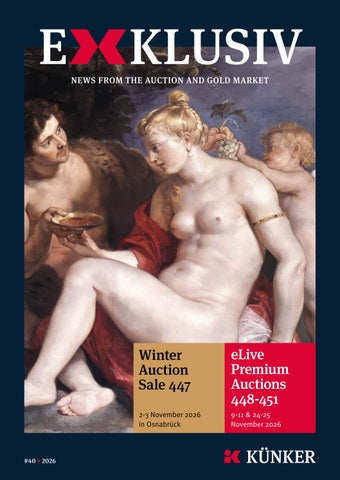
Cover picture Peter Paul Rubens, Sine Cerere et Baccho friget Venus, 1612/1613.
Legal Notice Publisher
Photography Floor Auction Sales
Fritz Rudolf Künker GmbH & Co. KG
Lübke + Wiedemann KG, Leonberg
Nobbenburger Straße 4a
B.Seifert
49076 Osnabrück www.kuenker.de
Fotos eLive Auction 95 Fritz Rudolf Künker GmbH & Co. KG
Proofreading Georg Müller
Responsilble according to press law Dr. Andreas Kaiser
Editors Dr. Ursula Kampmann Julia Kröner Inja MacClure Dr. Margret Nollé Dr. Hertha Schwarz Felix Wunder Typesetting and layout Helge Lewandowsky
SSN 3052-0630
PREFACE
KÜNKER EXKLUSIV
Dear Customers and Coin Enthusiasts,
with this issue of Künker Exklusiv, we welcome you to our Winter Auction Sales 447 - 451. This issue focuses on the numerous highlights of our upcoming Auction Sales: In particular, lovers of ancient numismatics can look forward to Auction 447. It is the only floor auction of the year dedicated exclusively to coins from the ancient world. At the same time, we would like to point out that ancient coins play a role not only in this auction. Our eLive Auctions also regularly feature attractive pieces from the world of antiquity and offer exciting acquisition opportunities throughout the year. In addition, the eLive Premium Auctions 448 and 449 will present significant collections of ancient coins, including the collections of Rolf W. Schumm, Dr. Hartmut Kreutzer and the Dr. W. R. Collection With the eLive Premium Auctions 450 and 451, we are also continuing to auction off additional outstanding numismatic treasures: In addition to the second part of the Imperial Collection – numismatic treasures from the estates of the Prussian kings and German emperors of the House of Hohenzollern – the Buginithi Collection brings an extraordinary selection of Brandenburg-Prussian coins to the market. But the auctions are not the only focus of this issue. Look forward to exciting insights into the world of numismatics, interesting stories about
significant collections, a journey to Syracuse, and articles on historical events whose effects are still felt today. We also pay tribute to two employees who have been contributing to our firm’s success for 25 years. We hope you enjoy reading this issue, make exciting discoveries, and, of course, have great success at our winter auctions. Perhaps we’ll have the pleasure of welcoming you in person soon in Osnabrück or at one of the numerous coin fairs.
Ulrich Künker
Dr. Andreas Kaiser
3
4
KÜNKER EXKLUSIV
WINTER AUCTION SALES 447-451
Auction Sales 447–449: A Rich Selection of Coins from the Ancient World We will hold three auction sales featuring exclusively coins from the ancient world in early November 2026. On November 2 and 3, 2026, the floor auction sale will take place in Osnabrück, featuring more than 1,300 lots from various collections. This will be followed by the Dr. Rolf W. Schumm Collection, an eLive Premium Auction on November 9 and 10, 2026, featuring more than 1,100 lots. The series will conclude—also as an eLive Premium Auction— with two special collections: coins from Syracuse from the collection of Dr. Hartmut Kreutzer, and the 11th installment of the Dr. W. R. collection, featuring coins ranging from the first tetrarchy to the fall of the Western Roman Empire. For auction catalogs 447-449 and a detailed auction overview simply scan the adjacent QR code.
Auction 447: Coins of the Ancient World 2-3 November 2026 (Floor Aucion Sale)
1,300 lots of coins from the ancient world will be offered during the Künker floor auction sale from November 2 to 3, 2026. The auction sale covers the entire spectrum of ancient numismatics: from Celtic, Greek, and Roman coins to those of the Byzantine era. The selection is rounded out by several pieces from the Migration Period and Islamic numismatics.
1,5:1
1,5:1
Lot 5
Lot 74
Gaul. Parisii. Stater, around 60 BC
Lucania. Metapont. Didrachm, 400/340 BC
Very rare, particularly in this condition.
Attractive piece. Very rare, particularly in this condition.
Almost extremely fine.
Dionysus head of the finest style, fine toning,
Estimate: 20,000 euros
broad flan, extremely fine. From the auction Jacob Hirsch VIII, München 1903, no. 792 Estimate: 20,000 euros
WINTER AUCTION SALES 447-451
KÜNKER EXKLUSIV
5
No fewer than five significant specialized collections will be sold as part of the auction sale, namely: 2:1
Lot 218 Sicily. Syracuse. 100 Litren 405/400 BC One of the finest known pieces of this interesting coin type. Very rare. Attractive piece. Extremely fine.
the Walter Louwet Collection the Antissa Collection a private collection from southern Germany a collection of ancient coins spanning two generations the collection of a Hanseatic lover of Roman antiquity
Estimate: 25,000 euros
These collections complement each other perfectly. Whether you’re interested in refined Greek style, Roman history, ancient provenance, or rarities, this auction has something for every lover of ancient coins. Following a selection of coins from the Celtic tribes is an extensive offering of Greek coins, featuring a rich selection of issues from Syracuse. You can also look forward to numerous archaic coins as well as a series of electrum coins from Mytilene. Particularly unusual is the extensive selection of North African coins.
1,5:1
Lot 223 Sicily. Syracuse. Decadrachm around 400/390 BC, unsigned. Splendid patina, extremely fine. Estimate: 25,000 euros
Collectors of coins from the Roman Republic are spoiled for choice: you’ll find not only major rarities but also coins in excellent condition, especially from the period of the civil wars. Now you have the opportunity to acquire coins featuring the portraits of all the major figures of this exciting era. Or are you looking for a specific legion in the series of Marcus Antonius’s legionary denarii? The selection is vast. And if you don’t succeed in Auction Sale 447, an almost complete series of legionary denarii is also being offered in the Schumm Collection. Among the coins from the Roman Imperial period, you’ll discover an exciting mix of gold, silver, and bronze.
1,5:1
Lot 391 Attica. Athens. Tetradrachm 500/480 BC. Extremely rare, with an obverse that is perfectly centered. Obverse perfectly centered on a broad flan, good very fine. Estimate: 10,000 euros
Lot 440 Creta. Lyttos. Stater, 330/300 BC Rare. Fine toning, minor weakly struck, nearly extremely fine. Estimate: 1,000 euros 1,5:1
6
KÜNKER EXKLUSIV
WINTER AUCTION SALES 447-451
1,5:1
1,5:1
Lot 475
Lot 711
Mysia. Kyzikos. Pharnabazos, Satrap, 413-373 BC.
Egypt. Ptolemy II, 285–246 B.C., for Arsinoë II.
Tetradrachm 394/393 BC.
Octodrachm, 253/246 B.C., Paphos.
Very rare. Slightly corroded and cleaned, very fine.
Of the highest rarity. Very fine-extremely fine.
Estimate: 4,000 euros
From the collection of Alexandre Silberstein. Estimate: 30,000 euros
1,5:1
1,5:1
Lot 728
Lot 740
Cyrenaica. Kyrene. Stater 331/322 BC.
Zeugitania. Carthage. Trihemistater, ca. 260 B.C.
Very rare. Very fine..
Rare. Attractive specimen, extremely fine.
Estimate: 30,000 euros
Estimate: 30,000 euros
1,5:1
1,5:1
Lot 769
Lot 813
Roman Republic. Denarius 108/107 BC, Rome.
Roman Republic. Denarius 43 BC, Rome. L. Servius Rufus.
M. Herennius. Extremely fine-uncirculated.
With the portrait of Brutus. Very rare. Fine toning,
Estimate: 1,000 euros
small scratches, very fine. From the collection of Ernst Justus Haeberlin (1847-1925), auction Cahn-Hess, Frankfurt am Main 17. Juli 1933, no. 2980. Estimate: 1,500 euros
1,5:1
1,5:1
Lot 817
Lot 880
Roman Republic. Denarius 42 BC, Rome. C.
Emperors. Marcus Antonius, d. 30 B.C.
Vibius Varus. Expressive Hercules head.
Denarius, 37/35 B.C., Peloponnesian mint.
Splendid toning, extremely fine.
Rare. Splendid toning, extremely fine.
Estimate: 1,000 euros
Estimate: 1,000 euros
WINTER AUCTION SALES 447-451
1,5:1
KÜNKER EXKLUSIV
1,5:1
Lot 958
Lot 1024
Roman Empire. Augustus, 30 B.C.–14 A.D.
Roman Empire. Otho, 69. Aureus, Rome.
Denarius, 17 B.C., Rome. Fine toning, small flan defect,
Rare. Good very fine.
collectors punch (?) on the obverse, good very fine.
Estimate: 50,000 euros
Estimate: 1,500 euros
Lot 1031 Roman Empire. Vespasian, 69–79. Sestertuis 71, Rome. Attractive piece. Extremely fine. Estimate: 6,000 euros 1,5:1
1,5:1
1,5:1
Lot 1111
Lot 1118
Roman Empire. Lucius Verus, 161–169, for Lucilla.
Roman Empire. Pertinax, 193. Aureus, Rome.
Aureus, Rome. Rare. Extremely fine-almost uncirculated.
Very rare. Attractive piece. Extremely fine. From the collection
From the auction Kunst und Münzen AG 2,
of Archer Milton Huntington (* 10. März 1870, New York; † 11.
Lugano 1969, no. 202.
Dezember 1955, Bethel; Inventar-no. ANS 1001.1.30032).
Estimate: 12,500 euros
Estimate: 30,000 euros
1,5:1
1,5:1
Lot 1124
Lot 1156
Roman Empire. Septimius Severus (193–211)
Roman Empire. Regalianus, 260, for Dryantilla.
with Julia Domna, Caracalla, and Geta. Aureus, 202, Rome.
Antoninianus, Carnuntum. Very rare. Good very fine.
Very rare. Tiny scratches on the obverse, nearly extremely fine.
The coin is an overstrike of a denarius of Severus Alexander.
Estimate: 30,000 euros
Estimate: 4,000 euros
7
8
KÜNKER EXKLUSIV
WINTER AUCTION SALES 447-451
1,5:1
1,5:1
Lot 1167
Lot 1238
Roman Empire. Maximian I, 285–305.
Roman Empire. Constantius III, 421.
Quinarius, 294/297, Treveri.
Solidus, Ravenna. Very rare.
Of the highest rarity. Dark patina, very fine.
Very fine/good very fine.
Estimate: 3,000 euros
Estimate: 6,000 euros
Lot 1269 Roman Empire. Maiorianus, 457–461. Solidus, Arelate. Very rare. Almost extremely fine. Estimate: 10,000 euros 1,5:1
eLive Premium Auction 448: Coins from the Ancient World – The Rolf W. Schumm Collection 9-10 November 2026
Many coin collectors who enjoy attending auction sales will have met Rolf W. Schumm in person. This dedicated member of the Württemberg Numismatic Society was a regular guest at coin fairs and auctions. He discovered his enthusiasm for classical antiquity at a very early age and shared his passion with his wife, Ursula Schumm. Now, in eLive Premium Auction 448, his collection is coming to market—a collection that clearly reflects the couple’s enthusiasm for history. Connoisseurs will notice it immediately: The coins were not selected based on investment criteria, but rather on the expressive power of their images. If you’re interested in history, you’ll discover motifs in this collection that you’ve always wanted for your own collection. Of course, the Schumm collection also includes coins in excellent condition and of superb provenance. It was assembled over six decades, a period that offered many opportunities for some truly exciting purchases! So look forward to a multifaceted ensemble from Celtic, Greek, and Roman numismatics, selected by someone who loves history!
1,5:1
Lot 2531 Sicily. Punier. Tetradrachm, 410/390 B.C., public mint or Carthage. Good very fine. From the auction Bank Leu 2, Zürich 1972, no. 124. Estimate: 3,500 euros
WINTER AUCTION SALES 447-451
1,5:1
KÜNKER EXKLUSIV
1,5:1
Lot 2662
Lot 2704
Egypt. Ptolemy I, 323–305–283 B.C.
Roman Republic.
Tetradrachm, 306/303 B.C., Alexandria.
60 asses after 211 B.C., Rome.
Splendid patina, extremely fine.
Almost extremely fine.
Estimate: 1,500 euros
Estimate: 5,000 euros
1,5:1
1,5:1
Lot 2745
Lot 2834
Roman Republic. Civil War. Denarius around 89 B.C., Bovianum.
Roman Republic. Denarius, 48 B.C., Rome.
Very rare. Splendid patina, extremely fine.
L. Hostilius Saserna. Very rare. Attractive toning, extremely fine.
From the auction Hess-Leu 41, Luzern 1969, no. 29.
From the auction Sternberg VI, Zürich 1976, no. 758.
Estimate: 1,250 euros
Estimate: 2,000 euros
1,5:1
1,5:1
Lot 2958
Lot 2960
Emperors. Mark Antony, d. 30 B.C., and Cleopatra.
Emperors. Octavian. Aureus, 43 B.C., Rome.
Denarius, 34 B.C., Alexandria.
Very rare. Tiny edge faults,
Very rare. Fine toning, minor weakly struck, good very fine.
traces of mint luster, extremely fine.
From the list Rodolfo Ratto IX, Milano 1933, no. 1144.
Estimate: 7,500 euros
Estimate: 2,000 euros
1,5:1
1,5:1
Lot 3023
Lot 3025
Roman Empire. Augustus, 30 BCE–14 CE.
Roman Empire. Augustus, 30 BCE–14 CE.
Aureus, 19/18 BCE, Ephesus (Ionia).
Denarius, 19/18 BCE, Pergamon.
Very rare. Min. Very fine.
Very rare. Extremely fine.
Estimate: 10,000 euros
Estimate: 1,500 euros
9
10
KÜNKER EXKLUSIV
WINTER AUCTION SALES 447-451
1,5:1
1,5:1
Lot 3200
Lot 3227
Roman Imperial Empire. Nero, 54–68. Aureus, 64/65, Rome.
Roman Empire. Civil War, 68–69.
Irregular blank, extremely fine. From the collection of
Denarius, 69, Gallic mint.
Walter Niggeler, auction Bank Leu/Münzen und Medaillen AG,
Very rare. Very fine.
Basel 2.-4. November 1967, no. 1120.
Estimate: 1,500 euros
Estimate: 5,000 euros
1,5:1
1,5:1
Lot 3289 Roman Empire. Domitian, 81–96. Sestertius 87, Rome. Green patina, minor double strike, Fields slightly tooled, e xtremely fine/very fine-extremely fine. From the collection of M. Paul Vautier und Prof. Maxime Collignon, auction Ars Classica II, Luzern 1922, no. 561. Estimate: 1,500 euros Lot 3401 Roman Empire. Lot 3557
Hadrianus, 117-138. Sestertius 130/133, Rome.
Roman Empire. Gordian III, 238–244.
Rare. In exceptional condition.
Medallion, Rome. Very rare.
Attractive patina, slight weakness of strike,
Slightly corroded, very fine.
good very fine. specimen.
From the collection of Fürst Waldeck,
Estimate: 5,000 euros
auction Münzhandlung Basel 3, Basel 1935, no. 832. Estimate: 2,000 euros
1,5:1
1,5:1
Lot 3642 Roman Empire. Constantinus III., 407-411. Solidus 408/411, Treveri. Very rare. Struck with rusty dies; tiny testing mark at the edge, nearly extremely fine. Estimate: 4,000 euros
WINTER AUCTION SALES 447-451
eLive Premium Auction 449: The Dr. Hartmut Kreutzer Collection, Part 1
Lot 4026
11 November 2026
signed on both sides by Euainetos.
KÜNKER EXKLUSIV
1,5:1
Sicily. Syracuse. Tetradrachm, 415/405 B.C., Rare. Splendid patina, minor weakly struck, very fine +. Estimate: 2,000 euros
When people hear the name Dr. Hartmut Kreutzer, they immediately think of his important book on the Syracusan drachmas and small silver coins from the period of the signatory artists. Now the first part of his collection is coming to market. It comprises around 100 lots of—not surprisingly—coins from Syracuse, including extremely rare small coins as well as comparative specimens of Syracusan and Sicilian coinage. The pieces were selected with a deep understanding of the artistic quality and rarity of certain dies. Thus, not only will those who would like to own a coin from the city of Syracuse find something of interest, but so will the experienced specialist collector. For the collection offers types that are rarely seen.
1,5:1
Lot 4036 Sicily. Syracuse. Hemidrachm 410/405 BC Fine toning, slightly corroded, very fine-extremely fine. Estimate: 250 euros
1,5:1
Lot 4045 Sicily. Syracuse. Litra 415/405 BC. Fine patina, very fine-extremely fine. Estimate: 250 euros
1,5:1
1,5:1
Lot 4059
Lot 4065
Sicily. Syracuse. Drachm 410/405 BC
Sicily. Syracuse. 50 litren, 405/400 B.C.
Nice shade, slightly corroded, good very fine.
Struck with a slightly rusty obverse die,
Estimate: 1,000 euros
very fine-extremely fine/extremely fine. Estimate: 4,000 euros
Lot 4076 Sicily. Syracuse. Hieron II., 274-216 BC. Drachm 269/263 BC. Tiny test mark at the edge, else extremely fine. From the collection of Gustave Burel, 1,5:1
auction Rollin & Feuardent, Paris 11.-14. Juni 1913, no. 111. Estimate: 2,500 euros
11
12
KÜNKER EXKLUSIV
WINTER AUCTION SALES 447-451
eLive Premium Auction 449: The Dr. W. R. Collection, Part 11 11 November 2026
1,5:1
Lot 4503 Roman Empire. Carausius, 287–291. Antoninian, mint unknown. Very rare. Min. Weakly struck at the edge, extremely fine. Estimate: 300 euros
1,5:1
Lot 4506
As part of the eLive Premium Auction 449, the 11th installment of the Dr. W. R. Collection is being sold. Connoisseurs now know what to expect: select rarities of outstanding quality in all three metals—gold, silver, and bronze. Part 11 features coins from the numismatically significant period spanning the beginning of the First Tetrarchy to the fall of the Western Roman Empire. Specialty collectors have much to look forward to, as they will discover many rare emperors—among whom we mention here only Alexander of Carthage and Martinianus. But the collection also includes historically interesting rarities featuring some of the better-known rulers.
Roman Empire. Diocletian, 284–305. Aureus, 294, Rome. Rare. Very attractive piece, extremely fine-uncirculated. Estimate: 6,000 euros
1,5:1
Lot 4513 Roman Empire. Maximinus I, 285–305. Aureus, 286, Antioch. Very rare. Tiny edge faults at the edge, extremely fine.
The selection is thus extensive. Nevertheless, we recommend taking a closer look at the thoughtfully curated lots, which contain coins—some of which are in perfect condition.
Estimate: 7,500 euros
1,5:1
1,5:1
Lot 4524
Los 4537
Roman Empire. Constantius I, 293–306.
Roman Empire. Maximinus II Daia, 305–313.
Argenteus, 300/301, Rome, 6th issue.Rare.
Aureus, 306/307, Nicomedia.
Specimen with fine patina, almost extremely fine.
Rare. Almost extremely fine.
Estimate: 500 euros
Estimate: 6,000 euros
WINTER AUCTION SALES 447-451
KÜNKER EXKLUSIV
Lot 4549 Roman Empire. Alexander of Carthage, 308–309. Follis, Carthage. Very rare. Broad flan, 1,5:1
small double strike, good very fine. Estimate: 4,000 euros
1,5:1
1,5:1
Lot 4553
Lot 4558
Roman Empire. Aureus, 315/316, Siscia.
Roman Empire. Martinianus, 324.
Of the highest rarity. Probably unique.
Follis, Nicomedia, 2nd offizin. Very rare.
Small scratch on the obverse; otherwise extremely fine.
Dark patina, slightly corroded, fast very fine.
Estimate: 7,500 euros
Estimate: 1,000 euros
1,5:1
1,5:1
Lot 4584
Lot 4606
Roman Empire. Constantine I, 306–337. Follis 327,
Roman Empire. Constantine II, 337–340.
Constantinople. Extremely rare. Fine patina with
Solidus, 337/340, Siscia. Very rare.
some silver luster, slightly corroded, very fine-extremely fine.
Slightly double strike, extremely fine.
Estimate: 1,000 euros
Estimate: 7,500 euros
1,5:1
1,5:1
Lot 4698
Lot 4717
Roman Empire. John, 423–425.
Roman Empire. Valentinian III, 425–455,
Solidus, Ravenna. Very rare. Very slight
for Justa Grata Honoria. Solidus, 430/445, Ravenna.
pressure mark in the field of the obverse; very fine.
Very rare. Tiny Kratzer, almost extremely fine.
Estimate: 5,000 euros
Estimate: 7,500 euros
13
14
KÜNKER EXKLUSIV
WINTER AUCTION SALES 447-451
eLive Premium Auctions 450 and 451: Numismatic Treasures from the Prussian Tradition Collectors and numismatists can look forward to an extraordinary double event with eLive Premium Auctions 450 and 451 on November 24-25, 2026. While the auction of the Imperial Collection, Part 2, once again presents unique items from the personal collection of the Hohenzollern family, the first part of the Buginithi Collection offers fascinating insights into the numismatic history of Brandenburg-Prussia from the Middle Ages through the 19th century. Both auctions bring together rare items, specimens in outstanding condition, and significant historical references, promising highlights for specialized collectors as well as for enthusiasts of German history.
Die Imperial Collection, Teil 2: Numismatic Treasures of the House of Hohenzollern 24 November 2026
For auction catalogs 450-451 and a detailed auction overview simply scan the adjacent QR code.
We are pleased to continue the auction of the extraordinary Imperial Collection with eLive Premium Auction 450 on November 24, 2026. Approximately 400 coins, medals, and plaques from the Hohenzollerns’ personal collection once again offer insight into the passion for collecting shared by King Frederick William IV and Emperor William I, while also documenting significant chapters in Prussian, German, and European history. While numerous rare gold pieces caused a sensation in the first part of the auction, the focus now is primarily on silver and bronze medals, which are in no way inferior in their numismatic and historical significance. The range of items on offer extends from Prussian medals depicting rulers and historical events to medals
Lot 5058 Kingdom of Prussia. Friedrich Wilhelm III., 1797-1840. Silver medal 1815, by A. F. König, commemorating the complete unification of Pomerania and Rügen with Prussia. Very rare, particularly in this condition. Attractive piece. Splendid patina, extremely fine-uncirculated. Estimate: 750 euros
WINTER AUCTION SALES 447-451
KÜNKER EXKLUSIV
15
honoring artists and individuals, as well as rare pieces from Austria, Russia, and other European nations. Many of the objects reflect the close connection between politics, culture, and the dynasty that shaped the collecting interests of the Prussian royal family.
Lot 5104 Kingdom of Prussia. Friedrich Wilhelm IV., 1840-1861. Bronze medal n. d. (1846), by Chr. Pfeuffer, on the occasion of the world premiere of Sophocles’ “Antigone” by Felix Mendelssohn-Bartholdy in Berlin. Nice copper patina, almost uncirculated. Estimate: 150 euros
Among the outstanding lots is the extremely rare silver medal from 1815 commemorating the Treaty of Paris (lot number 5058). On it, the medalist A. F. König combined the portraits of the Great Elector Frederick William, Frederick William I, and Frederick William III. The depiction interprets Prussia’s territorial gains following the Napoleonic Wars as another step on the path to becoming a major European power. This magnificent specimen captivates with its beautiful patina and a condition ranging from excellent to proof-like.
Estimate: 300 euros
The bronze medal commemorating the premiere of Felix Mendelssohn Bartholdy’s incidental music for “Antigone” (lot number 5104) has a particularly close connection to 19th-century cultural life. Frederick William IV himself supported the project by encouraging the setting of this ancient story to music. The medal thus commemorates not only a significant musical event but also the role of the Prussian court as a patron of the arts and culture. The fact that the corresponding silver edition in the first part of the Imperial Collection sold for 17,000 euros—far exceeding the estimate—underscores the appeal of this motif.
Lot 5122
Another highlight is the silver medal commemorating Count Henckel von Donnersmarck’s 50th anniversary of Masonic membership (lot number 5096). Created by H. Lorenz in 1841, this medal—with its allegorically designed reverse—ranks among the most artistically sophisticated works in the entire collection. A cube, columns, and the rising sun form a complex Masonic iconography. This piece, known to be extremely rare in silver, is a magnificent specimen with an attractive patina.
Lot 5096 Kingdom of Prussia. Friedrich Wilhelm IV., 1840-1861. Silver medal 1841, by H. Lorenz, on the occasion of 50 th anniversary of Count Henckel von Donnersmarck‘s initiation into Freemasonry. In silver extremely rare. Attractive piece. Attractive patina, almost uncirculated.
Kingdom of Prussia. Friedrich Wilhelm IV., 1840-1861. Silver medal 1851 by C. Rauch and H. Bubert, G. Loos Workshop, on the occasion of the unveiling of the equestrian statue of Frederick the Great on the “Unter den Linden” boulevard in Berlin. In silver rare. In original case. Splendid patina, almost uncirculated. Estimate: 1,250 euros
Of particular historical significance is also the silver medal commemorating the unveiling of the equestrian statue of Frederick the Great on Unter den Linden in Berlin (lot number 5122). Created in 1851 by Christian Rauch and Heinrich Bubert, this piece commemorates one of Berlin’s most significant 19th-century
16
KÜNKER EXKLUSIV
WINTER AUCTION SALES 447-451
Lot 5164 Kingdom of Prussia. Wilhelm I., 1861-1888. Gold-plated bronze medal 1879, by R. Siemering, commemorating the imperial couple’s golden wedding anniversary on June 11, dedicated by the Royal Academy of Arts. In a decorative setting. Extremely fine-uncirculated. Estimate: 500 euros
monuments. This rare silver edition is even offered in its original case and is in excellent condition with nearly full mint luster. One of the artistic highlights of the auction is the gilded bronze medal by Rudolf Siemering commemorating the golden wedding anniversary of Emperor Wilhelm I and his wife Augusta in 1879 (lot number 5164). With a diameter of approximately 122 millimeters and its decorative border, it embodies the prestigious art of medal making in the late 19th century. The piece was commissioned by the Royal Academy of Arts and ranks among the most impressive large medals in the auction. Architectural medals by the renowned Wiener family are also prominently featured. Of particular note is the medal by Leopold Wiener commemorating the 25th anniversary of the Cologne Cathedral Building Association (lot number 5158). It commemorates the completion of Cologne Cathedral, which was made possible in large part by the support of Frederick William IV. At the same time, it demonstrates the extraordinary ability of the Wiener medalists to depict monumental structures in rich detail and with great vitality within the smallest of spaces.
Lot 5158 Kingdom of Prussia. Wilhelm I., 1861-1888. Bronze medal 1867, by F. W. Kullrich, commemorating the 25th anniversary of the Cologne Cathedral Building Association. Almost uncirculated. Estimate: 150 euros
WINTER AUCTION SALES 447-451
KÜNKER EXKLUSIV
17
Lot 5184 Kingdom of Prussia. Wilhelm II., 1888-1918. Rectangular cast bronze plaque 1898, by O. Rohloff, Berlin, commemorating the dedication of the Church of the Redeemer in Jerusalem during the imperial couple’s trip to Palestine. Very rare. Some patina, extremely fine. Estimate: 500 euros
A rare cast bronze plaque commemorating the dedication of the Church of the Redeemer in Jerusalem during the imperial couple’s 1898 trip to Palestine (lot number 5184) dates from the reign of Wilhelm II. Only a few copies were produced and presented to highranking German and Ottoman dignitaries. Its rarity and direct connection to one of Wilhelm II’s most significant foreign policy appearances make it a highly sought-after collector’s item. Lot 5107 Kingdom of Prussia. Friedrich Wilhelm IV., 1840-1861. Silver medal 1847, by J. B. Resek, depicting the composer Giacomo Meyerbeer. In silver very rare. Splendid patina, tiny scratches, almost uncirculated. Estimate: 150 euros
Lot 5355 Austrian Empire. Ferdinand I., 1835-1848. Silver medal 1842, by F. Gaul, commemorating the Austrian dancer Fanny Elßler and the conclusion of her tour of North America and Cuba. Extremely rare in silver. Splendid patina, almost uncirculated. Estimate: 200 euros
Among the fascinating biographical medals is the silver medal honoring the composer Giacomo Meyerbeer (lot number 5107). Born in Brandenburg, this master of French grand opéra was one of the most successful opera composers of his era. The rare silver medal by J. B. Resek combines high numismatic quality with a tribute to one of the defining musical figures of the 19th century. The silver medal honoring the famous dancer Fanny Elßler (lot number 5355) also holds a special place. Created by F. Gaul, the medal was produced in 1842 to mark the conclusion of her spectacular tour of North America and Cuba. Elßler was one of the celebrated stars of Romantic ballet and thrilled her audiences especially with her legendary “Cachucha.” This medal, which is extremely rare in silver, combines cultural history with the highest collectible value.
18
KÜNKER EXKLUSIV
WINTER AUCTION SALES 447-451
Lot 5070 Kingdom of Prussia. Friedrich Wilhelm III., 1797-1840. Bronze medal from 1828, by F. Brandt, depicting the naturalist Alexander von Humboldt. Attractive copper patina, minor edge faults, almost uncirculated. Estimate: 100 euros
Lot 5157 Kingdom of Prussia. Wilhelm I., 1861-1888. Bronze medallion 1866 (made in 1869), by F. W. Kullrich, commemorating the victorious war against Austria. Only 150 specimens in bronze struck. Almost uncirculated. Estimate: 500 euros
Lot 5077 Kingdom of Prussia. Friedrich Wilhelm III., 1797-1840. Silver medal n. d. (1838), by H. F. Brandt, commemorating the death of Prussian Lieutenant General Job Wilhelm von Witzleben. Very rare in silver. Extremely fine-uncirculated. Estimate: 100 euros
Lot 5215 Anhalt-Dessau. Leopold Friedrich Franz, 1751-1817. Silver medal 1801, by F. W. Loos and J. V. Döll, commemorating his 50th anniversary on the throne. Attractive piece. Magnificent mint luster and attractive patina, almost uncirculated. Estimate: 400 euros
WINTER AUCTION SALES 447-451
KÜNKER EXKLUSIV
19
Lot 5339 Russian Empire. Nikolaus I., 1825-1855. Bronze medal 1839, by G. Brandt, commemorating the wedding of Grand Duchess Maria Nikolaevna to Duke Maximilian of Leuchtenberg. Very rare. Nice copper patina, almost uncirculated. Estimate: 200 euros
In addition, there are numerous other remarkable items, such as the silver medal commemorating Lieutenant General Job Wilhelm von Witzleben (lot number 5077), the rare bronze medal commemorating Alexander von Humboldt’s famous *Kosmos* lectures (lot number 5070), a bronze medal commemorating Prussia’s victory over Austria in 1866 (lot number 5157), a medal commemorating the 50th anniversary of the reign of Leopold Friedrich Franz von Anhalt-Dessau (lot number 5215), and a rare Russian bronze medal commemorating the wedding of Grand Duchess Maria Nikolaevna to Duke Maximilian von Leuchtenberg (lot number 5339). These items highlight the international and thematic diversity of this extraordinary collection.
The Imperial Collection thus demonstrates once again that historical significance, artistic quality, and outstanding provenance are not reserved solely for rare gold pieces. The second part offers collectors the rare opportunity to acquire items from one of Europe’s most significant private collections with a direct connection to the Prussian royal house.
eLive Premium Auction 451: Brandenburg-Prussian Coins from the Middle Ages and the Period 1787–1873
On November 25, 2026, we will auction the first part of the Buginithi Collection as eLive Premium Auction 451. On offer are approximately 300 medieval coins, primarily from the Margraviate of Brandenburg, as well as about 200 coins from the Kingdom of Prussia, ranging from Frederick William II to William I.
25. November 2026
Collectors specializing in Brandenburg-Prussian coins will be impressed by the variety of types, years, and mints found in this collection. Even more impressive is seeing these great rarities in exceptionally good condition. That said—as with any good specialized collection—the focus is on rarity. Medieval Coins of the Margraviate of Brandenburg
Lot 5504 Brandenburg. Jakza von Köpenick, um 1157. Bracteate, Brandenburg. Very rare. Fine mint luster, extremely fine. Estimate: 3,000 euros 1,5:1
eLive Premium Auction 450: The Imperial Collection, Part 2– Numismatic Treasures from the Collection of the Prussian Kings and German Emperors of the House of Hohenzollern– on Tuesday, November 24, 2026, starting at 2:00 p.m. on www.kuenker.auex.de
Connoisseurs of medieval coinage, in particular, have much to look forward to: time and again, they will come across the phrase “exquisite specimen” and the term “extremely rare.” It is rare to see the diverse and fascinating coinage of the Margraviate of Brandenburg displayed in such a wide variety: here, the standing margrave guards his border; there, he rides high on horseback to protect his land; elsewhere, he defends his city or goes hunting, with a falcon perched on his outstretched arm.
20
KÜNKER EXKLUSIV
WINTER AUCTION SALES 447-451
A few coins from Upper Lusatia and the Electorate of Brandenburg round out the collection. From Frederick William II to William I
1,5:1
Lot 5509 Brandenburg. Albrecht the Bear, 1134–1157. Bracteate, Köthen or Bernburg.
The second part of the auction perfectly complements the second part of the Imperial Collection held the day before, as one collection features medals while the Buginithi Collection focuses on coins from the same period. From the taler to the pfennig, everything is included. Whether from Ansbach-Bayreuth, Danzig, Neuenburg, East Frisia, Silesia, or the Prussian heartland: you’ll find magnificent specimens even from the rarest mints, as well as proofs and brass test weights.
Extremely rare. Attractive specimen with fine patina, almost extremely fine. Estimate: 4,000 euros
In other words: If you’re interested in Prussian numismatics and rare coins in excellent condition, we hope you enjoy Catalog 451!
1,5:1
Lot 5523
Lot 5802
Brandenburg.
Prussia. Friedrich Wilhelm II, 1786–1797.
Otto I., 1157-1184. Bracteate, Brandenburg.
Reichstaler preuß, 1788 B, Breslau. A rare year
Very rare, particularly in this condition.
in exceptional condition. A magnificent specimen.
Attractive piece. Splendid patina, extremely fine-uncirculated.
Fine patina, uncirculated.
Estimate: 4,000 euros
Estimate: 1,000 euros
1,5:1 1,5:1
Lot 5525 Brandenburg.
Lot 5841
Otto I., 1157-1184. Bracteate, Brandenburg.
Prussia. Friedrich Wilhelm II, 1786-1797.
Very rare. Attractive piece with fine patina,
Batzen (4 Kreuzer) 1790, Neuenburg (Neuchâtel).
small edge fault, almost extremely fine.
Attractive piece. Almost uncirculated.
Estimate: 3,000 euros
Estimate: 200 euros
WINTER AUCTION SALES 447-451
KÜNKER EXKLUSIV
1,5:1
Lot 5867 Prussia. Friedrich Wilhelm III, 1797-1840. 4 Groschen (1/6 Taler) 1816 A. Very rare. Attractive piece. Almost uncirculated. Estimate: 1,000 euros
Lot 6058 Prussia. Friedrich Wilhelm IV, 1840–1861. 2 Francs 1848. Minted for Moresnet. Very rare. Attractive piece. Attractive patina, almost uncirculated. Estimate: 1,000 euros
Lot 5913 Prussia. Friedrich Wilhelm III, 1797-1840. 21 Batzen (Gulden) 1799, Neuenburg (Neuchâtel). Very rare in this condition. Attractive piece. Attractive patina, almost uncirculated. Estimate: 1,000 euros Lot 6062 Preußen. Wilhelm I., 1861-1888. Doppelter Vereinstaler 1862 A. Very rare in this condition. Tiny hairlines, polierte Platte. Estimate: 3,000 euros 1,5:1
Lot 5983 Prussia. Friedrich Wilhelm III, 1797-1840. Co.-pfennig, 1812 A. pattern. Extremely rare. Very fine-extremely fine. Estimate: 3,000 euros
Lot 6074 Prussia. Wilhelm I, 1861–1888. Taler 1866 A. Lot 6003
“Vereinstaler“. Pattern.
Prussia. Friedrich Wilhelm IV, 1840–1861.
Of the highest rarity.
Double taler 1856 A. „Vereinsdoppeltaler“. Very rare in this
Attractive patina,
condition. Attractive piece. Proof, minor touched. Estimate: 1,000 euros
extremely fine. Estimate: 4,000 euros
21
22
KÜNKER EXKLUSIV
THE ROLF W. SCHUMM COLLECTION
A Phenomenon of Cultural History: The Rolf W. Schumm Collection By Johannes Nollé
Fig. 1: Theodor van Thulden, Odysseus and Argos (JN Collection).
The Collection and Its Collector A specific type of collection is becoming increasingly rare and will soon no longer be found at auctions: those spanning the entire ancient world, consisting of wellpreserved and often rare ancient coins that cover most areas of Greek and Roman coinage, as well as peripheral fields such as the Celts, Phoenicia, Carthage and Bactria. In this respect, the collection assembled by Rolf W. Schumm is a remarkable exception and likely to be a veritable treasure trove for many collectors.
The ability to build comprehensive coin collections of this kind is being lost. This is primarily due to a lack of linguistic and historical education, which is no longer provided by our schools to the same extent as before, meaning that access to ancient coins – tangible witnesses to ancient history – is very limited. While the latest PISA study focuses on demonstrating that the performance of German students in reading, mathematics and science has declined further, it overlooks the fact that access to and participation in our millennia-old culture – and thus our sense of identity
THE ROLF W. SCHUMM COLLECTION
(where do we come from, who are we, where are we going?) – has also been steadily eroding. It is no wonder, then, that political upheaval arises so easily. Humanistic high schools, which teach Latin and Ancient Greek alongside humanism, have become rare throughout Germany. These two ancient languages are considered difficult, and many people fail to see their value because they only think superficially. “Per aspera ad astra” (through adversity to the stars) was a motto once adorning the entrances of many German high schools. However, the modern “fun society” does not want to adopt it and has dismissed it as antiquated. Yet this motto remains the foundation of a country’s economic and cultural success. As well as language skills, these schools instill virtues such as diligence, precision and systematic thinking. Rejecting arduous learning means missing out on the joy of understanding difficult yet substantively rich texts, appreciating the aesthetics of ancient poetry, reflecting with Plato or Seneca on fundamental questions of human life, and being able to read and understand Latin inscriptions on old buildings in European cities, ensuring that houses, churches, cathedrals and castles from past centuries do not feel foreign to us. The collector Rolf W. Schumm took great delight in the ancient world as he built up his collection, which spanned the entire ancient period, over many decades. During this time, he gained knowledge and drew many fascinating insights from it. These insights prompted the “collector doctus” to visit many of the places where the coins in his collection had been minted long ago, in order to experience their atmosphere – the genius loci – while keeping the beautiful pieces in his collection in mind. In this article, we highlight a few coins from his collection that exemplify how much we can learn about culture and the world from them, provided we can read and understand their motifs and inscriptions. His collection thus serves as both inspiration and a call to explore ancient coinage. Odysseus, Argos and a Roman Noble Family One of the most touching stories in the Odyssey is that of Odysseus’s faithful dog, Argos. After more than twenty years, Odysseus returns from the Trojan War to his home island of Ithaca. He had spent ten years at the siege of Troy and another ten in constant danger of losing his life on the perilous journey home from the Dardanelles to the Ionian Sea. When he enters his palace on Ithaca, he is in danger because the island’s nobles have taken it over. They wanted to marry Odysseus’s wife, Penelope, and thus seize the
KÜNKER EXKLUSIV
23
riches of Odysseus. To prevent him from falling into the hands of his wife’s suitors unprepared, Athena transformed him into a beggar. At the entrance to the palace, Odysseus encounters his hunting dog, Argos, whose name means “the swift one”. No one had cared for him after his master’s departure, and now he lay abandoned and neglected on a dung heap in front of the palace: old, mangy and near death, yet still waiting with unwavering loyalty for his master’s return. Despite Odysseus’s disguise, it was Argos who recognized him first. There [among heaps of mule and cattle dung], plagued by ticks, lay Argos the hound. But suddenly aware of Odysseus’ presence, he wagged his tail and flattened his ears, though no longer strong enough to crawl to his master. Odysseus turned his face aside and [...] wiped away a tear (Odyssey XVII: 300–304). The Italian painter Francesco Primaticcio (1504–1570) did not strictly adhere to Homer’s exact words. He designed the Galerie d’Ulysse at the Palace of Fontainebleau for King Henry II of France (1547–1559). As the gallery was destroyed in 1738, the copperplate engravings by the Flemish painter and engraver Theodor van Thulden (1606–1669), who copied Primaticcio’s Odysseus cycle and engraved it on copper, are our only remaining source. Among these is the Argos scene: In Primaticcio’s version, Argos sits before Odysseus, whom he has recognized. The homecoming man strokes the head of his beloved dog (see Y. Wagner, Die Wandmalereien der Galerie d’Ulysse in Fontainebleau. Politische und moralische Handlungsanleitungen für den französischen König, kunsttexte.de, No. 4, 2014, 1-41; fig. 1). The story of Odysseus’s return and his dog Argos was well known in antiquity, not least because reading and knowing the Odyssey was mandatory for all educated people in the ancient world. However, the reason why the recognition of Odysseus by his dog Argos appears on a Roman Republican coin is another highly interesting story. It is said that Odysseus spent a considerable amount of time with the sorceress Circe during his wanderings, and that he fathered three sons with her: Latinos, Agrios and Telegonos. Latinos gave the Latins their name, while Telegonos was associated with the founding of the Latin cities of Praeneste (modern-day Palestrina) and Tusculum. The leading noble family of Tusculum, the Mamilii, traced their ancestry back to Telegonos, who reportedly had a daughter named Mamilia with a local Latin woman. The Mamilii used their mythical lineage, which they traced back to Odysseus, to bolster their claim to leadership in Tusculum, as well as to enhance their standing in Rome. Through this lineage, the family gained such high esteem that Tarquinius Superbus, the last Etruscan king of Rome, is said to have married a daughter of
24
KÜNKER EXKLUSIV
THE ROLF W. SCHUMM COLLECTION
2,5:1
Fig. 2: Künker eLive Premium Auction 448, Lot 2751: Denarius by mint master C. Mamilius Limetanus: Head of Mercury // Odysseus and Argos.
Fig. 3: As by Lucius Mamilius: Janus head // Odysseus on the prow of his ship (CNG Electronic Auction 539, 31 May 2023, lot No. 575).
Octavius Mamilius from Tusculum. The noble lineage of the Mamilii through Odysseus is not only transmitted to us by Greek and Latin authors such as Livy (I 49, 8f.), Festus (130 in Lindsay’s edition) and Dionysius of Halicarnassus (Roman Antiquities IV 45), but also by statue bases found during the excavation of the theater at Tusculum. They bear the names of Odysseus’s two sons: Telemachus, whose mother was Penelope, and Telegonos, whose mother was Circe. Gaius Mamilius Limetanus, one of the mint masters of 82 BC, issued the denarius depicting Odysseus on the reverse wearing a cap (pileus) and holding a staff – a reference to his long journey home (fig. 2). In front of him is Argos, looking up at him and wagging his tail, as described in the Odyssey. As with Theodor van Thulden later on, the depiction on the coin does not strictly adhere to Homer’s words.
This denarius shows that the Mamilii were not content to have their family tree begin with Telegonos, Odysseus’s son; rather, they traced it back to the much better-known Odysseus with this coin design. And they even went one step further. The obverse of the coin depicts the head of Mercury, or his Greek counterpart Hermes: according to ancient tradition, Odysseus’s grandfather was named Autolykos and was the son of Hermes and an exceedingly beautiful maiden named Chionis (“Snow White”) or Philonis. This tradition concerning Odysseus’ divine grandfather is very old as it dates back to Pherekydes of Athens (6th century BC), and has been preserved in an ancient commentary on the Odyssey (N. Ernst, Die D-Scholien zur Odyssee. Kritische Ausgabe, Phil. Diss. Univ. Köln, Cologne 2006, 358). With this Roman denarius, the Mamilii also claimed divine ancestry. This occurred at a time when the family, which had produced three consuls around the time of the First Punic War (265, 262 and 239 BC), had lost its significance on Rome’s political stage. For the young descendant of this distinguished family, it was important to be able to claim Hermes and Odysseus as ancestors because the office of mint master was merely an entry-level position for a Roman from a senatorial family. When C. Mamilius Limetanus was appointed mint master, he was able to use a model with regard to his reference to Odysseus and Hermes. About 100 years earlier, another member of the Mamilii family had evoked the ancestor Odysseus by having coins struck depicting him on the bow of a ship. Odysseus is evidently on his way home to Ithaca – to Argos (M. H. Crawford, Roman Republican Coinage I, Cambridge etc. 1987, 219 f., No. 149; fig. 3). It is also worth mentioning the beautiful book “Wiedersehen mit Argos und andere Nachrichten über Hunde in der Antike”, published by Zabern-Verlag and edited by Jost Perfahl (fig. 4). A Denarius and Its Connection to the Roman Playwright Terence Another denarius from the Schumm Collection was minted around 146 BC under a mint master named Gaius Terentius Lucanus. The obverse depicts the head of Roma, crowned by Victoria, symbolizing a victory that Rome – which had expanded far into the Mediterranean region – had achieved at that time. The reverse depicts the Dioscuri riding to the right; below is the legend C. TER. LVC (fig. 5).
THE ROLF W. SCHUMM COLLECTION
KÜNKER EXKLUSIV
25
2,5:1
Fig. 4: “Wiedersehen mit Argos” –
Fig. 5: Künker eLive Premium Auction 448, Lot 2711:
a book on dogs in ancient times
Denarius by C. Terentius Lucanus:
(Photo JN).
Head of Roma // Dioscuri.
The mint master was probably the son of a wealthy senator of the same name who purchased an African slave, perhaps from Libya, born in Carthage. In a rather unimaginative move, the senator named him Afer, meaning “African”. He could never have imagined that this purchase would have such a profound impact on European cultural history. The slave Afer learned Latin quickly and soon proved himself to be an intelligent young man with a talent for poetry. This earned him a good education. His master eventually set him free. P. Terentius Afer, as the slave was called after his
manumitter, wrote a comedy called “The Woman of Andros”, which was performed in 166 BC at the Ludi Romani in honor of Jupiter. Terence was so imaginative and prolific that a further five of his plays were staged in Rome before he died around 150 BC while traveling to the Greek East. His six comedies became classics and were preserved throughout the Middle Ages thanks to a constant supply of new copies. They found an especially enthusiastic readership in the Early Middle Ages. The Vatican
26
KÜNKER EXKLUSIV
THE ROLF W. SCHUMM COLLECTION
THE ROLF W. SCHUMM COLLECTION
KÜNKER EXKLUSIV
27
Fig. 7: Peter Paul Rubens, Sine Cerere et Baccho friget Venus, 1612/1613.
Terence, a codex housed in the Vatican Library that may depict an ancient image of the poet (fig. 6), dates from this period. This displeased the strict nun Hrotsvitha of Gandersheim (10th century), the first German female poet, so much that she wrote six comedies of her own in an effort to steer people away from Terence’s pagan and, in her view, overly licentious works. She was not successful in this endeavor. Terence continued to serve as a role model for comedic writers such as Molière, remaining popular and inspiring.
Fig. 6: Image of Terence in the early medieval Codex Vat. lat. 3868.
Some of his lines became so ingrained in people’s minds that they turned into catchphrases, such as “quot homines, tot sententia” (as many men, so many opinions; Phormio 454); “homo sum, humani nil a me alienum puto” (I am a human: I regard nothing human as foreign to me; Heauton Timorumenos/The Self-Tormentor, 77); “fortīs fortuna adiuvat” (fortune favors the brave; Phormio, 203). Another saying from Terence’s Eunuchus influenced the visual arts: “Sine Cerere et Baccho friget Venus” (Without Ceres and Bacchus, Venus would freeze – or, more freely translated: Without wine and bread, Venus is dead). There is a whole series of paintings that depict this maxim visually. One of the most beautiful versions was painted by Peter Paul Rubens. It shows Dionysus/Bacchus offering Aphrodite/Venus a cup of wine and giving Eros/Cupid only a grape. The boisterous, childlike god of love must not be given wine in case he becomes even more unpredictable. Demeter/Ceres, wearing a wreath of ears of grain in her hair, has taken a piece of bread from a small basket to offer to the goddess of love. This painting is part of the exceptional collection at the Museum Wilhelmshöhe in Kassel (fig. 7).
28
KÜNKER EXKLUSIV
THE ROLF W. SCHUMM COLLECTION
Fig. 8: Map of the Social War (Wikipedia, Ifly6). Maroon: Roman territory Dark green: Territory of the initial insurgents Light green: Groups that later joined the insurgents.
The Courage to Reform: One of the Greatest Crises of Republican Rome The conquest of Rome by the Gauls around 390 BC, Hannibal’s crossing of the Alps and his campaign in Italy during the Second Punic War (218–201), as well as the incursions of the Cimbri and Teutons in the final decade of the 2nd century BC, presented Rome with major challenges. An even more severe ordeal was the Social War of 91–87 BC. In the course of its imperialist expansion, Rome demanded ever-greater contributions from its Italic allies (socii) in central and southern Italy. However, it was unwilling to reward them politically by granting them equal status with the Romans: the allies were ruled, yet had no share in the rule. This led to growing discontent among them, especially since Roman officials behaved extremely arrogantly in their territories. Towards the end of 91 BC, a Roman praetor and his soldiers were killed during an inspection in Asculum, in the Picene region (fig. 8). Subsequently, the
Asculan Italics murdered the Romans living in the city. Consequently, many Italics in central Italy broke away from Rome. Since Rome refused to negotiate with the rebels or grant them Roman citizenship, as they demanded, war broke out (H. Mouritsen, Italian Unification, A Study in Ancient and Modern Historiography, London, 1998; C. J. Dart, The Social War, 91 to 88 BCE. A History of the Italian Insurgency against the Roman Republic, Aldershot/Burlington, Ashgate 2014). The allies established an administrative center in Corfinium, from which they intended to direct their military campaigns, and they named it “Italia”. They elected leaders and officials, but it is no longer possible to determine whether they modelled this on Rome. Their primary aim was probably to put pressure on Rome to achieve equality with the Romans by granting them Roman citizenship, rather than to establish a rival state. To pay their troops, the allies
THE ROLF W. SCHUMM COLLECTION
minted their own coins modelled on the Roman denarius (Alberto Campana, La monetazione degli insorti italici durante la guerra sociale, Soliera 1987; the same, Le monete della guerra sociale (91-87 a.C.), in: F. Pettazoni [ed.], Guerre e Monete. Evo antico e Alto Medioevo, Bari 2023, 119–170). The Schumm Collection contains two such insurrection denarii. The earlier of these, probably minted in Corfinium, depicts an oath-taking scene with a pig sacrifice on the obverse (cf. L. Cappelletti, Il giuramento degli italici sulle monete del 90 a.C., ZPE 127, 1999, 85–92; fig. 9); the reverse depicts the head of Italia. The later insurrection denarius, which was likely no longer produced in Corfinium, again shows the head of Italia adorned with a laurel wreath on the obverse. However, her name is inscribed in Oscan, an Italic language, underscoring the Italics’ resistance to Roman dominance (fig. 10). Around the middle of 90 BC, the rebellious allies inflicted severe defeats on the Romans, but the tide turned during the war year of 89 BC. The Romans managed to besiege Asculum and eventually captured it. By the end of 89 BC, Rome had quelled the uprising in central Italy. This was partly due to the Lex Julia and the Lex Plautia Papiria, which granted Roman citizenship to the Italics provided they sided with Rome. While this did not abolish Rome’s rule over Italy, it did soften it and opened up the possibility of unifying Italy under Roman leadership with the Italics participating as equals. It was reforms, not military coercion, that ended the crisis in Rome and Italy. Nothing now stood in the way of Italy’s rise as a world power in the Mediterranean region. The selected examples demonstrate the educational potential of coins, provided the necessary conditions for understanding them are established. Our company founder, Fritz Rudolf Künker, aptly described our auction house as a “house of minted history”, and we always look forward to meeting with collectors at coin clubs, interested laypeople and scholars to spread and deepen knowledge about coins and the history of the world through such collections.
KÜNKER EXKLUSIV
2,5:1
Fig. 9: Künker eLive Premium Auction 448, Lot 2742: Denarius of the allies, 90 BC: Italia // Oath scene.
2,5:1
Fig. 10: Künker eLive Premium Auction 448, Lot 2745: Denarius of the allies, 89 BC: Italia in Oscan // Soldiers, with cattle lying next to them. The cow is a reference to Italy, since the name Italy was interpreted as “land of cattle.”
29
30
KÜNKER EXKLUSIV
THE DR. KREUTZER COLLECTION
Coins from Syracuse in the Classical Period: Landowners, Tyrants, and the Horses Thoughts on the Coins of the Dr. Hartmut Kreutzer Collection By Johannes Nollé
Fig. 2a: Columns of the Temple of Athena in Syracuse on the left side
Coins from Syracuse in the Dr. Hartmut Kreutzer Collection The coins of Syracuse minted during the Classical Period by Sicily’s most important city tell us a great deal about how the people living there at the time viewed themselves and their city. The images on its coins reveal the city’s religious and political identity, while the numerous additional symbols primarily highlight elements of Syracuse’s economic foundations. The high denominations minted by Syracuse, as well as the magnificent artistic craftsmanship of the coins from this Greek polis bear witness to the city’s enormous wealth during its heyday, and its commitment to creating coins of the utmost beauty. In this respect, the partly rare coins that the lawyer Dr. Hartmut Kreutzer
wall of the Cathedral Santa Maria delle Colonne (photo: JN).
2,5:1
Fig. 1: Künker eLive Premium Auction 449, lot No. 4059. AR drachm: head of Athena, slightly tilted en face // Leucaspis
THE DR. KREUTZER COLLECTION
KÜNKER EXKLUSIV
31
Gulf of Corinth. This location virtually compelled a seafaring city such as Corinth to extend its reach into southern Italy and Sicily. During the reign of the tyrant Gelon in Syracuse, the cult of Corinthian Athena merged with that of Rhodian Athena Lindia. Athena of Lindos was the patron goddess of Gela, which had once been founded by Rhodian settlers and was the hometown of the Syracusan tyrant Gelon. In Kamarina, which was part of the Syracuse domain, Athena was also the divine protector of the city. The Temple of Athena in Syracuse is still part of the cityscape today. When the city became Christian in Late Antiquity, the Syracusans converted the temple into a church and dedicated it to the mother of God, who, despite her motherhood, was venerated as a virgin, just like Athena. The Cathedral of the Most Holy Nativity of Mary of Syracuse stands on the highest point of the Syracusan peninsula of Ortygia (“Quail Island”) – temples of Athena were very often acropolis sanctuaries. The Cathedral of Syracuse has a Baroque façade, but its construction incorporates columns from the former Temple of Athena, which are clearly visible on the left exterior of the cathedral today. It is because of these that St. Mary of Syracuse is known by the epithet “delle colonne”, meaning “of the columns” (figs. 2a and b).
Fig. 2b: The baroque façade of the Cathedral of the Most Holy
The City’s Guardian Deities as Sources of Local Identity: Arethusa
Nativity of Mary in Syracuse (photo: JN).
has assembled in his collection serve as a history book well worth leafing through, reading and reflecting upon, as it enables us to gain insight into the character of this ancient city.
An important deity in ancient Syracuse was the Arethusa Spring, also situated on the Ortygia peninsula (fig. 3). As this freshwater spring emerged directly beside the salty sea, it was regarded as a miracle. It is therefore not surprising that myths about it arose. It is said that Arethusa, as a beautiful huntress, once
The City’s Guardian Deities as Sources of Local Identity: Athena of Corinth and Lindos According to ancient Greek beliefs, a city lacking divine protection could not flourish. This was no different in the case of Syracuse. Its patron goddess was Athena, who is depicted on the obverse of Syracusan coins. Such coins can be found in this collection (fig. 1). The cult of Athena was once brought to Sicily by the Corinthians, the Greek founders of Syracuse, from their home town. Corinth is situated on the isthmus that connects Central Greece with the Peloponnese and separates the Saronic Gulf from the
Fig. 3: Basin of the Arethusa spring in Syracuse with papyrus plants (photo: JN).
32
KÜNKER EXKLUSIV
THE DR. KREUTZER COLLECTION
Figs. 5-7: Arethusa with elaborate hairstyle.
2:1
Künker eLive Premium Auction 449, lot No. 4011. Fig. 4: The pursuit of Arethusa by the river god Alpheios; modern sculpture group at the Arethusa spring (photo: JN).
hunted game in Elis, that is, the north-western corner of the Peloponnese. There, she was pursued by the river god Alpheios, who flows past Olympia (fig. 4). At the last moment, the goddess Artemis saved Arethusa from being raped by transforming the girl into a water nymph. Having become a water deity, Arethusa is said to have flowed from the Peloponnese under the Ionian Sea to Sicily, emerging from the ground on the Syracusan peninsula. The people of Syracuse commemorated the spring nymph, who connected their city with their motherland of Greece, by depicting her on their attractive coins: they created one of the most beautiful female heads ever to appear on Greek coins. Particular importance was attached to the nymph’s hairstyle, which was altered time and again. Modelled on the rapidly changing hairstyles of the beautiful women of Syracuse, the nymph’s hair was always intended to reflect the latest fashion trends (figs. 5, 6, 7). On the coins, Arethusa is surrounded by four dolphins, which are intended to suggest that the spring is almost encircled by the sea. However, the Greeks also associated the dolphin with calm seas (galéne), as it is only when the waves are gentle that dolphins delight sailors with their leaps. Furthermore, dolphins were associated with rebirth and immortality. In the case of Arethusa, this cannot be dismissed, for even more than two thousand years later, such eminent poets as Percy Bysshe Shelley and Marie Luise Kaschnitz have commemorated the beautiful water goddess in their poems and brought her to life.
2:1
Künker eLive Premium Auction 449, lot No. 4021.
2:1
Künker eLive Premium Auction 449, lot No. 4027.
The City’s Guardian Deities as Sources of Local Identity: Persephone Unlike her mother Demeter, Persephone (fig. 20) was worshipped in Syracuse not only as a goddess of grain, believed to ensure the city a bountiful harvest. According to myth, Hades, the god of the Underworld, abducted her in Sicily and took her to the Underworld. A local version of the myth states that the abduction took place at the Cyane spring (“dark blue”), located not far from Syracuse.
THE DR. KREUTZER COLLECTION
KÜNKER EXKLUSIV
33
The City’s Guardian Deities as Sources of Local Identity: the Hero Leucaspis Finally, Dr. Kreutzer’s collection also includes rare Leucaspis drachms, which incorporate a pre-Greek – that is, Sicani – hero, and with him the ancient indigenous population of Sicily, into the identity of Syracuse (fig. 8). The hero with the bright (silver?) shield – as his name implies – stood up to the Greek raider during the Greek conquest, which was mythically carried out by Heracles, and fell in battle. The learned collector has compiled all the essential information about this hero and his significance in a German essay well worth reading (H. Kreutzer, Der Heros Leukaspis auf den Drachmen von Syrakus, in: G. Schmied-Kowarzik et al. (ed.), Panegyrikoi Logoi. Festschrift für Johannes Nollé zum 65. Geburtstag, Bonn 2019, 307–330.). Sicily: An Island of Large Landowners and Horses The political identity of Syracuse is expressed – often misunderstood – primarily through the many depictions of horses on the city’s coins: quadrigas, bigas, and horsemen can be seen on them time and again (figs. 9, 10, 11). They do not merely indicate that, in terms of its natural resources, Sicily was an island of horses. A well-known Greek saying states: παρὰ μὲν πεδίον, παρὰ δ᾿ ἵππος. Where there is a plain, there are horses. In Sicily, there were – and still are – numerous alluvial plains on which horses could be successfully reared. In ancient times, however, only wealthy people with large estates were able to afford the high cost of keeping and breeding horses. The Greeks, who came to Sicily as colonists from the motherland from the 8th century BC onwards and built new Greek cities – calling them poleis – there in a highly organized manner, had, as a rule, allocated plots of land (kleroi) of equal size to all colonists upon settlement. However, due to the diversity of people with different abilities and divergent life goals, large landholdings soon emerged, whose owners held sway in the cities not only economically but also politically. This noble ruling class was known as the Gamoroi, i.e., “land-shareholders”. The horse became their status symbol. One coin in this collection depicts a horseman who can be interpreted as a Gamoros (fig. 12).
2:1
Fig. 8: Künker eLive Premium Auction 449, lot No. 4057. AR drachm: Arethusa en face // the hero Leucaspis.
2:1
Fig. 9: Künker eLive Premium Auction 449, lot No. 4005. AR tetradrachm: Nike crowns the horses of a biga // Arethusa.
2:1
Fig. 10: Künker eLive Premium Auction 449, lot No. 4017. AR tetradrachm: Nike crowns the charioteer of a quadriga // Arethusa.
2:1
Fig. 11: Künker eLive Premium Auction 449, lot No. 4025. AR tetradrachm: Nike crowns the charioteer of a quadriga, in the exergue a horizontal wheel // Arethusa.
34
KÜNKER EXKLUSIV
THE DR. KREUTZER COLLECTION
2:1
Fig. 12: Künker eLive Premium Auction 449, lot No. 4002. AR drachm of Syracuse: naked horseman, most likely a Gamore // head of Arethusa.
The Tyrants of Sicily and Their Victories Some members of this class of “ruling riders” managed to outstrip their peers and gain almost monarchical control over the entire city. They were known as tyrants. Tyrants came to power particularly when the Sicilian Greek cities felt threatened by uprisings of the suppressed native population or by attacks from the Carthaginians, who controlled the western tip of the island. In times like these, the Greek cities needed both the Gamoroi noble cavalry to mount a defense against their enemies and a leader (the tyrant) capable
of warding off the threat with tactical and strategic skill. However, the tyrants were reluctant to have themselves depicted as rulers on coins. They feared the spirit of freedom of the Greek citizens all too much. Consequently, the tyrants were content to exert a decisive influence over the cities’ politics without directly interfering in constitutional arrangements and refrained therefore from featuring themselves directly – that is, personally – on the coins. However, the tyrants did use their status symbols – their horses – to secure victories in the most prestigious equestrian competitions, in order to present themselves as rich, successful and powerful. They knew that victors easily attracted admirers and followers. In the Greek mainland, the Sicilian tyrants repeatedly won with their chariots at the Panhellenic Games – particularly at Olympia and Delphi – and these victories were widely discussed. It is no coincidence that, on the coins of Syracuse, the goddess of victory, Nike, is repeatedly depicted crowning the horses or the charioteer who had secured victory for the tyrants. However, the victorious chariots on the coins of Syracuse bear the legend ΣΥΡΑΚΟΣΙΟΝ, i.e., “(coin) of the citizens of Syracuse”. This actually reflects part of the reality: whilst the owner of the chariots was announced at the victory ceremony, the polis from which he came was also named In this way, the home city was crowned and honored alongside the victor. In this respect, the tyrants achieved a communal celebration of their victories through their chariot coins, which were issued under the city’s name rather than their own, and were able to obscure political realities. The tyrants of Syracuse depicted themselves on the coins of Syracuse as the very embodiment of their city’s glory and splendor, whilst at the same time showing restraint. The victorious tyrants of Syracuse had their personal contribution to the equestrian victories celebrated in victory songs (epinikia) composed by the most eminent Greek poets of the time – the choral lyricists Simonides, Bacchylides and Pindar (fig. 13) – which were performed by choirs. Quite a few of these victory songs have survived to this day, but many have not. They were less enduring than the silver coins and also reached fewer people than these. The victory songs
Fig. 13: Pindar, bust at the Capitoline Museums (photo: JN).
THE DR. KREUTZER COLLECTION
(epinikia) – whose lyrics we know, but not their musical accompaniment – nevertheless leave us with a lasting impression of the pride and self-esteem of Sicily’s horse-loving tyrants.
Syracuse: head of Arethusa // Four-spoke wheel.
2:1
Fig. 15: lot No. 4052: Æ hemilitra: head of Arethusa, behind it an ear of wheat // wheel.
2:1
Fig. 16: lot No. 4041: AR litra: head of Arethusa, barley grain in the background // Octopus.
2:1
Sicily’s Economic Foundations as Reflected in Coin Symbols
Fig. 17: lot No. 4071: Æ hemilitra: head of Arethusa // dolphin and scallop. 2:1
Fig. 18: lot No. 4040: AR litra: head of Arethusa //
Olive groves were indispensable to the Greeks, as they supplied the much sought-after and often irreplaceable olive oil: on Syracusan coins, they are represented by an olive leaf (fig. 17). Like most Greek colonies, Syracuse was situated by the sea, so symbols such as the octopus, fish and scallop (fig. 17), as well as starfish (fig. 19) are used as symbols to highlight the importance of fishing to the city. The octopus seems to have been particularly popular in Syracuse. It does not appear as an additional symbol, but as the main motif on smaller denominations (fig. 18). Similar is true regarding the starfish (fig. 19). Margret Nollé discusses the octopus in more detail in this Exklusiv magazine.
35
Fig. 14: lot No. 4003: AR obol of
Finally, it is worth noting that the wheel depicted on smaller denominations may be interpreted in Syracuse as a simplified representation of a coin showing a horse-drawn carriage (fig. 14). This interpretation is particularly plausible when a horizontal wheel is depicted beneath a quadriga in the exergue of larger coins (fig. 11). In antiquity, chariots built in Sicily were considered to be of a particularly high standard (Athenaeus 28b).
Sicily’s natural environment and its economic use appear only incidentally in the motifs of Syracusan coins. On ancient coins, the economy is often merely mentioned as a secondary aspect of urban identity. In antiquity, Sicily was an island rich in grain, where, in good years, surpluses could be generated that contributed significantly to the wealth of the landowners. This is indicated by the symbols of an ear of corn and a barley grain (figs. 15, 16).
KÜNKER EXKLUSIV
Octopus.
2:1
1,5:1
Fig. 19: lot No. 4066: Æ drachm: head of Athena // Starfish between two dolphins.
A sea monster (kétos, catalog No. 4005) and Scylla (fig. 20) indicate that the sea – in particular the Strait of Messina, with its strong and dangerous currents – was not only a source of food but also a source of danger for all who had dealings with it. 1,5:1
Fig. 20: lot No. 4024: AR tetradrachm: quadriga, Nike crowns the charioteer; Scylla in the exergue // head of Persephone.
36
KÜNKER EXKLUSIV
THE OCTOPUS DEPICTED ON THE COINS OF SYRACUSE
The Octopus Depicted on the Coins of Syracuse “See that you buy economically; for anything will do.” “Explain, master.” “Not sumptuously, but simply; whatever is required for piety‘s sake. We‘ll be satisfied with some little cuttle-fish or squidlets.” (Athenaeus VIII 359b)
By Margret Nollé
The Dr. Kreutzer Collection contains a number of small silver coins (litra) minted in the last quarter of the 5th century BC, whose reverse depicts an octopus with eight arms. This raises a question that has scarcely been
4:1
eLive Premium Auction 449, Lot 4006 Sicily. Syracuse. Litra, 460/450 B.C. Minimally corroded, minor scratches, very fine. Specimen from Electronic Auction CNG 143, Lancaster 2006, No. 23. Estimate: 100 euros
4:1
eLive Premium Auction 449, Lot 4022 Sicily. Syracuse. Litra, 460/450 B.C. Very rare. Fine patina, very fine. Estimate: 125 euros
discussed to date: what might have motivated those responsible for the city’s coinage to choose these strange sea creatures as designs for their small change? First, we must distinguish between the two types of sea creature that are often grouped together and referred to as “coleoids”: the eight-armed octopus and the ten-armed squid and cuttlefish. Syracusan coins feature octopuses (the Greek word for octopus means “eight-legged”), which have a rounded body, large eyes, and eight tentacles equipped with small suction cups. They grow to approximately one meter in length. Notably, octopuses have three hearts: two supply blood to the tentacles and a third supplies the body. Octopuses are famous for the dark, ink-like fluid that they squirt from sac-like organs to confuse predators.[MM1.1] Primarily living on the seafloor, they feed on mussels, whose shells they crush, as well as crabs and small fish. They are exceptionally adept at camouflaging themselves by changing their color and skin texture, and are considered highly adaptable and intelligent. The renowned zoologist and author Alfred Brehm (1829–1884) even attested that octopuses exhibit brain activity that goes far beyond mere instinct. More recent experiments have shown that these clever marine animals can open screwtop lids on containers and remember how to do so for a long time, suggesting that they have a welldeveloped memory. Behavioral researchers have even claimed to have discovered that octopuses possess individual personality traits. Surprisingly, the octopus is enjoying growing attention these days. For several years now, the eight-armed octopus has been taking the international film industry, bestseller lists and toy stores by storm. “Octopussy” – the somewhat silly name of a small, poisonous octopus
THE OCTOPUS DEPICTED ON THE COINS OF SYRACUSE
in the James Bond film of the same name – swims with great success through today’s cultural landscape as an intelligent, humanlike creature. A current example is the film adaptation of the bestseller “Remarkably Bright Creatures” by US author Shelby Van Pelt, which is currently streaming on Netflix. This is the story of the incredible friendship between Marcellus, a giant Pacific octopus, and the woman who cleans his tank. The octopus sensitively recognizes his caregiver’s emotional struggles and helps her cope with a difficult family situation simply through his behavior. Back in 2020, a female octopus reportedly helped South African wildlife filmmaker Craig Foster through a deep personal crisis, serving as a “coach”. The resulting documentary, My Octopus Teacher, won the Oscar for Best Documentary Feature Film in 2021. While one might dismiss such tales as overly sentimental, they reflect the desire of many people for the support of a spiritually powerful animal to guide them as a mentor through an increasingly complex and perilous world. The appearance of the octopus, with its long tentacles, may also play a role here: one could “curl up” inside them with almost childlike trust, seeking protection from the outside world. It’s no wonder that the cute little yellow octopuses made of soft polyester from a wellknown Swedish furniture store are popular among young children. Even in ancient times, the octopus was clearly of interest to people in many ways – perhaps even being popular – as it was featured as a reverse design on the coins of important cities such as Syracuse. The octopus received so much attention in ancient literature that we have some tentative answers to the question of why it was depicted on Syracusan coins. Almost all of antiquity’s knowledge about the anatomy of these marine creatures, known as “cephalopods” (“head-footed”), can be found in Aristotle’s writings. With their peculiar physique, which makes it difficult for the layperson to distinguish front from back or top from bottom, octopuses must have aroused the great naturalist’s particular interest. His great achievement was classifying cephalopods as a clearly defined group within his zoological system, based on their body structure. He called them malákia (mollusks), a subclass of the anaima (bloodless animals), a term he used to describe invertebrates. His detailed and anatomically precise studies of this group of animals were not confirmed or recognized until the mid-19th century (Aristotle, History of Animals, IV 1, p. 523b 1–525a 29). Furthermore, the Roman naturalist Pliny the Elder (23/24–79 AD) recorded much ancient knowledge about squids and octopuses in the ninth book of his Natural History (Plin. NH IX 83; XI 275).
KÜNKER EXKLUSIV
37
4:1
eLive Premium Auction 449, Lot 4039 Sicily. Syracuse. Litra 405/395 B.C. Minimally corroded, small pressure mark on the obverse, good to very fine. Specimen from the Pecunem 23 auction, Munich 2014, No. 82. Estimate: 125 euros
The intelligence and adaptability of octopuses were observed in antiquity too, arousing great interest. Since the “polyp” (the “many-footed one”) could change its color, someone who was highly adaptable and dexterous was described as “polypodios homoiotes”, meaning “one who has become like the many-footed one”. The ancient Greeks valued and admired such a disposition. Thus, Homer describes his titular hero Odysseus as “polýtropos anér”, meaning “resourceful man”, who could solve problems with intelligence and the ability to deceive. The Greek writer Plutarch, who lived in the first and second centuries AD, even recommended imitating the manner of an octopus as a rule of life in his work on natural philosophy, Aetia physica or Quaestiones naturales (Natural Questions, 916 E ff.). Although it was correctly observed from a zoological perspective that octopuses would regrow tentacles bitten off by predatory fish (Arist. hist. an. VIII 2 p. 590 b 15f.), it was mistakenly assumed that they would bite off their own tentacles out of greedy gluttony in order to eat them. This led to the phrase “polypodos tropos” (meaning “octopus-like character”), which was used to describe a greedy person (Macar. VII 27).
38
KÜNKER EXKLUSIV
THE OCTOPUS DEPICTED ON THE COINS OF SYRACUSE
shoot out of the water and fly several meters to escape predators thanks to their torpedo-shaped bodies. Octopuses were caught on a fishing line, although they often skillfully removed the bait from the hook and spat it out. The most effective method, therefore, was to kill them with a trident. These remarkable cephalopods with their long, supple tentacles, were depicted early on in the visual arts of antiquity. The oldest and most impressive depictions of cephalopods in European art date back to Minoan Crete in the 2nd millennium BC. During the so-called “Marine Style” (c. 1500–1450 BC), Minoan potters painted large octopuses on ceramic vessels. Their tentacles spread organically across the vessel’s entire surface, imitating the movement of water. This visual language is direct and naturalistic; the octopus is not an ornament projected onto the surface, but a form that follows the curve of the vessel.
Minoan clay bottle showing an Octopus ( 1500 B.C. ); Archaeological Museum in Herakleion. Photo: Wolfgang Sauber, Wikipedia.
People admired the octopus’s cunning tactic of building a cave out of seashells among the rocks on the seabed for camouflage, from which it would hunt its prey. In its hiding place, it also collected all kinds of prey. Aristotle had already noted its ability to remain out of the water for short periods. However, reports of the animal venturing onto land – where it could climb over fences and trees at night to plunder fruit trees and salting facilities – are likely to be dismissed as pure fantasy (Plin. NH IX 92f.). In contrast, the “flying squids” reported by sailors are not just tall tales. This phenomenon involves squids with ten arms that can
Now, let us turn to a completely unsentimental aspect of our little treatise: the human appetite. The common octopus (polypus vulgaris), found along all Mediterranean coasts, was a staple of every fish market in ancient times, known as a popular and inexpensive dish that was also very filling. The Greek writer Athenaeus, who lived between 190 and 230, described his participation in an opulent banquet in Rome that lasted several days in his magnum opus, the Deipnosophistai (“The Dinner of the Learned”). During this banquet, the guests discussed various topics of everyday life, politics and art in the form of table conversations. Above all, however, they conversed at length about recipes, paying particular attention to the octopus. When cooked and prepared correctly, its meat is tender and aids digestion, they argue. It was also believed to have blood-thinning and aphrodisiac properties. Accordingly, eating octopus was – and still is – very good for one’s health. However, if its tough meat was not sufficiently tenderized before cooking, it was difficult to digest, causing poor sleep and nightmares. According to one of the many anecdotes about the death of the philosopher Diogenes, he is said to have died after eating a raw octopus (Ath. VIII p. 341 E). The gourmets cited by Athenaeus claim that the best octopuses were those caught off Kerkyra (Corfu), Thasos, and the Carian coast. The numerous floor mosaics in the banquet halls of Roman villas, featuring all kinds of fish, crabs and shellfish, also evoke this literary feast. To the viewer, the variety of fish depicted resembles a richly laid table. Fresh fish was expensive and could only be purchased at market by the wealthy; the poorer population had to make do with salted fish (mainly tuna, mackerel, anchovies and sardines). Octopus and squid were rarely
THE OCTOPUS DEPICTED ON THE COINS OF SYRACUSE
KÜNKER EXKLUSIV
39
Fish mosaic from Pompeii, circa 100 B.C., Naples National Archaeological Museum. Photo: Carole Raddato, cc-by-sa-2.0, Wikipedia.
depicted among the fish delicacies in the mosaics as they were apparently considered inexpensive food for commoners. This is also consistent with the fact that squid meat was often used as bait in fish traps. Does this brief examination of the octopus’s significance in antiquity answer the question posed at the beginning? Why did these strange sea creatures become motifs on Syracusan coins? If we turn our attention to the coinage of other Sicilian coastal cities, the answer becomes clear. Many Sicilian and southern Italian coastal cities, not just Syracuse, featured the octopus as their main design on silver and bronze coins. A small selection of such examples will suffice: Adranon (Hoover Greek Coins 2, 40); Akragas (Hoover Greek Coins 2, 133); Alontion (Hoover Greek Coins 2, 1375); Messana (Hoover Greek Coins 2, 832) and Motya (Hoover Greek Coins 2, 949). It can therefore be concluded that octopuses were abundant and of high quality along the Sicilian coast. Consequently, they became a defining feature of these coastal cities’ identities. This phenomenon was not unique to the coinage of ancient cities along the Mediterranean coast. As well as Kroton and Tarent in Calabria and Populonia in Etruria, cities such as Eretria on the island of Euboea and Cyrene in North Africa also depicted the octopus on their coins. This overview also shows that the octopus was generally depicted on small denominations. A brief dialogue recorded by Athenaeus, in which a master sends his servant to the fish market to buy
food at a bargain price, reveals that an octopus was an inexpensive meal, most likely costing one litra. Given how frequently the octopus was featured on the small coins of Syracuse, it is not surprising that it eventually became a defining design on 5-litra electrum coins minted under King Agathocles (305/304–289 BC).
Bibliography r • Au. Steier, RE VI A,2, s. v. Tintenfische, 1393–1406. • D. Bérend, Histoire de poulpes, in: G. Le Rider et al. (ed.), KraayMorkholm Essays, Louvain-la-Neuve 1989, 23–28 (an attempt of a typology and dating of the coins). • O.D. Hoover, The Handbook of Greek Coinage Series, Volume 2, Coins of Sicily (in-cluding Lipara), Classical Numismatic Group, Inc., Lancaster/London 2012.
40
KÜNKER EXKLUSIV
“WAR IS THE FATHER OF ALL”
“War Is the Father of All” Artistic renewal and philanthropy during the First World War. A series of exclusive cast medals from the Imperial Collection, Part II. By Felix Wunder
as their model. As J. Menandier put it, these medals “remain exemplary throughout all changes of time and beyond every difference in national character, transcending every contrast to attain purely human significance”. The series was planned to consist of 180 medals, but some pieces were never produced and others did not progress beyond the planning stage. In our upcoming eLive Premium Auction 450, an impressive 18 medals from this fascinating series will be offered (lot Nos. 5190–5207). Patriotism for a Good Cause
Menandier image: Münzkabinett Berlin: Object No. 18205501 Images are licensed as Public Domain Mark 1.0. Berlin, Münzkabinett der Staatlichen Museen, 18205501. Photos by Lutz-Jürgen Lübke (Lübke und Wiedemann).
Julius Menandier, director of the Berlin Münzkabinett (Numismatic Collection) from 1898 to 1921, drew upon Heraclitus’ famous eponymous quote when presenting the agenda of the “Freunde der deutschen Schaumünze” (Friends of the German Representative Coin) – a society he had founded – in the numismatic journal “Frankfurter Münzzeitung” in late 1915. The medal society, which was joined by numerous well-known public figures, aimed to publish a series of medals on the occasion of the First World War. The medals were intended to disseminate patri-otic messages through the media. The thematic programs and their iconographic design reflect a desire to strengthen social cohesion, while the artistic execution was intended to demonstrate that German visual arts could achieve the highest levels of excellence, even – or espe-cially – in times of war. The society’s founders chose Italy’s cast medals of the Renaissance and their three-dimensional precursors
The patriotic sentiment that prevailed in Germany at the outset of the First World War was clearly reflected in the production of medals. There are several reasons for this. Since the late 19th century, leading medal artists and numismatists – including J. Menandier and Rudolf Bosselt – had been trying to reform the medal as an art object. They aimed to enhance the three-dimensional and aesthetic qualities of the medals by refining the casting and minting tech-niques, thereby inspiring a wide audience to appreciate their artistry. Unlike in France, where minting was concentrated in Paris, Germany had mints and foundries spread across the country. The range of subject matter and design was enormous, and the quality varied. This was the situation when the First World War broke out in 1914. The conflict, with its mass deaths in the trenches, marked a profound turning point for European civilization, with the participating na-tions often breaking new ground. This was particularly evident in the media coverage of the war. The systematic use of political propaganda took on a completely new dimension, and the major-ity of medal makers sought to capitalize on this. Many of them were primarily driven by financial interests. However, J. Menandier and his colleagues were motivated by patriotism, as is clear from his remarks: “The Friends of the German Representative Coin have joined forces to create a historical medal for the German people. (...) The priority is to pay tribute to the full range of Ger-man
“WAR IS THE FATHER OF ALL”
KÜNKER EXKLUSIV
41
visual arts, beginning with the subject of the army.” Alongside its artistic ambitions and expression of patriotic sentiment, the society pursued a social cause. Half of the proceeds from the sale of the medals were earmarked as payment for the artists, while the other half were to benefit war victims and their dependents. Thus, the promotion of social cohesion took on a practical dimension and was not limited to the selected imagery. Financial support was certainly a matter close to J. Menandier’s heart and reflected his deepest convictions. As he emphasized: “The war does not only involve the German army; it en-gulfs the entire German people.” Cult of Personality and Heroism
eLive Premium Auction 450, Lot 5195 (obverse). Undated (1915) cast bronze medal by H. Bendorff, commemorating the death of Lieutenant Commander and submarine commander Otto Eduard Weddigen (*1882, Herford; †1915, at sea off the coast of Scotland) during World War I.
With the exception of one medal, all pieces in the auction series feature a portrait on the ob-verse. One piece depicts an anonymous soldier; while the others feature almost always military commanders. This can be viewed as representative of the entire series of First World War med-als, but a brief explanation is required. Since the early 19th century, the political cult of person-ality had become increasingly important. Napoleon Bonaparte was particularly notable in this respect, being the first modern ruler to understand how to deliberately use art and mass media to present the public with an exaggerated yet multifaceted self-image. In doing so, he also drew on traditional elements of royal iconography with origins in ancient models, thus becoming the prototype for ruling figures in the 19th and 20th centuries. The portraits on the medals in the World War series, which are mostly uniformed bust portraits, depict resolute figures with striking facial features. Notably, some of the subjects, such as U-boat General Otto Weddigen (lot No. 5195 and 5203) and Vice Admiral Maximilian von Spee (lot No. 5192), are figures that had fallen in the first months of the war. Therefore, these objects honor their resolute efforts and celebrate their patriotic spirit of self-sacrifice. Medals bearing the lot numbers 5190 and 5196 deserve special mention. Both of these cast medals depict members of the ruling family. One depicts Prince Eitel Friedrich of Prussia as the commander of a guard regiment, while the other medal, created by the artist R. Küchler, shows Crown Prince William in a magnificent hussar uniform. Both pieces illustrate the direct involvement of the imperial family in the war.
eLive Premium Auction 450, Lot 5196 (Obverse). Bronze cast medal 1915, by R. Küchler, depicting the Crown Prince and his service in World War I. First casting from the collection of Emperor Wilhelm II.
Although the reverse designs of the medals vary, there are recurring themes and visual ele-ments. Many pieces depict significant historical events from the war, such
42
KÜNKER EXKLUSIV
“WAR IS THE FATHER OF ALL”
eLive Premium Auction 450, Lot 5199 (reverse). Bronze cast medal 1915, by R. Küchler, commemorating the Prussian General of the Infantry, Ewald Constantin Ferdinand Friedrich von Lochow (*1855, Petkus; †1942, Berlin-Charlottenburg)
as the Siege of Na-mur, the Battle of Soissons and the Battle of Dixmuiden. Two medals depict advancing or rather marching soldiers, highlighting their heroic efforts (lot Nos. 5191 and 5199). This heroic ideali-zation is also abundantly clear in the depiction of the naked (or half naked) warrior. For example, he is depicted as a liberator of the people (lot No. 5200), a bullfighter (lot No. 5204) and, equipped with the attributes of sword and laurel wreath, as a universal symbol of victory (lot No. 5195). Engravers also repeatedly drew on ancient iconography or motifs from Norse or Christian mythology. As well as Samson battling enemies (lot No. 5206) and Sigurd as the bear-slayer (lot No. 5202), there is also a medal depicting Achilles being instructed in archery by his teacher, Chiron (lot No. 5205). Another piece is an adaptation of an ancient sacrificial scene (lot No. 5201). It depicts men and women in ancient attire carrying pouches of money to a sacrificial bowl. The image is surrounded by the motto “All strength to the Fatherland”. Dedicated to His Majesty
and his achievements at the Battle of Soissons. First casting from the collection of Emperor Wilhelm II.
eLive Premium Auction 450, Lot 5204 (Reverse). Bronze cast medal 1915, by A. Löwental, depicting Field Marshal August von Mackensen and his victories in Galicia. First casting from the collection of Emperor Wilhelm II.
The mintage figure of the individual medals from the “Friends of the German Representative Coin” series cannot be determined with certainty. The production effort – and thus the cost – for these high-quality casts was significantly higher than for struck medals. It can therefore be as-sumed that the mintage of most pieces did not exceed 50–100 specimens. Only the most popu-lar designs were widely circulated. An important feature of the series is the hallmarking, which includes a series number and a cast number. The initials “DS” on the edge indicate that the piece was issued by the “Friends of the German Representative Coin” society. The next number shows the medal’s position within the limited edition of 180 medals. Finally, the casting number specifies the order in which the respective specimen was produced. This feature is particularly notable among the specimens in our auction. A total of 14 medals bear the casting number 1. The significance of this becomes clear when we review the article by J. Menandier cited at the beginning, in which he writes, “Each first casting is intended as a dedication to His Majesty the Emperor and King; the next two castings and a few struck specimens are presented to the per-son being honored by each”. This proves that the specimens bearing the casting number 1 are the first castings from the personal collection of Emperor Wilhelm II! Such a direct indication of provenance is extremely rare for medals, making these pieces truly unique collector‘s items!
“WAR IS THE FATHER OF ALL”
KÜNKER EXKLUSIV
43
eLive Premium Auction 450, Lot 5201 (Reverse). Bronze cast medal 1915, by P. Leibküchler, commemorating Karl Helfferich and his appointment as Imperial Secretary of the Treasury. First casting from the collection of Emperor Wilhelm II.
Resource Shortages and an Unexpected End From the outset, the circumstances were far from ideal for the ambitious project of the “Friends of the German Representative Coin”. High production costs meant the medals had to be sold at high prices, and the number of buyers remained modest. Due to the lack of demand, the artists responsible were often unable to receive their fees. Added to this was the wartime scarcity of resources. J. Menandier was well aware of the difficult situation: “The dire circumstances of the times present an insurmountable barrier on this endeavor: bronze has been requisitioned for war purposes, and we must accept this.” The minting statistics of the Berlin Mint during the ear-ly war years vividly illustrate this problem. While 2,500 bronze medals were produced in 1915, production ceased completely in 1917. The Berlin foundry H. Gladenbeck & Sohn, which usually handled production for the medal society, probably experienced the same. Even switching to iron as an alternative material (see lot No. 5194) failed to implement the original plans of J. Me-nandier and his like-minded colleagues. Thus, all trace of the “Friends of the German Repre-sentative Coin” society was lost in the later years of the war, and the society was finally dis-solved at the end of the First World War. Meanwhile, the initial patriotic enthusiasm for the war in Germany had long since given way to disillusionment. Grueling trench warfare had taken its toll, and the majority of the population longed for peace.
eLive Premium Auction 450, Lot 5202: Edge mark DS 1 1
Literatur • Elke Bannicke, Weltkriegsmedaillen – Kunst und Kommerz. In: Gold gab ich für Eisen. Der Erste Weltkrieg im Medium der Medaille. Berlin 2014, 23–31. • Julius Menadier, Die Freunde der deutschen Schaumünze. Der Krieg ist der Vater aller Dinge. In: Frankfurter Münzzeitung 15-178/9 (Oct. / Nov. 1915), p. 495–510. • Makus Meinhold, Geprägte Erinnerung – Medaillen als Propagandamedium des Ersten Weltkriegs. In: kunsttexte.de (2009) No. 1, p. 3–8. • Wolfgang Steguweit, Die deutsche „Weltkriegsmedaille“im Mainstream des Zeitgeistes. In: Gold gab ich für Eisen. Der Erste Weltkrieg im Medium der Medaille. Berlin 2014, p. 15–22. • Wolfgang Steguweit, Das Münzkabinett und die Förderung der Medaillenkunst. Künstlerbriefe 1914-1918. Medaillenedition. Das Kabinett 5. Berlin, Münzkabinett der Staatlichen Museen 1998. • Wolfgang Steguweit et al. Die Kunstmedaille in Deutschland, 7: Kunst und Technik der Medaille und Münze. Das Beispiel Berlin. Deutsche Gesellschaft für Medaillenkunst in Verbindung mit dem Münzkabinett der Staatlichen Museen zu Berlin, 1997. • Wolfgang Steguweit, Das Editionsprogramm der „Freunde der Deutschen Schaumünze“ im Ers-ten Weltkrieg. Grenzen der politischen Medaille im 20. Jahrhundert. In: Geldgeschichtliche Nachrichten 29, 1994, volume 159, p. 17–27.
44
KÜNKER EXKLUSIV
eLIVE AUCTION 95
Preview of our eLive Auction 95 from 1-4 December 2026 on www.kuenker.auex.de
Anhalt-Bernburg.
Baden-Durlach.
Alexander Carl, 1834-1863.
Karl Leopold Friedrich, 1830-1852.
Vereinstaler 1859.
Kronentaler 1835.
Extremely fine.
Extremely fine-uncirculated
Bavaria. Ludwig I, 1825-1848.
Bavaria. Ludwig II, 1864-1886.
Kronentaler 1831.
Vereinstaler 1871.
Fine patina, tiny scratches,
Fine patina, tiny scratches,
extremely fine-uncirculated.
extremely fine-uncirculated.
Brunswick-Wolfenbüttel.
Brunswick-Calenberg-Hanover.
Wilhelm, 1831-1884.
Georg IV, 1820-1830.
Vereinstaler 1867 B.
Konventionstaler 1830.
Fine patina, almost uncirculated.
Rare. Extremely fine.
eLIVE AUCTION 95
KÜNKER EXKLUSIV
Brunswick -Calenberg-Hanover.
Hessen-Kassel. Friedrich Wilhelm, 1847-1866.
Georg V, 1851-1866. Vereinstaler 1865 B.
Vereinstaler 1863. Fine patina, tiny scratches,
Only 2,000 pieces struck. Attractive patina, small scratches,
extremely fine-uncirculated.
extremely fine-uncirculated.
Hessen-Darmstadt.
Mecklenburg-Schwerin.
Ludewig (X) I. (1790-) 1806-1830.
Friedrich Franz II, 1842-1883.
Konventionstaler 1809. Fine patina, extremely fine +.
Vereinstaler 1867. Fine patina, extremely fine-uncirculated.
Nassau. Wilhelm, 1816-1839.
Prussia.
Kronentaler 1832.
Friedrich Wilhelm IV, 1840-1861.
Fine patina, extremely fine.
Vereinstaler 1861 A, on the occasion of his death. Tiny scratches. Proof.
Reuss-Obergreiz.
Saxony. Friedrich August II, 1836-1854.
Heinrich XX., 1836-1859.
Taler 1854 F, on the occasion of his death.
Vereinstaler 1858. From polished dies,
Yield. Attractive patina, early strike,
almost uncirculated.
extremely fine-uncirculated.
45
46
KÜNKER EXKLUSIV
eLIVE AUCTION 95
Saxony. Johann, 1854-1873.
Saxony-Saalfeld. Ernst I., 1806-1826.
Taler 1855 F. Visit to the Mint. First strike,
Konventionstaler 1817.
tiny scratches, extremely fine-uncirculated.
Extremely fine-uncirculated.
„ LiveBidding“ on kuenker.auex.de Take advantage of our convenient online bidding. Waldeck. Georg Heinrich, 1813-1845. Kronentaler 1824. Fine patina, tiny scratches, tiny flan defects at the edge, very fine-extremely fine.
All you need is an up to date browser, such as Mozilla Firefox®, Google Chrome® or Microsoft Edge®. Bidding can be done via Smartphone, Tablet, Notebook or PC. On this user friendly portal you will find all the important information on our lots and your bids at a glance.
Westphalia.
Be there live when the gavel falls. Hear the auctioneer and see the current lot, including the current bid status and description. Use the opportunity to purchase your favorite items by auction at home or en route, with just a mouse click.
Hieronymus Napoleon, 1807-1813. Gulden 1811 C. Fine patina, extremely fine-uncirculated.
We welcome you to be our guest in our floor auction sale via your display screen. In just three steps to a successful bid: 1. Please register at kuenker.auex.de. 2. Activate the registration via the link in your confirmation e-mail. 3. On the auction day all you have to do is log in on kuenker.auex.de and participate live.
Wurttemberg. Wilhelm I, 1816-1864. Kronentaler 1837. Fine patina, extremely fine.
NUMISMATA BERLIN 2026
KÜNKER EXKLUSIV
We are looking forward to NUMISMATA Berlin 2026
Künker on the NUMISMATA in München, 2026.
On November 14 and 15, 2026, the 22nd NUMISMATA Berlin will take place at the Messe Berlin exhibition center, Hall 11.2. With more than 200 exhibitors from Germany and abroad, the event ranks among the most important numismatic fairs in Europe and offers a wide range of coins, medals, banknotes, specialized literature, and accessories. We are delighted to be represented again this year with a booth in the capital and to welcome many customers, fellow collectors, and business partners in person. Especially in a time when so many interactions take place digitally, face-to-face encounters at a coin fair are something truly special. They offer the opportunity to discuss collections, exchange experiences, discover new pieces, and share our common passion for numismatics. Whether you’re interested in our upcoming auctions, have questions about a collection, or simply want to stop by: Our team is happy to be available for personal conversations.
NUMISMATA Berlin 2026 14-15 November 2026 More than 200 national and international exhibitors Saturday, 14th November 2026 9.30 am to 6 pm Sunday, 15th November 2026 9.30 am to 3 pm Messe Berlin Hall 11.2 Messedamm 22 14055 Berlin numismata.de
47
48
KÜNKER EXKLUSIV
MOHÁCS 1526 – A TURNING POINT IN EUROPEAN HISTORY
Mohács 1526 – A Turning Point in European History By Hertha Schwarz
Fig. 1: Ottoman miniature, 1550 scene from the Battle of Mohács: On the left Hungary’s armored horsemen, at the center King Louis II in gilded armor. On the right the Ottoman army with janissaries, recognizable by their tall white caps, and mounted sipahi. Between them Suleiman the Magnificent, wearing a white turban. In the center of the image is the Ottoman artillery. Wikimedia Commons.
29 August 2026 marked the 500th anniversary of the Battle of Mohács (fig. 1). Anyone using today’s information technology to find out about this place and time will be told by AI in brief sentences that the troops of the Kingdom of Hungary, led by King Louis II, suffered a devastating defeat at the Battle of Mohács on 29 August 1526 at the hands of the Ottoman army under Sultan Suleiman the Magnificent. The king was killed during his escape, marking the end of Hungarian independence and the partition of the country. While this basic summary is accurate, it neither captures the magnitude of the tragedy nor its farreaching consequences. With the fall of the Kingdom of Hungary at Mohács, the most significant power in Central and Southeastern Europe came to an end. The territory of the Lands of the Holy Crown of St. Stephen (fig. 10) – not to be confused with today’s rather small state of “Hungary” – covered an area of approximately 325,000 square kilometers and had access to considerable resources. 1 The Hungarian kings were among the most powerful rulers in Europe. This long-standing kingdom, whose crown had been sought by some of the most distinguished families on the continent, lost its preeminent position forever in the years following 1526. Its core territory, which roughly corresponds to present-day Hungary, became
an Ottoman province. Transylvania was reduced to the status of an Ottoman vassal state, while Upper Hungary, with its ore-rich mines, came under Habsburg control as Royal Hungary (fig. 11). The increase in power that the House of Habsburg gained in this process would henceforth determine the fate of Europe. However, it was not the Ottomans’ victory on the battlefield that destroyed Hungary in the 16th century, but rather the self-destructive particularism of the Hungarian elites, who were incapable of, or unwilling to, reach consensus and compromise, both before and after the events of 1526. A Medal Commemorating a Royal Couple On 29 January 2025, an extremely fine silver commemorative medal honoring the royal couple Louis II and Mary of Hungary and Bohemia was offered at Künker’s auction 418 as lot number 691 (fig. 2). Expert authors describe it as a commemorative issue for the death of Louis II at the Battle of Mohács in 1526 that is attributed to the engraver Christoph Füssl. Based on the assumption that Füssl created the medal, who worked at the Kremnica mint in Upper Hungary (now Slovakia) from 1543 until his death in 1561, researchers also
Pálffy 2017, p. 3.
1
MOHÁCS 1526 – A TURNING POINT IN EUROPEAN HISTORY
KÜNKER EXKLUSIV
49
• DVLCISS(imae) • CO(n)IVGIS • AC • PRO CES(are) | IN • FLAN(dria) [In memory of] Louis, King of Hungary and Bohemia, and Queen Mary, [his] sweetest wife and Governess in Flanders. Although the Latin inscription does not explicitly state “in memoriam” (in memory of), the genitive case used for the names excludes any other interpretation, as “in memoriam” must always be followed by the genitive case.
The obverse design is divided into two slightly unequal sections by a large banner suspended in front of the busts of the Hungarian-Bohemian royal couple. The banner reads: LVDO(vici) : VNGAR(iae) : BOHE(miae):QVE | REGIS • ET • MARIAE • RE|GINAE
On the banner – which, due to the way it is hung, creates the illusion of a balustrade – the busts of the royal couple face each other against a background of floral ornamentation. The portrait bust of Louis II on the left (fig. 3) is clearly modelled on a portrait by Hans Krell from 1526 depicting the king aged 20 (fig. 4). This enables us to describe the bust on the medal “in color”. The twenty-year-old king, who can barely be described as an adult, wears a trimmed brown beard, which makes him – quite intentionally – appear much older than he actually was. His dark hair is cut in a straight pageboy style to the base of his chin. The king’s head is covered by a black velvet beret adorned with a medallion and gemstones. He wears a red coat trimmed with fur over his finely pleated white shirt, which features a gold-colored, richly decorated, close-fitting collar. Above it lies the broad collar of the Order of the Golden Fleece.
Fig. 3: King Louis II,
Fig. 4: Hans Krell, Portrit of King Louis II
enlarged detail of fig. 2.
at the age of 20, 1526. Wikimedia Commons.
Fig. 2: Silver medal commemorating Louis II and Mary of Bohemia and Hungary, 1531 at the earliest. Künker auction 418, 29 January 2025, lot no. 691, Estimate: 15,000 euros, hammer price: 26,000 euros
assumed that the medal was struck in Kremnica. While there is some evidence to support these claims, they are far from certain as the silver medal, which measures 45.26 mm in diameter and weighs 28.34 g, is neither signed nor marked with a date or any other identifying mark.
50
KÜNKER EXKLUSIV
MOHÁCS 1526 – A TURNING POINT IN EUROPEAN HISTORY
Fig. 5: Queen Mary,
Fig. 6: Hans Krell, Mary, Queen of Hungary (1505–1558), 1524.
enlarged detail of fig. 2.
Bayerische Staatsgemäldesammlungen – Staatsgalerie in der Neuen Residenz Bamberg, URL: https://www.sammlung. pinakothek.de/en/artwork/0vxo9EpG2V
His wife Mary (1505–1558), a native Archduchess of Austria and Princess of Castile and Burgundy, is depicted opposite him on the right of the medal, and her depiction also appears to be modelled on a portrait by Hans Krell from 1524 (figs. 5–6). The Queen’s chestnutbrown hair is tied into a bun at the nape of her neck and held in place by a gold hairnet. Her hair and hairnet are covered by a black bonnet that is richly decorated with appliqués. Over her finely pleated white shirt with a tight gold collar, the Queen wears a black gown with a wide rectangular neckline edged with a gold border. The sleeves of the robe are slit, allowing the gold fabric of the lining to show through. Around her neck, she wears a wide gold chain with a large, round pendant. As the medal is dedicated to the memory of both the king and queen, it cannot be a commemorative coin with the sole purpose of honoring Louis II’s death at the Battle of Mohács. Therefore, the inscription on the unfurled banner on the reverse commemorates not so much this battle, but rather continues the inscription on
the obverse. While the obverse notes that Queen Mary was Governess of Flanders, the reverse describes the King’s fate just like Mary’s: LVDO(vicus) : HVNG(ariae) : BO(h)EM(iae) : ZC • REX | AN(n)V(m) : AGENS • XX • IN • TVRCAS | APVD • MOHAZ • CVM • PAR|VA • SVORVM • MANV • PV|GNA(n)S • HONESTE | OBYT (=obiit) • M•D•XXVI Louis, King of Hungary and Bohemia etc., died honorably in 1526 at the age of 20 while fighting the Turks at Mohács with a small troop of his men. His death on the battlefield not only marked the end of his young life and reign, but also the end of Mary’s time as queen of Hungary and Bohemia. Although she continued to be referred to as Mary of Hungary, the kings of Hungary from December 1526 onwards were her brother, Ferdinand I (1503–1564), and John Zapolya (Hungarian: János Zapolyai, 1487–1540). This medal can therefore be viewed as a commemorative piece honoring the shared life and reign of Louis II and his wife Mary. However, the question of who commissioned and put this medal into circulation remains unanswered. The mention of Mary of Hungary as Governess of the Spanish Netherlands
MOHÁCS 1526 – A TURNING POINT IN EUROPEAN HISTORY
KÜNKER EXKLUSIV
51
Fig. 7: Silver medal commemorating Louis II and Mary of Bohemia and Hungary, enlarged detail of the reverse of fig. 2.
Mohács 1526
Fig. 8: (a) The horse’s saddlecloth and breastplate from fig. 2. (b) The coat of arms of King Louis II of Hungary and Bohemia. Quartered shield. Fields 1 and 4: Coats of arms of Old Hungary
The reverse of the medal is also divided in two by the banner and depicts a scene from the fateful Battle of Mohács in the slightly larger upper field. On the left are the Hungarian king’s heavy cavalry, with armored horsemen (fig. 7), some of whom have already fallen to the ground with their horses. From the right, the Ottoman sipahi charge at full gallop with their lances raised; crescent and star adorn their shields. The long line of sipahi is interrupted at the top of the medal by a battery of three cannons aimed at Hungary’s armored horsemen. Those who have not yet fallen stand firm as a block, awaiting the onslaught of the enemy horsemen.
with four red and four silver horizontal bars. Fields 2 and 3: Coat of arms of Bohemia with the crowned, double-tailed lion. In the central shield the crowned Polish white eagle. By Own work, CC BY 3.0, https://commons.wikimedia.org/ w/index.php?curid=12025471
is, however, an important clue to the medal’s date of origin. In January 1531, Emperor Charles V (1500–1558), Mary’s brother, appointed her to this office. She held the position until Charles abdicated in October 1555, when she resigned from her office and moved to Spain with her brother. The medal must therefore have been struck between January 1531 and October 1555, although an earlier date is more probable.
Like almost nothing else, these horsemen in full armor on their warhorses embody the ideal of the noble knight in the High Middle Ages. Elegant, courageous and composed – as befits a gentleman – they await the enemy. In the center is King Louis II himself on his horse. He is recognizable by his striking crest and the coat of arms displayed on the richly decorated saddlecloth of his steed, which is firmly planted on the ground. The four-part shield on the saddlecloth displays the Hungarian coat of arms in the first and fourth fields featuring eight alternating red and silver bars. The second and third fields are occupied by the rampant, double-tailed Bohemian lion (fig. 8). The Polish (white) eagle on the horse’s breastplate refers to Louis’s dynastic affiliation with the Polish Jagiellonian dynasty.
52
KÜNKER EXKLUSIV
MOHÁCS 1526 – A TURNING POINT IN EUROPEAN HISTORY
The Downfall
Fig. 9: Ferdinand I to commemorate his 10th anniversary as King of Hungary. Representative issue of 15 gold gulden by Wolf Milicz, 1537, Joachimsthal. Obv.: FERDINANDVS ROMANORVM HVNGARIAE BOHEMIAE REX MDXXXVII Ferdinand, King of the Romans, of Hungary [and] Bohemia 1537. Rev.: ANNA REGINA HVNGARIAE CONIVNX FERDINANDI MDXXXVII Anna Queen of Hungary, wife of Ferdinand, 1537. SINCONA AG 100, 20 October 2025, lot no. 1084: Hammer price: 152,000 euros.
The enemy charges this static group of noble knights from the right at a gallop with agile, lightly armed horsemen. The enemy’s leaping horses and the raised lances of the horsemen lend the scene great dynamism, yet they also convey a sense of unrest and confusion. An atmosphere of disorder and lawlessness hangs over the enemy’s front line. This disorder is epitomized by the cannons positioned at the highest point of the medal’s circular design. In stark contrast to the chivalric rules of warfare – whereby men fight one-on-one – it was these Ottoman cannons that decided the Battle of Mohács on 29 August 1526 by simply mowing down the cavalry. It was a victory of the fire that burns all over the individual who follows a code of honor. It was a victory of the superior firepower of the dawning modern era over the armored knight of the Middle Ages and his ideals. It is only against this backdrop that the inscription “honeste obiit” (he died honorably) on the reverse of the medal can be properly understood: King Louis II died honorably at Mohács because he faced the enemy without violating the rules of his station. The fact that the Hungarian army was outnumbered by the Ottomans and acted in an amateurish manner, both strategically and tactically, is irrelevant. The fact that the king did not die in open battle, but drowned in the Danube while fleeing, is also irrelevant. To his contemporaries, it was the Ottomans who broke the rules and were therefore dishonorable.
In the weeks and months following 29 August 1526, no one could have properly grasped the consequences of the Battle of Mohács. Contrary to how it is perceived today, the Ottomans did not immediately occupy Hungary after the Battle of Mohács. Sultan Suleiman was probably never intending to do so in the first place; his original motivation was to extort tribute payments from Hungary. After plundering the area, beheading their prisoners and burning the town of Mohács to the ground, the Ottomans withdrew – but not before taking numerous Hungarians into slavery. Although Hungary was not occupied, the thrones of both Hungary and Bohemia had become vacant following the king’s death. As Louis II left no heirs, the right to the Hungarian and Bohemian crowns passed to Archduke Ferdinand I of Austria, who was married to Louis’s sister, Anna Jagiellon (1503–1547). However, as both Hungary and Bohemia were elective monarchies, the estates had a say in the matter. And in exchange for their vote, the estates sought to expand their rights. On 25 October 1526, the Bohemian estates elected Ferdinand I as King of Bohemia. However, on 10 November 1526, the estates of Hungary elected John Zapolya, Prince of Transylvania, as King of Hungary in Stuhlweissenburg (Székesfehérvár). On 16 December 1526, Zapolya’s opponents convened an assembly in Pressburg, at which the election of the king and all resolutions of the Diet of Stuhlweissenburg were declared null and void. On 17 December 1526, they elected Ferdinand I of Austria as King of Hungary (fig. 9). After Ferdinand had succeeded in driving Zapolya out of the country a year later, he had himself crowned King of Hungary on 3 November 1527. During the ensuing civil war, Zapolya placed himself under Turkish protection, establishing a tradition that would run through Hungarian history for a long time. Perhaps the statement that the king fought against the Turks at Mohács “with a small troop of his own men” – the literal translation being “with a handful of his own men” – should be seen as a remark criticizing the Hungarian magnates, especially John Zapolya, for betraying the king, and thus the kingdom, for their own gain. Given this context, the commemorative issue probably dates from the early 1530s, the period of the civil war. In this case, it would clearly be a pro-Habsburg issue, as Ferdinand’s claim to the Hungarian throne was based on dynastic ties.
MOHÁCS 1526 – A TURNING POINT IN EUROPEAN HISTORY
KÜNKER EXKLUSIV
Das dreigeteilte Ungarn um 1550
CHES REICH
sit Lau
EI
CH
PO
lesie
Länder der böhmischen Krone
LE
n
Prag
Wien
ma
rk
Szeged
Venedig
K rain
Agram
K ro a
Slaw
onie
Siebenbürgen Hermannstadt Kronstadt
Temesvar
Banat WALAC H E I
n
(Fürstentum)
tien
Innsbruck
ES
Tirol
RÖ
MA
PO
Habsburgisches Ungarn
LE
n
MIS
Mähren
CHES REICH Venedig
Lemberg
ier
ma
rk
Leutschau Kaschau Kremnitz
K rain
NISCHES REICH
Großwardein Klausenburg
Ofen Stuhlweißenburg Szeged
Slaw
onie
Siebenbürgen Hermannstadt Kronstadt
Temesvar
Banat WA L ACHE I
n
(Fürstentum)
tien
Belgrad
OS
MA
NISCHES REICH
Fig. 10: Map of the Kingdom of Hungary around 1500.
Fig. 11: Hungary, divided into three parts, around 1550.
Image: Hertha Schwarz.
Image: Hertha Schwarz.
The war between the two Hungarian kings prompted Suleiman the Magnificent to invade Hungary again in 1529 with a large army. The Ottomans captured Ofen (Buda) and advanced as far as Vienna. The siege of the city ended on 14 October 1529, after several unsuccessful assaults, most likely due to the onset of winter.
Több is veszett Mohácsnál More Was Lost at Mohács
As Ferdinand was unable to hold all of Hungary, a ceasefire was agreed in 1533. In 1538, the Treaty of Grosswardein (Oradea) finally recognized Zapolya as king over the territories under his control for the duration of his life. However, when Ferdinand I sought to claim Zapolya’s inheritance after his death in 1540, Zapolya’s widow, supported by Sultan Suleiman, asserted a claim on behalf of her son to his father’s entire estate. The Turkish occupation of the Hungarian heartland only became permanent when Ferdinand sought to take control of all of Hungary. This resulted in Hungary being divided into three parts (see figs. 10–11): Central Hungary, with its capital in Ofen, became an Ottoman vilayet (province); Transylvania became an Ottoman vassal state; and Upper Hungary, with its capital in Pressburg, became “Royal Hungary” under the Habsburgs. Fourteen years after the Battle of Mohács, the once powerful medieval Kingdom of Hungary effectively disappeared from the map of Europe.
(Fürstentum)
Gran
Agram
K ro a
M OL DAU
Oberungarn
Preßburg
Österreich
Ste
Osmanisches Ungarn Fürstentum Siebenbürgen (Osmanischer Vasallenstaat)
N
Fünfkirchen
Belgrad
OS
lesie
Wien
Passau
G
Erzherzogtum Österreich (Habsburger Erblande)
CH
Krakau
Regensburg
(Fürstentum)
Großwardein Klausenburg
EI
Olmütz
Böhmen
Augsburg
Ofen Stuhlweißenburg
GR
Prag
Gran
Fünfkirchen
CHES REICH
S ch
I
I
MIS
ier
NI
z
M O L DAU
Oberungarn
Preßburg
Österreich
Ste
sit Lau
Länder der böhmischen Krone
Breslau
Nürnberg
Leutschau Kaschau Kremnitz
IL
IL
Tirol
RÖ
Mähren
HE
HE
Innsbruck
CHES REICH
Olmütz
Regensburg Passau
ES
MIS
Frankfurt
Lemberg
Krakau
Böhmen
Augsburg
Erzherzogtum Österreich (Habsburger Erblande)
N
RÖ
KÖ
HE
HE
S ch
Nürnberg
ES
GR
Breslau
Frankfurt
G
NI
z
IG
MIS
Länder der Heiligen Stephanskrone (Ungarn)
IL
ES
RÖ
IL
IG
Das Königreich Ungarn um 1500 KÖ
53
In light of its far-reaching consequences, the Battle of Mohács entered the Hungarian language as a figure of speech. Even today, when someone want to offer comfort, they tend to say: “Több volt Mohácsnál elveszve” – More was lost at Mohács. The Battle of Mohács became the epitome of catastrophe and a national myth that could be interpreted in many different ways, depending on the political climate of the time. Over time, the Battle of Mohács in 1526 has served as a reminder of national unity, a lament for the death of the Hungarian nation, a sign of impending foreign rule and a call to patriotism. Underlying all these interpretations, however, is the idea that Europe abandoned the Hungarians at that time. This is an easily identifiable propaganda lie, as German, Croatian and, above all, Bohemian followers had indeed heeded their king’s call to arms. Evidence of this can be seen in the numerous coins from various German principalities that have been found in the mass graves discovered on the battlefield so far. However, the Second Battle of Mohács in 1687 – which paved the way for the restoration of the Kingdom of Hungary – is commemorated with less emphasis.
54
KÜNKER EXKLUSIV
MOHÁCS 1526 – A TURNING POINT IN EUROPEAN HISTORY
Fig. 12: Hans Jakob Wolrab, Silver medal to commemorate the victory of Emperor Leopold I at the Battle of Mohács in 1687. Künker eLive Premium Auction 401, 5 February 2024, lot No. 1402, Estimate: 750 euros, 1,5:1
During the Great Turkish War, which began after the Siege of Vienna in 1683 and ended in 1699 with the Treaty of Karlowitz, imperial and Bavarian troops under the command of Charles V of Lorraine inflicted a devastating defeat on the Ottomans on 12 August 1687 at Villány, situated around 31 km southwest of Mohács. 2 A medal by Hans Jakob Wolrab leaves no doubt as to how this victory was interpreted at the time by the imperial forces (fig. 12). The inscription on the reverse of the medal reads: WO LUDOVICI NIDERLAG • 29 AUG 1526 • KOMMT LEOPOLDI SIEG AM TAG 12 AUG 1687 (Where Ludovici was defeated • 29 August 1526 • Leopold won on 12 August 1687), and depicts Emperor Leopold I in a triumphal chariot drawn by three lions. It was no coincidence that the Christian emperor of the House of Habsburg triumphed in the very place where Louis II had been defeated 161 years earlier – it was God’s promise. Just as Constantine the Great at the Milvian Bridge (AD 312), Leopold I was destined – as an inscription on the obverse implies – to triumph over the Ottomans at Mohács “IN HOC SIGNO”, under the sign of the cross. The reason why the 1687 Battle of Mohács was not widely celebrated in the past may lie in the fact that the country’s liberation was achieved by the unpopular Habsburgs and other foreigners, while quite a few Hungarian magnates, most notably Imre Thököly and later Ferenc II Rákóczi, distinguished themselves through their military alliance with the Ottomans. However, this was also because, following the 1687 victory in Pressburg, the Hungarian estates were
T his battle is also known as the Battle of Mount Harsány
2
(or Szársomlyó), a site which was once believed to have been the location of the 1687 battle. The mountain lies north of the present-day town of Nagyharsány, between Villány and Siklós.
hammer price: 1,900 euros
forced to vote in favor of making the Hungarian crown hereditary within the House of Habsburg. This decision was of equal significance to Hungarian history as the consequences of the catastrophe of 1526. This marked the beginning of what would later become known as the Dual Monarchy. The Impact of Dynastic Networks The developments that affected all of Europe and began with the death of Louis II of Hungary and Bohemia can be traced exclusively to the dynastic claims and the highly complex relationships between the European nobility at the time. The resulting political shifts continue to have repercussions to this day, lending the Battle of Mohács a pan-European dimension. Louis II was born on 1 July 1506 in Ofen. He was the son of Anne of Foix-Candale and Władysław II (1456–1516), who reigned as King of Bohemia from 1471 until his death and as King of Hungary from 1490 onwards. Władysław descended from the Polish Jagiellonian dynasty; and his son’s designation as Louis II Jagiellon is attributable to this lineage. His father, Casimir IV Andrew Jagiellon, was Grand Duke of Lithuania and King of Poland, and his brother Sigismund became King of Poland in 1507. Władysław’s claim to be elected King of Hungary and Bohemia stemmed from his mother, Elisabeth of Habsburg. She was the daughter of Albert II (1397–1439), who had been King of the Romans, as well as King of Hungary and Bohemia. Louis II Jagiellon, who was related to all the major noble houses, became King of Bohemia and Hungary at the age of ten following his father’s death in 1516. To secure his election, his father had been forced to make significant concessions to the respective estates, further diminishing the king’s limited authority. A regency council led by John Zapolya – who had harbored
MOHÁCS 1526 – A TURNING POINT IN EUROPEAN HISTORY
KÜNKER EXKLUSIV
55
Fig. 13: Bernhard Strigel, Emperor Maximilian I and the most important family members of his dynasty, oil on canvas, after 1515. Behind Emperor Maximilian I (on the left) and his wife (on the right) Mary of Burgundy (1457–1482) stands their son, Philip (I) the Handsome, King of Castile and León (1478– 1506). In the foreground, from left to right, the sons of Philip I and Joanna of Castile, the grandsons of Maximilian: Ferdinand I (1503–1564) and Charles V (1500–1558), as well as Maximilian’s adopted son and grandson-in-law Louis II of Bohemia and Hungary (1506–1526). Not pictured are Maximilian’s granddaughters: Eleanor, Isabella, Mary (1505–1526; wife of Louis II) and Catherine.
ambitions for the Hungarian throne throughout his life – administered the affairs of state on behalf of the underage king. One year earlier, on 22 July 1515, Louis had married Archduchess Mary of Austria, born on 17 September 1505 in Brussels, in St. Stephen’s Cathedral in Vienna. She was a daughter of King Philip I the Handsome of Spain and Joanna of Castile. Meanwhile, Emperor Maximilian I married Anna Jagiellon, sister of King Louis, as a proxy for one of his grandsons. At that point, it was still undecided whether the marriage would be to Charles V or Ferdinand I. Maximilian promised to marry Anna himself if a marriage contract with one of his grandsons would not been concluded within a year.
The father of Philip the Handsome was Maximilian I (1459–1519), Archduke of Austria, Duke of Burgundy – through his marriage to Mary of Burgundy (1457–1482), who was the sole heiress of Charles the Bold, as the Spanish Netherlands emerged from the territories of Burgundy –, as well as King of the Romans from 1486 and Emperor of the Holy Roman Empire from 1505 (fig. 13). Philip the Handsome was also Archduke of Austria and, upon his mother’s death, Duke of Burgundy. He became King of Castile and León through his marriage to Joanna of Castile, who went down in history as Joanna the Mad. In 1516, Joanna also became Queen of Aragon by right of inheritance. Her two sons, Charles (Archduke of Austria, Charles I of Spain and Charles V
56
KÜNKER EXKLUSIV
MOHÁCS 1526 – A TURNING POINT IN EUROPEAN HISTORY
of the Holy Roman Empire) and Ferdinand I (Archduke of Austria, ruler of the Habsburg hereditary lands and Emperor of the Holy Roman Empire from 1558 to 1564, as well as King of Bohemia and Hungary), became the founders of the Spanish and Austrian lines of the House of Habsburg. Her sister, Mary, became Queen of Hungary and Bohemia through her marriage to Louis II Jagiellon. Through these far-sighted and skillful marriages and alliances, Maximilian I aimed to secure a claim to the crowns of Hungary and Bohemia. Even before Louis II, the future King of Hungary, had been born, the Vienna double wedding of 1515 had already been arranged on 20 March 1503. On 20 July 1515, Maximilian I adopted Louis II of Hungary and Bohemia – the future husband of his granddaughter Mary – as his own son. In doing so, he ensured that he would always have the opportunity to intervene in Hungarian and Bohemian affairs. King Louis II of Hungary In January 1522, Louis II was declared of age and crowned King of Hungary in Stuhlweissenburg (modern-day Székesfehérvár), at the age of 16. All sources describe Louis Jagiellon as handsome, gentle and very generous. However, he lacked decisiveness
Fig. 14: Geographical overview map of the area around Mohács. By Ikonact, translation: Wiki0856 - File: Hungary-geographic_ map-en.svg, CC BY-SA 4.0, https://commons.wikimedia.org/w/ index.php?curid=116108373 (detail).
and a political vision of his own. His wife Mary, who was politically gifted, had moved to Pressburg to be with him in 1521, and played a more important role at the royal court than the king himself. Nevertheless, a different arrangement would likely not have changed the course of events, as the real power in Hungary lay with the estates, who were driven by particular interests and embroiled in intrigue. Above all, the power lay with the Hungarian high nobility, the so-called magnates. When Louis II became King of Hungary, the kingdom was deeply divided. A few years earlier, in 1514, a peasant uprising had shaken the country to its core. This was sparked by conflicts between peasants and their landlords, as well as issues surrounding serfdom. Following bloody battles in which neither side showed mercy, the feudal lords succeeded in quelling the uprising. The result was the total deprivation of peasants’ rights and the permanent establishment of serfdom. In addition, Hungary had not had a standing army since the days of Emperor Matthias Corvinus (1443–1490), despite the evident threat to the southern border from the Ottomans, which was growing more perilous by the day. In 1521, Sultan Suleiman captured Szabács (Sabac) and Belgrade. This was made possible, in part, because the Hungarian nobility failed to respond to the king’s call to arms that same year. It seems that no lessons were learned from the fall of Belgrade, as no precautions were taken to repel the Ottomans and no preparations for war were made. When the Ottomans marched in in 1526, the nobles were reluctant to follow their king into battle. Despite repeated requests, John Zapolya, the commander-inchief, did not bring the army from Transylvania to join
MOHÁCS 1526 – A TURNING POINT IN EUROPEAN HISTORY
KÜNKER EXKLUSIV
57
Fig. 15: Danube branches near Mohács and Mohács Island in the late 17th century, from: A. Ferdinando Marsili, Danubius Pannonico-Mysicus, Observationibus geographicis, astronomicis, hydrographicis, historicis, physicis, Vol. 1 (Den Haag/Amsterdam 1726), mounted copperplate engraving of pages VIII and XIV.
The Battlefield
the king’s forces. Instead, he remained stationed near Szeged when the Ottomans arrived at Mohács on 29 August. However, given Zapolya’s behavior and his own ambitions for the throne, the question arises as to whether he ever intended to arrive with his army in time. After the battle, rumors circulated about Zapolya; and some people were saying that the king had not drowned, but had been murdered. In retrospect, it is hard to fathom how the Hungarian commanders – led by Pál Tomori, the Bishop of Kalocsa – could have misjudged the situation so badly as to attack the Ottomans, whose forces numbered between 60,000 and 70,000 men, without first ascertaining the enemy’s strength and tactical formation. They did so even before their own army, reportedly numbering between 28,000 and 30,000 men, was fully deployed and ready for battle. While pursuing the sipahi, who were retreating tactically, the Hungarians galloped directly into the line of fire of the Ottoman artillery. The Hungarian army then fled in panic and was driven into the marshes by the pursuing Ottomans. It is said that the Hungarians lost 28 magnates, seven high-ranking clergy men, 500 nobles, 4,000 armored cavalrymen and 10,000 infantrymen at Mohács.
Mohács is located on the right bank of the Danube in southern Hungary (Baranya County), near the borders with Croatia and Serbia, 45 kilometers east of Pécs (see fig. 14). The landscape around Mohács looked different in 1526 than it did in the 19th century or does today. The Danube, in particular, has changed its course significantly. Until the end of the 18th century, the Danube split into two branches upstream of Mohács, creating a vast marshy area known as Mohács Island, which was enclosed by the two branches until they rejoined near Bezdan, now in Serbia (fig. 15). The eastern branch of the Danube, known as the Baracskai branch, was the main navigable channel until the mid-18th century as it was deeper and wider than the other. However, when the water flow shifted to the narrower western branch – the Mohács branch – in the second half of the 18th century, the eastern branch gradually silted up until it disappeared entirely. The Danube near Mohács played a central role in determining both the location of the battlefield and the place where King Louis II met his death. In recent years, a team of researchers led by Norbert Pap, a historian and geographer at the University of Pécs, has reconstructed the 16th-century landscape through meticulous work. This has enabled them to determine the location of the
58
KÜNKER EXKLUSIV
MOHÁCS 1526 – A TURNING POINT IN EUROPEAN HISTORY
Fig. 16: Layout of the battlefield at Mohács in 1526: I. Camp of the Hungarian army; II. Battlefield; III. Ruins of the medieval village of Földvár, where most of the encounter took place. The towns of Sátorhely and Udvar did not exist in 1526. According to eyewitness accounts, the “great ditch” was located on the edge of the battlefield. IV. Ottoman encampment. From: Pap et al. 2024, p. 289, fig. 8.3.
previously disputed battle (fig. 16). 3 As contemporary accounts have always suggested, the battle took place near the present-day village of Sátorhely, approximately 7.5 kilometers southwest of Mohács. Along a dried-up riverbed, described in contemporary reports as a “great ditch”, five smaller mass graves were discovered in the 1960s. In Majs, the village closest to Sátorhely to the southwest, which had long been thought to be the site of the battle due to discovery of ammunition, a cavalry battle took place in 1687. Death in the Danube When Louis II Jagiellon turned to flee in the late afternoon of 29 August 1526, only a few loyal followers accompanied him. Heavy rain had set in, and the group, pursued by Ottoman cavalry, hurried towards the Danube. Their destination was reportedly Mohács Island, the vast, overgrown area between the two branches of the Danube. The local population regarded this area as a place of refuge because of its inaccessibility. It was widely believed for a long time
that King Louis II had drowned in the Csele stream (Csele patak in Hungarian) during his escape. This stream flows into the Danube approximately three kilometers north of Mohács. A monument to Louis II was erected there, slightly inland, in the 19th century. However, the only eyewitness account of the king’s death, though second-hand, places the spot where he died in the Danube just above Mohács, where the high western bank of the Mohács branch of the Danube slopes down, opening up access to the water. 4 The king and his companions, including his Silesian chamberlain Ulrich Czettrich, made their way to this spot. At the end of August, the Danube was in flood due to heavy rainfall. Although the eastern bank of the Mohács branch of the Danube was flat, it was largely flooded and silted up by the high water. The king and his companions crossed the Danube on horseback, wading through the water. Ulrich Czettrich seems to have ridden ahead of the group, as he safely reached the eastern bank. However, when the king’s horse reached the flooded bank, it stepped into a mud-filled hollow and reared up, throwing its rider off. The heavily armored king fell
Pap et. al. 2024, esp. part 2 (The Overall Landscape)
3
and 3 (The Battle Arena), p. 217–413. Pap et al. 2024, p. 357–413.
4
MOHÁCS 1526 – A TURNING POINT IN EUROPEAN HISTORY
KÜNKER EXKLUSIV
59
Fig. 17: Bertalan Székely, The Discovery of the Corpse of King Louis II, oil on canvas, 1860. Wikimedia Commons.
into the water and drowned. István Aczél and András Trepka, who had rushed to his aid, also drowned. When the floodwaters receded, unknown individuals found the king’s body and buried him in a nearby shallow grave. On 11 October, a search party, including Ulrich Czettrich, discovered the grave (fig. 17). The king’s body was transferred to Székesfehérvár and buried in the Coronation Basilica of Our Lady there. However, the ill-fated king found no peace; as the Turks plundered the royal tombs in 1543. Finally, in 1601, the basilica, which had been used as a powder magazine, was destroyed by an explosion. A search party found the king’s horse and his weapons at the spot where Louis II had been swept away by the floodwaters of the Danube. Shortly afterwards, they found the bodies of those who had tried to help the king.
Further Reading: Norbert Pap (ed.), The Battle of Mohács, 1526 (Leiden/Boston 2024). Istvan György Toth (ed.), Geschichte Ungarns (Budapest 2005). Klaus-Peter Matschke, Das Kreuz und der Halbmond. Die Geschichte der Türkenkriege. (Düsseldorf/Zürich 2004). Géza Pálffy, Strukturgeschichtliche Merkmale des Königreichs Ungarn. Ein starker Ständestaat in der Habsburgermonarchie, Teil 1: Die Integration Ungarns in die Haburgsburgermonarchie. Version 1.0, in: Online-Handbuch zur Geschichte Südosteuropas. Volume 1: Herrschaft und Politik in Südosteuropa bis 1800, ed. by Institut für Ost- und Südosteuropaforschung, 9 January 2017, https://www.hgsoe.ios-regensburg.de/fileadmin/doc/texte/Band1/ Geza_Palffy_Ein%20starker%20Staendestaat-Teil%201.pdf (last accessed on 10 June 2026). Gernot Heiß, Ludwig II., in: Neue Deutsche Biographie. (NDB) Vol.15 (Berlin 1987), p. 381–382. Martina Fuchs/Orsolya Réthelyi (eds.), Maria von Ungarn (1505–1558). Eine Renaissancefürstin (Münster 2007). Manfred Hollegger, Maximilian I., 1459–1519, Herrscher und Mensch einer Zeitenwende. (Stuttgart 2005).
60
KÜNKER EXKLUSIV
25 YEARS OF DEDICATION TO KÜNKER
25 Years of Dedication to Künker: Alexandra Elflein-Schwier and Eike Geriet Müller A quarter-century at Künker means, for Alexandra Elflein-Schwier and Eike Geriet Müller, 25 years full of changes, new challenges, and shared successes. Both began their careers at Künker rather by chance. What began as a student job for Eike Geriet Müller and as a first step into a new career for Alexandra Elflein-Schwier evolved into a long-standing connection with the company and its people.
Eike Geriet Müller
Alexandra Elflein-Schwier
Eike Geriet Müller: From a Student Job to Division Head
Alexandra Elflein-Schwier: A Pioneer in Internationalization and Digitalization
Eike Geriet Müller joined Künker while studying business administration with a focus on marketing. After graduating, he was initially tasked with establishing the marketing department and helped modernize and standardize the company’s brand identity. He later moved to the gold division, where Horst-Rüdiger Künker systematically introduced him to the trading business, and he finally took over as head of the division in 2014. Along the way, he played a key role in numerous developments at the company, ranging from the professionalization of marketing and digitalization to the growth of the gold trading business.
Alexandra Elflein-Schwier, too, has been involved in important future-oriented projects since she was hired. Drawing on her experience in e-commerce at the Museum of Modern Art in New York, she supported the launch of the new Künker website, including its online store, and guided the company’s first steps in digital sales and internationalization. In addition, she was instrumental in developing a consistent corporate design and helped to professionally further develop the company’s external communications. Drawing on her studies in languages and her international experience,
25 YEARS OF DEDICATION TO KÜNKER
KÜNKER EXKLUSIV
61
Arne Kirsch, Alexandra Elflein-Schwier, Eike-Geriet Müller, Fritz Rudolf Künker, Marion Künker and Dr. Andreas Kaiser (from left to right) at the AINP conference in Deauville in 2007.
she expanded the service—which had previously been largely focused on German-speaking customers – to an international audience. Shaping Change Together The two are also connected by their involvement in numerous changes that led Künker, among other things, into the digital age. Together, they worked on new marketing and internet projects and helped establish modern communication and sales channels for the company. Künker Ambassadors Around the World
Ulrich Künker, Eike Müller, and Alexandra Elflein-Schwier at NYINC, circa 2008.
In addition to their work at the company, both have been and continue to be important ambassadors for Künker at national and international coin fairs. While Eike Geriet Müller played a decisive role in shaping Künker’s professional presence at trade shows, Alexandra Elflein-Schwier forged connections with collectors and dealers around the world at countless fairs and events. Especially at the New York International Numismatic Convention – which she has attended regularly since 2003 – she became the familiar face of Künker for many international clients. The fact that she continues to actively fulfill this role today is evident once again: She is currently representing Künker at the international coin fair in Tokyo, where she is nurturing existing contacts as well as forging new relationships with collectors and specialist dealers from around the world. 25 Years of Dedication to the Company’s Future Both have witnessed and contributed to the company’s growth and international expansion over many years. Throughout this time, the focus has always been on people: customers, business partners, and colleagues. Their dedication, openness to new developments, and commitment to the company have made them trusted
62
KÜNKER EXKLUSIV
25 YEARS OF DEDICATION TO KÜNKER
Alexandra Elflein-Schwier and Fabian Halbich at NYINC, 2018.
employees who are highly valued by everyone. The managing directors, Dr. Andreas Kaiser, Ulrich Künker, and Timo Niermann, together with Fritz Rudolf Künker and Horst-Rüdiger Künker, extend their heartfelt congratulations to Alexandra Elflein-Schwier and Eike Geriet Müller on their 25th company anniversary and thank them for their many years of dedication, their loyalty, and their important contribution to the successful development of Künker. Along with their best wishes for health, success, and happiness, they look forward together with both of them to many more successful years of collaboration.
Book recommendation: The Künker Chronicle
Would you like to learn more about the early days of Alexandra Elflein-Schwier and Eike Geriet Müller – and about the company’s 50-year history, from a small coin shop on Heger Street to a leading international auction house? All quotes and anecdotes in this article are taken from the Künker Chronicle by Ursula Kampmann, published to mark the company’s 50th anniversary. Would you like to receive a copy of the chronicle? Then please feel free to contact us: Tel. +49 541 96202 0 or service@kuenker.de
XXXX
KÜNKER EXKLUSIV
Visit us at the NUMISMATIK@Munich Show
The Winter Auction Sales are 447-451 open for viewing • Auction 447 – Coins from the Ancient World • eLive Premium Auction 448 – Coins from the Ancient World: The Schumm Collection • eLive Premium Auction 449 – Coins from the Ancient World, featuring the collections of Dr Hartmut Kreutzer and Dr W. R., Part 11 • eLive Premium Auction 450 – The Imperial Collection, Part II • eLive Premium Auction 451 – Brandenburg-Prussia Collection (Middle Ages and 19th century)
NUMISMATIK@MUNICH SHOW 23 October 2026 • for registered trade visitors only 24–25 October 2026 • Trade visitors & general public 9:00 am – 18:00/6:00 pm Munich Exhibition Centre NUMISMATIK@MUNICH SHOW WEST Entrance Am Messesee 2 81829 München munichshow.com/numismatik
SCROLL. EXPLORE. ORDER. SAVE Experience our online store right at our booth. Get 5% off all orders placed via our touchscreens at the MUNICH SHOW
63
ISSN 3052-0630
www.kuenker.de