A Resiliency Planning Grant from the Office of Local Defense Community Cooperation’s (OLDCC) Installation Resilience Program. National
National City and Naval Base San Diego Resiliency Study


December 2023

Acknowledgements
City of National City
Ben Martinez, City Manager
Steve Manganiello, Director of Public Works/City Engineer
Martha Juarez, Assistant Director of Engineering and Public Works
National City Councilmember Luz Molina, District 1
Roberto Yano, Former Director of Public Works



Naval Base San Diego
Ya-Chi Huang, NBSD CPLO
Office of Local Defense Community Cooperation
Mary Beth Greiner, Project Manager OLDCC
KTUA
Mark Carpenter, Principal
Tom Bertulis, Senior Associate and Project Manager
Morgen Ruby, Senior Planner and Assistant Project Manager
Darren Jacobsen, Associate
Kimley-Horn Associates
Whitney DiGiantommaso (Sokolowski), P.E.
Amy Restelli (Jackson), PE (MD), PTOE
and a special thank you to our...
Policy Committtee
Mayor Ron Morrison
Steve Manganello, Director of Public Works/City Engineer
National City Councilmember Luz Molina, District 1
Ya-Chi Huang, NBSD CPLO
Alternate to Steve Manganello: Martha Juarez, Assistant Director of Engineering and Public Works
2.4 Collision
2.5 Street
Stakeholder Engagement
EXECUTIVE SUMMARY
ES.1.1 PURPOSE
The purpose of the National City-Naval Base San Diego Resiliency Study is to review and coordinate existing projects to help reduce congestion, improve traffic safety, and enhance multimodal transportation to foster, protect, and enhance sustainability of military installations and adjacent communities. A primary goal is to foster consensus between the City of National City, Naval Base San Diego (NBSD), and other public transportation agencies on project priorities that address accessibility, congestion, parking, and multimodal mobility connections between Downtown and Westside National City, regional transit stations, and major points of access to the base.
ES.1.2 POLICY COMMITTEE AND COMMUNITY ENGAGEMENT
A Policy Committee consisting of National City and NBSD representatives was created to help identify projects and prioritize final recommendations to the (National City) City Council for approval. Members of the San Diego Association of Governments (SANDAG) Military Working Group (MWG) were also consulted on projects.
In addition to numerous progress meetings with NBSD and National City planning staff, a set of public agency and general public outreach meetings were held to encourage collaboration and project development. Meeting notes and summaries are provided later in this Study.
Public Information Meetings were held at the Public Library in May, and as part of the Community Breakfasts in June and September of 2023. Informational presentations were provided at the SANDAG MWG meetings held in May and September of 2023. Official Policy Committee Meetings (NBSD and National City representatives) were held in May, June, August and December of 2023 via Zoom. Meetings with City of San Diego representatives were held to help refine project definitions and determine project priorities in June, July and September of 2023. Coordination with Caltrans occurred to ensure the current goals and status of the Harbor Drive 2.0 project was incorporated in the process.
ES.1.3 PROJECT SELECTION METHODOLOGY
The Team began with a list of 139 projects proposed by previous studies and plans that address the primary concerns of safety, congestion, connections to highway and transit networks, and multimodal transportation opportunities. The Team focused on congestion, safety, and proximity to NBSD to develop priority projects. A final list of top 8 prioritized projects is shown in Table ES.1 to help create an efficient, safe and sustainable transportation network for all modes of transportation to NBSD and through related parts of National City and San Diego.
ES.1.4 TRAFFIC ANALYSIS OF TWO KEY PROJECTS
Traffic counts were collected in April 2023 for selected Study Area intersections along Main Street and 19th Street, as these two locations have projects that proposed modifications to lane geometry and traffic signal operations. These corridors were analyzed to evaluate the effects of the proposed projects utilizing Synchro traffic analysis software.
The following conclusions can be drawn from the traffic analysis:
• Current (2023) Conditions show delays over 5 minutes at the intersection of Main Street and Division Street in both the AM and PM peak hours. Signalizing the intersection as part of the 8th and Roosevelt project is expected to significantly improve operations at this intersection.
• Current (2023) and Future (2030) Baseline Conditions show unacceptable operations at the intersection of Division Street and Osborne Street in both the AM and PM peak hours. Operations are expected to deteriorate at this location with construction of the Vesta Street Bridge project. Signalizing the intersection is recommended to improve the delay to an acceptable level.
• With the assumed construction of the Vesta Street Bridge in Future (2030) conditions, the travel time for Main Street going eastbound could take an excessively long period of time. Implementing the recommended improvements along Main Street would decrease the travel time to approximately 7 minutes, which is still a long delay, but significantly less than without recommended improvements.
• Similarly, with the construction of the Vesta Street Bridge conditions at the intersections of Main Street with Vesta Street, Yama Street, and Division Street will operate unacceptably in the AM and PM peak hours. Recommended lane geometry and signal timing modifications will improve the intersection delays to operate at acceptable levels.
• Repurposing one eastbound through lane to install Class IV bikeway(s) on 19th Street does not significantly increase arterial travel time or delay. All intersections on 19th Street between Tidelands Avenue and Wilson Avenue operate acceptably in the Future (2030) Plus Vesta Bridge Plus Improvements Conditions, with the longest travel time is 1.4 minutes in the PM peak hour.
ES.1.5 FINAL EIGHT (8) PROJECTS
Team refined the list of projects from 139 to 26 priority projects based on specific criteria related to safety, mobility, congestion management, multimodal options, and connectivity. This priority list was further refined through a gradual process of meeting with the Policy Committee, and personnel from the City of National City staff, the City of San Diego, and NBSD to identify projects most supported for future implementation.
Half of the 26 priority projects were incorporated into the eight project recommendations. These projects are broken down into three different tiers based on the level of support and ability to move the project forward, as shown in Table ES.1.
Level 1 projects are identified as high priority by project stakeholders and include more refined conceptual design plans.
Level 2 projects are identified as medium priority by project
ES.1. Project List
stakeholders and include an less refined conceptual design plans. Level 3 projects are identified as low priority by project stakeholders and include the least amount of information.
A cut-sheet for each project summarizes the purpose of the project, location, and project features for ease of future grant funding applications. Preliminary concepts for these projects are provided in Appendix E.
at areas with rightof-way constraints
Introduction
1.1 INTRODUCTION
This “National City and NBSD Resiliency Study” (Study) is the result of a Resiliency Planning Grant from the Office of Local Defense Community Cooperation’s (OLDCC’s) Installation Resilience Program that was awarded in 2022. The grant was received by the City of National City in partnership with Naval Base San Diego (NBSD).
In general, “Installation Resilience activities’’ are designed to support the organizing, planning, and implementation actions necessary to foster, protect, and enhance the sustainability of military installations. These program activities establish or reinforce an ongoing collaboration between civilian (public and private) and military entities that thrives beyond the term of any project. In the case of this Study, it is intended to encourage coordination and collaboration between the City of National City, NBSD, and other public agencies (SANDAG, Metropolitan Transit System [MTS], Burlington Northern Santa Fe Railway [BNSF], Port of San Diego [Port] , and City of San Diego [SD]) in the identification of issues and prioritization of potential solutions related to transportation, traffic, and parking. This Study is coordinating and collaborating as needed with other public agencies to build consensus on project priorities that address accessibility, congestion, parking, and multimodal mobility needs around NBSD.
A key part of this process was to establish a Policy Committee that helped make final recommendations to the (National City) City Council for approval, as well as utilize members from SANDAG’s Military Working Group (MWG) as an advisory group. The National City Policy Committee was made up of the Mayor of National City, the head of City Public Works, and a representative from NBSD. More details on input from stakeholders, various agencies, and the general public is described in Chapter 6, Stakeholder Engagement.
1.1.1 PURPOSE AND STUDY AREA
One major challenge for public agencies is getting funding for large-scale bike, pedestrian, and vehicle infrastructure projects affecting multiple agencies that could help alleviate congestion and improve freight movement. This Study explores projects to help reduce congestion, improve traffic safety, and enhance multimodal transportation. This Study is intended to help highlight the need for and prioritization of transportation projects that will benefit both National City and NBSD. A general map of the Study Area is shown in Figure 1-1.
1.1.2 PROJECT IDENTIFICATION
The process of identifying and developing key projects involved the consultant team (Team) and all advisory bodies assisting in narrowing down the list of projects identified and proposed by previous studies and plans that address the pri-
mary concerns of safety, congestion, connections to highway and transit networks, and multimodal transportation opportunities. As a starting point, the Team performed a literature review and identified 139 projects, listed in Appendix A, that had been proposed in earlier studies and plans from local and regional agencies, such as the SANDAG Regional Military Multimodal Access Strategy, Harbor Drive Multimodal Corridor Study by the Port of San Diego, and the National City Integrated Neighborhoods Study (INTRAConnect). The literature review and a project selection methodology is described in subsequent pages of this Study.
1.2 LITERATURE REVIEW
The following section provides an overview of other recently completed and ongoing projects, plans and studies that overlap within the Study Area. It’s important to recognize that these projects play a significant role in continued coordination between agencies to align efforts and strengthen project outcomes. In many cases, the project descriptions below have been paraphrased from studies or website descriptions of these projects. This Study reviewed past and ongoing plans to build momentum upon existing efforts, in addition to assessing new potential projects that address local agencies’ concerns of congestion, safety, and multimodal access.
Past and ongoing projects and plans reviewed include:
• National City Marina District Balanced Land Use Plan, 2016
• NBSD Entry Control Facilities Evaluation, 2016
• NBSD Installation Development Plan, 2017
• NBSD Parking and Traffic Congestion Relief Plan, 2018
• SANDAG Regional Military Multimodal Access Strategy, 2019
• 8th Street and Roosevelt Ave Caltrans ATP Grant, 2020
• Homefront to Waterfront Study, 2020
• National City Integrated Neighborhoods Study (INTRAConnect), 2020
• Port of San Diego: Harbor Drive Multimodal Corridor Study, 2020
• Roosevelt Ave Smart Growth, 2020
• NBSD Comprehensive Traffic Study, 2021
• Trade Corridors Improvement Fund, Ongoing
• Port District of San Diego Project List, Ongoing
• National City Project Summary Map, Ongoing
OLDCC Stu dy Area
NBSD Bound ary
Figure 1-1: Resiliency Study area
1.2.1 NATIONAL CITY MARINA DISTRICT BALANCED LAND USE PLAN, 2016
The National City Marina District Balanced Land Use Plan was a joint effort between the Port of San Diego, National City, and community stakeholders to determine the right balance of maritime, commercial, recreation and public access land uses. The plan included many land use, railway infrastructure and transportation projects, but the realignment of Marina Way and Tidelands Avenue and adjustments to the Bayshore Bikeway play a key role in addressing mobility connections in this Study. Understanding how the street network and land uses will evolve over time is critical to proposing projects that effectively close mobility gaps and connect people west of Interstate 5 to the waterfront.
1.2.2 NBSD ENTRY CONTROL FACILITIES EVALUATION, 2016
The 2016 NBSD Entry Control Facilities Evaluation report makes project recommendations at the entry gates off of Harbor Drive and onto the installation. This has been superceded by the 2021 Comprehensive Plan.
1.2.3 NBSD INSTALLATION DEVELOPMENT PLAN, 2017
The 2017 NBSD Installation Development Plan (IDP) makes recommendations within the installation. All but two of the recommended projects stay within the fence line of the installation and do not affect roads in National City or City of San Diego. The two projects in the IDP that will primarily affect Harbor Drive are the bridges that will be built over Harbor Drive to reduce congestion. One bridge would be built at Vesta Street to connect the “Dry Side” to the “Wet Side” of the installation over Harbor Drive. The second bridge would connect Harbor Drive to the I-15 but a final site plan was not provided to determine changes.
1.2.4 NBSD PARKING AND TRAFFIC CONGESTION RELIEF PLAN, 2018
The 2018 NBSD Parking and Traffic Congestion Relief Plan focuses on understanding the existing and projected parking and traffic congestion issues in order to provide strategies that help alleviate these issues. Recommendations in this plan include both program and infrastructure projects that directly address vehicular, transit and active transportation opportunities. Several notable projects that complement this Study include internal shuttle stops and routes that connect to all piers and high population Wet Side facilities, the pedestrian turnstyle and bridge from the 8th Street Transit Center to Dry Side.
1.2.5 SANDAG REGIONAL MILITARY MULTIMODAL ACCESS STRATEGY, 2019
The Regional Military Multimodal Access Strategy (RMMAS) is a collaboration between SANDAG, representatives of the military installations within San Diego County, Caltrans, the County of San Diego, North County Transit District (NCTD) and MTS.
The RMMAS was released in 2019 with a prioritized list of projects to help meet various goals and objectives. The prioritized recommendations for NBSD included some projects that are currently underway, either in preliminary planning or engineering phases.
The prioritization methodology in the RMMAS began with projects that benefited multiple stakeholders, improved multimodal travel, and the project is adequately defined to proceed to detailed evaluation. Then the projects that best addressed congestion relief, safety, and transportation options were prioritized using a simplified points system. Out of the twenty-six top projects for the San Diego region, three projects most directly affect National City and NBSD as noted below:
8th Street Multi-use Path
This active transportation project will help close mobility gaps between NBSD gates along 8th Street, the 8th Street Trolley Station and Downtown National City. The proposed path will support pedestrians, bicyclists and an NEV shuttle system. This project has been designed and is waiting for construction.
Vesta Street Bridge
This project includes the design and installation of a bridge that would span over Harbor Drive. The bridge is aimed at improving traffic flow and congestion issues throughout NBSD, Main Street, and Harbor Drive. This is a current project that Caltrans is leading.
Harbor Drive Multimodal Corridor Projects
Project elements are derived from the Port’s Harbor Drive Multimodal Corridor Study, including pedestrian crossings, truck traffic flow improvements, streetscape enhancements, parking adjustments and various other safety improvements. Caltrans is leading this project, known as the Harbor Drive 2.0 project.
1.2.6 8TH STREET AND ROOSEVELT AVE CALTRANS ATP GRANT, 2020
The 8th Street and Roosevelt Avenue multi-use path project is an important project that provides multimodal transportation benefits within the Study area. This project includes a physically separated multi-use path with NEV access, lighting, planting and other active transportation safety enhancements.
This project has required extensive coordination between NBSD, National City, and MTS to ensure that certain NBSD operations have not been negatively impacted by the improvements. Additionally, the NEV shuttle component of this project would support local and regional clean energy/low emissions goals. As of the completion of this Study, the 8th Street and Roosevelt Avenue Caltrans project is designed and awaiting funding for construction.
1.2.7 HOMEFRONT TO WATERFRONT STUDY, 2020
The goal of the Homefront to Waterfront Study was to develop a vision to improve connections between the “Homefront” area around downtown National City (just east of I-5) and the “Waterfront” area around NBSD and the harbor (west of I-5).
With likely increases in employment and housing needs, more sustainable modes of transportation will be needed to lessen the burden of congestion on transportation networks. The increase in use of sustainable modes will help meet goals related to Greenhouse Gas Emissions (GHG) and Climate Change. The study helps solve several complex and interrelated issues, including air quality, livability, walkability, bikeability, safety, public health, traffic congestion, climate change, and the integration of new technologies in transportation. The most relevant projects are:
• 19th Street NBSD to 24th Street Trolley Connection: The proposed project for 19th Street would provide a critical connection from Gate #13 at NBSD to the Bayshore Bikeway and the rest of National City’s bike network. Project recommendations include reallocating road space based on low traffic volumes between Tidelands Avenue and McKinley Avenue to install a cycle track.
• Bay Marina Drive Upgrades & Optional Ped. Bridge at 24th Street: The project would include Pedestrian Hybrid Beacons (PHBs), Rapid Rectangular Flashing Beacons (RRFBs), and traffic calming, such as curb extensions, to reduce the speed of motor vehicles and the crossing distance, and signal coordination to reduce progression speed.
• Hoover Avenue Road Diet and Pedestrian Improvements: This project would include a road diet and a bike lane along Hoover Avenue between Mile of Cars Way to 30th Street on both sides of the street. It would also include installing traffic calming such as chicanes and curb extensions as well as adding high visibility crosswalks.
• National City Boulevard Pedestrian Improvements: Recommendations for this project include signal timing changes to slow progression speed along the corridor, as well as pedestrian friendly signal timing improvements at signalized intersections, including Leading Pedestrian Intervals and countdown pedestrian signals.
• E 30th Street Road Diet and Pedestrian Improvements: This project would include a road diet (reducing the roadway from four lanes to two lanes) and a bike lane along 30th Street from Hoover Avenue to National City Boulevard on both sides of the street. It would also include
installing traffic calming, especially fire-truck friendly “Speed Cushions,” as well as adding high visibility crosswalks with retro-reflectivity.
• NBSD 32nd Street Commuter Project: This project would include formal drop-off and pick-up locations for all directions of travel.
• 8th Street Trolley Station Mobility Hub and Parking Structure: This project would include an initial phase that upgrades the 8th Street Trolley station into a more robust mobility hub and transportation center. The first phase would include some amenities that support multimodal transportation choices. The second phase would be much more robust with major changes proposed for portions of the site, such as a six-story parking garage and a pedestrian bridge across the rail line and Harbor Drive to 8th Street gate.
1.2.8 NATIONAL CITY INTEGRATED NEIGHBORHOODS STUDY (INTRACONNECT), 2020
The 2020 National City Integrating Neighborhoods with Transportation Routes for All Connections (INTRAConnect) study is a guide for improving neighborhoods pedestrian, transit, bicycle and local transport with bike lanes, sidewalk and road projects. Of the total 38 recommended projects, only six are within the Study area, as listed below:
• Hoover Avenue Street: Lighting and crosswalks, if warranted
• 19th Street: Add stop sign, if warranted
• National City Boulevard: Redesign intersection crossing to accommodate pedestrians and add high visibility crosswalks and placemaking
• Wilson Avenue: Add crosswalk, if warranted
• Harding Avenue: Add traffic calming, stop sign, if warranted
• Civic Center Drive: Increase number of pedestrian crossings, add curb extensions and Lead Pedestrian Intervals (LPIs)
1.2.9 PORT OF SAN DIEGO: HARBOR DRIVE MULTIMODAL CORRIDOR STUDY, 2020
The Harbor Drive Multimodal Corridor Study is a planning study that examined traffic flow between the Tenth Avenue Marine Terminal in San Diego and the National City Marine Terminal. The study analyzed all modes of transportation with a special focus on improvements to truck traffic circulation and safety.
Prioritized projects that affect this Study were organized by corridors. Continued coordination between National City, NBSD, the City of San Diego, and the Port will help move potential projects forward in subsequent planning and engineering phases.
32nd Street
Multiple projects under the “Truck-related congestion, noise and pollution” category were highlighted in this Study, but Project 73 is directly related to optimizing operations for street crossings. It points to the removal of the pedestrian bridges at the intersection of 32nd Street and Harbor Drive due to the Bayshore bikeway improvements. This project is part of the Harbor Drive 2.0 project and therefore not considered as part of this Study.
8th Street/Civic Center Drive
Several active transportation projects are highlighted in this section of the Harbor Drive Study. Bikeway improvements along 8th Street, Cleveland Avenue, and Civic Center Drive are described as priorities. These bikeway improvements would help close active transportation gaps to and from Harbor Drive and other sections of this Study Area.
Bay Marina Drive
Four active transportation projects are highlighted throughout the Bay Marina corridor, primarily focused around improving connections to the Bayshore Bikeway, the waterfront (Pepper Park and National City Aquatic Center), and the 24th Street Trolley Station. Bay Marina Drive near I-5 has the highest number of crashes, especially those resulting in fatalities and those seriously injured, out of all the intersections within the Study area.
Naval Base Projects
Several of the projects included in this section are also found in SANDAG’s RMMAS plan. The Vesta Street Bridge project is particularly important to the Harbor Drive Study because the bridge would address many issues that currently affect circulation outside and inside of NBSD. The study also suggests the possibility of allowing MTS transit bus access onto NBSD.
1.2.10 ROOSEVELT AVE. SMART GROWTH, 2020
The Roosevelt Avenue Smart Growth Revitalization Plan outlines goals and strategies for investing in higher density mixed use development along the Roosevelt Avenue corridor. The specific development zones are described in more detail in the National City Downtown Specific Plan. The plan highlights streetscape, lighting, signage, urban greening, stormwater runoff and parking improvements that would support a healthy neighborhood. This project directly complements the 8th Street and Roosevelt Avenue multi-use path project previously discussed.
1.2.11 NBSD COMPREHENSIVE TRAFFIC STUDY, 2021
The 2021 NBSD Comprehensive Traffic Study makes project recommendations on NBSD property and entry gates that can affect Harbor Drive or Main Street.
• Vesta Street entry gate on “Dry Side” realigned with Una Street
• Vesta Street bridge over Harbor Drive-Vesta Street entry gate on “Wet Side” modified for truck inspections
1.2.12 NATIONAL CITY PROJECT SUMMARY MAP, ONGOING
The 2023 SANDAG, Caltrans, National City, Port, NBSD, City of San Diego project summary maps for the Vesta Street bridge and Harbor Drive improvement projects are planned to include the following by 2026:
• Truck Only Lanes on Harbor Drive
• Improved bicycle and pedestrian facilities along Harbor Drive
• Vesta Street Bridge over Harbor Drive to connect Wet and Dry Sides of NBSD
1.2.13 PORT DISTRICT OF SAN DIEGO PROJECT LIST, ONGOING
The Port’s Proposed Project List includes numerous road and sidewalk projects from Harbor Drive east towards I-5, including:
• Dedicated truck freight haul lanes: Harbor Drive, Bay Marina Drive, 8th Street, 32nd Street, and 28th Street
• Road improvements to increase traffic capacity along Main Street
• Bike lanes along Bay Marina Drive
• Bike lanes along Cleveland Avenue
• Add left turn lanes from I-5 southbound off-ramp on Civic Center Drive
• Bike lanes plus various road and intersection improvements on 8th Street
• Road and intersection improvements at 19th Street on Tidelands Avenue
• Create bike and pedestrian connections to Pepper Park
1.2.14 TRADE CORRIDORS IMPROVEMENT FUND, ONGOING
The SANDAG, Caltrans, Port, NBSD Trade Corridors Improvement Fund (TCIF) Port Access Improvements maps provide three alternative design solutions to traffic congestion at the NBSD 32nd Street entry gate and Harbor Drive.
• Southbound Harbor Drive to I-15 on-ramp new bridge overpass
• At-grade intersection, new bridge over 32nd Street for on/off-ramps from Harbor Drive to I-15 interchange
• Elevated new bridge over 32nd Street for on/off-ramps from Harbor Drive to I-15 interchange
1.3 SEA-LEVEL RISE
Sea-Level Rise (SLR) has been a growing concern over the last few decades, with scientific understanding and guidance documents continuing to evolve. The latest guidance from the State of California was published in 2018 jointly by the California Natural Resources Agency and the California Ocean Protection Council. The guidance provides four probabilistic models (Median (50%), Likely (66% chance), 1-in-20 Change (5%), and 1-in-200 Change (0.5%). These four models were applied to 12 Tide Gauges from Crescent City in the north to
San Diego in the south. Values for 2050, 2100, and 2150 are shown in Table 1-1.
To help visualize the potential affects of these values, the Team used the National Oceanic and Atmospheric Administration Sea Level Rise Viewer. After reviewing the results of the tool, the primary area of concern for this Study is the area adjacent to Paleta Creek near Harbor Drive and 8th Street. Figures 1-2 to 1-5 show the extents of Mean Higher High Water (MHHW) today, with a one-foot increase (2050), with three feet of increase (2100), and with six feet of increase (2150) respectively. Increases up to about three feet can be contained within the existing creek channel and begins to flood the adjacent areas at four feet, with six feet flooding a significant area north and south of the creek channel.
Based on flat to gently sloping terrain in the area, SLR adaptation will need to be addressed more holistically and collaboratively between local, state, and federal agencies. The Harbor Drive 2.0 project should become the forum to discuss and determine appropriate elevations to reconstruct this major arterial. Other projects recommended in this Study will acknowledge the need for SLR adaptation, but will only recommend that SLR be incorporated into future planning and design phases of the project and utilize the best available knowledge and guidance at that time.
Table 1-1. Probabalistic Models for Sea Level Rise
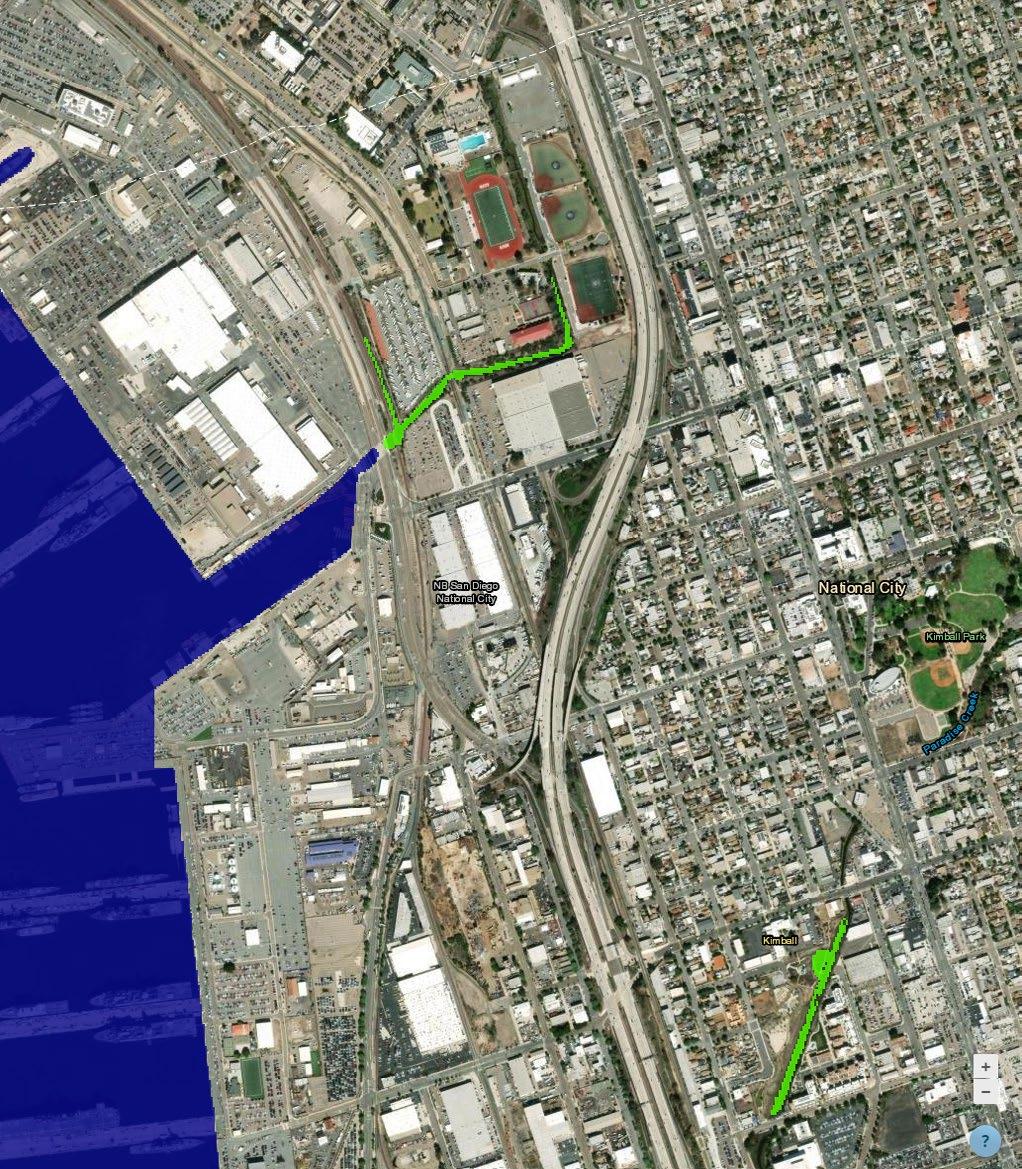
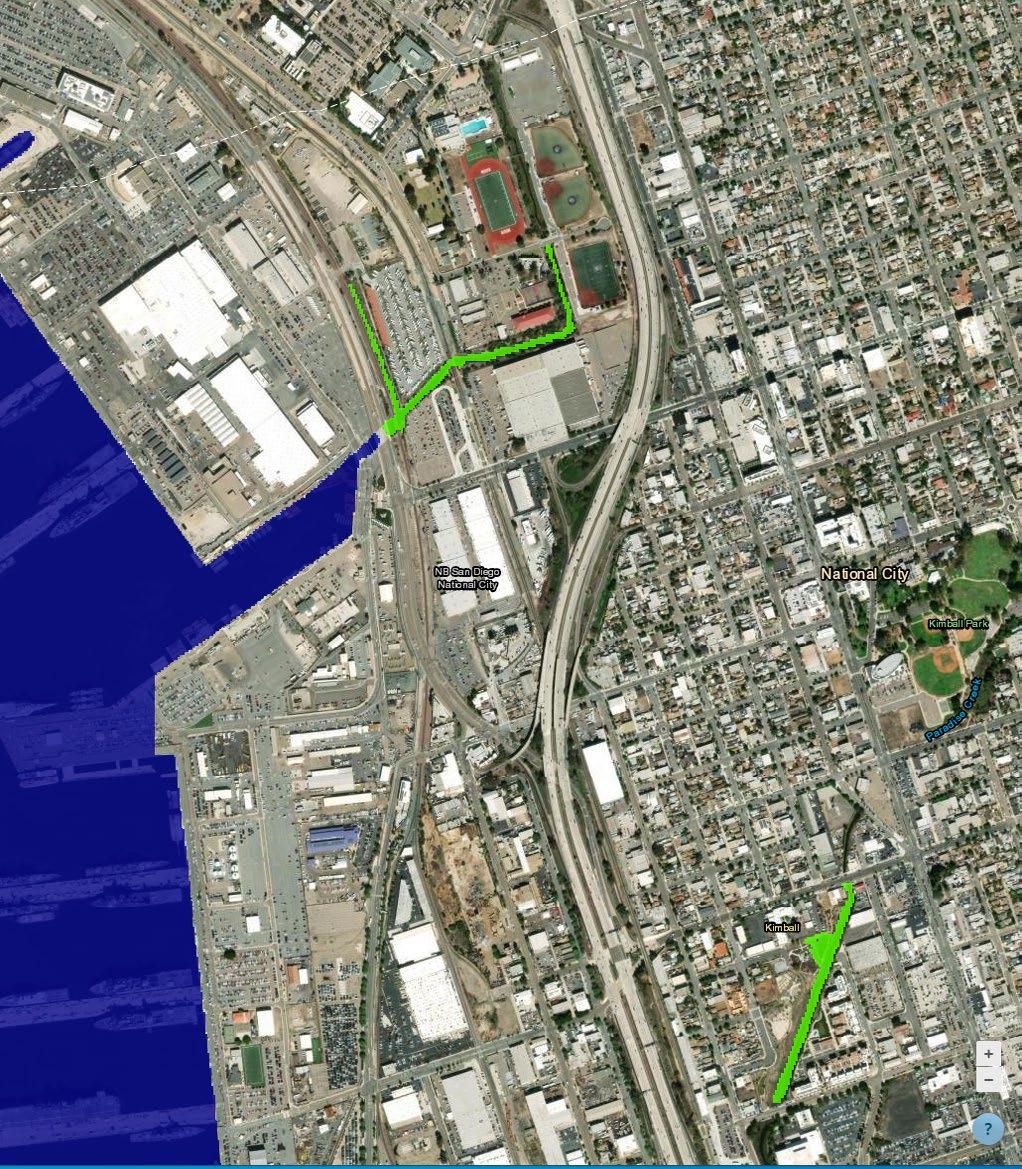
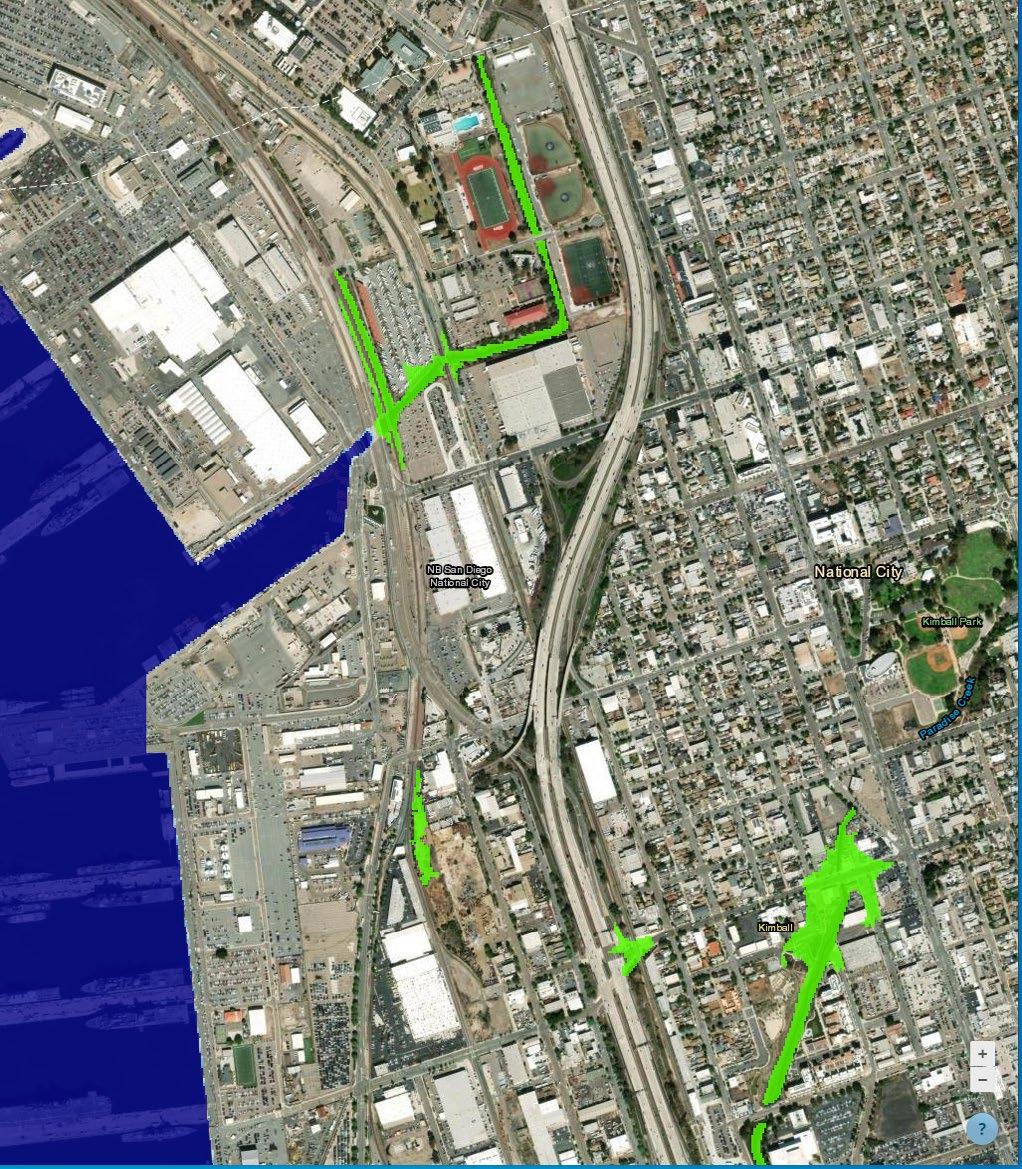
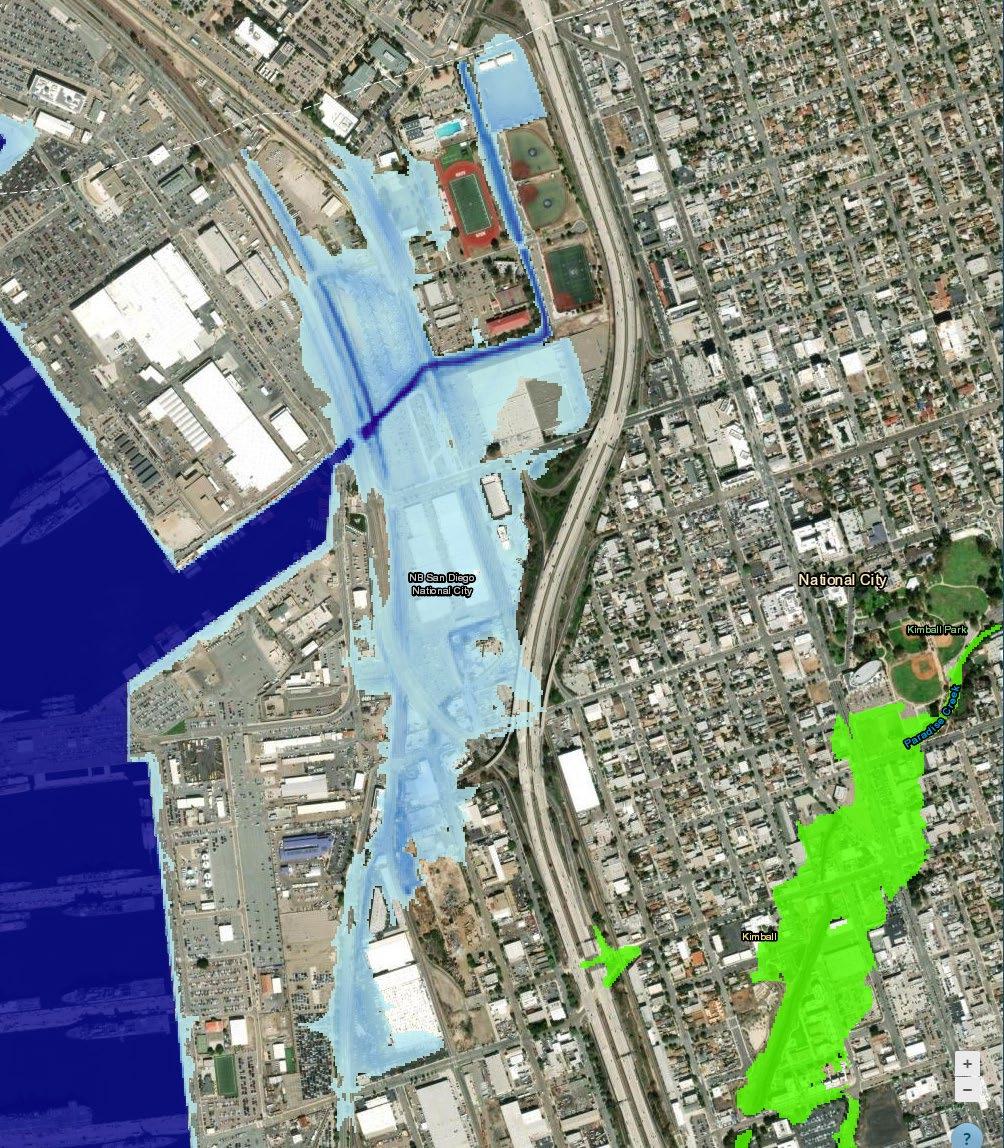
Figure 1-2: Current Sea Level (2023)
Figure 1-4: Sea Level with a Three-foot Increase
Figure 1-3: Sea Level with a One-foot Increase
Figure 1-5: Sea Level with a Six-foot Increase
This page is intentionally left blank.
Existing Conditions 2
2.1 EXISTING CONDITIONS
This chapter provides descriptions and analysis of NBSD and National City on topics of transportation mode utilization, pedestrian travelsheds to public transit and NBSD entry gates, and traffic collisions within the Study Area. The intent is to identify, prioritize and potentially improve some existing transportation related projects that lead to NBSD, and identify areas where new projects may need to be recommended.
Because this Study is funded by a grant that National City received from the OLDCC, the area considered is limited to proximity of NBSD property and facilities to enhance Department of Defense (DoD) readiness and resilience and provide safe places for service members and their families in alignment with the military mission. The goal is to provide value back to the DoD by ensuring manufacturing and supply chains are ready and agile, while encouraging local communities to focus on sustainable development that is compatible, supportive and adaptable to the DoD mission.
Naval Base San Diego
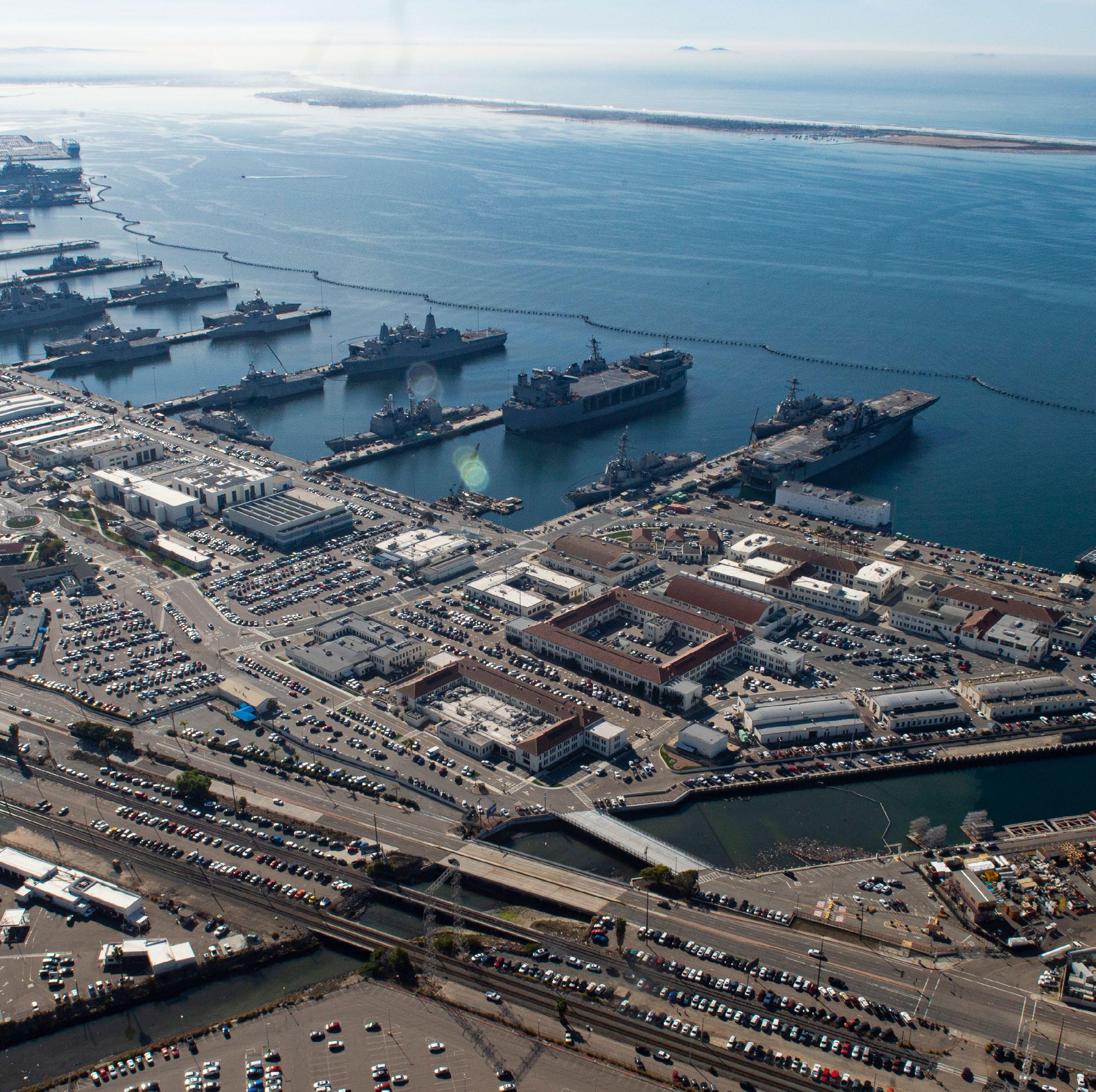
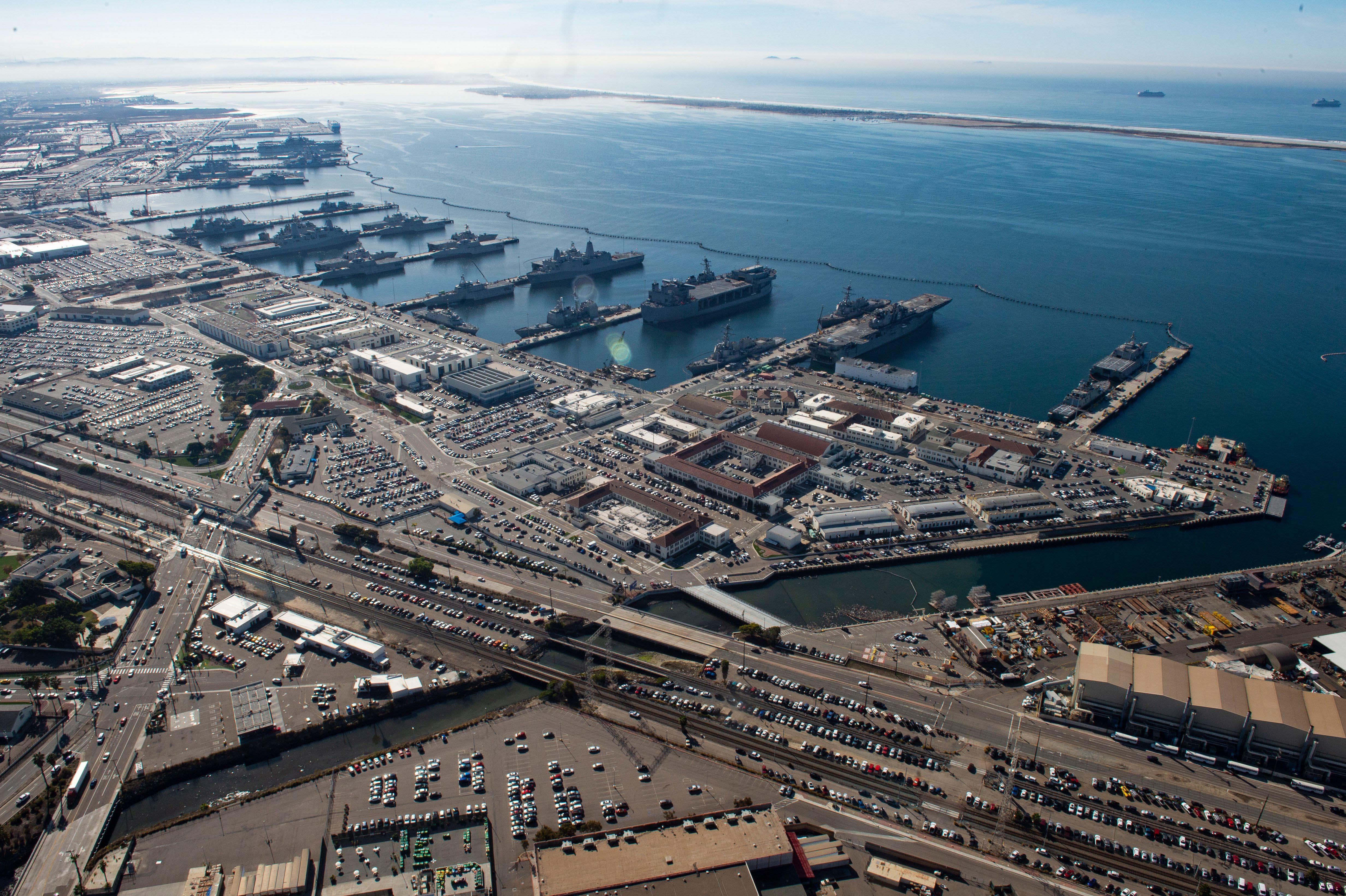
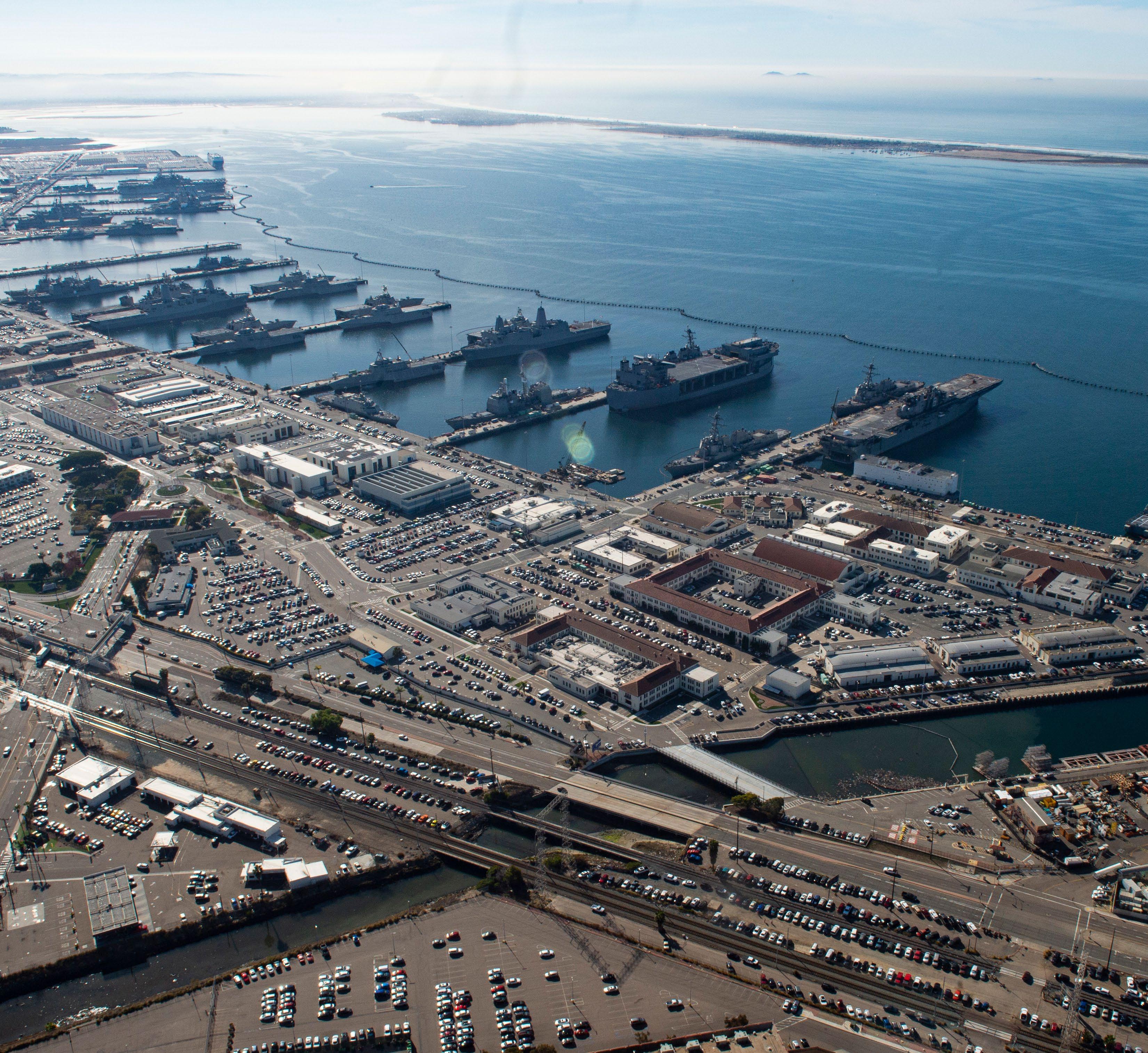
NBSD occupies the waterfront edge of the San Diego Bay directly west of National City and west of the City of San Diego at the north end. It is homeport to the Pacific Fleet Surface Navy with nearly 60 ships, more than 200 tenant commands, and ship maintenance personnel working there daily. As one of the largest employers in the region, NBSD brings over 30,000 vehicles to the installation daily which contributes to local traffic congestion which in turn impacts freight movement in and out of the port. One challenge with the urban fabric around the installation is the lack of walking and biking infrastructure that, if fully developed, could help reduce traffic congestion, improve freight movement, and reduce collision related injuries as a net benefit for both NBSD and National City.
National City
National City is a fully built-out urban environment with nearly 60,000 residents and is considered by the CalEnviroScreen web page as an economically disadvantaged community. The city is directly adjacent to the east edge of NBSD and provides local roads and other bike and pedestrian infrastructure to its citizens and personnel going to NBSD. Caltrans provides the freeway related infrastructure that feeds into NBSD in combination with local city roads.
2.2 TRANSPORTATION MODES AND LEVEL OF USE
Table 2-1 compares National City transportation modes amongst workers 16 and over using five-year estimates from the American Community Survey (ACS) to neighboring cities Chula Vista, San Diego, and La Mesa. This data is limited to
the people that live in the noted cities based on 2021 ACS 1-Year Estimates.
Table 2-1. Transportation Modes with Nearby City Comparison
2.1.1 CARPOOLED
More than double the amount of ACS survey responders carpool in National City when compared to neighboring cities. This is helpful for reducing congestion and greenhouse gas emissions.
2.1.2 PUBLIC TRANSPORTATION
There are also nearly twice as many workers from National City who commute using public transit than neighboring cities. San Diego County’s Blue Line trolley line is the most heavily used route in the San Diego region. However, within the Study Area, 8th Street is the most traveled bus route with 1,000 to 5,000 transit trips per day, followed by the arterial transit networks with around 500 to 1,000 trips per day.
2.1.3 WALKING AND BICYCLING
More people from National City report walking and bicycling to work than neighboring cities as well. It should be noted that NBSD is one of the region’s largest employers and fourth largest naval base in the US. Given this information, the area currently lacks the complimenting infrastructure to support walking and biking in an accessible and comfortable way.
2.1.4 OTHER
The ‘other’ category represents people who did not drive, bicycle, walk, or take transit to work. This could mean they used a motorcycle or skateboard, worked remotely, or called a taxi or ridesharing service. It is important to note that in 2021, when these estimates occurred, many people were working remotely due to the COVID-19 pandemic.
2.3 TRAVELSHED ANALYSIS
Travelshed analysis figures on the following pages were developed to help with project prioritization based on potential high use areas like bus stops, trolley stops, and entry gates to NBSD. The travelsheds are not “as the crow flies;” rather, they use streets and walkways to show the path that people walking are able to take or not take, based on the existing road network and barriers. The closer an origin and destination are, the more likely and willing people are to use sustainable modes of transportation, such as walking, bicycling, and using transit.
According to the book Human Transit, by Jarrett Walker1, the most commonly cited distance to walk to transit stops in the United States is a quarter mile, or about a five-minute walk. In Europe, larger distances are more commonly used such as a half-mile, or about a 10-minute walk. This Study also includes an eighth of a mile travelshed, or about a three-minute walk, to demonstrate where improvements will have the greatest impact for those making first-last mile connections.
Both I-5 and the railroad tracks in National City cause similar limitations in permeability of the grid network in the Study Area, as can be shown by the travelsheds in Figures 2-1 through 2-3. Typical project recommendations such as intersection reconfigurations, curb extensions, and new bike lanes, all contribute to a safer environment for pedestrians and bicyclists, which is supportive of the goal to enhance multimodal conditions of within the Study Area.
Travelsheds from Bus Stops
Figure 2-1 shows an eighth of a mile or about a three-minute walk, quarter-mile or six-minute walk, and half-mile walk distances from all bus stops as shaded polygons. Bus stops provide strong access to Dry Side gates, all within a quarter-mile or closer. Of the Wet Side gates, only Gates #6 and #9 are within a quarter-mile. Gates #2, #7, and #13 are more than a half mile walk, signaling that people are probably not using the bus to access these gates. It is reasonable to assume that people are or would be willing to use transit to access gates within smaller travelsheds which emphasizes the importance for pedestrian and bicycle improvements. Other gates are beyond a half-mile and less likely to be accessed by bus.
Travelsheds from Trolley Stops
Figure 2-2 shows the eighth, quarter, and half-mile distances from trolley stops. Both the 8th Street and Pacific Fleet trolley stop provide strong access to military gates. From the 8th Street station, Gate #9 is about an eighth-mile distance and from the Pacific Fleet station, Gate #6 is within an eighth-mile and Gate #43 is within a quarter-mile. Improvements made
within these travelsheds will both increase safety for existing trolley passengers while also attracting new ones. The 24th Street trolley stop does not reach any gates within a half-mile distance. Due to I-5 being a barrier, options are limited to get to that trolley station.
Travelsheds from Military Gates
Figure 2-3 shows eighth, quarter, and half-mile distances from NBSD gates #2, #6, #7, #9, and #13 on the Wet Side and gates #29, #32, and #43 on the Dry Side. This map is specific to showing which bus stops and trolley stops can be accessed within a half-mile from the gates. All gates are relatively wellserved and can access bus and/or trolley stops with an exception of the 24th Street station. While Gate #13 almost reaches it, the I-5 and railway act as a barrier, preventing a more direct route. Gates #6, #9, and #43 are the most accessible by bus and trolley.
1
Walker, Jarrett. Human Transit, Island Press, 2011
Eighth mile travelshed from bus stops
Quarter mile travelshed from bus stops
Half mile travelshed from bus stops
2-1: Travelsheds from Bus Stops
Figure
Le ge n d
# NBSD Ga tes
G Trolley Stations Served
NBSD Bound ary
OLDCC Stu dy Area
Eighth mile travelshed from trolley stops
Quarter mile travelshed from trolley stops
Half mile travelshed from trolley stops
2-2: Travelsheds from Trolley Stops
Figure
Harborside Stop
GATE 2
GATE 43
GATE 6
Le ge n d # NBSD Ga tes
Bu s sto ps
Trolley Stations Served
NBSD Bound ary
OLDCC Stu dy Area
Eighth m ile travelshed from wetside gate
Quarter mile travelshed from wetside gate
Half mile travelshed from wetside gate
GATE 7
2-3: Travelsheds from Military Gates
GATE 29
GATE 13
GATE 9
32
Figure
2.4 COLLISION ANALYSIS
The following section provides an overview of bicycle, pedestrian, and automobile collisions between 2011-2021 using data downloaded from the University of Berkeley’s Transportation Injury Mapping System (TIMS). TIMS data is based on the California Highway Patrol’s (CHP) Statewide Integrated Traffic Records Systems (SWITRS). Collision quantities, severities, locations, and primary collision factor violations are summarized in Tables 2-2 through 2-4 for the Study Area.
Table 2-2.
Injury Severity for All Collisions
Table 2-3. Injury Severity and Location
Table 2-4. Primary Collision Factor
Collision Summary
The Study Area had 770 total collisions between 2011-2021, as detailed in Tables 2-2 through 2-4. There were more automobile collisions (due to relative scales of mode utilization) than pedestrian collisions, and the fewest were bicycle collisions. There were no bicyclist fatalities but four pedestrians and six automobile occupants were killed. The primary causes, or collision factor violations, for automobiles was most frequently ‘unsafe speed’, then ‘improper turning’, ‘automobile right of way’, and ‘traffic signals and signs’. Bicyclist injury causes were primarily from the bicycle riding on the wrong side of the road (likely due to lack of bike facilities), then ‘improper turning’ of vehicles into bicyclists, then bicyclists violating the automobiles right of way. Pedestrian collisions primarily resulted from automobiles violating the pedestrians right of way (likely in crosswalks due to unsafe driving or driving at an excessive speed), and next by pedestrians violating various traffic laws (possibly crossing outside a crosswalk midblock and other reasons).
Methodology
The GIS methodology for the following maps joined collision points to the nearest road centerline. Each collision point joined to a road centerline was then ranked based on collision type and severity of injury as noted below. The total rank, or score from the joined collisions for each road segment, was divided by the linear foot length of the segment to get a ‘collision per foot’ decimal number for that length of road segment. The decimal value was used to compare each road segment to other segments in the Study Area and determine a scale from highest to lowest quantity and severity of collisions. Red road segments have the highest quantity and severity of injuries - over the length of the road segment. The following scoring values were used for all injuries.
• Pedestrian and Bicycle collisions:
» Fatal or Severe Injury = 1.5
» Visible or Other Injury = 1.25
• Vehicle collisions without a Pedestrian or Bicycle
» Fatal or Severe Injury = 1.25
» Visible or Other Injury = 1.0
Each road segment on a corridor is ranked relative to all other road segments based on collision rank-scoring with injury severity. This is useful with finding areas with the highest level of collisions and injury severity that could become project priorities.
All Collisions
In Figure 2-4, Main Street starting at Division going north to 28th Street in San Diego has four traffic fatalities and six severe injuries, higher than most streets in the City. South 28th Street in San Diego also has a high collision rank with two severe injuries and numerous additional injury collisions. Additional streets with high numbers of severe traffic collisions include the 1-15 on/off-ramp connecting to the NBSD Wet Side main gate, National City Boulevard, and Bay Marina DrMile of Cars going east National City Boulevard.
Bicycle Collisions
In Figure 2-5, the road segment ranking is limited to only bicyclists related collisions and injuries. This can help with identifying bicycle project priority locations.
The quantity and extent of bike related injuries are scattered throughout the Study Area with the highest ranks occurring on the side streets that feed into National City Boulevard and segments of Roosevelt Avenue at the north edge of National City. Main Street running along the east edge of NBSD Dry Side has seen a few bicyclists injuries that could benefit from a new bike project. Mile of Cars Way is another corridor with segments of high bike collision ranks. The intersection around Harbor Drive and Civic Center Drive just west of I-5 appears to need attention for bike safety. Segments of Cleveland Avenue with bike injuries suggest a project on this street may help reduce future injuries. At the north end of the Study Area, the areas around 28th Street, 32nd Street and National Avenue in the City of San Diego could benefit from bike safety projects.
Pedestrian Collisions
Figure 2-6 shows a similar pattern of priority road segments along the following corridors:
• National City Boulevard
• Main Street
• Mile of Cars Way
• Civic Center Drive at the I-5 underpass
• 28th Street, 29th Street, 30th Street, National Avenue, Boston Ave in City SD
Automobile Collisions
Figure 2-7 brings the same roads to the top with the highest ranking corridors including National City Boulevard running the length of National City, Cleveland Avenue, Civic Center Drive, Mile of Cars Way at the south edge of National City, and the full length of Main Street along the NBSD Dry Side boundary.
The Mile of Cars Way/Bay Marina Drive corridor should be considered the worst single stretch for collision injuries (and a key corridor for potential projects) due to the four severe injuries, one fatality, and numerous other injury collisions that have occurred during the study period. At the north end of the Study Area, the I-15 on-ramp and off-ramp that leads directly to NBSD Wet Side main gate, 28th Street, National Avenue, Boston Avenue and the full length of Harbor Drive all see high levels of collision injuries.
Legend
All Mode s Injurie s
D Fatal
( Severe Injury
! Other Injury
Com pa ra tiv e C ollis io n Ra nk sAll Mode s
Very Low to N o C ollis ions
Low C ollision R ankScore
Medium Rank
High Collision RankScore
OLDCC Stu dy Area
2-4:
Legend
Bike Injurie s
( Severe Injury
! Other Injury
Com pa ra tiv e C ollis io n Ra nk sBike
Very Low to N o C ollis ions
Low C ollision R ankScore
Medium Rank
High Collision RankScore
OLDCC Stu dy Area
2-5: Bicycle Collisions
Figure
Legend
Pede s tria n Injurie s
D Fatal
( Severe Injury
! Other Injury
Com pa ra tiv e C ollis io n Ra nk s -
Pede s tria n
Very Low to N o C ollis ions
Low C ollision R ankScore
Medium Rank
High Collision RankScore
OLDCC Stu dy Area
2-6:
Figure
Pedestrian Collisions
Legend
Veh icle Injuire s
D Fatal
( Severe Injury
! Other Injury
Com pa ra tiv e C ollis io n Ra nk sVeh icle s
Very Low to N o C ollis ions
Low C ollision R ankScore
Medium Rank
High Collision RankScore
OLDCC Stu dy Area
Figure 2-7: Vehicle Collisions
2.5 STREET CLASSIFICATION
Figure 2-8 shows Street Classification from National City Homefront to Waterfront in the western portion of National City and extending north into the City of San Diego along Harbor Drive. As shown on the map, primary arterial routes include National City Boulevard, Harbor Drive, 8th Street, and parts of 24th Street. Numerous collector routes run throughout the City with primary collectors including Tidelands Avenue, Civic Center Drive, 18th Street, Bay Marina Drive, 24th Street.
Arterials tend to have a higher crash frequency, higher vehicle volumes, and higher speeds, which can make a safe and inviting pedestrian environment more challenging. At the same time, improving the safety, efficiency, and multimodal options along arterial roadways is key to improving the overall function and operation within the Study Area.
2.6 TRUCK ROUTES AND STRAHNET CORRIDORS
Figure 2-9 shows Truck Routes and Strategic Highway Network (STRAHNET) connectors from National City Homefront to Waterfront in the western portion of National City and extending north into the City of San Diego along Harbor Drive. As shown on the map, the STRAHNET runs along Harbor Drive then turns east to connect to the primary STRAHNET route of Interstate 5. The STRAHNET is a 62,791-mile system of roads in the United States that is deemed necessary for emergency mobilization and peacetime movement of goods. A short segment of STRAHNET is on Bay Marina Drive to connect NBSD with Interstate 5. Primary and alternative truck routes connect industrial and commercial parts of the City with Interstate 5. One of the primary truck routes includes Harbor Drive to Civic Center Drive westbound to Tidelands Avenue southbound to Bay Marina Drive east to get to commercial parts of the City east of Interstate 5. The truck route then goes north and south on National City Boulevard. Additional truck routes include Civic Center Drive east of Interstate 5, Plaza Boulevard going east into the City, Roosevelt Avenue going north of Plaza Boulevard. The safety and efficiency of truck routes and the STRAHNET corridor will be an important part of this Study, as well as meeting the standards of the STRAHNET road design guidelines.
2.7 BICYCLE NETWORK
Figure 2-10 shows existing and proposed bikeways in the western portion of National City and extending north into the City of San Diego along Harbor Drive. As shown on the map, National City has numerous segments of existing bikeways but they have numerous gaps in connections that reduce the accessibility and sense of security when riding through the City. Proposed bikeway routes from National City Homefront to Waterfront will close these gaps by adjusting lane widths and configurations to support safe routes for alternative means of transportation throughout the City.
2-9: STRAHNET Network (from Homefront to Waterfront)
Existing Bikeways
Class I: Multi-use Path
Class II: Bike La ne
Class III: Bike Route
Class IV: Cycle Track
Urb an Trail Planned Bikeways
Class I: Multi-use Path
Class II: Bike La ne
Class III: Bike Route
Class IV: Cycle Track
OLDCC Stu dy Area
Figure 2-10: Existing and Planned Bikeways (from Homefront to Waterfront)
2.8 WALKABILITY
There are multiple trolley lines and bus routes in the Study Area. However, with mostly industrial and light industrial land uses and heavy use of trucks and large vehicles, the environment can be uncomfortable for people walking. The Study Area has railway lines and freeways as barriers, and generally long block lengths, commonly 1,000 feet long, which can increase walk trips significantly. Although there are a fair amount of sidewalks in the Study Area, there are generally long distances between signalized pedestrian crossings so the area is not considered pedestrian-friendly.
Although there’s no one universally accepted metric for how walkable an area is, there are emerging tools to measure walkability, such as the Walk Opportunities Index, the Walkability Index, the Pedshed Connectivity measure, and Walk Score, according to research from the Project for Public Spaces. It is the latter metric, Walk Score, that will be explained in this section, as well as a pedestrian crash analysis in a subsequent section of this Study.
Walk Score is a generalized tool for comparing relative ease of access by walking, biking, and using transit to destinations of a city or neighborhood from adjacent areas, as provided by the Walk Score webpage. The webpage is a free service available to the general public to compare, mainly, the density of destinations in adjacent cities or individual homes or businesses. Table 2-5 and Figures 2-11 provide a summary of Walk Score webpage data as of May 2023. The table compares walk, bike, and transit access in adjacent cities, and the adjacent neighborhood of Southcrest. All scores are out of 100 possible points. As shown in the comparison table, the overall area of National City scores highest with walkability compared to adjacent areas. Although it should be noted that ‘San Diego’ includes a vastly larger area that is averaged for its entirety and reduces its overall score. National City is described as having “some public transportation,” does not have many bike lanes, and “some’’ errands can be accomplished on foot.
Some of the criteria used in this Study’s prioritization process are pedestrian quality and bicycle level of traffic stress. Factors such as low walkability or bikeability helped determine priority projects by focusing on closing gaps and increasing multimodal options.
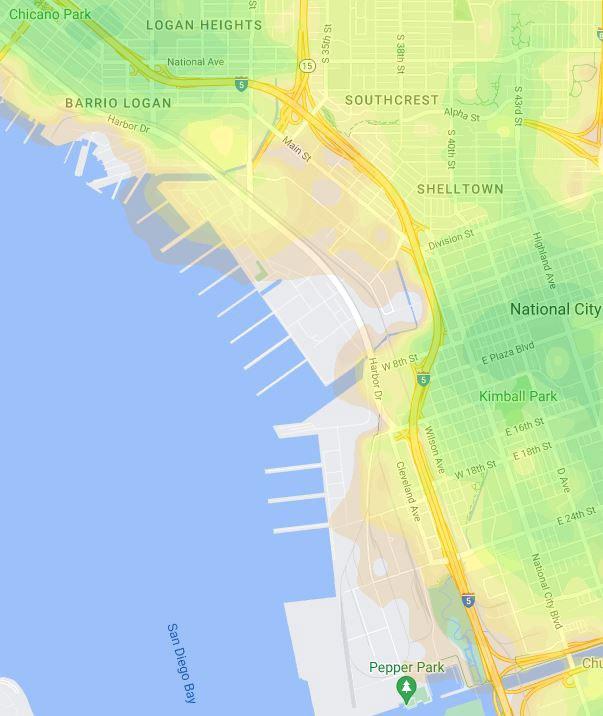
2-11: WalkScore Map of Walkability (green is higher density of destinations)
Table 2-5. Walk Score Comparison with Adjacent Cities
Figure
2.9 NEIGHBORHOOD ELECTRIC VEHICLES (NEV)
The City of National City received a Clean Mobility Options (CMO) grant from the California Air and Resource Board to construct a mobility hub at the 8th Street Transit Center. As a dedicated location for switching modes of transport, mobility hubs are centers designed to provide a safe and comfortable transition for passengers between transportation modes by providing a focal point in the transportation network. The plan for this mobility hub is to both charge and store Neighborhood Electric Vehicles (NEVs). A NEV is defined as a four-wheeled electric vehicle that has a maximum speed greater than 20 miles per hour (mph) but not more than 25 mph. NEVs will be stored at the 8th Street station and serve National City within a 10-minute radius of the mobility hub, as shown in Figure 2-12. The purpose of this microtransit is to increase first-last mile connections for people using the 8th Street trolley, though it can be used by anyone with a smartphone.
The NEVs are funded for four years. The CMO grant funds the first three years of the program, and the Port is funding the fourth year.
2.10 CITYWIDE TRAFFIC CONDITIONS
For this Study, the Team analyzed current traffic conditions throughout the day, using the standard traffic engineering measurement of a volume to capacity ratio. A volume to capacity (v/c) ratio measures the amount of traffic on a given roadway relative to the amount of traffic the roadway was designed to accommodate, or the capacity of the roadway.
After analyzing all the periods of the day, the peak morning period appeared to be 6am to 7am and the peak afternoon/ evening period appeared to be 3pm to 4pm, as can be seen in Figures 2-13 and 2-14.
To gauge traffic conditions, traffic engineers use a term called “Level of Service,” which is a qualitative measure used to relate the quality of motor vehicle traffic service. It is used to analyze roadways and intersections by categorizing traffic flow and assigning quality levels of traffic based on performance measures like vehicle speed, density, congestion. In general, the principle is to take the volume of traffic in one hour and divide it by the appropriate capacity of the road type to get a v/c rating.
In traffic engineering, it is acceptable for roads to operate at 85% capacity, which equates to what traffic engineers refer to as “Level of Service” (LOS) D and E. After analyzing the peak morning period and the peak afternoon/evening period in the project study area, it was determined that for those two periods, most of the streets in the Study Area operate above 85% capacity. As can be seen in Figures 2-13 and 2-14, where orange represents a v/c between 0.85 and 0.96 and red represents a v/c above 0.96, most of the streets are in orange or in red, indicating significant current congestion during peak periods in the Study Area. These traffic engineering terms are further explained in chapter 4.
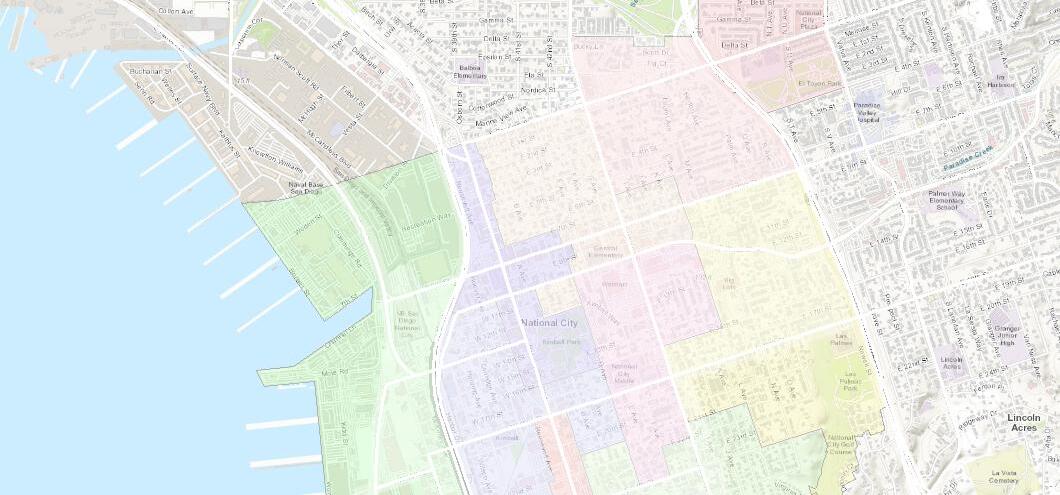
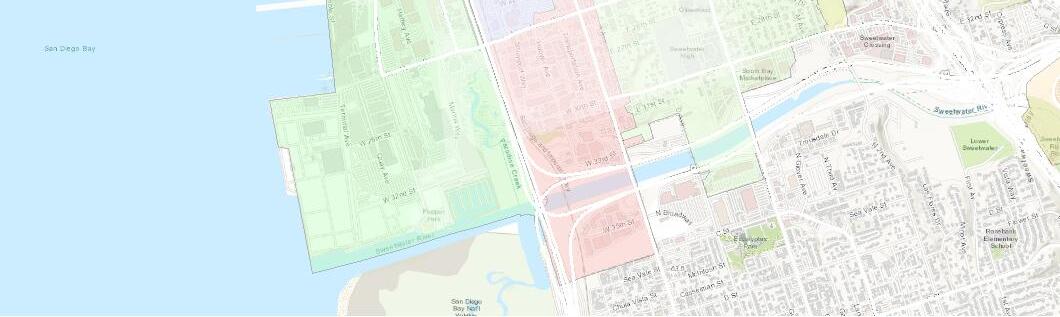
2-12: NEV Service Area
Figure
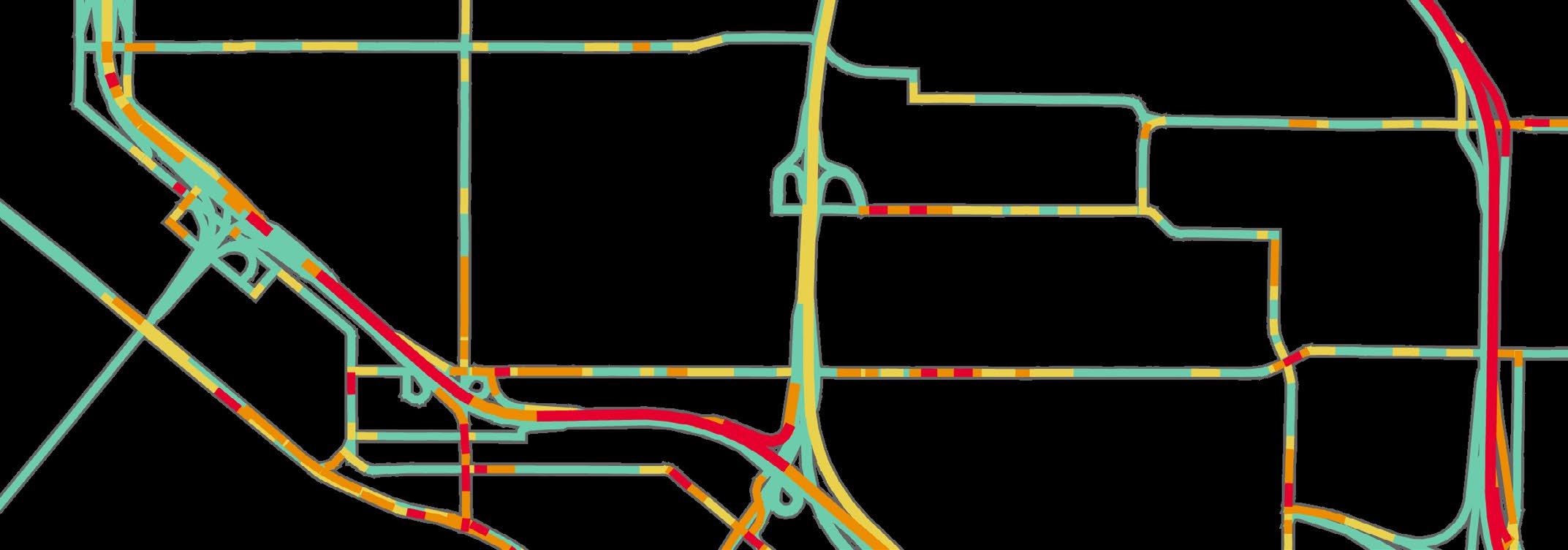

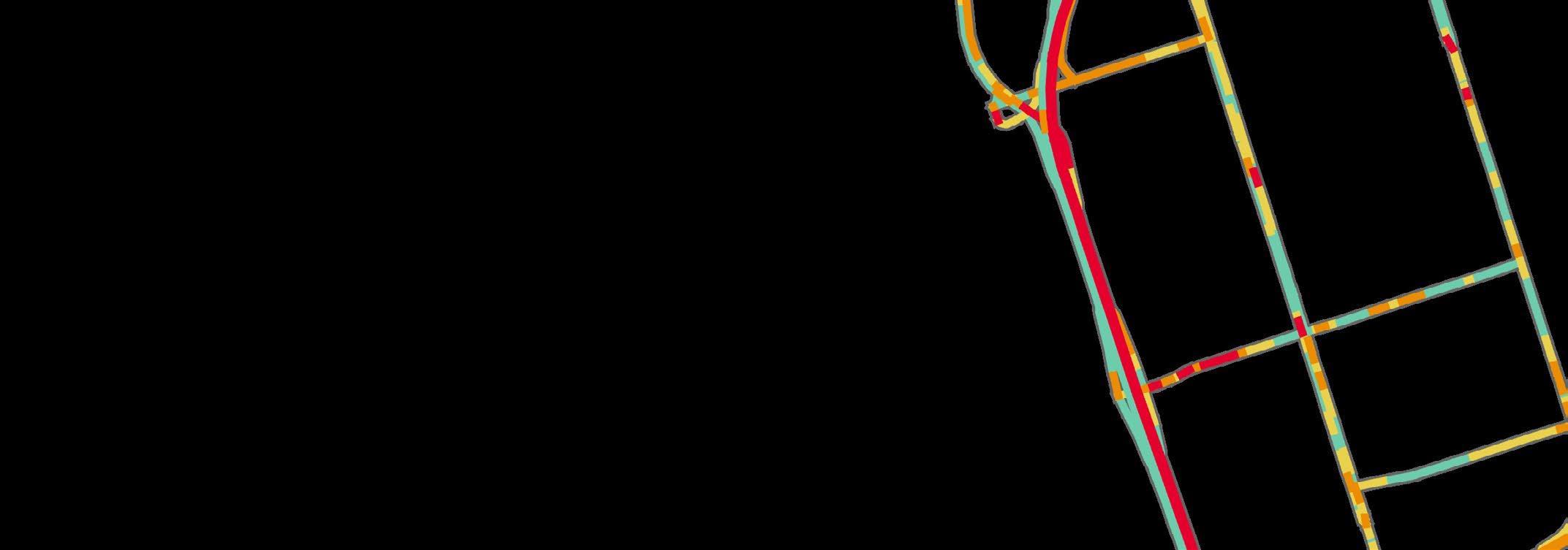

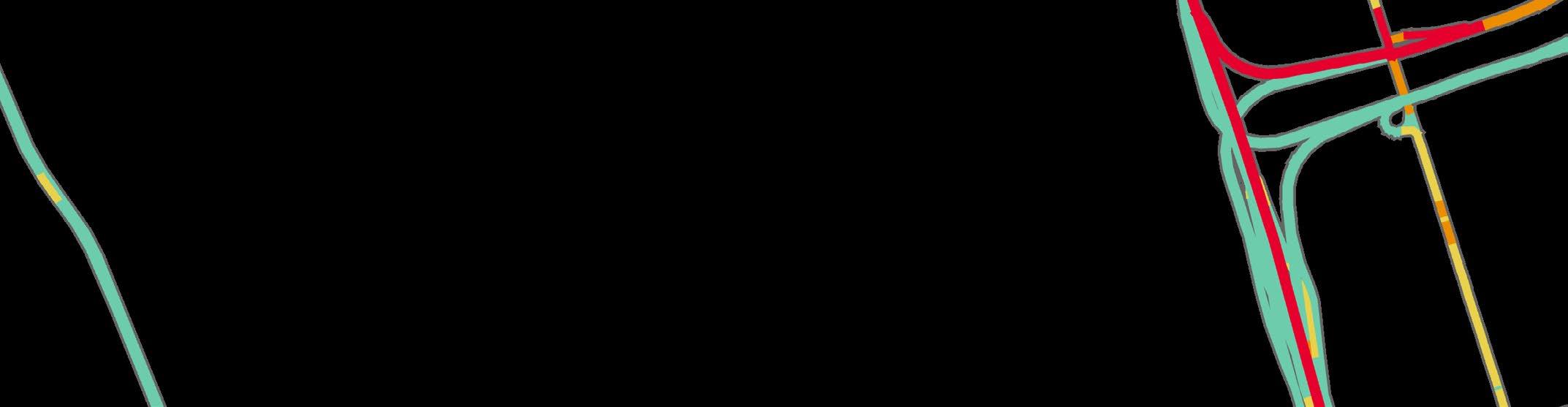
Figure 2-13: Congestion from 6:00-7:00AM (Peak Hour)
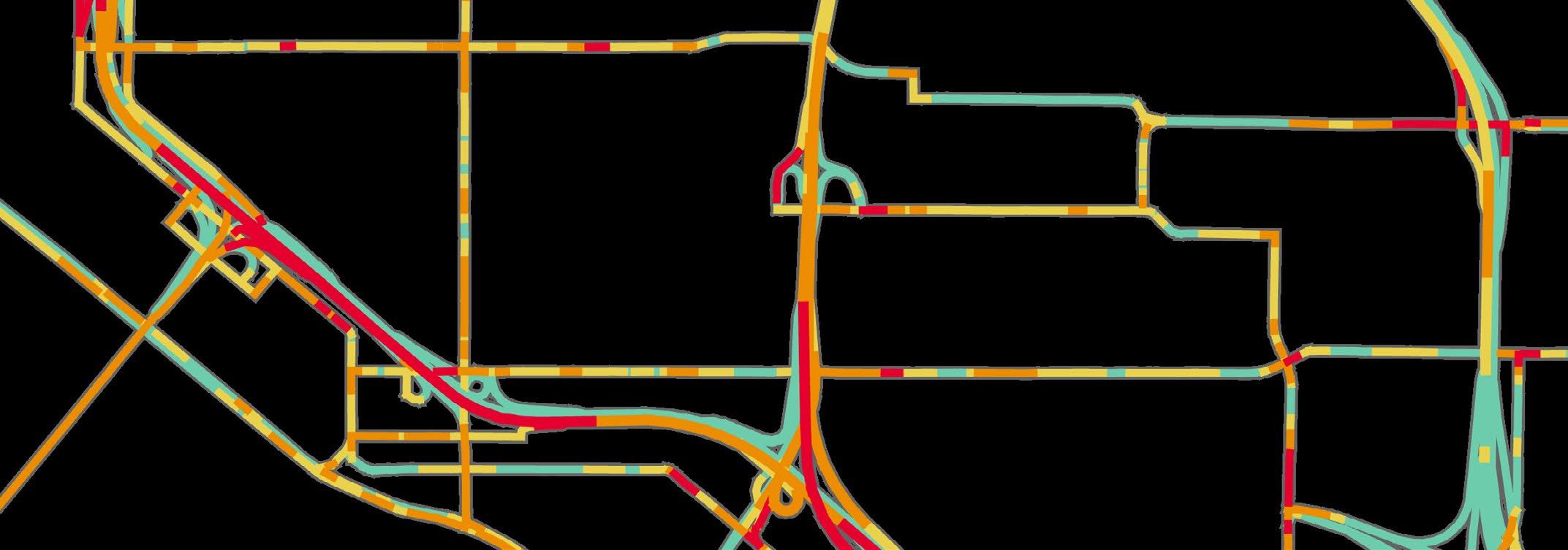


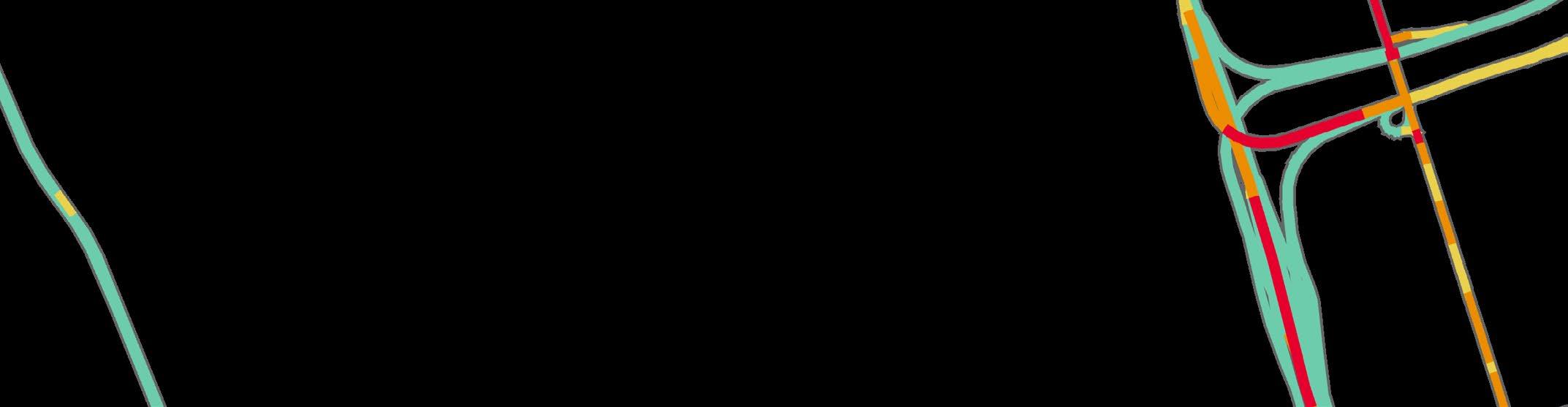
Figure 2-14: Congestion from 3:00-4:00PM (Peak Hour)
Project Recommendations 3
3.1 PROJECT PRIORITIZATION
The Team began with a list of 139 projects proposed by previous studies and plans that address the primary concerns of safety, congestion, connections to highway and transit networks, and multimodal transportation opportunities. The Team applied the following filters to develop priority projects. Over two dozen of the projects were removed because they were on NBSD right of way, which is outside of the scope of this Study. For example, some projects were inside the NBSD fence line, NBSD gates improvements, etc. More projects were removed from the list if they didn’t meet the project goals of safety, transportation congestion, or multimodal benefits or weren’t focused on the City of National City, the City of San Diego, or NBSD.
The Team also removed any projects that were in construction, funded, already designed, or the project included more recent projects identified in the same area by a different agency. With these criteria applied, the Team removed 113 projects from the original project list of 139 projects, bringing the list of potential projects down to 26 projects, pictured in Figure 3-1 and project descriptions can be found in Appendix B.
For those 26 projects, the Team applied a series of criteria to score and then rank them from 1 to 26. The criteria are determined as follows:
1. Collision Scores for all collisions - This column is a score for each of the project locations based on vehicle, pedestrian and bicyclist collisions that occurred along each corridor or intersection. For intersections, collisions that occurred within 300 feet of the intersection were included in the collision score. Scores for individual collisions are based on 1.25 ‘points’ for fatal vehicle/vehicle collisions, 1.00 ‘points’ for all other vehicle/vehicle injuries, 1.50 for fatal pedestrian or bicyclist versus automobile collisions, 1.25 for severe injury pedestrian or bicyclist versus automobile collisions, and 1.00 for all other pedestrian or bicyclist versus automobile injuries.
2. Proximity to NBSD Gates - For this score, the Team used GIS to measure the distance from the part of the project closest to one of the gates (#2, #6, #7, #9,#13, #29, #32, #43). If a project was within an eighth of a mile from the selected gates, it was given a score of 9. If a project was within a quarter mile from the selected gates, it was given a score of 6. If a project was within a half mile from the selected gates, it was given a score of 3. If a project was further than half mile away from the selected gates, it was given a score of 0.
3. Average Congestion (Volume-to-Capacity Ratio [v/c])- Google Maps “Typical Traffic” tool was used to determine the weekday morning (AM) and afternoon (PM)
peak hour congestion for the Study Area. Google Maps classifies their typical traffic congestion into four categories: Green (free flow - no traffic delays), Orange (moderate amount of traffic), Red (traffic delays), Dark Red (significant traffic delays). These four categories were equated to a corresponding volume-to-capacity (v/c) ratio with similar traffic conditions: Green (v/c < 0.5), Orange (v/c ≤ 0.85), Red (v/c ≤ 0.96), Dark Red (v/c > 1). For congestion scoring, average v/c ratios were multiplied by 10 to correspond to the other scoring columns. For a roadway, the worst case v/c segment was used and for an intersection, the intersection approach v/c ratios were averaged.
4. Pedestrian Quality - This score factors in the following criteria.
• Ped Separation (bike, planter, parking) - This column indicates the percentage of corridor that has horizontal separation between the vehicle travel lane and the sidewalk. This criteria is for determining pedestrian Level of Traffic Stress (LTS).
• Ped Existing Sidewalk (percent) - This column indicates the percentage of the corridor that has existing sidewalks.
• Ped Ease of Crossing (Corridors) (percent) - This column indicates the percentage of the corridor that has existing marked crosswalks every 600 feet down the road.
• Ped Ease of Crossing (Intersection) (type/percent marked) - This column indicates the percentage of four crosswalk areas that have existing markings for crosswalks.
• Ped LTS - Shows the final score applied to the corridor (or intersection depending on the project) for pedestrian LTS.
5. Bicycle Level of Traffic Stress - This score factors in the following criteria.
• LTS Speed - LTS is a method of estimating the Level of Traffic Stress for bicyclists. LTS Speed is the vehicle road speed in miles per hour as posted on signs. The higher the speed for vehicles then the higher the stress for bicyclists. The LTS Speed score is used in conjunction with the LTS Bike Lane Exists (percent) and the LTS Vehicle Lanes values in the next columns to determine the overall LTS.
• LTS Bike Lane Exists (percent) - This column shows the percentage of the corridor that has an existing bike lane.
• LTS Vehicle Lanes - This column shows the number of vehicle lanes along the segment of the corridor.
• Bike LTS score - Shows the final score applied to the corridor for bike LTS.
6. Connection to STRAHNET, freeways, trolleys lines, etc. - This is a score that considers connectivity to key networks, namely the STRAHNET, freeways, trolleys lines, using professional judgment to determine a score based
Table 3-1. Projects for Prioritization
on that project’s importance in boosting and connecting to the aforementioned networks.
The Team added the aforementioned criteria to a table and added the total score for each of the 26 projects, so they could be ranked 1 through 26 as shown in the Table 3-1.
3.2 COLLISIONS AT PRIORITIZED PROJECTS
The ranked projects from the prior section were further analyzed for types and quantities of collisions. The following two maps focus collision mapping analysis on the project intersections and corridors to help prioritize projects relative to each other in terms of public safety.
Figure 3-2 Project Intersection Collisions shows circles around intersection project locations to highlight relative ranking or scoring of all (bike/ped/vehicle) injury severities within a 300 foot buffer, or circle, from the intersection point. Each collision within 300 feet of the intersection was ranked / scored based on collision type and severity of injury as described previously. The total score for each intersection’s collisions was then used to compare each intersection and determine a relative scale from highest to lowest quantity and severity of collisions.
The intersection of Division Street and National City Boulevard has the highest relative rank of collision injuries of all the intersection projects.
the
intersection onto Main Street which is directly adjacent to the worst intersection noted above. Additional relatively high ranking intersections for collision injuries include the main entry gates to NBSD Dry Side and Wet Side off of 32nd Street and the intersection of 28th Street and Boston Avenue at the north edge of the Study Area.
Figure 3-3 Project Corridor Collisions shows the project locations with relative ranking of the projects full length and collision injuries compared to the other project corridors.
The Mile of Cars Way/Bay Marina Drive corridor is considered the worst single stretch for collision injuries due to the four severe injuries that have occurred there plus all the other injury collisions. A tie for the second worst locations starting with Main Street leading to the NBSD Dry Side entry gate that has seen two severe injuries, then 32nd Street as it directs traffic to the NBSD Dry Side and Wet Side main entry gates. The fourth high ranking injury corridor project is at the north end of the Study Area on 28th Street that brings traffic to Harbor Drive from I-5.
Figure 3-2: Collisions at Project Intersections
Figure 3-3: Collisions on Project Corridors
Future Conditions 4
4.1 TRAFFIC ANALYSIS
Data was collected in April, 2023 for the Study Area intersections along Main Street and 19th Street, as these two locations have projects that proposed modifications to lane geometry and traffic signal operations. These corridors were analyzed to evaluate the effects of the proposed projects. The following Study Area intersections are shown in Figure 4-1 and Figure 4-2.
Main Street Study Intersections
1. Main Street and I-15 Freeway Ramps
2. Main Street and Vesta Street
3. Main Street and Yama Street
4. Main Street and Division Street / Roosevelt Street
5. National City Boulevard and 1st Street / Osborn Street
6. Division Street and Osborn Street
19th Street Study Intersections
7. 19th Street and Tidelands Avenue
8. 19th Street and Cleveland Avenue
9. 19th Street and McKinley Avenue
10. 19th Street and Wilson Avenue
4.1.1 ANALYSIS SCENARIOS
This traffic analysis evaluated the intersections listed above under the following five (5) scenarios:
• Current (2023) – Based on Current (2023) traffic counts collected in April 2023.
• Future (2030) Baseline – Based on current traffic volumes and ambient growth along major roadways. This scenario is based on the roadway geometry and traffic control assumed for year 2030.
• Future (2030) Plus Improvements – Future (2030) baseline volumes with roadway geometry and traffic control modifications assumed for the project.
• Future (2030) Plus Vesta Bridge – Future (2030) baseline traffic volumes redistributed as a result of the construction of the Vesta Street Bridge project. This scenario is based on the roadway geometry and traffic control assumed for year 2030.
• Future (2030) Plus Vesta Bridge Plus Improvements –Future (2030) plus Vesta Street Bridge project volumes with roadway geometry and traffic control assumed for the project.
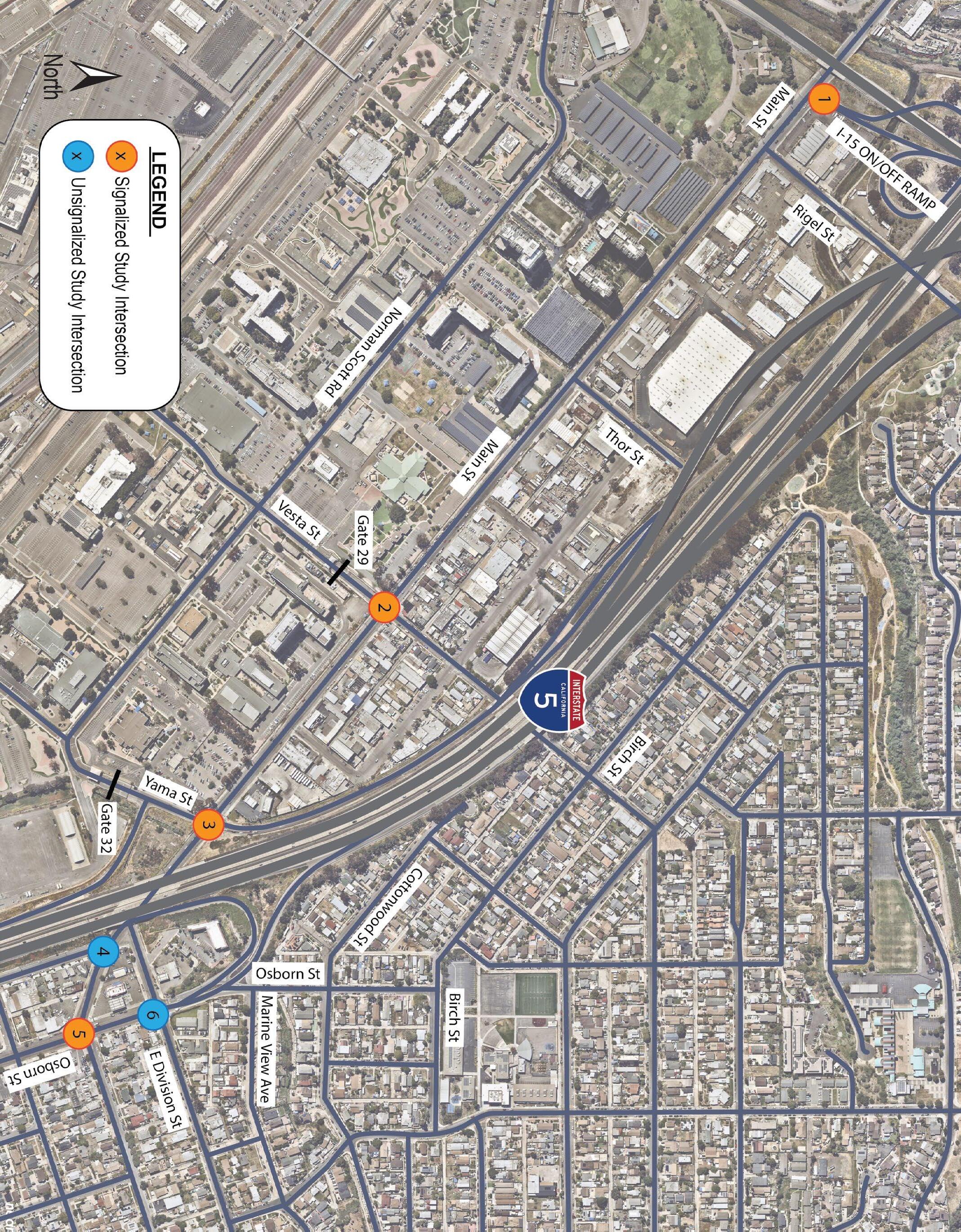
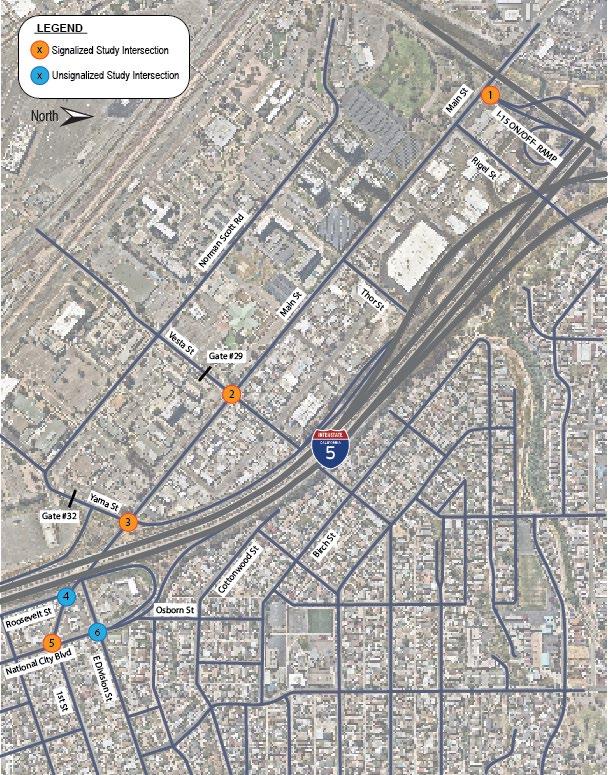
Figure 4-1: Main Street Study Area
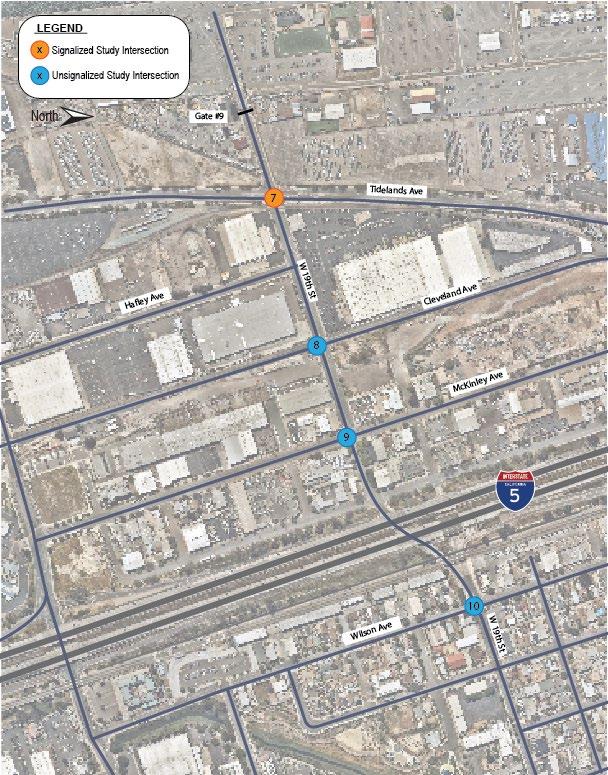
Figure 4-2: 19th Street Study Area
4.2 ANALYSIS METHODOLOGY
4.2.1
LEVEL OF SERVICE STANDARDS
Analysis of the study intersections were based on the concept of Level of Service (LOS) and is a qualitative measure used to describe operational conditions, as mentioned in section 2.10. LOS ranges from A (best), which represents minimal delay, to F (worst), which represents heavy delay and a facility that is operating at or near its functional capacity. Levels of service for this Study were determined using methods defined in the Highway Capacity Manual, 6th Edition (HCM 6) and Highway Capacity Manual, 2000 (HCM 2000) within Synchro analysis software. Intersections with standard signal phasing were analyzed with HCM 6. Intersections with non-standard signal phasing or non-standard intersection control were analyzed using HCM 2000 methodologies due to HCM 6 methodology limitations within Synchro.
The HCM includes procedures for analyzing side street stop controlled (SSSC) and signalized intersections. The SSSC procedure defines LOS as a function of average control delay for the worst movement. Conversely, the signalized intersection procedures define LOS as a function of average control delay for the intersection as a whole. The LOS standard for the City of San Diego and the City of National City is LOS D.
Table 4-1 relates the operational characteristics associated with each LOS category for signalized and unsignalized intersections.
4.2.2
TRAVEL TIME RUN METHODOLOGY
Arterial travel time was evaluated using Synchro’s SimTraffic software. Synchro is a macroscopic analysis tool used to identify operational measures of effectiveness at the intersection level, but is limited to treating each intersection in isolation of
A Free flow with no delays. Users are virtually unaffected by others in the traffic stream [ 10 [ 10 B
Stable traffic. Traffic flows smoothly with few delays.
Stable flow but the operation of individual users becomes affected by other vehicles. Modest delays.
D
E
Approaching unstable flow. Operation of individual users becomes significantly affected by other vehicles. Delays may be more than one cycle during peak hours.
Unstable flow with operating conditions at or near the capacity level. Long delays and vehicle queuing.
F Forced or breakdown flow that causes reduced capacity. Stop and go traffic conditions. Excessive long delays and vehicle queuing.
Sources: Transportation Research Board, Highway Capacity Manual 6th Edition, National Research Council, 2016.
Table 4-1. Intersection Level of Service Definitions
the network. SimTraffic, the microscopic software built into Synchro, analyzes the Synchro model as a network and can identify deficiencies caused by queuing and blocking at upstream and downstream intersections. Therefore, SimTraffic was used to determine arterial travel times for each of the study corridors based on the average results from three microsimulation runs for the AM and PM peak models.
4.3 CURRENT (2023 CONDITIONS)
Current (2023) Roadway Network
From I-15 to Division Street, Main Street is an east-west, twolane, local collector. The roadway serves commercial uses and provides access to Gates #29 and #32 of NBSD. Main Street provides connection to the I-15 and I-5 freeways from NBSD. On-street parking is allowed on both sides of the street and the street is divided by a two-way left-turn lane (TWLTL). There are sidewalks on both sides of the street with sidewalk gaps along the south side and no bicycle facilities along Main Street in the Study Area. The posted speed limit is 30 miles per hour.
From Tidelands Avenue to Wilson Avenue, 19th Street is an east-west, two-lane, local road. From Cleveland Avenue to Wilson Avenue, the roadway is eastbound only. The roadway serves commercial uses and provides access to NBSD Gate #13. There are sidewalks on both sides of the street and there are no bicycle facilities along 19th Street in the Study Area. The posted speed limit is 30 miles per hour.
4.3.1 CURRENT (2023) PEAK-HOUR TURNING MOVEMENT VOLUMES
Current (2023) volumes are based on counts collected on April 5, 2023, and are illustrated in Figure 4-3 and Figure 4-4. Counts can be found in Appendix C.
4.3.2 CURRENT (2023) LEVEL OF SERVICE
Traffic operations were evaluated at the study intersections under current traffic conditions. Results of the analysis are presented in Table 4-2 and Table 4-3.
All study intersections function within acceptable LOS standards under this analysis scenario except for the following intersections:
• #2 – Main Street and Vesta Street – PM peak only
• #4 – Main Street and Division Street – AM and PM peak
» This intersection will be signalized as part of National City’s 8th and Roosevelt project.
• #6 – Division Street and Osborn Street – AM and PM peak
4.3.3 CURRENT (2023) ARTERIAL TRAVEL TIME
Traffic operations were evaluated for the two study corridors under current traffic conditions using SimTraffic to calculate the travel time from one end of each corridor to the other during each peak hour. Results of the analysis are presented in Table 4-4 and Table 4-5.

Figure 4-3: Current (2023) Volumes for Main Street
4-4: Current (2023) Volumes for 19th Street
Figure
Table 4-2. Current (2023) Level of Service for Main Street
Note:
*HCM 2000 Methodology reported. All remaining locations represent HCM 6th methodology. Average intersection delay reported for Signal and AWSC intersections; Worst case approach and movement delay reported for SSSC intersections.
Table
4-3.
Current (2023) Level of Service for 19th Street
Note:
*HCM 2000 Methodology reported. All remaining locations represent HCM 6th methodology. Average intersection delay reported for Signal and AWSC intersections; Worst case approach and movement delay reported for SSSC intersections.
Table 4-4. Current (2023) Arterial Travel Time for Main Street
Table 4-5. Current (2023) Arterial Travel Time for 19th Street
4.4 FUTURE (2030) BASELINE CONDITIONS
The Future (2030) baseline conditions are based on existing traffic volumes and ambient growth along major roadways, with roadway geometry and traffic control modifications assumed in year 2030. The following two projects that are nearing construction were assumed to be completed by 2030:
• 8th and Roosevelt Active Transportation Corridor Project
• West 19th Street Greenway Improvement Project
Overview of these plans for these projects can be found in Appendix D.
4.4.1 FUTURE (2030) BASELINE PEAK-HOUR TURNING MOVEMENT VOLUMES
Future (2030) Baseline volumes were determined by applying an annual growth rate to existing (2023) volumes. Annual growth rates for roadway segments within the Study Area were derived from the San Diego Association of Governments (SANDAG) Transportation Forecast Information Center (TFIC) data portal. An annual growth rate was calculated for each roadway segment based on Year 2025 and 2050 volumes from TFIC. The growth rates were averaged with the exception of any segments that were projecting negative growth, to be conservative. The resulting average growth rate for the Study Area was determined to be approximately 0.5 percent. Therefore, an annual growth rate of 0.5 percent was applied to intersections along the Main Street corridor. For the remaining intersections along 19th Street, an annual growth rate of 0.75 percent was applied instead based on discussion with NBSD about anticipated growth that may not be factored into the SANDAG model. The resulting future (2030) volumes are illustrated in Figure 4-5 and Figure 4-6.
4.4.2 FUTURE (2030) BASELINE LEVEL OF SERVICE
Traffic operations were evaluated for the two study corridors under future traffic conditions using SimTraffic to calculate the travel time from one end of each corridor to the other during each peak hour. Results of the analysis are presented in Table 4-6 and Table 4-7.
All study intersections function within acceptable LOS standards under this analysis scenario except for the following intersections:
• #2 – Main Street and Vesta Street – PM peak only
• #3 – Main Street and Yama Street – PM peak only
• #4 – Main Street and Division Street – PM peak only
• #6 – Division Street and Osborn Street – AM and PM peak
• #8 – Cleveland Avenue and 19th Street – PM peak only
4.4.3 FUTURE (2030) ARTERIAL TRAVEL TIME
Traffic operations were evaluated for the two study corridors under future traffic conditions using SimTraffic to calculate the travel time from one end of each corridor to the other during each peak hour. Results of the analysis are presented in Table 4-8 and Table 4-9.
Figure 4-6: Future (2030) Volumes for 19th Street
Note:
*HCM 2000 Methodology reported. All remaining locations represent HCM 6th methodology. Average intersection delay reported for Signal and AWSC intersections; Worst case approach and movement delay reported for SSSC intersections.
Table 4-7. Future (2030) Baseline Level of Service for 19th Street
Note:
*HCM 2000 Methodology reported. All remaining locations represent HCM 6th methodology. Average intersection delay reported for Signal and AWSC intersections; Worst case approach and movement delay reported for SSSC intersections.
Table 4-8. Future (2030) Arterial Travel Time for Main Street
Table 4-9. Future (2030) Arterial Travel Time for 19th Street
4.5 FUTURE (2030) PLUS IMPROVEMENTS CONDITIONS
The Future (2030) Plus Improvements conditions are based on the future baseline conditions, with the following project improvements to improve intersection and corridor operations:
• Main Street from I-15 Ramps to Division Street
» Widen Main Street between I-15 Ramps and Division Street from a 3-lane section to a 5-lane section
• Main Street and Yama Street
» Convert a westbound through lane on Main Street to a second westbound left-turn lane
» Add second southbound lane on Yama Street
• Main Street and Division Street
» Modify signal phasing so that eastbound and westbound Main Street and National City Boulevard are split phased
» Modify eastbound Main Street approach geometry to one eastbound left-turn lane, one eastbound shared through-left lane, and one eastbound shared through-right lane
» Modify southbound Division Street approach geometry to one right turn lane only
• 19th Street from Tidelands Avenue to Wilson Avenue
» Remove one eastbound through lane to repurpose roadway space for a Class IV bikeway (one-way or two-way)
• 19th Street and Tidelands Avenue
» Convert eastbound shared through-left lane to exclusive left-turn lane
» Extend northbound left-turn lane to 150’
4.5.1 FUTURE (2030) PLUS IMPROVEMENTS PEAKHOUR TURNING MOVEMENT VOLUMES
The project improvements will not affect the number of trips or distribution patterns; therefore, the volumes remain unchanged from the Future (2030) Conditions. Future (2030) Plus Improvements volumes are illustrated in Figure 4-5 and Figure 4-6.
4.5.2 FUTURE (2030) PLUS IMPROVEMENTS LEVEL OF SERVICE
Traffic operations were evaluated at the study intersections under future traffic conditions. Results of the analysis are presented in Table 4-10 and Table 4-11.
All study intersections function within acceptable LOS standards under this analysis scenario except for the following intersections:
• #6 – Division Street and Osborn Street – AM and PM peak
4.5.3 FUTURE (2030) PLUS IMPROVEMENTS ARTERIAL TRAVEL TIME
Traffic operations were evaluated for the two study corridors under future plus improvements traffic conditions using SimTraffic to calculate the travel time from one end of each corridor to the other during each peak hour. Results of the analysis are presented in Table 4-12 and Table 4-13.
Note:
*HCM 2000 Methodology reported. All remaining locations represent HCM 6th methodology. Average intersection delay reported for Signal and AWSC intersections; Worst case approach and movement delay reported for SSSC intersections.
Table 4-11. Future (2030) Plus Improvements Level of Service for 19th Street
Note:
*HCM 2000 Methodology reported. All remaining locations represent HCM 6th methodology. Average intersection delay reported for Signal and AWSC intersections; Worst case approach and movement delay reported for SSSC intersections.
Table 4-12. Future (2030) Plus Improvements Arterial Travel Time for Main Street
Future (2030) Plus Improvements
Direction Segment
Table 4-13. Future (2030) Plus Improvements Arterial Travel Time for 19th Street
Future (2030) Plus Improvements
Direction Segment
4.6 FUTURE (2030) PLUS VESTA BRIDGE CONDITIONS
The Vesta Bridge project will provide a direct bridge connection between the Wet Side of Vesta Street and the Dry Side of Vesta Street over the rail line. As a result of the bridge construction, the intersections along Vesta Street at McCandless Boulevard, Harbor Drive, and Knowlton Williams Road will be removed and Gate #7 will also be eliminated. Northbound and southbound through movements will still be allowed along McCandless Boulevard but turning movements to and from Vesta Street on McCandless Boulevard will no longer be feasible.
The Future (2030) Plus Vesta Bridge scenario incorporates the anticipated modifications to the roadway network and travel patterns as a result of the Vesta Street Bridge project.
4.6.1 FUTURE (2030) PLUS VESTA BRIDGE PEAKHOUR TURNING MOVEMENT VOLUMES
Traffic volumes were assumed to be redistributed from Gate #7 to nearby gates along Harbor Drive such as Gates #6, #9, and #53 as a result of the Vesta Street bridge project. In addition, vehicles paths using existing roadways to access the gates along Harbor Drive were assumed to be redirected to use the new Vesta Street Bridge which will provide a more direct route to the Wet Side. These vehicles were rerouted to use Gates #29, #32, and #43. The number of vehicles that will be rerouted to use the Vesta Bridge were derived from the Comprehensive Traffic Study Final Report, December 20211 The study utilized Streetlight Data to determine the vehicle demand traveling between the Wet Side and Dry Side.
Based on the Streetlight Data and the existing volumes at Gate #7, the Vesta Bridge volumes resulted in 356 vehicles anticipated to be traveling from the wet to Dry Side (northbound on Vesta Bridge) and 560 vehicles from the dry to Wet Side (southbound on Vesta Bridge) in the AM peak hour. In the PM peak hour, 935 vehicles are anticipated to travel from the wet to Dry Side (northbound on Vesta Bridge) and 162 vehicles from the dry to Wet Side (southbound on Vesta Bridge). Future (2030) volumes were then adjusted to reflect the removal of Gate #7 and redistribution of volumes to Vesta Bridge. Table 4-14 summarizes the volume adjustments made for each of the gates. Redistribution of volumes at the remaining gates were reviewed and approved by the NBSD.
The resulting Future (2030) Plus Vesta Bridge volumes are illustrated in Figure 4-7 and Figure 4-8.
1 Comprehensive Traffic Study Final Report for the Naval Base San Diego, Transportation Engineering Agency and Gannett Fleming, December 2021.
4.6.2 FUTURE (2030) PLUS VESTA BRIDGE LEVEL OF SERVICE
Traffic operations were evaluated at the study intersections under future traffic conditions. Results of the analysis are presented in Table 4-15 and Table 4-16.
All study intersections function within acceptable LOS standards under this analysis scenario except for the following intersections:
• #2 – Main Street and Vesta Street – AM and PM peak
• #3 – Main Street and Yama Street – AM and PM peak
• #4 – Main Street and Division Street – AM and PM peak
• #6 – Division Street and Osborn Street – AM and PM peak
4.6.3 FUTURE (2030) PLUS VESTA BRIDGE ARTERIAL TRAVEL TIME
Traffic operations were evaluated for the two study corridors under future plus Vesta Bridge traffic conditions using SimTraffic to calculate the travel time from one end of each corridor to the other during each peak hour. Results of the analysis are presented in Table 4-17 and Table 4-18.
Table 4-14. Vesta Bridge Redistribution Percentages to Nearby Gates
Note:
*HCM 2000 Methodology reported. All remaining locations represent HCM 6th methodology. Average intersection delay reported for Signal and AWSC intersections; Worst case approach and movement delay reported for SSSC intersections.
Figure 4-7: Future (2030) Volumes Plus Improvements Plus Vesta Street Bridge for Main Street
Figure 4-8: Future (2030) Volumes Plus Improvements Plus Vesta Street Bridge for 19th Street
4-15.
Note:
*HCM 2000 Methodology reported. All remaining locations represent HCM 6th methodology. Average intersection delay reported for Signal and AWSC intersections; Worst case approach and movement delay reported for SSSC intersections.
Table 4-16. Future (2030) Plus Vesta Bridge Level of Service for 19th Street
Note:
*HCM 2000 Methodology reported. All remaining locations represent HCM 6th methodology. Average intersection delay reported for Signal and AWSC intersections; Worst case approach and movement delay reported for SSSC intersections.
Table 4-17. Future (2030) Plus Vesta Bridge Arterial Travel Time for Main Street
Plus Vesta
Direction Segment
Note:
*This level of delay is not realistic as it is anticipated that travelers would choose a different route rather than travel in this level of congestion.
Table 4-18. Future (2030) Plus Vesta Bridge Arterial Travel Time for 19th Street
Direction
4.7 FUTURE (2030) PLUS VESTA BRIDGE PLUS IMPROVEMENTS CONDITIONS
The Future (2030) Plus Vesta Bridge Plus Improvements conditions are based on the future plus Vesta Bridge conditions, with the following project improvements:
• Main Street from I-15 Ramps to Division Street
» Widen Main Street between I-15 Ramps and Division Street from a 3-lane section to a 5-lane section
• Main Street and Yama Street
» Implement the following lane geometry
∙ 1 northbound left-turn lane, 1 northbound right-turn lane
1 southbound left-turn lane, 1 southbound shared through-right lane, 1 southbound rightturn lane
1 eastbound through lane, 1 eastbound shared through-right lane
∙ 2 westbound left-turn lanes, 2 westbound through lanes
» Add second southbound lane on Yama Street
• Main Street and Vesta Street
» Implement the following lane geometry
∙ 2 northbound left-turn lanes, 1 northbound shared through-right lane, 1 northbound rightturn lane
∙ 1 southbound left-turn lane, 1 southbound shared through-right lane
1 eastbound left-turn lane, 1 eastbound through lane, 1 eastbound shared throughright lane, 1 eastbound right-turn lane
1 westbound left-turn lane, 1 westbound through lane, 1 eastbound shared through -right lane
• Main Street and Division Street
» Modify signal phasing so that eastbound and westbound Main Street and National City Boulevard are split phased
» Modify eastbound Main Street approach geometry to one eastbound left-turn lane, one eastbound shared through-left lane, and one eastbound shared through-right lane
» Modify southbound Division Street approach geometry to one right turn lane only
• 19th Street from Tidelands Avenue to Wilson Avenue
» Remove one eastbound through lane to repurpose roadway space for a Class IV bikeway (one-way or two-way)
• 19th Street and Tidelands Avenue
» Convert eastbound shared through-left lane to exclusive left-turn lane
» Extend northbound left-turn lane to 150’
4.7.1
FUTURE (2030) PLUS VESTA BRIDGE PLUS IMPROVEMENTS PEAK-HOUR TURNING MOVEMENT VOLUMES
The project will not affect the number or distribution of trips; therefore, the volumes remain unchanged from the Future (2030) Plus Vesta Street Bridge Conditions. Future (2030) Plus Vesta Bridge Plus Improvements volumes are illustrated in Figure 4-7 and Figure 4-8.
4.7.2 FUTURE (2030) PLUS VESTA BRIDGE PLUS IMPROVEMENTS LEVEL OF SERVICE
Traffic operations were evaluated at the study intersections under future traffic conditions. Results of the analysis are presented in Table 4-19 and Table 4-20.
All study intersections function within acceptable LOS standards under this analysis scenario.
4.7.3 FUTURE (2030) PLUS VESTA BRIDGE PLUS IMPROVEMENTS ARTERIAL TRAVEL TIME
Traffic operations were evaluated for the two study corridors under future plus Vesta Bridge plus improvements traffic conditions using SimTraffic to calculate the travel time from one end of each corridor to the other during each peak hour. Results of the analysis are presented in Table 4-21 and Table 4-22.
Note:
*HCM 2000 Methodology reported. All remaining locations represent HCM 6th methodology. Average intersection delay reported for Signal and AWSC intersections; Worst case approach and movement delay reported for SSSC intersections.
Table 4-20. Future (2030) Plus Vesta Bridge Plus Improvements Level of Service for 19th Street
# Intersection Control
Note:
*HCM 2000 Methodology reported. All remaining locations represent HCM 6th methodology. Average intersection delay reported for Signal and AWSC intersections; Worst case approach and movement delay reported for SSSC intersections.
Table 4-21. Future (2030) Plus Vesta Bridge Plus Improvements Arterial Travel Time for Main Street
Future (2030) Plus Vesta Bridge Plus Improvements
Direction Segment
Table 4-22. Future (2030) Plus Vesta Bridge Plus Improvements Arterial Travel Time for 19th Street
Plus Vesta
Table 4-23.
LOS
Results Summary for Main Street
Note:
*HCM 2000 Methodology reported. All remaining locations represent HCM 6th methodology.
Average intersection delay reported for Signal and AWSC intersections; Worst case approach and movement delay reported for SSSC intersections.
4.8 TRAFFIC ANALYSIS SUMMARY
Table 4-23, Table 4-24, Table 4-25, and Table 4-26 present a summary of the results of the LOS and travel time analysis, respectively, for each scenario.
The following conclusions can be drawn from the summary tables on the previous pages:
• Current (2023) Conditions show delays exceeding 300 seconds at the worst approach for the intersection of Main Street and Division Street in both the AM and PM peak hours. Signalizing the intersection as part of the 8th and Roosevelt project is expected to significantly improve operations at this intersection.
• Current (2023) and Future (2030) Baseline Conditions show unacceptable LOS F operations at the intersection of Division Street and Osbourne Street in both the AM and PM peak hours. Operations are expected to deteriorate at this location with construction of the Vesta Street Bridge project. Signalizing the intersection is recommended to improve the delay to acceptable LOS D.
• With the construction of the Vesta Street Bridge in Future (2030) conditions, the arterial travel time for Main Street going eastbound could take over and hour during the PM peak (note this level of delay is not realistic as it is anticipated that travelers would choose a different route rather than travel in this level of congestion). Implementing the recommended improvements along Main Street would decrease the travel time to approximately 7 minutes.
• With the construction of the Vesta Street Bridge in Future (2030) conditions as shown in Figure 4-17, the intersections of Main Street and Vesta Street, Main Street and Yama Street, Main Street and Division Street will operate unacceptably at LOS E or F in the AM and PM peak hours. Lane geometry and signal timing modifications will improve the intersection delays to operate at acceptable LOS D or better.
• Repurposing one eastbound through lane to a Class IV bikeway on 19th Street does not significantly increase arterial travel time or delay. All intersections on 19th Street between Tidelands Avenue and Wilson Avenue operate acceptably in the Future (2030) Plus Vesta Bridge Plus Improvements Conditions. The longest travel time is 1.4 minutes in the PM peak hour, in the Future (2030) Plus Improvements Conditions.
Table 4-24. LOS Results Summary for 19th Street
Note:
*HCM 2000 Methodology reported. All remaining locations represent HCM 6th methodology. Average intersection delay reported for Signal and AWSC intersections; Worst case approach and movement delay reported for SSSC intersections.
Table 4-25. Travel Time Results Summary for Main Street
Table 4-26. Travel Time Results Summary for 19th Street
Project Recommendations 5
5.1 RECOMMENDED PROJECT LEVELS 1-3
As previously discussed in Chapter 3, the Team refined the list of projects from 139 to 26 priority projects based on specific criteria related to safety, mobility, congestion management, multimodal options, and connectivity, which are shown in Figure 3-1. This priority list was further refined down to 8 projects through a gradual process of meeting with the Policy Committee and representatives from the City of National City, the City of San Diego, and NBSD over several meetings to identify projects most supported for future implementation. Projects were removed after considering feedback such as maintaining the NBSD fence line, maintaining roadway capacity throughput, and combining existing projects. The combining of existing projects include the Main Street project which merged recommendations from the NBSD Comprehensive Traffic Study, the National City Downtown Specific Plan, and the 8th & Roosevelt project.
From the list of top 8 projects, the following project numbers were consolidated: 2, 6, 7, 8, 9, 10, 11, 17, 18, 19, 21. The NC 19th Street conversion to Bike/Ped project addresses projects 16 and 23. Moreover, there is already a planned traffic
signal project at 8th Street at Hoover Avenue, so project 12 was removed. It was decided by the stakeholders that project 24, located along Hoover Avenue from 30th Street to Mile of Cars Way, was too far from NBSD, so it was removed from this list. Since the Study will be approved by the National City Council and not the City of San Diego, the projects wholly within the City of San Diego projects (#1, 3, 4, 5, 15, 20, 22) were not carried forward. And finally, the Bayshore Bikeway Phase IV project reduces or eliminates the need for projects 13, 14, 25, 26, so those were also removed from the list.
This chapter summarizes the top priority projects broken down into three different tiers based on the level of support and ability to move forward. The project tiers are summarized in Table 5-1, and the projects are detailed on the following pages. Each project contains a cut-sheet summarizing the purpose of the project, location, and project features for ease of future grant funding applications. The concepts developed for these projects to help streamline the process for the City to implement the project or pursue grant funding are provided in Appendix E. Each concept incorporates any existing project concepts for the area that are anticipated to be constructed in the near future.
Closes connectivity gap within bicycle network and provides connectivity with Bayshore Bikeway
Level 1 Projects
Identified as high priority by project stakeholders. Level 1 includes an approximate 30% conceptual design plan.
Bay Marina Drive/Mile of Cars Way..........88
See Appendix E Main Street..........90
See Appendix E
Level 2 Projects
Identified as medium priority by project stakeholders. Level 2 includes an approximate 10% conceptual design plan.
National City Boulevard..........92
8th Street Pedestrian Bridge (Dry Side)..........94
Level 3 Projects
Identified as low priority by project stakeholders. Level 3 includes a list of improvements only. The 8th Street (Pre-Signal) project also includes an approximate 5% conceptual design plan as well.
8th Street (Pre-Signal)..........96
8th Street Pedestrian Bridge (Wet Side)..........99 19th Street..........100 Civic Center Drive..........102
Bay Marina Drive/Mile of Cars Way
PROJECT VICINITY
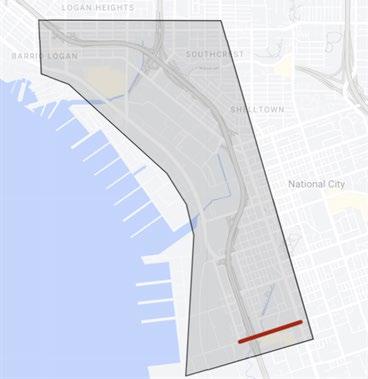
ROADWAY CHARACTERISTICS
Posted Speed 35 MPH
Lanes (bi-directional) 4
Average Daily Traffic (ADT)1 23,650 vehicles
1Based on segment with highest ADT within the roadway limits
PROJECT BENEFITS
• Improves overall corridor safety by consolidating driveways for access management.
• Improves overall corridor safety by reducing curb radii and adding truck aprons.
PROJECT DESCRIPTION
The proposed project at Mile of Cars Way/Bay Marina Drive consists of various multimodal safety enhancements. The project improvements include:
• Adding medians to restrict turning movements and consolidate access points where historical collision data shows trends of angle collisions.
• Reducing curb radii and adding truck aprons, where feasible, to reduce speeds and reduce both number of crashes and severity of crashes. Trucks aprons are to be designed using the typical design vehicle for freeways, typically the WB-67.
• Add hardened centerlines to channelize traffic as a safety measure.
• Providing high visibility crosswalks, where feasible.
Stakeholder outreach and Policy Committee coordination resulted in lack of consensus on appropriate improvements and the request for this corridor to receive further study in the future. Given the high volumes of motor vehicles, and the need for capacity to not cause excessive delay along the corridor, it was decided to not remove travel lanes for biking facilities. Rather, the consideration was instead to repurpose the sidewalk as a Class I multi-use path with various possible alignments.
The proposed project has two alternative alignments between the I-5 southbound and northbound ramps intersections: build the path within the north abutment wall of both bridge structures (requires investigation into structural feasibility) or extend the existing sidewalk on the north side of Bay Marina Drive (requires narrowing of travel lanes). The latter alternative would not be preferred as it would require a travel lane reduction, and due to proximity to freeway onramps, Caltrans DIB-94 would not apply. Therefore, this alternative would require a design exception.
LEVEL 1
Main Street
Vesta Street to Division Street
PROJECT VICINITY
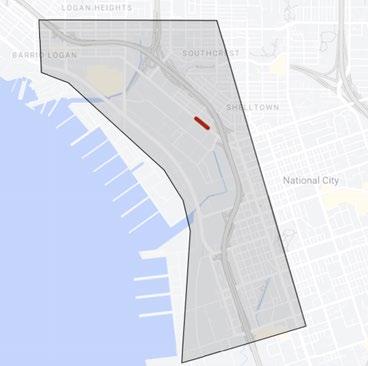
ROADWAY CHARACTERISTICS
Posted Speed 35 MPH
Functional Class Collector
Lanes (bi-directional) 5
Average Daily Traffic (ADT)1 14,350 vehicles
1Based on segment with highest ADT within the roadway limits
PROJECT BENEFITS
• Provides additional capacity to roadway for drivers in conjunction with the Vesta Street Bridge project.
• Improves vehicular operations for access between the freeway and NBSD.
PROJECT DESCRIPTION
The proposed project for Main Street includes operational and capacity improvements to accommodate additional traffic entering NBSD Gates #29 (Vesta Street) and #32 (Yama Street) in conjunction with the Vesta Street Bridge project. The Vesta Street Bridge project will provide access between the NBSD Wet and Dry Sides. These project improvements could be implemented prior to construction of the Vesta Street bridge to improve existing congestion issues related to NBSD. The proposed project improvements include:
• Increasing roadway capacity on Main Street from 3 lanes to 5 lanes by removing on-street parking on both sides of the roadway.
• Increasing roadway capacity on Division Street between National City Blvd and Osborn Street from 1 eastbound lane to 2 lanes.
• Increasing intersection turning movement capacity at the following intersections:
» Yama Street and Main Street – convert one northbound through lane to 2nd left turn lane.
» Roosevelt Street and Main Street – convert one southbound through lane to a shared through/left turn lane.
• Increasing roadway capacity on Yama Street south of Main Street from one southbound lane to two lanes. This requires roadway widening on the east side by approximately four’-six’.
• Signalizing the intersection of Division Street and Osborn Street
This project would connect with the National City project improvements for the 8th and Roosevelt project which includes signalization of the National City Blvd and Division Street intersection. This project also incorporates intersection capacity improvements for the Main Street and Vesta Street intersection to accommodate future traffic volumes from the Vesta Street Bridge project. An alternative is presented in the concept sheets which includes an exclusive eastbound right turn lane from Main Street to southbound Vesta Street that would require a Real Estate action by the Navy to modify the perimeter fenceline.
Supporting Documentation: NBSD Comprehensive Traffic Study and National City Downtown Specific Plan
National City Boulevard
18th Street to 26th Street
PROJECT VICINITY
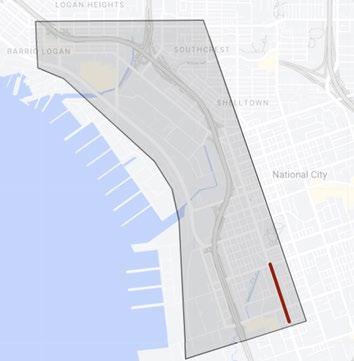
ROADWAY CHARACTERISTICS
Posted Speed 35 MPH
Functional Class Major Arterial Lanes (bi-directional) 4
Average Daily Traffic (ADT)1 14,650 vehicles
1Based on segment with highest ADT within the roadway limits
PROJECT BENEFITS
• Reduces potential for broadside collisions between minor street and major street vehicles
• Enhances pedestrian connectivity and pedestrian safety along National City Boulevard
PROJECT DESCRIPTION
The proposed project for National City Boulevard consists of redesigning intersections from 18th Street to 26th Street for pedestrian improvements. The project improvements include:
• Closing the median on National City Boulevard at 26th Street to restrict eastbound and westbound left-turn movements.
• Implementing Leading Pedestrian Intervals (LPIs) at signalized intersections.
• Implementing truck aprons, where feasible.
• Striping parking lane to reduce travel lane widths and slow speeds.
The proposed project would integrate with the existing (in progress) 22nd Street Improvements project which will remove the median, add pedestrian curb extensions at the intersection of National City Boulevard and 22nd Street, and implement a two-way protected bikeway on the south side of 22nd Street.
The Policy Committee was concerned additional pedestrian improvements could negatively affect vehicular throughput and cause congestion. Additional analysis will need to be incorporated as this project moves forward.
Supporting Documentation: National City INTRAConnect Study
2
8th Street Transit Center Pedestrian Bridge (Dry Side)
8th Street Transit Center to NBSD over Paleta Creek
PROJECT VICINITY ROADWAY CHARACTERISTICS
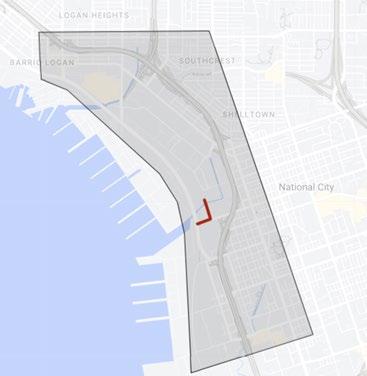
1Based on segment with highest ADT within the roadway limits
PROJECT BENEFITS
• Promotes transit use.
• Provides direct pedestrian access from the transit center to the Dry Side of NBSD.
PROJECT DESCRIPTION
The proposed project for 8th Street consists of providing a pedestrian connection from the 8th Street Transit Center to the Dry Side over Paleta Creek. There is currently no pedestrian access from the 8th Street Transit Center to the Dry Side of NBSD. As a result, NBSD visitors and employees are not encouraged to use transit to access the southern portion of Dry Side. This proposed project would tie into the mobility hub at the 8th Street Transit Station from the National City Homefront to Waterfront plan, including the National City Clean Mobility Options (CMO) project.
This project will create a multi-use path and pedestrian/bicycle bridge over Paleta Creek and connecting into NBSD at Recreation Way with a new turnstile access gate. The multi-use path would be constructed between the MTS rail line and the NBSD perimeter fenceline. The turnstile into NBSD may require a Real Estate action by the Navy to modify the perimeter fenceline.
The project will require cooperation between NBSD, MTS, and the California Public Utility Commission (CPUC) along the rail line, as well as the City of National City.
Supporting Documentation: NBSD Parking & Traffic Congestion Relief Plan and National City Homefront to Waterfront Plan
8th Street (Pre-Signal)
I-5 South Ramps to Roosevelt Avenue
PROJECT VICINITY ROADWAY CHARACTERISTICS
Posted Speed 35 MPH
1Based on segment with highest ADT within the roadway limits
PROJECT BENEFITS
• Provides multimodal connectivity to NBSD.
• Closes critical multimodal network gaps.
PROJECT DESCRIPTION
The proposed project for 8th Street consists of transit pre-signal lanes to allow for buses to bypass vehicular queues giving the buses priority. Pre-signals allow for provision of priority to buses traveling on dedicated bus lanes by taking advantage of existing infrastructure and utilizing intersection capacity more efficiently. Pre-signals are additional signals placed upstream of signalized intersections to facilitate provision of some level of priority to buses by allowing them to bypass standing queues of cars. The project improvements would include:
• Adding an eastbound transit pre-signal lane and traffic signal in the existing median approximately 400 feet east of the I-5 south ramps intersection
• Adding a westbound transit pre-signal lane and traffic signal in the existing median at the I-5 north ramp intersection
The project would also integrate improvements along 8th Street from the 8th and Roosevelt Active Transportation Corridor project. There are potential projects to install traffic signals along 8th Street at both the I-5 off-ramp and the I-5 on-ramp, both of which would affect (and perhaps supersede) any pre-signal project along 8th Street and therefore this project requires improvement coordination.
Supporting Documentation: 8th and Roosevelt Active Transportation Project and National City Homefront to Waterfront
8th Street Transit Center Pedestrian Bridge (Wet Side)
1Based on segment with highest ADT within the roadway limits
PROJECT BENEFITS
• Promotes transit use.
• Provides direct pedestrian access from the transit center to the Wet Side of NBSD.
PROJECT DESCRIPTION
The proposed project for 8th Street consists of providing a grade-separated pedestrian and bicycle connection from the 8th Street Transit Center to the Wet Side. This proposed project would tie into the mobility hub and parking structure at the 8th Street Transit Station from the National City Homefront to Waterfront plan. The project would also integrate improvements along 8th Street from the 8th and Roosevelt Active Transportation Corridor project.
This proposed pedestrian and bicycle bridge over Harbor Drive would connect from one of the middle levels of the proposed parking structure with the NBSD 8th Street Wet Side Gate #9. The bridge would be a prefabricated pedestrian/bicycle bridge. A “switchback” wheelchair accessible ramp would connect the bridge with ground level to access NBSD Wet Side Gate #9. The goal is to not increase security personnel requirements at the gate to monitor bike and pedestrian traffic and security checks by using a turnstile access point and possible “caging-in” the access point.
A six-story parking structure that would have a portion of the first floor as retail services, food services and a car rental facility is proposed to be constructed on top of the surface parking lots being utilized by the Navy. A portion of the structure would extend over the existing bus exit street and trolley parking. Levels 1-3 would be for the public and contractor parking (those employees that work on NBSD but do not need to bring in a vehicle). NBSD military and civilian staff would be able to park for free on levels 4 and 5. Level 6 would be reserved for long term NBSD deployment privately owned vehicle parking using tandem vehicle parking and deployment storage lockers for deployed sailors.
During coordination meetings with NBSD, two concerns were raised. First, the conceptual ramp from the bridge down to the ground on the west-side of Harbor Drive would require some reconfiguration of the perimeter fence requiring a Real Estate action by the Navy. At this time there is not the perceived user demand to support the loss of land area inside the perimeter fence. Second, displacement of existing surface parking for Navy purposed has not been vetted and any temporary or long-term reduction in parking would not be currently supported and would require a Real Estate action by the Navy to modify the existing leases.
Initial concept development information for the project can be found in the National City Homefront to Waterfront Plan.
19th Street
Tidelands Avenue to Cleveland Avenue
PROJECT VICINITY
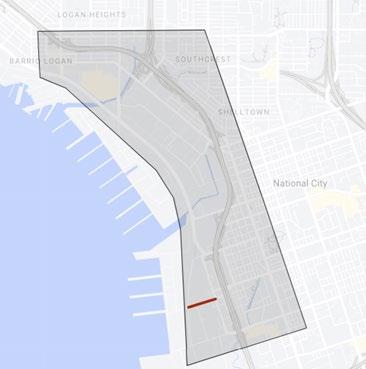
ROADWAY CHARACTERISTICS
Posted Speed 30 MPH
Functional Class Collector
Lanes (bi-directional) 4
Average Daily Traffic (ADT)1 10,400 vehicles
1Based on segment with highest ADT within the roadway limits
PROJECT BENEFITS
• Provides multimodal connectivity to NBSD.
• Closes critical multimodal network gaps.
PROJECT DESCRIPTION
The proposed project for 19th Street will provide multimodal connectivity between the proposed Bayshore Bikeway project along McKinley Avenue, the W 19th Street Greenway project that will prohibit vehicles on 19th Street between McKinley Avenue and 18th Street, and Gate 13 of NBSD. The project improvements include:
• Constructing one-way protected bikeways in each direction on 19th Street which requires repurposing of the outermost eastbound vehicular lane and narrowing lane widths for the two westbound lanes.
• Increasing capacity for the northbound left turn movement from Tidelands Avenue to 19th Street.
• Implementing bikeway design enhancements at Tidelands Avenue and 19th Street.
This project would complement and connect to an existing project along 19th Street at the east end of the corridor. At that point, under I-5, the street would be closed to motor vehicle traffic and motor vehicles would be channelized to instead use 18th Street to travel under I-5. Due to the limited capacity on the feeder street to 19th Street, there would be minimal capacity issues with this current 19th Street project.
It is anticipated that driveway consolidation will occur in the future along the south side of 19th Street, which will help minimize conflict points with eastbound bicyclists. A pinch point will occur at the rail crossing where the bike lane will be reduced to five feet. Modular low-profile speed humps are recommended to be installed at the driveways to slow turning vehicles.
While the traffic analysis conducted as part of this Study did not identify existing or future congestion issues, NBSD is concerned that future ship maintenance within the south portion of the base could place higher vehicular demand on this roadway and want to make sure bicycle and pedestrian improvements would be compatible.
Supporting Documentation: Port of San Diego Harbor Drive Multimodal Corridor Study and National City Homefront to Waterfront Plan
Civic Center Drive
Tidelands Avenue to Cleveland Avenue
PROJECT VICINITY
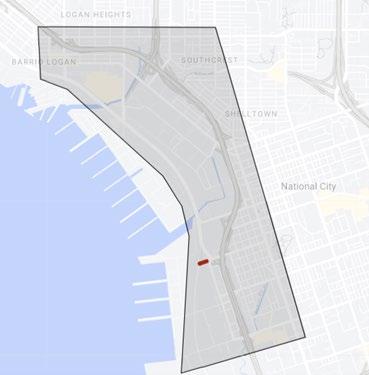
ROADWAY CHARACTERISTICS
Posted Speed 30 MPH
Functional Class Collector
Lanes (bi-directional) 2
Average Daily Traffic (ADT)1
5,250 vehicles
1Based on segment with highest ADT within the roadway limits
PROJECT BENEFITS
• Closes connectivity gap within bicycle network
• Provides connectivity with Bayshore Bikeway
PROJECT DESCRIPTION
The proposed project for Civic Center Drive consists of bicycle connectivity improvements. The project improvements include:
• Adding Class IV bike lanes between Tidelands Avenue and Harbor Drive to close the gap between the existing Bayshore Bikeway (Tidelands alignment) and the proposed bike lanes on Civic Center Drive, east of Harbor Drive
The proposed project would be consistent with the Bayshore Bikeway project and the Civic Center Drive Protected Bikeway project at the intersection of Civic Center Drive and McKinley Avenue. This project is low priority however if it moves forward, modular low-profile speed humps are recommended to be installed at the driveways to slow turning vehicles.
Supporting Documentation: National City INTRAConnect Study, the Bayshore Bikeway project, and Harbor Drive 2.0
Stakeholder Engagement 6
6.1 STAKEHOLDER ENGAGEMENT
The purpose of the Resiliency Study was in part to encourage coordination and collaboration between the City of National City, Naval Base San Diego, and other public agencies (SANDAG, San Diego Metropolitan Transit System [MTS], Burlington Northern Santa Fe Railway [BNSF], Port of San Diego [Port], and City of San Diego) in the identification of issues and prioritization of potential solutions related to transportation, traffic, and parking. To fulfill this effort, the Team established a Policy Committee that will make final recommendations to the (National City) City Council for approval, utilized members from SANDAG’s Military Working Group (MWG) as an advisory group, and coordinated and collaborated as needed with other public agencies to build consensus on project priorities that address transportation, traffic, and parking needs around NBSD. The following summarizes how these efforts propelled the Resiliency Study.
6.2 PUBLIC INFORMATION MEETINGS
Presentation at the Public Library May 22, 2023
The Team presented an overview of the project and initial existing conditions analysis to five attendees. The small size provided an intimate venue where residents dove into their individual challenges where they live, work, and frequent. One of the participants currently works at NBSD and expressed frustration with congestion in the morning. Another person works near Hoover Avenue and Mile of Cars Way, serving persons with disabilities, many of whom walk from the 24th Street Transit Station.
Community Breakfast Meeting #1, June 10, 2023
The Team presented at the quarterly community breakfast to 28 attendees. The project covered an overview, existing conditions, and highlighted next steps. The Team also discussed one of the future conditions of the 8th Street Mobility Hub. Attendees were eagerly anticipating the launch of the NEV shuttle program which has since been partially implemented and considered an ‘Existing Condition’ in this Study.
Community Breakfast Meeting #2, September 9, 2023
On September 9, 2023, the Team presented preliminary project recommendations to 101 community members, volunteers, and City staff as one of seven project presentations at the Martin Luther King (MLK) Community Center. The project team responded to community member questions prior to and during the presentation. Questions focused around project schedule and process for next steps and project implementation.
6.3 SANDAG MILITARY WORKING GROUP (MWG) MEETINGS
MWG Meeting #1, May 8, 2023
The project team presented an overview of the Resiliency Study to the MWG, focusing on the existing conditions analysis and next steps. This forum resulted in formulating connections with City of San Diego staff to collaborate outside of the group to discuss alignment with current planning efforts.
MWG Meeting #2, September 11,2023
The project team presented a follow-up of the May 8th meeting to the MWG, focusing on the project development, concepts, and engineering drawings. There was no formal vote taken but there was positive feedback and general support of the study from meeting attendees, with one question about an upcoming launch of shuttle buses in National City.
6.4 POLICY COMMITTEE MEETINGS
The Policy Committee was made up of Ya-Chi Huang of NBSD CPLO, Mayor Ron Morrision of National City, and Steve Manganiello, Director of Public Works at National City. The Policy Committee met four times on the dates listed below. The Policy Committee helped make final recommendations to the (National City) City Council for approval and provide a venue for project partners at both the City and NBSD to collaborate.
Meeting #1: May 30, 2023
The first Policy Committee meeting included the City of National City Mayor and Public Works staff and one project manager community planner from NBSD. The meeting served as initial coordination for all team members and to identify initial concerns with the methodology KTUA is applying for the study. Various topics used for the study included review of prior studies, definition of the study area extents, collisions mapping analysis and project prioritization scoring methodology. All projects being considered are off of NBSD property but will benefit NBSD personnel getting to and from the base as they travel through National City. Various corridors were identified as top priorities for National City and NBSD including 19th Street, 8th Street, Civic Center Drive, National City Boulevard, Cleveland Boulevard, Bay Marina Drive, and Hoover Street.
Meeting #2: June 22, 2023
The second Policy Committee meeting included the City of National City Mayor, Vice-Mayor, and Public Works staff as well as a representative from NBSD and all other team members. This Policy Committee meeting focused on an update on public engagement and a review of the progress on the design drawings. The following corridors were reviewed: National City Blvd, 8th Street, Cleveland Avenue, 19th Street, Bay Marina Drive, Main Street and Civic Center Drive. The Team received
feedback from the City of National City and NBSD on edits and changes to make to the concept plans, in anticipation of the next meeting. A follow-on meeting was scheduled for additional review of the concepts.
Meeting #3: August 23, 2023
The third Policy Committee meeting focused on concept level site plans at the prioritized project locations that were identified in prior Policy Committee meetings and coordination of the overall project next steps including public meetings. Comments on concept plans, used for updating the plans, were provided for the following corridors: 8th Street, 19th Street, Bay Marina Drive, Main Street and Civic Center Drive. A follow-on meeting was scheduled for additional review and update of the concept plans.
Meeting #4: December 4, 2023
The fourth Policy Committee meeting focused on the final report, including all concept level site plans at the prioritized project locations that were identified in the prior Policy Committee meetings. Comments on concept plans were provided and next steps to finishing the project were discussed.
6.5 CITY OF SAN DIEGO MEETINGS
Meeting #1: June 7, 2023
This meeting guided San Diego projects that benefit the military installation to float to the top of the priority list. The City of San Diego team provided insight for priority projects in alignment with their draft Mobility Master Plan. It was decided a follow-up meeting would be beneficial so San Diego can cross-reference their project list to see if other projects should be added.
Meeting #2: July 6, 2023
This meeting included a discussion on issues related to motorists, pedestrians, cyclists, and parking issues as part of the Navy’s Resiliency Grant for NBSD. The meeting focused on the Main Street project, from Yama Street to Vesta Street. The City of San Diego mentioned that the Main Street project would make a useful connection to the Chollas Creek Bikeway project that they are working on, closing a missing gap. No decisions or official feedback was given at this meeting. A follow-up meeting was scheduled for additional review of the concepts.
Meeting #3: September 18, 2023
This third meeting with San Diego allowed the project team to discuss progress on the Main Street and 19th Street concepts, traffic analysis, and the Vesta Street bridge redistribution. The City of San Diego staff was satisfied with the direction of the projects.
6.6 CITY OF NATIONAL CITY MEETINGS
During the course of the project, there were nine (9) check-in meetings with the head of the Department of Public Works from the City of National City to give updates as to the progress of the plan. Team members received input and advice from City of National City staff and incorporated that feedback into the Study. Meetings occurred on the following dates: April 19, April 27, May 2, May 9, May 16, May 22, July 25, October 5, and October 19.
6.7 MEETINGS WITH NAVAL BASE SAN DIEGO (NBSD)
During the course of the project, there were nine (9) check-in meetings with a representative from Naval Base San Diego (NBSD) to give updates as to the progress of the plan. Team members received input and advice and incorporated that feedback into the plan. Meetings occurred on the following dates: April 13, April 18, May 2, May 9, May 16, July 11, August 11, October 3, and October 23.
6.8 SITE VISIT WITH CITY OF NATIONAL CITY AND NBSD
In addition to the aforementioned meetings, the Team met with the City of National City, OLDCC, and NBSD for a Site Visit on February 22, 2023, at the 8th Street Trolley Station. The site visit was to have an introduction to the project and to walk along the project site and discuss the plan as well as potential projects, starting with projects located at or near the 8th Street trolley station.
6.9 MEETING WITH CALTRANS AND SANDAG
For this meeting the Team met with the Harbor Drive 2.0 design team, representing Caltrans and their partners, including the Port, SANDAG, the San Diego MTS, and the Burlington Northern Santa Fe (BNSF) Railway. This meeting was mostly informational, starting with the consulting team explaining their progress on the National City Resiliency plan and related concept plans. That was followed with the Harbor Drive 2.0 design team explaining the design details behind the Harbor Drive 2.0 project and the Vesta Street Bridge Project and discussing the potential funding and construction schedules for both projects. They provided valuable information so the National City Resiliency Team could ensure any of their potential projects align with and complement the Harbor Drive 2.0 project and the Vesta Street bridge project.