Text Amendment
I-2 Heavy Industrial Zoning District

Planning Commission- June 9, 2026
Heath Martin, Planner I
Planning Commission- June 9, 2026
Heath Martin, Planner I

June 9, 2026
• Planning Commission Recommendation
• Zoning Ordinance
Text Amendment
August 6, 2026
• Zoning & Noise Ordinance
• 1st Reading
• City Commission

August 20, 2026
• City Commission
• 2nd Reading
• Zoning & Noise Ordinance
• Public Hearing
September 3, 2026
•City Commission
• 3rd & Final Reading
• Zoning & Noise Ordinance
• Moratorium Expires
A text amendment allows changes to governing ordinances as the community’s needs change.

Any amendment to the Zoning Ordinance is subject to Article 14 and requires a Planning Commission recommendation and three readings at City Commission. If the text is adopted, it becomes the new ordinance on the date of adoption.
• Data Center technology & investment continue to evolve rapidly
• Johnson City adopted initial regulations in June of 2025
• Additional research, technical analysis, and public engagement have been completed
• Proposed amendment provides stronger framework for evaluating future applications
• Moves Data Centers from Permitted Use to Special Exception Review under Board of Zoning Appeals
• June 2025 – Initial Data Center ordinance (4914-25) adopted, moratorium enacted
• Fall 2025 – Solicited a Request for Qualifications (RFQ) for a consultant to perform a Noise & Vibration Study
• Fall 2025/Winter 2026 - Working Group Established
• National policy review
• Industry research
• Review of peer communities
• February 2026 – JPM Awarded Consultant Contract for Noise & Vibration Study
• March/April 2026 – JPM conducted ambient noise study
• Launched webpage for the study including public survey
• May 2026 - JPM provided Ambient Noise Level Report
• May 2026 – Moratorium extended until December 3rd , 2026
• June 5, 2026 – Online survey concluded & under review
Reviewed
Staff reviewed approaches by:
• Federal agencies (Executive Orders, EPA regulations, etc.)
• State governments
• Utility providers
• Jurisdictions regulating large-scale data centers
• Noise management
• Infrastructure capacity verification
• Environmental review
• Community engagement
• Ongoing compliance monitoring
• Flexibility to adapt to evolving technology
• Data centers operate continuously
• Cooling systems and generators are primary concerns
• Impacts are highly site-specific Actions taken:
• Research of national standards
• Review of acoustical engineering practices
• Development of technical assessment requirements
• Creation of compliance monitoring framework
Current:
• Permitted Use in I-2 Zoning District
Proposed:
• Special Exception Use in I-2 Zoning District
• Definitions revised & added for Data Centers, Accessory Data Centers, Noise & Vibration Studies, and Qualified Acoustical Engineers
• Establish objective noise & vibration performance standards & compliance requirements
• Requires technical studies for noise & vibration, utility, and environmental impacts
• Increase setbacks and changes residential separation measurements from the facility to the property line
• Requires ongoing public transparency through a project information website
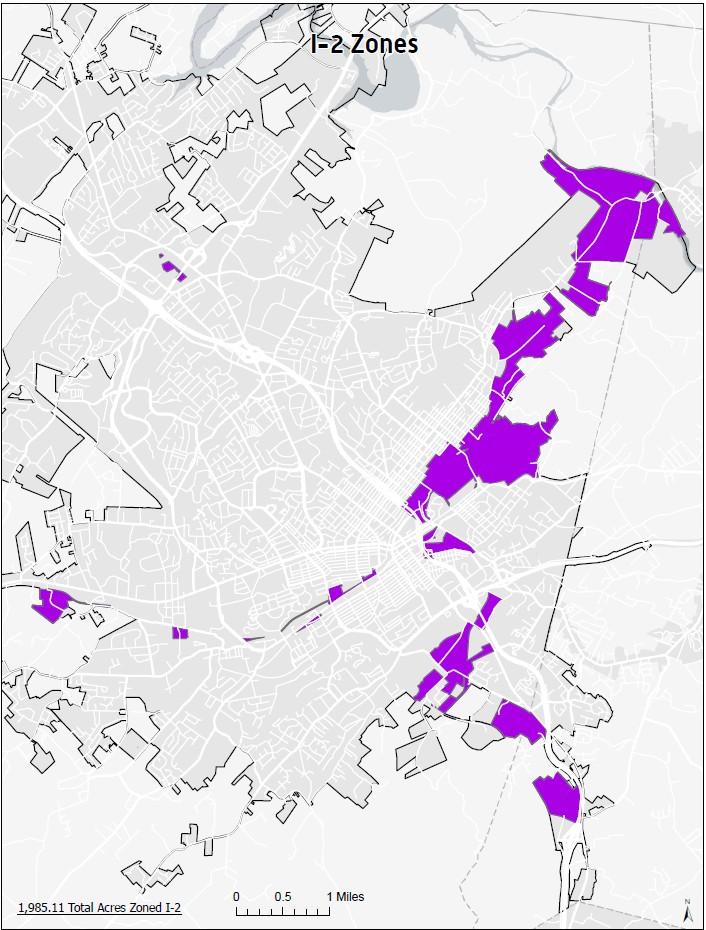
• Data Centers remain limited to the I-2 Heavy Industrial Zoning District
• Operations must comply with applicable City Ordinances & Regulations
• Digital data operations remain enclosed within buildings
• Screening & buffering requirements remain part of the development review process
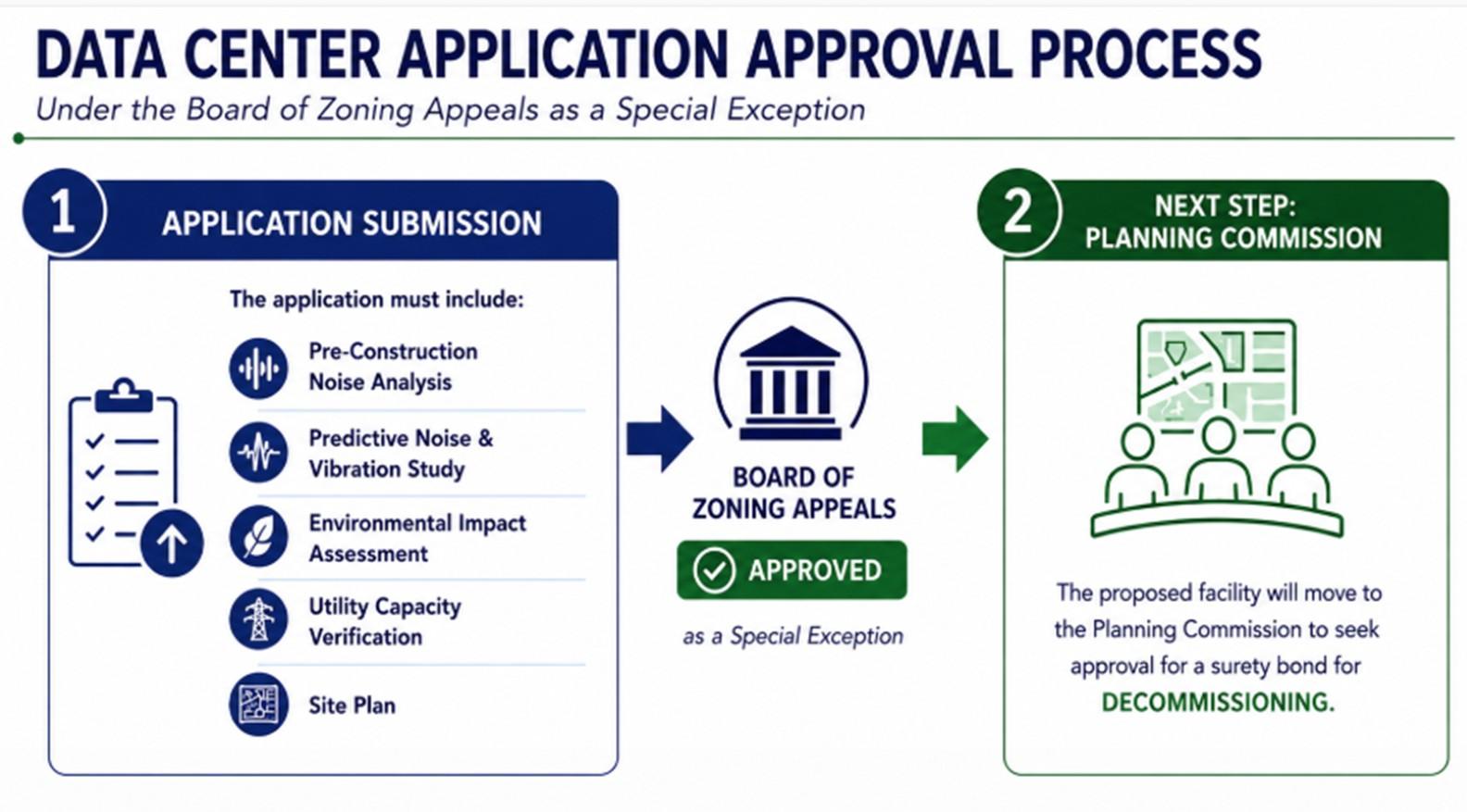
• Every proposed data center must be reviewed at a public hearing before the BZA
• Board is composed of Johnson City residents appointed to serve as independent decision-makers
• Applicants must submit technical studies, site plans, and supporting documentation for public review
• Adjacent property owners w/in 200ft receive notification
• Property owners & members of the public may provide testimony during the hearing process
• Board may impose additional site-specific conditions to address compatibility, noise, vibration, etc.
• Annual review at license renewal (includes notification)
Purpose: Establish ongoing operational standards for all data center activities
• Must comply with the City’s Noise Ordinance & all applicable City Regulations
• Prohibits unreasonable off-site impacts, including glare, emissions, interference, and nuisance conditions
• Requires compliance with vibration performance standards
• Establishes compliance with vibration performance standards
• Establishes Noise & Vibration Assessment Guidelines for future technical evaluations
• Allows the BZA to impose additional conditions when warranted
• Unlike sound, vibration can be difficult to identify and attribute to a specific source
• Ground conditions, building construction, traffic, rail activity, industrial operations, and natural conditions can all influence perceived vibration
• Because of these complexities, the zoning ordinance requires vibration analysis by Qualified Acoustical Engineers using accepted engineering methodologies
• The ordinance allows the City to retain an independent qualified acoustical consultant to review studies, methodologies, assumptions, and compliance documentation
• The cost of this independent review is borne by the applicant or facility owner/operator, not taxpayers.
Purpose: Provide sufficient information to evaluate operational impacts
• Building locations & dimensions
• Property boundaries & setbacks
• Adjacent land uses & zoning
• Nearby residential & noise-sensitive uses
• Cooling equipment, generators, substations, transformers, and utility infrastructure
• Proposed screening & buffering
• Developmental phasing, where applicable
Purpose: Establish existing conditions before development
• Conducted by a Qualified Acoustical Engineer
• Documents existing ambient sound and vibration conditions
• Creates a baseline for future comparison
• Prepared in accordance with City guidelines
Purpose: Evaluate future impacts before approval
• Predicts operational noise & vibration levels
• Demonstrates compliance with City standards
• Evaluates equipment, cooling systems, generators, and supporting infrastructure
• Prepared by a Qualified Acoustical Engineer
Purpose: Verify continued compliance after construction
• Required annually or at business license renewal
• Confirms compliance with approved operational standards
• Evaluates actual facility performance
• Documents ongoing noise & vibration compliance
Review
Purpose: Ensure future changes receive review
Required for:
• Additional generators
• Expanded cooling capacity
• Substation or transformer upgrades
• Increased IT equipment loads
• Facility expansions
• Other significant operational changes
Purpose: Provide independent expert review
• City may retain qualified acoustical consultants
• Consultants may review studies, assumptions, and methodologies
• Cost borne by the applicant or facility operator
• Additional expertise available when needed
Purpose: Minimize visual & operational impacts
• Data operations must occur within enclosed buildings
• Ground-mounted equipment limited to side and rear yards
• Equipment prohibited within required setbacks
• Acoustically effective screening required
• Roof equipment must be integrated into building design
Purpose: Improve compatibility with nearby residential areas
• 60ft front setback
• 50ft side & rear setback
• 200ft minimum separation from residential uses and zoning districts
• Separation measured from property line to property line

• 60ft front setback
• 50ft side & rear setback
• 200ft separation from any residential use or district property line
• The proposed separation standard provides a meaningful buffer from residential areas while recognizing that compatibility is ultimately achieve through site design & operational controls
• Beyond physical distance, the ordinance requires performance standards through;
• acoustical design,
• vibration analysis,
• screening,
• buffering, and
• ongoing compliance verification to ensure impacts remain within acceptable limits
Purpose: Reduce off-site impacts
• Type 4 Buffer Yard required adjacent to residential areas
• Additional buffering may be required
• Earthen berms permitted
• Acoustic barriers permitted
• Enhanced landscaping may be required
Purpose: Evaluate broader community impacts
Review includes:
• Water use
• Wastewater impacts
• Stormwater
• Utility demand
• Transportation impacts
• Emergency services
• Environmental conditions
• Community impacts
• Mitigation alternatives
Purpose: Confirm infrastructure can support the facility Verification required for:
• Electric capacity
• Water service (Johnson City)
• Wastewater treatment (Johnson City)
• Necessary infrastructure improvements
Purpose: Ensure responsible equipment disposal
• Electronic Waste Plan required
• Addresses servers, batteries, hazardous materials, and related equipment
• Must comply with state and federal regulations
• Subject to City review
Assurance
Purpose: Ensure long-term accountability
Requires:
• Decommission plan
• Cost estimates
• Site restoration procedures
• Hazardous material handling
• Financial assurance acceptable to the City (Bond)
Purpose: Ensure long-term accountability
Applicants must maintain a public website with:
• Project description
• Site maps & renderings
• Construction schedules
• Development phasing
• Public meeting information
• Permit status updates
Creating a Flexible Regulatory Framework- Planning for an Evolving Industry Data Centers continue to change rapidly:
• Cooling technologies
• Power systems
• Battery storage
• AI-related computing demands
• Water consumption methods
Benefits:
• Administrative updates w/o repeated ordinance amendments
• Ability to incorporate evolving industry standards
• Consistent technical methodology
• Improved review efficiency
Reasonable
• Allows data centers in appropriate industrial areas
• Does not create a prohibition
Rational
• Requirements directly address documented impacts
• Standards are based on engineering and technical review
Defensible
• Objective criteria
• Measurable standards
• Consistent review process
• Technical documentation
• Clear nexus between impacts and mitigation
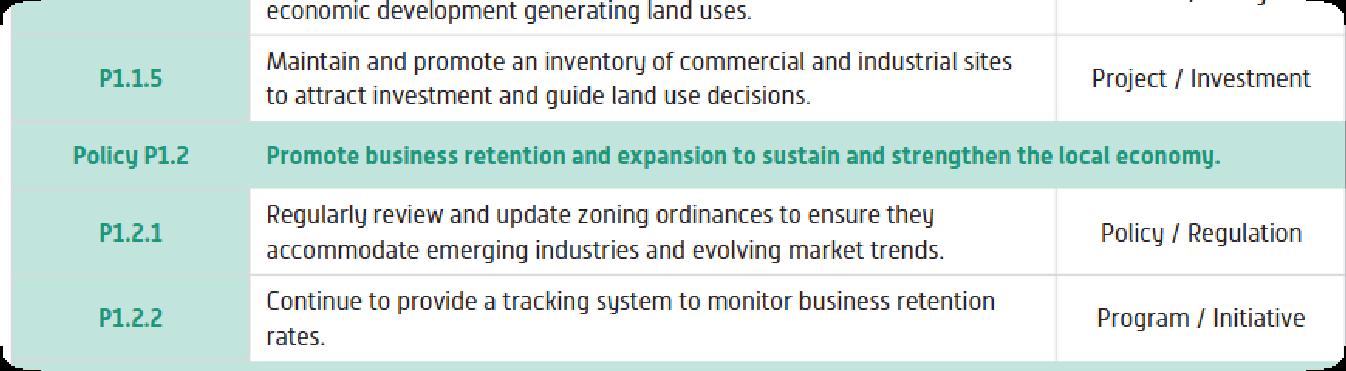
Supporting Action P1.2.1
“Regularly review and update zoning ordinances to ensure they accommodate emerging industries & evolving market trends.”
This amendment:
Supports economic development
Protects neighborhoods
Provides flexibility
Creates predictable review standards
Allows adaptation over time
Staff recommends approval of the proposed text amendment.
The proposed ordinance:
• Reflects extensive research
• Incorporates public feedback
• Establish measureable standards
• Protects public health, safety, and welfare
• Provides a reasonable, rationale, and defensible framework for future data center review
• APPROVE the text amendment as provided
• DENY the text amendment and state the reasons for denial in writing
• DEFER the action to a date certain, pending the receipt of additional information