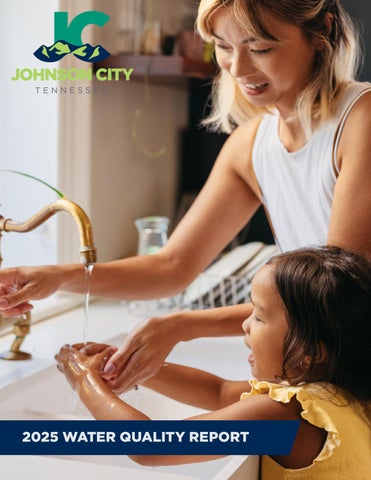
2025 WATER QUALITY REPORT
WHAT IS THE QUALITY OF MY WATER? The City of Johnson City Water and Sewer Services Department is pleased to share this water quality report with you. It describes to you, our customer, the quality of your drinking water. This report covers January through December 2025. Johnson City’s drinking water surpassed the strict regulations of both the State of Tennessee and the U. S. Environmental Protection Agency, which requires all water suppliers to provide reports like this every year to each customer.
WHAT IS THE SOURCE OF MY WATER? The City of Johnson City relies on water from the Watauga River and Unicoi Springs. The Watauga and the Unicoi plants treat your water using filtration and disinfection to remove or reduce harmful contaminants in the source water. A Source Water Assessment for both facilities is available for review. The Source Water Assessment determined that the Watauga River is highly susceptible, while the Unicoi Springs are moderately susceptible. The Tennessee Department of Environment and Conservation also has a Source Water Assessment at: http:// www.tn.gov/environment/program-areas/wr-water-resources/water-quality/source-water-assessment.html The City of Johnson City operates both water and sewer infrastructure inside the corporate limits of Johnson City and in portions of four counties outside the City limits. Each year, the Water and Sewer Services Department treats over 5.6 billion gallons of potable water and processes over 5.0 billion gallons of wastewater.
OUR FACILITIES INCLUDE: 2 drinking water treatment plants; 3 wastewater treatment plants; 105 water storage reservoirs, booster stations and pressure reducing valves; 95 wastewater lift stations; 954 miles of water lines; and 765 miles of wastewater collection lines.
CROSS CONNECTION: The Johnson City Water and Sewer Services Department routinely conducts inspections for cross connections between a customer’s service and the public water supply to protect water quality. A cross connection is a direct arrangement of plumbing that allows the potable water supply to be connected to a line that contains a contaminant or non-potable water. Examples of cross connections are direct connections of your plumbing with lawn irrigation systems, fire protection systems, pools, saunas, hot tubs, decorative fountains, auxiliary intakes (i.e. – wells, cisterns, ponds, etc.) or home water treatment systems. Installation of backflow preventers will separate these types of installments from your drinking water. Submerged water hoses can also create a cross connection. Never submerge or connect a water hose with any substance that you wouldn’t want drawn back into your plumbing in the event of pressure drop within the City’s water supply lines. If you have any questions regarding cross connections, please contact the Department at (423) 975-2602.
WHERE CAN I GET MORE INFORMATION? For more information about your drinking water and for opportunities to get more involved, please call Randy Griffin (Chief Water Plant Operator) at: (423) 975-2646 or (423) 975-2648; or you may write to: Johnson City Water & Sewer Services Department, PO Box 2466, Johnson City, TN 37605. You are welcomed and encouraged to attend City Commission meetings on the first and third Thursdays of each month at 6 p.m. in the Commission Chambers, Municipal and Safety Building, 601 E. Main St. These meetings are also streamed, for your convenience, on the Johnson City Government YouTube Channel, www.johnsoncitytn.org/streaming.
WHY ARE THERE CONTAMINANTS IN MY WATER? Drinking water, including bottled water, may reasonably be expected to contain at least small amounts of some contaminants. The presence of contaminants does not necessarily indicate that the water poses a health risk. More information about contaminants and potential health effects can be obtained by calling the U. S. Environmental Protection Agency’s Safe Drinking Water Hotline (1-800-426-4791). Generally, sources of drinking water (both tap water and bottled) include rivers, lakes, ponds, streams, natural springs and wells. As water travels over the surface of the land or under the ground, it dissolves naturally occurring minerals and, in some cases, radioactive material, and can pick up substances resulting from the presence of animals and human activity.
Some people may be more vulnerable than the general population to contaminants in drinking water. Immunocompromised people such as those with cancer undergoing chemotherapy, people who have undergone organ transplants, people with HIV/AIDS or other immune system disorders, some elderly, and infants can be particularly at risk for infections. These people should seek advice about drinking water from their health care providers. EPA/CDC guidelines on appropriate means to lessen the risk of infection by Cryptosporidium and other microbial contaminants are available from the Safe Drinking Water Hotline (1-800-426-4791).
Contaminant
Unit
MCLG MCL EPA’s Level Health Limits Detected Goal
1 Range Violation Year Detected (Yes/No) Sampled
Potential Source of Contamination
Microbial Contaminants Total Coliform Bacteria
N/A
0
TT
0.00%
0
NO
2025
Naturally present in the environment
2
Turbidity
NTU
N/A
TT
0.24
0.02-0.24
NO
2025
Soil runoff
Total Organic Carbon
ppm
N/A
TT
0.44
N/D-0.8
NO
2025
Naturally present in the environment
3
Inorganic Contaminants 0 of 51
Copper
ppm
1.3
1.3
0.200
(action level)
(90th percentile)
samples above action level
NO
2023
Corrosion of household plumbing systems; erosion of natural deposits
Fluoride
ppm
4
4
0.68
0.5
NO
2025
Erosion of natural deposits; water additive to promote strong teeth
Lead
ppb
0
15
1.3
(action level)
(90th percentile)
samples above action level
NO
2023
Corrosion of household plumbing systems; erosion of natural deposits
4-28
NO
2025
Byproduct of drinking water disinfection
6-45
NO
2025
Byproduct of drinking water disinfection
1 of 51
Byproduct of Drinking Water Chlorination/Disinfection Haloacetic Acids (HAA5) Total Trihalomethanes
(TTHMs)
18
ppb
N/A
60
(running annual average)
ppb
0
80
(running annual average)
32
Unregulated Substances Unregulated contaminant monitoring helps EPA to determine where certain contaminants occur and whether it needs to regulate those contaminants
Sodium
ppm
N/A
N/A
5.49 (average)
2.84-8.93
NO
2024
Disinfectant
Unit
MRDLG
MRDL
Level Detected
Range Detected
Violation (Yes/No)
1 Year Sampled
Chlorine
ppm
N/A
N/A
0.32-2.43
NO
2025
1.95 (running annual average)
Naturally occurring
Potential Source of Contamination Water additive used to control microbes
UCMR5: Unregulated Contaminant Monitoring Unregulated contaminants are those for which EPA has not established drinking water standards. The purpose of unregulated contaminant monitoring is to assist EPA in determining the occurrence of unregulated contaminants in drinking water and whether future regulation is warranted. For additional information call the Safe Drinking Water Hotline at 1-800-426-4791.
Lithium
N/A
N/A
7.5
7.5
NO
2023/2024
PFAAS Group
N/A
N/A
1.42
0.6-6.5
NO
2023/2024
Hazard Index
N/A
N/A
0.375
0.37-0.38
NO
2023/2024
The state allows us to monitor for some contaminants less than once per year because the concentrations of these contaminants do not frequently change. Some of our data, though accurate, is more than one year old. 2 Turbidity is a measure of the cloudiness of the water. It is monitored because it is a good indicator of the effectiveness of our filtration system. The EPA has two requirements: (1) That the maximum level found must be less than 5.0 NTU; (2) That the level must be under 0.3 NTU 95% of the time. 100% of our monthly samples were below the turbidity limit for 2025. 3 We met the treatment technique requirements for Total Organic Carbon in 2025. 1
DEFINITIONS: MRDL or Maximum Residual Disinfectant: The highest level of a disinfectant allowed in drinking water. There is convincing evidence that addition of a disinfectant is necessary for the control of microbial contaminants. NTU or Nephelometric Turbidity: A measure of clarity. N/A: Not Applicable 90th Percentile: 90% of the samples are equal to or less than the number on the chart.
MCLG or Maximum Contaminant Level Goal: The level of a contaminant in drinking water, below which there is no known or expected risk to health. MCLGs allow for a margin of safety. MRDLG or Maximum Residual Disinfectant Level Goal: The level of a drinking water disinfectant below which there is no known or expected risk to health. MRDLGs do not reflect the benefits of the use of disinfectants to control microbial contaminants.
ppm or parts per million: Milligrams per liter (mg/l). One part per million corresponds to one minute in 2 years, or a single penny in $10,000. TT or Treatment Technique: A required process intended to reduce the level of a contaminant in drinking water. ppb or parts per billion: Micrograms per liter (ug/l). One part per billion corresponds to one minute in 2,000 years, or a single penny in $10,000,000.
Action Level: The concentration of a contaminant which, if exceeded, triggers treatment or other requirements which a water system must follow. MCL or Maximum Contaminant Level: The highest level of a contaminant that is allowed in drinking water. MCLs are set as close to the MCLGs as feasible using the best available technology.
www.johnsoncitytn.org
CONTAMINANTS THAT MAY BE PRESENT INCLUDE: Microbial contaminants such as viruses and bacteria that may come from sewage treatment plants, septic systems, agricultural livestock operations, and wildlife Inorganic contaminants such as salts and metals, can be naturally occurring or result from urban stormwater runoff, industrial or domestic wastewater discharges, oil and gas production, mining or farming Radioactive contaminants which can be naturally occurring or be the result of oil and gas production and mining activities
Organic chemical contaminants including synthetic and volatile organic chemicals, which are byproducts of industrial processes and petroleum production, and can also come from gas stations, urban stormwater runoff, and septic stations Pesticides and herbicides may come from a variety of sources such as agricultural, urban stormwater runoff, and residential uses
In order to ensure that tap water is safe to drink, EPA prescribes regulations that limit the amount of certain contaminants in water provided by public water systems. Food and Drug Administration regulations establish limits for contaminants in bottled water which must provide the same protection for public health.
LEAD IN DRINKING WATER: Lead can cause serious health effects in people of all ages, especially pregnant people, infants (both formulafed and breastfed), and young children. Lead in drinking water is primarily from materials and parts used in service lines and in home plumbing. The City of Johnson City is responsible for providing high quality drinking water and removing lead pipes but cannot control the variety of materials used in the plumbing in your home. Because lead levels may vary over time, lead exposure is possible even when your tap sampling results do not detect lead at one point in time. You can help protect yourself and your family by identifying and removing lead materials within your home plumbing and taking steps to reduce your family’s risk. Using a filter, certified by an American National Standards Institute accredited certifier to reduce lead, is effective in reducing lead exposures. Follow the instructions provided with the filter to ensure the filter is used properly. Use only cold water for drinking, cooking, and making baby formula. Boiling water does not remove lead from water. Before using tap water for drinking, cooking, or making baby formula, flush your pipes for several minutes. You can do this by running your tap, taking a shower, doing laundry or a load of dishes. If you have a lead service line or galvanized requiring replacement service line, you may need to flush your pipes for a longer period. If you are concerned about lead in your water and wish to have your water tested, contact Randy Griffin telephone: 423975-2648 at the City of Johnson City Water Treatment Plant for Information on lead in drinking water, testing methods, and steps you can take to minimize exposure is available at: http://www.epa.gov/safewater/lead. Exposure to lead in drinking water can cause serious health effects in all age groups. Infants and children can have decreases in IQ and attention span. Lead exposure can lead to new learning and behavior problems or exacerbate existing learning and behavior problems. The children of women who are exposed to lead before or during pregnancy can have increased risk of these adverse health effects. Adults can have increased risks of heart disease, high blood pressure, kidney, or nervous system problems. For proper identification of service lines, please visit: www.johnsoncitytn.org/LeadAndCopperRule
WATER SYSTEM SECURITY: We realize that our customers are concerned about the security of their drinking water. We urge the public to report any suspicious activities at any utility facility, including treatment plants, pumping stations, tanks, fire hydrants, etc. to 423-461-1643 or 423-975-2648.
Este informe contiene información muy importante sobre su agua potable. Tradúzcalo o hable con alguien que lo entienda bien.