

![]()


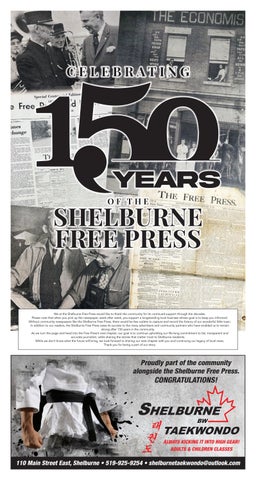
We at the Shelburne Free Press would like to thank the community for its continued support through the decades.


Please note that when you pick up the newspaper, week after week, you support a longstanding local business whose goal is to keep you informed. Without community newspapers like the Shelburne Free Press, there would be few outlets to capture and record the history of our wonderful little town. In addition to our readers, the Shelburne Free Press owes its success to the many advertisers and community partners who have enabled us to remain strong after 150 years in the community.

As we turn the page and head into the Free Press’s next chapter, our goal is to continue upholding our life-long commitment to fair, transparent and accurate journalism, while sharing the stories that matter most to Shelburne residents.
While we don’t know what the future will bring, we look forward to sharing our next chapter with you and continuing our legacy of local news. Thank you for being a part of our story.


We at the Shelburne Free Press would like to thank the community for its continued support through the decades.


Please note that when you pick up the newspaper, week after week, you support a longstanding local business whose goal is to keep you informed. Without community newspapers like the Shelburne Free Press, there would be few outlets to capture and record the history of our wonderful little town. In addition to our readers, the Shelburne Free Press owes its success to the many advertisers and community partners who have enabled us to remain strong after 150 years in the community.

As we turn the page and head into the Free Press’s next chapter, our goal is to continue upholding our life-long commitment to fair, transparent and accurate journalism, while sharing the stories that matter most to Shelburne residents.
While we don’t know what the future will bring, we look forward to sharing our next chapter with you and continuing our legacy of local news. Thank you for being a part of our story.


By Paula Brown
“The history of a community is the story of its people,” writes John Rose in “A History of Shelburne.”
As we celebrate the 150th Anniversary of the Shelburne Free Press, we would like to take a moment to share the history of the people who founded our newspaper and how we have continued to bring community-focused stories to our readers.

“Local newspapers are so important because they document the everyday of smaller communities. Having these celebrations of small communities and all of the things that make small communities wonderful, captured for us in a newspaper, like the Shelburne Free Press, is so valuable to keep the community connected to each other,” said Jasmine Proteau, manager of the Museum of Dufferin. “There are some real gems about individual people and circumstances that would never make a national newspaper. They would never go on the national or international stage because it’s such a microcosm of what’s going on here.”


Through the Town of Shelburne’s history, there have been three newspapers: the Shelburne Free Press, the Shelburne Economist and the Dufferin Standard.
The oldest of the three newspapers is the Shelburne Free Press, which commenced as a weekly publication in the spring of 1875 under the proprietorship of George Raines.
Raines, who was originally from Oakville, Ont., became a newspaper publisher following a seven-year apprenticeship that started with the Orangeville Sun in 1867 and ended with the Orangeville Advertiser in 1874. Raines purchased the Orangeville Advertiser that same year, and shortly afterwards moved the newspaper to Shelburne due to competition with the Sun newspaper.
Just three short years into production, issues of the Shelburne Free Press stopped appearing, and the number of missing issues is unknown to this day.
Unwilling to see the business fail, Raines, with the assistance of William Jelly, brought in a new and experienced editor, James Cameron, in 1878. At the same time, a group of 19 Shelburne citizens


formed a shared syndicate to create the Shelburne Printing and Publishing Company.
The Shelburne Free Press would be operated by the Shelburne Printing and Publishing Company for the next 15 years, under the leadership of editors James Cameron, Fredrick H. Thompson and Robert Lee Mortimer.
Robert Lee Mortimer, a resident of Honeywood and former principal of the Shelburne Public School, became the editor of the Shelburne Free Press in 1889 and bought the Shelburne Printing and Publishing Company outright in 1893. Mortimer continued publishing the Shelburne Free Press until his death in 1919.
While the Shelburne Free Press was the first newspaper to go into production in the local community, the Shelburne Economist was the last paper, with its first issue published in September of 1883.
The weekly paper was originally started by brothers W.L. and H.T. Smith, but was sold in 1903 to Thomas Fredrick Ernest Claridge or affectionately shortened to T.F.E.
T.F.E. Claridge was the youngest of eight children born into the Claridge family. He received his primary education at the Shelburne Public School and graduated from Shelburne Continuation School with honours in 1889. At the age of 15, he


joined the Shelburne Economist in the role of “printer’s devil,” which is considered a step below apprentice.
Over the years, he became foreman for the Shelburne Economist’s printing shop and eventually purchased the newspaper in 1903.
Following the death of Shelburne Free Press editor Robert Lee Mortimer in 1919, his widow, Sarah Mortimer, took up the job of running the Free Press. She held the role until she signed an agreement with T.F.E. Claridge, owner of the Shelburne Economist, in 1928 to amalgamate the two rival newspapers.
From then on, the local newspaper officially became known as the Shelburne Free Press and Economist.
The Shelburne Free Press remained in the Claridge family for 86 years, with T. F. E.’s son, Frederick M. Claridge,
eventually taking on the role of editor and publisher.
Thomas Claridge, founder of the Orangeville Citizen and grandson of T.F.E. Claridge, was the last family member of the Claridges to own and operate the local paper.
In 2014, the Shelburne Free Press was purchased by London Publishing Corp. London Publishing Corp also owns several other newspapers in the region, including the Orangeville Citizen, New Tecumseth Times, Caledon Citizen, King Weekly Sentinel, and the Auroran.
“Without newspapers like the Shelburne Free Press, stories about our community would go underreported. As a citizen, I really need that level of micro coverage in order to be fully informed,” said Neil Orford, founder of the Canadian Historical Education Services, which operates out of
EARLY DAYS: One of the earliest editions of the Free Press was printed on Feb. 10, 1876, (right) and is currently preserved at the Museum of Dufferin in Mulmur. Pictured above, the Shelburne onomist s first e i tion was printed Sept. 20, 1883. The Free Press and Shelburne Economist amalgamated in April 5, 1928.


THE COPY: T.F.E. Claridge, late publisher of The Free Press and Economist, discusses a make-up problem with son Fred as press time nears on an issue of the FP&E in January, 1956. The “copy” they are examining is a Shelburne Co-op ad. Today, the lead-alloy type has been replaced by photo-composition processes and make-up is done on layout tables. Photo courtesy The Globe and Mail. (This image was printed in the May 7, 1975 edition of the Free Press and Economist)


The Shelburne Free Press would like to extend a special thank you to the Museum of Dufferin (MoD), the Shelburne Public Library and the Town of Shelburne’s Arts, Culture and Heritage Committee for providing invaluable information and research as we mark our 150th anniversary.
The generous contributions made by these organizations greatly assisted the Free Press in producing a special section that not only celebrates the newspaper’s legacy but also honours the rich history of our community. We are deeply grateful for their historical insights, ongoing support, and unwavering commitment to preserving the stories that shaped who we are over the last 0 years. As we reflect on our past, we look forward to continuing our reputation as a trusted voice in the community for future generations.
JOINING FORCES: he hel burne ree ress an ono mist ri ht ublishe its first e ition of the a er on ril , after amal amatin the ree ress an helburne onomist he amal amation ha ene after lari e, then e itor of the helburne onomist, bou ht the news a er out an ombine it with the ree ress


other ortrayals are un oubte ly those of a ity e itor” an rinter s e il ” ny i ea as to the a tors his ima e was rinte in the ay , e ition of the ree ress an onomist, entennial ition
The Economist Block 1894
The village of Shelburne was just entering upon the greatest building boom of its youthful existence when, on August 29, 1883, the young brothers, W.L. and H.T. Smith, fresh from their father’s printing shop in Markham, began installation of their printing equipment in John Jelly’s Main Street West, then still under construction, and began to assemble their first issue of The Shelburne Economist,” namesake of their father, Matthew Smith’s Markham Economist. Two weeks later, on September , their first issue was on the street. John Jelly, to honour the first tenants to occupy his new building, immediately named it, The Economist Block.

MULTI-GENERATIONAL JOURNALISTS: lari e left , his son homas lari e entre , an ran son lan lari e re iew news a er ontent at the helburne ree ress in the mi s re owne the helburne ree ress an onomist before sellin it to homas in lan hel se eral roles at the news a ers homas owne o er the years, su h as e itor, re orter an eneral mana er


By Paula Brown
To celebrate 150 years of keeping the community informed, Shelburne Free Press is taking a look at some of the other businesses, buildings, institutions and groups that have also stood the test of time.
Jelly’s Tavern
One of the oldest and most well-known businesses to exist in the Town of Shelburne is Jelly’s Tavern.
William Jelly, known as the “Father of Shelburne,” having founded the town in 1860, entered the bushes from Bowling Green in 1864 to begin the task of clearing the future site of the British Canadian Hotel, as he reportedly called it.
The hotel opened in September of 1865 and officially became known as Jelly s Tavern. In 1870, the establishment was sold to George Murray, who renamed the tavern to The Shelburne House and operated the hotel until 1873. Murray turned the operation of The Shelburne House over to his former competitor, “Joe” Black, who went on to rename the institution, Black’s Tavern.”
As the years went on, the hotel originally known as Jelly’s Tavern went through a “musical chairs” exchange in ownership and names. The last connection to the hotel ended in 1955.
Shelburne Town Hall
Shelburne’s Town Hall and opera house, Grace Tipling Hall, have sat at the heart of the community’s downtown for more than 140 years.
The building was constructed in 1882 with the plans drawn by town clerk Francis G. Dunbar, who also designed the Orangeville Town Hall in 1879. The brick used to build the Town Hall was manufactured at the Shelburne Brick Yards, and the stone was mined from a quarry just east of town.
The Fire Hall and bell tower portion of the Town Hall were later additions to the building, erected in 1888.
Grace Tipling Hall, the opera house located on the top floor of the Town all, was used as the central space for travelling professional show troupes and was where the first movie in Shelburne was shown in 1926.
The building was restored and renovated in the late 1990s.
Grace Tipling Hall and Town Hall are located at 203 Main St. E., Shelburne.
Shelburne Public Library
The construction of the Shelburne Public Library, located at 201 Owen Sound St., dates back almost 115 years. The idea of building a public library in the community was first brought up in January , and by June that same year, construction of the building was underway with the financial assistance of the Carnegie Library Foundation.
The Shelburne Free Press’s very own T.F.E. Claridge was an instrumental member of a seven-person committee that helped negotiate with the Carnegie Library Foundation for financial assistance. He subsequently went on to serve as a regular member of the library board for 23 years.
In 2002, the Shelburne Public Library received a grant from the federal and provincial governments called the SuperBuild Grant worth nearly $600,000. The grant made it possible for the library to be rebuilt at twice its original size and become wheelchair accessible with the installation of an elevator.
Dedicated fundraisers and donors from the community also helped raise an additional $300,000 to support the upgrades.
A renovation and expansion of the public library was completed in 2004.
The Shelburne Public Library is located at 201 Owen Sound St., Shelburne.
St. Paul’s Anglican Church
Before shuttering its doors to the community in January 2024, St. Paul’s Anglican Church had more than 150 years of history in Shelburne.
The history of St. Paul’s Anglican Church began well before the church’s construction, with the first Anglican worship services held monthly in a small log hall in Melancthon as early as 1855.
Construction of the first St. Paul s Anglican Church began in the summer of 1874 and was finished by Christmas of the same year. The first service was held on Jan. , 1875, led by Rev. J.J. Morton, with planks used to seat the congregation and a borrowed organ.
The local Anglican church received its first resident rector in Rev. James Smythe in 1878, but the position was quickly left vacant following his death in 1879.
Discussions were held in 1910 with the idea of building a new and bigger church in the same spot as the original. The St. Paul’s Anglican Church that sits in Shel-

burne to this day was constructed and completed in 1913.
In January 2 , a fire broke out in the church’s furnace room, and the church sustained damage from smoke and water, but fire insurance allowed for repairs and replacement.
During Canada’s Centennial year (1967), the Shelburne parish and Dundalk church were amalgamated.
The Shelburne congregation celebrated St. Paul’s Anglican Church’s 150th anniversary in 2023. Since its inception, the local Anglican church has seen over 30 reverends oversee the congregation.
Considered one of Shelburne’s founding churches, St. Paul’s Anglican Church held its last congregation on Jan. 21, 2024.
Shelburne Memorials Funeral and burial services are considered one of the oldest practices, so it’s seemingly appropriate that Shelburne Memorials is the community’s second oldest running business. Originally established in 1888, Shelburne Memorial has been owned and operated by the McBride family since 1991.
McBride purchased the business in 1991, having no previous training or knowledge in the making of cemetery monuments and instead learned the trade on the job.
While Shelburne Memorials’ head office and manufacturing space is located
in Shelburne, the business has expanded to consist of 15 locations in Central Ontario, including Huntsville, Wiarton, Georgetown, and Orangeville.
Following McBride’s retirement in 2021, Shelburne Memorial was taken over by his children – Michelle Thompson, Annisa Prins, and Brian McBride.
Shelburne Memorials is located at 709 Industrial Rd., Shelburne.
Shelburne Legion
The Shelburne Legion, Branch 220, has been a staple in the local community for nearly 95 years. The legion was established in Shelburne in 1931 by a group of local veterans as a way to come together. The numbering of the legion branches is based on the order in which they were established, meaning the local branch is the 220th Royal Canadian Legion to open in Canada.
The cenotaph that sits outside Town Hall is one of the earliest projects spearheaded by local veterans and showcases its early community-focused mentality. In early 1919, proposals were made by the Great War Veterans Association, known now as the Royal Canada Legion, to raise a memorial honouring individuals from the area who did not return home from the First World War. The conversation piqued the interest of municipal officials and Dufferin County Council, and Shel-
By Sam Odrowski
Lots of key events happened in Canada and around the world during the year the Shelburne Free Press was founded.
To help date our newspaper and give readers an idea of the significant events that occurred at the time of the Shelburne Free Press’s inception, here is a list of what was happening in 1875.
March 1: In Toronto, the Hospital for Sick Children was founded
March 3: The first recorded indoor hockey game occurred at the Victoria Skating Rink in Montreal, Que.
March 11: Jennie idd Trout became the first


woman in Canada to practice as a licensed medical doctor. However, Emily Stowe practiced without a license since 1867. Trout was the only woman in Canada to practice with a license until July 1880, when Stowe also became a licensed medical doctor.
April 5: The Supreme Court of Canada was established.
May 20: The Metre Convention was signed in Paris, France, which established the International Bureau of Weights and Measures. This led to the creation of the metric system, which Canada adopted 100 years later, on April 1, 1975.
June 1: To mark the construction of the Lake Superior to anitoba section of the Canadian Pacific Railway, a sod-turning ceremony was held near Fort William, now known as Thunder Bay, Ont. The rail-


way s construction was a significant move towards connecting Canada from coast to coast.
Sept. 26: During a pilgrims’ march to St. Michael’s Cathedral s bishop s palace, the first of the violent Jubilee Riots occurred. The riots saw an outbreak of Protestant-Catholic sectarian violence in Toronto related to the Jubilee year declared by Pope Pius XI. The violence happened during a series of religious pilgrimages by Catholics.
Dec. 17: Violent bread riots took over Montreal as its residents faced massive unemployment and hunger due to an economic depression. Hundreds of unemployed labourers marched to Montreal’s City Hall, where they demanded work or food from the government. Vandalism and looting took over as rioters targeted bakeries and warehouses.


burne became one of three municipalities to receive $3,300 for a memorial.
In 1922, an order was placed with the John Fleck Monument Company of Shelburne to commission the cenotaph, and on June 4, 1923, the monument was unveiled by Mrs. E.J. McComb, whose son, Rev. T. Allan McComb, died overseas.
Located at 203 William St., the building that houses the Shelburne Legion was originally built as a curling rink in 1926, but was taken over by the Great War Veterans Association in 1931.
Today, the Shelburne Legion has nearly 300 members and is led by President Dan Sample.
The Shelburne Legion is located at 203 William St., Shelburne.
Shelburne Rotary Club
The Rotary Club of Shelburne was established on April 22, 1938.
Jack Aiken, the first president of the Rotary Club of Orangeville, was instrumental in bringing the chapter to the community. It is reported that less than a week after announcing his plans to bring the Rotary to Shelburne, he was able to sign up 24 men to the organization.
Over the years, the Rotary Club of Shelburne has put “Service Above Self” to help support projects within the community, including the Santa Claus Parade, Fiddle Fest, and reforming the Shelburne Legion Hall.
The Rotary Club of Shelburne supports annual charitable projects, such as the Backpack Program and the Christmas Hampers. The organization was a leader in the construction of the Splash Pad at Greenwood Park, raising $300,000 towards the project, and also a large donor to the Shelburne Food Bank’s Food Rescue Van.
Today, the Rotary Club of Shelburne has 15 members.
Shelburne Scouts
The 1st Shelburne Scouts Group hit a significant milestone in 2024, as it celebrated 100 years of scouting in the local community.
Established in early 1924, there is limited historical information about the formation of the 1st Shelburne Scouts Group and its formative years, with the loss of paper documents and members eventually leaving the program. Most of the informa-
tion that is known about the 1st Shelburne Scouts Group is from the last four decades and comes from the stories of previous Scout Leaders and members.
The mission of Scouts Canada is to help prepare participating youth to become well-rounded citizens and individuals in their community.


KTH Parts Manufacturing Inc. established its Canadian subsidiary, KTH Shelburne Manufacturing in December of 1996. The plant, located at 300 2nd Line in Shelburne, officially started producing automotive frames in July 1998.
KTH began as a welding operation with 54 employees and a building with 100,000 sq. ft., but quickly grew in need of an expansion. In the December of their first year of operation, KTH Shelburne almost double the number of frames they were building in a single day and in 1999 they added a 2500 Ton Transfer press that enabled them to make some of the part they were welding.

Local youth in the program experience a variety of outdoor activities, including hiking and camping, while also learning skills such as how to start fires, build shelters, identify fauna and flora, track animals, use compasses, and how to survive if you’re stuck in the wild.
In 2024, the 1st Shelburne Scouts Group had roughly 15 youth participate in its programming.
KTH Shelburne
With just over 25 years in the community, KTH Shelburne Manufacturing is still a fairly new business, but has also become the largest employer in Dufferin County.
As welding capacity increased to match Honda’s expansion in Alliston, the local plant added more presses.
Since the construction of the original building in April 1997, KTH Shelburne has had seven plant expansions.
For every fifth anniversary KTH Shelburne passes, a dedication is made by the company to the community.
At five years, it was a donation to the Shelburne Public Library; at 10 years to Stevenson Memorial Hospital; at 15 years a donation to Headwaters Hospital; and for their 20th anniversary they planted a cherry orchard at KTH Park, where the company has a baseball diamond and soccer field.
According to the Dufferin Board of Trade, KTH Shelburne Manufacturing Inc. is the largest employer in Dufferin County with more than 80 per cent of the workforce residing in the Shelburne, Dundalk and Orangeville areas.
Crewson Insurance
It takes a lot of work to have a small business succeed for multiple decades, and Crewson Insurance had done it for a total of 40 years.
The local insurance company, located at 110 Adeline St. in Shelburne, celebrated four decades of business back in March.
Ed and Wendy Crewson opened Crewson Insurance in 1985; after buying Delmar Bates Insurance, a small farm-focused brokerage located on Main Street in Shelburne. At the time, Crewson Insurance was a two-person business with Ed going door-to-door to get more customers and Wendy managing the office and money.
The Crewsons experienced their first big claim just 90 days after opening their business when a tornado ripped through the Dufferin County community on May 31, 1985.
By the end of their first year of business, Crewson Insurance doubled in size and brought on their first employees: Steve Gallaugher and Sherry Robinson.
In 2001, Crewson Insurance expanded to two offices with a second branch opening in Wasaga Beach. Two decades later, Crewson Insurance once again expanded after acquiring Padfield-Nelson Insurance in Mount Forest.
What started out as a two-person company in 1985 has since grown to 27 employees and three office locations spanning Dufferin, Simcoe and Wellington Counties.
Dufferin Mutual
Dufferin Mutual, one of Shelburne’s longest-standing businesses, is celebrating 130 years of serving the community this year.
Founded in 1895 as a farm mutual, the company is still entirely owned by its policyholders and has its headquarters in Shelburne, at 802 Main St. E., Unit #4.
Dufferin Mutual offers farm, home, property, automobile, commercial and liability insurance protection to over 5,000 policyholders.
The company is committed to the community, having operated out of Shelburne for the 130 years it has existed.
Dufferin Mutual provides insurance through independent brokers who operate throughout South-Central Ontario. Originally called Dufferin Farmers’ Mutual Insurance Company, the name was later changed to better reflect its evolution into offering more types of insurance.
The company was founded by local farmers who had difficulty finding fire insurance for their farms.
This resulted in generations of policyholders receiving protection through Dufferin Mutual.


By Alex Sher
William Jelly was born in 1835 to Irish immigrant John Jelly near Elizabethtown in Upper Canada, in a place later referred to as Brockville, Ont.
It is largely believed that Shelburne is the result of Melancton Township’s construction of the Toronto Sydenham Road in the 1940s, enticing settlers and promoting growth.
Jelly lived in Amaranth Township and Wellington County before settling at West Lot 1, Concession 2, where he took up half the property in 1864. While many reference Jelly as a farmer turned businessman, others concede he was still growing something – the Town of Shelburne.
Caravaggio’s Pharmacy is the very location where William Jelly built the timber-framed William’s British Canadian Hotel, which opened in 1865. It was locally known as the Jelly Hotel.
Only coming to own the property in 1870, Jelly and his three brothers seemed to thrive, buying land while promoting growth and development. It was at this
time, within a year of the hotel opening, that Jelly became the first postmaster of a post office named Shelburne by members of Canadian Parliament after the Earl of Shelburne. At that time, the post office was conveniently located in the hotel. Later, in 1870, Jelly sold the hotel, which then became known as Shelburne House.
Jelly was convinced the village of Shelburne would prosper as the expected arrival of the Toronto, Bruce and Grey Railway was certain to ensure Shelburne’s growth. Jelly took particular interest in surveying the village. And thrive it did!
When the village of Shelburne was incorporated in 1879, William Jelly was elected Reeve and remained in the role for 14 years, through several elections. Also elected to the Ontario Legislative Assembly, Jelly represented Dufferin as a Conservative.
Jelly enjoyed a two-year political career serving on the council for Melancthon Township and Grey County. Though Jelly took a brief pause from politics from 1893–1897, he was convinced by locals to serve again, which he did until he died in 1900.
Jelly was survived by his wife, Bessie and his daughter Adeline.
William Jelly is widely considered one of the very first businessmen in Shelburne and was a witness to his little, thriving village growing to 1,000 people. He saw Main Street evolve from wooden storefronts to brick, and Shelburne quickly became a manufacturing centre.
In 1977, Shelburne became a town, and today, the population continues to grow.
Jelly’s hard work, political commitment and dedication to seeing Shelburne thrive brought the community together on June 14, 2014, for an unveiling of his statue in Jack Downing Park.
The 28th Lieutenant Governor of Ontario, David C. Onley, representing Her Majesty, Queen Elizabeth II, attended the ceremony. He was joined by then Dufferin–Caledon MP David Tilson, Dufferin County Warden Bill Hill, Shelburne Mayor Ed Crewson and CAO John Telfer.
The statue stands today as a symbol of Jelly’s commitment to the town.
(This article was originally published in the Shelburne Free Press in 2014)

FOUNDER: Known as the “Father of Shelburne,” William Jelly was one of the first businessmen in the community and directly oversaw its growth as reeve from the year it was founded, 1879, until 1893. From 1893 to 1897, Jelly took a break from politics, but returned to serve again until his death in 1900.
By Laura Camilleri, Archivist Museum of Dufferin
In an era dominated by digital media giants and fleeting online news, small community newspapers remain a vital thread in the fabric of local life. Among these is the Shelburne Free Press, which this year celebrates an extraordinary 150 years in publication. The Free Press has long been more than a source of news—it’s a cornerstone of community identity.
The Shelburne Free Press was originally founded in 1875 by George Raines. Just eight years later, in 1883, a second paper, The Economist, was established by W.L. Smith who sold to T.F.E Claridge in 1903. For decades, these two newspapers chronicled the lives of Shelburne’s residents, businesses and organizations. In 1928, the Economist purchased the Free Press, joining forces to become the Shelburne Free Press & Economist. The Claridge family, first T.F. , then his son Fred, would operate the newspaper for over 100 years. In 2014,

the publication returned to its roots and adopted its current name, the Shelburne Free Press.
Small newspapers like the Free Press play a unique and irreplaceable role. They offer in-depth, hyper-local coverage that larger outlets overlook. They provide a platform for community voices, celebrate local successes, and hold local institutions accountable. In a town like Shelburne, they are a mirror and a megaphone, reflecting the town’s character and amplifying its concerns. The Free Press has chronicled the stories of generations—births, weddings, milestones, fall fairs, Fiddle Contests, council meetings, school achievements, and the passing of local legends. It has been a reliable witness to the town’s growth and evolution.
The impact of the Shelburne Free Press extends beyond its pages. It supports local businesses through advertising, offers young writers and photographers a place to grow, and fosters civic engagement by keeping residents informed and connected.


us that community newspapers are not relics of the past—they are living, vital institutions that keep the heart of small-town life beating strong.


The following article is the text of a speech that the Free Press’s early owner, “T.F.E.,” gave to the Shelburne Rotary Club 35 years ago. The occasion was his required classification talk. The speech has been edited for
I am supposed to talk about Newspapers — Past and Present.” It is a pretty big subject to try to do anything with in the time we are supposed to take in these talks.
Untold centuries of slow progress passed before the birth of the first newspaper was possible.
If instead of being born in this age, we had been born way back down IN the ages before the first form of writing picture writing and hieroglyphics — had been started, I wonder if any of us would have helped in the birth of even picture writing.
From picture writing and hieroglyphics followed the slow growth of alphabets. On stone and marble and on clay tablets and (with the Anglo-Saxon) even on smooth ash boughs, man left his story — before there came the evolution of the written word on parchment. Gold, bronze, tin, leaden plates, ivory, wax, and leather are among the materials on which ancient historical and diplomatic records were inscribed. Then there were the papyrus rolls of Egypt. In Europe, calfskin and other skin materials were used for books in the olden days.
Paper Before there could be newspapers, there had to be paper. Paper in its first forms saw its birth long before the invention of printing, although even paper is but a youngster as earthly things go. The first use of paper was, of course, as a writing material, and its origin and history are involved in much obscurity. While it is claimed that it has its origin in China around 200 B.C., in any event, it was known only in the ast until the beginning of the 8th century, and paper in Europe first made its appearance in those countries closest to the Orient. The manufacture of paper in urope was first established in Spain. At first, the paper was entirely made by hand from vegetable fibres . The first paper-making machine was invented in 1798. It is only 112 years since the first paper-making machine was put into use on this continent. And it is only 85 years since wood-fibre was first used for this purpose. Paper was at first used only for writing purposes. ven books were entirely in writing. In the Middle Ages, only priests and learned men knew how to write, for even the highest nobles could not write their own names. The nobles who signed the Magna Carta affixed only their marks. The oldest epistle in the British Archives is one penned by the Bishop of London, 731 A.D. Shakespeare, in 2 , in one of his plays, put this speech into the mouth of Jake Cade: “Thou has most traitorously corrupted the youth of the realm in erecting a grammar school; and whereas, before, our forefathers had no other books but the score and the tally, thou has caused printing to be used, and, contrary, to the King, his crown and dignity, hast built a paper mill.”
Books
Printed books came before newspapers. These books were printed from engraved wooden blocks. And when movable types were invented, they were first used for printing books.
Sometime in the 1500s, Gutenberg, in ermany, made the first use of movable types in printing his bible.
The First Journalists
Leading up to the publication of newspapers were newsletters, and the first nglish journalists were the writers of these newsletters. These journalists were originally the dependents of great men, each employed in keeping his own master or patron well informed, during his absence from the royal court, of all that transpired there. This duty at length grew into a calling. The writer had his periodical subscription list, and, instead of writing a single letter, wrote as many letters as he had customers. This was in the 1500s.
First English Newspaper
And it was three of these writers of newsletters Nathaniel Butler, Nicholas Bourne and Thomas Archer, who, in ay 22, issued the first copy of the first nglish printed newspaper, The Weekly News. ermany beat England to it by six or seven years, and France was nine years behind England. For a lengthy period, only news appeared in the newspapers. Editorials and leading articles did not have their birth until the period 1704-1740.
The first newspapers were all weeklies. saw the first thrice-a-week newspapers. 04 saw the birth of the first nglish daily newspaper, but it was many years later before daily newspapers began to grow in real stature. The London Times dates from 1785-88 and in the early 1800s made the first use of power steam for running newspaper presses.
In the States
Boston, in , was the first American city to have a newspaper. It was 18 years before then that Sir William Berkeley, overnor of irginia, had piously exclaimed: Thank od we have neither free school not printing press, and I hope any not have for a hundred years to come.” Maybe the Boston fellows hadn’t heard about Sir Billy.
The first issue of the Pennsylvania azette of Philadelphia may be of interest to you. Dated December 14, 1728, it contains a paragraph which shows how fast news travelled in those days:
“We have little news of consequence at present, the English Prints being generally stuffed with robberies, cheats, fires, murders, bankruptcies, promotions of some and hangings of others; nor can we expect much better till the vessels arrive in the Spring, when we hope to inform our reader what has been doing in the Court and Cabinet, in the Parliament-House as well as the Sessions-House.”
The editor also intimates that the American world and the European are hit by Dr. Wild s lines:
“We are all seized by the Athenian itch; News and New Things do the whole world bewitch.”
New ork had eight daily papers in 20, but their combined daily circulation was only 10,800, only two of them having as large a circulation as 2,000.
In Canada
The first copy of the first Canadian newspaper, the Halifax Gazette, was issued at alifax, N.S., under the date of arch 2 , 1752.
It was a sheet 8.5 by 15 inches, printed on both sides. If you had time to look closely, you would find the first page is given to foreign news “by the last papers from London by way of Boston,” and that while the Gazette was dated March 23, 1752, the items are dated from Sept. 18, 1751, to Jan. 3, 1752.
It may surprise you to hear that in ,


edited the paper, handled the books and chatted with the public when he wasn’t
leading the old town band. This picture was taken March 11, 1956, by a Toronto Telegraph photographer as part of an illustrated feature on Shelburne. Note that at the time Shelburne lacked dial telephones. The FP&E number for years was 14. (This image was printed in the May 7, 1975 edition of the Free Press and Economist)
there were three papers published in Shelburne. But it was at Shelburne, N.S. which was at about that time a very flourishing spot.
The first paper in nglish in uebec was printed by a Frenchman and the first paper in Ontario was published by a French-Canadian Louis Roy.
This paper was the Upper Canada Gaette or American racle, issued at Niagara in . Niagara was then the seat of government in Upper Canada. When the seat of government was moved to ork now Toronto) in 1799, the Gazette moved with it.
And it was in Toronto, in the issue before Christmas, 1801, that the editor of the Gaette complained:
“It is much to be lamented that communication between Niagara and this town is so irregular and infrequent. Opportunities now do not often occur of receiving the American papers form our correspondents and thereby prevents us from laying before our readers the state of politics in Europe.”
Niagara was still the avenue of intelligence from the outer world, and the entry point of commerce for ork, and the dependence of little ork upon its rival was manifested about this time in the forlorn aspect of the Gazette, which had run short of paper and was reduced to using blue wrapping paper for six weeks in the winter while navigation was closed.
Toronto’s First Daily
The first daily in Toronto was the Telegraph, which appeared in July 40, the first issue being a sheet of four pages, about six by eight inches.
It was nine years later that that, and but 90 years ago (1849) that Reuter began the operation in Paris, by way of a pigeon service and the telegraph, of the first news-transmitting agency. At first, the then all-powerful London Times would have nothing to do with Reuters new-fangled idea. Now, of course, news-collecting agencies cover the globe.
Politics
While newspapermen in Canada have not largely as a class gone into politics to a greater extent than writing political editorials, for which they never (public opinion to the contrary notwithstanding) got very
much of a chance at Governmental “feedbags,” yet, looming large in Canada’s political annals we find such names as on. Joseph owe, Nova Scotia s statesman and ournalist William yon acken ie, leader of the rebellion he afterwards regretted; Hon. George Brown, founder of the Toronto Globe and one of the Fathers of Confederation Sir acken ie Bowell, of the Belleville Intelligencer, Prime Minister of Canada in - and eneral Sir Sam ughes, a Canadian minister of Militia — probably Canada’s most colourful Minister of Militia.
Editors of Prominence
Among newspapermen who have loomed large in the life of Toronto, to take that city as only one illustration of change that I believe fairly represents conditions in other Canadian cities, we find not so many years back such outstanding men as . . Sheppard, of the old Toronto news, later founder of Saturday Night Billy c ean of the Toronto World; John Ross Robertson of the Telegram; Sir John Willison of hte Globe and later of the vening News, who as a young chap clerked in a store in the ansfield area. Today, how many are there who can name the chief editors of the Toronto papers? We know more about ordon Sinclair and reg Clark.
Other changes
There are other changes. The majority of men who broke into the daily newspaper game in those days were their own chief editorial writers.
But now we find the Southams owning a chain of dailies.
Sir Joseph Flavelle set the example of a rich man buying daily as a toy when he purchased the Toronto News from . . Sheppard and took over Willison from the lobe. After getting tired of throwing money into a sinkhole, however, he threw up the sponge. Then, after the Riordan interests had become tired of losing money with the ail- mpire, millionaire illam took over. illionaire William Wright s taking over the Mail-Empire and the Globe to form the Globe and Mail was made possible because millionaire Killam of the Mail-Empire and the Jaffray interests of the Globe were each tired of losing propositions.
Continued on Page B10


Shelburne District Fair
With nearly 160 years of history, the Shelburne Fall Fair is the longest-standing event in the community.
The first meetings to organi e an agricultural society in the community were held in September of 1867 at resident John Mason’s Tavern in Masonville. The newly established organi ation was named the Melancthon Agricultural Society, with John Mills, then township clerk for Melancthon, elected as the first president.
The inaugural fall fair was held on the roadside in Masonville in October of 1868 as a one-day event.
The fair would expand to a two-day event in the mid-1880s, when it moved to the farm of George Charters, which also served as the grounds of the Shelburne Turf (horse racing).
tending the fair in 1958.
Over the years, the Shelburne Fall Fair has been known under many monikers, including the Melanchthon Agricultural Society, the Dufferin Central Fair and the Shelburne District Fair.
The Shelburne District Agricultural Society celebrated the 150th anniversary of the local fall fair in 20 with a Pioneer Way to odern Days theme, celebrating the history of the long-standing event.
The Shelburne District Agricultural Society continues to host the fall fair at the Shelburne Fairgrounds, located at 377 William Street, on the second weekend following Labour Day.
Shelburne Fiddle Fest
After being in the community for more than a decade, the Rotary Club of Shelburne began looking for a project that would involve and benefit the community and, hopefully, would become an annual event.

In 1888, Simon Jelly, the older brother of William Jelly and one of the original family members to settle in town, gave 16 acres of his farm, which to this day serves as the location for the Shelburne Fairgrounds.
The Shelburne Fall Fair has had its fair share of sensational moments, such as John Jelly displaying and demonstrating the first talking machine, known as a gramophone, with a 10-cent admission, and Prime Minister John Diefenbaker at-
For several months and meetings, a number of ideas were brought forward from street dances to amateur contests, but one subject persistently stood out – an oldtime fiddle contest.
Thus, the establishment of the Canadian Open Old Time Fiddlers’ Contest.
The first event was held in 1951 and featured over 150 amateur and professional fiddlers with competitions in various categories, including open, novelty, duet, and age-based divisions.
In his book istory of Shelburne, John Rose reported that contests poured in from all corners of the country to take part in the inaugural event. e noted that many of the pri e winners went on to have successful careers in entertainment.
Fiddle legend, Scott Woods, known as The Fergus Fiddler and The Flippin


Fiddler, has close ties to the Shelburne community through the Olde Time Fiddle Contest. is great-grandfather was an original topthree finalist in the lde Time Fiddle Contest, and his father also competed in the local fiddle contest. Woods himself began competing in the contest in 1979 and continued through to 2004.
In 20 , the fiddle contest was renamed the eritage usic Festival to reflect a broader range of musical and cultural activities beyond fiddling.
The event experienced significant challenges in the early 2020s due to the global COVID-19 pandemic and reduced attendance.
The Rotary Club of Shelburne made the decision not to continue with the event in 2023, ending the festival’s more than 70 years of history.


Shelburne Primary Eye Care Celebrates 20 years with Amy and welcomes new team members Dr. Grewal and Satya.
Shelburne Primary Eye Care is proud to celebrate a very special milestone—20 incredible years with our team member, Amy!
The entire sta gathered to honour Amy’s two decades of dedicated service. Known for her warmth, professionalism, and unwavering commitment to our patients, Amy has been a cornerstone of the clinic since the very beginning. Her presence has made a lasting impact on both patients and sta , and we are truly grateful for all she brings to our team.

As part of the celebration, the team posed for a commemorative photo—surrounded by cake, laughter, and heartfelt memories.
We’re also excited to welcome two new additions to our team. Dr. Grewal,
optometrist, brings fresh expertise and
assistant, adds enthusiasm and a dedication to
At Shelburne Primary Eye Care, we
to eye care, with a strong focus on primary care, vision therapy, and ocular surface disease management. We remain committed to providing exceptional, personalized care to every patient who walks through our doors. Congratulations to Amy—and a warm welcome to Dr. Grewal and Satya! We’re

as of booming canon
For our 150th anniversary we’d like to ree t ba on some of the si nifi ant stories that ha ene in the ommunity, in lu in this one of a meteorite that stru ufferin County.
he followin arti le ran in the u , e ition of the helburne onomist
A few minutes after eight o’clock Saturday evening last the people of this section who happened to be out of doors at the time were startled by a strange flash, as of long continued lightning, followed by a booming as of the discharge of heavy artillery.
The cause of the unusual sight and sounds was a meteorite, which had taken a notion to visit this earth of ours and was so specially attracted by the beauties of Dufferin County that it decided to make its resting place here.
The sky being overcast with clouds a good view of the descent of the phenomenon was not obtainable at Shelburne. Farther north, however a full view was to be had of it, and spectators describe it as having exploded while high up in the air, the pieces flying in all directions. It was this bursting that caused the sounds as of artillery fire.
nly one piece of the strange visitor has, so far as we have heard at time of writing been found. It is a 4-pound chunk which struck the ground within a couple of feet of the verandah on the residence of John Shields, about three miles from Shelburne and orning s ills, spattering earth up against the side of the house and imbed-
Continued from Page B8
With the Weeklies
Changed conditions have also been responsible for a great number of amalgamations that have taken place among the weekly newspapers.
When the Free Press and later the Economist were established in Shelburne, and if still a third plant had been put in, the combined cost of the three plants would not have been more than the cost of one

ding itself to the depth of inches.
The stone was dug out of the ground on onday morning and brought to town, and it has since been on exhibition in the window of Jelly and White s hardware store, where it has been viewed by a whole shoal of people.
Many are the theories that have been heard advanced as to the origin of the phenomenon. One theory credits a waterspout with bringing it up from the bottom of the sea and carrying it up into the air to wander around. Another gives a volcano credit. Some refuse to believe that it fell at all, saying it is a stone that was struck by lightning. owever, as meteorites are by no means a new thing, and so many saw this one fall, and so many more who did not see it fall saw the light it cast and heard the detonation made when it burst, there would seem to be no occasion to call in questioning its genuineness.
Many have seen meteorites in their passage before (notably what is known as the Collingwood one, several years ago , but we have not beard of any in this section who before had the privilege of seeing or hearing one burst.
Although the terms comet and meteor are often confused by those of us who are not of a scientific turn of mind, there is a wide difference between them.
A comet is defined as a heavenly body consisting of a coma surrounding a bright star-like nucleus, with a nebulous train or tail, often of great length. Comets, so the scientists tell us, move about the sun in very eccentric or parabolic orbits, often coming
from immense stellar distances and visiting out system but once. Some, however, revolve round the sun in regular periods, ranging from three or four years to hundreds of years.
A meteor is defined as a sudden luminous phenomenon, as of a star or bright body in rapid motion through the air, produced by a small mass of matter from celestial spaces striking the air with planetary velocity, and suffering heating, dissipation, or combustion: when not very brilliant, called a shooting star. It has been calculated that the average number of meteors which traverse the atmosphere daily, and which are large enough to. be visible to the naked eye on a dark clear night, is no less than , 00,000. The meteor also leaves a bright tail or trail like the comet. Several varieties of meteorites are known: etallic nickeliferous iron, exhibiting, when polished and etched, the peculiar crystalline markings called Widmannstattian figures 2 A spongy mass of iron containing olivite and other minerals in its vesicles A stony mass with disseminated particles of iron 4 A stony mass without iron.
Meteorites usually show a pitted surface with a fused crust, caused by the heat developed in their rapid passage through the earth’s atmosphere.
liver W. untington, writing in , said: From prehistoric times down to we have a record of about 20 meteorites, of which number 42 fell within the territory of the nited States, of which were seen to fall.
machine in the Free Press and Economist plant the inotype machine.
Newspaper troubles f course, the newspaper game, like all others, is full of troubles. ne of them is the typographical error. erily, there is more oy among with the discovery of a typographical error than there is with one who will say, well, that s a pretty good paper this week. If I had the time, I suppose I could quote
a barrel of typographical errors, but I will only note a couple of recent ones.
Not so long ago, a paper down in issouri had this one:
James Wilson, Jr., takes the cake, musically, around these parts. e can make a piano talk, twirls a couple of mean sticks on a snare drum and also plays a B-flat corset pretty well.
And it was when the King and Queen were here that the ancouver Sun, describing the Royal isit civic luncheon in

Tait, in his Recent Advances, lecture ten, says: A great astronomical discovery of modern times is, that meteorites, the Scalled falling stars........... follow a perfectly definite path in space, and that this track is in each case the path of a known comet. A not unnatural assumption would be that the meteorites that reach the earth are chunks of matter that break away from the tails of comets and, in striking out for fresh worlds- to conquer run up against our own planet.
that city, under the sub-head Resplendent Waiters, referred to the red-livered Royal Butlers.
Possibly the saddest typographical error that stands out in my memory happened at the Mail-Empire a number of years ago. It was in the account of a fast and furious hockey game. The reporter had told of a goalie having to face a veritable avalanche of shots on goal. And the typewriter got an i instead of an o in shots.

A lot of work goes into producing a fresh edition of the Shelburne Free Press week after week.
It takes several people, working in various roles, to get the paper to our readers each Thursday.
As we celebrate our 150th edition of the Shelburne Free Press, we’d like to take some time to introduce the people behind the scenes who make it possible.
Douglas Rowe
As the general manager of the Shelburne Free Press, Doug oversees the operations of the newspaper. While he’s worked in similar roles within the newspaper industry for over 30 years, he became the general manager of the Shelburne Free Press in 2017. Doug oversees several other newspapers in Ontario and provides dynamic leadership to his team. Outside of Doug’s work life, he’s known as a grill master, always trying out new sauces and rubs. He even owns his own small BBQ sauce business with his wife Kris. Doug also enjoys spending time with his daughter Ashley, who runs a business of her own, The New Leaf Collective, which is focused on digital marketing.
Sam Odrowski
Sam joined the Shelburne Free Press team as editor in 2020. He spends his days writing, editing and assigning stories to reporters. Originally from Port Perry, Ont., he studied journalism at Durham College in Oshawa and graduated in 2017. Sam completed an internship with the Scugog Standard as part of his education and was hired on as a reporter. He worked there for just under a year before moving nearly 1,600 kilometres away from his home to work at the Fort Frances Times in Northwestern Ontario. Sam worked for the Fort Frances Times from 2018 to 2020 as a reporter, before relocating closer to home to work a reporting position at the New Tecumseth Times. He worked there for several months before being promoted to his current position as the editor of the Shelburne Free Press and Orangeville Citizen. In 2022, he also became editor for the New Tecumseth Times. Sam has a passion for community news and enjoys sharing positive stories with his readers. When
he isn’t tied up preparing for each week’s newspaper, he enjoys playing tennis and is a volunteer with Durham College’s Journalism Program Advisory Committee as chair. Sam also owns Dufferin DJs, a local DJ company that provides sound, lighting and MCing services for corporate events, celebrations and weddings.
Janine Taylor
Janine is the production manager of the Shelburne Free Press and creative director of Our Routes Magazine. She joined the Free Press team in October 2023 and brings over 20 years of experience to the role. Much of Janine’s day is spent making advertisements, laying out content on the pages of the Free Press, and bringing fresh ideas to the team. She graduated from Sheridan College’s Illustration and Design program in 2002 and began working in the newspaper industry shortly after. Since then, she’s never looked back and has held many roles related to newspaper production over the last 21 years. When she’s not busy designing the latest edition of the newspaper, she enjoys playing women’s softball and giving back to the community by fundraising for local charities. Janine and her partner also has a twoyear-old Havanese dog, Walter, who keeps their hands full outside of the office.
Debbie Freeman
The Shelburne Free Press s office and sales manager, Debbie Freeman, has been with the newspaper since 2013. She’s the first face people see when they walk into the office, or the first voice they hear when calling the newspaper. Much of Debbie’s days are focused on selling advertising and maintaining client relationships. She also spends her Thursdays taking care of distribution for the Shelburne Free Press, ensuring the paper reaches readers across the community. Whether she’s assisting a local business in promoting its services or helping a reader sign up for deliveries, her focus is on serving the community. When Debbie s out of the office, she spends her time volunteering with the Shelburne Legion and Big Brothers Big Sisters of Dufferin and District. She also enjoys horseback riding, swimming in her backyard pool and going camping with her family.


THE PEOPLE: The Shelburne Free Press wouldn’t be what it is today without its spectacular team. Back row, from left, is Douglas Rowe (general manager), Janine Taylor (production manager), Paula Brown (general reporter), Brian Lockhart (sports reporter). The front row, from left, is Carolyn Dennis (billing clerk), Sam Odrowski
and ebbie reeman offi e an sales mana er
Paula Brown Paula is a full-time reporter and photographer with the Shelburne Free Press and Orangeville Citizen. She covers a wide range of topics, including municipal politics, arts, the environment, human interest, health, crime and court news. A lifelong resident of Orangeville, Paula joined the Orangeville Citizen in 2019 as an intern while completing her journalism degree. Following a three-month internship, she joined the Citizen team as a freelance reporter covering crime and courts. In 2020, Paula graduated with an Honours Bachelor of Journalism from Humber College and became a full-time reporter at the Shelburne Free Press. This past June, she marked five years with the Free Press and Orangeville Citizen. Outside of Paula’s work with the Free Press, she’s an avid baseball player and a member of a local reading club.
Carolyn Dennis Carolyn holds many titles within the Shelburne Free Press’s family of newspapers, first oining the rangeville Citi en in as classifieds manager. At the Shelburne Free Press, she takes care of invoicing and helps to create a cheerful working environment for its employees. With over
25 years in the newspaper industry, she is committed to supporting the creation of community news. When Carolyn’s not busy taking care of accounts receivable, she enjoys spending time with her three children and nine grandchildren.
Brian Lockhart
Brian is a columnist and sports reporter for the Shelburne Free Press, first oining the team in 2010. He brings 23 years of journalism experience to the role and contributes to the Orangeville Citizen’s sports page each week while working as a full-time reporter for the New Tecumseth Times. Brian has a strong passion for his work and enjoys meeting people in the different communities he reports on. Over the years, he has written or photographed just about everything you can imagine. In his spare time, Brian enjoys photography, producing videos, and making or recording music. He is also a script writer with one play already produced and another coming to the stage in the fall. Brian also enjoys spending time with his daughter and family. He can occasionally be found at the Woodbine Racetrack, where he can predict a winner almost 20 per cent of the time.


From your neighbours at Du erin Mutual
For 150 years, the Shelburne Free Press has been a trusted voice in our community—sharing stories, keeping us informed, and connecting the people of Shelburne and the surrounding area. At Du erin Mutual, we understand the value of that kind of legacy—because we’ve been here almost as long.

Founded in 1895, Du erin Mutual has proudly served this region as a true farm mutual—local, independent, and owned by the people we insure. We’re not a call centre. We’re your neighbours. When you call us, you reach someone right here in Shelburne—someone who knows your name, your road, and your community.
Today, we provide property, auto, commercial, and farm coverage to more than 4,000 policyholders across the region. rough all the changes in the industry and the world, our commitment to personalized service, local expertise, and strong community ties has never wavered.
As we tip our hats to the Shelburne Free Press on this remarkable milestone, we celebrate the values we share: service, integrity, and a deep connection to the community we call home.

Du erin Mutual — Proudly Local Since 1895


By Paula Brown
“The history of a community is the story of its people,” writes John Rose in “A History of Shelburne.”
As we celebrate the 150th Anniversary of the Shelburne Free Press, we would like to take a moment to share the history of the people who founded our newspaper and how we have continued to bring community-focused stories to our readers.

“Local newspapers are so important because they document the everyday of smaller communities. Having these celebrations of small communities and all of the things that make small communities wonderful, captured for us in a newspaper, like the Shelburne Free Press, is so valuable to keep the community connected to each other,” said Jasmine Proteau, manager of the Museum of Dufferin. “There are some real gems about individual people and circumstances that would never make a national newspaper. They would never go on the national or international stage because it’s such a microcosm of what’s going on here.”


Through the Town of Shelburne’s history, there have been three newspapers: the Shelburne Free Press, the Shelburne Economist and the Dufferin Standard.
The oldest of the three newspapers is the Shelburne Free Press, which commenced as a weekly publication in the spring of 1875 under the proprietorship of George Raines.
Raines, who was originally from Oakville, Ont., became a newspaper publisher following a seven-year apprenticeship that started with the Orangeville Sun in 1867 and ended with the Orangeville Advertiser in 1874. Raines purchased the Orangeville Advertiser that same year, and shortly afterwards moved the newspaper to Shelburne due to competition with the Sun newspaper.
Just three short years into production, issues of the Shelburne Free Press stopped appearing, and the number of missing issues is unknown to this day.
Unwilling to see the business fail, Raines, with the assistance of William Jelly, brought in a new and experienced editor, James Cameron, in 1878. At the same time, a group of 19 Shelburne citizens


formed a shared syndicate to create the Shelburne Printing and Publishing Company.
The Shelburne Free Press would be operated by the Shelburne Printing and Publishing Company for the next 15 years, under the leadership of editors James Cameron, Fredrick H. Thompson and Robert Lee Mortimer.
Robert Lee Mortimer, a resident of Honeywood and former principal of the Shelburne Public School, became the editor of the Shelburne Free Press in 1889 and bought the Shelburne Printing and Publishing Company outright in 1893. Mortimer continued publishing the Shelburne Free Press until his death in 1919.
While the Shelburne Free Press was the first newspaper to go into production in the local community, the Shelburne Economist was the last paper, with its first issue published in September of 1883.
The weekly paper was originally started by brothers W.L. and H.T. Smith, but was sold in 1903 to Thomas Fredrick Ernest Claridge or affectionately shortened to T.F.E.
T.F.E. Claridge was the youngest of eight children born into the Claridge family. He received his primary education at the Shelburne Public School and graduated from Shelburne Continuation School with honours in 1889. At the age of 15, he


joined the Shelburne Economist in the role of “printer’s devil,” which is considered a step below apprentice.
Over the years, he became foreman for the Shelburne Economist’s printing shop and eventually purchased the newspaper in 1903.
Following the death of Shelburne Free Press editor Robert Lee Mortimer in 1919, his widow, Sarah Mortimer, took up the job of running the Free Press. She held the role until she signed an agreement with T.F.E. Claridge, owner of the Shelburne Economist, in 1928 to amalgamate the two rival newspapers.
From then on, the local newspaper officially became known as the Shelburne Free Press and Economist.
The Shelburne Free Press remained in the Claridge family for 86 years, with T. F. E.’s son, Frederick M. Claridge,
eventually taking on the role of editor and publisher.
Thomas Claridge, founder of the Orangeville Citizen and grandson of T.F.E. Claridge, was the last family member of the Claridges to own and operate the local paper.
In 2014, the Shelburne Free Press was purchased by London Publishing Corp. London Publishing Corp also owns several other newspapers in the region, including the Orangeville Citizen, New Tecumseth Times, Caledon Citizen, King Weekly Sentinel, and the Auroran.
“Without newspapers like the Shelburne Free Press, stories about our community would go underreported. As a citizen, I really need that level of micro coverage in order to be fully informed,” said Neil Orford, founder of the Canadian Historical Education Services, which operates out of
EARLY DAYS: One of the earliest editions of the Free Press was printed on Feb. 10, 1876, (right) and is currently preserved at the Museum of Dufferin in Mulmur. Pictured above, the Shelburne onomist s first e i tion was printed Sept. 20, 1883. The Free Press and Shelburne Economist amalgamated in April 5, 1928.


THE COPY: T.F.E. Claridge, late publisher of The Free Press and Economist, discusses a make-up problem with son Fred as press time nears on an issue of the FP&E in January, 1956. The “copy” they are examining is a Shelburne Co-op ad. Today, the lead-alloy type has been replaced by photo-composition processes and make-up is done on layout tables. Photo courtesy The Globe and Mail. (This image was printed in the May 7, 1975 edition of the Free Press and Economist)


The Shelburne Free Press would like to extend a special thank you to the Museum of Dufferin (MoD), the Shelburne Public Library and the Town of Shelburne’s Arts, Culture and Heritage Committee for providing invaluable information and research as we mark our 150th anniversary.
The generous contributions made by these organizations greatly assisted the Free Press in producing a special section that not only celebrates the newspaper’s legacy but also honours the rich history of our community. We are deeply grateful for their historical insights, ongoing support, and unwavering commitment to preserving the stories that shaped who we are over the last 0 years. As we reflect on our past, we look forward to continuing our reputation as a trusted voice in the community for future generations.
JOINING FORCES: he hel burne ree ress an ono mist ri ht ublishe its first e ition of the a er on ril , after amal amatin the ree ress an helburne onomist he amal amation ha ene after lari e, then e itor of the helburne onomist, bou ht the news a er out an ombine it with the ree ress


other ortrayals are un oubte ly those of a ity e itor” an rinter s e il ” ny i ea as to the a tors his ima e was rinte in the ay , e ition of the ree ress an onomist, entennial ition
The Economist Block 1894
The village of Shelburne was just entering upon the greatest building boom of its youthful existence when, on August 29, 1883, the young brothers, W.L. and H.T. Smith, fresh from their father’s printing shop in Markham, began installation of their printing equipment in John Jelly’s Main Street West, then still under construction, and began to assemble their first issue of The Shelburne Economist,” namesake of their father, Matthew Smith’s Markham Economist. Two weeks later, on September , their first issue was on the street. John Jelly, to honour the first tenants to occupy his new building, immediately named it, The Economist Block.

MULTI-GENERATIONAL JOURNALISTS: lari e left , his son homas lari e entre , an ran son lan lari e re iew news a er ontent at the helburne ree ress in the mi s re owne the helburne ree ress an onomist before sellin it to homas in lan hel se eral roles at the news a ers homas owne o er the years, su h as e itor, re orter an eneral mana er


By Paula Brown
To celebrate 150 years of keeping the community informed, Shelburne Free Press is taking a look at some of the other businesses, buildings, institutions and groups that have also stood the test of time.
Jelly’s Tavern
One of the oldest and most well-known businesses to exist in the Town of Shelburne is Jelly’s Tavern.
William Jelly, known as the “Father of Shelburne,” having founded the town in 1860, entered the bushes from Bowling Green in 1864 to begin the task of clearing the future site of the British Canadian Hotel, as he reportedly called it.
The hotel opened in September of 1865 and officially became known as Jelly s Tavern. In 1870, the establishment was sold to George Murray, who renamed the tavern to The Shelburne House and operated the hotel until 1873. Murray turned the operation of The Shelburne House over to his former competitor, “Joe” Black, who went on to rename the institution, Black’s Tavern.”
As the years went on, the hotel originally known as Jelly’s Tavern went through a “musical chairs” exchange in ownership and names. The last connection to the hotel ended in 1955.
Shelburne Town Hall
Shelburne’s Town Hall and opera house, Grace Tipling Hall, have sat at the heart of the community’s downtown for more than 140 years.
The building was constructed in 1882 with the plans drawn by town clerk Francis G. Dunbar, who also designed the Orangeville Town Hall in 1879. The brick used to build the Town Hall was manufactured at the Shelburne Brick Yards, and the stone was mined from a quarry just east of town.
The Fire Hall and bell tower portion of the Town Hall were later additions to the building, erected in 1888.
Grace Tipling Hall, the opera house located on the top floor of the Town all, was used as the central space for travelling professional show troupes and was where the first movie in Shelburne was shown in 1926.
The building was restored and renovated in the late 1990s.
Grace Tipling Hall and Town Hall are located at 203 Main St. E., Shelburne.
Shelburne Public Library
The construction of the Shelburne Public Library, located at 201 Owen Sound St., dates back almost 115 years. The idea of building a public library in the community was first brought up in January , and by June that same year, construction of the building was underway with the financial assistance of the Carnegie Library Foundation.
The Shelburne Free Press’s very own T.F.E. Claridge was an instrumental member of a seven-person committee that helped negotiate with the Carnegie Library Foundation for financial assistance. He subsequently went on to serve as a regular member of the library board for 23 years.
In 2002, the Shelburne Public Library received a grant from the federal and provincial governments called the SuperBuild Grant worth nearly $600,000. The grant made it possible for the library to be rebuilt at twice its original size and become wheelchair accessible with the installation of an elevator.
Dedicated fundraisers and donors from the community also helped raise an additional $300,000 to support the upgrades.
A renovation and expansion of the public library was completed in 2004.
The Shelburne Public Library is located at 201 Owen Sound St., Shelburne.
St. Paul’s Anglican Church
Before shuttering its doors to the community in January 2024, St. Paul’s Anglican Church had more than 150 years of history in Shelburne.
The history of St. Paul’s Anglican Church began well before the church’s construction, with the first Anglican worship services held monthly in a small log hall in Melancthon as early as 1855.
Construction of the first St. Paul s Anglican Church began in the summer of 1874 and was finished by Christmas of the same year. The first service was held on Jan. , 1875, led by Rev. J.J. Morton, with planks used to seat the congregation and a borrowed organ.
The local Anglican church received its first resident rector in Rev. James Smythe in 1878, but the position was quickly left vacant following his death in 1879.
Discussions were held in 1910 with the idea of building a new and bigger church in the same spot as the original. The St. Paul’s Anglican Church that sits in Shel-

burne to this day was constructed and completed in 1913.
In January 2 , a fire broke out in the church’s furnace room, and the church sustained damage from smoke and water, but fire insurance allowed for repairs and replacement.
During Canada’s Centennial year (1967), the Shelburne parish and Dundalk church were amalgamated.
The Shelburne congregation celebrated St. Paul’s Anglican Church’s 150th anniversary in 2023. Since its inception, the local Anglican church has seen over 30 reverends oversee the congregation.
Considered one of Shelburne’s founding churches, St. Paul’s Anglican Church held its last congregation on Jan. 21, 2024.
Shelburne Memorials Funeral and burial services are considered one of the oldest practices, so it’s seemingly appropriate that Shelburne Memorials is the community’s second oldest running business. Originally established in 1888, Shelburne Memorial has been owned and operated by the McBride family since 1991.
McBride purchased the business in 1991, having no previous training or knowledge in the making of cemetery monuments and instead learned the trade on the job.
While Shelburne Memorials’ head office and manufacturing space is located
in Shelburne, the business has expanded to consist of 15 locations in Central Ontario, including Huntsville, Wiarton, Georgetown, and Orangeville.
Following McBride’s retirement in 2021, Shelburne Memorial was taken over by his children – Michelle Thompson, Annisa Prins, and Brian McBride.
Shelburne Memorials is located at 709 Industrial Rd., Shelburne.
Shelburne Legion
The Shelburne Legion, Branch 220, has been a staple in the local community for nearly 95 years. The legion was established in Shelburne in 1931 by a group of local veterans as a way to come together. The numbering of the legion branches is based on the order in which they were established, meaning the local branch is the 220th Royal Canadian Legion to open in Canada.
The cenotaph that sits outside Town Hall is one of the earliest projects spearheaded by local veterans and showcases its early community-focused mentality. In early 1919, proposals were made by the Great War Veterans Association, known now as the Royal Canada Legion, to raise a memorial honouring individuals from the area who did not return home from the First World War. The conversation piqued the interest of municipal officials and Dufferin County Council, and Shel-
By Sam Odrowski
Lots of key events happened in Canada and around the world during the year the Shelburne Free Press was founded.
To help date our newspaper and give readers an idea of the significant events that occurred at the time of the Shelburne Free Press’s inception, here is a list of what was happening in 1875.
March 1: In Toronto, the Hospital for Sick Children was founded
March 3: The first recorded indoor hockey game occurred at the Victoria Skating Rink in Montreal, Que.
March 11: Jennie idd Trout became the first


woman in Canada to practice as a licensed medical doctor. However, Emily Stowe practiced without a license since 1867. Trout was the only woman in Canada to practice with a license until July 1880, when Stowe also became a licensed medical doctor.
April 5: The Supreme Court of Canada was established.
May 20: The Metre Convention was signed in Paris, France, which established the International Bureau of Weights and Measures. This led to the creation of the metric system, which Canada adopted 100 years later, on April 1, 1975.
June 1: To mark the construction of the Lake Superior to anitoba section of the Canadian Pacific Railway, a sod-turning ceremony was held near Fort William, now known as Thunder Bay, Ont. The rail-


way s construction was a significant move towards connecting Canada from coast to coast.
Sept. 26: During a pilgrims’ march to St. Michael’s Cathedral s bishop s palace, the first of the violent Jubilee Riots occurred. The riots saw an outbreak of Protestant-Catholic sectarian violence in Toronto related to the Jubilee year declared by Pope Pius XI. The violence happened during a series of religious pilgrimages by Catholics.
Dec. 17: Violent bread riots took over Montreal as its residents faced massive unemployment and hunger due to an economic depression. Hundreds of unemployed labourers marched to Montreal’s City Hall, where they demanded work or food from the government. Vandalism and looting took over as rioters targeted bakeries and warehouses.


burne became one of three municipalities to receive $3,300 for a memorial.
In 1922, an order was placed with the John Fleck Monument Company of Shelburne to commission the cenotaph, and on June 4, 1923, the monument was unveiled by Mrs. E.J. McComb, whose son, Rev. T. Allan McComb, died overseas.
Located at 203 William St., the building that houses the Shelburne Legion was originally built as a curling rink in 1926, but was taken over by the Great War Veterans Association in 1931.
Today, the Shelburne Legion has nearly 300 members and is led by President Dan Sample.
The Shelburne Legion is located at 203 William St., Shelburne.
Shelburne Rotary Club
The Rotary Club of Shelburne was established on April 22, 1938.
Jack Aiken, the first president of the Rotary Club of Orangeville, was instrumental in bringing the chapter to the community. It is reported that less than a week after announcing his plans to bring the Rotary to Shelburne, he was able to sign up 24 men to the organization.
Over the years, the Rotary Club of Shelburne has put “Service Above Self” to help support projects within the community, including the Santa Claus Parade, Fiddle Fest, and reforming the Shelburne Legion Hall.
The Rotary Club of Shelburne supports annual charitable projects, such as the Backpack Program and the Christmas Hampers. The organization was a leader in the construction of the Splash Pad at Greenwood Park, raising $300,000 towards the project, and also a large donor to the Shelburne Food Bank’s Food Rescue Van.
Today, the Rotary Club of Shelburne has 15 members.
Shelburne Scouts
The 1st Shelburne Scouts Group hit a significant milestone in 2024, as it celebrated 100 years of scouting in the local community.
Established in early 1924, there is limited historical information about the formation of the 1st Shelburne Scouts Group and its formative years, with the loss of paper documents and members eventually leaving the program. Most of the informa-
tion that is known about the 1st Shelburne Scouts Group is from the last four decades and comes from the stories of previous Scout Leaders and members.
The mission of Scouts Canada is to help prepare participating youth to become well-rounded citizens and individuals in their community.


KTH Parts Manufacturing Inc. established its Canadian subsidiary, KTH Shelburne Manufacturing in December of 1996. The plant, located at 300 2nd Line in Shelburne, officially started producing automotive frames in July 1998.
KTH began as a welding operation with 54 employees and a building with 100,000 sq. ft., but quickly grew in need of an expansion. In the December of their first year of operation, KTH Shelburne almost double the number of frames they were building in a single day and in 1999 they added a 2500 Ton Transfer press that enabled them to make some of the part they were welding.

Local youth in the program experience a variety of outdoor activities, including hiking and camping, while also learning skills such as how to start fires, build shelters, identify fauna and flora, track animals, use compasses, and how to survive if you’re stuck in the wild.
In 2024, the 1st Shelburne Scouts Group had roughly 15 youth participate in its programming.
KTH Shelburne
With just over 25 years in the community, KTH Shelburne Manufacturing is still a fairly new business, but has also become the largest employer in Dufferin County.
As welding capacity increased to match Honda’s expansion in Alliston, the local plant added more presses.
Since the construction of the original building in April 1997, KTH Shelburne has had seven plant expansions.
For every fifth anniversary KTH Shelburne passes, a dedication is made by the company to the community.
At five years, it was a donation to the Shelburne Public Library; at 10 years to Stevenson Memorial Hospital; at 15 years a donation to Headwaters Hospital; and for their 20th anniversary they planted a cherry orchard at KTH Park, where the company has a baseball diamond and soccer field.
According to the Dufferin Board of Trade, KTH Shelburne Manufacturing Inc. is the largest employer in Dufferin County with more than 80 per cent of the workforce residing in the Shelburne, Dundalk and Orangeville areas.
Crewson Insurance
It takes a lot of work to have a small business succeed for multiple decades, and Crewson Insurance had done it for a total of 40 years.
The local insurance company, located at 110 Adeline St. in Shelburne, celebrated four decades of business back in March.
Ed and Wendy Crewson opened Crewson Insurance in 1985; after buying Delmar Bates Insurance, a small farm-focused brokerage located on Main Street in Shelburne. At the time, Crewson Insurance was a two-person business with Ed going door-to-door to get more customers and Wendy managing the office and money.
The Crewsons experienced their first big claim just 90 days after opening their business when a tornado ripped through the Dufferin County community on May 31, 1985.
By the end of their first year of business, Crewson Insurance doubled in size and brought on their first employees: Steve Gallaugher and Sherry Robinson.
In 2001, Crewson Insurance expanded to two offices with a second branch opening in Wasaga Beach. Two decades later, Crewson Insurance once again expanded after acquiring Padfield-Nelson Insurance in Mount Forest.
What started out as a two-person company in 1985 has since grown to 27 employees and three office locations spanning Dufferin, Simcoe and Wellington Counties.
Dufferin Mutual
Dufferin Mutual, one of Shelburne’s longest-standing businesses, is celebrating 130 years of serving the community this year.
Founded in 1895 as a farm mutual, the company is still entirely owned by its policyholders and has its headquarters in Shelburne, at 802 Main St. E., Unit #4.
Dufferin Mutual offers farm, home, property, automobile, commercial and liability insurance protection to over 5,000 policyholders.
The company is committed to the community, having operated out of Shelburne for the 130 years it has existed.
Dufferin Mutual provides insurance through independent brokers who operate throughout South-Central Ontario. Originally called Dufferin Farmers’ Mutual Insurance Company, the name was later changed to better reflect its evolution into offering more types of insurance.
The company was founded by local farmers who had difficulty finding fire insurance for their farms.
This resulted in generations of policyholders receiving protection through Dufferin Mutual.


By Alex Sher
William Jelly was born in 1835 to Irish immigrant John Jelly near Elizabethtown in Upper Canada, in a place later referred to as Brockville, Ont.
It is largely believed that Shelburne is the result of Melancton Township’s construction of the Toronto Sydenham Road in the 1940s, enticing settlers and promoting growth.
Jelly lived in Amaranth Township and Wellington County before settling at West Lot 1, Concession 2, where he took up half the property in 1864. While many reference Jelly as a farmer turned businessman, others concede he was still growing something – the Town of Shelburne.
Caravaggio’s Pharmacy is the very location where William Jelly built the timber-framed William’s British Canadian Hotel, which opened in 1865. It was locally known as the Jelly Hotel.
Only coming to own the property in 1870, Jelly and his three brothers seemed to thrive, buying land while promoting growth and development. It was at this
time, within a year of the hotel opening, that Jelly became the first postmaster of a post office named Shelburne by members of Canadian Parliament after the Earl of Shelburne. At that time, the post office was conveniently located in the hotel. Later, in 1870, Jelly sold the hotel, which then became known as Shelburne House.
Jelly was convinced the village of Shelburne would prosper as the expected arrival of the Toronto, Bruce and Grey Railway was certain to ensure Shelburne’s growth. Jelly took particular interest in surveying the village. And thrive it did!
When the village of Shelburne was incorporated in 1879, William Jelly was elected Reeve and remained in the role for 14 years, through several elections. Also elected to the Ontario Legislative Assembly, Jelly represented Dufferin as a Conservative.
Jelly enjoyed a two-year political career serving on the council for Melancthon Township and Grey County. Though Jelly took a brief pause from politics from 1893–1897, he was convinced by locals to serve again, which he did until he died in 1900.
Jelly was survived by his wife, Bessie and his daughter Adeline.
William Jelly is widely considered one of the very first businessmen in Shelburne and was a witness to his little, thriving village growing to 1,000 people. He saw Main Street evolve from wooden storefronts to brick, and Shelburne quickly became a manufacturing centre.
In 1977, Shelburne became a town, and today, the population continues to grow.
Jelly’s hard work, political commitment and dedication to seeing Shelburne thrive brought the community together on June 14, 2014, for an unveiling of his statue in Jack Downing Park.
The 28th Lieutenant Governor of Ontario, David C. Onley, representing Her Majesty, Queen Elizabeth II, attended the ceremony. He was joined by then Dufferin–Caledon MP David Tilson, Dufferin County Warden Bill Hill, Shelburne Mayor Ed Crewson and CAO John Telfer.
The statue stands today as a symbol of Jelly’s commitment to the town.
(This article was originally published in the Shelburne Free Press in 2014)

FOUNDER: Known as the “Father of Shelburne,” William Jelly was one of the first businessmen in the community and directly oversaw its growth as reeve from the year it was founded, 1879, until 1893. From 1893 to 1897, Jelly took a break from politics, but returned to serve again until his death in 1900.
By Laura Camilleri, Archivist Museum of Dufferin
In an era dominated by digital media giants and fleeting online news, small community newspapers remain a vital thread in the fabric of local life. Among these is the Shelburne Free Press, which this year celebrates an extraordinary 150 years in publication. The Free Press has long been more than a source of news—it’s a cornerstone of community identity.
The Shelburne Free Press was originally founded in 1875 by George Raines. Just eight years later, in 1883, a second paper, The Economist, was established by W.L. Smith who sold to T.F.E Claridge in 1903. For decades, these two newspapers chronicled the lives of Shelburne’s residents, businesses and organizations. In 1928, the Economist purchased the Free Press, joining forces to become the Shelburne Free Press & Economist. The Claridge family, first T.F. , then his son Fred, would operate the newspaper for over 100 years. In 2014,

the publication returned to its roots and adopted its current name, the Shelburne Free Press.
Small newspapers like the Free Press play a unique and irreplaceable role. They offer in-depth, hyper-local coverage that larger outlets overlook. They provide a platform for community voices, celebrate local successes, and hold local institutions accountable. In a town like Shelburne, they are a mirror and a megaphone, reflecting the town’s character and amplifying its concerns. The Free Press has chronicled the stories of generations—births, weddings, milestones, fall fairs, Fiddle Contests, council meetings, school achievements, and the passing of local legends. It has been a reliable witness to the town’s growth and evolution.
The impact of the Shelburne Free Press extends beyond its pages. It supports local businesses through advertising, offers young writers and photographers a place to grow, and fosters civic engagement by keeping residents informed and connected.


us that community newspapers are not relics of the past—they are living, vital institutions that keep the heart of small-town life beating strong.


The following article is the text of a speech that the Free Press’s early owner, “T.F.E.,” gave to the Shelburne Rotary Club 35 years ago. The occasion was his required classification talk. The speech has been edited for
I am supposed to talk about Newspapers — Past and Present.” It is a pretty big subject to try to do anything with in the time we are supposed to take in these talks.
Untold centuries of slow progress passed before the birth of the first newspaper was possible.
If instead of being born in this age, we had been born way back down IN the ages before the first form of writing picture writing and hieroglyphics — had been started, I wonder if any of us would have helped in the birth of even picture writing.
From picture writing and hieroglyphics followed the slow growth of alphabets. On stone and marble and on clay tablets and (with the Anglo-Saxon) even on smooth ash boughs, man left his story — before there came the evolution of the written word on parchment. Gold, bronze, tin, leaden plates, ivory, wax, and leather are among the materials on which ancient historical and diplomatic records were inscribed. Then there were the papyrus rolls of Egypt. In Europe, calfskin and other skin materials were used for books in the olden days.
Paper Before there could be newspapers, there had to be paper. Paper in its first forms saw its birth long before the invention of printing, although even paper is but a youngster as earthly things go. The first use of paper was, of course, as a writing material, and its origin and history are involved in much obscurity. While it is claimed that it has its origin in China around 200 B.C., in any event, it was known only in the ast until the beginning of the 8th century, and paper in Europe first made its appearance in those countries closest to the Orient. The manufacture of paper in urope was first established in Spain. At first, the paper was entirely made by hand from vegetable fibres . The first paper-making machine was invented in 1798. It is only 112 years since the first paper-making machine was put into use on this continent. And it is only 85 years since wood-fibre was first used for this purpose. Paper was at first used only for writing purposes. ven books were entirely in writing. In the Middle Ages, only priests and learned men knew how to write, for even the highest nobles could not write their own names. The nobles who signed the Magna Carta affixed only their marks. The oldest epistle in the British Archives is one penned by the Bishop of London, 731 A.D. Shakespeare, in 2 , in one of his plays, put this speech into the mouth of Jake Cade: “Thou has most traitorously corrupted the youth of the realm in erecting a grammar school; and whereas, before, our forefathers had no other books but the score and the tally, thou has caused printing to be used, and, contrary, to the King, his crown and dignity, hast built a paper mill.”
Books
Printed books came before newspapers. These books were printed from engraved wooden blocks. And when movable types were invented, they were first used for printing books.
Sometime in the 1500s, Gutenberg, in ermany, made the first use of movable types in printing his bible.
The First Journalists
Leading up to the publication of newspapers were newsletters, and the first nglish journalists were the writers of these newsletters. These journalists were originally the dependents of great men, each employed in keeping his own master or patron well informed, during his absence from the royal court, of all that transpired there. This duty at length grew into a calling. The writer had his periodical subscription list, and, instead of writing a single letter, wrote as many letters as he had customers. This was in the 1500s.
First English Newspaper
And it was three of these writers of newsletters Nathaniel Butler, Nicholas Bourne and Thomas Archer, who, in ay 22, issued the first copy of the first nglish printed newspaper, The Weekly News. ermany beat England to it by six or seven years, and France was nine years behind England. For a lengthy period, only news appeared in the newspapers. Editorials and leading articles did not have their birth until the period 1704-1740.
The first newspapers were all weeklies. saw the first thrice-a-week newspapers. 04 saw the birth of the first nglish daily newspaper, but it was many years later before daily newspapers began to grow in real stature. The London Times dates from 1785-88 and in the early 1800s made the first use of power steam for running newspaper presses.
In the States
Boston, in , was the first American city to have a newspaper. It was 18 years before then that Sir William Berkeley, overnor of irginia, had piously exclaimed: Thank od we have neither free school not printing press, and I hope any not have for a hundred years to come.” Maybe the Boston fellows hadn’t heard about Sir Billy.
The first issue of the Pennsylvania azette of Philadelphia may be of interest to you. Dated December 14, 1728, it contains a paragraph which shows how fast news travelled in those days:
“We have little news of consequence at present, the English Prints being generally stuffed with robberies, cheats, fires, murders, bankruptcies, promotions of some and hangings of others; nor can we expect much better till the vessels arrive in the Spring, when we hope to inform our reader what has been doing in the Court and Cabinet, in the Parliament-House as well as the Sessions-House.”
The editor also intimates that the American world and the European are hit by Dr. Wild s lines:
“We are all seized by the Athenian itch; News and New Things do the whole world bewitch.”
New ork had eight daily papers in 20, but their combined daily circulation was only 10,800, only two of them having as large a circulation as 2,000.
In Canada
The first copy of the first Canadian newspaper, the Halifax Gazette, was issued at alifax, N.S., under the date of arch 2 , 1752.
It was a sheet 8.5 by 15 inches, printed on both sides. If you had time to look closely, you would find the first page is given to foreign news “by the last papers from London by way of Boston,” and that while the Gazette was dated March 23, 1752, the items are dated from Sept. 18, 1751, to Jan. 3, 1752.
It may surprise you to hear that in ,


edited the paper, handled the books and chatted with the public when he wasn’t
leading the old town band. This picture was taken March 11, 1956, by a Toronto Telegraph photographer as part of an illustrated feature on Shelburne. Note that at the time Shelburne lacked dial telephones. The FP&E number for years was 14. (This image was printed in the May 7, 1975 edition of the Free Press and Economist)
there were three papers published in Shelburne. But it was at Shelburne, N.S. which was at about that time a very flourishing spot.
The first paper in nglish in uebec was printed by a Frenchman and the first paper in Ontario was published by a French-Canadian Louis Roy.
This paper was the Upper Canada Gaette or American racle, issued at Niagara in . Niagara was then the seat of government in Upper Canada. When the seat of government was moved to ork now Toronto) in 1799, the Gazette moved with it.
And it was in Toronto, in the issue before Christmas, 1801, that the editor of the Gaette complained:
“It is much to be lamented that communication between Niagara and this town is so irregular and infrequent. Opportunities now do not often occur of receiving the American papers form our correspondents and thereby prevents us from laying before our readers the state of politics in Europe.”
Niagara was still the avenue of intelligence from the outer world, and the entry point of commerce for ork, and the dependence of little ork upon its rival was manifested about this time in the forlorn aspect of the Gazette, which had run short of paper and was reduced to using blue wrapping paper for six weeks in the winter while navigation was closed.
Toronto’s First Daily
The first daily in Toronto was the Telegraph, which appeared in July 40, the first issue being a sheet of four pages, about six by eight inches.
It was nine years later that that, and but 90 years ago (1849) that Reuter began the operation in Paris, by way of a pigeon service and the telegraph, of the first news-transmitting agency. At first, the then all-powerful London Times would have nothing to do with Reuters new-fangled idea. Now, of course, news-collecting agencies cover the globe.
Politics
While newspapermen in Canada have not largely as a class gone into politics to a greater extent than writing political editorials, for which they never (public opinion to the contrary notwithstanding) got very
much of a chance at Governmental “feedbags,” yet, looming large in Canada’s political annals we find such names as on. Joseph owe, Nova Scotia s statesman and ournalist William yon acken ie, leader of the rebellion he afterwards regretted; Hon. George Brown, founder of the Toronto Globe and one of the Fathers of Confederation Sir acken ie Bowell, of the Belleville Intelligencer, Prime Minister of Canada in - and eneral Sir Sam ughes, a Canadian minister of Militia — probably Canada’s most colourful Minister of Militia.
Editors of Prominence
Among newspapermen who have loomed large in the life of Toronto, to take that city as only one illustration of change that I believe fairly represents conditions in other Canadian cities, we find not so many years back such outstanding men as . . Sheppard, of the old Toronto news, later founder of Saturday Night Billy c ean of the Toronto World; John Ross Robertson of the Telegram; Sir John Willison of hte Globe and later of the vening News, who as a young chap clerked in a store in the ansfield area. Today, how many are there who can name the chief editors of the Toronto papers? We know more about ordon Sinclair and reg Clark.
Other changes
There are other changes. The majority of men who broke into the daily newspaper game in those days were their own chief editorial writers.
But now we find the Southams owning a chain of dailies.
Sir Joseph Flavelle set the example of a rich man buying daily as a toy when he purchased the Toronto News from . . Sheppard and took over Willison from the lobe. After getting tired of throwing money into a sinkhole, however, he threw up the sponge. Then, after the Riordan interests had become tired of losing money with the ail- mpire, millionaire illam took over. illionaire William Wright s taking over the Mail-Empire and the Globe to form the Globe and Mail was made possible because millionaire Killam of the Mail-Empire and the Jaffray interests of the Globe were each tired of losing propositions.
Continued on Page B10


Shelburne District Fair
With nearly 160 years of history, the Shelburne Fall Fair is the longest-standing event in the community.
The first meetings to organi e an agricultural society in the community were held in September of 1867 at resident John Mason’s Tavern in Masonville. The newly established organi ation was named the Melancthon Agricultural Society, with John Mills, then township clerk for Melancthon, elected as the first president.
The inaugural fall fair was held on the roadside in Masonville in October of 1868 as a one-day event.
The fair would expand to a two-day event in the mid-1880s, when it moved to the farm of George Charters, which also served as the grounds of the Shelburne Turf (horse racing).
tending the fair in 1958.
Over the years, the Shelburne Fall Fair has been known under many monikers, including the Melanchthon Agricultural Society, the Dufferin Central Fair and the Shelburne District Fair.
The Shelburne District Agricultural Society celebrated the 150th anniversary of the local fall fair in 20 with a Pioneer Way to odern Days theme, celebrating the history of the long-standing event.
The Shelburne District Agricultural Society continues to host the fall fair at the Shelburne Fairgrounds, located at 377 William Street, on the second weekend following Labour Day.
Shelburne Fiddle Fest
After being in the community for more than a decade, the Rotary Club of Shelburne began looking for a project that would involve and benefit the community and, hopefully, would become an annual event.

In 1888, Simon Jelly, the older brother of William Jelly and one of the original family members to settle in town, gave 16 acres of his farm, which to this day serves as the location for the Shelburne Fairgrounds.
The Shelburne Fall Fair has had its fair share of sensational moments, such as John Jelly displaying and demonstrating the first talking machine, known as a gramophone, with a 10-cent admission, and Prime Minister John Diefenbaker at-
For several months and meetings, a number of ideas were brought forward from street dances to amateur contests, but one subject persistently stood out – an oldtime fiddle contest.
Thus, the establishment of the Canadian Open Old Time Fiddlers’ Contest.
The first event was held in 1951 and featured over 150 amateur and professional fiddlers with competitions in various categories, including open, novelty, duet, and age-based divisions.
In his book istory of Shelburne, John Rose reported that contests poured in from all corners of the country to take part in the inaugural event. e noted that many of the pri e winners went on to have successful careers in entertainment.
Fiddle legend, Scott Woods, known as The Fergus Fiddler and The Flippin


Fiddler, has close ties to the Shelburne community through the Olde Time Fiddle Contest. is great-grandfather was an original topthree finalist in the lde Time Fiddle Contest, and his father also competed in the local fiddle contest. Woods himself began competing in the contest in 1979 and continued through to 2004.
In 20 , the fiddle contest was renamed the eritage usic Festival to reflect a broader range of musical and cultural activities beyond fiddling.
The event experienced significant challenges in the early 2020s due to the global COVID-19 pandemic and reduced attendance.
The Rotary Club of Shelburne made the decision not to continue with the event in 2023, ending the festival’s more than 70 years of history.


Shelburne Primary Eye Care Celebrates 20 years with Amy and welcomes new team members Dr. Grewal and Satya.
Shelburne Primary Eye Care is proud to celebrate a very special milestone—20 incredible years with our team member, Amy!
The entire sta gathered to honour Amy’s two decades of dedicated service. Known for her warmth, professionalism, and unwavering commitment to our patients, Amy has been a cornerstone of the clinic since the very beginning. Her presence has made a lasting impact on both patients and sta , and we are truly grateful for all she brings to our team.

As part of the celebration, the team posed for a commemorative photo—surrounded by cake, laughter, and heartfelt memories.
We’re also excited to welcome two new additions to our team. Dr. Grewal,
optometrist, brings fresh expertise and
assistant, adds enthusiasm and a dedication to
At Shelburne Primary Eye Care, we
to eye care, with a strong focus on primary care, vision therapy, and ocular surface disease management. We remain committed to providing exceptional, personalized care to every patient who walks through our doors. Congratulations to Amy—and a warm welcome to Dr. Grewal and Satya! We’re

as of booming canon
For our 150th anniversary we’d like to ree t ba on some of the si nifi ant stories that ha ene in the ommunity, in lu in this one of a meteorite that stru ufferin County.
he followin arti le ran in the u , e ition of the helburne onomist
A few minutes after eight o’clock Saturday evening last the people of this section who happened to be out of doors at the time were startled by a strange flash, as of long continued lightning, followed by a booming as of the discharge of heavy artillery.
The cause of the unusual sight and sounds was a meteorite, which had taken a notion to visit this earth of ours and was so specially attracted by the beauties of Dufferin County that it decided to make its resting place here.
The sky being overcast with clouds a good view of the descent of the phenomenon was not obtainable at Shelburne. Farther north, however a full view was to be had of it, and spectators describe it as having exploded while high up in the air, the pieces flying in all directions. It was this bursting that caused the sounds as of artillery fire.
nly one piece of the strange visitor has, so far as we have heard at time of writing been found. It is a 4-pound chunk which struck the ground within a couple of feet of the verandah on the residence of John Shields, about three miles from Shelburne and orning s ills, spattering earth up against the side of the house and imbed-
Continued from Page B8
With the Weeklies
Changed conditions have also been responsible for a great number of amalgamations that have taken place among the weekly newspapers.
When the Free Press and later the Economist were established in Shelburne, and if still a third plant had been put in, the combined cost of the three plants would not have been more than the cost of one

ding itself to the depth of inches.
The stone was dug out of the ground on onday morning and brought to town, and it has since been on exhibition in the window of Jelly and White s hardware store, where it has been viewed by a whole shoal of people.
Many are the theories that have been heard advanced as to the origin of the phenomenon. One theory credits a waterspout with bringing it up from the bottom of the sea and carrying it up into the air to wander around. Another gives a volcano credit. Some refuse to believe that it fell at all, saying it is a stone that was struck by lightning. owever, as meteorites are by no means a new thing, and so many saw this one fall, and so many more who did not see it fall saw the light it cast and heard the detonation made when it burst, there would seem to be no occasion to call in questioning its genuineness.
Many have seen meteorites in their passage before (notably what is known as the Collingwood one, several years ago , but we have not beard of any in this section who before had the privilege of seeing or hearing one burst.
Although the terms comet and meteor are often confused by those of us who are not of a scientific turn of mind, there is a wide difference between them.
A comet is defined as a heavenly body consisting of a coma surrounding a bright star-like nucleus, with a nebulous train or tail, often of great length. Comets, so the scientists tell us, move about the sun in very eccentric or parabolic orbits, often coming
from immense stellar distances and visiting out system but once. Some, however, revolve round the sun in regular periods, ranging from three or four years to hundreds of years.
A meteor is defined as a sudden luminous phenomenon, as of a star or bright body in rapid motion through the air, produced by a small mass of matter from celestial spaces striking the air with planetary velocity, and suffering heating, dissipation, or combustion: when not very brilliant, called a shooting star. It has been calculated that the average number of meteors which traverse the atmosphere daily, and which are large enough to. be visible to the naked eye on a dark clear night, is no less than , 00,000. The meteor also leaves a bright tail or trail like the comet. Several varieties of meteorites are known: etallic nickeliferous iron, exhibiting, when polished and etched, the peculiar crystalline markings called Widmannstattian figures 2 A spongy mass of iron containing olivite and other minerals in its vesicles A stony mass with disseminated particles of iron 4 A stony mass without iron.
Meteorites usually show a pitted surface with a fused crust, caused by the heat developed in their rapid passage through the earth’s atmosphere.
liver W. untington, writing in , said: From prehistoric times down to we have a record of about 20 meteorites, of which number 42 fell within the territory of the nited States, of which were seen to fall.
machine in the Free Press and Economist plant the inotype machine.
Newspaper troubles f course, the newspaper game, like all others, is full of troubles. ne of them is the typographical error. erily, there is more oy among with the discovery of a typographical error than there is with one who will say, well, that s a pretty good paper this week. If I had the time, I suppose I could quote
a barrel of typographical errors, but I will only note a couple of recent ones.
Not so long ago, a paper down in issouri had this one:
James Wilson, Jr., takes the cake, musically, around these parts. e can make a piano talk, twirls a couple of mean sticks on a snare drum and also plays a B-flat corset pretty well.
And it was when the King and Queen were here that the ancouver Sun, describing the Royal isit civic luncheon in

Tait, in his Recent Advances, lecture ten, says: A great astronomical discovery of modern times is, that meteorites, the Scalled falling stars........... follow a perfectly definite path in space, and that this track is in each case the path of a known comet. A not unnatural assumption would be that the meteorites that reach the earth are chunks of matter that break away from the tails of comets and, in striking out for fresh worlds- to conquer run up against our own planet.
that city, under the sub-head Resplendent Waiters, referred to the red-livered Royal Butlers.
Possibly the saddest typographical error that stands out in my memory happened at the Mail-Empire a number of years ago. It was in the account of a fast and furious hockey game. The reporter had told of a goalie having to face a veritable avalanche of shots on goal. And the typewriter got an i instead of an o in shots.

A lot of work goes into producing a fresh edition of the Shelburne Free Press week after week.
It takes several people, working in various roles, to get the paper to our readers each Thursday.
As we celebrate our 150th edition of the Shelburne Free Press, we’d like to take some time to introduce the people behind the scenes who make it possible.
Douglas Rowe
As the general manager of the Shelburne Free Press, Doug oversees the operations of the newspaper. While he’s worked in similar roles within the newspaper industry for over 30 years, he became the general manager of the Shelburne Free Press in 2017. Doug oversees several other newspapers in Ontario and provides dynamic leadership to his team. Outside of Doug’s work life, he’s known as a grill master, always trying out new sauces and rubs. He even owns his own small BBQ sauce business with his wife Kris. Doug also enjoys spending time with his daughter Ashley, who runs a business of her own, The New Leaf Collective, which is focused on digital marketing.
Sam Odrowski
Sam joined the Shelburne Free Press team as editor in 2020. He spends his days writing, editing and assigning stories to reporters. Originally from Port Perry, Ont., he studied journalism at Durham College in Oshawa and graduated in 2017. Sam completed an internship with the Scugog Standard as part of his education and was hired on as a reporter. He worked there for just under a year before moving nearly 1,600 kilometres away from his home to work at the Fort Frances Times in Northwestern Ontario. Sam worked for the Fort Frances Times from 2018 to 2020 as a reporter, before relocating closer to home to work a reporting position at the New Tecumseth Times. He worked there for several months before being promoted to his current position as the editor of the Shelburne Free Press and Orangeville Citizen. In 2022, he also became editor for the New Tecumseth Times. Sam has a passion for community news and enjoys sharing positive stories with his readers. When
he isn’t tied up preparing for each week’s newspaper, he enjoys playing tennis and is a volunteer with Durham College’s Journalism Program Advisory Committee as chair. Sam also owns Dufferin DJs, a local DJ company that provides sound, lighting and MCing services for corporate events, celebrations and weddings.
Janine Taylor
Janine is the production manager of the Shelburne Free Press and creative director of Our Routes Magazine. She joined the Free Press team in October 2023 and brings over 20 years of experience to the role. Much of Janine’s day is spent making advertisements, laying out content on the pages of the Free Press, and bringing fresh ideas to the team. She graduated from Sheridan College’s Illustration and Design program in 2002 and began working in the newspaper industry shortly after. Since then, she’s never looked back and has held many roles related to newspaper production over the last 21 years. When she’s not busy designing the latest edition of the newspaper, she enjoys playing women’s softball and giving back to the community by fundraising for local charities. Janine and her partner also has a twoyear-old Havanese dog, Walter, who keeps their hands full outside of the office.
Debbie Freeman
The Shelburne Free Press s office and sales manager, Debbie Freeman, has been with the newspaper since 2013. She’s the first face people see when they walk into the office, or the first voice they hear when calling the newspaper. Much of Debbie’s days are focused on selling advertising and maintaining client relationships. She also spends her Thursdays taking care of distribution for the Shelburne Free Press, ensuring the paper reaches readers across the community. Whether she’s assisting a local business in promoting its services or helping a reader sign up for deliveries, her focus is on serving the community. When Debbie s out of the office, she spends her time volunteering with the Shelburne Legion and Big Brothers Big Sisters of Dufferin and District. She also enjoys horseback riding, swimming in her backyard pool and going camping with her family.


THE PEOPLE: The Shelburne Free Press wouldn’t be what it is today without its spectacular team. Back row, from left, is Douglas Rowe (general manager), Janine Taylor (production manager), Paula Brown (general reporter), Brian Lockhart (sports reporter). The front row, from left, is Carolyn Dennis (billing clerk), Sam Odrowski
and ebbie reeman offi e an sales mana er
Paula Brown Paula is a full-time reporter and photographer with the Shelburne Free Press and Orangeville Citizen. She covers a wide range of topics, including municipal politics, arts, the environment, human interest, health, crime and court news. A lifelong resident of Orangeville, Paula joined the Orangeville Citizen in 2019 as an intern while completing her journalism degree. Following a three-month internship, she joined the Citizen team as a freelance reporter covering crime and courts. In 2020, Paula graduated with an Honours Bachelor of Journalism from Humber College and became a full-time reporter at the Shelburne Free Press. This past June, she marked five years with the Free Press and Orangeville Citizen. Outside of Paula’s work with the Free Press, she’s an avid baseball player and a member of a local reading club.
Carolyn Dennis Carolyn holds many titles within the Shelburne Free Press’s family of newspapers, first oining the rangeville Citi en in as classifieds manager. At the Shelburne Free Press, she takes care of invoicing and helps to create a cheerful working environment for its employees. With over
25 years in the newspaper industry, she is committed to supporting the creation of community news. When Carolyn’s not busy taking care of accounts receivable, she enjoys spending time with her three children and nine grandchildren.
Brian Lockhart
Brian is a columnist and sports reporter for the Shelburne Free Press, first oining the team in 2010. He brings 23 years of journalism experience to the role and contributes to the Orangeville Citizen’s sports page each week while working as a full-time reporter for the New Tecumseth Times. Brian has a strong passion for his work and enjoys meeting people in the different communities he reports on. Over the years, he has written or photographed just about everything you can imagine. In his spare time, Brian enjoys photography, producing videos, and making or recording music. He is also a script writer with one play already produced and another coming to the stage in the fall. Brian also enjoys spending time with his daughter and family. He can occasionally be found at the Woodbine Racetrack, where he can predict a winner almost 20 per cent of the time.


From your neighbours at Du erin Mutual
For 150 years, the Shelburne Free Press has been a trusted voice in our community—sharing stories, keeping us informed, and connecting the people of Shelburne and the surrounding area. At Du erin Mutual, we understand the value of that kind of legacy—because we’ve been here almost as long.

Founded in 1895, Du erin Mutual has proudly served this region as a true farm mutual—local, independent, and owned by the people we insure. We’re not a call centre. We’re your neighbours. When you call us, you reach someone right here in Shelburne—someone who knows your name, your road, and your community.
Today, we provide property, auto, commercial, and farm coverage to more than 4,000 policyholders across the region. rough all the changes in the industry and the world, our commitment to personalized service, local expertise, and strong community ties has never wavered.
As we tip our hats to the Shelburne Free Press on this remarkable milestone, we celebrate the values we share: service, integrity, and a deep connection to the community we call home.

Du erin Mutual — Proudly Local Since 1895


