Een gedeelde geschiedenis
Kröller-Müller & Sonsbeek
A Shared History
Kröller-Müller
& Sonsbeek
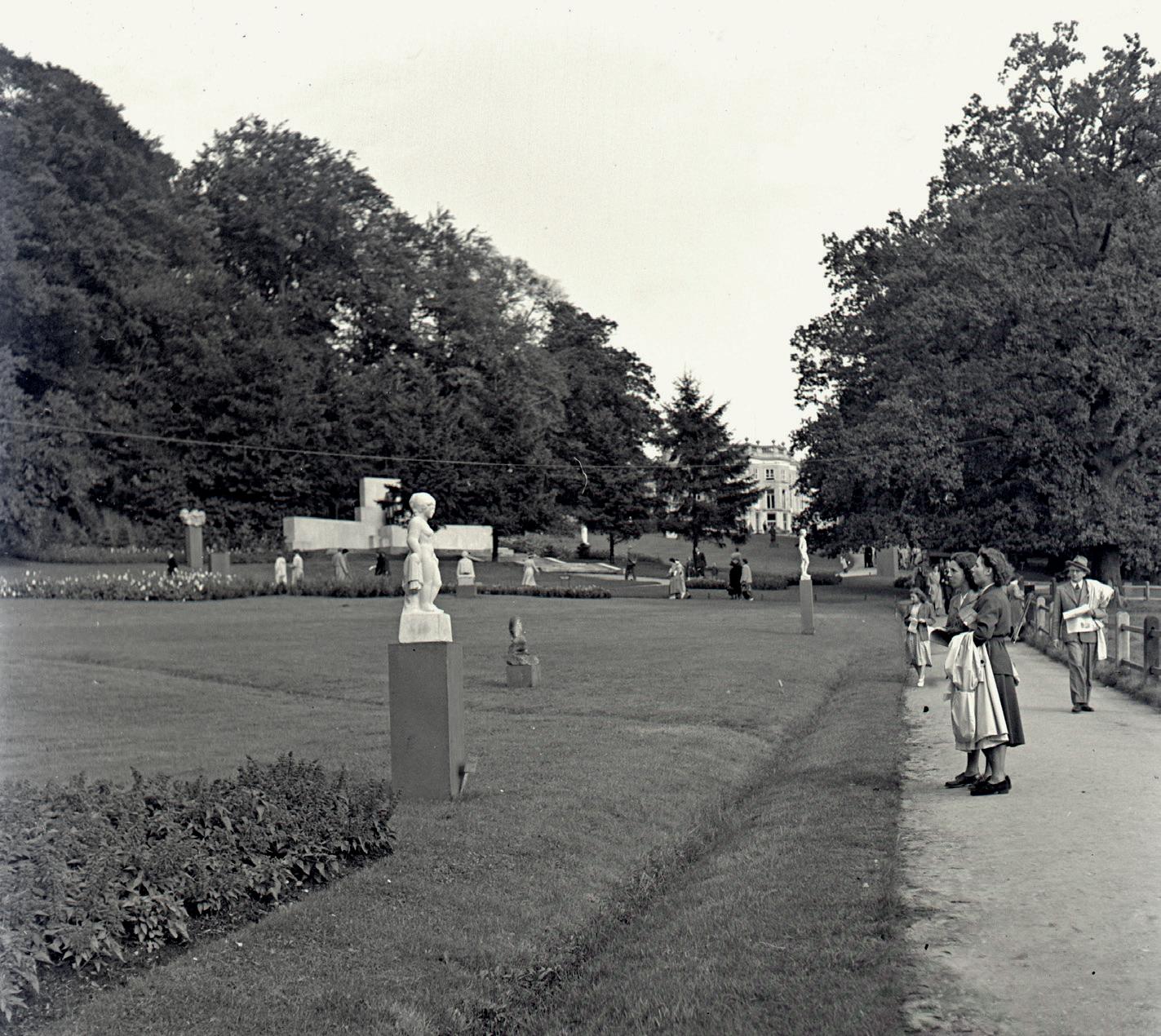
Sonsbeek ’49: Europese beeldhouwkunst in de open lucht vindt in 1949 in Park Sonsbeek te Arnhem plaats. Op initiatief van de Arnhemse wethouder Marga Klompé wordt deze tentoonstelling van kunst in de openbare ruimte georganiseerd om de bewoners van de zwaar beschadigde stad na de Tweede Wereldoorlog een hart onder de riem te steken. Het buiten tonen van sculptuur is rond 1950 in trek; de openluchttentoonstelling in Battersea Park in Londen (1948) bijt het spits af en ook het Middelheimmuseum, een openluchtmuseum in Antwerpen, opent de deuren. Sonsbeek ’49 is een groot succes. Tot 1958 keert de tentoonstelling elke drie jaar terug, daarna gebeurt dit onregelmatig.
Even lang geleden begint de band tussen Sonsbeek kunstprojecten en het nabijgelegen Kröller-Müller Museum. Bram Hammacher (18972002), museumdirecteur van 1947 tot 1963, is als lid van de erecommissie nauw betrokken bij de eerste Sonsbeekeditie van 1949 (en die daarna volgen). Hammacher koestert dan al de wens een beeldentuin aan te leggen bij ‘zijn’ museum, in navolging van bovengenoemde initiatieven. Hij gelooft dat sculptuur in een natuurlijke omgeving het best tot zijn recht komt. Openluchttentoonstellingen bieden de bevolking dus niet alleen een gevoel van hoop en herstel, ook voor de beeldhouwkunst zelf is het groen gunstig.
Sonsbeek ’49: Europese beeldhouwkunst in de open lucht (Sonsbeek ’49: European Sculpture in the Open Air) took place in Sonsbeek Park in Arnhem in 1949. On the initiative of Arnhem councillor Marga Klompé, this exhibition of art in the public domain was organised to lift the spirits of the residents of the city, which had been severely damaged during the Second World War. Exhibiting sculpture outdoors became popular around 1950; the open-air exhibition in Battersea Park in London (1948) led the way, and the Middelheim Museum, an openair museum in Antwerp, also opened its doors. Sonsbeek ’49 was a huge success. The exhibition was held every three years until 1958, after which it returned irregularly.
The connection between Sonsbeek Art Projects and the nearby Kröller-Müller Museum dates back just as far. Bram Hammacher (1897-2002), the museum’s director from 1947 to 1963, was closely involved in the first Sonsbeek edition in 1949 (and those that followed) as a member of the honorary committee. Hammacher already harboured the desire to create a sculpture garden at ‘his’ museum, following the example of the aforementioned initiatives. He believed that sculpture is best appreciated in a natural setting. Openair exhibitions therefore not only offer the public a sense of hope and recovery, but the natural surroundings are also beneficial for sculpture itself.
Na 1949 blijft het Kröller-Müller Museum verbonden met Sonsbeek. Zo zit Rudi Oxenaar (1925-2005), Hammachers opvolger van 1963 tot 1990, in het werkcomité van Sonsbeek ’66 en is hij zelfs aanvankelijk samensteller van Sonsbeek ’71. Ook biedt het museum tijdens latere edities plaats aan kunstwerken die onderdeel zijn van de Sonsbeektentoonstelling. Deze jarenlange wisselwerking wordt weerspiegeld in de beeldentuin; een flink aantal sculpturen stond ooit in Park Sonsbeek. Een selectie uit die beelden, die op uiteenlopende manieren bij het Kröller-Müller Museum terecht zijn gekomen, komt in deze wandeling aan bod. De foto’s tonen de werken op de Sonsbeekeditie waar ze mee samenhangen.
After 1949 the Kröller-Müller Museum remained associated with Sonsbeek Art Projects. For instance, Rudi Oxenaar (1925-2005), Hammacher’s successor from 1963 to 1990, sat on the organising committee for Sonsbeek ’66 and was initially even the curator of Sonsbeek ’71 During later editions, the museum also provided space for artworks that were part of the Sonsbeek exhibition. This long-standing collaboration is reflected in the sculpture garden; a considerable number of the sculptures once stood in Sonsbeek Park. This walk features a selection of those works, which found their way to the Kröller-Müller Museum by various means. The pictures show the works at the related Sonsbeek edition.
Bezoekers op Sonsbeek ’49: Europese beeldhouwkunst in de open lucht, de eerste Sonsbeektentoonstelling in 1949
Visitors at Sonsbeek ’49: European Sculpture in the Open Air, the first Sonsbeek exhibition in 1949
Three Upright Motives
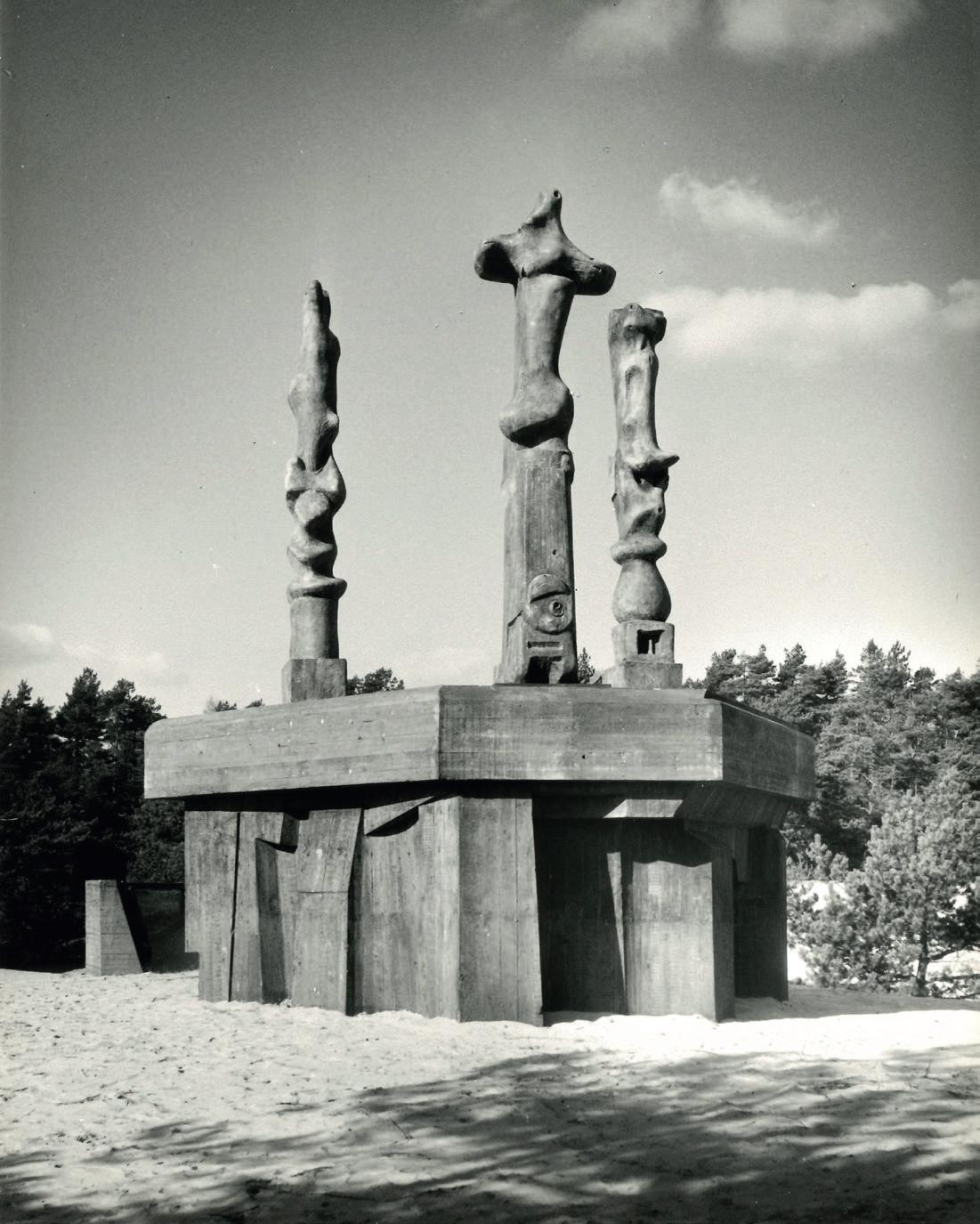
Deze Three Upright Motives (1955-1956) van de Britse kunstenaar Henry Moore (1898-1986) zijn te zien geweest in Park Sonsbeek tijdens Sonsbeek ’58. Directeur Rudi Oxenaar koopt ze in 1964 als één werk aan, maar de verwerving ervan lijkt los te staan van deze Sonsbeekeditie. Sinds 1965 staat Three Upright Motives buiten het terrein van het Kröller-Müller Museum, aan de voet van de Franse berg langs de weg richting Schaarsbergen, op een betonnen sokkel die Moore speciaal voor het museum ontwerpt (zie foto).
Three Upright Motives
11 Henry Moore, Three Upright Motives, 19551956, 1965
These Three Upright Motives (19551956) by British artist Henry Moore (1898-1986) were exhibited in Sonsbeek Park during Sonsbeek ’58. Director Rudi Oxenaar acquired them as one work in 1964, but the acquisition appears unrelated to this Sonsbeek edition. Since 1965 Three Upright Motives has stood outside the grounds of the Kröller-Müller Museum, at the foot of the French Hill along the road towards Schaarsbergen, on a concrete pedestal that Moore designed especially for the museum (see picture).
10 uitgelichte beelden in de beeldentuin
10 featured sculptures in the sculpture garden
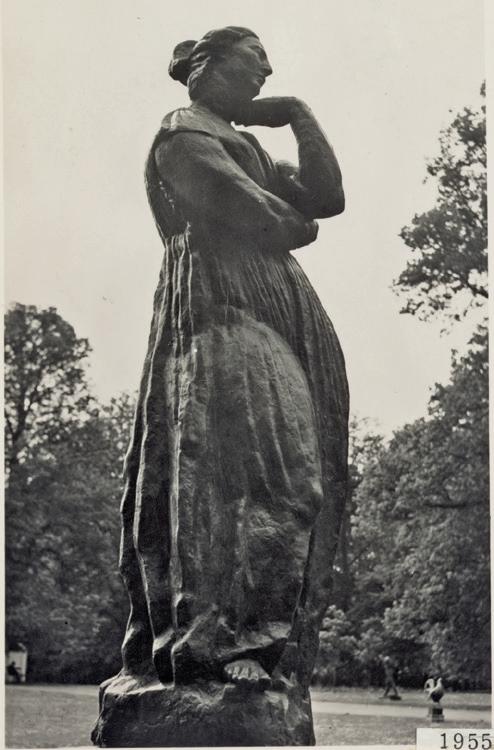
Een robuuste Penelope wacht standvastig tot haar echtgenoot Odysseus terugkeert; het zou twintig jaar gaan duren. De Franse beeldhouwer Émile-Antoine Bourdelle (1861-1929) legt zich tussen 1905 en 1912 toe op dit figuur uit het oud-Griekse epos de Odyssee van Homerus. Een kleinere versie van deze sculptuur had in 1949 op de eerste Sonsbeektentoonstelling gestaan en prijkte zelfs op het tentoonstellingsaffiche. Op dat moment aast Bram Hammacher, directeur van het Kröller-Müller Museum, al op deze grote Penelope. Voor Hammacher, die een representatief overzicht van de beeldhouwkunst wil verzamelen, mag Bourdelle als wegbereider van de moderne sculptuur niet ontbreken. Pas in 1955 weet Hammacher de aankoopcommissie van het Kröller-Müller Museum voor zich te winnen. Hij koopt La grande Pénélope (De grote Penelope) aan, om het vervolgens meteen weer uit te lenen aan Sonsbeek ’55, de derde editie, waar het een prominente plek vlakbij de entree krijgt. Die opstelling van het beeld in de open lucht, waar ook Hammacher de voorkeur aan geeft, laat in het Kröller-Müller Museum nog een aantal jaar op zich wachten. Maar als de beeldentuin in 1961 eindelijk opent, verplaatst La grande Pénélope direct naar buiten. Ook hier krijgt de sculptuur te midden van het groen een ereplaats op het hoofdveld.
A sturdy Penelope waits steadfastly for her husband Odysseus to return; it would take 20 years. Between 1905 and 1912, the French sculptor ÉmileAntoine Bourdelle (1861-1929) devoted himself to this figure from Homer’s ancient Greek epic poem, the Odyssey A smaller version of the sculpture had been on display at the first Sonsbeek exhibition in 1949 and even featured on the exhibition poster. At that time, director of the Kröller-Müller Museum, Bram Hammacher, had already set his sights on this large Penelope. For Hammacher, who sought to assemble a representative collection of sculpture, Bourdelle – as a pioneer of modern sculpture – was indispensable. It was not until 1955 that Hammacher managed to win over the Kröller-Müller Museum’s acquisition committee. He purchased La grande Pénélope (Large Penelope), only to loan it out immediately to Sonsbeek ’55, the third edition of the exhibition, where it was given a prominent spot near the entrance. Presenting the sculpture in the open air, which Hammacher also favoured, would not occur at the KröllerMüller Museum for several more years. But when the sculpture garden finally opened in 1961, La grande Pénélope was immediately moved outdoors. Here too, the sculpture was given a place of honour in the middle of the main lawn, surrounded by greenery.
Émile-Antoine Bourdelle, La grande Pénélope, 1912
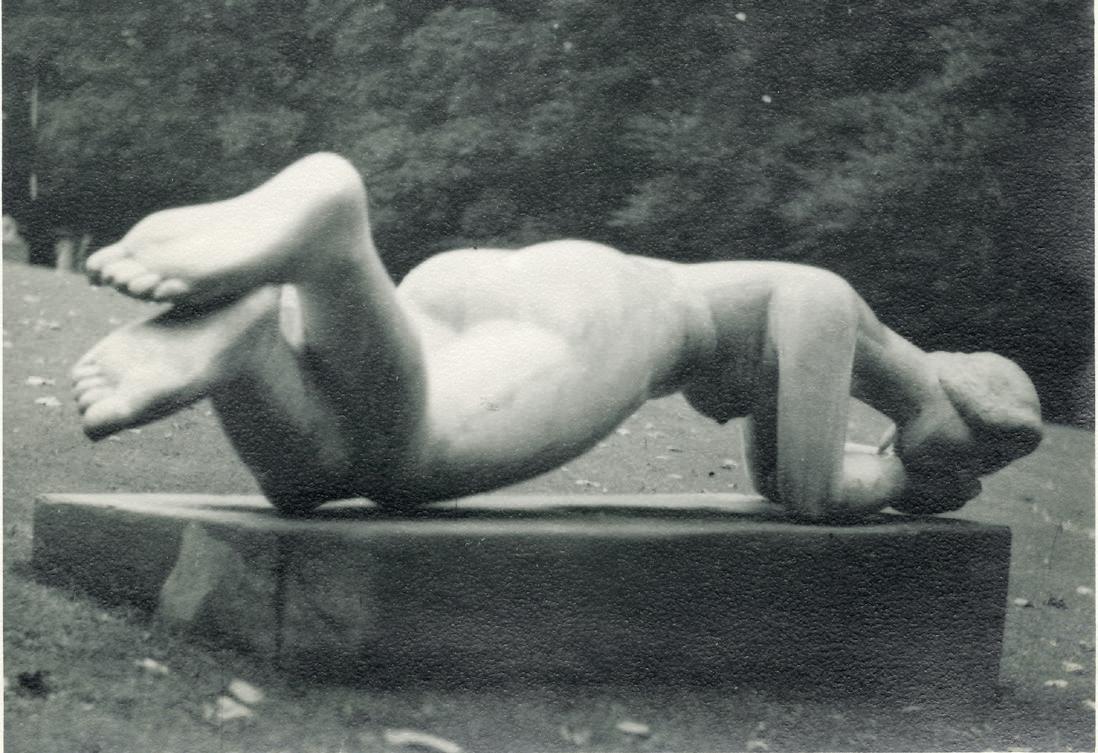
Voor Bram Hammacher, die de collectie beeldhouwkunst van het Kröller-Müller Museum tussen 1947 en 1963 in rap tempo opbouwt, zijn de Sonsbeektentoonstellingen van groot belang. Aan het overzicht van de moderne sculptuur dat hij bijeenbrengt, wenst hij ook de Vlaamse expressionistische kunstenaar Constant Permeke (1886-1952) toe te voegen. Dat dat Niobe moet zijn, ontdekt hij op Sonsbeek ’52, waar het dan te zien is. In een bespreking van de tentoonstelling noemt Hammacher het zelfs het hoogtepunt van deze tweede editie, en later verwijst hij er nog eens naar als Permekes beste werk. Met dit beeld refereert Permeke aan de Griekse mythe van koningin Niobe, die haar onderdanen dwingt haar te aanbidden als een godin. Niobes hoogmoed wordt bestraft; haar kinderen worden gedood. Ze versteent van verdriet. De Niobe die in 1952 in Park Sonsbeek staat, is niet exact hetzelfde werk als hier in de beeldentuin is opgesteld. Het materiaal van het sculptuur in Arnhem is een wit kunststeen. Het beeld dat Hammacher in 1958 voor het museum aankoopt, is het eerste bronzen exemplaar dat Permeke van Niobe maakt. De glanzende, groene koningin, die zich wanhopig tegen de grond heeft geworpen, krijgt een ereplek op het hoofdveld.
For Bram Hammacher, who rapidly expanded the sculpture collection of the Kröller-Müller Museum between 1947 and 1963, the Sonsbeek exhibitions were of great importance. In the overview of modern sculpture he was compiling, he wished to include a work by the Flemish Expressionist artist Constant Permeke (1886-1952). He realised that this had to be Niobe at Sonsbeek ’52, where it was on display. In a review of the exhibition, Hammacher even called it the highlight of this second edition, and later referred to it again as Permeke’s finest work. With this sculpture, Permeke invokes the Greek myth of Queen Niobe, who forces her subjects to worship her as a goddess. Niobe’s hubris is punished; her children are killed and she is turned to stone with grief.
The Niobe shown in Sonsbeek Park in 1952 is not the exact same work as the one on display here in the sculpture garden. The sculpture in Arnhem was made of white artificial stone. The work that Hammacher acquired for the museum in 1958 is the first bronze version of Niobe created by Permeke. The gleaming, green queen, who has thrown herself to the ground in despair, now occupies a place of honour on the main lawn.
Rietveld, Rietveldpaviljoen, 1954-1955 (herbouwd in 1964-1965 en 2010)
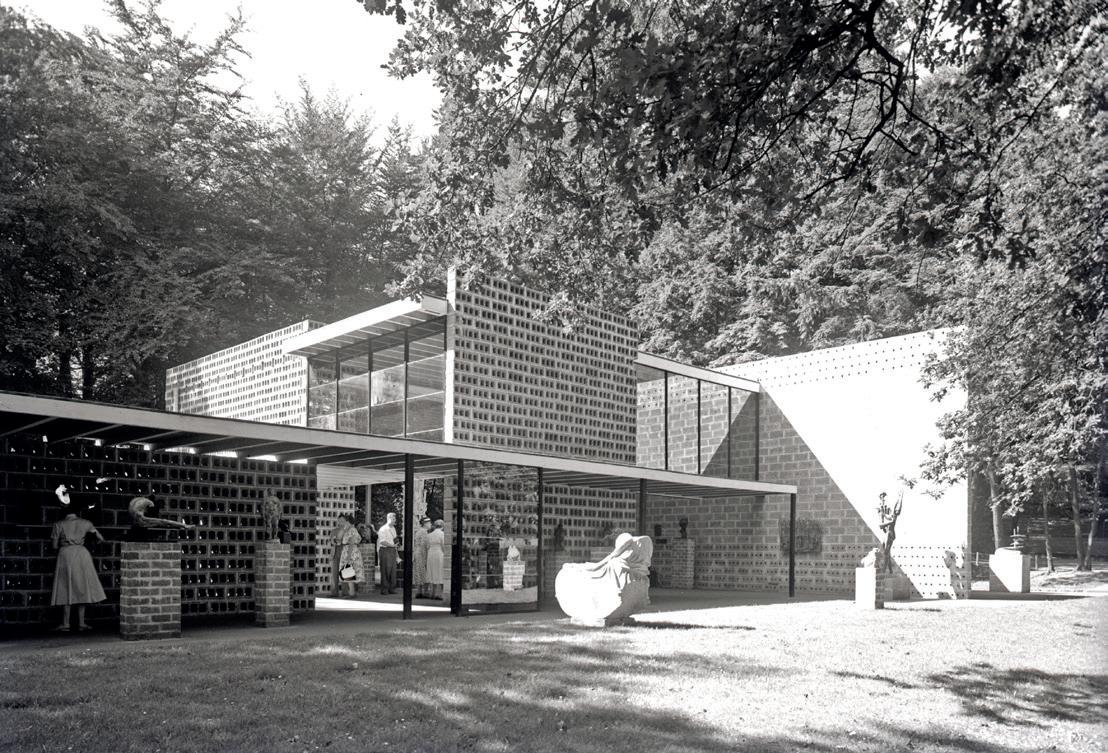
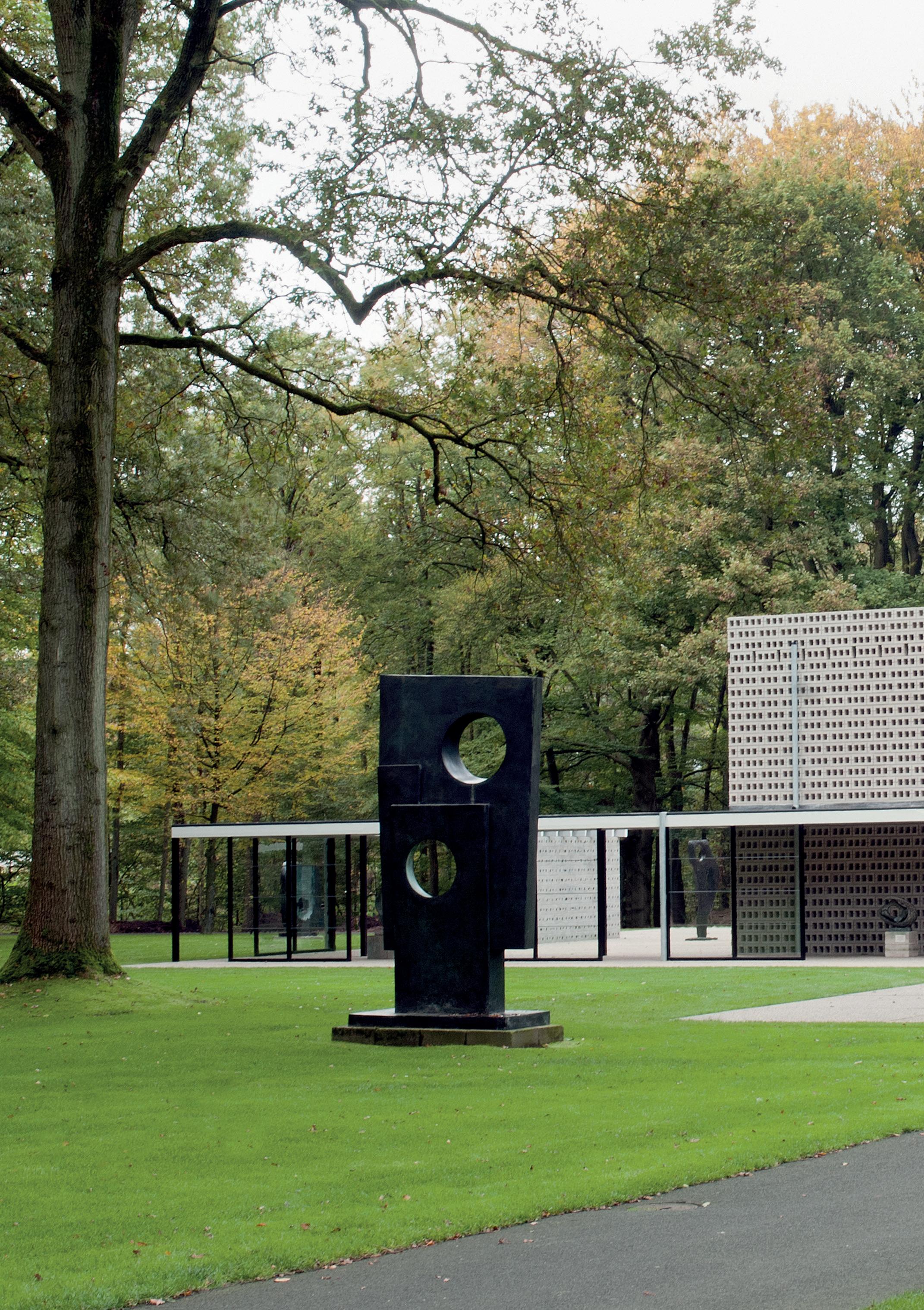
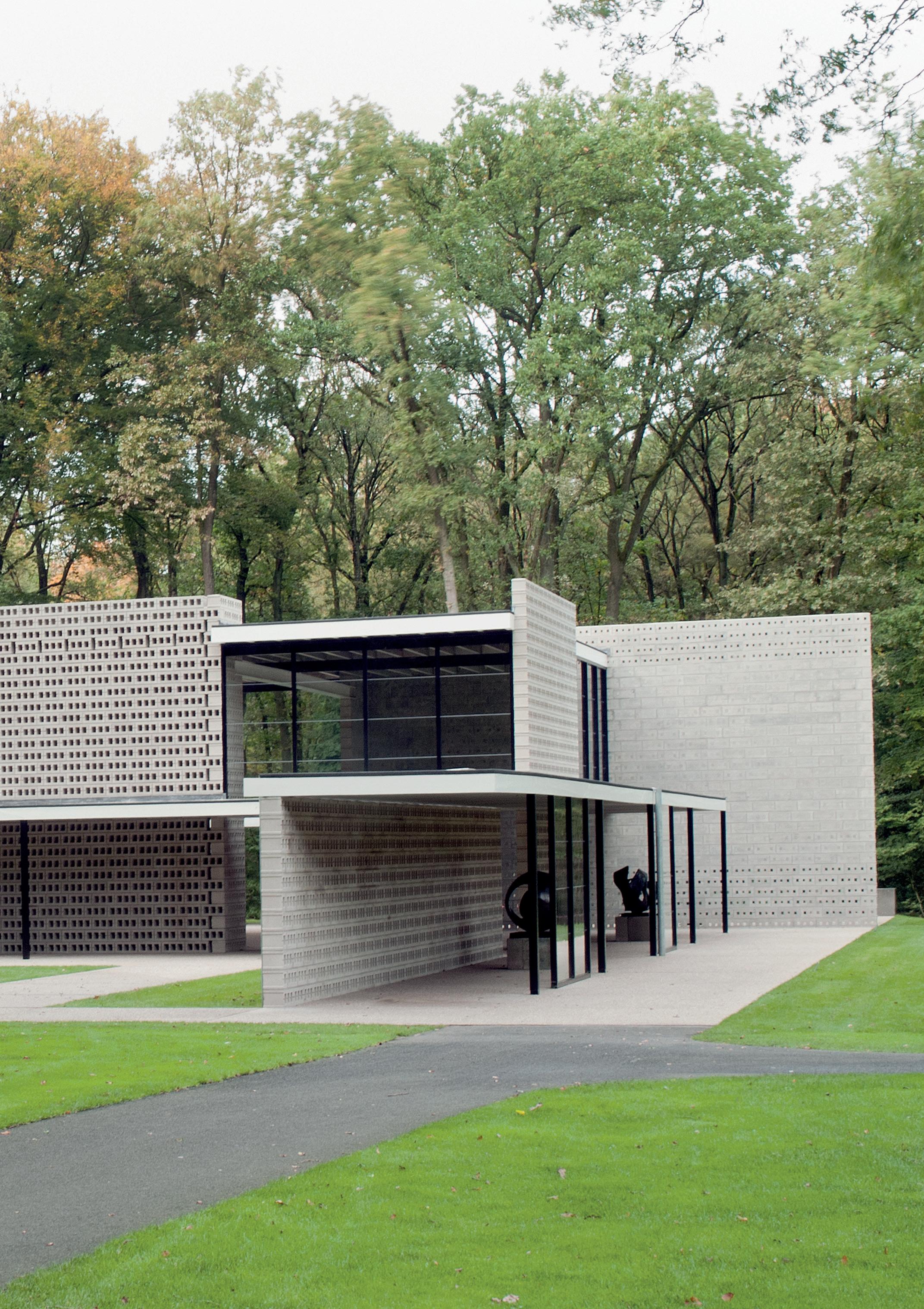
De toonaangevende Nederlandse architect en ontwerper Gerrit Rietveld (1888-1964) maakt dit paviljoen voor Sonsbeek ’55: Internationale Beeldententoonstelling in de open lucht. Hem is gevraagd een paviljoen voor deze derde editie te ontwerpen dat plaats biedt aan enkele kleinere sculpturen. Zijn ontwerp wordt gerealiseerd op de plek van een voormalige tennisbaan in Park Sonsbeek. De sobere horizontale en verticale elementen, gemaakt van eenvoudige materialen, creëren een open, luchtige ruimte die het licht vrij spel geeft. In dit paviljoen versterken de architectuur en de beelden elkaar. Rietvelds ontwerp maakt (inter)nationaal furore. Het bouwwerk is tijdelijk bedoeld en wordt na Sonsbeek ’55 afgebroken, maar is dan al zo roemrijk dat initiatieven om het elders te herbouwen snel ontstaan. Dat gebeurt in 1964 in de beeldentuin van het Kröller-Müller Museum, tot grote vreugde van de architect zelf, die echter overlijdt voor de wederopbouw goed en wel van start is. In mei 1965 is het zo ver; het vermaarde Rietveldpaviljoen – niet langer het Sonsbeekpaviljoen geheten – staat weer. Sinds de herbouw biedt het ook hier onderdak aan beelden. Net als bij Sonsbeek ’55 gaan architectuur en sculptuur een harmonieuze wisselwerking aan.
The influential Dutch architect and designer Gerrit Rietveld (1888-1964) created this pavilion Sonsbeek ’55: Internationale Beeldententoonstelling in de open lucht (Sonsbeek ’55: International Sculpture Exhibition in the Open Air). He was asked to design a pavilion for this third edition to exhibit several smaller sculptures. His design was realised on the site of a former tennis court in Sonsbeek Park. The sober horizontal and vertical elements, made from simple materials, create an open, airy space that allows light to enter freely. In this pavilion, the architecture and the sculptures complement each other. Rietveld’s design caused a sensation both at home and abroad. The structure was intended to be temporary and was demolished after Sonsbeek ’55, but by then it had already become so famous that initiatives to rebuild it elsewhere soon emerged. This occurred in 1964 in the sculpture garden of the KröllerMüller Museum, much to the delight of the architect himself who, unfortunately, passed away before the reconstruction had properly begun. In May 1965 the moment had finally arrived; the renowned Rietveld Pavilion – no longer known as the Sonsbeek Pavilion – stood once more. Since its reconstruction, it has also housed sculptural works here. Just as in Sonsbeek ’55, architecture and sculpture interact harmoniously here.
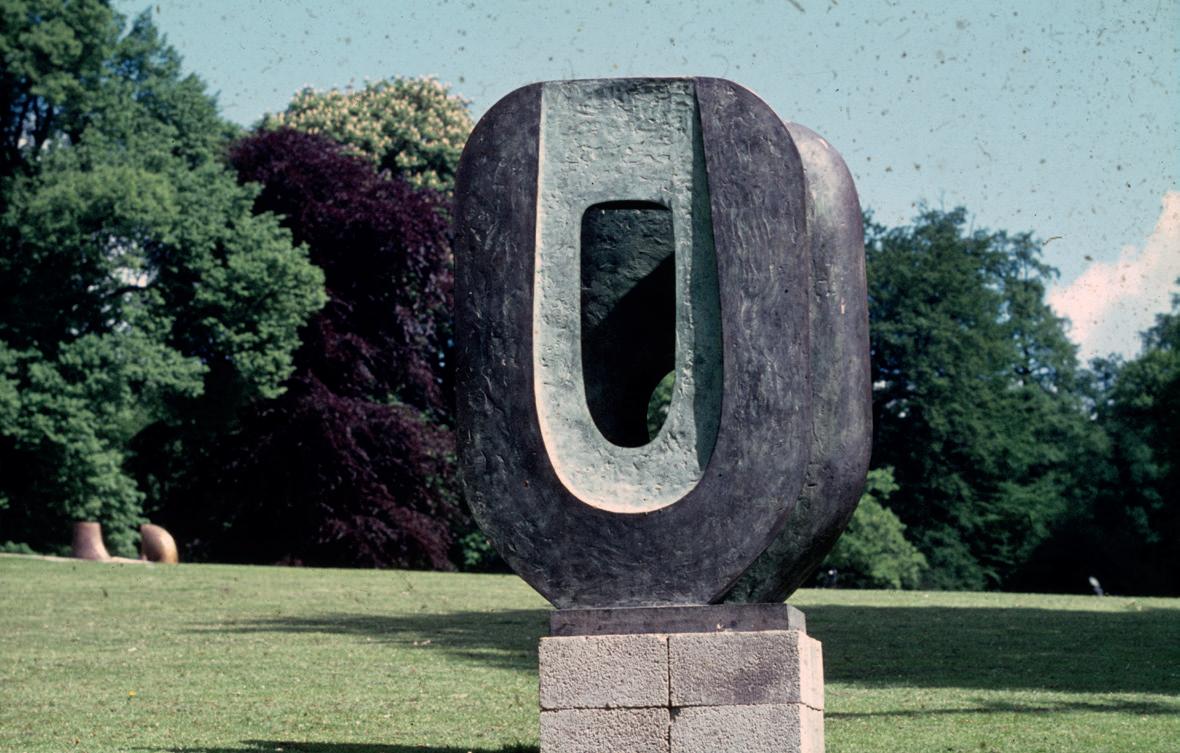
Het Rietveldpaviljoen wordt in 1965 in de beeldentuin geopend met een tentoonstelling van het werk van Barbara Hepworth (1903-1975). Het Kröller-Müller Museum, in de persoon van Bram Hammacher, heeft dan al jaren een hechte band met deze Britse beeldhouwer. Met haar aan de natuur ontleende, organische vormen is ze van grote betekenis voor de moderne beeldhouwkunst. Net als Hammacher vindt zij dat haar sculpturen in een natuurlijke omgeving het best tot hun recht komen; ze maken deel uit van het landschap. Hammacher legt met meerdere aankopen de basis voor wat de grootste Hepworth-collectie buiten het Verenigd Koninkrijk wordt, die de kunstenaar zelf aanvult met schenkingen.
Rudi Oxenaar, Hammachers opvolger, zet de goede relatie met Hepworth voort. Als hij in 1966 lid is van het werkcomité van de aankomende Sonsbeektentoonstelling, vraagt hij de kunstenaar of zij wil bijdragen aan deze vijfde editie met een nieuw werk. Een enthousiaste Hepworth stelt Dual Form (Tweeledige vorm) voor; het brons zou net op tijd gegoten kunnen worden. Het is die eerste gieting die op Sonsbeek ’66 te zien is, en het is dat exacte werk dat Oxenaar later dat jaar tegelijk met vijf andere sculpturen voor een vriendenprijs van haar kan kopen voor het museum. Daar krijgt het lange tijd een plek in het Rietveldpaviljoen.
The Rietveld Pavilion opened in the sculpture garden in 1965 with an exhibition of work by Barbara Hepworth (1903-1975). The Kröller-Müller Museum, in the person of Bram Hammacher, had already maintained close ties with this British sculptor for many years. With her organic forms inspired by nature, she is of great significance to modern sculpture. Like Hammacher, she believed that her sculptures are best appreciated in a natural setting; they form part of the landscape. Through a series of acquisitions, Hammacher laid the foundations for what would become the largest Hepworth collection outside the United Kingdom, which the artist herself supplemented with further donations. Hammacher’s successor, Rudi Oxenaar, continued the good relationship with Hepworth. When he became a member of the organising committee for the forthcoming Sonsbeek exhibition in 1966, he asked the artist if she would like to contribute a new work to this fifth edition. An enthusiastic Hepworth proposed Dual Form; the bronze could be cast just in time. This first casting was exhibited at Sonsbeek ’66, and it is that very work which Oxenaar was able to purchase from her later that year, along with five other sculptures, at a discount for the museum. Here it was given a home in the Rietveld Pavilion for a long time.
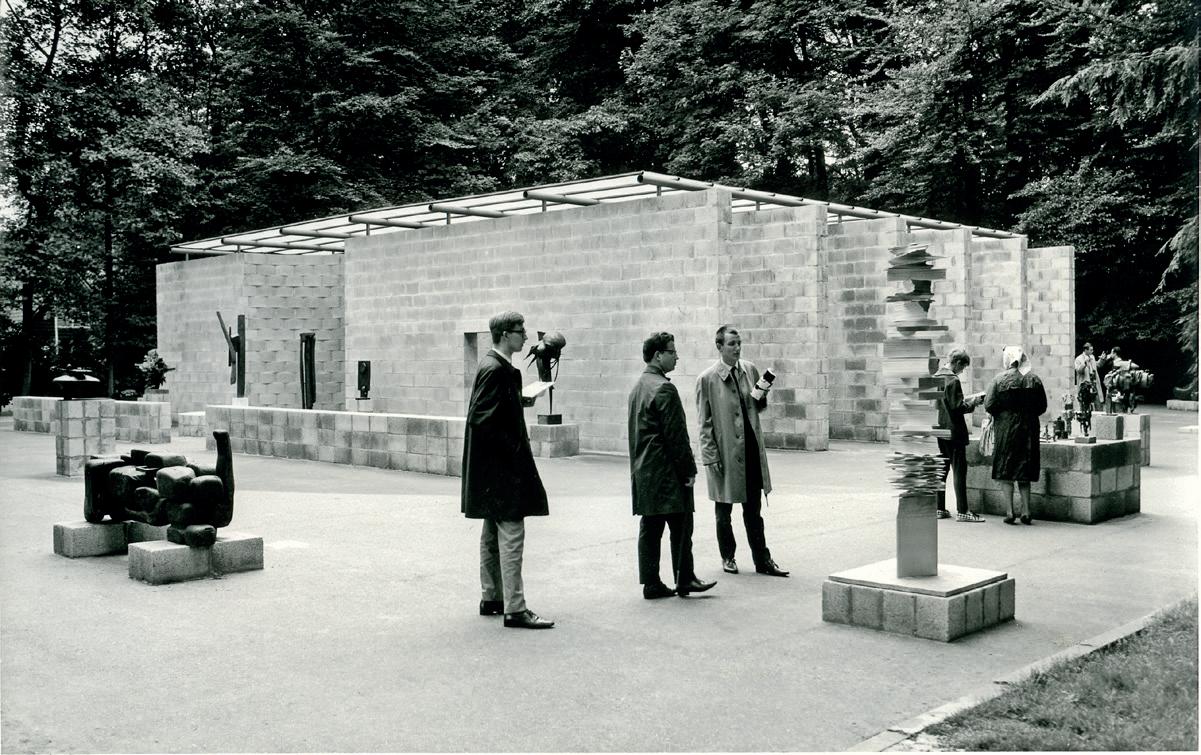
Aldo van Eyck, Aldo van Eyck-paviljoen, 1965-1966 (herbouwd in 2005)
Tien jaar na Gerrit Rietveld krijgt ook architect Aldo van Eyck (1918-1999) de opdracht een tijdelijk paviljoen voor kleine sculpturen te maken, ditmaal voor Sonsbeek ’66. Het bouwwerk van Van Eyck prijkt op dezelfde plek waar een decennium eerder het Rietveldpaviljoen nog stond, dat dan al in de beeldentuin van het Kröller-Müller Museum is herrezen. Het Sonsbeekontwerp van Van Eyck geldt als een mijlpaal van creatief bouwen in de Nederlandse naoorlogse architectuurgeschiedenis. In dit labyrintachtige, gesloten paviljoen, dat als een kleine stad van betonsteen oprijst tussen het groen, stuurt de architect met evenwijdige wanden, ronde vormen én zitplekken je beweging in de ruimte. Op die manier ontstaan meer intieme, verrassende ontmoetingen met de beelden. In 2005-2006 wordt het inmiddels beroemde paviljoen herbouwd in de Kröller-Müllerbeeldentuin in samenwerking met het architectenbureau Aldo en Hannie van Eyck (de architect zelf is dan al overleden). Deze uitvoering wijkt nét wat af van het origineel. Het oorspronkelijke gebouw op Sonsbeek ’66 had bijvoorbeeld een nylon doek als ietwat provisorisch dak; hier wordt een duurzamer dak geplaatst en komt het licht gezeefd binnen door transparante kunststof platen. De twee voormalige Sonsbeekpaviljoens zijn in de beeldentuin bijzondere architectonische tegenhangers van elkaar.
Ten years after Gerrit Rietveld, architect Aldo van Eyck (1918-1999) was also commissioned to design a temporary pavilion for small sculptures, this time for Sonsbeek ’66. Van Eyck’s structure was erected on the same spot where the Rietveld Pavilion had stood a decade earlier, which had since been rebuilt in the sculpture garden of the KröllerMüller Museum. Van Eyck’s Sonsbeek design is regarded as a milestone in creative building within the history of post-war Dutch architecture. In this labyrinthine, closed pavilion, which rises like a small town of breeze blocks amidst the greenery, the architect guides your movement through the space using parallel walls, curved forms and places to sit. This creates more intimate, unexpected encounters with the sculptures. In 2005–2006, the now famous pavilion was rebuilt in the KröllerMüller sculpture garden in collaboration with the architectural firm Aldo and Hannie van Eyck (the architect himself had already passed away by then). This version differs slightly from the original. For example, the original building at Sonsbeek ’66 had a nylon sheet serving as a somewhat makeshift roof; at the Kröller-Müller Museum, a more durable roof was installed of transparent plastic panels through which light filters in. The two former Sonsbeek pavilions in the sculpture garden are striking architectural counterparts of one another.
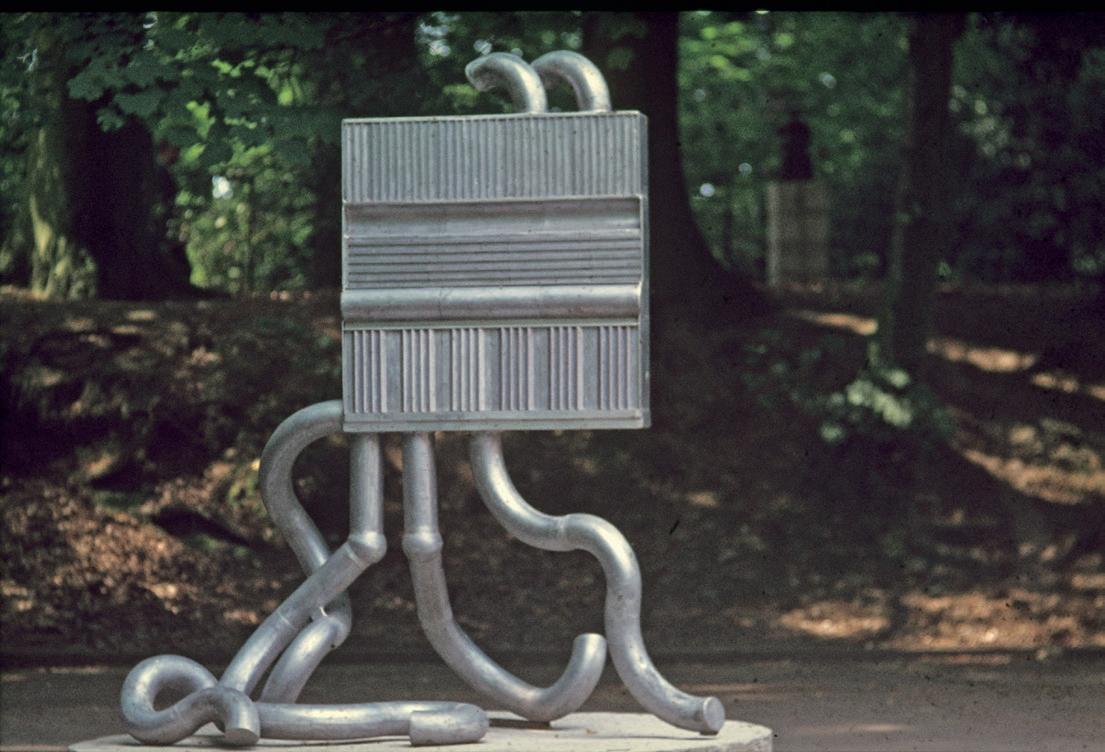
Paolozzi, Medea, 1964
Hoewel de keuze van werken door het werkcomité van Sonsbeek ’66 wordt gemaakt, is Aldo van Eyck destijds zelf nauw betrokken bij de inrichting van zijn paviljoen. Op ongeveer dezelfde plek als het nu in de beeldentuin staat, plaatst hij Medea van de Schotse kunstenaar Eduardo Paolozzi (1924-2005). Rudi Oxenaar, dan de directeur van het Kröller-Müller Museum, maakt onderdeel uit van dat werkcomité. De commissie van deze vijfde editie kiest voor werk van jonge kunstenaars die experimenteren met nieuwe materialen als ijzer, plastic en aluminium en hun sculpturen vaak direct op de grond plaatsen, zonder sokkel. Zo ook Paolozzi. Zijn Medea is een haast robotachtige vertolking van de gelijknamige wraakzuchtige mythologische figuur en bestaat uit kronkelende benen en een bovenstel dat herinnert aan een machineonderdeel. Oxenaar, die tijdens zijn directeurschap veelal de ruimte geeft aan vernieuwers in de beeldhouwkunst, is groot liefhebber van dit sculptuur. Na Sonsbeek ’66 haalt hij Medea als bruikleen naar het museum, waar het in 1967 te zien is in een duotentoonstelling over het werk van Paolozzi en dat van de Britse kunstenaar Anthony Caro. Paolozzi schenkt het als dank aan het museum, waarna het meteen geplaatst wordt op zijn ‘vertrouwde’ plek, in het Aldo van Eyck-paviljoen.
Although the organising committee of Sonsbeek ’66 selected the works, Aldo van Eyck was closely involved in the installation of his pavilion at the time. He placed Medea by Scottish artist Eduardo Paolozzi (1924-2005) in roughly the same spot where it now stands in the sculpture garden. Rudi Oxenaar, then director of the KröllerMüller Museum, was a member of that organising committee. The committee for this fifth edition selected works by young artists who were experimenting with new materials such as iron, plastic and aluminium, and who often placed their sculptures directly on the ground, without a pedestal. Paolozzi was no exception. His Medea is an almost robotic interpretation of the vengeful mythological figure of the same name, consisting of twisting legs and an upper body reminiscent of a machine part. Oxenaar, who during his tenure as director often gave space to innovators in the field of sculpture, was a great admirer of this piece. After Sonsbeek ’66, he secured Medea on loan for the museum, where it was exhibited in 1967 as part of a joint exhibition featuring the work of Paolozzi and of British artist Anthony Caro. Paolozzi gifted it to the museum as a token of gratitude, after which it was immediately placed in its ‘familiar’ spot, in the Aldo van Eyck Pavilion.
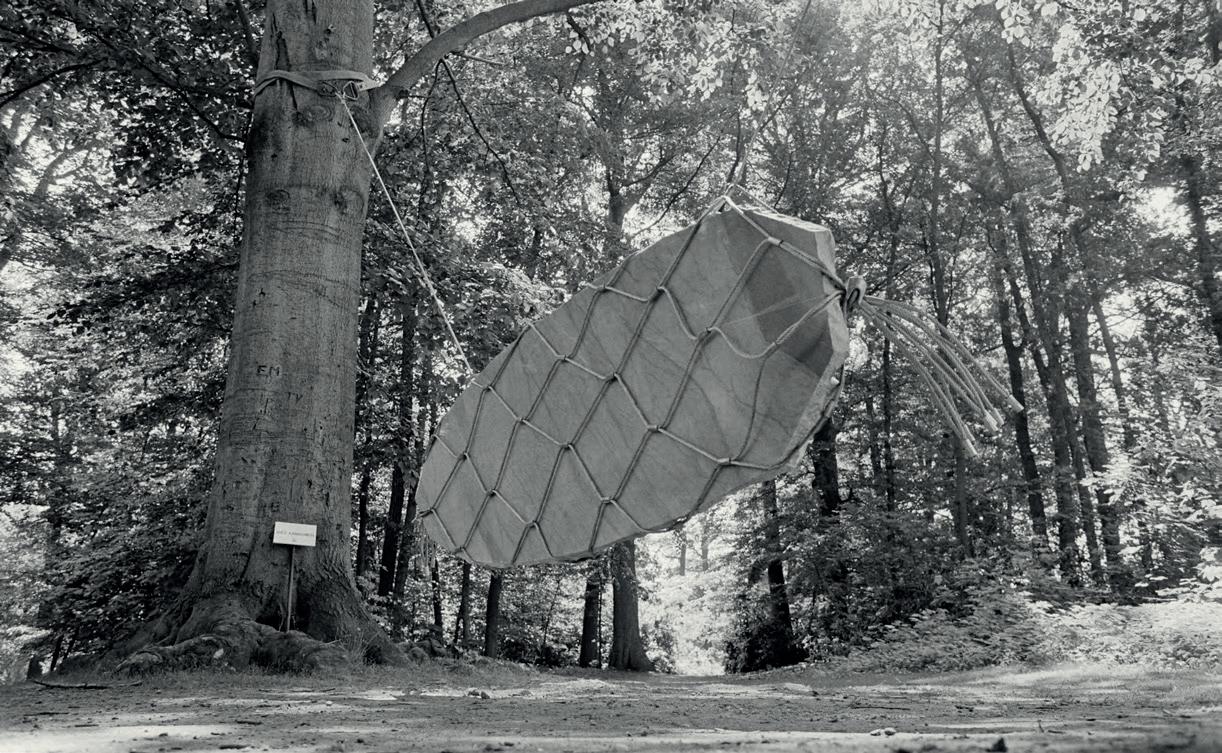
De Italiaanse kunstenaar Luciano Fabro (19362007) maakt La doppia faccia del cielo (Het tweeledige gezicht van de hemel) voor de Sonsbeektentoonstelling van 1986. Fabro verwijst met de gepolijste zijde van de steen naar de Italiaanse blauwe hemel, de ruwere kant staat voor de bewolkte Nederlandse lucht. Met dit contrast tussen het verfijnde dooraderde marmer en de onbewerkte grofheid legt Fabro de nadruk op het materiële oppervlak, de buitenste laag van de sculptuur. Dit sluit naadloos aan bij een van de voornaamste thema’s van Sonsbeek ’86. Samengesteld door curator Saskia Bos richt deze zevende editie de aandacht op de huid van het beeld. Ook het werk van kunstenaars als Mario Merz en Giuseppe Penone, net als Fabro gerekend tot de arte povera, is te zien in Arnhem. Deze Italiaanse groep kunstenaars, kritisch op de commerciële kunstwereld en consumptiemaatschappij, kiezen veelal voor natuurlijke, vergankelijke materialen. Directeur Oxenaar bouwt in de jaren tachtig een omvangrijke arte povera-collectie op in het Kröller-Müller Museum. Na afloop van Sonsbeek ’86 koopt hij dan ook La doppia faccia del cielo aan. Hoewel Fabro in Park Sonsbeek de plek zelf uitkiest, is hij niet betrokken bij de plaatsing in de beeldentuin. Verheugd is hij zeker; hij schenkt het museum een tekening van dit sculptuur.
The Italian artist Luciano Fabro (19362007) created La doppia faccia del cielo (The Double Face of Heaven) for the 1986 Sonsbeek exhibition. With the polished side of the stone, Fabro refers to the blue Italian sky, while the roughhewn side represents the cloudy Dutch one. Through this contrast between the refined veined marble and the unworked roughness, Fabro emphasises the material’s surface, the outer layer of the sculpture. This ties in seamlessly with one of the main themes of Sonsbeek ’86. Curated by Saskia Bos, this seventh edition focused on the outer skin of the sculpture. Work of artists such as Mario Merz and Giuseppe Penone who, like Fabro, are considered members of the arte povera movement, was also exhibited in Arnhem. This group of Italian artists, critical of the commercial art world and consumer society, often use natural, perishable materials. In the 1980s, director Oxenaar assembled an extensive arte povera collection at the Kröller-Müller Museum. Following Sonsbeek ’86, he therefore acquired La doppia faccia del cielo. Although Fabro chose the location himself in Sonsbeek Park, he was not involved in the placement in the sculpture garden. However, he was certainly delighted, as he donated a drawing of this sculpture to the museum.
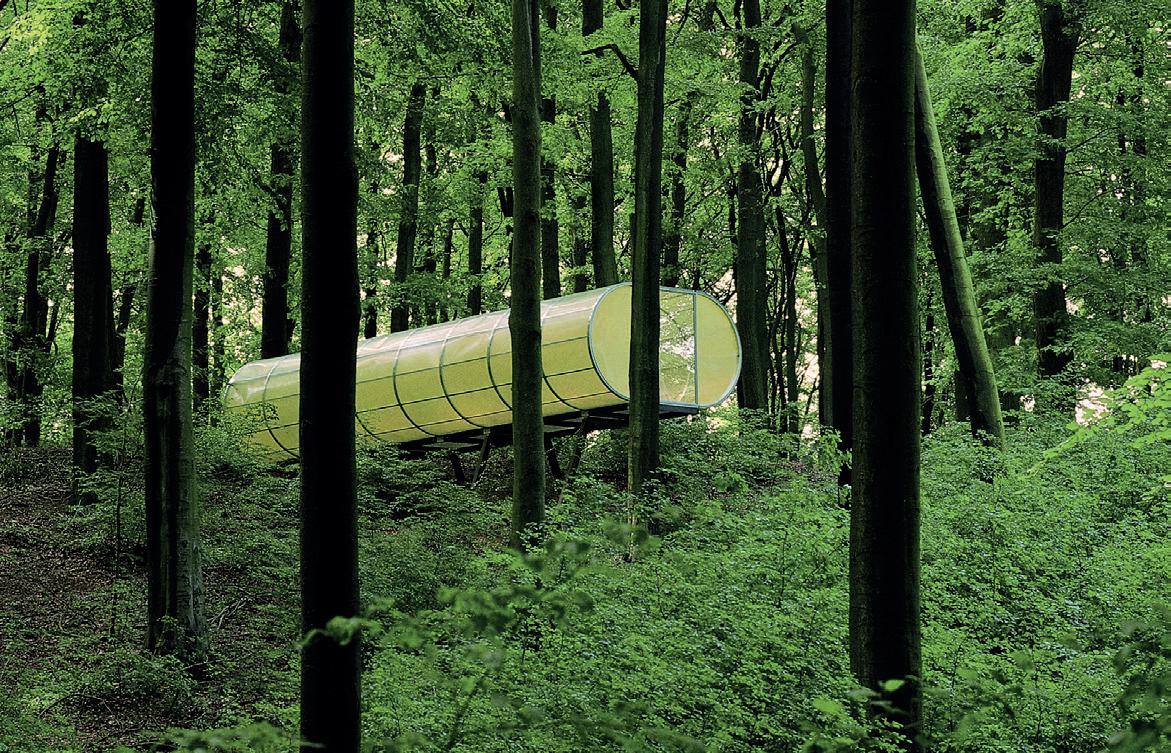
Verstopt tussen het groen op de Franse berg staat Hermann Maier Neustadts (1956-2009)
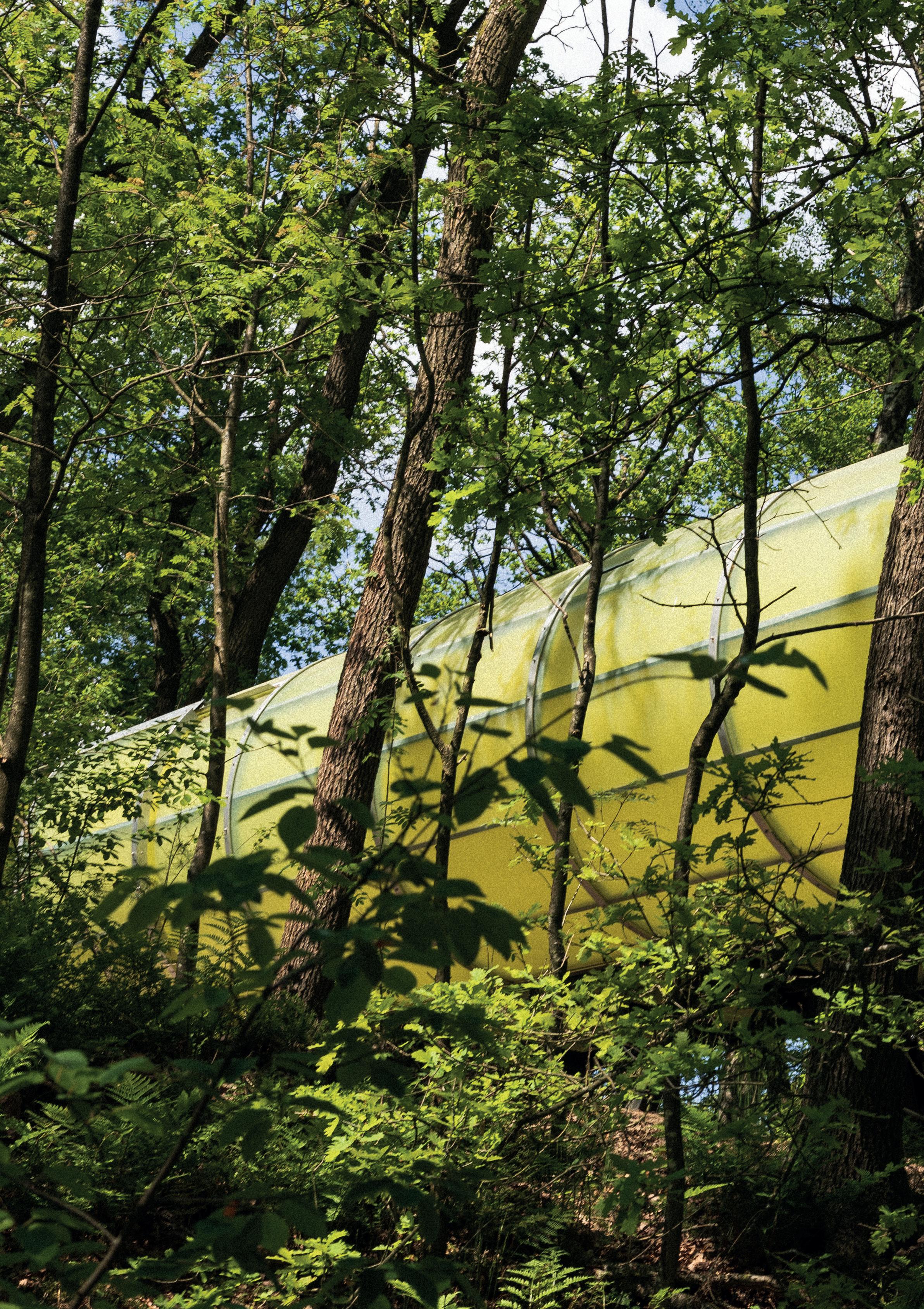
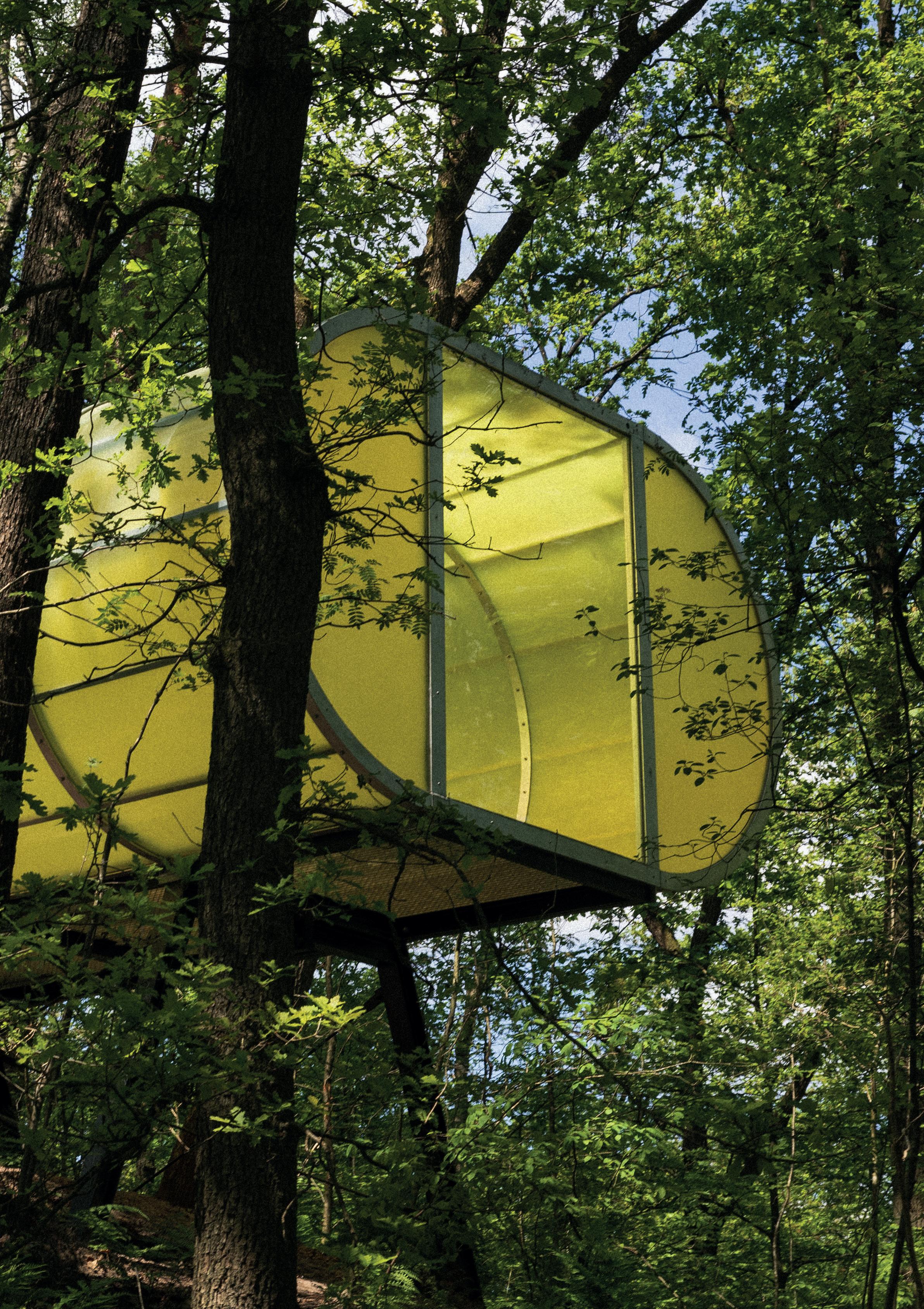
WD-Spiral Part One CINEMA. Deze Naturkino – ‘openluchtbioscoop’ – van de Duitse kunstenaar is afkomstig van Locus Focus, de Sonsbeektentoonstelling van 2001. Curator Jan Hoet legt in deze negende editie onder meer de focus op locatie, de ‘plek-als-identiteit’, ofwel de individuele ervaring van of betekenisgeving aan een bepaalde plaats. Maier Neustadts werk geeft op een eigen manier invulling aan die thematische insteek. Met het raam in de gele koker biedt hij de bezoeker die plaats heeft genomen in zijn ‘bioscoop’, geïsoleerd van de omgeving, een uitsnede van het bos – de ‘film’ die draait. Dit is een individueel kader, benadrukt Maier Neustadt. Het gaat hier om de persoonlijke waarneming van de natuur. Die kan voor iedereen anders zijn en mogelijk verschillen van de werkelijkheid. Na afloop van Locus Focus verwerft Evert van Straaten (1948), directeur van het Kröller-Müller Museum tussen 1990 en 2012, het werk voor de beeldentuin. Maier Neustadt kiest zelf de plaats. De plek, verscholen en op een verhoging, doet denken aan de oorspronkelijke locatie in Park Sonsbeek, op de rand van een heuvel in het bos.
Tucked away amongst the greenery on the French Hill stands Hermann Maier Neustadt’s (1956-2009) WDSpiral Part One CINEMA. This Naturkino – ‘open-air cinema’ – by the German artist originates from Locus Focus, the 2001 Sonsbeek exhibition. In this ninth edition, curator Jan Hoet focused, among other things, on location, ‘place as identity’, that is the individual experience of or attribution of meaning to a particular place. Maier Neustadt’s work gives its own unique interpretation to this thematic approach. With the window in the yellow tube, he offers visitors seated in his ‘cinema’ – isolated from their surroundings – a partial view of the forest: the ‘film’ that is playing. This is an individual frame, Maier Neustadt emphasises. It is about the personal perception of nature. This may be different for everyone and may not reflect reality. Following the Locus Focus exhibition, Evert van Straaten (1948), director of the Kröller-Müller Museum from 1990 to 2012, acquired the work for the sculpture garden. Maier Neustadt chose the location himself. The spot, secluded and situated on a slight elevation, is reminiscent of its original placement in Sonsbeek Park, on the edge of a hill in the forest.
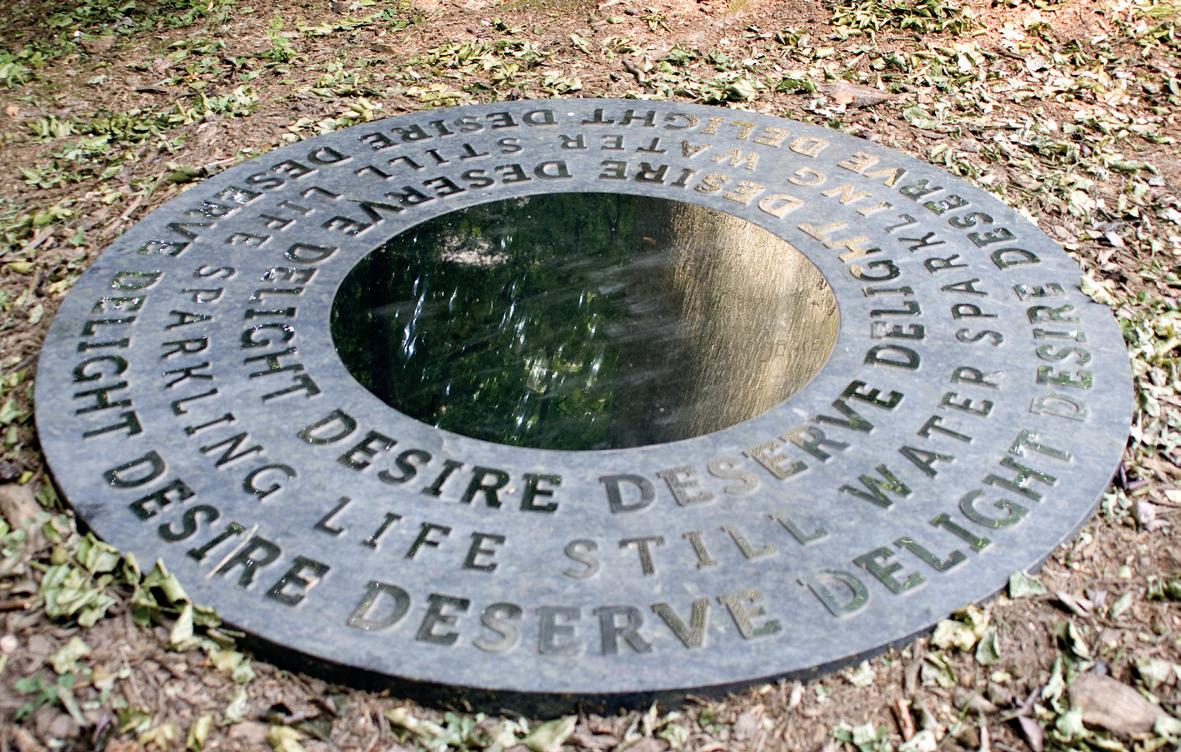
Vijf spiegels liggen verspreid over de beeldentuin op de grond. Ze zijn omringd door een granieten rand met daarop het mantra ‘Desire, Deserve, Delight, Still Life, Sparkling Water, Still Water, Sparkling Life’. Het is een werk van de Braziliaanse kunstenaar Ana Maria Tavares (1958), die het maakt voor Grandeur, de Sonsbeektentoonstelling van 2008. Water is een grote inspiratiebron voor Tavares, en ook Secrets of the Waters (for Mnemosyne) (Geheimen van de wateren (voor Mnemosyne)) is een ode aan waterverbindingen die voor het menselijk oog verborgen blijven, maar wel van levensbelang zijn. Het meerdelige werk is lokaal gebonden: Tavares onderzoekt de directe omgeving van Arnhem en ontdekt dat er 81 beken en sprengen – door mensen gegraven bronnen of beken – zijn op en rondom de Veluwe. Tijdens de tiende editie plaatst ze in Park Sonsbeek vijf cirkels bovenop knooppunten van dit soort ondergrondse waterstromen, zogenoemde sprengkoppen. Ze draagt het op aan Mnemosyne, de Griekse godin van geheugen en herinnering, als verwijzing naar de grotendeels onbekende geschiedenis van deze waterstromen. Na afloop van de Sonsbeektentoonstelling koopt directeur Evert van Straaten het werk aan. Ook in de beeldentuin worden vijf plekken waaronder water stroomt aangewezen en gemarkeerd door Tavares’ cirkels.
Five mirrors lie on the ground in various parts of the sculpture garden. They are surrounded by a granite border inscribed with the mantra ‘Desire, Deserve, Delight, Still Life, Sparkling Water, Still Water, Sparkling Life’. It is a work by Brazilian artist Ana Maria Tavares (1958), created for Grandeur, the 2008 Sonsbeek exhibition. Water is a major source of inspiration for Tavares, and Secrets of the Waters (for Mnemosyne) is also an ode to waterways that remain hidden from the human eye, yet are of vital importance. The multi-part work is site-specific: Tavares explored the immediate surroundings of Arnhem and discovered that there are 81 streams and springs – man-made wells or streams – in and around the Veluwe. For the tenth edition, she placed five circles in Sonsbeek Park directly above the intersections of these underground watercourses. She dedicated the work to Mnemosyne, the Greek goddess of memory and remembrance, as a reference to the largely unknown history of these watercourses. After the Sonsbeek exhibition, director Evert van Straaten acquired the work. In the sculpture garden, five places where water flows underneath were also identified and marked by Tavares’s circles.
Ana Maria Tavares, Secrets of
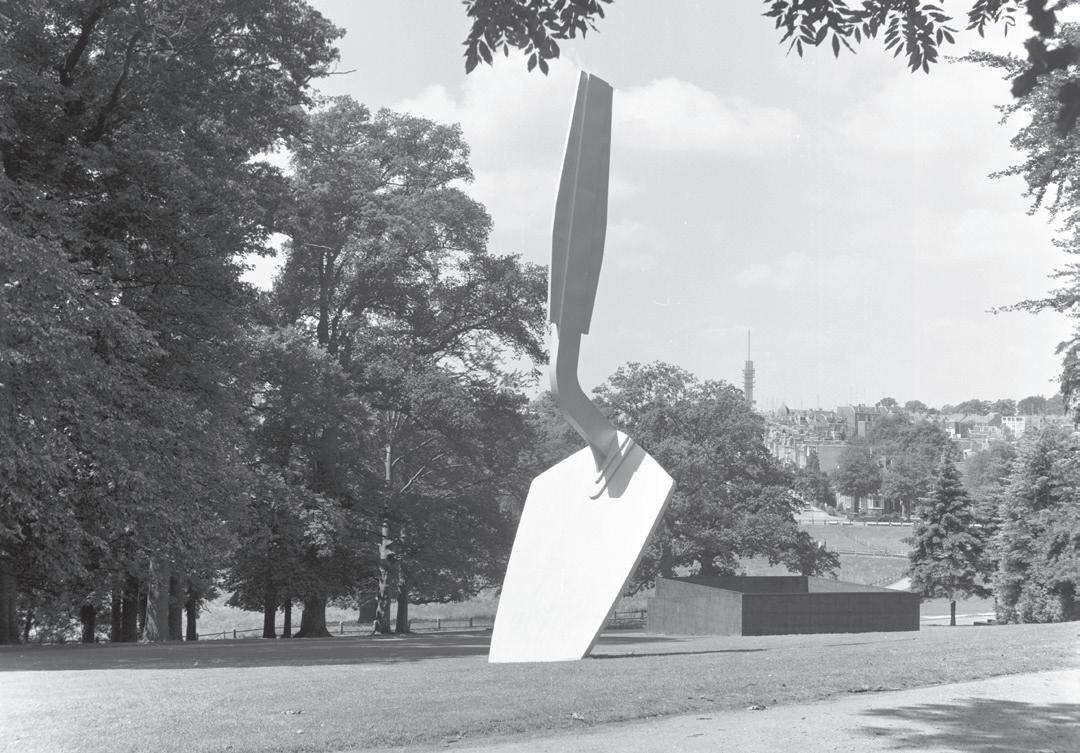
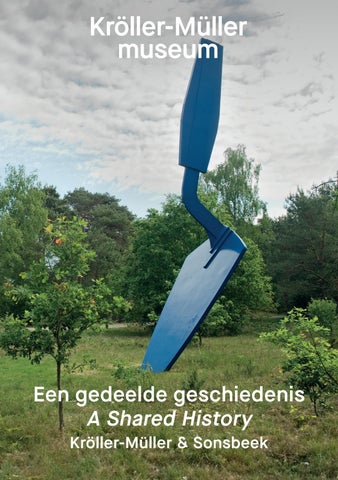
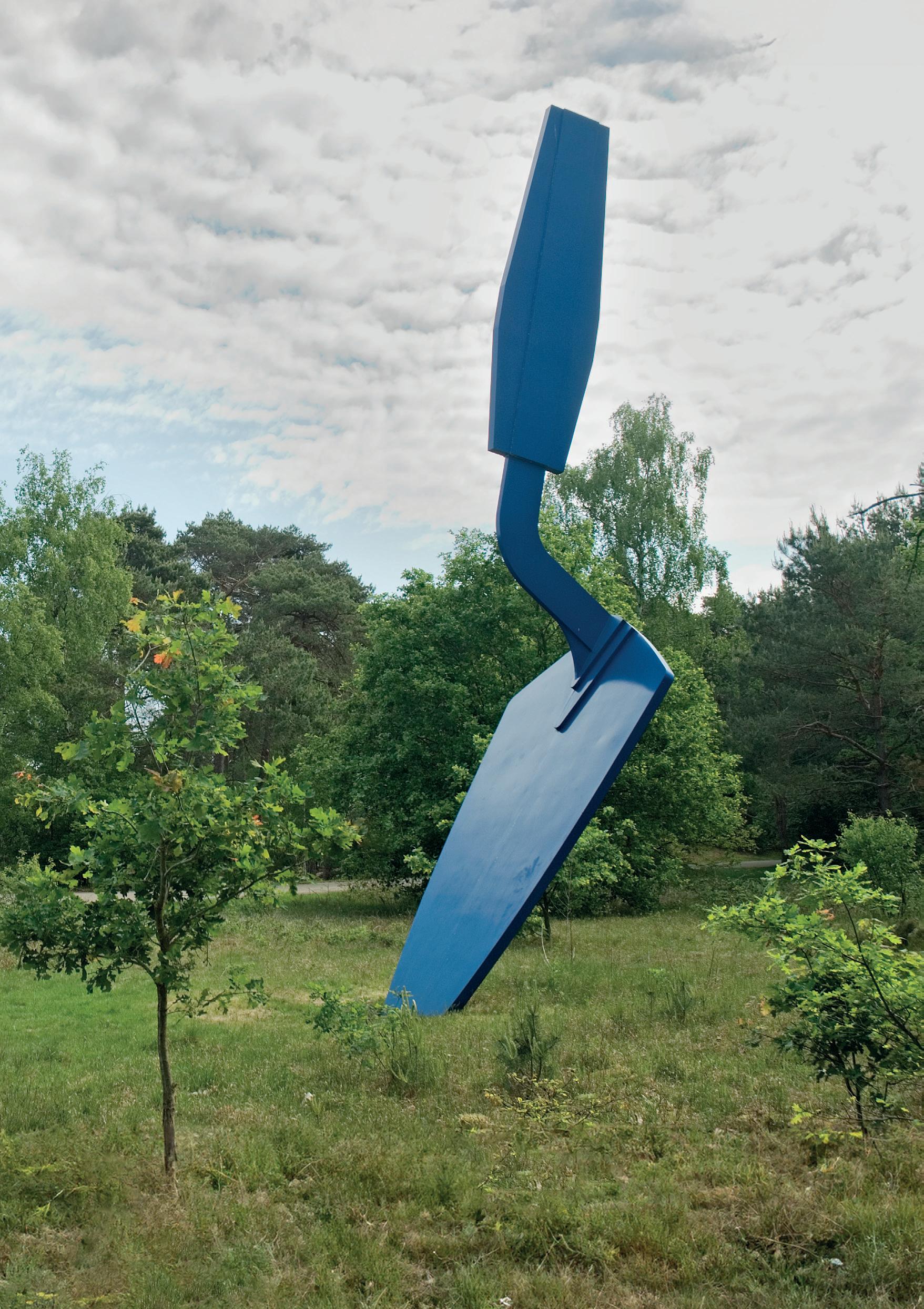
Als een blauwe blikvanger die het Kröller-Müller Museum aankondigt, staat op de T-splitsing naast de entree een ruim elf meter hoge troffel: Trowel (Troffel) van Claes Oldenburg (1929-2022). Deze Zweeds-Amerikaanse kunstenaar vergaart bekendheid met zijn gigantische uitvergrotingen van alledaagse voorwerpen en gebruiksartikelen; Trowel is zijn eerste grootschalige sculptuur die in Europa wordt gerealiseerd. Dit gebeurt in 1971, voor de legendarische zesde editie Sonsbeek ’71. Sonsbeek buiten de perken, samengesteld door Wim Beeren, aanvankelijk in samenwerking met Rudi Oxenaar. Een internationale selectie van vernieuwende kunstenaars wordt uitgenodigd om site specific (locatiegebonden) werk te maken, speciaal voor deze tentoonstelling. Die strekt zich ver buiten de grenzen van Park Sonsbeek uit; kunstprojecten ontstaan verspreid over heel Nederland. De uitvoering van Trowel, die oorspronkelijk zilverkleurig is, is duur. Oxenaar lost het op: het Kröller-Müller Museum dekt de kosten als de sculptuur na Sonsbeek ’71 aan het museum wordt geschonken. En zo kiezen Oldenburg en Oxenaar later dat jaar samen een plek voor Trowel op de Veluwe, op de kruising. In 1976 wordt het werk geverfd. Oldenburg wil een meer opvallende kleur, die afsteekt tegen de omgeving. Hij kiest voor blauw, een verwijzing naar de kleur van de overalls van Nederlandse werklieden die troffels gebruiken.
Standing at the T-junction near the entrance, a trowel over 11 metres tall serves as an eye-catching blue landmark announcing the Kröller-Müller Museum: Trowel by Claes Oldenburg (19292022). This Swedish-American artist is renowned for his gigantic enlargements of everyday objects and functional items; Trowel was his first large-scale sculpture to be realised in Europe. This happened in 1971, for the legendary sixth edition Sonsbeek ’71: Sonsbeek buiten de perken (Sonsbeek Out of Bounds) curated by Wim Beeren, initially in collaboration with Rudi Oxenaar. An international selection of innovative artists is invited to create site-specific works especially for this exhibition. It extended far beyond the boundaries of Sonsbeek Park; art projects sprang up all over the Netherlands. The realisation of Trowel, which was originally silver in colour, was expensive. Oxenaar found a solution: the Kröller-Müller Museum would cover the costs if the sculpture were donated to the museum after Sonsbeek ’71. And so, later that year, Oldenburg and Oxenaar chose a location for Trowel in the Veluwe, at the intersection. In 1976 the work is repainted. Oldenburg wanted a more conspicuous colour, that would stand out against the surroundings. He chose blue, referring to the colour of the overalls worn by Dutch labourers who use trowels.
Tekst en samenstelling / Text and compilation: Kröller-Müller Museum, Sonsbeek kunstprojecten
Vertaling / Translation: Mike Ritchie
Vormgeving / Design: Saiid & Smale
Druk / Printing: Drukkerij de Bij, Amsterdam
Fotografie / Photography: omslag: Cary Markerink • pag. 9: Gelders Archief: 1583 - 9931, Renes, CCBY-4.0 licentie • pag. 10: Wouter van Heusden • pag. 11: Gelders Archief: 1500 - 3407, Public Domain Mark 1.0 licentie • pag. 12: M.A.C. van ’t Houdt. Afkomstig uit fotoboek/from photo album ‘Zomer 1952 Sonsbeek Arnhem, 1952’, met dank aan/ courtesy of Frans & Theo Brink • pag. 13: Gelders Archief: 1583 - 9937, Renes, CC-BY-4.0 licentie • pag. 14: Gelders Archief: 1524 - 9266, fotograaf Gemeentearchief Arnhem, CC0 1.0 licentie • pag. 15: Gelders Archief: 1585 - 790, Jos Pé, CC-BY-4.0 licentie • pag. 16: Gelders Archief: 15249278, fotograaf Gemeentearchief Arnhem, CC0 1.0 licentie • pag. 17: Rob C. Kroes, Nationaal Archief / Anefo • pag. 18: Herman van Ommen © Sonsbeek kunstprojecten • pag. 19: Gelders Archief: 150101 - 7725, Gerdien Mogendorff, CC0 1.0 licentie • pag. 20: Gelders Archief: 1583 - 14929, fotograaf Gemeentearchief Arnhem, CC0 1.0 licentie • pag 5-6, 20-21: Marjon Gemmeke