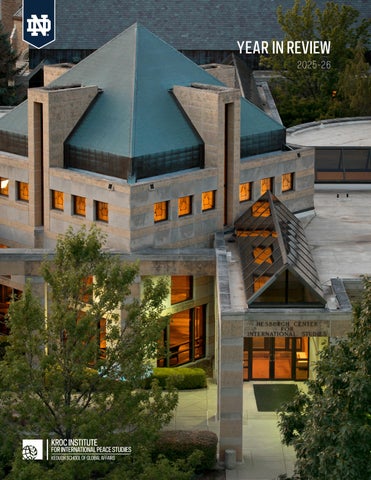
YEAR IN REVIEW 2025-26
TABLE OF CONTENTS YEAR IN REVIEW 2025-26
1
Letter from the Director
3
Thoughts from the inaugural cohort of the International Peace Studies Ph.D. program
6
Kroc Institute faculty and staff shine brightly with research efforts
18
If you want to go far, go together
24
Kroc Institute People
26
Financial Overview
28
Publicity and Outreach
The University of Notre Dame’s Kroc Institute for International Peace Studies, part of the Keough School of Global Affairs, is one of the world’s leading centers for the study of the causes of violent conflict and strategies for sustainable peace.
EDITORIAL
CR E ATIV E
Editor-in-Chief and Lead Writer: Kate Chester (B.A. ’88)
Visual and Graphics Editor: Jena O’Brien
LETTER FROM THE DIRECTOR In my opening letter in last year’s annual report, I commented on the assault of the Trump administration on peacebuilding infrastructure and its impact on our operations as a peace institute. I noted that it will likely shape our work in the years to come. I wish I were able to write to you now that I was wrong or exaggerating. Given the loss of federal funds, in 2025-2026 we faced challenges in our research and policy work, and our graduating students have had fewer employment opportunities in the peacebuilding sector around the world. Also, the chilling effect on academic freedom wrought by the Trump administration has continued to affect American higher education, and unfortunately, we have not been spared. On a positive note, however, we were able to respond to some of these challenges constructively given the stability of our endowment and our standing in the field. We organized public events and offered a convening space for peacebuilders to rethink how peace research, policy and practice should be reoriented in this age of political and academic precarity. Notably, on March 10 and in partnership with the Alliance for Peacebuilding and former leaders of the United States Institute of Peace, we organized a day-long public event in Washington, DC, bringing together leaders and thinkers to explore how to respond to these challenges. Peter Quaranto, Visiting Professor of the Practice at the Keough School of Global Affairs, who works closely with the Kroc Institute, spearheaded this effort with the support of key faculty, staff and students. More than 250 people attended that day, and I can say with confidence that the success of the event was in large part a result of our reputation as a premier peace institute and our robust professional networks. This past academic year, Peter has also invested much effort and talent as the faculty editor of the Institute’s Peace Policy online publication. I encourage you to read the latest issues covering a variety of topics: from atrocity prevention, to American peacebuilding at the crossroads, to issues surrounding artificial intelligence, to peacebuilding perspectives on current-day nuclear arms concerns in the context of history and ethics. We were excited to welcome our first cohort of doctoral students in International Peace Studies, which we popularly call the “stand-alone” program. These students joined our existing and successful joint-doctoral programs, launched in 2008 in partnership with six departments at the College of Arts and Letters. The “stand-alone” program has been long in coming, and we designed it to attract experienced peace practitioners wanting to integrate their knowledge into pivotal doctoral research. We look forward to ongoing development of this program as it evolves and matures; read about our talented first cohort on page 3.
1
In May 2026 we held our second annual Kroc Institute Strategic Peacebuilding Academy (KI-SPA) focused on the theme, “Modes of Healing”; a recap on the gathering can be found here. KI-SPA took the space and function of our longrunning Summer Institute but with a slight twist. Its purpose is twofold. First, it is designed to bring peace practitioners and scholars to campus, to focus on a particular theme that changes each year. Second, the gathering intentionally integrates skills-building for participants and encourages them to network with one another, fostering a collaborative community of practice. KI-SPA is a major endeavor for us, and I am happy to report that KI-SPA 2027 is already in the making, with the focus being on constructing the peacebuilding future in education, in training, in community-based efforts and beyond. Details are being finalized about next year’s convening and will soon be available. Our faculty, staff and students continued to engage in robust peace research, and in this annual report we put the spotlight on their scholarly work and institutional cross-collaboration. With 24 faculty, 26 staff and 30 Ph.D. students, we have a number of sources from which to gather examples—and as you’ll see, it is a long collection! Last but not least is our 40th anniversary. The Institute was formally founded in August 1986, and we will celebrate this significant milestone throughout the academic year of 2026-2027. Already we have spent time planning anniversary activities, which will include a research symposium scheduled for March 18-20, 2027. The symposium will consist of five tracks; the first four are peace education in times of academic precarity, innovative peace research, challenges and responses to peace policy and practice, and the connection between peace and democracy. The fifth track will be dedicated to re-thinking strategic peacebuilding, which for many years has been the organizing concept of the Kroc Institute. We welcome seeing our alumni, colleagues and friends in attendance, and I invite you to mark these dates on your calendar with the hope that you can join us. The symposium will be both thought-provoking and fun. I anticipated being able to give you a recap in this letter on the outcome of what had been planned as our first 40th anniversary event: an alumni-focused gathering in Nairobi in June 2026. We had a full program, and many of our African alumni confirmed participation. However, the Ebola outbreak in East Africa forced us to cancel it this year. We are rescheduling it for June 2027, so you’ll be able to read about it in next year’s annual report! Global events throughout the world continue to haunt us. The war in Iran launched by the United States and Israel is one of the distressing signs of a changing and deteriorating global order. In the United States, democratic backsliding continues unabated and government corruption reaches unprecedented heights. In other parts of the world, from Ukraine to the DRC, from Venezuela to China, we are witnessing continued pressure and challenges to peace, justice and stability. There is a lot of peace work to be done, and our Kroc Institute community continues to be at the frontlines of it. I dream about a world where we need to look for a different profession. Until that day arrives, however, I thank you for your support of our peacebuilding efforts in research, education, policy, and practice. Yours,
Asher Kaufman John M. Regan, Jr. Director Professor of History and Peace Studies
2
Inaugural cohort members of the International Peace Studies Ph.D. program share reactions to their first year
Fall 2025 marked the launch of the latest doctoral program at the Kroc Institute for International Peace Studies, part of the Keough School of Global Affairs—specifically, a program fully focused on international peace studies. The new program caters to individuals with interdisciplinary academic and professional backgrounds who wish to integrate their knowledge into high-impact doctoral research. It joined six other long-standing Ph.D. programs administered by the Kroc Institute that pair peace studies with distinct disciplines based on partnerships the Kroc Institute has with Notre Dame departments: anthropology, history, political science, psychology, sociology, and theology. “We welcomed an outstanding group of accomplished professionals into the program this year, whose curiosity and experience have benefitted the Kroc Institute,” said Cat Bolten, a professor of anthropology and peace studies and the director of the institute’s doctoral studies. Six doctoral students were welcomed to the Kroc Institute last fall, with four being admitted to the new IPS program and each having specialized expertise (the remaining two students were admitted to the joint Ph.D. programs – Sarah DeMarais, in peace studies and theology, and Shimon Likhtman, in peace studies and anthropology). Here are their thoughts after year one in the IPS program, along with their hopes and research ambitions.
3
Eskandar Ataallah
Melissa Baganz
Eskandar Ataallah is a Syrian peacebuilding practitioner and researcher with experience across conflict-affected settings in relief, development, and peacebuilding. His work spans program management, context analysis, and stakeholder engagement with organizations such as the U.S. Agency for International Development, United Nations Development Programme, The Office of the United Nations High Commissioner for Refugees, and Catholic Relief Services. He earned his master’s degree in global affairs with a concentration on international peace studies from Notre Dame’s Keough School of Global Affairs. Research: My research focuses on the political economy, particularly international economic sanctions and their unintended consequences, with special attention to the use of Artificial Intelligence for early warning and peacebuilding efforts. Reflections: My first year in the stand-alone IPS program has been incredibly rewarding intellectually, especially through the opportunity to engage closely with faculty and peers across disciplines while refining my research agenda. Over the coming year, I hope to further strengthen the methodological foundations of my work while continuing to develop new research projects for conference presentations and publication.
Melissa Baganz is a certified civil mediator and experienced workshop facilitator in the areas of mediation, conflict transformation, and communications skills-building. She brings practical, hands-on expertise through her long-term work with non-governmental organizations in Germany and India. Research: My research focuses on persistent violence in contexts shaped by formal peace processes, with a particular emphasis on how the design of these processes influences long-term outcomes. Reflections: My first year in the International Peace Studies program was formative both intellectually and professionally. The program’s flexibility allowed me to engage with interdisciplinary perspectives, particularly those from sociology and anthropology, while further refining my research focus. I worked as both a teaching assistant and research assistant on the Legacy Project, which enabled me to participate in a research trip to Bogotá, Colombia, where our team organized and conducted a workshop. I also served as a commentator for Dr. Kerry Clamp’s on-campus presentation, “Relational Accountability in Transitional Justice,” which deepened my interest in issues of memory, accountability, and transitional justice. I look forward to furthering my research by attending Professor Laurie Nathan’s summer course on mediation in Geneva, Switzerland.
4
Mohamed El Meadawy
Aidana Rakhatbekova
Mohamed El Meadawy is a peace researcher and practitioner whose work has examined the intersection between peacebuilding, development, and religious ethics, with a particular emphasis on post-conflict societies. Research: My research examines the conception of the human being that operates within development discourse. The aim is to identify its concealed assumptions and trace its philosophical foundations. My work focuses on textual analysis, anchored within the critical linguistics tradition. Reflections: My first year at the Kroc Institute was equally challenging and rewarding. I had the opportunity to study under some of the world’s leading experts in their respective fields. I was fortunate to receive their support in helping me develop and articulate my ideas. In the year ahead, I hope to start carving out the intellectual space my project will occupy, and identify the community of scholars with whom my research will be in conversation.
Aidana Rakhatbekova has worked with international and local organizations on human rights, legal cooperation, and cross-cultural dialogue since 2016, with positions at the Red Crescent Society of Kyrgyzstan and the Foundation for International Legal Cooperation. Research: My dissertation research examines Indigenous community responses to state and corporate extractivism across Russia’s Arctic and Sub-Arctic regions, and understanding these responses as forms of constructive resistance with implications for environmental justice. Reflections: During my first year, I benefited from a flexible curriculum spanning peace studies, Indigenous studies, sociology, and sustainable development, which allowed me to develop my own intellectual track across these fields. I also had the privilege of learning from and alongside faculty and fellow scholars whose expertise meaningfully shaped how I approach my research. I received the Liu Institute grant and launched my first independent research project, currently underway, and moderated a panel on Indigenous peacebuilding at the Notre Dame Student Peace Conference. In the coming year, I am preparing to present work in progress at a summer school on minority rights and selfdetermination in Budapest, advance my dissertation research, and work toward my first publications.
5
Kroc Institute faculty and staff shine brightly with research efforts
Since its foundation in 1986, the Kroc Institute has emphasized policy informed peace research as one of its main pillars of operation. Over the past 40 years, and as programmatic research has advanced, so have pivotal, individual research contributions from the Institute’s faculty and staff. “The past year is a fantastic example of that growth and focus on research,” said Asher Kaufman, John M. Regan, Jr. Director of the Institute, referencing the many authored books, book chapters, reports, academic articles, and op-eds in consumer media on subject matter germane to the expertise of faculty and staff. He also highlighted that several have been invited to give scholarly talks around the globe because of their proficiency, and have been regularly interviewed by international and domestic media outlets. “I’m proud and humbled by the research being produced—and the doors being opened to collaborative future work because of it,” he continued. Following are topical categories from the past academic year, July 2025 through June 2026, representing the work of faculty and staff associated with the Kroc Institute. Highlights include research articles; scholarly presentations; published books, book chapters, policy memos and reports; and a sample of key media coverage because of their subject matter expertise.
PEACEBUILDING POLICY AND PRACTICE Melinda Davis (B.A. ‘19), Research Associate, Peace Accords Matix, co-authored the article, “Peace Accords Matrix and its Peacebuilding Work in Mindanao,” with Madhav Joshi for the September 2025 issue of Pax Lumina.
6
Aref Dostyar (M.A. ‘16), Program Director, Afghanistan Program for Peace and Development (AfPAD): •
•
•
• • •
•
Authored the byliner, “How the United Nations Can Turn Afghanistan’s Seat Into a Path Forward” for the Sept. 16, 2025 issue of PeaceRep, The Peace and Conflict Resolution Evidence Platform affiliated with the University of Edinburgh. With C.J. Pine (B.A. ‘17) and George A. Lopez, co-wrote the byliner, “Moving Beyond the Security Council’s Impasse to Support Afghanistan,” which ran in the March 25, 2026 edition of the International Peace Institute’s Global Observatory, which offers timely analysis on peace and security issues by experts, journalists, and policymakers. The article was later picked by ReliefWeb. Led efforts for the Dialogue and Visioning Process, part of AfPAD, which was highlighted in the article, “Various Afghanistan Groups Call for Expanded UNAMA Political Powers,” in the May 15, 2026 issue of Hasht e Subh Daily/8 a.m., a major Afghan media outlet. Coverage stemmed from a Kroc Institute policy memo showing that various groups of people from Afghanistan, inside and outside the country, are calling for a review of the working methods of the United Nations Assistance Mission in Afghanistan (UNAMA) and for an expansion of its political authority. Amu TV also covered the policy memo, with the segment running May 14, 2026, and Etila Atroz published the Farsi translation of the full memo on May 22, 2026. Authored the policy memo, “Advancing U.S. Interests Through a Restructured United Nations Assistance Mission in Afghanistan (UNAMA),” for the Libertas Council that ran June 3, 2026. Was one of the authors behind the op-ed, “Why Afghanistan Opposes the UN Mission But Still Needs It,” which ran June 7, 2026 in Hasht e Subh Daily/8 a.m. Was invited to participate in a private roundtable discussion, “Facilitating an Inclusive and Sustainable Political Process in Afghanistan,” on Nov. 19, 2025 at the offices of the Center for a New American Security in Washington, DC. The discussion explored how the United States, Europe, and the United Nations can facilitate a structured process of engagement among Afghan citizens, including those in exile, that builds toward an inclusive and sustainable political process in the country. With support from both the Keough School of Global Affairs and the Kroc Institute, established a memorandum of understanding with Woman Online University. The Keough School’s June 25, 2026 article on the partnership was picked up by several Afghan media including Afiniti Television and Amu Television.
Emma Murphy, Postdoctoral Research Associate, Peace Accords Matrix and the Clingen Family Center for the Study of Modern Ireland: • •
Published a review in H-Diplo, which ran Oct. 24, 2025 and is part of a roundtable review of the recent book, Relational Peace Practices. Authored a review essay about peacebuilding in Colombia for the journal Peacebuilding. The essay was published Jan. 3, 2026 and focused on two recent books, one of which – Feel the Grass Grow: Ecologies of Slow Peace in Colombia – is authored by Angela Lederach (Ph.D., ‘20).
Laurie Nathan, Professor of the Practice of Mediation; Director, Mediation Program: •
• •
Helped author the article, “Religious and secular mediators need each other,” which ran on the Peace Research Institute Oslo website on Oct. 16, 2025 and stemmed from the July 2025 conference in Vatican City, “Religious Dimensions of Peacemaking.” Presented “The Potential and Challenges of International Mediation” on Dec. 4, 2025 at the University of Wisconsin Law School. Was a distinguished speaker in the Jan. 30, 2026 online seminar, “Alternative Dispute Resolution in Africa: Toward Sustainability and Advancement,” hosted by Sacramento State University’s Center for African Peace &
7
•
•
Conflict Resolution. Was a panelist as part of the April 27, 2026 Sigur Center for Asian Studies seminar, “Afghanistan and Its Neighbors: Conceptualizing a Regional Mechanism for Principled Security,” hosted by George Washington University. The panel also featured Nilofar Sakhi, a visiting research fellow at the Kroc Institute in fall 2022. Assisted with the design and facilitation of a retreat for special envoys based in Africa, in Pretoria, South Africa’s capital, May 20-22, 2026. The retreat was co-hosted by the South African and Swiss departments of foreign affairs. This was followed by serving as the lead trainer and instructor at the annual United Nations High Level Mediation Course held in Glion, Switzerland in June 2026. Convened by the UN Mediation Support Unit in partnership with the Swiss government, this year’s course enrolled 22 participants, all senior officials from the UN and other peacemaking organizations.
CEASEFIRES AND MEDIATION Madhav Joshi, Research Professor and Associate Director of the Peace Accords Matrix, was interviewed for the article “Russia-Ukraine War Shows Ceasefires Have Lost Meaning Under Trump,” which ran May 13, 2026 in the New York Times. The article was picked up by several media outlets, with excerpts published by RBC Ukraine in its article, “Trump’s ceasefires in Ukraine became political theater, professors say.” Laurie Nathan, Professor of the Practice of Mediation; Director, Mediation Program: • • • •
•
• • •
Bylined the article, “Implementing the Gaza Ceasefire” for the Oct. 20, 2025 issue of Just Security. Authored an op-ed that ran on the Peace Research Institute Oslo website on Dec. 8, 2025, “The UN Security Council Resolution on Gaza: Age of Consent or Recipe for Conflict?” Authored the op-ed, “Achieving a Genuine Ceasefire in Gaza: Lessons from Other Ceasefires,” that ran Dec. 18, 2025 as part of the International Peace Institute’s Global Observatory. Was included as part of a recap in Geneva Solutions that ran Oct. 17, 2025 and stemmed from coverage of Nathan’s participation in Geneva Peace Week, Oct. 13-17, as a panelist in the discussion, “Ceasefires and Peace Processes: Lessons for Policy and Practice.” Specifically, Laurie addressed ceasefires, peace processes, and the case study of Darfur, Sudan. Was quoted in the Nov. 17, 2025 issue of PassBlue as part of the article, “The UN Security Council Accepts US Plan for Gaza With Wariness.” Nathan’s PassBlue quotes were picked up as part of an original article, “What is missing from UNSC Resolution 2803?,” that ran the following day in the newsletter published by the Arab Center in Washington, DC. The article was authored by Brian Brivati, the executive director of Britain Palestine Project. Was interviewed for a Q&A – “Is It Really a ‘Cease-Fire’ if Both Sides Are Still Shooting?” – with Foreign Policy that ran May 13, 2026. Was interviewed by the New York Times and quoted within the article, “Cease-Fires, but No Peace: A truce isn’t necessarily doomed if the missiles are still flying. Here’s why.” which ran May 27, 2026. Was interviewed for a Q&A, “Middle East: “All ceasefires are violated. Always.,” with Le Soir, which ran June 29, 2026; following is the link to both the French and English versions. The article was also picked up by 24 Heures.
PEACE AGREEMENTS Madhav Joshi, Research Professor; Associate Director of the Peace Accords Matrix: •
8
Was interviewed by MindaNews for the article, “Bangsamoro peace implementation lags in global average,
•
•
expert says” that ran Jan. 26, 2026. The article was picked up that same day by the following outlet by Inquirer. net. Authored the article, “Active International Actors Accompaniment, Reputational Costs and Colombia’s 2016 Peace Agreement Implementation,” which was published in the academic publication Journal of Intervention and Statebuilding on March 19, 2026. His article, “Does the Implementation Status of Gender Provisions Affect the Implementation of a Peace Agreement? Evidence from Colombia’s 2016 Peace Agreement Implementation Process,” ran April 8, 2026 on the Policy Studies Journal blog. The article was first published in the journal in December 2024.
PEACE AND SECURITY Josefina Echavarría Álvarez, Professor of the Practice; Director, Peace Accords Matrix: •
Co-authored the following policy briefs as part of the Keough School of Global Affairs policy brief series: •
•
“Beyond Ethnocracy: Lessons from Colombia and Northern Ireland for a ‘Dayton+’ in Bosnia and Herzegovina,” with Liridona Veliu Ashiku and Emma Murphy (2026) “Third-Party Monitoring Essential for Success of Peace Deals” with Peter J. Quaranto (B.A. ‘06), Tyler Jess Thompson, and Aly Verjee (2025)
Madhav Joshi, Research Professor; Associate Director of the Peace Accords Matrix: • • • • •
Authored the article, “The R-ARCSS and Institutionalizing Peace and Stability in South Sudan,” which was published online Oct. 22, 2025 in the Journal of World Affairs: Voice of the Global South. Published an article, “Prosecuting the political opposition: the court and subnational variation in the onset of the Maoist conflict in Nepal,” which ran Jan. 29, 2026 in the Japanese Journal of Political Science. Was interviewed by the European Center for Populism Studies, a Brussels-based think tank, about Nepal’s recent election, whose article ran March 18, 2026. Authored the article, “Nepal in 2024 and 2025: A Leap Forward From Politics as Usual?” for the April 1, 2026 edition of Asia Survey. Co-authored an article, “Where are the international allies of Afghan women,” with Grace Sullivan, his research assistant who is majoring in global affairs and minoring in peace studies and gender studies. The article ran in mid-April 2026 in the Australian Journal of International Affairs.
Peter J. Quaranto (B.A. ‘06), Visiting Professor of the Practice, Keough School of Global Affairs: • • • • •
•
Bylined the piece, “Five Big, Beautiful ‘Peace’ Announcements Trump Could Make Next Week,” for the Sept. 18, 2025 edition of the Center of International Policy newsletter. With George A. Lopez, co-authored an op-ed, “Turning Trump’s Peace Overtures into Sustainable Deals,” for the Sept. 19, 2025 issue of Just Security. Co-authored the op-ed, “Global Fragility Act 2.0? Amid a Possible Bipartisan Revival, a Chance to Make U.S. Peace Efforts More Effective,” for the Oct. 15, 2025 issue of Just Security. Co-authored the op-ed, “The Brewing Egypt-Ethiopia Nile River Conflict is Ripe for ‘Solving,’” for the Oct. 31, 2025 issue of Just Security. Co-authored the op-ed, “As Trump Presses for a Post-Maduro Venezuela: Questions, Lessons, and Warnings for the Aftermath,” for the Nov. 24, 2025 issue of Just Security. With Josefina Echavarría Álvarez and two other authors, penned the byliner, “Lasting peace in Ukraine may
9
• • • • •
hinge on independent monitors – yet Trump’s 28-point plan barely mentions them,” which ran in the Dec. 3, 2025 issue of The Conversation. Co-authored a byliner with David Cortright, “The American peace movement we need today,” for the Dec. 16, 2025 edition of Waging Nonviolence. With David Cortright, co-authored the byliner, “No to Wars of Conquest in Venezuela and Beyond,” that ran Jan. 9, 2026 on the Center for International Policy website, under the “Publications” tab. With C.J. Pine (B.A. ‘17) and George A. Lopez, authored the article, “How the U.N. Can Show Renewed Leadership on Peace Efforts in 2026,” for the Feb. 2, 2026 edition of Just Security. Authored the article, “To Memorialize the Fallen, Renew the Pursuit of Peace,” for the May 22, 2026 edition of Just Security. Co-authored the article, “Renewing the UN’s Toolbox for Peace and Security,” which ran June 2, 2026 on the Stimson Center website.
Lisa Schirch, Richard G. Starmann, Sr. Professor of the Practice of Peace Studies, co-authored an op-ed with David Cortright, “Millions are protesting – but boycotts might be key to changing government policies.” The article ran March 26, 2026 in The Conversation and was widely circulated by media outlets across the country. Ernesto Verdeja, Associate Professor of Peace Studies and Global Politics; Director of Undergraduate Studies: •
Co-authored a byliner for the Chicago Tribune entitled, “Local control over police is a check on executive power.” The op-ed ran Aug. 27, 2025. Among the many media outlets picking up the op-ed were the Center for the Study of Federalism and Governing Magazine. The op-ed was cited in a large policy report from the Center for American Progress – see footnote three in the second paragraph – with the report garnering significant media coverage from national outlets, including Newsweek and the Washington Post.
MIDDLE EAST WARS AND CONFLICTS Asher Kaufman, John M. Regan, Jr. Director of the Kroc Institute; Professor of History and Peace Studies:
•
•
10
Authored the following byliners for The Conversation, which were picked up by hundreds of media outlets and news services around the world: • “Amid fragile ceasefire, violence in southern Syria brings Druze communities’ complex cross‑border ties to the fore” (July 21, 2025) • “Netanyahu remains unmoved by Israel’s lurch toward pariah status − but at home and abroad, Israelis are suffering the consequences” (Aug. 23, 2025) • “Trump’s Gaza peace plan: A bit of the old, a bit of the new – and the same stumbling blocks” (Sept. 29, 2025) • “A year on, the Israeli-Lebanese ceasefire looks increasingly fragile − could a return to cyclical violence come next?” (Nov. 26, 2025) • “Israeli action in Lebanon risks repeating history’s mistakes — and torpedoing a historic moment for dialogue” (March 20, 2026) • “In Iran war’s shadow, Israel’s renewed Lebanon campaign risks repeating failed lessons – and occupations – of the past” (June 1, 2026) Authored the article, “The Rise and Fall of the Hiram–Solomon Alliance: Zionist, Hebrew and Lebanese
• • • • • •
Nationalism, and the 1982 Israeli Invasion of Lebanon,” for the journal Nations and Nationalism that was published March 19, 2026. Authored the op-ed, “In Lebanon, Israel is also destroying the homes of those who were its allies for decades,” for the blog site Bearing Witness, which ran May 24, 2026 originally in Hebrew and was translated into Arabic. Was interviewed for the podcast, “Beyond Politics” for the episode, “The Gaza Ceasefire and Prospects for Peace in the Middle East with Professor Asher Kaufman,” which aired Nov. 30, 2025. Was interviewed live by BBC-TV on March 23, 2026 for a segment regarding the Israeli military and its plans for the expansion of ground and air attacks against the Lebanese armed group Hezbollah. Was the featured guest on the “The Long History Short” podcast, which ran March 29, 2026. The segment, “Israeli Foreign Policy: What It Has Been, What It Could Be,” was hosted by Brian Stahl, a Notre Dame graduate who had been a student of Kaufman’s. Was interviewed by Arab News for a May 3, 2026 article, “Could a revived Trans-Arabian Pipeline map a new future?,” which was based on a study Kaufman published in 2014. Was interviewed by the BBC for the segment/article, “Why is this 900-year-old fortress important in the IsraelHezbollah war?,” which ran June 3, 2026 and was translated into Spanish, Hausa, Swahili, and Turkish.
Ernesto Verdeja, Associate Professor of Peace Studies and Global Politics; Director of Undergraduate Studies: • •
Was the featured guest on the Sept. 20, 2025 segment, “The Gaza Genocide in Five Crises – Gaza, Genocide and Social Theory,” that aired on The Sociology of Everything Podcast. Was interviewed for an Al Jazeera article, “Genocide label crucial in addressing atrocities in Gaza: Legal scholars,” that ran Oct. 8, 2025. Verdeja’s quotes conclude the article.
RELIGION, ETHICS, PEACEBUILDING, RACIAL RELATIONS AND INTERFAITH WORK Melinda Davis (B.A. ‘19), Research Associate, Peace Accords Matrix, was the lead author of the Conference Report of the Workshop on Religious Dimensions of Peacemaking, joined by fellow authors Laurie Nathan, Peace Research Institute Oslo, and Pontifical Academy of Social Sciences. The report stemmed from the July 2025 workshop they hosted in the Casina Pio IV, Vatican City. Emmanuel Katongole, Professor of Theology and Peace Studies and Director of the Ansari Institute for Global Engagement with Religion, authored the byliner, “Pope Leo is not traveling to bring hope to Africa, but to find hope,” for the National Catholic Reporter that ran April 7, 2026. The op-ed also appears in the “Leo XIV in North and Central Africa” feature series. View the full series here. Caesar A. Montevecchio, Assistant Director, Catholic Peacebuilding Network:
•
Co-authored the report, Catholic Approaches to Mining: A Framework for Reflection, Planning, and Action, with Séverine Deneulin, Laudato Si’ Research Institute, Campion Hall, University of Oxford. The report was translated into Spanish, Portuguese, French, and Italian, and its launch in October 2025 was supported by a virtual panel discussion with partners Laudato Si’ Research Institute Campion Hall, University of Oxford; the Catholic Peacebuilding Network; the Kroc Institute; the Holy See Dicastery for Promoting Integral Human Development; and Caritas Internationalis. Following is coverage stemming from the panel discussion and report launch: • The Tablet (Oct. 31) – Was one of several quoted within the feature stemming from the Oct. 21 virtual panel discussion.
11
•
• Catholic Culture (Oct. 27) Co-authored the article, “The Catholic Church and Mining: Types of Responses,” with Deneulin for the journal Sustainability. The article complemented the Catholic Approaches to Mining report.
Ebrahim Moosa, Mirza Family Professor of Islamic Thought and Muslim Societies, Keough School of Global Affairs:
• • •
His book, “What is a Madrasa?,” was featured in the Aug. 9, 2025 issue of The True and Impartial Daily Sun based on the book’s translation in Bengali for the first time by Chaitanya Prokashan. Presented “Critical Traditionalism in Islamic Thought: History, Norms and Interpretation” at Georgetown University as part of its Department of Arabic and Islamic Studies in early December 2025. Was the featured guest on “Akbar’s Chamber: Experts Talk Islam” podcast that was posted Dec. 1, 2025. Moosa is introduced and begins his interview about five minutes into the segment, titled “What is a Madrasa? Life and Learning in an Islamic College.”
A. Rashied Omar (M.A. ‘01), Associate Teaching Professor of Islamic Studies and Peacebuilding and a faith leader and peace practitioner based in South Africa half-time, was interviewed by several South African consumer media and wrote many op-eds over the past year: •
• • • • • •
•
•
Was featured within the Aug. 12, 2025 issue of GroundUp as he spoke to activists with UniteBehind, a community that argues that changes to Parliament’s code of conduct allow Members of Parliament (MPs) implicated in state capture to evade accountability. Was featured in an article that ran Aug. 13, 2025 in TimesLIVE regarding his talk with protestors marching against Parliament’s new code of conduct for MPs. Was quoted throughout an article in the Aug. 14, 2025 issue of the Eswatini Observer about a march in South Africa related to the constitutionality of a new code of conduct for the country’s MPs. Wrote an op-ed, “Our country’s wounds will not be healed by speeches and declarations,” for the Aug. 21, 2025 issue of South Africa’s Daily Maverick. Was noted in an article that ran Sept. 8, 2025 “We are tired – Faith leaders unite against gang killings in vigil at Athlone Magistrate’s Court,” in South Africa’s Daily Voice. Wrote an op-ed, “Police minister Cachalia’s hopeful engagement with Cape Flats residents,” for the Sept. 10, 2025 issue of South Africa’s Daily Maverick. Was among the faith leaders highlighted in an article in the Sept. 19, 2025 issue of South Africa’s Plainsman, who have convened an interfaith meeting in response to the ongoing spate of crime and violence across the Cape Flats. Authored the online article, “Africa, moral agency and strategic futures,” which was published Feb. 26, 2026 by ISS African Futures with Auda-Nepad, a platform to envision Africa’s future through advanced forecasting. Participated virtually in the seminar “Gangsterism and Social Dysfunction in the Western Cape,” on March 18, 2026.
Atalia Omer, Professor of Religion, Conflict and Peace Studies: • • •
12
Delivered the keynote address at the October 2025 Peace and Justice Studies Association conference held at Swarthmore College. Bylined the article, “Charlie Kirk’s Assassination and ‘Judeo-Christian’ Racism,” that ran on the Institute for the Study of Christian Zionism’s website in late October 2025. Delivered a presentation at Vassar College on Nov. 5, 2025, “Unlearning ‘Landlord Theology’: Excavating Alternative Jewish Traditions and Histories in Palestine.”
•
• • • •
•
Was interviewed as part of the podcast episode, “Israel, Palestine, and Christian Zionism,” which aired Nov. 25, 2025. The episode is part of the series, American Unexceptionalism: Fighting Religious Nationalism – with Dr. Matthew D. Taylor and Rev. Susan Hayward. Participated in the podcast episode, “Religion & Teaching in Times of Tension,” on Dec. 11, 2025, part of Indiana University’s “Religion &” series from its Center for the Study of Religion & American Culture. Was a panelist as part of the welcome plenary session at the 2026 ISA Conference, “Reappraisals: The Mobilization of the Intellect in Times of Catastrophe.” Her scholarship was cited in the Jewish Currents article, “Does the Jewish Body Keep the Score?,” which ran April 16, 2026. Her scholarship was highlighted in the May 26 edition of Union Juive Française Pour La Paix, as part of the “Afterword” about the book, “The Language of Gaza,” within the section titled, “Amalek.” Published the academic article, “A Subversive Pedagogy for Teaching Palestine/ Israel,” in the June 24, 2026 issue of the Journal of Interreligious Studies.
Gerard (Jerry) F. Powers (M.A. ‘88, J.D. ‘86), Director, Catholic Peacebuilding Studies; Coordinator, Catholic Peacebuilding Network: • • •
Penned an op-ed for The Conversation, “What is and isn’t new about US bishops’ criticism of Trump’s foreign policy,” which ran Feb. 11, 2026. The byliner was picked up by several media outlets including National Catholic Reporter, Religion News Service, Religion Unplugged and Yahoo! News. Was interviewed by The Conversation for its weekly podcast about the definition of ‘Just War’ and its definition in relation to the Trump administration and the Catholic Church. The interview aired April 30, 2026 and was picked up domestically by Yahoo! News and internationally by Yahoo! News/UK. Was interviewed by the National Catholic Reporter for the article, “Pope Leo upholds Vatican opposition to nuclear weapons despite Trump’s ‘weak’ critique,” which ran April 17, 2026.
NEWLY PUBLISHED BOOKS AND/OR BOOK CHAPTERS AND SECTIONS Josefina Echavarría Álvarez, Professor of the Practice; Director, Peace Accords Matrix: • •
Edited the book, “Crossing Borders in Search of the Truth: The Work of the Colombian Truth Commission with Exiles” (Universidad Externado de Colombia, Bogotá) Contributed to an edited collection with co-authors Cristian Sáez Flórez and Allison Kiehlhold, producing the chapter, “Post-Agreement Peacebuilding and Implementation,” edited by P. Terrence Hopmann and Siniša Vuković, Handbook on the Politics of International Agreements (Palgrave).
Asher Kaufman, John M. Regan, Jr. Director of the Kroc Institute and Professor of History and Peace Studies, contributed a chapter in the edited book, “Israel, Lebanon, and Hizballah 2010-2025: Between the Maritime Boundary Agreement and the Third Lebanon War,” in Elie Podeh and Onn Winkler (eds.), Israel in a Changing Environment (Tel Aviv: Dvir, 2026): 427-449. Richard (Drew) Marcantonio (Ph.D. ‘21, M.A. ‘18), Assistant Professor of Environment, Peace, and Global Affairs, authored the book, “The Environment in Conflict: Implications and Pathways” (Cambridge University Press, 2026), which was reviewed by the Journal of Social Encounters and Environmental Politics. Ebrahim Moosa, Mirza Family Professor of Islamic Thought and Muslim Societies, Keough School of Global Affairs,
13
authored a new introduction, “Reading Tradition: Pathways to the Study of Islam,” for Observing the Observer: The State of Islamic Studies in American Universities, eds. Mumtaz Ahmed, Zahid Bukhari & Sulayman Nyang (London; Washington: International Institute of Islamic Thought, 2025), ix-xlii. A. Rashied Omar (M.A. ‘01), Associate Teaching Professor of Islamic Studies and Peacebuilding: •
•
Authored the book chapter, “Hijrah From Mecca to Habasha: A Template for Interfaith Coexistence Today” in Prophet Muhammad at 1500: His Prophetic Legacy, Ethical Vision and Contemporary Resonance, edited by Aslam Fataar, 135–147. Cape Town: Al-Ikhlaas Academia Library and Resource Centre, 2026. Authored the book chapter, “Beyond the State: Interfaith Solidarity in the Struggle against Crime and Gang Violence” in Gangsterism and Social Dysfunction in the Western Cape, edited by Hein Willemse, 80–84. Cape Town: JDC Opinion and Review, 2026.
Lisa Schirch, Richard G. Starmann, Sr. Professor of the Practice of Peace Studies, contributed the chapter, “Construcción de paz, feminismo y religión: conceptos compartidos y bordes sanadores,” for the book, Enfoques feministas de transformación intercultural: Religión, violencia sexual y construcción de la paz, edited by María Pilar Aquino, Mónica A. Maher, and María del Carmen Servitje Montull, 147–166. Bogotá: Editorial Pontificia Universidad Javeriana, 2025. Ernesto Verdeja, Associate Professor of Peace Studies and Global Politics and Director of Undergraduate Studies, was one of the authors of “Artificial Intelligence for Peace: An Early Warning System for Mass Violence,” which runs as chapter nine in the second edition of “The Political Economy of Robots: Prospects for Prosperity and Peace in the Automated 21st Century,” published by Springer Nature Switzerland in September 2025. Peter Wallensteen, Richard G. Starmann, Sr. Research Professor Emeritus of Peace Studies, co-authored with Ivan Svensson the new book, “The Peacemaking Mandate: Nordic Experiences in International Mediation,” Cambridge University Press (2025), which was reviewed by Eurasia Review News and Analysis on Jan. 26, 2026.
TECHNOLOGY, ARTIFICIAL INTELLIGENCE, AND SOCIAL MEDIA Lisa Schirch, Richard G. Starmann, Sr. Professor of the Practice of Peace Studies: •
•
•
•
14
Wrote a byliner for The Conversation, “Social media can support or undermine democracy – it comes down to how it’s designed,” which was first published July 7, 2025 and ran in media outlets throughout the world through mid-September 2025. Contributed to the article, “Advancing Democracy as a Digital Public Service,” for TechPolicy.Press, which ran Sept. 5, 2025 and stemmed from the Victoria Forum in August, a conference hosted by a Canadian nonprofit organization that seeks to develop challenges to global problems in line with the UN’s Sustainable Development Goals. Her ‘Blueprint for Prosocial Tech Design Governance and Social Media Impacts on Conflict and Democracy’ was noted as an important and comprehensive governance architecture in Jordan Ryan’s Jan. 8, 2026 policy brief, “Reclaiming Attention: From Digital Conflict to Democratic Dialogue,” posted on the Toda Peace Institute website. Co-authored the June 25, 2026 paper, “Visualizing “We the People”: Bridging the Perception Gap through Pluralistic Data Storytelling,” for arXiv, which was shared at Civic Council for Courageous Citizenship in
• • • • •
Philadelphia at the Braver Angels Summit, June 25-28, 2026. Was the featured guest for the podcast, Let’s Talk Democracy for the segment, “The Megaphone Effect: How Social Media Controls Democracy,” airing Feb. 3, 2026. Presented at the Vatican in October 2025, on “Technology for Peace and Democracy.” Presented her work on “How Technology can Supercharge Democracy and Peace” at the Yale University Peacebuilding Colloquium, April 20, 2026. Moderated a panel on “Citizen Participation via Social Media and AI” at the Kellogg Global Democracy Conference at Notre Dame, May 19-20, 2026. Presented “Supercharging or Sabotaging Democracy: A Virtue-Ethics Lens on AI’s Role in Democratic Life” at the “Virtues for Generative AI” conference held at Notre Dame on May 21, 2026.
INTERNATIONAL LAW, PEACE STUDIES, AND CATHOLIC SOCIAL THOUGHT Mary Ellen O’Connell, Robert and Marion Short Professor of Law; Concurrent Professor of International Peace Studies, Kroc Institute:
• • • • • • • • • • • •
Her comments in a BBC interview related to international law and the need for consistency and universality were highlighted in an op-ed that ran July 9, 2025 in Liberi Oltre Illusioni. Authored a blog post, “Defending international law in the attacks on Iran,” for the July 18, 2025 edition of The Rule of Law on the website of the Center for Ethics and the Rule of Law at the University of Pennsylvania. Bylined “The Unyielding Right to Assist Civilians in Gaza,” which ran in the European Journal of International Law: Talk! blog on Aug. 6, 2025. Authored a byliner for the Sept. 16, 2025 issue of Verfassungsblog on Matters Constitutional about the U.S. military strikes on ships in the Caribbean, entitled “Killing For Show: The Killings in the Caribbean And Other Costs of Accommodating Law to Power.” Authored an op-ed, “Effective Opposition to Summary Executions in an Escalating Phony War at Sea” for the Dec. 12, 2025 blog site of European Journal of International Law: Talk! Authored the op-ed, “The law of peace,” related to the U.S. and Venezuela for the Jan. 10, 2026 issue of The Tablet. See page 7 of the issue. Was interviewed and quoted as part of the Dec. 29, 2025 article, “Blockade, aggression, and jus cogens: Why Trump’s restriction on Venezuela’s oil tankers tests the limits of international law,” in The Leaflet: Constitution First. Her scholarship was noted in the May 25, 2026 issue of the Australian Institute of International Affairs, in the article, “The Future of International Law in Light of Recent US Foreign Policy.” Met with The Joint Committee on Foreign Affairs and Trade and representatives from World Vision on Jan. 27, 2026 in Dublin to discuss the current situation in Venezuela, based on a media advisory serviced by the Houses of the Oireachtas. Was one of the panelists as part of ‘War Powers and Recent U.S. Military Operations,’ hosted by the Notre Dame Law School on Feb. 5, 2026. The Law School published an event news story on its website Jan. 30, 2026. Participated in the March 12-13, 2026 conference, “Rule of Law and the Common Good,” at Boston College and was highlighted in an op-ed about the event that ran March 19 in the National Catholic Reporter. Participated in an online panel, “War is Back in Vogue: Iran and Catholic Teachings on a Moral Foreign Policy,” on April 13, 2026 that was organized by Georgetown University as part of its Initiative on Catholic Social Thought and Public Life series. The National Catholic Reporter covered the panel, with its story running April 21, 2026.
15
RESEARCH AND PUBLICATIONS FROM THE NEWEST FACULTY AT THE KROC INSTITUTE The scholarship of Ashley Bohrer, Assistant Professor of Gender and Peace Studies, is cited in Katie Castillo’s byliner, “Making Cents of Failure in Ocean Vuong’s On Earth We’re Briefly Gorgeous,” which appears in the May 4, 2026 edition of lit que(e)ries. Meanwhile, over the past year she continued work on her book project, We Don’t Buy It: A Global Study of Boycott in Theory and Practice, for which she was awarded a $100,000 grant from the university. Ashley is conducting archival research to construct a comprehensive history of the theory and outcomes of boycott movements around the world. In the realm of scholarly activities, Maira Hayat, Assistant Professor of Environment and Peace Studies, gave a seminar presentation, “The Ultimate Dam: Sediment, Storage and Sustainability in a Changing Climate,” to the Department of Anthropology at the University of Illinois, Chicago, on Oct. 13, 2025. This was followed by presenting at the Interdisciplinary Ecology and Culture Seminar at Columbia University on March 26, 2026 with “The Future Has Arrived: Infrastructure, Temporality, and Geopolitics in a Changing Climate” and serving as a panelist on “Living With Rivers at Harvard University” on April 17, 2026 as part of the Mittal Institute Annual Symposium. Richard (Drew) Marcantonio (Ph.D. ‘21, M.A. ‘18), Assistant Professor of Environment, Peace, and Global Affairs, wrote a byliner for New Security Beat on the intersections and correlations threaded throughout war, violence, and environmental stress. The article ran July 15, 2025. He also co-authored the academic article, “Quantifying responsibility for cross-state air pollution: an airshed approach,” which ran Dec. 12, 2025 in Environmental Research Letters. This was followed by an article, “Environmental Provisions in Formal Peace Agreements: What Does the Literature Say?,” published on Feb. 27 in the Journal of Peacebuilding & Development, which Marcantonio co-authored with two undergraduate students, Gabrielle Penna (peace studies) and Liam Gibson (global affairs). In terms of interviews, he was quoted in the article, “Toxic fallout from Gulf war ‘could last decades,’” which ran March 26, 2026 in SciDev.net, as well as in the article, “Middle East conflict pollution puts Africa at risk of health impacts,” which ran May 12, 2026 in Nature News.
16
Gwendolyn Purifoye, Assistant Professor of Racial Justice and Conflict Transformation, was interviewed for a podcast led by Sociology of Race and Ethnicity that ran July 8, 2025 and focused on her research paper, “Without Risk Reduction: How Black Men’s Well-being and Humanity Are Compromised in Mobile Public Spaces.” The paper was published in the July 2025 print edition of the publication, and first published online by the journal on Oct. 25, 2024. This was followed by another podcast interview for “The Analog Hour with Michelle Henery,” about Purifoye’s research on “third places.” The 30-minute segment, “The Disappearance of Third Places,” aired March 20, 2026. She was featured in a Q&A that ran Jan. 9, 2026 in Streetsblog Chicago and showcased her research with Kate Lowe from the University of Illinois (Chicago). Their work aims to understand public transit ridership patterns and experiences in greater depth by race and place as a means to improve public transit equity. ‘Black Perspectives on Public Transit’ is a new interactive website that has been developed based on data collected through Chicago Metropolitan Agency for Planning and CTA surveys, along with community-based research assessed by Purifoye and Lowe. Lastly, in the realm of scholarly activity, Purifoye was invited to give the keynote address at College of the Holy Cross for Women’s History Month on March 10, 2026.
RESEARCH GRANTS Laura Miller-Graff (B.A. ‘08), Professor of Psychology and Peace Studies and the Director of the William J. Shaw Center for Children and Families, was awarded a three-year investment as part of the University’s Poverty Initiative, with her research partner Kristin Valentino. They are co-leading a project that integrates multiple types of longitudinal data into an ongoing study of the effects of housing instability on child maltreatment and intimate partner violence. The grant totals $269,699.
EMERITUS FACULTY ACTIVITY Kroc Institute Emeritus Faculty—David Cortright, John Paul Lederach, George A. Lopez, and Peter Wallensteen— have independently presented at nearly 20 conferences and convenings, written at least 15 op-eds, been interviewed by nearly 20 international and domestic media outlets, and serve on boards and/or as external evaluators for other peace studies institutes under review.
17
If you want to go far, go together Collaboration Across the University and Beyond The power of teamwork, community, camaraderie, and shared support is reflected in the well-known African proverb, “If you want to go fast, go alone. If you want to go far, go together.” This approach was notable at the Kroc Institute in the 2025-26 academic year because of the Institute’s expansion of alliances and partnerships, both on campus with other University units and with external organizations. “We have a collaborative team at the Kroc Institute, and we’ve seen an uptick in the number of partnerships being created and fostered, as well as added depth and strength to existing joint efforts because of a desire to grow the relationship,” said Asher Kaufman, John M. Regan, Jr. Director of the Kroc Institute and a professor of history and peace studies. Below is a sample describing Kroc Institute collaborations from the past year, followed by a comprehensive list with links of the many partnerships underway.
“Religious Dimensions of Peacemaking,” which took place in July 2025, is an example of internal Notre Dame colleagues and external partners coming together to center attention on the distinctiveness of peace mediation and the power of its capabilities if preparation, resources, experience, trust, and skills are present. Hosted by the Pontifical Academy of Social Sciences and organized jointly by the University of Notre Dame’s
18
Keough School of Global Affairs and its Kroc Institute with the Peace Research Institute Oslo (PRIO), the conference took place in Vatican City and convened scholars and practitioners from across the globe—represented were Afghanistan, Australia, Colombia, Congo, Egypt, Ghana, India, Israel, Italy, Japan, Norway, Palestine, Pakistan, the Philippines, South Africa, Sudan, South Sudan, Türkiye, the United Nations, and the United States—to examine how religious and secular mediators can work together in preventing and resolving violent conflicts. The follow-up report was authored by the Kroc Institute’s Melinda Davis (B.A. ‘19) and Laurie Nathan. Josefina Echavarría Álvarez was featured in the Vatican News because of her participation in the conference. C.J. Pine (B.A. ‘17) bylined the editorial, “How Pope Leo can build real peace that lasts beyond the signing of deals” for the National Catholic Reporter, which cited the event.
A new partnership between the Keough School and Woman Online University in Afghanistan aims to expand educational opportunities for Afghan women amid the country’s ongoing restrictions. Founded in 2022, Woman Online University has served more than 20,000 students across 16 academic disciplines, offering nearly 800 classes per week as well as significant mental health resources. Aref Dostyar (M.A. ‘16), program director of the Afghanistan Program for Peace and Development (AfPAD) within the Kroc Institute, led negotiations for the partnership that emerged after months of discussions with Mary Gallagher, the Marilyn Keough Dean of the Keough School, and administrators at the Kroc Institute and Woman Online University. “Our goal is to support the incredible efforts and resilience of young women who are striving to acquire knowledge under unprecedentedly harsh, dark and exhausting circumstances,” he said. This effort and partnership is part of the larger work of AfPAD, which facilitates research, dialogue visioning and policy in an effort to help build a sustainable and inclusive peace that protects human rights. The announcement of the agreement was picked up by several Afghan media outlets including Afiniti Television and Amu Television.
19
The Migration Research Initiative based at the Keough School’s Klau Institute for Civil and Human Rights brings together scholars, students, faith leaders, and partner organizations to understand the human experience of those who move across borders. One such partner is the Kroc Institute, with Associate Teaching Professor and Executive Director Erin B. Corcoran offering her experience in immigration and refugee law and human rights law to help launch the initiative and to serve on its interdisciplinary research working group. In support of this initiative, the Keough School’s Kroc Institute, Klau Institute for Civil and Human Rights, and the Kellogg Institute, as well as the Notre Dame Poverty Initiative, participated in a multidisciplinary conference in October 2025, “Migration, a Pilgrimage of Hope” at Pontifical Urban University in Rome. The event was in partnership with the Scalabrini International Migration Institute.
Richard (Drew) Marcantonio (Ph.D. ‘21, M.A.’18), an assistant professor specializing in environment, peace, and global affairs, juggles a multitude of partnership projects with units across the Notre Dame campus. A standout collaboration, however, is his work with Arun Agrawal, Pulte Family Professor of Development Policy and the university’s inaugural director of the Just Transformations to Sustainability Initiative. Together, they are developing a global synthesis of artisanal and small-scale mining (ASM) given the increased concern for ‘green economy conflicts’ or ‘transition minerals conflict,’ and the rise in both environmental degradation and livelihood destruction. Through their research they aim to uncover ecological, social, and economic factors related to 1) conflict emergence and persistence and 2) peacebuilding potential in ASM mined landscapes.
20
The project has three phases, the first of which took place in May 2026. Marcantonio and Agrawal convened an expert working group of approximately 20 scholars and practitioners for a workshop at Notre Dame to identify existing data on ASM and to determine key ecological, social, and economic variables that are essential to understanding where, how, and why ASM is occurring. With this input, they began the second phase: to build the global database to address questions regarding ASM. Next up: A following workshop will be held at Notre Dame Dublin, in Ireland, in October 2026 to begin the third phase. Partners will review and refine the database, conduct initial analysis using it, and produce the assessment framework for the development of an ‘optimal’ database moving forward.
On behalf of the Kroc Institute, Josefina Echavarría Álvarez leads The Legacy Project at the University of Notre Dame, which offers a myriad of narratives and memories compiled by the Colombian Truth Commission about the armed conflict in Colombia from 1964 to 2016 between the government and guerrilla groups like the Revolutionary Armed Forces of Colombia (FARC). The signing of peace accords in 2016 brought an end to the conflict. The Kroc Institute’s on-campus partners on The Legacy Project are the Keough School’s Kellogg Institute and Keough-Naughton Institute for Irish Studies, as well as the Lucy Family Institute for Data and Society. Together, they support Notre Dame’s repository, which houses a collection of more than 200,000 files of audiovisual, non-textual knowledge, and digitized documents about the Colombian civil war and peace process. Included are narratives and voices across classes, territories, ethnicities, races and genders of the victims and witnesses of the armed conflict, as well as those responsible for it. The partners also sponsor outstanding scholar-practitioners to campus through Kellogg Legacy External Grants. The goal is to integrate their research on Colombian Truth Commission transmedia files with peace, conflict, and democracy research at the University and to do this through public events that serve as learning opportunities for faculty, staff and students.
21
The Catholic Peacebuilding Network (CPN), housed at the Kroc Institute, epitomizes the nature of partnership and collaboration. A global network made up of 24 affiliated partners, CPN espouses the strength of shared capacity and experience enabled by network cooperation. Examples of this in the past year are fellowship opportunities with Catholic Relief Services (CRS) and Caritas Internationalis. The long-running fellowship between the Kroc Institute and CRS, which began in 2006, aims to host a CRS staff person (or a member of a partner organization engaged in peacebuilding) for a short-term research and writing post at the Kroc Institute. The opportunity gives the fellow a chance to reflect on and strengthen their peacebuilding work, translate their work into scholarship or policy documents, or do valuable, large-scale planning for more engaged and sustained peacebuilding. Because of the high caliber of applicants for the spring 2026 slots, three visiting scholars were accepted to join the Kroc Institute on campus to pursue independent research projects: Isabel Aguilar Umaña, Cecilia Margarita Suárez, and Rev. Michael K. A. Quaicoe. Meanwhile, the Kroc Institute’s research fellowship with Caritas Internationalis continues. Flora Gicquel served as a research fellow at Caritas Internationalis in Rome, from October 2024 through spring/summer 2025, and led a study on Caritas’ peacebuilding best practices and lessons learned, with a special focus on the role of women. The outcomes of her research evolved into a report that was published in the Journal of Social Encounters in September 2025.
TO LEARN ABOUT OTHER KROC INSTITUTE COLLABORATIONS, READ MORE BY CLICKING THE LINKS BELOW.
22
•
As part of the University’s Democracy Initiative, Madhav Joshi will join Susan L. Ostermann, associate professor of global affairs and political science, as a principal investigator on Ostermann’s project, “From Slacktivism to the Successful Gen Z Movement: Political Change and Democratic Quality in Nepal,” along with several other co-principal investigators from Notre Dame. Read more here.
•
Emmanuel Katongole helped organize the conference, “Laudato Si’: Where Is Africa?,” at Bethany Land Institute in Kampala, Uganda in July 2025 with support from the University of Notre Dame, the Keough School Global Affairs and its Kroc Institute, and Taproot Earth, a pro-democracy nonprofit based in Louisiana. In another joint effort, Katongole hosted third-year Notre Dame law students at Bethany Land Institute who participated in the Mendoza College of Business’s REEL Lab (Regenerating Ecologies and Economies for Livelihoods).
•
Laurie Nathan moderated the on-campus debate in October 2025 between College Democrats and College Republicans, which was organized by BridgeND, the University’s non-partisan organization.
•
Gerard (Jerry) F. Powers (M.A. ‘88, J.D. ‘86) collaborated with Notre Dame’s Institute for Social Concerns and the Department of Political Science on “Bringing a Just Peace to Ukraine,” whose goal is to establish a Center for Just Peace at Ukrainian Catholic University.
•
The Kroc Institute and Keough-Naughton Institute for Irish Studies partnered on the first ever Conference on Disappearance Studies, which took place in September 2025 and served to launch a new academic journal, the Journal of Disappearance Studies. Josefina Echavarría Álvarez was one of the organizers.
•
Of the 50 global experts participating in the conference, “Digital Rerum Novarum: Artificial Intelligence for Peace, Social Justice, and Integral Human Development,” held in October 2025 at the Vatican’s historic Casina Pio IV, several represented the Kroc Institute and Keough School including faculty members Mary Ellen O’Connell and Lisa Schirch.
•
The Catholic Peacebuilding Network’s Project on Revitalizing Catholic Engagement on Nuclear Disarmament is focused on revitalizing and strengthening the voice of the Catholic community in the United States and beyond in the debate on nuclear nonproliferation and disarmament. Click here to read more about the student-led disarmament webinar series in 2025-26 and CPN’s outreach about student opportunities for engagement with the project.
•
Peter J. Quaranto (B.A. ‘06) joined forces with Maura Policelli and many others at both the Keough School and its Kroc Institute to host the American Peacebuilding at a Crossroads at a Crossroads convening at the Keough School’s Washington Office in March 2026. Approximately 250 attended, with the Keough School covering the event, as well as external media.
•
In May 2026, the University of Notre Dame Rome and Caritas Internationalis signed a Memorandum of Understanding (MOU), formalizing and strengthening their collaboration in research and formation at the service of the Church’s humanitarian mission. The first initiative under the MOU is a dedicated research fellowship focused on contributing to the development of the IHD guidelines document. The fellowship is funded by Notre Dame Rome, the Kroc Institute and the Nanovic Institute for European Studies, both part of the Keough School of Global Affairs, and reflects a shared institutional commitment to interdisciplinary research and global engagement. It is also co-sponsored by the Catholic Peacebuilding Network (CPN).
•
The Kroc Institute, Liu Institute and Nanovic Institute, all part of the Keough School, and the School itself played lead roles in Notre Dame’s presence in Japan in August 2025 to commemorate the 80th anniversary of the atomic bombings of Hiroshima and Nagasaki. Gerard (Jerry) F. Powers (M.A. ‘88, J.D. ‘86) was instrumental with the logistics surrounding the “Pilgrimage of Peace,” which generated internal and external media coverage as well as student participant reflections. Notre Dame President Rev. Robert A. Dowd, C.S.C., highlighted the Kroc Institute in his Aug. 6 remarks about his travel to Japan as part of the pilgrimage.
23
KROC INSTITUTE CORE FACULTY
KROC INSTITUTE EMERITUS FACULTY
Ashley Bohrer Assistant Professor of Gender and Peace Studies
Ann Mische Associate Professor of Sociology and Peace Studies
Catherine Bolten Professor of Anthropology and Peace Studies; Director of Doctoral Studies
Laurie Nathan Professor of the Practice of Mediation; Mediation Program Director
Erin B. Corcoran Associate Teaching Professor; Executive Director
Mary Ellen O’Connell Robert and Marion Short Professor of Law; Concurrent Professor of International Peace Studies
Josefina Echavarría Álvarez Professor of the Practice; Director, Peace Accords Matrix Maira Hayat Assistant Professor of Environment and Peace Studies Anne Hayner Associate Advising Professor; Associate Director for Alumni Relations Caroline Hughes Rev. Theodore M. Hesburgh, C.S.C., Chair in Peace Studies; Interim Associate Dean for Academic Affairs at the Keough School of Global Affairs Madhav Joshi Research Professor; Associate Director, Peace Accords Matrix Emmanuel Katongole Professor of Theology and Peace Studies Asher Kaufman John M. Regan, Jr. Director; Professor of History and Peace Studies Norbert Koppensteiner Associate Teaching Professor of Peace Studies; Director of the International Peace Studies Concentration (Master of Global Affairs) Richard (Drew) Marcantonio (Ph.D. ’21, M.A.’18) Assistant Professor of Environment, Peace, and Global Affairs Laura Miller-Graff (B.A. ’08) Professor of Psychology and Peace Studies; Director of the William J. Shaw Center for Children and Families
24
A. Rashied Omar Associate Teaching Professor of Islamic Studies and Peacebuilding Atalia Omer Professor of Religion, Conflict and Peace Studies Gerard F. Powers (M.A. ’88, J.D. ’86) Professor of the Practice; Director, Catholic Peacebuilding Studies; Coordinator, Catholic Peacebuilding Network Gwendolyn Purifoye Assistant Professor of Racial Justice and Conflict Transformation Jason Quinn Research Associate Professor, Peace Accords Matrix Lisa Schirch Richard G. Starmann, Sr. Professor of the Practice of Peace Studies Jason Springs Professor of Religion, Ethics and Peace Studies Ernesto Verdeja Associate Professor of Peace Studies and Global Politics; Director of Undergraduate Studies * In addition to 25 core faculty members, there are 59 faculty fellows from across the University that are affiliated with the Kroc Institute.
David Cortright (B.A. ’68) Professor Emeritus of the Practice Gary Goertz Professor Emeritus of Political Science and Peace Studies Robert C. Johansen Professor Emeritus of Political Science and Peace Studies John Paul Lederach Professor Emeritus of International Peacebuilding George A. Lopez Rev. Theodore M. Hesburgh, C.S.C., Professor Emeritus of Peace Studies Susan St. Ville (B.A. ’85) Associate Teaching Professor Emeritus Peter Wallensteen Richard G. Starmann, Sr. Research Professor Emeritus of Peace Studies
KROC INSTITUTE STAFF Jennifer Betz (M.A. ’08, B.A. ’02) Assistant Director of the International Peace Studies Major (Master of Global Affairs) Pam Blair Academic Programs Assistant Mariafernanda (Mafe) Burgos Ariza Monitoring & Evaluation Specialist, Peace Accords Matrix
KROC INSTITUTE ADVISORY BOARD Jena O’Brien Senior Communications and Digital Media Specialist Alyssa Paylor (Ph.D. ‘25) Postdoctoral Research Fellow Laurel Quinn Associate Director of Operations and Policy, Peace Accords Matrix
Philip D. Brady (B.A. ’73) J. Patrick Danahy (B.A. ’66) Kelsey Davenport (M.A. ’11) Duncan Donahue (B.A. ‘22) Garrett FitzGerald (Ph.D. ’20) Elizabeth Hume Monica Montgomery (B.A. ’19)
Cristian Sáez Flórez (MGA ’21) Research Associate, Peace Accords Matrix
Paddy Mullen (Chair, B.A. ’80)
Kathryn Sawyer Vidrine (Ph.D. ’18) Assistant Director for Doctoral Studies
Steven Pepe (B.A. ’65) Judy Scully
Melinda Davis (B.A. ’19) Research Associate, Peace Accords Matrix
Carolina Serrano Idrovo (M.A. ’17) Assistant Director of Research and Grant Operations, Peace Accords Matrix
Olivia Dopheide Pre-Doctoral Scholar
Dania Straughan (M.A. ’16) Program Manager, Contending Modernities
Safiatou Touray (MGA ’23)
Aref Dostyar (M.A. ’16) Program Director, Afghanistan Program for Peace and Development
Michele Talos Senior Office Coordinator
Uzra Zeya
Anna Van Overberghe (M.N.A. ’13, B.A. ’99) Assistant Director for Academic Administration and Undergraduate Studies
VISITING RESEARCH AND ALUMNI FELLOWS
Elizabet Campos Duarte Coordinator, Peace Accords Matrix Kate Chester (B.A. ’88) Communications Program Director
Jeanine Dziak Senior Administrative Assistant Juan Flores Ramirez Associate Director for Finance and Administration
Ari Woodworth Program Manager, Events Strategy
Elias Omondi Opongo (M.A. ’04) John E. Scully, Jr. (B.A. ’64) Mike Smith (B.A. ’93) Richard G. Starmann, Sr. Peter Wallensteen
Doğukan Cansin Karakuş Francisco Diez Katie Conlon (M.A. ‘14)
Sarah Genz (M.N.A. ’22, B.A. ’21) Strategic Peacebuilding Program Manager
Prakash Bhattarai (M.A. ‘10)
Chris Henderson Hesburgh Center Facilities Manager
Vera Brandner
Allison Kielhold Research Associate, Peace Accords Matrix Joshua Lupo Content Writer/Editor, Contending Modernities; Classroom Coordinator, Madrasa Discourses
Siobhán McEvoy-Levy Mujahid Osman (MGA ‘19)
CATHOLIC RELIEF SERVICES FELLOWS Cecilia Margarita Suárez Trueba Isabel Aguilar Umaña Rev. Michael K. A. Quaicoe
Sehrazat G. Mart (Ph.D. ’24) Postdoctoral Research Fellow Caesar A. Montevecchio Assistant Director, Catholic Peacebuilding Network Emma Murphy Postdoctoral Research Associate, Peace Accords Matrix and the Clingen Family Center for the Study of Modern Ireland
25
Investing in Peace: Annual Expenditures P RO G RA M
E XP E ND IT U RE S
P E RC E NTAG E S
Master of Global Affairs, International Peace Studies*
$454,516
4.5%
Undergraduate Program in Peace Studies
251,291
2.5%
Ph.D. in Peace Studies
1,230,346
12.2%
Peace Accords Matrix**
2,653,198
26.3%
Kroc Institute Strategic Peacebuilding Academy
99,441
1%
Research – Kroc Institute Faculty & Staff***
463,574
4.6%
Visiting Fellows
319,576
3.2%
Alumni Program
129,146
1.3%
Lectures Program
62,308
0.6%
Communications
294,933
2.9%
Catholic Peacebuilding Network
259,025
2.6%
Kroc Faculty, Support Staff, Other
3,888,000
38.3%
$10,105,354
100.0%
Total Expenditures:
* The MGA IPS program excludes $856,980 transferred to the Keough School for MGA IPS stipends and related expenses. ** The Peace Accords Matrix includes $626,650 in expenditures financed by outside grants from the US Department of State and Humanity United. It also includes $459,924 for emergency funding from Kroc and $209,000 from the Provost’s office. *** Kroc Research includes $247,309 in expenditures financed by outside grants.
Undergraduate Program in Peace Studies
4.5% 2.5%
Masters of Global Affairs, International Peace Studies
38.3%
Ph.D. in Peace Studies
12.2%
Kroc Faculty, Staff, Other
Peace Accords Matrix
26.3%
Catholic Peacebuilding Network Communications
2.6% 2.9% 3.2%
26
Lectures Program 0.6% Alumni Program 1.3% Visiting Fellows Program
4.6%
Kroc Institute Strategic Peacebuilding Academy 1% Research — Kroc Institute Faculty & Staff
Investing in Peace: How You Can Help The Ph.D. program in International Peace Studies trains scholars, practitioners and educators in peace research and practice, as it recognizes the critical role of peace studies expertise to address global challenges. The program is designed for those with interdisciplinary academic and professional backgrounds who wish to integrate their knowledge and experience into highimpact doctoral research.
The Peace Accords Matrix (PAM) is a unique source of quantitative and qualitative data on intra-state peace agreements that enables scholars and practitioners to compare 42 comprehensive and 236 partial accords along 51 different themes. As the only university center in the world to have received mandates from peace accord signatories, with local and international staff on the ground and in real time, PAM follows the implementation of the peace accord in Colombia since 2016 and in Mindanao since 2022.
$47,000 per student, per year (includes stipend,
PAM Field Unit Operational Fund: Starting at $100,000
healthcare, and research funds) $8 million to endow a student over six years of study (includes stipend, healthcare, and research funds)
PAM Peace Process Research Hub & Curricula: $500,000 target PAM Directorship Endowment: $5 million PAM Operations Endowment: $10 million
The Master of Global Affairs, International Peace Studies major attracts students from around the world who are committed to professional practice in public policy, political change, management of organizations in peace and justice, and conflict transformation. The pursuit of a graduate degree is challenging, and even more so for graduate students with meager, if any, resources when they arrive at the Kroc Institute. While the Institute offers fully-funded scholarships, there are costs that fall outside the financial scope of what the program offers. Please consider supporting our student hardship fund, which allows the Institute to provide financial assistance to students with extenuating circumstances beyond what is covered by the student stipend and other programmatic costs. $50,000 per student, per year (includes stipend,
The Catholic Peacebuilding Network (CPN) is a voluntary network of practitioners and academics, clergy and laity that links 24 bishops’ conferences, academic institutions, development and aid agencies, and Catholic associations. Its priorities are to enhance the study and practice of Catholic peacebuilding in areas struggling with intractable conflict and violence, and build on its longstanding commitment to nuclear disarmament. Current research priorities also include the role of the Catholic Church in peace processes, mining and conflict, and women’s peacebuilding leadership. $175,000 per year, to support the program $5 million to endow the program (including staff positions, program and research costs)
healthcare and a six-month experiential internship in the field) $3 million to endow a student over two years of study (includes stipend, healthcare and a six-month experiential internship in the field)
27
PUBLICITY AND OUTREACH (July 1, 2025 – June 30, 2026)
N U MB E R O F W E BS I T E N EWS S TOR I ES :
61 ACA DE MIC A RTI C LE P U BL I CAT I ON S , P U BLI C I T Y IN C ONSU M E R OU T L E TS A ND IN NOT RE DAM E C HANNE LS:
721 Academic publications: 134 Consumer publications: 485 Notre Dame outlets: 102 N U MB E R O F E V E N TS :
57 SOCIAL MEDIA FOLLOWING ON ALL CHANNELS:
11,248
LinkedIn:
10,317
X (Twitter): 9,107
YouTube:
2,421
Facebook:
Instagram: 3,524
ALUMNI NETWORK
The alumni network is made up of more than 2,000 graduates worldwide. This includes nearly 1,300 graduates from the undergraduate supplementary major or minor in peace studies, with more than 750 alumni from our graduate programs working in 100+ countries around the world.
28
1110 Jenkins Nanovic Halls University of Notre Dame Notre Dame, IN 46556-5677
kroc.nd.edu
30