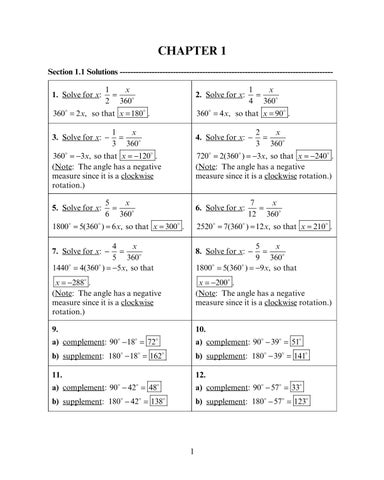
CHAPTER 1 Section 1.1 Solutions -------------------------------------------------------------------------------1. Solve for x:
1 x = 2 360
2. Solve for x:
360 = 2 x, so that x = 180 .
3. Solve for x: −
360 = 4x, so that x = 90 .
1 x = 3 360
4. Solve for x: −
360 = −3x, so that x = −120 . (Note: The angle has a negative measure since it is a clockwise rotation.)
5. Solve for x:
1 x = 4 360
2 x = 3 360
720 = 2(360 ) = −3x, so that x = −240 . (Note: The angle has a negative measure since it is a clockwise rotation.)
5 x = 6 360
6. Solve for x:
7 x = 12 360
1800 = 5(360 ) = 6x, so that x = 300 .
2520 = 7(360 ) = 12x, so that x = 210 .
7. Solve for x: −
4 x = 5 360 1440 = 4(360 ) = −5x, so that
8. Solve for x: −
x = −288 . (Note: The angle has a negative measure since it is a clockwise rotation.)
x = −200 . (Note: The angle has a negative measure since it is a clockwise rotation.)
9.
10.
a) complement: 90 − 18 = 72
5 x = 9 360 1800 = 5(360 ) = −9x, so that
a) complement: 90 − 39 = 51
b) supplement: 180 − 18 = 162
b) supplement: 180 − 39 = 141
11.
12.
a) complement: 90 − 42 = 48
a) complement: 90 − 57 = 33
b) supplement: 180 − 42 = 138
b) supplement: 180 − 57 = 123
1
Chapter 1
13.
14.
a) complement: 90 − 89 = 1
a) complement: 90 − 75 = 15
b) supplement: 180 − 89 = 91
b) supplement: 180 − 75 = 105
15. Since the angles with measures ( 4x ) and ( 6x ) are assumed to be
complementary, we know that ( 4x ) + ( 6x ) = 90. Simplifying this yields
(10x ) = 90 , so that x = 9. So, the two angles have measures 36 and 54 .
16. Since the angles with measures ( 3x ) and (15x ) are assumed to be
supplementary, we know that ( 3x ) + (15x ) = 180. Simplifying this yields
(18x ) = 180 , so that x = 10. So, the two angles have measures 30 and 150 .
17. Since the angles with measures ( 8x ) and ( 4x ) are assumed to be
supplementary, we know that ( 8x ) + ( 4x ) = 180. Simplifying this yields
(12x ) = 180 , so that x = 15. So, the two angles have measures 60 and 120 .
18. Since the angles with measures ( 3x + 15 ) and (10x + 10 ) are assumed to be
complementary, we know that ( 3x + 15 ) + (10x + 10 ) = 90. Simplifying this yields
(13x + 25 ) = 90 , so that (13x ) = 65 and thus, x = 5. So, the two angles have measures 30 and 60 . 19. Since α + β + γ = 180 , we know that
20. Since α + β + γ = 180 , we know that
117 + 33 + γ = 180 and so, γ = 30 .
110 + 45 + γ = 180 and so, γ = 25 .
21. Since α + β + γ = 180 , we know that 4 β ) + β + ( β ) = 180 and so, β = 30. (
22. Since α + β + γ = 180 , we know that 3β ) + β + ( β ) = 180 and so, β = 36. (
= 150
= 155
= 6β
= 5β
Thus, α = 3β = 108 and γ = β = 36 .
Thus, α = 4 β = 120 and γ = β = 30 .
2
Section 1.1
23. α = 180 − ( 53.3 + 23.6 ) = 103.1
24. β = 180 − (105.6 + 13.2 ) = 61.2
25. Since this is a right triangle, we know from the Pythagorean Theorem that a 2 + b2 = c 2 . Using the given information, this becomes 4 2 + 32 = c 2 , which
simplifies to c 2 = 25, so we conclude that c = 5 . 26. Since this is a right triangle, we know from the Pythagorean Theorem that a 2 + b2 = c 2 . Using the given information, this becomes 32 + 32 = c 2 , which
simplifies to c 2 = 18, so we conclude that c = 18 = 3 2 . 27. Since this is a right triangle, we know from the Pythagorean Theorem that a 2 + b2 = c 2 . Using the given information, this becomes 6 2 + b 2 = 10 2 , which
simplifies to 36 + b 2 = 100 and then to, b2 = 64, so we conclude that b = 8 . 28. Since this is a right triangle, we know from the Pythagorean Theorem that a 2 + b2 = c 2 . Using the given information, this becomes a 2 + 7 2 = 12 2 , which
simplifies to a 2 = 95, so we conclude that a = 95 . 29. Since this is a right triangle, we know from the Pythagorean Theorem that a 2 + b2 = c 2 . Using the given information, this becomes 82 + 52 = c 2 , which
simplifies to c 2 = 89, so we conclude that c = 89 . 30. Since this is a right triangle, we know from the Pythagorean Theorem that a 2 + b2 = c 2 . Using the given information, this becomes 6 2 + 52 = c 2 , which
simplifies to c 2 = 61, so we conclude that c = 61 . 31. Since this is a right triangle, we know from the Pythagorean Theorem that a 2 + b2 = c 2 . Using the given information, this becomes 7 2 + b 2 = 112 , which
simplifies to b 2 = 72, so we conclude that b = 72 = 6 2 . 32. Since this is a right triangle, we know from the Pythagorean Theorem that a 2 + b2 = c 2 . Using the given information, this becomes a 2 + 52 = 92 , which
simplifies to a 2 = 56, so we conclude that a = 56 = 2 14 .
3
Chapter 1
33. Since this is a right triangle, we know from the Pythagorean Theorem that
a 2 + b2 = c 2 . Using the given information, this becomes a 2 +
( 7 ) = 5 , which 2
2
simplifies to a 2 = 18, so we conclude that a = 18 = 3 2 . 34. Since this is a right triangle, we know from the Pythagorean Theorem that a 2 + b2 = c 2 . Using the given information, this becomes 52 + b 2 = 10 2 , which
simplifies to b 2 = 75, so we conclude that b = 75 = 5 3 . 35. If x = 10 in., then the hypotenuse of this triangle has length
36. If x = 8 m, then the hypotenuse of
this triangle has length 8 2 ≈ 11.31 m .
10 2 ≈ 14.14 in.
37. Let x be the length of a leg in the given 45 − 45 − 90 triangle. If the hypotenuse of this triangle has length 2 2 cm, then 2 x = 2 2, so that x = 2.
Hence, the length of each of the two legs is 2 cm . 38. Let x be the length of a leg in the given 45 − 45 − 90 triangle. If the hypotenuse 10 10 of this triangle has length 10 ft., then 2 x = 10, so that x = = = 5. 2 2
Hence, the length of each of the two legs is
5 ft.
39. The hypotenuse has length 2 4 2 in. = 8 in.
40. Since
(
)
2 x = 6m x = 6 2 2 = 3 2m,
each leg has length 3 2 m.
41. Since the lengths of the two legs of the given 30 − 60 − 90 triangle are x and 3 x, the shorter leg must have length x. Hence, using the given information, we
know that x = 5 m. Thus, the two legs have lengths 5 m and 5 3 ≈ 8.66 m, and the hypotenuse has length 10 m. 42. Since the lengths of the two legs of the given 30 − 60 − 90 triangle are x and 3 x, the shorter leg must have length x. Hence, using the given information, we
know that x = 9 ft. Thus, the two legs have lengths 9 ft. and 9 3 ≈ 15.59 ft., and the hypotenuse has length 18 ft.
4
Section 1.1
43. The length of the longer leg of the given triangle is
3x = 12 yards. So,
12 12 3 = = 4 3. As such, the length of the shorter leg is 4 3 ≈ 6.93 yards, 3 3 and the hypotenuse has length 8 3 ≈ 13.9 yards.
x=
44. The length of the longer leg of the given triangle is x=
3x = n units. So,
n n 3 n 3 = units, and the . As such, the length of the shorter leg is 3 3 3
hypotenuse has length
2n 3 units. 3
45. The length of the hypotenuse is 2 x = 10 inches. So, x = 5. Thus, the length of the shorter leg is 5 inches, and the length of the longer leg is 5 3 ≈ 8.66 inches. 46. The length of the hypotenuse is 2 x = 8 cm. So, x = 4. Thus, the length of the shorter leg is 4 cm, and the length of the longer leg is 4 3 ≈ 6.93 cm. 47. For simplicity, we assume that the minute hand is on the 12. Let α = measure of the desired angle, as indicated in the diagram below. Since the measure of the angle formed using two rays emanating from the center 1 of the clock out toward consecutive hours is always 360 ) = 30 , it immediately ( 12
follows that α = 4 ⋅ ( −30 ) = −120 (Negative since measured clockwise.)
α
5