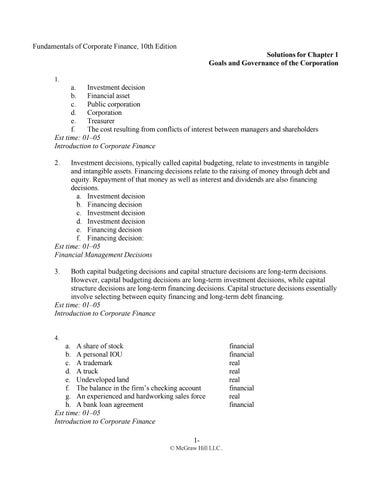
Fundamentals of Corporate Finance, 10th Edition Solutions for Chapter 1 Goals and Governance of the Corporation 1.
a. Investment decision b. Financial asset c. Public corporation d. Corporation e. Treasurer f. The cost resulting from conflicts of interest between managers and shareholders Est time: 01–05 Introduction to Corporate Finance 2.
Investment decisions, typically called capital budgeting, relate to investments in tangible and intangible assets. Financing decisions relate to the raising of money through debt and equity. Repayment of that money as well as interest and dividends are also financing decisions. a. Investment decision b. Financing decision c. Investment decision d. Investment decision e. Financing decision f. Financing decision: Est time: 01–05 Financial Management Decisions 3.
Both capital budgeting decisions and capital structure decisions are long-term decisions. However, capital budgeting decisions are long-term investment decisions, while capital structure decisions are long-term financing decisions. Capital structure decisions essentially involve selecting between equity financing and long-term debt financing. Est time: 01–05 Introduction to Corporate Finance
4.
a. A share of stock b. A personal IOU c. A trademark d. A truck e. Undeveloped land f. The balance in the firm’s checking account g. An experienced and hardworking sales force h. A bank loan agreement Est time: 01–05 Introduction to Corporate Finance 1© McGraw Hill LLC..
financial financial real real real financial real financial
“Companies usually buy real assets. These include both tangible assets such as executive airplanes and intangible assets such as brand names. To pay for these assets, they sell financial assets such as bonds. The decision about which assets to buy is usually termed the capital budgeting or investment decision. The decision about how to raise the money is usually termed the financing decision.” Est time: 01–05 Financial Management Decisions 5.
6.
a. Private corporation b. Partnership c. Public corporation d. Public corporation Est time: 01–05 Forms of Business Organization Double taxation means that a corporation’s income is taxed first at the corporate tax rate. When the income is distributed to shareholders as dividends, the income is taxed again at each shareholder’s personal tax rate. Est time: 01–05 Forms of Business Organization 7.
8.
C. Ownership can be transferred without affecting operations and D. Managers can be fired with no effect on ownership. Est time: 01–05 Forms of Business Organization 9.
The individual stockholders of a corporation (i.e., the owners) are legally distinct from the corporation itself, which is a separate legal entity. Consequently, the stockholders are not personally liable for the debts of the corporation; the stockholders’ liability for the debts of the corporation is limited to the investment each stockholder has made in the shares of the corporation. Est time: 01–05 Forms of Business Organization 10.
B. The corporation survives even if managers are dismissed and C. Shareholders can sell their holdings without disrupting the business. Est time: 01–05 Forms of Business Organization 11.
Limited liability is generally advantageous to large corporations. Large corporations would not be able to obtain financing from thousands or even millions of shareholders if those shareholders were not protected by the fact that the corporation is a distinct legal entity, conferring the benefit of limited liability on its shareholders. On the other hand, lenders do not view limited liability as advantageous to them. In some situations, 1© McGraw Hill LLC..
lenders are not willing to lend to a corporation without personal guarantees from shareholders, promising repayment of a loan in the event that the corporation does not have the financial resources to repay the loan. Typically, these situations involve small corporations, with only a few shareholders; often these corporations can obtain debt financing only if the shareholders provide these personal guarantees. Est time: 01–05 Forms of Business Organization B. Responsible for investing the firm’s spare cash and C. Responsible for arranging any issue of common stock. Est time: 01–05 Management Organization and Roles 12.
13.
The responsibilities of the treasurer include the following: supervising cash management, raising capital, and banking relationships. The controller’s responsibilities include supervision of accounting, preparation of financial statements, and tax matters. The CFO of a large corporation supervises both the treasurer and the controller. The CFO is responsible for large-scale corporate planning and financial policy. Est time: 01–05 Management Organization and Roles 14.
Answers will vary. For example, a corporation might cut its labor force dramatically, which could reduce immediate expenses and increase profits in the short term. Over the long term, however, the firm might not be able to serve its customers properly, or it might alienate its remaining workers; if so, future profits will decrease, the stock price, and the market value of the firm, will decrease in anticipation of these problems. Similarly, a corporation can boost profits over the short term by using less costly materials even if this reduces the quality of the product. Once customers catch on, sales will decrease and profits will fall in the future. The stock price will fall.
The moral of these examples is that, because stock prices reflect present and future profitability, the corporation should not necessarily sacrifice future prospects for shortterm gains. Est time: 01–05 Goal of Financial Management 15.
Financial managers refer to the opportunity cost of capital because corporations increase value for their shareholders only by accepting all investment projects that earn more than this rate. If the company earns below this rate, the market value of the company’s stock falls and stockholders look for other places to invest. To find the opportunity cost of capital for a safe investment, managers and investors look at current interest rates on safe debt securities, such as U.S. Treasury debt.
Est time: 01–05 Cost of Capital—General 1© McGraw Hill LLC..