Managerial Accounting 5th Canadian Edition, 5e Karen Braun, Wendy Tietz, Louis Beaubien (Solutions Manual All Chapters, 100% Original Verified, A+ Grade) All Chapters Solutions Manual Supplement files download link at the end of this file.
Chapter 1
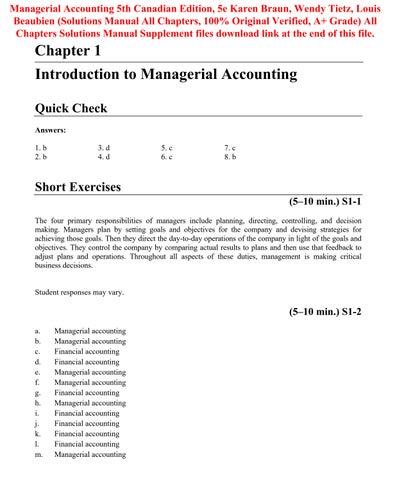
Introduction to Managerial Accounting Quick Check Answers: 1. b 2. b
3. d 4. d
Short Exercises
5. c 6. c
7. c 8. b
(5–10 min.) S1-1
The four primary responsibilities of managers include planning, directing, controlling, and decision making. Managers plan by setting goals and objectives for the company and devising strategies for achieving those goals. Then they direct the day-to-day operations of the company in light of the goals and objectives. They control the company by comparing actual results to plans and then use that feedback to adjust plans and operations. Throughout all aspects of these duties, management is making critical business decisions. Student responses may vary.
(5–10 min.) S1-2 a. b. c. d. e. f. g. h. i. j. k. l. m.
Managerial accounting Managerial accounting Financial accounting Financial accounting Managerial accounting Managerial accounting Financial accounting Managerial accounting Financial accounting Financial accounting Financial accounting Financial accounting Managerial accounting
Copyright © 2024 Pearson Canada Inc.
1
Managerial Accounting Fifth Canadian Edition Instructor’s Solutions Manual
(5–10 min.) S1-3 a. b. c. d. e. f. g. h. i. j. k. l. m.
Internal auditing department Controller Treasurer Internal auditing department Controller Controller Treasurer Internal auditing department Controller Controller Treasurer Internal auditing department Controller
(5–10 min.) S1-4 Characteristic
Check () if related to internal auditing
a.
Helps to ensure that the company’s internal controls are functioning properly
b.
Reports to the treasurer or controller
c.
Required by the Toronto Stock Exchange if company stock is publicly traded on the TSX
d.
Reports directly to the audit committee
e.
Ensures that the company achieves its profit goals
f.
Is part of the accounting department
g.
Usually reports to a senior executive (CFO or CEO) for administrative matters
h.
Performs the same function as independent certified public accountants
i.
External audits can be performed by the internal auditing department
2
Copyright © 2024 Pearson Canada Inc.
Managerial Accounting Fifth Canadian Edition Instructor’s Solutions Manual
(10 min.) S1-5 Each of the five ethical standards contributes to maintaining CPA Canada’s expectation that management accountants will uphold the highest standards of ethical behaviour. Without the necessary competence, management accountants will be unable to perform their responsibilities. Even if they do recognize an ethical dilemma, they could lack the competence required to determine all the alternative courses of action and the implications of each alternative. Having independence is important for minimizing or eliminating the impact of others’ influences. Management accountants need to provide opinions based on their own interpretation of data rather than the interpretations of other stakeholders. Management accountants have access to confidential information. If they do not maintain that confidentiality, their companies could suffer. Their companies would be reluctant to provide access to information, which would prevent management accountants from performing their responsibilities. Additionally, employers must have confidence that management accountants have the integrity to apply their skills appropriately and avoid being prejudiced by any conflicts of interest. Management accountants should have the ability as well to effectively analyze situations so that they might communicate them faithfully to employers, regulators, or clients to ensure proper action is taken. Finally, an important part of management accountants’ responsibilities is communicating information and providing reports to senior management. To be able to rely on these reports, management must have confidence that the management accountant is not hiding inconvenient facts or presenting a biased view. Student responses may vary.
Copyright © 2024 Pearson Canada Inc.
3
Managerial Accounting Fifth Canadian Edition Instructor’s Solutions Manual
(5 min.) S1-6 a. Providing earnings information to your brother before it is publicly announced violates the concept of client confidentiality and fails to uphold trust. b. Stealing from your employer is a violation of the concept of integrity and is illegal. c. Skipping continuing education sessions could violate the requirement to maintain professional competence in enabling competencies. If your company paid for you to attend the conference, skipping the sessions also violates the notion of integrity. d. Failing to read the specifications of the software package before purchasing it violates professional competence in enabling competencies. e. Failing to provide job description information to management because you fear it may be used to cut a position in your department violates the notion of integrity and the required skills of a competent accountant.
(5 min.) S1-7 a. b. c. d. e.
ISO 9001:2008 Enterprise resource planning (ERP) system The Sarbanes-Oxley Act (SOX) XBRL E-commerce
(5 min.) S1-8 a. b. c. d. e.
4
Prevention costs Lean production Appraisal costs Internal failure costs External failure costs
Copyright © 2024 Pearson Canada Inc.
Managerial Accounting Fifth Canadian Edition Instructor’s Solutions Manual
(5–10 min.) S1-9 a. b. c. d. e. f. g. h. i. j. k. l. m.
Lean Traditional Traditional Lean Traditional Lean Lean Traditional Lean Lean Lean Lean Traditional
(5 min.) S1-10 1. 2. 3. 4. 5. 6. 7. 8. 9. 10.
Reworking defective units—internal failure Litigation costs from product liability claims—external failure Inspecting incoming raw materials—appraisal Training employees—prevention Warranty repairs—external failure Redesigning the production process—prevention Lost productivity due to machine breakdown—internal failure Inspecting products that are halfway through the production process—appraisal Incremental cost of using a higher grade raw material—prevention Cost incurred producing and disposing of defective units—internal failure
Copyright © 2024 Pearson Canada Inc.
5
Managerial Accounting Fifth Canadian Edition Instructor’s Solutions Manual
(10–15 min.) S1-11 Req. 1 Prevention costs: Negotiating with, and training, suppliers to obtain higher-quality materials and on-time delivery Redesigning the speakers to make them easier to manufacture Appraisal costs: Additional 20 minutes of testing for each speaker Eliminate inspection of raw materials Internal failure costs: Reduce reword (fewer defective units) Avoid lost production time due to rework External failure costs: Reduce warranty repair costs Avoid lost sales due to disappointed customers
6
Copyright © 2024 Pearson Canada Inc.
Managerial Accounting Fifth Canadian Edition Instructor’s Solutions Manual
(continued) S1-11 Req. 2
Cost –Benefit Analysis
Costs Savings
Prevention costs:
Negotiating with, and training, suppliers to obtain higher-quality materials and on-time delivery……………………….. Redesigning the speakers to make them easier to manufacture………………………………………………….
Appraisal costs:
$ 300,000 1,400,000
Additional 20 minutes of testing for each speaker……………………
500,000
Savings on inspection of raw materials……………………………….
$(400,000)
Internal failure costs:
Savings on rework……………………………………………….............. Savings on lost profits from lost production time due to rework…………………………………………………………………
External failure costs:
(650,000) (300,000)
Savings on warranty repair costs………………………………………… Savings on lost profits from lost sales due to disappointed customers…………………………………......................
(200,000)
Net Benefit from implementing quality program………………………
$(200,000)
(850,000)
Wharfedale should implement the new quality program. The company would save $200,000 by implementing the new program and the change would likely improve longer-term relations with current as well as potential new customers.
Copyright © 2024 Pearson Canada Inc.
7
Managerial Accounting Fifth Canadian Edition Instructor’s Solutions Manual
(5–10 min.) S1-12 1. 2. 3. 4. 5. 6.
External failure cost External failure cost External failure cost Appraisal cost Prevention cost Internal failure cost
Exercises (Group A) a.
Controlling
b.
Decision making (also directing)
c.
Planning (also decision making)
d.
Decision making (also directing)
e.
Decision making (also controlling)
(5–10 min.) E1-13A
Student responses may vary since several of management’s responsibilities overlap when performing these activities.
(5 min.) E1-14A a. b. c. d. e. f. g. h. i.
8
Companies must follow IFRS or ASPE in their financial accounting systems. Financial accounting develops reports for external parties such as creditors and shareholders. When managers evaluate the company’s performance compared to the plan, they are performing the controlling responsibility of management. Managers are decision makers inside a company. Financial accounting provides information on a company’s past performance to external parties. Managerial accounting systems are not restricted by IFRS or ASPE but are chosen by comparing the costs versus the benefits of the system. Choosing goals and the means to achieve them is the planning function of management. Managerial accounting systems report on various segments or business units of the company. Financial accounting statements of public companies are audited annually by public accountants.
Copyright © 2024 Pearson Canada Inc.
Managerial Accounting Fifth Canadian Edition Instructor’s Solutions Manual
(5–10 min.) E1-15A 1. 2. 3. 4. 5. 6. 7. 8. 9. 10. 11. 12. 13. 14.
Financial accounting information Financial accounting information Managerial accounting information Financial accounting information Managerial accounting information Financial accounting information Financial accounting information Financial accounting information Financial accounting information Both Both Financial accounting information Financial accounting information Both
(5–10 min.) E1-16A a. The CFO and the COO report to the CEO. b. The internal audit function reports to the CFO or CEO and the audit committee. c. The controller is directly responsible for financial accounting, managerial accounting, and tax reporting. d. The CEO is hired by the board of directors. e. The treasurer is directly responsible for raising capital and investing funds. f. The COO is directly responsible for the company’s operations. g. Management accountants often work with cross-functional teams. h. A subcommittee of the board of directors is called the audit committee.
(5 min.) E1-17A Major issues in management accounting include the following: 1. The role played in providing information 2. The behavioural implications of managerial accounting information (e.g., how does this impact performance reward systems in organizations?) 3. The management of organizational capacity 4. The development, deployment, and use of accounting and management information systems 5. The stewardship of sustainable activities in the organization Student answers may vary. Copyright © 2024 Pearson Canada Inc.
9
Managerial Accounting Fifth Canadian Edition Instructor’s Solutions Manual
(15 min.) E1-18A Req. 1 While the amount is not large now, the repeated nature of the thefts means that they add up over time. Also, the repeated nature of the thefts increases the severity of Anik Cousineau’s unethical behaviour. A new employee who has engaged in repeated thefts is unlikely to become a valued and trusted employee. As controller, Mary Gonzales hired Anik, and she is also responsible for the lack of controls that permitted a new employee to commit this theft. However, this is no excuse for Anik’s unethical behaviour. The controller should think carefully whether it is in the company’s interest to keep Anik or fire her immediately. This incident also reflects poorly on Mary’s competence. She needs to learn from the experience and supervise the next bookkeeper more carefully. Req. 2 The new information makes Mary’s decision more complex. Being new, she may want to discuss the situation with the company president. Even if the bookkeeper believed she was just “borrowing” the money, her behaviour is still unethical. It will probably be difficult to confirm whether Anik did in fact repay money she had taken in the past. Unless Mary can obtain additional clarifying information, one alternative to firing her would be to indicate to Anik that this behaviour will not be tolerated in the future and to establish better controls and closer supervision. Student responses may vary.
(10 min.) E1-19A 1. 2. 3. 4. 5. 6. 7. 8. 9. 10. 11. 12. 13.
10
Maintains a client’s confidentiality Demonstrates competence Demonstrates credible skills and reasonable independence Demonstrates competence Maintains professional and personal integrity Demonstrates competence and credible skills Maintains professional and personal integrity Demonstrates credible skills Maintains a client’s confidentiality Demonstrates competence and credible skills Maintains professional and personal integrity Maintains a client’s confidentiality Demonstrates credible skills
Copyright © 2024 Pearson Canada Inc.
Managerial Accounting Fifth Canadian Edition Instructor’s Solutions Manual
(10 min.) E1-20A a. b. c. d. e. f. g. h. i. j. k. l. m.
XBRL Supply-chain management Sarbanes-Oxley Act of 2002 Lean production Present, future ERP E-commerce ISO 9001:2008 Lean production XBRL IFRS Just in time Total quality management
(10–15 min.) E1-21A
MEMO DATE:
Current
TO:
Accounting Colleagues
FROM:
Your Name
RE: SOX ______________________________________________________ The Sarbanes-Oxley Act of 2002, better known as SOX, was the direct result of corporate accounting scandals such as those at Enron and WorldCom. The goal of SOX is to restore public confidence in publicly traded companies in the United States, their management, their financial statements, and their auditors. Some of the major provisions of SOX include the following: •
The CEO and CFO assume responsibility for the financial statements and must certify that the financial statements fairly present the operations and financial condition of the company.
•
The CEO and CFO assume responsibility for establishing and maintaining an adequate internal control structure and procedures for financial reporting.
•
The effectiveness of the internal controls and financial reporting procedures must be assessed annually.
•
The audit committee members must be independent of the company, which means they cannot receive consulting or advisory fees. At least one member should be a financial expert.
Copyright © 2024 Pearson Canada Inc.
11