Using MIS, 12e David Kroenke, Randall Boyle (Instructor Manual All Chapters, 100% Original Verified, A+ Grade)All Chapters Solutions Manual Supplement files download link at the end of this file.
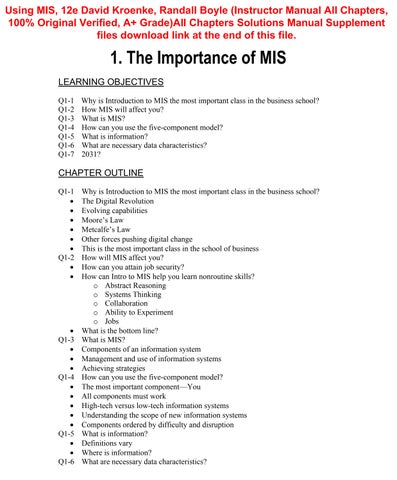
1. The Importance of MIS LEARNING OBJECTIVES Q1-1 Q1-2 Q1-3 Q1-4 Q1-5 Q1-6 Q1-7
Why is Introduction to MIS the most important class in the business school? How M IS will affect you? What is M IS? How can you use the five-component model? What is information? What are necessary data characteristics? 2031?
CHAPTER OUTLINE Q1-1 • • • • • • Q1-2 • •
• Q1-3 • • • Q1-4 • • • • • Q1-5 • • Q1-6
Why is Introduction to MIS the most important class in the business school? The Digital Revolution Evolving capabilities Moore’s Law Metcalfe’s Law Other forces pushing digital change This is the most important class in the school of business How will MIS affect you? How can you attain job security? How can Intro to M IS help you learn nonroutine skills? o Abstract Reasoning o Systems Thinking o Collaboration o Ability to Experiment o Jobs What is the bottom line? What is M IS? Components of an information system Management and use of information systems Achieving strategies How can you use the five-component model? The most important component—You All components must work High-tech versus low-tech information systems Understanding the scope of new information systems Components ordered by difficulty and disruption What is information? Definitions vary Where is information? What are necessary data characteristics? Copyright © 2022 Pearson Education, Inc.
Kroenke - Using MIS 12th Ed - Instructor’s Manual
• • • • • Q1-7
1-2
Accurate Timely Relevant Just barely sufficient Worth its cost 2031?
SECURITY GUIDE Passwords and Password Etiquette 1. Here is a line from Shakespeare’s Macbeth: “Tomorrow and tomorrow and tomorrow, creeps in its petty pace.” Explain how to use these lines to create a password. How could you add numbers and special characters to the password in a way that you will be able to remember? There are several correct ways to create a password from this line. One way might be to take the first letters from each word. The password would then be “tatatciipp.” You could then capitalize a couple of the letters and add in a special character or numbers. The resulting password could be “T&2morrow&tciiPP.” This would be a very secure password. 2. List two different phrases that you can use to create a strong password. Show the password created by each. There will be many correct answers to this question. Using a passphrase to create a password is done by using the first letters in the phrase, then changing some of the letters by substituting in special characters, numbers, or changes of case. For example, the phrase, “I never count my chickens before the eggs have hatched!” could create the password “iNcmCHKNSb4t3ggsHH!” This would be a great password. 3. One of the problems of life in the cyberworld is that we all are required to have multiple passwords—one for work or school, one for bank accounts, another for eBay or other auction sites, and so forth. Of course, it is better to use different passwords for each. But in that case, you have to remember three or four different passwords. Think of different phrases you can use to create a memorable, strong password for each of these different accounts. Relate the phrase to the purpose of the account. Show the passwords for each. There will be many correct answers to this question. For example, a passphrase for a university account may look something like, “I will graduate from state university before 2020 or bust!” This could yield a password that would look like “IwgfSUb42020ORB!” 4. Explain proper behavior when you are using your computer and you need to enter, for some valid reason, another person’s password.
Copyright © 2022 Pearson Education, Inc.
Kroenke - Using MIS 12th Ed - Instructor’s Manual
1-3
In this case, say to the other person, “We need your password,” and then get out of your chair, offer your keyboard to the other person, and look away while she enters the password. Among professionals working in organizations that take security seriously, this little “do-si-do” move—one person getting out of the way so another person can enter her password—is common and accepted. 5. Explain proper behavior when someone else is using her computer and that person needs to enter, for some valid reason, your password. If someone asks for your password, do not give it out. Instead, get up, go over to that person’s machine, and enter your own password yourself. Stay present while your password is in use, and ensure that your account is logged out at the end of the activity. No one should mind or be offended in any way when you do this. It is the mark of a professional.
SO WHAT? IOTrends 1. People often use the terms Web and Internet interchangeably, but they are not the same. Do your best to define each and identify exactly how they are different. Student answers will vary but a good explanation can be found at the website https://www.geeksforgeeks.org/whats-difference-internetweb/#:~:text=The%20Internet%20is%20a%20global,on%20top%20of%20that%20in frastructure. It states: “The Internet is a global network of networks while the Web, also referred formally as World Wide Web (www) is collection of information which is accessed via the Internet. Another way to look at this difference is; the Internet is infrastructure while the Web is service on top of that infrastructure.” 2. The article talks about Web 1.0 and Web 2.0. You may be wondering if Web 2.0 is the end of the line. What do you think—will there be a Web 3.0, and if so, what would it entail? Student responses will vary, but should cover some ideas and concepts that are not already part of Web 1.0 or Web 2.0 specifically. 3.
While IoT is clearly having an impact on businesses (e.g., tracking manufacturing using sensors in production lines) and cities (e.g., tracking traffic flows, lighting, public transportation), how has IoT impacted your life? Do you have any IoT devices in your apartment or home? If not, which IoT devices would you be interested in owning? Student answers will vary, btu some devices could include Amazon Echo, Google Nest, and similar devices. 4. Do you think IoT devices feature the newest and most advanced security measures, or could there be potential security risks from using IoT devices?
Copyright © 2022 Pearson Education, Inc.
Kroenke - Using MIS 12th Ed - Instructor’s Manual
1-4
Student answers will vary, but should point out that often times upon release new products do not have all their security holes covered so users should be aware and proceed with caution.
COLLABORATION EXERCISE 1 This chapter discussed why collaboration is a key skill for maintaining job security. In this exercise, you will build a collaboration IS and then use that IS to answer the questions below in a collaborative fashion. You might want to read the four questions below before you build your IS. Until you answer question 1-5, you’ll have to make do with email or face-to-face meetings. Once you’ve answered that question, use your communication method to answer question 1-6. Once you’ve answered question 1-6, use your communication method and your content-sharing method to answer question 1-7. Then use the full IS to answer questions 1-8 and 1-9. 1-5 Build a communication method: a. Meet with your team and decide how you want to meet in the future. Student decisions will vary. (LO: 2, Learning Outcome: Explain how I S can enhance systems of collaboration and teamwork, AACSB: Interpersonal Relations and Teamwork) b. From the discussion in step a, list the requirements for your communication system. Student answers will vary. Expect students to include requirements in terms of ease of use, availability, and features that support the way the team wants to work. (LO: 2, Learning Outcome: Explain how IS can enhance systems of collaboration and teamwork, AACSB: Interpersonal Relations and Teamwork) c. Select and implement a communication tool. It could be Skype, Google Meet, Zoom, or Skype for Business. Student choices will vary depending on decision from step b above. (LO: 2, Learning Outcome: Explain how IS can enhance systems of collaboration and teamwork, AACSB: Interpersonal Relations and Teamwork) d. Write procedures for the team to use when utilizing your new communication tool. Student answers will vary. Look for students to include procedures regarding meeting notifications, tardiness and missing meetings, and designating a team member to send out reminders. (LO: 2, Learning Outcome: Explain how I S can enhance systems of collaboration and teamwork, AACSB: Interpersonal Relations and Teamwork) 1-6 Build a content sharing method: a. Meet with your team and decide the types of content that you will be creating.
Copyright © 2022 Pearson Education, Inc.
Kroenke - Using MIS 12th Ed - Instructor’s Manual
1-5
Student answers will vary. (LO: 2, Learning Outcome: Explain how IS can enhance systems of collaboration and teamwork, AACSB: Interpersonal Relations and Teamwork) b. Decide as a team whether you want to process your content using desktop applications or cloud-based applications. Choose the applications you want to use. Student answers will vary. (LO: 2, Learning Outcome: Explain how IS can enhance systems of collaboration and teamwork, AACSB: Interpersonal Relations and Teamwork) c. Decide as a team the server you will use to share your content. You can use Google Drive, Microsoft OneDrive, Microsoft SharePoint, or some other server. Student answers will vary. Student decision will depend in part on the availability of tools, such as SharePoint, in their environment. (LO: 2, Learning Outcome: Explain how IS can enhance systems of collaboration and teamwork, AACSB: Interpersonal Relations and Teamwork) d. Implement your content-sharing server. No specific answer; a task to be performed by students. (LO: 2, Learning Outcome: Explain how I S can enhance systems of collaboration and teamwork, A ACSB: Interpersonal Relations and Teamwork) e. Write procedures for the team to use when sharing content. Student answers will vary. Look for students to include procedures regarding responding to requests to edit, timeliness of responses, and expectations for participating in content review. (LO: 2, Learning Outcome: Explain how I S can enhance systems of collaboration and teamwork, AACSB: Interpersonal Relations and Teamwork) 1-7 Build a task management system: a. Meet with your team and decide how you want to manage tasks. Determine the task data that you want to store on your task list. Student answers will vary. Check to see that the task data listed by the team is complete, and includes at least: a task name, task description, task assignment, task due date, task check-out and check-in, and priority. (LO: 2, Learning Outcome: Explain how I S can enhance systems of collaboration and teamwork, A ACSB: Interpersonal Relations and Teamwork) b. Decide as a team the tool and server you will use for sharing your tasks. You can use Google Drive, Microsoft OneDrive, Microsoft SharePoint, or some other facility. Student decision will depend in part on the availability of tools, such as SharePoint, in their environment. (LO: 2, Learning Outcome: Explain how IS can enhance systems of collaboration and teamwork, AACSB: Interpersonal Relations and Teamwork)
Copyright © 2022 Pearson Education, Inc.
Kroenke - Using MIS 12th Ed - Instructor’s Manual
1-6
c. Implement the tool and server in step a. No specific answer; a task to be performed by students. (LO: 2, Learning Outcome: Explain how I S can enhance systems of collaboration and teamwork, A ACSB: Interpersonal Relations and Teamwork) d. Write procedures for the team to use managing tasks. Student answers will vary. Look for students to include procedures regarding task creation, task assignment, priority setting, check-out and check-in, and meeting deadlines. (LO: 2, Learning Outcome: Explain how IS can enhance systems of collaboration and teamwork, AACSB: Interpersonal Relations and Teamwork) 1-8 Nonroutine skills: a. Define abstract reasoning and explain why it is an important skill for business professionals. Give three other examples of abstractions commonly used in business. Abstract reasoning is the ability to construct and use a model or representation. Being able to construct a model or representation of a complex situation through abstract reasoning is an important skill for business professionals, who frequently must make decisions under uncertain and highly complex situations. This is a highly marketable skill. Student answers will vary, but some examples of abstractions used in business include a list of items in inventory and their quantity on hand, project plans, budgets, and business process models. (LO: 2, Learning Outcome: Describe the components of an information system (IS), AACSB: Reflective Thinking) b. Define systems thinking and explain why it is an important skill for business professionals. Give three other examples of the use of systems thinking with regard to the consequences of Bell’s Law, Moore’s Law, or Metcalfe’s Law. Systems thinking involves identifying and modeling the components of a system and connecting the inputs and outputs among those components into a sensible whole, one that explains the phenomenon observed. This is an important skill because business people must be able to identify and understand the relationships among the elements involved in a complex situation. Regarding examples, student answers will vary. Bell’s Law, for example, states that digital devices will evolve so quickly that they will enable new platforms, programming environments, industries, networks, and information systems every 10 years. Right now, smartphones and tablet devices are predominant platforms for consumers, but how will that evolve and what does that mean for current smartphone/tablet providers? Will smart watches finally catch on, or some other “wearable” product? (LO: 2, Learning Outcome: Describe the components of an information system (I S), AACSB: Reflective Thinking) c. Define collaboration and explain why it is an important skill for business professionals. Is the work product of your team better than any one of you could have done separately? If not, your collaboration is ineffective. If that is the case,
Copyright © 2022 Pearson Education, Inc.
Kroenke - Using MIS 12th Ed - Instructor’s Manual
1-7
explain why. Collaboration is the ability to work productively with others when developing ideas and plans. A good collaboration results in a final work product that is superior to one that would be developed by a person working alone. Regarding student teams, the students answers will vary. It is likely that students have not spent enough time and effort reviewing and evaluating each other’s ideas and improving the work product. Often student groups are satisfied with whatever is contributed and little attention is paid to critique and refinement. (LO: 2, Learning Outcome: Explain how I S can enhance systems of collaboration and teamwork, A ACSB: Interpersonal Relations and Teamwork) d. Define experimentation and explain why it is an important skill for business professionals. How does the fear of failure influence your willingness to engage in experimentation? Experimentation involves creating and testing promising new alternatives, consistent with available resources. In today’s demanding business environment, new ideas will be essential to success, and business people must overcome their fear of failure and pursue new approaches rationally. If any of the group members respond to a suggested process with the comment, “that will never work,” he may be reflecting his fear of failure. Unwillingness to try a new way of doing things may be an accurate assessment that the approach is unworkable, but it could also be an unwillingness to work in a new way. (LO: 2, Learning Outcome: Describe the components of an information system (I S), AACSB: Reflective Thinking) 1-9 Job security: a. State the text’s definition of job security. The text defines job security as “a marketable skill and the courage to use it.” The text also argues that marketable skills are no longer specific task-related skills, but rather “strong nonroutine cognitive skills.” (LO: 2, Learning Outcome: Describe the components of an information system (I S), AACSB: Reflective Thinking) b. Evaluate the text’s definition of job security. Is it effective? If you think not, offer a better definition of job security. It is likely that students will be dismayed that the more traditional task-oriented skills they are learning (e.g., computer programming, accounting) will not provide them with job security. That is probably contrary to the message they receive from their parents and grandparents. However, this definition of job security should cause the students to think critically about what they are getting from their college education and may cause them to think differently about their experiences in college. (LO: 2, Learning Outcome: Describe the components of an information system (IS), AACSB: Reflective Thinking) c. As a team, do you agree that improving your skills on the four dimensions in Collaboration Exercise Questions will increase your job security? Student answers will vary, but we hope that thinking about these dimensions will
Copyright © 2022 Pearson Education, Inc.
Kroenke - Using MIS 12th Ed - Instructor’s Manual
1-8
change their attitudes about what comprises marketable skills and how to work to develop them. (LO: 2, Learning Outcome: Describe the components of an information system (IS), AACSB: Reflective Thinking) d. Do you think technical skills (accounting proficiency, financial analysis proficiency, etc.) provide job security? Why or why not? Do you think you would have answered this question differently in 2000? Why or why not? Technical skills are not irrelevant to job security, but they are not sufficient to guarantee job security. This circumstance is very different than in 2000, when technical skills probably were sufficient to get and keep a decent job. (LO: 2, Learning Outcome: Describe the components of an information system (IS), AAC SB: Reflective Thinking)
CASE STUDY 1 Pluralsight Go to http://pluralsight.com and search for a course you might be interested in taking. What is attractive to you about online versus traditional training? Student answers will vary in terms of the course that is interesting. Attractive features of online training versus traditional classroom training include the convenience and flexibility of taking a lesson/course when time allows. (LO: 1, Learning Outcome: Describe the effects of e-commerce on the modern business world, AACSB: Analytic Skills)
1-10.
1-11. What advice would you give executives at Pluralsight if they wanted to grow their
business? How could they increase revenues? Pluralsight has traditionally focused on corporate training. Students might be more familiar with an academic environment and might suggest that Pluralsight establish programs with universities so that students could take courses to supplement their traditional coursework at a reduced rate. Possibly some companies could be lined up to help pay the subscription rate, since the students should be more able to provide needed skills to those companies when they graduate. (LO: 1, Learning Outcome: Explain how IS can be used to gain and sustain competitive advantage, AACSB: Analytic Skills) 1-12. Why would corporate clients be interested in online technology training for their
internal employees? How would they benefit from paying Pluralsight for training? Technical skill requirements are constantly changing and employee skills constantly need to be updated. Paying for skills training from Pluralsight is probably much more cost effective for a company than trying to provide the training in-house. Pluralsight is a training outsourcer and if their training quality is good, the company is much better off obtaining the training this way. (LO: 1, Learning Outcome: Discuss the role of information systems in supporting business processes, AACSB: Analytic Skills)
Copyright © 2022 Pearson Education, Inc.
Kroenke - Using MIS 12th Ed - Instructor’s Manual
1-9
1-13. Why is there a technology skills gap? Why do employers have the need for highly
skilled workers, and why do too few workers have these skills? It is difficult for a traditional college or university to include every type of technology skill in its curriculum, so graduates will not necessarily know every type of technology an employer requires. In addition, skills required evolve quickly and employees need to be updated and retrained on new technologies. (LO: 2, Learning Outcome: Discuss the role of information systems in supporting business processes, AACSB: Analytic Skills) 1-14. How might a traditional university benefit from a partnership with Pluralsight? Why
might some universities see such a partnership as a threat to their existence while others might see it as a great opportunity? Universities could benefit from a partnership with Pluralsight in several ways. One, a university’s IT staff would undoubtedly benefit from access to these training courses. Two, faculty members in certain fields might like to enhance their own knowledge and skills. Finally, students might like to supplement their more traditional classes with training that is more skills-focused, such as those offered in Pluralsight courses. Many universities would not fear this partnership because their courses are not focused only on technical skills but more on conceptual knowledge. Colleges and universities that do offer focused skills training might find this partnership a little threatening if students preferred the Pluralsight online courses to the traditional university offerings. (LO: 1, Learning Outcome: Explain how IS can be used to gain and sustain competitive advantage, AACSB: Reflective Thinking) 1-15. Suppose you were considering buying stock in Pluralsight. What types of threats
might Pluralsight face in the future? Could a large tech company mimic its business model and threaten its profitability? How could Pluralsight defend against this type of competition? Like any company today, there are constant competitive threats. An example of a threat that could disrupt Pluralsight is the rapid growth of cloud computing. A major cloud computing provider, such as Amazon, could launch a skills training business geared toward all its cloud computing environments and tools that would be far superior to Pluralsight’s. Pluralsight could defend against this by establishing a partnership with Amazon to provide Amazon’s cloud computing skills training. (L O: 1, Learning Outcome: Explain how IS can be used to gain and sustain competitive advantage, AACSB: Reflective Thinking)
Copyright © 2022 Pearson Education, Inc.
Kroenke & Boyle - Using MIS 12th Ed - Instructor’s Manual
2
.. .. .. .. .. .. .. ..
Strategy and Information Systems
LEARNING OBJECTIVES Q2-1 Describe how organizational strategy determines information systems structure. Q2-2 Explain the five forces that determine industry structure. Q2-3 Describe how analysis of industry structure determines competitive strategy. Q2-4 Describe how competitive strategy determines value chain structure. Q2-5 Explain how business processes generate value. Q2-6 Describe how competitive strategy determines business processes and the structure of information systems. Q2-7 Explain how information systems provide competitive advantages. Q2-8 Explain how businesses may use information systems for competitive advantage in 2029.
CHAPTER OUTLINE Q2-1 How does organizational strategy determine information systems structure? Q2-2 What five forces determine industry structure? Q2-3 How does analysis of industry structure determine competitive strategy? Q2-4 How does competitive strategy determine value chain structure? • Primary activities in the value chain • Support activities in the value chain • Value chain linkages Q2-5 How do business processes generate value? Q2-6 How does competitive strategy determine business processes and the structure of information systems? Q2-7 How do information systems provide competitive advantages? • Competitive advantage via products o First mover advantage • Competitive advantage via business processes • How does an actual company use IS to create competitive advantages? • How does this system create a competitive advantage? Q2-8 2031?
Copyright © 2022 Pearson Education, Inc.
Kroenke & Boyle - Using MIS 12th Ed - Instructor’s Manual
2-2
SECURITY GUIDE Critical Ransom 1. Do you think criminals will actually decrypt your data if you pay them the ransom? Student answers will vary. Explain to them that it generally is common for them to follow through with decrypting the data, because if they do not, they lose any future leverage to get paid by companies if history shows they do not follow through with their end of the arrangement. 2. If you are 100 percent certain that paying the ransom for your data will result in it being decrypted, should you do it? Explain. Student answers will vary. Point out that many security professionals feel strongly that companies should never cave to these ransoms and pay them as it encourages them to further carry out these types of attacks. Look for some justification on how it might make sense for specific instances depending on that company’s situation as it relates to backups and ways around it as well as how much they can tolerate potential downtime. 3. The article mentions that surveillance of and attacks against critical infrastructure are growing commonplace. Take a few minutes to search for the latest examples of these types of attacks against critical infrastructure organizations. (Refer to the CISA list in the article to help guide your search of relevant industries.) Student responses will vary. They should pull from some researched/current examples at the time of response. 4. Can you think of any examples of known international cyberattacks that have succeeded in damaging their targets? Student responses will vary. For a good look at current examples, direct students to https://www.csis.org/programs/strategic-technologies-program/significant-cyberincidents which keeps a running list of international cyberattacks.
SO WHAT? Amazon Everywhere 1. Some of the most innovative and powerful companies in the world are technology companies (e.g., Google, Facebook, Apple, Amazon, and Netflix). Out of the five companies on this list, could a case be made that Amazon should be considered the most powerful company of them all? Why?
Copyright © 2022 Pearson Education, Inc.