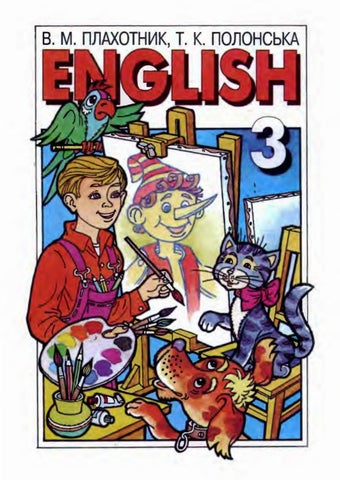
B. M. nnAXOTHV1K T. K. nOJlOHCbKA
HAB~AJlbHVl~
nOCI6HV1K ,l])lS1 3-10 KJlACY ,ll,OnyLJ4eHO MiHicrepcr soM ocein1 YKpai H~1
KV1 1B
n EPYH 1996
nEPWA '-IBEPTb YPOK 1 1.
Oasyq 6yKBH, 6yKsocnoJiyqeHHH i TpaucKpHnQi:Hsi 3BaKn:
a) c, g, h, j, k, I, s, v, w, x, z, a, u, e, i, o; 6) ch, ck, sh, ar, or, ir, oo, qu, ng, nk, wh; B) [e1], [d], [8], [0], [w], [v], [/\], [a:], [d3], [ce], [e], [m], [n], [r], [t], [f], [h], [g], [ks] .
.. 2. TI pO'IHTaB CJIOBa ftBI'JiiBcbKOIO MOBOIO i 3B8H)I;H Bi.n;noBi,n;HHB 1M nepeKJia.n;:
1) an autumn 2) a school ·
3) September 4) a pupil 5) first 6) third 7) a day 8) a teacher 9) to spend 10) the weather 11) a village 12) a town 13) the holidays 14) to like 15) good 16) bad 17) the sun 18) again 19) a classrqom 20) to see
1) 2) 3) 4) 5) 6) 7) 8) 9)
nepmu:i .n;eu~:,
noro~a
ociHL npOBO~BTB
mKoJia sepeceuL TpeTiH y~eHL
1 0) y-qBTeJib
11) KJIRCHR KiMHaTa 12) 3HOBY 13) norauuii 14) coun;e 15) 6aqHTB 16) ceno 17) MiCTO 18) no~o6aTBC.H 19) KaHiKyJIH 20) rapHHB 3
3.
,lJ;aH Bi,ll;DOBi,n;i HR 3RDHTRHH.ft.
1. 2. 3. 4. 5. 6. 7.
What day is it today? What season is it now? Do you like today's weather? Why? What form are you in? How many pupils are there in your form? Do you like your classroom.? Did you spend your holidays in town or in the village? 8. Are you glad to see your English teacher again?
4.
PoaKa.iKH npo noro,n;y soceHH, BHRopHCTaBmH MaJIIOHKH.
5.
IlpotiHTaH DpO ce6e
i
HRDHillH Bi,ll;DOBi,ll;Hi CJIOBa:
[bukL [sku:l], [ga :l], [b:>1], [gleed]. [l1v], [f:>:m], [8a:d], [1n], ['ti:tJa]. 4
6.
YTBOpH HKOMora 6iJihme peqeuh.
I
He She We You They 7.
lS
are am
in the second form. in the third form. in the first form.
Bi~TBopiTh .n;iaJior aurJiiiicLKOIO MOBOIO.
- .IJ:o6pnAeHL, Ha.n;inKo! - .D:o6pH~eHL, IleTpnKy! - H paAHH Te6e 6a'IHTH. - · H Te.m. - Y .HKOMY TH KJiaCi? . - H B TpeTbOMY Knaci. A TH? - H B ApyroMy Knaci. ·
18.1 a) llpo'IHTaH CJIOBa Ta CJIOBOCIIOJiyqeHH.fi aHrJiiHCh:KOIO MOBOIO aa
13 ce:Kya.n;.
6)- 3a:KpHH JiiBy 'IaCTHBY BnpaBH i IIepe:KJia.LI;H Ha aarJiiHChKY Mouy aa
15 ceKya.n;.
a school a pupil a teacher a classroom September 6) an autumn 7) a fine weather 8) in the third form 9) to be glad 10) to have a good time 1) 2) 3) 4) 5)
mKona y'IeHh, y'IeHHQ.H Y1JHTeJib, y'tiHTeJILKa KJiaCHa RiMHaTa Bepeceab OClHL 'IYAOBa noroAa . y TpeThOMY RJiaCI 6yTH paAHM A06pe npOBOAHTH 'lac
[[) flepeiiHillH peqeHHH, BCTaBHBillH ll0Tpi6Hi CJIOBft.
1. Today is the (first, second) of September. 5
2. I am in the (second, third) form. 3. I am (eight, nine). 4. I had a (good, bad) time on my summer holidays.
YPOK2 1. llpoqHTaii uipm i nepeKJia.n;H ua yKpai:ncLKY MOBY. Cnpo6y:H po3Ka3aTH :Horo uanaM'HTL.
Summer is over, September comes. October and November Are also autumn months. also
['~:ISOU]
-
Te:>K, TaKO:>K
2. llepe.n;aiiTe .n;iaJior Y'JHTeJIB 3 'IeproBHM.
-Who is on duty today? - I am on duty today. My name is Roman. My surname is Homenko. -How old are you, Roman? - I am eight. - What form are you in? - I am in the third form. • - How many pupils are there in your class? - There are twenty-five pupils in our class. - Who is absent today? - Nobody is absent. All are present today. - Thank you. Sit down, please. -Not at all. 3. Iloro,n;Lcn a6o ue noro.n;Lc.JI 3 yquTeJieM. 3paaoK: It is spring now. No, it isn't spring now. 6
It is autumn now. A6o It is" September now. Yes, it is September now. 1. 2. 3. 4. 5. 6. 7. .. 8.
4.
It is October now. It is winter now. It is cold today. Two pupils are absent today. September is a summer month. September has thirty days. Autumn has four months . You have four lessons today.
IlpO'IHTRH TeKCT, ,n;aii Bi)l;DOBi,n;i Ha 3RDHTRHHR.
AUTUMN
Summer is over. It is -autumn now. Autumn is a fine season. September, October and November are autumn months. It is September now. The weather is 7
good in September. The sky is blue. The sun shines brightly. It is not cold. There are many apples, pears, pl urns and flowers in September. to be over ['ouva] 1. 2. 3. 4. 5. 6. 7. 8. 5.
aaKiHl:lyBaTHCH
What season is it now? How many seasons are there? What are autumn months? Is it October now? What is the weather like in September? Is it warm today? Do you like autumn? Why? · Who likes September in your class?
llepenHmH pe~eBBH, BCTaBHBWH DOTpi6Hi CJIOBa (week, aU-
tumn, seasons, months).
1. There are four ... in a year. 2. A year has twelv~ . . . . 3. The~e are seven days in a . . . • 4. September is an ... month. 6. YTBOpH MBO)KHBY iMeBBHKiB BiA CJiiB:
a a a a 7.
desk, a book, an exercise-book, a ruler, an eraser, • diary, a pen, a pencil, a box, a child, a pupil, a teacher, window, a door, a chair, a bench, a tree, a car, lorry. ITocTaB aanHTaHBH AO pe~eBL i Aaii aanepe'lHY BiADOBiAL.
3paaoK: Lida likes to play with a doll.
Does Lida like to play with a doll? No, she doesn.' t. 1. Ox ana goes to school on Sunday. 8
2. 3. 4. 5. 6. ~a)
They live in Poliske. I am in the first form. There is a clock on the wall in our classroom. There are four windows in his room. Ostap is ten . •
3ra.n;aif Ha3BH ,ll;HiB TH)KHR aHrJiiHCbKOIO MOBOIO.
A
Tenep
DO,li;HBHCh, RK BOHH DHWYTLCH CKOpoqeuo.
•
Sunday Monday Tuesday Wednesday Thursday Friday Saturday Y
Sun'day Mon'day Tues'day Wednes'day Thurs'day Fri'day Satur'day
Sun. Mon. Tues . Wed. Thurs. Fri. Sat.
nepmiH KOJIOHIJ;i TH 6aqHm HaDHCaHHH DOBHOl Ha3BH
,ll;HiB TH)KHH. He 3a6yna:ft:, ID;O B aurJiiHCLKiH MODi BOBH aan.m,nH DHWYTbCH 3 BeJIHKOl · 6yKBH. nepmi CKJia,n;H, Bi)J. HKHX i
Y
~pyriii KOJIOHIJ;i BH,ZJ;iJieHo
YTBOp10€TLCSI CKOpoqeaa «}>OpMa
HaDHCaHHH ~BiB TH)KBJI. Ocb DOHa y TpeTiH KOJIOH~i.
A
Tenep
me pa3 yBa)KBO npoqHTBH yci TpH KOJIOHKH i .n;aii BiJJ;DOBi,ZJ;i Ba 3ftfiHTaHHH.
1. Y
HKOMy CJIOBi CKOpoqeBHH He 36ira€TLCH 3
nepWHM
CKJia,z:J;OM?
2.
HKe cnono Mae TPH CKJia,nu?
3.
.fiKe M&JieHbKe CJIOBO DHWeTLCJI i BHMOBJIJIETLCJI O)J;HaKOBO B OCT8HHLOMY CKJia,n;i BCiX CJiiB?
6) HanHmH no naM'SITi cno'IaTKy uaaBH ceMH ,o;uin Tuman, a DOTiM 6iJIB KO.)KHOrO 3 HHX lXHIO CKOpoqeuy «}>opMy, HKa m;e ua3HBa€TLCH a6peniaTypoiO.
A
qH 3HaiOTL TBoi pi.u;ui Ta npu-
BTeJii TaKe CJIOBO?
9
YPOKH3-4 '
1. IIpoquTaH cJioBa aa 17 ceKyn,n;:
· air, hair, chair, fair, ear, pear, bear, tear, near, bird, girl, shirt, skirt, first, boy, toy, joy, oil, soil, coin. 2. Bi.z:tTBopiTL
~iaJioru
aurJiiiicLKoro MOBOIO.
1) -
HKa nopa poKy aapaa? ;3apaa ociHh. A .HKHH Tenep Mic.H~h? · Bepeceah. Qe nepm:u:H Mic.H~h oceai? TaK . C:KiJILKH Mic.s~iB Mae ociah? Ociah Mae TPH 'Micsu::(i. Qe Bepeceab, >KOBTeHh, JIHCTOnap;. 2) - CKiJihKH nip poKy TH aaaem? - .H aaa10 'tiO~HPH nop:u poKy: a:nMy, secay, niTo, . OCIHh, HRa nopa poKy To6i no.n;o6aeThC.H aa:H6iJihme? OciHL. l.JoMy To6i no.n;o6aeTLC.H ociHh? • - OciHL - 30JIOTa (golden rgoulden]) nopa po:Ky. Iloro,z:r;a 'tiY)J;OBa. JIHCT.H ua )J;epeBax ae'n eHe, moBTe, 'tlepsoue, KopH'tiHese. A To6i no)J;o6aeThC.H ociHh? TaK, aJie Meai aa:H6inhine no.n;o6a€ThCH a:nMa. - T:u JII06Hm KaTaTHCH Ha :Kosaaaax? H JII06JIIO KaTaT:ncn aa caaqaTax, i H JII06JIIO . . JllllHTH CHirOBHKa.
3. IlpoqHT&H TeKCT i nepeKJI&,D;H iioro · Ha yKpalHCLKY MOBY. 3.n;ora,n;aiicn npo auaqeHHH BHAiJieHHX cJiiB.
10
I
THE FIRST OF SEPTEMBER It is the first of September. All the schoolchildren are at scho~l again. The pupils want to begin their lessons again. They are glad to see their teachers and friends. It is their first day at school after the summer holidays. We can see many little boys and girls with their mothers and fathers or grandmothers and grandfathers. These children are six or seven. Today is their first day at school. Many children have flowers in their hands. The flowers are for their teachers. The day is very fine. The pupils are gay and happy. Antin: Hello, Katya! I am glad to see you again. Where did you spend your summer holidays? Katya: Hello, Antin! I am glad to see you too. I was in the village in summer. Where were you? 11
Antin: I was in town on my summer holidays. I had a good time. It was very hot in summer. I often went to the river with my father and mother. And what about you? Katya: I went to the pond and to the forest with my b~other. I helped my grandfather and grandmother about the house. I read many books. Did you play football in summer? Antin: Yes, I did. Sometimes I played football with my friends and sometimes I played tennis. In the evening I watched TV or read a book. Katya: But we must go to the classroom. Antin: Yes, let's go. to ~egin [b1'g1n] - no'IHHaTH; a river ['nva] a forest ['fonst] - nic 4.
pl'IKa;
CKamu aarJiiiicbKOIO MOBOIO.
1. 2. 3. 4.
CLoro.n;Hi nepme BepecH.H. Y'IHi 3HOBY npHiimJIH .n;o mKOJIH. .H pa,n;HH 6a'liHTH CBOlX npH.HTeJiiB i B'IHTeJiiB. MH 3HOBY xo'tJeMo poaMOBJI.HTH, 'IHTaTH ii nHcaTH aHrJilHCLKOIO MOBOIO. • 5. ~iKTOP npoBiB ni THi KaHiKy JIH B O.n;eci. 6. MeHi XOTiJIOC.H 6 rrpoBeCTH CBOl KaHiKyJIH B CeJii, ane MO.H 6a6ycs mHBe y MicTi. 7. Ha~iiiKa qacTo xo.n;Hna .n;o nicy a .n;i.n;yceM. TaM 6araTo KBiTiB, .n;epeB i nTaxiB. •
5.
u
3aDHT8HTe O,ZJ;Be O,ZJ;BOro, SIK BH npoBeJIH JiiTBi KBHiKyJIH.
Y
CBOlX ,ZJ;iaJiorax BH MO)KeTe BHI<OpHCTftTH TBKi CJIOB8 i BHCJIOBH:
a camp [kcemp] - Ta6ip; to bathe [bel~] in the river to swim [sw1m] - nnaBaTH; 12
KyrraTHC.H B pi'ID;i; ·
to to to to
make a fire ['fa1a] - poanaJIIOBaTH BorHHm;e; gather ['gce~a] berries - a6HpaTH .H:ro.n;H; gather mushrooms ['mAjrumz] - a6HpaTH rpH6H; bicycle ('bOISikl) - l3.D;HTH Ha BeJIOCHne.n;i.
6. HauHmiTL aBrJiiiicLKoro MoBoro ni.n; ,li;HKTOBKY sqHTeJISI.
1. H y'tJeHh TpeThoro KJiacy. 2. HaM no.n;o6aeThC.H Ham ni.n;pyqHHK a aHWiiHChKOl MOBH. 3. JliTo - HaiiKpam;a nopa poKy. 4. IIIKOJI.Hpi ii.n;yTh .n;o mKOJIH nepmoro BepecHH. 7. BuKoBaiiTe KoMaa.n;u nquTeJISI.
Take a pen! Write a word "the sun"! Take a book! Read a· text! Go to the door! Open the doo.r! Go to the table! Clean the desk!
Stand up! Stand still! Sit down! Sit still! Look at the window! Show me your pencil! Open your bag! Take a ruler! ~a)
HanHmH, SIK TH nposis JiiTBi KaBiKyJIH. BuKopncTaii BoBi CJIOBa 3 BDpaBH 5. 6) PoaKamH csoi:M pi.n;BHM npo JiiTBi KaBiKyJIH.
•
YPOKH5-6
1. PoaKamH, .n;e i SIK TH npoBiB JiiTBi KaBiKyJIH. 2. CKJia,D;iTL .n;iaJiorH, BHKOpHCTOByiOqH CJIOBa "please" i "thank ·you".
13
I want to write but I have no pen. Give me a pen, please. Here you are. Thank you. Excuse me, please! May I take your pencil? Yes, you may. Thank you.
3paaoK: 1) -
2) -
-
3. CKamu, m;o TH po6HB n;e yqopa.
3paaoK:
.I clean my desk every d-ay.
I cleaned my desk yesterday. 1. 2. 3. 4.
Borys plays with his dog in the yard. Vira helps her mother about the house. We water flowers in our classroom every day. I want to go to the park.
4. YTnopH HKOMora 6inLme peqeaL.
I
He We Ivan Nadya They
didn't
5. a) IIpo'lHTaii
do lessons have dinner watch TV helped his mother go to the pond play tennis
cnooocnon~eBBH
on Sunday. at that time. yesterday. at 3 o'cloGk.
Ta peqeBBH aurniiicLKOIO
MOBOIO. 6) 3aKpHH JiiBy 'lRCTHBY BDpaBH i nepeKJIR,D;H pe'leBB$1 Ba aarniiicLKY MoBy.
1) 2) 3) 4) 14
to go to school in the yard to write a letter near the village
u
HTH JJ;O illKOJIH
.
y .lJ;BOpl
llHCaTH JIHCT 6iJIH
ceJia
5) at eight o'clock 6) I should like to bathe in the river. 7) We were in the second form last year. 8) Svitlana was in the zoo last. Sunday. 9) They didn't watch TV in the morning. 10) September is the first autumn month. •
• v
•
BOChMlH rO.D;l{Hl .H XOTiB 6H nOKynaTHC.H . . B pl't{D;l. MH 6yJIH B .u;pyroMy KJia. Cl MHHYJIOrO poKy. CBiTJiaHa 6yna B 3oonapKY MHHY noi He.n;ini. BoHH He .D;HBHJIHC.H TeneBiaop ypaHn;i. BepeceHL nepmuE: OClHHlH MlC.H~L . 0
•
6. a) CnoqaTKY npo'lHTaii BenpaBHJILBi
• v
•
~iecJioBa,
a .HKHMH TH oaHa:iioMHBCH B ,[(pyroMy KJiaci, B Present Indefinite Tense i nepeKJia,[(H ix a a yKpaiBCLKY MOBY. lloTiM auaii~H Bi,[(noBi~Bi 1M <}JopMH B Past Indefinite Tense y npaBux KOJIOBKax. 6) 3aDHIDH 06H,ZJ;Bi «}>opMH ,[(i€cJiiB.
3paaoK:
to be - was, were to speak - spoke
Present Ind. Past Ind. 1) to be 2) to come 3) to have 4) to do 5) to give 6) to go 7) to make 8) to get up 9) to read 10) to see
11) to sit
1) went 2) read 3) made 4) was, were 5) got up 6) came 7) had 8) sat 9) did 10) gave 11) saw
Present Ind.
Past Ind.
12) to speak 12) thought
13) to 14) to 15) to 16) to 17) to 18) to 19) to 20) to 21) to 22) to
write take think know put shut say spend stand shine
13) said 14) shone 15) shut 16) stood 17) took 18) knew 19) put 20) wrote 21) spoke 22) spent 15
[1Ja) IIpoqHTaii TeRcT "The Fox and the Crow" i nepe.n;aif iioro 3MiCT yKp8IHCbKOIO MOBOIO CBOIM fiaTbKRM, 6paTOBi qu. cecTpi. 6) BHnHmH a TeRcTy anaiioMi To6i JJ;iccJioBa B Past Indefinite i nocTaB 1x y Present Indefinite . .H«mo OJJ;He ii Te caMe ,n;iccJiono aycTpiqacTbCH ,zJ;eKiJihKa paain, aanncyii iioro Jinme o,n;HH paa.
3paaoK:
sat ~ to sit looked ~ to look
THE FOX AND THE CROW A Crow once sat in a tree. She had a large piece of cheese in her mouth. She wanted to eat it, but suddenly she saw a Fox. The Fox came up to the tree. He looked up and saw the Crow. He saw the cheese also. The Fox wanted to get the cheese. "How beautiful you are, Mrs. Crow! What big eyes you have. What a pity you cannot sing." The Crow opened her mouth and said: "Of course I can sing. Car-r! Car-r!" When the Crow opened her mouth, the piece of cheese fell out. The Fox ran up to the cheese and quickly ate it up. 16
"Thank you very much," said he. "The cheese was good and you sang well. What a pity you don't think well." a crow [krou] - BopoHa; once [wAns] - o.n;Horo paay; a piece [pi:s] - mMaToK; cheese [tJi:z] - cHp; a mouth [mau8] - :poT; to eat [i:t] (ate) - icTH; suddenly ['sAdnll] - panToM; also ['~:ISOU] - Tem; to get - .n;icTaBaTH; beautiful ['bju:taful] - BPOJVIHBHii; Mrs. ['m1s1z] - naHi; an eye [a1] - oKo; of course [k~:s] 3BIPiaiiHo; fell out (to fall) - BHnaB, ynaB; r a n up [rffin,Ap] - ni.n;6irna; quickly ['kw1kl1] - mBH.n;Ko
YPOKH7-B 1. llpoqHTaii cJioBa i cJiooocnonyqeunSI, auaii)l;H oi.n;nooi.n:uuii 1M nepe:Kna.n; y npaBiii
KOJIOHid:
1) a crow 2) a fox 3) a piece of cheese 4) big eyes 5) in the mouth 6) to eat 7) to look up 8) to look at 9) to come up 10) to run up 11) what a pity 12) to think well
1) 2) 3) 4) 5) 6) 7) 8) 9) 10) 11) 12)
IIIMaTOK CHpy Be~HKi O"t:Ii ni.n;6iraTH .n;o6pe .n;yMaTH BOpOHa ni.n;x O.ZJ;HTH ma.rrL JIHCHD;.H y poTi )l;HBHTHC.H Bropy lCTH )l;HBHTHC.H Ha
2. ,D;a.H oi.n;noBi.n;i ua aanHTaHBSI .n;o TeKcTy "The Fox and the Crow".
17
1. Who sat in a tree? 2. What did the Crow have in her mouth? 3. Did she eat the cheese? 4. Whom did the Crow see under the tree? 5. What did the Fox say? 6. Can the Crow sing? 7 .. Why did the piece of cheese fell out? 8. Who ate the cheese? 9. Who was glad and who was sad? Why? 3. llepeRamu aMicT TeKcTy "The Fox and the Crow" aa TaKHM DJIRHOM:
1. 2. 3. 4. 5. 6. 7. 8. 4.
A Crow sat in a tree. She had a piece of cheese. A Fox came up to the tree. The Fox wanted the cheese too. The Crow began to sing. The piece of cheese fell down. The Fox ate the cheese. What a clever Fox!
IlocTaB JJ.O pe'IeHb aanHTaBBSI, Ba SIRi MO»<Ba 6yJio 6 BiJJ;DOBiCTH "TaK" a6o "Hi".
1. 2. 3. 4. 5. 5.
There was a picture on the wall. . There were many children in the yard. His sister cleaned the room on Saturday. Roman had two cars and three lorries. Pavlo spent his summer holidays in the village.
PoaKa:>KH, SIK npoBiB JiiTBi KaHiKyJIH TBiH DpHSITeJIL.
6. lli.n;6epH CJIOBOCDOJiyqeHBSI, DpOTHJie>KBi 3a 3Ba'leHB.HM, 1 uanumu 1x. 3pa3oK: a clean window 18
a dirty window
a good student, a new school, a polite boy, a white car, a big dog, a long corridor, a bad pupil, a light room 7. BHKOHRH KOMRB,ll;l:l.
Stand up!
Hands up!
Hands down!
Show me your right (npaBy) handl Show me your left (niBy) hand! Right hand up! Right hand down! Left hand up! Left hand down! Right leg up! Right leg down! Left leg up! Left leg down!
•
I s.J llpo'1HTRH i
nepeKJia.n;H Ha yKpaiHCLKy MOBY Bipm ''Ten T9YS I Love Best". CKamu, cKiJILKH Hacnpau.n;i 6yno irpamoK.
TEN TOYS I LOVE BEST One dog is under a tree. Two geese are for you and me. Three sheep are near the door. Four puppies are on the floor. Five hens are in the box. Six chickens and a horse. Seven cows are · near the house. Eight cats and a mouse. Nine birds are in the nest. Ten toys I love best. to love [IAv] - JII06HTH; geese (gi:z] [Ji:p] - BiBQi; a nest - rHia~o
·
ryc:a; sheep 19
[iJ,nau DHCLMOBi Bi,ZJ;DOBiJJ;i Ha 3aDHTaRH.fl.
1. 2. 3. 4. 5.
When did you get up yesterday? How many lessons did you have yesterday? Who was on duty yesterday? Did you have an English lesson yesterday? Where did you go after classes?
YPOKH9-10 1. OaBy'l TpaHcKpunniiini anaKu:
[k], [h]. [g]. [j], [w], [v], [d], [t·.], [m]. [n]. [s], [z], [J], [8]. [~]. [a:], [/\], [au], [e], [ce], [a:]. [e1], [u], Uu:]. [::l], [::ll]. [ou]. 2. Tiepe.n;aiiTe poaMoBy qeproBoro a yquTeneM anrnincLKoro MOBOIO.
1) - XTo cLoro.n;Hi qeproBHH? -H. - XTO Bi~CYTHiH? - MaKcHM. - "t!oMy BiH Bi.n;cyTHiH? - MeHi a.n;a€TLC.H, m;o BiH XBOpH:H. - "tJoMy TH TaK .ZJ;yMa€m? - H .n;yMaiO TaK TOMY, m;o :Horo He 6yJio B"tlopa TaKom. 2) - XTo CLoro~Hi qeproBHii? - MapnHa. - MapHHO, xTo Bi.n;cyTHi:H? - CamKo. ~0 TpanHJIOC.H 3 HHM? - Me Hi a~a€ThCH, m;o BiH aanj.aHIO€ThCH (he is late). - "tJOMY TH TaK .n;yMa€m? - H ,zzyMaiO TaK TOMY, m;o BiH HtHBe .n;aJie:Ko Bi)J; mKoJIH. 20
3. a) IIpoqHTaii
pe"t~eHH.H
i nepeKJia.n;:u ix Ha yKpaiHCLKY Mosy.
1. 2. . 3. 4.
I shall go to the park on Sunday. We shall have four lessons tomorrow . Ira will go to her grandmother in the evening. The boys of our form will play football after classes. 5. They will spend their winter holidays in Yaremcha.
6) IIocTaB peqeHH.H B n:uTaJILHiii: i aanepeqni:ii l}>opMax.
3paaoK: •
Shall I go to the park on Sunday? No~ I shall not (shan't). A6o Will you go to the park on Sunday? No, you will not (won't).
4. HaaBH Bci Micni(i poKy. CKam:u, cKiJILKH .n;niB Ma€ KomeR a HHX i .fiKHH BiH no nopH.n;Ky.
3paaoK:
5.
January, February ... January has thirty-one days. January is the first month of the year.
,non:um:u neaaKinqeui peqeHB.fl.
The The The The
spring months are: summer months are: autumn months are: winter months are:
6. a) Ilpoq:nTaii: aan:uTaBH.fl aHrJiiHCbKOIO MOBOIO i .n;aii: Ha HHX si.n;nosi.n;i.
6) 3aKpHH JiiBy qaCTHHy BnpaBH, nepeKJI8,li;H aan:uTaHHH Ha anrJiiHChKY MOBy i noupoc:u CBoro OJ];HOKJiaCHHKa Bi.n;no• . BiCTH Ha BHX.
1. What day will it be tomorrow? 2. Who will be on duty tomorrow?
HKHH aaBTpa 6y.n;e .n;eHL?
XTo aaBTpa BaTH?
6y~e ~epry
21
3. What will you do after classes? 4. Will you help your mother or father about the house today? 5. When will you get up on Sunday? 6. Will you watch TV in the evening? 7. Where will you spend your winter holidays? 8. What form will you be in next year? 7. Haauu n;n«)Jpu
~0
TH 6y,n;em po6HTH niCJIH ypOKiB? TH 6y,n;em ,n;onoMaraTH MaMi 'tiH TaToBi no rocno,n;apcTBY CLOrO,n;Hi? KonH TH BCTaHem y He,n;iJIIO? TH 6y,n;em ,n;HBHTHCH TeneBiaop yBe'Iepi? )l;e TH npoBe,n;em 3HMOBi KaHiKyJIH? Y HKOMy KJiaci TH 6y,n;em HacTynHoro poKy?
aHrJiiifcLKoro MOBOJO.
3, 11, 15, 20, 29, 30, 32, 40, 44, 50, 66, 78, 81, 97, 100.
~
Ilpo'IHTftH TeRCT. Ilepep;aii iioro 3MlCT yKpRlBCbKOIO MOBOIO.
22
AT THE LESSON OF MATHEMATICS
Teacher: How much is two plus one? Pupil: I don't know. Teacher: Well, Petro! Faney, I give you two pens and then one pen. How many pens have you now? Pupil: Four pens. Teacher: Why? Pupil: Because I had one pen already. mathematics [,.mce81'mcet1ks] MaTeMaTHKa; t':l fancy ['frens1] - y.HBJI.HTH; already [::>:l'red1] - · Bme •
{jJHanHmH aHrJiiHChKOIO MOBOIO.
1. 2. 3. 4.
He~iJIIO
MH
ni~eMo
.n;o aoonapKy. Tapac He ni~e ~o mKOJIH aaBTpa. XTo rpaTHMe y TeHic nicJI.H ypoKiB? 3aBTpa 6y~e "t.IY~oBa noro~a. Y
YPOKH 11-12 1.
Ilp01:1HT8H CJIOBa
a) can cat cut cry class
i
CK8.»CH, .HK 'IHT810TbC.H 6yKBH:
"c" face pencil . n1ce certainly dance
"g" 6) bag green great gay egg
page gem gin village large
doctor decorate December recite October
.
g1ve girl get degree flag I
23
2. a) ,lJ;aii Bi,ZJ;llOBi,ZJ;i HR 3RITHTRHH.R.
1. 2. .3. 4. 5. 6. 7. 8.
What is the weather like today? Is it warm or chilly? Does the sun shine brightly? Is the sky covered with clouds? What colour are the leaves on the trees? Are there many autumn flowers in the parks? What is the temperature today? What else can you say about today's weather?
6) PoaKamH npo cboro,ZJ;nimnro noro,ZJ;y. s) CKamH, .RKa Mome 6yTH noro,ZJ;a aasTpa.
3. YTBOpH .RKOMora 6iJibWe peqeHb i CKa>KH, npo .RKHH KOBRpeTBO MiC.RIJ;L ii,ZJ;eTbC.R B KO>KBoMy peqenui.
The temperature
was
.
lS
will be
zero two degrees above zero ten degrees above zero twenty-five degrees above zero five degrees below zero eighteen degrees below zero
in spring. . 1n summer. in autumn . in winter. now.
..
4. a) llpO'liHTaHTe y napax JJ;iaJIOrH aBrJiiHCbKOIO MOBOIO. 6) 3aKpHHTe JiiBy qacTHBy BDpaBH i Bi,ZJ;TBOpiTb y napax JJ;iaJIOrH aBrJiiHCbKOIO MOBOIO.
What can you see in the yard? - I can see many trees in the yard. - What else can you see there? 1) -
24
-
~0
-
H 6aqy 6araTo .u;epeB y
TH 6aqHm y )J;BOpi?
.
~BOpl.
TH ~e MO)Kem 6aqHTH TaM? -
~o
- I can see a car and a bench there. - Whom can you see in the yard? - I can ;:,ee many children in the yard. - Whom else can you see there? - I can see an old man there.
H 6aqy TaM aBTOM06inb 1 JiaBy. Koro TH 6aqum y -
2) - What did you see in the street? - I saw many cars and lorries in the street.
- ~0 TH 6aqHB Ha ByJIHD;i? - H 6aquB 6araTo Jier. KOBHX ·1 BaHTaa(HHX aBTOM06iJiiB Ha BYJIHD;i. - ~0 :m;e TH TaM 6a"tJHB?
.
What else did you see there? ~ I saw a tram there. - Whom did you see in the street? - I saw many boys and girls in the street. - Whom else did you see there? - I saw our English teacher .there.
-
~Bopi?
-
H 6aqy 6araTo
.
~iTeii 1
y
~BOpl.
- Koro :m;e TH 6a-qum TaM? - H 6a-qy CTaporo "t!O. JIOBlKa TaM.
- .fl 6aqHB TaM TpaMBaB. - Koro TH 6a'tlHB aa Bynun;i? - H 6aqHB 6araTo xJionn;iB i ~iBqaT Ha BYnun;i. - Koro ~e TH TaM 6aquB? - H 6aquB TaM Hamoro B'tiHTeJI.H aBriDHC:bKOl MOBH. • v
••
5. Hanumu
cnotiaTKY .KiJibKicai tiHcJiiBHHKH cJiosaMH, noTiM yTsopu si.n; HHX nop.R,nKoBi liHCJiiBHHKH.
3paaoK: 2 -
two - second; 45 - forty-five - forty-fifth ...
1-
;
7-
•
'
11 33- -
.
' ; 25
56826. a) ,ll;aH
1. 2. 3. 4.
5. 6. 7. 8. 9.
•
.' '
98100-
. '
BiJ];DOBi,ZJ;i Ha 3ftllHTftHH.H.
What holiday did we celebrate in August? When was Day of Independence of Ukraine? Did you go to school on that day? Did your father and mother work on that day? What did you do on that day? Did you see many people in the streets and in the parks on the twenty-fourth of August? What did they have in their hands? Were they gay and. happy? Do you like this holiday? Why?
6) OnumH
MaJIIOHOK, BHKopucTooyro~IH cJiooa i cnosocnoJiyt~eHH.H:
a holiday, to celebrate, great, on the twenty-fourth of
26 .
.
August, Day of Independence of Ukraine, Maidan of Nezalezhnist, people, gay, happy, children, cold, warm, flags, flowers. l7.la) Hanumu npo JI;enb HeaaJiemuocTi. BHKopHcTa:H npH O:hOMy CJIOBR, CJIOBOCllOJiylleHHSI i 38llHT8HHSI ia BnpaBH 6.
6) PoaKamn cso!M pi.n;HHM,
~o
TH uanHcas npo o;eii .n;euL.
~BHKOHaH Bnpasy 6 (6) llHChMOBO.
YPOKH 13-14
. 1. flpoqHTaii TpaacKpHllO:iiO CJiiB i nepeKJift,ZJ;H lX Ha yKp&lHChKy ~osy:
['wa:ka], ['btlda], ['ta:na], [,end3t'nta], ['dra1va], [ka'lekttv'fa:ma], ['trrekta ,dratva], ['m1lkmetd]. [kam'batn .oparetta], ['penJana]. ['ti:tJa], ['dokta]. [pju:pl], ['stju:dant]. 2. PoaKamu, stKa cbOro.n;ni noro.n;a, .RKa TeMnepaTypa nosiTp.R ua syJIHO:i i B KJiaci.
3. a) IlpoqHT&H 38llHT8BH.R aBrJiiHCbKOIO :M;OBOIO i ,n;aif Ha HHX si.n;nosi.n;i.
6) 3aKpHH JiiBy qacTHHY BnpaBH, nepeKJiftAH .aanHTaBB.H Ha aurJiiHCLKY MOBy i norrpocH csoro cyci.n;a no napTi si.n;nosicTH Ha BHX. lloTiM IIOMiH.RHTeC.R pOJI.RMH.
1. Do you get up at six o'clock? 2. When do you get up? 3. When do you go to school?
Tu BCTaem o mocTiii ro~uui?
Konu TH BCTaem? KonH TH ii~em AO mKo-
nH? 27
4. Is the first lesson at eight o'clock or at half past
llepmHH ypoK 0 BOCbMiH . . rot~;HHl qH o niB ua _n;e-
eight?
B'.HTy?
5. How many breaks do you
CKiJILKH nepepB BH Ma-
have?
eTe?
6. When is the last lesson
KOJIH aaKiaqyeTLC.H oc-
over ['ouva]?
TaHHiii ypol\?
7. Do you come home at
Tn npHxo_n;nm _n;o_n;oMy o
two o'clock?
_n;pyriii ro_n;Hai?
8. When do you have your
KoJIH TH o6i_n;aem?
.
dinner?
9. At what time do you do
0 1\0Tpiii ro_n;uui TH po-
your lessons?
6Hm ypOKH?
10. Do you go to bed at
TH nxraem cnaTH o _n;e-
nine o'clock?
B'.HTiH rOt~;HHi?
4. CKamH
aHrJiiHCLKOIO MOBOIO.
,llpyra ro_n;Hua, n' aT a ro_n;HHa, ChoMa ro_n;HHa, _n;BaH~ D;.HTa ro_n;Hua; niB ua nepmy, niB Ha "tJeTBepTy, niB Ha }l;eB' .HTY, niB Ha O.D;HHa_n;Q.HTy;
..
't:lBepTb Ha TpeTIO, 't!BepTb Ha n' .HTy, 'tlBepTb HR BOCbMy, 't!BepTb Ha
_n;BaH~Q.HTy;
aa qBepTb nepma, aa 't!BepTb _n;pyra, aa 't!BepTb mocTa, aa qBepTb ,D;ec.HTa; TpH XBHJIHHH Ha _n;pyry, n' .HTb XBHJIHH Ha n' .HTy, BiCiMHa_n;Q.HTb XBHJIBH Ha CbOMY, )l;Bat~;Q.HTb _n;eB' SITb XBHJIHH Ha _n;eC.HTy;
.
3a _n;Bl XBHJIHHH nepma, 3a J];eC.HTb XBHJIHH qeTBepTa, aa miCTHa_n;n;.HTb XBHJIHH BOCbMR-, aa t~;Ba_n;D;.HTb n' .HTb XBHJIHH O_D;HHa.D;D;SITa.
28
5. YTsopu .HROMOra 6iJILme peqeBL.
My father His mother Her sister Halya's brother Petro's grandfather Oxana's grandmother Stepan's uncle Maria's aunt I My friend
.
lS
was shall be will be
a collective-farmer. a pensioner. a worker. a student . an engineer. a tractor-driver. a builder. a pupil. a turner. a combine-operator. a driver. a milkmaid. i
6. a) llpo'IHTaii pe'IeHH.H i nepeRJia~u ix na yRpaiucLRy Mosy. 6) CRJia.n;u no o,n;uoMy peqeuuro a BH~iJieHHMH cJioBaMH i aanumu ix.
1. I always come to school in time. 2. My mother is always right. 3. Victor's grandfather and grandmother live in the village. 4. He spent his holidays in town. 5. It's a pity I don't have a watch. ~IIpoquTaii TeRcT i nepeKJia.n;u iioro na yRpaiucLKY Mosy.
NO TIME TO SEE THE TOWN One day a farmer came to a large town for the first time. He wanted to se.e nic~ modern buildings, museums, theatre~ and cinemas. He stopped at a good hotel. "Your room is 416 on the fourth floor," said the clerk. 29
•
"And what time is breakfast, dinner and supper?" asked the farmer. "Breakfast is from seven to twelve o'clock," said the clerk, "lunch is from twelve to three o'clock; dinner is from three to seven and supper is from seven to nine." "Oh," said the farmer, "I don't like your hotel. You eat here all day. I want to see the town. Please, show me the way to another hotel."
a farmer - cpepMep; large [la:d3] - BeJIHKHii; ~ice rapHHii; modern ['m~da:n] - cyqacHuii; a building ['bJidJI')] - 6y~iBJI.a; a museum [mju'z1am] - Myaeii; a theatre ['81ata] - TeaTp; a cinema ['sJnJma] - KiHoTeaTp; to stop - aynHHHTHc.a; a hotel [hou'tel] - roTeJih; a floor - nosepx; the fourth floor - n'HTHH nosepx; a clerk [kla:k] - cJiym6oBe~L; a lunch [IAntJ] - ~pyrHii cai~aHoK; to eat [i:t] i:cTH; a way [we1] - ~opora; another (a'nA~a] - iHmHii ~YTBOpH 30
'tiOTHpH peqeuBH aa Ta6JIH:n;ero BnpaBH 5 i aanHmH lx.
YPOK 15 1. IlpoqHTaH ,n;aTH. 3paaoK: 13th January- the thirteenth of January
21st August -
the twenty-first of August
2nd February, 8th March, 9th May, 14th December, 3rd October, 31st January, lOth April, 22nd July, 11th November, 1st August, 19th June, 1st September. 2. CKJI.a,ll;iTL y napax ,n;iaJIOrH, BHKOpHCTOBYIOllH Ta6JIHIJ;IO.
I like
3p.aaoK:
spring summer autumn winter
because ...
What season do you like best? - I like summer best of all. And you? - As for me, I like autumn. -Why? - I like autumn because the leaves on the trees are yellow, red and brown.
3. a) PoaKamH nanaM'.HTL anrJiiiicLKHii aJicj;)aBiT. 6) HaaBH cnolla'l'KY roJiocni, a noTiM npHroJiocni. B) HaaBH no o.n;noMy C-!IOBY na Komny 6yKBY aJicj;)aoi TY.
4. a) HanHmH cJioBa B aJicj;)aoiTHOMY nop.H.n;Ky. 6) IIpollHTaii i:x i nepeKJia,n;H na yKpai:ncLKY MOBY.
A book, a corridor, a shelf, a teacher, a lamp, a pencil, a ruler, a pen, an eraser, an exercise-book, a day-book, a table, a desk, a chair, a pupil, a bag, a clock, a pointer. 31
5. 3aUHT8HTe O,D;He O,UHOrO,
XTO
38 npo<}leci€10 Bami 6aTLKH i
po~HT.J:l.
3paaoK:
-
-
What is your uncle? He is a.n engineer. And yours? He is a turner.
6. IIpo'liHTaii pe"T.IeHH.R i nepeKJia,n;u ix. 3aKinq aanuTaHHH ,no HHX.
1) Nina Romanivna didn't like Hlib's day-book. Did .. . Who .. . What did ..... 2) Olya is a pupil of the third form. Is ... Who ... What is ... What form ... 3) Myron will go to the village on Sunday. Will .. . Who .. . What .. . Where .. . When .. . •
[1] llpO'liHTRH
I
aara,n;Ky, nepeKJI8,li;H 11 Ha yKpaiHCLKY Mo~y i
si.n;ra.n;an.
There is a little green house; And in the little green house There is a little brown house; And in the little brown house There is a little yellow house; And in the little yellow house There is a little white house; And in the little white house There is a white little heart. a heart [ha:t] 32
cepQe.
.
~ Hanumu
aHrniiichKOIO MOBOIO.
Y Ramo My KJiaci e seJIIIKa nOJIIIIJ;SI. BoRa Ha CTlHl. Ha IIOJIIIn;i MII 6at.JIIMO 6araTo KHII»<OK i aomliTiB.
{iJ BHKOHaii
onpaBy 6 (3) IIHChMooo.
YPOKH 16-17 1. a) llpoqHTRH CKOpOMOBKy 38. 13 CeKyH,n . •
Humpty-Dumpty sat on a wall, Humpty-Dumpty had a great fall.
All the King's horses And all the King's men Couldn't put HumptyD·umpty together again.
humpty-dumpty [' hAmptl'dl\mptl] KOpOTyH, Hli3eHbKHH ToBcTyH; a fall [f~: I] rra~iHHsr; a king Koponb; to put to-
gether
[ta'ge~a]
[a'ge1n] -
again CKJiaCTII ~OKYIIII 3HOBY
6) TiepeKJIRJJ.H CKOpOMOBKY Ha yKpalHCbKY MOBY. B)
A Tenep npoqnTaii BipmoBaHHH nepeKJia,n cKopoMoBKH i nopiBH.Rii ai CBOlM nepeKJ18,li;OM.
2
1>- 1 ~J
33
ToBcTyH-KopoTyH cnJJ;iB Ha cTiHi. ToBcTyH-KopoTyH aBannscL yBi cHi. BcH KoponiBcbKa KiHHoTa I BCH KoponiscbKa paTb He aM or JIH :Horo 3HOBY JJ;OKyrrH ai6paTb. 2.
Ilepe,ZJ;aHTe aHrJiiHChKOIO MOBOIO p03MOBY BliHTeJI.H
i
qeprOBHX.
Y: XTo Cboro_n;Hi qeprosn:H? Tf 1 : .H. Me He as a TH IBaH"tiYK ITeTpo. q 2: I H Tem -qeprosa. Moe iM 'H Onecn, a npiasnm;e
- OcTaneHKO. Y: XTo BiACYTHi:H? q 1 : IIHJIHTI Bi~CYTHiH. Y: mo 3 HHM TpanliJIOCb? q 1: H TOqHo He 3Haro, aJie JJ;YMaro, m;o siH xBopH:H. £f2: .H 3Hal0 TOqHO, IIJ;O BiH XBOpHH, 60 B'IOpa 6a"t£HJia iioro MaMy. Y: manb, m;o ITHJIHII XBOpHH. q2: AJie .R ~yMaiO, ~o siH 6yJJ;e s rroHeJJ;iJioK. Y: rapaa~. )l;.RKYIO BaM. CiJJ;aHTe, 6yJJ;L JiacKa. 3.
CKa:>KH, 1:111 Bi,ZJ;nosi~ae np01IHTane ,ZJ;i:HcnocTi.
3paaoK: 1) You got up at seven o'clock yesterday.
You are right (a6o That's right.) I got up seven o'clock yesterday. .. .. 2 )· You lived in Lviv last year. You are not right (a6o That's not right.) I did not live in Lviv last year.
at
1. 2. 3. 4. 5. 4.
You You You You You
had breakfast at nine o'clock yesterday. watered flowers last night. went to the zoo last Sunday. were at school on Saturday. played snowballs in the morning.
Ilo,zJ;HBHCh Ha BeceJIKy
i
Ha3BH BCi
ll
KOJibOpH aHrJiiHCLKOIO
MOBOIO. ,lJ;Ba ia CeMH KOJlbOpiB MH To6i
34
ni.n;Ka:>KeMO:
orange
r~nndJ]
-
opanmeBHH,
voilet ['varalrt] -
cnoBo "BeceJIKil", a6o "paii.ZJ.yra", CKJI8)J.a€ThC.fl 3 )J.BOX CJiiB: rain -
-
A CaMe a rainbow ['rembou] «}lioJieTOBHH.
)J.OITJ; i bow -
,ZJ;yra. 3a -
naM'.HT8B? .flKID;O TH He MO:>Kem H83B8TH 8HI'JiiHCLKOIO MOBOIO BCi KOJibOpH BeCeJIKU llO nop.H.ZJ.KY, TO.ZJ.i 38D8M' .HT8H cnoqaTKy T8KHH yKpaiHCLKHH BipmHK:
•
JlJ06HTb IleH3JIHK MiH )1;0 CB.HTa Co6i qy6qHK cpap6ysaTH. BiH y pa:H.n;yry rri pHae, Ko.mHHH Konip HaaHsae: "~e qepBOHHii, map HeHaqe. IJ;e opaH)KeBnii, rap.HqH:H • :/KOBTHH - .HK rrmeHHD;.H B llOJii. Mos TpaBa - aeneunii Konip. rony6nii - .HK y KpaiiJIHHi. A HaCTYIIHHH KOJiip - CHHi:ii. CHHiii Konip, Hi6n piqKa, tlJioJieTOBHH - .HK Hi qKa,. CKiJinKH BC:horo KOJI:hopiB Ha3BaB lleH3JIIIK
)I.iTBopi? BoJtoouMup
2*
35
BH,ZJ;iJieHi y oipmi cJioBa oauaqaiOTb uop.H,ZJ;OK poaTamyoaHHSI KOJILOpiB y paii,ZJ;yai: '1epBOHHH, opaumeBHH, )I(OBT~H, 3eJieHHB, roJiy6HH, CDHiH, tl>ioJieTOBHH.
5. HanHmH Tpauc:KpHno;iiO cJiio: good, bad, pupil, teacher, boy, girl, polite, impolite.
~ BHB'tJH HanaM'SITb CKOpOMOBKY aHrJiiHCbKOIO MOBOIO.
m
BHnHmH JIHme Ti CJIOBa, .HKi ni,ZJ;XO,ZJ;SITb ,ZJ;O Te6e. By,ZJ;L o6'€KTHBHHM. 3aDHT8H CBOIX pi,ZJ;HHX, '111 npaBHJILHO TD xapaKTepuayem ce6e.
A girl, a boy, tall, short, thin, thick, polite, impolite, gay, sad, a good pupil, a bad pupil, long name, short name, long surname, short surname, fair hair, dark hair, long hair, short hair.
18.1 BHB'tJH HallaM' .HTL Bipm npo lleH3JIHKa. ~ HanHmD
oci KOJILopH oeceJIKH no nop.H.AKY yKpaiHCLKOIO i aurJiiHCbKOIO MOBRMD.
3paaoK:
1lepeonuu - red opan:HCeeuu - orange ...
YPOKH 18.:_19 ball-pen, felt-pen, sketch-book, pencil--sharpener, brush, paints·, to draw, to paint 1.
~3Bytl BCi 6yKBH aHrJiiHCbKOro aJicpaBiTy.
2. Oaoyq cnoqaTKY roJiocui,. a noTiM npHronocui. 3. Bi,ZJ;TBopiTL ,ZJ;iaJior y napax. 36
- Who is on duty today? - I am. My name is ... My surname is ... - What day is it today? - Today is Monday (Wednesday ... ) .. -What month is it now? - It is April. - Is it spring or summer? - It is spring. - What temperature is it now? - It is 10 (15 ... ) degrees above zero. - Who is absent today? - .. Victor (Nina ... ) is . .- What's the matter with him (her)? - I don't kp.ow exactly but I think he (she) is ill. -Why do you think so? - I think so because he (she) was absent yesterday. - It's a pity. But the weather· is good and I think he (she) will be at school tomorrow. 4.
a) fipoqHTSH peqeHH.fl i nepeKJIS,IJ;H IX Ha yKpaiHCbKY MOBY.
6) YTBOpH no.n;i6ni peqeBH.fl B Present, Past i Future Indefinite.
1) She reads every day. Does she read every day? She ·doesn't read every day. 2) He wrote a letter yesterday. Did he write a letter yesterday? What did he do yesterday? When did he write a letter? Who wrote a letter yesterday? He didn't write a letter yesterday. 3) They will go to the park on Sunday. Will they go to the park on Sunday? 37
Who will go to the park on Sunday? Where will they go on Sunday? When will they go to the park? They will not (won't) go to the park on Su:nday. 5.
IlpoqHTRH CJIOBa 3 nepeKJia~oM, 3RllHillH IX y CBiH CJIOBHHK
aanaM' .n:Taii:
a ball-pen KYJibKOBa py"t!Ka;
a felt-pen ct>noMacTep;
a pencil-sharpener a brush- (brAJ] ['Jo:pana] - -quHKa neHaenb; (aacTpyryBa'tl ,u;nsr OJiiBD;i.B) ~ 3ts
a sketch-book [skcetJ] aJib60M ,li;JIH MaJIIOBaHHH;
a paint [pe1nt] cpap6a;
i
to draw -
KpeCiiHTH, MaJIIOBaTH_; to paint BaTII cl>ap6aMH, q,ap6yBaTH.
M8JIIO-
3AIIAM' .HTAit! Past Indefinite Bip; .n;iecJioBa to draw - -drew a) fipO"IIHTaii CJIOBOCDOJI~eHB.fl
6.
i
pe"lleBH.H aBrJiiHC:&KOIO Ta ~-
yKpaiHCLKOIO MOBaMH.
6) 3aKpHH JiiBy "llaCTHHY BDpaBH i nepeKJI8.,lJ;II CJIOBOCDOJI~eHH.fl ii pe"lleHH.H Ha aurJiiHCLKY MOBY.
·~ I
1) a long ball-pen 2) 3 yellow felt-pen 3) Taras' sketch-book 4) a good pencil-sharpener 5) two small brushes 6) a box of paints 7) to draw with a pencil 8) to paint a picture 9) I like to write with a half-pen. .. 10) My mother likes to write with a pen. 11) Nina has twenty-four .. ' .. felt-pens. ·~ ·' 12) The pupils of our ·form have sketch-books, pencils, felt-pens, paints and brushes. "' 13) Our teacher gives us her pencil-sharpener. 14) Oleh likes to draw with a pencil and his little sister likes to pa_int.
.. .
· -
0 00
.#
-'U!
-.
..
.......!'._r-,ol
I
.n;oBra KyJibKOBa py'tiKa >KOBTHH <IJJIOMaCTep TapaciB aJIL6oM )l;06pa 't:IHHKa )l;Ba MaJieHbKHX IIeH3Jii . KOp06Ka 3 cl>ap6aMH MaJIIOBaTB OJiiBD;eM MaJIIOBaTH KapTHHY Meui rro.n;o6aeT:&c.a rrucaTH KYJihKOBOIO PY'tiKOIO. Moi:ii MaMi no.u;o6aeTLC.H .: l .... -;IIHCRTH py-qKOIO 3 nepoM. ' Y Hiuu e ABa,D;D;.HT& 'tiOTupu cPJIOMRCTepH. Y'llui uamoro KJiacy MRIOTL aJIL60MH,· OJiiBn;i, ci»JIOMaCTepH, l}lap6B i rreuani. Hama B't:IHTeJILKa .u;ae HaM CBOIO 't:IHHKy. Oner nm6HTL MaJIIOBa TH OJilBil;eM, a HOrO MRJieHLKR ceCTPH'I!Ka JII06HTb MRJIIOBaTH cpap6aMH. ~-
•
~
u
39
7. ,ll;aii ai,nnoai.ni ua aanHTaHH.fl.
Do you have a pen or a ball-pen? Who has many felt-pens? Do you like to draw in your sketch-book? Do you have a pencil-sharpener? 5. How many brushes do you have? 6. What colour are your paints? 7. Who paints very well in your form? 8. Can you paint a picture? 9. Can you draw with a pencil and a ruler? 10. Do you have a good eraser?
1. 2. 3. 4.
8. HanHmH aHrJiiHCLKOIO MOBOIO Di,ZJ; ,ZJ;BKTOBKY B"'IHTeJI.H.
1. H xoqy MaJIIOBaTH, a.ne y MeHe HeMae «PnoMacTepiu. 2. BiB HaMaJIIOBaB n;10 KapTHHY Bqopa.
3. )];aii MeHi,
6y~h
JiaCKa, CBOIO qHHKy.
(]]a) IIpo"'IBTaii TeKCT i nepeKJiaAH iioro Ha yKpaiHCLKY MOBY.
THE COCK AND THE PAINTS Mike drew a picture o:f a cock, but he did not colour it.
The Cock went out for a walk and on his way he met a dog. 40
"You are not beautiful," the dog said. The Cock went to the river to look at himself. He really was not beautiful. "Oh, you are not coloured!" said the dog. "Go and ask paints to help you." The Cock went to the paints and said: "Paints, paints, help me, please! Colour my wings, my tail and my head."
"All right," said the red paint and coloured red the Cock's head. The blue paint coloured blue his tail. The green paint coloured green his wings. The Cock went into the _yard and cried: "Cock-adoodle-doo! Look at me! I am coloured now. I have a 41
red head, l have a blue tail and I have green wings. I am the most beautiful bird in the world."
to colour - cpap6yBaTH; to go for a walk - iiTH ua • nporyJI.HHKy; a way - mJI.Hx, .n;opora; met - aycTpiB; beautiful [' bju :taful] - Bpo.n;JIHBHH, npeKpacuuii; a river - pi'l~Ka; at himself- ua ce6e caMoro; really ['nail] cnpaB.n;i; to ask - nonpocuTu; a wing - KPHJio; a tail [tell] - xsicT; a head [hed]- roJiosa; to cry- Kpu'tlaTu; cock-a-doodle-doo ['k::>kadu:dl'du:] - KyKypiKy; the most [moust] beautiful - uaiiBpo.n;JIHBimHii; world [wa:ld] . CBIT 6)
3B&H,AH
y TeKCTi i BHDHWH CJIOBOCDOJI}"IeBB.R, DJ;O Bi,ADO-
..
Bi,A&IOTL yKp&lBC_LKHM:
HaMaJIIOBaB KapTHHY, nimoB ua nporyJI.HHKy, aycTpiB co6aKy, nimoB AO pi'liKH, nocpap6yB&B y qepBOHHH KOJiip, . aeJieHl KPHJia, . " XBlCT, . CHBlH nimoB ua no.n;Bip' .a, HaHKp~~a llTaiDKa y CBlTl. u
42
•
•
YPOKH20-21 •
•
...
6
&I
abacus, calculator, class-register, black~ board, piece of paper; piece of chalk, orange ~
1. llpoqHT8H CJIOB8 38 20 CeKyB,l\:
pen, pencil, ball-pen, felt-pen, pencil-box, pencil-sharpener, ruler, eraser, pointer, book, exercise-book, paint, brush, day-book, bag, bottle of glue, sketch-book; red, blac~, white, yellow, brown, blue, green, grey. 2.
a) ,ll;aii Bi,l\DOBiJd H8 38DHT8BBR ,l\0 TeRCTY.
1. Who drew a picture of a cock? 2. Did Mike colour the cock? 3. Whom did the Cock meet in the yard? 4. What did the dog say to him? 5. Did the Cock go to the paints? 6. What did the red paint do? 7. Who coloured his tail? 8. What did the green paint colour? 9. Where did the Cock go then? 10. What did he say? 11. Was the Cock the most beautiful bird in the world? 6) Po3Kamu TeRcT caoiMH cnoBaMH •
.
3.
BiJJ:TBopi Th ,l\ianorH aBrniiichKOIO MOBOIO B napax.
a) - H xoTiJia 6 HaMa.moBaTH KOTa, ane y MeHe HeMae tPJIOMaCTepiB (oJiiBD;iB). Aaii MeHi, 6y~L nacKa, cBoi £l>JIOMaCTepH ( OJiiBD;i). - OcL, npomy. - )]; yme B~.HqHa. -He BapTo. 43
;
6) - .fl XO't!Y HRMRJilOBRTH KapTHBY npo BeCHy, ane y MeHe HeMae neaaJI.H . .[laii MeHi, 6y,n;h nacKa, cBoro neaan.H. - Bu6aq, ane y MeBe Tem HeMae iioro • .H Momy ,n;aTH T06i OJiiBQi a6o <lJJIOMaCTepH. - .[l.HKylO, aJie .H JII06JIIO MRJIIOBRTH cpap6aMH. 4.
fipo"'IHTRH CJIOBa ix y cJioBBHK
i
H CJIOBOCDOJiy'leHB1I
3 nepeKJia,ZJ;OM, 38DHIDH
3anaM'.HTaii:
an abacus ['rebakas] a calculator
a class-register
['krelkjule1ta] -
['kla: s,red31sta] -
KRJihKYJI.HTOp;
KJIRCHHH mypHaJI;
-
paxiBaH:u;H;
a blackboard -
44
KnacHa ,n;omKa;
a piece of paper [pi:s] -
apKym nanepy;
a piece of chalk [tJ ::>:k] -
illMRTOK KpeH,n;H;
....
orange ['::>nnd3] opaameBHH
(-a, -e, -i).
5.
a) IIpo"'IHTaii cJioBocnoJiyqeHH.H ii peqeHB.H i nepeKJia.n;H lx ua yKpaiHCbKY MOBY. 6) CKJIRJJ;H no o.n;HoMy peqeuuro a BHJJ;iJieBHMH cJioBaMH.
A big abacus, a small abacus, a new abacus, an old abacus. There is a big abacus on the floor in the first form. A big calculator, a small calculator, a new calculator, a good calculator, my calculator, many calculators. Our teacher has a small calculator. A white class-register, a blue class-register; our class-register, a class-register on the table, many classregisters. The surnames of the pupils are in the classregister.
.
A black blackboard, a brown blackboard, a big blackboard, a good blackboard, a bad· blackboard, a blackboard on the wall, a blackboard on the floor, a blackboard between the windows, above the blackboard. Olya, write this exercise on the blackboard! A big piece of pieces of paper, a of paper, on the paper. Nina, give
paper, a small piece of paper, two clean peace of paper, a dirty piece piece of paper, under the piece of me a piece of paper, please!
A big piece of chalk, a small piece .of chalk, a piece of white chalk, a piece of red chalk, many pieces of chalk, a piece of chalk in the hand, a piece of chalk on the blackboard. I can see a piece of chalk under the teacher's table. An orange pencil, an orange felt-pen, an orange lamp, an orange dress, yellow and orange, orange and red. Do you like this orange ball? 45
6. IIocTaB .RKoMora 6iJILme 3RDHTaHL ,no peqenL i CKamu lx y 3anepequiii c~>opMi.
3paaoK: There is a class-register on the table.
Is there a class-register on the table? What is there on the table? Where is a class-register? There is no class-register on the table. There isn't a class-register on the table. 1. There is a blackboard on the wall. 2. There was a big abacus in the corner of the classroom. 3. I shall have a calculator next year. 7.
Hanumu cJioBa B aJict>asiTnoMy nop.RAKY:
a felt-pen, a class-register, orange, a ball-pen, a piece of paper, a calculator, a blackboard, an abacus, a paint, a sketch-book, a pencil-sharpener. (8.la) IIpoquTaii cJioBocnoJiyqeunn i pe'leBB.fl aurJii:AcbKOIO MOBOIO 3a 40 ceKyn,n. 6) 3aKpHH JiiBy 'lftCTHHY BllpftBH i nepeKJift,li;H CJIOBOCllOJiyqeHH.R · u •v H peqeBB.fl Bft aBrJilHCLKy MOBY.
1) a ball-pen and a felt-
pen 2) a sketch-book and a class-register 3) an abacus and a calculator 4) a brush and paints 5) a blackboard and a piece of chalk 6) an exercise-book and a piece of paper 46
KY JihKOBa py"t!Ka i «<>no-· MaCTep • aJib60M i KJiaCHHH mypHaJI paxiBHHD;H i KaJI:E.Ky JI.HTOp neH3eJIL i cl>ap6B KJiaCHa ,z:T;OmKa i IDMRTOK ... KpeH.z:t;B aomHT i apKym nanepy
7) pencils and a pencil-
sharpener 8) to draw and to paint 9) orange and brow~
•
•
OJilB~l
0
1
't.IHHKa
MaJIJOBaTH i poa«fJap6oByBaTH opaames:uii i KOPH'tlHeBHH Y MeHe miCTh l})JIOMaCTepiB, a y Tapaca ABau
10) I have six felt-pens and Taras has twelve felt-pens.
Ha.n;~srTh.
11) It's a pity that I haven't a calculator. 12) A pupil on duty didn't clean the blackboard. 13) Olya wants to draw the sun with an orange pencil.
lKaJih, IIJ;O y Meae BeMa€ KaJihKY JI.HTOpa. qeprOBHH He BHTep KJiaCHOl .z:r;OIDKH. 0JI.H XO'tle HaMaJIIOBa TH COHIJ;e OpaH>KeBHM OJiiB~eM.
14) Does your teacher have
a class-register? - Yes, she does. 15) Don't write your name on the piece of paper, write it on your exercise-book!
Y Barno} B'IIHTeJibKH € KJiaCHHH · >KypHaJI? TaR. He nHmi Tb CBO€ iM' .H a a . apKymt rranepy, nan:u. ... Wl Th HOrO Ha CBO€My . 30IDHT1.
[[] ,nonumu peqenas, BCT&BHBmu ueo6xi,u.ni cJioBa.
1. I write a letter with (a ball-pen, a pen, a paint). 2. There isn't (a piece of paper, a piece of chalk) on the blackboard. 3. You can sharpen your pencils with (a brush, an abacus, a pencil-sharpener).
47
YPOKH22-23 to remember
I
1. I1pO'IHT8H i BHROBaH ,n;il.
Clap, clap, clap your hands! Clap your hands together! We are cia pping, We are clapping, We are clapping our hands! Stamp, stamp, stamp your feet! Stamp your feet together! We are stamping, We are stamping, We are stamping our feet.
to clap (klcep] - nnecKaTH; we are clapping MH nnecKaEMo; to stamp - TynaTH; feet [fi:t] - uorn 2. llonpociTh o.n;ue o.n;uoro ,n;aTH tPJIOMacTep 'IH oJiiBen;h neBnoro KOJibopy (red, green, white, black, orange, blue, brown, yellow).
3paaoK: - Do you have an orange felt-pen? - Yes, I do. • - Give me your orange felt-pen, please. Here you are. Thank you very much. Not at all. 3. CKa>KH, lll;O TH 6a'IHID i "liOI'O Be 6aqHm y KJiaci 3 THX Dpe,nMeTiB, H83BH HKHX TH BHB'IHB. BHKOpHCTaH CJIOBa: a blackboard, a piece of chalk, a class-register, a piece of paper, an abacus, a calculator, a ball-pen, a felt-pen, a brush, paints, a pencil-sharpener Ta iumi.
48
3paaoK: I see (can see) a duster on the blackboard.
I don't (can't) see a calculator in the classroom. 4. a) llpO'liHTRR CJIOBO 3 nepeKJIR,li;OM, 38llHWH y CBiR CJIOBHHK i a an aM' .HTaii.
to remember [n'memba] -
naM'.a:TaTH, npHra~yaaTH.
6) llpo'l!HTRH CJIOBa, CJIOBOCllOJiytieHH.H i pe'lleBH.H aHrJJiHrh:KOIO MOBOIO. B) 3aKpHH JiiBy 'llftCTHBy BllpaBH i nepeKJIR,li;H CJIOBa, CJIOBOCllOJiyqeBH.H ii pe'IJeHB.H ua anr JiiiicbKY Mouy.
1) a word 2) a gqod word
3) many fine words 4) to remember a word 5) to remember a poem 6) I remember his name but I can't remember his surname. 7) This little girl can't remember the number of her house. 8) He didn't remember the English word "cpap6H". 9) Do you remember the name of your street? Yes, I do. 10) I remember I saw him in Odessa last summer.
CJIOBO JJ;06pe CJIOBO 6araTO rapHHX CJilB rraM'HTaTH CJIOBO naM'HTaTH Bipm H rraM' .HTaiO :Horo iM' x, ane He Mo.my npHraJJ;aTH iioro npiaBHIIJ;a. IJ;H MaJieHhKa JJ;iB"':IHBKa He MO:>Ke npHra)J;aTH HOMep CBOI'O 6y~HHKy. Bia He naM'.a:TaB aarni:HChKoro CJIO"Ba "«Pap6:u". 'fu HaM' .HTa€IU Ha3By CBO€l ny JTHUt? · --· 'l,aR.
.H n:aM' .HTaiO, m;o 6a"':IHB :Uoro B OJJ;eci MHHY Jioro . JilT a.
5. CKJia,n;H i uanHmH .n;ua peqeau.H ai cJIOBOM "to remember". 6. CKa>KH, m;o TH ue Momem npHra,n;aTH .HKec& CJIOBO. Tsiii cyci.n; no napTi Mft€ .n;onoMorTH To6i. lloTiM noMiusi"iiTecSJ poJI.HMH.
49
3paaoK:
I can't remember the word It is an abacus.
"paxiBuu~.R".
7. a) ITpoquTaii TeKcT i nepeKna.n;n iioro na yKpalncLKY MOBY. I6)I.II.a:H ni.n;non~.n;i na aanHTaHB.fl.
Petro was a lazy boy. He did not like to do his lessons. He didn't learn his English words either. One day his English teacher asked him: "Petro, what is the English for 'KaHiKyJIH'?" "I don't know," answered Petro. "Well, then, what is the English for '(}>JioMacTep'?" "I don't remember," said Petro again. "What do you know then?" the teacher asked him. "Tell me, what three words do lazy pupils usually say?" "I don't know," was the answer. "Correct at last,'' said the teacher.
lazy ['le1z1]- JiiHHBHH, ne~a't!Hii; to learn [la:n]- yqHTH; either ['a1~a] - TaKom; to ask - aannTyBaTH; What is the English for ... ? - HK 6y~e aurniiicLKOIO MOBoro?; answer ['a:nsa] - Bi~noBi~aTH, si~nosi~:o; again [a'ge1n] - aHoBy; to tell - cKaaaTH; correct [ka•rekt] npaBHJILHHii; at last -. HapemTi . . .,_ 1. Who was a lazy boy? • 2. Why was Petro a lazy boy? 3. Are you a lazy boy (girl)? 4. Did Petro know the English words "KaHiKyJIH" and "(}>noMacTep"? · 5. Do you remember what is the English for "KaHiKyJIH"? 6. And what is the English· for "tt>noMacTep"? 7. What are three words of lazy pupils? 8. Do you like these words and do you often say them? I
• .I
50
~ BHKOHaii
snpasy 4 (6) aa 20 ceKyH,n;, 4 (s) -
~ llepeKJIR,D;H
aa 25 ceKyH,n;.
CJIOBa Ha aHr JiiHChKY MOBY, CKJI8,D;ll 3 KOiKHIIM ia .. HHX IIO O,li;HOMY peqeHHIO 1 38IIllillH IX:
.
...
neaaeJib, opaameBHH, KaJibKYJIHTop, apKym narrepy, KyJibKOBa py"t!Ka.
YPOKH24-25 bookcase, radiator, ceiling, pail, mop 1.
llpol.IHTaii CKopoMOBKY aa
5 ceKyH.n;. IIepeKna.n;H 11 Ha yKpa-
IHCLI<.y MOBY.
Jac~,
be nimble, Jack, be quick, Jack, jump over
..
The candlestick. nimble [nimbi] - CIIPHTHHH; quick (kw1k] - IDBH)l;KHH, MOTopa:uii; over [ •ouva] qepea; a candlestick ['kcendiStlk] - CBi'IHHK
51
2.
PoaRamH npo choro,n;HimHro noro.n;y.
3.
IIocTaB .RROMora 6iJihme 3RIIIIT8Hh JJ;O pe'l!eHh.
1. Roman remembers the poem about the New Year. 2. Maria cleaned the blackboard in .the morning. 3. I shall go to the park with my sketch-book and pencils on Saturday. 4.
CRamH aHrJiiiicLROIO MOBOIO.
1 . .H .a aaro :u;ro )l;iB"tiHHKy, ane He Mo:my npnra)l;aT:u ii . . lMeHl. 2. Hi a a naM' SITae Bci aar ni:iic:&Ki Bipmi. . 3. ~eHi XOTiJIOCSI 6 CKaaaTH ~eKiJI:&Ka CJIIB npo noro~y, ane H ae 3Haro cnoBa "TyMaH". 4. Bia xoTiB HaMaJIIOBaT:u ~iM, aJie y HbOro He 6yno cpap6. 5 . .H ~aM T06i CBiH KaJibKyJIHTOp 3aBTpa. 6 . .HKoro KOJI:&opy :u;eii cpnoMacTep? - Bia opaa:meBHH. 7. Knaca:u:H mypHaJI aHaxo)l;HT:&CSI Mim KaJI:&KYJIH. TOPOM 1 "t!HHKOIO. 8. XTo Mome )l;aT:u MeHi apKym nanepy? 5.
Ilpo'l!IIT8H CJIOBa 3 nepeRJI8)J;OM, 38IIHWH
IX
y CBiii CJIOBHHR
38IIaM' .RT8H:
a bookcase ['bukke1s] KHH>KKoBa macpa, eTamepKa; 52
a radiator ['re1d1e1ta] 6aTapeSI;
i
a ceiling ['si:llf)] - CTeJI.H; 6.
a pail [pe1l] . - Bl,n;po;
a mop - ntBa6pa .
.
a) Ilpo~UiT8H 38llHT8HHSI 8HI'JiincbJCOJO MODOlO i Jl8H H8 HlfX
Bi~noBi~i.
6)
3aKpHH JiiBy 'IJ8CTHHY BIIp8Bll, IIepeKJI8~H 38llHT8HHSI H8 aurJiiHCbKY MOBY
i
IIOllpOCH CBOl'O cyci,na no
II8pTi
Bi,l\llOBiCTJI H8 BHX.
1. Do you have a bookcase in your classroom (room)?
2; Are there many books in this bookcase? 3. How many radiators do you have in your room? 4. ·Is it warm or cold in your classroom (room) in winter? 5. What colour is the ceiling? 6. Is the ceiling above or below the table? 7. Where is the floor? 8. Do you have a pail 1n your classroom (room)?
I
a'
tJn € y BaiiTOMY KJiaci (y TBOlH RiMIJaTi) KHH»(ROBa macpa? Y D;ill Kli:U)KKOBiH IITaQ>i 6ara·ro It aumoK? CKiJILKH 6aTapeii y TBoiil KiMHaTi? TenJio "t!U xoJio,n;ao y B~l -· illOMY I<Jiaci ( y TBOlll ItiM ~ HaTi) B3HMKy? HKoro KOJibopy cTeJI.H? CTeJI.H aa,n; "t!H ni,n; cToJIOM? ,Ue ni.n;Jiora? Y samoMy KJiaci ( y T"Boi:H KiMHaTi) € Bi_n;po? 53
9. What colour is this pail? 10. Do you have a mop? 11. Where is the mop? 12. Can you clean the floor with a niop?
HKoro KOJI:&opy
~e
Bi)l;po?
Y Bac (y Te6e) e mBa6pa? ,D;e mBa6pa? TH. BMi€m npu6upaTH IIl)l;JIOry aa )l;OITOMOrOIO mBa6pH? 0
7.
OnHmH MaJIIOHOK. BHKOpHcTaii cJlpaaH:
I
8.
HanHmH niJJ. JJ;HKTOBKY Bl:.JHTeJUI.
1. 2. 3. 4.
CTeJI.H 6ina, a ni)l;Jiora KopH'tlHeBa y aamoMy KJiaci. Y HaC HeMa€ illBa6pH B)l;OMa. Y MOiH KHH:>KKOBiH macpi 6araTO KHH:>KOK Ta irpamoK . ... Moro napTa He)l;aJieKo Bi.n; 6aTapei.
c ·a n see •••
I
see •••
[[]a) flpOl:.JHTaii CJIOBa Ta CJIOBOCIIOJiyl:.JeHHSI aHrJiiHCLKOIO MOBOIO aa
54
20
ceRyHJJ;.
6) 3aKpHH JiiBy 'laCTHHY HnpaBH i nepeKJia,l\H CJIOBa Ta CJIOBOCllOJiy'leHHSI aa 25 ceKyn.n. IIepeBip ce6e.
1) a bookcase 2) a big bookcase 3) a bookcase in the cor-
KHH»tKOBa ma(};>a BeJI~Ka KHH>KKOBa ma(};>a KHH»tKOBa ma<}Ja B KYT. Ky KlMHaTH llOJIHIJ;.H 6araTO ITOJIHIJ;:h . . llOJIH~SI Ha CTlHl ·6aTape.H 6iJia 6aTape.H niJJ; BiKHOM
ner of the room 4) a shelf 5) many shelves ~- 6) a shelf on the wall 7) a radiator 8) a white radiator under the window 9) a hot radiator rap.H"tJHH paJ];laTop • 10) a ceiling CTeJI.H 11) a white ceiling 6ina cTeJI.H 12) on the ceiling Ha CTeJii 13) above the floor HM niAJioroiO . Bl~po · 14) a pail .. . . 15) a duster in the pail raH"tJJpKa y Bl.ZJ;pl i,.· IDB_a 6pa 16)- a broom and a m9p · ... -.: BiHHK ' 1 7) a mop near the door , ·~ -. ·msa6pa~-6i~ .J:J;Bepe:H u
•
.
~~ · ,
lt?.l3uaii,n;H cepe,ll; 6yKB aJI4JaBiTy tqi~Tb "3Q.:X...OB~~Hx" cJiiB, SIKi 1 ' MaiOTb 6yTH y KOmBiH KhiBaTi. 3aDHIDU lX • . ~
..
~· ~.
.
.
sqatepwi~dowuzgebj
wuyvtondoorabihkxo qukorceilingaswoyzb bomhepradiatorstyv a bad unsi wall ucemky jecamyflooriqefgilds
[it.l BHKOHaii BnpaBy 3 (1) nHCbMOBO.
YPOKH26-2B(PE3EPBHO 55
APYrA LIBEPTb YPOK29 1. a) llpoqHTaii Bipm i nepeKJia,l{H iioro Ha yKpaiHCbKY MOBY. CKamH, qH BiJ\DOBi,n;ae iioro aMicT cboro)\uimuiii noro,n;i. 6) flepeMO)Ke TOM, XTO illBH;\me BHBl:.JHTb Bipm HanaM,HTb.
Autumn, autumn, autumn! The summer is over, The trees are bare, There's mist in the garden And frost in the -air. to be over ['ouva] - aaKiHtJYBaTnc.H; bare [bEa] - ronu:R; mist - TyMaH; air [Ea] - noBiTp.H • 2. ,ZJ;aii Bi,ZJ;llOBi,n;i HR 3aDHTRBHH.
1. 2. 3. 4. 5. 6. 7. 8. 9. 10.
How ma:ny seasons are there in a year? What season is it now? What month is it now? Is it the last autumn month? What were the first and the second autumn months? • What will be the next month? Will it be autumn or winter? How many days does November have? What can you say about today's weather? Do you like November? Why?
3. a) 3aKiHq petiCHHSI. 6) PoaKamH npo cboro.n;uimHIO noro;\y, BHKOpHcToByroqu ni peqeHHSI.
56
1. 2. 3. 4. 5. 6. 7. 8. 9. 4.
Today is the ... of November. November is the ... month of autumn. The weather is ... today. The sun ... brightly in the sky. The sky is ... The clo11ds are ... The temperature is ... zero. The leaves are ... I ... today's weather.
a) - IlpOlHfTRH 38llHTRHH=1 RHI'JiiHChKOIO MOBOIO i ,n;aii Ha HHX Bi,nnoBi,n;i.
6)
3tKpHH JiiBy qacTHHY BnpaBH, nepeKJIR.ZJ;H 38llHT8HH.fl Ba aBrJiiHCLKY MOBY
i
nonpoCH CBOI'O .cyci,n;a no napTi
Bi,nnoBiCTH Ba BHX
6ea
ni,n;rJI.fl,li;RBBSI B KBH»<KY.
1. Did you spend your autumn holidays in town or in the village? 2. VVhere did you spend your holidays? 3. Did you spend holidays with your sister or brother? 4. With whom else did you spend your holidays? 5. How many days did you have your holidays? 6. What was the weather like on your holidays? 7. Did you have a good time? 8. Did you go to the park or to the zoo?
T:u npoBiB ociHHi KaHIKyJIH B MiCTi ~H CeJii? ,ll;e TH npoBiB CBOl KaHiKYJIH? Tu npoBiB KaHiKyJIH ai CBOeiO cecTpOIO ~H 6paTOM? 3 KHM illl;e TH npoBiB CBOl KaHiKyJIH? CKiJibKH )l;HiB y Te6e 6yJIH KaHiKyJIH? .HKa 6yna noro.n;a niJJ; -qac TBOlX KaHiKyJI? TH )l;06pe npoBiB ~ac? TH xo.n;us y napK napK?
~~~
aoo57
9. Did you play football, basketball or tennis? 10. VVhat book did you read? 11. VVhat else did you do on your holidays? 12. Did you like your autumn holidays?
Tu rpaB y 4>YT6oJI, 6acKeT6oJI "'IH TeHic? HKy KHH>KKY TH rrpo"'IHTaB? mo lll;e TH po6HB ni.n; "'laC KaHiKyJI? To6i crro.n;o6aJIHCH ociHHi KRHiKyJIH?
5. a) flpoqHT8HTe ,n;iaJior TBapHH y pOJIHX. 6) Bi.n; iMeHi cBoix nepcouamiB poaKa:miTL, HKa nopa poKy BaM IIO,n;o6a€TLC$1 Haii6iJILme i lJ:OMY.
THE ANIMALS TALK .
Cat: It rains today. I don't like rain. I'm going to sit . by the fire in the room. Dog: You can sit by the fire. I think the rain is nice. I want to go to the garden. Cat: I like the garden when the sun shines and it is hot. I don't like autumn and grey sky. I like summer. Squirrel: I like autumn because it brings me nice, brown nuts. Dog: Spring is the best season, I think. My master goes for a long walks then, and takes me with him. Squirrel: Spring is very nice, but I don't like winter with its frost and snow. Cat: I'll sit by the fire and drink hot milk then. animal ('ren1mal] - TBapuaa; talk [t~:k] - poaMoBa, 6eci.n;a; I'm going - SI a6Hparoc.H, MaiO aaMip; a fire [fa1a] - BoroaL; nice rapHHii; a garden [ga:dn] ca.n;, ropo.n;; a squirrel ['skw1ral] - 6inKa; to bring 58
.
npHHOCHTH; a master rocnoAap; to go for a walk [wJ:k] - niTH noryJIHT:u; to drink - nHTH 6. YTBOpH 2-3 petJeHHSI a BHC.TIOBOM I'm going to • •• (51 a6Hparoc.H,
.R
MaiO BaMip) i 38DHIDH lX y 30IDHT.
[!;] HanHmH
KOpoTKo, .HK TH npooio ociHHi KaniKy.TIH. Y l.lbOMY T06i .D;ODOMOmyTL 3RDHT8HB.H BDpRBH 4.
YPOKH30-31 tv begin, to be ready, to be over, to study well 1.
fipo'IHTRH i CKR)KH, Ill;O o;e.
SAY WHAT IT IS In this town (village) there is a street that y o u h~ ~c( : \\' very well. There is a big house in that street. There are many :t>ig rooms in that house. There are many boys and girls in each room. There is a blackboard on the wall in each room . There is a table and a chair in each room too. There are many books and exercise·books in the desks. There are pencil.boxes on each desk. There are pens and pencils in the pencil·boxes. What house is that? each [i:tJ) 2.
KOJKHHH
IIocTaB .HKOMora 6i.TILme aannTaHL ~o peqeuL i cKa.mu 1x y aanepe'IHiH ct>opMi.
59
J. ''alya goes t.o school every day. 2. ''alya went to school yesterday. 3. Val ya will go to school tomorrow. ;l. lf:tnltiUM BHrJiiHChKOIO MOBOIO.
IloJntu;.H i KHH>KKOBa ma<}>a, cTeJISI i ni.n;Jiora, BiKHO i OaTape.H, ,LJ;Bepi i CTiHa, Bi)l;pO i raH"tlipKa, IDBa6pa i BlHlf IC
4. ffpn
1
Ht'f8H CJIOBa
CJIOBHHK
to to to to
i
i
BlfCJIOBII 3 nepeKJI8,ll;OM, 38llllillll
lX y
CBiii
38ll8M'SIT8H:
begin (b1'g1n] - llO"t!HHaTH, ITO"t!HHaTHC.H; be ready ['red1] - 6yTH roTOBHM; be over [' ouva] - aaKiH"tiyBaTHcSI; study well - .n;o6pe B"t!HTHCSI.
- · - - ------·- - - - - - - - - - - - - - - - - - - - - ,
3AllAM' .HT AH! Past Indefinite Bi,z:r; .n;iecJioBa to begin - began 5. a) Tipo•IMT8H pe'leHHfl. fi) 3aKpu:ii JiiBy JJ j MChKY
l.J8CTHHY Bllp8BH i nepeKJI8,ll;H pe'leHH.H H8 8Br-
MOBY.
1. Children, begin to write! 2. I ,ida began to do her lessons at five o'clock. 3. The first lesson begins at half past eight. 4. Shall I begin to read? 5. The classroom is ready for the lesson. 6. Are you ready? 7. ·I sha 11 be ready in five n1inutes.
60
,[(iTH, ITO"t!HHaHTe ITHCaTH! ni,z:r;a llO"tlana roTyBaTH ypoKH o n' SITiii ro,z:r;HHi. Ilepm:uii ypoK ITO"t!HHaETbC.H 0 niB Ha ,z:r;eB'SITy. Uo"ti:uHaTH q:uTaT:u? KJiacHa KiMHaTa roTosa .n;o ypoKy. T:u roTOBHH (BH roTosi)? H 6y.n;y roToBa (roTOBHii) 3a (-qepea) n' SITb XBHJIHH.
8. The lesson is over. 9. The rain was over yesterday. 1 0. The school will be over in May. 6.
YpoK aaKiH'tiHBCH. )];om; aaKiHqHBCH (nepecTaB iTH) sqopa. 3aHHTTH 3aK1HqaTbCH B . TpaBHl.
a) llp0'1HT8H TeKCT.
6)
)l;aii Bi~DOBi~i H8 38DHT8BB.R.
At the English lessons the pupils read and write English. They speak English too. Every day when the lesson begins the teacher usually says, "Good morning, children!" The pupils answer, "Good morning!" Then the teacher says, "Sit down please!" And the pupils ~it down. At every lesson the teacher says, "Who is on duty today?" The pupil on duty stands up and says, "I am." Then the teacher asks, "Who is absent? Is the classroom ready for the lesson?" And the pupil on duty answers. But one day the teacher came in and asked, "Who is absent today?" The pupil on duty stood up and said, "I am.,, The pupils and the teacher began to laugh. When the lesson was over the teacher said, "The lesson is over. You are free."
.
to answer ['a:nsa] - si~nosi~aTH; to ask-. aanHTysaTH; to laugh [la:f] - CMiHTHCH; to be free - 6yTH BiJibHHM 1. When did you begin to study English? 2. What is your English teacher's name? 3. How many English lessons do you have every week? 4. What do you do at your English lessons? 61
5. What does your teacher say when the lesson begins? 6. Who asks, "Is the classroom ready for the lesson?" 7. What does the teacher say when the lesson is over? 8. What did the teacher say at the beginning of the lesson one day? 9. Do you like your English lessons? Why? 7. IIpotiHTaiiTe .n;iaJior i nepe)J;a:HTe iioro B napax.
- Is D~ytro a good boy? - Yes, he is. · - Why do you think so? - I think so because he studies well, he is polite, he often helps the pupils of our form to study English. . - And what about Oleh? - Oleh doesn't study well. He doesn't listen to the teacher, doesn't repeat after the teacher, doesn't do his lessons. - I agree with you. He doesn't want to study well • and he is an impolite boy. IB.jPoaKa)I(H CBOIM pi)J;BHM, ~0 BH po6HTe Ba ypoKaX 8BI'JiiiicLKOI MOBH.
[!J Hanumu
no O)J;BOMY pelleBBIO ai CJIOBaMH i BHCJIOBaMH: to begin, to be ready, to be over, to study well.
ltO.IBHKOBaii BnpaBy 5 (6) aa 30 ceKyB,n;.
62
YPOKH32-33 1. TipotiHTaiiTe Bipm i IIepeMo>Ke TOH, XTO
nepeKJia~iTb
mBH~me
iioro a a yKpai:HCbKY MOBy. BHBliBTL iioro uapaM' HTL.
JACK AND JILL Jack and Jill went up the hill, To fetch a pail of water; Jack fell down and broke his crown And Jill came tumbling· after. a hill - rop6, rraropoK; to fetch - IIPHHOCHTH; water ['w:l:ta] - so,n;a; fell down - ynaB; broke his crown ua6HB ry n10; came tumbling after snana, cni TRHyBmHCL
2. flpOliHT8HTe Bi)J;TBopiTb ll pupil).
6eci~y
n' SITH YliBiB, HKi rpaiOTb y IDKOJIY, i
Bi~noni~BO ~0
CHTyan;il y BamoMy KJiaci (P -
P 1: Who is on duty today?
P2: I am. 63
P 1: Who is absent? P2: Myshko is absent.
Pl: What's the matter with him? P2: I don't know exactly but I think he is ill.
P l: Is the classroom ready for the lesson?
P2: Yes, it is. The blackboard is clean, the duster is
wet, there is a piece of chalk on the blackboard. That's why I think the classroom is ready for the lesson. P3: You are not right. Look! The duster is not on the blackboard, it is on the window-sill. The floor is not clean. That's why I think the classroom is not ready for the lesson. P4: You are right. The classroom is not ready for the lesson. I,ook, the pail is under the table, the mop is under the first desk. There are pieces of paper under the desks. P5: I want to add. The broom is on the radiator, the map is in the corner of the classroom. Victor and Taras are in the corridor. That's why I say that the classroonl is not ready for the lesson.
3.
Aa ti 1. 2. 3. 4. 5. 6. 7. 8.
64
ni.n;noBi.ZJ;i Ha
38IIIIT8HBSI.
Do you often have English lessons? Are you a pupil of the secon.d form? What do you do at your Ukrainian lessons? Who is your TTkrainian teacher? When did you begin to study Ukrainian? Where does your friend live? Why do you study English? How many English books did you read?
3ADAM' .HTAit! 3anuTaHHH 6yBaiOTh aaraJILHi i cne~iaJILHi. 3ar&JILHi aanHTaHHJI BHMaraiOTh Bi~UOBi.n;i "yes" (TaK) a6o "no" (ai). HanpBKJiaA: 1. Does she live in Kharkiv? Yes, she does. (No, she doesn't.) 2. Is he a student? Yes, he is. (No, he isn't.) 3. Can you speak English? Yes, I can. (No, I can't.) Cnen;iaJILHi aanHTaHH.R aaB>K;::t;H rroqHHaiOTLCH IIRTaJibHHMH CJIOBaMH: what - m;o; where - ;::t;e, Ky.l(u; who - xTo; which - .HKHii; whom - Koro; how - .HK; why- qoMy; how many- cKiJibKH. when - KOJIR; HanpHKJiaA: 1. When do you go to school? 2. What do you usually do in the evening? 3. Where is your bag? 4. How old is your mother? 4.
a) llpO'IHTBH TeKCT i nepeKJIBJJ;H iioro HB yKpalHCLKy MOBy.
THE BIRDS AND THE FROG The frog lived in a lake. It had two friends, two big birds. But one day the birds wanted to go to another lake. "My good friends, take me with you," said the frog. "All right," said one of the birds. "Do you see this stick? I shall take one end of the stick, my friend will •
65
take the other end. And you must take the stick in your mouth in the middle. But you must not speak! Do not open your mouth!"
.. "All right!" said the frog. So one bird took one end of the stick in its beak. Another bird took the other end. The frog took the stick in its mouth in the middle. And they flew to ano_ther lake. When they flew they saw many children in the field. And the children saw the birds too. "Oh, look!" they cried~ "What is it? What are the birds carrying? Is it a big clock?" The frog opened the mouth and said: "I am not a 66
clock! I am a frog!" And flop! The frog fell down to the gro..und. What a silly frog!
a lake - eaepo; another [a'nJ\Oa] - iHmuii; all right - rapaaA; stick - naJIH"t{Ka; an end - KiHen;L; other • ['AOa] - inmuA; ·a mouth [mau9] - poT; in the middle . - nocepeAHHi; SO - T8K, TaKHM "t{HHOM; a beak [bi:k] - .naLo6; flew [flu:] - noJieTinu; a field [fi:ld] - noJie, nyr; to cry - KpuqaT:a; What are the birds carrying? - II(o HecyTb nTamKu?; flop - mJILorr, ren; silly .n;ypHHH 6)
3BaH~H
B TeKCTi i BRllHillH aBrJiiHCLKOIO MOBOIO peqeBB.H, SIKi Bi~noni~aiOTL Ba TRKi 3RllBTRBBSI.
1_. HKHX .n;pyaiB MaJia .ma6a? 2. ~o HaKaaaJIH nTamKH ma6i? 3. Koro BOHH no6aqHJIH B noJii? 4. qoMy ma6a snaJia Ha aeMJIIO? n) ,Uaii ni~noni~i sa aanHTRBBSI. CKamu:, .Hid aara.JILHi qu cnen;iaJILBi.
~e
aanHTanan:
1. Where did the frog live? 2. Where did the birds want to go?
.. 3* •
67
3. Did the frog want to go with the birds? 4. Who took the stick in the mouth in the middle? 5. Did the children see the frog? 6. What did the children say? 7. Was it a clock? 8. Where did the frog fall? . r) llpo'liBTaii nepeKaa K&3KH. PoaKa:>KH ii aMicT.
THE BIRDS AND THE FROG The frog lived in a lake. Her friends, two birds, wanted to go to another lake. The frog wanted to go with them too. So the frog took the stick in its mouth in the middle. The birds took the ends of the stick in the beaks and they flew to another lake. They saw children in the field. The frog wanted to say, "I am not a clock, I am a frog." It opened it s mouth and fell down to the ground. What a silly frog was it! [!]a) llpO'liHT8H TeKCT i nepeKJI8,D;B iioro H8 yKp8IHCLKy MOBY. 6) CnoqaTKy ,n;aii ITHCLMOBi Bi,n;noBi,n;i Ha aaraJILHi 38ITHT8HH.H,
.
ITOTIM -
.
.
H8 CITeiJ;I8JlLH1.
.. A BARKING DOG DOES NOT BlfE "Sam," said his father, "put. on your cap and coat and let us go for a walk." · Sam was happy. He liked to go for a walk with his father. He put on his cap and coat and said, "Father, I am ready." Sam and his father went out into the street. Sud· denly they saw a big black dog. The dog began to bark. Sam was afraid of the dog. He wanted to go home. His 68
father said, "Don't be ·afraid, Sam, don't you know the proverb: "A barking dog does not bite?'' "Oh, yes," said Sam, "I know the proverb, you know the proverb, but does the dog know the proverb?"
to bark -
raBKaTH; to bite - . KycaTn; to put on o~.HraTH; a coat [kout] - naJibTo; let us - ~aBaii; to for a walk - ryJI.HTH; suddenly ['sJ\dnl1] - parrToM; be afraid [a'fre1d] of 6o.HTHcn; don't you know xi6a TH ue aHa€m; a proverb ['pr::>vab] - npHCJiiB'n
go to -
1. Who went for a walk? 2. Was Sam happy? • 3. Did Sam and his father see a big black cat? . 4. Who began to bark? 5. Was Sam afraid of the dog? 6. Where did Sam want to go? 7. Did Sam know the proverb: A barking dog does not bite? 8. Do you know this proverb now? ~
u) 3anaM'.HTaii npHcJiiB'sr "A barking dog does not bite" ("Co6aKa, .HKHH raBK8€, Be Kyca€TLC.H"):
YPOKH34-35 tidy, untidy, well,... bred, ill-bred, to_pu-sh, to run, to run about 1. llp01:UIT8H Tp8BCKpHDIJ;i10 i B8DHillH Bi,ADOBi)J;Bi CJIOB8.
3paaoK: [da:k]- [dAk] [men1] -
[mren], [Oen] -
dark -
duck.
[Oret), [red] -
[kAp]- [krep], [ba:d] -[bed], [n1a] -
[rcet],
[tJEa]. 69
2. BHKoaaii onpaoH 5(6) i 5 (o) nonepe.n;aLoro ypoKy.
3. PoaKa»eH, SIKa cLoro.n;ai noro.n;a. 4. llpo'IHTaii cJiooa
3
nepeKJUlJJ;OM, aanumu 1x y cniii CJIOBBHK i
aanaM'sTaii:
tidy ['ta1d1) -
oxaHHHH (-a, -e, -i), qHCTHH (-a, -e, .-i), a:KypaTHHH (-a, -e, -i); untidy [An'ta1d1] - aeoxaiiHHH (-a, -e, -i), HenpH6paHHH (-a, -e, -i); well-bred - ~o6pe BHXOBaHHH (-a, -e, -i), tpeqHHH (-a, -e, -i); ill-bred noraHO BHXOBaHHH (-a, -e, -i), HeBHXOBRHHH (-a, -e, -i), rpy6HH (-a, -e, -i); to push [puJ] - mTOBXaTH, mTOBXRTHCH; to run [rAn] - 6iraTH, 6irTH; to run about MeTymHTHCH, rpaTHCH, 6aBHTHCH.
3ADAM' HTA:A:!
Past Indefinite
Bi~ ~i€CJIOBa
to run- ran 5. a) llpo'IHTaii pe'leBBSI
3
nepeKJiaJJ;oM.
6) 3aKpHH npaoy '18CTHBY BnpaoH i nepeKJia.l{H pe'leBBSI Ba y:KpaiacLKY Mooy.
.
.
B) 3aKpHH JiiBy 'IRCTHBY BnpaBH 1 nepeKJI8.D;H peqeBBSI Ba aarJiiiicLKY Mooy.
1. She is a very tidy girl.
2. I like tidy children.
BoHa ~yme aKypaTHa ~iB qHHKa. MeHi no~o6aroT»C.H oxa:U-
. .
HI
3. Pavlyk is an untidy boy. 4. Why are you so untidy? 70
~ITH.
IlaBJIHK - HeOXRHHHH XJIQllqHK. qoMy TH TRKHH Heoxa:HHHH?
5. I think Slavko is wellbred because he studies well, he is tidy and polite.
..H ~yMaro, m;o CnaBKO JJ;06"' pe BHXOBaHHH, TOMy ID;O BiB ~06pe B~HTbCH, BiB OXaHHHH 1 BBl~nHBHH. Bopuc ueBHXOBauuii xnou
6. Borys is an ill-bred boy.
v
•
•
u
ne~h.
7. Ihor, .push the door and you will open it. 8. He is ill-bred because he pushes the girls. 9. Do you like to run in the park? - Yes, I do. 10.· Our teacher doesn't like when the boys run about in the classroom.
Irope, mTOBXHH ~Bepi, i TH Bi~~HHHID ix. Biu norauo BHXOBauu:H, 6o . IDTOBXa€ .D;lB'tlaTOK. Tu JII06um 6iraTH B napKy? - TaR. Hamiii }"IHTeJIL~i ue no.n;o6a€TbCH, KOJIH XJIOD~HKH MeTymaTbC.H (6irai0Tb) B
.
KJIRCl.
6.
3anHT8HTe O~Be O~BOI'O RBI'JiiHCLKOIO MOBOIO i ~aiiTe BiAnoBiAi, XTO y BamoMy KJiaci OX&HBHH, BeOX&HBHH, (pe'IBBH, BeBHXOB&BHH, BBi'IJIHBHH, BeBBi'IJIBBBH; XTO 6irae, CTpu6ae, IDTOBX8€TLC.H, MeTymHTLC.H ni~ 'I&C nepepB.
3paaoK: Who likes to jump in the classroom and
in the corridor? - Pavlyk· does. 7.
Hanumu, HKi a nepepaxouaaux y uopaui ai 'l'o6i.
6
puc npuTaMaB-
3paaoK: I am polite. I study well. I don't run
about in th.e classroom ... 8.
a) llpo'IHTaiiTe ~iaJioru B napax.
6) 3aKpHHTe JiiBy 'IB.CTHBY
~iaJioriB
i
Bi~TBOpiTL IX &Hr-
JiiHCLKOIO MOBOIO.
1) - Is Artur tidy? -Yes, he is.
- ApTyp aRypaTuuii? -TaR. 71
-
Is he well-bred?
-Yes, he is. Why do you think so? I think so because he doesn't push the girls, doesn't run about in the classroom and in the corridor. He is polite and tidy. Is Myshko tidy? - Oh, no, he is untidy. His books and exercise-books are -dirty, his hands are often dirty too. - Is he well-bred? - No, he isn't. He is an ill-bred boy. - Why do you think so? - He pushes the girls and the boys, runs about and j"umps in the classroom and in the corridor. He is impolite and he doesn't study well. That's why I think he is an illbred boy and a bad pupil. 2) -
- Bia ~o6pe BHXOBaau:H? - TaK. - qOMY TH TaR BBa·.maem? - .fl TaR BBaHtaiO TO. MY, IIJ;O BlH He IDTOBXae ~iB'tlaTOK, He 6irae B Knaci B: Kopu~opi. Bia BBi'tlnHBHH 1 OXaHBHH. u
•
u
u
- MumKo oxaiiauii? - 0 ai, BiB aeoxaiiHHH. ::A:oro KHHHtKH i aomHTH 6py~ai, PYKH y H~»oro Tem 'tlacTo 6py~ai. - Bia rpe'tiBHii? - Hi. BiB rroraao BHXOBaHHH"' XnOIItiHK. - qOMY TH TaR ~yMa em? - BiB mToBxae ~iBqa TOK i xnon'tiHKiB, 6irae i CTpH6ae B Knaci i KOpH-
.
~Opl.
BiB HeBBi'tlnHBHii i noraao HaB'tlaeT:hCH. Och . 'tiOMY H ~yMaiO, IIJ;O BlH HeBHXOBaHHH xnorre~h 1 noraHHH yqea~». v
•
u
l9.J BHKOHaii unpauy 5 (6) aa 30 ceKyH.n;, 72
5 (B) -
aa 35
ceKy~.n;.
lto.l Poa.nH:nucL MaJIIOHKH i uarrumu, xTo a n;ux .niTeii oxa:Huu:H, a XTO HeoxaifHHH, XTO ,ll06pe BHXOBftHHH, a XTO noraHO BHXOBftHHH.
3paaoK:
Stepan is ill-bred.
Stepan
Denys
Dmytro and Iryna
Vira
Maryna
Lid a 73
YPOKH36-37 behaviour, to be satisfied with 1.
IlpllB:UJILHO np01IIITaH He3HRHOMi T06i CJIOBa 3a 15 CeKyH,n;:
[a:]
heart, hard, star, lark, large, guard, cart, darn, mark, tart; [a1]: pie, side, rye, line, fly, lie, guy, sigh, bike, plight.
2. B:nKouaii BnpaBy 10 nonepe,n;HLoro ypoKy.
3.
a) IlpO'IHTaii TeKCT i nepeKJia,ZJ;H HOro Ha yKpalHCLKy MOBY. 6).CKam:n, XTO 3 ,n,iTeii ,n;o6pe BHXOBaBHH, a XTO noraBO, i 'IOMY T:U TaR JJ;yMaem.
ONLY AN OLD WOMAN It was a cold winter day. A boy and a girl were going home from school. An old woman was walking in front of them. It was very slippery in the street. The old woman fell down.
74
"Take my books," said the boy and he gave his bag to the girl. He ran quickly up to the old woman and helped her to get up. When the boy came back the girl asked him, "Is that old woman your granny?" "No, she isn't." "Then she must be your aunt or your mother's friend." "No, she isn't," answered the boy. "She is just an old woman." only ['ounll] - nnme; a woman ['wuman] - miHKa; were going - :Hmnn; in front of - nonepe~y; fell down Bnana; quickly ['kw1kll] - IDBH.n;Ko; back - Haaa~; to ask aanuTyBaTn; a granny - 6a6ycH; must be Mae 6yTn; to answer ['a:nsa] - Bi~noBi~aTn; just [d3Ast] - IIpOCTO 4. a) llpoqnTaii, aanumn y cniit CJIOBHHK i aarraM'11Taii:
a behaviour [b1'he1vja] -- noBe.n;iHKa; to be satisfied with [SCBtiSfOid]- 6yrH 38.)l;OBOJieHHM (-010, -HMH) "t!HMOCb, KHMOCb. 75
6) Tipo'IHTaii cJionocnoJiy'IeHHSI i pe'IeHHSI ii nepeKJia,n;u 1x ua yKpatHCLKY MOBY.
A good behaviour, a bad behaviour, his behaviour, Nina's behaviour, pupils' behaviour. I don't like his behaviour. Her behaviour is good. Do you like Tolya's behaviour? to be satisfied with him, to be satisfied with her, to be satisfied with them. I am satisfied with Olya. The teacher was satisfied with the pupils on duty. Roman's mother was not satisfied with his behaviour. Are you satisfied with them? - Yes, I am. (No, I am not.) B) CKam.H aur JiiHCLKOIO MOBOIO.
1. H aa.n;oBoneHa lOp:KoM. 2. Y'tiHTeJih aa.n;oBoneHHii TeT.HHKOIO. 3. H aa.n;oBoneHHH MnKonKoro, TOMY m;o iioro noBe.n;iaKa .n;o6pa. 4. H ae aa.n;oBoneHHH OneKcoro, 6o :Horo noBe.n;iaKa noraaa. 5. HiHa CTenaHiBHa He aa,n;oBoJieHa qeproBHMH, TOMY m;o .n;omKa 6py.n;Ha. 6. Mu He aa.n;oBoJieHi CTenaHoM, 6o B:oro noBe.n;iaKa .n;yme noraaa. BiB 6irae i cTp:n:6ae B Knaci. • 7. Meai no.n;o6a€ThC.H Jiro6:n:aa noBe.n;iHKa, TOMY m;o . BOHR )l;OTIOMara€ MaJieHhKHM .D;l T.HM. 8. lM He no.n;o6aeThC.H Map:KoBa noBe.n;iHKa, 6o BiB . WTOBXR€ .D;lB'tlaTOK. 5.
HanHmH aur JiiHCLKOIO MOBOIO ni,n; ,li;HKTOBKY B~HTeJISI.
1. Irop aeoxa:Hau:H i noraao BHXOBaHHH xnon'tiHK. 2. Jli.n;a .n;o6pe HRB"''a€ThC.H. BoHa BBi'llnHBa i rpe"''Ha. 3. Y 'tJHTenh He aa.n;oBonea:n::H noBe.n;iHKOIO BacHJI.H, 6o BiB 6irae B Knaci. 76
PoaKa:>KH TeKcT "Only an old woman" cooiM pi~HBM. 6) HanHmH aurJiiiicLKOIO Moooro:
[§:I a)
1. 2. 3. 4.
XnonqHK i .n;iB"tJ:HHKa :Hmnn .n;o.n;oMy ai mKOJIH. BiB .n;onoMir cTapi:H miH:Qi ni.n;BeCTHC.H. Boaa npocTo cTapa miHKa. H 3a.n;oBOJieHnii noBe.n;iHKOIO :Qhoro xnon'tiHKa.
YPOKH38-39 1. IIpoquTaii i uanHmH cJioBa B aJI«<JaoiTHOMy nopSI,nKy: •
tidy, run, abacus, well-bred, behaviour, push, untidy, ill-bred, radiator, calculator, pencil-sharpener, orange, draw, mop, word, lesson, study, over. 2. a) ,ll;aii Bi,nnooi,n;i Ha 38IIHTaHHSI.
1. 2. 3. 4. 5. 6.
7. 8. 9. 10.
What day is it today? What month is 1t now? Is it spring or summer now? Is the weather fine today? Does the sun shine brightly? What colour is the sky? Do you see many clouds in the sky? What can you say about trees and flowers? What is the temperature today? Do you like today's weather? Why do you like it (Why don't you like it)?
6) PoaKamH npo cLoro,nuimuro
noro~y.
3. a) llpoqHTaH peqeHHSI i aaKiHq 3aiiHTaHHSI.
1. The classroom was not ready for the lesson. Was ... What was not ...
77
2. The teacher likes Nick's behaviour. Does .. . Who .. . What does ... 3. Roman will run in the park after his lessons. Will .. . Who .. . What will ... Where .. . When .. . 6) CKa>KH pe'!eHHSI B aanepe'IHiii «lJopMi.
1. He is tidy and polite. 2. I was satisfied with Katya's behaviour. 3. She will do her lessons in the evening. 4. a) IlpO'IBTRHTe 6eci,n;y &HI'JiiHCLKOIO MOBOIO. 6) 3aKpHHTe JiiBy 'I&CTHHY BIIpaBH i nepeKJia,n;iTL ll Ha &HI'JiiiicbKy Mooy.
Do you like Makar's behaviour? 2) - No, I don't. 1 ) - Why? 2) - I don't like his behaviour because he jumps in the classroom and pushes the gir Is. 1) - Does he study well? 2) - No, he doesn't. He does not study well because he doesn't listen to the teacher and doesn't repeat after the teacher. 1) -
78
- To6i no.n;o6aeThCH MaKapoBa noBe~iHKa? -Hi.
- "t.foMy? - Meai He no~o6aeThCH HOrO ITOBe)l;iHKa, TOMY.. IIJ;O BiB CTpH6ae B KJiaci i . illTOBXa€ )l;lB'tlaTOK. - BiB .n;o6pe B'tiHThCH? - Hi. Bia He B'tiHThCH ~o6pe, 6o BiH He cnyxae . B'tiHTeJI.H 1 He llOBTOplO€ 3a B'tiHTeJieM.
•
I agree with you.
3) -
4) - But I don't agree with you. Makar listens to the teacher, he repeats after him, he does his lessons, but he can't remember the words. 5.
- .H noro.n;myroc.H 3 T06oro. - AJJ.e .H He noro.n;myiOc.H a BaMH. MaKap cJJ.yxa€ . B'tiHTen.H, BlH TIOBTOpiO€ 3a HHM, rOTY€ ypORH, ane BiH He MO>Ke aanaM'.HTaTH . cniB.
a) Ilpo~UIT&H TeKCT i HftTIHillH ,11;0 Hboro 'IOTHpH 3&TIBT&HHSI, SIKi 6 poanoqHH&JIHCSI cJioBaMH: Did, Who, When, What.
6) PoaKa>KH TeKCT cuoiMH cJioB&MH . •
A MAN AND HIS CAT Long, long ago there lived a man who had no family. He had no wife and no children. He had only a cat. The man liked his cat very much and the cat liked the man too. Every day when the man had dinner t he cat sat on a chair at the table. The cat had its plate and
the man always put some meat or fish into the eat's plate. Sometimes he gave the cat some soup or milk with some bread on it. One day the cat came into the room and put a large rat into the man's plate. You 79
see, the cat wanted to thank the man for the food that the man had given it every day for a number of years. wife [wa1f] - .n;pymHHa; only - TiJibKH; every Komau:H; its- cBoro; always [':rlwaz]- 3aB»<.n;H; some Tpoxu; meat - M'sco; soup [su:p] - cyn; bread [bred] - xni6; large [la:d3] - BeJIHKHii; you see po3yMi€Te; food - ima; had given - .n;aBaB ~BHKOHRH
BnpaBy 3 (6) DHCbMOBO.
1-7.1 a) Han:nm:n 'IOT:np:n 3RDHTRHHSI ,z:J;O pe'IeHHSI. My father watches TV every evening.
.
6) Han:nm:n pe'IeHHSI B 3anepe'Iniii I}JopMi.
1. We were in Ivano-Frankivsk last summer. 2. I want to spend my holidays at home. 3. Ruslan will go to the zoo on Tuesday. ~ PoaKam:n cno1M pi,z:J;HHM, SIKa noro,n;a 6yuae uoceu:n. On:nm:n CLOrO~HimHIO noro,z:J;y. Ilo,n;o6a€TbCSI BOHR T06i 'Ill Hi? qoMy?
80
YPOKH 40-41 · animal, monkey, squirrel, hare, do mestic, wild 1. IIpo'IHTaii 3HaiioMi To6i cJioBa i .nepei<Jia,n;H IX aa yi<paiHCLI<Y MOBy:
cat, dog, cow, horse, rabbit, fox, hen, cock, rat, duck, frog, mouse, chicken, fish, kitten, bird, pig, puppy, bear. 2.
3ant~Taii cnoro cyci.u;a 3& napToiO, BI<i 3 nepeJii'leHHX BHJ:I\e
TBapHH 'IH DT&XiB y HbOI'O €. BiB M&€ To6i Bi,D;DOBiCTH. ·IIoTiM DOMiHBHTeCB pOJIBMH.
3pa3oK: Do you have a horse? No, I don't. A6o Have you a bird? Yes, I have. 3.
llpo'IHTaii cJioBa 3 nepeKJia.n;oM, 3anHmH IX y cniii CJIOBHHI< i 3aDaM'BTaii:
.• a monkey ['mArJkl] a squirrel ['skw1ral] -
MaBna;
-
6in~<:a;
a hare [hEa] aa€IJ;I:J; 81
an animal ['renrmal] - TBap:nua; domestic [da'mestrk] CBiHChKHH (-a, -e, -i); wild (wa1ld] - JJ;HK:UH (-a, -e, ·i). 4.
a) IIpo'liHTaii cJioBa, cJioBocnoJiyqeuun i peqeuun aurJiiiicLKOIO MOBOIO.
6)
3a:KpHH JiiBy qacTHHY BDpaBH i nepeKJIR,D;H. CJIOBa, CJIOBOCDOJiyqeHH.fi i pe'lleHH.fi Ha RHI'JiiiicLKy MOBY.
a monkey a gay monkey a squirrel a fine squirrel a hare a rabbit and a hare 7) many grey hares 8) an animal 9) a wild animal 10) a domestic animal 11) The monkeys like to play and jump) 12) I saw a red squirrel in t he park) 1 3) A hare is a wild animal and a rabbit is a domestic . animal. 1) 2) 3) 4) 5) 6)
5.
•
Ha3BH aHr5i i1: l" t• i,·0 ro MOBOIO CDO'liRTKy CBiHCLKHX TBapHH, a IIOTiM -
G.
MaBna Becena MaBna 6inKa rapua 6iJIKa aaEIJ;h KPOJIHK i aaer~h 6araTo cipnx aa:Hn;iB TBap:nHa ,u;:n:Ka TBap:nHa CBiHChKa TBapHHa MaBnH Jil06JI.HTh rpa THC.H i CTpH6aTH. H 6aqnB py.n;y 6ino"t£KY B ·n apKy. 3a€~h ,ll;HKa TBapHHa, a KPOJIHK - cBiiichKa.
,lJ;HRHX (,D;HBHCL MRJIIOHOK Ha CTOpiHD;i
83).
HanHmH aurniiicLKOIO MOBOIO.
1. KopoBir i :KoHi .mHBYTh y ceni.
2. Bara TO co6aK i :KOTiB m:nByTL y MicTi. 3. Tn 6a"t£HB MaBny i aain;.H B aoonapKy? 4. BinKH JIJ06JIHTL ropixn. 82
7. BHcJioB cyMBiB 3 npHBop;y noqyToro. 3paaoK: -
-
-
Cows live in town. Do cows live in town? They live in tfle village. A6o I don't agree. with you. They live in the village. .
1. 2. 3. 4. 5. 6.
Monkeys live in the houses. Squirrels live in the ponds. Hares live in the trees. Cats live in the dog-houses. Horses live in the streets. Fishes live in the park.
[jJ BHKOBaii nnpany 4 (a) aa 25 ceKysp;, [!J BHKOBaii Bnpany 5 DHCLMOBO.
4 (6) aa 30 ceKysp;.
YPOKH42-43 lion, tiger, wolf, crocodile, elephant, giraffe 1. IIpoqHTaiire nipm "The Zoo" i nepeKJia,AiTL iioro ua yK}'JaiBCLKY MOBY. IIepeMome Toii, XTO mBHp;me BHBqHTL iioro sanaM' .HTL.
THE ZOO I like "to go to the zoo, To the zoo, to the zoo! Come with me to the zoo, To the zoo, to the zoo! A zebu lives in the zoo, In the zoo, in the zoo! 84
...
A zebra lives there too, In the zoo, in the zoo!
a zebu ['zi:bu:] - ae6y (.n;oMamHi:H 6nK ia HeBeJIHKHM rop6oM Ha · aarpHBKy); a zebra ['zi:bra] - ae6pa 2.
llocTB.B yci MO)KJIHBi 38.DHT8.HH.fl ,l.(O peqeHb.
1. This monkey will live in the zoo. 2. Kostya saw a white hare in winter. 3. Tanya has two birds in her room. 3.
38.II.HT8.U CBOI'O cyci,n;a DO 08.pTi, KOJIH i ,n;e BiH fiaqHB M8.Blly, 6i.TIKY,
aaiin;.n,
.TIHCHD;IO
i
Be,n;Me,n;.R. Bin
MB.E
ai,n;noBiCTH.
lloMiHHHTeCH pOJIHMH.
3pasoK:
4.
When did you see a bear? I sazv a bear last summer. Where di.d you see it? I sazv it at the zoo.
flpoqlfTRH CJIOBa 3 UepeK.Tia,l.(OM, 38.DHIDH y CBiH C.TIOBHHK 1 38II8M 'SITRH:
a lion ['la1an] -
JieB;
a tiger ['ta1ga] - THrp;
a_wolf [wulf] BOBK;
85
a crocodile ['kr:>k:>da1l] -
an elephant [' ellfant] -
a giraffe [d3i:'ra:f] -
KpOKO,lJ;HJI;
CJIOH;
m:upa<lJa.
3AIIAM' .HT A:R! MHo.mnHa Bi,n; iMeHHHKa a wolf - wolves [wulvz] 5.
a) IIpo'IHTaii cJioBa, CJioBocnoJiyqennH
i
pe'IeBBfl anrJiiiichKOIO
ii yKpai:ncLKOIO MOBaMH.
6)
3aKpHH JiiBy qacTHBY BnpaBH i nepeKJift,ll;H CJIOBa, CJIOBOCllOJIY'lleBBH
1) 2) 3) 4)
a a a a 5) a
i
pe'lleHB1I 08. yKp&lBChKy MOBY.
lion and a tiger bad wolf crocodile big elephant giraffe 6) I saw a lion and a tiger in the zoo. 7) A wolf looks like a dog. 8) Crocodiles live in Africa ['cefnka] and America [a'menka].
86
JieB 1 THrp noraHHH BOBK .. KPOKO,ll;:UJI ... BeJIHKH:U CJIOH .m:npa<Pa, m:npa<P .fl 68"'liHB JieBa i THrpa B aoonapKy. BoBK cxo.mn:H na co6aKy. KpoKo,n;nn:u mnByTL B A<Ppnn;i Ta AMep:un;i.
9) There was a little bird
on the big elephant. 10) This giraffe is very talL 11) Lions, tigers, wolves, crocodiles, elephants and giraffes are wild animals. 12) You can see these animals in the zoo. 6.
Ha BeJIHKOMy cnoni cH.n;iJia MaJieHbKa nTamKa. Qx .m npacpa ~yme BHCOKa. JleBH, THrpH, BOBKH, KpOKO~HJIH, CJIOHH i )RHpacpH . - ~HKl TBapHHH. TH Mo.mem no6aqHTH n;ux TBapHH y aoonapKy.
Hanumu cJiosa B anctJasiTHoMy nop.HAJSY=
lion, giraffe, bear, monkey, crocodile, hare, elephant, fox, tiger, squirrel, wolf. 7.
-
CK&>KH, .HKOI'O KOJILOpy MO»cyTL 6yTH n;i TBapHBH: KiHL, CJIOH, KOpOBa, Manna, 3a€Ilh, KpOJIHK, BeAMiAL, KpOKOAHJI, 6iJIKa, JIHCHIJ;.H, >KHpacpa, THrp, JieB, BOBK, COO&Ka.
3paaoK: An elephant is grey.
A hare is white or grey. A6o A hare can be white or grey . •
8.1 a) IlpO'IIHTaH TeKcT i
nepeKJI&AH HOI'O Ha yKpaiHCLKY MOBY. 6) ,ll;aii DHCLMOBi BiADOBiAi Ha 3&DHTaHH.H.
AT THE ZOO
..
On Sunday Vira went to the zoo. She went there with her father, mother and a little brother. They saw many birds and animals at the zoo. Vira liked an elephant very much. It was big, strong and very kind. They saw also a wolf, a tiger, a lion, a 87
.... .
giraffe, a trocodile, a white bear and a brown bear. Little bears were very funny. They ran, jumped and played with a ball.
Vira saw monkeys too. They also played, jumped and cried loudly . Little children were very glad to wa tch them. Children like to go to the zoo. 88
•
Vira and her family had a good time at the zoo.
strong -
CHJILHHii; kind - .n;o6pn:H, cnaBHn:R; also [':J:Isou] - TaKom; funny ['f/\nl] - aa6aBHHH, cMimHn:R; to cry- KpHqaTn; loudly ['laudh] - ronocHo; to watch · ~ cnocTeplraTH
1. 2. 3. 4. 5.
Who went to the zoo? What did they see there? Why did Vira like an elephant? What did monkeys do? Did Vira's family have a good time at the zoo? •
YPOKH44-45 cage, neck, forest, river, funny, clever 1. PoaKamu npo cboroJJ;HimHIO noro)J;y. 2.
CKR.'fKH, SIKa TBRpHHR (cBiHCbKR qu JJ;HKa) T06i llO,lJ.06a€TbCSI
89
·aaii6iJILme, i no.HcBH, 'IOMY. PoaKamH nee, m;o TH npo Bel auaem.
3. IIpo'IHTaii cnona 3 nepeKJia,n;oM, aanHmH lx y cniif cnoBBHK i 3anaM' HTaii:
a cage [ke1d3] -
•
a forest ['f:>nst]
a neck [nek] -
KJilTKa;
.
ntc;
a
river [' nva] -
mnx;
pi qKa;
fuiiny ['fAnl] - aa6aBHHH (-a, -e, -i), cMimHHH (-a, -e, -i); clever ['kleva] - poayMHHH (-a, -e, -i). 4. a) Ilpo'liHTaii cnonocnony'lleBB.H Ta pe'lleBB.H, nepeKna,n;H lx ua yKpalBCLKY MOBY. 6) CKJI&,D;H ITO O,D;BOMY peqeBBIO 3 KO»<BHM BH,ZJ;iJieBHM CJIOBOM.
A big cage, a small cage, a good cage, a bad cage, in the cage, on the cage, under the cage, near the cage, 90
between the cages. Lions and tigers in the zoo are in the cages. The rabbits live in the cage near the house. A long neck, a short neck, a clean neck, a dirty neck, his neck, her neck. A giraffe has a long neck. Mykolka, wash your hands and the neck! A green forest., a big forest, a small forest, a thick forest, a thin forest, in the forest, near the forest, many forests. My grandfather and grandmother live in the village not far from the forest. Maksym likes to ski in the forest with his father and mother. A long river, a short river, a clean river, a dirty river, many rivers, at the river, in the river, between • the forest and the river. Dnipro is a big and fine river. A crocodile lives in the river. A funny toy, a funny boy, a funny girl, a funny monkey, a funny kitten, a funny puppy. Little tigers are very funny. I can see a funny boy in this picture. A clever man, a clever student, a clever pupil, a clever boy, a clever girl, a clever dog, a clever elephant. Our teacher is very clever and good. I like monkeys because they are funny and clever. 5.
CKamH aHrJiiHCLKOIO MOBOIO.
1. ManeHbKa nTamKa muBe B MaJieHbKiii KJiiT~i. 2. "Y Koro ~yme ~oBra m:na? 3. Y ~bOMy Jiici 6araTO HJIHH i COCOH. 4. KpoKOJJ;HJIH He mHBYTb y Hamux piqKax. 5. BypaTiHo ~yme cMimuuii, 6o y Hboro ~oBrnii uic. 6. Miii co6aKa ~yme poayMHHH, ane BiB ue BMie poaMOBJIHTH. 6. HanHmH Bi,n;noBiJd na aanHTRHH.H.
1. Is there a cage with birds in your classroom? 91
2. Has a cock a long . or short neck? 3. Do domestic animals live in the forest? 4. Who lives in the river? 5. Do you like to read funny books? 7. PoayqH nicn10 npo Kenrypy i aacniuaii ii paaoM a yqHTeJieM.
THE KANGAROO Come with me to the zoo, zoo, zoo, . To see kangaroo, roo, roo; Watch him walk with a jump, jump, jump! As he· goes along with a bump, bump, bump! a kangaroo [kcenga'ru :] - KeHrypy; to walk [w~:k] J\O~HTH, ryJI.HTH; as [rez) - TO,ZJ;i, KOJIH; along [a'IJf')] Brrepe,n;; a bump - cTyK . ~ llpoqnTaif i nepeKJia,.n;H aara.z:n<H. Aaii KopoTKI nHCLMOBI Bi,lJ;TIOBi,n;i Ha 38IIIITRHH.H.
92
3pa3oK: I have spots on my..back and a very long neck. What am I? - You are a giraffe. · 1. I am yellow and black and have stripes on my back. What am I? 2. I am big and grey and have a long trunk. · What am I? 3. I have long ears and a short tail. The big animals like to eat me and I am afraid of them. What am I? 4. I am big and brown. I like berries and mush .. rooms. Children are afraid of me. What am I?·. a spot --- n;urMa; a back - cnHHa; a stripe - cMyra; a trunk [trAf')k] - xo6oT; an ear [1a] - Byxo; a tail [te1l] - xsicT; to eat [i:t] - 1cTn; to be afraid [a'fre1d] 6o.HTHCH; a berry - Hro.n;a; a mushroom - rpH6
YPOK46 1. llpottMTaii nipm aa 10 ceKya,n;. llepeKJia.n;H iioro na yKpa.lncLKY MOBy.
93
;,
DEEDLE, DEEDLE DUMPLING .
•
Deedle, deedle dumpling My son John, . He went to bed with his stockings on. One shoe off And one shoe on, Deedle, deedle dumpling My son John.
----
"'"" · a s9n- cuH; a stocking- naw~oxa; a shoe Uu:]- qepeBHK 2.
BR'eJIOB
cyMHiB, CKamH,
XTO
n;e
HacnpaB~i.
This is a lion. - Is this a lion? You are not right. I am sure it's a tiger.
... 3paaoK: -
1. This is a lion.
2. This is a squirrel.
3. This is a..giraffe .
•
4. This is a monkey. 94
5. This is an elephant. 6. This is a crocodile.
3. llocTaB SIKoMora 6iJibme aanMTaHb .no KOmHoro pe'l!eHHSI.
1. This green crocodile lives in the river. 2. Two little monkeys played and jumped in the cage. 3. They will go to the forest next Sunday. 4.
a) llp0"11ITRH TeKCT
i
nepeKJIR,li;H iioro Ha yKpaiHChKY MOBY.
HAPPY
A little monkey lived in a cage The cage stood in the zoo.
w~th
her mother.
.
"
•
The monkey's name was Happy. Happy ran up and down in her cage and looked at the children. Children liked Happy. Every day they stood near her cage, looked at her and gave her many apples and sweets. One day Happy sat still in her cage. She didn't run, she didn't jump, she didn't look at the children. She had a bad toothache. Her mother went to the doctor. "Happy has a bad toothache," she said. "I must see Happy," said the doctor. He came to see the little monkey. "Open your mouth," said the doctor. Happy opened her mouth. 95
'
'
"Now I see," said the doctor. "I can help you but you must not eat many sweets."
The doctor helped Happy and she jumped 1n her .. cage again.
stood - c·To.Hna; sweets - n;yKepKn, cono.n;on:r;i; she had a bad toothache ['tu:8e1k] - y He1 ~yme 6oniJIH ay6H; must - IIOBHHeH; a mouth [mau8] - poT; to eat [i:t] - lCTH; again (a'ge1n] - 3HOBY 6) ,I..(a.if
Bi,ll,llOBi,n;i H8. 3tillHT8.HHH.
1. Who lived in a cage? 2. Where was the cage? 3. What was the monkey's name? 96
4. 5. 6. 7. 8. 9". 10.
What did Happy do in her cage? Who stood near the cage every day? What did children give her? Why did Happy sit still. one day? Where did her mother go? Did the doctor come to see the little monkey? Did he help Happy?
[!!] IIpo'IHTaH nepeKaa TeKcTy.
PoaKa:>KH iioro aMicT.
HAPPY
A little monkey lived in the zoo. Her name was Happy. Happy was very gay and funny. She liked children and children liked Happy. Happy liked apples and sweets. One day Happy was very sad because she had a bad toothache. But the doctor came and helped Happy. She was gay and happy again. 5. Ysara! rpa "Where Does It Live?" Y'IHTeJib cTaBHTb 3annTaBB.fi "Where does it live?" i o,npa3y m, asepTaiOl.IHCL .n;o Komuoro rpaBIVI no 1.1epai, naaHBa€ 6y,nLHKY TBapuuy, nTamKy, pu6y. Bi.n;nosi.n;i cJii,n; .n;asaTH msn.n;Ko. Toii, XTO noMHJIHBCfl, su6ysa€ 3 rpH.
3paaoK:
Where does a wolf live? It lives in the forest. Where does a fish live? - It lives in the river.
YPOK47 1. IIpo'IHTaiiTe ,poaMosy Bl.IHTeJifl 3 Yl.IHflMH npo roTOBBiCTb KJiacy .n;o ypoKy i si,n;Tsopi Tb H B poJiflX.
97
T: Who is on duty today? Pl: I am.
T: Who is absent? P 1: Petro is. T: What's the matter with him? P 1: I don't know. T: Who knows? P2: I don't know exactly but I think he is ill. T: It's a pity. Is the classroom ready for the lesson? P 1: Yes, it is. The classroom is clean. The blackboard is clean too. The duster is wet, the chalk is on the blackboard.That's why I think the classroom is ready for the lesson. P2: You are not right. Look! The desks and the window-sills are dirty. There is a piece of paper under the t~acher's table. That's why I think the classroom is not ready ' r the lesson. P3: You are right. The floor is not clean, there is a pail under the table. I think the classroom is not ready for the lesson. P4: I want to add. Look! The mop is near the door. T: Are you satisfied with the pupils on duty? P2: No, I am not. I am not satisfied with the puJJils on duty because the classroom is not ready for the lesson. T: Are you satisfied with pupils' behaviour? P3: No, I am not. I am not satisfied with their behaviour because they run about and jump in the classroom. 2. ITpoqHTaii TpancKpHnr'(iro i nanHmH Bi,nnoBi.n;ni cJIOBa:
['fa: ttri:], [gri:n], [ 'nju:,ja:], ['dekare1t], [Sir]], [da:ns], [ 'preznt], [ ·sellbre1t], ['hrep1], [ge1]. 98
[t~1z],
3. IlpHra,naiiTe uci uipmi ii nicui, SIKi BH auaeTe npo Houuii piK. IIepeMome TOH, XTO ara.n;a€ lx ua:H6iJILme.
4. a) IIpoquTa:HTe uouopiquy iucneaiuKy i nepeKJia,niTL li ua yKp8lBCLKY MOBY. 6) Poano.n;iJii TL Mim co6o10 cJioua i ni.n;roTyiiTe iucueuiBKY .n;o HoBoro poKy.
ANIMALS WELCOME YOU ()J;iTH, O,li;SirByTi B M&CKH 3BipiB, BHIDHKYB&JIHCSI B pSI,n.)
Beay'luil: Now the animals want to welcome you to the forest to celebrate the New Year with them. (KoJIH se.u;y..'Inil roBopnTL: "the squirrel says" a6o "the hare says'' TO~o, 6iJIKa 'tlH aae~L po6nTb KpoK ynepe.a; i rOBOpHTb CBOl CJIOBa, niCJI.H '!Oro CTa€ Ha Micrte.) The squirrel says: Come to my hut I'll give you a nut. The hare says: Come to my village I'll give you cabbage. The hedgehog says: Come to my house I'll give you a mouse. The fox says: Come to my hole I'll treat you all. The bear sqys: Come to my den You'll get honey then. All together: Welcome, welcome, come to us We shall sing and play and dance. a hut 4*
xaTnua; cabbage ['kceb1d3] -
KanycTa; 99
a hedgehog ['hed3h~g] - imaK; a hole- Hopa; to treat [tri:t] - rrpuro~aTH; a den - 6apJiir; honey ['hAnl] Me)];
@JIIpot.nfTaii i nepeKJI8.,I\H Ba yKpaiBcLKy MOBY n;eii' oipm. BHB'IJH iioro ,no Hosoro poKy.
THE NEW YEAR'S TREE Oh, New Year's Tree, Oh, New Year's Tree, How green are your sweet branches. You bloom not only when it•s warm, But also in the winter stor~. Oh, New Year's Tree. Oh, New Year's Tree. How sweet are your green branches. sweet ~BiCTH;
aanamHuii; a branch a storm -
rinKa; to bloom
6ypx, yparaa
YPOKH48-49(PE3EPBHQ 100
TPETSI LIBEPTb YPOK50 1.
a) llpoqnTaR CJIOBa
i CJIOBOCDOJiyqeHHJI, nepeKJia,lJ;H IX Ha
yKpatHCLKY MoBy.
6) CKJia,nH DO O,li;HOMY peqeHHIO 3 KO:>KHHM CJIOBOM i CJIOBOCDOJiyqeHHJIM.
New Year tree, Christmas Day, many presents, green, Father Frost, Snow-Maiden, happy, to celebrate. 2.
llpoqnTaiiTe ,niaJior y napax i nepeKJiaJtiTb iioro na yKpaincLKY MOBy. CKJia,niTb caMOCTiHHO no,n;i6HHM )liaJior npo KaHiKyJIH i Bi,nTBOpiTh ROrO.
-
Hello, Natalka! Hello, Mykolka! I am glad to see you. So am I. How are you? Thank you, well. Where did you spend your winter holidays? - Oh, I had a good time. I went to my grandfather and grandmother to the village. And what about you? - I had a good time too. But I was in town. I skied in the park. I played with my friends in the yard and read a book about animals. And what did you do during your holidays? - I went to the pond and skated there. I helped my grandmother and grandfather about the house. I made a snowman and played snowballs. I watched TV and I read a book about Dunno (HeaHaiiKa) and his friends. - Did you speak English during your holidays? 101
- It's a pity but I didn't. And you? - As for me I wrote a letter to my English friend. - Will you go to school tomorrow? - Yes, I shall. I am glad to go to school. And you? It seems to me that you want to go to school too. -Yes, I do. 3. PoaKamH, .u;e i SIK TH npouiB aHMoui Kani.KyJIH. 4 .. ,ll;aii Bi.n;noui.u;i na aanuTaHHSI.
1. 2. 3. 4. 5. 6. 7. 8. 9.
lp. 11. 12. 13. 14. 15.
What seas.on is it now? What is the name of the month? Is it the first month of winter? What else winter months do you know? What is the shortest month of the year? What is the coldest month of winter? Are there many holidays in winter? What holiday do you like best of all? Why? Did you have a New Year tree at home or at school? ' Was it a fir-tree or a pine-tree? Who decorated the New Year tree? Did you have Father Frost and Snow-Maiden at school? .. Did you like the New Year holiday? How did you celebrate Christmas Day? Who gave you presents on these holidays?
5. Hanumu, SIKa cbOro~ui noro.u;a. BHKOpHcTaii neo6xi~ui cnoua ii cJioBocnonyqeHHSI: January, the weather, frosty, cold, chilly, below, degree, much snow, the sun, the sky, in winter.
I]J HanumH, 102
SIK TH npoBiB 3HMOBi KaniKyJIH.
YPOKH51-52 classmate, subject7 question, to ask questions, to answer the questions, to learn, favourite, interesting 1.
Po3~tamu uanaM'.HTL aurJiiiicLKHii aJicpasiT.
2. Onumu cLoro)l;uimuiO noro)l;y. 3. llpoqHTRH CJIOBR Ta CJIOBOCIIOJiyqeHH.H 3 nepeKJIR)l;OM, 3aiiHillll ix -y cJIOBHHK i a an aM' .HTaii:
a classmate ['kla:s ,me1t] - o~HOKJiaCHHK ( -n;s); a subject ['sAbd31kt] - npe~MeT (mKiJihHHii); a question ['kwestjn] - aanHTaHHH, n:uTaHHH; to answer ['a:nsa] the questions - Bi~noBi~aTH Ha aanHTaHus; to learn [la:n] - B'tiHTH, BHB'tlaTH; favourite ['fe1vant] - yJII06Jieuuii; interesting [' 1nt.nst1r]] - n;iKaBHH. 3AllAM'HT AH!
The Past Indefinite Tense Bi~ to learn - learnt
~iecJIOBa
4. a) llpoqHTaii. cJioBocrroJiyqeuu.H Ta peqeuu.H i nepeKJia.n;H ix ua yKpaiucLKY MOBY. 6) CKJia)l;H EO O)l;HOMY peqeuu:JQ 3 BH)l;iJieHHMH cJiosaMH.
.
~
My classmate, his classmate, our classmate, Stepan's classmate, one classmate, many classmates, with this classmate. Valya is my classmate. Yurko went to the zoo. with his classmates. 103
One subject, five subjects, a new subject. We have many interesting subjects in the third form. English is a very interesting subject. A short question, a long question, an interesting question, many questions, a good question, a bad question, to ask questions, to answer the questions. Can you ask and answer the questions at the English lessons? My little sister asks many questions. The pupils answer the teacher's questions. To learn a poem, to learn words, to learn English, to learn Ukrainian. I learn English from the first form. He likes to learn Ukrainian. We learnt many new words at the last lesson. A favourite book, a favourite film, a favourite subject, a favourite toy. Nina's favourite subject is English. Olenka's favourite toy is a teddy-bear. An interesting book, an interesting subject, an interesting film, an interesting man. Look at this picture! It is very interesting. Olenka .is an interesting girl. 5.
a) IJpo"tlHTaH 3RllHTaBH.H RHI'JiiHC:&KOIO MOBOIO i ,n;aii Ha HHX si.n;noni,n;i. 6) 3aKpHH JiiBy 'JaCTHHY BnpaBH, nepeKJia.n;H 3RllHTaH:ft.H Ha anrJiiiicLKy MOBY i nonpocH csoro cyci.n;a no napTi si.n;nosicTH Ha HHX. IJoMiH.HHTeC.H pOJI.HMH.
1. Do you like to go to the park with your classmates? 2. Is English your favourite subject? 3. How many subjects do you learn this year? 104
T:u JII06:um xo~HTH B napK 3i CBOiMH O~HOKJiaCHH KaMH? AHrJiiHChKa MOBa- ~Biii yJII06JieH:uii npe~MeT? CKiJILKH rrpe~MeTiB TH BHB'tlaem n;Loro poKy?
4. Do you like to ask questions? 5. Do you like to answer the questions? 6. Who usually asks many questions at the lessons? 7. Do you want to learn English poems? 8. What is your favourite book? 9. Who is your favourite teacher? 10. What interesting book did you read on your summer holidays?
Tn nm6nm cTaBHTH aannTaHHx? Tn nm6:um Bi,n;noBi.D;aTil aa-aannTaHHH? XTo aBn~aHHO cTaBHTL 6araTo aaniiTaH:& Ha ypoKax? T11 xo~em BIIB'tiaTH aHrJiiHCLKi Bipmi? HKa TBOH ynm6neHa KHII)KKa? XTo TBiii ynm6neHIIH Y'tiiiTen:&? HKy n;iKaBy KHIImKy Til npO'tiiiTaB ni.D; ~aC Jii THiX KaHiKyJI?
6. flpoqHTRH 3BaHOMY T06i Ka3KY i BHIIHIDH 3 Bel BCi ,LJ;i€CJIOBR B Past Indefinite. HK~o .a:Kecb ,n;i€CJIOBO aycTpiqa€TbC.fi KiJibKa paaiB, aanHcyii :Horo JIHme o,n;HB paa. •
•
THREE LITTLE KITTENS Once upon a time there lived three little kittens: a black one, a grey one and a white one. One day three little kittens saw a little grey mouse. They ran after the mouse. But the mouse jumped into the box of flour. Three little kittens jumped after it. But the mouse ran away. Three white kittens · came out of the box of flour. Three white kittens went into the yard and saw a green frog. The frog jumped into an old stove-pipe. Three white kittens ran after the frog. 105
But the frog ran away. Three black kittens came out of th~ stove-pipe. Three black kittens went to the river. They saw a fish in the river. Three black kittens jumped into the river but the fish swam away. Three little kittens came out of the river. They were wet. But the sun came out and they dried. Now you can see a black kitten, a grey kitten and a white kitten again. ·
once upon a time- KOJIHC:&, ~aBHHM-~aBHo; ran after no6irJIH aa; flour ['flaua] - 6opomHo; ran away BTeKJia; came out of - BHHmJIH a; a stove-pipe - ni'tiHa Tpy6a; swam away - nonJIHBJia reTL; dried - BHcoxnu; again [a'ge1n] - aHo:By
CIJ TiepeKamu 3MicT Ka3KH "Three Little Kittens", BHKOpHcTaBmH cJioBocnoJil"JeHn.H: three little kittens, a grey mouse, ran after, jumped into, ran away, a green frog, a fish in the river, swam away, the sun came out. l8·.1a) fipoquTaH CJIOBa, CJIOBOCIIOJiyqeHH.H i pe'tleHH.H aHrJiiHCLKOIO MOBOIO aa 20 CeKyHA· • 6) 3aKpHH JiiBy 'llaCTHHY BnpaBH i nepeKJia,n;H CJIOBa, CJIOBOCIIOJiy'tleHH.H i pe'lleHH.H Ha yKpai:HCbKY MOBY aa 25 ceKyH,n;.
1) 2) 3.) 4)
5) 6) 7) 8)
this year last year in the third form an interesting subject my classmate English Ukrainian to ask questions
106' .
n;:&oro poKy MHHynoro poKy . y TpeTLOMY KJiaCl . ... IJ;lKaBHH npe~MeT .... MlH O~HOKJiaCHHK . ... aHrJilHCL'Ka MOBa yKpaiHC:&Ka MOBR CTaBHTH aanHTRHHH
9) to answer the questi-
.
.
B)JJ;llOBl)l;aTH Ha aanHTaHH.H
ons
10) We learnt many En-
Mn BHB'tJHJIH 6araTo aur-
glish words in the second form. 11) Dmytryk's favourite subject is Ukrainian. 12.) We began to read an ipteresting book about
JilHC:bKHX CJilB y .n;pyrOMy KJiaci.
•
u
•
Ymo6JieHHH npeJJ;MeT ,li;MHTPHKa - YKPaiHCLKa MOBa. M:u no't!aJIH 'tJHTRTH ~iKaBy KHH:>RKy npo co6aK.
dogs.
rn
BHROHaH Bnpasy 4 (6) lll:ICLMOBO .
.
YPOKU53-54 time-table, mathematics, natural sciences, music, drawing, manual work, physical training 1.
Ilpoq~:~Taii
TpancRpllnn;iJO cJiiB i nepeRJia,D;H ix ua yRpaiHcbRY
MOBy:
['1ntnstH)], [f::>:m]. [ri:d]. [ra1t]. [n'pi:t], [lesn]. [tekst]. ['eksasa1z], ['sAbd31kt]. [kwestJn], ['fe1vant]. [la:n], ['a:nsa], [' kla :s ,me1t]. 2. C&amH anrJiiiicLROIO MOBOJO: ii O)l;HOKJiaCHHKH, ~iKaBa KHH:>RKa, y JII06JieHa irpamKa, 6araTO mKiJI:bHHX rrpe.n;MeTiB, B'IHTH aHrJiiHC:bKY MOBy, 't:IHTRTH TeKCT, IIHCaTH D;IO BnpaBy, IIOBTOpiOBaTH HOBi CJIOBa, Bi)J;IIOBi)J;RTH Ha 3RllHTaHHH, CTaBHTH 3RIIHTa.HHH. 107
3. llpoqHTaii cJiona a nepeKJia,n;oM, aanHmH IX y cniii CJIOBHHK i 38.TI8.M' .HTaii:
a time-table - poaKJia~;
mathematics natural sciences [ 1mCB91'mrettks] ['ncetJral, sa1ans] . Ma TeMa THKa npHpOJ1:03HaBCTBO; (maths [mre8s] CKOpO~eHa qJOpMa);
music ['mju:z1k] - Mya:uKa; drawing ['dr~:lf)] - MaJIIOBaHHH; manual work ['mffinjual]- py~Ha rrpa~H; physical training ['f1Z1kal1 tre1n1f)] - 4Jia:u~He BHXOBaHHH. 4. llpoqHTaH cJioBocnoJiyqeHHH Ta peqeHHH, nepeKJI8.,lJ;H IX na yKpaiHChKY Mony:
a time-table - poaKJia,n; • This time-table, our time-table, a good time-table, today's time-table, a time-table for tomorrow, a timetable for a week. We have a time-table for every day. I like a time-table for Friday best of all. Do you know a time-table for Monday? mathematics - MaTeMaTHKa A book of mathematics, a teacher of mathematics, at the lesson of mathematics. Mathematics is Olya's ·favourite subjest. Mathematics is an interesting subject. We have mathematics every day. 108
natural sciences - npupop;oaHaBCTBO A book of natural sciences, an exercise-book of natural sciences, a lesson of natural sciences, a teacher of natural sciences. How many lessons of natural sciences do you .have? Many pupils of our form like the lessons of natural sciences. Last year we didn't learn natural . sciences. . music - MY3HKa Music lessons, a teacher of music, at the lesson of music. We . like music lessons very much. Our music lessons are very interesting. At the music lessons we sing and dance. drawing - MaJIIOBaHBB . A drawing lesson, at the drawing lesson, two drawing lessons, a teacher of drawing. Drawing is Lida's favourite subject. I like drawing lessons. At the drawing lessons we draw with pencils, felt-pens and paints. manual work - pyqHa npa~s A lesson of manual work, a teacher of manual work, at the lesson of manual work, many lessons of manual work. Do you like your manual work lessons? Is manual work your favourite subject? The pupils of our form like manual work lessons very much. physical training - «!liauqHe BHXOBaHHB A lesson of physical training, a teacher of physical training, at the lesson of physical training, after the lesson of physical training. Physical training is Oleh'·s favourite subject. Many pupils of the third form like physical training .lessons. At the physical training lessons we run, play football and tennis. 5. 3anuTaiiTe
OAHoro, qlfM BH numeTe ii ~anmeTe i ,ne. BHKOpHcTaiiT~ cnoBa Ta cJioBocnony-qeuun: a pen, a pencil, a felt-pen, a ball-pen, a piece of chalk, a brush, paints, in the e-xercise-book, in the day-book, ·on the blackboard, on the piece of paper, in the sketch-book, to write with, to draw with. O;J;He
109
3paaoK: -
What do you
writ~
with?
'f[uM mu numeut? I write with a pen.
- Where do you draw? - I draw . in the sketch-book. 6. ,l.J;aii
Bi~DOBi,ZJ;i HR 3RDHTRHH.fl.
1. 2. 3. 4.
What are the subjects of the third form? What were the subjects of the second form? What new subjects do you learn this year? What lessons do you have today? 5. What lessons did you have yesterday? 6. What lessons will you have tomorrow? 7. Do you have a time-table for a week? 8. When do you have your English lessons? 9. What subjects do you have every day? 10. What is your favourite subject?
7.
HanHmH poaRJia,ZJ; ypoKiB na cLoro,D;ni aa TaRHM apaai<oM:
THURSDAY 1. 2. 3. 4.
Ukrainian Mathematics English Manual Work
•
ls.Ja) IIpoqHTaii cJioBa, cJiosocnoJiyqena.n: i peqenn.n: anrJiiiicLI<oro MOBOIO 3a 2 5 ceRyH~. 6) 3aRpHH JiiBy qacTHHY BDpaBH i nepeKJia~H CJIOBa, CJIOBOCDOJiyqeHH.fl i peqenn.n: Ha aHrJiiHCLRY MOBY aa 30 ceRyH,ZJ;.
1) my classmates
MOi O~HOKJiaCHHKH
2) a favoJ.Irite subject_ 3) an interesting book
y JII06JieHHH npe~MeT
110 .
D;iKaBa KHUmKa
4) a new time-table 5) to learn English and Ukrainian 6) mathematics 7) natural sciences 8) drawing 9) music 10) manual work 11) physical training 12) We learn eight subjects this year. 13) V,ye began to learn English in the first form. 14) The pupils of our form like to ask questions and answer them. 15) I was absent at the last mathematics lesson.
[!J
....
HOBHH p03KJia)J; ..... .... BHB'laTH aHrJilHC:&Ky H YKpaiHC:&Ky MOBH MaTeMaTHKa np:upo)J;03HaBCTBO MaJIIOBaHB.H My3HRa py'IHa npa~.H €l>i3H1'1He BHXOBaHH.H Mu BHBTJaeMo BiciM npe)J;MeTiB ~:&oro poKy. Mu noqaJI:u BHB'laTH aHr. .... JilHCLKY MOBy B nepmOMy KJiaci. YTIHi Hamoro KJiacy JII06JI.HTL CTaBHTH 3aTIHTaHH.H i Bi)J;TIOBi)J;aTH Ha HHX. 5I 6yB Bi)J;CyTHi:ij Ha MHHYJIOMY ypo~i MaTeMaTHKH.
HanHmH cBiH poaKJI&.l\ ypoKiB ua THa<,ZJ;eHL aHr JiiiicLKOIO MOBOIO.
YPOKH55-56 mark, to get a mark, to use, to count, to do a sum 1.
IIpoqHTaiiTe Bipm i nepeKJia,ZJ;iTL iioro ua yKpalucLKY MOBY. llepeMOa<e TOH, XTO IDBH;ZJ;ille BHBqHTL. iioro HallaM' SITL.
111
I can run,
I can
j~mp,
I can I can I can I can
draw do it do it do it
and I can play,
this way, that way, any way.
to jump [dJAmp] - cTpu6aTu; this way [we1] ocL TaK; that way - i ocb TaK; any ['en1] way - BCiJI.HKo 2.
YTBopH aannTaHH.H a~ Ta6JIHD;eiO i nonpocn cBoro cyci~a no napTi Bi,li;IIOBiCTH Ha HHX.
Mondays? Tuesdays? Wednesdays? What lessons do you have on
Th~rsdays?
Fridays? Saturdays? Sundays? 3.
3aiiHT&HTe O~He 0):\HOI'O, .Hl{HH Bam y JII06JieHHH mKiJILHHH npe,11;MeT.
3paaoK: - Wha·t is your favourite subject? -My favourite subject is English. And yours? - My favourite subject is music. • 4.
fipO'liHT&H HOBi CJIOBa Ta CJIOBOCIIOJiyqeHH.H, 3&DHWH IX y CBiii CJIOBHHK i aanaM'.HTaii:
a mark [ma:k] - o~iHKa; to get a mark.- o.n;ep)RyBaTH o~iHKy; to USe [ju:z] B)RHBaTH, KOpHCTyBaTHC.H; to count [kaunt] - JiiquTH, paxyBaTu; to do a sum [sAm] -- p03B'.H3yBaTH 3a.n;aqy. 5.
.
a) fipoqHTaii CJIOBa, CJIOBOCDOJiytleHH.H
..
H yKpalHCLKOIO MOBaMH.
112
i
peqeHH.H &HI'JiiHCLKOIO
6) 3aKpHH npaBy qacTHHY BnpaBH i nepeKJia)\H CJIOBa, CJIOBOcnoJiyqeHHSI ii peqeuuSI ua y&palucLKY MOBY. B) 3aKpHH JiiBy 'l!aCTHHy BnpaBH i ·nepeKJI&,ZJ;H Ha aHrJiiHCLKY MOBy.
1) a sketch-book 2) a new sketch-book 3) his day-book 4) a good mark 5) a bad mark 6) to get a mark 7) to count 8) to. do a sum 9) to use 10) At the lessons of mathematics we count and do sums. 11) Yesterday Taras got two good marks. 12) Myshko gets good marks in (for) all the subjects. 13) We have a time-table in our day-books.
.
14) - What do you use at a drawing lesson? -We use coloured pencils, felt-pens, paints, brushes and sketch-books.
15) -
Do you use an abacus at a mathematics lesson? -Yes, we do.
aJih60M )J;JI.H MaJIIOBaHH.H HOBHii anh60M ... Horo m;o.n;eHHHR . xopoma o:o;lHRa noraHa on;iHKa . O)J;eplKyBaTH O~lHKy paxyBaTH .P03B' .H3YBRTH aa.:n;a-qy KOpHCTyBaTHC.H Ha ypoKax MaTeMaTHKH MH paxy€MO i p03B 7 .H3y. €MO aa.z:r;a'til. Y-qopa Tapac o)J;epmaB .n;Bi . . rapHl OD;lHKH. Y MHmKa a ycix rrpe.n;MeTiB rapHi OII;iHKH. M:u Ma€MO poaKJia,D; ypoKiB. y HaiDHX IIl;O,D;eHHHKaX. - "l£HM BH KOpHCTy€TeC.H Ha ypon;i MaJIIOBaHH.H? MH KOPHCTY€MOC.H . KOJihOpOBHMH OJilBIJ;.HMH ~ cpJIOMaCTepa.MH, cpap6a.MH, rreH3JI.HMH :H 8Jlh6oM8MH .. -. B:u Kop:ucTy€TeCh paxiBH:un;ero Ha ypon;i MaTeMaTHKH? -TaR. 113
6. a) Ynamuo npoquTaii c.nona aurJiiiicLROIO MOBoiO:
an exercise-book, a ball-pen, a sketch-book, a feltpen, a calculator, an abacus, a book, a piece of paper, a day-book, a piece of chalk, interesting, favourite-, a classmate, a pupil. 6) A Tenep uanHmH l.X aurJiiHCLROIO MOBOIO B TaKoMy nopSitr;Ky:
aJib60M )J;JI.H MaJIIOBaHH.H, ID;O~eHHHK, 30WHT, KHH)KKa, yJII06JieHu:H, n;iRaBuii, KaJihRyJisTop, paxiBHHn;s, "" yqeHb, O.D;HOKJiaCHHK, mMaTOK KpeH)l;H, apxym nanepy, <PnoMacTep, RYJibKOBa pyq~a. 7. llpoquTaii TeKCT i nepe:KJI&,AH iioro Ha yKpaiHCLKY MOBY.
LITTLE NELLY Little Nelly was seven. On the first of September she went to school. When she came home her mother asked her: "Did you like your teacher, Nelly?" Nelly thought a minute and said, "Yes, I liked her very much but I do not think that she is very clever.,' "How is that?'' asked the mother. "Oh," said Nelly, "because she asked us so many questions/' US [AS] -
Hac;
SO -
TaK
Is.Ia) llpoqHTaii Jiiny qacTHBY nnpaBH 5 aa 30 ceRyH,A. 6) BHKouaii nnpany 5(n) aa 40 ceKyu,n.
~Aaii DHCLMOBi Bitr;ttoBitr;i Ha 3&llHTaBBSI.
1. 2. 3. 4.
How many lessons did you have ·today? Was there your favourite subject today? What mark did you get today? Did you have an English lesson? 5. Do you like today's time-table?
114
..
YPOKIA 57-58 hometask, page, sentence, story, dictation, to translate, to retell, at page 1. IlpoqHT&H CJIOB& ai 3BYKOM (i:]. IlepeKJIR)J;H Ha yKpalHCLKY MOBY Ti, .HKi TH auaem.
She, he, we, me, see, free, sleep, greet, street, three, green, tree, please, speak, clean, read, eat, meat, leaf, season, piece,· field, chief, ceiling, people, key, s'ki, evening. 2.
,r(aii Bi)J;DOBiJJ;i ua 3RTIHTRHH.fl.
1. 2. 3. 4. 5. 6. 7. 3.
Do you have a sketch-book? Do you like to get bad marks? What marks do you get for English? Do you use a calculator at mathematics .lessons? Can you count to hundred in English? Do you do sums at the English lessons? How many days in a wee.k do you go to school?
IIpo"~niTaii CJioBa a nepeKJia,n;oM, aanHmH ix y
CJIOBHHK i
aanaM' SITaii:
a hometask - .AOMamH€ aaB,n;aHH.H; a page - CTopiHKa; at page - Ha CTopiHn;i; a sentence ['sentans] - peqe:Hu.H; a story ['ston] - onoBi,n;aHH.H; a dictation [d1k'te1Jn] .n;uKTaHT; to translate [trrens'le1t] - nepeKJIR.AaTH (a from, Ha - into); to retell [ri:'tel] - · nepeKa3yBaTH . . 3ADAM.HT AH! The Past Indefinite Tense Bi.n; .n;iecnoBa to retell ---- retold
•
115
4.
CKa)KH, .HRi npe,rt;MeTH BH BHROpHCTO~yeTe Ha pi3HHX ypoRaX. Y ~LOMY To6i ,ll;ODOMOme Ta6JIHD;.H.
We use
5.
books sketch-books calculators abacuses pens exercise-books day-books pencils erasers ball-pens rulers a blackboard a piece of chalk felt-pens glue pictures balls a pencil-sharpener a pointer
at mathematics lessons. at drawing lessons. at music lessons. .at the English lessons. at the lessons of manual work. at the lessons of natural sciences. at the Ukrainian lessons:. at the lessons of physical training.
a) IIpoqHTaii cJioBocnoJiyqeHH.H
i
yKpa1ucLRY MOBY. 6) CKJia,rt;H no o,n;uoMy peqeuHIO
a BH,rt;iJieBHMH cJioBaMH.
peqeHH.H, nepeRJia,rt;lt
lx · ua
4.- hometask in English, a hometask in mathematics, a hometask in drawing. Our hometask in English was to do exercise 5. What was your hometask in mathematics? - To do sums. A clean page, a dirty page, at page 10, at page 22, at page 97. Open your books at page 31. Read the text at page 45. 116
•
A long sentence, a short sentence, many sentences, this sentence, that sentence. Say this sentence in Ukrainian. Don't read a sentence in English. An interesting story, a short story, a long story, two stories, her story. I liked a story about the clever dog very much. At the English lessons we read an interesting story about the little monkey. A short dictation, a long dictation, English dictations, Ukrainian dictations. Many pupils of our form write English dictations very well. Did you write a dictation at that lesson? - No, we didn't . To translate words, to translate sentences, to translate from English into· Ukra~nian, to translate from Ukrainian into English. Laryssa likes to translate English stories into Ukrainian. At the English lessons we oft.e n read sentences with the new words and translate· them into Ukrainian. To retell the text, to retell the story. Read and retell the text at page 17. Our hometask in Ukrainian was to retell the story about Dovbush.
.
6. llpoliHTaii peqeHH.fl i nepeKJia.u;H ix ua yKpaiucLKy MOBY.
1) - · What was your hometask in mathematics for yesterday? - To do sums 10 and 11 at page 26. 2) - What was your hometask in Ukrainian for last Monday? - To read and retell the text at page 29. 3) - What is our hometask in English for tomorrow? To do exercise 8 at page 50 and to answer the questions at page 52. 117
7.
a) IIpoqHTa:liTe ~iaJior y napax aarJiiiicLKOIO :H YJ<paiHCLKOIO MOB8MH. 6) 3aKpHHTe JiiBy qacTHHy BUp8BH i Bi~TBopiTL ~iaJior aHrJiiHCLKOIO MOBOIO.
- Hello, is that you, Katya? - · Hello! That's me. How are you, Olya? Why were you absent yesterday? - I was ill. What did you do at the English lesson? - We learnt new words and translated sentences from Ukrainian into English. - · What is our hometask in English for tomorrow? - To do exercise 7 at page 33 and to retell the text at page 31. - And what is our hometask in drawing? - To draw an apple and a pear. Thank you, Katya. Good-bye! - Not at all, Olya. Goodbye! - See you tomorrow.
- IIpHBiT,
~e
TH, KaTIO?
- IIpuBiT. Qe H. HK nomuBa€m, OJI10? ~OMY Te6e B'tlopa He 6yJio? - H xBopiJia. ~o BH po6HJIH Ha ypo~i aHrJiiuc:&Koi MOBH? - Mu BHB'tlaJIH HoBi cJio. Ba 1 nepeKJI~a.n:u peqeHHH 3 yKpaiHC:&KOi MOBH Ha aHrJilHC:&Ry. -· HKe .n;oMamHe aaBJJ;aHH.H 3 aHr-JilHC:&EOl MOBH Ha aaBTpa? -- BHKOHRTH BnpaBy 7 Ha cTopiHn;i 33 i nepeKaaaTH TeKCT Ha CTOpiH~ 31. - A .HKe .n;oMamH€ 3aB.n;aHH.H 3 MaJIIOBaHHH? - HaMaJIIOBaTH .H6.rryKo .1 rpymy. - )l;.HKyiO, KaTIO. ,ll;o no6aqeaH.a! - He BapTo, 0JIIO. )l;o no6aqeHH.H! - )l;o 3aBTp~. • u
• v
••
)8.)IIpoqHTaii nepmy 'IacTHHY TeKcTy "Four Wishes" i nepeKJI~H :lioro H8 yKpalHCLKY MOBY.
118
FOUR WISHES Part I It was winter. It was cold. The days were short and the nights were long. There was much snow on the ground. The streets, the trees, the yards, the parks and the fields were white with snow. Taras could skate and ski. He could make a snowman and play snowballs. Taras liked winter very much.
In the evening he came home, took off his coat and said to his father. "Oh, Daddy, how nice it is in winter! Winter is the best season in the year. I like all its months: December, January and February. I want it to be winter all the time." His father asked him to write down his wish in the exercise-book. And Taras wrote it down. Spring came. It was warm in spring. The weather was fine. The trees were green. There were many flowers in the fields. The birds sang in spring. Taras could play in the green garden and went for a walk to the 119
forest. Taras and his friends could play football in spring. Taras liked spring too. In the evening he came home and said to his father. "Oh, Daddy, how nice it ·is in spring! Spring is· the best season of the year. I like all its months: March, April and May. I want it to be spring all the time." His father asked him to write down his wish in the exercise-book. And Taras wrote it down. a wish [w1J] - 6a.maHHH; a part [pa:t] - qacTnaa; a .. field [fi:ld] - none; could [kud) - Mir; very much JJ;y.me; took off - 3HHB; a coat ['kout] - rraJibTo; Daddy ['dmd1] - TaTo, TaTycb; how nice [hau,na1s] - HK rapao; to ask - (no)npocnTn; a garden (ga:dn) - ca.n;; to go for a walk [w~:k] - xo.n;HTH Ha nporyJIHHKY ~ CKna.nn no o,n;noMy pe'1eHHIO 3i cJioBaMH: a hometask, a sentence, a dictation, to translate. 3anHmH lx.
j10.1 Harrumu
po3IOia,z::t; ypoKin na 6y,z::t;h-SIKHH ,n;enh Tuman i ,li;OM8IDH€ 38B,li;8HHfl 3 KOjKHOro npe,D;MeTa 38 T8KHM 3p83KOM:
120
MONDAY Mathematics - :to do sums 20 and 21 at page 48. Ukrainian - to learn a poem at page 29. Drawing - to draw a ball. Natural Sciences - to read arid retell the text at page 34. 5. Physical Training.
1. 2. 3. 4.
YPOK59
1.
. HaaBiTb aHrJiiHCbKOIO MOBOIO CJIOBa, HKi noqHHaiOTbCH ia aa,n;aHoi6yKBH. llepeMome Toii, XTO BHKOHa€ n;e aaB,n;aHH.H aa
20
ceKyH,n;.
a) "S" .
3paaoK: peqennR -
. mKiJILHHH npe)J;MeT aJIL60M )J;JI.H MaJIIOBaHH.H . IDlCT )J;eCHT OIIOBi)J;aHH.H
6) "M".
IDKOJia . lHKOJIH CTy)J;eHT npi3BHm;e
3paaoK: pyllna npaqR -
.
MlHYC MaTeMaTHKa MY3HKa 6araTo
2.
sentence
llpoqHTaH CJIOBOCUOJiyqeHHH
manual work XBHJIHHa . OD;lHKa KapTa . MlCHD;L
i
nepeKJIR,li;H IX Ha yKpalHCbKY
_MOBy.
1) to learn English 2) mathematics lessons 3) a favourite subject
4) to get good marks 5) a new time-table
6) at page 18 121
7) to read and retell the text 8) to do sums · 9) a short dictation 10) an interesting story 11) to translate words and sentences 12) to ask questions 3.
CRa»<;H aHrJiiHCbROIO MOBOIO:
1) .D;OMamHe 3aB.D;aHH.H 3 yKpalHCLKOl MOBH 2) ypoKH tfli3H-qHoro BHxoBaHH.H 8) Bi.D;ITOBi.D;aTH Ha 3aiTHTaHH.H 4) BacHJieBi o.n;HoKJiaCHHKH 5) Ha ypo~i npHpo.n;oaHaBCTBa 6) Jii"qHTH Bi.n; o.n;Horo .n;o .n;ec.HTH 7) nepeKJia.n;aTH 3 aHrJiiHCLKOl MOBH Ha yKpalHCLKY 8) ~y:m.e p:oraHi . o~1HKH 9) KOpHCTyBaTHC.H KaJILKYJI.HTOpOM 10) nepeKaayBaTH onoBi.n;aHH.H 11) HOBHH aJIL6oM .D;JI.H MaJiroBaHH.H 12) 6araTo 3anHTaHL 4. a) IIpoqHTa:H i rrepeRamn TeRcT.
We had four lessons yesterday. At the first lesson we learnt a poem and recited it. Then we wrot~ a dictation. It was an Ukrainian lesson. At the second lesson we did sums and counted. We used ali abacus and a calculator. It was a mathematics lesson. At the third lesson we drew pictures. The pupils used coloured pencils, felt-pens and paints. It was a drawing lesson. At the fourth lesson we read an interesting story about seasons and retold it. Then we answered the teacher's. questions about the weather. It was a lesson of natural sciences. 122
Many pupils of our form got good marks in these subjects. 6) CKamH, 'liH Bi,ZJ;noBi,n;aroTL I'(i pe'lleBB.H TeKcToBi. HK~O ui, TO BHnpaB IX.
1. 2. 3. 4.
We had five lessons yesterday. At the first lesson we did sums. We had mathematics at the second lesson. We spoke English at the third lesson. 5. We drew pictures at the fourth lesson. 6. We had natural sciences at the fourth lesson. 7. All the pupils of our form got bad marks in Ukrai• nian, mathematics, drawing and_natural sciences.
5.
HanHmH aHrJiiHCLKOIO MOBOIO ni,n; ,li;HKTOBKY B'liHTeJI.H.
1. Mi:H yni06JieHRH npe.n;MeT - npHpo.n;o3HaBCTBO. 2. Ha ypon;i aHrJiiiicLRoi MOBH ~Hi BHB'IaJIR B:oBi CJIOBa. 3. MH -qacTo nHmeMo .D;HRTaHTH a yRpaiHCLRoi MOBR. 4. HamHM .n;oMamHiM aa:a.n;aHH.HM 3 MaTeMaTHRR 6yno p03B'.H3aTH 3a.n;a-qi Ha CTOpiHD;i 23. 6. Y.HBH,
~0 TH B'liOpa He 6yB y illKOJii. 3aTeJief}>ouyii ,li;O CBOro
O,li;BOKJiaCHHKa i aanHTaii iioro aurJiiHCLKOIO MOBOIO, .HKi B'liOpa 6yJIH ypoKH i ~o 6yJIO aa,n;aBo ,n;o,n;oMy.
[1:J PoaKa»tH CBOIM pi,n;BHM aurJiiHCLKOIO MOBOIO,
~0 BH po6HJIH
CLOro,n;Hi (Bqopa) Ha KO»tBOMY ypoi'(i. 3a 3pa30K Bi3LMH BnpaBY 4(a). IB.IHanumH anrJiiii-cLKOIO MOBOIO, .HKHH TBiii YJII06JieBHH mKiJILHHH npe,n;MeT, i no.HcBH, 'liOMy.
123
YPOKHB0-61 expression, word-combination, dialogue, to explain, to make up, to write down 1. IIpoqnTaii i nepeKJI8JJ;H na yRpaiHCLKY MOBY Bipm "How Many?"
HOW MANY? How many seconds in a minute? Sixty and no more in it. How many minutes in an hour? Sixty for sun ahd flower. How many hours in a day? Twenty-four for work and play. How many months in a year? Twelve the calendar makes clear. a· second - ceKyH.n;a; no more - He 6iJILme; an hour ['aua] - ro.n;HHa; a calendar ['kmltnda] - KaJieH.n;ap; makes clear ['kha] - IIO.HCHIOe 2. a) IIpoqnTaii cnonocnoJiy'leHH.H i nepeRna,n;H IX na yRplrincLRY MOBY. Ilpura,n;aii, .HKa· piaHHD;.H Mim aaiiMeHHHRaMH many i much.
Many books, many people, many maps, many sentences, many pages, many subjects, many questions, many days. Much milk, much snow, much work, much rain, much time, much grass, much butter, much water. 6) CKna,n;H no o.n;noMy pe'Iennro ia aaiiMeHHHKaMH many Ta much i aarrHmH IX y aomHT.
124
3. TiocTaB He MeHme Tpbox aanuTaHL 11.0 Romnoro peqenn.H.
1. 2. 3. 4.
We read an English story yesterday. The pupils drew pictures at the third lesson. Hnat answered all the teacher's questions. Kira wrote words on the blackboard.
4. flpoqHTaH CJIOBa i CJIOBOCITOJiyqeHH.H 3 nepeRJia/l.OM, 3RITHW.H lx y cBiii cJIOBHHR i aanaM' .HTaii:
an expression [1ks'pre]n]- BHpaa, :BncJiiB; a word-combination [wa:d. kJmb1'ne1Jn] - cnoBocnonyqeHH.a; a dialogue ['da1al::>g] - _n;ianor, poaMoBa; to make up CKJIR)l;aTH, YTBOpiOBaTH; to explain [~ks'pletn] - llO.HCHlOBaTH; to write down - aan:u:cyBaTH. 5.
a) IIpo"liHTaii CJIOBocno~y"tleHH.H Ta peTieHH.H anrJiiiicLROIO ii yKpalHCLROIO MOBaMH. 6) 3aRpHH npaBy 'IRCTHHY BIIpRBH i rrepeRJIR/l.H Ha yRpaiHCLRY MOBy. B) 3aRpHH JiiBy "tlaCTHHY BIIpaBH i rrepeRJia/l.H Ha anrJiiHCLRy MOBy.
1) new expressions 2) to read words and wordcombinations 3.) short dialogues 4) to make up a dial<;>gue 5) to make up questions 6) to explain new words 7) to explain us (me, him, her, them) · 8) to write down these expressions 9) Our teacher always explains us new words and expressions.
HOBi BHpa3H, BHCJIOBH ~HTaTH CJIOBa Ta CJIOBOCITOJiy~eHH.H
KOpOTKi )l;iaJIOrB . CKJia.D;aTH _n;tanor YTBoproBaTH aanHTaHH.H llOHCHIOBaTH HOBi CJIOBa llO.HCHIOBaTH HaM (MeHi, HOMy, iii, iM) 3aiTHCyBaTH D;i BHCJIOBH Hama B~HTeJI:hKa 3aB>R)l;H llO.HCHIOe HaM HOBi CJIOBa . 1 BHCJIOBH. 125
10) Your hometask will be to make up dialogues at page 56. 11) He wrote down new words on the blackboard. 12) Read these word-combinations and translate them into Ukrainian.
BarnuM ~oMamHiM saB~aHH.HM 6y~e CKJIRCTH ~i BJIOrH Ha CTOpiHDJ 56. Biu sanncaB HOBi cJioBa . Ha ~OmQI •. IlpO"t:IHTaHTe n;i CJIOBOCTIOJiy-rreHHH i nepeKJiaJJ;i Tb lX Ha yKpalHCh:Ky MOBy.
6. Bi_nTBopiTL .nianor y napax aHrJiiHCbKOIO MoBoiO. - 'TH BHB-rraem aHr.rriHC:&Ky MOBy? -TaR. A TH? - H BHB'tlaiO aHrJiiHCbKY MoBy 3 nepmoro KJiacy. - To6i no~o6aiOT:&ca ypoKH aHrJiiiic:&Koi MOBH? - TaK, aarniiich:Ka - Miii ynro6neauii npe~MeT. A HKHH TBiii ynro6neanii npe~MeT? - Miii ynro6nenu:H npe~MeT- yRpaYac:&Ka MOBa. H JII06JIIO B'tJRTR Bipmi, 't!HTRTR QiKaBi onoBi~aaaa. A m;o BH p06HTe HR ypOKRX aHrJiiHCbROi MOBH? MH TRKOJK B't:IHMO Bipmi i "t:IHTaeMo ~iKaBi OHOBiJJ;RHHH aHrJiiHCLKOIO MOBOIO. MH B"t:IHMO HOBi CJIOBa, BHCJIOBH, CKJia.n;aeMO pe't.IeHH.H, .n;iaJiorH, nnmeMO ~HK TaHTH. H aaBm.n;u OTPRMYIO xopomi on;iaKH a a.arJiiii- C:&KOI MOBH. (I]BHKOHaH BnpaBy 5(B) aa 35 CeKyH,n.
(8.1 HanHmH peqenna
anrniiicLKoro MOBoro.
1. J\1;H 3HR€MO 6araTO aHrJiiBCb:KHX CJiiB i BHCJIOBiB. 2. YTBOpH .n;Ba pe-rreHHH i aanumu ix y cBiii aomHT. 3 . Bn c:Kna.n;aeTe .n;ianorn ua ypoKax yKpaiac:&Roi 4. 126
~~? Moa ·:M:aMa -rracTo rro.HcHIOe MeHi HOBi cnoBa.
YPOKH62-63 vocabulary, paragraph, mother tongue, to describe, also 1. llpo"tiHTaii TpaacKpnn:o;ilo i nepeKJia,n;H CJIOBa aa yRpaiHCLKY MOBy:
['da1aiJg], [lks'preJn], ['stJn], [pe1d3], [d1k'te1]n], ['houmta:sk], ['sentans], [trrens'le1t], [ra1t], [ma:k]. [kaunt], ['sJ\bd31kt], ['d r~: If)], ['mju :z1k], ['kwestJ n]. 2. YTBOpH HKOMOI'8 6iJILme peqeab aa T86JIHQeiO.
We
· read texts write words answer the questions make up dialogues write down new expressions learn poems translate sentences retell stories use books and exercise-books
at the Eng Iish lessons. at the Ukrainian lessons. at the lessons of natural sciences.
3. llpo"--HTaii cJioBa a nepeKJia,n;oM, aanHmH lx y cBiii CJIOBHHK i 38D8M'SIT8H:
a vocabulary [va'krebjulan] -
CJIOBHHK;
a paragraph ['preragra:f] - rraparpacp; 127
a mother tongue [tAr]] pip;Ha MOBa; to describe [d1s'kra1b] - onncyBaTH; also ['o:lsou] - TaK·o m. 4. a) IIpo"tJHTaii CJIOBocnoJiyqean.a ii pe"tJeHHSI i nepeKJia,n;H ix Ha yKpaiHCLRY MOBY. 6) CKJia,n;H no o,n;noMy pe'lleHHIO a BH)l;iJieHHMH cJioBaMH.
A clean vocabulary, a dirty vocabulary, my vocabu-· lary, our vocabularies.· I have a new vocabulary this year. We write down new words and expressions into our vocabularies. They use their vocabularies at the English lessons. Paragraph 3, paragraph 13, paragraph 64 at page 48, a big paragraph, a new paragraph. ·Y ou must read and retell this paragraph. Our hometask in natural sciences was to retell paragraph 10 at page 27. My mother tongue, his mother tongue, her mother tongue, our mother tongue. My mother tongue is Ukrainian. Jimmy's mother tongue is English. Read the dialogue and translate it into your mother tongue. To <l.escribe pictures, to describe a room. Describe what you can see in the picture. Can you describe your classroom to me? Last year we described many pictures at the English lessons. We also read and retell the texts. His sister also learns English. At the English lessons we also write dictations. Last Saturday I was at the zoo. My class·m ates also were there. 5.
~aH Bi,li;ITOBi,n;i Ha 3RITHTRBBSI.
1. 2. 3. 4. 128
How many vocabularies do you have? What is your mother tongue? How many paragraphs are there in your book? Can you describe your room?
5. What marks do you like to get? 6. Do you like to ask questions in English or to answer them? 7. Who likes to learn poems in your form? 8. What interesting subject did you have today? 6. Ha!IHIDH cJiona y MHomHHi:
a question, a mark, a sum, a page, a story, a dialogue, a vocabulary, a paragraph, an expression, a word-combination. 7. CK1imH anrJiiiicLRoro Monoro.
1. MH IIOBHHHi MaTH .D;Ba CJIOBHHKH 3 aHrJiiHCLKOl MOBH. 2. 3arrHIDH ~i CJIOBa B CJIOBHHK i BHBliH IX. 3. Po3KpHiiTe KHHJKKH i liHTaiiTe naparpaq, 6 ua CTOpiHD;i 2 5. 4. To6i crro.n;o6aiJc.H n;eii naparpal}J? 5. B aHr niiicLKiii KHH.mn;i aeMa€ naparpat}liB. 6. 5J JII06JI10 nepeKJia)l;aTH n;iKaBi OIIOBi.D;aHHH 3 . ..... .. ... . aHrJIIHCLKOl MOBH na yKpaiHCLKy. 7. IOpKoBi no.n;o6aeTLCH onHcyBaTH MaJIIOHKH npo nopu poKy. 8. Ha ypoKax aHrJiiHCLKoi MOBH MH liHTaeMO i nepeKa3y€MO TeKCTH. MH TaKO)K po6HMO n;e Ha ypoKax yKpaiHC:&KOl MOBH. .
Is. IBHROHaH Bnpany 4(6) ITHCbMOBO. ~ IlpoqHTaii ,n;pyry qacTHHY TeRcTy "Four Wishes" i JJ;aii DHCbMOBi Bi,D;ITOBi)J;i Ha aanHTaHHSl.
5
6-12~~
129
FOUR WISHES
Part 2 Summer came. It was very hot. The sun shone brightly, the sky was blue. The weather was fine. The days were long and the nights were short. The gardens, the fields, the grass and the trees were green. Taras and his friends often went to the forest. They picked flowers. Sometimes Taras played in the yard. He played football, volley-ball, tennis and other games. He often went to the river. He swam in the river, and he fished there. He liked summer very much. He said to his father, "How nice it is in summer! Summer is the best season of the year. All its months are good: June, July and August. I want it to be summer all the time."
His father asked him to write down this wish in the exercise-book. So rraras wrote down the wish in his father's exercise-book. At last autumn came. Children started to go to school. But Taras could also play many games in au130
•
tumn. When it rained he often played chess with his friends. The trees were yellow and red in autumn. Taras went to the garden. He could see many red, green and yellow apples and pears there. Taras liked to eat apples and pears. He gave many apples and pears to his friends. Taras liked autumn very much. So he said to his father, "Daddy, how nice it is in autumn! Autumn is the best season of the year. I like September, October and November. I want it to be autumn all the time." His fathP.r asked him to write down his wish in the exercise-book, and Taras wrote down this wish in the father's exercise-book. Then Taras' father took his exercise-book and said, "Now, my boy, read your wishes about winter, spring, summer and autumn." Taras read ... shone -
csiTIIJio; to pick - 36IIpaTII, 3piiBaTII; other ['A()a] - iam:uii; a game - rpa; swam - rrJiaBaB; to fish - JIOBIITII pii6y; SO - OT:>Ke, TaKBM lJIIHOM; at last 5*
131
- uapemTi; to start - no"tJHHaTu; to play chess rpaTH B maxu; to eat [i:t] -· icTu; took - B3SIB
1. 2. 3. 4.
Was it cold or chilly in summer? Where did children pick flowers? What came after summer? Who gave apples and pears to children? 5. Did Taras like autumn? 6. What season did he like best of all?
YPOKH64-65 1. OnHmH cwro,n;HimHro noro,n;y. CKamH, no,n;o6aeTLC.H BoHa To6i qH Hi?
2. IIocTaB iMeHHHKH B MHomHHi.
3paaoK: a girl - girls a child - children a bench - benches A school, a pupil, a teacher, a classmate, a man, a subject, a picture, a room, a bench, a flower, a floor, a dress, a day, a story, an exercise, an exercisebook, a time-table, a sketch-book, a word-combination, a mark, a dialogue, a blackboard. •
3AllAM' HT AA! HKm;o ocHoBa iMeHHHKa aaKiHtiyeTLCSI Ha 6yKBY y niCJISI npHrOJIOCHOl, TO y MHO)KHHi iMeHHHK . MaTHMe 3aKlH'tleHHSI -IeS.
.
HanpHKJia)l;: a victory - victories a. puppy - puppies 132
AJie SIK~o nepe~ 6yKBOIO y CTOITh roJiocaa, TO MHOJKHHa yTBOpiO€ThCSI 3BHqaHHO )J;O)J;aBaHHSIM . 3aK1HqeHHSI -S. HanpHKJia~: a toy toys a holiday - holidays 3. HanHmH iMeHHHRH y MHomHHi:
a story, a vocabulary, a cherry, a family, a lorry, a boy, a day, a schoolboy, a monkey, Monday. 4.
YTBOpH micTb aanHTaHb i nonpocH cBoro cyci.n;a no napTi Bi,ZJ;ITOBiCTH Ha HHX TaR, m;o6 y Bi.ZJ;ITOBi,z:r;i o6oB' .H3ROBO 6y JIO BH.z(1JieHe CJIOBO.
How many
stories vocabularies lorries are boys there days monkeys
in your Ukrainian book? in your classmates? in the street? in your form? in a week? in the zoo?
5. a) IlpoqHTaH TeRCT i nepeRJia,z:r;H iioro Ha yRpalHCbRY MOBY. 6) II·ocTaB BH,ZJ;iJieHi iMeHHRRH B O,lt;HHHi.
My name is Denys. I am nine. I live in Vinnytsya. I am a pupil of the third form. I learn many interesting subjects at school. My favourite subject is English. We have English lessons on Mondays, Wednesdays and Fridays. At the English lessons we learn to read, write and speak English. Our teacher's name is Olha Ivanivna. She knows English very well. She explains us new words and expressions and we write down them into our vocabularies. We read word-combinations and sentences in English and translate them into our mother tongue. 133
We also translate sentences from Ukrainian into English. At our English lessons we often read and retell the texts and stories, describe pictures, ask and answer the questions. We like to make up dialogues or sen· tences with new words. Sometimes we write dictations. We also write small stories about our friends and families. Our English lessons are very interesting. I like them very much and I always get good marks. 6.
,li;~:H
Bi.n;noBi,zd a a aanuTaHH.H rrpo Bami ypoKH aarniiicLKoi MOBH.
1. 2. 3. 4. 5. 6. 7. 8. 9. 10. 11.
12. 13. 14. 15. 134
When do you have your English lessons? What do you learn at the English lessons? What is your teacher's name? What does your teacher explain you at the lessons? Where do you write down new words and expressions? Do you know all the words from your vocabulary? Who asks and answers the questions at the En· glish lesson? Do_you often read interesting stories and tetell them? Who can describe pictures very well? Can you make up sentences with new words and word-combinations? Do you often make up dialogues in English? Do you like to write English dictations? What stories do you read at your English les· sons? Do you like them? Are your English lessons interesting? What marks do you usually get in English?
7. llpo'llHTaiiTe AiaJior i BiATBopiTis ·:Horo B rrapax.
-
-
Did you have an English lesson yesterday? Yes, I did. And what about you? I also had an English lesson. What did you do at that lesson? As for me I read the text and answered the questions. Did you speak at your English lesson? Yes, I did. I described the picture and I wrote new words and expressions in my vocabulary. Did you get a good mark yesterday? Yes, I did. I always get good marks because En• glish is my favourite subject.
18.1 PoaKa:>KH CBOlM piAHHM IIpo ypoKH aurJiiHCLKOl MOBH B illKOJii. Y D;LOMY To6i AOIIOMO:>KyTL p03IIO'llaTi peqeHH.H, HKi CJiiA I
aaldH'llHTH.
1. We have English lessons on ... 2. At the English lessons we learn to ... 3. Our teacher explains us ... 4. We write down new words into ... 5. We translate sentences from ... 6. We often read and retell ... 7. We describe ... 8. We ask and answer .. . 9. We like to make up .. . 10. Sometimes we write .. . 11. Our English lessons are very ... 12. I always get ...
rn
HaiiHIDH, III;O BH po6HJIH Ha OCTaHHbOMY ypon;i aHrJiiHCLKOI MOBH. (What did you do at the last English lesson?)
135
YPOK66 1. IIepe,ZJ;aiiTe poaMOBY B'llHTeJI.H a qeproBHM.
2.
a) ,IJ;aii Bi,ZJ;noBi,ZJ;i aa aanuTaHH.H. 6) 3aRpHH niBy qacTHHY BDpaBH, nepeKna~H peqeHH.H Ha aarJiiiicLRY MoBy i noupocu cBoro cyci)l;a no napTi Bi.ZJ;noBicTH Ha HHX.
1 :' When did you have your last English lesson? 2. Did you learn new words and expressions at that lesson? 3. How many vocabularies do you have? 4. Did you write a dictation at the last English lesson? 5. What else did you do at that lesson? 6. What did you use at that lesson? 7. Who retold the text or the story? 8. Did you make up dialogues with your classmates? 9. What mark did you get? 10. What was your hometask for the next lesson? 136
Konu y Bac 6yB ocTaaHi:H ypoK aarJiiHC:&KOl MOBH? Bu BHB"t!aJIH HoBi cnoBa i BHCJIOBH Ha TOMY ypon;i? CKiJihKH y Te6e e cnoBHHKiB? BH nHcaJIH ~HKTaHT aa OCTaHHhOMY ypon;i. aHrJiiHCLKOl MOBH? m;e BH po6HJIH Ha TOMY ypon;i? ~0 BH BHKOpHCTOByBaJIH Ha TOMY ypon;i? XTo nepeKaayBaB TeKC.T q:a onoBiAaHH.H? Tu CKJiaAaB ~ianoru ai CBOlMH O~HOKJIRCHHKaMH?
mo
~0
BaM 6yJIO 3aAaHO Ha uacTynau:H ypoK?
3. Onumn MftJIIOHOK "At the English lesson". D
rrAlPHABE1' A J
S
K T C L U DMV
B
I=
N W
F 0 X
SPY
HQz
0
4.
1
R
IlepeKJift,l(H 11;1 cJioBocnoJiyqeHH.R na yKpaiHCLKY MOBY aa 30 ceKyn.n:
1) a favourite lesson 2) a new expression 3) to read the word-combinations 4) to translate a poem into Ukrainian 5) a time-table for a week 6) to make up a story 7) to write a dictation 8) an interesting text 9) to answer the teacher's questions 10) to learn mathematics 5.
IlepeKJift,li,H n;i CJIOBOCllOJiyqeHHfl Hft aHrJiiHCLKY MOBy i 3ftllHillH
i:x:
137
1) :KopOTKi Aianoru 2) AOMamue aaB.n;aHHa a npupOJ.J;03Ha.BCTBa 3) HOBHH po3KJIRA ypoKiB 4) OITHCyBaTH MRJIIOHKH 5) flO.HCHIOBRTH HOBi CJIOBa 6) nepeKJIRAaTH Ha yKpaiHCLKY MOBY 7) ua cTopiu~i 9 8) 3aTIHCyBaTH B CJIOBHHKH 9) Y'IHTH HOBi BHCJIOBH 10) poaB'aayBaTH aaAa'Ii ~ fipoqHTaii Te:KCT. l.JH TpallJUIIOTbCSI Ta:Ki CHTyaQii y BaC H ~ ypo:KaX anrJiiHCb:KOl MOBH?
WHO IS ABSENT'? Every day when the English lesson begins the teacher says, "Good morning, children!" The pupils answer, "Good morning!" Then the teacher says, "Sit down, please." And the pupils sit down. At every lesson the teaeher says, "Who is on duty today?" The pupil on duty stands up and says, "I am." Then the teacher asks, "Who is absent?" And the • pupil on duty answers. But one day the teacher came in and asked, "Wlio is absent today?" The pupil on duty stood up and said, "I am." The pupils and the teacher laughed.
to laugh [la:f] -
[1J llepe.n;
CMiHTHCH, po3CMi.HTHCSI
T060IO miCTL 3HaHOMHX CJiiB. Y KOmHOMY 3 BHX nponym;euo o.n;ny 6y:KBY. HKy? HanumH Qi 6yKBH, i TH MaTHMem im;~ O,ZJ;He CJIOBO. J..no Qe aa CJIOBO?
138
2
3
t
f
d
e
e
k
1
4
5
a
b
d
a
t
0
0
b
h
e
k
r
a
e
r
6
•
c k
r
YPOKIA 67-68
Istorey, floor I 1. fipo"IIHTaH
CJIOBa:
a) igh [a1]
ou [au]
tion [Jn]
light right fight might
count round pound sound
dictation composition reception recommendation
6) light, count, dictation, right, round, composition, fight, pound, reception, might, sound, recommendation. 139
2.
IIpo'llHTaii peqenn.H i cKa.mH, IIJ;o: a) TH i TBOl O~HOKJiaCHH:KH BHKOHYIOTL o;i ~it ~o6pe; 6) TH i TBOl O~HOKJiaCHHKH He BHKOHyiOTb n;i ,n;il ,n;o6pe.
3paaoK: a) I speak English well. My classmates
speak English well. 6) I don't speak English well. My classmates don't speak English well. 1. 2. 3. 4. 5. 6. 7. 8. 3.
Count from twenty to fifty! Retell the text! Translate the words-! Write the dictation! Speak Ukrainian! Recite the poem! Clean your room! Play tennis!
TiocTaB peqean.H B 3anepeqniii «}>opMi.
3paaoK: Open your book, please!
Don't open your book! 1. 2. 3. 4. 5. 6. 7. 8. 9. 10. 4. YTBOpH
140
Take this pencil, please! Shut the door, please! • Speak Ukrainian, please! Write this word, please! Open the window, please! Put your diary into your bag, please! Translate this text, please! Retell this story, please! Read this exercise, please! Draw a flower, please!
.fiROMOra 6iJILille peqeHL.
speak English translate from English into my mother tongue retell the poems read Ukrainian texts count in English write the dictations know mathematics draw play football
I
We They
well. very well. not very well.
•
3ADAM' HTA:A! KonH MH Ka:>«eMo, cKiJihKH noBepxiB Mae 6y.D;HHOK, TO B:>KHBaeMO CJIOBO a storey ['ston) - noBepx. HanpHKJia.n;: The house in this picture has five storeys. - I1 eu 6yiJunoJC Mae n'.Rmb noeepxiB. A6o It is a five-storied house. Q e n' Rmunoeepxoeuu 6yiJuno~e. A KOJIH MH roBopHMO, Ha .HKOMY noBepci :>KHBYTh 't{H npaD;IOIOTb JIIO.D;H, TO B:>KHBaeMO 3HRHOMe T06i CJIOBO a floor (flo:) - UOBepx. A Tenep 3BepHH yBary Ha nepe:Kna.n; D;HX CJIOBOcnony-qeHh: the ground floor - nepwuu noeepx; the first floor - iJpyzuu noeepx,· the second floor - mpemiu noeepx; the third floor - ttemeepmuu noeepx; the fourth floor - n' Rmuu noeepx,· the fifth floor - wocmuu noeepx i T. ll.· 141
5.
a) PoarJUIBL MaJIIOHOK
i
ni,n;nHCH .n;o HLoro.
THE HOUSE I LIVE IN
5. fourth floor (Oleh) 4. third floor (Ivan)
3. second floor (Nina) 2. first floor (Taras) 1. ground floor (Ira) 5. fifth storey 4. fourth storey
3. third storey 2. second storey 1. first storey
6)
CKamH, na SIKOMY nooepci JKHBYTL ,n;iTH, TIHi iMeBa BSDHC8Hi HS MSJIIOH:Ky.
..
3paaoK: Ira lives on the ground floor.
6.
,ll;aii BiJJ;DOBi,n;i Ba 38DHT8BHH.
1. 2. 3. 4. 5. 6. 142
How many storeys does your hou3e have? What floor do you live on? How many storeys does your friend's house have? What floor does your friend live on? How many storeys does your school have? What floor is your classroom on?
7.
3anHTaiiTe o.n;ne o,n;noro npo Te, cKiJILKH noBepxiB Mae 6y,n;HHOK? y .HKOMY BII JKIIBeTe, i Ha .HKOMy IIOBepci BII JKHBeTe. Komen a Bac Mae Bi,n;noBicTH na n;i aauHTaHH.H.
8.
,ll;OIIOBBII peqeHHH, .HK y 3p83KY.
3paaoK: Yaroslav lives on the sixth floor, but
last year he lived on the ground floor. 1. 2. 3. 4. 5.
Roman lives on the second floor. Mykola lives on the fifth floor. · Svitlana lives on the fourteenth floor. My aunt lives on the ninth floor. Our teacher lives on the first floor.
[!J a)
ttpoqHTSH peqeBHSI anrJiiHCLKOIO MOBOIO aa 25 ceKyH,n;. 3BepH1I yBary Ba BH,D;iJieBi CJIOB8 Ta IX nepeKJia,n;. 6) 3aKpiiH JiiBy qacTHBy Bllp8.BII i IIepeKJI8,D;II peqeHH.H H8 anrniiicLKY MOBY aa 30 ceKyn,n;.
1. I speak English a little.
2. He reads very well. 3. We play tennis well. 4. I recite the poems not very well. 5. Their house has sixteen stories. 6. They live in a five-storied house. 7. Do you live on the third floor? - Yes, I do. 8. Does Ihor live on the ground floor? - No, he doesn't. 9. How many stories does your house have? - Nine.
H Tpoxu po3MOBJIHIO aHr. ... JllHCL:KOIO MOBOIO. BiH quTae AY*e )J;Ofipe. Mu ;J;Ofipe rpaeMo y TeHic .. .H Ae:KJiaMyro Bipmi He ;J;yme ;J;06pe. lxHiH 6yAHHO:K Mae 16 DOBepxiB. BoHH .)RHBYTL y n'aTHnouepxouoMy fiy;J;HHKY. TH :>KHBem Ha 'leTuepTOMY nouepci? - TaK. Irop >KHBe Ha nepmoMy nouepci? - Hi.
CKiJihKH nouepxiu y TBOeMy 6yAHHKy?- ,l(eB'.HTL. 143
10. What floor do you live
on? -
On the first floor.
Ito. IHanHmH
l
Ha HKoMy noBepci TE mn-
Bern? -
Ha ,n;pyroMy.
5 peqeuh npo Te, na HKoMy noBepci :>KHBYTh TBo1
.n;pyai ii po.n;Hqi.
YPOKH69-70 address, telephone, to move, to ring up. Haven't seen you for ages! 1. IIpoqHTaii CKopoMoBKY ua aByK [w) aa 20 ceKyH.n;. IIepeKJia.n;H ii Ha yKpaiHChKY MOBY.
WHISTLE "Oh, where is my whistle," Asked Willy one day. "My dear little whistle, My little white whistle, My dear little, white little Whistle," I say. "Why, here is your whistle;" His brother replied.
..
"Your dear little whistle, Your little white whistle, Your dear, little, white little Whistle," he cried. a whistle [WISI] - CBHCTOK; dear ['d1a] ,n;oporH:R; to reply [n'pla1] Bi)];nosi,n;a TH; to cry KPH'tlaTH, nJiaKaTH
144
2.
,IJ;aii Bi,nnoBi,ni Ba 3aDHTRHBSI.
1. What day is it today? 2. Do you like today's weather? 3. Is it cold, warm or chilly today? 4. Can you see the sun in the sky? 5. Does the sun shine brightly? 6. Are there many clouds in the sky? 7. What temperature is it today? 8. What colour are the leaves on the trees? 9. Is the grass green or yellow? 10. Are there many flowers in the parks and near • the houses? 11. What season is it now? 12. Do you like autumn? Why? 3.
llpoqHTaH CJIOBa, CJIOBOCDOJiyqeHHSI i peqeBBSI 3 nepeKJIR,ZJ;OM. 3aDHillH
lX
y CJIOBHHK
an address [a'dres] - a)J;peca;
i
aanaM'.HTaii:
a telephone rtehfoun] - Tenel}JoH;
to move [mU:V] - nepeim.zpK8TH, nepeCeJI.HTHCa; to ring Up [rU) 1 Ap) - )1;3BOHHTH IIO TeJiel}Joay, TeJiel}JOHyBaTH; Haven't seen you for ages! a6o I haven't seen you for 145
.H He 6a~:nB Te6e (Bac) .n;y:>Ke .n;aBHO. BiqHiCTL Te6e He 6aq:nB.)
ages! [fo:r, e1d31s] (~iJiy
3AIIAM' HT A:9! The Past Indefinite Bi.n; p;iecJioBa
to ring 4.
rang
a) IIpoqHTa:H CJIOBocnoJiyqeuH.a: i peqeuu.a: aHrJii:HcLKOIO Ta y:KpalHCLKOIO MOBRMH. 6) 3aKpHH npaBy qacTHHy BnpaBH i nepeKJia,ZJ;H Ba yKpaiHCLKY MOBy. B) 3aKpHH JiiBy qaCTHHY BnpaBH i ~epeKJI8.,ZJ;H CJIOBOCTIOJiyqeHH$1 Ta peqeHHH Ha aarJiiHCLKY MOBy.
1) my address 2) his new address 3) to have a telephone 4) a telephone number 5) to speak on (over) the telephone 6) to ring up
7) to move to Poltava 8) to move into a new flat
9) I haven't seen you for ages! 10) What is your address? tl) Olha's address is: , 5, Shevchenko Street, Flat 10. 12) What's your telephone number? 13) His telephone number is 5-11-43. 146
MO.H a,Apeca :uoro HOBa a.n;peca MaTH TeJie¢lOH HoMep Tene<PoHy p03MOBJI.HTH no TeJie~OHY u
JJ;3BOHHTH no Tene<Poay ( TeJietlloHyBaTH) nepeixaT:n B IIonTaBy nepeixaT:n (nepecen:nT:ncs) B HOBY KBapTupy He 6aq:nJia Te6e ~iny Biq. HlCTL . .HKa TBO.H ap;peca? A.npeca OnLr:n: BY JIH~.H ffieB'tJeHKa, 5, KBapTHpa 10. .flKHH HOMep Bamoro Tene¢louy? HoMep :Horo TeJie¢louy
5-11-43.
•
14) Ring me up at five o'clock, please!
IlOJJ;3BOHH (3aTeJie€);JoHyii) MeHi, 6y.n;L Jl8CRa, 0 n' .HTlH. rO.ZJ;HHl. - He 6aqHB Te6e .n;yme .D;aBHO! - Mu nepeixaJIH B HOBY RBapTHpy. • u
15) - Haven't seen you for ages! -We moved into a new flat.
•
5. 3arrHTaATe o,n;ue o,n;aoro i ,n;aii:Te Bi,n;noni,n;i.
1. 2. 3. 4.
5. 6. 7. 8. 9.
Do you have a telephone? What is your telephone nun1ber? Do you like to speak dn the telephone? Is there a telephone in your classroom? Do your friends ring you up every day? What is your address? When do you move into your flat? How many storeys does your house have? What floor do you live on?
6. Bi,n;TBopiTL ,n;iaJior y napax.
-
Hello, Lida! Haven't seen you for ages! Hello, Ruslan! We moved into a new flat. What is your address? 10, Volodymyrska Street, Flat 41. What floor do you live on? I live on the fourth floor. Do you . . have a tele .. phone? - Yes, I do. My telephone number is 228-39-21. - Thank you. I'll ring you up in the evening. Good- · bye! - Good-bye! I was glad to see you.
7. 3aKiuq peqeHH$1 llHCbMOBO. .,
1. My address is ... 14('
·2. 3. 4. 5.
I live on the ... floor. Our house has . . . $toreys. I like (I don't like) to speak ... We have (haven't) a telephone. Our telephone number is ....
~a) flpoqHTaii JiiBy qacTHHY BllpaBH 4 aa 30 ceKyH,n;. 6) BHKOHaH BIIpaBy 4(B) aa 35 ceKyHJJ;. [[) HarrHmH anrJiiiicLKOIO MOBOIO.
1. 2. 3. 4. 5.
Tu aHa em ·a,D;pecy cBoro npH.HTen.a? Ham TeJiel}>oH 6iJIHii. BoHH nepeixa.nu B HOBY KBapTupy BJiiTKy. He ,D;3BOHH MeHi Bpau~il ~iny BiquicTL Te6e He 6aquna. - .H 6yna xBopa.
YPOKIA 71-72 1. llpoqHTaH CJIOBa B aJI«}>aBiTHOMY IIOp.R,n;Ky:
floor, telephone, address, describe, storey, explain, because, move, hometask, count, retell, music, question, learn, word, nine, zero, vocabulary. 2. a) 3aKiuq aarrHTaun.a ,n;o peqeHL.
1. Last year Stepan moved into a new flat. -Who .. . -Did .. . -·what .. . -When .. . -Where .. . 2. Valya lives on the ground floor. -Who ... 148
- Does .. . -What .. . -Where .. . 3. They will have a telephone next year. -Who .. . - Will .. . -What .. . -When .. . 6) llocTaB SIKOMora 6iJILme aanHTaHL AO peqeHL.
1. Our school has two storeys. 2. Olha didn't know her teacher's address. 3. Yurko will ring you up tomorrow after classes. 3. TiocTaB peqeHHH B aanepellHiii c}>opMi.
3paaoR: Our hometask was to learn a new poem. Our -h ometask wasn't to learn a new poem. 1. Lynda's telephone number is 218-45-19. 2. Last year they moved from Melitopol to Uzhhorod. 3. Maryna likes to speak on the telephone with her friends. 4. He will give you his address in two days. 4. a) 3aKinqTe AiaJior i Bi,n;TBopiTL iioro B napax.
- Hello ... I am glad ...
-We moved ... •••
-
I live ...
- So am 1.' Haven't seen you ... - Where were you? -What is your new address? - What floor ... ? -Thank you. Good-bye.
•••
149
6) Bi,n;TBopiTL ,n;iaJior aHrJiiiicLKOIO MOBOIO.
-
IlpHBiT, CnaB:Ky! He 6aqHJia Te6e n;iny Bi'IHiCTL. IIpHBiT, Onea:Ko! MH nepeixann B HOBY :KBapTHpy. HKa TBO.H a.n;peca? ByJIHD;.H JlicoBa, 2, KBapTupa 8. Ha .H:KOMY noBepci TH )I(HBem? Ha TpeTLOMy. Ham 6y.n;HHOK n'.HTHIIOBepxoBHHo A H:K TH? MH nepei.n;eMo B HOBY KBapTHPY uacTynuoro poKy. Y Te6e e Tenei}Jou? TaK. 3anumH iioro HOMep, 6y.n;L nacKa. ,IJ;aKyro. H To6i no,n;aBOHIO B cy6oTy qH ae.n;inro. ,IJ;o no6aqeaH.Ho ,IJ;o no6aqeHH.Ho
5. IIpoqHTaii peqenn.a: Ta i:xuiii nepeKJia,n;. 3BepHH yBary ua aaKinqenH.H ,n;iecniB y npaBiii Konoun;i.
Every day
Now
1. I go to school every day o 1. I am going to school - .H XO,li;JKY .n;o illKOJIH now. - .H ii,n;y .n;o mKom;o,n;H.H. 2. Danylo does his morning exercises every day. - ,IJ;aHHJIO po6HTh paHKOBy 3ap.H,n;Ky Ill;O,li;H.H o 3. My mother waters flowers every day. - Mo.H . MaMa IIOJIHBae KBlTH m;o,n;H.H. 4o The boys play football after classes.- Xnonn;i rpaiOTb y cPYT60JI niCJI.H . ypOKlB. 150
JIH 3apa3o 2. Danylo is doing his morning exercises.. now . - ,lJ;aHHJIO po6HTh paH:KOBY aap.H,n;Ky aapaa o 3. My mother is watering flowers now. - Mo.H . MaMa UOJIHBae :KBlTH aapaa. 4. The boys are playing football now. - Xnonn;i rpaiOTb y cPYT6on aapaao
5. We do our lessons every
5. We are doing our les-
day. - MH po6HMO ypoKH ~O)l;HH.
sons now. - MH po6HMO ypoKH aapaa.
3AIIAM' HTAA! ~06 llOKa3aTH, ~0 .n;is Bi.n;6yBa€TLCH B MOMeHT
poaMOBH a6o npoTaroM nepio.n;y TenepimHLOro 'lacy, Ba<HBa€TLCH TeneplillHlH TpHBRJIHB 'laC (The Present Continuous (kan't1njuas] Tense). TenepimHiii TPHBaJIHH 't!ac yTBOpiOeTLC.H aa .n;onOMOrOIO ~ieCJIOBa to be y TenepimHLOMY HeoaHa"tleHoMy 11aci (am, is, are) i aaKifftleHHs -ing, .HKe ,n;o,n;aeTLCH .n;o ,n;iecniB. HanpuKna.u;: I am reading a book now (a6o •
• u
u
~ ~
I'm reading a book now.) H ttumaro Knu:HCKy aapaa. Y ,n;iecJiiB,
~0
3aKiH'IYIOTLCSI Ha e, npH ,n;o,n;aBaHHi aaKiH'IeHH.H -ing e BHna.n;ae. HanpHKna.u;: to give - giving
to make -
making
HK~o
,n;iecnoBo aaKiH"tlyeTLC.H Ha ie, TO npH ,li;O.D;aBaHHi -ing ie 3aMiHIO€TLC.H Ha y. HanpHKna.u;: to lie ( Jte:HCamu) - lying
to tie ( aae' Rayeamu) -
Y O,li;HOCKJia,D;OBHX ,n;iecJiiB,
tying
~0
3aKiH'IyiOTLC.H .. ... Ha npHrOJIOCHy, nepe,n; .HKOIO CTOlTL KOpOTKHH u • • rOJIOCHH.B 3BYK, npH )l;O,D;aBaHHl 3aK1H"tleHHSI . ·IDg KlHD;eBa npurOJIOCHa nO)l;BOIO€TLC.H. HanpHKJia.u;: to sit sitting
.
to run -
running 151
6.
llpoqHTSH
lll~ITHCH
.11;0 MaJIIOHKiB i
nepeKJUl~H IX
Ha yKpalHCLKy
MOBy.
1. The boy is jumping.
1. The boys are jumping.
2. The gir1 is sitting.
2. The girls are sitting.
3. The child is playing. 152
3. The children are playing.
4. The pupil is standino· at the blackboard. 7.
4. The pupils are standing at the blackboard.
YTBOPH HKoMora 6i.TILme peqeah y Present Continuous Tense.
I
You He She We They
am
.
IS
are
making a bed. dressing. watching TV . having breakfast. reading a book. writing a letter.
[E)a) flpoqHTRH TeKCT i DHChMOBO nepeKJI8,ZJ;lf BH,ZJ;iJieHi KypcHBOM peqeaan. 6) ,ll;aif Bi,ZJ;DOBi,n;i HR 3RlllfT8HB.H.
THE FRIENDS OF THE SUN
Every day the Sun shines in the sky. Every night the Moon shines in the sky. One day the Moon says to the Sun, "You are bright. You are brighter than I. But you are alone in the sky. I am not alone. There are many stars in the sky. They are my little friends. They twinkle and smile at me. They like me and I like them very much." 153
The bright Sun is very sad. He wants to have as many friends as the Moon. One day Spring sees that the Sun is sad. "Why are you sad?" asks Spring. "I am bright," says the Sun, ''but I am alone in the sky. The Moon has many friends. The stars are the Moon's friends." "Well, I can help you," says Spring. "You will have many friends and they will love you very much." Next morning when the Sun rises in the sky he .sees many bright yellow flowers everywhere. They grow in the stree-ts, they grow in the yards, they grow in the parks and in the gardens. They are called dandelions. The Sun loves them and they open when the Sun shines.
the Moon - MiCH~h; brighter - IICKpaBime; alone [a'loun] - caMoTHiii; a star [sta:] - aipKa; twinkle [tWifJkl] - MepexTiTH, CHHTH; smile at me nocMixaiOTbCH MeHi; as many ... as [rez] - cTiJibKH m •.• CKiJibKH; to rise - BCTRBRTH, ni,n;HiMaTHC.H; everywhere - cKpiab, yciO,n;n; to grow - pocTn; a garden [ga:dn] -- ca]l;, ropo,n;; they are called - ix HaauBaiOT:&; a dandelion ['dcend1la1an] - KyJI:&6a6a
1. Where does the Sun shine every day? .. 2 .. When does the Moon shine? 3. Who is alone in the sky? 4. Are the stars the Moon's friends? 5. Does the Sun want to have many friends? 6. Who helps the Sun? 7. What can you say about the Sun's friends?
ID.I Hanumu peqeuun B Present Continuous Tense. 1. The Sun shines in the sky. 2. The st!::-3 twinkle and smile. 154
3. Many dandelions grow in the yards and in the parks. 4. The Moon speaks to the Sun.
YPOKH73-74
Iat this moment 1.
I
IIpo(IHTaii cJioBa:
[n]: pin, pan, sun, win, thin, fan, ran, ten, in, kin; [~]:.king, ping, ring, sing, thing, bring, tongue, sung, fang, bang. 2. CKamH,.
~o
TH po6Hm n;e caMe.
3paaoK: Kyrylo is writing a dictation now.
I am writing a dictation now. 1. 2. 3. 4. 5. 6.
She is writing down new words. They are translating the text, We are sitting at our desks. Ostap is doing a sum. You are reading the tale at page 7. My classmates are making up dialogues now.
3~ a) 3anHIDH
y CBiH CJIOBHHK i aanaM' SITaR:
at this moment ['moumant] -
y n;eii MOMeHT, y n;ro
\
XBHJIHHy.
6)
IIpo~HTaii pe~eHHH
i nepeKJia,n;H na yKpai:HcLKY MOBY •.
I am making my bed at this moment. My father is watching TV at this moment. Vira is having supper at this moment. They are reading a tale at this moment. 155
4.
CKamH anrJiiifchKOIO MOBOIO.
1. Biu paxye y u;e:U MOMeH·r. 2. Boua Bi,n;noBi.n;ae ua aanuTaHHH B"tJ:HTeJIH y 3. 4.
5·. 6. 7.
MOMeHT. Y"t!HTeJI:&Ka no.HCHIO€ HOBi cJioBa y u;10 XBBJIHHY. .ff OITHCyiO KapTBHY aapaa. 'tJeprOBBB BBTBpae )J;OillKY B ~eH MOMeHT. Bou:n nepeKJia.n;aiOT:& pe"tleHH.H Ha aurJii:Uc:&Ky MOBY aapaa. BiKTopin poaMOBJI.He no TeJiec:I>ouy B u;eii MOMeHT.
3AllAM' HTAii! )l;JIH yTBOpeHH.H IIHTaJibHOI «lJopMH Present Continuous Tense .n;iecJioBo to be (am, is, are) . CTaBHT:&C.H nepe.z:t ITl)J;MeTOM. ]niiJMem]
HanpHKJia.n;:
I am speaking now. pa3 po3MOBJt.R10 . .A,m I speaking now? p03MOBJl.HIO?
JI 3aH 3apa3
IniiJMeml
lle (she) is reading at this moment. - Bin /Bona) ttuf!lae B q,eu MO.Menm. Is he (she) reading at this rrroment? -·Bin (Bona) y q,eu MOMenm ttumae? l!_tiiJ Mem ]
You (we, they) are having dinner now. - Bu ( .Mu, Bonu) o6ioaeme ( o6iiJaeMo, o6iiJaJOmb) 3apa3. Are you (we, they) having dinner now? - Bu ( Mu, Bonu) o6ioaeme ( o6iiJacMo, o6iiJaJOmb) 3apa3? 156
~e:U
3anepeqaa ciJop:M.a Present Continuous Y.TBOpiO€T:&C.H 3a )l;OITOMOrOIO qaCTKH not, .HKa CTaBHThC.H nicnx am, is, are. HanpHKJia,u;:
•
5.
I am not watching TV now. H He iJuBJtJOCR meJteBiaop 3apa3. He (she) is not (isn't) dancing at this moment. - Bin (Bona) ne manq.roe e q.eu MO.MeHm. We (you, they) are not (aren't) playing football now. - M u ( BU, BoHu) 3apa3 He zpaeMO ( zpaeme, zparomb) y l/Jy m6oJt .
IlpoqHTaH peqeHHH .D;O MaJIIOHKiB
i
nepeKJI8.,D;H
lX Ha yKpalHCbKY
MOBy.
1. The boy is giving an apple to the girl. Is the boy giving an apple to the girl?- Yes, he is.
2. The dogs are running in the park. Are the dogs running in the park? - Yes, they are. 157
•
is the boy giving an apple to his father? - No, he isn't. What is the boy doing? He is giving an apple to the girl. Who is giving an apple to the girl?- The boy is giving an apple to the girl.
Are the dogs jumping in the park?- No, they are not. What are the. dogs doing in the park? - The dogs are running in the park. Where are the dogs running? - They are running in the park.
6. IlocTaB peTJeHHH B ITHTaJILHiii i aanepequiii «}>opMax.
1. Taras is looking at the picture. 2. Raya is standing near the window. 3. The pupils are listening to their teacher. 4. I am drawing a flower. 7. Hanumu
anrJiiiicLKOIO MOBOIO ni,n; ,n;HKTOBKy BTJHTeJIH.
1. Bu numeTe ,n;u«TaHT aapaa. 2. YquTeJI:& -qurtae pe'lleHHH anr ni~cLKOIO MOBolO y u
MOMeHT. 3. MaKap .n;HBHTLCSI aa .n;omKy aapaa? - Hi. 4. Y't!Hi cu.n;SITL aa napTaMH aapaa? - TaK. ~eH
(!JPoaKamH aHrJiiHCbKOIO MOBOIO, ~0 po6HTL aapaa KO)ReH qJieH 'fBOCl CiM'l . (,n;i,n;ycb, 6a6ycH, T8TO, MaMa, 6paT, cecTpa, TH).
[!;] H annmH aurJiiiicLKOIO ·Mouoro. 1. H aapaa .n;orroMaraiO MaMi no rocrro.n;apcTBY. 2. BiH He po6uT:& ypoKH B ~eii MoMeHT. BiH rpaeT:&CSI 3i CBOeiO CeCTpH"tJKOIO. 3. )J;iTH rpaiOTb y cnimKH aapaa? - Hi. 4. OJieHa MH€ nocy].l rr;iei XBHJIHHH? - TaR.
lto.l BnKonaii nupaBy 6 nncLMoBo. 15A
YPOK75 1. CKamu aRrJJiHchKOIO MOBoiO: o.n;nH, .n;ecHTh, .n;Ba.n;n;HTb, Tpn.n;n;»Tb, COpOK, n' HT)l;eC.HT, miCTJ];eC.HT, ClM,D;eC.HT, BiCiM,n;eC.HT, .n;eB'.HHOCTO, CTO; nepmnii, .u,pyrnii, TpeTili, -qeTBepTRli, n' .HTRH, .n;eC.HTllH, ,n;Ba,D;IJ;.HTllll, Tpli,D;IJ;HTb IDOCTRH, COpOK BOCbMRH, ·ciM.n;ec.HT .n;pyr11ii, .n;eB' .HHOCTO .n;eB' HTRH.
2. a) ,l.J;aii Bi.ll;ITOBi,n;i HR 38IIHT81IH.R ,ZJ;O M8JIIOHK8. 6) Onnmu M8JIIOHOK, BHKopHcToayroqn Present Continuous Tense.
159
1. 2. 3. 4. 5. 6. 7. 8. 9. 10.
Is it summer or autumn? Why do you think so? Is it raining? Does the sun shine brightly? Are the boys playing football? Who are playing tennis? \Vhat is the girl doing? Who is reading a book? Is the grandmother reading a book too? What is she doing? Is this a happy family?
3. llpOtJ:HTRHTe TeKCT i BiATBopiTh iioro B napax.
I AM NOT LISTENING A mother asks her small daughter who is reading a book: "What are you reading, dear?" "I don't know," answers the girl. "You don't know? You are reading aloud, so you must know." "I am reading aloud, Mummy, but I am not listening," the child explains.
.
a daughter ['d:l:ta] - JJ;oqKa; dear (d1a] - ~oporuii (-a); aloud [a'laud] - Bronoc; so- TOMy; must - nOBHHeH 4. a)
IIpo'~ntTaii peTieHHSI
i nep~KJia,z:t;H ix na yKpaiacLKY Mouy. CKamH, B .HKOMY qaci B>KHTO BH.U.iJieHi ,niecJiona (Present Indefinite, Past Indefinite, Present Continuous).
1. Fedir goes to school number 2. He doesn't go to sc,h ool number 1. Does Fedir go to school number 2? -Yes, he does. Does he go to school number 1? - No, he doesn't. 160
2. Natalka went to the zoo yesterday. She didn't go to school yesterday. Did Natalka go to the zoo yesterday? - Yes, she did. Did she go to school yesterd-ay? ~ No, she didn't. 3. The boys of our form will play football after classes. They will ·not do their lessons after classes. Will the boys of our form play football after classes? - Yes, they will. Will they do their lessons after classes? - No, they won't. 4. The teacher is listening to the pupils at this moment. She is not reading the sentences now. Is the teacher listening to the pupils at this moment.? - Yes, she is. Is she reading the sentences now? - No, she isn't. 16) IYTBOpH no o,n;HoMy peqeaaro B CTBep,n;myBaJILHiii ~opMi Ha Rome a qac i aanHmH ix.
5. 3anHTaHTe O)l;He O,li;HOI'O i ,n;aHTe Bi,n;noBi,n;i, mo BH i Bami o,n;HoKJiaCHHKH po6JI.HTL aapaa (now, at this BHKOpHcTaiiTe TaKi cJioBa:
moment).
to read, to write, to speak, to listen, to explain, to translate, to look, to describe, to draw, to ask, to answer, to count, to retell, to make up. 3paaoK:
6
6-123
-.What are you doing now? - I am answering your question now. - What i~ Petro doing at this moment? - Petro is looking at the teacher at this moment. - Is our teacher speaking now? - No, she isn't. 161
~CKamH aHrJiiHCbROIO MOBOIO.
1. 3apaa iiJJ;e cuir? - Hi. 2. 3apaa iiJJ;e JJ;om;? - TaK. 3. TH aapaa rpaemcx a co6aKoiO? - Hi. 4. ~o yTIHi po6JIHTL aapaa? - BoHH poaMOBJI.f:IIOTL aHrJiiHCLKOIO MOBOIO. 5. qeproBHii He BHTHpae JJ;OmKy B n;e:H MOMeHT. Biu . CHJJ;HTL aa napToiO 1 cnyxae. 6. H He MaJIIOIO B ~10 XBHJIHHY, H nepeKJIRJJ;aiO peTieHHH Ha aHrJiiHCLKY MOBy. 7. Hama BTIHTeJILKa CTOlTL 6inx BiKHa aapaa. Boua He . CHJ];HTL 3R CTOJIOM.
YPOK76 1. llpo'IHTaii Bipm aa 7 ceRya.n;. Cnpo6y:H poaRaaaTH :iioro HallaM' .HTb.
I like to I like to I like to I like to I like to I like to It's fun.
fun [fAn] -
read, play, study every day. jump, run, play,
•
mapT, Becenom;i
2. a) flpO'IHTaHTe CJIOBa i CJIOBOCUOJIY"tleHH.H, .Hid BH BHB'IHJIH B n;i:ii 'IBepTi. flepeRJia,ZJ;i Tb IX Ha yRpaiHCbRY MOBY. 6) Poano.n;i.niTb cJioBa Mim co6oro i cKna.n;iTL no o.n;uoMy pe'leHHIO 3 KO)KHHM ia HHX.
1) address 2) aJso 162
•
3) classmate 4) count
5) describe . 6) dialogue 7) dictation 8) do a sum 9) drawing 10) explain 11 )_expression 12) favourite 13) floor 14) Haven't seen you for ages! 15) hornet ask 16) interesting 17) learn 18) make up 19) manual work 20) mark 21) get a mark 22) mathematics 23) at this moment 24) mother tongue 25) move 26) music
27) 2S) 29) 30) 31) 32) 33) 34)
natural sciences page at page paragraph · physical traiping question ask questions answer the questions 35) ring up 36) retell 3 7) sentence 38) storey 39) story 40) subject 41) telephone 42) time-table 43) translate 44) use 45) vocabulary · 46) word-combination 47) write down
a·. a)
IIpo"tiHTaii TeKCT "The Parrot Likes to Learn English" i nepeKJUl)J;H :iioro Ha yKpatHCLKY MOBy. 6) Aa:ii BiJJ;noBiJJ;i ua 3anHTauu.a B Past Indefinite.
THE PARROT LIKES TO LEARN ENGLISH Bohdan likes to learn English. Polly likes to learn English too. Polly is a nice big parrot. When Bohdan does his English lessons Polly is in the room. He listens to Bohdan and repeats the words. One day two boys come to see Bohdan. They are • B_o hdan's friends. Polly sees them and says in English, 6*
.... •'
163
"Go away! Go away!" The boys know English. They do not like Polly's words. They look at Bohdan . .Bohdan is angry with Polly. He asks him to stop talking. But Polly says and says, "Go away! Go away!" Then the boys say, "Very well, let's go!" They say "Good-bye" to Bohdan and Polly, and go home. Bohdan doesn't know what to do. Then he says, "Polly, you must be nice to my friends. When they come say these words: "How do you do, friends? Come in, come in, please!" Polly likes the new words. He says them a lot of times. Bohdan listens to him and says, "That's right, Polly, that's right." When Bohdan's fr~ends come to see him again Polly says, "How do you do, friends? Come in! Con1e in, please!" The boys like his words very much. They say, "Well, Polly! You are a good parrot." And then· Polly says, "That's right! That's right!"
a parrot ['prerat] - rranyra; nice - rapan:U; to see Bi~Bi~aTH; Go away! - M~iTh reTL!; to be angry (with) 164
cep,D;HTHCH, rHiBaTHCH (Ha); to ta}k - rOBOpHTH, poaMOBJISITH; a lot of times - 6eaJii-q paaiB; again · · [a'ge1n] - 3HOBY
1. Did Polly like to learn English? 2. Could he speak English? 3. Who came to see Bohdan one day? 4. Did Polly say good words to them? 5. What did the boys do? 6. Was Bohdan satisfied with Polly's behaviour? 7. What new English words did Polly learn? 8. Was Polly a good pupil? 9. Do you have a parrot? 10. Does your parrot speak English or Ukrainian?
YPOKH77-79(PE3EPBHQ 165
'fETBEPTA I.IBEPTb YPOKBO 1. a) llpo~HTaii T})aHCKpBnrdro cJiiB i nepeKJift,li;H 1x Jia yKpalHCLKY MOBy. 6) HaaBH cnoqaTRY nci ~ic.Hn;i poKy no nopH,ZJ;Ky, a nOTiM oKpeMO 3HMOBi, BeCHSI:Qi, JiiTHi, OCiHHi.
[d3u:n], [sap'temba], ['februan], [mer], [:)k'touba), [d3u :'l.w ], ['dJCEnjuan], [d1'semba], [ma:tJ], [' :):gast], [no'vemba], ['e1pral]. 2. PoaKa:mu npo Becu.aui KaHiKyJIH.
·a. BuKona:ii KOMan,n;y. Ilpu n;LoMy ,n;a:ii npaBHJILHY Bi,n;noBi,n;L ua aanuTaHH.f.l.
Stand up, Oleh! - Are you sitting? -No, I am not sitting. I am standing.
3paaoK: -
1. 2. 3. 4. 5. 6. 7. 8. 9. 166
Go to the blackboard! Are you going to the door? Open the book! Are you opening the window? Shut the diary! Are you opening the diary? Read this text! Is he writing a letter? • Write the exercise 5 at page 11! Are they writing the exercise 3 at page 11? Give him a pencil! Are you giving him a pencilbox? Draw a ball! Are you writing a ball? We are sitting in the classro9m. Are we sitting in the park? The teacher is asking questions. Is the teacher answering the questions?
10. Count from five to ten! Are you doing sums? 4. a) llpO'IHTaH Bipm. ,lJ;aii Bi,D;UOBi,D;i Ha 38.TIHT8.HH.H.
ACAT IN A HAT Where are you going • to, my little cat ? I'm going to to~n to buy a hat. What? A hat for a cat? • A cat in a hat? Who ever saw a cat in a hat?
to buy
[ba1] KynyBaTB; ever ['eva] KOJIH-ne6y )J;h
1. 2. 3. 4.
Where is a cat going? What is the cat going to buy in town? Do you have a cat? Does your cat have a hat? 5. Did you ever see a cat or a dog in a hat? 6. Do you like this little cat in a hat?
6) A Tenep cnpo6yii npo'IHTaTH Bipm, aaMiHHBmH cno'laTKY cJioBo "a hat" ua "a shirt", a noTiM ua "a skirt".
5. HanHmH peqeHH.H aHrJiiiicLKOIO MOBoiO B Present Continuous.
1. · KiT CHJI;HTh Ha ni.n;BiKoHHi. 2. Co6aKa ~HBHTLCH y BiKHO. 167
3. BinKa rpaeTLCH a ropixoM. 4. Ha BYJIHn;i :H,n;e ,n;o~. 6. a) flpO'liHTaHTe )J;i8)10r aHrJiiHCbKOIO MOBOIO y napax. 3BepHiTb • yBary Ha BH,ZJ;iJieHi CJIOBa Ta IX nepeKJia,n;. 6) 3aRpHHTe JiiBy 'tlaCTHHY ,n;iaJiory i cnpo6yiiTe Bi,ZJ;TBOpHTH iioro aHrJiiHCbKOIO MOBOIO.
Katya: The weather is bad today. Myshko: Yes, it is. I think it will rain. Katya: Let's go home. We have no umbrellas
K·a mR: CLoro,n;ai rroraua noro.n;a. MuwJCo: TaK. H .n;yMaiO, m;o 6y.D;e .n;om;. KamR: Xo,n;iMo .n;o.n;oMy. Y . Hac HeMae napaco-
[Am'brelaz].
JILOK.
Myshko: Oh! It's raining already [o:l'red1]. Katya: It's raining cats and dogs. Myshko: You are right. I am wet to the skin. Katya.: So am I.
Mum«o: 0! Yme :H.n;e ,n;o~. KamR: Ao~ JIJI£ HK 3 Bi)J;pa. M uwJCo: CnpaB.n;i. H npoMOK .ZJ;O BBTKB.
KamR: I
H
Tem.
7. a) IlpO'liHTaii TeKCT i nepeKJia,n;H iioro Ha ygpai:HCLKY MOBy.
TWINS Vira and Lida Pavlenko are twins. They are schoolgirls. The twins are very much alike and their teachers never know which is which. One day the teacher of English says, "Vira Pavlenko, take your book and come up to my table." But Vira does not· know the lesson. She cannot read the new text. So she says to her sister, "Help me, Lida! I don't know the lesson. I can't read the text. You go and read it." 168
Lida stands up and goes to the teacher's table. She begins to read. She reads the text very well. The teacher says, "You read very well, Vira, you get a five. Shut your book and sit down." Lid a goes to her place and sits down·. The twins are happy. But the teacher wants to ask Lida Pavlenko too. He says, "And now, Lida Pavlenko, you take your book and come up to my table!" And he looks at Vira. Now Vira must go and read the text. But she cannot read it. The twins do not know what to do. Vira Pavlenko stands up and . . . . What does she say to the teacher? ...
twins -
6nnaH.HTa; to be much alike [a'la1k] -
never know which is which poapi3HHIOT:b ix; SO - TOMY
.n;y:me cxo:mHMH; He
6)
HanHmH
1. 2. 3. 4.
pe'lleHH.R
B
6yTH HiKOJIH
Present Continuous.
Lida Pavlenko goes to the teacher's table. She reads the text. Vira does not answer the teacher's question. The twins look at the teacher.
YPOKH81-82 face, head, nose, round, oval, straight, turned". up, plump 1.
llpO'liHTaH Ha3BH MiCT. CKa:>KH, B .HKOMY 3 HHX :>KHBYTh TBOI ,n;pyai 'liH pO,li;H"tli.
3paaoK: My attnt lives in Kamyanets-Podilsky.
Vinnytsya, Dnipropetrovsk, Donetsk, Zhytomyr, Zaporizhzhya, Ivano-Frankivsk, Kyiv, Kirovohrad, 169
Luhansk, Lutsk, Lviv, Mykolaiv, Odessa, Poltava, Rivne, Simferopol, Sumy, Ternopil, Kharkiv, Kherson, Khmelnytsky, Cherkassy, Chernivtsi, Chernihiv, Uzhhorod • 2. CnoqaTKY npo'IHTaiiTe ,n;iaJiorH y napax, a noTiM Bi,n;TuopiTL IX aurJiiBCLKOIO MOBOIO.
1)- Who is on duty today? - I am. - Who is absent? - Halya is absent today. -
Why is she absent? It seems to me she is ill.
-Why do you think so? - I think so because yesterday it was raining cats and dogs and she was wet to the skin .. - It's a pitty, but I think we shall see her at school in two or three days.
2) - Hello, Maxym! - Hello, Kostya! - Let's go to the zoo after · lessons. - But look at the window! . It rains cats and dogs. I haven't an umbrella. 170
X To cLoro)J;Hi qeproBHH? -H. - X TO Bi)J;CyTHiii? CLoro.n;ai Bi)J;CYTH.H raJI.H. - "t.Jo:My BOHR Bi,ZJ;CYTH.H? - Meui 3)J;aeTbCSI, m;o BOHa XBOpa. - "t.JoMy TH TaK )J;yMaem? - H .n;yMaiO TaK TOMY, m;o BTIOpa )J;Oill; JIHB HK 3 . . Bl)J;pa, 1 BOHa npOMOKJIR ,ll;O HHTKH. - :iKaJIL, ane H )J;yMaiO, MH no6a't1HMO i"i B mKO• • JII -qepe3 ABa 'tiH Tpu . ,ll;Hl. - IlpHBiT, MaKCHMe! - IlpHBiT, KocTI<?! - .l];aBaH CXOfJ;HMO B 300. . napK lllCJI.H ypOKIB. - Ane norJIHHL y BiKuo! ,lJ;om; JIJI€ SK 3 Bi)J;pa. Y MeHe ueMae napacoJILKH. -
.
-
And what are you going to do then? I am going to read an interesting book. Will you read it with me?
-
-
I
~o TH
a6npa€mcx
TO~i po6HTH?
-
.H
36HpaiOCH 'tiHTaTH
Tn 11 ai
n;iKaBy KHH)KKY.
·
6y~em
'tiHTaTH
MHOIO?
-
Yes, I shall.
3.
-
TaK.
fipoqHTRH CJIOBR 3 nepeKJIRJJ;OM, 3RDHIDH
y CBiii CJIOBBHR i
aanaM' .RTaii:
a face (fe1s] o6JIHqq.R;
oval ['ouval] -
OBRJibBHH;
a head [hed] -
ronona;
straight [stre 1t] -
np.RMHH;
round [raund)
a nose [nouz] -
nic;
-
plump [piAmp]
turned-up ['ta :nd,Ap) KHpnaTIIH; .
Kpyr JIHH;
-
llOBHHH
(npo
JIIOAHBy).
171
4. a) IlpoqHTaH cnoBocnony"tJeBB.H i peqenn.H. IlepeKJia.n;H ix na yKpaiHCLKY MOBY. 6) CKJiaAH no o.n;noMy peqenu10 a BH.ZJ;iJieHHMH cJio:Q.aMH.
My face, her face, their faces, the girl's face, the boy's face, a clean face, a dirty face, a round face, an oval face. His face is oval. Nina's face is round. My head, his head, the doll's head, a big head, a small head, on his head, on her head. My dog has a big head. Buratino has a fine hat on his head. A big nose, a small nose, a long nose, a straight nose, a turned-up nose. Finocchio has a long nose. Malvina has a small nose. A round face, a round head, a round table, a round clo~k, a round watch, a round ball. He has a round face. Buratino's head is big and round. An oval face, an oval watch, an oval table, an oval looking-glass, an oval ball. Tanya's. face is oval. I have an oval wat~h. A straight nose, straight hair, a straight street, a straight line. I can draw a straight line with a ruler. Her hair is• short and straight. A tur.ned-up nose. Valya has a small turned-up nose. Do you have a turned-up nose? Who has a turned-up nose in your class? A plump child, a plump girl, a plump boy, a plump man, a plump woman. Olya is small and plump. My grandmother is a plump woman.
.
5. CKamH aurJiiiicLKOIO MOBo10: u
•
u
•
•
rOJIOBa, IIp5.1MHH HIC, KHpiiaTHH HlC, IIOBHa ,D;lB't{HHKa, ..,. . . . IIOBHHH 'tiOJIOBlK, KpyrJia KlMHaTa, OBaJILHa KlMHaTa, rrpHMa BYJIHD;H, ,n;oBra BYJIHD;H, KopoTKa BYJIHD;H, 'tiHCTe o6JIH'tl't15.1, 'tiHCTa rOJIOBa. 172
't
6. ,l'(ft:ii
ni.nnoni.ni a a 3anHTaBB.H.
3paaoK: What is your face like? -
H1ee y me6e
06JlUlltt.R?
It's oval. -
OBaJLbne. A6o What face have you? -
H1ee y me6e
06JlUlltt.R?
Y .M.ene oBaJtbne
I have an oval face. 06JlUllll.R.
1. Are you a boy or a girl? 2 . Are you tall or small? 3. Are you thin or plump? 4. What face have you? 5. What is your head like? 6. Is your nose straight or turned-up?
•
[1Ja)
IJpoTJH~aii CJIOBOCllOJiyqeBBSI i 38
6)
25
peTJeBBS aBrJiiHCLKOIO MOBOIO
CeKyB,n.
3aKpHH JiiBy TJ8CTHBY CTOpiBKH i nepeKJI8AH CJIOBOCllOJIYqeBHSI Ta peTJeBBSI Ba aBrJiiHCLKy MOBY 38
1) a round face 2) an oval face 3) a straight nose 4) a turned-up nose 5) a big head 6) on his head 7) a plump child 8) Pinocchio and Buratino have long straight noses. 9) My friend has an oval face. 10) Rex has a big head and a small nose.
30
CeKYBA.
Rpyrne o6JIH'ti"'I.H OBaJILHe 06JIH"'I"'ISI
.
...
npSIMHH HlC
...
.
RHpTiaTHH HlC BeJIHKa rOJIOBa ... . Ha HOrO rOJIOBl TIOBHa )l;HTHHa Y IIiHORKio i BypaTiHo )l;OBri np.HMi HOCH. Y MO€l no.n;pyru OBaJILHe 06JIH'tl't!SI.
Y PeKca BeJIHKa ronoBa . ... . 1 MaJieHLRHH HlC. 173
11) She has a red hat on her head. 12) This girl is very plump.
Y Hei Ha roJIOBi ~epBOHHH KaiieJIIOX. IJ;s: ,DJB~HHRa )l;y.)Ke IIOBHa.
YPOKHB3-84 eye, eyebrow, lefi, blueeyed, grey-ey_ed, darkeyed, green-eyed
1.
IIpoqHTaii aa .
30
ceKyH~: · .
hand, arm, leg, head, face, nose, neck, hair, fai:r, dark, straight, round, .oval, plump, thin, thick, turned-up, short, tall, ·big, large, small, fat, old, gay, happy, boy, girl, man, woman, child, children, people. 2. CKamH anrJiiiicLKoro
MOBOIO.
3pa3oK: Y n&ozo oeaJt&ne o6Jtutttt.R. - He has an oval face. Hozo o6JtUttllJl oBaJtbHe.- His face is oval. ~
1. Y Hei KpyrJie o6JIH'tl'ti.H. 2. Y KimKH BeJIHKa roJIOBa. 3. Y KYPKH MaJieHLKa ronoBa. 4. Y MeHe RHpUaTHH Hie. 5. Y Bipu np.HMHH Hie. 6. Y IliHOKKiO )l;OBrHH Hi C. 3.
ii o6JIH'tl'ti.R Rpyrne. KoTSI~a
ronoBa BeJIHRa. •
Kyp'tiHHa ronoBa MaJieHbRa. Miii Hie KHprraTHH. BipHH Hie rrps:MHH. Hie IliHOKKio .D;OBru:H.
• ,Il;aii Bi)J.llOBi)l.i Ha 3aDHTftBB$1 llpO CBOIX O,lJ;BORJiftCBHRiB.
1. Who has a .round face? 2. Who has an oval face? 174
3. Who has a 4. Who has a 5. Who has a 6. Who has nose? 4.
small nose? straight nose? long nose? a turned-up
Onumu Koroch ia cBoix o,n;HoKJiacHuKiB.
3paaoK:
5.
7. Who is tall? 8. Who is small? 9. Who is plump? 10. Who is thin?
Olya is my classmate. She is a girl. Olya is small and plump. She has a round face. Her nose is turned-up.
3anHmH cJioBa a nepeKJia,UOM y cBi if CJIOBHHK i aanaM' .RTaii:
an eye [a1] ORO;
grey .. eyed . ...
ClpOOKIIH;
left -
an eyebrow ['a1brau] - 6posa;
blue-eyed -
dark-eyed -
green-eyed -
TeMHOOKHH;
ro~y6ooRHii;
aeJieHOOKHH;
JiiBHH.
175
6. a) llpoTIHTaii CJIOBocnonyqeuHSI i peqeaa.R ii nepeKna.n;H ix aa yKpaiacLKY MoBy. 6) CKna.n;u no o.n;aoMy peqeaaro a KomaHM BH,n;ineauM CJIOBOM.
Two eyes, blue eyes, green eyes, brown eyes, large eyes, my eyes, their eyes, dog's eyes, eat's eyes. My mother has large blue eyes. His eyes are grey. Thin eyebrows, thick eyebrows, dark eyebrows, fair eyebrows, my eyebrows, his eyebrows, her eyebrows. Olena has brown eyes and dark eyebrows. Her eyebrows are very thin. A left hand, a right hand, a left leg, a right leg, a left eye, a right eye, in her left hand, in his right hand. Nastya has a bag in her left hand. Our teacher can draw with his left hand. A blue-eyed child, a blue-eyed girl, a blue-eyed boy, a blue-eyed man, a blue-eyed woman. Is he a blue-eyed boy? -Yes, he is. He is a blue-eyed ~oy. Her sister is · a blue-eyed girl. A grey-eyed girl, a grey-eyed boy, a grey-eyed woman, a grey-eyed man. My grandfather is a greyeyed man. Antin's brother is a grey-eyed boy . . A dark-eyed boy, a dark-eyed girl, a dark-eyed chl.ld, a dark-eyed woman, a dark-eyed man. A dark-eyed old man was sitting on the bench and reading a boo'k. Our teacher is a dark-eyed woman. A green-eyed girl, a green-eyed woman, a greeneyed child. This green -eyed child is my sister. Liz a is a green-eyed girl. 7.
CKamH aarJiiHCLKOIO MOBOIO:
a) 1. Y Hei roJiy6i o'tli. 2. Y HLOrO Kapi O~i. 3. Y Hei TOHKi 6pOBH. 176
Ii oqi roJiy6i. :A: oro o-qi Kapi. ii 6poBH TOHKi.
4. Y HLOrO TOBCTi 6pOBH. 5. Y IOni aeJieHi oqi. 6. Y CsiTJiaHH cBiT.ni 6poBH.
:t:ioro 6pOBH TOBCTi. lOJIHHi O'tli 3eJieHi. CBiTJirumHi 6poBH cBiT.rri.
6) 1. ~.a r.oJiy6ooKa :>KiHKa - Hama B't!HTeJILKa . ... .. aHrJilHC:bKOl MOBH. 2. To:H cipooR:nii qoJioBiK - Ham y'tiHTeJIL ~iasu XOBaHH.H. a. Mo.a no.n;pymRa - TeMHOOKa .n;iB'llHHKa. 4. Y IOpKa rony6i oqi i TeMHi 6poBH. 5. Miif 6paT MO:>Ke DHCaTH JiiBOIO pyKOIO. 6. 3.aRpHif JiiBe ORO, aaKpHH rrpase oKol
..
Is.) IlpoquTaii TeKcT i
,u;aii ui.;Anoui,u;i ua aanuTaHHH. 3,n;ora,u;aiic.H, npo Koro u,u;eTLC$1. v
This boy is Malvina's friend. He is a small wooden boy. His head is big and round. He has also a round face, a long straight nose and large brown eyes. His hair is dark and short. He has long thin arms and legs. He has a white shirt and white shorts on. There is a long striped hat on his head. He always has a key in his hands.
shorts - mopTH; striped [stra1pt] [ki:] - KJIIO'tl
cMyracTuii; a key
1. Who is this boy? 2. Is he Malvina's friend? 3. What head has he? 4 . What is his nose like? 5. Is he a grey-eyed boy? 6. Has he an oval face? 7. What can you say about his arms and legs? 8. Is his hair long and fair? 9. What has he on? 177
10. Has he a ball in his hands? What does he have? 11. Do you like this ~oy? Why? .
.
[!J Hanumu aurJiiiicLKOIO MoBoro. · ..· 1. MeHi uo~o6aiOTLC.H 'aeJieHooKi ~iBqaTa, ane y MeHe roJiy6i o-qi. 2. Y iioro 6aTLKa TeMHi oqi u TeMHi 6posH. 3. Y Tapa aHa MaJieHLKHH MoKpuii Hie. 4. II(o y Te6e B JiiBiH py:Qi?
YPOKB5
.. ~
.
,-
1. a) IIpoTIBTaii jJipm "My Plans" i)::iepeKJI8JJ;B iioro ua yKpaiHCLKY MOBy. 6) A Tenep cnpo6yii npoTIBTaTH iioro y Past Indefinite Tense.
3paaoK: On Monday I bought a tool, ... (Y nepe,ZJ;OCTaHHLOMY p.R,ZJ;KY CJIOBO "if" BBDYCTH.)
MY PLANS On Monday I shall buy a tool, On Tuesday I shall make a stool, On Wednesday I shall read a book, On Thursday I shall try to cook Something very, very sweet For my little brother Pete. On Friday I shall brush my hat, On Saturday I'll dust my flat, On Sunday if the weather's good I shall go into the wood.
•
plan - nJiaH; a tool [tu:l] - iHcTpyMeHT; a stool Ta6ypeTKa; to try - CTapaTHC.H; to cook - BapHTH; something - m;oc~:,; sweet - cono~KHii; to brush 178
"tJHCTllTH IIJ;l TKOIO; to dust BHTHpaTH nHn; if the weather's good - HKIIJ;O noro,n;a 6y,n;e rapHa; a wood . JilC 2.
OnHmll
aonuimuicTh
BypaTiBo 38 Ma.TIIOBKOM.
· 3. a)
llpoqHTSH CJIOBOCllOJIY-
qeBH.H i peqenH.H 8HrJiiiiCLKoro MOBOIO 38
40
Ce -
KyH,D;.
6)
3a:ttp:UH JiiBy qacTHBY
BnpaBH
i
nepeKJIRAH CJIO-
BOCDOJiyqeHH.H i peqeHH.H Ba 8BrJiiHCLKY MOBY 38
40
ceKyB,n.
1) 2) 3) 4) 5) 6)
a thin boy a plump woman a left hand a right leg an eye and an eyebrow an oval face 7) a blue-eyed gir1 8) a turned-up nose 9) lar.ge eyes and dark eyebrows 10) He has a black cap on his head. 11) Laryssa has large blue eyes and long fair hair. 12) Do you like this greeneyed doll? - Yes, I do.
..,
xy.n;HH xnone~ llOBHa >KlHKa . JIIBa pyKa rrpaBa uora OKO i 6poBa OBaJILHe 06JIH"tJ"tJ:.H rony6ooRa ,n;iB"tiHHa .... . KllpllaTHH HIC BeJIHKi O"tJ:i i TeMHi 6pOBH
Y Hhorq ua ronoBi 'tlop....
-HHH RamReT. Y JlapHCH BeJIHRi rOJiy6i O't!i i ,D;OBre CBi TJie BOJIOCC.H. ~ To6i no,n;o6aeTLCH ~.H · aeneuooKa JIHJihRa?.- TaK. ...
179
•
13) Has Pinocchio a turned-
Y IliHORK
up nose? -
Hie? -
4.
No, he hasn't.
u
KHpiiaTHH
Hi.
Hanllmll anrJiiHCLKOIO MOBOIO ni)l; )l;IIKTOBKY BqliTeJUI.
1. Y ¥aJibBiHH KpyrJie o6JIHqqg i MaJieHbKHH HiC. 2. BaaiJiio - qopHHii KiT a BeJIHKHM aeJieHHM OKOM. 3. H He aHaiO o;noro BHCOKoro cipooKoro xnorr"t:J::nKa. 5.
a) llpoqHTaiiTe TeKcT
y
pO/IHX i nepeKJia,D;iTh iioro Ha yKpa-
IHCLKY MOBY.
FATHER FROST One cold evening Rex says, "Bow-wow". · Ivanko: What is it, Rex? Rex goes to the door. Father goes to the door too. Ivanko and Lessya go to the door. Father: Sh-h-h-h. Sh-h-h-h.
Lessya: What is it? Is it a bird? Father: Rex, what is 1"t?•
Ivanko: Is it Father Frost? Lessya: Is it Father Frost? Open the door, Father. Father opens the door. Something white runs into the house. Rex runs after it. Ivanko and Lessya run after it too. Lessya: What is it? Is it a dog or a cat? 180
Ivanko: It is a dog. A little white dog. He is ve~y cold. He cries. Lessya: Let us call him Father Frost. Father Frost is hungry. And the children go to get something for Father Frost. bow-wow - raB-raB; something ['sAm91f]] - m;ocb; to be cold - aaMepaayTu; to cry - nJiaKaTu; let us ,n;aBaiiTe; to call - aaaHBaTH; hungry ['hAf]Qrl] - roJIO,ll;HBii; to get - ,D;iCTaTH
l6)l ITpoqHTaii nepeKaa TeKcTy. PoaKamH iioro • . One cold evening Rex went to the door and said, "Bow-wow." Ivanko, Lessya and their father went to the door too. The father opened the door and a little white dog ran into the house. He was very cold and hungry. The children called him Father frost.
IB)lBHnHmH a TeKcTy peqeuun anrJiiiicLKOIO MOBOIO • • 1. ~o TaM, PeKe? 2. ~OCb 6iJie B6irae ,ll;O 6y,D;HHKY. 3 . Bia ,n;yme aMepa. 4. ,ll;aBaiiTe aaaBeMo iioro ,D;i,n;oM MopoaoM. 5. .D;i,n; Mopoa roJio,ll;HHH.
YPOKIA 86-87 cheek, mouth, ear, forehead, pale, high, low 1. ITpoqHTaii cJioBa a 6yKBoiO "y":
a) [a1]-: my, by, fly, try, cry, why, style, rye, type, bye; 181
[r]: happy, sunny, cloudy, dirty, windy, hobby, story, silly, many, any; U]: yes, year, yet, you, your, yard, young, yawn, yellow, yesterday; 6) fly, sunny, yes, why, windy, yard, cry, cloudy, yet, type, many, young, my, happy, yesterday, bye, hobby, yellow, try, dirty, year. 2.
llpO"lJHTRH CJIOBa 3 nepeKJIRJJ;OM, 3Rllllillll
y
CBiH C.TIOBHIIK i
aanaM' HTaii:
a cheek [tJi:k] - 'ID;OKa;
a mouth [mau9] - poT;
an ear [1a] Byxo;
.
a forehead ['f~nd] - Jio6; pale 182
high [har] low [lou] BHCORHH ( aJie He HH3hKHH, HeBHnpo JIIO,n;e:H); COKHH, HeBeJIHKHH"
6Jii,n;H:H.
3. a) ITpo'IHTaii cnoBocnoJiyqeHH.R i pe:qeHH.R ii uepeRJia,n;H ix ua yKpaiHCLKY MOBY. 6) CKna.n;H no o.n;uoMy peqeHHIO a BHJJ;iJieHHMH cJioBaMH.
My c_heeks, red cheeks, rosy cheeks, plump cheeks, clean cheeks, dirty cheeks. This child has plump cheeks . • His sister has rosy cheeks and red lips. Her mouth, his niouth, a big mouth, a small mouth. lhor has a big mouth. My mouth is small. My lips, her lips, thick lips, thin lips, red lips, rosy lips. I have rosy cheeks and red lips. He has an oval face and thin lips. A left ear, a right ear, two ears, my ears, clean • ears, dirty ears, small ears, large ears, long ears. Sharyk has long black ears. My sister's ears are small. My forehead, his forehead, a large forehead, a high forehead, a low forehead. His forehead was very high and large. My mother put her hand on my forehead. A pale child, a pale· girl, a pale boy, a pale woman, _pale cheeks, a pale face. He had thin and pale cheeks. Natalka has a pale face. . A high tree, a high house, a high wall, a high chair, a high table, a high fore4ead. My father has a high forehead. He lives in the high house. A low wall, a low ceiling, a low house, a low tree, a low forehead. There are many low trees near the house. She has a low· forehead. 4. CKamH aurJiiiicLKOIO MOBOIO.
Kpyrne o6JIH'I'I.H, BeJIHKa ronoBa, MaJieHhKi Byxa, np.HMHH Hie, BeJIHKHH poT, qepBOHi -ry6H, roJiy6i o-ri, BHCOKHH JI06, HH3hKHH JI06, 6Jii.n;i IIJ;OKH, pyM' .HHi IIJ;OKH , .D;OBri Byxa, BeJIHKi O'Ii, TeMHi 6pOBH, ITOBHa >KiHKa, xy.D;HH 'IOJIOBlK, KHpnaTHH me, KpyrJIHH pOT. u
•
u
•
u
183
5.
BH6e~H
a .n;ymoK aeo6xi.n;ai cJioBa i aanHmH peqeaa.a npo
ce6e.
1. I have a (high, low) forehead and a (big, small) mouth. 2. My·cheeks are (pale, rosy, red) and my lips are (red, rosy). 3. I (like, don't like) my ears because they are (small, large). 6. IlpO'IHTaH peqeHH.H i nepeKJia,n;H Ha yRpalHCLKy MOBy.
1. Her cheeks are plump and· rosy. She has plump and rosy cheeks. 2. His mouth is big. He has a big mouth. Has he a little mouth? No, he hasn't. 3. Snip's ears are long. Snip has long ears. Are Snip's ears long? Yes, they are. Has Snip long ears? Yes, he (it) has. 4. Pylyp has a high forehead. • Pylyp hasn't a low forehead. Pylyp's forehead is high. Pylyp's forehead isn't low. 5. Nina had pale cheeks. Nina's cheeks were pale. Did Nina have pale cheeks? Yes, she did. Were Nina's cheeks rosy? No, they weren't. 184
7.
CKa)KH, HKi TBapHHH MaiOTL BeJIHKi (1JH }l;OBri) Byxa, a HKi MaJii.
3paaoK: An elephant has large ears.
A hen has small ears. Js.Ja) ITpolJHTaii cJioBocnoJiylJeHHH i peqeHHH aHrJiiiicLKoro MOBoro 3a
6)
30
ceKyH,n;.
3aKpHH JiiBy lJRCTHHY BnpaBH i nepeKJia,zJ;H CJIOBOCITOJiytieHHJI
H
peqeH~H Ha aHrJiiHCLKy MOBY 3a
1) rosy cheeks 2) pale cheeks 3) a pale face • 4) a big mouth 5) a small mouth 6) long ears 7) clean ears 8) a high forehead· 9) a low forehead 10) Nastya has red cheeks and red lip~. 11) He has a small nose and a small mouth. 12) Her eyes are large and her ears are small. 13) He has a s~raight nose and high forehead. 14) Maria has a round face and a low forehead.
CeKyH,ZJ;.
PYM' .HHi III;OKH 6Jii~i IQOKH 6ni.ne o6JIH"t£CI.H BeJIHKHH pOT MaJIH:H poT . ~oBrl Byxa "''HCTl ByXa BHCOKHH JI06 HH3hKHH JI06 Y HacTi qepBoHi m;oKH i -qepBoHi ry6u. Y Hhoro MaJIHH Hie i MaJIHH pOT. ii O"tli BennKi, a Byxa . MaJII. Y HhOro np.HMHH Hie i BHCOKHH JI06. Y Mapii Kpyrne o6JIH"''"tl.H i HH3hKHH JI06.
9.J HaUHIDH ,ZJ;Ba pelJeHHH npo Te, o11i, a HKi -
35
v
u
0
u
HKi TBapHHH MRIOTL BeJIHKi
MaJii.
3paaoK: Birds, mice ... have small eyes.
Frogs, cats ... have large eyes. 185
YPOKUBB-89 •
braid., ribbon, curly, fair-haired, darkhaired, grey-hair_ed 1.
•
YTnopH MHomuny iMeHHHKiB. IlpoqHTaii yro.rroc o6B,ZJ;Bi cl>oPMH.
3paaoR: an eye -
eyes
A nose, a head, a forehead, a face, an ear, a mouth, a lip, a cheek, an eyebrow, a hand, an arm, a leg, a boy, a girl, a man, a woman, a child, a schoolmate, a friend. 2.
a) llpo'IHTaH 3aiTHTaHHH aHrJiiHCLKOIO MOBOIO i
. . . Bl,[(llOBl,lJ;l.
6)
,lf;ft.H
Ha HHX
3aKpHii JiiBy 'laCTHHy BnpaBH, nepeKJia)J;H 3aiTHTaHHH Ha aHrJiiHChKY MOBY i nonpocH CBoro O,li;HOKJiaCHHKa Bi,n;noBiCTH Ha HHX.
1. Are you tall or small? TH BHCOKHH 'tJH HH3hKHH? 2. Are you thin or plump? Tu xy,n;u:H "tJH noBHH:H? 3. Is your hair dark or Tsoe BOJIOCC.H TeMHe 'tiH CBiTJie? fair? 4. What colour are your HKoro KOJILOPY TBOi O"tJi i eyes and eyebrows? 6posu? 5. Is your nose turned·up TBiii Hie KHpnaTHii 'tiH .l{OBru:H? or long? TBiii no6 BHCOKHH "tJH 6. Is your forehead high or .1ow.? HH3hKHH? TBoi IIJ;OKH pyM' s:Hi, 7. Are your cheeks rosy, qepBOHi 'tJH 6Jii.n;i 1 red or pale? . S .•What are your ears like?_ HKi y Te6e Byxa? 9 ... What can you say about ~0 TH MO>Kem CKa3aTH npo cBiii poT i ry6u? . yo~r mouth and lips? 18.6 • l
3.
flpol.JHTRH CJIOBR 3
nepeKJI~OM, 3aDHillH y
CJIOBHHK 1 3R-
naM'HTaii:
•
a braid [bre1d] KOC8 ( BOJIOCC.H);
a ribbon ['nban] -
curly ['ka:l1] Ky'llep.HBHH,
CTpi'liRa;
u
XBHJI.HCTHH;
fair-haired CBi T JIOBOJIOCHH;
4.
dark-haired -
...
grey-haired
TeMHOBOJIOCHH;
CHBHH.
a) llp01.JHTaH CJIOBOCDOJiyl.JeHBH 3 nepeKJia,ZJ;OM.
6)
3aKpHH npasy 1.JaCTHBY BnpaBH
i
nepe:KJia,zJ;H CJIOBOCDOJiyt~eH
B.fl BR yKpaiE~ChKY MOBY. B) 3aKpHH JiiBy 1.JaCTHHY BnpaBH
i
nepe:KJia;J;H CJIOBOCDOJiyqeHHR
a a aurJiiiicLKY MOBY.
1) a long braid 2) a short braid
·K oca KopoTKa Koca
~oBra
187
3) 4) 5) 6) 7) 8) 9) 10) 11)
a thick braid a thin braid tw-o long braids a red ribbon a yellow ribbon a large ribbon a ribbon in a braid curly hair short curly hair
12) long curly hair 13) a fair-haired woman 14) a dark-haired woman 15) a grey-haired man
TOBCTa KOCa TOHKa KOCa . . .l(Bl .l(OBrl KOCH . qepBOHa CTpl't!Ka. )iCOBTa CTpi'IKa BeJIHKa CTpi'IKa CTpi'IKa B KOCi Ky'Iep.HBe BOJIOCCH KOpOTKe Ky'Iep.HBe BOJIOCC.H .. .l(OBre XBHJIHCTe BOJIOCCH CBi TJIOBOJIOCa miHKa . TeMHOBOJIOCa )KlHKa ... . CHBHH 't:lOJIOBlK
5. IIpoquTaii pe'l!eHHH i nepeKJia,n;H na yKpaiHCLKY MOBY.
1. 2. 3. 4. 5. 6. 7. 8.
Olya has two long braids. There are two white ribbons in her braids. Halya's hair is short and curly. My brother is a dark-haired boy. Our teacher is a fair-haired woman. His grandfather is a grey-haired man. Vir a has thick straight hair. .. Her grandmother's hair is short and grey.
6. HanHmH anrJiiiicLKoiO MOBOIO.
1. 2. 3. 4.
Moe Bonoccs KopoTKe i Ky't:lepsBe. Y CBiTJiaHH .l(Bi ~oBri KocH. 0RcaHa Mae qepBOHi CTpi'tiKH B KOcax. IJ;.H CHBa miHKa - MO.H 6a6yc.H.
7. ,[(aii Bi,ll;UOBi,n;i Ha aanHTaHHH ,li;O MaJIIOHKa. 188
•
•
, 0
·1. Whom do you see in this picture? 2. Is Nina's and Mykolka's grandmother a grey-haired woman? 3. How many braids has Nina? 4. What are her braids like? 5. What colour are her ribbons? 6. Who is a fair-haired boy? 7. Is Mykolka's hair straight or curly? 8. What is the grandmother doi~g? 9. Who is playing with a doll? · 10. Is Mykolka playing with a car? 8. On:umu
MaJIIOHOIC
189
~Ilpo'IHTRH
Bipm i BHB'IH HOro HanaM'.HTL .ZJ;O .[(H.H IJepeMorH. .
;
THE NINTH OF MAY The sun is so bright today, Because it is the Ninth of May. The sky is so blue today, Because it is the Ninth of May. And ·we are now so gay, Because it is Victory Day.
•
v
SO-· TaKHH
[!QJ .[(au.llHCLMOBi Bi,rt;ITOBi,rt;i Ha 3RITHTRHH.H. ·1. When do we celebrate Victory Day?
2. Is it a great holiday? 3. Can you see many people with flowers on the 9th of May? 4. What do we usually do on that day? 5. Do you like this holiday? Why? YPOKH90~91
appearance, pretty, handsome, to look like; What do you look like? Whom do you look like?
•
1. IIpo'IHTaii . . . MOBy:
TpaacKpHnniro cJiiB i nepeK.Tia,ZJ;:u
lx
aa yKpaiHCLKY
['fe1s1z], [hedz], ['nouz1z], [a1z], ['a1brauz], [tJi:ks], [mau8z], [1az], ['f:Jndz], [a:mz], [hrendz], [legz], [bre1dz], ['nbanz], [lips]. 2.
.[(aii Bi,D;ITOBi,ZJ;i Ha. 3RllHTRHH.H.
190
1. Are you a dark . . haired or a fair . . haired boy (girl)? 2. Is your hair long or short? 3. Is it curly or straight? 4. Have you a braid? 5. Is there a ribbon in your braid? 6. What is your mother's hair like? 7. Has she braids? 8. Is she a grey-haired woman? 9. How many girls have braids in your form? 10. What colour are their ribbons? 3. OnHmH o6JIHtiti.H i BOJIOCC.H:
ciJoro cyci~a no napTi; CBO£l B"'IHTeJihKH (CBOrO Y"'IHTeJI.H); CBOel MaMH; cBoro TaTa; ~) CBOrO 6paTa (CBO£l CeCTpH); e) cBoro ~i~yc.H ( cBoei 6a6yci) . a) 6) B) r)
•
3paaoK: My sister's face is round. She has two long dark braids, 4. IIpi)tiHTaii uooi cJioBa i cJioBocnoJiy"l!eBB.H .a nepeKJia,n;oM, aan:nm:n y cBiii CJIOBBHK ~ aanaM' .HTaii:
an appearance [a'p1arans] - aoBHimHiCT:&; pretty ['pnt1] - rapHeH:&Ka, qapiBHa (npo miuoK); handsome ['hrensam] - Bpo~JIHBHH, rapunii (npo "'IOJIOBiKiB); to look like - 6yTH CXO)KHM Ha KOrOCh, BHrJI.H~8TH. 5. a) IIpotiHTaii cJionocnoJiy-qeBB.H i petieBB.H, nepeKJia,n;:n 1x ua yKpalBCLKY MOBY. 6) CKJia,ZJ;H DO O,li;BOMy peqeBBIO 3 BH,ZJ;iJleBIDIH CJIO.aMH.
My appearance, his appearance, her appearance, Nadya's appearance, Yurko'~ appearance. Describe her appearance, please! Can "you describe his appearance? 191
A pretty girl, a pretty woman. Vira is a pretty girl. His mother is pretty. A handsome boy, a handsome man. Her brother is a handsome boy. My father is handsome. I look like my mother. He looks like his father. A wolf looks like a dog. What do you look like? What does his sister look like? 6.
IlpotiHTaii petieHH.H a nepeKJia,n;oM. 3nepHH ynary Ha ixHro CTPYKTypy.
1) What do you look like? -
HK TH BHrJI.H,ZJ;a€m?
(HKHH TH?) I am a tall black-eyed boy. - H BHCOKHH TeMHO... OKHH XJIOTI"'IHK. I am a short girl with blue eyes. - H HeBHCOKa ,n;iB"'IHHKa 3 rony6HMH O"'IHMa. 2) Whom do you look like? - Ha Koro TH cxomuii ( -ma)? · I look like my father.- H CXO)KHH (-)Ka) Ha TaTa. I look like my mother. - .H cxO)KHH (-)I( a) aa MaMy. 7.
,ll;aii DHCLMOBi Bi~DOBi~i Ha 3aDHTaHH.H.
1. What do you look like? 2. Whom do you look-like? ~a) IlpoqHT&H CJIOBOCDOJiyqeBH.H i pelleHH.H aHrJiiHCLKOIO MOBOIO aa 35 ceKyH~. 6) 3aKpHH JiiBy qacTHHY BDpaBH i nepeKJI8.)J;H CJIOBOCDOJiyqeHH.H ~a peqeHH.H Ha aHrJiiHCLKY MOBy 38
1) his appearance . 2) my·, mother's appearance 192
40
ceKyH~.
HOrO 30BHimHiCTb 30BHimHiCTb MO€l MaMH
3) a pretty woman
-qapiBHa miuKa
4) two pretty girls
.D;Bi rapHeH:&Ki .D;iB"''HHKH
5) a handsome man
rapHHH "''OJIOBiK . . rapm XJIOIID;l
6) handsome boys
7) I can't describe her ap pearance. 8) Can you describe your
father's appearance? -Yes, I
can~
9) This pretty woman is
H He Momy orrucaTH ii 30BHimaiCTb. Tn Momem orrucaTH 30BuimaicTL cBoro 6aT:&Ka? - TaK.
QH ~apiBHa miHKa- ua-
our tE!'acher.
ma B"''HTeJI:&Ka.
10) My friend Sashko is a
handsome boy.
Miu .n;pyr Camxo ... Bpo.n;JIHBHH xJioneJJ;:&.
11) What do you look like?
HK TH BHrJI.H,D;aem?
- I am a tall girl with a long braid.
- H BHCOKa .n;iB"''HH:Ka a ,D;OBrOIO KOCOIO.
12) Whom rlo you look like?
Ha Koro TH cxomuii?
-
I look like my brother.
- .H CXO)KHH Ha CBOrO 6paTa.
[!;] YTBop:n
no o,n;aoMy peqeauro 3i cJioBaMH "appearance", "pretty", "handsome" i 3anum:n ix y 30IDHT.
YP0KH92-93
1. IIpoti:nTaii aipm i BHBtiH iioro uanaM'.HTL ,n;o ,[(a.H MaTepi. 7
f:i- 123
193
\
MY DEAR MUMMY My dear, dear Mummy. I love you very much, I want you to be gay On the Mother's Day. Be happy and gay On the Mother's Day.
dear ['d1a] - ,n;opora; Mummy ['mJ\ml] MaTyC.H 2. PoaKamu npo
cLoro~nimHIO
noro.n;y.
3. 3anHTaiiTe o.u;ne o.n;noro, aa Koro BH cxomi. 3paaoK: -
-
Denys, whom do you look like? I think I look like my father. And ..you? It seems to me I look like my mother.
4. a) flpoqHTaHTe TeJiecpOHHY p03MOBY ,lJ;BOX ,n;pyaiB DO JIHCTYBRHHIO, .HKi tiiKOJIH He 6aqHJIHCSI. 6) 3aKpHHTe JiiBy qacTHHY BDpaBH i Bi,n;TBOpiTb ,n;iaJior y napax.
Hello, are you Bohdan Karpenko? - Yes, I am. And who are you? 194
- IlpHBiT, TH Bor,n;aH KapneaKo? - TaK. A TH xTo?
- I am Mariana Ivanchuk·. I _a m your pen-friend. - Oh, I am glad to hear you. Where are you ringing me up from? - I am in your town now. I want to see you. - I want to see you too. What do you look like? - I Q.m not very tall. I have a long fair braid with a blue ribbon in it. My nose is turned-up, my face is round. I am a blue-eyed girl. And now describe your appearance. - I am a tall thin boy. My hair is short and dark. My eyes are dark too. I have an oval face and a straight nose. And where are you now? I am in the centre ('senta] of the town near the big shop. - Oh, I live not far from this shop. I'll be there in ten minutes.
-All right!
- · 5I Map'.HHa IBaH-qyK. H TBO.H no,n;pyra ·no JIBCTyBaHHIO. - 0, .H pa.ZJ;HH Te6e "'YTB. 3Bi.ZJ;KH TH MeHi TeJiefPOHy€m? - H aapaa y TBO€MY MicTi. H xoqy Te6e no6aquTH. - H Tem xo-qy Te6e no6aquTH. H:K TH BHrJI.H.n;aem? - H ae .n;y:me BHcoKa. Y MeHe .ZJ;OBra CBi TJia KOCR 3 rony6010 CTpiqKOIO.B HiH. Y MeHe KHpnaTHH Hie, Kpyrne o6JIHq'tJ.H. 5I rony6ooKa .n;iB"tJHHRa. A Tenep OTIHWH CBOIO 30BHimHiCTL. - H BHCOKHH xy.n;opn.HBHH xnon"tJHK. Moe Bonoccs KopoTRe B: TeMHe. Moi oqi Te:m TeMHi. Y MeHe OBaJILHe 06JIH'tJ'tJ.H i np.HMHH aic. A .n;e TH aapaa? - H B ~euTpi MicTa 6ins BeJIHKOrO Mara3HHY.
-
0, .H muBy ue.n;aneKo
Bi.n; qLoro Maraauay. H 6y.n;y TaM qepea .n;ec.HTL XBHJIHH. - rapaa.zd
195
5. Y SIBH co6i, IIJ;O TBiii ,n;pyr (no,n;pyra) IIO JIHCTYBRHHIO IIpBIXaB (IIpHlXaJia) y TBO€ MiCTO (ceJIO) i IIO)J;3BOHBB (IIOJJ;3BOHHJI8) T06i, m;o6 aycTpiTuc.a. 3anuTaiiTe o.n;ue o,n;uoro rrpo aoBuimuicTL i ,li;OMOBTeC.JI npo Micn;e aycTpi'Ii.
6. IIpoquTaii peqeHB.JI a rrepeKJia,n;oM.
1) What does he look like?
He is a thin grey-eyed man. What does she look like? She is a plump woman with brown eyes.
HK BiB BHrJI.a.n;ae? Bia xy.n;nu cipooKHii "'IO. JIOBlK. HK Bona BHrn.a.n;ae? Boaa IIOBHa miaKa a KapHMH O"'IHMa.
2) Whom does he look like? He looks like his mother. Whom does she look like? She looks like her father.
Ha Koro BiB cxomuii? Bin cxomnii aa MaMy. Ha Koro BOHa cxoma? Bona cxoma Ha TaTa.
7. Aaii IIHCLMOBi Bi,n;rroui,n;i ua aarruTauu.a.
1. Whom does your sister look like? 2. Whom does your brother look like? 3. Whom does' your friend look like? [!;]a) IIpotiHTaii aarruTaHH.JI au~JiiiicLKOIO MOBOIO i ,n;aii ua HHX ui,n;n o ui.n;i. • 6) 3aKpHH JiiBy llftCTHHy BIIpaBH i rrepeKJift,li;H ~'\IIHTftHH.H Ha aurniiicLKY MoBy aa 30 ceKyu.n;.
1. 2. 3. 4.
Have you a friend? What is his (her) name? H-ow old is he (she)? What is your friend? Is he (she) a pupil or a student? 5. What does your friend look like?
·196
Y Te6e e .n;pyr (no.n;pyra)? HK iioro (ii) aBaTH? CKiJILKH iioMy (iii) poKiB? XTo TBiii .n;pyr? BiH (Bona) y"'!eHh (y-qeann;.a) "'IH CTy.ZJ;eHT (CTy.ZJ;eHTKa)? HK BHrnn.n;ae TBiii .n;pyr?
6. Whom does your friend look like? 7. Where does your friend live? 8. Where is your friend now? 9. Do you often ring him (her) up? 10. Does he (she) write letters to you?
Ha Koro cxomnu TBiu ,n;pyr? ~e :>KHBe TBiH ~pyr? ~e
TBiii ,n;pyr aapaa?
Tn qacTo ,z:r;aBOHHm iioMy •• u
(
)?
lH •
Bia (BoHa) nume To6i JIHCTH?
[!J HaD}IIDH npo cBoro ,n;pyra aa nnauoM BnpaBH 8.
110.1 IlpHH€CH Ha HaCTYDHHH ypOK n.HnLRy a6o cl10TOrpa<}>il CBOlX pi,n;HHX.
YPOK94 1. IIpoqHTaii aara,n;Ky i Bi,n;ra,n;aii 11.
A RIDDLE I have a face, I have a little hand, I have a big hand. My face is white, My hands are black. I have no feet, I can run. What am I? a riddle [ndl] -
aara.z:r;Ka; feet -
HorH (o,z:r;H. -
a foot)
2. IIepe,n;aiiTe poaMOBy B'IHTen.H i qeproBoro.
197
3. On:nmH aonnimnicTL JISIJILKH. IIoKa>KH Ti qacTHHH OOJIHq'lSI i TiJia, HKi TH aHaem.
3paaoK: This is a
doll. These are her eyes. This is a left eye. This is a right eye. Her eyes are large and blue 1 T. )];.
4. OnHmH cpoTorpa<}JiJO, HKY npHHiC TBiH O,ZJ;BOKJI8CHHK. HK~O TH llOMHJIHTHMemcH, BiB Te6e MR€ BHnpaBJI.JITH. IIoTiM noMiHHiiTecn poJUIMH. PoanotiHHaii onHc l)>paao10: This is a photo of ..•
a photo ['foutou] -
<PoTo, «lJoTorpa¢liH.
3paaoK: This is a photo of Andriy's mother. She
is a pretty woman. I think she is thirtyfive. She has a round face ... i T • .n;. 5. UpoqHTaii nipmi "My Sister" i "My Brother". CKa.mH, 'lfH y Te6e Te.m TaKa cecTpa a6o 6paT. HKm;o Hi .n;eHKi CJIOBa H8 Ti, HKi T06i DiJJ;XO,ZJ;.RTb.
Momem noJ.liHHTH
3paaoK: short -
straight, turned-up; round -- oval; full - thin, thick ... MY SISTER
1) My sister is pretty, my sister is nice. She has a short nose and beautiful eyes. Her full lips are rosy, her cheeks are rosy too. Her little face is round, her ears are small. I love my dear sister best of all. 198
nice - rapauii (-a), MHJIHH (-a); beautiful ['bju:taful] npeKpaCHHH, "IJY,ZJ;OBHH; full - llOBHHii; to love (IAV] . JI106HTH; dear '['dra] - ,ZJ;oporui (-a)
MY BROTHER 2) My brother is handsome, my brother is nice He has a straight nose .and beautiful eyes. His full lips are red, his cheeks are red too. His little face is oval, his ears are small. I love my dear brother best of all . •
6. Ilepe,ll;aHTe
-
-
-
-
J];iaJior aHrJiiHCLKOIO MOBOIO
y
napax.
ITpusiT, CnasKo! ITpuBiT, Mapiu:Ko! He 6a"'IHB Te6e ~iny si-quicT:&. H XBOpiJia, a.rre HRCTynHoro noue,ZJ;iJIKa npHH,ZJ;y B mKOJiy. TH auaem, m;o y Hac e Hosa y-qeaHns B Knaci? Hi. A .aK ri asaTu? ii aBaTH Jli,ZJ;a Tapaceuxo .. Boua nepeixana a 'l!epuiroBa. . SIR BOHa BBrJis,ZJ;ae? Boua ue ,ZJ;ylKe sucoKa. Y ~ei Kpyrne o6JIH"~A.H, rony6i O"'li, KHpnaTBH Hie-. Bonocc.H CBiTJie, xopoTKe i Ky-qep.ase. Boua rapueH:&Ka. BoHa xopoma y-qeuu~.H? H ,ZJ;yMaro, ~o Jli,ZJ;a xopoma y"'leHH~.H, TOMY m;o BOHa aaB)K,ZI;H oTpHMY£ rapHi o~iHKH. rapaa,n;. 5I ,n;yMaiO, IIJ;O BOHR CTaHe (6y,ZJ;e) M0£10 . no,ZJ;pyroro.
{1;)0nHWH UHCbMOBO 30BHimHiCTb Korocb ia CBOlX 'liH
p~HHX
(T8T8
MaMH, 6paTa qu cecTpH, ,nJ,n;ycSI qu 6a6yci) aa c)>oTorpaciJieiO
a6o no naM'SITi.
199
YPOKH95-96 lean, may, mustl 1. IIpol!HTaH nipm -na anyKH [w],
[~]
i
nepeKna~H
iioro na
yKp&lBCLKy MOBy.
THE WEATHER Whether the weather be cold, Whether the weather be hot, Whether the weather be fine, Or whether the weather be not. Whatever the weather, We must weather the weather Whether we like it or not. whether ['weOa] - "tJH; whatever - xo"tJ 6u .fiKOIO 6yJia (rrorOJJ;a); to weather - BHTpHMyBaTH, rrepeHOCHTH 2. Aau
1. 2. 3. 4.
5. 6. 7. 8. 9. 10. 11. 12. 200
Binnoni~i
na aaiiHTaBB.H.
Is it autumn now? What season is it now? What spring months do you know? What month is it now? Is it a cold month? What colour· is the sky today? Is the sun shining today? Is it windy or rainy today? Is it cool, cold or warm today? Is the weather fine today? What is the temperature today? Do you like today's weather?
3. a) llpoqHTaii TeKcT. 3.n;ora.n;aiic.H, npo Koro B HLOMY H)l;eTLCH. 6) OnHmH aoBHimHiCTL .n;iBqHHKH, He ni,n;rJI.H,n;aroqlf B TeKcT.
My story is about one pretty girl. I want to describe her appearance. She is a tall girl with a round face and a small nose. She has large blue eyes and thin black eyebrows. Her cheeks and lips are rosy. The girl's hair is blue, long, curly and thick. She has a large blue ribbon in her hair.
The girl has a fine dress on. It's blue too. She is a very good and tidy girl. She has many • friends. Who is this girl? 4. OnHmH aoBHimHicTL ao6pa.meHHX Ha MaJIIOHKax JiiTepaTypHHX nepcoHa»eiB. HaaBH i:x.
201
3AiiAM' HTAA! Mo.n;aJI:&HHMH .n;iecJIOBaMH B aurniiicpKi:i MOBi Ha3HBaiOTLCH .D;i€CJIOBa, HKi BHCJIOBJIIOIOTL He .n;iiO (qu cTaH), a Bi.n;uomeHHH .n;o uei. ,llo ocHOBHHX MO.D;RJILHHX .n;iecJiiB HaJiemaTL: Can (kren] - MOrTH, BMiTH, 6yTH CnpOMO)RHHM; may (mel) - MOrTH, MaTH 3Mory, MO)RJIHBO; must [mAst]- TJ)e6a, Heo6xi~o, ~ymy, noBHHeH. HanpuKJiaA: She can speak English. Bona BMie ( M031Ce) po3MOB.... JLJlmU alt2JllUCb1COIO MOBOIO. May I sit down? - TJu MO:HCJUL M£ni cicmu? ( Mo31C!J R cicmu?) I must go home now. - H nosuueK ( MYULY) umu iJoiJoMy. IIicJIH Mo.n;aJILHHX .n;iecJiiB can, may, must 3aB)R.IJ;H B)RHBaiOTLCH CMHCJIOBi -.ZJ;i€CJIOBa 6e3 "'laCTKH to. HanpHKJiaA: He can draw. We must work. Mo.n;aJILHi .n;ie~.TioBa can, may, must MaiOTL o.n;Hy cpopMy .D;JIH Bcix oci6 TenepimH&oro qacy, T06To He MaiOTL 3aKiH"'IeHHJI ·S y 3-:i OC06i O.ZJ;HHHH. HanpHKJiaA: I can read. We can. read . .. You can read. You can read. ·H e (she) can read. They can read. Mo.n;aJILHi .n;iecJioBa can, may, must .nHTaJILHY Ta aanepe'tiHY cpopMH YTBOPIOIOTL caMocTiiiHo, 6ea .n;onoMi.mHoro .n;iecJioBa. Y nHTaJILHiii cpopMi .n;iecJioBa can, may, must . CTaBJIHTLCH nepe.n; lll.D;MeTOM, HanpHKJiaA: May I come in? Can I see her now? Must I go?
202
Y aanepe'tiHiii (}lopMi aanepe'tiHa 'tlacTKa not cTaBHTbCH nicn.s: Mo.n;aJILHBX
.n;iecJii~
can, may,
must. HanpHKJiaA:
I can not (can't) answer this question. You must not (mustn't) do that. He may not (mayn't) go therenow.
)J;iecnoBa can i may MaiOTb (}lopMB TenepimBboro (Present Indefinite) i MHHynoro (Past Indefinite) 'tlacy - could [ku_d], might [ma1t], a .n;tecJIOBO must BlRBBaeTLCH nume B TenepimHbOMY 'tlaci. Nina could not speak English HanpHKJiaA:
last year. I might not go there yesterday. 5. llpoquTaii peqeaHH. 3sepuu .ysary ua nepeKJia.n; BH.ZJ;iJieuux cJiiB.
1. He can write well. 2. A boy can read. 3. You may take my ruler.
Bia BMi£ (Moace) .n;o6pe llBCaTH. XJIOU't!HK BMi£ 'tiHTaTB. Mo•em B3HTH MOIO JilHlBKy. MoatJIHBO, CLoro.n;ai 6y.n;e .n;om;. Boaa noauuua poaMoBJIHTH aHr JllHCbKOIO MOBOIO Ha ypOKaX aHrJilBCbKOl MOBH. Melli noTpifiao 6yTH B.n;oMa o .n;pyr1u ro.n;ua1. •
4. It may rain today .. 5. She must speak English on her English lessons.
• u
•
u
• u
6. I must be at home at two o'clock.
• u
•
203
7. Can she translate this BoHa Mome rrepeKJiaCTH text into Ukrainian? n;eH TeKCT Ha yRpalHChKy -Yes, she can. -No, she · MoBy? - TaK, Mome. cannot. Hi, He Mome. 8. May I open the window? Momaa Bi,n;'tfHHHTH BiKao? - Yes, you may. - No, - TaK, MO:atHa. - Hi, He you may not (mayn't). MOZHa. 9. Must we write these "l.JH DOBBHHi MH 3aiiHwords down? CaTH n;i CJIOBa? ' - Yes, you must. - No, - TaK, DOBHHHi. - Hi, you must not (mustn't). He DOBBHHi. 10. I could not do this H ae aMir BHKOHaTH n;ro work yesterday. po6oTy B't!Opa. 11. He might go to the zoo Bia Mir (oR) niTH B aooafter classes but it was rrapK rricJI.H ypoKiB, aJie raining. :HmoB ,n;om;. 12. My mother must get up 38.BTpa MO.H MaMa DOBHHat six o'clock tomorrow. Ha BCTaTH 0 illOCTiH ro,n;HHi. v
••
6. a) YTBOpH HKOMOra 6iJILme peqeHL 3 MO,ZJ;aJILHHMH .n;ieCJIOBaMH can, may, must. IIepeKna.n;H ix a a yKpaiHcLKY MOBY. 6) 3anHmH ITO O,ZJ;HOMY peqeHHIO 3 KO»CHHM MO,ZJ;aJILHHM .n;iecJioBoM y Present Indefinite Tense.
today. read this book in winter. write a letter He in summer. skate and ski She in December. play tennis can Lin a on Sunday. play football may Denys last year. must go to the village We after classes. play with (my, his, could You in the evening. her, our, their) might They at seven o'clock. friend The puyesterday. watch TV pils now. open a window The chilin the morning. get up dren at the lesson. I
204
[L] a)
llpo"~Ht:Taii
TeKCT i nepeKJIR,lJ;H iioro Ha yKpai"HCLKY MOBY. 6) BHnHmH a TeKcTy TpH peqeHH.H a MO}l;RJILHHMH J(iecJIOBRMH ( o.n;ue y CTBep.n;myaa.rrLHiii rpopMi, o.n;ue - y aanepequiii i O,D;He y IIHTRJihBiH) TR nepeKJIR,D;H IX IIU:CLMOBO HR yKpalacLKY MoBy.
JIMMY'S HOMETASK
(Jimmy is an English boy, Betty is his little sister, Jack is a dog) Betty: Jimmy, can you come and play with me in the children's room? Jimmy: I cannot come now, I must do my hometask. I • have much hometask to do today. You can take Jack with you. Betty: Must you do your hometask now? You can do it in the evening. Jimmy: I cannot, Betty. Our mother says that I must do my lessons now. Betty: I also want to play school. Jimmy: You can take your dolls, the doll's table s.rtd chairs and play with them till I come.
205
Betty: May I take your English book with pictures? Jimmy: No, you may not because I must read a text in this book and translate it into my mother tongue. Betty: All right, Jimmy, do your hometask quickly. Then we'll play school. Jimmy: I can do my lessons quickly and then I can come and play with you. till I come -
noRn H
npnn~y;
quickly ['kw1kll] -
mBH)J;RO
~YTBOpU: DO O~HOMY peqeHBIO 3 MO,l1;8JILBHMH ,nieCJIOBaMH can, may, must B Present Indefinite i Past Indefinite Ta aaoHmH lX.
YPOKH97-98 to come in, to go out, to be late, never 1. a) IIpoqn:Taii sipJD i nepeKJia.n;u: :Horo Ha yKpa!HcbKY Mosy. 6) A Teoep npo"l!n:Taii sipm y Present Indefinite Tense.
206
A sailor went to the sea. To the sea? What could he see? ~ And all he could see Was the sea, the sea, the sea. a sailor ['sella] -
MOPHK; the sea [si:] -
Mope
2. fipo'IHTaii pe'IeHH.H i nepeRJI8AH IX Ba yRpalHCLKY MOBy.
1. You may see this old man every morning in the park. 2. Can she come at eleven o'clock? - No, she can't. She'll be at school at that time. 3. Borys could not help his brother because he had no time. 4. May I shut the window? - Yes, you may. 5. I must study well because I want to be a clever boy. 6. How old may she be? - I think she may be twenty. 7. Can you skate well? - No, I can't. But I can ski well. 8. You may use vocabularies at the English lesson. 9. I must do my lessons and then I can read a book.or watch TV. 10. Who can speak English very well in your form? I think our teacher can speak English very well. 3. CKamH aurniiichROIO MOBOIO.
·1. Mn nOBHHHi xo.n;HTH .n;o mKOJIH ~o.n;HH. 2. Tu Momem B3HTH MOl onisn;i. 3. H aMomy aaTeJietPOHyBaTH (no.n;a~OHHTH) T06i B cy6oTy .
.
He.D;lJIIO. .. 4. MomHa sac aanuTaTH (nocTaBHTB BaM aanuT8.HHH)? 5. BoJIO.D;H He 3Mir poas'HaaTH a~aqy. a MaTeMaTHKH. , 6. H rroBHHHa HTH .n;o.n;oMy nicJIH ypo:KiB. 7.. Bu MOmeTe 6aqHTH suco:Koro qoJioBi:Ka Ha 4>oTorpaQ1ii. . q:u
.
207
8. 9. 10. 11.
Jliaa BMiJia qHTaTH, KOJIH lH 6yJIO "t!OTHpn pOKH. Mo.mHa :aanTH n6nyKo? BiH He Mir rrpuiiTH B"tlopa, 6o xBopiB. Ham .n;i.n;ycL Mome npHHTH cLoro.n;Hi a6o aaBTpa (:M:O)RJIHBO, Ham .n;i.n;ycL IIpHH.D;e CLOrO.D;Hi a6o 3aBTpa). 12. Y~Hi rroBHHHi B'IHTH ypoKH m;o.n;un.
4.
3anHmH CJIOBa ii CJIOBOCITOJiyqeHHH B CBiii CJIOBHHK 1 3RnaM'SITaii:
to come in - BXO.D;HTH; to go OUt - BHXO.D;HTH; to be late - 3aiii3H10BaTHCH; never - HiKOJIH. 5.
a) IIpoqHTaii peqeHHSI a nepeKJia~oM.
6) 3aKpHii npaBy qacTHHy BllpRBH i nepeKJIR,D;H peqeHHSI HR yKpaiHCLKy MoBy. B) 3aKpHii JiiBy qacTHHy BllpRBH i nepeKJia,D;H peqeHHSI Ha aarniiicbKY MoBy.
1. May I come in? -
Yes,
you may. Come in! 2. Don't stand in the rain, come in at this moment. 3. May I go out? - Yes, you may. 4. She is ill and can't go out. 5. Why are you late? - I am late because I have no watch. 6. I am never late for school. 7. Vira was ten minutes late. 8. My friend never gets bad marks.
208
Mo.mHa BBiHTH? TaK, MO.mHa. 3axo.n;L! He cTiii ni.n; .n;om;eM, aapaa .me BBiH.D;H B 6y ~HHOK. Mo.mHa (MeHi) BHHTH? TaK, MO)KHa. BoHa xBopa i He Mome BHXO)I;HTH ( 3 .D;OMy). 'tJoMy TH 3aiii3HHBCH? .H a&niaHHBCH, TOMY m;o He MaiO rO.D;HHHHKa. .fl HiKOJIH He 3aiii3HIOIOC& .D;O IDKOJIH. Bipa aaniaHHJiac.H Ha .n;eC.HTL XBHJIHH. Mon no.n;pyra HiKOJIH He . o.n;ep.mye noraHHX on;IHOK.
..
9. Our teacher is never late for lessons. 10. Never do tomorrow what you can do today.
Hama B't:IHTeJibKa Hi&OJIH He . 3aTI13HIO€T:bCH HR ypORH. He B~.ruvr;aii Ha aaBTpa Toro, IIJ;O MO.)KHa apo6HTH CLOrO.n;Hi (o~ He ii.n;e y na,n;).
3ADAM' HTAA DPHCJIIB' H: ·Never do tomorrow what you can do today. - He Bi,z:r;Rna,n;a:R Ha aaBTpa Toro, m;o MOmHa 3p06HTH CLOrO,z:r;HL (~0 MR€ID apo6HTH 3RBTpa, apo6:n CLOrO,z:r;Hi.)
.
6. Han:um:n aHrJiiiicLROIO MOBOIO
ni~
,n;:nKTOBRY nq:nTeJis.
1. AHTOHiHa noBHHHa HTH .z:r;o,z:r;oMy, TOMY J:I\O !i MaMa XBOpa. 2. H Momy ,n;onoMorTH To6i nepeKJiaCTH n;e:R TeKcT HR yxpalHCLRy MOBy. 3. He6o cipe, MOmJIHBO, cLoro,n;Hi 6y,n;e .z:r;on::t;. 4. Y Hel HiROJIH He 6yJIO ROCH.
7.
Bi~TBopiTL
,n;iaJior:n aHrJiiiicLKOJO MOBOJO B napax.
a) -
MomHa BBiiiT:n? TaK, Momaa. .D;o6poro paHKY, IBaHe <Pe,n;opoBuqy! ,D;o6poro paHKy, ApTeMe! "lJ:oMy TH aaniaauBc.H? - H aaniaHHBCH TOMy, m;o aBTo6yca ae 6yno 20 XBHJIHB (for 20 minutes). - rapaa,n;, ci.n;aii i HiROJIH 6iJILme He 3RTii3HIOHC.H. 6) - ,llo6p:nii .n;eHL! - ,l];o6pHH ,z:r;eHL! Qe ,ll;MHTPHK? - Hi, n;e .l];MHTPHRiB TaTo. A xTo T:n? - MapKo. H o,n;HOKJiaCHHK ,ll;MHTpHKa. MomHa iioMy BHHTH i norpaTH B CBimKH 3i MHOIO? - Hi, BiB He Mome BHHTH, TOMY m;o BiB xBop:nii.
209
A.Jr.e TH MO)Kem npHHTH ~0 H&Oro J];OJ];OMY. Bu MO)KeTe 'tiHTaTH qu rpaTHC.H B HOrO KlMHaTl • • - ,ll;sKyiO • .H npu:U.n;y .u;o Hboro aa (qepea) 30 XBHJIHH. _ - rapaa.n;, aJie He aaniaHIOHC.H. v
•
•
l-B.jBuKona:H snpasy 5(B) aa 40 ceKyH,ZJ;.
~BHKOHRH llHCLMOBO BnpaBy 7(a), 7(6).
YPOK 99 (KOHTPQn&HHH) 1. IlepeKJIR,li;B llHCbMOBO CJIOBOCllOJI}"IeHHJI Ha yKpaiBCLKY MOBY i aanumH ix (o,ZJ;BH ia BapiaHTiB, .HKBH To6i aanponouy~ B"tiHTeJib Ha ypoiXi).
I. 1) a pretty woman 2) 3) 4) 5)
a turned-up nose his left ear a blue-eyed girl thick lips
II. 1) a handsome man 2) 3) 4) 5)
a round head a right leg a big mouth pale cheeks
2. IIepeKJIR,li;H nBcbMOBO cJioBocnoJiy-qeHB.H Ha aurniiicLKY MOBY i aanumu ix (o.n;uli ia sapiaHTiB, .HKHii To6i aanpononye BqHTeJih Ha ypon;i).
I. 1) oBaJihHe o6Jinqq,a 2) 3) 4) 5)
IIOBHa J];HTHHa aeneai oqi BHCOKHH JI06 Kyqep.s:Be BOJIOCC.H
II. 1) np.HMHH aic 2) cipOOKHH XJIOIIqHK 3) TeMHi 6pOBH 4) ,D;OBre BOJIOCC.H
5) xy.n;HB 'tiOJIOBiK
3. Onumu nucLMOBO aoBHimnicTh cBoro o.u;aoRnacnHKa qu o.n;noKJiacnun;i (Koro To6i aanponoaye BquTeJIL na ypon;i).
YPOKH 100-102 (PE3EPBHi) 210
TABJIH~H
HEllPABHJihHHX (Irregular Verbs)
~I€CJIIB
I c)JopMa II c)JopMa III c)JopMa llepeKJIB,IJ; (The first form) (The second form) (The third· form) (Translation)
to be [bi:] to to to to to to to to to to to to to te to to to to to to to to to to to to lo to to to to
begin [b1'g In] come [kAm] do [du:] draw [dro:) get [get] give [g1v] [goo] have [hrev] hold [hould] know [nou] learn [la:n)
go
make [me1k] put (put] read [ri:d] retell [ri:'tel] ring [nf')] run [rAn] say [set] see [si:) shine [Jam] show [J ou] shut [JAt] sing [Sif)] sit [stt] speak Jspi:k] spend [spend] stand [strend] take [teJk] tell [tel] think [811]k] write [ra1t]
was, were [w~:z, wa:] beg.an [b1'gren] came [ke1m] did [dtd] drew [dru:] got [got] gave [ge1v] went [went] had [hred] held [held] knew [nju:] learned, learnt
been [bi:n)
[la:nt]
[fa:nt] . made [me1d] put [put] read [red) retold [ri:'tould] rung (rAI)] run [rAn] said [sed] Reen [si:n] shone [J ou n] • shown [Joun] shut [JAt] sung [SAl)] sat [sret] spoken [spoukn] spent [spent] stood [stud) taken [te1kn] told [tould] thought (8o:t] written [ntn]
made [meld] put (put] read (red] retold [ri:'tould] rang [rrel)] ran [rren] said [sed] saw [so:] shone [Joun] showed [J oud] shut [JAt] sang (Sref)]
sat "[sret] spoke [spouk] spent [spent] stood [stud] took [tuk] told [tould] thought [8o:t] wrote [rout)
begun [bl'gAn] come [kAm] done [dAn] drawn [dro:n] got [got] given [g1vn] gone [gon) had [hred) held [held] known [noun] learned, learnt
6yTH
npHXO,lJ;HTH p06HTH MaJIIOBaTH o.n;epmyBaTH ,D;aBaTH iiTH, ixaTH -MaTH TpHMaTH 3HaTH BqHTHCSI, BqHTH p06HTH KJiaCTH
)l;3BOHHTH 6irru
CBiTHTH DOKaayBaTH cniBaTH . CH,lJ;lTH FOBOpHTH. RHTpaqaTH CTOHTH 6paTH p03DOBi,n;aTH .n;yMaTH nucaTH
211
AHr_niACbKMA AnCbABIT Aa-
[e1]
N n --
[en]
Bb-
[bi:]
[au]
Cc -
[si:]
OoPp-
Dd-
[di:]
[kju:]
Ee -
[i:]
QqRr-
Ff -
[efJ
-
[es]
Gg-
[dJi:]
Ss Tt
-
[ti:]
Hh-
[e1t[]
I i
-
Jj
-
[pi:] [a:]
[a1]
UuVv-
[vi:]
[d3el]
Ww-
['dAblju:]
Kk-
[ke1]
Xx-
[eks]
Ll -
[el]
Yy-
[wai]
Mm-
[em]
z z-
[zed]
Ou:]
.
•
A, B, C, D, E, F, G,
H, I, J, K, L, M, N, 0, P, Q, R, S, T, U, V, W, X, Y, Z
ENGLISH-UKRAINIAN VOCABULARY (AHrnO-YKPAiHCbK~M CnOBH~K)
Aa 8 [a) He03Ha"tleHHH apTHKJI~ (nepeiJ npUZOJlOCitUMU) abacus ['reba kas] paxiBHHD;.H about... [a'baut] rrpo above [a'bAv] Ha~, BHm;e absent ['rebsa nt] Bi~cyTHiii; be absent 6yTH Bi~cyTHiM add [red] ~OIIOBHIOBaTH, ~O~aBaTH address [a' d res] a~peca after ['a:fta] rricn.a; after classes ['kla:stz] nicn.a ypoKiB afternoon ['a:fta'nu:n] -qac rricn.a nony~H.a; Good after, noon! ,Ilo6pH~eH~! agree [a'gri:] rroro~myBaTHC.H album ['relbam] an~6oM all [~J] yci also ['~:lsou] TaKo»<:, Te»<: always ['~:lwaz] aaB»<:~H am [rem] (was, been) e (iJJLR oiJ1tu1tu) an [an] HeoaHa"tleHHii apTHKJIL (nepeiJ 20JLOCHUMU) and [rend] i, Ta; and yours [j~:z] a TBiii (TBOH, TBol) animal rrentmal) TBapHHa answer ra:nsa) Bi~IIOBi~~, Bi~IIOBi~aTH appearance [a'ptarans] aoBHimHicT~ apple [repl] .a6JiyKo April ['etpral] KBiTeH~ 213
are [a:] (were, been) e (iJJtst .MitO:HCunu) arm [a: m] pyKa ( eiiJ JCuc mi ao nJte~ta) around [a'raund] BaBKpyrH, HaBKOJio . as for me [az'f::>:'mi:] m;o,n;o MeBe ask [a:sk] nHTaTn; ask a question ['kwestJn] aannTyBaTH August ['::>:gast] cepneHb aunt [a:nt] TiTKa, TbOT.H autumn [':>:tam] ociHb; in autumn BoceHH
Bb bad [bred] noraun:H bag [breg] nopT«t>eJib, cyMKa ball [b::>: I] M '.aq ball-pen ['b::>:l,pen] KYJibKOBa pyqKa be [bi:] (was, were) 6yTH bear [be a] Be,n;Mi,n;b because (bt'k::>z] TOMY m;o, 6o bed Ibed] Jii.mKo begin [bt'gtn] (began, begun) noqHuaTn(cH) behaviour [b1'he1vja] noBe,n;iuKa behind [bt'hatnd] aaaJJ;y, noaa,n;y be}} (bel] ,li;3BOHHK below [bt'lou] ni,n;, HH.mqe bench [bentJ] JiaBa best [best] Ha:HKpam;n:H; best of all Hau6iJibme better ['beta] Kpam;n:H, Kpam;e between [bt'twi:n] Mi.m big [btg) BeJIHKHH bird [ba:d] nTamKa 214
..
black [bleek) 't!OPHHH blackboard ['bleekbo:d] K.rracua ,n;omKa blue [blu:] rony6uu, 6naKHTHHH, CHHiii; blue-eyed ['blu :a1d] rony6ooKHii book [buk] KHH>KKa bookcase ['bukke1s] :KHH:>RKoBa mact>a, eTa>Kep:Ka bottle of glue ['botl av'glu:] n.rrHmKa KJieiO box [boks] H~HK, Kopo6Ka boy (b01) XJIOne~:&, . XJIOTI"C.IHK braid [bre1d] KOCR (BOJIOCC.H) bre~k
[bre1k] nepepBa breakfast ['brekfast] cHi,u;aHoK; have breakfast cui,u;aTH brightly ('bra1tll] HCKpaBO broom [brum] MiTJia, BiHHK brother ['brJ\Oa] 6paT brown ['braun] KOPH"C.IHeBHH brush [brAJ] neH3eJIL builder ['b1lda] 6y,n;iBeJILHHK bus [bAs] aBTo6yc but [bAt] a.rre, npoTe butter ('bAta] Macno
Cc cage [ke1d3] KJiiT:Ka calculator ['keelkjule1ta] KaJILKYJI.HTop can (keen) (could) MOrTH, BMiTH, 6yTH CUpOMO:>RHHM cap [keep] KenKa, KamKeT car [ka:] aBTOMo6in:&, MamuHa carpet ['ka:p1t] KHJIHM
215
cat [k~t] KiT, Kim~a ceiling ['si:hf)] cTeJIH celebrate ['sellbre1t] cB.HTKyBaTH certainly ['sa:tnll] ~BH'tlaiiHo, Heo,n;MiHuo, naneBHo chair [tJ~a] cTinen;L changeable ['tJ e1nd3abl] MiJIJIHBliH cheek ['tJi:k] ~oKa cherry ['tJ en] BHmH.a, 'tlepemnx chick [tJ1k] nTameu.a chicken ['tJ 1k1 n] Kypqa child [tJ Clld] ,li;HTHHa children ['tJ1Idren] ,n;iTH chilly ['tJ1II] npoxoJio,n;nuii; it is chilly npoxoJio,n;Ho class [kla: s] KJiac classmate ['kla:s ,melt] OAHOKJiaCHHK, O,li;HOKJiaCHHD;H class-register ['kla:s ,red31sta] KJiacHHH mypHB.JI classroom ['kla:s,rum] KJiacua KiMHaTa clean fkli:n] qHCTHH, oxaHHHH clever ['kleva] poayMuuii clock (kl::>k] rO,D;HHHHK (cTiHHHH, HaCTiJILHHH, 6amTOBHH) cloud [klaud] xMapa cock [kok] niBeHb • cold [kould] xo.ri:o,n;uu:H; it is cold xoJio,n;no collective-farm [ka'lektlv .fa:m] KOJirocn collective-farmer [ka'lekt1v ,fa:ma] KOJirocnuuK, KOJIrocnnun;.x
colour ['kAla] KoJiip, ct>ap6a; ct>ap6yBaTH combine-operator [kam'ba1n'::>pare1ta] Ko~6a:Huep come [kAm] (came, come) npHxo,n;HTH; come in BXO,D;HTH corner ['k::>:na] KyT, KyTo~ corridor ['kond::>:J KopH,n;op 216
cover ['kAva] IIOKpHBaTH cow [kau] KopoBa crocodile ['krokada1l] KPOKo,n;un cup [kAp] qamKa curly ['ka:ll] K}":Iep.HBHH, XBHJI.HCTHH curtain ['ka:tn] aaBica, aaaaBicKa, «!JipaaKa
Dd dance Jda:ns] TaHIJ;IOBaT:n dark [da:k] TeMHHH; dark blue [blu:] c:nHi:H; dark-eyed ['da:k,a1d] TeMHOOKHii; dark-haired ['da:k,hcad] TeMu
HOBOJIOCHH
day [de1] ,n;eHL day-book ['de1buk] m;o.n;enHHK December [d1'semba] rpy.n;eHL decorate ['dekare1t] np:nKpamaTH degree [d1'gri:] rpa,n;yc describe [d1s'kra1b] orrHcyBaTH desk [desk] napTa, IIHCLMOBHH CTiJI -dialogue ['da1al::lg] ,n;ianor, poaMoBa dictation [d1k'te1Jn] .n;HKTaHT dinner ['d1na] o6i,n;; have dinner o6i,n;aTH dirty ['da:t1] 6py.ZJ;HHH do [du:] (did, done) po6HTH; OOnOMi:HCne iJieCJlOBO; do a sum [sAm] poaB'.aayBaTH aa,n;aqy (npHKJia,n;); do lessons [lesnz] roTyBaTH (po6HTH) ypoKH; do morning exercises ['mo:n1~ ,eksasa1z1z] po6HTH paHKOBY aap.a,n;Ky
doctor ['dokta] JiiKap 217
dog (dog] co6aKa, nee doll (dol] JIHJILKa domestic [da.'mest1k] ,n;oMamai:H, cBiHC:bKHii door [do:] ,n;Bepi down (daun) BHH3, ,li;OHH3Y draw [dro:] (drew, drawn) KpecJIHTH, MRJIIOBaTH drawing ['drO:If)] MRJIIOBRHH.H dress (dres] cyKH.H; o,n;HraTH driver ['dra1va] mo(j;)ep drum [drAm} 6ap_a6aH duck (dAk] KR'tlKR during ['djuanf)] npoTHroM, ni.n; qac; during the break ui.n; qac nepepBH
duster ('dAsta] raHtiipKa duty ['dju:t1] qepryBaHHH; be on duty 6yTH qeprOBHM, 't.lepryBaTH; pupil on duty ['pju:pl] qeproBHH dry [dra1] cyxuii
Ee ear ['1a] Byxo egg [eg] s:H~e eight (e1t] BiCiM eighteen ['e1'ti:n] BiciMHa,n;n;.HT:b eighty ['e1t1] BiCiM,n;eCHT elephant ['ellfant] cnoa eleven [1'levn] o,n;HHa.D;D;HTL engineer [,end31'n1a] iH)I(euep English ['n)giiJ] aurniiic:bKHii; aurni:Hc:bRa MOBa; in English uo-aurni:HcLKH; speak English [spi:k] poa• u
MOBJI.HTB RHrJilHCLKOIO MOBOIO
218
eraser [1're1za] ryMKa evening ['i:vnlrJ] Beqip; Good evening! )J;o6pu:H Be'tlip!; in the evening BBeqepi every ['evn] KO)KHHH exactly [1g'zcekth] TO'tlHO excuse me, please [1ks'kju:z,mi:'pli:z] BH6a"'I(Te) MeHi, 6y,u;h JIRCKa exercise ['eksasa1z] BrrpaBa exercise-book [' eksasa1z tbuk] aomuT explain [1ks'ple1n] rro.HcHIOBaTH expression [1ks' pre In] BHCJiiB, BHpaa eye [a1] o:Ko eye-brow ['a1brau] 6poBa
Ff face [fe1s] o6JIH"ti"'I.H fair [fea] cBi TJIHii, 6i~HBHii; fair-haired ['fca ,head] cBi TJIOBOJIOCHH family pfcem1h] ciM' H far [fa:{'JJ;aJie:Ko; far from [fr::>m] )J;aJieKo BiJJ; farm [fa:m] q,epMa, rocrro_napcTBO fat (feet] :>KHpHHH, TOBCTHH father· ['fa:Oa] 6aTLKo, TaTo; Father Frost [fr::>st] ,[liJJ; Mopoa favourite ['fe1vant] yni06neHuii February ['februan] JIIOTHH felt-pen ['feltpen] <t>noMacTep few [fju:] ·AeKiJILKa fifteen ['f1fti: n] n' .a'raa,u;u;HTh u
219
fifty ['f1ft1) n' .HT.D;eC.HT fine [fa1n) npeKpaCHHH, 'tiY.D;OBHH fir-tree ['fa:tri:] .HJIHHa first [fa:st] nepm11:H fish [f1 J] pH6a five [fa1v] n' .HTh flag [flreg] npanop flat [fleet] K:aapTHpa floor [flo:] ni.n;Jiora, noBepx flower ['flaua] KBiTKa for [f::>:] ,n;JI.a, aa forehead ['f::>nd] JI06 forest ['f:::>nst] Jiic fork [f::>:k] BH,D;eJIKa form [f:::>:m] KJiac; What form are you in? B .HKOMY TH Knaci?
forty ['fo:tl] copoK four (f:::>:] 'tiOTHpH fourteen ['fo:'ti:n] "C.IOTHpna.n;n;HTh fox [foks] JIHC, JIHCHD;.H fresh [fre J] cBimHii Friday ['fra1dt] n'HTHHD;H friend [frend] ,n;pyr, npH.HTeJih, no,n;pyra frog [frog] ma6a frosty ['frost1) MOp03HHH, XOJIO)l;HHH funny ['fAnl) CMimHHH, aa6aBHHH, IIOTimHHH
Gg gay [ge1] BecenHii get up ['get,Ap] (got, got) BCTaBaTH (3 .ni:HCICa) 220
•
giraffe [d3i:'ra:f] )KHpac}>; )KHpac}>a girl [ga:J] .ZJ;iB'fiHHa, .ZJ;iB'fiHHKa give [g1v] (gave, given) .n;aBaTH go [gou] (went, gone) xo~HTH, iiTH, 1xa.rru; go home [houm] iiTH .n;o.n;oMy; go out [aut] BHXO,D;HTH; go to bed JUI:raTH cnaTH good [gud] rapHuii, .n;o6puii, xopomuii; Good afternoon! J];o6pu.n;eH:&!; Good evening! .z:lo6puii Be'tlip!; Good morning ['m::>:ntl')]! .z:lo6puii paHoR! grandfather ['g rcend ,fa :a a] .n;i.n;, .n;i.n;yc:& grandmother ['green ,mAaa] 6a6a, 6a6yc.H • great [grett] BeJIHRHii green [gri:n] 3eneHuii; green-eyed ['gri:na1d] 3eJieHOOKHH grey [gret] cipu:H; grey-eyed ['gre1a1d] cipooKHii ground ['graund] 3eMJIH (noBepxHH)
Hh hair [hEa) BOJIOCCH half (ha :f] IIOJIOBHHa hand [hcend] pyKa (KHCTL) handsome ['hcensam] ~po,n;nHBHii, rapHHii (npo x.n.onqie, llOJl.OBiJCiB)
happy ['hcep1] m;acJIHBuii; Happy New Year ['nju:ja:] to you! 3 HOBHM pOKOM! hare [he a] 3aen;:& has [hcez] (had, had) Mae ( iJ.n..R 3-t oco6u oonunu) hat (hret] Ranen10x have [hcev] (had, had) MaTH (MaiO, Maem, Ma£Mo, MaeTe, MaiOT:&); have a good time [ta1m] .n;o6pe npoBeCTH -qac; 221
have breakfast cHi.n;aTH; have dinner o6i,n;aTH; have lunch [IAntJ] MaTH .n;pyrH:H cHip;aHoK; have supper ('SApa) Be"tiepHTH he (hi:] BiH head [hed] rOJIOBa help [help] .n;onoMaraTH; help about the house [haus] .n;onoMaraTH no rocno.n;apcTBY
hen [hen] RypRa her [ha:] ii, i:H here you are [h1alju:a:] oc~;,, 6yp;~;, nacRa; npomy high (hal] BHCORHH (ne npo JllOOeu) . him [h1m] :HoMy, :Horo his [hIS] :Horo hold up ['hould ,Ap] (held, held) ni.n;HiMaTH holiday ['h::>1adl] CBHTO, BHXi,ZJ;HHH ,D;eH:& holidays ['h:>lad1z] KaHiKyJIH home [hou m] .n;iM, )KHTJio; at home s.n;oMa hometask ['houmta:sk] ,n;oMamHe 3aB,n;aHH.H horse [h:>:s] KiHL hospital ['h:>sp1tl] JiiKapH.H • hot [h:>t] rap.H"tiHH; it is hot mapKo house [haus] .n;iM, 6y,z,;HHOK, xaTa how [hau] .HK; how many ['mcen1] cKiJILKH; how much (mAtJ] CKiJI:&RH hundred ['hAndrad] cTo
222
I i I [a1] a
ill [11] XBOpHH; be ill 6yTH XBOpHM ill-bred ('1l'bred] noraHO BHXOBRHHH, HeBHXOBRHHH ... impolite [1mpa'la1t] HeBBi~JIHBHH, He~eMHHH in [1n] y, B, H8 institute ['1nst1tju:t) iHCTHTYT interesting ['1ntnst11')] ~iRaBHH is [1z] (was, been) e (aJl.R 3-r oco6u oanunu) it (It] tie; BiH, BOHa, BOHO; iforo, 11, ·HOMY, 1if (npo pelli U maapun)
its [1ts] :Horo, 11
Jj January ('dJcenjuan] ci~eH:& job [dJ::>b] po6oTa jug [d3Ag] rJieqHR July (d3U:'Ial] JIHIIeH:& June [d3u:n] ~epBeH:&
Kk kitchen ['k1tJ1n] RYXHH; kitchen garden ropo,u; kitten ['k1tn] KomeHH know [nou] (knew, known) 3HRTH
223
LI lake [le1k] oaepo lamp [lremp] naMna last [la:st] MHHyJIHH,
.
OCTRHHiii;
last night [na1t)
B"llOpa
BBe"llepl
be late (le1t) 3RIIi3HIOBRTHC.H leaf [li:f) (M1t. leaves) JIHCTOK, JIHCT learn [la:n] (learnt, learnt) B"llHTH, BHB"llRTH least [li:st] HaiiMeHme left [Jeft] JiiBHH leg [leg] uora less [I es] MeHme lesson [lesn] ypoR; do lessons po6HTH ypoKH letter ['leta] JIHcT; 6yKBa light [lalt) CBiTJIO; CBiTJIHH like [la1k] CXO:>KHH; no.n;o6aTHCH lion ['la1an] neB lip [hp] ry6a listen (llsn] CJIYXRTH(CH) .. little '[htf] MaJieHLKHH; MRJIO; a little TpOXH live [hv] atHTH long [l:lr]] )l;OBrHH look (luk] )l;HBHTHC.H; MaTH BHrJIH)l;; look like 6yTH CXO»tHM HR KOrOCL, BHrJIH)l;RTH; you look well (wef) TH .n;o6pe BHr JI.H.n;aem
looking-glass ['luklr]gla:s] .n;aep:KaJio, lorry ['l:ln] BauTa.miBKa low [lou) HH3LKHH. HeBHCOKHH 224
JIIOCTpo
Mm make [me1k] (made, made) po6uTu; make a bed cTeJIHTH nocTin:&; make snowballs JiiiiHTH cui:mKu; make a snowman ninHTH cuiroBy 6a6y (cHiroBHKa) man [mren} (Mn. men) "tJOJIOBiR, .JIIO)l;HBa manual work ['mrenjual'wa:k] py"tJ:Ha 11pan;SI many ['mren1] 6araTo map [mrep] KapTa March [ma:tJ] 6epeaeu~:. mark [ma:k] on;iuRa; get a mark o.n;ep:myBaTu on;iuKy mathematics [,mre81'mretlks] MaTeMaTHKa (cKopollena f!JopMa maths [mre8s]) May [me1] TpaBeH:& may [mel) (might) MOrTH, MaTH 3M(>ry, MO:>KJIHBO may be ['me1bi:] MO:>KJIHBO, Ma6yT:& me [mi:] Meui, Meae melt [melt) TRHYTH milk [mtlk] MOJIOKO milkmaid ['m1lkme1d] .n;onpKa minus ['ma1nas] Miuyc minute ['m1n1t] XBHJIHHa moment ['moumant] MOMeHT; at this moment y n;eii MOMeHT, y qiO XBHJIHHY
Monday ['mAndl] noHe.n;iJioK monkey ['mAI)kl] MaBna month [mAnS] Mic.s:n;:& mop [m:lp] mBa6pa more [m:l:] 6inome morning ['m~:nuJ] paHoR; Good mor~ing!· ~o6poro pauRy! in the morning BpaHn;i 8
6-123
225
most [moust] aa:H6inLme mother ['mA~a] MaTH, MaMa mother tongue [' mA~a 'tAl)] pi,n;aa MoB a mouse ['maus] (Mn. mice) MHma . mouth [mau8] poT move [mu:v] nepei)K,n;JKaTH, nepeceJI.HTHC.H much [mAtJ] 6araTo muddy ['mAdl] 6py,D;HHH music ['mju :z1k] MyauKa must [mAst] Tpe6a, Heo6xi,n;ao, Mymy, noBHHeH my [ma1] Miii I
Nn name [ne1m] iM's, aaaBa natural sciences ['ncetJral ,sa1ans1s] npupo,n;oaaaBcTBo near ['n1a] 6in.H neck [nek] mus never ['neva] HiKoJiu new [nju:] HOBuii; New Year [ja:] HoBHH piK next (nekst] HRCTyllHHH • night [na1t] Hiq; Good night! Ha ,n;o6paaiq! nine [na1n] ,n;eB' .HT:& nineteen [' na 1n'ti: n] ,n;eB' .HTHa~n;a:TL ninety ['na1nt1] ,n;eB' saocTo no [nou] Hi nobody ['noubadt] HixTo nose [nouz] Hie not [not] ae November [no'vemba] JIHCTona,n; 226
•i '
now [nau] aapaa, Tenep number ['nAmba] qHcno, HOMep nut [nAt] ropix
Oo October [ok'tou ba] )I(OBTeH:& often [o :fn] qacTo old (auld] CTapHH on [on]_. ua one [wAn] o.n;HH open (oupn) Bi~KpHBRTH, Bi~'IHH.fiTH,
or [o:]
p03KpHBRTH
a6o, 'IH
our ['aua] uam oval ['ouval] oBaJILHHH be over ['ouva] aaKiB'IyBaTHC.H
Pp page (pe1d3] CTOpiHKa, at page Ha pail [pe1l] Bi.n;po paint [pe1nt] «Pap6a; MaJIIOBaTH pale [pe1l] 6ni~Hii paragraph ['pceragra:f] naparpacp part (pa:t) 'IRCTHHR past (pa:st] MHBYJIBH pear ['pea] rpyma pen [pen] pyqKa, nepo pencil [pensl] oJiiBe~h 8*
CTOpiB~i
227
pencil-box ['penslb:lks] neaan pencil-sharpener ['pensi,Ja:pana] aacTpyrysa-q
~JI.a oJiis-
~is ( "'IHHKR)
pensioner ['penJana] neHcioHep, neHcioHepKa people [pi: pi] JIIO,n;H physical training ['ftztkal ,tretnUJ] 4>iaH:t~H.e suxosaHH.H picture ['ptktJa] KapTHHa, MaJIIOHOK; in the picture Ha
.
KapTHHl
piece [pi:s] mMaToK; piece of chalk [tJ:l:k] mMaTOK Kpe:H.n;u; piece of paper ['petpa] apKym nanepy pig [ptg] csua.a, nopoc.H pin [ptn] mnHJihKa pine . . tree [' pa 1ntri:] cocHa it's a pity ['pttt] .manb, mKo.n;a plant [pla:nt] ca.n;maTu; aaBo,n; play [plet] rpaTH(cH); play hockey ['h:lkt} rpaTH y xoKeii; play football ['futb:J:I] rpaTH y 4lyT6on; play tennis ['tents] rpaTH y TeHic; play snowballs rpaTH B cui.mKH_ plum [p1An1] CJIHBR plump [piAmp] nosau:H (npo JLJOiJuny) plus [piAs] nn10c poem ['pou1m] sipm; recite a poem [n'satt] ~eKnaMysaTH sipm (poaKaaysaTH)
point ['p:Jtnt] noKaayBaTH naJILD;eM, sKaaysaTH pointer ('p:Jtnta] yKaaKa polite [pa'latt] BBiqJIHBHH, 'IeMHHH pond (p:lnd] CTRBOK present ['preznt] npHCYTHiii; no,u;apyaoK; be present 6yTH
.
· npucyTHlM
pretty ['pntt] rap.HeHLKa, -qapisHa (npo iJiellam, puddle [pAd I] KRJIIO.ma 228
:HCino~e)
pupil ['pju:pl] yqeH:&, y'lleHHIJ;H; pupil on duty puppy ('pApl) n;y:QeHH pbsh (puJ] illTOBXRTH put [put) (put, put) KJiaCTH, TIOKJIRCTH;
qeproBHH
CTRBHTH,
TIOCTaBHTH
Qq quarter ['kw:l:ta] "tJBepTL (15 XBHJIHH) question ['kwestjn] aanHTRHHH, UHTRHHH; ask questions aa:n:uTyBaTn, CTRBHTH aanuTaHHs:; answer questions
.
.
Bl)J;TIOBl)J;RTH Ha 3aTIHTaHHH
quite right ['kWCitlOlt)
a6COJIIOTHO (n;iJIKOM) npaBHH
Rr rabbit ['rreb1t] KpOJIHK radiator ['re1d1e1ta] 6aTape.H rain [re1n] .n;o~; it rains H.l(e .l(OID; rat [rret] nan;IOK, m;yp read [ri:d] (read, read) 'IIHTaTH ready ['red1] roToBHH; be ready 6yTH roTOBHM; ready for the lesson roTOBHH (-i) .n;o ypoKy red [red] qepBOHHH, py.n;:u:H remember [n'memba] naM's:TaTH, ar~yBaTH, npurap;yBaTH repeat (n'pi:t) llOBTOpiOBaTH retell [ri:'tel] (retold, retold) nepeKaayBaTH ribbon ['nban] cTpi'IIKa right [ra1t] npaBHii, cnpaBe)J;JIHBHii; npaBHH (zqo anaxooumbCR npaBopyiL)
229
ring up [rHJ ,-Ap] (rang, rung)
~3BOHHTH no Tenect>oHY,
TeJiecpo~yBa TH
river ['nva] pi'IRa room [ru:m] RiMHaTa rosy ['rOUZI] pomeBHH, pyM' .HHHH round ['round] RpyrJiu:H ruler ['rula] JiiHi:HRa ·run [rAn] (ran, run) 6iraTH, 6irTu; run about MeTymHTHCH, rpaTH<:H, 6aBHTHCH
Ss sad [sred] cyMHHH Santa Claus [ ,srenta'kl:>:z] CaHTa KJiayc,
,ll;i~ Mopoa,
Pi3)J;B$1HHH )l;i~
be satisfied with ('sret1sfa1d] 6yTu· aa,u;oBoJieHHM (RHMOCh, 'IHMOCh)
Saturday ['sretad1] cy6oTa say [se1] (said, said) roBopHTH, cRa3aTH .scarf [ska:f] map(}>, :raJicTyK, RpaBaTRa school [sku :I] mRoJia schoolboy ['sku:lb:>l] mRoJIHP schoolgirl ['sku:lga:l] mROJI.HpRa season [si:zn] nopa poKy seat [si:t] Micn;e; take a seat ci~aTu Ha Mic:u;e second ('sekand] ~pyru:H; ceRyHJJ;a see [si:] (saw, seen) 6a'IHTH sentence ['sentans] pe'IeHH.H September [sap'temba] BepeceH:& settled [setld] BCTaHOBJIIOBaTHC.H (npo nozoiJy) 230 .'
•
seven [sevn] ciM seven teen ['sevn 'ti: n] ciMH8.,ll;D;HTh seventy ['sevnt1] ciM.u;ec.aT she (Ji:) BOHR shelf [J elf] noJIH:Q.H shine [J a 1n] (shone, shone) cBi THTH, c.a.aTH shirt [J a :t] copo~Ka, 6.nyaa shop [J ::>p] :KpRMHH:Q.H short (J ::>:t] :KOpOT:KHH, HH3h:KHH should like [Jud] xoTiTH show·[Jou] (showed, showed) no:KaayBaTH shut [JAt] (shut, shut) 3R:KpHBRTH, 3R't£HH.HTH sing [SIFJ] (sang, sung) cniBaTH sister ['s1sta] cecTpa sit [s1t] (sat, sat) CH)l;iTu; Sit down! C.a.u;h (c.H)l;hTe)! Sit still! CH.u;H (cH.u;iTh) cno:KiiiHo! six [s1ks] micTh sixteen [' s1 ks 't i: n] micTH8.,ll;:Q.HTh sixty ['s1kst1] micT.u;ec.HT skate [ske1t] :KaTaTHC.H aa :KOBaaaax sketch-book ['sketjbuk] aJih6oM (aAR MaJtJOBannst) ski [ski:] (skied, skied) JIH)I(a; XO)l;HTH HR JIH)I(RX skip (Skip] CTpH6aTH, C:KR:KRTH skipping-rope ['skiPIFJ .roup] c:Ka:KaJIKa skirt [ska:t] cni.u;HH:Q.H sky [ska1] ae6o sledge [sled3] KaTaTHC.H aa caH.ax; caaH Slippery ['sllpan] CJIH3h:KHH small [sm::>:l) MRJIHH, MaJieHhKHH snow [snou] cair; it snows :H.u;e cair 231
snowball ['snoubol] cHiatKa; make snowballs nirrHTH CHi)I(KH; play snowballs rpaTH B CHi)I(KH Snow-Maiden ['snoume1dn] CHirypKa snowman ['snoumcen] cHiroBHK, cHiroBa 6a6a; make a snowman nirrHTH cHiroB-y 6a6y sock [sok] mKapneTKa sometimes ('sAmta_Jmz] iHo.n;i, iHKOJIH I am sorry ['son] MeHi mKo.n;a (manh) speak [spi:k] (spoke, spoken) roBopHTH, poaMOBJI.HTH spend [spend] (spent, spent) rrpoBo.z:t;HTH (ttac) spring [spnrJ] BecHa; in spring BecHoro, HaBecHi squirrel ['skw1ral] 6iJIKa stand [stcend] (stood, stood) CTOHTH; Stand still! CTi:U (cTiHTe) crroKiHHo! Stand up [Ap]! BcTaHh (BCTaHhTe)l still [st1l] CIIOKiHHHH storey ['ston] rroBepx story ['ston] orroBi.n;aHH.H straight ['stre1t] rrp.HMHH street [stri:t] BYJIH~.H student ['stju:dant] cTy.n;eHT, cTy.n;eHTKa study ['stAdl] HaB~aTHC.H, B"t!HTHC.H subject ['sAbd31kt] rrpe.n;MeT (f:lliCiJlbHuu) .. such [sAtJ] TRKHH sum [SAm] apHc}>MeTH~Ha aa.n;a~a, rrpHKJia.n;; do a sum p03B' .H3YBRTH 38.)J;R~y (rrpHKJIR.D;) ,
summer ['sAma] JiiTo; in summer BJiiTKy, JiiToM sun [sAn] coH~e Sunday ('sAnd!] He.n;iJI.H supper ['sApa] Be~ep.H; have supper Beqep.HTH sure ['Jua] BIIeBHeHHH; be SUre 6yTH BIIeBHeHHM surname ['sa:ne1m] rrpiaBHm;e
232
Tt table [tetbl] cTiJI take [te1k] (took, taken) 6paTH tall [t~:l] BHco:KH:H ·teacher ['ti:tJa] y"t:IHTeJih, Y"t!HTeJih:Ka teddy-bear ['tedt'bca] Be.n;Me.n;BK (izpaw~ea) telephone ['tellfoun] Tenecpoa tell [tel] (told, told) poanoBi~aTH temperature ['tempntJa] TeMnepaTypa ten [ten] ~ec.aTh • text [tekst] Te:KcT • thank you ['~reFJkju:] ~H:Kyro, cnacH6i that [~ret] Toii, Ta, Te the [~a], [~i:] 03HR"t!eHHH apTH:KJih their ['~ca] ixaiii, ix them [~em] iM, ix then [~en] To,nJ there [~ca] TaM there are [~car'a:] € (iJJt.H MHO:»Cunu) there Is [~car'tz] e (iJJt.H oiJnunu) they [~e1] BOHH thick [81k] TOBCTHH thin [81n] TOiiKHH, xy~:R:H think [8tr]k] (thought, thought) ~yMaTH third [9a:d] TpeTi:H thirteen ['8a:'ti:n] TpHaa,n;:Q.HTb thirty ['8a:t1] TpH,n;:Q.HTh this [~1s] :Qe:H, :Q.H, :Qe three [8 ri:] TPH Thursday ['8a:zd1] "t:IeTBep
233
tidy ['ta1d1] OXRHHHH, -qucTHH, aKypaTHHH tiger ['ta1ga] THrp time [ta1m] qac; What is the time? KoTpa ro.n;uHa? time-table poaKJia.u; to [tu:], [tu] ~o, :a today [ta'd.e1] cLoro.n;Hi together [ta'ge~a] paaoM tomorrow [ta'm~rou] aaBTpa too [tu:] TaKom, Tem top [t~p] .n;aura touch (tAtJ] TOpKRTHC.H, ~OTOPKRTHC.H . town [taun] MicTo .. tractor-driver ['trrekta ,d ra1va] TpaKTopHcT tram [trrem] TpaMBaii translate [trrens'le1t] nepeKJia,u;aTH (from a, into \
Ha)
tree [tri:] ~epeBo Tuesday ['tju:zd1] BiBTopoK turned-up ['ta:nd,Ap] KHpnaTHH turner ['ta: na] TOKap twel.ve [twelv] .n;BaHa.n;:Q.HTh twenty ['twent1] .n;Ba.n;:QHTL two [tu:] ~Ba
..
Uu Ukrainian [ju:'kre1njan] yKpaiHc:&Kuii; yKpaiHc:&Ka MoBa; in Ukrainian no-yKpaiHCLKH; speak Ukrainian poaMOBJI.HTH yKpRlHChKOIO MOBOIO
uncle 234
['A~ kl] .D;.H.ZJ;LKO, ~.H~.H
under ['Anda] ni)l; untidy [An'ta1d1) aeoxa:Huu:H, ueaKypaTHHH up [Ap] Bropi, Bropy, aaropy US [/\S] Hac, HaM
use Ou:z] B)KHBaTH, KopucTyBaTHCSI usually ['ju :3uah] aBuqa:Hao
Vv very ['ven] ,ll;y)Ke victory ['v1ktan] nepeMora; Victory Day )J;euL· IlepeMoru village ['v1lld3] ceJio vocabulary [va'kcebjulan] cJioBHHK
Ww wall [w~: I] cTiHa want [w~nt] xoTiTH, 6amaTH warm [w~:m] TenJiu:H; it is warm TenJio was [w~:z] 6yB, 6yJia (iJJt.R oouunu) wash (w:>J] MHTH, MHTHC.H, BMHBRTH, BMHBRTHC.H; wash up MHTH nocy,ll;
watch [w:>tJ] ro)l;HHHHR (1CuuteHb1COBuu, napy1lnuu); AHBHTHC.H, cnocTepiraTH; watch TV ['ti:'vi:] AHBHTHC.H
.
TeJieBI30p
water
['w~:ta] B.OAa; noJIHBRTH;
. KBITH
water flowers noJIHBaTH
we [wi:] MH weather ['weOa] noroAa Wednesday ['wenzd1] cepe,n;a 235
week [wi:k] TH»<.n;eHh well [wei] .n;o6pe, rapHo; very well .n;yme .n;o6pe, Bi.n;Miaao well-bred ['wel'bred] .n;o6pe BHxoBaa:uB:, I'pe~a:uii were [wa:], [wa] 6yn:u (iJJt.H Mno:HCunu) wet [wet] MOKp:u:H what [w::>t] m;o, .aK:nii; what else [els] m;o m;e when [wen] KOJIH where [Wf;a] .n;e, Ky.n;:u white [wa1t] 6in:uii who [hu:] xTo whom [hu:m] Koro; whom else Koro m;e ~by [wa1] qoMy wild [Walld] .ZJ;HKHH window ['w1ndou] BiKao window-sill ['w1ndous1l] rri.n;BiKOHH.H winter ['w1nta] a:uMa; in winter B3HMKY wolf [wulf] (Mn. wolves) BOBK word [wa:d] CJIOBO word -combination ['wa :d .. k::>mb1' ne1 Jn] cnoBocrrony~eaas work [wa:k] po6oTa; rrpa:QIOBRTH worker ['wa:ka] po6iTHHK .. worse [wa:s] ripm:uii worst [wa:st] aa:Hripm:u:H write [ra1t] (wrote, written) rr:ucaTH
Yy yard Ua :d] .n;Bip, rro.n;Bip' .a year Ua:] piK; New Year HoB:uii piK yellow ['jalou] »<OBTHH 236
yes Ues] TaR yesterday ['jestad1] B~opa; yesterday morning y'tlopa . . BpRHD;l you Uu:] TH, BH, Te6e, To6i, Bac, BaM your [jo:] TBiii, Bam
Zz zero ['z1arou] HYJib; below zero HHmqe aynH; above zero BH~e
HYJI.H
zoo [z.u :] aoonapK
YKPAiHCbKMA AnebABI
Aa 66
I i ••
TT
Ii
Ba
-
Yy
M£1
Cbcl>
r.-
KK
Xx
r'r
nn
U.L\
AA
MM
'ill
Ee €£
HH
Ww
Oo
>K>K
nn
W.IL\ bb
33
Pp
MM
1010 .
Cc
Sis.
..
YKPAiHCbKO-AHrniACbKP11A CnOBHMK (UKRAINIAN-ENGLISH VOCABULARY) A aoo or aOCOJIIOTHO npaBHH quite right aBTofiyc bus aBTOMofiiJI:L car; (eanma:HCnuu) lorry a~peca
address
aKyp&THHH, OX8HHHH tidy ane but 8JI:&OOM album; BJI:LOOM ~JIB M8JIIOB8HHB sketch-book aHrniiic:LKRii English; aHrJiiiic:LKa MOBa English; noaurJiiiic:LKH in English; po3MOBJIHTH aurniiic~»KOJO MOBOJO speak English apKym nanepy piece of paper
5 6afia, fiafiyc11 grandmother fiafia ( cnizoea) snowman; JiiDHTH cHiroBy fiafiy make a
snowman fiaBHTHC.R run about 6araTo many, much fiazaTH want fiapafiau drum 239
6aTapes radiator 08T:&KO, T8TO father 6a'IHTH see fiepeaeu:& , March 6iraTH, 6irTH run 6iJIHB white 6iJIRa squirrel 6iJI:&me more; Hail6iJILme most 6iJis at, near 6iJIBBHH fair 6JI8KHTHHB blUe fiJii.,n;uii: pale fiJiyaa, copo'IIKa (ttoJtoBilla) shirt fio because 6paT brother fipaTH take fipoBa eye-brow 6py)l;BHH dirty; (npo
BYJlUijiO,
aopozy) muddy
fiyAHHOR house fiyJJ;iB~JI:&HHR
builder . 6yJJ;:& JiacRa please .. 6yKBa letter 6yTH be; 6yTH Bi,ZJ;CyTHiM be absent; fiyTB BDeBHeHHM . sure; fiyTH rOTOBHM be ready; fiyTH 38)l;OBOJiem (KHMOC:&, 'IIHMOCL) be satisfied with; fiyTH DpHCyTB. be present; fiyTB XBOpHM be ill; fiyTH 'leprOBHM . on duty
B B, 6iJis, npu at, in BaM you
240
BaRTaZiBKa lorry . sapeaus Jam sac you sam your BBi'IIJIHBHH polite • srop1, sropy up s,n;oMa at home se,n;Me,n;HK (izpaw~ea) teddy-bear se,n;MmL bear BeJIHKHH big, great aepeceuL September • BeCeJIHH gay secaa spring; secuoro in spring seqeps supper; seqepsTH have supper seqip evening; sseqepi in the evening; Aofipaii seqip!· Good evening! BZHBaTB, KOpHCTyB8THCJI USe BH, sac, saM you safiaq(Te) Meui, fiy,n;L nacKa excuse me, please! BHFJIJI,tJ;aTH (MaTH BBrJIJI,tl;) look; TH ,tJ;Ofipe BBFJIJI,tJ;aE:m You look well. BH,ti;~JIKa fork sanpacysauaii pressed; npacysaTH press sacnis, sapaa expression BHCOKBH tall, high saxmuaii .n;eaL holiday saxosaaaii (.n;ofipe) well . . bred; (noraao) ill-bred BHXO,ti;HTH go OUt sumas cherry sa~e, aa.n; above; sa~e ayns above zero sisTopoK Tuesday 96-123
241
from;
far from Bi,zJ;MiBBO, AYZe AOfipe very well • • • • BIJt;DOBIJt;h, BIJt;DOBIJt;8 TR answer B~cyTuiii absent; fiyTa BmcyTsiM be absent • • BJ,ZJ;KpRB8TH, BIJt;qHHBTH Open B~po ·p ail BiKHO window BiB he; (npo meapuu, npeiJMemu, RBuzqa) it BiHHK broom Bipm poem·; AeKJiaMyBaTH Bipm recite a poem BiCiM eight BiCiM,TJ;eCHT eighty BiCiMB8A~BTL eighteen BBBqaTH, BqBTH learn . sapo~yBaTB grow BHCOKBB (ne npo JUOiJeii,) high BK83YBRTH, DOK83YB8TB D8JIL~eM point BMBB8TH(Ca) WaSh • BMITB, MOrTH can BHH3; AOHH3Y down BOBK wolf BORa she; (npo meapuu, npeiJ;nemu, RBuzqa) it BOA& water BOHR they BOJIOCCH hair BDeBHeHHH sure; fiyTB BDeBHeHBM be SUre . BnpaBa exercise BpaH~i in the morning Bi.n:
A&JieKo Bm
BPOAJIHBBH, rapHBB
some 242
(npo XJtonqiB, llO.ltOBiKiB) hand . .
sci all BcTaBaTu (a Jti:HCKa) get up; (na nozu) stand up! BcTaHL(Te)! Stand up! BCT8HOBJIIOB8TBC.H (npo nozoiJy) settled sy JIB~B street syxo ear
.
BXOABTB come In B'IIBTB learn sqopa yesterday; sqopa sseqepi last night~ aqopa spaH~i
yesterday morning
r raJicTyK, KpasaTKa, mapc)l scarf raFiipKa duster rapaaii, AOfipuii good; rapHo (Aofipe) well; Ta rapHo BBrJis.a;aem. You look well. rapHeHLKa, qapisHa (npo iJiBttam, :HCinoK) pretty rapHuii, spoAJIBBBii (npo XJLonq.iB, ttoJLoBiKiB) hand-
some v
u
...,.
•
mce rapsquii hot; zapKo it is hot ripmu:ii worse; Haiiripmuii worst rJiequK jug rOBOpBTB (CK838TB) . say; p03MOBJIBTB speak rapuau, MBJIBH, xopomuu
rOABHHBK (cmiunuu, nacmiJL&nuu, 6ammoBuu) clock; (Kuwen&KoBuu, napyttnuu) watch roJiosa head; Ka'llaH KanycTB head of cabbage roJiy6uii blue rOJifOOOKBH blue-eyed 9*
243
ropix nut rocno.u;apcTBO (ciJepMa) farm rOTOBHH ready; fiyTH rOTOBHM be ready; rOTOBHH ,li;O ypoKy ready for the lesson rpa.u;yc degree rpaTucs play; rpaTH y xoKeii play hockey; rpaTH y ciJyTfion play football; rpaTH y TeHic play tennis; rpaTH B cHi:acKH play snowballs rp&TBC.H (fiaBBTBC.H, MeTymHTHC.H) run about rpy.u;eBL December rpyma pear ryfia lip ryMKa eraser
r I'peqHHH, .u;ofipe BHXOB8HHH well-bred
A .u;asaTH give .u;aneKo far; .u;aneKo si.ll; far from .u;sa two .n;Ba.u;:o;aTL twenty .u;Baaa.n;:QaT• twelve .u;aepi door .u;aip yard .u;e where .u;eii'.HBOCTO ninety
244
..
.D;eB' .HTH&.D;~.RTL
nineteen
nine .D;eKiJILKa few, some .D;eB' BTL
recite a poem .IJ;eHL day; .lJ:eHL DepeMoru Victory Day; .IJ:ofipuii .IJ;eHL! Good afternoon! .D;epeso tree .D;eC.HTL ten )];3BOHBK bell .IJ;3BOHHTH no TeneciJoHy ring up .D;3ep{t&JIO (nJOcTpo) looking-glass .IJ;3Hta top .D;HBHTHC.R (MaTH BBrJIHA) look; Tu .D;ofipe BHrJI.H,D;aem. You look well; BHrJIJI)l;8TB (fiyTB CXOZHM H8 KOrOCL) look like )l;HBHTBCJI ( CnOCTepiraTH) watch; .li;BBHTHCJI TeJieBi3op watch TV )l;HKHH wild )l;BKT8HT dictation )l;BTHH8 child .D;ianor, poaMosa dialogue .D;iBqHH8, .D;iBqHHK8 gir1 .D;i.n;, .D;i.IJ;YCL grandfather; Jlm Mopoa Father Frost, Santa Claus .D;iM (mBTJIO) home; 6y.D;HHOK, xaTa house; B.D;OMa at home; iiTH .D;OAOMY go home )l;iTB children )];JIB, 3a for ,ll;O, B to )l;06pe well; ,ll;yme .D;06pe very well )l;eKJiaMyB&TB Bipm
245
JJ;Ofipe BHXOB&HHH, tpeqHHH well-bred _u;ofipuii good; .IJ:ofipuii _u;eH:L! Good afternoon! .IJ:ofipuii seqip! Good evening! Aofipuii paHoK! Good morn-
ing! ,a;ouru:ii long ,D;OA8B8 TH, ,D;ODOBBIOB8 TH add _u;oMamuiii ( caiiic:LKHii) domestic _u;oMamHe aaa_u;aHHB hometask -D;OBH3y, BHH3 down AODOMaraTH help; _li;ODOM&r8TH DO rocno_u;apCTBY help
about the house _I~;OTOpKJlYTRCJI touch _u;omKa ( H:Jtacna) blackboard _u;o~ rain; ii_u;e _u;o~ it rains _u;ospKa milkmaid _u;pyr, npltsTeJI:L friend _u;pyru:ii second _u;yze very; _u;yze _u;ofipe very well _u;yM&TH think _u;.a:JJ;:LKo, _u;.a:.a;s uncle
E eTazepKa, KHHZKOBa matiJa bookcase
e am, is, are; there is, there are 246
•
>K frog 3t&JIL It's a pity; MeHi zaJIL I am sorry zapKO it is hot zapafll(a) giraffe zupHHii, TOBCTHii fat ZHTH live atHTJio, AiM home atOBTeH:& October ZOB'EIIH yellow atypHaJI (KJtacnuu) class-register
3t8D8
3 aa
for
aafiaBHHii, noTimuuii, CMimHuii aaBZ.ZJ;H
funny
always
aaBica, aaHasicKa, tj;)ipaHKa
curtain
plant aasTpa tomorrow 38BOA
aaAa'la
(apul/JMemuq;na) sum;
poas'saysaTH 3&Aa'ly
do
a sum satisfied; fiyTu be satisfied with
38AOBOJieHHii 'IHMOCL)
aa€~1.
38AOBOJieHHM (KHMOCL,
hare
be over 38KpHB8TH, 38'1HH.RTH shut 38HBT8HHJI question; smnoBi_ll8TH H8 38UHT8HBJI answer questions; aanuTysaTH ask questions
aaKill'lyBaTHCB
247
aaniauJOB&THCB be late aapaa, Tenep now aaps.n;Ka (pau~eoea) morning exercises; po6HTH aapBAJtY
do morning exercises aacTpyryaaq .zxns oJiiB~ia (quuKa) pencil-sharpener aauqaiiuo certainly, usu.11lly ara.zxyaaTB, naM'sT&TH remember u
aeneHHH green aeneBoOKHii green-eyed aeMJIB (noeepxnR) ground aaa.zxy, noaa.zxy behind auMa winter; B3BMKY in winter aB&TH know aoauimuicT:t. appearance 300D8pK ZOO
i i and iM~s name iuzeuep engineer iHKOJIH, iuo.n;i sometimes iBCTHTYT inst~ tu te iTB go; iTB )XO,li;OMY go home; ·j.zxe it snows
)XO~
i ii, iii her; (npo pelli iM, ix them 248
u meapuu) it, its
it rains; i_.zxe CHir
their iiTH go
ix, ixHiii ixaTH,
his, him, it, its iioMy him, it iiTH go; iiTH AOAOMY go home; cHir it snows
iioro
iiAe AOm;
it rains;
iiAe
•
K calculator K8JIIOZ8 puddle K&HiKyJIB holidays Kanenrox hat KapTa map KapTHHa picture; Ha KapTHHi in the picture K8T8THCJI H8 KOB38H8X skate; K8T8TBCB H8 sledge KaqKa duck KBBpTHpa flat KBiTeH• April KBiTKa flower; noJIHB&TH KiliTH water flowers KenKa, KamKeT cap KHJIHM carpet KHpnaTBii turned-up KiMH&Ta room KiH:t. horse KiT, KimKa cat K&JIJ.,KyJIHTOp
C8HBX
249
form, class; B .HKOMy TB KJiaci? What form are you in? KJ18CH8 AOWK8 blackboard KJiacHa xiMHaTa classroom KJI&CHBii mypHaJI class-register KJI&CTH, CT8BHTH put; B~.Rr&TH, B3YB8TB put on KJieii glue; nJI.HmKa KJieJO bottle of glue KJiiTKa cage KHBZK8 book KHBZKOBa maclJa, eTamepKa bookcase xoro whom; xoro ~e whom else KOZHBH every xoJirocu collective-farm KOJirOCUHBK, KOJIFOCDHBII;.H collective·-farmer KOJIB when Ronip colour ~oMfiaiiHep combine-operator xopB,ll;Op corridor
KJiac
KOpBCTyB&THC.H KOpB'IIHeBBH Kopo6xa
USe
brown
.
box
KOpOB8 COW
short KOC8 ( 80Jt0CC.R) braid KOTpBii which, what, who; time? KomeHs kitten
KoTpa roABHa?
RpaaaTKa, rancTyK, mapclJ
scarf
KOpOTKBH
Kp&MHHD;.H
shop
Kp&JD;Bii, Kpaute
250
better
What is the
Kpeii,n;a
chalk;
piece of chalk draw;. (tjJap6aM.U) paint
mMaToK Kpeii,n;B
KpeCJIBTB, M&JIIOB&TH
rabbit KpoKo,n;BJI crocodile KpyrJIBii round Ky,n;B where KYJI:hKOBa pyqKa ball-pen KypKa hen Kypqa chicken KyT, KyToK corner • KyxHB kitchen Kyqep.BBHii, XBBJIJICTBB curly KPOJIBK
n bench naMna lamp neB lion
nasa
JIHZa; XO,li;BTB Ha JIBZ&X
ski
July JIBCHD;JI fox JIHCT letter Jl.IICTOK leaf (Mit. leaves) JIBCTona,u; November JiiBRH left JiiZKO bed JiiKap doctor JiiKapHB hospital JiiHiiiKa ruler
JIBBeH:h
251
ninBTH csiroRHKa (csiroRy oaoy) niDHTB cHi:atKH
nic forest JiiTo summer; noo forehead JIJO,n;H
make a snowman;
make snowballs
RJiiTKY
in summer
(napoo) people
man (Mn. men) JIIOTBii February JIIOCTpo, ,n;aepKano looking-glass JIJira TH en a TH go to bed JIJIJI:&K_a doll JIJO,n;HHa
M MaRna
monkey
MaJIHH, MaJieH:&KHH
small, little;
MaJIO
little;
TpOXH
a little drawing MaJIJORaTH draw; ( t]Jap6aMu) paint M&JIIOHOK picture; sa MaJIJOHKy in the picture MaMa, MaTH mother; pi,n;Ha MORa mother tongue· Mac no butter M&Til have, has; MaTH RBrJIJI)J;, RHrJIB,n;aTH look; Tu ,n;o6pe RHrJIJI,n;aem. You look w.ell; MaTH aMory, MOrTB may Ma~uHa ( JLeeiCoBa) car; ( Banma:HCna) lorry MeHi, MeHe me; MeHi mKo)J;a (zan:&) I am sorry MeHme less; HaiiMeHme least MeTymHTHCJI, 6a.RHTHCJI run about MH we
MaJIIORaHHJI
252
past, last MBTB, BMBB&THCJI wash; MBTB DOCYA wash Up MHma mouse (MH. mice) Mi.at between ... MIR my MiHJIBBBii changeable • • MIHyc minus Mic:u;e seat; ci)J;a TH Ha Micn;e take a seat Mic.H:q;:& month MiTJia broom MOB&. pi)J;Ha mother tongue MOrTR can, may MO.atJIRBO, M&OyT:& may be MOKpBii wet MOJIOKO milk MOMeHT moment; y :q;eii MOMeBT (y It;IO XBRJIRHy) at this moment Mopo3HBii frosty; )l;i.zl; Mo~o3 Father Frost, Santa Claus MY3BKa music M'.H'IJ ball MBHYJIBH
H Ha
.
In, on
H&BKpyrB, H&BKOJIO
around
study Bropy up Ha)l;, BH~e above aaaBa name aaiioin:&me best of all, most
H&B'IJ&TBCJI
• aaropy,
253
. Haiiripmuii worst HaiiKpa~HH
best HaiiMeHme least sac, HaM us HaCTYDHBH next Ham our se not Heoo sky HeBBi'IJJIBBHH, He'lleMHBB impolite HeBHXOBaHHH, DOraHO BBXOBaHBH ill-bred se.z:w;ina Sunday HeO.D;MiHHO, HaDeBHO certainly seoxaiiHuii, HeaKypaTHHii untidy HH:at'lle, ni.n; below; HB:at'lle syna below zero HB3J.KHH, HeBHCOKBH low •
HI
no
• HIKOJIB never
.
RIC nose HiXTO nobody Hi'll night; Ha .z:w;o6paHi'll! Good night!
..
HOBHii new; Hosuii piK New Year; 3 HoBHM poKoM!
Happy New Year! Bora leg HOMep ·number HYJIL zero; HH:at'lle Hyna below zero; zero
254
BH~e syna
above
0 o6ln dinner; o6maTH have dinner o6nuqqJI face OB&JI:&HBH oval O)J;BH one o.n;uHa)J;~JITL
•
eleven
O.IJ;HORJI&CHBR, O)J;HORJI8CHH~JI classmate o.n;BraTH dress; cyRHJI dress; 6yTH B)J;JirHeHHM y be dressed in; B)J;JiraTH put on oaepo lake •
OKO eye oJiiBe~:&
pencil ODHCyB&TB describe ODOBi,ZJ;&HHJI story opauzesu:ii orange ociHL autumn; Boceuu in autumn oxaii:Haii, aKypa THHii tidy o~iHRa mark; o.u;epzyBaTH on;iuRy get a mark
n naM'JIT&TH remember nanip paper; apKym nanepy piece of paper naparpa~
paragraph
napTa, DHC:&MOBBH CTiJI desk na~JOR
rat neuan pencil-box neuaen:& brush neuciouep, neHcioHepKa pensioner 255
..
.
nepetz,n;zaTB, nepeceJIJITHCJI move nepeKa3yBaTB reiell nepeKna,n;aTB translate (3 from, ua into) nepeKouauuii sure; oyTB nepeKoHaBHM be sure nepeMora victory;
.U:eu:~.
IlepeMoru Victory Day
DepepBa break; nm qac DepepBB during the break nepmuii first nee, cofiaKa dog DBC&TH write DHT&TH ask (npo about) niseuL cock n~
under; (uuzqe) .below; ni,n; qac during; ni.u; qac nepepsu during the break D~BiKOHHJI window-sill nmnora floor D~HiM&TH hold Up nicJIJI after; nicJIJI ypoKiB after classes nJII()c plus DJIJIM& spot DJIJimKa KJieJO bottle of glue .. nose,n;iuKa behaviour noBepx floor, storey DOBBHeB, Mymy must uoBHHii (npo JLIOiJuny) plump DOBTOpiOB&TB repeat norauuii bad DOr&HO BBXOB8.HBH, HeBHXOB8HBB ill-bred noro,n;a weather noro,n;zyBa THCJI agree 256
no~apyHQK
no.n;Bip's
present yard
DOApyra, ~pyr, npH.HTeJII.t
behind noKaayBaTH show;
friend
noaaAy
(naJILIJ:eM)
point
DOKJI&CTH, KJI&CTH put
COVer DOJIHB&TB water; DOJIHB&TB KBiTB water flowers DOJIH~JI shelf DOJIOBHH8 half noHe,ri'inoK Monday nopa potty season DOpOCJI, CBHHJI pig nopT4»eJII.t bag DO'IJHH8TH(CJ1) begin DOHCH10B8TH explain npaBBii ( cnpaBeiJJLuBuil) right; ( 140 3naxoiJum&c.fl npaBopytt) right; TB DpBBHH you are right; afiCOJIIOTHO npaBuii quite right npanop flag npa~BaTH work; pofioTa -w ork, job npe~MeT (wKiJt&nuu) subject DpeKpaCHBH, 'IIY,ll;OBBH fine DpB at npura)l;yBaTH remember nputtpamaTR decorate npapo~oaHaBCTBO natural sciences DpBCYTHiii present; fiyTB DpHCYTHiM be present . DpBXO~BTB come; BXOABTB come In DOKpBB&TH
257
npBBTenL, ~pyrfriend npi3BHm;e surname npo about nposo~BTB (Jtac) spend; ~oope nposecTH qac. have a good time npoTe but DpOT.HrOM, qac during; nm '18C nepepBH during the break · npoxonOAHBii chilly; npoxono~Ho it is chilly npomy (oc:&, 6yAL nacRa) here you are Dp.HMBH straight DTameus, Kypqa chick DTamKa bird n' .HT~ec.RT fifty n' .RTHa.no:sTt. fifteen n'sTHBIJ:B Friday D'BTL five
nm
p paaoM together paHoR morning; spaauJ in the morning; ,ll;o6poro paHKy! Good morning! paxiBHBIJ:H abacus peqeHHB sentence piK year; HosHii piK New Year . pi'IKa river puoa fish pOOBTH ~0, make; pOOHTH ypoKH do lessons; pOOHTH paHROBY aap.s:~KY do morning exercises pooiTHHK worker
.
258
poooTa work, job; pyqHa npau:s manual work pozeBaii rosy p03B'JI3yBaTB 3&Aaqy (DpHKJIBA) do a SUm poaKJiaA time-table • p03KpBB8TH, Bl,lJ;KpHB&TH open p03MOBJIBTH speak p03DOB~&TH tell poayMHHii clever poT mouth PYAHii red pyKa (BiiJ JCucmi iJo aJte~ta} arm; KHCT:& hand pyM' JIHHH rosy pyqKa, nepo pen; (ICYJtbJCOBa} ball-pen pyqHa npa~s manual work
c CBAZ8TB, CBAHTH plant C&HH sledge; KBTBTHCJI HB C&WIX sledge CBHHJI .pig CBiZHH fresh cBiiic:&KHii domestic CBiTHTH, CJIBTB shone CBiTJIHH fair, light; CBiTJIO light; CBiTJIOBOJIOCHB fair . . haired CB.RTKyBBTB celebrate CBJITO holiday; K8HiKyJIH holidays ceKyH.ZJ;a second ceno village; y ceni in the ~illage cepe~a VVednesday 259
cepneu:t. August cecTpa sister CHp;i TH Sit; CH.ll;H ( CH)J;i TJ.) CDOKiBHO Sit still; C.R)J;J. ( C.R.lJ::t.Te) sit down casiii blue, dark blue ci.l);aTH ua Mic~e take a seat
.
.
CIM seven ciM)J;ecaT seventy . ciMHa)J;~HTJ. seven teen ciM's family cipaii grey cipooKaii grey-eyed ci"lleH:t. January CK838TH say CRBKBJIK8 skipping-rope cKiJI:t.KH how many, how much; CKiJI:t.KH To6i poKiB?
How old are you? CJIH3J.KHH slippery CJIHB8 plum CJIOBO word .. CJIOBHHK vocabulary CJIOH elephant cJiyxa TB( ca) listen CMimHHH funny cair snow; ii.l);e cuir it snows cuiroBa 6a6a, cuiroBHK snowman; JiiDHTH csiroBy 6a6y make a snowman CuirypKa Snow-Maiden cai.l);asoK breakfast; csi.l);aTH have breakfast 2.6 0
cni:atKa snowball; rpaTH s cni:atKH play snowballs; ninHTH cni:atKH . make snowballs co6aKa dog
sun copoR forty copoqRa shirt cocna pine-tree cnacu6i thank you cnisaTH sing cni~HH~JI skirt CDOKiiiHHH still; CH,IJ;H (cH,IJ;iTL) CDOKiHHO sit still; CTiii ( cTiiiTe) cnoKiiino stand still cno'I&TKy, cnepmy first cnpase,n;nusuii, npasu~ right CT&BHTH, DOCT8BHTH put CT&BOK pond CT&pH~ old CTeJIHTH DOCTiJI.L make a bed cTeJIJI ceiling cTiJI table; ( nucbMOBuu) desk cTiJieQ;L chair ctina wall; na cTiHi on the wall · 'CTO hundred cTopinKa page; Ha cTopiH~t;i at the page CTOJITH stand; CTi~ ( CTiiiTe) CDOKiHHO stand still; BCT&HL (BCT&HLTe) stand Up CTpHfi&TH, CK8R8TH, nepeCTpHfiyB&TH skip cTpi'IKa ribbon cTy,n;eHT student cy6oTa Saturday con~e
261
dress cyMKa bag cyMHHH sad cyxuii dry CXO:B(HH like; fiyTH look like CLOI'O,li;Hi today cyKHH
CXO:B(HM Ha ROI'OCL, BHI'JIH,li;&TH
T Ta,
i and
yes TaKHH such TaK
TaKom, Tem
too, also
there TRHYTH melt T&Hil;IOB&TH dance TaTo father TBapuaa animal TBiii your; a TBiii and yours TeKCT text Teneflloa telephone Teneflloayua TH ring up TeMHHH dark; TeMHOOKHH dark-eyed; dark-haired TeMnepaTypa temperature Tenep now TenJiuii warm; Tenno it is warm TD:, Te6e, To6i you TaM
262
..
TeMHOBOJIOCHH
Turp tiger Tu3t)l;eHL week TiTR8, TLOTJI aunt TOBCTHH, mHpHHH fat To.z:w;i then TOH, Ta, Te that TOKap turner TOMY m;o because TOBRHH thin TOpKaTHCB touch TO'IHO. exactly Tpaua grass TpaKTopucT tractor-driver TpaMBaii tram Tpefia, Heofixi.,D;uo must TpeTiii third Tpu three TP~~HTL
thirty Tpuua~~JITL thirteen
y .
y, BIn yRa3·K a pointer yKpaiBCLKHii Ukrainian; yRpaiHcLRa MORa Ukrainian; po3MOBJIBTH yKpaiBCLKOIO MOBOIO speak Ukrainian; no-yRpaiBcLRH in Ukrainian yJirofineuuii favourite yneBueuuii sure; fiyTH yneuueHHM be sure ypoK lesson; nicns ypoKiB after classes; pofiHTH ypoKu
do lessons 263
pupil yesterday; y'lopa
y'!eBL, y'leBHQ;JI y'lopa
upaHQ;i
yesterday morning
colour, paint fila p6yBa TH paint fllepMa farm ·
fllap6a
flli3H'IIHe BHXOB8HHB fllnoMacTep
physical training
felt-pen
X house XBHJIHHa minute XBOpHii ill; fiyTH
xaTa, ,n;iM
XBOpHM
XJIODeQ;L, XJIOn'IIHK xMapa
be ill
boy
cloud
go; XO,D;HTH Ha JIHmax ski XOJIO,li;HHH cold; XOJIO,D;HO it is cold XOTiTH want XTO who xy.o;uii thin XO,li;HTH, HTH
it, this Q;eii, ll;JI this n;iKaBHii interesting Q;iJIKOM npaBHH quite right Q;yn;eus puppy Q;€'
264
..
pretty 'llac time; KoTpa ro,n;aua? What is the time?; a Toro · 'llacy, BK since qacTBBa part 'llaCTO often qamKa cup qsepTL quarter qeMHHB polite 'llepBeHL June 'llepBOJIHH red 'lleproBHii pupil on duty qepryBaTB, fiyTH qeprOBHM be On duty qeTBep Thursday qH or qHHKa pencil-sharpener qacno number 'IIHCTBH clean; ( OX8HHHH) tidy qHT&TH read 'IIOJIOBiK man (Mn. men) qoMy why 'IOpHBH black 'IIOTHpH four ~OTHpua,n;u;BTL fourteen '~~Y.Z.OBBB fine 'II&piBBa
w scarf msafipa mop mHs neck ma pf)»
265
micT,IJ;ecaT sixty micTua.n;~.aTL
six teen
micT:t. six mKapneTKa sock mKo,u;a it's a pity mKoJia school mKoJI.a:P- schoolboy DIKOJiapKa schoolgirl mKOJIHpi schoolchildren · mMaTOK piece; mMaTOK Kpeii,IJ;H piece of chalk mo4lep driver
.
mnHJILKa pin
~aCJIHBHH
happy m;o what; m;o ~e what else ~O,IJ;eHHHK day-book ~o,IJ;o MeRe as for me ~oRa cheek m;yp rat
.. a I .a6nyKo apple .aii~e
egg .aK how .HJIBHa fir- tree HCKpaso brightly .am;uK box 266
The Kangaroo BAtGHnY
Drum
!
i3
•
'~
Come with
*J
~
see
!
*
!j 0 F)!111i21 me to the
*
----
kan-
ga-
~b J J J 31 him
zoo,
walk with a
If
roo,
goes
To
1' J roo,
roo;
' --=---
1) ¥:1 ;b ' !'3 jump,
; Sf l I J J Jl ' '~ C7
zoo,
~
C7
F,............-
Watch
zoo,
;p J j J IP 1* the
l
jump, jump!
As
I
he
F
a-
lOng with a
bump,
-c_-
Jl
J
bump, rump!
'
II
267
3MiCT
IIEPIDA qBEPTb YpoK 1 . . . . . . . . . . . . . . . . . . . . . . . . . . . YpoK 2 . . . . . . . . . . . . . . . . . . . . . . YpoKn 3-4 . . . . . . . . . . . . . . . . . . . . . . . Ypoxn 5-6 . . . . . . . . . . . . . . . . . . . . . . . YpoK:n 7-8 . . . . . . . . . . . . . . . . . . . . . . . YpoKn 9-10 . . . . . . . . . . . . . . . . . . . . . . YpoKn 11-12 YpoKn 13· 14 . . . . . . . . . . . . . . . . . . . . . YpoK 15 . . . . . . . . . . . . . . . . . . . . . . . . . YpoKn16-17 . . . . . . . . . . . . . . . . . . . . . YpoKn 18-19 . . . . . . . . . YpoKH 20-21 . YpoKn 22-23 . . . . . . . . . . . . . . . . . . . . . YpOKH 24-25 . . . . . . . . . . . . . . . . . . . . . YpoKn 26-28 (peaepBHi) . . . . . . . . . . .
. . 3
.. ... 6
o
o
o
o
o
•
•
•
•
•
o
o
o
••••
o
•
•
•
•
•
•
•
•
•
•
••••••••••
•••
o
•
o
. . . . •
. . . o
••••••••••
10 13 17 20 23 27 31 33 36 43 48
. . 51
...
55
.. APYr A qBEPTb YpoK 29 . . . . YpoKH 30-31 YpoKH 32-33 YpoKn 34-35 YpoK:n 36-3 7 YpoKH 38-39 YpOKH 40-41 268
. . . . . . . . . . . . . . . . . . . . . . 56 59 . . . . . . . . . . . . . . . . . . . . . . 63 69 74 ........ . . . . . . . . . . . . . . . . . . . . . . 77 • • • • • • • • • • • • • • • • • • • • • • 81 o
•••••••••••••••••••••
o
•••••••••••••••••••••
o
•••••••••••••
YpORH 42-43 . . . . . . . . . . . . . . . . . . . . . . 84 YpoRH 44-45 . . . . . . . . . . . . . . . . . . . . . . 89 YpoR 46 . . . . . . . . . . . . . . . . . . . . . . . . . . 93 YpoR 4 7 . . . . . . . . . . . . . . . . . . . . . . . . . . 9 7 YpoRH 48-49 (peaepsHi) • • . • • • • • . • • • . 1 OG
TPETH qBEPTL YpoR 50 • • • • • • • • • • • • • • • • • • • • • • • • • YpoRH 51-52 . . . . . . . . . . . . . . . . . . . . . YpoRH 53-54 . . . . . . . . . . . . . . . . . . . . . • }7pORH 55-56 . . . . . . . . . . . . . . . . . . . . . YpoRH 57-58 . . . . . . . . . . . . . . . . . . . . . YpoK 59 . . . . . . . . . . . . . . . . . . . . . . . . . YpoKn 60-61 . . . . . . . . . . . . . . . . . . . . . YpORH 62-63 . . . . . . . . . . . . . . . . . . . . . YpoRn 64-65 . . . . . . . . . . . . . . . . . . . . . YpoR 66 . . . . . . . . . . . . . . . . . . . . . . . . . YpoRn 67-68 . . . . . . . . . . . . . . . . . . . . . YpoRH 69-70 . . . . . . . . . . . . . . . . . . . . . . YpoKn 71-72 . . . . . . . . . . . . . . . . . . . . . YpoRH 73-7 4 . . . . . . . . . . . . . . . . . . . . . YpoR 75 . . . . . . . . . . . . . . . . . . . . . . . . . YpoR 76 ~ . . . . . . . . . . . . . . . . . . . . . . . . YpoRH 77-79 (peaepBHi) •••.•••••••••
101 103 107 111
115 121
124 127
132 136
139 144 148
155 159
162 165
YpoR 80 • • • • • • • • • • • • • • • • • • • • • • • • • 166 YpoRH 81-82 . . . . . . . . . . . . . . . . . . . . . 169 YpOKH 83-84 . . . . . . . . . . . . . . . . . . . . . 174 YpoR 85 . . . . . . . . . . . . . . . . . . . . . . . . . 178
269
YpoKH 86-87 • • • • • • • • • • • • • • • • • • • • • YpoKH 88-89 • • • • • • • • • • • • • • • • • • • • • YpoKH 90-91 • • • • • • • • • • • • • • • • • • • • • YpoKH 92-93 • • • • • • • • • • • • • • • • • • • • • YpoK 94 . . . . . . . . . . . . . . . . . . . . . . . . . YpoKH 95-96 . . . . . . . . . . . . . . . . . . . . . YpOKH 97-98 . . . . . . . . . . . . . . . . . . . . . YpoK 99 (KoHTpoJILHHH) •••••••••••••• YpoKH 100-102 (pe3epBHi) . • • . • • . . . • . •
181 186 190 193 197 200 206 210 210
TalJJtuqst nenpaeuJtbnux iJiecJtiB . • . . • . . . . 211 AnzJtiucb~euu
aJtfjJaBim . .................
AnzJto-yKpa"incb~euu YKpa"incb~euu
cJtoenuJC . .........
0
•
•
212
o
213
•
238
aJtfjJaBim . . . . . . . . . . . . . . . . . .
Y~epa"incb~eo-anzJtiilcbKUil CJtOBHUIC
1 •
•
•
•
•
•
239
•
Homu .................................. 267
..
270
nllAXOTHMK BacMnb MaKapoaM"'
nonoHCbKA TaMapa KocTRHTMHiaHa
ENGLISH HaB'/anbHMVI noci6HIAK ,anfl 3-ro Knacy . . . 3aranbHOOCBITHIX WK/fl
XyAOlkHMK
lnbHHI.IbKJdl esreH OneKcaH,qpoBH'I
B:i,nnoB:i,n:arrbHa 3a BHnycK C. B. XpycmaJZ&o6a
PeAaKTopH J(.
r. Mapmina,
10. M. Ha6oKa
TexHiqHHH pe.n;aKTop T. M. Ilixoma KopeKTOp Jl. II. TromronnuK KoMn'IOTepHa BepcTKa L M:
3aKOHR
llmnHcaHo ,no APYKY 3 opHrimm-MaKeTa 03.03.96. <I>opMaT 70x100/16. nanip o<PceTHHH Ng 1. rapHiT)'Pa IlhciJibHa. ,[(pyx.: o4JceTHHH. YM. ,lijl}'K. apK. 21,93. YM. 4Jap6oBm6. 90,95. 06JI.-BHA. apK. 8,44. 3aMoBJieHH11 Ng 6-12 3. BH,ZJ;aBHWIO-ToproBa 4JipMa «llep)'H». 255710 lpniHb, Byn. T. IlleB'ICHKa, 4a CBmon;TBo npo pe€cTpan;iJO N213710594 Bm 30.06.95. BizuJ,pyKoBaHo Ha xapKi.BcbKiH KHIDKKoBiH 4Ja6pHn;i «rno6yc». 310012 XapKiB, ByJI. EHreJibca, 11.