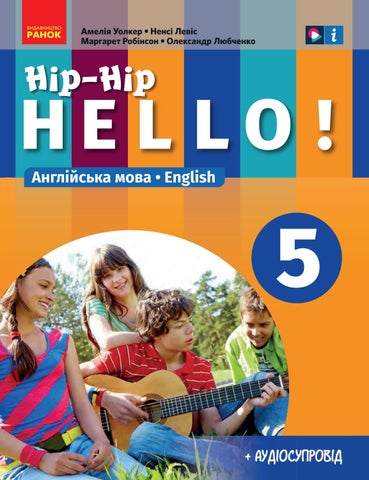
Амелія Амелія Уолкер Уолкер • Ненсі • Ненсі Левіс Левіс Маргарет Маргарет Робінсон Робінсон • Олександр • Олександр Любченко Любченко
Світлана Сотникова, Ганна Гоголєва
Німецька мова • Deutsch
5
Hip-Hip Hip-Hip
HHEE LL LLO O !! Англійська Англійська мова мова • English • English
55 + АУДІОСУПРОВІД + АУДІОСУПРОВІД
Амелія Уолкер Ненсі Левіс Маргарет Робінсон Олександр Любченко
«Англійська мова (5-й рік навчання)» підручник для 5 класу закладів загальної середньої освіти (з аудіосупроводом) «English»
ТОВ Видавництво «Ранок» м. Харків
Створено відповідно до модельної навчальної програми «Іноземна мова. 5-9 класи» для закладів загальної середньої освіти (автори: Зимомря І. М., Мойсюк В. А., Тріфан М. С., Унгурян І. К., Яковчук М. В.)
Амелія Уолкер • Ненсі Левіс Маргарет Робінсон • Олександр Любченко
Hip-Hip
HE L LO ! Англійська мова (1-й рік навчання)
Підручник для 5 класу закладів загальної середньої освіти (з аудіосупроводом)
ENGLISH (Year 5)
A TEXTBOOK FOR THE FIFTH FORM OF SECONDARY SCHOOLS (WITH AUDIO)
Рекомендовано Міністерством освіти і науки України
ХАРКІВ Видавництво «Ранок»
Contents Hello аgain!
6–11
Unit 1
MEET THE COUSINS
GRAMMAR
VOCABULARY
FUNCTIONS
SKILLS
PRONUNCIATION
The verb be; Personal pronouns and possessive adjectives; Possessive ’s and the preposition of
Personal information; Cardinal numbers
Greetings and introductions; Talking about my family; Counting to one million
Reading: meeting someone at the airport; an application form Listening: introductions; greetings Speaking: introducing myself; greeting someone formally and informally Writing: an email to a new friend
The letter A
Unit 2
HOME, SWEET HOME!
/æ/, /aː/, /eɪ/
22–31
GRAMMAR
VOCABULARY
FUNCTIONS
SKILLS
PRONUNCIATION
there is/are; Definite and indefinite articles; Possessive pronouns; Prepositions of place
Rooms in the house; House furniture
Talking about home and furniture; Describing my room
Reading: talking about a lost object Listening: showing people around the house; a description of a room Speaking: my room Writing: my house or flat
The letter E
Unit 3
WHAT’S SHE LIKE?
/e/, /iː/, /ə/
32–39
GRAMMAR
VOCABULARY
FUNCTIONS
SKILLS
PRONUNCIATION
have/has got; Comparative and superlative adjectives
Appearance and personality
Describing appearance; Talking about personality; Comparing people and objects
Reading: describing appearance and personality Listening: talking about classmates; describing appearance and personality Speaking: appearance and personality; thanking somebody Writing: describing a relative
The letter I
Up to now 1
/ɪ/, /aɪ/, /ɜː/
40–41
Unit 4
WHAT DOES SIESTA MEAN?
42–49
GRAMMAR
VOCABULARY
FUNCTIONS
SKILLS
PRONUNCIATION
The Present Simple; Prepositions of time
Daily routine; Phrases with have
Talking about my daily routine; Asking and telling the time
Reading: a daily routine Listening: a healthy habit Speaking: a daily routine; asking and telling the time Writing: my favourite part of the day
The letter O
Unit 5
4
12–21
SCIENCE IS MY FAVOURITE SUBJECT!
/ɒ/, /ɔː/, /əʊ/
50–57
GRAMMAR
VOCABULARY
FUNCTIONS
SKILLS
PRONUNCIATION
like/dislike + -ing; Adverbs of frequency
School subjects; Leisure activities
Talking about likes and dislikes; Talking about school subjects and leisure activities; Agreeing and disagreeing
Reading: a conversation about museum exhibits Listening: a visit to a museum Speaking: likes and dislikes; school subjects; leisure activities; agreeing and disagreeing Writing: likes and dislikes
The letter U /ʌ/, /ʊ/, /juː/
Unit 6
IT’S DELICIOUS!
58–69
GRAMMAR
VOCABULARY
FUNCTIONS
SKILLS
PRONUNCIATION
Countable and uncountable nouns; some and any; much, many and a lot of/lots of
Food; Ordinal numbers; Celebrations
Wishing a good holiday; Talking about my eating habits; Describing traditions and celebrations; Buying food
Reading: a favourite celebration Listening: favourite food and eating habits Speaking: eating habits; family celebrations and traditions; wishing people a good holiday Writing: family celebrations
Unstressed vowels: the sound SCHWA /ə/
Up to now 2
70–71
Fun time 1
72–73
Unit 7 GRAMMAR
TOURING LONDON VOCABULARY
The Present Buildings Continuous; and places The Present Simple in town and the Present Continuous; Adverbs of manner; Prepositions of movement Unit 8
FUNCTIONS
SKILLS
PRONUNCIATION
Talking about buildings and places in town; Asking for and giving directions; Accepting someone’s thanks
Reading: people describing what they are doing Listening: a London tour guide; describing photos Speaking: talking about buildings and places in town; asking for and giving directions; accepting someone’s thanks Writing: my hometown
The letter C
DISCOVERING THE WORLD
GRAMMAR
VOCABULARY
The Past Simple: the verb be; Past time expressions; The Past Simple: regular verbs; Indefinite pronouns; Prepositions of means or instrument
Geographical Talking about my birthday and features birthplace; Talking about past events
Unit 9
74–81
FUNCTIONS
/s/, /k/
82–89
SKILLS
PRONUNCIATION
Reading: an unassisted journey Listening: adventures and adventurous teens Speaking: past events; birthdays and birthplaces, journeys and adventures Writing: a school trip
Past Simple ending -ed
A JOURNEY BACK IN TIME
/t/, /d/, /ɪd/
90–97
GRAMMAR
VOCABULARY
FUNCTIONS
SKILLS
PRONUNCIATION
The Past Simple: irregular verbs
Plants and animals on the farm
Talking about past events; Making and accepting apologies
Reading: a journey back in time Listening: past experience Speaking: past events; apologising and accepting apologies Writing: a story based on pictures
The sounds
Up to now 3
/θ/and /ð/
98–99
5
Unit 10
OUCH! IT HURTS!
GRAMMAR
VOCABULARY
FUNCTIONS
SKILLS
PRONUNCIATION
can and could; must; have to and had to
Parts of the body; Health problems and symptoms
Talking about parts of the body and health; Seeing the doctor/the dentist
Reading: an accident and an urgent health problem Listening: a dental problem Speaking: parts of the body and health problems; present and past ability/ possibility Writing: a health problem
The letter S
Unit 11
WHAT ARE YOU DOING THIS WEEKEND?
GRAMMAR
VOCABULARY
will; The Present Continuous for arrangements and plans
The weather Talking about and seasons arrangements and plans; Describing the weather and seasons
Unit 12
FUNCTIONS
SKILLS
/s/, /z/
108–115 PRONUNCIATION
Reading: a description of a place and The letter G weekend plans; seasons /g/, /dʒ/ Listening: discussing plans; ads and voice messages Speaking: arrangements and plans; the weather and seasons Writing: my favourite season
WHAT ARE YOU WEARING TO THE PARTY?
116–123
GRAMMAR
VOCABULARY
FUNCTIONS
SKILLS
PRONUNCIATION
shall for suggestions; Word order (statements and questions)
Clothes and footwear
Talking about clothes and footwear; Describing someone’s clothes; Making suggestions; Saying goodbye
Reading: clothes to wear to a party; ads and announcements Listening: getting ready for a party Speaking: smart and casual clothes; making suggestions; saying goodbye Writing: my favourite clothes; an invitation
The sounds
GRAMMAR
VOCABULARY
FUNCTIONS
SKILLS
PRONUNCIATION
the with geographical names
geographical names; kinds of transport; prepositions of place and direction
Talking about past events; talking about a home country
Reading: ways of travelling and kinds of transport Listening: account of a past event Speaking: talking about a home country; talking about past events Writing: account of a trip
Geographical names
Unit 13
DISCOVERING UKRAINE
/ŋ/ and /ŋk/
124–129
Up to now 4
130–131
Fun time 2
132–133
Play and revise 1–12
134–145
Projects
146–148
Wordlist
149–155
List of irregular verbs
6
100–107
156
Hello again! II. A/AN; PLURALS; THIS/THESE 1. A/An We use a/an before singular countable nouns. We put a when the word starts with a consonant. We put an when the word starts with a vowel.
1
Work in pairs. Point, ask and answer. Take turns.
Model:
A: What’s this? B: It’s a notebook. It’s an apple.
2. The plural of nouns Regular plural: • We add -s to most nouns: apple + s = apples; cousin + s = cousins • We add -es to nouns ending in -s, -ss, -z, -x, -ch, -sh: bus + es = buses; kiss + es = kisses; quiz + es = quizzes; box + es = boxes; lunch + es = lunches; brush + es = brushes Irregular plural: Some nouns change in the plural: man men; woman women; child
2
children; foot
feet; tooth
teeth
Copy the nouns below into your notebook and write their plural forms. student
class
game
watch
number
key
place
letter
3. This/These This is а pen. That is a book.
3
These are pens. Those are books.
In your notebook, make the sentences plural.
Model:
Where is the child? Where are the children?
this pen
these pens
that book
those books
1. 2. 3. 4. 5.
Can you see that man? Do you know this woman? This game is funny. Don’t step on my foot. That child is happy.
7
Hello again! III. NUMBERS 1 1 2 3 4 5
Read the numbers. one two three four five
100 200 900 1,000
2
11 12 13 14 15
eleven twelve thirteen fourteen fifteen
one/a hundred two hundred nine hundred one/a thousand
10 20 30 40 50
ten twenty thirty forty fifty
21 22 33 44 55
twenty-one twenty-two thirty-three forty-four fifty-five
182 one hundred and eighty-two 212 two hundred and twelve 911 nine hundred and eleven
Look at the pictures and say the numbers.
s 34 B u rg a
124.9
5 km
5
3
A: How far is it from Kyiv to Lviv? B: It’s 534 km.
Lviv
534 кm
кm 502
Model:
Kyiv
Work in pairs. Make similar dialogues.
142 кm
Chernihiv
766 кm
Maryupol
Mykolaiv
4
8
Play a game. Student A says a number. Student B says the next number. Then change roles. Student B says a number. Student A says the previous number. Do it as fast as possible.
34
35
U1 IV. TELLING THE TIME, COLOURS What’s the time? What time is it?
B: It’s twenty to seven.
Listen and repeat.
2
A:
1 11 10
12
1 2
9 8
3 7
11 10
6
12
5
1 2
11 10
6
12
5
1 2 3
7
11 10
6
12
5
4
2 3
7
11 10
6
12
5
4
2
11 10
6
12
7
11 10
12
5
5
7
11 10
12
7
5
11 10
7
11 10
12
6:30
It’s half past six.
3
6:35
It’s twenty-five to seven. It’s six thirty-five.
5
3
6:40
It’s twenty to seven.
4
12
5
4
1 3
8
7
6
4
5
11 10
5
4
12
1 2
9 7
5
6
4
3
Work in pairs. Ask and answer about time. Use the two ways in 1. A: Look at the green clock. What’s the time? B: It’s two sharp.
It’s six forty.
6:45
It’s quarter to seven.
It’s six forty-five.
1 2
6
Is it twenty to eight?
8:40
11 10
2:00
11 10
12
5
4
6:50
It’s ten to seven.
12
1
4
5
4
6:55
It’s five to seven.
It’s six fifty-five.
11 10
12
1 2
9
3
8
5
4 7
11 10
8:20 2
6
6
5
4 6
9
3 7
4:30
2
6:05
2
It’s six fifty.
1
9 8
1 3
7
12
6
5
1 2
3:15 3
8 11 10
12
9
3 7
3 7
Is it half past eleven?
3
8
9
9 8
Is it five to ten?
7:55
8 12
Is it quarter to four?
2
9
1 2
6
It’s six thirty.
12
8
3 7
4
5
1 2
6
6
1
9 8
3 4
9 8
It’s twenty-five past six. It’s six twenty-five.
2
6
It’s six twenty.
1
9 8
6:25
2
6
3 7
11 10
It’s six fifteen.
3 4
2
A: Is it quarter past three? B: No, it isn’t. It’s twenty past three.
1
9 8
It’s six ten.
6:20
2
6
It’s quarter past six.
1
It’s six oh five.
It’s twenty past six.
4
9 8
It’s ten past six.
12
9
11 10 3
7
6:15
It’s five past six.
1
9 8
6:10
1
9 8
6:05
4
9 8
11 10
It’s six sharp.
8
3 7
Ask and answer in pairs.
4
9 8
6:00
It’s six o’clock.
It’s six forty.
6:40
4
7
6
5
10:40
11:45
9
Заглавие на урок Hello again! V. DAYS OF THE WEEK, MONTHS 1
2 Model:
Listen and repeat. SUNDAY
MONDAY
THURSDAY
FRIDAY
Look at the concert poster. Ask and answer in pairs.
TUESDAY SATURDAY
3
Listen and repeat. January February March April May June
А: When’s the concert in Zhytomyr? B: On Tuesday.
4
5
А: When’s your birthday? B: In September. A: Maria’s birthday is in September.
Ask and answer in pairs. 1. 2. 3. 4. 5. 6.
eday Zhytv ia c n on ay Kyi yts
o MTuessdday Vinnarkiv c y e o dn rsda y Kh ipr in e n W hu ida D esa T Fr day Od r ay tu Sa und S
10
6
July August September October November December
Ask and answer in pairs. Then report to the class.
Model:
rLtviv omyr
WEDNESDAY
How many days are there in a week? How many weeks are there in a year? How many days are there in January? How many days are there in February? How many days are there in June? How many days are there in September?
Play a game. Student A says a month. Student B says the next month. Then change roles. Student B says a month. Student A says the previous month. Do it as fast as possible. June! July!
U1 VI. CLASSROOM LANGUAGE 1
Listen, point and repeat.
Answer. Say.
Work in pairs.
Ask.
Read.
Check.
Write.
Repeat.
It’s your turn.
Listen.
Clean the board, please. Look at page … Pay attention.
Open your book.
May I go out, please?
2
Raise your hand.
Quiet, please. May I come in, please?
Don’t talk.
I’m sorry, I don’t understand.
Play a game. Student A gives an instruction to Student B. The rest of the class doesn’t hear what Student A says. Student B mimes the action and the class makes a guess.
11
UNIT 1
Meet the cousins
Unit focus Grammar: the verb be; personal pronouns and possessive adjectives; possessive ’s and the preposition of; be going to Functions: greetings and introductions; talking about my family; counting to one million; talking about plans and intentions; talking about your future job; appearance Vocabulary: personal information; cardinal numbers; jobs Pronunciation: the letter A
LET’S GET STARTED
LISTENING AND READING
1
3
Answer the questions.
1. 2. 3. 4.
Have you got any brothers or sisters? Have you got any relatives who live abroad?
WORDS IN ACTION 2
Listen and answer the questions. Where is Alice? What nationality is she? Who are Victoria and Borys? What nationality are they?
How many family words do you know? Now look at the words below. Explain the words you know. Follow the model and use the suggested definitions. an aunt
a parent
an uncle
a cousin
a grandparent
a relative
1. 2. 3. 4.
my mother’s or my father’s brother my mother or my father my aunt’s or my uncle’s child one of the parents of my mother or my father 5. my mother’s or my father’s sister 6. a person from my family such as a grandparent or a cousin Model:
An aunt is my father’s sister.
Listen, check and repeat.
12
Now listen again and check your answers.
4
Read the statements. Then listen to part of a conversation. Which statement is true? a. It is Victoria and Borys’s first time in London. b. It is Victoria and Borys’s second time in London.
U1 5
Read the whole conversation and answer the questions.
Mum, Dad, I can see them! Over there! Hey, Vicky! Hey, Borys! Alice: Hi, Alice! Hi, Justin! I’m so excited! It’s our first time in London! Victoria: Hi, Vicky! Hi, Borys! Justin: Hi, Justin! Hi, Alice! Borys: Mrs Wilson: Hello! We’re so happy to see you here! Victoria and Borys: Hello, Aunt Anna! Hi, Uncle John! Mr Wilson: Hi, kids. Are you tired? A little bit. Borys: Not at all. Victoria: Mr Wilson: OK, let’s go. Our car’s in the car park. Your bag’s huge, Vicky. Let me help you. Thank you, Uncle John. Victoria: Borys, I can help with your backpack. Justin: Thanks, Justin. I’m fine. Borys: 1. 2. 3. 4. 5.
Inside the
Who is excited? Who are Anna and John? Is Victoria tired? Where is the Wilsons’ car? Whose bag is huge?
UK
p or t throw A ir a e H n o nt d L on an importa is w o r th or H e a n. ar Londo airport ne
GRAMMAR SPOT 1. The verb BE POSITIVE
I
am
you we they he she it
are
is
NEGATIVE
I’m
I
you’re we’re they’re he’s she’s it’s
you we they he she it
am not
YES/NO QUESTIONS
Am Are
Is
аre not
is not
I’m not you aren’t we aren’t they aren’t he isn’t she isn’t it isn’t
SHORT ANSWERS
I ...?
I
you ...? we ...? they ...? he ...? she ...? it ...?
you we they he she it
Yes,
I’m not.
am. are.
is.
No,
you aren’t. we aren’t. they aren’t. he isn’t. she isn’t. it isn’t.
13
UNIT 1 PRACTICE 6
In pairs, complete the questions with the correct form of the verb be. Then give true answers. Follow the model.
Model:
7
1. 2. 3. 4. 5.
… you Ukrainian? … you 14 years old? … your family big? … your backpack huge? … your best friend in the same school as you? 6. … your classmates excited about the new school year? 7. … English your favourite subject?
A: Is Alice from Ukraine? B: No, she isn’t. She’s from the UK. A: Are Victoria and Borys in London? B: Yes, they are.
1. … Borys English? 2. … Alice 12 years old? 3. … the Wilsons at home? 4. … Victoria excited? 5. … the Wilsons’ car in front of the airport?
2. Personal pronouns and possessive adjectives PERSONAL PRONOUNS
POSSESSIVE ADJECTIVES
I you he she it we you they
my your his her its our your their
In pairs, say the correct form of the verb be to complete each question. Then give true answers.
PRACTICE 8
Say the correct possessive adjective to complete each sentence.
Model:
What’s your name?
1. Where’s Vicky? Only ... bag’s here! 2. Is that your brother? What’s ... name? 3. Borys and Victoria are twins. ... surname’s Andonovi. 4. We’re in class 5A. ... English teacher’s name is Mrs Kovalchuk. 5. I’m Ukrainian but … cousins are English.
3. Possessive ’s and the preposition of a. Read the examples and answer the questions. Victoria’s brother is called Borys. Excuse me, what’s the name of this street? When do we use possessive ’s? When do we use the preposition of?
14
Now check with the rules.
We use possessive ’s for people. We use the preposition of for things.
U1 b. Study the examples and match them with the rules. 1. My grandparents’ house is in the country. 2. The children’s bedroom is tidy. 3. Ben and Betty’s class is very nice. 4. Ben’s and Betty’s notebooks are in their bags.
a. regular plural noun + ’ b. irregular plural + ’s c. ’s after the last name when two or more people have got the same thing or things d. ’s after each name when two or more people have got different things
PRACTICE 9
Complete the sentences in your notebook. Follow the model and write phrases with ’s or ’, or of. 1. 2. 3. 4. 5. 6. 7. 8. 9.
(Vicky, mobile number) Vicky’s mobile number is very easy. (the children, toys) … are under the table. (Justin, bedroom) … is downstairs. (London, photo) Look at this … . Isn’t it wonderful? (my parents, room) … is upstairs. (Mrs Wilson, car) … is in the car park. (your school, name) What is the …? (my uncle and aunt, house) … is in Brick Street. (Vicky and Borys, passports) … are in their backpacks.
Remember!
VOCABULARY
Boys and men are male. Girls and women are female.
1. Personal information
10 Look at the word web below. Listen and repeat. first name
surname
nationality
date of birth age address
PERSONAL DETAILS
gender
mobile number
15
UNIT 1 Now read the application form. Find the words and phrases from the word web.
Remember! N FORM
APPLICATIO
the form in Please complete
Saying your address S
BLOCK LETTER
ying
ch you are appl
course for whi : Please tick the
1. COURSES English A1 English A2 Conversation English Drama h Business Englis
ation: lish Course Dur
Eng
95 Lisova Street, floor 3, flat 5, Kyiv
2 weeks
1 month
I live at ninety-five Lisova Street, floor three, flat five. The city is Kyiv, the postcode is oh two thousand. Shevchenkivskyi District, Building 42, Entrance B, floor 4, flat 19
3 months
L DETAILS: e 2. PERSONA GENDER: Femal A V O N O D SURNAME: AN ICTORIA FIRST NAME: V E IRTH: UKRAIN Y) COUNTRY OF B 8 (DD/MM/YYY 0 0 2 / 3 0 / 1 2 : DATE OF BIRTH
I live in Shevchenkivskyi District, building forty-two, entrance B, floor four, flat nineteen.
Male
Saying your mobile number
: 3. ADDRESS T 5 OOR 3, FLA L F , T E E R T S 95 LISOVA , UKRAINE 0 0 0 2 KYIV 0 78 986 21@ukr.net 380 88 43 0 0 Email: vicky_a ): de co ea untry and ar Tel. (including co 1 21/07/202 Date � V. And�n�v Signature
Mobile: 0038 088 769 35 40 country code mobile code number My mobile is double oh three eight oh, double eight, seven six nine, three five, four oh.
11 Read the application form again. Answer the questions. 1. 2. 3. 4.
16
What is the girl’s name? What is her surname? When is her birthday? How old is she?
5. What is her address? 6. What is her mobile number?
U1 2. Cardinal numbers 1,001 1,013 1,027 1,700 1,734 2,000 13,000 99,999 1,000,000
IMPORTANT!
one thousand and one one thousand and thirteen one thousand and twenty-seven one thousand, seven hundred (seventeen hundred) one thousand, seven hundred and thirty-four two thousand thirteen thousand ninety-nine thousand, nine hundred and ninety-nine one/a million
With numbers of four or more digits, we use a comma after every third digit from right to left.
12 Say the numbers. Then listen and check your answers. 1,783
68,544
101,352
1,098,786
13 In your notebook, write down the numbers you hear. Then check your answers with a partner.
MIND THE PREPOSITIONS! Prepositions of place: at, in, on We use prepositions of place to say where someone or something is. Now read the examples below. I’m at school. (I’m there to study.) My father is at the station. (He’s waiting for a train.) I’m in hospital. (I’m ill.) Look. My school is on the left and mum’s office is on the right. A: Where’s Peter? B: He’s on the bus to school.
at
in
on
at the bus stop at the airport at the station at home at school
in London in France in Europe in hospital in the street
on the floor on the table on the left on the right on the bus
17
UNIT 1 14 Say the correct preposition in each sentence. Model:
I’m not at school now, I’m at home. 1. A: Where are you now? B: I’m … the station. 2. Let’s meet … the bus stop at 3:00 pm. We can chat … the bus. 3. My grandma isn’t … home. She’s … hospital. 4. Alice lives ... London but she’s not there now. She’s … Kyiv. 5. My school is … Park Street. It’s the red building … the right. 6. Nazar lives ... 15 Vyshneva Street.
COMMUNICATION Greetings and introductions
15 Read and listen to the dialogues. Decide which one is formal and which one – informal.
Remember! You use formal English when you talk with teachers and other adults. You use informal English when you talk with friends or family members.
IMPORTANT! We use at to talk about addresses. I live at 35 Lake Street. We use in when we just give the name of the street. I live in Lake Street.
HOW TO Greet informally Hi! Hello! How are you? Greet formally Good morning/ afternoon/evening! Introduce yourself informally
A: B: A: B:
Hi, I’m Andrew. Hi, I’m Sue. How are you? I’m fine, thanks. And you?
I’m ... My name’s ...
A: B: A: B:
Good morning! My name is Ben Johnson. How do you do? I’m Sandy Smith. Pleased to meet you. Pleased to meet you, too.
My name is …/I’m … How do you do? Pleased to meet you.
Introduce yourself formally
16 Role play. Practise the dialogues in groups of four. Introduce yourself formally or informally to your classmates. Take turns.
18
U1 WRITING
I n s id e t h
An email to a new friend
17 Read Patrick’s email to a new email
friend. Then write an email to Alice or Justin. Use your personal details in place of Patrick’s.
e UK
In the UK , children the age of 4 and start school bet ween 5. for pupil s betwee Primar y school is n 4 and school – 11 and s for pupil e c on sb W hen ch ildren ar etween 11 and 1 dar y e 11, the y are in Y 8. ear 7.
To: Subject: Hi :-) Hi, My name is Patrick Brown. I am English. I am 11 years old and my birthday is on 3 March. I am in Year 7. My school is called Whitmore High School and it is a big school. It is in the town of Harrow near London. What about you? Write soon, Patrick
PRONUNCIATION The letter
A
18 Listen and repeat. æ
aː
eɪ
man
car
name
back
bath
take
match
park
age
hand
class
male
apple
father
date
thanks
partner
favourite
Now look at these words. In your notebook, put them into the correct group. Then listen and check your answers. baby bag are March cake cat
19
UNIT 1
Meet the cousins
What is the most difficult job you know? What is the easiest job? What is the most exciting/least exciting? VOCABULARY JOBS 19. Make a list of the jobs you know. 20. Match the jobs with the pictures.
a. lawyer d. vet g. journalist j. policewoman m. receptionist
b. builder e. manicurist h. army officer k. dentist n. driver
c. accountant f. game designer i. hairdresser l. nurse o. IT specialist
a housewife – a woman who works inside the home and looks after her children and husband/partner unemployed – a person without a paid job
Listen, check and repeat. 21. In small groups, talk about the jobs of your family members. My mother is a receptionist. My father is a builder. My grandfather is/was an accountant. My aunt is unemployed. LISTENING Todor is from the Teen Photographers club. What do you remember about him? How old is he? 22. Look at the pictures and answer the questions. 1. What is Todor going to study at university? 2. What is he going to do in summer? Listen and check your answers.
20110
U1 25. Complete the questions and answers. Then ask and answer in pairs.
23. Listen again and circle the correct answer. 1. Todor is in a. Grade 11.
b. Grade 12.
2. He is going to be a. a fashion designer.
b. a game designer.
3. Todor wants to be a. an important person.
b. a successful person.
4. Todor and Dimiter are going to friends from the Teen Photographers club. a. invite b. visit GRAMMAR BE GOING TO We use be going to + verb to talk about plans and intentions. Fill in. Positive I am going to travel with my brother. He/She ______ going to study hard. We/You/They ___ going to visit some friends in Europe. Negative, questions and short answers He isn’t ________ to be a doctor. _______ Dimiter going to be a vet? Yes, he is./No, he isn’t.
24. Fill in the gaps with the correct form of be going to: positive and negative. 1. He likes cars. He is going to be a car mechanic. be a fashion 2. I’m good at Art. I designer. travel this week because 3. They they’re busy. be a vet. She likes animals. 4. She 5. He be an accountant. He isn’t good at Maths.
1. She likes cooking. What is she going to be? A baker/A chef. 2. He likes driving. What
?
3. She loves working with her hands. What ? 4. They are good at acting. What
?
5. I am good at
. What ?
SPEAKING 26. Read and listen to the dialogue. Then practise in pairs. A: What are you going to be? B: (I’m going to be) A designer. A: Why do you like this job? B: It’s creative. And it’s well-paid. What about you? A: I’m going to be a vet. A: Why do you like this job? B: I love animals. TEEN TALK TALKING ABOUT YOUR FUTURE JOB A: What are you going to be? B: (I’m going to be) a/an … . A: Why do you like this job? B: It’s … ./I like … .
27. Make similar dialogues. Use the ideas in the box and your own ideas! It’s well-paid/fun/interesting. animals/cars/good food. I like I love I adore
working alone/in a team. helping people. doing things with my hands.
21
111
UNIT 2
Home, sweet home!
Unit focus Grammar: there is/are; definite and indefinite articles; possessive pronouns; prepositions of place Functions: talking about home and furniture; describing my room Vocabulary: rooms in the house; house furniture Pronunciation: the letter E
LET’S GET STARTED
LISTENING AND READING
1
3
In pairs, answer the questions.
Listen and answer the questions.
Is your home a house or a flat? Is it big or small? How many bedrooms are there in your flat/house? What furniture is there in a bedroom? What furniture is there in a living room?
WORDS IN ACTION 2
Look at the words below. Do you know any of them? Point to the pictures and say the words. upstairs
downstairs
a hall
stairs
a key
a fireplace
1
2
3
4
5
6
1. Where are Vicky and Borys? 2. Who are they with?
4
Listen, check and repeat.
22
Listen again and answer the questions. 1. 2. 3. 4.
Where is Alice’s room? Where is Justin’s room? What does downstairs mean? What does upstairs mean?
U2 5
Listen to part of another conversation and answer the questions. 1. What can’t Mrs Wilson find? 2. Who is it for?
6
Now read the whole conversation and the sentences below. Say true or false. Correct the false sentences.
Mrs Wilson: Alice: Mrs Wilson: Justin: Mrs Wilson: Mr Wilson: Mrs Wilson: Alice: Mrs Wilson: Borys: Mrs Wilson:
Alice, Justin. Where’s the spare key? I want to give it to Vicky and Borys. I think it’s under the flowerpot in the hall. I’m afraid it isn’t there, Alice. Isn’t it on the bookcase? No, Justin, it isn’t. Check the kitchen cupboards, dear. I’m sure it isn’t there. Mum, what about your handbag? There are all kinds of things in there. Come on, Alice, don’t be cheeky. This key’s somewhere in the house. Aunt Anna, there’s a key in the living room. It’s on the shelf over the fireplace. On the mantelpiece you mean? Yes, that’s the spare key! Keep it! Mr Wilson: Hey, where are my glasses? I can’t find them. Oh, no ... All:
1. There is a flowerpot in the hall. 2. There aren’t many things in Mrs Wilson’s handbag. 3. There is a fireplace in the living room. 4. Mr Wilson’s key is on the mantelpiece. 5. Mr Wilson can’t find his mobile phone.
23
UNIT 2 GRAMMAR SPOT 1. There is/There are Forms POSITIVE
NEGATIVE
There is a chair in the room.
There isn’t a chair in the room.
There are two chairs in the room.
There aren’t two chairs in the room.
QUESTIONS
Is there a chair in the room? Are there two chairs in the room?
SHORT ANSWERS
Yes,
there is. there are.
No,
there isn’t. there aren’t.ARE.
Use Answer the questions. When do we use there is? When do we use there are?
Now check with the rules. We use there is with singular nouns. We use there are with plural nouns.
PRACTICE 7
Say there is or there are to complete each sentence. Follow the model.
Model:
There are four chairs in the dining room.
1. 2. 3. 4. 5. 6. 7.
… two beds in my bedroom. … a table near the window. … two cupboards next to the door. … a key on the bookshelf. … a fireplace in the dining room. … four bedrooms in the house. … a flowerpot next to the door.
2. Articles The indefinite articles a/an and the definite article the Read and compare the examples. Answer the questions. There’s a bathroom downstairs. The bathroom is next to the living room. There’s an armchair in front of the fireplace. The armchair is new.
24
U2 When do we use a/an?
When do we use the?
Now check with the rules. We use a/an when we mention something for the first time. We use the when a. we mention something for the second time. b. there is only one of the things we are talking about.
Remember! Use a for words starting with a consonant. Use an for words starting with a vowel.
PRACTICE 8
Say a/an or the to complete the sentences.
Model:
There’s a dining room next to the kitchen.
1. Is there … flowerpot in … hall? 2. A: Excuse me, where is … bathroom? B: It’s on … first floor. 3. How old is … boy in … photo? 4. There’s … bookcase in my bedroom. It’s next to … door. 5. Mr Wilson’s glasses are on … sofa.
3. Possessive pronouns Read the examples and answer the questions. This is my room. This room is mine.
Your glasses are on the table. The glasses on the table are yours.
It’s her camera. This camera is hers. When do we use my, your, etc? When do we use mine, yours, etc?
Now check with the rules. We use my, your, etc before a noun. We use mine, yours, etc without a noun.
POSSESSIVE ADJECTIVES
POSSESSIVE PRONOUNS
my your his her its our your their
mine yours his hers its ours yours theirs
25
UNIT 2 PRACTICE 9
10 Make correct sentences.
Say the correct possessive pronoun to complete each sentence. Follow the model.
Model:
Say the right possessive adjective or pronoun. 1. Have you got your / yours mobile on you? I haven’t got my / mine. 2. The Wilsons are waiting for their / theirs cousins at the airport. 3. A: This isn’t my / mine workbook. B: I’m sure it’s your / yours. 4. My backpack is very old, not like my / mine sister’s. Her / Hers is brand new. 5. Your / Yours dog is very large. Our / Ours is tiny. 6. Where’s Vicky? Her / Hers mobile is ringing.
A: Whose keys are on the mantelpiece? Are they yours? B: Yes, they’re mine.
1. Where’s Alice? Isn’t this bag …? 2. My parents have got a lot of books. All these books are … . 3. A: Is this Justin’s bedroom? B: Yes, it’s ... . 4. My brother and I have got a big collection of CDs. All the CDs here are … . 5. This pink umbrella is not ... . My umbrella is blue.
VOCABULARY Rooms in the house House furniture
11 Listen, point and repeat.
1
2 3
a wardrobe
an armchair
a bunk bed
7 5 4 6 a bedside lamp
a bedside table
8 a sofa
a rug
a curtain 13
10 9 a coffee table
26
a chest of drawers
12
11 a bookcase
a display cabinet
a TV cabinet
U2 12 Copy the table into your notebook. Write the words in 11 in the correct column. Add any other words you know. Compare with a partner. BEDROOM
DINING ROOM
LIVING ROOM
KITCHEN
13 In pairs, ask and answer about the furniture in your flat or house. Use the information from the table in 12. Model:
A: Is there a TV cabinet in your living room? B: Yes, there is. / No, there isn’t.
MIND THE PREPOSITONS! Prepositions of place: on, under, behind, in front of, next to, near We use prepositions of place to say where someone or something is. Now look at the pictures and read the examples.
The laptop is on the table. The book is under the table.
The bike is in front of the house. The car is behind the house.
The dog is next to the sofa. The cat is near the sofa.
14 Look at the pictures. Say the correct prepositions. Model:
The dog is under the table.
1. The rug is ... the fireplace.
2. The armchair is ... the coffee table.
3. The sofa is ... the armchair.
4. The picture is ... the wall.
5. The bookcase is ... the armchair.
6. The key is … the rug.
27
UNIT 2 a. charger b. gadgets c. mouse d. CD player e. digital camera f. DVD player g. e-reader h. MP3 player i. smartphone j. tablet k. laptop l. desktop m. game console n. USB port o. keyboard p. battery q. joystick
VOCABULARY 1. Personal information
15 In your workbook, match the words with the pictures.
2
1
3 4 8
7 5 6
9
10
11
13 12
14
15
16
Now listen and check. Listen again and repeat.
28
17
U2 16 Find 9 more gadgets.
gadgetchargermouse to p b
lap
bl
e r y j oys ti ck
ar tphoneta
at t
s
m
Which of these gadgets: - have you got? - don’t need a desk to work on? - can work on a desk? - can you use for playing games? - can you use with both hands? - can help your other gadgets work?
e td e s k to p key b o a r d
17 Complete the sentences with necessary words. There are the first letters. I need a c… for my s… , its b… is low. You can use this U… for a m… or for a j… . My dad has got a new l… at his work and an old d… at home. I would like a new t… or a g… c… as a birthday present. My smartphone takes wonderful photos, so I don’t need a d… c… . I like to read books on my e… when I’m on a train or bus.
18 Do the crossword. Can you guess the key word? 1 2
C
D
P
3
L
A
Y
E
R
4
5 6
7
8
9
10
11
12
Across 1 You use it to listen to music. 2 You use it to type texts. 6 You use it to click on icons. 7 It is a very small computer. 11 You can take this computer with you. 12 You use it when your battery is low.
Down 3 You can use it for reading books. 4 This computer is on your desk. 5 You can use this gadget for calling friends, taking photos and many other things. 8 This gives power to your gadgets. 9 This is one word for smartphones, cameras, e-readers, CD players and so on. 10 This helps you play computer and video games.
29
UNIT 2 COMMUNICATION Describing my room
19 Read and listen to the conversation. Then practise in pairs. Vicky: Wow, your bedroom is lovely! Alice: Thanks. And what’s your bedroom like? Vicky: It’s not mine, it’s ours. I share the bedroom with Borys and Memory. Alice: Who’s Memory? Vicky: She’s our cat. Alice: Oh, what a funny name for a cat! Vicky: Yep! So in the bedroom there are two beds, two desks, two small wardrobes but three chairs – one for me, one for Borys, and one for Memory. And there are a lot of posters on the walls. There’s also a laptop and a game console. Alice: A game console? Cool!
20 Work in pairs. Choose one of the rooms below. It’s your room. Talk about it with your partner. Follow the conversation above as a model.
HOW TO Use exclamations Wow! Thanks! Oh! Cool!
30
U2 WRITING Describing my house or flat
21 Read the text. Which drawing matches the description? Our flat is very modern.
There are two bedrooms, a living room, a dining room, a kitchen, and a bathroom. My parents’ bedroom is big. My room is
small and sunny. There is a bed,
a desk, a chair, and a wardrobe. My laptop and school things are on the desk.
My clothes are everywhere.
Write a description of your home. Follow the model above.
PRONUNCIATION The letter
E
22 Listen and repeat. e
iː
ə
egg
kitchen
desk
she
listen
best
week
modern
Now look at these words. In your notebook, put them into the correct group. Then listen and check your answers. bedroom
garden
see
collection
children
street
31
UNIT 3 What’s she like? Unit focus Grammar: have/has got; comparative and superlative adjectives Functions: describing appearance; talking about personality; comparing people and objects Vocabulary: appearance and personality Pronunciation: the letter I
WORDS IN ACTION 2
Look at the pictures. Try to guess the meaning of the phrases in the speech bubbles. 1
What a pity!
2
LET’S GET STARTED 1
I love beautiful clothes.
Look at the pictures. Answer the questions. Who is tall? Who is short? Who is slim? Who is muscular?
3 Well done!
Now describe the pictures. a basketball player
4 5
Lucky you!
a gymnast
a weightlifter
32
Listen and repeat.
What a nightmare!
U3 6
LISTENING AND READING 3
Listen and answer the questions.
Alice: Hello everybody, I’m back home! Borys and Victoria: Hi, Alice! How are you? Alice: Fine. I’m so happy it’s holiday time! And how are you, school kids? Borys: Good. Summer school is fun. Alice: Excellent! And what’s your teacher like? Borys: In fact, we’ve got two teachers, Mrs Adams and Mr Daniels but we call them Kate and Alan. Victoria: Alan is very serious. Kate is funnier than him. Borys: But he’s more patient. Alice: What do they look like? Victoria: Alan is tall and skinny. He’s got curly red hair and blue eyes. He looks like a pop star. Borys: Kate is shorter than Alan. Victoria: She’s got big brown eyes and dark hair. Alice: Great! Summer school sounds fun.
1. Who is at home? 2. Who has got new friends?
4
Now listen again and answer the questions. 1. Where is Alice? 2. How many girls are there in Vicky and Borys’s group? 3. What is Justin interested in?
5
Now read the whole conversation and the questions below. Choose the correct answer.
Listen to part of another conversation and answer the questions. 1. How many teachers have Vicky and Borys got? 2. What are their names?
1. Why is Alice happy? a. Because she is back home. b. Because school is over. 2. Alan is a. a pop star. b. an English teacher. 3. Kate has got a. red hair and blue eyes. b. dark hair and brown eyes.
Note the difference!
Remember!
What’s she like? = Tell me something about her personality. What does she look like? = Tell me something about her appearance (eyes, hair, etc).
33
UNIT 3 GRAMMAR SPOT 1. Have/Has got POSITIVE
I you we they he she it
NEGATIVE
have got
I’ve got you’ve got we’ve got they’ve got
I you we they
has got
he’s got she’s got it’s got
he she it
haven’t got
hasn’t got
YES/NO QUESTIONS
I you we they
Have
got ...?
SHORT ANSWERS
Yes,
he she it
Has
I you we they
have.
he she it
has.
No,
haven’t.
he she it
hasn’t.
Remember!
PRACTICE
In short answers, we do NOT use got!
7
Yes, I have. / Yes, she has. No, I haven’t. / No, she hasn’t.
Say the correct forms have got, has got, haven’t got, hasn’t got to complete each sentence. Follow the model.
Model:
I have got a new friend.
1. Mr Daniels … curly brown hair. His hair is red. 2. … Justin … a new mobile? 3. … your parents … a car?
4. A: I’m sorry, I … a pen today. B: Here you are – I … two. 5. Lucy … a cat because her mother doesn’t like pets.
2. Comparative and superlative adjectives Study the examples. Kate is shorter than Alan. Alan is more patient than Kate. The girls in our class are the prettiest in the school. This is the most beautiful house in our street.
34
I you we they
U3 ADJECTIVE
COMPARATIVE
SUPERLATIVE
Short adjectives
tall thin pretty
taller thinner prettier
the tallest the thinnest the prettiest
Long adjectives
patient interesting
more patient more interesting
the most patient the most interesting
Irregular adjectives
good bad far much/many little
better worse further more less
the best the worst the furthest the most the least
Answer the questions. When do we use -er and the + -est? When do we use more and the most? When do we use than?
PRACTICE 8
We form comparative adjectives by adding -er to short adjectives and more to long adjectives. We use than after comparatives. We form superlative adjectives by adding the + -est to short adjectives and the most to long adjectives.
In your notebook, complete the sentences. Use the comparative form of the adjectives.
Model: 1. 2. 3. 4. 5. 6.
9
Now check with the rules.
(short) (sunny) (difficult) (small) (exciting) (large) (good)
Holidays are shorter than the school year. Summer is … than autumn. Writing is … than speaking. Ukraine is ... than the UK. Summer school is … than ordinary school. Your flat is … than ours. Borys is … at English than Vicky.
In your notebook, complete the questions. Use the superlative form of the adjectives. Then ask and answer in pairs. Give true answers.
Model: 1. 2. 3. 4. 5. 6.
(big) (young) (busy) (good) (bad) (difficult) (interesting)
What’s the biggest city in the UK? Who’s … member of your family? Who’s … person in your family? Who’s your … friend? What’s your … nightmare? What’s … English word you know? What’s … subject at school?
35
UNIT 3 VOCABULARY
a. short b. tall d. plump e. young g. slim/thin h. old
1. Appearance
c. medium height f. middle-aged i. overweight
10 In your notebook, match the words with the pictures.
1
2
3
4
5
6
7
Now listen and check. Listen again and repeat.
11 Look at the pictures of three avatars.
8
9
Remember! We say: He is tall. but He is of medium height.
Then read the text. Which avatar matches the description? Jack. He’s got shor t This is Transpor ter ses. e blue. He’s got glas ar es ey is H . ir ha k blac tall and slim. Transpor ter Jack is
In your notebook, write a description of one of the other two avatars. Then read it to your partner. Ask him/her which avatar matches the description.
2. Personality
12 Read the words and their definitions. Try to guess their meaning. Then listen and repeat.
patient impatient friendly unfriendly polite impolite communicative shy clever
someone who can wait a long time someone who can’t wait a long time someone who is nice to other people someone who isn’t nice to other people someone who has got good manners someone who hasn’t got good manners someone who likes to talk someone who is quiet and a bit nervous around other people someone who learns and understands things quickly
Do you know any other adjectives of personality?
36
We use adjectives like patient, shy and unfriendly to describe personality. We call them ADJECTIVES OF PERSONALITY.
U3 13 Copy the table into your notebook. Write the adjectives in 12 in the correct column. Add any other adjectives of personality you know. POSITIVE ADJECTIVES
NEGATIVE ADJECTIVES
14 Listen to Vicky talking about two of her new friends.
Tick the adjectives of personality you hear in the table in your notebook. Listen again. Now write A for Alexa and B for Bella next to the adjectives in your table. Work in pairs. Use your notes and talk about Alexa and Bella. What do they look like? What are they like?
COMMUNICATION Describing a friend
15 Read and listen to the conversation. Then practise in pairs. Remember! We usually use handsome for boys and men.
A: B: A: B: A: B: A: B: A: B: A: B: A:
HOW TO Thank somebody Thank you very much! Thanks a lot! Thanks a million!
I know you’re really good at making avatars. Yes, that’s right. Can you make an avatar for my friend Jenny? Sure. Let’s start. What does she look like? plump of medium height handsome cute She’s thin and short. She’s very pretty. What colour is her hair? It’s brown. blonde black red Is it long or short? It’s long. short OK. Long brown hair. What colour are her eyes? They’re blue. And big. black green brown small OK. Big blue eyes. Let’s see. Is this Jenny? Wow, you’re great! That’s her. Thank you very much! him
Make a similar dialogue about the avatar for a friend. Replace the words in bold with the ideas on the right. Draw the avatar.
37
UNIT 3 16 Work in pairs. Choose a role: Student A or Student B.
Read the role cards and make a dialogue. Then change roles and make another dialogue. You can use the dialogue in 15 as a model.
Student A: Choose a classmate but don’t tell Student B his/her name. Tell Student B you’ve got a new friend. Answer student B’s questions about your friend.
Student B: Student A has got a new friend from your class. Ask Student A about his/her new friend’s appearance. Guess who Student A’s new friend is.
WRITING Describing appearance and personality
17 Read the description and answer the questions. My grandma’s name is Maria but everybody calls her Mimi. She’s 58 years old. She’s my mum’s mother.
My granny isn’t very tall. She’s a bit plump. She’s got short straight grey hair. Her eyes are brown and she’s got glasses.
My granny is kind and patient. She’s the best granny in the world.
38
U3 1. Which paragraph introduces the person?
WRITING TIPS Order of adjectives
2. Which paragraph describes her appearance?
When you describe someone’s hair, always use the following order of adjectives:
3. Which paragraph describes her personality?
HAIR LENGTH
Write a similar description of a family member or a friend. Follow the model.
short
HAIR STYLE
straight
HAIR COLOUR
red
She’s got short straight red hair.
When you describe someone’s eyes, always use the following order of adjectives:
EYE SIZE
big
EYE SHAPE
round
EYE COLOUR
black
He’s got big round black eyes.
PRONUNCIATION The letter
I
18 Listen and repeat. ɪ
aɪ
ɜː
big
bike
girl
thin
like
shirt
slim
night
skirt
silly
polite
circle
pity
exciting
birthday
Now look at these words. In your notebook, put them into the correct group. Then listen and check your answers. mobile bird kid mine thirty holiday
39
Up to now 1 READING
LISTENING
3
Read the article. In your notebook, answer the question: What is the UpsideDown House?
1
1
2
Listen to the text. What is the best title? Write the correct answer in your notebook. a. Classrooms in Australia b. Students in Australia c. Schools in Australia
2
3
Listen again and write the correct answers in your notebook. 1. The Australian school year lasts 4
а. 100 days. b. 200 days. c. 300 days. 2. There are … in a school year. a. two terms b. three terms c. four terms 3. Students have … of holiday between terms. a. two weeks b. three weeks c. four weeks 4. The school day is a. from 8:30 am to 3:00 pm. b. from 9:00 am to 3:30 pm. c. from 9:30 am to 3:30 pm.
40
5p.
A. Look at the photos. Can you guess what this is? This is one of the tourist attractions in Bukovel, Ukraine. It is called the Upside-Down House. B. The house has two floors. On the ground floor you can see a utility room and a bathroom, on the second floor there is one big room with large windows.
C. The house is upside down not only outside but also inside — all the furniture is on the ceiling. D. The unusual house is open for tourists all year round. The pictures that you can take while inside the UpsideDown House are good to share with friends on social networks. Source: Source https://ukraine-kiev-tour.com/ bukovel-upside-down-house.html
4
Read the text again. In your notebook, write true or false. Correct the false sentences. 1. The Upside-Down House doesn’t have many rooms. 2. It is in one of European countries. 3. It has got only one floor. 4. It has got a lot of very small windows. 5. There is a bed on the ceiling. 6. In winter, the house is closed for tourists.
6p.
SPEAKING 5
Work in pairs. Each pair chooses a topic for conversation. Pair A. Family, appearance and personality Follow the instructions and make a dialogue. Take turns.
Student B:
Student A: Ask about the people in Student B’s family. Ask Student B to describe a family member. Ask about his/her personality.
Answer Student A’s question. Describe the person’s appearance. Use adjectives of personality to describe the person.
Pair B. Home and furniture Choose a picture in 3 and describe it to your partner. Use the expressions in the box. Take turns.
• • • • •
there is / there are on the left / on the right in front of / behind / next to red / pink / orange small / large
Go to page 22 in Workbook 1 to do the Grammar and Vocabulary sections.
I know how to:
introduce myself formally and informally. greet people. thank people. talk about my family and relatives. describe my room. talk about my home and furniture. describe a person’s appearance and personality.
I can:
use personal pronouns and possessive adjectives. express possession. use the definite and indefinite articles. compare people and things.
Now
41
UNIT 4
What does siesta mean?
Unit focus Grammar: the Present Simple; prepositions of time Functions: talking about my daily routine; asking and telling the time Vocabulary: daily routine; phrases with have Pronunciation: the letter O
LET’S GET STARTED 1
Answer the questions. What are the days of the week? What are the weekdays? When is the weekend? What is your favourite part of the day? What do you do then?
LISTENING AND READING 3
1. What part of the day is it? a. Morning. b. Noon. c. Afternoon.
WORDS IN ACTION 2
Listen and choose the correct answer.
Look at the pictures. Read the sentences and try to guess the meaning of the phrases in bold.
2. What does Justin do three times a week? a. He goes swimming. b. He goes walking. c. He goes running.
1. They have a rest after lunch.
2. My dad has a nap on Sunday afternoons.
3. We go jogging at the weekend.
Now listen and repeat.
42
4
Now listen again and answer the questions. 1. Where do Justin and his dad go jogging? 2. Who goes jogging every morning? 3. Do Vicky and Borys want to join? 4. Does Justin get up early at weekends?
U4 5
Listen to part of another conversation and answer the questions. 1. Where does Alfredo come from? 2. What do people in Alfredo’s country do after lunch?
6
Now read the whole conversation and answer the questions below.
Alfredo: Victoria: Alfredo: Borys: Alfredo:
Victoria: Borys: Alfredo: Victoria: Alfredo: Borys:
I’m so sleepy. Are you? Why? I need my siesta. Siesta? What does that mean? It’s a rest or a nap after lunch. I come from Spain, you know. In summer, it’s very hot there. That’s why we have a rest for two or three hours in the afternoon. Most shops and offices close. They open again at 4:00 or 5:00 pm. How interesting. It’s very hot in summer in Ukraine, too, but people don’t have a siesta. And what time do people finish work in Spain? My parents come home around 8:00 pm. We have dinner between 9:00 and 11:00 pm. Really? So late? Yes. We don’t go to bed before midnight or even 1:00 am. That’s so cool!
1. Why is Alfredo sleepy?
4. What time do they open again?
2. What does siesta mean?
5. When do Alfredo’s family have dinner? Why?
3. Do most shops and offices close after lunch?
6. What time do Alfredo’s family go to bed?
Remember! What does it/that mean? or What is this/that in English? We ask these questions when we don’t know a word.
43
UNIT 4 GRAMMAR SPOT The Present Simple Forms POSITIVE
I You We They
like
He She It
likes
NEGATIVE
music.
I You We They
don’t like (do not) like
He She It
doesn’t (does not) like
music.
YES/NO QUESTIONS
I you we they
Do
Does
like music?
SHORT ANSWERS
Yes,
he she it
I you we they
do.
he she it
does.
No,
I you we they
don’t.
he she it
doesn’t.
WH-QUESTIONS
do What Where does
I we you they he she it
like? live?
Answer the questions. When do we use verb + -s? When do we use do/does? When do we use don’t/doesn’t?
Now check with the rules. We use verb + -s after he/she/it in positive sentences. We use do/does + base form of the verb in questions and only do/does in short answers. We use don’t/doesn’t + base form of the verb in negative sentences and only don’t/doesn’t in short answers. base form of the verb = verb without to
44
U4 MIND THE SPELLING!
Use Read the examples and match them with the rules.
VERB + S
1. The Earth goes around the Sun. 2. I like chocolate. I don’t like soft drinks. 3. Dad goes jogging every morning. We use the Present Simple to talk about a. something that is always true. b. likes and dislikes. c. habits.
sleep make + s play
sleeps makes plays
cry study + s try
cries studies tries
go catch + es kiss
goes catches kisses
PRACTICE 7
Copy the table into your notebook. Add -s or -es and put the verbs into the correct column. play
watch
cry
-s plays
8
study
-es watches
run
walk
dress
fly
listen
go
make
kiss
try
-ies cries
Say do/does, don’t/doesn’t to complete each sentence.
Model: 1. 2. 3. 4. 5.
9
wash
Justin likes football but he doesn’t like volleyball. People in Ukraine ... have a siesta. A: Peter, ... you like tea? B: No, I … . A: … your parents like your new friends? B: Yes, they … . A: What ... Mike like more – jogging or swimming? B: Oh, he ... like sports at all! I … go to bed early on Saturday.
Say the opposite.
Model: 1. 2. 3. 4. 5.
I play tennis but I don’t play football. I don’t play tennis but I play football. I have dinner after 9:00 pm and I don’t go to bed early. Annie doesn’t do her homework in the morning, she does it in the afternoon. James and Andy don’t walk to school, they take the bus. This shop closes at 6:30 pm. It doesn’t close at 7:00 pm. Grandma has a nap after lunch. She doesn’t go for a walk.
45
UNIT 4 VOCABULARY My daily routine
10 In your notebook, match the pictures with the phrases. a. wake up b. go to school c. watch TV d. have a shower e. go to bed f. finish classes g. have breakfast h. get dressed i. go home j. have lunch k. do homework l. have dinner m. get up n. brush my teeth
Remember! Sometimes we use have + noun to express an action. I have breakfast at 7:00 am. I don’t have breakfast at 6:00 am. Lena has lunch at home. She doesn’t have lunch at school. Here are some phrases with have: have fun have dinner
1 6:30 am
2
BUT BUT
have a good/a great time have a sandwich/a snack
6 7:30 am
7
6:32 am
3
1:00 pm
8
6:40 am
4
1:30 pm
9
7:00 am
5
1:40 pm
10
7:15 am
2:30 pm
Now listen, check and repeat.
46
11 7:00 pm
12
8:00 pm
13
10:00 pm
14
10:30 pm
U4 11 Meet Lena – she’s in Vicky and Borys’s group at the summer school. Read about Lena’s daily routine. Say the phrase for each picture.
Hi there. I’m Lena. I come from Bulgaria. Here’s what I do on weekdays in Bulgaria. I
at 6:30 am. I
and
orange juice. Then I 1:00 pm and I I
and .I
. I don’t
– I just drink
. School starts at 8:00 am. I
at
with my sister and my grandparents. After that
. Then I go to ballet classes. I love ballet and I practise every day. My parents
come home from work at 7:00 pm. And then we all evenings. I listen to music. At 10:00 pm I
. I don’t and
in the
.
Now listen and check.
12 Talk about Lena’s daily routine. Follow the model. Model:
She wakes up at 6:30 am. She gets up and brushes her teeth.
13 In pairs, talk about your daily routine. Take turns. Use the model in 11.
MIND THE PREPOSITIONS! Prepositions of time: at, in, on We use prepositions of time to say when something happens. Now read the examples below. I get up at 7 o’clock. I do my homework in the afternoon. I have English classes on Mondays and Fridays.
at
in
on
at 5 o’clock at the weekend at noon at night at Christmas
in the morning in the afternoon in the evening in summer in April
on Monday on Tuesday morning on weekdays on my birthday on Christmas Day
47
UNIT 4 14 Say the correct preposition in each sentence. I get up early on weekdays.
Model:
1. Dad has a nap … Sunday afternoons. 2. Classes finish … 1:00 pm. 3. I do my homework … the afternoon.
4. My baby sister often wakes up … night. 5. Justin goes jogging … the morning. 6. They visit their grandparents … the weekend.
COMMUNICATION HOW TO
1. Asking and telling the time
Ask for the time
15 Read and listen to the dialogues. Then practise in pairs. A: B: A: B:
Excuse me, have you got the time, please? It’s 12:45. Thank you very much. You’re welcome.
A: What time is it? B: It’s 7:15. A: Hurry up, it’s time for school. A: What time does the match start? B: It starts at 7:30. A: Oh, we’ve got plenty of time. Let’s have a snack.
What time is it?/What’s the time? Excuse me, have you got the time, please? Sorry, can you tell me the time, please? What time does the film start? When does the film start?
dinner the talent show the film classes bed the concert
Now make similar dialogues. Replace the times with your ideas and the words in bold with the words and phrases in the box. Act out the dialogues for the class.
2. Talking about my daily routine
16 Read and listen to the dialogue. Then practise in pairs. A: B: A: B:
HOW TO Tell the time It’s half past three. It’s three thirty. It’s five to seven. It’s six fifty-five. It’s quarter past eight. It’s eight fifteen. It’s quarter to one. It’s twelve forty-five.
What do you do in the morning? Well, I go to school. And what do you do after school? I have lunch and then I do my homework.
Now make similar dialogues. Replace the phrases in bold with your own ideas.
48
11 10
12
1 2
9 8
3 7
11 10
6
12
5
4
1 2
9 8
3 7
11 10
6
12
5
4
1 2
9 8
3 7
11 10
6
12
5
4
1 2
9 8
3 7
6
5
4
U4 17 Work in pairs. Choose a role: Student A or Student B. Read the role cards
and make a dialogue. Then change roles and make another dialogue. Use the ideas in the box below.
Student B: Student A: You want to go to the cinema on Sunday at 4:00 pm. Find a classmate who is free on Sunday. Invite him/her to come with you.
Answer student A’s questions. Agree to go with Student A. OR Disagree because you are busy. Invite student A to go to the National History Museum with you on Saturday.
USEFUL LANGUAGE I want to … Do you want to …? What time …?
WRITING My favourite part of the day
18 Read Paulo’s homework about his favourite part of the day. When does he do his homework?
The film starts ... Let’s go … That’s a great idea!
PRONUNCIATION The letter
ɒ
ɔː
əʊ
box
short
open
stop
sport
home
shop
more
most
often
before
piano
jogging
morning
alone
is the afternoon. I finish school at 1:00 pm and I go home. I have lunch and then
I hurry out for my football practice. In the late afternoon,
I hang out with my friends or chat with them on Viber.
In your notebook, write a similar description of your favourite part of the day. Follow the model.
O
19 Listen and repeat.
My favourite part of the day
After that I do my homework.
I’m sorry I can’t. I’m busy. Why don’t we go …
Now look at these words. In your notebook, put them into the correct group. Then listen and check your answers. go whole
clock office
horse form
49
UNIT 5 Science is my favourite subject! Unit focus Grammar: like/dislike + -ing; adverbs of frequency Functions: talking about likes and dislikes; talking about school subjects and leisure activities; agreeing and disagreeing Vocabulary: school subjects; leisure activities Pronunciation: the letter U
LISTENING AND READING 3
1. What news has Mrs Adams got for her group? 2. Are Vicky and Borys interested?
LET’S GET STARTED 1
Answer the questions.
4
Do you like going on school trips? Is there a Natural History Museum in your hometown? Are you interested in dinosaurs?
touch
do experiments measure
a skull
1
bones life-sized 3
2
4
6
Now listen, check and repeat.
3. Vicky is not interested in a. rocks and stones. b. dinosaurs. c. plants. 4. Borys’s favourite subject is a. History. b. Science. c. Geography.
5
50
2. There are about 80 million … on display. a. rocks b. animals c. objects
Look at the words and phrases below. In your notebook, match them with the pictures.
scary
Now listen again and choose the correct answer. 1. The trip is to a. the British Museum. b. the Natural History Museum. c. the Science Museum.
WORDS IN ACTION 2
Listen and answer the questions.
7
5. The museum has got a collection of ... models of dinosaurs. a. medium-sized b. life-sized c. pocket-sized
U5 CULTURE CORNER The Natural History Museum in London is a favourite place for people of all ages. The museum has got a huge collection of about 80 million objects on display. It has got different colour-coded zones. They cover all forms of life on Earth from prehistoric times till now. More than 300 scientists work there. The Museum is a top UK visitor attraction. Entrance to the museum is free. Source: http://www.nhm.ac.uk/
5
Listen to part of another conversation and answer the questions. 1. Do all the students like the museum? 2. Who has got a surprise?
6
Now read the whole conversation and the sentences below. Say true or false. Correct the false sentences.
Mrs Adams: Borys: Paulo: Alfredo:
How do you find the museum, kids? It’s great! I like touching the objects. I love doing experiments. I prefer watching videos. The Velociraptor 3D video’s amazing! Mrs Adams: What about you, Vicky? Are you bored? Victoria: Oh, no, Kate, not at all. It’s absolutely fantastic! Look, we can make a dinosaur mask. I love drawing. Mrs Adams: I’m so glad you all like it. There’s something for everybody here. Now I’ve got a surprise for you... Come here quickly. Let me introduce you to T-Rex. It’s only 70 million years old. Are you kidding us? Borys: Mrs Adams: No, Borys. I’m serious. You can touch its skull. And you can measure its teeth and bones. Victoria: Brrr, that’s scary. I’m so happy these monsters don’t exist anymore! 1. Borys likes the museum. 2. Paulo doesn’t like doing experiments. 3. Vicky likes drawing. 4. Alfredo likes watching videos.
5. Mrs Adams shows a Velociraptor to the students. 6. The students can’t touch the dinosaur bones. 7. Vicky is sorry she can’t see a living dinosaur.
51
UNIT 5 GRAMMAR SPOT 1. Like/don’t like/hate + -ing Read the examples. What form of the verb do we use after like, love, and hate? love like don’t mind don’t like hate
I
studying. sleeping. watching TV.
Now check with the rule. We use verb + -ing after love, like, don’t mind, don’t like, and hate.
PRACTICE 7
Work in pairs. Take turns to ask and answer the questions below. Use the phrases in the box as well as your own ideas.
Model:
I love playing football.
3. What don’t you mind doing? 4. What don’t you like doing? 5. What do you hate doing?
1. What do you love doing? 2. What do you like doing? go to school go on school trips go to the cinema
do homework visit museums tidy my room
play football sleep help my parents
watch TV do experiments walk the dog
2. Adverbs of frequency
Remember! always usually often sometimes never
52
100%
0%
IMPORTANT! Once (one time) a day/a week/a month Twice (two times) a day/a week/a month Three times a day/a week/a month
U5 Read the examples and answer the question below. I am sometimes late for school. They are never bored. Alfredo usually watches videos in the evening. I don’t often watch sport on TV. Do you often play sports? Does Vicky usually go to school by bus? Where do we put adverbs of frequency in the sentence?
Now check with the rules.
Adverbs of frequency go after am/are/is. Adverbs of frequency go before other verbs.
PRACTICE 8
Make sentences true for you. Use always, usually, often, sometimes, never.
Model: 1. 2. 3. 4. 5. 6. 7. 8. 9.
9
I never go to school by car. I … go to school by car. I am … late for school. I am … happy. I am … hungry at 10:00 pm. I … listen to music in the evening. I … go the cinema. I … go to school by bus. I … speak English outside school/at home. I … go to museums.
In your notebook, put the words in the correct order to make sentences. Then check with your partner. 1. I / my / on / the / bus / always / on / mobile / text .
Model: 2. 3. 4. 5. 6.
I always text on my mobile on the bus. usually / watches / the / TV / evening / in / Maria . my / music / are / loud / play / angry / when / always / I / parents . grandma / in / nap / the / my / afternoon / has / never / a . your / homework / you / do / usually / do / when ? they / often / come / me / with / to / cinema / the / don’t .
53
UNIT 5 VOCABULARY 1. School subjects
1
10 Read the school subjects. In your notebook,
match the school subjects with the pictures. Which are the new subjects this year? a. Ukrainian Language b. Geography and Economics c. Maths d. Science e. Literature f. History and Civilisations g. IT (Information Technology) h. Music i. Art j. Technology and Enterprise k. PE (Physical Education) l. English m. German n. French
8
9
12
9
13
2
3
4
5
6
7
10
11
14
Now listen, check and repeat. Then go to page 32 in Workbook 1 to do exercise 7. Read the school timetable and answer the questions.
54
U5 11 In pairs, talk about your school
subjects. Use the words in the box and follow the models below.
HOW TO
A: I think English is easy. B: Yes, I agree.
Agree and disagree I think so, too. That’s right. Absolutely. Yes, I agree.
A: I think Maths is difficult. B: I don’t think so. I think Maths is easy. • interesting/a bit boring • fun/a waste of time • useful
• great • hard • easy
I don’t think so. That’s not right. Absolutely not. I don’t agree. I’m not sure about that.
2. Leisure activities
12 In your notebook, match the activities with the pictures.
1
6
2
3
7
a. play video games d. ride a bike g. have a party
4
8
b. surf the Internet e. hang out with friends h. go camping
5
9
c. go for a walk f. play sports i. go hiking
Now listen, check and repeat. In your notebook, make a list of other leisure activities you know.
13 Work in pairs. Choose an activity and mime it for your partner. Your partner guesses the activity. Take turns.
55
UNIT 5 COMMUNICATION Talking about likes and dislikes
14 Read and listen to the dialogues. Then practise in pairs.
LeisureTodtime ay’s interviews
new teen
Vicky: What do you like doing in your free time? Alfredo: I love sleeping and I like playing video games. Vicky: Really? What about sports? Do you like playing sports? Alfredo: Yes, I do. I love swimming. Vicky: How often do you go swimming? Alfredo: Four times a week. And I also do karate. Vicky: How often do you do karate? Alfredo: Twice a week. Vicky: Wow, you’re sports mad!
Borys: What do you like doing in your free time? Martha: I like hanging out with friends. I’m very communicative, you know. Borys: Yes, you really are. What about sports? Do you like playing sports? Martha: I don’t mind playing sports. I sometimes ride my bike. Borys: Sometimes? What do you mean? Martha: Four or five times a month. Borys: I see. You’re not mad about sports.
HOW TO Ask and answer about leisure activities
Now make similar dialogues. Replace the phrases in bold with your own ideas.
What do you like doing in your free time? I like/love … /I don’t mind … Do you like sports/reading? How often do you …?
15 Work in pairs. Choose a classmate you don’t know very well and interview him/her about his/her free time activities. Write down your classmate’s answers and tell the class about him/her. Change roles.
56
U5 WRITING Describing likes and dislikes
16 Read Alfredo’s email to Patrick, his email friend. What doesn’t Alfredo mind doing?
To: patrick_the_great@gmail.com Subject: Hi again :-) Hi Patrick, How are you? What do you like doing in your free time? In my free time I like listening to music and playing sports. My favourite singer is Drake. My favourite sports are swimming and karate. I also love sleeping and playing video games. I don’t mind walking the dog. Write soon, Alfredo
Write a similar email to a friend. Follow the model.
PRONUNCIATION The letter
U
17 Listen and repeat.
Now look at these words. In your notebook, put them into the correct group. Then listen and check your answers.
ʌ
juː
ʊ
cut
student
put
just
usually
full
study
introduce
pull
instrument
lunch
computer
push
during
umbrella communication pudding
summer music sugar
plump
57
UNIT 6
It’s delicious!
Unit focus Grammar: countable and uncountable nouns; some and any; much, many and a lot of/lots of Functions: wishing a good holiday; talking about my eating habits; describing traditions and celebrations; buying food Vocabulary: food; ordinal numbers; celebrations Pronunciation: unstressed vowels: the sound SCHWA
LET’S GET STARTED
LISTENING AND READING
1
3
In pairs, answer the questions. Then report to the class.
Listen and match the pictures with the people.
What is your favourite food? What is your favourite drink? What is your favourite dessert? Is there any food you only have on special days? 1
WORDS IN ACTION 2
Alice
Look at the words and phrases below. Do you know any of them? Match them with the pictures.
stuffing
grilled meat
a roast turkey
Brussels sprouts
cranberries
1
3
4
3
2
4 6
4 5
8
Now listen, check and repeat.
58
Borys
a bowl of cereal
a sausage bacon
7
2
Listen again and say true or false. Correct the false sentences. 1. Alice has a bowl of cereal and some fruit for breakfast. 2. Alice has lunch at home. 3. Alice has vegetables, pasta, or pizza for dinner. 4. Borys has two sandwiches and some fruit juice for breakfast. 5. Borys has lunch at school. 6. For dinner Borys has grilled meat and mashed potatoes.
U6 5
Listen to part of a text and answer the questions. 1. Which meal is an important part of the Christmas celebration? 2. When do people have Christmas dinner?
6
Now read the whole text and the questions below. Choose the correct answer.
Project TRADITIONS and FOOD by Justin Wilson
My favourite holiday is Christmas. In my family, the most important meal is Christmas dinner. It consists of lots of delicious dishes: roast turkey, Brussels sprouts, roast potatoes, and cranberry sauce. There is also stuffing, tiny sausages in bacon, and hot gravy. The dessert is a Christmas pudding. Nowadays, not many families make it at home but we still do. We prepare it long before Christmas. It has a lot of different ingredients. According to tradition, every member of the family stirs the pudding and makes a secret wish. My mum hides a silver coin in the pudding. It brings good luck to the person who finds it.
1. Christmas dinner consists of a. turkey, vegetables, sausages, and dessert. b. turkey, vegetables, and dessert. 2. The dessert on Christmas is a. a fruity pudding. b. a chocolate pudding.
3. People make Christmas pudding a. on Christmas day. b. some time before Christmas. 4. When the family prepares Christmas pudding, its members a. make a secret wish. b. hide a silver coin.
59
UNIT 6 GRAMMAR SPOT
Remember! Some nouns are both countable and uncountable. I like ice cream. Three ice creams, please.
1. Countable and uncountable nouns Read the examples and match them with the rules. I usually have a sandwich and two apples for breakfast. My Granny always has tea with milk in the afternoon. We can count some nouns: a banana – three bananas. They are countable nouns. There are some nouns that we can’t count: water, meat, sugar. They are uncountable nouns.
PRACTICE 7
Look at the words below. Copy the table into your notebook and write the words in the correct column. Add two more words to each column. banana bacon
water butter
Countable
apple sandwich
sugar cranberry
potato vegetable
sausage chocolate
Uncountable
2. Some and any Read the examples and answer the questions. some
butter eggs
in the fridge.
We use some in positive sentences with uncountable and plural countable nouns.
There isn’t There aren’t
any
juice oranges
in the fridge.
We use any in questions and negative sentences with uncountable and plural countable nouns.
Is there Are there
any
juice? oranges?
There is There are
When do we use some? When do we use any?
60
Now check with the rules.
Remember! We use some in questions when we ask for or offer something.
Can I have Do you need
some
chocolate, please? help?
U6 PRACTICE 8
Say some or any to complete each sentence. When you feel hungry, have some vegetables or some fruit between meals.
Model: 1. 2. 3. 4. 5.
There is … cheese but there isn’t … tomato sauce. Is there … mineral water in the fridge? My mother is on a diet. She doesn’t eat … sweets. My brother can’t eat … fried food. A: Can I have … biscuits, please? B: Sorry, there aren’t … biscuits, but there are … nuts. 6. Let’s go to the supermarket. We need … meat and … carrots.
3. Much, many and a lot of/lots of Read and compare the examples. Then answer the questions. She eats a lot of vegetables and she drinks a lot of water. Do you eat much chocolate? Are there many vegetarians in your class? There isn’t much tea in my cup! I don’t eat many vegetables. When do we use a lot of? When do we use many? When do we use much?
Now check with the rules. In informal English, we normally use a lot of/lots of in positive sentences with both uncountable and plural countable nouns. We use many with plural countable nouns in questions and negatives. We use much with uncountable nouns in questions and negatives.
a lot of = lots of
PRACTICE 9
In your notebook, match the two parts of the sentences. 1. 2. 3. 4. 5. 6. 7.
Ukrainians eat Do you drink There isn’t Do you eat Do you send My sister drinks They don’t serve
a. much food in the fridge. b. a lot of water every day. c. a lot of meat. d. much orange juice? e. much junk food when you go out with friends? f. many healthy drinks in the school café. g. many Christmas cards?
61
UNIT 6 VOCABULARY 1. Food
1
2
bread
a muffin
4
3 a pancake
a biscuit
10 Listen, point and repeat. 5 a strawberry
11 cabbage
10 sweetcorn 15 peas
20 salami
6 a peach
7 a watermelon
12 a mushroom
13 lettuce
22 honey
18 butter
23 jam
11 Look at the pictures and answer the questions.
1. What do the Wilsons usually have for breakfast at weekends? 2. What is there in Alfredo’s sandwich? 3. What does Lena sometimes have for dessert?
Now work in pairs. Ask and answer. Take turns. Model:
For breakfast I usually have a bowl of cereal. 1. What do you usually have for breakfast? 2. What do you usually have for lunch? 3. What do you usually have for dinner?
62
9 a pear
14 beans
17 cream
16 yoghurt 21 a burger
8 grapes
19 cheese
24 nuts
U6 2. Shops and money
12 Listen, point and repeat. 2
1
3 a baker’s 5
a chemist’s
4
6
a greengrocer’s 9
7
a shopping mall
8
a department store
12 a credit card
cash 14
12
a pound
13 Say the dates and the years.
a dairy shop
a newsagent’s 11
10
a bookstore
a butcher’s
a supermarket
13
a dollar
a hryvnia
milk meat Brussels sprouts bread medicines We can buy cheese books clothes shoes newspapers
a supermarket a bookstore a shopping mall the chemist’s the baker’s a department store the butcher’s the newsagent’s the greengrocer’s a dairy shop
in/at
63
UNIT 6 14 Look at the pictures of Exercise 11 again and answer the questions. 1. Where do the Wilsons buy their food for breakfast? 2. Where does Alfredo buy the food for his sandwich? 3. Where does Lena buy the food for her dessert?
Now work in pairs. Ask and answer in turns. I usually buy milk in a supermarket.
Model:
Where do you usually buy:
milk?
watermelons?
yoghurt?
bread?
sausage?
jeans?
3. Ordinal numbers
15 Listen and repeat. 1st first 2nd second 3rd third 4th fourth 5th fifth … 8th eighth 9th ninth 10th tenth
11th eleventh 12th twelfth 13th thirteenth 14th fourteenth … 19th nineteenth 20th twentieth
21st twenty-first 22nd twenty-second 23rd twenty-third 24th twenty-fourth … 30th thirtieth 40th fortieth
31st thirty-first 32nd thirty-second …
16 Say the dates and the years. 1 April – the first of April / April the first
Model:
12 August 14.09
16.08
22 October 23.11
1996 – nineteen ninety-six 2003 – two thousand and three
Model: 5 May
05.04
8.06
2001
1963
1912
1876
1396
1996
2011
2020
Now listen, check and repeat.
You can write 12 August or 12th August.
17 In pairs, ask and answer the questions below. • •
64
When do we celebrate Christmas? When do we celebrate St Valentine’s Day?
• •
When do we celebrate Liberation Day? When is your birthday?
U6 COMMUNICATION 1. At the supermarket
18 Read and listen to the dialogues. Practise in pairs.
Shop assistant: Customer: Shop assistant: Customer: Shop assistant: Shop assistant: Customer: Shop assistant: Customer: Shop assistant: Customer: Shop assistant: Customer: Shop assistant: Customer: Shop assistant: Customer: Shop assistant:
USEFUL LANGUAGE • Can I help you? • What would you like to get / buy / see? • I’d like / I would like …
Good morning. Can I help you? I’d like a box of 6 muffins, please. Here you are. How much are they? That’s 2 pounds, please. Can I help you? Yes, please. What would you like to buy? I’d like new jeans. Blue or black? Blue, please. Here you are. I like them. How much are they? 100 pounds. How would you like to pay? Cash, please. Here you are. OK. Thank you very much! You’re welcome.
• • • •
How much is it? How much does it cost? You’re welcome! Have a nice day!
Customer: Shop assistant: Customer: Shop assistant: Customer: Shop assistant: Shop assistant: Customer: Shop assistant: Customer: Shop assistant: Customer: Shop assistant: Customer: Shop assistant: Customer: Shop assistant:
Hello. Where can I find Cheddar cheese, please? In the dairy section. Where is it? It’s at the back of the shop on the right. Thank you very much. You’re welcome. Good morning! Can I help you? Yes, please. I’d like a new mobile. What brand would you like? Samsung, I think. Here you are. Yes, I like it. How much does it cost? It’s 53 dollars. I’d like to pay with a credit card, is it OK? Yes, of course. Thank you! You’re welcome! Have a nice day!
Now make similar dialogues. Replace the phrases in bold with your own ideas.
65
UNIT 6 2. Wishing a good holiday
19 Look at the photos. In your notebook, match the celebrations with the photos. Birthday Easter New Year’s Eve Christmas Valentine’s Day
4
3
5 2
1
3.
20 Read and listen to five dialogues. Match them with the celebrations in 19. Practise the dialogues in pairs.
4. A: Happy Easter! B: Same to you!
1. A: Many happy returns! B: Happy Birthday! C: Thank you all!
5. A: Merry Christmas, everyone! B: Merry Christmas!
2. A: Happy New Year! B: Happy New Year to you too! 3. A: Happy Valentine’s Day! B: Happy Valentine’s Day to you, thank you!
21 Work in pairs. Interview your partner about his/her birthday celebration and write down his/her answers. Change roles.
My Birthday Celebration Class Survey
Now report to the class.
66
USEFUL LANGUAGE When’s your birthday? Where do you usually celebrate your birthday? (at home/at a party club/ at a restaurant …) Who do you invite? (friends, relatives) Do you get any presents? If so, what presents do you usually receive? What do you do on your birthday? What food and drinks do you have?
U6 WRITING Family celebrations
22 Look at the picture. Listen, point and repeat. Then read the project about a Christmas Eve dinner in Ukraine.
This is a typical Christmas Eve dinner in Ukraine. The festivities start with the first star in the sky. The table has 12 meatless dishes. The main dish of the evening is Kutia (boiled wheat mixed with poppy seeds, honey, and nuts). Source: https://ukraine.ua
Mushrooms
Dumplings (varenyky)
Fish
Beans Kutia Borscht
Holubtsi
Write about a celebration dinner in your family. Follow the model.
PRONUNCIATION Unstressed vowels: the sound SCHWA
23 Listen and notice the stress of the words below.
ˈteacher /ˈtiːtʃə/ ˈChristmas /ˈkrɪsməs/ ˈparent /ˈpeərənt/ ˈanswer /ˈɑːnsə/ traˈditional /trəˈdɪʃ(ə)n(ə)l/ ˈsugar /ˈʃʊgə/ ˈwater /ˈwɔːtə/
Schwa is the name for the most common sound in English. It is a weak, unstressed sound. The phonemic symbol for this sound is /ə/.
IMPORTANT!
Тhe correct pronunciation of the schwa sound makes your English more accurate and natural.
Listen again and repeat. Find three words in 6 that have the schwa sound. Write them in your notebook.
67
UNIT 6
It’s delicious!
4C YOUR FOOD IS YOUR MEDICINE How old is the man in the picture?
READING 24. Read the text and write the headings over the paragraphs. Healthy habits
Daily routine
This is Pierre’s grandfather. He’s 75, but he looks about 65. He shares his secrets of a healthy life. ______________ I usually get up at 6 o’clock. I always drink a glass of water. Then I do yoga, drink a cup of tea and work in the garden. At 9:00 I have a snack of fruit or nuts. At lunch I have soup and salad. In the afternoon, I have a nap. In the evening, I have vegetables and yoghurt with bread. ________________ I eat a lot of vegetarian food. I eat meat once a week. I drink a lot of water every day. I never drink coffee. I go to bed early and sleep for 8 hours. I often say to my grandson: Your food is your medicine.
25. Read the text again and answer the questions. 1. What time does Pierre’s grandfather get up? 2. What does he do in the morning? 3. What does he eat at 9:00? 4. What does he do in the afternoon? 5. What does he drink in the evening? 6. What does he say to his grandson?
68
46
U6 GRAMMAR
27. Complete the questionnaire.
PREPOSITIONS OF TIME in the morning/afternoon/evening in (the) summer at 9:00/at noon at the weekend/at weekends on Sunday/weekdays
Have you got a healthy lifestyle?
SPEAKING 26. In pairs, talk about your daily routine. Use never, sometimes, often, usually, always and the ideas in the box. A: How often do you get up early? B: I sometimes get up early. What about you? A: Oh, I always get up early, even at weekends.
1. I watch TV for one hour or more every day. 2. I play computer games for one hour or more a day. 3. I often eat fast food. 4. I usually eat sweets and junk food. 5. I eat fruit and vegetables every day. 6. I usually eat healthy food. 7. I go to bed early on weekdays. 8. I drink a lot of water (2 litres a day). 9. I usually walk to school. 10. I often play a sport.
Yes No Yes No Yes No Yes No Yes No Yes No Yes No Yes No Yes No Yes No
Yes 1, 2, 3, 4 – 0 points, 5, 6, 7, 8, 9, 10 – 1 point No 1, 2, 3, 4 – 1 point, 5, 6, 7, 8, 9, 10 – 0 points
get up early walk in the park eat fish eat vegetables do a sport go to bed late
eat meat eat fruit tidy your room
IMPORTANT! Lifestyle = Your habits and the things you usually do. JUNK FOOD
7–10 points 4–6 points 1–3 points
You have got a healthy lifestyle. You need to change some habits. You need to change your habits urgently.
Compare your score with a partner. Share your healthy habits with the class. I never eat fast food. I eat fruit every day.
WRITING DESCRIBING A HEALTHY LIFESTYLE 28. Write about the healthy lifestyle of a person you know. How does he/she live? Use the Writing File on p. 124 as a model.
69
47
Up to now 2 LISTENING 1
Listen to the interview. What is the best title? Write the correct answer in your notebook. a. Food and Tennis b. Food and Cooking c. Tennis and Cooking
2
Listen again and write the correct answers in your notebook. 1. The Williams’ favourite dish is а. Mom’s chicken with rice and gravy. b. Mom’s chicken with potatoes and gravy. c. Mom’s chicken with stuffing. 2. Serena … cooking. a. likes b. doesn’t mind c. doesn’t like
3. Serena’s roast chicken recipe is with a. garlic and rice. b. butter and gravy. c. garlic and butter. 4. Serena adds a. some salt and pepper. b. some water. c. some tomatoes.
READING 3
Read the article. In your notebook, answer the question: What holiday is the text about?
A. In the United States, people celebrate Thanksgiving Day on the fourth Thursday of November. We can trace this historic American tradition back to the year 1863. B. Thanksgiving Day is traditionally a day for families and friends. People get together for a special meal. The meal often includes a turkey, stuffing, potatoes, cranberry sauce, gravy, pumpkin pie, and vegetables. Thanksgiving Day is a time for lots of people to give thanks for what they have.
70
5p.
C. In some cities and towns, there are Thanksgiving Day parades. People gather in the streets to watch the festive floats, marching bands and giant balloons. At the end of the Parade, Santa Claus appears and this is the start of the Christmas season. Source: http://www.timeanddate.com
4
Read the text again. In your notebook, write true or false. Correct the false sentences. 1. 2. 3. 4. 5. 6.
American people celebrate Thanksgiving on the fourth Tuesday of November. It’s a modern American tradition. People have a special meal. The meal includes chicken, gravy and pumpkin pie. On Thanksgiving Day, lots of people give thanks for what they have. Santa Claus appears at the beginning of the Thanksgiving Day Parade.
6p.
SPEAKING 5
Work in pairs. Interview your partner about a family member or a friend. Use the questions below. Copy the chart into your notebook. Take notes. •
What is his/her name?
Name
•
How old is he/she?
Age
•
What does he/she look like?
Appearance
•
What does he/she like?
Likes
•
What doesn’t he/she like?
Dislikes
Go to page 42 in Workbook 1 to do the Grammar and Vocabulary sections.
I know how to: Now I can:
describe my daily routine. ask and tell the time. express agreement and disagreement. talk about likes and dislikes. talk about my school subjects. wish a good holiday. talk about my eating habits. describe traditions and celebrations. use the Present Simple. use phrases with have. express an amount of something.
71
Fun time 1 2
CULTURE TRIP What do you know about the UK?
1
Work in groups of four: A, B, C and D. Each group reads its paragraph. Then it answers the questions and reports to the class.
Listen and find the countries on the map.
THE UNITED KINGDOM England
SCOTLAND
NORTHERN IRELAND
Edinburgh
Belfast
REPUBLIC OF IRELAND
ENGLAND
Group A
England is the largest country in the United Kingdom. Its capital is London. People sometimes wrongly use it as a synonym of the whole United Kingdom. This is not only incorrect but can cause offence to people from other parts of the UK. England is famous for lots of things – its castles and historic houses, football stars, pop stars, universities, food, pubs and so on. 23rd April, St George’s Day, is the national day of England. Some people wear a red rose on St George’s Day. The rose is the national emblem of England. England’s national animal is the Lion.
WALES Cardiff
London
Wales
Group B
Wales (Cymru /ˈkʌmri/ in Welsh) is a mountainous country on the western side of the UK. Its capital is Cardiff. Wales is known for its rich culture and male voice choirs. The national game of Wales is rugby. 1st March, St David’s Day, is the national day of Wales. On this day, Welsh people wear daffodils or leeks. These plants are the national emblems of Wales. The national animal of Wales is the Red Dragon. It is on the Welsh flag.
72
SONG Scotland
Group C
Scotland is a mountainous country in the north of the UK. It also has lots of islands all around its coast. Its capital is Edinburgh /ˈedɪnˈb(ə)rə/. Scotland is famous for its fresh water lochs /lɒks/ (lakes). The most famous is Loch Ness where, people say, the mysterious monster Nessy lives. Scotland is also famous for its kilts, medieval castles, as well as for the poetry and songs of Robert Burns. 30th November, St Andrew’s Day, is the national day of Scotland. On this day, people wear a thistle – the national flower of Scotland. The national animal is the Unicorn.
Northern Ireland Group D Northern Ireland is situated in the northeast of the island of Ireland. Its capital is Belfast. Northern Ireland is famous for its musical and artistic traditions. A lot of famous actors, musicians and writers such as C.S. Lewis, the author of ‘Chronicles of Narnia’, were born in Northern Ireland. Northern Ireland is also known for its sports, especially golf and fishing. 17th March, St Patrick’s Day, is the national day of Northern Ireland and the Republic of Ireland. On this day, Irish people wear shamrocks. The shamrock is the national emblem of both Northern Ireland and the Republic of Ireland. 1. 2. 3. 4. 5.
What is the country’s capital? What is the country famous for? When is its national holiday? What is the country’s national emblem? What is the country’s national animal?
3
Listen to the song.
Verse 1: London’s the capital everyone knows, London’s so famous that everyone goes To ride boats on the Thames, the Eye in the sky, And watch as all the Queen’s soldiers march by. Verse 2: But London’s not England; there’s lots more to do: See stone circles at Stonehenge and Avebury, too. There’s Salisbury Cathedral, the Minster at York. The Lake District’s pretty – a great place for a walk. Chorus: On a trip to the UK you can see many sights, Check on the Internet and book your flights. Visit Ireland, Scotland, England and Wales: The journey will leave you with many fine tales. Verse 3: Wales is a country of castles and sheep, Its big mountain Snowdon is really quite steep! You can sit on the beaches and surf in the sea Or watch a good game of exciting rugby. Chorus: On a trip to the UK you can see many sights, Check on the Internet and book your flights. Visit Ireland, Scotland, England and Wales: The journey will leave you with many fine tales. Verse 4: Up in the north Scotland’s mountains are high, And if you want luck, there’s heather to buy. Its islands are many, its sea’s rough and cold. But Scotsmen wear kilts like their fathers of old. Verse 5: Northern Ireland lies over the cold Irish Sea, There’s dancing and singing and fine poetry. There are villages and farms, green fields and rain; For the warmth of the people you’ll go back again. Chorus: On a trip to the UK you can see many sights, Check on the Internet and book your flights. Visit Ireland, Scotland, England and Wales: The journey will leave you with many fine tales.
73
UNIT 7 Touring London Unit focus Grammar: the Present Continuous; the Present Simple and the Present Continuous; adverbs of manner; prepositions of movement Functions: talking about buildings and places in town; asking for and giving directions; accept someone’s thanks Vocabulary: buildings and places in town Pronunciation: the letter C
LET’S GET STARTED
LISTENING AND READING
1
3
Answer the questions. Where do you live – in a city, a town or a village? What interesting sights are there in or near the place where you live? Do any tourists visit these sights/your village, town or city?
Vicky, Borys, and their classmates are taking the London City Tour. Listen to their tour guide. Choose the correct answer. Vicky, Borys, and their classmates are a. on a boat. b. on a train. c. on a bus.
WORDS IN ACTION 2
Look at the words below. Do you know any of them? Match them with the pictures. a wheel
a tower
a palace
1
a bridge
a guard
2
3
4 5
Now listen, check and repeat.
74
CULTURE CORNER
The Elizabeth Tower stands at the north end of the Houses of Parliament. The tower is a famous tourist attraction and it is popularly known as Big Ben. In fact, Big Ben is the nickname of the big bell inside the Elizabeth Tower. Big Ben’s official name is the Great Bell.
U7 4
Listen again. Point and name the sights in the order Vicky and Borys see them. b. London Eye a. Buckingham Palace
5
c. Houses of Parliament
Listen to part of a conversation and answer the questions. 1. What are Vicky, Borys and Justin doing? 2. Who joins them?
6
Now read the whole conversation and the sentences below. Say true or false. Correct the false sentences.
Mrs Wilson: Good evening, everybody. What are you doing? Justin: Hi, mum. Vicky and Borys are showing me their photos of London. Mrs Wilson: That’s interesting. Can I have a look? Sure, Aunt Anna. Borys: Mrs Wilson: Oh, this is the lake in Hyde Park. Yes, that’s right. We’re feeding the ducks. Vicky: Mrs Wilson: And where’s that? Borys: Let me see. Aha. We’re relaxing and eating ice cream in front of the British Museum. Look at this photo, Aunt Anna. Vicky: Can you guess the place? Mrs Wilson: Hm, aren’t you standing in front of Buckingham Palace? Borys: Yes, we’re watching the Changing the Guard ceremony. Does the Queen live there all the time? Vicky: Mrs Wilson: No, she doesn’t. Look, the Queen’s flag’s flying above Buckingham Palace. That means the Queen’s there. 1. Aunt Anna isn’t looking at the photos of London. 2. There is a lake in Hyde Park. 3. Vicky and Borys are playing with the ducks in Hyde Park. 4. Vicky and Borys are eating sandwiches in front of the British Museum. 5. Vicky and Borys are watching Changing the Guard at Buckingham Palace. 6. When the Queen’s flag is flying above Buckingham Palace, the Queen is in the building.
75
UNIT 7 GRAMMAR SPOT 1. The Present Continuous Forms POsitive
I
neGative
’m (am)
You We They He She It
’re (are)
I
reading.
’s (is)
’m not (am not)
You We They He She It
aren’t (are not)
isn’t (is not)
yes/nO QuestiOns
Am Are
Is
shOrt ansWers
I
I
you we they he she it
you we they he she it
playing?
sleeping.
Yes,
I
am. are.
’m not.
you we they he she it
No,
is.
aren’t.
isn’t.
Wh-QuestiOns
am I you are we What reading? they playing? Where he is she it
Use Read the examples and answer the question. Quiet! I’m listening to the tour guide. Look! They’re waiting for the bus. When do we use the Present Continuous?
MIND THE SPELLING! verB + inG
sleep play + ing go
sleeping playing going
make change + ing take
making changing taking
stop + p + ing run + n + ing cut + t + ing
stopping running cutting
Now check with the rule. We use the Present Continuous to talk about activities happening at the moment.
76
U7 PRACTICE 7
Copy the table into your notebook. Add -ing and put the verbs into the correct column. read
run
make
play go
just add -ing reading
8
get
shop
take
remove e making
write
jump
have
sit
double the last consonant running
In your notebook, complete the sentences with the correct form of the verbs in brackets. Use the Present Continuous. My brother Borys and I 1. are standing (stand) in the queue now. We 2. … (wait) patiently because we want to ride on the London Eye. We 3. … (enter) the capsule now. 4. The wheel … (turn) very slowly. We 5. … (go) up now. Wow! It’s amazing. My brother 6. … (take) lots of photos. I 7. … (not take) any photos. I 8. … (enjoy) the view.
2. The Present Simple and the Present Continuous Look and compare the examples. Uncle John always watches the news at 8:00 pm. He doesn’t watch any films at this time. It’s 8:10 now. He’s watching the news. He isn’t watching a film. We study English at school. I’m busy now. I’m studying for the English test.
Answer the questions. When do we use the Present Simple? When do we use the Present Continuous?
Now check with the rules. We use the Present Simple to talk about habits. We use the Present Continuous to talk about activities happening at the moment.
77
UNIT 7 PRACTICE 9
Work in pairs. In the sentences below, say the correct tense, the Present Simple or the Present Continuous, of the verbs in bold. 1. make
Model:
4. meet I usually … my friends on Friday afternoon. The Wilsons are at the airport. They … their guests.
Vicky’s mum usually makes a cake for her birthday. She is making a birthday cake now.
2. change The guards always … at 11:30 am. Look! The guards … .
5. run We never … along the school corridors. Why … you …? We aren’t late.
3. give Anna never … her mobile phone number to strangers. In this photo. Tom … Anna a present.
6. go We always … on holiday in August. Hi, Borys! Where … you …?
3. Adverbs of manner Adjectives and adverbs Read the examples and compare the words in bold. Then answer the questions. Vicky is patient. Vicky and Borys are waiting patiently. What do adjectives describe? What do adverbs describe?
Now check with the rules. Adjectives describe a noun (a person or a thing). Adverbs describe a verb.
MIND THE SPELLING! • • •
78
For adjectives that end in -l, we add -ly. For adjectives that end in -y, we remove the -y and add -ily. For adjectives that end in a consonant + le, we remove the -e and add -y.
adJective
adverB
slow bad careful angry gentle
slowly badly carefully angrily gently
adJective adverB
good BUT! fast hard late
well fast hard late
PRACTICE 10 In your notebook, form adverbs from the adjectives below.
Model:
happy
gentle late good quick
happily hard quiet beautiful fast
U7 11 Complete the sentences with some of the adverbs in 10. Slow down, please. You’re speaking very fast.
Model: 1. 2. 3. 4. 5. 6.
Listen! Someone is speaking … outside. It’s Christmas Eve and people are singing … in the streets. Aunt Anna loves beautiful clothes and she dresses … . John studies … at school. Please, come … . I need your help. I’m not feeling very … at the moment.
VOCABULARY Buildings and places in town
12 In your notebook, match the words with the pictures. 1
2
3
4
5
6
7
8
9
10
11
12
13
14
a. a library b. a hospital f. a stadium g. a post office k. a cinema l. a hotel
c. a museum d. a theatre h. a gallery i. a train station m. a palace n. a fortress
e. a bank j. a coach station
Now listen, check and repeat.
13 Look at the pictures. Ask and answer in pairs. Follow the model. Use words in 12 and the phrases in the box.
Model:
• • • • • •
A: Where are Vicky and Borys? B: They’re at the Natural History Museum. A: What are they doing? B: They’re looking at the dinosaurs. look at the dinosaurs attend a concert wait for the train buy a postcard watch the Changing the Guard ceremony read a book
1
2
3
4
5
6
79
UNIT 7 MIND THE PREPOSITIONS! Prepositions of movement Look at the examples. Match them with the pictures.
14 Say the correct preposition in each sentence.
Look to the left/right. Go up the street.
1
2
3
4
Move along the path.
1. The tourists are walking … the street. 2. On my way to school, I go … the post office. 3. Look … the left. Isn’t that Sara? 4. Don’t turn right, go … the street.
Go past the museum.
HOW TO
COMMUNICATION
Ask for directions Do you know how to get to ...? I’m looking for ... Is this the way to ...? Can you tell me the way to ...?
Asking for and giving directions
15 Read and listen to the dialogues. Then practise in pairs. A: B: A: B:
Excuse me, do you know how to get to the theatre? Sorry, I don’t know. Thanks anyway. You’re welcome.
A: B: A: B:
Can you tell me the way to the museum, please? Go straight ahead. The museum is on the left. Thank you very much. Not at all.
A: Excuse me, is this the way to the stadium? B: Yes. Turn right at the traffic lights. It’s just around the corner. A: Thanks a lot. B: No problem. A: Excuse me, I’m looking for the post office. B: You’re going the wrong way. Go back to the square and then ask again. А: Thank you. B: It’s OK.
80
Give directions Take this street. It’s this way. Go straight ahead. Go back and then ask again. Turn right/left. It’s on the left/right. It’s on/around the corner. Accept someone’s thanks You’re welcome. Not at all. No problem. It’s OK/all right.
16 Now make similar dialogues. Replace the phrases in bold with the phrases on the right. Act out the dialogues for the class.
U7 17 Work in pairs. Choose a role: Student A or Student B. Read the role cards and make a dialogue. Then change roles and make another dialogue.
WRITING Describing my hometown
18 Student A: Imagine you are a tourist in this city. Look at the map. You are standing in front of the train station. Find a place where you want to go. Ask Student B (a person in the street) how to get there.
Student B:
Imagine you live in this city. Give directions to Student A (a tourist). Use the map.
HO
TEL
LIBRARY
THEATRE
In your notebook, write a similar description of your hometown. Follow the model. The phrases in the boxes will help you. Add your own ideas. Type of place the capital of Ukraine a small/pretty town a peaceful/small village a mountain/seaside resort Sights an old/a small square a town/history museum
PALACE L GA
CINEMA
I live in Santander. It is an old city in Spain. The best way to see Santander is on foot. You can start at the big square in the centre and visit the old cathedral and the palace. The best time to come to Santander is summer. There is a music and dance festival in August.
HOSPITAL MUSEUM
Read Martha’s homework about her hometown. Why is August the best time to visit Santander?
LE
RY
POST OFFICE
PRONUNCIATION
BANK
STADIUM FORTRESS
an ancient fortress mineral springs
s
k
city clock centre coach cinema cupboard Listen and repeat. centimetre crossing celebration cathedral
The letter
19
C
Events a folk dance festival a light show a town/village fair
Now look at these words. In your notebook, put them into the correct group. Then listen and check your answers.
COACH STATION
TRAIN STATION
corner century
celebrate car
come cereal
81
UNIT 8
Discovering the world
Unit focus Grammar: the Past Simple: the verb be; past time expressions; the Past Simple: regular verbs; indefinite pronouns; prepositions of means or instrument Functions: talking about my birthday and my birthplace; talking about past events Vocabulary: geographical features Pronunciation: Past Simple ending -ed
WORDS IN ACTION 2
a. Sam travels a lot to exotic places. He loves adventures. b. Jonathan is a sea captain. His ship sails across the Atlantic. c. Can you write your name and sign here, please? d. A: The view is wonderful. B: Really impressive! e. Arthur isn’t afraid of anything. He’s very brave.
LET’S GET STARTED 1
Read the sentences and match them with the pictures. Try to guess the meaning of the words in bold.
Answer the questions.
1
Is there an exciting activity you want to do? Where can you do it? Can you do it alone or you need somebody to help you?
na m e:. Sig ..... ..... na ..... tu ..... re: ... ..... .....
2
4
5
3
Now listen and repeat.
82
U8 LISTENING AND READING 3
Listen and choose the correct answer. •
4
What is Vicky so happy about? a. A new bag. b. A meeting at school.
Listen again and answer the questions.
5
1. What is the book about? 2. What is Jessica like? 3. Who signed Vicky’s book?
c. An adventure.
Listen to part of a text and answer the questions. 1. Where does Jessica come from? 2. How old was Jessica when she started sailing? 3. When did Jessica decide to sail around the world?
6
Now read the whole text and answer the questions below.
e Week Star of th
Jessica Watson
Jessica Watson is Australian. She was born on 18 May 1993. When she was sixteen, Jessica sailed around the world solo, non-stop and unassisted. This means that she was alone on her boat, she didn’t stop anywhere and nobody helped her. Jessica started sailing when she was eight. Her family lived on a boat for five years. Jessica’s mum loved reading adventure books to her children. One of these books inspired Jessica. When she was only twelve, she decided to sail around the world. Jessica departed from Sydney on 18 October, 2009. She sailed her pink ten-metre boat called Ella’s Pink Lady. Jessica returned to Sydney 210 days later, three days before her seventeenth birthday. It was an amazing journey!
� �ic Jes Come and meet Jessica
at 1:00 pm on Tuesday in Room 4!
a�
bo ’� � c s�i Je
1. Where did Jessica’s family live for five years?
4. What was Jessica’s boat called?
2. What did Jessica’s mum love doing?
6. How many days was she alone on her boat?
3. When did Jessica start her journey?
5. When did she return to Sydney?
83
UNIT 8 GRAMMAR SPOT 1. The Past Simple: the verb BE POsitive
I He She We You They
neGative
I He She We You They
was at school yesterday. were
wasn’t (was not) at school yesterday. weren’t (were not)
yes/nO QuestiOns
Was
Were
shOrt ansWers
I he she at school yesterday? we you they
Where were
I he she we you they
was. No, were.
yesterday?
We use was with I/she/he/it. We use were with you/we/they.
Maria’s story was interesting. 1. 2. 3. 4. 5. 6.
84
weren’t.
Now check with the rules.
Make sentences with was or were.
Model:
wasn’t.
When do we use was? When do we use were?
PRACTICE 7
I he she we you they
Answer the questions.
Wh-QuestiOns
was
Yes,
I he she we you they
You … ten last year. … you alone on the boat? Jessica … really tired after the end of her journey. A: … you at home yesterday evening? B: Yes, I ... . Bob and Ben … at the sailing club at the weekend. All my classmates … at school yesterday.
U8 PRACTICE
2. Past time expressions
8
Remember! last week/month/summer/year yesterday morning/afternoon/evening but last night! ten minutes/five days/two months/one year ago
Model: 1. 2. 3. 4. 5. 6.
Do you remember? in 2011
at 10 o’clock
Complete the sentences with past time expressions. Make them true for you.
on Friday
I was really tired yesterday evening/ last week/two weeks ago. My English books were in my bag … . I was in bed … . I was at a birthday party … . I was on holiday … . I was in grade 1 … . I wasn’t at school … .
3. The Past Simple: regular verbs Verbs that add -ed in the Past Simple are regular. POsitive
I You He played She We They
neGative
football yesterday.
I You He didn’t (did not) play She We They
yes/nO QuestiOns
Did
I you he she we they
shOrt ansWers
Yes, play
football? No,
Wh-QuestiOns
When Where
did
I you he she we they
play
football yesterday.
I you he she we they
did.
didn’t.
IMPORTANT! football?
There are three different ways to pronounce the -ed ending of regular verbs in the Past Simple: /ɪd/, /t/ or /d/. Go to p. 83 in the Student’s Book and read about the correct pronunciation of -ed.
85
UNIT 8 Answer the questions.
MIND THE SPELLING!
How do we form negative sentences? How do we form questions?
verB + ed
Now check with the rules.
ask + ed
asked
We use didn’t + the base form of the verb in negative sentences. We use did + the base form of the verb in questions.
like + ed
liked
study + ed BUT! play + ed
studied
base form of the verb = verb without to
jog + ed
jogged
played
PRACTICE 9
In your notebook, complete the sentences with the correct form of the verbs in bold. Use the Past Simple. 1. 2. 3. 4. 5. 6.
open move not listen enjoy wash, not brush wait
It was very hot in the room so I opened the window. They ... to Australia last year. We ... to the story carefully. My friends ... the adventure film. My little brother ... his face but he ... his teeth. Jessica’s parents … for her in Sydney.
10 Read about two teenagers who did some extraordinary things.
Say the correct form of the verbs in brackets. Use the Past Simple.
Jordan Romero
Jordan Romero loves climbing mountains. He 1. ... (reach) the top of Mount Everest when he 2. ... (be) only thirteen. To prepare for this, he 3. ... (climb) six mountains on different continents. Not bad for a 13-year old!
86
Fraser Doherty
Fraser Doherty loves his grandmother’s jam. He 4. ... (ask) his grandma how to make it. Fraser 5. ... (start) his jam business when he 6. ... (be) fourteen. At sixteen, he already 7. ... (work) on his jam empire full time.
Jordan Romero
U8 4. Indefinite pronouns somebody
someone
something
anybody
anyone
anything
nobody
no one
nothing
What pronouns do we use for people? What pronouns do we use for things? What kind of verb do we use with nobody/nothing – a positive or a negative one?
Read the examples and answer the questions.
Now check with the rules. We use somebody/anybody/nobody for people. We use something/anything/nothing for things. We use a positive verb with nobody, no one and nothing.
There’s somebody/someone at the door. Speak louder! I can’t hear anything! Did anybody/anyone help her? Nobody helped her.
Remember!
Can I have We use something/somebody/someone in questions to ask for things or to make a request. Can
PRACTICE to complete each sentence.
The fridge is empty. We need to buy something for dinner. 1. Hello, is … there? 1
VOCABULARY
2
5
match the words with the pictures.
a. b. c. d. e. f.
a hill a coast a valley an island an ocean a continent
g. h. i. j. k. l.
a desert a beach a cave a lake a waterfall a peninsula
help me?
3
Geographical features
12 In your notebook,
to eat?
2. The room is empty. There’s … inside. 3. There is ... under the bed. Can you take it out, please? 4. A: Does .... here speak French? B: Sorry, .... speaks French. 5. It’s dark here. I can’t see ... . 6. This is a boring place. There’s .... to do. 7. Why are you so sad? Please, say ... . 8. I’m sorry, there is ... I can do to help you.
11 Say the correct indefinite pronoun Model:
something somebody someone
4
7 6 11
8
10 9 12
Now listen, check and repeat.
87
UNIT 8 13 Read the text. Say the correct word for each picture. Remember – some of the words are plural!
Jack Highway is a famous traveller. When he was sixteen, he decided to visit all the of the world. Jack started from North America. He crossed it from on a bike. On his way he saw lots of green amazing
, high
to , beautiful
. At twenty-five, Jack was a teacher on a small
The school was in a big tent on the
and
. At thirty, Jack crossed the Sahara
a camel. When he was in Asia, he lived in a
.
in the Pacific on
. Now Jack is in Europe. He lives in
a big country in the centre of Europe. His house is in the
of daffodils.
Can you guess the name of the country?
Now listen and check.
MIND THE PREPOSITIONS! Prepositions of means or instrument
by (+ vehicle)
My parents go to work by car. I go to school on foot. Jack crossed the island on a bike. She draws her paintings with a pencil. I saw the tiger with my own eyes.
on with (+ an animal (+ means or or feet) an instrument)
by bus by train by plane by underground
on a horse on a camel on a bike on foot
14 Say the correct preposition in each sentence.
Model:
I like travelling by car. 1. Maria writes … a pen. 2. We went on holiday … plane. 3. In India, people usually travel … train, … bike or … foot. 4. I can’t open the door … this key. 5. A lot of people in the capital travel … underground. 6. In the past, people often travelled … ship. 7. I crossed the whole town … foot.
88
with a pen with a pencil with a key with my own ears
COMMUNICATION 1. Talking about my birthday and my birthplace
15 Read and listen to the dialogue. Practise in pairs. A: B: A: B:
When were you born? I was born on 23 September, 2003. Where were you born? I was born in Varna.
Make similar dialogues. Give true answers.
U8 2. Talking about past events
16 Work in pairs. Choose a role: Student A or Student B. Read the role cards and make a dialogue. Then change roles and make another dialogue. Use the ideas in the box below.
Student A:
Skyhigh Hills
Crystal Waterfalls
You are a journalist. Interview the famous traveller Student B about his/her journey. Find the traveller’s route on the map. Prepare your Muddy River questions in advance. The questions in the Imagine you are a famous traveller. box can help you. You are back from a trip to a tropical island. Your route is on the map. Answer the interviewer’s questions about your adventures.
Red Lake Spooky Caves
Student B:
• • • • •
USEFUL LANGUAGE How did you go to …? Where did you start your journey (from)? What did you decide to do when ...? Were there any people/animals? What did they look like? What were they like? (friendly/unfriendly, shy)
WRITING Describing a school trip
17 Read Borys’s homework about a school trip. What did the students do?
Last month, my class went on a day trip to Bukovel. It is a big ski resort in the Ukrainian Carpathian. The trip started at 7:00 am. We travelled by coach. We visited «Hutsul Land Park». We fed wild animals and swung on the biggest swing in Ukraine. It was cool. We had a great time.
In your notebook, write about a school trip. Follow the model.
sand Ghost Desert
Pink Dunes Beach
• How did you cross the desert/the river/ the lake? (on foot, on a camel, by boat) • What colour was/were …? • Was it hot/cold …? • Were you afraid of …?
PRONUNCIATION Past Simple ending -ed
18 Listen and repeat. t
d
ɪd
washed crossed watched asked checked
travelled sailed signed answered inspired
repeated departed waited decided started
Now look at these verbs. In your notebook, put them into the correct group. Then listen and check your answers. laughed arrived
looked planned
needed wanted
89
UNIT 9
A journey back in time
Unit focus Grammar: the Past Simple: irregular verbs Functions: making and accepting apologies; talking about past events Vocabulary: plants and animals on the farm Pronunciation: the sounds θ and ð
LET’S GET STARTED 1
* BC = Before Christ (пр. Хр.)
Work in groups of three. Imagine that you’ve got a time machine. It can take you back in time. Answer the questions below. How many years back do you want to go? • 100 years • 1,000 years • 1,000,000 years Where do you want to go? What do you want to do?
Between 230 and 65 million years
From 3100* BC to 332* BC
WORDS IN ACTION 2
Read the sentences and match them with the pictures. Try to guess the meaning of the words and phrases in bold. a. b. c. d. e. f.
I love getting up early and watching the sea at dawn. There are a lot of lambs on the farm in spring. My parents were born in the 20th century. Lemon tart is my favourite dessert. I play the fiddle in a folk band. A: Wow, you’ve got a great suntan! Were you at the beach last weekend? B: No, I wasn’t. I caught the sun when I went for a walk in the mountains.
1
2
5
Now listen and repeat.
90
3
6
4
Now The 1930s
U9 LISTENING AND READING 3
•
5
4
Listen and choose the correct answer. Last year, Alice and Justin went to a. a beach. b. a zoo. c. a farm.
Now listen again and say true or false. Correct the false sentences. 1. Only Alice had a suntan. 2. Alice and Justin relaxed on the farm. 3. They woke up at 10:00 am. 4. Alice enjoyed her stay on the farm. 5. Justin fed the horses on the farm.
Read the statements below. Then listen to part of a text. Which statements are true? 1. a. Alice and Justin spent seven weeks on the farm. b. Alice and Justin spent seven days on the farm. 2. a. The people on the farm did everything by hand. b. The people on the farm made only bread by hand.
6
Now read the whole text and answer the questions below.
The School Times
A JOURNEY BACK IN TIME by Alice Wilson My brother Justin and I spent a week on a 19 thcentury farm together with eight other boys and girls. For seven days, we lived and worked with the Jones family on their farm. We wore traditional 19th-century clothes and did everything by hand. Mr Jones and the boys looked after the animals. The girls helped Mrs Jones in the kitchen. She taught us how to make bread.
In the evening, Mr Jones played the fiddle and Mrs Jones sang traditional songs. We learned some traditional folk dances. On Sunday, we went to the market. We sold all the eggs and homemade cheese and we bought some strawberries. In the evening, Mrs Jones made strawberry tart. We ate it with cream! Delicious!
1. Who did the children stay with?
5. What did the Jones do in the evenings?
2. What kind of clothes did everybody wear?
6. Where did everybody go on Sunday?
3. What did the boys do?
7. What did they sell?
4. What did the girls do?
8. What did they buy?
91
UNIT 9 GRAMMAR SPOT The Past Simple: irregular verbs Verbs that have special forms in the Past Simple are irregular. POsitive
I You He She We They
got up
neGative
early yesterday.
I You He She We They
didn’t (did not) get up
yes/nO QuestiOns
I you he she we they
Did
shOrt ansWers
Yes, get up
early yesterday.
early yesterday? No,
I you he she we they
did.
didn’t.
Wh-QuestiOns
When Where
did
I you he she we they
meet have
Vicky? breakfast?
Answer the questions. How do we form negative sentences? How do we form questions?
Now check with the rules. To form negative sentences, we use didn’t + the base form of the verb. To form questions, we use did + the base form of the verb.
92
U9 PRACTICE 7
Copy the verbs below into your notebook. Go to p. 156 in your Student’s Book. Find the Past Simple forms and write them next to the base forms. go
say
make
take
come
see
give
know
eat
think
Now listen, check and repeat.
8
In your notebook, complete the sentences with the correct form of the verbs in bold. Use the Past Simple. 1. 2. 3. 4. 5. 6. 7. 8.
9
spend come give know, not know take sell think make, eat
They spent a week in the mountains. All my friends … to my birthday party. Alice ... me her address in London. I … the address but I … how to get there. It … me half an hour to come to school today. My grandparents … their country cottage last year. A long time ago, people … that the Earth was flat. We … pancakes and … them with chocolate.
In your notebook, finish the sentences. Make them true for you. 1. 2. 3. 4.
I went to the dentist two weeks ago. I … half an hour ago. I … yesterday evening. I … last week.
5. I … two weeks ago. 6. I … last month. 7. I … last year.
10 Read Martha’s ‘to do’ list. In your notebook, write what she did or didn’t do yesterday.
Model:
Martha didn’t feed her fish. She bought a present for Alice. feed my fish buy a present for Alice do my homework meet my friends go to the park
read my new book make pizza teach my brother some English see a new film spend time with Grandpa
93
UNIT 9 VOCABULARY Plants and animals on the farm
1
11 In your notebook, match the words with the pictures. a. b. c. d. e. f. g. h. i.
3
maize wheat a sunflower oats a cow a pig a sheep a goat a hen
4
2
6
8
5
9 7
Now listen, check and repeat.
12 Read the text. Say the correct word for each picture.
Be careful – the words for all animals and one plant are in the plural! When I was a little boy, I spent the summers on my grandparents’ farm. My grandma looked after the animals and my grandpa worked the land. Every morning my grandma got up at 5:00 am. She milked the
by hand
because there weren’t any milking machines then. Then she fed the the
. We usually had fresh cow’s milk, butter, and homemade jam for
breakfast. After breakfast grandma took me to see the My grandpa grew
,
and
and the . He didn’t grow any
Now my grandparents live in the city. They miss their farm a lot.
Now listen and check.
94
and
. .
U9 COMMUNICATION
HOW TO
1. Making apologies
Make apologies
13 Read and listen to the dialogues.
I’m so/very/extremely/ terribly sorry.
Then practise in pairs.
A: Hi! I’m very sorry I’m late. B: That’s OK. What happened? A: I overslept. I didn’t hear the alarm clock.
Accept apologies No worries. That’s OK. Don’t worry.
A: Good morning! I’m terribly sorry I’m late. I missed the bus. B: Don’t worry. We only started a minute ago.
Make similar dialogues. Replace the phrases in bold with the phrases in the box. Put the verbs in the Past Simple. Act out the dialogues for the class. • go to bed late • miss the train
• do a lot of homework • get stuck in a traffic jam
• go to the doctor/to the dentist • lose my keys
2. Talking about past events
14 Now read and listen to three dialogues. Practise in pairs. A: Did you watch the talent show last night? B: No, I didn’t. I did my homework and went to bed. A: B: A: B: A: B:
Did you go anywhere last summer? Yes, we went to the seaside. Where did you go? We went to Odesa. Who did you go with? Mum, dad, my brother and another family.
A: B: A: B: A:
What did you do at the weekend? Oh, nothing special. Didn’t you go anywhere? No, I stayed at home and watched TV. What did you do? I had a fantastic time! I played football with my friends.
HOW TO Ask about past events What did you do ...? Where did you go ...? Who did you go with?
Make similar dialogues. Replace the phrases in bold with your ideas. Use the Past Simple. Act out the dialogues for the class.
95
UNIT 9 15 Work in pairs. Interview your partner about his/her
last winter/summer holiday and write down his/her answers. Then report to the class. Change roles.
USEFUL LANGUAGE • • • •
What did you do? Did you go anywhere? Where did you go? We went …
• • • • •
Who did you go with?/Who were you with? How did you feel? Nothing special. I had a good/great/wonderful time! Do you want to go there again?
WRITING Describing a past event
1
16 Read the story. In your notebook, put the pictures in the correct order.
Justin woke up early and went jogging in the park. Suddenly, he saw smoke coming from under a tree. ‘A fire!’ Justin thought. He took out his mobile and called the fire brigade. They arrived very quickly and put out the fire. The firemen told Justin: “Well done, young man! You saved the park!”
4
96
Now cover the text, look at the pictures and tell the story. 5
2
3 A fire!
6 Well done, young man!
U9 17 Look at the pictures below. What did Vicky and Borys do last weekend? Use the ideas in the box and write a story. Use the story in 16 as a model. • go to a party • find
• take home • be sad/unhappy
• not want to eat • take to the vet
• be happy
On the way back home, … The dog was very ill but it’s OK now.
Last weekend, …
The following day, …
PRONUNCIATION The sounds θ and ð
18 Listen and repeat. θ
ð
think
they
thank
there
birthday
these
bathroom
mother
something
another
Now look at these words. In your notebook, put them into the correct group. Then listen and check your answers. teeth three clothes together brother everything
97
Up to now 3 LISTENING
READING
1
3
In your notebook, take the quiz about Scotland.
Read the article. In your notebook, answer the question: What is Edinburgh famous for?
EDINBURGH
SCOTLAND
NORTHERN IRELAND
REPUBLIC OF IRELAND
Arthur’s Seat
ENGLAND
WALES
THE UNITED KINGDOM
1. The largest city in Scotland is a. Edinburgh. b. Glasgow.
Holyrood Palace
Edinburgh Castle
The Scottish Parliament
Edinburgh Castle is the most popular historic site. Visitors also love climbing a hill called Arthur’s Seat. From there you can see the whole city and take a selfie that will make your friends jealous. Other popular sites are Holyrood Palace, the Scottish Parliament and Edinburgh Zoo.
Edinburgh Zoo
August is a great time to visit Edinburgh. For three weeks there are festivals of music, theatre, opera and literature. Another good time is around Hogmanay (New Year’s Eve). You can party, watch the fireworks, listen to Scotland’s famous bagpipes and eat haggis.
2. Ben Nevis is a. the highest mountain peak. b. a famous poet. 3. … islands of Scotland are inhabited. a. All b. Some 4. The festivals and celebrations are a. in spring and summer. b. all year round. 5. The most popular sports are a. football and golf. b. football and curling.
2 98
Now listen and check your answers.
5p.
Edinburgh, the capital of Scotland, is situated on the country’s east coast. It is famous for its beauty, historic sites, festivals and friendly people.
Source: https://www.tes.com http://www.whatuni.com
4
Read the article again and answer the questions in your notebook. 1. Where is Edinburgh situated? 2. What is the most popular historic site? 3. What is Arthur’s Seat? 4. What else can you see in Edinburgh? 5. When is a good time to visit Edinburgh? 6. What is Hogmanay? 6p.
SPEAKING 5
Work in pairs. Follow the instructions below.
Student A: Imagine that you are a foreign visitor to Ukraine. Interview student B to find out more about Ukraine.
What is the capital of Ukraine?
CULTURE CORNER Bagpipe a musical instrument with pipes and a bag made of sheep’s skin
Which is the largest city? Which is the highest mountain? Which is the longest river? What can you do in winter? Where? What can you do in summer? Where? Can you recommend a special place in Ukraine? When is the best time to visit it?
Look at the instruments. Which one is the Ukrainian bagpipe (koza)? Which one is the Scottish bagpipe? Haggis a traditional Scottish dish
Student B: Imagine a foreign visitor is interviewing you about Ukraine. Answer Student A’s questions.
Go to page 22 in Workbook 2 to do the Grammar and Vocabulary sections.
I know how to: Now I can:
describe what I am doing now. talk about buildings and places in town. ask for and give directions. describe past events. talk about my birthday and birthplace. make and accept apologies. use the Present Continuous. use the Past Simple. use adverbs of manner. use past time expressions.
99
UNIT 10 Ouch! It hurts! Unit focus Grammar: can and could; must; have to and had to Functions: talking about parts of the body and health; seeing the doctor/the dentist Vocabulary: parts of the body; health problems and symptoms Pronunciation: the letter S
LET’S GET STARTED 1
Answer the questions. When did you last go to the doctor? When did you last go to the dentist?
WORDS IN ACTION
LISTENING AND READING
2
3
Read the sentences and match them with the pictures. Try to guess the meaning of the words in bold. a. b. c. d. e.
2
4
4
3
5
Now listen and repeat.
100
• Who has got toothache? a. Justin b. Borys c. Mrs Wilson
I’ve got toothache. I’ve got a headache. It’s urgent! I’ve got an appointment at 9:15 am. Ouch! It hurts!
1
Listen to the dialogue and choose the correct answer.
Listen again and try to remember who says the sentences below. 1. 2. 3. 4. 5. 6.
What’s wrong with you? It’s urgent! I couldn’t sleep at all. What’s the matter? Does it hurt? I hate going to the dentist!
U10 5
In your notebook, match the phrases with the pictures. a. to slip down the stairs b. a broken leg c. a swollen ankle
1
2
3
Now listen, check and repeat.
6
Listen to part of another conversation and answer the questions. 1. Who has got a problem?
7
2. What does Alice want?
Now read the whole conversation and the sentences below. Say true or false. Correct the false sentences.
Mrs Wilson: Hello, Alice. What’s the matter? You and Vicky went out just half an hour ago. Alice: Hi, Mum. Can you come and pick us up? We’re in front of the Aquarium. Mrs Wilson: Alice, what’s wrong? Alice: Don’t worry, Mum. We’re fine. I just can’t walk very well. Mrs Wilson: What happened? Alice: Well, I slipped down the stairs and now my ankle’s awfully painful. Mrs Wilson: Oh dear! I hope it’s not broken. Now, Alice, can you move it? Alice: Let me try. Ouch! It hurts! Mrs Wilson: Can you stand on your foot? Alice: Yes, I can but it hurts a lot. Mrs Wilson: Phew! Maybe it’s just sprained. Stay where you are. I’m coming. Alice: Oh, Mum, come quickly! My ankle’s getting swollen.
1. Alice is calling Mrs Wilson.
5. Vicky can’t walk very well.
2. Alice and Vicky went out an hour ago.
6. Alice can’t stand on her foot.
3. They are in front of the British Museum.
7. Mrs Wilson thinks the ankle is broken.
4. Alice slipped down the stairs.
8. Alice’s ankle is getting swollen.
101
UNIT 10 GRAMMAR SPOT 1. Can and could Forms POsitive neGative QuestiOns shOrt ansWers
I can swim. She can’t drive. Can you ride a bike?
I could swim when I was 7. She couldn’t drive when she was 16. Could you ride a bike when you were 7?
Yes, I can. No, I can’t.
Yes, I could. No, I couldn’t.
Use Read the two groups of examples. A. I can speak English but I can’t speak German. When I was five, I could ride a bike but I couldn’t read. B. I can come to your party but my sister can’t because she’s ill. In the past, the flu could be a very dangerous illness. Alice couldn’t come to the party because she had a fever.
Answer the questions. When do we use can/can’t? When do we use could/couldn’t?
Now check with the rules. We use can/can’t to say that we know/don’t know how to do things. We use could/couldn’t to say that we knew/didn’t know how to do things. We use can/can’t to say that something is/isn’t possible. We use could/couldn’t to say that something was/wasn’t possible.
IMPORTANT!
We use can and could for polite requests. Can I have a biscuit, please? Can you come quickly, please? Could you help me, please?
102
U10 PRACTICE 8
In your notebook, complete the sentences with can, can’t, could and couldn’t. 1. 2. 3. 4. 5. 6. 7. 8. 9.
9
I can use a computer but my grandmother can’t. Jessica … sail a boat when she was only eight. Sorry, I ... do my homework yesterday because I had a headache. I’m sorry, I … walk. My ankle is swollen. … you swim when you were five? My sister … play tennis very well but I … . Maria … speak three languages. There was a concert last night. I … hear the music until midnight. People … use computers 100 years ago.
Work in groups of four. Take turns and say two things you • can do. • can’t do. • could do when you were five. • couldn’t do when you started school. • couldn’t do yesterday because you didn’t have time.
2. Must; have to and had to
10 Complete the dialogues with the polite
requests in the box. Then practise in pairs.
Can you help me with my homework? Mum, can you turn on the TV, please? Could you open the window, please? A: … B: Sure. It’s very hot in here. A: … B: Sorry, I can’t, Tom. Your Dad is having a nap. A: … B: Sure. Just give me a minute to finish mine.
Do you remember? I must arrive at school at 7:00 am. I mustn’t be late for my classes. • We use must when we feel that something is important or necessary. • We use mustn’t when it is FORBIDDEN to do something.
Read the examples and match them with the rules. a. We have to keep our classroom clean. b. The doctor says I have to stay in bed. c. I don’t have to get up early on Sunday.
We use have to when something is a rule. We use have to when another person says something is necessary. We use don’t have to when it is NOT necessary to do something.
103
UNIT 10 Forms POsitive
I You We They
have to
He She
has to
neGative
get up early on Monday.
I You We They
don’t
He She
doesn’t
have to
yes/nO QuestiOns
Do
Does
I you we they
shOrt ansWers
Yes, have to
get up early on Monday?
No,
I you we they he she
he she Wh-QuestiOns
When Where
get up early on Sunday.
do
I you we they have to
does
he she
do. don’t. does. doesn’t.
IMPORTANT!
The past tense of both have to and must is had to. get up meet
early? Vicky?
I had to stay in bed last week because I was ill. I didn’t have to do my homework. A: Did you have to go to the doctor? B: Yes, I did.
PRACTICE 11 In your notebook, complete the sentences with have to/don’t have to, has to/doesn’t have to, had to/didn’t have to.
1. My mother has to get up early because she starts work at 6 o’clock. But she … get up so early at the weekends. 2. My doctor says that I … rest because I’ve got a sprained ankle. 3. Lena … get up early yesterday because it was Sunday. 4. We … be polite when we talk with strangers. 5. You … go to the dentist and check your teeth at least twice a year. 6. My parents are actors. They often … work at the weekends. 7. Last week, I … go on a diet because I had a stomach ache.
104
U10 12 Say the correct form. 1. 2. 3. 4. 5. 6.
I don’t have to / mustn’t do any homework this weekend. Lilly doesn’t have to / mustn’t see the doctor. She feels better. You don’t have to / mustn’t throw papers on the floor. These are schoolbooks. We mustn’t / don’t have to write in them. This museum is free on Monday. They mustn’t / don’t have to pay to get in. His ankle is swollen. He doesn’t have to / mustn’t stand on his foot.
VOCABULARY 1. Parts of the body
2. Health problems and symptoms
13 In pairs, make a list of the parts of the body you know.
14 In your notebook, match the words a shoulder a finger a toe a wrist an elbow a stomach a knee a neck
3 2
1
with the pictures.
a. b. c. d. e. f.
with the pictures.
a. b. c. d. e. f. g. h.
16 In your notebook, match the words a stomach ache a cough a sore throat an allergy a fever a runny nose
1
3 5
4 6
4 5
2
Now listen, check and repeat.
6 7
Now listen, check and repeat.
15 Say the correct parts of the body to complete the sentences.
1. I can see with my … . 2. I wear a watch on my … . 3. I stand on my … . 4. I smell with my … . 5. I write with my … . 6. I put my hat on my … . 7. I wear gloves on my … . 8. I wear a scarf around my ... . 9. My … hurts when I eat too much. 10. I can touch my … .
8
17 Read and listen to the dialogues. Then practise in pairs.
A: Why weren’t you at school yesterday? B: I felt sick. I had a headache. a stomach ache, toothache A: How are you now? B: I’m getting better. Thanks. A: B: A: B: А:
Why aren’t you at school today? I’ve got a cold. I have to stay in bed. a runny nose Have you got a fever? Yes, and a sore throat. a cough Oh, that’s a pity. Get better soon!
Make similar dialogues. Replace the words and phrases in bold with the words on the right.
105
UNIT 10 COMMUNICATION 18 Read and listen to the dialogues. Then practise in pairs. 1. At the doctor’s Doctor: Patient: Doctor: Patient: Doctor: Patient: Doctor: Patient: Doctor:
Good morning. How can I help you today? Good morning. I feel very tired and weak. Have you got a sore throat? Yes, I have. And I’ve got a runny nose, too. I see. Any headache? Yes, and a terrible stomach ache. When did it start? Two days ago. Show me your tongue and say ‘Ahhh’. I think you’re coming down with flu. You must stay in bed and drink a lot of hot tea. Are you allergic to any medicines? Patient: I don’t think so.
2. At the dentist’s
Flu = Influenza is a common illness that gives you a headache, a fever, a sore throat, etc.
HOW TO
Dentist: Good afternoon. What seems to be the problem? Patient: Good afternoon. I’ve got toothache. I think it’s in this tooth. Dentist: Can you open your mouth wide, please? Does it hurt when I touch it? Patient: Ow! Yes, it’s very painful. Dentist: Yes, you’ve got a cavity in there. You need a filling. Patient: Will that be painful? Dentist: Just a little bit. Don’t worry.
Say you need a doctor I’m ill. I don’t feel well. I need a doctor. I must see a doctor.
19 Work in pairs. Choose a role: Student A or Student B. Read the role cards and make Dialogue 1. Then change roles and make Dialogue 2. Dialogue 1
Student A:
You are sick. You’ve got the flu. Go to the doctor’s (Student B). Answer the doctor’s questions about your problem.
106
Student B: You are a doctor. A patient comes to your practice. Interview the patient (Student A). Find out what is wrong with the patient. Tell the patient what to do.
U10 Dialogue 2
Student A: You are a doctor. A patient comes to your practice. Interview the patient (Student B). Find out what is wrong with the patient. Tell the patient what to do.
Student B: You are sick. You’ve got a stomach ache. Go to the doctor’s (Student A). Answer the doctor’s questions about your problem.
WRITING Describing my health
20 Read Lilly’s story about the last time she was ill. What symptoms did the girl have? Last week, I wasn’t at school because I had the flu. I felt very weak and tired. I had a runny nose and a sore throat. I also had a headache. I felt terrible. I had to stay in bed and drink hot tea with lemon. I had to take some medicine.
In your notebook, write about the last time you were ill. Or, write about Jack. Look at the picture. Start like this: Jack wasn’t at school yesterday. Follow the model.
PRONUNCIATION The letter
S
21 Listen and repeat. s
z
wrist space soup salad
easy nose busy please
Now look at these words. In your notebook, put them into the correct group. Then listen and check your answers. sick because student phrase
107
UNIT 11 What are you doing this weekend? Unit focus Grammar: will; the Present Continuous for arrangements and plans Functions: talking about arrangements and plans; describing the weather and seasons Vocabulary: the weather and seasons Pronunciation: the letter G
LET’S GET STARTED 1
Answer the questions. Does your family like going for picnics? What do you need when you go for a picnic? What kind of food do people have on picnics?
WORDS IN ACTION
LISTENING AND READING
2
3
In your notebook, match the words with the pictures.
Listen and choose the correct answer. •
the Underground a rainforest a glasshouse plants
1
treetops
a walkway
2
3
4
5
4
6
Listen, check and repeat.
108
The Wilsons, Vicky and Borys are going to a. Green Park. b. Kew Gardens. c. Kensington Gardens.
Listen again and say true or false. Correct the false sentences. 1. 2. 3. 4. 5.
It’ll be rainy at the weekend. They’ll have a picnic by the lake. Mrs Wilson won’t come to the picnic. They’ll take the Underground. Alice will tell Vicky and Borys about the picnic.
U11 CULTURE CORNER Kew Gardens Kew Gardens are the Royal Botanic Gardens in London. They are full of different trees and plants from around the world. Some of the trees are very old. The plants grow in gardens and glasshouses.
Source: http://www.kew.org/
The Tube The Tube is another name for the underground railway system in London.
5
Listen to part of another conversation and answer the questions. 1. Where do Vicky and Borys usually go for picnics? 2. Why don’t the Wilsons go for picnics in the mountains?
6
Now read the whole conversation and answer the questions below.
Justin: Vicky: Borys: Justin: Borys: Justin: Vicky: Alice: Justin: Borys: Vicky: Justin: Alice:
Vicky, Borys, guess where we’re taking you this weekend! The shopping mall? The London Dungeon? No, dear, we’re going for a picnic. Where to? We usually go for picnics in the mountains. There aren’t any mountains near here. But there are lots of beautiful parks and gardens. So where are we going? We’re going to Kew Gardens. It’s a great place. You’ll see a lot of exotic plants in the glasshouses. And there’s a new attraction – the Treetop Walkway. We’ll climb up if you want. It’ll be cool. Are you sure climbing up trees is cool? Come on, Vicky. Don’t be a chicken! I bet you’ll like it. I think I’ll stay on the ground. My ankle still hurts a bit.
1. What will Borys and Vicky see in the glasshouses? 2. What is the new attraction?
7
Read the conversation again and find five places you can go to at the weekend. Write them down in your notebook. Add as many other places as you can.
3. Does Vicky like the idea of climbing up trees? 4. What will Alice do? Why?
Mind the idiom! Don’t be a chicken!
109
UNIT 11 GRAMMAR SPOT 1. Will Read the examples and answer the question. I’ll be 13 next month. People will drive flying cars in the future. I’m hungry. I’ll have an apple. When do we use will?
Now check with the rules. We use will to talk about future facts and predictions. We use will when we decide to do something at the moment of speaking. POsitive
I You He ‘ll be (will be) She It We They
neGative
12 next month.
I You He won’t be She (will not be) It We They
yes/nO QuestiOns
Will
I you he she it we they
shOrt ansWers
Yes, be
12 next month? No,
Wh-QuestiOns
When Where
110
will
I you he she it we they
12 next month.
be live
12? in 2030?
I you he she it we they
will.
won’t.
U11 2. The Present Continuous for arrangements and plans Read and compare the meaning of the verb forms in the examples. The Wilsons are having a picnic now. The Wilsons are having a picnic at the weekend.
Now check with the rules. We use the Present Continuous to talk about a. something which is happening at the moment. b. personal arrangements and plans for the future.
PRACTICE 8
In your notebook, match the pictures with the sentences. Which sentences describe actions happening now? Which sentences are about arrangements and plans? 1
4
2 3
a. b. c. d. e. f.
9
I’m sorry, Alice can’t talk right now. She’s sleeping. They’re having a snack. They’re going hiking this weekend. I’m meeting my friends tomorrow after classes. I’m seeing the dentist later today. We’re waiting for the train.
5
6
Listen to an announcement and two messages. In your notebook, match them with the pictures.
а.
b.
c.
111
UNIT 11 Listen again and say the correct sentences. 1. • Justin is phoning Vicky. • Justin is phoning Alice.
• Justin is going for a walk with Vicky. • Justin is going for a walk with Alice.
2. • The dolphins will play and swim. • The dolphins will dance and sing.
• The next show will start in 15 minutes. • The next show will start in 50 minutes.
3. • Alice’s mum is coming home straight after work. • Alice’s mum is not coming home straight after work.
• Alice’s mum is going to the cinema. • Alice’s mum is going to a restaurant.
10 In your notebook, write sentences about the pictures.
Use the Present Continuous. The phrases in the box will help you. 1
2
3
4
• • • •
IMPORTANT!
We use in + time to talk about the future. We’re leaving in 10 minutes. (not after ten minutes)
go on holiday/tomorrow go shopping/this weekend play tennis/this afternoon leave/in an hour and a half
11 Say the correct form of the verbs in brackets: the Present Continuous or will. Model:
(do) (go)
1. (do) (go)
112
A: What are you doing at the weekend? B: I’m going to the cinema. A: What … the Wilsons … at the weekend? B: They … for a picnic.
2. (open)
A: It’s very stuffy in here. B: I … the window.
3. (have)
I’m hungry. I … something to eat.
4. (see)
A: … you … the dentist next week? B: Yes, I am. At 3 o’clock on Friday.
5. (get)
A: I’m so thirsty! B: I … you a drink.
U11 VOCABULARY The weather and seasons
12 Work in pairs. In your notebook, write down all the words you know about the weather and seasons.
13 In your notebook, match the words with the pictures. 1 a. fog b. a shower c. a thunderstorm d. a hailstorm
4
3 2
Now listen, check and repeat.
14 Read the text. Copy the table into your notebook. Complete it with the
adjectives describing the seasons. Add as many other adjectives as you can! There are four seasons in Ukraine – spring, summer, autumn and winter. Springs are generally warm and pleasant. There are often showers. Summers are hot and sunny. Sometimes, but not very often, there are thunderstorms or hailstorms. Autumns are usually cloudy, rainy and foggy. There is often a period of warm and dry weather in the months of October and November. It is called an ‘Indian summer’. Winters in Western Ukraine are snowy, windy and cold. In Southern Ukraine, winters are milder, warmer and drier. SEASON
WEATHER
Spring
warm
Summer
Autumn Winter
15 Read and listen to the dialogue. Then practise in pairs. Use the words from the table in 14. A: B: A: B:
What’s the weather like in Ukraine in summer? It’s hot and sunny. How often does it rain? From time to time.
Mind the idiom! It’s bucketing down.
113
UNIT 11 MIND THE PREPOSITIONS! Prepositions of time: in (future) Time phrases without a preposition: next, this, last We use in + time period to talk about the future. We’re leaving in 10 minutes. (not after ten minutes) We use NO preposition before the words next, this, last. We’re going on holiday next Monday. I haven’t got classes this week. Last winter, my family went skiing in Bukovel.
16 Say next/this/last/in to complete the sentences. Sometimes two words are possible. I got up early last weekend.
Model: 1. 2. 3. 4. 5.
They’re flying to the USA … Friday. We went hiking … weekend. They’re coming back … two hours. I didn’t visit my grandparents … summer. I’ll be ready to go … five minutes.
COMMUNICATION Talking about arrangements and plans
17 Read and listen to the dialogues. Then practise in pairs. 1. A: Let’s play football after classes. ride a bike, go for a walk, go window-shopping B: Sorry, I can’t. go shopping with mum, have a Maths I’m visiting my grandparents. lesson, go to a dancing class A: What about tomorrow? What are you doing? B: I’m not sure. I’ll call you later. I don’t know. Tomorrow’s fine. 2. A: B: A: B:
What will the weather be like at the weekend? There’ll be a thunderstorm. Why are you asking? What bad luck! We’re going to the mountains on Saturday. Why don’t you go on Sunday then?
Make similar dialogues. Replace the words and phrases in bold with the ideas on the right or add your own ideas. Act out the dialogues for the class.
114
showers for a picnic
U11 18 Work in pairs. Choose a role: Student A or Student B. Read the role cards and make
a dialogue. Then change roles and make another dialogue. Use the ideas in the box.
Student B:
Student A: It’s Friday and you’re in the park with your parents. You meet a friend (Student B). Ask Student B about his/her plans for Saturday and Sunday. Invite Student B to do something together.
• go hiking
• ride a bike
It’s Friday and you’re in the park with your parents. You meet a friend (Student A). Answer Student A’s questions. Tell Student A you’re busy on Saturday. Agree to do something together on Sunday.
• go for a walk
• go to the cinema
WRITING Describing my favourite season
19 Read Vicky’s homework about her favourite season. What does she celebrate in summer?
My favourite season is summer. I love summer because we don’t have school and the weather is nice. My family always go to the seaside for a week. I love sitting on the beach and swimming in the sea. My favourite celebration in summer is my birthday. Summer is great!
In your notebook, write about your favourite season. Follow the model.
PRONUNCIATION The letter
G
20 Listen and repeat. g
dʒ
gum
gym
good great
garden
goodbye
magic gentle giraffe generous
Now look at these words. In your notebook, put them into the correct group. Then listen and check your answers. gap
German
greeting
large
game
vegetarian
115
UNIT 12What are you wearing to the party? Unit focus Grammar: shall for suggestions; word order (statements and questions) Functions: talking about clothes and footwear; describing someone’s clothes and footwear; making suggestions; saying goodbye Vocabulary: clothes and footwear Pronunciation: the sounds ŋ and ŋk
LET’S GET STARTED
WORDS IN ACTION
1
2
Answer the questions. What are you wearing now? What are your favourite clothes? What clothes do you wear to school? What clothes do you wear to a party?
1
2
I like casual clothes but my sister prefers to look smart.
5
4
I love my faded jeans.
Listen and repeat.
LISTENING AND READING 3
Listen and choose the correct answer. •
116
Vicky is going a. to school. b. shopping. c. to a party.
Look at the pictures. Read the sentences and try to guess the meaning of the words and phrases in bold.
Can I borrow your sunglasses?
Are you going to Ben’s party? I can give you a lift.
These trainers are very expensive.
3
What size are you?
6
U12 4
Listen again and say true or false. Correct the false sentences. 1. Vicky is a bit sad. 2. The party is at 4:00 pm. 3. Vicky wants to wear her blue dress.
5
4. Vicky and Alice are the same size. 5. Vicky is pretty in Alice’s pink dress.
Listen to part of another conversation and answer the questions. 1. What is Borys wearing to the party? 2. Who says the following expressions? a. Typical. b. It’s not trendy. c. I’m all ears.
6
Now read the whole conversation and answer the questions.
Vicky: Borys: Vicky: Borys: Vicky: Borys: Vicky: Borys:
Borys, I know it’s a silly question but … I’m all ears. What are you wearing to the party? Can’t you guess? My faded jeans and my white trainers. Typical. Why don’t you put on something special? Let me think. Oh, yes! I’ll put on my new London T-shirt. Where did you get it from? Aunt Anna gave it to me earlier today. She’s got the same T-shirt for you. Why don’t you put it on, too? Vicky: It’s silly! I never wear T-shirts to parties! Mr Wilson: Guys, are you going already? Shall I give you a lift? Borys: Thanks, Uncle John. Vicky: You’re so kind! I’ll miss you all. Mrs Wilson: You can come again next year.
1. Who gave Borys the T-shirt? 2. What is special about Borys’s T-shirt? 3. Has Alice got the same T-shirt? 4. Why doesn’t Alice wear T-shirts to parties? 5. Who can give Vicky and Borys a lift?
7
Read the conversation again and find two pieces of clothing. Write them down in your notebook. Add as many other examples as you can.
Mind the idiom! I’m all ears.
117
UNIT 12 CULTURE CORNER ‘Mind the gap’ is a phrase used on the London Underground and on trains in the UK. Passengers hear and see it at stations where there is a gap between the train door and the station platform.
GRAMMAR SPOT
PRACTICE 8
1. Making suggestions: shall We use shall to make suggestions.
Make suggestions for these situations. Use Shall I/Shall we and the ideas below. 1. 2. 3. 4.
Shall we see a film? Shall I help you with your homework?
Your friend is bored. Your friend is hungry. You’ve got a new computer game. Your friend is cold.
close the window have something to eat
9
see a film play the game
Read the ad and the announcement below. Then answer the questions.
A COMING BIRDWATCHING TRIP Participants: all students Place: Lake Synevyr Date/time: Saturday, 8 May, from 8:00 am to 5:00 pm
Don’t miss out! For more information, contact Mr Kovtunenko, Science Teacher, Room 201.
1. 2. 3. 4.
118
What is the ad/announcement about? When will the event take place? Where will the event take place? Who will take part in the event?
U12 Now choose one event and invite a friend. In your notebook, write a short message about the event, the place, and the time. Follow the model.
Hi, …! There’s a … on … at … . Are you free then? Shall we go? Bye. Please call.
2. Word order (statements and questions) Read the sentences and then match them with the patterns. 1.
She
wears
casual clothes
Does
she
wear
casual clothes
3. What does
she
wear
1.
My parents
bought
a new car
Did
my parents
buy
a new car
3. What did
my parents
buy
1.
Borys
is buying
a T-shirt
Is
Borys
buying
a T-shirt
3. What is
Borys
buying
2.
2.
2.
every day. every day?
two days ago. two days ago?
now. now?
a. Statements: Subject + Verb + Object + (Adverb) b. Yes/No Questions: Auxiliary Verb + Subject + Verb + Object + (Adverb) c. Wh-questions: Wh-word + Auxiliary Verb + Subject + Verb + (Adverb)
PRACTICE 10 In your notebook, put the words in the correct order. 1. 2. 3. 4. 5. 6. 7. 8.
going / after classes / home / I / am . Borys / speak / German / can ? was / last week / she / in hospital ? in Greece / spend / they / will / their holiday . what time / did / start / the film ? yesterday / saw / I / the doctor . your mum / get up / have to / tomorrow / does / early ? tonight / to the cinema / are / going / we .
119
UNIT 12 VOCABULARY Clothes and footwear
11 In your notebook, match the words with the pictures. a. b. c. d. e. f. g. h. i. j. k. l.
a hooded top pyjamas cropped jeans a miniskirt a raincoat flip-flops a sweatshirt with a print hiking boots a hooded jacket leggings cargo pants a long-sleeved T-shirt
1
2
3
4
8 7
5
6
12
9
10 11
Now listen, check and repeat.
120
U12 12 Look at the pictures and complete the descriptions.
A. Hi. I’m Daisy. I’m wearing a white … with a blue … on the front. I’m in … jeans and orange … . It’s warm and sunny so I’m going to the beach.
B. Hi, guys. I’m Rob. It’s Sunday today so I’m hiking with my parents. I’m wearing a green … and grey … . I’ve got brown … . It’s good to have strong shoes.
13 Work in pairs. Describe a classmate, but don’t say the name. Describe his/her appearance and clothes. Use the ideas in the box below. Your partner makes a guess. Take turns.
Body
Hair and face
He’s She’s
He’s got She’s got
tall. of medium height. short. slim. plump. dark long fair short blonde big small round a
Clothes
She’s wearing He’s wearing –
bright dark light
curly wavy straight dark blue green
yellow red blue green
hair. eyes. shirt. skirt. dress. blouse. T-shirt jeans. trousers. shoes. trainers.
121
UNIT 12 COMMUNICATION Saying goodbye
14 Read and listen to the dialogues. Then practise in pairs. A: B: A: B: A:
It’s time to say goodbye. Really? When are you leaving? I’m flying home tomorrow at 3:00 pm. Goodbye then! Have a safe journey home! Thanks. I hope we’ll stay in touch.
A: B: A: B:
I’d like to say goodbye to you all. It was so nice having you with us. Thanks a lot. I’ll miss you all! We’ll miss you, too. Come again next year.
15 Make similar dialogues. Replace the words and phrases in bold with the words and phrases on the right. Act out the dialogues for the class.
HOW TO Say goodbye OK, everyone, it’s time for me to leave/go.
on Sunday afternoon good
great I hope you’ll visit us again
16 Work in pairs. Choose a role: Student A or Student B. Read the role cards and make a dialogue. Then change roles and make another dialogue.
Student A: You are the host. Student B stayed over. He/She is leaving now. Thank Student B for being your guest and say goodbye.
See you later/tomorrow/soon. It was great to see you. Have a lovely/nice/great weekend/ evening/afternoon! Thank you very much for inviting me/ having me. Talk to you later. Have a good day.
122
Student B: You are the guest. Student A invited you to stay over. Say it’s time to leave. Thank Student A for being your host and say goodbye.
U12 WRITING My favourite clothes
17 Read Borys’s homework about his favourite jeans. Which pair of jeans does he like best?
I like wearing jeans. I wear them every day. Jeans are very comfortable. They are good
for all seasons. I’ve got three pairs of jeans.
I like my faded jeans best. My mum bought
them for me last Christmas. They look very trendy.
In your notebook, write about your favourite things to wear. Follow the model.
PRONUNCIATION
The sounds ŋ and ŋk
18 Listen and repeat. ŋ
ŋk
thing
think
sing
sink
bang
bank
ring
rink
long
link
Now look at these words. In your notebook, put them into the correct group. Then listen and check your answers. clothing
ankle
shopping
drink
wearing
pink
123
UNIT 13
Discovering Ukraine
Unit focus Grammar: the with geographical names Functions: talking about past events; talking about a home country Vocabulary: geographical names; kinds of transport; prepositions of place and direction Pronunciation: geographical names
LET’S GET STARTED 1
Answer the questions. Is there a place you would like to go to? How can you get there? Would you like to go there alone or with a friend? Why?
WORDS IN ACTION 2
Read the sentences and match them with the pictures. Try to guess the meaning of the words in bold. a. Ukraine is the second biggest country in Europe. b. It is in the centre of Europe and it borders on seven countries. c. Most of the country is a plain. d. The Carpathians are very low mountains. e. There are a lot of rivers and lakes in Ukraine. There are also the Black Sea and the Sea of Azov in the south. 3
2
1
4
Now listen and repeat.
124
5
U9 U13 3
The letters in these names were jumbled. Can you guess the places? grunhay – nikruae – proeue – namoria –
lodpan – avlomod – bruseal – arisus –
LISTENING AND READING 4
Listen and choose the correct answer. What did John want to do in Ukraine? • He wanted to have fun. • He wanted to learn to cook national dishes. • He wanted to play sports.
6
5
Listen again and answer the questions. 1.
How many people were there in the car?
2. Where did they cross the border? 3. Who had friends in Ukraine?
Listen to part of a text and answer the questions. Where did John and his family come from? How old was John’s mum when she started cooking? When did she decide to cook a large pancake?
7
Now read the whole text and answer the questions below. “I was in my kitchen when I heard wonderful news on the radio”, said John’s mother, Erica. “I won the national cooking contest and won a trip to Ukraine for the whole family. It was fantastic!” This is what Erica said on a TV show yesterday. She and her family came to Ukraine last week. They decided to go by car from London to Kyiv and they crossed a lot of borders in Europe. “I started cooking when I started going to school. I was 5 then”, said the woman. “I always loved making pancakes and one day I decided to take part in a cooking contest. It was two months ago. So, I bought everything I needed and made a huge pancake for lunch at my son’s school. The pancake was so big that the students couldn’t eat it up and so I became the national winner.” 1. Where did John’s mother hear the news?
4. What did Erica always love cooking?
2. What did Erica win?
5. Whom did she make the pancake for?
3. When did Erica and her family come to Ukraine?
6.
How big was the pancake?
125
UNIT 13 GRAMMAR SPOT Articles: the with geographical names We use the with:
Oceans, seas, rivers
Mountain chains
The Indian Ocean The Black Sea The Dnipro
The Alps The Caucasus The Carpathians but (Mount) Hoverla
Islands
Deserts, valleys
Greenland but: the Isle of.../ the island of... the Bahamas / the Bahama Islands, the British Isles — plural
the Sahara / the Sahara Desert the Valley of the Kings but: Death Valley, Silicon Valley
Countries, states America, Australia, Great Britain, Britain, England, Canada, Ireland But: the United States (the U.S.), the United Kingdom (the UK), the Russian Federation – federations the Netherlands, the Philippines – plural the Republic of...
PRACTICE 8
Fill in the blanks with the where necessary. 1. We went to … United Kingdom last year. 2. He comes from … America. 3. When I travelled, I loved … Africa and … Sahara Desert. 4. My friend’s granny lives in … Carpathian mountains. 5. My parents lived not far from … Black Sea. 6. She didn’t want to go to … Great Britain.
126
U9 U13 VOCABULARY
1
2
How can we travel? Match the pictures with the transport.
By land
By air
By water
9
by car by train by coach by bike
3 but
by plane by helicopter
4
on foot
5
7
6
8
by ship by boat
9
Read the text. Say the correct word or word combination for each picture. Remember – some of the words can be plural!
Rose is a girl but she likes to . She travelled to the
a lot. She likes to travel by and
, by
. She saw many beautiful
, and by and
. When she travelled from country to country, she crossed a lot of borders. A year ago she came to a country in the centre of Then, she travelled by
and by
down the Dnipro because she wanted to travel by
. She went from England by
.
. Last week she went by across the Black Sea. What
country did Rose come to? Can you guess?
Now listen and check.
127
UNIT 13 10 Say the correct preposition. Mary doesn’t like travelling … foot. She likes going … car better. Her friend Andrew is lucky because two years ago he travelled across Europe. He started from London … by plane, then he went … train and … coach. But most of all he liked it when he could travel … bike or … foot.
COMMUNICATION 1. Talking about a home country
11 Read and listen to the dialogue. Practise in pairs. A: Where do you come from? B: I’m from Ukraine. A: Where’s that? B: It’s in the centre of Europe. A: Where do you come from? B: I’m from Kyiv. A: Is it a big city? B: Yes, it’s the biggest city in Ukraine. A: Oh, I see.
Make similar dialogues. Give true answers.
2. Talking about past events
12 Work in pairs. Choose a role: Student A or Student B. Read the role cards and make a dialogue. Then change roles and make another dialogue. Use the ideas in the box below.
Student A: You are a TV journalist. Interview the famous traveller Student B about his/her home country. Find the places on the map. Prepare your questions in advance. The questions in the box can help you. Student B: You live in Ukraine. Now you are on a TV show in England. Answer the interviewer’s questions.
128
U9 U13 USEFUL LANGUAGE • Where is Ukraine? • Where do you live in Ukraine? • Is it far from rivers, lakes or seas? • Are there many people? • Is it a big or a small city / town / village?
• Is it hot/cold in summer / in winter? • What do the people in Ukraine look like? What are they like? (friendly/unfriendly, shy) • How did you travel from Ukraine to England? • What do you like best of all in your home country?
WRITING 13 Read John’s homework about their trip. What did John and his mum do when they were in a different country?
Last year my family and I went to Ukraine because my mum won a cooking contest. Ukraine is a big and modern country in the centre of Europe. It has got plains and mountains, rivers and lakes, and two seas – the Black Sea and the Sea of Azov.
We went to Ukraine by car and it was wonderful because we saw a lot of interesting things. We visited many historical places and I even studied in a Ukrainian school and my mum cooked some traditional Ukrainian dishes! The Ukrainian kids were great, and the food was delicious! We had a great time!
In your notebook, write about a trip. Follow the model.
PRONUNCIATION Geographical names
14 Listen and repeat.
Europe
Romania
Ukraine
Hungary
Poland
Belarus
Slovakia
The Carpathians
Russia
the Black Sea
Moldova
the Sea of Azov
129
Up to now 4 LISTENING 1
Listen to the text. What is the best title? Write the correct answer in your notebook. a. The Oldest Woman in the World b. The Oldest Student in the World c. The Most Famous Kenyan in the World
2
Listen again. In your notebook, write true or false. Correct the false sentences. 1. 2. 3. 4.
Priscilla Sitienei is 80 years old. She didn’t want to go to school when she was younger. The headmaster isn’t very happy that Gogo’s at his school now. Priscilla motivates the other students.
READING 3
Read the article and answer the questions in your notebook.
FOR AND AGAINST S M R O F I N U L O O H C S o go to a state Most British students wh wear a uniform. In secondary school have to was quite formal, the past, a school uniform Now uniforms are almost like an adult suit. rally consist of a more casual. They gene eatshirt or pullover, T-shirt or polo shirt, a sw rt for girls and shoes trousers for boys and a ski ls prefer uniforms or trainers. Some schoo the same and it is because students look and who is poor. difficult to see who is rich t they want to wear But some students say tha rs. different styles and colou teenagers say: Here’s what some British
130
Source: http://www.theguardian.com/education
Anna: ‘I think wearing a uniform d grown up.’ makes me look smart an Mike: w your personality.’ sho n’t do s ‘Uniform Steven: really expensive.’ rm ‘Sometimes unifo s are
5p.
1. 2. 3. 4. 5. 6.
Who has to wear uniforms? What were uniforms like in the past? What do uniforms consist of now? Why do some schools prefer uniforms? Why don’t some students like uniforms? Who thinks that uniforms are sometimes not cheap at all? 6p.
SPEAKING 4
Work in groups of three. Each group chooses to be Group A or Group B.
Group A: You are for school uniforms. Think of three reasons why uniforms are good. Write them down.
Group B: You are against school uniforms. Think of three reasons why uniforms are bad. Write them down.
Then discuss your opinions in groups. Choose a group speaker and share your opinions with the rest of the class. Write your ideas on the board.
Go to page 42 in Workbook 2 to do the Grammar and Vocabulary sections.
I know how to: Now I can:
describe my body. talk about my health. describe arrangements and plans. describe the weather and seasons. say I need a doctor. talk about clothes. make suggestions. express ability and possibility. make predictions. talk about future facts. express necessity and obligation. use the Present Continuous for arrangements and plans.
131
Fun time 2 CULTURE TRIP Why is it important to learn English?
1
Answer the questions. 1. Do you think it is good that Ukrainian students have to study a foreign language at school? 2. In your opinion, which is the most popular foreign language in Ukraine? 3. Why do you think it is important to learn English?
3
Read the text. In your notebook, match the sentences below with the parts (A–E) of the essay. 1. English is one of the easiest languages. 2. Travelling is easier when you speak English. 3. English is the language of the Internet. 4. English is an international language. 5. You can have fun with English.
Discuss Question 3 in pairs or groups. Make a list on the board. Borys Andonov
2
Why is it important to learn English? Listen to four children answering the question: Why do you study English? Compare with the list on the board. In your notebook, note down the different reasons. Add them to the list on the board.
A. Millions of people around
the world speak or learn English as a foreign language. English is the international language of business, sport, diplomacy, science, etc. Speaking English will help you communicate with people from all over the world.
B. Some people think that English
is very difficult to learn. In fact, it is one of the easiest languages. There are lots of resources you can use to practise your English.
132
SONG 4
Listen to the song.
Chorus: Isn’t it great to communicate! Verse 1: Know how to write down the date Correctly say your body weight Count right up to eighty-eight Tell people who you love and hate. Verse 2: To speak English all day long Understand a new pop song Say things mostly right, not wrong Feel linguistically strong. Chorus: Isn’t it great to communicate!
C. Most of the websites on the
Internet are in English and you can find information about nearly everything.
D. You can watch thousands
of films and television shows in English, sing along to your favourite songs or play video games.
E. English makes travelling easier.
Verse 3: Let English take you everywhere By bus, by train, up in the air An English speaker’s always there To answer you, to care and share. Verse 4: If you study, you’re not a nerd You understand what you just heard You speak with many an English word And let your speech fly like a bird. Chorus: Isn’t it great to communicate!
You can ask for help in English in every part of the world.
Source: http://hubpages.com/literature
133
Play and revise 1 1 Answer the question.
2 Complete the sentence.
3 Answer the question.
What nationality are you?
Men and boys are ... .
Who are Anna and John?
5 Complete the sentence.
6 Complete the sentence.
7 Answer the question.
8 Answer the question.
Vicky’s ... is Andonova.
I’m pleased to ... you.
What is your surname?
What is your mobile phone number?
9 Answer the question.
10 Complete the sentence.
11 Complete the sentence.
12 Answer the question.
What nationality is Alice?
Vicky’s bag is ... .
You are your aunt’s ... .
Where is Heathrow Airport?
13 Go to the board and write your name in block letters.
14 Answer the question.
15 Complete the sentence.
16 Answer the question.
What is your address?
Your mother’s sister is your ... .
What’s your best friend’s surname?
17 Complete the sentence.
18 Say five family words.
19 Complete the question.
20 Complete the sentence.
How old … your best friend?
Your father’s father is your ... .
23 Complete the dialogue.
24 Say the word.
Girls and women are ….
21 Which is different?
22 Say the word.
a. surname b. date of birth c. course d. nationality
25 Say the number: 35, 682, 2368.
A: Pleased to meet you. B: …
26 Complete the question. ... they excited?
134
4 Say the word.
27 Answer the question. Who is Justin?
28 Which is different? a. floor b. age c. flat d. street
Play and revise 2 1 Which is different? 2 Say the word. a. dining room b. living room c. sofa d. kitchen
6 Complete the sentence.
A: Is there a TV in your bedroom? B: No, … .
The Wilsons’ living room is on the … floor.
7 Say the word.
10 Which is different? 11 Say the word.
14 Say the word.
a. my school name b. my school’s name c. the name of my school
17 Say the word.
21 Say the word.
25 Complete the question. ... ... four chairs in your dining room?
8 Which is correct? a. London picture b. London’s picture c. a picture of London
a. wardrobe b. armchair c. bathroom d. sofa
13 Which is correct?
4 Say the word.
A: Is this your dad’s car? B: Yes, it’s ... .
5 Complete the dialogue.
9 Say the word.
3 Complete the dialogue.
12 Complete the dialogue. A: Is this pen yours? B: No, it isn’t … . It’s John’s.
15 Complete the sentence.
16 Which is correct?
... is a wardrobe in the bedroom.
a. Mrs Boston book b. Mrs Boston’s book c. the book of Mrs Boston
18 Complete the sentence.
19 Complete the question.
20 Complete the sentence.
There ... two bedrooms in our flat.
... ... a fireplace in your living room?
Alice’s bedroom is on the ... floor.
22 Which is different? 23 Which is different? 24 Say the word. a. mine b. her c. yours d. theirs
a. my b. your c. hers d. our
26 Say the word.
27 Complete the question. ... ... two armchairs in the living room?
28 Complete the dialogue. A: Are there any curtains in your room? B: No, ... .
135
Play and revise 3 1 Which is different?
136
2 Complete the sentence with your ideas.
3 Answer the question.
4 Complete the sentence.
Who is Mrs Adams?
Summer school is ... .
7 Say the word.
8 Describe the hair.
a. friendly b. impolite c. polite d. patient
My friend is … than me.
5 Answer the question.
6 Complete the sentence.
What colour are Mrs Adams’s eyes?
He ... ... short hair.
9 Which is different?
10 Finish the phrase. 11 Complete the question.
a. pretty b. tall c. short d. of medium height
Calm ...!
13 Complete the sentence.
14 Complete the sentence.
Someone who hasn’t got good manners is ... .
Mrs Adams has got ... clothes.
Which sport is … exciting? Football or basketball?
15 Which is correct?
12 Go to the board and write a comparative adjective.
16 Describe the hair.
a. That’s pity! b. That’s great! c. That’s nightmare!
17 Go to the board and write a superlative adjective.
18 Complete the question.
19 Complete the sentence.
20 Answer the question.
... he ... brown eyes?
They are twins. They ... ... blue eyes.
What colour is your hair?
21 Complete the sentence.
22 Answer the question.
23 Complete the sentence.
24 Answer the question.
Someone who is nice to other people is ... .
Who is the tallest student in your class?
An impatient person is someone who ... .
Are you communicative?
25 Complete the sentence.
26 Answer the question.
27 Complete the sentence.
We ... … so much to tell you.
Are you patient?
Vicky ... ... a lot of new friends.
28 What is the opposite of polite?
Play and revise 4 1 Answer the question.
2 Say the phrase.
What do you do in the evening?
5 Complete the question. ... Martha watch TV every day?
3 Complete the 4 Say the phrase. sentence with the correct preposition. I get up … 7 o’clock.
6 Complete the 7 Say the phrase. question and then answer it.
8 Complete the question and then answer it.
… you walk to school?
… you have a nap in the afternoon?
9 Complete the 10 Complete the 11 Answer the sentence with the question and then question. correct preposition. answer it.
12 Say the phrase.
I do my homework … the afternoon.
What time … you have dinner?
What time do you wake up?
13 Say the opposite.
14 Answer the question.
15 Complete the sentence.
16 Complete the sentence.
Maria speaks two foreign languages.
What do you do in the afternoon?
Justin and his father go … in the park.
A … is a short nap in the afternoon.
17 Complete the 18 Complete the 19 Answer the question and then sentence with the question. answer it. correct preposition.
20 Complete the question.
… you like sports?
I clean my room … the weekend.
Do you go to the cinema?
21 Answer the question.
22 Complete the question.
23 Answer the question.
24 Complete the question and then answer it.
What time do you go to bed?
What time … Alan get up?
What do you do in the morning?
Where … Alfredo come from?
… do you start school?
25 Complete the 26 Answer the sentence with the question. correct preposition.
27 Complete the 28 Answer the question and then question. answer it.
I’ve got an English class What time is it? … Wednesday morning.
… people in Ukraine have a siesta?
When do Alfredo’s family have dinner?
137
Play and revise 5 1 Which is different? a. always b. usually c. week d. never 5 Complete the sentence.
2 Say the word.
6 Say the word.
She ... mind listening to loud music.
9 Finish the sentence.
138
4 Answer the question.
What can you see in the Natural History Museum?
Do you like going to school?
7 Answer the question.
8 Say the word.
How often do you have Maths tests?
10 Say the word.
I go to the cinema once a ... .
13 Complete the sentence.
3 Answer the question.
14 Which is correct?
Paulo loves … experiments.
a. He is always on time. b. He always is on time. c. He is on time always.
17 Complete the sentence.
18 Answer the question.
11 Go to the board and write down your favourite school subject.
12 Complete the sentence.
15 Say the word.
16 Complete the sentence.
When you are afraid of something you say that it is ... .
I never … on Sunday.
19 Answer the question.
20 Which is different?
The Natural History What can you see Museum has got a large in the dinosaur hall? collection of ... .
What do you say when you don’t know a word?
a. serious b. great c. amazing d. fantastic
21 Complete the sentence.
22 Answer the question.
23 Agree with the statement.
24 Complete the sentence.
The students can measure the dinosaur’s ….
Do you like reading magazines?
Museums are interesting.
The students can ... the objects in the Natural History Museum.
25 Answer the question.
26 Complete the 27 Complete the question and then sentence. answer it.
What is Borys’s favourite subject?
Do you like … out with friends?
I don’t mind going to ... .
28 Disagree with the statement.
This test is difficult.
Play and revise 6 1 Answer the question.
2 Say the word.
What does Christmas dinner consist of in the UK?
5 Can you count it?
6 Complete the sentence.
3 Can you count it?
4 Complete the question.
I have … hamburger for lunch.
Do you know ... vegetarians?
7 Say the word.
8 Answer the question.
My mum doesn’t eat … Borys has … for lunch. bread.
9 Say the word.
What do you usually have for lunch?
10 Complete the question.
11 Can you count it?
12 Complete the sentence.
Is there … milk in the fridge?
I eat … banana every day.
I don’t want … dessert. I’m full.
13 Choose the correct word.
14 Complete the sentence.
15 Say the word.
16 Can you count it?
I don’t eat much/many meat.
Alice has ... for dinner.
17 Answer the question.
18 Say the word.
What do you usually have for breakfast?
21 Complete the sentence.
22 Complete the sentence.
There isn’t … butter.
Tomatoes, cabbage and lettuce are … .
25 Choose the correct word. I drink many/a lot of water.
26 Say the word.
I don’t drink … tea.
19 Complete the sentence.
20 Complete the question.
Christmas pudding is ... .
Have we got ... ice cream?
23 Say the word.
24 Complete the question. Would you like ... orange juice?
27 Answer the question.
28 Say the word.
What do you never have for dinner?
139
Play and revise 7 1 Which is different?
2 Complete the sentence.
3 Answer the question.
4 Complete the question.
a. bridge b. palace c. guard d. tower
The London Eye is a ... .
What is the opposite of well?
Can I … a look?
6 Finish the phrase.
7 Say the word.
5 Answer the question. What is the adverb? quiet
9 Say the word.
a. watching b. interesting c. reading d. sleeping
13 Go to the board and write the name of a museum in London.
14 Complete the sentence.
17 Which is correct?
18 Say the word.
The hotel is ... the corner.
a. Let me see! b. Let I see! c. Let’s me see!
21 Complete the sentence. The London Eye is turning ... .
25 Complete the sentence. Quickly is a synonym of ... .
140
What are Vicky and Borys doing in front of the British Museum?
Go ... .
10 Which is different?
8 Answer the question.
11 Answer the question.
12 Complete the sentence.
What is your teacher doing now?
Big Ben is the name of … .
15 Ask the way to the nearest supermarket.
16 Answer the question.
19 Go to the board and write the opposite of patiently.
20 Complete the question.
What aren’t you doing now?
… , can you tell me the way to the post office?
22 Answer the question.
23 Complete the 24 Complete the sentence with the dialogue. correct preposition. What are Vicky and A: Thank you very The gallery is … Borys watching in front much. the left. of Buckingham Palace? B: ...
26 Complete the dialogue. A: Sorry, I don’t know. B: ...
27 Complete the sentence.
28 Answer the question.
This isn’t the right way. Go back to the station and … .
When is the best time to visit the city/town/ village/place where you live?
Play and revise 8 1 Complete the sentence.
2 Say the word.
3 Answer the question.
4 Complete the question.
Jessica Watson wrote a book about her … .
Were you at school yesterday?
What did you do … night?
5 Complete the 6 Complete the question and then sentence. answer it.
7 Say the word.
8 Which is different?
Did ... help you with your homework?
I talked to my mum last … .
9 Say the word.
10 Say the opposite. We didn’t play football yesterday.
13 Complete the sentence.
14 Answer the question.
... answered the teacher’s questions.
Was it Sunday yesterday?
17 Say the opposite.
18 Say the word.
a. impressive b. gorgeous c. amazing d. unassisted
11 Answer the question.
12 Complete the sentence.
When were you born?
Jessica Watson … around the world.
15 Which is different? a. sea b. lake c. hill d. ocean
19 Complete the sentence. Jessica is very … . She did her journey alone.
She enjoyed the film.
21 Complete the 22 Answer the question and then question. answer it.
23 Complete the sentence.
How old … your Mum in 2015?
My uncle crossed the mountain ... a horse.
25 Which is different? a. coast b. journey c. beach d. valley
Where were you born?
26 Say the word.
27 Complete the question. Can I have ... to eat?
16 Say the opposite. It wasn’t sunny yesterday afternoon so I didn’t play football.
20 Complete the question and then answer it. … you … visit your grandparents at the weekend? 24 Say the word.
28 Say the opposite.
Jessica travelled on foot. She didn’t sail.
141
Play and revise 9 1 Which is different? a. century b. dawn c. month d. year
2 Complete the sentence.
3 Answer the question.
4 Complete the sentence.
I love getting up early and watching the sun at … .
What is a fiddle?
The only thing Justin liked on the farm was … .
5 Answer the question.
6 Complete the sentence.
Where did the Joneses live?
My grandparents were born in the ... century.
9 Say the word.
10 Which is different? a. cake b. muffin c. tart d. wheat
13 Go to the board and write the Past Simple form of think.
14 Answer the question.
17 Which word has the /θ/ sound?
18 Say the word.
8 Answer the question. What was the Jones farm like – a traditional one or a modern one?
11 Answer the question.
12 Complete the sentence.
Who looked after the animals on the farm?
The baby of a sheep is called a ... .
15 Apologise for being late.
16 Complete the sentence.
What do people make from milk?
a. mother b. they c. everything d. together
They did everything … hand.
19 Go to the board and write the Past Simple form of wear.
20 Complete the question. … you go anywhere last summer?
21 Complete the sentence.
22 Answer the question.
23 Complete the sentence.
24 Answer the question.
Vicky and Justin spent a week on a ... .
Who helped Mrs Jones in the kitchen?
I ... the sun at the beach.
How many years are there in a century?
25 Complete the sentence.
26 Which is different?
27 Say the opposite.
28 Answer the question.
He got … in a traffic jam.
142
7 Say the word.
a. oats b. lettuce c. maize d. wheat
My grandpa fed the pigs and milked the cows.
What did the girls learn from Mrs Jones?
Play and revise 10 1 Which is different?
2 Complete the sentence.
3 Answer the question.
4 Complete the sentence.
a. broken leg b. headache c. appointment d. sprained ankle
Ouch! It …!
What’s wrong with Borys?
I … read when I was 6 years old.
5 Answer the question.
6 Complete the sentence.
7 Say the word.
8 Complete the sentence.
What couldn’t you do yesterday because you didn’t have time?
I … speak English but I … speak Japanese.
9 Say the word.
10 Which is different? a. foot b. anklе c. toe d. hand
Alice slipped down the stairs and … her ankle.
11 When your tooth hurts, you’ve got … . Go and write the word on the board.
12 Complete the request. … you answer the door, please?
13 Go to the board and write the Past Tense of can.
14 Complete the 15 Imagine that 16 Complete the question and then you don’t feel well question. answer it. and explain why. … your father have to … are you now? work late?
17 Which is different?
18 Say the word.
a. elbow b. shoulder c. headache d. knee
21 Complete the sentence. The doctor says I … stay in bed and drink hot tea.
22 Which is different? a. cut b. play c. hurt d. sprain
19 Complete the sentence.
20 Complete the request.
I … study hard for the test tomorrow. I musn’t fail.
Could you close the window, …?
23 Complete the request.
24 Answer the question.
… I have an apple, please?
What do you do when you’ve got toothache?
25 Complete the sentence.
26 Answer the question.
27 Complete the sentence.
28 Answer the question.
I … have to clean the house on Sunday. My sister did all the housework.
What could you do when you were 5?
You look …! What’s wrong with you?
What time do you have to get up on weekdays?
143
Play and revise 11 1 Which is different?
2 Complete the sentence with your ideas.
4 Complete the sentence.
Where are Kew Gardens?
There aren’t … mountains near London.
a. rainy b. sunny c. funny d. cloudy
We’ll have a picnic … .
5 Answer the question.
6 Complete the sentence.
What are you doing this weekend?
The Tube is another name for … .
How old will you be in 2035?
9 Say the word.
10 Finish the phrase. 11 Complete the sentence.
12 Which word has the /dʒ/ sound?
Sounds ... .
7 Say the word.
What a ... idea!
13 Complete the sentence.
14 Complete the sentence.
15 Complete the sentence.
Winters in Ukraine are ... and … .
We can see a lot of … plants in the glasshouse.
There are ... parks and gardens in London.
17 Say the word.
144
3 Answer the question.
8 Answer the question.
a. greeting b. gap c. giraffe d. game
16 Which is correct? They are coming … a. in an hour. b. after an hour.
18 Go to the board and write your favourite month.
19 Complete the sentence.
20 Complete the sentence.
Autumns in Ukraine are … and … .
I’m tired. I ... go to bed early tonight.
21 Answer the question.
22 Answer the question.
23 Complete the sentence.
24 Complete the question.
What does Borys think about climbing up trees?
Why will Alice stay on the ground?
The Treetop Walkway is a new … .
Where can you go … a picnic?
25 Answer the question.
26 Complete the question.
27 Complete the sentence.
28 What is the opposite of climb up?
What’s the weather like today?
What are you ... after classes tomorrow?
I’m ... the doctor tomorrow.
Play and revise 12 1 Which is different? a. smart b. casual c. difficult d. comfortable
5 Put the words in the correct order.
2 Complete the sentence.
3 Complete the question.
4 Answer the question.
My dad can give you a … in our car.
What … is this T-shirt? Small or medium?
Where are Vicky and Borys going at 5:00 pm?
6 Describe what your partner is wearing today.
7 Say the word.
late / my friend / arrived / at the party .
9 Say the word.
What’s the print on Borys’s new T-shirt?
10 Which is different? a. hiking boots b. pyjamas c. trainers d. flip-flops
11 Put the words in the correct order.
12 Complete the request.
do / live / your grandparents / where ?
Can I … your pen? I left mine at home.
13 Answer the question.
14 Complete the sentence.
15 Put the words in the correct order.
What are your favourite clothes?
I hope we’ll … in touch.
do / you / like wearing / to parties / what ?
17 Which is different?
18 Put the words in the correct order.
a. hooded jacket b. sweatshirt c. flip-flops d. long-sleeved T-shirt
21 Complete the sentence.
leaving / when / are / Borys and Vicky / London ?
22 Say the word.
I’m listening to you carefully. I’m all … .
25 Put the words in the correct order. did / dentist / to / yesterday / the you / go ?
8 Answer the question.
26 Say the word.
19 Where can you see the phrase “Mind the gap”?
16 Say the word.
20 Answer the question. Who offers to give Vicky and Borys a lift?
23 Put the words in the correct order.
24 Answer the question.
does / many clothes / your sister / buy ?
What is Vicky wearing to the party?
27 Which word has the /ŋk/ sound?
28 Complete the sentence.
a. thing b. long c. ankle d. clothing
I’ll miss … all!
145
Projects PROJECT 1 MY IDEAL ROOM Describe the room you want to have. The questions below will help you. Add some pictures or drawings. 1. 2. 3. 4. 5. 6. 7. 8. 9.
How big is your ideal room? What colour are the walls? What is there on the floor? Are there any pictures/drawings/ posters on the walls? What pieces of furniture are there in your room? Where are they? (near, next to, behind, on) Have you got a computer/laptop? If so, where is it? Is there a balcony? What can you see from the balcony/ window?
PROJECT 2 MY BEST FRIEND Describe your best friend. The questions below will help you. Add some pictures or drawings. 1. What is your friend’s name? 2. How old is he/she? 3. What does he/she look like? (tall, short, slim, etc.) 4. What’s he/she like? (kind, generous, friendly, etc.) 5. How often do you see each other? 6. What do you do together?
146
PROJECT 3 GREETING CARDS Make greeting cards. Write greetings. You can look for ideas on the Internet. De�� Jus��� , I �i�� y�� � M�r�� C��is�ma� �n� � H�p�� N�� Ye��!
Dear Alice, Happy Birthday! May all your dreams and wishes come true! Love, James
L���, M��i�
PROJECT 4 MY BEAUTIFUL COUNTRY Work in groups. Make a tourist brochure about Ukraine. Do some research on the Internet. The questions below will help you. Organise the information under the headings. Add some pictures or drawings. Nature • How large is Ukraine? •
How many mountains are there?
•
How long is the coast?
•
What are the most famous seaside and ski resorts?
•
What nature reserves and national parks do you know?
History • When was Ukraine founded? •
What was the first Ukrainian capital?
Famous visitor attractions • Name three famous visitor attractions. Where are they? • Which is your favourite visitor attraction in Ukraine? • What other famous sights can you recommend?
147
Projects PROJECT 5 MY FAVOURITE CELEBRATION Describe your favourite celebration. The questions below will help you. Add some pictures or drawings. 1. 2. 3. 4. 5. 6. 7. 8. 9.
What is your favourite celebration? When is it? Is it a family celebration? Do you invite guests? Who do you usually invite? What food do you eat? Do you give presents? Who do you give them to? Do you receive presents? Who gives them to you? Do you dance or sing? Do you play any games?
PROJECT 6 INVITATIONS AND THANK YOU CARDS
1
Make a birthday invitation.
IMPORTANT! R.S.V.P. comes from French and means ‘Please, reply.’ The person sending the invitation wants to know if you accept or decline the invitation.
Exchange your invitations with a partner. Answer your partner’s invitation. Accept or decline. Dear … You are invited to … ’s birthday party! Date: …
2
Time: ….. R . S.V. P.
Place: ….
Make a Thank you card.
Thank you Thank you very much for coming to my party and for the wonderful gift!
148
accepted is n o ti a it v in y rt a p Your
.
Thanks!
Thank you for the invitation. I’m sorry I can’t come to your party. I’m visiting my grandparents. I hope you have a wonderful time.
Wordlist UNIT 1
a little bit /ə ˈlɪt(ə)l bɪt/ трохи abroad, adv /əˈbrɔːd/ за кордоном address, n /əˈdres/ адреса adult, n /ˈædʌlt/ дорослий age, n /eɪdʒ/ вік airport, n /ˈeə(r)pɔː(r)t/ аеропорт application form, n /ˌæplɪˈkeɪʃ(ə)n ˈfɔː(r)m/ анкета, заява
area code, n /ˈeəriə ˌkəʊd/ код зони aunt, n /ɑːnt/ тітка backpack, n /ˈbækpæk/ рюкзак between, prep /bɪˈtwiːn/ між, поміж birth, n /bɜː(r)θ/ народження block letters, n (pl) /ˌblɒk ˈletə(r)z/ друковані літери
building, n /ˈbɪldɪŋ/ будинок cardinal number, n /ˈkɑː(r)dɪn(ə)l ˌnʌmbə(r)/
кількісний числівник car park, n /ˈkɑː(r) ˌpɑː(r)k/ парковка classmate, n /ˈklɑːsmeɪt/ однокласник country code, n /ˈkʌntri ˌkəʊd/ міжнародний код країни cousin, n /ˈkʌz(ə)n/ двоюрідний брат, двоюрідна сестра date, n /deɪt/ дата date of birth дата народження digit, n /ˈdɪdʒɪt/ цифра entrance, n /ˈentrəns/ вхід excited, adj /ɪkˈsaɪtɪd/ вихід favourite, adj /ˈfeɪv(ə)rət/ улюблений female, n/adj /ˈfiːmeɪl/ особа жіночої статі/жіночий first, adj /fɜː(r)st/ перший first name ім’я flat, n /flæt/ квартира floor, n /flɔː(r)/ підлога; поверх formal, adj /ˈfɔː(r)m(ə)l/ офіційний, формальний gender, n /ˈdʒendə(r)/ стать hospital, n /ˈhɒspɪt(ə)l/ лікарня huge, adj /hjuːdʒ/ величезний important, adj /ɪmˈpɔː(r)t(ə)nt/ важливий informal, adj /ɪnˈfɔː(r)m(ə)l/ неофіційний, неформальний kid, n /kɪd/ дитина Let me help you. Дозвольте (мені) допомогтти вам. Let’s go. Ходімо. male, n/adj /meɪl/ особа чоловічої статі/чоловічий member, n /ˈmembə(r)/ член, членкиня My school is called … /kɔːld/ Моя школа називається… nationality, n /ˌnæʃəˈnæləti/ національність nephew, n /ˈnefjuː/ племінник niece, n /niːs/ племінниця not at all /ˈnɒt ət ˈɔːl/ зовсім ні
over there /ˈəʊvə(r) ðeə(r)/ десь там personal details, n (pl) /ˈpɜː(r)s(ə)nəl ˈdiːteɪlz/ особисті дані
postcode, n /ˈpəʊs(t)kəʊd/ поштовий індекс pupil, n /ˈpjuːp(ə)l/ учень, учениця relative, n /ˈrelətɪv/ родич, родичка second, adj /ˈsekənd/ другий station, n /ˈsteɪʃ(ə)n/ станція; вокзал street, n /striːt/ вулиця surname, n /ˈsɜːneɪm/ прізвище talk, v /tɔːk/ говорити tidy, adj /ˈtaɪdi/ охайний tired, adj /ˈtaɪə(r)d/ втомлений uncle, n /ˈʌŋk(ə)l/ дядько village, n /ˈvɪlɪdʒ/ село
UNIT 2
armchair, n /ˈɑː(r)mtʃeə(r)/ крісло bedside lamp, n /ˌbedsaɪd ˈlæmp/ приліжкова лампа
bedside table, n /ˌbedsaɪd ˈteɪb(ə)l/ приліжкова шафа
bookcase, n /ˈbʊkkeɪs/ книжкова шкафа brand new, adj /ˌbrænd ˈnjuː/ абсолютно новий bunk bed, n /ˈbʌŋk ˌbed/ двоярусне ліжко check, v /tʃek/ перевіряти cheeky, adj /tʃiːki/ зухвалий, нахабний Don’t be cheeky! Не будь нахабним! chest of drawers, n /ˌtʃest əv ˈdrɔːə(r)z/ комод coffee table, n /ˈkɒfi ˌteɪb(ə)l/ журнальний столик
cool, adj /kuːl/ крутий (розм.) Cool! Супер!/Круто! cupboard, n /ˈkʌbə(r)d/ буфет; сервант curtain, n /ˈkɜː(r)t(ə)n/ занавіска; завіса display cabinet, n /dɪˈspleɪ ˈkæbɪnət/ шафа зі скляними дверцятами
downstairs, adv /ˌdaʊnˈsteə(r)z/ внизу; на нижньому поверсі
everywhere, adv /ˈevriweə(r)/ всюди find, v /faɪnd/ знаходити fireplace, n /ˈfaɪə(r)pleɪs/ камін flowerpot, n /ˈflaʊə(r)pɒt/ квітковий горщик funny, adj /ˈfʌni/ смішний; кумедний furniture, n (uncountable) /ˈfɜː(r)nɪtʃə(r)/ меблі give, v /ɡɪv/ давати glasses, n (pl) /ˈɡlɑːsɪz/ окуляри ground floor, n /ˌɡraʊnd ˈflɔː(r)/ перший поверх hall, n /hɔːl/ зал; передпокій handbag, n /ˈhæn(d)bæɡ/ дамська сумочка keep, v /kiːp/ берегти; тримати key, n /kiː/ ключ kind, n /kaɪnd/ вид; різновид all kinds of things всілякі речі
149
lose, v /luːz/ втрачати; програвати lovely, adj /ˈlʌvli/ чудовий mantelpiece, n /ˈmænt(ə)lpiːs/ полиця над каміном
mean, v /miːn/ означати over, prep /ˈəʊvə(r)/ над; через; по; за; понад; більш як
poster, n /ˈpəʊstə(r)/ плакат rug, n /rʌɡ/ килимок share, v /ʃeə(r)/ поділитися shelf, n /ʃelf/ полиця sofa, n /ˈsəʊfə/ диван; софа somewhere, adv /ˈsʌmweə(r)/ десь; куди-небудь spare, adj /speə(r)/ запасний; вільний spare key запасний ключ stairs, n (pl) /steə(r)z/ сходи tiny, adj /ˈtaɪni/ крихітний TV cabinet, n /ˌtiːˈviː ˈkæbɪnət/ тумба під телевізор
upstairs, adv /ʌpˈsteə(r)z/ нагорі, нагору сходами
wardrobe, n /ˈwɔː(r)drəʊb/ шафа для одягу
UNIT 3
appearance, n /əˈpɪərəns/ поява; зовнішність autumn, n /ˈɔːtəm/ осінь blonde, adj /blɒnd/ білявий clever, adj /ˈklevə(r)/ розумний communicative, adj /kəˈmjuːnɪkətɪv/ товариський, балакучий
curly, adj /ˈkɜː(r)li/ кучерявий cute, adj /kjuːt/ милий everybody, pron /ˈevriˌbɒdi/ кожний; усі friendly, adj /ˈfren(d)li/ дружній gymnast, n /ˈdʒɪmnæst/ гімнастка handsome, adj /ˈhæns(ə)m/ вродливий (про чоловіка)
impatient, adj /ɪmˈpeɪʃ(ə)nt/ нетерплячий impolite, adj /ˌɪmpəˈlaɪt/ неввічливий interested (in), adj /ˈɪntrəstɪd/ зацікавлений (у) look, v /lʊk/ дивитися What does she/he look like? Як вона/він виглядає?
Lucky you! Щасливчик!/Щасливиця! medium height, n /ˈmiːdiəm ˌhaɪt/ середній зріст of medium height середнього зросту middle aged, adj /ˌmɪd(ə)l ˈeɪdʒd/ середнього віку nightmare, n /ˈnaɪtmeə(r)/ кошмар What a nightmare! Який кошмар! old, adj /əʊld/ старий ordinary, adj /ˈɔː(r)d(ə)n(ə)ri/ звичайний overweight, adj /ˌəʊvə(r)ˈweɪt/ надмірна вага patient, adj /ˈpeɪʃ(ə)nt/ терплячий personality, n /ˌpɜː(r)səˈnæləti/ особистість plump, adj /plʌmp/ повненький, огрядний
150
polite, adj /pəˈlaɪt/ ввічливий short, adj /ʃɔː(r)t/ короткий; низький shy, adj /ʃaɪ/ сором’язливий silly, adj /ˈsɪli/ дурний skinny, adj /ˈskɪni/ худий slim, adj /slɪm/ стрункий sound, v /saʊnd/ звучати spring, n /sprɪŋ/ весна straight, adj /streɪt/ прямий; прямо subject, n /ˈsʌbdʒɪkt/ предмет summer, n /ˈsʌmə(r)/ літо tall, adj /tɔːl/ високий thin, adj /θɪn/ тонкий; худий trendy, adj /ˈtrendi/ модний unfriendly, adj /ʌnˈfren(d)li/ недружній weightlifter, n /ˈweɪtˌlɪftə(r)/ штангіст Well done! /ˈwel ˈdʌn/ Молодець! Добре! What a pity! /ˈwɒt əˈpɪti/ Шкода! Який жаль! What’s she/he like? Яка вона?/Який він? young, adj /jʌŋ/ молодий
UP TO NOW 1
architect, n /ˈɑː(r)kɪˌtekt/ архітектор call, v /kɔːl/ кликати; викликати designer, n /dɪˈzaɪnə(r)/ дизайнер guess, v /ɡes/ здогадуватися; вгадувати inside, adv /ˈɪnˌsaɪd/ всередині light, n /laɪt/ світло living area, n /ˈlɪvɪŋ ˌeəriə/ житлова зона natural, adj /ˈnætʃ(ə)rəl/ природний outdoor, adj /ˈaʊtˌdɔː(r)/ відкритий; зовнішній owner, n /ˈəʊnə(r)/ власник wheel, n /wiːl/ колесо whole, adj /həʊl/ цілий wood, n /wʊd/ ліс; деревина
UNIT 4
Are you off to school? Ти йдеш до школи? brush, v /brʌʃ/ зубна щітка brush my teeth чистити зуби daily, adj /ˈdeɪli/ повсякденний; денний even, adv /ˈiːv(ə)n/ навіть jogging, n (uncountable) /ˈdʒɒɡɪŋ/ біг підтюпцем
go jogging бігати get dressed одягатися midnight n (uncountable) /ˈmɪdnaɪt/ опівночі nap, v /næp/ дрімати have a nap подрімати need, v /niːd/ потребувати rest, n /rest/ відпочинок have a rest відпочити routine, n /ruːˈtiːn/ рутина, заведений порядок shower, n /ˈʃaʊə(r)/ душ
have a shower приймати душ siesta, n /siˈestə/ сієста sleepy, adj /ˈsliːpi/ сонний That’s so cool! Це так круто! (розм.) wake up, v /weɪk ʌp/ прокидатися
UNIT 5
absolutely, adv /ˈæbsəluːtli/ абсолютно agree, v /əˈɡriː/ погоджуватися alive, adj /əˈlaɪv/ живий always, adv /ˈɔːlweɪz/ завжди amazing, adj /əˈmeɪzɪŋ/ вражаючий, дивовижний anymore, adv /ˌeniˈmɔː(r)/ більше Are you kidding? Ти жартуєш? Art /ɑː(r)t/ мистецтво attraction, n /əˈtrækʃ(ə)n/ атракціон bone, n /bəʊn/ кістка colour-coded, adj /ˈkʌlə(r) ˈkəʊdɪd/ кольорове кодування
cover, v /ˈkʌvə(r)/ вкривати dinosaur, n /ˈdaɪnəsɔː(r)/ динозавр disagree, v /ˌdɪsəˈɡriː/ не погоджуватися do experiments /duː ɪkˈsperɪmənts/ проводити експерименти
don’t mind /ˈdəʊnt maɪnd/ не заперечувати enormous, adj /ɪˈnɔː(r)məs/ величезний exist, v /ɪɡˈzɪst/ існувати free, adj /friː/ безкоштовний French /frentʃ/ французька мова Geography and Economics /dʒiːˈɒɡrəfi ənd ˌiːkəˈnɒmɪks/ географія й економіка
German /ˈdʒɜː(r)mən/ німецька мова go hiking /ˈɡəʊ ˈhaɪkɪŋ/ відправитися в похід hang out, v /ˈhæŋ aʊt/ вивішувати; тусуватися hate, v /heɪt/ ненавидіти How do you find? Як ти знаходиш? IT (Information Technology) /ˌɪnfə(r)ˈmeɪʃ(ə)n tekˈnɒlədʒi/ інформаційні технології
History and Civilisations /ˈhɪst(ə)ri ənd
ˌsɪvəlaɪˈzeɪʃ(ə)nz/ історія й цивілізація
life-sized, adj /ˈlaɪf ˌsaɪzd/ у натуральну величину
Literature /ˈlɪtrətʃə(r)/ література Maths /mæθs/ математика measure, v /ˈmeʒə(r)/ вимірювати medium-sized, adj /ˈmiːdiəm ˌsaɪzd/ середнього розміру monster, n /ˈmɒnstə(r)/ чудовисько never, adv /ˈnevə(r)/ ніколи object, n /ˈɒbdʒɪkt/ предмет often, adv /ˈɒf(ə)n/ часто on display /ɒn dɪˈspleɪ/ демонстрований once, adv /wʌns/ одного разу Physical Education /ˈfɪzɪk(ə)l ˌedjʊˈkeɪʃ(ə)n/ фізичне виховання
plant, n /plɑːnt/ рослина pocket-sized, adj /ˈpɒkɪt ˌsaɪzd/ кишенькового розміру
prehistoric, adj /ˌpriːhɪˈstɒrɪk/ доісторичний rock, n /rɒk/ скеля; камінь scary, adj /ˈskeəri/ жахливий Science /ˈsaɪəns/ природничі науки scientist, n /ˈsaɪəntɪst/ вчений, вчена skull, n /skʌl/ череп sometimes, adv /ˈsʌmtaɪmz/ іноді stone, n /stəʊn/ камінь Technology and Enterprise /tekˈnɒlədʒi ənd
ˈentə(r)ˌpraɪz/ технології та підприємництво
till, prep /tɪl/ до; доти, поки top, adj /tɒp/ найвищий touch, v /tʌtʃ/ торкатися trip, n /trɪp/ поїздка twice, adv /twaɪs/ двічі useful, adj /ˈjuːsf(ə)l/ корисний usually, adv /ˈjuːʒʊəli/ зазвичай visitor, n /ˈvɪzɪtə(r)/ відвідувач, відвідувачка waste, n /weɪst/ відходи a waste of time марна трата часу
UNIT 6
according to, prep /əˈkɔː(r)dɪŋ ˌtuː/ згідно з; за according to tradition за традиціями also, adv /ˈɔːlsəʊ/ також bacon, n (uncountable) /ˈbeɪkən/ бекон bean, n /biːn/ квасоля; квасолина biscuit, n /ˈbɪskɪt/ (сухе) печиво bowl, n /bəʊl/ миска bread, n (uncountable) /bred/ хліб bring, v /brɪŋ/ приносити Brussels sprout, n /ˈbrʌsəlz ˈspraʊt/ брюссельська капуста
butter, n (uncountable) /ˈbʌtə(r)/ масло cabbage, n /ˈkæbɪdʒ/ капуста celebrate, v /ˈseləbreɪt/ святкувати celebration, n /ˌseləˈbreɪʃ(ə)n/ свято cereal, n /ˈsɪəriəl/ крупа; (звич. з pl) хлібні злаки
Christmas, n /ˈkrɪsməs/ Різдво Christmas Eve, n /ˌkrɪsməs ˈiːv/ Святвечір Christmas pudding, n /ˌkrɪsməs ˈpʊdɪŋ/ різдвяний пудинг
coin, n /kɔɪn/ монета consist of, v /kənˈsɪst əf/ складатися з cranberry, n /ˈkrænb(ə)ri/ журавлина cream, n (uncountable) /kriːm/ вершки dairy section, n /ˌdeəri ˈsekʃ(ə)n/ відділ з молочними продуктами
delicious, adj /dɪˈlɪʃəs/ смачний dessert, n /dɪˈzɜː(r)t/ десерт
151
different, adj /ˈdɪfrənt/ різний dried, adj /draɪd/ висушений food, n /fuːd/ їжа fruity, adj /ˈfruːti/ фруктовий grapes, n /ɡreɪps/ виноград gravy, n (uncountable) /ˈɡreɪvi/ підлива greeting, n /ˈgriːtɪŋ/ привітання grilled meat, n /ˌɡrɪld ˈmiːt/ м’ясо на грилі habit, n /ˈhæbɪt/ звичка hide, v /haɪd/ приховувати honey, n (uncountable) /ˈhʌni/ мед ingredient, n /ɪnˈɡriːdiənt/ інгредієнт; складова
частина invitе, v /ɪnˈvaɪt/ запрошувати jam, n /dʒæm/ варення; джем lettuce, n /ˈletɪs/ листя салату, салат (рослина) loaf, n /ləʊf/ буханець luck, n (uncountable) /lʌk/ удача; успіх Many happy returns! Усього найкращого! meal, n /miːl/ прийом їжі meat, n (uncountable) /miːt/ м’ясо nowadays, adv /ˈnaʊədeɪz/ у наші дні nut, n /nʌt/ горіх ordinal number, n /ˈɔː(r)dɪn(ə)l ˌnʌmbə(r)/ порядковий числівник odd, adj /ɒd/ непарний odd number непарне число pancake, n /ˈpænkeɪk/ млинець part, n /pɑː(r)t/ частина pastry, n /ˈpeɪstri/ тістечко peach, n /piːtʃ/ персик pear, n /peə(r)/ груша peas, n /piːz/ горох pickle, n /ˈpɪk(ə)l/ солоні огірки, соління preparе, v /prɪˈpeə(r)/ готувати pudding, n /ˈpʊdɪŋ/ пудинг pumpkin, n /ˈpʌmpkɪn/ гарбуз receive, v /rɪˈsiːv/ отримувати rice, n /raɪs/ рис roast turkey, n /ˌrəʊst ˈtɜː(r)ki/ печена індичка salami, n /səˈlɑːmi/ салямі sauce, n /sɔːs/ соус sausage, n /ˈsɒsɪdʒ/ ковбаса silver, adj /ˈsɪlvə(r)/ срібний stir, v /stɜː(r)/ перемішувати strawberry, n /ˈstrɔːb(ə)ri/ полуниця stuff, v /stʌf/ фарширувати, начиняти stuffed pepper фарширований перець stuffing, n (uncountable) /ˈstʌfɪŋ/ начинка sunset, n /ˈsʌnˌset/ захід сонця sweetcorn, n (uncountable) /ˈswiːtkɔː(r)n/ солодка кукурудза tradition, n /trəˈdɪʃ(ə)n/ традиція traditional, adj /trəˈdɪʃ(ə)nəl/ традиційний
152
use, v /juːz/ використовувати vegetarian, n/adj /ˌvedʒɪˈteərɪən/ вегетаріанець, вегетаріанка; вегетаріанський
vine, n /vaɪn/ лоза vine leaf, n /ˈvaɪn ˌliːf/ виноградний лист watermelon, n /ˈwɔːtə(r)ˌmelən/ диня wish, n /wɪʃ/ бажання make a wish загадувати бажання yoghurt, n (uncountable) /ˈjɒɡə(r)t/ йогурт You’re welcome. Ласкаво просимо!/Нема за що!
UP TO NOW 2
appear, v /əˈpɪə(r)/ з’являтися band, n /bænd/ група express, v /ɪkˈspres/ висловлювати festive, adj /ˈfestɪv/ святковий float, n /fləʊt/ надувний круг; буй gather, v /ˈɡæðə(r)/ збирати giant, adj /ˈdʒaɪənt/ велетенський march, v /mɑː(r)tʃ/ марширувати parade, n /pəˈreɪd/ парад Thanksgiving Day /ˌθæŋksˈɡɪvɪŋ ˌdeɪ/ День подяки
together, adv /təˈɡeðə(r)/ разом get together збиратися разом trace, v /treɪs/ слідувати
FUN TIME 1
actor, n /æktə(r)/ актор artistic, adj /ɑː(r)ˈtɪstɪk/ художній bluebell, n /ˈbluːˌbel/ дзвіночок (рослина) capital, n /ˈkæpɪt(ə)l/ столиця castle, n /ˈkɑːs(ə)l/ замок cause, v /kɔːz/ спричиняти choir, n /kwaɪə(r)/ хор male voice choir чоловічий хор coast, n /kəʊst/ узбережжя daffodil, n /ˈdæfədɪl/ нарцис emblem, n /ˈembləm/ символ, емблема especially, adv /ɪˈspeʃ(ə)li/ особливо fishing, n /ˈfɪʃɪŋ/ риболовля geographical, adj /ˌdʒiːəˈɡræfɪk(ə)l/ географічний
include, v /ɪnˈkluːd/ містити в собі; включати incorrect, adj /ˌɪnkəˈrekt/ неправильний be made up, v складатися з island, n /ˈaɪlənd/ острів kilt, n /kɪlt/ кілт (традиційний чоловічий шотландський одяг)
leek, n /liːk/ цибуля-порей medieval, adj /ˌmediˈiːv(ə)l/ середньовічний mountainous, adj /ˈmaʊntɪnəs/ гірський musician, n /mjʊˈzɪʃ(ə)n/ музикант mysterious, adj /mɪˈstɪəriəs/ таємничий
north, n /nɔː(r)θ/ північ northern, adj /ˈnɔː(r)ðə(r)n/ північний offence, n /əˈfens/ правопорушення; образа cause offence вчиняти протиправні дії; ображати
official, adj /əˈfɪʃ(ə)l/ офіційний poetry, n /ˈpəʊɪtri/ поезія political, adj /pəˈlɪtɪk(ə)l/ політичний pub, n /pʌb/ паб rugby, n /ˈrʌɡbi/ регбі shamrock, n /ˈʃæmrɒk/ трилисник short, adj /ʃɔː(r)t/ короткий situated, adj /ˈsɪtʃueɪtɪd/ розташований and so on тощо, і так далі star, n /stɑː(r)/ зірка synonym, n /ˈsɪnənɪm/ синонім term, n /tɜː(r)m/ термін thistle, n /ˈθɪs(ə)l/ будяк unicorn, n /ˈjuːnɪˌkɔː(r)n/ єдиноріг university, n /ˌjuːnɪˈvɜː(r)səti/ університет voice, n /vɔɪs/ голос western, adj /ˈwestə(r)n/ західний writer, n /ˈraɪtə(r)/ письменник wrongly, adv /ˈrɒŋli/ неправильно
UNIT 7
above, prep /əˈbʌv/ вище; більш як along, prep /əˈlɒŋ/ уздовж ancient, adj /ˈeɪnʃ(ə)nt/ стародавній angrily, adv /ˈæŋɡrili/ сердито bank, n /bæŋk/ банк boat, n /bəʊt/ човен bridge, n /brɪdʒ/ міст capsule, n /ˈkæpsjuːl/ капсула carefully, adv /ˈkeə(r)f(ə)li/ уважно cathedral, n /kəˈθiːdrəl/ собор coach station, n /ˈkəʊtʃ ˌsteɪʃ(ə)n/ автовокзал coach, n /kəʊtʃ/ міжміський автобус corner, n /ˈkɔː(r)nə(r)/ кут Do you know how to get to ...? Ви знаєте, як дістатися до ...?
duck, n /dʌk/ качка enjoy, v /ɪnˈdʒɔɪ/ насолоджуватися excuse, v/n /ɪkˈskjuːz/ вибачатися/вибачення fair, n /feə(r)/ ярмарок feed, n /fiːd/ харчування flag, n /flæɡ/ прапор fortress, n /ˈfɔː(r)trəs/ фортеця gallery, n /ˈɡæləri/ галерея gently, adv /ˈdʒentli/ ніжно give directions давати вказівки Go back and then ask again. Поверніться, а потім запитайте знову.
Go straight ahead. Ідіть прямо.
guard, n /ɡɑː(r)d/ варта guess, v /ɡes/ здогадуватися; вгадувати heart, n /hɑː(r)t/ серце library, n /ˈlaɪbrəri/ бібліотека light show, n /ˈlaɪt ˌʃəʊ/ світлове шоу mineral spring, n /ˈmɪn(ə)rəl ˌsprɪŋ/ мінеральне джерело
mountain resort, n /ˈmaʊntɪn rɪˈzɔː(r)t/ гірський курорт
nickname, n /ˈnɪkˌneɪm/ нік, прізвисько palace, n /ˈpæləs/ палац past, prep /pɑːst/ повз; понад; після patiently, adv /ˈpeɪʃ(ə)ntli/ терпляче peaceful, adj /ˈpiːsf(ə)l/ тихий, спокійний post office, n /ˈpəʊst ˌɒfɪs/ пошта queue, n /kjuː/ черга relax, v /rɪˈlæks/ розслаблятися seaside resort, n /ˈsiːˌsaɪd rɪˈzɔː(r)t/ морський курорт
sights, n (pl) /saɪts/ пам’ятки; визначні місця slowly, adv /ˈsləʊli/ повільно square, n /skweə(r)/ майдан stadium, n /ˈsteɪdiəm/ стадіон stranger, n /ˈstreɪndʒə(r)/ незнайомець Take this road. Іди цією дорогою. tour guide, n /ˈtʊə(r) ˌɡaɪd/ туристичний путівник
tower, n /ˈtaʊə(r)/ вежа traffic lights, n (pl) /ˈtræfɪk ˌlaɪts/ світлофор
UNIT 8
across, prep /əˈkrɒs/ через; упоперек adventure, n /ədˈventʃə(r)/ пригода alone, adv /əˈləʊn/ на самоті around, prep, adv /əˈraʊnd/ навколо beach, n /biːtʃ/ пляж be afraid of /biː əˈfreɪd əv/ боятися brave, adj /breɪv/ сміливий cave, n /keɪv/ печера continent, n /ˈkɒntɪnənt/ континент decide, v /dɪˈsaɪd/ вирішувати depart, v /dɪˈpɑː(r)t/ вирушати; від’їжджати desert, n /ˈdezə(r)t/ пустеля discover, v /dɪˈskʌvə(r)/ відкривати; виявляти exciting, adj /ɪkˈsaɪtɪŋ/ хвилюючий extraordinary, adj /ɪkˈstrɔː(r)d(ə)n(ə)ri/ надзвичайний
gorgeous, adj /ˈɡɔː(r)dʒəs/ чудовий hill, n /hɪl/ пагорб historic, adj /hɪˈstɒrɪk/ історичний inspire, v /ɪnˈspaɪə(r)/ надихати impressive, adj /ɪmˈpresɪv/ вражаючий journey, n /ˈdʒɜː(r)ni/ подорож lake, n /leɪk/ озеро
153
mount, n /maʊnt/ височина; гора Mount Everest /ˌmaʊnt ˈev(ə)rɪst/ гора Еверест ocean, n /ˈəʊʃ(ə)n/ океан peninsula, n /pəˈnɪnsjʊlə/ півострів return, v /rɪˈtɜː(r)n/ повертати; повертатися sail, v /seɪl/ ходити під вітрилами sign, v /saɪn/ підписувати solo, adv /ˈsəʊləʊ/ один, без партнера tent, n /tent/ палатка unassisted, adj /ˌʌnəˈsɪstɪd/ без допомоги valley, n /ˈvæli/ долина waterfall, n /ˈwɔːtə(r)ˌfɔːl/ водоспад world, n /wɜː(r)ld/ світ
UNIT 9
alarm clock, n /əˈlɑː(r)m ˌklɒk/ будильник another, pron /əˈnʌðə(r)/ інший, ще один by hand /baɪ ˈhænd/ від руки catch, v /kætʃ/ ловити, спіймати catch the sun засмагати century, n /ˈsentʃəri/ століття cottage, n /ˈkɒtɪdʒ/ котедж; заміський будинок cow, n /kaʊ/ корова dawn, n /dɔːn/ світанок farm, n /fɑː(r)m/ ферма fiddle, n /ˈfɪd(ə)l/ скрипка fire, n /ˈfaɪə(r)/ вогонь; пожежа fire brigade, n /ˈfaɪə(r) brɪˈɡeɪd/ пожежна команда
goat, n /ɡəʊt/ коза happen, v /ˈhæpən/ траплятися hear, v /hɪə(r)/ чути hen, n /hen/ курка homemade, adj /ˌhəʊmˈmeɪd/ саморобний lamb, n /læm/ ягня look after, v /lʊk ˈɑːftə(r)/ наглядати; піклуватися maize, n (uncountable) /meɪz/ кукурудза (бр. англ.)
milk, v /mɪlk/ молоко miss, v /mɪs/ сумувати; не досягати мети oats, n (pl) /əʊts/ овес oversleep, v /ˌəʊvə(r)ˈsliːp/ проспати pig, n /pɪg/ порося put out, v /pʊt aʊt/ погасити put out a fire погасити пожежу save, v /seɪv/ зберігати sea, n /siː/ море sell, v /sel/ продавати sheep, n /ʃiːp/ вівця (множ. sheep) sunflower, n /ˈsʌnˌflaʊə(r)/ соняшник suntan, n /ˈsʌntæn/ засмага take a seat /ˈteɪk ə ˈsiːt/ присідати tart, n /tɑː(r)t/ домашній пиріг teach, v /tiːtʃ/ навчати, викладати
154
terribly, adv /ˈterəbli/ жахливо, страшно vet, n /vet/ ветеринар wear, v /weə(r)/ носити (одяг), бути одягненим wheat, n (uncountable) /wiːt/ пшениця zoo, n /zuː/ зоопарк
UP TO NOW 3
bagpipes, n (pl) /ˈbæɡˌpaɪps/ волинка haggis, n /ˈhæɡɪs/ шотландська національна страва
firework, n /ˈfaɪə(r)ˌwɜː(r)k/ феєрверк site, n /saɪt/ об’єкт, місце
UNIT 10
allergy, n /ˈælə(r)dʒi/ алергія ankle, n /ˈæŋk(ə)l/ щиколотка appointment, n /əˈpɔɪntmənt/ прийом (у лікаря) broken, adj /ˈbrəʊkən/ зламаний cavity, n /ˈkævəti/ порожнина cough, n /kɒf/ кашель dentist, n /ˈdentɪst/ стоматолог elbow, n /ˈelbəʊ/ лікоть fever, n /ˈfiːvə(r)/ лихоманка, висока температура
filling, n /ˈfɪlɪŋ/ пломба finger, n /ˈfɪŋɡə(r)/ палець на руці flu, n (uncountable) /fluː/ грип I’m coming down with flu. Я захворів на грип. headache, n /ˈhedeɪk/ головний біль hurt, v /hɜː(r)t/ боліти, завдавати біль It hurts. Мені боляче. knee, n /niː/ коліно neck, n /nek/ шия painful, adj /ˈpeɪnf(ə)l/ болісно pick up, v /ˈpɪk ˌʌp/ піднімати practice, n /ˈpræktɪs/ лікарська практика runny nose, n /ˌrʌni ˈnəʊz/ нежить shoulder, n /ˈʃəʊldə(r)/ плече sick, adj /sɪk/ хворий I feel sick. Мені погано. slip, v /slɪp/ послизнутися sore throat, n /ˌsɔː(r) ˈθrəʊt/ хворе горло sprained, adj /spreɪnd/ вивихнений stomach, n /ˈstʌmək/ живіт; шлунок stomach ache, n /ˈstʌmək ˌeɪk/ біль у животі swollen, adj /ˈswəʊlən/ набряклий toe, n /təʊ/ палець на нозі toothache, n /ˈtuːθeɪk/ зубний біль tongue, n /tʌŋ/ язик urgent, adj /ˈɜː(r)dʒ(ə)nt/ нагальний, невідкладний
weak, adj /wiːk/ слабкий I feel weak. Я відчуваю слабкість. Will that be painful? Це буде боляче?
wrist, n /rɪst/ зап’ясток wrong, adj /rɒŋ/ неправильний What’s wrong with you? Що з тобою?
UNIT 11
announcement, n /əˈnaʊnsmənt/ оголошення arrange, v /əˈreɪndʒ/ домовлятися bet, v /bet/ закладати climb, v /klaɪm/ підійматися Come on. /ˈkʌm ɒn/ Ходімо! chicken, n /ˈtʃɪkɪn/ курча; боягуз (розм.) Don’t be a chicken! Не будь боягузом! drizzle, n /ˈdrɪz(ə)l/ дощ, мряка dungeon, n /ˈdʌndʒ(ə)n/ підземелля far, adj /fɑː(r)/ далекий, віддалений fog, n /fɒɡ/ імла, туман gap, n /ɡæp/ пробіл; дірка glasshouse, n /ˈɡlɑːshaʊs/ оранжерея gum, n /ɡʌm/ гумка; жуйка gym, n /dʒɪm/ спортивний зал hailstorm, n /ˈheɪlˌstɔː(r)m/ град hot, adj /hɒt/ спекотний hungry, adj /ˈhʌŋɡri/ голодний Indian summer, n /ˌɪndiən ˈsʌmə(r)/ бабине літо indoor, adj /ˈɪndɔː(r)/ закритий; хатній It’s bucketing down. Ллє як з відра. mild, adj /maɪld/ помірний news, n (uncountable) /njuːz/ новина rainforest, n /ˈreɪnˌfɒrɪst/ тропічний ліс rainy, adj /ˈreɪni/ дощовий shower, n /ˈʃaʊə(r)/ злива stuffy, adj /ˈstʌfi/ задушливий sunny, adj /ˈsʌni/ сонячний then, adv /ðen/ потім; тоді thirsty, adj /ˈθɜː(r)sti/ спраглий thunderstorm, n /ˈθʌndə(r)stɔː(r)m/ гроза treetops, n (pl) /ˈtriːtɒps/ крони дерев underground, n /ˌʌndə(r)ˈɡraʊnd/ метро (бр. англ.)
cropped jeans, n /ˌkrɒpt ˈdʒiːnz/ укорочені джинси
event, n /ɪˈvent/ подія faded jeans, n /ˌfeɪdɪd ˈdʒiːnz/ вицвілі джинси flip-flops, n /flɪpflɒps/ капці give someone a lift підвезти когось hooded, adj /ˈhʊdɪd/ з капюшоном I’m all ears. Я дуже уважно тебе слухаю. leggings, n (pl) /ˈleɡɪŋz/ легінси long-sleeved T-shirt футболка з довгими рукавами
mind, v /maɪnd/ звертати увагу Mind the gap. Зверніть увагу на відстань до платформи!
participant, n /pɑː(r)ˈtɪsɪpənt/ учасник platform, n /ˈplætfɔː(r)m/ платформа pyjamas, n (pl) /pəˈdʒɑːməz/ піжама raincoat, n /ˈreɪnkəʊt/ плащ rink, n /rɪŋk/ каток sink, v/n /sɪŋk/ затонути; раковина size, n /saɪz/ розмір What size are you? Який розмір ви носите? sleeve, n /sliːv/ рукав smart, adj /smɑː(r)t/ розумний, дотепний stay in touch залишатися на зв’язку suggest, v /səˈdʒest/ пропонувати suggestion, n /səˈdʒestʃ(ə)n/ пропозиція sweatshirt, n /ˈswetʃɜː(r)t/ світшот sweatshirt with a print світшот с надписом чи малюнком
tournament, n /ˈtʊə(r)nəmənt/ турнир trainer, n /ˈtreɪnə(r)/ тренер Typical. Типово.
UP TO NOW 4
grown-up, adj /ˈɡrəʊnʌp/ дорослий headmaster, n /ˌhedˈmɑːstə(r)/ директор suit, n /suːt/ костюм
walkway, n /ˈwɔːkweɪ/ пішохідна доріжка window-shopping, n розглядання вітрин go window-shopping розглядати вітрини, не
FUN TIME 2
UNIT 12
speech, n /spiːtʃ/ промова weight, n /weɪt/ вага
купуючи нічого
annual, adj /ˈænjʊəl/ щорічний birdwatching, n (uncountable) /ˈbɜː(r)dˌwɒtʃɪŋ/
nerd, n inf. /nɜː(r)d/ «ботанік»; комп’ютерний маніяк (розм.)
resource, n /rɪˈsɔː(r)s/ джерело; матеріали для читання (слухання, перегляду)
спостереження за птахами
borrow, v /ˈbɒrəʊ/ позичати cargo pants, n (pl) /ˈkɑː(r)ɡəʊ ˌpænts/ камуфляжні штани
casual, adj /ˈkæʒuəl/ буденний clothes, n (pl) /kləʊðz/ одяг
155
List of irregular verbs be /bi/ was /wɒz/, were /wɜː/ бути become /bɪˈkʌm/ became /bɪˈkeɪm/ ставати; зробити(ся) починати(ся) begin /bɪˈɡɪn/ began /bɪˈgæn/ ламати break /breɪk/ broke /brəʊk/ будувати build /bɪld/ built /bɪlt/ купувати buy /baɪ/ bought /bɔːt/ ловити; catch /kætʃ/ caught /kɔːt/ спіймати обирати choose /tʃuːz/ chose /tʃəʊz/ приходити come /kʌm/ came /keɪm/ коштувати cost /kɒst/ cost /kɒst/ робити do /du/ did /dɪd/ малювати draw /drɔː/ drew /druː/ пити drink /drɪŋk/ drank /dræŋk/ керувати drive /draɪv/ drove /drəʊv/ їсти eat /iːt/ ate /еt/ падати fall /fɔːl/ fell /fel/ годувати feed /fiːd/ fed /fed/ відчувати feel /fiːl/ felt /felt/ битися; fight /faɪt/ fought /fɔːt/ змагатися знаходити find /faɪnd/ found /faʊnd/ літати fly /flaɪ/ flew /fluː/ отримувати get /get/ got /ɡɒt/ давати give /gɪv/ gave /geɪv/ йти; їхати go /gəʊ/ went /went/ рости grow /grəʊ/ grew /gruː/ мати have /hæv/ had /hæd/ чути hear /hɪə/ heard /hɜː(r)d/ боліти, hurt /hɜː(r)t/ hurt /hɜː(r)t/ завдавати біль берегти; keep /kiːp/ kept /kept/ тримати знати know /nəʊ/ knew /njuː/ залишати leave /liːv/ left /left/ втрачати lose /luːz/ lost /lɒst/
156
make /meɪk/ mean /miːn/ meet /miːt/ pay /peɪ/ put /pʊt/ read /riːd/ ride /raɪd/
made /meɪd/ meant /ment/ met /met/ paid /peɪd/ put /pʊt/ read /red/ rode /rəʊd/
ring /rɪŋ/ run /rʌn/ say /seɪ/ see /siː/ sell /sel/ send /send/ shut /ʃʌt/ sing /sɪŋ/ sit /sɪt/ sleep /siːp/ speak /spiːk/ spend /spend/
rang /ræŋ/ ran /ræn/ said /sеd/ saw /sɔː/ sold /səʊld/ sent /sent/ shut /ʃʌt/ sang /sæŋ/ sat /sæt/ slept /slept/ spoke /spəʊk/ spent /spent/
stand /stænd/ swim /swɪm/ take /teɪk/ teach /tiːtʃ/ tell /tel/
stood /stʊd/ swam /swæm/ took /tʊk/ taught /tɔːt/ told /təʊld/
think /θɪŋk/ throw /θrəʊ/ understand /ˌʌndə(r)ˈstænd/ wake /weɪk/
thought /θɔːt/ threw /θruː/ understood /ˌʌndə(r)ˈstʊd/ woke /wəʊk/
wear /weə/ win /wɪn/
wore /wɔː/ won /wʌn/
write /raɪt/
wrote /rəʊt/
робити означати зустрічати платити класти читати їздити (на велосипеді) дзвеніти бігати казати бачити продавати відправляти закривати співати сидіти спати говорити витрачати, проводити (час) стояти плавати брати навчати розповідати; сказати думати кидати розуміти прокидатися; будити носити (одяг) здобувати перемогу писати
«Англійська мова» підручник для 5 класу закладів загальної середньої освіти (з аудіосупроводом)
Підручник сприятиме:
• розвитку навичок XXI століття (креативності, критичного мислення, комунікативних навичок і вміння співпрацювати в команді); • формуванню правильної вимови завдяки аудіосупроводу у виконанні носіїв мови; • закріпленню вивченого за допомогою уроків повторення з підсумковими іграми й проектними роботами; • розкриттю творчого потенціалу кожної дитини засобами іншомовного спілкування.
Інтернетпідтримка за QR-кодом rnk.com.ua/101635