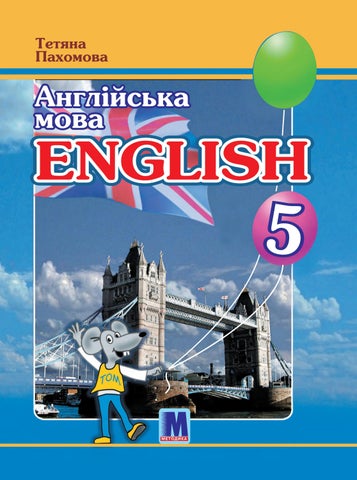
Тетяна Пахомова
АНГЛІЙСЬК АНГ ЛІЙСЬКА А МОВА (1-й рік навчання) Підручник для 5 класу закладів загальної середньої освіти ( з аудіосупроводом)
Tetiana Pakhomova
ENGLISH Year 1 A textbook for the fifth form of secondary schools ( with audio) Рекомендовано Міністерством освіти і науки України
Київ «Методика Паблішинг» 2022
Рекомендовано Міністерством освіти і науки України (наказ Міністерства освіти і науки України від 08.02.2022 №140) Підручник створено за Модельною навчальною програмою «Друга іноземна мова. 5-9 класи» для закладів загальної середньої освіти (авт. Редько В.Г., Шаленко О.П., Сотникова С.І., Коваленко О.Я., Королецька І.Б., Якоб О.М., Самойлюкевич І.В., Добра О.М.,Кіор Т.М., Мацькевич М.Р., Глинюк Л.М., Браун Є.Л.)
Автор і видавництво висловлює щиру подяку Маріон Хорнер, Карлу Тейлору, Франку Хассу, Дженіфер Баер-Энгель, Памелі Грімс, а також видавництву «Ernst Klett Verlag» за надані матеріали, підтримку і сприяння у реалізації проекту. Прослухати і завантижити аудіосупровід: https://bit.ly/Joy_of_English_5 ЗВЕРНИ УВАГУ! Завдання практичної частини виконуй у робочому зошиті
Пахомова Т.Г. Англійська мова (1-й рік навчання), : підруч. для 5 класу закладів загальної середньої освіти (з аудіосупроводом)/ Т. Г. Пахомова, – К. : Методика Паблішинг, 2022 – 152 с., іл. Pakhomova Тetiana English (Year 1) :a textbook for the fifth form of secondary schools. / Tetiana Pakhomova. – К. : Metodika Publishing, 2022. – 152 pages. ISBN________________
Умовні позначення Let’s talk Давайте поспілкуємося Let’s listen Давайте послухаємо For my folder Для мого учнівського досьє Треки аудіосупроводу Вправи підвищеної складності Робота в парах Робота в групах Для додаткового опрацювання Підказка в словнику Підказка в граматичному довіднику
ISBN _______________
© Т.Г. Пахомова, 2022 © ТОВ «Методика Паблішинг», оригінал-макет, 2022 © Ernst Klett Verlag GmbH, Stuttgart, 2013
Content
Zoom-in
Time for Greenwich
Unit 1
Thomas Tallis School
Check-in
Hello! My name is … . What’s your name? I’m from … . How old are you? My phone number is … . I’m, you’re, he’s, she’s a book, an apple book books, sandwich sandwiches What’s 7 and 17? Alphabet rap Sam and Terry are cool. Is Emma eleven? The pupils aren’t here. in, on, under, behind No problem! school, classroom, school bag
Language 1 Language 2
Language 3 Language 4 Story* Wordwise Check-out Link-up A
Home sweet home Home sweet home
Unit 2
At home in Greenwich AND CHERKASY
Check-in
the Brooks, the Jacksons, the Taylors For my folder: My family
Tim is Sam’s uncle. Her parents’ name is … . Sarah is from Poland. I’ve got a blue bed. Language 2 I haven’t got a sofa. Language 3 Have they got a computer shop? Chats with Charlie Two families ‘Charlie’ !tS? and ‘Jade’ !ß? Ghosts in Hither Farm Road? Story Wordwise Check-out
Language 1
* Уроки Story не є обов’язковими
10–11 12–13
14–15 16–17
18–19 20–21 22–23 24 25 26–27
28–29 30–31 32–33 34 35 36–37 38 39
3
Content
Link-up B
Hobbyland can/can’t
Unit 3
Free time
Clubs at Thomas Tallis For my folder: My favourite club What time is it? Language 1 It’s six o’clock. Take an apple, but don’t take a sandwich. He gets up at … and he washes Language 2 / 3 at … . Chats with Charlie A chat with a night nurse ‘gets’ !s?, ‘goes’ !z? and ‘washes’ !Iz? Barker’s story Story Wordwise Check-out Check-in
Link-up C
In town Can you tell me the way to … ? go right/left/down …
Unit 4
Greenwich Project Week
Check-in
Out and about in Greenwich
40–41 42–43 44–45 46–48 49 50–51 52 53 54–55
56–57
For my folder: My town Do you … ?, Does he … ? What does … ?, Where do … ? me, you, him, her, it, us, you, them Language 3 Chats with Charlie Greenwich for young people In our town Sentences Cool idea, Sam! Story Wordwise Check-out Language 1 / 2
4
58–59 60–62 63 64–65 66 67
Content
Unit 5
Shopping in Greenwich
Excuse me, have you got … ? Let’s talk: shopping dialogues a packet of crisps Language 1 I want a pizza. I want to buy a pizza. We haven’t got much sugar, and there aren’t Language 2 / 3 many apples. first, second, third on 21st May Chats with Charlie Birthday lists Tongue twisters with !f?, !v? and !w? Happy birthday, Sam! Story Wordwise Check-out Check-in
Unit 6
Let’s go to the country!
Check-in
A postcard from Wiltshire
For my folder: The seasons They’re eating., Are they packing?, They aren’t Language 1 / 2 watching TV. this/that, these/those Language 3 Chats with Charlie Country sounds? Story Wordwise Check-out
‘the’ !D? and ‘thing’ !T? Noises in the night
68–69 70–71 72–74
75 76–77 78 79 80–81 82–83 84–85 87 88–89 90 91
5
Content
Unit 7
The school year
Big events For my folder: Our school year Emma often writes e-mails, but today she is Language 1 writing a letter. We must have scones! Language 2 You needn’t speak Ukrainian. Chats with Charlie At the summer fair The bloke at the burger stall Story Wordwise Check-out Check-in
Unit 8
Ukraine
Check-in Language 1 Language 2 Story Check-out
Information files For my folder: Ukraine is my country Adjectives Children at the map of Ukraine! Projects!
Unit 9
English and Ukrainian holidays
Check-in Language 1 Language 2 Story
Information files For my folder: exciting holidays Thankyou-letter Favorite holidays
92–93 94–95 96 97 98–99 100 101
102–103 104 105 106 107
108–109 110–111 111
Extras ABC Practice Stories Grammar Glossary
6
English – Ukrainian
7-9 112–122 123-139 140–151
ABC Practice
ABC Pictures
A
B
C
D
E
F
G
H
I
J
K
L
M
N
O
P
Q
R
S
T
U
V
W
X
Y
Z
1 The letter V is for volleyball. The letter R is for… Скажіть за зразком.
7
ABC Practice
2 Point to each capital letter as your teacher asks you and sound it. Вкажіть велику літеру, яку називає вчитель /вчителька, і озвучте її.
A B C D E F G H I J K L M N O P Q R S T U V W X Y Z 3 Point to each small letter as your teacher asks you and sound it. Вкажіть маленьку літеру, яку називає вчитель / вчителька, і озвучте її.
a b c d e f g h i j k l m n o p q r s t u v w x y z 4 Name the missing capital letters. Назвіть пропущені великі літери. _______ ___B___ _______ _______ _______ _______ _______ ___K___ _______ _______ _______ _______ _______ _______ _______
_______ _______ ___S___ _______
___G___ _______ _______ _______
_______ _______ _______
_______ _______ _______ _______
___g___ _______ ___t___ _______
_______ _______ _______
5 Name the missing small letters. Назвіть пропущені маленькі літери. ___a___ _______ _______ _______ _______ _______ ___j___ _______ _______ _______ _______ _______ _______ _______ ___x___
6 Name the missing capital and small letters. Назвіть пропущені великі і маленькі літери. __A__ ___ ___ __b__ __C__ ___ __D__ ___ ___ __e__ __F__ ___ ___ __g__ __H__ ___ ___ __j__ __K__ ___ __L__ ___ __M__ ___ __N__ ___ ___ __o__ ___ __p__ __Q__ ___ ___ __r__ ___ __s__ __T__ ___ ___ __u__ ___ __v__ __W__ ___ ___ __x__ __Y__ ___ ___ __z__
7 Name each capital letter to its partner letter. Назвіть маленькі літери, які відповідають заданим великим. С O D Q G
d q c g o
A E F X Y
x y e f a
I L J S T
j i t l s
B R H K P
k h p b r
N U M W V
n v u w m
DIALOGUES Look at the ABC pictures and show your partner the picture you like and say: Dialogue 1 Dialogue 2 Student 1: Look, it’s a cat. Student 1: I see a zebra. Student 2: Wow! Student 2: Me, too.
8
ABC Practice
8 Practice in pairs. Take turns to read lines 1-6. Працюємо в парах. Прочитайте по черзі вказані рядки. 1. b-v-c-d-p-t-c-e-d-t-b-c-d-g-p-t-g-c 2. f-l-m-n-s-x-z-f-m-x-s-x-z-l-f 4. i-y-o-q-u-w-r-i-y-q-u-w-r-i 3. a-h-j-k-a-j-k-a-h-k-a-j 6. a-b-f-i-o-q-r-e-b-l-i-y-q-r-t-h-u 5. a-e-i-o-u-y-e-o-i-a-o-e-i-y-e
9 Learn reading rules together with your teacher. Опануйте разом з учителем / учителькою правила читання. a o u e i(y)
[eI] [Eu] [ju:] [i:] [aI]
1 name rose student me five
ai (ay) au (aw) air all ass (ask, ast) ea (ee) ei (ey) ear (eer) ight (ild, ind)
[eI] [C:] [4E] [C:] [a:] [I:] [eI] [IE] [aI]
[x] [C] [0] [e] [I]
2 man dog bus bell kid myth
[A:] [C:] [E:] [E:] [E:]
aid, play autumn, awful hair ball class, mask, fast clean, tree seiner, they hear, engineer light, mild, kind
3 car sport turn her first
[4E] [C:] [uE] [IE] [aIE]
4 fare before sure here tired tyre
sh [S] th [T], [D] ph [f] ch [tS] ck [k] nk [Nk] ng [N] kn [n] qu [kw] wh [w] oi (oy) oo ou (ow) old
[CI] [u:] [au] [Eu]
short three, this photo child clock thank spring knife queen what
coin, boy school mouse, town cold
10 Try to read with your teacher. Прочитайте разом з учителем / учителькою правила читання. dig big pig bill hill pill pin pan pat wag wig win lid rid lad six fix mix bad bid bib pin pan nap boss box fox lack lock luck top tip tap hull bill hill rock rack sock cut cat cup dog dig dug lag log lug mail mad made mail mill nail rack rake sake top tap tape fire five fix lips lisp pills bite bake bike tie tied lied sail suit sit same sane sun cup cap sup mute mule mud bug big dug cub cube cute rude rug rule mug gum gun rip ripe rope dome home dime bore bowl bone hoe toe doe toad tote toast ride road rod nose not note cue sue suit sit set seat key keg kit beak bet beat fee see bee jet jeep jeer quit quite queen beans beads beets ear fear tear
9
Zoom-in
Time for Greenwich
10
Zoom-in
A
B
Millennium Dome
Greenwich Market
C
D Thames Barrier
E
24-hour clock D1, 2 1 Let’s listen: Greenwich sounds
F
Listen and point. Greenwich Park D1, 3–4
Bus to Greenwich
2 A song: Let’s get started! a) Listen. Прослухайте пісню. b) Sing the chorus: Заспівайте пісню разом.
Let’s get started! We’re on our way. We’re learning English! Let’s go! Hooray!
11
1
Check-in
Language
Unit 1
Story
Wordwise
Thomas Tallis School
Hello! I’m Tom.
D1, 5
Hello. My name is Lisa Taylor. I’m eleven. I’m from Greenwich, in London. Thomas Tallis is my new school. I’m in Year Seven.
1 Let’s talk: Hello. Hello. / Hi! My name is … . I’m ten. / … . I’m a … at … . I’m from … . I’m in Year Five.
12
Hi! I’m Terry Jackson. I’m twelve. I’m from Greenwich, too. I’m a pupil at Thomas Tallis School.
(➝ p. 4/ex. 1)
Hello. My name is Tom. I’m a mouse. I’m one. I’m from Thomas Tallis.
Language
Chat
Check-in
Story
1
2 Let’s talk: What’s your name? (➝ p. 4/ex. 2) What’s your name? Where are you from?
I’m Suzanne. I’m twelve.
How old are you? I’m from London.
A: What’s your name? B: My name is … . A: Where are you from? D1, 6–7
B: I’m from … . A: How old are you? B: I’m … . My mobile number is 0 7740 915462.
3 Let’s listen: Phone numbers (➝ p. 4/ex. 3)
a) Listen and write the numbers. Прослухайте цифри і запишіть їх.
b) Listen and write the phone numbers. Прослухайте телефонні номери і запишіть їх.
2
1
one
5
4
four
7
Lisa: ............... Terry: ............. (home) Terry: ............. (mobile)
two
seven
five
3
three
6
six
8
eight
9
nine
0 oh
c) Say your phone or mobile number in English. Назвіть свій домашній або мобільний номер телефону англійською мовою.
4 For my folder: Let’s make a poster. a) Для твого фолдера. b) Підготуйте постер про себе. My name is … . I’m … . I’m from … . I’m in Year Five. My number is … .
is My name
My name is Taras. I’m ten. I’m from Kharkiv. I’m in Year Five. My number is 0341 …
Julia.
. I’m eleven my. u S m o fr I’m Five. r a Ye I’m in is r e b My num … 030
13
1
Check-in
Language 1
Story
Wordwise
Meeting people
You and your sport! (➝ p. 5/ex. 4)
D1, 8
Hello. My name is Lisa. What’s your name?
Emma Brook. I’m from Bristol. I’m new in Greenwich and I’m new at Thomas Tallis.
I’m new at Thomas Tallis, too.
It’s a big school.
Here’s Terry. He’s from my old school.
Hi, Terry. This is Emma. She’s new here.
Yes!
What’s your favourite sport, Emma?
14
Hi, Emma. Are you in Year Seven, too?
My favourite sport is football.
Look, it’s Mrs Carter. She’s my teacher.
Oh! She’s my teacher, too.
Meeting people
Language 1
Chat
Story
1
Check-in
1 Let’s listen: Emma, Terry, Lisa or Mrs Carter (➝ p. 6/ex. 7)
D1, 9
Прослухайте і скажіть, хто говорить: Емма, Террі, Ліза чи місіс Картер. Example: 1. It’s Emma. 2. It’s … . Go on, please.
2 Thomas Tallis School (➝ p. 6/ex. 7) Thomas Tallis Terry Example: Thomas Tallis is a big school. Emma Mrs Carter b) Match the and sentences. a) Make sentences.
is
new in Greenwich. a teacher. a big school. in Year Seven.
Example: Thomas Tallis is a big school. It’s in Greenwich. It’s in Greenwich. • She’s from Bristol. • She’s nice. • He’s OK. • He’s twelve.
Thomas Tallis is a big school. It’s in Greenwich. G2
3 A quiz: What’s my name? (➝ p. 5/ex. 5; p. 6/ex. 7) Example: A: B: A: B: A:
I’m new at Thomas Tallis. Your name is Emma. No. My favourite sport is football. Your name is Lisa. Yes. That’s right!
4 Let’s talk: This is Nina (➝ p. 5/ex. 6; p. 6/ex. 7) Example: 1. A: B: 2. C: A:
This is Nina. She’s eleven. She’s from Stuttgart. Hello, Nina. I’m … . I’m ten/eleven/… . I’m from … . This is Mehmet. He’s … . He’s … . Hi, Mehmet. Go on, please.
1
2
Nina, 11, Stuttgart
Mehmet, 12, Istanbul
3
Nadine, 10, Paris
5 For my folder: At my new school Write about your new school.
(➝ p. 6/ex. 7)
Francisco, 11, Madrid
G1, G2
6
5
4
I’m he’s she’s
Keiko, 12, Tokyo
Olga, 10, Poltava
s my new school. This is ... School. It’ It’s in ... . e’s my teacher. This is ... . She’s/H
15
1
Check-in
Language 2
Story
Wordwise
School things
The school bag 1 Let’s listen: In the bag (➝ p. 6/ex. 8)
D1, 10
a) Copy the grid into your exercise book. Listen for the words and fill in your grid.
In the bag a pencil case a pen a pencil a rubber a ruler a book an exercise book a sandwich an apple a mobile
Lisa
b) What’s in the bag here? A pencil, a ruler ... . Go on, please.
Terry
Emma
✕ ✕ ✕
a book an apple Emma Brook
c) Look at your grid. What’s the name on the bag in the picture?
Lisa Taylor
Terry Jackson
2 ‘A’ or ‘an’? 4. Mmm, … apple. 5. Here’s … shoe. 6. And that’s … old ruler.
1. Here’s … exercise book. 2. And here’s … pencil case. 3. This is … English book.
3 Let’s listen: Numbers (➝ p. 6/ex. 9)
D1, 11
a) Listen and say the numbers. b) A: What’s 7 and 17? B: It’s 24. What’s … and … ? A: …
c) Play buzz! Say ‘buzz!’ for all numbers with seven. One, two, three, four, five, six, buzz !, eight, nine, ten, eleven, twelve, thirteen, buzz !, fifteen, sixteen, buzz !, …
16
13 14 15 16 17 18 19 20 21 22
thirteen fourteen fifteen sixteen seventeen eighteen nineteen twenty twenty-one twenty-two
23 24 30 40 50 60 70 80 90 100
twenty-three twenty-four thirty forty fifty sixty seventy eighty ninety a/one hundred
Language 2
School things
Chat
Story
1
Check-in
4 Two pictures Picture 1: one pen …
D1, 12
Picture 2: four pens … Go on, please.
5 Sounds Listen and say.
ssssssssss
zzzzzzzzzz s
z
z
1. bag – bags: 2. book – books: The bags are big. My books are in my bag. pen – pens: sport – sports: My pens are new You and your sports!
6 Let’s talk: What’s in your bag? Example: Two sandwiches, one rubber, … Go on, please. D1, 13
7 Let’s listen: Alphabet rap (➝ p. 7/ex. 10)
A (clap) B (clap) C D E Here’s a rap for Thomas T.
F (clap) G (clap) H I J English lessons are OK.
K (clap) L (clap) M N O Are you new here? Hi, hello.
P (clap) Q (clap) R S T Say the numbers one, two, three. U V W — shout and clap.
ızzzzzzzzz
3. pencil case – pencil cases: Here are three pencil cases. sandwich – sandwiches: Mmm, two big sandwiches!
one pen, four pens one sandwich, two sandwiches G3
8 Words and numbers a) What’s your favourite number? b) Read and spell the numbers. Go on, please. fou
forty
r
ninety
…
c) Make puzzles for your partner. A: Here are the letters: What’s the number? B: It’s ‘fifteen’. A:
X Y Z (clap) — do the rap.
17
1
Check-in
Language 3
Sam (➝ p. 7/ex. 11)
D1, 14
Story
Wordwise
Asking questions
(➝ Stories p. 112)
Are we in the right classroom, Lisa? Yes, we are. Mrs Carter isn’t here. Are you sure? Yes, I am. Look, here’s Terry. Hi! Where’s Sam? Is he here, too? No, he isn’t. Who’s Sam? Is he a friend from your old school? Lisa: Yes, he is. And he’s always late!
Emma: Lisa: Emma: Lisa: Terry: Lisa: Emma:
Sam is … . Sam and Terry are … .
1 Right or wrong? Example: Sam is always late. – That’s right. Sam is in the classroom. – That’s wrong. 1. 2. 3. 4. 5.
G2
Lisa and Terry are in the right classroom. Emma is from Greenwich. Sam and Terry are old friends. Mrs Carter is the teacher. Lisa, Emma and Terry are at Thomas Tallis.
2 People at Thomas Tallis
(➝ p. 7/ex. 12)
3 Long forms
(➝ p. 8/ex. 13)
Fill in: I, you, he, she, it, we, you, they.
Write the long forms.
Example: I’m Lisa. I’m from Greenwich. Go on, please.
Example: I’m ten. – I am ten.
1. 2. 3. 4. 5. 6. 7.
That’s Mrs Carter. …’s my teacher. Here’s Terry. …’s from my old school. …’s the right classroom. …’m sure. …’re lucky. Terry and you are friends. Emma and Lisa, …’re in my class. Here are Sam and Terry. …’re my friends. Hello, Mrs Carter. Sorry …’m late.
1. 2. 3. 4. 5. 6. 7. 8.
You’re my new friends. She’s eleven. They’re new here. You’re at Thomas Tallis. He’s from Greenwich. I’m in your class. We’re friends. It’s a big school.
you’re ‡ you are she’s ‡ she is we’re ‡ we are they’re ‡ they are G2
18
Asking questions
4 That isn’t right.
Language 3
Chat
I’m not you aren’t he isn’t she isn’t it isn’t we aren’t they aren’t
Example: Sam isn’t here. He is in London. The pupils … here. They … late. I … from Greenwich. I … from Bristol. It … a football. It … a shoe. Emma and I … twelve. We … eleven. I … a pupil. I … a mouse.
1
2
3
Is
Is
Sam
Terry Tom Sam Emma Lisa
ten?
5
enwich? from Gre a mouse? ten? a boy? eleven? at a new school?
6
Is Emma … ? – Yes, she is. – No, she isn’t.
(➝ p. 8/ex. 15; p. 9/ex. 16)
No, he isn’t.
6 Let’s talk: At my school
I am you are he is she is it is we are they are G4
4
5 Make questions and answers. Example:
1
Check-in
(➝ p. 8/ex. 14)
Look at the pictures and make sentences. 1. 2. 3. 4. 5.
Story
G5
No, she isn’t.
Yes, he is.
Yes, she is.
. No, he isn’t
(➝ p. 9/ex. 17)
‡ – Yes, they are. Example: the girls and boys • OK ‡ Are the boys and girls OK? ‡ – No, they aren’t. 1. your friends • from your old school? 2. the classrooms • big? 3. the pupils in your class • ten?
7 A game
(➝ p. 9/ex. 18; p. 10/ex. 19)
What are the words for your numbers? Make questions and answers. Example:
4. your teachers • from London? 5. the caretakers at your school • OK? 6. your school shoes • new? Emma … Lisa …
Mrs Carter … Lisa and Emma …
the girls and boys in your class …
Is Emma eleven? – Yes, she is.
… from Greenwich? … eleven? … ten? … new at Thomas Tallis? … Ukrainian? … English?
19
1
Check-in
Language 4
Story
Wordwise
The classroom
I’m here in a classroom at Cherkasy Secondary School #17. The boys and girls are in the playground. The apple on the table is for my lunch. What’s behind the door?
F G
C
H
I
A
D
E B
window
door
chair desk
Classroom phrases
poster board cupboard
wall table
Ah, sandwiches. And what’s that under the chair? Crisps! Mmm, my favourite. Let’s look in the cupboard! Wow! Chocolate! Cherkasy Secondary School #17 is my favourite school!
1 Classroom words (➝ p. 11/ex. 20)
D1, 16
a) Listen and point. b) What’s the word for A? – The word is ‘door’. What’s the word for B? – …
on
in
2 In the picture
behind
Write ten sentences. Example: The apple is on the table. The books are in … . Go on, please.
3 A game Where’s the pencil case? Is it in the bag? No, it isn’t. Is it on the table? No, it isn’t. Is it under the chair? Yes, it is.
20
under
Classroom phrases
Language 4
Chat
Story
1
Check-in
4 ‘Who’ or ‘what’? 1. 2. 3. 4. 5.
…’s TTS? – It’s ‘Thomas Tallis School’. …’s Emma? – She’s a girl from Bristol. …’s the word ‘mobile’ in Ukrainian? – It’s ‘Mobilka’. …’s from Greenwich? – Lisa, Terry and Sam. …’s in the school bag? – A book and two pens.
5 Match the questions and the answers. (➝ p. 11/ex. 21) 1. 2. 3. 4. 5. 6. 7. 8.
What’s under the chair? It’s a mouse. What’s your favourite sport, Lisa? Where’s Greenwich? I’m from Che rkasy. Who’s always late? Where are the books? It’s in London. Where are you from? What’s 7 and 7? It’s football. Where’s School #17? Sam is always late. They’re on the cupboard.
It’s 14. D1, 17
what?
where?
who?
G6
It’s in Cherkasy.
6 Classroom phrases (➝ p. 11/ex. 22) Listen and match. You: Good morning. Sorry I’m late. Can we open the window? Where are we? What’s ‘До побачення’ in English, please? Can I go to the toilet, please? What’s the homework? Thank you. Goodbye.
Your teacher: That’s OK. Sit down, please. Yes, of course you can. It’s on the board. Good morning, boys and girls. We’re on page 19, Exercise 6. You’re welcome. Bye! No, you can go at lunchtime. It’s ‘goodbye’. You can say ‘bye’, too.
7 Let’s talk: In the classroom What can you say to your teacher? Example: Teacher: Good morning. You: …
1. 2. 3. 4. 5. 6.
Good morning. Here’s your exercise book. Where’s your book? You’re late. Let’s do a rap. Who’s your Ukrainian teacher?
21
1
Check-in
Language
No problem!
D1, 18 – 21
Story
Wordwise
(➝ Stories p. 112)
A It is lunchtime.
1
Emma is in the cafeteria with Lisa. Look – here’s Terry. He’s cool. Cool? He’s – Sssh! Listen, you two. Here’s a new joke. What’s a word with twenty-six letters? Emma: That’s easy! The word is ‘alphabet’. Right?
Emma: Lisa: Emma: Terry:
2
B Lisa and Emma are in the playground now. Lisa: Let’s play. Here you are! Emma: Oh, no! I’m not good at – Lisa: Oops! The ball is in the tree. Emma: Oh, Lisa. I’m sorry!
C Now Sam and Terry are in the playground, too. Sam: Hello. What’s the problem? Emma: It’s the ball. It’s in the tree. Sam: That’s no problem – not for Terry and me. Terry: Is it your ball, Emma? Emma: No, it isn’t.
22
3
Language
Story
Chat
Check-in
1
D Terry is in the tree now. 4
5
Here’s your ball, Lisa. Oh, no. Sorry!
Terry, you’re naughty!
1 Terry, you’re naughty! (➝ p. 12/ex. 23) Talk about the story. This story is … .
2 What’s the right order? (➝ p. 12/ex. 23)
very nice
cool
OK
boring
3 Sort the words. (➝ p. 12/ex. 23)
Example: 1. It is lunchtime. 2. … – Lisa and Emma are in the playground with a ball. – It is lunchtime. – Lisa is not nice to Terry. – Sam is nice to Terry, Lisa and Emma. – Emma is not good at football. – The girls are in the cafeteria. – The ball is in the tree.
Oh, I’m sorry. …
You’re naughty! …
Your jokes are boring. • Oh, I’m sorry. • No! • You’re cool. • Here you are. • That’s wrong. • That’s no problem. • Thank you. • Very nice. • You’re not cool. • Your ball – your problem. • You’re naughty!
4 Picture five (➝ p. 12/ex. 23)
5 Act the story. (➝ p. 12/ex. 23)
Write what Mrs Carter says and what Terry says.
Make groups and then act the story “No problem!”
23
1
Check-in
Language
Wordwise
Story
1 New words (➝ p. 13/ex. 24) V
VO C A B U LARY S K ILLS
O
C
A B U
L
A
R
Y
Write as many words as you know you see in the classroom (b), you see in a schoolbag (c). There is an example for you (a).
teacher
a)
b)
caretaker
playground
school cafeteria
c)
classroom
school bag
classroom
2 Pairs (➝ p. 13/ex. 25)
3 The wrong word (➝ p. 13/ex. 26)
Find six pairs: old – new
ruler – rubber – mouse – pencil
yes on girl old hi please
Example: The wrong word is ‘mouse’.
thank you no bye boy new under
1. 2. 3. 4. 5.
girl – chair – boy – teacher cafeteria – playground – classroom who – what – hi – where in – on – under – pen homework – apple – chocolate – sandwich
4 Where’s Tom? 1. Tom is … .
2
1 3
5 Find the right adjectives. Example: Tom is a lucky mouse. My … sport is football. TTS is a … school. Your jokes are …, Terry. Emma is a … girl. How … are you?
fav
our
OK
ite
easy 6. Lisa isn’t … . nice 7. Sam is always … . late boring 8. Here’s Terry. new big luck y He’s … . 9. English is … ! l o co
D1, 22
6 Let’s listen: Words
Write the letters. What are the words?
24
6
old
1. 2. 3. 4. 5.
5
4
Language
1 A new school
Chat
Check-out
Story
1
(G1, G2) (➝ p. 14/ex. 27, 29)
Look at this letter from Emma to her friend Fiona. Fill in: I, you, he, she, it, we, you, they.
Hi Fiona! …’s lunchtime here. …’m in the playground with Terry. Who’s Terry? …’s my new friend and …’s cool. …’re in Year Seven now. Terry’s friends are Lisa and Sam. …’re from his old school. …’re in Year Seven, too. Mrs Carter is nice. …’s the English teacher. …’m good at English, but …’m not good at sport. … isn’t boring here. Greenwich is OK and my new friends are nice. But …’re my friend, too.
2 School questions and answers
(be G5) (➝ p. 14/ex. 28 – 29)
1. Is Thomas Tallis a big school? – Yes, it is. 2. Hi, Terry and Lisa! … you from Greenwich? – Yes, … . 3. Oh, I’m sorry. … I late? – Yes, … .
4. … the girls in the classroom? – No, … . 5. … your school bag new? – No, … . 6. … Mrs Carter a teacher? – Yes, … . 7. Hello, Mrs Carter. … we in the right room? – No, … .
3 Who or where?
rd f r i
e
4 A new pupil
boa te a c h er cafeteri ac u p
classroom …
assro omb oypl aygrou
nd
girl …
ho
d
Where?
rtnercl
n
Who?
a gi r l p
mebagposterschool
(G6) (➝ p. 14/ex. 29)
Steve: 1. …’s your name? 2. … are you from? 3. …’s Mrs Carter? 4. … are the boys? 5. …’s your football? 6. … are ‘lucky’ and ‘cool’?
Lisa: – It’s Lisa. – I’m from Greenwich. – She’s a teacher at Thomas Tallis. – They’re in the playground. – It’s in my bag. – They’re adjectives.
NOW YOU CAN
name yourself name ABC say your phone number say where you are and where he or she is
25
Link-up A
Home sweet home
purple yellow D1, 23 – 24
black white
red
1 Let’s listen: Rooms
2 Colours
a) Listen and write the words on cards, one word per card. kitchen bedroom
living room
dining room bathroom
b) Look at the picture and listen. Where is Tom? Show the right card.
3 Right colours? a) Look at the colours and say the right word. b) Write the words in the right colour. Example: Number one is green.
26
green pink blue brown
Look at the picture and ask the questions. A: Is the kitchen yellow? Close your book. Answer the questions. B: No, it isn’t. It’s pink. 1. 2. 3. 4.
Is the living room brown? Is the bathroom white? Is the bedroom purple? Is the dining room green? 1
2
blue
purple
4
5
3
black
yellow
green
Link-up A 4 Room rhyme
D1, 25
5 Funny furniture
I’m Tom and here’s my home sweet home with table, chairs and bed. Green and yellow, blue and purple and my favourite colour, red. Tiny pictures, tiny sofa in my funny, tiny house. Tiny TV and computer – this is home for Tom, the mouse.
6 Let’s talk: Houses
Write and say the words. c • pbo • rd com • • t • r • ha • r ta • • e so • a pi • tu • e
1. 2. 3. 4. 5. 6.
7 For my folder: My dream house
A: What are the rooms in your dream house? B: Four bedrooms, a … . A: What furniture is in the rooms? B: A big bed, a … . A: What colours are the rooms? B: The bathroom is yellow. The … .
a) Now draw your dream house. Write the words for the furniture and the rooms in your picture. b) Show your picture in class. Find new words. Put your picture and the new words in your folder.
8 Let’s listen: Tom Tiny and his family
D1, 26
Example: Who’s in picture A? – That’s his brother, Tim. He’s three. 1. 2. 3. 4. 5.
Who’s in picture B? Who’s in picture C? Who’s in picture D? Who’s in picture E? Who’s in picture F?
mum
sister
Tina
adragnd itress rrhoebt mraagnd add
B
C
D
F
Tamara
E
Tilly
Tony Thomas
brother
9 Write the family words. 1. 2. 3. 4. 5.
Tim
A
grandad
dad
grandma
10 Link-up quiz 1. Who’s in the Tiny family? 2. What are the rooms in the mouse house? 3. What colour are the rooms? 4. What furniture is in the rooms?
27
2
Check-in
Unit 2
Language
Story
Wordwise
At home in Greenwich and Cherkasy
The Brooks and the Ivchenkos
D1, 27
Emma:
Our computer shop Aaargh!!! A tiger!
My shed in the garden
Alex:
This is my family – my parents, Rob and Farah, and my sister, Amina. Rob is her dad. He’s the manager of a computer shop. Our flat is over the shop. It’s very small, so Amina and I are in one room. But the shop is great. I can play computer games with my friends there.
My parents are Kate and Victor Ivchenko. Our house is in Farm Road. I’m an only child. But my cat, Tiger, is funny. Her favourite place is the roof of the shed in the garden. My drums are there. The “Keep out!” sign on the door is only for parents – not for my friends.
1 Emma Brook or Alex Ivchenko? Example: Our cat is on the roof of the shed. – That’s Alex Ivchenko. 1. Our room is small. 2. My drums are there. 3. My dad is the manager.
28
Emma Brook
4. I’m an only child. Alex Ivchenko 5. Our flat is very small. 6. My parents are Rob and Farah.
Language
Chat
Story
Check-in
2
Hi! I’m Richard. I’m Jade.
My name is Ben!
Hello! I’m Sue.
This is Barker, our dog! Our house and garden in Pond Road
Woof!
2 The Taylor family
(➝ p. 16/ex. 1 – 2)
Write a text for Lisa. This is my family. My parents are … . My sister is …, and Ben is my … . Barker is our … . Our house is … .
3 Let’s listen: Can you come over?
D1, 28
a) Draw this house. b) Now listen and write the number on it. c) Listen again. What things can you add?
(➝ p. 16/ex. 3)
upstairs downstairs
4 Let’s talk: Where’s your house? A: B: A: B:
Where’s your house? It’s in … . What’s the number? It’s … .
A: B: A: B:
What colour is the door? It’s … . What colour are the windows? They’re … .
5 For my folder: My family This is my family. My parents are … and … . I’m an only child. / My brother/sister is … . / My brothers/sisters are … . Our house/flat is in … .
29
2
Check-in
Language 1
Story
Wordwise
Families and nationalities
Sam’s family married to Sarah Pilch (grandma)
James Spencer (grandad) († 2001)
married to
married to
Elena Stavros (mum)
Sam
1 Who’s who?
Tim Spencer (uncle)
David Spencer (dad)
Phil (cousin)
Maria Monte (aunt)
Tracy (cousin)
(➝ p. 17/ex. 4)
Susan (cousin)
Sam’s family Phil’s cousin
Look at Sam’s family tree and make sentences. Example: Tim is Sam’s uncle. Sarah • James • Tim • Maria • is Elena • Phil
G7
Sam’s • Tracy’s • grandad • grandma • aunt • Phil’s • Susan’s • uncle • cousin • dad • David’s mum • sister • brother
2 For my folder: My family Make a family tree for your family.
3 Lunch with the Spencer family
A
(➝ p. 17/ex. 5)
Find the names for the letters at the table. 1. The girls next to Sam are his cousins. 2. Tracy is on Sam’s left. 3. Tracy is next to her Uncle David. 4. Susan is on her dad’s left. 5. Phil is next to his dad. 6. David is on his mum’s right. 7. Sam’s aunt is on his grandma’s left.
30
B
C D
SAM G
F
E
Example: A is … . … is on the right. … is on the left. … is next to …
Families and nationalities
Language 1
4 Grandma, are we English?
D1, 29
Chat
Story
2
Check-in
(➝ p. 17/ex. 6)
Well, my family’s name is Pilch. That’s a Polish name. But your name, Spencer, is English. Your grandad is from England. But your mum is from Greece. Her parents’ name is Stavros.
OK. So we’re English, Polish and Greek.
Your relatives are Italian and English. And today our lunch is English and Italian, too.
her parents’ name your cousins’ family G7
a) Copy Sam’s family tree. b) Add countries to the tree. c) Where are the people from? Example: James Spencer is from England. Sarah Pilch is … .
5 Countries, people and languages
James Spencer England
(➝ p. 18/ex. 7)
Match a flag with a country and write sentences. C
Greece/Greek
Sarah Pilch Poland
Italy/Italian
France/French
E
Ukraine/Ukrainian
A
F
D
B
Poland/Polish
Germany/German
Example: Flag A is from Poland. People from Poland are Polish. The language is Polish.
6 Let’s talk: More about my family A: B: A: B: A: B:
Where are you from?
Where are you from? I’m from … . I’m … . Where’s your family from? My family is from … . They’re … . And your grandma/grandad? My grandma/grandad is from … . She’s/He’s … .
I’m from …
31
2
Check-in
Language 2
Emma, help me!
D1, 30
Story
Wordwise
Saying what you’ve got
(➝ Stories p. 113)
Emma has got a big sister, Amina. Their bedroom is small, so they have got only one wardrobe. Amina hasn’t got a lot of time now. Her friends are outside, so she’s in a hurry. But her new T-shirt isn’t in the wardrobe. Her parents haven’t got it, but what about her sister? Amina: Emma? Where are you? Emma: In the bathroom. What’s up? Amina: Where’s my new pink T-shirt, Emma? Hurry up! I’m late. Have you got it? Emma: No, I haven’t. Look on the shelf in the wardrobe. Amina: It isn’t there. Where is it? Emma: OK, OK! It has er, em – it has got a mark on it.
I’ve got I haven’t got they’ve got they haven’t got she has got she hasn’t got G8, G9
1 The Brooks
(➝ p. 18/ex. 8 – 9)
Read the text and write sentences. Example: Emma has got a big sister. Amina hasn’t got a big sister.
Emma has got Amina hasn’t got Mr Brook
a lot of time. a pink T-shirt. a Discman. a problem. a big sister. friends outside.
2 The girls’ room What have they got? Make sentences. Example: They’ve got beds.
1
4
They haven’t got a sofa.
3 Let’s talk: Things in your room A: What have you got in your room? B: I’ve got a … and one/two/three … .
32
(➝ p. 19/ex. 10–11)
2
3
5
6
Saying what you’ve got
Language 2
4 A quiz: Who is it?
Chat
2
Check-in
(➝ p. 19/ex. 12; p. 20/ex. 13; p. 21/ex. 16)
Test your partner.
a shed in the garden
Example: A: They’ve got a house in Pond Road. Who is it? B: It’s the Taylors. A: He has got … . B: It’s … . Go on, please.
5 Amina’s friend
Story
only one bedroom a house in Pond Road three cousins in Italy
drums
…
Has he got … ? – Yes, he has. – No, he hasn’t
(➝ p. 20/ex. 14; p. 21/ex. 16)
What are Emma’s questions about Amina’s friend? G10 Example: Emma: Has he got a brother? a brother (yes) • a lot of friends (yes) • Amina: Yes, he has. a dog (no) • a cat (no) • a mobile (yes) • Emma: Has he got a dog? a computer (yes) • a sister (no) • Amina: No, he hasn’t. a TV in his room (no) Go on, please.
6 What have they got?
(➝ p. 20/ex. 15; p. 21/ex. 16)
A: My questions are about the Brooks. Have they got a computer shop? B: Yes, they have. A: Have they got a cat? B: No, they haven’t. Have they got … ? A: Have they got … ? – Yes, they have. Go on, please. – No, they haven’t
the Brooks the Ivchenkos the Taylors the Spencers
a computer shop a cat/dog a flat in … Road a garden a shed a boy
G10
7 Let’s talk: Have you got a red pencil, please? Yes, I have. Here you are.
(➝ p. 21/ex. 16)
I haven’t got my bag. Have you got a red pencil, please?
Have you got a ruler? No, I haven’t. Sorry.
33
2
Check-in
Language 3
1 Look at the pictures.
Story
Wordwise
Describing rooms
(➝ p. 22/ex. 17)
What’s different? Example: In picture A there are two books on the table. In picture B there is one book on the table. A B
one shelf two shelves
2 Let’s talk: Questions and answers about the pictures
(➝ p. 22/ex. 18)
Your book is closed. Your partner is A. A: B: A: B:
there is there are Is there … ? Are there … ?
Is there a table in picture A? Yes, there is. Are there four chairs in picture B? No, there aren’t. Go on, please.
3 For my folder: My room Draw a picture of your room, and write about your room.
4 Revision: I spy with my little eye … A: I spy with my little eye something beginning with ‘C’. B: Cupboard. A: No, sorry.
34
My room In my room there is …
C: Chair. A: No. That’s wrong. D: Chocolate. A: Yes. That’s right. Go on, please.
Language
Chat
Story
Check-out
2
Chats with Charlie
1 Two families
Radio Active has got a new radio show: Chats with Charlie. People can chat about their favourite topics on the show. They can phone Charlie or come to his studio. He is always happy to see new people there. Before you listen: Who is in the Taylor family? Who is in the Spencer family? brother dad … sister Example: Lisa has got … . D1, 31
2 Let’s listen: Family and friends What’s the right answer? 1. The topic today is … friends. • family. • magazines. 2. Sam has got … a brother. • a sister. • a grandma. 3. Lisa’s sister is … six. • five. • ten. 4. When she’s unhappy, Lisa can … play with Barker. • sing a song. • play football.
D1, 32
3 Let’s listen: Right or wrong? 4. Sam has got a lot of friends. 5. Lisa has got a problem with Barker. 6. The topic today is ‘family’.
1. Sam is the DJ. 2. Lisa is in the studio. 3. Lisa can talk about problems with her friends. D1, 33
4 Sounds Listen and say.
D1, 34
tS
dZ
It’s Chats with Charlie. She’s the teacher. It’s lunchtime. What’s in the picture?
He’s the DJ. Here’s Mr Jackson. He’s the manager. It’s an old joke.
5 A song: I’ve got a crazy song (Music: K.-H. Böttcher, Lyrics: S. McBride) 1. I’ve got a crazy song about my brother. A really crazy song about my brother. I’ve got a song for free about my family. I’ve got a crazy song about my brother. 2. You’ve got a crazy song about your sister. A really crazy song about your sister.
You’ve got a song for free about your family. You’ve got a crazy song about your sister. 3. 4. 5. 6.
He’s got a crazy song about his grandma. She’s got … about her cousin. We’ve got … about our uncle. They’ve got … about their grandad.
35
2
Check-in
Language
Story
Wordwise
Ghosts in Hither Farm Road?
D1, 35 – 38
(➝ Stories p. 114)
1 Before you read: Who’s who? What can you say about Terry, Tiger and Emma? They’re in this story.
A One Saturday afternoon Terry is in his shed in the garden. Tiger, the Jacksons’ cat, is on the roof of the shed. Terry has got his dad’s laptop on one of his drums. He is busy with a new music project. But he has got a question. The laptop is not very good. It is really slow. He is fed up.
B Who can help? Sam hasn’t got a laptop. But what about Emma? He has got Emma’s phone number, and he is lucky: she is at home! Emma has got a new laptop and Terry can borrow it. She has got homework, but she can come over in an hour. Terry is happy now. He can finish his project.
C An hour later, there is a knock on the door of the shed. It is Emma with her new laptop.
36
Language
Story
Chat
Check-in
2
D Emma: Terry, it’s spooky here. There are strange noises outside. Terry: Oh, Emma! It’s only the wind in the trees. We haven’t got ghosts in Hither Farm Road! But I can take you home. Emma: OK, Terry. That’s really nice of – Suddenly there is a terrible noise outside! Emma is really scared. Emma: Aargh!!! Terry! What’s that? Terry: I’m not sure. Let’s look! It is dark outside, but they can see two yellow eyes under the window. Meow, meow! Terry: Tiger! You stupid cat. Your bed is in the kitchen. It isn’t on the roof of the shed! Come on, Emma. Let’s go!
2 Talk about the story. This story is … .
very good
(➝ p. 23/ex. 20)
a bit boring
spooky
3 What’s wrong in the sentences?
really nice
funny
terrible
(➝ p. 23/ex. 20)
Example: Terry is in the Jacksons’ house. That’s wrong. Terry is in his shed. 1. 2. 3. 4. 5. 6.
The shed is in Pond Road. Terry has got his dad’s drums. Emma is at school. Emma has got an old laptop. There is a knock on the door of Terry’s house. They can see two cats under the window.
4 More about Terry, Emma and Tiger a) Sort the adjectives. strange • busy • new • fed up • slow • not very good • lucky • good with … • happy • nice • scared • stupid • terrible • spooky b) Use the adjectives and write sentences. Example: Terry is busy in the shed.
(➝ p. 23/ex. 20)
Terry busy …
Emma good with computers …
Tiger stupid …
places/things not very good … 37
2
Check-in
Language
1 Picture words
Story
Wordwise
(➝ p. 24/ex. 21 – 24)
VOC A B U LARY S K ILLS
V
O
C
A B U
L
A
R
Make picture words as in the examples. Examples:
2 Funny words
(➝ p. 24/ex. 21 – 24)
What’s the right word?
step
Example: playground foot
lap
time
3 A word puzzle
cup
stairs
ball
play
top
up
dad lunch
board
ground
(➝ p. 24/ex. 21 – 24)
Find the words. 1. school teacher computer shop ???
2. bed bedroom sofa ???
3. grandpa grandma uncle ???
4. Greece Greek Poland ???
5. books shelf T-shirts ???
6. pencil case pencils house ???
4 Barker’s bed
(➝ p. 24/ex. 21 – 24)
Barker’s bed is in the Taylors’ kitchen. What is there in Barker’s bed? Example: There is a mouse. There are … .
38
Y
Language
Chat
Story
Check-out
2
1 Terry’s shed (G7, have got/has got G8) (➝ p. 25/ex. 25 – 26) a) Example: 1. That’s Terry’s shed. 2. That’s … . Go on, please. 1
4
3
6
5
2
b) What have the people got? Write sentences.
Example: Terry has go t a shed. Go on, please.
2 Two families (have got/has got G8, have got/has got G9) (➝ p. 25/ex. 25 – 26) The Ivchenkos The Taylors
cat
dog
shed
garden
house
flat
Make sentences. Example: The Ivchenkos have got a cat. They haven’t got … . Go on, please.
3 Funny questions (have got/has got G10) (➝ p. 25/ex. 25 – 26) Examples: I • tree • in my bedroom – Have I got a tree in my bedroom? my • dad • drums • in the car – Has my dad got … ? 1. our cousins • shed • in the playground 2. we • sofa • in the bathroom 3. my grandma • computer • in the garden
4. our school • garden • on the roof 5. I • cupboard • in my school bag 6. Barker • window • in his bed
NOW YOU CAN
describe your family you can write 5 sentences about your family describe your room and what you have got in your room
39
Link-up B
Hobbyland B
A
C
D
1
2
3
skate
play computer games
play football
swim collect and swap cards
break-dance play the drums draw a picture ride a bike
read comics
Copy the list of hobbies under the picture. Look at the grid and write down where you can do the different things. Example: 1. ride a bike – A 1 2. ride a horse – …
2 Let’s listen: Check your list. Are all your answers right? Correct what’s wrong. Can you … ? – Yes, I can. G11
40
ride a horse
3 Let’s talk: Hobbies
1 What can you do in Hobbyland?
D1, 39
watch videos
a) A: Let’s say we’re in Hobbyland. What can we do together? B: We can … and we can … . A: OK. But I can’t … . B: Then I can teach you. / Then we can … . A: OK. That’s a good idea. b) Add more hobbies to your list in Exercise 1. c) What hobbies can’t your partner do? A: Can you … ? B: Yes I can. / No, I can’t. Can you teach me? A: Yes, I can. / No, I can’t.
Link-up B 4 Let’s listen: What can’t you do today in Hobbyland?
D1, 40
Example: You can’t skate today. Go on, please.
5 Hobbies for Tom and Tina What can Tom and Tina do? Example: Tom can ride a bike and … . Tina can … .
6 Tom’s week a) What can Tom and his friends do at the Mouse Club? Example: On Mondays they can swim or they can draw a picture. On Tuesdays they can … . b) Write a plan for Tom’s week.
Tom’s week Monday: swim Tuesday: …
7 Link-up quiz 1. 2. 3. 4.
D1, 41
What can you play? What can you ride? What can you watch? What can you read?
9 A song: Seven days in a week At Thomas Tallis after school There’s always lots to do. From drama club to basketball, It’s really up to you. Monday is number one. Cooking is really fun, yeah! Tuesday is number two. Football is the thing for you, yeah! Wednesday is number three.
8 What day is it? 1. 2. 3. 4. 5.
before after
It’s the day after Wednesday. It’s two days before Sunday. It’s the day after Monday. It’s two days after Thursday. It’s the day before Monday.
(Music: K.- H. Böttcher/Lyrics: K.-H. Böttcher & S. McBride)
Drama club for you and me, yeah! Thursday is number four. Gymnastics on the floor, yeah! Friday is number five. Rap music – and it’s live, yeah! Saturday is number six. Where are the hockey sticks? Yeah! Sunday is number seven. Nothing to do is heaven, yeah!
41
3
Check-in
Language
Unit 3
Story
Wordwise
Free time
School clubs
D1, 42
Come to the Thom
AY FRIDAY IS RAP Dd rap
as Tallis
All Sports Club
dance an Learn to breakub! cl p ra in the T.T.
in the gym on Frida ys at 3:30. Learn to play bask etball, badminton and volleyball.
at 3:30 When: Fridays ic room Where: the mus
T h e C o o k i n g C
THOMAS TALLIS DOG CLUB Come to the Thomas Tallis dog club in the park on Mondays at 3:30. on Mondays
Learn about dogs and teach your dog tricks.
in room 4C at 4:00
UB COMPUTER CL
u b
The T.T. F every Tuesday
4:00 = four o’clock 3:30 = half past three
Drama Club
Can you sing? Good! Can you dance ? Great! Can you sing and dance? WOW ! We’ve got just
in the gym
ry School Cherkasy Secon da
#17
for you:
CATS
tball Club
at 4 : 00
the right thing
at 3:30 Every Tuesday room. in the computer
Cherkasy Secondary
Come to the ha ll on Wednesd ays at Cherkasy Seco 3 :00. ndary School #1 7
School #17
1 Clubs at Thomas Tallis and Cherkasy Secondary School #17
(➝ p. 27/ex. 1)
What clubs are there at Thomas Tallis/Cherkasy Secondary School #17? Where are they? Example: You can go to the football club. It’s in the gym. Go on, please.
42
Language
Chat
2 Let’s talk: Boring or a good idea? Talk about clubs with a partner. A: B: A: B: D1, 43
(➝ p. 27/ex. 2)
Let’s go to the … club. No, that’s … . Let’s go to the … club. OK. That’s … . When is the … club? It’s on … at … . Go on, please.
Story
fun easy (very) good (really) nice a good/great idea OK cool
3
Check-in
no fun terrible (a bit) boring not cool
3 Let’s listen: What can we do? (➝ p. 27/ex. 3 – 4) a) Match the clubs with the pupils. Example: Lisa – dog club, football … b) What can the friends do together? Example: Lisa and Terry – football club c) Look at the clubs on page 40 again. When are they? football computer Add the times to the clubs in b) and write sentences. dog Example: Lisa and Terry can go to the football club cooking (in the gym on Tuesdays at 4:00). all sports drama rap
4 Let’s talk: My clubs What’s your club?
My club is … .
a) Make a list of clubs at your school or in your town. b) Talk about clubs with your partner.
When is it? It’s on … at … .
5 For my folder: My favourite club Make a poster for your favourite club.
A: B: A: B:
What are your clubs? My clubs are … and … . When are they? … is on … at …, and … is on … at … .
My favourite club What: the music club. We can play music together. When: on Saturdays at 3:00 Where: The Youthclub
43
3
Check-in
Language 1
Story
Wordwise
Rules
Clubs at Thomas Tallis and Cherkasy Secondary School #17 1 Late again?
D1, 44
Excuse me! What’s the time, please?
(➝ p. 28/ex. 5)
It’s quarter to four.
Sam is on his way to the cooking club. Mr Newman is in the playground. a) Read the dialogue. b) Act the dialogue with a partner. Use different times. Example: 3:30 – It’s half past three. 1. 4:30 4. 7:20 7. 4:50 2. 8:15 5. 10:30 8. 9:28 3. 12:45 6. 6:15 9. 11:14
Oh, thank you.
12 9 to past 3 6
You’re welcome.
4:15 = quarter past four 4:30 = half past four 4:45 = quarter to five 4:20 = four-twenty
2 At the clubs Match the pictures of different clubs with the texts.
Take … . G12
Example: Picture 1 – Take the apples out of the oven at 5:15. 1
2
Take the apples out of the oven at 5:15.
OK. It’s 4:30. Stop the music, please.
4 3
OK. It’s 5:00. Put the balls in the cupboard, please.
OK. It’s 4:30. Walk your dogs to the tree and back, and then you can go home. 5
6
Sorry, it’s 4:30. Finish the game now, please.
It’s only 4:50. Sing the song again, please, Emma.
44
Rules
Language 1
3 Rules for the drama club
Chat
Story
3
Check-in
(➝ p. 28/ex. 6)
Example: Come to the drama hall at 2:55. – Can you come to the drama hall at 2:55, please? Come to the drama hall at 2:55. Bring your Cats T-shirts. Leave your bags in my room. Put your mobiles on my desk. Learn your lines at home. Go to the toilet before you come. Be nice to your partner. Smile! Drama is fun!
4 Rules in the T. T. all sports club
Can you …, please? … Nice words can help! Can you leave the room, please?
(➝ p. 28/ex. 7)
Don’t bring … ! Don’t … !
It’s 3:30 on Friday. Lisa is at the all sports club, but she is fed up. There are a lot of rules. a) Read the rules. Don’t bring your mobile!
G12
b) Make more rules with: be, bring, leave, open, play, put.
Don’t bring sandwiches to the club! Don’t take balls from the cupboard! Don’t shout!
1. Don’t … football in the hall! 2. Don’t … late! 3. Don’t … the gym! 4. Don’t … the windows! 5. Don’t … dogs! 6. Don’t … schoolbags behind the
door!
5 Classroom rules Write rules for your classroom.
6 Funny rules
1. ________
_
2. ________
a) Look at the poster. What are the rules for the pictures? b) Make a poster with funny rules for your school.
_
?
3. ________
_ 4. _____ ___
_
7 A trick with numbers Think of a number from one to ten. Multiply the number by two (x2). Add the number eight (+8). Divide the number by two (÷2). Take away the first number (– first number). What’s the number?
45
3
Check-in
Language 2
Story
Wordwise
Daily routines
An e-mail to Grandma
D1, 45
Dear Grandma, Thank you for your e-mail. You ask about my new school. Well, I like Thomas Tallis and I like my teachers. The uniform is OK. My school day is very long. We start at 8:40 and most days I don’t get home before 4:30. Here’s a normal day for me: 7:45 – I get up and wash. 8:00 – I dress and go into the kitchen. 8:15 – I eat breakfast with Dad. 8:30 – I leave the house. 1:10 – Lunchtime!!! I eat lunch with my friends, and after lunch we play in the playground. Here I am in the computer room :-) 2:10 – We start afternoon school. 3:20 – We finish school. On Wednesday afternoons we finish at 2:30. 5:00 – I do my homework. 7:00 – We have supper. After supper I help in the kitchen or watch TV. 9:30 – I go to bed. Bye, Emma
1 From morning to night
(➝ p. 29/ex. 8)
What can Emma say about her day? Example: I get up and wash at 7:45. I dress and … at … . Go on, please.
2 For my folder: My school day
(➝ p. 29/ex. 9)
Write about your school day. Example: I get up and wash at 6:30. I … . Go on, please.
3 School days
(➝ p. 29/ex. 10)
Look at a day at your school and a day at Emma’s school. What’s different?
46
I get up … I dress … I eat …
I eat breakfast in bed.
Example: 1. They start at … . We start at … . 2. They eat lunch at … . We eat … . Go on, please.
Daily routines
Language 2
Chat
Story
4 Let’s talk: You and your friends (➝ p. 30/ex. 11 – 12) a) Talk to a friend about Saturdays.
I
always often sometimes never
3
Check-in
I never do my homework on Saturdays.
I often write e-mails.
get up late. write e-mails. listen to music. do my homework. watch videos. meet my friends. read comics.
b) Now say what you and your friend do. Example: We always … . We often … . Go on, please. never 0
sometimes
often
100
5 Emma’s clubs (➝ p. 30/ex. 13) Read about Emma’s clubs again and make sentences. Example: Terry and Lisa • the football club • often • go to Terry and Lisa often go to the football club. 1. 2. 3. 4. 5. 6.
always
I always read comics on Saturdays. G14
go to • I • the football club • never on Tuesdays • the computer club • go to • often • I the drama club • on Wednesdays • we • go to • always on Fridays • sometimes • go to • Terry and I • the rap club go to • clubs • after school • I • often play • stupid sports • always • they • at the all sports club
6 Pupils don’t like homework. (➝ p. 31/ex. 14 – 16) Match and write sentences. Example: Pupils don’t like homework. Go on, please. Pupils Pupils in Greenwich Lisa and her family A lot of young people don’t English pupils Emma and Lisa Mice
eat breakfast. wear uniforms. go home for lunch. live in a flat. like homework. like cats.
7 For my folder: All about my weekends Write about your weekends.
Pupils don’t like homework. G15
one mouse – two mice
to At weekends I always go n’t do I . … … . I don’t go to esom I like …, but I like … . times/never/often … . 47
3
Check-in
Language 3
Story
Third person singular
Wordwise
Who likes Mondays?
D1, 46
Tiger likes mice. She doesn’t like dogs. And she doesn’t like Mondays. Terry always comes home early on Mondays and plays his drums in the shed. Tiger often sleeps on the roof of the shed. She doesn’t like her bed in the kitchen. She never sleeps there. Barker likes his bed in the kitchen. He puts his favourite things there. He doesn’t like Wednesdays. Lisa always comes home late. But he likes Mondays. Then he always watches Tom and Jerry on TV with Jade. He likes … . She sleeps … . He watches … .
1 Tiger or Barker? (➝ p. 32/ex. 17 – 18; p. 33/ex. 20) Example: … likes his bed. Barker likes his bed. 1. … watches TV. 2. … never sleeps in her bed. 3. … puts his things in his bed.
G13
4. … likes mice. 5. … likes Mondays. 6. … sleeps on the roof of the shed.
2 Right or wrong? (➝ p. 32/ex. 19; p. 33/ex. 20) Example: Barker doesn’t like his bed. – That’s wrong. Barker likes his bed. Tiger likes mice. – That’s right. 5. Tiger likes dogs. 1. Tiger doesn’t like Mondays. 6. Barker likes Tom and Jerry. 2. Barker puts his things in the garden. 3. Barker doesn’t like Mondays. She likes / doesn’t like … . 4. Terry always skates on Mondays. He watches / doesn’t watch … . G15
3 That’s wrong. (➝ p. 33/ex. 20; p. 34/ex. 21 – 22)
go – goes do – does
Example: Emma likes dogs. – That’s wrong. She doesn’t like dogs. 1. Terry goes to school at 8:25. 2. Lisa goes to the cooking club. 3. Tom likes cats. 4. Emma gets up after Amina. 5. Sam does homework at 5:00. 6. Barker sleeps on the roof.
48
4 Sam and Terry’s Monday
(➝ p. 33/ex. 20; p. 34/ex. 23)
1. Terry gets up at 7:00. He eats breakfast at … . He … . 2. Sam gets up … . He … . Go on, please. Terry Sam get up eat breakfast go to school do homework watch TV
7:00 7:30 8:00 5:00 7:30
8:20 8:25 8:35 9:00 7:30
Language
Chat
Story
Check-out
3
Chats with Charlie
1 Let’s listen: A chat with a night nurse
D1, 47
Today Charlie chats with Anna Church, a night nurse. Match the sentence parts. 1. 2. 3. 4. 5. 6. D1, 48
with their homework. at seven in the morning. at half past three. at ten o’clock in the evening. e. bring chocolate. f. a lot of people. a. b. c. d.
Anna helps She starts work People sometimes Anna comes home She helps her children She always goes to their school
2 Let’s listen: Anna’s day Listen again. Then match the times with the sentences. Example: Anna starts work at ten o’clock in the evening. She … . Go on, please
in the afternoon 2:30 7:00 Anna starts work. She finishes work. She goes to bed. She makes breakfast. 10:00 8:00 in the morning She eats lunch. She gets up. 6:15 3:00 in the evening D1, 49
3 Sounds Put the words in three groups.
borrows, comes, dances, does, dresses, finishes, helps, leaves, plays, puts, rides, shouts, sings, skates, sleeps, starts, swims, takes, teaches, washes, watches
D1, 50
s
z
z
helps …
borrows …
dances …
4 A poem: Lazy Daisy and Busy Bobby Lazy Daisy Sleeps on Monday Gets up on Tuesday Washes on Wednesday Dresses on Thursday Plays on Friday Sings on Saturday Dances on Sunday. This is what Daisy Does every week.
Busy Bobby Washes on Monday Irons on Tuesday Shops on Wednesday Cooks on Thursday Cleans on Friday Bakes on Saturday Dances on Sunday. This is what Bobby Does every week.
49
3
Check-in
Language
Barker’s story
D1, 51 –58
Story
Wordwise
(➝ Stories p. 114)
1 Before you read: Answer the questions. 1. Who’s Barker? 2. Who’s in the Taylor family?
A Hello. I’m Barker. My people
1
are the Taylors – Richard and Susan and their children, Lisa, Ben and Jade. The Taylor family lives in my house. I love the Taylors! 2
B Every morning at half past seven I wake up Lisa and wash her face. Lisa is my friend. Then she washes her face again. After that, we make our breakfast. 3
C At twenty past eight the children go to school. I help Susan in the house, or I play in the garden. Sometimes a cat comes into our garden, but I don’t like cats. I always bark, and then they run away. 4
D In the afternoons Susan and I go to our café. I often sit behind the window, and I say ‘Hello!’ when people come in. I’m a very nice dog. 5
50
E On Saturdays I don’t work, and Lisa doesn’t go to school. I take Lisa to the park. I often teach Lisa tricks. I sometimes bring Lisa her ball. She often gets lost in the park. Then she calls my name. I always find Lisa again.
Language
Chat
F On Sundays I go out of town with
Story
3
Check-in
6
my people in our car. There are always a lot of cars. Sometimes there are dogs in the cars, too. We bark. It’s great fun! 7
G In the evenings my people often watch TV. Then we play a game. I watch TV, too. I sit in front of it, and they throw shoes. I take the shoes into Lisa’s bedroom. I like shoes! 8
H At nine o’clock I take Lisa to bed. She’s nice, so she can always sleep in my bed. I’ve got a very nice bed in the kitchen, too. But I sometimes sleep on my big bed in the bedroom. After my busy day I’m always dog-tired.
2 Say what you think. (➝ p. 35/ex. 24) Example: I think this story is really nice/funny/… I like/don’t like Barker/the pictures/the story/… Go on, please.
3 Who is it? (➝ p. 35/ex. 24) Example: Who tells the story? – Barker. 1. Who are Barker’s people? 2. Who goes to school? 3. Who takes Barker to the park?
4. Who sits behind the window? 5. Who gets lost in the park? 6. Who throws shoes?
4 Let’s talk: What can you remember? (➝ p. 35/ex. 24) a) Partner A looks at pictures 1 to 4 and then closes his/her book. Partner B asks questions. B: Who is in picture 1? A: Barker and … . B: Is there a car in picture 1? A: … b) Partner B looks at pictures 5 to 8 and then closes his/her book. Partner A now asks questions.
Who is in picture 1?
Barker and … .
51
3
Check-in
Language
Story
Wordwise
1 Words in sentences (➝ p. 36/ex. 25 – 28)
D1, 59
VO C A B U LARY S K ILLS
V
O
C
A B U
L
A
R
Y
Learn the new words in a sentence. a) There’s a dog in our rap club, And breakdance is his thing. When he dances on the table, All the children start to sing. b) Make on Monday, take on Tuesday, Wash on Wednesday, throw on Thursday, Find on Friday, sit on Saturday, See on Sunday.
2 What can you do? (➝ p. 36/ex. 25 – 28) Example: I can wash my face . Go on, please. wake up help
play with
eat play wash
football my face my grandma supper people my dog breakfast
computer games my brother
3 Fill in the right letters. (➝ p. 36/ex. 25 – 28) Example: favrite – favourite 1. chocte 2. rlly
3. brkfast 4. Tsday
5. Wesday 6. yng
7. ofen 8. ening
9. diffent 10. cupbrd
4 Tom’s Sunday (➝ p. 36/ex. 25 – 28) Example: Tom gets up at 10:00 in the morning. He … . does homework goes to bed eats supper gets up watches TV makes breakfast
52
Language
Chat
Story
3
Check-out
1 Playground rules (G 12) (➝ p. 37/ex. 29 – 31) Look at the pictures on the board. Write the rules. Example: 1. Don’t bring mobiles. Go on, please.
2 They don’t eat chocolate. (G 15) (➝ p. 37/ex. 29 – 31) Look at the pictures and the words. They don’t do a lot of things. What can you say? Example: They don’t … . help in the house eat chocolate live in a flat like TV sleep on the roof love cats 4
1
2
5
3 Tiger’s Saturday
3
6
(G 13, G 15) (➝ p. 37/ex. 29 – 31)
Example: Tiger … in her bed. She … on the roof. sleep Tiger doesn’t sleep in her bed. She sleeps on the roof. 1. 2. 3. 4. 5. 6.
She … her bed in the house. She … the shed. There are mice under it. like On Saturday Tiger … at 6:00 in the morning. Terry … before 10:00. get up She … mice. She … her breakfast. like She … into the garden. She … into Terry’s bedroom. go She … on the bed. She … on his face. sit Terry …, “Nice cat!” He …, “You stupid cat!” say NOW YOU CAN
speak about clubs and hobbies – what your hobbies are you can make a report – make a dialogue with your partner about your evening plans: write what is forbidden in your school write about your schedule; ask your partner what time it is now
53
Link-up C
In town
1 Places in Mousetown
D2, 1
a) Listen to the words for places on the map. Say the words. b) Now look at the map. What is where? Example: The café is in Mouse Road. The park is in … .
54
Link-up C D2, 2
2 Let’s listen: I’m new in Mousetown. a) Look at Tom’s map and listen. Where’s Tom? b) Listen again. Where are the bus stops? What’s the number of the bus? c) Find the way from the department store to number 25 Park Road.
3 Let’s talk: In Mousetown Look at the map of Mousetown. You are behind the school in Dog Street. How can you get to the computer shop, the museum and the playground? Ask a partner. A: Excuse me. Can you tell me the way to the computer shop, please? B: Yes. Go down Dog Street to River Road. Go right into River Road. The computer shop is on your left. A: Thank you. Goodbye.
4 A game: Where am I? A: Look at the map and then close your eyes. B: I’m in Mouse Road, in a place next to the church. Where am I? A: You’re in the … . B: No, that’s wrong. A: You’re in the … . B: Yes, that’s right. Go on, please.
6 In Mousetown You are at the Information Centre. Where can mice go in Mousetown? How can hey get there? Make a poster with six places.
on your left on your right next to Go down … . Go left. Go right.
5 Link-up quiz: What is it? 1. It’s near the supermarket. There are a lot of children there. It’s in Old Road. 2. It’s near the river. It’s in Apple Tree Road. There are old books and pictures in it. 3. It’s near the newsagent. It’s in Mouse Road. There are a lot of sandwiches there.
Places in Mouse town
How you can ge t there:
1. The church:
Go down Shoe Street to Mouse Road. Go left. The church is … .
2. The playgrou nd: Go down … .
55
4
Check-in
Unit 4 D2, 3 – 7
Language
Story
Wordwise
Greenwich Project Week
Out and about in Greenwich B The Foot Tunnel goes under the Thames, so you can walk under the river! It starts at Cutty Sark Gardens in Greenwich and goes to the Isle of Dogs.
A lot of my mouse friends use the tunnel.
A There is a great playground in Greenwich Park. A lot of young people come here on skateboards or on skates. You can play football here, too.
1 What is it? (➝ p. 39/ex. 1) Example: East is on the right and West is on the left. – It’s the Meridian Line. 4. Home of the 24-hour clock! 1. This famous ship is a museum, too. 5. Use it and walk under the river! 2. A train without a driver! 6. You can skate here. 3. A lot of mice use it.
2 Let’s listen: Places for our project
D2, 8
a) It’s Greenwich Project Week at Thomas Tallis. The pupils work in groups and choose a topic. Then they go into town and get information. The four friends want to find a topic for their project.
places Greenwich Park Cutty Sark
Terry …
Emma …
Who wants to do what? Listen and complete the grid. b) What’s Terry’s idea? Complete the text. Let’s call our topic … . We can go to the … and the … first. Then we can visit the … and … .
56
Language
C The Royal Observatory is in Greenwich. It is the home of the Meridian Line and GMT (Greenwich Mean Time).
Chat
Story
Check-in
4
D The name ‘Cutty Sark’ means short shirt. It is now a museum. You can see old pictures and maps there.
My right foot is in the East. My left foot is in the West.
North West
East South
E The DLR (Docklands Light Railway) goes under the river from Greenwich to the Isle of Dogs, too. It is a train without a driver.
3 Let’s talk: A visitor in Greenwich (➝ p. 39/ex. 2 – 3) A: B: A: B:
Excuse me. I’m a visitor here. Where can I go and what can I do in Greenwich? You can go to … . You can … there. Thank you. That’s a good idea. You’re welcome.
Cutty Sark Museum: visit a famous old ship • look at old maps Greenwich Park: play football • skate Royal Observatory: see the 24-hour clock • see the Meridian Line
4 For my folder: My Chernivtsi
My Chernivtsi
(➝ p. 39/ex. 3)
Where can visitors go in your town and what can they do there? Make a poster with pictures.
Our church is very old.
Our park is great. We play football here every Saturday. We skate and listen to music here.
57
4
Check-in
Language 1
Story
Wordwise
Surveys
Friends and families in Greenwich 1. Do you live in Greenwich? 2. Do you often go to Greenwich Park? 3. Do you skate there? 4. Do you play football there? 5. Do you ride your bike there? 6. Do you meet friends there? 7. Do you eat lunch in Greenwich Park? 8. Do you listen to music there? 9. Do you read in Greenwich Park? 10. Do you swap cards there?
1 Terry’s survey (➝ p. 40/ex. 4 – 5) Terry does a survey for the school project. Look at his questions. What are Emma’s answers? Do you … ? Terry: Do you live in Greenwich? – Yes, I do. Emma: Yes, I do. – No, I don’t. Terry: Do you often go to Greenwich Park? Emma: No, I don’t. Go on, please.
G 16
Where can we meet?
2 Let’s talk: Our town
a) Young people in Greenwich meet in the park. Where can you meet in your town? What can you do there? Example: We can meet … . We can … there. b) Look at Terry’s questions again. Write five questions. Ask the group. A: Do you … ? B: … Go on, please.
We can meet in the playground.
3 Let’s talk: Friends and family Make questions and then ask a partner. Example: A: Do your friends go to town on Saturdays? B: Yes, they do. / No, they don’t.
Do
58
your friends your parents you and your friends/parents
go to
Do your friends … ? – Yes, they do. – No, they don’t.
town the park the shops
G 16
on … ?
Surveys
Language 1
Chat
Story
4
Check-in
4 How the pupils go to school (➝ p. 40/ex. 6) One group in Year Seven chooses the topic ‘transport’. They make a grid and ask the pupils questions. Say how the pupils go to school. HOW?
by on by by on
bike foot car bus skates
LISA
SAM
EMMA
TERRY
KATE
MARY
JOHN
by bike on foot JENNY
Example: Lisa goes by car or by bus. Sam goes … . b) Say how you go to school.
5 Transport (➝ p. 41/ex. 7 – 8) A: B: A: B:
Does Sam … ? – Yes, he does. – No, he doesn’t. Does Lisa … ? – Yes, she does. – No, she doesn’t.
Does Sam go to school by bus? Yes, he does. Does Lisa go to school on foot? No, she doesn’t. Go on, please.
G 16
6 A family topic – the Taylors’ week
walk Barker
skate in the park
watch TV
a) Write sentences about the Taylors’ evenings. Example: On Mondays Mrs Taylor walks Barker at 7:00. On Tuesdays … . Go on, please.
play cards
phone Emma
b) Make dialogues with a partner. A: Do Jade and Lisa watch TV on Mondays? B: No, they don’t. They watch TV on … . Go on, please.
7 Let’s talk: Your family (➝ p. 41/ex. 9; p. 42/ex. 10) Make questions and answers.
Example: Does your mum get up at … ? – Yes, she does. Does
your mum your dog your grandad …
get up meet friends go to the park …
on Saturdays? every day? at … o’clock? …
59
4
Check-in
Language 2
Story
Wordwise
Questions about Greenwich
Information questions Greenwich Mouse Time?
1 What do you know? (➝ p. 42/ex. 11) 1. 2. 3. 4. 5. 6.
What does GMT mean? Where do visitors find the 24-hour clock? What do the letters DLR mean? Where does the Foot Tunnel go? What does the name ‘Cutty Sark’ mean? How do you get from Greenwich to the Isle of Dogs? Name: Sam Spencer Name: Emma Brook
1. Greenwich Meridian Time 2. at the Royal Observatory
What? Where? How?
1. Greenwich Meet Time 2. at the Royal Observatory 3. the Docklands Light Railway
3. I don't know
4. under the river
4. under the river
5. big shirt
5. old boat
6. by DLR or you can walk
6. by tunnel or by DLR
2 Read the friends’ answers. Who has got one wrong answer, two wrong answers, three wrong answers? Example: Emma has got … wrong answers. It’s/ They’re number … . Sam has got … . Go on, please.
3 How do we get to the Cutty Sark? (➝ p. 42/ex. 12; p. 43/ex. 13) Before the pupils go to Greenwich, they ask their teacher a lot of questions. Put in the right question words. When do we eat … ? Where do we get … ? Where … ? What … ? When … ? How … ? G 17 Pupil: 1. … do we get to the Cutty Sark? 2. … does the Royal Observatory open? 3. … do we meet you at lunchtime? 4. … do we eat lunch? 5. … do we get our sandwiches? 6. … do we do in the afternoon?
60
Teacher: – You can take the number 386 bus. – It opens at 10:00. – At Mrs Taylor’s café. – At one o’clock. – At Mrs Taylor’s café. – You finish your worksheets.
Information questions
Language 2
Chat
Story
4
Check-in
4 On the way to Greenwich Sort the questions. Example: get to • the friends • How do • Greenwich How do the friends get to Greenwich? 1. 2. 3. 4. 5. 6. 7.
Where What does he/she … ? How
G 17
the friends • What do • in the bus • do the Foot Tunnel • What does • call • Lisa Sam • What does • about the tunnel • know want • What does • Emma • to know the bus • Where do • they • get off get • to school • Lisa • in the morning • How does the pupils • When do • lunch • at the café • eat
5 Let’s talk: Where do you skate? (➝ p. 43/ex. 14; p. 44/ex. 15; p. 45/ex. 16) A: Where do you skate? B: I skate in the park. A: When do you … ? Go on, please. I skate in the park.
Where do you skate?
How
What
Where
When skate
do after scho ol
eat lunch get to school
read
…
When do you … ?
6 A day in town (➝ p. 45/ex. 17) Look at Terry’s answers. What are Sam’s questions?
When does your mum go to town?
She goes to town on Saturday mornings.
She leaves at nine o’clock.
She meets her sister. She goes by car. shops. She goes to the
61
4
Check-in
Language 3
Story
Using object pronouns
Wordwise
Mr Rose’s rules for Project Day I you he she it we you they
Don’t forget your worksheets. Put them in your folders. Stay in your group. Don’t leave it. When you’ve got the answers, write them on your worksheets. Give them to Mrs Taylor in her café in Park Row. When she gives you your sandwiches, don’t forget to thank her.
me you him her it us you them G18
1 Who or what is it? (➝ p. 46/ex. 18) Read the rules for the project. Example: Put them in your folders. – It’s the worksheets. 1. Don’t leave it. 2. You can phone me. 3. Give us your mobile number.
4. Don’t ask him for the answers. 5. Write them on the worksheets. 6. Don’t forget to thank her.
2 Can you help me, please? (➝ p. 46/ex. 19 – 20) Match the questions with the pictures. Example: Picture 1: Can you help me, please? Can you ask him, please? • Can you find her, please? • Can you help me, please? • Can I help you? • Can you excuse us, please? • Can we borrow it, please?
1
3
5
62
4
2
6
Language
Chat
Story
4
Check-out
Chats with Charlie
1 Let’s listen: Greenwich for young people
D2, 10
music shops
a) Match the people with the places they like. Example: Peter likes … . Go on, please. b) Listen again. Answer the questions. 1. What does Peter do in Greenwich? 2. What are Mark’s hobbies? 3. What’s Kate’s problem?
Peter
Kate Cutty Sark Gardens
Mark the café in Church Street
2 Let’s talk: In our town A: B: A: B:
What problems are there for young people in your/our town? In my/our town there isn’t a … . Are there Are there good/big/ … ? good parks? Yes, there are. / No, there aren’t.
café park playground sports … …
Yes, there are.
3 Sounds
D2, 11
Write the sentences in your exercise book. Where do they go up? 1. 2. 3. 4.
D2, 12
Where do they go down?
Does Sam go to school by bus? Where do we meet at lunchtime? What do the letters ‘DLR’ mean? Lisa goes by car or by bus.
5. When do they eat lunch at the café? 6. Do Jade and Lisa watch TV on Mondays?
4 A song: Please don’t! I don’t want to sit in the house alone. I don’t want to talk on my mobile phone. I don’t want to break-dance or to rap. I only want to play the flute and hear the people clap. (Music: K.-H. Böttcher; Lyrics: K.-H. Böttcher, S. McBride)
63
4
Check-in
Cool idea, Sam!
D2, 13 – 16
Story
Language
Wordwise
(➝ Stories p. 115)
A At nine o’clock on Wednesday morning the groups of pupils in Year Seven leave the school with their worksheets. Sam: Let’s go to the Foot Tunnel first. That’s my topic! Then we can come back here.
B They go to Cutty Sark Gardens next to the Foot Tunnel. It is quarter to ten. They see three people and ask them questions. Lisa speaks to a young man.
What do you want to know?
Lisa: Excuse me. We’re from Thomas Tallis School. Have you got time to … ? Young man: Sorry. I haven’t got time. I’m late. Sam asks a woman. Great! Thank you – er! First question: …
C It is quarter past ten. The children go back to the Cutty Sark Museum. At quarter to eleven they have got only three answers. It is cold and then it starts to rain.
64
Language
Chat
Story
Check-in
4
D The children go to Mrs Taylor’s café. They find a table and start to do the answers. At half past eleven Mr Rose comes into the café. The friends are busy and they don’t see him.
“Make up the answers! Mr Rose can’t find out!” Cool idea, Sam!
I call it bad luck!
He does this project every year, Sam. He knows all the tricks.
1 The right order (➝ p. 47/ex. 21)
2 Timeline (➝ p. 47/ex. 21)
Put the sentences in the right order.
Find all the times in the story and make a timeline.
– – – – – – –
Mr Rose comes into the café. It starts to rain. The children go to Mrs Taylor’s café. Lisa speaks to a young man. The children walk back to the Cutty Sark. Sam reads the sign. The pupils leave the school.
9:00 The pupils leave the school. 9:30 They are at the … . 9:45 … Go on, please.
3 Let’s talk: Test your partner. (➝ p. 47/ex. 21)
How do they get to the museum?
They go by … .
Make up questions. What does your partner know? A: B: A: B:
How do the pupils get to the museum? They go by … . What is the number on the … ? It’s … .
A: Where do they go first? B: … . Go on, please.
65
4
Check-in
Language
Wordwise
Story
1 Don’t forget the small words!
(➝ p. 48/ex. 22 – 23)
VOC A B U LARY S K ILLS
O
V
C
A B U
A
L
Y
R
Example: be good at: I’m good at football. be good at: … be at home: … be married to: …
on foot: … on skates: … by bus: … by bike: …
2 Find words for the photos.
get up: … ask for: … take out: … Go on, please.
(➝ p. 48/ex. 22 – 23)
…
by car
Royal Observatory
Transport
west
…
GMT
…
under
3 The DLR
to (3 x) Look at the text on the DLR. Put in the missing words. (➝ p. 48/ex. 22 – 23)
The DLR is a new train … London. It is a train … a driver. Trains leave Greenwich every ten minutes … Monday … Friday. … busy times there is a train every three minutes. The first train goes … 5:23 … the morning. You can go … Greenwich … the Isle of Dogs. The DLR goes … the River Thames. A lot … people work … East London and live … Greenwich. They use the train … the mornings and … the evenings. Visitors … the Cutty Sark use the DLR, too, because it stops … the river.
66
…
… The DLR stops next to the river.
without
next to
of
at (2 x) in (6 x)
from (2 x)
Language
1 Questions about Greenwich
Chat
Story
Check-out
4
(➝ G 16) (➝ p. 49/ex. 24 – 26)
Use short answers. 1. Does the number 386 bus go to the Cutty Sark? – 2. Does Terry live in Greenwich? – 3. Does the name ‘Cutty Sark’ mean short ship? –
2 In Greenwich Park
(➝ G 16) (➝ p. 49/ex. 24 – 26)
A boy asks Lisa and Emma a lot of questions. Put the words in the right order. 1. 2. 3. 4.
you • Italian • Do • or Greek • speak you • in Greenwich • Do • live a lot of • Do • nice places • here • know • you to the Royal Observatory • go • the DLR • Does
3 Find the questions. 1. 2. 3. 4. 5. 6.
(➝ G 17) (➝ p. 49/ex. 24 – 26)
Where … ? – Young people skate in Greenwich Park. When … ? – The Cutty Sark Museum opens at ten o’clock. What … ? – The pupils choose a topic. How … ? – They get to Greenwich by bus. Where … ? – He reads a sign at the Cutty Sark. When … ? – He comes into the café at half past eleven.
4 What do the people answer? 1. 2. 3. 4. 5.
Do you speak … ?
(➝ G 18) (➝ p. 49/ex. 24 – 26)
I’ve got a lot of books here. – Please put … in the cupboard. What do I do with my bag? – Leave … on your desk. Who knows Mrs Taylor? – Lisa knows … . Where can I find Mr Newman? – You can find … in the playground. I don’t know where the café is. – We can show … . NOW YOU CAN
Describe your town, village Describe Greenwich Ask questions on the topic
67
5
Check-in
Language
Unit 5
Story
Wordwise
Shopping in Greenwich
At the shops
D2, 17
Anything else?
How much is the magazine?
sports shop newsagent department store Yes, have you got this cap in red, please?
It’s two pounds.
1
No, I’m sorry. We haven’t.
supermarket
2
Where are the apples, please? Excuse me. This T-shirt is too small. Have you got it in large, please?
Yes, we have.
Over there near the door.
4
3
1 Match the pictures with the shops. Picture 1 is a … . Picture 2 is a … . Go on, please.
S = small M = medium L = large
2 Where can you buy the things in the pictures? (➝ p. 52/ex. 1) Example: You can buy magazines at the newsagent or at the supermarket. 1
6
68
2
7
3
4
5
8
9
10
Language
Chat
Story
Check-in
5
3 For my folder: Shops a) Copy the grid. Fill in the things from Exercise 2. What else can you buy at the shops?
sports shop
newsagent
department store
supermarket
…
…
magazines
…
…
…
b) What other shops do you know? What can you buy there?
4 Money In England they have got pounds and pence. There are 100 pence in a pound. How much is it? 1. 25p 4. 75p
2. £1.50 5. £1.99
3. £3.00 6. £27
We write: We say: £1 a / one pound £5 five pounds 50p fifty p £1.50 one (pound) fifty £5.30 five (pounds) thirty
5 Let’s talk: How much? (➝ p. 52/ex. 2) A: B: A: B:
D2, 18–21
How much is the bike? It’s … . How much are the … ? They’re … .
How much is the comic? – It’s … . How much are the magazines? – They’re … . G 20
6 Let’s listen: Where are the friends? (➝ p. 53/ex. 3)
Excuse me. Can you help me, please?
1. Terry is in the … . 2. Emma is in … . Go on, please.
7 Let’s talk: Shopping dialogues (➝ p. 53/ex. 4) Make dialogues with a partner. A: Excuse, me. I can’t find … . / Where are the … ? A: How much is/are the … ? A: Have you got this in black/ blue …, too?
Yes, of course.
B: It’s/They’re over there in the window/near the door/on the shelf. B: It’s … pounds. / They’re … p. B: No, I’m sorry, we haven’t. / Yes, we have.
69
5
Check-in
Language 1
Story
Shopping for Sam’s party
D2, 22
Wordwise
Shopping
(➝ Stories p. 116)
OK, Grandma. I think we’ve got all the things on our list. And there’s no chocolate! Grandma: Very good. We eat too much chocolate. Now, what about your birthday? Do you want a cake? Sam: Well … yes. But can I make it this year? Grandma: Yes, of course. Do you want to have a party? Sam: Oh yes, Grandma, there’s a new burger bar – Grandma: Sam, I’m sorry. That’s too expensive. What about a pizza from Mario’s? Sam:
milk – 2 bottles eggs – 2 boxes apples – 1 big bag tomatoes – 1 bag lemonade – 1 bottle cheese – 1 large packet water – 5 bottles biscuits – 1 packet cornflakes – 2 boxes pencils – 1 box NO CHOCOLATE!!!
1 The shopping list (➝ p. 54/ex. 5 – 7) What do Grandma and Sam want to buy?
a packet of crisps a box of pencils
Example: They want to buy a packet of …, and a bag of … . a / two / …
packet(s) • box(es) • bag(s) • bottle(s)
of
G19
apples • biscuits • milk • eggs • lemonade • cheese • cornflakes • tomatoes • water • pencils
2 What else? Look at the shopping list again. What else can you buy in a supermarket? Example: You can also buy packets of …, boxes of … .
3 What do they want? (➝ p. 55/ex. 8) Make sentences about Sam and his grandma. Example: Grandma wants to talk to Sam.
Grandma Sam
70
wants doesn’t want
(to)
I want an apple. I want to buy a pizza.
a party. • invite three friends. • make his cake. • go to a burger bar. • buy a pizza from Mario’s. • make a cheese cake. • get all the things for the cake. • make a chocolate cake.
Shopping
D2, 23
Language 1
Chat
Story
5
Check-in
4 A present for Sam (➝ p. 56/ex. 11) What do you know about Sam? What are his hobbies? What’s a good present for him? Look at this. Here’s a nice card!
Hurry up! We haven’t got much time.
Look. They’ve got really nice T-shirts here.
Come on. We’re late! The bus leaves in five minutes.
But they’re too expensive.
The friends go to the newsagent. There are Terry hasn’t got many a lot of cards there. ideas. Then Emma sees a Emma finds a nice card. T-shirt in the sports shop. But Terry and Lisa want But it’s too expensive. to find a present first.
No, wait! I’ve got a great idea! Let’s go back to the department store. We can take the next bus.
The friends go back to the department store. What’s Terry’s idea? What do you think?
5 What hasn’t Sam got? (➝ p. 55/ex. 9; p. 56/ex. 11)
Sam hasn’t got
much many
money. CDs. posters. chocolate. books. music.
He hasn’t got much homework. He hasn’t got many presents. G20
Example: Sam hasn’t got much money. Sam hasn’t got many … .
6 Let’s talk: What can we buy? (➝ p. 56/ex. 11) A: It’s …’s birthday on … . What can we buy for him/her? B: He/She hasn’t got much/many … . Let’s buy … for him/her. A: No. That’s boring/expensive/not a good idea. Let’s get … . B: OK. How much is it/are they? A: It’s/They’re … . Go on, please.
She hasn’t got much music.
Let’s buy a CD for her.
71
5
Language 2
Check-in
Story
Wordwise
Dates
Thank you for the invitation, Sam. When’s your birthday?
Invitations And what’s the date of your party? Oh great! A party!
It’s on the third of March.
PARTY
Dear friends, Please come to my birthday Friday at 5:00. I live at 24 party at my flat on , Wendover Road. See you then! Sam RSVP
1 Who is it from? (➝ p. 57/ex. 12) a) Read the invitation and answer the questions. Example: What does RSVP mean? – It means ‘please answer’. 1. Who is the invitation from? 2. Who does Sam invite to his party? 3. Where is the party? 4. What time is the party? 5. Where does Sam live? 6. Why does Sam write an invitation? b) What isn’t on Sam’s invitation? (His address? The date of his party? The time of the party? His name?)
2 The months of the year (➝ p. 57/ex.13)
D2, 24
a) Listen and say the months.
February April
October December
July January
November May
March August June September
b) Now say the months in the correct order. January, February, … . Go on, please.
72
Who? What? When? Where? Why? Why … ? Because … .
3 Let’s talk: Days in the month a) Make a list of the months. How many days are there in the months? Example: January – 31 days b) Make a quiz for your partner. A: It has got thirty-one days. It has got only three letters. B: That’s May. A: It has got thirty days. It starts with an ‘A’. B: That’s … .
Dates
D2, 25
Language 2
Chat
Story
Check-in
5
4 Birthdays (➝ p. 57/ex. 14 – 16) a) Listen and say the numbers. b) Look at Sam’s birthday list. When are the birthdays? Example: His mum’s birthday is on the twenty-first of May. His dad’s birthday is … . Go on, please.
Mum – 21st May Dad – 10th December Grandma – 15th September Terry – 22nd July
Lisa – 6th November Emma – 30th January Me! – 3rd March
You say: on the twenty-first of May You write: on 21st May
5 What’s the date? (➝ p. 57/ex. 16) Read and say the dates. Example: Tue., 23.02. – Tuesday, the twenty-third of February. 1. Fri., 30.12. 2. Wed., 11.05. 3. Sun., 04.07. 4. Thu., 20.10. 5. Sat., 15.09. 6. Mon., 31.01.
6 Let’s talk: When’s your birthday? (➝ p. 57/ex. 16) a) Ask about birthdays in your group. Make a list. A: When’s your birthday? B: It’s on the … of … . When’s your birthday? C: It’s on the … of … . When’s … ? Go on, please. b) Do a class survey. How many pupils have got a birthday in January, … ?
7 A birthday calendar (➝ p. 57/ex. 16) Make a birthday calendar for the pupils in your class.
8 For my folder: A party invitation (➝ p. 57/ex. 16)
Mon.= Monday Tue. = Tuesday Wed. = Wednesday Thu. = Thursday Fri. = Friday Sat. = Saturday Sun. = Sunday
BIR PART THDAY **** Y INVITATION W h en * * * * * * * * * * * * * : Friday, a
4th May
t 3 o’cl Wher o ck Make an invitation to a party. Don’t forget your name, your e: Shev chenko str. 6 address and the time and date of the party. Here are three ideas. Cherkasy * S ee you * 1. Write it as a crossword puzzle. there! 2. Blow up a balloon and write on it. OLGA :o) 3. Use magazine pictures of famous people. They can give the information about the party.
*
73
5
Check-in
Language 3
Story
Celebrating birthdays
Wordwise
Birthdays are fun
D2, 26 – 29
1.
2.
I like my birthday. Grandma and I make a big cake. That’s fun. My friends come to our flat and we play games and eat a lot of good things. Grandma helps and my dad always gives me a great CD.
?
My birthday is in July. This year I want to have a party in the park and play football. My friends love football. Then I want to go to a burger bar with them. But I hope they don’t sing “Happy Birthday”!
?
?
?
1 Who says what? Number 1 is … . Number 2 is … .
2 Revision: Yes or no? (➝ p. 58/ex. 17 – 18) Example: Does Sam make his cake? – + Yes, he does. / No, he doesn’t. 1. Does Emma make her cake? + I me 2. Does Sam’s dad give him a CD? – you you 3. Does Lisa write invitations? + he him 4. Does Terry want to have a party in the park? – she her 5. Does Sam get money from his parents? + we us 6. Does Emma’s sister go to a friend’s house? – you you they them 3 Revision: I, me or my? Complete the sentences. 1. 2. 3. 4. 5. 6.
my your his her our your their G 18
We haven’t got our invitations. Can you give them to …, please? Can you help me, please? I can’t find … birthday list. I know them. They always invite us to … parties. His friends always give him cards. … has got twenty this year. Do you like the CD? It’s for … for your birthday. She doesn’t make her cake. Her mum makes it for … .
4 Let’s talk: Birthdays A: Do you like birthdays? B: Yes, I do. A: What do you do? B: I … . A: Do you/your friends … ? Go on, please.
74
Do you like birthdays?
Yes, I do.
Language
Chat
Story
Check-out
5
Chats with Charlie
1 Let’s listen: Birthday lists
D2, 30
a) Listen and match the people with one thing on their birthday list. You can start like this: Queen Elizabeth wants … . Emma
Jim
Queen Elizabeth
Ben
2 1 4
3
b) Listen again. Answer the questions about the things on the birthday lists.
1. 2. 3. 4. D2, 31–32
What’s too big for the Queen? What’s too small for two people? Where can’t Ben use English money? Why is a dog a good thing for Jim’s dad?
2 Sounds a) Say the sentences. f
v
w
Find funny furniture for five fed up friends.
Seven visitors visit Who wants to work the observatory in the on Wednesday? evening. b) 1. Without you we forget every face. 2. Every week we watch five films on video. 3. Seventy-four women want to live west of King William Walk.
D2, 33
3 A song: It’s your day Let’s sing a song For you – for you! Happy birthday, Happy birthday To you!
(Music: K.-H. Böttcher; Lyrics: K.-H. Böttcher, S. McBride)
Party time! It’s your day. Fun and music – That’s OK.
75
5
Check-in
Language
Story
Happy birthday, Sam!
D2, 34 – 38
Wordwise
(➝ Stories p. 117)
1 Before you read: What do you know about Sam’s birthday? A It’s lunchtime. Terry, Lisa and Emma are in the cafeteria. They have got invitations to a school disco.
But I want to go to –
1
B “Hi!” says Sam, “Don’t forget my party this evening. Five o’clock and don’t be late!” “But you’re always late,” Lisa says and they all laugh. “We’re really excited, Sam.”
2 But Grandma, I want to go to the disco. My friends want to go, too. – OK. You’re right.
C Emma, Lisa and Terry leave the cafeteria and go into the playground. They aren’t very happy.
3
76
Language
Chat
Story
Check-in
5
D Sam’s friends all come to his party at five o’clock. They sing “Happy Birthday” to him and give him his present. 4 Get into the car, kids.
E Two hours later Sam’s new alarm clock rings. “What’s that?” “It’s your new alarm clock, Sam,” says Terry. “Terry, how do you turn it off?” Sam shouts. Terry turns it off. Lisa says, “Come on, Sam. It’s time to go.” 5
2 Because … (➝ p. 59/ex. 19) Example: Why can’t the friends go to the disco this evening? Because Sam’s birthday party is this evening, too. 1. 2. 3. 4.
Why are the children in the cafeteria? Why does Sam ask his friends not to be late? Why does Sam call his grandma? Why do Sam’s friends sing “Happy Birthday” to him?
3 Times and dates (➝ p. 59/ex. 19) Here are six times or dates from the story. Make questions on the story. Start with ‘When … ?’ 3. at 5:00 1. at lunchtime 4. Friday, 3rd March 2. at 7:30
5. after lunch 6. at 7:15
Example: at lunchtime – When do the friends meet?
77
5
Check-in
Language
Wordwise
Story
1 Alphabetical order (➝ p. 60/ex. 20 – 22) VOC A B U LARY S K ILLS
a) Say the alphabet in English.
V
O
C
A B U
L
A
water ask pound b) Put the words in the right order: apple, ask, … CD pizza Go on, please. boring party newsagent c) Find them in the word list. buy egg T-shirt apple expensive shoe money supermarket
R
Y
shop
cheap
2 Letter puzzles (➝ p. 60/ex. 20 – 22) a) Look at the words in Exercise 1 again. Answer the letter puzzles.
Example: It has got five letters. It starts with ‘p’ and ends with ‘y’. – The word is party. 1. It has got nine letters. It starts with ‘n’ and ends with ‘t’. – The word is … . 2. It has got six letters. It starts with ‘t’ and ends with ‘t’. 3. It has got four letters. It starts with ‘s’ and ends with ‘p’. b) Make more letter puzzles with a partner.
B ig party I nvite friends
3 First letter ideas (➝ p. 60/ex. 20 – 22) Look at the ideas for the word ‘birthday’ on the right. Write more ideas for the words. 1. 2. 3. 4.
party present invitation supermarket
R ap music T hank you H elp my pare nts D raw a map A re you happy? Y es, we ar
e.
4 Birthday phrases (➝ p. 60/ex. 20 – 22) What can you say to the people? Match the sentences. It’s your friend’s birthday today. You can’t come to your cousin’s party. Your mum asks: What’s the time? Your teacher asks: What’s the date today? 5. You want to invite a new pupil to your party. 6. You can’t find a present for a friend’s birthday. 1. 2. 3. 4.
78
a) It’s Tuesday 23rd March. b) Let’s look in the department store. c) I’m sorry. We’re in Bristol on 16th February. d) Happy Birthday! e) Do you want to come to my party on Saturday? f) It’s quarter to eight.
Language
Chat
Story
5
Check-out
1 What do you want for your birthday? (➝ p. 61/ex. 23 – 25) car go to disco with Amina euros visit my friend in Ukraine
new mobile play new games football play football for England
skates skate in the park with my friends mouse put it in my bedroom
Write sentences about the things they want and what they want to do. Example: Lisa wants a new mobile because she wants to play new games. Go on, please.
2 ‘Much’ or ‘many’?
(much and many ➝ G 20) (➝ p. 61/ex. 23 – 25)
a) Lisa’s mum checks the kitchen before Lisa goes shopping. Fill in the right word. Mrs Taylor: OK, Lisa. Let’s write a list. How … milk have we got? Lisa: We haven’t got … milk, but we’ve got a lot of eggs. We haven’t got … cheese, and there aren’t … tomatoes. Mrs Taylor: How … tomatoes are there? Lisa: Two and they’re very old. Mrs Taylor: OK. Write them on the list, please. b) Write Lisa’s shopping list.
3 In the shop
(➝ G 19) (➝ p. 61/ex. 23 – 25)
a) Bottles, packets, bags or boxes? What does Lisa ask for? Lisa: Good morning! I want … milk (3 x), … cheese (4 x), … water (1 x),
… apples (1 x), … tomatoes (2 x), … crisps (2 x), and … cornflakes (2x), please. b) One thing in Lisa’s shopping bag isn’t on the list. What is it? NOW YOU CAN Write invitations Say the dates Describe your birthday
79
6
Check-in
Unit 6
Language
Story
Wordwise
Let’s go to the country!
An invitation
D2, 39
The farm near us
se Rose Tree Hou
Dear Grace, Ted an Our new home in th d Terry, from our flat in Londe country is very different you can hear the fis on. It’s so quiet here – fishing on Saturdays. h in the river! I often go me, but she just playKath sometimes comes with flowers. There’s a sm s with the dogs or picks and there’s a farm neall river behind the house us up every morning. ar us, too. The sheep wake The Jackson fa mily us soon. Wiltshire is Please come and stay with be au Friday 13th to Sunday tiful in the spring. From 39 Hither Farm Road 15th May is OK with us. Greenwich Our new address: Rose Tree House, ne ar Neston, Wiltshire London SE 3 8 SN 13 9 Love, Kath, Bob and the dogs
1 A postcard from Wiltshire (➝ p. 62/ex. 1) Terry’s parents get a postcard from their friends, Kath and Bob. Read it and write sentences about their friends. What do you know about them? Example: The sheep wake Kath and Bob up every morning.
80
Things to write about: farm
river
invitation
sheep
fish
address
Kath and Bob
Language
Chat
Story
6
Check-in
2 Let’s listen: What about me? (➝ p. 62/ex. 2)
D2, 40
Match the people with the sentences. Example: They are in the kitchen. – It’s the Jacksons. 1. 2. 3. 4. 5.
He comes in with a postcard. They’ve got a new home near Bath. She can visit Bath with Kath. They can go fishing on Saturday. He can go to Bath with his mum.
A street in Bath
3 The seasons: autumn, summer, spring and winter (➝ p. 62/ex. 3)
rainy
foggy
a) Match the adjectives with the pictures of the season. windy Add the months of the year to the seasons. sunny snowy
1
2
3
cold hot
4
Example: Picture 1 – Autumn is cold and foggy. September, … are in the autumn. b) Look at the pictures again. What can children do in the autumn, the summer, the spring and the winter? Example: In the autumn they can eat … . c) What can you do in the four seasons?
What’s your favourite season?
4 Let’s talk: My favourite season A: B: A: B:
What’s your favourite season? My favourite season is the … . It’s often … . What months don’t you like? I don’t like … . It can be very … in … .
5 For my folder: The seasons Where do you live? Write about the seasons there. Draw pictures for the seasons, too.
My favourite … .
I live in … . In the winter it is of te very … and … . I (d n on’t) like … because … . …
81
6
Check-in
Language 1
Story
Wordwise
Friday, 13th May
D2, 41
Mr Jackson is reading. The Jacksons are packing.
A lot of people are outside number 39, Hither Farm Road.
1. It’s 4:00 in the afternoon. The Jacksons are packing for their trip to Wiltshire. Emma and Lisa are carrying a box. Mrs Jackson is putting a cake in the car. Mr Jackson is reading the map. Tiger is sitting on the map. Terry is closing the window. Sam is talking to his dad.
G 21
2. It’s 4:30 in the afternoon. Mr Jackson and the boys are waiting in the car. Mrs Jackson is closing the door. Mr Jackson is opening the car window. Emma and Lisa are feeding Tiger. Tiger is sitting on the wall. Terry is saying goodbye. Sam is sending a text message.
1 Who is doing what? (➝ p. 63/ex. 4 – 6)
put ➞ putting close ➞ closing
Make sentences about the family and friends.
At four o’clock At half past four
Terry Emma and Lisa the Jacksons Tiger Sam Mr Jackson Mrs Jackson the boys
What's happening
is are
closing ... . waiting ... . ...
I’m sending a text message.
Example: At four o’clock Terry is closing the window. At half past four Mr Jackson and the boys are waiting … .
82
What's happening
Language 1
Chat
Story
6
Check-in
2 Question time (➝ p. 64/ex. 7) Make questions about the pictures on page 80. Answer the questions. Example: It’s 4:30. Is Mrs Jackson reading? – No, she isn’t. 1. 4:30 • Mrs Jackson • read 2. 4:00 • Terry • sleep
Is she reading? – Yes, she is. – No, she isn’t. G 22
3. 4:00 • Mr Jackson • open the window 4. 4:30 • Sam • send a text message
3 Let’s talk: What are they doing? (➝ p. 64/ex. 8) B: Look at the pictures again and then close your book. A: Ask questions. A: B: A: B: A:
It’s 4:30. Are Sam and Terry sitting in the car? Yes, they are. It’s 4:00. Are the Jacksons sitting on the wall? No, they aren’t. … Go on, please.
Are they sleeping? – Yes, they are. – No, they aren’t. What is Tiger doing? – She is eating. Where are the Jacksons going? – They are going to Wiltshire. G 22
4 At Rose Tree House Make answers. Example: Can you give this cake to Kath, please, Terry? (I / put on my shoes) – Just a second. I’m putting on my shoes. 1. 2. 3. 4.
Can you open the door please, Sam? (I / look for my mobile) Can you help me with this bag, please? (we / carry a big box) Can you take the map, please, Terry? (I / look for my comic) Can I borrow mum’s mobile? (she / send a text message)
5 A miming game: What am I doing?
Are you shouting?
Mime an action. Can the others guess what you are doing? A: OK. What am I doing? break-dancing B: Are you shouting? A: No, I’m not. singing shouting No I’m not! C: OK. Are you barking? A: No. I’m not. g in bark skating taking a dog for a walk D: Are you singing? A: Yes, I am. Now it’s your turn. washing the car dancing swimming
83
6
Check-in
Language 2
Story
Are you joking, Terry?
D2, 42
Wordwise
What isn't happening
(➝ Stories p. 118)
It’s Saturday. Sam and Terry are helping Mr Hunter, the farmer. His farm is near Kath and Bob’s house. Sam: Oh, no! Can you look at this, Terry? Terry: Hang on! My phone is ringing. Hello? Emma: Hi, Terry. It’s Emma. I’m calling from your kitchen. Lisa and I hope you aren’t having fun without us! Terry: Oh. Hello, Emma! Emma: What’s that noise? Have your friends got pigs? Terry: No. They’re Mr Hunter’s pigs. He’s a farmer, and Sam and I are helping him. He has got a lot of animals: pigs, cows, sheep – Emma: Are you joking, Terry? You don’t like farms. And it’s Saturday afternoon. You and Sam always watch MTV on Saturday afternoons. Terry: Well, today we aren’t watching TV.
1 That’s wrong (➝ p. 65/ex. 9 – 11) Read the text. What’s wrong with the sentences? Example: Sam and Terry are helping Bob. That’s wrong. They aren’t helping Bob. They’re helping … . 1. 2. 3. 4. 5. 6.
Emma is calling Lisa. Terry is feeding the cows. Sam is checking the sheep. Mum and Kath are visiting Bristol. Dad and Bob are swimming. Tiger is sitting in the kitchen.
84
They’re eating ➞ They aren’t eating. She’s eating ➞ She isn’t eating. G 23
What isn't happening
Language 2
Chat
Story
Check-in
6
2 An e-mail for Sam (➝ p. 66/ex. 12 – 13) Hi Sam, How are you? We hope you’re having fun. What are you doing? Are you fishing? Or are you watching MTV with Terry? I hope you aren’t spending your time in front of the TV. Grandma hopes you aren’t making work for the Jacksons and she hopes you’re helping in the house. Bye, Dad
What does Sam write to his dad? Example: Hi Dad! We’re OK. I’m having a lot of fun. Today we’re helping … . Terry is … and I’m … . Go on, please.
3 Back in Greenwich (➝ p. 66/ex. 13) Sam and Terry are thinking about home. Are they right? Example: 1. Tiger isn’t playing with a mouse. She’s sitting on the shed. 2
1
play • sit 4
3
draw • write 6
5
play • walk
play • dance
eat • sleep
watch • eat
4 Let’s talk: Phone calls (➝ p. 66/ex. 13; p. 67/ex. 14)
D2, 43
a) A: B: A: B: A: B: A:
Listen to the dialogue. Hello? Hi! It’s … . What are you doing? I’m playing … . And what about you? I’m … . Can we meet in … at …? Yes. That’s a good idea. OK. Bye! Bye! b) Phone a partner about Saturday.
Can we meet in the park at 4:00?
85
6
Check-in
Language 3
A lot of rubbish?
D2, 44
Story
Wordwise
Pointing a things
(➝ Stories p. 118)
Later Terry and Sam are in Mr Hunter’s shed. There are a lot of things in there, and there is a lot of rubbish, too. The boys are helping Mr Hunter. Mr Hunter: Can you take those bottles outside, please, boys? Now, help me with this box here. OK. Let’s open it. Can you give me that penknife over there, please, Sam?
This is my old penknife.
Sam: Here you are, Mr Hunter. Mr Hunter: Thank you, Sam. OK. Let’s see what’s in this bag. Oh, it’s my tent. And there’s an old penknife, but it’s broken. What about that torch there, Terry? Is it working? Terry: Yes, it is. And these sleeping bags are new.
1 Answer the questions. (➝ p. 68/ex. 15 – 16) 1. Where are Sam and Terry? 2. What are they doing? 3. What do they find with Mr Hunter?
2 The boys’ questions (➝ p. 68/ex. 17; p. 69/ex. 18) Put in ‘this’, ‘that’, ‘these’ or ‘those’. 1. 2. 3. 4.
Where can we put … bottles? What’s in … boxes over there? What’s in … bag over there? Can we borrow … tent here, please? 1
86
over there – that/those G 24
Please put these apples in this bag here.
2
4 3
here – this/these
And put those apples in that bag over there.
Language
Chat
Story
Check-out
6
Chats with Charlie D2, 45
1 Let’s listen: Country sounds? (➝ p. 69/ex. 19 – 20) Listen to the sounds. What are they? Are they town sounds or country sounds? Example: 1. Those are trains. That’s a town sound. 2. Those are pigs. That’s a … . Go on, please.
D2, 46
2 Let’s listen: Ten o’clock on Saturday morning (➝ p. 69/ex. 19 – 20) Today Charlie chats on the phone with four young people in his show. a) What are Sally, Tim, Paul and Tess doing? Find the right picture. Example: 1. Sally is … . That’s picture b) … . 1. a)
Sally 1. b)
3. a)
2. a)
Tim 2. b)
4. a)
Paul 3. b)
Tess 4. b)
b) Listen again. Who knows the right answer to the quiz? Where’s the information?
3 A game: Let’s say … (➝ p. 69/ex. 19 – 20) A: Let’s say it’s nine o’clock on Saturday morning. What are you doing? B: I’m eating breakfast. What are you doing? C: I’m … . Let’s say … I'm getting up now. Go on, please. D2, 47
4 Sounds (➝ p. 69/ex. 19 – 20) Listen and say. T Don’t think of things south of Bath. D Take these other bags to your brother over there.
D2, 48
5 A song: Leaving town Get up! We’re leaving town. Summer – the roof is down. Oh, it’s a beautiful day. We’re all OK.
(Music: K.-H. Böttcher, Lyrics: S. McBride) (➝ p. 69/ex. 19 – 20)
We’re in the country now. Look, there’s a funny cow! Oh no, it’s really a sheep. Beep, beep! Beep, beep!
87
6 D2, 49 – 53
Check-in
Language
Noises in the night
Story
Wordwise
(➝ Stories p. 119)
1 Before you read: Look at the picture. What’s happening?
A On Saturday Sam and Terry are sleeping in their tent in Kath and Bob’s garden. It isn’t cold and it isn’t raining. They go to bed at eleven o’clock. Soon Sam is sleeping like a baby, but Terry can’t sleep. He plays with his mobile.
B Sam: Yes, hello. Terry: Sam. It’s Terry. I’m at the river. Sam: What are you doing there? Are you fishing? Terry: No! I’m not fishing! Don’t be stupid! It’s twelve-thirty! I’m watching two men. Sam: Oh! And what are they doing? Are they fishing? Terry: No, they aren’t. They’re carrying boxes and bags from their car to the bushes. Sam: Oh. What’s in the boxes?
C Ten minutes later Sam arrives at the river. He and Terry find the boxes and bags. Let’s open this big box first, Sam. Have you got your penknife? Yes. Wow! Look at this, Terry. Old laptops. What about that box over there? Can you open it, too? Yes. It’s a computer! But it looks broken. It’s all rubbish, Terry. And what’s in those bags near the tree? Shh! Listen! I can hear a car. They’re coming back. Quick – let’s hide under the bridge. We can see them from there. The car stops at the bridge. A man gets out. Terry: Sam: Terry: Sam: Terry: Sam: Terry:
88
Language
Story
Chat
Check-in
6
D
Terry: Dad! What are you doing here? Mr Jackson: What am I doing? I’m looking for two boys. Your mum is very worried. What are you two doing? It’s one o’clock in the morning. Come on!
OK, Dad. But first come and look at these boxes.
E At 8:00 Mr Jackson phones the police. Later at breakfast, he tells the boys about his phone call. 1
2 A puzzle (➝ p. 70/ex. 21) a) Add the right sentences to the pictures. Terry is watching the men. Sam is sleeping. Terry is phoning Sam. The men are driving away. Mr Jackson is phoning the police. Terry is showing his dad the boxes.
2
b) Put the pictures in the right order. 3
4
5
6
3 Parts of the story (➝ p. 70/ex. 21) a) Give each part of the story a title. Example: Part A: Terry can’t sleep. / Terry leaves the tent. / … Part B: Sam … . b) Choose one part of the story. Act it in class.
89
6
Check-in
Language
Wordwise
Story
1 Guess the word. (➝ p. 71/ex. 22 – 23) VOC A B U LARY S K ILLS
V
O
C
A B U 4.
2. It’s a season .
It’s often foggy. 3. The trees are yellow It’s old bottles and . and red. Nice flowers are … boxes. A sunny day is … . . Answer: … You don’t want it. A picture can be … People leave it in fields and parks. 1.
Answer: beautiful
L
A R
Y
It’s small. You can open a bo with it. You can x pick flowers with it. Answer: …
Answer: … It’s a tree. There’s a tree in our garden.
What’s this?
2 A quiz: Make sentences. (➝ p. 71/ex. 22 – 23) Draw six pictures on cards. Show them to your partner. He/She says the word and makes a sentence with it.
3 Plural forms (➝ p. 71/ex. 22 – 23) a) Look at the pictures. Make two lists. Example: plurals with -s different plurals
cows
Look in the alphabetical word list for the different plurals.
men mice
b) Add more plural forms to your lists.
90
men
Language
Chat
Check-out
Story
6
1 What are they doing? ( G21, G23) (➝ p. 72/ex. 24 – 25) 1
2 Terry
Sam Mr Hunter
Kath
dog Example: In picture one Terry is feeding the pigs. In picture two he isn’t … . He’s … .
2 What aren’t they doing? ( G23) (➝ p. 72/ex. 24 – 25) Example: 1. They aren’t riding bikes. 1
2
play
3
do 4
go
read
ride
5
3 Some days are different. ( G22) (➝ p. 72/ex. 24 – 25) It’s Sunday morning. What are they doing? 3 1
4
2
Example: 1. 2. 3. 4.
Are Ted and Bob working in the garden? No, they aren’t. They’re … . … watching MTV? … . … talking on the phone? … . … playing the drums? … .
NOW YOU CAN Describe the weather Phone your friend Write a postcard
91
7
Check-in
Unit 7
Language
Story
Wordwise
The school year
Big events (➝ p. 73/ex. 1)
D3, 1
September
December A lot of pupils act in the school play ev ery year. At the mom ent we are rehearsing C ats. The son gs are great, an d we can use make-up an d paint our faces.
1 for the We make lanterns ntern La l Thames Festiva st la e th Procession on r. be em pt weekend of Se
2
March June
3 Every March, Year Seven has a disco. They or ganize it and sell tickets.
4 t! We Sports day is grea ds and en fri r ou can invite It’s on families to school. in June. ay rd tu Sa the third at the Terry is really good long jump!
1 When are the events? Example: The Lantern Procession is in … . Sports day is on … . Go on, please.
92
Language
Chat
Story
7
Check-in
2 The year at Thomas Tallis Look at the pictures of activities at Thomas Tallis. Match the pictures with the sentences. Example: Pupils do different sports. – That’s picture number 4. 1. Pupils act in a play for parents, teachers and other pupils. 2. Pupils from Years 7 and 8 make lanterns and walk along Year Seven disco the Thames. 3. You can meet new friends, dance and listen to great music.
3 Let’s listen: An idea for a stall (➝ p. 73/ex. 2)
D3, 2
The drama club is talking about their stall for the summer fair. One word in each sentence is wrong. Example: The fair is in June. – The word ‘June’ is wrong. 1. 2. 3. 4.
We want to collect a lot of books this year. Our idea is to paint dog faces. We’ve already got the money. We’re all doing different things at the club. What am I doing?
4 Let’s talk: School events Choose an event and mime it. Can the others guess the event? You're …
5 For my folder: Our school year Compare your school year with the school year at Thomas Tallis.
Our school year som et starts in … . We ha imes ven’t got a … in September. Bu got a … in … . Our t we’ve summer fair/sports day/scho ol play is in … . 93
7
Language 1
Check-in
Story
Wordwise
Describing a scene
Sports day at Thomas Tallis time the runners
1
drink water
Terry 2
do the long jump
Lisa Jade 5
eat an ice-cream
6 3
7
sit under a tree
Charlie
Emma
throw a ball
Sam 8
run a race
4
play cricket
Today is sports day at Thomas Tallis School. In the picture a lot of pupils are doing different sports. A reporter is watching them. A teacher is timing the runners. Other pupils are waiting for the next race. Parents are watching their children and clapping.
1 Who’s doing what? Match the numbers in the picture with the activities. Example: run a race – number 3
2 Describing a picture (➝ p. 74/ex. 3)
At the moment Right now I’m talking Today
a) Look at the picture. What’s the reporter saying? Charlie: Good morning. Today I’m talking to you from Thomas Tallis School. It’s sports day here. At the moment a lot of things are happening on the sports field. The girls are running a race right now. A teacher … . Go on, please.
b) Not all the pupils are doing sports. Say what they’re doing. Example: Three pupils are watching … at the moment. Lisa is … . Other pupils are … . Go on, please.
94
G 21
Describing a scene
Language 1
Chat
Story
7
Check-in
3 Yes, he is. (➝ p. 75/ex. 6) Look at the picture on page 94 again. Find the right answer.
Yes, he is.
No, he isn't.
Example: Is Charlie reporting on sports day? − Yes, he is. 1. 2. 3. 4. 5.
Is Terry running a race? Is Lisa doing the long jump? Are the teachers playing football? Are the parents clapping? Is Jade eating an ice-cream?
No, she isn't.
No, they aren't.
Yes, they are.
Yes, she is.
The teachers help every year. They are helping at the moment.
4 ‘Do’ or ‘doing’? (➝ p. 74/ex. 4; p. 75/ex. 6)
G 14, G21
Example: Terry … sports every week. (do) – He … the long jump now. (do) Terry does sports every week. – He is doing the long jump now. 1. 2. 3. 4.
Sam never … water at home. He … a bottle of water at the moment. (drink) The pupils … in the park on Saturdays. This afternoon they … a race. (run) Ben often … sports after school. He … cricket right now. (play) The parents always … fun at sports day. They … a lot of fun today. (have)
5 What’s different? (➝ p. 74/ex. 5; p. 75/ex. 6)) What do the friends often do on Saturday afternoons? What are they doing now? Example: Terry often plays … . Right now he is talking … .
write
play
right now
talk
sometimes
always
often
at the moment run
walk now
throw
6 Let’s talk: Sports pictures (➝ p. 75/ex. 6) Bring in a sports picture. Don’t show it to your group. They ask ‘yes/no’ questions and guess what’s in the picture. A: Have you got a picture of a man? B: Yes, I have. C: Has he got a ball?
B: Yes, he has. D: Is he playing basketball? B: Yes, he is. Go on, please.
95
7
Check-in
Language 2
Story
We must have scones!
D3, 3
Wordwise
(➝ Stories p. 120)
Using ‘must’ and ‘needn’t’
jam
butter
All the English classes at Thomas Tallis must welcome the Ukrainian exchange pupils. What can they do? They are collecting ideas with their teacher. Mrs Carter: I must talk to you about the Ukrainian exchange visit. How can we welcome the visitors? Sam: Miss, what about an English afternoon tea? Mrs Carter: Yes, Sam. That’s a great idea. Emma: We can make sandwiches – they’re easy. Mrs Carter: Fine. But we must have cakes, too. We can – Terry: You must ask Sam, Miss. His chocolate cakes are fantastic!
1 ‘Must’ or ‘needn’t’? (➝ p. 76/ex. 7 – 8) Example: The cake needn’t be English. The cake The class Terry Sam Mrs Carter
must needn’t
scones We must make scones. We needn’t make pizza.
make two chocolate cakes. talk to the class about the exchange. ask the Ukrainian kids. make scones for the visitors. be English. use Ukrainian.
2 Let’s talk: Afternoon tea (➝ p. 76/ex. 7) What must you have for an English afternoon tea? Talk to a partner about it. A: We must have … for our afternoon tea. B: No, we needn’t have … but we must have … . A: OK. And what about … ? B: That’s right. And we must have …, too. A: OK. Let’s make a list.
96
Afternoon tea
Language
Chat
Story
Check-out
7
Chats with Charlie
1 Things to do (➝ p. 76/ex. 9) Look at the picture. What things can you do at a summer fair? What about food and drinks? Write a list. Example: You can buy lemonade, … . Go on, please.
D3, 4–6
2 Let’s listen: At the fair (➝ p. 76/ex. 9) a) Listen and add more things to your list. b) 1. What are the pupils selling? 2. What is Charlie looking for? 3. Who puts water on Charlie’s shoes and bag? c) Listen again and match the sentences with the right words. They are in the playground. homework book stall They cost 50p. Pupils throw them at their friends. pizza stall toilets They use the money for new books. The pupils needn’t do it. sponges
3 Let’s talk: Different stalls (➝ p. 76/ex. 9) Choose a stall. Make a poster with prices. Buy and sell things with the other groups. A: B: A: B:
Hello. Can I help you? Yes, how much are your ... , please? They’re ... . OK. Can I have ... , please?
1 for 10 euros 2 for 18 euros A: Yes, of course. Here you are. That’s ... , please. B: ... Go on, please.
97
7
Check-in
Language
Story
Wordwise
The bloke at the burger stall
D3, 8–11
(➝ Stories p. 121)
A It’s 4:00 on the day of the school fair. Emma and Lisa are selling pizzas. A young man comes to the burger stall next to the pizza stall. She knows his face, but she doesn’t know who he is. “Emma, don’t look now, but can you see that bloke behind me at the burger stall?” asks Lisa. Emma looks behind Lisa. “Is he wearing a black cap and a red T-shirt?” asks Emma. “Yes,” says Lisa. “Do you know him?”
Don’t look now, but …
You’re crazy!
B Ten minutes later Lisa comes back to the pizza stall. “So what’s his name, Lisa? Have you got his autograph?” asks Emma. “No,” says Lisa. “I can’t find him.” “But he must be here in the school. That door goes to the classrooms. I can look with you, but we must find him! Where’s the fire?
C It’s Mr Rose. He’s in the corridor with a man and a woman. “Hello, Lisa. Hi, Emma,” says Mr Rose. “Where’s the fire?” “Sorry, Sir,” says Emma. “There’s no fire. We’re looking for a … a –” “Boy, Sir,” says Lisa. “Er ... we’re looking for Lisa’s brother, Ben Taylor.”
98
Language
Chat
Story
Check-in
7
D The teachers say goodbye and go into the hall. “We can’t find him now,” says Lisa. “Let’s go back to the stall.” The two girls are very unhappy. Sam and Terry are talking to Amina. There is a young man with her. Emma and Lisa can see his red T-shirt, but they can’t see his face. The two girls walk past Amina, and then they see the young man’s face. It’s the actor from Eastenders! “Excuse me,” says Lisa. “Can we have your autograph, please?”
Oh!
Just one question …
1 Who says what? (➝ p. 77/ex. 10) Make a list of the people in the story. Match them with the sentences. Example: He’s here with the Ukrainian exchange. – That’s Paul. 1. 2. 3. 4. 5. 6.
Do you know him? So what’s his name? I can’t find him. Where’s the fire? Let’s go back to the stall. Can we have your autograph, please?
2 Places in the story (➝ p. 77/ex. 10) What is happening at these places? At the pizza stall At the burger stall Outside the hall Examples: At the pizza stall Emma and Lisa are … . At the burger stall the young man … .
99
7
Check-in
Language
Wordwise
Story
1 Words with two meanings (➝ p. 78/ex. 12 – 14) VOC A B U LARY S K ILLS
V
O
Look at the underlined words in these sentences. What do they mean? 1. 2. 3. 4. 5. 6. 7. 8. 9.
C
A B U
L
A
R
Y
My goal is ten goals!
I am in Year Seven. There are twelve months in a year. We always have our tea at six o’clock. I don’t like tea with milk. The soap is in the bathroom. My favourite soap is on TV now. You can draw a line here. I must learn my lines for the play. The word is in line 54.
2 Make word stars. (➝ p. 78/ex. 12 – 14) a)
parents
c)
b)
sports day
visitors
race afternoon tea tea
school fair cake
long jump
3 A game: The white elephant stall (➝ p. 78/ex. 12 – 14) A: What are you bringing for the white elephant stall? B: I’m bringing an old English book. C: I’m bringing an old English book and a big green bottle. D: I’m bringing an old English book, a big green bottle and a … . Go on, please.
100
At a white elephant stall you bring and buy different things.
Language
Chat
7
Check-out
Story
1 What must and what needn’t they do? (➝ p. 79/ex. 15 – 17) Match the pictures with the sentences. What must or needn’t these people do? I must find the caretaker. You must meet my teacher. You needn’t shout! We needn’t buy all of them. You needn’t put it in a box. She must be in a hurry! 1
3
2
5
4
2 Saturday at the school fair
6
( G14, G21) (➝ p. 79/ex. 15 – 17)
Choose the right form of the verb and write sentences about the people. 1. 2. 3. 4.
On Saturdays Mr Rose often … to town. Today he … to Thomas Tallis. (go) On Saturdays Terry often … the breakfast. Today he … pizzas. (make) On Saturdays Mrs Carter often … food for the family. Today she … books. (buy) On Saturdays Lisa often … a ball for Barker. Today she … sponges. (throw)
3 Tom’s sports day ( G21, G23) (➝ p. 79/ex. 15 – 17)
2
What is Tom doing? What isn’t he doing? Example: 1. Tom is doing the long jump. He isn’t making tea.
1
1. do the long jump • make tea 2. swim • wash 3. time the runners • wake up Sam 4. run a race • run away from the cat 5. play cricket • draw a picture
4
3
5
NOW YOU CAN
Describe your school year Describe school events Say what you must or needn’t do
101
8
Check-in
Language
Unit 8
Ukraine
FILE INFORMATION kraine ◆ Name — U ople — 46 million pe ◆ Population s 72%, ps — Ukrainian u o gr ic n th E ◆ Russians 22%
2
700 km ◆ Area — 603, ◆ Water — 7% iv ◆ Capital — Ky hryvnia (UAH) ◆ Currency — nian guage — Ukrai ◆ Official lan with a t — a republic en m rn ve o G ◆ president
102
Story
Wordwise
Language
Chat
Story
8
Check-in
Grammar Point – a/an/the/0 article • I live in a village near Kyiv. • The village is very small. • There are mountains in Western Ukraine. • The mountains are called the Carpathians.
We use the ➧ For unique things and objects: the Sun, the Earth. ➧ With the names of mountains, rivers, seas and oceans: the Carpathians, the Dnipro, the Black Sea, the Atlantic Ocean. ➧ With the superlative of adjectives: The longest river is the Dnipro.
Correct the mistakes. 1. Crimean mountains are in the South of Ukraine. (The Crimean Mountains are in the South of Ukraine.) 2. What colour is sky? 3. The stars are beautiful tonight. 4. Kyiv is situated on the both banks of Dnipro. 5. I want to go to Black Sea.
Complete. Use a, an or the where necessary. 1. Olesia lives in a village. The village is near Lviv. 2. There is ___ church in Olesia’svillage. ___ church is very old. 3. There are ___ mountains near Olesia’s village. ___mountains are not very high. 4. Olesia’s friend Tania lives in ___ small town. 5. The name of ___ town is Bila Tserkva. 6. Tania sends ___ photo to Olesia. ___ photo shows Oleksandriya Park.
103
8
Check-in
Language 1
Story
Wordwise
1 Nazar and Oksana are looking at the map of Ukraine Nazar: We live in Ukraine, the second largest country in Europe. Our parents and grandparents live here too. Ukraine is our homeland. Oksana: Ukraine is a very beautiful country. It is washed by the Black Sea and the Sea of Azov. There are a lot of fields, forests, rivers and lakes in our country. The longest river is the Dnipro. Nazar: What I like about Ukraine is Kyiv. It is the capital of our country. There are a lot of universities and institutes in Kyiv. I want to study in Kyiv. Oksana, Nazar: We love Ukraine and we love our capital city Kyiv.
2 Let’s talk Student A spells the name of a city, a town or a village and student B writes it down. Do it in turns.
3 Choose a city. Ask and answer. – Is it east of Kyiv? No, it isn’t. – Is it west of Kyiv? Yes, it is. – Is it Lviv? Yes, it is .
104
Language 1
Chat
Story
Check-in
8
4 Match the pictures and the names. F G H I
The Polissia forests Kyiv Lviv Sorochyntsi
A B C D E
The Carpathians The Crimean Mountains The Black Sea The Sea of Azov The Dnipro river
1.
2.
3.
4.
5.
6.
7.
8.
9.
5 Let’s talk Listen to Nazar and Oksana and make up similar dialogues using pictures from exercise 4 Nazar Oksana Nazar Oksana Nazar Oksana Nazar Oksana Nazar
Let’s go somewhere this summer. Good idea! Where? What about mountains? Sounds nice. Let’s go to the Carpathians. Why do you want to go there? Well, I like mountains, and now, look at this picture. Wow! It’s beautiful. What is this? The Carpathians. OK, let’s go there then.
105
8
Check-in
Language 2
Story
Wordwise
6 Let’s listen D3, 12
Ukrainians are a truly musical nation. They like to dance, to sing and they can play different folk instruments. Listen and number the pictures A ___ kobza B ___ bandura C ___ sopilka
D ___ buben E ___ tsymbaly F ___ trembita
Writing Write the e-mail again. Put capital letters in the correct places. To: annsmith_12@gmail.com Subject: Independence Day dear ann, today is friday the 24th of august and i’m in kyiv, the capital of Ukraine. i’m in independence square. there are thousands of Ukrainians here today because it’s the independence day of ukraine. I attach photos. love, oksana
Independence Day
106
Language
Chat
Story
Check-out
8
Project I 1 Draw a map of your country. 2 Choose the part of your country you want to visit and draw it on the map. 3 Find pictures to illustrate this part of the country. 4 Present to the class 1. 2. 3. 4. 5. 6.
I want to visit …. It is in the East/ West/ South/ North/ centre of Ukraine. I can swim/sunbathe/climb/walk/go sightseeing/pick flowers /etc. /there. There is/are … there. I can see … there. I like …… very much.
Project II Present your native city, town or village. 1. 2. 3. 4. 5. 6.
My name is… I live in …. It is in the East/West/South/North/centre of Ukraine. There is a … , … and … in my … . You can see … here too. I like my… very much.
Do you know that… ◆ ◆ ◆ ◆ ◆ ◆ ◆ ◆
the geographic centre of Europe is in Ukraine near a small town of Rahiv. the Ukrainian language is the second most melodious in the world, after Italian. there are the monuments to a famous Ukrainian poet, Taras Shevchenko, in 1200 places around the world. Ukraine is a 4th educated nation in the world:with only 1% of world’s population Ukraine has 6% of the world’s scientists. there is a children railway in Dnipro. the Arsenalna metro station in Kyiv is the deepest one in the world. McDonalds near Kyiv railway station is the third-most visited McDonalds in the world. the first ABC book was made by Ivan Fedorov in Lviv in 1574 .
107
9
Check-in
Language
Story
Wordwise
Unit 9 English and Ukrainian holidays
Greetings and wishes Happy New Year! Merry Christmas! Happy Valentine Day! Best wishes for a happy Easter! Many happy returns of the day! May all your dreams come true!
1 Fill in the gaps with the words from the box. Match the poems with the greeting cards. a) Christmas d) Valentine
b) New Year e) Mother’s Day
Here’s a special 1). ______________ With lots of love for you, And since you’re very special Here are hugs and kisses, too It’s Mom’s Day! And I am here to do my favourite activity of the day… Guess what? Mmmmm…Putting my arms round you And giving you tight sqqqqeeeeze to say… You are the best!
108
c) Thanksgiving
Language
Chat
Story
Check-in
9
Happy 2).______________! Having a friend like you Means always having Big helpings of support and love and fun Wishing you a 3)._________________ As special as you are to me! Wishing you 12 month of happiness, 52 weeks of fun 365 days of success 8760 hours of good health 525600 minutes of good luck 3153600 seconds of joy Best wishes for a Merry 4)._____________ And a Happy 5).______________________!
2 Read the information and do a group project of Christmas celebrations Christmas is an important festival in Britain and Ukraine. December 25th is Christmas Day in Great Britain. January 7th is Christmas Day in Ukraine. People buy presents and cards for their friends and family. Houses and shops have pine trees with lights and decorations called Christmas trees. On Christmas Eve evening children leave big red stockings by their beds for presents. Santa Claus comes at night and leaves presents in the stockings. In Ukraine Christmas is the most beloved festival. On Christmas Eve (Sviat Vechir) the family gathers around the table for a holy supper of twelve symbolic dishes. The supper begins when the first star appears in the sky. First everyone takes a spoonful of kutia. Carols usually end the evening and signal the start of koliadki.
109
9
Check-in
Language 1
Story
Wordwise
3 Project. Make your own valentine and present it in the class The 14th of February is St. Valentine Day. On this day boys and girls send cards to people they like very much. They are short poems in the cards. Sometimes you can only guess who the cards are from. Read and match the parts of valentines.
4 Read the text about Easter in Britain and Ukraine. Make a drawing of an Easter egg Easter is in spring. In Britain Easter starts on Good Friday. People give children chocolate eggs for Easter. Pysanka is the traditional Easter egg in Ukraine. The first Easter meals begins when the head of the family cuts pysanka into small pieces and gives them to each member of the family.
5 Read the information about April Fool’s Day and write three more April Fool lies The first day of April is full of fun. It is April Fool’s Day. People tell lies and play tricks. If somebody believes the lie, say, “April Fool”. Here are some April Fool lies: ‘There is a spot on your dress’ ‘We’re having a test today’
6 a) Read the information about March 8. Make a list of things mothers do for their children. Compare it with the lists of your classmates In Ukraine March 8 is Women’s Day. It is official day off. On this day, men present flowers and gifts to their women: wives, mothers, sisters and daughters. Mother’s day is the second Sunday in May. On this day children make cards or gifts for their mothers. They can write thank-you-letters to their mothers too.
110
Language 2
Chat
Story
Check-in
9
b) Write a thank-you-letter to your mother. Dear Mum, I love you very much! I thank you for _____________________________________ _______________________________________________________________________ _______________________________________________________________________ With love, _____________
7 a) Learn about the Day of Knowledge and make a poster about it ***The Day of Knowledge is celebrated at the time when all students begin their new year studies. After a fun filled hot summer students are going back to the “Land of Knowledge”. The day starts with meetings held next to each school. You can see many nicely dressed students with bunches of flowers everywhere.
b) Put the sentences in the correct order. 1. It is not safe. Instead, towns, cities, and even neighbourhoods have big parties for children. 2. People who answer the doors put treats into the children’s bags. In many towns and cities now, children do not go out to trick or treat. 3. Some children go out to trick or treat on Halloween. They go from door to door, ring doorbells, and call out, “Trick or treat!” 4. Children who go to the parties get treats. They eat oranges and chocolate cakes and cookies, and drink lemonade. They may turn the lights down and tell scary stories about ghosts, monsters, witches and black cats. After all, that’s what Halloween is all about! 5. Halloween – that’s a specil holiday for children in the United States. It is a time when they can dress up as ghosts, witches, monsters, animals, or other things.
Read the dialogue. Make your own dialogues. What’s your favourite holiday? New Year’s Day. Why? The New Year tree is so beautiful and there are gifts under it too. – Well, and besides we have winter vacations then, right? – Yes, we can play snowballs, ski, skate and make a snowman too. What holiday do you like best? – I think I like my Birthday most of all. – – – –
111
Stories
Stories Sam
(➝ p. 18)
Are we in the right classroom, Lisa? Yes, we are. Mrs Carter isn’t here. Are you sure? Yes, I am. Look, here’s Terry. Hi! Where’s Sam? Is he here, too? No, he isn’t. Who’s Sam? Is he a friend from your old school? Yes, he is. And he’s always late! You’re lucky, you two. I’m not from Greenwich. My friends aren’t at Thomas Tallis. Lisa: Yes, they are. Emma: No, they aren’t! They’re in Bristol. Lisa: They’re here, too – we’re your new friends, Emma! (Brr! Brr!) Terry: Hey, that’s my mobile. – Hi, Sam! What’s up? Where – ? Emma: Terry!!! Here’s Mrs Carter. Terry: Bye, Sam. Hello, Mrs Carter. Er – sorry! Mrs Carter: That’s OK. Good morning, boys and girls. Emma: Lisa: Emma: Lisa: Terry: Lisa: Emma: Lisa: Emma:
No problem!
(➝ p. 22)
A It is lunchtime. Emma is in the cafeteria with Lisa. Emma: Look – here’s Terry. He’s cool. Lisa: Cool? He’s – Emma: Sssh! Terry: Listen, you two. Here’s a new joke. What’s a word with twenty-six letters? Emma: That’s easy! The word is ‘alphabet’. Right? Terry: Uh, yes. Lisa: That isn’t a new joke, Terry. It’s a boring old joke. Your jokes are always boring. Emma: Lisa, that’s not very nice. You and Terry are friends. Terry: No, we aren’t. Goodbye, Lisa! B Lisa and Emma are in the playground now.
112
Stories Lisa: Let’s play. Here you are! Emma: Oh, no! I’m not good at – Lisa: Oops! The ball is in the tree. Emma: Oh, Lisa. I’m sorry! C Now Sam and Terry are in the playground, too. Sam: Hello. What’s the problem? Emma: It’s the ball. It’s in the tree. Sam: That’s no problem – not for Terry and me. Terry: Is it your ball, Emma? Emma: No, it isn’t. Terry: Oh, is it your ball, Lisa? Lisa: Yes, it is. Terry: Hm. Your ball – your problem. Sam: Terry! You and Lisa are friends. Terry: Friends? No, we aren’t. My jokes are boring. Lisa: I’m sorry, Terry. Your jokes are OK. Emma: Please, Terry. Terry: OK, OK.
Emma, help me!
(➝ p. 32)
Emma has got a big sister, Nasreen. Their bedroom is small, so they have got only one wardrobe. Nasreen hasn’t got a lot of time now. Her friends are outside, so she’s in a hurry. But her new T-shirt isn’t in the wardrobe. Her parents haven’t got it, but what about her sister? Nasreen: Emma? Where are you? Emma: In the bathroom. What’s up? Nasreen: Where’s my new pink T-shirt, Emma? Hurry up! I’m late. Have you got it? Emma: No, I haven’t. Look on the shelf in the wardrobe. Nasreen: It isn’t there. Where is it? You’ve got two seconds! Emma: OK, OK! It has er, em – it has got a mark on it. Nasreen: A mark? Emma, you’re in big trouble! (Later) Emma: Dad!! Where’s Nasreen? She has got my Discman. Just because her T-shirt – Mr Brook: That’s your problem, Emma. I haven’t got a Discman and I haven’t got a pink T-shirt. Sort it out with your sister.
113
Stories
Ghosts in Hither Farm Road?
(➝ p. 36)
A One Saturday afternoon Terry is in his shed in the garden. Tiger, the Jacksons’ cat, is on the roof of the shed. Terry has got his dad’s laptop on one of his drums. He is busy with a new music project. But he has got a problem. The laptop is not very good. It is really slow. He is fed up. B Who can help? Sam hasn’t got a laptop. But what about Emma? He has got Emma’s phone number, and he is lucky: she is at home! Emma has got a new laptop and Terry can borrow it. She has got homework, but she can come over in an hour. Terry is happy now. He can finish his project. C An hour later, there is a knock on the door of the shed. It is Emma with her new laptop. Terry is really happy to see Emma. Now they can finish his project. And Emma is a great help. They have got a lot of problems, but Emma is really good with computers. Two hours later, Emma can go home. But she isn’t very happy. It is late and it is already dark outside. D Emma: Terry, it’s spooky here. There are strange noises outside. Terry: Oh, Emma! It’s only the wind in the trees. We haven’t got ghosts in Hither Farm Road! But I can take you home. Emma: OK, Terry. That’s really nice of – Suddenly there is a terrible noise outside! Emma is really scared. Emma: Aargh!!! Terry! What’s that? Terry: I’m not sure. Let’s look! It is dark outside, but they can see two yellow eyes under the window. Meow, meow! Terry: Tiger! You stupid cat. Your bed is in the kitchen. It isn’t on the roof of the shed! Come on, Emma. Let’s go!
Barker’s story
(➝ p. 50)
A Hello. I’m Barker. My people are the Taylors – Richard and Susan and their children, Lisa, Ben and Jade. The Taylor family lives in my house. I love the Taylors! B Every morning at half past seven I wake up Lisa and wash her face. Lisa is my friend. Then she washes her face again. After that, we make our breakfast.
114
Stories C At twenty past eight the children go to school. I help Susan in the house, or I play in the garden. Sometimes a cat comes into our garden, but I don’t like cats. I always bark, and then they run away. D In the afternoons Susan and I go to our café. I often sit behind the window, and I say ‘Hello!’ when people come in. I’m a very nice dog. E On Saturdays I don’t work, and Lisa doesn’t go to school. I take Lisa to the park. I often teach Lisa tricks. I sometimes bring Lisa her ball. She often gets lost in the park. Then she calls my name. I always find Lisa again. F On Sundays I go out of town with my people in our car. There are always a lot of cars. Sometimes there are dogs in the cars, too. We bark. It’s great fun! G In the evenings my people often watch TV. Then we play a game. I watch TV, too. I sit in front of it, and they throw shoes. I take the shoes into Lisa’s bedroom. I like shoes! H At nine o’clock I take Lisa to bed. She’s nice, so she can always sleep in my bed. I’ve got a very nice bed in the kitchen, too. But I sometimes sleep on my big bed in the bedroom. After my busy day I’m always dog-tired.
Cool idea, Sam!
(➝ p. 64)
A At nine o’clock on Wednesday morning the groups of pupils in Year Seven leave the school with their worksheets. Terry, Lisa, Emma and Sam take the number 386 bus to King William Walk. Then they walk to the Cutty Sark Museum. It is half past nine. There are no people at the museum. Then Sam reads the sign. Hours: 10:00–17:00, from Monday to Saturday. Sam: Let’s go to the Foot Tunnel first. That’s my topic! Then we can come back here. B They go to Cutty Sark Gardens next to the Foot Tunnel. It is quarter to ten. They see three people and ask them questions. Lisa speaks to a young man. Lisa: Excuse me. We’re from Thomas Tallis School. Have you got time to … ? Young man: Sorry. I haven’t got time. I’m late. Sam asks a woman. Sam: Excuse me. Can you help us, please? Woman: Sorry. No English. Terry is lucky. An old man has got time. Terry: Good morning. Excuse me, but have you got time for our questions?
115
Stories Old man: Of course. I’ve got a lot of time. What do you want to know? Terry: Great. Thank you – er! First question: Do you live in Greenwich? Old man: No, I don’t. I live in Poland. I’m a visitor here. I don’t know Greenwich. Terry: Oh, no! Well, thank you. Emma: Oh, this is terrible. Let’s go to the Cutty Sark. C It is quarter past ten. The children go back to the Cutty Sark Museum. At quarter to eleven they have got only three answers. It is cold and then it starts to rain. Terry: Let’s go to Greenwich Park now and do my survey. Lisa: Oh, this is so boring. Let’s go to mum’s café now. Emma: But what about our worksheets, Lisa? Sam: I’ve got an idea. Mr Rose can’t tell where we get the answers from. Let’s make them up. Emma: We can’t do that. Sam: Terry, you can ask me. I can ask you. Then I can ask Emma and she can ask Lisa. Mr Rose can’t find out. Emma: You two are terrible! And what about your mum, Lisa? She isn’t stupid. Lisa: My mum isn’t in the café this morning. D The children go to Mrs Taylor’s café. They find a table and start to do the answers. At half past eleven Mr Rose comes into the café. The friends are busy and they don’t see him. Mr Rose: Hi, you four! Have you got all the answers? Terry: Oh, Mr Rose! No, we, we – Lisa: We are – Emma: – on the way to the Royal Observatory. Terry: Yes, Lisa just wants to go to the toilet. Lisa: Oh, yes. I want to go to the toilet. Mr Rose: Well, hurry up! It’s twenty-five to twelve now. Be back here at one o’clock for lunch. Good luck! Four friends: Thank you, Mr Rose.
Shopping for Sam’s party
(➝ p. 70)
Sam: OK, Grandma. I think we’ve got all the things on our list. And there’s no chocolate! Grandma: Very good. We eat too much chocolate. Now, what about your birthday? Do you want a cake? Sam: Well … yes. But can I make it this year?
116
Stories Grandma: Yes, of course. Do you want to have a party? Sam: Oh yes, Grandma, there’s a new burger bar – Grandma: Sam, I’m sorry. That’s too expensive. What about a pizza from Mario’s? Sam: Oh no, Grandma. We don’t like Mario’s pizzas and they aren’t cheap. Grandma: Well, why don’t you all make your favourite pizzas? You and your friends can put all your favourite things on them. How many friends do you want to invite? Sam: Just three – Terry, Lisa and Emma. Is that OK? Grandma: Yes, of course it is. Let’s get all the things now. Do you want to make a cheese cake? Sam: No. Can I have a chocolate cake, please? Grandma: Well … OK, Sam. But only because it’s your birthday. Let’s go find the chocolate for you.
Happy birthday, Sam!
(➝ p. 76)
A It’s lunchtime. Terry, Lisa and Emma are in the cafeteria. They have got invitations to a school disco. There is only one problem. The disco is today and Sam’s birthday party is today, too. They have got his present and Sam is very excited about his party. But the friends really want to go to the disco. What can they do? “Let’s tell him we want to go to the disco,” says Terry. “We can’t do that,” says Lisa. “But,” says Terry, “I want to go to –” “Shh!” says Emma, “There’s Sam.” Sam sits with his friends. B “Hi!” says Sam, “Don’t forget my party this evening. Five o’clock and don’t be late!” “But you’re always late,” Lisa says and they all laugh. “We’re really excited, Sam.” An invitation to the disco is on the table. Terry sees it and he kicks Lisa under the table. But Sam sees the invitation. “What’s this, Lisa?” Sam asks. “It’s – it’s only an invitation to a disco, Sam,” says Lisa. She gives Sam the invitation and he reads it. “Great! A disco!” he says. Then he looks again. “Oh, the third of March. That’s too bad. Well, we can dance at my birthday party, too. We can’t have a disco, but we can play CDs. And there are a lot of good things to eat.” C Emma, Lisa and Terry leave the cafeteria and go into the playground. They aren’t very happy. Sam calls his grandma on his mobile. Then Emma comes into the cafeteria again. Sam doesn’t see her, but she listens to him.
117
Stories Oh, no! Sam wants to go to the disco, too! Emma runs into the playground and finds Terry and Lisa. She has got an idea, and she tells her friends about it. They all think it is a very good idea. D Sam’s friends all come to his party at five o’clock. They sing “Happy Birthday” to him and give him his present. There’s a funny noise inside the box. What can it be? He opens the box. “An alarm clock?!” Sam says and smiles. Sam and his friends have a good time at the party. They make pizzas, drink lemonade and eat Sam’s birthday cake. E Two hours later Sam’s new alarm clock rings. “What’s that?” “It’s your new alarm clock, Sam,” says Terry. “Terry, how do you turn it off?” Sam shouts. Terry turns it off. Lisa says, “Come on, Sam. It’s time to go.” “Go where?” Sam asks. “Your second birthday present is outside,” says Emma. Sam’s dad is outside in his car. He says, “Get into the car, kids. It’s sevenfifteen. It’s time for the school disco!” “We can go to the disco? What a birthday! Thank you, Grandma!” says Sam. “Say thank you to your friends, Sam, not to me,” says Grandma.
Are you joking, Terry?
(➝ p. 84)
It’s Saturday. Sam and Terry are helping Mr Hunter, the farmer. His farm is near Kath and Bob’s house. Sam: Oh, no! Can you look at this, Terry? Terry: Hang on! My phone is ringing. Hello? Emma: Hi, Terry. It’s Emma. I’m calling from your kitchen. Lisa and I hope you aren’t having fun without us! Terry: Oh. Hello, Emma! Emma: What’s that noise? Have your friends got pigs? Terry: No. They’re Mr Hunter’s pigs. He’s a farmer, and Sam and I are helping him. He has got a lot of animals: pigs, cows, sheep – Emma: Are you joking, Terry? You don’t like farms. And it’s Saturday afternoon. You and Sam always watch MTV on Saturday afternoons. Terry: Well, today we aren’t watching TV. Emma: What are you doing? Terry: We’re working. I’m feeding the little baby pigs. Emma: And what about Sam? Is he feeding them, too? Terry: No, he isn’t. He’s checking Mr Hunter’s computer. It has got a problem. It’s eating his e-mails.
118
Stories Emma: So you’re feeding the pigs, and he’s feeding the computer! And what about your mum and dad? Are they feeding the cows? Terry: No, they aren’t, Emma. They aren’t here. Mum and Kath are visiting Bath, and Dad and Bob are fishing. Emma … why are you calling? Emma: Oh, it’s Tiger. She isn’t eating. She’s just sitting on the shed and – Terry: She’s a funny cat, Emma. She often sits there and doesn’t eat. Don’t worry about her. Sam: Terry! What are you doing? Terry: Sorry, Emma. Sam is calling me. Bye! Emma: OK. Bye, Terry! Have fun on the farm! Oink-oink!
A lot of rubbish?
(➝ p. 86)
Later Terry and Sam are in Mr Hunter’s shed. There are a lot of things in there, and there is a lot of rubbish, too. The boys are helping Mr Hunter. Mr Hunter: Can you take those bottles outside, please, boys? Now, help me with this box here. OK. Let’s open it. Can you give me that penknife over there, please, Sam? Sam: Here you are, Mr Hunter. Mr Hunter: Thank you, Sam. OK. Let’s see what’s in this bag. Oh, it’s my tent. And there’s an old penknife, but it’s broken. What about that torch there, Terry? Is it working? Terry: Yes, it is. And these sleeping bags are new. Mr Hunter: Do you like camping, Sam? Sam: I don’t know. We haven’t got a tent. Mr Hunter: I’ve got an idea. Do you want to sleep in the tent tonight? Sam: Oh yes, Mr Hunter. Terry: That’s a great idea! Mr Hunter: OK. Let’s put these things in Kath and Bob’s garden. Then we can ask them when they come home.
Noises in the night
(➝ p. 88)
A On Saturday Sam and Terry are sleeping in their tent in Kath and Bob’s garden. It isn’t cold and it isn’t raining. They go to bed at eleven o’clock. Soon Sam is sleeping like a baby, but Terry can’t sleep. He plays with his mobile. Then he hears noises. He puts on his shoes and his jacket. Then he finds his torch and takes his mobile, and he leaves the tent. Ten minutes later Sam’s mobile rings. He wakes up.
119
Stories B Sam: Terry: Sam: Terry: Sam: Terry: Sam: Terry: Terry: Sam: Terry: Sam: Terry: Sam:
Yes, hello. Sam. It’s Terry. I’m at the river. What are you doing there? Are you fishing? No! I’m not fishing! Don’t be stupid! It’s twelve-thirty! I’m watching two men. Oh! And what are they doing? Are they fishing? No, they aren’t. They’re carrying boxes and bags from their car to the bushes. Oh. What’s in the boxes? I can’t see from here. Hang on! They’re coming back. They’re getting back into the car. Listen. Have you got a pen? Yes, I’m just getting it. OK. The car number is B HE 239. Have you got it? Yes. B HE 239. Now they’re driving away. It’s a dark van. Sam, can you come to the river near the bridge? And bring your penknife! OK, Terry. Wait for me. I’m looking for my shoes.
C Ten minutes later Sam arrives at the river. He and Terry find the boxes and bags. Terry: Let’s open this big box first, Sam. Have you got your penknife? Sam: Yes. Wow! Look at this, Terry. Old laptops. Terry: What about that box over there? Can you open it, too? Sam: Yes. It’s a computer! But it looks broken. It’s all rubbish, Terry. Terry: And what’s in those bags near the tree? Sam: Shh! Listen! I can hear a car. Terry: They’re coming back. Quick – let’s hide under the bridge. We can see them from there. The car stops at the bridge. A man gets out. D Terry: Dad! What are you doing here? Mr Jackson: What am I doing? I’m looking for two boys. Your mum is very worried. What are you two doing? Terry and Sam show him the boxes and the bags. On the way back to their tent they tell Mr Jackson about the noises, the two men, the computers and the van. Mr Jackson: OK, you two. Back to bed. We can call the police in the morning. E At 8:00 Mr Jackson phones the police. Later at breakfast, he tells the boys about his phone call. Mr Jackson: The police are very pleased with you two. They know the two men. They’ve got a computer shop in Bath. They are already at the police station.
120
Stories Mrs Jackson: Well, I’m not pleased with you. At least we aren’t staying here for a week! Terry: Oh, Mum. It’s great here. Can Sam and I come back in the summer, Kath? Kath: Of course you can. But please tell us before you leave your tent. Then we can come with you.
We must have scones!
(➝ p. 96)
All the German classes at Thomas Tallis must welcome the German exchange pupils. What can they do? They are collecting ideas with their teacher. Mrs Carter: I must talk to you about the German exchange visit. How can we welcome the visitors? Sam: Miss, what about an English afternoon tea? Mrs Carter: Yes, Sam. That’s a great idea. Emma: We can make sandwiches – they’re easy. Mrs Carter: Fine. But we must have cakes, too. We can – Terry: You must ask Sam, Miss. His chocolate cakes are fantastic! Sam: But it’s an Italian recipe. Mrs Carter: Don’t worry, Sam. It needn’t be English – as long as it tastes good. Sam: OK. I can make two chocolate cakes. But we must have scones, too. Afternoon tea isn’t afternoon tea without scones. Mrs Carter: Well, we can all make scones. Terry: What about tea, Miss? Do Ukrainian kids drink tea? Mrs Carter: That’s a good question, Terry. You must ask them. Terry: What – in Ukrainian, Miss? Mrs Carter: No, you needn’t use Ukrainian, Terry. They all speak English.
The bloke at the burger stall
(➝ p. 98)
A It’s 4:00 on the day of the school fair. Emma and Lisa are selling pizzas. A young man comes to the burger stall next to the pizza stall. She knows his face, but she doesn’t know who he is. “Emma, don’t look now, but can you see that bloke behind me at the burger stall?” asks Lisa. Emma looks behind Lisa. “Is he wearing a black cap and a red T-shirt?” asks Emma. “Yes,” says Lisa. “Do you know him?” “No. He looks like that actor from Eastenders – he plays the manager of the supermarket.” “Yes,” says Lisa. “That’s him. Look, he’s buying a burger. Oh, no. He’s leaving the hall. Let’s follow him!” “Lisa, we can’t just leave the stall,” says Emma. “You can go.” “OK. Give me five minutes,” says Lisa, and she runs to the door.
121
Stories B Ten minutes later Lisa comes back to the pizza stall. “So what’s his name, Lisa? Have you got his autograph?” asks Emma. “No,” says Lisa. “I can’t find him.” “But he must be here in the school. That door goes to the classrooms. I can look with you, but we must find him! Terry’s over there at the white elephant stall with Sam. Maybe they can help on the stall,” says Emma. They tell Terry and Sam about the young man. The boys think the girls are crazy, but they want to help. Emma and Lisa run out of the hall. They aren’t looking, and suddenly they run into a teacher. C It’s Mr Rose. He’s in the corridor with a man and a woman. “Hello, Lisa. Hi, Emma,” says Mr Rose. “Where’s the fire?” “Sorry, Sir,” says Emma. “There’s no fire. We’re looking for a … a –” “Boy, Sir,” says Lisa. “Er ... we’re looking for Lisa’s brother, Ben Taylor.” “So you are Ben’s sister!” says the woman. “Ben is with the Ukrainian exchange pupils in the music room.” “Lisa, Emma, this is Frau Strobel and this is Herr Konrad. They’re here with the Ukrainian exchange.” “Доброго дня,” says Lisa. “Мене звуть Емма.” “Вам не треба розмовляти українською з нашими друзями” says Herr Konrad. D The teachers say goodbye and go into the hall. “We can’t find him now,” says Lisa. “Let’s go back to the stall.” The two girls are very unhappy. Sam and Terry are talking to Amina. There is a young man with her. Emma and Lisa can see his red T-shirt, but they can’t see his face. The two girls walk past Amina, and then they see the young man’s face. It’s the actor from Eastenders! “Excuse me,” says Lisa. “Can we have your autograph, please?” “My what?” asks the young man. “Your autograph,” says Lisa. “We know you from Eastenders and we –” Terry and Sam look at Amina and they all start laughing. “But he’s not from Eastenders, Lisa,” says Terry. “He’s here with the Ukrainian exchange. His name is Paul Schmidt.” “Oh!” says Lisa. “Це цікаво!” says Emma. “You needn’t speak Ukrainian, Emma,” says Amina. “Paul is very good at English.” “Just one question,” says Paul. “Who or what are Eastenders?” “That’s easy,” says Lisa. “It’s a TV soap about people in East London.” “I must watch it,” says Paul. “Maybe I’ve got a double in England.”
122
G
Grammar
WELCOME TO GRAMMAR LAND
! y s a e s i r a m m Gra a
Gramm
ar is fun
m Gram
G 1 I you he she it we you they
r!
upe s s i r
! Personal pronouns
I’m a mouse. You’re twelve. He’s from Istanbul. She’s my teacher. It’s a big school. We’re in the right classroom. You’re lucky, you two. They’re new here.
123
G
Grammar
G2
Long forms I am you are he is she is it is we are you are they are
Short forms I’m you’re he ’s she ’s it ’s we ’ re you ’re they ’re
124
Forms of the verb ‘be’
I am new in Greenwich. You are late, Sam. He is eleven. She is from Bristol. It is a big school. We are at Thomas Tallis. You are here. They are my friends.
I’m new in Greenwich. You’re late, Sam. He’s eleven. She’s from Bristol. It’s a big school. We’re at Thomas Tallis. You’re here. They’re my friends.
G
Grammar
G 3
Plural forms
Singular
Plural
Sound
a book a dog a sandwich
five books two dogs three sandwiches
[s] [z] [z]
G 4
I am not ’m not you are not aren’t he is not isn’t she is not isn’t it is not isn’t we are not aren’t you are not aren’t they are not aren’t
Negation of the verb ‘be’
I’m not new in Greenwich. You aren’t late, Sam. He isn’t eleven. She isn’t from Bristol. It isn’t a big school. We aren’t at Thomas Tallis. You aren’t in my class. They aren’t my friends.
125
G
Grammar
G 5
Questions/short answers with be
Am I late? Are you from Greenwich? Is he at Thomas Tallis? Is she from Bristol? Is it in your bag? Are we late? Are you new in Greenwich? Are they in your class?
Am I … ? Are you … ? Is he … ? Is she … ? Is it … ? Are we … ? Are you … ? Are they … ?
Yes, I am. Yes, you are. Yes, he is. Yes, she is. Yes, it is. Yes, we are. Yes, you are. Yes, they are.
Yes!
No, I’m not. No, you aren’t. No, he isn’t. No, she isn’t. No, it isn’t. No, we aren’t. No, you aren’t. No, they aren’t.
G 6 Who are you? How old are you? Where are you from? What’s on the table?
126
No!
Questions with question words
– – – –
I’m Tom. I’m one. I’m from Greenwich. A book.
Who
are you
?
G
Grammar
G7
The possessive form with -’s
Emma’s sister isn’t very nice. The Taylors’ house is in Pond Road.
G8
The possessive form with have got/has got
Long forms I you he she it we
have got …/ have got …/ has got … / has got … / has got … / have got …/
I you he she it we
Short forms ’ve got … ’ve got … ’s got … ’s got … ’s got … ’ve got …
you have got …/
you ’ve got …
they have got …/
they ’ve got …
I have got a new book. You have got a cool T-shirt. He has got a new ball. She has got a problem. It has got blue doors. We have got a cafeteria in the school. You have got a nice teacher. They have got a new flat.
127
G
Grammar
G 9
I you he she it we you they
have got/has got: Negation
haven’t got … haven’t got … hasn’t got … hasn’t got … hasn’t got … haven’t got … haven’t got … haven’t got …
G 10
I haven’t got a new book. You haven’t got a cool T-shirt. He hasn’t got a new ball. She hasn’t got a problem. It hasn’t got blue doors. We haven’t got a cafeteria in the school. You haven’t got a nice teacher. They haven’t got a new flat.
have got/has got: Questions and short answers
has got Emma uter. a comp
Have I got a new book? Have you got a pencil? Has he got a new ball? Has she got a problem? Has it got blue doors? Have we got a cafeteria in the school? Have you got a computer? Have they got a new flat?
128
Has Em ma got a comput er?
Have I got … ? Have you got … ? Has he got … ? Has she got … ? Has it got … ? Have we got … ? Have you got ... ? Have they got … ?
G
Grammar
Yes, I have. Yes, you have. Yes, he has. Yes, she has. Yes, it has. Yes, we have. Yes, you have. Yes, they have.
Yes!
No, I haven’t. No, you haven’t. No, he hasn’t. No, she hasn’t. No, it hasn’t. No, we haven’t. No, you haven’t. No, they haven’t.
G 11
The verb ‘can/can’t’
Can I take you home?
I She We I She We
No!
Yes, you can!
No, you can’t!
can read English texts. can read my comics. can play football. can’t write this word. can’t eat my chocolate. can’t ride a horse. Can Sam play the drums?
– Yes, he can. – No, he can’t. Can you come over? – Yes, I can. Can you come to my house?– No, I can’t.
129
G
Grammar
G 12
The imperative
DON’T! DO
Put Bring Help Don’t Don’t Don’t
130
be bring do
your bags in my room, please. your T-shirts, please. your children with their homework, please. late! your mobiles. the homework for your children, please!
G
Grammar
G 13 I You He/She/It We You They
The simple present
play play plays play play play
music. music. music. music. music. music.
I live in Kyiv, but my grandpa lives in Borispil.
G 14
I We Tiger Emma
sometimes always often never
I live in Greenwich, but my grandma lives in Bristol.
Adverbs of frequency
eat watch sits plays
crisps. MTV. on the roof. football.
131
G
Grammar
G 15
The simple present: Negation
My mum likes Saturdays, but she doesn’t like Mondays.
I You He She It We You They
132
don’t eat don’t shout doesn’t do doesn’t like doesn’t start don’t know don’t sit don’t listen
chocolate in class. in class. his homework. Mondays. here. the answer. on a sofa. to the teacher.
G
Grammar
G 16
The simple present: Questions/short answers
Do you eat breakfast in bed?
Does your mum bring it to you?
Do Do Does Does Does Do Do Do
I know you? you live in London? he work in London? she go to London by bus? it stop here? we take the train or the car? you like your new school in London? they have friends in London?
Yes, I do. Yes, you do. Yes, he does. Yes, she does. Yes, it does. Yes, we do. Yes, you do. Yes, they do.
Yes!
No, I don’t. No, you don’t. No, he doesn’t. No, she doesn’t. No, it doesn’t. No, we don’t. No, you don’t. No, they don’t.
No!
133
G
Grammar
G 17
The simple present: Questions with question words
“Who?”, “when?”, “how?” and “where?” and “what?” – here are questions I have got.
When How Where What
does do do does
the museum open? they get to the Cutty Sark? we meet? she write on her worksheet?
G 18 Can you help me? I can see you. Do you know him? I meet her every morning. Say it again, please. Can you tell us the way, please? Can I take you boys home? You can ask them.
134
Object pronouns
G
Grammar
G 19 a two five nine
Expressions of quantity
bottle(s) packet(s) box(es) bag(s)
of
lemonade crisps pencils apples
G 20
Two packets of chocolate cats, please.
Expressions with a lot of, much and many
I’ve got a lot of cheese and a lot of biscuits, but I haven’t got much milk and I haven’t got many apples.
A lot of children like crisps. There is a lot of milk here. I haven’t got much time. There aren’t many apples here.
135
G
Grammar
G 21 I’m You’re He’s She’s It’s We’re You’re They’re
The present progressive
eating closing sleeping singing raining playing making dancing
crisps. the window. on the sofa. a song. now. cards. too much noise. on the table. We’re having a party.
make skate dance sit get put
136
+ + + + + +
ing ing ing ing ing ing
= = = = = =
making skating dancing sitting getting putting
G
Grammar
G 22
The present progressive: Questions/short answers
Am I using the right computer? Are you having problems? Is he looking for his mobile? Is she taking Mark to school? Is it raining? Are we making too much noise? Are you having fun? Are they eating the flowers?
Yes, I am. Yes, you are. Yes, he is. Yes, she is. Yes, it is. Yes, we are. Yes, you are. Yes, they are.
Yes
No, I’m not. No, you aren’t. No, he isn’t. No, she isn’t. No, it isn’t. No, we aren’t. No, you aren’t. No, they aren’t.
No.
What is Tiger doing? Where are the Jacksons going?
137
G
Grammar
G 23
The present progressive: Negation
They aren’t helping me!
I You He She It We You They
138
am not / are not / is not / is not / is not / are not / are not / are not /
I You He She It We You They
’m not aren’t isn’t isn’t isn’t aren’t aren’t aren’t
joking. watching TV. drawing a picture. helping him. raining now. leaving the bags here. listening! eating the flowers.
G
Grammar
Grammatical terms English
English Examples
adverb G14
always, often, sometimes, never
apostrophe G7
I’m, you’re, here’s
possessive form with have got/has got G8 You have got a cool T-shirt. possessive form with -’s G7
Emma’s sister, the Taylors’ house
demonstrative pronouns
this, that, these, those
‘yes/no’-questions G16
Do you like computers?
question G5, G6, G10, G17, G22
What’s your name? Are you Tom?
question word G6, G17
Who? What? When? Where? How?
adverb of frequency G14
always, often, sometimes, never
auxiliary G8, G11, G12, G15–17, G21–23
be, have got, do, can
imperative G12
Don’t talk! Listen, please.
infinitive
to do, to go, to see
consonant G21
b, d, k, l, r, n
short answer G5, G10, G16, G22
Yes, I am. No, he isn’t.
short form G2, G4, G8
I’m, we’re, she’s got
long form G2, G4, G8
I am, we are, she has got
expressions of quantity G19, G20
a lot of, much, many, a bottle of
object pronoun G18
me, you, him, her, it, us, them
personal pronoun G1, G5
I, you, he, she, it, we, you, they
plural G3, G20, G24
girls, children, books
possessive pronoun
my, your, his, her, its, our, your, their
simple present G13, G15–17
I live in Greenwich.
singular G3, G24
a girl, a boy, a book
noun G3
book, dog, sandwich
verb G2, G11–13, G15–17, G21–23
to be, to go, to do, to write
present progressive G21–23
We are having a party.
negation G4, G9, G15, G23
I’m not finding this easy.
vowel
a, e, i, o, u
verb G13–17
to go, to do, to write
139
Glossary
English-Ukrainian Glossary Числівники Кількісні числівники
Порядкові числівники
one [ ] один two [ ] два three [ ] три four [ ] чотири five [ ] п’ять six [ ] шість seven [ ] сім eight [ ] вісім nine [ ] дев’ять ten [ ] десять eleven [ ] одинадцять twelve [ ] дванадцять thirteen [ ] тринадцять fourteen [ ] чотирнадцять fifteen [ ] п’ятнадцять sixteen [ ] шістнадцять seventeen [ ] сімнадцять eighteen [ ] вісімнадцять nineteen [ ] дев’ятнадцять twenty [ ] двадцять twenty-one [ ] двадцять один twenty-two [ ] двадцять два twenty-three [ ] двадцять три thirty [ ] тридцять forty [ ] сорок fifty [ ] п’ятдесят sixty [ ] шістдесят seventy [ ] сімдесят eighty [ ] вісімдесят ninety [ ] дев’яносто one hundred [ ] сто
first [ ] перший second [ ] другий third [ ] третій fourth [ ] четвертий fifth [ ] п’ятий sixth [ ] шостий seventh [ ] сьомий eighth [ ] восьмий ninth [ ] дев’ятий tenth [ ] десятий eleventh [ ] одинадцятий twelfth [ ] дванадцятий thirteenth [ ] тринадцятий fourteenth [ ] чотирнадцятий fifteenth [ ] п’ятнадцятий sixteenth [ ] шістнадцятий seventeenth [ ] сімнадцятий eighteenth [ ] вісімнадцятий nineteenth [ ] дев’ятнадцятий twentieth [ ] двадцятий twenty-first [ ] двадцять перший twenty-second [ ] двадцять другий twenty-third [ ] двадцять третій twenty-fourth [ ] двадцять четвертий thirtieth [ ] тридцятий thirty-first [ ] тридцать перший
140
Кількість How much ...? Скільки (незлічимі) How many ...? Скільки (злічимі) a lot of money/books багато грошей/книжок a packet of cheese упаковка сиру a bag of apples кульок яблук a bottle of water пляшка води a box of eggs упаковка яєць no chocolate жодного шоколаду
Glossary
A a, an [ ] один a bit [ ] трохи a lot of [ ] багато, безліч about [ ] про What about...? [ ] Як щодо...? Чи не...? to act [ ] грати (у театрі) ] дія action [ activity [ ] діяльність actor [ ] актор to add [ ] додавати address [ ] адреса adjective [ ] прикметник, after [ ] після afternoon [ ] полудень afternoon tea [ ] полуденне чаювання in the afternoon [ ] пополудні again [ ] знову alarm clock [ ] будильник all [ ] все along [ ] вздовж alphabet [ ] алфавіт, абетка alphabetical [ ] алфавітний already [ ] вже also [ ] також always [ ] завжди, постійно and [ ]і animal [ ] тварина answer [ ] відповідь to answer [ ] відповідати, давати відповідь anything [ ] будь-що apple [ ] яблуко April [ ] квітень are [ ] є Here you are! [ ] Будь ласка! to arrive [ ] приїздити as long as [ ] допоки to ask [ ] питати to ask for [ ] просити про at [ ] у at home [ ] вдома at least [ ] принаймні at the moment [ ] на даний момент, зараз August [ ] серпень aunt [ ] тітка
] автограф autograph [ autumn [ ] осінь away [ ] поодаль to run away [ ] тікати
B baby, babies (pl) [ ] немовля, дитина ] назад back [ bad [ ] поганий bad luck [ ] невдача badminton [ ] бадмінтон, гра з воланом bag [ ] сумка, пакет school bag [ ] шкільна сумка, рюкзак sleeping bag [ ] спальний мішок ball [ ] м’яч balloon [ ] повітряна куля burger bar [ ] ресторан фаст-фуд to bark [ ] гавкати basketball [ ] баскетбол bathroom [ ] ванна, ванна кімната to be [ ] бути He is on his way to [ ] Він на шляху до ... I’m good at... [ ] У мене добре виходить. to be fed up [ ] бути ситим по горло чимось/кимось to be fun [ ] бути весело to be good with ... [ ] добре ставитиc до... to be in a hurry [ ] поспішати to be pleased with [ ] бути задоволеним кимось to be right [ ] бути правим to be worried [ ] бути стурбованим, занепокоєним beautiful [ ] гарний, чудовий because [ ] тому що bed [ ] ліжко bedroom [ ] спальня before [ ] до, перед behind [ ] позаду between [ ] між big [ ] великий bike [ ] велосипед by bike [ ] на велосипеді
141
Glossary birthday [ ] день народження biscuit [ ] тістечко, печиво a bit [ ] трохи black [ ] чорний to blow up [ ] вибухати blue [ ] блакитний board [ ] дошка, настінна дошка book [ ] книга exercise book [ ] зошит, зошит для завдань boring [ ] нудний to borrow [ ] позичати, брати в борг bottle [ ] пляшка box, boxes (pl) [ ] ящик, коробка, блок boy [ ] хлопець to break-dance [ ] танцювати брейк-данс breakfast [ ] сніданок bridge [ ] міст to bring [ ] приносити, брати з собою to bring in [ ] приносити, вводити broken [ ] поламаний, пошкодженний brother [ ] брат brown [ ] коричневий burger [ ] гамбургер burger bar [ ] ресторан фаст-фуд bus, buses (pl) [ ] автобус bus stop [ ] зупинка автобуса bush, bushes (pl) [ ] кущ, кущі busy [ ] зайнятий, заповнений but [ ] але butter [ ] масло to buy [ ] купувати bye [ ] бувай
C cafe [ ] кафе cafeteria [ ] кафетерій cake [ ] тістечко calendar [ ] календар call [ ] дзвінок to call [ ] дзвонити, телефонувати, називати camping [ ] кемпінг, наметовий табір can [ ] могти cap [ ] чашка, горнятко car [ ] автомобіль
142
] карта card [ caretaker [ ] опікун/господиня дому to carry [ ] нести pencil case [ ] пенал cat [ ] кіт CD [ ] компакт-диск centre [ ] центр, середина information centre [ ] інформаційний центр chair [ ] стілець charity [ ] доброчинність, доброчинна організація chat [ ] бесіда, розмова to chat [ ] спілкуватися cheap [ ] дешевий to check [ ] перевіряти cheese [ ] сир child, children (pl) [ ] дитина only child [ ] єдина дитина chocolate [ ] шоколад to choose [ ] вибирати, обирати з-поміж church [ ] церква to clap [ ] плескати у долоні class [ ] шкільний клас, клас classroom [ ] класна кімната clock [ ] годинник alarm clock [ ] будильник o’clock [ ] година (вказівка на час) to close [ ] зачиняти, закривати closed [ ] закритий, зачинений club [ ] клуб, об’єднання cold [ ] холодний to collect [ ] збирати colour [ ] колір to come [ ] приходити Come on. [ ] Припини, припиніть to come in [ ] входити to come over [ ] проходити крізь; переходити comic [ ] комік to compare [ ] порівнювати complete [ ] повний; завершений computer [ ] комп’ютер cooking [ ] кулінарія, кулінарний cool [ ] класний, супер; прохолодний to copy [ ] переписувати, копіювати cornflakes [ ] кукурудзяні пластівці
Glossary to correct [ ] виправляти, corridor [ ] прохід, вестибюль, коридор country, countries (pl) [ ] країна in the country [ ] у країні of course [ ] звісно, само собою cousin [ ] кузен/кузина cow [ ] корова ] божевільний crazy [ ice-cream [ ] морозиво cricket [ ] крикет crisp [ ] картопляні чіпси crossword (puzzle) [ ] кросворд cupboard [ ] кухонна шафа, шафа
D dad [ ] батько, тато to dance [ ] танцювати dark [ ] темний date [ ] дата day [ ] день sports day [ ] спортивне свято dear [ ] любий, дорогий December [ ] грудень department store [ ] універмаг to describe [ ] описувати desk [ ] письмовий стіл dialogue [ ] діалог ] інший, відмінний different [ dining room [ ] їдальня, обідня зала disco [ ] дискотека divorced from [ ] розлучений з DJ [ ] ді-джей to do [ ] робити, займатися do sports [ ] займатися спортом dog [ ] собака to walk the dog [ ] вигулювати собаку door [ ] двері double [ ] двійник, клон to go down [ ] спускатися sit down [ ] сідати, присідати Go down... [ ] Йдіть униз; Спускайтеся downstairs [ ] внизу, на нижньому поверсі
] драма; п’єса drama [ to draw [ ] малювати dream [ ] сон to dress [ ] вбиратися drink [ ] напій to drink [ ] пити to drive [ ] їхати driver [ ] водій/водійка drums [ ] барабани
E each [ ] кожен/кожна/кожне early [ ] рано east [ ] схід easy [ ] просто, легко to eat [ ] їсти, жерти egg [ ] яйце elephant [ ] слон else [ ] або, ще e-mail [ ] електронна пошта to end [ ] закінчуватися English [ ] англійська мова euro [ ] євро (валюта) even [ ] навіть, зовсім evening [ ] вечір in the evening [ ] ввечері, у вечірній час event [ ] подія, нагода every [ ] кожний/кожна/кожне example [ ] приклад change [ ] обмін, зміна excited [ ] схвильований Excuse me! [ ] Вибачте! exercise [ ] вправа, завдання exercise book [ ] зошит для вправ expensive [ ] дорогий eye [ ] око
F face [ ] обличчя fair [ ] виставка, ярмарок summer fair [ ] літній ярмарок family [ ] родина family tree [ ] родинне дерево famous [ ] відомий fantastic [ ] фантастичний, грандіозний
143
Glossary farm [ ] фермерське господарство, ферма farmer [ ] фермер, фермерша, favourite [ ] улюблений February [ ] лютий to feed [ ] годувати field [ ] поле, вид діяльності to fill in [ ] наповнювати; заповнити to find [ ] знаходити to find out [ ] виявляти fine [ ] добрий, у порядку, гарний, красивий to finish [ ] закінчувати, виконувати, припиняти fire [ ] вогонь, пожежа first [ ] спочатку; перший/перша/ перше fish, fish (pl) [ ] риба/риби to fish [ ] рибалити, ловити рибу fishing [ ] риболовля flag [ ] стяг, прапор flat [ ] квартира flower [ ] квітка foggy [ ] туманний folder [ ] папка, портфель to follow [ ] слідувати, наслідувати, виконувати food [ ] їжа foot, feet (pl) [ ] нога on foot [ ] пішки football [ ] футбол for [ ] для to forget [ ] забувати form [ ] форма long form [ ] повна форма free [ ] вільний Friday [ ] п’ятниця friend [ ] друг/подруга from [ ] з, від divorced from [ ] розведений з Where are you from? [ ] Звідки ви? in front of [ ] перед fun [ ] веселощі Have fun! [ ] розважайтеся! to be fun [ ] бути весело ] веселитися, to have fun [ розважатися funny [ ] комічний, смішний furniture [ ] меблі
144
G game [ ] гра garden [ ] садок to get [ ] добиратися, ставати, діставати to get into [ ] вступати до; потрапити to get lost [ ] загубитися, заблукати to get off [ ] зійти з ] вийти to get out [ to get up [ ] вставати; підводитися ghost [ ] дух, привид girl [ ] дівчинка to give [ ] давати, дарувати to go [ ] йти Go down. [ ] йдіть униз; спускайтеся Go left. [ ] поверніть ліворуч Go right. [ ] поверніть праворуч to go down [ ] спускатися to go up [ ] підніматися goal [ ] гол, мета good [ ] гарний ] Хай щастить! Good luck! [ Good Morning! [ ] Доброго ранку! I’m good at. [ ] Я вмію добре... to be good with . [ ] добре ставитися до... to have a good time [ ] гарно проводити час goodbye [ ] до побачення to have got [ ] отримувати, мати grandad [ ] дідусь grandma [ ] бабуся great [ ] чудовий, прекрасний Greek [ ] грецький; грек/грекиня green [ ] зелений grid [ ] ґратка, решітка group [ ] група gym [ ] гімнастичний зал to guess [ ] здогадуватися, припускати
H half past (two) [ ] пів на (третю) half-sister [ ] зведена сестра hall [ ] зал, зала, вестибюль Hang on! [ ] Зачекай! Почекай-но! to happen [ ] ставатися, відбуватися happy [ ] щасливий, вдоволений
Glossary to have [ ] мати Have fun! [ ] Розважайтеся! to have a good time [ ] гарно проводити час to have a party [ ] влаштувати вечірку to have fun [ ] розважатися, веселитися to have got [ ] отримувати, мати to have supper [ ] вечеряти he [ ] він to hear [ ] чути Hello! [ ] Привіт! help [ ] допомога to help [ ] допомагати her [ ] її; їй here [ ] тут Here you are! [ ] Будь ласка! hey [ ] привіт! to hide [ ] ховати, ховатися him [ ] його, йому his [ ] його hobby, hobbies (pl) [ ] хобі home [ ] дім, будинок; додому at home [ ] вдома to take home [ ] забирати додому homework [ ] домашнє завдання/домашня робота to hope [ ] сподіватися horse [ ] кінь hot [ ] гарячий hour [ ] година hours [ ] години роботи house [ ] дім how [ ] як How are you? [ ] Як ти? how many [ ] скільки How much are ... ? [ ] Скільки коштують ... ? How much is ... ? [ ] Скільки коштує... ? How old are you? [ ] Скільки тобі років? to be in a hurry [ ] поспішати Hurry up! [ ] Поспішай!
I I [ ]я ice-cream [
] морозиво
] ідея idea [ I’m [ ] я є in [ ] в, на; всередині in front of [ ] перед information [ ] інформація/ відомості information centre [ ] інформаційний центр inside [ ] всередині, туди, всередину into [ ] в, у, туди to get into [ ] потрапити у invitation [ ] запрошення to invite [ ] запрошувати is [ ] є it [ ] воно Italian [ ] італійський; італієць/ італійка
J jacket [ ] куртка jam [ ] мармелад January [ ] січень joke [ ] жарт to joke [ ] жартувати, розповідати жарти July [ ] липень long jump [ ] довгий стрибок June [ ] червень just [ ] щойно, тільки-но, просто
K Keep out! [ ] Вхід заборонено! to kick [ ] бити kid [ ] дитина kitchen [ ] кухня knock [ ] стук, удар to know [ ] знати, бути знайомим з
L land [ ] країна; земля language [ ] мова lantern [ ] ліхтар laptop [ ] ноутбук large [ ] великий, величезний ] останній/остання/останнє last [ late [ ] пізно, запізно, той, хто запізнився later [ ] пізніше to laugh [ ] сміятися
145
Glossary to learn [ ] дізнаватися; вчити at least [ ] принаймні, щонайменше to leave [ ] облишати, залишати, від’їздити left [ ] лівий/ліва/ліве; ліворуч Go left. [ ] поверніть ліворуч. on the left [ ] зліва lemonade [ ] лимонад lesson [ ] урок Let’s [ ] Давай... letter [ ] літера, лист to like [ ] подобатися, вподобати like [ ] як; подібно line [ ] рядок, текст, лінія list [ ] список to listen [ ] слухати, прослуховувати little [ ] малий to live [ ] мешкати, жити living room [ ] зала long [ ] довгий as long as [ ] допоки long form [ ] повна форма long jump [ ] стрибки в довжину to look [ ] дивитися, бачити, виглядати to look at [ ] дивитися на to look for [ ] шукати to get lost [ ] загубитися, заблукати a lot of [ ] багато, велика кількість love [ ] з сердечними вітаннями (у кінці листа), любов to love [ ] любити, вподобати luck [ ] щастя Good luck! [ ] Хай щастить! lucky [ ] щасливий you’re lucky [ ] тобі щастить lunch [ ] обід lunchtime [ ] обідня перерва, обід
M magazine [ ] журнал, видання to make [ ] робити, вчиняти to make up [ ] вигадувати, фантазувати make-up [ ] макіяж, косметика man, men (pl) [ ] чоловік manager [ ] менеджер/ менеджерка many [ ] багато; множина how many [ ] скільки map [ ] план міста, карта місцевості
146
] березень March [ mark [ ] пляма married to [ ] одружений з to match [ ] приводити у відповідність, впорядковувати May [ ] травень maybe [ ] можливо me [ ] мені, мною to mean [ ] означати, мати на увазі meaning [ ] значення medium [ ] середній to meet [ ] зустрічати, зустрічатися text message [ ] текстове повідомлення milk [ ] молоко mobile [ ] мобільний телефон at the moment [ ] у даний момент, наразі moment [ ] момент, мить Monday [ ] понеділок on Mondays [ ] по понеділках money [ ] гроші month [ ] місяць more [ ] більше morning [ ] ранок, перша половина дня Good Morning! [ ] Доброго ранку! in the morning [ ] вранці, рано, у першій половині дня most [ ] переважно, більшість mouse [ ] миша Mr [ ] пан (звертання) Mrs [ ] пані (звертання) much [ ] багато mum [ ] мама, матуся museum [ ] музей music [ ] музика must [ ] мусити my [ ] мій/моє
N name [ ] ім’я My name is... [ ] Мене звати... near [ ] неподалік від, біля needn’t [ ] не потребувати, не мати потреби у never [ ] ніколи, жодного разу new [ ] новий
Glossary newsagent [ ] продавець/ продавчиня газет next [ ] наступний/наступна/наступне next to [ ] біля nice [ ] гарний night [ ] ніч no [ ] ні; жоден/жодне noise [ ] шум, галас normal [ ] нормальний north [ ] північ not [ ] ні November [ ] листопад now [ ] зараз, негайно right now [ ] прямо зараз, у цю мить number [ ] цифра, число phone number [ ] номер телефону nurse [ ] медична сестра, доглядач за хворими night nurse [ ] нічна сиділка
O observatory [ ] обсерваторія October [ ] жовтень of [ ]з of course [ ] звичайно, беззаперечно to get off [ ] вийти з often [ ] часто oh [ ] о We’re OK. [ ] У нас все добре. old [ ] старий How old are you? [ ] Скільки вам років? on [ ] на, в on foot [ ] пішки on Mondays [ ] по понеділках on the left [ ] зліва on the right [ ] справа only child [ ] єдина дитина only [ ] лише, тільки, лиш Oops! [ ] Ого! open [ ] відкривати, відкорковувати or [ ] або order [ ] порядок, послідовність to organize [ ] організовувати other [ ] інший/інша/інші our [ ] наш/наші out [ ] звідси, назовні, з
Keep out! [ ] Вхід заборонено! get out [ ] виходити to sort out [ ] з’ясовувати, вирішувати (проблему) to take out [ ] брати з собою out of [ ] з, з-поміж outside [ ] назовні, надворі, надвір oven [ ] пічка over [ ] через; понад ] там over there [ to come over [ ] переходити
P to pack [ ] упаковувати packet [ ] упаковка, пачка page [ ] сторінка to paint [ ] малювати, змальовувати pair [ ] пара parents [ ] батьки park [ ] парк part [ ] частина partner [ ] партнер/партнерка party [ ] вечірка, свято to have a party [ ] влаштувати свято past [ ] повз, через half past (two) [ ] пів на (третю) pen [ ] ручка pence (pl) [ ] пенс (грошова одиниця) pencil [ ] олівець pencil case [ ] пенал penknife, penknives (pl) [ ] складаний ножик people [ ] люди, громада phone number [ ] номер телефону to phone [ ] телефонувати, дзвонити photo [ ] фотографія phrase [ ] вираз, фраза to pick [ ] підбирати, вибирати picture [ ] зображення pig [ ] свиня pink [ ] рожевий ] піцца pizza [ place [ ] місце plan [ ] план play [ ] п’єса, вистава to play [ ] грати playground [ ] шкільне подвір’я, ігровий майданчик
147
Glossary please [ ] будь ласка to be pleased with [ ] бути задоволеним чимось plural [ ] множина, деяка кількість to point [ ] вказувати на police [ ] поліція Polish [ ] польський postcard [ ] поштова листівка poster [ ] постер, плакат pound [ ] фунт (валюта) present [ ] подарунок price [ ] ціна problem [ ] проблема, ускладнення project [ ] проект pupil [ ] школяр/школярка purple [ ] бузковий, фіолетовий to put [ ] встановлювати, ставити, класти to put in [ ] розміщувати put on [ ] вдягати, одягати to put up [ ] встановлювати, будувати puzzle [ ] загадка, головоломка
Q quarter past [ ] чверть по quarter to [ ] за чверть до question [ ] питання quick [ ] швидкий quiet [ ] спокійний, нерухомий, повільний quiz [ ] вікторина, загадка
R race [ ] перегони, забіг to run a race [ ] брати участь у перегонах radio [ ] радіо radio show [ ] радіопрограма to rain [ ] дощити rainy [ ] дощовий rap [ ] реп to rap [ ] читати реп to read [ ] читати really [ ] справді recipe [ ] рецепт red [ ] червоний to rehearse [ ] проводити репетицію (театральну постановку)
148
to remember [ ] згадувати, пригадувати, запам’ятовувати reporter [ ] репортер/репортерка revision [ ] повторення rhyme [ ] рима to ride [ ] їхати, їхати верхи right [ ] правий, права, праве on the right [ ] справа to be right [ ] мати рацію ] прямо зараз, у цей right now [ момент to ring [ ] дзвонити river [ ] річка road [ ] дорога, шосе roof [ ] дах room [ ] кімната, простір, місце dining room [ ] їдальня, обідня зала living room [ ] житлова кімната, зала RSVP [ ] чекаємо на Вашу відповідь rubbish [ ] сміття, відходи, залишки rule [ ] правило, припис ruler [ ] лінійка to run [ ] бігти, тікати to run a race [ ] брати участь у перегонах to run away [ ] тікати runner [ ] бігун/бігунка Russian [ ] російський; росіянин/ росіянка
S sandwich [ ] сендвіч, бутерброд Saturday [ ] субота to say [ ] казати, промовляти scared [ ] наляканий school [ ] школа school bag [ ] шкільна сумка, шкільний портфель scone [ ] булочка (випічка) season [ ] пора року, сезон ] секунда second [ to see [ ] бачити See you! [ ] До побачення! Побачимось! to sell [ ] продавати to send [ ] надсилати sentence [ ] речення
Glossary September [ ] вересень she [ ] вона shed [ ] сарай sheep, sheep (pl) [ ] вівця/вівці shelf, shelves (pl) [ ] полиця, етажерка ship [ ] корабель shirt [ ] сорочка shoe [ ] черевик shop [ ] магазин, крамниця sports shop [ ] спортивний магазин shopping [ ] шопінг, купівля товарів short [ ] короткий to shout [ ] кричати show [ ] шоу, передача, вистава radio show [ ] радіопрограма to show [ ] показувати sign [ ] вивіска, знак to sing [ ] співати sister [ ] сестра half-sister [ ] зведена сестра to sit [ ] сидіти to sit down [ ] сідати, присідати to sit with [ ] сідати поряд з to skate [ ] їздити на скейтборді, кататися на скейті skateboard [ ] скейтборд skates (pl) [ ] роликові ковзани to sleep [ ] спати sleeping bag [ ] спальний мішок slow [ ] повільно small [ ] малий to smile [ ] посміхатися snowy [ ] засніжений so [ ] тож, отож, тому soap [ ] мильна опера, «мило» sofa [ ] диван, софа sometimes [ ] іноді song [ ] пісня soon [ ] швидко sorry [ ] мені шкода, перепрошую to sort [ ] сортувати sort out [ ] з’ясовувати, вирішувати (проблему) sound [ ] звук, шум, дзвінок ] південь south [ to speak [ ] говорити to spell [ ] називати по літерах to spend [ ] проводити, витрачати
] губка sponge [ spooky [ ] зловісний sport [ ] спорт sports day [ ] спортивне свято sports field [ ] спортивний майданчик sports shop [ ] спортивний магазин to do sports [ ] займатися спортом spring [ ] весна stall [ ] стійка, будка word star [ ] зірка слова start [ ] починати, розпочинати station [ ] сторожа, станція, вокзал to stay [ ] залишатися to stay with [ ] жити у/з stepdad [ ] вітчим stop [ ] стоянка, зупинка bus stop [ ] зупинка автобуса to stop [ ] припиняти, облишати, затримувати department store [ ] універсальний магазин story [ ] історія, розповідь strange [ ] дивний, рідкісний street [ ] вулиця studio [ ] студія stupid [ ] дурний, тупий suddenly [ ] раптом, несподівано summer [ ] літо summer fair [ ] літній ярмарок Sunday [ ] неділя sunny [ ] сонячний supermarket [ ] супермаркет supper [ ] вечеря to have supper [ ] вечеряти sure [ ] звісно survey [ ] опитування to swap [ ] обмінювати sweet [ ] солодкий to swim [ ] плавати
T table [ ] стіл to take [ ] брати, приносити з собою, приносити to take home [ ] забирати додому to take out [ ] брати з собою
149
Glossary to talk [ ] говорити, промовляти to taste [ ] смакувати tea [ ] чай, вечеря afternoon tea [ ] полуденне чаювання to teach [ ] навчати teacher [ ] вчитель/вчителька to tell [ ] розповідати, казати tent [ ] намет ] жахливий, страшний terrible [ to test [ ] тестувати, випробовувати text [ ] текст text message [ ] текстове повідомлення than [ ] ніж to thank [ ] дякувати thank you [ ] дякую that [ ] це, те the [ ] той, та, те their [ ] їх/їхні them [ ] їм; їх then [ ] тоді there [ ] там, у тому місці over there [ ] там there are [ ] є, маємо there is [ ] є, маємо these [ ] ці, отут they [ ] вони (множина) thing [ ] річ to think [ ] думати third [ ] третій/третя/третє this [ ] це; цей/ця/ці those [ ] ці, отам, ті to throw [ ] кидати Thursday [ ] четвер ticket [ ] квиток, проїзний документ, вхідний квиток time [ ] час to have a good time [ ] розважатися What’s the time, please? [ ] Перепрошую, котра година? to time [ ] зупинятися, займати час timeline [ ] часовий вимір tip [ ] підказка today [ ] сьогодні together [ ] разом, одне з одним toilet [ ] туалет tomato, tomatoes (pl) [ ] помідор(и)
150
] сьогодні ввечері, сьогодні tonight [ вночі too [ ] також ; занадто topic [ ] тема torch, torches (pl) [ ] кишеньковий ліхтарик, факел town [ ] місто train [ ] поїзд transport [ ] транспорт tree [ ] дерево trick [ ] трюк, витівка trip [ ] екскурсія, подорож trouble [ ] проблема, неприємність to try [ ] намагатися, пробувати T-shirt [ ] футболка Tuesday [ ] вівторок tunnel [ ] тунель, шляхопровід Turkish [ ] турецький to turn off [ ] вимкнути, відключити TV [ ] телебачення, телевізор
U uncle [ ] дядько under [ ] під underlined [ ] підкреслений unhappy [ ] нещасливий uniform [ ] уніформа Hurry up! [ ] поспіши! to get up [ ] підводитися to go up сходити нагору to wake up прокидатися, пробуджуватися What’s up? [ ] Що сталося? upstairs [ ] нагорі, на верхньому поверсі us [ ] нас to use [ ] використовувати, застосовувати
V van [ ] фургон very [ ] дуже video [ ] відео visit [ ] відвідини to visit [ ] відвідувати, оглядати visitor [ ] відвідувач/відвідувачка volleyball [ ] волейбол
Glossary
W to wait [ ] чекати to wait for [ ] чекати на to wake up [ ] прокидатися, вставати to walk [ ] йти, крокувати to walk the dog [ ] вигулювати собаку wall [ ] стіна to want [ ] бажати, хотіти wardrobe [ ] шафа для одягу to wash [ ] митися, мити to watch [ ] оглядати, cпостерігати water [ ] вода way [ ] шлях He is on his way to ... [ ] Він на шляху до we [ ] ми wear [ ] мати на собі, носити Wednesday [ ] середа week [ ] тиждень weekend [ ] вихідні ] вітати to welcome [ You’re welcome. [ ] Будь ласка!, Не варто дякувати! well [ ] так, отож, ну добре west [ ] захід what [ ] що ; який/яка/які What about...? [ ] Як щодо..? Що, коли..? What’s up? [ ] Що сталося? What’s your name? [ ] Як тебе звуть? when [ ] коли, коли ж where [ ] де, куди Where are you from? [ ] Звідки ти? Where’s the fire? [ ] Де пожежа?
] білий white [ white elephant stall [ ] лавка лахмітника who [ ] хто; кому, кого why [ ] чому wind [ ] вітер window [ ] вікно windy [ ] вітряний winter [ ] зима with [ ] з to be pleased with [ ] бути задоволеним without [ ] без woman, women (pl) [ ] жінка Woof! [ ] Гав! word [ ] слово work [ ] робота to work [ ] працювати, функціонувати worksheet [ ] робочий листок to be worried [ ] бути стурбованим, стривоженим to worry [ ] хвилюватися to write [ ] писати to write down [ ] записувати wrong [ ] невірно; помилково
Y year [ ] рік, клас навчання yellow [ ] жовтий yes [ ] так you [ ] ти, тобі, тебе, вас, вам, ти, ви, Ви Here you are! [ ] будь ласка! thank you [ ] дякую you’re lucky [ ] тобі щастить You’re welcome. [ ] будь ласка!, не варто дякувати! young [ ] молодий your [ ] твій/твої, ваш/ваші, їх/їхні
151
Навчальне видання
Пахомова Тетяна Геннадіївна
АНГЛІЙСЬКА МОВА (1-й рік навчання)
Підручник для 5 класу закладів загальної середньої освіти (з аудіосупроводом)
Редактор Бондар T.І.
Підписано до друку _______ Формат 70×100 1/16. Папір офсет. Обл.-вид. арк. ____. Умов. друк. арк. ____Тираж ____ прим. Замов. №
ТОВ «Методика Паблішинг» Україна, 01103, Київ, вул. Професора Підвисоцького, 10/10, оф 61 Свідоцтво про внесення до державного реестру суб'єкта видавничої справи ДК № 4395 від 27.08.2012 Тел. (044) 456-70-57