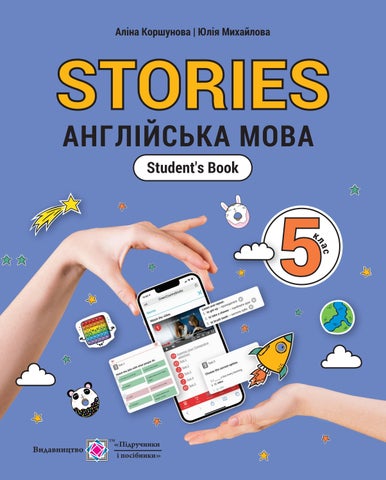
АНГЛІЙСЬКА МОВА: 5-й рік навчання Підручник для 5 класу закладів загальної середньої освіти (з аудіосупроводом)
ENGLISH: Year 5
А textbook for the 5th form of secondary school (with audio)
Рекомендовано Міністерством освіти і науки України
Тернопіль 2022
УДК 811.111(075.2) А64
Авторський колектив: Аліна Коршунова, Юлія Михайлова, Діана Фролова, Валерія Якушко
Підручник створено за модельною навчальною програмою «Іноземна мова 5-9 класи» для закладів загальної середньої освіти (автори Редько В. Г., Шаленко О. П., Сотникова С. І., Коваленко О. Я., Коропецька І. Б., Якоб О. М., Самойлюкевич І. В., Добра О. М., Кіор Т. М.)
Рекомендовано Міністерством освіти і науки України (Наказ Міністерства освіти і науки України від 08.02.2022 №140).
Англійська мова : 5-й рік навчання. Підручник для 5 класу заклаА64 дів загальної середньої освіти (з аудіосупроводом). / А. Коршунова, Ю. Михайлова, Д. Фролова, В. Якушко. — Тернопіль : Підручники і посібники, 2022. — 192 с. : іл.
УДК 811.111(075.2)
© Коршунова А., Михайлова Ю., Фролова Д., Якушко В., 2021
Stories to: me
Хей, гайз Ставлю лайк вашому бажанню вчити англійську Цього року це буде відбуватися трохи незвично, не так, як завжди. Ну по-перше, для навчання вам знадоблюся не тільки я, підручник Stories, але й телефон, планшет або ноутбук Уже щось новеньке. На моїх сторінках є відео-, аудіоматеріали та інтерактивні квізи які заховані під QR-кодами. Аби виконати деякі завдання, відскануйте їх та слухайте-дивіться англійською Разом із однокласниками на заняттях ви будете вчитися користуватися англійською — гратимете в ігри, працюватимете над проєктами та багааато спікатимете. Теми вам точно сподобаються Ви будете обговорювати нестандартні наукові факти, подорожі світом, непопсові туристичні місця в Україні та інше (терпіння, скоро дізнаєтеся ). Головне — відкиньте всі хвилювання: у вас точно вийде! Англійська — топ, і ви точно потоваришуєте Ваша англомовна пригода почнеться через 3… 2… ой, вже Твій English Book, Stories. Reply
Forward
3
Unit
Vocabulary
Grammar
Functional Language
Welcome
• letters • numbers • colours • family
Revision: • to be • have got • demonstratives: this, that, these, those • possessives
• getting to know each other • talking about possessions
Unit 1 My life
• daily routines • after-school activities • emotions and hobbies
• can for abilities • Present Simple: affirmative, negative, questions • adverbs of indefinite frequency
• talking about daily routines and timetable • talking about abilities and preferences • talking about interests and making suggestions
Unit 2 School life
• at school • school subjects • actions and tasks during the lesson
• comparative & superlative adjectives • Imperatives: affirmative and negative
• telling about your favourite subject • telling the time
Unit 3 Weather
• Present Continuous: affirmative, • describing weather negative, questions • seasons; natural phenomena • events in progress; temporary situations • names of months • prepositions of time
Unit 4 Clothes
• clothes • shopping for clothes
• special questions • relative pronouns • question words
Unit 5 Let’s go out!
• places to go out • holidays of the year • organising a party
• Present Simple vs Present Continuous • be going to (affirmative) for plans and intentions • conjunctions (and, but, so, or, because)
Unit 6 In the city
• places in the city
• Past Simple: affirmative • to be in the past (affirmative, negative, questions)
Unit 7 Food
• at the cafe • food • Ukrainian vs British cuisine • containers
• quantifiers: some, any, a lot of, much, many, all, both, a few, a little
• giving instructions (for a recipe) • ordering food at a cafe
Unit 8 Travelling
• at the airport • giving directions
• Past Simple: negative, questions • Present Perfect Simple: affirmative, negative, questions
• buying a ticket • giving directions
Unit 9 Around the world
• countries and nationalities • describing people / things
• Past Simple vs Present Perfect
• asking for clarification / clarifying things • giving advice on how to behave in different countries
• talking about the dates • giving instructions • talking about the weather forecast • talking about shopping • buying clothes at the shopping mall • making suggestions • talking about advantages / disadvantages
Revision 1 Units 1-4
Revision 2 Units 5-9 Irregular verbs Extra resources
4
Skills
Page
6-11
Reading: Understanding the text about a famous singer’s day. Listening: Understanding information about likes and dislikes. Speaking: Asking and telling about your day. Writing: Writing a post for social media.
12-27
Reading: Understanding the texts about school lessons and a dream job. Listening: Understanding students talking about their timetable / school day. Speaking: Telling about your timetable. Writing: Writing a letter to a penfriend about Ukrainian school days.
Pronunciation: / i / / aI /, /e/ / eI /
28-45
Reading: Understanding the text about the holidays. Listening: Understanding information about special dates in the calendar. Speaking: Describing the weather. Writing: Writing a message.
Pronunciation: / aI /
46-63
Reading: Understanding the conversation between a shop assistant and a customer. Listening: Understanding the conversation about shopping. Speaking: Describing clothes. Writing: Writing an essay about outfits in Ukraine.
Pronunciation: / eə / / Iə / / f /
64-77
78-83 Reading: Understanding an email about a party. Listening: Understanding students talking about camping. Speaking: Speaking about the camp you went to. Writing: Writing an email.
84-101
Reading: Reading about famous places now and in the past. Listening: Understanding information about villages in Ukraine. Speaking: Describing the place where you live. Writing: Writing an essay.
Pronunciation: / id / / t / / d /
102-117
Reading: Understanding an article about breakfast in different countries. Listening: Understanding information about a birthday party. Speaking: Ordering food at the restaurant. Writing: Writing a short message.
Pronunciation: / oʊ / / ʊ /
118-137
Reading: Understanding the text about transport. Listening: Understanding a conversation at the airport. Speaking: Giving directions. Writing: Writing a description of your favourite tourist destination. Reading: Understanding the text about the British people. Listening: Understanding information about moving to and living in another country. Speaking: Telling about your country. Writing: Writing an email.
138-153
Pronunciation: /əʊ/ /aʊ/
154-173
174-179 180 181-188
5
Welcome 6
1
1. Listen to the dialogue. Then work in pairs and role-play it. Listen here!
bit.ly/piiXAKbss
Kyryl: Hi! What’s your name? Dasha: My name’s Dasha. And yours? Kyryl: I’m Kyryl. How old are you? Dasha: I’m 10 years old. And you? Kyryl: I’m 11. How are you? Dasha: I’m fine, and you? Kyryl: I’m great! Nice to meet you! Dasha: Nice to meet you too!
To be (affirmative)
2. Ask your classmates and complete the table. Student A: What’s your name? Student B: My name’s Anna. Student A: How old are you? Student B: I’m 10 years old.
bit.ly/pG9tN3jxu
are
're
He / She / It
is
's
Anna
10 years old. … years old. … years old. … years old.
15 3
You / We / They
… years old.
Example: Thirteen.
14
'm
Age
3.a Listen to the audio and write the numbers you hear.
12
am
Name
Example: Anna is 10 years old.
Listen here!
I
11
8
24
16
100
10
13 2
18
57
23
3
17 0
26
3.b Listen to the phone numbers and write them. Check them in pairs. Listen here!
Example: Student A: What’s your name? Student B: I’m Alice.
2. Billy: bit.ly/qqZZdn88U
1. Alice: 091 37 69 36 48
Student A: What’s your phone number? Student B: It’s 091 37 69 36 48. 3. Andrew:
4. Sara:
My phone number:
Welcome
7
2
1. Look at the pictures and do the colour sums. Example: red + white = pink 1. 2. 3. 4.
green
red + yellow = ... red + blue = ... red + green = ... yellow + blue = ...
pink
purple
orange
brown
red
2.a Look at the pictures and make sentences.
Example: The spinner / blue / orange – The spinner is blue. It isn’t orange. 1. 2. 3. 4.
The smartphone / purple / white The pencil / white / blue The walls / orange / white The classroom / white and yellow / brown and red
To be (negative) I
am not 'm not
You / We / They are not
aren’t
He / She / It
isn’t
is not
2.b Work in pairs. Think of one object in your classroom and let your classmate guess. Example: Student A: Is it white? Student B: No, it isn’t. Student A: Is it brown? Student B: Yes, it is. Student A: Is it a table? Student B: Yes, it is.
8
Welcome
A table
To be General questions
Short answers
Am I … ?
Yes, I am. / No, I’m not.
Are you / we / they … ?
Yes, you are. / No, you aren’t.
Is he / she / it … ?
Yes, it is. / No, it isn’t.
3. Read the text and fill in the gaps with this is / that is / these are / those are. Hello! I’m Tim. And this is my classroom. These are two desks and five red chairs for students.
school bag
And that is a yellow chair for a teacher. These are four laptops for students, and that is one laptop for a teacher. And those are white loudspeakers. And … my blue school bag. … my books. And … my pens and pencils. … windows. And … a desk and a chair.
classroom 4. Look around your classroom and write 5 sentences. Then compare in pairs. Demonstrative pronouns Example: Singular Plural This is my classroom. this these This is my desk, and that is the board. that those
This That
These Those
1.a Write the names of your family members in the family tree.
3 David
1.b Look at your family tree and write. 1. … is my uncle. 2. … is my aunt. 3. … are my cousins. 4. … is my grandma. 5. … is my grandpa. 6. … are my parents. 7. … is my mum’s / dad’s nephew. 8. … is my mum’s / dad’s niece. 9. … is my brother. 10. … is my sister. 2. Work in pairs and talk about your families. Example: Student A: What’s your uncle’s name? Student B: His name is Paul.
Possessives Adjectives
Nouns + ' / 's
I – my
* singular noun + 's – sister's
You – your He – his She – her It – its We – our They – their
* name + 's * plural noun + ' – parents' * plural irregular noun + 's – children's
Welcome
9
3.a Read the texts. Hello! My name is Max. I’m 10 years old. This is my family. This is my mum. Her name is Emma. And this is my dad. His name is Ben. My mum has got a sister, but my dad hasn’t got a brother or a sister.
Hi! I’m Sonia Li. I am 11 years old. And I’m an instablogger. I’ve got a big family. I’ve got a sister, but I haven’t got a brother. My sister’s name is Masha. She is my best friend! Look! This is my sister’s dog. It’s so cute!
Hello, everyone! I’m Anita. My nieces and nephews have got the best aunt in the world. Look! These are my nieces’ presents.
Hi there! We are Anna and Brandon. And we are a grandma and a grandpa. We’ve got 3 grandchildren. And they are very nice and funny. We love them very much. 3.b Choose the correct answer.
4.
1. Sonia Li has got / hasn’t got a brother.
3. Ben and Emma are / aren’t parents.
2. Anita has got / hasn’t got nieces.
4. Anna and Brandon have got / haven’t got grandchildren.
Write the sentences true for you. Then work in pairs and compare. Example: Student A: I haven't got a niece. Student B: I haven't got a niece, too. 1. 2. 3. 4. 5. 6.
10
I / a niece My best friend / an uncle / an aunt I / a grandpa My teacher / a son I / nieces / nephews I / a sister
Welcome
Have got Affirmative
Negative
I have got / I’ve got
I haven’t got
You / We / They have got / They’ve got
You / We / They haven’t got
He / She / It has got / It’s got
He / She / It hasn’t got
4
1.a Listen and put a tick (v) or a cross (X). Listen here!
bit.ly/n4GZWAREs
a laptop 2 best friends an uncle Tim
a blue school bag a dog
Maria
a smartphone grandparents 1 best friend
a blue penny board a cat
Have got
1.b Work in pairs and check. Example: Student A: Has Maria got a … ? Student B: Yes, she has. Student A: Has Maria got a … ? Student B: No, she hasn’t.
General questions
Short answers
Have I got … ?
Yes, I have. / No, I haven’t.
Have you / we / they got … ? Yes, you have. / No, you haven’t. Has he / she / it got … ?
2. Fill in the gaps. 1. I … got many friends on social media.
Yes, it has. / No, it hasn’t.
Have you got many friends on social media? …, I haven’t.
2. My teacher … got a laptop and loudspeakers on his desk.
… my teacher got a laptop on his desk? Yes, he has.
3. His cousins … got a lovely cat, but they haven’t got a dog.
Have his cousins got a lovely cat? Yes, they … .
4. Kim can ride a bike very fast, but she … got a bike. Has Kim got a bike? No, she … . 3.a Look at the pictures and ask each other. Student A, look at the pictures below. Student B, look at Exercise. 4. Example: Student A: Have you got a skateboard? a skateboard a profile on social media a baby cousin a pet
Student B: Yes, I have.
a sports bag a smartphone twin brothers birthday presents
3.b Tell the class about you and your classmate. Example: I’ve got a laptop, but I haven’t got … . He / she has got ... , but he / she hasn’t got ... . 4. Look at the pictures and ask each other. Example: Student B: Have you got many Insta friends? many Insta friends a laptop a bike a school uniform
Student A: No, I haven’t.
2 lovely dogs a black school bag a car a baby brother Welcome
11
Unit 1 My life 12
1
Speaking 1. Interview your classmates and find someone who can … . Example: Student A: Can you use a computer? Student B: Yes, I can. • use a computer • act • cook • drive a car • keep order • read fast • take nice selfies • design clothes
Modal verb: can General questions
Short answers
Can I / you / we / they / he / she / it … ?
Yes, I can. No, I can’t / cannot.
2.a Look at the people’s photos on social media and guess their jobs. • • • •
a driver a programmer a chef аn actor / actress
• • • •
a blogger a police officer a teacher a designer
Example: Student A: What’s Steven’s job? Student B: I think he’s a ... because he can ... . 2.b Read and check your guesses.
Sofia
Sofia’s post
Steven’s post Hi, my online friends! So, my perfect day starts with breakfast. I usually get up and run to the kitchen. I can make a sandwich with tea or a salad. But on my perfect day, I can try something new. I’m a chef and know a lot of recipes. I can cook an English breakfast: eggs, sausages, tomatoes, and bread. Mmmm … it’s a perfect meal for my perfect day. Sofia Jones, what is your perfect day? #thebestchef#cancook#perfectdaychallenge Comment
Steven
A challenge? A perfect day? Ok, I can’t imagine a perfect day without my work. I get up and do exercises. I walk my dog Jack in the park, have breakfast, and go to the office. On my perfect day, I can take Jack with me. He is very smart and can help keep order on the streets. He hasn’t got a uniform, but he can be a good police officer. A day at my favourite work with my best friend is a perfect time for me. Hey, friends, you are next. #perfectdaychallenge#dogpolice
Share
Comment
Share
Writing 3. Choose a person below and write a post for the #perfectdaychallenge on social media. Example: On my perfect day, I ... . I can also ... .
Margo
Silvia
Luke
Amanda Unit 1 My Life
13
1.a Match the pictures with the words. 1 Example: A. to get up (8) B. to go to school C. to brush teeth D. to go to bed E. to take a shower F. to take a bus G. to get dressed H. to have breakfast / lunch / dinner
2
5
3
6
1.b Use the phrases from Exercise 1a and write about your day (you can use one phrase several times). Then work in pairs and read your sentences to each other. Example: I get up and brush my teeth. Then I ... . After that, I ... . 2. Match the personal pronouns with the correct verbs. I He She We takes It take You They
2
4
7
8
Present Simple (affirmative) I / You / We / They
He / She / It
+V
+ V s / es
I take a shower.
He takes a shower.
Use it right!
s / es endings
after -ch, -ss, -sh, -x or -o, use -es watches, mixes, goes after a consonant + -y, use i + -es cry – cries, copy – copies
3. Read the texts and fill in the gaps with the Present Simple. Then match with the pictures. after a vowel + -y, use -s buys, stays A. My name’s Mia. I go to school from Monday to Friday. I get up at 6 o’clock in the morning, I take a shower at 6.30 am and … (go) to school by bus. I have breakfast at school. Friday
B. This is David. At the weekend, he … (get up) at 10 o’clock in the morning. In the afternoon, he has lunch with his family at a café. After that, they all … (walk) in the park and go home.
1
2
Monday
Friday
C. They are Sam and Jane. On Friday, their first lesson … (start) at 10 am. They get up at 8.30 am, take a shower, … (brush) their teeth and have breakfast. At 9.30 am, they take a bus to school.
Writing
3
4. Choose a classmate and try to guess what he / she does during the day. Write 5 sentences. Then read your sentences to him / her and check. Example: Kevin gets up at 7 am and then brushes his teeth.
14
Unit 1 My Life
1. Complete the table with the following words. • often • at midnight • in the afternoon • never 2. Put the words ALWAYS / OFTEN / SOMETIMES / NEVER in the correct place. Example: I USUALLY brush my teeth before breakfast. 1. I … get up … at 7 o’clock in the morning. 2. I ... don’t ... get up at 7 o’clock in the morning. 3. I ... am ... happy. 4. I ... am not ... tired.
Reading 3.a Read the text.
When?
How often?
in the morning
always
1) ...
usually
in the evening
3) ...
at night
sometimes
2) ...
4) ...
Telling the time
3
Use it right!
8 am – 8 o’clock in the morning 8 pm – 8 o’clock in the evening
Hello! My name is Jerry Heil! I’m 23 years old. And I’m a singer and a blogger. And this is what I do every day. In the morning, I get up at 8 o’clock. Then I take a shower and brush my teeth. I’m eco-friendly, so my toothbrush is wooden. Then I get dressed. My favourite clothes are dresses and sweatshirts. I often have breakfast at 9 o’clock. I usually have cereal and some fruit for breakfast. And at 10 am, I go to the studio. I never take a bus because I always walk. I work there from 11 am till 6 pm. In the afternoon, I often have a sandwich and coffee for lunch. I never eat meat because I’m a raw foodist. In the evening, I meet my friends. We usually go to the cinema together. I go to bed at 10 o’clock in the evening.
3.b Mark the sentences T (true) or F (false). Example: Jerry Heil gets up at 9 o’clock. T / F 1. She often walks, but sometimes she takes a bus. T / F 3. In the afternoon, Jerry meets her friends. T / F 2. She works from 10 o’clock in the morning to 6 o’clock 4. She goes to bed at midnight. T / F in the evening. T / F
Speaking 4. Work in pairs and answer the questions. Then compare. Example: I always go to the cinema at weekends, but Kate never goes to the cinema at weekends. 1. How often do you go to the cinema at weekends? 4. How often do you do sports after school? 2. When do you usually go to bed? 5. When do you usually meet your friends? 3. How often do you play online games in the evening? 6. When do you usually have dinner? Unit 1 My Life
15
1. Look at the timetables and fill in the gaps with these words. • • • • • •
Internet friends homework books sports watch
• • • • • •
phone feed bike games music food
4
Monday - meet my 1) … - use my laptop - do 2) … - walk home
Thursday - 7) … and walk a
Tuesday - visit grandparents - have fun with cousins - play computer 3) …
- ride a 8) ...
- listen to 9) … Friday - buy 10) …
- do 4) …
- cook pizza
Wednesday - 5) … films - charge my 6) … - go to the cinema
Listening 2.a Listen and match the photos with the timetables from Exercise 1.
- charge my laptop
- play with my pet Weekends - surf the 11) …
A
- read 12) …
- go for a picnic
Listen here!
- take pictures
B bit.ly/nmIE0IFfq
Anna
Sasha
2.b Listen again and choose the correct option. 1. I’m Sasha and I do sports / don’t do sports after school. 2. I don’t usually go / usually go shopping.
1. This is Anna and she rides / doesn’t ride a bike after school. 2. She doesn’t usually do / usually does homework at home.
16
Unit 1 My Life
dog
3. Unscramble the sentences. Example: I / not / play computer games / before school. I don’t play computer games before school. 1. 2. 3. 4. 5. 6.
My sister / not / charge her laptop / every day. We / not / go to the cinema / at weekdays. I / not / usually / surf the Internet / before school. Jim / not / play with his pet / in the park. My dad / not / usually / walk home / after work. My classmates / not / take pictures / at school.
Speaking
Present Simple (negative) I / You / We / They
He / She / It
+ don’t + V
+ doesn’t + V
I don’t play computer He doesn’t play games in the morning. computer games in the morning.
4. Work in groups and play a guessing game. Tell your classmates about one of the people below and let them guess the name of this person. Use the prompt questions. •
Who am I?
•
Who is he / she?
•
Who are they?
Example: Student A: He doesn’t take pictures. He doesn’t surf the Internet. He doesn’t listen to music. Who is he? Student B: He is Tom.
Jane and Rachel
David
Lidia
Mark and Matthew
Patrick and Jenny
Olivia
Tom
Toni
Unit 1 My Life
17
5
1. Number the pictures. Example: 0. tired 1. relaxed 2. sleepy 3. lazy 4. hungry
5. 6. 7. 8.
sick angry afraid busy
2.a Read the sentences and write the emotions. Example: I always have something to do. (busy) 0 1. I don’t feel well and can’t do anything today. (...) 2. I can’t cook, and there is nothing in the fridge. (...) 3. I get up at 6 am every day and want to sleep at school. (...) 4. I don’t like this computer game, but my brother plays it very often. (...) 5. I don’t like dogs because they are big and dangerous. (...) 6. I watch YouTube and do nothing. (...) 2.b Work in groups. Read a sentence from Exercise 2a with the correct emotion. Let your classmates guess the emotion. Example: I never play with pets.
afraid
Student A: Are you angry? Student B: No, I’m not.
Student A: Are you afraid? Student B: Yes, I am.
3.a Write 6 sentences about yourself. Use the phrases from the box. Example: When I’m tired, I ... . When I’m tired, I never ride a bike. OR When I’m tired, I don’t ride a bike. • • • •
watch films play computer games read a book go for a walk
• • • •
play with my pet do sports listen to music surf the Internet
Speaking 3.b Work in pairs and ask each other. Example: Student A: Do you watch films when you are sick? Student B: No, I don’t. Student A: What do you do when you are sick? Student B: I listen to music when I’m sick.
18
Unit 1 My Life
• • • •
go shopping cook meet friends do homework
Present Simple (questions) General
Special
Do I / you / we / they … ? – Yes, I do. OR No, I don’t.
What do I / you / we / they … ? – I study.
Does he / she / it … ? – Yes, he does. OR No, he doesn’t.
What does he / she / it … ? – He studies.
3.c Work in different pairs and ask about your classmates. Example: Student A: Does Paul watch films when he’s sick? Student B: No, he doesn’t. 1. Match the pictures with the words.
Student A: What does he do when he is sick? Student B: He listens to music when he’s sick.
A
B
C
E
F
G
D
6
Example: 0. roller skating (A) 1. 2. 3. 4.
drama programming hiking ice skating
5. 6. 7. 8.
photography maths gymnastics chess
2. Listen, write and repeat. Example: 1. skating Listen here!
bit.ly/nGx4czHwI
2. rid 3. play 4. go 5. do 6. danc
7. programm 8. giv 9. speak 10. read
3. Work in pairs and role-play dialogues. Example: Student A: What can you do? Student B: I can do gymnastics. It’s my hobby.
H
I
Use it right!
-ing ending “cycle” is a verb – I can cycle.
“cycling” is a noun – My hobby is cycling.
Student A: What’s your hobby? Student B: My hobby is dancing. I can dance very well.
Listening 4.a Watch the video and circle. Watch here!
bit.ly/swqKadlzW
Liz Ali Unit 1 My Life
19
4.b Look at the pictures and write what they love, like, hate.
Mum
Liza
Dad
Alan
Talking about likes Ann
Use it right!
love like + ing hate
Sasha
My mum hates skateboarding. 5. Sort the words into 3 groups. • • •
hiking sports computer games Do
• • •
gymnastics chess cycling
• • •
crafts horse riding maths
Play
Go
6. Write the sentences about you. Use love, like, hate. Then work in pairs and tell your classmate what you love, like and hate doing. Example: I love travelling and doing sports. What about you? What do you love doing? 1. 2. 3. 4.
20
I … (ice skating). I … (horse riding). I … (computer games). I … (chess). Unit 1 My Life
5. 6. 7. 8.
I … (sports). I … (gymnastics). I … (films). I … (swimming).
7
1. Unscramble the words and match them with the pictures. Example: FMILS – films (8) • •
IASOFHN NYCLCIG
1
2
• •
ESCHS GRAMMINPROG
3
4
• •
5
PHYHGRAPOTO FRTCAS 6
•
7
KINGHI 8
Reading 2.a Work in pairs and read the dialogue. Tim: Anna, what are you doing? Anna: I’m creating a school project about my interests. Tim: Interesting... So, what do you like doing? Anna: I like doing crafts. I always make beautiful presents for my parents and friends. Tim: Yes, I remember your birthday present for me. And what do you love doing? Anna: I love going to drama classes. Drama is my hobby. Tim: Wow! And what do you hate doing? Anna: I hate doing gymnastics. It’s very difficult and tiring for me. What about you? Tim: I’m into programming. It’s my hobby. I have programming classes twice a week. It’s very interesting but sometimes difficult. Anna: And what do you like doing? Tim: I like playing chess. I always play it with my sister. She is interested in playing this game, too. Anna: And what do you hate doing? Tim: I hate swimming. My sister Kate is mad about swimming, but I hate it. Anna: I see. 2.b Complete the sentences with the words from the table. • •
likes hates
• •
loves into
1. Tim’s sister Kate is … about swimming. 2. Anna … doing crafts. 3. Tim … swimming.
• •
mad interested
4. Tim’s sister is … in playing chess. 5. Anna … going to drama classes. 6. Tim is … programming. Unit 1 My Life
21
3. Work in groups. Choose a role and make a dialogue. Example: Student A: Hello! I’m a journalist. Can I ask you some questions? Student B: Yes, please. journalist Tim Anna Student A: Do you like doing crafts? Student B: Yes, I do. I like doing crafts. Use it right! I always create beautiful presents Talking about interests for my parents and friends. be into • swimming • doing crafts be mad about + ing • playing chess be interested in • going to drama classes • programming • doing gymnastics My friend is into playing football.
Speaking MY QUESTIONNAIRE
4. Complete the questionnaire. Then work in pairs and interview your classmate. Example: … (be interested in) … ? Student A: Are you interested in playing computer games? Student B: No, I’m not. Student A: What are you interested in? Student B: I’m interested in watching action films.
1. … (be interested in) … ? 2. … (be mad about) … ? 3. … (love doing) … ? 4. … (hate doing) … ? 5. … (like doing) … ? 6. … (be into) … ?
1
2
8 1.
Label the pictures of the places. Then answer the questions. • music • skate
• 3D • football
a … stadium
a … school 3
4
1. How often do you go to such places? 2. What do you usually do there? a … cinema
22
Unit 1 My Life
a skate park
2. Read the messages and fill in the gaps with these words. • •
new Hello
• •
Yours What
• •
reply How often
• •
too Write
• •
Also Let’s
Hi, ...! How are you doing? What do you usually do at the weekend? (...) spend this weekend together. How about doing sports? I’ve got a new skateboard, so we can go skateboarding. Have you got a skateboard? We can also watch a football match at the stadium, but I’m not a big fan of football. As I can remember, you never play football and hate team sports (...). Can you play any other games? How often do you play? Waiting for your (...). (...), …! (...), What’s (...)? Samuel What do you usually do at the weekend? How about we spend this weekend together? We can go to a music master class with my cousin. She’s mad about music. She usually plays the guitar and sings at my birthdays. Shall I call her and ask for more details about this event? (...), we can go to the cinema. How about watching an action film? There is a new 3D picture by Marvel, and I want to see it. Are you interested in the Marvel world? (...) do you watch such films? (...) me back. Love, Use it right! Margo
Making suggestions
3.a Read the messages again and choose the correct options.
1. 2. 3. 4.
Shall I call / calling her for more details? Let’s spend / spending this weekend together! How about go / going to the cinema? How about we go / going skateboarding together?
3.b Talk to your classmates and role-play dialogues. Find 2 people who want to spend a weekend with you. Example: Student A: How about swimming at the weekend? Student B: I’m not into swimming. Let’s ride bikes at the weekend!
Writing 4. Choose one of the messages from Exercise 2 and write a reply.
Hi / Hello, … ! I’m … . How are you? I usually / always / often … at the weekend. I love / like / hate … . I’m mad about / ’m into / ’m interested in … . Let’s go to … / How about … ? / Shall I … ? Yours / Love / Regards, ...
Unit 1 My Life
23
Project 1.a Look at the pictures and choose the correct word. 1
2
3
a. a YouTuber b. an astronaut
4
a. art b. STEM
a. a big family b. a small family
a. an early bird b. a night owl
1.b Choose the odd one out and explain why. Example: A driver is odd because he / she drives a car not a bicycle. He / she doesn’t cycle. He / she doesn’t ride a bike. 1. 2. 3. 4. 5.
cycle night owl space Maths big family
ride a bike late YouTuber Art cousins
bicycle midnight videos technology only child
driver early computer Science uncle
2. Use the words above and write questions to the following answers. Work in pairs. Ask your classmate a random question and let him / her give the correct short answer. Example: Student A: Are you a night owl? •
Yes, I am.
•
No, I haven’t.
Student B: Yes, I am. •
Yes, I can.
•
No, I don’t.
3. Read the facts on the next page and answer the questions. 1. Which do you think is a myth?
2. Which do you think is the truth?
4.a Do the research. Interview your classmates and draw the charts. Example: 5% athletics and team sports Use it right! Talking about numbers art, music, dance 25% 50% • 1 of my classmates does sports learning • 2 of my classmates do sports nothing 20% • 50 % (per cent) of my classmates do sports 4.b Present your results to the class. Example: Fact 1 is a myth. I’ve got 10 classmates, and only 4 of them have got a bike and can ride it.
24
Unit 1 My Life
Myth or Truth?
Fact 1
There is 1 billion bicycles in the world. And every second person on earth can cycle.
Fact 2
Early birds get up early in the morning and go to bed at 9 pm. At the same time, night owls get up at 9-10 am and go to bed after midnight. So, early birds sleep more than night owls.
Do the research and check it!
Fact 3
Children don’t want to be astronauts, but they want to become YouTubers. 3 out of 10 teenagers choose the job of a professional YouTuber.
Fact 4
What do you do after school? More than 50% of teenagers go to sports clubs or play team games like football or volleyball. And only 25% study languages or go to STEM clubs after school.
Fact 5
Big families are not popular anymore. People don’t have time to visit their relatives very often. Some of them can’t even remember their cousins’ names and birthdays.
1
Have you got a bike?
2
Can you ride a bike?
3
Are you an early bird or a night owl?
4
What time do you usually get up and go to bed?
5
Have you got a YouTube channel?
6
Do you want to be an astronaut or a professional YouTuber?
7
Are you good at art?
8
Do you like studying science?
9
How often do you visit your grandparents?
10
Do you remember your cousins’ birthdays?
25
Revision 1.a Do the quiz. 1. Who is Jane’s cousin? • Tina • Robert
•
Liza
•
Rachel
•
Tom
•
David
•
Anthony
Tom and Tina have got 3 children: Liza, Anthony, and Robert. Liza hasn’t got any children, but Anthony and Robert have got big families. Anthony has got 2 children: David and Jane. And Robert has got one daughter, Rachel. So, Anthony has got a nephew, and Robert has got a nephew and a niece. 2. Which sentence is FALSE? A. Programmers can use computers and write programs.
B. Chefs are good at cooking restaurant dishes.
C. Designers usually drive a bus or a taxi.
3. Complete the sentence. I get up at 7 am. Then I brush my teeth and get... A. dress
B. dressed
C. dressing
4. Fill in the gap with one word. - How … do you go to bed after midnight? I never go to bed so late. 5. Which sentence is TRUE? A. When Anna is angry, she eats a sandwich and drinks tea. B. When Anna is relaxed, she surfs the Internet and watches YouTube. C. When Anna is busy, she doesn’t watch films or read books.
26
Unit 1 My Life
Anna
6. Choose the correct word. What’s your hobby? I’m mad about mountains and hiking / photography / ice skating. But it’s difficult. 7. Fill in the gaps with the same word. How often do you … sports at the weekend? They … crafts every day. I think it’s boring. A. play
B. go
C. do
8. Choose the odd one out. A. Jack is good at riding a scooter. B. Jack can ride a scooter. C. Jack likes riding a scooter. 9. Fill in the gaps. How about … to the swimming pool? Oh, no. I’m not ... swimming. A. going / about
B. do / in
C. going / into
10. Which sentence is CORRECT? A. Jane never go to school discos.
B. Jane doesn’t go to school discos.
C. Jane doesn’t never go to school discos.
1.b Go to Extra resourses and check your answers. Then read the comment. 1-4 correct answers
Try again! How about revising Unit 1 and doing the quiz one more time? You can do it better!
5-7 correct answers
Good results. Congratulations! Look at your mistakes. Think carefully and try to correct them. You can also ask your classmates to explain them to you.
8-10 correct answers
Great job! Go on and use the words and grammar you know in your everyday life. Talk to your family and friends in English! Unit 1 My Life
27
Unit 2 School life 28
1. Discuss the questions with your partner. 1. What lessons do you have today? 2. Open your diary. What lessons are there for this week? 3. What time do you come to school? 2.
1
Put the correct numbers in the circles. Example: 0. Maths
Listen here!
bit.ly/mCHvAfqko
4. Guess and write the correct word.
Maths V PE English Ukrainian Literature Craft French History
1. 2. 3. 4. 5. 6.
History PE Ukrainian Maths Craft French
1. 2. 3. 4. 5. 6.
Maths German PE Ukrainian IT World Literature
THURSDAY
1. 2. 3. 4. 5. 6. 7.
FRIDAY
Listen to the timetable and tick the subjects you hear.
MONDAY
Listening 3.
0
6. Craft 7. PE 8. ICT 9. History 10. World Literature
TUESDAY
English German French Ukrainian Ukrainian Literature
WEDNESDAY
1. 2. 3. 4. 5.
1. 2. 3. 4. 5. 6.
Craft English World Literature Ukrainian Maths IT
1. 2. 3. 4. 5. 6. 7.
Craft History German Maths IT PE English
Example: English is easy for me. I already know Present Simple and a lot of words. 1. Do you like ... ? Physical exercises are good for health, and I love these lessons. 2. In ... lessons we create presentations, websites, and learn how to use Microsoft Office. 3. ― What is your favourite book that you know from a ... lesson? ― It is The Star Child by Oscar Wilde. 4. I like ... lessons because we read a lot of our national poems and stories. 5. If you want to travel to Germany one day, do homework before your ... lessons. 6. I like reading about Ukrainian Cossacks. I am interested because of ... lessons. 7. How many ... lessons do you have per week? ― We have 4: from Monday to Thursday. I enjoy this subject because I want to speak my national language with no mistakes. Unit 2 School life
29
Speaking
TUESDAY
1. 2. 3. 4. 5.
... Maths ... English ...
1. 2. 3. 4. 5.
German ... PE Maths ...
THURSDAY
... ... Ukrainian ... Maths
1. 2. 3. 4. 5.
... World Literature ... IT ...
FRIDAY
MONDAY
1. 2. 3. 4. 5.
WEDNESDAY
5. Work in pairs. Ask your partner about his / her timetable. Student A Student B, go to Extra resources. Example: - What is lesson number 3 on Monday? - It’s Ukrainian.
1. 2. 3. 4. 5.
IT French ... ... ...
6. Find someone who … . Example: ... likes Maths. - Jack, do you like Maths? - Yes, I do.
Questions ... likes Maths ... always does History homework ... never skips Maths ... likes Ukrainian Language and Ukrainian Literature ... doesn’t like German ... likes Craft and PE ... knows English very well ... never has two PE lessons
30
Unit 2 School life
Names Jack
1.a Match homework tasks with the subjects. 1. Maths a) Read the story The Painted Fox. 2. Ukrainian Literature
b) Fill in the gaps with the verbs in Present Simple.
3. History
с) Read the story Alice in Wonderland.
4. World Literature
d) Solve: 0,5*0,7= ...
5. French
e) Make a presentation in Microsoft PowerPoint.
6. IT
f) Écrivez une histoire.
7. English
g) Read 2 paragraphs about Ancient Egypt.
2
1.b Compare the answers with your partner.
Reading 2. Unscramble the words. I like studying. I’m very busy every day. On Monday I have PE (EP) lessons in the morning. We run and play basketball, and we sometimes swim in the pool. In the afternoon I have ... (eSccnie) and ... (Mstha). I like learning languages. In my school we study ... (hEnilgs) and ... (mnaGre), but I also want to learn ... (esehniC) or ... (cerFhn). I have extra English classes two times a week ― on Wednesdays and on Fridays. I enjoy ... (tAr) and ... (tCarf) lessons. They are more interesting than Science. Ugh, I don’t like Science. At Art lessons we always make something creative. But I have these lessons only once a week. On Friday I have ... (yGoearhpg) and ... (eearuLittr). These subjects are very difficult for me. I’m not interested in reading and I can’t understand maps.
3.
Choose T (true) or F (false). Example: He has a lot of things to do every day. T / F 1. 2. 3. 4. 5.
He has PE on Monday afternoons. T / F He studies French and Chinese. T / F There are extra English lessons on Wednesdays and Fridays. T / F Science is more interesting than Art. T / F He has Art lessons once a week. T / F
Unit 2 School life
31
4. Discuss the questions with your partner.
Comparative Adjectives
1. What’s your favourite subject at school? Why? 2. What languages do you study at school? 3. What’s more difficult: Maths or languages?
If the word is one-syllable adjective, use -er suffix: old - older, nice - nicer If the word has two and more syllables, use more, but do not change the form of the adjective: difficult - more difficult; popular - more popular Note! good - better bad - worse far - farther / further
Grammar 5. Listen and put the signs. Listen here!
bit.ly/mcenZhQyc
Example: Maths is more important than Art. Maths > Art. Chinese is more difficult than English. English < Chinese
German / English
•
•
Java / Python
Mary
•
Mia
Nature / Science
Use it right! If the last letter of one-syllable adjective is -y, change -y into -i: easy - easier; pretty - prettier.
•
David
Maths / Japanese Ali
•
Craft / Art
Ben
6. Compare the subjects and other things using the adjectives from the list. Example: English is more popular than Japanese. difficult easy cool interesting good
• • • • •
32
• • • • •
bad exciting popular famous old
• • •
•
English / Japanese
•
Music / History
•
Art / PE
•
Reading / Craft
•
ICT / Science
•
•
Geography / Nature
•
Unit 2 School life
big small tasty
•
vanilla ice-cream / chocolate ice-cream
Chinese / ICT
•
actors / programmers
Geography / Music
•
English book / Maths book
•
living room / kitchen
3
1. Answer the questions. 1. What do you do in your English lessons? 2. Which tasks do you like the most?
Vocabulary 2. Match the words with the pictures.
C
F
D
G
1) to match 2) to underline 3) to write 4) to type
A
5) to cross 6) to read 7) to circle 8) to listen 3. Scan the QR-code and do the task.
B
H
E
Scan here!
bit.ly/ummcXZgwU
4. Order the activities. What does the lesson start with? 1
to learn new words
to do exercises
to greet your teacher
to note down homework tasks
to check homework
to say goodbye to your teacher Unit 2 School life
33
5. Read the text. Does Kate like English lessons?
My school lessons… ...are interesting. I am Kate, and I am a student in one of the public schools in Poltava. My favourite subject is English. I have English 4 days a week: on Monday, Wednesday, Thursday and Friday. Our English lessons start with greetings; the teacher puts stickers with our names on the board, and when we work well, our names move up, and when not – down. Then we check our homework, and our teacher always puts pink or green stamps in our workbooks. Sometimes we learn new words or new grammar, then we do some exercises. We often match the words with the pictures, underline, cross the words, write sentences, listen to stories and read texts. At the end of the lesson, our teacher always says “Good job” or “Well done”, and we can see our name stickers that motivate us. I’m always in a good mood after English lessons and wait for the next one. 6. Answer the questions. Example: Where does Kate study? In one of the public schools in Poltava. 1. 2. 3. 4. 5. 6. 7.
What is Kate’s favourite subject? How do they start English lessons? Why do they use stickers? What does the teacher put in their workbooks? What colours of stamps does their teacher use? What tasks do they do in the lessons? How does Kate feel after English lessons?
7. Compare your English lesson with Kate’s. How often? (Days)
34
Unit 2 School life
Beginning of the lesson
Type of tasks
End of the lesson
4
1. Look at the pictures and answer the questions about you. 1. 2. 3. 4.
Which subject is more difficult than Maths? Which subject is the most difficult? Which subject is more interesting than Art? Which subject is the most interesting?
Reading 2. Read the dialogue. What are the boys discussing? Steve: What are you doing, Max? Max: I’m packing my bag for tomorrow. Steve: Can I help you? Max: Of course! Steve: So, you have English, Maths, Art, Science, PE, German tomorrow. Do you have only 6 lessons? Max: Yes, it’s the shortest school day. Steve: What is your favourite subject? Max: It is Science. Also I love Nature because we have a lot of experiments. Literature is good because my hobby is reading. I’m reading Robinson Crusoe now. It’s the longest book in my life. I am into languages, too. Steve: And which subject is not very interesting for you? Max: I don’t like History because it’s boring. And what about you, Steve? Steve: I like Maths. I have it every day, and it’s useful for me because I want to be a programmer in the future. Also, I like Science. But I am not interested in Geography. This subject is the most difficult and the most boring for me. 3. Choose the correct answer. Example: Max is checking his homework / packing his bag for tomorrow. 1. 2. 3. 4. 5.
Max has got 5 / 6 lessons tomorrow. His favourite subject is Science / Literature. Max doesn’t like Nature / History. Steve likes History / Maths. Steve isn’t interested in Science / Geography.
Unit 2 School life
35
Grammar
Superlative Adjectives Use article the before all superlative adjectives: pretty - the prettiest; old - the oldest
4. Complete the sentences with comparatives or superlatives. Example: Doing homework is better than getting bad marks.
If the word is one-syllable adjective, use -est suffix: new - the newest, nice - the nicest
1. Maths is ... (exciting) than Geography. But Literature is ... (exciting) of all.
If the word has two and more syllables, use most, but do not change the form of adjective: difficult - the most difficult; popular - the most popular
2. Nature is ... (easy) than Art. But PE is ... (easy) of all.
Note! good - the best bad - the worst far - the farthest / the furthest
3. Science is ... (interesting) than Music. But Art is ... (interesting) of all.
Use it right!
If the word has two syllables and ends in -y, change -y into -i: busy - the busiest; funny - the funniest.
4. ICT is ... (difficult) than PE. But Maths is ... (difficult). 5. Ask your partner and complete the questionnaire. Example: What is the easiest (easy) lesson at school?
My answers
My partner’s answers
What is ... (difficult) lesson at school? Who is ... (tall) student in your class? Who is ... (young) student in your class? Who is ... (old) student in your class? What is ... (interesting) lesson for you? 6. Compare the school subjects. Use the words from Task 4.
VS
Example: English is easier than German.
VS
VS 36
Unit 2 School life
VS
VS
VS
5
1. Answer the questions. 1. How long is your lunch break at school? 2. What is your favourite lesson? Why? 3. What is there in your backpack? 2. Match the words with their meanings. 1. a break a) a set of tasks to check what students know 2. a lesson b) a class 3. a test с) a bag 4. homework d) a book with students’ names and marks 5. a mark e) a short period of time after the lesson 6. a register f) tasks that teachers give to do at home 7. a backpack g) a person who instructs students at school 8. a teacher h) number of points you get for good or bad work 9. a principal i) a director of school 10. a uniform j) clothes that students wear at school, usually looking the same
Listening A clock – an object that shows time, usually on the wall or a building; A watch – an object that shows time, usually people wear it on their wrist.
Use it right!
Use it right! 5:00 - it’s 5 o’clock 5:10 - it’s ten past 5 5:15 - it’s a quarter past 5 5:30 - it’s half past 5 5:45 - it’s a quarter to 6 5:50 - it’s ten to 6
3.a Listen to the audio and choose the correct option. Listen here!
Where does Claire check the time? A classroom clock. / Her watch.
bit.ly/nJIUokk9y
3.b Listen to the audio one more time and complete the chart. Activity Time now Maths starts at English starts at Ukrainian Literature starts at They leave school at Monika has an extra Maths class at They can meet at
Time 11:30 am
Unit 2 School life
37
4. Complete the gaps with the correct time. Example: It’s a quarter past five. It’s twenty-five past ... .
It’s ... past two.
It’s five to ... .
It’s eleven ... .
It’s ... o’clock.
It’s a ... to eleven.
It’s half ... twelve.
It’s ... past six.
It’s ... past one.
It’s a ... to five.
5. Tell the time. Example: - What time is it? - It is twenty past three.
1
2
3
4
5
6
7
8
9
38
Unit 2 School life
10
11
6
Reading 1. Look at the photos and discuss the questions in pairs. 1. Who can you see in the photos? 2. What do they do? 1
2
3
2. Read the text and complete it with the correct words from the list. •
hairdresser
•
business women
•
teacher
MY DREAM JOB Hello! Our names are Kate and Asya. We are ... and founders of Sleeper. Sleeper is the world’s first walking sleepwear. We create pajamas. You can wear them at night and in the afternoon. Look, this is our model. She is wearing a Black Pajama Set with Feathers. And this is our photographer. She is taking photos of the new collection. Hello everyone! My name is Oleksandr Zhuk, and I’m the best ... in Ukraine. I teach IT to children who can’t hear. Look at this photo. These are my students. We are on the excursion together. Hi there! I’m Oleksandr Hodos, and I’m a ... . You think that only women can be good hairdressers but that’s not true. I cut hair and do hair every day. Look at this photo. I’m cutting my client’s hair. 3. Choose T (true) or F (false). Example: Kate and Mia create pajamas. 1. 2. 3. 4.
T/F
You can wear pajamas only in the afternoon. T / F Sleeper has got one director. T / F The best teacher in Ukraine teaches Science. T / F Only women can be hairdressers. T / F Unit 2 School life
39
Read it right! 4.a Listen and repeat. Listen here!
i – in, it, dim, sip, slim, sit, rib, win, pit, thin
bit.ly/uHwOCu5tS
аi – rice, kite, tie, lie, vice, mice, nice, fine, file, dine
4.b Listen and write the words in the correct box. i
Listen here!
ai
pig
mine
bit.ly/tMUzXqpl6
5. Complete the sentences using the words in brackets. Example: V Close the door! X Don’t close the door! 1
4
Don’t make videos in the cinema. (make / X) ... your hands after the playground. (wash / V)
2
5
... the rubbish in the bin. (put / V)
... the helmet in the skatepark. (wear / V)
6. Think of 5 things to do and 5 things not to do in these places. Example: Don’t run at the airport.
40
Unit 2 School life
3
... play on this playground, the sandbox is dirty. (play / X)
6
... be messy in the hotel. (be / X)
7
Writing 1.a Read the text. What is it: an email, a letter or a personal message? Greeting Hello, Ben, ... Thank you for your letter. So, you want to know about the school life in the UK. Let me tell you about it. ... Firstly, I study at Stamson’s secondary school. It is a good place that I like a lot. We go to school from Sunday to Thursday. ... Secondly, let me tell you what it looks like. There is a big gym with a pool for our PE lessons. Our classroom is the biggest in our school. Anyway, you can see a picture in my letter.
... Finally, I want to tell you about my lessons. We have 5 or 6 lessons in a day, 30 min each. I have a lot of ICT and German. When I come back home I do my homework. Usually it takes around two hours. ... So, now write about your school in your letter. What does it look like? Which subject is the most interesting for you? Let’s compare our schools! ... Yours, Mia. 1.b Write the parts of the letter next to the paragraphs. • Ending • Body 2 • Introduction • Body 3
• •
Body 1 Greeting
•
Summary
2. Read the letter one more time and find the phrases.
Which phrases can you use to ... ? Example: say “hi”? Hello • say “thanks” for the letter? • start your idea number one? • start your idea number two? • give the last idea? • ask to write back to you? • finish your letter?
Use it right!
Know your phrases! Greetings Hi, / Hello, / Dear ..., Order Firstly, ... / Secondly, ... / Finally, ... Start your idea Let me tell you ... . I want to tell you about ... . Finish a letter Best wishes, ... / Yours, ... / Love, ...
Unit 2 School life
41
3.a Complete the chart with your ideas. The UK
Ukraine
School days Lesson duration Number of lessons a day Homework 3.b Write a letter about your school life in Ukraine to your friend who lives in the UK. Use the structure and phrases from Task 1. Use comparative and superlative adjectives.
Read it right! 4. Listen and repeat. Listen here!
bit.ly/sq4F3cQz6
mat, pat, cap, as, and, cab, sat, lap, ham
make, take, lake, tale, blade, chase, trade, whale
5. Listen and write the correct letter. Listen here!
Example: This is a can near a cane. Where is my 1m __ p? Next to a 2wh __ le. Look 3 __ t the 4c __ t running on a 5l __ ne.
bit.ly/qG6j2Q3yo
42
I 6c __ n't see the 7h __ m that my 8p __ rents 9m __ de. My 10c __ t likes to 11c __ tch dark angry 12b __ ts.
Unit 2 School life
8
Project 1. Look at the pictures and discuss with your partner what they mean.
2. Read the brochure. What is the event?
MAKE A CHANGE! If you want to make our world a better place, start with your school! We invite you to our Earth Day that takes place on Saturday, September 15th at 2 pm. We will clean the territory of our school and make special boxes that help us reuse paper after the lessons. Every student can plant a flower or even a tree to make classroom air nicer to breathe. Bring some empty clean boxes and baskets, each class can create bins to sort the rubbish and make their place cleaner. How can you help? If you have some paper at home that you don’t need anymore (old books, newspapers, magazines, notebooks), give them the best second life ― reuse. Glass bottles can be the best home for smaller plants, so if you have some ― you can bring them too.
We are waiting for you! 3. Read the brochure again and answer the questions. Example: What day does The Earth Day take place? Saturday, September 15th. 1. What time does it start? 2. What do students do on this day? 3. What can they plant? 4. What can students bring to the event? 5. What can each class do?
Unit 2 School life
43
4. Choose what is good for nature and what is bad.
plastic
to plant a tree
to switch off the lights when you don’t need them
to reuse paper
to collect rubbish near the sea
water waste
5. Create a poster “Our eco-friendly classroom”. Make a short presentation on how you can be eco-friendly. Use some ideas from Task 4 and use your own ones. • What do you do to be eco-friendly? • What can you change to be more eco-friendly? • Choose 3 things you can start doing at school to be more eco-friendly.
9
Revision 1.a Do the quiz. 1. Complete the sentence. A. Maths
B. Craft
… lessons are interesting: we can make different toys and figures of paper. 2. Which sentence is NOT correct? A. What is gooder: to get good marks or to know a lot? B. Science is more difficult than IT. C. The supermarket is farther from my home than my school.
44 Unit 2 School life
C. English
3. Complete the gap with the correct form of the adjective. Lina is … (tall) student in our class. 4. Complete the sentences with the correct words. •
My ... is blue and white: I wear a white shirt and • blue trousers.
I always keep my pencil case, my notebooks and textbooks in my … .
5. Which instruction is NOT correct? A. Do your homework!
B. Don’t be late!
C. Not run in the corridor!
6. Put the adjectives in brackets in a comparative or a superlative form. •
Studying in Ukraine is not (bad) than somewhere else. •
7. Look at the picture and say the rule.
What is (difficult): German or French?
8. Choose the odd one out. A. to choose B. to type C. English D. to cross E. to write
(fight / X) 9. Look at the picture and choose the CORRECT instruction.
10. Look at the picture and choose the CORRECT instruction.
A. Underline the correct answer. B. Cross the wrong answer. C. Circle the correct answer.
A. Don’t fight! B. Listen to the teacher! C. Don’t speak! D. Raise your hand!
1.b Go to Extra resourses and check your answers. Then read the comment. 1-4 correct answers
Try again! How about revising Unit 2 and doing the quiz one more time? You can do it better!
5-7 correct answers
Good results. Congratulations! Look at your mistakes. Think carefully and try to correct them. You can also ask your classmates to explain them to you.
8-10 correct answers
Great job! Go on and use the words and grammar you know in your everyday life. Talk to your family and friends in English! Unit 2 School life
45
Unit 3 Weather 46
1.a Write about you. Work in pairs and guess.
Use it right!
Prepositions of time
1
at time
Example: Student A: My first answer is winter. Student B: Do you like walking outside in winter? Student A: Yes, I do. • the time you get up • the day you are always busy • the season you like walking outside
in seasons, months on days • • •
the day you never do your homework the month you celebrate your birthday the time you go to bed
Revise it!
bit.ly/34hbDNV
NOVEMBER
1.b Write about your partner and yourself.
M T
W T
F
S S
01 02 03 04 05 06 07
Example: Maria likes walking outside in winter.
08 09 10 11 12 13 14
M T
W T
F
15 16 17 18 19 20 21
S S
22 23 24 25 26 27 28
01 02 03 04 05 06 07 08 09 10 15 16 17 14 13 12 11 18 19 20 21 22 23 24
Listening
25 26 27 28 29 30 31
29 30
DECEMBER M
T
W
T
F
S
S
01 02 03 04 05
2.a Look at Leo’s calendar and name the dates in circles. Revise it!
Saying dates
06 07 08 09 10 11 12 13 14 15 16 17 18 19 20 21 22 23 24 25 26 27 28 29 30 31
Use it right!
April, 5 - the fifth of April on the fifth of April bit.ly/32TW5yS
My birthday is on the fifth of April.
2.b Listen to the audio and complete the sentences. Listen here!
1. On the first of October, Leo goes to a speaking club. 2. ... , Leo celebrates his birthday.
3. 4. 5. 6.
On the twenty-third of November, Leo … . On the tenth of December, Leo … . ... , Leo buys presents for his friends. ... , Leo goes to the school camp.
bit.ly/lpvBEEKic
Writing 3. Write 4 sentences with the special dates for you. Then work in pairs and compare. Example: My mum’s birthday is on the twenty-fifth of December. Unit 3 Weather
47
1.a Look at the pictures and complete the phrases. 1
2
to walk in the rain
3
to … presents 6
5
to … in the lake
2 4
to eat …
to … up flowers 7
8
to make a bird …
to … trees
to have a … fight
1.b Write what you do in winter / spring / summer / autumn. Then work in pairs and compare. Example: In winter, I usually buy presents for Christmas.
Reading 2.a Read the paragraphs and match them with the pictures. A. 1. This is my class. It’s the winter holidays, the 8th of January. We are on an excursion at a chocolate factory. We are drinking hot chocolate and listening to our guide. 2. The best picture of my spooky neighbours. They B. are celebrating Halloween. Jane is cutting out the pumpkins, and Paul is counting candies. C. 3. Oooph… Spring clean is always tiring, but fun. We are cleaning out our house and garden. My mum is planting flowers, and I’m helping my dad. 4. My summer holidays. Nothing can be better. I’m D. sunbathing on the beach, drinking lemonade and posting, posting, and again posting my pictures on Instagram.
48
Unit 3 Weather
A
2.b Read again and choose the correct option. 1. 2. 3. 4.
At a chocolate factory, the classmates are drinking hot chocolate / lemonade. The neighbours are celebrating Christmas / Halloween. The family is cleaning out their house / classroom. Jessica is sunbathing / bathing on the beach.
Present Continuous (affirmative)
2.c Work in pairs. Look at the pictures in Exercise 2a and retell what the people are doing. Don’t look at the texts. Example: It’s winter. The children are drinking hot chocolate. 3.
I
am V + ing I’m walking.
You / We / They are V + ing
We’re walking.
He / She / It
He’s walking.
is V + ing
Look at the pictures and make the sentences. 1. The girl is eating grapes. 2. … (plant flowers in the garden) 3. … (buy presents for a friend’s birthday)
4. … (have a picnic in the park) 5. … (swim in the sea) 6. … (make a bird feeder)
1
2
3
4
5
6
Speaking 4. Take 4 pictures in which you are acting out seasonal activities. Then share the pictures with classmates and let them describe your pictures. Describe your classmates’ pictures too. Example: Pasha is having a snowball fight, and Kate is drinking hot chocolate. Pasha is walking in the rain, and Kate is swimming in the lake. Unit 3 Weather
49
1. Work in pairs and answer the questions. 1. What weather do you like the most? 2. What is your favourite season? 2.a Write the weather for every season. • hot • windy • cold • warm Summer
3
• •
sunny cloudy
• •
Winter
stormy dry
Autumn
• •
foggy snowy
Spring
rainy 2.b Write the adjectives. Then listen and repeat. 1. 2. 3. 4. 5. 6.
sun – sunny cloud – ... storm – ... fog – ... snow – ... rain – ...
Listen here!
Use it right!
Word formation wind = a noun windy = an adjective
bit.ly/32Q3ZJE
3. Complete the sentences with the correct words. Use the pictures to help you. Example: What’s the weather like in your city? – It’s warm and sunny, and we are walking a lot this week. 1
I’m drinking lemonade because it’s … here now.
3
My brother likes … weather and making a snowman.
5
50
– How about sunbathing? – There is no sun. It’s … .
Unit 3 Weather
2
4
6
It’s … these days, but I haven’t got an umbrella with me.
It’s difficult to drive. It’s … , and our dad can’t see anything.
It’s cold and … at the moment. But look! He is swimming.
Listening 4.a Listen to the sounds. Guess and number the pictures. Listen here!
Example: It’s a city, and the weather is … . •
What’s the place?
•
What’s the weather like?
bit.ly/snxWQm2g8
4.b Watch the video and mark the sentences as T (true) or F (false). Correct the false sentences. Watch here!
bit.ly/rDyZGSFBm
1. 2. 3. 4. 5. 6.
It’s cold in the Carpathians. T / F Jane is drinking tea at the moment. T / F In the Maldives, the weather is cloudy. T / F Jack is studying these days. T / F In Paris, the weather is sunny. T / F Maria is walking on the street now. T / F
5. Look outside and complete the sentences. 1. 2. 3. 4.
The weather is … . … these days. I … at the moment. …
Present Continuous (time markers) •
now
•
at the moment
•
this week / this month
•
these days
Use it right!
Unit 3 Weather
51
1. Complete the sentences. Then match them with the pictures. 1. rainbow / rain / sky We can see a rainbow in the sky after rain. 2. ground / leaves It’s autumn. Colourful ... are falling on the ... . 3. mountains / clouds The sky is often full of nice ... in the ... . 4. jungle / wet The weather is really ... in the ... . 5. desert / rainforest It’s hotter in a ... than in a ... . C
4 A
B
D
E
2. Work in pairs. Look at the pictures and describe them. Let your partner draw after you. Then compare the pictures with your drawings. Student A
bit.ly/mCoJ4j6og
Student B
Example: It’s cloudy. I can see clouds in the sky.
bit.ly/ny64XI3Uk
Reading 3.a Read the text and write the best title for each paragraph.
52
1
1. ........................ Cape Town in the Republic of South Africa is a special place. Look! These are the most unusual clouds. Warm air is going up over the mountain and forming big thick white clouds in the sky. The weather may be very different: wet as in a rainforest or dry as in a desert. But nature is always beautiful here.
2
2. ........................ We usually see snow rollers in cartoons but what about life? They are real! Some people call them snow doughnuts, snow nuts or even wind snowballs. Look at the picture! It’s snowy and windy. The wind is blowing and rolling the huge snow doughnuts down the hill. Fantastic!
3
3. ........................ Do you love looking at a rainbow after the rain? Can you name all the rainbow colours? Look here! It’s a fire rainbow. It’s the middle of the summer, and it’s really hot. The temperature is more than 58 °C in the sky. The sun is shining brightly, and the clouds are going higher and higher in the sky. So, the colours are changing into red, orange, yellow, green. Unit 3 Weather
3.b Choose the correct option. 1. 2. 3. 4.
In picture 1, the air is / isn’t going down over the mountain. In picture 2, the huge snow doughnuts are / aren’t rolling down the hill. In picture 3, the clouds isn’t / aren’t becoming grey and black. In picture 3, the sun is / isn’t shining brightly.
Present Continuous (negative)
4. Correct the sentences.
I
am not V + ing
I’m not walking in the jungle.
You / We / They
are not V + ing
Children aren’t playing with leaves.
He / She / It
is not V + ing
My brother isn’t playing outside.
Example: - I’m picking leaves from the ground. (take pictures of golden trees) - I’m not picking leaves from the ground, but I’m taking pictures of golden trees. 1. 2. 3. 4. 5. 6.
Jane’s grandparents are watering flowers in their garden. (pick up flowers) My friends are walking in the jungle. (play in the backyard) I’m looking at the rainbow in the sky. (watch the white clouds) My classmate is hiking in the Carpathian Mountains. (have a picnic) Maria and her brothers are sandboarding in Oleshky Sands. (make a video for a vlog) He is wrapping Christmas presents at the moment. (buy presents)
Use it right!
Writing 5. Look at the pictures below. Choose two and compare. Write 4 sentences.
Present Continuous
Adjectives
It’s raining now.
It’s rainy.
It’s snowing this week. It’s snowy. Example: In London, it’s raining, but in Kyiv, it isn’t raining now. People in Kyiv are walking on the streets, but people in London aren’t walking on the streets.
Kyiv
2 pm July 22 /
London
July 22 / 2 pm
Los Angeles
July 22 / 2 pm
Sydney
July 22 /
2 pm
Unit 3 Weather
53
1.a Listen to the audio. Match the people’s names with what they are doing at the moment. Listen here!
Mary
Nancy
Brendon
Anna
Dana
5 Patrick
bit.ly/kIXOt2Pgk
A. is throwing autumn leaves in the air. B. is cleaning the territory of his / her school. C. is drawing a rainbow. D. is playing on the playground. E. is reading an e-book. F. is climbing a tree to save a little kitten. G. is taking a picture of Dana. H. is packing his bag for a cycle trip to the Carpathians.
Kira
1.b Work in groups and play a miming game. Choose any activity from Exercise 1b and mime it. Let your partners guess. Example: Student A: Are you playing with the pet? Student B: No, I’m not. Student C: Are you having fun at the beach? Student B: Yes, I am.
2. Fill in the gaps. 1. 2. 3. 4. 5. 6.
54
Present Continuous (general questions and short answers) Am I walking a dog?
Yes, I am. / No, I’m not.
Are you / we / they walking a dog?
Yes, we are. / No, we’re not / we aren’t.
Is he / she / it walking a dog?
Yes, she is. / No, she’s not / she isn’t.
Note! Special questions I’m walking a dog, and What are you doing? she’s feeding a cat.
What are the children doing in the garden? – They are making a snowman. ... your friend studying German this month? – ..., he is. Are you ... a picture of that lovely flower bed? No, I’m ... . I ... drinking hot chocolate at the moment. ... am … doing now? ... am watching a film about rainforests on the Discovery Channel. Look! What is Jack doing? – He ... ... the tree.
Unit 3 Weather
Karl
3.a Look through the text and write questions you can ask to fill in the gaps. Student A, look at the text below. Student B, go to Extra resources. Example: Brendon is 5) ... and chasing after the girls. – What is Brendon doing? OR Is Brendon listening to music?
WHAT’S HAPPENING? It’s 1) ... in the city. The weather is 2) foggy and wet this week. It’s 3) … , but Mary and Nancy are 4) running to school. They are late. Look! What is Brendon doing? He is 5) ... and chasing after the girls. The colourful leaves are 6) falling from the trees, and the clouds are covering the sky. Kira is 7) … too, but she isn’t in a hurry. She’s walking down the street and 8) picking up leaves and flowers. She’s taking selfies. What’s Kira doing now? Oh, her friend Karl is 9) … her on Telegram. Karl is already at school. He is 10) doing his homework and waiting for Kira. The school bell is ringing, and all students are at the lesson now. But where is Kira? What is she doing now? 3.b Work in pairs. Ask and answer the questions and complete the story. 4.a Imagine yourself in one of the places below and write 4 sentences about what you and your friends are doing there. 1
2
3
4.b Work in groups and interview each other. Example: Student A: What are you doing? Student B: I’m sitting on the bench. Student A: Are you feeding birds? Student B: No, I’m not. 1. Where are you and your friends? 2. What’s the weather like? 3. What are you doing? / Are you ... ? 4. What are your friends doing? / Is your friend (Mark) ... ? Unit 3 Weather
55
1.a Label the pictures.
6
th...
r…
l…
s…
heavy rain
s… w…
th… c…
p…
1
1.b Look at the pictures in Exercise 1a and order them. What happens in a thunderstorm? Example: First, there’s heavy rain.
First ➪
Listening
Last Example: Student A: A thunderstorm often happens in spring and summer. Student B: I think it’s true. A thunderstorm usually happens in May and June in our country.
bit.ly/ox4HXj2YU
A. A thunderstorm often happens in spring and summer. T / F B. It’s always rainy and foggy during a thunderstorm. T / F C. Thunder comes before lightning. T / F D. A thunderstorm is possible on other planets and in Minecraft. T / F 2.b Listen to the audio again and fill in the gaps. 1. 2. 3. 4. 5.
56
Then ➪
2.a Work in pairs and choose T (true) or F (false). Then listen and check. Listen here!
Use it right!
A thunderstorm usually lasts 30 minutes. The most dangerous thing in a thunderstorm is … . Lightning happens on the Earth ... times every second. People count ... to know how far a thunderstorm is from them. A thunderstorm happens more often in ... . Unit 3 Weather
Speaking
1
2
3.a Work in pairs and answer the questions. Example: Student A: What’s the weather like in picture 2? Student B: It’s raining. There are thick clouds in the sky. ... 1. 2. 3. 4.
What’s the weather like? What are the people in the pictures doing? Is it a good idea to do it in a thunderstorm? What do you usually do in a thunderstorm when you are at home / outside?
3.b Create a poster about how to be safe in a thunderstorm. Draw next to a bad idea and next to a good idea. Example:
Don’t stay outside.
Be safe in a thunderstorm! close windows
climb a tree
talk on the phone
stay in a car
stay under a tree
swim in the sea
use electricity
stay calm and drink hot chocolate
3.c Work in groups and tell each other how to be safe in a thunderstorm. Example: Student A: In a thunderstorm, don’t … . Student B: When you see lightning, ... . Student C: It’s not a good idea to … in a thunderstorm.
Use it right! + It’s a good idea to stay at home. = Stay at home! - It’s a bad idea to jump in puddles. = Don’t jump in puddles!
4.a Work in pairs. Scan the QR code and role-play the dialogue. Match the letters and find the secret word. The secret word: _ _ _ _ _ _ _ _ _ _ _ _
bit.ly/3pMYDYM
4.b Make your own dialogue and role-play the video call. Unit 3 Weather
57
1. Work in pairs and answer the questions. Use the phrases.
7
Example: Student A: What’s a field trip? Student B: It’s a trip when students go to a place and study some subjects. • to go for a picnic • to study nature • to use a map 1. 2. 3. 4. 5.
• to take a bus • to pack a backpack • to walk in the park
• to do tasks • to eat sandwiches • to take pictures
What’s a field trip? What do students do on a field trip? Do you want to go on a field trip with your class? Why? / Why not? Where do you want to go on a field trip with your class? What do you want to do there?
2.a Read and order the messages.
Person 1: I can’t talk at the moment. We’re taking а bus to the central park. Text me. Love u
Person 2: Good afternoon, Sir. The trip is going fine. We are studying nature and doing the tasks. We are taking pictures and writing. 11:27 am
10:15 am
Person 2: Thank you for asking. We’re sitting in a circle and speaking with the teacher.
Person 3:
1 pm
I’m OK, thanks. And you? I’m packing a backpack, and my mum is making sandwiches and tea for me.
6:30 pm
1
Person 1: I’m safe. Don’t worry. We’re having a picnic, eating sandwiches and drinking tea. 1:45 pm
Person 1: Adam
Yeah, I’m at school. The teacher is telling us the rules. Call me back at 10. 9:25 am
Person 3:
Hi! I’m busy now. We’re planning a field trip with our English teacher. See u tomorrow at school.
3 pm
Person 3: Hey! We’re using Google Maps to find the lake in the park. Text me on Telegram. 11:00 am
2.b Work in pairs and say what Adam, his English teacher, and his classmates are doing at this time. Example: Student A: What’s Adam doing at 3 pm on Monday? Student B: Adam is busy. He and his classmates are planning a field trip with their English teacher. Mon, 3 pm
58
Unit 3 Weather
Tue, 11:00 am
Tue, 1:45 pm
Tue, 9:25 am
Mon, 6:30 pm
2.c Look at Adam’s messages again and answer the questions. 1. Who is he texting to? 2. How do you know? Example: Adam is texting his classmate in Message # 1 because he’s writing “See u tomorrow at school.” Mum / Dad Message # ...
Classmate Message # 1, ...
Teacher Message # ...
Writing 3.a Imagine yourself on a field trip and write messages to the people below.
Use it right!
Person 1 | Mum / Dad
To text your parents To text your teacher, write ... . or friends, write ... .
Person 2 | Classmate Person 3 | Teacher 3.b Work in groups and read your messages to each other. Guess the person. Example: Student A: Hey! Can’t talk now. Text me. Thanks. Student B: Are you texting your classmate?
Hey! / Hi!
Good afternoon, Madam / Sir!
Thanks!
Thank you!
Text / call me!
Please, text / call me back.
Yeah! / OK!
Yes, everything is alright.
See u!
See you there!
Read it right! 4.a Listen and repeat. Listen here!
i – right, night, fight
y – sky, fly, dry, sly
i – line, kite, hike
bit.ly/GkVvCJUjbJ
4.b Listen and put the numbers next to the words. Listen here!
•
dry
•
kite
•
night
•
hike
•
right
•
sky
bit.ly/uLBig3pC0
4.c Listen and write the missing letters. Chant. Listen here!
bit.ly/tUMoecVDG
This k_te is br_ght. Look at the l_ne in the sk_.
Switch off the I_ght at n_ght. This answer is r_ght. Unit 3 Weather
59
8
Project 1.a Match. What types of climate are there? 1. tropical D 2. dry
B
A
3. temperate 4. continental 5. polar
C
D
E
1.b Work in pairs and describe the climate in each picture from Exercise 1a. Example: Student A: What’s the tropical climate like? Student B: The tropical climate is hot. The weather is ... . I think the temperature is ... .
Use it right!
Talking about temperature It’s 5 (degrees) above zero.
It’s 5°C. = It’s 5 degrees Celsius.
It’s 5 (degrees) below zero.
It’s -5°C. = It’s minus 5 degrees Celsius.
2. Do the short quiz. Check your answers in Extra resources. 1. The climate in Ukraine is continental with warm summers and cold winters. A. dry B. polar C. continental 2. It’s ... in England and ... in Australia. A. summer / winter B. summer / summer C. summer / autumn 3. The lowest temperature in the world is … in Antarctica. A. -189°C B. -89°C C. -59°C 4. The highest temperature on Earth is 56°C in … . A. Sydney B. Cape Town C. the USA 5. The … temperature in Ukraine in autumn is 12°C. A. lowest B. average C. highest
60
Unit 3 Weather
3.a Watch the weather forecast and fill in the gaps. Weather forecast (England
Watch here!
Mon
Tue
Wed
Thu
) Fri
Sat 2) ...
1) ... (rainy) bit.ly/pA5HZR7Zm
Sun
10°C 16°C 3) ...°C 23°C 20°C 4) ...°C 24°C Weather forecast (Australia Mon
Tue
Wed
Thu
) Fri
Sat
Sun
5) ...
6) ...
-3°C 7) ...°C -4°C 2°C 8) ...°C 1°C 6°C 3.b Work in pairs. Look at the weather forecast and compare the countries. Example: Student A: What’s the weather like on Wednesday in England? Student B: It’s warm, 17 degrees above zero. It’s raining. What about Australia? 4.a Look at the chart and answer the questions. Example: Student A: What’s the highest temperature in Australia this week? Student B: The highest temperature in Australia this week is 6 above zero.
Australia England Ukraine +25 +20 +15 +10 +5
1. 2. 3. 4.
What’s the highest temperature in England this week? What’s the lowest temperature in Australia this week? What’s the average temperature in Australia this week? What’s the average temperature in England this week?
0 -5
Mon Tue Wed Thu Fri Sat Sun
Note!
The average temperature = add the weekly temperature together and then divide by 7.
4.b Check the weather forecast in your city. Draw the chart and add your city there. Then tell the class the weather forecast for this week in your city. Example: The weather in Kyiv is hot this week.
Weather forecast (Your city ... Mon
Tue
Wed
Thu
Fri
) Sat
Sun
...°C ...°C ...°C ...°C ...°C ...°C ...°C Unit 3 Weather
61
Revision 1.a Do the quiz. 1. Which description is FALSE? A. It’s autumn in the Carpathian Mountains. It’s warm and sunny. B. It’s the beginning of October. The sun is shining brightly, and there are white clouds in the sky. C. It’s a cold season. It’s cloudy and foggy in the mountains but it isn’t raining now. 2. Fill in the gaps. Jake’s birthday is A ... Friday. It’s B ... the seventeenth of February.
Jake’s birthday party starts E … half past seven F ... the evening.
Jake’s birthday is C … winter. It’s D ... February.
3. Choose the odd one out. Guess why. A. to pick up flowers B. to plant trees C. to have a snowball fight D. to make a bird feeder 4. Which word is correct? Choose. It’s a bad idea to climbing / climb a tree in a thunderstorm. But look! They are climbing / climb a tree – it isn’t safe. 5. What’s the question? The answer is ... . A
Are they celebrating Christmas now?
“We’re celebrating Christmas now.”
B What are you doing now?
C
What are they doing at the moment?
6. Which sentence is CORRECT? A. It’s Halloween, and my classmates are cutting out the pumpkins. B. The weather is cold and stormy, and people isn’t sunbathing on the beach. C. Look at this funny photo! Are they sandboard in a desert?
62
Unit 3 Weather
7. Divide the words to describe the pictures. wet dry
• •
• •
snow rollers desert
A: a rainforest, ...
• •
strong winds snowy ground
• •
B: snowy, ...
thick clouds puddles
C: summer, ...
8. Which is NOT correct? A. The weather is rainy. B. It’s raining now. C. It’s snowing. 9.
D. It’s sunny. E. The weather is snowy. F. The weather is raining.
Which temperature is extra? •
It’s 15 above zero.
A.
-2°C
B.
•
It’s 7 degrees Celsius. C.
+15°C
•
It’s 2 degrees below zero.
-15°C
D.
+7°C
•
It’s -11°C. E.
-11°C
10. Choose the best message for a teacher. A
Hey! Thanks!
B
Yes, Sir! I’m fine.
C
Yeah, I’m busy. Call me back! Love u.
1.b Go to Extra resourses and check your answers. Then read the comment. 1-4 correct answers
Try again! How about revising Unit 3 and doing the quiz one more time? You can do it better!
5-7 correct answers
Good results. Congratulations! Look at your mistakes. Think carefully and try to correct them. You can also ask your classmates to explain them to you.
8-10 correct answers
Great job! Go on and use the words and grammar you know in your everyday life. Talk to your family and friends in English! Unit 3 Weather
63
Unit 4
What should I wear?
64
1
Speaking 1. Sort what you can wear at school, at home and in one more place. • shirt • shorts • trainers • jacket • boots • T-shirt • jeans • sweatshirt • flip-flops • trousers • coat • sweater School
Home
• •
swimsuit socks
Your place ...
trousers,
2. What clothes are these kids wearing? 1
a blue sweatshirt, ... _____________________________ 4
_____________________________
2
3
_____________________________ 5
_____________________________
_____________________________ 6
_____________________________ Unit 4 What should I wear?
65
3. Discuss the questions. 1. How often do you go shopping? 2. Where do you go shopping? 3. What do you usually buy there? 4. Are there any shopping malls you like the most?
Listening 4. Listen and write what these people are buying. Listen here!
Black trainers
bit.ly/oEm9VxjAk
5. Draw what you have in your wardrobe and tell your partner about it. Example: Student A: Do you have jeans in your wardrobe? Student B: Yes, I do. Student A: How often do you wear them? Student B: I sometimes wear these jeans with a T-shirt. Student A: What colour are they? Student B: They are blue and black.
Use it right! Clothes = are Your clothes are really nice!
2 Speaking 1. Work in pairs and answer the questions. Use the phrases from the Speaking bank. SPEAKING BANK Questions
66
How often do you wear … ?
Answers I always / sometimes / never / often wear … .
How many … have you got?
I’ve got … .
Where can I find … ?
You can find … next to / behind / near … .
Where can I change … ?
You can change … there / next to … .
Which … do you like the most?
I like this … .
What colour is it?
It’s … .
Unit 4 What should I wear?
1. How often do you wear jeans? 2. Where can you find good clothes in your city? 3. What colours are you wearing today?
4. What T-shirt is your favourite? 5. How many hats and scarfs have you got?
2. Complete the gaps with the correct question words. Example: ― Where can I wear this jacket? ― You can wear it at school. 1. … colour is your T-shirt? ― It’s red. 2. … do you buy clothes? ― At the shopping mall. 3. … dress do you like the most? ― I like a red one.
4. … backpacks have you got? ― I have 2 backpacks. 5. … do you go shopping? ― I go shopping twice a month.
3. What clothes do you wear in this weather?
jacket, 4. Create your wardrobe for summer and autumn. Work in pairs and discuss. Use question words. Student A Student B, go to Extra resources. Example: ― What do you wear in spring? What colour is your … ?
Unit 4 What should I wear?
67
Reading
3
1. Use the words from the box to label the pictures. • •
size price
• •
assistant small
medium large
• •
• •
fitting room to buy
1
2
3
4
5
6
7
8
2.a Read the dialogue. Where is Anna? Shop assistant: Hi there! Can I help you? Anna: Yes, please! I’m looking for a new blue sweatshirt with unicorns. Where can I find it? Shop assistant: You should go straight on and then turn left. You can see the sweatshirts there. And what size are you? Anna: Hm ... I don’t really know. Maybe medium. Shop assistant: Here is your blue sweatshirt in a medium size. Anna: And where is a fitting room? Shop assistant: It’s over there. Anna: This sweatshirt doesn’t really fit me. I need a smaller size. Can I change it? Shop assistant: No problem. This sweatshirt is in a small size. Do you want to try it on? Anna: Yes, thank you. Shop assistant: Does this sweatshirt fit you? Anna: Yes, thank you. I want to buy it. Where can I pay? Shop assistant: Over there. 2.b Answer the questions. 1. What does Anna want to buy? 2. What size is Anna?
68
Unit 4 What should I wear?
3. Does Anna want to try the clothes on? 4. What is Anna’s favourite colour?
Speaking 3. Make the questions and discuss in pairs. Example: Where / you / buy / shoes? ― Where do you buy shoes? ― I buy shoes at the shopping centre next to my house. Questions
My answers
My partner’s answers
1. How many / jeans / you / have? 2. Which / colour / you / like / the most? 3. How often / you / wear / hats? 4. How often / you / go / shopping? 5. Where / you / find / the best clothes? 6. Which / size / you / wear?
Listening
4
1. Look at the pictures. What can you see?
Unit 4 What should I wear?
69
2.a Listen to the audio and choose the correct option. Listen here!
Lora / Mary doesn’t have anything to wear. bit.ly/pNiBg9dQs
2.b Listen again and mark the statements as T (true) or F (false). Example: Lora doesn’t have anything to wear to school. T / F 1. Mary’s clothes are in a medium size. T / F 2. Mary can wear blue trousers to school. T / F 3. Lora has black trousers for Mary. T / F 4. Mary chooses a pink shirt. T / F 3. Complete the chart with the correct words. • which • who …/… Use …/…
•
that
to talk about living objects The principal … wears orange dresses all the time. This is a person ... can help you. to talk about non-living objects A blue shirt … your sister likes to wear. You can try these trousers … I usually wear to school.
4. Complete the gaps with “which”, “who” or “that”. Example: This is the dress that / which I want to wear today. 1. This is the size … I need. 2. Is there a shop assistant … can help me? 3. The shoes … I wear to school every day are very comfortable. 4. … buys clothes for you? Mum or dad? 5. … shirt is your favourite one? 6. The bag … I take to school is old now. 5.a Look at the pictures. Explain the words to your partner. Use “which”, “who”, “that”. Student A Student B, go to Extra resources. Example: These are the shoes that / which you can wear for PE lessons. 1
70
2
Unit 4 What should I wear?
3
4
5
5
5.b Listen to your partner and guess his / her words.
Reading 1. Discuss the questions with your partner. 1. What is your favourite shopping mall? 2. Do you ask anyone for help at the shopping centre? 3. What do you do when you can’t find the size you need? 2. Read the dialogue and find the phrases that are for a shop assistant (SA) and for a customer (C).
I think it looks nice. Can I try it on?
Good morning, it’s Fancy Shop customer service. How can I help you?
No, but you can send it back if the size is not ok. Hello, excuse me, I am looking for a beautiful dress for my school party. Can you help me?
Okay, what is the party about?
How much is it?
It’s UAH 450. Are you ready to order?
It is Teacher’s Day. I am going to sing the song, and I want to buy a red or pink dress.
Great, let me see … What about this one? www.fancy shop.address123 We have it in medium and large sizes. Which size are you?
Great. I’m putting it into my shopping cart.
Have a nice day!
Bye, you too!
I’m small.
Then what about this light pink dress? www. fancyshop.pinkdress124 It is nice and good for your school party. And it’s a small size.
Unit 4 What should I wear?
71
3. Fill in the gaps with the correct words. Example: Excuse me, where is a fitting room? 1. How … I … you? 2. … size is it? 3. I’m … for black trousers. 4. How … is this swimsuit? 5. We have 3 sizes: small, … and … . 6. It … UAH 450. 4. Correct the mistakes. Example: Sorry me, do you have a white jacket? – Excuse 1. 2. 3. 4. 5.
How many are these flip-flops? I need a little size of this purple T-shirt. How I can help you? I’m looking to a warm sweater for this autumn season. Can I take this coat on?
Speaking 5. Role-play the dialogue. A Choose 4 things you want to buy:
A
B
C
D
E
B Role-play the dialogue with 2 roles: a shop assistant and a customer. Use the phrases from the box. Write it as a text message. Example: ― Hello, how can I help you? ― Hi! Can you help me with the ... ?
72
Unit 4 What should I wear?
Shop assistant • • • • • • •
How can I help you? What are you looking for? Which size are you? It is small / medium / large. The fitting room is … . It is UAH … . Put it in your shopping cart.
F
Customer • • • • • • •
Excuse me, … . I’m looking for … . Can you help me? How much is it? Which size is it? I’m taking it. How can I order?
6
1. Read the text messages. What plan are they making? Hey Lina, how are you?
Sounds good. What time?
Hi Den, I’m fine, how about you? Let’s meet at 4 pm.
Same here. Let’s go to the cinema today? 2. Match the pictures with the phrases. Example: Let’s eat E 1. Let’s go 2. Let’s do 3. Let’s meet 4. Let’s start A B 5. Let’s play
See you!
D
C
E
F
3. Complete the gaps with the correct words. Example: Let’s meet tonight. 1. Let’s … Mario on my PlayStation. 2. Let’s … something, I’m really hungry.
3. Let’s … to the shopping centre, I want to buy new shoes. 4. Let’s … our lesson. 5. Let’s … this task together.
4.a Work with your partner. Invite each other to do some activities. Example: friends ― Let’s meet our friends.
game
task shopping mall
clothes school
friends
sandwich
4.b Tell your groupmates where you invite each other. Example: ― I go to the shopping mall with my friend ... (name). ― My friend ... (name) plays PlayStation with me.
Read it right! 5.a Listen and repeat.
Listen here!
ph – phone, dolphin, photo
gh – laugh, cough, trough
5.b Listen and put the numbers next to the words. cough 1 trophy Listen here! alphabet elephant
bit.ly/kITtqIHF6
bit.ly/ohb4VaRBS
trough laugh Unit 4 What should I wear?
73
5.c Listen and write the missing letters. Then chant.
Listen here!
Example: Don’t laugh at the elephant. It’s so cute. 1. Are you cou__ing? It’s cold. 2. That is a __oto of a dol__in. 3. Have you got a tro__y on the shelf? 4. The __one is on the table.
bit.ly/32IKpz9
5.d Write your chant with the words with “ph” and “gh”.
7
Reading
1. Look at the pictures. What are they wearing? 1
2
3
2. Read the text and choose the correct answer.
WHAT IS THE OUTFIT FOR TODAY? School / Walk
Hey, I’m Lizz, and I’m from Texas, USA. I love fashion and shopping. When I grow up, I’d like to be a fashion designer at Prada. This is my biggest dream. So, let me tell you about my weekly outfit. I wear different clothes because I like creating different looks. So, for walks I usually wear some skirts or shorts. In winter I wear some dark trousers and bright sweaters or sweatshirts. At school I usually wear a dark skirt with black shoes and white or pink shirt. In autumn I really like wearing beautiful coats with hats to make my outfit more interesting and creative. In summertime I often go to the beach, so I have extra outfits for it: I put on my red flip-flops, my favourite yellow swimsuit and a pink cap. Today I am wearing black jeans with brown boots. I wear them with a yellow T-shirt. 3. Complete the chart about you. What do you usually wear? Summer
Autumn
Flip flops,
74
Unit 4 What should I wear?
Winter
School
Walks
Writing 4. Write about your outfits in Ukraine. Use your ideas from Task 3 and an example from Task 2. Tell about: • what you usually wear in summer, autumn and winter; • what you wear for walks; • what you wear to school.
Read it right! 5.a Listen and repeat.
ea – near, ear, hear
ai – air, pair, stair
Listen here!
5.b Listen and put the numbers next to the words. Listen here!
clear 1 fair
dear air
ear stair
bit.ly/5kwyvxGGW40
bit.ly/q4Nrh1I9W
5.c Listen and write the missing letters. Then chant. Listen here!
Example: Can you hear that sound? 1. How many __rs has a rabbit got? 2. The shopping mall is n__r. 3. The __r is clean.
bit.ly/3sQtl4V
5.d Create your own chant with “ea” and “ai”.
Speaking 1. Discuss the questions with your partner. 1. What do you do with old clothes? 2. Is it eco-friendly to throw away the clothes you don’t need anymore?
8 Project
2. Look at the pictures. What are these things for?
Unit 4 What should I wear?
75
3. Read the text. Match the ways to reuse clothes with the paragraphs.
USE SMARTLY! We want to create a better eco-friendly world. Never throw away your clothes if they are old. There are some ways how you can reuse them. C If you are creative, you can try DIY (Do it yourself). Colour your shirts, create covers for pillows or ___ make shorts out of jeans. ___ Donate your clothes to those who need it. Post the photos of your clothes on Instagram or Facebook, or just leave them outside. ___ Give some clothes to your friends. Just send some pictures of how they look like, wash them and give away. Your friends can like this idea and give you something in return. ___ Sell clothes online. There are a lot of websites that sell second-hand clothes. You can take pictures of the clothes and ask your parents to post them for you. This way you help someone and get some money.
A
B
C
D
4. Work in pairs. Choose one way to reuse clothes from Task 3. Make a poster and present it. Talk about: Use it right! 1. the name of the way; 2. how to do it; We would like to talk about … . 3. how it can help; One of the pros (+) is … . 4. what the pros are; One of the cons (-) is … . 5. what the cons are. You can do this … .
9
Revision 1.a Do the quiz. 1. Complete the sentence. I can wear … for the beach. A. flip-flops
76
Unit 4 What should I wear?
B. socks
C. jacket
2. Which sentence is NOT correct? A. How size are you?
B. Which clothes do you like wearing for school?
C. The girl that I know always wears white trainers.
3. Complete the gap with the correct word: which or who. Is this the sweater … you want to buy? 4. Complete the sentences with the correct words. • … go to the shopping mall!
•
I need to speak to the ... . I can't find my size.
5. Guess the word. A. Where is a … ? I want to try this sweatshirt on.
B. You can wear … for sports and for walking.
C. ― What is the … of this coat? ― It’s UAH 800.
6. Guess the word. A. ― … do you wear jeans? ― I wear jeans three or four times a week. B. ― … is your favourite colour? ― It’s blue. C. ― … can I try these shorts on? ― The fitting room is on the right. 7. Continue the phrases.
8. Choose the odd one out. A. flip-flops, jeans, boots, trainers B. socks, jacket, coat, shirt
A. How can I … ? B. How much … ? C. Which size … ? 9. Guess the question word. A. ― ... is your school? ― It’s on 1st Road Street. B. ― ... trainers have you got? ― I’ve got 5 pairs of trainers. C. ― ... do you go shopping? ― I go shopping once a month. 10. Look at the pictures and say the words.
1.b Go to Extra resources and check your answers. Then read the comment. 1-4 correct answers
Try again! How about revising Unit 4 and doing the quiz one more time? You can do it better!
5-7 correct answers
Good results. Congratulations! Look at your mistakes. Think carefully and try to correct them. You can also ask your classmates to explain them to you.
8-10 correct answers
Great job! Go on and use the words and grammar you know in your everyday life. Talk to your family and friends in English! Unit 4 What should I wear?
77
Revision Units 1—4 78
1.
Write your own answers. Then work in pairs and ask each other. Don’t forget to ask why.
1
Example: What is your favourite season? Why? My answers
My partner’s answers
season subject at school clothes after-school activity 1.a Do the quiz. 1. Put the missing words into correct places: cousin, uncle, grandpa. grandma aunt
1) ...
2) ... 3) ...
2. Which sentence is NOT correct? A. My mum is taller than your mum. B. The Eiffel Tower is more beautiful than the London Eye. C. My brother is the fastest than me. 3. What subject is it? A. Science B. English C. Crafts 4. Complete the sentences with the correct words. Teacher puts the marks for the lesson in the … . … is the boss of all the teachers. 5. Write the correct instruction to the picture. (to step on the grass / X)
mum
dad me
6. Which sentence is correct? A. My teacher loves school holidays. B. My teacher is loves school holidays. C. My teacher love school holidays. 7. Match the sentences and the words. 1. I’m not … sport, I don’t like it. 2. I’m … about dancing, it’s very interesting to me. 3. I … swimming, it is always so relaxing!
a) love b) into c) mad
8. What temperature is this? -2°C A. It’s two degrees minus. B. It’s two degrees negative. C. It’s two degrees below zero. Revision Units 1-4
79
9. Which sentence is correct?
My principle is a kind of a person … loves everyone. It is the red book … I need to finish for my science project.
A. Let’s watching a film! B. Let’s watch a film! C. Let’s watched a film! 10. Choose the correct answer. ... the afternoon A. on B. at … 10 o’clock A. on B. at … Wednesday A. on B. at
12. Write the correct relative pronoun: who, which / that.
C. in C. in C. in
11. Put the words in the correct order to make a sentence. Sundays / do / you / What / on / do / ?
13. Which sentence is in Present Continuous? A. I go to school every Friday. B. My sister Stella is watching TV. C. He plays football in the evening. 14. Choose the odd one out. Explain why. waitress blogger literature model 15. Write the correct form of the adjectives. My best friend is … (smart) in our class. Books about adventures are … (interesting) than movies.
Grammar 1.a Read the text and put the verbs in the correct form.
Dear Stella, I am writing to tell you about my camping trip. You know that every year my parents and I go (go) camping in the forest right outside the city. My dad always … (take) the things we … (not need) but my mum is very practical. We … (cook) food on fire, put up tents, and sometimes I even … (sleep) outside the tent on the grass! This year everything is different. We … (not swim) in the lake because the weather is too cold, and my mum … (not cook) fish every evening because my dad and I can’t catch any. These changes make me very sad. What … (you / usually / do) on your summer holidays? Tell me all about it! See you soon, Reya
1.b What tenses did you use in Exercise 1a?
80
Revision Units 1-4
2
2.a Complete the sentences. Use Present Continuous. Example: The family is spending time at home tonight. 1. The dad … (help) his son to draw a picture. 2. The mum … (cook) dinner at the moment. 3. The children … (do homework) right now. 4. The dog … (sleep) under the table. 5. The girl … (not dancing). 6. Mum and dad … (not fight) right now. 7. The grandma … (not sit) with them. 2.b What time markers do we use with Present Continuous? Now, … 3. Put the words in the sentences in the correct order. Write the sentences. Example: many/friends/How/you/have/do/? – How many friends do you have? 1. having / we / What / for / lunch / are / ? 2. often / you / go / How / to / cinema / the / do / ? 3. Why / you / never / do / talk / her / to / ? 4. for / you / looking / are / What? 5. many / How / we / do / have / months ? 4. Put the words and the phrases in the correct categories. • • •
the morning 9 pm night
• • •
August 1997 25th of October
ON
IN
• • •
Wednesday Friday morning spring
AT
the morning
Revision Units 1-4
81
Listening 1.a Look at the pictures. Discuss with your partner: what are the speakers talking about? Listen and check if your ideas are correct.
3
Listen here!
bit.ly/pk1LKcpQA
1.b Listen to the audio again and choose the correct answer. 1. Julia’s project is about: A. dancing
B. swimming
C. music
2. How often does Ian go to music school? A. once a week — on Friday B. twice a week — on Monday and Friday C. three times a week — on Monday, Wednesday and Friday 3. Which sentence is correct? A. Ian doesn’t go to the swimming pool. B. Ian goes to the swimming pool twice a week. C. Ian hates swimming. 2. Talk to your partner and compare if you have similar ideas. 1. What hobby do you choose to present for an English lesson? 2. H ow often do you do this hobby? On which days? 3. D o you do it alone or with someone else?
Reading 3.a Look through the text quickly and match the pictures with the texts (1-4).
82
Revision Units 1-4
4. Ian decided to do a project about: A. swimming B. playing the violin C. cooking
OUR ENGLISH PROJECTS 1. Today I want to tell you about my mum. She is a Maths teacher in our school. Every day she checks homework, underlines and circles all the incorrect answers, puts marks in the register and talks to the principal. 2. My project is about different types of climate on Earth: continental, dry, tropical, and polar. In tropical climates, the average temperature is higher than +18°C, and in polar regions it is very cold. In dry regions, life is very hard — the temperature is higher than +40°C during the day and freezing during the night. I love our climate! 3. I will tell you about my dream job! I want to be a designer and make fashionable clothes for people all over the world. I love drawing different styles of clothes, sizes and colours. My biggest dream is to be a designer who creates clothes for Paris Fashion Week! 4. My hobby is very popular. I can’t do it all the time because I have to go to school five days a week and do my homework. But when I’m free, I take my ball and go to the football stadium to play with friends! My parents think it’s a fantastic hobby because it’s good for my health. 3.b Now read the text one more time and decide if these sentences are true (T) or false (F). 1. 2. 3. 4. 5. 6. 7.
Mum of Speaker 1 is an English teacher. T / F There are four climate regions on Earth. T / F The most difficult climate region for people to live in is polar. T / F Speaker 3 really wants to make clothes for The Fashion Week. T / F Speaker 3 says it’s difficult for him / her to draw. T / F Speaker 4 wants to spend all his / her free time playing football. T / F Parents of Speaker 4 think it’s a good idea for their child to play football. T / F
3.c Read the text again and find all the words you learned in Units 1-4. Example: teacher, underline …
Writing 4. Write a letter (50-60 words) to your friends or parents from the summer camp.
INCLUDE THE FOLLOWING INFORMATION: greetings; weather at the camp; clothes you have; activities you do with others; say goodbye.
Revision Units 1-4
83
Unit 5 Let’s go out! 84
1.a Label the pictures. 1
2
a chocolate festival
3
an exhibition of ... sculptures 6
5
a rock ...
1
4
a ... in the theatre
a city ...
7
8
a ... match
a theme ...
a ... night
1.b Describe the events from Exercise 1a. Use the phrases below. Then work in pairs and compare. Example: A chocolate festival may be interesting but not always. • is boring / never go there • may be interesting but not always • is not for me / very loud • is just fantastic / can’t miss it
Listening 2.a Listen to the conversations and match the people with what they are talking about. Listen here!
bit.ly/uJvtkr4c0
1
2
3
4
5
6
7
8
Conversation 1 Amily Jessica Conversation 2 Kevin Olivia John
2.b Listen again and complete the words or phrases. 1. What do you think of theme parties? 2. I … they are boring. 3. Are you a cinema … ? 4. Are you a music … ?
5. Do you ... that city quests are better than indoor quests? 6. What games do you … ? 7. I agree … quests may be interesting. 8. I disagree … you.
3. Look at the phrases in Exercise 2b and match them with their meanings. Example: to ask about one’s opinion ― What do you think of … ? • to ask about one’s opinion • to ask if one has the same / a different opinion • to say about your opinion • to say that you have the same opinion • to be a fan of something • to say that you have a different opinion Unit 5 Let’s go out!
85
Speaking 4. Work in pairs and role-play the dialogues. Ask and say your opinion about the events below. Example: Student A: What do you think of a classical concert? Student B: I’m not a music lover. I don’t like classical music. It’s boring. Do you agree? Student A: Yes, I do. I agree with you.
A classical concert
An exhibition of sports cars
A pirate quest
A theme Marvel party
A literary evening at school
An English film in a 4D cinema
Sunday | 15:00
Wednesday | 16:00
Sunday | 10:00 — 19:00
Monday | 17:30
Friday | 18:30
Saturday | 11:00
2
1.a Work in pairs. Which text do you agree with? Explain why. Example: Student A: What do you think of text 1? Student B: I agree with it because I think that ... . 1
Concerts are not interesting. It’s better to stay at home and listen to your favourite songs of different bands and singers.
2
Concerts are fun. You can listen to your favourite singer, sing along and dance with other people there.
1.b Number the pictures. 1. a rock concert 2. to buy tickets
1
86
Unit 5 Let’s go out!
3. to sing on the stage 4. crowded
5. to clap hands 6. to play the drums
7. a band and dancers 8. live streaming
2.a Are the sentences true? Work in pairs and discuss. 1. Live-streaming concerts are not very popular today because they are expensive. 2. Robots can only sing the songs of other bands. 3. Holograms usually sing without other musicians on the stage. 4. Live-streaming concerts never start on time.
Interesting Facts!
Reading 2.b Read the text. Student A, look below. Student B, go to Extra resources.
LIVE STREAMS Live-streaming concerts are very popular nowadays. And that’s not a surprise because there are a lot of pluses in this kind of show. First, you can stay at home — you don’t need to get a bus or taxi to arrive to the place. Just get ready on time. Second, it’s all for free — you don’t need to get a ticket. You only need your laptop or computer and good Wi-Fi. Third, you can go to a concert alone or with your friends. It’s a good idea if you don’t like crowded concert halls or stadiums. Finally, feel free to dance, sing along or clap your hands and don’t feel shy. Enjoy the concert and don’t worry about how to get home after the show.
BTS A lot of famous bands and singers regularly give concerts online. Don’t miss your chance to watch them on YouTube.
2.c Work in pairs and retell each other your part of the text. Go back to Exercise 2.a and check your guesses. 2.d Do the questionnaire. Are you a concertgoer? Check your result in Extra resources. 1. What do you think of crowded places? A. I love being with other people. B. I go to such places, but I sometimes feel tired there. C. I usually get scared in a crowd. 2. Do you like loud music? A. Yes, I do. Especially rock! B. I enjoy all music genres. C. No, I don’t. I like listening to calm and quiet music. 3. Which genre of music do you like more? A. rock B. pop C. classical 4. Which musical instrument do you like more? A. drums B. the guitar C. the piano 3.a Look through the text again and find the synonyms for the phrases. Example: to become bored – to get bored 1. to buy a ticket 2. to catch a taxi
3. to become popular 4. to arrive home Unit 5 Let’s go out!
87
3.b Read the sentences and change “get” into its synonyms. 1. We always [get] popcorn when we go to the cinema. ― We always buy popcorn when we go to the cinema. 2. Is there a bus stop? Where can I [get] a bus to PinchukArtCentre? 3. ― Let’s go to the wax sculpture museum with your cousins! ― Oh no. I think they can [get] scared there. 4. ― What about going to a night city quest today? ― I don’t like this idea. I don’t want to [get] home late. 5. ― What’s your mum doing there? ― She’s [getting] me a new guitar. 6. The show starts at 4 pm. We need to [get] there at 3:30 pm to [get] the tickets. 4.a Interview your classmates and find someone who: Example: always gets scared in a quest room Student A: Do you always get scared in a quest room? Student B: Yes, I do. • usually gets bored at Maths classes • never gets a bus to school • is getting popular on YouTube these days
• gets food at the supermarket every day
4.b Write about your classmates. Example: Mark always gets scared in a quest room.
1. Number the pictures. How often do you do these activities? Work in pairs and tell each other. Example: Student A: I never make a campfire. And you? Student B: I sometimes make a campfire when I go to the forest with my parents. 1. to make a campfire 2. to put up a tent 3. to use a compass 4. to roast marshmallows 5. to sleep in a hammock 6. to write a diary
88
Unit 5 Let’s go out!
1
3
Listening 2.a Listen and match the students with what they are talking about. Listen here!
•
the campsite
•
classes
•
evening activities
bit.ly/3mQnrNn
Alice
David
Peter
2.b Listen again and match the parts of the sentences. 1. I usually sleep in my bed, 2. In the evening, we usually watch YouTube or surf the Internet, 3. My mum usually cooks in the kitchen, 4. We usually have lessons in a classroom,
a) but today we are playing the guitar and singing camp songs. b) but now we are having a class outside, sitting on the grass. c) but here we are learning how to put up a tent, use a compass, or make a knot. d) but now I’m sleeping in a tent.
5. I usually wear a school uniform for my classes,
e) but she’s cooking on the fire these days.
6. We usually write and read a lot in class,
f) but now I’m wearing shorts, a T-shirt and a scout scarf.
Present Simple vs Present Continuous We use the Present Simple to talk We use the Present Continuous to talk about about things we do regularly. an action happening now or these days. We usually use Google Maps to find a place, but now we are using a map and a compass.
Unit 5 Let’s go out!
89
Speaking 3. Look at the table and write the sentences. Example: Every summer, Phillip makes videos about scouts on YouTube, but this summer he is staying in a scout camp. Phillip
Anna & Maria
Kira
Oliver & his parents
Mario
every summer
make videos about scouts on YouTube
go to outdoor concerts
study in England
go camping
work in a quest room
this summer
stay in a scout camp
watch concerts on YouTube
go to a day camp
travel across Ukraine play in a theatre
4.a Imagine yourself in these camps and make stories. Use the pictures. Example: Every summer I stay at home and read a lot. This summer I’m visiting an online camp. I’m studying different subjects on Zoom.
4.b Work in pairs. Read your stories to each other and let your partner guess what camps you're visiting this summer.
90
Unit 5 Let’s go out!
1.a Read the notice on the school webpage and fill in the gaps with the words. A. PRIZE B. dress up
C. Decorate D. presentation
E. free F. competition
G. party H. traditional
I. theme J. CELEBRATE
4
SCHOOL FESTIVAL! HOLIDAYS OF THE YEAR!
WIN T
HE
1) CELEBRATE WITH US! Choose a holiday you want to celebrate this week. 2) … your classroom. BE CREATIVE! Think of the costumes and 3) … . 4) … !
TAKE PART IN: a concert — prepare a 5) … about the history and traditions of your holiday. Feel 6) … to make it fun. photo 7) … — take a picture of your class and post it on the a school's Insta page, add the tag #holidaysfestival.
WELCOME to the school 8) … ! The final day of the festival is the 24th of NOVEMBER (FRIDAY). Bring and sell 9) … holiday food at a funfair AT 3 PM. Stay for a 10) ... disco party and a big holiday quest AT 5 PM. 1.b Work in pairs and discuss. 1. What activities can students take part in? 2. What is the prize for the competition? How can you win it? 3. What can students do on the final day of the festival?
Reading 2.a Work in pairs and match the holidays with the seasons. • Christmas • St. Nicholas Day • Halloween autumn • Easter
winter • St. Valentine’s Day
spring • Thanksgiving Day
• Independence Day summer • New Year
Check yourself!
What do you know about these holidays? — Scan the QR and do the quiz! bit.ly/rNomdJqTu
Unit 5 Let’s go out!
91
2.b Read the dialogues. Fill in the gaps with the names of the holidays. DIALOGUE 1 Tim: Look! The school is holding a festival this week. What do you think of it? Claire: Sounds great! My class is going to celebrate the winter holidays on Friday: 1) New Year and 2) … . We’re going to dress up as Santa’s elves. Monica: Ha-ha-ha… It’s funny. You are celebrating Christmas, but it’s autumn now. My classmates and I are going to choose 3) … and decorate our classroom with pumpkins and spider webs. Claire: Good choice! And listen, we are going to bring a real Christmas tree and hang Christmas stockings around the classroom. Tim: Wow! So many plans. DIALOGUE 2 Tim: Are you going to take part in the competition on Friday? Robert: Of course! My class is going to prepare a presentation about 4) … traditions in different countries. For example, do you know what an Easter hunt is? Tim: No, I don’t, but I think it’s fun. Robert: Yes, it is. And what about you? Tim: My class doesn’t want to prepare anything special, so we are just going to take part in a big holiday quest and a funfair on the 24th of November. But, at the same time, we are going to wear red clothes and sell handmade Valentine's Day cards. Robert: Oh, 5) … is a nice holiday too. 2.c Read again and fill in the gaps in the table. Holiday
92
Traditions
Costumes
Decorations
Christmas
singing carols, writing letters to Santa
1) …
2) …
Halloween
trick-or-treating
scary witches, bad wizards
3) …
Easter
4) …
no costumes
a basket with painted eggs and an Easter cake
St. Valentine’s Day
giving each other lovely presents 5) … (Valentine cards and boxes of chocolates)
Unit 5 Let’s go out!
paper hearts and kisses
3.a Look at the sentences and put V next to the ones that show future plans and intentions. • We dress up as Santa’s elves every Christmas. • My class is going to celebrate winter holidays on Friday. • Look! They're decorating a Christmas tree in 3.b Open the brackets. Use be going to. 1. My family is going to celebrate (celebrate) Christmas in the country house this winter. 2. Jim … (take part) in a rock festival next week. 3. Anna and her brother … (dress up) as vampires for the Halloween party on Friday. 4. Every year, my younger brother writes a letter to Santa. He … (write) another one soon. 5. Any plans for the weekend? – Yes, I … (sell) handmade candles at a school funfair.
the classroom. • My class is going to prepare a presentation next week. • Every year, we sell handmade Valentine cards at a school funfair.
Be going to I’m going to dress up as a vampire for Halloween. You / We / They're going to dress up as Santa’s elves for Christmas. He / She / It's going to dress up as an angel for St. Valentine’s Day. Note! Time markers soon; next week / month / summer this Friday / on Friday; tonight / tomorrow
4.a Work in groups. Look at the notice in Exercise 1a and prepare for the festival. 1. Choose a holiday 2. Discuss the traditions 3. Describe the costumes and decorations 4.b Talk to your classmates and share. Example: Student A: We’re going to celebrate New Year. People usually decorate a Christmas tree, and we’re going to decorate a Christmas tree too. Student B: Sounds great. 1.a Look at the table and tick (V) what you are going to do and cross (X) what you aren’t going to do.
5
Tonight
This weekend
Next week
This year
play a board game V or X
bake a cake
travel to the countryside
study online
watch a comedy
help parents
make a campfire
go to a day camp
cook
listen to rock music
take part in a school competition
decorate a house for Christmas
Unit 5 Let’s go out!
93
1.b Write the sentences about you. Example: I’m going to play a board game tonight. OR I’m not going to play a board game tonight.
Note! I’m going to go to England next summer. = I’m going to England next summer.
1.c Work in pairs and ask each other. Give short answers. Example: Student A: Are you going to make a campfire next week? Student B: No, I’m not.
Be going to Negative
Questions and short answers
I’m not going to do homework during the holidays.
Am I going to do homework during the holidays? ― Yes, I am. OR No, I’m not.
You / We / They aren’t going to read anything during the holidays. He / She / It isn’t going to study during the holidays.
Are you / we / they going to read anything during the holidays? ― Yes, we are. OR No, we aren’t. Is he / she / it going to study during the holidays? ― Yes, she is. OR No, she isn’t.
2.a Read the messages. Luke:
Hey, friends! What are you going to do at the weekend? Kevin:
This weekend, I’m going to take part in a school funfair. I’m going to bake cupcakes and sell them there. Come and try my cupcakes! Tom and his cousins:
We’re going to watch a live stream of a rock concert. We’re going to meet in a cafe near the school and have fun. Veronika:
Yes, I have some plans for Sunday. I’m going to a quest room with my friends. But it’s far from my house, so I’m going to get there by taxi. Brenda and her classmates:
No plans, but homework! We’re going to prepare a presentation for our school project. We’re going to gather at Maria’s place and study together.
94
Unit 5 Let’s go out!
Claire:
I’m going to celebrate Halloween soon, so at the weekend I’m going to prepare some decorations for the holiday. I’m going to cut out paper witches and vampires. Maria:
No-no, no plans. I’m going to stay at home. I don’t want to go anywhere. I’m going to play with my younger brother and watch comedies. Nick and Natalie::
We’re going to the scout camp on Sunday. We’re going to sleep in a tent and roast marshmallows over the campfire. We can’t wait to go there! Timothy:
I have many plans for this Saturday. First, I’m going to help my mum. I’m going to get some food at the supermarket and cook dinner. Then, I’m going to an exhibition of wax sculptures together with my classmates.
2.b Complete the sentences to make them true about Luke and his friends. Example: Kevin isn’t going to take part in a pirate quest, but he is going to take part in a school funfair. 1. Tom and his cousins … (watch) a live stream of a pop concert. 2. Maria … (watch) comedies at the weekend. 3. Brenda and her classmates … (have) a theme party, but they … (prepare) a presentation for their school project. 4. Timothy … (see) wax sculptures on Saturday. 5. Claire … (celebrate) Christmas, but she … (celebrate) Halloween soon. 6. Veronika … (study) with her friends on Sunday. 7. Nick and Natalie … (sleep) in a tent and … (roast) marshmallows.
Be going to Special questions
3.a Make questions to the underlined words and phrases in the messages. Example: What’s Kevin going to do this weekend? 1. 2. 3. 4.
5. 6. 7. 8.
What … When … Where … Who …
Use it right!
What are you going to do this weekend? When are they going to do their homework? Where is she going to sleep in a camp? How is he going to get to the camp? Who am I going to have fun with?
How … When … Where … What …
3.b Work in pairs and ask and answer the questions in Exercise 3a. Example: Student A: What’s Kevin going to do this weekend? Student B: He’s going to bake cupcakes and sell them at a school funfair. 4
Work in groups and ask each other about your plans for the weekend. Ask for extra information. Example: Student A: What are you going to do at the weekend? Student B: I’m going to have a party on Saturday. Student A: Where are you going to have it?
1.a Sort the words. • boring board games • a fantastic cake • an interesting quest • school uniform A good party many guests, ...
• • • •
small greeting cards classical music loud music a great surprise
• • • •
☺
a big crowd terrible costumes tasty crisps a fun disco A bad party
6
☹
boring music, …
Unit 5 Let’s go out!
95
1.b Work in pairs. Compare your answers and answer the questions. Example: Student A: What’s a good party for you? Student B: At a good party, there is a fun quest, loud music, and ... . 1. What’s a good party for you? Listen here! 2. What’s a bad party for you?
Listening bit.ly/3pN6565
2.a Listen to the dialogues and match them with the pictures. 1. Dialogue 1 — 2. Dialogue 2 —
A
B
2.b Listen to the voice messages from Anna and Max and choose the correct option. Listen here!
bit.ly/3eJGc0G
1. 2. 3. 4.
Max is ... at a school party. Maria’s guests are going to … . Max is angry because he’s … . Max is going to ... soon.
3.a Think of your party. — What are you going to celebrate? — When are you going to celebrate? — Where are you going to celebrate? 3.b Talk to your classmates. Role-play the dialogues. Example: Student A: Are you free on Friday? Student B: Sorry, I’m busy.
96
Unit 5 Let’s go out!
Invite Are you free next Saturday?
A having fun
B getting bored
A take part in a quest A dancing at the party A get small presents
B play music B wearing a stupid costume B leave
— Who are you going to invite? — What are you going to do at the party?
Say YES Yes, I’m free. Why?
Say NO
Use it right!
Sorry, I’m busy.
Yes, it sounds great. May I invite you to my party? It’s next Saturday. Thanks for inviting me.
Sorry, I can’t.
I’d love to. Thanks. Would you like to come to my birthday party next Where are you going to celebrate? Saturday?
I’d love to, but I have other plans.
1.a Match the pictures with the names of the parties. 1. a housewarming party 4. Mother’s Day 2. St. Valentine’s Day
5. a birthday party
3. a graduation party
6. a sleepover
7
5
1.b Use the words below. Work in pairs and discuss presents for the parties in Exercise 1.a. Example: Student A: What’s a good present for ... ? Student B: I think a board game is a good present for … . • sweets • the Harry Potter book collection • jewellery • candles • a drawing art set • a rainbow unicorn balloon • a board game • a garden gnome
• • • •
funny mugs flowers a GPS watch a greeting card
2. Read the email and answer the questions. 1. 2. 3. 4.
What party is Mary going to? Who is Mary choosing a present for? What present is Mary going to buy? Why is Mary going to buy this present?
Unit 5 Let’s go out!
97
Mon, 15 Nov, 11:15
Mary
to: me
Hi, Patrick! What’s new? I have exciting news for you. We have new neighbours: Jessica and her daughter Tina. They’re going to have a housewarming party this weekend. Isn’t that cool? My family is going there too, so I need to get a present for them. I’m going to buy a present for Tina and make a greeting card myself for Jessica. I’m going to buy a drawing art set for Tina because she likes drawing and doing crafts. I think it’s a good present. What do you think of it? My mum is going to bake a pumpkin or a chocolate cake for them. Also, she’s going to get flowers for Jessica. I like this idea. My dad is going to bring some board games for the party, but he doesn’t know which ones to choose. He’s going to ask Jessica which games they usually play. I’m going to write to you after the party too. What about you? What are you going to do at the weekend? Yours, Mary
3.a Read the email again and match.
Use it right!
We use linking words to link ideas. 1. and
A. to say why
2. so
B. to show a choice
3. but
C. to add ideas
4. because
D. to show a contrast
5. or
E. to show a result
3.b Complete the sentences to make them true about you. Then work in pairs and guess the beginnings. Example: Student A: … but I don’t know what present to buy. Student B: I’m going to a birthday party soon, but I don’t know what present to buy. 1. At the weekend, I’m going to do my homework … 2. I usually get bored at school discos … 3. I’m having an English lesson now … 4. I’m going to a birthday party soon ... 5. I never eat crisps for dinner …
and or so but because
… … … … …
Writing 4. Answer the questions from Exercise 2 about yourself and write an email. Use the linking words.
98
Unit 5 Let’s go out!
Project
8
1.a Use the phrases below and make 5 questions to interview your classmates. Ask extra questions. Example: Student A: Do you like solving puzzles? Student B: No, I don’t. It’s difficult and boring. Student A: Why is it boring for you? • likes solving puzzles • is a creative person • doesn’t like working in a team • can use a compass • can read secret codes • is going to read Harry Potter • usually gets lost in a crowd • never celebrates St. Nicholas Day • never hurries up to school • is going to a quest room soon 1.b Work in groups and share. Example: Roman doesn’t like solving puzzles. It’s boring for him. 2.a Read the texts and answer the questions. Student A, look at the texts under the questions. Student B, go to Extra resources. 1. Which quest is the most difficult? Why? 2. Which quest do you like the most? Why?
Ask for more information
Use it right!
Do you know the price? Can you tell me the story? I’d like to know the time. I’m interested in the prize.
DO YOUR BEST ― SOLVE THE QUEST! Quest Room 1 Age: 10+ Participants: 4 Price: 200 UAH Time: 60 minutes A secret message ― read it!
bit.ly/ 3qK5ql4
Win the prize! – 2) ...
Quest Room 2 Age: 9+ Participants: 6 Price: 5) … Time: 30 minutes A code ― understand it!
0) Minecraft Your friends are lost in a Minecraft world. There is a maze with a lot of paths. Be brave and check each way. There's a timer, so you need to hurry up. Use the compass and clues. Find your friends and get free from the maze.
bit.ly/ 3EJCmiB
St. Nicholas Party 4) ... Solve puzzles on your way and find the key to the secret door. It’s a good idea to work as a team. Help all the children on Earth celebrate the holiday and receive their presents. Win the prize! – Free tickets to a New Year’s concert.
Unit 5 Let’s go out!
99
Quest Room 3 Age: 12+ Participants: 4-6 Price: 150 UAH Time: 40 minutes A puzzle ― solve it!
bit.ly/ 3zhGK7r
7) … It’s now dangerous to stay in Hogwarts. There are crowds of bad wizards and scary witches. Be brave and creative! It’s a real hunt, so do your best. Do the tasks and make the school a safe place again. Win the prize! ― The Harry Potter book collection.
2.b Work in pairs and fill in the gaps in the texts. Use the phrases. Example: Student A: Do you know the theme of the first quest room? Student B: Yes, it’s Minecraft. 3.a Work in groups. Create your own quest room. Think about: • a theme • time and participants • a story • a prize • a secret message 3.b Change groups and present your quests. Ask for more information. Whose do you like more? Why? Example: Student A: This is our quest room. Its theme is … . Student B: I’m interested in the price.
9
Revision 1.a Do the quiz. 1. Who is NOT a concertgoer?
Jenny
I like calm and quiet music. I disagree with people who say that classical music is boring. I can’t miss any classical concert.
I’m a music lover and I love crowded and loud places. I’m going to a show this weekend. My favourite band is going to sing on the stage.
Paul
I’m a music lover. I’m a big fan of rock and pop. I also agree that live streams are better than stadium concerts.
Max
2. Which sentence is FALSE? A. My mum usually makes sandwiches for breakfast, but this week she’s cooking traditional Christmas food only. B. The band never speaks with their fans but now they’re talking to the people from the crowd. C. Kevin works in an art gallery, but these days he sings carols in a local theatre. 3. Choose the correct option. It’s Easter tomorrow, so my mother and I are going to bake an Easter cake and paint eggs at the moment / tonight / every day.
100 Unit 5 Let’s go out!
4. Find an extra sentence. Try to guess why. A. The festival starts on Monday, so I’m going to get to the place on Sunday.
B. My dad’s going to get my brother a GPS watch for his 9th birthday.
5. Choose the correct pictures. 1. Welcome to our scout camp. A Learn how to put up a tent, make a campfire, and roast marshmallows. 2. Take part in a theme party and win A a prize. Dress up as a pirate and get a funny mug with your picture.
C. After school, I never get home later than 3 pm.
3. St. Nicholas Celebration! Decorate your classroom and post a picture of it on the school’s Insta page.
B
A
B
B
6. Choose the correct answer. The question is: Would you like to come to my housewarming party next Saturday? A. I’d love to. Thanks. What do you B. Sorry, I can. I have other plans. C. No, it sounds great. want for a present? Thanks for inviting me. idea / there. / without / crowded / go / not / good / It’s / a / parents / to / 7. Unscramble the sentence. places / because / you / can / to / lost / get 8. Put the dialogue in order. A. Sounds great and interesting. Do you agree?
B. I’m going to a festival on Saturday. Would you like to go with me? D. Yes, I agree with you.
С. Yes, I’d love to. Can you tell me more about it?
F. It’s a chocolate festival in Lviv. Every year, many people come there to eat sweets and take part in different competitions.
E. Hi! Any plans for the weekend?
9. Fill in the gaps. A … are you going to celebrate your birthday? – At home. B … are you going to invite? – Jane and Sarah.
C … are going to do your Maths homework? – Tomorrow. D … are you going to buy her? – A new diary.
10. Which sentence is CORRECT? A. My younger brother usually gets scared in the cinema or it’s dark there. B. This summer I’m going to a scout camp because I’m going to sleep in a hammock. C. Jane is going to a concert next week, so she needs to buy a ticket. 1.b Go to Extra resources and check your answers. Then read the comment. 1-4 correct answers
Try again! How about revising Unit 5 and doing the quiz one more time? You can do it better!
5-7 correct answers
Good results. Congratulations! Look at your mistakes. Think carefully and try to correct them. You can also ask your classmates to explain them to you.
8-10 correct answers
Great job! Go on and use the words and grammar you know in your everyday life. Talk to your family and friends in English! Unit 5 Let’s go out! 101
Unit 6 In the city 102
1. Look at the map. What places are there? What can you do there?
Grocery store
1 Train station
Underground
Church
Pharmacy Park Hospital
Airport
Reading 2.a
Read the text and complete it with the correct words.
THIS IS HOLOSIIVSKYI DISTRICT! A. One of the best places to live in Kyiv is Holosiivskyi district. There you can find everything you need for a good and comfortable life. B. There are a lot of grocery stores with any food you like: fruit, vegetables, dairy products, meat and other. ... work 24/7 so you can always buy your favourite vitamins. C. There is an … too, so when you want to go to the city centre, you can always take the metro. D. The most important thing for us is health, so there are some ... too. E. The best place for walks with friends and family is Holosiivskyi ... . You can walk your dog, go to cafes with friends and just have a good time with your family. F. When you go for a trip, it takes only half an hour to get to the ... or Boryspil ... by car. G. There are also some beautiful ... in Holosiivskyi district. People usually go there with their families on Sunday. Unit 6 In the city 103
2.b Match the pictures with the words from the text. 1
2
3
4
5
6
7
8
3. There are 6 sentences that are skipped from the text in Exercise 2a. Add them to the correct paragraph (a-g). Example: You can go there when you don't feel well. d 1. It’s a good and beautiful place to live in. … 2. You can never be late for your trip. … 3. Fresh food is important. …
4. So you have a close place to have fun. … 5. By underground you can go to any place in the city very fast. ...
4. Listen and write the places. 1. grocery store 2. … 3. … 4. …
5. … 6. … 7. … 8. …
Speaking 5. Work with your partner, describe your places and guess your partner's places. Student A Student B, go to Extra resources. Example: ― In the first place, you can walk with your friends. ― Is it a school? ― No, it isn’t. ― Is it a park? ― Yes, it is.
104 Unit 6 In the city
Listen here!
bit.ly/tUz2bsw92
Your places
Your partner’s places 1. … 2. …
3. … 4. …
2
Speaking 1. Compare Kyiv now and then. What is different? Example: Before there was a park, and now there is a shopping mall.
10 YEARS CHALLENGE
Old / new stairs Source: guideme.com.ua
Old / new metro station
Light / dark colour of theatre building Unit 6 In the city 105
Reading 2. Read the dialogues and match the dialogues with the pictures. Dialogue 1 Mary: Oh wow, look at this picture. George: What is it a picture of? Mary: It is a picture of the Eiffel Tower in Paris in the last century and now. George: Let me see. Oh, it looks so different. Mary: I like it better now. Now the sky is blue, and there is no smoke in the air. Before, the sky wasn’t so clear. The area wasn’t so nice. There were a lot of buildings around the Eiffel Tower. There was no beautiful park where people can walk. It wasn’t very pretty before. George: You’re right. It is much prettier now.
Dialogue 2 George: Where is that? Mary: It is Poshtova Ploscha in 2008. George: No way! I was at Poshtova Ploscha last Saturday, and this is not Poshtova Ploscha! Mary: Yes, it is. In 2008, there was no big fountain. The road was between the square and the River Station, and now it is under the square. The square also wasn’t clean, and it wasn’t easy to go for a walk there. George: Now it is one of my favourite places to walk. I can look at the river, go to some cafes, have some fries from McDonald’s. Was McDonald’s there in 2008? Mary: Yes, there was McDonald’s, but it wasn’t as big as now, and there weren’t nice benches outside McDonald’s. George: I see. I like the square the way it is now. Mary: Me too.
106 Unit 6 In the city
3. Look at the picture and choose the correct option. 1. There was / There were a church on the square in the 20th century. 2. There was / There were trams in the 20th century. 3. There wasn’t / There weren’t many cars in the 20th century. 4. There wasn’t / There weren’t many grocery stores in the 20th century.
There was / There were • Yes, there was McDonald’s. • There wasn’t a big fountain. • There were many buildings around the square. • There weren’t nice benches outside the cafe. 4. Rewrite the sentences. Example: - / any churches / on Poshtova Ploscha There weren't any churches on Poshtova Ploscha. 1. + / a post office / near my home 2. - / any railway stations / next to my school 3. - / many pharmacies / over there
4. + / a good grocery store / not far away from here 5. + / a lot of buildings / in the city centre 6. - / any fountains / in our park
Writing 5. Think about the place where you live. Write some sentences about it. You can use these phrases: • • • •
In the past ... wasn’t / weren’t ... . In the last century ... was ... . Before ... were ... , and now they are ... . ... was between ... and ... , and now it is between ... and ... .
Speaking
• •
... wasn’t (pretty, comfortable, small ... ) like it is now. ... weren’t (cheap, interesting ... ) like they are now.
3
1. Discuss with your partner. Where do you go in your city / village / when … 1. you want to have fun? 2. you want to get some food? 3. you want to buy some medicine? 4. you want to take some transport? Unit 6 In the city 107
2. Look at the pictures. Are there these places in your city / village? 1
2
3
4
5
6
7
8
3. Write the names of the places. 1
Kyiv, Ukraine ― Bakery 4
2
London, the UK – ... 5
Dnipro, Ukraine – ...
3
Kharkiv, Ukraine – ... 6
Dubai, the UAE – ...
Paris, France – ... 7
Berdiansk, Ukraine – ...
Watsonville, the USA – ...
4. Correct the mistakes. Example: Let’s go to the bakery and buy some clothes and food. shopping mall 1. There are really good chicken steaks in the amusement park near my home. 2. If butcher’s is close to your home, it’s more comfortable because you can do sport any time you want. 3. I think bakeries are bad because animals should live in the wild. 4. There is a huge cinema on Podil – we can go and see all the city from there. 5. We can watch some movies at our gym tonight. 6. There are really good fresh croissants and buns at the butcher’s near our school. 7. Jack and his friends usually go to the zoo to ride some roller coasters.
108 Unit 6 In the city
Speaking 5. This is Karen. Help her plan her birthday. Make a plan of where she can go to prepare for the party. Example: Karen can go to the shopping mall or a grocery store to buy some food and have a good party with her parents at home. She wants to: • have a party at home with her parents and good food; • have fun with friends and ride some roller coasters; • wear something nice and new;
• • •
1. Match two parts of the sentences. 1. The underground 2. The supermarket was 3. The church 4. The hospital and the pharmacy weren’t on 5. The airport 6. The park
go and see animals with her siblings at the weekend; get a big cake with candles; watch some cartoons with her parents the next day.
4
a) not near my house. There was only a small shop. b) was next to my house. I went there every Easter. с) the 1st Street. d) was behind the train station. There weren't many planes. e) wasn’t near my home. There was only a bus station. f) was between the school and the grocery store. There were a lot of trees there.
Use it right!
There was / There were +
-
?
There was
There wasn’t
Was there … ?
There were
There weren’t
Were there … ?
2. Change these sentences into (-) negative sentences and (?) questions. + Segway was popular last century.
Segway wasn’t popular last century.
? Was Segway popular last century?
? Special Question What was popular last century?
There was a huge building on this street. There were two grocery stores next to my house 3 years ago. The school party was boring. There were 10 metro stations on the green line.
Unit 6 In the city 109
3. Work with your partner. Put a lot of things on your table. Look at everything. Remember where things are. Close your eyes. Your partner moves and hides things. Open your eyes. Say what is different. You can use these phrases: • The (book) wasn’t near the pen. • The (pencil box) was here, but now it isn’t. • The (chocolate) was in the middle. • The (stickers) weren’t on the (book). • The (pens) were in the (pencil box). • The (phone) was between the (book) and the (pencil). 4. Look at the city centre now. Draw some extra places on the piece of paper in the part “before”. What is different? Example: There was a church before, and there is a church now too. There is a shopping mall now, but there wasn’t a shopping mall before. Before
Now
5. Draw the street where you live. What was there before? Ask your partner about his / her street and tell them about yours. Example: ― Was there a shopping centre on your street? ― Yes, there was a shopping mall. 1. Look at the map. Which places are there?
― Was there a pharmacy? ― No, there wasn’t a pharmacy.
HOSPITAL
BAKERY
BUTCHER'S
PHARMACY
AIRPORT
2. Use the map from Exercise 1 and complete the gaps with the correct prepositions of place. Example: Pharmacy is next to the grocery store. • • • •
next to on the right of on the left of between
110 Unit 6 In the city
• • •
behind opposite in front of
1. 2. 3. 4. 5. 6.
The park is ... the hospital and church. Bakery is … the butcher’s. Train station is … the airport. Underground is … the park. Butcher’s is … the church. Hospital is … the grocery store.
5
3.a Listen to the dialogue. Answer the questions. 1. 2. 3. 4.
Listen here!
5. How do they feel? And what do they want to do? 6. Do they use paper maps or Google Maps?
Where do you think these people are? Where do they want to go? What is the problem? Do they find what they need?
bit.ly/pBoNt8d3y
3.b Listen again and label the buildings.
1
6
8
2
7 5 3
4
4. Look at your picture. Some of the buildings are labeled, but some aren't. You need to ask your partner questions to find out what the rest of the buildings are. Don’t show your picture to your partner. The buildings that your partner and you know are orange in your picture. Student A
CITY CENTRE
2 _________________
4___________________
3. bookshop
supermarket
5. shopping mall
6__________ 1. fountain
flowershop
12 _______________ 7. train station 11. church
10 _______________
9. underground
Student B, go to Extra resources. You can use phrases like these: • What is near (the post office)? • What is on the left / on the right of (the post office)? • What building is between (the supermarket) and (the theatre)?
8 _________________
• What is opposite (the shopping mall)? • What building is behind (the shopping mall)? Unit 6 In the city 111
1. Read the dialogue. Anna: Hi Max! How are you? Max: I’m fine! Thank you! And you? Anna: Great! What did you do last weekend? Max: First, on Saturday I had a football match. We practised a lot before. And at the beginning of the match our team scored a goal. Then, the game was more difficult. One of our players was ill, and he stopped the game. Our coach changed the player. In the end, we scored one more goal and were the winners. And on Sunday I had a free day. And what about your weekend? Anna: First, on Saturday I visited my grandparents. And then, on Sunday I had a tennis game, too. It wasn’t difficult for me, but I was very tired in the end.
6
2. Read the dialogue one more time and complete the gaps with the correct words. 1. Anna had a ___________ game. Past Simple 2. Max had a ___________ match. I usually play volleyball. 3. Max’s match was ___________. I played volleyball yesterday. 4. Anna visited her grandparents on _________. We add -ed to some verbs to make them past. 3. Match.
wash ― washed cry ― cried stop ― stopped
I, You, We, They, He, She, It
play
cry changed
dropped
stopped
cried
d ye a l p
stop
change
drop
4. Remember your last holidays and write about them. Use the words from the table. • • • •
first then
• •
travelled played
• •
next in the beginning
had stayed
• •
used changed
•
• •
in the end
visited stopped
• •
started parked
Read it right! 5.a Listen and repeat. Listen here!
ed – wanted, needed, visited
bit.ly/3lVzCvc2BV5
112 Unit 6 In the city
ed – looked, washed, laughed
ed – loved, cleaned, changed
5.b Listen and put the words in the correct column. Listen here!
/id/
/t/
/d/
bit.ly/loQ6hyiqI
5.c Put the words in the correct column and pronounce them. • dance • drop • watch • start • call • visit /id/
• •
play plan
• •
/t/ Last letters: k / ss / sh / p / f / c / ch / x
Last letter t or d
close paint
/d/ Last letters: s/b/g/m/n/r/v/l/ w / y / z / j, vowels
7
Speaking 1. Discuss with your partner. 1. Where do you live? Do you like this place? Why / why not? 2. Are there any interesting facts about your place?
Listening 2.a Look at the pictures. What can you see? A
B
C
D
2.b Listen to the audio and match the pictures with villages. Listen here!
Trypillia _____ Roztoky _____ Dzembronia _____ Leski _____
bit.ly/nFAwqZTwI
3. Which village would you like to visit and why? Unit 6 In the city 113
4.
Put the words in the correct order. Example: I / last / my / grandparents / visited / week. I visited my grandparents last week. 1. English / We / year / last / practised / a lot. 2. last / moved / to / another / city / We / month. 3. movie / new / Tom / a / cinema / watched / in / the 4. a goal / in the / This team / scored / end.
5.a Describe your last summer. Use the words from the table. • • •
first then next
• • •
at the beginning in the end walk
• • •
enjoy study help
• • •
use watch like
5.b Tell your partner. Remember the answer of your partner and be ready to tell it to another partner.
8
Project 1. Look at the pictures. Which problems can you see? A
B
C
D
2. Sort the phrases. • • •
sort rubbish use plastic bags use paper bags
Eco-friendly sort rubbish
114 Unit 6 In the city
• • •
use electric cars use petrol cars use bicycles
• •
dump rubbish in the rivers and lakes compost rubbish
Polluted
3. Read the text. What does it tell you about? Kyiv is a big city with beautiful buildings and nice places. It’s the capital of Ukraine. There are a lot of people and transport that make Kyiv a bit dirty. But now there are a lot of ways that help to keep this city cleaner. The first problem in Kyiv is bad air because of cars. To make it better, we can use the underground, bicycles or segways. It can make air cleaner. It’s a good idea to walk more because it’s healthy and eco-friendly for nature. The second problem is plastic. We use plastic cups, straws, bags and a lot of other things. Why don’t we try using paper or glass more? For example, you can use a glass cup with a metal straw. Paper bags or cotton bags can be better than plastic ones. You can use one bag a lot of times. The third thing is dirty rivers and lakes in summer. People come there for a picnic and sometimes don’t clean after themselves. It’s not good for nature because there can be plastic that is very bad for plants and trees. All this rubbish is very bad for fish and living things in water. So, it’s important to use rubbish bins.
4. Answer the question. How can you solve these problems? • Bad air • Too much plastic • Rubbish in forests and rivers 5. Write about the problems in your place of living and how you can solve them. Use the phrases from the box.
• • •
The first problem is … . The second problem is … . The third problem is … .
• • •
It is a good idea to / not to … . It is a bad idea to / not to … . Why don’t you / we … ?
Unit 6 In the city 115
Revision
9
1.a Do the quiz. 1. Complete the sentence. You can buy some medicines in the … . A. park
B. pharmacy
C. grocery store
2. Which sentence is NOT correct? A. There was an airport 10 years ago. B. Were your friend in this grocery store? C. I liked the movie a lot. 3. Complete the gap with the correct form: There wasn’t / There weren’t. … a school or other building before. 4. Complete the sentences with the correct words. • Let’s buy some fresh croissants at the … next to our house. •
What’s your plan for … ? Do you want to see some exotic animals?
5. Guess the word. A. At the ... you can wait for the train. B. If your flight is at 3 pm, be at the … at 1:30 pm. C. Buy some Panadol and Vitamin C at the … that is opposite the cinema. 6. Complete the gaps with the correct form of the verbs. A. We … (to walk) yesterday. It … (to be) nice. B. What … in that black box? (to be) C. They ... (to like) our food a lot yesterday. D. Where … your brother? (to be) E. We … on Pecherska Street 2 years ago. (to be) 7. Continue the phrases. A. … there a school? B. … they your friends? C. There … an amusement park in this place.
116 Unit 6 In the city
8. Complete the answers. A. ― Were they here last night? ―… B. ― Were you tall when you were 6 years old? ― ... C. ― Was there a pharmacy next to your house? ― ... 9. Guess the word. A. We can do some exercises in our … at school. B. Let’s buy some chicken and turkey at the … . C. Where is the nearest … to this place? I need some fast transport. 10. Which picture is extra?
1.b Go to Extra resources and check your answers. Then read the comment. 1-4 correct answers
Try again! How about revising Unit 6 and doing the quiz one more time? You can do it better!
5-7 correct answers
Good results. Congratulations! Look at your mistakes. Think carefully and try to correct them. You can also ask your classmates to explain them to you.
8-10 correct answers
Great job! Go on and use the words and grammar you know in your everyday life. Talk to your family and friends in English!
Unit 6 In the city 117
Unit 7 Food 118
1.a Work in pairs and play a guessing game. Scan the QR codes to find the pictures. Example: Student A: It’s sweet and brown. Student B: Is it chocolate? Student A: Yes, it is. sweet to have it for a snack to cook it with
• • •
Student A
Student B
bit.ly/uJ0NpbcOs
bit.ly/qwgnwdvZ6
• •
to eat it with a spoon / fork / knife to eat it cold / hot
• • •
1
tasty to add it to tea / a salad crispy
1.b Put the meals in the correct order. Then work in pairs and answer the questions. Example: Student A: What do you usually eat for breakfast? Student B: I usually eat a sandwich. •
dinner
•
lunch
1. What do you usually / never eat for … ? 2. What did you have for … yesterday?
1•
breakfast
•
snack
3. What are you going to have for … today? 4. What do you like for … ? A
2.a Answer the questions. 1. Have you got a lunch box? Do you take it to school? 2. How often do you go to a school cafe? What do you eat there? 2.b Read the texts and match them with the pictures. 1
Let’s open my lunch box. There are two eggs in my lunch box. Also, I’ve got some bread with cheese and a tomato. I’ve got some juice, but I’m going to have some tea with sugar at a school cafe. I usually buy two or three biscuits there too. 3
B
2
It’s my lunch box. My mum always gives it to me in the morning. What did she cook for me today? Let’s look. There is a sandwich with some butter and jam. I usually eat it cold. There are some candies. I like them because they are sweet. Also, there is an orange. It’s not my favourite fruit but I usually eat it for a snack.
I don’t take a lunch box to school. I usually go to a school cafe. Yesterday, I had some soup with meat there, and it was tasty. There were also two small bananas and an apple. Today, I’m going to have some cereal with milk. I’m going to have an avocado salad too. I always eat it with a fork and a knife.
C
Unit 7 Food 119
3.a Read the texts again and circle the words with a, an, some. Match. 1. some candies a) we can count it, there’s one, and it starts with a vowel 2. a sandwich b) we can count them, there are two and more 3. an egg c) we can’t count it 4. some soup d) we can count it, there’s one, and it starts with a consonant 3.b Sort all the food words from Exercise 2.b into three categories. A sandwich, ...
AN egg, …
SOME candies, soup, …
3.c Choose the correct option. 1. I had (an / a / some) sausages and (an / a / some) egg for breakfast.
Countable / uncountable nouns (affirmative)
2. My mum usually adds (one / two / a) onion and (one / two / a) carrots to a potato salad.
Use a / an with one countable noun. There is a sandwich in my lunch box. I’ve got an apple in my lunch box.
3. There (is / are) some butter in my sandwich. It’s tasty.
Use some with two and more countable nouns. He’s going to eat some oranges for a snack. There were some candies on the table.
4. There (was / were) three candies in my bag, so I shared them with my classmates. 5. My family always has (an / a / some) cheese for dinner.
Use some with uncountable nouns. My mum usually adds some jam to her tea. There is some meat in my soup.
6. I’m going to a school cafe today. I’m going to have (an / a / some) soup and (an / a / some) avocado for lunch. 4.a Write what you've got in your lunch box. Example: This is my lunch box. There is a / an ... .
There is / are some ... . I’ve got some ... .
4.b Work in pairs and share. Example: Student A: What have you got in your lunch box? Student B: I’ve got some biscuits and an apple. Student A: What’s there in your lunch box? Student B: There are some biscuits. There is an apple.
120 Unit 7 Food
1.a Choose the odd one out. Work in pairs and explain why.
2
Example: A lemon is odd because it’s a fruit. 1. 2. 3. 4. 5.
a tomato a melon tea meat a candy
• • • • •
a potato an orange milk sausages water
• • • • •
a lemon grapes juice chicken chocolate
• • • • •
a carrot an onion sweets fish sugar
Note! fruit = an uncountable noun a fruit / fruits = a countable noun a vegetable = a countable noun
1.b Work in groups and play a guessing game. Use the words from Exercise 1a. Example: Student A: Is it a fruit? Student B: No, it isn’t. Student A: Is it a vegetable? Student B: Yes, it is!
Listening 2.a Read the dialogue and try to answer the questions. Then listen and check. Listen here!
bit.ly/t4Cz94cKs
Example: Student A: Where are Sofia and Max going? Student B: Sofia and Max are going to the park. It’s sunny and warm outside. I think it’s a great idea.
1. Where are Sofia and Max going? 2. What are they going to take?
Then let’s check what we’ve got in the fridge.
3. What do they need to buy? 4. What are they going to do there?
2.b Listen again and tick (V) what they've got in their fridge and cross (X) what they haven’t got. V• cheese
• bread
• meat
• milk
• a melon
• vegetables
• jam
• sausages Unit 7 Food 121
2.c Look at Exercise 2b and write. There is some … (cheese in the fridge). There are some ... . There isn’t a ... . There aren’t any ... .
3.a Fill in the gaps with the words. • a • an
• any (x3) • some (x3)
Countable / uncountable nouns (negative) Use a / an with one countable noun. There isn’t a banana in my bag. I haven’t got an apple in my bag. Use any with two and more countable nouns. There aren’t any biscuits in the fridge. There weren’t any candies on the table. Use any with uncountable nouns. My dad doesn’t add any sugar to his coffee. There isn’t any meat in your soup.
1. Are there any potatoes at home? – Yes, there are. There are five potatoes. Please, buy more. 2. I had … sweets for dinner yesterday. 3. Mum, what are we going to have for dinner? – … sausages and soup. And … melon for dessert. 4. Have you got ... milk in your fridge? – No, I haven’t. I haven’t got … milk, but I’ve got … juice. 5. There isn’t … orange on the table. 6. Please, don’t add … onions to my salad. 3.b Make the questions. Work in pairs, ask each other and answer. 1. have got / banana / your bag – Have you got a banana in your bag? 2. your mum / add / meat / soup 3. there / tomato / your favourite sandwich
Countable / uncountable nouns (questions)
4. you / eat / sweets / for breakfast
Use a / an with one countable noun. Is there an egg on your plate? Has she got a tomato in her sandwich?
5. there / juice / your fridge 6. have got / fish / for dinner / yesterday 4.a Work in pairs. Imagine you’re going for a picnic. Make a list of food you would like to take. Example: 0. some bread OR 0. some oranges 1. 2. 3. 4. 5.
122 Unit 7 Food
6. 7. 8. 9. 10.
Use any with two and more countable nouns. Were there any melons in the fridge? Did you have any sausages for lunch yesterday? Use any with uncountable nouns. Does your dad add any sugar to his coffee? Is there any meat in my salad? .
4.b Now check what you have in your fridges and what you need to buy. Ask each other. Student A, look at your fridge on the right. Student B, go to Extra resources. Example: Student A: Are there any oranges in your fridge? Student B: No, there aren’t. There aren’t any oranges in my fridge.
4.c Tell the class what you’ve got for your picnic and what you need to buy. Example: We’ve got some bread, but we haven’t got any oranges. We need to buy some oranges for our picnic.
1.a Match. 1. toast with
a) milk or juice
2. pancakes with
b) bacon or vegetables
3. yoghurt with
c) fruits
4. cornflakes with
d) jam or ice cream
5. a salad with
e) lettuce or kiwi
6. an omelette with
f) butter or cream cheese
3
1.b Work in pairs and interview your classmates. Example: Student A: What’s your favourite breakfast? Student B: I like some cereal with milk for breakfast. 1.c Present your findings. What do you have in common with your classmates? Example: Paul likes some cereal with milk for breakfast. I also like cereal for breakfast.
Unit 7 Food 123
Reading 2.a Look at the pictures of the dishes and say what you can see. Example: There are two eggs and some bacon in Picture 1. 2.b Read the texts and complete them with the parts of the sentences below. What do people eat for breakfast in different countries? Hi, I’m Amy. I’m from the UK. I usually have my breakfast at 8 am, just before school. We call a traditional English breakfast “a full breakfast” because 1) it’s full of good food. We usually fry some bacon, eggs, and sausages. Look! I have them on my plate. Sometimes we also have some tomatoes or mushrooms. We cut them and add them to the eggs. We always drink some tea after breakfast, and sometimes we eat yoghurt with fruit. But I don’t 2) …. I like vanilla yoghurt. It’s yummy!
2
1
Hi, I’m Jessica. I live in California. I like sweet breakfasts. I usually have my breakfast at school, at about 8:30 am. Here, in the USA, our traditional breakfast is pancakes. We add jam, honey, or 3) …. We don’t drink any tea for breakfast. We like orange juice or milk more. I like banana milk, and my brother is a vegetarian, so he drinks coconut milk. Sometimes we have cornflakes for breakfast. My favourite cornflakes are chocolate rings. I love them.
Welcome to Canberra. My name’s Kevin. A traditional Australian breakfast is an omelette with some vegetables and beans. I hate them, so my mum usually 4) … and makes a toast for me. I really like Vegemite toast. Vegemite is a dark brown spread we usually 5) …. It’s very popular in my country. Sometimes we also eat a salad for breakfast. We mix some vegetables such as 6) ... and add some oil. A. chocolate spread to our pancakes B. add any fruit to it C. it’s full of good food
3
D. boils an egg E. tomatoes, carrots, and lettuce F. put on bread
3.a Look at the words highlighted in Exercise 2 and match them with the pictures. 1
2
Boil
124 Unit 7 Food
3
4
5
6
3.b What’s the breakfast in Exercise 3a? Complete the recipe below. Example: First, take 2 eggs and ... . Now prepare some vegetables such as … . Then … . It’s almost ready. Finally, make a roll and enjoy your meal!
Writing 4. Write about a traditional breakfast in your country and how to cook it. Example: My name’s Julia, and I live in Ukraine. Our traditional breakfast is ... . First, take … .
4
1.a Number the words. What other sweets can you name? 1 1•
fruit
•
jelly
•
a milkshake
•
a cake
•
candyfloss
•
a cupcake
•
a lollipop
•
lemonade
5
2
3
4
6
7
8
1.b Work in pairs and answer the questions. Example: Student A: Have you got any food or drinks from Exercise 1a at home? Student B: Yes, I have. I’ve got some cupcakes at home. But I haven’t got any jelly. 1. 2. 3. 4.
Have you got any food or drinks from Exercise 1a at home? How often do you eat sweets? What do you never eat or drink from Exercise 1a? What are your favourite sweets?
Unit 7 Food 125
Listening 2.a Listen and answer the questions.
A
B
Listen here!
1. Who has a birthday? A. Monica B. Paul and Peter 2. Where are they celebrating? A. at home B. at a restaurant bit.ly/2hnJx1aOODN
3. What’s the greatest surprise at the party? A. presents B. a candy bar
2.b Choose the correct option. Then listen again and check. Before the party
After the party
lemonade
a lot of / much
a little / not many
fruit
not much / a few
no / not many
cupcakes
much / a lot of
a few / a little
lollipops
much / a lot of
not many / not much
jelly
a few / a little
a little / no
milkshakes
a lot of / much
a little / not many
3.a Look at the table in Exercise 2b and complete the rules below. Quantifiers countable nouns
uncountable nouns
1) … / a few / no
a lot of / 3) … / no
2) …
much
How many?
How 4) …?
3.b Look at the table in Exercise 2b and write 5 questions for your partner. Example: How many milkshakes were there before the party? How many milkshakes are there after the party? 3.c Work in pairs, ask and answer. Example: Student A: How many milkshakes were there before the party? Student B: There were a lot of milkshakes on the table.
126 Unit 7 Food
4. Look at the pictures and fill in the gaps. 1. There is no / a few candyfloss on the plate, but there is not much / a lot of salad. 2. There is a little / no ice-cream on the plate. 3. There are a few / a lot of biscuits in the lunch box.
1
2
3
4
5
6
4. There are a little / a few carrots and a lot of / no potatoes in the shopping bag. 5. There is a little / not many butter and a lot of / no cheese on the toast. 6. There aren’t many / a lot of drinks on the table.
5.
What is in your candy bar? Work in pairs, ask each other and draw your classmates’ candy bars. Example: Student A: Are there any cupcakes in your candy bar? Student B: Yes, there are. Student A: How many cupcakes are there? Student B: There are a few chocolate cupcakes and a lot of vanilla cupcakes in my candy bar.
1.a Ask your classmates and find someone who has the same answers as you. Ask extra questions. Example: Student A: Do you like vegetables more than fruits? Student B: Yes, I do. Student A: What’s your favourite vegetable? •
likes vegetables more than fruits
•
knows how to boil an egg
•
can eat with chopsticks
•
had a chocolate cake for the previous birthday
•
is going to a restaurant this weekend
5
1.b Tell the class about your findings. Example: Maria likes vegetables more than fruits. Her favourite vegetable is tomato. I like vegetables too. My favourite one is carrot. Unit 7 Food 127
2. Choose the correct word. 1
2
a) french fries
a) to order food delivery
b) mashed potatoes
b) to eat out
4
5
3 a) a burger
a) at the cafe
a) Italian pasta
b) a chicken roll
b) at the restaurant
b) Chinese noodles
Reading 3.a Work in pairs and answer the questions. 1. Do you know these places? 2. Do you have them in your city? 3. What do you know about them? 3.b Work in groups of three. Read the texts and answer the questions. 1. Is it a restaurant / cafe / delivery service? 2. What food can you order there?
3. Is it cheap / expensive? 4. What’s special about it?
Food Delivery. You don’t want to go out but eat some restaurant food? Then Food Delivery is the best choice. It’s so popular because you can order any food you want: french fries, burgers, pizza, or mashed potatoes with the tastiest Chicken Kyiv. Sounds great, yeah? The delivery is very fast and cheap. And you can call them whenever you are hungry, even at night. Vanilla cafe is a magic place, especially for ice cream lovers. There are no boring desserts like apple pies or banana pancakes. But, at this cafe, you can try some special sweets like bread or cheese ice cream. What? Yes, exactly bread ice cream, or pasta with ice cream, or burgers with ice cream. Some desserts are expensive here, but they are the best. Come and enjoy your ice cream!
128 Unit 7 Food
Taste It is a restaurant for people who are into Chinese food. Everything is tasty and not expensive here. There are a lot of tasty dishes: salads, chicken, fish, noodles, and … a snake soup! Chinese tea is the most popular drink in this restaurant. What’s special about Taste It? People don’t eat with a fork and a knife here, they use chopsticks. It’s great fun! 3.c Ask and answer the questions. Example: Student A: Is it a restaurant / cafe / delivery service? Student B / C: Taste It is a restaurant.
Writing 4. Write about your favourite cafe / restaurant / delivery service. Use the questions in Exercise 3b to help you. Example: … is a cafe. You can order … there. 1.
Label and then order the pictures. When you come to a restaurant, what happens first? And what happens next?
6
Example: Student A: When you come to a restaurant, what happens first? Student B: First, a waiter or a waitress comes. Student A: And what happens next? 1
6
3
to bring the m...
a waiter and a waitress
6
5
to order the m… c…
4
7
d…
to ask for a b...
a s...
to have a cupcake for d…
8
to put a f... , a k…, a p… on the table Unit 7 Food 129
Listening 2.a Listen to the audio and answer the questions. Listen here!
1. Where are the people? 2. What are they doing there? 3. Who is Helen?
bit.ly/scMez2vpm
2.b Complete the sentences with the words from the list. Then listen to the audio again and check. Mark who says them (put ‘H’ for Helen, ‘B’ for Benjamin, and ‘L’ for Lidiia). • order • Excuse me • thanks • please • main course • Would • bill B•
Can we have the menu, 0) please?
•
No, 3) … .
•
Here you are.
•
What would you like for the 4) ... ?
•
Are you ready to 1) … ?
•
I’d like … .
•
2) … you like a drink?
•
5) … , can I have some bread, please?
•
Some tea, please.
•
How much is a chocolate milkshake?
•
Do you want any sugar in your tea?
•
Can we have the 6) … , please?
2.c Work in groups and role-play the dialogue. Example: Benjamin: Can we have the menu, please? Helen: Yes, here you are. I’m Helen, your waitress. Lidiia: Thank you!
Speaking 3.a Work in pairs and ask each other. Fill in the gaps in the menu. Student A, look at the menu on the next page. Student B, go to Extra resources. Example: Student A: What have you got for starters? Student B: A cheese roll, a salad, … . Student A: Thank you! Student B: How much is the toast with eggs?
130 Unit 7 Food
Use it right!
money is uncountable a hryvnia is countable How much is the jelly? – It’s 19 hryvnias.
Starters: a 1) ... roll - 29 a salad - 59 cheese with honey - 37 toast with eggs - 15
Main course: spaghetti - 65 mashed potatoes with chicken - 25 tomato soup - 27 grilled fish - 2) …
Desserts: ice-cream - 19 fruits with chocolate - 29 3) … pie - 23 pancakes with jam - 45
Drinks: tea with lemon - 15 lemonade - 19 milkshake - 29 orange / apple juice - 4) …
3.b Work in groups. Decide how much money you’ve got and role-play dialogues in a restaurant. Example: A waiter / a waitress: Are you ready to order? Student A: I’d like a salad and spaghetti. A waiter / a waitress: Would you like a dessert? 1.a Label the pictures with the words. beans
•
•
box
1
•
bottle
•
carton
2
a bottle of milk 4
•
potatoes
honey
7
3
a … of cookies
a can of … 5
a jar of ...
•
6
a bag of …
a … of juice
1.b Work in pairs and brainstorm other phrases. Example: a bottle of milk, a bottle of yoghurt, a bottle of juice … . Unit 7 Food 131
Listening 2.a Look at the pictures and describe what you can see in the shopping baskets. Example: There is … in the first shopping basket. A. Michael, a dad 1
B. Maria, a college student 2
C. Brenda, a schoolchild 3
2.b Work in groups and discuss. Example: Student A: Whose basket is number 1? Student B: I think it’s Brenda's basket. • •
Whose basket is number 1 / 2 / 3? Why do you think so? Which shopping basket do you like more? Why?
2.c Watch the video. Check your guesses and match the people with their shopping baskets.
Watch here!
3.a Read the messages and answer the questions. Example: Student A: Who texted Maria? Student B: I think it’s her roommate or a friend. 1. Who texted Michael / Maria / Brenda? 2. What do they need to buy? 3. Why?
bit.ly/5oIi04ifPl9
Hi, dad! Can you please go to the supermarket and buy some food? My friends Jess and Iva just came to visit me. I’m going to cook our favourite dinner for them. Please, take one bag of potatoes and a few cans of fish. If possible, please, get some strawberry ice-cream. Many thanks! 11:27 am Maria, hello! Can I ask you to buy some food for my pet? I haven’t got any meat and milk at home. Please, buy a bottle of milk and а bag of dog food. If possible, please, get a jar of Nutella for me. Thank you for your help.
15:13 pm
132 Unit 7 Food
Hey, Brenda! Do you think you can go to the supermarket before the party? If possible, please, buy a few boxes of cookies and five cartons of juice. I’ve got some oranges and grapes at home, but I haven’t got any bananas for the milkshake. Do you think you can get a few bananas and a jar of jam? Thank you so much. 17:30 pm
3.b Look through the messages again and complete the table. phrases to ask someone for something
phrases to thank someone
Can you please … ?
Note! We use some in questions when we politely ask for something.
Writing 4. Write a message. Ask someone politely for something and explain why you need it. Thank the person.
1. Work in pairs. Scan the QR code and interview each other. Whose eating habits are healthier?
8
Example: Student A: How much water do you drink a day? Student B: I don’t know.
Project
Check yourself!
Healthy or unhealthy? Check yourself!
2.a Put the words into 3 categories. • vitamins • sugar • calories • salt the words I know
• •
to contain minerals
the words I think I know
bit.ly/1wLQgVeKxGx
• •
to stay fit protein
• •
fat energy
the words I don’t know
… … sugar, …
2.b Work in groups and compare. Ask each other the words you don’t know. Example: Student A: What’s sugar? Student B: Sugar is sweet. We add it to tea. Unit 7 Food 133
Reading 3.a Work in pairs and answer the questions. 1. What’s a food pyramid? 2. What do you think is on the top of it? Why?
3. What do you think is on the bottom of it? Why? 4. Is it true about your eating habits?
3.b Read the texts and complete the food pyramid. A G
VEGETABLES
B
C
EGGS / MEAT / FISH
They keep our bones strong and healthy. Some products contain a lot of fat, so we can choose low-fat yogurt or cheese. There is also a lot of lactose (sugar) in these products, so we can buy lactose-free food. We need to eat three products from this category a day to stay strong and healthy.
E
35%
People think these products make them fat, but it’s false. They are good. They contain the necessary vitamins and minerals. We can eat brown rice instead of white rice or brown bread instead of white bread to stay fit.
F
D
5%
BREAD / PASTA / CEREALS
H They’re full of vitamins, like vitamin C in oranges. They don’t contain many calories but they are sweet. They are also good sources of water. Don’t buy them in cans because there is a lot of sugar.
FOOD PYRAMID They give us protein and a lot of energy for our body and brain. They are sources of vitamin D. Eat some simple dishes with these products. Boil or fry them with a little oil. Don`t eat too many sausages or hot dogs. There is too much salt in them.
These products don't contain many vitamins or minerals. They give us a lot of calories. But they aren't bad because they make our food tastier. We can use them less in cooking to stay fit and healthy.
1) ... fat, oil, sugar, sweets
3) ...
20% 2) ...
milk
5) ... 4) ... fruits
7) ...
134 Unit 7 Food
6) ...
40% 8) ...
They are a source of important vitamins and minerals. We eat different products from this category to get all the minerals. We can boil and fry them. Also, we can mix them and make a salad to get healthier. A lot of calories come from cooking. Don't add much salt or oil when you cook them.
4.a Look at the pyramid and match. 1. We eat oranges
a) to stay fit.
2. We eat different vegetables
b) to keep our bones strong.
3. We eat meat and fish
c) to make our food tastier.
4. We eat milk products every day
d) to get vitamin C.
5. We add oil and sugar
e) to get all the minerals.
6. We eat brown bread not white one
f) to be energetic.
4.b Work in pairs ask and answer questions.
Giving reasons
Use it right!
We drink a lot of water to stay healthy.
Example: Student A: Why do we eat oranges? Student B: We eat oranges to get vitamin C and stay healthy.
Speaking
- Why do we drink so much water? - To stay healthy. To stay healthy = gives the reason why we do something.
5.a Work in groups. Choose one category of the food pyramid. Write and draw the products. Example: Student A: What sweets do you know? Student B: Let’s draw a cake, some biscuits, a little lemonade ... . 5.b Present your category from the food pyramid to the class. Tell why we need to eat these products. Example: There are different sweets in this category. For example, there are biscuits, cakes, and lemonade. They give us a lot of calories and a few minerals. We don’t eat much fat, oil, sugar, and sweets to stay fit.
Read it right! 6.a Listen and repeat. Listen here!
ou – house, mouse, blouse
aw – claw, paw, prawn Listen here!
bit.ly/olFzWsJpu
6.b Put the numbers next to the words. B
loud
B paw
B cow
B claw
6.c Listen and write the missing letters. 1. Can I please have 7 straws? 2. Dogs have got the softest p__s. 3. “Squeak-squeak-squeak” says the m__se. bit.ly/sooyG6tXi
B proud
B raw bit.ly/u88ARJZf2
4. What colour is your favourite bl__se? 5. At Art lessons can we dr__? 6. Don't eat this fish, it is r__. Unit 7 Food 135
9
Revision 1.a Do the quiz. 1. Choose the odd one. A. eggs
B. bread
C. sugar
D. meat
E. soup
2. Which sentence is CORRECT? A. There are some sausages, but there isn’t a cheese in the fridge. B. We need to buy some grapes for the picnic because we've got any fruits at home. C. Did you have a sandwich for breakfast yesterday? 3. Choose the correct option. A. Sugar? – No, thank you. I don’t like tasty / crispy / sweet tea. B. Let’s order some pizza! – It’s a good idea, but delivery is expensive / cheap. C. What have you got in your cafe / lunch box / fridge? – I’ve got a sandwich and some candies. My mum gave it to me in the morning.
4. Look at the picture and choose the FALSE sentence. A. There is a big chocolate cake and no lemonade. B. There are some drinks and a few cupcakes. C. There aren’t any lollipops or candyfloss. 5. Match. A.
•
soup
B.
•
mashed potatoes
C.
•
a chicken roll
D.
•
Chinese noodles
6. Choose the correct answer. The question is A. A few.
136 Unit 7 Food
B. A little.
How much water do you drink a day? C. Not many.
D. Any bottle.
7. What's in the picture? A. a carton of milk, a jar of milk, and a bottle of juice B. a carton of juice, a jar of jam, a bottle of milk C. a carton of yoghurt, a jar of chocolate spread, a bottle of water 8. What comes first? A. cut the egg OR boil the egg B. cut the vegetables OR mix the vegetables C. add some oil OR fry the bacon D. make a roll OR put some cream cheese 9.
Complete the sentence. We eat fruits and vegetables ... A. because to stay fit and healthy.
B. stay fit and healthy.
C. to stay fit and healthy.
10. Order the phrases to make a dialogue.
A. Yes, I’d like a salad with tomatoes and the Chicken Kyiv. B
D. Can we have the bill, please?
B
B. Two vanilla cupcakes, please. B
E. Can we have the menu, please?
B
C. Are you ready to order?
B
F. What would you like for dessert?
1.b Check your answers in Extra resources and read the comment. 1-4 correct answers
Try again! How about revising Unit 7 and doing the quiz one more time? You can do it better!
5-7 correct answers
Good results. Congratulations! Look at your mistakes. Think carefully and try to correct them. You can also ask your classmates to explain them to you.
8-10 correct answers
Great job! Go on and use the words and grammar you know in your everyday life. Talk to your family and friends in English! Unit 7 Food 137
Unit 8 Travelling 138
1
Reading 1. Discuss the questions. 1. How do you get to school? 2. What transport is your favourite? 2.
3. What transport is there in your city / village?
Read the brochure. What is it about?
HOW DO YOU GET TO SCHOOL? Now your school timetable is not a problem anymore, because you can take Suber – a cab for students. Trolleybuses are always full of people in the morning, underground can’t even open and close its doors, the fastest way is only by plane or on a horse :) We are as comfortable as a plane and as fast as a horse! Download our Suber app on your smartphone and get a taxi to your school - just choose it from the list of schools. We send a message to your school to inform that you are coming! Your fastest cab, Suber Get cheap trips using this promo code: Suberstudent!
3.
Read the brochure again and answer the questions. 1. 2. 3. 4. 5.
What’s the name of the taxi service? Suber What public transport is not comfortable in the morning? How can you order taxi Suber? Who gets a message about your trip to school? Would you like to go to school by taxi? Why? Why not?
4. Match the words with the pictures. 1. bus 4. ship 7. car 2. horse 5. sledge 8. yacht 3. plane 6. train 9. tram
10. taxi 11. trolleybus 12. scooter
13. segway 14. ticket 15. lift
16. car park
1
Unit 8 Travelling 139
5.a Work in pairs and describe what you see in your pictures. Student A, look at the pictures below. Student B, go to Extra resources. Example: There is / There are … .
I can see … in the picture.
1
2
3
5.b Listen to your partner. Are your pictures the same or different?
Grammar Past Simple
-
?
I / You / We / They / He / She / It + didn’t (did not) + V
Did + I / you / we / they / he / she / it + V
+
Yes, I / you / we / they / he / she / it did.
We didn’t buy a car.
Did we buy a car?
-
No, I / you / we / they / he / she / it didn’t.
short answers
6. Rewrite the sentences in negative form. Example: I visited my grandparents last week. – I didn’t visit my grandparents last week. 1. Jack’s parents organised a birthday party on a yacht. 2. I had money for two tickets. 3. She wanted to buy a new segway. 4. I called a taxi twice. 5. Max went to the shopping centre. 6. Kristen visited a lot of beautiful places in our city. 7. Work in pairs. Ask and answer. Example: get to school by bus (-) – Did you get to school by bus? – No, I didn’t. • • •
go on holidays by plane (+) buy a chocolate bar at the airport (+) order a hamburger in a cafe (-)
• • •
have eggs for breakfast (-) go to the camp last summer (+) like the movie (-)
8. Work in pairs. Ask and answer the questions about yourself.
140 Unit 8 Travelling
2
Speaking 1. Look at the pictures. Which transport have you used?
2.a Listen to the audio and guess the transport. Listen here!
4. … 5. …
1. sledge 2. … 3. …
bit.ly/sglS0o6ha
2.b Sort the types of transport. • a bus • a ship • a horse • a sledge • a plane • a train ride
a car a yacht a tram
• • •
drive
• • •
fly
a taxi, a trolleybus a scooter
• •
a segway a bike
go by
a bike,
3.a Study the grammar chart. now past
future
Present Perfect (positive, negative) I / You / We / They
have + V3/ed
I have ridden a horse only twice.
He / She / It
has + V3/ed
Kate has ridden a bike.
I / You / We / They
haven’t + V3/ed
We haven’t checked the plane tickets.
He / She / It
hasn’t + V3/ed
Jack hasn’t flown by plane till now. Unit 8 Travelling 141
3.b Choose the correct option. 1. We … a train from Odesa to Lviv twice. a) have took b) has taken c) have taken
4. Peter … a segway only once. a) has ridden b) have ridden c) has ride
2. My elder brother … a car without our dad four or five times. a) has driven b) have driven c) has drove
5. We … on the trip by ship. a) have went b) has gone c) have gone
3. Lina ... a taxi, but she ... a bus. a) haven’t taken; has taken b) hasn’t taken; have taken c) hasn’t taken; has taken
6. Ben … to ride a scooter. a) hasn’t tryed b) hasn’t tried c) haven’t tried
Speaking 4. Look at the pictures and make sentences. Example: ride a bike / she / +
She has ridden a bike.
1
2
use a scooter / me and my friends / -
ride a horse / I / -
drive / a car / my dad / +
fly by plane / I / + 4
3
5
6
take a bus / my mum / +
ride a sledge / kids / +
5. Look at the pictures and talk about yourself. Make positive and negative sentences. Example: I haven’t driven a car. I have ridden a sledge three times this winter. (car, sledge)
142 Unit 8 Travelling
1. Which transport can you use to get to these places? 1
3
2
3
Use it right! 2. Complete the gaps with the words from the box. • yesterday • roads • dangerous • city • trip • seat belt • street • town • arrived
city > town City is bigger than town. Town is usually smaller than city.
1. Travelling by airplane isn’t dangerous because it’s the safest type of transport. 2. ... I took a bus to come to school but today I’m going on foot. 3. Fasten your ... when you go somewhere by car. 4. Our plane … on time. We landed at 6:30 pm. 5. – How was your … to Italy? – It was amazing! 6. In the morning ... are full of cars, buses and other transport because everyone goes to work or school. 7. Our … isn’t big, but we have everything we need: grocery shops, a shopping mall, a train station, a bus station and other places. 8. – Where do you live? – My house is on the 5th … . 9. New York is a big … with beautiful parks and a lot of office buildings.
Unit 8 Travelling 143
Reading 3.a Read the texts. What transport do they talk about? I live not far away from my school, and I don’t wake up early. My classmates wake up at around 7 am, but I can wake up at 7:40 am. Every morning I take a bus to get to school. I don’t want to be late so I take it at 8:00 am. From the bus station I go to school on foot. It takes around 10 minutes. I like living close to my school because I don’t spend much time on the way. Ann To get from the shopping mall to my home, I always use my segway. It’s very fast and comfortable. A lot of people are afraid to use segways because they think it’s dangerous. But if you learn how to use it, you can feel how fast you can arrive where you need to go. Segways are getting more popular these days, and it’s eco-friendly too. Max
Andrew
My favourite type of transport is a car. But of course I can’t drive it now because I’m just 10 years old. I enjoy going to places by car with my dad. We usually use it to go grocery shopping, to school or amusement parks. When I grow up, I want to learn how to drive a car. It’s fast, comfortable and nice. I like small cars with 2 doors – they look expensive and they go faster than the big ones.
I have a dream to be a cabin crew when I grow up because I enjoy travelling by plane. I had around 5-6 flights from Ukraine to Romania, France, Italy, Spain, and Morocco. It’s comfortable, fast and interesting because you can see everything just from the window. Viktoria 3.b Read again and choose if the sentences are T (true) or F (false). 1. Ann goes to school on foot. T / F 2. It takes 10 minutes for Ann to get from the bus station to her school. T / F 3. Max uses a scooter to get to the shopping mall. T / F 4. Andrew enjoys going to some places by car with his dad. T / F 5. Viktoria’s dream is to be a pilot. T / F 6. Viktoria travelled to 5 countries. T / F
144 Unit 8 Travelling
Speaking 4. Look at the places. What transport can you use to go there? Example: From your school to the nearest supermarket I usually use a bus to go to the nearest supermarket from my school. From … 1. your home 2. your town / city 3. the pharmacy 4. the city centre 5. your parents’ workplace(s) 6. Ukraine 7. your house 8. the shopping mall 9. the ground floor 10. your school
To ... the shopping mall another town / city the hospital your grandparents’ place your home Turkey your best friend’s home the amusement park the 9th floor the beach
5.a Write the places where you usually go. 1. school 2. … 3. …
4. … 5. … 6. …
5.b Work with your partner and discuss how you get there. Example: – How do you get from your home to your school? – I go to school by bus.
1.
Solve the rebus.
4
Unit 8 Travelling 145
2. Look at the pictures. Write the type of transport. Example: There is a car next to the bus. 1. There is a car between the tram and … .
5. There is a ... next to the ship.
2. There is one ... next to the underground.
6. There is a taxi in a ... .
3. There is a ... and a ... next to my house.
4. There are a lot of ... at the airport.
7. There is a ... in the city center.
Present Perfect (Questions and short answers) Have
I / you / we / they
Yes,
I / you / we / they
No,
I / you / we / they
haven’t.
Has
he / she / it
Yes,
he / she / it
V3(ed) ?
V3 (ed)? have.
has.
he / she / it hasn’t. No, 3. Make questions. Example: your family / buy / a car? Has your family bought a car? 1. you / fly by plane? 4. Jeremy / take a bus / to school? 2. you and your parents / travel / to another country? 5. how much money / she / pay / for a ticket? 3. your school / organise / a road trip? 4. Make questions and answer them. Ask your partners.
FIND SOMEONE WHO ... Example: ... has travelled by train – Have you travelled by train? – Yes, I have. / No, I haven’t. 5. Make a report. Tell the class about your partner(s).
146 Unit 8 Travelling
... go to school on foot ... find a good taxi service ... use Google Maps to find some places ... ride a horse ... go by taxi to some places ... ride a sledge in winter ... go on a road trip with classmates
Your answer Partner 1 Partner 2
1. Read the facts. Are they true or false? 1. Ukraine has the longest railroad in Eurasia. T / F 2. There is an underground in Poltava. T / F 3. People can use BlaBlaCar to get from one city to another one for free. T / F 4. There is a fast train that you can take to go from Kyiv to Kharkiv in 4 hours. T / F
5
Reading 2.a Read the dialogue. Where is Max? The weather today is sunny. Children are visiting another city with their teacher. Now they are buying the tickets at a train station. Cashier: Hi! How can I help you? Teacher: Ah, well, we would like 5 tickets to Prague. Cashier: Okay. What time do you want to leave? Teacher: We want to leave at 4 pm. Is it possible? Cashier: Sorry, but there are no tickets for this time. Teacher: That’s bad. What about 5 pm? Cashier: Wait a minute... Yes! There are some tickets for this time. Would you like single or return tickets? Teacher: Return tickets, please. Cashier: Okay. Would you like the first or the second class? Teacher: We would like the first class, please. How much are the tickets? Cashier: They are 20 euros per one person. Teacher: Are there any discounts for students? Cashier: Student tickets are 15 euros per one ticket. Here you are. Teacher: Thank you very much. 2.b Continue the sentences. 1. The teacher and children buy tickets to Prague. 2. They want to leave at … pm. 3. Cashier … got tickets for 5 pm.
4. The teacher wants … tickets. 5. The teacher has bought … class tickets. 6. The price per one ticket for students is … euros.
3. Write the questions to the answers. Example: What time do you want to leave? We want to leave at 5 pm. 1. ... ? – I’d like a single ticket. 3. ... ? – No, there aren’t any discounts. 2. ... ? – I’d like the second class, please. 4. ... ? – The tickets are 50 Euros. Unit 8 Travelling 147
4. Sort the phrases. • How can I help you? • I would like a ticket to … . • What time do you want to leave? • I want to leave at … . • Would you like a single or return ticket?
• • • • •
Customer
A single / a return ticket, please. Would you like the first or second class? How much are the tickets? They are UAH 10. Are there any discounts for students? Cashier
I would like a ticket to … . 5. Write a dialogue and then role-play it. Student A: You are a traveller who wants to buy a ticket to some town. You want to buy a single ticket, the first class. You are also a student who has a discount.
Student B: You are a cashier. You need to know the type of the ticket, the first or the second class, and time.
1. Discuss the questions. 1. Do you travel a lot? 2. Have you ever travelled by plane? What countries have you visited? 3. What documents do you need to go abroad?
6
2. Match the words with the pictures. 1. to travel 2. a suitcase
1
148 Unit 8 Travelling
3. to arrive 4. a flight
5. a ticket 6. to pack
7. duty free 8. a boarding pass
9. a passport 10. a tourist
3. Complete the gaps with the missing words from Exercise 2. Example: I have my bus ticket from Poltava to Odesa. 1. Let’s … for tomorrow. I want to take all my clothes and books. Our … is at 6 am, so we want to go to the airport at 4:30 am. 2. – Excuse me, where can I get my …? – Just go to the check-in desk. 3. Our family … every year. We have visited a lot of countries with hot climate. 4. – What time did you ... in Khmelnytskyi? – I came back at 8:30 pm yesterday. 5. Do you have a … for travelling to other countries? 6. I like going shopping with my parents at … . We usually buy sweets and toys. 7. – What’s the colour of your …? – It’s red. I can never lose it at the train station because it’s very bright. 8. I don’t live in Kyiv, I’m a … here. I’ve gone to different famous places, have taken pictures and have posted them on Instagram.
Listening 4.a Listen to the audio. Where are the kids? Listen here!
1
2
3
4
bit.ly/1BGusl57wYp
4.b Listen again and answer the questions. Example: What time is it now? It’s 5:30 pm. 1. Where do they want to go shopping?. 2. What time is the flight? 3. What does Mary want to buy for her grandparents?
4. What does Leya propose to buy? 5. What does Leya have in her suitcase? 6. What time do they arrive in Boryspil?
5. Make a dialogue with your partner. You are on your way back home from the trip around Europe with your class. Talk about: - where you are; - what you want to buy in duty free and for whom; - whether it was a good / a bad trip; - who meets you at the airport; - what time your flight is; - what time you arrive and where. - what you packed in your suitcase; Unit 8 Travelling 149
Read it right! 6.a Listen and repeat. Listen here!
ee – tree, three, treat, meat
i – sit, lip, ill, bin Listen here!
bit.ly/1PkMvJUu2F5
6.b Listen and put the numbers next to the words. B
bin
B been
B eel
B seat
B sit
B ill
6.c Listen and write the missing letters. Then repeat. 1. I can s______ a tr______. 2. Do you like m______t? 3. Where is the b______n?
bit.ly/35LNXvkr7xQ
4. Are you ______ l? 5. There are thr______ dogs on the str______ t.
bit.ly/1FMIrigBrQC
1.a Look at the picture. Where are the girls?
7
1.b Read the dialogue. Anna: Hello, Tom! I want to buy a present for my brother. I’m looking for the Gifty Shop. Where is it? Tom: That’s a good idea! Let’s find it on Google Maps. Anna: Yes, I can see it on the map. But how can I get there? Tom: Go straight on down Victoria Street and then turn right next to the supermarket. Go past the cinema and turn left next to the shopping mall. The shop is on the left. Anna: Thank you for your help. I need to buy candles and a cake for my brother’s birthday party. Where can I do that? Tom: I think that the Party Shop is a good place for that. Do you know where it is? Anna: No, I don’t. Can you tell me how to get there? Tom: Yes, sure! Go out of the Gifty Shop and then turn left. Go past all the shops and then on the corner of Waterfront Street you can see the shop. Anna: Thank you very much, Tom! Tom: You’re welcome!
150 Unit 8 Travelling
2. Answer the questions. Example: Who asks for directions: Anna or Tom? Anna. 1. What does Anna want to do? 3. Where can Anna buy candles and a cake? 2. How can Anna get to the Gifty Shop? 4. How can Anna get to the Party Shop? 3. Use the words in bold from the text in Exercise 1.b and write them under the pictures.
go past
4. Draw and answer the questions. 1. How can you get from home to school? Picture
2. How can you get from home to the cinema?
Direction
3. How can you get from home to the ice rink? Picture
Picture
Direction
4. How can you get from home to the shopping mall?
Direction
Picture
Direction
5.a Choose 3 places next to your home. Tell your partner how to get there. Show it on Google Maps. 5.b Work in pairs. Draw a map of how to get to these places and make a dialogue. Use the words from the table. Places: • shopping mall • school • pharmacy • train station
• • • •
airport market cinema your favourite cafe / restaurant
Phrases to use: Phrases to use: — Can you tell me how to get to the ... ? — Yes, sure. — Go straight on / Turn left / Turn right / Go past / Go out of / on the corner. — Thank you very much! — You’re welcome. Unit 8 Travelling 151
Watch here!
1. What do you know about Ukraine? Work in pairs and talk.
Project
8
2.a Watch the video. What is it about? bit.ly/57K7l3h4RGX
2.b Watch the video again and answer the questions. 1. The official language in Ukraine is … . 2. As of the year 2021, there are … people living in Ukraine.
3. When is the best time to visit Ukraine? 4. What is Ukrainian money called? 5. What are the colours of the Ukrainian flag?
3. Complete the information about Ukraine.
DISCOVER UKRAINE What places can you visit? Kyiv, … What industries are there in Ukraine? Fashion, … What dishes are there in Ukrainian cuisine? Borsch, … What historic places are there? Zaporizhian Sich, Khortytsia Island, … 4. You are a group of students who prepare the page about your hometown / village on the website about Ukraine. Google the information about: • Beautiful places in your city • Ukrainian food • Historic places 5. Make a short plan for your presentation. Present it to your classmates. • We would like to talk about … • There is / There are … • Firstly, … • We want to start with … • We want to present … • Secondly, … • Finally, ...
Revision
9
1.a Do the quiz. 1. Complete the sentence. Press the “G” floor to take the … .
A. taxi
2. Which sentence is NOT correct? 1. John and Rita have taken the bus to school. 2. Who has driven the car?
B. elevator / lift
C. yacht
3. I never ridden a horse.
3. Complete the gaps with the correct form of the Present Perfect. A. I … (call) the taxi for us. (+)
B. Lily … (use) her train ticket. (-)
C. … (you / enjoy) your trip? (?)
4. Complete the sentences with the correct words. 1. Fasten your … and switch off your devices such as smartphones, tablets or laptops. 2. I have never travelled by … . I am afraid of heights. 152 Unit 8 Travelling
5. Guess the words. 1. You can leave your car at the … . 2. Never walk on the … . It’s dangerous because there are a lot of cars going. 3. Try using a ... . It’s eco-friendly and fast, but you need to learn how to use it first. 6. Complete the gaps with the correct form of the verbs. 1. 2. 3. 4. 5.
… (Mike / try) using a scooter? It’s very fast and comfortable. Our parents … (buy) a good car. I … (not travel) abroad. I want to go to Spain, Italy and see France. She … (not buy) anything in Duty Free. It was very expensive. Out trip to Europe … (finish) too fast. But we enjoyed it a lot!
7. Complete the gaps. 1. … right, and the shopping mall is on your left. 2. Go straight … , and the cinema is on your right. 3. Go … the supermarket, and my school is on your right. 8.
Answer the questions. 1. – Have you bought a new suitcase? (+) 2. – Have they finished their trip to London? (-)
9.
3. – Has she enjoyed her holidays? (+) 4. – Has Jack tried going to school by segway? (-)
Guess the word. 1. Let’s … our suitcases. Don’t forget to put all your clothes. 2. Our … is at 10:30 am. We should arrive at the airport at 8 am. 3. You can get your … at the check-in desk.
10. Which picture is extra? Why?
1.b Check your answers in Extra resources and read the comment. 1-4 correct answers
Try again! How about revising Unit 8 and doing the quiz one more time? You can do it better!
5-7 correct answers
Good results. Congratulations! Look at your mistakes. Think carefully and try to correct them. You can also ask your classmates to explain them to you.
8-10 correct answers
Great job! Go on and use the words and grammar you know in your everyday life. Talk to your family and friends in English! Unit 8 Travelling 153
Unit 9
Around the world 154
1.a Match the countries with the pictures. Then listen, check, and repeat. 1. England
1
1
2. Ukraine 3. the UK 4. Australia 5. New Zealand 6. the USA Listen here!
Use it right!
bit.ly/2lzMMv4vTKF
1.b Write the nationalities. Ukraine
the UK
no article England
the USA
Australia
New Zealand
Ukraine
Ukrainian
the the USA the UK
2. Work in pairs and answer the questions. Example: Student A: Have you been to any countries Student A: Would you like to? from Exercise 1a? Student B: Yes, I’d like to go to the USA because ... . Student B: No, I haven’t. 1. Have you been to any countries from Exercise 1a? Would you like to? 2. What countries have you been to? 3. Do you know people of other nationalities? Who are they? 4. Which country is odd in Exercise 1a? Why?
Listening 3.a Listen to the audio. Match the people with their profiles. Listen here!
bit.ly/2uaGx1s1Dkp
Oliver and Emily country: Australia nationality: American mother tongue: 1) ... hometown: 2) ...
1
Amelia country: 3) ... nationality: 4) ... mother tongue: English hometown: Savannah
Liam 2
country: England nationality: 5) ... mother tongue: 6) ... hometown: Birmingham
3
3.b Listen to the audio again and write the missing information. Unit 9 Around the world 155
4.a Look at the sentences and choose the correct words. Present Perfect time markers
Dialogue 1 Oliver: How long have you been here? Liam: I’ve been here for / since August. Dialogue 2 Emily: How long have you lived in Birmingham? Amelia: I’ve lived here for / since 1 month.
Use it right!
FOR + period
SINCE + point
for 4 days / a week / a few months / a year
since yesterday / last week / August / 2020
4.b Fill in the gaps. •
since x 2
•
for x 2
•
last winter
1. It’s winter already. It’s been cold for 2 weeks in my region. 2. My dad has worked in this IT company ... 1 year. 3. Jessica is not a new student. She’s studied here ... last year. 4. They’ve been at home for ... .
•
2 weeks
•
a few hours
•
2017
5. He’s my best friend. I’ve known him since ... . 6. I’ve been a student of this school ... a few years. 7. My grandparents have lived in Kyiv since ... . 8. I can’t wait anymore. I’ve been here ... 2 pm.
5.a Work in pairs. Look at the profiles in Exercise 3 and role-play the dialogues. Use the questions below. Dialogue 1 Emily and Amelia
Dialogue 2 Liam and Amelia
- What’s your mother tongue? - Tell me about your hometown. - Can you speak any other foreign language? - What’s your nationality?
Dialogue 3 Oliver and Liam - Where are you from? - What countries have you been to? - How long have you been here? - Where were you born?
5.b Work in pairs and role-play the situations.
Situation 1
Situation 2
Student A: You’ve just moved to another country. This is your first day at school, and your new classmates want to know more about you. Student B: You have a new student in your class. He / she came from another country. You want to know as much as possible about his / her country.
Student A: You have new neighbours. The only thing you know about them is that they came from another country. You want to get to know them better. Student B: You’ve just moved to a new country. You can speak English well. Tell your neighbours more about you.
156 Unit 9 Around the world
1. Work in pairs and describe the pictures. Use the phrases below.
2
Example: The people in picture A are telling jokes. A
1. to make friends 2. to behave well
B
3. to be proud of their country 4. to tell jokes
C
5. to talk a lot 6. to work hard
7. to be on time 8. to keep quiet
2. Match the adjectives with the descriptions. 1. funny
a) to do nothing and waste time
2. patriotic
b) to be on time and never late
3. polite
c) to make friends easily and talk a lot to other people
4. shy
d) to work hard all the time
5. punctual
e) to hate crowds and talking to other people
6. hard-working
f) to tell jokes and make other people laugh
7. friendly
g) to behave and speak well
8. lazy
h) to be proud of their country
3.a Write about your classmates. Use the phrases from Exercise 1 and the adjectives from Exercise 2. Example: Anna is always on time for school. 3.b Work in pairs and share. Do you agree with each other?
Note!
4.a Work in pairs and answer the questions. 1. What are British people like? 2. Which picture in Exercise 1 best describes them?
British people = the British
Unit 9 Around the world 157
4.b Read the text and choose the correct title for each paragraph. • Being polite comes first • Keep calm and be patriotic • British jokes are funny only for British people • A hard-working nation
British people be like … 1) ... Good manners are important to British people. They always say “Excuse me, …”, “Please, ...”, “Thank you.” When foreigners come to the UK, they are surprised by this British habit and try to behave and speak well too. Also, the British are friendly. They make friends easily with people from abroad and enjoy giving presents to them. 2) ... The British work hard and are busy all the time. Also, they are very punctual and are always on time for everything: for school, for work, and for five o'clock tea. They usually study well and are very clever. There are a lot of good schools in the UK, and British teenagers want to study there. 3) ... British people love their country. They show great love for it. They are proud of the UK’s history and traditions. Every British person can tell you a lot of things about their nation. They are proud of their country, nationality, and mother tongue. 4) ... Have you heard any British jokes? Are they funny to you? British people love telling jokes. The problem is that people from other countries don’t always understand them. But the British are never shy, and they don't keep quiet. They like going out with friends and having fun. 4.c Read the text again and choose T (true) or F (false). 1. People in the UK are always polite. T / F 2. British young people are very lazy. T / F 3. The British love their country. T / F 4. British people can make any person laugh. T / F
Writing 5.a Work in groups and discuss. • Which sentences in Exercise 4c are true about your nation? Why? • Which sentences in Exercise 4c are false about your nation? Why? • Which adjectives best describe people in your country? Why? 5.b Write about the people of your country. Think of a title for your paragraph. Example: Title: A patriotic nation The beginning of the paragraph: People in Ukraine love their country ...
158 Unit 9 Around the world
Write a title
Use it right!
- choose one topic for your paragraph - stick to one idea in your paragraph - make your title short - use a title that describes the main idea of your paragraph
1. Work in pairs and discuss the questions. 1. Would you like to move to another country? Why? / Why not? 2. What country would you like to live in? Why?
3
Listening 2.a Look at the pictures. Do they show negative or positive situations from Raphael’s life in the UK? Listen and check. Example: I think picture 1 shows a positive situation. Everyone is happy and laughing. Maybe they are telling jokes.
Raphael
1
2
3
4
5
6
Listen here!
bit.ly/lWEvMR7Pi
2.b Listen again and choose the correct option. 1. 2. 3. 4. 5. 6.
Raphael’s family moved to the UK in 2016 / 2017. When Raphael was 6, he started school in Stadford / London. Raphael has / hasn’t been to other British cities. Raphael and his parents have / haven’t made a lot of friends in the UK. Raphael has learned English for 6 / 10 years and can speak it without an accent now. Raphael had a funny / bad situation on the street a few years ago.
Unit 9 Around the world 159
Past Simple vs Present Perfect
Use it right!
We use Past Simple to talk about past actions if we say when they happened.
We use Present Perfect to talk about past actions if we don't say when they happened.
I visited London 3 years ago.
I’ve visited London.
3. Open the brackets to fill in the gaps. 1. 2. 3. 4. 5. 6. 7. 8.
My new friends invited (invite) me to a sleepover party last week. Jessica … (not make) dinner, so she’s going to order some pizza. I … (not be) on time for school yesterday. I was late. Patrick’s parents … (buy) a new segway for his 12th birthday. When I was 6, I … (not have) many friends in my neighbourhood. We don’t know our new Maths teacher. We … (not meet) him. My aunt Olivia … (see) this music show in 2019 when she travelled to New Zealand. My brother … (be born) last month. He’s very young. He … (not travel) by any means of transport.
4.a Tick (V) or cross (X) and write sentences about yourself. Use Present Perfect and Past Simple. Example: I’ve visited some other countries. I visited Turkey in 2019 and Poland in 2020. • visit other countries
• go shopping abroad
• change a flat
• talk to a foreigner
• meet a famous person
• get lost in a city
4.b Work in pairs and share your sentences. Find something in common.
1.a Look at the pictures in Exercise 1b and guess the countries where these things or places are. • Ukraine • India • Poland • Thailand 1.b Read what people tell about these things and places. Did you guess the countries?
Anna
“Yes, I have. Last year I was in Thailand with my family, and one evening we decided to go out. We went to a local restaurant. It looked great. The menu was in Thai, and there weren’t any words in English. So, I ordered some soup from the pictures there. Then, the waitress brought me the dish. I tried it and ... it was awful. Later, the waitress told me it was snake soup!!! It was the most horrible experience in my life.”
160 Unit 9 Around the world
4
“Yes, I have. My family travelled across Ukraine last summer, and we found the most beautiful place. It’s Lake Lemuria. It’s a special lake because it’s pink! We took a lot of photos there, and they all were awesome. It was the best trip of my life.”
Kristina
“No, I haven’t. I’ve never used any unusual transport. But my dad has. He was on a business trip to New Delhi. It’s the capital of India. So, there he saw a lot of auto rickshaws on the streets. These are small cars people use instead of taxis. They are cheaper than ordinary cars but they aren’t comfortable. My dad once used it when he was late for the meeting, and he said it was terrible.” Patrick “No, I haven’t, unfortunately. But I know that one of my best friends from Poland has. When he went to the cinema for the first night, he met a famous blogger there. It was strange. He didn't know his name but was sure he was a popular TikToker. There were other people, and they asked him for an autograph. It was an interesting experience.” Jake 2. Look at the questions and say who answered them in the texts above. Example: Have you ever used any unusual transport? - Patrick. 1. Have you ever used any unusual transport? 2. Have you ever met a famous person?
3. Have you ever been to an unusual place? 4. Have you ever tried any strange food?
3.a Find the the adjectives in the texts and divide them into positive and negative. Some adjectives can be both – positive and negative. positive strange, ...
negative strange, ...
3.b Work in pairs and answer the questions in Exercise 2. Use the adjectives from Exercise 3a. Unit 9 Around the world 161
4. Read the rules and fill in the gaps. Use ever / never.
Use it right! When we use Present Perfect to talk about experiences and we want to say: at no time in (my) life, we use the word never
at any time in (my) life, we use the word 2) ...
I’ve 1) … used any unusual transport.
Have you 3) … tried any strange food?
The words ever and never usually come between ‘have’ and the main verb.
5. Look at the dialogues and fill in the gaps. Then work in pairs and role-play.
Dialogue 1
Dialogue 2
– Have you ever been to the Carpathians? – No, I 1) … . And you? – Yes, I have. I was there last winter. – 2) ... you like it? – Yes, it was awesome. Have you ever 3) … to any other special places? – 4) … , I have. I went to the seaside on holiday. – Did you like it? – Yes, I 5) … .
– 6) ... you ever eaten any unusual food? – Hmm…, yes, I have! – What 7) ... that? – It was a sweet potato salad. – Wow! 8) ... you like it? – No, I 9) … . I was awful! What about you? Have you 10) ... tried anything awful? – No, I haven’t. I’ve 11) … eaten anything awful. One day I ate snails, but I liked them. They were tasty. – Wow, interesting.
6.a Make up the questions and find someone who … . Ask for extra information. Example: Student A: Have you ever eaten unusual food? Student B: Yes, I have. Student A: What was that? Did you like it? • • •
eat unusual food wear awful clothes use strange transport
• • •
be to a beautiful place in Ukraine meet a famous person hear a horrible story from your friend
6.b Tell the class some interesting facts you know about your classmates’ experience now. Example: Peter has eaten some unusual food. It was a sweet pizza … .
162 Unit 9 Around the world
7.a Look at the famous people below. Think what questions you would like to ask them.
Elon Musk
Cristiano Ronaldo
Greta Thunberg
Billie Eilish
7.b Work in pairs and role-play the dialogues. Imagine how this famous person can answer your questions.
5
1. Work in pairs and discuss the questions. 1. What can you see in the pictures? 2. Are they British or American? Why? 3. What other things do you associate with the UK or the USA? A
B
C
D
2.a Match the pictures with the words. Then listen, check, and repeat. 1. 2. 3. 4.
5. 6. 7. 8.
cookies backpack trousers lift
Listen here!
holiday store chips pharmacy
1
bit.ly/3LnxXsEESfh
Unit 9 Around the world 163
2.b Use the words from Exercise 2a and complete the table below. British
American
1) biscuits 2) ... 3) crisps 4) ... 5) rucksack 6) ... 7) shop 8) ...
cookies elevator ... pants ... drugstore ... vacation
3.a Look at the picture and read the dialogue. What’s the problem? “... I wanted to buy chips, so I went to the store and …” “... Excuse me, did you say chips or crisps? I didn’t understand that …”
3.b Listen to the dialogue and answer the questions. Listen here!
1. 2. 3. 4.
Who are Jessica and Patrick? Where is Jessica from? What’s her mother tongue? Where is Patrick from? What’s his mother tongue? Why can’t they understand each other?
bit.ly/qSHEnWr0Q
4.a Listen to the audio again and fill in the gaps. Ask for explanation:
Answer / explain:
•
Was that a rucksack or a backpack?
•
I 5) ... potato chips.
•
1) May I interrupt you for a moment? What do you mean by a lift?
•
I 6) … to say vacations.
•
I’m trying to 7) ... that I got biscuits at that store.
•
2) ... me, did you say chips or crisps?
•
In other 8) … , sweets, chocolate cookies.
•
Sorry. I didn’t 3) ... that. What’s a drugstore?
•
What are you trying to 4) … ?
164 Unit 9 Around the world
4.b Read the sentences and match them with the correct answers. 1. I’m sorry, I didn’t understand that. What are pants?
a) In other words, I went to the supermarket.
2. What are you trying to say? Where did you go?
b) Vacations. School holidays.
3. May I interrupt you for a moment?
c) I mean I wanted to buy trousers or jeans.
4. Excuse me, did you say a vocation or vacation?
d) Ha-ha, I found the lift, not a present.
5. Sorry, I didn’t understand that. What do you mean by a rucksack?
e) Yes, sure.
6. Was that a lift or a gift?
f) I’m trying to say my bag was heavy.
4.c Work in pairs and role-play the dialogues from Exercise 4b. Example: Student A: I’m sorry, I didn’t understand that. What are pants? Student B: I mean I wanted to buy trousers or jeans.
Speaking 5. Work in pairs and role-play the situations below. Example: Student A: I’m sorry, I didn’t understand that. What is borsch? Student B: I mean I wanted to order a soup with ... .
SITUATION 1 Student A: You’re Ukrainian. You come to the restaurant in London and want to order some Ukrainian food. The waiter /waitress doesn’t understand you. Try to explain to him / her what you mean. Student B: You’re from London. You’re a waiter / waitress. You can’t understand what the client wants to order. Ask him / her to explain.
SITUATION 2 Student A: You’re from Kyiv, and you’re calling your friend from the USA on Zoom. You can’t hear him / her well. Also, you don’t know some words he / she’s saying to you. Ask him / her to repeat and / or to explain. Student B: You’re American. You’re trying to tell your Ukrainian friend about your last shopping trip. He / she can’t understand you, so you need to explain what you bought.
Unit 9 Around the world 165
1.a Match the words with the pictures. 3. a desert 1. an island 4. a hill 2. an ocean
5. a continent 6. a beach
7. a forest 8. a sea
9. a mountain 10. a country
6
1
1.b Work in groups and play a guessing game. Use the phrases below. Example: Student A: It’s a place where you can sunbathe and swim in the sea. Get it right! Student B: Is it a beach? It’s a place where … . Student A: Yes, it is. It’s a / an (adjective) place. It’s (adjective) there. The most famous one is (proper name).
2. Work in pairs and do the quiz. Check the answers in Extra resources and compare your results with other classmates. 1. What is the biggest island in the world? A. Hawaii B. Australia C. Greenland 2. What’s in the picture? A. Mount Petros B. the Grand Canyon
C. Oleshky Sands
3. What oceans are there in the USA? A. the Atlantic Ocean B. the Pacific Ocean
C. both
4. What is the highest mountain in Ukraine? A. Mount Hoverla B. Mount Everest C. Mount Petros 5. How many continents are there on the world map? A. 8 B. 7 C. 6 6. Which is NOT in Ukraine? A. the Black Sea B. the Carpathian mountains 7. What’s in the picture? A. Odesa beach B. the Sahara desert 8. Where is the Mississippi river? A. New Zealand B. Australia
166 Unit 9 Around the world
C. Lake Victoria
C. Oleshky Sands
C. the USA
Reading 3.a Work in pairs and answer the questions. 1. Have you (or your friends) ever been to any of the places in Exercise 2? 2. Would you like to go to any of the places in Exercise 2? Why? / Why not? 3. What’s in the picture below? Do you have this at home?
Interesting facts! Anderson Dias has broken the record for visiting every country in the world. 3.b Read the text and put the pictures in the correct order.
A TRAVELLER’S STORY This is Patrick’s Scratch Map. Patrick Jones is a real traveller. He’s been to all 7 continents on the world map and visited a lot of countries. He travelled for the first time when he was 12 years old. And since then he has been to 67 countries. Can you imagine that? The first country he went to was the USA. He liked a lot of things there: people, food, cities, but the mountains there were the best. His trip there was awesome. The USA is the place where Patrick wants to go again and again because the country has a lot of unusual things. Then Patrick visited some European countries like France, Germany, Poland, but he always wanted some adventures. So, in 2000, he bought a ticket to one of the coldest places in the world – Greenland. It’s a big island between the Arctic and Atlantic oceans. Patrick didn’t enjoy this place. There was only water and ice everywhere, and the weather was awful. So, after that journey, Patrick decided to go to some warmer places. He travelled to Africa, one of the biggest and hottest continents in the world. He visited 10 countries there. He first went to Morocco and took a tour to the Sahara, the most famous desert. It was wonderful for Patrick to see so much sand and sun. The last three days in Africa, Patrick was in the African jungles. There were a lot of beautiful plants and rivers, and some animals too. Every country and place is special for Patrick, and he wants to travel more. Unit 9 Around the world 167
3.c Read the text again and fill in the gaps. 1. 2. 3. 4. 5. 6.
Patrick was 12 years old when he first went to another country. … is the place where Patrick wants to go again and again. Patrick didn’t like Greenland because the … was awful there. Patrick visited ... countries in Africa. Patrick went to the ... when he was in Morocco. Patrick also was in the jungles when he stayed in … .
4. Imagine yourself in 20 years. Write what countries you’ve already visited and marked on your Scratch Map. Tell the class about some of the countries and the wonderful places you saw there. Example: I’m … years old now, and I’ve visited … countries.
MY SCRATCH MAP
7
1.a Match the words with the pictures or descriptions. 3. a stranger 5. a city tour 1. a suitcase 4. wellies 6. a guidebook 2. advice 1
advice = an uncountable noun
Note!
a piece of advice = a countable noun
a person you don’t know and have never met before
168 Unit 9 Around the world
useful information that can help you
an excursion around a city
1.b Make three “banana” sentences with some of the words from Exercise 1a. Then work in pairs and guess. Example: wellies Student A: When it’s rainy outside, I always put on my “bananas”. Student B: Are these wellies? 2.a Read the topics below and guess what the email is about. • what I should visit; • how I should behave; • what I should take. 2.b Read the email and match the paragraphs with the topics. Mon, 23 Jul, 14:25
Leo
to: Rebecca
Hi, Rebecca! How are you? I’ve got great news. I’m going to visit your city next weekend. But I’m really worried about that. I’ve never been to another country. Could you help me with some advice? 1) … I’m packing my suitcase at the moment, and I’m not sure what to take with me. I know that in your city the weather is cold and foggy these days. Is it raining? Should I take a raincoat or wellies? 2) … Next, I want to plan my weekends there, so I’ve read some guidebooks about your city. All the places are so awesome. I can’t choose where I should go. I have only 2 days. What places should I visit first? 3) … And I know nothing about the people of your country. I’m afraid I can’t understand them. I think they’re polite and funny. But how should I behave? Should I just be friendly? Is there any other advice? Looking forward to hearing from you. Regards, Leo
3.a Look through Leo’s email again. What modal verb does he use to ask for advice? Fill in the gaps below. Ask for / give advice We use 1) ... for asking and giving advice. + (do it) - (don’t do it) ? (ask what to do / not to do)
Unit 9 Around the world 169
3.b Read the advice Rebecca gives to Leo. Fill in the gaps with should / shouldn't. 1. 2. 3. 4. 5. 6.
You shouldn’t take any special clothes, like wellies or a raincoat. We don’t have heavy rains here. You ... take a large suitcase not to pay at the airport. You ... go to Trafalgar Square. It’s in the centre of London, and it’s beautiful. You ... read guidebooks or go on a city tour. I can show you the city. You ... be polite and friendly. The British love funny people. You ... be shy. Be yourself and tell jokes.
Writing 4.a Work in pairs and discuss. • Are Rebecca’s pieces of advice good? Why? / Why not? • What other advice can you give to Leo if he comes to your country? 4.b Imagine Leo’s going to come to your city / village. Include the topics below and write an email to Leo. • what he should take; • what he should visit; • how he should behave.
Say it right! 5.a Listen and repeat. Listen here!
o – tone, bone, code
o – town, cloud, mouth
bit.ly/4WdMEnl74Fh
Listen here!
5.b Put the numbers next to the words. B
clown
B ground
B phone
B joke
5.c Listen and write the missing letters. Then chant. Listen here!
1. 2. 3. 4.
The ph _ ne is al _ ne. This r __ d leads h __ e. The cl __ n is in the t __ n. This c _ de is really br _ ken.
bit.ly/lKt9XEWY0
170 Unit 9 Around the world
B home
B now bit.ly/2JY0u6rwsAS
Project
1. Look at the pictures and choose the correct option.
a) a geography place
a) a coast
b) a tourist place
b) a beach
a) a kangaroo
8
a) a mountain
b) Emu
b) a reef
2.a Choose the odd one out. Explain why. Example: A mountain is odd because other words describe New Zealand. It’s a country with a lot of islands. a mountain islands a country 1. New Zealand a kangaroo Emu a bird 2. to fly a lake a sea a reef 3. an ocean awful terrible horrible 4. unusual hard-working surprising shy 5. polite 2.b Use the words above and write questions to the following answers. Example: No, we haven’t. – Have you ever been to New Zealand? • No, we haven’t. • No, it wasn’t. • Yes, they are. • Yes, they were.
• •
Yes, I have. Yes, I did.
2.c Work in pairs. Ask your partner a random question and let him / her give the correct short answer. Ask for extra information. Example: Student A: Have you ever been to New Zealand? Student B: Yes, I have. Student A: What did you see there?
Unit 9 Around the world 171
3.a Work in pairs and decide whether the statements about Australia are T (true) or F (false). Then watch the video presentation and check. 1. Melbourne was the capital of Australia in the past. T / F 2. Emu is an Australian bird that can’t fly. T / F 3. There are a lot of kangaroos in Australia. T / F Watch here! 4. Australia has the longest coast. T / F 5. Sydney Opera House is a very popular tourist place. T / F 6. It’s difficult to understand Australian people because their English is different. T / F bit.ly/ENA8pCouhA
3.b Watch the video presentation again and tick (V) what facts about Australia Charlotta mentions. Example: Melbourne was the capital of Australia in the past. Now Australia’s capital is Canberra. V• the capital
• the language
• tourist places
• people
• geography places
• the favourite place
4. Work in groups. Choose one of the countries below. Scan the QR code and learn some facts about it. Then make a presentation about this country. New Zealand
bit.ly/toolK0K8o
Canada
bit.ly/n7fRmqsyA
Ireland
bit.ly/ox6OxVhba
South Africa
bit.ly/mAq2uxMBO
9
Revision 1.a Do the quiz. 1. Choose the odd one. Ukrainian British 2. Which sentence is WRONG? A. They've been at home for 4 hours.
English B. They’ve been at home since 4 pm.
American
Australia C. They’ve been at home for 4 o’clock in the evening.
3. Choose the correct option. It was the most beautiful place I’ve ever seen in my life. It was awful / horrible / awesome.
172 Unit 9 Around the world
4. Which sentence about Jack is FALSE?
Jack is friendly.
A. He makes friends easily. B. He enjoys giving presents to other people. C. He feels shy when he talks to other people. 5. Match.
A “I took my backpack for the holiday last year. There were pants and some T-shirts.”
1 Jane
B “Yesterday, I had some biscuits with milk for breakfast. And my dad ate some potato crisps.”
2 Mark
6. Choose the correct answer. The question is: How long have you been here? A. for 2017
B. since 2017
C. in 2017
7. What is it a picture of? A. a continent
B. an ocean
C. a country
8. Which ending is NOT correct? The British are very polite. When you’re in the UK, A. you should speak and behave well.
B. you shouldn’t interrupt them when they speak to you.
9. Complete the sentences. 1. Have you … been to another country? 2. I’ve … seen a famous blogger.
C. you should be late for the meeting with them.
3. I haven’t seen him … 3 hours. 4. They’ve known him … 2019.
10. Match the questions with the answers. A. What do you mean by a drugstore?
1. I said a store. S - T - O - R - E.
B. May I interrupt you for a moment?
2. Not a problem. I can repeat.
C. I’m sorry, I didn’t understand that.
3. I mean a place where you can buy medicine.
D. Excuse me, did you say a shore or a store?
4. Yes, sure!
1.b Check your answers in Extra resources and read the comment. 1-4 correct answers
Try again! How about revising Unit 9 and doing the quiz one more time? You can do it better!
5-7 correct answers
Good results. Congratulations! Look at your mistakes. Think carefully and try to correct them. You can also ask your classmates to explain them to you.
8-10 correct answers
Great job! Go on and use the words and grammar you know in your everyday life. Talk to your family and friends in English! Unit 9 Around the world 173
Revision Units 5—9 174
1. Look at the pictures and use them to make a story together with your partner. Start your story with "Once upon a time there was / were ..." 1
2
3
4
5
6
1
2.a Do the quiz. 1. Cross the odd one out. Explain why. • a pharmacy • a waitress • a railway station • a shopping mall 2. Which sentence is NOT correct? A. My grandpa wasn't a teacher. B. The weather was so nice on Saturday! C. I'm sure they was at the party! 3. What is it? A. a bakery B. the butcher's C. a bookshop
7. Match the sentences with the missing words. 1. You should … right at the A. straight supermarket. 2. You need to go … the library first, and then you can't miss it — it's the next building. 3. To get to the underground, first you need to go out … the park, and then walk for 5 minutes.
B. turn
C. of
4. — Do I need to turn left there? — No, dear, just keep going … on.
D. past 4. Fill in the gaps with the correct word – some or any. 1. There is … water left in the cooler. 2. There aren't … books in that room. 8. Choose the correct option. 3. Are there … cool people in your class? Let's buy a … of beans, I'm sure they taste amazing! 5. Unscramble the sentences and use the correct tense. A. box B. can C. bottle 1. to / you / ever / be / Paris? 2. you / yesterday / see / the new Ghostbusters? 9. Which sentence is correct? 6. Which sentence is correct? A. My teacher has never was on holiday. B. My teacher was never on a holiday. C. My teacher has never been on a holiday.
A. He going to the cinema this weekend. B. I not going to swim in the lake on Friday — I can't swim. C. They are going to visit their parents next Sunday. Revision Units 5-9 175
10. Choose the correct answer: a, b, or c. 1. When you tell a lot of jokes, you are ... . a) patriotic b) funny c) punctual 2. When you don't want to do anything, you are ... . a) shy b) lazy c) polite 3. When you come on time, you are ... . a) punctual b) hard-working c) friendly
13. Which sentence is in Present Perfect?
12. What do people do at Christmas?
15. Write the correct nationalities.
A. I went to the doctor's office yesterday. B. Have you ever eaten sushi? C. He plays tennis in the evening.
14. What should you say if you DON'T want to come to the party? A. Thanks for inviting me, I'd love to. 11. Put the words in the correct order to make a sentence. B. May I invite you to my party? London. / never / My mum / I / been / and / to / have. C. Sorry, I'm busy. A. Ukraine – ... B. the USA – ... C. the UK – ...
A. sing carols B. go trick-or-treating C. sell handmade things 2.b Now check your answers in Extra resources. 1-6 answers correct: You can do so much better! Revise units 5-9 and then try again.
7-11 answers correct: 11-15 answers correct: Good job! Be careful with the Fantastic work! You are showing answers you had incorrect and great progress! revise those topics one more time.
2
Grammar 1. Read the message and choose the correct missing words. Mum
Mon, 30 Sep, 11:18
to: Jackson
Hey, Jackson! Can you go to the supermarket? We don't have (some / any / a little) bananas, and we also don't have that 1) … (much / many / a lot of) milk. Next, we need 2) … (a little / any / a few) pieces of cheese. Your granny is coming, so we need to buy 3) … (any / a lot of / little) vegetables, you know that it is the only thing she eats! If you want, you can get 4) … (some / any / a few) popcorn, but please don't buy too 5) … (much / many)! And also don't forget about 6) … (a little / a few / any) cans of cat food. That's all, dear. Thank you very much! I left 7) … (any / a few / some) money on the table. P.S. Is there 8) … (some / any / many) orange juice in the fridge? If not, you can buy 9) … (any / a few / a little) cartons. Love, Mum
176 Revision Units 5-9
2. Fill in the gaps. Use the words below in Past Simple. • •
go sing
• •
buy see
• •
not study want
• •
tell not have
•
be
Dear Lisa, Last Christmas Jess and I 0) went shopping for presents. We 1) ______________ some Christmas decorations. We 2) ______________ at school that day, because it was winter break. Jess and I 3) ______________ the prettiest handmade decorations at the shop. Some people dressed as Santa's elves and 4) ______________ carols. We 5) ______________ to give them some money for children, but 6) ______________ any extra money. We 7) ______________ them that we were sorry. What about you? Where 8) ______________ you last Christmas? Sarah 3. Look at the table and write the sentences in Present Perfect. MY TRAVELLING LIST: the USA Japan Italy India Canada Ukraine China Moldova Peru
0. (Italy / I / be / yet). I haven't been to Italy yet. 1. (the USA / I / travel / already). 2. (Peru / we / visit / yet). 3. (Japan / we / be / never). 4. (Moldova / be / you / ever)? 5. (India / I / live / since 2005). 6. (Canada / my best friend / be / already). 7. (Ukraine / I / stay / only for 3 days). 8. (China / your sister / be / already)?
4. Open the brackets. Use Past Simple or Present Perfect. 0. My dad ate (eat) a burger yesterday. 1. Lisa __________________ (never, see) the Eiffel Tower so close. 2. I __________________ (ask) my mum to buy a few avocados yesterday. 3. __________________ (you, live) here since 1997? 4. My parents __________________ (not talk) to each other for 5 years. 5. __________________ (you, listen) that rock concert yesterday? Oh, it was fantastic! 6. I __________________ (never, organise) a sleepover party before. 7. — Are you ready with the task? — Yes, I __________________ (just, do) it! 8. We __________________ (not like) broccoli the first time we tried it. 5. Put the words in the correct order and write the sentences. 0. are / you / Where / to / have / going / lunch? – Where are you going to have lunch? 1. am / some / I / to / going / sausages. / eat 2. is / table. / going / the / clean / Julia / to 3. is / to / going / holiday. / My dentist / on / go
4. mum / Is / your / to / visit / us / going / soon? 5. tell / I / am / that! / her / not / to / going
Revision Units 5-9 177
Listening
1
2
3
4
3
1. Look at the pictures. Discuss with your partner. • • • •
What food do you see in the pictures? What food would you like to eat right now? What food is your favourite? What food do you think is going to be in the listening task?
2. Listen to the audio and choose the correct answer: a, b, or c. Listen here!
bit.ly/2ycj6C3TAMu
1. What is spaghetti bolognese? a) spaghetti with some meat b) spaghetti with some meat and tomato sauce c) spaghetti with some garlic sauce
3. What do you need to do with chicken? a) cut it into small pieces b) cut it into big pieces c) don't cut it
2. What do you need to do with spaghetti? a) fry it b) eat it without cooking c) boil it
4. What do you add to the sauce? a) garlic, cucumbers and ketchup b) garlic and ketchup c) garlic, ketchup and pepper
3. Discuss in pairs. 1. Have you ever tried spaghetti bolognese? If not, do you want to? 2. Do you have any recipe that your family likes? Tell your partner about it.
Reading 4. Read the texts (1-4) and match them with the pictures (A-D) of the places people are looking for. A
178 Revision Units 5-9
B
C
D
1. First, you need to go out of the building. Then turn right and go straight on down Victoria Road for 5 minutes. On your left you are going to see the park! It is across the house with a big swimming pool. Be careful. To come into the park, you need to turn left. 2. I can help you! Go straight on down Albert Street. In around 7 minutes, you are going to see a big red house in front of you. Then turn left and walk for 10 more minutes. You are going to see the grey school buildings on your left, but there are four of them. You need school number four and it is the last one, so you have to walk past the other three buildings. 3. First, you need to go out of the building. On your right, you are going to see a small park. Go past that small park and turn right at the fountain. Walk straight on for 2 more minutes, and you are going to see the stadium across the street from you. 4. You need to walk straight on down Main Street for around 10 minutes. Then across the street you are going to see a big blue building. It is the hotel you are looking for. But it is closed right now because they work from 7 am till 11 pm. 5. Read the text again and find all the directions. Example: turn left, ... 6. Read and decide if the sentences are true (T) or false (F). 0. You can get to the park in around 5 minutes. T / F 1. The park is right next to the building. T / F 2. The school buildings are red. T / F 3. There are 4 school buildings and to get to number 4, you need to walk more. T / F 4. To get to the stadium, you need to turn right when you see the park. T / F 5. After the fountain, you need to walk for 7 more minutes. T / F 6. To get to the hotel, you need to walk straight on for 10 minutes. T / F
Writing 7. Write a blog post (50-60 words) about a perfect town. Include the following information. • What is the name of the town? • What places are there in your town? • What transport is there? Is there an airport? • What are the people like? Describe them. Revision Units 5-9 179
Irregular Verbs Verb
Past Simple
Past Participle
Verb
Past Simple
Past Participle
be
was / were
been
know
knew
known
become
became
become
lose
lost
lost
break
broke
broken
make
made
made
bring
brought
brought
meet
met
met
buy
bought
bought
pay
paid
paid
come
came
come
put
put
put
cost
cost
cost
read
read
read
cut
cut
cut
run
ran
run
do
did
done
say
said
said
drink
drank
drunk
see
saw
seen
drive
drove
driven
sing
sang
sung
eat
ate
eaten
sit
sat
sat
fall
fell
fallen
sleep
slept
slept
feel
felt
felt
speak
spoke
spoken
find
found
found
swim
swam
swum
fit
fit
fit
take
took
taken
forget
forgot
forgotten
teach
taught
taught
fly
flew
flown
tell
told
told
get
got
got / gotten
think
thought
thought
give
gave
given
throw
threw
thrown
go
went
gone
understand
understood
understood
grow
grew
grown
wake
woke
woken
have
had
had
wear
wore
worn
hear
heard
heard
win
won
won
hit
hit
hit
write
wrote
written
keep
kept
kept
180 Extra resources
Extra resources p.27, Ex.1.b
Revision Quiz Keys 1. 2. 3. 4.
Rachel С B often
5. 6. 7. 8.
B hiking C C
9. C 10.B
p.30, Ex.5 Work in pairs. Ask your partner about his / her timetable. Student B
WEDNESDAY
World Literature History ... PE ...
1. 2. 3. 4. 5. 1. 2. 3. 4. 5.
French ... IT ... Ukrainian Literature ... Craft ... ... History
THURSDAY
1. 2. 3. 4. 5.
1. 2. 3. 4. 5.
German ... English ... Maths
FRIDAY
TUESDAY
MONDAY
Example: - What is lesson number 1 on Monday? - It’s World Literature.
1. 2. 3. 4. 5.
... ... History Ukrainian Craft
p.45, Ex.1.b
Revision Quiz Keys 1. 2. 3. 4. 5. 6. 7. 8.
Craft A the tallest uniform; backpack C worse; more difficult Don’t fight! English (school subject, others are verbs) 9. A 10.B
p.55, Ex.3.a Look through the text and write questions you can ask to fill in the gaps. Example: Mary and Nancy are 4) ... . – What are Mary and Nancy doing? OR Are Mary and Nancy walking?
WHAT’S HAPPENING? It’s 1) autumn in the city. The weather is 2) ... and wet this week. It’s 3) raining outside, but Mary and Nancy are 4) ... . They are late. Look! What is Brendon doing? He is 5) putting up his umbrella and chasing after the girls. The colourful leaves are 6) ... from the trees, and the clouds are covering the sky. Kira is 7) going to school too, but she isn’t in a hurry. She’s walking down the street and 8) ... leaves and flowers. She’s taking selfies. What’s Kira doing now? Oh, her friend Karl is 9) calling her on Telegram. Karl is already at school. He is 10) ... and waiting for Kira. The school bell is ringing, and all students are at the lesson now. But where is Kira? What is she doing now? Extra resources 181
p.60, Ex.2
Quiz Keys 1. C 2. A 3. B
p.63, Ex.1.b
4. C 5. B
Revision Quiz Keys 1. 2. 3. 4. 5. 6. 7.
C A on; B on; C in; D in; E at; F in C (you do A, B, D in spring, but you do C in winter) climb / climbing B A A: a rainforest, wet, thick clouds, puddles; B: snowy, snow rollers, snowy ground, strong winds; C: summer, dry, desert 8. F 9. C 10. B
p.67, Ex.4
p.70, Ex.5.а
Look at the pictures. Explain the words to your partner. Use “which”, “who”, “that”. Student B
Example: These are the shoes that / which you can wear for PE lessons. 1
182 Extra resources
2
3
4
5
p.77, Ex.1.b
Revision Quiz Keys 1. 2. 3. 4. 5. 6.
p.87, Ex.2.b
A A which Let’s; shop assistant fitting room; trainers; price How often; What; Where
7. help you; is it; are you 8. A. jeans (because others are types of shoes); B. socks (because you put them on your feet) 9. Where; How many; How often 10. boots; hoodie; flip-flops
Read the text. Student B, look below.
INTERESTING
FACTS!
Shimon Shimon is a real robot. It writes and plays its own music on the biggest stages in the world.
When artists can’t come to the concert, they use holograms. Nobody can see the difference!
Robots and Holograms What do you think of a concert without a real singer or band? Robots and holograms are getting more popular today. They look like real artists and can sing and dance on the stage. You never find the difference. Also, robots can write music, and holograms can sing or dance together with other artists on the stage. One more exciting fact is that holograms and robots can communicate with their fans. You never get bored at such a show. p.87, Ex.2.d
Are you a concertgoer? Check your result below.
Questionaire Quiz Keys Mostly As — You are a real music fan and a concertgoer! Concerts can always make you feel good. Mostly Bs — You like going to shows of your favourite singers and bands. But when you miss a concert, you aren’t upset.
Mostly Cs — You’re a music lover. You like listening to music at home. Concerts are not for you.
Extra resources 183
p.99, Ex.2.b
Work in pairs and fill in the gaps in the texts. Use the phrases. Student B
Example: Student A: Do you know the theme of the first quest room? Student B: Yes, it’s Minecraft.
Ask for more information
Use it right!
Do you know the price? Can you tell me the story? I’d like to know the time. I’m interested in the prize.
DO YOUR BEST ― SOLVE THE QUEST! Quest Room 1 Age: 10+ Participants: 4 Price: 200 UAH Time: 1) ... QR a secret message ― read it!
bit.ly/ 3qK5ql4
Win the prize! – A Minecraft lego set.
Quest Room 2 Age: 9+ Participants: 6 Price: 100 UAH Time: 30 minutes
bit.ly/ 3EJCmiB
QR a code ― understand it!
184 Extra resources
3) ... You receive a secret message from St. Nicholas helpers. Read the code and learn what’s happening. Solve puzzles on your way and find the key to the secret door. It’s a good idea to work as a team. Help all the children on Earth celebrate the holiday and receive their presents. Win the prize! ― 6) …
Harry Potter 8) … Be brave and creative! It’s a real hunt, so do your best. Do the tasks and make the school a safe place again.
Quest Room 3 Age: 12+ Participants: 4-6 Price: 150 UAH Time: 40 minutes QR a puzzle ― solve it!
0) Minecraft Your friends are lost in a Minecraft world. There is a maze with a lot of paths. Be brave and check each way. There's a timer, so you need to hurry up. Use the compass and clues. Find your friends and get free from the maze.
bit.ly/ 3zhGK7r
Win the prize! ― The Harry Potter book collection.
p.100, Ex.1.a
Revision Quiz Keys 1. Paul 2. C 3. tonight 4. B 5. 1 B 2 B 3 B 6. A 7. It's not a good idea to go to crowded places
without paresnt because you can get lost there. 8. E, B, C, F, A, D 9. Where, Who, When, What 10. C
p.104, Ex.5 Work with your partner, describe your places and guess your partner's places. Student B Example: ― In the first place, you can walk with your friends. ― Is it a school? Your places
Your partner’s places 1. … 2. … p.111, Ex.4
― No, it isn’t. ― Is it a park? ― Yes, it is.
3. … 4. …
Look at your picture. Some of the buildings are labeled, but some aren't. You need to ask your partner questions to find out what the rest of the buildings are. Don’t show your picture to your partner. The buildings that your partner and you know are orange in your picture. Student B CITY CENTRE
2. school
4. cinema
3________________
supermarket
5_______________
6. bus stop
flowershop
1_______________ 12. theatre 7______________ 11______________
10. post office
9________________
8. museum Extra resources 185
p.116, Ex.1.b
Revision Quiz Keys 1. 2. 3. 4. 5. 6.
B B There wasn’t bakery; zoo train station; airport; pharmacy А. walked; was B. is there C. liked D. was E. were 7. Was; Were; wasn’t
p.123 , Ex.4.b
8. Yes, they were. / No, they weren’t.; Yes, I was. / No, I wasn’t. Yes, there was. / No, there wasn’t. 9. gym; butcher’s; underground 10. school
Now check what you have in your fridges and what you need to buy. Ask each other. Student B, look at your fridge on the right.
Example: Student A: Have you got any bread? Student B: Yes, I have. I’ve got some bread in my fridge.
p.130 , Ex.3.a
Work in pairs and ask each other. Fill in the gaps in the menu below. Student B
Example: Student A: What have you got for starters? Student B: A cheese roll, a salad, … . Student A: Thank you! Student B: How much is the toast with eggs?
Starters: a cheese roll - 29 a salad - 59 cheese with honey - 5) ... toast with eggs - 15
186 Extra resources
money is uncountable a hryvnia is countable How much is the jelly? – It’s 19 hryvnias.
Main course: spaghetti - 65 mashed potatoes with chicken - 25 6) ... soup - 27 grilled fish - 74
Desserts: ice-cream - 19 fruits with chocolate - 7)... apple pie - 23 pancakes with jam - 45
Use it right!
Drinks: tea with lemon - 15 lemonade - 19 milkshake - 29 orange / 8) ... juice - 10
p.137, Ex.1.b
Revision Quiz Keys 1. A 2. C 3. A sweet, B expensive, C lunch box 4. B 5. A Chinese noodles, B soup, C mashed potatoes, D a chicken roll 6. B 7. B 8. A boil the egg, B cut the vegetables, C add some oil, D put some cream cheese 9. C 10. E C A F B D
p.140, Ex.5.a
Listen to your partner. Are your pictures the same or different? Student B Example: There is / There are … . I can see … in the picture. 1
p.153, Ex.1.b
2
3
Revision Quiz Keys 1. B elevator / lift 2. 3 I have never ridden a horse. 3. A have called B hasn’t used C Have you enjoyed 4. seat belt; airplane 5. car park; road; scooter / segway 6. Has Mike tried; have bought; haven’t travelled; hasn’t bought; has finished 7. Turn; on; past 8. Yes, I have.; No, they haven’t.; Yes, she has.; No, he hasn't. 9. pack; flight; boarding pass 10. segway
Extra resources 187
p.173, Ex.1.b
Revision Quiz Keys 1. Australia 2. C 3. awesome 4. C 5. Jane - B, Mark - A 6. B 7. A 8. C 9. ever; never; for; since 10. A - 3, B - 4, C - 2, D - 1
p.176, Ex.2.b.
Revision Quiz Keys 1. a waitress, it's a profession and the others are places 2. C 3. A 4. some; any; any 5. Have you ever been to Paris? Did you see the new Ghostbusters yesterday? 6. C 7. 1B, 2D, 3C, 4A 8. B 9. C 10. B, B, A 11. My mum and I have never been to London. 12. A 13. B 14. C 15. Ukrainian, American, British
188 Extra resources
LEARN MORE! Unit 1 My life
Vocabulary: • Jobs • Daily routines • After-school activities • Emotions • Free-time activities • Weekend activities • Myths about everyday things Grammar: • can for abilities • Present Simple: affirmative, negative, questions adverbs of indefinite frequency
Listen here!
Unit 2 School life
Vocabulary: • School subjects • Actions and tasks • School day • Comparative and superlative adjectives Grammar: • comparative & superlative adjectives • imperatives: affirmative and negative
Listen here!
Unit 3 Weather
Vocabulary: • Season activities • Weather • Nature • In a thunderstorm • Writing a message • Climate types Grammar: • Present Continuous: affirmative, negative, questions • events in progress; temporary situations • prepositions of time
Listen here!
189
Unit 4 Clothes
Vocabulary: • Shopping • At the shopping mall • Presenting your ideas Grammar: • special questions • relative pronouns • question words
Listen here!
Unit 5 Let’s go out
Vocabulary: • Entertainment • Going to a concert • Staying in a camp • Celebrating a holiday • Parties • Parties and presents • Solving a quest Grammar: • Present Simple vs Present Continuous • be going to (affirmative) for plans and intentions • conjunctions (and, but, so, or, because)
Listen here!
Unit 6 In the city
Vocabulary: • Places in the city • Prepositions of place • Make your place eco-friendly Grammar: • Past Simple: affirmative • to be in the past (affirmative, negative, questions)
190
Listen here!
Unit 7 Food
Vocabulary: • Breakfast meals • A candy bar • Eating out • At the café • A shopping basket and food containers • Healthy vs unhealthy eating habits Grammar: • quantifiers: some, any, a lot of, much, many, all, both, a few, a little
Listen here!
Unit 8 Travelling
Vocabulary: • Transport • Travelling by plane • Giving directions Grammar: • Past Simple: negative, questions • Present Perfect Simple: affirmative, negative, questions
Listen here!
Unit 9 Around the world
Vocabulary: • Countries and nationalities • Personality (adjectives + expressions) • Adjectives to describe things/experience • Am. vs Br • Geography places • Asking for and giving advice Grammar: • Past Simple vs Present Perfect
Listen here!
191
Навчальне видання
КОРШУНОВА Аліна Сергіївна МИХАЙЛОВА Юлія Станіславівна ФРОЛОВА Діана Максимівна ЯКУШКО Валерія Валеріївна
АНГЛІЙСЬКА МОВА (5-й рік навчання) Підручник для 5 класу закладів загальної середньої освіти (з аудіосупроводом)
Редагування і верстання: Єлизавета Даєн, Ясамін Мохаммад Літературне редагування: Інна Улітко, Катерина Кравченко Художнє оформлення: Єлизавета Даєн
Формат 84х108/16. 20,16 ум. др. арк., 19,87 обл.-вид. арк. Видавець, виготовлювач і розповсюджувач видавничої продукції Редакція газети «Підручники і посібники». 46000, м. Тернопіль, вул. Поліська, 6а. Тел.: (0352) 43-15-15; 43-10-31. Збут: pip.ternopil@ukr.net Редакція: editoria@i.ua www.pp-books.com.ua Свідоцтво про внесення суб’єкта видавничої справи до Державного реєстру видавців, виготовлювачів і розповсюджувачів видавничої продукції серія ДК № 5143 від 05.07.2016 р. Книга-поштою: а/с 376, Тернопіль, 46011. Тел.: 096-948-09-27; 097-503-53-76 pip.bookpost@gmail.com
192