Connecting you to English around the world
1
Meet the
Sheena, London
A1 A2
What’s different about
Tara, Dublin
Tom, New York City
Kirstine, Glasgow
John, Los Angeles
Student’s Book
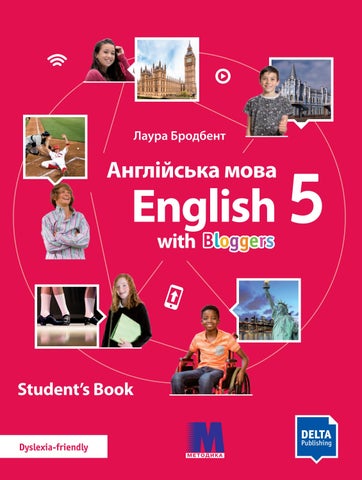
is a four-level course for lower secondary students. It is truly international! The bloggers are from English-speaking countries around the world. SHEENA, JOHN, TARA, KIRSTINE and TOM blog, vlog and share aspects of their lives as well as their thoughts on global issues – connecting YOU to English around the world.
5
!
Лаура Бродбент
English 5
Англійська мова
?
BLOGGERS is a project-based course that integrates the 5 C’s of 21st century learning – communication, cooperation, creativity, critical thinking, and cultural awareness – to make sure that YOU have fun, learn what YOU need, and use English because YOU have something relevant to say.
Why is
right for YOU?
What are the key features in
with
?
✓ It’s authentic!
✓ One unit – one blogger – one project
✓ It’s engaging!
✓ Communicate, collaborate and create
✓ It’s about showing what you can do!
✓ Clearly defined topics and language goals
✓ It’s about completing challenges!
✓ Personalized activities for everyone in the class
✓ It develops the skills you need in real life!
✓ Cultural awareness in the “Culture Blog”
Student’s Book 2022
ISBN 978-617-7511-55-6
Dyslexia-friendly
Лаура Бродбент
АНГЛІЙСЬКА МОВА (5-й рік навчання) Підручник для 5 класу закладів загальної середньої освіти (з аудіосупроводом)
Laura Broadbent
ENGLISH Year 5 A textbook for the fifth form of secondary schools (with audio)
Рекомендовано Міністерством освіти і науки України
Київ «Методика Паблішинг» 2022
УДК 373.3/.5.091.27:811.111](075.3) Б88 You can find all the audios and videos on our free DELTA Augmented app.
1 Hördatei 2 Filmclip 3 Hördatei
Download the free DELTA Augmented app onto your device
Start picture recognition and scan the first page of each unit.
Download files and use them now or save them for later
Рекомендовано Міністерством освіти і науки України (наказ Міністерства освіти і науки України від 08.02.2022 № 140) Підручник створено за Модельною навчальною програмою «Іноземна мова. 5-9 класи» для закладів загальної середньої освіти (авт. Редько В.Г., Шаленко О.П., Сотникова С.І., Коваленко О.Я., Королецька І.Б., Якоб О.М., Самойлюкевич І.В., Добра О.М., Кіор Т.М.)
Serіos Editor: Laura Broadbent, Brighton, UK Author Team: Céline Blanchard, Nathalie Brient, Lynda Corvé, Virginie Jousset, Agnès Pihuit-Imbert, Adeline Wion-Goguillon За редакцією: Тамари Бондар (українське видання)
Лаура Бродбент Б 88 Англійська мова (5-й рік навчання): підручник для 5 класу закладів загальної середньої освіти (з аудіосупроводом) / Лаура Бродбент.– Київ: Методика Паблішинг, 2022. - 168 c.,іл. Laura Broadbent English (Year 1) : a textbook for the fifth form of secondary schools (with audio) / Laura Broadbent. – К. : Metodika Publishing, 2022. – 168 pages. ISBN 978-617-7511-83-9 (укр.)
ISBN 978-3-12-501202-8 (англ.) ISBN 978-617-7511-83-9 (укр.)
© French edition by Editions Maison des Langues, Paris, France, 2017 © International edition by Ernst Klett Sprachen GmbH, Stuttgart, Federal Republic of Germany, 2020 © «Методика Паблішинг», Київ, ліцензійне видання, 2022
Foreword Привіт! Цей підручник створений із думкою про тебе. Ми наполегливо працювали, щоб зробити матеріал пізнавальним і цікавим, тому взяли до уваги твої можливі вподобання, схильності й прагнення. Знайомся з головними героями – блогерами з різних міст світу. Це Шина з Лондона, Джон – із Лос-Анджелеса, Том – із Нью-Йорка, Кірстин – із Глазго, Тара – із Дубліна, Тимур – із Черкас. Теми, запропоновані для обговорення, допоможуть тобі потоваришувати з блогерами та з іншими дітками, дізнатися про особливості шкільного життя й цікаві місця для подорожей!
Sheena
Tom
Tara
John
Kirstine
Tymur
Підручник стане тобі в нагоді й подарує приємні миті, якщо ти: ✓ братимеш активну участь у роботі, якомога більше розмовлятимеш і слухатимеш, будеш частіше намагатися говорити англійською мовою, не боятимешся помилятися, бо помилок не допускає той, хто нічого не робить;
✓ поважатимеш інших людей – свого вчителя та однокласників; ніколи не будеш насміхатися з того, хто помилився; поводитимешся з іншими так, як би ти хотів, щоб поводилися з тобою;
✓ не боятимешся ставити запитання, сміливо проситимеш учителя пояснити матеріал; цікавитимешся думкою інших дітей, якщо з чимось не погоджуватимешся; будеш розмірковувати, чому певної думки дотримуються автори тексту, із яким ти б подискутував;
✓ завжди знаходитимеш час, щоб повторити вивчений на уроці матеріал; будеш звертатися до додаткових матеріалів на сайті, що допоможуть тобі в самостійній роботі; прагнутимеш самостійно навчатися, тренувати пам’ять;
✓ будеш експериментувати, бо кожен міні-проект – це заклик до творчого мислення; завжди намагатимешся творчо думати та креативно розв’язувати завдання;
✓ не пасуватимеш перед труднощами, бо немає нічого неможливого для того, хто прагне досягти гарного результату. Опанування знань – подібне до сходження на гору. Цей шлях подолає лише той, хто постійно рухається вперед. Щоб досконало вивчити мову, потрібні роки, а не лише дні чи місяці. Упевнені, що тобі під силу вивчити деякі особливості іноземної мови, хоч вони й відмінні від української мови.
Гарного навчального року! Натхнення й наполегливості!
Авторський колектив та видавництво three 3
Table of Contents Unit 1
New school, new life Hi! I'm Sheena from London. What is the first day of school in England like?
PROJECTS MINI CHALLENGE 1
LESSON 1. WHERE ARE YOU FROM?
20
Give a welcome speech in your school.
I can introduce myself to my new class. • Subject pronouns • Question words (1) • The present tense of the verb to be (1) • Talking about likes and dislikes
YOUR CHALLENGE
LESSON 2. WELCOME TO MY SCHOOL!
Interview a classmate to find out their new identity.
MINI CHALLENGE 2
Start to create the class yearbook.
I can talk about schools in England.
MINI CHALLENGE 3
LESSON 3. MEET TYMUR, A BLOGGER FROM UKRAINE!
Introduce Tymur.
22
24
I know how to make friends. I can talk about schools in Ukraine.
Û Check your skills WB p. 23
p. 18
Unit 2
American family Hi! I'm Tom from New York.
MINI CHALLENGE 1 Invent the family tree of a celebrity family.
MINI CHALLENGE 2 Create a character and guess your classmates' characters.
MINI CHALLENGE 3 Explain Tymur’s family tree. YOUR CHALLENGE
What are American families like?
Create the family characters for a new American TV series.
Û Check your skills WB p. 37
p. 30
Unit 3
My week Hi! I'm Tara from Dublin.
What is a normal day like for Irish teenagers?
p. 42
Unit 4
My friend’s home and chores Hi! I'm John from Los Angeles.
MINI CHALLENGE 1
• The verb have got (1) • The present tense of the verb to be (2) • Possessive adjectives (2)
LESSON 2. HAVE YOU GOT BLUE EYES? 36 I can describe a physical appearance. • The verb have got (2) • Asking questions with be and have got • Adjective position
LESSON 3 MEET MY FAMILY
38
I can introduce my family in Ukraine. I can describe the members of a family.
LESSON 1. WAKE UP!
48
Do a survey about the class's activities outside school.
MINI CHALLENGE 3
LESSON 2. I PLAY GAELIC FOOTBALL
MINI CHALLENGE 2
YOUR CHALLENGE Present a slideshow for a typical day for Tara.
50
I can talk about my hobbies.
LESSON 3 GOOD MORNING! IT’S TIME TO WAKE UP!
52
I can talk about my morning. I can talk about my timetable. I can compare and contrast timetables.
Û Check your skills WB p. 51 MINI CHALLENGE 1
LESSON 1. WELCOME TO MY HOUSE!
MINI CHALLENGE 3
I can describe an American house. • there is / there are • The possessive ('s) • The negative and questions form of have got (3) how many
Present the description of your living room.
LESSON 2. HOME RULES
Design a short advert to sell a house.
MINI CHALLENGE 2 Invent crazy home rules.
Imagine an unusual house and family for Tim Burton's next film. What are houses and home life like in American cartoons?
LESSON 1. WE ARE FAMILY! 34 I can introduce the members of a family.
I can talk about what I do everyday and how I spend my time. • The present simple (1) • Time expressions (1) • Time expressions (1)
Present your perfect timetable for a day.
YOUR CHALLENGE
4 four
COMMUNICATION AND GRAMMAR GOALS
64
I can talk about my room and housework. • Object pronouns • Obligation and prohibition
LESSON 3 WELCOME TO MY FLAT!
Û Check your skills WB p. 65
62
66
I can describe my flat in Ukraine. I can talk about the family chores.
Bloggers 1
LEXICAL AND PHONOLOGICAL GOALS VOCABULARY • Languages, countries and nationalities • Leisure activities (1) • Different places in school • Prepositions of place (1)
REVIEW • Numbers
CROSS-CULTURAL LESSONS ARTISTIC AND CULTURAL EDUCATION • The Hindu Diwali festival • Indian food • Indian political jounalist Anushka Asthana
CITIZENSHIP • Respect for cultural diversity
CULTURAL GOALS • School in England • Introducing yourself • Introducing your classmates • Different countries and nationalities • London, multicultural city
PRONUNCIATION • Sentence stress • Different ways of pronouncing “th”
VOCABULARY • Family members • Physical description
REVIEW • Colours
ARTISTIC AND CULTURAL EDUCATION • Family in art: Freedom from Want, by Norman Rockwell
CITIZENSHIP • Different types of family
PRONUNCIATION
• Daily activities • School material • Leisure activities (2)
REVIEW • Leisure activities • The days of the week
• Some famous fictional American families • New York City (USA) • Thanksgiving • Little Women, by Louisa May Alcott, and Going and Coming, by Norman Rockwell
• The contracted forms of have got and has got • The sound /ɪ/ and the diphthong /aɪ/
VOCABULARY
• Talking about yourself
ARTISTIC AND CULTURAL EDUCATION • Gaelic football • Irish dance
HEALTH EDUCATION • Body and mind in harmony
• Everyday life in an Irish school • Likes and habits • Typical Irish activities • Dublin city
PRONUNCIATION • “-s” and “-es” in the third-person singular • Sentence stress • How to pronounce “ea”
VOCABULARY • Rooms in the house • Furniture • Prepositions of place (2) • Housework • Some leisure activities (3)
ARTISTIC AND CULTURAL EDUCATION • Houses in Tim Burton's films
CITIZENSHIP • Sharing housework between men and women
• American homes • Family life at home • The city of Los Angeles • The universe of film-maker Tim Burton
REVIEW • Colours • The family • Everyday activities
PRONUNCIATION • The pronunciation of “'s”» • there is / there are and there isn't / there aren't
Bloggers 1
five 5
Table of Contents Unit 5
Looking good! Hi! This is Sheena from London.
PROJECTS MINI CHALLENGE 1 Write an article about fashion and teenagers for a magazine.
MINI CHALLENGE 2 Act out a scene in a clothes shop in London.
MINI CHALLENGE 3 YOUR CHALLENGE
How do London teenagers dress and where do they shop?
p. 66
Unit 6
Let's play ball! Hi! This is John from Los Angeles. Do they play the same sports in the United States as we do?
p. 78
Unit 7
New York, New York Hi! This is Tom from New York.
What defines New York city?
p. 90
Unit 8
A trip to Scotland Hi! I'm Kirstine from Glasgow.
Create a new collection of school uniforms for Marks & Spencer and present it.
LESSON 1. What are you wearing?
Û Check your skills WB p. 81 MINI CHALLENGE 1
LESSON 2. A shopping day
78
I learn to express myself in a shop. • How much? • Expressing desires (would like) • Expressing agreement and disagreement • Prices
80
I can describe what 11 year old children in Ukraine can wear. I can talk about prices.
LESSON 1. You mustn't kick the ball!
I can talk about typical American sports. • need / need to
90
Invent a new American sport for a competition.
MINI CHALLENGE 2
LESSON 2. Becoming a champ
92
LESSON 3 Let’s play dodgeball
94
Promote your favourite sports club.
MINI CHALLENGE 3 Think of a new ball game.
YOUR CHALLENGE Create a poster to promote a new American sport.
Û Check your skills WB p. 97
I can talk about sporting talent and diets for athletes. • can / can't • Degrees of ability • Qualifying adverbs • Coordinating conjunctions I can talk about dodgeball and other ball games. I can talk about the healthy food.
MINI CHALLENGE 1
LESSON 1. Come to NYC!
Describe a tourist experience for a tourist guide.
I can describe my trip to Manhattan. • The past simple (1)
MINI CHALLENGE 2
LESSON 2. The island of hope
Imagine the story of an immigrant who is going to the USA.
MINI CHALLENGE 3 Describe a place in Chyhyryn.
YOUR CHALLENGE Talk about your trip to New York... playing with dice!
Û Check your skills WB p. 111 MINI CHALLENGE 1 Organise a two-day tourist route.
MINI CHALLENGE 2 Organise a sightseeing day in Glasgow.
MINI CHALLENGE 3 Design the new tour.
YOUR CHALLENGE
What are the main attractions in Scotland?
LESSON 3 Welcome to Cherkasy and Chyhyryn!
106
108
I can describe the places to see in Cherkasy and Chyhyryn. I can talk about adventures.
LESSON 1. We'll visit Loch Ness!
118
I can talk about tourist routes and the weather in Scotland. • will + verb
LESSON 2. Let's go to Glasgow!
120
I can organise holiday activities in Glasgow. • The first conditional (if... will) • Time expressions (2) • Making suggestions
LESSON 3 We’ll visit Zakarpattia!
Û Check your skills WB p. 127
104
I discover the history of Ellis Island. • The past simple (2) • Time markers for the past tense
I can talk about tourist routes in Zakarpattia.
| EXERCISES p. 114 | READING p. 122 | LEARNING STRATEGIES p. 130 6 six
76
I can talk about outfits. • The auxiliary verb can • The present form of to be + verb + -ing (present continuous)
LESSON 3 Kids’ clothing in Ukraine.
Organise a tourist route around Scotland.
p. 102
COMMUNICATION AND GRAMMAR GOALS
122
LEXICAL AND PHONOLOGICAL GOALS VOCABULARY • Clothes and accessories • The seasons • Shopping and shops • Numbers
REVIEW
CROSS-CULTURAL LESSONS ARTISTIC AND CULTURAL EDUCATION • London fashion and the designer Stella McCartney
CITIZENSHIP • School uniforms: for or against?
• The colours • Physical description
CULTURAL GOALS • Dressing styles • Clothes shopping • Dress sense • London and its markets: Brick Lane, Oxford Street… • School uniforms in England
PRONUNCIATION • The sound /ə/
• Lengthening of vowels before an “r”
VOCABULARY • Sports • Sports equipment • Adjectives that express ability and skills • Food and diet
REVIEW
ARTISTIC AND CULTURAL EDUCATION • Baseball, a typical American sport • The artist Norman Rockwell
CITIZENSHIP • Fair play
• Leisure activities
• Sport and diet • Individual sports • Some famous North American sporting personalities • Some typical North American sports: curling, baseball, ice hockey
PRONUNCIATION • How to pronounce can and can't
VOCABULARY • Places in town • Qualifying adjectives • Travel and feelings • Verbs in the past
ARTISTIC AND CULTURAL EDUCATION • Skyscrapers in Manhattan
CITIZENSHIP • The Melting Pot
• Expressing feelings • At Ellis Island: a History in Many Voices, by Louise Peacock • New York city and its most famous buildings • Some immigrants' journeys to the United States
REVIEW • Shops and places in town
PRONUNCIATION • The pronunciation of “-ed“
VOCABULARY • Outdoor activities • Landscapes • The weather • Different places in town • Tourist activities • Means of transport
ARTISTIC AND CULTURAL EDUCATION • Two Scottish legends
CITIZENSHIP
• Organisation of leisure activities • The city of Glasgow • Some Scottish tourist spots
• Planet-friendly means of transport • The Loch Ness monster and the legend of the salmon and the ring
PRONUNCIATION • The pronunciation of will • Intonation in sentences
seven 7
Discover What do the icons in your Student's Book mean? Speaking time / Time to speak / Speaking practice
Listen and understand
Video-projectable / printable file
Let's speak together!
Watch and understand
Go to Workbook
Track: 3
Write
Audio file
How do you say this?
Read and understand
How does each unit work? The opening double page
What are American families like?
Unit 2
Hi, I’m TOM, from New York (USA). In this unit you will learn about American families.
American family
A simple question about a specific aspect of the English-speaking world. The unit will equip you with the tools you need to respond.
USA New York
The main character of the unit, who presents their city and the topic that you're going to be looking at. LET’S GO! Û
In this unit, we are going to...
• introduce family members. • describe people’s physical characteristics. • discover American artists. • talk about different types of families.
Your challenge Create the family characters for a new American television series.
1 Look at the pictures and the video still. What do you think this unit is about? 2 What do you know about New York? Make a list of things with your group. Û
The objectives of the unit and your challenge! This is the task that you're asked to carry out, and which we're sure you'll be able to do.
Two activities to familiarise you with the subject and revise what you've learned.
30 thirty
thirty-one 31
I can introduce the members of a family
1. We are family!
4 Imagine it’s your birthday. You have a party with friends and family. Who do you invite from your family? Tell a partner. WB p. 26
1 Look at the painting. Who are they? WB p. 24
5 Watch Tom’s video about his birthday party. Who is at the party? Draw the family tree.
husband wife uncle aunt
father
son
daughter
nephew niece
daughter
2. Have you got blue eyes?
Did you know? Norman Rockwell (1894-1978)1wasLook at this family. an American artist. He painted Read the descriptions of the members of the family. scenes of American people Underline the information about physical characteristics. and families.
documents (texts, videos, recordings, images…), authentic and always interesting!
5
Bill Jr
Jenny
Sally
Linda
Todd
• Have you got a sister?
STUDENT A: 1 Imagine a family with yourself and six or Asking questions with have got and to be She has got blue eyes. Has she got blue eyes?
Her name is Maria and she’s ... years old. She’s ... and she is very .... She has got ... hair and brown ....
Bloggers 1
3 Write about someone famous. Your partner guesses who they are! WB p. 29 Stand up if you've got brown eyes!
The 'Stand up if…' game 1. A student says a sentence with a physical feature. 2. Stand up if it applies to you.
Games, because you always learn better when you're having fun!
Draw the family tree.
tall medium-height short
Bloggers 1
3
His father is Lionel Messi...7
4 6
2. Look at the poster again. Explain the different types of families. Family 1 has got three children...
thirty-three 33
Play 'Who's Who' and guess your partner's character.
black/dark hair
1
blond(e) hair
2
brown hair
3
Invent a character and draw a picture. Give your character a name. Hang all the portraits on the wall. Ask questions to identify your partner's
4
Answer your partner's questions.
character.
red hair
Bloggers 1
Bloggers 1
5
Types of family
ü Yes, she is.
û No, she isn't. my sister me
MINI CHALLENGE: WHO'S WHO? (pair work)
Reflection to help prepare you to become a citizen of the world… in English, of course!
1. What different kinds of families are there? Find them in the poster.
Is she tall?
STUDENT C: 1 Listen to student B and draw the family tree.
overweight ≤ fat slim ≤ thin
2
8
Vocabulary track: 06
Vocabulary
.............. NSH IP ..............
9
Beyonce' Lionel Messi She is tall.
seven famous characters (real or fictional).
2
STUDENT B: ü Yes, she has. 1 Explain the family tree to student û No, she C. hasn't.
The verbs have got and to be I have got / I've got a sister. description complete the sentence. WB p. 29 We have gotand / We've got a beautiful car. She is always with us. / She's always with us.
34 thirty-four
• Is she tall? Has she got…? No, she isn't. She's got...
WB p. 28
CITIZE
1
He’s my grandson!
Louisa May Alcott, Little Women (1868)
Yes, I have. Play the family game: invent a famous family for yourself!
stepmother has got blonde hair. stepbrother / half-brother Jess has got two daughters, Maria and Eva. They are the intelligent girls of the stepsister / half-sister family. They have got long dark hair and black eyes.
LET'S PLAY…
Fifteen-year-old Jo is very tall and thin. She has got beautiful long brown hair. And she She’s has my got big hands and feet. grandmother!
Ask and answer about a member of family. Exchange roles. MINI CHALLENGE: A FAMILY GAME (group work)
son + daughter = children brother
2 Listen to the
5
Elizabeth, or Beth, as everyone calls her, is The game of the family relationships thirteen. She has got bright eyes, soft hair, a (group work) shy manner and a timid voice. 1. Sit down in a circle. 10 Amy, though the youngest, is a most important 2. Student A points at student B and person, in her owninvents opinion a atfamily least. She has relationship. got blue eyes and blonde hair. 3. Student B answers by saying the family relationship for him/her.
5
Lewis has gotsister one child, Tom. Tom is medium height. He has got brown eyes and brown hair.
Track: 04
8 eight
LET'S PLAY…
3 Write about your real or fictional family. Jen has got astepfather sister, Lisa. Jen is tall and she has got red hair. Lisa is tall and she I have got one / two... My sister loves animals...
Margaret, the eldest of the four, is sixteen, and very pretty. She has got big eyes, brown hair, a sweet mouth, and white hands.
Tom's vlog.
Vocabulary track: 04
32 thirty-two
Need help to express yourself? Use the prompts or the examples in blue.
WB p. 29
mother + father = parents grandmother + grandfather = grandparents
Pin
Possessive adjectives Read the extract from the famousReview: novel 'Little Women'. Match the descriptions with the girls in the image. WB p. 32 I: my You: your He/She: his / her
I have got a little sister and two brothers, Bill Jr and Todd. Bill Jr is my favourite! His dog, Pin, is very intelligent. I have got a grandmother too, she is always with us. I love my grandma! We have got a beautiful car. Pin loves the car and I love it too!
Vocabulary Granny
4
Norman Rockwell, Going and Coming (1947)
2 Read the text about this family. Who is the author? WB p. 24
Bill
cousin
I can describe a person's physical appearance
Û
mother
son
Û
All kinds of
Vocabulary track: 05
Vocabulary
grandmother
Û
The two lessons
A vlog by the teenager in the unit.
Tom's family
WB p. 33
Has he got...?
Is he...?
Yes, he has.
thirty-five 35
A mini challenge to put what you’ve learned into practice and train you up for the final challenge.
The essential grammar and vocabulary you need to remember.
My grammar My vocabulary
My grammar
WB p. 25, 32
a.
correct form of the verb have got. you any brothers or sisters? Yes, I
b.
POSITIVE FORM
have got
He / She / It
has got
We / You / They have got
he / she / it
Have
we / you / they
.
QUESTION FORM
Is
dog and a cat, too. I've got four uncles and Ifive see and I memorise. aunts. So I've got 32 cousins!
Û Exercises, p. 115 Û WB p. 34
I love
c.
THE FAMILY
have. haven't.
he / she / it
hasn't.
hair
When talking about your age in English, red you use to be instead of have got. hair I'm 11 (years old). Do you know what happens in any other languages?
2
HE
EYES
I wear…
I / you
PHYSICAL DESCRIPTION
have got.
glasses
HA
colour (UK) / color (US) Pronunciation Û WB p. 36
I have got…
long hair
h
HT
short
an intelligent girl adjective noun
medium-height tall
Edwina
overweight overweight
Toby Robert
slim
BUILD
DESCRIBING PHYSICAL CHARACTERISTICS thirty-seven 37
2 Who is who?
thin / slim
short hair
FAMILY MEMBERS grandparents
a grandmother a grandfather
I'm my grandparents'
my siblings
a mother a father
5
7
I'm my uncle and aunt's
niece nephew
stepdaughter stepson
a half-sister/stepsister a half-brother/stepbrother Bloggers 1
38 thirty-eight
Create your mind map! Create your own mind map by choosing the words that best describe you: your physical characteristics, your family, etc.
I'm my stepmother's
siblings after one parent remarries
a stepmother a stepfather
6
3
daughter son
a cousin a cousin
after one parent remarries
4
1
I'm my parents'
my uncle and aunt's children
an aunt an uncle
2
granddaughter grandson
a sister (or twin sister) a brother (or twin brother)
parents' siblings
a. Natasha is slim and she's got long, dark hair. b. Peter is a bit overweight and he’s got short, brown hair. c. Meg's got short, white hair. d. Billy is short, and so is Jack. e. Brian has a long nose and big ears. f. Rosie is a bit fat and she’s got long, blond hair.
overweight
Who am I?
children
parents
Test your memory with a variety of exercises!
Emma
Andy
thin
shoulder-length hair
dark / black hair
e. Jeff is Toby's .... .
an intelligent boy f. Edwina is Robert's .... . adjective noun
Jeff Look at the adjectives in the examples above. Do they change depending on the noun? Do they change in your language?
Bloggers 1
Bloggers 1
36 thirty-six
the noun.
Copy out the text again, using the full I am… verb instead of the contracted form of the verb.
IR
The contracted forms of have got and has got
len gt
IG
In English, adjectives are places before (quite) d. Robert and Andy have got two .... .
I'm Tom. I’ve got two best friends: Shawn and Kyle. They are my classmates. Shawn’s got short two stepbrothers and Kyle's got a sister. Shawn’s got dark hair. Kyle’s got short blond hair.
3 Write the contracted form of the verb
a. My aunt has got two brothers. b. I have got a younger sister. c. My grandmother has got three cats. d. My uncle has got two houses.
brown hair
A mind map to visualise all the key vocabulary in the unit. Words are easier to memorise when they’re grouped in a logical, visual way!
this family. a. Jeff is the .... .
4. ADJECTIVE POSITION WB p. 30 b. Emma has got a .... , Toby.
(of) medium-height • Adjectives are used to describe nouns.
colour (UK) / color (US)
have.
we / you /blond(e) they haven't.
your friend; it’ll train you to speak English like a native!
1 Complete these sentences about
tall
in photos 1 and 2?
1
dark
Make the Workbook
accent.
Translate the phrases below into your language: “my sister”, “my uncle”, “my grandparents”. What do you notice in comparison to English?
(very)
NEGATIVE ANSWERS (NO) eyes
No,
films.
family is very small. I haven't got a brother or a sister.
d. Are you American? I like
your brother / your sister?
he / she
c. Edwina has one .... , Robert.
brown eyeshas.
we / you / they
his her
5 Fill in the correct possessive adjective.
4 Read the text. Who are the two boys I am…
I have got…
green POSITIVE ANSWERS (YES)eyes he / she / it
he she
Kev is my cousin. Watch out! In the thirdperson singular, the possessive adjective depends on if the owner is male (his father) or female (her father).
a. I have got a cousin. name is Joe. b. My favourite actress is Emma Watson.
• In short answers, got is not used.
I / you
your
my brother / my sister.
• In addition to he and she, there is also it. It is used to talk about objects, for example: Pronunciation Û WB p. 36 It is a bike. It isn't a car. The sound /ɪ/ and the diphthong /aɪ/
Her name is Lucy. She...
blue eyes
Yes,
my
you
• To ask a question, you should invert the subject and is.
I have got three brothers, Billy, Jim and Scott, and two sisters, Mandy and Carla. I have got a
got a brother?
is not isn't
He / She
Hi! My name is Lucy. I have got a big family.
My vocabulary
I / you
Has
I
NEGATIVE FORM
a cousin?
Yes, he
This is my bike.
my brother / my sister.
• In the negative form, add not after the verb is. In spoken English, is not becomes isn't.
a dog?
.
Matt
2 Rewrite the following about Lucy.
• In the question form, the subject and have change position.
Have
blue eyes?
.
your cousins No, they
d.
is 's
He / She
your sister
c. blue eyes. long hair.
• In spoken English, contract I have got to I've got. The word have becomes 've. He / she has got becomes he / she's got. These are known as “contracted” verbs.
QUESTION FORM
• Possessive adjectives allow you to indicate who an object belongs to and describe family relationships.
POSITIVE FORM
.
Yes, she
I / You
3. POSSESSIVE ADJECTIVES WB p. 28
He's my brother. Mike's my best friend.
1 Complete the sentences with the
• The verb have got allows you to express: - ownership (I have got a computer), - family ties (I have got a brother), - physical descriptions (I have got long hair).
Simple explanations and exercises for each grammar point seen in the unit.
2. THE PRESENT TENSE OF THE VERB TO BE (2) • The form of to be with he/she = is
1. THE VERB HAVE GOT
Observation questions to find links between English and other languages that you know.
I understand and I practise.
Û Exercises p. 115
Bloggers 1
thirty-nine 39
Your challenge
The Culture Blog
http://www.deltapublishing.co.uk/culture-blog
AR AND TISTIC CU EDUC LTURAL ....... ATION
Today I'm writing about a family painting by a great artist from the state of Massachusetts.
Your challenge
Other Posts: Multicultural
..............
London: India
.......
Two Very Irish Activities
FAMILY PAINTINGS
create the characters FOR a new American TV series
Tim Burton's Houses
You are a TV scriptwriter for a new American comedy series.
London Fashion
NORMAN ROCKWELL
I Love Baseball
This is a famous representation of Thanksgiving, by the artist Norman Rockwell. He paints scenes of American life. He has got a realistic style.
New York
2. Write a description for each member of the family.
Skyscrapers
3. Think about a title for your series.
Scottish
4. Present your characters. You can use pictures or drawings.
Legends
5. The class chooses the funniest family.
Û
The blog by the main character of the unit and all the other bloggers in the coursebook. Read their articles to get into the topic of each unit… then start the creative phase!
1. Think about the characters and draw the family tree.
Design
Contributors:
Thanksgiving is a traditional family celebration in the USA. In the painting, you can see a grandmother and a grandfather serving a meal to a large family. Everybody is happy and they are smiling.
This is Sally Dog. She's got a sister, Molly Dog, and a brother, Mike Dog. She's got brown eyes and a big nose. She loves reading!
Tom
Tara
Digital alternative
You can create a slideshow to introduce the members of the family and the title of the TV series.
Sheena
Dog family
And he's Dad Dog. His wife is Mum Dog. He's tall and thin. He's got green eyes and white hair. He loves computers.
stages are there in detail, and the examples are there to help you. You have all the cards in your hand to succeed!
John
Kirstine
Û
Your mission! All the
Freedom from Want (1943)
YOUR TURN! 1 Read the text. Look at the painting. What do you like about the painting?
How does it make you feel?
2 Imagine you are a member of this family. Describe your family to your
partner. YOU ARE AN ARTIST! Look for a parody of this painting on the Internet. Invent your own parody with photos of your family and friends. To show you have completed this challenge, mark your progress in this unit on the CHECK YOUR SKILLS section of your Workbook (p. 37).
40 40 forty number
DO01_3-12-501202-8_Bloggers_StudentsBook_1_Inhalt_7.indd 40
6/23/2020 11:47:33
What else is there in your Student's Book? There are pages... … about phonetics.
… about learning strategies.
… of exercises.
… of texts to read.
Exercises
CULTURE IN SOUNDS
How to have a telephone conversation
How can I make sure I understand the instructions correctly?
English vowels
Track: 18
a black cab /æ/
a smart guard /ɑː/
a pink kilt /ɪ/
a green queen /iː/
a delicate elephant /ə/
a small door /ɔː/
Here are some tips to help you understand instructions.
an odd bulldog /ɒ/
In the instructions, the verbs are the most important part. It can help to create a mini notebook with instruction verbs. You can draw pictures to help you memorise the words. Look at the "Instructions in your textbook" page at the beginning of this book for ideas. Keep your mini notebook with your school books so you can look at it when you need!
a blue moon /uː/
Think about the main objective. Is there a project to do at the end of the school year? If you understand the objective, you can organise the process!
a funny bus /ʌ/
a grey cupcake /eɪ/
a noisy paperboy /ɔɪ/
a pure tourist /ʊə/
a yellow raincoat /əʊ/
a severe deer /ɪə/
I’m sorry, I don’t understand.
I’m not English. Can you speak slowly?
Can you repeat, please?
So, you said, '…', right?
All right. Thank you and goodbye!
Now it's your turn!
a. We have / has got two cars: a Ford and an Audi. b. Sometimes our teachers haven’t / hasn’t got a lot of
• Introduce yourself:
e. We have / has got a long holiday in summer. g. My best friend have / has got an exam tomorrow.
THE PRESENT SIMPLE TENSE OF THE VERB TO BE (2)
Call me back on 33 1 23 61 45 67.
2 Complete the sentences about Ding. he's
• Say goodbye before hanging up:
(3)
English shoes /ʃ/
a Chinese chair /tʃ/
three thieves /θ/
Bloggers 1
orange jam /dʒ/
a hot bowler hat /h/
a worthy father /ð/
look
tick
complete
circle
glue
write
speak
stick
choose
pick
highlight
reorder
count
colour
one hundred and forty-seven 147
130 one hundred and thirty 130 forty-two
Ding. (2)
father. (4)
live in England. (6)
his (x 2)
is
he
12 years old. And this is
He and (7)
• Speak clearly and put the right intonation in your sentences. Just because you can't see the other person, it doesn’t mean that you have to stay still. You can understand everything over the phone, even a smile!
listen read
underline find
fill in
match
father love football.
Manchester United. They (8)
big fans of
Barcelona too.
copy
a. Her / voice / is / . (beautiful)
draw
The telephone labyrinth Stand back to back with a classmate. One of you starts the call and chooses a conversation starter. Take it in turns to start the call. Try to speak for 30 seconds, then 1 minute! Bloggers 1
138 one hundred and thirty-eight
sister brother cousin
Bloggers 1
blonde
blue
pretty
soft
b. We / live / in / a / house / . (new) c. Our / dog / is / so / ! (intelligent) d. My / mother / has / got / eyes / . (brown)
long thin
5
very (1)
. She has got big (2)
, brown (3)
Fifteen-year-old Jo is very tall and (4)
10
. She has
brown hair. And she has got
Elizabeth, or Beth, as everyone calls her, is thirteen. She has got bright eyes, (6)
hair, a
15
Margret
Jo
shy manner and a timid voice. Amy, though the youngest, is a most important person, in
Beth 20
her own opinion at least. She has got (7)
f. He / has / got / hair / . (long)
(8)
Amy
eyes, and
She sat down at her desk. Kevin admired his aunt and her enthusiasm. There were so many different ethnic groups in New York. There were whole streets where Italians lived together. In fact, more Italians lived in New York than in Rome, more Jews than in Tel Aviv. There were the Irish Americans, who still called themselves Irish and still hated the English. He sat on the couch for a while, dreaming. The he fetched the telephone book which had names beginning with "O". He soon shut the book. It was hopeless. There were hundreds of O'Briens. He shut the book with such a bang that Aunt Bella looked up from her desk. "What's the matter, Kev? Who are you looking for in that telephone book? A girlfriend?" "Well, sort of."
hair. one hundred and fifteen 115 40
Anexos_Culture in Sounds_v10.indd 132
,
a sweet mouth, and white hands.
big hands and feet.
e. We / have / got / two / cats / . (black)
Bloggers 1
hair eyes
Margaret, the eldest of the four, is sixteen, and
got beautiful (5)
3 Rewrite the sentences below. Put adjective in brackets in the correct place.
NOW, LET'S CALL!
Fill in the question answer
cousin stepmother half-brother
5 Complete the descriptions by using the adjectives below.
is bilingual,
Their favourite team is
father
DESCRIBING PHYSICAL CHARACTERISTICS
are from China but now (5)
he speaks Chinese and English.
ADJECTIVE POSITION
b. Next to each verb, note down the meaning in your own language. c. To finish off, think about illustrating each of the verbs!
a loving song /ŋ/
they (x 2)
are
This (1)
Thank you! Goodbye!
nephew
d.
half-sister
h. Have / Has he got a girlfriend?
• Leave your telephone number:
grandfather
aunt
c.
Richard Musman
uncle daughter
wife
I don’t like him.
f. I haven’t / hasn’t got a TV in my bedroom.
• Give the reason for your call
b.
sister
d. My sister have / has got a strange boyfriend;
Hello, this is Enzo.
1 Create a notebook with “instruction verbs”! a. To start with, note down all the verbs below in your notebook. You can add more verbs when you find them.
a.
brother
c. Have / Has you got a mobile phone?
ESCAPE IN NEW YORK
4 Find the odd one out in each group. Explain your choice.
patience with us!
2. If the person you are calling doesn't answer the phone, leave a message:
3. Don't forget: You’re welcome. Have a nice day!
THE FAMILY
1 Choose between have and has.
I would like to invite Mandy to my party.
• Before ending the call…
English consonants
Track: 19
Let me think…
Er… Well…
Drink a lot of water and sleep 8 hours per night to help you concentrate in class.
a rare teddy bear /eə/
Hello? Yes, this is Mia / Oliver speaking.
• If you haven’t understood the caller…
Remember, if you don't understand, some of your classmates probably don't!
a brown crown /aʊ/
Hello! This is Enzo. I’d like to speak with Mia / Oliver, please.
Let me see…
It's normal if you don't understand everything. When you don't understand something, ask your teacher. You can ask when your classmates are doing a task if you're shy or embarassed.
white china /aɪ/
• At the start of a conversation...
• If you need to think about it…
2. Listen closely and ask if you don't understand! a good book /ʊ/
THE VERB HAVE GOT
1. Here are some expressions you can use to say the right thing in every situation:
3. Think about it from another perspective
1. Find the verb!
a red dress /e/
a purple purse /ɜː/
Unit 2 Reading
Unit 2 American family
It’s easy to phone. But talk on the it's difficu another lt in language! Don't panic: with these tips, you will to call anyon soon be able e you want!
Bloggers 1
one hundred and twenty-three 123 41
15/05/17 10:07
nine 9
And what's so special about the Workbook? To complement the lessons
Unit 2
Different ways to do each activity, one that's more challenging, and one with more support!
Unit 2
aunt('swife)
brother
stepmother
NINA
Camilla
JAY
me
a. I have got a brother.
b. We have got a car.
HOW CAN I UNDERSTAND THE INFORMATION IN A VIDEO?
• Which sentence talks about a family relationship?
• Read the pre-video activity. What do you have to do? How did it help you?
• Now, complete the table. POSITIVE FORM HAVE GOT
father
daughter
Complete form
Contracted form
I
daughter
• When you watch the video, what helps you understand it?
've got
You
have got
tone of voice
've got
We
1
V E GOT
b. Watch the full video. Pick out all the names you hear. Write them down in the table opposite.
Write the sentences with the contracted form of have got.
a. I have got a sister.
c. You have got a car.
Û
3
GROUP A Look at Tom's family tree. Complete it with the family relations.
Norman Rockwell, Going and Coming
Bill
Bill Jr
Jenny
Sally
Granny
Linda
Todd
Pin
Bloggers 1
26 twenty-six
DO01_3-12-501203-5_Bloggers_WorkBook_1_Inhalt_Nachdruck.indd 26
to have (got)
to be
JAY
CAMILLA
LINA Unit 2
twenty-seven 27
DO01_3-12-501203-5_Bloggers_WorkBook_1_Inhalt_Nachdruck.indd 27
Learning strategies for you to reflect on your learning, and work out which techniques work best for you.
2. Have you got blue eyes?
me
My grammar Bloggers 1
24 twenty-four
DO01_3-12-501203-5_Bloggers_WorkBook_1_Inhalt_Nachdruck.indd 24
POSSESSIVE ADJECTIVES
Bloggers 1
11/25/2020 13:47:13
1 Look at this family. Read the descriptions. Underline the information about the physical description.
twenty-five 25
• Complete the table with possessive adjectives. Use the sentences to help you.
DO01_3-12-501203-5_Bloggers_WorkBook_1_Inhalt_Nachdruck.indd 25
11/25/2020 13:47:21
subject
possessive adjective (singular)
I you
a. I have got a brother. My brother is called Blake. b. Alex has got a sister. Her name is Haley.
your
c. Bill has got a dog. Its name is Pin.
he she it
1
Grids to complete for each mini challenge so you can evaluate your own work… as well as that of your classmates!
Underline the possessive adjectives. Write the sentences with a different subject.
a. Tom is from the US. His dad is Canadian. b. Paul is 12. His sister is 14. c. Sheena is American. Her dad is 39.
Yes definitely!
MINI CHALLENGE: A FAMILY GAME (group work)
So so
Lewis has got one child, Tom. Tom is medium height. He has got brown eyes and brown hair. Jen has got a sister, Lisa. Jen is tall and she has got red hair. Lisa is tall and she has got blonde hair. Jess has got two daughters, Maria and Eva. They are the intelligent girls of the family. They have got long dark hair and black eyes.
Not really
MY EVALUATION OF A CLASSMATE
MY OWN EVALUATION
2 Look at Maria. Guess her description. Listen and complete it.
Name: ..............
Track: 08
STUDENT A: I draw
a. Her name is Maria and she
• Does the family tree include six or seven celebrities?
Organisation
11/25/2020 13:47:29
ROBERTA
JOANNA
TOM
b. Who is the author of the text?
Bloggers 1
11/25/2020 13:47:29
NINA
CARLOS
I have got a little sister and two brothers, Bill Jr and Todd. Bill Jr is my favourite! His dog, Pin, is very intelligent. I have got a grandmother 5 too, she is always with us. I love my granny! We have got a beautiful car. Pin loves the car and I love it too!
the pictures
• Sometimes, people invent songs to help them remember information. Do you think a song can help you remember the names of Tom's family in the video?
c. Watch the full video again. Complete the table opposite with the family relationships (related to Tom). Add some other information you hear in the table. Draw the family tree in your notebook.
b. We have got a house in Portugal.
2 a. Read this text. Circle the family words. Tick P the verb used to express possession: Underline the possessive adjectives.
different voices
• What are the most difficult sentences to understand? Do they stop you completing the activities?
've got
• What letters does the apostrophe in I've got replace? I
Steps to reflect on the language and work out the grammar rules for yourself.
TOM
• Which sentence talks about the possession of an object?
grandmother
son
ROBERTA
4 a. Look at the screenshot of Tom's video. Say what it is about.
THE VERB HAVE GOT (1)
1 Write the names of the family members.
son
JOANNA
Unit 2
• Read the sentences.
mother
CARLOS
My grammar
1. We are family!
The documents in your Student's Book can be circled, highlighted or underlined as much as you want!
OTHER INFORMATION
aunt
grandfather
LINA
American family
FAMILY RELATIONSHIP
stepsister
father
grandmother
CAMILLA
Unit 2
FIRST NAME
GROUP B Look at Tom's family tree. Complete it with some of the words here.
years old. and, she is very
b. She's
STUDENT B: I explain
c. She has got
hair and brown
. .
• Is family vocabulary used? Language
3
• Are possessive adjectives used?
GROUP A Write a description of another character in this family. Read it to your partner: he / she guesses who it is!
• Is the verb have got correctly used?
STUDENT C: I listen, I understand and I write • Have I paid attention during all of the conversation?
Speaking
Bloggers 1
28 twenty-eight
DO01_3-12-501203-5_Bloggers_WorkBook_1_Inhalt_Nachdruck.indd 28
Bloggers 1
11/25/2020 13:47:29
twenty-nine 29
DO01_3-12-501203-5_Bloggers_WorkBook_1_Inhalt_Nachdruck.indd 29
11/25/2020 13:47:32
To memorise your vocabulary Unit 2
My vocabulary 3 Find five family relationships in the word search. Write them down.
1 Organise the words into three groups. Think of a title for each group. medium-height
A variety of exercises and games to memorise vocabulary and to test it!
cousin
black
stepbrother
brother
green
mother
fat
slim
aunt
white
sister
tall
blue
uncle
short
Are any of these words similar to words in your language? Do they have the same meaning?
B
A
M
O
O
G
N
U
S
S
S
P
B
R
E
R
F
R
E
R
A
T
H
G
L
R
A
E
S
U
N
C
L
E
C
W
E
I
M
Z
X
G
L
A
O
R
T
E
P
S
I
O
T
H
E
R
M
L
S
12 years old slim
M
F
K
1. mother
E
Y
E
A
W
2.
I
A
D
T
Z
3.
U
A
H
R
N
S
E
E
S
T
E
R
E
K
K
I
T
N
1. b
2. g
e
5. t
6. m
3. d
-h
4. b
h
4. 5. 6.
Bloggers 1
11/25/2020 13:47:38
Check your skills
Unit 2
A2
Listening
A1/A2
CONTRACTED FORM ('VE GOT / 'S GOT)
READING Me and my family
Jack and Emma Read
Track: 12
My name is Kylie Jean Carter. I live in a big, sunny, yellow house on Peachtree Lane in Jacksonville, Texas, with Momma, Daddy, and my two brothers, T.J. and Ugly Brother.
2 3 4 5
5
T.J. is my older brother, and Ugly Brother is… well… he’s really a dog. Don’t you go telling him he is a dog. Okay? I mean it. He thinks he is a real, true person. He is a black-and-white bulldog. (…)
10
My momma says I’m pretty. She says I have eyes as blue as the summer sky and a smile as sweet as an angel. (…) I’m pretty on the outside and on the inside. My hair is long, brown, and curly.
6 A dipthong is when you can hear two vowels together. For example, /a/ and /ɪ/ make the sound /aɪ/.
THE SOUND /ɪ/ AND THE DIPTHONG /aɪ/
Do you know any other dipthongs? There are a lot in English!
2 Listen carefully. Are the circled sounds /ɪ/or /aɪ/? Tick the correct box. /aɪ/
1. Her dog is so smart.
SPEAKING
A1/A2
My family
2. This girl has got long hair. 3. You have got beautiful eyes.
Marci Peschke, Kylie Jean, Drama Queen
1 2
4. Her sister has got short hair .
3
My family is big. I have got two... My family is big. I have got two...
5. I'm medium- height . 6. My dad's wife is so tall.
4
7. I'm nine years old. A1/A2
3 Say the tongue-twister out loud. What is the meaning?
INTERACTING Have you got…?
WRITING
A1/A2
I spy with my little eye nine nice lions and five wild tigers.
My favourite character
_______________________ is short and… Bloggers 1
11/25/2020 13:47:40
Bloggers 1
DO01_3-12-501203-5_Bloggers_WorkBook_1_Inhalt_Nachdruck.indd 37
To prepare you for assessment Five training activities to help you on assessment day.
Û
/ɪ/
DO01_3-12-501203-5_Bloggers_WorkBook_1_Inhalt_Nachdruck.indd 36
LOVE (I love...)
thirty-five 35
1
36 thirty-six
tall
a stepsister
DO01_3-12-501203-5_Bloggers_WorkBook_1_Inhalt_Nachdruck.indd 35
1 Can you hear full or contracted forms? Listen and tick the correct boxes.
Track: 11
WEAR (I wear...)
music
an uncle
Bloggers 1
11/25/2020 13:47:38
Pronunciation
Track: 10
my parents
tall
h
CONTRACTED FORMS OF HAVE GOT AND HAS GOT
COMPLETE FORM (HAVE GOT / HAS GOT)
HAVE GOT (I have got...)
a sister
blue eyes
red hair
7. s
34 thirty-four
DO01_3-12-501203-5_Bloggers_WorkBook_1_Inhalt_Nachdruck.indd 34
Track: 09
intelligent
short
glasses
BE (I am...)
10 ten
T
D
my grandmother
two brothers
short hair
Activities to train you to recognise and to pronounce the sounds, the intonation and the rhythm of English.
I
W
U
F
S
4 Complete the table with the words.
2 Complete the phrases.
To improve your pronunciation
T
• Have you got any brothers or sisters? Have you got any brothers or sisters? Yes, I have. thirty-seven 37
11/25/2020 13:47:46
Bookquest
Let's play! Here are some questions about your Student's Book. Answer them as fast as you can with a classmate. The first pair to finish are the winners!
The first pages of the Student's Book How many units are there in the Student's Book?
A
Table Tableof of Contents Contents
LESSON LESSON1.1.WHERE WHEREARE AREYOU YOUFROM? FROM?
MINICHALLENGE CHALLENGE1 1 MINI
New Newschool, school, new newlife life
Interview Interviewa aclassmate classmatetotofind findout out their theirnew newidentity. identity.
MINI MINICHALLENGE CHALLENGE2 2 Give Givea awelcome welcomespeech speechininyour yourschool. school.
Hi! I'm Sheena from London.
Hi! I'm Tom from New York.
Unit 5
MINICHALLENGE CHALLENGE1 1 MINI
Invent Inventthe thefamily familytree treeofofa acelebrity celebrityfamily. family.
Looking good!
MINI MINICHALLENGE CHALLENGE2 2
Create Createa acharacter characterand andguess guessyour your classmates' classmates'characters. characters.
Hi! YOUR YOURCHALLENGE CHALLENGE This is Sheena
Create Createthe thefamily family characters characters for fora anew new from London. American AmericanTVTVseries. series.
Unit 6
MINICHALLENGE CHALLENGE1 1 MINI
Unit Unit33
Let's play ball!
Present Presentyour yourperfect perfecttimetable timetablefor fora aday. day.
My Myweek week
MINI MINICHALLENGE CHALLENGE2 2
Do Doa asurvey surveyabout aboutthe theclass's class'sactivities activities Hi! outside outsideschool. school. This is John from
Hi! I'm Tara from Dublin.
Los Angeles. YOUR YOURCHALLENGE CHALLENGE
MINI CHALLENGE 1 LESSON LESSON 1.1.WAKE WAKE UP! UP! Invent a new American sport
YOUR CHALLENGE LESSON LESSON 2.2.I play I aplay Gaelic Gaelic footballa new Create poster tofootball promote
MINICHALLENGE CHALLENGE1 1 MINI
Unit Unit44
Home, Home,sweet sweethome home Hi! I'm John from Los Angeles.
What Whatare arehouses housesand and home homelife lifelike like ininAmerican Americancartoons? cartoons?
Unit 7
• •like like/ /love love/ /hate hate+ +V-ing V-ing/ noun / nounorornoun noun Û Check your skills WB p. 97 phrase phrase/ to / to+ +verb verbroot root • •The Theverb verbhave havegot got
LESSON LESSON 1.1.WELCOME WELCOME TOTOMY HOUSE! MINI CHALLENGE 1MYHOUSE!
I can I candescribe describean American American house. house. Describe aan tourist experience for the Lonely • •there there isis / there /guide. thereare are Planet • •The Thepossessive possessive('s) ('s) MINI CHALLENGE 2 • •The The negative negative and andquestions questions Invent Inventcrazy crazyhome homerules. rules. Imagine the story form form ofofhave have got got (3)(3)of an immigrant who is going to the USA. YOUR YOURCHALLENGE CHALLENGE • •how how many many Hi! Imagine Imagineananunusual unusual house house andfamily familyfor forTim Tim This is Tomand YOUR CHALLENGE LESSON LESSON 2.2.HOME HOME RULES RULES Burton's Burton'snext nextfilm. film. New from Talk about your trip toand New York... I can I cantalk talkabout aboutmy myroom room and York. playing with dice! housework. housework. What defines • •Object Objectpronouns pronouns New York city? • •Obligation Obligationand andprohibition prohibition Design Designa ashort shortadvert adverttotosell sellthe theSImpson's SImpson's house. house.
New York, New York
MINI MINICHALLENGE CHALLENGE2 2
p. 90 Û Check your skills WB p. 65
p.p.54 54
REVIEW REVIEW • •there thereisis
Û Check your skills WB p. 111
Organise a two-day tourist route.
Bloggers 1
MINI CHALLENGE 2
Organise a sightseeing day in Glasgow.
YOUR CHALLENGE
Hi! I'm Kirstine from Glasgow.
• The colours • Physical description
Organise a tourist route around Scotland.
What are the main attractions in Scotland?
• London and its markets: Brick Lane, Oxford Street… • School uniforms in England
• •Little LittleWomen, Women,bybyLouisa LouisaMay MayAlcott, Alcott,and and Going Goingand andComing, Coming,bybyNorman NormanRockwell Rockwell • •Some SomeAmerican AmericanTVTVseries series
PRONUNCIATION • The sound /ə/
VOCABULARY ARTISTIC ARTISTICAND CULTURAL CULTURALEDUCATION EDUCATION •AND Sports
ARTISTIC AND CULTURAL EDUCATION
• Some famous North American sporting personalities • Some typical North American sports: curling, baseball, ice hockey
•Irish Fair play • •Typical Typical Irishactivities activities • •Dublin Dublincity city
• Leisure activities
Û Check your skills WB p. 127
Tara
American family
Kirstine
John
And now, you! Here are some tips to help you through this school year:
PRONUNCIATION
✓ Take part in class: Talk and listen as much as you can. Try to speak in English even when it’s
• How to pronounce can and can't
PRONUNCIATION PRONUNCIATION
Tom
• Individual sports
CITIZENSHIP
• Food and diet
HEALTH HEALTHEDUCATION EDUCATION REVIEW • •Body Bodyand andmind mindininharmony harmony
Sheena
• Sport and diet
• •Everyday Everydaylife lifeininananIrish Irishschool school • Baseball, a typical American sport • •Gaelic Gaelicfootball •football Sports equipment • The artist Norman Rockwell • •Likes Likesand andhabits habits • •Irish Irishdance dance • Adjectives that express ability and skills
Schoolmaterial material • •School LESSON 2. Becoming a champ • •Leisure Leisure activities activities I can talk about sporting talent and diets (2)(2) for athletes. REVIEW REVIEW • can / can't • •Leisure Leisureactivities activities • Degrees of ability • •The Thedays daysofofthe theweek week • Qualifying adverbs • Coordinating conjunctions • •“-s” “-s”and and“-es” “-es”ininthe thethird-person third-person • like / love / hate + verb +singular -ing / noun or singular noun phrase / to + verb •root •Sentence Sentencestress stress • must / mustn't • •How Howtotopronounce pronounce“ea” “ea”
hard. Also remember, other people will always say things you don’t think of!
D
✓ Respect other people around you: your teacher and your classmates. We can only learn ARTISTIC ARTISTIC AND ANDCULTURAL CULTURALEDUCATION EDUCATION VOCABULARY
VOCABULARY LESSON 1. Come to NYC! VOCABULARY
• •American Americanhomes homes ARTISTIC AND CULTURAL EDUCATION • •Family Familylife lifeatathome home • Skyscrapers in Manhattan
• •Houses Housesin Tim TimBurton's Burton's films • in Places in townfilms
Roomsininthe thehouse house • •Rooms I can describe my trip to Manhattan. Furniture • •Furniture • The past simple (1) Prepositionsofofplace place(2)(2) • •Prepositions
• Qualifying adjectives
• •Sharing Sharing housework betweenmen menand and •housework Verbs in thebetween past women women
I discover the history of Ellis Island. Some leisureactivities activities(3)(3) • •Some leisure • The past simple (2) REVIEW REVIEW • Time markers for the past tense • •Colours Colours • •The Thefamily family • Saying the time • •Everyday Everydayactivities activities • there is / there are PRONUNCIATION PRONUNCIATION • would like to • •The Thepronunciation pronunciationofof“'s”» “'s”» • must • •there thereisis / there / thereare areand and there thereisn't isn't / there / therearen't aren't
REVIEW
✓ Ask questions: If you don’t understand something, ask your teacher to explain it in a different
• New York city and its most famous buildings • Some immigrants' journeys to the United States
• Shops and places in town
REVIEW
by making mistakes. Imagine how you’d feel if someone laughed at you, try not to make someone else feel like that.
• Expressing feelings • At Ellis Island: a History in Many Voices, by Louise Peacock
• •The Thecity cityofofLos LosAngeles Angeles CITIZENSHIP • The Melting Pot • •The Theuniverse universeofoffilm-maker film-makerTim TimBurton Burton
CITIZENSHIP CITIZENSHIP • Travel and feelings
LESSON 2. The island of hope Housework • •Housework
PRONUNCIATION
way; if you don’t agree with something someone says, ask the speaker to explain their reasons; if you don’t believe a text, find out who wrote it and think why they have those opinions.
• The pronunciation of “-ed“
VOCABULARY
LESSON 2. Let's go to Glasgow! I can organise holiday activities in Glasgow. • The first conditional (if... will) • Time expressions (2) • Making suggestions
✓ At home, take time to revise new things you’ve learned. There are lots of learning pages at
• Organisation of leisure activities
ARTISTIC AND CULTURAL EDUCATION
• Outdoor activities • Landscapes • The weather • Different places in town • Tourist activities • Means of transport
I can talk about tourist routes and the weather in Scotland. Bloggers 1 • will + verb
• Two Scottish legends
the back of the book to help you. Try different ways to learn and remember things. Have variety and keep your brain fresh!
• The city of Glasgow • Some Scottish tourist spots
CITIZENSHIP • Planet-friendly means of transport
• The Loch Ness monster and the legend of the salmon and the ring
✓ Give yourself time off. You have a lot of exams and stress at the moment but having a rest is
PRONUNCIATION
really important.
• The pronunciation of will • Intonation in sentences
REVIEW
p. 102
What are American families like?
Unit 2
• Lengthening of vowels before an “r”
• Possessive adjectives • like / love / hate + verb-ing / noun or noun phrase / to + verb I can talk about typical American sports. VOCABULARY VOCABULARY • need / need to • •Daily Dailyactivities activities
LESSON 1. We'll visit Loch Ness!
MINI CHALLENGE 1
Unit 8
A trip to Scotland
• Dressing styles • Clothes shopping • Dress sense
REVIEW
REVIEW
REVIEW REVIEW
p. 78 Û Check your skills WB p. 51
p.p.42 42
REVIEW
?
In this book, teenagers just like you present the eight units. In each unit, they talk about aspects of their lives in English speaking countries like the United Kingdom and the United States. They also write about things that interest them on a shared blog. That’s why this book is called ! You can find their blog posts in the Culture Blog pages in each unit.
CULTURAL GOALS
ARTISTIC AND CULTURAL EDUCATION
CITIZENSHIP • •New New York YorkCity City(USA) (USA) • School uniforms: for or against? • •Thanksgiving Thanksgiving
• types Numbers • •Different Different typesofoffamily family
LESSON 2. A shopping day
PRONUNCIATION I learn to express myselfPRONUNCIATION in a shop. • •The Thecontracted contractedforms formsofofhave havegot got • How much? andhas hasgot got • Expressing desires (would and like) • •The Thesound sound/ɪ//ɪ/and andthe thediphthong diphthong/aɪ/ /aɪ/ • Expressing agreement and disagreement • Prices
CROSS-CULTURAL LESSONS • •Talking Talkingabout aboutyourself yourself
• London fashion and the designer Stella • •Some Somefamous famousfictional fictionalAmerican Americanfamilies families McCartney
• Shopping and shops CITIZENSHIP CITIZENSHIP
LESSON 1. You mustn't kick the ball!
I can I cantalk talkabout what whatI do I doeveryday everydayand and for a about competition. how howI spend I spendmy mytime. time. MINI CHALLENGE • •The The present present simple simple(1)(1)2 • •Time Time expressions expressions (1) Promote your (1) favourite sports club. • •Time Timeexpressions expressions(1)(1) I can I cantalk talkabout about my myhobbies. hobbies. American sport. • •Adverbs Adverbsofoffrequency frequency(1)(1) • •Question Questionwords words(2)(2) • •Questions Questionsand andshort shortanswers answers
Present Presenta aslideshow slideshowfor fora atypical typicalday day for forTara. Tara. Do they play the same sports in the United States as we do?
What Whatis isa anormal normalday day like likefor forIrish Irishteenagers? teenagers?
LEXICAL AND PHONOLOGICAL GOALS ARTISTIC ARTISTIC AND ANDCULTURAL CULTURALEDUCATION EDUCATION VOCABULARY • •Family Familyin•inart: art:Freedom Freedom from fromWant, Want, Clothes and accessories bybyNorman Norman Rockwell Rockwell • The seasons
LESSON 1. What are you VOCABULARY wearing? VOCABULARY Familymembers members I can talk about outfits. • •Family Physicaldescription description • The auxiliary verb can • •Physical • The present form of toREVIEW be + verb + -ing REVIEW (present continuous) • •Colours Colours
We’ve worked really hard to make this book fun and interesting. We’ve put things in that we find fascinating and think you will too. We’ve also included a lot of our own experiences, which we think you might be going through now.
Why is it called
• •Introducing Introducingyour yourclassmates classmates
• •Sentence Sentencestress stress • •Different Differentways waysofofpronouncing pronouncing“th” “th”
• •The The verb verb have havegot got(1)(1) for a magazine. • •The Thepresent presenttense tenseofofthe theverb verbtotobe be(2)(2) MINI CHALLENGE 2 • •Possessive Possessive adjectives adjectives(2)(2) Act out a scene in a clothes shop LESSON LESSON 2.HAVE HAVEYOU YOUGOT GOTBLUE BLUEEYES? EYES? in2. London. I can I candescribe describea aphysical physicalappearance. appearance. YOUR CHALLENGE • •The Theverb verbhave have got got(2)(2) Create a new with collection of have school uniforms • •Asking Asking questions questions withbe beand and havegot got for Marks & Spencer and present it. • •Adjective Adjective position position
I’m Laura. I don’t know about you, but I think a great book is made by two teams, the writers and the learners. I’m on the author team and you are on the learner team!
This means you are learning real English. When you take a look at the English school in Unit 1, the uniform, timetable, classrooms, that’s how my school was!
• •Different Differentcountries countriesand andnationalities nationalities • •London, London,multicultural multiculturalcity city
• •Respect Respectfor forcultural culturaldiversity diversity
• •Numbers Numbers
B
• •School SchoolininEngland England • •Introducing Introducingyourself yourself
PRONUNCIATION PRONUNCIATION
COMMUNICATION AND GRAMMAR GOALS
LESSON LESSON 1.1.WE WE ARE AREFAMILY! FAMILY! MINI CHALLENGE 1 I can I canintroduce introduce the themembers members ofofa afamily. family. Write an article about fashion and teenagers
How do REVIEW REVIEW London teenagers dress • •Short Shortanswers answers and where do they shop? • •Singular Singularpossessive possessiveadjectives adjectives Û Check your skills WB p. 37 Û Check your skills WB p. 81 p. 66
What Whatare are American Americanfamilies familieslike? like?
p.p.30 30
CITIZENSHIP CITIZENSHIP
REVIEW REVIEW
PROJECTS
Check your skills WB p. 23
Unit Unit22
American Americanfamily family
• •The TheHindu HinduDiwali Diwalifestival festival • •Indian Indianfood food • •Indian Indianpolitical politicaljounalist jounalistAnushka AnushkaAsthana Asthana
What’s the name of the main character in Unit 2?
Hi there, Welcome to your book!
CULTURAL CULTURALGOALS GOALS
ARTISTIC ARTISTICAND ANDCULTURAL CULTURALEDUCATION EDUCATION
• •Languages, Languages,countries countriesand andnationalities nationalities • •Leisure Leisureactivities activities(1)(1) • •Different Differentplaces placesininschool school • •Prepositions Prepositionsofofplace place(1)(1)
I can I cantalk talkabout aboutschools schoolsininEngland. England. • •Articles: Articles:a a / an, / an,the theand andthe thezero zeroarticle article • •Possessive Possessiveadjectives adjectives(1)(1) • •there thereisis/ /this thisisis
Table of Û Contents
p.p.18 18
CROSS-CULTURAL CROSS-CULTURAL LESSONS LESSONS
VOCABULARY VOCABULARY
I can I canintroduce introducemyself myselftotomy mynew newclass. class. • •Subject Subjectpronouns pronouns • •Question Questionwords words(1)(1) • •The Thepresent presenttense tenseofofthe theverb verbtotobe be(1)(1) • •Talking Talkingabout aboutlikes likesand anddislikes dislikes
LESSON LESSON2.2.WELCOME WELCOMETOTOMY MYSCHOOL! SCHOOL!
YOUR YOURCHALLENGE CHALLENGE Start Starttotocreate createthe theclass classyearbook. yearbook.
What Whatis isthe thefirst first day dayofofschool school ininEngland Englandlike? like?
LEXICAL LEXICALAND AND PHONOLOGICAL PHONOLOGICALGOALS GOALS
COMMUNICATION COMMUNICATIONAND AND GRAMMAR GRAMMARGOALS GOALS
PROJECTS PROJECTS
Unit Unit11
C
Foreword
✓ Take care of your things: this book, your notebook, pens and pencils. If you keep them in
• Would like to • There is / there are • Can
good condition, you can work better.
✓ Final tip: Keep trying! It takes years to learn a new language, not days. There will be things
| EXERCISES p. 114 | READING p. 122 | LEARNING STRATEGIES p. 130
Bloggers 1
Bloggers 1
you find hard but keep trying. That moment when you can do something new will come!
Make
your own, unique book.
Have a great year with
!
The units
I can describe a person phisically.
2. Have you got blue eyes? How many lessons are E F there in a unit? G
I can introduce the members of a family
30 thirty
4 Imagine it’s your birthday. You have a party with friends and family. Who do you invite from your family? Tell a partner. WB p. 26
Read the descriptions of some characters. to do in English in this WB p. 29 Underline the information about physical characteristics. course? Find at least five 1 Look at the painting. Who are they? WB p. 24
5 Watch Tom’s video about his birthday party. Who is at the party? Draw the family tree.
Your challenge Create the family characters for a new American television series.
In this unit, we are going to...
• introduce family members. • describe people’s physical characteristics. • discover American artists. • talk about different types of families.
What will you be able
1 Look at the poster of this American TV series. 1. We are family!
Û
Which cities in the English-speaking world will you find out about? Find at least four, from two 4 Read the extract from the famous different countries!
Match the descriptions with the gi
Meet the
Margaret, the eldest of the four, is s very pretty. She has got big eyes, br sweet mouth, and white hands.
Vocabulary track: 05
Vocabulary husband wife
grandmother
uncle aunt
mother
nephew niece
father
cousin
son
son
daughter
daughter
Review: Possessive adjectives I: my You: your He/She: his / her
Did you know? Norman Rockwell (1894-1978) was an American artist. He painted scenes of American people and families.
Û
Tom's vlog.
Û
What does the box below refer to on the first page of each unit?
Norman Rockwell, Going and Coming (1947)
2 Read the text about this family. Who is the author? WB p. 24 5
Bill Jr
Bill
Jenny
Sally
Vocabulary track: 04
Vocabulary Granny
Linda
Todd
Pin
1. Cameron
3 Write about your real or fictional family. I have got one / two... My sister loves animals...
LET'S PLAY…
I have got a little sister and two brothers, Bill Jr and Todd. Bill Jr is my favourite! His dog, Pin, is very intelligent. I have got a grandmother too, she is always with us. I love my grandma! We have got a beautiful car. Pin loves the car and I love it too!
He’s my grandson!
5
MINI CHALLENGE: A FAMILY GAME (group work)
mother + father = parents grandmother + grandfather = grandparents
His father is Lionel Messi...
Play the family game: invent a famous family for yourself! WB p. 28
son + daughter = children brother sister
STUDENT A: 1 Imagine a family with yourself and six or
stepfather stepmother stepbrother / half-brother stepsister / half-sister
Beyonce' Lionel Messi
seven famous characters (real or fictional). 2
Draw the family tree.
STUDENT B: 1 Explain the family tree to student C.
The verbs have got and to be I have got / I've got a sister. We have got / We've got a beautiful car. She is always with us. / She's always with us.
me
3. Jay
www.thecultureblog.emdl
4. Gloria
my sister
this book. They are fromElizabeth, different English-speaking or Beth, as everyone c FAMILY PAINTINGS countries. They all contribute to She the Culture thirteen. has gotBlog, bright eyes, sof manner and aabout timid what voice. a collaborative blog where they write they're interested in.10 Amy, though the youngest, is a mos person, in her own opinion at least. S Let's meet them! Today I'm writing about a family painting by a great artist from the state of Massachusetts.
STUDENT C: 1 Listen to student B and draw the family tree.
Bloggers 1
32 thirty-two
Fifteen-year-old Jo is very tall and th got beautiful long brown hair. And s bigyou're handsgoing and feet. Here are the five bloggers to meet in
different things!
She’s my grandmother!
The game of the family relationships (group work) 1. Sit down in a circle. 2. Student A points at student B and invents a family relationship. 3. Student B answers by saying the family relationship for him/her.
ARTISTIC AND CULT EDUCATI URAL ........... ...........ON ......
Other Posts:
Multicultural
London: India
Two Very Irish Activities
Bloggers 1
Tim Burton's
thirty-three 33
Houses
London
Fashion Design
NORMAN ROCKWELL
I Love Baseball New York
Pronunciation Û WB p. 36
blue eyes
brown eyes
I am…
I have got…
colour (UK) / color (US)
HE
EYES
HA
FAMILY MEMBERS grandparents
a grandmother a grandfather
5. Alex
a. Jeff is the .... . b. Emma has got a .... , Toby. c. Edwina has one .... , Robert. d. Robert and Andy have got two .... .
short
e. Jeff is Toby's .... . f. Edwina is Robert's .... .
short medium-height tall
len gth
I have got…
Toby Robert
slim BUILD
a mother a father parents' siblings
an aunt an uncle after one parent remarries
a stepmother a stepfather
children
I'm my grandparents'
my siblings
a sister (or twin sister) a brother (or twin brother) my uncle and aunt's children
granddaughter grandson I'm my parents'
daughter son
overweight
a. Natasha is slim and she's got long, dark hair. b. Peter is a bit overweight and he’s got short, brown hair. c. Meg's got short, white hair. d. Billy is short, and so is Jack. e. Brian has a long nose and big ears. f. Rosie is a bit fat and she’s got long, blond hair.
9. Manny 2
1
3
4
6
5
7
I'm my uncle and aunt's
a cousin a cousin
niece nephew I'm my stepmother's
siblings after one parent remarries
a half-sister/stepsister a half-brother/stepbrother Bloggers 1
stepdaughter stepson
Kirstine
J
Create your mind map! Create your own mind map by choosing the words that best describe you: your physical characteristics, your family, etc.
Bloggers 1
thirty-nine 39
Û
N
I
am
M
from a. Her name is Alex, andScotland. she's doyears old. you when You / We are . b. She's Where can you find extra, and she wears this note? eyes. c. SheEnglish, has got • In spoken the firstbrown letter ofhair the and verb to be grammar exercises?
In English, you refers both to the second-person singular and the second-person plural. Does the Unit 2 American family same thing happen in other languages? THE VERB HAVE GOT
a. We have / has got two cars: a Ford and an Audi. b. Sometimes our teachers haven’t / hasn’t got a lot of
a.
b.
sister
patience with us!
brother
c. Have / Has you got a mobile phone? I don’t like him.
grandfather
aunt
nephew
e. We have / has got a long holiday in summer.
WB p. 10
c.
d.
half-sister
g. My best friend have / has got an exam tomorrow.
LET'S PLAY…
sister
Question words are at the beginning of a question. PRESENT SIMPLE TENSE OF THE Use them to ask questions about: THE VERB TO BE (2) I'm Sarah. DESCRIBING PHYSICAL CHARACTERISTICS We're from the USA. What...? a thing, a situation, a person's name, The 'Stand up if…' game nationality, likes, dislikes... • In the question form the verb, the a subject and with 1. A of student says sentence What sport do you like? the verb are inverted. When...? a date / time 2. Stand up if it applies to you. ADJECTIVE POSITION QUESTION FORM When does school start? Where...? place Am I eleven? Where is the canteen? Chinese? 34 Are thirty-four you / we Where ...from? origin of a person or thing Where are you from? • In the negative form, not follows the verb to be. Who...? person NEGATIVE FORM Who is the teacher? 030-041_bloggers6_sbk_u2.indd 34-35 How old ...? age I am German. not How to have a telephone How old are you? fromIt’sLondon. You / We are stepmother
brother
half-brother
O
cousin
2 Complete the sentences about Ding. he's
This (1) (3)
they (x 2)
are
Ding. (2)
father. (4)
live in England. (6)
his (x 2)
is
he
12 years old. And this is
5 Complete the descriptions by using the adjectives below.
are from China but now (5)
blonde
is bilingual,
pretty
he speaks Chinese and English. He and (7)
father love football.
Their favourite team is Manchester United.
blue
soft
hair
long
eyes
thin
Margaret, the eldest of the four, is sixteen, and very (1)
. She has got big (2)
, brown (3)
,
big fans of
Barcelona too.
Fifteen-year-old Jo is very tall and (4) got beautiful (5)
. She has
brown hair. And she has got
big hands and feet.
3 Rewrite the sentences below. Put adjective in brackets in the correct place.
a. Her / voice / is / . (beautiful)
b. We / live / in / a / house / . (new) c. Our / dog / is / so / ! (intelligent)
d. My / mother / has / got / eyes / . (brown)
Elizabeth, or Beth, as everyone calls her, is thirteen. She has got bright eyes, (6)
hair, a
Jo
Margret
shy manner and a timid voice.
Amy, though the youngest, is a most important person, in
Beth
her own opinion at least. She
e. We / have / got / two / cats / . (black)
has got (7)
f. He / has / got / hair / . (long)
(8)
Bloggers 1
eyes, and
Amy
1 Use these words to create questions.
Then answer them. Pay attention to capital letters and punctuation! a. name what is your
P
hair.
one hundred and fifteen 115
conversation
Notice! 4 of the question words start with 'wh-'
a physical feature.
a sweet mouth, and white hands.
How many Learning Strategies files can you consult if you need guidance? Say at least four of the topics! They (8)
Stand up if you've got brown eyes!
father
These are called contracted verbs
cousin
h. Have / Has he got a girlfriend?
uncle
daughter
wife
f. I haven’t / hasn’t got a TV in my bedroom.
ABILITY
4 Find the odd one out in each group. Explain your choice.
d. My sister have / has got a strange boyfriend;
2. QUESTION WORDS (1)
WB p. 24
3
THE FAMILY
1 Choose between have and has.
L
WB p. 29
see
MIXED- HING is often replaced by an apostrophe. TEAC I am = I'm Sarah you are = You're 11 years old she is /Write he is = She's / He's English.of another character in the TV series. a description it is = It's my school. we are Your = We'repartner Scottish. guesses who he / she is! WB p. 29 they are = They're my teachers. Exercises
What can you find after page 130?
YOUR TURN!
What’s the link 11. Luke between the bloggers and the Culture Blog page?
doesn't the phone, • In short positive answers, verbs areanswer not contracted. Hello? leave a message:
Hello! This is Enzo. I’d like to speak with
Yes, this is Mia /
Louisa May Alcott, Little Women (1868)
1 Read the text. Look at the painting. What do you like about the painting?
How does it make you feel?
2 Imagine you are a member of this family. Describe your family to your
partner. YOU ARE AN ARTIST! Look for a parody of this painting on the Internet. Invent your own parody with photos of your family and friends.
5 Ask a classmate about a member
of his / her family. Complete his / her portrait in one m Exchange roles.
40 40 forty number
K
TOM
• Have you SHEENA got a sister?
What type of Yes, I have.She's British, but her family co • Is she tall? Has sheold.got…? She's 11 years activity does No, she isn't. She's got... She's in Year 7 at an internatio London. the icon below loveshave sports got but she doesn with and to represent? Asking questionsShe games, and she hates cooking
He's American and he lives in New York.
She has got blue eyes. She tall. t She likes design andisfashion,
LET'S PLAY…û
McCartney is one of her favou
eyes? the Culture wri IsBlog, she she tall? He has got a big family: he's got a brother, Has she got blue In London (Unit 1 a sister and a half-sister. ü Yes, she has. multiculturalü Yes, she is fashion (Unit 5, p. 76). He loves TV series and art. Norman Rockwell isNo, she hasn't. No, she isn one of his favourite artists.
In the Vocabulary CD: 13tables, MP3: 08 why are some letters in Vocabulary He loves the skyscrapers in his city. chubby /ˈtʃʌbi/ ≤ fat orange? In the Culture Blog, he writes about family slim ≤ thin
paintings (Unit 2, p. 40) and skyscrapers (Unit 7, p. 100).
tall /tɔːl/ medium-height /haɪt/ short /ʃɔːt/
MINI CHALLENGE: WHO'S WHO? (P
Play 'Who's Wh
1 With the ph give you, in 2 Hang all the 3 Ask questio character. Book4 Answer his
12 twelve
black/dark hair /heə/ blond(e) hair brown hair red hair
û
Well done! Your Student's has no secretsBloggers for 6you! You can Bloggers 6 use it through the whole course... or you can look through the pages whenever you want. e
e
easy to phone. But talk on the it's difficult another in language!
Don't pan ic: with • In spoken English, the negativetips form isthesoften e , you will soon be able anyonenot contracted: I am not becomes to call I'm you want!and you / we are not becomes you / we aren't. 1. Here are some expressions you can use toI'm say the right thing in not Sarah. every situation: We're not from the USA. 2. If the person you are calling
• At the start of a conversation...
Freedom from Want (1943)
He's 11 years old.
2 Listen to the description What of Alex and complete should youit.
POSITIVE FORM
blue eyes and blonde hair.
John
2 Who is who?
thin / slim Who am I?
- age: I am eleven. - place of origin: I am from the USA. - nationality: I am American.
CD: 12
Tom
DESCRIBING PHYSICAL CHARACTERISTICS
Additional resources in the coursebook I am Sheena. You are 11 years old. She is English. It is my school. We go to a great school. They are my friends.
Sheena
Emma
Claire and Phil have got three children. Claire is slim and she has got long blonde hair and beautiful green eyes. Manny isTENSE the intelligent of the family. He’s a bit fat and quite tall. He has got dark hair 3. THE PRESENT OF THE boy VERB WB p. 8eyes. TO BEand (1)black and have got a young daughter, Lily. Mitchell is slim and he has got • To be is5 aMitchell verb that can be Cameron used to express... - identity: I red am Sarah. hair and blue eyes.
1. SUBJECT PRONOUNS
Legends
Andy
What’s the name of the 8. Claire diagram that you find on I understand the My vocabulary pages? 10. Phil and I practice. Modern Family (2010) What is it for?
Û Exercises p. 114
6. Haley
thin
long hair
38 thirty-eight
Scottish
Tara
overweight
shoulder-length hair
parents
Edwina
Skyscrapers
Contributors:
Thanksgiving is a traditional family celebration in the USA. In the painting, you can see a grandmother and a grandfather serving a meal to a large family. Everybody is happy and they are smiling.
overweight
IR
short hair
I you he / she it we they
HT
PHYSICAL DESCRIPTION
dark / black hair
My grammar
IG
I am…
colour (UK) / color (US)
brown hair
H
tall
Jeff
I wear…
glasses
red hair
I
this family.
(of) medium-height
blond(e) hair
What can you find in the My grammar section?
1 Complete these sentences about
(quite)
dark eyes
7. Mitchell
THE FAMILY
The sound /ɪ/ and the diphthong /aɪ/
(very)
green eyes
This is a famous representation of Thanksgiving, by the artist Norman Rockwell. He paints scenes of American life. He has got a realistic style.
Û
2. Lily
Your challenge Start to create the class yearbook.
I see and I memorise.
Û Exercises, p. 115 Û WB p. 34
Û
My vocabulary
eleven 11
Meet the
www.thecultureblo
g.emdl
AR AND TISTIC CU EDUC LTURA ..............AT L .......ION
FAMILY PAINTINGS
.......
Other Posts: Multicultural London: India Two Very Irish Activities Tim Burton's Houses London
NORMAN ROCKWELL
Fashion Design
This is a famous representation of Thanksgiving, by the artist Norman Rockwell. He paints scenes of American life. He has got a realistic style.
I Love Baseball New York Skyscrapers Scottish Legends
Thanksgiving is a traditional family celebratio n in the USA. In the painting, you can see a grandmother and a grandfather serving a meal to a large family. Everybody is happy and they are smiling.
Contributors: Sheena
Tom
Tara
John
Û
Here are the five bloggers you're going to meet in this book. They are from different English-speaking countries. They all contribute to the Culture Blog, a collaborative blog where they write about what they're interested in. Let's meet them!
Today I'm writing about a family painting by a great artist from the state of Massachus etts.
Freedom from Want
(1943)
Kirstine
YOUR TURN! 1
Read the text. Look How does it make at the painting. What do you like you feel? about the painting? 2 Imagine you are a member of this family. Describe partner. your family to your YOU ARE AN ARTIST! Look for a parody of this painting on Invent your own parody with photos the Internet. of your family and friends.
40 forty 40 number
SHEENA She's British, but her family comes from India. She's 11 years old. She's in Year 7 at an international school near London.
TOM He's American and he lives in New York. He's 11 years old. He has got a big family: he's got a brother, a sister and a half-sister. He loves TV series and art. Norman Rockwell is one of his favourite artists. He loves the skyscrapers in his city. In the Culture Blog, he writes about family paintings (Unit 2, p. 40) and skyscrapers (Unit 7, p. 100).
12 twelve
She loves sports but she doesn't like playing video games, and she hates cooking. She likes design and fashion, too. Stella McCartney is one of her favourite designers. In the Culture Blog, she writes about multicultural London (Unit 1, p. 28) and fashion (Unit 5, p. 76).
TARA She's from Dublin, Ireland. She's 11 years old. She's in the sixth year at school, and her favourite subjects are art and drama. She doesn't like business studies. In her free time, she does Irish dancing and she likes surfing the Net at home. In the Culture Blog, she writes about two very Irish activities (Unit 3, p. 52).
KIRSTINE She lives in Glasgow, Scotland. She's 11 and a half. She likes hiking in the mountains, especially the Highlands in the north of Scotland. She loves telling myths and legends, like the one about Nessie, the Loch Ness monster. In the Culture Blog, she writes about Scottish myths and legends (Unit 8, p. 112).
JOHN He's from Los Angeles, California. He has got a big house with a big garden. He has got a brother and a sister. He loves cinema, especially the films by Tim Burton, and baseball. The Los Angeles Dodgers are his favourite team. In the Culture Blog, he writes about Tim Burton's houses in films (Unit 4, p. 64) and baseball (Unit 6, p. 88).
thirteen 13
Ready, steady, go!
I can communicate in English class.
1. Let's communicate!
Excuse me! What's the name for this in English?
Can you repeat that, please?
You call this a highlighter in English. Sorry, I don't understand. Can you explain that? I said, 'Take a red pen'.
Thank you!
Open your notebooks!
Oh, OK!
I'm sorry, I've left my notebook at home. 14 14 fourteen eighteen
Goodbye, have a nice day!
Good morning!
Good...
Hello class!
Hey!
Hello.
May I borrow a pen?
Mynameisbilland imelevenyearsold. Er... Can you repeat that, please? Slowly.
Can I wipe the board?
My name... is... Bill... and...
Could I have a tissue?
I... am... eleven... years... old. zzZZZzz...
LET'S GO!
Read the comic strips and memorise them. Act them out with a partner! WB p. 5 fifteen 15 15 nineteen
2. Let's celebrate!
Januar y
I can talk about the days, months and national celebrations in the Englishspeaking world.
February
1st New Year's Day
6th Waitangi Day (New Zealand)
26th Australia Day
14th Valentine's Day
March
spring
1st St David's Day (Wales) 17th St Patrick's Day (Ireland)
April 21st The Queen's birthday (England)
23rd St George's Day (England) 27th Freedom Day (South Africa)
May
June
1st L abor Day (USA) / May Day (UK)
On a Saturday
25th Africa Day
16 sixteen
summer
Trooping the Colour
(England)
August
July 1st Canada Day
15th Independence Day (India)
4th Independence Day (USA)
September
autumn / fall
11th Patriot Day (USA)
November 5th Guy Fawkes' Night (England)
The 4th Thursday Thanksgiving (USA)
October 31st Halloween
December
winter
25th Christmas 26th Boxing Day 31st New Year's Eve
30th St Andrew's Day (Scotland)
LET'S GO! Create a calendar for your English class. Take it in turns to ask and answer about your birthdays and write it on the calendar. Now we can celebrate birthdays in class! WB p. 6 seventeen 17
Unit 1
How do they spend the first day of school in England?
New school, new life
Û
In this unit we are going to...
• introduce ourselves to our new classmates. • talk about schools in England. • discover the wealth of diversity in multicultural London. • talk about cultural diversity.
18 18 eighteen number
Your challenge Create the class yearbook.
UK
London
Hi, I am SHEENA, from London (UK). I'm English, but my family is from India. In this unit you will learn about the first day of school in Year 7 in England.
Û
INDIA
Piccadilly Circus, London
LET’S GO! 1 Listen to Sheena's conversation. Complete the sentences:
Û
Track: 01
Sheena's vlog
a. It's Sheena's first... b. In the school, there is...
2 Look at the picture of Sheena's video. What can you see? Tell a partner. nineteen 19 19 number
I can introduce myself to my new classmates.
1. Where are you from? Track: 02
1 L isten to three introductions and match them with an illustration. Read three more introductions. Match them with the correct illustrations. WB p. 8 a. My name is Sheena. I am British. I am nearly twelve. b. I am Eva. I'm from Spain and I am eleven years old. c. We are Carl and Hans. We are German. We're eleven.
2
1
3
Write an introduction for the two remaining characters. 4
Did you know? English people are from England. British people are from the United Kingdom (England + Scotland + Wales + Northern Ireland).
Scotland
Northern Ireland
England
5
Wales
6
Vocabulary track: 01
Vocabulary Track: 03
2 I n Sheena's school, there is a Welcome Club. Listen to the dialogue and complete the forms. WB p. 9
LAST NAME: AGE:
REGISTRATION FORM
BIRTHDAY:
FIRST NAME:
NATIONALITY: OKEN:
LANGUAGES SP
LAST NAME: AGE: BIRTHDAY: NATIONALITY: LANGUAGES SPOKEN:
LET'S PLAY…
NATIONALITIES
Belgium
Belgian
China
Chinese
France
French
Germany
German
India
Indian
Spain
Spanish
The USA
American
The United Kingdom
British
Question words What is your name? How old are you? When is your birthday? Where are you from? What is your nationality? Where do you live? What languages do you speak?
A ball game (group work) 1. Take a ball and introduce yourself: say your name, your age, your nationality and the languages you speak. 2. Pass the ball to a person in the group. My name is Sara. I am eleven...
20 twenty
COUNTRIES
8
7
The present tense of the verb “to be” I am English. / I am not English. We are English. / We are not English. Are you English? Û Yes, I am. / Yes, we are. Û No, I am not. / No, we are not.
3 Watch Sheena's video about her first day at school and new friends. Take notes about their favourite activities. WB p. 12 Compare your notes with your classmate. And you? What do you do in your free time? Tell your partner. I love swimming.
Vocabulary track: 02
Vocabulary
Û
to cook to cycle to go on the computer to play cricket / football to play in the garden to play video games to read to swim to watch TV to write
Sheena's vlog
ead Sheena's section in the school yearbook. 4 R Complete your own profile in your notebook. Expressing likes and dislikes like / love / hate + to + infinitive verb I like to swim.
Did you know? A yearbook, is a book published annually to record and celebrate the past year at a school.
like / love / hate + verb-ing I like swimming. like / love / hate + noun / nominal group I like sports. I like science fiction films. I don't like + to + infinitive + verb-ing + noun / nominal group
MINI CHALLENGE: A NEW IDENTITY (pair work) It's the first day at your new school. You play a game to get to know each other. WB p. 13 1
Create a new identity for yourself: a new name,
My name's Domenico Rossi.
an age, a birthday, a nationality, a place of residence and the language(s) you speak. 2
Think about what you like or don't like to do in your free time.
3 4
Ask and answer questions. Complete your classmate's card.
What's your name?
twenty-one 21
2. Welcome to my school!
I can talk about schools.
2 W atch the video and write the names next to what Eva's friends think. Two phrases are true about one person. WB p. 14 Sheena
Jae
Û
1 L ook at the picture. What do you think the video is about? Why? Tell a partner.
Raphael
Sheena's vlog Eva C
a.
c.
I don't like reading in English because it is difficult and I don't know all the words.
I like our house in England because we’ve got a garden. I love playing in the garden.
b.
d.
I ENS ......I..T ....Z .......... HIP .......... ..
I like London because it's so international, but I miss my friends.
I love the class because we play video games and explain our opinions.
We all smile 1. Look at the poster. Find the slogan. 2. Rephrase the message. We come from different countries but…
3 Work in groups. Discuss the questions.
Û
a. Where are you from? Where is your family from? Rimidesigns, We All Smile in The Same Language b. What do you think of reading in another language? Is it difficult/easy/important? c. Do you have friends from different countries? d. What do you think are the positive/negatives about having friends from different countries? e. Do you like the I.T. class? Why (not)?
4 C omplete the table with the correct activities. Use the sentence starters to write sentences. Sheena
Sheena doesn't like ... Jae likes ... 22 twenty-two
Eva
Raphael
Jae
5 Tell your partner about your first day at school. WB p. 15
“We have assembly and I go to the classroom. I sit next to …”
6 L ook at the plan of the school. Four room names are missing. Watch the video again and write the missing rooms in the correct places. Complete Sheena’s sentences.
d) ____________
CHANGING ROOM
a) ____________
c) ______________
CHANGING ROOM
b) ____________
This is my school. a. The cafeteria is next to the … and the … . b. There is a lab opposite the … . c. The … is between the girls' toilets and the boys' toilets. d. The … is opposite the music room.
LET'S PLAY…
Find the room (pair work) 1. Choose a place in the school. 2. Explain where it is. 3. Your partner guesses.
It's a small room next to the library. What is it?
MINI CHALLENGE: YOUR SCHOOL It's Open Day in your school. Give the welcome speech. WB p. 19 1
Decide the name, location and number of students in your school.
2 3
I go to a High School in Plymouth. We are over...
Articles There is a library in our school. This is the library where I study. Vocabulary track: 03
Vocabulary near / next to
between
opposite
This is the hall. There is a… between the library and the...
Complete a school plan. Describe your new school!
twenty-three 23
I know how to make friends.
3
3. Meet Tymur, a blogger from Ukraine! 1
Track: 01
Listen to an introduction. Write questions that match Tymur’s information. ................................................................................................................................ ................................................................................................................................ ................................................................................................................................ ................................................................................................................................ ................................................................................................................................
MINI CHALLENGE: CREATE A BIRTHDAY FOR TYMUR Think of Tym’s last name that is common for your place. Now complete the registration form. REGISTRATION FORM First name.............................................................................................................. Last name.............................................................................................................. Birthday................................................................................................................. Nationality............................................................................................................. Languages spoken.................................................................................................
Track: 02
2 Listen to Tymur talking about his favourite activities. Take notes. Compare your notes with your classmates’. What activities from Tymur’s list do you like? /love? / do not like? /hate? Tell your classmates. 3 Complete the table with the names (Sheena /Tymur). swimming
cycling
cooking
playing video games
washing dishes
watching TV
like love does not like hate
4 Speak about Sheena and Tymur. Use the sentence starters like in the example: Sheena likes….Tymur loves….
24 twenty-four
Track: 03
5 Listen to Tymur talking about his school in Ukraine. Write the missing prepositions to complete Tymur’s story. Welcome to my school in Ukraine. This is a school plan. The school is fantastic. There is a library ________ to the hall. The gym is __________ the dining hall and the computer room. The music room is __________ the gym. The art room is next to the assembly hall. The Head Teacher’s office is __________ the hall and the computer room. There are the boys’ and girl’s toilets _________ the changing rooms. The school office is ____________ the library and the music room. The art room is ___________ the exit.
MAIN ENTRANCE COMPUTER 8th grade ROOM
HEAD School TEACHER’S OFFICE director
HALL LIBRARY Library Вестибюль
SCHOOL TeachersOFFICE room
Changing room Boy’s toilets
MUSIC ROOM Workshop
Hall
6th grade GYM
WC Toilets
5th grade EXIT
EXIT Changing room Girl’s toilets
DINING HALL Cafeteria
Computer ART ROOM room
ASSEMBLY HALL 7th grade
6 Pair work: desribe Tymur’s school and Sheena’s school. Agree (I agree) or disagree (I disagree) with your partner. Follow the example: A: The cafeteria is opposite the hall in Sheena’s school.
B: I agree.
A: The gym is next to the hall in Sheena’s school.
B: I disagree. The gym is next to the lab in Sheena’s school.
A: The hall is between the girls’ toilets and the boys’ toilets in Sheena’s school. A: The art room is between the cafeteria and the music room. Continue making statements….
twenty-five 25
My My grammar grammar
I understand and I practise.
Û Exercises p. 114
1. SUBJECT PRONOUNS
I you he / she it we they
3. THE PRESENT TENSE OF THE VERB TO BE (1) WB p. 8
I am Sheena. You are 11 years old. She is English. It is my school. We go to a great school. They are my friends.
In English, you refers both to the second-person singular and the second-person plural. Does the same thing happen in other languages?
2. QUESTION WORDS (1)
WB p. 10
Question words are at the beginning of a question. Use them to ask questions about: What...? a thing, a situation, a person's name, nationality, likes, dislikes... What sport do you like? When...? a date / time When does school start? Where...? place Where is the canteen? Where ...from? origin of a person or thing Where are you from? Who...? person Who is the teacher? How old ...? age How old are you? Notice! 4 of the question words start with 'wh-'
1 U se these words to create questions.
a. b. c. d. e. f. g.
Then answer them. Pay attention to capital letters and punctuation! name what is your old you are how are from where you birthday when your is live where you do nationality what your is speak you languages what do
26 26 twenty-six number
To be is a verb that can be used to express... identity: I am Sarah. age: I am eleven. place of origin: I am from the USA. nationality: I am American.
• -
POSITIVE FORM
I
am
You / We
are
from Scotland.
• In spoken English, the first letter of the verb to be is often replaced by an apostrophe. I am = I'm Sarah you are = You're 11 years old she is / he is = She's / He's English. it is = It's my school. we are = We're Scottish. they are = They're my teachers. These are called contracted verbs I'm Sarah. We're from the USA. • In the question form of the verb, the subject and the verb are inverted. QUESTION FORM
Am
I
Are
you / we
eleven? Chinese?
• In the negative form, not follows the verb to be. NEGATIVE FORM
I
am
You / We
are
not
German. from London.
• In spoken English, the negative form is often contracted: I am not becomes I'm not and you / we are not becomes you / we aren't. I'm not Sarah. We're not from the USA. • In short positive answers, verbs are not contracted. SHORT POSITIVE ANSWERS
Yes,
I am. / we are.
SHORT POSITIVE ANSWERS
No,
I'm not. / we aren't.
2
C omplete the conversation. Use contracted forms.
Sharon: Hi! Paolo: Hi! What's your name? S: My name's Sharon Cooper. And you? ? P: Paolo Ramirez. How old S: 11. P: That's funny. both 11! S: Where are from? P: Guess! Italian? S: . And you? P: Yes, S: from England. Pronunciation Û WB p. 22 Different ways of pronouncing “th“ Sentence stress
4. LIKES AND DISLIKES
WB p. 13
5. ARTICLES: A / AN, THE AND THE ZERO ARTICLE WB p. 17 Articles provide us with information about noun. • The is used to talk about something that has already been mentioned, or something that everyone knows. This is the cafeteria. The art room is quite big. • A / an are used to refer to something that has not yet been mentioned. The article a becomes an when used in front of a noun that starts with a vowel sound. There is a lab and an art room in my school. • The zero article is used to talk about something in general terms. I love Ø team sports. / I hate Ø classical dance.
Be careful! When talking about something in general terms in English, you do not use an article (Ø = zero article). But what happens in your language when you talk about something in general?
You can use different verbs to talk about what you like or dislike. love
6. POSSESSIVE ADJECTIVES
Adjectives are used to describe a noun. Possessive adjectives show the relationship between a noun and a person.
like don’t like
hate
When you talk about he/she/it add an -s onto the verb. Sheena likes cycling. In the negative form, the auxiliary do changes to does. Sheena doesn't like maths. Use verb + ing to talk about the experience of an action I like swimming fast. Use verb + to + pass infinitive to talk about a habit I like to run before school. 3 T alk about what Sheena likes and
dislikes (or hates). What do you and Sheena have in common?
I
my
you
your
we
our
WB p. 19
This is my school.
This is my school. This is your school.
This is our school.
4 C omplete the sentence with the correct
possessive adjective. Hi! name is Peter, and this is friend Alex. We are eleven. We love playing football on school team. And you? What's name?
twenty-seven 27 number 27
My vocabulary The Congo
Û WB p. 20
(Algerian)
Morocco
Tunisia
(Moroccan)
(Tunisian)
Australia (Australian)
ica Afr
Nigeria
Canada
(Nigerian)
Senegal (Senegalese)
China (Chinese)
The USA (American)
ia
(Japanese)
HO BB IES
As
Japan
Ame ric a
(Canadian)
Oceania
(Indian)
Û Exercises, p. 114
Algeria
(Congolese)
India
I see and I memorise.
ORIG I NS e
p ro u E The United Kingdom (British)
Germany (German)
England
(Irish)
(English)
Belgium Wales
(Belgian)
S RT PA
Ireland
ME AND MY SCHOOL
O
F
TH
E SCHOOL
(Welsh)
Scotland (Scottish)
Italy (Italian)
France Northern Ireland (Irish)
main entrance
(French)
Portugal
corridor
(Portuguese)
Spain
car park
(Spanish)
playground
28 twenty-eight
to read
to write
to cook
COUNTRIES, NATIONALITIES AND LANGUAGES 1 Look at the flags to complete the sentences below. a. Hi, I am Christian. I’m from ....
.
I live in Melbourne. b. My name is Petra. I live in Venice. I am ....
to watch TV
c. Hello! I am Joshua. I’m from ....
.
.
I speak .... and English.
to play video games
s or indo
to go on the computer
s or do out
to cycle
d. I am Jean. I live in Paris but I am not .... I am from ....
to play football
. I speak .... and English.
e. Hello everybody. My name is Said. I’m .... live in ....
but I
. I speak Arabic and .... .
2 Find the odd one out. Explain your answers to your partner.
a. The USA to swim
.
The United Kingdom
Canada
b.
Australia
Portugal
Wales
c.
Belgium
Germany
France
d.
Italian
Portuguese
Chinese
art room
DIFFERENT PLACES AT SCHOOL music room
3 Match each activity with a place at school. a. We learn to play the piano in the .... .
classroom
computer room
b. We play basketball and badminton in the .... . c. We learn digital skills in the .... . d. We have lunch in the .... .
lab
e. We borrow books from the .... . f. We make and then paint our creations in the .... . g. We have drama lessons in the .... .
cafeteria
theatre
library
Create your mind map! Create your own mind map by choosing the words that you would use to describe yourself (country, nationality, languages, hobbies) and your school.
gym twenty-nine 29
http://www.deltapublishing.co.uk/culture-blog www.thecultureblog.emdl
Today I'm writing about Indian culture in London.
AR AND C TISTIC U E C ALTURAL ......D..U ..........TION ...... ....
MULTICULTURAL LONDON: INDIA
Other Posts: Family Paintings wo Very Irish T Acivities im Burton's T Houses L ondon Fashion Design
DIWALI In Autumn, British Indians in London celebrate the festival of Diwali, with music and dance. It's called 'the festival of lights'. It is one of the major festivals of Hinduism. It represents the victory of light over darkness, good over evil and hope over unhappiness.
I Love Baseball ew York N Skyscrapers Scottish Legends Contributors: Sheena
INDIAN FOOD London has something for everyone. People come from Europe, Africa and Asia to live in the city. Many people come from India or Pakistan. In London you can eat delicious Indian food like chicken tikka masala. It is a spicy dish that contains chicken, spices and yoghurt. Yummy!
Tom
Tara
Û
John
chicken tikka masala
ANUSHKA ASTHANA Anushka Asthana is a journalist and newsreader. Her parents are from India and she was born in Scunthorpe, North England. She studied economics at Cambridge University and has reported for a main English newspaper, The Times, and Sky News. If you want to know anything about politics, ask Anushka!
YOUR TURN! 1 Go on the internet. Find international festivals in London. What culture do they celebrate?
YOU ARE AN ARTIST! Create a poster about multicultural London (festivals, areas, food, artists) in groups. 30 30 thirty number
Kirstine
Your challenge create a class yearbook It's your first day in a new school with new classmates. Start the yearbook for your class. 1.
Write a short introduction of yourself: name, age, birthday, nationality, languages you speak, hobbies, likes and dislikes, etc.
2.
Write a brief introduction of the school: name, location, number of students, different parts...
3.
Take a photo of yourself and of the different parts of your school.
4. Create a page with personal information and another one with the information about the school. 5.
Collect all the pages to start a yearbook. You will complete it as a class during the year.
Û
6. Take a class vote for the best description of the school. Digital alternative
Film your presentations, then save them. You will be able to watch them again in your last year of school.
My name's Laura Martin. I'm eleven.
I'm in Year 7. I like playing football. I love cooking. Welcome to my school in Versailles! There are 900 students.
I don't like playing video games.
In our school, there is a science lab, a big gym and a beautiful library.
To show you have
this challenge, Tocompleted show you have completed mark your this progress in this unit on challenge, CHECK YOUR SKILLS section themark your progress in this of your (p. 23). unit onWorkbook the CHECK YOUR PROGRESS section of your Workbook (page xxx). thirty-one 31
Unit 2
What are American families like?
American family
Û
In this unit, we are going to...
• • • •
introduce family members. describe people’s physical characteristics. discover American artists. talk about different types of families.
32 thirty-two
Your challenge Create the family characters for a new American television series.
Hi, I’m TOM, from New York (USA). In this unit you will learn about American families.
USA New York
LET’S GO! 1 Look at the pictures and the video still. What do you think this unit is about?
Û
2 What do you know about New York? Make a list of things with your group. Tom's family thirty-three 33
I can introduce the members of a family.
1. We are family! 1 Look at the painting. Who are they? WB p. 24 grandmother
mother
son
father
son
daughter
daughter
Û
Did you know? Norman Rockwell (1894-1978) was an American artist. He painted scenes of American people and families. Norman Rockwell, Going and Coming (1947)
2 Read the text about this family. Who is the author? WB p. 24 5
Bill Jr
Bill
Jenny
Sally
I have got a little sister and two brothers, Bill Jr and Todd. Bill Jr is my favourite! His dog, Pin, is very intelligent. I have got a grandmother too, she is always with us. I love my grandma! We have got a beautiful car. Pin loves the car and I love it too!
Vocabulary Granny
Linda
Todd
Pin
Vocabulary track: 04
mother + father = parents grandmother + grandfather = grandparents son + daughter = children brother sister
3 Write about your real or fictional family. I have got one / two... My sister loves animals...
stepfather stepmother stepbrother / half-brother stepsister / half-sister
The verbs have got and to be I have got / I've got a sister. We have got / We've got a beautiful car. She is always with us. / She's always with us.
34 thirty-four
4 Imagine it’s your birthday. You have a party with friends and family. Who do you invite from your family? Tell a partner. WB p. 26 5 Watch Tom’s video about his birthday party. Who is at the party? Draw the family tree.
Vocabulary track: 05
Vocabulary husband wife uncle aunt nephew niece cousin
Review: Possessive adjectives I: my You: your He/She: his / her
Û
Tom's vlog.
LET'S PLAY…
She’s my grandmother!
The game of the family relationships (group work) 1. Sit down in a circle. 2. Student A points at student B and invents a family relationship. 3. Student B answers by saying the family relationship for him/her.
He’s my grandson!
MINI CHALLENGE: A FAMILY GAME (group work) Play the family game: invent a famous family for yourself! WB p. 28
STUDENT A: 1 Imagine a family with yourself and six or seven famous characters (real or fictional). 2
His father is Lionel Messi...
Beyonce' Lionel Messi
Draw the family tree.
STUDENT B: 1 Explain the family tree to student C.
me
my sister
STUDENT C: 1 Listen to student B and draw the family tree. thirty-five 35
2. Have you got blue eyes?
I can describe a person's physical appearance.
1 Look at this family. Read the descriptions of the members of the family. Underline the information about physical characteristics. WB p. 29
Lewis has got one child, Tom. Tom is medium height. He has got brown eyes and brown hair. Jen has got a sister, Lisa. Jen is tall and she has got red hair. Lisa is tall and she has got blonde hair. Jess has got two daughters, Maria and Eva. They are the intelligent girls of the family. They have got long dark hair and brown eyes.
2 Listen to the description and complete the sentence.
WB p. 29
Her name is Maria and she’s ... years old. She’s ... and she
Track: 04
is very .... She has got ... hair and brown ....
3 W rite a description of another character in this family. Your partner guesses who they are! WB p. 29
LET'S PLAY…
36 thirty-six
Stand up if you've got brown eyes!
The 'Stand up if…' game 1. A student says a sentence with a physical feature. 2. Stand up if it applies to you.
Vocabulary
Vocabulary track: 06
black/dark hair blond(e) hair brown hair red hair
4 Read the extract from the famous novel 'Little Women'. Match the descriptions with the girls in the image. WB p. 32 Margaret, the eldest of the four, is sixteen, and very pretty. She has got big eyes, brown hair, a sweet mouth, and white hands. 5
Fifteen-year-old Jo is very tall and thin. She has got beautiful long brown hair. And she has got big hands and feet. Elizabeth, or Beth, as everyone calls her, is thirteen. She has got bright eyes, soft hair, a shy manner and a timid voice.
E
S IP ......N ......H ......
..........
Amy, though the youngest, is a most important person, in her own opinion at least. She has got blue eyes and blonde hair.
Û
10
CITIZ
Louisa May Alcott, Little Women (1868)
5 Ask and answer questions about a member of your partner's family. Exchange roles. • Have you got a sister? • Yes, I have. • Is she tall? Has she got…? • No, she isn't. She's got...
Asking questions with have got and to be She has got blue eyes.
She is tall.
Has she got blue eyes?
Is she tall?
ü Yes, she has.
ü Yes, she is.
û No, she hasn't.
û No, she isn't.
Types of family 1. Describe your family. Who are they? What do they look like? The others draw a family picture. Discuss which drawing you take home to show your family. 2. Look at all the other pictures. Are all families the same? Explain the differences ... Kim has got two brothers, one uncle ...
MINI CHALLENGE: WHO'S WHO? (pair work) Play 'Who's Who' and guess your partner's character. 1 2 3
Invent a character and draw a picture. Give your character a name. Hang all the portraits on the wall. Ask questions to identify your partner's character.
4
Answer your partner's questions.
WB p. 33
Has he got...?
Is he...?
Yes, he has.
thirty-seven 37
3. Meet my family
Track: 04
I can introduce my family in Ukraine.
1 I can introduce my family in Ukraine. Pick out all the names and numbers you hear and complete the sentences. Hi! I am Tymur, from Cherkasy, Ukraine. I can introduce the members of my family. Listen to me and complete the sentences.
My family is friendly. I’ve got a little brother ______ and an elder sister ________. My little brother is ______ years old; he is in kindergarten. My older sister is _________. We are at the same school. My father’s name is __________. He is ________ years old. My mother’s name is ________. She is ________ years old. My father’s parents’ names are _________ and _______. So my grandfather Victor is ______ years old and my grandmother Svitlana is ________ years old. My mother’s parents’ names are _________ and _________. Grandfather Yaroslav is _______ years old and grandmother Nadiia is ________. My father has got two sisters, ______ and _______. Vira is ________ years old and Vika is ________ years old. My mother has got a brother, ______, who is 40 years old. My aunt Vira has a son ______ and a daughter _______. Oleh is ______ years old, and Olha is _____. My aunt Vika has got a son _________, who is 8 years old. Ihor has got two sons, __________ and ___________. Valentyn is ______ years old and Oleksandr is ______.
MINI CHALLENGE: A FAMILY TREE Draw the family tree for Tymur. Complete it with the family relations. You may Дляlisten запису to a recording several times.
Explain Tymur’s family tree to students. 2 Compare Tymur’s family tree and Tom’s family tree. Tymur’s family relationship
Tom’s family relationship …
Tymur has got a sister and a brother
Tom has got …
3 Read the text about the activities Tymur and his family members like doing. Complete the sentences with the names of his family members. I like playing computer games and cooking. My older sister_________loves listening to music. She always listens to music! My younger brother__________has got a pet dog, Black. He plays with his dog for hours. He feeds the dog too and cleans after Black. My father ________is a football fan. He loves watching football on TV. On weekends, he likes playing football with his friends. My mother________ loves sport too. She goes to the gym two times a week. 38 thirty-eight
4 Look at the picture of this family. Guess whose family this could be. Why do you think so?
5 Look at the picture above. Listen to the description and complete the sentence. Track: 05
My mother is a lovely woman. She has got __________, brown hair and ________ eyes. She is ________ and slim. My dad is _______ and strong. He’s got short _________ hair and blue eyes. My sister has got ________ blond hair and blue eyes. My younger brother has got blond, short hair and ______ eyes.
6 Look at these pictures. Think of the names you like to call them. Describe the person and ask your partner to guess who it is. Or your partner can ask you questions, for example: Is it a boy? Is it a girl? Has she got short hair?.......
A____________
B___________
C___________
D____________
E____________
F__________
G__________
H_____________
7 Fun activity. Think of the activities these children might like doing. Who likes drawing? traveling? singing? dreaming? dancing? playing video games? playing football? writing poems? Why do you think so? Follow the example: Student Student Student Student
A: Who likes drawing? B: I think the girl in picture F likes drawing. A: Why do you think so? B: She likes to express herself. Her hair is neat. thirty-nine 39
My grammar 1. THE VERB HAVE GOT • -
I understand and I practise.
Û Exercises p. 115
WB p. 25, 32
The verb have got allows you to express: ownership (I have got a computer), family ties (I have got a brother), physical descriptions (I have got long hair).
1 C omplete the sentences with the
correct form of the verb have got. a. you any brothers or sisters? Yes, I .
b.
POSITIVE FORM
your sister Yes, she
I / You
have got
He / She / It
has got
blue eyes. long hair.
We / You / They have got • In spoken English, contract I have got to I've got. The word have becomes 've. He / she has got becomes he / she's got. These are known as “contracted” verbs. • In the question form, the subject and have change position.
I / you
Has
he / she / it
Have
we / you / they
.
c.
your cousins No, they .
d.
Matt Yes, he
a dog?
a cousin? .
2 Rewrite the following about Lucy. Hi! My name is Lucy. I have got a big family. I have got three brothers, Billy, Jim and Scott, and two sisters, Mandy and Carla. I have got a dog and a cat, too. I've got four uncles and five aunts. So I've got 32 cousins!
QUESTION FORM
Have
blue eyes?
got a brother?
Her name is Lucy. She...
• In short answers, got is not used. POSITIVE ANSWERS (YES)
Yes,
I / you
have.
he / she / it
has.
we / you / they
have.
NEGATIVE ANSWERS (NO)
No,
I / you
haven't.
he / she / it
hasn't.
we / you / they
haven't.
When talking about your age in English, you use to be instead of have got. I'm 11 (years old). Do you know what happens in any other languages?
40 forty
3 W rite the contracted form of the verb
a. b. c. d.
have got. My aunt has got two brothers. I have got a younger sister. My grandmother has got three cats. My uncle has got two houses.
Pronunciation
Û WB p. 36
The contracted forms of have got and has got
2. THE PRESENT TENSE OF THE VERB TO BE (2) • The form of to be with he/she = is He's my brother. Mike's my best friend. POSITIVE FORM
He / She
is 's
my brother / my sister.
• I n the negative form, add not after the verb is. In spoken English, is not becomes isn't. NEGATIVE FORM
He / She
is not isn't
my brother / my sister.
•T o ask a question, you should invert the subject and is. QUESTION FORM
Is
he / she
your brother / your sister?
• I n addition to he and she, there is also it. It is used to talk about objects, for example: It is a bike. It isn't a car.
4 R ead the text. Who are the two boys
in photos 1 and 2?
1
2
3. POSSESSIVE ADJECTIVES WB p. 28 • Possessive adjectives allow you to indicate who an object belongs to and describe family relationships. This is my bike. I
my
you
your
he she
his her
Kev is my cousin. Watch out! In the thirdperson singular, the possessive adjective depends on if the owner is male (his father) or female (her father).
5 F ill in the correct possessive adjective.
a. I have got a cousin. name is Joe. b. My favourite actress is Emma Watson. I love
c.
films.
family is very small. I haven't got a brother or a sister.
d. Are you American? I like
Translate the phrases below into your language: “my sister”, “my uncle”, “my grandparents”. What do you notice in comparison to English?
4. ADJECTIVE POSITION WB p. 30 •A djectives are used to describe nouns. In English, adjectives are places before the noun. an i ntelligent girl adjective noun
I'm Tom. I’ve got two best friends: Shawn and Kyle. They are my classmates. Shawn’s got two stepbrothers and Kyle's got a sister. Shawn’s got dark hair. Kyle’s got short blond hair.
accent.
an intelligent boy adjective noun
Look at the adjectives in the examples above. Do they change depending on the noun? Do they change in your language?
Copy out the text again, using the full verb instead of the contracted form of the verb.
forty-one 41
My vocabulary blue eyes green eyes brown eyes
I see and I memorise.
Û Exercises, p. 115 Û WB p. 34
I have got…
colour (UK) / color (US)
dark eyes
EYES
I wear…
PHYSICAL DESCRIPTION
glasses blond(e) hair red hair
HA
colour (UK) / color (US)
len gt
brown hair
h
IR I have got…
long hair shoulder-length hair
dark / black hair
short hair
FAMILY MEMBERS grandparents
a grandmother a grandfather
parents
children
my sisters and brothers
a mother a father
a sister (or twin sister) a brother (or twin brother)
an aunt an uncle
my uncle and aunt's children
After one parent marries again
a cousin a cousin
a stepmother a stepfather
sisters and brothers, after one parent marries again
parents' sisters and brothers
a half-sister/stepsister a half-brother/stepbrother 42 forty-two
Pronunciation Û WB p. 36
THE FAMILY
The sound /ɪ/ and the diphthong /aɪ/
(very) I am…
I HE
this family.
tall
a. Jeff is the .... .
(of) medium-height
b. Emma has got a .... , Toby.
(quite)
T GH
1 C omplete these sentences about
short
c. Edwina has one .... , Robert. d. Robert and Andy have got two .... . e. Jeff is Toby's .... . f. Edwina is Robert's .... .
Jeff
short medium-height tall
Edwina
I am… Toby Robert
slim BUILD
Emma
Andy
thin
DESCRIBING PHYSICAL CHARACTERISTICS
thin / slim overweight / fat Who am I?
2 Who is who? a. Natasha and Sara have got long, dark hair. b. Peter has got two children and he's got brown hair. c. Meg's got short, white hair. d. Billy is short, and he's got short, brown hair. e. John is tall and he's got short, white hair.
I'm my grandparents'
granddaughter grandson I'm my parents'
daughter son
2 1 3
4
6 5 7
I'm my uncle and aunt's
niece nephew I'm my stepmother's
stepdaughter stepson
Create your mind map! Create your own mind map by choosing the words that best describe you: your physical characteristics, your family, etc.
forty-three 43
http://www.deltapublishing.co.uk/culture-blog
Today I'm writing about a family painting by a great artist from the state of Massachusetts.
A AND RTISTIC C EDUCULTURAL .......... ATI .......... ON ...... ..
Other Posts: Multicultural London: India Two Very Irish Activities
FAMILY PAINTINGS
Tim Burton's Houses London Fashion Design
NORMAN ROCKWELL
I Love Baseball New York
This is a famous representation of Thanksgiving, by the artist Norman Rockwell. He paints scenes of American life. He has got a realistic style.
Skyscrapers Scottish Legends Contributors:
Thanksgiving is a traditional family celebration in the USA. In the painting, you can see a grandmother and a grandfather serving a meal to a large family. Everybody is happy and they are smiling.
Sheena
Tom
Tara
John
Û
Kirstine
Freedom from Want (1943)
YOUR TURN! 1 R ead the text. Look at the painting. What do you like about the painting?
How does it make you feel?
2 I magine you are a member of this family. Describe your family to your
partner. YOU ARE AN ARTIST! Look for a parody of this painting on the Internet. Invent your own parody with photos of your family and friends.
44 44 forty-four number
Your challenge create the characters FOR a new American TV series You are a TV scriptwriter for a new American comedy series. 1. Think about the characters and draw the family tree. 2. Write a description for each member of the family. 3. Think about a title for your series. 4. Present your characters. You can use pictures or drawings.
This is Sally Dog. She's got a sister, Molly Dog, and a brother, Mike Dog. She's got brown eyes and a big nose. She loves reading!
Û
5. The class chooses the funniest family.
Digital alternative
You can create a slideshow to introduce the members of the family and the title of the TV series.
And he's Dad Dog. His wife is Mum Dog. He's tall and thin. He's got green eyes and white hair. He loves computers.
Dog family
To show you have completed this challenge, mark your progress in this unit on the CHECK YOUR SKILLS section of your Workbook (p. 37). forty-five 45
Unit 3
What is a normal day like for Irish teenagers?
My week
Û
In this unit, we are going to...
• t alk about our everyday activities and how we spend our time. • talk about our hobbies. • discover two typically Irish activities. • talk about physical and mental health.
46 forty-six
Your challenge Present a slideshow of your typical day.
I’m TARA, from Dublin (Ireland). In this unit you will learn about the everyday life of Irish students.
Dublin IRELAND
John
Hi Tara! How are you?
12:22
Tara A bit tired. But hey, it's Wednesday already!
12:23
John
What classes do you have tomorrow? 12:23
Tara I have art and drama, my two favourite subjects. 12:23
John I hate drama... My favourite subject is maths. 12:25
Tara Hey John, I have to go. I have a tap dancing class in 20 minutes. 12:25
John
Tap dancing? Sounds cool. Have fun!
12:26
Tara
12:26
Û
Thanks. You too!
colourful doors in Dublin
LET’S GO! 1 Read the conversation. Answer these questions: a. What subjects does Tara have tomorrow? b. Does Tara like drama? c. What subject does John like?
Û
2 Look at the picture from Tara's video. Tara's vlog.
What does she have for breakfast? What do you have for breakfast? Tell a partner. forty-seven 47
1. Wake up!
I can talk about my everyday activities.
1 What do you do in the morning? Tell your classmates. Include one activity you don't do. In the morning, first I get up, then… Afterwards, I... But I don't…
2 Watch part 1 of the video about Tara’s day. Then discuss with a partner. • Is your routine similar or different to Tara’s routine? • How do you feel when you haven’t got much time in the morning?
have a shower do my hair pack my bag
get up wake up
wash my face
brush my teeth
make my bed
leave home
check my phone
get dressed
eat / have breakfast
Û
Vocabulary
Tara's vlog
3 Put the activities in the right order. Identify three activities Tara doesn’t mention. 4 Write two things that your classmates do and one thing they don't. Paul gets dressed first and then... Isabelle has a shower first...
LET'S PLAY…
48 forty-eight
The fortune teller game (pair work) 1. Make a paper fortune teller. 2. Draw daily activities. 3. Student A says a number. 4. Student B shows him / her the picture for that number. 5. Student A says what activity the picture shows.
Vocabulary track: 07
first then afterwards finally
The present simple tense I make my bed. ≠ I don't make my bed. She makes her bed. ≠ She doesn't make her bed.
5 Watch part 2 of the video about Tara’s day. Do you think her school week is busy or easy? Talk to a partner. 6
Did you know? In home economics we learn how to do practical activities like cooking, sewing, etc.
Look at Tara’s timetable. Write the missing lessons. 08:40-09:20
MONDAY
TUESDAY
WEDNESDAY
THURSDAY
FRIDAY
History
Religious Education
Spanish
b) ...
Maths Science & Natural Studies
09:20-10:00
Business Studies
a) ...
History
Civic, Social & Political Education
10:00-10:40
Music
Maths
Religious Education
English
English
BREAK 11:05-11:45
c) ...
Home Economics
English
Art
Social, Personal & Health Education
11:45-12:25
Science & Natural Studies
Home Economics
English
Art
Geography
12:25-13:00
English
Business Studies
Music
Geography
English
Geography
PE
History
PE
Business Studies
Drama
d) ...
Maths
IT
LUNCH 13:40-14:20
English
14:20-15:00
Maths
English
Maths
Science & Natural Studies
15:00-15:40
7 Compare your timetable with Tara's.
WB p. 41
Vocabulary art
Tara starts school at…, but we start at… She has business studies, but we don’t. She doesn't have...
drama IT (Information Technology) PE (Physical Education)
8 What are Tara's favourite subjects? Guess her favourite school day. WB p. 40 LET'S PLAY…
On Wednesdays at 10 we have...
The timetable game (pair work) 1. Look at your timetable. 2. Student A says a day and an hour. 3. Student B guesses the subject.
Maths!
MINI CHALLENGE: A PERFECT DAY AT SCHOOL You present a new timetable for your class. 1 2 3
Vocabulary track: 08
List your favourite subjects (at least five). Invent your perfect timetable for a day. Present your timetable.
WB p. 42
Time expressions On Mondays Fridays... At seven o’clock eight thirty... In the morning the afternoon the evening...
I start at 10 am. First, I have 2 hours of... Then...
forty-nine 49
I can talk about my hobbies.
2. I play Gaelic football 1 Watch part 2 of Tara's video again. Read the texts and fill in the gaps. Look at the logos of the schools clubs in Dublin. Match each student with the correct club. Tara doesn't mention 2 logos. WB p. 43
1
2
Did you know? Irish, or Gaelic, is an official language of the Republic of Ireland, in addition to English.
I love literature and films. On a) ... evenings, I go to a drama club with my brother. We want to be professional actors!
I love reading books and writing poems. On b) ..., I always go to a club to learn how to write.
Callum
2
3
4
5
6
Sophie
In my free time, I do c) ... twice a week. I love it! I also like surfing the Net at home.
Tara
o you have anything in common with them? D Talk about what you do in your free time. In my free time, sometimes I play rugby... I usually surf the Net, like Tara.
In the d) ..., I usually play e-sports, and once a week, I practise with my Gaelic football team.
Aidan
Adverbs of frequency always usually
Vocabulary
LET'S PLAY…
The truth game 1. Write three activities you do in your free time: two are true but one is false. 2. Read them aloud. 3. The others guess the false one.
False! You I play the guitar, don't play the I learn Greek guitar. You and... play the piano!
50 fifty
sometimes never
Vocabulary track: 09
to chat with my friends to cook to do football / tennis training to draw to go to dance / drama classes to listen to music / the radio... to play the violin / the guitar... to play video games to read a book to sing to speak a foreign language to surf the Internet to watch films / TV / videos to write
3 Read an interview with a young Irish dancer. What do you learn about Jean? WB p. 45
HEALTH ED
UCATION ............ ..................... .
A SUCCESSFUL GIRL
10
15
20
25
I: How often do you practise? J: I go to dance classes every week, but when I prepare for a championship it's much more than that. I spend hours just on one dance. I: Does performing stop you from doing other things? J: Yes, it does, a little, but to be honest, I like it that way. My social life is based around my dancing friends, because we're often together and share the same interests. I: What advice do you have for young dancers? J: I think young people spend too much time on social networks and the Internet. You should focus on yourself, and build on your character to be a nicer person.
healthy healthy + body mind
happy life
=
A happy life 1. Look at the picture. a. Name three activities you can do to have a healthy body. b. Name three activities you can do to have a healthy mind.
Question words What…? What time…? When…? How…? How often…?
Questions Do you…?
ü Yes, I do. / û No, I don't. ü Yes, he does. / û No, he doesn't. ü Yes, we do. / û No, we don't.
Û
5
From the outside, Jean Kennedy seems like an ordinary girl, but the medals (she placed third in the Irish Dancing World Championship) tell a different story. In this interview, we chat about normal teenage things: friends, college (Jean is studying biology and teaching PE in Dublin City University), family and boyfriends.
Siún Lennon, Interview: Jean Kennedy, Irish Dancing World Champion
MINI CHALLENGE: A CLASS SURVEY (pair work) You do a class survey to find out if your class is more sporty or more artistic. WB p. 47 1 2
3 4
Do you do any sport?
Yes, I do. I play tennis.
Ask and answer questions about sports and art. Take notes. Draw a table and fill it in with the information about the sports/artistic activities that your classmates do, and how often. Explain your findings to the class. Is the class more sporty or more artistic? fifty-one 51
I can talk about my morning.
3. Good morning! It’s time to wake up! 1 My music alarm always wakes me up with an English song! (Tymur) Wake up! Wake up! Wake up, my child! Welcome to the dawn that is so bright! The sun is rising and spreading its light! It’s time to enjoy this beautiful sight!
What or who wakes you up in the morning? 2 Track: 06
hat does Tym do in the morning? W Listen to Tymur talking about his routine in the morning. Use the clues to describe Tymur’s morning. Arrange them in order.
A ___________
B ___________
C ___________
D ___________
E ___________
What activities are missing? Add them to have a complete story. Think of the clues for the missing activities and draw them. 3 Tymur’s school timetable. Look at Tymur’s timetable. Do you have a similar timetable? 8:30 – 9:15
MONDAY
TUESDAY
WEDNESDAY
THURSDAY
FRIDAY
Ukrainian
Ukrainian
Ukrainian Literature
Maths
Maths
Art
Ukrainian
Ethics
History
Home Economics
Ukrainian
English
Home Economics
PE
Maths
Natural Studies
Foreign Literature
Natural Studies
PE
Spanish
10 9:25 – 10:10
Maths
Foundation of Safe & Healthy Lifestyle 20
10:30 – 11:15
English
English 10
11:25 – 12:10
Spanish
Maths
12:20 – 13:05
IT
PE
10
10 13:15 – 14:00
Ukrainian Literature
14:10 – 14:55
History
Foreign Literature
10
Music 5
15:00 – 15:45
4 Describe Tymur’s timetable with your partner. Follow the example: Student A: Tymur has got English three times a week. Student B: Yes, you are right. Thank you. 52 fifty-two
Student Student Student Student
A: You are welcome. Tymur has got Maths four times a week. B: I don’t think so. Tymur has got Maths every day, five times a week. A: Thank you. B: You’re welcome
5 Compare Tymur’s timetable with Tara’s in terms of subjects without looking at them. Check how well you remember their timetables. Fill in the chart. Subjects
Tara’s timetable
Tymur’s timetable
Business Studies Ukrainian History Music Maths Music Science and Natural Studies Natural Studies Ukrainian Literature Spanish Foreign Literature Religious Education Home Economics English Spanish Geography PE IT Drama Art Foundation of Safe & Healthy Lifestyle Ethics Civic, Social & Political Education Social, Personal & Health Education
6 Compare your grid with your partner’s. Follow the example: Student Student Student Student Student Student
A: Business Education is on Tara’s timetable. B: Yes, it is. You are right. Thank you. A: Spanish is on Tymur’s timetable. B: I don’t think so. It is on both timetables, Tara’s and Tymur’s. A: Thank you. B: You’re welcome.
7 Summary. Similar or different? Work with your partner and agree or disagree with your partner’s statement. Follow the example: Student Student Student Student Student Student
A: Tara starts school at 8:40 but Tymur starts school at 8:30. B: Yes, you are right. They start school at different time. A: Thank you. B: You’re welcome. A: Both Tara and Tymur have got breaks after every lesson. B: I don’t think so. Tara has got two breaks, but Tymur has breaks after every lesson. Student A: Thank you. Student B: You’re welcome.
fifty-three 53
My grammar
I understand and I practise.
Û Exercises p. 116
1. THE PRESENT SIMPLE WB p. 39 The present simple tense expresses actions happening now and regular actions. •T o make the simple present, use the infinitive verb (without to). Remember in the thirdperson singular add an -s. I sing in a choir. à She sings in a choir.
- I f the verb root ends in -o, -s, -z, -ch, -sh or -x, then we add –es. Tara goes to tap dance once a week.
- I f the verb root ends in -y (study), then the y becomes i + es. She studies Irish at school.
•T he word order in a sentence depends on the type of sentence: - In the affirmative: She surfs the Net.
subject + verb + complement
- In the negative: She doesn’t surf the Net.
subject + auxiliary + not + verb + complement - In the question form: Does she surf the Net?
auxiliary + subject + verb + complement
- When there is a question word:
Use do/does for: - questions - negative answers - short responses
When does she surf the Net?
question word + auxiliary + subject + verb + complement
I / you / we / they do. He / she / it does. POSITIVE FORM
I / You / We
dance
He / She
dances
on Mondays.
In the present simple, the verb only changes form in the third-person singular: he/she/it. In question and negative forms, the auxiliary verb changes form: do/does. What happens in your language?
NEGATIVE FORM
I / You / We
don't
He / She
doesn't
dance on Mondays.
QUESTION FORM
Do
I / you / we
Does
he / she
dance on Mondays?
POSITIVE ANSWERS (YES)
Yes,
I / you / we
do.
he / she
does.
NEGATIVE ANSWERS (NO)
No,
I / you / we
don't.
he / she
doesn't.
Pronunciation Û WB p. 50
“-s” and “-es” in the third-person singular Sentence stress
54 fifty-four
1 W rite the verbs in brackets in the
present simple tense.
1. 2. 3. 4. 5. 6.
You
at six o'clock in the morning. (get up)
Tara
home economics at school. (study)
We
school at 4:30 pm in France. (finish)
You
TV in the evening. (watch)
Tara
Irish dancing. (do)
Megan
Gaelic football. (play)
2 R ewrite the sentences above in the
negative form, then in the question form.
1. 2. 3. 4. 5. 6.
2. TIME EXPRESSIONS
4. QUESTION WORDS (2) WB p. 46
WB p. 42
To talk about when an action happens, we use prepositions: on, at and in. • on + day of the week:
On Wednesdays, I play rugby with my friends.
What? What time? When?
• at + time:
Tara gets up at 7 o’clock.
How often?
• in + time of day:
I usually do my homework in the evening. 3 C omplete these sentences with the
correct prepositions.
At school, Tara has lunch one o’clock. Wednesday, she finishes 3 o’clock the afternoon. She studies French Wednesday and Thursday
Where? •W e use what time to provide information about time. • We use when to talk about about the time of day: What time do you get up in the morning?
At 7 o'clock.
8:40 am.
3. ADVERBS OF FREQUENCY
semitemos
Question words are always placed at the start of a question.
WB p. 43
Adverbs of frequency express how often something happens. They are placed before the verb (except for the verb to be, when they are placed ylerar after thereverb). ven
• When do you go to the acting club? • In the afternoon, on Mondays.
•W e use how often to talk about the frequency of an activity: syannever weltafo always
semrarely yiltleam usous usually
ylerar sometimes sometimes
roften even never
I always chat with my friends. I usually listen to music on my way to school. I sometimes do my homework in the evening. syawla yllausu always Iusually never watch TV.
4 P lace the adverbs correctly in the
following sentences.
(always) On Tuesdays after school, Sean has
• How often do you play rugby? • Never.
5 Write the questions.
1. ? I do my homework every day. 2. ? I finish school at 4:30 pm 3. 4. 5.
on Tuesday. ? I go to the cinema on Sunday. ? I have lunch at school on Friday. ? I usually do my homework in my room.
extra coaching in maths. (usually) After that, he plays the saxophone. (sometimes) In his free time, he surfs the Net. (always) During the week, Sean is with his friend Tom. They get on very well!
In English, question words contain the letters wh (when, what). Which letters are normally found in question words in your language?
fifty-five 55
My vocabulary
I see and I memorise.
Û Exercises, p. 116 Û WB p. 48
to cook
to wake up / get up
to draw
to wash my face
to listen to music
to have a shower
to read a book to get dressed to write a journal / an email to do my hair MO
to eat / have breakfast
RNIN
G ROUTIN
ES
MY WEEK
to brush my teeth to make my bed to take my bag SCHOOL SUBJEC
geography
TS
maths science
to go to school
history PE Hello
home economics
English
Bonjour
56 fifty-six
business studies
religious education
French
IT
art drama music
Pronunciation Û WB p. 50 How to pronounce “ea”
SCHOOL SUBJECTS 1
Match the subjects to the photos.
geography
to speak a foreign language
PE
to go to dance classes
music
IT
home economics art
maths
1
2
to do football training 3
to sing to play the violin
4
5
to chat with my friends 6
TIME ACTIVITIES FREE
HOBBIES AND ACTIVITIES 2
a. b. c. d. e. f. g.
to watch films / TV / videos to play video games to surf the Internet
7
3
hink about the activities you T can do... with a computer: .... in the kitchen: .... with a friend: .... alone: .... with a tablet: .... with a pen: .... with headphones: ....
ay three things you always do, S sometimes do and never do.
a. always: .... b. sometimes: .... c. never: ....
Create your mind map! Create a mind map by choosing the words that describe your school, subjects, daily activities and hobbies.
fifty-seven 57
http://www.deltapublishing.co.uk/culture-blog
Today I'm writing about two very Irish activities. Ireland is a country where traditions are very important.
A AND RTISTIC C EDUCULTURAL .......... ATI .......... ON ...... ..
TWO VERY IRISH ACTIVITIES
Other Posts: Multicultural London: India Family Paintings im Burton's T Houses London Fashion Design I Love Baseball New York Skyscrapers Scottish Legends Contributors: Sheena
Gaelic football
Û
Û
Tom
Irish dancing shoes
Tara
GAELIC FOOTBALL
IRISH DANCING
Gaelic football is one of the most popular sports in Ireland. This game is played between two teams of 15 players with a round ball.
Irish dancing is a Celtic tradition. In Ireland, people like to invite friends to play music, dance and tell stories. Today, Irish boys and girls carry on the tradition of Irish step dancing. In this dance, the feet make quick and precise movements but the arms don't move. You can dance solo or in groups. The costumes are usually very colourful and bright. There are national and international championship competitions.
The aim is to score by kicking or punching the ball into the other team's goals (3 points) or between two posts above the goals (1 point). Girls can play too! Join the #Gaelic4Girls team!
YOUR TURN! 1
YOU ARE AN ARTIST!
Create a logo to represent a new Gaelic football team or an Irish dancing club.
58 fifty-eight
Kirstine
And I found this really cool video. Watch it to find out more about what's going on in Dublin!
Read the texts. Look at the pictures. What's your favourite Irish activity?
58 number
John
Your challenge PRESENT your day to your Irish FRIEND Tara wants to know about a typical school day in your country. 1. Think about what you do on a normal school day. 2. Find pictures representing the activities. 3. Create a slideshow with pictures to illustrate your day. 4. Prepare a short text for each picture. Û
5. Present your day. The class will choose the best presentation for Tara. Digital alternative
Create a video to show what you normally do in your daily routine.
This is a typical school day for me in Portugal. I usually get up at 7... Then I...
WHAT TIME DO YOU GET UP?
To show you have completed this challenge, mark your progress in this unit on the CHECK YOUR SKILLS section of your Workbook (p. 51). fifty-nine 59
What are houses and home life like in America?
Unit 4 My friend’s home and chores
Û
In this unit, we are going to...
• • • •
describe an American house. talk about our rooms and housework. talk about gender equality. discover an American director.
60 sixty
Your challenge Imagine an unusual house and family for Tim Burton's next film.
Û
Hi, I’m JOHN, from Los Angeles, California. In this unit you will learn about American houses.
USA Los Angeles
Residential Neighborhood in Los Angeles, California
LET’S GO!
Track: 05
1 Listen to the Skype conversation. Complete the sentences.
a. John has a big … in front of his house. b. His house is very … c. There are … bedrooms.
Û
2 Look at the picture from John's video. What John's vlog
do you think of his bedroom?
Tell a partner. sixty-one 61
1. Welcome to my house! 1 Look at the ground floor plan of John’s house. Label the rooms you can see. Then identify objects you can see. kitchen living room garden toilet hall bathroom bedroom study
I can describe a house.
Did you know? In the UK, it's ground floor and first floor. In the US, it's first floor and second floor.
Vocabulary
Vocabulary track: 10
an armchair a bathtub a bed a chair a couch, a sofa a chest of drawers a desk a fireplace a lamp a mirror a nightstand a bedside table
2 Watch John's video.
WB p. 52
a TV
Discuss John's question at the end with your partner. Can you remember the objects he talks about? Work with a partner. In the kitchen, there are …
In the living room, there is a …
Describe the room you are in. You partner guesses the room.
62 sixty-two
a (wash) basin a sink
there is / there are
3 Imagine you are in John’s house.
You are in …!
a wardrobe a closet
There is a bed near the window. In front of it …
There is a bathroom. There are three bathrooms.
The possessive ('s) Lisa's room. The room of Lisa.
4 a. Look at John's room. Listen to the locations of four objects. Track: 06
Identify the objects.
WB p. 55
b. John can't find his backpack, his skateboard or his pencil case. Help him find them.
WB p. 55
Vocabulary
Vocabulary track: 11
behind
The backpack is under the…
between in front of near / next to on under
The negative form of have got We have got a couch. (UK) We haven't got a garden. (UK) We have a couch. (US) We don't have a garden. (US)
5 In pairs, ask and answer questions about your own bedroom. • How many lamps have you got? • I have got... And you? Have you got posters on the wall? • No, I haven't. I...
LET'S PLAY…
The 'Go fish' game 1. Each player receives four cards. On each card, there is a piece of furniture on one side and a room on the other side. 2. The aim is to collect furniture to complete a room. Player A asks player B for a piece of furniture. 3. If player B has the piece of furniture, they give the card to player A and player A can ask again. If not, player B says "Go fish! and player A takes another card from the pack.
The question form of have got Have you got a mirror? (UK) Do you have a mirror? (US) How many mirrors have you got?
Marion, have you got a mirror for my bedroom? No, sorry. Go fish!
I have! Here you are.
MINI CHALLENGE: HOME FOR SALE This house is for sale. Write the advert.
WB p. 56
1
Draw the house plan.
2
Write a description of the house (rooms, furniture).
3
Don't forget to include the price. sixty-three 63
I can talk about my room and housework.
2. Home rules 1 Look at these people at home. Describe what they are doing and where they are.
WB p. 57
The boys... and... in the...
Vocabulary
Vocabulary track: 12
to cook to do my homework to eat my meals to go on the computer to hang out with friends to have a bath to have breakfast to listen to music to read to sleep to study to watch TV
2 a. Describe this room. b. Read the poem. What is there in Edwina's favourite room? What does she do there? c. Write the first stanza of a poem about your favourite room. WB p. 59 My favourite place is my desk because I love drawing...
My favourite room is where I write. I spend many hours there. Morning, mid-day, even at night in my favourite rocking chair. 5
My piano and my PC friends I also occupy. There's just one window in the room that allows me a view of the sky. (...)
10
I would not trade this little room for a castle or a suite. For the comfort this room gives to me makes me feel complete.
Û
Edwina Reizer, My Favorite Room
3 Look at the vocabulary list. Tell your partner where you usually do the activities. • •
I usually study in my room. What about you? Sometimes in my bedroom, sometimes...
64 sixty-four
4 Read the board in John's house. What mustn't he do at home? Listen to the audio about the chores in John's house. What do John and Ann have to do this week? WB p. 60
Track: 07
CITIZ
John has to… and he mustn't…
CHORES
Mom
Dad
John
E
S IP ......N ......H ......
..........
Ann
HOUSE RULES
wash the dishes
for everybody
cook
ü Be kind to each
other. û Don't tell lies. ü Respect everybod y. û Don't say bad words.
do the laundry take out the trash sweep the floor feed the pets set the table
Equality of men and women 1. Do you think the picture is controversial? 2. Do you think it is strange when girls want to play with toy cars? 3. In your home, who does the laundry? Who cleans the floor? Do you think these are women's jobs or men's jobs?
do the gardening
5 Read these sentences from the video. Look at the words in purple. Who or what do they refer to? a. It's my turn to do them. b. Nobody cooks like me. c. I hang out with him.
d. It's up to us. e. He always copies her. f. Tonight it's you.
Object pronouns Nobody cooks like her.
Obligation and prohibition
6 What do you have to do at home? What don't you have to do? Is there anything that you mustn’t do? Tell a partner. I have to wash the dishes and I mustn't tell lies…
MINI CHALLENGE: CRAZY HOME RULES (group work) Invent crazy house rules.
WB p. 61
1
Imagine you have a new house and live together.
2
Write five chores and activities that you have to / don't have to do.
3
Present your rules to the class. Vote for the craziest home.
I have to wash the dishes. I must respect everybody. I don't have to cook. I mustn't tell lies.
In our house, we have to play video games at least one hour every day.
And we don't have to...
sixty-five 65
I can describe my flat.
3. Welcome to my flat! 1 Look at the floor plan of Tymur’s family’s flat. Label the rooms you can see. Then identify the objects you can see.
Did you know? In the UK, people say a flat if it is located in a multistoried building. In the USA, it is an apartment.
2 Listen to Tymur talking about his flat. Can you remember the rooms he talks about? Can Track: 07
you remember details about his flat? Read the statement and identify if it is true or false. There are two bedrooms in the flat. There are two toilets in the flat. There is a bathroom in the flat. There are five windows in the flat. There is a window in a bathroom. Mariia shares a bedroom with Nazar. My parents don’t have a bedroom. There are also two balconies in the flat.
3 Listen to Tymur talking about his bedroom. Track: 08
Listen to the locations of the furniture in his room. Draw a picture.
66 sixty-six
MINI CHALLENGE: A LIVING ROOM 1
Write a description of a living room.
2
Read it to your partner.
3
Have your partner draw the living room with the furniture in it.
4 Listen to Tymur talking about the family chores. Fill in the chore chart with the family Tr.: 09–13
members’ names. CHORES
MONDAY
TUESDAY
WEDNESDAY
THURSDAY
FRIDAY
feed the pet walk the pet in the morning walk the pet in the evening clean after the pet be responsible for a pet’s water bowl
mop the floor vacuum the floor take out the rubbish do the laundry sort colors for the laundry hang up towels in the bathroom hang out clothes match socks after clothing is washed put clean clothes into piles for each family member cook do the dishes after supper water the indoor plants take Nazar from kindergarten take Nazar to kindergarten set the table for supper clean the bathroom sink help with meal preparation and serving clean mirrors help with grocery shopping and putting away groceries write a grocery list wash windows pick up toys
5 Look at the chore chart and describe every family member’s chores. sixty-seven 67
My grammar
I understand and I practise.
Û Exercises p. 117
1. THERE IS / THERE ARE WB p. 53 There is / there are indicates something exists. • There is is followed by a singular noun. There is a table in the kitchen.
• There are is followed by a plural noun. There are plates on the table.
In English, there is and there are refer to one or several things. Is it the same in your language?
1 P lace 's in the correct place in the
sentences below.
a. b. c. d.
John bedroom is really cool. I don’t like John couch. Emily loves John garden. I love Andy room.
3. THE NEGATIVE FORM OF HAVE GOT Haven’t got is the negative form of have got. It allows you to talk about something that the subject does not have. I haven’t got a big house. He hasn't got a garage.
There is an armchair, and there are four chairs...
NEGATIVE FORM
I / You
haven't got
He / She
hasn't got
a playroom.
We / You / They haven't got
2. THE POSSESSIVE WB p. 54 •T he possessive form expresses possession. The name of the person is followed by 's and then the object. John’s house belongs to John "The house of John" makes an assumption the student's first language is structured this way. •W hen the names are plural or end in an s, add an apostrophe to show possession. My parents' bedroom is very big. My cousins' house has got a swimming pool.
Pronunciation
Û WB p. 64
The pronunciation of “'s” There is / there are and there isn't / there aren't
68 sixty-eight
British and American people both speak English, but with some small differences. For example, Americans generally do not use got, and instead make the negative form of have with the auxiliary verb do/does: I don't have a big house. He doesn't have a garage.
2 W rite these sentences in the
negative.
a. b. c. d. e. f.
Emily has a big room. Emily's family has a nice house. My aunt has a fireplace in her house. John has two brothers and two sisters. John has a computer in his room. John's parents have a nice bedroom.
4. HOW MANY?
How many is used to ask about quantity. It is at the beginning of a question. It is always followed by a plural. We can use it as follows:
• Have got:
How many brothers and sisters have you got?
• There is / there are:
How many bathrooms are there in your house?
6. OBLIGATION AND PROHIBITION WB p. 61
Obligation can be expressed using must or have to. Both options are placed before the verb. I have to work. You must buy him a present.
Make the negative form by adding not to (n't). • Mustn't shows something that is prohibited. You mustn't tell lies.
•D on't have to shows something that is not obligatory.
• With other verbs:
How many people do you usually invite to your parties?
You don't have to come. You have to wash the dishes before going out!
3 Use the words to make questions.
a. b. c. d.
how / bathrooms / you / got ? many / hours / you / normally / sleep? many / rooms / there / your house? how / computers / are / your house?
5. OBJECT PRONOUNS WB p. 60
5 C omplete the sentences with must or
mustn’t.
Object pronouns are used to replace nouns.
a. You
He loves Jane. à He loves her.
b. c.
I like fireplaces. à I like them. SINGULAR
I
à me
PLURAL
d. e.
we à us
you à you
you à you
he à him
they à them
6 C hoose the correct form for the
sentences below.
she à her it
arrive late. They are waiting for you! You listen to your teacher, John. I eat French fries and hamburgers every day or I'll get fat. Your children jump on the bed! I haven't got a lot of money. I waste it.
a. Are you quiet in class? You have
à it
to / don't have to be quiet in class.
b. Do you wear uniforms in France? You have to / don't have to wear uniforms in
4 Complete the sentences below.
France.
a. Who is this boy? Do you know ? b. She wants to invite Lola, Paul and Adam. She likes
c. Do you have to turn off your phones in theatres? You have to / don't have to
a lot.
c. Mum is a great chef. Nobody cooks like d. I don't like this city. I hate .
.
turn off your phones in theatres.
d. Do you have to bring food to school in your country? You have to / don't have to bring food to school in your country.
sixty-nine 69
I see and I memorise.
My Myvocabulary vocabulary
Û Exercises, p. 117 Û WB p. 62
living room
hall
dining room
toilet basement
kitchen
e
id ts
ou playroom
garage
garden
t firs
/g ro un d
CH
fir st /
office
MY HOUSE
S)
fireplace
bedroom
couch / sofa
bathroom
armchair
s
nd eco
livin g room
my
om ro
R FU
NI
wardrobe (UK) / closet (US)
chair
nightstand (US) /bedside table (UK)
desk
chest of drawers
70 70 seventy number
R TU
E
m
TV
bed
(U
oo hr bat
lamp
O
(UK )
stairs
SE
T PARTS OF HE H O (UK) floor U floor
(U
S)
back yard
bathtub (wash)basin / sink mirror
RE
S
ROOMS IN A HOUSE 1 Name each room in a house.
to do the cooking / to cook to set the table
1
3
2
to wash the dishes 5
4
to take out the trash (US) / to take out the rubbish (UK) to sweep the floor
FURNITURE 2 S ay which piece of furniture, room or
to do the laundry to do the ironing
to fold my clothes
a. b. c. d. e. f.
object in the picture above corresponds to each description. It's under the bathroom mirror. It's next to the couch. It's in front of the desk. It's next to the bathroom sink. It's in front of the couch. It's between the two bedside tables.
CHORES AND ACTIVITIES IN THE HOME 3 I dentify the activities below.
to make my bed to tidy my room / to clean my room
to feed the pets
a. S ometimes I .... for my family. They love my spaghetti carbonara. b. I always .... in my room. I have a big desk. c. My sister always .... . She loves animals. d. I always .... the table before dinner. e. I like to recycle. I always .... in the evening. f. All my clothes are dirty! I must .... g. I .... my bedroom every day. I hate it when my room is dirty.
Create your mind map! Create a mind map by choosing the words that correspond to your house, what you do there, and the chores you have to do...
seventy-one 71 number 71
http://www.deltapublishing.co.uk/culture-blog
A AND RTISTIC C EDUCULTURAL .......... ATI .......... ON ......
Today I'm writing about two famous fictional houses by Tim Burton.
..
Other Posts: Multicultural London: India F amily Paintings
TIM BURTON'S HOUSES
wo Very Irish T Activities London Fashion Design I Love Baseball
TIM BURTON
New York Skyscrapers
I love cinema, and Tim Burton is one of my favorite filmmakers! In his films, the houses are always interesting.
Scottish Legends Contributors: Sheena
his style of house reflects Charlie's T poor family on the outside
Û
In Charlie and the Chocolate Factory, the house is poor and dark, but inside it's warm and inviting. There is a strong connection with Charlie's character. The house is different from the rest of the city, just like Charlie is different from the other kids.
Tom
Tara
John
Kirstine
In the film Edward Scissorhands, Edward lives on a street similar to this one. The houses are identical, but they each have a personality.
Û
Û
Tim Burton's Alice in Wonderland is full of magic. This castle shows the magic Alice experiences.
YOUR TURN! 1
Read the texts and identify the adjectives used to describe the houses.
2
atch these adjectives to one of the images. M Explain your choices. new
colourful
peculiar
conventional
lonely
spacious
YOU ARE AN ARTIST!
Invent your own house that fits your personality. Draw it. 72 72 seventy-two number
small
Your challenge
DESIGN AN UNUSUAL house Tim Burton is looking for ideas for unusual houses and characters for a new film. You decide to send him some ideas. 1. Your teacher will give you a template of a house. 2. Name the different rooms and pieces of furniture. Remember it has to be a bit strange! 3. Imagine the members of the family who live in the house. Give them names. 4. Write what each member does in each room (favourite activity or household chores). 5. Think of unusual house rules. 6. Present your house and your family to the class.
Û
7. Record each presentation and send the best one to Tim! Digital alternative
Make a video that shows your house and explains what you and your family members do in each room.
This is the skateboard house. On the first floor, there is a living room and…
Mike
Gloria, the mother, usually reads on the sofa and Mike, the father, feeds the cat on his skateboard every day. I...
To show you have completed this challenge, mark your progress in this unit on the CHECK YOUR SKILLS section of your Workbook (p. 65). seventy-three 73
Unit 5
How do London teenagers dress and where do they shop?
Looking good!
Û
• • • •
In this unit we are going to... talk about dress codes. learn how to communicate in a shop. discover a famous London stylist. give our opinion on wearing school uniforms.
74 74 seventy-four number
Your challenge Design and present a new collection of school uniforms for Marks & Spencer.
Hi, this is SHEENA, from London (UK). In this unit you’ll learn about clothes and shopping in London.
UNITED KINGDOM
London
John Hi Sheena! Where are you? What are you doing?
11:48
Sheena Hi! I'm in Oxford Street. I'm looking for a new pair of trainers. What about you?
11:49
John I'm at home, studying.
11:49
Sheena
Hey, do you like these (the pink ones)?
11:50
John
Û
Yes! They're cool.
11:50
Oxford Street, London
LET’S GO! 1 Read the conversation. What are Sheena and John doing? Complete the sentences. a. Sheena is… b. John is…
Û
2 Look at the picture from Sheena's video. Sheena's vlog
What do you think it's about? Tell a partner. seventy-five 75 number 75
I can talk about outfits.
1. What are you wearing?
1 Identify the different items of clothing in the photos. WB p. 66 Watch part 1 of Sheena's video. Draw lines to match the school uniform that boys and girls must wear. Why do you think boys and girls have a different uniform? Discuss in a group. ST. SWITHIN'S HIGH SCHOOL Uniform All students are encouraged to be proud of their appearance and their uniform. School uniform · Green blazer with school badge · Green and white tie · White shirt · Grey jumper (optional) · Grey or white socks · Grey leather shoes · Grey skirt and black tights · School trousers (classic style)
· caps · hoodies · trainers · boots · jeans · piercings · jewellery
2 Look at Sheena's clothes. Say if she can wear these items of clothing at school or not. WB p. 66 Track: 08
At school, she can wear... but she can't wear...
Vocabulary track: 13
Vocabulary black blue green grey orange
shirt
dress
jeans
tights
pink purple red yellow
trainers
shoes
skirt
hoodie
white
blazer
Expressing permission: can ü Y ou can wear
leather shoes.
û tie 76 seventy-six
flip-flops
cap
boots
socks
Y ou can't wear trainers.
3 W atch part 2 of Sheena's video. Write the names of the people she interviews under each photo. Read Sheena's article about fashion in the 'London Teens' mag. Match the texts and the images. WB p. 69
C
IZ NSHIP ......IT .........E .................. .
Ada is wearing…
They are sixteen and they live in Notting Hill. They are wearing casual clothes: jeans, shirts and hoodies. Jack is wearing a cap too. Here, they are walking around their neighbourhood.
B
2) ...
School uniforms Do you think school uniforms are a good or a bad idea? Why / Why not? You can use these words to give your opinion.
3) ...
beautiful
She is fourteen. She lives in Hackney, in the East End. She is wearing a long grey jacket and a purple skirt with long white socks and black shoes. Here, she's taking a picture.
ugly
smart
original
the same
a symbol of equality elegant
expensive
Charles Beyl, CartoonStock
C 1) ...
LET'S PLAY…
She is fifteen. She lives in Greenwich. Here, she is on her bike. She's wearing a summer look: jeans and a long top with black and white stripes.
The outfit game 1. Describe what a classmate is wearing. 2. Your partner guess who it is.
He is wearing blue jeans, white trainers... It's Mathieu!
fair
Û
A
LONDON TEENS
Vocabulary track: 14
Vocabulary spring
autumn
summer
winter
The present continuous I am wearing a white cap. He / She is wearing a white cap.
MINI CHALLENGE: TEENS TODAY 'Teen Vogue' wants you to write an article about teen fashion in your country WB p. 71 1 Find and print photographs to illustrate the article called 'Local Teens Today'. 2 Write a caption for each describing what teens are wearing. 3 Add a paragraph to explain what students can or can't wear at school. 4 The class will decide on the best article to send to 'Teen Vogue'.
seventy-seven 77
I learn how to express myself in a shop.
2. A shopping day
1 Look at this map from Sheena's video of a famous shopping street in London. Identify all the types of shops on the map. WB p. 72
Camden Guitars Toy Stop Camden Accessory
Camden Market
Souvenirs in London Fashionister
Pages a'Plenty
Û
All Exercise
Josh Hurley, Camden High Street
2 R ead these sentences about Zoe, from Sheena's video. Explain what the best presents for her birthday are. Write how much each item costs. Vote for the best present Sheena can buy. WB p. 73 Zoe loves hats. She doesn't wear any jewellery. She likes winter sports. She has got two baseball caps, but she hasn't got a beanie. She hasn't got a scarf. Zoe
flip-flops £
Her favourite colours are red and purple, and she hates yellow.
rucksack £
gloves £
scarf £
bracelet £
Vocabulary
Vocabulary track: 15
an antique shop a bookshop / bookstore a clothes shop a department store a gift shop a market a shopping centre (UK) = a mall (US) a sporting goods shop a toy shop
How much? How much is this? It's £15.
beanie £
78 seventy-eight
earrings £
baseball cap £
How much are these? They're £12.
Track: 09
3 I t's time to listen to Sheena's final task at London Teens Mag. Sheena and Tessa are looking for a present for their friend Zoe in Camden High Street. Listen to the conversation with the shop assistant. What do they finally buy? WB p. 75
Did you know? In the United Kingdom, the official currency is the pound sterling (£). one pound = 100 pence 1 pence is a penny.
Vocabulary track: 16
Vocabulary
Can I help you? I'm looking for a beanie / hat... I love these shoes! Do you have it in red / blue...? Here you are.
Agreeing and disagreeing These shoes are cool. I agree. They're nice!
Û
These shoes are horrible. I disagree. / I don't agree. I like them.
John Kellerman, Camden High Street, London
LET'S PLAY…
The Hangman game (pair work) 1. Think about a piece of clothing, an accessory or a type of shop. 2. Tell your partner the category that you have chosen. 3. Your partner says a letter of the alphabet. If your word doesn't contain that letter, then draw one part of the hangman.
MINI CHALLENGE: SHOPPING IN LONDON (group work) Role play a shopping situation in London. 1
WB p. 77
STUDENT A: You work as a shop assistant in London.
Can I help you?
Use the cards that your teacher gives you. We are looking for... I think that she For each product, write the available colours and the price on hasn't got... the back. Place the cards on your table. 2
STUDENTS B & C: You are in a shop in London.
You want a gift for one of your classmates. You don't want to spend more than £30.
seventy-nine 79
3. Kids' clothing in Ukraine Track: 14
What can 11 year old children in Ukraine wear?
1 Tymur and his friends are in the park. Listen to Tymur talking about what his friends are wearing today. Draw the items of clothing that Tymur and his friends are wearing. Discuss in a group why five children are wearing different clothes? 2 L ook at Tymur’s friends, Vlad, Lana, Katia and Artem. Describe what they are wearing. Why are they wearing such clothes?
Vlad
Track: 15
Lana
Katia and Artem
3 What to do to look good? Listen to Tymur giving some tips to his friends that he learned from his mother. Match the pictures to his tips. Discuss Tymur’s tips with a partner.
B
A
C
D
E
What pictures can you add to illustrate Tymur’s tips?
Track: 16
4 W hy are you wearing these clothes? Listen to Tymur asking his friends why they are wearing their clothes. Write Tymur’s friends’ names who are wearing these items of clothing.
A 80 eighty
B
C
D
Track: 17
5 Listen to Tymur again talking about his clothing. Complete the sentence with words you hear. I am wearing an oversized ___________, baggy ________, and boots. I think I look like Jungkook from BTS, a Korean band.
sweatpants
a sweatshirt
Jungkook from BTS
6 Shop with us. Read the dialogue. Role play a situation in the shop. Mariia
Hi, Veronica, what do you think about going shopping today? I want to buy some new clothes. You know, there is a party at school tonight.
Veronica
Hi, Mariia, oh, yes, that’s a good idea. Let’s meet at the clothes shop at 9 o’clock. In the shop.
Veronica
Oh, look, I want to buy some new shoes. What about you?
Mariia
I don’t know… maybe some new skirt and a t-shirt to go to the party.
Veronica
Ok, let’s go and find some new clothes for the party.
Mariia
Oh, look, there are some beautiful t-shirts.
Veronica
Oh, yes and they are on sale! They are discounted.
Mariia
It means they are cheap. I want to buy them.
Veronica
It’s plenty of beautiful shoes. Do you like these shoes, Mariia?
Mariia
Yes, Veronica, I like them. And what about these trousers? They look tight. Do you like tight trousers? I want to try them.
Veronica
You can try them with the jacket. Do you like this jacket? Look there is a beautiful skirt. But it’s 1000 hryvnias. It is expensive.
Mariia
Look, this dress is beautiful. I really want it. Excuse me? Can I buy this dress? How much is it?
Shop assistant
Oh, that dress is just two thousand hryvnias.
Mariia
Two thousand hryvnias? That is so expensive. Ans how much is this jumper?
Shop assistant
This jumper is just five hundred hryvnias, do you want to buy it?
Mariia
Oh, I don’t think so. Five hundred hryvnias is just too much for a jumper.
Veronica
There are so many clothes in this shop, but they are so expensive. Now let’s see all the prices. T-shirt – 300 hryvnias; trousers – 750 hryvnias; shoes – 900 hryvnias; jacket – 1200 hryvnias; skirt – 1000 hryvnias; dress – 2000 hryvnias; jumper – 500 hryvnias. Too expensive!!!
Mariia
Oh, no, everything is so expensive. We don’t have enough money. Who buys these clothes, anyway? eighty-one 81
I understand and I practise.
My Mygrammar grammar
Û Exercises p. 118
1. E XPRESSING PERMISSION WITH CAN WB p. 68
• The auxiliary verb can expresses possibility.
2. THE PRESENT CONTINUOUS WB p. 71 The present continuous gives information about what is happening in the present / now.
You can wear jeans.
Oh, she is wearing blue trousers!
•T he negative form of the verb, can't (cannot), expresses something that is not possible. You can't wear trainers.
•C an never changes form. It is followed by the verb root.
•T o make the present form of to be + verb-ing, change the auxiliary verb to be but not the main verb, which only takes -ing at the end. • The structure is: am / is / are + verb + ing POSITIVE FORM
POSITIVE FORM
I / You He / She can / can't We / They
wear trainers.
I
am wearing
He / She
is wearing
You / We / They
are wearing
a T-shirt.
QUESTION FORM
I / you / he / she we / they
Can
wear trainers?
POSITIVE ANSWERS (YES)
Yes,
I / you / he / she we / they
No,
I
am not wearing
He / She
is not wearing
can. QUESTION FORM
can't.
1 W rite these sentences in the negative
form. a. You can wear jeans. b. We can wear trainers. c. Yes, she can wear a cap.
Am
I
Is
he / she
Are
you / we / they
wearing a T-shirt?
• I n short answers, we do not repeat the -ing form of the verb. POSITIVE ANSWERS (YES)
2 W rite if you can/can't wear these
items to a party.
a T-shirt.
You / We / They are not wearing
NEGATIVE ANSWERS (NO)
I / you / he / she we / they
NEGATIVE FORM
Yes,
I
am.
he / she
is.
you / we / they
are.
NEGATIVE ANSWERS (NO)
No,
Pronunciation
The sound /ə/ 82 82 eighty-two number
Û WB p. 80
I
am not ('m not).
he / she
is not (isn't).
you / we / they
are not (aren't).
•What are you wearing now?
4. AGREEING AND DISAGREEING WB p. 76
I'm wearing a pair of jeans and a T-shirt.
• Those shoes are really beautiful. • I agree (with you)! I love the colour!
Are you wearing jeans? Yes, I am. / No, I'm not.
• Two forms of the negative: • I disagree (with you)! I don't like the colour.
3 C omplete the sentences below with
a. b. c. d.
to be + verb-ing. I for a new dress. (look) She a new pair of shoes. (wear) What film they ? (watch) Now I my homework. (do)
• I don't agree (with you)! I don't like the style. 7 Respond to these statements.
a. b. c. d.
This suit is too big. û These trainers are awful. ü I think the red scarf is perfect for her. û This T-shirt is really funny. ü
4 Write the correct questions and answers.
a. - you / look / for a new pair of trainers? - Yes b. - What / your classmate / wear? c. - What / you / wear / today? -I
Watch out! In English, when we want to express agreement, we do not use the verb to be (I am agree), but the verb agree by itself (I agree).
!
5 C hoose the present simple or the
present form of the verb in brackets.
a. Look! Joe a blue scarf. (wear) b. She usually a uniform at school. (wear) c. But today is Sunday and she jeans. (wear) d. Joe is at the clothes shop. She for a
8 W rite a conversation between two
friends visiting Camden Town in London. They want to buy a birthday present for a friend and they do not agree.
pair of trainers. (look)
3. HOW MUCH? WB p. 74 To ask how much something costs, use how much with the verb to be or with the verb cost.
How much is this bracelet? How much does this bracelet cost? It is £16.50. / It costs £16.50. How much are these gloves? How much do these gloves cost? They are £25. / They cost £25.
6 A sk a friend for the price of these items
of clothing. Write down the answers in full. Use letters not numbers.
T-shirt ?
trainers ?
skirt ?
shoes ?
eighty-three 83 number 83
I see and I memorise.
My vocabulary shorts
dungarees
tights
jumper
hoodie
T-shirt
up runk pe / r bod y
top
t
n ec k
ACCESS O
gloves
nd
s
feet
bracelet
earrings
SH
RS
27 twenty-seven 28 twenty-eight 29 twenty-nine 30 thirty 40 forty 50 fifty 60 sixty 70 seventy 80 eighty 90 ninety 100 one hundred 101 one hundred and one 200 two hundred 1,000 one thousand
NS
84 84 eighty-four seventy-eight
LO U
SEASO
1 one 2 two 3 three 4 four 5 five 6 six 7 seven 8 eight 9 nine 10 ten
11 eleven 12 twelve 13 thirteen 14 fourteen 15 fifteen 16 sixteen 17 seventeen 18 eighteen 19 nineteen 20 twenty 21 twenty-one 22 twenty-two 23 twenty-three 24 twenty-four 25 twenty-five 26 twenty-six
CO
socks
sunglasses
NUMBERS
GOING SHOPPING
flipflops
face
beanie
trainers shoes
he a d
hat
boots
ES
ha
H OT
RIE S
CL
shirt
S
trousers
scarf
cap
blazer
OP
le b od y
tie
coat
jeans
legs
ho
jacket skirt
dress w
Û Exercises, p. 118 Û WB p. 78
spring summer autumn winter
shopping centre (UK) / mall (US)
CLOTHES AND COLOURS 1 T he stylist at Bigstore has taken notes
department store clothes
for the new winter collection. Design the clothes described by the stylist.
a. pink dress + pink and blue tights
clothes shop
b. red dress with white and yellow stripes c. orange skirt + blue and orange jumper
sporting goods shop
d. grey jeans + green t-shirt with "Good morning!" on it
ACCESSORIES
toy shop
2 P lace these accessories in the correct
column(s).
flip-flops
music shop
beanie
cap
SUMMER
WINTER
scarf
gloves
bookshop
sunglasses
antique shop
COLOURS 3 Write the missing colour.
jeweller's gift shop
+
b. c.
= ....
d.
+
= ....
+ .... =
e.
+ .... =
+ .... =
f.
+
= ....
SHOPS
fo
od
a.
4 In which shop can you find these items?
market pink purple
blue
a. earrings
b. a comic
c. headphones
d. trainers
green yellow black grey white Pronunciation
Û WB p. 80
Lengthening of vowels before an “r”
orange red
5 Give the answers to these sums in words.
a. 13 + 45 = .... b. 8 + 28 = .... c. 99 + 1 = .... d. 76 + 15 = .... Create your mind map! Create your own mind map with your favourite shops, colours, clothes and accessories. eighty-five 85 85 seventy-nine
http://www.deltapublishing.co.uk/culture-blog
Today I'm writing about London teens and fashion. Do you want to find out about a popular designer from London?
ARTIS T ANA D ISLTTICIC ANED RCTU URAL C D U U L C ...... ..ATTU E..D..U RN AL ..T......IO .......... C..A .... ..........IO..N .. ......
LONDON FASHION DESIGN I love design and fashion, and in London there are fantastic designers. Look at this suit for this summer: red, orange and blue with an African print. I think it's fun and elegant. And the white shirt is very cool too. How much is it? Very expensive, certainly!
Other Posts: Multicultural London: India F amily Paintings wo Very Irish T Activities Tim Burton's Houses I Love Baseball New York Skyscrapers Scottish Legends Contributors: Sheena
Tom
Tara
STELLA MCCARTNEY The outfits are created by a London fashion designer called Stella McCartney. She is very famous in London, and internationally. Her father is famous too. He's Paul McCartney, one of The Beatles. I'm sure you know The Beatles! She has an original style. Her clothes are often casual and relaxed, and she creates sports outfits too. She wants to protect animals, so she doesn't use animal products (fur or leather) in her creations.
YOUR TURN! 1 Read the text and look at the models. Close your books.
a. What's the name of the designer Sheena talks about? b. What does she want to protect? c. Use your memory to describe one of the outfits on the page.
YOU ARE AN ARTIST! You are Stella McCartney's new assistant designer. Design two pieces of clothing that fit with her style and write a short paragraph to present them. 86 86 eighty-six number
John
Kirstine
Your challenge
NEW SCHOOL UNIFORM Marks & Spencer's wants you to create a new school uniform. 1. Decide if boys and girls wear the same or different uniforms. 2. Draw the winter school outfit you want (boys' and girls') in groups of four. 3. Think about the accessories, the price, the colours. 4. Decide what English students can / can't wear in summer with your outfit. 5. Present your collection to the rest of the class. Û
6. The class chooses the best outfit to sell at Marks & Spencer's. Digital alternative
You can scan in your designs and project them, so that they look more professional.
This is the new uniform. As you can see, this girl is wearing... In summer, students can also wear... but they can't wear...
Wow! How much are these shoes?
I don't like this shirt in blue. Do you have it in red?
I don't agree! I love this colour.
To show you have completed this challenge, mark your progress in this unit on the CHECK YOUR SKILLS section of your Workbook (p. 81). eighty-seven 87
Unit
Do they play the same sports in the United States as we do?
Let's play ball!
Û
In this unit, we are going to...
• • • •
look at typical American sports. talk about sporting talents and a sports diet. discuss American enthusiasm for baseball. talk about the values of “fair-play”.
88 eighty-eight
Your challenge Create a poster to promote a new American sport.
Hi, this is JOHN, from Los Angeles, California. In this unit you'll learn about American sports.
USA Los Angeles
LET’S GO! 1 Look at the photograph. What sport can you play in this stadium?
2 Look at the video still. What sports can you see?
Û
List the sports you know. Compare with a partner. John's vlog eighty-nine 89
1. You mustn't kick the ball! 1 Look at the poster backgrounds. What sports can you see? What equipment do you need to play these sports?
WB p. 82
I can talk about typical American sports.
Did you know? In the USA there is an intense rivalry between some teams on the east and west coasts.
To play American football, you need...
1
2
3
Vocabulary
Vocabulary track: 17
a (foot / basket / base)ball a bat a cap a facemask a glove a helmet a jersey a net a racket shorts shoulder pads a stick trainers (UK) / sneakers (US)
How can I memorise things? Go to p. 133 to find out!
2 Watch part 1 of John's video.
Memorise the rules of baseball. Close your book and write or draw the rules in your notebook. Compare with a partner. WB p. 83
Vocabulary
Vocabulary track: 18
to bounce = to dribble to catch to hit to jump to kick to pass to push to run to score to shoot to sweep = to brush to throw
Û
need / need to and must / mustn't To play basketball you need a sleeveless shirt, shorts and sneakers.
John's vlog: how to play ...
3 Write some basic rules of baseball.
WB p. 84
To play baseball, you need two teams of… Players must… 90 ninety
You need to be fast. You must throw the ball but you mustn't kick it.
4 Watch part 2 of John’s video and make notes about ice hockey:
Did you know? Americans love competing with Canadians in winter sports, especially ice hockey!
• Equipment and clothes • Number of players on a team • The name of the player in goal • How to win
5 Match these the sentence halves to complete the rules of ice hockey. Write similar sentences about the sport of your choice.
WB p. 86
To play..., you need... Players must... but they mustn't...
1. To play ice hockey, you need a puck: 2. Each player needs a hockey stick 3. To score a goal, players 4. When you commit a foul 5. You must wear protective equipment
ICE HOCKEY RULES a. for your safety, like a helmet and gloves. b. a small black disk, made of rubber. c. must shoot the puck into their opponent's net. d. you must go to the penalty box for 2 minutes. e. to control, pass and shoot the puck.
6 Complete the table. Compare your answers with a partner.
Vocabulary track: 19
Vocabulary
Explain your answers. Baseball
Hockey
I think John prefers … I prefer …
American football baseball basketball boxing curling (ice / field) hockey lacrosse soccer tennis
7 Time to find out the sport John chooses! Read the clues and guess the sport. You sometimes need gloves. – – You don’t need a helmet. – You mustn’t wear ice skates
MINI CHALLENGE: A NEW SPORT The NCAA (National Collegiate Athletic Association) has launched a worldwide competition to create a new American sport. WB p. 87 1
Invent a new sport (a combination of different American sports).
2
Ask yourself questions like: Is it a team sport or individual? Do you play it indoors or outdoors?
3
Give it a name.
4
Write down the rules and the equipment you need.
5
Present it to the class in 30 seconds max!
My sport is called... You need two teams of... Players must... but...
ninety-one 91
I can talk about sporting talent and diets for athletes.
2. Becoming a champ 1 Read and take the quiz. What American sport is more appropriate for you? Quiz your partner. Report to the class.
WB p. 88
Léa likes team sports. She is active and... She can...
WHICH SPORT IS FOR YOU? 1. What sports do you like to play? ● individual sports ✜ ◆ ▲ team sports ▲ ✜◆ indoor sports outdoor sports ✖ none! 2. W hat are you like? Circle what best describes you. ▲ very active ● quite active ✖ lazy ✜ ◆ very fast ▲ fast ● slow ✖ I hate running tall ● medium-height ● small ▲ very strong ✜ ▲ strong ● weak ◆ ● a bit clumsy ✖ very clumsy ✜ ◆▲ skilful 3. D o you like sports that require strategy and thinking? ✜ ▲ ◆ Yes, I do! No, I don't. ●✖ Vocabulary If most of your answers are...
✜ You are fast and skilful. You really can throw, hit and catch a ball. Baseball is the best sport for you! ▲ Y ou are agile and active. You can run up and down the court. You are skilful, so shooting the ball into the basket is not a problem for you. Basketball is your sport. ◆ Y ou are tough and fast. You are not afraid of contact. American football is for you!
● You are quite fit and active but baseball, basketball and American football are not for you. There are so many other sports. Find one that corresponds to your personality and your abilities. ✖ You are not active and competitive at all. I guess you have other talents. Maybe you can draw, play an instrument... Find your way!
Vocabulary track: 20
athletic active ≠ lazy competitive fast ≠ slow fit ≠ unfit healthy skilful ≠ clumsy strong ≠ weak tough
can + degrees of ability I can throw a ball very well. I can throw a ball quite well. I cannot (can't) throw a ball at all.
Qualifying adverbs I am very fit. I am quite fit. I am a bit unfit. I am not fit at all.
92 ninety-two
CITIZ
2 Look at the photo. What can you see? Read. What do the speakers recommend? Erik: Hi everyone, I’m
E
S IP ......N ......H ......
..........
WB p. 91
Dwain: Well, I eat fruit
Erik Spoelstra of the Miami Heat
and vegetables every day
basketball team and a member of
because it gives me the
the NBA Fit Team. I’m here with
energy I need to play really
two top basketball players to find
well and move better than
out why eating healthy food can
Fair play
the other players.
help you perform like a champion.
1. Identify the values that are fundamental in fair play.
Erik: Thanks, Dwain.
Ray: Water is a really
What about you,
loyalty
important part of my pre-game
Ray?
honesty
routine. I need it to stay focused and refreshed. Seriously, eating the right food can make you a better athlete. You can’t eat junk food
tolerance
cheating
disrespect
sadness
injustice
violence
solidarity
2. What values do you see in the photo?
and play sports well.
3. Write a slogan to promote fair play in American sports.
3 Match these foods with the categories from the vocabulary box.
Track: 10
WB p. 92
Vocabulary MILK
chicken
pears
cheese
rice
tuna
green beans
water
tomatoes
milk
eggs
potatoes
lettuce
4 Write sentences to explain what you need to eat or drink in your opinion to be a champion.
WB p. 93
To be a champion, you need to eat… because…
oranges
Vocabulary track: 21
dairy drinks fruit grains proteins vegetables
pasta
LINKING WORDS You need to eat fruit and vegetables, but you mustn't eat junk food because it isn't healthy.
MINI CHALLENGE: A SPORTS CLUB ADVERT Your favourite sports club wants you to create an advert to promote it. WB p. 93 1
Choose a sport you like. What qualities are important for this sport?
2
Associate one of these qualities with an animal.
3
Think of what you need to eat or drink to perform well in this sport.
4
Write three or four sentences to promote your sport. Follow the example.
5
Design the advert.
Are you fast? ? Can you swim like a fish To be a swimming champion you need to eat dairy foods. b! Join the swimming clu
ninety-three 93
I can talk about dodgeball and other ball games.
3. Let’s play dodgeball 1 Look at the picture. What do you call this game?
What equipment do the children need to play this game? Where are the children? DID YOU KNOW? This game has got a lot of variations. Your grandparents played this game. Children in kindergarten like this game too. In Ukraine the most popular variation of this game is «вибивний»
2 Listen to Tymur talking about the rules of dodgeball. Track: 18
The pictures help you to understand the rules.
A. a softball
B. a playground ball
C. a rectangle
D. to throw a ball
F. a thrower is someone who throws a ball
G. balls are spaced evenly
H. a catcher is someone who catches a ball
E. players hit the girl
I. ………………..?
3 Listen again and decide if the statement is true or false. Mark true with T and false with F. Track: 18
1 You need a maximum of 4 players to play dodgeball. 2 If the ball hits you, you are out of the game. 3 We play this game indoors. 4 Players may cross the middle (center) line. 5 If you catch a ball before it hits the ground then the thrower is out.
94 ninety-four
4 Listen again and take notes. Track: 18
Then explain the dodgeball rules. Play this game with your friends in PE class.
5 Do you want to win in dodgeball? Read what Tymur recommends. Dodgeball Work is a rather simple game; as a team. If your team hit your opponents with stays close together, you are the ball to eliminate them and one large target to your opponents. avoid being hit with balls. These Instead, spread out along the back wall for are the basic rules of the game, defence. Move forward when you need to but there are a number of tricks throw, but try not to get in the way of your and strategies you can use to teammate’s line of sight. Practice playing improve your chances of with the team. Always cheer each Learn winning. other and smile! It is fun to play to catch the ball. Stand as Learn together. close to the back wall as possible. the tricks for throwing This gives you more time to see the the ball. It’s much more difficult balls coming and more time to react. This for your opponents to catch the makes it easier to catch or dodge incoming ball if you throw low. Throw from as throws. If you’ve already got a ball, you close to the line as you can. Whether can hit incoming balls rather than you have a ball in your hands or not, dodging them. This is especially hide your hands behind your back. useful for low balls. This move gives less information to the opposing team about your intention.
6 Read Tymur’s tips again. Write down his recommendations about how to win in dodgeball. 7 Lunch box. To be fit, Tymur takes a lunch box to school. Look at his food. What food do you like? What food do you dislike? Write the name of each food below its picture. egg muffins, celery, broccoli, cucumber, zucchini, cherry tomatoes, olives, sundried tomatoes, strawberries, blueberries
MINI CHALLENGE: A NEW GAME Your PE teacher has announced a competition to create a new ball game for 11 year old children.
1 2 3 4 5 6 7
Choose a ball game you like. Think of the possible variation of the game. Think of the new rule(s) for this game. Draw a uniform for your team. Write a slogan for your team. Think of a club emblem. Introduce your ideas to the class. ninety-five 95
My grammar
I understand and I practise.
Û Exercises p. 119
1. N EED / NEED TO MUST / MUSTN'T WB p. 84 To say that we need something, use: need + noun (or nominal group)
To play American football you need a helmet and protective gear.
need + to + verb
To become a champion, you need to eat healthy food.
To express obligation, use must:
To play sports, you must wear trainers.
To express prohibition, use mustn't: You mustn't kick other players.
1 Answer one of the questions below.
a. What do you need to play baseball? b. What do you need to play basketball? 2 U se the prompts to write sentences
with need.
a. American football / helmet / protect your head b. basketball / be fit and agile c. eat a lot of fruit and vegetables / be fit 3 C hoose one sport and describe what
2. CAN / CAN'T WB p. 89 •T he auxiliary verb can expresses possibility or ability. •T he negative form of the verb, can't (cannot), expresses something that is not possible or a lack of ability (something we are not able to do). •C an and can't do not change. They are followed by the verb. I can run fast. I can't jump high. POSITIVE FORM
I / You He / She
4 C omplete the sentences below with
must or mustn't.
a. Y ou .... respect all players in a game. b. T o be a sports champion, you .... eat
swim.
can't (cannot)
swim.
We / They NEGATIVE FORM
I / You He / She We / They
In the question form of the verb, invert the verb can and the subject. QUESTION FORM
I / you
you need to / play it.
....................................................................... ....................................................................... .......................................................................
can
Can
handle a ball?
he / she we / they
SHORT ANSWERS
Yes, No,
I / you / he / she/ we / they
can. can't.
junk food. c. In American football protective gear is essential. You .... wear a helmet, a facemask and shoulder pads.
What is the corresponding word for can in your language? Does it change form or not?
d. In American football, you .... run with
Pronunciation Û WB p. 96
the ball, you .... dribble it.
96 ninety-six
How to pronounce can and can't
3. LEVEL OF ABILITY WB p. 90 To express level of ability, use... • in affirmative sentences: can + verb + very/really/quite well I can play basketball very / really / quite well.
• in negative sentences: can't + verb + at all I can't play basketball at all.
below to describe yourself. Include adverbs.
athletic
healthy fit
Specify the level of ability.
skilful
lazy
Peter / cycle Emma / swim Liz and Alison / play badminton
strong
competitive
you / play football
6 P lace the words in the right order to
a. b. c. d.
7 W rite sentences using the adjectives
active
5 W rite sentences about people’s abilities.
a. b. c. d.
•T hey are placed before the adjective they qualify, except at all, which is used in negative phrases and is placed at the end of a sentence.
ask questions. Then, answer them. Pay attention to punctuation. play / you / curling / can ? throw / can / a / you / football ? mother / fast / your / run / can ? short / basketball / players / can / people / great / be ?
5. LINKING WORDS WB p. 93 A linking word connects two parts of a sentence. It can add information, contrast two ideas or give a reason. • To add information: and
You need to eat a lot of fruit and vegetables.
• To contrast two parts of a sentence: but
You can eat a little butter but you can't eat a lot of chips.
4. ADVERBS OF DEGREE WB p. 90 •A n adverb modifies the meaning of a verb or an adjective. •S ome adverbs modify the level or degree of the situation: a little, a lot, very much.
+
I am very / really agile.
I am quite agile.
I am a bit slow / lazy.*
-
I am not agile at all.
• To give an explanation: because
Apples are healthy because they contain a lot of vitamins.
8 L ink the two statements with the
correct conjunction. a. You can eat a lot of lettuce, carrots ... tomatoes. b. Rice and pasta are necessary ... they are full of fibre. c. You can't eat a lot of biscuits ... you can eat a few.
* A bit is normally used with negative adjectives.
ninety-seven 97
My vocabulary
I see and I memorise.
Û Exercises, p. 119 Û WB p. 94
to kick soccer (US)/ to pass football to shoot (UK) to score a goal to jump basketball to dribble to shoot to score a basket
to throw to sweep / to brush curling to score points to throw to catch baseball to hit to score a home run
(ice / field) hockey lacrosse
American to throw football to catch to score a touchdown
running SPORTS
tennis boxing
s
EQUIPMENT
cl
facemask
he ot
SPORTS & HEALTH
s le b a
cap glove shoulder pads
net
players
bat
stick
ball
racket
ve ge t
helmet
potatoes green beans
jersey
lettuce
shorts
tomatoes football
98 ninety-eight
basketball
baseball
athletic active ≠ lazy competitive fast ≠ slow fit ≠ unfit IL L
S
healthy
SK
skilful ≠ clumsy
N T ITUDES A
strong ≠ weak
D
1 R ead the riddles and identify the
equipment. a. It is a piece of clothing that covers the top of your body. Your name and number are usually on the back: ... b. You use this piece of wood to hit a baseball: ... c. It protects your head, nose and eyes: ... d. It is a small black disk made of rubber: ... e. You use it to hit the ball, in tennis: ...
tough � strong
ABILITIES water
2 Link each adjective to its opposite.
dr in
ks
lazy
juice D
it ru
skilful
oranges
slow active
f
FOO
strong
clumsy
fast
weak
pears ins prote
FOOD chicken
3 Prepare a balanced diet for an athlete. MONDAY
TUESDAY
eggs
s
tuna gr ain
rice
iry
pasta
da
AP
SPORT AND SPORTS EQUIPMENT
milk cheese
MILK
Create your mind map! Create your own mind map by choosing the sports, foods and adjective that best correspond to you.
ninety-nine 99
http://www.deltapublishing.co.uk/culture-blog
Today I'm writing about a typical American sport.
I
A AND RTISTIC C EDUCULTURAL .......... ATI .......... ON ...... ..
BASEBALL!
Other Posts: Multicultural London: India F amily Paintings wo Very Irish T Activities Tim Burton's Houses
I play baseball at school. I love it! Baseball is a national passion in the USA. Baseball is played in other countries too, like Japan and Cuba. My favourite team is the L.A. Dodgers but I also really like the Chicago Cubs.
L ondon Fashion Design
ERNIE BANKS
Scottish Legends
Ernie Banks played for the Chicago Cubs from 1953-1971. Some people say he was the best baseball player of all time. This statue is near the entrance of the Cubs stadium. I think it's great!
ew York N Skyscrapers
Contributors: Sheena
Tom
In the United States, many people like to collect baseball cards with the names and statistics of famous players. Some baseball cards are very rare and they can cost thousands of dollars!
Tara
John
Kirstine
Û
Ernie Banks
YOUR TURN! 1 Read the text and find three countries where people play baseball. 2 What do you collect? Sports cards or something else? Tell your partner.
YOU ARE AN ARTIST! Create your own version of a baseball card: use a picture of yourself and invent a name, a team, and some statistics (number of games won and lost, number of home runs). 100 number
100 one hundred
Your challenge CREATE A POSTER TO PROMOTE YOUR SCHOOL CLUB Invent a new sport for your American school and look for students to join in. 1. W rite about your sport: give it a name, explain the rules, the equipment you need. 2. Invent a mascot and choose your school colours.
4. I nclude details about the person to contact, the place where you practise, the days and the time. 5. I llustrate your poster. Make it attractive, you need to encourage other students to join in!
Û
3. E xplain the qualities that your players need to have (tall, fast). Give some food recommendations to be a champ.
Digital alternative
You can also create a digital brochure, by using publishing software.
! O T B E U L OM BALL C C L E W STICK THE EQUIPMENT nd a tick a
ball.
. each s r e y t pla sket with h n g i u e o •Y s of he ba t m a o e t t n S i o RULEere are tw it the ball h g. • Th rs must stron d e y n a a l • P stick. fast TS eed to be the N E n M it UIREckball, you at fru e Q o E t R ay sti d u nee o y To pl , mp m ll cha d a S b n P k I ail.co ra rt T e a stic es. m t b o l h s b o Thi w sp ou! To d vegetab deb@tise on are t a h c n e a n for y ora We pra e games b e D . th is ation and ACT: s eed a
T m CON ore infor 5 to 7 pm for m ays from ornings. d Tues turday m a S on
To show you have completed this challenge, mark your progress in this unit on the CHECK YOUR SKILLS section of your Workbook (p. 97). one hundred and one 101
Unit 7
What is it that defines New York city?
New York, New York Tom
Hey Kirstine! Are you ready for the trip? I can't wait for you to come. 8:23
Kirstine
Hi Tom! I'm packing my bag right now. I'm so excited! 8:24
Tom
Me too. I've already prepared an itinerary for you. It includes a visit to the Empire State Building, the Guggenheim Museum, the New York Public Library, Grand Central Station... 8:26
Kirstine
Wow! But hey, I want to relax too! It's my holiday!
8:26
Tom
Ok, don't worry, we can just go to Central Park and sunbathe on the grass with an ice cream. 8:27
Kirstine Great!
Û
In this unit, we are going to...
• • • •
talk about a trip to Manhattan. discover the history of Ellis Island. find out more about New York skyscrapers. discover the concept of a “melting pot”.
102 one hundred and two
See you soon!
8:27
Your challenge Talk about your trip to New York... playing with dice!
Û
Hi, this is TOM, from New York City (USA). In this unit you'll learn about the history of NYC.
USA New York
Central Park in New York City
LET’S GO! 1 Read Tom and Kirstine's conversation. Identify the place names.
Û
2 Look at the video still. What do you think it's
Tom's vlog
about? Imagine a friend is coming to visit you. Write 4 places you can visit and 4 things you can do. Compare your list with your partner. one hundred and three 103
1. Come to NYC! 1 Watch Tom’s video about Kirstine’s trip to New York. Find the places they mention on the map. Write 3 places from the video that you want to visit. Tell your partner and explain your choices. WB p. 98
Û
LET'S PLAY…
1. Listen to Tom’s video and close your eyes. Imagine a picture that represents the information Tom gives about the 5 places they visit. 2. Cut up 5 cards and write one place name on the front of each card. 3. Draw the picture you imagined on the back of each card. 4. In a group, put all of the cards in a pile. Take it in turns to take a card and show the group. 5. Each group member says the information they think the picture represents.
Mila Studio, New York Map
104 one hundred and four
I can describe my trip to Manhattan.
Vocabulary
Vocabulary track: 22
amazing = great = awesome = astonishing classy charming famous = popular fun iconic inspiring interesting an avenue = a boulevard a bridge a building a cathedral a ferry a harbour an island a library a market a museum a park a restaurant a skyscraper a train station
2 Cover the postcard Kirstine sent to her family. I n pairs, take it in turns to read a paragraph and imagine the places. Cover the postcard again. Take it in turns to remember and say the places mentioned.
WB p. 100
First they went to… Then… Finally…
Dear Mum,
5
10
Post Card
This is my first day in New York. It's an amazing city! In New York, there are lots of tall buildings, called skyscrapers. My favourite is the Chrysler Building (you can see it on the postcard). NY has lots of sights like the Statue of Liberty (it was a present from France!). Tom and I went to Manhattan today. First we visited the American Museum of Natural History (we saw the famous Tyrannosaurus Rex!). It was really awesome. Then we walked around Central Park. There was a zoo in the park! Finally we went to the iconic Fifth Avenue. There were a lot of people, taxis and shops... it was fun! Tomorrow we want to visit Ellis Island. Miss you, xxx
15
Kirstine
Did you know? New York is famous for its cheesecake, bagels, cupcakes, and more... One of my favourite restaurants is Katz's Delicatessen, on the Lower East Side. It is famous for its pastrami sandwich. The place opened in 1888 and they still use the same recipe!
The past simple We went to Manhattan. We visited the museum. We saw the Tyrannosaurus Rex. It was awesome / fun... There was a zoo. There were a lot of people.
MINI CHALLENGE: A TOURIST EXPERIENCE Friendly Earth is looking for information about different destinations for their world-famous travel guides. WB p. 102 a tourist experience (it can be real or imaginary).
1 Think about
about where you went, what you visited, what it was like.
2 Take notes 3 Record
Last year, I went to Portugal. It was great. We visited Lisbon and ... We went to...
your presentation and
send it to Friendly Earth.
one hundred and five 105
I discover the history of Ellis Island.
2. The island of hope 1 Read the texts and match them with the sentences. WB p. 103
a. He arrived in America with no family. b. She was very sick on the boat. c. She arrived in America five years after her father. d. She arrived in Ellis Island in 1910. e. The journey was awful.
y father went to America in 1906. Then he saved up money for the tickets to get us over here. He wanted his family. It took five years for him to save up enough money to take us over.
5
5
Sonya Kevar,
arrived from Russia in 1911, age 13.
e spent eleven days on board ship. The first four days we were deathly sick, seasick, because we were down in the hold*. The cheapest possible ticket... I was so sick, and I wanted to die. I was seven years old.
Vocabulary
Vocabulary track: 23
happy ≠ sad lonely rough sick a beggar a ship = a boat tears a trip = a journey to arrive in = to get to (à got) to be seasick to come (à came to eat (à ate) to feel (à felt) to leave (à left) to save up money to say (à said) to spend (time) (à spent) to take (à took) to want
Rota Fichbach,
1
arrived from Germany in 1926, age 7.
2
5
he trip from Europe was rough. The food was bad. We used to eat like beggars there, we ate sitting on the floor, with our plates next to us. White tin plates.
5
o you know how I felt when I left my home, my father and my mother? Terrible, terrible. That's how I felt. I was the first in my family to come.
Tessie Croce,
arrived from Italy in 1912, age 15.
Theodore Spake,
arrived from Greece in 1911, age 16.
* down in the hold – in a storage area, below-decks
4
3
5
hen we got to America, we saw the Statue of Liberty, and Mother said to me, "That means we are free." I remember her saying that. And to this day I think I'm a better American than a lot of them born here, because when I sing 'God Bless America' I'm in tears. Margaret Wertle, arrived from Hungary in 1910, age 7.
Louise Peacock, At Ellis Island: A History in Many Voices
106 one hundred and six
Û
Û
5
Statue of Liberty, New York City
CITIZ
......E..NSHI ........ P ....
........
2 Watch part 2 of Tom's video about their visit to the old immigration station. Identify the different parts of the journey.
WB p. 104
Melting pot L ook at the picture. Can you explain it?
Vocabulary
Vocabulary track: 24
dangerous difficult poor ≠ rich
3 Listen to the Ellis Island audio guide. Track: 11
Find the names of rooms 1, 2, 3, 4 Take notes about each step of the visit. WB p. 105
a bag ≈ a piece of baggage belongings = personal objects an immigrant a prison to be free to be married to become (à became) to have money to interview to return
Time markers In 1906... / From 1880 to 1930... 100 years ago... In the past... In those days...
MINI CHALLENGE: AN IMMIGRANT'S STORY Write about an immigrant's story.
WB p. 107
the information about an immigrant's voyage to Ellis Island.
1 Read
her name, her country of origin, the people she travelled with, her feelings.
2 Imagine
a text about her experience in the first person (I...). You can add information.
3 Write
• leave her village (March 1900) • board the boat (April 1900) • cross the ocean (2 weeks) • see the Statue of Liberty (26th June morning) • arrive in Ellis Island (26th June afternoon) I left Italy five months ago… one hundred and seven 107
I can describe the places to see in Cherkasy and Chyhyryn.
3. Welcome to Cherkasy and Chyhyryn! 1 Listen to Tymur talking about Cherkasy, his hometown. Track: 19
Identify the places he mentions in his description. Write three places from the description you want to visit in Cherkasy. Tell your partner and explain your choices.
the longest dam in Ukraine
Sosnivka park
kayaking
Shevchenko Boulevard
the Blue Palace
the Wedding Palace
Cherkasy Zoo
the high ropes city «Monkey Forest» in Sosnivka
the Dnipro River boat trip
2 We discovered the history of Chyhyryn! Look at these pictures! What can they tell you about Track: 20
Chyhyryn? What do you know about the first capital of Ukraine? Listen to Tymur talking about the family trip to Chyhyryn. Use the information from his story to describe the pictures.
The former Hetman’s capital (the roadside monument and the sign welcome visitors) 108 one hundred and eight
Illinska Church in Subotiv In memory of Bohdan Khmelnytsky
The Chyhyryn fortress, Bohdan Khmelnytsky’s residence
The view of Chyhyryn from Zamkova Hora
The memorial of the Zamkova Hora
Maksym Zalizniak’s thousand year old oak
3 Look at the pictures. What are they about? Listen to Tymur talking about his adventure. Track: 21
Find the pictures Tymur mentions in his story. Arrange the pictures in order. A
B
C
D
E
F
G
H
What picture do you want to add? I
J
K
MINI CHALLENGE: A PLACE IN CHYHYRYN 1
Look at the picture and name as many items as you can.
2
Explain why people decorated this place in such a way. Do you like it? Why? Why not?
3
Make a list of meals you can order there.
4
Present your information in class. one hundred and nine 109
My grammar
I understand and I practise.
Û Exercises p. 120
1. THE PAST TENSE OF TO BE Use the past simple tense to talk about the past. •T o be is the only verb that has two forms in the past tense (singular and plural). There wasFORM a zoo. POSITIVE There were a lot of people. very poor I / He / She was at the time. were
You / We / They
Irregular verbs that need to be learnt by heart. become à became come à came do à did eat à ate feel à felt get à got go à went
very poor at the time.
have à had leave à left make à made say à said see à saw spend à spent take à took
I cried the day I arrived in New York City.
•U se it with there to talk about something in the past tense. there was / were indicates that something existed in the past. There was a zoo. There were a lot of people.
2. FORMING THE PAST SIMPLE TENSE WB p. 100
In English, regular verbs are different from irregular verbs. •T o make the past tense with a regular verb, add -ed to the verb root. visit à visited
•F or verbs that end in -e: add-d to the verb root. arrive à arrived
•F or verbs that end in a consonant + -y: y is replaced by i. cry à cried
•F or verbs that end in a vocal and a consonant, repeat the final consonant. stop à stopped
Pronunciation
Û WB p. 110
The pronunciation of “-ed “
110 one hundred and ten
1 Write these verbs in the past simple tense.
a. b. c. d. e.
like à liked carry play wait dance
f. g. h. i. j.
cross board believe marry look
2 C omplete the sentences below by writing
the verbs in the past simple tense.
a. b. c. d.
My uncle .... (visit) us last weekend. Yesterday I .... (listen) to Italian music. We .... (study) hard for the history exam. I .... (wait) for the school bus for 20 minutes. e. Yesterday night, somebody .... (knock) at the door. f. The bus .... (be) full so we .... (walk) to the museum. g. Her father .... (be) sick when they .... (arrive) in Ellis Island.
3. TIME MARKERS FOR THE PAST TENSE WB p. 106 Time markers are words (or phrases) that specify when an action takes place. Here are some time markers for the past tense:
One hundred years ago this was an immigration station.
(day / week / month / year) + ago I went to New York two years ago.
yesterday Yesterday I visited the MoMa, the Museum of Modern Art.
last + noun (week / night / month / year) Last year I went to New York.
in + date/period of time In 1910, a lot of people arrived in New York. In those days / In the past, New York was a rough city.
from… (date/period of time) to… (date/period of time) From 1880 to 1930, 12 million immigrants arrived in the USA.
first / then / finally First, we visited the American Museum of Natural History. Then, we walked around Central Park. Finally, we went to the Fifth Avenue.
3 C omplete these sentences with the
appropriate time markers. a. He lived in Washington .... 1998 .... 2016.
b. .... 1980 there were fewer people in NYC. c. .... week I went to the American Museum of Natural History.
d. I was in Brooklyn two years .... . e. My grand-parents lived in the United States .... 1973 .... 1984.
Think about the word ago. Is there an equivalent time marker in your language? Where is it placed in the sentence?
f. .... 1984, they left the United States and settled in Europe. 4 Put these events in the right order.
a. We went to our hotel in Manhattan. .... b. We left home. .... c. We arrived in New York. .... d. We visited Grand Central Station. .... e. We went to the airport. .... f. It was great! ....
one hundred and eleven 111
I see and I memorise.
My vocabulary
Û Exercises, p. 120 Û WB p. 108
harbour (ferry) po rt
restaurant
train station
tra ns
market
park CITY
A N
ts
en m u mon
cathedral
'S NT A R IG EY M RN M OU J
I
ES
library
PLA C
NEW YORK
building skyscraper bridge amazing = great = awesome
museum
O
ON NI I P
charming
interesting
famous
SOME FAMOUS PLACES
One World Trade Center
Empire State Building
112 one hundred and twelve
Chrysler Building
Brooklyn Bridge
Statue of Liberty
PLACES IN A CITY baggage
1 M atch each action with the
corresponding place.
to take / board a boat / ship to leave
TR IP
to arrive in / to get to
to be free AS RE
O
NS
to escape war to escape oppression to be poor = to escape poverty ≠ to be rich
museum
walk around
train station
take a boat
hospital
cross a river
to cross the ocean
to be seasick
take a train
see a doctor learn about history
bridge harbour park
TRAVELLING AND FEELINGS 2 C omplete each sentence with an
adjective. There are many possible answers. a. I really liked the trip to NYC; it was ....! b. I was .... to leave the country after such good holidays. c. I was alone at home, I felt .... before coming to this big city full of people everywhere. d. I was really .... to come and meet you for the first time, you're so nice. e. It was quite .... at the beginning to find my way in this country. 3 Find the odd one out. Justify your choice.
S FEELING
a.
poverty
freedom
oppression
war
happy ≠ sad b.
c.
sick difficult
cathedral
museum
lonely rough
library
park
interesting rough
charming
awesome
Create your mind map! Create a mind map for the different places in your town/village and explain what you think about the place.
one hundred and thirteen 113
http://www.deltapublishing.co.uk/culture-blog
Today I'm writing about skyscrapers, a symbol of New York City!
A AND RTISTIC C EDUCULTURAL .......... ATI .......... ON ...... ..
NEW YORK SKYSCRAPERS
Other Posts: Multicultural London Family Paintings wo Very Irish T Activities im Burton's T Houses London Fashion Design I Love Baseball Scottish Legends Contributors: Sheena
People worked in very dangerous situations to build skyscrapers! Tom
I love the skyscrapers in New York! They are tall buildings (more than 50m high) with multiple floors, at least 40 to 50 floors! Can you imagine? A lot of people work in there. Some especially tall skyscrapers (300 metres high) are called 'supertall'. The most famous skyscrapers in the United States are on the island of Manhattan: the Empire State Building, the Chrysler Building and the One World Trade Center (or 1WTC). They are very popular destinations. The 1WTC was finished in 2013, and it is the tallest building in North America.
YOUR TURN! 1
L ist the different New York City skyscrapers in the text. Do you know any other skyscrapers that are in another city?
2 T he 1WTC replaced another famous building that disappeared in 2001.
Do you know its name? What happened in 2001?
YOU ARE AN ARTIST! Create a poster to compare the sizes of famous buildings. Look for information on the Internet: how tall are the skyscrapers in Tom's text? And how tall is the Eiffel Tower? Now you can present your information in a visual form. 114 hundred and fourteen 114 one number
Tara
John
Kirstine
Your challenge TELL YOUR STORY ABOUT New York Imagine that you went to New York... Roll the dice and tell your story! 1. Divide the class into three groups. 2. Each group cuts out four dice shapes and writes: a. places you visited in New York. b. when you went. c. who you went with. d. your opinion about the trip. 3. Glue the four dice into cubes. 4. Each group picks two students to be judges. 5. Each student rolls the full set of dice and tells their story. 6. The judges give points (1 to 5) to each student.
Û
7. The first team to reach 25 points is the winner! Digital alternative
WI MY TH FAM
ST LA ER M M
ILY
SU
W FRIE ITH NDS
IS LL E E TH AND ISL EUM S MU
THE EMPIRE STATE BUILDING
IN M 201 AY 6
MY ON N OW
AM
AZ
IN
G
Record your story about New York with audio editing software.
O TW THS N MO AGO
G
IN
BOR
T ES
R TE
ING IN
On Monday I visited the Empire State Building. I remember the views from the top were awesome. It was great!
TIMES SQUARE
To show you have completed this challenge, mark your progress in this unit on the CHECK YOUR SKILLS section of your Workbook (p. 111). one hundred and fifteen 115
Unit 8
What are the main attractions in Scotland?
A trip to Scotland Tom
Hi Kirstine! What's the weather like today in Glasgow? It's sunny here in New York. 12:52
Kirstine
Not bad. At least it isn't raining. And summer is coming soon. By the way, where are you 12:53 going for your summer holidays?
Tom
I'll probably go to Florida with my parents. What about you? 12:54
Kirstine
Maybe we'll go to the Highlands. That's in the north of Scotland, not very far from Glasgow. 12:54
Tom
What will you do in the Highlands?
12:55
Kirstine
I suppose we'll visit some castles, see some lochs... I'm excited! 12:55
Tom
Have a great time!
Û
• • • •
In this unit, we are going to... t alk about tours and the weather in Scotland. organise holiday activities in Glasgow. discover two Scottish legends. talk about environmentally friendly means of transport.
116 one hundred and two
12:56
Your challenge To organise a four-day tour around Scotland.
Glasgow SCOTLAND
Hi, I'm KIRSTINE, from Glasgow (Scotland). In this unit you'll learn about my country.
Û
Castle in ruins on the shore of Loch Ness
LET’S GO! 1 Read Kirstine's conversation. Correct these sentences with a partner. a. It's raining in Glasgow. b. Tom will go to California in the summer. c. The Highlands are in the south of Scotland. Û
2 Look at the picture from Kirstine's video. Kristine's vlog
Choose words to describe Scotland. one hundred and three 117
I can talk about tourist routes and the weather in Scotland.
1. We'll visit Loch Ness!
1 W atch part 1 of Kirstine's video. Complete the names of the tours. Match the texts to the correct photo. WB p. 112
1
2
MAGIC a) ... TOUR
3
PEACE & b) ... TOUR
This five-day Scotland tour through the Highlands will take you to spectacular scenery where you'll have some unforgettable experiences. 5 You'll go monster hunting in Loch Ness, ride the Jacobite train to the capital, Inverness, and explore the impressive mountains around Glencoe. Get ready to connect with 10 nature!
CULTURE & c) ... TOUR
Take this three-day tour to explore the romantic Isle of Skye. You'll hike a 50-mile-long path among spectacular moors, mountains, lochs, 5 waterfalls and sea cliffs. You'll also find many castles, museums, and art galleries. But mostly, you'll enjoy the peace and quiet of this island of colourful houses.
2 Watch part 1 of Kirstine's video again. Say which tour you think Jim and Lisa will choose and why. WB p. 113 I think that they will take the... tour because…
3 Imagine you have decided to visit Scotland. Choose one tour and justify.
This tour will start in the wonderful city of Edinburgh, a wonderful city. We'll spend three days visiting the castle, the Scottish National Gallery, and the 5 Princess Street Gardens. Then we'll continue up to Stirling Castle. On day five, we'll get to Loch Lomond to enjoy some water activities such as swimming and kayaking. We'll 10 travel back south to finish our tour in Glasgow, the city of culture and architecture.
Vocabulary impressive romantic spectacular unforgettable wonderful a castle a cliff an island a loch (lake) a moor
Vocabulary track: 25
a mountain a river a waterfall to enjoy to explore to go kayaking to go sightseeing to hike to ride a train
Personally, I would love to take... North
West
East
South 118 one hundred and four
Future: will We will (we'll) visit a castle. You will not (won't) miss the famous castle.
Vocabulary
Vocabulary track: 26
cloudy rainy ≠ dry snowy sunny windy a shower a thunderstorm the temperature
Û
Mila Studio, Map of Scotland
LET'S PLAY…
The secret word game 1. Two contestants stand in front of the board. King 2. Another student writes a word from this unit on the board so the contestants can't see. 3. Contestants take turns to ask classmates for clues to the secret word. 4. The contestant who guesses the secret word stays in front of the board. 5. The student who gives the last clue replaces the other contestant.
MINI CHALLENGE: A LEAFLET ABOUT YOUR COUNTRY (group work) WORLDTOURS4U IS LAUNCHING TWO-DAY TOURS IN YOUR COUNTRY. DESIGN THE LEAFLET FOR A TOUR. WB p. 117 1
Choose a type of tour (nature, adventure, history).
2
Look for four places to visit / things to do. Look this lesson and on the Internet.
3
Organise the activities across two days.
4
Find some great pictures.
5 Each student in the group
Û
Track: 13
4 L isten to a weather forecast. Place the symbols and the temperatures on the map. WB p. 116
a leaflet
writes a text for each place to explain what visitors will do and see
on one day. Include information about the weather. 6
Design your leaflet and include the pictures and the texts. one hundred and five 119
Old
I can organise holiday activities in Glasgow.
2. Let's go to Glasgow! 1 W atch part 2 of Kirstine's video. Find the places they visit on the map. Write the missing information. WB p. 118 Answer the questions. Where will you go if you want to see great paintings? Where can you go on a Saturday at 9:30 am? What can you visit every day from 9.45 am to 5.15 pm? Where will you go if you like vehicles? What will you see if you visit the Lighthouse? Where will you go if you want to go shopping?
Vocabulary an art gallery a cathedral / the city centre an entrance fee an exhibition
Rosemary Cunningham, The Glasgow Alphabet Map
a. b. c. d. e. f.
Opening hours: Monday-Saturday 10.30am-5pm / Sunday 12pm-5pm Entrance fee: a) ... 2
Kelvingrove Art Gallery and Museum is one of Scotland’s most popular free attractions. It houses one of Europe’s best art collections (Dalí, Rembrandt, Van Gogh, Gauguin and more). Opening hours: Monday-Thursday & Saturday 10am-5pm / Friday & Sunday b) ... Entrance fee: free entry 120 one hundred and six
a lighthouse / a museum / opening hours / a shopping area /
If… will If you go to Kelvingrove, you will see great art.
School of Art
Glasgow cathedral
Buchanan Street
Kelvingrove Museum
Riverside Museum
Lighthouse
Botanic Gardens
Û
1 The Lighthouse is a centre for design and architecture. It contains original objects, interactive touch screens and architectural models.
Vocabulary track: 27
3 At the Glasgow School of Art, one of the masterpieces of Charles Rennie Mackintosh, Scotland's most famous architect, you will discover Glasgow’s creative past and present through design. Opening hours: 7 days 9.45am5.15pm Entrance fee: c) ... 4 The d) ... houses some of the world's finest vehicles, including boats, cars, skateboards and bikes. Opening hours: Monday-Thursday & Saturday 10am-5pm / Friday & Sunday 11am-5pm Entrance fee: free entry
5 The Glasgow cathedral is one of Scotland’s most magnificent medieval buildings and a fantastic way to travel back in time. Opening hours: Monday-Saturday 9.30am e) ... / Sunday 1pm-5pm Entrance fee: free entry 6 The Botanic Gardens is located in the West End of Glasgow. It's the best garden in the city, and it houses the national collection of tree ferns. Opening hours: 7 days 7am-6pm Entrance fee: free entry 7 Buchanan Street is a pedestrian boulevard lined with beautiful buildings and some of the city's finest shops.
Track: 14
CITIZ
E
S IP ......N ......H ......
..........
2 L isten to Naomi, an American tourist, calling the Tourist Information Office in Glasgow. Write her itinerary and the transport she will take. WB p. 119
Naomi will visit…
School of Art Glasgow cathedral Lighthouse
Botanic Gardens
Eco-friendly transport 1. Look at the picture. What can you see?
Riverside Museum
Kelvingrove Museum
Did you know? The name ‘Glasgow’ comes from a Gaelic phrase meaning ‘green valley’ or ‘dear green place’. Scottish Gaelic is an old Celtic language, very different from English.
LET'S PLAY…
2. Which means of transport are more eco-friendly?
The future tense chain game (group work) 1. A student invents a sentence about the future. 2. The next student says a new sentence that includes the last part of the previous one, and so on. If I go on holiday, I will go to Scotland.
Visit Scotland, Sustainable Tourism
Û
Buchanan Street
If I go to Scotland, I will...
Vocabulary
Vocabulary track: 28
What are the opening hours? How much does it cost? How can I get there? Is it worth going? Is it worth visiting?
Time expressions She will visit the Cathedral before she goes to the Riverside Museum.
Making suggestions Why don't we...? What about...? How about...? Let's...!
MINI CHALLENGE: 24 HOURS IN GLASGOW (pair work) STUDENT A: You are a tourist in Glasgow.
WB p. 123
1
Choose two places from the list of places in Glasgow.
2
Tell student B your choices.
3
Prepare questions to ask about: the price, the opening hours,
Hello! Can I help you?
the means of transport, what you will be able to do or see there. STUDENT B: You work at Glasgow's Tourist Information Office. 1
Read the leaflet about Glasgow.
2
Write down information for each place: the price, the opening hours,
Yes, please! I want to go to...
the exact location, what you can do or see there. 3 Prepare your answers to student A. 4 Role
play! one hundred and seven 121
3. We’ll visit Zakarpattia!
DO YOU KNOW
Track: 22
Track: 23
Track: 24
I can talk about tourist routes and the weather in Zakarpattia
that a coat of arms is a symbol used to identify a family, town, organization, and country? The coat of arms is designed in the form of a shield. Can you design a coat of arms for your family? What symbols would you include?
Uzhhorod
1 L isten to Tymur talking about some major attractions in Zakarpattia that are interesting for children. Write the words that help you to describe the pictures below.
Karpatia water park in Mukachevo
The Dinosaur Theme Park near Mukachevo
Palanok Castle in Mukachevo
indoor and outdoor awesome
dinosaur lovers
a fortification
2 A tour full of magic! Guess which trip I liked best? You remember that I like history, right? My favourite place in Mukachevo is Palanok Castle. Listen to the track and draw a picture to illustrate a story. Retell the story as if you were a knight on a beautiful white horse. Which image of a knight do you like more? Why? 3 Inside the castle. Listen to Tymur talking about the things you can see in the castle. Look at the pictures and find those that Tymur did not mention. Tell your partner what things you want to see and explain why.
A. medieval fashion 122 one hundred and twenty-two
B. coins
C. a medieval knight helmet
Track: 25
D. a sward
E. a drawbridge
F. a medieval wooden shield
G. a medieval bow with arrows
H. medieval furniture
I. Palanok Castle water well
4 M ore to hear! Look at the pictures. What can you say about these pictures? Listen to Tymur talking about Countess Ilona Zrinyi. Note down the important facts about her life story. Share your impressions with your partner.
The monument to Ilona Zrinyi and her son, Ferenc II Rakoscy
Ilona Zrinyi
Her son, Ferenc II Rakoczy. Zakarpatsky Uhorsky Instiute in Berehove is named after Ferenc II Rakoczy.
5 Imagine you have decided to visit Zakarpattia. Which place would you like to visit first? Why? What places and whose faces do you want to see on Ukraine’s currency? Why?
MINI CHALLENGE: YOUR TOUR 1
Think of the place where you live.
2
Find something special about the place that you would like to share with people.
3
Think of the activities for people to do in your place. Describe them.
4
Design your leaflet. Introduce your leaflet to the class. one hundred and twenty-three 123
My grammar
I understand and I practise.
Û Exercises p. 121
1. WILL + INFINITIVE WB p. 115 Use will for these situations: • D ecision in the moment: I’m hungry. I think I will buy a sandwich.
• Offer: That looks heavy. I will help you carry it. • Promise: You will love the castle. • P rediction: There are a lot of clouds. It will rain soon. • Refusal: He won’t listen to anything you say.
Note! You can use contractions: I will = I’ll You will = you’ll She will = she’ll He will = he’ll
It will = it’ll We will = we’ll They will = they’ll
1 Answer the questions below.
a. Will it rain tomorrow? ... b. Do you think you will have pizza for dinner? ... c. What won't you do when you're tired? ...
2 S ay what the weather will be like in
Britain tomorrow.
2. THE FIRST CONDITIONAL (IF… WILL) WB p. 121 Structure: if + present simple + will / won’t + infinitive verb Situation: To talk about possibility now or in the future. Example: If I visit Scotland, I will go to Glasgow. If we go to the loch, we won’t have time to see the lighthouse. Notice! You can invert first conditional sentences, just remove the comma! Example: I f I visit Scotland, I will go to Glasgow. I will go to Glasgow if I visit Scotland.
3 C omplete the sentences below with
a. b. c. d. e. f.
the correct form of the verb shown in brackets. If I ... (go) to Scotland, I ... (visit) Loch Ness. I ... (not be) happy if I ... (not see) Edinburgh Castle. If he ... (come) to Glasgow, I ... (take) him to Loch Lomond. If it ... (rain), they ... (not go) to the Isle of Skye. If I ... (visit) Scotland this summer, I ... (have) two weeks to see the country. She ... (take) a taxi if she ... (be) tired after the visit.
4 I f you have £500, what will you do?
Look at the drawings and write a sentence for each one.
Pronunciation
1
2
3
4
Û WB p. 126
The pronunciation of will Intonation at the phrase level
124 one hundred and twenty-four
3. TIME EXPRESSIONS WB p. 122 Use time expressions to talk about when actions happen. Structure: will + infinitive verb + time expression + present simple Example: I ’ll go to Glasgow before she goes to Edinburgh. 1 Glasgow roadsign 2 Edinburgh roadsign Example: W e’ll visit the loch after they see the castle. 1 castle 2 a lake
6 W rite the suggestions below with
a. b. c. d. e.
phrases from the Suggestions box. We can relax in Victoria park. We can taste some traditional Scottish food. We can discover wonderful landscapes in the Highlands. We can write a travel blog to share our experiences. We can take a picture in front of the castle.
7 Y ou go on a trip to Scotland with
some friends. Suggest the four activities below.
5 Choose the correct form of the verb.
a. I'll prepare the picnic before you come / 'll come.
b. When you get up, we go / 'll go kayaking.
c. After we visit the Botanic Gardens,
Kirstine's dad drives / will drive us to the lake. d. Don't worry! I'll watch you carefully when you go / will go for a swim in the lake.
1
4. SUGGESTIONS WB p. 122 To suggest an activity... you can use these options: • Let's...
2
Let's + infinitive verb Let's go to the mall today.
• Using a question: How about + verb-ing? What about + verb-ing? How about watching a movie this weekend?
Why don't we + inifinitive verb
3
Why don’t we go to the park this afternoon?
4
one hundred and twenty-five 125
My vocabulary
I see and I memorise.
Û Exercises, p. 121 Û WB p. 124
explore
hike island
go kayaking
ride a train
lake (loch)
go sightseeing
swim cliff
CI T
river
Y
OUTDOO
mountains
RA CT IV
E AP SC ND
ITIE S
LA
moor
waterfall
AD JE
spectacular impressive wonderful beautiful romantic
dry sunny (sun) hot cold
temperature
ES
A TRIP TO SCOTLAND WEATH ER
CT IV
unforgettable
windy (wind) rainy (rain) cloudy (cloud) snowy (snow) a shower a thunderstorm
126 one hundred and twenty-six
castle
entrance fee leaflet map opening hours
cathedral garden
1
Find the odd one out in each list.
a. lake
moor
b. go kayaking
waterfall
river
swim
hike
ADJECTIVES
tourist information office
park art gallery ≈ museum lighthouse
2
CT A
city centre
IES IVIT
shopping area
to walk / to go on foot to visit
TR A
bike bus
to enjoy to discover
car
to take a picture
plane
to go shopping
metro / subway / underground train
hich adjectives would you use to W describe these places?
a. a place you will always remember: .... b. a place you choose to tell someone you love him / her: ....
THE WEATHER 3
PLACES
NS PO RT
OUTDOOR ACTIVITIES AND THE LANDSCAPE
Complete the sentences below.
a. Kirstine is wearing sunglasses because it is .... b. Tomorrow, it will be very ...., the temperature will be around -5ºC. c. It is very .... today, I hope it doesn't rain. d. Don't forget your umbrella, it will be .... all day. e. There are high temperatures, the weather will be .... .
THE CITY 4
Complete the sentences below.
a. If you visit the ...., you will see beautiful paintings. b. Kings and queens lived in this .... before. c. I have to buy a ...., I am completely lost. d. You can have a picnic in the .... . e. Very often, the tourist information office is in the .... . f. You don't have to pay an .... to visit the cathedral.
MEANS OF TRANSPORT 5
Find 4 means of transport and 3 landmarks.
BAYWUS DREHACLAT RODUEDRGUNN RALYGLE
RTIAN
CLESAT ARC
Create your mind map! Create a mind map for your perfect holiday: choose the words that correspond to your favourite activities, your perfect weather, your favourite places, etc. one hundred and twenty-seven 127
http://www.deltapublishing.co.uk/culture-blog
A AND RTISTIC C EDUCULTURAL .......... ATI .......... ON ......
Today I'm writing about two Scottish legends.
..
Other Posts: ulticultural M London: India Family Paintings
SCOTTISH LEGENDS Scotland is a land of myths and legends. Here are two examples I like!
wo Very Irish T Activities im Burton's T Houses London Fashion Design I Love Baseball
THE SALMON AND THE RING
ew York N Skyscrapers
The city of Glasgow is represented by a coat of arms. There is a salmon with a ring in its mouth. Can you guess why?
Contributors: Sheena
Û
A long time ago, a Scottish queen gave a ring to a soldier. The king discovered this and he was furious! He met the soldier by a river, took the ring and threw it in the water. The legend says that St Mungo caught a salmon and miracuously found the ring in its stomach. Today, St Mungo is the patron saint of Glasgow. Some people think that he protects the city!
Glasgow's Coat of Arms, as featured on the Kelvin Bridge
THE LOCH NESS MONSTER Loch Ness is a huge, beautiful lake, but the reason so many people come to visit the place is... the Loch Ness monster! The legend of a monster that looks like a dinosaur the lake is very well-known. Many explorers and scientists have tried to find scientific evidence of the monster. Some people say that they have photographs of it! In reality, it is only a legend, but in Scotland we like our “monster”... It even has a nickname: Nessie.
YOUR TURN! 1 Look at the pictures, read the texts and answer the questions. a. What part of each legend shows that nature is very important in Scotland? b. Does the Loch Ness monster really exist? c. Who was St Mungo? YOU ARE AN ARTIST! Create your own Nessie: draw it, paint it or make it with parts of a magazine.
128 one hundred and twenty-eight number 128
Tom
Tara
John
Kirstine
Your challenge
plan a trip to scotland Student A: You decide to go to Scotland this summer for four days. 1. Take notes about the activities you would like to do (culture, adventure) and the places you'd like to see (cities, lakes, castles). 2. Give your notes to student B. 3. Call your penfriend on Skype and agree on an itinerary. 4. Don't forget to make your own suggestions and to ask questions about the places.
Student B: You are Scottish. Help your penfriend organise their four-day trip to Scotland. 1. Read your penfriend's notes. 2. Prepare a tour for them based on their preferences. 3. Call your penfriend on Skype and suggest the itinerary. 4. Be ready to give information about the weather, the means of transport, etc. Û
Digital alternative
I'll meet you at the airport and then we'll go to the city centre by train. There, we'll...
If the weather is good, we will...
Use your mobile phones, or talk on Skype or a similar app for long distance communications. It will make your conversation more realistic.
That's fine but do you think we'll go to see "Nessie"?
To show you have completed this challenge, mark your progress in this unit on the CHECK YOUR SKILLS section of your Workbook (p. 127).
Exercises Unit 1 New school, new life
EXPRESSING LIKES AND DISLIKES
SUBJECT PRONOUNS 1 Complete the phrase with the correct subject pronoun.
a. • Where are b. Hi,
from?
am from Belgium.
are Samuel and David.
c. • Kate and Brian, are
12?
Yes,
5 W rite down two activities that you: - love doing 130 one hundred and thirty-two - like doing - don't like doing - hate doing
are.
ARTICLES: A / AN, THE AND THE ZERO ARTICLE QUESTION WORDS (1) 2 Write the questions for each answer
a. ? I speak French of course but I also speak English.
b.
? I live in Spain.
c.
? I'm 11 years old.
d.
? My birthday is on 10th July.
3 An English-speaking student arrives in your class. Write questions to ask her.
a. You want to know her name. b. You think she is twelve years old but you are not sure.
6 Complete the sentences below with a / an, the or Ø. Welcome to my school! This is (1) playground. (2) computer room is next to (3) hall. (4) cafeteria is between (5) lab and (6) theatre. There is also (7) art room and (8) big library. It's fantastic. I love to read (9) books.
POSSESSIVE ADJECTIVES 7 C omplete the sentences below with a subject pronoun (I, you…) or a possessive adjective (my, your…). Check if the word that follows is a verb or a noun. Hello! (1) (3)
'm Sara and this is (2)
are both eleven. (4)
c. You think she is British.
play sports in (6)
d. You want to know where she is from exactly.
What's (7) do (9)
THE PRESENT SIMPLE TENSE OF THE VERB TO BE (1) 4 C omplete the sentences below with the full form of the verb to be, or the affirmative or negative form.
a. We from the USA. ✘ b. You Australian. ✓ c. I 13 years old. ✘ d. We Todd and Simon. ✓ e. You a headteacher. ✘ f. I
bilingual. ✓
130 one hundred and thirty
friend Amanda.
are British. (5)
love to
school club. Tell us about yourself.
name? How old are (8)
? What sports
like?
COUNTRIES, NATIONALITIES AND LANGUAGES 8 C omplete the sentences below with the correct country, nationality or language.
a. I am from . I am British. I speak . b. We are from France. We are . c. They are from China. They are . d. I am from . I am Algerian. e. We are from Germany. We are . f. You are from . You are American. You speak
.
Exercises
Unit 2 American family
THE VERB HAVE GOT
THE FAMILY
1 Choose between have and has.
a. We have / has got two cars: a Ford and an Audi. b. Sometimes our teachers haven’t / hasn’t got a lot of patience with us!
4 F ind the odd one out in each group. Explain your choice.
a. sister
c. Have / Has you got a mobile phone?
b.
uncle
brother
daughter
wife
grandfather
aunt
nephew
d. My sister have / has got a strange boyfriend; I don’t like him.
e. We have / has got a long holiday in summer. f. I haven’t / hasn’t got a TV in my bedroom. g. My best friend have / has got an exam tomorrow.
c. half-sister cousin
sister
stepmother
brother
half-brother
cousin
h. Have / Has he got a girlfriend?
THE PRESENT SIMPLE TENSE OF THE VERB TO BE (2) 2 Complete the sentences about Ding. he's This (1) (3)
they (x 2)
are
Ding. (2)
father. (4)
live in England. (6)
his (x 2)
is
he
12 years old. And this is
DESCRIBING PHYSICAL CHARACTERISTICS 5 C omplete the descriptions by using the adjectives below.
are from China but now (5) bilingual,
he speaks Chinese and English. He and (7)
father love football.
Their favourite team is Manchester United. They (8)
big fans of
Barcelona too.
blonde
blue
pretty
soft
3 R ewrite the sentences below. Put the adjective in brackets in the correct place.
a. Her / voice / is / . (beautiful) b. We / live / in / a / house / . (new) c. Our / dog / is / so / ! (intelligent) d. My / mother / has / got / eyes / . (brown)
hair
long
eyes
thin
Margaret, the eldest of the four, is sixteen, and very (1)
. She has got big (2)
, brown (3)
,
a sweet mouth, and white hands. Fifteen-year-old Jo is very tall and (4) got beautiful (5)
ADJECTIVE POSITION
d. father
. She has
brown hair. And she has got
big hands and feet. Elizabeth, or Beth, as everyone calls her, is thirteen. She has got bright eyes, (6)
hair, a
Jo
Margret
shy manner and a timid voice. Amy, though the youngest, is a most important person, in
Beth
her own opinion at least. She
e. We / have / got / two / cats / . (black)
has got (7)
f. He / has / got / hair / . (long)
(8)
eyes, and
Amy
hair. one hundred and thirty-one 131
Exercises Unit 3 My week
THE PRESENT SIMPLE TENSE 1 Complete the text with the following words. wash get up
drink (x 2)
In the morning I (1)
but I never (6)
this year. (usually)
my teeth. Then, I (4) milk or fruit juice,
tea. After breakfast I (7)
my schoolbag and say ‘Have a good day’ to my parents. I (8)
the frequency adverb in brackets in the correct place.
a. We go to Corsica for our holidays but not
at 7 o’clock. I (2)
breakfast. I usually (5)
5 Rewrite the sentences below by putting
have
check
leave
my face and (3)
brush
ADVERBS OF FREQUENCY
b. When there’s a birthday in my family we have lunch together. (sometimes)
c. My mother helps me with my homework. (never) I do it alone. (always)
d. My parents get up at 6.30 am – even at the weekend! (always)
home at 8 o’clock.
2 Rewrite the sentences in exercise 1 with
she as the subject. Remember to change the form of the possessive adjectives. 3 Match the words in each column to ask
questions. Then, answer them.
a. Do you sometimes cook…
1. have a mobile phone?
QUESTION WORDS (2) 6 Complete these questions with the correct
question word. how
when
what
what time
who
a. •
does the first lesson begin?
b. •
does he usually have for lunch?
At 8 o'clock.
b. Does your mother play…
2. tea for breakfast?
c. •
do you have the longest holidays?
c. Do your parents drink…
3. dinner at home?
d. •
do you go to school?
d. Do you…
4. video games in
e. •
wants to sing this song?
Rice and fish. In summer.
By bus. Tamara.
the evening?
TIME EXPRESSIONS 4 Choose the correct preposition for
each example. Sean always goes to his judo club
(1) in / on / at Wednesday. The club opens (2) in / on / at the afternoon and the lesson starts (3) in / on / at two o'clock. (4) In / On / At Sunday, Sean has competitions. He has to get up (5) in / on / at seven thirty because the competitions are always (6) in / on / at the morning. Poor Sean! No lie-in (7) in / on / at Sunday.
132 one hundred and thirty-two
SCHOOL SUBJECTS 7 Put the letters in the correct order to find
6 school subjects. TSMAH HYROSTI
TAR
ESINCEC
IMSUC
NEILGHS
8 Complete the sentences below with a
school subject.
a. b. c. d. e. f.
In
class, I learn to play the flute.
In
class, I work with numbers.
In
class, we learn to draw and paint.
We study plants, animals and life in We learn about the past in Our
class.
class.
teacher helps us learn this language.
Exercises
Unit 4 Home, sweet home
THERE IS / THERE ARE 1 Complete the sentences below.
a. There
two kitchens in our new house.
b. There
a sofa in my bedroom.
c. There
two dogs in the garden.
d. There
five chairs in the dining room.
e. There
a big garage too!
OBJECT PRONOUNS 5 Complete the sentences below with an
object pronoun.
a. I like swimming with my friends. .
I like swimming with
b. They always play football with my father. They always play football with
c. I like going to school with my mother. .
I like going to school with
THE POSSESSIVE FORM 2 Underline the possessive 's.
Hello, I’m Marie. I live in Los Angeles. I live with my parents and my sister, Alice. We have a dog. In fact, it’s Alice's dog, but I take care of him too. His name is Bin. Bin’s a very cute dog.
.
OBLIGATION AND PROHIBITION 6 Place these phrases in the correct table column. take out the trash clean my room play in the kitchen watch TV all day do the washing up clean the table AT HOME I MUST…
AT HOME I MUSTN’T…
He’s always sleeping or playing with us. I like Alice's dog a lot.
ROOMS IN A HOUSE 7 Complete the sentences below with the
THE NEGATIVE FORM OF THE VERB HAVE GOT 3 Write these sentences in the negative form.
correct location. bathroom
kitchen
garden
a. Tom plays football in the
a. I have got a big bedroom.
b. Dad cooks in the
b. They have got three bathrooms in their house.
c. Donna watches TV in the
c. We have got a computer in our bedroom.
d. My parents have a
d. She has got a new friend.
living room
.
. .
inside their bedroom.
PREPOSITIONS OF PLACE 8 Complete the sentences below with the
HOW MANY?
correct preposition.
a. The ball is ….. the table. a
4 Ask questions for these answers.
b. The ball is ….. the table.
a. I have three bedrooms in my house.
c. The ball is ….. the table.
b. They have two bedrooms in their house.
d. The ball is ….. the tables.
c. She has two best friends.
e. The ball is….. the table. d
b c e
d. We have two little brothers. one hundred and thirty-three 133
Exercises Unit 5 Looking good!
EXPRESSING PERMISSION WITH CAN / CAN'T 1 Write sentences to say if you can/can't
wear these items of clothing to school.
EXPRESSING AGREEMENT AND DISAGREEMENT 4 Say if you agree with the following
statements, and why.
a. School uniforms are a good idea. b. Rap music is great. c. Winter is the best time of year.
a. b.
c.
d. Black and blue clothes look really bad together.
NUMBERS 5 Answer the questions below.
Write the numbers out in full. d. e.
f.
a. How many days are there in December?
.
b. How many students are there in your English class today?
THE PRESENT CONTINUOUS 2 Complete the sentences below with the
present simple or present continuous form of the word in brackets.
a. We can’t go to the park today because it (rain). b. I’m sorry I can’t talk now. I (help) to make dinner.
c. On Saturday, we
(get up) quite early,
c. How many countries border France?
.
d. How many days are there in a year?
.
COLOURS 6 Complete the sentences below with the
correct colours.
usually at 8 o’clock.
d. My mother
(work) for the City Council.
She’s a lawyer.
e. Can’t you see us? We
(stand) outside
the ticket office.
.
a. If you mix red and white you get b.
and
.
are the colours of the Spanish flag.
c. Old photos and old films are in d. The Moroccan flag has a
and
star.
CLOTHES 3 Find the odd one out in each list. Justify your answers.
a. shirt
b.
shoes
134 one hundred trainers and thirty-six socks 134 one hundred and thirty-four
hoodie
c. bracelet
d.
trousers
skirt
blazer
tie
dress
belt
blazer
tights
beanie
flip-flops
.
Exercises
Unit 6 Let's play ball!
CAN / CAN'T AND ABILITY
LINKING WORDS
1 Say if you play the following sports.
5 Complete the sentences below
Describe your level of ability.
using and or but. I am fit (1)
competitive, (2)
skilful. I can run fast (3)
a
c
quite well, (4)
e
I can't throw it at all.
My favourite food is fish (5)
d
b
I am not
I can catch a ball
chips. Well,
I do like chips, (6)
not fish. So actually I
prefer chicken (7)
chips.
2 Write the questions and answers to
complete the dialogue.
a. Mr Jones:
? James: Yes, I can. I
b. Mr Jones: James: I
run very fast.
? kick a ball quite well.
c. Mr Jones:
? James: I'm very active and tough.
d. Mr Jones:
? James: Yes, I am. I'm really skilful.
SPORT AND EQUIPMENT 6 Read these rules and write the sport.
a. You must hit the ball with a bat: b. To score points you must put the ball through the hoop:
c. Players must shoot the puck with the stick into the opposing team's net:
d. Players must throw stones down a sheet of ice. Each team must throw eight stones
ADVERBS OF DEGREE 3 Complete this conversation using the
correct adverbs. Norah: What are your best subjects? Helen: Well, I’m really / a bit good at physics, chemistry and technology. I always get more than a 9 out of 10.
ADJECTIVES THAT DESCRIBE CHARACTERISTICS 7 Are you very sporty? Use four adjectives
below to describe yourself.
Norah: Wow! Me, I’m not good at science subjects at all / quite. And I’m at all / a bit worried about the maths exam next week. Helen: Well, maybe I can help you. I’m quite / a bit good at maths too. I want to study architecture at university and those subjects are a bit / very important.
active
clumsy
tough
lazy
fast
skilful
slow competitive
FOOD 8 Complete each label with the
correct food. a.
b.
c.
d.
NEED / NEED TO 4 Choose two sports and write the
equipment and skills you need to play them. one hundred and thirty-five 135
Exercises Unit 7 New York, New York
TIME MARKERS FOR THE PAST TENSE
THE PAST SIMPLE OF TO BE 1 Complete the sentences with the past
simple form of the verb to be.
a. I
happy to see him again.
c. She
sad to hear the news.
d. Yesterday the weather e.
before
in London two days ago.
b. We
5 Write sentences with the prompts.
in the past
really bad.
last week
… week(s) ago
in 2012
in those days
6 Complete the sentences below with the
time markers in exercise 5.
she Maria's sister?
a.
she came, I was ready to go.
b. Sally O'Connor came from Ireland to New York in 1924. She was very poor
FORMING THE PAST SIMPLE 2 Place the verbs in the correct column. be
have
spend
arrive
visit
cry
take
stop
eat
make
REGULAR VERBS
IRREGULAR VERBS
c. I did my last exam
.
, now I am on holiday.
d. They went to New York two
, and they loved it.
PLACES IN A CITY 7 Complete the sentences below.
a. If I am ill, I go to the
.
b. If I want to eat, I sometimes go to a 3 Write sentences in the past simple, using
the verbs from exercise 2. 4 Rewrite the phrases below in the
c. If I want to go from one side of the river to the other, I take the
.
d. The boats are in the
.
e. If I want to see an art exhibition, I go to the
past simple.
a. I go to school. b. I have a good day. c. She eats doughnuts everyday. d. They spend a lot of money.
TRAVELLING AND EXPRESSING FEELINGS 8 Choose the correct answers.
When I left / came / were France for New York, I took a boat / cold / river. I crossed / walked / drove the ocean. I was ill and lonely / difficult / rough. But I was very sick / happy / painful to arrive in this country. 136 one hundred and thirty-six
.
.
Exercises
Unit 8 A trip to Scotland
WILL + VERB
TIME EXPRESSIONS
1 You visit a fortune teller.
4 Write after, before or when.
Read her answers and write the questions.
a. You:
?
Craig: Can I speak to Xavier, please? This is Craig.
The fortune-teller: No, you will live in a
Beth: He’s not here at the moment.
small village.
Craig: Do you know
b. You:
?
Beth: At about 8 pm.
The fortune-teller: Yes, you will have an interesting job.
c. Y ou:
?
The fortune-teller: You will have three children.
d. You:
he’ll be home?
?
The fortune-teller: Yes, you will be very happy. 2 Look at the picture and guess where Tom
and Kate are going and what they will do during their holidays.
Craig: Hmm, I have to leave 8. Can you ask him to phone me 10 pm, please? Beth: Sure. I’ll give him your message gets home.
he
SUGGESTIONS 5 Your pen pal is in town this week. Suggest
some places to visit and some activities to do.
THE WEATHER
Day 1
6 Complete the sentences below with the
help of the following words.
Day 2
snow
cold
wind
sunny rain shower(s)
a. We can go skiing this weekend! There’s a lot of ….. .
Day 3
b. When there’s a hurricane, you can expect extreme
.
c. It’s not unusual in Britain and Ireland to have three or four
d. Tomorrow will be a beautiful day – we can
CONDITIONAL SENTENCES
expect
3 Write four sentences that describe which
activities you will do depending on the different weather conditions. Weather conditions rainy sunny cold
hot
Activities go to a museum
go kayaking
in one day.
swim in a lake
take a tourist bus
hike in the mountains
go sightseeing in the city centre
If it's rainy, I'll go to the museum.
weather.
e. You don’t need to take your umbrella tomorrow because it won't
.
MEANS OF TRANSPORT 7 Answer the questions below with four
different types of transport.
a. How do you go to school?
.
b. If you go to New York, how will you travel? c. How do you go to the Isle of Skye?
.
.
d. You are an eco-tourist. How do you visit a city? (Give 2 possibilities.)
.
one hundred and thirty-seven 137
Unit 1 Reading
P u b l ic Sc h o o l
Supe rhe ro
Did you know? James Patterson (1947-) is an American author known for his thrillers and his young adult fiction books.
son r e t t a P s by Jame
5
10
Okay, in my neighborhood, my school is known as Fort Union. That’s because of the crazy-strict military base rules there. No kids get inside until 7:50 a.m., sharp. No kids get inside without a student ID. No kids get inside without opening their backpacks for the security guards. And that’s just the front door. I’m sure it’d take you less time to get through the airport’s high-tech security with explosives tied to your calves. It’s crazy man. This is what I go through, every stinkin’ day.
15
When I get past security, I find that my homeroom doesn’t even have real windows. It’s just metal screens where someone broke out the glass over the summer. Also, it’s kind of crowded in here. “Overcrowded” would be an understatement. For real.
20
After attendance, my homeroom teacher, Ms. Green, takes us around the school and shows us where everything is. Downstairs on the first floor, the library’s about the size of a closet. There’s one rolling computer cart with two computers for the whole school.
138 one hundred and thirty-eight 40
Unit 2 Reading
ESCAPE IN NEW YORK Richard Musman
5
10
15
20
She sat down at her desk. Kevin admired his aunt and her enthusiasm. There were so many different ethnic groups in New York. There were whole streets where Italians lived together. In fact, more Italians lived in New York than in Rome, more Jews than in Tel Aviv. There were the Irish Americans, who still called themselves Irish and still hated the English. He sat on the couch for a while, dreaming. The he fetched the telephone book which had names beginning with "O". He soon shut the book. It was hopeless. There were hundreds of O'Briens. He shut the book with such a bang that Aunt Bella looked up from her desk. "What's the matter, Kev? Who are you looking for in that telephone book? A girlfriend?" "Well, sort of." one hundred and thirty-nine 139 41
Unit 3 Reading
The Story of
Saint Patrick James A. Janda A little boy liked to sit on a hill and watch the boats come and go in and out of the harbor. His name was Patrick. 5
10
He liked to run down to the pier. He liked to watch the fishermen bring in their boats loaded with fish. Patrick lived on the shore of England facing the Irish Sea. He wore a toga and sandals, because he was a citizen of Rome. He lived there a very long time ago —in the fifth century. Patrick had to learn his prayers just as you and I. But, to tell the truth, young Patrick was more interested in playing than in learning. He liked to climb trees, pick apples, and play with his dog.
15
Patrick had a happy time until he turned sixteen. Then something happened that made him very sad.
20
From the top of the hill, he saw it all coming. Nial, the Celtic warrior, and his enemy boats were coming into the harbor.
25
Nial’s warriors attacked the town. They killed many people. They burned the homes. They stole horses, pigs and sheep. They captured Patrick, forced him into a boat, and sailed across the sea to Ireland. In Ireland, Patrick was sold as a slave.
140 one hundred and forty
Did you know? Saint Patrick is the patron saint of Ireland. Saint Patrick’s Day is a very important celebration, held on 17th March.
Unit 4 Reading
If I Built a House
Chris Van Dusen
Oh, it may include shapes like a tower or dome, but I’ll focus on what makes a building a home.
Jack, in the backyard, said to his mother, This house is OK, but it’s like any other. It’s boxy and boring and basically bland. It’s nothing at all like the house I have planned. 5
Did you know? Chris Van Dusen (1960-) is an author and illustrator from Portland, Maine, in the US. He writes children’s books.
10
My house will be different. It can’t be the norm. I’ll think about traffic flow, function, and form.
It’s the rooms on the inside that make it unique, so step through the door and let’s take a peek. We’ll start with the basics, right off the bat. Check out my new Kitchen-o-Mat!
15
You don’t have to cook and you don’t have to clean, it’s done by a space-age robotic machine. It makes all the meals and the food is deeelish, then it washes and puts away every last dish.
20
The living room’s next. It’s fun! Come on in! The chairs and the table and the sofa all spin! And trampolines lead to a giant ball pit. It’s a pretty neat room, you have to admit.
one hundred and forty-one 141
Unit 5 Reading
Back to School Kenn Shopping Nesbitt My sleeves are too short and my jeans are too tight. My shirt is so small that it doesn’t fit right. 5
10
15
20
142 one hundred and forty-two
My hat is too snug and my socks all have holes. My shoes are worn out on the sides and the soles. My mom says it’s time to go shopping for more. She wants me to get some new clothes at the store. She begs and cajoles, but I simply say, “No. I want to stay home. I would rather not go.” While new ones may fit in the sleeves and the toes, the old ones I have are my favorite clothes.
Did you know? Ken Nesbitt (1962-) is an American children’s author named Children’s Poet Laureate by the Poetry Foundation.
Unit 6 Reading
MY WEIRD SCHOOL DAZE #4 Dan Gutman I love Pee Wee Football.
5
10
15
In the fall I play football every Saturday. Football is cool because you get to push and shove and yell and knock kids on their butts. And the best part is, you don’t even get punished!
20
At school, if you push and shove and yell and knock kids on their butts, you have to go to the principal’s office. But in football you’re supposed to push and shove and yell and knock kids on their butts.
25
The good news is, we’re getting a new coach this year named Coach Hyatt. I bet he’ll be a lot better than our old coach, Mr. Boozer. Mr. Boozer was a loser. I put on my uniform and shoulder pads to get ready for our first practice. Shoulders pads are cool because they make it look like you have big muscles. Our uniform is red, and we have red helmets with a lightning bolt down the middle.
That’s why I hate school and I love Pee Wee Football. If you ask me, the world would be a better place if they closed all the schools and turned them into Pee Wee Football camps. The only problem is, my team stinks! We’re called the Moose, and we lost every game last season. Every game!
Did you know? Dan Gutman (1955- ) is an American writer, primarily of children’s fiction, famous for his My Weird School series.
one hundred and forty-three 143
Unit 7 Reading
Did you know? Richard Panchyk is an American author, editor and translator from Queens, New York.
From New Amsterdam to the Big Apple adapted from Richard Panchyk
5
10
15
I often try to imagine what life was like for my great-great-grandfather, Carl Friedrich. He was the first of my ancestors to arrive in New York City. He got to Manhattan Island in 1866 as a young man of 18. There were people everywhere, endless streets and stone buildings. […] Carl had little money. He took whatever job he could find, and he lived on the Lower East Side. There was only one shared bathroom and there were bugs and mice everywhere. Carl worked hard. After some years, he became a US citizen, moved uptown to a better neighborhood, found a wife and started his business. […] Life wasn’t easy. But he stayed and made it work. Carl and millions of others like him are the people who made New York great. This is Carl’s story. The story of New York.
144 one hundred and forty-four
Unit 8 Reading
Glasgow William McGonagall Beautiful city of Glasgow, with your streets so neat and clean, Your stately mansions, and beautiful Green! Likewise your beautiful bridges across the river Clyde, And on your bonnie banks I would like to reside. 5
Then away to the West — to the beautiful West! To the fair city of Glasgow that I like the best, Where the river Clyde rolls on to the sea, And the lark and the blackbird whistle with glee. ‘Tis beautiful to see the ships passing to and fro,
10
Laden with goods for the high and the low; So let the beautiful city of Glasgow flourish, And may the inhabitants always find food their bodies to nourish. And as for the statue of Sir Walter Scott that stands in George Square, It is a handsome statue — few can with it compare,
15
And most elegant to be seen, And close beside it stands the statue of Her Majesty the Queen.
Did you know? William McGonagall (1825-1902) was a Scottish poet. When he wrote this poem, Glasgow was an industrial desert.
one hundred and forty-five 145
How can I make sure I understand the instructions correctly? Here are some tips to help you understand instructions.
3. Think about it from another perspective
1. Find the verb! In the instructions, the verbs are the most important part. It can help to create a mini notebook with instruction verbs. You can draw pictures to help you memorise the words. Look at the "Instructions in your textbook" page at the beginning of this book for ideas. Keep your mini notebook with your school books so you can look at it when you need!
Think about the main objective. Is there a project to do at the end of the school year? If you understand the objective, you can organise the process!
2. Listen closely and ask if you don't understand! It's normal if you don't understand everything. When you don't understand something, ask your teacher. You can ask when your classmates are doing a task if you're shy or embarassed. Remember, if you don't understand, some of your classmates probably don't! Drink a lot of water and sleep 8 hours per night to help you concentrate in class.
Now it's your turn! 1 Create a notebook with “instruction verbs”! a. To start with, note down all the verbs below in your notebook. You can add more verbs when you find them. look
tick
complete
circle
glue
write
speak
stick
choose
pick
highlight
reorder
count
colour
listen read
underline find
b. Next to each verb, note down the meaning in your own language. c. To finish off, think about illustrating each of the verbs!
146 hundred and forty-six 146 one forty-two
fill in
match
copy
draw
Fill in the question answer
How can you tell if something is true or false? It's easy to believe new information. Sometimes it's just a person's opinion. How can you know? Here's how!
1. Stay alert!
1. Beware of simplification!
Question sources of information. This includes texts, videos and the internet.
Summarising a complex idea can be a good a task. But be careful! Simplifying means reducing and choosing the most important aspects, but it also means removing some information. This can encourage generalisations.
2. Who is providing the information? Investigate the author. Imagine a car. The person selling the car says it's incredible. A person who worries about nature says a car is awful. They are talking about the same object! Think about the author's purpose.
2. Think outside the box! When you share these ideas, you are responsible for their consequences. Check that you really know about the topic. Be open to other people's opinions.
3. Rephrase the information! Repeat information and then say it with your own words. If can you, then you understand the information! Indicate where the information comes from.
How does it work? The human brain likes logic, it tries to find immediate explanations. But reality can be complex. Some things are complicated to explain and that's fine!
4. Reflect and evaluate You have understood. But can you tell the difference between opinion and fact? A fact is objective, it is the same for everyone. An opinion is subjective, it varies according to people's opinions. Is the information subjective or objective?
The cat
mily
of the fa
t?! of this ca e the size v e li e b mother u Can yo owball’s n S r! e st is a mon near a Snowball as found w t) a c d th to l-size r gave bir (a norma . She late ry to g! ra o b than 40k nuclear la ed more h ig e w o , wh Snowball
Now it's your turn! 1
Take a look at the photo. What is your initial reaction?
2
After reading the text, how would you explain the size of the cat?
3
Think about it for a while. Where does the image come from? Where does the text come from?
4
Can you verify that it is true? One suggestion: type “Snowball monster cat hoax” in a search engine to check if it is a hoax. one hundred and forty-seven 147 number 147
How do I make a slide show presentation ?
1. To prepare:
On paper, plan the information for each slide. Include one idea per slide. On the slides: Write max. 6 words per line. Write max. 6 lines per slide.
2. Plan your presentation!
Open a new slide show and write these titles: • the introduction: slide show topic + names of the authors + year made + a picture that matches the topic • t he titles and subtitles for the slides that follow, • t he conclusion slide: summary + conclusion + references / sources. How does it work? The brain likes receiving information that is categorised. Include categories in your slide show so your classmates understand!
Spoken presentations can generate a lot of interest with your classmates! Follow these tips to give a great slide show presentation.
4. Adapt your text
Your objective is to create a slide show that is easy to see and easy to read. It needs to be simple: •M ax. three main colours, • use fonts arial, verdana or calibri, and make sure there is colour contrast (black on a light background), • f onts in size 38 for titles and minimum size 24 for the text, •u se bullet points for lists. It makes the information clear. How does it work? Illustrations are important for a slide show. It is easier to remember an idea when it is associated with an image.
5. Add the finishing touches to your presentation
Add transitions and animations, but not too many or you will make your audience dizzy.
3. Choose the right pictures!
Just because you find a picture on the internet doesn't mean you can use it! Use an image bank such as Pixabay, Freepik or FreeImages. Cite the author of the picture or the website where you found it.
How does it work? To understand and memorise information, the brain needs time and tranquillity. The brain needs clear information, lots details.
Now it's your turn! 1 In the challenge for Unit 3, you create a slide show about Tara's daily routine. Do the activities on the worksheet.
148 hundred and forty-eight 148 one number
Go further! If you are comfortable with basic slide shows, you can create personal videos or presentations using online software like PowToon.
How can I memorise new information?
Vocabulary, grammar rules, dates, ... Here are some tips to help you remember everything.
1. Participate in class
Listen, participate, highlight important information and copy the lesson with colours.
4. Write
Read, re-read and write down any new words, expressions or phrases from your class. Use different colours to categorise new words.
How does it work? In class, you use your “short-term memory”. This part of your brain understands new things but it doesn't remember them.
How does it work? To remember something for a long period of time, your brain needs to make associations: a word with a colour, for example. Important information will then be stored in your “long-term memory”.
2. Read out loud
When you are at home, close your textbook and write or say the words and expressions you have learned during class out loud.
3. Check
Read your textbook and note down anything you have forgotten in your rough workbook. How does it work? Your brain forgets information that does not seem important. Look at your book. What things can you remember? Think about why.
5. Make flashcards
Make cards and draw pictures to illustrate new words. Write the new word on the back. Carry your cards around or play card games to practice your vocabulary.
6. Recite
Read new words out loud using the pronunciation guides in your coursebook. You can also film yourself, and watch the video back ! How does it work? When someone listens to you, your neurones work twice as hard!
Now it's your turn! 1 Here is a list of some of the different counties in England. What categories can you think of to classify the names? Look your ideas. Which do you think is the best for memorising the names? Compare your answers with a classmate. Kent
Buckinghamshire
Dorset
Surrey
Warwickshire
Derbyshire
Norfolk
East Sussex
West Sussex
Go further! Do you want a more difficult challenge? Memorise these eight cards in the right order. You can train yourself to memorise even more cards!
Somerset
Suffolk
2 Memorise the two first verses of the poem Daisy the Snail by following the tips on the worksheet provided by your teacher.
one hundred and forty-nine 149 number 149
How can I use my notebook to work comfortably?
1. Categorising your notes can improve your grade!
It’s good to take notes... It's also important to be able to find your notes when you need them! To do this, you can:
•N umber the pages of your notebook so you can find things quickly.
•N ote the date at the top of the pages so you can see when you were studying each topic.
•C olour in the page corners in different colours depending on the topic, or note the chapter number at the bottom of each page.
2. How can I copy down the information I need ?
•C opy words or phrases your teacher writes on the board. You can read the words by placing them in groups of 4 or 5 and repeating them in your head while copying them down.
• I f you cannot read the board properly, tell the teacher.
If you write things down, it helps you. You can organise new information and remember it. Your notebook can help you!
3. Words need to breathe!
Follow these tips to review new words: •W rite titles in the centre of the page and underline them. • L eave a line empty or separate different topics by lines with a ruler.
4. Words: are they all the same?
In Year 6 you will learn many new words. To learn you can use different colours for groups of words. For example: nouns are blue, verbs are orange.
5. Personal expression? In the margin!
Use the margin to: •H ighlight interesting words. • Note down the translation of words in your language. • Note down a synonym, a short definition, a word that summarises the topic of a paragraph, a personalillustration or a mnemonic expression… anything you like!
6. Don't forget the decoration!
It is important to illustrate and decorate your notebook. It’s a good way to enjoy your work.
Excuse me, but I can’t read this!
Now it's your turn! 1 Create a contents table for your English notebook! a. Number the pages in your notebook and take a single sheet. b. Write the page numbers, their title and their main topic on each line. You can also copy some of the most important words on the page. hen your contents table is complete, stick it in at the beginning or end c. W of your notebook. You can check it just before exams. 150 hundred and fifty 150 one number
Go further ! There’s nothing like a post-it! You can write down questions you want to ask in the next class. You can also note down information, definitions or an interesting fact to share with the class. What could you explain or ask in your next class? Write it on a post-it and stick it in your notebook!
Do you need to produce written work? Team work is a great way to share ideas for your final assignment.
How can I improve my writing when working as a team?
1. How do you divide tasks?
There are three essential elements for a group to work well: Organisation (leading the group word), ability (the expertise of each member) and atmosphere (respect for each group member). Some students enforce the rules. Others do specific tasks. Everyone shares information!
2. What steps do I need to follow? a. Team work (5 min.):
The group leader will rephrase the instructions to make sure everyone understands. They can see who understands and can explain again if necessary.
b. Individual work (5 min.):
Each member of the group completes personal research outside the classroom and thinks about how to present the results to the group.
c. Team work (30 min.):
Guided by the group leader, the members of the group shares their information. The timekeeper controls the time. The speech master controls the volume! The expert chooses the best ideas. One student writes down the key words. The referee makes sure the group members interact well with each other: listening to each other, finding agreements when group members give different opinions, and making sure everyone is polite.
d. Individual work (10 min.):
Each group member notes down the result of the discussion in their notebook. You can use the expert's notes. Everyone has everything they need to complete the written task!
Now it's your turn! 1 The challenge in Unit 6 is to create a poster about an American sport (p. 93). To create the poster, there are three jobs: an artist to illustrate the poster, a writer to write the text and a computer expert to find useful websites. Which of these roles would you like? Why?
2 The challenge in Unit 1 involves creating a yearbook for your class (p. 29). Imagine that you are working in groups of 5. a. Write a list of the 5 roles you need to complete the challenge. b. Choose one of these roles and explain why.
Go further! The American Howard Gardner described eight forms of intelligence. Of these, interpersonal intelligence is the type of intelligence that allows us to guess the intentions and feelings of others, and to interact with them in an appropriate way. In your class, who do you think has the most interpersonal intelligence? What does this person do to get the group to understand each other and to resolve any conflicts? one hundred andnumber fifty-one 151 151
How can I improve my cultural knowledge?
1. Find out more!
Unit 7 includes tourist sites, food and architecture in New York. You can choose a topic and find out more about it. If you like sport, search for "sports in New York" on the internet.
2. Work on your memory!
When you find information on the internet, test your memory. Read it out loud or write it down. Then the information stays in your brain!
You will learn about different parts of the world/ For example: Ireland, Scotland and the United States. You can learn about different cultures!
You can make flash cards to help you remember the articles you have read. Note down any new vocabulary you have learned.
6. Watch cartoons in their original language!
Watch cartoons in their original language to help you improve your English skills. You can put on subtitles in English to help you understand. You will also learn about the culture. For example, if you are working on unit 7, watch The Secret Life of Pets. It's set in Manhattan!
3. Share with others!
In the Culture Blog in Unit 7, You are an artist you research famous buildings in New York and make a poster to compare their sizes. Exchange information with your classmates! This will help you memorise the information.
4. Take an interest in current affairs!
You have lots of sources of information: newspapers, podcasts, TV programmes and websites. Access the news in English. You will learn about the world and improve your English!
5. Read magazines!
Have a look in your school library for magazines in English for your age group and level of English.
Now it's your turn! 1 Do you want to speak perfect English? Ask your teacher for a list of websites to look at. This will allow you to practice in a fun way, while improving your pronunciation and reading skills while learning about English-speaking countries.
152 hundred and fifty-two 152 one number
How can I understand an audio?
Understanding a listening exercise is like a puzzle: you need to put the pieces together so that they make sense. Here’s how.
4. Listen to the keywords
1. Think positive!
Listen again and write down the important words. These are the key words. Write down names and numbers. Don't write down grammatical words. For example: a / the. If you're working in a group, share your words!
If your teacher plays you a listening exercise, it will be related to the chapter you are studying. This means you can be sure that you will find information you already know. Be confident in your abilities!
2. Be ready to listen!
Your teacher will suggest one or two pre-listening activities that will prepare you. For example, a picture can help you to think about the words in the listening exercise.
How does it work? Your brain cannot process and categorise all of this information at the same time. Notes can help you concentrate, understand and remember.
3. Listen to understand the context
Listen to the exercise without taking notes. • Listen for all the audio cues (music, background noise, etc.) to imagine the scene. • Pay attention to the voices (are they children? men? women?) to identify the people and their names. These clues will help you decide what kind of recording it is: a film, radio show, weather report, news report, interview.
5. Listen to the emotions
Listen to the intonation and tone of voice: the tone indicates emotions. You can hear if people are angry, disappointed or happy.
Now it's your turn!
Go further!
1 You will listen to an audio. To prepare, look Track: 15
at the picture and make a list of words to describe it.
2 Listen to the recording. Try closing your eyes to help you focus. What is the name of the person speaking? Who is talking? What can you understand about what kind of recording it is?
3 Listen again. Choose the keywords from the words and expressions below. is
the
cat
living room bathroom
I
home
have
playroom
house
rabbit a
haven’t got
bedroom
my bedroom
big
they
kitchen
the
Statue of Liberty
laundry room
swimming pool
You can practice alone and make progress outside of your English classes. Always watch your favourite TV shows or films in the original version, to help train your ears. Check the examples on the website http://www. elllo.org, which has a number of listening activities at a “beginner” level.
fast one hundred and fifty-three 153 number 153
How to have a telephone conversation
It’s easy to talk on the phone. B ut it's dif ficult in another language ! Don't pa nic: with these tips, you wil to call an l soon be able yone you want!
1. Here are some expressions you can use to say the right thing in every situation: • At the start of a conversation... Hello! This is Enzo. I’d like to speak with Mia / Oliver, please.
Hello? Yes, this is Mia / Oliver speaking.
• If you need to think about it… Let me see…
Let me think…
2. If the person you are calling doesn't answer the phone, leave a message: • Introduce yourself: Hello, this is Enzo.
• Give the reason for your call I would like to invite Mandy to my party.
Er… Well…
• If you haven’t understood the caller… I’m sorry, I don’t understand.
I’m not English. Can you speak slowly?
Can you repeat, please?
So, you said, '…', right?
Call me back on 33 1 23 61 45 67.
• Say goodbye before hanging up: Thank you! Goodbye!
3. Don't forget:
• Before ending the call… All right. Thank you and goodbye!
• Leave your telephone number:
You’re welcome. Have a nice day!
• Speak clearly and put the right intonation in your sentences. Just because you can't see the other person, it doesn’t mean that you have to stay still. You can understand everything over the phone, even a smile!
NOW, LET'S CALL! The telephone labyrinth Stand back to back with a classmate. One of you starts the call and chooses a conversation starter. Take it in turns to start the call. Try to speak for 30 seconds, then 1 minute!
154 one hundred and fifty-four
How to understand a text
Oh no... your teacher has given you a text to read and you pani c. You think you don’t un derstand it. Take a dee p breath a follow these tips. You’ll get th ere!
1. Look around! • The texts in your manual are often accompanied by illustrations and a title on the same topic. Use what you can see to identify the general topic of the text.
• Linking words and and but can help you understand a sentence. - and adds a similar idea: My sister has black and big trousers. à You can understand that this is
2. Look inside!
another detail about his trousers.
• Even if you don't understand everything, you can still identify some elements of the text:
- but introduces an opposing idea: I enjoy baseball but not lacrosse. à Baseball is a sport, so
- Names (people and places) always start with a capital letter.
• Even if you are missing a piece in a jigsaw puzzle, you can still see the final picture. The same thing happens with a text! What do you think jewellery means?
- Subject pronouns (I, you, him, us, etc.) provide information about the characters. - Dates indicate the time period in question. • If possible, underline these elements in different colours. Otherwise, take notes. This will allow you to answer these questions: WHO? WHERE? WHEN?
3. Look again! • Some English words can be similar to words in other languages. If you see a word similar to a word in your language, see if it makes sense. hello / hola / óla / hallo
there is a high chance that lacrosse is also a sport.
There is a beautiful necklace in this jewellery shop! • Try drawing some elements of the text to better visualise them.
4. Look for more! • When you have a text to read at home, check the meaning of words in your dictionary. Create your own personal vocabulary list. • Practice your reading with the Reading sections of your manual!
NOW, LET'S START READING! 1. Look at pages 23, 35 and 47 of your Student's Book. Look at the pictures and identify the topic of each text. Compare your ideas with those of your classmates. 2. Read the text that your teacher gives you and answer the questions, using the tips given on this page. number 155 one hundred and fifty-five
How to improve your written work
Short senten ces are fine . Rich senten ces are bett er! Here are so me tips to he lp you get clos er to the leve l of an Englis h-speaker of the same ag e!
1. Work on details! • Readers are always curious. They love more information! My sister is 15. à very short! My sister is 15. She has long hair. She has two hamsters, and she loves skateboarding.
frequency (usually, often, always, never). Remember to use them before the verb. I eat breakfast at 7 o’clock. à I always eat breakfast at 7 o’clock.
à Much more interesting!
• Add adjectives to make your descriptions more visual! My sister has long hair. à My big sister has long brown wavy hair. To remember the order of adjectives in a sentence, think about a TACO! Tallness (big, small) Age (old, young) Colour (blue, red) Origin (American, French)
• Use different verbs so you don't repeat the same ones. I like pancakes. à I love pancakes. I like sports. à I enjoy sports. I don’t like spiders. à I hate spiders! • Does what you are talking about happen often, rarely, or never? Use adverbs of
2. Work on logic! • What is the secret to a well-written text? Linking words (like but, and, because)! Use them to make your ideas and event clear. This is my new school. This is my classroom. I like it. It is comfortable. à This is my new school, and this is my classroom. I like it because it is comfortable. • If your story is chronological, use time expressions (First…, Then…, Afterwards…) to better explain the different stages in the story. I have mathematics. I go to history class. It is time for a break. à First, I have mathematics. Then, I go to history class. Afterwards, it is time for a break.
Now, let's captivate the reader! 1. Make these sentences more interesting by adding as many adjectives as possible. a. My pet is a dog. b. I like cake. c. My friend is a girl. 2. Tom has the same routine every morning. Write the most interesting paragraph possible to explain his routine, using the words given by your teacher. Don't forget to use time expressions and adverbs of frequency. 3. Write a single sentence with a linking word. a. I have a brother. I have two sisters. b. I love this sweater. It is a beautiful colour.
c. My house is big. We have a small garden.
4. Longest sentence contest! Follow the instructions given by your teacher. number 156 one hundred and fifty-six
How to make a poster
A poster is th e perfect way to give a mes sage to man y people at th e same time. Here are so me key poin ts for creating perfect posters!
1. Make it visual! Title: Short and written in bold so it can be seen from far away. The title presents the subject of the poster in a lively and eyecatching way.
ARE YOU MAN ENOUGH...
Layout: Make sure to leave enough space on the page.
Picture(s): One or several colour pictures that fit with the topic and are big.
....FOR THE JOB? Subtitle: A short sentence that gives more details about the subject of the poster.
Format: Use a large sheet of paper, so your poster is easy to see.
2. Make it interesting! • The title is the main feature of your poster as it attracts attention and explains the topic. It should be short and catchy. To do this, you can: repeat the same word, repeat the same sound, ask a question, use an exclamation. • Subtitles provide more information on the topic of the poster. It tells the reader to do something. For example, you can: – use an action verb in the imperative: discover…, learn…, watch…, come… – use the imperative in the negative form: don’t do this!
Now, let's be creative! 1. Use one of these techniques for each title. a. WHAT’S YOUR TALENT? b. COOL SCHOOL c. SPORTS, SPORTS, SPORTS! d. LET'S GO!
1. A repeated word 2. A repeated sound 3. Question 4. Exclamation
2. With a classmate, imagine the title and subtitle for three posters that your teacher has given you. number 157 one hundred and fifty-seven
How to write an email or a letter
3
Date:
5 September 2017
1
From:
Maxime <maxime@yahoo.fr>
2
To:
Payton <payton@yahoo.co.uk>
4
Subject:
Hello from France!
5
Dear Payton,
6
My name is Maxime and I am your new penfriend. I am 11 years old. I live in a nice house in Pornic and I have two big brothers and a dog. What about you? Tell me about your family.
7 8
1
You are luck y, you have found an En glish-speaki ng pen pal! To get to know each other an d start a discussion by letter or by email, use th e examples below for he lp!
Maxime Dupuis 2 rue de l'océan 44 210 Pornic FRANCE
2 Jo e Haley
230 Sou th Peck Drive Beverly H ills, CA, 90212 USA
3 26 December 2017 5 Dear Uncle Joe,
See you soon! 10 Maxime 9
6 Thank you for the Christmas present. It's
beautiful and I love it! 1. 2. 3. 4. 5. 6. 7. 8. 9. 10.
Sender (the person who sends the letter) Recipient (the person who receives the letter) Date Email subject Opening the letter Objective of the letter (to introduce yourself, send a thank you) Explanation and details Introducing another topic Closing the letter Signature
• Choose the greeting you use depending on the person you are writing to!
RECIPIENT
7 I am sending you a picture of the family! 8 When are you coming to France? 9 Love, 10 Maxime
OPENING THE LETTER
CLOSING THE LETTER
Family or friends
•D ear Uncle Joe •M y dear Mitchell
•S ee you soon! •H ugs and kisses! • XXX (kisses) • Love
Someone you don't know
•D ear Mr Hurley •D ear Mrs Lawrence
•B est regards • Yours
Now, let's get writing! 1. Write the following letters. They should include all the necessary information but be very short (two sentences maximum). a. An email to your cousin in New York to thank her for the postcard from Los Angeles b. A letter from your pen pal in London talking about your favourite sport c. A letter to Mr. McRae from the tourist office in Glasgow to tell him you would like a map of the city number 158 one hundred and fifty-eight
How to prepare for and act out a scene
Do you have to act out a scene in En glish with a classmate? Don’t panic! Use these ti ps to impres s the audienc e!
1. Get into character! • Read the instructions properly to find out: – who your character is: an English student, a journalist, or an animal? – who you are writing to: a friend, a salesperson, or a teacher? – where you are: in a shop, in a house, or in a tourist agency? – your objective: to get information or to organise a trip? • If you need more information, imagine what you need so you can visualise the scene. To help you, fill in the table below. To make it more realistic use props and create a set!
Name: Alex Age: 12 Job: pupil Personality: shy, friendly Feelings at the moment of the conversation: hungry
Place of the conversation: school cafeteria Goal of the conversation: have information
on the school menu
Who the character is speaking to: the cook
2. Get ready! • The scene should look natural. Imagine what you would say in a certain situation and note down any vocabulary and expressions that will be useful. Don’t write down everything and don't memorise everything! For a scene in the canteen, you could note down the following, for example: –V ocabulary: food / meal / dessert / fruit... –Expressions: I’d like… / Can you…?
3. Be natural! Good morning! Thank you!
Good afternoon!
Have a nice day!
Hello! Goodbye!
• Don't forget to greet the other person at the start and say goodbye at the end! • A conversation is more than just words! Think about your tone of voice happy or angry. Hand gestures and even imitating your partner!
now, let's play! Track: 16
1. This sentence is recorded with a different intonation every time. Listen and identify the person's emotion. My name is Cameron.
happy
sad
shy
angry
2. In groups of 2 or 3 people: every person should choose an emotion. Then say the sentence in exercise 1 with that tone of voice. The others guess the emotion. Then repeat with your own sentences. Who is the best actor? number 159 one hundred and fifty-nine
How to give a talk or a speech 1. Understand the job! • First of all, carefully read the instructions given by your teacher: - What will you be talking about (your family, school, hobbies, etc)? - Who will you be talking to (your classmates, your English pen pal, a group of tourists, etc)? - What is your objective (to explain, present, convince, etc)? - Are there any guidelines to follow (comment on pictures, make a video, use a certain tense, etc)?
Does speaki ng in public make you ne rvous? Don't panic! Follo w these tips and take a d eep breath. You’ll see th at it's not too difficult !
Now, you're on! 1. Place these sentences in the correct order to create a structured talk. a. Second, I don’t like sports. I am terrible at basket-ball. b. Today, my presentation is about… me! c. My name is Nora and I am French. d. Finally, my favourite subject at school is History. e. First, I love movies! My favourite movie is Hunger Games. f. Good afternoon everyone! g. That is all. Thank you and goodbye!
2. Organise yourself!
3. Use keywords!
• So that your audience can follow your thoughts, make sure to structure your speech in several parts:
• Only memorise the keywords: the most important words in your presentation so your audience can understand your speech. These words should be emphasised in spoken English.
- 1. Welcome and introduction to the topic, My subject is sports.
Hello everyone! Today, my presentation is about my family.
I want to talk about New York City.
- 2. Presenting the different ideas to be covered, in order, First, … Secondly, … Thirdly, … Finally, …
- 3. Conclusion and goodbye. That's all. Thank you and goodbye.
• When preparing your speech, don’t write everything down! Only write down the main ideas for each one of the parties. number 160 one hundred and sixty
For example, in the sentence Music is very important for me, the keywords are music and important.
• If you can't remember what to say, use short words like er… or well… while you find your place again.
Now, you're on! 2. Note down the keywords in this extract from a talk. In the morning, I wake up at 7 o’clock. I always take a shower before breakfast. I take the bus to school on Monday and Tuesday. I don’t take the bus on Wednesday.
3. Now, listen to the talk. Identify the words that the person stresses. This Track: 17 will help you confirm that you found the right keywords.
4. Using the same keywords as in the previous exercises, give your own speech.
4. It’s a question of attitude!
5. Shakespeare, my dear! • To make sure you are understood, you must pronounce things correctly! Always learn new words by listening to and repeating their pronunciation. brother
• Even if you are not comfortable with public speaking, act like you are! - Look at your classmates. Look at some of your friends in class to give you courage. - Talk loudly, slowly and clearly so that everyone can understand you. - Stand up straight and use hand gestures and facial expressions to illustrate what you are saying. - Feel free to move around the room and, if you are using pictures during your talk, point out the things you are talking about to your classmates. • When preparing for the talk, practise in front of a mirror and/or with your family.
I'm going to talk about...
Good morning, everyone! Today, I am going to talk about...
brozeur… brozer… brotheur… brother!
• Think about sentence stress. Remember: when a word ends in a consonant and the next word starts with a vowel, the two words should be pronounced like one word. On the other hand, when a word ends in a letter and the next word starts with the same letter, the repeated letter is only pronounced once.
Now, you're on! 6. Say these sentences with the correct stress. a. I’m the king of the world! (Titanic) b. Winter is coming! (Game of Thrones) c. I don’t want to forget. (Finding Dory) 7. Say the phrases below: a. This is a pretty bedroom! b. What time is it? c. I hate ants. d. She’s eating a banana. e. I need a new coat.
Now, you're on!
When listening to you talk, we should know whether your are enthusiastic, angry, happy. Express your emotions by using the correct intonation!
5. To help improve your self-confidence, play the game Truth or Lie? with your classmates. Each person should give information (true or false) with the most confidence possible. The goal is to make the others believe the most ridiculous things!
number 161 one hundred and sixty-one
How to read over your homework
Did you finish your English hom ework? Mak e sure everyt hing is correc t by checking over the following po ints before handing your homework to your teac her!
1. Everything in its place! • A simple sentence is: a subject, a verb and, often, an object. Don't forget anything! I
like
My mother
loves
subject
verb
subject
verb
3. Pay attention to the details!
chocolate.
• Take a few minutes to make sure your punctuation and spelling are correct!
cakes.
• Remember that some nouns are always written with a capital letter: countries and their inhabitants, languages, nationalities, days of the week and months.
object object
• Adjectives (words that describe a noun) are placed before nouns. a blue car adj.
noun
4. Don’t confuse them! 2. Let’s agree • In the simple present tense, verbs have an -s at the end in the third person singular (he, she, Tom…). I play basketball. Jason plays tennis. • All modal verbs are used in the same way: can / must + verb root (= verb in the infinitive without to and without -ing). They must work. She can be very funny. • Adjectives never have an -s at the end in their plural form in English. My best friends are Emily and Pam.
• there is + singular there are + plural If you know you need to count, you have to use there are. • Pay attention so you don't get confused: - you’re (you are) / your: You’re my friend. ≠ Your pen is on the table. - they’re (they are) / their / there: They’re sad. ≠ Their life is great. ≠ Look over there! - it’s (it is) / its: I love your house: it’s very pretty! ≠ I like its style.
• Use the article an and not a in front of words that start with a vowel, to make pronunciation easier: an aunt, an arm…
Now, let's revise! 1. These sentences were written by an absentminded student. Correct them! a. I love chocolate! What is you’re favourite food? b. I doesn’t think its true. c. My best friend have eyes blues. d. There is three books english on the table. e. New York? Its a amazing city! 162 one hundred and sixty-two
Tip
acher e your te Every tim ack a homework b gives you t the mistakes a k o them task, lo and note or on e d a m k you o o a workb fore down in Be f paper. o a sheet ork, rew e m t ho your nex to avoid making m read the mistakes! e m sa e th
CULTURE IN SOUNDS English vowels
Track: 16
a black cab /æ/
a smart guard /ɑː/
a pink kilt /ɪ/
a green queen /iː/
a good book /ʊ/
a brown crown /aʊ/
a funny bus /ʌ/
a rare teddy bear /eə/
a delicate elephant /ə/
a small door /ɔː/
a grey cupcake /eɪ/
a pure tourist /ʊə/
a red dress /e/
a purple purse /ɜː/
an odd bulldog /ɒ/
a blue moon /uː/
a noisy paperboy /ɔɪ/
a yellow raincoat /əʊ/
white china /aɪ/
a severe deer /ɪə/
English consonants
Track: 17
English shoes /ʃ/
a Chinese chair /tʃ/
three thieves /θ/
orange jam /dʒ/
a hot bowler hat /h/
a worthy father /ð/
a loving song /ŋ/ one hundred and sixty-three 163
The British Isles Great Britain: England + Wales + Scotland
SHETLAND ISLANDS Lerwick
The United Kingdom: Great Britain + Northern Ireland The British Isles: The United Kingdom + Republic of Ireland
Fair
Kirkwall
ATLANTIC OCEAN
ORKNEY ISLANDS
John O’Groats
Thurso Hig lan ds
ch in M
No rth e rn
Inverness
Oban
Mull
yd
Cl
of
F
h irt
Edinburgh
NORTH SEA
de
la n
e
North Cha nn el
Cly
ds
Glasgow
Up
er n uth So
UNITED KINGDOM
NORTHERN IRELAND Belfast
upon Tyne
Ern
s ine nn Pe
Carlisle
Newcastle
e
Carrauntoohil 1041m
Cork
St
Grimsby Sheffield Nottingham
Se
Norwich
Leicester
ve
Birmingham Coventry
O use
Northampton
Stratford-
Cambridge
upon-Avon
WALES Swansea
Leeds
Hull
Trent
Manchester
rn
Suir
York
Bradford
Snowdon 1085m Mountai ns
REPUBLIC OF IRELAND (EIRE)
DUBLIN
Liverpool
Cam brian
L
y i f fe
l
ara
G eo rg e's Ch ann e
n
m
IRISH SEA Blackpool
S ha n no n
Co
ne
Sheena
Isle of Man
Roscommon
Oxford Tham
Cardiff
Bristol
es
LONDON Dover
ATLANTIC OCEAN
520m Exmoor
Southampton
Tintagel
fD ov e
ENGLAND Brighton
it ra St
Portsmouth Plymouth
o
Isle of Wight English Channel
Land’s End
National capital State capitals Major cities
Alderney Guernsey
100 km 50 miles
164 one hundred and sixty-four
CHANNEL ISLANDS
Sark Jersey
r
Islay
Londonderry
Dundee
SCOTLAND
Jura
Tara
s
ou nM a i p am Ta Gr y
Ben Nevis 1343m
Kirstine
Aberdeen
nt ai n
Gl
en
Sp
ey
Mo
Skye
r
Lit tle
HEB RID ES
Lewis Stornoway
FRANCE
PACIFIC
n
Juneau
CANADA
500 miles
1 000 km
OCEAN
Anchorage
6 194 m Mt McKinley
o Yuk
100 miles
200 km
PACIFIC OCEAN
Honolulu
Oahu
Hawaii
Molokai Maui
HAWAII
20°N
Jackson
ALABAMA
MAINE
WASHINGTON (D.C.)
State capitals Major cities
0
National capital
Gulf of Mexico
New Orleans
200
1 000
2 000 m
300 miles
500 km
LOUISIANA
Tampa
1. 2. 3. 4. 5. 6. 7. 8. 9. 10.
Tom
BAHAMAS
NEW HAMPSHIRE VERMONT MASSACHUSETTS RHODE ISLAND CONNECTICUT NEW JERSEY (Trenton) PENNSYLVANIA DELAWARE (Dover) MARYLAND (Annapolis) WEST VIRGINIA
Miami
Orlando
Jacksonville FLORIDA
Montgomery GEORGIA
MISSISSIPPI Tallahassee Baton Rouge
Houston
Dallas
San Antonio
Austin
TEXAS
ran
Kauai
MEXICO
El Paso
MEXICO
oG
RUSSIA
160°W
Phoenix
ARIZONA
UTAH
MINNESOTA
Lake Superior
Augusta Montpelier MONTANA 1 NEW Bismarck Lake Concord 2 MICHIGAN Huron YORK Lake Boston Albany Saint Paul Ontario N Lake 3 40° WISCONSIN Providence Rochester Michigan SOUTH Minneapolis 4 Pierre Lake Buffalo 5 Hartford DAKOTA Milwaukee Detroit Erie New York Madison Lansing Cleveland 6 Harrisburg WYOMING IOWA 7 Philadelphia Chicago Pittsburgh Des Moines OHIO Cheyenne NEBRASKA Baltimore 9 Columbus 8 ILLINOIS Indianapolis Lincoln Springfield Cincinnati 10 Richmond Denver INDIANA Mt Elbert Charleston M i s s ou Kansas City ri Saint Louis Norfolk Frankfort 4 401 m VIRGINIA ATLANTIC o i h KANSAS A Topeka O Louisville Jefferson rka ns OCEAN COLORADO KENTUCKY NORTH MISSOURI Raleigh CAROLINA Nashville e Charlotte se Santa Fe OKLAHOMA TENNESSEE Columbia Memphis Oklahoma City Albuquerque SOUTH Little Rock CAROLINA R ed Riv Atlanta er ARKANSAS NEW NORTH DAKOTA
Ri
John
San Diego
Los Angeles
ake
Salt Lake City
Las Vegas
NEVADA
Carson City
Sn
Boise
IDAHO
Helena
Missouri
as
ALASKA
bia
OREGON
Colum
WASHINGTON
CALIFORNIA
Sacramento
San Francisco
PACIFIC OCEAN
40°N
Salem
Portland
4 392 m Mt Rainier
do
ra
lo
ce en wr .L a St
Seattle
iss ippi Miss
Olympia
s
ne
Te n
Co
CANADA
The United States of America
de
one hundred and sixty-five 165
166 one hundred and sixty-six
Graphic scale:
0
1000
2000 km
Other English-speaking countries
Commonwealth
PACIFIC OCEAN
ALASKA (USA)
UNITED STATES OF AMERICA
CANADA
BELIZE JAMAICA
BAHAMAS
FALKLAND ISLANDS
SIERRA LEONE
GUYANA GHANA
ATLANTIC OCEAN
GAMBIA
GIBRALTAR
CARIBBEAN ISLANDS
ATLANTIC OCEAN
Washington (D.C.)
REPUBLIC OF IRELAND
KENYA
SOUTH AFRICA
SWAZILAND
ZIMBABWE NAMIBIA BOTSWANA MOZAMBIQUE
MALAWI
TANZANIA
UGANDA
CYPRUS
ZAMBIA
MALTA
CAMEROON
NIGERIA
UNITED KINGDOM
SRI LANKA
MAURITIUS
INDIAN OCEAN
SEYCHELLES
BANGLADESH
INDIA
MALDIVES
PAKISTAN
SINGAPORE
BRUNEI MALAYSIA
NEW ZEALAND
FIJI ISLANDS
PACIFIC OCEAN
PAPUA-NEW GUINEA
AUSTRALIA
PHILIPPINES
The English-speaking world
Acknowledgements Images 123RF.com, Nidderau: 1 3 (Andriy Popov); 13 (ruslankphoto); 2 1 (kornienko); 2 8 (stockillustration); 2 9 (Shvadchak Vasyl); 33 (bloodua); 4 1 (damedeeso); 64 (buzzfuss); 6 5 (sudowoodo); 6 8 , 147 (123rfaurinko); 68 (Elnur Amikishiyev); 68 (Evgeny Tomeev); 68 (Natalia Nazarenko); 6 8 (Pramual Jermjun); 6 8 (Ron Sumners); 68 (Sviatlana Shpak); 6 8 (avesun); 6 8 (monika3stepsahead); 68 (stocksnapper); 6 9 (Ineta Alvarado); 6 9 (Volodymyr Melnyk); 6 9 (sugarwarrior); 7 0 (Andreja Donko); 7 0 (Maria Mitrofanova); 7 0 (Nataliya Korolevskaya); 7 0 (PAUL HAKIMATA); 7 0 (Sebastian Radu); 7 0 (Xiaodong Sun); 7 1 (wrangel); 7 2 (Dmitry Naumov); 7 2 (Sommai Damrongpanich); 7 2 (evaletova); 72 , 147 (tarzhanova); 73 (Tatiana Gladskikh); 7 3 (Vlad Teodor); 73 (satina); 7 3 (tupungato); 75 (PHOKIN WHANSAD); 7 5 (vectomart); 7 7 (Sylvie Bouchard); 8 2 (Arunas Gabalis); 8 2 (Denis Pepin); 8 2 (ronniechua); 84 (sergeypykhonin); 8 6 (Bradford Calkins); 89 (Volker Schlichting); 8 9 (habrda); 93 (choreograph); 93 (myvector); 9 4 (ssviluppo); 9 5 (greatandlittle); 9 8 (merfin); 9 8 (microone); 9 9 (Dmitrii Starkov); 100 (sborisov); 101 (maglara); 1 01 (maximkabb); 1 04 (cougarsan); 1 13 (maszas); 115 (kzenon); 1 17 (Anna Yakimova); 1 19 (M.G. Mooij); 1 19 (winterstorm); 1 38 (alexutemov); 1 39 (Noppadol Anaporn); 1 41 (Maxim Popov); 142 (Dragana Eric); 1 42 (Pavel Ignatov); 1 45 (Kostiantyn Rassylnov); 1 45 , 145 (iimages); 146 (Mahmud Fajar Rosyadi); 1 47 (Beata Predko); 1 47 , 1 47 (Eric Isselee); 1 47 (Hanna Macharidis); 147 (John McAllister); 1 47 (Kamil Cwiklewski); 1 47 (Prapan Ngawkeaw); 147 (Sergey Sukhorukov); 1 47 (Somchai Somsanitangkul); 1 47 (Tatyana Tomsickova); 1 47 (VITALII SHCHERBYNA); 1 47 (Valentyna Chukhlyebova); 1 47 (W.Scott McGill); 1 47 (blueringmedia); 1 47 (maridav); 147 , 147 (nerthuz); 1 47 (serezniy); akg-images, Berlin: 9 5 (Fototeca Gilardi); Alamy, Abingdon, UK: 1 29 (GL Archive); CartoonStock.com, Bath: 5 9 (Madden, Chris); 6 9 (Beyl, Charles); Chaney Farrell Academy of Irish Dance, Dublin: 4 6 ; gemeinfrei 3 5 ; Getty Images, München: 5 (blackwaterimages); 7 (Matt84); 7 (Wavebreakmedia); 7 (batuhanozdel); 7 (funduck); 1 2 (ozgurdonmaz); 1 6 (wundervisuals); 17 (golero); 17 (leminuit); 17 (lolaira); 17 (qingwa); 20 (JohnnyGreig); 23 (DragonFly); 23 (bandian1122); 2 9 (Robert Nicholas); 3 6 , 3 7 (Juanmonino); 37 (DGLimages); 41 (ferrantraite); 53 (adventtr); 59 (4x6); 65 (3DMAVR); 68 (SolStock); 6 9 (Ben Pipe Photography); 8 3 (Mike Powell); 8 8 (cmannphoto); C over (Donald Miralle); C over (Shelly Allen Art); 8 8 (terryjack); 9 4 (Edwin Levick); 9 5 (Lewis W. Hine); 1 12 (georgeclerk); 1 29 (theasis); 1 30 (nadia_bormotova); 131 (Igor Zakowski); 137 (ntzolov); 139 (InnaBodrova); 1 41 (SDI Productions); 1 43 (alashi); 143 (rendixalextian); 1 45 (Visual Generation); 1 47 (bobey100); 1 47 (selimaksan); C over (track5); Illustration by Josh Hurley 7 0 ; Jeffrey Beall (licensed under Creative Commons Attribution 3.0 Unported license) 1 26 ; Klett-Archiv, Stuttgart: 1 (Laura Broadbent); 1 23 ; Look and Learn 112 ; Marks and Spencer 7 7 ; mauritius images, Mittenwald: 4 0 (Pictorial Press Ltd / Alamy); Penguin Random House LLC 1 25 ; Printed by permission of the Norman Rockwell Family Agency © 1943 (Freedom From Want) the Norman Rockwell Family Entities 4 0 ; Printed by permission of the Norman Rockwell Family Agency ©1947 (Going and Coming) the Norman Rockwell Family Entities 3 2 ; Richard Panchyk 1 28 ; Scott Garrett 1 07 ; Shutterstock, New York: C over (Africa Studio); Cover (Aitor Bouzo Ateca); 3 , 19 , Cover (Galina Barskaya); 5 (Luria); 5 , 64 (Tntk); 7 (Andrey Yurlov); 7 , Cover , 79 (Simone van den Berg); 12 (Kamira); 1 2 (Michael Kaercher); 1 3 (Emma_Griffiths); 1 3 (Madrugada Verde); 1 6 (Alfaenergy); 1 6 , 16 (Bikeworldtravel); 1 6 (ComposedPix); 1 6 (Hasanov Jeyhun); 1 6 (Ian Francis); 1 6 (Milleflore Images); 1 6 (Umomos); 1 6 (Zmiter); 16 (michal812); 16 (photastic); 1 7 (JASPERIMAGE); 1 7 , 65 (Rawpixel.com); 17 (Smileus); 1 7 (Stephen Coburn); 17 (StockImageFactory.com); 1 7 (kurhan); 17 (kuvona); 1 7 (rozbyshaka); 19 (runLenarun); 2 0 (M.Stasy); 20 (ajt); 20 (jackhollingsworth.com); 2 1 (Evgeniy_D); 21 , 69 (Jacek Chabraszewski); 2 1 (dimair); 2 2 (Lemonade Serenade); 23 (ONYXprj); 2 4 (dikobraziy); 2 5 (ChetnaC); 25 (SergiyN); 25 (linear_design); 2 8 , 76 (Featureflash Photo Agency); 2 8 (Ronald Sumners); 2 8 (solomon7); 29 (SvetaVector); 2 9 (Tracy Whiteside); 30 (wassiliy-architect); 3 1 (Kudryashka); 3 1 (Michael Zech Fotografie); 3 2 (MeSamong); 3 3 (Padma Sanjaya); 3 3 , 43 , 44 (lineartestpilot); 3 3 , 33 (strekalova); 34 (View Apart); 3 4 (miumi); 37 , 53 (Visual Generation); 3 9 (Monkey Business Images); 3 9 , Cover , 81 (wavebreakmedia); 40 (Somchai kong); 41 (DenisNata); 4 1 (Just dance); 4 1 (Minerva Studio); 42 (MichaelJayBerlin); 4 3 , 98 (Art studio G); 4 3 (StockSmartStart); 4 3 (Suradech Prapairat); 4 4 (Helha); 44 (Mega Pixel); 44 (PchelaMajka); 4 5 (Leah-Anne Thompson); 4 5 (Viktoria Kazakova); 4 6 (Alfa Photostudio); 4 6 (Azurhino); 4 6 , 52 (David Spieth); 46 , 89 (Paul Hakimata Photography); 4 6 (spaxiax); 4 7 (2xSamara.com); 4 7 (d3verro); 5 1 (Axel Wolf); 5 1 (David Gilder); 5 1 (James Clarke); 51 (Jit-anong Sae-ung); 5 1 (Maglara); 5 1 (Michal Dzierzynski); 5 1 (Telnov Oleksii); 52 (Aurelien CURTET); 52 (Rus S); 52 (jjmtphotography); 5 2 (outsideclick); 5 2 (shellyallenart); 5 3 (bluedog studio); 5 3 (clearviewstock); 5 4 (Gabriele Maltinti); 5 5 (Les Perysty); 55 (Photographee.eu); 5 6 (Susse_n); 56 (VitaminCo); 57 (Cocos.Bounty); 5 8 (Emese); 58 (Lorelyn Medina); 5 8 (MJTH); Cover (Joshua Haviv); C over (Richie Chan); 58 (Olesia Bilkei); 58 (Prostock-studio); 5 9 (3D Vector); 5 9 (Alexandra_F); 59 (Happy Art); 5 9 (MSSA); 59 (NEGOVURA); 5 9 (Oliver Hoffmann); 5 9 (lanych); 64 (Konstantin L); 64 (Pavel Chagochkin); 65 (3DPhoto); 6 5 (Anton Brand); 6 5 (Be Good); 6 5 (cigdem); 65 (dotshock); 6 6 (Christian Mueller); 6 7 (MarySan); 67 (alexandre zveiger); 67 (graphixmania); 67 (owatta); 68 (AlexHliv); 6 8 (Alexapicso); 68 (Didecs); 68 (Katrine Glazkova); 68 (Olga Popova); 68 (shuttersport); 6 8 (studiovin); 6 9 (Aroonsak); 7 0 (Akira Kaelyn); 7 0 (Denise Kappa); 7 0 (Petr Malyshev); 70 (TerraceStudio); 7 1 (s4svisuals); 7 3 (Ljupco Smokovski); 73 (ivastasya); 73 (kedrov); 75 (Aedka Studio); 7 6 (Kuziva Shamu); 76 (Olinchuk); 77 (BCFC); 77 (FiledIMAGE); 7 9 (DenysHolovatiuk); 8 0 (Crows Nest Factory); 8 0 (LHF Graphics); 8 0 (Saint A); 80 (oixxo); 8 3 (chronicler); 8 3 (lazyllama); 88 (Nagel Photography); 91 (artnLera); 93 (Leonard Zhukovsky); 1 00 (Everett Historical); 1 03 (Natalia Mikhaleva); 104 (Photo Image); 1 04 (RobertColquhoun); 105 (Alexander Ryabintsev); 113 (Emilian Danaila); 121 (Dark Moon Pictures); 122 (Shmizla); 122 (kamomeen); 124 (JeniFoto); 124 (Texture background wall); 1 24 (Thoom); 1 26 (ChristianChan); 1 27 (Artisticco); 129 (photocritical); 1 33 (Francesco Abrignani); 1 36 (DRogatnev); 1 40 (ShineArt09); 1 42 (Miss Doreria); 1 42 (subarashii21); 1 47 (Anita Ponne); 147 (Anna Kucherova); 1 47 (Evgeny Atamanenko); 1 47 (Heath Doman); 1 47 (Michele Paccione); 1 47 (mashakotcur); Sue Solie-Patterson (licensed under CC BY-SA 3.0) 1 22 ; Tempo Music School, Dublin: 4 6 ; The Gaiety School of Acting - The National Theatre School of Ireland 1986-2019, Dublin: 4 6 ; The Glasgow Alphabet Map by Rosemary Cunningham. www. illustrationetc.co.uk 1 06 ; Writing.ie 4 6 ; © Dan Gutman 127 ; © Lynam school of irish dancing; with the kind permission of Jean Kennedy 4 7 ; © Rimidesigns www.rimidesigns.com.au 6 ; © Ron Sumners 93 ; © Stonewall 35 ; ©2012 by Richard Panchyk; Illustration design: Monica Baziuk; All rights reserved including the right of reproduction in whole or in part in any form. This edition published by arrangement with Chicago Review Press c/o Susan Schulman A Literary Agency. Any third party use must be requested directly from Susan Schulman Literary Agency LLC. 1 28
Illustrations Alejandro Milà, Greta Gröttrup Video Integra Software Services PVT Ltd, Chennai, Top 10 Things To Do in Dublin Ireland (2015), Alicia Mae Hirté, AMaeTV Texts p. 47 from an interview with Jean Kennedy by reporter Siún Lennon, © Siún Lennon; p. 58 My Favorite Room by Edwina Reizer, © Edwina Reizer; p. 94 from At Ellis Island: A History in Many Voices by Louise Peacock, © Atheneum Books for Young Readers; p. 122 from: Public School Superheroes by James Patterson, © Jimmy Patterson Books, Little Brown and Company; p. 124 The Story of Saint Patrick by James A. Janda, © James A. Janda/Paulist Press; p. 125 from: If I Built a House by Chris Van Dusen © Puffin Books; p. 126 Back to School Shopping by Kenn Nesbitt, © Kenn Nesbitt; p. 127 from: My Weird School Daze #4 by Dan Gutman, © Harper Collins; p. 128 adapted from: New York City History for Kids: From New Amsterdam to the Big Apple with 21 Activities by Richard Panchyk, © Chicago Review Press.