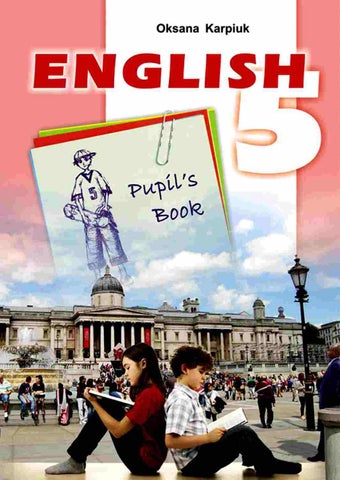
Оксана Карп’юк
а н г л ій с ь к а м ова (5-й рік навчання)
Підручник для 5-го класу загальноосвітніх навчальних закладів
Рекомендовано Міністерством освіти і науки, молоді та спорту України
Тернопіль „Видавництво Астон” 2013
ББК 81.43.21-922 К 26 Рекомендовано Міністерством освіти і науки, молоді та спорту України
(наказ МОНмолодьспорту України від 04.01.2013 p. № 10) Видано за рахунок державних коштів. Продаж заборонено.
Експертизу здійснював Центр наукових досліджень та викладання іноземних мов НАН України. Рецензент: О. М. ільченко, доктор філологічних наук, професор, заступник директора;
Експертизу здійснював Інститут педагогіки НАПН України. Рецензент: і. В. Алексеенко, молодший науковий співробітник
К 26
Карп’юк О. Д. Англійська мова: Підручник для 5-го класу загальноосвітніх навчальних закладів. (5-ий рік навчання) — Тернопіль: „Видавництво Астон”, 2013. — 280 с.: іл. ISBN 978-966-308-500-5
ISBN 978-966-308-500-5
© О. Д. Карп’юк, 2013 © ТзОВ „Видавництво Астон”, 2013
C o n te n ts S t a r t i n g
r U m
-* tJ
U
p
4
\ TIME F0R S C H O O L ....................... 7
Lesson 1 All about m e ..................8 Lesson 2 All about my c la s s .... 16 Look B a c k .....................................24 Lesson 3 Favourite subject........26 Lesson 4 An English te s t........... 34 Look B a c k .....................................42 READING 4 F U N ..........................44 M y Learning D iary........................ 46
U
_ / J TIME FOR n i f ___LE IS U R E ....................... 49 Lesson 1 All about my friends...50 Lesson 2 Hobbies and interests................58 Look B a ck...................................... 68 Lesson 3 Free tim e ..................... 70 Lesson 4 Friends online..............78 Look B a c k ..................................... 84 READING 4 F U N ..........................86 M y Learning Diary.........................88
U
-jc t|m ef°r
l l l t ___J
ї
TIME FOR OUTDOORS. .145 Lesson 1 Weather m ix.......... 146 Lesson 2 Weather and clo the s........... 158 Look B ack................................ 166 Lesson 3 Weather and activities......... 168 Lesson 4 My favourite season................... 178 Look B ack................................ 183 READING 4 FUN.................... 186 M y Learning D ia ry .................. 188
U n i f ~
) TIM E F 0 R DISCOVERY...191 Lesson 1 Getting about my home to w n .... 192 Lesson 2 Discover the U K ...202 Look B ack............................... 215 Lesson 3 Focus on Ukraine.218 Lesson 4 Plans for sum m er.232 Look B ack............................... 244 READING 4 FUN...................247 M y Learning D ia ry .................250
H O M E ................... 91
Lesson 1 All about my family ....92 Lesson 2 An apple a d a y ......... 102 Look B a c k ....................................114 Lesson 3 Special d a ys..............116 Lesson 4 Grandma's stories ...126 Look B a ck.................................... 136 READING 4 FU N ........................138 M y Learning Diary.......................142
A p p e n d ix
253
Grammar Reference............. 253 Vocabulary.............................. 265 Irregular Verbs....................... 278
3
S ta r tin g U p 1 Listen and sing along. ^ Back to school! Back to school! It starts in September. That's a rule. I can't wait to be there. Hey, let's run. Going back to school is Really fun! Back to school — Together again. We're grown up and wise, We are ten!
£
КT U Back to school! Back to school! We'll see all our friends. That is cool! It's good to go back, We're relaxed and bright! Going back to school is like Flying a kite!
2 Copy and add six more words to each list.
3 Point to things in the classroom and say what colour they are.
4 Write the words in alphabetical order. 0
L E A R N IN G T IP
Gg H i jt-
J,
% </
1 bus car bike < A У r
2 chair table bookcase 3 museum cinema cafe 4 doll balloon ball
%
z:
s
оО
Слова у словнику розміщуються в алфавітному порядку (alphabetical order). Якщо два слова розпочинаються з однієї літери, дивись на другу літеру. Першим буде те слово, друга літера якого стоїть першою в алфавіті.
5
5 Read the rules. Close the book and say the rules you remember.
WORKING TOGETHER W orking in pairs or groups is fun! When you work in pairs or groups-
Listen to your partner.
Look at your partner.
Think up new ideas. Ask questions
/
Share your things.
6 Find these words and logos in your book. Say what they mean.
R E A D I N G и ЭфІ С BACK! VOCABULARY r j G R A M M A R S
'
LISTENING SPEAKING WRITING Ѵ І .
FILE FOR I PROJECT
TIME FOR SCHOOL • • • •
All about me All about my class Favourite subject An English test
7
A L L A B O U T ME R E A D IN G * ^ 1 Read about Taras. Kyiv
Hi I am Taras I'm eleven Г т from Kyiv Kyiv is Ihe capital gf Ukraine t'vjj got a b to family, mol her fasher, sister and grandma, t h a d n 't got a pec I'd like la have a dog Mutn always &ay& '№"11 lalfc aboul rt tomorrow" t'v-ѳ got Lwo besl friends' Ihor from my cFass and Dan Dan is from L.viv ihor Jias got a Ьокѳг and Dan has got a dglmaiian I am c ra iy aboul flogs
8
Lesson 1 2 Say if it is true or false. a Taras lives in Lviv, b He is eleven, с Taras hasn't got a pet. d He has got two best friends, e Ihor is from Lviv, f
Dan has got a dog.
3 Find in the text the word/phrase that means: a) a family member b) a kind of a dog c) Taras likes dogs d) a country e) a city REMEMBER! TU“
Ґ
V
Long I am... I have got...
S hort I'm... I've got...
Long 1am not... 1have not got...
A S hort I'm not... 1 haven't got...
J
4 A sk and answer the questions in pairs. 1 Where are you from? 2 Is your family big? 3 Have you got a pet? 5 Speak about yourself. • • • • • •
I am... I am from ... I’ve got a... I haven’t got a... I like... I'm crazy about...
4 What are your friends' names? 5 Where are they from? 6 Are they crazy about animals?
LISTENING *! * 1 Listen and say what Pam is crazy about.
Windsor Hello. My name is Pam. I am ten and a half. I am from Windsor ['windza], a small town near London. I have got a small family. Just Mum and me. I've got a cat Ginger [^зігкізэ]. Ginger is not clever, but she is nice. I am not lonely. I've got a lot of friends: Alice and Linda, Ivy and Jill, Adam and David. I'm crazy about computer games and the Internet.
Lesson 1 REMEMBER! Long S hort He is / She is / It is... He’s / S h e ’s / It’s... He is not / She is not / It is no t... He is n ’t / She is n ’t / It is n ’t... He’s got / She’s got / It’s go t... He has got / She has got / It has got... He hasn’t got / She hasn’t got / It hasn’t got... He has not got / She has not got / It has not got... Read about Taras and Pam again. Tick the true sentences. □ □ □ □
CD
□ □ □ □
1 Pam is from England. 2 Taras is ten and a half. 3 Kyiv is in Ukraine. 4 Taras has got a dog. 5 Pam has got a cat. Ginger has got a computer. 7 Taras's friends have got small dogs. 88 Pam's friends are all girls.
3 A sk your partner to close the book and answer the questions. a Who is eleven? b Who is from England? с Who is from a big / small town? d What is Ginger? e Who has got a small / big family? f Who has got a cat? Work in pairs. Complete the interview with Pam / Taras. 1 2 3 4 5 6
What's your...? W here... you from? Are you...? Have you got a...? Have you got a...? How many friends... you...?
My name's I'm from... Yes, I... No, I... Yes, I...
5 Make an interview with your partner.
11
GRAMMAR Су, A PRONOUN (займенник) S ubject prono uns I you he/she/it we you they P ossessive pronouns my your his/her/its ou r your th e ir
THE VERB ‘ТО BE’ (дієслово “бути”) A ffirm a tiv e 1
N egative2
I'm at school. You're at school. He's at school. She's at school. It's at school. W e're at school. You're at school. They're at school. In terro ga tive3
I'm not at home. You aren't at home. He is n 't at home. She is n 't at home. It is n 't at home. We aren't at home. You aren't at home. They aren't at home. S hort answ ers
Am I at school?
Yes, I am. / No, I'm not.
Is he/she/it at school?
Yes, he/she/it is. / No, he/she/it isn't.
A re we/you/they at school?
Yes, we/you/they are. / No, we/you/they aren't.
Read Grammar Reference § 2, pages 258-259 1 Choose the correct pronoun. Example: S h e /H e r is my best friend She is mv best friend. 1 H e /H is name's John. 6 We /O u r are pupils. 2 H e /H is is new in my class. 7 She / Her mum is a teacher. 3 I / My am 10 years old. 8 They/their house is nice. 9 I / M y bag is green. 4 How old are they /their? 5 T h ey/ Their are friends. 'affirmative [s'fsmstiv] — ствердження Negative [negstiv] — заперечення
12
interrogative .ints'rDgstiv] — запитання
Lesson 1 2 Complete the sentences with the long form. Example: He's Boris. = He is Boris. 1 2 3 4 5 6 7 8 9 10
They’re from Ukraine. = They ... from Ukraine. She isn’t at home. = S h e ............at home. W e’re not students. = We ... not students. They aren’t here. = T h e y .................. here. W hat’s your name? = W h a t... your name? How’s Bill? = How ... Bill? W ho’s here today? = Who ... here today? W hat’s your father? = W h a t... your father? W here’s our teacher? = Where ... our teacher? She’s outdoors now. = She ... outdoors now.
3 Match the words with correct pronouns (a-f). 1 Olga and I \ 2 John and you 3 Bill and Tom
a You b It ^ c W e
4 Linda 5 Pam's bag 6 Victor 1 0
2 0
d They e He f She 3 Q
4 Q
5
□
4 Replace the words in bold with the correct pronouns. Example: Sam is in my class. He is in my class. 1 B etty is 10 years old. 2 A nn and Mary are classmates. 3 How old is Max? 4 Mark is a new pupil. 5 Ju lie and I are friends. 6 G inger is a cat. 7 How is Tina? 8 You and B ill are on duty today.
SPEAKING Think about Taras and Pam, then say whose these words are. • This is my friend Max. • I'm not lonely. • We'll talk about it tomorrow. • I've got a big family. • My cat is nice. • I haven't got a pet. • I haven't got a big family. • I'm fond of computers. Work in pairs. Look, ask and answer. Ann, G reat B ritain - 21 years old - in Spain - likes corrida Olha, Ukraine - 1 6 years old - in India -y o g a
Example: A: Where is Ann from? B: She's from Great Britain. A: How old is she? B: She is 21. A: Where is she now? B: She is in Spain. A: What does she like? B: She's likes corrida.
Voitsek, І П Г Poland j
-1 1 years old - in Ukraine - travelling
Carl, G erm any
j - 1 8 уyears old - in the — th USA - likes American English
3 Work in pairs. Match answers with questions, then act out the interview. 1 2 3 4
What's your name? s. Where are you from? How old are you? \ Have you got a Ukrainian friend? 5 What's his / her name? 6 Why are you in Ukraine now?
a b с V d e f
Canada. Yes, I have. I like travelling. Bill. Nineteen. It is a girl. Her name is Oksana
Lesson 1 4 a) Listen to the rap, * then answer the questions. • What is the girl's name? • How many animals would she like to have?
EMILY’S RA? My name is Emily I live with my family and a big white cat in a three-room flat. I'd like to have a hamster and I'd like to have They are easy
a frog, a dog. a sheep, to keep.
I'd like to have a mouse and a big farm house with many rooms and many doors and a horse, of course. b) Listen and beat the rhythm, then repeat. c) In pairs practise reading the rhyme. d) Read out loud the rap.
WRITING _________ f FILE FOR PROJECT 1 2 3 4 5
Find an old magazine. Cut out a picture of a boy / girl. Stick it on the sheet of paper. Give him / her an English name. Write 6-7 sentences about the b o y /g irl.
Example: This is Tim. He is from London. He is ten. He has got a big family. He hasn't got pets. Tim has got two friends: Bill and Ron. Tim likes doing sports.
15
A L L A B O U T M Y CLASS LISTENING
t
& READING
J*.
1 Listen about David's class and say if your class
I’ve got curly brown hair and brown eyes. I’m not very tall. I am good at Gymnastics and Art. My best friend is Adam. He’s got short straight hair. He’s good at Maths and basketball. He's a computer wizard. My class is not big, but w e’re special. We are members of the Green Planet Club. W e’ve got a lot of pen-friends and e-mail friends all round the world. ^W ill you send us your address?________________________________^
Lesson 2 2 Say if the statements are true or false. 1 David has got straight hair. 2 Some pupils have got computers 3 They have got a lot of pen-friends. 4 They are members of a club. 5 David is good at Maths.
- VO C ABU LAR Y BOX — A rt [a:t] G ym nastics [djim'naestiks] m em ber ['те тЬ э ] w izard ['wizad] • be good at • round the w o rld [w3:ld]
3 Match questions with answers. 1 2 3 4 5 6
How old is David? What is he good at? Who is David's best friend? Who has got curly hair? Are they a big class? Have they got many friends?
4 Read and match.
a) Yes, they have. b) David. c) He is ten and a half. d) Adam. e) Gymnastics and Art. f) No, they aren't.
©
Julie is ten years old. She’s got straight blond hair and brown eyes. She is from Paris, France.
Tina is eleven years old. She’s got dark curly hair and brown eyes. She’s from New York, the USA.
Janet is nine years old. She’s got red wavy hair and blue eyes. She’s from London, England.
17
Read and find Biii's classmates on the picture. Hi! My name is Bill. Can you see me? Let me show you my class. There is Tom over there. He's my best friend. Look at him. He's got a big dictionary and a pencil in his hands. We always play football together. Other boys watch us when we play. Do you have a best friend? Do you play football together? Behind him is Lisa. She's got a big red and green pencil case. Mark, Mary and Bill are very good friends. I often talk to them. They have the same T-shirts. And now, look at the picture on the wall. It's the symbol of our class. Do you like it? There's a fish on the cupboard in the corner. It's called Fred. I must go and feed it. Bye!
6 Answer the questions. - REMEMBER! Who is Bill's the best friend? David’s class What do they do together? Bill’s classmates Who is behind Bill's friend? classmates’ desks What are the three friends' names? friends’ names What have they got the same? Who has got a big red and green pencil case? Read § 2, Who has got a big dictionary? page 254 Who is called Fred? Why must Bill go?
18
Lesson 2 7 Look and describe the symbol o f Bill's class. Explain how you understand it.
GRAMMAR L-s O bject prono uns me you him /her/it us you them
^
K cm cm ocK !
>
I am Bill. You can see me. You are here. I can see you. He is Tim. I know him.
v
She is Mary. I like her. It is grey. I don’t like it. We are friends. You can meet us. They are Ron and Pam. I don’t know them.
J
1 Read about Bill's class again and write out sentences with the object pronouns. 2 Choose the correct pronoun. 1 2 3 4 5 6 7 8
Don't ask they / them. They/T h em don't know the answer. I / M e don't understand this. Can you help I / m e , please? She / Her is very friendly and everyone likes she /her. W e / U s must get up early. Please, wake w e / u s up at seven. Can you give Jane and I / me some ice-cream, please? Where's Anna? I can't see s h e / her anywhere. Look at they/them. They/Them are a\\ wearing school uniforms. H e / H i m is a very good sportsman. I really like watching h e / h i m on TV.
3 Read and fill in the gaps with the correct pronoun. 1 He's got new fell-tip pens. He uses ... to draw. 2 ...'re in the classroom. There are piles of books in front o f ... 3 ...'s playing with a ball. She's holding ... in her hands now.
19
PRESENT SIMPLE OF THE VERB ‘ТО HAVE’ A ffirm a tive
Negative
I / You / We / They have g o t a cat.
I / You / We / They haven't g o t a dog.
He / She / It has g o t a cat.
He / She / It hasn't g o t a dog.
Interrogative
S hort answ ers
Have I / you / we / they go t a cat?
Yes, I / you / we / they have. No, I / you / we / they haven't.
Has he she / it g o t a cat?
Yes, he / she / it has. No, he / she / it hasn't.
4 Fill in the gaps with 'have got' or 'has got'. 1 Marta ... a parrot. 2 Bill and Dan ... pets at home. 3 My mum ... long hair. 4 I ... a computer in my room. 5 My grandparents ... a house. 5 Make five sentences about David's class. is pen-friends. isn't red hair. are They a computer wizard, aren't David ten and a half, have got Adam a friend, has got special. haven't got members of a club. hasn't got 6 Fill in gaps with 'have' or 'has', then answer the questions. 1 2 3 4 5
... ... ... ... ...
you got a friend? your mum got straight hair? your parents got two children? your friend got a dog? your grandparents got many grandchildren?
Lesson
SPEAKING 1 Tell about what you are good at.
I’m good at English but I'm not good at Mat Gymnastics
computers
English
Sports
Music
dancing
2 Use the 'Remember' box and the clocks below to ask each other the time as in the examples. REMEMBER! ------------------------------ ч o ’clo ck
qu arte r
qu arte r
to ['kwoita]
past
\ ________
ha lf [ha:f] past
Examples: — What time is it, please? — It’s half past five. — Excuse me, what’s the time, please? — It’s quarter to six.
21
* 3 Listen and act out the dialogue. A: What's the time? B: Ten to nine. A: We must hurry then. B: Why? A: Because classes start in ten minutes. B: How many lessons have we got today? A: I don't know. Not m any I hope. 4 Work in pairs. A sk and answer. 1 What's the day today? 2 Is today the first day of the school year? 3 How many lessons have you got today? 4 Which class are you in? 5 Who do you sit next to in class? 5 Work in pairs. A sk your partner to remember about David's class and answer the questions. 1 Who 2 Who 3 Who 4 Who 5 Who 6 Who
is ten and a half? has got long hair? is tall? is good at gymnastics? is good at Maths? is a computer wizard?
6 Work in pairs. A sk and answer about your class. 1 Who 2 Who 3 Who 4 Who 5 Who 6 Who
is ten and a half / eleven? has got curly / wavy / straight hair? is tall? is good at gymnastics / football / basketball? is good at Maths / English? is a computer wizard?
7 Look around and make a presentation o f your class (7-8 sentences).
22
/
W RITING \_L
Lesson 2
1 Read and guess the missing words.
Hello Emily, My name is Ihor. My friends say I am a com pute r..., but I am not v e r y ........English. I found y o u r... on the Internet. I go to school in Kyiv. I love it, but I love Lviv more. My granddad lives there. It is the ... town in the world. It has got beautiful old houses. Have you got any Ukrainian ...? You can write to me in ... . Hope 2 hear from u, Ihor I |:^ ___- fa h j
jbM
ME
2 Imagine you want to have an e-mail Write an e-mail to kids. worldCcbcom. qb in your notebook. 23
1 a) Imagine there is a new pupil in your class. Think o f the questions you can ask him. b) Look and answer the questions. • What pet would you like to have? • Which instrument can you play / would like to play on?
a budgie [Ълсізі]
a piano [рі'жпзо]
P
a pa rro t I'paerat]
a ham ster ['haemsta]
a syn th e size r ['sin©isaiz3]
a g u ita r [gi'ta:]
ч* 2 Listen to the interview with a new pupil and say what musical instrument he сan play.
Here’s our new pupil. His name is Kevin. Kevin's mother is from London What would you like to ask 3 Answer the questions.
'
24
.
1 2 3 4
What is the new pupil's name? How old is he? What pet has he got? Where are his friends?
5 Can he play tennis? 6 Can he swim? 7 Are the new boys and girls his friends?
Lessons 1 -2 * 4 Listen again and act out the interview in a group. 5 Complete the sentences with correct pronouns. 1 Diana’s my best friend. I see ... almost every day. 2 Hi, my name is Iryna. I’m good at Maths and a lot of my classmates want to sit with .... 3 Tim: I must go home now. Can I call ... later? Jenny: OK. Call ... at five o’clock. 4 My cat likes playing in the garden. Can you see ... over there? 5 There’s John. Look a t ... . 6 Mum, where are my history books? I can’t find .... 7 Twin sisters: Hey, Clara, ... are working on our geography project. Can you come and help ...? Clara: Yes, sure. 6 Get to know your classmate better. f----------------------------------------------------------------1) Interview the classmate who sits next to you about his/her age, family, hobby, favourite sport or subject at school. 2) Copy and fill in the form. My classmate’s name is
FOR' PROJECT
years old.
He/she i s _____ _______ He/she is ____________
[FILE
(tall/short)
He/she has got a n d _________ He/she has got __________ His/her favourite sport is _
hair eyes. brothers/sisters. Ї------ w
His/her favourite lesson is
3) Tell the class about your classmate.
25
FA V O U R ITE SUBJECT R E A D IN G -^ 1 Think about school and your favourite subject. Say which day is your favourite. Explain why. 2 Look at the messages1 on the notice board and find: 4 school subjects phone number 5 days of the week website address
please bring y ° ur dictionary to English Class on Mondays, W ednesdays and Fridays.
Second-hand TEXTBOOKS for SALE! Call on 05093727
School visit .
C\asS
lu e S * 0 0 < ^
W elcom e to S chool W ebsite www.greenhill.school.eu for information about our • • • •
school teachers photo album school calendar C ontact us!
No PE today!
to the History ^V O C A B U L A R Y B O X ^ Museum C raft [kra:ft] Wednesday, G eography [dji'Dgrafi] 7th H isto ry ['histari] IT [,аі 4i:]
3 Answer the questions, PE [.pi: 'i:] What room is Science Class in? R eligion [n'lid33n] When do they go to the museum? S cience ['saians] Is there PE lesson today? tim etable ['taim.teibal] Can you buy second-hand textbooks? ' What should pupils bring to English Classes? What can you find on school website? 1a message [’mesidj] — повідомлення
26
Lesson З VOCABULARY/и CARDINAL NUMBERS (К іл ькісн і ч и сл ів н и ки ) Numbers can be tricky: -teen and -ty are easily mixed up! 1 one 2 two 3 three 4 four 5 five 6 six 7 seven 8 eight 9 nine 10 ten
11 eleven 12 tw elve 13 thirteen 14 fourteen 15 fifteen 16 sixteen 17 seventeen 18 eighteen 19 nineteen
20 30 40 50 60 70 80 90
twenty thirty forty fifty sixty seventy eighty ninety
Пам’ятайте про наголос! 14 [fo:'ti:n] але 40 ['fo:ti] 16 [siks'ti:n] але 60 [siksti] і т. п.
Odd numbers: 1, 3, 5, 7, 9, 11, 13, 15, 17... Even numbers: 2, 4, 6, 8, 10, 12, 14, 16, 18. Copy the correct pairs in your notebook. Example: 0 - zero 1 - one 2-...
21 19 50-
Continue the chain. Even numbers: two, four, . Odd numbers: one, three,
REMEMBER! 42 fo rty -tw o 100 a hundred [ Ъ л п с і г э с і ] 300 three hundred 652 s ix hundred and fifty -tw o 1000 a tho usa nd ['©aoznd] 2000 tw o thousand
Match. 1 five hundred and twenty six ч 2 ninety-four ^ч 3 seventeen ^ 4 one thousand 5 eleven
a) 11 b)1000 c) 526 d) 94 e) 17
27
--------------------- REMEMBER! ------------------------Telephone num bers 6220558 six - double two - о - double five - eight 330357 double three - о - three - five - seven Years 1990 nineteen-ninety 1992 nineteen-ninety-two Read § 1, 2, 2013 two thousand and thirteen pages 257-258 ----------------------------- ORDINAL NUMBERS 1st — (the) firs t [fs:st] 2nd — second ['sekand] 3d — th ird [0s:d] 4th — fourth
5th 6th 7th 8th
— — — —
fifth sixth seventh eighth
9th — ninth 10th — tenth 21st — tw enty-first 53rd — fifty-third
4 Look in your timetable. A sk and answer in pairs. Example: — What is your second lesson on Tuesday? — It's Craft. — What is your fifth lesson on Friday?
LISTENING Г 1 Think about Maths and say if it is your favourite subject. + 2 Listen and read about Adam's favourite subject and say what the best mark in English school is.
' 7■
Everybody says I'm crazy but I love Maths. I like numbers, especially even numbers. My favourite numbers are 6 and 22.
Lesson З I don't like odd numbers very much: 1, 3, 5, 7, 9... A hundred is a nice number, and a thousand... In some countries number five is very popular. It is the best mark at school. In the UK we've got letters. 'A' is the best mark. Not many students have got an 'A' in Maths in our class, only three. Other students call us swots. Girls shout 'Sweaty-swotty!'. It sometimes hurts. 3 Answer the questions.
, VO C ABU LAR Y ВO X \ bo ring [Ъэ:пг)] d iffe re n t ['dif,3r3nt] easy ['i:zi] im p o rta n t [im'pD:t3nt] p o p u la r [pDpjota] s w o t [swDt] tric k y ['triki] • I guess [ges] • It hurts [h3:ts]
V_____________________
1 2 3 4
What is Adam's favourite subject? What are Adam's favourite numbers? What number is popular in some countries? In which country do students get 'А', 'В', 'С', 'D', 'E' at school?
5 6 7 8
Are swots bad students or good students? Is there a special name for bad students? Why not? How many students have got an 'A' in Maths? Is Adam happy in his class?
i t 4 Listen and sing the rap song. Щ
THE. OF THE. 4KE.R S... Sun... Sunday. M... Mon... Monday. T... Tue... Tuesday. W ... Wednesday. T... Thur... Thursday. F... Fri... Friday. Saturday's the best of all.. Guess why.
29
GRAMMAR Суч ґ ------------------ ADJECTIVE (П рикм етник)-------------------DEGREES OF COMPARISON (С тупені пор івнян ня) cold — colder — (the) coldest . m ore . the m ost interesting interesting — . interesting — a less a the least the But: good — better — the best bad — w orse — the w o rs t [ws:st] Read § 1, little — less — the least pages 256-257 4. 1 Complete the sentences as In the example. Example: Tom is tall but Ben is taller. Ben is taller than Tom. 1 Stella is short but Rita is ... .Rita is... 2 Tom's kitten is little but Ben's puppy is ....Ben's puppy is... 3 My bag is big but your bag is ... . Your bag is ... 4 I am good at English but you are .... You are... 5 Pete is a bright pupil but Sam is ... . Sam is... 2 Fill in with correct forms o f the adjectives from the box. ^ n te re s tin g jD o p u la rj^ 1 I don't like this book. This book is more ... than that one. 2 I liked his story. His story is ... than my story. 3 I am not good at Maths. Maths is ... for me than English. 4 Pupils love their English teacher. She is ... than History teacher. 5 It is ... to say 'goodbye' and go home than to go home without saying it. 3 Read the lists o f the m ost popular and least popular subjects at one o f English schools. щ*
30
і
The most popular school subjects:
PE, English, IT, Art, Craft, Music
«і '
The least popular school subjects:
History, German, Science, Maths
Lesson З Make up six sentences like in the example. PE is the most popular and the History is the least popular. Craft is less popular than Art but more popular than Music.
Work in groups. a) A sk your group: a b с d e f
What is your favourite subject? What is your least favourite subject? What do you think is the most important subject? What do you think is the least important subject? What is the easiest subject? What is the most difficult subject?
b) Make top-five lists for your group for items (a)-(f). c) Compare your lists to the lists o f other groups.
S P E A K I N G S 1 Listen to the children and say who is right. Mia: Sweety sweaty swotty! David: Stop, teasing him, Mia. OK, Maths is difficult. He's got an 'A'. So w haP Mia: Nothing. I've got an 'A' in Music. That's normal. Adam: Are you saying it's not normal to like Maths?
31
Mia: Well, Maths is my least favourite subject, I hate it. On my top-ten list Maths is number ten, of course. Adam: And Music is number one, I guess. Ha, ha. How very clever! David: Stop quarrelling, you two! My favourite subject is English. We're all different, so what? ---------------- REMEMBER! --------------
VOCABULARY BOX
Capital letters (Великі літери) В англійській мові з великої літери пишемо імена (Магу), шкільні предмети (Maths), особовий займенник “я” (І), дні тижня (Tuesday), місяці (September) і назви країн (Ukraine).
d iffic u lt ['difikalt] norm al ['пэ:тэ1] to quarrel ['kwDral] to tease [ti:z] top-ten lis t
2 Say if it is true or false. 1Adam has English on Monday. 2 Adam is teasing Mia. 3 It is not normal to like Maths.
4 Mia and Adam are fighting. 5 They are different. 6 English is easy.
3A ct out the talk from task one in a group o f three. 4 Read the dialogue, then look in your timetable. A sk and answer in pairs. A: How many times do we have English? B: Three times a week. A: When do we have them? B: English is on Monday, Wednesday and Thursday. A: When do we have Science on Tuesday? B: Science is the third lesson on Tuesday. We have it at 11 o'clock.
Lesson З 5 Interview your classmate about his / her favourite subjects. L E A R N IN G T IP Interview A c tiv ity (Як взяти інтер в’ ю) 1 Подумай над питаннями, які б хотів/хотіла задати. 2 Склади перелік запитань. 3 Запитуй чітко і зрозуміло. 4 Будь ввічливим. 5 Давай час на відповідь. 6 Записуй відповіді. 7 Після інтерв’ю подякуй людині, в якої ти брав/брала інтерв’ю.
WRITING 1 Think about your favourite subjects. Copy and answer three questions in your notebook. 1 2 3 4 5
What is your favourite subject? What is your least favourite subject? When do you have Maths? Make your own top-ten list. What is your best friends' number one?
2 Make an ideal timetable for one week. TIMETABLE Lesson
Monday
Tuesday
Break
Break
Wednesday Thursday
Friday
1 2 Break
Break
Break
3 4 5
33
A N ENG LISH TEST READING*. >■ 1 Say if you have a pen-friend (e-maii friend) who writes his / her letters in English. • If yes, does it help you in learning English? • If not, would you like to have one? Why? 2 Read and guess the words in the letter below.
Dear everybody, Hi again. I'm David. My best pen-friend is Ihor. He is from Kyiv, Ukraine. Ihor knows about four hundred English words but he is very clever. He sends me pictures and I send him words: Alphabet song tree explosions
Dear David, We are doing an English
bathroom three witch test
\
I love English, especially the I love your sounds P, T, K. They are very special. They are like little 1?
.
I hate the letter ШШ. It makes my life difficult. Listen to this: Which witch has got three trees in the garden?
а
, WHICH, a
Think of the words: THANK YOU, and THURSDAY and Terrible!
34
Lesson 4 Copy the letter In your notebook. Use the words David sent to Ihor. 3 Answer the questions. 1 Is Ihor a clever boy? 2 How many English words does Ihor know? 3 Is Ihor afraid of the English test? 4 Has he got problems with the letter 'H'? Why? 4 A sk and answer in pairs. 1 2 3 4
Are you doing a test today? What is your favourite English song? What is your favourite English sound? Have you got problems with the letter 'H'?
5 Write three easy and three difficult words in your notebook. 6 Read and number the ways to learn English from 1 (the best way) to 5. [
) on the Internet
[
) at school with a teacher
[
I talking to people in English
[
I at home using a book
[
I watching English films
[
I listening to stories in English
s- L E A R N IN G T I P --------• Watch TV in English. • Use the Internet. • Look for English in cafes and shops. • Write to or email a pen-friend. • Use books and CDs in English. V__________________________________ у
35
LISTENING 1 a) Before listening say if you can spell your name and your family name in English. ^
b) Listen to the phone call and say why the girl asks Ian Ashton to play some computer games with her.
2 Copy the questions and answer them in your notebook. 1 Who is at home? 2 Who is phoning? 3 Who works with Pam's mum?
4 Who hasn't got the key? 5 Who is unhappy? 6 Who is ready to help?
3 A sk and answer in pairs. 1 Is Ian's family name long? 2 Is it difficult to spell? 3 Is your family name long? 4 Is it difficult to spell? 5 Have you got problems with spelling? 6 Which letters are difficult? ,----------------- DO YOU K N O W ? There are 26 letters in the English alphabet. In a book from China, you don't see letters. You see hundreds of little pictures. They are difficult to learn.
Lesson 4 с *
4 Listen and sing along.
к Spelling
С
Ra?
What's a B-A-T? It's a bat. What's a C-A-T? It's a cat. What's a B-O-Y? It's a boy. What's a T-O-Y? It's a toy. I love spelling and its fun. S-U-N is sure for SUN, 'U' and 'You' just sound the same. Now you try and spell your name!
w 5 Spell. • your • your • your • your
c
m
name; best friend's name; mother's name; teacher's name.
6 Read, guess and match. What do the letters stand for? NY The United States of America ч The United Kingdom \ PC disk jockey \ UK compact disk \ SOS personal computer \ DJ New York X USA CD Save our souls! 7 Play the game in a group. 1 Find the name of an English singer / American actor / a film star / a book. 2 Think about its spelling. 3 Say how to spell the name. Your friends must guess it. 4 Show the name to the group.
37
SPEAKING 1 Read some sentences you can often hear in your English class. Divide them into two columns: column T ' is for a teacher and column 'P' is for a pupil. • • • • • • • • • • • • • • *
May I go out? Who is absent? What do we have for homework? Open your books on page 8, please! Here you are. Who wants to read? How do you say 'бджола' in English? Can you say that again, please? I've finished! Sorry, I'm late. Thank you. What does 'difficult' mean? Copy this into your notebooks! Be quiet, please!
2 Listen to some classroom situations. Tick the sentences from task 1 that you hear.
3 a) Write the missing sentences. 1 T: You've got five minutes to finish this task. P: ... Г Already?! Let me see. 2 T: I would like to see your notebook, Ted. P: ... T: This is very nice and tidy. Well done Ted! 3 T: Yes, Ted, what is it? P: ... T: Yes, but hurry back. 4 T: Your homework is on page 8, exercise 2. P: ... T: Of course. Your homework is on page 8, exercise 2.
38
Lesson 4 5 T: What is small, and sometimes dangerous, but gives honey? P: ... T: A bee. P: The answer is a bee. T: That's correct. Now another riddle. 6 T: Who is absent? P: Steve Martin, Jessica White, Tania Wild... Knock, knock P: Good morning! ... T: Come in Ted. b) Work in pairs. Choose two dialogues and act them out. 4 Say why you learn English. Use the ideas below. I learn English because I want to have friends from other countries. • write e-mails in English • be good at English • speak over the phone to people from other countries • • • • • •
travel to other countries make presentations in English watch films in English read English books sing English songs work and play with a computer
VOCABULARY^ & GRAMMAR 1 Read and say what subject is this text about?
.. grammar rules help us to organize information that we know, and help us to speak, write and learn that language more easily. ... We organize words into parts of speech. For example, a 'house' and ' a dog' are nouns, 'nice' and 'new' are adjectives, 'I' and 'we' are pronouns, 'in' and 'under' are prepositions... / ----------------------- R E M E M B E R !-------------Parts o f Speech (Частини мови) NOUNS: a fish, a king, a man, a pupil... PRONOUNS: I, you, his, our, me, her, us... ADJECTIVES: big, long, popular, important... VERBS: to say, to swim, to learn, to play... PREPOSITIONS: in, on, under... 2 Match and think o f more examples. 1 Nouns
[
I to speak, to see...
2 Pronouns
I
I I, me...
3 Verbs
[7]
a question, apples...
4 Adjectives
□
in, behind...
5 Prepositions
I
I lazy, high...
3 a) Look at the pages from Olha’s and Ihor’s vocabulary books and compare them.
Olha’s Vocabulary Book
\
1
Lesson 4 noun
[naon]
іменник
pronoun
[’ргзопаоп]
займенник
verb
[ѵз:Ь]
дієслово
preposition
[.prepa'zijan]
прийменник
— —---------------
Lesson 4 adjective
[’cr.tist]
a part of speech which stands before the noun to describe it
airport
[’eapo'.t]
a place where planes land
alphabet
[’aelfabet]
letters from A t o Z
[bi'.tj]
place near the sea with sand or small stones
Ihor’s Vocabulary Book
В beach
K * b) Answer the questions. • How do you learn new words? • What is the difference between Ihor's and Olha's vocabulary books? • How do you make your own vocabulary book7
WRITING
І
1 Read a page from Andrew’s diary. Complete the sentences. Use the words on the left. interesting funny nice good difficult
JlAy S n g d is h ( le s s o n s a t e .. yi/iy n ew Sng& ish b oo k is ... У h e p i c t u r e s a t e ... y h e gtawivnaZ is n o t veZtj J[Ay tea ch eZ is veZy he&pbud. S h e is ... (J w a n t m o t e h o m e w o rk .
Write about your English lessons, your new English book and your teacher. Use task 1 as an example.
*+.
ОЭфК BACK! 1 Complete with the words from the box. Use the degrees o f comparison and put the adjectives into correct forms. good (x3), beautiful, friendly, long (x2), bad, intelligent, tall This is my class 5A. It is the best class in the whole school. I have a lot of friends. Pete is my ... friend. We are both tall, but he is a b i t ... than me. There are 12 boys and 13 girls. All girls are very pretty, but Jenny is ... . She has g o t ... hair than Betty. I think she likes me. John and Tom are very ... at football. John is ... boy in the class. My favourite subject is Science, but I'm ... than Kate. We always work and study together. I would like to be like my father. He is ... person I know. 2 Match. eleventh
1st
fifty-third first twenty-fourth
62nd 53rd 11th 100th 24th
sixty-second hundredth
3 Guess the subjects (1-10). Say what you do in these lessons. learn how to use the com puter
®
©
discuss how peopie live in the past
© read about countries all over the world
1
^ and paint ■ї і 'f ill 11ьі лj : і ; use
study Eng|jsh ^ words phrases and grammar
42
©
(б )
numbers and calculations
learn about animals, plants and a human
Lessons З
©
body
!+'■r114-: ї ;v4. ® play different sports
learn about
make
composers, styles of music
different th'mgs and cook
Example: In IT we learn how to use the computer. In . . . we learn .... 4 A sk and answer in pairs. x fftf • How many subjects have you got? ■■ • Is your timetable OK? Why? .j • Who is your form teacher? • Who is your favourite teacher? • What are you good at? • What are you bad at? r t' r ■ J .4 • How many pupils are there in your class? f j' ** • How many new pupils are there in your class? Who are they? • Do you speak English with other people? • Do you like working in groups in English lessons?
<AJ .».■A n
5 Write a short report about your school life. The questions above
can help you, Start like this, subjects. My timetable .1 am good because i s ________ but 1am bad at a t ______ . She I He is also My form teacher is teacher. My favourite m y _________ teacher i s ___
1have got
J
* 1 Listen and read the fairy tale.
IT IS IMPORTANT TO KNOW A FOREIGN LANGUAGE A wise mother-cat and her two little kittens live in an old grey house. They live upstairs in an small bedroom. They sleep on a warm comfortable carpet in the middle of the room. Every morning the two kittens get up, brush their tails, wash their faces and go downstairs to the kitchen to have breakfast. They usually have milk and porridge for breakfast. After breakfast they wash their cups, glasses and plates and go to the Cats’ Primary School. They take their school bags with pens, pencils, rulers and books. They are very clever, but they don’t like to go to school because they are a bit lazy. They don’t like to study foreign languages. One day, the mother-cat and her kittens went for a walk to the park. Suddenly1, they saw a dog. The big dog was in front of them. The kittens were scared and began to cry. The dog looked at them and said:” Grrrrrr!” At that moment, the mother-cat opened her mouth and said: “Grrrrrr!” The dog answered: ’’Grrrrrr!” and ran away. Then, the wise old cat turned to her kittens and said: “Now, you understand how important it is to know a foreign language.”
Suddenly [sAdnli] — раптом
«
2 Choose the correct sentence.
»
*
*
,
д
1 a) The mother-cat is funny, 2 3 4 6
b) The mother-cat is wise. a) The mother-cat and her kittens live downstairs, b) All the cats live upstairs. a) Every morning the cat goes to the primary school, b) Every morning the kittens go to the primary school. a) The kittens are fond of foreign languages, b) The kittens don’t like to go to school. a) Cats and dogs speak the same language, b) Cats and dogs speak different languages.
3 Look at the pictures and tell the story.
They don’t like ...
Every morning
After breakfast...
One day they w e n t...
Suddenly
The dog ...
The wise m other-cat...
а
і і і і і і і і і і / і -f-- і---і—
My Learning Diary
7 / / ~j—/—r—r—/—r—/—t—h
This unit is с а Ш .... I like lesson .. ................... ..
Sthink this unit is (ftck
Я І'ГЬП?for yOiiJ
Q
................ best.
easy not very easy difficult
Five important vsords from this unit are:
•
Two difficult words from this t/nit are:
■ Two easy Words from this unit are :
Two words from this unit that і don't like are My favourite wordf$) from thr$ unit is (are).
46
Photocopy for Your Portfolio
U n it 1 у?
My Words in Unit 1 be fond of
Lesson %
!
W
„ о Lesson
Lesson 4 Lesson
I I I I
- f ------ і ------ і ------ і—
My Learning Diary I-- 1-- 1-- 1--/-- T-- 1
After the unit I can: (tick what is true for you)
NOW 1 CAN
< 3
• count to 1000 • say years • say telephone numbers • say days of the week • understand and use classroom language • ask and answer about time • ask and answer personal questions • talk about my class • talk about school subjects • say why pupils learn English • make my own vocabulary book • write a short personal presentation • write my timetable for one week • understand parts of speech in English MY WORK
48
Photocopy for Your Portfolio
( 3
TIME FOR LEISURE • • • •
All about my friends Hobbies and interests Free time Friends online
What do you usually do after school?
0 you sPend much time with friends? What do you collect? Do У °и Uke parties?
ALL ABOUT MY FRIENDS READING ч 1 Listen and read about some British children and match the words in colums to make true sentences. Lolly i s p o p u l a r at school. David i s a nice girl. Tom is an unusual girl. Luka is Jasmine is
an excellent pupil. sporty.
VO C ABU LAR Y BOX -ч nicknam e [nikneim] c lu m sy ['kkm si] c u rio u s ['kjorias] helpful ['helpfal] im aginative [l'maedjinativ] lazy ['leizi]
L o lly is an unusual girl. Her real name is Elizabeth Jennifer po lite [ps'lait] McDougal. But her nickname is tid y ['taidi] Lolly because she likes lollipops. unusual [An'ju:3u3l] Lolly has got a lot of unusual pets. v She is very curious and imaginative.
David is an excellent pupil. He has got a lot of books about science because he wants to be a scientist. In his room he has even got a real mini lab, a telescope and a large bug collection. He is very clever. He can speak English and German.
Lesson 1 Tom is sporty. He is a basketball player and he is in the school basketball team. He can also play tennis and football. He is not crazy about school but he is a good pupil. He has got two brothers. David is his best friend. Luka is very popular at school. But he is not a good pupil. For him only music is cool. Luka is very musical. His hobby is music. He has got hundreds of CDs. He has got a little sister. Jasm ine is a really nice girl. She is very polite and helpful. Everybody likes her. She is a bit shy. Jasmine has two very interesting hobbies — reading books and writing stories. She has got a big brother. Read again and complete with the children's names. 1 ... is very clever. 2 ... has got a very interesting hobby — writing ston es 3 ... is in the school basketball team. 4 ... has got a nickname. 5 ... isn't a good pupil. 6 ... has got a real mini lab. 7 ... is helpful. 8 ... has got hundreds of CDs. Work in pairs. A sk and answer. lazy? polite? unusual pets? is imaginative? has got shy? a telescope? an excellent pupil? 4 Choose a character. Write 3-4 sentences about him / her.
51
* 5 Listen and sing along.
L uka’s Ra ? Tock, tock, tock, troo, loo, loo, I'm Luka. Who are you? I've got a lot of friends, And they are all cool. Every day we go Together to school. Tock, tock, tock, troo, loo, loo, I am cool, What about you?
LISTENING Г 1 Answer the questions. 1 2 3 4 5 •
Have you got a nickname? Are you a member of a club? What is your club called? Do you send e-mail messages to your friends? Do you sometimes invite friends to your place? 2 Read the names o f some friends and their club. Then listen to their talk and find out who Shark is. VO C ABU LAR Y B O X n m essage ['mesidj] b u lly ['boli] ca re fu lly ['кезїзії] invite [in'vait] kind [kaind] lonely ['Іэопіі] sm a rt [sma:t]
52
Lesson 1 Sam, Elliot, Ella and Ted are the members of the Heart and Brain Mystery Club (HBMC — in short). They have got a message from somebody. 3 Say if it is true or false.
-
% m
1 Shark is somebody else.
^
, r shark ~ v [rQkl 4
Щ ~ ^ 3 HBMC kids would like to invite Pete to the club. 4 HBMC kids want to wait before they invite Pete to their club. 2 Shark is Pete.
4 Find and write in the name o f the kid who says: 1 Shark 2 Shark 3 Shark 4 Shark
is lonely. .......................... has got a lot of ideas. .......................... is good at sport. .......................... is not kind to HBMC kids.............................
5 Do the Quiz. Answer ‘Yes, I do’, ‘No, I don’t’ or ‘Sometimes’. •
If you have m ‘Yes’ answers — you are
«
ґ 7 Г )\ П ) \ /J popular with a lot of friends. I u ^ But you can't always have „ _ , , .. friends around you. Do you 1 Do you spend much time , , x , , ... r . know how to be alone? with friends? * L „ _ „ • If you have more than four 2 Do you share things with them? No-answers — you are „ ^ ' .............................. probably feeling lonely. Try to 3 J Do you try to be nice to . ... ... , . , , „ share something with friends: other people? , ,,. „ ^ . . . . . hobbies, ideas, dreams. 4 Do you get more than three ^ A , , „ • If most of your answers are phone calls a day? „ , ,, ^ 'I . . , r Sometimes, you probably 5 Do you get post cards from , , /, x ,. , „ have a friend or two and that friends in summer? , — , 1A „ ^ ...... , . is enough for you. You don t 6 Do you invite friends to your r ,. ..... .. „ care for big crowds, birthday parties?
53
GRAMMAR REMEMBER! I can swim. I can do it. I can speak English.
I can’t swim. I can’t do it. I can’t speak English.
Copy the true sentences. 1 2 3 4 5 6 7 8 9 10
can write a story. can roller-skate. can ride a bike. can dive. can stand on my head. can tell a rhyme in English can cook. can play computer games. can send an e-mail. I can dance.
2 Work in pairs. Answer tricky questions. • Can you draw a duck out of the number two? • Can you draw a pig with numbers and letter B? • Can you draw a house without breaking the line? 3 Think about what the children can ofo, Write down as m any things as you can. Use a dictionary if you want. Start with: Some children can... Some children can play the piano. Some can play table-tennis.
Can you swim? Can you do it? Can you speak English? f Read § 7, page 264
Lesson 1 4 Complete the sentences. Use 'can'or 'can't'. 1 My sister is good at Maths. She ...do difficult calculations. 2 We are very strong. We ... lift a car. 3 4 5 6
Jessy is bad at Science. He ... help you with your homework. Antony is lazy. He ... help you about the house. My friend likes singing. He ... sing hours without a break. Greg and Tom like eating. They ... eat 10 hamburgers in twenty minutes.
5 a) Answ er the questions. b) Work with your partner. A sk him / her. Me 1 2 3 4 5 6 7 8
Can Can Can Can Can Can Can Can you sing well?
My partner
□ □ □ □
□ □ □ □
□ □ □ □
□ □ □ □
6 Write about what you can and what you can’t do. Write with both hands
Lift a bus
Dance well
Drive a tractor
Make a chocolate cake |
Climb a tree
Run backwards
Run fast
Speak three languages
Count to 1000 in English |
Name 20 animals in English
Swim
Read a book in one day
55
SPEAKING 1 Answer the questions. 1 Do you trust your friends? 2 Do you sometimes cheat in tests? 3 Why do you tease other children? ■ 2 Listen and read to find out how Pete answers the questions above. Ted: If you become a member, you have to learn about the Golden Rule. Elliot: That's why we have to put you to the test. Carl: So, why do you want to become a member of our club? Pete: I sometimes feel really lonely I know other kids don't want to be with me. Carl: But why do you tease other children then? Pete: I can't help it. I guess I like to make them angry. Ana: Why do you cheat in tests? Pete: I like playing. Elliot: One more question — do you trust us? Pete: Do I trust you? I'm afraid I don't know what trust is. Sam: Hmmm. Do we really want him in the Club?
^ VO C ABU LAR Y B O X > attentio n [ э Ч е ф п ] to to to to
cheat [tji:t] expect [ik'spekt] jo in [djDin] tease [ti:z]
to tru s t [trASt] • I can 't help it.
Lesson 1 3 A ct out the talk In a group o f five. 4 Unscramble some more questions Sam wants to ask Pete. Answer them. 1 you / Do / your / mobile / phone / switch / off / at / school / ? 2 Do / you / secrets / ? / keep / other / kids’ 3 ? / in / doing / do / what / you / like / your / free / time 4 you / Do / be / really / our / friend 111 want / to
-------------- DO y o u KNOW?---------------The Golden Rule says, ‘Don't do to other people things that you don't want them to do to you.’
v---------------------------------------------------------------------------------
5 Read Pete's answers. Guess Sam ’s questions. Example: — Yes, we tease girls. — Do you tease girls? Yes, I play the drums. J
^ No, I don't study hard,
I go to bed at midnight.
I watch TV and play computer games.
6 Answer the questions. 1 Can Pete become a member of the Club? Why? Why not? 2 Do you follow The Golden Rule?
WRITING' 1 1 Write 5-6 sentences about what your friend is like. • • • • • •
Do you trust your friend? Why? Has he / she got a nickname? Why? What is he / she good / bad at? What can he / she do? Does he / she share ideas (dreams) with you? Use 2-3 adjectives to describe his / her character.
57
HOBBIES AND INTERESTS R E A D IN G - ^ 1 Read and name the boys' unusual hobbies. I am Oleh Kryvoshapko. And I am at our School Hobby Fair today We can learn a lot about likes and interests of our schoolchildren The pupil of the 5th form, Petro Doroshenko, has got an unusual collection. He collects rocks. “Rocks are beautiful,” says Petro. “Some of them have pretty colours. My smallest rock is the most interesting. It is from the Pacific Ocean.” Borys Ivanchuk, the pupil of the 8th form, has an interesting hobby: cartoon animation. His new cartoon is called Pencil Man. “Making Pencil Man is a lot of work,” he says. “The cartoon has got 2000 drawings. Each one is just a little different. I use my camera to take a picture of each drawing. In the film the pictures move very quickly. That's why Pencil Man looks like he is moving”. Borys is going to show his Pencil Man at school on Tuesday at 3 o'clock in the afternoon. Don't miss the show! ЇЬ С З
"-REMEMB to play the piano the guitar to play football tennis hockey chess to go running skiing skating swimming
вї
о.
Unusual Hobbies of Ukrainian Schoolchildren
Lesson 2 2 Say if the sentences are true or false. 1 2 3 4
Olena is at School Hobby Fair. Petro collects stamps and coins. Borys makes cartoons. His new cartoon is called Pencil Box. 5 Cartoon has got 2000 drawings. 6 Borys uses his computer.
3 Speak about collections. Say:
-V O C A B U L A R Y B O X — cam era ['кэетэгэ] cartoon [ka:'tu:n] coin [к э т ] stam p [s ta m p ] to c o lle c t [ka'lekt] fa ir [їез] • be fon d o f [bi fond зѵ] • be interested in [bi: 'intrsstid in]
• what things people collect • why they collect these things • take p ictu res (photos) • what different collections ['faotaoz] can teach us • what you (your friends, brothers, sisters) collect 4 Say what games the children play at the sports grounds and what musical instruments some o f them play after classes. Example: Mary and Tom (table tennis) Mary and Tom plav table tennis. 1 The children (volleyball)
4 My elder sister (guitar)
2 Mary (piano) 3 Nelly and Victor (badminton)
5 Caroline (basketball) 6 The boys (hockey)
59
5 Read, look and guess whose things are these. Explain your choice like in the example. Example: I think this piano is Peter's because he plays the piano.
Peter is interested in music and plays the piano. He also likes sports.
Polly has got a pet. She is fond of painting. Polly is interested in gardening.
G R A M M A R ,^ ---------------------- PRESENT SIMPLE TE N S E -----------------------(Теперішній неозначений час) I play the guitar.
^ U'tar еѵегУ ^aУ-
He / She plays the piano.
He / She plays the piano every day.
We / You / They play tennis.
We / You / They play tennis every day.
I d o n 't play the piano. He / She d o e sn 't play tennis. We / You / They d o n 't play the guitar.
Read § 1, page 261
Do I / you / we / they like playing tennis? Yes, I / you / we / they do. No, I / you / we / they don't. Does he / she play the piano? Yes, he / she does. No, he / she doesn't.
Lesson 2 1 a) Complete the Interview with a ju n io r tennis are, do, don’t, am, isn’t champion. 1 2 3 4
How old ... you, Max? Where ... you live? Is a champion's life easy? When ... you get up?
5 W h a t... you have for breakfast? 6 W h a t... you do then? 7 ... you a good pupil? 8 When ... you come home? 9 ... you play the whole evening? 10 ... you a happy boy?
— — — —
I am twelve. I live in Kharkiv. No, i t ..., but I like it. I get up at about seven.
— I have some cereal and milk. — I go to school. — Yes, I ... . But I ... not good at History. — At about four. I have a snack and run to the tennis court. — No, I ... . I play for two hours. — Yes, I think I .... But I ... sometimes lonely
b) A ct out the interview in pairs. 2 a) Make a report about Max. Start like this: Max is 12. He lives in Kharkiv. ... b) A sk and answer about Max. Work in pairs. — — — —
How old is Max? He is 12. Where does he live? He lives in Kharkiv.
3 Use the correct verbs and the words below to make sentences. 1 2 3 4
John / poems — John writes poems. Ann / teddy bears 5 Tina / danang F rank/ volleyball 6 B ill/S p a n ish Josh / bird houses 7 Sarah / portraits
61
VOCABULARY/ J 1 Look at the columns. Tell about different groups o f hobbies. Which is your favourite one? What hobbies will you have in future? Work in groups.
LEARNING THINGS
DOING THINGS
MAKING THINGS
COLLECTING THINGS
reading, going to the theatre, museums, art galleries, cinema, etc.
gardening, cycling, travelling, playing chess, playing computer games, etc.
drawing, painting, handicrafts, cooking, etc.
stamps, coins, badges, matchboxes, books, videos, CDs, postcards, toys, watches, paintings, etc.
* 2 Put the verbs into correct boxes. play, write, go, collect, do, watch, make 1
teddy bears matchboxes, posters a snowman, a bird house, a model boat
62
J
Lesson 2 c h e s s ^ j the piano, football
birds, stars, action films
______________ yoga, puzzles, experiments
I a diary, poems, letters
dancing, fishing, climbing
J
J
LISTENING ' 1 Answer the questions. • Are you a member of a club? • Do you do sports? • Are you very busy after school? • Have you got plans for every day? - 2 Listen to Emiiy who is talking to her granny and say if she is a happy girl.
^V O C A B U L A R Y B O X ^ aerobics [ea'raobiks] c h o ir [kwais] dram a group [сігэетэ gru:p] yoga [ р о д э ]
63
3 Listen again and talk about Emily. Use the table below. Monday / draw 1 sing 1 buy bread
Tuesday
Wednesday Thursday
1practice / draw 1 sing yoga 1 do aerobics 1 write
Friday
1practice 1play the piano yoga 1 ride a 1 do horse aerobics 1 act 1 write
Saturday / have a free day!
Example: Emily does aerobics on Tuesday and Thursday 4 Ian is not so busy. Look and say what he does each day o f the week. Monday
Tuesday
1play / read computer comics games
Wednesday Thursday / ride my bike
1 visit my grandma
Friday
Saturday
/ watch my 1go favourite to the TV serial cinema
5 Read and guess the activities. Match them with the correct names from the box. cooking, school newspaper, Spanish lessons, school choir, drama group, school band ( T ) school band
v
We're looking for a GUITARIST. If you are interested, contact Jim.
© ATTENTION JOURNALISTS! We'll help you become great writers.
WANTED TO BECOME AN ACTOR? This is the right activity for you. Join us.
A chance to learn a WONDERFUL LANGUAGE and get to know the culture of Spain.
Lesson 2 ©
1
Want to learn how to bake ' © Have you got an EAR FOR MUSIC? bread, make pancakes or Join us when we sing different a fruit salad? melodies, pop songs and even opera. 6 Do the quiz to learn about what kind o f person you are. • Are you more a physical person or are you more a creative one? Or are you both? Put these activities in 2 groups. Write the headings
I like
and
I don't like.
re a d in g
basketball
m usic
drama
aerobics
• If you like more 'pink' activities — you are more physical. • If you like more 'blue' activities — you are more creative. Creative or physical — it doesn't matter. The world needs both types.
65
SPEAKING * 1 Listen, then put the interview from Em ily’s school magazine “Super J ” in the right order.
□
Super J: Hello, Helen. So you are the winner! Congratulations! Helen: Oh, I don't know what dance. My own creation Super J: It was cool! What form are you in? Helen: The fifth. Super J: What kind of music do you like? Helen: Thank you. Super J: You are a real dancer. What dance was it? Super J: Are you in love, Helen? Helen: Of course I am. Love gives me the energy to dance. Super J: Is your prince charming from our school? Helen: Latino music. And I play the piano, so I love classical music as well. Helen: Yes, he is. But it's a secret. Hush hush. He doesn't know it yet.
2 A ct out the interview in pairs. 3 Speak about your likes and dislikes. What do you like doing in your free time? Work in pairs. 4 Answer the questions. Work in a group. 1 Who is fond of collecting stamps, coins, toy cars, toy animals, dolls? 2 What else can you collect? 3 Who has interesting collections of badges? 4 What collections do you (your parents, your friends, your sisters and brothers) have?
Lesson 2 WRITING 1 'Hobbies' is a usual topic between pen-friends. I collect things. At the moment, I’m collecting perfume bottles. I’ve got about 40. I’ve got 90 match boxes, hundreds of stamps and about 80 coins. In summer I am going to start ____
collecting toy cars.
2 Do a survey! A sk your classmates and fill in the table. 1 Copy the table.
1 F IL E
FOR
PR O JEC T
2 Choose five hobbies and sports. Write them in the first column. 3 Work in a group. Ask the members of your group what they think about each sport or hobby. 4 Put a tick ( ✓ ) for each person in the correct column. 5 Compare results with your classmates. ѴЛОВВХ SViRMEX
What do you think of collecting coins?
67
1 Read, then write a short letter to Dora. A nsw er her questions. Say something about yourself.
near olha, My М Є
Is IM
vm ±±. vm U the 5 th form. M y
school is iA/0 t big. I have got ^o brothers or sisters яvd I ofteiA. feel lonely. I f ouiA,d your letter U our sc-hool ^ a g a z U e . I see you are lonely, too. it us sad. I feel і am different. I d o ^'t watch soap operas. I don't ofte^ go out. і Lttee reading.
I Ittec w ritin g real
letters, M t e-mails. I am a but old-fashioned. W he^ the -postw-йіл, brin gs me a letter -
wow, I am the
ha??test g ir l U the world, oh , yes, I p la y the pla^o a^d collect tl* ,y little th in g s . I feeep them, on a shelf. W hat about you? t>o you p la y a n y musical li/vstru.w.ent?
T>o you. ріяу any sport? Po you. collect anything? Write to me as soon as possible, yours, T>ora 2 Do the quiz.
ARE YOU A GOOD FRIEND? Yes 1 Do your friends tell you their secrets? 2 Do you keep your friends' secrets?
68
□ □
No □ □
Lessons 1 -2 3 Do you often talk about your problems with your friends? 4 Do your friends help you when you are in trouble? 5Do you trust your friends? 6 Do you invite all your friends to your birthday party? 7 Do you often get angry with your friends? 8
Do you lie to your friends?
□ □ □ □ □ □
• If you have 6 or more 'Yes' answers, you're a good friend! • If you have less than 6 'Yes' answers, you must think about your friends more! Why don't you talk to them more often? 3 Talk about collection that people make. People (children, schoolchildren, my brother) collect ...to learn more about... • the countries of the world • the history of a country • famous people • space and space flights • places of interest • different kinds of sports • towns and cities of the world • animals and birds 4 Read and answer the question below.
,
---------------DO YOU KNOW?---------Barry Thomson, an eleven-year-old boy from Windsor, has got three gold medals for an unusual sport. It is the remotecontrol car1race. The ‘driver’ is not in the car but has a remote control in his hand. The fastest car wins the race.
• Do you know any unusual sport or hobby? Yemote-control car — машинка з дистанційним управлінням
□ □ □ □ □ □
FREE TIME READING 1 Read children's notes about the parties. Make a list o f different kinds o f parties. My friends and I like sleep-over parties. At sleep-over parties my friends eat and play games in my bedroom. Then they sleep at my house. Of course we go to sleep very late because we tell stories and talk about our friends. Linda Theme parties are my favourite. You choose a theme for your party and your friends wear clothes to match the theme. You can also decorate the party room and have food and music with the same theme. Fancy dress parties, funny hat parties and pyjamas parties are also great! Steve Outdoor parties are also good but you need good weather! My family and friends often have picnics in a garden or near the river. Food always tastes fantastic outdoors! Then we swim or play games. Sometimes my friends and I sleep in tents after these parties. Nataly
Lesson З Tonight is my birthday party and the theme of the party is Japan. Today my mum is cooking Japanese food. I'm cleaning the house, decorating the party room and making my costume. I'm having fun! Bob 2 Complete the sentences. 1 At sleep-over parties friends ... 2 Friends usually go to sleep very late because ... 3 My mum is cooking Japanese food because ... 4 At the theme parties people usually 5 Some other kinds of parties are ... 6 At the outdoor parties we usually ... 7 After outdoor parties we sometimes
VO C ABU LAR Y BOX badge [Ьэесіз] fa n cy [ faensi] dress glue [glu:] gu est [gest] invita tion [invi'teijn] pastim e ['pa:staim] them e [Ѳі:ш]
3 Fill in the words from the box. envelope, guest, invitation, a piece of, to glue, to cut, to blow up Take ... coloured paper and ... out a form of a flower. Write the ... and ... the coloured flower on it. Put your card into t h e ...........a balloon and tie it to your invitation. Write a name of a ... on a balloon. Have a good time! 4 A sk and answer in pairs. singing, dancing, cooking, writing stories, taking photos, watching TV, playing football, collecting stamps, reading books, going to the cinema/museum, fishing, gardening, listening to music
What do you usually do in your free time?
Well, I like... and
GRAMMAR ,£>\ ----------REMEMBER!---------Tim e m arkers: Present S im ple alw ays u su ally som etim es rarely never
He He He He He
• • • • o o o o M O O • ООО o o o o
alw ays watches TV. u su ally calls his friends. som etim es reads books rarely plays football. never goes to museums.
---------------------------------------------------------------------------------------------- -
1 Make up five sentences about your free time. Start like this: I always talk to my friends. I usually play / go... I sometimes ... 2
I rarely... I never...
a) Interview three o f your classmates about what they like to talk in their free time. Use the word map below. It is important! j
у It is interesting! f
music hobbies books politics popular singers . sportsmen . other boys/girls
boring!
72
always often usually sometimes never
pocket money talk about...
school life, teachers
It is a change from school!
\T
Lesson З 3 Look at the table and say what are the m ost popular ways o f spending free time for grown-ups in Britain. How often?
S pending free tim e in B ritain
men
wom en
visiting museums
rarely
rarely
going to the theatre, ballet and cinema
not very often
not very often
sewing and knitting
never
usually
house repairs
often
sometimes
reading books
often
often
sports
sometimes
sometimes
listening to music
often
often
going out for a meal and drink
very often
very often
Example: British men rarely visit museums in their free time. ц Ч 'і They go to the theatres not very often. British men never...
LISTENING
К
1 Listen and read, then answer the questions. 1 What kind of party is it? 2 What are Nigel's friends singing? 3 What have they got for Nigel?
2 Say if the sentences are true or false. 1 Nigel's friends are angry at him. 2 Nigel is the youngest winner of the quiz. 3 Pink balloons are good for boys. 4 Nigel is very happy. 5 The present for Nigel is the book “The Dangerous World of Animals” . 6 Nigel's present can help him to prepare for another quiz. 3 Think about surprises. What ideas can you come up with? Use the words in the box to answer the questions that follow. smile, new pet, happy, gift, clap hands, laugh, glad, jump, find something
, -------------------------------------------------- L E A R N IN G T IP — ч BUILDING A WORD MAP The word map shows how some of the words in the box above go together. Think about words you can add to the map. Use words from the box and your own words. KINDS HOW SURPRISED OF SURPRISES PEOPLE ACT new pet, gift happy, glad '------------------------------------------------------------------------------------- J
74
Lesson З ^
4 Listen about the parties British children have and answer the questions.
1 Why do the British children like parties? 2 What parties can the British children have? 3 What can they cook for a party? 4 What things do they make for their parties? 5 What do children usually do at their parties? 6 What are the most favourite parties?
SPEAKING 1 Speak on spending free time by different people. Use the word map.
2 Ask and answer in pairs. 1 2 3 4
Do you like parties? What kind of parties do you usually have? What do you usually do to prepare a party? What does your favourite kind of party look like?
♦ 3 Listen and read the dialogue. Find out what Lilly's invitation look like. Terry: What are you doing Lilly? Lilly: I’m making invitations for our balloon party Have a look. Do you like them? Terry: Yes, very much. How do you make them? Lilly: I cut a card in the form of a balloon, glue it to the envelope1 and put a piece of string2 on it. Then I write the invitation on the balloon.
4 Share Lilly's recipe [ resipi] how to make invitations with your friends. 1an envelope [епѵэіэор] — конверт
2a string [stnrj] — мотузка
Lesson З 5 Read, then ask and answer in pairs. We like to make surprises for our guests. We usually have them at Christmas but we make them for our parties, too. We write jokes on a paper and put them with sweets.
How do you make name badges?
I cut a piece of a card and glue a piece of string on it. Then I write the name of a guest. 4_________________________________
How do you make
invitations? party decorations? prizes? fortune trees? party surprises?
W RITING___ 1 Design an invitation card for your party,
f F IL E
Think of a party you are going to have
FOR
тэтэгѵ P R O Jт E C T
with your friends at someone's home /E ’ R E
HAVING’ДРARTY”-
SATURDAY 10' JAISWARY place 28 Green Street. Ж Л - ^ The party starts at 2 o’clock.
*
FRIENDS ONLINE READING 1 Say if you have got an e-maii friend. Think about useful things you can get from e-mailing. Share your thoughts with class. 2 Read Alec's letter and say what way e-mailing helped Alec. »
" IjV
ra a s jA # m
> йв 3 -
11
Pi h i d
тл и' аГ- Г
Фтл ' * г п м
■ ■= > :■ ^
g
*
Hello, Nick! I'd like to share my experience of having an e-mail friend. I was bad at English and I wasn't very good at Computer Studies. My English teacher gave me a good piece of advice to use the Internet and make an e-mail friend. I found the “E-mail Friends' Club” website and chose the name of my future friend. It was Helen from Switzerland ['sw itsabnd]. We started sending e-mails to each other. We're good friends now. My English is much better. I'm very good at using the computer now, too. Here are some useful tips on how to write e-mail letters. Yours, Alec Fitzer
I like football. It is very popular in our country. I visit my Football Club three times a week. I am fond of reading books on history. Sometimes I go to the library. Are you interested in history?
78
Lesson 4 3 Say if the sentences true or false. 1 Alec was bad at English. 2 Alec was very good at Computer Studies. 3 His elder brother gave him good advice. 4 Alec found the name of his e-mail friend on a website. 5 Helen is Alec's e-mail friend. 6 Alec is very bad at English now. 7 Alec shares good tips on how to write e-mail letters.
VO C ABU LAR Y BOX - n co n ta ct ['lamtaekt] experience [ik'spiarians]
^
freak [fri:k] to search [s£:tj] to share [}еэ] useful ['ju:sfl] • to be keen on
Match and use the right prepositions to make up sentences. We are good
in
music.
He is keen
at
speaking English.
They are fond
of
reading books.
She is interested
on
sport
Think and say who in your class is keen on: • e-mailing • playing computer games • doing Maths
у
1 A sk and answer in pairs. 1 2 3 4 5
Can you use a computer? Do you go to a computer centre? Have you got a computer at home? Do you play computer games? Can you work on a computer?
6 How much time did you spend on a computer yesterday? 7 Is your mum sometimes angry with you because of spending too much (надто багато) time on a computer? If yes, why? ♦ 2 Listen and say if computers are always useful. 3 Answer the questions. 1 Who is worried about the children? Why? 2 What did her children do after school yesterday? 3 Did they go out to ride bikes? 4 How many hours did Leo play on a computer? 5 Did they communicate1 with friends? 6 What advice can you give to the m o tlw ? 7 Do your parents worry about you? W
/------------- DO YO U K N O W ? ----------Every second someone new gels on the Internet. Think about tomorrow and read computer magazines
'communicate [k9'miu:mkeit] — спілкуватися
Lesson 4 GRAMMAR i p , & SPEAKING '----------------------
REMEMBER! ----------------
THE GERUND (Герундій) Talk about likes & dislikes with the gerund form. love like d o n 't like hate go
I
playing football reading ^____________ dancing I'm good at drawing. doing tests I'm keen on e-mailing. swimming I like going sledging. I th in k cleaning my room is OK.
1 Complete the sentences. I love... I like... I am good at... I like going... I hate... I don't like... ... is OK for me.
2 Complete the e-mail about your partner for the 'Kids' Net Magazine'. • h ll-v
I
£
"■'tП'J1 -lAfcffl Ш ІО Н ж
ІІЯ
3 J
Л
From
■ ■■
E
Гї-тіЧ W -
*'
-1
-ч
To
....................................................... Kid's N e t M a g a z і ne
Subject
Likes
and
■ ja w
:UL" ■ ffi
X:
-!*
Dislikes
In English 1sit next t o ...................... He / She likes / doesn't lik e ............. He / She lik e s .................too.............
1
L
1V'J-tJ
7^4
81
з A sk and answer in pairs. ґ-----------------------------
Do you like playing in the snow?
• • • • •
reading in bed writing letters going shopping helping in the house playing computer games
Yes, it's great. / It's fantastic! (No, I don't like it. It's boring.)
4 a) Read the interview and say what M r Grumps thinks about children today. Ella: May I ask you some questions for our school magazine? Mr Grumps: Yes, but be quick, I haven't got much time. Ella: What do you think about 12year-olds today? Mr Grumps: I think they are lazy. They don't do their homework. They don't help at home. They don't do sports. They watch TV and play computer games all day. They waste their time. They don't talk to their friends, they print text messages to them. Ella: How many 12-year-olds do you know, Mr Grumps? Mr Grumps: I know Pete. He's my neighbour.
b) In groups discuss why M r Grumps thinks so and if he is right.
Г- VO C ABU LAR Y BOX ^ m essage ['mesidj] • to w aste [weist] tim e
Lesson 4 WRITING 1 Read the e-mail and write your message. f t»
S tb rti
и гН Ч т
№ (№ l>
1 53 J -
F H i
-.Vi .
іЧ д о
:i ■■
*
І-
"P
H
Ken
,-i«
You
Crazes What is a 'craze'? It's a game, a sport or a toy. It is very popular for months or years and all kids love it. Then it goes away. Like break dancing. My brother's craze is a skateboard, for example. Roller-blades are magic for me. I also do roller-skating and ice-skating. Roller-blades are not toys. They are very expensive — these cost 200 dollars. What are kids' crazes in your counlfy cr town?
---------------------------------------------- L E A R N IN G T IP -----------WRITING AN E-MAIL (Н аписання ел ектронного листа) 1 Вкажи тему (subject) свого листа. 2 Розпочни його з привітання. 3 Електронний лист, як правило, є невеликим за обсягом. 4 Намагайся чітко висловлювати думки. 5 Уяви свого друга / подругу, якому / якій пишеш листа.
83
1 Match and use right prepositions to make up sentences. They are good She is keen We are fond I am is interested
in at of on
History speaking English, singing songs, playing games.
2 Fill in the gaps with the words from the box. contests, prizes, winners, present, blow up, prepare, surprise, vote, every, guests, invitations Children of our class like to have parties. We write ... for o u r .... Our party always has a theme: a football birthday party, a teddy-bear party or any other. We ... many interesting things for the party: we ... balloons, make ... . There are many games .... We ... for the leader of the . He or she gives ... to .... Usualty gets a s m a ll... . 3 A sk and answer in pairs. • • • • •
Have you got a mobile phone? How do you use it? What about your mum or dad? How many text messages do you send every day7 Is it necessary for 11-year-old kids to have mobile phones? Why?
4 Read the text messages and put them in the correct order.
84
a) OK. See you. Linda.
1
Q
b) Of course. When? Linda. c) I'm doing music project for school with Monica, Jenny and Hannah. Can you help us, Cathy? d) Today at 5. My place. Cathy.
2
I
I
^ I— > 4 Q
Lessons 3 - 4 5 Complete the e-mall with the words from the box. play the piano, always, sports, good at, collects, does, plays
: н іііѵ
tt
5**fifti u i i t
улш ш
й ч ї
4h H w
ь rf a J - g a g i g j P л і j* у у 'ja: ^ Fr om To Subject
I Gr eg Taras F r e e Ti me
My friend and I do lots of things. Jane plays tennis. John plays football. I play volleyball but I am not.............. it. Do you play a musical instrument? I............Mark .........the guitar. I've got stamps from lots of countries. H a rry .......... badges. What .......... Tim do in his free time? Does he p la y .........? I think he doesn't. H e ............ watches TV and plays computer games. J:fa
hf>№te
H-H**
ТОДІ~
6 Speak on your days o ff in a group. 1 Where do you like to go on your days off and why? 2 How did you spend your last Sunday? 3 Did you have a good time? Why? 4 What do you usually do at home on your day off? 5 What did you do at home last Sunday? 6 How do you usually spend your days off? 7 What's your idea of having a good time? 8 Do you often have free time? 9 Do your parents often have free time? 10 Do your parents always spend their free time with you? Why? 7 Choose a theme for your next birthday party and write a paragraph what you're going to do.
85
* 1 Listen and read.
EYORE’S BIRTHDAY adopted from A. A. Milne One day Winnie-the-Pooh got up early in the morning and went for a walk in the forest. There he saw his friend Eeyore1, the donkey2. Eeyore looked very sad. “Why are you so sad?” asked Pooh. “It's my birthday today, but I haven't got any presents,” said Eeyore. “Oh! Many happy returns of the day, Eeyore!” “And many happy returns to you, Pooh.” “But it isn't my birthday, Eeyore.” “No, it's my birthday.” “But you said 'many happy returns' to me.” “Did I? Oh, I wanted to say 'thank you', Pooh-Bear.” Pooh ran home to get Eeyore a present. Near the house he saw Piglet. “Do you know it is Eeyore's birthday today? Poor donkey, he is so sad.” “Why?” asked Piglet. “It is his birthday today, but he hasn't got any present. What can we give him as a present, Piglet?” “I haven't got any idea, Pooh...” “Oh, Piglet, I've got an idea. I shall give him a ja r of honey.” “And I shall give him a red balloon.” “You're very kind, Piglet!” “You are so kind, Pooh!” In the evening the happy friends went to Eeyore's birthday party. ’Eeyere [i:p:| — ім’я ослика
2a donkey [’dDrjki] — ослик
2 Say if it is true or false. 1 One day Winnie-the-Pooh met a donkey. 2 3 4 5
The donkey looked very happy. It was Pooh's birthday. The donkey wanted to say 'thank you'. Pooh went home to get Eeyore a present.
6 7 8 9
On his way home he met a Rabbit. They talked about Piglet's birthday present. Winnie-the-Pooh will give Eeyore a jar of honey. Happy friends went to Eeyore's birthday party.
З Look at the pictures and tell the story.
One d a y ...
There he saw ...
Pooh asked ...
Pooh ran ...
“I've got an idea ...
In the evening ...
І І І І І
I I I I J I I I
My Learning Diary І І І І І І І і I I I I I I I
This unit is called
<
I like lesson ..................................................... best.
<
I think this unit is:
Q
(tick what is true for you)
j
easy j
VQ /y e a s y
I I difficult • Five important words from this unit are:
• Two difficult words from this unit are:
• Two easy words from this unit are:
• Two words from this unit that I don't like are:
• My favourite word(s) from this unit is (are):
U n it 2 2
My Words in Unit 2
My j Learning a Diary j 4
After the unit I can: (tick what is true for you)
NOW 1 CAN
О
• name hobbies • build word maps • say what 1/ my friend can / can't do • describe my friends • ask and answer about likes and dislikes • read and understand about kids' clubs • talk about interests with my friends • speak on the ways 1spend my free time • interview people • describe a party • share recipes on making party surprises • make party invitations • do a questionnaire or a quiz • understand e-mails from friends • write e-mails to my friends MY WORK
і і і і і I
90
Photocopy
Your Portfolio
U n it
TIME FOR HOME All about my family An apple a day Special days Grandma’s stories What are your parents v\/hd^ ,n9 at the moment? What s your mother's job? is your granny's t і n birthday? і j ° o you always have breakfast in the morning?
91
ALL ABOUT MY FAMILY vocabulary/
I
> Mr Peters -
Mrs Peters
■*-
Mr Green - Mrs Green
4m Jessica - Tim
Martha - Patric
Fred
Rick - Sarah
Diana 1 Look at Tom's family tree. Answ er the questions. 1 2 3 4
92
How How How How
many many many many
brothers has Tom got? uncles has Tom got? cousins has Tom got? aunts has Tom got?
Lesson 1 2 Complete the sentences
with the words from the box. A 1 Mrs Green is Tom's grandmother. 2 Julie is P a t's .............. 3 Sarah is M a t's ................. 4 Diana is J im 's .................. 5 Martha is T o m 's.............. 6 Julie is S a ra h 's ................... 7 Diana is Mr P e te r's ............. В 1 Patrick is Tom's father. 2 Pat is M a t's .............. 3 Tom is M a rtha 's.............. 4 Nick is Mrs G re e n 's ............. 5 Mr Green is N ic k 's ............... 6 Jim is T o m 's.................. 7 Rick is P a t's ...............
mother (mum), grandmother (grandma), daughter, granddaughter, aunt, sister, cousin
son,grandson, cousin, uncle, father (dad), grandfather (grandpa), brother
3 Look at Tom's family tree again. A sk and answer in pairs. Example: — — — —
Is Rick Tom's uncle? Yes, he is. Is Julie Leo's aunt? No, she isn't.
4 Answer the questions.
How many
sisters uncles cousins aunts
have you
93
LISTENING * 1 Name as many jobs as you can. + 2 Listen and say if you can hear any jo b that someone in your family does.
-------------------------
94
ftEMEMBER! -----------------------
He / she / it
helps [s]
draws [z]
teaches [iz]
He / she / it
makes [s]
repairs [z]
catches [iz]
Lesson 1 3 A sk and answer in pairs. A 1 2 3 4 5 6
1 2 3 4 5 6
Who Who Who Who Who Who
What What What What What What
brings letters? helps the doctor? repairs teeth? works in an office? teaches at school? catches burglars?
does does does does does does
В a secretary do? a doctor do? a dentist do? a postman do? a nurse do? a teacher do?
,—
VO C ABU LAR Y BOX — s
b u rg la r ['Ьє:д1з] d e n tis t ['dentist] nurse [ns:s] police o ffic e r [pa'liis Dfiss] postm an ['paostman] to catch [kaetj]
4
to repair [п'реэ] vet [vet]
J
4 Say if it is true (T) or false (F). □ □ □ □ □ □
1 2 3 4 5 6
A A A A A A
nurse helps an architect. A nurse helps the doctor. postman works in an office teacher catches burglars. TV reporter repairs teeth. police officer helps sick animals. secretary teaches children. -
DO YOU K N O W ? -
There are a lot of jobs connected with animals, especially in the USA. There are pet shop assistants, pets' hair dressers, zoo-keepers, vets, animal trainers and even animal baby-sitters.
95
READING 1 Read, guess and match the words with their definitions. 1 to compete 4
2 an only child 3 a twin 4 to look alike 5 similar
a) a child who has no brothers b) somebody who was born at the same time as his or her brother or sister c) to look like somebody else d) to try to do everything better than somebody else e) almost the same
2 Finish the sentences and discuss them in a group. 1 It is good to be an only child because... 2 It is good to have a younger brother or sister because... 3 It is fun to have a twin brother / sister because... 4 It is good to have an older brother or sister because... 3 Read and say if these sentences are true (T) or false (F). 1 Twins always compete with each other. 2 Twins have special powers. 3 Twins look alike and no one can say who is who. 4 Twins should always be in different classes,
tw in s [twinz]
96
so they can learn to live without each other. 5 Twins are always best friends.
Lesson 1 4 a) Read what D r Green, an expert on twins, says. Compare your answers with her words. ASK DR GREEN — TWINS Dr Green: Not always. Sometimes it is better for young twins to be together in class, but they can work in different groups of children. Some twins are really sad when they are in different classes.
Sentence
Dr Green: Twins are close to each other,^ but that doesn't mean they are always best friends. They enjoy playing with other kids just like any other children.
©
Sentence
□
Dr Green: Some twins really look alike but some Sentence don't. When you know twins well, you can say who is who. Their parents can always say who is who. ------------T~*
□
fcT) Dr Green: Twins compete with each other v ry sentence just like any children. As they grow up, they ^ no longer feel the need to compare 1 themselves with their twin brother or sister. ( VO CABULAR Y BOX pain [pern] pow er [раоэ] to enjoy [in'djDi] to g ro w up [дгэо лр] each o th e r лдэ] to g e th e r [ta'geda]
Dr Green: There are stories about twins who feel each other's pain and guess what the other twin is thinking. But sometimes good friends, who are similar and spend a lot of time together, can do the same.
b) Read again and match answers with the sentences from task 3.
Sentence
□
97
5 Find sentences or pairs o f sentences in the text above which show that... a) ... it is not a good idea to put twins in different classes at school. b) ... twins are not best friends just because they are twins. c) ... twins do not compete with each other when they grow up. d) ... twins are never completely the same. e) ... some twins have special powers.
6 Read and match. Our teachers don't know who is who.
We share secrets and talk to each other our problems.
л
98
[
I a They are close
[
I b They look alike
[
Iс
They compete with each other
I want to be better than my brother.
J
Lesson 1 ---------- REMEMBER! ----------PRESENT CONTINUOUS TENSE (Теперішній тривалий час) I
Ѳ
You / We / They H e /S h e / It I
0
You / We / They H e /S h e / It Am Are Is
©
am / 'm a r e /'r e
reading,
is / 's am not / 'm not are not / aren't is not / isn 't
reading.
I you / we / they he / she / it
reading?
S hort answ ers Yes, No, Yes, No, Yes, No,
I I you / we / they you / we / they he / she / it he / she / it
am. am not. are. aren't. is. isn't.
go — going dance — dancing swim — swim m ing
Вживаємо, щоб повідомити про дію, яка відбувається в момент мовлення.
Read § 4, раде 262
1 Read the e-mail on the next page. Copy it in your notebook, but make the underlined words shorter. Example: Iam sitting in my room. I'm sitting in my room.
m
у— ..... -tt.n і д ( 1
ї і н іїї M h
............
м Г О т * - h>'Xi ■*-
* tt Э J | * : ■ * F r o m_____ I M a r k To Rita Subject Family
=
Г*. Й
«і* F
^
-- 1____________________________________________________ J Hi, Rita. I am sitting in my room. My dad is in my room too. He is reading a newspaper, jt js cold and it is raining outside. We are listening to music. ]t_is really nice! My sister and her friends are watching a film in the living room. Say hello to you family!
SPEAKING * 1 Listen and read to find out what the boy's grandparents are doing now. It is morning. The children are in the classroom. They are learning about the Present Continuous now. Teacher: It is ten o'clock. What's your family doing now? Taras: I don't know. I think father is playing basketball. Teacher: Is he a basketball player? Taras: No, he's a PE. teacher. My mother is probably talking to a patient. Teacher: Is she a doctor? Taras: Yes, she is. My sister is doing a test. She is a student. Teacher: What about your grandparents? Taras: I've got two grandmothers and a grandfather. One grandma is cooking now, the other grandma is probably watching TV and, I guess, grandpa is working in the garden. Teacher: What about your friends? Taras: Ihor is here. He is listening to me.
Lesson 1 2 A sk and answer in pairs. 4 Is his mother a teacher? 5 Is she a doctor? 6 Where is his grandfather?
1 Where is Taras? 2 What is he doing? 3 Where is his father? 3 Play the game in pairs. 1 Write all the jobs you know
- VO C ABU LAR Y BOX -
on a piece of paper. Write what he/she is doing as in the example below. Turn the pieces of paper face down on the table. Let your partner take two pieces of paper at a time. Say the true sentence. Example:
/ she is wearing
co m p u te r program m er [k3m'pju:t3 'ргэодгэетэ] co o k ['kok] hairdre sser [Ъеэ ,dress] m echanic [mi'kaemk] taxi d riv e r ['taeksi 'draiva] w rite r [гэйэ]
я w r it e r
Й UlA/tforlM.. A writer doesn’t У wear a uniform.
WRITING *
%
1 Draw the table with three columns in your notebook. Copy these words in the correct boxes. at school, swimming, doctor, teacher, in the garden, studying, in the street, watching TV, jumping, dentist, basketball player, policeman, at home 1 PLACES
2 JOBS
3 ACTIONS
2 Write an e-mail to your pen-friend about what you and the members o f your family are doing.
101
A N APPLE A DAY VOCABULARYM 1 a) Match words with the pictures, a) carrot b) tomato c) peas d) spinach ['spmid3] e) strawberry f) pear g) watermelon h)cabbage i) cherry
□ □ □ □ □ □ □ □ □
b) Say what fruit and vegetables you like. 2 Look at the picture for two minutes. Shut the book and name all the things you remember.
у « і» su g a r
m ilk
I
і
jam
P ■' tea
_
cornflake s honey
m ЯГ
b u tte r bacon and eggs I ENGLISH BREAKFAST
102
cheese
Lesson 2 3 Read, guess and match.
t is small. It is round. It is red. t grows on a tree. t is green and yellow, t grows on a tree. Bears like it. t doesn't grow on a tree, t is small and red. t doesn't grow on a tree, t is big and green.
© © © ©
F ruit ( a ) strawberry
®
watermelon
(cT) cherry \ ( d ) pear
j
і -■
Vegetables It is red. It is round. We make ketchup from it. They are small. They are round. They are green. It has got green leaves. It is long. It is orange. Rabbits like it very much.
©
©
© © ©
© © ©
carrot
tomato
V ^
Ф
peas
spinach
103
READING 1 a) Answ er the questions. • Do you eat healthy food? у b) Listen and read to find out if crisps and peanuts are healthy. crisp s [knsps]
peanuts [pi:nAts]
EAT WELL — FEEL WELL The children are having Science. A doctor is talking about healthy food. Doctor: What food is rich in vitamins? Class: Lemons, oranges, apples, pears... Doctor: Yes, there are vitamins in fruit, vegetables, brown bread and in other food as well. Class: Why do we need vitamins? Doctor: They are important for your eyes, your skin and... your health. Who can tell me where we can find minerals? Class: In milk, cheese, eggs and in vegetables. Doctor: Yes, minerals are important for your teeth and your bones. And... don't skip your breakfast. It is the most important meal. Don't eat crisps and peanuts between your meals. And remember: you must drink at least five glasses of water every day. r- VO C ABU LAR Y BOX ^ bone [Ьэоп] health [hel©] s kin [skin] (un)healthy [(лп)ЪеІѲ] • be rich in • s k ip a meal [mi:l]
Lesson 2 2 Complete the sentences.
%
1 . . . . . . . . . . . are rich in vitamins. 2 There are vitamins in ..., ... and .... 3 Vitamins are important for o u r ..., ... and .... 4 5 6 7 8
We can find minerals in ..., ..., ... and .... Minerals are important for o u r ... and .... Breakfast i s ............... D o n 't.............! You m u s t...............
*
3 Discuss the question In pairs. • An apple a day keeps the doctor away. Why? 4 Read to find out what Englishmen eat for breakfast, lunch and dinner. ENGLISH MEALS When an English friend invites you to his / her home to live for a week you can get an English breakfast in the morning: cereal with milk, bacon and eggs, toast, butter, jam and tea with milk. The English usually have a quick lunch in their lunch break at about one o'clock in the afternoon. They have a big dinner at about six when parents come home from work. It is their main meal. Some people have supper at about 8 or 9 o'clock in the evening.
5 Say if it is true or false. 1 For English breakfast you can get bacon 2 3 4 5 6
and eggs, of course. They drink tea with lemon. Lunch is the main meal for the English. They have lunch about 1 o'clock in the afternoon. Your English friend invites you for dinner when his/her parents come home from work. English people never have supper.
LISTENING 1 A sk and answer in pairs. • What do you eat in the morning? • What do you eat for lunch? • What do you eat in the evening?
2 a) Match words with the pictures.
a) salad b)cocoa c) hamburger d) yoghurt
106
□ □ □ □
e)candy f) fish g) ice-cream h) ham
□ □ □ □
Lesson 2 ■ b) Listen to find out what Pam and Mia have got for their meais.
Time for Breakfast
Time for Dinner
3 Answer the questions. 1 W hat does Pam usually have for breakfast?
2 Who skips breakfast? 3 W hat else is there on Pam's table? 4 Does Mia get up early? 5 W hat is there in Pam's lunch box? 6 W hat is there in Mia's lunch box? 7 What do Pam and her mum often have for dinner? 8 Where does Mia's family often go?
•
4 Draw two columns In your notebook. Listen again and fill in the columns with Pam's and Mia's food. Compare the food both girls have and say: • Which food is good for health? • Which is bad for health?
DO YOU KNOW?---------Each country has its own favourite food. In Italy it is spaghetti and pizza. In France they like good cheese. In England they drink tea with milk. 5 Speak on what you think our favourite food in Ukraine is.
GRAMMAR REMEMBER! COUNTABLES AND UNCOUNTABLES (Злічувані та незлічувані іменники)
108
You can count: apples, tom atoes, sandw iches... Example: three tomatoes, five apples
You ca n 't count: milk, cheese, fish, ice cream, tea, coffee, meat.
We use there are with countables: There are som e eggs on the plate.
We use there is with uncountables: There is som e Read § 3, m ilk in the glass. page 264
Lesson 2 ** 1 a) Listen, find and repeat.
і
There There There There
There's There's There's There's There's
som e som e som e som e som e
rice in the jar. milk in the bottle. sugar in the jar. oil in the bottle. water in the jug.
are are are are
som e apples on the plate. som e oranges on the table. som e eggs on the plate som e bananas on the table. There are som e lemons on the table. There are som e onions on the table. b) Write if these nouns are countable or uncountable. ,----------------------------------
REMEMBER! ------------------------------
+ There are som e tomatoes. ? Are there any tomatoes? - There aren't any tomatoes.
+ There is som e water. ? Is there any water? - There isn't any water. >
f
* 2 Listen, compare and practise.
I
Read § 3, page 259
There isn 't any butter.
There aren't any tomatoes.
There isn 't any cheese.
There aren't any mushrooms.
There isn 't any beer.
There aren't
JN L
^
апУ e99s -
109
— — — — — — — —
Is there any cheese in the fridge? Yes, there is. Is there any butter in the fridge? No, there isn't. A re there any eggs in the fridge? Yes, there are. A re there any tomatoes in the fridge? No, there aren't.
3 A sk and answer in pairs. Use the example and the words in the box. Meat, ice-cream, cakes, milk, eggs, fish, hamburgers, candies Example: — Is there any meat? — Yes, there is. (No, there isn't.) — Are there any cakes? — Yes, there are. (No, there aren't.)
-----------
REMEMBER! -----------
MANY вживаємо зі злічуваними іменниками: There are many apples. MUCH вживаємо із незлічуваними іменниками: There is much water. •b 4 Listen and practise. A: There's some butter in the freezer. В: How much is there? A: There is a lot. There are some hamburgers in the freezer. B: How many are there? A: There are a lot.
110
Lesson 2 5 Fill in the gaps with 'some' or 'any'. a) Have you g o t... brothers or sisters? b) We don't need ... butter. c) There are ... books on the table. d) I w a n t... flour because I'm going to bake a cake. e) Is there ... milk in the bottle? f) We don't need ... eggs.
REMEMBER! The verb TO NEED He needs som e money. She d o e sn 't need any bread. Do you need any plate?
S P E A K IN G ^ ^ 1 Think what's in your fridge at home. A sk and answer in pairs. Example: A: There is some milk. B: Are there any eggs? A: No, there aren't. + 2 a) Listen to the dialogue and say where it takes place in. A: Can I help you? B: Yes. Can I have a hot dog and fries, please? A: Here you are. Anything to drink? B: Yes, a milkshake, please. A: So, a hot dog and fries, and a milkshake. B: Thank you. How much is that? A: 3.90 altogether, please. B: Here you are. A: Here's the change.
b) A ct out the dialogue in pairs.
, ------ REMEMBER! -------ч — How m uch is the cake? — It's 30 hryvnias. 4________________________ J Complete the dialogue with phrases from (a) to (c). A: What do you eat every day? B : ............................................................ A: How about breakfast? B : ............................................................ A: We're studying food at the moment. I'm asking my friends about eating habits. What else do you eat? B : ............................................................ a) It's hard to remember! I sometimes eat lots of sweets! b) I eat some breakfast cereal — you know, cornflakes. I usually drink some tea. Why do you ask? c) Well, at school I sometimes eat an apple or a banana at break time, and I drink some milk. I have lunch at school. 4 Role-play the situation in pairs. Jane goes to a food shop. Look at the lists below and act out the dialogue. SH O PPING
eggs crisps tomatoes bananas apples
biscuits oranges
LIST
SHOP ASSISTANT eggs crisps tomatoes bananas apples biscuits oranges
s S X X у/ X X
Lesson 2 Jane: Have we got any...? Assistant: Yes, we've got some... / Sorry, we haven't got any... 5 Discuss in a group. • What about your meals? • What time is your main meal?
WRITING 1 Make a poster about food. 1 2 3 4
Find pictures of food in old magazines. Cut out the food and drinks you can name. Paste them on two big pieces of paper. Write the titles: GOOD FOR HEALTH and NOT VERY HEALTHY.
{F I L E
FO R '
PR O JEC T
5 Write the captions1 under each picture. 6 Present it in class. NOT VERY HEALTHY candies hamburgers, cakes c/ioeotele
tf M
♦ .4 * 1a caption [’каер](э)п] — підпис (під ілюстрацією)
113
1 a) Before listening a rhyme read and think. There are more than 6 billion people in the world. At this moment they are all doing something. What are they doing? •
b) Listen and read. THE WORLD IN ACTION Believe1 it or not this story is true. It talks about people like me and like you. It talks about people at this moment of time. It's not a real story in fact — it's a rhyme. In China a Chinese is chewing gum2, In France a Frenchman is having fun.
A German in Germany is cooking noodles3, An Australian in Australia is baking strudels. An Italian in Rome is singing a song. An American from New York is singing along. In England a lady is drinking tea. In my country someone is thinking of me. c) A sk and answer in pairs. chewing gum? having fun? cooking noodles? baking strudels? singing a song? singing alone? drinking tea? thinking of me? 1to believe [bi'li:v] — вірити 2a chewing gum ['Цилддлт] — жувальна гумка 3noodle [n u :d l] — локшина
Lessons 1 -2 чі 2 aj Listen to find out what game Pam's ciass is playing. No, I'm not a housewife. No, I'm not a journalist. No, I don't work in an office.
b) Play this game in your class. Always write who you are in your notebook. 3 Describe your family photo. 1 Bring family pictures to school. 2 Prepare a one-minute talk about the photo. 3 Say who they are, what they are / he is / she is doing Example: ґ-----------------This is Tim. He is my cousin. He is playing football. He is running for the ball.
SPECIAL DAYS READING 1 Read and match greetings with cards. Then name a holiday for each greeting.
1
Many Happy returns of the day!........................................... [ a j
2
Happy E aster!.........................................................................Q
3
Happy Mother's D a y !.............................................................Q
4 Christmas greetings and best wishes for the New Year...... 5
Will you be my Valentine? Happy Valentine's Day!........... (
REMEMBER!
on on Christmas Day; on Mother's Day; on Christmas Eve;
on holiday; on Father's Day; on my birthday
2 Read and say what an English family usually has for Christmas Dinner. CHRISTMAS Christmas Day is a happy holiday for a lot of people in different countries. Every year there is a very big Christmas Tree in the centre of London, in Trafalgar Square. This Tree
116
at at Christmas; at weekend; at Easter
)
Lesson З is a present to Great Britain from Norway ([’noiwei] — Норвегія). People of Norway send it to Londoners every year. Before Christmas people buy presents and a lot of food and drink for their parties. On Christmas morning people open their presents and say 'thanks' to their members of family and friends. The Queen's speech ([spi:tj] — промова) is on TV at 3.00 p.m. On Christmas people wish a merry Christmas to each other. They eat Christmas turkey, potatoes and green vegetables for Christmas Dinner. And they have the Christmas pudding for the dessert. They like to have a Christmas cake for tea at five o'clock. After Christmas comes Boxing Day. On this day people usually visit their relatives and friends. 3 Say if the sentences are true or false.
1 There is the Christmas present from Norway in the center of London every year. 2 On Christmas morning people go to the shops to buy presents. 3 People buy food and drinks for their parties before Christmas. 4 On Christmas Day there is the Queen's speech on TV. 6 People open their Christmas presents after the Queen's speech. 5 For Christmas dinner people eat pizza and cheeseburgers. 6 People usually visit their relatives and friends on Boxing Day. 4 Read and say what John likes about Christmas. ґ-----------------------------------------------------------------------------------Hello! I'm John. I'm from Liverpool. It is in England. Christmas is my favourite holiday. It is in December in England. You may ask, “What do you like about Christmas?”. Well, my answer is, “Santa Claus, presents, Christmas Tree, parties and many other things.”
S Answ er John's questions. Use the words from the box. — When do you have Christmas in Ukraine? — Does Santa Claus bring presents to Ukrainian children? — What do people usually do before Christmas in Ukraine? — Have you got Christmas parties? If yes, what do you usually do at them?
In December, St. Nicholas, in January, Father Frost, Christmas decorations and presents, make masks and costumes, do shopping, act out in Vertep Show, sing Christmas songs, greet friends and relatives, the President's speech on TV
GRAMMAR REMEMBER! PREPOSITIONS OF TIME (Прийменники часу)
on on on on
on Christmas days holiday Christmas Eve my birthday
at at Christmas at weekend at Easter
but at night
on on Sunday on Wednesday on Monday
118
in in the morning in the afternoon in the evening
in in in in
in January May autumn winter
at at three o'clock at half past seven Read § 1(2), page 254
Lesson З 1 Think and say what day is the busiest day for you. Say what you do on that day. In the morning... . In the afternoon... . In the evening... .
2 A sk and answer in pairs. 1 2 3 4 5
When When When When When
do do do do do
you you you you you
usually usually usually usually usually
do your homework? go to the cinema? go to the seaside? read a book? play in the park?
in the evening at weekend in summer in the morning
3 Play this board-game with your partner. You need a dice and counters. Use the words (1-16) to say what you do.
Start
1 2
3
6
7 12
11
10
GAME 1 2 3 4 5 6 7
sometimes never usually always rarely 6 at 9 o'clock at 1 o'clock
8 9 10 11 12 13 14 15 16
on Monday on Thursday in the morning in the afternoon in the evening in spring in winter in February in December
119
LISTENING 1 a) Before listening remember about your mother's birthday and say what you usually do for your mum on that day. b) Listen and answer the questions. • What are Mike and Ted doing? Why? • Is their mother surprised? Why?
r VO C ABU LAR Y BOX to clean up [kli:n лр] to loo k like [lok laik] d e licio u s [di'lij3s]
2 Correct these wrong sentences.
ta sty ['teisti] after [а:Йз]
1 It is dad's birthday today. before [bi'fo:] 2 Mike and Ted are making soup • make a mess to surprise their mum. • Never m ind! 3 They are making Whities. ['пеѵэ maind] 4___________ __________ / 4 Their cake looks like an old boot. 5 Mum thinks this is terrible surprise. 6 Mike and Ted must clean the bathroom before the guests arrive. *
3 Listen again and talk about Mike and Ted's cooking experiment. Have you got a sim ilar story? Talk about it.
Lesson З REMEMBER! --------------------------MUST — MUSTN'T (повинен / не повинен) • I, you , he, she, it, we, you, they m u st clean up the kitchen.
• I, you , he, she, it, we, you, they m u s tn 't make such a mess at home.
------------- DO YO U K N O W ? Before Christmas people are busy. They make or buy Christmas cards. They send them to their friends, grandparents, cousins, aunts and uncles. People buy or make Christmas presents. They decorate Christmas tree with toys, glass balls and lights. There are beautiful Christmas decorations in the shops and in the 4 A sk and answer in pairs. 1 2 3 4
What do people usually do before Christmas? What do shops look like before Christmas? How do people decorate trees? What can you see in the streets? 5 Listen and sing the carol. SILENT NIGHT
Silent night, holy night, All is calm, all is bright. Round you Virgin1 Mother and child. Holy Infant so tender and mild Sleep in heavenly2 peace. Sleep in heavenly peace. 1a virgin ['vs:d3in] — діва 2heavenly [Ъеѵ(э)п1і] — святий, небесний
Read § 7, page 264
SPEAKING REMEMBER! We w rite May, 16
-*• We say the sixteenth of May
We w rite My birthday is on February, 21
-*• We say My birthday is on the twenty-first of February
1 Say these dates in words.
2 a) Match the holiday with their dates and say as in the example. 1 New Year 2 3 4 5 6 7
Christmas Day St. Valentine's Day Easter Victory Day Independence Day St. Nicholas' Day
a) April (or May) b) January 1 c) February 14 d) May 9 e) January 7 (or December 25) f) August 24 g) December 19
Example: The New Year is on the 1st of January. b) A sk and answer in pairs It is on the
122
Lesson З 3 Match and copy. Make up your sentences. 1 g e t^ 2 set 3 4 5 6 7
invite play have sing spend
a dinner time together together songs the table your friends games
r
REMEMBER! л knife - knives
— VO C ABU LAR Y BOX — T h anksg iving [.©segks'givig] to mean [mi:n] excited [ik'saitid]
• set the table 4 Listen and read the text 4 to find out why this day is special for Melanie and her family. Melanie is excited. She invited all her friends to a dinner party at her home. There are party decorations all over the flat — flags, balloons... It is a special day for her family. Mrs Cooper: Hello kids. Thanks for coming. Jasmine: Thank you for inviting us. Lolly: Here are some flowers for you. Mrs Cooper: Thank you, they are lovely. Tom: Is it somebody's birthday? Melanie: No, it isn't. It's Thanksgiving. Luka: And what is Thanksgiving? Melanie: It is an important holiday in America. Mrs Cooper: Families get together and have a big dinner. Tom: But we are not your family.
123
Mr Cooper: You are Melanie's friends and we always invite our friends, too. David: Do you eat anything special on this day? Mr Cooper: Yes, we do. We usually have roast turkey, corn, pumpkin pie and sweet potatoes. Luka: Sweet potatoes?! You mean you put sugar on potatoes?! Mr Cooper: No, no... ha, ha, ha...! David: Do you sing any songs? Mr Cooper: No, we don't. We just have our dinner and spend some time together. Melanie: Sometimes we play some games. That's fun. 5 Answer the questions. 1 2 3 4 '
What is Thanksgiving? Who do the Coopers usually invite? What do they usually eat at Thanksgiving? What do they usually do? 6 Listen again and complete the sentences. 1 2 3 4
The kids have got some f ........for Mrs Cooper. It is a s .......... day for Melanie and her family. Thanksgiving is an important h .........in the USA. They usually have roast t .......... , pumpkin p........ and sweet p .............
7 In a group talk about dinner at the < 8 Look, read and answer the questioi
I
Tomorrow is m y mother's birthday.
All the members of f the fam ily are busy I
today. What are
they doing? Kate
124
granny
Mike
Lesson З 9 Role-play the situation In a group o f three. It is a Welcome Day Party at your home. You invited your friends to come. Pupil A, meet your guests and answer their questions. P upils В and C, you are guests. Say greetings and have a talk with pupil A.
WRITING 1 Read the girl’s letter to find out what she likes about holidays.
My name's Tanya. I live in Ukraine. We celebrate many holidays in our country. I should say I like all of them. Celebrating is my joy. I love greeting guests at my home. I like helping mum to cook tasty things. Guests come to share the joy of the day. Sometimes we make presents or surprises for each other. For example, we write jokes on a paper ar>d pul them w ilti sweets. It's great!
2 Write a short letter about your favourite holiday. Use the questions. • • • •
What holiday is it? Do you make special things before it? Do you invite guests? What do your family usually do on this day? • Why do you like this holiday?
GRANNY'S STORIES READING 1 A sk and answer in pairs. • • • •
Do you like stories? Who is the best storyteller in your family? What is your favourite story? Can you write a story?
+ 2 Listen and read to find out about Emily's grandma's childhood. Emily and her grandmother are looking at the family photographs. They are talking about past times. Granny: Look at this photo. When I was five I had long hair. I was very shy and quiet. Emily: Were you afraid of the dark? Granny: Yes, I was. Most children are afraid of the dark. I was also afraid of ghosts. And thunder, and lightning. Emily: I'm afraid of spiders and sharks. Adam says that's not normal.
Lesson 4 Granny: Fiddlesticks... People are different, so what? Maybe he is afraid of skeletons or dentists... That's all normal... Emily: Did your parents have any animals? Granny: Yes, we had a white cat called Fluffy and some chicks, ducks and pigs in the back garden. I loved all baby animals. Emily: Did you have a secret hiding place? Granny: Yes. It was in a tree. I liked sitting on a branch and reading stories there... I loved stories. Do you want to hear one? 3 Answer the questions. 1 Who is talking about past times? 2 What are they looking at? 3 4 5 6 7 8 9
Was grandma a naughty child? Did she have short hair? Was she afraid of the dark? What else was she afraid of? What is Emily afraid of? Is that normal for small children? Did grandma have any pets when she was a child? 10 What else did she like?
, VO C ABU LAR Y BOX a ttic ['setik] g h o s t [gaost] h o rro r [Чюгэ] lig h tn in g ['laitmrj] th u n d e r ['Ѳлгкіэ] to hide [haid] dark [da:k] • be afraid o f • be scared [skead]
V/ bat [bat] -
REMEMBER!
Grandma and Emily are talking about the past. — Did you have a secret hiding place in the attic? — No, I d id n't. I had a hiding place in a tree. — Did your parents have a dog? — No, they did n 't. They had a white cat. \ _____________________________________________ /
skeleton f'skelitn]
4 Listen and read. Last night I watched a horror film on TV. I was so scared, oh poor me! There was a bug on a rug. There was a mouse in the house. There was a bat on a hat. There was a snake in the lake. There was a rat on a mat And a ghost on toast... Horror, horror on TV Didn't get a wink of sleep... Poor me!
'$
5 Finish the sentence. Use the words below. When I was five, I was afraid of... thunder and lightning, dentists, spiders, the dark, snakes, dogs, doctors, ghosts, skeletons
6 Make up only true sentences.
When 1was
five seven nine
1had
a bike, long hair, a pet. a lot of toys, my own room.
7 Think o f what you are afraid o f now. • What about your mum or dad? Make a poster and illustrate it.
r
bug [Ьлд]
rug [глд]
mat [ m a t]
Lesson 4 GRAMMAR£ REMEMBER! THE PAST SIMPLE TENSE o f the verb ‘ТО BE’ (Минулий неозначений час) I-----------------© -----------------1 I / he / she / it was at home. We / You / They were at home.
<2>
I----------Was I / he / she / it at home? Were we / you / they at home? w as not = w a sn 't w ere not = w ere n't
Г
1 О I / he / she / it was not at home. We / You / They were not at home.
----------------------------------------1 Yes, I / he / she / it was. No, I / he / she / it w as not. Yes, we / you / they were. No, we / you / they w ere not.
1 Fill in the gaps with 'was', 'were', 'wasn't', 'weren't'. 1 2 3 4
We ... in the History museum on our weekend. Bob ... in the swimming pool on Saturday. ... you at school on Sunday? Jane and Liz ... in a circus on their weekend, they ... in the library. 5 I ... at home on my winter holidays. 6 Donna ... at winter camp in the mountains. 7 The w e a th e r... fine on the weekends.
2 Ask and answer in pairs. Were you in (at) ... on your winter holidaysTj Yes, I was. / No, I wasn
IT
Were you in ( a t) ... on your weekend?
129
*
3 Listen and read. [d]
[t]
worked watched washed walked cooked helped
listened phoned played opened showed lived cleaned skied sledged
---------------------------
[id]
visited collected invited painted studied skated
REMEMBER!
PAST SIMPLE TENSE (Минулий неозначений час)
Read § 2, page 254
I------------------------------------------ © --------------------------------------1 I / You / He / She / It / We / They played outside yesterday I------------------------------------------ © ----------------------------------------------1 I / You / He / She / It / We / They did not play outside yesterday
<5>
Г 1 Did I / you / he / she / it / we / they play outside yesterday? Yes, I / you / he / she / it / we / they did. No, I / you / he / she / it / we / they did not. did not = d id n 't Fiii in the blanks with 'did' or 'didn't. 1 2 3 4 5
... you ride a bike yesterday? I ... play with my dolls last evening, I studied Maths. ... Steve go to school last Monday? No, he ... . I ... walk in the park yesterday, I cleaned my room. My m o th e r... ask me to help her.
6 ... your father work last Saturday? No, he ... .
130
Lesson 4 REMEMBER ---------------------last evening last m onth last Sunday yesterday
are used in the sentences with Past S im ple Tense
Make up negative sentences as in the example. Example: I wanted to be a doctor. I didn’t want to be a doctor. 1 2 3 4 5 6 у
I phoned to my friend yesterday We watched our favourite performance at the theatre last Sunday Ron flied the kite yesterday Paul walked in the park last evening. Mark and Jeff played computer games yesterday. Sam studied his English on Saturday evening. 6 a) Listen and say the rhyme.
DAY BY DAY On Sunday I played with my friend, On Monday I started my school. On Tuesday I watched the play to the end, And helped my mum to cook. On Wednesday I washed the dishes, On Thursday I watched TV. On Friday I visited my dear cousins, On Saturday they phoned me. b) Find out the verbs in the Past Simple.
REMEMBER! IRREGULAR VERBS be — w as/w ere
[w d z
/ \ѵеэ]
come — came [keim] do — did [did] have — had [heed] find — fou nd [faond] forget — fo rg o t [fa'gDt]
LISTENING Г 1 Say if you can make stories.
/--------------------- REMEMBER! ------------------- ч IRREGULAR VERBS eat — ate [eit] sing — sang [saeg] make — made [meid] take — to o k [tok] read — read [red] write — w ro te [raot] 4 ________________________________________________________________________________________________________________________________________________
a) Listen and name the favourite granny's functions on a computer.
b) Listen and read the story, then say why everything was the same. POPPY COPY . Once upon a time there was a little girl called Poppy Сору. Poppy Copy lived in Copyland. In Copyland all the people lived in the same houses, they ate the same food. They had the same cars. After school Poppy and her friends did the same things: they read the same books, they watched the same films, and they played the same games. Й The people in Copyland were all as one. How L
132
wonderful! O r... is it? What cio you think. > was Poppy a happy girl?
Lesson 4 3 Use the verbs in the past tense to retell the story. was, lived, ate, did, read, watched, played, sang, were 4 Think and say. It is good to be
a) the same. b) different. c) free.
5 A dd some more sentences to the story and write them in your notebook. Start with: "ііл,
C,op y U n ^ d p eo p le cooked, wrote, painted, collected.
6 Say what you did yesterday. Use the irregular verbs you know. Work in pairs. Example: I ate fish yesterday. jfc 7 Listen and say the rhyme. Long, long, long ago There lived a little girl. She liked to sing a lovely song. Her mother called her Singing Pearl. Once upon a time She had a day of fun. She woke up in the morning, Then looked at smiling Sun. She washed her face and made her bed Then looked at Sun again. It winked at1 her and waved its hand, Then wished to have a nice weekend. 1to wink at [’w irjkst] — підморгнути
AG P
-
SPEAKING 1 A sk and answer in pairs. 1 2 3 4 5 6 7 8 '
Did Did Did Did Did Did Did Did
your grandma live in a village when she was young? she have any brothers or sisters? she work in the garden after school? she speak any foreign languages? f VOCABULARY BOX her parents have a car? ch ild h o o d ['tjaildhod] she have a computer? fa iry tale ['fesri teil] her parents have a TV set? kindergarten she have a happy childhood? ['kindagaitn]
n
2 Listen and read what Emiiy's piece [pi:s] class is talking about, then title ['taitl] name the titles o f fairy tales to s p lit [split] pupils liked in their childhood. Teacher: What was your favourite fairy tale when you were in kindergarten? David: I liked 'Snow White and the Seven Dwarfs' best. Mia: I liked the 'Frog Prince' most of all. And, of course, 'Little Red Riding Hood' and 'Hansel and Gretel'. All children love them. Ian: And my dad knew only one story. So I heard it every evening. It's 'The Three Little Pigs'. I still know it by heart. Emily: I wanted to hear 'Sleeping Beauty' every night, over and over again. It's still my favourite fairy tale. Adam: I never liked fairy tales. I loved rhymes like 'Humpty Dumpty' and stories like 'Chicken Licken'. Teacher: Right, we all like different things.
s- REMEMBER!
build — b u ilt [bilt] buy — b o ugh t [bo:t] go — w en t [went] h e a r— heard [hs:d] meet — m et [met] sit — sat [ s a t ] sleep — s le p t [slept] ч____________________
Lesson 4 3 Work in a group o f six. A ct out the classroom talk above. Match to make up true sentences. Snow White Little Red Riding Hood Sleeping Beauty The Three Little Pigs Hansel and Gretel Humpty Dumpty Chicken Licken The Frog Prince
met sat ate went built slept asked pushed
the girl to kiss him. a poisonous apple, a straw house, a twig house and a brick house. on a wall. the witch into the oven, to see the king, a big bad wolf, for a hundred years.
Speak on favourite fairy tales o f your childhood. Work in pairs.
WRITING \ _ i . Interview the members o f your family and friends about their childhood. A sk them to finish these sentences. Write a report. 1 ѴѴИбіл, I WAS...
I played...
f FILE FOR' PROJECT
When my mum was ten she collected little dolls.
I c-ollected... I tocitML.
I llteeel... I believed ііЛ/.Гт I listened to,..
f
When my dad was ten he hated school. He says it was just a phase!
135
1 Speak up in a group. 1 2 3 4
What are holidays for? How do they change our life? What holidays do we have? What English holidays do you know? 5 What is Thanksgiving? 6 How do usually people celebrate Christmas in Ukraine?
2 A sk and answer in pairs. A: When is your birthday? B: It is on the ... . And yours? A: My birthday is... . 3 Think about your childhood and complete the sentences. When I was eight I liked... / 1didn't like... My favourite book w a s... My favourite type of music / song w a s... My favourite food w a s... Ididn't like... (book) very much. Ididn't like ... (type of music / song) very much. Ididn't like ... (food) very much. 4 Read and say if it is true about you?
136
• When I was
seven eight
• When I was
nine ten
I read my first
poem, fairy tale, comic. story.
I wrote my first
rhyme. e-mail.
Lessons 3 - 4 * 5 a) Listen and say why Emiiy's granny is unusual. b) Say if the sentences are true or false. 1 Granny always wanted to learn foreign languages. 2 She wrote a story at home. 3 She gave it to Emily. 4 The story was printed in a book. 5 Emily read the story. 6 She liked it. 6 Role-play the situation. Work in pairs. an English boy/girl. He/she wants to know about the way of celebrating Christmas in Ukraine. В is a Ukrainian schoolboy/girl. He/She is going to answer A’s questions about Christmas in Ukraine. 7 Make a Christmas Card. • Draw and cut it out. • Write your greetings.
LESSON 1 * 1 Listen and read.
SLEEPING BEAUTY adopted from Jim Axley NARRATOR, 13th WISE WOMAN, KING, QUEEN, PRINCESS ROSAMOND (the Sleeping Beauty) Part One
"A G IF T F O R T H E P R IN C E S S " Time: Long ago Place: The palace o f the King and Queen NARRATOR: Long ago, in a land far away, there lived a King and Queen. They were very happy. They had a new baby. Princess Rosamond. They invited many people to the palace for a party. KING: My good friends, we are very happy. We invited twelve wise women. We have twelve chairs for these women to sit in. QUEEN: Yes, my friends, we are glad to see you. You are going to see the princess. NARRATOR: Each of the twelve wise women had a gift for the princess. The 12th wise woman was giving the princess the gift of beauty. Suddenly the 13th wise woman came into the room. The King forgot to invite her. KING: Oh, dear! We are glad to see you. We'll find a chair for you. 13 th WISE WOMAN. I am very angry. And I've got a special gift for the princess. At the age of sixteen the princess will prick1her finger on a 1to prick [pnk] — вколоти
138
spindle1. She will fall asleep for 100 years. (She laughs and leaves.) NARRATOR: The years went by. One day, Princess Rosamond was walking about the palace. She came to a house and found a small room at the top of it. Inside the room, an old woman was sitting. ROSAMOND: What are you doing? 13th WISE WOMAN: I am making cloth. Would you like to learn how to spin2? ROSAMOND: Yes, I would. 13th WISE WOMAN: Good! I will show you how. Put one finger here. ROSAMOND: Like this? Ouch! My finger! I feel so tired and sleepy! 13th WISE WOMAN: Yes, my beauty. It is the time to sleep. (She laughs and leaves.) NARRATOR: So, Princess Rosamond fell asleep. The King and Queen and every person in the palace fell into a deep sleep, too. And for 100 years every person in the palace slept. 2 Answer the questions. 1 2 3 4 5
Why were the King and the Queen happy? Why was the 13th wise woman angry? What gift did she have for the princess? How did Rosamond prick her finger? What happened to every person in the palace?
3 A ct out the play. Work in a group o f 5. 1a spindle [sp in d l] — веретено 2to spin [spin] — крутити веретено, (тут) прясти
— REMEMBER! fall [fo:l] — fell [fel]
LESSON 2 * 1 Listen and read.
SLEEPING BEAUTY adopted from Jim Axley NARRATOR, PEDDLER1, PRINCE, PRINCESS ROSAMOND Part Two
"A K IS S O F T H E P R IN C E ” Time: 100 years later Place: Outside and inside the palace o f the King and Queen NARRATOR: The forest was like a big fence2made of trees. It covered the palace. Then one day a prince came from another country. He saw a peddler by the side o f the road. PRINCE: Hello. What are you selling? PEDDLER: I am selling bread today Would you like some? PRINCE: No, thank you. But I would like a drink o f water. PEDDLER: Here, you can have a drink of my water. Who are you? Where are you from? PRINCE: I am a prince from a country far away I heard stories about the sleeping princess. Can you tell me about her? PEDDLER: Well, she is sleeping in the palace. Some people wanted to find her, but the forest is too dark and thick. PRINCE: Why is the princess sleeping? PEDDLER: Some people say she pricked her finger and fell asleep. They say that she is very beautiful. NARRATOR: And so the prince left. He came to the forest. It was very dark and the trees were very tall. The prince went into the forest. The sun came out. The fence of trees turned golden in the light. At last he came to the palace. He climbed the stairs and looked in all the rooms. 1a peddler [’pedls] — торговець
*fence [fens] — огорожа
I P
Щ\
PRINCE: I see people who are sleeping. But where is the Sleeping Beauty? NARRATOR: Then he came upstairs, and at the top he found a small room. There he found Rosamond. She was sleeping on a golden bed. The prince kissed the princess. She woke up and smiled. ROSAMOND: {sitting up) Who are you? PRINCE: I am a prince from a country far away. I came to see you. In my country I heard stories about the sleeping princess. ROSAMOND: Where are my father and mother? PRINCE: I saw them. They were sleeping, too. I am happy you woke up. NARRATOR: And so the prince found Princess Rosamond the Sleeping Beauty. And the King and the Queen and every person in the palace woke up. And the golden sun shone once more upon the palace. 2 Answer the questions.
1 2 3 4 5 6
What was the forest like? Who told the prince about Sleeping Beauty? What did the prince see around and inside the palace? Where did he find Rosamond? What happened next? What happened to every person in the palace?
3 A ct out the play in a group o f 4.
✓-------------------R E M E M B E R !-------------------- \ wake up [weik лр] — w oke up [waok лр] shine [Jain] — shone [j3on] ---------------------------------._____________________ у
I
I
I
I
{
I
I
I
I
I
/
I
- f ------ і ------ і—
My Learning Diary і і і і і і і
%
і
і і і і і і і I I I I I I I I I I I Г 11~f
This unit is ca lle d .............................................. I like lesson ...................................................... best.
I think this unit is:
Q
(tick what is true for you)
j
easy j
VQ /y e a s y
I I difficult • Five important words from this unit are:
• Two difficult words from this unit are:
• Two easy words from this unit are:
• Two words from this unit that I don't like are:
• My favourite word(s) from this unit is (are):
U n it З My Words in Unit 3
т
е
а
т
р
у
After the unit I can: (tick what is true for you)
NOW I CAN
(3
• name family members • identify jobs • name items of food • build a family tree • tell about my family • describe my family's photo • say what a person is doing at the moment • ask and answer about food at home • use countables and uncountables • talk about meals • speak on healthy food • understand time-markers • listen and understand about holidays • talk about preparation for a holiday at home • read and understand stories • tell about childhood • ask and answer about past events • write a report MY WORK
144
P ,o t ocopy
t a
^
p o r t fo lio
О
Uni
TIME FOR OUTDOORS
ft m n <= 1- It Hi
Weather mix Weather and clothes Outdoor activities My favourite season
What 1 Weather like today? W hatdoyouwearatschooP J d y o u g o outdoors yes,erc|ay? What s your favourite season?
145 j
WEATHER МІХ VOCABULARY ГЧ 1 Listen to the sounds. What images come to your mind? What is the weather like? r
REMEMBER! ^ sun — sunny wind — windy cloud — cloudy rain — rainy snow — snowy fog — foggy storm — stormy
VO C ABU LAR Y BOX c h illy and fo g g y c lo u d y and sno w y hot and su n n y w arm and su n n y w et and rainy
2 A sk and answer in pairs. Use the pictures. Example: A: What is the weather like in picture 1? B: It is chilly and foggy
146
Lesson 1 3 Make up true sentences.
sunny rainy foggy stormy
When the weather is
the sky is the sun is the clouds are
windy
red. orange. yellow. blue. pink. purple. grey. white.
READING 1 a) Look at the symbols, use the words from the box and fill in the first gaps about the weather. snow storm, foggy cloudy and w indy rainy and wet, sunny and warm
©
Weather:
---------
foggy
Temperature___ Town
2°C = 2 degrees centigrade v_
.______________________________ ,
______
l
i
l
t
REMEMBER! -------[di'gri:z sentigreid]
©)
1
©
\ \ Weather: Temperature Town
Weather: °С
Temperature Town
°С
©
©
)
Weather: Temperature Town
Weather: °С
Temperature Town
°С
147
+ b) Listen and read the weather report and fill in the gaps above (a) with the temperature and the name o f the town. This is the weather report for our continent — dear old Europe. Yesterday was not different from the rest of the week. In the north it was cold as usual. In the south it was warm as can be expected for this time of the year. London was foggy with a temperature of 12 degrees centigrade. It was windy and cloudy in Berlin. And the temperature was 9 degrees centigrade. In Madrid it was rainy again. Usually wet for this time of the year. And the temperature was 15 degrees centigrade. Let's see what the weather was like farther south. So, in Rome the weather was really beautiful. It was sunny and warm and the temperature was wonderful — 22 degrees centigrade. The north of our continent was the coldest. Actually, it was even colder than usual. In Oslo the temperature was only 0 degrees and there was even a snow storm. And now let's see what the weather will be tomorrow...
Lesson 1 2 Ask and answer in pairs. • What is the difference between a weather report and a weather forecast? • What is the weather like today? • What was the weather like yesterday (last Sunday) / two days ago? 3 a) Read Pam's letter to Taras and say what it is about.
Fr o m To Subject
, VO C ABU LAR Y BOX n centigrade ['sentigreid] degree [ d ig i t] fo re ca st ['fo:ka:st] to expect [ik'spekt] to re p o rt [n'po:t] 4.
у
Pam Taras weather
Hi, Taras, Well, spring officially starts in March, summer in June, autumn in September and winter in December. But sometimes we have weather from each season all in one day. Because English weather changes so often, there is always something to talk about. A remark to a stranger about the weather such as “Not a very nice day, is it?” can often lead to an interesting dialogue. Even poets talk about the weather. For example, the great poet Lord Byron (1788-1824) once said, “ I like the weather, when it is not raining. That is, I like two months of every year.” I г
-*іж-
W
Г
'. p *
г іи
I
____________________________
b) Answer the questions. • • • •
When does summer officially start and finish in Britain? Why do people in Britain talk about the weather a lot? How can you start a talk with a stranger? Which months do you think the great poet Lord Byron liked best?
149
GRAMMAR/^. REMEMBER! It is + A d je ctive / Noun It is cold. It is warm.
It is winter. It is dark.
It is light. It is Sunday morning.
1 Think about spring and autumn and make up 5 sentences from the table below.
It
is isn't
often always usually sometimes
very terribly
cold warm hot fine dry bright nice
in
autumn. spring. Match. April. September. October.
REMEMBER! PRESENT PRESENT to rain, to sn o w SIMPLE CONTINUOUS It often rains / snows in autumn. It is raining / snowing now. It is n 't raining / snowing now. It never rains / snows there. It d o e sn 't rain / sn o w in June. Is it raining / snowing now? Does it often rain / sn o w there? PAST SIMPLE It often rained / snowed last w inter. It d id n 't rain / s n o w last m onth. Did it rain / sn o w in March? 2 Write down questions and start them with the words in brackets. It often rains in autumn in Kyiv. (When / Where) It never snows in Africa. (Does / Where) It usually rains in October. (When / Does)
150
Lesson 1 3 a) Write questions to interview your British friend about the weather in Great Britain. Work in a group, b) Compare your iist with the iists o f other groups. Which one is the lo n g e s t/th e m ost correct?
LISTENING П 1 Listen and say why the weather is different in various places. Let's see what the weather is like around the world today. ----------------------------------- У
, VO C ABU LAR Y BOX ч clim ate ['klaimit] to sunbathe [sAnbeid] freezing ['fn: 3 irj] fro s ty ['frDsti] v a rio u s [V e( 3 )ri 3 s] heavily ['hevili] outside [a o ts a id ] < 1 2 3 4
2 Listen again and answer the questions. What are people in England doing? What's the weather like in Argentina today? In which country are people swimming today? What's the weather like in Canada today / on February 8th?
151
3 Read and answer the questions below. WINTER IN ENGLAND The weather in England is not very cold. Sometimes it snows. But usually it rains in winter. That is why Englishmen usually don't wear warm coats. They have got raincoats and umbrellas. 1 Is the weather usually very cold in England in winter? 2 Does it often snow? 3 What do Englishmen usually wear in winter? Why? 4 a) Complete the table with the words from the box. cold, hot, very cold, very warm, warm 30° 25° 20° 15°
thirty hot twenty-five twenty ___ fifteen
10° ten ______ 5° fiv e ______ 0° zero _____ -5° minus five
b) Look, then ask and answer in pairs. Use the words above. What's the weather like in Kyiv?
It is cloudy and freezing.
152
TODAY'S WEATHER AROUND THE WORLD Kyiv £ 2 b London
cloudy rainy
o° 5°
Ankara
sunny
20 °
Toronto
windy
-
2°
Lesson 1 + 5 Listen and sing the song.
Falling from the sky, Soft and white, Falling through the air Day and night, Cold and bright, Pretty sight, Snow, snow, snow! At last we know It's snow, snow, snow!
SPEAKING Speak about the day during your last holiday. Use the questions below. • • • • •
Where were you? When were you there? What was the weather like? What were other people doing? What was your favourite activity?
I t
Read the postcards and look at the information below. Guess where these people are. Discuss in a group, Dear Erica, I'm so bored here. It's raining and I am at the hotel all the time. I keep repeating the rhyme: Rain, rain, go away... But it doesn't help. Sarah
\ -\
Hi John. We are having a great lime It's warm and sunny. We would like to stay here for ever. Monica & Peter
153
My dear friends,
Dear Mum
©
and Dad, I like it here a lot. It's often foggy. But don't worry. I won't get lost. Your son Steven
I wish you were here. It's snowing but it isn't cold. Just as you like it. Theresa
London
Hi guys, It s windy today so we
Manchester
are not on the beach. We are visiting these beautiful churches. See you soon. Taras and Ihor
Odesa Oslo
®
Rome
Ш
3 Listen, read and act out the talk in a group o f three. Jane. Shsh! Let's listen about the weather. Speaker: It is going to be snowy tomorrow. The weather is going to be cold and frosty in London. Be careful! It's going to be slippery in the city. Molfier. W hat do Ihey say about the weather, Jane? Jane: Ttiey say we must put our warm clothes on. Mother: Really? Jane: Yes, it is going to be frosty and slippery tomorrow. VO C ABU LAR Y BOX clothes [kl 9o ( 3 )z] careful [ 'к е з ї( з ) 1] slippery ['sliр (э )п ] tomorrow [ta'rrmrao]
154
Lesson 1 4 Look and say as in the example. Example: It's going to be foggy in France tomorrow. RUSSIA
T
^
: r
GERMANY
POLAND
Ч І- /Г Г 1 " J
^
’ V. . . . . . J 11
b IN
4 'Hi— ■і - ми»... ^ . J“"—J1 і» ■ !'► .... ............... 1— ■
™ СЕ
UKRAINE
F j|,£ j.Ll
ft.
I rb ’
^м и 'іу
^ '• s p a in
^ \й ® в 5 ь . 'IT A L Y . ■ r f-i— и
I
Ч _____
M S r *
'-, ■:•. ш—1». гг
і rainy
frosty
j slippery
windy
Б
^5.^ ^ .
:■ Ці ■ ~ v Й1 ■ г» far д
sunny foggy
5 Read and say where Ann's father is and what the weather is there. Father: Hello, Ann! Ann: Is it you, daddy? Father: Yes, I am. How are you? Ann: I am fine. Where are you now, daddy? Father: I am in Italy today. It is sunny and warm here. What is the weather like in London? Ann- The weather is bad. The wind is blowing today. It is cool and wet.
6 Role-play the situation. Use the words from the box. A and В are classmates. A is in London now. В is talking over the phone and asking about the weather.
Is it cold today?
fine / bad cool / warm / wet is (not) blowing is (not) raining is (not) shining blue / grey
WRITING 1 Make your weather report. Copy and complete the table. • What was the weather like in your town / village? Temperature yesterday on on on on
156
Weather
Lesson 1 2 a) Put the verbs in brackets into the Present Continuous to complete the e-mail. ~ » lI: U lln j E
a
2 *
Fr om To Subject
f
"it ! /
Іті
і
*13 t-;:
- я.'і Ги-
%
..4
’:.n frd
n_
Betty L i L Ly He L L о !
Hi, Betty! How are you? I'm at home now. I t ............ (rain) heavily outside. I ............(do) my homework. M u m ............ (cook) dinner. My dad and my s is te r............(lay) the table. We're all busy. My brother R o b e rt............(have) a good time. H e ............. (not / do) his homework and h e ............(not / help) mum. H e ............. (play) games with his girl friend. Lucky him! Hope you are OK. Any plans for Sunday?
XX
b) Write an e-mail to a friend sim ilar to the one above. Use the questions below. • What is the weather like in your town / village today? • What are you doing? • What are others doing?
WEATHER AND CLOTHES V O C A B U L A R Y & GRAMMAR Су.
— What is Jeff wearing? — He is wearing a white shirt, black trousers and black shoes. 2 Read and name. • • • • •
158
two things you wear in hot (cold) weather three things that only women wear four things you wear on your feet five things that keep you warm six things that men and women can both wear
Lesson 2 3 Choose the right word to do a correct commentary for the fashion show.
1 2 3 4 5 6 7 8
With jeans you can wear a skirt/shirt/trousers. Over a dress you can put on slippers/ gloves / a coat. When it's cold you wear a ja c k e t/a swimsuit/sandals. When it's warm you wear a T-shirt / scarf / boots. Boys often wear a dress / swimsuit / a tracksuit. Only girls wear trainers / skirts / jeans. You can put a c a p /a belt /socks on your head. On the beach you wear pyjam as/a sweater/ swimming trunks.
4 a) Look at the 'Remember' box and say: which tense we use to talk about habits / routines; which tense we use to talk about actions happening now; which tense we use to talk about past
-------------
REMEMBER! -------------
Present Simple She always wears boots in winter. Present Continuous She is wearing a raincoat now. Past Simple She wore a hat yesterday.
events. b) Put the verbs in brackets into the correct tense form. 1 2 3 4 5
Does Ed u s u a lly ........(wear) a sweater in autumn? W h a t......... (you/do) now? D id ............(wear) a coat last winter? ............(it/rain) in winter? She o fte n .........(go) to school on foot.
159
READING^,
*
1 Read and match. It is hot and sunny. I am going to go out
I am going to put my new beautiful pink dress and shoes on.
to play with my friends. It is cool. I am going to go to the shop.
I am going to put my yellow raincoat and green boots on.
It is a dancing party today.
I am going to put my old white T-shirt and blue shorts on.
©
It is raining. I am going to go to
I am going to put my coat, red cap, scarf
school.
and mittens on.
It is snowing. Let’s go to the park!
I am going to put my blue sweater and grey trousers on.
*
2 Listen and read the story to find out which day is Jasmine's favourite one.
Jasmine always gets up at 7 o'clock. She quickly gets up. She is in a hurry, so she doesn't brush her teeth. She doesn't even comb her hair. She opens the wardrobe and quickly puts on her favourite pink T-shirt and a skirt. At last she is ready, so she takes her schoolbag and opens the front door. But... there is a surprise! “Oh, no! it's raining and it's cold. I must go back and change my clothes” .
160
Lesson 2 So, she goes back in, puts on a warm sweater and jeans. But she can't find her umbrella. “Now, I'm really, really late...” Finally she finds her umbrella and rushes to school. She runs into Tom. But Tom is not in a hurry at all. “Hello, Jasmine!” “Hi, Tom! Hurry up, we are late for school!” Tom looks at her in surprise. “School?! But today is Sunday!” “Oh dear, ... there is no school today. Great. Then, I can finish reading 'Harry Potter'.” So she goes back home to enjoy her favourite day of the week. 3 Copy the sentences in the right order o f events. □ □ □ □ □ □
Jasmine puts on her favourite pink T-shirt and a skirt. Jasmine goes back home because there is no school today. Jasmine puts on a warm sweater and jeans. Jasmine finds her umbrella and rushes to school. Jasmine opens the front door and sees that it is raining.
, VO C ABU LAR Y BOX ч event [l'vent] size [saiz] to enjoy [in'djDi] to try on ['trai Dn] finally [Чэіпэіі] • be in a hurry [Ълп] • go back ч____________________ У
Jasmine runs into Tom.
4 Shut the book. Speak on Jasmine's Sunday mistake.
161
LISTENING 1 Play the guessing game In a group. • Say what one of your classmates is wearing at the moment. Let the other pupils guess who she / he is. 2 Listen to the girls' talk and say why Betty is angry with Ann. VO C ABU LAR Y BOX fashion ['faej(3 )n] to borrow [Ъогэо] light [lait]
p 3 Listen again and answer the questions. 1 2 3 4 5
Are the girls friends? What is Ann wearing? What's the weather like? Why did Ann put Betty's clothes on? Where is Ann going? Who with?
4 Make up true sentences. hot When it's
When it
162
cool cold windy frosty rains snows
I put on my... I don't put on my...
hat cap mittens gloves fur-coat jacket coat raincoat overcoat
shoes boots sandals socks trousers slacks scarf overall tights
Lesson 2 SPEAKING 1 Discuss the following in a group. • • • •
What What What What
do your parents usually wear? are your favourite colours? do you know about this year's fashion? clothes would you like to buy?
2 Look, match and say as in the example.
© 1 It is cold and snowing. 2 It is cool. It is sunny and hot. ґ--------------------------------------------------о її is3sunny с У You'd better put your sweater on! f 4 |t js rajnjng 3 Say what the right clothes are and what are not for the following: a cold, winter day a birthday party a P.E. lesson a rainy summer (autumn) day.
163
4 Play the game In pairs. Use the example, the pictures and the words in the box.
cafe, school, park, dancing party, playground, shop, friend's house
4
The weather is as in the picture .... You are going to the ... . What are you going to put on? *
Well, I am going to put my .. and ... on.
5 Listen and read, then act out the dialogue in pairs.
Jane: Bye, mum! Mother: Jane, stop! Hey, what are you wearing? Jane: Well, I am wearing my favourite dress and shoes ... Mother: Oh, dear, look! It is raining today. Better put your raincoat on. Jane: Oh, no ... The weather is really bad. Mum, give me my green boots, please. Mother: Take your umbrella, Jane! Jane: Thank you, mum!
164
Lesson 2 6 Role-play the situation In pairs. It is wet and windy day in autumn. Pupil A, you are a naughty little sister / brother. You have a coat and boots on but you don't want to put a hat and a scarf. Pupil B, • tell her / him that he / she isn't right • say why he / she has to put these things on • show him / her what you have on • ask him / her to look through the window. Tell him / her what people are wearing now.
W R I T I N G \ _ i. 1 Finish the sentences. At school I usually wear... I never wear... My father usually w e a rs .............at work. He doesn't w e a r.............at home. My mum likes to w e a r.............at home. She doesn't like to w e a r.............at home.
2 Design a leaflet about Ukraine for tourists. ґ-----------------------------\ ______________________________________ I F I L E FOR r a) Work in a group. Choose any country and answer the questions first. • Where is your country? • What is the weather like in each season? • What clothes does a tourist need to bring for each season? b) Prepare a leaflet for tourists.
P R O JE C T
1 A sk and answer in pairs. 1 2 3 4 5
What is the weather like today? What weather is typical for different parts of Ukraine? What type of weather do you like? Why? Has the weather ruined a special occasion for you? What saying about the weather do you remember?
2 Read and guess what the weather is like. 1 2 3 4 5 6
It's so cold and I can't see anything. Hurray! Everything is white! We can go swimming in the sea. Look! The sky is grey. There is no sun. Oh, I haven't got my umbrella. I'll get wet. Look, the papers and leaves are flying like birds.
3 In a group speak about the weather in Ukraine.
What is the weather like in
166
spring? summer? autumn? winter?
It's . It's . It's . It's . It's . It's .
Lessons 1 - 2 4 Say what you usually put on in each season. Work in pairs. 5 a) Solve the riddles. More than one answer is possible. 1 2 3 4 5 6
You wear them on your feet in winter. You put it on your head. You wear them when you sleep. Girls wear it on the beach. You put it around your neck. You wear them on your feet at home.
b) Make your own riddle. Test your partner. 6 Find pictures o f your family and friends or pictures o f people from magazines. Write sentences describing the people's clothes. Start like this:
167
OUTDOOR ACTIVITIES VOCABULARY/ J 1 Look at the pictures and say what activities you do when it is: • hot • warm • cold
• snowy • rainy
Example: We usually go swim m ing when it is hot.
2 Say what you can do in each season. Use the phrases below. Example: In sum m er we can swim in the river, lake o r sea. • to stay indoors and listen to the rain; • to sunbathe;
168
Lesson З • to gather fruit and vegetables; • to sleigh; • to gather strawberries in the forest; • to play snowballs; • to gather yellow and red leaves in parks; • to skate and ski; • to gather mushrooms; • to stay at home near the fire; • to build sand castles.
, ------- REMEMBER! -------ч boating canoeing [кэ'пи:іг)] sailing swimming go a camping fishing gathering mushrooms skating ------------------------------------------ J
3 Read, guess and match. thermos flask, tent, sleeping bag, torch, compass, gas cooker, trainers, canoe 1 2 3 4
It helps you find your way in the wood. You cook on it. It helps you see in the dark. It keeps a cold drink cold and a hot drink hot.
5 6 7 8
You You You You
compass
live in it when you go camping. You put it up. go canoeing in it. put them on your feet. sleep in it.
4 Choose the items you need when you go camping. compass camera computer trainers tent TV torch
blackboard teddy walking shoes tooth brush desk poster
thermos flask gas cooker CD player book mobile phone sleeping bag rope
169
R E A D IN G * ^ 1 Read the weather forecast and say what you can do today if you live in the south / south-w north / west. What will you do tomorrow? ґ---------------------------------------------------------Today's weather will be cloudy in the with the temperature above 10 degrees centigrade. In south-west it will be very windy with the temperature around 6 degrees centigrade. There will be rain in the north and to the west. It will be foggy. We won't be saainj much sun today. At night the temperatures wifi drop below zero. Tomorrow it will be su n n / ell day throughout the country. Temperatures WiFi rise up to 20 degrees centigrade, ч____________________________________________
2 Read Cathy's letter and say which activities she mentions.
Dear Mum and Dad, Here I am in the outdoor school camp. It's my second day here and I don't have much time to write because we have a lot of activities planned for today. Yesterday was one of the best days of my life. We were on the bus at exactly 7 am. Imagine this: I wasn't sick on the bus. I was excited. Linda was a bit sad because this is her first time away from home. Two hours later we were already in our cabins. They were a real surprise — cosy and very comfortable. We share a cabin with some girls from Mike's class. Our first activity, at 9:30, was the first-aid course. You know, when you are in the countryside it is important to know how to help people. The second activity — shelter building. We weren't as skilful as the boys, but it was still great. Our lunch was at 1pm. It was delicious. Or maybe it was because I was so hungry.
170
Lesson З In the afternoon our teachers weren't with us. We were with a forest plants instructor in the woods for four hours. There are so many plants you can eat in the forest, but also many poisonous mushrooms. At 6 pm we were back, and thirty minutes later we were at the table. What was for supper? Mushrooms, - VO C ABU LAR Y BOX of course. But the ones you can eat. activity [aek'tiviti] In the evening I was so tired, but I countryside ['L m trisa id ] wasn't really sleepy. Anyway, we were shelter ['Jelts] all in our beds at 8 pm because lights brave [breiv] were out 45 minutes later. comfortable Don't worry, mum. I'm careful and I ['клгггі(эНэЬ(э)1] am wearing my waterproof boots and a cosy ['ksozi] warm sweater. sick [sik] Love from brave and clever daughter, skilful [skilf(3)l] Cathy
3 Choose to make true sentences about Cathy. 1 2 3 4
Cathy is in the countryside/ a small town. Cathy was sick/excited. Cabins were uncomfortable / cosy. Boys were more skilful/ brave than girls.
5 Lunch was poisonous / delicious. 6 There were many plants / animals in the forest. 7 Cathy was sleepy/tired in the evening. 8 Cathy's wearing trainers/ waterproof boots.
L
poisonous mushroom ['poiz( 3 ) n 3s 'т л } г и ( : ) т ]
waterproof boots cabin ['kaebin]
['wo:t3pru:f bu:ts]
plant [pla:nt]
171
4 a) Look at the outdoor activities and say which ones Cathy did on her trip to outdoor school camp.
b) In pair discuss which ones you would like to do.
GRAMMAR! 1 Complete the tables with the words from the box. I was at the dentist's You were in the village He was ill She ... at the cinema It was very hot We were busy You ... in London They were at the theatre I was not (wasn't) You were ... (weren't) He was not (wasn't) She was not (wasn't) It was not (...) We were not (weren't) You were not (weren't) They were not (...)
172
yesterday. last week. four days ago. last... in 2008. two months ago.
—
there.
weren't, were, not, wasn't, was, night
REMEMBER!----
last week; last month but two weeks ago [э'дэо]; three months ago. I was a small boy five years ago.
2 Choose the correct word. 1 Ann was / were at the camp last summer. 2 The Wilsons w a s /w e re at the seaside in summer. 3 Linda w a sn 't / w eren't at school last week. 4 5 6 7 8
You w a s /w e re at the doctor's two days ago. Why? You w a sn 't / w eren't at home last night. It w a sn 't / weren't very cold last winter. The Maths test w a s /w e re easy. Mike and Pete w a s n 't / w eren't bored at the outdoor school.
3 Look at the timetable and match numbers with the words below. Past
Now
0
О
О
О----------- О
О
1
2
3
4
6
(
I last night
(
I two days ago(IT) 20 minutes ago
5
last month
►
yesterday morning Q
three hours ago
, ---------------------------- REMEMBER! ---------------------------- ч THE PREPOSITIONS OF PLACE (Прийменники місця) in in London in bed in America ^
in the in the mountains in the village in the classroom
Read £ 1, page 260
at at home at school at work
at the at at at at at
the the the the the
cinema theatre restaurant seaside dentist's
J
173
4 Complete the sentences with the prepositions o f place.
1 2 3 4 5 6 7 8
Mark was ... cinema last night. My cousin lives ... Kyiv. It was Sunday yesterday so they w e re n 't... school. When you are ... theatre you must be quiet. Last weekend I was ... mountains with my cousins. Sorry, Linda is n o t... home. She is out. The whole day yesterday I was ... bed because I was ill. Is there a co m p u te r... study?
5 Complete the sentences with the words from the box. Why, What, Where, When, Whose, Which
I
1 . . was the weather like? 2 . . were you last summer? 3 . . were you absent yesterday? 4 . . were they there? 5 . . cousin was in the theatre? 6 . . was your doll?
LISTENING V 1 Before listening say what your favourite outdoor activity is. Work in pairs. • Where did you do it? • Why do you like it? • Would you like to try something new? Why? •
174
2 Listen to Cathy's answers to her parents' questions about the outdoors school and learn what activity is Cathy's favourite one.
Lesson З Complete the sentences. 1 2 3 4 5 6 7
Outdoor school w a s... Food was sometimes ... Cathy liked mushrooms but she didn't like ... Rock climbing looks... There were many... Cathy's forest plants instructor w a s... Instructors were strict only...
*
4 Listen to the second part o f the talk and say what the weather was like.
з
5 Choose to make true sentences about Cathy's outdoor school. 1 2 3 4 5
The pupils were up at 6 am / 6 pm. It was cold /w arm early in the morning. The cabins were really hot/warm . Clothes helped Cathy to feel happy/ warm. The whole week the weather was very nice / really bad. 6 Cathy would/ wouldn't like to go there again. I
*
6 Listen to two parts o f Cathy's talk with parents again and put the questions in order you hear them.
1
□ □
When were you up in the morning? Was it cold early in the morning?
□ □
Where the instructors strict? What was your favourite activity?
□ □ □
Would you like to go there again? Was it good at outdoor school? What was the weather like?
□ □
How many instructors were there? Was the food good?
175
SPEAKIN G 1 Think o f two questions you wouid like to ask Cathy. 2 In pairs talk about Cathy's outdoor school trip. Use the words below. great, lucky, delicious, a piece of cake, difficult, strict, sleepy, warm, glorious 3 Think o f your last outdoor weekend (holiday). Get ready for your classmates' questions. Work in a group o f three. Take turns. Where were you? When were you there?
Who was with you? What was it like?
What was the weather like? What was your room like?
What was the food like? Were there any children?
r Last summer / spring / winter I
--------------------------------------------------
What was your favourite activity? When were you up in the morning? When were you in bed at night?
4 Take a photo o f your holiday outdoors and describe what is happening on it.
Lesson З 5 Plan one day at outdoor school. Work in a group and make a list. Time
A c tiv ity
... — ...
getting up
socks, jacket, ...
... — ...
breakfast
..., ..., ...
... — ...
W hat / need
..., ..., ...
W R IT IN G 1 Read Linda's postcard and answer the questions. • Where's Linda staying? • What are her parents doing now? • What's the weather like?
• What is she doing now?
Dear Granny and Grandpa, Greetings from Italy! We're having a great time here. The hotel's fantastic. We're staying on the second floor. The weather's lovely. It's hot and sunny. Dad's swimming at the moment. Bill's playing volleyball with other boys. Mum and 1 are sunbathing. It's lots of fun. See you soon, Linda
fc ^ ir c J
Mr and Mrs Willcocks 22 Green Road Slough 2 UK
2 You are on holiday with your family. Write a postcard to a friend. Use the plan below. Greet your friend and say: • Where you are. • Describe the place and the weather. • Talk about what you and your family are doing now.
177
NATURE'S BEAUTY READ IN G ^
& VOCABULARYЛ
1 A sk and answer in pairs. 1 What are winter / spring / summer / autumn months? 2 What season begins in June / September / March / December? 3 4 5 6
How many days are there in a month? How many months are there in a year? Does it often snow in your town (village) in winter? What are your favourite pastimes in summer? Why?
2 Read and fiii in the gaps with the words in brackets. rainy warmer, hot, longer
(A )
S pring is the time when the snow melts and the flowers bloom. The days g e t ... and warmer. It can be sunny one moment and ... the next so it's better if you have your umbrella with you. It's ... than in winter but it's never really ...
In sum m er the
thunderstorms, shade, thunder, season temperature is at its highest. In this ... there's little rain and long hot and dry days. People often sit in the ... to cool themselves a bit. Summer is also a season o f ..., which usually occur in the afternoon. During such a storm you can often see lightning and h e a r.... It can be quite scary.
І
178
І
fall, cool, flood, fly In autumn the weather begins to ... down. The leaves turn from green to orange, red and brown and then they ... off. Many birds ... south to spend the winter in warmer places. The days slowly cool down and get shorter and shorter. There's more rain than in summer so rivers sometimes .... In winter there's ice and snow, for, below, in, from especially ... the mountains. The temperature is low, often ... freezing. You have to wear warmer clothes to protect y o u rs e lf... the cold. There's not much sunshine and the days are very short. The soil rests and prepares ... a new beginning. 3 Say if the sentences true or false. 1 2 3 4 5 6 7
It can be sunny and rainy in spring. Many birds fly south in autumn. People often sit in the shade in winter. There's more rain in autumn than in summer. There isn't any snow in the mountains in winter. The soil rests in spring. Summer is a season of thunderstorms.
4 Do the months quiz in pairs. Take turns. 1 2 3 4 5 6
The first month of the year is ... We have school holidays in ... The first summer month is ... The shortest month is ... We have Christmas in ... The first autumn month is ...
VOCABULARY BOX bloom [blu:m] flood [fkd] soil [soil] thunderstorm ['блпсіэ ,sto:m] to melt [melt]
179
LISTENING ' 1 A sk and answer in pairs. 1 In what month does it often rain? 2 In what season are the trees not only green? 3 4 5 6 *
What colours are they? Do you often play indoors in autumn? Why? Do you like autumn? Why? What changes in Nature do we have in spring? What is your favourite season? 2 Listen and guess the season.
3 A sk and answer in pairs. 1 Do we go to the seaside in autumn? 2 Do we go skating in winter? 3 Do we gather mushrooms in winter? 4 Do we wear warm clothes in summer? 5 Do we carry umbrellas in autumn? 6 Do we make a snowman in spring? 7 Do we pick apples in winter?
180
Lesson 4 4 In a group talk about your m ost favourite month o f the year. Use the example below. r~ January is usually rather cold. There is some snow and it is frosty. There may be some winds in January too. January is my favourite month because I can have lots of fun, I like playing with snow on my winter holidays.
r VO C ABU LAR Y BOX л berry ['ben] nest [nest] to blossom ['blDs(3)m] to b lo w [Ыэо] m ild [maild]
5 Listen and read the poem.
A /
у
* 3 "
White sheep, white sheep, On a blue hill, When the wind stops You all stand still. When the wind blows You walk away slow. J
White sheep, white sheep, Where do you go? (Cristina Rossetti)
What are these white sheep? What is a blue hill? Why do they stand when the wind stops?
181
SPEAKING 1 Speak on the changes that happen when seasons change. 2 Think about the piace you like to visit and describe it. • what places you like to walk in and what you can find there to watch; • what it is nice to watch in spring / summer / autumn and winter. 3 Discuss in a group. 1 Do you take care of plants and animals? 2 What do you do to keep gardens, VO C ABU LAR Y BOX yards and parks clean the Earth [Зі є:©] and beautiful? to take care (of) 3 How do you take care of nature? 4 What must you not do if you want to keep nature beautiful? 5 Can you make bird-houses? 6 What can you learn if you keep your eyes and ears open? 7 Did you plant a tree anywhere? When did you do it? Are you going to plant some more trees? 8 Do you teach younger children to love nature? 9 Did you learn anything interesting when you were in the wood (at the river, at the seaside, at the lake)? What was it?
WRITING 1 Complete the sentences in a way that is true for you. • Windy days are fun because... • When the sun shines, I feel ... • I love the snow because...
2 Write a paragraph about your favourite season.
О э ^ к BACK!
Lesson* 3 " 4
1 Read and guess what the weather is like. 1 I'm wearing my waterproof boots and a jacket. I can't go out without my umbrella. 2 I'm wearing flip-flops, shorts and a top. But it doesn't help. 3 I can't go out of the house. Leaves and papers are flying all around. 4 We are planning a picnic, but I don't think we can go. Look at the sky — it's completely grey. 5 I can't see a thing. It's pretty scary to be in the car. 6 The children in my street are so happy. Soon they can make a snowman. 2 Remember about Cathy's outdoor school, match and copy. 1 Last week Cathy was 2 Cathy's favourite activity 3 Rock climbing is 4 The food was OK the mushrooms were 5 The instructors were 6 The mornings were cold but Cathy's bag 7 The weather was
a) a piece of cake for Cathy. b) delicious but the beans were yucky1. c) was rock climbing. d) was full of warm clothes. e) glorious the whole week. f) at outdoor school with her class. g) strict.
* 3 a) Listen about kids' outdoor activities and choose the right answer. 1 The children stay... every spring. a) in the country b) at the seaside 2 They go with... a) Paco b) their teacher ’yucky ['jAki] — огидний
3 Tom ... puts up the tent. a) sometimes b) always 4 Luka ... a) misses his cat b) misses his CDs 5 Lolly teases Jasmine because she is ... a) afraid b) wise 6 Melanie tells stories ... a) about a wise old Indian b) about her friends in America 7 Paco says the trees and animals are our a) fathers and mothers b) brothers and sisters 4 Complete the dialogue with the words from the box. snow, warm, umbrellas, cold, rainy, dry Mary: I don't think we should go on a long walk in this weather. Ann: Yes, perhaps we were a bit foolish to think of that. It'll be too ... and .... Mary: Maybe we should just go for a short walk around the lake. Ann: That's a better idea. Do you think we should take o u r ...? Mary: Yes, you are right. It'll be windy and the temperature will drop. Ann: Do you think there will be ...? Mary: No, I don't think so. Ann: Let's go to the cinema. It's ... there and.... Mary: Well, we can do that later, but let's go for a walk first. A bit of fresh air will do us good.
Lessons З 4 5 Say if it is true or false. 1 2 3 4 5 6 7
Mary and Ann had a plan to go for a long walk. Mary doesn't want to go for a walk because of the weather. Ann wants to take umbrellas. Mary doesn't think there will be snow. Girls think about going to the circus. Girls agreed about a short walk around the lake. They are going to take compass.
6 A ct out the dialogue in task 4 in pairs.
7 Speak in a group. • • • •
Do you sometimes go on a camping trip? What do you take with you? What do you do there? Do you like it? Why?
8 Agree or disagree. Prove your answer. Work in pairs.
1 There are a lot of interesting things around you in the woods, in the mountains, at the seasides and at the rivers. 2 Children must keep their eyes open to see and to learn interesting things around them. 3 You must teach your younger brothers and sisters to see interesting things around them. 4 People must take care not only of animals and birds. People must take care of plants, seas, lakes, rivers and pools. 9 Choose the item and explain what it means in 5-6 sentences. 1 Nature is full of surprises. 2 The Earth is our home. Let's take care of it!
LESSON 1 * 1 Listen and read.
THE SELFISH GIANT1 after O. Wilde Once upon a time there lived a Giant. He had a beautiful garden. Birds sang songs there. Every day children came to his garden and were happy there. But one day when the Giant saw the children he got very angry. He built a large wall around and told the children not to come. Then spring came. There were a lot of flowers and birds in all gardens. But it was winter in the selfish Giant's garden. The Giant thought that the spring was late. Then summer came to all gardens. But there was snow in the Giant's garden. There were not green trees or flowers. Autumn gave fruit to every garden. But only a cold wind and white snowflakes danced in the trees of the Giant's garden. One morning the Giant heard beautiful music in his garden. It was the song of a little bird. He went into the garden. All those trees were white. But there was a green tree in one comer of his garden. There was a little bird singing in the tree. The Giant saw a little boy under it. He could not get up on the tree. Now the Giant understood why spring did not want to come. The Giant put the boy up in the tree. The big tree became green. The birds flew to that tree. The boy was happy The Giant was happy, too. He said to the children, “Now it is your garden.” 1a giant [’d ja is n t] — велетень
1 What did the children do in the garden? 2 What was the Giant's garden like in spring, summer and autumn? 3 Why didn't spring come to the garden? 4 What did he see one morning? 5 What did the Giant do and say? 6 What do you think about the Giant? 3 Look at the pictures and tell the story.
Once upon a time ...
One day he became angry ...
But it was w in te r...
The Giant p u t...
I
I
I
I
J
I
I
I
I
J
I
I
I
My Learning Diary І І І І І І І і I I I I I I I
This unit is ca lle d .............................................. I like lesson ...................................................... best.
I think this unit is:
Q
(tick what is true for you)
j
easy j
VQ /y e a s y
I I difficult • Five important words from this unit are:
• Two difficult words from this unit are:
• Two easy words from this unit are:
• Two words from this unit that I don't like are:
• My favourite word(s) from this unit is (are):
U n it 4
My Words in Unit 4
Lesson 1 ;
I
Lesson z
I
I
I
I і t -f-- І---/—
I
My Learning Diary І І І І І І І і I I I I I I I
♦
After the unit I can: (tick what is true for you) N O W I CAN
(У
• name items of clothes • say what outdoor activities children like doing • say what the weather is like • describe somebody's clothes • ask and answer about the weather • read and understand weather forecast • listen and understand weather report / forecast • talk about the clothes that are better to put on in different situations • tell about activities I had on my outdoor trip • say some facts about nature • plan a trip outdoors • describe nature in each season • use Present Continuous and Present Simple Tenses • understand and use Wh-questions in Past Simple Tense • write a postcard from a holiday place • write a paragraph about my favourite season MY W ORK
190
Photocopy for Your Portfolio
■■
U n it
TIME FOR DISCOVERY Getting about the town Discover the UK Focus on Ukraine Plans for summer
J I Where do you live? 2 I і
I
you like travelling'?
ш7ЄУОи bGen t0 к Уіѵ?
I What do you know
about the UK? are you going to spend your summer holidays? 191
GETTING ABOUT THE TOWN VOCABULARYfj & READING 1 Guess and name the place. 1 You can eat there. 2 You can buy things there. 3 You can watch films there. 4 You can see very old things there. 5 You can keep your money there. 6 You clap your hands there when you like the show. 2 a) A sk and answer in pairs. 1 2 3 4
Is there a cafe in your street? Is there a post office not far from your house? Is there a church in your town / village? Are there family houses in your street?
5 Are there a lot of shops in your town / village? b) A dd some more questions. A sk your partner. 3 Mach words with their definitions. 1 2 3 4 5 6 7
swimming pool ^ hospital park zoo monument cafe playground
a) There are a lot of animals there. b) You can eat there. c) You can swim there. d) You can see tourists around it. e) People go there to see a doctor. f) Children play there. g) People like walking there.
4 Say what there is in your street.
192
Lesson 1 5 Read and say what the village club looks like. IN THE VILLAGE1 My uncle lives in the country. The name of the village where he lives is Krasne. The village is not small, more than three thousand people live there. There is a train station in the village. In the centre of the village there is a large square with shops and a cafe near it. The club is on the other side, opposite the hotel. The club has got a big hall, where people watch films and concerts. There is a library in the club. In the evening people of the village go to the club and have good time there. Sometimes they gather there to talk, sing and dance. There are two schools in the village. The houses in Krasne are clean and nice. Some of them have got two or three floors. There is gas, cold and hot water in many houses. There are a lot of trees in the gardens and lots of flowerbeds along the streets. The traffic is not heavy. There are some crossings and the traffic lights opposite the train station. I like to visit my uncle and stay in the village for several days. ( VO CABU LARY BOX ч crossroad ['krDsraod] library ['1аіЬг(э)п] square [skwea] traffic ['traefik] traffic lights [laits] train station [ steijn] modern ['rrmdn] O p p O S ite
['D D 3 Z lt]
V________________________ / 1a village [Ѵііісіз] — село
6 Say if it is true or false. 1 More than five thousand people live in Krasne. 2 There is a train station in the centre of the village. 3 Some shops and a cafe are on one side of the square. 4 The club is opposite the hotel. 5 People can watch films and concerts in the theatre. 6 The village library is in the club. 7 There are trees along the streets. 8 There are some crossings and traffic lights in the village.
REMEMBER!
1 000 000 one million ['rniljan]
5 000 000 five million
LISTENING ' 4 1 Listen and say what the address o f the museum is. It's late morning. The children are in front of the school. Today they are visiting the science museum. Tom: Is everybody here? Jasmine: Yes, we are all here. David: Let's go to the science museum then. Jasmine: But, where is Mr Southgate? David: He is waiting for us in front of the museum. How are we going there? Melanie: We can go by underground. Jasmine: But we haven't got an underground here. We are not in New York. David: We can go by bus or on foot. Luka: What's the address? David: 34 High Street. Luka: Let's go on foot. It's not far from.
Lesson 1 Later... Lolly: Where now? Luka: I think we must turn left... Or maybe right... Jasmine: Is it left or right? Luka: W ell... this way. Luka: Here we are! Tom: But this is not the science museum. It's the theatre. Luka: Oops... the wrong address. David: This is Hill Street, not High Street. Jasmine: Let's ask somebody to help us. David: Excuse me, can you help us? Man: Yes, of course. David: We are looking for the science museum. Where is it? Man: Go straight on. Turn left at the traffic lights. The science museum is next to the bank. You can't miss it. David: Thank you. Man: You're welcome. Luka: You see... I'm an excellent guide. Children: Ha! Ha! In your dreams! , VO C ABU LAR Y BOX 4 guide [gaid] science museum ['saians mju:'zi3m] to look for
by
underground [4nd3graond] bus car
on foot far [fa:] (from)
v_____________________
195
2 Read and choose the correct answer. 1 The children are going to the
a) bank. b) theatre. c) museum. They are going there a) by bus. b) on foot. c) by underground. Their teacher, Mr Southgate, is waiting for them a) at the museum. b) behind the museum. c) in front of the museum. The museum is in a) Hill Street. b) High Street c) Oak Street.
5 The science museum is a) next to the bank. b) opposite the bank. c) behind the bank. 6 The children are lost. They a) take a taxi. b) call Mr Southgate on the phone. c) ask somebody to help them. 7 Luka is an excellent a) police officer. b) guide. c) teacher.
3 A sk and answer in pairs.
ія4
• Where are the children? • Where are they going todays • Who is taking them to the museum?
-> How are they going? -■ Can they find (he museum? * Who is helping them?
*
4 Listen about one tourist centre in London and say what tourists can do there.
*
5 Listen again and complete the sentences. 1 Covent Garden is a famous ... centre in London. 2 3 4 5
There is a historic ... Place here. They sell a lot o f ... in Covent Garden. After shopping you can ... It is a p o p u la r... place. You can v is it... with your friends in the evening.
SPEAKING 1 Speak about the town / city you live in. 1 Where do you live? 2 Is your town / city large? 3 Is there a theatre in your town / city? 4 How many cinemas are there in your town / city?
197
5 6 7 8
Is your school far from your house? How do you usually get to it? Are there parks and playgrounds in your town / city? Are there any shops and cafes? What do you show your guests in your town / city?
2 a) Read and say what a young man and a young woman should do to get to the place. Young woman: Excuse me, could you tell us where the famous church is? Robert: Err, do you mean St Nicholas' Cathedral? Young man: Let me see. (He looks in the tourist guide.) Yes, that's the one. Robert: Right, I know where that is. It's in the old part of town where most other sights are. It's next to a big park that has lots of benches and big trees. Young woman: Okay, and how do we get there? Robert: You could take a taxi. Young woman: That's a bit too expensive for us. Young man: Is the cathedral very far? Monica: I think it's about half an hour on foot. Young man: That's too far to walk. Monica: You can take the underground.
Lesson 1 Phil: I think you should take the bus. There's a bus stop right across the street next to the bank. Get off at the third stop. You'll see a big yellow building on your left. That's a supermarket. Walk straight on for about five minutes. Go past the city hall and the town museum. You'll then see the big park on your right. From there the cathedral is just in front of you. Young couple: Thanks a lot, guys. Bye. b) A ct out the talk In a group o f five. 3 Play the guessing game in pairs. SPORTS SCHOOL
MARKET
SCHOOL RIVER STREET
RI VER — RIVER STREET
POST OFFICE
KING PALAC
TRAIN STATION
BANK SUPERMARKET
LIBRRRY
THEATRE
STREET' BUS STOP
ВФ
CINEMA
• Choose a place on the map. Don't tell your partner. • Give your partner directions to the place. Your partner must say which place it is. Example: A: Go along Station Street, cross Bank Street, pass Train Station, turn left and go along the Bridge over the river. Now you can see it. B: It's a market.
199
4 a) Read the short dialogues and fill in the gaps with the words from the box. bus stop — bus station
city — town
A A: I like living in a (1) town It's small but it's got everything you need: a few shops, a post office, a pharmacy, a food market, a restaurant and even a hotel. B: For me it would be too boring. I'd miss the big supermarkets, museums, galleries, all the people in the street. I just have to live in a big (2 )____________. В A: I go to work by bus. There's a (3) at the end of our street, so I don't go to work very far to catch the bus. В: I go to work by bus too. But I work in a different town, so I have to catch the bus at the (4) in the centre of the town. b) Choose a dialogue to act out with your partner. 5 a) Match to make up sentences. We can go by bus or Let's ask somebody Excuse me, where is You can't Turn left at Go The museum is It's not far
the science museum? straight. the traffic lights. from here. next to the bank. on foot. miss it. to help us.
b) Work in a group o f three. Think o f the situation to use three phrases from task (a). Role-play your situation. 6 Role-play the situation in pairs. Pupil A, you are a schoolboy from a foreign country. You ask your Ukrainian friend to tell about the town he / she lives in. Pupil B, tell foreigner about the place you live in.
200
Lesson 1 7 Role-play the situation. Pupil A, you are a stranger. Ask: • where ... is • how to get to ... • what the shortest way to get to ... is • how f a r ... is • which bus you should take to get to ... Pupil B, you are a passer-by. Answer the stranger's questions using the phrases in the box. turn right at the crossroads; cross the road and go straight ahead; it is opposite the...; go straight ahead; turn right on the corner; it is not very far...; take bus (tram) number...
WRITING 1 Think o f a place which is not very far from your house. Draw a plan to get there. Write down what the quickest way to get there from your ■ <■ ,, place is.
2 Write 6 or 7 sentences about the town (village) which you live in. Use the words you learnt in Lesson 1.
DISCOVER THE UK! R E A D IN G - ^ 1 Speak on the following items. 1 2 3 4 5 6 7 8 9
When do you usually travel? Where do you go? Do you collect information about the places you'd like to visit? Do you think it's useful or not? When do you start preparing for your trip? Do you like to take photos of different places? Do you think travelling teaches you a lot of new things? What places would you like to visit? What do you like better: to travel alone or in a group? Why?
2 Read and say what the UK means. Taras was in his room. He was playing games on his computer. Suddenly his
H i Ta r a s ! W o u ld to
you
lik e
COME t o
th e
UK?
W e 'll h a v e a g r e a t T IM E T O G E T H E R . Bye, Pa m .
computer blinked1: You've got an email. Taras was curious. Who was it from? So he clicked the mouse and saw an e-mail from Pam. “Wow... That was an invitation to the UK”. That was cool but Taras didn't know what 'the UK' meant. He phoned his friend Ihor. Ihor told him that the UK are the letters for the United Kingdom of Great Britain and Northern Ireland and that it is the full name of the country which we usually call Great Britain. Ihor promised to send an email with some more information. 1to blink [blirjk] — блимати
3 Work in groups. Match the pictures with the text. IHOR'S E-MAIL ABOUT THE UK a) The United Kingdom of Great Britain and Northern Ireland [аізізпсі] is situated on islands to the north-west of Europe. b) Great Britain consists of three parts — England, Scotland and Wales. c) The capital of the UK is London. It stands on the Thames ['temz] River — the longest river in Great Britain. d) The flag of the UK is made up of three crosses. It is red, white and blue. The English call their flag “the Union Jack” because it unites flags of all parts of the UK. e) The highest mountain of the UK is Ben Nevis. It is in Scotland. f) British money is called pounds and their coins are pence. g) People of the UK keep their traditions. There is still the Queen in the country. She is the head of the United Kingdom.
4 Work in two groups. Choose one group o f questions. Answ er them. A 1 What is the full name of the UK? 2 Where is it situated? 3 How many parts does the Kingdom consist of? 4 What are the names of the parts of the UK? 5 What is the capital of the country? 6 What river is the longest in Great Britain? В 1 What does the flag of the UK look like? 2 Why is the flag of the UK called Union Jack? 3 What is the highest mountain in the UK? 4 Where is the highest mountain situated? 5 What is British money called? 6 Who is the head of the United Kingdom? Which group is the quickest?
V O C ABU LAR Y BOX
5 Read the letter from Taras that he has sent from London.
cross [krDs] kingdom ['kigdam]
D ear Mum and Dad, I am having a fantastic
to unite [ju:'nait] to consist (of) [ kDnsist] ~ be situated [sitjo e itid ]
holiday. W indsor is a nice town. I have visited a beautiful caS^
Г п Г о Г п
M
London Eye and m any others, have taken a lot o f pictures. I have bought m any souvenirs.
Love, Taras
204
m useum s and cafes. I have
T b w o n d e rfu l! , have seen m any P,sees o f
interest there: the Houses o f Parliament, St Paul's Cathedral
See you soon.
^
Lesson 2 6
Finish the sentences aboutTaras. 1 Taras is in ... 2 He has visited a beautiful .. 3 Taras and his friends ... /------------ R E M E M B E R !-------------- s 4 He has been to ... be — was / were — been [bi:n] 5 He has seen many ... buy — bought — bought [bo:t] 6 Taras has taken... see — saw — seen [si:n] 7 He has b o u g h t... take — took — taken [Чеікэп] V_____________________________ s
GRAMMAR ------------------------------------- R E M E M B E R !---------------------------------THE PRESENT PERFECT TENSE вживають для позначення дії, яка тільки-но (just) або вже (already) відбулась чи тоді, коли її ще не встигли (not yet) зробити. Часова форма утворюється з допоміжного дієслова to have у Present Simple (have / has) та 3-ї форми основного дієслова. I have just written the letter. He has already done his homework. We haven't visited our grandparents yet. Ill форма дієслів утворюється за допомогою додавання закінчення -ed до 1-ї форми: I visit play *
II visited played
III visited played
\ See pages 278-279 Ъ /
III форму неправильних дієслів слід запам'ятати:
1
II
III
come
came went
come [клш] gone [gDn]
made read did met
made [meid] read [red] done [dAn] met [met] written [гйэп]
go make read do meet write
wrote
205
1 Write down the Present Perfect forms o f the verbs.
/ --------------- R E M E M B E R !--------------- n THE PRESENT PERFECT TENSE
Ѳ I / you / we / they have done it. He / She / It has done it.
Example: to see — have seen to to to to to to to to to to to to
Ѳ
be — ... take — ... visit — ... come — ... p la y — ... do — ... make — ... listen — ... open — ... meet — ... buy — ... read — ...
Have not = haven't Has not = hasn't
I / You / We / They haven't done it. He / She / It ha sn't done it.
© Have I / you / we / they done it? Yes, I / you / we / they have. No, I / you / we / they have not. Has he / she / it done it? Yes, he / she / it has. No, he / she / it has not.
ч
t V
Read § 5, page 263
2 Put the sentences into negative forms. Example: He has already come. He h a sn ’t come vet. 1 2 3 4 5 6
Ann has just watered the flowers. Mum has already gone to her work. I have already seen this film. We have just taken the bus. Bob has just entered the shop. They have already read this book.
7 The children have made a present for their mother.
206
(--------- REMEMBER! send — sent — sent spend — spent — spe nt
J > /
Lesson 2 3 a) Read and compare. I have never played tennis before. (I should learn to play tennis.) IhaverVt played tennis today. (I can play, but I didn't have time to do it today.) b) Make up sentences.
I haven't I have never I have already I have just
seen this film made an article read this magazine worked on a computer gone to the forest done this work written in Japanese —
yet. before.
R E M E M B E R !-------
Хоча дія у The Present Perfect Tense відбувалась у минулому вона має безпосередній зв'язок з теперішнім часом: I haven't done my homework yet. (And I can't play now.) He has already written the letter. (And he can send it by mail.) У питальних реченнях ми цікавимось результатом виконання дії на теперішній момент. Have you done your English? Yes, I have. (No, I haven't.) Have you ever seen the queen? No, I haven't. (Yes, I have.) 4 Put the sentences into interrogative forms. 1 2 3 4 5 6 7
I have read the book. Have you read the book? She has written the exercise. ... Mum has made a cake. ... We have seen a real elephant. ... They have taken all of the chairs. ... Mile and I haven't done Maths for today. ... A happy smile has appeared on his face. ...
207
5 A sk and answer. Use the words from the box. Example: A: Have you ever been to Kyiv? B: Yes, I have. (No, I haven’t.) 1 2 3 4 5
LISTENING *
6 read / an interesting book 7 come late / school 8 go fishing 9 make / project in English 10 do / morning exercises
be / Kyiv see / Big Ben meet / President buy / souvenirs take / photos
*,
1 Look, listen and say what countries John has already visited.
\n
------------- R E M E M B E R !--------------I have = I've He / She has = He's / She's We / They have = W e've / They've
14-DAY TOUR OF EUROPE
d *f!
ITINERARY
s; U ,n' Stockholm
Copenhagen Amsterdam
©
(4 )'
London
^2j Brussels Paris
Lisbon 14} ■....... (1^ Madrid
/ (? ) Berli (g ) Prague
Vienr^^ "(lO) Budapest
-(12).. Rome Athens
Day Day Day Day Day Day Day Day Day Day Day Day Day Day
1 — London 2 — Paris 3 — Brussels 4 — Amsterdam 5 — Copenhagen 6 — Stockholm 7 — Berlin 8 — Prague 9 — Vienna 10 — Budapest 11 — Athens 12 — Rome 13 — Madrid 14 — Lisbon
]* 2 Listen again and choose the correct sentence (a) or (b). 1 a) John has already been to eight countries, b) John has already been to seven countries. 2 a) He has been to Europe before, b) He hasn't been to Europe before. 3 a) He has seen a lot of new places, b) He has seen some new places. 4 a) John has done his homework. b) John has done a lot of interesting things. 5 a) The tour has finished already, b) The tour hasn't finished yet. 6 a) John has arrived in Paris [ p a n s ] b) John has arrived in Prague [pra:g] 7 a) John hasn't sent any postcard to his mum yet. b) John has sent one postcard from every city. 8 a) He has already been to Paris, b) He hasn't been to Paris yet. 9 a) He has already been to Vienna, b) He hasn't been to Vienna yet. 10 a) He has bought a lot of souvenirs, b) He hasn't bought any souvenirs yet. 11 a) John has taken a lot of photographs, b) John hasn't taken any photographs yet 3 Look at the map o f the tour and say as in the example. Example: John has been to London, but he hasn't been to Vienna yet. 4 In pairs say 3-4 sentences about your experience. Example: I have been to Odesa, but I haven't been to Yalta yet. I have seen Volodymyrska Hirka in Kyiv, but I haven't seen Sofiyivka Park in Uman yet.
209
5 A sk and answer in pairs. Use the example and the words from the box. cities, money, souvenirs, photographs, places of interest Example: — Have you ever bought a souvenir? — Yes, I have. / No, I haven't. 6 Answer the questions. 1 2 3 4 5 6
Have Have Have Have Have Have
you you you you you you
ever ever ever ever ever ever
seen the Golden Gate Bridge? been to Paris? sent a postcard? spent a lot of money on a trip? met an Englishman? taken pictures on a trip?
7 Read and learn the poem.
Of Ш-\СО (after Caroline Graham) Have Have Have Have
you you you you
ever ever ever ever
seen the beaches of Mexico? walked the street of Paris? been to England? been to Spain?
Have you ever walked barefoot in a heavy rain? , I've never seen the beaches of Mexico. I've never walked the street of Paris? I've never been to England? I've never been to Spain? I've never walked barefoot1 in a heavy rain.
But I've sure been in trouble I've sure been in pain2 I've sure been in love. I'd do it all again. 'barefoot [’bssfut] — босоніж 2pain [pern] — біль
Lesson 2 SPEAKING 1 A sk and answer in pairs. 1 2 3 4
Do you like to imagine that you are travelling to some places? What imaginary places do you travel to? Who do you travel with? How do you travel? Do you take a map and a compass or do you just imagine things? 5 Is it more interesting to travel when you have a map and a compass? 6 What can you learn when you imagine that you are travelling?
2 Read the questionnaire, then ask and answer the questions with a partner.
ARE YOU A WORLD TRAVELLER? 1 How often do you go on holiday? a) hardly ever b) once a year c) twice year or more 2 How many countries have you visited? a) one b) not any c) three or more 3 You win the lottery where will you go? a) to Disney World in the USA b) to Yalta or Odesa c) on a trip round the world
4 W hat type of holiday do you like? a) staying at home doing nothing b) activity holidays such as sailing c) lying on a beach in a foreign country
5 Your hotel room isn't very nice. a) change the hotel? b) not worry about it?
c) not notice? 6 What do you buy on holiday? a) presents for all your friends b) one or two souvenirs c) some sweets for yourself 7 Who do you like to go on holiday with? a) no one — / prefer to be alone b) my best friend c) my family
1 2 3 4 5 6 7
a1 a2 a2 a1 a3 аЗ a1
Key b2 Ы Ы b2 b2 b2 b3
c3 c3 c3 c3 c1 c1 c2
r VOCABULARY BOX -ч custom ['kAstsm] tradition [tr3dij(3)n] to appear [з різ] to arrive [s'raiv] to discover [dis'kAvs] to exist [lg'zist] to explore [ik'spb:] to imagine [l'maedjin] strange [s tre in d j] ч_____________________ У
Your score You are a World Traveller (21-24 points) You really like holidays and enjoy all about them: buying presents, seeing friends and having fun. But remember, you can have fun at home too! You are a Happy Tourist (12-20 points) You like to go to new places. You enjoy quiet holidays with a few friends and you prefer not to spend too much money. You are a Stay-at-Home person (8-11 points) You quite like going away, but you prefer to be with people you know. You are also happy at home.
Lesson 2 3 Read a page from Taras's diary and answer the questions. “If you ѳггіѵѳ in Great Britain, you'll he ar the w ord tradition irywhere. Englishm en have a sentim ental love fo r things and traditions because they are old. They never throw aw ay old things. F o r example, in m any houses o f Great Britain they have fireplaces, the English people don't w ant to have central heating because they don't w ant to have changes. One more example. The Yeomen-W arders 1 are dressed in traditional m edieval clothes and the traditional dress o f the Horse Guards re g im e n f has existed since the twelfth century. This dress costs a lo t o f m ongy and seem s very funny nowadays, but Englishm en stand fo r it because it's their traditional dress. A n o th e r old custom rem ains from the time when there were a lo t o f robbers 4 in London. In those days the shouting “Who goes hom e?” was often heard in the Houses o f P arliam ent and the m em bers w ent in groups along the dark narrow streets o f the old city. In m odern London this shouting sounds very strange...
1 How do Englishmen show their love for a tradition? 2 Do they like to have central heating in their homes? 3 How long have medieval4 clothes for Yeoman-Warders existed? 4 What custom is kept up in the Houses of Parliament? 'Yeomen-Warders ['jo:men ’wo:dez] — англійські охоронці палацу 2medieval [,m edi'i:vl] — середньовічний 3regiment [’re d jim s n t] — військове формування, полк “robber [’robs] — грабіжник, розбійник
213
4 Finish the sentences REMEMBER! about Taras and learn — le a rn t— learnt [ls:nt] his impressions think — thought — th o u g h t [0o:t] o f Great Britain. understand — understood — understood Taras has been to .. [,And3'stu:d] Taras has learnt th a t... The Yeomen-Warders in their traditional dress have existed ... Many customs have remained ... Taras has heard the shouting ... Taras has understood that Great Britain is the land ... 5 Work in pairs. Make up short dialogues about English traditions. The replies o f the pupil who is asking about them can be as follows: • Really? Indeed? • Is that so? • Are you sure? • I don't think so. • Too good to be true.
W R IT IN G \_ i, 1 Imagine you've been to the UK. Write 7-8 sentences about: • • • • • • • •
where you have been to what you have seen what you have bought whom you have met how many photos you have taken what you have learnt what you have heard what you have understood
О э ^ к BACK!
L e **o n *
1 -2
f Give a call to your friend. Invite him / her to your home and explain how to get to the place where you live. 2 Describe the town / village where you live in. (Speak about cinemas, theatres, museums, ...) 3 In pairs play the game. GUESSING THE WAY Take a map of your town. A is going to some place. В is asking questions and trying to guess where A is going to.
Р оі Ц Otii«
A: Which bus should you take? В: I can ... A: Where should you get off? B: At / I n . . . Д /Are you going to ...? B: Yes, I am. / No, I am not. 4 Read the text and write down the information that you have learnt (4-5 sentences). Start like this. • I have learnt that... • I have understood t h a t ... • I have thought t h a t ... but now I know t h a t ... If you look at the Earth from the space you will see it is a round ball with a land, seas, oceans, continents and even countries. They look very beautiful. All the countries have interesting people, places, animals and plants. People of different nationalities live in these countries. They speak different languages. Each country has its national flag, anthem and its own traditions and customs. How do we know about it? This information came to us due to the curious and brave people who travelled and explored the world around them. Their discoveries help to learn many interesting things about the planet we live on.
ОЭ^гК BACK! 5 Discuss in a group. 1 Men have travelled ever since they first appeared on earth. Why do people travel? 2 Why do people take a camera with them? What do they usually photograph? 3 What do we see and learn while travelling? 4 How do different people spend their holidays? 5 What ways of travelling do you know? 6 Have you ever taken a holiday cruise along the Black Sea coast or down the Dnipro River? 7 Some people prefer to travel on their own and hate travelling in a group. What about you? 6 a) Read what Taras toid his friends in Ukraine about Great Britain. I have heard a lot about Britain. Some things are as I have expected. I've heard that English people are reserved1. That's true. When I went on the Underground it was funny for me to see people sitting and reading newspapers. I couldn't understand why no one talked or smiled. But some things are not as I have expected. I haven't expected London to be so international with so many people from 'reserved [n'ze:vd] — стриманий
Lessons 1 -2 different parts of the world! Students from all over the world come to study English in London. I have heard that the British are polite and wellmannered people. It's true. They use phrases such as 'Please', 'Thank you', and 'Excuse me' very often. One more thing I have understood. It is about queuing1. At bus stops and cinemas, in shops, banks and post offices and in lots of other places I had to join the queue and wait for my turn. So, I have understood that every person is polite here in the way that is normal to people in Britain. I have learnt the Englishmen are great home lovers. Many British families have got their ownhouses.
They are fond of
gardening and keep lawns2 and trees near their houses neat and beautiful. Ihave enjoyed my stay in the UK! b) Tell what Taras: • has expected about Britain • hasn't expected • has understood about queuing 1to queue [кju:] — стояти в черзі
• has learnt • has enjoyed
2a lawn [b:n] — газон, клумба
FOCUS ON UKRAINE READING 1 Read the letter below and say if foreign tourists like to visit Ukraine? Hello, everyone! I asked my pen-friend from Ukraine to tell me more about his country. He has sent me this letter. I'm going to share the information with my friends. They don't know much about Ukraine. They only know about three Ukrainian sportsmen Volodymyr and Vitaliy Klychko and Andrij Shevchenko.
Hi, David. My country is Ukraine. It is situated in the centre o f Europe.
Its territory is 603,7 thousand square kilometres. Ukraine has got a long history. Its territory was a part of Kyivan Rus, an ancient state hundreds o f years ago. Today Ukraine is an independent country. Kyiv is the capital of our country. It is very beautiful. Ukrainians live in small towns and big cities. A lot of them live in villages. Ukrainian people are talented and friendly. They have got their own language, culture, customs and traditions. Two colours on our National Flag — yellow and blue — symbolize Ukraine's golden fields of grain under blue skies. Many tourists from other countries visit Ukraine every year. They spend their holidays, learn about the history and culture of the Ukrainian people. Kyiv and Lviv, Chernihiv and Donets k, Odessa and the Crimea, the Black Sea and the Carpathians are some of the popular places visited by foreign tourists and businessmen. They enjoy their visit to Ukraine and come back again. 1the Carpathians [бе ксі:'реіѲ'isnz
218
Карпати
Lesson З Т- -Г- » -CHemelJyl
А,и
« т... I
lV.-- J. :W|Іїй tai.m
РоІІ^Ѵ^
■■—T*ІЛОрІГ ■ Khmql' nyp 7 Jftnn^n: nruwud
C h arfcn iy
•Iv n jin -F fta n fc lT n 'lt
СкИГгМ 1 4 > r « T D h r jt f
У
L - 'lll4 tr S ( № ( r fr T f j ' h
Чітгочйі- : ^врсгч^і
Read again and finish the sentences. ^инГ«ії|іпГ 1 Ukraine is... чт 2 Its territory was a part o f ... 3 Today Ukraine is ... Ukrainian people live ... They are ... They have got their own ... Two colours of the Ukrainian flag symbolize 8 Many tourists . r VO C ABU LAR Y BOX 9 They enjoy ... independence
Вїаск Зея
3 Match adjectives with nouns as in the letter. ancient talanted independent national foreign
country ~~~~~~~ city flag people tourists
Lindi'penctans]
territory [Ч еп Ц э)п ] ancient ['einj(3)nt] foreign ['fo:nn] independent L indi'pendant]
national ['пае^(э)пэ1]
219
4 Read and guess what travellers say about Ukraine.
are have got
They say that Ukrainians
lazy bones, hard-working, great tea-drinkers. kind people, great borsch lovers, talented, beautiful girls, a long interesting history.
5 a) Read the Information o f two Ukrainian children that they have sent to kids.world@gb. У
to I 3 Q “ ®
SCfr'Tl ‘№
t Э Fr om To Subject
l«fCh№+- I-'W
**- jm w
M
J DanyLo K i d ' s World N a t i v e town
^
■_*=■» ~ iS ijJ
Hello, my name is Danylo. I'd like to tell you about my native town Nizhyn. It is in Chernihiv region. It stands on the Oster river. Nizhyn is 855 years old. 81,000 people live here. Nizhyn was a famous centre of culture and arts. Poets Taras Shevchenko, Oleksandr Pushkin and many other well-known people visited Nizhyn. Writer Mykola Hohol studied in Nizhyn. There are many monuments, churches and museums in my town. There is the Art Gallery and Drama Theatre in Nizhyn. We are proud of our town. Come and see true historical places!
r VO C ABU LAR Y BOX л region [п:сіз(э)п] be famous ['feimas] for be proud [ ргзосі] of
Lesson З т
...... ......................................
■ В Д 4 )г
( '1
й ь п
І* н -г
£ й і Э -І І# : From To Subject
■Т-лг-г-
П ііХ л
tP
_____________________________ L
*
Iryna K i d ' s World N a t i v e town
Hi! I am Iryna. I'm from Skala-Podilska. It is a big village in Ternopil region. Skala-Podilska is famous for its large park. There are more than 100 kinds of trees in it. My favourite trees are oak-trees. They are strong and can be very old. One of them is over 400 years old. They say that Bohdan Khmelnytsky had a nap under it. There are many birds in our park, too. You should visit our beautiful village. I am sure you'll love it. b) A sk and answer in pairs. 1 2 3 4 5 6 7
A What region is Nizhyn in? Is Nizhyn a city or a town? What was it famous for? Who visited the town? Who studied there? What does Nizhyn look like? Is there a circus in the town?
В 1 2 3 4
Is Skala-Podilska a town? What region is it in? What is Iryna proud of? How does the park look like?
6 Use the map o f Ukraine. Agree or disagree. 1 Uman is in Cherkasy region. 2 Melitopol is in Zhytomyr region. 3 Odesa is proud of its friendly people. 4 Donets'k is well-known as a very ancient city. 5 The Crimea is famous for its summer camps for children. 6 Lviv is proud of its historical places. 7 Yalta was the capital of Ukraine in old times.
221
LISTENING
*,
1 Before listening speak on holiday traditions in Ukraine. • • • •
What holidays do Ukrainian people celebrate every year? What holidays does your family celebrate? Are there any traditions in your family? Do you keep the traditions? 2 Listen about some holidays in Ukraine and choose the right answer (a), (b) or (c) to complete the sentences below.
Christmas and ... are public holidays in Ukraine. a) Humour Day b) Victory Day c) St. Nicholas's Day 2 St. Valentine's Day and ... are not days off. a) Taras Shevchenko Birthday b) Constitution Day c) Easter 3 The 24th of August is ... a) the birthday of Taras Shevchenko b) Victory Day c) the birthday of our country On the Independence Day people can ... a) decorate the New Year Tree b) watch fireworks c) paint eggs
Lesson З 3 A sk and answer about holiday traditions in Ukraine. Work in pairs. What can you tell about Ukrainian Easter traditions? ґ
N In Ukraine people make Easter baskets. They cook an Easter cake. It is called 'paska' or 'babka'. Ukrainian people paint eggs beautifully. They put Easter cake, some sausages, Easter eggs and some ham into their baskets. On Easter they go to church with the baskets. After that, each family usually has a holiday lunch or dinner. They thank God, sing Easter songs and have fun.
• Christmas traditions • the traditions on Ivana Kupala Day • St. Nicholas's Day • New Year's traditions • Women's Day • Humour Day traditions
v________________________________
4 Find a photo o f celebrating a holiday. Comment the image. Use the example. Example: These are my winter holidays photos. My friends and I are having a Christmas Vertep show here. I am acting as a king. We are singing kolyada songs. Kolyada'is a Ukrainian Christmas carol.
223
5 Listen and sing along.
МЧ EAST® BASKET
“ I have a basket, it's for Easter” . “What's in the basket? Please tell me” . “Paska, babka, cheese and butter. Ham, horseradish1 and kovbasa. With some onions and beet radish2 A painted egg and coloured ones. And an Easter Egg! We are going to light a candle, Go to church and have it blessed, And together we'll all sing out. Christ is Risen! Indeed He has Risen!”
GRAMMAR tirs 1 Read and compare. I have done my homework. (Present Perfect) I did my homework yesterday. (Past Simple) PAST SIMPLE TENSE
PRESENT PERFECT TENSE
вказує на дію, яка мала місце у минулому, часто із зазначенням часу.
вказує на дію, яка хоча і почалась у минулому, але має зв'язок із теперішнім (завершилась або продовжує тривати і впливає на теперішню ситуацію).
I went to Paris in 1987. I saw the President last summer. 'horseradish ['ho:s,raedij] — хрін
I have been to Paris already. (And I can tell about the city.) I have never seen the Pyramids. (And I would like to see the place.) 2radish [’raedij] — редис
Lesson З 2 Make up the questions.
Have
you we they
ever
done it? seen it? eaten it? bought it?
What
I
Where Why When How
you we they she
did
do? do it? see it? eat it? buy it?
3 Read the sentences choosing the correct tense form o f the verb in brackets. 1 My brother (finished / has finished) school last year. 2 His sister (didn't finish / hasn't finished) school yet. 3 I (haven't seen / didn't see) Tom today. 4 (Have you met / did you meet) before? Yes, we (have m et/m et) once. It (w as/has been) in Spain. 4 Put Yes / No and Wh-questions to the foiiowing sentences. Use correct tense forms o f the verbs. Example: I've been to the United States. Have you ever been to the United States? I went there in 1995. I tried Indian food there. I live in Kyiv. I've lived there all my life. My granny has written a letter. She wrote a letter last night. I did my work this morning. I have done lots of work. 5 Practise the dialogues in pairs. Use the words from the boxes to change the underlined words. I at evening classes a) A: Have you ever studied French at home English before? German at college B: Yes, I have. Spanish A: Where did you study it? Russian В: I studied it at school.
<
225
b) С: D: C: D:
Have you ever seen a fire? Oh, yes, I have. When did you see it? I saw one in Manchester in 1976.
л in 1969 in 1977
<
in 1993 in 1985
a Queen the President an elephant
6 Complete the dialogues as in the example. Example: A: Have you ever seen a giraffe? B: Yes, I have. A: Where did you see it? В: I saw one at the Zoo.
A : ... you e v e r... in hospital? B: Yes, I have. A: Why ... you in hospital? B: Because I ... very ill.
A: Have they ever met a
TD
famous person? B: Yes, they have. A: Who did they ...? B: They ... the President.
A: Has she ... been to Kyiv? B: Yes, she ... A: When was she there? B: She ... there last summer.
7 Read the information for the travellers in Ukraine. Use Present Perfect Tense and make sentences about Bill as in the example. Trip to Ukraine should be well-planned. Travellers can take personal things and souvenirs with them. Travel agency can help you with transport, train tickets, hotel and meals. Travel agents can give you advice as for the shopping, health and bank service. They can help with an interesting cultural programme — with visiting galleries, museums and theatres, historical places or art festivals. You may take short
226
trips around the country by bus or train. Be prepared for other kind of meal. You can enjoy some of the finest dishes in Eastern Europe and try Ukrainian borsch and varenyky, Chicken a-la-Kyiv, the rolled filled pancakes, or delicious Ukrainian brown bread. Good luck and enjoy your time in Ukraine! Example: Bill has planned his trip to Ukraine. He has taken his personal things already and souvenirs for friends. Continue.
Lesson З
VOCABULARY BOX s advice [ad'vais] agency ['eid3 (s)nsi] dish [dij] trip [trip]
SPEAKING 1 Answer the questions. 1 What things can travellers take? 2 How can travel agency help? 3 What is a cultural programme that travel agent can help you with? 4 How can you take short trips around Ukraine? 5 What national dishes can traveller taste in Ukraine?
2 Read, then agree or disagree. These are the paragraphs from the foreigners' diaries.
For most Ukrainians “pivden” (the South) is the Crimea, where they go on their vacations by the Black Sea on Summer Holidays. Though lots of nationalities live in the Crimea, they haven't got enough international food cafes.
Ukrainians are not afferent from the a fte r Europeans. They also like to travel, meet other people, в а р у life's pleasures and Ці ї *? their love to sports.
3 a) Read the dialogue and say if Jim likes going to circus.
Mum: So, how do you like the town? Jim: It's small, but nice. There is a beautiful park in your town. I've seen some places of interest and I have bought some souvenirs. Mum: Really? And what are you going to do tomorrow? Artem: We can go to the museum or to the Zoo... Mum: How about going to the circus? There is a good programme today. Jim: Good idea! I like watching circus shows.
4 Look and tell about Kaniv. Use the fact file below.
City: Kaniv Country: Ukraine River: Dnipro Not far from: Cherkasy Places of Interest: Uspensky Cathedral, many monuments and museums, Shevchenko's grave1 on Tarasova Hora People think of the city as: old, green and beautiful
228
'grave [grave] — могила
I d Jd
b) A ct out the talk in a group o f three.
5 Introduce your country. Use the words from the box. national, ancient, a part of Kyivan Rus, talented, centre of Europe, customs and traditions, language and culture, square kilometres, to symbolize 1 2 3 4 5
What is Ukraine? Where is it? Is it large? What do you know about the history? Is it an independent country now?
6 7 8 9
When do we celebrate the Independence Day? What is the Capital of Ukraine? What are the Ukrainians like? What are the national symbols of Ukraine?
6 Read and act out In pairs. Jim: What a sight! What a beautiful river! Oksana: This is the Dnipro — the biggest river in Ukraine. Jim: Can you tell me how Kyiv took its name? Oksana: There is a legend about three brothers and their sister Lybid. The brothers' names were: Kyi, Schek and Khoryv. They built the city and gave it a name after their eldest brother Kyi. That's why the city is called Kyiv. Jim: That's really interesting...
7 Role-play the situation. Work In a group o f three. Some American children are visiting your town / village. Pupil A, you are going to show your town / village. P upils В and C, you are asking the questions about the name of a town / village. • the founder of the town / village • history or legends • places of interest 7* 8 Listen and sing along.
THE INK IS BLACK, THE PAGE IS WHITE The ink1 is black, the page is white, Together we learn to read and write. To read and write. And now a child can understand, Ukraine is our Motherland2. The board is black, the chalk is white, The words stand out so clear and bright, So clear and bright. And now at last clearly see Ukrainian people are Family. The child is black, the child is white, The whole world looks upon the sight, A beautiful sight. For very well the whole world knows, This is the way our Friendship3 grows. 'ink [ir)k] — чорнило Motherland [’тл б эіж псі] — батьківщина friendship [’fren djip ] — дружба
Lesson З WRITING ^
*
1 Copy and complete the letter with the words from the box. Easter, Easter cake, Ukraine, God, church, paska family, songs, eggs, big dinner, hello, music
Dear David, (I)... is a great holiday in (2).... On Easter Sunday people usually go to (3)..., give thanks to (4)..., sing (5)..., listen to (6).... In Ukraine we make (7) .......... An Easter cake is called (8).... we paint (9)..., too. Families have a (10).......... Say ( II) ... to your (12).... Yours, T&as
2 Choose one o f the Ukrainian towns and write the information for kids.worlddcbab. r----------------------------n
\FILE
С Work in a group o f four.
FOR I PROJE СT
Use the plan below. • the region the town is in • the thing or the person it took its name after • well-known people, who visited the town or lived there • the things it is famous for • the places of interest ч__________________________________________________________ J
231
PLANS FOR SUMMER R E A D IN G 1 Say which o f these activities you can do during holidays. Why? • go surfing • buy souvenirs • see place of interest • go fishing • go camping • make new friends • sunbathe • go on a boat trip • gather mushrooms • go shopping
2 Read the letter and find out what way Taras is going to spend his sum m er holidays.
Hello, Pam ! Soon the school will be over. I have learnt a lo t o f new things. I have done a lo t o f listening and talking, reading and writing a t m y English lessons a t school. We have learnt gram m ar rules and a lot o f new English words. I had som e problem s with spelling, but I did all m y best to spell better. I think writing letters to you has been a good practice in spelling, too. B ut m y favourite activity is acting out the dialogues and role-playing. I enjoy putting the plays on, too. Yesterday o u r class had a P layday Party. We felt as if we were real actors and actresses. We had a lot o f fun: we p u t plays, played games, had contests, sang and danced. It was great!
v
Lesson 4 S um m er holidays are com ing and it w ill be the time to play, m ake new friends, swim in the river o r go fishing... I
am not sure about the places m y fam ily is going to visit. But
there is one thing I know fo r sure. I'll visit m y dear grandparents. I haven't been to their place fo r two years. It w ill be great to spend som e weeks in the countryside. I enjoy walking in woods, gathering m ushroom s and m y grandad's storytelling. I like riding a bike and watching the beauty o f nature. I
hope m y grandparents will be pleased to see me. I have becom e
two y e a r o ld e r and now I can help them about the house and even take care after m y g ranny’s hens and ducks, too. W hat are you going to do this sum m er? Is there a plan o f spending holidays fo r yo u r fam ily? Do you like being in a village? Have you g o t good m arks at school? H ow do you feel? Hope, you'll write me back soon. Bye fo r now. With best wishes, Taras
VO C ABU LARY BOX actor ['aekta] actress ['sektris] practice [praektis] to pretend [pn'tend] to promise [promis] • go surfing ['ss:fir)] • put the play on
3 Ask and answer in pairs. 1 What has Taras done at his English lessons at school? 2 What was his problem about English? 3 What did help him to spell better? 4 What is Taras's favourite activity he does in English lessons? 5 What is he going to do in summer? Why? 4 Imagine you are Pam. Answer Taras's questions.
, --------------- REMEMBER!--------------become — became — become [Ьі'клш] feel — felt — felt [felt] \_____________________________________У 5 Discuss in pairs. 1 When will the school year be over? 2 What form will you be in the next year? 3 Have you learnt a lot this year? 4 What English books and stories have you read? 5 What have you learnt to do in English? 6 Did you start planning your summer holidays now? 7 Will you go to the village, camp, the seaside or another city? 8 When will you go there? 9 What will you do there? 10 Would you like to travel in summer? 11 What places would you like to visit? 12 Does your class have a picnic (a party, an excursion) each year before summer? Where are you going to go this year?
Lesson 4 GRAMMARI REMEMBER! THE FUTURE SIMPLE TENSE (Майбутній неозначений час) О 1 I / We shall go on holidays. You / He / She / It / They will go on holidays.
,-----------------Ѳ------ 1 I / We shan't go on holidays. You / He / She / It / They won't go on holidays.
<2>
Г Shall I / we go on holidays? Yes, I / we shall. No, I / we shan't.
shall not = shan't [Ja:nt] will not = won't [wont]
Will you / he / she / it / they go on holidays? Yes, you / he / she / it / they will. No, you / he / she / it / they won't.
1 P ut the verbs into the correct form s Read about the holidays in the future.
Read § 3, page 262
A hundred years from now, holidays ... (be) different! Most people ... (have) very busy lives and they ... (n o t/h a v e ) time to go on a real holiday. There ... (be) special computers in every home. You ... (use) these computers to go on a virtual holidays! All you ... (need) is buttons. The com puter... (do) the rest! So easy! You ... (n o t/s p e n d ) a lot of money, you ... (n o t/n e e d ) a passport and you ... (n o t/g e t) a sunburn! 2 Look and say as in the example. Work in a group o f three.
In one hundred years... children will drive cars to school.
^ Yes, they will. I think, they wilT ^ No, they won't. I don't think they will, 235
every schoolchild will study 5 foreign languages all people will live in cities people will be able to spend their holidays on the Moon people won't be ill any person will be able to live one hundred years Read and compare. shall / w ill — It's hot in here. — I'll open the window. (раптове вирішення ситуації) — I'll do my morning exercises every day on holidays, (обіцянка) — In a hundred years people w ill go to the moon on holidays, (передбачення)
going to — Why have you bought so many vegetables? — Because I'm going to make a salad, (попередній намір) — I have put my PT suit on because I am going to do my exercises, (намір) — I am going to buy a new computer next month. (намір) Read § 6, page 263
4 Make sentences about your future holidays. Use 'going to / not going to'. Example: I am going to put up a tent. I am not going to travel by train. • go on a trip
• go swimming
• go fishing • eat local dishes
• buy souvenirs • take photos
5 Read and say as in the example. Example: I'll make some meal. No. I'm not going to make meals today. Use the following: bring glasses, make a cake, go shopping, change the song, put up a tent, make fire.
Lesson 4 6 Make up questions to find out 'w h o'or 'what', 'why' or 'when' is going to or wiii do something. Example: I won't be a football player. Why will you not be a football player? 1 2 3 4 5 6 7
I'm going to train hard every day. Tom will travel around the world when he is grown up. We'll play football and they'll enjoy watching us. Linda is going to buy a new car. He is going to write a story about his dad. I'm going to study hard and enter a good college. I'll do my best at college.
8 I am going to become a doctor. 9 I shall help sick people. 7 Choose 'going to 'o r 'shall' to complete the text. ґ ----------------------------------------------------------
I know well what I ... (am going to be / shall be) when I grow up. I want to teach English, so I ... (am going to b e / shall be) an English teacher. I like to read and I like spending time with children. After primary school I ...(am going to g o /s h a ll go) to grammar school. I ... (am going to study/shall study) English language and literature. I... (am going to read / shall read) a lot, write interesting stories and I... (am going to work /s h a ll work) with children when I grow up. I think I... (am going to
be / shall be) a good English teacher. Yes, I... (am going to d o /sh a ll do) my best to become an English teacher. ч ____________________________________________
LISTENING
*.
4 1 Listen to the girls’ talk about their plans for holidays and find out where they are going to spend them.
+ 1 2 3 4 5 6 7 8
2 Listen again and answer the questions. Who Who Who Who Who Who Who Who
is going to the Bournemouth [Ъэ:птзѲ]? isn't going to go to the beach? will fly to Brazil? is going to live in a small house? is going to rent a boat and waterski? is going to travel around a country? is going to hang around with his friends? won't stay in a hotel?
3 A sk and answer in pairs as in the example.
23S
Lesson 4
Example:
I'll go swimming. What about you?
I think I'll..
4 In pairs, talk with each other as In the example. Use: a rucksack a boat some bikes
Example: We're going to take a camera.
a swimming suit Г Qh, good! We'll be able to take photos! n----------------------------------------------------------- / a tent a compass a map 5 You are going to have a holiday for a week. Write a programme for each day. щ 6 Listen and sing along. I
want to go
Some place where the sun is yellow And the sky is blue, Some place where The grass is green And there is a swimming pool! I want... Sun that is yellow, yellow, yellow; Sky that's blue, blue, blue; Grass that's green, green, green And sparkling1 pool that's cool!
'sparkling
['spcuklir)]
— виблискуючий
SPEAKING 1 Share the ideas with your group. Use the phrases below. • Why do you like summer holidays? ґ----------------------------------------I like summer holidays because I can live in a tent. • • • • • • •
live in a tent make a fire take part in concerts play sports read a lot gather berries and mushrooms have fun in a camp
have long walks play with my friends get up late in the morning travel play a lot outdoors sunbathe enjoy living in a village
Look, ask and answer in pairs.
SUMMER CAMP TIMETABLE WEDNESDAY
t
8:00 8:30 9:00 10:00 12:30 1:30
waking up morning exercises breakfast going to the river lunch having a nap
4:00 5:00 7:00 7:30 8:30 9:00
dinner team games supper watching a film having a bath going to bed
і
What time are they going t o ........? Are they going t o ........a t ... o'clock? What are they going to do at 8( . ) o'clock in the morning?
240
They are going to get up (...).
Lesson 4 3 A sk and answer as in the example. x When are they going to swim in the swimming pool?
Wednesday going f'sVMnQ
and boat'ng Friday having a picnic and playing outdoors
Monday going to the swimming
Saturday Qoing to the Zoo
Tuesday doing sports Thursday gathering mushrooms and berries in the forest
Sunday Show Day
4 In pairs speak about your plans and intentions1 for this weekend. 5 Read the dialogue and make up a sim ilar one. A: Where are you going to spend your holidays? B: I'm going to spend them in the village. A: How long are you going to stay there? B: For three weeks, I think. A: Are you going by train? B: No, we are going by bus. A ct out your dialogues in pairs. 1an intention [m'tenjn] — намір
241
6 Imagine you are on holiday. What are your plans for the summer? Use the plan and tell your partner. • • • • •
Where are you? Who with? How long are you going to stay? Where are you going to stay? What are you / your family going to do?
WRITING 1 Fill in the letter with the words from the box. underwater, photos, Zoo, exciting, tent, scuba-diving, stay, mountain biking
Dear Liz, We are having a great time here in New Zealand! We ve done some really ... things. Yesterday we went ...it was fantastic! Ron took ... They are wonderful. Today we are going to look at the animals in the ... Tomorrow we're going to take our ... so we can ... for a night in the mountains. On Friday 23 we're going to go ... I say goodbye for now. Yours,
Lesson 4 , -------- L E A R N IN G T I P ---------------------------If you are going to write a letter to your pen-friend follow the steps. Step 1 Think what you will write about. Step 2 Make up a plan of your letter. Step 3 Write a letter, check your spelling and correct mistakes. Step 4 If everything seems to be all right, write the letter down on a special sheet of paper and present it to your class: read it aloud. Step 5 You can arrange a contest 'The Best Letter to a PenFriend', make a gallery of your works and vote for the best letter. 4 ______________________________________________________________________________________________________________________________________________________________________________________
2 Imagine you have ju s t arrived in a place to spend two weeks on your sum m er holidays. Write a letter to your friend about what you are planning to do.
D e a r..., Hi! How are you? We arrived ... and we're really ... We're going to... My mum ... My dad... I'm ... That's all for now. See you in ... Love,
.
О э ^ к BACK! 1 Read and speak o f what M r Sorry and M r Jolly say. Do as in the example. Example: (play football) Mr Jolly: I played football when I was young. Mr Sorry: I've never played football. This is Mr Jolly. Mr Jolly did a lot of things when he was young. read books sing songs write stories go to Ukraine
This is Mr Sorry. Mr Sorry has never done anything.
play snowballs ride a bicycle do parties learn French
paint pictures meet a Ukrainian go skiing work hard
2 Say what you have learnt at your English lessons this year. 3 a) Read the letter and answer the questions below.
Dear Mary, We're having a great time here in Australia! We've done ЪГ 'З & т some really exciting things! Yesterday we went shopping. tWhjp It was fantastic! We bought a lot of things! Today, we are going to go to Sea World and look at the dolphins. We have got cameras and we'll take lots o f photos. On Thursday, we are going to visit Brisbane Forest Park. We'll go on the “Night Wildlife Tour”. I can't wait. It sounds really exciting! See you soon, John.
Lessons 3 - 4 Who's writing a letter? Where is he? What is he doing? What has he done? What did he do yesterday? What is he going to do today? What will he do there? What is he going to visit on Thursday? Where will he go? b) Identify the tense forms o f the verbs used in the letter above. Write out them into the columns o f the table. Present Perfect
Simple
Past Continuous
Simple
Future Simple
‘going to’
4 Read and answer the questions. There are many big cities and beautiful towns in Ukraine. Each of them has its own ancient name. Some of the towns took their names after their founders or national heroes. Danylo of Halych gave his son's name Leo (Lev in Ukrainian) to the town of Lviv. Other towns took their names after the names of their regions. Kharkiv, Uzhhorod, Luhans'k, Poltava grew on the rivers with the similar names. • How did the Ukrainian cities and towns get their names? • Who was the founder of Kyiv? • What / who did your town or village take its name after?
Coats of Arms
Kharkiv
Uzhhorod
Luhans'k
Poltava
Kyiv
245
О э ^ к BACK! 5 Tell your partner what you are going / not going to do this summer.
This summer I'm going to... I'm going to ... I'm not going to ... 6 Discuss In a group. • What places would you like to visit in summer? Why? • • • • • •
Where are you going to spend your holidays? How long are you going to stay there? What are you going to do there? Which summer month will you spend with your parents? What plans have your friends got? What places would they like to see?
7 Design a new stamp for our country. r----------------------------> ___________________ ______________________I F I L E FOR 1 Think over some things which can be
2 3 4 5
PRO JECT
symbols of Ukraine (storks (лелеки), guilder rose (калина), kozaks or some others). Work in groups. Ask the members of your group what they think about each symbol. Find or draw a picture of it. Make it the size of half a page. Don't forget to write the name of your country in English. Write the information in two sentences on the stamp.
1 Listen and read the story.
I
Щ\
HOLIDAYS "Where are you going to spend your holidays?" Myshko asked his friends when they were on their way home from school. "I don't know," Victor said, "my father and mother have not decided yet. This evening we are going to speak about it." "But I know," Lora said, "we usually spend our holidays at the seaside. We enjoy holidays at the Black Sea, we like to swim and sunburn, and go on all kinds of interesting excursions." "We also go to the seaside in summer," Vira said, "but this year my parents decided to spend our holidays in Kyiv." "Oh, it's wonderful! You'll see all the interesting places, exhibitions, museums, parks and theatres there," Myshko said. "We were in Kyiv last summer, and we had a very good time there." "And where are you going to spend your holidays this summer, Myshko?" Vira asked.
"I'll stay in town for a month and then I'll go to my uncle. He lives in a small village of Polissia." “Why don't you ask me about my plans for the holidays?" Serhiy asked. “Tell us, please!" all of them said at once. "I have a cousin, who lives in Lviv. She is coming to stay with us this summer.” "Then it's very good. Let's spend our time together. You and me, and our cousins," Myshko said. “A very good idea!" Serhiy said. "I like it very much. We'll go on excursions together. We'll play games, swim in the river, and go for walks in the woods. I think my parents will let us live in tents near the river.” "I don't want to go to the Black Sea now," Lora said suddenly "I want to stay here and spend my holidays with you. It's so nice to live in a tent near a river.” "But it's nice to live at a seaside, too!" Serhiy said. “I'll write to you from Kyiv," Vira said. "I am so glad I am going to Kyiv. I want to see everything and I want to go everywhere." "But you can't be everywhere and see everything at once," Victor said. "Certainly not. I know it. But a lot o f plans, and summer holidays are so short.
;,. ^ 248
When I'm at school, The holidays seem far away, And I think up all sorts o f ways To make time fly away: What I'll do, And where I'll go,
And who I'll see. Then the holidays come around, And I've found That I want the time to slow down. But does it? No. It won't go slow, Quickly it will go. And before I know where I am, I'm back at school again.” “Oh, you speak like a poet, Vira." "You know I like poems, and I try to write poems, but I can't." “Yes, you can. This poem is very good." “Don't laugh at me, Myshko." “I don't," he said. "You know I always tell the truth. I'm an honest critic.” 2 Answer the questions.
1 What are the children speaking about? 2 3 4 5 6 7
Where does Lora spend her summer holidays? Where is Myshko going to spend his summertime? Is Serhiy going to go on a trip? Who is going to go to Kyiv? What did Lora say suddenly? Why? What does Myshko think about the girl's poem? What do you think?
3 Discuss in a group. • The popular places for the Ukrainians to spend summertime. • The way (transport) your family usually travel in summer. • The worst (best) summer you have ever had. • Your plans for your summer holidays this year.
I
I
I
I
I
I
I
I
- f ------ і ------ і ------ і—
My Learning Diary ---r---/---r---/---Г---/---r---r--- r~
4
This unit is ca lle d ..............................................
4
I like lesson ...................................................... best.
4
I think this unit is: (tick what is true for you)
Q j
easy j
VQ /y e a s y
I I difficult • Five important words from this unit are:
• Two difficult words from this unit are:
• Two easy words from this unit are:
• Two words from this unit that I don't like are:
• My favourite word(s) from this unit is (are):
U n it My Words in Unit 5
I
I
I
I
I
I
I
I
I
I
I
I
- f ------ і ------ і—
My Learning Diary 11 і і
I-- 7-- 7-- 1--/-- 7-- 1
After the unit I can: (tick what is true for you)
NOW 1 CAN • ask questions about a town / village • answer questions about my country • describe Easter traditions in Ukraine • speak on the symbols of my country • make a presentation of Ukraine • write about my country for a web-site • understand the difference between the Past Simple and the Present Perfect Tenses • ask questions in the Present Perfect Tense • speak on the results of the school year • say what summer holiday activities children like • speak on future events • express intentions • make predictions • discuss the ways of spending summer holidays • speak on my plans • tell about my friends' plans for summer holidays • identify tense forms 1have learnt • write a letter from any place of my visit MY WORK
(У
(її)
GRAMMAR REFERENCE
A p p e n d ix
(Г р а м а т и ч н и й д овід н и к) ІМ Е Н Н И К § 1. М н о ж и н а
Множина іменників утворюється за допомогою закінчення -(e)s, яке додається до основи іменника: a c a t- cats', a cow - cows; a monkey-monkeys. Запам'ятайте такі особливості утворення множини від деяких іменників: 1.
Якщо іменник закінчується на ш и п л я ч и й п р и г о л о с н и й або -о , додаємо закінчення -es: a box - boxes; a boss - bosses; a bush - bushes; a potato -
potatoes. Примітка: Деякі іменники на -s (photos; pianos; kilos).
-о
потребують для утворення множини закінчення
2. Деякі Іменники, що закінчуються на -f(e ), змінюють - f( e ) на -v і додають -e s . Це такі іменники: c a lf, h a lf, k n if e , le a f, life , lo a f, s h e lf , t h ie f , w if e , w o lf : knife -
knives, wife - wives Leaves are yellow in autumn. Two halves of the apple. АЛЕ: a roof- roofs; a safe - safes; a handkerchief - handkerchiefs. Вимова закінчення -(e)s: після г л у х и х приголосних: cats [s]; після шиплячих приголосних: watches [iz]; після д з в ін к и х приголосних та голосних: dogs; cows [z] 3. Іменники на -у з попереднім приголосним при утворенні множини змінюють у на і і додають -e s : a fly - flies; a story - stories.
Примітка: Запам'ятайте вимову слова houses ['hauzizj. 4. Запам'ятайте форми множини від таких іменників:
Child - children, man [тэеп] - men [men], woman - women [wirnin], foot [fut] feet [fi:t], tooth - teeth, goose - geese, deer - deer, fish - fish, mouse - mice, ox - oxen, sheep - sheep Іменник people має два значення люди (множина) та народ (однина): a lot of people — багато людей; all peoples of the world — всі народи світу 5. Запам'ятайте іменники, що вживаються лише в множині: t r o u s e r s (штани), g la s s e s
(окуляри), e a r r in g s (сережки), v e g e t a b l e s (овочі), s t a ir s (східці),
(ножиці), je a n s (джинси) і т.ін. 6. Так звані збірні іменники (a fa m ily , a c r e w , a c h o ir , a t e a m , a n a r m y , a c la s s ) s c is s o r s
можуть сполучатися з дієсловами та заміщатися особовими займенниками як в однині, так і в множині. Якщо ми сприймаємо дану спільноту або колектив як єдине ціле, вживаємо дієслова або займенники в однині. Якщо ж маємо на увазі кожного члена спільноти окремо, вживаємо множину: Our family is very
253
big. — Наша сім'я дуже велика. Our family
have fair hair. — Всі в нашій сім'ї
мають світле волосся. § 2 . П р и с в ій н и й в ід м ін о к
Присвійний відмінок утворюється до д аван н ям 's до основи іменника. Він означає п р и н а л е ж н іс т ь / в о л о д ін н я і вживається з назвами живих істот: Tom's room — кімната Тома, т у father's h a t— капелюх мого батька. Якщо множина іменника закінчується на -s , то при утворенні присвійного відмінка додається лише а п о с т р о ф : the dog s' houses, the b oys' parents Якщо ж множина іменника не має закінчення -s , в присвійному д о д а є ть ся 's: the children's toys. Примітка: ви м о в а 's співпадає з вимовою закінчення множини іменників - (e )s . § 3 . З л іч у в а н і т а н е з л іч у в а н і ім е н н и к и
Злічувані іменники м о ж н а п о р а х у в а т и : a boy, a bird, a flower, a day. Незлічувані іменники н е м о ж н а порахувати: air, hair, water, peace, poetry, progress. Вони мають такі відмінності: З л іч у в а н і ім е н н и к и
Н е з л іч у в а н і ім е н н и к и
1. Можуть вживатися з н е о з н а ч е н и м
1. Н е в ж и в а ю т ь с я з неозначеним артиклем: This is snow.
артиклем :
a table. a nice kitten
This is What
2. У т в о р ю ю т ь м н о ж и н у і вживаються з кількісними числівниками: There a r e five books on the shelf.
What fine weather! 2. H e у т в о р ю ю т ь м н о ж и н и і не вживаються з кількісними числівниками.
3. Вживаються зі словом m a n y , There are many pencils in the box.
3. Вживаються зі словом m u c h , There is much w ater in the pond.
4. Запам'ятайте іменники, які в англійсь кій мові є незлічуваними і тому вживаються в однині: n e w s (новинаА новини), a d v ic e (порада/поради), fu r n itu r e
(меблі), m o n e y (гроші), fr u i (фрукти), c r e a m (вершки).
АРТИКЛЬ
В англійській мові є два артиклі — н е о з н а ч е н и й ( а /а п ) та о з н а ч е н и й ( th e ). Артикль ніколи не вживається самостійно, він завжди стоїть перед іменником (а / t h e boy) або перед його означенням (а / t h e little boy). Вимова артиклів: А ртикл ь а an
(перед приголос.) (перед голосним) th e
П ід н а г о л о с о м
Б ез н аго л о су і
[і] [sen]
[э] [эп]
[Зі:]
[бэ] (перед приголос.) [бі] (перед голосним)
254
A p p e n d ix § 1. Н е о з н а ч е н и й а р т и к л ь
Неозначений артикль вживається перед з л іч у в а н и м и іменниками в о д н и н і у таких випадках: 1. Коли ми називаємо щось або когось вперше або позначаємо приналежність об'єкту до певного класу предметів чи осіб. В цьому випадку значення артикля інколи можна передати словами " я к и й с ь / о д и н " : This is an elephant. Once I saw a very big snake. There is a plate on the table. A woman crossed the road. (Якась жінка перейшла дорогу.)
2. Якщо артикль можна замінити словом a n y (будь-який) та перед іменниками, що мають узагальнююче значення: Take an / any apple. A teacher is a person who teaches.
3. Після слів what (в окличних реченнях): What a clever child! 4. Перед числівниками h u n d r e d , t h o u s a n d та m illio n та іменниками, які означають одиниці виміру, періоди часу і т.п., неозначений артикль може заміняти числівник o n e : a /o n e hundred — сто; а / one bottle o f m ilk — пляшка молока; а / one thousand — тисяча; а / one hour la te r — годиною пізніше 5. В кількісних словосполученнях такого типу: three times a week — три рази на тиждень 6. В сталих виразах (див. також розділ "Прийменник"): to have a talk; a num ber of... (цілий ряд/певна кількість) § 2. О зн а ч е н и й а р ти кл ь
1. Означений артикль може вживатися перед іменниками як в о д н и н і, так і в м н о ж и н і, к о л и в ід о м о , п р о я к у с а м е р іч а б о о с о б у й д е т ь с я ,
— про це вже згадували раніше: He's got a dog and a cat.
тобто коли:
The cat is very funny.
— іменник має означення, що індивідуалізує його значення (прикметник; підрядне речення; of + іменник і т. ін.): The water in the lake is very cold. The cake I ate for breakfast was very tasty. The winter of last year wasn't frosty. — означенням іменника є порядковий числівник, найвищий ступінь прикметника або слова f o llo w in g , n e x t , la s t ( в значенні «останній»): th e first floor, t h e best pupil, t h e next day, t h e last month, t h e following task АЛЕ: last/ next month (week, year) з точки зору теперішнього часу: We had а
holiday last month. 2. Означений артикль вживається також перед деякими категоріями іменників: 1. Назви у н і к а л ь н и х п р е д м е т ів т а я в и щ , які існують в однині: sky; the world;
the Moon; the
2. Назви, вжиті в у з а г а л ь н ю ю ч о м у з н а ч е н н і: — тварин та рослин: The canary is a singing bird. — явищ культури та наукових винаходів: I don't listen to the radio. I go to the theatre. — музичних інструментів: to play the piano/guitar/violin; — кліматичних та природних явищ: Do you like
the rain? We often go to the
mountains. They live not far from the sea. — збірні іменники, утворені від прикметників: the young (молодь),
the rich
(багаті), the English (англійці), the Ukrainians (українці).
255
3. Іменники t h e n o r t h /s o u t h /e a s t /w e s t :
to the north; in the south; the FarEast; the West. the United States ofAmerica,
4. Назви держав з позначенням державного устрою:
the United Kingdom. 5. Назви кораблів, закладів культури, ресторанів та кафе, готелів:
the National
Gallery, the Globe (театр) 6. П р із в и щ а л ю д е й в м н о ж и н і, якщо вони позначають всю сім'ю або кількох її представників:
the Smiths (Сміти/сім'я Смітів). § 3 . В ід с у т н іс т ь а р т и к л я
Артикль н е в ж и в а є т ь с я : 1. Якщо перед іменником стоїть вказівний, присвійний, неозначений чи заперечний займенник, а також прикметники m a n y / m u c h /e v e r y /e a c h :
this
street; his hat; some/many apples; no/much snow; every day 2. Якщо перед іменником або після нього стоїть к іл ь к іс н и й ч и с л ів н и к :
five
interesting books; day two of the trip 3. Перед м н о ж и н о ю з л іч у в а н и х ім е н н и к ів та н е з л іч у в а н и м и ім е н н и к а м и , коли зміст потребує і неозначеного артикля (див. "Неозначений артикль", п. 1):
There
are children in the yard. Do you have sugar? 4. Перед такими власними назвами: — ім е н а т а п р із в и щ а л ю д е й : Do you know Jack Brown? — н а з в и к о н т и н е н т ів , к р а їн т а ї х с к л а д о в и х ч а с т и н ( ш т а т ів , г р а ф с т в ) , м іс т , с іл , в у л и ц ь :
South America ПРИКМ ЕТНИК § 1. С т у п е н і п о р ів н я н н я
Звичайний
Вищ ий *
Н а й в и щ и й **
1. Односкладові: s h o rt
s h o rte r
hot
h o tte r
fin e
fin e r
(the) s h o rte s t (the) h o tte s t (the) fin e s t
2. Двоскладові на -у з попередньою приголосною: happy
h a p p ie r
(th e ) h a p p ie s t
3. Двоскладові та багатоскладові: fa m o u s
m o r e fa m o u s
(th e ) m o s t fa m o u s
in te re s tin g
m o r e in te re s tin g
(th e ) m o s t in te re s tin g
w o rs e
( th e ) w o r s t ( th e ) b e s t
4. Винятки: bad
256
good
b e tte r
fa r
fa rth e r, fu r th e r
o ld
o ld e r ,
little
le s s
( th e ) le a s t
m a n y /m u c h
m o re
( th e ) m o s t
elder
( th e ) f a r t h e s t
(відстань), ( th e ) f u r t h e s t
( th e ) o ld e s t, ( th e ) e l d e s t
(сім'я)
A p p e n d ix * Вищий ступінь часто вживається зі сполучником
thair. The Nile is longer than the
Amazon. **Найвищий ступінь часто вживається з прийменниками in (для позначення місця) та o f: The Nile is the longest river in the world. The Nile is the longest of all rivers. 5. Прикметники можуть утворювати ступені порівняння, що мають зменшувальне
less/(the) least +прикметник less attractive — менш привабливий (the) least attractive — найменш привабливий less happy — менш щасливий (the) least happy — найменш щасливий less thick — менш густий (the) least th ic k — найменш густий
значення, за такою моделлю:
6. Найвищий ступінь порівняння прикметників утворює таку граматичну конструкцію: Gold is one of the most expensive You are
metals. (Золото — один з найдорожчих металів.) one of my best friends. (Ти один з моїх найкращих друзів.) § 2 . П о р я д о к п р и к м е т н и к ів
Якщо кілька прикметників стоять перед іменником і є його означеннями, то порядок цих прикметників залежить від їх значень. 1. Прикметники, які називають об'єктивні характеристики предмета вживаються у такому порядку: 1 р о з м ір
2 ф орма
big
square
3 в ік
5 м а т е р іа л
6 походж ення
oak old
large
4 к о л ір
table
brown blue
coat woolen
Indian
carpet
2. Прикметники, що називають суб'єктивні характеристики предмета, стоять на першому місці:
a beautiful young girl; a nice small glass vase; a boring old black-and-white film Ч И С Л ІВ Н И К § 1 . К іл ь к іс н і т а п о р я д к о в і ч и с л ів н и к и
Кількісні числівники означають кількість предметів і відповідають на Howmany? (Скільки?) Порядкові числівники означають порядок при лічбі і відповідають на запитання Which? (Який по порядку?)
запитання
§ 2 . Ч и с л ів н и к и в р із н и х к о н с т р у к ц ія х т а с п о л у ч е н н я х
Вік
I am fifteen (years old). — Мені 15 (років). She is four (years old). — їй 4 (роки).
257
Час
5.00 — five (o'clock) (a.m./in the morning; p.mJin the afternoon) 5.10 — ten (minutes) past five / five ten 5.15 — a quarter past five / five fifteen 5.30 — half past five/five thirty 5.45 — a quarter to six/five forty-five 5.50 — ten (minutes) to six/ five fifty Роки 1889 — eighteen eighty-nine 1900 — the year nineteen hundred 2000 — the year two thousand Дати June, 15 — the fifteenth of June / June the fifteenth Температура +10° — ten degrees above zero -10° — ten degrees below zero a hundred, three hundred, seven hundred one thousand, four thousand, fifteen thousand АЛЕ:
hundreds of years — сотні років; thousands of books — тисячі millions of people — мільйони людей
книжок;
ЗАЙМ ЕННИК § 1 . В к а з ів н і з а й м е н н и к и
1. Вказівні займенники t h is / t h e s e (цей / ці) позначають щось просторі або часі, a t h a t / t h o s e (той / ті) щось
наближене в
віддалене.
2. Вони можуть стояти перед іменником і бути його означенням, а також вживатися замість іменника: Who are these people? Give me this. § 2 . О с о б о в і т а п р и с в ій н і з а й м е н н и к и
Особа
1 2 3
Число
Однина Множина Множина Однина
Множина
Особові
Присвійні
Називний відмінок
Об'єктний відмінок
І we
me us
my our
you he
you him
your his
she it
her it
her its
they
them
their
1. Займенник і (я) завжди пишеться великою літерою 2. Займенник другої особи y o u вживається при звертанні до однієї особи (ти/ви) та до багатьох осіб (ви).
258
A p p e n d ix 3. Займенники третьої особи he (він) та she (вона) позначають людей та інколи тварин, а займенник it (він/ вона/воно) — неживі предмети та тварин. Займенник th ey (вони) позначає живих істот та неживі предмети:
Is Kate at home? — No, she is out. Where is my umbrella? — It is in your bag. Did you see my shoes? — They are under the bed. 4. Особові займенники в називному відмінку вживаються в реченні в функції підмета, а в об'єктному — в ф ункції додатка:
Не is ту friend, (підмет) і know him. (прямий додаток) Give him a pen. (непрямий додаток) i'll talk to him. (прийменниковий додаток) 5. Присвійні займенники стоять перед іменником і є його означенням:
This is ту book. Your car is fast, but mine is faster, (підмет) I haven't got a pen. Give me your pen. (додаток) 6. Український присвійний займенник "свій" перекладається англійською мовою присвійним займенником відповідної особи: Вона взяла свої окуляри. — She took her glasses. §3. Д е я кі неозначені зай м е н н и ки 1. Займенник m u ch — багато, значна частина вживається з незлічуваними іменниками, а займенник many— багато із злічуваними іменниками в
множині. Порівняйте: much work, m any days. 2. Займенники so m e і a ny (деяка кількість, кілька) вжживаються як із злічуваними, так і з незлічуваними іменниками в однині і множині. — Займенник som e вживається, головним чином, у стверджувальних реченнях, де має значення «кілька, деяка кількість, деякі»: give те some water, please. Some boys like playing hockey. — Som e вживається також у запитаннях, які виражають прохання, пропозицію або передбачають з'ясування чогось. Can і have some more milk? Where can I buy some sweets? — Займенник a ny вживається переважно у питальних реченнях, де він означає «будь-який, скільки-небудь» або просто підсилює питання, і в заперечних реченнях, де у сполученні з заперечною часткою він виражає просте або підсилене заперечення, is there any water in the jug? There isn't any milk in the bottle. Have you got any new books? — У стверджувальних реченнях займенник a n y має значення «будь-який, всякий». You can take any book you like. Do you need a black pencil or a red pencil? — Oh, any will do.
259
ПРИЙМЕННИК § 1. Д е я кі п р и й м е н н и ки м ісця П рийменник at
Значення 1) в/на (точці) 2) на/в (установі/ закладі і т.п.) 3) за адресою 4) в якійсь частині цілого 5) в/на (кінцевий пункт руху) 6) на (якомусь заході)
in
1) в (всередині) 2) в/на (країна/ місто/ село/вулиця/ місцевість) 3) на (півдні/півночі/ заході/сході)
on
1) на (поверхні/ площині) 2) на (лінії")
П риклади
at the crossroads at the post-office/ station 1live at 3, Baker St., London. 4) at the back/front/top/bottom of... 5) The lift stopped at the 3rd floor. 6) at the performance/ concert/ meeting 1)
2) 3)
1) in
a room/pocket/an armchair; to swim in the river 2) in Spain/Poitava/a village/High Street/the mountains 3) in the South (of) 1) on
a table/chair/the Continent/the second floor 2) on the way home/ from London to Oxford; Kyiv is on the river Dnieper.
§ 2. Д е які п р и й м е н н и ки часу П рийменник
З начення
П риклади
in
1) в (століття/ роки/ пори року/ місяці/тижні);
in the 20th century/1999/winter/ May/the following weeks 2) I'll be back in a week/2 hours. 3) He swam 1 km in 15 minutes.
2) через/за (якийсь час); 3) за (якийсь період) on
в (дні та дати)
on Monday/my birthday/the 5th of April
at
1) в/о (момент часу)
at half past three/ noon/that moment 2) at Easter/New Year
2) на (свята)
1)
протягом (як довго?)
for 5 hours/three years; for hours; for the rest of his life
before
перед
before the performance/noon
a fte r
після
after midnight/the lesson
до (щось сталося / станеться не пізніше якогось моменту)
He'll be back by next Monday.
fo r
by
260
1)
A p p e n d ix
Примітка. Запам'ятайте такі сталі словосполучення з прийменниками часу: 1) at present, in the past, in (the) future 2)
in the morning, in the afternoon, in the evening, at night Із цими словами вживається прийменник on, якщо вони мають якесь
Friday morning, on a warm summer evening, on the afternoon of September 23rd 3) a t the weekend — у вихідні дні (суботу та неділю) означення, тобто, коли йдеться про конкретний ранок, вечір і т. ін.: on
Д ІЄ С Л О В О § 1. T h e P r e s e n t S im p le T e n s e
1. The P r e s e n t S im p le T e n s e називає регулярну, повторювану дію або постійний стан в теперішньому часі. Цей час утворюється так: V (основа дієслова в 3 особі однини) + - (e )s 2. T h e P r e s e n t S im p le часто вживається з такими обставинами часу: — e v e r y d a y / w e e k /m o n t h /y e a r ; d a ily ; w e e k ly ; o n S u n d a y s /M o n d a y s /e t c .; in t h e e v e n in g ; in t h e m o r n in g ; in t h e a f t e r n o o n ; in s p r in g ; e tc .; — a lw a y s ; n e v e r ; s e ld o m ; r a r e ly ; f r e q u e n t ly ; o ft e n ; u s u a lly ; s o m e t im e s
(прислівники, що з дієсловом в Present Simple звичайно стоять перед присудком але після дієслова be):
We до to school everyday. They often play
tennis. He is never late. § 2 . T h e P a s t S im p le T e n s e
1 . T h e P a s t S im p le T e n s e вказує на дію, що регулярно або одноразово мала місце у минулому часі. Цей час утворюється так: Ѵ(основа дієслова) + -e d (II форма дієслова) 2. При утворенні P a s t S im p le у всіх особах однини та множини до основи дієслова додається суфікс -e d за такими моделями:
work - worked, phone - phoned, drop - dropped, travel - travelled, try - tried 3. Так звані н е п р а в и л ь н і д іє с л о в а утворюють Past Simple не за правилом і тому їх треба запам 'ятати (див. таблицю неправильних дієслів Ir r e g u la r V e r b s III pages 278-279). 4. P a s t S im p le означає: а) дію, що відбулась в минулому (обставина часу в такому реченні — це, як правило, минулий момент або завершений відтинок часу — in 1 9 6 4 ; y e s t e r d a y ; la s t w e e k / m o n t h / y e a r ; a t 5 o 'c lo c k ; e tc ):
She came home at 3 o'clock. They finished school last year. б) стан або повторювану дію в минулому:
Не lived in Lviv when he was young. We swam in the river every day in summer. в) послідовні дії в минулому:
She stood up, came up to the window and opened it.
261
§ 3. The Future S im ple Tense 1. The F uture S im ple Tense вживається для вираження: — передбачення: People will live on the Moon in future. (В майбутньому люди житимуть на Місяці.) — обіцянки: — відмови:
I'll help you. (Я допоможу тобі.) I won't до there. (Я не піду туди.) I shan't wash the dishes. (Я не
митиму посуд.) — вірогідної дії (в умовних реченнях та інколи після слів
I'm sure/І think/
perhaps): I think I'll buy it. (Думаю, я куплю це.) Perhaps I'll buy it. (Можливо я куплю це.) I'll buy it if I have money. (..., якщо матиму гроші.) — майбутньої дії, рішення про яку приймається в момент мовлення:
Which ice-cream will you eat? — I'll take strawberry ice-cream.(Яке морозиво ти їстимеш? — Я візьму полуничне.) 2. З дієсловом be може означати заплановану на майбутнє дію:
There will be 15 people at my birthday party. (У мене на іменинах буде п'ятнадцятеро гостей.) § 4. The P resent C o n tin u o u s Tense 1. The P resent C o n tin u o u s Tense утворюється так: Ѵ(основа дієслова) + -ing 2. The P resent C o n tin u o u s Tense позначає : — безперервну дію або дію, що відбувається в даний момент:
Our planet is orbiting the Sun. (Наша планета обертається навколо Сонця.) We are working now/at this moment/at the moment. (Ми працюємо зараз/в даниймомент.) — тимчасову дію, що відбувається в теперішньому часі: Не is writing a new book now / nowadays.(B\H пише нову книгу
зараз.)
— дію, яка здається безперервною (здебільшого тому, що є набридливою): Не is always / constantly eating something. (Він завжди/постійно щось їсть.)
They are talking all the time. (Вони весь час розмовляють.) Примітка. Додавання суфікса -ing призводить до змін в основі дієслів, які закінчуються на: 1) приголосну + наголошену голосну + приголосну:
stop - stopping; begin -
beginning 2) голосну + I:
travel -travelling
3) -ie: lie - lying; die - dying 4) голосну + приголосну + e: come - coming; take - taking § 5 . The P resent P e rfect Tense 1. The P resent P e rfect Tense (теперішній перфектний час) утворюється за такою формулою: have + V3 (Participle II)
262
A p p e n d ix 2. T h e P r e s e n t P e r f e c t T e n s e вживається: а) Якщо дія відбулась в минулому, а ї ї р е з у л ь т а т якимось чином в ід ч у в а є т ь с я з а р а з . В цьому випадку в стверджувальних реченнях (та інколи в питальних) часто вживається прислівник a l r e a d y (вже), який стоїть після дієслова
have, а в заперечних та питальних реченнях —
прислівник y e t (ще не), який стоїть в кінці речення:
We have already done the work and can go home. We have n o t done the work yet. Have you done the work yet? б) Коли йдеться про п о п е р е д н ій д о с в ід л ю д и н и (до теперішнього моменту). В цьому випадку можуть вживатися прислівники seldom/ often/ always/ never/
ever/etc, які стоять після дієслова h a v e : I have never been to Spain. This writer has w ritten many interesting books. Have you ever heard this song? г) Коли в реченні є обставина часу, що означає незавершений проміжок часу:
(today/this week/this month/this year), а дія, про яку йдеться, вже відбулася:
We have had three lessons today. д) Якщо обставиною часу є прислівник j u s t (щойно), який ставиться після дієслова h a v e , або r e c e n t ly / la t e ly (нещодавно):
Не has ju s t left. I've m et him recently. Примітка: якщо обставиною є сповосполучення j u s t
now ,
вживається P a s t
S im p le :
I d id itju s t now. (Я зробив це щойно.) Запам'ятайте: Present Perfect н ік о л и н е в ж и в а є т ь с я з о б с т а в и н о ю ч а с у , я к а в к а з у є н а к о н к р е т н и й м о м е н т а б о п р о м іж о к ч а с у в м и н у л о м у
o'clock/ yesterday/ a week ago / etc). Саме тому цей час
(in 1988/at 5
н ік о л и н е в ж и в а є т ь с я
в п итал ьн их реченнях, щ о починаю ться питал ьним словом
When?.
§ 6 . П о з н а ч е н н я м а й б у т н ь о ї д і ї з а д о п о м о г о ю b e g o in g to
1. Структура be go in g to + V має значення: а) З а з д а л е г ід ь з а п л а н о в а н о ї д і ї а б о н а м ір у , як з обставиною часу, так і без неї:
We are going to b u y a new flat next year. (Ми збираємось купити нову квартиру наступного року.)
Не is not going to lo ok fora newjob. (Він не збирається шукати нову роботу.) What are yo u going to do this evening? (Що ти збираєшся робити сьогодні ввечері?) б) М а й б у т н ь о ї д ії, я к у м о ж н а п е р е д б а ч и т и , виходячи з певних ознак в теперішній ситуації:
Look at those clouds. It's going to ra/'n.(Подивись на ті хмари. Схоже, буде дощ.) Примітка: Д ієслово д о в цій конструкції, як правило, пропускають, залишаючи лише b e g o in g :
263
He is go in g to Spain next week. (Він збирається їхати/іде до Іспанії наступного тижня.) § 7 . M o d a l V e r b s ( м о д а л ь н і д іє с л о в а )
Більшість модальних дієслів мають два значення, п е р ш е з яких можна вважати або головним. За першим значенням модальні дієслова дуже відрізняються: вони виражають о б о в 'я з о к , д о з в іл , в м ін н я і т. інш., в той час як у первинним
д р уго м у
значенні всі вони означають різні ступені й м о в ір н о с т і.
1. C a n / c o u ld ( з д а т н іс т ь /в м ін н я )
Головне значення дієслова с а п — фізична або розумова здатність до дії, вміння: She can swim. — Вона вміє плавати.
Не can speak English. В
— Він може говорити англійською.
цьому значенні дієслово с а п може відноситись тільки до теперішнього
часу, c o u ld — тільки до минулого, а еквівалент t o b e a b le / u n a b le t o V — може утворювати всі часи крім часів Continuous:
She c o uld swim when she was a little girl. She is able to swim. She w ill be able to sw im soon. Заперечна Форма: I cannot / can 't dance. I co u ld n o t / c o u ld n 't dance.
I am n o t able to dance. / 1 am unable to dance. you dance? — Yes, I can. / No, I can't. C ould you dance? — Yes, I could. / No, I couldn't.
Питальна Форма: Can 2 . M a y ( д о з в іл )
Значення "дозвіл/прохання" можуть передаватись модальним дієсловом т а у
May I соте in? 3 . M u s t ( о б о в ’я з о к )
Модальне дієслово m u s t означає "необхідність / обов'язок / наказ". Воно має лише форму теперішнього часу, яка може відноситись як до т е п е р і ш н ь о г о так і до м а й б у т н ь о г о часу:
I m u st go now. (Зараз я маю йти.) I m u st be in Lviv tomorrow. (Завтра я повинен бути у Львові.) Дієслово m u s t має два еквіваленти: — t o h a v e t o (вживається в усіх часах, в тому числі і в теперішньому; утворює заперечну та питальну форми за допомогою допоміжного дієслова do) — вимушеність дії:
Не fell ill and had to stay at home. (Він захворів і був змушений залишитись вдома.)
Do you have to stay at home today? I d o n 't have to stay at home.
Present Simple та Past Simple, причому Present Simple відноситься до теперішнього або майбутнього часу) —
— t o b e t o (вживається в
спланованість дії / наказ:
We are to write a dictation tomorrow. (Завтра ми повинні писати диктант.) You are n o t to do it. (Ти не повинен цього робити.)
264
A p p e n d ix VOCABULARY (Словник) A above [эЪлѵ] над across [a'krDs] через
П ри й няті позначення:
п. = noun (іменник) v. = verb (дієслово adj. = adjective (прикметник) adv. = adverb (прислівник) prep. = preposition (прийменник)
act [askt] діяти act out розігрувати (виставу, діалог тощо) action [’aekjn] 1. дія; 2. вчинок activity [ask'tiviti] діяльність actor ['askts] актор actress [’aektres] актриса actually ['aektjoali] фактично, насправді adjective ['asd3iktiv] прикметник address [a'dres] адреса
a n c ie n t
aerobics [ea'reobiks] аеробіка afraid [s'freid] зляканий be afraid of боятися after ['a:fts] після again [э'д е (і)п ] знову agency ['eid3(3)nsi] агенство, бюро
['em{(9)nt] давній, древній
a n t h e m [ ’э е п Ѳ э т ]
[ emwei] в любому випадку
anyw ay
a p p e a r [э'ріэ]
з'явитися, виникати
[a'raond] навколо
a ro u n d a rra n g e
[a'reinds] організовувати,
влаштовувати a r r iv e [э'гаіѵ] a rt
прибувати, приїжджати
[a:t] мистецтво
a t t e n t io n [эЧеп{эп]
['astik] горище, мансарда
aunt
[a:nt] тітка
A u s t r a l ia A u s t r ia
[o'streilis] Австралія
['D:stri3] Австрія
В b a b y -s itte r
згоди aid [eid] допомога
увага
a t t ic
long ago багато років тому
ahead [s'hed] вперед, попереду
будь-де; де-небудь
a n y w h e re [е п ш е э ]
ago [э'дэо] тому agree [s'gri:] погоджуватись, досягати
гімн
['asm] будь-який, який-небудь
any
adverb [aedv3:b] прислівник advice [ad'vais] порада
[b:lw (e)iz] завжди
a lw a y s
['beibi sits] няня, яка
приходить back
[bask] назад
lo o k b a c k
обертатися назад
alike [s'laik] схожий, подібний
bacon
[Ъеікэп] бекон
alm ost ['o:lm3ust] майже
badge
['basd3] значок, бейдж
[beik] пекти
along [s'Idq] вздовж
bake
aloud [a'laod] вголос
b a lle t
also ['o:ls3u] також
basket
already [od'redi] вже
be
[Ъэеіеі] балет [’bcKskat] кошик
[bi: ] ( w a s / w e r e , b e e n ) бути
beach [bi:t{] пляж
b u rg la r [Ъз:д1э] грабіжник
bea uty [’bju:ti] 1. краса; 2. красуня
b u sy [’bizi] зайнятий
because [bi'kDs] тому що
b u t [bAt] але
beer [Ьіэ] пиво
b u tte r [’bAta] вершкове масло
before [bi'fo:] перед, до
b u tto n [bAtn] кнопка, клавіша
b eh in d [bi'hamd] позаду, за (чимось /
buy [bai] (bo ug ht, b o u g h t) купувати
кимось)
С
believe [bi'li:v] вірити, вважати
c a lc u la tio n [,kaelkjo'lei{(9)n] розрахунок
b e lo w [Ьі'1эо] внизу
rt. телефонний дзвінок v. 1. кликати; 2. дзвонити
call [ko:l]
b e lt [belt] ремінь, пояс b e rry [ben] ягода bless [bles]
n. благословення; v.
cam era [’кэетэгэ] фотоапарат
благословляти b lo o m [blu:m]
rt. цвіт, цвітіння; v.
квітнути, цвісти b lo w [Ыэо] (blew, blo w n) дути
C anada ['kaenada] Канада c a nd y [’kaendi] цукерка ca pita l [’kaepital] столиця
bone [Ьэоп] кістка b o rin g [Ъэ:пд] нудний, нецікавий
когось)
b o th [ЬэоѲ] обоє, обидва B o xin g Day ['bDksig ,dei] День Подарунків b ra cke ts [’braekits] дужки b ra in [brem] мозок brave [breiv] сміливий
rt. перерва; v. (broke,
broken) ломати, розбивати, розривати
card [ka:d] 1. листівка; 2. картка саге [кеэ]
rt. 1. турбота, опіка,
піклування; 2. увага, обережність;
V.
дбати
take care o f піклуватись про ca re fu l [Tkesf(s)l] обережний c a re fu lly [Tkesfsli] обережно carol [’кэег(э)1] різдвяна пісня c a rro t [’k a ra t] морква c a rto o n [ka:'tu:n] мультиплікаційний фільм
b ridg e [Ьпсіз] міст
ca stle [’ka:sl] замок
b rin g [brig] (b ro u g h t, b ro u g h t)
ca tch [kaetj] (caught, ca ug ht) зловити,
приносити, привозити b ro w n ie s [’braoniz] «брауніз» —
впіймати ca the dra l [кэ'ѲЫгэ1] собор
традиційні тістечка
ce lebrate [’selibreit] святкувати
коричньового кольору
ce n tig ra d e [sentigreit] за Цельсієм
b ud gie [Ълсізі] хвилястий папужка b u ild [bild] (b u ilt, b u ilt) будувати b u lly [’boh]
rt. забіяка, хуліган;
v. задирати
266
rt. табір v. 1.
canoe [кэ'пи:] каное
b lo w up надувати
bre ak [breik]
cam p [kaemp]
розташовуватись у таборі
b lo sso m [’blDs(9)m] цвітіння
b o rro w [Ъогэо] позичати (у
calm [ka:m] тихий, спокійний
ce n tra l h eating ['sentrel ,hi:tig] центральне опалення cereal ['sisrisl] хлібний
rt. злак; adj. зерновий,
A p p e n d ix c e r t a in ly
[’s3:tnli] звичайно
[’Цеіпсіз]
change
обмін;
rt. переміна, зміна,
v. 1. змінювати;
2. обмінювати
c o m p le t e
[tjek] rt. контроль, перевірка;
check
[t{i:z] твердий сир [’tjeri] вишня
c h e rry
[’Ц атэ] Китай
C h in a
повністю com poser
[t{u:z] ( c h o s e , c h o s e n )
choose
обирати, вирішувати,
connect
[kraist] Христос
C h r is t m a s
[’krisrrws] Різдво
c h u rc h
[t{3:t{] церква
c in e m a
[’э т э т э ] 1. кіно; 2. кінотеатр
c le a n u p
[kli:n лр] прибирати
c o n s is t (o f) c o n ta c t
[’kDntest] змагання, конкурс
c o n t in e n t
[’kok] повар
cook cool
[ku:l] 1. прохолодний; 2. (неформ.) крутий [’кэ:пэ] кут
[klaim] підніматися, лізти
c o rn e r
c lo s e
[kboz] закривати
c o r n f la k e
c lu b
[kkb ] клуб
coast
[’кэокэо] какао
cocoa c o in
[kom] монета
точний [’к э іш ] затишний
cosy cost
[kaost] ( c o s t, c o s t ) коштувати
c o u n t a b le
[’каоггіэЬ(э)1] злічуваний
[’kAntri] 1. країна; 2. місцевість
[ks'lekt] збирати,
c o u n try
колекціонувати
c o u n t r y s id e
c o lle c t
c o lle g e
[’kDlid3] коледж
c o lu m n
[’kDbm] стовпчик, колонка
com e
[ks'rekt] правильний, вірний,
c o rre c t
[’k km si] незграбний
[kaost] узбережжя, берег
[’komfleik] кукурудзяні
пластівці
[kbo(5)z] одяг
c lu m s y
['kDntmant] континент,
материк
c lim b
c lo t h e s
[к л т ] (c a m e , c o m e ) приходити
c o m f o r t a b le
[’к л т К э ^ э Ы ] комфортний,
[’kDment] коментувати
c o m m e n ta ry
[’kAntnsaid] сільська
місцевість c o u rs e
[ko:s] 1. справа; 2. курс
o f c o u rs e c o u s in
звичайно
[’kAzin] двоюрідний(а) б р а т / сестра
зручний com m ent
[k9n'sist(9v)j складатись (з)
[’kDntaekt] rt. контакт;
v. контактувати c o n te s t
[’klaim it] клімат
c lim a t e
[ka'nekt] rt. приєднання;
v. зв'язувати, з'єднувати
розв'язувати C h r is t
[kam'pjixta
’ргэодгж тэ] програміст
[kwaia] хор
c h o ir
[кэ т'р э о гэ ] композитор
c o m p u te r p ro g ra m m e r
[’tjaildhod] дитинство
c h ild h o o d
adj. повний;
[ksmTpli:tli] цілком,
c o m p le t e ly
v. перевіряти cheese
[k9m'pli:t]
v. завершити, закінчити
[t{i:t] обманювати
cheat
[kam'piit] змагатись
c o m p e te
cover
[’клѵэ] rt. обкладинка, кришка;
v. покрити, накривати
[’kDmantan] коментар
c o m p a re
[кэт'ре э] порівнювати
C ra ft
com pass
[’кл тр э з] компас
c ra z e
[kra:ft] урок праці (рукоділля) [kreiz] манія
[’kreizi] божевільний
c ra z y
be c ra z y a b o u t
сходити з розуму (від
чогось), обожнювати [,кга і'тіэ ] Крим [knsps] хрустики, чіпси
c r is p s
[krDsjn. хрест;
c ro s s
[di{] 1. страва; 2.таріль
d iv e
[daiv] пірнати
do
[du:] (d id , d o n e ) робити,
[кп'еі{(э)п] творіння
c r e a t io n C r im e a
d is h
v. переходити,
виконувати, займатись [dri:m]
d re a m
[’krDsreod] перехрестя
n. 1. крапля; 2. падіння; v. падати
[drai] сухий
d ry
c ro w d
[’kraod] натовп
d u e to
c r u is e
[kru:z] круїз
d w a rf
c u lt u r e
[’клІЦэ] культура
c u r io u s
[’kjonas] цікавий
c u r ly
[кз:1і] кучерявий [’kAstam] звичай
c u s to m
[dael'meijQbn] далматинець
d a lm a t ia n d a n g e ro u s d a rk
['demd39res] небезпечний
[da:k] темний
e a c h o th e r
E a s te r
[Ti:sts] Великдень
e a s te rn
[’i:st9n] східний
[’i:zi] легкий, простий
easy
[i:t] (a te , e a t e n ) їсти
e - m a il
[’i:,meil]
[’dentist] зубний лікар
d e n t is t
[dis'kraib] описувати,
d e s c r ib e
поштою [end] кінець, закінчення
end
e n jo y
[m'd3Di] насолоджуватись,
e n te r
[enta] 1. входити; 2. вступати
зображувати [dizain]
d e s ig n
n.
розробка;
1.
полюбляти дизайн; 2.
v. 1. оформляти;
2. розробляти d ia r y
[Tdaisri] щоденник
d ic t io n a r y
2 .різний, різноманітний d if f ic u lt
['difik(s)lt] складний, важкий
[’i:vn] навіть
even event ever
e v e ry
[dis'kAs] обговорювати
n. європеєць;
[i:v] переддень, канун
[dis'kAva] відкривати,
d is c u s s
[,]'оэгэ'рі:эп]
adj. європейський eve
d is c o v e r
[dis'kAv(9)n] відкриття
[ju:rsp] Європа
E u ro p e a n
[dai'rekjn] напрямок
d is c o v e r y
268
E u ro p e
d ir e c t io n
дізнаватися
[l'spejli] особливо
e s p e c i a ll y
['гіік{(э)п(э)гі] словник ['dif,arant] 1. інший, відмінний;
d if f e r e n t
v.
надсилати електронною
[di'lijss] смачний
d e lic io u s
n. електронне
повідомлення (лист);
[di'gri:] 1. градус; 2 .рівень
d e g re e
(планета)
[i:st] схід
[defa'nijn] визначення
d e f in it io n
[,i:t{ лбэ] один одного
[е:Ѳ] Земля
E a r th
eat
[dei Df] вихідний день
d a y o ff
[dju: to] завдяки [dwo:f] гном
E
east
D
n. сон; мрія; v. мріяти
[drop]
d ro p
пересікати c ro s s ro a d
['dram a ,gru:p] драмгурток
d ra m a g ro u p
[l'vent] подія, випадок
[еѵэ] коли-небудь, будь-коли [еѵп] кожний
e v e ry b o d y e v e ry o n e
[evnbDdi] кожний, всі
[evriWAn] кожний, всі
e v e r y t h in g
[еѵпѲід] усе, все
A p p e n d ix everywhere [evriwea] всюди exactly [lg'zsektli] точно, саме [flask] фляга
excellent [eksalant] відмінний
fla s k
exciting [ik'saitig] хвилюючий
f l ip - f l o p s
exercise [eksasaiz] вправа
f lo o d
exist [lg'zist] існувати
fly
[’flipflDps] шльопанці
[fkd] повінь
[flai] ( fle w , f lo w n ) літати [[’faokas] rt. фокус;
v. фокусувати
exhibition [.eksi'bijn] виставка
fo c u s
expect [ik'spekt] очікувати
fo g
expensive [.ik'spensiv] дорогий,
fo g g y
[’fDgi] туманно
fo llo w
['fDteu] додержуватися,
коштовний
[fog] туман
притримуватись
experience [lk'spi(3)ri3ns] ДОСВІД expert [eksp3:t] фахівець, експерт,
[fond] люблячий
fo n d
спеціаліст
[’fDlaovig] наступний
f o l lo w in g
explain [iks'plein] пояснювати
be fo n d o f
explore [ik'spb:] досліджувати, вивчати
f o r s a le
F fact [faskt] факт
f o o l is h
[’fu:li{] дурний
f o r e ig n
[Ъ :п п] зарубіжний ['fo:kast] rt. прогноз;
fo re c a s t
fair [fes] справедливий
v. передбачати
fairy tale ['feari teil] казка
f o r e ig n
fall [fo:l] (fell, fallen) падати
f o r e ig n e r
fall asleep засинати false [fo:ls] 1. невірний, помилковий;
[Ъ :п п] іноземний, закордонний [Ъ :ппэ] іноземець
fo re s t
[’fDHSt] ліс
fo rg e t
[fs'get] ( fo r g o t , f o r g o t t e n )
2 . неправдивий
забувати
fam ous [’feirrws] знаменитий fancy dress ['faensi ,dres]
любити, когось, щось
для продажу
rt. костюм;
adj. костюмований far [fa:] adj. далекий; adv. далеко fashion ['fsej(s)n] мода field [fi:ld] поле fill in [fil m] заповнювати finally ['famali] нарешті find [famd] (found, found) знаходити find out дізнаватися fine [fain] хороший, гарний
fo rtu n e fo u n d e r
[’faonda] засновник [fra:ns] Франція
F ra n c e
[fnk] 1. дивацтво; 2. дивак
fre a k
[fri:] вільний
fre e
fre e z e r fr e e z in g
f r id g e f r u it
[Tfri:zs] морозильна камера [’fri:zig] заморожувальний
[frej] свіжий
fre s h
fu r
[Ъ:Цэп] доля
[fnd3] холодильник
[fru:t] фрукт; фрукти
[їз:] хутро
finger [’figgs] палець
G
finish ['fm ij] закінчувати
[gasp] проміжок, прогалина
fire [Tfa(i)s] вогонь, вогнище
gap
fireplace ['fa(i)spleis] камін
g a rd e n
firework [’fa(i)9w£:k] феєрверк
g a r d e n in g
[ga:dn] сад [’ga:dnig] садівництво
[gaeskoka] газова плита
gas co o ker
[get] ( g o t, g o t ) отримувати
get
розсердитись
g e t a n g ry
g e t a b o u t th e to w n
ознайомитись із
містом [^ з з :т э ш ] Німеччина
G e rm a n y
['gsust] привид
ghost
[gift] подарунок
g if t g iv e
[giv] ( g a v e , g iv e n ) давати, надавати
g iv e a c a ll g lo r io u s g lu e
[ha:d] наполегливо, важко
h a te
[heit] ненавидіти [h av] (h a d , h a d ) мати
[hi:] він
he
['gb:ri3s] славний, уславлений
[glu:]n. клей;
v. клеїти,
[дэо] ( w e n t , g o n e ) ходити go back
g o ld e n
[дэо bask] повертатись
виходити
go out
[’дэоМеп] золотий [’дгэетэ] граматика
g ra m m a r
g ra n d p a re n ts
['grasnd.pefejrants] дідусь
і бабуся g r e e t in g
(разом)
[’gri:tig] привітання
[дгэо] ( g r e w , g r o w n ) 1. рости;
g ro w
2. g ro w up
вирощувати [дгэо лр] виростати
g ro w n -u p guess
[дгэоплр] дорослий
[Ьіэ] ( h e a r d , h e a r d ) чути
hear
[ha:t] с е р ц е
h e a rt
[help] допомагати
h e lp
h e lp fu l
[Ьз:] її, їй
h e re
['his] тут
h e ro
[Ъіэгэо] герой [haid] ( h id , h id d e n ) ховати(сь)
h id e h im
[him] його ['histsri] історія
H is t o r y
[Ъэоіі] святий
h o ly
honest
['Drust] чесний [Ълпі] мед
honey
[haop]
hope
h o rro r
вгадувати
[gaid] екскурсовод
g u ita r
[gi'ta:] гітара
['hDspitsl] лікарня
h o s p it a l
h u n g ry
H
h u rry
[Ъеэ,dress] перукар
[’hjuim sn] rt. людина; adj. людський [Ълддп] голодний
[Ълп] спішити
b e in a h u r r y h u rt
['hsebit] звичай, звичка
h a ir d r e s s e r
[’haoswaif] домогосподарка
[hao] як
hum an
[d3 im'naestiks] гімнастика
rt. надія; v. надіятися
['hDre] жах
2.
g y m n a s t ic s
2. hush
поспішати
[h3:t] ( h u r t , h u r t) 1. ранити; боліти
[hA{] тсс...
[ham ] шинка
I
[hag] ( h u n g , h u n g ) висіти, вішати
270
що допомагає her
how
g u id e
hang
[’helpf3l] 1. корисний; 2. такий,
h o u s e w if e
[gest] гість
ham
[Ъеѵ(э)п] небеса, рай
[Ъеѵі] важкий, тяжкий
heavy
[ges] 1. здогадуватись;
guest
h a b it
[ЪеІѲі] здоровий
h e a lt h y
приклеювати go
[’hedig] заголовок, назва
h e a d in g
heaven
подзвонити
вештатися, тинятися
[Ъэер(э)п] траплятися
h a rd
have
[сізіЪдгэй] географія
G e o g ra p h y
h an g a ro u n d happen
id e a
[.ai'dis] думка, ідея
A p p e n d ix [ai'dentifai] розпізнавати,
id e n t if y
впізнавати be keen on
[l'masdsinstiv] 1. образний,
im a g in a t iv e
уявний; 2. повний фантазії im a g in e
[i'maed3 in] уявляти
im p o r t a n t
[lm'prejn] враження
[m'di:d] насправді
in d e e d
in d e p e n d e n c e
[m di'pendsns]
незалежність in d e p e n d e n t in d o o r s
[.ndi'pendsnt] незалежний
[in'do:z] всередині, в
['infant] немовля перед
in f r o n t (o f) in te re s t
[bi 'm trestid in]
цікавитися (чимось) in t r o d u c e
[,mtre'dju:s] вводити,
знайомити, представляти in v it a t io n
is la n d IT
[mvi'teijn] запрошення
[m'vait] запрошувати
Ir e la n d
[aislsnd] Ірландія
It a ly
['itsli] Італія
it e m
[aitsm ] 1. елемент; 2. пункт, замітка
in t e r n a t io n a l
[d3a:] глек, кухоль [dzoin] приєднатися, приєднуватися
jo k e
[d3Ast] adv. тільки, саме, ледь
К keen
вид, сорт [’kmsgcKtn] дитячий садок
[’kigdsm] королівство
k is s
[kis] n. поцілунок; v. цілувати(сь)
k n it
[m t] в'язати
L la n d
[land] країна, земля
la te r
['leits] потім, пізніше
la n g u a g e la s t
[’laeggwid3] мова
[la:st] останній, минулий [la:f] сміятись
la u g h la z y
[’leizi] лінивий
le a d
[li:d] (le d , le d ) вести, призвести. спрямувати [’liflet] буклет
le a f le t le a r n
[1з:п] ( le a r n t , le a r n t) вивчати,
le a v e
[li:v] (le f t , le ft) залишити,
пізнавати, довідуватись покинути; 2. поїхати, виїжджати [Tled3snd] легенда
le g e n d
le is u r e [’Іезэ]
lie
відпочинок, дозвілля
[ki:n] 1. допитливий, кмітливий; 2. заповзятий
бібліотека
[lai] ( la id , la id ) лежати
lig h t
[lait] світло; світлий
lig h t n in g
[d39ok] жарт
ju s t
a k in d o f
k in d e r g a r t e n
lib r a r y [’1аіЬ г(э)п]
[d3Db] робота
jo in
[kamd] добрий
k in d
[.mts'naejnsl] міжнародний
J jo b
[kid] дитина
k id
[aitand] острів
[,ai 'ti:] інформаційні технології
ja r
['ki:,bo:d] клавіатура
k e y b o ard
[’m trist] 1. інтерес; 2. цікавити
b e i n t e r e s t e d in
in v it e
зберігати [ki:] ключ
key
k in g d o m
приміщенні in f a n t
[ki:p] ( k e p t, k e p t ) тримати,
keep
[im'po:t3nt] важливий
im p r e s s io n
захоплюватись чимось;
дуже любити щось
[’laitmg] блискавка
['litsrsri] 1. літературний;
lit e r a r y
2 . буквальний lo c a l
[’Іэокэі] місцевий
lo n e ly
[’Іэопіі] самотній
lo o k f o r
[lok fo:] шукати
[luk laik] бути (виглядати)
lo o k lik e
m useum
[mju:'zi3m] музей
lo t o f
[b t эѵ] багато
m y s te ry
[’m istari] таємниця
lu c k y
[’Ілкі] вдалий, успішний
м m a g a z in e
[,тэедэ'зі:п] журнал
N [nasp] дрімота
nap
m a in
[mem] головний
таке
[meik] ( m a d e , m a d e ) робити,
n a rro w
m ake a m ess
робити безлад
[’тэепэ] манера, спосіб, засіб
m anner
adj. з гарними
w e ll-m a n n e r e d
[ma:kit] ринок, базар
m a tc h b o x
те
[’maetJbDks] сірникова
m eet
[ті:1] 1. їжа; 2. прийом їжі [mi'kaemk] механік
[’т е т Ь э ] член ['menjn] згадувати
m e n t io n m ess
[mes] безлад
m essage
['m e s ^ ] повідомлення
[maild] м'який
m ild m in d
[maind] л. 1.розум; 2. думка;
v. пам'ятати m in e r a l m is s
[nest] гніздо
[net] сітка, мережа [пеѵэ] ніколи
N e v e r m in d ! H e new spaper
N e w Z e a la n d
v. змішувати m o d e rn m oney
[nju: zi:laend] Нова
Зеландія [nekst to] поруч з
n e x t to
n ic k n a m e
[’nikneim] прізвисько
['по:тэ1] нормальний
n o rm a l
[по:Ѳ] північ
n o r th
['пэ:3эп] північний
n o r th e rn N o rw a y
[noiwei] Норвегія
[naon] іменник
noun
[n3:s] 1. медсестра; 2. няня
n u rs e
О o c c a s io n
[mis'teik] помилка
[miks] л. суміш, змішування; [’rrmdn] сучасний [’т л п і] гроші
pocket m oney
['pDkit , т л т ]
кишенькові гроші
звертайте уваги!
[’njixs.peipa] газета
[’тіп(э)гэ1] мінерал
[mis] пропускати
m is t a k e m ix
nest
v. потребувати
[пеіЬэ] сусід
n e ig h b o u r
[mi:t] (m e t , m e t ) зустрічати(сь)
m em ber
бешкетний, пустотливий
[ni:d] л. потреба;
need
[’meibi] можливо
[melt] танути
m e lt
['no:ti] 1. неслухняний;
n a u g h ty
never
m e c h a n ic
[.nsejs'nseliti] національність
[пеіЦэ] природа
n a tu re
net
[ т і ] мене, мені
m eal
[’пэе{(э)пэ1] національний
n a t io n a lit y
коробка m aybe
[’пэегэо] вузький
2.
[т а :к ] оцінка
m a rk e t
[п зїегіз] оповідач
n a t io n a l
манерами m a rk
дрімати; куняти
have a nap n a rra to r
виготовляти, створювати
272
[’m aontin] гора
m o u n t a in
схожим (до)
[з'кеїзп] 1. випадок, нагода;
2. подія ocean o ft e n o il
[эо{п] океан [’Dfn] часто
[oil] олія
o ld - f a s h io n e d once
[wAns]
['эоЫ fe{n] старомодний
adv. колись, якось
O n c e u p o n a tim e ...
Одного разу ...
A p p e n d ix o n io n [лгц'эп] цибуля o n lin e [.Dn'lain] он-лайн; он-лайновий o p p o s ite ['ops3it]
adj. протилежний;
place o f in te re s t визначне місце p la n t [pla:nt]
prep, навпроти
rt. рослина; v. саджати
p lay [plei] п'єса
o rd e r ['D:d3] порядок
p u t a p lay on ставити п'єсу на сцені
o th e r [ЧЗэ] інший
adv. назовні; adj. зовнішній; prep, поза
o u ts id e [aotsaid]
p leasure [’ріезэ] задоволення, розвага p o in t [point] 1. пункт; 2. очко
o v e r ['эоѵэ] через, над
p o is o n o u s [poiznas] отруйний
ow n [’эоп] власний
p o lice o ffic e r [ps'li:s Dfisa] поліцейський
Р
p o lite [ps'lait] ввічливий
page [рекіз] сторінка
p o litic s [’pDlatiks] політика
pain [реіп] біль
p o p u la r [pDpjola] популярний, відомий
p a ir (of) [реэ] пара
p o s s ib le [’pDsabl] можливий
p aren ts [paerents] батьки
p o stca rd [’p9ostka:d] поштова листівка
p a rlia m e n t ['рш іэтэггі] парламент
p o s te r [paosta] постер, плакат
th e H ouses o f P a rlia m e nt Будинок Парламенту
p ostm an [paostmaen]листоноша, поштар
p a rt [pa:t] частина
p o ta to [pa'teitao] картопля
p a rty [’pa:ti] вечірка
p o u n d [paond] фунт стерлінгів
pass [pa:s] 1. проходити, проїжджати;
p o w e r [’раоэ] сила
2.
передавати
p ra ctice [’praektis] практика
p a s t [pa:st] минулий
p re d ic tio n [pn'dikjn] передбачення
paste [peist] вставити, вставляти
p re fe r [рпЪ :] надавати перевагу
pastim e [’pa:staim] 1. проведення часу;
prepare [рп'реэ] готувати(сь)
2. p a tie n t [p eijnt]
розвага
rt. пацієнт;
adj. терпеливий
p re p o s itio n [,ргерэ'гі{эп] прийменник p retend [pn'tend] прикидатися, прикинутися
P.E. [,pi: ’і:] урок фізкультури
p rim a ry [р га іт э п ] початковий
peace [pi:s] 1. мир; 2. спокій
p rin t [print] друкувати
p ea nu t [’pi:nAt] арахіс
(горіх)
prize [praiz] приз
pear [реэ] груша
p ro b a b ly [ргоЬэЫі] можливо
pearl [рз:1] перлина
p ro m ise [prom is] обіцяти
peas [pi:z] горох
p ro n o u n [’ргэопаоп] займенник
p erfo rm a n ce [pa'foimens] вистава
p ro te c t [pre'tekt] захищати
person al [’psisnal] особистий
p ro u d [praeod] гордий
phrase [’freiz] фраза p ia n o [рГаепэо] піаніно piece [pi:s] шматок, кусень
be p ro u d o f пишатись (кимось / чимось) p u d d in g [podig] пудинг
p u m kin [’р л тк іп ] гарбуз
ro c k [гак] камінь, порода
p yjam a [рэ'с^сктэ] піжама
ro c k c lim b in g [гак klaimig]
Q qua rrel [’kwDrel] n. сварка; v. сваритися q u e stio n n a ire [.kwesta'nea] анкета q u iz [kwiz] квіз
скелелазіння ro le -p la y [гэоі.ріеід] розігрувати ролі ro lle rb la d in g [.reota'bleidig] катання на роликах
adj. круглий; adv. навколо
ro u n d [raond]
R rarely [’геэіі] нечасто, рідко
ro u n d th e w o rld навколо світу ro u tin e [,ru:'ti:n]
race [’reis] гонка
rt. звичний порядок;
adj. звичний, установлений
ra t [raet] щур ra th e r [га:бэ] досить, доволі
ru in [’ru:m] руйнувати
read [ri:d] (read, read) читати
rule [ru:l]
ready [’redi] готовий reg io n [гк1з(э)п] регіон, область
rt. 1. правило; 2. панування; v. керувати
ru sh [гл{] кинутись, помчати
S
relative [’relativ] родич R eligio n [riTlid3sn] релігієзнавство rem em be r [ п 'т е т Ь э ] 1. запам'ятати; 2.
пам'ятати, пригадувати
rem ain [ri'mem] залишатися, лишатися rem ote [ri'm aot] дальний, віддалений remote control дистанційне управління re n t [rent] оренда; орендувати re p a ir [п'реэ] лагодити, відновлювати, ремонтувати re p ly [n'plai] відповідати re p o rt [ri'po:t]
п. репортаж, доповідь;
v. повідомляти, звітувати re st [rest] v. відпочивати a re st (of) решта retell [ri'tel] переказувати rhym e [raim] римівка, вірш rice [rais] рис ric h [nt{] багатий be ric h in бути багатим (на щось) rid d le [ndl] загадка rig h t [rait] 1. правий; 2. правильний rise [raiz] (rose, rise n) 1. вставати, піднятися; 2. здійматися, підніматися
274
sad [saed] сумний sa il [seil] плавати, поплисти sale [seil] продаж sca re d [’skead] зляканий schem e [skim ] схема Science [’saians] наука, урок з природничих наук s c o re [sko: ] рахунок S co tla n d [skDttand] Шотландія sc ra m b le [’skraembl] дертися, битися scree n [skri:n] екран s c u b a -d iv in g ['sku:b9 .daivig] підводне плавання зі скубою se arch [s3:t{]n. пошук;
v. шукати
seaside [si:said] морське узбережжя seem [si:m] здаватись s e lfis h [selfij] егоістичний se ll [sel] (sold, s o ld ) продавати se nte nce [’sentans] речення s e rvice [s3:vis] служба, послуга several [sevrel] декілька se w [seo] шити shade [Jeid] тінь
A p p e n d ix share [feэ] ділитися s h a rk [Ja:k] акула s h e e t [Ji:t] аркуш
so lve [sdIv] розв'язувати, вирішувати
s h e lte r ['felts] притулок
so m e [sAm] декілька, трохи
s h in e [Jam] (shone, sh on e) світити(сь),
so m e b o d y [’sAmbadi] хтось so m e tim e s [’sAmtaimz] інколи, іноді
сяяти s h o u t [Jaot] кричати s h o u tin g [’Jaotig] крик s h u t [{At] (shut, sh u t) закривати,
so o n [su:n] скоро as s o o n as як тільки s o u n d [’saond]
rt. звук; v. звучати
s o u th [’sao0] південь
зачиняти s h y [Jai] сором'язливий
s o u th e rn ['saodan] південний
s ic k [sik] хворий
s o u v e n ir [,su:ve'ni9] сувенір
s id e [said] бік, сторона
space [speis] космос, простір
s ig h t [sait] вид, видовище
S pain [spem] Іспанія
s ile n t [’sailant] тихий, мовчазний
sp ea k [spi:k] (spoke, spoken)
s im ila r [’simita] подібний
розмовляти
s in c e [sms] зі, з
sp e cia l ['spejsl] особливий
s in g [sig] (sang, su n g ) співати
s p e ll [spel] проговорювати / писати по
s it [sit] (sat, sat) сидіти, сідати s itu a te [’sitjoeit] розташовувати be s itu a te d [’sitjoeitid] бути розташованим, розміщеним
s p e llin g [’spelig] правопис s p in a c h ['spmid3] шпинат s p lit [split] n. тріщина; v. розколювати sq ua re [skwea]
size [saiz] розмір s ka te b o a rd [’skeitbo:d] скейтборд s k illfu l [Tskilf(s)l] кваліфікований, майстерний
rt. 1. площа; 2. квадрат;
adj. квадратний sta m p [stam p] марка ste p [step] крок s till [stil] нерухомий, застиглий
s k in [skm] шкіра s k ip [skip] 1. пропускати; 2.
літерах
перестрибувати
slee p [sli:p] (slept, sle p t) спати s le e p in g bag спальний мішок s lip p e r ['sli рэ] черевик s lip p e ry ['sli р(э)п]
adj. слизький;
adv. слизько s le e p y [’sli:pi] сонний so a p opera ['saop ,Dpre] багатосерійна теле- або радіовистава на сімейні чи побутові теми (мильна опера) s o il [soil] земля, грунт
s tra ig h t [streit]
adj. прямий; adv. прямо
stra n g e [’stremd3] дивний s tra n g e r [’stremd39] незнайомець s tra w b e rry ['stro:beri] полуниця s tr ic t [stnkt] строгий s tu p id [’stju:pid] безглуздий, дурний s tyle [stail] стиль s u b je c t [’sAbd3ik t] предмет su d d e n ly [’sAdnli] раптом s u g a r [Tfu:gs] цукор su n b a th e [’sAnbei0] загаряти su re [{оэ] впевнений s u rfin g [s3:fig] серфінг
rt. несподіванка, v. дивувати
s u rp ris e [sa'praiz] сюрприз;
tip [tip] підказка, порада
s u rv e y [’s3:vei] огляд, дослідження
tire d ['taisd] змучений
sw e e t [swi:t] солодкий
title [’taitl] назва
S w itze rla nd [switslaend] Швейцарія
to d a y [ts'dei] сьогодні
s w o t [swDt] зубрила
to g e th e r [ta'geSa] разом
sym b o liz e ['эітЬэІаіз] символізувати
т take care a fte r наглядати за
to m o rro w [ta'nm rau] завтра to n ig h t [ta'nait] сьогодні увечері to p [top] вершина, верх
take [teik] (took, taken) брати, взяти
(чимось
/кимось) take p ic tu re s (ph oto s) фотографувати take nam e a fte r називатися на честь take tu rn s робити по черзі ta s k [ta:sk] завдання ta s ty ['teisti] смачний ta xi d riv e r ['taeksi ’draiva] таксист team [ti:m] команда tease [ti:z] дражнити te ll [tel] (told, to ld ) розповідати te m p e ra tu re [ЧетрэЦэ] температура te n d e r [’tenda] лагідний, ласкавий
to p -te n lis t список десятьох з найвищим балом to p ic ['topik] тема to rc h [to:tj] ліхтар(ик) to u r [tua] екскурсія, тур, мандрівка to u ris t g u id e ['to an st gaid] туристичний ГІД
tra d itio n [tredi{(9)n] традиція tra d itio n a l [tr e 'd ij^ n a l] традиційний tra ffic ['trsefik] дорожній pyx tra ffic lig h ts світлофор tra in [trem] потяг tra in s ta tio n залізнична станція tra in e rs [’trem az] кросівки, спортивні туфлі
te n t [tent] палатка
tra ve l [Чгэеѵэі] подорожувати
te rrito ry [Tte rit(s)n ] територія
tric k y [’tnki] хитрий
Tham es [temz] Темза
trip [trip] 1. дорога; 2. шлях, поїздка
T h a n k s g iv in g Day [,9aegks'givig dei]
tro u b le [ЧглЫ] неспокій, турбота,
День Подяки th ea tre ['Ѳ іэіэ] театр th em [б е т] їх, їм them e [Ѳ і:т ]
п. тема; adj. тематичний
th e rm o s ['Ѳзігпэб] термос
клопіт, біда tru e [tru:] вірний, правильний, справжній tru s t [trAst]
п. довіра; v. довіряти.
покладатися
th in k [Ѳідк] (th o u g h t, th o u g h t) думати
try on ['trai Dn] приміряти
th ro w [Ѳгэо] (threw , th ro w n ) кидати,
tu rk e y [Чз:кі] індик
скидати th u n d e r [’©Anda] грім th u n d e rs to rm ['0And3sto:m] буря, гроза, громовиця tid y [’taidi] охайний
276
tim e ta b le [’taim.teibl] розклад
tu rn [t3:n] 1. повертати; 2. обертати(ся); 3. перетворювати(сь), ставати tw in [twin] близнюк tw ic e [twais] двічі
A p p e n d ix U u ncle [лдкі] дядько u n c o u n ta b le [лп'каиггіэЬ(э)1] незлічуваний u n d e rg ro u n d ['Andagraund] метро
w aste tim e даремно витрачати час w a te rm e lo n [Ѵ э^э.те іэп ] кавун w a te rp ro o f ['wo:t3pru:f] водонепроникний
u n d e rlin e ['лгкЫаіп] підкреслювати
w a vy [’weivi] хвилястий
u n d e rsta n d [.Anda'staend] (u n d e rsto o d ,
w a y [wei] шлях
u n d e rsto o d ) розуміти u n d e rw a te r ['AndawDita] підводний
w e a r [wea] (w ore, w o rn ) одягатись, носити
(про одяг)
u n ifo rm ['ju:nifo:m] форма
w e a th e r [Ѵебэ] погода
u n it [’ju:nit] 1. розділ; 2. одиниця
w e b site [’w eb sa it] веб-сайт
u nite [ju:'nait] об'єднувати(ся)
w e s t [w est] захід
U nited K in g d o m [ju'naitid .kigdam]
w e ste rn [’w e s ta n ] західний
Об'єднане Королівство u n s c ra m b le Un'skraembl] розшифровувати
w h ic h [witj] який, котрий, що w h o le [haul] увесь, цілий w h o se [hu:z] чий
u nu sua l [лп']'и:зиэ1] незвичайний
w h y [wai] чому
us [as] нас, нам
w ise [waiz] мудрий
(the) USA [,jo:e'sei] США (Сполучені
w is h [wi{]
Штати Америки)
n. бажання; v. бажати
w itc h [witj] відьма
u sefu l [Tju:sf(s)l] корисний
w iza rd [’wizad] чарівник
u s u a lly ['ju:303li] зазвичай
w o n d e rfu l [’wAndafl] чудовий
V v a c a tio n [ѵэ'кеі{п] відпустка, канікули v a rio u s [Ve(3)ri3s] різний ve ge tab le ['ved3(i)t3b(3)l] овоч v e rb [ѵз:Ь] дієслово v e t [vet] ветеринар
w o rd [w3:d] слово w o rld [w3:ld] світ w o rry ['wAn] хвилювати(ся) w rite [rait] (w rote, w ritte n ) писати w rite r ['raits] письменник w ro n g [rag] неправий, неправильний
Y
v ic to ry [V iktsn] перемога v io lin [,ѵаіэ'1іп] скрипка v o te [v9ot]
n. голос; v. голосувати
w w a it [weit] очікувати w ake up [weik лр] (w oke up, w oke n up) прокидатися
y e ste rd a y ['jestsdi] вчора y e t [jet] ще, досі yo g a [р и д э] йога y o g h u rt [jDgst] йогурт
z zo o-kee pe r [’ги:кі:рэ] власник зоопарку
W ales [’weils] Уельс w aste [weist]
n. відходи; v. витрачати,
витратити
277
IRREG ULAR VERBS (Н еп р ав и л ьн і дієслова) і
II
III
be [bi:] .......... ...w as[w D z] / w e re [Ѵ еэ] ..........b e e n [b i:n ]........... ............... бути b e g in [bi'gm]
..........b e g a n [bi'gaen]....... ....... b e g u n [Ьі'длп]...................починати
b e c o m e [Ь і'к л т ].. ....... b e c a m e [b i'ke im ].... .....b e c o m e [ Ь і'к л т ].... ............ ставати b lo w [Ы э о ]..................... b le w [b io :]........... ....... b lo w n [Ы э о п ]........ .............. Дути b re a k [breik] b rin g [brig]
...........b ro k e [Ь гэ о к ]........ ....b ro k e n [Ъ гэокэп] ...
розбивати, рвати
........... b ro u g h t [b r o :t]....... ...... b ro u g h t [b r o :t]...... ......... приносити
b u ild [b ild ]....... .............. b u ilt [ b i l t ] ........... ...........b u ilt [ b i l t ] ........... ...........будувати b u y [b a i]......... ............b o u g h t [b o :t] ......... ........ b o u g h t [b o :t] ......... .............купувати c a tc h [ka e tj] ..................... c a u g h t [k o : t] ......... ..........c a u g h t [k o :t] .......... ............ ловити c o m e [ к л т ] ...................... c a m e [k e im ]................... c o m e [ к л т ] ......... ......... приходити c o s t [ k a o s t ] ....... .............c o s t [ k a o s t ] ........... ..........c o s t [ k a o s t ] ............ ......... кош тувати c u t [kAt]........... ................c u t [ k A t ] ............... .............c u t [ k A t ] ............... ............... різати d o [du:] ............. .................d id [did] ................ .............d on e [dAn] ............. робити, виконувати d re a m [ d r i : m ] .... ........... d re a m t [ d r e m t ] ........ ...... d re a m t [ d r e m t ] ...... ............... мріяти d r in k [ d r i n k ] ..................d ra n k [drae g k]......... ....... d ru n k [di-лдк]....... .............. пити e a t [ i:t]............. .................a te [ e it ].............. ........ e a te n [’i : t s n ] .......... ................їсти fa ll [fo:l]............ .................fe ll [ f e l ] ................ ......... fa lle n [Ъ :1эп] ......... .............. падати fe e l [fi:l]........... .................. fe lt [ f e l t ] .............. .............. f e lt [ f e l t ] .............. ........... відчувати fin d [ f a m d ] ....... .............fo u n d [’f a o n d ] ......... ........ fo u n d [’f a o n d ] ........ ........... знаходити fly [flai]............. ............... fle w [ f l u : ] ............. ........ flo w n [ f t a o n ] .......... ............. літати fo r g e t [fs'get]
...........f o r g o t [fs'gD t]......... ..fo rg o tte n [ f o r g o t t e n ] . ...........забувати
g e t [g e t].......... ................g o t [g D t] .............. .............g o t [g D t]............
отрим увати
g iv e [g iv ] .......... ............... g a v e [g e iv ] ...................... g iv e n [’діѵэп]....... .............. давати g o [дэи] ........... ............... w e n t [ w e n t ] ........... ...........g o n e [д л п]......... .............ходити g ro w [дгэо]
............. g re w [ g r o : ] ............ ....... g ro w n [дгэоп]....... .............. рости
h a n g [hasg]
............. h u n g [Ь лд]......... ............ h u n g [Ьлд] ............
вішати, висіти
h a ve [haev]....... ................. ha d [ h a d ] ............. .............h a d [ h a d ] ............. ................. мати h e a r [ h i s ] .......... .............. h e a rd [hs:d ] ....................... h e a rd [ h s : d ] .......... .................. чути h id e [h a id ]........ ................h id [h id ]...................... h id d e n [h id n ]..................... ховати h u rt [ h 3 : t ] ......... .............. h u rt [h 3 :t] ............. .............h u rt [h 3 :t] ............. ....вдаряти, боліти kee p [k i:p ] ........ .............. k e p t [k e p t] ............ .............k e p t [k e p t] ............ ..тримати, зберігати
278
A p p e n d ix lead [li:d ] ............ ............. led [le d ]........... ............. led [le d ]...........
вести, прямувати
learn [ls :n ]........ .........learnt ['ls:nt]....... .......... learnt ['k :n t ]....... ............ вивчати leave [li:v ]......... ............ left [le ft] ............ ............. left [le ft] ............. ............ залишати, виїжджати make [m eik] .......... ........... made [meid]......... .............made [meid]....... ...робити, виготовити meet [m i:t] ........... .............. met [m e t] .......... ............ met [m et].......... ..........зустрічати put [p o t].......... ............ put [p o t].......... ............. put [p o t]........................ класти read [r i:d ]......... ........... read [re d ]........ ............ read [red].......... ................ читати rise [ra iz] ............. .............rose [ro o z ]....... ........... risen [ra iz o n ] ........
піднімати(сь)
run [гл п ] ............. ............... ran [гл п ] ............ ............. run [гл п ] ............. ................. бігати see [si:] .............. ............... saw [so:]............. ........... seen [si:n]......... ............ бачити sell [s e l]........... ..........sold [so old ]....... ...........sold [soold]........ .........продавати send [send]
.......... sent [sent]........ ........... sent [sent] ............ ........... надсилати
shine [Jam]......... ............ shone [Jon]......... .............shone [{on].......... ....... світити, сяяти shut [{A t].......... ............... shut [{A t] ............ ............... shut [{A t] ............ .............закривати sing [sig]..................... san g [sag ]........ ........... sung [sAg]........ ............ співати sit [sit]............ ............ sat [s a t]......... ............. sat [sa t].......... .................сидіти sleep [sli:p]
........... slept
[sle p t]....... .............slept [slept] .......... .................. спати
speak [spi:k]
......... spoke
[spook] ...... .... spoken [’spookon]... ..........розмовляти
spend [spend]
.......... spent
[spent] ....... .........spent [spent]................. витрачати
stand [stand]
.........stood [sto:d].................stood [sto:d].................... стояти
swim [s w im ]....... .......swam [s w a m ]..............swum [swAm]...... ........... плавати take [te ik ] ........... .............. took [tok] .......... .........taken [te ik o n ] ...... .......... брати, взяти tell [ te l] .............. .............told [toold] .......... .............. told [to o ld ] .......... ..........розповідати think [Ѳ ід к] ........ ........ thought [0o:t] .... .......... thought [0 o : t]..... ............... думати throw [Ѳ гэо] ........ ........... threw [Ѳ га:]....... .......thrown [Ѳ гѳоп].................. кидати understand........ ......... u n derstoo d ...... .............understood ......... .............. розуміти [.Ando'stand]....... .............[,Ando'sto:d].......... ..............[,Ando'sto:d] wake u p ............. ............... woke u p ............................ woken u p ........... ..........прокидатись [weik л р ] ............. .............. [wouk л р ] ............ .......... [woukon лр] w ear [weo]......... .......... wore [woo]........ .......... worn [wo:n]....... .... одягати, носити win [w in ].......... ..............won [wAn] .......... .............. won [wAn] ........... ........... перемагати write [r a it]......... ........... wrote [root]....... .......... written [’nton] ....... ............... писати
279
Навчальне видання Карп’юк Оксана Дмитрівна
Англійська мова Підручник для 5 класу загальноосвітніх навчальних закладів. (5-ий рік навчання) Р еком ендовано М ініст ерст вом освіт и і науки, м ол о ді т а сп ор т у України
Англійською та українською мовами Видано за рахунок державних коштів. Продаж заборонений. Ігор М иколів, Н ат алія Б ат рин Л ю б ом ир Бейгер, П ет ро Тирпак Д и з а й н і к о м п ’ю т е р н а в е р с т к а А н д р ій Кост иш ин, М а р ’я н а Тераз Р едактори
Худож ники
Здано до набору 14.09.2012. Підписано до друку 15.04.2013. Формат 70x100 1/16. Гарнітура Аріал. Папір офсетний. Друк офсетний. Умовн. друк. арк. 22,68. Обл.-вид.арк. 25,0. Тираж 208 770 прим. Зам. №
ТзОВ „Видавництво Астон”, 46006, м. Тернопіль, вул. Гайова, 8. Свідоцтво про внесення до Державного реєстру суб’єктів видавничої справи ТР № 28 від 9.06.2005 р.