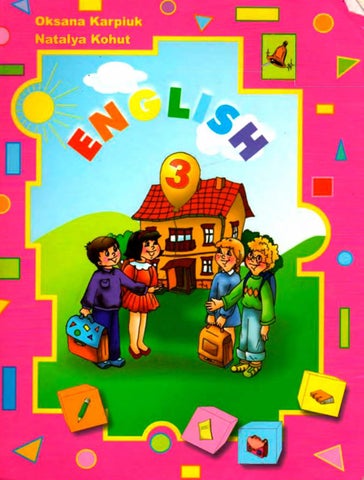
О. Карп’юк, Н. Когут
АНГЛІЙСЬКА МОВА Підручник для 3 класу загальноосвітніх спеціалізованих шкіл з поглибленим вивченням англійської мови Рекомендовано Міністерством освіти і науки України
Видання друге, виправлене і доповнене
і \/І ІІЇрсІЇГсррА '2011
CONTENTS 4-Л1
2-29 ^W ELCO M E BACK TO SCHOOL!
SPORTS AND HOBBIES IS THERE ANY FOOD? WINTER IS FUN! 8д И ( т GETTING ABOUT THE TOWN OUR WEEKENDS DAILY DUTIES THE WORLD AROUND VOCABULARY IRREGULAR VERBS
Lesson 1 1. a) Look, listen and point to the child. Germany 'ch3:mani Ukraine [ju:'krem]
2) Hans 3) Oksana
1) Stella England
America [э'тепкэ]
ГіддІппНІ
4) Jim a
Canada 'kaenodol
'fra:ns
6) Natalie 7) Nick b) Read the presentations and match them to the children. 5) Cindy
Hello! I'm Jim. I am nine. I come from England. Meel my new friends (V )
I fftllo1
V- -
^
X
v
My name is Oksana. I am nine. I come from Ukraine [ju:’krem]. Л
I like/ 4cooking. ____ ✓ 4
/
©
Hi! I'm Stella. V I am eight. I come from Italy ['italij. I like playing tennis. ^
Hi! My name’s Nick. I am ten J come from America. rI like boating.
jjHÜ I'm Natalie. I am 8. i f oome from France./ I like dancing, г "
©
Hello! My name's Cindy. I am 10. I come from Canada. I like singing and playing the guitar
Hello! I am Hans. I'm nine. \ I come from Germany. I like fishing.
2. Listen and read.
i] it, Nick, Cindy, Italy, England ae] camp, can, Hans, Canada з:] her, girl, Germany e| American, ten, Stella, Ben ei] name, eight, Jane, Ukraine a:] park, garden, France
3. Introduce yourself.
m
Hi! My name is ..., I am ... (years old)
I come from .... I like ......
4. Introduce Jim ’s new friends to your classmate.
Example:
Meet Stella. She is eight. She comes from Italy. ^ She likes playing tennis^
fords as,
Italy, Canada, Ukraine. America ■spell
1. Listen, point and repeat.
Ukraine —
UkrainianJ ~
Italy — Italian
Ijui'kremian]
1"
Canada —
< ~ ЬЪеНац |
America — American [э’шепкэп)
Germany [’d^man]
England —
Frafiee — French * * |frentj]
English höflliJl
2. Listen, read and talk. ВІН; Hello! I'm Bill. What's your name? Nick: I am Nick, Bill: Nice to meet you, Nick. Where do you come from? Nick: I come from America. And you? Bill: I come from England. Nick: Nice to meet you. What is = What’s I am = I’m My name is = My name's
3. Play your game.
A: Hello, I'm Dan. I am Canadian. What's your name? B: My name's Marie. A: Where do you come from? В: I come from France. I am French,
4. Read and compare.
% [ei]
[ae]
Jane game take make Kate cake
am and camp many Ann Canada
Ы not got cold hot
swim film Italy
Jк 7 spell
[a.|
like bike write nice
[el
pet friend tent American French
go
hello
“i f
e
111
І зо] no
Ii:i
we Pete he she
But: live [liv] have [haev]
France. Germany, England
u [a]
run jump fun supper
lju:|
Ukraine usually
Lesson 3V j ^ ^ ■/%.
. Listen and read. June. 21 Dear boys,
weather
/■s had The w
sitting in cold. It is ra,? n9 'tZ „ e r lam cafe and wnl'ng
„0Мэу
not having <* very y ^ What about you? Bye, JanC.
Dear Jane
Ju,y>
S 5sS S »»‘
ё ё Э ;
Canada. Ukraine Л ° Т 'Шуап<1
France anri n h
^
° M
'n
9
p
o l Z
:c
America.
n
< Z
See you soon. Bill and Jim.
^
Z
Z
т
і
і
к
Є
,а У ,П д
together [ts'geda) — разом
True or false? 1) Jane can't swim today. True. She can’t swim today. 2) The water is warm in the sea. 'А) Ляпе is writing a letter in a cafe. 4) Jiinn is hnvinri a good holiday at the sea. 0) I he boys аги having a good holiday in the camp. В) They don’t swim in the river, but they play team games. /) Ihw Ьиуь have got friends from Canada. Ukraine and America. 8) The boys have picnics and play outdoor games.
Ч^РЯйНМ
3. Read, match and speak about th e ir holidays. • • • • • • • • • •
Jane
* f ' :\
Bill
goes to the cafe doesn't swim in the sea swim in the rivur play outdoors has a bad holiday go boating lives at the sea live in tents have a good holiday plays indoors
4. Read and compare
r
ar, ar+e
or, oo+r
ir, er
[a:]
Ы
Із: I
park party are garden
sport indoors morning porridge
her girl bird German
Ij) [i] [ai] yes daddy my yellow granny fly many ey, ay
oy
[ei]
loi] boy Roy toy
they day play
ow [ao]
show snow
[ao] clown brown
‘Ш
Lesson 4 . Read and compare. USUALLY
NOW
It's seven o'clock in the morning, at this time. She is sleeping now.
It is eight o'clock now. Jane usually has her breakfast. She is waking up now.
It is ... Jane's school starts at this time.
Jane usually does her homuwork.
q
Janu usually goes to bed.
She is having her breakfast
She is swimming in the sea now.
She is watching a cartoon on TV now.
2. Read and say it correctly. USUALLY
NOW
-arr and Kate have (to have) soup and porridge for dinner.
It is Sunday today. They ure voting (to eat) potatoes and salad now
classmate usually ... (to play) football on Saturdays.
He/she ... (to ride) his bike now.
J lAnn's mother usually... [lo cook) dinner for the family.
Г
Ann ... (to cook) supper today.
Ж>
(С
- *he children usually ... (to play) computer games on Fridays.
They ... (to fly) a kite now.
:r.
\ 3. Read and compare. air, eir [ea] fair hair chair their
ea [i:l tea please sea read
“ — [ao] house mouse about cloud
[ia] / ear near Canadian Italian Ukrainian
11
Unit 1. WELCOME BACK TO SCHOOL! 1. Listen and read. a uniform I'juimfo.mI school uniform, to wear a uniform. Do you wear a uniform for school? I like my new school uniform, be over [hi 'aovo] School is over, we can play. Summer is over, September comes. Holidays are over, and we go to school, feel [fi;l] feel sorry, feel sad. I feel happy. I've got my birthday today. She feels sorry, her pet is ill. — How do you feel? — I feel sad.
2. Look, listen and talk. Ann: Hello, Jane. How are you? Are you ready for school? Jane: Well, I am fine. I’ve got a new uniform and a new bag this year. What about you? Ann: My old uniform is OK. I can wear it. But I feel sorry. Jane. Why? Ann: Summer is over... Holidays are over... Jane: So what? We are going to meet at school again. Isn't it nice?
—З. True or false? a) Ann has got an old uniform this year. b) Ann is happy to go to school again. c) Jane has got a new bag and a new uniform this year. d) Jane fe«is sorry that summer is over. e) Jane is happy to meet her classmates at school again.
12
^ 4 . Talk w ith your classm ate A: Hello? Are you ready for school? B: Well, I feel... A: I've got a new...
5. Rhyme
Summer is over, September comes. October and November Are also autumn months
September is the month When school begins1. It's time to work,” The school bell sings. Holidays are over, y j a No more fun. Holidays are over, * School has begun*.
A / \ ns Lbi ginzI — розпочинається begun [haez Ьі'длпJ — розпочалась
r<äs^
over, uni
. Listen, point and repeat.
ф pocket m
.
badge
uniform
J\2 . Listen and read. A SCHOOL UNIFORM
Mike Stones is an English schoolboy. He goes to school in London. When he goes to school he wears a white shirt and a tie with the colours of his school. He wears a school jacket. His jacket is blue, the colour of his school. He has got the school badge on the pocket uf his jacket. He has got his school badge on his cap too. Winter in England is not very cold. It does not snow much, but it often rains. Mike often wears a raincoat in winter
3. Answer the questions.
-|4
a) Whnrn does Mike go to school? b) Does he wear a tie? c) What colour is his jacket? Why? d) What has he got on the pocket? e) Does it snow much in winter in England? f) What does Mike Jones often wear in winter?
К ш
ft
4. Speak about yourfriend/classm ate. What is your friend's/classmate's name? Is he/she tall? What colour is his/her hair? Has he/she got long or short hair? What colour are his/her eyes? What is he/she wearing today?
і г
5. Look and describe the uniforms.
6. Write to your pen friend about your school’s uniform. • • •
the colour of your school's uniform. the school uniform for boys the school uniform for girls
7. Design the uniform 1for your school and tell about it. to resign [di'zam] the uniform — розробити фасон шкільної форми
_
uniform, badge, pocket
15
1. Listen and read. after ['(kFU] Autumn comes after summer. February comes after January. W h ^ L ^ s o n comes after Maths today?
before [ш f£| February comes before March. Autumn comes before winter. What dayijft before Tuesday? class [ЙІт-sj classes, in class, after classes, before classes. Do you speak Enplish in class? I don't play before classes.
2. Look, listen and talk. Bill: What are you going to do after classes today, Jim? Jim: I don't know. Bill: What about playing football? Look! The weather is nice today. Jim: OK. But let's have lunch at school before football. I'm very hungry. Bill: Great! Let’s meet before lunch. I am going to have lunch with you, too.
11
Ask and answer. What are you going to do after classes? ' -----і ____ ^ ^ ( I am going to do shopping. meet my friend, play volleyball, read an interesting book, go swimming, have lunch, go to the Zoo
16
4. Look at your tim etable fo r today and say. What lesson comes after Maths? What lesson have you got before Reading? What is before Maths? What is after Reading?
5. Read and answer the questions. Summer holidays are short in Britain - only six weeks. But schoolchildren also get two weeks in winter, two weeks in spring, a week in October and a week in February. • • •
How many weeks of holidays have British schoolchildren got in a year? What holidays have they got before summer? What holidays have they got after a holiday week in October?
► ^
I„
6. Tell your classemate what you usually do:
Words
• • •
before classes; in class; after classes.
after, before.class to spell
Lesson 4 1. Read and compare. at
four o’clock night the lesson
on
Tuesday Monday morning / Saturday evening Maths, Ukrainian
in
the evening / the morning / the afternoon summer / autumn September / May
2. Listen to the classroom talk. Then agree or disagree. 1) Ann has got Reading on Mondays. 2 ) Sam has got Maths on Wednesdays.
3) Jane's favourite lesson is Maths. 4) Jane likes to write and read. 5) Jim likes PT lessons.
^
Д 3. Look, read and match a)- f) sentences to the children, О
18
Г Г — N Mika Maths. JJike Ukrainian.
a) He likes to read about animals. t>) She likes to draw pictures.
I like Reading. I like Nature Study. I like Art.4
c) He likes Iq count and do sums. d) She likes to speak English. e) She likes to read books.
I like English. f) She likes to write.
*£4. Ask and answer. When do you have Maths?
I've got Maths on Tuesdays and Fridays.
Do you read stories in Maths?
What do you do in Maths lessons?
No, I don't. I count and do sums
5. Answer the questions. 1) What's your favourite day of the week? 2) What time do you usually get up that day? 3) What time do you go to school? 4) How many lessons have you got? 5) What is your favourtie lesson? 6 ) What do you usually do at this lesson?
t
\ 6. Write about your favourite day. ... is my favourite day. This is what I usually do on .. I get up .... I like .... After classes __
V o rd ^
D* Spell
avou rile. Ukrainian
19
Lesson 5 ✓
Д 1. Listen and read. a test [test] to have a test. We've got a test on English. Schoolchildren are having a test on Nature Study now. What are you going to do after the test? How many tests have you got this week?
2 . Ask and answer. What test have you got) (We've got a test on English. t o d a y ? ^ v ___ _________
Nature Studies, Reading, Ukrainian, History, English, Maths /
3. Look, listen and talk. ./яла: What are you doing this Thursday? ПНІ: I don't know. Why? Jene: We arc going to have a test on Maths on Гrlday. Can you help me with it? Bill Of mursiH, I can. When can we meet? Jane; Can we meet after classes on Thursday? Bill: OK Two o'clock then. Snn ynu bye. Jane: Bye and thanks a lot.
20
4. Answer the questions. 1. What is Jane going to have on Friday? 2. Who can help Jane with Maths? 3. When are Bill and Jane going to meet?
5. a) Read and choose a) - c) phrases to have a talk A Can we read a book now? B : ... A It's four o'clock. B : ... A: Can't you do it after the reading? В: . . .
a) Sorry, I can't. I am going to have a test on Maths tomorrow. b) Oh, It is late. I must do my homework. wж. .• c) And what time tC ' is it? ЧЛ
b) A ct o ut the talk in pairs. 6. Say w hat they are: 1) a day of the week which comes after Monday; 2 ) a thing pupils wear at school; 3 ) days of the week when pupils don’t go to school; 4) a lesson when pupils can run, jump and ski; 5) a day of the week which is before Thursday; 6) a lesson when pupils can make things.
7. Fill in: 'at', 'on', 'in', 'after', 'before'. a) Sam gets up ... eight o'clock in the morning. b) They clean their teeth ... the morning. c) They play football ... classes. e) Yesterday we had a te s t... Ukrainian. f) I never play with my friends ... classes.
Thursday,Wednesday, H istory
21
Lesson 6 1. Listen and read. PRIMARY1SCHOOLS IN ENGLAND In England schools have got names not numbers. For example, schools have got names like Graveney* School or Gedar Grove3 School. Primary schools teach children from 5 to 11 years old. The school year begins in September. Classes usually begin at nine. Pupils have got a glass of milk or a glass of orange juice at eleven. At half past eleven or at one o'clock they usually have got lunch meat, pudding, juice or a cake. Pupils often sit on the carpet on the floor and listen to the teacher. Usually they have some pets in class- hamsters, rabbits, — — -— / **■* birds or fish. Teachers like — - *to read or tell interesting ■Jo Rr' stories English pupils often play outdoors during hrn.'iks
1Prlmnry [‘prflimari 3Uraveney [‘qrTfvSml ’ Cedar Grovojlaj^v'
почлтксва i .
‘ я пгеяк [brrik]|= перерва
2. Answer the questions. 1) Have English schools got numbers or names? 2) What is the age of children who go to primary schools in England? 3) Do English pupils usually have lunch at home or at school? 4) What do schoolchildren usually do during breaks?
22
3. Complete the sentences according to the text above. -»'/The school year starts......... 2) At n in e ......... 3) At eleven pupils....... .
4) At half past twelve they 5) Pupils ofte*:......... 6) Usually th e y.........
4. Listen and read. ible ’’клтКэЫ] a comfortable chair, comfortable shoes. Is your room very comfortable? This coat is not very comfortable it is smnll ground I'spsits graond] There is a sports ground behind the school. We jump, run and play sports in a sports ground, с 51m] There is a big gym in our school. In winter we've got Sports in n school gym. V eik] Schoolchildren have got breaks between the lessons At school we've got one long break and two short breaks every day. lor ’kondo:] We can see many schoolchildren in the corridor between the lessons. Pupils usually go out into corridors during breaks, нп kaen'ti:n] Schoolchildren have got their lunch in a school canteen. There are twenty tables and lots of chairs in our school canteen.
5. Look at the plan and describe the school. Exam ple: This is a primary school. It is small. There are ... There is ... BARRON's Primary School
J K .. to SDell
primary,
gym,
canteen, corridor
sports ground
( Lesson 7
)
І д_________________ __
%
^
1. Listen and talk.
Jim: Good morning, miss ones. Мяу I take my seat? Teacher: You are late again, Jim. Don't you know you must not he late for school? Jim: Yes, I du. I am sorry, Miss Jones. I've got a note from my mum. Here it is. Teacher: Well, we must have a talk after the lesson, take your seat now. Jim: Thank you
2. Read and compare.
%
< :>
must do it.
We You He She
mustn't do it.
It They
Must
24
1 ^
1
we you he she r they
we you he she it they
Yes, do it? No,
must not = mustn't
і must. mustn't.
3. Read the school rules they have got at Blackpool School. Ask and answer about them.
BLACKPOOL SECONDARY SCHOOL RULES
1
1) School starts at 8:30. You must not be late 2) You must not walk on the left in the corridors. 3) You must not eat in the classrooms. 4) You must go out during breaks. 5) You must bring a note from your parents if you have been ill. 6) You must wear the uniform at all times in the school. 71
I
Ф
\\
Example: A: Must they eat in the classrooms? B: No, they must not.
4. Write the rules you have got at your school. Use 'must', 'must not', 'can', 'cannot'.
Example: wear a uniform
You must wear your uniform.
eat at the lessons run in the corridors be polite to teachers be polite to classmates run in the sports-ground write on the desks write in the books with a pencil •
take a packed lunch with you take some toys with you come to school on time go out of the classroom without asking talk at the lessons sleep at the lessons listen to the music at the lessons
Words. ruLe, m ust, wear to-spell
l-i-l-l-H
25
Lesson 8 ~
V
1. Listen and read. Assembly Hall [o'sembli ,ho:l| Children usually have got school parties in the school Assembly Hall. There is a large comfortable Assembly Hall in our school. library [’laibraril There are many books in our school library. In a library you can take an interesting book to read.
2. Listen to the boy's letter and tell about his school.
. True or false? 1) Dan's school-rs very big. 2) There is a big sports ground in front of the school.
26
■ T h e re is a big Assembly Hall and a good library in the school. И There isn't a gym in their school. Ь Pupils usually have lunch in their school canteen. ■JTnere is a mouse and a parrot in their Pet's Corner. ) Scnoolchildren must not feed the pets. ІЦ Schoolchildren must go out of their classrooms during the breaks, 'srt Dan doesn't wear a uniform in school. 1С Pupils can read 'School Rules' in the corridor $ 4 . Work in pairs. Take turns to ask and answer the
questions. 1) What school do you study at? 2) How many lessons a day have you got? 3) When do your lessons start? 4) How many breaks have you got every day? 5) Where do you have lunch*? 6) Do you wear a school uniform? 7) What don't you like about your school?
5. Rhyme. SCHOOL school has doors that open wide1, And friendly teachers wait inside. - jrry. hurry, let's go in For soon the lessons will begin. Books and pencils you will need, When you start to write and read. Lots to learn and lots to do. You like to go to school, don't you? Aide |waid] — широко
WöFdS:
к
le-spell
AssembLy HaLL, Library
Round-Up Lessons 9-10 j 1. Read and say what the boy studies at school. TIKI GOES TO SCHOOL Tiki is eight. He is a little boy. He lives in Africa. Tiki goes to school. His school starts at 7 o'clock in the morning. There are 52 pupils in Tiki's class. The pupils play in the playground before classes. Some of them wear their school uniform: a white blouse or a shirt and a blue skirt and shorts in the classroom. Others do not wear uniform because it is not comfortable when it is hot In the room. __ \ 'у Befuru classes they sing one or two songs. The pupils have got classes five days a weak, hvury day they have got five lessons. They study t/En^lish, Maths, Nature Studies, P.Т.. History, Music and Art They have got swimming, games and computer studies, too. After classes Tiki plays football and then дон»; home. When he comes home, he has his, lunch. He usually watches cartoons on TYjbefore he does his homework.
2. Read and match about Tiki and his school. 1) Tiki's school starts a) five days a week. ?) The schooruniform is not comfortable b) he watches cartoons on TV. 3) Pupils have got classes c) at 7 o'clock. 4) After dnssos the boy plays football / <d) and then goes home. (g)'Before he does his homework when it is hot in the room. r
Spuak about Tiki and his school.
28
Where is Tiki from? • How many pupils are there in • his class? • What do pupils usually do before classes?
Do all pupils wear a uniform? What does Tiki study at school? Does he have lunch in their school canteen?
|4. Role-play. Work in pairs. You have got a new classmate. He/she asks you about the school. feftk itnere a library at school? s, there is. There are many interesting books in it. I have lunch at school? you can. I usually have lunch in a school canteen classes. We can go there together. Thank you.
3. Your Project. 1) Interview the classmate who sits next to you about his/her age, family, hobby, his/her favourite sport or subject al school. 2) Copy and fill in the form.
My classmate 's name is ___________________ _________ He/she is years old He/she has got________ brothers/sisters. His/her favourite sport is_ He/she likes (his/her hobhy)
His/her favourite lesson is
29 ►
Unit 2. Sports and Hobbies Lesson 1 Listen, point and repeat.
4
*
4 play volleyball [plei ’vulibo:!]
fh»gym du: '(ідии
skate [skeitj
do judo‘ [du; 'd^uidaol
play basketball [plei 'ba:skitbo:l]
play table tennis [plei 'teibl .tenis)
play hockey І plei ’hDki]
Listen, read and talk. Jane: Who is this? Bilf: This is Stella. Jane: Stella? Is she English? Jim: No, she isn't. She is Italian Jane: What is she doing? ^ ß iil: She is doing gym.
is not = isn't are not = aren’t
thine: And who are these? Jim: These are Hnns and Nick. b ill Hans is German. ./ллє, lü Nick Qwrman, too? Jun. Nn, he isn't He is American. Jane: What are they doing? Bill: They are doing judo.
. Listen and read. [a:] glass, France, park, basket, basketball [d ] hot, shop, office, copy, holiday, hockey, volleyball [ds] jam, Jim, judo, giraffe, German, gym
іpie: Bob and Mark are doing / playing judo Max „and David
answer
V i/? English
> %
? Canadian
? American
Ukraine
Franca
? Ukrainian Number 1. Is he English?
? English
? German
No, he isn't. He is Italian
basketball, voLLeubaLL, skate, s
Lesson 2 1. Read and compare. I
і am playing. He is playing. We You They
і
L
We You are not reading. They
are playing. --------------------------------------------------------------------------------<
Am I writing? he Is she writing? it we Are you writing? they
"O" I am not reading. He She is not reading. It
2
>
— Yes, you are. / No, you are not — Yes, he is. / No, he isn't,
— Yes, they are. / No, they are not. run - running swim - swimming skip - skipping
write - writing ride - riding take - taking race - racing
Look at the picture in ex.4, page 13 and talk with your friend. Example: Jeff / volleyball A: Is Jeff playing volleyball? В: No, he isn’t. A: What is he doing? В: He is playing basketball. • Jeff / volleyball • Tina / table tennis • Ann, Sue / basketball
• Bob, Mark / do gym • Max, David / do judo
J
і
3. Look, listen and match. Then answer.
Fred 4
Linda and Kate
Helen___
Terry and Mike___
Robert and Chris John and Jack
1) What are the schoolchildren doing today? 2) What is Fred doing? 3) What are Robert and Chris doing? 4) What are Linda and Kate doing? 5) What is Helen doing? 6) Are Terry and Mike playing volleyball? 7) Are John and Jack playing hockey?
SS?4. Look at the pictures above. Ask and answer.
Picture 1. Who are these? (Who is this?)
These are John and Jack. (This is ...)
do gym, do judo, hockey. ia b L e - t e n n is
33
Lesson 3
)
1. Listen, point and repeat.
s
t 1car-racing
faring I'reisirji
A*-** A
1
-Г--
g
fV
I
horse-racing
40
poster
3 ^ u n if o r m
I'paosta]
"
[ju:mf3:ml
[praiz]
2. Listen, read and talk. Bill: Look, Jim! This is my favourite basketball team “Flyers". They are getting a prize now. Jim: Are they winners today? Bill: Yes, they are! Look, they are wearing nice uniforms! Bill: Is this yuur favourite football team on the pubterV Jim: You il іь. The team is having a football mululi luday. We can watch it on TV at b o'clock. Bill: OK.
. Listen and read. 34
[ju:] usually, Ukraine, uniform [ail like, five, nice, ride, prize
Ann, Canada, many, match , game, take, race Jmaetj ] football match, to have a match. I like to watch football Ifnatches on TV. Our school team is having a football match today.
ШПГ. to win a game, to win a match. Hooray! We are winning! Mary is ^ojng to win in table-tennis. She is a good player. wins] Who is the winner of the game? John is the winner today (reis] 1. to race a car, to race a horse. Who is racing that rod cur? 2 to run a race, to win a race. Look! Albert is winning this racc й is a great horse! These cars are running a race in France. ф
3 4. Look, ask and answer. me
favourite sport
favourite team
team's uniform
ne
volleyball
Yellow Tigers
В II
basketball
Flyers
Jim
football
Liverville
Sam
hockey
Peggy Boys
a yellow T-shirt and black shorts, yellow socks: blue and white T-shirts and shorts, white socks; green and yellow T-shirts, green shorts and yellow socks: red and white shirts and black trousers
A What is Jane's favourite sport? В: Her favourite sport is volleyball. A: What is her favourite team? B: “Yellow Tigers." A: What is the team's uniform? B: They wear yellow T-shirts, black shorts and yellow socks.
^ ^
5. Interview your classmate about his/her favourite i sport or sports team.
W o rd s ^
w in,winner,
K
- і
to-spell
match, r ac e
35
Lesson 4
)
. Listen and read. Dear Bob, Thank you for your letter. I am glad your favourite sport is car racing. It is my favourite sport, too. I like watching car races on TV. My favourite sportsman is Michael Frenoe [ fre no.y. He is a prize winner in France this year. I like his uniform. It is red and white. I've got some posters and photos o f Michael and his cars on the walls in my room. Write about your favourite sportsman. Best wishes, Ted.
True or false? 1) Dob's favourite sport is horse racing. 2) Ted’s Favourite sport is car racing. 3) Ted’s favourite sportsman is German. A) The uniform is red and black. 5) The posters of his favourite sportsman are on the walls in his room.
Number 1. False. Bob's favourite sport is a .........
3 Write about the sportmen below (6 sentences) or your favourite sports team.
'4. Act out the scenes of lesson 3. 5. a) Match and say. to watch to get to play to wear to win to race to do to have
• X. X
N. X
•s.
X V
X.
X
V
X
X
V
X
a prize a race gym a car hockey a match a game a uniform
b) Make up three sentences w ith the phrases above. Example: O urschool team can get a prize today.
6. Rhyme. WINNERS' CHANT !>e having IScorts today L«fs go out, Race and play Let’s be winners, Get a prize. JK'S going to be nice! :’s do judo. Let's have fun! We can jump •*nd we can run. _efs play hockey I And do gym. We can be A real team!
37
Lesson 6 __ _
^ ^ 4
A
Read and compare. /Ts
і іі
We
can dance. You He / She / It They <3> Г I he she Can it dance? we you they
We You He / She / It They
cannot dance.
I
Yes, No,
he she it we you they
can. cannot.
cannot = can't [ka:ntj
ї $ 2 . Look, ask and answer as in the example. Example: Number 1. Can he join the Dancing Club?
ил
• join the dancing club?
© play football?
play basketball?
• join the basketbal club?
3. Listen and match the names to the girls.
2=4 1
4. Listen again, read and complete. Nancy is good a t ... Nancy's favourite sport is ... Nancy is interested in ... L is fond of painting.
5) Rosie's favourite subject is 6)... is interested in music. 7) She is good at ...
5. Speak about yourself name's ... I'm good a t... fond o f ...
My favourite sport is ... I am interested in ..., too. I'm going to join th e ...... this year.
. Act out the scenes of lesson 5.
Lesson 7 і
:>1. Listen, point and repeat.
£ coin [loin]
stamp [staemp]
badge і [hapd^]
I
L
m &
postcard I'paostku’.d]
sticker [stika]
mask [ma^sk]
comics ['kumiks]
2. Listen, read and talk.
Spoaker: Good afternoon! This is “School News Programme" Today we've got a School Hobby Fair. Children from different classes present their collections. This is Mary Woodcraft. She collects dolls, iell us about your collection, Mary. Mary- Well, here is my collection. There are dolls from different countries in it. I’ve got one Lnglish doll, two German, one Ukrainian, one Canadian, and three French dolls. My ^ favourite is the Italian doll. Speaker Oh, your Italian doll is really very beautiful!
■т..
*
\Ъ . Listen and read.
[jn] invitation, collection, nation, nationality [a:I glass, class, fast [d^] fridge, porridge, badge jeaj hare, chair, hair, fair [i:] me, these, scene, Pete, theme
42
to collect — a collector to act — an actor
(]• I to collect dolls, to collect coins, to collect stamps. My сoilects badges. I collect stickers. What do you collect? ___ • - : eкJn] a collection of dolls, a collection of masks. I have got a > ; scl ecuon of postcards. Have you got any collection? # lekta] a good collector, collectors from different countries. A m l. a good collector: her collection is small. Is Bob a coin collector? ЮІ ; the theme of the lesson, the theme of the collection. What is ^~me of Mary's stamp collection? - zent] to present a project; fo present a collection. ^.lectors present their collections on different themen tnriny Гг A t Fair, Flowers and Vegetables FaiK-this year the Handicraft s in the hall of our school. Childrorrare going to perform their 5 at the Fair.
Read and match. *
t ask and answer.
1 1Are you fond 21 is he good' ^ Do you collect ^ ^3 Have you got a collectkxf^^ is he interested 6; What is the therm 7) Is she a
coins? of badges? in Maths? t swimming? o f his collection? collector? of collecting stamps?
5 Play your guessing game. Ask the questions below. you got a collection o f ...? I have. / No, lhaven't. = fond of collecting ... ? p№. 1am. / No, I am not.
collect... ? ••ri ! do. / No, I don't, you a ... collector? I am. / No, I am not. you interested in collecting .. css I am. / No, I am not.
У
с о LLe с t , coin, mask, stamp, comics, theme
і 43
Lesson 8 \ l . Listen and read. This is Julia Olsen. She is from England. Julia is English. She is good at doing gym. Julia is a winner of the season. In the photo she is getting her prize. Julia is interested in collecting postcards from different countries. Her favourite postcard is from (Iraoml - Рим).
This is Robert York. He is from Canada. Robert is Canadian. He is good at playing hockey. His team is the winner of the match. Look, they are getting a prize in this photo. Robert is fond of collecting toycars, too. He collects different car makes. Red Ferrari is his favourite toy-car.
2. Read, choose and say. 1. Julia is from England . <*) England b) Poland 2. She is good a t .... a) doing Judo b) doing gym 3. Julia is interested in .... a) collecting toy-animals b) collecting postcards 4. Her favourite ^s tc a rd is from a) Rome b) London
44
5. Robert York is from ... . a) Ukraine b) Canada 6. He is good a t .... a) playing tennis b) playing hock 7. His team is a ... . a) collector b) winner 8. Robert is fond o f .... a) collecting stamps b) collecting toy-cars.
L
3. Interview your classmate.
І1) Where are you from? ' /Vhat do you like doing? Ь What are you good at? - What are you fond of? t What is your favourite sportsman / team? і What does his / her / their uniform look like? ) Are you interested in collecting? If yes (якщо так), what do you collect?
■5
Read and act out. A: What do you like doing? В: I like playing basketball. And you? A: I am fond of reading books. What is your favourite basketball player? B: Mike Adams from ABN team.
5. W rite a le tte r to your pen friend. Tell him /her about: • *ne things you are fond of • your favourite subject at school • tie things you like doing at home
the collection you have rpt a club you go to or going to join your favourite sport and a sportsmar
6. Rhyme. FAMILY'S HOBBIES My Mum is very good at cooking. My Father always likes to read. Vy dear Granny's fond of music. Sometimes they shout and can't agree. So. I can help my Mum with cooking. I give my Father a new book. cor Granny I turn on my player... Now they have got a happy look! W o rd ^
_ J to perform, badge, postcard, fair, s t i c k e r
К
—— ж
J
to spell
45
^
\ 1. Read and name the sports the English play/do. SOME THINGS THE ENGLISH ARE FOND OF
The English is a sports nation. Lots of English people do different sports and are fond of playing sport games. You know, of course, that English boys like to play football and hockey. But do you know what games English girls like to play? In England girls usually play netball. They play hockey, too! Many schools have got their sports teams. Do you know that there are also such games in England as golf and cricket? English people like to watch games and sports^ too They come to watch horse races even ([’i:ven] - навіть) when the weather is bad. There are different clubs for boys and girls in England. Parents often go to their children's schools to see their children's work. Some of the the schools have fairs. Pupils perform their art or project work. Many schools perform concerts and plays at the end of the school year.
'2. True or false? 1) Fngllsh people like to watch horse races very much. Number 1. 2) English girls like to play football and cricket. True. 3) The English is a sports nation. Yes, they do. 4) English boys like to play football and hockey. 5) English girls don't play netball. 6) Parents don't go to their children's schools. 7) Parents perform their art or project work at fairs. 8) Many schools have got their sports teams. 46 9) Many schools perform concerts and plays. 10) People play golf and cricket in England.
3. Role-play. AT THE SCHOOL FAIR A. You are a School TV speaker. You are presenting a collector. 5 You present your collection at the Fair Speak about the collection. afternoon! This i s ....... Programme. at th e ....... This i s .........He / she collects ... ....... please. is ......... There a re ........ in it. My favourite ... you .... Your collection (hobby) i s .........
Your Project, dassmates about their
rS Ron. of reading, es have got hobbies. doing sports. Rose seed in collecting dolls. >Döby is playing •er games. Nancy is fond ■fcSLtäfC. Tom is fond of music,
Steve Rose Dob Nancy Tom
collecting things doing sports painting music computer ames
ng
X
X
X
X
X
V/
X У
X
X
X
X
Unit 3. IS THERE ANY FOOD? ( Lesson 1 1. Listen, p o in t and repeat.
pie [pai]
honey [’Ьлпі]
money [’тл пі]
sour cream Isaoa kri:m]
flour Iflaoa]
2. Listen, read and talk.
Mother: Well, there is some sugar, there is some butter and there are some apples. Oh! There isn't any flour and there aren't nny eggs.
Ann: Mum, what are you doing? Mother: I am going to make an apple pie. Can you go to the shop and buy some flour and some eggs, Ann? Ann: Sure, mum. Mother: Here is the money.
. Listen and read. mother, month, some, monkey, Monday, honey, money у, і [ai] buy, bye, sky, fly, hi, lie, pie our [a(io] our, sour, flour money І'тл пі] Have you got any money? You need some money fo shopping. Look, there is some money on the table. Oh no, there isn’t any money here.
4. Look and say as in the There is some butter In the fridge. There are some eggs in the fridge. There is not any flour in the fridge. There are not any bananas in the fridge. mbers, tomatoes, potatoes, ts, honey, chickens, lemons, ra s , apples, water, butter, pie, tad, honey, eggsr ice-cream, aese, sour cream, milk, ndwiches, bread, pears
5. Rhyme. Apples are sour, Apples are sweet.
0Г
sour, sour-cream, flo u r
Appfes are juicy And nice to eat!
Lesson 2 і /л
1. Read and compare. There is a lemon. There is an egg.
There are some lemons. There are some eggs.
There is some water. There is some meat.
^
2. Look and say.
I hero are some ...
There isn't any
3. Listen and complete the sentences. 1) There ... some ... and there is some ... . 2) There ... some ... but there ... not any sausages. 3) There not any sour cream and there ... not any 4) There is some ... but there ... n o t... sausages.
4. Fill in ‘is* or ‘are’ .
50
1) There 2) There 8) There 4) There 5) There 6) There
a glass of milk on the table, some apple pie in the fridge, some bananas in the basket, some money in your bag. not any sour cream in the fridge, some tomatoes in the basket.
i. Look and say as in the examples. There is some meat on the table.
There are three oranges on the table.
?re are not lemons.
6. A ct out the scenes of lesson 1. 7. Rhyme. SHOPPING A bear and a bunny Have much money. They go to the shop For carrots and honey. When the bear and the bunny Ask for some carrots and honey The man in the shop Says, “Where is your money?” How strange1 and funny! They really have money — And that’s how they buy Their carrots and honey. 1strange (stremd3] — дивно
pie, honey, money
FOOD SHOP
I 1. Listen, point and repeat.
chocolate [’tjDklit]
sweets [swi:ts]
biscuits ['biskits]
2. Listen, read and talk. Bill: Helio mum, hello dad! Here I am. Father: Hello, son. Come in. Mother: The dinner's ready. Bill: Oh, yes! I'm so hungry! Are there any potatoes for dinner? Mother: Well, there aren't any potatoes, but there is some rice with chicken today. Father: I’ve got a sweet surprise for you. Bill: Are there any sweets in the box? Father: No, there aren't. Bill: Is there any ice-cream in it? Father: No, there isn't. Let's see. Bill: Wow! Biscuits! My favourite biscuits. Yummy!
s
3. Listen and read. [з:] girl, bird, third, thirty, thirsty thirsty [’03:sti| be thirsty. I am thirsty. Is there any water? I'm very thirsty. hungry ['Илддгі| She is hungry. She is going to eat. I am usually hungry after school. When I'm hungry I go to my kitchen: there are always tasty things to eat. surprise [sa’praiz] a nice surprise. What a surprise! It's a great surprise for me, thank you!
к Look and make up questions.
there any
bananas? bread? lemons? oranges? pears? meat?
there any
chicken? pizza? cake? pie? cucumbers? tomatoes?
5. Look, ask and answer.
Yes, there is.
No, there aren't.
1. Read and compare. 0 ^ u There is some flour. There isn't any flour. There are some apples. There aren't any apples.
© Is there any flour? Are there any apples?
© Yes, there is. / No, there isn't. Yes, there are. / No, there aren't
2. Complete the dialogue. A ct it out. A: I ... very hungry. Is there ... bread? B: No, th e re ......... But there are ... sandwiches. A: That's good. Let's have some. B : ... you thirsty? A: Yes, I .... Is there ... juice? B: Yes, there .... Here you are. A: Thank you. B: You are welcome. '/
3. Listen and read. A NEW KITCHEN FOR SANDY’S DOLL Snndy is five. She doesn't go tn nchool. Sandy likes playing with dulls. Sandy has got a new toykilchun loday. The kitchen is nice.There is a table, a cupboard, a cooker and a fridge. There are two chairs in it, too. Look, there is some 54 toy-food in the fridge. There are some toy-
eggs, oranges, apples and hot dogs. But there aren't any potatoes. There aren't any cucumbers or tomatoes. Sandy's dolls can cook food m the kitchen. Well, they can have some eggs and fruit for breakfast. For dinner trey can have some meat or fish. But there isn’t any soup in the fridge! Is it a problem? No, it isn't. Sandy can make some soup on the cooker for her dolls. 3
4. True or false?
5e r 1) Sandy is four. False. Sho isn't four. 2) Sandy is fond of playing. She is five 3) Sandy has got a new toy-car for her doll. 4) There isn't any table in the doll's kitchen. 5) There is some toy-food in the fridge. 6) There is some meat and fish for dinner. 7) There isn't any soup and it is a big problem. 8 ) Sandy can cook some soup on the cooker. 9) Sandy likes her new toy-kitchen very much.
^ 5. Play this game in a group.
4
One of you is a shop assistant. He/she draws the food he/she has got in his/her food shop. The others can’t see the drawings of the seller. The class guesses what there is in the shop. The winner is a boy or a girl who guesses the best (‘buys’ the most) (переможець той, хто найбільше відгадав або “купив").
A: Is there any milk in your shop? B: Sorry. There isn't any milk. C: Are there any oranges? A: Yes, there are. D: Are there any ...?
sweet, biscuit, chocoLate
55
Lesson 5 1. Listen, point and repeat.
bottle [ Ь D tl ]
lemonade J l.leme'neid
2. Listen, read and talk. Jim: I am so hungry. Ann: I am hungry, too. Jane: Here is the cafe. Ann: Have you got hamburgers? Waiter: No, we haven't. But we have got cheeseburgers and fishburgers today. Ann: One cheeseburger and one fishburger for me, please. Bill: Three cheese and tomato pizzas, please. Waiter: What about some lemonade or coca-cola? Jane: Have you got any juice? Waiter: Yes, we have. We've got different kinds of juice. Jane: Two glasses of tomato juice. Jim : ... and two bottles of lemonade, please.
\з.
mind, find, climb, child, kind [з:] purple, turn, curly, Thursday, burger a kind of Iэ 'kaind av] a kind of ice-cream, a kind of food. Lemonade is a kind of drink. What kinds of burgers do you like? a glass of [э gla:s av] a glass of juice, a glass of milk. Two glasses о water, please.-I'm thirsty. Can I have a glass of orange juice, please' a bottle of [э 'botl av] a bottle of coca-cola, a bottle of lemonade. Have you got a bottle of tomato juice? One bottle of lemonade, please. [mi]
}
Listen and read.
4. Read and complete. . have you got?
1) What kinds of 2) Can we have a 3) Can I have a 4) A
*
ч г
. of coca-cola, please? ... of milk, please?
...of coffee and two
of лрріе juice, pleasel
... are there in the cate?
5) What kinds of \
6) A
.. and two
eg ... of lemonade, please.
5. Answer the questions above. Use the phrases. Sure, you can. / We've got different kinds o f ... / Certainly, you can. / Yes, of course. I Yes, sir (madam).
6. A ct out the scene of the lesson. 7. Look, ask and answer. A: Have they got a n y ...... ? B: Yes, they have. / No, they haven't. A: What kinds o f ... have they got? В: They've g o t.......
\M \\EW N \\u\ qPichburaers f \ shburgers n n Hamt>urgets VOOÖS О Cheeseburgers ф . 5 )utc* Q Cheese p'zza □ Tomato p\zza Q Chicken ptoa О Mushroom pizza
Words
kind of. gLass of. boitLe of to spell
57
СLesson 6j ^
1. Read and compare.
« =
/T v
< *>
I We haven’t got any eggs. You They
have got some eggs. ґ ї\
I
I got any eggs?
W
we you they
Yes,
have.
we haven’t. you they
I
hasn’t got any eggs.
has got some eggs.
he she it
No,
got any eggs?
Yes,
Look, ask and answer.
he she it
has.
No,
he she it
I
hasn’t.
\
Picture ‘a\ Have they got a ballon?
Yes, they have. / No, they haven't.
3. Listen to the TV show and answ er
emonaae, coca-co
ч ( Lesson 7
1. Listen, point and repeat.
ел bar Iba:]
jar Мза:|
■% ^
pack [paek]
carton [’ka:tn]
can [kaen
bag Ibaeg]
2. Listen, read and talk.
Jane: Hello. Seller: Hello, Jane. What do you want today? Jane: I want a pack of butter and a bag of potatoes, please. Seller: Here you are. Anything else? Jane: I also want a carton of orange juice, please. Seller: Sorry, we haven't got any cartons of orange juice but we've got some cartons of tomato juice, some cartons of banana and pear juice. Jane: A carton of banana juice for me. Here is the mone^ Seller: Here you are.
3. Listen and read. 60
|ae] cat, map, cap, can, pack, bag |a:j farm, far, dark, scarf, March, are, bar, jar
Look and say as in the example.
(juice) He wants a
(honey).............
(oranges)......
5. Look at the pictures above, ask and answer. What do you want today? ’ Anything else?
I w a n t... | a|S0 w a n t...
Lesson 8 у
1. Read and match. a bar different kinds a bottle a bag a jar a can a glass a cup a piece a carton a plate a pack
oranges biscuits milk tea lemonade juice soup chocolate honey coca-cola sweets pie
2. Make up 3 sentences w ith the w ords above. 3. Listen and read. LUNCH AT SCHOOL Twelve o'clock is the time for lunch in our school. Children are running to the school cafe. They are thirsty and very hungry. Today they have some potatoes and some fish, a glass of tea and some biscuits for their lunch. There are also different kinds of burgers, pizzas and salads. Pupils can buy bottles of water, cans of lemonade or cartons of juice. My friend Pete likes to buy a bar of chocolate or a box of sweets. We like to have lunch at school.
Flour
4. True or false? 1 Children can have lunch at school. 2) They have lunch at one o'clock. 3 The pupils are hungry after the lessons. - Today they have some meat, peas and a glass of juice for lunch. 5) There are different kinds of pizzas at school.’ ^і 6 ) Pupils can buy water, but they cannot buy any lemonade. 7) My friend likes chocolate and sweets. 8 ) We like school lunch.
5. Write about yourself. 1 ) Have you got your lunch at school? 2) When have you got it? 3) What do you usually have for your lunch?
6. A ct out the scenes of lesson 7. 7. Counting Rhyme (лічилка). A ja r of jam is for little Sam. A can of cola is for sister Nora. A bottle of lemonade is for Kate. A cup of tea is for me. What about a piece of cheese? Who is it for? Help me, please!
1. Read the text. ENGLISH MEALS 1 The English have four meals a day: breakfast, lunch, tea and dinner or supper. Breakfast time is between seven and nine, lunch time is between twelve and two, tea is between four and five and dinner or supper is between seven and ten. English people like porridge. They usually eat it for breakfast. They like to eat porridge with milk.
English people don't eat m ud bread. They never eat bread witt meat or vegetables. But the) sometimes eat bread with soup. The English are great tea drinkers. They usually have tea four о five times a day. They like to have tec with milk. They drink it from cups no from glasses.
’meal [mi:l] — прийом їж
2. Read, choose and complete with the correct answer. 1) In England breakfast time is between ... . a) four and five b) seven and ten c) seven and nine 2) English people like to eat porridge with .... a) jam b) butter c) milk 3) English people ... . a) sometimes eat bread with soup b) don't eat bread c) eat bread with meat 4) The English usually drink tea ... . a) three times a day b) with iemon c) from cups
3. Role-play. Work in pairs. IN THE SHOP A. You are a shop assistant. S. The other pupil wants to buy some food and drin! \Ъ. I help you? please. re you got ? we have. і Are there ? there is / are ling else? int . . . . a • . you are.
4. Your Project. Make up the menu of your cafe. Make some drawings in it. Speak about what there is on the menu.
U n it4. WINTER IS FUN! Lesson 1 1. Listen, p o in t and repeat.
skates
skating rink
ski
skis
a snowball fight
[skcits]
['skeitig ,ngk]
[ski:]
[ski:z]
[э 'бпэоЬэ:! ,fait]
r
2. Listen, read and talk.
Bill: Mum, may I go to the skating rinh with Tom? Mother: Yes, you may. Put your warm cap and scarf on. Bill: OK... Where are my skates? Mother: Well, they are in the brown box over there! Bill: Thank you, mum. Mother: Here are your mittens. Have
Jane: Hello, Ann. Look, it is snowy today. What about making a snowman? Ann: It's a good idea! I can see some boys are having snowball fights outside. 66 Let's go out and join them.
. Talk with your classmate. about ? go out ikate.
It's a good idea! It is a snowy day today. (It's not a good idea. It isn't a snowy day today.)
4. A ct out the scenes of the lesson 5. Role-play in a group of three. A. and B. are friends. They are talking over the telephone about going out to play in the snow. A. is asking his/her mum to go out. C. is the mother of A.
6. Rhyme. Children are skating, Children are skiing, And sledging down the hills Winter is coming, Winter is here With snow, frost and winds.
skaling-rlnk. ski, sLedge
67
Lesson 2 1. Listen, p o in t and repeat.
sledge fsleds]
sledges f’sled3iz]
a snowman [9 snaomaen]
a snow castle [a ’snao ,ka:sal]
2. Listen and read. Children like to play in the snow in winter. They skate and ski, they sledge down the hills. Having a snowball fight is the favouriti game for boys in winter. Boys and girls like to make a snowman or a snow castle, too. There is so much fun for children in winter!
Look, ask and answer.
Picture ‘a’. Are they making a snowman? No, they aren't. They are making a snow castle.
4. Make up and write down four true sentences. It is often
cold and snowy cool and wet hot and sunny windy and cloudy
in
summer. winter. autumn. spring.
’5. True or false. 1) There are three seasons in a year. 2) In Canada it often rains in winter. 3) The spring months are: December, January and February. 4) Children like to have snowball fights in autumn. 5) We can skate downhills. 6) Children can ski on the skating-rink. 7) Children usually make snow castles and snowmen in June, July and August.
6. Play the mime game. Mime1 any activity2you do in winter. Your classmate asks you and tries to guess what you do. Are you skating?
Yes, I am.
1to mime [maimI — імітувати, зображати рухи якогось виду діяльності 2activity [aek'tivitil — діяльність
have a snowbaLL fight, make a sn
Lesson З . Listen, point and repeat.
slippery i’sil peri]
2. Listen, read and talk. Jane: Shsh! Let's listen about the weather. Speaker: It is going to be snowy tomorrow. The weather is going to be cold and frosty in London. Be careful! It's going to be slippery in the city.
Mother: What do they say about the weather, Jane? Jane: They say we must put our warm clothes on. Mother: Really? Jane: Yes, it is going to be frosty and slippery tomorrow.
3. Match the pictures to the sentences. d 1) 2) 3) 4) і
—
4. Ask and answer. What is the weather like today?
It's frosty and slippery. It's cool and wet. It's sunny and hot. It's windy and cloudy.
5. Look and say. Example: It's going to be foggy in France tomorrow.
f ' Ъ Ш Ш
rainy
St* jX
Іslippery
^Г % ї - Ä 5 = > — , ' '■
_
'ü s L
frosty UKRAINE
windy sunny foggy SPAIN
hot
/
snowy ■
s
6. Listen and read. careful ['кеэГэ!] Mike is a careful driver. He drives well. “John, be careful! It is slippery today." freezing ['fri:zi[)] “Look! Lakes and rivers are freezing." The water is freezing at 0 degree ([di'gri:] — градус), cool [ku:l] a cool morning. It isn't warm and it isn't cold — it is cool today. When it is cool I usually wear a warm sweater or a jacket.
7. Rhyme. /hen windows are frosty ^ t ^ ^ „ nd icy in places, Д Ö [ ■ ike to write letters, * , ~ nd draw funny faces, W U K J j j j [ І Ш CJ
frosty, foggy, sLippery
Or flowers or houses ^ г т а УЬе a cat * really wish windows Were always like that!
71
Lesson 4 1. Listen, p o in t and repeat
high Л bouts I'Iihi ,hurts]
2. A nsw er the questions. 1) What 2) What 3) Does 4) What 5) What 6) What
is the weather like in winter (spring, summer, autumn) season is it now? it often snow in winter? is the weather like today? colour are the trees? do you usually wear these days?
• Ш І ' З . Listen and say if it is true o r false.
WINTER IN ENGLAND weather in England is not very cold. »times it snows. But usually it rains in к. That is why Englishmen usually don’t warm coats. They have got raincoats umbrellas. 1) Is the weather usually very cold in England in winter? 2 Does it often snow? 3) What do Englishmen usually wear in winter? Why?
5. Complete the table. Use the words from the box. cold, hot, very cold, very warm, warm СЛ о
1
Со П
о О
very hot thirty _ twenty-five tw enty___ fifteen
о О T“
(
4. Read and answer the questions below
ten five frcezinq zero minus
6. Look, ask and answer. Use exercise 5. TODAY'S WEATHER AROUND THE WORLD
Kyiv с £ 3 cloudy 0° f Toronto w windy -2° London r \h<‘ t raining 5° s Ankara s sunny 20°
What's the weather like in Kyiv?
It is doudy and freezing.
7. A ct out the scenes o f lesson 3.
fur, high boots, cLoudy, windy spell
73
Lesson 5 1. Listen, read and talk. Jim: Look, this is my Christmas Card for grandparents. Father: It is nice. What about some Christmas presents for your friends? Well, I've got a present for Bill. But I haven't got any presents Jane and Ann. Father: Do they like reading? Jim: Yes, they do... I know! A book about animals is a good present for Ann. And a pack of multicoloured ([тл Ш .кл Ы ] — різнокольорові) felt-tip pens is for Jane.
Christmas greetings and best wishes for the New Year!
2. Look and say what these children like doing I fond of.
74
Sally
Dan
■*
3. Look and say as in the example.
Which of these things are good presents for the children from task 2, page 74? Example: A new bike is a good present for Mike. He iikes riding bikes.
4. Listen and read. a holiday [ ’h ö l i d i ] The New Year is a nice holiday. We've got two holidays in May. What is your favourite holiday? before [ b i ' f a : ] three days before, before our meeting. What do you usually do before the New Year Party? Christmas I'krismasl Merry Christmas! Christmas is my favourite holiday. Children like to get presents on Christmas Day. Before Christmas people are busy. They make or buy Christmas cards. They send them to their friends, grandparents or other relatives (I'/ulot/vz ] — родичі). People buy or make Christmas presents. They decorate Christmas trees with toys, nuts in silver (['silvaj — срібний) paper and multicoloured lights. There are beautiful Christmas decorations In the shops and in the streets.
^
5. Answer the questions. 1) What do people usually do before Christmas? 2) What do shops look like before OI1 Christmas? on Christmas Day 3) How do people decorate on Mother's Day at Christmas Trees? on holidays 4) What can you see in the at Christmas at the weekend on my birthday
W o rd s , streets?
holiday, Merry ChrlslmasI Happy New Year to SDell
75
1. Read and compare. yT y
u s -
/2 4 .
^
I
You like the decorations. We They
с
I You do not like the presents. We They
\L>
I you Do we they
like the cards?
do.
Yes'
/+ V О
I I He likes the decorations. She it
Mle She II -
Does
I
4
he she it
3
Yes,
do not = don’t
do not.
W //' does not like the presents.
-------------------------------------------------------------------------------------------------------------------------
like the cards?
No,
he she does. it
I he No, she does not. it
\
does not = doesn't
і
gb* ^ 2. Look at the table, then ask and answer.
76
Exam ple: A: Does Ron like hockey? B; Yes, he does. A: Does he like painting? B: No, he doesn't.
name
likes
dislikes
Ron Tom & Bob Mary & Vira Linda Paul
hockey stamps books dolls sledging
painting skating riding bikes cars books
у
І^
3. Read and guess if the children above like their presents. Exam ple: I think Ron doesn't like his present. He doesn't like painting. 1) Ron has got multicoloured felt-tip pens. 2) Bob and Tom have got some new stamps about animals. 3) Mary and Vira have got new books. 4) Linda has got a red toy ‘Ferrari’. 5) Paul has got a new book. , 6 ) Tom and Bob have got two pairs of new skates. /
\ 4 . Listen and read. envelope [’envslaop] to put the letter into the envelope. You ohuuld ж
■
■
■
"
1
write the address of your pen friend on the envelope. Look at this envelope. There is an interesting stamp on it. after [a: fta] after school, after the night. What do you usually do after your breakfast? I'm going to do my homework after the walk with my dog. After the Maths we have got our PT lesson.
5. Listen to the story and say what the boy is preparing.
ф
Z .
-
6. Choose rig h t answers to the following questions.
1. Why does Mike make a Christmas Card for his teacher? a)The teacher asks him to do it for her. b) Mike is preparing the card for a Christmas Card competitio c) Mike is preparing the card for the Christmas party. 2. How does Mike feel himself ([himself] — себе) on Tuesday? a) He is sad. b) He doesn't know what to do. c) He is worried (['wArid] — схвильований). 3. Does the teacher like his card? a) No, she doesn't. b) Yes, she does. c) The teacher doesn't want to open the envelope.
7. A ct out the scene o f lesson 5. »
Lesson 7 1. Listen, read and talk. Jane: The bell is ringing. Can you answer the door, Bill? Bill: Yes, I can.
Merry Christmas! I've some presents for you!
Santa Claus: Are you Bill? Bill: Yes, I am. Santa Claus: Where are Jane, Ann and Jim? Bill: They are in the room... Come in, please. Jim: Thank you, pa. You're a very good Santa Claus! Santa Claus: Shsh! Bye, children! Children: Goodbye, Santa! Thank you!
2. Listen and read. hang IhaeoJI usually hang sweets on my Christmas tree. “How do you decorat yuur Christmas Tree?" “Well, I usually hang small toys on it.” tradition [lu'dijii] a wonderful tradition, to have an interesting tradition. Ohristmns Day there Is a tradition to sing songs about little Jesus. To put, big Christmas Tree in Trafalgar Square is a Christmas tradition in London. Thereare many different traditions in ourfamily. celebrate [’sehbreit] to celebrate a holiday. Are you going to celebrate your birthday this year? Do they celebrate Christmas in America? When do people celebrate New Year in Africa?
78
ON CHRISTMAS EVE On Christmas Eve ([.knsmas 'i:v| — переддень Різдва) English and American children hang their stockings (['stDkigz ] — панчохи) on
beds. This is a tradition. They believe that Santa Claus comes |ht. He has a very big bag with Christmas presents. He puts ints into the stockings. Children like to write letters to Santa before Christmas. They tell him what presents they like, -------' also ask him to bring snow for Christmas.
3. Answer the questions. 1) What tradition do they have on Christmas Eve? 2) What do children believe? 3) What do usually children write to Santa Claus about'?
4. Role-play. Work in a group of four. Use the w ords from the box. are going to have a New Year Party at school. f [Jea] — поділіться) the ideas. • make decorations A: We're going to have........ (presents, surprises) В What can we do? • draw New Year cards С We c a n ........ • decorate a New Year Tree Z L e t's............ • act out the scenes - What about...... ? • sing songs It is (not) a good idea. • wear masks (dresses) B : Well.......... • play games
'5. A ct out the scenes of this lesson. 6. Rhyme. ringing, children singing, and bright, ir stockings your prayers1, Santa Claus is coming tonight." ’a prayer Ipreal — молитва
tradition, ceLebraie, hang
He is making a list. And checking it twice3 He wants to find oul Who is naughty And who is nice. 2twice [twaisl — двічі
79
Lesson 8 . Read the text. CHRISTMAS Christmas Day is a happy holiday for a lot of people in different countries. Every year there is a very big Christmas Tree in the centre of London, it Trafalgar Square. This Tree is a present to Great Britain from Norway (['no:w ei| — Норвегія). Peopl of Norway send it to Londoners every year. Before Christmas people buy presents and a lot of food and drink for their parties. On Christmas morning people open their presents and say 'thanks' to their members of family and friends. The Queen's speech ([spi:tj| — промова) is on TV at 3.00 p.m. On Christmas people wish a merry Christmas to each other. They eat Christmas turkey, potatoes and green vegetables for Christmas dinner. And they have the Christmas pudding for the dessert. I hey like to have a Christmas cake for tea at five o'clock. After Christmas comes Boxing Day. On this day puuplu usually visit their relatives and friends.
True or false?
1) There is the Christmas present from Norway in the center of London every year. 2) On Christmas morning people go to the shops to buy presents 1 3) People buy food and drink for their parties before Christmas. 4) On Christmas there is the Queen's speech on TV. 6 ) People open their Christmas presents after the Queen's speech 5) For Christmas dinner people eat pizza and cheeseburgers. 6 ) People usually visit their relatives and friends on Boxing Day. •
80
mm
/
.
Q
3. Read and say what John likes about Christmas.
m
Hello! I'm John. Vm from Liverpool. It is in England. Christmas is my favourite holiday. It is in December in England. You may ask, "What do you like about P Christmas? . Well, my answer is, “Santa Claus, presents, Christmas Tree, parties and many other things.”
4. Answer John's questions. Use the words from the box. When do you have Christmas in Ukraine? Does Santa Claus bring presents to Ukrainian children? What do people usually do before Christmas in Ukraine? Have you got Christmas parties? If yes, what do you ^ usually do at them? in December, St. Nicholas, in January, Father Frost, Christmas decorations and presents, make masks and costumes, do shopping, act out in Vertep Show, sing Christmas songs, greet friends and relatives, the President's speech on TV
5. Song. DEAR ST. NICHOLAS Yen who, who loves dear St. Nicholas, ren who, who obeys St. Nicholas Chorus: They're the ones that won't be missed, And their wishes will be blessed By St. Nicholas upon our happy, smiling faces, delight us with your blissful graces. Chorus: Don't forget to bring some treats, Presents, peanuts and some sweets, Dear St. Nicholas.
St. Nicholas. Christmas turkey, pudding P* '
81
( Round-Up Lessons 9-10 j t o
1. Match the sentences to the pictures.
1) It’s very hot and sunny. 2) It is snowy, cold and slippery.
3) It's sunny, but it's cool and win< 4) It's raining, but it's warm.
2. Read the text. NEW YEAR IN BKIIAIN AND AMERICA Not ull English people celebrate the New Year. The people who celebrate this holiday have a New Year party at home. They wish a "Happy New Year" when Big Ben strikes ([straiks] — б'ють) twelve o'clock at night. In America they like to celebrate this holiday. Americans visit their relatives and friends. They have parties at home. English and American people often make New Year's promises (rprnmisizl — обіцянки) for the New Year. They call them resolutions ([.rezs’ltrjanz] — постанови). Here is the letter of one ЕпдІіьП girl, Polly by name:
Hello , Tanya! Thank you for your letter. The Year is the time for resolutions. I often make them but I don’t always keep ( [ki:p] — дотримую ся) them. These are the resolutions for the year: to do morning exercises; not to be late for school; to be nice to my little brother; to help mum about the house. My mum's resolution is not to eat sweet cakes and bread. My dad is going to run in the park every day My parents always keep their resolutions. And what about you? Do you make New Year's resolutions? Do you always keep them? Best wishes and Happy New Year! Polly ;
3. A n sw e r the q u e stio n s. Co all English people celebrate the New Year? liftmen do English and American people usually celebrate the New Year? .'.nat are New Year's resolutions?
4. W rite a le tte r to your pen friend. Tell him/her about your family New Year traditions.
5. Put the dialogue into the rig h t order. A c t it out. — From Africa?! What are you doing in Africa? — Are you having a good time? — Hi! This is A. I'm calling from Africa - How's the weather in Africa? Is it hot? I’m on holiday, hot. I'm having a very bad time. I'm sorry to hear that.
. Your P ro je ct. Make a Christmas Card: — draw and cut it out; — write your greetings.
. Listen, point and repeat.
market
museum
cinema
[mju:'zi9m]
[’sinimal
theatre
circus
gallery
I'feJiata]
[’s3:k3s]
[gaelari]
2. Listen, read and talk.
Bill: Jim, meet Peter. He is my cousin from Oxford. Jim: Hi, Peter! Peter: Hello, Jim! Bill: Peter wants to have a walk about the city. Peter: Is there any museum near here'
Jim: No, there isn't. Bui there is a nice circus in this street. Peter: Really? Are there any animals in the circus? Jim: Yes, of course! Peter: Great! Can we go there? Bill: Sure.
84
3. Listen and read. thank, think, theme, mouth, theatre -ere, near, theatre, museum s) race, science, city, performance, cinema, circus ance [pa'bimans] to have a performance, to be at the performance, ю watch a performance. I am going to watch a circus performance today. My parents like to watch theatre performances.
4. Look and say.
There is a ... in the town. There isn't any ... in the town. market, museum, gallery, cinema, theatre, circus
5.Look at the picture above. Ask and answer.
m
Is there a ... in the town?
Yes. there is. / No, there is not.
6. Draw and speak. a plan of the street where you live. Label (познач) the placcs. к about what there is /a re in your street. ґШ ь t Mj in pairs. Ask and answer. A: Is / Are there......in your street? В: Yes, there is / are. (No, there is / are not.)
market,fiLm.performance
ь
85
L cл oо oо Uл fг
1. Look and say which words you know.
zoo
hospital
shop
park
caf£
2. Look, read and say what people do there. -
Wc can study ul vvhvol.
hospifc.
*; і* ' * W \ -< Ш М We can see a doctor in ... .
■ i> We can ... in the ...
* Wtr can uld things in the .. .
We can watch a performance in the ..
We can watch clown and animals in the
4Ё5Й We can buy different things at the ... .
We can watch films in the ....
We can have dinner at the ...
86
3. Listen and fill in the gaps with the words from the box.
The British, nine, London, Sundays, Shreck, lives, theatres, cinemas, London IMAX Cinema, markets 1. Helen is nine years old. 2. She ... in London. 3. There are a lot of circuses, museums ...,... and ... in London. 4. Helen's favourite museum is ... museum. 5. Helen likes watching performances in ... circus. 6 . Helen and her friends usually go to ... to watch films and cartoons. 7. They go to the cinema on ... . 8. Her favourite cartoon is ....
4. A ct out the scenes of lesson 1.
Ш
5. Look at the p ictu re s in task 2, then ask and answer.
Can I buy any fruit in the cafe?
Words, as^
ш
to spell
No, you cannot. You can buy fruit at the
market
museum, einem a. th e a tre , c i r c u s
37
Lesson _ _
З 1. Listen, point and repeat.
_''"v__ X V
LI о Ы
іm m osl ottice .Dfis)
bank
library
[’laibrari]
[baegk]
ШД Я Я Я
ІІТПТ вам й
* .1 Г. palace
І'ікі'Іік]
hotel
[hao'telJ
police station [p3'li:s ,steijn]
2. Listen, read and talk.
P eter: Where can I buy some postcards for my collection? B ill: At the post office. P eter: Where is it? Jim : It is in Station Street on the right next to the bus station.
3. Listen and read. q]
88
thank, think, monkey, sink, bank s| race, place, palace, ice, juice, police, office
4. Read and match. re сап ction? re can re can re can re can re can
I buy new coins for my
a) at the police station 4' x
I see a policeman? I stay visiting a town? I see a queen? I get any books? I buy a stamp for a letter?
b) in the c) at the d) in the e) in the f) in the
library post office bank palace hotel
5. Read and compare. the post office the police station school,
hospital
the library the bank the palace the museum the shop
6. Ask and answer.
>ks corns snoney performance %T! gkJ things see a doctor see a teacher see an animal
stay
A: Where can I get some money? B: In the bank. A: And where can I watch an animal performance? B: In the circus.
in the bank in the library in the cinema in the circus in the museum in the hotel in hospital at the posl office at the zoo at school
post o f f ic e .L ib r a r y .p a L a c e .p o L ic e s t a t i o n
89
Lesson 4 1. Listen, point and repeat. Jllllll ' шиї
>ими . *huh
>Sn r__
7 , 1 1 »
\T‘
И»» ■І
at the corner [un 09 кг>:пэ]
next to [’nekst te]
opposite ['Dpazit)
between
behind [bi’hamd]
[bi'twi:n]
2. Look, read and fill in w ith the w ords from the box. museum Is between the Post Office and the Police Station. school is ... the library. Post Office is ... of Park Street and River Street. circus is ... of the theatre. school is ... the cinema and the swimming pool. hospital is . to the Post Office. ________ bank Is ... the library ... of the bus stop. between behind on the left <nun \ nun next T> k l i _____ on the right opposite !:5 Ш ІІ. at the corner \^W between
1) The ?) The 3) The 4) The 5) The 6 ) The 7) The
3. a) Listen and read. LONDON
Buckingham Palace
90
London is the capital of Great Britain Igreit ’britnl. It stands on the Thames [temz] River. There are many interesting places in the city. You can see a tower [taoa] clock called Big Ben in London. It strikes every 15 minutes. The Queen of Great Britain lives in Buckingham ['Ьлкідат] Palace. There are 600 rooms in the palace. ^
pie can visit the Tower of London. It is a museum Big Ben* There are hundreds of interesting collections in it. re are a lot of beautiful parks in the city. One of them led Regent’s [Vi:d3ants] Park. There is a big zoo in it. ren can enjoy watching different animals there, jdon Metro is very old and big. Englishmen call it I :ju:b]. It is really great to see hundreds of different ts with a lot of shops, cafes, cinemas, theatres and museums, don is an interesting and beautiful city.
True or false? don is the capital of Canada. on stands on the river mes. Ben is the name of one of towers in London.
4) Buckingham Palace Is the home of the British Queen, 5) Regent’s is the name of the zoo. 6) The Tower of London is a library now. 7) London Metro is called Tube.
4. A c to u t the scene of lesson 3. 5. Play your game. You are a Policeman. Some people are asking the way.
are answering the questions.
HOI FI
cAft:
BANK
f
І
lJ(JS 1 nm n
fHOP
SCHO O L
Iliuhh m v 1
HÜSPIFRL
A: Where can we have some meal? B: At the cafe. A: Where is it? B: It is over there, next to the bank, opposite the hospital.
opposite, on the Left (right), between.be hind n o il
1. Listen, point and repeat. over ['oüvoI
LC bridge [bridal
і
- A lake [leik]
along the street [эЪг) da stri:t]
turn left [Дз:п 'left] xО Ц р '* - 2. Listen, read and talk.
to cross the street ['krDs <3a stri:11
turn right [ Дз:п ’rait|
Pam: Tomorrow is Sunday. What can we do' Ann: I haven't got any idea. Jane: Let's go to the museum. Pam: Which one? Jane: The one in Art Street. Ann: Here is the Ann: Look. We walk along the bridge over the river. Then we cross Green Street and turn right Into Art Street. The museum is on the lefl next to the supermarket. Pam: Greatl When can we meet? Jane: Let’s meet at 12 at the station. '/
3. Listen and read. *
92
[сізі orange, sausage, porridge, fridge, bridge [з:] learn, shirt, skirt, Thursday, turn ght [t| eight, tight, light, night, flight, right pass |pa:s] to pass the house. Go along Green Street, pass the Metro, and the museum is next to it.
4. Look, read and match. MARKET
SCHOOL
f
SCHOOL
ажшиж A*Y
R ..C R STREET
VER STREET
KING PALACE
<
P Q
S 1
O F F I C E У
TRAIN STATION
BANK STREI ET BUS STOP
1
I R
R
f l R
^
V
T
------ -
-------------------------------------
H
р
E
A
T
I N
t
M
A
Ї
R
E
|
W n
along Station Street, cross Bank Street, iss Train Station, turn left and go along the ßndge over the river. Now you can see it. )ss Station Street, go along Bank Street, is next to the Circus, along Station Street, cross Bank Street and to River Street, turn right and cross Station reet, pass the Toy Shop and the Post Office and here are. It is next to the Post Office, jss Station Street, then cross Bank Street, the Museum and the Toy Shop. It is opposite the ^ost Office, between the Sports School and the Swimming Pool.
Ї
№
Ш C
і
,1
t ) L >
a cinema b school с market d hospital
5. Look at the map above and answer the questions. 1) Where is the swimming pool? 2) Where is the King Palace? 3) Where is the supermarket? 4) Where is the library?
Number 1. It is behind the school.
5^ W h e r e is th e la k e ? ir d S ;
bridge, Lake,aLong the street, pass ■ B 'S p e l l
93
Lesson 6 1. Read and compare. 1 we you she he it they
my eyes our eyes your eyes her eyes his eyes its eyes their eyes
Look Look 1see Look Look Look Look
at me. at us. you. at her. at him. at It. at therr
2. Complete the sentences w ith the w ords from the box me, us, him, her, it, them 1. Can you tell me the way to the market? 2. We are looking for the Children's Museum. Can you help ... ? 3. He can't find the way to the Circus. Can you show ... the way? 4. Do you know ... ? Yes, I do. They are my classmates. 5. Do you like ... ? Yes, I do. It is my favourite film. 6 . Show ... the way to the King Bridge. She doesn't know the town.
.1 0 ^ 3. Look, listen and follow.
4. Listen again, choose and com plete. 1) Miss Simpson is the boys'. . . . a) Music teacher b) teacher o f English c) teacher o f Science
2) Many ... are walking in the streets. a) teachers b) friends c) people 3)... can't see the teacher. a) Ben b) Bob c) Boys 4)
The house the teacher is going to is in .... a) Smile Street b) Pink Street c) Sun Street
5) The house is between .... a) the museum and the lake b) the museum and the post office c) the circus and the post office
6 ) This house is the .... a) library b) school c) sports school
5. Song. A SONG OF PEOPLE song of people fast or slow, in the city down they go.
People in the metro, Underneath1 the ground, People driving taxis Round and round and round..
going shopping, on the bus; passing, passing and in front of us.
Sing a song of people Who like to com© and go; Song of city people You see but never know!
’underneath [,Anda'ni:0| — під
A ct out the scenes o f lesson 5.
turn, Left, right, c r o s s the s t r e e t , over
95
( Lesson 7 * 1. Listen, read and talk. Ann: Hey, Pam, stop. Look, we must cross the street here. Pam: Oops! Jane: Must we turn right here? Ann: No, we mustn't. It isn't Art Street. Pam: Oh, here is the museum. It is in front of Jane: Stop, Pam. Look! We mustn't walk on grass. Ann: That way. Pam: Wow! Look! It's Queen's dress! It's fantastic! Ann: Shsh! Be quiet! Look, we must keep silence. Jane: ... and we mustn't touch the things in the museum.
2. Match the signs to the sentences. 1) You must stop 9 ?) You mubl turn right.___ 3) You mustn't feed animals.___ 4) You can't turn left.___ 5) Don't sit here. _ _ 6 ) You must cross the street here, 7) No w ay!___ 8) You mustn't touch things.___ 9) You must keep silence.___ 10) Don't walk on the grass.___
96
. Match, ask and answer. Can vou tell me the wav to the cinema? Go along Market Street, then turn left.
for A the way to the library, Ыге is the way to the train Kon^ m лі j tell me the way to the &
e is the bank? booking for the supermarket, c-ou help? vmj tell me the way to the office?
for В a) The bank is between the police station and the hotel. b) Go to the supermarket, Ніш Ішм right. The train station Із bnhlnri It c) Go to the corner The posl пГПсн is behind the corner. d) Turn right and go to the post office The library is next to it. e) The supermarket is over there, opposite the circus. f) Cross the street and turn left The hospital is behind the park.
. Fill in the gaps with the ‘ m ust’ , ‘m ustn’t ’ , ‘ can’ or ca n ’t ’ . Ш
• walk on the grass in front of the palace! . sit here. The bench is wet paint. ... wear their uniform at work, doesn't know English. She ... speak English. Pte boy ... clean his room before mother comes, take my book. Here you are. ... run in corridors at school! opke ... feed animals at the Zoo. . swim. It is hot today, sieep well when you are watching TV. is good at Maths. I think he ... help you.
must, keep slLence. do n’t touch things HI
97
Lesson 8 •£ ^
1. Look and say.
Where can you see these si
0
Exam ple: I can see it in the streets. The sign ‘a ’ says where we must cross the street.
Look at the signs above again, ask and answer. Exam ple: A: What does the sign ‘c’ say? В: It says you mustn't talk. A: Where can you see it? B: In a library.
3. Match the sentences to the pictures.
1) You 2) You 3) You 4) You
mustn't touch things in the museum. must cross the street when the light is green. mustn't cross the street here. mustn't eat here!
Г
\4 . Listen and read.
STAY IN OUR HOTEL! Welcome to our hotel! It is very old but very clean and cosy ([koozi ] - затиш ний). There are a lot of different rooms in it; small and large, dark and light. Y< can take any you like. You can use a kitchen, a gym and a swimming pool. But we have got a list of hotel rules. They help us to be the best in the city. What are these rules? Well, listen: •You mustn't play music late at night. • You mustn't touch the things in the corridors! ■You mustn't keep pets in your room! • You can't cook in the room. • You can cook it in the kitchen. •And at last, you can invite your guests. So, are you going to stay in our hotel?
True o r false? 1 . The hotel is new. 2 They have got only small and light rooms. 3. There is a kitchen and a swimming pool in it. 4. There are some rules in the hotel.
5. These rules are not good. 6 . You mustn't play music in the room. 7. You mustn't touch any things. 8 . You mustn't keep any pets. 9. You can't use the phone.
6. Play your game. You have got your own hotel (bank, office, school, hospital). What are the rules in it? Talk with your guests about them. A: You can ... A: You must (m ustn't)... В: Can I ... ? B: Must I ... ?
7. A c t o u t the scenes of lesson 7. W o rd s ^
Ъ /' to-spelf
Don't waLk on the g ra s s ! Cross the s tre e t,
99)
ГлО
. a) Read and say what you can see in Kyiv. KYIV Kyiv is the capital of Ukraine. It stands on the Dnieper I’dniipal river. There are many bridges over the Dnieper. Kyiv is really a very green city with many chestnut (['tJesnAtl — каштан) trees along the streets. A chestnut leaf is a symbol I'simbl] of the city. Kyiv is old and beautiful. You can enjoy walking down Andriyivskyi Uzviz or around Volodymyrska Hyrka. There are many interesting places like Kyiv Pechersk Monastery ['rrmnastri] or Saint Sophia’s Cathedral [кэ’6Ыгэ11. You can visit different museums or galleries. You can watch performances at many theatres or cinemas of Kyiv The Circus in Peremoha Square or Kyiv Zoo are favourite places to visit, too. There are a lot of beautiful parks in the city. One of them is called Hydro Park. There are many attractions in the park. Kyiv Metro is beautiful and busy. You can see hundreds of people there. Lots of shops and markets, cafes and banks are busy places in the city. Lots of people visit the capital every day.
b) A nsw er the questions. 1) What river does Kyiv stand on? 2) Are there any bridges over the nvur? 3) What is the symbol of the 4) What places of interest do know in Kyiv? 5) Are there any parks? 6) What places are busy in the city?
2. Role-play. Work in pairs. You have got a new classmate. Tell him/her the way to the place he/she wants to go to (school library, gym, doctor's, English class, school cafe, school sports ground, school museum, Nature C orner...). Example: A: Can you tell me the way to the school library? B: Sure I can. Go along the corridor, pass the Maths class, and the library is on the left. A: Thank you! В: You are welcome!
3. Your Project. ГШ Ч Um
Write about the rules you have got in your school. Speak about them. children
teachers
must
mustn't can
can't ^v ^ My name is John. In my school children must and m ustn't.... They can ... but can’t ... .j~-—
^ ✓
Unite. OUR WEEKENDS Lesson 1 'ф ;
1. Listen, read and talk.
Jane: Hi, Pam! Where were you on your winter holidays? Pam: I was in Scotland. Ann; Does your granny live there? Pam: No, she doesn't. My parents and I were in a small hotel in the mountains. Jarm: Was it comfortable? Pam: Yes, it was. The rooms were clean and nice. Ann: What about the weather? Pam: The weather was fine. It was very snowy but not very cold. It was pleasant to ski and sledge downhills. The mountains were beautiful. Here's the photo. Jane: Wow! What a wonderful sight!
2. Listen and read was [wuz] I was at the seaside on my holidays. My sister was at school on Monday. I was very glad to see the teacher of English in summer. It was cold and windy in February. were [w*.] We were in the mountains in winter. Tina and Sabina were happy to meet their grandmother from Scotland. The rooms in the hotel were nice and comfortable. comfortable [’kAmfotobl] a comfortable sofa, a comfortable car. It is very comfortable to go to the seaside by car. My mother has got very comfortable shoes. sight [sait] a wonderful sight, a beautiful sight. You can see a beautiful sight from my window. last [la:st] last day, last week, last weekend. We were at the cinema last Sunday. We were at granny's on our last holidays.
102
3. Look and say.
Sally and her mum were at the seaside on summer holidays.
The children....... last weekend.
D avid....... on his last winter holidays.
Linda and her sister ....... on their winter holidays.
K a te ........ on her summer holidays.
Roy and Rich last weekend.
4. Make up the sentences. I We My friend and I My sister Tom They Ben and John Carla and Jessica
► ^
was were
in the mountains in England at home in the city in the library in the museum in the theatre in the zoo
on
my our his her their
5. Tell yo ur frie n d w here you were on your w in te r holidays.
were, comforiabLe.
winter holidays.
Lesson 2
\
\ 1. Read and compare.
# FI
/T\ W
He She was ft We You were They --------'T V I I vX/ he Was she it we Were you they
—
at home. at home.
I He She It We You They
at home?
Yes, No,
at home?
Yes, No,
Щ г.
і
<j€y ^
was not at home. were not at home.
he she it we you they
was. wasn't. were. weren't
was not = wasn't were not = weren't
2. Fill In the gaps with 'was', 'were', 'wasn't', 'weren't'. 1) We ... in the History museum on our weekend. ?) Bob in the swimming pool on Saturday. 3) ... you at school on Sunday? 4) Jane and Liz ... in a circus on their weekend, they ... in the library. 5) I ... at home on my winter holidays. 6 ) Donna ... at winter camp in the mountains. 7) The weather... fine on the weekends.
3. Listen about Laura and say if it is true or false. 1) Laura [Ъ.тэ] is 10. 2) She lives in a big city, 3) Laura was in the mountains on her 104 summer holidays.
Number 1 "rue
4) Laura and her friends were good at climbing the trees. 5) There was a forest near the camp. 6) Children weren't glad to see each other in the evenings.
4. Act out the scene of lesson 1. Ask and answer. Were you in(at)... on your winter holidays?
Yes, I was. / No, I wasn't.
Were you in(at)... on your weekend?
6. Read about Pete's w inter holidays. Rewrite it in the past.
Dear Bob, I’m really very glad to spend my winter holidays with my parents in Egypt [ 'Ыз! pt/. It is winter and it is cold in London now. But in Egypt it is sunny and hot. We are on the beach today. The water is warm in the sea. It is pleasant to swim and play in the sand. On Monday we are going to visit famous Egyptian [id y p\n) Pyramids. ' YourS, ^ JC T 7 Pete
Words^#
wasn't, weren't, beautlfuL, happy. S co tland to-spell
-|05 ,- 1
Lesson З •у
\1 . Listen and read it і worked watched washed walked cooked helped VA/ Г
Id]
"
listened phoned played opened showed lived cleaned skied sledged
lid]
,
visited collected invited painted studied skated
,
2. Listen, read and talk.
Bill: Hi, Sam! How was your weekend? Sam: It was awful! I studied all the weekend. What about you, Bill? Bill: My weekend was great! I visited my cousins. We played compute games.
Jim: Hello, everyone! Dill: I li, Jim! Where were you on your weekend? Jim: Weff, f was in different places... On Saturday morning I helped my father in a garage. On Saturday afternoon I watched my favourite football team at the stadium. On Sunday morning I visited my granny. In the evening I watched an interesting film at the cinema.
3. Listen and read. >sterday ['jestadi] It is Monday today. It was Sunday yesterday. Yesterday I visited my aunt. The weather was fine yesterday. ist [la:st] last week, last month, last Sunday, last year. We were at the seaside last summer. Where were you last winter?
^
4. Look and say a b o u tT o n n y ’s last weekend. Use the w ords from the box.
In the morning Tonny helped his mother lo cook breakfast.
After that Tonny ... his English.
Then he ... the dishes
At noon he ... with hiß friends in the yard.
In the evening he ... to music.
Then he ... TV.
learned, helped, listened, washed, played, watched
^
5. Speak about yo u r last weekend, using the w ords from the table in ex.1, page 88.
Wordsa
Г wai c h ed,pLayed,heLped,vlslied,waLked,cooked Ю 7
to-soell
;son 1. Read and compare.
IT
4 i>
'I He She It
played in the yard yesterday.
We You They
Did
'I He She It
(;>
did not play in the yard yesterday.
We You They
/Ä\
1
1
he she it play in the we yard yesterday? you they
he she it we you they
Yes, No,
did.
did not = didn't
Ф
2. Read and fill in with 'did1or 'didn't'. 1) ... you ride a bike yesterday? 2) I ... play with my dolls last evening, I studied Maths. 3 ) ... Steve go to school last Monday? No, he ... . 4) I ... walk in the park yesterday, I cleaned my room. 5) My mother... ask me to help her. 6) ... your father work last Saturday? No, he ... .
3. Make up negative sentences as in the example.
Example: I wanted to be a doctor. I didn’t want to be a doctor. 1 ) I phoned to my friend yesterday. 2) We watched our favourite performance at the theatre last Sunday 108 3) Ron flied the kite yesterday. 4) Paul walked in the park last evening.
5) Mark and Jeff played computer games yesterday. 6 ) Sam studied his English on Saturday evening.
із
4. Read and answer.
Emma Johnson is a famous pop-star today. But when she was a little girl she wanted to be a doctor like her father She liked to help people. But one day when she was ill, she stayed in bed and listened to her favourite music. It was very pleasant, and the girl listened to it all day. Next day Emma was surprised. She wasn't ill, she was well again. After that she started to sing songs and wanted to be a singer to help people to feel good.
1) What is Emma today? 2) 3) 4) 5)
Did she want to be a singer when she was a child? Why did she like to be a doctor? Why did the girl change her mind? Why did Emma want to be a singer.
^
5. Read Je n n y’s plans fo r Saturday. It is Sunday today. Tell w hat she did yesterday.
6:00 - help mum to cook breakfast 10:00 - wash dishes 12:00 - clean my room
3:00 - play with my sister 5:00 - watch ‘Tom & Jerry " cartoon 6:00 - visit uncle George
6. Rhyme. DAY On Sunday I played with my friend, On Monday I started my school. On Tuesday I watched the play to the end, And helped my mum to cook.
BY On On On On
DAY Wednesday I washed the dishes, Thursday I watched TV. Friday I visited my dear cousins, Saturday they phoned me.
g P 7 . A c t out the scenes o f lesson 3. W o rd s ^
(л§гГ s t u d y - s l u d i ed, tid y-tid i e d . i r a v e l - i r a v eiled W s p e ll
Ю9
Lesson 5 і '—
'
^
\ 1 . Listen and read. go — went Iwent I We like to go to the theatre on our weekends. They w< to the cinema last Sunday. see — saw I sn: ] I see my classmates every day. I saw my teacher yesterday.
come — came [keim] My parents come home at 5 o’clock. Our granny came lo visit us yesterday. learn — learnt [Із:пt ] Every day we learn some new words at our English Lessons. My sister learnt a nice poem yesterday.
do
did I do my morning exercises every day. I did my lessons in the afternoon yesterday. What did you do yesterday? 1went.
He didn't go.
Did you go?
1saw.
He didn't see.
1came.
He didn't come.
Did you see? Did you come?
1learnt.
He didn't learn.
Did you learn?
1did.
He didn't do.
Did you do?
2. Listen, read and talk. rrr /
Jane: Did you see Pam yesterday? Ann: Yes, I did. I saw her near the shop. Jane: What time did you see her? Ann: It was 3.00 p.m. Why do you ask? Jane: I phoned her all day long. She didn't answer.
Bill: Where were you yesterday? I came to your place but you weren't in. Jim: I went to the History Museum. Bill: What did you do there? I >| q Jim : I watched old things, I listened about history. I learnt many interesting facts!
t o
3. Look, read and match the pictures to the sentences.
I I
I) Mike listened to music in the evening yesterday, d 1 Willy saw his classmate walking in the town yesterday.___ I Yesterday John went to school at 8 o'clock.___ - Tina’s mother came home at 6 o'clock yesterday.___ 5 1Ann learnt new English words at 6 o'clock.___ 6 Stacy worked in the garden yesterday.___
Ask the questions to the sentences in ex. 3 and answer them as in the example. Example: - Did Mike listen to music in the morning? - No, he didn't. у_у У
5. Play your guessing game. Work in a group.
One of you shows what he did yesterday. The rest of the group are trying to guess asking questions.
Pupil 1: Did you listen to the nurse? Italian : No, I didn't. Pupil 2: Did you phone to your friend? Italian: Yes, I did.
Words
KJ
to spell
go-wen t. s e e - saw.come-came, le a rn -L e a r n t щ
Lesson 6 1. Listen and read. spend — spent [spent] Every year I spend a month at my granny's in the village. I spent my last weekend in the mountains. have — had |ha?d] I usually have my breakfast at 8 o'clock in the morning It was Sunday yesterday, and I had my breakfast at 9.
begin — began [bi'gsen] Our lessons begin at 8:30, but yesterday they began at 9.
speak — spoke [ьрэок! We speak English at our English lessons. Yesterday I saw a man, he spoke French.
write — wrote [raot] I write letters to my cousin every Saturday. Yesterdaj she wrote a letter for me.
wake up — woke up |waok лр] I wake up at 7 o'clock in the morning. My sister woke up at 9 yesterday. We spent.
They didn't spend.
We had.
They didn't have.
We began.
They didn't begin.
We spoke.
They didn't speak.
We wrote.
They didn't write.
We woke up.
They didn't wake up.
Did Did Did Did Did Did
you spend? you have? you begin? you speak? you write? you wake up?
2. Look at J im ’ s plans fo r his b irth d a y party. Tell w ha t he did and d id n ’t do.
rO ООО ООО о о о
112
to to to to to to to to
buy a new shirt make a cake bring new CDs to listen take a camera write the invitation cards decorate the room invite friends tidy the room
>/ X X X >/ V у/ V
3. Listen, then say if it is true or false. 1) Linda is a famous pop-star. Example: Number 1. True. 2) Linda is twelve years old. 3) She likes playing roles. 4) She didn't do her exercises on her weekends. 5) Linda watched TV in the evening. 6) She didn't play in the yard last weekend.
► ^
4. Now look and tell what Linda did and when she did it.
Example: She went to the beach on Sunday morning.
5. Rhyme. LONG AGO ... Once upon a time Long, long, long ago She had a day of fun. There lived a little girl. She woke up in the morning, She liked to sing a lovely song. Then looked at smiling Sun. Her mother called her Singing Purl. She washed her face and made her bed. Then looked at Sun again. It winked at1 her and waved its hand, Then wished to have a nice weekend. W o rd S ^
К; to spell
w'n^ a* I'wiokat] — підморгнути
spent,spoke,began,had.wrote,woke up
113
Lesson 7 . Listen and read. bring — brought [bro:t] My sister brings flowers for my mum every week, brought new books from our school library.
buy — bought fbj;t] We buy fresh1fruit and vegetables at the market even Saturday. Two days ago my mother bought me a new suit.
teach — taught [b:t] My mother teaches me to be polite. Last week at our Sport lessons our teacher taught us to play basketball.
think — thought |0D:t| I think learning English is not an easy thing, but when I was a child I thought that it was easy. take — took [tok] I take 3 books to school every day. When I travelled last summer I took my favourite book with me to read. make — made [meidl We make interesting things in our Handicraft Club. Yesterday we made a tulip2of paper.
2. Tell your friend about what you did yesterday. Use the verbs above. /
3. Listen, read and talk. Ann: Do you remember about Jim's birthday party next Sunday? Pam' Yes, I do. He invited us to come at 3 p.m. Jane: Let's make a nice birthday cake for him. Porn: It's a good idea! Jane: Now, girls, did you bring all the things we need for the cake? Ann: Look. I bought a pack of butter, a bar of chocolate and a pack of eggs in the shop. Pam: I took a jar of jam at home. Here it is. Jane: Well, I bought a pack of sugar and two lemons. Did you bring any flour? Ann: Sorry, Jane. You didn't tell us about it. 1fresh Ifrej] — свіжий
2tulip [’tju:lip] — тюльпан
г
4. Look, read and compare. Then ask questions as in the example. What Where When do/does Why I / you / he /she How ■ptk -I j
її A o
do did
What What
g0 ?
we / they і_____________
(to school?) | * - -і л "'j
write write
they they
today9 yesterday?
Exam ple: When did Tom have many toys?
ш г.
'^ * 1 ^ 5 . Look at J im ’s plans in lesson 6 (page 94). a) Ask and answer 1
i
Did J im ...? Yes, he did. / No. didn't
b) Ask the wh-questions as many as you can. What did Jim write?
He wrote the invitation cards.
і.
35^6. Ask and answ er What did you do last weekend? When did you do your lessons? What time did you go to bed yesterday?
I visited my cousin in London. I did my lessons in the evening. I went to bed at 10 o'clock.
ir a s ^ Words
У і brought, thought, taught, bought, took, made ^ 5 to spell
1. Listen and repeat. Then read. draw — drew fly , - flew
blow - blew grow - grew
put — put [pot] read — read [redI
2. Listen and read. draw — drew We draw nice pictures at our Art lessons. Yesterday we d.,„ a beautiful sight of mountains in snow. fly — flew The birds fly high in the sky. We flew a kite last summer. blow — blew Winds often blow in February. We blew out a lot of balloons for our last party. grow — grew Some nice apple-trees grow in our garden. Last summer there grew a lot of flowers. can — could [kod| I can swim now, but I couldn't swim when I was 5 .
3. Fill in the gaps with the verbs from the box. read, spent, began, wrote, spoke, woke up 1. When Tina was a child she had many toys. 2. Yesterday I ... my English exercise without mistakes. 3. When I was on my summer holidays I ... at 9 o'clock in the morning. 4. I ... my last weekend at my aunt's, on a farm. 5. Mark .. with his friend over the phone yesterday. 6. 1 ... H rittw book last Sunday.
4. a) Read and put the verbs into the past forms. THE MAGIC FINGER
(by Roald Dahl)
One day we were (be) in class and Mrs W inter... (teach) us spelling. "Stand up,” she ... (say) to me, and spell “cat”. v “That's easy I ... (say). “K-a-t”. “You are a stupid1 little girl!" Mrs W inter... (say). “I am not a stupid little girl!" I ... (cry). “I am a 116 very nice little girl!”
“Go and stand in the comer,” Mrs W inter... к isay). Then I got angry, and ... (get) red, and ... (put) > Ihe Magic Finger on Mrs Winter. Guess what did I see? Whiskers2... (begin) to grow out of her face! They were long black whiskers, like the ones you see on a cat. Of course all the children started to laugh, and then Mrs W inter... .'say), “Tell me, please, what do you find so funny?" And when she turned around to write something on the blackboard, we ... (see) that she ... (have) got a tail. I t ... (be) a liuya 3 bushy4tail! I can’t tell you w hat... (be) after that. But if you think, she is all right now, the answer is “No". I think she can't be all right at all.
u
UT л 4LIM!
’stupid [stju:pid] — тупий, дурний \vhisker [ w i s k a ] — вуса
3huge [hjuid^] — здоровенний, величезний 4bushy ['boji] — густий (про шерсть)
b) Choose and complete the sentences. 1)The children w ere.... a) in the Zoo b) in the class 2) Mrs Winter... them to spell. a) taught b) asked 3) She asked the girl to spell... a) 'ra t' b) ‘cat’
4) The g irl... the word correctly. a) spelled b) couldn't spell 5) The g irl... her Magic Finger on Mrs Winter, a) took b)put 6) Whiskers ... of Mrs Winter’s face. a) blew out b) grew out
5. Rhyme. MY WEEKEND Then I had my dinner, First I had my breakfast. Phoned Bob — with him we planner)Then I watched TV. Where to go and what to see I went out to play with friends And what to do the next weekend And came home at three.
W o rd s*
WJ to sp e ll
It was one of my weekends. At ten I went to bed. Then stopped and thought: “For all the day I didn’t help my mum and dad!..”
could, sold, fLew, blew, grew. knew, drew
117
Round-Up Lessons 9 -TO > V
v
s
.
y
y
1. Read the text. BRITISH CHILDREN AT THEIR WEEKENDS British children like many other children in the world like skiing, sledginc skaling or playing snow fights at their weekends in winter. When it is summer they like to go to the seaside or to the river, to fish, to lii In the sun, to build castles of sand. Some of them enjoy making short trips to big cities or to the mountains. Then the children with their parents travel by bus, by car, or by train, sometimes by bicycle. In the mountains they live in tents and climb the mountains. In big cities they prefer to visit Art galleries and museums, to watch performances in theatres or circuses. They also enjoy taking photos of the places they visit. The children like to buy different things for their collections: stamps, badges, postcards, posters, dolls, cars. SoniHtimes British children like to make up different parties at their weekends. They can have a cookery party or a balloon party, a teddy bear or a football party. For some parties they make a lot of things: cakes in the form1 of a bear or a football field hall, fancy2dresses, party masks, name badges, invitations or posters british children like having a good time at the weekends. ’in the form [in Oj fj.niJ — у вигляді "ілпсу ['І«ііьі| — свнікивий (про одяг)
•j
^
2. Answer the questions. 1) What do children like doing in winter (summer)? 2) Where do they like to travel? 3) What do they do in the city (mountains)? 4) What kinds of parties do they make? 5) What do they do for them.
У
► ^ A"
3. You are an English boy or girl and had a weekend of your dream. Speak about it. Role-play. Work in pairs. A: You are policeman. B: You are suspect1. A: is asking questions about what B. did yesterday. A: Where were you yesterday at 6 o'nlnnk? B : ............................................................ A: What did you do there? B : ...................................... ..................... A: What time did you come home? B : ............................................................ ’suspect [’sAspekl] — підозрюваний
.
Your Project.
MY LAST WEEKEND 1) Remember your last weekend and write about it. You may start like this:
Last weekend I was in . . . .
ЩДЬгі tim p " '* W a.m. rn b 11 /§ A a
I , Г * * 0« ™ ’itc h e d a
/ , 0 / _____
I spent a good time there. I ............. Then I .... After that I .... 2) Make some drawings to design a poster. 3) Show your poster and tell about your last weekend in class.
і*»
Unit7. DAILY DUTIES Lesson 1 1. Listen, point and repeat.
tidy up f'taidi лр] Ihe room
wash the dishes [,wdJ бэ
sweep the floor [,swi:p дэ ’fb:]
iron (aidnl
Listen, read and talk. Pam: I say, John. Do you remember mother is going to come at 6 p.m.? Let's make a surprise for her. John: What surprise? Pam: You can tidy your room, wash the dishes, sweep the floor in the kitchen... John: Hey, stop! What are you going to do? Pam: Well, I am going to iron the clothes and do some cooking. John: Here is the iron. I fixed it for you yesterday. Pam: Thank you, John. It is really very kind of you.
*; t y 3. Look and say what these people are doing. Example: Granny is cooking.
\4 . Listen, read and compare. і alw ays make my bed in the morning, never make my bed in the evening. She alw ays cleans her teeth in the bathroom. She n ever cleans her teeth in the bedroom. They alw ays go to bed at 9 o'clock in the evening. They never go to bed at 7 o'clock in the evening. Mum alw ays cooks in the kitchen. She n ever cooks in the living-room. Kate usu ally makes cakes. But sometimes fsAmtaimz] she makes a fruit salad. Bill u su ally helps Mum after dinner. But som etim es he plays with his friends. Jane u su ally wears a dress. But som etim es she wears pants. Nick usually goes to bed at 9 o'clock in the evening. But som etim es he goes to bed at 10 o'clock in the evening. Dogs never say 'mew*. Mermaids never run. Cows never fly. Bad children never help their mums.
5. Read and answer. Use the words from the box. always, usually, sometimes, never
Example: Do you make your bed in the morning? Yes, I do. I always make my bed in the morning. 1) Do you help your mum in the kitchen? 2) Do you sweep the floor in the living-room? 3) Do you wash the dishes after dinner? 4) Do you tidy your room on Saturdays? 5) Do you iron the clothes? 6) Do you go shopping?
[ Lesson 2 1. Listen, point and repeat. J b
air [еэ| the room
ants water the plants
do the ironing [aiamg]
feed the pet
fix things
do the washing
2. Listen and read. ON WEEKDAYS It is summer now. Kate and Bill don't go to school in summer. They have summer holidays. On weekdays Mrs Brown gets up early in the morning. She does the cooking for her family. At 8 o'clock the Browns sit down at the table and have breakfast. Then Mr and Mrs Brown say goodbye their children and go to work. Here comes Tom. "Where is Mum?" he asks. He is always late to say Mum goodbye. Kate gives Tommy breakfast and then does the washing-up. lidies up the room and then sweeps the floor in the kitchen. Tom makes his bed and feeds the pet. It is a funny parrot. It's name is Carl. Kate waters the plants. Sometimes she asks Bill to do the shopping. When Mrs Brown comes home the flat is usually tidy and clean. uOh my little helping hands, thank you!” she says to her children.
із
^
3. a) Answer the questions about the Browns.
Exam ples: — Who cooks breakfast on weekdays? — Mrs Brown does. ^ oes t0 wor^ — Mr and Mrs Brown do.
1) Who gives breakfast to the little brother on weekdays? 2) Who feeds the bird? 3) Who tidies the room? 4) Who sweeps the floor?
Who does the washing-up? Who waters the flowers?
7) Who does the shopping? 8 ) Who says 'thank you1to the kids?
It is Monday morning now. Answer the questions as in the example. ampfes: Who is cooking breakfast now? Mrs Brown is. Who is going to work now? Mr and Mrs Brown are 3 Who is giving breakfast 4) Who is sweeping the floor now? to her little brother now? 5 ) Who is doing the washing-up now? ) Who is feeding the bird now? 6) Who is watering the fluwers now? Who is tidying the room now? 7) Who is doing the shopping now?
b is 4. Ask and answer about daily duties in your family. Who sweeps the floor in your flat (house)?
f
5. Talk with your classmate. A: Who waters the plants at your home? B: Sometimes і do, sometimes my sister does. A: And who usually walks your dog? B: My father does.
always usually sometimes never
air the room, do the washing up, do shopping, do the ironing, cook dinner, tidy the room, sweep the floor
6. Song. DO IT NOW When you have a job that's not much fun, And you wonder when you'll get it done, Don’t wait till later — time may not allow! Don't wait till later — do it now! When you have some work that's not much fun, A job to do before the day is gone, Don't wait till tomorrow — better not delay1! Don't wait till tomorrow — do it today! 'to delay [di'lei] — затримувати, розтягувати в часі
Lesson З г
1. Listen, read and talk.
John: Good evening, mum. How are you? Mother. I am tired. I am always tired after work. Pam: You can have a rest today. M other Can I?.. Wow! What's this? Who cleaned tN rooms? Pam: John did. And he fixed the iron. M other Thank you, John. John: Well, Pam ironed the clothes and cooked supper today. M other Really? Thank you, my helping hands!
Write down as in the example. tidy — tidied wash — ... do — ... iron _ -и
air — ... water — ... cook — ... walk — ...
sweep — swept feed — fed
3. Read, ask and answer. Here are the lists of the family duties for Friday. It was Friday yesterday. They did their duties.
Mother • cuuk dinner • do ironing ♦ do the washing up
124
Ann • tidy up the room • feed the pet • sweep the floor in the kitchen
Tim Father ] • walk the pet • do shopping • water the plants • fix up the tat-a
J
4. Read and fill in with the words from the box. [ always, usually, sometimes, never ]
1 Rose doesn't like to do the washing up. B u t... she does it. 1 Mike likes to sweep the floor. He ... sweeps the floor after school. Зі Liz and Ron like their dog. They like to walk it. ... Liz walks the dog, ... Ron does. - George can't cook. He ... cooks. 5) M other... cooks meals for the family, ... granny Ьінірк hur
5. A ct out the scene of the lesson. ^
6. Rhyme.
WHO MADE THE PIE? Who made the pie? I did. Who stole the pie? He did. Who found the pie? She did. Who ate the pie? You did. Who cried for the pie? We all did. Who laughed at us? They did. Who did not want the pie? It did not. Why? It was a cat and the pie was a lemon one.
Words, ш
to spell
air, plant, fix, feed, sweep
Lesson 4 j . Listen, po in t and repeat. washing machine
do the laundry
[wnjin ms’Jiin]
['du <Ээ 'b :n d ri]
vacuum cleaner
microwave ov
['vsekjuam ,кП:пэ]
['m aikraw eiv]
2. Listen to the boy’s story.
■»
3. Listen again, make notes and answer the questio 1) Wliu inadu the list of duties? 2) Whu liylps mum with heavy things? And who helps with little things? 3) Who makes a shopping list? 4) Who docs the shopping? 5) Who does carpets with the vacuum cleaner? 1 26 b) Who tidies up Dan’s room? 7) Who helps Dan?
8 ) Who cooks in Dan's family? 9) Who can make sandwiches? 10) Who warms food in a micr oven? 11) Who does the laundry? 12) Who washes Dan's socks a pants? 13) Who washes up the dishes the dishwasher machine?
4. Fill in the gaps with the words from the box. microwave oven, washing machine, cooker, vacuum cleaner, dishwasher
is a good housewife. Every day she goes to the kitchen nwitehe.^ лп thr makes dinner. Her husband gave her a present a , to do 11in iii m_j Saturdays A/ice does (he laundry with her ... . $(ш ((куц to KüüU Пиг clean, so she cleans them with her.... In the evening Aliee tn th^ \g classes. Her husband warms food for his supper In the....
5. Read and remember. on I off /off
the washing machine / the microwave oven / the dishwasher / the computer / the TV / the vacuum cleaner / the radio / the light / the tape recorder.
Turn off the gas.
the window!
Close the fridge / the door.
2. Switch off / turn off the toaster!
3. Turn off the water!
6. Read and match. Jones wants to wash up^ dishes. *Brown wants to cook dinner, •carpet is clean, wants to sleep, wants to wash her clothes, wants to read before ivants to listen to the music.
a) She is switching off the vacuum cleaner. b) She is switching on her dishwasher. c) She is turning on her W a lk m a n . d) She is switching on the light. e) She is switching on the washing machine. f) He is turning on his gas cooker. j) She switching off the lamp.
machine, dishwasher, vacuum cLeaner
127
1. Listen, point and repeat. toast ltdost CEREAL
cereal [siarial]
toaster [Чэо
2. Listen, read and talk. Jim: Hello, Bill! It's Jim speaking. My parents are out. Can you come today? Bill: Sure. Jim: Are you hungry? Bill: Yes, I am. Jim: I've got some pease soup. Bill: Sorry, Jim. I don't like pease. Jim: We can make some cereal with toasts. Can you cut the bread? Bill: Of course, I can. And I can toast it, too. , I am pouring some milk... Look, the cereal is ready!
Read and fill in w ith the words from the box. I don't like this music. I am going to turn off the radio. -fc ^ yf
1?ß
I am going to make a ^ .sandwich. I take the roll. '■ I am going to ... it.
I am going to have supper. I take some cere I am going to ... some m I like toasts for breakfast I take some bread. I alii going to put it into my ...
cut, pour, switch on, toaster, turn off, switch off, turn on
ч
-
My mum asked me to do the washing up. )l am going to ... the dishwasher.
-$r ^
/ The carpet is clean. ^ > I can ... my vacuum cleaner.
It is dark in the room. I am going to ... the light
\4 . Listen and read. MAKING SALADS On Sundays my sister and I like to make salads. I like making a fruit salad. 1tak~ iree apples, two oranges, a banana id some cream. My sister makes a vegetable salad. >he takes two cucumbers, three tomat an onion and some oil. Come and enjoy our salads!
Talk with your classmate. A: What can you make? В: I can make... Look, I take... tea -► hot water, sugar, milk, tea cereal -►cereal, milk, sugar, salt toast -► bread, butter, jam fruit salad -►apple, orange, banana, cream vegetable salad--------►cucumber, tomato, onion, oil
6. Rhyme. PEASE PORRIDGE Pease porridge hot, Pease porridge cold, Pease porridge in the pot Nine days old.
Some like it hot, Some like it cold, Some like it in the pot Nine days old.
Words
cut, pour, toast, switch on/off tGSpell
129
Lesson 6 1. Listen, p o in t and repeat. ^ ^ '* pee! [pi:ij
l y ^
за*
^
slice fslais]
mash (mae{]
%— mix [miks]
boil [boil]
oil [oil]
Listen and read Jim's mum is cooking lunch. She's making an omclctle.
She's got some eggs. She breaks the eggs into a bowl.
She mixes the eggs with a fork.
She puts some oil into the pan, then she puts the eggs into the pan and cooks the omelette.
Then she puts some peae and buiii іь into the
She chops some tomatoes and puts them into the pan.
l-M M .
I hen she puts the omelette onto a plate. Lunch Is ready!
1ЛП
chop [tjopl
3. Read and choose as in the example. 1. Jim’s mother breaks the eggs into a bowl. a) cuts b) breaks c) mixes 2. She ... the eggs with a fork. a) boils b) mashes c) mixes
3) She ... ьогпи oil iulu j k/ötii. a) fjutu b) jO/ууАь u) ///wv* 4) Sho ... bumw tum«lue% and puts them into n pnn a) pvulx b) р и ть l) l I hii }\
4. Listen and read. TOMATO AuT> С н ЄЄ&Є SAm"DvjICH one bread roll, some tomatoes, some cheese Cut open the bread roll, Cut the tomatoes into slices. Cut the cheese into slices.
Ж ‘^ # 5 J Put tomato slices on the bread.
'
Put some cheese on top. Put the top of the bread roll on top. Now eat your sandwich. It's delicious!
5. Read and fill in with the words from the box. SAUSAGE AND OLIVE SANDWICH ,.. open the bread roll. ... some sausage slices on the breud. ...the sausage into .... Put some olive ... on top. ... the olives into ..., too. Now ... your sandwich. It's delicious slices (x3), cut (x3), put, eat
Words,
К J
to spell
peeL, sLice, mash, mix, boiL, chop ..............
' : “
•r
131
1. Listen, p o in t and repeat. tablecloth ^ /['te ib lk lD 0 )
lay the table [’lei Оэ ’teibl)
Ц
bowl [bool
pot [pot] fork [b:kl
spoon [spu;n]
M knife [naif] - knives [naivz]
N ti
shelf [jelf] - shelves [jelvz]
\ 2 . Listen and read. I am going to have guests today. So, I am putting the tablecloth with napkins on the table. How many guests are going to come? Five people! So, I need 5 plates, 5 spoons, 5 forks, 5 knives. I need 5 cups and 5 saucers and a tea pot. Oh, I've t —\ 3 ^ got a beautiful vase with flowers in it. It is going to ) be a nice decoration!
Ask and answ er a bo ut the th in g s in task 2. How many plates is she going to take?
She is going to take 5 plates.
napkins, tablecloths, spoons, vases, forks, cups, saucers, tea pots, knives
4. Listen, read and talk.
132
M vthcr. What's the time dear? Ann. It‘s half past six. Why?
iH other. Father comes at 7.00. Can you help me to lay the table? I Ann: Sure, mum. What can I do? [ Mother. Lay the tablecloth and put the cups and saucers on the table. I Ann: Where is the tea pot? Mother. It’s in the cupboard. Ann : And what about napkins? Mother. They are over there on the shelf. Take some butter from the fridge, too. Father likes to spread it on the scones. Ann: OK. Do we need spoons and forks? Mother. Of course, dear. And put the knives on the table, too.
► ^
5. Give in stru ctio n s to your frie n d .
Your friend is going to have six guests. He/She wants to have tea with them. He doesn’t know how to lay the table. Put the tablecloth. Take six napkins and put them on ...
. A ct out the scene of the lesson.
HELP YOUR MOTHER Help your mother to lay the table , With knife, and fork and spoon. Help your mother to lay the table Every afternoon.
чШ
Help your mother to clean the table. Take the knife, and fork and spoon. Help your mother to clean the table Morning, night and noon.
fork, spoon, knife-knives, pot,, bowl to-spell
133
Lesson 8
*7 ^
1. Interview yourclassm ate.
Ask about his/her duties at home. k#
Do you help to ? Can y o u ...? You need .... What do you usually do'J When do you usually ... ? What is your favourite ... ?
2. S p e a ko n yo u rd u tie sa th o m e . 3. Listen to the story.
\
4. Answer the questions. 1) What эоир is mother cooking? 2 ) Why i* mother glad? 3) Whflt must Kate do with potatoes? 4) What dows mother do?
134
5) What vegetables does Kate begin to cut? 6 ) What does father ask? 7) What is mother's answer?
5. Listen again and w rite down the instructions how to cook the vegetable soup. 6. Game. need
m il •\c £ b
BE ECONOM,CAI? #Throw thedice.Lookatthepiuluiu yuuaiw um nd Wl what to do. (Кидай кубік Подивись на малюнок, ни ітим у т и опинився, і дай відповідну команду.) Look at the picture and tell what to do. (Подивись на малюнок і дай відповідну команду.) If you do well, have an extra go. (Якщо т и сказав правильно, ходи знову.) If you don't know, miss a turn. (Якщо ж не знаєш ( як бути добрим господарем), пропускай хід.)
\
Round-Up Lessons 9-10 ) 1. Read and te s t yourself. ARE YOU GOOD AT HOME? 1) Do you make your bed? a) always b) usually c) sometimes 2) Do you help your mum in the kitchen? a) always b) usually c) sometimes 3) Do you help your father? a) always b) usually c) sometimes 4) Do you cook meals? a) always b) usually c) sometimes 5) Do you play with your little brother/sister? a) always b) usually c) sometimes
POINTS a) - 3 b) - 2
c) -1 d) - 0
d) never d) never d) never d) never d) never
RESULTS 12-15 — You are always good! 8-11 — Usually you are good! 3-7 — Sometimes you are good, sometimes you are not. 0-2 — You are very bad at home!
3. Role-play. Work in pairs. A. and B. are going to have a party. Decide (вирішіть) how mnriy guests. Speak about what you are going to do. for A for n • What way are you going to lay • How many guests are gning to rnnWi the table? • What Is your menu? в What are you going to make? • W hat do you need to buy?
4. Your Project. MY S P E C IA L R E C IP E .
Write down the recipe1of the dish.
S a J ju L Onions — 2 Vegetable o il — 2 spoons Vinegar2— 1 tea spoon Tomatoes — 4 Cucumbers — 2 Sugar— 1 tea spoon Salt — h a lf the spoon Chop all the vegetables and mix them in a bowl. Add salt, vegetable oil mid vinegar. Decorate the salad with slices of cucumbers, tomatoes and onions.
’recipe I’resi pi] — рецепт ’vinegar I’viniga] — оцет
^ qj
м іж . HÜB ш и ш м
м
Lesson І
1. Look, listen and read. I want to watch The Magic Castle. I love
fantasies.
Fantasies are OK. But I like
westerns. Let's watch Hands Up!
I want to watch Let's Sing! I like
musicals.
No! I like
cartoons Let's watch this.
I don't like cartoons. Let's watch this. It's an adventure film.
% » . * Q ? rp ;2. Ask and answer about the children above, What type of films does Cindy like ?
Fantasies. What type of films does Bob like?
adventure, cartoon, fantasy, musical, western
^
3. Read and answer the questions after the text.
GOING TO THE CINEMA IN ENGLAND There are no intervals between films in some cinemas in England, and people can stay there as long as they like. Cinema is very populnr. but It was more popular in the past. Years ago, people in England uflwn wwnl lu thy cinema, but now many of them stay at home and spend rnmr nvnnings rending books and watching TV or videos. Dut many people are still fond of going to the cinema. They often go to Ihe Odeon, which is one of the famous cinemas in London. You can see different films at the Odeon: comedies, musicals, 138 adventures, historical films, fantasies and westerns.
1) Can you stay to watch two or three films in the cinema in EnglnntP 2) Is cinema more popular today than in the past? 3) What ways do the English spend their evenings now? 4) What famous cinema do Londoners like to visit? 5) What types of films can they see there?
4. Listen, point and repeat. It is a quarter ['kwoitaj past five.
It is a half past three.
It is a quarter tn flVP
» ■ 5. Listen, read and talk. Ann: What is on TV today? Jane: There is a football match at 5.15. Pam: Is there any cartoon? Jane: Yes, there is Tom and Jerry at 7.45. Ann: And what is on now? Jane: It’s The Big Show for Children. Ann: Can we watch it? Jane: Sure we can.
6. Listen and read. be on What is on today? It is an interesting film on TV now. quiz |kwiz| Do you like quiz programmes? Look, there are twenty questions in this quiz. programme [praogrseml We can watch different programmes on television. What is this programme about? How do they call this programme? the news [nju:z ] They tell the latest news in the news programme on TV. Children usually don't like watching the news, channel ['tjaenl] CNN is my father's favourite channel — he likes watching the news programmes on it. My favourite channel W o r d s is Cartoon Network.
the news, programme, quiz, channel, cinema 139 feTspell
^
J
*
J
1. Look and say as in the example. Number 1. It is quarter to seven.
2. Listen to the dialogue. Then choose and fill in. 1) There is ... at 10 o'clock in the morning. a) a cartoon b) a quiz c) а Л іт 2) There is ... at 2.45. a) a film b) a football match c) the news 3) There is a football match a t ... . a) 5.15 b) 4.30 c) 5.30 4 ) ... is on now. a) Around the World b) Around the Country c) About the
^ ^ « 3 . Read, ask and answer about yesterday’s programmes. 7.15 7.45 8.30 9.00 10.45 11.40 12.10 12.50
Get Up! with Tonny Smile Nature Today Sports Quiz Show Superman film Let's Sing Together! Tom & Jerry cartoon The News Weather
A: What was on TV at 10.45? B: It was... A: What was it about? B: It was about...
4. Listen and read. boring [*Ьг>тіq] I don’t like this book — it is really boring. It is not Interesting. She doesn't like to play this game: it is boring for her. cxciting [ik'saitigl When my cat saw a mouse, the cat became very uxciling. I like travelling to foreign countries — it is so exciting! 140 That adventure film was very exciting!
I like animal programmes. They are interesting. Sports programmes are interesting, too. Films are OK. But cartoons are my favourites, of course. I don't like the news. It's boring O 11I7 shows are very boring for me, too. I like Music Land. It's my favourite prngmrnrnn. Music Land is on Mondays and Thursdays at seven o'clock in the evening. It's on Channel 2. There uie lots of singers on Music Land. I like listening to their songs and watching their videos. I watch Pop Music World on Channel 4, too. It's on Saturday evening. There are no videos on Pop Music World. I think Music Land is better.
^
5. Speak abo ut your fa vo u rite program m e. I am interested in ... (fond o f ...). So, I like ... It's my Гнупигіїн programme. This programme is on ... and ... a t ... o’clock. II ш on Channel. . . . It is ab o u t... . There are lots o f ... on the programme. I like watching ... (and learning a b o u t... ).
^
6. In te rvie w your classm ate. 1) What is your favourite TV programme? 2) What days (what time) is the programme on? 3) What Channel is it on? 4) What is the programme about? 5) Why do you like it?
j
W rite down the results of your interview .
Ф
A. is interested in ... (is fond o f...). So, h is /h e r) favourite TV р гп д гн ттн is ...................................................
Words ".
К
.
. quarter, half, past, cartoon, film, quiz
to soell
га ш
^4-1
Lesson 3 ) 1. Listen, read and talk. Bill: Did you watch Animal Planet on TV yesterday? Jim: No, I didn't. Bill: Well, there was an interesting programme on this Channel. Jim; What was it about? Bill: It was about dogs. Dogs are the best friends of people. They can help in different ways. Dogs can help blind ([blamd] — сліпий) people | l | | to walk outside, some dogs can baby-sit... Jim: Oh, yeah! Once I watched the film about a dog-policeman. It was exciting! Bill: Yesterday they showed the Laika dog. It was the first animal in space! Jim: Wow!
m
2. Read and match. Then speak about dogs.
1) Dogs are ... - — _ 2) Dogs can help ... 3) Dogs can help blind people ... 4) Some dogs can ... 5) Dogs can be ... 6) The first animal in space ...
a) to walk outside. b) was a dog. c) the best friends of peopl( d) baby-sit. e) policemen. f) in different ways.
3. Listen and read. WINDSOR SAFARI PARK Cities in lots of countries are closing their big zoos with large animals in small nagcs and these animals live in open1. The Windsor Safari Park is one of them. Visitors can be inside the park in cars or on Safari buses, They should remember three things: they must drive2slowly, never open the car window япгі never get out of the car or a bus in places where wild3animals live tree4. Visitors can watch the real life of monkeys, lions, zebras, hippos, giraffes and other animals from hot countries. 142
in open — на відкритих просторах 2drive Idraiv] — керувати автомобілем
3wild [waild] — дикий 4live free [fri:J — жити на волі
In the Windsor Safari Park there are two dosed sectmnn Psekjnz]. The first one is the Svaworld suction. which hnn dulphirib, btid liunti, fiuli und other sea animals In II ■*
Blrdworld ncotlan there are hundrud* uf diffvi will
birds from lots of
mzL countries.
4. Read and say if it is true or false. 1) Animals live in open in the Windsor Safari Park. 2) Visitors must drive fast. 3) Visitors mustn't open car windows or get out of the car. 4) In the Windsor Safari Park visitors can't watch the real life of animals. 5) There is a section with sea animals and fish in the park. 6) The Birdworid is an open section in the park.
•;
5. Tell your classmates about your visit to the Safari Park.
Ф
6. Write a letter about your visit to the Zoo. Tell him/her: — when you visited it — who you went there with — what visitors musta't do
— what you saw there — how you liked it
7. Act out the scene of the lesson. ’i
8. Rhyme. Some birds are yellow r And some are white. Big birds are heavy, ^ Little ones are light. . ‘
Some birds fly fast, A Some birds fly slow. ' Others don't fly, They just stay low1.
4
’stay low l.stei 1эо] — тут: ходити по землі
visitor, геаL, Life
143
Lesson 4 r ✓
1. Listen and read. high [haij There are lots of high mountains on the Earth. Look, there is a high in the sky. thousand ['©aozand] There are three thousand people in our town. The* are 10 hundred in one thousand, centimetre [fseiiti,mi:U] My ruler is 20 centimetres long, meter I'iniiUl How many centimetres are there in 1 metre? There are 1 centimetres in 1 metre. I am 1 metre and 34 centimetres tall, kilometre ['kila.mrta] There are 1000 metres in one kilometre. That river 3 kilometres long. This mountain is 2 kilometres high.
2. Listen, read and compare. How long is it? — It's 2 metres long. How high is it? — It’s 12 metres high. How tall is he? — He is 1 metre and 72 centimetres tall. How old is it? — It is 2 thousand years old.
^ ^
3. Look and say as in the example,
u. «,
Denis is 1 metre and 30 centimetres tall.
/rV
W
» i Denis
Lisa
Vira ш
4. Answer the questions.
144
1) 2) 3) 4)
How tall are you? How tall is your friend? How old is your house? How old is your school?
Nick «ха
5. Look, read and match.
і©
I The Tower of Pisa — 55 m Ш
--------------------------------------------
tr's in Egypt. r*s over four thousand years old. rs in America. FTs over a hundred years old. s in France. Its over a hundred years old. s in Italy. It's over six hundred years old. ТЛ *
----
-
The Great Pyramid — 136 m.
__
_
- § 6. Look, ask and answer. How tall is the Eiffel Tower? How old is it?
^
It's 324 metres tall.
It’s over a hundred years old.
7. Rhyme. Can Can Can Can
you you you you
CAN YOU? count in English? What do you want to do today? tell the time? What do you want to be? tell a story? How old are the Pyramids? How tall is that tree? say a rhyme?
how, high, taLL, Long
145
[ Lesson 5 *•
1. Listen, read and talk.
Tcacher: Good morning, boys and girls. Let's start the quiz Who Knows Best? Question 1. Which animal is taller: an elephant or a giraffe? Sam. An elephant. Teacher No, it isn't. It's a giraffe. Question 2. Where is summer warmer: in Canada or in Italy? Jane: In Italy. leacher: Yes! You are right! Question 3. Where do people speak English: in France or in America?
2. Listen and read. The children learnt a lot of interesting things from Around the World Programme. Here are some of them: • London's Metro is called Tube. It is 4,000 kilometres long. • Kangaroos can jump 12 metres long. • A redwood tree grows in America It can be more than 110 metres tall. • The Nile is a very long river in Egypt. It's 6,670 kilometres long • Giraffes are tall animals. They ru fast. They can run 50 kilometres an hour. • Mount Everest I’evarast] is 8,843 metres high. • Spacemen grow five centimetres in space a month.
*
'§■ 3. Ask and answer. Use the words from the box. How long is the London Tube?
It is 4000 kilometres,
How long can kangaroos jump? flT
'
12 metres. — %
X.
redwood tree, the Nile, giraffe, mount Everest
i § 4. Talk with your classmate. A: What is it? і В: It is ........ % A: How high / long / tall is it? B: It is ........ A: Where did you learn it? В: I saw it on television in the ... programme. I read it from the book... A: What is this programme / book about? В: It's about........
J
5. A ct out the scene of the lesson. 6. Rhyme. THE EARTH IS FULL OF WONDERS Tfie Earth1 is full of wonders, Which all of us want to see. We need to visit places Where we would like to be. are lots of different cities, are lots of different lands. .)d like to see other people, them to make new friends. ’the Earth jdi з:0 ] — Земля
centimetre, thousand
-147
esson 6 Listen, poin t and repeat. ocean laojn]
the Earth [бэ 'з:0],
the Moon [03 'mu:n|
Listen and read. THE EARTH We live on the Earth. It is very big and round. There is a lot of water on the Earth. It is in rivers, lakes, seas and oceans. There are a lot of forests and fields, hills and mountains on the Earth. People and animals live on it. Different plants grow on it. The Earth is beautiful. It is full of wonders. There are large countries and small ones. There are warm countries and cold ones. People live in different countries There are countries where there are four seasons in a year and some countries where there are only two. When it is day in one country it is night in another country. The sun shines at the daytime. At night you can see the moon and the stars.
3. Complete the sentences. 1) The Earth is ... 2) The wdtwi is in ... J) I he Larth is beautiful and .. 4) Different plants ... 5) Different animals ...
148
6 ) People live in ... 7) There are some countries where there are 4 seasons and some countries where ... 8 ) You can see the sun ... 9) At night you can see ...
the Sun [0Э SAFl)
4. Read and compare. С
І-
Hello, I live in Canada. It is cold in January here. There is lots of snow in Canada in winter. Hello, I live in England. It is wel in winter in England. There is not much snow here.
Hello, I live in Australia. It is warm in January here. There is not any snow in Australia in January. ✓
\ 5. Listen, read and compare.
How many rivers are there on Earth? There are a lot of lots of rivers. How much water is there on Earth? There is a lot of / lots of water. There is lots of snow in London. There is not much snow in England.
I
fht
6. Match and say. 1) In January there is .............. 2) In February there are n o t... 3) In March there is n o t... 4) In April there is n o t... 5) In May there are ... 6 ) In June there are ...
a) lots of flowers. - b) lots of snow. c) much snow. d) a lot of birds. e) any snow at all f) any leaves on the trees.
^ 7. Ask and answer. A: How many ... are there in / on ... B: There are .... A: How much ... is there in / on ...? B: There is ....
July / green grass August I rainy days September / hot days October / yellow and red leaves November / rainy days December / snowy days
the Earth, the sun, ihe moon, ocean
149
1. Listen, read and talk. Guide: Dear children, welcome to the History Museum. Here you can see some really old things. People used them in their past. Look. Guess what that is. B ill: Is that a cup? Guide: No, it isn't. Jim: Is that a bowl? Guide: Well, that is an ink-pot. People poured some ink into it and used special pens to write with ink. Bill: And what is that? Is that a TV set or a computer? Guide: It is an old TV set. Look, the screen is very small. The pictures on it were white and black. Now turn right...
2. Listen to the guide of the H istory Museum.
sundial
I’bAiidaielJ
cuckoo I'koku:] clock knight [naitj
ladies' clothes in the past
* * • 3. Match the sentences to the p ictu re s on page 150.
►
1) Women often had a bag and a small knife. 2) This clock comes from Germany. There is a little bird in it. 3) They wore clothes made of wool and of metal. 4) The sun shines and makes a shadow nn this nlnrk 5) These hats were for rich1women in old England. 'rich [ntj] — багатий
4. Listen again and complete the sentences. 1) You can watch many interesting things in ... 2) People poured some ink into ... 3) Old TV sets had sm a ll... and the pictures were ... 4) 'Sundials’ and 'cuckoos' are the names o f ... 5) In the past children’s clothes were like ... 6) Life for men in the past was ... wear — wore Iwd:| 7) Knights wore ...
5. A ct out the scenes of the lesson. 6. Speak about yo u r last v is it to the museum. Yesterday I went to ... There were lots o f ... I watched ... The museum guide showed... and ... I saw ... I learnt... Now I know that foy example, . . .
guide, w e a r - w o r e ,
fuLL
of
_ Г
■ 4 t-
1. Listen and read.
castle ['ka.sl] Rich people lived in castles in old times. There are many are usuatty museums in our days, pretend Ipn’tend] Little girls like to pretend they are ladies. Pretend you are a cat and say 'mew!'. Mary likes to play school type games with her dolls. She pretends she is a teacher. WARWICK CASTLE Warwick ['wnnkI Castle is in the middle of England. It's in the country and it stands next to a river. It is nearly 1,000 years old. In the past the castle was small and made of wood. Then the owner built new walls and towers. Soon there was a nice dining room, a kitchen and lots of bedrooms. Warwick Castle is a museum now. You can walk on the walls but please don't run! One of the towers is called Guy's [gaizj Tower. It's 39 metres tall and it's got twelve sides. Inside Guy's Tower there are four floors. Today there are actors in Warwick Castle. They wear historical costumes. They pretend to be people in the past. They may pretend to be hunters and have eagles with them. In the past, people had big birds for hunting'. ’hunting (hAntigj — полювання
2. Read and say if it is true or false.
152
1) Warwick Castle is in the country in England. 2) It is very old. 3) In the past the castle was made of stone.
4) There was a toilet and a bathroom in the castle 5) One of the towers is called Guy's Tower. 6) There are 2 floors inside Guy’s Tower. 7) Actors never wear historical costumes. W*
Ф
Ї £ 4. Ask and answer about Warwick Castle. Where is Warwick Castle? What did it look like in the past? What is Guy's Tower? What does the castle look like today?
b
5. Talk with your classmate. I was ... last weekend. I visited ... I saw ... I learnt about...
What did you do there? What did you see there? What did you learn there?
6. Rhyme. IN A BIG OLD HOUSE old house, They ate in the kitchen, years ago, They ran in the halls... were two In that large ballroom children Their parents ri Betty and Joe. had balls’ They walked in the garden, They sat on the chairs. When they had to go sleeping2— They went up the stairs3. ’a ball [bo.ij — бал 2When they had to go sleeping... — Коли їм треба було йти спати T hey went up the stairs. — Вони піднімались догори сходами
castLe, pretend
Round-Up Lessons 9-10 ^
л
c s - i.
—
>
A
—
/ 4
----------
Read the text.
SOME PLACES OF INTEREST IN LONDON London stands on the Thames. There are lots of bridges in London because people need to cross the river. The biggest bridge is Tower Bridge. It's over 100 years old. Tower Bridge is over 40 metres tall. It has got two towers. You can go up in a lift, then walk across the bridge. The view is fantastic! Big boats can go under Tower Bridge because the two sides go up. Cars and buses must wait until the bridge closes again. The bridge opens over 900 times every year. Look at the tower with the clock below. This famous clock is in the middle of London. People call it Big Ben. The numbers on the clock are 700 centimetres tall. The big hand of the clock is three metres long. Inside Big Ben there is a man. He is looking after the clock. Tourists in London take photos of Big Ben, but they can't go in the clock.
^ ^
2. Answer the questions.
1) What river does London stand on? 2) Why do people need bridges over the river? 3) What is the biggest bridge in London? 4) How old is it? 5) How tall is it? 6 ) How many towers has it got? 7) Is there any lift to go up? 8) Can boats easily go under the bridge? 9) When can cars and buses run on the bridge? 10) Huw many times a year does the bridge opei 11) Where can you find Big Ben? 12) How tall are the numbers on the clock? 13) How long is the big hand of it? 14) Who is inside Big Ben? 154 15) Can tourists go inside the clock?
Big Ben
3. Role-play. Work in pairs. »
You are in the History Museum. A. is a visitor. He/she asks questions. B. is a guide in the museum. He/she answers them.
4. Read and answer your pen friend's questions.
It is interesting to iearn about Ukraine. What is the capital o f Ukraine? How old is it? Are there any big rivers and high mountains in Ukraine? How many seasons are there in your country? What animals live in Ukrainian forests? Are there any castles in Ukraine? Please, name 4 famous historical places in your country. Thank you. Hope to hear from you soon. Yours, John.
5. Your Project. Find a picture of one of the famous places of interest. Write about it. Use the questions: фWhat is it? • Where is it? • How old is it? • What does it look like today? • Who lived there?
This is Buckingham Palace in London. It is over 300 years old. This is the home place of the British Queen. It has got 600 roomsf The Queen's Guard changes every day at 11 o'clock in the morning. It looks fantastic! ACC ud
VOCABULARY Аа about [a'baot] про act [жкі] грати (роль) adventure [ad’ventfa] пригода after |'a:fta] після afternoon l,u:fta'nu:n| час після обіду again [э'депJ знову air the room провітрювати кімнату all [э:1] всі, все alone [э'1эоп] сам, один along the street [a'log дэ 'stri:t| уздовж вулиці am [гет] є (форма 1-ої особи однини) America [э'тепка] Америка
Атеїісап [з'тегікзпі американський; американець another [э'плдэ] інший answer |'a:nsa] відповідати any [епі| який-небудь, будьякий, якийсь April l'eiprol] квітень are [а:] є (форма 2-ої особи однини та всіх осіб множини) around b ’raond] навколо A rt\u .^ мистецтво. образотворче мистецтво as [аг] як, у ропі (когось) ask [a:skj запитувати August ['Digest ] серпень aunt [a:nt] тітка (сестра 156 мами або тата) autumn [’D:t3m] осінь
Bb
І
1
bad [baed] поганий badge [baed^] значок bag [bseg] сумка bakery [’beikari] пекарня; хлібний відділ bank [baepk] банк bar Iba: ] шматок, плитка be fond of захоплюватись be interested in ['mtrastid] цікавитися be on іти (про фільм) be over бути завершеним bear [Ьеэ] ведмідь beautiful [’bjuitifal] красивий, прекрасний before [bi'h:] перед, до begin (began) [bi'gin] ([bi'gaen]) починати behind [bi'haind] позаду; за bell [bei] дзвоник, дзвіночок berry ['beri ] ягода better [’beta] краще between [bi'twi:n] між (чимось bike [baik] велосипед biscuits ['biskits] печиво blouse [blaoz] блузка blow (blew) [blao] ([blu:l) дути blow (up) дути, надувати (повітряну кульку) boat [beot] човен body [’bodi] тіло boil [boil] кип’ятити: кипіти bookcase [’bok-keis] книжкова шафа boot [bu:t] черевик boring [’Ьэ:пд] нудний