Facilities & Estates Management Live Navigating excellence.
FACILITIES MANAGEMENT JOURNAL
VOL 34 ISSUE 09 OCTOBER 2026
OFFICIAL MAGAZINE OF:
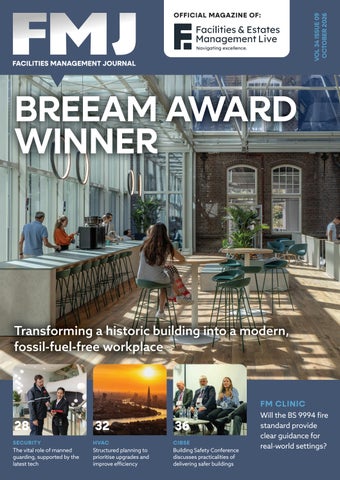
BREEAM AWARD WINNER
Transforming a historic building into a modern, fossil-fuel-free workplace
FM CLINIC
28
32
36
SECURITY The vital role of manned guarding, supported by the latest tech
HVAC Structured planning to prioritise upgrades and improve efficiency
CIBSE Building Safety Conference discusses practicalities of delivering safer buildings
Will the BS 9994 fire standard provide clear guidance for real-world settings?
Where workplace intelligence meets operational control
Meet Eptura at Facilities & Estates Management Live Discover how to drive greater efficiency, compliance, and resilience across your estate
Find us at stand D24
20 - 21 October
WELCOME kpm media Unit 1 Mill Place, Platt Business Estate, Maidstone Road, Sevenoaks, Kent TN15 8TB Tel: 01322 662289 Editor Sara Bean sara.bean@kpmmedia.co.uk Assistant Editor & Social Media Development Sarah O’Beirne sarah.obeirne@kpmmedia.co.uk Director & Designer Warren Knight warren.knight@kpmmedia.co.uk Mob: 0780 1947757 Sales Director Danny Grange danny.grange@kpmmedia.co.uk Mob: 07867 418994 Business Administrator & Circulation Enquiries Maxine Howell maxine@kpmmedia.co.uk
This month’s issue features a special report on page 36 from CIBSE Building Safety 2026: Delivering Safer Buildings in Practice, exploring how building safety has moved beyond understanding the regime to delivering it in practice.
Editorial & Events Assistant Madeleine Ford madeleine@kpmmedia.co.uk Accounts Diane Jarvis accounts@kpmmedia.co.uk Group CEO Nigel Copp
Editorial steering committee: Alex McCann Senior Facilities Manager, Informa Group Plc Alan Hutchinson, Facilities Director, Howard Kennedy LLP Darren Miller, Group Head of Real Estate & Workplace, Experian Ian Wade, Head of UK Estates, British Medical Association Jenni Gallop, Director of Estates & Facilities and H&S, Provide Community (NHS) Lucy Hind, Senior FM Lecturer, Leeds Beckett University Russell Burnaby, Assistant Director, Corporate Facilities Management, Southwark Council Simon Francis, Director of Estates and Facilities, LifeArc Simone Fenton-Jarvis, Group Director of Workplace Consultancy and Transformation, Vpod Solutions Wayne Young, Facilities Manager at DB Cargo (UK)
Total Average Net Circulation 18,740 January to December 2025
Supported by
kpm media adopts a sustainable policy of using paper from managed forests. Printed in the UK by Sudbury Print Group © Copyright 2026 kpm media - The publisher does not necessarily agree with the views and opinions expressed by contributors. No material may be reproduced in part or whole without written permission from the editor. Editorial contributions are accepted on an all-rights basis only. Letters to the editor may be published in their entirety or in edited form and remain the property of kpm media. While due care is taken to ensure the accuracy of information contained in this magazine, the publishers cannot be held responsible for any errors in editorial articles or advertisements. Subscriptions are available to non-qualifying and overseas readers at £120 p.a. (UK), £160 p.a. (EU countries) and £240 p.a. (overseas-other).
SARA BEAN Editor
The facilities management sector was largely overlooked during the building reforms consultation, despite FMs’ critical role in the operational phase of buildings. That is why CIBSE, described by one panelist as “the home for technical facilities managers” represents and supports FMs focused on engineering excellence, operational performance and building lifecycle management. Professional institutes play a vital role in representing the many responsibilities within FM, with RICS and IWFM supporting the sector’s estates and workplace management obligations. All three of these leading bodies will be attending this year’s Facilities & Estates Management Live event and will be taking part in a number of seminar sessions, ranging from panel discussions to smaller advice clinics. We hope to see you there. https://facilities-estates.co.uk/
Facilities & Estates Management Live Navigating excellence.
Headline sponsor
20 October – 21 October 2026 Business Design Centre - London
REGISTER HERE: WWW.FACILITIES-ESTATES.CO.UK FMJ OCTOBER 2026
3
THE UK’S LEADING FUEL SERVICES PROVIDER
How can we help? Crown Oil Environmental offers far more than expert fuel services - we’re a provider of turnkey fuel supply and maintenance solutions, backed up by some of the most experienced teams in the business and a HVO-fuelled delivery fleet.
HVO fuel transitions
Tank telemetry installation
Tank installation & decommissioning
Rafibra tank lining systems
Fuel system inspections
Renewable fuel supply
Fuel testing & polishing
Fuel supply contracts
Fuel uplift & removal
Data centre services
Non-destructive testing (NDT)
Fuel tank cleaning
Choose Crown Oil Environmental 0330 123 3399 SALES@CROWNOILENVIRONMENTAL.CO.UK CROWNOILENVIRONMENTAL.CO.UK
CONTENTS
14 NEWS & ANALYSIS
40
28 FEATURES
MIFM
06 FM NEWS
24 CASE STUDY
44 MIFM
This month’s summary of stories that hit the headlines in the FM sector.
New product and service launches and company news from the FM industry.
08 ASSOCIATION NEWS
The BREEAM In-Use Finalists of the BREEAM Awards 2026 demonstrate how FM teams are setting themselves up for success.
The latest news and views from membership organisations.
28 SECURITY
47 PEOPLE
Technology can enhance – rather than replace – the vital role of manned guarding. 30 Clearing confusion over property guardianship as a form of commercial building security.
Find out who is moving where in the facilities management profession.
ADVICE & OPINION 10 OPINION Stephen Bott with thoughts on resourcing and outsourcing versus inhouse for smaller companies.
12 COMMENT Demands for mailroom deliveries differ, so must be shaped around specific needs.
14 COMPLIANCE Robotic inspections can help FMs keep pace with tougher compliance demands.
16 FAST FACTS Joe Bailey says it’s with the engineer that every CAFM rollout lives or dies.
18 BLOG & SOCIAL MEDIA Paul Frankland, Group Director of property and maintenance, Aimbridge Hospitality EMEA.
32 HVAC Structured HVAC planning can help estates teams prioritise upgrades and improve efficiency. 34 Unlocking energy savings within the UK’s sport and leisure sector.
36 CIBSE BUILDING SAFETY CONFERENCE Delivering Safer Buildings in Practice covers the next phase of the building safety regime. Why it’s key to turn building safety from a compliance exercise into an ongoing operational responsibility.
FM CAREERS
48 RECRUITMENT Advice for employers and job seekers on a hiring landscape which is increasingly shaped by AI-powered application tracking systems (ATS).
49 TRAINING The real AI challenge for the FM sector is in training the people to use it to do their jobs better.
50 CAREERS NEWS A roundup of the latest careers news in the facilities management sector.
49
40 WELLBEING Supporting wellbeing at work through healthier food and beverage options.
20 FM CLINIC Will the new BS 9994 fire standard help provide clear, effective and practical guidance for real-world settings?
NEXT EDITION The impact of Government’s Waste Crime Action Plan on recycling & waste management. How Waste Water Heat Recovery (WWHR) can form part of a wider energy strategy for washrooms. Why architectural lighting is being increasingly designed to meet the body’s biological needs. The highlights from Facilities & Estates Management live.
FMJ FMJ SEPTEMBER OCTOBER 2026
5
NEWS & ANALYSIS LEGAL NEWS Why £296 million-a-year ‘Tribunal Blackmail’ is about to get worse Every HR professional and employment lawyer in Britain knows the game being played, even if nobody says it out loud. An employee with a weak grievance files an employment tribunal claim, knowing exactly what it will cost their employer to defend it - around £15,000 in legal fees. So they pitch a settlement figure just below that number, then sit back and wait. For a small business, paying £10,000 to make a problem disappear is simply cheaper than fighting it, even when you know you’d win. New analysis of government tribunal data by Hamilton Nash puts a figure on the cost to businesses, and it’s a whopping £296 million a year. The number is calculated from Ministry of Justice statistics showing that just 7.2 per cent of cases reaching a full hearing succeed. But more than 60 per cent of all claims filed are settled before that, at an average payout of £10,000. Only two per cent of all submitted claims succeed at tribunal. Employers aren’t settling because the claims against them are strong. They’re settling because the process itself has become the weapon. This isn’t a criticism of employees with genuine grievances, as the tribunal system rightly exists precisely to protect them. Since fees were scrapped in 2017, it has become far easier to bring a legitimate claim, which is a good thing. From January 2027, two changes under the Employment Rights Act come into force that will turbocharge the problem. The qualifying period for unfair dismissal claims drops from two years to just six months, which dramatically widens the pool of employees who can bring a claim. At the same time, the £118,000 cap on unfair dismissal awards is being abolished entirely. A single successful claim could now be an existential crisis for a business that would previously have faced a manageable, capped liability. So what should employers do? Waiting until a claim lands on your desk is too late. Businesses should consider investing now in early conflict resolution, and creating proper grievance processes, trained line managers who can spot and defuse issues before they escalate and a genuine culture of fair treatment that reduces the volume of claims reaching a tribunal stage at all. The importance of acting early is highlighted by proposed changes to the Code of Practice from Acas, the independent agency that’s meant to improve workplace relationships. The updated Code of Practice will aim to reduce the backlog of tribunals by encouraging employers and employees to resolve disputes internally and rely more on early intervention and informal resolution. Businesses that treat this as a legal problem to be managed after the fact will find themselves permanently exposed. Those that treat it as a cultural problem to be solved in advance will be the ones still standing. Jim Moore, Employee Relations expert, Hamilton Nash
6
FMJ OCTOBER 2026
FMJ.CO.UK
Campaign unites major names across the built environment NLA, the membership organisation for the built environment, has launched One Built Environment, a campaign calling on government to formally recognise the built environment as a single, connected economic sector ahead of this autumn’s Budget and 10-year plan for Britain.
The campaign is backed by a coalition of the sector’s leading businesses and organisations, including, but not limited to, Arcadis, Berkeley Group, British Land, Built Environment Connective, JLL, Gensler, Gardiner & Theobald, L&Q, LCA, Mott MacDonald, Savills, Multiplex and SOM, alongside NLA’s network of trade body partners across the industry. NLA’s The Built Environment Sector report, which was created in partnership with GLA Economics and the London School of Economics found that together, architecture, construction, development, engineering, planning and the wider built environment supply chain contribute 25 per cent of UK GVA (£568 billion) and support one in eight jobs – around 3.8 million people – generating £168 billion in exports and outperforming the financial services sector twofold. Yet policy and regulation affecting the industry remain fragmented, split across housing, infrastructure, planning, skills, transport, energy and investment, with no single, joined-up approach. The campaign argues this fragmentation is not just a policy inconvenience but a direct cost to growth, jobs and investment – and that the government’s forthcoming Budget and 10-year plan for Britain represent a rare opportunity to fix it. Once that framework is settled, campaigners warn, the sector’s standing within it will be fixed for years to come. One Built Environment is calling on government to make three changes before the Budget and 10-year plan for Britain are finalised: Recognise the built environment as one industry. Name the built environment industry as a strategic growth sector. Build a long-term strategy with industry partners. Since early engagement began, NLA has been working closely with trade bodies and organisations from across every part of the sector to build a coalition behind the campaign.
NEWS & ANALYSIS
FMJ.CO.UK
DATES FOR THE FM DIARY Facilities & Estates Management Live Navigating excellence.
20-21 OCTOBER 2026 Facilities & Estates Management Live Business Design Centre London https://facilities-estates.co.uk
04-05 NOVEMBER 2026 Advanced Engineering
IFMA reveals its 2026 Top Global FM Influencers
NEC Birmingham www.advancedengineeringuk.com
The International Facility Management Association (IFMA) has revealed its 2026 Top Global FM Influencers list, which this year, recognises 10 professionals shaping the future of facilities management through innovation, leadership and measurable impact.
QEII Centre, London https://www.iswa2026.org
These individuals represent the full spectrum of the FM profession — from sustainability and technology integration to workplace strategy, leadership, education, operational excellence, research and more. Michael V. Geary, CAE, IFMA President and CEO said: “Our influencers leverage their clout and experience to share more than just best practices. They use their platforms – whether it is content, the classroom or leadership to inspire conversations that better position our global professionals as the trusted resource for stronger, more efficient facility and organisational outcomes. “They are telling the stories that strengthen the facility management profession and shine a light on not just the people, but also the processes and actions that are sometimes invisible, yet have a resounding impact on everyone’s lives, health and culture.”
Together, 88 Wood St, London. EC2 https://worktechevents.com
The list was curated to highlight those making a significant mark on the built environment — advancing sustainable operations, integrating emerging technologies, enhancing workplace experiences, and prioritising safe, resilient and people-centred spaces. From bold new approaches to proven, data-driven results, these influencers are elevating facilities management and inspiring progress around the world. Representing 10 countries, the honourees reflect the diversity and global scope of facilities management. Through their work and platforms, IFMA says they share ideas and innovations that transcend geography and language, amplifying FM’s role in creating environments that are secure, efficient and adaptable. The full list of the Top Global FM Influencers is available at https://pages. ifma.org/2026-ifma-global-fm-influencers
Volaris Group acquires Matrix Booking Volaris Group, a ‘buy-and-hold’ software and technology group headquartered in Canada, has announced its acquisition of Matrix Booking Limited, a UK-based provider of meeting room and desk booking software used by government departments, NHS organisations and other public sector bodies. Matrix Booking was acquired from the Matrix Booking Employee Ownership Trust. Under Volaris Group’s permanent ownership model, Matrix Booking will continue to operate as a standalone business, retaining its brand, its customer relationships and its operating independence.
09-11 NOVEMBER 2026 ISWA World Congress 2026
17 NOVEMBER 2026 WORKTECH London
18-19 NOVEMBER 2026 LiGHT26 Business Design Centre London https://www.lightexpo.london
18-20 NOVEMBER 2026 IFMA World Workplace Anaheim, California https://worldworkplace.ifma.org
24-25 NOVEMBER 2026 LiftEx 2026 Exhibition Centre, Liverpool https://bit.ly/4prpnvb
25-26 NOVEMBER 2026 Emex ExCeL London https://www.emexlondon.com
25-26 NOVEMBER 2026 CIBSE Build2Perform ExCeL London https://elementallondon.show
25-26 JANUARY 2027 FM FORUM Radisson Hotel & Conference Centre, London Heathrow facilitiesmanagementforum.co.uk
ASSOCIATION NEWS CIBSE celebrates the 30 Under 30 winners for 2026
FMJ.CO.UK
Climate Adaptation: Acting now for a Changing Workplace The heat and drought of summer may seem a long time ago, but the lessons we have learned need to be fore fronted and embedded in our everyday practice. I thought it worthwhile to set out why the Climate Adaptation session I will be chairing at Facilities & Estates Management Live is at the core of a wider conversation around business resilience and suitability.
The future of building services engineering was firmly in the spotlight as CIBSE celebrated the winners of the 30 Under 30 Awards 2026 at a special event bringing together some of the profession’s brightest emerging talent. Organised by the CIBSE Global Young Engineers Network (YEN), the annual awards recognise young professionals making a significant contribution to the industry through innovation, leadership, sustainability, technical excellence and project delivery. The 2026 cohort represents an impressive breadth of talent across 10 regions in the UK, alongside CIBSE regions in the Middle East and North Africa, Hong Kong, and Australia and New Zealand. With winners, colleagues, sponsors and industry representatives gathered to celebrate, the event was filled with energy and enthusiasm. The atmosphere reflected the ambition and passion of a generation of engineers who are already making their mark on the profession and will play an important role in defining the future of building engineering. The 2026 winners demonstrate the breadth of expertise needed across today’s building services sector and the wider built environment. Visit: https://bit.ly/4hUUgpp to see the full list.
8
FMJ OCTOBER 2026
The summer heatwaves showed the value in providing cooler workplaces and spaces for workers, and cool refuges for the wider public. We also need to be ready for greater incidence of all extreme weather effects, disruption to our supply chains and that our buildings are ready to respond to these challenges. Our built environment has been built for a climate that no longer exists. By safeguarding workplaces for the longer term, we are ensuring the lifespan of the asset and the wellbeing of the people within it. Meeting the challenge our buildings will be facing over the next decades will require thinking about climate impact as part of a wider resilience framework, linking climate risks with energy disruption, water scarcity and supply chain unreliability. Being realistic and open about these overlapping risks means that we can then ensure we are addressing these challenges head on with a joined-up approach at how we can protect our assets from increasingly disruptive climate events. The holistic view will ensure that we’re considering the building, where our materials have come from and how we can keep the lights on in an increasingly uncertain world. Our survey evidence shows that when buildings are being retrofitted or refurbished, FMs are primarily focusing on reactive maintenance, and most projects are only done when absolutely needed. These retrofits and refurb opportunities should be seen as a wider chance to embed resilience in the estate, so additional time spent in consideration of the wider risks (how flood resilient is our building? How will it respond to a prolonged electricity outage? How do we keep our workers at safe working temperatures?), will help create a wider scope of work that safeguards the building and the people within it against the challenges we will be facing. Andrew Gladstone-Heighton, Head of Policy and Research, IWFM
NOT ALL HEROES . S E P A C R A WE R A E W E M SO . S L L A R E V O ORST JOBS
LE FOR THE W
THE BEST PEOP
Blocked, broken, backing up or just due an inspection to avoid any of that unwelcome stuff happening? We sort drainage for facilities managers who can’t afford downtime, disruption or unpleasant surprises.
FIND OUT MORE metrorod.co.uk
Advice & Opinion
OPINION
Sourcing dilemma Resourcing and outsourcing versus in-house for smaller companies
STEPHEN BOTT HR & Facilities Manager Charterhouse Holdings
FM applies to a company of any size, but there can be stark differences in terms of resourcing. Clearly, major factors are budget and the status of FM – larger companies will generally have more financial resources and often a formal FM strategy, whereas, within smaller companies, FM tasks must be done with existing resources. There are many small companies with less than 250 employees, large enough to have the capacity to take on dedicated staff for various areas of FM. This is where an interesting outsourcing/inhouse balance comes into play. Indeed, this is very pertinent to my day-to-day work at Charterhouse Holdings plc, an SME with just under 100 employees. SME’s sphere will invariably share traits, such as having to outsource certain, specialist aspects of FM. Specialist services such as the servicing and testing of major infrastructure – such as fixed wire and other electrical testing – have to be outsourced to qualified contractors. For other services how to dedicate resources for general FM activities must also be considered and decisions must be taken on whether to outsource services or to keep everything in-house.
BENEFITS OF OUTSOURCING One key benefit of outsourcing, particularly for SMEs, is the fact that any staffing issues – performance, conduct and absence in particular – are the responsibility of the agency.
10 FMJ OCTOBER 2026
Yet outsourcing comes at a premium, the fee per operative often being much higher than if they were in direct employment. It is a balancing act of whether the convenience of outsourcing is worth the extra expenditure. At Charterhouse, we employ a maintenance operative to carry out a variety of general FM activities, being tasked to fix issues before calling in contractors. It would not make sense to outsource this position, not least because much FM activity at Charterhouse is reactive in nature and service level agreements with agencies may be very rigid and not allow immediate flexibility to resolve unforeseen issues. On the other hand, we outsourced our cleaning activities as we needed to increase provision and it did not make sense to employ a full-time cleaner yet outsource a part-time one. Recruitment and retention of cleaning staff is not easy, so the convenience of these being the responsibility of the agency removes often time-consuming hurdles. Nevertheless, it is very important to treat any contractors based on site as if they are employees.
Charterhouse-based cleaning personnel contribute as much to the company’s functions as employees are included in any team events, such as charity days or Christmas parties. Feeling part of the team increases morale and engagement, adding value for money for the fee paid to the agency.
BALANCING NEEDS The outsourcing/in-house balance can be considered when there is sufficient capacity to take on personnel dedicated solely to FM activities. Sticking solely to outsourcing or to keeping all activity in-house isn’t the answer: it is important to consider the pros and cons of both approaches and resource accordingly to whichever works best for each aspect of FM. Every company is unique and there is no one-size-fits-all solution – the outsourcing/in-house question should be focussed on the company’s individual needs and what benefits it specifically, not based on what other companies do. This is especially important for smaller companies where making the right decisions is critical financially and in terms of overall staffing levels and resourcing.
PPL Training Elevate your Technical Compliance in the Scotland.
TRAIN LIVINGSTON. 12,000FT2
OF TRAINING FACILITIES
10+ PRACTICAL AREAS COVERING 100+ COURSES
OVER 94% OF DELEGATES RATED LIVINGSTON “OUTSTANDING”
KNOWLEDGEABLE
AND EXPERIENCED TRAINING STAFF CONTACT OUR TEAM TODAY 0333 121 1215 ppltraining.co.uk info@ppltraining.co.uk
TRAIN NOW
Advice & Opinion
MATT COLLINS Business Development Manager, Gophr
COMMENT
Dedicated delivery Demands for mailroom deliveries differ, so each organisation needs support shaped around specific demands. Many organisations now rely on dedicated couriers rather than traditional postal services to ensure deliveries throughout the day. However, peaks and troughs in demand can affect courier availability, so deliveries for trickier postcodes may go to the first courier and sit at the bottom of the pile or require a separate courier who may take time to arrive. If you don’t know when the peak is, it will hit – and all the couriers will be already booked or will place your job on an already large route map. And if you don’t know the most common delivery routes, you won’t know how to get the best out of your mailroom operations. Take London as an example. We recently carried out an in-depth piece of research, The Hidden Infrastructure of London Business, analysing the secret lifelines keeping businesses moving. It identified a series of clear demand peaks and distinct corporate ‘Courier Miles’ operating across the capital. While office deliveries peak at 11am, legal and government activity reaches its busiest point between 4pm and 5pm. In that hour alone, an average of 205 legal deliveries arrive at London law firms: 2.5 times more than at any other point in the day. The ‘Legal Courier Mile’ between Holborn, Fleet Street, Westminster and St Paul’s, involves contracts, approvals, court bundles and government papers. The ‘Creative Courier Mile’ runs between Soho, Fitzrovia and Mayfair and is taken up by campaign assets, production materials, samples and creative deliverables moving between agencies and clients. Then there’s the ‘Corporate Courier Mile’ between South Bank, Canary Wharf and the City, with office supplies, equipment and the day-to-day operational flow of modern business. That one peaks before lunch. In essence, a multi-tenant office building in Fitzrovia experiences very different patterns of mailroom activity to a corporate tower in Canary Wharf or a legal hub around Holborn – and demands a very different approach
12 FMJ OCTOBER 2026
from the FM team. That’s just in London, but the patterns can be extrapolated to every other city.
KEEPING PACE The courier bookers who work in those mailrooms understand their individual, unique rhythm because they live it every day. They know when things are about to change or that demand is about to skyrocket, but the higher echelons of the FM team might not. This is why it’s so important for FM leaders to check in with their mailroom site leads weekly or monthly rather than leaving it for every quarter (or even every year, in some of the worst offenders). It’s also why it’s vital to work in partnership with suppliers to understand each individual client requirement – for each business and each division within it. Are most of your courier requirements for deliveries within the city, or from the urban hub out to the surrounding counties? Where are your remote and hybrid workers and what do they need? In addition, because of those demand peaks, most FM teams work with multiple courier companies. It’s possible to consolidate that down to a single supplier, with the associated reductions in cost and admin, but only with a full understanding of the peaks and when couriers will be available.
MORE THAN JUST PAPERWORK It’s also worth noting that the nature of courier operations has shifted in recent years. The growth of remote and hybrid working has seen more demand for equipment like laptops and phones, whether for new starters, or for the existing employees who used to get their devices upgraded when they were at the office. That change means a growing diversification in transport requirements, with the courier on a bike now often superseded by the one in a van. Yet facilities managers are increasingly balancing speed, cost and sustainability, with many organisations still keen to rely on bike and cargo bike courier networks to move items quickly between offices because it reduces emissions if delivery mileage is low. They need delivery networks that are fast enough to keep businesses running, sustainable enough to support corporate carbon goals, and flexible enough to move everything from legal documents to laptops to office furniture. It can be a big ask, but not if it’s thought out properly.
SPONSORED FEATURE
SANAWAY
Expansion into the Southwest marks new milestone for Sanaway Washroom hygiene, matting and clinical waste management specialist, Sanaway, has expanded into Southwest England with the opening of a new depot in St Philip’s, Bristol. The move responds to growing demand from both new customers in the region and existing clients seeking consistent service delivery across multiple locations.
A
s well as serving London and the South of England, all Sanaway services are now available from its new Southwest of England depot serving: Devon, Somerset, PATRICK Wiltshire, Gloucestershire, MARTIN South Wales and Bristol. Co-Founder The expansion follows the Sanaway continued success of Sanaway ONE, the company’s zero waste to landfill inclusive washroom hygiene service designed to support all washroom users, regardless of gender. As employers place greater emphasis on employee wellbeing, washroom facilities are increasingly recognised as an important part of workplace support, ensuring basic needs are met and contribute to overall wellbeing. Sanaway co-founder, Patrick Martin says, “We’re delighted to be moving into the Southwest region. With two decades of experience in the sector, we’ve built a business that is renowned for its efficiency and high customer service standards. “Key drivers for this next growth stage have been our continued commitment to high service standards combined with the launch of our Sanaway ONE inclusive ZWTL washroom hygiene service in 2025. With over 2000 units in the field to-date, the service has highlighted a need to move washrooms beyond
mere compliance and promote inclusivity in the workplace.”
SUPPORTING WORKPLACE WELLBEING THROUGH INCLUSIVE WASHROOM PROVISION While employers are legally required to provide feminine hygiene disposal facilities, there is no equivalent requirement for men. Yet urinary incontinence affects an estimated one in ten people in the UK and can result from a range of conditions, including menopause, disability, neurological disorders and prostate cancer treatment. Patrick explains, “Our Sanaway ONE universal hygiene disposal service enables organisations to provide a practical solution for anyone managing a health condition that requires discreet disposal facilities, regardless of gender. Normalising these facilities across all washrooms, regardless of gender, helps eliminate the need for individuals to disclose personal health issues, reducing stigma and supports dignity and inclusion. Through their partnership with The Prostate Project, Sanaway customers can also receive educational materials promoting PSA testing, and can host the charity’s mobile testing facility, the “Man Van”, at their workplace. At one customer site, 46 employees underwent testing, with at least one individual referred for further
investigation, highlighting the value of accessible workplace health initiatives. “Employees visit washrooms several times a day, making them an effective location for concise health messaging and awareness campaigns,” says Patrick. “We’re planning two more on-site PSA testing days with our customers currently, and we’re also working to bring additional charitable organisations into the Sanaway ONE service provision to further support our customers’ workplace wellbeing.
MORE THAN WASHROOM HYGIENE Sanaway’s auditable zero waste to landfill disposal method manages all customers’ waste responsibly, with annual reports tracking the journey from collection to disposal and supporting ISO 14001 and ESG goals. Alongside its ZWTL washroom services, Sanaway also provides standard and logo matting, nappy and bulk clinical waste disposal, and a fully recyclable reusable sharps collection service. To discuss your service requirements, or to book a free on-site audit, contact Sanaway on 0345 094 9495 or visit us at F&EM Live, Stand M6 at the Business Design Centre, London on the 20th and 21st October 2026. For more info visit www.sanaway.co.uk
FMJ OCTOBER 2026 13
Advice & Opinion
ELEANOR TANG-SMITH COO and Co-Founder OLO Robotics
COMPLIANCE
Automated Assistance Robotic inspections can help FMs keep pace with tougher compliance demands. The SFG20 State of Facilities Management 2026 Report revealed despite 72 per cent saying improving compliance and safety is their top priority - overstretched teams are increasingly at risk of reactive, fix-on-fail working. In practice, that means inspection schedules slip. Not because facilities managers don’t understand their obligations, but because the people needed to carry out routine inspection rounds are the same people being pulled in other directions. When something breaks, it takes priority. For the most stretched teams, the scheduled walk round can find itself pushed back. This has always been a risk, but in 2026 it is a compliance exposure. The Building Safety Regulator is actively stepping up enforcement of the Building Safety Act’s golden thread requirements, with unlimited fines and significant consequences for non-compliance. The expectation on duty holders is clear that inspection must be documented, consistent and demonstrable. A reactive approach does not meet that bar.
ROBOTIC INSPECTION The case for robotic inspection is not new. Robots navigating facilities autonomously, capturing thermal imaging, monitoring pressure and temperature gauges, checking air quality and detecting leaks are established applications. The argument for taking people out of hazardous environments and replacing variable manual data with consistent, repeatable records has also been well understood for some time. What has been less well understood is how an FM team without a robotics engineering background gets there. United Utilities, one of the UK’s largest water and wastewater operators, recently issued a tender for autonomous quadruped robots to support routine site inspections. In its procurement documents, the organisation cited three specific drivers: the resource intensity of current manual inspection processes, the hazard exposure faced by site-based staff, and the variability in inspection quality and data consistency that human-led inspection introduces. These are not niche concerns. They are the concerns of any organisation running a large, complex estate. But United Utilities has a dedicated technical procurement function. Most FM teams do not. And for most FM teams, the conversation about robotic inspection has historically ended with the question “who is going to set it up?”.
facilities management skill set. Before a robot navigates a single corridor, someone must configure the underlying robotics framework, handle the middleware, write the launch files and set up the hardware drivers. That is robotics engineering work. Without it, the project stalls before it starts. Hiring an integrator to do it adds cost and complexity that puts the economics out of reach for most FM operations. The SFG20 report identifies digital and IT skills as one of the top three gaps across FM teams. This is not a coincidence. The FM sector has been aware of what robotic inspection could offer for several years. The gap has always been between understanding the potential and having a practical route to deployment. Thankfully, that gap is closing. The software layer that has traditionally made robotic inspection the preserve of organisations with dedicated engineering teams has become significantly more accessible. Platforms now exist that allow FM teams to plan, simulate and deploy autonomous inspection routines without specialist programming expertise - reducing what was once a complex engineering undertaking to a manageable operational process.
STRATEGIC SHIFT The shift this enables isn’t just operational, but strategic. An FM team that can deploy a robot to run a repeatable inspection routine on a schedule has something that a team dependent on manual walkthroughs does not: a documented, consistent, time-stamped record of every inspection run. In the context of Building Safety Act compliance, that record is not a nice-to-have. It is the golden thread. Robotic inspection will not solve the FM staffing crisis. But it offers FM teams a practical way to take routine, hazardous and compliance-critical inspection tasks off the to-do list and to return consistent, auditable data every time without depending on specialist availability. The technology is ready and the regulatory framework is in place. For FM teams willing to look seriously at robotic inspection, the barriers to getting started have never been lower.
SPECIALIST SKILLS Deploying a robot for inspection has traditionally required specialist programming expertise that sits well outside the
14 FMJ OCTOBER 2026
© OLO Robotics
SPONSORED FEATURE
JLL in a shared drive, equipment telemetry is captured by a building management system and asset information is in archaic spreadsheets. Viewed separately, each source paints just part of the overall picture. AI can help unify those sources to create what amounts to a continuously updated map of facility health and can identify correlations, identify emerging patterns and recommend where teams should next focus their attention. In turn, that intelligence can improve day-to-day decision-making.
Tackling an AI trust gap in your organisation? Start here. Practical, low-risk use cases are helping facilities teams move beyond the hype and translate AI into measurable value
A
rtificial intelligence is advancing at breakneck speed – but it’s posing a paradox for facilities leaders under pressure to adopt technology that depends heavily on data quality and is constantly changing. That tension has created an AI trust gap: while the technology’s potential to transform facilities management may seem limitless, many leaders question how to implement it, how to use it safely, and whether the returns it promises are real. Caught between real excitement about the potential of AI and legitimate uncertainty about where to start, teams often wait for the perfect moment to act and end up making the decision by default later – with a lot less control over how to execute a meaningful AI strategy. The good news is that you don’t have to hand over entire workflows to AI to start capturing its value. According to experts from JLL Corrigo, the most credible path forward often starts with targeted applications, measurable outcomes and – yes – human oversight. The key is to approach AI in stages. Facilities teams can begin with tactical applications that eliminate repetitive work, expand into operational use cases that connect insights across a portfolio, and ultimately apply AI strategically to predict risk and guide capital decisions. TACTICAL AI: BOOSTING CAPACITY THROUGH EVERYDAY EFFICIENCIES
At the tactical level, AI can help facilities teams streamline the repetitive, manual tasks that can consume countless hours and resources. For example, one JLL team recently helped a client implement AI to better manage staff access badges, including tracking, activation, and deactivation. By using AI to automate low-risk tasks and identify unnecessary steps, the team saved more than 40 hours per week across 45 employees while accelerating access pass turnaround times by 50% to 90%. In another example, AI helped consolidate three tools used to manage moves, adds, and changes into a more efficient interface. The redesigned process saved approximately eight hours per person each week across a team of 100. These examples show that organisations do not need to automate an entire workflow to generate meaningful value. Saving a few minutes or hours at multiple points in a process can add up to significant additional capacity, and that’s time employees can redirect towards higher-value work.
STRATEGIC AI: PREDICTING FAILURES AND IMPROVING CAPITAL DECISIONS And at the strategic level, AI’s value extends to risk avoidance and capital allocation. Unnecessary (and avoidable) equipment downtime can jeopardise operations or delay the launch of a product or service, and the resulting losses can often reach six or seven figures, far exceeding the cost of the repair itself. AI-enabled fault detection can analyse subtle changes in systems before an asset fails. In one real-world example involving a research and development lab, AI-driven fault detection diagnostics detected patterns showing that a chiller component was beginning to fail, allowing the facilities team to intervene before the equipment went down. The system recognised a combination of signals that would have been difficult for an individual to identify in time. The same approach can make capital planning more dynamic. Instead of relying solely on asset age and scheduled repair and replacement intervals, AI can evaluate manufacturer specifications, maintenance history, repair costs, operating conditions and real-time performance. Facilities leaders can then determine whether an asset truly needs to be replaced or whether capital can be directed elsewhere. START SMALL, BUT START NOW To explore a practical framework for identifying opportunities, preparing your data and implementing AI responsibly, download the AI in Facilities Management Guide using the QR code - https://bit.ly/4gK3kfc
OPERATIONAL AI: CONNECTING DATA ACROSS THE PORTFOLIO The next level of opportunity comes from connecting data that has traditionally been scattered across multiple systems. For example, CAD drawings are stored
FMJ OCTOBER 2026 15
Advice & Opinion
FAST FACTS
FMJ AIMS TO SUPPORT TECHNNICAL EXPERTISE IN THE FM MARKET
Wrong way round The industry is pointing its smartest technology at the wrong end of the process; it’s with the engineer that every CAFM rollout lives or dies. In 2025, 76.8 per cent of HVAC work was reactive. Something broke, somebody got sent, and the paperwork caught up later, or didn’t. This is a long way from where the industry is currently aiming its best tools. Every conference, every vendor deck, every LinkedIn feed is about prediction. Sensors, models and dashboards that tell you a pump is going to fail JOE BAILEY Founder before it does. On a big estate with a big budget docket and years of clean data behind it, that is a real problem worth solving. But it is not where a CAFM rollout succeeds or fails. I have watched enough of them from the night desk to say that with some confidence. Each one comes down to a question no dashboard can answer. Does the engineer use it? If they don’t, everything above them is guesswork. The prediction engine only reads what got typed HVAC work remains in, and what got typed in was made overwhelmingly reactive by someone in a plant room with — 76.8 per cent of HVAC one bar of signal, a torch in their work in 2025 was reactive, mouth and four more jobs before meaning the industry’s focus they can go home. on predictive tools is out of
Four Key Takeaways
step with how most work actually happens on the ground.
Software adoption hinges on the engineer, not the dashboard — no matter how advanced a CAFM system is, its value depends entirely on whether the engineer actually uses it in the field. More features often mean worse data. Adding complexity to engineerfacing software tends to backfire, pushing engineers back toward paper. Garbage in, garbage out — sophisticated platforms can’t compensate for thin, late, or second-hand data. 16 FMJ OCTOBER 2026
WHY SMARTER SOFTWARE MAKES IT WORSE The assumption is that a more capable system is a better one, but from the operations side it usually goes the other way. Every feature someone adds to the engineer’s screen is another box to fill in, another tap, another reason to put the phone back in a pocket and write the job on paper to sort out later. The more the software asks for, the less of it comes back. I sat through one rollout where the office had a lovely new platform, and the yard had a growing pile of job sheets in a plastic tray. The reason? Closing a job in the app took the best part of five minutes. Closing it on paper took 20 seconds
with a biro. People aren’t lazy. They are busy, and they will route round anything that slows the actual work down. This means the record turns up on Wednesday for a job done on Friday, typed in from memory and by a person who was never on site. That is what feeds the dashboard. You can buy the most advanced system on the market and still run your business on a record that is thin, late and second hand. Adding more at the top doesn’t fix that. It usually makes it worse, because there is more on the screen to ignore.
ENGINEER NOT ESTATE The question I find more interesting is what AI looks like when you aim it at the engineer rather than the estate. One that reads a handwritten job sheet from a photo and turns it into a proper record. Takes a voice note left in the van and files it as the completion. Picks the expiry date off a paper certificate so nobody must key it into a spreadsheet on a Friday afternoon. In every case the engineer changes nothing. No new app to learn, no boxes to tap on a wet roof at four o’clock. They do the job the way they have always done, and a clean record is made afterwards.
MANY OF THE LARGE COMPANIES SPENT THE LAST DECADE BUYING DASHBOARDS. THEY WILL SPEND THE NEXT ONE CLEANING UP THE DATA UNDERNEATH... Many of the large companies spent the last decade buying dashboards. They will spend the next one cleaning up the data underneath, because so much of it was captured by people who found the system slower than paper. An independent company of 20 or 40 staff never made that investment, so it doesn’t carry the debt. It can start where the corporates are trying to achieve, an accurate record, made on the day, by the engineer, with nobody retyping it in between. Skipping the dashboard years isn’t falling behind. Done properly it is arriving where the market is heading without the clean-up bill. Prediction will matter eventually, and it will matter most to whoever has the best ground-level record. That record never gets built at the top. It gets built by the engineer on the tools, which is exactly where the industry keeps forgetting to look.
KEEPING KEEPINGFM FMTEAMS TEAMSCONNECTED CONNECTED WHEN WHENIT ITMATTERS. MATTERS. COMMUNICATION COMMUNICATIONRESILIENCE RESILIENCEFOR FORMODERN MODERNFM FM FM teams depend onon fast, protect people, FM F M teams depend d d fast, f reliable reliable li blcommunication communication i i toto protect people, l maintain maintain i i performance and deliver consistently for their customers. From frontline performance and deliver consistently for their customers. From frontline incidents toto multi-site operations, the right system helps teams respond incidents multi-site operations, the right system helps teams respond faster, strengthen accountability and work with greater confidence. Apex faster, strengthen accountability and work with greater confidence. Apex builds solutions around the realities of modern facilities management. builds solutions around the realities of modern facilities management.
PROTECT PEOPLE. PROTECT PEOPLE. Safer frontline operations. Safer frontline operations.
PROTECT PERFORMANCE. PROTECT PERFORMANCE. Faster, more reliable service delivery. Faster, more reliable service delivery.
PROTECT THE CONTRACT. PROTECT THE CONTRACT. Helping you deliver consistently for your customer. Helping you deliver consistently for your customer. Two-way radios Two-way radios
Body-worn cameras Body-worn cameras
MEET APEX ATAT MEET APEX
FACILITIES FACILITIES&&ESTATES ESTATES MANAGEMENT MANAGEMENTLIVE LIVE
Nationwide push-to-talk Nationwide push-to-talk
Scan toto review Scan review your FM your FM communications communications
20–21 OCTOBER 2026 | STAND A8A8 20–21 OCTOBER 2026 | STAND
35+ YEARS EXPERIENCE | NATIONWIDE SUPPORT 35+ YEARS EXPERIENCE | NATIONWIDE SUPPORT info@apexradio.com • 0191 228 0466 • www.apexradio.co.uk info@apexradio.com • 0191 228 0466 • www.apexradio.co.uk
Advice & Opinion
SOCIAL - BLOG TOP SOCIALS Luke Lester https://lnkd.in/p/ esbiAAHT Last week we held our first CFM Connect, our new allteam session bringing colleagues from across Corporate Facilities Management together. It was great to see colleagues from across the service in the room, sharing ideas and celebrating some of the brilliant work happening across CFM. Rory Murphy FRICS MSc MCIOB https://lnkd.in/p/eSdy_9yX Here at VINCI Facilities we’d roadshows in Cardiff, London and Manchester, an all hands call with our #defence team and a webinar on #circularity to celebrate VINCI environment day 2026. Then two #healthandsafety days with our #supplychain an integration day for our new starters and an early careers day for our #apprentices and #graduates. We have an amazing team here at VINCI Facilities and it is fantastic to see so many of you at these various events. Facilities & Estates Management LIVE We are delighted to welcome Bonita Norris Keynote Speaker as an inspirational speaker. As the youngest person in the world to reach the summit of Mount Everest and the North Pole, Bonita brings an extraordinary story of resilience, determination, mindset and overcoming uncertainty. Join Bonita in the Keynote Theatre on 21st of October at 14:00pm. Register for FREE here: https://bit.ly/4hLjkPx Richard Sykes - Almost a million young people in the UK are not in education, employment or training. The talent and ambition are there, but too many routes into work remain closed. Businesses have a responsibility to open those doors, create genuine entry points and support people to build lasting careers. I’ve shared some reflections from the Fortune CEO Forum, including what we’re doing at ABM UK and the work still ahead. https://bit.ly/4hkqOck 18 FMJ OCTOBER 2026
Checking in: The vital role FM plays in the success of hotels Facilities management has always played an important part in hotels, but its role has evolved significantly in recent years. Against a backdrop of rising costs, tighter regulation and growing expectations around asset performance, FM supports profitability, protects revenue streams, ensures compliance and helps maximise the long-term value of hotel assets. So how do we as FM teams deliver this? Firstly, any purely reactive
Paul Frankland, Group Director Aimbridge Hospitality EMEA
approach to maintenance must go.
updated fire safety requirements have
A failed piece of equipment does not
raised expectations. FM teams should be
simply generate a repair bill. It can take
leading in this area to ensure properties
bedrooms, meeting space or restaurant
are safe and welcoming for guests,
facilities out of space, directly affecting
employees and visitors, providing
revenue and reputation.
continuous oversight rather than
Preventative and predictive
periodic compliance checks.
maintenance programmes help avoid
They should also be aware of the
costly failures and disruption and deliver
capabilities digital transformation brings
significant longer-term benefits, despite
to operatations, particularly the use
greater upfront investment.
of data, automation and centralised
We operate hotels on behalf of their
reporting systems, to improve visibility
owners across a wide range of brands
and support decision making.
and markets, and FM plays a central role
At Aimbridge, we’re continuing to
in making this happen.
develop dashboard capabilities that
We help ensure bedrooms,
bring together data from across our
restaurants, meeting space and public
hotel portfolio, enabling us to monitor
areas remain operational. Heating,
compliance requirements, maintenance
cooling and leisure facilities must also
activity and critical tasks.
be maintained effectively to ensure a
This ability to capture and analyse
positive guest experience.
real-time information helps FM teams
Owners increasingly expect assets to
identify issues earlier, monitor risk more
perform for longer while continuing to
effectively and provide better visibility
generate strong returns.
for owners and other stakeholders.
For FM teams, that means maintaining
I expect the biggest challenge facing
a robust asset register and clear capital
FM teams in the hospitality sector will
expenditure plan, allowing owners to
continue to be managing with limited
budget for future investment and avoid
resources.
unexpected costs.
The hotels that perform best over the
The growing importance of FM is also
long term will be those that view FM not
being driven by an increasingly complex
simply as a maintenance function, but as
regulatory environment.
a strategic tool in ensuring operational
Legislative changes, heightened
performance, compliance, guest
scrutiny around building safety and
satisfaction and asset protection.
Dependable Door Control Solutions We recognise the critical role that doors and their hardware play in the safety and security of any building. Our core product range includes: •
Door Closers
•
Access Control
•
Electric Locking
•
Door Hardware
•
Locks & Security
•
Fire Door Ironmongery
•
Panic Hardware
Whatever your project requires, you can depend on Door Controls Direct.
VISIT OUR WEBSITE www.doorcontrolsdirect.co.uk | 01305 263300 | sales@doorcontrolsdirect.co.uk
Advice & Opinion
FM CLINIC In FMJ’s regular monthly column, our team of FM experts answer your questions about the world of facilites management
THIS MONTH’S QUESTION
? The British Standards Institution (BSI) consultation on BS 9994, Fire strategies in
buildings intends to set out the overarching intent, structure and coordination of fire protection measures throughout a building’s life. In what ways will the standard help provide clear, effective and practical guidance for real-world settings?
ANDREW LEWINTON VP Quality, Health, Safety and Environment (QHSE) UK & Ireland, ABM UK&I
A
The proposed BS 9994 could provide real value by helping translate fire strategy from a design-stage document into information that remains relevant and usable throughout a building’s operational life. This is important for FM, where buildings continually change through maintenance, refurbishment, asset replacement and changes in occupancy or use. One of the most valuable contributions would be to support a more consistent approach to keeping fire strategies current. A building’s fire strategy needs to reflect how the building is being used and managed, not just how it was originally designed. Clear guidance could help building owners and duty holders identify when fire strategy information should be reviewed, updated or formally assessed as a building evolves. Supporting effective change management is another important area. Changes to building systems, including HVAC and mechanical and electrical services, can potentially affect existing fire safety arrangements. A consistent framework could help ensure that the fire safety implications of proposed changes are identified, assessed and appropriately managed, with relevant information captured once the work is complete. This would help connect project and maintenance activity with
20 FMJ OCTOBER 2026
the wider fire strategy. Improving access to fire safety information could make a significant practical difference. Those responsible for operating, maintaining or modifying a building need access to accurate and current information. Clear, well-managed fire strategy documentation can support better decision-making and help facilities solutions partners understand the arrangements within which they are working. Clarifying how responsibilities interact across the building lifecycle could further strengthen the practical application of fire strategies. Fire safety involves collaboration between building owners, duty holders, consultants, contractors and facilities solutions partners. Clear guidance could help reduce ambiguity, improve communication and support more consistent accountability, while complementing existing legal duties and responsibilities. Finally, the guidance needs to be practical enough for occupied and operational buildings. Its value will ultimately depend on whether organisations can apply its principles through everyday management processes, rather than treating fire strategy as a standalone technical document. The most effective approach would help translate fire safety principles into practical actions around maintenance, projects, change control, information management and operational decision-making. The consultation, has now closed and will undergo further review and scrutiny. When published BS 9994 could help create a stronger connection between fire strategy and the day-to-day reality of managing, maintaining and changing buildings.
Advice & Opinion
FM CLINIC
STEVE KNIGHT Technical Director, Sertus
BS 9994 is an important opportunity. If it can bring greater consistency to how fire strategies are structured, communicated and maintained, it should make it easier for everyone involved in a building to understand not just what has been specified, but why.
A
For FMs in particular, that matters. Buildings change. Layouts are altered, services are modified, products eventually need replacing and spaces can be refurbished or repurposed. The people making those decisions need access to reliable information about the original fire strategy and the performance requirements that sit behind it. From a manufacturer’s perspective, there is another important link in that chain: translating the requirements of the fire strategy into products with the right evidence for their intended application. For smoke control, that principle applies across the system. For instance, with smoke control dampers, understanding the required classification and ensuring the product’s test and classification evidence is appropriate for the supporting construction and intended installation. For natural smoke and heat exhaust ventilators,
With the consultation on BS 9994, the industry has an opportunity to reflect on a fundamental challenge: how do we ensure fire strategies remain relevant and effective throughout a building’s lifecycle?
A
Much of the conversation around fire strategies focuses on design. Fire engineers assess occupancy, layout, escape routes and fire protection measures. However, a fire strategy is only as robust as its assumptions, which rely on the continued performance of the building’s fire protection measures. This is why the principles underpinning the proposed BS 9994 are so important. Rather than treating a fire strategy as a handover document, the standard promotes the idea that it should remain a live reference point, helping stakeholders understand what fire safety measures are present and how they support the overall strategy. This is particularly relevant when considering
ensuring the aerodynamic and operational performance is understood and supported by the appropriate product performance evidence. For mechanical smoke control, the required duty and performance of the fan arrangement is clearly defined, with products selected and evidenced accordingly. The details differ, but the principle is the same: the requirement, the product and the evidence need to align. This is where clearer fire strategies can make a practical difference. They can help establish the required performance at the outset and provide a stronger reference point as a project moves through specification, procurement and, ultimately, into occupation. Manufacturers have a role to play too. Providing tested and appropriately certified products is only part of the picture; the supporting technical information and evidence also needs to be clear, current and accessible to those making decisions about them. If BS 9994 helps establish a more consistent approach to capturing and maintaining that information, it can strengthen the golden thread between fire strategy, specification and the ongoing management of a building. Ultimately, the opportunity is to make fire strategies more useful in the real world. Three principles should remain clear: the design intent needs to be understood; product performance needs to be supported by appropriate evidence; and that information needs to remain accessible throughout the life of the building. Get those fundamentals right, and BS 9994 can help support better-informed decisions at every stage.
ALEX BOOTE Technical Director, ARC Building Solutions
passive fire protection. Products such as cavity barriers, cavity closers, passive fire-stopping systems and compartmentation measures are often hidden from view once construction is complete. Yet they play a critical role in restricting the spread of fire and smoke, helping buildings perform as intended in the event of a fire. The challenge is that buildings do not remain static. They are subject to maintenance, refurbishment, service upgrades, occupancy changes and natural movement. As buildings evolve, those managing
FMJ OCTOBER 2026 21
Advice & Opinion
FM CLINIC them must understand the role passive fire protection plays within the wider fire strategy. Products must also perform in real buildings, with design assumptions continuing to align with the building’s condition throughout its service life. If facilities managers understand which fire protection measures support critical aspects of the strategy, they are better placed to recognise when alterations,
maintenance activities or building changes may warrant further assessment. The proposed standard’s emphasis on accessible, upto-date fire safety information is welcome. It recognises that effective fire safety management relies not only on knowing what has been installed, but also why it was specified and what role it performs within the overall fire strategy.
MARK BRISTOW Compliance Director, LS Fire Group
A
The DPC (Draft for Public Consultation) of BS 9994 places fire strategy at the centre of fire risk management throughout a building’s lifecycle. A fire strategy is produced during the design stage and then is rarely referred to again until a major refurbishment, or an FRA (Fire Risk Assessment) identifies concerns after an alteration. By that point, fire strategy decisions, responsibilities, and assumptions, can be difficult to trace. The proposed BS 9994 recognises that a fire strategy should be a living document that supports the entire lifecycle of a building. It is not simply a document produced to satisfy regulatory requirements. From the FM perspective, the real value lies in day-to-day operations. For example, before installing new partition walls or changing layouts, FMs can assess the impact on escape routes, travel distances, and compartmentation. Fire detection and alarm engineers can understand the reasoning behind zoning, detection coverage, and evacuation arrangements before making system modifications. Fire door inspectors and passive fire protection
companies can identify the fire resistance requirements of walls, floors, ceilings, and doors, and understand how these interact with the wider fire strategy. Building managers can assess whether changes to occupancy levels, vulnerable occupants, staffing arrangements, or evacuation procedures remain consistent with the original fire safety objectives. Compliance managers can use the fire strategy as the benchmark when reviewing fire risk assessments, PEEPs, maintenance records, compartmentation surveys, and remediation programmes. FM providers can understand the consequences of replacing or altering fire protection systems, smoke control, emergency lighting, sprinklers, or management procedures before changes are implemented. One of the strongest messages within the DPC of BS 9994 is that fire safety does not stop at handover: Buildings change as occupancies, layouts and FM teams change, so the fire strategy needs to change with them. The DPC specifically identifies the triggers for review: Extensions - Refurbishments - Layout changes - Occupancy changes - Management changes - Alterations to fire protection systems. If the DPC of BS 9994 helps building owners treat fire strategies as practical management tools rather than archived design documents, it could become one of the most significant developments for FMs in building fire safety.
Do you have a question that you’d like answered by the FMJ Clinic? Email: sara.bean@kpmmedia.co.uk
22 FMJ OCTOBER 2026
info@tgm.co.uk www.tgm.co.uk
✓Roof Maintenance ✓National Support ✓Asset Management
MA MAINTAIN INSPECT REPAIR
CASE STUDY
BREEAM Awards 2026
Continuous Improvement The BREEAM In-Use Finalists of the BREEAM Awards 2026, demonstrate how FM teams across the world are setting themselves up for success.
A
building’s sustainability performance is not fixed at the point of completion. Occupancy levels change, systems age and the ways in which spaces are used continue to evolve. Sustainable design can establish the potential for strong performance, but maintaining and improving it depends on how effectively a building is monitored, managed and adapted throughout its life.
TOM WILSON Director of BPS, Buildings, Products and Sales
CASE STUDIES
BRE
This makes facilities and asset-management teams
extends beyond technical systems: engaging tenants and responding to their experience can influence both resource consumption and the comfort and satisfaction of the building users. BREEAM In-Use provides owners and managers with a structured way to assess the sustainability performance of operational buildings and identify opportunities for improvement. The BREEAM Awards 2026 In-Use Performance category recognises projects that have used this process to achieve continued progress, rather than treating assessment or certification as an end in itself.
central to meeting sustainability and ESG goals.
Tom Wilson, Director of BPS, Buildings, Products
By examining actual energy, water and carbon
and Sales at BRE, is one of the judges on this year’s
performance, they can identify emerging problems,
panel. He points to the finalists’ ability to translate
prioritise investment and assess whether interventions
performance evidence into sustained improvement:
are producing the intended results. Their role also
“What distinguishes the finalists is their ability to turn
24 FMJ OCTOBER 2026
BREEAM Awards 2026 evidence into action. They have established a clear understanding of how their buildings are performing, used that information to make practical improvements and continued to review what more can be achieved. Their different starting points also demonstrate that continuous improvement is possible across a wide range of buildings and portfolios.” The six shortlisted entries encompass different building types, locations and operational challenges. The following four examples illustrate that range: a complex London commercial tower operating at high occupancy; a residential portfolio covering approximately 28,000 homes; a multi-tenant office progressing from a Pass rating towards Excellent; and a protected historic building transformed into a fossilfuel-free workplace.
20 FENCHURCH STREET AND SKY GARDEN Located in the City of London, 20 Fenchurch Street is a 38-storey commercial tower combining office accommodation with restaurants and the publicly accessible Sky Garden. Commonly known as the ‘Walkie Talkie’, its mix of uses and high visitor numbers create a complex operational environment. The building has achieved BREEAM In-Use Outstanding ratings for both Asset Performance and Management
homes in the Netherlands. Since achieving portfolio-
Performance.
wide BREEAM-NL In-Use certification in 2022, the
Between 2023 and 2025, electricity consumption
organisation has used assessment data alongside its
fell by eight per cent, gas consumption by 43.2 per
Sustainability Impact Score to compare assets, identify
cent and water consumption by 21.79 per cent,
priorities and incorporate improvements into routine
despite occupancy increasing by 17 per cent. These
investment and asset management decisions.
improvements have been supported by regular
Between 2022 and 2025, energy intensity across the
monitoring of utility data and continued optimisation
portfolio fell by almost 12 per cent, water intensity
of the building management system, allowing the
by nearly 17 per cent and location-based carbon
facilities team to identify further efficiencies.
emissions by around 16 per cent.
The approach also gives occupiers an active role.
For Wilson, the value of this portfolio-wide approach
Through Energy Strava, a tenant engagement tool,
is clear. “Vesteda shows the value of applying a
occupiers can compare their energy performance with
consistent approach across an entire portfolio.
others in the building, while regular meetings help turn
Individual improvements may appear incremental, but
the data into practical action.
when they are replicated across 28,000 homes their
Wilson adds: “At 20 Fenchurch Street, the facilities
collective contribution can be significant. Comparable
team has reduced energy and water consumption
data also helps asset managers direct investment
despite occupancy increasing. This shows how active
where it will make the greatest difference, supporting
management can maintain performance as patterns of
long-term performance and asset value across the
use change, strengthening the building’s operational
portfolio.”
resilience. “By involving occupiers in that process, the facilities
ERASMUSSTAETE
team has also extended responsibility for performance
The multi-tenant office building in Rotterdam’s
beyond the building’s central systems.”
Brainpark II business district received a Pass rating
VESTEDA
in its first BREEAM In-Use assessment in 2022. This gave its owner, Aroundtown, greater visibility of the
Vesteda Investment Management takes a portfolio-
building’s sustainability performance and the areas
wide approach to operational sustainability across 480
requiring improvement.
residential assets comprising approximately 28,000
Aroundtown subsequently introduced measures
FMJ OCTOBER 2026 25
BREEAM Awards 2026 adjustments as occupancy patterns change. The building achieved a BREEAM In-Use Excellent rating in 2025. “What makes Delft particularly compelling is the breadth of its approach,” comments Wilson. “It combines a substantial reduction in energy demand with more responsible use of materials, careful monitoring and attention to the wellbeing of those using the building. Its success in adapting a protected building for modern use also shows how sustainability improvements can support an asset’s long-term value without losing the qualities that make it distinctive.”
SHARED PRINCIPLES ACROSS GEOGRAPHIES Although the four examples differ substantially in scale, use and starting point, several common including electric vehicle charging points, a new air-
principles emerge. Each begins with a clear
handling unit with CO₂ controls in occupied areas and
understanding of actual performance, giving facilities
a smart water management system, among others. By
and asset-management teams the evidence they need
2025, Erasmusstaete had progressed to a Very Good
to prioritise action, measure its effect and identify
rating, and electricity consumption had fallen by 44
further opportunities for improvement.
per cent.
These cases also show why facilities and asset-
“What is equally important is that Aroundtown
management teams are central to ESG delivery. Design
has not treated the new rating as the end of the
choices establish a building’s potential, but operational
process”, says Wilson. “The next phase translates the
teams determine how its systems respond to changing
findings from the assessment into specific actions,
patterns of use, how performance data informs day-
demonstrating how a structured approach can support
to-day decisions and where resources will have the
continued progress towards wider sustainability and
greatest effect. Continuous improvement results from
resilience goals.”
sustained attention to how an asset is performing and
HASKONING DELFT OFFICE
the willingness to keep adjusting its operation. The finalists show that assessment should provide
Improving the performance of this Delft office
a foundation for continued action. Their progress has
meant working with the constraints of a protected
depended on facilities and asset-management teams
historic building. Formerly home to Delft University
continuing to monitor performance, make practical
of Technology’s Faculty of Mining Engineering, the
changes and adapt as buildings and patterns of use
building’s character had to be preserved while it was
evolve.
transformed into a modern, fossil-fuel-free workplace. Two former courtyards were enclosed beneath lightweight glass roofs, reducing heat loss while creating daylight-rich communal spaces intended to support interaction and employee wellbeing. Improvements to insulation and glazing were combined with heat pumps, low-temperature heating and cooling, and an aquifer thermal energy storage system. Together, these measures have reduced annual energy use from approximately 4,000,000 kWh to 975,000 kWh, while 604 rooftop solar panels generate around a quarter of the building’s energy needs. Glass panels, recycled carpets and upcycled furniture from other offices were incorporated into the building. Extensive submetering across its heating, cooling and lighting systems gives the facilities team the data needed to track performance and make further
26 FMJ OCTOBER 2026
SPONSORED FEATURE
JLG
Is your business falling behind in fall prevention?
The JLG® LiftPod - a Quick-Fold lift - is changing the way people work at height in indoor and public-facing environments.
A
fall from height is the leading cause of workplace death and injury in the UK. That’s why today’s businesses are urgently tackling the risk, with better awareness, training, and the right tools for the job – which is where JLG comes in.
LOW ACCESS: THE HIDDEN RISK JLG discovered that one of the most overlooked risks in FM is low level access. The jobs at height that engineers, cleaners and contractors do - bulb changes, vent cleans, ceiling and cable repairs. Low height, routine, repeated — and where injuries have the potential to occur. The JLG® LiftPod, the latest addition to the company’s industry-leading range of access equipment, is now providing the solution for many of today’s leading FM teams and businesses.
LIFTPOD: AN ALTERNATIVE WAY UP INDOORS LiftPod is an ingenious workplace alternative to ladders, steps and podiums, with user safety and wellbeing at its core. Designed and manufactured in the UK by JLG, there are two models for a maximum working height of either 3.2 metres or 3.5 metres. Both are transforming how low level access tasks in public-facing, front-of-house spaces are managed; in schools, hospitals, offices and transport hubs, where productivity and efficiency are at a premium - and fall risk is often underestimated. From air conditioning fixes to signage installation, LiftPod is delivering new levels of stability, safety and support to staff, so they can work at these heights in comfort and with the utmost confidence – regardless of age or ability.
DESIGNED WITH FM TEAMS IN MIND LiftPod is meticulously engineered and rigorously tested to bring many advantages:
Innovative design: Compact, ergonomic, with a patented folding mechanism that one person can manoeuvre into place and operate easily and safely; Safe and secure: An adjustable platform and safety gate that are light but robust, enclosing the user for safety, security and protection from falls. Staff can work at the correct and most comfortable height for the job, with no straining, awkward angles or risk of musculoskeletal disorders; Promoting productivity: The addition of a cleverly designed tool tray leaves operators hands-free and able to work smarter, longer and with greater productivity at height; Sustainable: Manual, non-powered lifting technology requires no batteries or mains power; Made for public spaces: Easy to move and store, with stylish aesthetic and compact size that can be used in operational environments, blending seamlessly into modern interiors and public spaces across a wide range of sectors.
A SIGNIFICANT HEALTH & SAFETY MILESTONE
in the workplace. As a business that specialises in access equipment, we are committed to working to find innovative new ways to reduce this risk. That starts with the right tools and equipment to ensure staff make the best choices for keeping themselves and their colleagues safe when working at height. LiftPod has been one of the most successful outcomes of this process, and we’re very proud of the tangible, positive difference it is making now to workplace safety and health – and its potential to achieve much more in the future.’
EXPERIENCE LIFTPOD To find out how LiftPod can make a difference to the health, safety and productivity of your FM teams, please get in touch at www.jlg.com/en-gb/liftpods JLG is a leading global manufacturer of mobile elevating work platforms (MEWPs) and telehandlers
LiftPod has recently been recognised by the Institute of Occupational Safety and Health as one of this year’s most significant workplace innovations – having been shortlisted for a prestigious IOSH Award (Supplier Innovation) in recognition of its pioneering method of improving occupational safety and health. Richard Puglia, JLG Sales and Business Development Director EMEAI said: ‘A fall from height continues to be the UK’s leading cause of fatalities and injuries
FMJ OCTOBER 2026 27
Security
Safer Together As organisations increasingly employ technology to strengthen their security provision, Jane Farrell explains how technology can enhance – rather than replace – the vital role of manned guarding.
JANE FARRELL Sodexo’s Head of Security for UK & Ireland
T
he conversation around security is shifting. Rather than focusing on how many security officers are needed to protect a site, organisations are increasingly asking how technology can support their people to deliver stronger security outcomes. This is creating opportunities to move beyond traditional guarding models and adopt more proactive approaches to risk management. Security officers bring qualities that technology cannot replicate, including judgement, empathy and the ability to make decisions in complex situations. Technology complements these skills by improving visibility, reducing routine tasks and providing access to timely information. Together, they create safer, more resilient environments.
BEYOND TRADITIONAL GUARDING Historically, many security operations relied heavily on physical presence and routine monitoring. While these approaches remain important, it’s also crucial to recognise today’s security technologies do far more than record incidents. Intelligent analytics can identify unusual activity, reduce false alarms and generate real-time alerts, enabling faster and more informed responses. By automating routine tasks such as access checks, patrol reporting and incident logging, technology
28 FMJ OCTOBER 2026
allows security professionals to focus on highervalue activities, while specialist security control centres provide 24/7 oversight across multiple sites. Combining technology, robust processes and experienced operators helps organisations strengthen resilience and operational efficiency.
TECH AS STRATEGIC ENABLER Today’s security officers play a broader role than ever before. Alongside protecting people and assets, they support visitors, reassure colleagues and contribute to creating safe, welcoming environments. Technology supports this evolution by taking routine tasks off an officer’s plate and providing greater situational awareness. Advances in digital tools, analytics and smart systems are helping organisations move from reactive security to a more predictive approach. Access control analytics, connected devices and intelligent CCTV provide real-time insight, helping teams identify vulnerabilities earlier, anticipate emerging risks and respond more effectively. Rather than replacing officers, these technologies equip them with better information to make better decisions. A good example of this is by introducing digital patrol systems at a critical infrastructure facility we were able to reduce missed patrols by 98 per cent, providing clients with verifiable, time-stamped data
Security
BY REDUCING DEPENDENCE ON ON-SITE STAFFING AVAILABILITY, THE SITE BECAME BETTER EQUIPPED TO MANAGE DISRUPTION CAUSED BY ABSENCE, RECRUITMENT CHALLENGES AND CHANGING OPERATIONAL DEMANDS. and increasing confidence in service. Where broader transformation is needed, we can implement solutions, such as remote monitoring, ANPR systems and automated weighbridges that streamline operations, strengthen risk management and maintain site continuity around the clock. At several global sites, this approach has delivered up to 60% savings while creating leaner, more responsive security operations without compromising protection.
BLENDED SECURITY IN PRACTICE We worked with a client looking to improve operational efficiency while maintaining high security standards and business continuity. The challenge was to reduce reliance on on-site officers during evenings and weekends without compromising site protection. Rather than investing in new infrastructure, we focused on maximising the value of existing assets. By integrating the site’s CCTV system with our security control centre and enhancing it with advanced detection analytics, we created a more connected and responsive operating model. Specialist operators can remotely manage alarms, oversee access control and coordinate live incident responses through connected CCTV, entrance barriers and intercom systems. Intelligent analytics helped operators assess incidents more quickly, identify likely causes of alarms and prioritise responses effectively. At the same time, remote access management supported operational
continuity through robust verification procedures and clearly defined operating processes. The result was a more efficient and resilient security model that maintained strong security coverage while reducing reliance on on-site resource.
RESILIENCE & EFFICIENCY What stood out most from this project was not simply the cost saving, although annual savings of approximately £140,000 were significant. More importantly, it demonstrated how a modern security model can strengthen resilience while improving efficiency. By reducing dependence on on-site staffing availability, the site became better equipped to manage disruption caused by absence, recruitment challenges and changing operational demands. The organisation also benefited from continuous monitoring, faster response capabilities and access to specialist expertise around the clock. This reflects a wider trend across the industry. Effective security is no longer measured solely by incident prevention, but by an organisation’s ability to adapt, respond and recover when challenges arise.
NEXT GENERATION OF SECURITY I believe we are only beginning to see the potential of technology to transform security operations. Advances in digital tools, analytics and smart systems are helping organisations move from reactive security to a more predictive approach. To identify vulnerabilities earlier, anticipate emerging risks and enable resources to be deployed more effectively. As these capabilities evolve, security operations will become increasingly connected. Manned guarding, remote monitoring, access control, lone worker protection and intelligent analytics will work together within a single operating model, providing greater visibility and more informed decision-making. Importantly, these technologies free officers to focus on what people do best: supporting people, responding to incidents and applying professional judgement where it matters most.
FUTURE PARTNERSHIP For all the advances we are seeing, the future of security remains fundamentally people led. Security officers still play a far broader role than many people realise. Alongside protecting people, property and assets, they support wellbeing, respond to medical incidents, provide reassurance during emergencies and help create safe, welcoming workplaces. Technology can enhance these capabilities, but it cannot replace the professionalism, empathy and judgement that security professionals bring every day. Organisations that combine the strengths of both, using technology to enhance human expertise, improve resilience and create safer, more welcoming environments.
FMJ OCTOBER 2026 29
Security
Property Guardians Confusion over property guardianship as a form of commercial building security can put building safety and asset protection at risk.
MATTHEW COOKE Managing Director of Ambika Security, vacant property specialists
P
roperty guardianship did not begin as a housing product, but as security by occupation. Long before the “property guardian”, there was the caretaker, given lodging, responsibility and usually a modest monthly stipend in return for keeping watch over a building. Caretakers were not placed into buildings to create an alternative housing market, but because empty property needed looking after.
That distinction matters. Ambika was the original caretaking company operating in this space. In 1988, we were placing people into vacant residential and commercial buildings at a time when residential property was especially vulnerable to squatting, vandalism and architectural theft. The model was straightforward: property owners paid us a small monthly subscription, and we supplied suitable caretakers to occupy and protect the building. The purpose never It was security. ae etusfnal dolenis aut was as es ciis ambiguous. m
CHANGING RULES Since then, with residential squatting largely outlawed, commercial property, has become the mainstay of the guardian sector. Large offices, schools, healthcare buildings, hotels and other transitional assets all carry significant risk when left empty. However new supplier flipped the arrangement as property owners no longer paid the monthly fee, but instead, caretakers, now increasingly known as guardians, paid for the right to live in vacant buildings. Buildings were occupied, owners reduced risk, and guardians accessed low-cost accommodation in areas where ordinary rents were increasingly out of reach. But once the person occupying the building became the revenue source, guardianship began drifting away from its original purpose. This where the identity problem began.
SECURITY OR HOUSING? Guardianship started life as a security solution, but sections of the market began selling it as affordable housing, social value, community creation and temporary place-making. Those things can all be positives but they are not the core purpose to protect the building. The powers that be started to take notice of the sector for two main reasons. Firstly, there was the business rates issue. When guardians occupied commercial buildings, the use could shift towards residential occupation, which meant business rates were no longer applicable in the same way. For local
30 FMJ OCTOBER 2026
authorities, that represented a substantial loss of income. Secondly, guardian numbers were growing quickly. As the sector expanded beyond 10,000 guardians, some companies scaled faster than their management systems could support. Housing regulations, HMO requirements, fire safety, welfare standards, inspections and maintenance all require proper staffing and proper process.
SERVICE LEVELS Larger providers began offering developers, councils and property owners a share of licence fee income. Property owners were understandably pleased. Against chronic construction inflation since Covid, any income from a dormant building looked attractive. Common sense tells you that if profitability falls, service levels are likely to follow as the money must come from somewhere. It may come from fewer inspections, thinner staffing, slower maintenance, weaker reporting, lighter vetting, less training or reduced site presence. Unfortunately, those are exactly the things that make guardianship effective in the first place. Again, the guardian model risks reducing its effectiveness in the very area it was originally created to address, security. There is a dangerous misconception that an occupied building is automatically a secure building. It is not. A badly managed occupied building can be more complicated, more exposed and more difficult to control than an empty one. Occupation alone does not protect an asset. Proper vetting, regular inspection, clear reporting, fire safety management, site-specific rules and experienced operational oversight protect it. There is nothing wrong with recognising the social value of guardianship. Affordable accommodation is valuable. Making productive use of empty buildings is valuable. Preventing vacant assets from declining into magnets for vandalism, theft or anti-social behaviour is valuable. But social value should be the result of good guardianship, not the reason for its existence.
Once guardianship is marketed primarily as housing, it invites housing regulation. Once it is treated as a letting model, it will be judged as a letting model. Once the industry forgets that it is meant to be protecting buildings, the argument for keeping it distinct becomes much harder to make.
SPONSORED FEATURE
Almost 2,000 small businesses sign up to Supply Connect as public sector contract wins start to stack up Supply Connect, the SME supplier hub launched to help more small businesses access public sector contracts, has reached 1,700 sign-ups in its first 12 months, with early participants already securing more than £2m in contract wins.
T
he programme, delivered by small business support platform Enterprise Nation and business growth ALEX WILLIAMS specialist Newable Founder and supported by JPMorganChase, Tiger Cleaning was established to capitalise on opportunities created by the Procurement Act 2023. Since launch, the private sector initiative has seen 650 directly supported with 87 contracts going directly to small firms. This is despite the fact that data from Tussell’s SME Tracker 2025 has found that the share of public procurement spent directly with SMEs has been stuck at around 20% for the past 6 years running. The diversity of businesses joining the platform is equally striking. Around 37% of registered businesses are female-owned and 41% are from BAME backgrounds, figures that suggest Supply Connect is reaching communities historically underrepresented in public sector supply chains. The top sectors attracting interest are facilities management, construction and food
and drink, precisely the three national procurement frameworks the platform was designed to unlock, with a combined estimated spend approaching £100 billion. Alex Williams, founder of Tiger Cleaning, a commercial and residential cleaning company operating across London and the South East, joined Supply Connect with ambition but limited experience of public sector procurement. “I admit I was pretty clueless,” he said. “As SME owners, we don’t really understand where to go, what to do, how to answer questions, what sites to register with.” With support from a dedicated Supply Connect adviser, Tiger Cleaning navigated the accreditation process, including achieving the demanding ISO 9001:2015 certification and Constructionline Gold status, and began attending Meet the Buyer events organised through the programme. The results have been tangible. Williams says the business has since won four significant tenders, with contract values between five and six figures - including a two-year construction cleaning contract with a leading UK construction company covering six 30-storey residential tower blocks.
SUPPLY CONNECT “It’s like having a mentor,” Williams said. “Supply Connect opened up the gates for us. It’s been an all-round learning tool, not just for applying for tenders, but for how we run the business, how we present ourselves, how we grow.” The platform is also supporting businesses at an earlier stage in their procurement journey. Michelle Smith, founder of Michelle Smith Coaching & Hypnotherapy, came to Supply Connect having previously described public sector tendering as “impossible, confusing and time-consuming.” Working with a Supply Connect adviser, she navigated a live NHS tender for the delivery of Action Learning Sets supporting newly qualified nurses. She discovered how to develop reusable bid templates and a sharper understanding of how to tailor applications to scoring criteria rather than simply describing her services. “The right support can speed up your learning and help you move forward with much more confidence,” she said. “It’s unlikely I’d have submitted the bid at all without that support.” Maggie Berry OBE, SME procurement lead at Enterprise Nation, said: “Almost 2,000 businesses signing up in 12 months tells us the appetite for public sector work is out there and growing. When small businesses are given the right tools and guidance, they can compete and win in markets that previously felt out of reach.” Malcolm Cohen, Managing Director of Advice at Newable, added: “Supply Connect is delivering exactly what it set out to do - connecting ambitious small businesses with real opportunities and giving them the practical support to succeed.” Stephanie Mestrallet, Head of UK Philanthropy at JPMorganChase, said the milestone reflected the firm’s broader commitment to inclusive economic growth. “We’re proud to support this platform to help strengthen the resilience and growth of small businesses and founders from all backgrounds, across the UK.” The programme continues to accept registrations from SMEs interested in public sector contracting.
FMJ OCTOBER 2026 31
HVAC
Under Pressure As our changing climate puts buildings under pressure, structured HVAC planning can help estates teams prioritise upgrades and improve efficiency.
TERRY ROSE HVAC Director Integral Cooling Tech
T
he hottest recorded summer on record was a wake-up call for anyone managing building services in the UK. Heatwave after heatwave has exposed something that’s been building for years: a lot of our HVAC infrastructure simply wasn’t designed for this. Equipment specified just a decade ago, on the assumption of the odd hot week each summer, is now expected to run flat out for weeks or even months. The temptation, when something fails under that pressure, is to replace like for like. That’s the wrong instinct and it’s becoming a more expensive and unreliable one. It’s also, whether people have yet joined the dots or not, directly tied to where we’re heading on Energy Performance Certificate (EPC) ratings. Cooling accounts for a significant share of a typical commercial building’s energy use, so decisions made under pressure during a heatwave have a
32 FMJ OCTOBER 2026
real and lasting effect on that building’s rating and, increasingly, its value and lettability.
EPC RATINGS The government confirmed in July that rented commercial buildings over 1,000m² need to reach EPC B by 2031. The interim step of hitting C by 2027 has been dropped, which gives building owners more time, but it doesn’t mean the pressure is off. In fact, the opposite is true. There are targets and a clear runway, and the buildings that plan for this early will find the work far cheaper and less disruptive than those that leave it late. It isn’t only about compliance. EPC ratings increasingly factor into how buildings are valued, financed and let. With the Minimum Energy Efficiency Standards – better known in the industry by its acronym MEES – already restricting landlords from letting many commercial properties with an EPC
HVAC rating below E, a poor rating is becoming a genuine commercial liability.
TM44 IS NOT BOX-TICKING TM44 -mandatory, energy-focused inspections apply to air conditioning systems over 12kW and must be completed every five years. Demand for TM44 inspections has risen sharply in recent years, which suggests more people are beginning to link building compliance with commercial risk. It’s worth being clear about what TM44 does. Having a valid certificate doesn’t improve your EPC rating by itself, but it drives actionable advice where the TM44 report provides specific recommendations to fix inefficient cooling settings and / or upgrade controls. When implemented, this provides indirect savings and thus lowers actual running costs and carbon use. Then, in future assessments, modernising your HVAC plant based on the findings can positively influence the new EPC score. Even simple recommendations such as an inspection may identify that a belt-and-pulley driven fan system must be replaced with a more efficient EC fan or fan wall, and when that work is carried out the savings can be significant. Historically, the fines for not having a valid TM44 were so low that they weren’t much of a deterrent. What’s changed the conversation is that TM44 compliance now feeds into how buildings are leased, and landlords and occupiers are paying attention to that in a way they weren’t five years ago.
the building, it’s just how legacy systems tend to accumulate. Equipment stays in service to support something else, which then supports something else again, until nobody quite remembers the original reason. Facilities managers need to start thinking about EPC ratings now, while there’s still time to plan properly, rather than waiting until a deadline or a failure forces the decision. The buildings that get ahead of this will spend less, disrupt less, and be in a stronger position when 2031 arrives.
THE REAL SAVINGS I still see buildings where the simple visible, highimpact work has been done and the harder, less visible work hasn’t. Lighting is a good example: LED upgrades have a fast payback, so most buildings have made that switch. But cooling and refrigeration, which make up a much larger share of energy use, often get left running exactly as they always have, because it’s the equipment nobody sees and nobody questions. The same pattern occurs at a system level. I recently worked on a healthcare building where zonal dampers were running 11 hours per day into areas that were only in use for part of the day. Nobody could explain why, beyond “it’s always been that way”. That’s not a criticism of the people running
FACILITIES MANAGERS NEED TO START THINKING ABOUT EPC RATINGS NOW, WHILE THERE’S STILL TIME TO PLAN PROPERLY, RATHER THAN WAITING UNTIL A DEADLINE OR A FAILURE FORCES THE DECISION.
WHAT FMS SHOULD DO NOW When we work with a client on this, we start in the same place every time: hat’s your current accreditation W position, and is it up to date? hat’s your actual occupancy and usage W profile, not the one from five years ago? hat’s critical to keep running, and W what’s running out of habit rather than need? That third question is usually where the most cost-effective savings sit, because it doesn’t always require capital investment, just a willingness to ask why a system is configured the way it is. The other point worth raising directly with clients is refrigerant phase-out. It would be easy to replace ageing plant now without checking whether the refrigerant it uses has a phase-out date on the horizon. We’d rather flag that upfront than have a client replacing the same equipment again in three years’ time. FMJ OCTOBER 2026 33
HVAC
Sports Energy With the UK’s sport and leisure sector grappling with a severe operational crunch, David Woon offers advice on unlocking energy savings.
E
DAVID WOON
nergy expenses now represent up to 30 per cent of total running costs in leisure centres - second only to staffing. Unsurprisingly, these old and energy-intensive assets generate between 10 per cent to 40 per cent of district councils’ direct carbon emissions, with pool facilities alone contributing nearly one million tonnes of carbon annually.
Yet, within this challenge lies an extraordinary commercial opportunity; targeted energy management improvements across the UK leisure estate could unlock up to £70 million in annual savings, while significantly accelerating net zero targets. Ennovus For facilities managers overseeing wet-site facilities, Solutions the consumption intensity is staggering. Leisure centres typically consume 1,500 to 2,500 kWh/m²/ year (Midlands Net Zero Hub) - up to 10 times the energy density of dry-site gyms. However, recent sector analysis ae etusfnal dolenis aut as es reveals ciis m that a huge proportion of this expenditure is simply wasted. Industry data shows that 23 per cent of weekly electricity, 34 per cent of gas and 32 per cent of water usage occur when there are no recorded bookings (Community Leisure UK). While background plant operations account for a baseline, significant energy leaks away during low-occupancy, weekend and late-night hours. Overcoming these hidden overheads requires a phased, data-led operational strategy.
Head of Net Zero Engineering and Operations
DEPLOY LOW-DISRUPTION QUICK WINS Optimising existing systems can yield immediate ROI without compromising the visitor experience: Predictive HVAC control: heating and ventilation represent most of the energy load for leisure centres. Modern smart controls, which dynamically adapt to real-time weather forecasts and indoor occupancy levels, can reduce system energy demands by up to 25 per cent Smart LED upgrades: lighting often drives up to 20 per cent of facility power costs. Replacing legacy fittings with modern LEDs equipped with motion sensors and daylight controls can cut lighting energy demand by
up to 60 per cent - this is one of the simplest upgrades that can have the biggest impact.
MAXIMISE ON-SITE RENEWABLE GENERATION Once demand is reduced, FMs should turn their attention to asset-level generation. Leisure facilities, ice rinks and swimming complexes often feature prime renewable generation assets thanks to expansive, unshaded roof spaces and substantial car parking capacity. Rooftop solar PV: typical solar arrays can reduce a site’s grid electricity reliance by 25 per cent or more, giving a business the ability to lock in predictable, lowcost power for a 25-plus year operational life. Solar thermal integration: for sites with high levels of hot water and heating demands, solar thermal directly offsets gas consumption, tackling the sector’s hardest decarbonisation bottleneck. Solar carports: where roof space is limited, parking canopies provide a dual-purpose alternative. A recent feasibility study carried out by Ennovus’ team of experts for a coastal council leisure centre designed a 128 kWh, 235-panel carport canopy. Engineered to withstand coastal corrosion while meeting strict height requirements (under 4m), the array would generate 140,000 kWh annually – supplying 22 per cent of the venue’s electricity demand and saving nearly 30 tonnes of carbon a year. Eliminating energy waste in sport and leisure requires a holistic approach. By combining immediate, data-driven operational tuning with funded on-site generation, FMs can protect operating margins, build long-term grid resilience and deliver on challenging corporate sustainability targets.
AT A GLANCE The challenge: energy accounts for up to 30 per cent of leisure facility operating costs, with significant waste occurring during offpeak and non-booked hours. The strategy: combine granular digital metering with quick-win controls (smart HVAC, LED) before deploying on-site generation. The commercials: facilities can bypass upfront capital barriers using Power Purchase Agreements (PPAs), Energy as a Service (EaaS) or Supply Contract Integration (SCI).
34 FMJ OCTOBER 2026
CIBSE BUILDING SAFETY CONFERENCE
Safe practice Sara Bean reports from CIBSE Building Safety 2026: Delivering Safer Buildings in Practice on the next phase of the building safety regime.
I
mproving compliance and safety is the top priority for facilities management, one which is more crucial given the changes to building safety legislation. Following the Grenfell Tower tragedy the Building Safety Act 2022 and the creation of the Building Safety Regulator (BSR) were created to ensure more robust standards of fire and safety systems across the built environment. CIBSE brought together a group of engineers, designers, building owners, facilities professionals and regulators to discuss the next phase of the building safety regime and what it means in practice. The day commenced with a keynote speech from Dame Judith Hackitt, who led the UK Government’s independent review of building regulations and fire safety in response to the 2017 Grenfell Tower disaster. She said that building safety reform must move beyond meeting regulatory compliance towards the creation of safer, higher-quality buildings delivered
36 FMJ OCTOBER 2026
through competence, accountability, collaboration, and continuous learning. This she added requires an emphasis on creating safety and quality across the full building life cycle, from design and construction through occupation, maintenance, refurbishment and change of use. “It’s time to shift the debate from a focus on regulatory compliance to talking about creating and delivering safety, quality, and a built environment which we can all take pride in, and which is resilient to the many unknown charges that the future holds,” she said.
PRACTICAL APPROACH Hackett joined a discussion chaired by Sam Baptist, CIBSE Head of Government Affairs which looked at the practical steps organisations should take to align with evolving compliance requirements. The panel discussed how regulatory reform, professional competence and industry collaboration can improve
CIBSE building safety and restore public trust. IT’S TIME TO SHIFT THE DEBATE FROM A Reporting from the BSR, Charlie FOCUS ON REGULATORY COMPLIANCE TO Pugsley acting CEO of the Building Safety Regulator (BSR), said approval times have TALKING ABOUT CREATING AND DELIVERING nearly halved and approval rates nearly SAFETY, QUALITY, AND A BUILT ENVIRONMENT doubled but stressed that implementation WHICH WE CAN ALL TAKE PRIDE IN, AND now depends on embedding competent behaviours and ensuring safer buildings WHICH IS RESILIENT TO THE MANY UNKNOWN throughout their life cycle. CHARGES THAT THE FUTURE HOLDS. Jack Pringle, Chair of the Royal Institute for British Architects called for the introduction of a single construction regulator across the critical built environment, while allowing chartered She said this year’s survey shows respondents institutes to continue overseeing the education and moving from “an awareness problem to an CPD requirements of their respective professions. assurance challenge”. Although 64 per cent said The regulator would provide a relatively light-touch they could demonstrate their work met duty-holder oversight function. requirements, fewer than half recorded that evidence Looking forward to the next 12 months the in project documentation. panel recommended maintaining the momentum She explained: “We’ve come to a position where by embedding the changes already introduced, people understand their responsibility, are more promoting professional competence and registration, informed and seem confident that they’re meeting the and establishing a single construction regulator. requirements. But the challenge is having a clear and proportionate evidence trail that demonstrates that BUILDING TRUST those requirements have been discharged in practice.” The panellists in a session on building trust in the Competence she explained, is about more than what system, chaired by Richard Goldsbrough, CIBSE is written on a CV. It is about having the right skills, Director of Membership agreed that safety reform knowledge and experience to do the job effectively. requires coordinated accountability, competence, For FMs and building management professionals, ethical behaviour and proportionate regulation across the challenge is proving that competence exists in the entire built-environment lifecycle. practice, rather than simply relying on qualifications Reflecting on Hackett’s comments earlier in the and experience. And that challenge becomes greater day that “competence is not just about knowledge when organisations look beyond their own teams to and experience, but about what you do with that the competence and quality of their supply chains. knowledge and experience,” Jon Vanstone from The survey suggests almost one in two the Industry Compliance Committee, said that organisations struggle to verify the competence of competence must be demonstrated through their suppliers. That raises a crucial practical question performance. for the sector she concluded: What does good It’s an area that Rachel Davidson Director of organisational capability actually look like, what should Specialist Knowledge from the Building Engineering FMs be asking suppliers when appointing them and Services Association says BESA has been tracking over how can they do so in a proportionate way?” the past three years to reveal the gaps between policy BUILDING SAFETY MANAGEMENT intent and operational reality. The Building Safety in Practice: Performance, Operations and Lifecycle Risk was of most relevance to the FM sector. Chaired by David Fitzpatrick, Managing Director at BSB Engineering Services Ltd, the panel examined how the Building Safety Act is translating into practice across the building lifecycle – from design and construction through to handover, maintenance and day-to-day operations. Among the speakers was Joanna Harris, CIBSE FM Group Vice Chair and Head of Technical Services at Sodexo, who highlighted the central role facilities management can play in meeting the legislative changes. Her comments come against a backdrop in which the Building Safety Act 2022 ultimately dropped the proposed statutory role of Building Safety Manager before the legislation was finalised. The move was
FMJ OCTOBER 2026 37
CIBSE intended to avoid additional costs and prevent duplication between existing responsibilities, meaning facilities professional are in the front line in ensuring building safety is embedded in day-to-day building operations. FM takes on this role she argued as they: “Run your buildings for you, they are in charge of building safety, they maintain the fire dampers, and they get the engineers in to fix.” So why she asked, are they often overlooked when it comes to discussing these regulation changes? Substantiating this consideration, Sophia Flucker, Technical Director at MiCiM believes there are continuing challenges with commissioning, building performance, late design changes and the transfer of usable information to facilities management teams. “If I could have one wish, it would be for people to take a much longer-term view of projects. We’re still very siloed, and once a project is handed over, it can feel as though the problems become someone else’s responsibility. The FM team is left to deal with all the issues, while the project team moves on.”
BUILDING LIFECYCLE As every FM is too well aware, handover is just the start of a building’s life. A project may take one or two years to deliver, but the building could be in operation for ten times that long, or more. So, even when it’s the same client, project teams need to think about total cost of ownership and long-term performance. Just because responsibility moves to another department doesn’t mean the problem goes away. Of equal relevance to the facilities management sector were comments from Wayne Timperley technical specialist from LABC, the membership organisation for all local authority building control teams in England and Wales. He noted that the BSA has had limited impact so far on hospitals, hotels, offices, shops, and other complex buildings, despite being intended for virtually all building work carried out in the UK. The panel also called for facilities managers to be more firmly embedded in building-safety responsibilities, with insurance and enforcement identified as potential levers
38 FMJ OCTOBER 2026
to strengthen duty-holder accountability and sign-off. Speakers pointed to a combination of client-led cost pressures, fragmented responsibilities and limited understanding of legal duties as contributing to poor outcomes. They also highlighted a construction culture in which work can begin before the design is fully developed – creating risks that can carry through into handover and operation. The way forward, they argued, requires stronger leadership and greater competence within facilities management, alongside demonstrable competence across the wider supply chain. Better education from professional bodies and a greater focus on whole-life building performance were also identified as key to turning building safety from a compliance exercise into an ongoing operational responsibility.
WE’RE STILL VERY SILOED, AND ONCE A PROJECT IS HANDED OVER, IT CAN FEEL AS THOUGH THE PROBLEMS BECOME SOMEONE ELSE’S RESPONSIBILITY. THE FM TEAM IS LEFT TO DEAL WITH ALL THE ISSUES... SUMMARY Safety beyond compliance: Dame Judith Hackitt argued that building safety should focus on creating safer, higher-quality buildings through competence, accountability, collaboration and continuous learning. Competence in practice: Speakers stressed that competence is not simply about qualifications or experience, but about demonstrating the ability to apply knowledge effectively. Supply-chain assurance: Almost one in two organisations reportedly struggle to verify supplier competence, highlighting the need for clearer and proportionate evidence of capability. FM’s central role: Facilities managers were identified as having a critical role in embedding building safety through day-to-day operations, maintenance and management. Handover remains a challenge: Speakers criticised siloed approaches in which project teams move on after handover, leaving FMs to resolve problems caused by design, commissioning or incomplete information. Whole-life thinking: The conference called for greater consideration of long-term building performance, total cost of ownership and operational safety from the earliest stages of a project. Industry-wide reform: Stronger leadership, professional competence, better education, supplychain assurance and closer collaboration were identified as necessary to make building safety an ongoing operational responsibility rather than a compliance exercise.
Your catering equipment, covered. We keep your estate’s kitchens running with everything from planned maintenance, to full parts and labor cover for new or your existing assets.
Choice of parts and/or labour Different levels of cover to suit your needs 5-day call-out cover
Can we take care of it for you?
Safety checks and compliance certification 24/7 support from friendly advisors
Contact us: JLA.com/FM | 0800 048 4186
MANAGE ASSETS, SCHEDULE MAINTENANCE, AND STAY AUDIT-READY ALL FROM ONE PLATFORM.
ASSET MANAGEMENT CLEANING AUDITS
CONTACT US
EFFICACY AUDITS
01480 469001 sales@asckey.com www.asckey.com
HEALTH AND SAFETY AUDITS
Come meet us Facilities & Estates Live Stand E5 20th & 21st October 2026
HELPDESK INFECTION CONTROL AUDITS PPM SCHEDULING RISK ASSESSMENTS STOCK MANAGEMENT
WELLBEING
The Food Factor Leading workplace food service and drink providers offer advice on supporting wellbeing at work through healthier food and beverage options.
W
orkplace food and drink is no longer viewed simply as a basic amenity for staff and visitors; it is now a core part of wider wellbeing strategies. According to Geetha Tetala, Wellness and Nutritional Lead for BM Caterers, one of the key reasons for this shift is growing evidence that links diet to chronic ill health, energy and mental performance. A poorly fed workforce shows up in sickness absence, giving healthy catering a business case, not just a wellbeing one. “With wellbeing now measurable and certifiable rather than aspirational, food matters, as those
40 FMJ OCTOBER 2026
pursuing WELL Building Standard accreditation must run an evidence-based review of plate and bowl sizes, portion control and nutritional labelling.” Wellbeing is driving business culture, says Greg Bramwell, Director of Food at BaxterStorey as offices evolve into social and wellness hubs, especially for those businesses who wish to be the market leaders in their field. Individuals are also being influenced by food trends adds Katrina Francis, Nutrition and Sustainability Manager at Eurest, with customers focused on gut health, fibre, protein and balanced nutrition, as well as by the rise of plant-based options on the high street. Alongside this argues Simon Houston, Director, Houston & Hawkes, workplace dining trends have now transitioned from the expectation of simply providing “healthy” choices to demands for greater transparency and information on ingredients, allergens, calories and nutritional value. Workplace hydration has also moved from being
Wellbeing treated as a basic utility to becoming part of a much wider conversation about employee experience, sustainability and how effectively a workplace operates according to Wayne Berger, Culligan UK CEO. “Changing habits are part of that,” he says. “Reusable bottles are now commonplace, so facilities increasingly need to support quick, convenient refilling and equipment that reflects the way people actually use the workplace.” HEALTHY CHANGES When making healthy changes, flexibility and customer knowledge is vital in gaining an understanding of customer needs advises Houston – for instance providing halal or gluten-free dishes if there is a particularly large demand on-site. There are also practical changes that can improve the nutritional quality of workplace food without significantly increasing costs. “Healthier” is often assumed to mean “more expensive,” says Tetala, but it doesn’t have to be. Most of the nutritional gain comes from reformulation and portioning, while using refined grains for wholegrain and swapping fried food for baked or grilled alternatives improves nutritional density at little or no extra cost. “What turns these into genuine improvements rather than marketing claims is measurement: dishes calculated and weighed so each one, a jacket potato bar with a range of toppings, for example, stays under 650 calories while delivering a real balance of macro and micronutrients and fibre,” she says. “Confectionery and drinks, cakes included, can be capped at under 25g of sugar through recipe calculation rather than guesswork. The investment required is in nutritional analysis, not costlier ingredients.” There are also opportunities for workplace catering to promote both healthier diets and more sustainable food choices. Says Francis: “Our Eating at Work report showed
INGREDIENTS FOR HEALTHIER FOOD SERVICES Katrina Francis, Nutrition and Sustainability Manager, Eurest ocus on taste first – it really does have to be top of the list. If a F healthy menu is not chef led and doesn’t taste delicious it’s not going to be a success. on’t be obsessed with titles such as vegan, vegetarian or low D carbon. Tell people why a dish is exciting and what benefits it brings. Highlight that it is high in protein, low in fat or good for gut health, for instance. on’t forget value for money – with the cost-of-living crisis this D is an important consideration for most people, and it comes up regularly in our customer feedback.
that 75 per cent of UK employees agree it is the responsibility of restaurants to make menu options more sustainable, plus 54 per cent say eating a nutrient rich diet is key to maintaining a healthy lifestyle.” For caterers, this presents an exciting opportunity to create colourful, nutrient-packed dishes that support wellbeing, while aligning with environmental and social responsibility goals. According to Berger, improving wellbeing is less about additional perks - like days out – and more about making the facilities people already use work better. “For clean, safe, great-tasting water FMs should understand where their water comes from, how it is treated or filtered and how quality is maintained. “The next consideration is choice. People have different preferences, so offering options such as still, sparkling, chilled or ambient water can create a more personalised experience without requiring a major workplace overhaul. “Finally, look at convenience. Moving a dispenser to where people naturally spend time, making reusable bottles easier to fill or choosing the right format for a particular space can improve the everyday experience without significant additional investment.” WELLBEING SUPPORT Nutrition doesn’t operate in isolation from healthy eating, but connects with other aspects of workplace wellbeing, such as mental health, productivity, hydration and physical activity. Tetala explains that with many employees spending most of their
FMJ OCTOBER 2026 41
WORKPLACE HYDRATION TIPS Wellbeing waking hours at work, meeting their nutritional needs removes a daily source of low-grade stress and decision fatigue. Stable blood sugar and proper hydration support sustained concentration, whereas skipped meals and dehydration produce the energy crashes that drag on afternoon performance. Bramwell points out that many organisations experience rising levels of obesity, type 2 diabetes, stress, anxiety and long-term sickness absence investing in better food means investing not just in nutrition, but in the overall health, resilience and performance of their people. Food services can support wider organisational goals explains Francis. Attractive workplace dining spaces and quality food offers can encourage people back into the workplace, promote social connection between colleagues and reinforce the importance of taking regular breaks during the working day. Creating an end-to-end wellbeing experience for customers is a priority says Houston: “From hydration stations installed throughout our locations to spotlighting mental health through meditation and mindfulness sessions. Our pop-ups are a key pillar of this approach, bringing wellbeing to life by injecting a sense of playfulness, whether its sunrise yoga sessions or smoothie bike events where customers pedal to power their own blenders, creating fresh, nutrient-packed smoothies. “We also run a range of exercise-led reward incentives, such as free food and drink treats for step challenges and other physical activities. These help encourage a positive culture around healthy movement.” A truly healthy workplace is user-first says Berger which means getting the fundamentals right before focusing on headline wellbeing initiatives. “The best workplace environments are often the ones where these basics work so well that employees barely need to think about them,” he says. This includes comfortable environments, dependable facilities, good air quality and amenities designed around the people using them.” The first step towards healthier workplace catering
42 FMJ OCTOBER 2026
P rioritise quality. Understand the water being provided, how it is treated and whether you are confident in its quality. D esign around the user. Make water easy to access, offer appropriate choice and ensure people can refill the bottles they actually use. C hoose a service you can rely on. Look beyond the equipment specification to the monitoring, maintenance and support behind it, because the value of any workplace amenity depends on it being available when people need it. Those three priorities - quality, user experience and reliability - are the foundations of a good workplace hydration strategy.
is to review what is already being offered. According to Tetala – as you can’t improve what hasn’t been measured, first carry out an audit of the existing menu against basic benchmarks: calories, sugar, fibre and protein sources. Second, review the whole environment: plate size, cutlery, layout and hydration provision before making a single recipe change. Thirdly, bring nutrition expertise into the same conversation as the chef team from day one, rather than treating healthy eating as a bolt-on. Bramwell believes healthy eating isn’t just a catering or FM conversation, it unites HR, wellbeing, sustainability and ESG teams around a shared purpose. “Food touches everyone in the workplace, which makes it an incredibly powerful way to influence culture, wellbeing and performance,” he says. “The priority should be simple: great food first, delivered with purpose. Get that right and health, wellness and sustainability can become part of everyday workplace life rather than something we must force upon people.” He concludes: “Be brave, commit to the mission and drive positive change for the benefit of workplace culture, health, wellness and sustainability.”
THE PRIORITY SHOULD BE SIMPLE: GREAT FOOD FIRST, DELIVERED WITH PURPOSE. GET THAT RIGHT AND HEALTH, WELLNESS AND SUSTAINABILITY CAN BECOME PART OF EVERYDAY WORKPLACE LIFE RATHER THAN SOMETHING WE MUST FORCE UPON PEOPLE.
Facilities Managment Journal_WCAA_resi spec_210x148 w:3mm bleed_1repro.indd 1
Our Standards. Your Guarantee. CHSA Certification Marks guarantee ‘what’s on the box is what’s in the box’. Independent inspection assures Scheme conformance.
Every CHSA member has signed our Code of Practice, which includes the Competition & Markets Authority’s Green Claims Code.
For more information: 0800 243919 www.chsa.co.uk
17/09/2026 14:01
MONTH IN FM
To advertise on these pages please contact danny.grange@kpmmedia.co.uk danny@kpmmedia.co.uk
Graham Forrester Joins Poplar Project Management Poplar Project Management has appointed industry leader Graham Forrester as NonExecutive Director, supporting the company’s continued growth and diversification across compliance, governance, asset management and digital transformation services. Founded by Lawrence Wright, Poplar Project Management helps organisations improve operational performance, compliance and governance through technology, process improvement and management system implementation. Graham brings extensive senior leadership experience and a proven track record of supporting business growth, strategic development and customer-focused service delivery. His appointment will provide additional challenge, guidance and commercial insight as Poplar enters its next phase of growth. Lawrence Wright, Founder & CEO, said: “Graham’s experience, knowledge and strategic perspective will be invaluable as we continue to evolve the business. His appointment strengthens our leadership team and reflects our ambition to support organisations in improving performance, governance and the value realised from their technology investments.”
www.poplarpm.co.uk enquiries@poplarpm.co.uk
01928 511 025
Condair Vita: New highpressure humidifier Condair is launching the Condair Vita, its next-generation direct-room spray humidifier. This adiabatic system combines a high-pressure pump station with water treatment options and a wide choice of spray heads. Its flexible configuration allows it to perfectly meet the varied needs of medium to large direct-room humidification projects. At the heart of the Condair Vita is a high-pressure pump and water treatment station available in capacities of 100, 300 and 500kg/h. It can be configured with integrated reverse osmosis, UV water sterilisation, deionisation and CO2 water conditioning technologies. These options ensure reliable germ-free, demineralised water supply, and can be tailored to meet project-specific requirements. Condair Vita spray heads can be wall or ceiling-mounted, are very quiet in operation and incorporate a fan to rapidly disperse the aerosol. An additional Condair Vita Line distribution system offers a series of high-pressure nozzles mounted along a pipeline, each operating without a fan or electrical connection. As the Condair Vita operates independently of an air handling unit, it is ideal for both new installations and retrofit projects.
www.condair.co.uk uk.sales@condair.com
44 FMJ OCTOBER 2026
01903 850200
Initial Washroom Hygiene launches a fresh innovation for washroom urinals Initial Washroom Hygiene has launched its latest development in urinal hygiene, the Signature BioFlow, giving facilities managers greater flexibility through easy maintenance, longer-lasting freshness and a more considered approach to single-use plastic waste in the male washroom. This easy-to-install urinal insert requires no infrastructure modifications and helps to prevent blockages by keeping urinal traps and pipework clear of debris. This helps maintain efficient water flow and reduces potential urinal downtime resulting from blockages. The product also features a bespoke urinal mat, designed to conform to a wide range of urinal bowl shapes, with built-in anti-splash features and an Ice Cool fragrance to tackle malodour and keep the washroom smelling fresh for an improved user experience. Central to its innovative design are two replaceable bio-enzymatic blocks, built to perform in busy, high-footfall washrooms. Good bacteria in the blocks break down uric acid, helping to keep pipes clear while tackling odours at their source. Sustainability was a key consideration in developing Signature BioFlow, reflecting Initial Washroom Hygiene’s commitment to helping its customers reduce single-use plastic waste. The refill blocks are biodegradable and contain no harsh chemicals, while the insert’s top-up cap is recyclable and hardware-engineered to last for one year, reducing single-use plastic waste. “The Signature BioFlow is the latest exciting development in our urinal hygiene range, giving businesses a simple, hard-wearing solution that helps keep washroom urinals fresher and easier to maintain.” Said Jamie Woodhall, UK Technical & Innovations Manager at Initial Washroom Hygiene. “It brings together performance, hygiene and a smarter approach to single-use plastic waste, helping our customers to provide a better washroom experience while reducing their environmental impact.” Find out more about the Signature BioFlow at www.initial. co.uk/washroom/cubicle-hygiene/urinal-management/
www.initial.co.uk 0808 296 5742
MONTH IN FM
FMJ.CO.UK
Setting the Standards for Shared Desk Handovers Hybrid working is very much the norm for many businesses across the globe. However, it creates a new problem in itself. The few minutes between one person leaving a desk and the next sitting down matter more than most facilities teams realise. A desk may be free, but chairs are set at the wrong height, pens have run out, cables hidden behind monitors, the next person starts the day troubleshooting instead of working. Anyone who has spent the first ten minutes of a Monday hunting for a working keyboard or mouse will recognise the problem. One way to tackle it is to treat the handover as a defined part of workplace management, starting with an agreed “resting state” for every shared desk. In practice, that means each desk is left ready for the next person to use. Responsibility can be split three ways: P ermanent equipment such as monitors, docks and keyboards stays put. A djustable items like chairs and laptop stands are reset after each use. E veryday supplies, including pens, notepads and sticky notes, are stocked to an agreed minimum level. The reset itself doesn’t need to take long. Around 90 seconds is enough for employees to clear away personal belongings, return shared items, tidy cables, report any faults and leave the surface ready for cleaning. For facilities teams, small standards like these can make shared workspaces easier to manage and give employees a better start to the working day. A shared desk should always look ready for the next person. Office Stationery has everything you need to keep your office well stocked and flourishing. From affordable office supplies to the latest equipment and tech, you’ll find great offers on everyday workplace items.
Sunbelt Rentals UK & Ireland expands robotic cleaning fleet with LionsBot R5 autonomous scrubber dryer Sunbelt Rentals, the largest rental company in the UK and Ireland, has expanded its robotic floorcare offering with the introduction of the LionsBot R5 autonomous scrubber dryer, reflecting the growing role of robotics in commercial cleaning. The R5 joins Sunbelt Rentals’ existing robotic cleaning fleet, broadening its autonomous floorcare range with a solution designed specifically for larger, high-traffic environments. It complements the existing robotic range by providing greater capacity and productivity for larger floor areas, giving businesses another option as they explore the use of robotics within their cleaning operations. The R5 autonomous scrubber dryer uses AI-supported navigation with reporting through the LionsCloud platform, allowing cleaning routes, machine activity and operational data to be reviewed after each use. Designed to clean up to 5,000m² on a single charge, the R5 features a 52cm scrubbing width and an 80cm turn-in-place radius, allowing it to operate efficiently within busy commercial environments Charlotte Rigby, Director of Flooring Solutions at Sunbelt Rentals, said: “Customer attitudes towards robotics are changing rapidly. More businesses are recognising the role autonomous technology can play within commercial cleaning, particularly across larger environments where consistency and repeatability are important. Our investment in the R5 reflects that shift and ensures our customers have access to a broader range of robotic cleaning solutions as adoption continues to grow.” The R5 is designed for efficient cleaning with up to 32kg of brush pressure, while its compact turning capability allows it to move smoothly in tight spaces without leaving wet rings. This machine is part of Sunbelt Rentals’ commitment to specialised flooring solutions and shows the growing trend of robotics in everyday commercial cleaning. For more information on the LionsBot R5 autonomous scrubber dryer visit https://bit.ly/4hXJT3d
www.officestationery.co.uk
www.sunbeltrentals.co.uk
01376 809 140
0330 4331766
FMJ OCTOBER 2026 45
MONTH IN FM New Altro Oceanis brings the beauty of nature to bathroom floors Altro Oceanis is an innovative new safety floor solution inspired by the timeless elegance of nature and expertly engineered for bathrooms and wet rooms. Designed to unite natural aesthetics with practical performance, Altro Oceanis offers the warmth of natural wood, stone-effect and mineral designs, while benefiting from trusted slip resistance in high-risk environments. Set to revolutionise wet room and bathroom design, this fresh new range was driven by customer feedback wanting style without compromising safety, and it delivers that even in challenging wet and dry conditions. Altro Oceanis is constructed with added comfort, and a smoother surface underfoot. It is easy to clean and maintains reliable slip resistance in both wet and dry conditions, ensuring ongoing safety without compromising on design. It features Altro’s advanced Altro Easyclean technology, delivering industry-leading cleaning performance for safety flooring. This makes Altro Oceanis simple to maintain while ensuring exceptional hygiene standards. Wet slip resistance exceeds PTV 50+ and is guaranteed for the lifetime of the floor. Altro Oceanis is ideal for both residential and commercial settings.
www.altro.com/uk/ enquiries@altro.com
Truvox launches the Valet Backpack PRO with Pacvac Truvox International has extended its OEM partnership with Pacvac Australia and expanded its popular dry vacuum range with the introduction of the Valet Backpack PRO – a corded backpack vacuum that gives the freedom to move effortlessly while delivering powerful performance, boosting productivity and ensuring a thorough clean in large spaces. Ideal for use in education, retail, leisure and facilities management, the easy-touse Valet Backpack PRO is lightweight – weighing just 5.2kg – and is designed for all day comfort, therefore reducing fatigue. The builtin adjustable ‘Ecoharness’ delivers a personalised, supportive and comfortable fit. Plus, the harness is made with 50% recycled materials, reducing environmental impact without compromising durability. The user-friendly Valet Backpack PRO features an easy to reach on/off switch and the lid can be rotated to suit left or right-handed users. Effective on both carpets and hard flooring, the Valet Backpack PRO features four stage filtration for cleaner air quality. The Valet Backpack PRO is supplied with a full accessory tool kit.
www.truvox.com sales@truvox.com
46 FMJ OCTOBER 2026
To advertise on these pages please contact danny.grange@kpmmedia.co.uk
Biohygiene launches Biometrix to close the cleaning industry’s data gap New platform connects purchasing information with productlevel usage and carbon data, helping organisations make more informed operational, commercial and environmental decisions. BioHygiene, the UK biotechnology-led cleaning brand backed by more than 30 years of scientific expertise from Biological Preparations, has launched BioMetrix, a new data intelligence platform developed specifically for the cleaning sector. BioMetrix connects verified purchasing information supplied by participating distributors with BioHygiene’s product, calculated usage and carbon data, giving authorised customers a clearer picture of what is being purchased across participating sites and contracts. The platform addresses a common challenge for multi-site organisations and facilities management providers, where cleaning information can be spread across invoices, spreadsheets, distributor systems and sustainability reports. Through accessible dashboards, BioMetrix enables customers to explore purchasing activity, product mix and adoption patterns, purchased quantities and calculated in-use litres, product-level CO₂e, cradle-to-grave environmental impact and estimated avoided emissions. For procurement and operations teams, the platform can highlight differences in purchasing and product adoption across an estate, helping identify areas for further investigation or support. For sustainability teams, it connects product-level carbon information with purchasing activity, helping make cleaning more visible within wider environmental assessments and Scope 3 conversations. BioMetrix does not replace an organisation’s wider carbon inventory or automatically diagnose the reasons behind differences. Instead, it provides a clearer evidence base for organisations to investigate, engage and make informed decisions. James Patterson, CEO of Biological Preparations, said: The next era of cleaning will not be defined solely by what is inside the container. It will be defined by what suppliers can evidence, what customers can understand and what organisations can improve as a result. “That is why we created BioMetrix – to connect purchasing information with product-level usage and carbon evidence, helping customers see where opportunities exist and how individual choices contribute to a much bigger picture.” BioMetrix is available to BioHygiene customers purchasing through participating distributors. To discover how BioMetrix could support your organisation, visit BioMetrix at https://bit.ly/4rCf9J8
https://biologicalpreparations.com
FM CAREERS PEOPLE
JOBS.FMJ.CO.UK
Senior hire at Atlas Retail Atlas Retail a standalone division of facilities services company Atlas FM, has strengthened its operations team with the appointment of Lee Dorey as Regional Operations Manager. Dorey joins Atlas Retail with over 24 years of private sector FM experience working across the UK and Europe originally as a security specialist, having worked on multiple defence contracts and with high-net-worth private clients. Over the years, Dorey has significantly broadened his experience moving into managing soft service delivery in shopping centres and retail environments in the UK. His new role will include overseeing service delivery and building strong relationships across multiple client sites whilst managing site teams and staff welfare to ensure efficient and effective management of retail facilities within in the portfolio.
Pareto appoints new Commercial Director Kira Hafner has been appointed to the role of Commercial Director at Pareto, strengthening the company’s senior leadership team as the facilities management business continues to develop its commercial approach and pursue new growth opportunities.
Hafner brings 15 years of experience across corporate real estate, workplace strategy and flexible workspace. She joins Pareto following senior commercial roles at The Instant Group and IWG, having previously worked globally within the sales team at Steelcase. As Commercial Director, she will lead Pareto’s commercial team and help strengthen how the business identifies new opportunities.
Compass One’s Yvonne Taylor appointed new chair of BICSc Yvonne Taylor, Head of Cleaning and Support Services at Compass One has been elected as the new Chair of the British Institute of Cleaning Science (BICSc). Taylor will serve a three-year term in the role, placing her at the forefront of shaping industry standards, best practice guidance and professional development across the cleaning profession. As Chair, she will lead the BICSc Council while also directing the organisation’s commercial arm, helping to ensure its services continue to support the evolving needs of the industry. Taylor plans to continue raising the profile of cleaning as a rewarding career. A passionate advocate for development, she believes education, training and clear progression pathways are essential to attracting talent and creating greater opportunities across the industry.
Looking for FM candidates?
• Cost-effective recruitment advertising • Exposure to over 25,000 FM professionals • Package deals
jobs.fmj.co.uk
• Includes social media promotion • Advert can run until position filled – no fixed term • Listings from as little as £250
FACILITIES MANAGEMENT JOURNAL
JOBS
FMJ OCTOBER 2026 47
FM CAREERS RECRUITMENT
JOBS.FMJ.CO.UK
Application tracking Advice for employers and job seekers on a hiring landscape which is increasingly shaped by AI-powered application tracking systems (ATS). As technology now filters applications before a human ever sees them, we believe candidates must take a more strategic, structured approach to their job search and managers must adapt and constantly review their support for employees. OWEN MORGAN Managing Director INTOO UK & Ireland
JOB INSECURITY
experiencing a fear of becoming obsolete as AI adoption in the workplace intensifies. However, this shift provides a golden opportunity for managers to re-focus their internal support and ensure that the recruitment process aligns with an unbiased, fair process. Despite AI being used to streamline efficiencies and reduce time wasted sifting through applications, the human-touch has never been more important. Providing a consistent point of contact for advice, support and guidance is paramount within the recruitment process to ensure candidates feel valued and guided every step of the way. We also see this first-hand with our outplacement support. Ensuring individuals and businesses are kept informed and supported underpins the success of our operation and the success of a business during times of change.
It is understandable to see how a rising number of workers are
CANDIDATE EXPERIENCE
We have found that one of our clients’ main concerns about the future is AI and automation displacement. Increasingly, organisations are reducing headcount while simultaneously seeking human soft skills, with critical thinking, the ability to lead and structure a debate, the understanding of how to ‘read a room’ and empathy ranking high on the wish-list of employers looking at their next hire’s CV. We can’t stress enough the importance to employers of developing vital human skills across their workforce while communicating with transparency. Not only does this maintain trust, but it ensures that those charged with taking the organisation forward are equipped to do so.
From a candidate perspective, they need to be more intentional than ever about how they present their experience and the roles they are applying for. We’re not encouraging candidates to trick the system, but to succeed, their application OVER 250 must make it through AI filters. JOBS LIVE These tools are often ON SITE set up to track clear, simple
LATEST JOBS.FMJ.CO.UK Associate Director of Infrastructure: PFI & Contracting Salary: c£95k + benefits Location: West Yorkshire Director of Property & Workplace Salary: £110k - 130k per year + Bonus + benefits Location: Greater London
48 FMJ OCTOBER 2026
language, spot tangible results and match key words with the job description. Clarity always wins. Simple layouts, standard fonts and clear section headings ensure your CV can be accurately read by the system. If it can’t process information, the experience won’t be fully recognised – so candidates are doing themselves a disservice trying too hard to make an application aesthetically pleasing. Clear headings like ‘Work Experience’ and ‘Skills’ will help AI systems to read CVs. Candidates need to think of their skills section as a checklist for the system. It should clearly reflect the capabilities the employer is looking for, using the exact terminology where possible. It is also important to avoid vague phrases and instead focus on specific, relevant competencies that match the role. General keywords and vague responsibilities are often the top reasons why ATS will reject applications.
SKILLS MATTER While AI is re-shaping the recruitment process, the humanelement cannot be overlooked. As the pace of AI adoption picks up, setting yourself apart from that noise will help to not only maintain a trusted, loyal brand image but it supports growth and development across an organisation.
JOBS.FMJ.CO.UK
FM CAREERS TRAINING
AI literate
The real AI challenge for the FM sector is in enabling the people who use it to do their jobs better.
CARLO ALLONI CEO Bellrock
Facilities management has never been short of problems to solve. Maintaining ageing assets, managing compliance, making sense of fragmented estates data and controlling costs these are all familiar challenges. What is changing is the range of tools available to help. AI is increasingly part of that toolkit. But after all the discussion about what AI might mean for FM, I think the real test is simple: it should help people do their jobs better.
ACCURATE DATA Most useful applications of AI in FM depend on accurate, current data. An AI system might spot patterns in an asset’s performance or maintenance history suggesting it is becoming more likely to fail. This gives an estates team a chance to intervene before a breakdown. Useful, but only as good as the information it’s working from. If maintenance records are inconsistent or equipment has been replaced without the information being updated, the prediction will be affected. A CAFM or IWMS can provide the infrastructure for good data, but it does not create it. Nor do dashboards, digital twins or increasingly sophisticated analytics. What matters is whether the information is accurate, current and complete enough to support decisions people can trust. Alongside technology investment, there is some unglamorous work to do: establishing standards, understanding where information comes from, agreeing authoritative sources, addressing gaps and
inconsistencies, and making data quality part of everyday practice.
THE HIDDEN SKILLS GAP The people using these tools matter just as much. Our recent research with GovNews, which surveyed 285 estates professionals across local government and healthcare, found that 40 per cent of estates professionals lack the skills to deploy AI effectively, while 61 per cent in local government and 65 per cent in healthcare have received no AI training for property or estates management. Only seven per cent of local government respondents and three per cent of healthcare respondents fully agree that their organisations have the inhouse skills to deploy AI effectively in estate management. I don’t think estates professionals need to become data scientists. But they do need enough understanding of AI to recognise where it can help, where its limitations lie, how to question its outputs and when professional judgement should take precedence. In the words of our own Head of AI, Richard Merrett: “AI adoption is 80 per cent a people problem and 20 per cent a technology problem.” Getting a workforce to trust AI, use it responsibly and build with it is where much of the work lies.
PRINCIPLE INTO PRACTICE We have tried to put that principle into practice through AI Empowered. This company-wide
programme combines training, leadership workshops, practical hackathons and a network of AI Champions. The first cohort includes 92 Champions - roughly one in every 15 Bellrock employees - drawn from across the business. What has interested me most is what happens when people who are not AI specialists are given permission to experiment with it against problems they understand. Our “Art of the Possible-athons” have been useful in that respect. Teams work with AI on real business challenges, rather than hypothetical use cases, and that enables them to see where it can genuinely help and, just as importantly, where their own judgement is still needed.
HELPING PEOPLE DO THEIR JOBS There is always a temptation in technology conversations to focus on what is new. In FM, I think we should concentrate instead on what helps people become even better at their jobs. For me, meaningful digital transformation comes down to giving people better information, better tools and the confidence to use them well. Yes, the technology matters - but so do the systems, data and skills that allow people to get value from it.
FMJ OCTOBER 2026 49
FM CAREERS NEWS
JOBS.FMJ.CO.UK
Balfour Beatty workforce set to increase by 2,000 Balfour Beatty is committing to increase its UK workforce from approximately 14,000 to 16,000 over the next two years. The recruitment drive marks a major acceleration in Balfour Beatty’s UK growth, with employee numbers rising from 12,200 at the end of 2023 to c.14,000 at the end of 2025. By the end of 2027, Balfour Beatty expects its UK workforce to have grown by more than 30 per cent in four years, reflecting both the strength of the UK infrastructure pipeline and the skilled jobs needed to deliver it. The company also currently supports the employment of c.4 million people through its
extensive network of around 7,200 UK supply chain partners, of which 64 per cent are SMEs. Philip Hoare, Group Chief Executive at Balfour Beatty, said: “Britain’s infrastructure ambitions will only be realised if the country has the capacity, capability and skills to deliver them. “Expanding our workforce by 2,000 is a clear vote of confidence in the market. It shows the scale of opportunity ahead and our commitment to investing in the people, projects and technical expertise that will power Britain’s future.” On current projections, earlycareer employees would increase to approximately 12.7 per cent of Balfour Beatty’s UK workforce by the end of 2027.
OCS launches degree apprenticeship programme with University of Suffolk OCS has partnered with the University of Suffolk to launch a degree apprenticeship programme, creating new routes into specialist careers within the Suffolkhead quartered international facilities management business. The programme will provide local individuals with an alternative route into professional careers that combines university-level education with hands-on workplace training. The partnership supports social mobility, strengthens the regional skills base, and helps build a sustainable pipeline of future leaders and specialists for OCS. By combining academic learning with practical workplace experience, apprentices contribute to the business from day one while developing the professional knowledge and behaviours needed for future leadership and specialist roles. For the University of Suffolk, degree apprenticeships form part of a wider
50 FMJ OCTOBER 2026
ambition to ensure all students gain genuine work experience and leave university ‘work ready’. Combining study with paid employment, apprenticeships also support the government’s drive to expand degree apprenticeship opportunities and build skills in key industries. Daniel Dickson, CEO UK & Ireland, OCS said: “This partnership with the University of Suffolk is about building the future of OCS. Investing in the next generation of talent gives us the specialist skills we need for the years ahead, while giving people in local communities a genuine route into a career with real prospects.”
AI-generated applications slowing hiring for two-thirds of UK employers As the use of generative artificial intelligence (GenAI) in job applications continues to grow, many UK organisations say it’s adding complexity to the hiring process. A new survey from Robert Half show that only 10 per cent of professionals say they don’t use AI in any part of the job application process, while more than twothirds of hiring managers (67 per cent) say the need to screen for AIgenerated materials has increased the time it takes to hire. According to the research, 48 per cent of UK employers say AIgenerated CVs or application materials are creating notable challenges for their organisation. In many cases, the increased use of GenAI tools is resulting in a high volume of generic CVs and cover letters, and fabricated or embellished work history, making it harder for employers to assess applications and determine whether a candidate’s stated experience accurately reflects their skills and capabilities. “The growing use of AI-generated CVs and applications is creating new challenges for employers,” said Matt Weston, Senior Managing Director for UK & Ireland, at Robert Half. “When large volumes of applications appear highly polished or follow nearidentical formats, it becomes harder to evaluate candidates, validate skills and experience and confidently identify the strongest fit for the role. “The increasing use of AI-generated applications reinforces the importance of human judgment, expertise and oversight in hiring”, Weston added. “Technology can support the process, but employers still need experienced professionals to evaluate candidates and make informed hiring decisions.”
Every use, measured to matter
Tork PeakServe® refills now have a 22% lower carbon footprint* From raw materials to disposal, every step of a product’s lifecycle leaves a carbon footprint. To make sustainability easier for you, we measure the carbon impact, learn from it, and share it – so our improvements can become your improvements. For you, it means the products you already know and trust now come with less impact on the planet, and more value for your business. Learn more at torkglobal.com/gb/en/focus4productsheets * On average, compared to the average of all Tork PeakServe® (H5) refill carbon footprint before commencing purchase of renewable electricity, verified and matched through Guarantees of Origin, for our paper making operations. The resulting carbon footprint reductions were quantified in a third party reviewed cradle-to-grave Life Cycle Assessment.
Tork, an Essity brand