The publisher does not necessarily agree with the views and opinions expressed by contributors. No material may be reproduced in part or whole without written permission from the editor. Editorial contributions are accepted on an all-rights basis only. Letters to the editor may be published in their entirety or in edited form and remain the property of kpm media. While due care is taken to ensure the accuracy of information contained in this magazine, the publishers cannot be held responsible for any errors in editorial articles or advertisements. Subscriptions are available to non-qualifying and overseas readers at £120 p.a. (UK), £160 p.a. (EU countries) and £240 p.a. (overseas-other).
We’ve a focus on education and training in this month’s issue of FMJ, with both a look at the education and training available for those joining the sector and an examination of the contribution made by facilities and estates management in supporting educational success.
In his comments on page 8, Andrew Gladstone-Heighton. Head of Policy and Research, IWFM says that the IWFM’s recent Impact and Experience Survey highlighted the challenge of attracting under 25s into facilities management.
Yet he reports, although the Youth Jobs Grant, where employers will receive £3,000 for every 18 to 24-year-old who has been looking for work for six months is a positive move, at the same time the Government has confirmed a plan to remove funding from apprenticeships such as the Facilities Management Supervisor. The IWFM is currently working with industry partners and providers to push back against this decision.
There’s also disturbing evidence that many employers are not making use of the apprenticeship resources that are available. A recent report revealed the underutilisation of the Apprenticeship Levy, with over £3.3 billion in unused funds returned to the Treasury. For the FM Clinic on page 20 we asked a group of thought leaders for their advice on tapping into the apprenticeship levy. All the respondents agreed that the main issue is a lack of clear information for employers. Read the article for invaluable advice on making the best use of training and development resources.
In the interview with Matt Hassall, Head of Estates Central Services Avanti Schools Trust on page 38 we discuss his upcoming book which explores the strategic value of school estates, when FM is seen as more than a necessary cost centre but a critical enabler of educational success. See his thoughts on how learning environments can thrive when FM and estates work collaboratively alongside educational and operational leaders.
As always, we’d welcome your feedback about any aspect of the magazine, together with your insight into what’s happening in the FM sector.
THE UK’S LEADING FUEL SERVICES PROVIDER
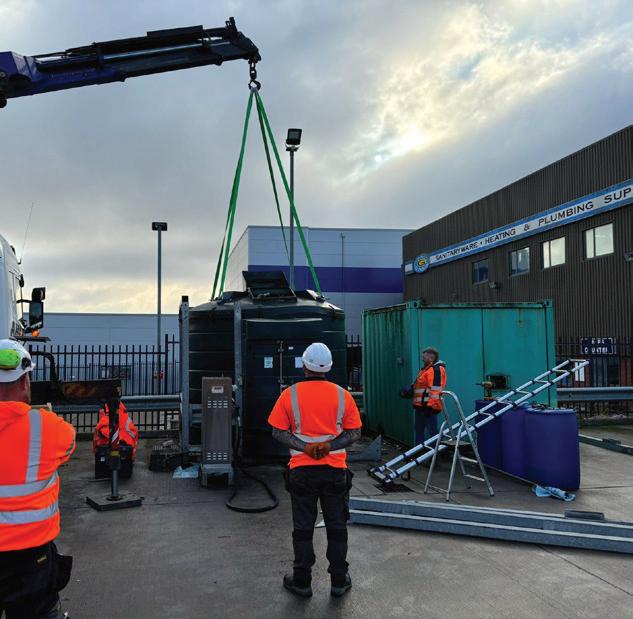
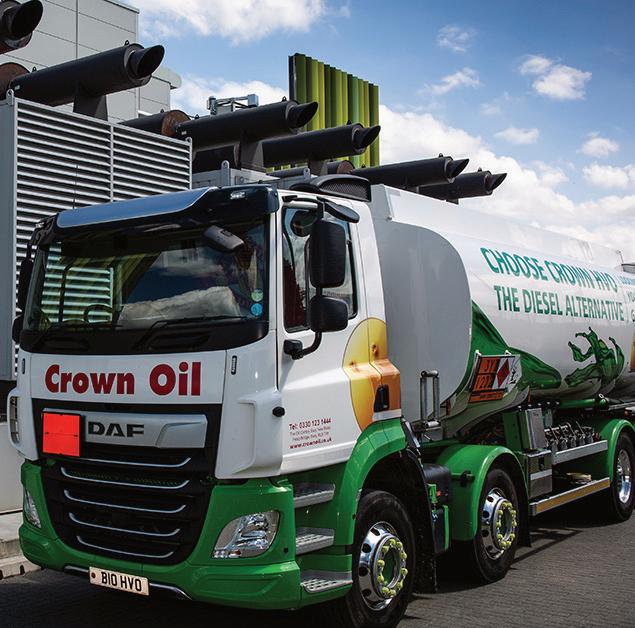
Crown Oil Environmental offers far more than expert fuel services - we’re a provider of turnkey fuel supply and maintenance solutions, backed up by some of the most experienced teams in the business and a HVO-fuelled delivery fleet.
HVO fuel transitions Tank telemetry installation
Tank installation & decommissioning Renewable
system inspections Rafibra tank lining systems Fuel uplift & removal
Fuel testing & polishing
Data centre services
supply Fuel supply contracts
(NDT)
THIS MONTH...
This month’s summary of everything that has hit the headlines in the FM sector.
The latest news and views from membership organisations.
Defence, data and the burning fire. Richard Huck with reflections from the Defence Procurement & Supply Chain Engagement expo.
Above zero and below the radar, NonFreezing Cold Injury is a real risk for UK workplaces, Paul Rees of Veterans for Veterans explains to FMJ.
Sam Lord of the Health and Safety Executive (HSE) on the legal duty to properly assess, manage, and monitor asbestos risks in non-domestic and multi-occupancy domestic premises.
16 Alisha Kalam, , Platinum Facilities looks at ways of identifying energy waste in your building.
18 Danny Steele, Director of SM Cleaning & Support Services, on the o ice cleaning standards facilities managers should expect.
20 A report revealed the underutilisation of the Apprenticeship Levy. How can we ensure that more apprenticeships are available to support the next generation of FM professionals?
SUSTAINABILITY
34
Net Zero starts in the supply chain says Daniel Usifoh, MSc, MCIPS, Co-Founder of Axiom Sustainability So ware.
36 Stefania Vatidis, Growth Marketing Manager at dynamic workplace solutions provider HubStar explains why underused o ices are an environmental problem - and how data can fix it.
INTERVIEW
Sara Bean visits Farnborough Airport to see how the team from Peartree Cleaning maintain the highest cleaning standards at the premier aviation hub.
End-of-route facilities are defining the commute. Madeleine Ford explores how the right infrastructure can combine smarter storage, better wellbeing and stronger sustainability outcomes.
38 Matt Hassall, Head of Estates Central Services for Avanti Schools Trust explains to Sara Bean why a culture change is needed in educational estates management.
CLEANING & HYGIENE
42
Kevin Muckle, Head of So Facilities Management for Sodexo UK & Ireland on how cleaning has evolved from a traditional, manual task into a technology led, data informed and experience-centred profession.
44 Responsibility for cleaning decisions is o en fragmented, says Georgia Jordan of BioHygiene. Taking a more strategic approach to cleaning requires FM departments to work together.
New product and
51 Find out who’s moving where in the facilities management profession.
Pauline Gunn, Head of Leadership and Development, and Sarah Hayes, Director of HR at Securitas UK on the advantages apprentices bring in building tomorrow’s security.
Matthew O’sullivan, Managing Consultant at Humanscale explains how digital platforms help train hybrid workers to maintain ergonomic practices.
brief roundup of the latest careers news in the facilities management sector.
In May’s issue our security focus explores how managing sta identification is becoming a litmus test for companies’ wider security strategies; plus, one-year on from the introduction of Martyn’s Law we’ve advice on compliance readiness at venues and other publicly accessible spaces. We ask, what are the lessons for FMs following the introduction of Awaab’s Law and could it reduce building related illness for workers as well as those who live in social housing? Simpler Recycling Phase 1 changed the way facilities handle recycling, but there’s still confusion over compliance. In our recycling and waste management feature we o er practical advice to help facilities get their recycling right. And finally, we present a preview of Clerkenwell Design Week and highlight some of the key brands and events to see during the festival.
LEGAL VIEW SCHOOL ESTATE TEAMS MUST MOVE FAST ON CIF PROJECTS ONCE FUNDING IS ANNOUNCED
SMES FACE FRESH FRAUD RISKS FOLLOWING COMPANIES HOUSE VULNERABILITY
Aman Parmar, Head of Marketing at BizSpace
Last month, a major security flaw at Companies House was revealed to have exposed millions of UK companies to potential unauthorised access, putting sensitive director data and business records at risk for several months.
The idea that someone could potentially access your company dashboard, view sensitive director data and even attempt to make changes is deeply unsettling, and it’s exactly the kind of vulnerability that fraudsters look for.
What makes this particularly alarming is how simple the flaw appears to have been. According to reports, users may have been able to access other companies’ records with nothing more than basic navigation tricks, exposing personal data such as home addresses, dates of birth and email addresses. That kind of information is valuable for criminals, whether for phishing, identity theft or impersonation.
This incident didn’t happen in a vacuum. British SMEs are already operating in a much tougher risk environment than they were even two years ago. Cyber-crime is now one of the most common threats facing businesses, with government data showing around 43 per cent of UK firms experienced a cyber breach or attack in the past year. The National Cyber Security Centre is dealing with the equivalent of four major cyber incidents every week and have issued a warning to organisations to strengthen their cyber defences following geopolitical tensions in the Middle East, which may further heighten the risk of cyber threat.
Smaller businesses are not flying under the radar; instead, they’re often the primary target. ‘AI 2.0’ scams are on the increase, and their methods are growing far more sophisticated than the obvious phishing emails of the past. These attackers are simply looking for the easiest way in, and once sensitive company data is exposed, it can be used weeks or even months later.
This isn’t something to review next quarter or leave to your accountant at year-end - every company director should be logging into Companies House as soon as possible and checking for anything that doesn’t look right. Check for changes to:
• Registered office address;
• Director details, including service and residential addresses;
• Filing history and any submissions they don’t recognise;
• Persons with Significant Control (PSC) records;
• Email addresses linked to filings and confirmations;
• Double-check who has access to your authentication code and whether any unexpected correspondence has been received.
Ultimately, cyber risk is no longer just about your own systems: it’s also increasingly about the platforms and institutions you rely on every day. From rising fraud levels - now described by the UK government as one of the most significant threats to businesses and growth - to high-profile incidents disrupting major UK companies, the landscape has dramatically shifted.
As a provider of flexible workspaces for SMEs BizSpace works closely with thousands of UK businesses every day, so we see first-hand how issues like fraud, data exposure can cause operational disruption. You cannot simply assume your Companies House records are safe. I therefore urge all business owners to take 10 minutes to check your details. If anything at all looks wrong, escalate it immediately and speak to your accountant or legal adviser.
As schools wait for CIF funding announcements in May, they are being advised to be ready to move fast to meet tight delivery deadlines.
Schools are entering the final years of the Condition Improvement Fund (CIF), with the Department for Education planning to replace the programme with a new capital maintenance funding model by autumn 2028.
That means the 2027–28 round is expected to be the final opportunity for many academy trusts and sixth-form colleges to secure funding through CIF.
Awards will trigger an immediate delivery race. Estates managers, technical advisers and contractors will have only a limited period to mobilise projects and complete works during the school summer holidays. In many cases CIF funding only covers part of the required works, meaning schools and trusts must prioritise carefully, manage tight capital budgets and sometimes phase projects across multiple funding rounds.
Will Hunnam, Managing Director of Forza Doors, said: “CIF funding is essentially a delivery programme with a very tight timetable. Once awards are confirmed, schools need to move quickly to finalise scope, appoint contractors and prepare sites for summer works. For many condition improvement projects, particularly those involving fire safety and compliance upgrades, the ability to move quickly from award to delivery will determine whether the project succeeds.”
The CIF programme assumes that many intrusive works will be completed during the summer holiday period, when school buildings are empty and sites are more accessible. However, this also creates a compressed delivery window for projects that may involve safety-critical upgrades.
For estates teams and consultants supporting CIF projects, early clarity around scope, procurement and programme can significantly reduce delivery risk.
ATLAS LAUNCHES ATLAS RETAIL
Atlas has launched a new specialist business focused on supporting the smooth, safe and welcoming operation of retail and leisure destinations across the UK.
Working across shopping centres, retail parks, leisure parks and mixed-use destinations, Atlas Retail delivers cleaning, security and wider site services through a single, integrated operating model. Rather than separate providers working alongside each other, services are planned and managed together on site.
Each location is supported by one management team and colleagues trained for the realities of live retail environments. This joined-up approach improves day-to-day coordination, raises standards across service lines, and supports a better experience for visitors, tenants and on-site teams.
Atlas Retail can provide a full suite of additional services alongside core cleaning and security allowing clients to simplify their supply chain while retaining flexibility in the operating model at site level.
Atlas Retail incorporates Aston Services Group, acquired by
Atlas in 2024.
SFMI SAYS FM SECTOR MUST ACCELERATE ACTION TO MEET 2030 SUSTAINABILITY DEMANDS
TheSustainable Facilities Management Index (SFMI) has published its ‘Sustainable Ambitions Report 2026’, revealing how the facilities management sector must evolve over the next five years to meet rapidly intensifying environmental, social and regulatory expectations.
The report follows the SFMI’s earlier Summary Report, ‘FM Leaders Zero in on What Really Matters in Sustainability’, and has been developed in close collaboration with SFMI Partners.
Crucially, the report gives FM leaders a clear view of what’s coming — outlining the major changes expected by 2030, the risks of inaction, and the practical steps organisations must take now to stay ahead of rising expectations across Decarbonisation, Wellbeing, Social Impact, and Risks & Opportunities. While the sector has made real progress, it warns that “the nature and scale of the changes do not give us the luxury of time. We need to act quickly”. The next five years will be decisive as expectations rise, regulatory scrutiny increases and workplace demands evolve. The report identifies key capability gaps that must be addressed for meaningful progress by 2030, across organisations, the FM sector, and government.
Delivering the sector’s sustainable ambitions by 2030 is achievable, but only if clients take real ownership of their strategies and reform procurement, FM providers raise their technical capabilities and embed sustainability into everyday operations, and government strengthens regulation while aligning the frameworks used across the sector. To download the full report visit https://bit.ly/4s4mlMU
BCIS updates five-year maintenance, cleaning and energy forecast
Maintenance costs, as measured by the BCIS All-in Maintenance Cost Indices, are set to rise 15 per cent over the five years to 4Q2030, according to the latest forecast data from the Building Cost Information Service (BCIS).
Cleaning costs are expected to rise by 23 per cent over the same period, largely driven by increasing labour costs, while energy costs are forecast to decline overall by around 3 per cent between 2025 and 2030.
Dr David Crosthwaite, Chief Economist at BCIS, said: “The UK facility management sector is operating in a challenging environment, with slow economic growth, persistent inflationary pressures and continued volatility in global energy markets.
“While repair and maintenance (R&M) output is expected to grow over the forecast period, pressure on labour costs, combined with uncertainty around energy prices, means organisations will need to keep a close focus on cost control.”
It is too early to fully assess the economic implications. However, a prolonged period of elevated energy prices could sustain broader inflationary pressures and slow the pace of monetary easing.
Dr Crosthwaite said: “Political instability in the Middle East has contributed to disruptions in global oil and gas supply chains, leading to sharp increases in wholesale energy prices and renewed inflationary risks in the UK economy.
“In this uncertain environment, organisations that prioritise energy efficiency and long-term strategic planning are likely to be better positioned to maintain operational continuity and financial stability.”
WILL GOVERNMENT YOUTH EMPLOYMENT MEASURES RISK DILUTING THE APPRENTICESHIP BRAND?
Thechallenges of the labour market have hit young people particularly hard, with 16 per cent of those aged 16-24 unemployed – an 11year high, according to the ONS.
Following the adoption of skills policy in England by the Department for Work and Pensions, that department has been busy with a flurry of announcements targeting this age group, whose levels of economic inactivity are concerning.
They have set out further detail on the youth new deal, with ‘£1 billion [to] create 200,000 jobs for young people, alongside the biggest transformation of apprenticeships in a decade’.
This is very much an announcement of two halves, with incentives to encourage employment of young people, alongside a restriction of the choices of fundable apprenticeships that, in the government’s view, don’t support its industrial strategy.
First, the good news – the Youth Jobs Grant, where employers will receive £3,000 for every 18 to 24-year-old who has been looking for work for
six months. This is alongside the Jobs Guarantee, a six-month paid job to eligible 18 to 21-yearolds who have been seeking work for 18 months – where government will cover 100 per cent of employment costs for 25 hours a week at the relevant minimum wage.
IWFM’s recent Impact and Experience Survey highlighted the challenge of attracting under 25s into facilities management – as clear a signal as any that FM needs to showcase its opportunities to them. This latest measure could be a prime opportunity to attract younger people into roles across the FM sector. We hope take-up will be high and many meaningful FM careers will come of it.
Professional bodies like IWFM that both set the standards for FM competence and o er a CPDsupported career pathway from entry to strategic level stand ready to help new FMs and their employers. At the same time, we continue to argue for a comprehensive focus on skill and competence development for young people that will boost key sectors like FM and help address underlying
CIBSE RESPONDS TO UK GOVERNMENT POSITION ON WHOLE-LIFE CARBON ASSESSMENTS
CIBSE has welcomed the Government’s recognition that whole-life carbon assessments will play an important role in decarbonising the UK’s buildings. However, the body for building services professionals is disappointed that it has rejected the Environmental Audit Committee’s recommendation to introduce mandatory whole-life carbon assessments for major developments, instead indicating that it intends to rely on a voluntary approach to carbon accounting.
Whole-life carbon assessments measure the total emissions associated with a building across its lifecycle. The methodologies, standards and professional expertise required to undertake these assessments are already well established across the sector. Making carbon accounting voluntary risks ignoring this existing capability and undermines the Government’s own legal commitment for the UK economy to achieve net zero by 2050.
The Government also suggests that an emissions increase in one part of the economy could be balanced by additional reductions or removals elsewhere to meet carbon budget limits. In practice, argues CIBSE, these risk creating a regulatory loophole while maintaining the status quo rather than delivering the sustained cross-sectoral reductions required to align with the UK’s net-zero trajectory.
Through the Part Z initiative, industry has already proposed a practical pathway through the introduction of a new regulatory requirement within Building Regulations. This would introduce mandatory whole-life carbon assessments first, followed by embodied carbon limits once su icient data has been gathered.
Many countries have already introduced mandatory whole-life carbon assessment and embodied carbon limits. The UK risks falling behind international best practice unless it provides a clear regulatory signal.
CIBSE is urging the Government to work with industry to establish a clear timetable for mandatory whole-life carbon assessments for buildings, alongside a pathway to future embodied carbon limits.
structural blocks to their flourishing through work.
We know that FM can o er a long and rewarding career. The Youth Guarantee should be used alongside workforce planning to ensure an on ramp for new young entrants to stay, learn and grow in the sector. This would help in maintaining institutional memory of ways of working, as well as providing opportunities for mentoring for those in more senior roles.
Feedback from our recent Impact and Experience survey clearly highlights the need to attract more talent into the FM sector and the recent announcements are a good start in supporting that. In isolation, they will not succeed without the engagement and commitment of employers across our sector to build youth employment objectives into their wider people recruitment strategies.
Andrew GladstoneHeighton, Interim Head of Policy & Insight, IWFM
RICS CALLS FOR EXPRESSIONS OF INTEREST IN NEW DATA, ANALYTICS
AND INTELLIGENCE PATHWAY
TheRoyal Institution of Chartered Surveyors (RICS) has announced a new pilot programme for a new Data, Analytics and Intelligence pathway to become a chartered surveyor. This innovation is designed to meet the growing demand for advanced digital and data-driven expertise across the built and natural environments. As part of the pilot approach, RICS is launching an Expressions of Interest (EOI) process to assess demand and gather feedback.
Luay Al-Khatib, Director of the Future Innovation Hub at RICS, said: “This pilot reflects RICS’ commitment to remaining agile and responsive to market change.
As educational and regulatory landscapes evolve, the institution is aligning its professional pathways with emerging career paths and specialisms, ensuring standards keep pace with innovation while maintaining the integrity and public interest role of the profession.
“I encourage professionals and organisations interested in being at the forefront of how data, technology and the built and natural environment interact to submit a formal Expression of Interest.”
Easier compliance with UK legislation
DPRTE 2026
DEFENCE MOVES
Defence, data and the burning fi re. Richard Huck of Magenta with refl ections from the Defence Procurement & Supply Chain Engagement (DPRTE) expo
There is a particular energy to an event that knows its relevance. DPRTE 2026, the UK's premier defence procurement and supply chain conference, arrived with distinct charge this year. For the first time in its 12-year history, the event ran across two full days, a decision that reflected both the scale of the agenda and the appetite of an industry with a great deal to discuss. O icially supported by the Ministry of Defence (MOD) and drawing key figures from across the sector, the atmosphere was busy and engaged.
A FIRE BURNING
Day 2 of the conference opened with a jolt of candour. Sky News’ Security and Defence Editor, Deborah Haynes delivered a keynote framed around lessons from a wargame. Her message was that while a growing notion of threat is visible, there remains a collective sense that we have the luxury of waiting. The UK’s defence system, she argued, exists in a strange limbo, everyone can see the fire burning, but too few are running towards it. There is a significant hole in the defence budget, and the public deserves to understand what that means. Journalists, she
added, need to go deeper into the industry and find new ways to communicate what they find. It was, deliberately or not, the perfect frame for everything that followed.
STRATEGY INTO ACTION
A session in the UK Defence Industry Growth & Development Zone brought together Ben English, Chief of Sta of the Defence Industrial Strategy at the MOD, and Emily Wood, Head of Programme at the newly launched Defence Industrial Joint Council, to take stock of six months since the strategy's publication. Six months on, the mood was one of cautious but genuine momentum. The message from the MOD was that the political will exists, the financial commitment is in place, and the machinery is beginning to move. Early milestones such as regional growth deals and the launch of a formal industry council point to a department intent on translating ambition into action rather than letting strategy gather dust.
What came through most strongly was a shi in how the MOD is thinking about industry engagement. Rather than a top-down model of instruction and compliance, the emerging approach
truth.
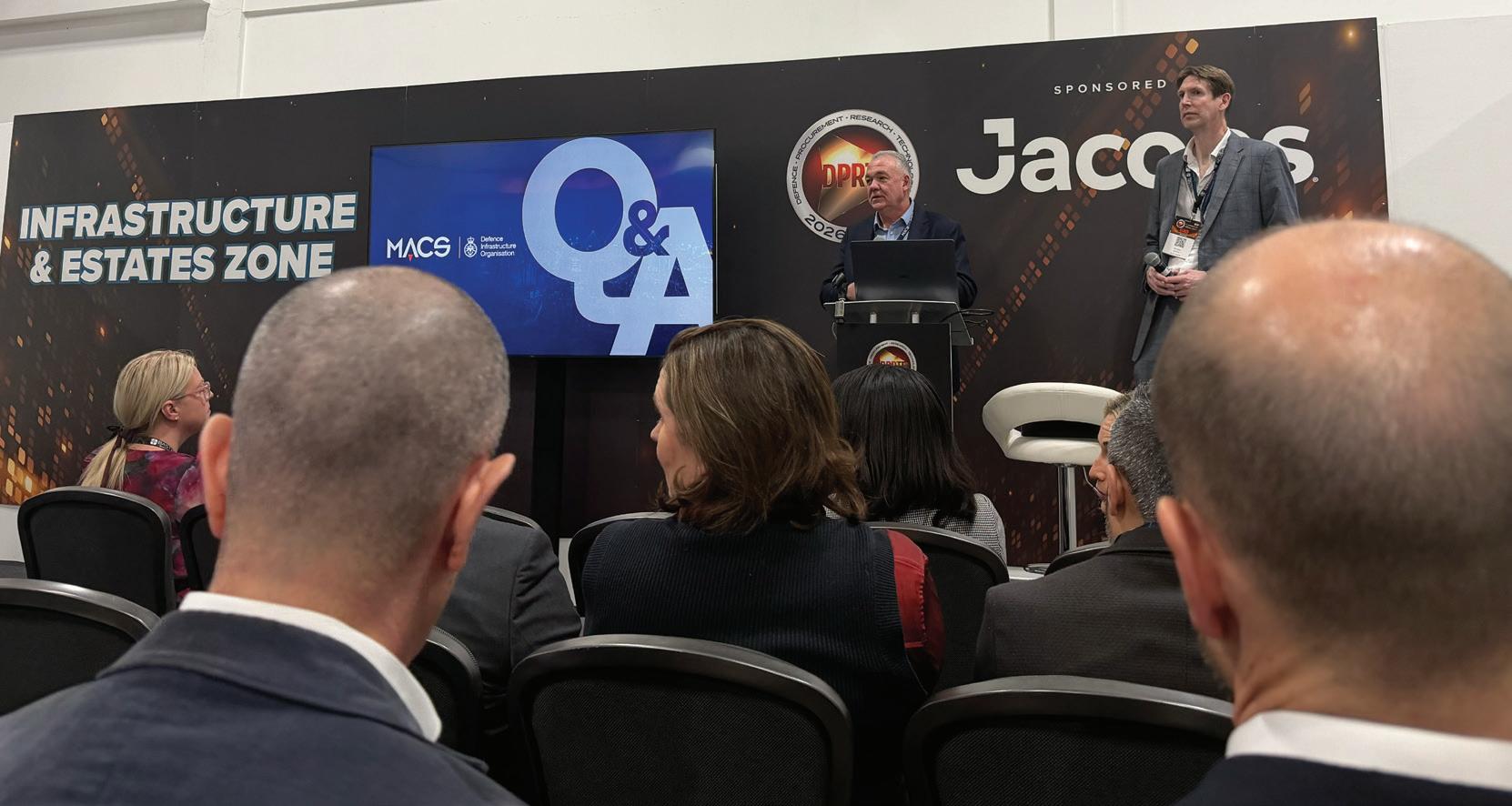
MACS EU, working alongside the DIO and IBM technology, led the consolidation of that fragmented landscape into a single digital asset master record built on industryrecognised standards. The platform now manages approximately £2.9 billion of spend annually, processes millions of work orders, and exchanges 1.7 billion data interactions with supply chain partners each year, figures more commonly associated with retail or banking than property management. The practical dividends are significant with data sovereignty returned to the DIO, cleaner supplier transitions and investment decisions informed by real condition data rather than educated guesswork.
Lemon's closing observation resonated well beyond the defence context: “No AI tool or advanced analytics platform can function well without sound underlying data. What has been built here is the foundation from which genuine operational intelligence can be drawn.” For FM professionals navigating their own data fragmentation challenges, it is an incredibly instructive case study.
is genuinely collaborative, bringing in voices from academia, technology, finance and manufacturing to shape the hardest problems together. Equally striking was the emphasis on accountability, this is structured work with ministerial oversight. The ambition is to make the relationship between defence and industry feel less transactional and more like a long-term partnership built on shared outcomes. For a procurement culture historically associated with complexity and delay, that represents a meaningful change in tone.
THE ESTATE AS ENTERPRISE
Peter Lemon, Sales Director of MACS EU and Phil Sayers, CIO at Defence Infrastructure Organisation (DIO), took to the stage in the Infrastructure and Estates Knowledge Transfer Zone to present the results of a decade-long digital transformation journey. The scale of what has been achieved is striking. The DIO is responsible for some 900 locations, 40,000 homes and approximately two per cent of the UK's total land mass, and in 2010 it was managing all of it across more than 150 disconnected systems with no common data standards and no single source of
URGENCY WITHOUT PARALYSIS
Stepping back from the individual sessions, a consistent thread runs through DPRTE 2026 - a sector working hard to convert stated ambition into operational reality, at speed, without losing coherence. Frustrations were named openly, procurement still moves too slowly, and the budget still has gaps. What felt di erent was the frank acknowledgement of those shortcomings, and a clear sense of direction for addressing them. For facilities and infrastructure professionals, the challenges are ultimately familiar ones with fragmented supply chains and the need to build systems that outlast the individuals who create them. The scale may be slightly di erent, but the discipline required is the same.
DPRTE 2026 made the case, convincingly, that the defence sector is speeding up with alarming urgency. Whether the structures now being put in place can deliver at the pace the moment demands remain to be seen. The political will is in the room. The industry is engaged. Now comes the hard part.
Further info: www.dprte.co.uk
Protect and Future-proof Your Buildings
Roofing & Solar Solutions
Built for performance, designed for longevity
Plan With Confidence Budget forecasting and ROI planning for your estate
Fully Compliant Specs Safe2Torch ready, designed to UK building regs
Dedicated Technical Manager On-site support, from project design to completion
Protected For The Future Up to 30 year Single-Point Guarantee
COLD INJURY
Above zero and below the radar, Non-Freezing Cold Injury is a real risk for UK workplaces, Paul Rees of Veterans for Veterans explains to FMJ
April creates a false sense of security. Frost risk drops on the register. Winter is considered done. But in the UK, April is o en wet, with long spells of rain, cold wind and single figure temperatures at 06:30 hrs. Saturated ground and waterlogged PPE are the exact conditions that cause Non-Freezing Cold Injury.
NFCI does not require ice. It does not require subzero temperatures. It develops above 0°C when cold, wet exposure is prolonged and circulation is restricted. Add long shi s and limited opportunity to dry kit and the risk increases.
“Wet plus cold plus long hours in safety boots. That is the formula,” says Paul Rees, former soldier and now adviser on cold injury risk. “It does not take snow. British weather does the job every winter.”
The injuries first gained widespread attention in the Armed Forces where soldiers experience extended periods in soaked boots in static positions with limited rotation. Between 2010 and 2017, the Ministry of Defence recorded almost 5,000 cases of NFCI through Freedom of Information data, and many more went undocumented.
Now the same exposure profile exists across civilian sectors, including construction, highways, rail, utilities, energy, facilities maintenance and security. In fact, any role that combines cold, wet conditions with restricted movement and occlusive footwear carries risk.
WHAT NFCI ACTUALLY DOES
Non-Freezing Cold Injury damages small blood vessels and peripheral nerves, most commonly in the feet.
Early symptoms are easy to dismiss:
Persistent cold sensation
Tingling or numbness
Pale or mottled skin
Reduced feeling in toes. If exposure continues, the damage can become chronic. Long-term symptoms include:
Severe cold sensitivity
Burning pain
Hypersensitivity to minor temperature change
Excessive sweating
Loss of balance
Ongoing nerve dysfunction
For some, the condition becomes permanent. This is not about discomfort, the condition a ects mobility, concentration and safe task execution. A worker who cannot properly feel their feet on a wet surface is at higher risk of slips and trips. Chronic pain a ects sleep and cognitive performance while cold hypersensitivity can make routine outdoor duties intolerable. Unfortunately, in many cases these symptoms are o en brushed o until they become career limiting.
WHY SPRING MATTERS
Winter controls o en reduce once frost risk drops, yet prolonged rainfall and low ambient temperatures continue well into spring. Waterlogged boots do not dry between shi s without intervention. Concrete and steel retain cold. Early morning callouts mean teams start work before temperatures rise, so the assumption that risk ends when ice disappears is flawed. NFCI has already cost the Ministry of Defence millions in compensation. In the civilian world, the legal exposure is less discussed but no less real. Under the Health and Safety at Work Act 1974, employers must control foreseeable risk. Cold and wet exposure is foreseeable in the UK climate and so are its consequences.
REASONABLE ADJUSTMENTS AND RISK CONTROLS
E ective prevention sits across engineering, administrative and PPE controls.
Engineering Controls
Heated, dry welfare areas positioned close to work zones
Dedicated boot drying systems
Covered access routes where feasible
Improved site drainage to reduce standing water
Drying capability is critical. Saturated boots worn day a er day create cumulative risk.
Administrative Controls
Task rotation to limit prolonged static exposure
Structured warm-up breaks
Monitoring of exposure duration during sustained rainfall
Early reporting systems for cold sensitivity symptoms
Supervisors should be trained to recognise early signs of cold injury. Not just frostbite
PPE Controls
Waterproof and breathable safety boots
Layered sock systems designed for moisture management
Water-resistant gloves with thermal protection
Spare dry socks available during long shi s
Where an employee develops chronic symptoms, the Equality Act 2010 may apply if the condition has a substantial and long-term impact on daily activities. Reasonable adjustments may include modified duties during cold spells or reduced exposure time.
WHY VETERANS ARE SPEAKING UP
Veterans for Veterans is a UK claims management company sta ed by former Armed Forces personnel. They support ex-service men and women pursuing compensation for service-related
Non-Freezing Cold Injury and noise-induced hearing loss. They are seeing an increase in enquiries from veterans whose cold injuries have worsened years a er exposure. Many transitioned into civilian sectors with similar environmental conditions and their symptoms followed.
Between 2010 and 2017, almost 5,000 cases were formally recorded within the Armed Forces. That scale of data provides insight civilian sectors should not ignore.
“We are not here to sell fear,” Rees says. “We are here to stop this happening again. This time on civvy street.”
Veterans understand the exposure pattern. Long hours, wet kit and limited rotation. That experience places them in a position to recognise risk early and speak plainly about it. Prevention costs less than compensation and more importantly, it prevents permanent harm.
THE BOTTOM LINE
Non-Freezing Cold Injury can happen above 0°C. It can happen anywhere prolonged wet and cold exposure is combined with restrictive footwear and limited recovery time. But it is preventable and ignoring it because the frost has gone is not risk management, it is optimism. British weather does not need to freeze skin to cause damage. The conditions are already here.
COMPLIANCE
MANAGING ASBESTOS
AsbestosIn association with
To mark Global Asbestos Awareness Week (1–7 April), Sam Lord, HM Principal Specialist Inspector and Occupational Hygiene Technical Strategy Lead for Asbestos at The Health and Safety Executive (HSE) covers the legal duty to properly assess, manage and monitor asbestos risks in non-domestic and multi-occupancy domestic premises
was banned in the UK in 1999, but despite this, potential risks are still present in many buildings today. If you are responsible for maintenance and repair of non-domestic buildings or multi-occupancy domestic premises, you have a legal duty to manage any asbestos in the building.
This includes factories, warehouses, o ices and shops, and public buildings like hospitals, schools, premises used for religious worship, museums and libraries.
DO YOU KNOW WHAT’S IN YOUR BUILDING?
Any building built or refurbished before 2000 could contain asbestos-containing materials (ACMs). Asbestos was widely used in construction between 1950 and 1980, and older premises may contain multiple ACMs in a variety of forms: spray coating, pipe lagging, insulating board, asbestos cement products such as profiled roof sheets and wall panels, floor coverings, and textured decorative coatings.
The risks are not static. As buildings age, ACMs can deteriorate and the law requires them to be monitored and managed actively to keep occupants safe. If you have incomplete historical records, or suspect materials have not been properly documented, now is the time to get it sorted.
THE LAW IS CLEAR
There is a legal duty to manage asbestos in non-domestic premises and multi-occupancy domestic premises. Failing to meet that duty can result in penalties ranging from fines to prison sentences. Consequences can extend far beyond the legal, including reputational damage, impact on sta morale, and the substantial human cost of preventable illnesses which are o en fatal.
HSE inspectors can visit premises without warning to review the management of health and safety risks, with the latest inspections having a particular emphasis on checking e ective asbestos management.
WHAT YOU NEED TO DO
HSE sets out a clear framework for duty holders to find where the asbestos is, what condition it’s in and how it should be managed:
Arrange for an asbestos survey (or review existing surveys)
Make a register and assess the risk
Write your asbestos management plan (AMP)
Put your plan into action
Surveys are just the starting point. A clear up-todate register and management plan is essential. These should not sit on a shelf as tick-box compliance documents, but function as practical, working tools. A robust register records inspections, tracks the condition and risk from ACMs and triggers prompt action if any deterioration is identified. Just as importantly, it ensures that anyone carrying out work on the building understands exactly where ACMs are located, so that the precautions required to work safely can be taken.
It is also important to remember that asbestos is o en concealed beneath surfaces and within structural voids – for instance, under flooring, inside cavity walls and li sha s. These hidden areas will require an intrusive refurbishment survey to identify any asbestos before work begins, to avoid accidental disturbance and exposure. If work begins and asbestos is discovered or suspected, stop work. If asbestos has been accidentally disturbed, it must be dealt with quickly and appropriately.
GOOD BUSINESS SENSE
Facilities management professionals face a demanding mix of regulatory, operational, and safety responsibilities when dealing with asbestos. The priorities are clear—accurate identification, ongoing monitoring, robust procedures, e ective
www.hse.gov.uk
communication and relevant training. There are challenges but proactive management and monitoring of asbestos is good business practice. Unexpected remediation costs and emergency responses are far more expensive and disruptive than planned, systematic management.
COSTLY CONSEQUENCES
The risk of working unsafely with asbestos is not just harmful to health, failing to comply can cost much more as this prosecution case illustrates.
A school and its maintenance contractor were fined a er workers disturbed asbestos at the school while installing a new heating system. In the course of the work, ceiling tiles containing asbestos were disturbed, potentially exposing several people – including children, to asbestos fibres. The contractor and the school both failed to refer to the existing asbestos register and management plan to identify the presence of asbestos within the building.
TRAINING AND AWARENESS
Ensuring that maintenance teams, contractors, and building occupants understand asbestos risks is essential to preventing accidental exposure. HSE o ers training courses such as the Managing Asbestos in Buildings course which introduces the responsibilities of duty holders, relevant legislation, and the standards required to properly manage asbestos risks.
FREE GUIDANCE AND TEMPLATES
HSE provides comprehensive guidance at hse.gov. uk. If asbestos has been accidentally disturbed, it must be dealt with quickly and appropriately. See Asbestos Essentials (em1) for step-by-step guidance and emergency procedures for accidental, unexpected releases of asbestos fibres.
FURTHER SUPPORT
HSE’s Asbestos & You and Asbestos Your Duty campaigns provide practical guidance for both tradespeople and those responsible for the maintenance and repair of non-domestic buildings. The message of Global Asbestos Awareness Week is straightforward: know your building, know your duty and act on both.
OUR CORE AREAS.
MECHANICAL & ELECTRICAL SAFE SYSTEMS OF WORK
HTM HEALTHCARE ESTATES & FACILITIES
MECHANICAL & ELECTRICAL TECHNICAL
F-GAS HANDLING
LEGIONELLA (WATER HYGIENE)
FIRE SAFETY
Our competence-backed training sets the standard, empowering your workforce to cross-skill for maximum flexibility or up-skill for technical mastery. By bridging the skills gap with industry-recognised, assured certification, we ensure your team remains compliant, efficient, and futureready. Invest in proven expertise. Elevate your operational standards and team performance at PPL Training.
Setting the Standard in Estates & Facilities Training. Elevate and up-skill your team’s capabilities... 0333 121 1215
info@ppltraining.co.uk ppltraining.co.uk
FAST FACTS
READ THE SIGNALS
FMJ AIMS TO SUPPORT TECHNICAL EXPERTISE IN THE FM MARKET
We’re facing a global energy crisis. Here, Alisha Kalam, Head of Data-Led Maintenance & Systems Analytics, Platinum Facilities looks at ways of identifying energy waste in your building
Formany facilities managers, energy data can feel overwhelming – there’s no shortage of numbers but knowing what to do with them is another matter. The good news is that a handful of straightforward checks can reveal a great deal about how your building is performing and where ine iciency is taking hold.
SEASONAL CONSUMPTION PATTERNS
One of the most accessible starting points is mapping monthly gas and electricity use against the time of year. In a typical UK o ice, the relationship should be predictable. Gas consumption tends to climb through the winter months as heating plant works harder to maintain space temperatures and produce hot water. Electricity, meanwhile, o en peaks in summer when cooling systems, pumps and fans are under greater load.
Where that seasonal pattern is absent – i.e., consumption looks broadly the same regardless of temperature outside – it’s worth investigating. Plant may be running when it shouldn’t be, controls may have lost their connection to real-
world demand, or the control strategy may no longer reflect how the building is occupied and used. That single observation can help you decide where to direct your attention first: schedules, controls, or the way the building is being operated day to day.
VALIDATE YOUR BMS
Any trend is only as reliable as the data behind it. Before acting on what you’re seeing, it’s worth sense-checking your BMS points against what’s happening on the ground. It’s not unusual to find a fan or pump showing as active when it’s stood still, or vice versa. Wiring changes, sensor faults, commissioning gaps and point mapping issues can all cause BMS statuses to dri from reality over time. A brief walkaround with an eye on live readings can save considerable wasted e ort.
Time schedules deserve similar scrutiny. A schedule that looks correct on screen – say, 08:00 to 17:00 –doesn’t always translate to equipment switching o at the end of the day. A communication fault or a standing override can keep systems running through the night. Even a single zone sensor calling for heat outside occupied
problem. A significant proportion stems from how buildings are managed under pressure. When comfort complaints come in – a cold desk, an overheated meeting room, a persistent hot or cold call from one part of the floor – the instinct is o en to act quickly. That might mean forcing a fan coil to full output, manually opening a valve, or switching a piece of plant to hand mode. The fix resolves the immediate complaint, but if the equipment isn’t returned to auto, what started as a localised response can create a persistent demand signal that draws on boilers, chillers, pumps and air handling units long a er the original problem has passed.
REMOVE OVERRIDES
Once you’ve worked through the basics, the next most impactful step is o en simply clearing persistent overrides and returning equipment to automatic control.
hours is enough to bring on plant, so long as the control logic allows it. A useful question to keep in mind: if the building is meant to be unoccupied, what conditions could still be triggering a demand response?
USE OCCUPANCY AS A DEMAND SIGNAL
How the building is used should be one of the clearest drivers of energy consumption. In a well-functioning building, energy use rises when people arrive and falls when they leave. This means evenings, weekends and bank holidays should show a meaningful drop. When consumption remains largely flat regardless of occupancy levels, it’s a strong indicator that plant is running without meaningful modulation. Halfhourly meter data and trend logs are particularly useful here. Even without sophisticated analytics tools, they can reveal out-of-hours running patterns that would otherwise go unnoticed. Most utility providers will supply this data on request.
HIDDEN COST OF OPERATIONAL HABITS
Not all energy waste is a technical
Plant held in manual mode tends to run continuously, regardless of what the building needs. When an automatically controlled system triggers a comfort complaint, this is valuable diagnostic information. Rather than masking it with another override, it points you towards the underlying issue.
Most BMS platforms, even older ones, hold historical trend data – fan speeds, valve positions, flow temperatures, run signals – and this information can expose patterns that aren’t visible in consumption figures alone: for example, out-of-hours operation, persistent demand from a single area, simultaneous heating and cooling, or equipment that never modulates away from full output.
At one client site, analysis of the daily electrical load showed that AHU energy consumption remained unusually high during weekdays when compared with weekends. This raised concern because the building is a residential block, where footfall is expected to be less during the week, when many residents are likely to be out during the day.
Following further investigation, it was found that the fan had been manually overridden to operate at a fixed speed. As a result, the issue was resolved without the need for any wider control logic amendments or capital expenditure.
The data is usually already there. It’s knowing what questions to ask of it that makes the di erence.
OUTSTANDING OUTDOOR MAINTENANCE
OUTSTANDING OUTDOOR MAINTENANCE
Your outdoor estate never stands still.
Your outdoor estate never stands still.
From expertly maintained grounds to fast, reliable reactive works, OUTCO keeps your sites safe, presentable, and operational all year round with one trusted partner for complete external maintenance
From expertly maintained grounds to fast, reliable reactive works, OUTCO keeps your sites safe, presentable, and operational all year round with one trusted partner for complete external maintenance
0800 0432 911 enquiries@outco.co.uk
0800 0432 911 enquiries@outco.co.uk
@CIBSE CIBSE’s Hong Kong Region celebrated another fantastic evening at the 2026 Annual Dinner! A heartfelt thank you to the CIBSE Hong Kong Region committee and all the volunteers whose hard work and dedication made this event such a success!
#WeAreCIBSE
@mitie A very happy Eid to all our colleagues, customers, and suppliers who will be celebrating. Eid is a time of gratitude, connection, and celebration. A reminder of the values that bring us all together.
@theCIOB To mark Prostate Cancer Awareness Month, the latest episode of the 21CC podcast sets out why men across the industry must prioritise their health. Listen and access and previous 21CC podcast episodes, here: https://brnw.ch/21x0MhM #menshealth #prostatecancerawareness
@IWFM_UK We’re excited to be partnering with Equans UK & Ireland to release a new guidance note: Climate Adaptation for WFM. Stay tuned for insights, practical guidance, and opportunities to take a leading role. #ClimateAdaptation #WorkplaceManagement #Resilience #Sustainability
@VeoliaUK Beyond delivering essential recycling collections and street cleansing services, our local ECO team supported biodiversity in Hammersmith & Fulham by volunteering with Hammersmith Community Gardens Association. Their hard work helped to clear an area to be used for planting herbs.
@VertasGroup This #NeurodiversityCelebrationWeek, hear from Suffolk New College students Andrew and Anna as they share how their placements have supported their growth so far. When workplaces remove barriers and embrace diverse talent, everyone benefits. Read more: https://bit.ly/3NrjtLW
@BritishCleaning Have you ever wondered about the staff who work behind the scenes keeping big events like @TheCleaningShow spotless and squeaky-clean? Find out about the team that cleans @mcr_central for huge events via the UK Cleaning Career Development Zone here: https://bit.ly/4uVOZmc
DANNY STEELE, DIRECTOR OF SM CLEANING & SUPPORT SERVICES
THE OFFICE CLEANING STANDARDS FACILITIES MANAGERS SHOULD EXPECT
Ithink it’s fair to say that expectations around workplace hygiene have shi ed significantly in recent years. What was once considered “good enough” cleaning is no longer meeting the expectations of employees, tenants and visitors.
Facilities managers are increasingly being asked to maintain workplaces that not only look professional but also support health, wellbeing and productivity. As o ices continue to evolve, the standards expected from cleaning providers are evolving too.
Looking ahead, there are several key areas where facilities managers should expect higher standards and clearer processes from their cleaning partners.
HYGIENE EXPECTATIONS ARE HIGHER THAN EVER
One of the biggest changes is the level of awareness employees now have around workplace hygiene. Shared desks, communal kitchens, li buttons and door handles are all high-touch areas that people notice immediately if they are not properly maintained.
Employees are far more conscious of hygiene than they were just a few years ago. If surfaces appear neglected, it can quickly a ect confidence in the workplace environment.
For facilities managers, this means cleaning specifications should clearly prioritise high-touch surfaces and shared spaces, with regular attention throughout the day rather than relying solely on end-of-day cleaning routines.
CLEANING CONTRACTS NEED CLEARER STANDARDS
Another common challenge across many workplaces is the lack of clarity in cleaning contracts. Cleaning specifications o en describe tasks in general terms rather than defining measurable standards. This can make it di icult for facilities managers to assess whether the expected level of service is actually being delivered.
In 2026 and beyond, cleaning contracts are increasingly moving towards clearer standards and accountability. Instead of simply listing tasks, specifications should outline what success looks like. This might include defined cleaning frequencies for specific areas, visual standards for washrooms and communal spaces, and clear responsibilities for maintaining shared environments such as kitchens and breakout areas. When expectations are clearly defined, both facilities managers and cleaning teams can work more e ectively together.
In multi-tenant buildings, maintaining consistent cleaning standards can be particularly
challenging. Di erent organisations may have di erent expectations, and shared areas such as receptions, li s and washrooms experience significantly higher footfall than individual o ice spaces.
Facilities managers increasingly need cleaning strategies that reflect how these buildings actually operate. High-tra ic areas o en require more frequent cleaning and monitoring throughout the day to maintain consistent standards.
Regular communication between building management teams and cleaning providers is also important to ensure that shared spaces remain well maintained as usage patterns change.
VISIBILITY AND COMMUNICATION ARE BECOMING MORE IMPORTANT
Facilities managers are also recognising the importance of visible cleaning standards. Employees feel more confident in the workplace when they can see that cleaning is being actively managed. This might include daytime cleaning in communal areas or clearer communication about hygiene routines.
Cleaning teams are becoming more integrated into the overall workplace environment rather than operating purely outside o ice hours. This visibility helps reinforce confidence that the workplace is being properly looked a er.
CONSISTENCY IS THE REAL BENCHMARK
Ultimately, the most important cleaning standard is consistency. Occasional deep cleans can be valuable, but the day-to-day condition of the workplace is what shapes how people experience the environment.
Consistent attention to high-use areas, clear cleaning schedules and well-defined service expectations all contribute to maintaining professional workplace standards.
For FMs, setting clear expectations and working closely with cleaning providers will remain key to ensuring workplaces continue to meet the higher hygiene standards people now expect.
Danny Steele, Director of SM Cleaning & Support Services
Protect people .
Prevent explosions .
Adler & Allan delivers:
Stay compliant . Book your consultation
Adler & Allan helps facilities managers move beyond reactive compliance to build scalable, strategic DSEAR programmes that are remediation-ready.
Explosion Protection Document (EPD) support
Training & competency reviews
ATEX equipment audits & maintenance
Site-specific risk assessments & hazardous area drawings
FM CLINIC
There is a growing interest by young people in apprenticeships; yet, a report revealed the underutilisation of the Apprenticeship Levy, with over £3.3 billion in unused funds returned to the Treasury between 2019 and 2022. How can we ensure that more apprenticeships are available to support the next generation of FMs?
THE APPRENTICESHIP & TRAINING PROVIDER’S VIEW
MARGARET GOTLIB, ASSISTANT PRINCIPAL OF INNOVATION, PRINCIPALS AND DIRECTORS AT CAPITAL CITY COLLEGE
There is a huge demand for apprenticeships. The problem is a lack of information for employers.
From our work with apprentices across sectors, we know that potential apprentices are very much aware of the option of apprenticeships.
But we find it is o en the employers who are wary, not spending levies nor advertising apprenticeship jobs.
We have Business Account Managers who can explain how to do levy transfers, how to utilise the levy, how the levy can be spent, what to do if an employer runs out of levy, how to set up levy accounts, how to set up suppliers. It is quite complicated if someone hasn’t done this before, and I think some employers still find the system complicated. Others, even if they want to spend their levy, don’t know how to do it. One employer told me, “I ran out of my levy, so I can’t take any more apprentices,” and I said, “We can help you with this. There are levy transfers available.’’
The issues are misconception, complexity and outdated views from some employers who believe apprenticeships are only for entry level jobs. This needs to change, because the demand for apprenticeships is there and facilities management o ers excellent opportunities. As one of the largest FM apprenticeship providers in the country, we’ve been delivering them for years and have seen excellent results.
We need to educate employers just as much as students. The
In FMJ's regular monthly column, our team of FM experts answer your questions about the world of facilities management
Apprenticeship Levy is complex to understand and navigate. In large companies, the employees dealing with apprenticeships are not the same sta members dealing with the levy, because levy is a type of tax. And with more changes coming in April, it is daunting for some employers to have to navigate their way around these changes happening so quickly.
There have been several changes since last year, including the relaxation of Functional Skills requirements and introduction of shorter apprenticeships, reflecting the government’s intention to encourage more employers to recruit apprentices. However, it will take time for employers to fully understand the support available to them.
Margaret Gotlib
In the short term, employers should look for providers who have the support system in place. They are not just going to employ an apprentice; they need the provider who can support the whole process from setting Digital Apprenticeship Service (DAS) accounts to completion of the training. Facilities management is one of the sectors that benefits most, because it is so complex that apprentices need both the qualification and the practice. I met apprentices recently who moved from Level 2 to Level 3 and are ready for Level 4.
Employers should expand apprenticeship programmes alongside graduate schemes and give apprenticeships a chance. The demand is there, the enthusiasm from students is there, and the opportunity for employers is clear. What’s missing is understanding, and if we can close that gap, FM employers will see a phenomenal impact.
THE ENGINEERING & INFRASTRUCTURE PROVIDER’S VIEW
JAMES GLADDING, OPERATIONS DIRECTOR, NG BAILEY
At NG Bailey careful forecasting, strong internal coordination, and a clear understanding of our workforce development priorities have enabled us to maximise the value of the levy year a er year. However, the recent government change requiring all levy funds to expire within a 12-month period significantly increases the urgency and complexity of this process. This shorter timeframe means that organisations must be even more strategic, agile, and forward-thinking to ensure that valuable funding is not lost.
Considering this change, it is essential that we actively
seek out and embrace every appropriate opportunity the levy fund can provide. One such opportunity is the new apprenticeship unit short courses launching in April. These shorter, more flexible programmes represent a practical way to utilise levy funding in a timely manner while also addressing immediate skills gaps within the business. They o er targeted development that can be aligned to operational priorities, enabling us to respond quickly to changing business needs while ensuring compliance with the new funding rules. By planning and aligning these courses with workforce requirements, we can continue to make full and e ective use of the levy.
James Gladding
At the same time, we recognise that managing and maximising levy opportunities is not straightforward for all organisations. Businesses without dedicated learning and development infrastructure, workforce planning capability, or internal administrative support may find it significantly more challenging to navigate funding rules, identify suitable programmes and coordinate enrolments within the required timescales. For smaller organisations in particular, limited capacity can mean that levy funds expire unused, not because there is no need for training, but because the system can be complex and resource-intensive to manage e ectively. This creates a risk that the levy does not always deliver its full intended benefit across the wider business community.
additional challenges, it also reinforces the importance of strategic workforce planning and timely decision-making. By continuing to manage levy funds proactively, embracing new programme opportunities, and building on successful initiatives such as the GMO upskilling programme, the FM industry can ensure that the levy remains a valuable tool for supporting the next generation of FM professionals.
THE HR DIRECTOR’S VIEW
EILEEN GIRLING, CROWN WORLDWIDE GROUP REGIONAL HR DIRECTOR EMEA
As someone who has worked across people, learning and organisational development for many years, I’ve seen first-hand the transformative power apprenticeships can have. Yet despite the clear benefits, the level of unspent Apprenticeship Levy funds frustrates me, because it represents thousands of missed opportunities for growth, development and social mobility in sectors like ours.
In the FM and workplace industry, where the skills landscape is shi ing faster than ever, we simply cannot a ord to let this continue.
We have successfully utilised levy funding to support our General Maintenance Operative (GMO) upskilling programme. This semi-skilled pathway initiative demonstrates how the levy can be used strategically to address the skills gap. The three/ four-year apprenticeship provides a clear progression route for part-qualified colleagues who are motivated to broaden their skills, take on greater responsibility, and advance their careers. By investing in structured development over a sustained period, we not only enhance individual capability and engagement but also strengthen the resilience and expertise of our workforce.
JamesGladding
When many people think of apprentices, they picture 16- to 18-year-olds taking their first steps into the workplace. However, while entry level apprenticeships remain vital, especially with rising university debt deterring many young people, they are only one part of the story.
We have successfully utilised levy funding to support our General Maintenance Operative upskilling programme. This semi-skilled pathway initiative demonstrates how the levy can be used strategically to address the skills gap. The 3/4-year apprenticeship provides a clear progression route for part-qualified colleagues who are motivated to broaden their skills.. ”
In 2025, we also launched our Digital Apprenticeship Programme to futureproof industry talent pipelines in line with 2030 digitalisation ambitions. Since its inception, 15 digital apprenticeships have commenced, ranging from Level 3 Data Analyst to Level 7 AI Specialist.
This initiative introduces digital engineers directly into the workplace, creating a new generation of technically fluent professionals equipped to lead the next wave of transformation in facilities and asset management.
Overall, while the new 12-month expiry rule presents
At Crown, we have used apprenticeships and the levy to support individuals who didn’t leave school with the qualifications they needed. For example, an apprenticeship course of study in roles like removals porters or warehouse operatives has given people the chance to re-engage with Maths and English while earning and learning. These are real opportunities that change lives, and they directly support the talent pipeline our industry depends on. One of the most persistent misconceptions about the levy is that it can only be used for new starters, yet some of the most valuable apprenticeships we fund are for existing employees. Through our Aspire Academy, we’ve enabled team leaders, warehouse operatives, drivers, and aspiring managers to gain NVQ level qualifications, fully funded through the levy. I distinctly remember one colleague who started in the warehouse and wanted to become a driver. The apprenticeship not only gave him the formal qualification he needed but opened the door to a new career path altogether. This is the levy at its best: enabling people
Eileen Girling
FM CLINIC
to grow, progress and contribute more deeply to the organisation.
Another major opportunity lies in shaping new apprenticeship standards through trailblazer groups. We have helped to co-develop the Collections Technician apprenticeship, which now supports entry into a niche area of Fine Art logistics.
The levy isn’t perfect, it's complex, sometimes bureaucratic and it requires active management, but it is still one of the most e ective tools we have for building the workforce of the future. If organisations lack internal expertise, they should partner with others, share resources, or gi unused levy funds to supply chain partners who can put them to good use. This is an excellent way to utilise levy funds which many organisations are unaware of, so it is about raising awareness of how the FM industry can access levy funds in a variety of ways.
We’re paying for it anyway, so the least we can do is make sure it benefits our people, our sector and the next generation entering the world of work.
THE FM SERVICES PROVIDER’S VIEW
KATHRYN DOLAN, CHIEF PEOPLE OFFICER, MITIE
In facilities management the need for talent spans everything from green energy and digital skills to engineering and technical roles.
THE CLEANING SECTOR’S VIEW
DELIA CANNINGS, BRITISH CLEANING COUNCIL DIRECTOR FOR EDUCATION AND TRAINING
Despite the importance of the cleaning and hygiene sector it faces an ongoing challenge in attracting and developing new talent.
FM is evolving at pace, playing a critical role in the UK’s transition to a low-carbon future. With more than 3.5 million non-residential buildings needing retrofit by 2030, the demand for skilled professionals across the built environment is only accelerating. As green technologies, digital tools, data, and automation redefine FM roles, apprenticeships provide the essential talent pipeline we need, developing a workforce ready to deliver at speed and scale. But this can only happen if the skills system evolves alongside the sector’s needs.
The Government’s recent ‘fast track’ apprenticeship reforms are a promising step towards a more agile, accessible skills system. Yet, to truly unleash the potential of apprenticeships, the reforms must go further. FM employers still struggle to unlock the full value of the Growth and Skills Levy, with restrictive rules holding back much-needed training in rapidly developing areas like grid connections, heat pumps and solar technologies. A more flexible, future-ready approach would empower organisations to o er a broader, more relevant range of opportunities for young people, and keep the system aligned with emerging skills demands.
To ensure apprenticeships keep pace with our changing industry, deeper collaboration across FMs, Government, training providers and industry bodies is essential. Strengthening these partnerships will create greater consistency nationwide, speed up the approval of new standards and support sustained investment in high-quality training. Ultimately, if FM organisations embrace these opportunities, we can open the door for thousands more young people to enter a sector o ering variety, stability and long-term progression. By championing apprenticeships and pushing for a more flexible, responsive skills system, we can build a workforce equipped to power the UK’s economic and environmental ambitions for decades to come.
Apprenticeships o er a practical solution to the issue of attracting younger recruits by providing structured training, recognised qualifications, and clear career pathways. Fortunately, the industry now has the Level 2 Cleaning Hygiene Operative (CHO) apprenticeship to provide the ideal entry-level qualification for sta in England. More than 200 personnel have signed up to it so far and there is a 70 per cent distinction rate in those who pass, but we need much more buy-in from the industry. The Government monitors take up of apprenticeships, and we do not want to risk losing ours.
Delia Cannings
Millions of pounds in Levy payments are paid by sector businesses each year o ering a huge potential pool of funds for both large firms and SMEs to invest into their workforce via apprenticeships. However, many organisations in the cleaning and hygiene sector are either unaware of the funding available or uncertain how to access it. The industry, training providers and Government must do more to highlight this incredible opportunity.
One of the most important steps is to encourage employers to view apprenticeships as a long-term workforce investment rather than simply an extra administrative burden. The CHO apprenticeship provides structured learning in areas such as infection control, specialist cleaning, chemical and risk management, via either the commercial cleaning or healthcare pathways. By integrating apprentices into operational teams and mentoring them through real-world experience, businesses can develop highly competent professionals who understand industry standards and best practices. Our sector is o en misunderstood as low-skilled work, despite the increasing use of technology, sustainability practices, and specialist equipment. Apprenticeships can help reshape this perception by highlighting the technical knowledge and professional expertise involved in modern cleaning operations. That’s why the British Cleaning Council is promoting success stories of apprentices through the UK Cleaning Career Development Zone, thereby showing how the industry o ers genuine long-term career opportunities. Finally, employers should ensure that apprenticeship pathways include clear progression opportunities. Entry-level apprenticeships could lead to advanced training in areas such as hygiene management, infection prevention or sustainability practices. This will encourage apprentices to remain in the industry and develop specialist expertise that benefits both employers and clients.
Do you have a question that you’d like answered by the FMJ Clinic?
Email: sara.bean@kpmmedia.co.uk
Kathryn Dolan
With 20% reduction in running costs,* 10% more energy efficiency and 6% smaller footprint, the new City Multi R32 VRF YXM range will help you heat and cool your building, whilst helping you on the road to net zero.
Your building, our solutions. Launching Spring 2026.
To find out more about the new City Multi R32 VRF YXM range, visit https://citymultiyxm.com/
*Compared to 30kW R410A YNW model
Working Smarter, Limiting Downtime, Saving More
HOBART Service has been working closely with operators for more than a century, so we understand the challenges your kitchens face daily. Managing your kitchen workflow efficiently is key to protecting assets like equipment, reducing overall energy usage and reducing time lost to downtime. By working in partnership with our customers, HOBART Service can help save you time AND money every single day.
We know that catering equipment operates in some of the most demanding environments. Food residue, extended run-times and the constant need to be ready to work on demand makes keeping things clean essential. A clean, well-presented outlet instantly reassures customers, as well as ensuring hygiene regulations are met and exceeded.
At HOBART Service we can help with every element of your cleaning and hygiene regimen.
A spotlessly clean external appearance doesn’t just enhance perception; it underpins confidence in every dish served and enhances every consumer interaction within the outlet. Perhaps more importantly, clean, wellmaintained equipment is more reliable, efficient and safer, so it makes long term sense to invest in regular maintenance and cleaning protocols.
This commitment to the importance of maintenance is being driven by today’s
operators increasing awareness of the total cost of ownership - the combined impact of capital investment, ongoing operating costs and, crucially, the hidden costs of downtime incurred. HOBART Service’s role is to help customers protect their investment over the full life of the machine and ensure that high-performance in the kitchen is delivered in tandem with positive return on that investment.
The real cost of a warewasher is not defined on the day it is installed, but over the years it is in operation. And you get the very best performance when you maintain the equipment to the highest standard. Think of it like a new car – with your manufacturer’s warranty you get peace of mind against any manufacturing faults and defects. But it’s not a replacement for regular servicing and replacement of parts that wear across the operational lifetime of the machine. Regular maintenance and servicing will maximise your whole life cost, improve performance and boost return on investment.
That is why HOBART Service offers a range of financial solutions designed to give customers total control over cost, while extended warranty packages provide long-term protection and peace of mind.
Operating costs (servicing, repairs, compliance and lost revenue when a machine is down) can quickly overtake the initial purchase cost if it is not properly managed. This is where working with the manufacturer’s service partner becomes a strategic decision, not just an operational one.
A critical, and often overlooked, element of total cost of ownership is the quality of installation and maintenance. To ensure the very best performance, it’s vital to use a technician who understands the equipment in detail. Working closely with our manufacturing sites, HOBART’s and deliver the highest safety standards.
“HOBART Service provides total peace of mind – from bespoke detergents to factory-trained engineers and beyond”
This direct connection between factory and field operations ensures trained engineers understand the machines inside out. It also allows us to intelligently stock our vans so that when we are called out, we always aim to fix first time. That capability alone can help operators to manage budgets and reduce downtime.
Our accredited dealer programme provides customer with the option of choosing technicians trained by our technical team at HQ. Our aim is to ensure customers have access to the best service through experienced and knowledgeable engineers.
Alongside the technician team, there are also no hidden fees and parts availability is always transparent through our parts checking service. Customers know exactly what they are paying for and why. Technicians are rigorously assessed for safety and competency in installing, commissioning and maintaining our equipment. This means customers have a genuine choice: they can use HOBART Service directly or an accredited technician, confident that either route will maximise machine performance, minimise downtime and enhance lifespan overall.
For more information on HOBART Service plans, detergents and more – visit hobartservice.co.uk or scan the QR code
FLYING HIGH
WSara Bean visits Farnborough Airport to see how the team from Peartree Cleaning maintain the highest cleaning standards at the premier aviation hub
hile every FM services provider knows that quality of service and attention to detail are always paramount, the higher end the client the more exacting the standards. This is even more of the case when it comes to the hospitality sector and one of the most exclusive hospitality settings is a private aviation hub.
Farnborough Airport is the leading business aviation airport in the UK and Europe and the birthplace of British aviation history. It was there, in 1908, that the first powered flight took place on UK soil. Today the Airport handles 600 flights per week, on a site which spans approximately 310 hectares (770 acres).
Peartree Cleaning, led by Site Manager Carlos Arias has been delivering a cleaning service to this complex and demanding site over the past four years with an attention to detail that reflects the prestige of the environment and the expectations of its exclusive clientele.
PEARTREE PROFILE
Peartree is a family business founded by former mechanic Managing Director Bradley Reames in 1986 and has grown to 1,500 employees and a £30 million turnover. The company specialises in high-end commercial cleaning of o ices and retail sites including Selfridges in Manchester and Birmingham. The company’s gold standard reputation led to Farnborough Airport approaching Peartree four years ago when the incumbent cleaning contract was up for renewal to ask them to take part in a competitive tender process.
Explains Max Reames, Peartree’s Senior Business Development Manager: “The opportunity for Farnborough was a bit of a unicorn opportunity and not something that we were actively chasing. They’d gone to market, found our details and got in touch with us, rather than the other way around, which is a unique place to be in.
“It’s a very high-profile site given the clientele that pass through the Airport - so a high standard is expected.”
ATTENTION TO DETAIL
Within the passenger terminal there are a range of lounges o ering the very best in luxury travel, so the client and their visitors expect a flawless level of cleanliness, from the bathrooms to the seating areas. To help meet these exacting standards, Site Manager Carlos Arias runs a very tight ship to ensure that not one tiny detail can undermine the overall impression. Arias, who’d previously worked in the commercial o ice sector in London, joined the team one year into the contract when the site was still operating with reduced hours from the pandemic period. He implemented a feasibility survey to determine how to deliver high standards of cleanliness with limited hours and without the option of agency cover due
to strict security requirements. He solved the problem by optimising shi structures and cross-training sta to support one another across all the buildings on site.
“We have a great team here,” he says, “and many of them have been with us for more than 10 years, so they know what they must do all the time.”
Since joining the Farnborough contract Arias has been mentoring the team sta and encourages continuous learning and engagement to ensure they can all work across the site safely and productively.
He adds: “I will still go into the detail to ensure that nothing is missed, from smears on the mirrors to any dust on top of the partitions, as an eye to the detail is paramount.”
“We’re also working in a pet friendly environment, and we even use special blankets in the lounge areas on top of the sofas to avoid all the fur accumulating.”
Cleaning within a private terminal means combining a discreet but exclusive service.
I will still go into the detail to ensure that nothing is missed, from smears on the mirrors to any dust on top of the partitions, as an eye to the detail is paramount.”
Reames says: “On one of the Airport sites for instance the Meadow Gate o ices our sta would wear what you expect to
within an o ice, but in the terminal our housekeeping sta aren’t in our standard housekeeping uniform, they’re in a shirt, trousers and a blazer. You can still identify them, but this reflects the hospitality level focus.”
STANDARDS & COMPLIANCE
Given the size and scale of the site, there is the logistical headache of getting people from A to B. To address this, Peartree
purchased two electric vehicles to access all areas quickly and discreetly, especially when there is a rush on to meet tight turnaround times – which o en includes cleaning and restocking the cutlery and crockery on the planes.
Says Russell Sutton, Divisional Director at Peartree: “Some of these items have gold surround and come in special boxes while others are brought out on a tray, but whatever the circumstances we’ll wash and dry them, sometimes almost immediately and double wrap in tissue to preserve them safely.”
requiring special training to drive around runways safely the cleaning team, explains Arias are charged with maintaining the hangar spaces where they may need to use harnesses to access the spaces.
Says Arias: “For the hangars and airside spaces, we’re particularly safety conscious because sta are using heavy equipment. For us that means holding toolbox [H&S] talks with them regularly, to repeat the same things to them about safety.”
For the hangars and airside spaces, we’re particularly safety conscious because sta are using heavy equipment. For us that means holding toolbox [H&S] talks with them regularly, to repeat the same things to them about safety.”
Adds Arias: “Given their value we’ll also ensure we count them before sending back. Recently we were asked to do a 15-minute turnaround, so all the available cleaning sta were deployed to make sure it was done on time and to the right quality.”
Another key challenge is in meeting health, safety and compliance. As well as
Arias recalls seeing hard to reach cobwebs which couldn’t be accessed, so researched a product that could clear out any cobwebs around the building, including the terminal and metal gates. This resulted in the purchase of a SkyVac, a high-level highreach, industrial-strength vacuum system designed primarily for cleaning gutters and high-level internal areas from the safety of the ground.
COMMUNICATIONS
Working on such a dispersed site where the quality of cleaning must be matched with a seamless and prompt level of service means that communications between both the Peartree team and their client is of huge importance. The result is a contract that runs smoothly, with minimal issues and consistent praise from both the Airport and its tenants.
Team morale is strong. Many members have worked at Farnborough for years and take pride in their work and the trust placed in them. The team’s willingness to help, means that four years into the contract the feedback from Farnborough Airport and its tenants is consistently glowing. Clients describe the site as “a dream to manage” with a positive culture built on respect, trust and shared pride.
As Max Reames, Senior Business Development Manager concludes: “The team here are very proud of working here as well. I think it’s quite unique. The Peartree cleaning team based here also see themselves as sta at Farnborough Airport, not just sta of the cleaning company, which is a really nice place to be.
“We want the team that are on site to feel part of the wider organisation where they are based. We’ve given them all the tools and the support that they need, and they are really proud of being here and it really does show.”
rockwool.com/uk/ training-academy
THE SMART ROUTE
End-of-route facilities are defining the commute. Madeleine Ford explores how the right infrastructure can combine smarter storage, better wellbeing and stronger sustainability outcomes
End-of-route facilities have undergone a quiet but significant transformation over the past five years. Once viewed as a functional add-on, somewhere to hang your coat or store your bike throughout the working day, they are now a critical component of workplace design. The right end-of-route facilities influences everything, from commuting choices, employee wellbeing and sustainability performance. How and where individuals store their belongings is directly linked to how they feel, and whether they choose to come into the o ice at all. These spaces aren’t just operational, they are strategic assets that shape how a building performs, both commercially and experientially.
A CHANGING LANDSCAPE
There has been a shi in demand over the past five years, which has not just increased but diversified. As workplaces evolve and new generations enter the workforce, employers are increasingly recognising how important it is to provide a smooth transition from the commute to the working day.
Hybrid working has had a huge impact in reshaping how storage is used, there is no longer a need for permanently assigned
lockers as employees are most likely not commuting into work five days a week. This is increasing year-on-year says Richard Blizzard, Head of Design at Frem Group: “As more employees come back to the o ice, there is more demand for flexible storage solutions.”
A major shi in end-of-route facilities according to Justin Sires, Founder & Managing Director of Five at Heart, is that it’s no longer just about cyclists. There is now a much broader use across the building community, with runners, gym users, and the culture of pre-work and post-work activity. He explains how storage demand has expanded into micromobility to accommodate for the rise of e-bikes, scooters and hybrid transport modes which require secure, convenient storage close to the point of arrival.
SHAPING COMMUTING PATTERNS
Get end-of-route storage correct and you actively shape commuting patterns says Sires. Simply, people will choose active or alternative transport when the amenity is “high quality, diverse in o ering, and reliable in availability. If users can’t access a space when they need it, or the experience is poor, behaviour quickly reverts,” he continues.
“Storage provision can directly influence whether employees feel able to choose active commuting options,” says Shaun Reaney, BeSmart Technology O icer. Cycling or running to work requires equipment, weather appropriate clothing and somewhere to store personal belongings during the day. It is important that employees are provided with the facilities needed to make the active choices if they wish to, and feel their items are being stored safely and securely.
“Providing lockers alongside showers and changing facilities removes many of the practical barriers that might otherwise discourage these commuting choices,” says Reaney.
Cycling or running to work requires equipment, weather appropriate clothing and somewhere to store personal belongings during the day. It is important that employees are provided with the facilities needed to make the active choices if they wish to, and feel their items are being stored safely and securely.”
the overall perception of the workplace. When integrated e ectively, storage systems become an invisible but essential part of the workplace ecosystem, quietly supporting the needs of employees.
SUSTAINABILITY GOALS
It is the day-to-day user experience that ultimately determines whether end-ofroute facilities succeed or sit unused. These spaces shape how people start and end their day, which has a direct impact on
“It’s not just a bike rack, it’s a better day,” is Justin Sires’ way of looking at it. When well done, they reduce friction, support active lifestyles, and create a sense that the building is working with you.
End-of-route facilities sits at the intersection of two major organisational priorities: supporting employee wellbeing and meeting sustainability goals. Encouraging active commuting is one of the most e ective ways to improve both. Cycling or running to work contributes to better physical health, supports mental wellbeing, and helps employees transition more positively into the working day. However, without the right infrastructure, these options remain impractical for many. Additionally, many organisations now have clear sustainability commitments that include reducing emissions along with improving wellbeing. Transport is a major contributor to carbon output, and encouraging low-carbon commuting options is a tangible way to address this.
“Active travel policies and ESG commitments are now major drivers behind investment in end-ofroute facilities”, says Adrian Cowley, Managing Director at Your Workspace. Many organisations are encouraging employees to cycle, walk or run to work as part of their sustainability strategies; however, these initiatives only work when the workplace provides the right supporting infrastructure.
Furthermore, Georgia Tomlin, Compliance and Sustainability O icer at Bisley explains that because of these sustainability commitments, there is an increased interest among buyers about the environmental impact of workplace infrastructure. “There are detailed questions about the materials used, product longevity, and manufacturing processes. Storage solutions are increasingly evaluated as part of a building’s overall sustainability strategy. Transparency around manufacturing, supply chains and environmental performance is therefore becoming an important factor in procurement decisions.”
REMAINING ADAPTABLE
Adaptability is key as commuting habits continue to change, and there are many options out there to allow for this:
Modular locker systems allow organisations to reconfigure layouts or expand capacity without significant changes to infrastructure. This ensures storage areas can evolve alongside building occupancy or employee needs.
Digital locker management systems also allow businesses to adjust allocation rules, user permissions and access remotely through so ware rather than physical changes.
Scalable systems ensure storage capacity can grow alongside increased demand for active commuting or changes in workplace attendance patterns.
Providing a mixture of locker sizes and flexible configurations allows storage areas to accommodate a variety of items, from work bags and laptops to cycling equipment or sports gear.
Reaney says providing a variety of locker sizes
further supports di erent commuting styles, user needs and behaviours, whether employees need to store bags, helmets, equipment, or personal belongings during the day:
Dynamic locker management systems allow lockers to be assigned based on user groups, access permissions or booking requirements. This enables storage to be shared e iciently rather than remaining permanently allocated. Configurable locker groups and usage rules can also prevent lockers from being occupied unnecessarily, ensuring availability across the building.
NON-NEGOTIABLES
While there are many ways to approach endof-route facilities, certain principles should be considered non-negotiable.
Adrian Cowley:
A common mistake is underestimating how much storage is required or treating end-of-route areas as secondary spaces.
Reducing locker capacity or specifying lowerquality products may reduce initial costs, but it often results in poor user experience and higher long-term replacement costs.
Durability, flexibility and ease of use are areas where organisations shouldn’t compromise.
Shaun Reaney:
Prioritising lower upfront costs by selecting basic or manually managed locker systems, however, this can create long-term operational inefficiencies.
Digital locker systems help to optimise utilisation and reduce the need for facilities teams to intervene in day-to-day storage management.
Avoid compromising on durability, security, and
ease of use. Storage infrastructure is expected to perform reliably for many years, making robust systems and intuitive user experiences essential.
Richard Blizzard:
Locker hardware is something many organisations compromise on. Instead of saving money with a manual combination lock, there are smarter digital systems that allow great flexibility, like data collection and smarter public mode options.
Locker size is also frequently compromised onmost will go for square locker doors everywhere for simplicity. However, multiple size locker doors can allow flexibility for all items that might need to be stored and will save space. Locker storage does not have to be boring, get creative with it.
Justin Sires:
Quality should not be compromised, particularly during value management. Where this becomes a problem is in the tactile, user-facing elementsbike parking systems, lockers, core amenities.
Alternatives can look comparable on the surface, but performance is very different and compromise can cause huge long-term impact.
CONCLUSION
“The best workplaces now recognise that the employee journey starts long before someone reaches their desk,” says Adrian Cowley. Endof-route facilities are no longer an a erthought tucked away in a basement; they are a core part of the building experience. It is key to provide the right infrastructure to enable employees to make commuting decisions that support the organisations sustainability strategies and their own personal wellbeing. If the storage facilities don’t work for the employees, they won’t get used, it’s as simple as that.
SUSTAINABLE SUPPLY
WNet Zero starts in the supply chain says Daniel Usifoh, MSc, MCIPS, Co-Founder of Axiom Sustainability Software
hen FMs think about decarbonisation, the immediate focus is o en on the buildings themselves. That means improving energy e iciency, investing in renewables or retrofitting for lower carbon performance. These initiatives are vital, but crucially, they only address part of the picture. The real challenge – and opportunity –lies in the supply chain.
The reason is quite simple: for most organisations, Scope 3 emissions account for 80 per cent or more of their total footprint. That’s a staggering figure, but Scope 3 encompasses a range of indirect emissions, including those from purchased goods and services, supply contracts, outsourced activities, waste management, commuting, business travel and the use and disposal of products.
For facilities managers who work in procurement, supplier relationships and building operations, Scope 3 is a paradox - they represent both the greatest complexity and the greatest opportunity to drive genuine progress towards Net Zero.
WHY SCOPE 3 MATTERS FOR FM
Facilities management is uniquely exposed to Scope 3 because the sector relies on extensive supply networks. Whether it’s cleaning, catering, HVAC maintenance, security, waste collection or construction projects, a large proportion of FM activities are outsourced. That means that virtually every business deal will involve Scope 3 emissions.
This creates a dual challenge. First, FMs must measure emissions across a fragmented and diverse supply chain. Second, they must influence and collaborate with suppliers, many of which are SMEs with limited capability, to reduce those emissions. With the introduction of new regulations, such as the EU Corporate Sustainability Reporting Directive (CSRD) and the UK’s Net Zero Strategy, as well as mandatory climaterelated financial disclosures, the pressure for complete value-chain transparency is intensifying. For facilities managers, Scope 3 is no longer simply a “nice to have”. It is central to compliance, risk management and competitive advantage.
THE TECHNOLOGY THAT CAN HELP
The scale and complexity of Scope 3 have traditionally been a barrier. Collecting accurate emissions data from dozens or even hundreds of suppliers has o en been patchy, inconsistent and resourceintensive. The good news is that digital tools are transforming what is possible, giving far more accurate reporting and allowing for carbon savings.
Carbon accounting and ESG reporting platforms: These systems act as central hubs, integrating with procurement and finance systems to collect data directly from suppliers, standardise emissions factors and generate compliance-ready reports. For FMs managing multiple contracts, streamlining administration and improving accuracy are key.
AI and machine learning: These technologies help analyse complex data sets to identify emission hotspots, forecast the impact of supplier or material changes and even suggest alternative procurement strategies with lower carbon intensity. For example, AI can model the carbon impact of switching from a traditional waste contractor to one o ering circular economy solutions. Digital product passports and blockchain: These emerging tools provide transparency across entire product lifecycles. For facilities managers sourcing furniture, fixtures or equipment, digital passports enable a business to track its materials, embodied carbon and end-of-life options - all crucial data. Blockchain, meanwhile, ensures tamperproof tracking of supplier credentials and carbon data.
Automation in operations: Smart building technologies, IoT sensors and automated energy management systems contribute directly to Scope 1 and 2 reductions, while also supporting Scope 3 by reducing demand for outsourced energy and resource-intensive services. Predictive maintenance, for example, reduces equipment failures, extending asset life and reducing the carbon footprint of replacements.
Together, these technologies provide FMs with the tools to measure, monitor and actively mitigate Scope 3 impacts.
PRACTICAL STEPS FOR FMS
While technology is key, the transition begins with practical actions FMs can take today:
Map your supply chain – Identify all outsourced services and suppliers contributing to your facilities portfolio. Categorise them by emissions impact. Engage with suppliers early – Begin conversations about emissions reporting, even if initial data is high-level. Collaboration is essential.
Prioritise high-impact areas – Focus first on contracts with the largest carbon footprint, such as construction projects, energy-intensive services or high-volume consumables.
Standardise measurement – Use recognised frameworks such as the Greenhouse Gas (GHG) Protocol to ensure consistent and comparable reporting across suppliers.
Integrate reporting into contracts – Build sustainability requirements into tenders and KPIs so suppliers are incentivised to measure and reduce their emissions.
Use digital tools – Pilot carbon accounting platforms or supplier engagement portals to streamline data collection and performance tracking. Communicate your progress –Transparency builds trust with stakeholders, tenants, and investors. Publish updates on supplier engagement and emissions reductions.
Regulatory risk – Non-compliance with reporting requirements such as CSRD or the UK’s climate disclosure rules.
Contractual risk – Exclusion from tenders or frameworks where Net Zero credentials are mandatory. This includes UK public sector tenders over £5m, which need a carbon reduction plan in place.
Reputational risk – Damage to stakeholder trust if sustainability claims lack evidence.
There are real opportunities for FMs who take the lead in managing Scope 3. Demonstrating robust supplier engagement and transparent carbon reporting strengthens relationships with clients and stakeholders, supports contract wins and enhances reputation. Operationally, e orts to cut emissions o en deliver e iciency gains, such as reduced energy use, lower waste disposal costs and extended asset life.
COLLABORATION, COLLABORATION, COLLABORATION!
The path to Net Zero runs through the supply chain. While Scope 1 and 2 improvements remain essential, the real opportunity lies in tackling the indirect emissions embedded in outsourced services, supplier contracts and product lifecycles.
RISK, REGULATION AND REPUTATION
The risks of inaction are significant. FMs who fail to address Scope 3 may face:
But, as you’ve read, tackling Scope 3 is not a challenge any one organisation can solve alone. Facilities managers must work closely with suppliers, industry and regulatory bodies, and clients to establish common standards, share data and pursue joint decarbonisation initiatives. Shared digital platforms that allow suppliers to provide data and access guidance on emissions reduction are becoming a cornerstone of e ective FM sustainability strategies.
By embracing digital tools, setting clear supplier expectations, and integrating sustainability into every stage of the supply chain, FMs can turn Scope 3 from a regulatory burden into a strategic advantage.
FOCUS SUSTAINABILITY
NO WASTED SPACES
Discussions
Stefania Vatidis, Growth Marketing Manager at dynamic workplace solutions provider HubStar explains why underused o ces are an environmental problem - and how data can fix it
about o ice sustainability tend to focus on solutions such as green building certifications, energy-e icient systems, and sustainable materials. However, in many o ices, a significant environmental cost is hiding in plain sight in the form of underused desks, meeting rooms that are booked but not used, and partially unoccupied floors that continue to consume energy every day.
Wasted space directly increases carbon emissions through unnecessary heating, cooling, lighting, and cleaning. And this ‘hidden’ environmental ine iciency in modern o ices has accelerated in recent years as the hybrid work model has increasingly become the norm.
With many workplace leaders still struggling to introduce an e ective hybrid strategy, o ice buildings now o en operate with fluctuating occupancy levels. This shi has created unprecedented challenges for facilities managers when it comes to trying to identify where to cut back. For example, a conference room might be used for only a few hours each week; desks may sit empty for days at a time; and, on some days, certain floors may only be half full.
Yet many o ices continue to run as if every square metre is fully occupied every hour of the day. Even partially empty buildings o en operate as if they are fully occupied – with equipment, lighting and HVAC systems running regardless of actual occupancy. Additionally, cleaning and maintenance schedules are o en fixed instead of being based on usage.
WASTED SPACE
Similarly, unintentional waste is created when employees use workspaces with more equipment and resources than they need, which
results in devices, screens and other facilities drawing power unnecessarily. For example, an informal two-person meeting in a 20-person meeting room results in excessive use of lighting, heating, cooling and ventilation, and the room will have to be cleaned a erwards, whereas a two-person pod or small meeting room would have been more emission friendly.
All of this ‘hidden’ waste creates avoidable emissions that increase an organisation’s carbon footprint. Much of the problem is down to the limitations of conventional space planning - a hangover from the days when o ices were designed around assigned desks and predictable attendance. The expanding gap between designed capacity and actual use has been amplified by the growth of hybrid work.
However, this sustainability problem has a simple, cost-e ective solution: better use of accurate occupancy and space utilisation data.
Insightful data analysis of occupancy data, booking insights, and sensor data o ers ways of identifying where improvements can be made in the pursuit of sustainability.
With the latest advances in AI-driven workplace technology, FM teams have been given new tools that enable them to gather and analyse more accurate workplace data. This, in turn, provides a much better understanding of real demand for space and resources that can help them make more informed decisions about building maintenance and energy management.
REAL-LIFE USAGE
Occupancy sensors and Wi-Fi usage data can track actual presence in rooms and zones. Smart desk and meeting room booking data can reveal patterns of demand, and access control or entry data from badge scans can help FM managers to identify peak attendance days.
In addition, a new generation of utilisation analytics tools can now accurately identify true workplace usage patterns, including weekly attendance trends. This can help pinpoint specific zones and neighbourhoods where utilisation rates may be low on specific days each week. These advanced analytic tools can also be utilised to flag up consistently underused spaces that could be adapted for other purposes to help reduce wasted space and resources. For example, unused desks could be transformed into quiet zones suitable for focused work. Conversely underutilised spaces might be turned into popular collaboration zones to foster teamwork and creativity (HubStar’s latest Hybrid Occupancy Index report found that collaboration areas and social spaces saw the largest increase in utilisation in 2025).
SUSTAINABLE INSIGHTS
FM teams can use important insights to help meet sustainable goals. For example, by identifying in real time which areas are not being used HVAC schedules can be optimised to only heat or cool occupied zones. Similarly,
lighting may be automated to ensure lighting usage is adjusted according to occupancy.
A data-driven approach will also enable flexible, dynamic cleaning schedules to be introduced for spaces that may be heavily used one day and empty the next. This approach will direct cleaners to concentrate on the areas that have been used each day, rather than a daily cleaning routine that covers the whole building. By aligning building operations more closely with accurate data and real-time space utilisation in this way, FM teams can dramatically reduce energy waste. Accurate data can also be used to further reduce energy consumption, as well as lower operational costs, by closing unused floors or zones on lowattendance days.
While many sustainability improvements require expensive building upgrades, data driven space optimisation can deliver a significant impact by using existing infrastructure more e iciently and reducing unnecessary operations. This makes it a fast, reliable and cost-e ective sustainability strategy that does not require large capital investment.
77% Fewer Injuries. One Tough Mat
A massive 77% of our customers say hand injuries have reduced since switching to RHINO Heavy Duty Cutting Mats.
Designed to absorb impact, resist blade wear and provide a stable cutting surface, RHINO mats help protect both your tools and your team.
Find out how RHINO can cut risks in your workplace.
EDUCATIONAL AIMS
Matt Hassall, Head of Estates Central Services for Avanti Schools Trust explains to Sara Bean why a culture change is needed in educational estates management
The Department for Education (DfE) published its Education Estates Strategy in February which set out its 10-year plan of national renewal for schools and colleges in England. The new strategy aims to create an education estate that is: “Safe, suitable, sustainable and su iciently sized, focused around three strategic pillars: manage the estate, improve and renew the estate, and build and rebuild the estate.”
Unveiling the plans, which include a £38 billion in overall capital investment from 2025-26 to 2029-30, Education Secretary, Bridget Phillipson, said: “This is about more than buildings – it’s about breaking down barriers to opportunity. Every child deserves to learn in a safe, accessible environment, with the right facilities to meet their
needs and help them thrive.”
Phillipson’s comments correspond with those of Matt Hassall, Head of Estates for the multi-academy Avanti Schools Trust who has been writing on LinkedIn about the role of FM and estates management as a critical enabler of educational success rather than a background cost centre. It is a theme he is currently exploring in more depth through a book, due for publication later this year which explores the intersection of culture, leadership, estates, and learning environments.
“Too o en”, he explains, “estates teams are positioned as reactive service providers, responding to issues once they become unavoidable. In my experience, when estates are instead embedded as a strategic partnerworking collaboratively alongside
educational and operational leaders, learning environments genuinely flourish.”
CARETAKER TO CRITICAL PROFESSIONAL
Hassall argues that the traditional image of the caretaker no longer fits the requirements for the modern educational estate. Today’s role is a complex one, including managing HVAC and other mechanical and electrical assets, overseeing contractor frameworks, compliance, asbestos and fire safety, capital planning, sustainability, energy strategy and risk registers. Facilities and estates working within the educational sector are expected to interpret legislation, manage budgets, challenge professionals and make safetycritical decisions daily.
His own first role in education estates, following a diverse career which included construction and health and safety, was as caretaker cover for a primary school trust. He later took on the role of Site Manager, before assuming the Head of Estates role for Avanti School Trust, a group of Hindu designated faith and community schools.
There are 12 Primary and Secondary Avani Schools Trust sites across England, including Harrow, Leicester, Croydon, Redbridge, and Bishop’s Stortford, with a very diverse portfolio, from buildings dating back to the 1600s to modern buildings completed in 2023.
Hassall’s main responsibilities are in leading the entire estate strategy, and as he explains: “No two schools have the same infrastructure or demographic condition. I span compliance, health and safety, asset lifecycle and planning, capital projects, policy and Government Risk Frameworks.
sectors is that of contractor management. Finding contractors that understand the nuances of working in a school and ensuring they can carry out works during the school holidays means managing projects is a lot more complex.
The estates team uses a bank of suppliers and consultants, and regular suppliers must ensure their sta are subject to an enhanced DBS (Disclosure and Barring Service which replaced the previous CRB checks) so they’re allowed on site.
Funding is also a huge challenge within the education sector, as Hassall explains:
“I’m very aware that every pound we overspend on a project is a pound we’re taking out of the classroom, and sometimes it’s di icult when a school wants something and you must rethink the project, as it’s not viable within the budget.
“I’ve been involved in facilities management in previous roles and education is very di erent. Our goal is to support learning outcomes and when you think about the e ect that has on approximately 7,000 pupils, that impact is massive. I’m very clear with my team that is our purpose. We provide the best conditions possible for teaching and learning, as even if you have the best teacher in the world, if they’re in a cold, noisy, poorly lit classroom, then that caps what pupils can achieve.”
MANAGING A SCHOOL ESTATE
While like most FMs, the primary remit for the Trust’s estates team is compliance and safeguarding, one area that di ers from other
knock on consequences. It’s a balancing act working in education, and it means no two days are the same, there’s always something to do.”
OPERATIONAL TO STRATEGIC
In his posts on LinkedIn Hassall has spelt out succinctly why a culture change is needed in educational estates management; it’s got to shi from a reactive, cost centre-based discipline to one which is aligned with the overall aims and strategy of the organisation.
No two schools have the same infrastructure or demographic condition.
“It feels like the education sector backed itself into a corner in terms of building management and facilities management, and it almost needs a kickstart to push itself out.”
I span compliance, health and safety, asset lifecycle and planning, capital projects, policy and Government Risk Frameworks.
“I’ve been involved in facilities management in previous roles and education is very di erent...”
“But we all want the best for our children and our values across the Trust, whether, estates, marketing, HR, finance, are all aligned on that. This is why we provide clarity and transparency involving all stakeholders at the earliest possible chance and ensure that the school sta know any changes to a project that do have
“At Avanti, we were slowly making the switch here from reactive to strategic and the book is about the change in that role. It’s not a caretaker turning up with a huge set of keys and a co ee mug to open the building. It’s all about forward planning he adds, for instance if the boilers are ageing but are still functioning, what happens if they break down in the winter, what impact does that have? By replacing them earlier there is no impact on teaching and learning.
Hassall has not only been working hard to shi perceptions and culture within his own Trust but has been working with the Queen Street Group of around 50 educational Trust leaders who meet to share peer support between Multi Academy Trusts with similar values to enhance their e ectiveness. Part of that aim is to look at how the Group can help the wider educational estates sector.
“The di iculty is,” he says, “if you’re a
We, as a Trust, are looking at how we can optimise inclusion. We’ve been working as part of a Senior Leader Group to understand what goes on in our classrooms. Our CEO, Dr James Biddulph has allowed our estates team to spend the day in a classroom and observe lessons, observe children with high level SEND needs and see what that looks like on the ground.”
small independent school, publicly and local authority maintained, how do you know that your Caretaker, your site sta , are doing what they should be doing and can do what they should be doing? The Queen Street Group are at the very early stages of understanding that problem and working towards coming up with solutions.
“It’s about networking. It’s about collaboration. It’s about helping other schools and using what we’ve learned as a trust to help other trusts to develop.”
PLACE OF LEARNING
One of the most compelling aspects of Hassall’s book proposal is that of the schools being more than physical buildings but spaces where learning takes place, environments that shape behaviour, wellbeing, attendance, sta morale and pupils’ sense of safety and belonging.
“The unfortunate thing at many schools across the sector, is that for some of the pupils, school is the only place they’ll come for warmth and for a hot meal,” he says.
The need to support children with more complex educational needs has also grown. Another recent Government announcement was regarding changes to the special educational needs and disabilities (SEND) system, as part of the White Paper: Every Child Achieving and Thriving . This will include
high-quality adaptive teaching, calm environments, and early help when needed.
There has been a shi over the last few years to the inclusion of SEND pupils within mainstream schools which logistically, can present a challenge for estates. Currently, a shrinking birth rate has meant some schools have extra spaces that can be renovated but in the longer terms Hassall notes it demands some thoughts on what these safe spaces should look like and how to maximise and optimise the use of these spaces.
He says: “It’s a balance between hitting our fundamental safeguarding obligations and making the classrooms feel homely, comfortable, and places which ensure pupils want to be there.
“We, as a Trust, are looking at how we can optimise inclusion. We’ve been working as part of a Senior Leader Group to understand what goes on in our classrooms. Our CEO, Dr James Biddulph has allowed our estates team to spend the day in a classroom and observe lessons, observe children with high level SEND needs and see what that looks like on the ground. And it’s really shi ed my thinking in terms of, ‘how can I support these teachers, how can I support this provision, and how can I support these pupils?’”
FUTURE
OF EDUCATIONAL ESTATES
Hassall’s hopes that the approach to
school estates management can move from a reactive, fix it as you go approach, to a strategic investment in educational success have been raised with the release of Government’s estates’ strategy. As a member of the Queen Street Group, he’s also sat down with Lindsay Harris, Deputy Director, Education Estates Strategy & Policy, Department for Education to discuss the Government’s new strategy going forward.
He says: “We can now see funding 10 years in advance, which is huge for schools in terms of planning. A lot of what I’ve been saying on LinkedIn, and a lot of the theories that underpin the book were reflected in the new Department for Education estate strategy.
He believes measuring success goes beyond meeting frameworks such as the Department for Education’s Good Estate Management for Schools (GEMS), as the overarching ambition should be to provide nurturing learning spaces for future generations.
Within Avanti, he reveals one strong indicator that the culture change is working is the fact that the sta levels have remained stable over the past three years, which is unusual in this sector.
“We know in education, the salary and the remuneration is one of the lowest in facilities management as it is public money and we can’t pay huge bonuses. To have people stay and engage with change is positive.
“We’ve also written a quality assurance framework that aligns with the DfE management standards, along with the regulatory compliance. We use this because we’re so geographically spread out. I can now use sta from one school to go to another site to work on the quality assurance, which sparks conversations.
“These successes may be di icult to measure, but when I see an increase in emails that I’m CC’d into between two premises o icers talking about how best to fix a problem. For me, that’s a measurement of success.”
Kevin Muckle, Head of Soft Facilities Management for Sodexo UK & Ireland on how cleaning has evolved from a traditional, manual task into a technology led, data informed and experience-centred profession
According to the British Cleaning Council (2024), the cleaning, hygiene and waste sector now contributes nearly £60 billion to the UK economy and employs around 1.49 million people, over five per cent of the total workforce.
What was once viewed as a background service is now front of mind in how people judge workplaces and a key enabler of workplace experience, sustainability and operational excellence.
Meanwhile, the cleaning landscape in the UK has changed dramatically over the past few years. Advances in digital tools, smart machines and sustainable chemistry have reshaped how services are delivered, measured and valued.
The trends driving this transformation are helping us deliver greater e iciency,
transparency, environmental impact, making cleaning materially part of the on-site experience.
IOT ENABLED AND RESPONSIVE CLEANING
The inclusion and adoption of internet of things (IoT) devices has transformed the way we manage cleaning operations. Sensors, NFC tags, QR codes and connected devices now capture live data on occupancy, washroom usage, air quality and bin fill levels. This data allows cleaning teams to clean by demand, not by diary, driving a proactive service delivery.
IoT has allowed us to move from reactive cleaning to a truly responsive model.
Supervisors can now redeploy sta based on real-time usage analytics, ensuring resources are used where they have the greatest impact.
The outcome is improved user satisfaction,
measurable e iciency gains and reduced environmental footprint. One recent Sodexo pilot site recorded between 15-20 per cent reduction in reactive call-outs a er sensorenabled deployment.
AUTOMATION AND ROBOTICS
Automation continues to advance at pace. Robotic scrubbers, autonomous vacuums and AI-guided dryers are now a proven part of daily operations, particularly in large or high tra ic environments. These machines deliver consistent standards, negate operator fatigue, collect valuable operational data and cut chemical and water use by up to 70 per cent compared with traditional methods (Cleaning & Hygiene Suppliers Association, 2024).
Modern robotic scrubber dryers use AI-
driven navigation systems, LiDAR sensors and obstacle detection to operate safely and e iciently. Instead of replacing people, these machines redefine their roles. Operatives are now machine supervisors, technicians and quality controllers. Upskilling our teams is therefore critical to maximising the benefits of automation.
SUSTAINABLE AND REGENERATIVE CLEANING
Sustainability remains at the centre of every innovation. The industry is moving beyond simple chemical reduction toward circular economy thinking. Manufacturers are also developing bio-based concentrates, closedloop systems and energy e icient machinery. At Sodexo, we’re embedding sustainability into every level of our cleaning operations, from supplier selection to waste management.
Touchpoint cleaning, microfibre technology and ozone systems all reduce environmental impact while maintaining hygiene excellence. Microfibre systems alone cut water use by up to 70 per cent and chemical use by 90 per cent (Sustainable Facilities Forum, 2024). We now combine these with real-time sustainability dashboards so clients can see verified impact, not just claims, across every site.
DIGITAL TRANSFORMATION
Digital transformation is no longer considered new…it’s the new normal. Cleaning management platforms now provide live dashboards, automated quality reports and predictive service alerts. Managers use data to make informed decisions about deployment, performance optimisation and user sentiment. This visibility allows us to demonstrate value to our clients with evidence, not assumptions. It ensures assurance, transparency, accountability and drives a culture of continuous improvement that aligns directly with clients’ workplaceexperience metrics. Our goal is to connect every cleaning task to a measurable impact on how people feel in the space they occupy. AI is increasingly central to cleaning innovation, influencing both equipment and management processes including improving compliance.
Within machines, AI optimises routes, monitors energy and water use and learns from environmental variables such as footfall patterns or humidity. In management systems, AI is being used to forecast demand, schedule work and even predict where services levels may drop.
The next step is full integration where AI links to IoT data, robotics and digital platforms to create self-adjusting service models providing a true output specification. This will allow us to balance quality, cost and
sustainability dynamically and in real time. Think of it as moving from ‘smart machines’ to ‘intelligent service ecosystems’ that continually learn from how workplaces are actually used.
A CHANGING PROFESSION – CLEANING WITH PURPOSE
Cleaning has evolved into a professional, data-driven and human-centred discipline built on technology, sustainability and continuous improvement. The shi has
elevated the skill, status, and pride of our people, transforming cleaning from a cost centre into a value generator.
As technology continues to advance, our mission remains the same: to provide a clean, safe and sustainable environment that enhances the everyday experience and wellbeing of those who use them.
The future of cleaning isn’t about replacing people with machines, it’s about equipping people with better tools, better data and better opportunities to deliver excellence.
The future of cleaning isn’t about replacing people with machines, it’s about equipping people with better tools, better data and better opportunities to deliver excellence.”
BREAKING THE SILOS
Responsibility for cleaning decisions is often fragmented, says Georgia Jordan of BioHygiene. Taking a more strategic approach to cleaning requires FM departments to work together
Cleaning is not just a support function but a defining factor in performance and perception. Yet responsibility for cleaning decisions is o en fragmented, with departments operating in isolation and value being lost in the gaps.
Cleaning influences indoor air quality, employee health, carbon reporting, asset longevity, labour e iciency and brand trust. When decisions about it are made in silos, even in businesses where cleaning is a clear di erentiator, outcomes become reactive, inconsistent and unnecessarily risky.
A strategic approach requires a di erent model; one that treats cleaning as a shared, cross-functional responsibility aligned to wider FM and organisational objectives.
THE HIDDEN COST OF SILOED CLEANING
When cleaning is viewed solely through an operational or procurement lens, its true cost is obscured. Upfront product price becomes the deciding factor, with wider impacts, labour time, health risks, waste and environmental footprint; unmeasured.
This creates false economies. Ine ective products increase labour hours through repeated cleaning. Harsh chemicals may meet hygiene standards but contribute to poor indoor air quality, higher absenteeism and long-term environmental and health risks. Over-packaged or ine icient formats inflate waste management costs and Scope 3 emissions.
Research consistently shows that indirect impacts far outweigh product price alone. Scope 3 emissions can account for over 90 per cent of an organisation’s total carbon footprint, making cleaning-related supply chain decisions far more significant than many FM teams realise. Without cross-functional oversight, these costs remain hidden.
CLEANING AND H&S: MORE THAN COMPLIANCE
For health and safety leaders, cleaning chemicals represent one of the most consistent exposure risks in the workplace. People spend an estimated 80–90 per cent of their time indoors, and studies have linked frequent exposure to certain cleaning products with increased rates of asthma, respiratory disease and skin irritation.
While COSHH compliance is essential, compliance alone does not guarantee low risk. Ingredient selection, frequency of use, ventilation and training all influence exposure levels. When health and safety considerations are disconnected from procurement or operations, opportunities to reduce risk proactively are missed.
A collaborative approach enables FM teams to assess not just whether products meet regulatory requirements, but whether they actively support workforce wellbeing, reducing absenteeism, improving productivity and strengthening duty-ofcare outcomes.
SUSTAINABILITY FORCING A RETHINK
For sustainability teams, cleaning is an o enoverlooked contributor to environmental impact. Net zero commitments, plastic reduction targets and ESG scrutiny are forcing organisations to examine areas previously considered low priority.
Traditional cleaning products contribute to emissions through raw material extraction, manufacturing, transport and disposal. Packaging waste, particularly single-use plastic, adds further burden. Yet cleaning is rarely integrated into sustainability planning with the same rigour as energy, water or waste streams.
This disconnect creates reputational and compliance risks. If cleaning decisions undermine carbon reduction e orts elsewhere, inconsistencies become visible to auditors, investors and customers alike.
OPERATIONAL EFFICIENCY
For operations teams, cleaning directly a ects productivity, asset maintenance and service quality. Poorly aligned cleaning strategies slow workflows, damage surfaces and equipment, and create inconsistency across sites.
When operations collaborate with procurement, sustainability and health and safety colleagues, cleaning can be optimised for e iciency and longevity. Standardised processes, rationalised product ranges and performance-led specifications reduce complexity while improving outcomes.
The result is the need for fewer stock cleaning product audits, reduced storage requirements, clearer training protocols and more predictable results.
FINANCE AND LEADERSHIP
For finance and senior leadership teams, cleaning is o en viewed as a controllable cost rather than a value driver. Yet failures in cleaning strategy can have direct financial consequences: increased sick leave, accelerated asset replacement, regulatory penalties or reputational damage following hygiene or sustainability incidents.
When cleaning is framed strategically, it becomes easier to link decisions to measurable KPIs (Key Performance Indicators) such as cost-in-use, labour e iciency, risk reduction, sustainability performance
and brand protection. This allows leaders to move beyond short-term savings and towards long-term value creation.
CROSS-FUNCTIONAL CLEANING
Breaking down silos starts with shared language and shared metrics. A strategic cleaning framework provides a common reference point, allowing di erent FM functions to assess cleaning decisions through the same lens, rather than optimising for individual departmental priorities.
A cross-functional cleaning framework typically considers five interconnected pillars: Wider cost, focusing on total cost of ownership rather than purchase price alone
Health and safety, prioritising reduced exposure and safer indoor environments
Sustainability, accounting for carbon, waste and lifecycle impact
E iciency, supported by evidence, testing and operational data
By using a shared framework, FM teams can move conversations away from isolated tradeo s and towards collective outcomes. Instead of asking whether a product is cheaper, safer or more sustainable in isolation, organisations can assess how cleaning decisions perform across multiple priorities at once, creating alignment, accountability and more resilient FM strategies. If cleaning decisions are still being made in isolation, the real question is not whether ine iciencies exist, but who is accountable.
BEYOND THE BREAKROOM: A SMARTER APPROACH TO WORKPLACE FOOD WASTE
Employee eating habits have shi ed considerably. The structured three-meal routine has mostly disappeared and snacking, irregular mealtimes and on-the-go consumption is on the rise. While this presents opportunities, it also presents challenges regarding how we manage our waste.
The UK wastes around 9.5 million tonnes of food annually. Workplace canteens see this play out daily through overstocked fridges, surplus catering and items that sit untouched until someone clears them out.
Data-Led Vending: Where Telemetry Meets Stock Management
Vending machines equipped with smart telemetry o er a di erent model to traditional canteens.
Real-time data tracking enables operators to see what products are selling, at what times and in what quantities. Rather than restocking based on estimates, ranges are replenished according to current consumption patterns, immediately reducing the volume of unsold items. However, technology only works when it's backed by proper operational procedures.
At Connect Vending, we use this data to tailor each site's product range to match the demographics and preferences of its workforce. A distribution centre with early-morning shi workers requires a di erent selection from a professional serviced o ice in the city centre. By analysing site-specific consumption data, we adjust not only what goes into the machines but how it's merchandised using colour placement and brand positioning to maximise uptake.
Our retail merchandisers carry out regular fresh food audits on site, rotating stock and removing products
before they reach their expiry dates. Several of our smart fridges also feature safety-lock mechanisms that automatically prevent access once a product passes its use-by date, providing an additional failsafe to complement the human checks.
Giving Surplus a Second Life
Even with tight stock management, some surplus is inevitable. The question is what happens to it. Since October 2022, Connect Vending has partnered with Olio, a food rescue organisation, to extend our social responsibility beyond the workplace.
This partnership creates a meaningful second life for surplus food that would otherwise be wasted. Olio coordinates volunteers to visit our sites to collect surplus food items that are still perfectly edible. The redistribution model creates a safety net for items that cannot be consumed within the workplace timeframe, ensuring that edible food reaches people who can use it rather than ending up in landfill.
The results to date speak for themselves. Across 363 collections, 2.9 tonnes of edible food have been donated, the equivalent of 6,600 meals reaching 577 local families. On the environmental side, that amounts to 11,900 kg of CO2 emissions avoided and the equivalent of 549 trees planted. We also work with local food banks alongside Olio, so that as many routes as possible exist for surplus food to reach someone who needs it, rather than ending up in a bin.
A Practical Path Forward
Telemetry led by stock management, site-specific merchandising and structured redistribution has given Connect Vending a model that addresses food waste at each stage. Surplus is reduced because machines are stocked against real demand. What remains goes to families who need it with 6,600 meals redistributed and counting, and Olio's quarterly impact reports provide facilities managers with hard data to track progress against sustainability targets.
Elyas Coutts is the CEO of Connect, delivering innovative food and beverage solutions to organisations all over the UK.
MOHAWK GROUP RENEWS RUDIMENTS TO STRENGTHEN SUSTAINABILITY TARGETS
Mohawk Group takes a decisive step in its ongoing sustainability journey with the renewal of Rudiments, one of its most established carpet tile collections. Representing a significant share of the carpet tile collection, this update integrates the latest innovations in sustainable materials and design. By combining Thrive® Matter yarns with up to 90% recycled content and the new EcoFlex™ NXT recyclable backing, Rudiments now aligns with Mohawk Group’s vision for circular design and responsible production.
Sustainability in action and company impact
Imperfection, Relaxing Floors and Lichen Community were the first collections produced on Mohawk Group’s new secondary backing line in Moeskroen. These collections have a premium backing called EcoFlex™ One. An acoustic backing with sustainable features. Rudiments now receives the same treatment. Vanessa Van Overmeeren, General Manager Carpet Tiles, explains: “Rudiments accounts for a significant share of our product portfolio and production. By updating it with polyolefine backing
and sustainable yarns, we can immediately scale our environmental impact. While some bitumen-backed versions will remain in circulation, our goal is for the new polyolefine-backed Rudiments products to take full precedence.”
Design evolution and practical integration Rudiments builds on a proven foundation, now with a stronger focus on sustainability. Designs such as Jute,
Makita has introduced a new redemption o er on XGT® machines, batteries, chargers, torches and power source kits. Between 1st March and the 30th of September 2026, customers can claim a free BL4040F battery for every £390 (excluding VAT) spent on qualifying XGT® products.
Makita’s XGT® range of cordless products are designed to deliver highperformance power, durability and reliability for trade professionals. The 40VMax battery can be used for heavy duty tasks or combined with another 40VMax battery to deliver an impressive 80VMax power output on select machines.
The BL4040F battery included in the redemption o er is designed to produce a 35% increase in power in comparison to the standard BL4040 4.0Ah battery. With tabless cell technology, the battery has an enhanced cooling system, meaning that the battery continues to run cooler to maintain performance under heavy load. What’s more, the battery also features a power level indicator to give users a warning when to recharge at a glance and has an average charging time of only 45 minutes.
For more information and to see the full terms and conditions for the promotion, please visit: https://www.makitauk.com/redemptions.
www.makitauk.com
01908 211678
Basalt, and Teak brought options of tone-on-tone variations, Planks: Clay and Metallic Clay return in updated, commercial-friendly palettes.
Two new designs further strengthen the collection. Quartz is a calm unicolour tile that balances larger surfaces, while Tides, a 50 × 50 cm transition tile, creates a smooth colour transition between di erent Quartz tiles, o ering a cohesive connection across spaces.
Looking ahead
The renewal of Rudiments demonstrates Mohawk Group’s holistic approach, combining technical innovation, design refinement, and sustainable materials to deliver a versatile, enduring, and environmentally responsible collection. Each update strengthens the portfolio while reflecting the collection’s baseline: a ground beneath growth - and supporting the brand ambition of well-being in every corner.
Discover the reimagined Rudiments collection
Explore how the updated Rudiments combines sustainability, design, and performance.
MAJED DAIYOUB JOINS CONDAIR AS AREA SALES MANAGER
Condair has appointed Majed Daiyoub as its Area Sales Manager for the north of England and North Wales. Majed joins Condair with a wealth of HVAC experience having worked at Carrier HVAC and Air Handlers Northern.
Dave Marshall-George, Sales Director at Condair, comments: “We are really delighted to have Majed join us as Area Sales Manager. He has a wealth of experience in the air handling unit sector and has really hit the ground running in this key customer segment for Condair.”
Majed commented: “I’m really looking forward to getting to know Condair’s existing clients and helping new potential customers get to grips with their humidity control issues. Condair is really well-known as the leading manufacturer in the humidifier sector, with outstanding engineering quality. I’m keen to get to know all the di erent end-user industries the company operates across and start supporting consultants, contractors and FMs with their humidifier, dehumidifier or evaporative cooling requirements.”
customerservice@makitauk.com
TIME TO RETHINK AIR CARE: RUBBERMAID COMMERCIAL PRODUCTS LAUNCHES CIRCULAIR 90
New mono-material refill delivers verified performance with improved recyclability.
Reengineered for recyclability with a lower environmental footprint compared to its predecessor, TCell™.
CirculAir 90™ emits 11% less greenhouse gases compared to TCell™.
Battery-free system delivers 90-day fragrance output.
Rubbermaid Commercial Products (RCP) has launched CirculAir 90™, the next evolution of its popular TCell™ passive air freshening system that’s designed to deliver uninterrupted performance.
Engineered for recyclability with a lower environmental footprint than its predecessor, CirculAir 90™ was developed in direct response to growing demand for air care solutions that deliver reduced environmental footprint without compromising on performance.
Backed by independent testing and certifications, the launch is part of RCP’s ongoing commitment to developing products designed to support businesses with reducing their environmental footprint, while maintaining the high standards of quality and reliability the brand is known for.
Certified recyclability
Faced with regulatory change, responsible procurement practices and strict ESG policies, facility managers are under increasing pressure to deliver improved sustainability.
CirculAir 90™ has been specifically designed with these trends in mind. As a passive air care system that uses the natural flow of air to move fragrance around the room, both the dispenser and its refills are battery-free, reducing the raw materials used in their production. In fact, every component of this scented refill is made of the same material, so you can put it straight in the plastic recycling bin without any need to dismantle it.
The result is a smaller environmental footprint, with CirculAir 90™ lowering resource usage by 36% and emitting 11% less greenhouse gas emissions across its entire lifecycle compared to TCell™*. Without compromising performance and by simply switching from TCell™ to CirculAir 90™, globally RCP is projected to save 3 tonnes of plastic and 4.9 tonnes of metals a year**.
Those credentials are
backed by third-party assessments and certification, including an ISO compliant third-party reviewed lifecycle assessment (LCA) in partnership with global climate consultancy South Pole, and a recyclability assessment by RecyClass (UK, EU, CH, NO & US). So it’s recyclability you can trust in practice, and at scale.
E ective performance
The good news for facility managers is that the improvements don't come at the cost of performance. Designed to be compatible with existing TCell™ dispensers, refills are available in six fresh scents (Blue Splash, Citrus Mix, Crystal Breeze, Fruit Crush, Polar Mist, Relaxing Spa), with varying intensities to match your facility’s needs.
“For more than half a century, Rubbermaid Commercial Products has worked to deliver worldclass products that meet the changing needs of our customers,” said Sustainability and Communications Manager, Adriana Olaya Rodriguez.
“With sustainability front-of-mind, today those customers need tangible solutions that cut through the empty promises and greenwashing to deliver real results. With its third-party certification, we’re proud to have developed a solution that’s proven to reduce environmental footprint when compared to its predecessor, while delivering the same exceptional performance our customers rely on.”
To find out more about RCP and the new CirculAir 90™ system, visit www.rubbermaid.eu/en/ CirculAir-90.
KEEPING THINGS SHIP-SHAPE – MAKITA BACKPACK VACUUMS USED FOR CLEANING THE MARY ROSE
Makita Backpack vacuum cleaners are being used to clean the 500-year-old hull of the Tudor navy ship the Mary Rose at its dedicated museum in Portsmouth. The Makita vacuums provide manoeuvrability and flexibility for the museum sta to easily remove the dust from the surface of the delicate wreck.
Raised in October 1982 a er 437 years on the sea floor, the Mary Rose, said to be King Henry VIII’s favourite ship, is one of the most significant and valuable naval artefacts of the Tudor age. The Mary
Rose is kept and conserved by the charitable Mary Rose Trust, which operates the museum. Although the Mary Rose is housed in a controlled environment, dust accumulates on the surface of the hull and must be removed.
David Pearson, Conservation Manager at the Mary Rose Museum, explained: “We’ve found the most e ective way of cleaning the hull is to carefully vacuum it. We had considered a corded cylinder vacuum, but it wasn’t going to provide the freedom and flexibility required, especially as for some areas of the cleaning, a mobile elevating work platform is required. The Makita cordless backpack vacuums have proven to be ideal for the task and allow our team to complete the work as quickly and easily as possible.”
The museum conservation team has now been using two Makita DVC261 twin 18v LXT backpack vacuums for around 6 years. The DVC261 delivers 36V performance with the two 18v LXT batteries used in series. It also features a high-e iciency brushless motor that minimises wasted energy and improves runtimes compared with a brushed motor.
The museum identified a need for more batteries
CONDAIR WINS BIM LEADERSHIP AWARD
Humidity control specialist, Condair, has been awarded the BIM Leadership Award 2026 by BIMobject for its outstanding partnership, initiative and longterm digital vision.
Paloma Cáliz Olivares, Director of Content Production at BIMobject, commented: “Beyond content, Condair stands out for its proactive attitude, collaborative mindset, and commitment to continuously improving its digital presence. It is a brand we value working with - an example of how BIM can be embraced strategically to drive innovation, strengthen relationships, and advance digital transformation in the industry.”
A BIM object is a digital, data-rich 3D representation of a physical building product or material used in Building Information Modelling (BIM) so ware. It combines accurate 3D geometry with embedded, non-graphical information, such as technical specifications, performance data and manufacturer details. These digital files allow architects and engineers to create accurate, simulations of buildings.
Dave Marshall-George, Sales Director at Condair Limited, commented: “Condair is convinced of the strategic value of BIM, for the architecture, engineering and construction industry, and for our own business. We are very proud to receive this BIM Leadership Award. It’s testament to the dedication and high-quality standards of our mechanical design department and reflects Condair’s position as a true industry leader in the humidity control sector.” BIMobject.com is a global platform hosting BIM content, digital twins of realworld building products.
for the vacuums to improve productivity. Also, the team had previously inadvertently purchased some non-genuine batteries, which were not providing the expected runtimes. Following a request from the museum, Makita supplied the team with an 18v LXT Power Source Kit ahead of the most recent clean in September 2025. The Power Source Kit contains 2x BL1850 5Ah batteries and a charger. The additional batteries have helped the team to complete the clean, which takes around 40 hours in total, with fewer interruptions for charging.
ALL 2PURE PRODUCTS ARE NOW CERTIFIED CARBON NEUTRAL
2Pure has always operated as sustainably as possible and is proud to announce all its products are now certified carbon neutral.
Understanding the pressing need to reduce carbon and the environmental impact of its products, 2Pure appointed independent experts to conduct a full Life Cycle Assessment (LCA) covering every stage of each product’s journey.
Following the Greenhouse Gas Protocol and ISO 14040 and 14044 standards, the assessment focused on greenhouse gas emissions and identified key hotspots for improvement. The primary emissions hotspots are formulation, ingredients, packaging and transport (excluding use phase).
For OdorBac Tec4 and OdorBac Air, the carbon footprint is 0.063 kg CO2e per litre of concentrate. OdorBac Toilet & Scale records 0.121 kg CO2e per litre. UK manufactured, using renewable energy, all 100% recyclable plastic containers are made from 100% recycled plastic using 88% less energy, 59% less water and 71% less CO2. All products are designed for the LoopBox™ reusable container system that allows packaging to be collected, washed and refilled in a continuous cycle.
https://2pureproducts.com
THE STAGE IS SET FOR 2026 GRAB THE FINAL TICKETS FOR THE GOLDEN SERVICE AWARDS
As the stage is being set for the 2026 Kimberly-Clark Professional Golden Service Awards, Gold Sponsor Numatic looks ahead to the big day.
The industry will gather for the biennial event on Thursday 21st May, at the London Hilton on Park Lane, to celebrate the latest achievements and excellence of the FM and Cleaning sector.
Since it began in 1991, the Kimberly-Clark Professional™ Golden Service Awards have become an essential fixture in the cleaning and facilities management industry calendar. For over three decades, these prestigious awards have o ered outstanding opportunities for cleaning companies, facilities firms, and in-house cleaning teams across the UK and Ireland to demonstrate the highest standards of cleaning excellence.
Introducing new, first time, Gold Sponsor –Numatic
Numatic International has joined the 2026 KimberlyClark Professional Golden Service Awards as Gold Sponsor. Famous the world over for its Henry vacuum cleaners, Numatic is the UK’s only producer of scrubber driers, janitorial trolleys, and of course vacuum cleaners.
“Our aim for the last 55 years and for the future is to continue to innovate new products that not only solve everyday cleaning challenges but also help organisations to work more e iciently and productively,” explains, Simon Barry, Commercial Director from Numatic. “This of course fits perfectly with the ethos of the Golden Service Awards, and we are delighted and proud to be the Gold Sponsor for the 2026 event.
“Integral to our business, is the pride of being part of the cleaning industry in the UK, and as we believe that progress is strongest when it is shared, these events are hugely important to us, our partners and customers,” adds Simon Barry. “The occasion of the Golden Service Awards brings people together to celebrate innovation, dedication and excellence from training and education to sustainability and frontline achievement. The 2026 event is set, as it has for over 30 years, to remind us of the incredible individuals and organisations working every day to raise standards and create positive change.”
The company’s commitment is to deliver reliable, e ective solutions that o er exceptional value which
supporting the communities it serves. “A key part of this commitment is our dedication to local sourcing. Over 30% of our components and raw materials come from within the UK, rising to more than 70% across the UK and EU. By strengthening local supply chains, we ensure quality, resilience, and trust, while supporting jobs and communities closer to home,” says Simon Barry.
Social value is central to Numatic’s purpose. “We are proud to share that £1 in every £4 spent with Numatic is returned to the UK economy. This means that every purchase contributes to vital public services such as schools, healthcare, social care, and national infrastructure.
“For their commitment to the industry, we o er any congratulations to all the finalists, and we are looking forward to learning about your amazing achievements at the event in May. It is a must attend event in the Numatic calendar, and we are excited to greet our
peers knowledge
peers as the lead sponsor and share the knowledge and insights that progress our industry year on year.”
Last remaining tickets – book now!
If you are a finalist, then don’t miss out on celebrating your success with the people that matter – your colleagues and your team. There is still time to add more tickets to your party – book now!
The final tickets for the 2026 Kimberly-Clark Professional™ Golden Service Awards are now available, priced at £275 plus VAT (£330).
To book your place, please email gsa@suzannehowe.com or call Suzanne Howe Communications on 0203 468 0923. Tickets can be purchased individually, or you may reserve tables of 10 for your colleagues and clients. Avoid disappointment and book early, as tickets are selling quickly!
NORTHWOOD SCOOPS TOP SUSTAINABILITY AWARD
Northwood – a leading manufacturer of professional paper hygiene and wiping products – has won a top award in the Foodservice Packaging Association (FPA) Awards. The business beat of sti competition to take the ‘Environmental Sustainability’ trophy at the annual awards, which were held on 5 March.
Celebrating innovation and excellence across foodservice and hospitality, the awards honour professionalism and best practice across the sector. Northwood won the award for its Green Loop end to end recycling initiative, which was created to help customers lower their waste footprint by making it easier than ever before to recycle waste products in washrooms.
CLIENTSHARE LAUNCHES CONNECT TO SCALE CUSTOMER ENGAGEMENT AND SENTIMENT TRACKING FOR BUSINESSES
The judges praised Northwood’s ‘Green Loop’ initiative for delivering a practical closed-loop recycling solution for washroom waste streams that are typically di icult to recycle. By collecting used paper towels, roll inserts and dispensers from customers and recycling them into new hygiene products through its UK paper mills, Northwood has created a scalable circular model with measurable environmental benefits, including significant carbon reductions.
Green Loop is a full-circle service that focuses on recycling three elements – roll inserts, dispensers and used paper towels. All of these items are di icult to recycle in general waste streams, meaning they are more likely to end up incinerated or in landfill, which is not sustainable.
www.northwood.co.uk
ALTRO PACKAGE DELIVERS FOR SAME DAY EMERGENCY CARE FACILITY
A stylish, safe and durable package of Altro products is delivering results at the newly developed Same Day Emergency Care (SDEC) and Minor Injuries services at Bassetlaw Hospital.
The project includes three popular Altro safety floors: the contemporary Altro Illustra used in the main circulation spaces, Altro Wood to bring a so ness to the waiting areas and nurses’ station and specialist Altro Pisces to bring a modern homely feel to the wet areas and toilets. Altro Whiterock Satins hygienic wall cladding and the bespoke Altro Whiterock Digiclad also feature in treatment rooms and waiting areas.
Hayley Hunter, Interior Designer at P+HS Architects, selected the Altro package. “Altro has such a great reputation for its safety aspects and durability, and the fact that it works just as well aesthetically alongside the other qualities is why we like to specify it,” she said.
For Roger Marshall, Capital Project Manager at Doncaster & Bassetlaw Teaching Hospital, choosing products he knows will be up to the task is a key consideration: “SDEC is such a busy environment, we have to get it right. We need to know we have used the right products for the job – especially given the amount of footfall. We know we always get useful input from the team at Altro to help with those decisions.”
www.altro.com/uk enquiries@altro.com
Clientshare has recently launched Clientshare Connect, a new product that helps Facilities Management enterprises stay engaged with a wider range of customer accounts, particularly those with lower-touch relationships. Connect enables teams to send updates to hundreds or thousands of stakeholders at once, while gathering CSAT, NPS and written feedback to surface opportunities and risks across customer relationships.
Designed to be quick and easy to use, Connect supports regular check-ins, service improvement and innovation updates, post-implementation comms, pre-renewal temperature checks, early issue detection and more. It complements Clientshare Pulse, which powers structured, high-touch business reviews, by extending consistent communication and feedback across the broader customer base.
“Many teams have great processes for their biggest accounts, but limited time to maintain the same rhythm across every relationship,” said James Ward, CEO of Clientshare. “Connect makes it easier to keep more stakeholders informed and capture customer sentiment at scale.”
www.myclientshare.com/connect
support@myclientshare.com
TORMAX CONCEALED AUTOMATION FOR HISTORIC CHURCH ENTRANCE
Two advanced iMotion 1401 underfloor door drives from TORMAX have been installed at the main entrance to All Saints Church, Bingley, automating new bespoke glass and timber swing doors cra ed by Roy C Smith. Engineered for superior performance, the iMotion 1401 delivers smooth, intelligent operation with precise microprocessor control, ensuring safe, obstacle-sensitive movement and remarkably quiet opening and closing. Fully concealed beneath floor level, the operators preserve the architectural integrity of the historic building while providing e ortless access for all parishioners and visitors.
Central to the iMotion 1401’s performance is a highly engineered motor design that eliminates the components typically subject to wear, such as gears and brushes. This advanced technology delivers outstanding durability with an exceptionally long lifespan making installation beneath the floorspace an entirely practicable option.
Working in close collaboration with Roy C Smith, the manufacturer and installer of the new doors, TORMAX was responsible for the discreet automation solution. The result is a fully inclusive entrance that reflects the church’s commitment to being welcoming and accessible to everyone, regardless of age or mobility, supporting independent access for wheelchair users, parents with pushchairs and elderly visitors alike.
CH&CO PROMOTES LIAM HATCHER TO PEOPLE DIRECTOR
CH&CO, part of Compass Group UK, has promoted Liam Hatcher MCIPD to the role of People Director, where he will draw on his HR and operational expertise to strategically lead the People function across the contract catering and hospitality group, which employs over 9,000 people and includes the well-known brands Company of Cooks, Gather + Gather and Vacherin.
In addition, his leadership responsibilities include the Learning & Development, Internal Communications and Facilities teams.
CH&CO says Hatcher’s promotion is in recognition of the incredible contribution he has made to the business and its people over the past 13 years. Most notably and recently, this includes leading his team to deliver award-winning People transformational change initiatives that elevated best practice at every stage of the employee lifecycle. He also expertly spearheaded the People integration into Compass Group UK&I following CH&CO’s acquisition.
BAXTERSTOREY APPOINTS MD FOR SCOTLAND
BaxterStorey has appointed Mark McCulloch as Managing Director for Scotland, a newly created role designed to support the hospitality company’s continued growth and expansion across the country.
McCulloch, who has been with BaxterStorey Scotland for 15 years, will lead the company’s Scottish operations with a focus on championing local supply chains, developing people and strengthening partnerships.
McCulloch began his career with BaxterStorey at the age of 24 and has progressed through several senior leadership roles, becoming Regional Director in 2025.
The role reflects the scale and success of the company’s operations north of the border, where BaxterStorey Scotland now employs more than 1,000 people and operates a £49 million business across sectors including business and industry, higher education and further education.
NEW CIO APPOINTMENT AT THE GPA
John Duckworth has been appointed as the new Chief Investment O icer (CIO) of the Government Property Agency (GPA).
Duckworth brings to the organisation extensive experience in strategic and operational leadership across the real estate industry. Prior to joining the GPA, he was Executive Director at The Instant Group. Before that he held senior roles at commercial real estate and property investment specialists JLL.
Duckworth said: “I am delighted to be appointed as the CIO at such a pivotal time for the GPA as it steps up to deliver some critical projects which will both enhance government capability and delivery nationally, as well as catalysing economic growth in the regions.
“The GPA is a great organisation with a clear mission focused on creating a smaller, better, greener o ice estate which aspires to deliver change for the benefit of many. This, together with the prospect of working alongside a line-up of impressively talented people, is why I have joined the agency.”
Looking for FM candidates?
SECURING THE FUTURE
Pauline Gunn, Head of Leadership and Development, and Sarah Hayes, Director of HR at Securitas UK on the advantages apprentices bring to building tomorrow’s security
In the security industry, frontline roles o en experience high turnover. Due to the nature of these positions, they can be high risk, which contributes to challenges around retention. In addition, there are still traditional perceptions and stereotypes of the industry as physically demanding and male dominated. This is despite the clear benefits of a diverse business landscape and the wide range of roles available across the sector beyond physical frontline security.
LATEST JOBS ON FMJ
HEALTH + SAFETY MANAGER
Salary: Up to £40,000 + bens
Location: Dorset/Somerset based
https://bit.ly/3ZdBnE8
TECHNICAL FACILITIES MANAGER
Salary: £55k per year +
Location: Clacton-on-Sea
https://bit.ly/3NRehki
HEAD OF MAINTENANCE
Salary: £65k - 70k per year +
Location: London
https://bit.ly/3Z9TU4f
We are working to address this challenge. We recognise that qualifications and targeted support can provide real opportunities for growth and development. By investing in our people, we are counteracting outdated stereotypes and giving security professionals the confidence and support they need to build long-term careers in the industry.
APPRENTICESHIPS
Apprenticeships o er on-the-job training programmes that combine practical experience with classroom study, leading to a nationally recognised qualification. While apprenticeships have traditionally been associated with younger people at the start of their careers, Securitas UK is utilising them to develop employees at di erent stages of their professional journey. From Level 2 through to Level 7, up to the equivalent to a master’s degree, apprenticeships are available to support leadership, management, marketing, human resources, coaching and recruitment, as well as a range of transferable skills. Tailored pathways allow for meaningful development that responds to an individual’s strengths and aspirations, whether that is improving team leadership, sharing knowledge e ectively or building expertise within specialist support functions.
A RESOURCE FOR RETENTION
A lack of qualifications and structured training can a ect confidence and create barriers to career progression; and in potentially high-risk environments, confidence is key. By providing recognised, work-based qualifications, apprenticeships are transforming what may once
have been viewed as an interim job into a profession with genuine progression opportunities. This builds capability, strengthens confidence and helps reduce turnover by giving employees a future to invest in. Since introducing the apprenticeship scheme at Securitas in 2023, sta turnover has decreased by 46 per cent, providing clear evidence that investing in people leads to stronger engagement, improved performance and higher retention.
CHALLENGING MYTHS AND RAISING AWARENESS
Past perceptions of apprenticeships have created unnecessary barriers, discouraged people and limited awareness of the advantages they o er. As a result, some employees who could benefit from them may have missed out.
Modern apprenticeships now provide enhanced on-the-job learning and development opportunities, particularly in leadership and specialist roles. This not only supports individual career growth but also strengthens the wider security sector by developing critical skills.
For those hesitant about their teams taking on apprenticeships due to the six-hour o -the-job training required weekly, it may be reassuring to note that this learning can be tailored around job responsibilities and allows individuals to apply new knowledge directly to their real-world work.
REAL IMPACT, REAL PEOPLE
Shibin Shaji joined the Securitas UK team in 2023 as a Security O icer. He recently completed his Level 3 Team Leader apprenticeship and shared: “The apprenticeship helped me grow from a task-focused Security O icer into a more confident and structured supervisor.”
Owen Mansfield from Securitas UK’s Marketing team joined the company 18 months ago a er finishing school. Owen now has a dual role across marketing and communications and is on track to complete his Level 3 Multi-Channel Marketer apprenticeship this quarter. These examples show how apprenticeships can elevate a career to the next level. But structured training gives people like Shibin and Owen the confidence and capability to progress in their security careers.
In addition, at Securitas, more than 26 per cent of current apprentices are women – significantly higher than the overall workforce figure of 15 per cent female representation. This contrasts with typical industry gender split statistics, where around 10.89 per cent of the security workforce is female. This demonstrates the progress apprenticeships can make in encouraging a more diverse workforce to grow, learn, and upskill with confidence, challenging industry stereotypes. By removing barriers and supporting learning at every stage of a career, apprenticeships are helping to broaden access to security careers for people from diverse backgrounds. In doing so, they are shaping a workforce that is more inclusive, better skilled and more resilient for the future.
ERGONOMIC REACH
Matthew O’sullivan, Managing Consultant at
Humanscale
explains how digital platforms help train hybrid workers to maintain ergonomic practices
The shi to hybrid working has created new challenges for FMs and workplace leaders tasked with protecting employee wellbeing. While traditional ergonomics programmes were largely designed for centralised o ices, today’s workforce operates across multiple environments: corporate o ices, home workspaces and shared locations. This dispersion makes it significantly harder to ensure employees are working safely and ergonomically.
For organisations that once relied on in-person workstation assessments and centralised equipment standards, hybrid work has fundamentally changed the equation. Facilities teams now need scalable ways to monitor and support ergonomic practices across thousands of employees working in di erent settings. In response to this challenge, new solutions are needed that bring data-driven ergonomics management into the hybrid era.
THE HYBRID ERGONOMICS CHALLENGE
Historically, workplace ergonomics programmes relied heavily on on-site assessments conducted by trained specialists. While e ective, this approach is di icult to scale and o en becomes reactive. Many in-house ergonomists and Environment, Health & Safety (EH&S) professionals simply lack the capacity to proactively monitor every employee. Instead, programmes o en respond only when issues are reported, such as discomfort or injury.
Hybrid work has intensified this issue. Employees are now frequently switching between o ice workstations and home setups that may not meet ergonomic standards. Without consistent oversight, poor posture, unsuitable equipment and poorly configured workspaces can go unnoticed.
Digital platforms are increasingly helping organisations bridge this gap.
EXTENDING ERGONOMICS EXPERTISE AT SCALE
Humanscale developed its solution ergoIQ in 2019 to extend the reach of in-house ergonomics professionals through technology. Rather than replacing specialists, the platform was designed to amplify their ability to identify risks, automate follow-up and guide employees in configuring their workstations correctly.
Since the pandemic accelerated remote and hybrid working, the platform has evolved. Virtual assessment capabilities and home-based self-assessments now allow organisations to support employees wherever they are working.
The system can be deployed globally and supports multiple languages, enabling organisations with distributed workforces to maintain a consistent ergonomics programme across locations.
REACTIVE
TO PROACTIVE PROGRAMMES
A major limitation of traditional ergonomics programmes is their reactive nature. Assessments
typically occur only a er discomfort or injury has already emerged.
Digital platforms are helping organisations shi toward a proactive model. By enabling thousands of employees to complete guided assessments quickly, organisations can identify potential risks before they develop into serious issues.
Recent enhancements to ergoIQ focus on helping ergonomists manage cases more e iciently, streamline equipment approvals and track ergonomic interventions across the organisation. This allows practitioners to focus their expertise where it matters most, rather than being overwhelmed by manual administrative tasks.
TRACKING ERGONOMIC OUTCOMES
Another significant advancement in digital ergonomics programmes is the ability to track improvements over time. Rather than viewing assessments as isolated events, modern platforms allow organisations to analyse trends across employees, departments and locations. By standardising assessments and visualising changes in risk levels or reported discomfort, teams can better understand which interventions are working.
For facilities leaders responsible for workplace investments, this data is particularly valuable. It enables organisations to demonstrate the impact of ergonomic improvements on employee comfort, injury risk and overall workplace performance.
By capturing consistent data before and a er adjustments, these platforms help connect workstation changes directly to measurable outcomes.
EMPOWERING EMPLOYEES’ WELLBEING
Hybrid work also requires a shi in how employees engage with ergonomics. Without daily oversight from workplace teams, individuals need tools that help them understand and adjust their own work environments.
Guided self-assessments and training modules are designed to make ergonomics more accessible and engaging. Employees receive personalised guidance on workstation adjustments, posture and everyday habits that improve comfort.
This approach helps build ergonomic awareness while encouraging employees to take ownership of their wellbeing, transforming ergonomics from a compliance exercise into an ongoing self-care practice.
LONG-TERM INVESTMENT
For employers, the key question is not whether ergonomics matters, but how to manage it e ectively across a dispersed workforce. Discomfort, musculoskeletal strain and workplace injury carry significant organisational costs. Addressing ergonomic risks early can help reduce these costs while supporting productivity and employee satisfaction.
Research highlights risks faced by engineers, inspectors and facilities teams working alone
Fi y per cent of lone workers said they had avoided a task or location because they felt unsafe, according to the Lone Worker Survey, conducted by safety technology provider SoloProtect.
SICK PAY CHANGES WILL HAVE BIGGEST IMPACT AT WORK UNDER NEW EMPLOYMENT RIGHTS ACT ADVISES ACAS
One in five respondents reported experiencing an environmental injury or nearmiss while working alone, reflecting the challenges faced by workers operating in environments that may include uneven terrain, machinery, poor lighting or hazardous conditions.
The survey also found that aggression and abuse remain a feature of lone working across many sectors, with 56 per cent of respondents experiencing verbal or physical abuse in the last 12 months.
In some cases, risks escalate further. The research found that 61 respondents reported being threatened with a weapon in the last 12 months.
The research also found that safety technology continues to play an important role in supporting lone workers. Seventy seven per cent of respondents said their safety device provides reassurance, and 74 per cent said they would recommend a lone worker safety solution to others.
Extreme
weather fears grow on UK construction sites
The impact of extreme weather is a concern according to respondents of a survey of UK construction professionals, commissioned by SafeSite Facilities, which found that 19 per cent of workers were frightened by high winds, 16 per cent by flooding and 15 per cent by lightning.
Construction workers said the climate change events which frightened them the most were:
High winds 19 per cent
Flooding 16 per cent
Lightning 15 per cent
Extreme heat 15 per cent
Wildfires 12 per cent
Power cuts 11 per cent
Storms 9 per cent
Jack Lowdell, Manager at SafeSite Facilities said:
“Extreme weather events are set to increase with climate change and construction sites need to be prepared.”
When Workplace expert, Acas, commissioned YouGov to ask which changes in the Employment Rights Act 2025 will have the biggest impact on bosses and workers, new rights on sick pay topped the polls, followed by new protections on unfair dismissals. Employers ranked new paternity leave rights as their third biggest while workers opted for the new changes on flexible working.
The survey results revealed that:
43 per cent of employers said that workers getting sick pay for the first day of illness rather than the fourth day would have the biggest impact on them and 36 per cent of workers also listed it as their biggest impact too.
Workers being protected from unfair dismissal a er six months in a job instead of two years was the second most-commonly chosen reform with 31 per cent of employers and 30 per cent of employees selecting this.
For employers, rights for paternity leave from the first day of employment was their thirdmost important reform (28 per cent), while workers said making it easier to get flexible working arrangements at work (28 per cent) was theirs.
New rules, brought in by the Employment Rights Act, regarding paternity leave and sick pay come into force on 6th April 2026.
Cleaning sta face significant challenges in the workplace
An overwhelming majority of cleaning sta face physical (90 per cent) and mental health (80 per cent) challenges because of their jobs, according to the findings of a new Tork survey.
Nearly half (46 per cent) of cleaning sta surveyed say they regularly feel stressed due to work conditions. They cite that they o en lack proper personal protective equipment, face exposure to harsh chemicals and feel their work is undervalued. Seven in 10 say they feel they are not supported by their employers when it comes to mental or physical wellbeing.
This results in higher turnover of sta : 38 per cent have quit due to lack of recognition and burnout, factors unrelated to pay. Nearly one in four (24 per cent) also say that physical health challenges at work reduce the quality of their work.