Technology Deal Flash
Germany Austria Switzerland Q2 | 2020
M&A activity in the second quarter of 2020 was 31% down on the same period in 2019. This was, unsurprisingly, driven by Covid-19, the impact of which was already being seen at the end of Q1 following lockdowns across the globe.
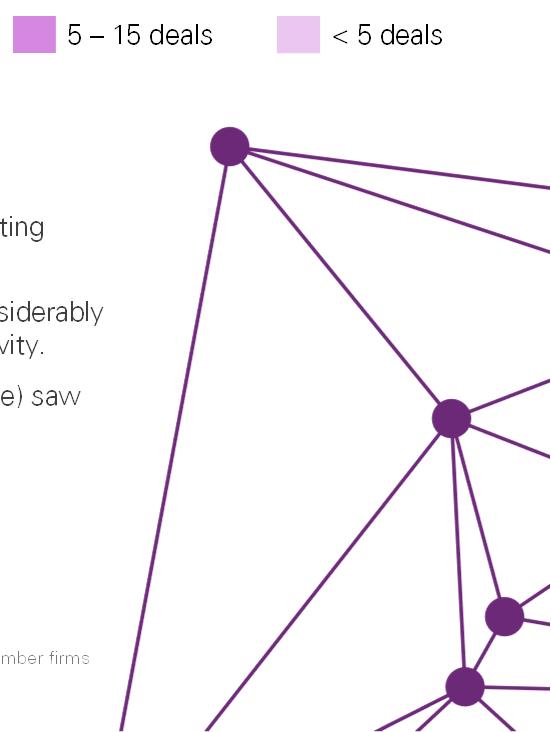
The most active sub-sector was IT Consulting and Other IT Services with a total of 15 deals, followed by Business/Productivity, Financial and Application Software, each with deals between 5 and 15.
A number of sale processes originally slated for the firsrt half of 2020 were put on hold as a result of the Covid-19 situation. Depending on the speed and shape of recovery, this could lead to an upswing in activity in the second half of the year. However, overall we expect the market to remain subdued in comparison to 2019.
After a promising start to the year, deal count decreased by 32% quarter-on-quarter (although in value terms there was an increase of 7%).
Business/Productivity Software and Financial Software were the most active sub-sectors, accounting for approximately 2/3rds of all fund raising deals in the quarter.
The sharp decline in funding transactions may reflect the fact that following the impact of Covid-19, many businesses had to transition from “growth” to “stabilize and survive” mode. At the same time investors focused time and resources on existing investments rather than pursuing new deals.

In February share prices across Europe experienced the sharpest drop since WW2. However, tech companies experienced a far better recovery than the overall stock market and are currently trading at around pre-crisis levels. This development highlights the fact that a number of tech companies may actually benefit from the Covid-19 crisis.
Volatility has dropped significantly following the initial Covid-19 outbreak but is still twice as high as pre-crisis levels showing the nervous and fragile state of capital markets around the globe.
The 9th edition of the KPMG Cloud Monitor sheds light on the adoption of cloud computing and its role in corporate IT infrastructure as an essential tool for digital transformation.
KPMG sector experts have recently released a number of tech-related publications covering topics including connectivity, digital transformation and AI. Further details and links are provided on page 12.
Despite the challenges of the Covid-19 situation, Deal Advisory teams across the KPMG global network continue to support both financial and strategic investors in the technology sector. A selection of recent transactions on which we have worked is provided on pages 15 & 16.
Deal volume started to decline from 4Q19, further exacerbated by the outbreak of the Covid-19 pandemic, particularly in March 2020. Deal count reduced to a level last seen in 4Q18.
remained by far the most active region in Q2 2020, accounting for 77% of total deals in the tech sector.
In addition to the decline in closed deals, a number of processes were put on hold in 1H20. Depending on the progress of the pandemic, this could indicate an upsurge in the latter half of the year as these assets return to market.
Q2 2020, Merger/Acquisition deal type was primarily driven by Business & Productivity Software and IT Consulting and Other IT Services, with 10 and 8 completed transactions respectively.
driven by the IT Consulting and Other IT Services sub-sector, Buyouts/LBOs increased to 14 deals in Q2 from 11 in Q1.
was just one German IPO in the first half of 2020 –Nuremburg-based data analytics business Exasol AG, which listed in Frankfurt in May 2020, raising c. €87 million to further drive its growth strategy.
in dental CAD/CAM
Align’s ortho-

The most active sub-sectors were Application Software, Business and Productivity Software, Financial Software and IT Consulting and Other IT Services, each generating between 5 and 15 deals in the quarter.
There were 15 deals within IT Consulting and Other Services, though this was considerably down on the prior year (2Q19: 22 deals), reflecting the overall decrease in deal activity.


sub-sectors (Communication Software and Multimedia and Design Software) saw no deal activity in the quarter.

the overall decline in activity in 2020, the number of deals in 1H20 was 32% lower compared with 1H19. In the second quarter there was a moderate increase in deal count from 11 to 15. This may reflect an increased focus for many businesses on digital transformation, a trend which is likely to accelerate going forward.
Q2 2020, demand for cloud-based services escalated among enterprises and individual customers, largely driven by adoption of collaborative tools such as virtual schooling, video conferencing, entertainment and gaming. Deals involving cloud-based IT service companies included the acquisition of Netrics AG by Tineo AG, Beck Et al GmbH and direkt gruppe GmbH by Waterland PE Investments.

Funding
Deal count and value per quarter(a)
Selected funding rounds
2020
Scandit
Contentful GmbHJun
Trade Republic Bank GmbH
In 1H20, funding activity declined significantly, with deal volumes down by 38% compared with 1H19. This may reflect the fact that with the arrival of Covid19, many businesses were forced to transition from “growth” to “survival” mode, while at the same time investors focused their time and resources on existing investments at the expense of new deals.
After a promising start in 1Q20, deal count decreased by 32% quarter-on-quarter, although in value terms there was an increase of 7% compared to the previous quarter.
Amongst the sub-sectors, Business/Productivity Software and Financial Software remained the most active, accounting for approximately 2/3rd of all deals
quarter.
Scandit, a Swiss-based company providing AR-based technology platforms, raised €74 million from a consortium of investors led by G2VP, to enhance its geographical presence in new markets.
Contentful, a German-based developer of a content management platform, raised €72 million from consortium led by Sapphire Ventures, to scale its operations to meet rising demand for digital content.
Trade Republic Bank, a Germany based mobile trading company, raised €62 million from a consortium led by Accel and Founders Fund to expand its geographical presence within Europe and develop a platform for mobile saving, investing, and trading.
Based on Pitchbook data, Swiss-based business angel network, Investiere was the most active investor, with the majority of its investments in Healthcare and B2B Software (mainly Business/Productivity and Communication
Again, according to Pitchbook, early-stage European VC firm, Speedinvest was the second most active investor, with investments in tech businesses developing mobile applications, financial and healthcare platforms at various growth stages in the DACH region.
Munich-based HV Holtzbrinck Ventures (with over €1 billion under management) was also active in Q2 2020. Investments focused on digital financial platforms and healthcare businesses.
Business/Productivity Software is the most active sub-sector. In the second quarter of 2020 it accounted for over 45% of deals by volume. Other notable subsectors include Financial Software (21%), Entertainment/Social Software (7%) and Application Software (7%).
Deal activity declined significantly q-o-q within several sub-sectors due to the impact of Covid-19. Business/Productivity Software and Entertainment/Social Software witnessed a decline of 41% and 55% respectively.
were no deals within the Communication Software and Multimedia and Design Software sub-sectors.







Impacted by the Covid-19 outbreak, deal volume in Business/Productivity Software declined by 24% in the first half of 2020 compared with 2019 (although deal value actually increased by 12%). The Covid-19 impact was more pronounced in Q2 leading to decreases of 41% and 56% in volume and value respectively.
Despite the slowdown in deal activity, Business/Productivity Software continued to be the main sub-sector for fund raising. In particular, early stage businesses with AI-based platforms that optimize business processes (Gridhound, Starmind, Datapred, Apic.ai, and Aedifion) were active on the fund raising front in Q2 2020.
Accel, Arena Holdings
Atomico, GV, Kreos Capital, NGP Capital, Salesforce Ventures, Swisscom Ventures
Accel, Lightspeed Venture Partners, Picus Capital, Northzone, Index Ventures

Lakestar, Accel, Holding14, HV Holtzbrinck Ventures, Scania Growth Capital, Project A
Atomico, Lakestar, Next47, 42CAP, Holtzbrinck Ventures, Toba Capital Scoutbee GmbHJan 2020
Disclosed deals only (47% of total deal
strengthen sales and marketing efforts in the
further enhance its AI-driven platform
accelerate growth in new markets of APAC
Latin America
enhance R&D to develop
using computer vision and AR
To facilitate expansion in European markets and further development of its cloud-based HRoperating system
expand presence across new markets and further enhance its mobile application-based fleet management system
To further expand R&D efforts, accelerate customer growth and explore strategic acquisitions
What the US has been historically more effective at is taking these great ideas that come out of the academic domain and building them into companies that employ people and succeed in the marketplace….hopefully, that’s going to change [in Germany]
Alexander Rinke
and co-CEO Celonis GmbH
“ “
1,5x
4,0x
6,5x
5,4x
4,3x
3,5x
4,6x
6,2x
4,6x
27,9x
21,9x
22,7x
18,5x
13,1x
13,4x
13,4x
11,1x
16,0x
11,1x
17,9x
13,3x
25,5x
19,8x
15,8x
14,8x
15,5x
14,8x
19,4x
16,1x
9,9x 15,7x
13,3x
Following a historic Covid-19 driven decline in multiples in February 2020, valuations recovered by June 2020 to pre-pandemic levels.
from home and the acceleration of digital transformation have increased demand for business and consumer technology solutions and services, in particular cloud services, communication and networking, financial platforms, online education, social and entertainment channels. These factors have contributed to an increase in valuations across all sub-sectors.
19Aug 19Sep 19Oct 19Nov 19Dec 19Jan 20Feb 20Mar 20Apr 20May 20Jun 20
STOXX Europe 600 (rebasd, lha)
Europe 600 Technology (rebased, lha)
(rha)
Following a long bull run which continued into January 2020, share prices fell across Europe in February, which witnessed the sharpest share price drop since WW2. Prices recovered in March following the announcement of aggressive monetary and fiscal responses.
Tech stocks generally rebounded both quicker and higher than the overall market and are now trading at levels near to those immediately prior to the outbreak of Covid-19. Among the best European performers so far this year have been Germany’s TeamViewer (TMV) , Sweden’s Sinch (SINCH), and Dutch fintech Adyen (ADYEN) -in total, 17 European tech firms outperformed the NASDAQ-100.
The collapse of Wirecard and arrest of CEO Markus Braun in June 2020 has prompted calls for an overhaul of the German financial regulatory system, and the aftershocks are still reverberating across the European fintech scene.
Volatility has dropped significantly post the initial Covid-19 outbreak, but it’s still twice as high as pre-crisis levels, showing the nervous and fragile state of capital markets across the globe.
As countries seek to find a safe way out of self-imposed lockdown restrictions (with varying degrees of success), it’s likely that economic uncertainty (and with it the risk of a prolonged recession) will persist for some time.
Whether prices can sustain the momentum created on the rebound will ultimately depend on how quickly Covid-19 can be brought under control.
For the ninth successive year, the KPMG Cloud Monitor describes the development of cloud use and experience of German cloud users in Germany. We summarize the consequences of these requirements for cloud users and companies interested in the cloud, as well as cloud providers. The publication also provides advice in selecting of a cloud provider, clarifies the difficulties in cloud integration and ultimately gives cloud users and cloud providers recommendations for a successful launch in the cloud.
Overview
Cloud computing is an essential part of the IT infrastructure of many German businesses. In most cases, cloud computing is now more than just a building block of the IT infrastructure: it’s also a key driver of digital transformation. Very few companies are still considering whether cloud computing should be used at all –the main question many are asking is “how can cloud solutions can be integrated into existing IT systems?”
Our results show that more than three quarters (76% compared with 73% in 2019) of German companies with 20 or more employees now rely on cloud computing. The proportion of companies not considering cloud computing is trending towards zero, implying further potential for growth in the cloud market. Nearly three out of five companies (58 percent) used a private cloud in 2019.
The growth of cloud computing is reflected in the results of cloud providers, with high revenue and margin growth seen in hyperscale cloud providers such as Amazon AWS, Google Cloud and Microsoft Azure.
Companies are increasingly using the cloud for mission-critical applications ranging from core infrastructure (computing and storage) to platform-as-a-service capabilities (machine learning, analytics, data lakes) and the application layer (office and collaboration, CRM, ERP).
For companies that already successfully use cloud computing, the focus is on further development of the existing cloud infrastructure. New cloud solutions must harmonize with existing cloud services, (i.e. be interoperable). At the same time, users face the challenge of merging existing IT solutions as part of a multi-cloud concept and preparing the cloud infrastructure for outages and high levels of utilization.
76%
…of German businesses with over 20 employees are in the cloud.
...rely on multi-cloudcomputing (87% for businesses with more than 2,000 employees).
…of cloud users recorded outages in the last 12 months. This level has remained relatively constant over the last three years.
Public cloud usage continues to increase (albeit moderately), and for the first time in the Cloud Monitor, the proportion of public cloud users is higher than that of non-public cloud users. The key to future growth will be the integration of public cloud solutions into existing IT infrastructure. It also goes without saying that integration must meet security and compliance requirements in order to ensure a trouble-free start in the public cloud.
Multi-cloud computing is the next stage in the development of cloud computing for private and public cloud users, in order to make IT resources and solutions available 24/7, regardless of outages or high loads. However, this step cannot be taken overnight, but must be well prepared and take into consideration complex cloud architectures.
Potential threats for cloud users are diverse and include outages due to technical problems, disruptions, security breaches and attacks by external parties. Added to this is the emergence of shadow IT (an issue which companies that don’t use cloud computing also have to deal with). For all these threats, companies need to have cloud-specific security concepts, in which threats are analyzed and appropriate security requirements and measures defined.
Cloud computing is an integral part of corporate IT in many companies and its adoption will certainly be accelerated by Covid-19. It should be viewed not just as IT infrastructure, but also an essential driver for digital transformation. In order to unlock the full potential of cloud computing, interoperability and the ability to integrate will become central factors of future cloud use.
The KPMG Cloud Monitor 2020 can be accessed here: Link
76%
…of users report problems with public cloud integration (an increase from last year’s 53%).
…of multi-cloud users, planners and commentators justify their multi-cloud strategy by a decrease in cloud outages.
…of cloud users have developed cloud security concepts. Last year just 57% had written security requirements or measures.






With more than 2,500 professionals in over 80 countries and with offices in major financial hubs including Frankfurt, Paris, London, Zurich, New York, San Francisco, Los Angeles, Toronto, Singapore, Hong Kong, Shanghai, Beijing, Tokyo and Sydney, KPMG’s Global M&A network contains more than 2,000 corporate finance experts with extensive industry reach and C-Suite access.

With over 2,700 deals closed since 2014 KPMG is one of the leading and most active international MidCap M&A advisors and consistently ranks top 3 by number of deals globally.
Truly global platform
sector
Tailored transaction processes


Leading global MidCap M&A advisor

London Zurich
Vancouver Frankfurt San Francisco & Silicon Valley
Chicago
Mexico City Bogota
Madrid Lisbon Paris Calgary Lagos
Lima
New York
Dallas Baltimore
São Paulo Santiago
Warsaw Buenos Aires
Los Angeles Beijing
Europe
Stockholm Tokyo
Moscow Johannesburg
Milan Seoul
Tel Aviv Riyadh
Mumbai Singapore
Taipei
Hong Kong
Perth
Toronto Montreal Auckland
Shanghai Dubai Sydney
Brisbane
Pacific
the Netherlands
financial advisory
of Mansystems (Barney Bidco B.V.)

in the United Kingdom provided divestiture advisory and acquisition or disposal structuring services to Solid Solutions Management Limited on the investment from LDC Managers Limited

Value
Deal Advisory in the Netherlands provided sell side advisory services to Dias Software on the sale of the business to a Consortium of Investors by UNIT4 Bedrijfssoftware
Value Not Disclosed January 2020
Transaction Services Group
New Zealand
acquisition of
advisory
Services Group
Minder
KPMG Corporate Finance Inc. in Canada provided divestiture advisory, tax related valuation, financial statement audit & tax services to the shareholders of ESC Automation on its sale to GDI Integrated Facility Services








US$56.5 Million January 2020
Sweden provided financial due diligence
to Sprints Capital Management Ltd
the acquisition of Swedish SaaS company Team Tailor
Disclosed
in Japan, along with assistance from professionals in KPMG Corporate Finance LLC in the United States provided buy side advisory services to TIS Inc. on the acquisition of Sequent Software Inc. from Chardon Holdings Limited and other shareholders
US$25 Million February 2020
KPMG Corporate Finance Inc. in Canada provided financial advisory, legal due diligence and tax disposal structuring services to Orbis Partners Inc. on its sale to Empower Community Care

Value Not Disclosed December 2019

KPMG Corporate Finance LLC in the United States provided divestiture advisory services on its investment from One Equity Partners, a leading middle market private equity firm
Value Not Disclosed
2019
Deal Advisory in Australia provided sell side advisory services to Christopher Ride on the sale of a significant majority stake in Interactive Pty Ltd
Value Not Disclosed October 2019
KPMG in Austria provided financial and tax due diligence services to Russmedia International Establishment GmbH on the acquisition of Jobiqo GmbH






Value Not Disclosed October 2019
in Sweden, along with assistance from professionals in Malta and in Bulgaria, provided financial, tax and pension due diligence services to NetEnt AB (publ) on the acquisition of online slot supplier Red Tiger Gaming Limited
US$274 Million August 2019
AG Wirtschaftsprüfungsgesellschaft,
of independent
in the United Kingdom advised Alcumus (portfolio business of inflexion) on the acquisition of E-Compliance

Not Disclosed
in South Korea provided financial due diligence services to Praxis Capital Partners on the acquisition of a stake in BusinessOn Communication Co., Ltd

US$84.5 Million
2019
in Sweden provided financial and tax due diligence service to AB Max Sievert on the minority shares acquisition in AB Scila, a FinTech company, with leading independent surveillance and risk technology services
Value Not Disclosed
2019
KPMG Australia provided sell side advisory, M&A tax restructuring and M&A legal services to the shareholders of NexonAsia Pacific Pty Limited on the majority sale of the business to EQT


















Value Not Disclosed July 2019
Germany provided sell-side assistance in the context of preparing a financial factbook
the start up
Technologies
an innovative German
company
in
Disclosed
in Australia acted as financial advisor to IRESS Limited on the acquisition of QuantHouse SAS


AU$62.62 million May 2019
in Denmark, along with the assistance from professionals in the US provided financial and tax due diligence assistance to Vizrt Group AS in connection with the acquisition of NewTek, Inc
Value Not Disclosed
Finland
sell side advisory services to Computer Program Unit Oy on the sale of Computer Program Unit (CPU) to Confirma Software backed by Abry Partners

Value Not Disclosed May 2019
in Denmark, with assistance from professionals in Switzerland, assisted the NNIT A/S with financial and tax due diligence, assistance to prepare completion accounts and pensions and retirement funds on the acquisition of business consultancy firm

Value Not Disclosed
Canada,
tax
assistance from
Deal values and deal counts used throughout the report are based on completed deal data provided by Thomson One and Pitchbook from 1 January 2018 to 30 June 2020, supplemented by additional independent research. Data available after publication date is incorporated in subsequent editions and thus may deviate from previous editions. Thomson and Pitchbook data have been merged to create a more comprehensive deal list. For M&A data, sub-sectors for Thomson deals have been changed to match the Pitchbook dataset for consistency purposes. VC funding data is derived solely from Pitchbook. Deal count data in this report includes all disclosed deals irrespective of values. Note that we have not included debt funding/financing.
Published deal count and deal values are based on analysis of target companies according to SIC codes for Thomson One and industry criteria search in Pitchbook:
Pitchbook:
IT Software
IT Services
Other Information Technology
Thomson One:
Computer Programming Services
Prepackaged Software Computer Integrated Systems Design Data Processing and Preparation Information Retrieval Services Computer Related Services, nec
Sources:
Thomson One (Thomson Reuters)
Pitchbook
S&P Capital IQ
Company press releases
Note:
(a) Responsible according to German Law (§7 (2) BerlinerPresseG): Christian Ramme
www.kpmg.de
Publisher
KPMG AG Wirtschaftsprüfungsgesellschaft Ganghoferstrasse 29 80339 Munich
Germany
Authors
Christian Ramme(a)
Partner, Deal Advisory –M&A
T +49 89 9282-3779 cramme@kpmg.com
Philip Grindley
Director, Deal Advisory –Transaction Services
T +49 69 9587-1921 philipgrindley@kpmg.com
Deal Advisory TMT, KPMG in Germany
Michael Buhl
Partner, Deal Advisory –Transaction Services
T +49 89 9282-1367 michaelbuhl@kpmg.com
Florian Frei Partner, Deal Advisory –M&A
T +49 69 9587-2834 ffrei@kpmg.com
Claus Buhmann Partner, Deal Advisory –Transaction Services T +49 89 9282-6732 cbuhmann@kpmg.com
Gunner Langer Partner, Deal Advisory –Valuations
T +49 69 9587-2830 glanger@kpmg.com
Jörg Preuss
Partner, Deal Advisory –Strategy
T +49 69 9282-1502 jpreuss@kpmg.com
Deal Advisory, KPMG in Switzerland and Austria
Timo Knak
Head of Deal Advisory and M&A Switzerland T +41 58 249 42 04 tknak@kpmg.com
Dr. Klaus Mittermair
Head of Deal Advisory Austria T +43 732 6938 2151 kmittermair@kpmg.at