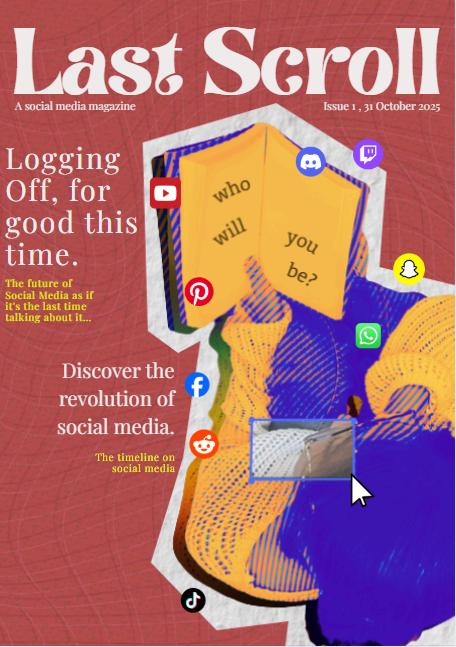
Logging
Off, for good this time. Logging Off, for good this time.

Logging
Off, for good this time. Logging Off, for good this time.





BY: KAHWEI
In the early 2000s, computers started to become popular. At first, people only used them for work, like typing documents or sending emails. But as technology got better, people began to see that computers could do more than just office work. Then a new idea appeared: “What if we could make a place online where people can make friends and talk?” From that idea, early social media was born.
From Yahoo Messenger and MSN to today’s Facebook and Instagram, social media has continuously evolved. It shifted from simple messaging tools to multifunctional platforms combining communication and entertainment. In our survey of 20 respondents, 95% recognized Yahoo, showing its lasting influence despite being outdated. During the Yahoo era, chatting online marked the beginning of digital interaction.
In 2002, Friendster became the first real social networking site. As Boyd and Ellison (2007) explain, platforms like Friendster and MySpace allowed users to create profiles and connect with others, forming the foundation of modern social media. Facebook later revolutionized global communication. According to Wilson, Gosling, and Graham (2012), Facebook enabled users to share personal information and daily life, transforming social interaction worldwide. Instagram, launched in 2010, popularized visual storytelling and inspired influencer culture. Later, TikTok and other short-video platforms shifted focus toward algorithmdriven content discovery (Kaye, Chen, & Zeng, 2022).


Looking forward, AI is reshaping social media. Giovanni et al. (2025) highlight how generative AI tools increase engagement but also raise misinformation risks. Most of our survey respondents believe reducing false content is essential. Thus, AI content labeling and moderation systems are crucial to ensure safer online spaces (Gillespie, 2020).



Written by Iva Teoh
Ever wondered of a future where social media would come to an end? That future may be just upon us now.
The rapid advancement of technology has caused our society to never stop moving, with the many new equipment and tools that we were given, people have been using social media less often than before, so many people have begun to think that this may be the start of the end for social media.
Social media has been part of everyone ’ s lives for many decades, so nobody would’ve expected this to happen. Before the newer technology was made, everyone heavily relied on social media to communicate with others across the world, some wouldn’t even last a day without opening the platforms. During its peak, many of us gathered to laugh at funny videos, partake in trends, and celebrate different events on these social media platforms, but it seems like it will soon be a thing of the past. Previously popular social media sites like Instagram and YouTube have slowly begun to lose its loyal fanbase and many people prefer to use the latest technologies.
Last seen ???
Memorable moments like the late 2000 early 2010s, where social media began fame around the globe as a form of communication, or during the Covid-19 lockdown, where people across the world were forbidden to leave their homes due to the pandemic, causing everyone to use social media way more frequently than before.



If social media were to continue down this path without making a comeback, this will truly be the end of a great era. Sometimes popular things fading into the past cannot be prevented, so if this really does happen, the only thing we can do is to treasure and remember the memories ’ ll had on the platform.
By: Aliah Rashid


Currently, 90% of teens use social media daily, and half of them display themselves online. If this were the last article you ever read about social media, would it make you reconsider who you are, what you show, and display online? Social media has



given people a platform to create, share opinions, but a mask to hide behind. We have started dictating what is truly the norm, what is right or wrong, and what is socially accepted. Some would say it’s easier to talk with freedom rather than in person; is that really the case?




We’re now living in an era where content creation has become our new reality. The newly built personas people began to create, especially those raised with a device in hand, are e approval. The approval tle things, like seeing the s on a post go up, which, a ’ s engagement starts to motional attachment. Our ity gets mixed under the ill this get views?” and “I wish I got more likes.” Hopefully, our future will be brighter, but we may be digging a deeper hole shaped by screens instead of mirrors.
Fortunately, mental health awareness is becoming more noticeable. Social media is linked to a variety of cognitive issues, including anxiety, depression, and low self-esteem. It’s a never-ending battle of constant comparison, the fear of missing out, that takes a toll on a person's mental health. When a user is constantly online, they’re so reliant on it that if they disconnect, they feel empty.



Suppose this is truly the last time to talk about the importance of identity on social media. In that case, people should keep spreading awareness on what social media could do to a person; it holds a lot of negative aspects, but when well-informed, it's a useful tool that could change the future.


By: Nataniel Dass
The final physical issue: a collector’s item, a relic, an epitaph in glossy print. It’s one for the history books, and as we turn that last page, the question isn't if things are changing, but what the hell is next?
Where does print journalism ,that tactile, beloved form go from here?
Let’s just discuss about the obvious elephant in the room
Will A.I. inevitably take over?

Perhaps it’s impossible to predict what’s next, but one thing remains certain we’ll miss the quiet magic of unwrapping a freshly printed issue. The excitement of spotting that long-awaited edition on the rack, the familiar scent of ink, the soft crackle of pages between our fingers as we search for “5 Tips for a Smaller Waist. ”
It’s almost a cosmic joke, isn't it? As a species, we ’ re laughably ill-equipped. We have no sharp claws, no super strength, not even decent speed. Yet, somehow, we claimed the top of the food chain. We took the king of the jungle, the lion, and caged it, tamed it, and hunted it to the brink. For millennia, God’s creations never came close to dethroning us.
But now, the script is flipped. Man’s creation Artificial Intelligence is not just challenging us, it’s overtaking us. The ink is drying on the final issue, but the algorithm is just warming up.
And here's the kicker, We built it to be our assistant, but it learned to be our replacement. That "5 Tips for a Smaller Waist" piece we loved flipping through? An AI can generate a thousand versions in the time it takes us to write a single headline. Suddenly, our witty columns and insightful reviews don't just feel nostalgic; they feel inefficient. The human element the flair, the struggle, the scent of ink is being rendered obsolete by the speed of a machine that never needs a coffee break.
We used our superior brainpower to dominate the physical world, to domesticate the wild. But we are now facing a creation that is fundamentally smarter than us, faster at learning, and utterly unburdened by human error or emotion. This isn't just about losing jobs; it's about losing the throne. For the first time, we face a competitor, a progeny that doesn't just adapt to our rules, but writes its own code for existence.
Our generation still remembers what it means to wrestle with a question, to wonder, to think.
The next gen might never need to, their thoughts prepackaged, their ideas pre-approved by A.I.
By: Aliah Rashid
To help better understand how deeply social media had affected people’s daily lives, the group that had written this magazine had surveyed 20 participants. Each person was asked to rate how much social media has impacted their lives from 1 to 5, with 5 meaning “ a lot” and 1 meaning “ very little.” The results were presented in a bar chart for visual interpretation.

Number of Participants (20)

How much social media had effected the participants
is that the majorit d of the scale. To b he impact as 5, and eans 85% of those who social media does play Only 2 people chose 3, selected 1. This suggests that social media affects everyone is some degree.
The distribution shows a trend that social media is highly influential in the daily lives of most individuals. The spread of responses at 4 and 5 shows that platforms like Instagram, TikTok, or Snapchat are used for communication, entertainment, and even self-image.
In conclusion, the chart shows data that social media shapes habits, relationships, and perceptions of how people view things. The results show that social media’s impact is not only widespread but is taken to heart.



Yan, L. (2024). Journalism in the Age of AI: The Future of a Longstanding Industry. [online] The Harriton Banner. Available at: https://hhsbanner.com/top-stories/2024/10/16/journalism-in-the-age-ofai-the-future-of-a-longstanding-industry/ [Accessed 26 Oct. 2025].
Gioia, T. (2024). The Death of the Magazine. [online] Honest-broker.com. Available at: https://www.honest-broker.com/p/the-death-of-themagazine?utm source= [Accessed 26 Oct. 2025].
Seitz, L. (2019). Average Time Spent Daily on Social Media (with 2019 Data). [online] BroadbandSearch.net. Available at: https://www.broadbandsearch.net/blog/average-daily-time-on-socialmedia.
Robinson, L. and Smith, M. (2025). Social Media and Mental Health: Social Media Addiction. [online] HelpGuide. Available at: https://www.helpguide.org/mental-health/wellbeing/social-media-andmental-health.
Boyd, D.M. and Ellison, N.B. (2007). Social Network Sites: Definition, History, and Scholarship. Journal of Computer-Mediated Communication, [online] 13(1), pp.210–230. doi:https://doi.org/10.1111/j.10836101.2007.00393.x.
Giovanni, M.A., Romero, D.M., Jurgens, D. and Aiello, L.M. (2025). The Impact of Generative AI on Social Media: An Experimental Study. [online] arXiv.org. Available at: https://arxiv.org/abs/2506.14295.)
Gillespie, T. (2020). Content moderation, AI, and the question of scale. Big Data & Society, 7(2). https://doi.org/10.1177/2053951720943234 (Original work published 2020)
By Iva Teoh
Our group was assigned with the task of creating a magazine with the topic revolving around the future. Our group decided to write about social media as all of us are familiar with the topic. Personally, I found this magazine very fun to make as I had to write in the perspective of being in the future. I had to ask myself questions like “Why would social media be used less?” in order to write the article. I’m sure my other groupmates would’ve had to ask similar questions too as we can only predict what would happen in the future. Hope you enjoyed reading our magazine that all of us work very hard on!






Made with Love
-By the members of SatuMalaysia