Grant Stanley | Manchester Residential Investment Market
Residential Investment Market 2023 | Page 2 of 15
Out of all the cities across the UK, there are few that have transformed to the extent Manchester has
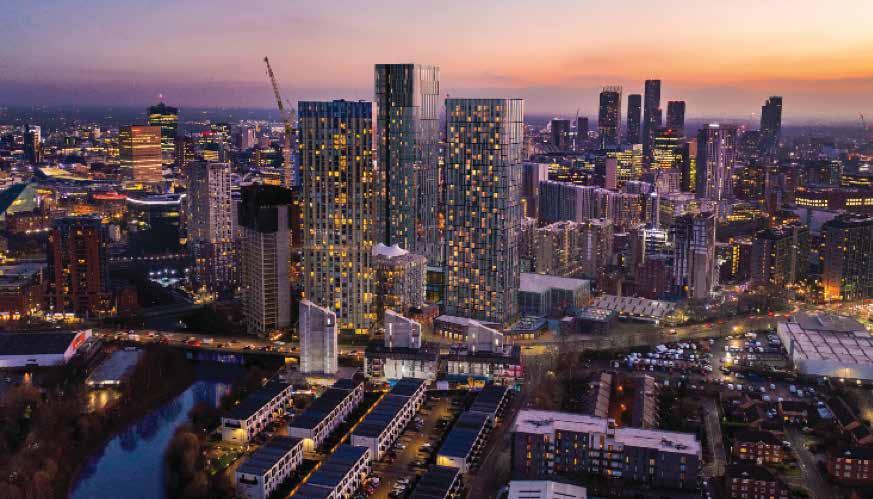
Manchester has become a thriving city packed with retail, leisure, cultural and residential o erings thanks to the signi cant level of regeneration that has happened here.
Additionally, the population has increased dramatically in recent years as more people have ocked to the city. According to the 2021 Census, the population of Manchester increased by 9.7%.
Property demand has signi cantly risen and Manchester has become a leading city of culture and liveability. The range of new developments continue to enhance its attractiveness to young people. At the same time, recent regeneration has also attracted major businesses and helped produce the second-largest regional economy in the UK.
The residential market activity over the last decade has predominantly focused on the delivery of high-density build-to-rent properties in the regional centre with a continued market supply through at least 10,000 homes under construction per annum since 2017.
Salford City centre has seen the largest share of development - 13,578 homes have been completed since 2014. 2,632 homes in Great Jackson Street and 2,760 homes in Ancoats, and New Islington have also been very active. 18,970 new homes, or 82% of the total supply since 2014, have completed between these three areas alone. While year-on-year completions reduced in 2022, the number of new starts in this area of the market show no signs of slowing down.
70,000
Private residential households forecast in Manchester by 2028.
Source: CBRE UK Multifamily - Top 20 towns and cities.
50,000
Approximate student population in Manchester, bolstering demand for residential property.
Source: CBRE UK Multifamily - Top 20 towns and cities.
1: Manchester Market Overview
2023 | Page 3 of 15
According to the 2021 Census data, Salford saw an even greater uplift than that of Manchester as a whole, with a population increase of 15.4%. Population growth across Manchester is signi cantly higher than the proportional increase for England (6.6%). Based on the current rates of construction and occupation of residential development, a further 20,000 people may relocate to the core Manchester postcodes over the next three years. Local housing targets also suggest this rate of growth will continue to 2035 with a diversifying stock.
The Deloitte Crane Survey shows that the buy-to-let market that started in the middle of the last decade has matured. Rental products are increasingly institutional investment-focused and professionalised, alongside a diversi ed and improved quality of product.
The overall estimated population density for Manchester is 4,805 people per km2, while nine of London’s Boroughs contain over 10,000 people per square kilometre, highlighting that there is signi cant room for further growth. Population growth continues because new residents are attracted by the area’s liveability - It ranked 28 on the Global Liveability Index for 2022, moving up the Index by 26 places in a single year and ranking higher than London.
Manchester was voted the 28th most liveable city in the world
Underpinning future demand for residential property in these areas is that during 2022, six o ces were delivered, while seven o ce schemes are currently under construction across Manchester and Salford.
The growth in Manchester’s popularity as a destination has been palpable during this current growth cycle and demonstrated by multiple tourism accolades. Over 1,504 hotel rooms have been delivered in 2022 alone and they continue to come forward across the broad spectrum of hotel market o erings. 33 hotels have been delivered since 2015 to highlight this, which equates to 5,948 new hotel rooms within the central Manchester area across boutique o ers, international brands and aparthotels.
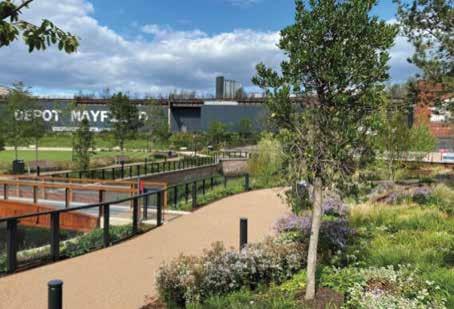
This popularity is driven by the excellent existing and future tourism credentials of the city through football, live music, cultural events, museums, galleries, and retail, including an ever-improving food and drink scene. Although this sector has experienced signi cant challenges due to COVID-19, it is also the bedrock of why the city region has been able to recover so quickly. This is coupled with signi cant improvements in the quality of the new and existing public spaces in the city, typi ed by the exemplary new May eld Park that opened in September 2022.
The June 2023, CBRE report advises that Manchester’s property markets are set for some of the most growth across the UK. CBRE examined the prospects of the 50 largest regional towns and cities, analysing a range of economic and demographic factors that support growth across the di erent types of property sectors.
With a thriving residential property market, Manchester came rst with the highest growth prospects over the next 10 years in student accommodation, multi-family housing and single-family housing sectors.
Manchester already has a large proportion of households (29%) in the private rented sector. This will be further boosted by its forecast for signi cant population growth (6%) across the next decade. And with the strong current and future fundamentals in the residential property market, there is already a large existing pipeline of new homes as a proportion of existing homes.
Manchester has been named the top city for future growth in the office property market space.
This was based on demand metrics like GDP, access to highly-skilled workers, working age population and the forecast for o ce-based employment. The Northern Powerhouse city has a diverse economy that provides a wide scope of employment prospects, which also has a profound impact on the residential property market.
Source: The Economist Global Liveability Index 2022
2022.
The Economist Global Liveability Index 2022
2:
Market Intelligence
Manchester is forecast to be the strongest market in the JLL Big Six in terms of price growth
The latest JLL Big Six Report found that Manchester has seen demand outstripping housing supply as students and young professionals return. Energy e cient new build city centre homes are popular with renters looking at ways to minimise their energy bills. This is expected to boost demand for new urban rental homes and underpin stronger rental growth.
The lack of homes to rent is an ongoing issue. There is strong demand for quality purpose built rental housing stock from institutional investors.
We expect that more prospective buyers, as well as those who would under normal circumstances have transacted under Help to Buy, are more likely to remain in the rental market in greater numbers in 2023. This adds further fuel to an already constrained rental market and is expected to perpetuate the supply demand imbalance.
14.7%
2020-2040 Employment growth forecast.
Source: Knight Frank UK Multihousing 2022/23
Source: JLL Big Six Residential Development Report
The performance of Manchester’s property prices over the last five years has been nothing short of exceptional
Property values in Manchester have seen some of the most signi cant increases since 2016. Data from the House Price Index suggests that prices have increased by 50.8% between 2016 and 2022 - around £74,000 - a run of form that doesn’t seem set to stop anytime soon.
Consistently high demand for Manchester property has meant the city has been JLL’s top performer in their Big 6 cities report for the last 3 years. Manchester was the rst of the Big Six cities to record double digit growth in prices post-pandemic, recording annual growth of 12.6% back in June 2021. Since then prices have continued to increase. Prices rose 4.9% in the year to December 2022. But consistently high demand for homes in Manchester means the city remains the strongest performer over the last three years, with prices up 21.8% since the end of 2019.
According to the latest December 2022 JLL Cities Index, prices for a new one bed at in the city averaged £213,000, with two beds at £300,000 and £367,500 for a 3 bed at. Manchester continues to see its prime market grow in size, with demand for high speci cation new developments pushing prices higher in 2023.
Buyers looking to purchase in the new developments are spending an average of £280,000 for a 1 bed, £382,000 for a 2 bed and £480,000 for a 3 bed prime apartment.
Manchester Residential Investment Market 2023 | Page 6 of 15
Manchester was the best performing rental market in the Big Six cities last year.
Manchester recorded 22% growth in achieved rents for new developments in the city centre in the year to December 2022. Average rents for a new 1 bed at in the city at the year end were £1,172pcm, £1,495pcm for a two bed at and £2,100pcm for a 3 bed. Quality new build prime stock reaching the market has helped push average prime rents up 25% in 2022. High speci cation 3 bed homes recorded the highest annual growth at 33%, followed by 2 beds at 22%. Driven by an increasingly young population and a growing acceptance of renting inde nitely, Manchester’s provision of amenities, atmosphere and career opportunities that were previously only found in the capital, is set to see continued growth over the next decade.
Manchester House Price Index
3: Resale Market for New Homes
The table below includes a selection of resale properties within some of Manchester's recently completed new build development and shows consistent growth in achieved values.
4: Growing Foreign Buyer Demand
Manchester now has significant numbers of owners based in UAE, Singapore and China
Data on overseas ownership is extremely di cult to come by (it is too politically sensitive to record and publish such data) and most gures are expressed as percentages of all property registered owned by overseas investors. This gure as of 2021 was around 11,500 properties within Manchester and Salford, representing a percentage of 2.9% and 4.8% respectively in foreign ownership. This doesn’t really tell the picture of the burgeoning development market in new high rise buildings that really kicked o in 2016/17 and in these developments overseas ownership is reported to be as high as 33-50%. The bulk of pipeline projects making up the 12,000 units over the next 3 years are high-rise schemes marketed to overseas investors for rental and to a more limited extent owner occupation. Overall, the rental market accounts for 50% of units across Manchester and in these schemes the proportion is far higher.
Despite the limited information on the nationalities of the purchasers of residential purchases, HM Land Registry data does o er some insight. Recent HM Land Registry data shows that 181,701 titles across England & Wales are now registered to individuals with an overseas correspondence address, representing nearly 0.7% of all registered titles. This number has approximately trebled since 2010, when such individuals owned around 0.26% of registered titles. This number is also almost double the number registered to overseas companies (94,712 titles), and has risen much faster than titles registered to overseas companies in recent years, suggesting that individual overseas purchasers are an increasingly important factor in the UK property market.
More than 80% of the titles are registered to individuals with addresses in just 20 countries, with the main groups being South-East Asia and the Middle East, and English-speaking countries.
The growth in titles registered to foreign individuals in Manchester has been notable, particularly since 2016, which is likely to re ect investment and second-home purchases of new build apartments. Manchester now has signi cant numbers of owners based in UAE, Singapore and China (where ownership outside London was virtually unknown in 2010).
This proliferation of foreign buyers is con rmed by the most active developers in Manchester. Renaker are currently seeing in excess of 40% overseas buyers, made up predominantly from Hong Kong, mainland China and Singapore, as well as India.
Image: The 6.5 Acre May eld Park; the rst new public park in Manchester city centre for more than a century
Countries with the most individual registered owners in 2021, trends 2010-2021
Source: The Centre For Public Data (Research Report June 2023)
5: Active Residential Developers and Pipeline
The majority of residential development is concentrated within five postcodes
Included below is a table of all of the key residential developments (larger than 150 apartments) that completed in the last year, currently under construction or in the development pipeline.
It highlights the most active developers in Manchester and also demonstrates that the majority of residential development is concentrated within 5 postcodes (M1, M3, M4, M5, M15).
11,759
New homes remain in the pipeline creating a steady supply for the next 3 years.
17
New residential developments are currently under construction, the highest since 2018.
Source: Deloitte Manchester Crane Survey 2023
Image: Colliers Yard development by Renaker
Renaker are currently the most active developer in Manchester and have 6 developments in the pipeline with a total of 2,825 apartments across the Castle eld and Central Salford areas. They are followed in size by Far Eastern Consortium with the largest development in Manchester by unit numbers, with 634 apartments being developed at Victoria Riverside, as well as a further 286 apartments at The Gate & The Style.
The central postcodes of M1-M5, M15 and M50 are the most desirable in terms of the quality of the current residential stock and the future development pipeline, excellent transport links and are seeing the most investment and regeneration.
This table summarises the average prices and rental yields for each of the selected postcodes. This is then followed by an overview of each of these areas.
Piccadilly City Centre Market Street
Source: Property Market Intel
The M1 postcode district covers the main part of Manchester’s prime city centre, including areas like Piccadilly, the Northern Quarter, Market Street and Oxford Road. The M1 postcode brings a full spectrum of neighbourhoods and o erings right in the heart of the city.
The Northern Quarter is a trendy area packed with vintage shops and independent cafes and bars. It features vibrant street art and some of Manchester’s liveliest music venues.
The Piccadilly neighbourhood is an area in particular to watch as the neighbourhood has been marked for extensive development and regeneration in the coming years and decades. Piccadilly Central is set to be transformed from the former underused industrial sites into a lively and vibrant mixed-use community hub with exceptional transport links and represents one of the biggest development opportunities in the UK. It has the potential to make a signi cant impact on both the growth of the city, and also the national economy. The area includes Piccadilly Station, Piccadilly Basin and Portugal Street East.
Following redevelopment, it is anticipated that the proposed new investment in the area could bring up to 40,000 new jobs, 13,000 new homes and 820,000m2 of new commercial development.
May eld Regeneration - The masterplan will include 155,000m2 of modern o ces and a thriving new residential neighbourhood that will overlook 13 acres of park and public space. Central to May eld will be its 6.5 acre park, the rst new public park in Manchester city centre for more than a century.
M2
Deansgate City Centre
As a central and well-connected area of Manchester, the M2 postcode district includes Deansgate and more of the prime city centre. Deansgate in particular has become a historic thoroughfare connecting so much of the city.
There’s also a lively nightlife scene and a range of restaurants, bars and shops. In terms of residential property, Deansgate is primarily home to apartments with many high rise buildings, combining luxury and contemporary living often with a range of lifestyle amenities.
M3
City Centre
Deansgate
Castle eld
Blackfriars
Greengate
Trinity
The M3 postcode district spans many areas in and around the city centre, such as Castle eld, other parts of Deansgate and Spinning elds. Much of the postcode is only a short walking distance to the heart of Manchester, and there is a wider array of properties on o er in these areas. Castle eld was previously an industrial neighbourhood that is now home to period-style homes and properties located alongside the Bridgewater Canal. It’s been transformed into a picturesque pocket of urban living with unique restaurants and bars and green spaces.
There is also a portion of the M3 postcode that covers Salford, including Blackfriars, Greengate and Trinity. There’s a wide array of properties here too as the area has seen signi cant redevelopment in recent years. It’s also a popular destination for business, shopping and entertainment. St Johns - 68% of the 700,000sqft of total o ce space brought to the market during 2022 is located within the St John’s area and is predominantly pre-let. It is one example of Manchester’s global competitiveness in the tech sector, with tenants such as global media giant WPP and Booking.com choosing to put down roots and base their headquarters in Manchester.
M4
Ancoats Northern Quarter Strangeways
The M4 postcode district covers Ancoats, other parts of Northern Quarter and Strangeways. Once an under-utilised part of the city, Ancoats has been transformed into a trendy neighbourhood that has really sprung up in recent years. There are interesting properties that were converted from warehouses and mills, in addition to contemporary new builds. Ancoats was recently dubbed by the Sunday Times Best Places to Live as the “benchmark for hip urban living”. And it was named one of the top 50 coolest neighbourhoods in the world by TimeOut.
Both Ancoats and New Islington, to the east of the city centre have seen signi cant residential, retail, leisure and commercial development. A key part of the redevelopment of the area has included the restoration of former mill buildings. A transformational development continues to be delivered within this postcode at NOMA, the Co-operative Group’s former estate located at the northern gateway to the city centre. The NOMA neighbourhood provides a mix of commercial and residential development alongside recreational and leisure amenities and new public areas. This builds on the area’s heritage and character as well as providing new, high quality buildings.
M5
Ordsall
Seedley
Weaste University
2023 | Page 15 of 15
This postcode covers Central Salford and covers the neighbourhoods to the west of the city centre, to the west of the River Irwell. Apart from the M1 postcode these areas are currently seeing a smaller proportion of new residential developments in the pipeline than the rest of the central postcodes.
M15
Hulme
Old Tra ord
This postcode district is south of Manchester’s city centre and covers Hulme, Old Tra ord and some areas of Castle eld. These parts of Manchester have also seen a lot of growth in recent years as the city has expanded south.
Formerly an industrial suburb, Hulme has been transformed in recent years to a thriving community. It features low-rise apartment buildings and townhouses, and with its open spaces and newly planted trees, it has even become a greener pocket of Manchester, despite its industrial past.
M50
Salford Quays
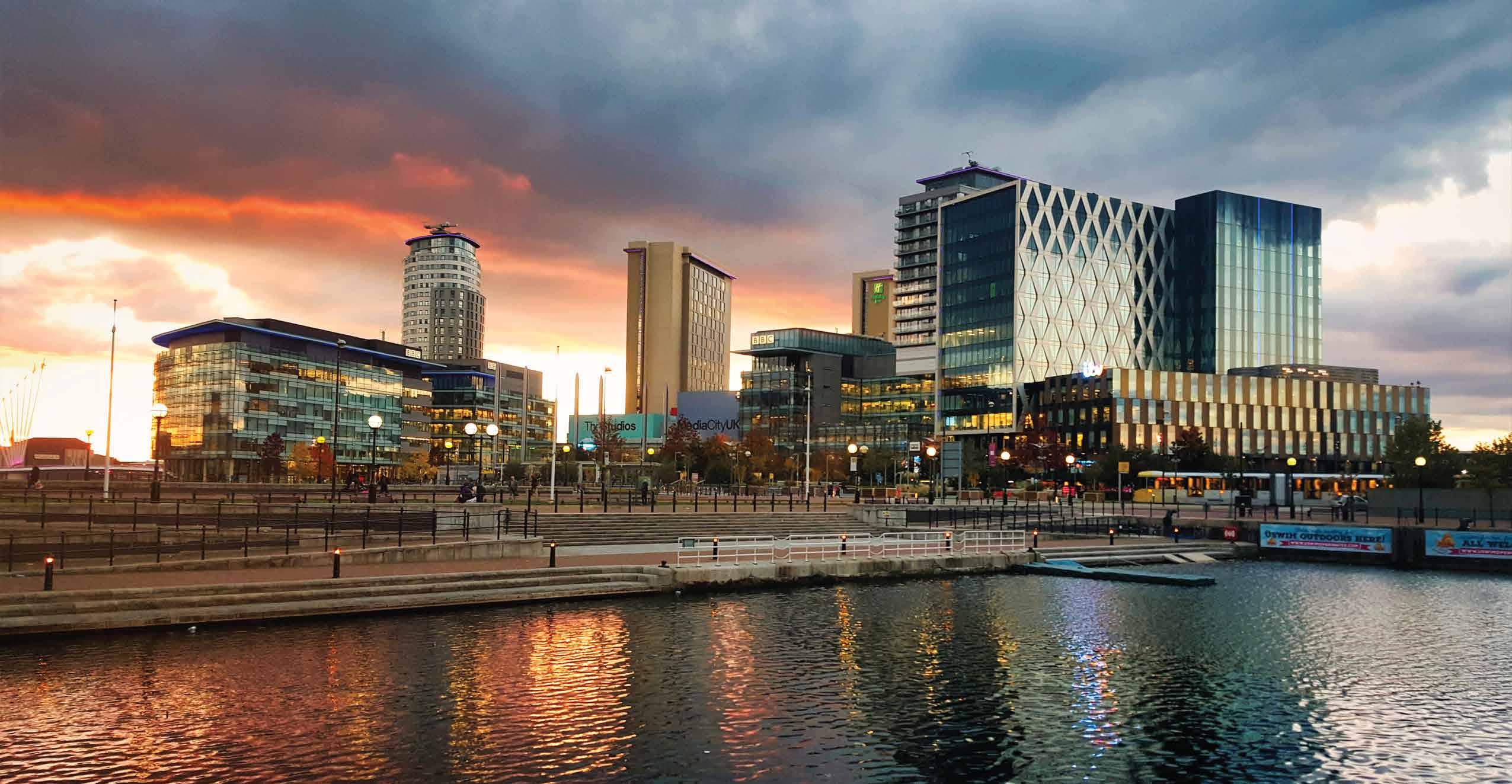
Salford Quays is now most famous for the BBC /Granada Media City complex, formed as part of the BBC relocation from central London. The largescale regeneration of this area kicked o in 2007 and largely completed over a decade ago. There is a limited pipeline of new developments in this area, but there are now numerous established new build developments located in this area and has become an area of choice for many young professionals, o ering lower prices compared with other central neighbourhoods. The area is home to The Lowry Outlet Mall, Lowry Theatre, Vue Cinema, parks, Salford Water Sports Centre, restaurants and bars.
Sources:
JLL Big Six Residential Development Report
The Economist Global Liveability Index 2022
Deloitte Manchester Crane Survey 2023
CBRE UK Multifamily – Top 20 towns and cities
CBRE Which City? Which Sector?
Knight Frank UK Multihousing 2022/23
The Centre For Public Data (Research Report June 2023)