98
THE REPRODUCTIVE SYSTEM
LESSON 14
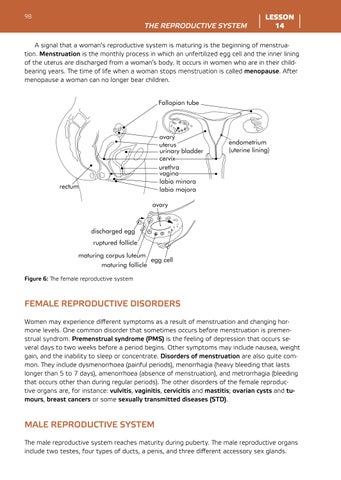
A signal that a woman‘s reproductive system is maturing is the beginning of menstruation. Menstruation is the monthly process in which an unfertilized egg cell and the inner lining of the uterus are discharged from a woman’s body. It occurs in women who are in their childbearing years. The time of life when a woman stops menstruation is called menopause. After menopause a woman can no longer bear children.
Figure 6: The female reproductive system
FEMALE REPRODUCTIVE DISORDERS Women may experience different symptoms as a result of menstruation and changing hormone levels. One common disorder that sometimes occurs before menstruation is premenstrual syndrom. Premenstrual syndrome (PMS) is the feeling of depression that occurs several days to two weeks before a period begins. Other symptoms may include nausea, weight gain, and the inability to sleep or concentrate. Disorders of menstruation are also quite common. They include dysmenorrhoea (painful periods), menorrhagia (heavy bleeding that lasts longer than 5 to 7 days), amenorrhoea (absence of menstruation), and metrorrhagia (bleeding that occurs other than during regular periods). The other disorders of the female reproductive organs are, for instance: vulvitis, vaginitis, cervicitis and mastitis; ovarian cysts and tumours, breast cancers or some sexually transmitted diseases (STD).
MALE REPRODUCTIVE SYSTEM The male reproductive system reaches maturity during puberty. The male reproductive organs include two testes, four types of ducts, a penis, and three different accessory sex glands.
Ukázka elektronické knihy, UID: KOS528531
LESSON 14
99
THE REPRODUCTIVE SYSTEM
The testes (testicles) are located in a double sac called the scrotum and have two functions: production of sperm (spermatogenesis) and production of testosterone, the male hormone. The ducts carry sperm and semen. They are of four types: the epididymis, the vas deferens, the ejaculatory duct, and the urethra. Once sperm cells are released, they travel along a tube called the vas deferens (ductus deferens). The vas deferens is the tube that connects the testes to the urethra. The urethra is the passageway for urine and sperm out of the body. It is enclosed in the penis. As the sperm move toward the urethra, they combine with fluids from other sex glands, forming semen. A thin white fluid that makes up most of the liquid in the semen is produced by the prostate gland. The prostate is located near the bladder, and is about the size of a walnut. The sperm eventually make their way through the vas deferens and into the urethra. The urethra never carries both urine and semen at the same time. The ejaculatory ducts pass through the prostate gland and eject sperm into the urethra just before ejaculation, the powerful propulsion of semen from the urethra to the exterior. They also transport and eject secretions of the seminal vesicles. The seminal vesicles belong among the accesory sex glands together with the prostate gland, and Cowper’s glands (bulbourethral glands).
Figure 7: The male reproductive system
MALE REPRODUCTIVE DISORDERS Disorders of the male reproductive organs have serious psychological and physical effects. Sexual function may be affected or the patient may worry about the possibility of impotence (inability to have an erection or to ejaculate, and so have sexual intercourse). There exist many congenital abnormalities that are relatively common and can be repaired surgically early in life, and also many painful inflammations of some organs. One of the serious disorders in elder men is an enlargement of the prostate and about 25% of these patients develop cancer of the prostate.
Ukázka elektronické knihy, UID: KOS528531
100
THE REPRODUCTIVE SYSTEM
LESSON 14
SEXUALLY TRANSMITTED DISEASES The general term sexually transmitted diseases (STD) is applied to any of the large group of diseases that can be spread by sexual contact. The group includes conditions traditionally specified as venereal diseases (VD), such as chlamydia, gonorrhoea, syphilis, and genital herpes. AIDS and hepatitis are sexually transmitted diseases that also may be contracted in other ways.
EXERCISES 1. Answer the questions. 1. What is sexual reproduction? 2. What types of reproductive organs do we distinguish? 3. List the female reproductive organs. 4. What is menstruation? 5. Describe female reproductive disorders. 6. What does the male reproductive system consist of? 7. Describe the function of various organs. 8. Describe male reproductive disorders.
2. Finish the sentences. 1. The specialized branch of medicine concerned with the diagnosis and treatment of the female reproductive system is ................... . 2. The female internal genitals include ................... , ................... , .................... , and ................... . 3. Ovulation is ........................................................................................... . 4. The neck of the uterus is called .............................................................................. . 5. The narrow tube that carries the egg cell is ............................................................ . 6. The testes are located in a double sac called ....................................................... . 7. The excretory ducts are ................... , ................... , ................... , and ................... . 8. The term STD means .............................................................................. .
3. Explain what is meant by the following terms: menorrhagia, amenorrhoea, gonorrhoea, cervicitis, mastitis, hysterectomy, impotence, infertility.
Ukázka elektronické knihy